ParkCitiesPeople
PrestonHollowPeople
2026
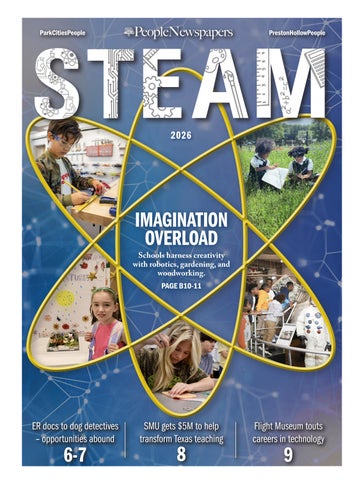
IMAGINATION OVERLOAD
Schools harness creativity with robotics, gardening, and woodworking. PAGE B10-11
ER docs to dog detectives – opportunities abound
6-7
SMU gets $5M to help transform Texas teaching
8
Flight Museum touts careers in technology
9
B2 STEAM 2026 | peoplenewspapers.com
STEAM LESSONS REACH BEYOND THE CLASSROOM
W
hen I was touring potential colleges many moons ago, one of my deciding factors had nothing to do with labs or libraries — it was whether any English classes were held outside. SomeCLAUDIA t h i n g CARSON-HABEEB a b o u t learning in the open air, under trees rather than fluorescent lights, always felt right to me. Years later, when my sons were in high school, my husband and I invited our friend Mariel Hemingway to speak to their English class. After she finished her presentation in the school’s theater, she asked everyone to head outdoors, slip off their shoes, and feel the earth beneath their feet. “Let’s do a little grounding,” she said. The students were thrilled to continue the Q&A in the sunshine. Mariel, who says her creativity peaks when she’s in the mountains, recounted how her grandfather spent many of his days outdoors in Cuba, where he was either on the ocean fishing or playing baseball with Cuban children who often called him “Papa.”
Mariel Hemingway. THE EPISCOPAL SCHOOL OF DALLAS
There’s something freeing and transformative about outdoor learning that connects body, mind, and environment. That spirit is alive and well in today’s STEM — and increasingly, STEAM — programs. As I gathered curriculum updates from area schools for this month’s STEAM issue, I was struck by the initiatives students can explore beyond four walls. At Greenhill, students are not
only cultivating a butterfly garden but also restoring native prairie grasses, understanding firsthand how ecosystems thrive. At Hockaday, students harvest honey from their on-campus beehive, blending biology, environmental science, and a sweet lesson in sustainability.
These projects are more than science experiments — they are lessons in stewardship, curiosity, and community. Students learn how innovation and nature coexist, how observation fuels creativity, and how small acts like planting native species or
“Let’s do a little grounding.” Mariel Hemingway
tending bees can have ripple effects on the planet. Interdisciplinary education has come a long way from the days of textbook equations and sterile labs. Today, it invites students to engage all their senses, to explore, to question, and to connect. And in this era of hybrid classrooms and digital learning, students are also getting to know each other across various platforms — sharing discoveries whether reading in the mountains, on a beach, or simply stretched out in the campus wildflower fields. Such moments are vital as they invite creativity and connection, lest we fall into what Richard Louv once described as “nature deficit disorder.” As Greenhill science teacher Gretchen Pollum put it, in spending time outdoors, “we not only learn about land and nature itself, but time in the gardens helps cultivate deeper understandings about ourselves and our connectivity to both the land and each other.” STEAM education has made big strides, and in doing so, has brought students closer to the world, and to one another. And perhaps best of all, it reminds them — just as Mariel did — to take a moment, step outside, and stay grounded.
your creativity
peoplenewspapers.com | STEAM 2026
SECURE YOUR CHILD’S SPOT TODAY! Choosing the right school for your child is important, and Dallas ISD has rigorous academics and more than 100 specialty programs to help you find the right fit for your child. Don’t let your child miss out on hands-on learning experiences and the chance to build their legacy.
Be part of something bigger! Apply NOW. Montessori • Early Learning • And more! •
Dual Language • Magnet Schools •
VIRTUAL JAN. 17, 2026 All grades
10 a.m. - 11:30 a.m.
Collegiate Academy • STEM/STEAM •
B3
B4 STEAM 2026 | peoplenewspapers.com
Armstrong Students Showcase Creativity in Invention Convention
By Sarah Hodges
sarah.hodges@peoplenewspapers.com
No one likes to spend a day at the beach with sand in their shorts. Spreading cold butter on toast can be a recipe for a crumby mess. And a Labubu should never be mistaken for a dog toy. Fortunately, Armstrong Elementary students have solved these problems. They’re among the many dilemmas students tackled during October’s Invention Convention. The Sand Ripper Swimsuit avoids an itchy day at the beach with a pull cord that scrunches up the suit’s fabric. Even cold butter is easy to spread when you put it in a glue stick. And both pets and pesky siblings are fooled by a locked Labubu safe disguised as a Squishmallow. The Invention Convention is an annual tradition at Armstrong Elementary. For the first time this year, all third graders were required to create a project, a change that enabled teachers to guide students and build on their creativity, explained the event’s co-chairs Lindsay Barnes and Jenna Fry. Students in other grades were also invited to invent whatever they wanted. Some young innovators created tools to improve their daily lives, while others took on issues of global significance, such as how to deliver clean water through a solar purifier. Not everything worked the first time, and that was part of the process. “Part of inventing is having it not work,” Barnes said. “I think that it’s important for everyone, especially when they’re young, to have the opportunity to think and try new things — and sometimes it works and sometimes it doesn’t — and to have the freedom to create, and to also solve real problems.” Fourth-grader Ellie Barnes used jar lids, popsicle sticks, and stretchy tube toys to add valuable inches to
CLOCKWISE FROM TOP LEFT: Eisa Khan and Casen James with their invention, a Lego Lift that can move items. Avery Lesikar with the Safe Skin Sanitizer she created with partner Callie Sargent. Davis Newberry and Rhett Rozzell with their Homework Guard. Ellie Chalmers holds her Toothpaste Buddy. SARAH HODGES
her height with expandable shoes. “We have these really high shelves in the pantry so I can’t reach them,” she explained. “But then if I put on my expandable shoes, I can reach the snack I want.” Ellie tested the shoes, and they worked. She wrote in the results section of her presentation that her invention should be on store shelves. Third-graders Davis Newberry and Rhett Rozzell used their coding skills to solve the age-
old problem of how to persuade reluctant students to do their homework. Their Homework Guard “watches” kids to make sure they stay in their seats during study time. If they get up, the device beeps to notify parents. The Guard will work for other kids, the inventors said, but may not be successful in their homes. “We know how to disable it,” Newberry explained. Third-graders Avery Lesikar
and Callie Sargent combined witch hazel, aloe vera, distilled water, and essential oils to create an alcohol and chemical free skin sanitizer. Lesikar said the pair plan to try to sell their creation. Every participant left the Invention Convention with a star headband and their own bright idea journal. Parent judges also gave three awards to each class of third graders for Bright Idea, Proficient Planning, and Creativity.
But the convention, which was sponsored by Medical City Children’s Hospital, was about learning and trying new things. Participating was itself a win. “They’re addressing problems that they have in their life,” Barnes said. “Some of it is bigger stuff, like how do you make sure that we don’t get plastic into the ocean for animals, and some of it’s how do I make my day-to-day life easier, better, safer, and cleaner.”
peoplenewspapers.com | STEAM 2026
HIGHLAND PARK S T E A M ELEMENTARY All our elementary schools are equipped with unique spaces where our youngest students participate in dynamic STEAM activities throughout the year.
INTERMEDIATE & MIDDLE Our 5th-8th grade students have a wide range of opportunities to pursue STEAM topics including Engineering, Coding, Robotics, and Digital Media.
MOODY ADVANCED PROFESSIONAL STUDIES Where can high school students have authentic learning experiences from outstanding teachers and industry experts? Right here in the MAPS Program at HPHS. Our classes include Business Design and Leadership, Environmental Architecture, Brain Science and Health, Engineering Design, Modern Media, and Sports Analytics.
ENTER TO LEARN. GO FORTH TO SERVE. For more information on about Highland Park STEAM, please visit our website.
www.hpisd.org/steam HP STEAM IS MADE POSSIBLE BY THE MOODY FOUNDATION AND MOODY INNOVATION INSTITUTE.
B5
B6 STEAM 2026 | peoplenewspapers.com
SCOTS DISCOVER STEM CAREERS DURING SCITECH FESTIVAL By Sarah Hodges
sarah.hodges@peoplenewspapers.com
Think of a circus. There’s more action than one spectator could possibly take in. But the talented members of this company are leaders in medicine, engineering, genetic therapy, and other STEM fields. Highland Park High School students experienced a day filled with hands-on learning and got an insider’s view of STEM careers during their school’s annual Science and Technology Festival on Nov. 17. About 50 presenters spoke with students during this year’s festival. Students could choose to attend a session that sparked their
interest during their regularly scheduled science and technology classes. The event was chaired by Abby Ruth and Molly Soper. Presenting sponsors were La Fiesta de las Seis Banderas, the Highland Park Education Foundation, and the Highland Park High School parent teacher association. It’s hard to choose just one presentation when options include talks on the history of robotic surgery, careers in video game development, and a day in the life of a hand surgeon. People Newspapers went back to school for the day and joined students for several classes of STEM-inspired learning.
ER docs in training Need stitches? Students at Highland Park High School have the skills to sew you up. Emergency medical physician Heather Owen gave a packed class of students a lesson in how to use simple interrupted sutures to help superficial injuries heal. The high schoolers practiced on “skin” — actually, small squares of silicon. Owen directed students in how to take “bites” by putting their needles through the pretend skin. Once students mastered the basics, she told them how to get style points by leaving equal spaces between the sutures, keeping consistent spacing on both sides of a wound, making sure their knots lay flat and were all on the same side, and not pulling so tight that they caused the skin to pucker.
“If you were to go home and you had three sutures really close to each other, and one up here and one up here, you’d be like, ‘Oh my. That doesn’t look very good,’” she told students. This is Owen’s second year teaching the hands-on skill. Last year, she had as much fun as the high schoolers did. “Exposure to the different aspects of medicine is really my greatest goal, to help them know what emergency medicine is,” Owen said. “But they can do anything that they want to. And something like this, that seems so challenging at first, they literally master in 30 minutes.”
Dog detectives Not all technology is shiny. It can be furry, with a wet nose and a waggy tail. Students met some superpowered service dogs during a presentation from Dogs in Vests and Novacek’s 84 Labradoodles. Amy Novacek told students that she has blood sugar issues and Addison’s Disease, a rare autoimmune disorder that causes her body to produce an insufficient amount of cortisol. She has a device designed to alert her when her blood sugar levels are low, but it can’t monitor her cortisol. Her dogs can, though. They’ve been trained to use their sense of smell to tell when Novacek’s cortisol and blood sugar levels are
out of range and even fetch her medicine. “Is there anything your dogs do, or do they just love you like crazy?” Novacek asked students. “That’s why most of us have dogs. The really cool thing about our dogs, though, is they help people do life.” Dogs in Vests owner Miriam Richard explained how she’s trained dogs in scent detection, a skill that has been key to protecting her son, who is unable to eat any starches. Even the amount found in a crouton crumb could be enough to send him to the hospital. One summer, the family had to take that trip 11 times. Richard said that thanks to the keen senses of his expert helpers, her son has been in the hospital just once in the last nine years.
peoplenewspapers.com | STEAM 2026
Animal advocates One of the yellow-billed stork chicks in the nest looked healthy, but the younger of the two was lethargic. Could he have an infection, Dallas zookeepers wondered, or had the tiny bird been struggling against a piece of straw over his head? He had actually tried, and failed, to swallow a giant fish. After zookeepers removed it and gave him some fluids, he made a full recovery. Ann Knutson, Dallas’ Zoological manager of birds, decoded this and other mysteries of animal behavior for students during her presentation, “Wild Works: The Science and Care Behind Every Animal.” Zookeeping has evolved in the 20 years she’s been in the profession, Knutson told students. It has become about much more than making sure animals have food and water. “Modern zookeeping is really a sci-
ence driven, welfare focused profession that blends animal care, behavior, conservation, communication, and collaboration to support thriving animals and sustainable populations,” she explained. Zookeepers rely on notes, data, and record keeping to find patterns in animal behavior, then problem-solve to determine how they can improve the welfare and enrich the lives of animals. Outside of the zoo, Knutson has helped birds thrive in the wild, including the critically endangered mangrove finch — the rarest bird in the Galapagos. “I love my job,” Knutson told students. “I think you can make a direct impact on conservation … by inspiring people to make a change in their life, even if it’s just caring about animals.”
Small, but still supersized They’re in each of the electronics that consumers rely on to make their lives easier, from smartphones and cars to the robotics in Amazon Prime distribution centers. But even though semiconductors are crucial to the functioning of modern devices, they’re tiny, and invisible to those who use them. Highland Park High School students got an inside look at the world of semiconductors, and a peek into one of the top companies that makes them, thanks to HP alum Sam Delagi, equipment branch manager of Texas Instruments’ (TI’s) Sherman facility. Delagi told students that they may be familiar with the name TI thanks to its best-in-class calculators. But the company’s famous classroom tools account for less than 1% of its revenue.
Art and AI
Students didn’t just listen to new media artist Taylor Cleveland talk. They experienced his story as it unfolded around them in Highland Park High School’s Digitarium at Pierce Planetarium during an artistic, immersive short film he made specifically for the SciTech Festival. Cleveland spoke directly to students during part of Reels to Real, then introduced case studies of the work he’s done at the cross section of marketing, art, and technology. Cleveland’s projects for viral marketing company TriplePlay Studios include the creepy use of actors to promote the movie Smile, and the mysterious campaign to advertise Marvel Studios’ Secret Invasion. Students had a chance to ask Cleveland questions after the presentation. But for Cleveland, the answers were often secondary to the act of questioning. He encouraged students to think critically, and to separate themselves from the trends they see in social media. “Who are you outside of all of those things
that are external to you, that are coming in from your device or your media, that ultimately are products of other people, and probably, more times than not, products of brands that are paying to get to you?” he asked students. AI, he said, isn’t a fad. It’s going to change
“TI is so big, but you won’t see it anywhere. It’s in everything around us,” he said. “It’s in TVs. It’s in projectors, and it’s just creating a better, more connected world.” Delagi took students inside TI’s plant in Richardson, where the company manufactures more than 100 million analog chips each day. Students examined one silicon wafer of chips that Delagi brought with him to the classroom. TI is continuing to grow, Delagi said. He’s part of a startup team building a new plant in Sherman to meet anticipated demand. The plant is a $30 billion investment for TI, and the largest economic development project in Texas history. “We are expanding our capacity very drastically,” Delagi said, “and are very proud to be doing it in Texas.”
the way that we think, see the world, and view ourselves. “It’s something that you should use. You should know how it works,” he said. “But it’s also something that you should question and push back on as well.”
Photos By: Sarah Hodges and Meg Boyd/Highland Park Education Foundation
B7
B8 STEAM 2026 | peoplenewspapers.com
Grants, Large and Small, Advance STEM Learning in North Texas Leaders in education and industry agree on this much: To better prepare students for the careers of the future, a solid foundation in science and engineering is vital in the United States. And with Texas educating more than 5.5 million public school students — more than 11% of the nation’s total — there’s a real chance to vastly improve STEM education nationwide. To that end in North Texas, grants of various sizes will help teachers improve science, technology, engineering, and mathematics lessons. SMU leads One of the bigger awards — a $5 million grant from the U.S. National Science Foundation — is fueling an SMU initiative to enhance how science and engineering are taught in Texas elementary and middle schools, the university announced in a press release. “By investing in teachers’ professional growth and leadership, we aim to both improve instruction and increase teacher retention, which is a critical need in Texas,” said the project’s lead, Jeanna Wieselmann, an assistant professor of STEM Education at SMU’s Simmons School of Education and Human Development. The 5-year grant will be used to recruit a select group of outstanding teachers into a Texas STEM Teacher Corps, provide them with professional learning and leadership opportunities, and connect them with other teachers across the state and country. “Through this project, about 100 teachers will directly participate, and we estimate more than 12,000 students will benefit
feeling unprepared to teach engineering, according to a 2018 study. In Texas, the challenge is compounded by high teacher attrition. In the past year, the Texas Education Agency reported that more than 12% of teachers left the profession, compared to roughly 8% nationwide. SMU is looking to turn that around by building strong teacher support.
TOP, FROM LEFT: SMU’s Janille Smith-Colin, Jeanna Wieselmann, and Anthony Petrosino are spearheading an initiative to improve science and engineering education in Texas. BOTTOM: Texas Instruments digital experience analytics manager Sarah Hantak, teacher Ward Coats, and JLD president Dr. Lindsay Davis at the Junior League of Dallas Headquarters. COURTESY RESEARCH EDUCATION AND GEORGE FIALA
from improved instruction during the 5-year project,” said Wieselmann. “That number will grow each year as these teachers continue in their careers and share what they’ve learned with colleagues.” Co-researchers Anthony Petrosino, professor in the Simmons School, and Janille Smith-Colin, an associate professor at
SMU’s Lyle School of Engineering, will assist Wieselmann. Three colleagues at Tarleton State University will also be helping with the educational programs, along with SMU graduate students. Less than 10% of U.S. elementary and middle school teachers have ever taken a college course in engineering, and most reported
TI and JLD Leaders in industry and the nonprofit sector are also supporting teachers. For example, the Junior League of Dallas ( JLD) through its Grants for Innovative Teaching program has awarded $2.27 million to Dallas ISD educators through the years — including $77,400 in the fall of 2025. Donors including Texas Instruments (Presenting Sponsor) and The Agnes Cluthe Oliver Foundation made possible the awards of $2,500 each for 33 Dallas ISD educators, JLD announced in a press release. The recipients included Ward Coates, whose Thomas Jefferson High School students are researching key protein complexes critical for pancreas formation. This interdisciplinary project combines biology, computer science, and engineering. “No other classroom factor influences student academic achievement more significantly than teachers,” said Andy Smith, TI director of giving and volunteering. “They not only act as mentors and advocates for their students but also equip them with skills for future achievements.” – Compiled by William Taylor
Cultivating Curious Minds for a Complex World
At Wesley Prep, STEAM learning empowers students to discover how the world works, imagine what it could become, and recognize their ability to contribute meaningfully to it. By nurturing curiosity, creativity, and character, we prepare learners not only for the future, but to shape the future. WESLEYPREP.ORG
│ 9200 INWOOD ROAD AT NW HWY
WESLEYPREPDALLAS
WESLEYPREP
Students Soar During Frontiers of Flight Museum Career Days
peoplenewspapers.com | STEAM 2026
B9
During the eighth anniversary version of the STEM Career Days program, students listened to lectures, made gliders, and checked out exhibits. COURTESY FRONTIERS OF FLIGHT MUSEUM
By Lisa Petty
Special Contributor Flying is a universal fascination. We conjure soaring, floating, and gliding in our earliest childhood dreams, and even the most world-weary grown-up will marvel as silver wings cut through misty clouds outside the window of a rising jet. This sense of wonder comes to life — and captures new generations — at Dallas’s Frontiers of Flight Museum. Since 1988, the Smithsonian Affiliate has amassed more than 35,000 pieces of aviation and space exploration history. Each year, the 100,000-square-foot campus at Love Field Airport hosts some 160,000 visitors from across Texas and around the world.
On any given day, you’ll find children and families marveling at an F-18 Blue Angel or sliding a hand across the battered exterior of a real-life Apollo mission capsule. And, for a few weeks each fall, there is even more to learn and explore. November 2025 marked the eighth anniversary of the STEM Career Days program, which brings a month of enhanced educational opportunities for North Texas students focusing on science, technology, engineering, and math. Rosalie Wade, the museum’s director of education, has seen the program through from the start. “We originally launched with a one-day event, and it was just a field trip,” she said, describing a day that included exhibitor tables and a STEM activity prepped for the students.
“Ultimately, we realized that if we opened it up throughout November and created a whole month of STEM career days, it would allow us to host more speakers from different career paths and serve more students, too,” Wade said. More students, indeed. In fact, the most recent STEM Career Days hosted approximately 2,000 sixth through 12th grade students, more than four times the number served in year one. Each day of the month brought an array of interactive challenges, tours, and career talks, thanks in large part to Amazon Prime Air, a first-time sponsor in 2025. “They want to educate people about aerospace, how drones work, and how it will affect the community,” said Wade of the new partnership timed in advance of the debut of Amazon drone delivery in North Texas.
Additional presenters included representatives from H-E-B, Dallas College, and European aerospace giant, Airbus, each focused on a different part of the ever-expanding world of STEM careers. For example, on a sunny morning before Thanksgiving, students were challenged to create their own gliders as a beginning lesson in aeronautics. Later that day, a speaker in the museum’s auditorium took students on a deep dive — or, flight, that is — into the subject of helicopters. No matter the specifics, it all served to spark the spirit of exploration through education. “As the students create these things and they get to experiment, it’s fun to see the lights in their eyes,” Wade said. “That’s my favorite part.”
B10 STEAM 2026 | peoplenewspapers.com
HANDS DIRTY, MINDS GROWING IN AREA STEAM PROGRAMS
From harvesting honey to drafting woodworking plans, the STEAM curriculum at Preston Hollow schools is buzzing with innovation. Blending hands-on learning with core academics, dynamic programs have grown into ways for science, technology, engineering, arts, and math to intersect in unexpected ways. Students aren’t just reading about ecosystems — they’re tending school beehives. They aren’t only studying geometry — they’re applying it to design and building real, tangible items. Teachers are demonstrating how this expanded approach encourages curiosity, confidence, and problem-solving, giving students a chance to see how classroom concepts come alive in the world around them. In this special STEAM edition, we take a closer look at the projects shaping young minds, the educators guiding them, and the community partnerships helping these programs thrive. Together, they’re redefining what learning can look like — and proving that creativity and innovation grow best when students are allowed to build, explore, and get their hands a little sticky.
Ursuline Academy‘s all-girls team breaks barriers in robotics At Ursuline Academy of Dallas, students are taking charge of technology in the robotics lab and the physics classroom. From an all-girls robotics team competing in a male-dominated field, to a hybrid AP Physics C course designed to keep top STEM students challenged, young women are redefining what innovation looks like in education. After the official “game reveal” in the fall, Team Robovinia began designing, building, and coding their robot. The model featured an advanced drive train, a specialized intake system, and an evolving webcam-based navigation system that used AprilTags for autonomous movement. On Nov. 22, in the FIRST Tech Challenge, Robovinia debuted a fully student-built robot designed to launch and retrieve game pieces.
Out of 34 teams in their league, only two others were all-girl teams — a powerful reminder that the future of engineering isn’t limited by gender. Ursuline students also collaborated with Jesuit Dallas for coding mentorship and lab support, diving into Java programming and other technical skills that pushed forward their engineering knowledge. With their sights set on the 2026 regionals and nationals, the 10 core members met after school and on weekends to perfect their mission. Ursuline’s commitment to empower young women in STEM was also sparked when the school’s AP Physics C teacher left last summer. Rather than canceling the class, Ursuline launched a one-year, hybrid version of the course, led by Barbara Watson, one of the region’s most respected AP Physics instructors. Students completed asynchronous lessons during the school day, gathered each
URSULINE ACADEMY
PARISH EPISCOPAL SCH OOL
Tuesday evening for in-person instruction, and came together once a month for immersive lab sessions while building projects that included homopolar motors to make abstract physics concepts come alive.
Parish Episcopal drives innovation across STEM and the arts
Parish Episcopal School expanded its hands-on, interdisciplinary learning to connect STEM with the arts and real-world problem-solving. This fall, students engaged directly with design, sustainability, and innovation across all grade levels. Parish’s STEM, Arts, and Center for College & Life Planning departments partnered with the Communications team to host students from the Savannah College of Art and Design (SCAD). Members of the SCAD team showcased their award-winning electric vehicle concept car and discussed their design process with
Lower, Middle, and Upper School students. Parish’s NASA Human Exploration Rover Challenge (HERC) team joined the event for a friendly test run between its Rover and the SCAD car, exchanging insights on engineering and creativity. At the Hillcrest campus, the first phase of the Nauslar Family Garden renovation was completed this fall, featuring 16 raised VegoGarden beds with in-bed worm composters, a new garden shed, and an outdoor wash station. The expanded space supports outdoor, cross-curricular learning opportunities where younger students will enjoy their first vegetable harvest later this season. The trimester concluded with the November Parish STEM Showcase, where families celebrated student work from the fall. Highlights included a CO₂ dragster race sponsored by the sySTEMs booster club, along with exhibits such as 3D-printed designs, Makey Makey projects, circuits, and new Rover prototypes.
Merit-Based Scholarships Available for 3rd, 4th, and 5th Grade Applicants ELIGIBILITY CRITERIA: • Must be a NEW student applying to 3rd, 4th, or 5th grade • Maintain a strong academic standing at current school • Exhibit leadership in school and community activities • Demonstrate positive behavior in previous school setting • Embody Compass’ five core values of Leadership, Purpose, Resilience Community, and Family Tuition assistance is available to all applicants Pre-K through 5th grade. Visit compassschooltx.org/admissions or scan the QR Code to learn more and submit your application. 5414 W. Northwest Highway Dallas, Texas 75220 | Questions? Email info@compassschooltx.org
peoplenewspapers.com | STEAM 2026
B11
OOL THE LAMPLIGHTER SCH
THE HOCKADAY SCHOOL
GREENHILL SCHOOL
The Lamplighter School’s woodworking program crafts real skills
At Lamplighter, woodworking is more than a class — it’s a hallmark of hands-on learning and creative exploration. Reflecting the school’s mission to nurture curiosity through engaging, collaborative experiences, Lamplighter’s woodworking program invites students to imagine, design, and build with both traditional and modern tools. Beginning in pre-K, children are introduced to the basics of design and construction using storybooks, 3D-printed manipulatives, and simple tools. As students progress through the Lower School, their skills and confidence grow alongside the complexity of their projects. By third and fourth grade, young makers are drafting plans, keeping design journals, and mastering tools ranging from hand saws and kid-safe chomp saws to laser cutters and 3D printers. Through every stage, students experience
the joy of turning ideas into tangible creations — learning persistence, precision, and the power of imagination along the way.
Greenhill School’s environmental impact reaches far and wide
Greenhill’s comprehensive environmental science education initiative focuses on the best practices for environmental stewardship, incorporating the local Blackland Prairie ecosystem and vegetable gardening with hands-on learning. The program aims to serve as a model for other schools nationwide and worldwide, providing professional development training in ecosystem restoration. Greenhill received a $100,000 matching grant from the Edward E. Ford Foundation to establish an environmental science education program, including the construction of a greenhouse, Blackland Prairie ecosystem installation, and outdoor learning spaces for pre-K-12th grade.
The school is raising $100,000 to receive matching funds from the foundation.
360-degree learning guides Hockaday’s exploration
Hockaday’s First Grade Field Studies, an interdisciplinary class that combines art, science, writing, and math, enables students to spend most of their class period outside, observing nature and recording their findings in journals. The class reimagines what it means to engage young learners through hands-on, interdisciplinary exploration. “I want this class to stimulate the whole learner,” said instructor Emily Dutcher. “I believe in 360-degree learning — learning that synthesizes everything else our girls are doing in their other classrooms. Nature provides an engaging, hands-on backdrop for them to begin making meaningful connections between their learning and the real world.” The class explores projects such as turning food waste into natural dyes for weaving
projects, partnering with the Upper School’s AP Science to map the Blackland Prairie area on campus, and harvesting honey from Hockaday’s campus beehive. While students make a catalog of native prairie trees on campus, using math concepts to organize and compare them, they learn about botanist and photographer Anna Atkins and her cyanotype process to document their findings. Working with Dr. Sarah Kucker and researchers from SMU’s Kids in Development Lab from SMU’s Dedman College of Humanities and Sciences, Dutcher is seeking to better understand how the non-traditional approach to learning supports Lower School outcomes, including wonder, collaboration, resilience, and agency. “I believe that giving students access to this type of learning will make them better thinkers and learners overall,” she said. – Compiled by Claudia Carson-Habeeb
B12 STEAM 2026 | peoplenewspapers.com