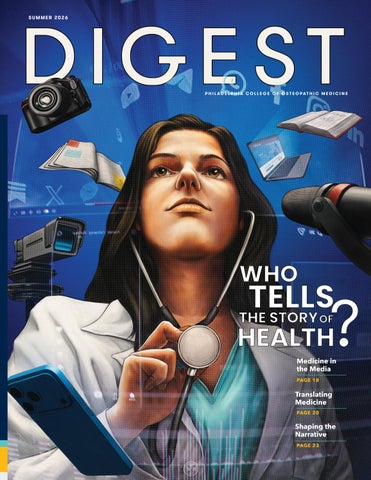
SUMMER 2026
P H I L A D E L P H I A C O L L E G E O F O S T E O PAT H I C M E D I C I N E
Medicine in the Media PAGE 18
Translating Medicine PAGE 20
Shaping the Narrative PAGE 23
2
PHI L A D EL PH I A COL L E G E O F O ST E O PAT HI C M E DI C I N E
DIGEST SUMMER 2026
FE AT UR E S
18
Medicine in the Media: The Power of Being Heard
20
Translating Medicine: From Expertise to Understanding
Compassionate care can leave an imprint that reaches far beyond the exam room.
Some of medicine’s most important work begins with helping people understand it.
23
Shaping the Narrative: Media, Influence and Public Trust
26
Emerging Voices: Social Media and the New Health Narratives
Today’s trusted healthcare voices are meeting audiences where they are: in studios, podcasts and across the digital landscape.
A new generation is reshaping how medicine is shared—one social media post at a time.
SE CT I O N S 5
News
14 United & Ignited
10 Field Notes
29 Shoutouts
11
Office Hours and Second Opinion
30 Class Notes
12
Pulse Check
13
In Their Words
35 Quick Takes
Benjamin Franklin recently visited PCOM. Not that Benjamin Franklin—– although in Philadelphia, you
never entirely rule it out—– but a historical interpreter bringing one of Pennsylvania’s most recognizable figures into the present as the nation marks America’s 250th anniversary year.
DIGEST
3
DIGEST VOL. 87, NO. 2, USPS, 413-060 Digest Magazine is produced by the Office of Marketing and Communications under the direction of Wendy W. Romano, chief marketing and communications officer. EDITOR Jennifer Schaffer Leone, MA PUBLICATION DESIGN Abigail Harmon
Dear Alumni and Friends, At PCOM, we prepare healthcare professionals for a medical landscape shaped not only by scientific advancement, but also by communication and public understanding. This responsibility extends beyond clinical decision-making to the broader work of strengthening trust in medicine and safeguarding the integrity of health information. Through “PCOM Perspectives” [available on Apple Podcasts, Spotify and SoundCloud], I have the opportunity to engage directly in these issues. As host of the podcast, I speak with faculty, researchers and national healthcare leaders about the forces shaping modern medicine, including recent conversations with former two-time U.S. Surgeon General Dr. Vivek Murthy and vaccine expert Dr. Paul Offit. These exchanges are not separate from medical education; they are an extension of it. They reflect a shared responsibility to bring evidence, experience and dialogue into the public spaces where understanding is formed. This issue of Digest Magazine highlights stories from across the PCOM community—alumni, faculty, staff and students—exploring how medicine is communicated, interpreted and understood in an increasingly complex media environment.
Jay S. Feldstein, DO ’81 President and Chief Executive Officer
CONTRIBUTORS Gabrielle DePietro Janice Fisher Kristen Hopf Brandon Lausch Jennifer Schaffer Leone Alexis Martina Meghan McCall Joy Williford ILLUSTRATOR Diego Abreu PHOTOGRAPHY Bruce Fairfield William Griffith Melissa Kelly Michelle Lynn Anthony Stalcup QUESTIONS OR COMMENTS pcomcommunications@pcom.edu CLASS NOTES OR ADDRESS CHANGES alumni@pcom.edu Periodical postage is paid at Upper Darby, PA, and at additional mailing offices. Opinions expressed are not necessarily shared by the College or the editor.
© 2026 Philadelphia College of Osteopathic Medicine. All rights reserved.
4
PHI L A D EL PH I A COL L E G E O F O ST E O PAT HI C M E DI C I N E
N E WS
A STRONG MATCH FOR THE CLASS OF 2026 As osteopathic medical students across the country celebrated a fourth consecutive year of record residency placement success, PCOM’s Class of 2026 marked Match Day with outstanding outcomes of its own. Nationally, osteopathic medical students and graduates achieved record-breaking success in the 2026 National Resident Matching Program Match. According to the American Association of Colleges of Osteopathic Medicine, 9,019 DOs matched, resulting in a 98.7% match rate. PCOM graduates reflected that national momentum with exceptional placement results. DO students at both PCOM Georgia and PCOM South Georgia achieved a 100% postgraduate placement rate, while PCOM recorded a 99% placement rate overall. Placements include residency, research and clinical fellowship positions. More than half (52%) of PCOM’s DO graduates entered primary care specialties, including family medicine, internal medicine, obstetrics and gynecology and pediatrics. Many graduates will also continue their training close to home. In Georgia, 33% of PCOM Georgia DO graduates and 35% of PCOM South Georgia DO graduates matched into graduate medical education programs within the state. Members
ECONOMY
$292.6 million
generated in ecomomic impact EMPLOYMENT
2,106 jobs
supported and sustained TAXES
$14.1 million
generated in state and local taxes
As students discovered the residency programs
of the Class of 2026 secured positions across a wide range of specialties, including urology, ophthalmology, orthopedic surgery, psychiatry, and physical medicine and rehabilitation. Students in PCOM’s School of Psychology also celebrated exceptional results, with 100% of School Psychology students participating in the match securing placements in the first round. Graduates
where they will continue their training, Match Day celebrations reflected the pride and excitement
surrounding their next steps as future physicians.
of PCOM’s Doctor of Pharmacy and Doctor of Physical Therapy programs likewise earned internship and residency placements, continuing their clinical training at healthcare institutions across the country.
PCOM’S GROWING IMPACT IN GEORGIA
A recently commissioned economic impact report shows that PCOM contributed approximately $292.6 million in direct economic impact in Georgia in 2025. Boosting business activity, job creation and state and local tax revenues across the state, PCOM Georgia and PCOM South Georgia are driving forces in medical education in the state, supporting over 2,100 jobs and generating over $14 million in tax revenue statewide. The report also underscores PCOM’s role in developing the state’s future healthcare workforce. More than 60% of osteopathic medical students enrolled at PCOM Georgia and PCOM South Georgia are Georgia residents, and more than half of the College’s graduates pursue primary care specialties, including family medicine, internal medicine and pediatrics. DIGEST
5
N E WS
PARTNERS IN COMMUNITY HEALTH Partnerships are opening new doors for PCOM students while helping the College meet the needs of the communities it serves. This year, PCOM partnered with ChristianaCare and Bayhealth to establish the Delaware Collaborative Clinical Campus. Launched in July 2026, the program allows third-year medical students to complete clinical training in Kent and Sussex counties while helping address physician shortages in central and southern Delaware. The inaugural cohort includes five Delaware Institute of Medical Education and Research (DIMER) students. “This clinical campus represents an innovative model that we hope all Delaware hospitals will embrace, ensuring that our students experience the full breadth of educational and professional opportunities available across the state,” said Michael A. Becker, DO ’87, senior associate dean of clinical education at PCOM. In Philadelphia, a new partnership with the Cobbs Creek Foundation is introducing young people to careers in healthcare through the Smilow Woodland TGR Learning Lab. PCOM sponsors the learning lab’s kitchen and café—the PCOM Café— and supports programming that blends nutrition education with career exploration. Through Greens to Goals, PCOM faculty, staff and students lead interactive workshops that encourage healthy lifestyles. The programming also includes handson activities, mentorship and conversations with
PCOM’s partnership with the
Cobbs Creek Foundation introduces
young people to careers in healthcare
through hands-on learning, mentorship
and community programming. At the Smilow Woodland
TGR Learning Lab, PCOM students help
young people explore careers in medicine
while promoting healthy lifestyles.
healthcare professionals designed to introduce participants to a range of careers in medicine and the health sciences. “Through this partnership, we’re helping young people see themselves with a future in healthcare,” said Jay S. Feldstein, DO ‘81, president and CEO of PCOM. “By offering real-world insights and mentorship, PCOM students are giving back to the community while inspiring the next generation of compassionate and skilled healthcare professionals.”
A CHAMPION FOR HEALTHCARE AND COMMUNITY
PCOM President and CEO Jay S. Feldstein, DO ’81, has been named a 2026 Community Champion by the Philadelphia Business Journal, recognizing his leadership within the region’s healthcare ecosystem. Recognized among inaugural Health Care Leadership Awards honorees, Dr. Feldstein continues to exemplify innovation, collaboration and commitment to patient care.
6
PHI L A D EL PH I A COL L E G E O F O ST E O PAT HI C M E DI C I N E
N E WS
A GIFT BEYOND MEASURE When Hannah Callahan learned that healthy people could donate a kidney while living, she couldn’t stop thinking about it. The project manager in PCOM’s School of Professional and Applied Psychology recently donated one of her kidneys to a stranger through the Penn Transplant Institute’s Center for Living Donation. Ms. Callahan, who supports multiple clinical studies at PCOM, began researching living kidney donation after learning about paired exchange programs. After months of medical evaluations and screening, she was matched with a recipient through the National Kidney Registry.
She hopes her experience encourages others to consider how even a single act of generosity can make a lasting difference. “If one person reads this and thinks, ‘Wow—someone did something good for a stranger,’ maybe it will encourage them to do one good thing,” she said. Hannah Callahan donated
a kidney to a stranger through the Penn
Transplant Institute’s living
donation program.
“A couple of days of testing, a surgery and a short recovery feels like nothing when you think about someone who might no longer need dialysis for hours every day,” Ms. Callahan said.
MEETING STUDENT ATHLETES WHERE THEY ARE This spring, PCOM South Georgia launched its Athletes in Medicine program, introducing local student athletes to healthcare careers through hands-on workshops in injury prevention, nutrition and wellness. Led by Jennifer Jenkins, EdD, director of Campus and Community Partnerships at PCOM South Georgia, the initiative brings together 80 high school football players from Thomasville, Georgia, every other Thursday with PCOM students and faculty. The program combines practical health education with career exposure, connecting athletics to fields such as sports medicine, physical therapy and osteopathic medicine. Students receive tools like resistance bands and foam rollers, while PCOM medical students gain experience working directly within the community.
This summer, PCOM students will also conduct hydration research with participating athletes to help develop individualized recommendations during South Georgia’s extreme heat.
Student athletes gather for a PCOM Athletes in Medicine session exploring injury prevention, stretching and overall wellness.
“We’re meeting them where they are— then showing them where they could go,” Dr. Jenkins said.
DIGEST
7
N E WS
HEALTHCARE LEADERS OF TODAY WELCOME PCOM CLASS OF 2026 PCOM celebrated a defining milestone this spring, awarding degrees to more than 700 graduates across its three campus locations. The ceremonies reflected both the academic achievements of the Class of 2026 and the broader mission that unites the institution: preparing health professionals to lead with skill, empathy and purpose in a rapidly evolving care landscape. Graduates received varying degrees from the College of Osteopathic Medicine, School of Professional and Applied Psychology, School of Pharmacy and School of Health Professions and Sciences. They will now move forward into residency programs and professional roles spanning a wide range of specialties, including family medicine, internal medicine, pediatrics, anesthesiology and physical medicine and rehabilitation. While each campus celebration carried its own feel, a shared thread connected them all—three keynote speakers whose careers embody innovation, service and the future of healthcare. Together, these speakers offered graduates not only inspiration, but a lens into the many directions a life in medicine can take.
8
PHI L A D EL PH I A COL L E G E O F O ST E O PAT HI C M E DI C I N E
A NATIONAL VOICE FOR PUBLIC HEALTH In Philadelphia, Vivek Murthy, MD, MBA, the 19th and 21st U.S. Surgeon General, served as the 2026 David A. Bitonte, DO ’80, MBA, MPH, FAOCA, Commencement speaker. He brought a message shaped by years at the forefront of national and global health challenges. Dr. Murthy’s leadership has elevated conversations around mental health, loneliness, health misinformation and workplace well-being, while his role as co-chair of the White House COVID-19 Task Force placed him at the center of one of the most critical public health responses in recent history. Addressing graduates, he emphasized that the future of medicine depends not only on clinical expertise, but on restoring trust, strengthening human connection and leading with compassion in an increasingly complex world.
N E WS
MEDICINE BEYOND EARTH
SERVICE AT THE COMMUNITY LEVEL
In Georgia, J.D. Polk, DO, MS, MMM, CPE, FACOEP, FAsMA, chief health and medical officer at NASA, offered a perspective grounded in exploration and possibility.
In south Georgia, Kirby O. Smith, DO, delivered a keynote rooted in community impact and relationship-centered care.
Dr. Polk most recently supported the Artemis II mission as it successfully orbited the moon and returned to Earth, an achievement that underscores how far medicine has expanded beyond traditional boundaries. His message to graduates highlighted adaptability, innovation and the importance of interdisciplinary thinking as healthcare continues to intersect with new frontiers.
A family physician, educator and healthcare leader, Dr. Smith has dedicated his career to improving access to care in rural communities. As the inaugural program director of the Georgia South Family Medicine Residency Program at Colquitt Regional Medical Center, he has helped shape the next generation of physicians committed to serving where they are needed most. Dr. Smith’s remarks underscored the power of mentorship, the importance of community engagement and the enduring value of compassionate, patient-centered care—reminding graduates that meaningful innovation often begins at the local level.
Across its three campuses, PCOM celebrated
more than 700 graduates as they prepared to lead the future of healthcare.
Though their paths differ—from national policy to space medicine to rural healthcare—Drs. Murthy, Polk and Smith share a common commitment to advancing the human side of medicine. Their collective presence across PCOM’s three campuses reinforced a central message: that the future of healthcare will be defined not only by scientific and technological progress, but by the people who choose to lead with integrity, curiosity and service.
DIGEST
9
IN S IGHTS
Field Notes
PCOM ENTERS A NEW ERA OF RESEARCH GROWTH AND INNOVATION by Kristen Hopf
PCOM’s research efforts are expanding through interdisciplinary collaboration, clinical innovation and student engagement—advancing discoveries that strengthen patientcentered, whole-person care.
Michelle Lent, PhD, has stepped into a permanent leadership role at PCOM as chief research and science officer. For Dr. Lent, the appointment comes as the College’s research enterprise continues to expand in scope and visibility. Her path to the role reflects a longstanding interest in the connection between behavior and health. Before academia, Dr. Lent worked in pharmaceutical communications and later built a career in behavioral medicine and obesity research. She joined PCOM in 2017 as an associate professor in the Doctor of Psychology program, attracted by opportunities to help expand research alongside students and faculty investigators. Since then, research at PCOM has grown through interdisciplinary collaboration, grant-supported projects and increasing student involvement. “I see this as a pivotal moment for PCOM research,” Dr. Lent said. “We have the opportunity to broaden the scope, visibility and impact of our work while translating discoveries into meaningful improvements in care.” Dr. Lent’s priorities include strengthening research infrastructure, expanding external funding opportunities and increasing participation in high-impact research. She also highlighted the role of PCOM’s library in supporting publication efforts and evidence-based patient care. Several specialized research centers are helping drive that growth. The Pathobiome Research Center brings together investigators studying how microbes may contribute to chronic diseases such as Alzheimer’s. PCOM’s Memory Center combines expertise across neuroscience, medicine and psychology to advance patient care and dementia-related research.
10
PHI L A D EL PH I A COL L E G E O F O ST E O PAT HI C M E DI C I N E
She also sees significant growth potential through clinical research conducted within PCOM’s Healthcare Centers as trials increasingly move into community-based clinical settings. Expanding these trials at PCOM could increase patient access to emerging therapies while creating new research opportunities for clinician-scientists, students and residents. Among the areas of particular excitement for Dr. Lent is PCOM’s medical cannabis research program. Through partnerships in Pennsylvania’s Medical Marijuana Research Program, PCOM faculty and students have participated in studies examining medical cannabis on patient functioning. Recent federal reclassification efforts could further expand biomedical and clinical research opportunities. Students and residents remain central to PCOM’s research. In addition to contributing to faculty-led projects, many present findings at conferences and publish in peer-reviewed journals. Dr. Lent hopes continued growth in funding and infrastructure will create more opportunities for students to move beyond case studies and participate in original research that helps shape clinical practice. “Research is central to our mission,” Dr. Lent said. “Everything we teach and everything we do as clinicians is grounded in evidence-based care. I want our students to be not only consumers of research, but producers of it as well.”
Over
in external research funding supports PCOM investigators and advances discoveries that strengthen patient care and research training.
IN S IGHTS
Office Hours
Second Opinion
WITH
Fake facts, viral fears and trending myths—what propels them, and how can scientists and healthcare professionals take back the conversation? by Jennifer Schaffer Leone
DR. MATTHEW L. HOLT
FROM INJECTION TO INNOVATION: THE NEXT CHAPTER IN GLP-1 THERAPY by Gabrielle DePietro
Matthew L. Holt, PharmD, BCPS, is an assistant professor of pharmacology at PCOM South Georgia with experience in ambulatory care and chronic disease management. Prior to joining PCOM South Georgia, he served as a clinical ambulatory care pharmacist at the Piedmont Columbus Family Medicine Center, where he worked closely with patients managing type 2 diabetes. That experience has positioned him as a knowledgeable voice on GLP-1 medications and the evolving landscape of weight-loss therapies. In discussing the new oral Wegovy option, Dr. Holt noted that while the risks and side effects are essentially the same as injectable versions, the pill may offer a practical advantage because it leaves the body more quickly and may appeal to patients hesitant about needles. Looking ahead, Dr. Holt believes the oral option could broaden access to GLP-1 therapy and shape future weight-loss medications. “As new players enter the space, each will aim to stand out—whether by offering simpler dosing instructions, more convenient administration or more affordable pricing options,” he said. “We’ll likely see more prescriptions across the U.S. in the months to come.”
STACIE FAIRLEY, PHD, associate professor of microbiology and immunology, PCOM South Georgia, emphasizes that addressing vaccine misinformation requires both scientific evidence and empathy. “The myth that vaccines cause autism has no scientific basis. It originated from a flawed study linking the MMR vaccine to developmental disorders. The paper was later retracted. Since then, studies worldwide have shown no causal relationship,” she says. “Clinicians must approach vaccine conversations through a culturally responsive lens. This involves listening, acknowledging concerns without reinforcing misinformation and explaining concepts in respectful ways.” KATHERINE E. GALLUZZI, DO, CMD, FACOFP, Dist., professor and chair of geriatric and palliative medicine, PCOM, notes that the federal reclassification of medical cannabis from Schedule I to Schedule III has precipitated questions from patients and providers. “Cannabis is sometimes used for pain relief in older adults, especially for chronic nerve pain, arthritis and cancer- or inflammation-related pain,” she says. “While it has shown some benefit, it also comes with important risks in this age group, including confusion or memory problems, anxiety or paranoia (THC-related), cardiac effects, drug interactions, impaired driving, falls and sedation. Providers should approach cannabis use in older adults with caution and always ‘start low and go slow.’ ” JESSICA GLASS KENDORSKI, PHD, NCSP, BCBA-D, chair of school psychology, PCOM, observes that fear is a motivator in a society where attention—especially through social media—is a hot commodity. “We are bombarded with information, and emotionally salient messages are often the ones remembered,” she says. “Parents trying to support their children can be vulnerable to misinformation that capitalizes on fear, while children and adolescents are still developing critical-thinking skills. To respond, we must focus not only on facts, but also empathy, and provide clear, developmentally appropriate information along with stronger media and technology literacy skills.” BRENT ROLLINS, PHD, RPH, professor of pharmacy administration, PCOM Georgia, warns that misinformation is a persistent challenge requiring clinical preparedness. “Fake facts and misinformation aren’t going away. Today’s algorithmdriven media environment ensures their spread. The volume, speed and emotional resonance of false narratives give them a head start,” he says. “This shifts responsibility to healthcare professionals, who are often the last line of defense between patients and decisions shaped by what they see online or using AI. Staying current is no longer optional; it is a clinical competency. The antidote is evidence-based knowledge paired with clinical experience.” DIGEST
11
IN S IGHTS
Pulse Check
A heartbeat of PCOM life—–dynamic moments, shared connections and events that bring our campuses to life.
1
4
5
2
6 3
12
1. The Department of Graduate Medical Education celebrated physicians completing training in seven PCOM residency and fellowship programs during the 2026 Residency Graduation Ceremony.
4. Hosted by the PCOM Wisely Surgical Association, the Philadelphia Surgical Conference brought nearly 100 attendees together for hands-on clinical training, mentorship and speciality-focused learning.
2. PCOM Georgia concluded its 20th anniversary with a “Legacy in Bloom” celebration, featuring remarks from PCOM President and CEO Jay S. Feldstein, DO ’81, and a flower bar commemorating two decades of growth.
5. At the Gwinnett Regional Science, Engineering + Innovation Fair, PCOM Georgia faculty, staff and students engaged hundreds of K-12 students through hands-on STEM activities, project judging and healthcare career exploration.
3. During Research Day, students across all three PCOM locations presented original research and clinical scholarship, with keynote talks and awards recognizing excellence in research and interprofessional collaboration.
6. PCOM South Georgia’s new mobile health unit will broaden access to care across the region while providing experiential learning opportunities that prepare students for clinical practice in diverse healthcare settings.
PHI L A D EL PH I A COL L E G E O F O ST E O PAT HI C M E DI C I N E
Q & A
In Their Words Bruce Feinberg, DO ’82, has carved out a unique space in the media landscape, blending medical expertise with accessible public education. As the host of the popular radio show and podcast “The Weekly Check-Up” on 95.5 WSB Atlanta’s News and Talk, Dr. Feinberg has created a trusted platform that helps audiences better understand complex medical topics. by Alexis Martina Q: Why did you decide to start a podcast? A: Following my fellowship at MD Anderson Cancer Center, I founded and was sole managing partner of an oncology and hematology practice in Georgia. Twenty-three years, 49 associates and 600 staff later I reached a point where I knew it was time for a new chapter. Shortly after becoming the chief medical officer for a Fortune 20 company I was offered the opportunity to host a Sunday radio show on 95.5 WSB Atlanta’s News and Talk called “The Weekly Check-Up,” focused entirely on conversations about medicine. Over time, my show evolved from one hour to two hours featuring a wide variety of guests and medical professionals. Wanting to expand the reach of these conversations, I thought to myself, “Why can’t I do a podcast? What’s stopping me?” That idea became the catalyst. I collaborated with the show’s production team, had my son create a musical intro and outro, and got to work building the podcast. Q: What is one of your favorite moments from “The Weekly Check-Up”? A: We had an unexpected sponsorship from a local veterinary practice whose veterinarians became some of my favorite guests for more than six years. During one episode, a caller phoned in with concerns about her 15-year-old goldfish. While the veterinarian hesitated to take the call, I couldn’t resist—it sounded like the fish might be a Guinness World Record contender. The conversation became an opportunity to discuss palliative care in fish through the lens of comparative physiology and connect it to human healthcare. At the time, conversations around end-of-life care in medicine had become highly politicized, so it was a unique and surprisingly effective way to engage listeners in a difficult but important topic. Q: How do you approach medical misinformation? A: Ethical journalism is incredibly important to me, and I always focus on the science behind the topics we discuss. I look at what has been tested, studied,
repeated and proven. I do not want to provide a platform for medical theories of dubious origin simply because they generate attention. I never want the show to become sensationalized. Instead, I want it to help guide people through medical decision-making and serve as a trusted source of reliable information. That, to me, is one of the most effective ways to combat misinformation: becoming a medical professional people trust to provide accurate, evidence-based insight. Q: What is the biggest challenge for current and future medical professionals when it comes to misinformation? A: Medical professionals are not immune to misinformation. As physicians, our professional oath requires us to stay informed and remain committed to evidence-based medicine. That responsibility starts at the individual level, which can be difficult given the myriad pressures practicing physicians face, but it is essential for both patient safety and the integrity of the profession. Listen to Dr. Feinberg’s “The Weekly Check-Up” on 95.5 WSB Atlanta’s News and Talk every Sunday from 3-5 p.m. and stream the podcast on Spotify, Apple Podcasts and Castbox.
DIGEST
13
FOUN DE RS ’ DAY UN FOUN ITE DDE &RS IGN ’ DAY ITE D
PCOM Opens New Student Success Center ENTIRELY FUNDED BY UNITED & IGNITED by Meghan McCall
After months of comprehensive renovations, the former Student Activities Center on the Philadelphia campus has been transformed into the Student Success Center—a vibrant, reimagined hub designed to support students across every dimension of their academic journey. Entirely funded through generous contributions to United & Ignited, the center reflects a shared commitment to student well-being and success. The updated space brings academic support, professional development and emotional wellness resources under one roof, creating a more integrated and accessible experience for students.
“It is because of the unwavering support of our donors that we are able to create spaces that truly enrich our students’ lives,” said Carrie Collins, chief advancement and strategic planning officer. “The Student Success Center embodies our commitment to supporting the whole person, ensuring that our students have the resources and community they need to thrive.” The Student Success Center now houses academic support services and testing accommodations; inclusive study environments; and
14
PHI L A D EL PH I A COL L E G E O F O ST E O PAT HI C M E DI C I N E
personal, career and academic advising. It preserves key student life spaces, including the basketball court and fitness center. On the second floor, newly dedicated spaces add a sense of warmth and belonging. The Calabro Commons, funded by Joseph Calabro, DO ’81, and the Biggs Connection Corner, funded by Robert Biggs, DO ’76, offer inviting areas where students can relax, meet and study.
“ From creating more study spaces to offering places to meet, connect and relax, the Student Success Center is going to have a tremendously positive impact on students. I know students look forward to using it every single day.” – Paige Schlechter (DO ’28), Immediate Past President, SGA
FOUN DE RS ’ DAY UN ITE D & IGN ITE D
FUEL THE FLAME: FINNY’S DAY OF GIVING UNITES PCOM COMMUNITY FOR STUDENT SUCCESS On Thursday, March 26, alumni, students, faculty, staff and friends of PCOM united to support student success initiatives through our first annual Fuel the Flame: Finny’s Day of Giving. Hosted by Finny, the Office of Institutional Advancement’s beloved student liaison, the day raised over $25,000 in support of student scholarships, experiences and opportunities that help them learn, lead and serve their communities.
CHAIKEN CENTER SERVES AS ANCHOR OF STUDENT SUCCESS CENTER Serving as a new hub for student academic and professional success, the Gene and Roz Chaiken Academic Center of Excellence occupies the entire third floor and stands as the cornerstone of the Student Success Center. The Chaiken Center brings together professional advising, small-group tutoring, one-on-one support, testing accommodations and space for larger workshops and events—all in one integrated location. Gene and Roz Chaiken are among the most generous donors in PCOM history. Gene has served on the Board of Trustees for 25 years, including 24 years as vice chairman, a role he currently holds. “This commitment from Gene and Roz enables PCOM to move boldly rather than incrementally, positioning the Chaiken Center as a fully integrated hub of student success,” said Jay S. Feldstein, DO ’81, president and CEO. “Current and future students will recognize the Chaikens as among PCOM’s strongest supporters, and this naming will serve as a lasting testament to their impact on the student experience.” “By integrating academic support services, advising, testing accommodations and study environments in one location, PCOM is better positioned to support students throughout their academic journey,” said Gene Chaiken. “Roz and I hope our support further propels student success.”
HIGHLIGHTS:
>> 319 Donors >> $25,526 Raised
Most Popular Areas of Support: DO Student Scholarship, Student Food Pantries and Student Emergency Fund
Save the Date for Fuel the Flame 2027 on March 31, 2027.
DIGEST
15
16
PHI L A D EL PH I A COL L E G E O F O ST E O PAT HI C M E DI C I N E
?
Every day, millions of people learn about medicine before they ever set foot in a doctor’s office. A podcast. A television interview. A social media post. A patient’s experience. These moments shape what we understand about health—and who we trust. Across these conversations, members of the PCOM community are lending their voices to explain, educate and challenge misinformation. Whether speaking to a single patient or a global audience, they remind us that medicine isn’t defined only by the care we provide, but also by the conversations that inspire understanding, compassion and confidence.
ABOUT THE ILLUSTRATOR: Brazilian illustrator Diego Abreu bridges the visual language of classical painting with contemporary digital art. His cover for Digest Magazine reflects this issue’s inquiry into who constructs the narrative of health—and the authority embedded in those voices.
DIGEST
17
Medicine in the Media:
The Power of Being Heard HOW JOAN KEEGAN DEVINE, DO ’06, FACOG, BECAME PART OF ONE PATIENT’S PUBLIC STORY OF CARE, TRUST AND LOSS. by Jennifer Schaffer Leone
In Philadelphia, Kylie Kelce is a familiar and trusted voice, known for her candor, humor and unfiltered take on family life. A former collegiate field hockey player, she now hosts the podcast “Not Gonna Lie,” which reaches more than 1.2 million listeners. She is also married to Jason Kelce, the Super Bowl champion and longtime Philadelphia Eagles center, whose passionate 2018 championship parade speech on the steps of the Philadelphia Museum of Art—delivered in full Mummers regalia—is etched in city lore. Together, the Kelces sit at the intersection of sports, media and Philadelphia culture. In March, Ms. Kelce used her platform to share something deeply personal. On her podcast, she reflected on a missed miscarriage in one of her early pregnancies and the care she received from Joan Keegan Devine, DO ’06, FACOG, her physician, her “soul OB.”
18
PHI L A D EL PH I A COL L E G E O F O ST E O PAT HI C M E DI C I N E
She did not simply recall what Dr. Devine told her during one of the most difficult moments of her life. She recalled how it was said. “You were gentle in the way that you delivered the news,” Ms. Kelce recalled, Dr. Devine seated next to her on the podcast. “You very rationally laid out the options and said, ‘You don’t have to decide right this minute.’ ” There was clarity in the language and space in the moment—an understanding that clinical precision alone is not always enough. For Ms. Kelce, it transformed an experience defined by loss into one she could move forward from.
A PHYSICIAN WHO TEACHES
For Dr. Devine, care and education are inseparable. “I see my job as helping patients understand what is happening to them and why,” she says. “This allows them to make informed decisions and become empowered participants in their care.” She sees medicine as something not only delivered, but also taught and translated in a world where patients are navigating an overwhelming flow of health information. While she emphasizes evidence-based medicine, she is equally intentional about not letting information replace human connection.
“I want to be approachable,” she says. “Not intimidating.” That philosophy took shape during her training at Philadelphia College of Osteopathic Medicine and residency at Lankenau Medical Center. Today, Dr. Devine maintains a full-spectrum practice at McConnell & Associates OB/GYN, Axia Women’s Health, spanning preventive care, office procedures and minimally invasive gynecologic surgery. She also views teaching as central to her role, particularly in mentoring young physicians entering obstetrics and gynecology, a field she describes as both deeply meaningful and increasingly strained.
A RELATIONSHIP BUILT ON TRUST
Women’s healthcare is defined by continuity—across decades, spanning generations. Dr. Devine first met Ms. Kelce long before she became a public figure. Her mother, too, was a patient in the practice. That continuity builds familiarity—and with it, trust. Dr. Devine follows patients through pregnancy, childbirth and menopause as well as preventive care and unexpected conditions. For many healthy patients between 20 and 40, she is their only physician. “I look at the whole patient—prevention, risk factors and support systems,” she explains. “In many cases, I fill gaps in care when patients do not have a primary care provider. I encourage them to build broader support through preventive follow-up and specialist care.” That work has grown more complex. Burnout, staffing shortages and legal uncertainty have intensified pressures in obstetrics and gynecology, particularly following the U.S. Supreme Court’s 2022 decision in Dobbs v. Jackson Women’s Health Organization, which eliminated the federal constitutional right to abortion and shifted regulatory authority to individual states.
care with a local hospital. The world watched the “Kelce Bowl,” a nickname for the 2023 Super Bowl featuring brothers Jason Kelce of the Philadelphia Eagles and Travis Kelce of the Kansas City Chiefs. But behind the scenes, there was the planning and partnership that underpin maternal medicine.
WHEN MEDICINE BECOMES CONVERSATION
Ms. Kelce’s openness on her podcast resonated with many listeners because it gave voice to an experience often kept private. Miscarriage affects roughly one in four pregnancies, yet it is still rarely discussed openly. “I truly don’t think that I would have had the courage to try again so quickly had you not handled that with such care,” Ms. Kelce said on her show. For Dr. Devine, that kind of visibility matters. “It helps normalize what people are going through,” she says. “And it helps them feel less alone. There is no single way to experience loss. Acknowledging it—even when uncomfortable— helps people heal.”
WHAT ENDURES
On a typical day in the office, Dr. Devine may see up to 27 patients. The pace is steady; still, she is deliberate about slowing down when it matters most. “I remind myself: Check your own pulse,” she says. “This patient is hearing big news. “My patients may not remember every detail of a conversation, but they remember that they were heard. I give them space. I encourage questions. I let them process and I make sure they know they can reach back out.”
“Women’s health is hard,” Dr. Devine says. “My field is always under scrutiny.”
For Ms. Kelce, that trust became part of a longer continuum of care, with Dr. Devine guiding her through four pregnancies and deliveries.
She notes that these pressures existed long before Dobbs, but have since added new layers of clinical and emotional strain to daily practice.
“That experience made it even more clear that I was in the right hands,” Ms. Kelce said on the podcast. “I hope everyone finds their soul OB the way I have.”
A SHARED PHILADELPHIA THREAD
In Philadelphia, sports are a shared language. For Dr. Devine, Eagles fandom began in childhood in the Lehigh Valley, shaped by a father who was an avid fan and Sundays spent watching games together. Today, that tradition continues through her husband, Mike, and two sons, Michael and William. The familiarity often carries into the exam room, where a passing reference—or a well-timed win—can ease anxiety and create an immediate sense of connection. During the Eagles’ run to Super Bowl LVII, the Philadelphia thread became especially personal. While watching a playoff game with her husband, Dr. Devine knew she would soon be caring for Ms. Kelce, who was nearing the end of her third trimester with her third child.
Dr. Devine appeared with Kylie Kelce on the “Not Gonna Lie” podcast in March.
As a precaution, Dr. Devine and her colleague, Colleen Dempsey, MD, traveled with the Kelce family to Arizona and coordinated
DIGEST
19
Translating Medicine: From Expertise to Understanding
As healthcare grows more complex, medicine increasingly depends on translation as much as treatment. by Jennifer Schaffer Leone
20
PHI L A D EL PH I A COL L E G E O F O ST E O PAT HI C M E DI C I N E
Bridging Touch and Understanding Science, touch and artistry converge in the work of Alexander King, DO ’17, RES ’20, FNAOME. Before attending Philadelphia College of Osteopathic Medicine, Dr. King studied sculpture and neuroscience at Muhlenberg College. Raised in a family of physicians, including a grandfather who practiced acupuncture, he always intended to pursue medicine but did not encounter osteopathic manipulative medicine (OMM) until medical school.
“Sculpture taught me to think in three dimensions and use my hands with precision, which translates naturally to treating the human body through OMM,” he says. Today, Dr. King serves as the interim chair of the Department of Osteopathic Manipulative Medicine at Rowan-Virtua School of Osteopathic Medicine, where he is also the medical site director of the Neuromusculoskeletal Institute and the program director for the Osteopathic Neuromusculoskeletal Medicine residency. He specializes in OMM and medical acupuncture, often treating patients with persistent symptoms that have not improved with prior care. “Healing is not something we do to the body,” Dr. King says. “It is something we guide the body toward.” That philosophy informs not only his patient care but also his growing role as a public educator. Through Instagram, TikTok, YouTube and his “Golden Hands” podcast—now being adapted into a book—Dr. King has become a visible advocate for OMM and a voice pushing back against misconceptions surrounding the field. “My goal is to make OMM accessible to everyone,” he says. “Not only for students and physicians, but also for the general public, who might not know anything about it.” The podcast grew from Dr. King’s desire to tell deeper stories about OMM, particularly through conversations with physicians who found their way back to osteopathic tenets after training and working in other medical specialties. For Dr. King, those discussions offer an opportunity to explain a discipline that remains frequently misunderstood—even, at times, within medicine itself. “One misconception is that OMM is alternative medicine,” he says. “In reality, it is grounded in anatomy, structure and function.” Dr. King says OMM is often dismissed online as unscientific or is conflated with chiropractic care. Part of the challenge, he believes, is that OMM relies heavily on palpatory skill and clinical intuition—expertise that can be difficult to quantify, but is developed through years of patient care. He compares learning the modality to learning jazz: mastering technique and structure first, then developing fluency through repetition and practice. “You understand OMM by treating thousands of patients and seeing the difference when they get off the table,” he says. At the same time, Dr. King notes that research is increasingly validating what many OMM practitioners have long observed clinically. He points to emerging research at Stanford University exploring the physiologic mechanisms underlying cranial osteopathy and related therapies. Dr. King sees a growing imperative for osteopathic physicians to explain their work clearly and to show research that affirms it, particularly in digital spaces where misinformation thrives. “If physicians are not part of those conversations, misinformation fills the gap,” he says.
Turning Silence into Dialogue For Anna R. Spivak, DO ’14, FACS, FASCRS, the challenge of modern medicine extends beyond clinical practice; it is fundamentally about communication. As section chief of pelvic floor surgery at the Cleveland Clinic, she treats conditions that are deeply personal, frequently misunderstood and often difficult for patients to talk about. “Many of my patients assume that what they are experiencing is normal or that it is simply something they have to live with,” Dr. Spivak says. “It is not. Moreover, they deserve care.” Roughly 90 percent of her patients are older women, many of whom have spent years putting their own health on the back burner while caring for children, partners, aging parents and work. “The conditions I treat aren’t cancer. They are functional problems,” she explains. “But they have a profound impact on quality of life. “A central part of my job is helping patients understand that what they are experiencing is treatable,” she says. “I want to challenge the assumption that they just have to live with it—and break the silence around it.” Through appearances on the Cleveland Clinic’s “Butts & Guts” podcast, Dr. Spivak translates complex colorectal and pelvic floor conditions into language listeners can understand. The goal, she says, is not to oversimplify medicine, but to make expert knowledge accessible. “What I share publicly is the same information I give my patients,” she says. “It’s grounded in research, not hearsay.” The podcast also serves as an access point, answering detailed questions and, in some cases, sparing patients a costly, travelintensive visit to Ohio. She speaks to healthcare professionals through podcast-based learning platforms like “BackTable,” where the focus is on practical insights, peer-to-peer education and mentorship. However, as medical information has become more accessible, misinformation has spread just as quickly. “We live in a time where there are endless opinions, but not all of them are rooted in clinical evidence,” Dr. Spivak says. She increasingly sees patients whose expectations have been shaped by social media, online forums and patient influencers.
DIGEST
21
Some arrive convinced they need surgery based on anecdotal success stories or unproven claims. Others turn to onlinepromoted “natural” treatments despite limited scientific evidence. “The narrative can be powerful,” she says. “But it is not always grounded in data.” Functional disorders can be especially vulnerable to misunderstanding. “Constipation, for example, is very rarely something surgery can fix,” Dr. Spivak explains. “Yet patients sometimes come in expecting surgery to be the solution. Part of my job is being honest—even when it’s not what they want to hear.” Misinformation also includes AI-generated self-diagnoses, with patients arriving convinced that online tools or uploaded images confirm a condition. “Access to information can be empowering,” she says. “But without the training to interpret it, it can also be misleading.” More than half of the patients she sees are seeking second or third opinions, often shaped by conflicting advice. In those moments, Dr. Spivak relies on collaboration, working closely with colleagues across specialties and drawing on the clinical depth of the Cleveland Clinic to provide comprehensive care. Much of that work involves revisiting prior recommendations and clarifying how different interpretations of the same condition have arisen.
Distilling Complexity into Understanding Who shapes the public understanding of healthcare often depends on who is willing to explain it. For Nicholas O. Biasotto, DO ’80, that responsibility has become an extension of clinical practice itself. A family medicine physician and past president of the Medical Society of Delaware, Dr. Biasotto has spent decades working in clinical care, hospital leadership and health system governance. He has also chaired committees in bioethics, quality assurance and risk management, work that exposed him to the structural forces shaping both practice and outcomes. He is drawn to questions that sit at the edge of medicine, policy and uncertainty itself. That perspective now drives his role as host of the “Delaware Health Care Reality” podcast, launched by the Medical Society of Delaware a year and a half ago.
22
PHI L A D EL PH I A COL L E G E O F O ST E O PAT HI C M E DI C I N E
“At first, I thought I would do two or three episodes,” he says. He recently completed his 45th. Released every other week, the podcast has expanded its reach to listeners in 28 countries, with more than 3,000 followers and growing sponsorship support. Before medicine, Dr. Biasotto taught middle school science, an experience that continues to shape his approach. “I see my role as a teacher first,” he says. “It is how I have always made sense of things.” The podcast work, he admits, is more fulfilling than he expected. He enjoys identifying guests, researching topics and asking questions that translate complex medical, political and systemic issues into accessible dialogue. Rather than commentary or wellness advice, he treats the podcast as an extension of medicine— one that feeds his own curiosity while helping listeners make sense of a rapidly changing healthcare landscape. Episodes have examined food as medicine, psychedelic therapies, sleep apnea and renal failure, along with physician unionization, prior authorization reform, artificial intelligence in malpractice law and broader systemic failures in American healthcare. Other conversations have highlighted emerging technologies such as the Galleri multi-cancer early detection test and gene-splitting therapies for sickle cell disease. Dr. Biasotto also regularly meets with Delaware legislators to discuss policies shaping care across the state. “The role of the physician is to stay grounded in science,” he says. “Avoid speculation. Stay up to date with research.” Now “semi-retired,” Dr. Biasotto practices within a concierge model serving approximately 400 patients, a shift from the 40 to 50 patients he once saw daily in a practice of over 4,000. The smaller scale has reinforced what also drives the podcast: Trust in medicine depends on time, clarity and informed conversation. Doctors are no longer only providers of care. Increasingly, they are asked to explain what care means—and why it works the way it does. For Dr. Biasotto, the goal has never really changed: to take what is complicated and make it understandable without losing its weight. A teacher and a physician, he is still doing both—still explaining, still clarifying, still returning to difficult ideas until they take shape in someone else’s understanding.
Shaping the Narrative: Media, Influence and Public Trust TODAY’S CONVERSATIONS ABOUT HEALTH HAPPEN EVERYWHERE. MEET FOUR PCOM ALUMNI LEADING THEM WITH KNOWLEDGE, COMPASSION AND PURPOSE. by David McKay Wilson
From emergency room storytelling developed with Dr. Phil McGraw’s production company to reality television that demystifies foot surgery, from mental health commentary in Vogue to on-air health analysis for a New Orleans NBC affiliate, PCOM alumni are reshaping how medical expertise shows up in public life— through stories, interviews and media platforms that bring clinical experience into everyday view.
CHARLES J. SOPHY, JR., DO ’86, FACN
Dr. Sophy, a Beverly Hills–based psychiatrist and longtime guest on “The Dr. Phil Show,” understands the media’s power to help people struggling with frayed relationships that have roiled their families.
For close to two decades, he offered on-air advice to parents seeking ways to resolve power struggles between parent and child, understand parenting dynamics, and end the cycle of intergenerational neglect and abuse. He has documented that approach in two books: Family Values: Reset Trust, Boundaries
and Connection with Your Child and Side by Side: The Revolutionary Mother-Daughter Program for Conflict-Free Communication. He has viewed his books and television appearances as part of his mission in medicine, which promotes mental health both in the counseling room and in the public eye. In his latest project, he will star in a show under development with Dr. Phil McGraw’s production company that will explore emergency room medical personnel and the impact trauma has on patients seeking care. “The goal is to give viewers a clear view of how hard emergency room medical staff work and what families of patients experience,” said Dr. Sophy. “It will show the pain and challenges people go through, and how they can get help—whether for domestic violence, substance abuse or mental health.” Dr. Sophy will also interview medical staff about their experiences on the frontlines. “They put their heart and soul into treating their patients, then go home to process that while trying to lead a healthy life without interference from all that they have witnessed,” he said. “We’ll see how they cope as what they’ve experienced spills over into their marriages and parenting.” Dr. Sophy, who treats Hollywood celebrities in his private practice, first appeared on “The Dr. Phil Show” in 2006 and later became a regular on the program, which ended in 2023. He has also appeared on CNN, “Today,” “Anderson Cooper 360°,” Fox News, and “Larry King Live.” In the early 2000s, he appeared on reality series including “The Real Housewives of Beverly Hills,” “Celebrity Rehab With Dr. Drew” and “Sober House.” On the “Dr. Phil” podcast, he has discussed his five tools for healthy family living in a framework called S.W.E.E.P.: Sleep, Work, Eating, Emotional expression, and Play, including hobbies pursued alone or with others. “Hobbies are very self-soothing,” he said. “For too many people, phones are their hobby. It’s an addiction.”
DIGEST
23
His media work provides a platform to educate the public about mental health through a perspective shaped during his PCOM studies in the 1980s. “Being a DO, you understand that it’s not just the ailment you are dealing with,” he said. “It’s the whole person and the whole family system.” Dr. Sophy said his time with the Los Angeles Department of Child and Family Services, where he served as medical director for an agency that placed 40,000 foster children, taught him that children raised in chaotic, trauma-filled environments may replicate those experiences in adulthood. “If you have lived a life of trauma, you are going to seek it out and recast it in every relationship,” he said. “Brains get wired differently in a chaotic environment. It’s different than a stable home. If some people could get help, they could make better choices. They have to know they need help, what they need help for, and how they can get help without shame.”
EBONIE E. VINCENT, MS/BIOMED ’11, DPM, MBMS A digitally savvy millennial, Dr. Vincent began educating the public about podiatry and foot health through posts on Facebook, Instagram, and YouTube. Not long after joining Orange County Podiatry in 2018, she was invited to audition for the TLC reality series “My Feet Are Killing Me.” The production team selected her, and she starred in a three-season run of the show, with 38 episodes streaming on YouTube, Hulu, and Discovery+. TLC also airs episodes in periodic marathons. For Dr. Vincent, the series helped demystify foot and ankle surgery and highlight the range of procedures used to treat complex conditions. Her patients included a runner with severe bunions, a man with six toes on one foot, and a woman whose toe deformities required reconstructive surgery. On the show, viewers saw the complexity of the foot—26 bones and 33 joints—and the potential for surgical intervention to relieve pain and restore function. “It’s important for people to have access to knowledge,” said Dr. Vincent, who practices in Orange and Long Beach, California. “There is fear of the unknown. I tried to demystify the process and make it less intimidating to see a doctor.”
24
PHI L A D EL PH I A COL L E G E O F O ST E O PAT HI C M E DI C I N E
The show helped grow her practice and broaden her visibility. “It was great for building my private practice,” she said. “It was a good advertisement.” Since the series ended, Dr. Vincent has continued public education through “The Health Exchange” podcast on Spotify. In December 2025, she joined Dr. Jay Ruland for a discussion on fungal infections, diabetic ulcers and bunion biomechanics. She has also appeared on “The Portia Show,” “Live With Kelly and Mark” and “Women’s Flow Space.” A former collegiate volleyball player at Hampton University, she often speaks about footwear choices for young athletes and the importance of breathable socks to prevent infection. She also addresses high heels and foot health, noting the style’s long-term impact on biomechanics. “You are putting all your weight on the ball of your foot, so neuromas are a huge issue with a swollen nerve,” she said. “It can become sharp, shooting pain, numbness or a real mess. Fat-pad atrophy is a real thing for women who have worn high heels for decades. I’m now doing fat-pad restoration for those patients.”
THEA GALLAGHER, PSYD ’14
In a world where misinformation abounds on social media, Dr. Gallagher has emerged as a thought leader on mental health through her frequent appearances on network television, a weekly radio show, interviews for national publications, and her personal journalism publication on Substack.
Dr. Gallagher, a clinical psychologist and associate professor at NYU Langone Health in New York City, averages about three media interviews a week, ranging from brief television news segments to more indepth analysis of mental health on “Doctor Radio: The Psychiatry Show,” a health information channel on SiriusXM 110. She believes mental health professionals have an important responsibility to help counter online misinformation with evidence-based guidance. In recent years, she has been quoted frequently in top women’s magazines, including Vogue and Glamour. “There are a lot of people on social media sharing really strong opinions, and they really don’t have the credentials,” she said.
“It’s only from their anecdotal experience, which has some value. But I think it’s really important for more doctors to step down from the ivory tower to give people actionable tips, tools and guidance.” She has built strong relationships with writers and producers, who often reach out to her on deadline. “What’s nice is you build relationships with reporters, and they will reach out directly,” she said. “You make yourself easy to work with. I tell them to reach out anytime, and I can fit it in between sessions with patients.” For example, in an October 2025 Vogue article about moving on after a breakup, Dr. Gallagher discussed how healing can involve both the mind and body, recommending physical activity—such as a morning walk—to help alleviate anxiety. “It’s great to say that 5,000 to 7,000 steps a day and socializing can be valuable to your overall health and well-being,” she said. “But what are we really doing to prioritize them in our lives?” In the March 2026 issue of Vogue, Dr. Gallagher was featured in an article about how morning rituals can support mental health. Her suggestions, based on scientific studies, included exercising, journaling, spending time outdoors, meditating and taking a break from social media to help relieve anxiety. She said many people are looking for ways to feel better, to maximize their happiness. But the nostrums pitched by online social media influencers may not hold up to scientific scrutiny, she warns. “We need to look at what we know from the research that actually helps and mitigates against anxiety and depression,” she said. “There’s so much information on the internet about how to live your best life, but a lot of people get stuck on how to implement it or which thing to implement. We can look at the research behind it and say, ‘This is so important to our health.’ ” Dr. Gallagher said she is open to nearly any media request if it provides an opportunity to share evidence-based views on mental health. She recalls that one of her first interviews focused on road rage—a topic several colleagues declined to discuss. “One part of doing media is that I say ‘Yes’ to everything,” she said. “Road rage is actually a mental health issue. What are you mad at? Why are you so angry? How do you regulate your emotions? I can say ‘Yes’ to so many things because so many things come back to mental health.”
COURTNEY ARIANNE WASHINGTON, DO ’17 As a family medicine physician, Dr. Washington reaches patients far beyond the exam room. Dr. Washington— known as Dr. Co— has expanded her outreach through work as a medical analyst for WDSU, the NBC affiliate in New Orleans, as well as through her YouTube channel, medical blog, and consulting work during the COVID-19 pandemic on the television drama “The Crossover.” “It’s important for patients to hear from doctors,” she said. “Doctors need to be the voice of reason, to explain why preventive care matters. Patients need to hear that they should have an annual exam, that there’s no single test for cancer, that you can’t look at someone and know they have high blood pressure, and that diabetes doesn’t hurt until it does.” Dr. Washington, founder of Fleur-de-Lis Aesthetics, a medical aesthetics and concierge practice in New Orleans, began working with producers of “The Crossover” in 2022. The Disney+ series is set in New Orleans, the hometown of author Kwame Alexander, whose young adult novel inspired the show, and follows the lives of 12-year-old twin boys whose father has health issues. “I consulted on how to make the medical scenes more realistic, whether in the primary care setting or the emergency room,” she said. “I helped shape the storyline to include a subtle message that prevention can make a significant difference in how disease progresses.” Her public profile led to speaking engagements, including keynote addresses at the Essence Festival of Culture in 2022 and 2023, where she spoke about GLP-1 medications and women’s health. At WDSU, she regularly provides on-air commentary on emerging health issues. In May, she addressed hantavirus infections on a Dutch cruise ship, helping clarify transmission risk. She also provided health guidance at the New Orleans Jazz & Heritage Festival, encouraging hydration during extreme heat conditions. Her podcast, “All About the Medicine With Dr. Co,” and her website AskDrCo.com cover topics ranging from hypertension to menopause and nutrition. “You only have one body, so if you don’t use it, you lose it,” she said. “Stay mobile, and you’ll enjoy your retirement years. And don’t go five years without seeing a doctor.”
DIGEST
25
Emerging Voices: Social Media and the New Health Narratives From chronic illness and mental health advocacy to residency life and pharmacy education, a growing number of students and physicians are using social media to make medicine feel more human, accessible and relatable. By Kristen Hopf
Scroll through TikTok or Instagram long enough and medical information appears almost everywhere: explanations of symptoms, study tips, surgery advice, mental health discussions, wellness trends and day-in-the-life videos from students and physicians alike. A recent article published in the Journal of Medical Internet Research noted that more than half of U.S. adults report using social media for health information at least occasionally, while researchers and public health experts increasingly recognize the influence online creators can have on public understanding of medicine. But alongside the opportunities come challenges surrounding misinformation, credibility and the responsibility of communicating healthcare topics online. For a growing group of PCOM students and alumni, social media has become less about building an audience and more about building human connection.
26
PHI L A D EL PH I A COL L E G E O F O ST E O PAT HI C M E DI C I N E
SHARING THE REALITIES BEHIND MEDICINE
Katie Morrison (DO ’29), who shares content under the handle @katieinmed, uses social media to connect with fellow students navigating the challenges of medical school. Since she began posting consistently in September 2025, her content has focused on life as a medical student with lupus, alongside reflections on osteopathic medicine and the day-today realities of becoming a physician. “I aim to be a voice for those who may feel overlooked or hesitant to share their own experiences, and to create a space that is both encouraging and empowering,” Ms. Morrison said. “I want to reach as many people as I can and let them know that they can do the hard things.”
Ms. Morrison said some of the most meaningful responses she has received have come from other medical students navigating chronic illness themselves. “I’m passionate about sharing the osteopathic perspective and debunking misconceptions, but the interactions that mean the most to me are hearing from other medical students with chronic illnesses, because those conversations are a reminder that none of us are navigating this alone,” she said. For Crystal Rodriguez, PharmD ’26, social media offers an opportunity to show aspiring pharmacists what training really looks like behind the scenes. Dr. Rodriguez began sharing content under the handle @crystal_a_rodriguez on TikTok in August 2025 and on Instagram in January 2026, posting videos about pharmacy school, clinical rotations and licensing exam prep. “My mission as a health-focused social media content creator is to provide insight into what a day looks like as a student pharmacist, what it means to be a part of healthcare and how you can still enjoy other aspects of life while learning to be part of the future of medicine,” Dr. Rodriguez said. She said creating content has also pushed her outside of her comfort zone, strengthening many of the same interpersonal skills she continues to develop through pharmacy school and patient care experiences. “I try to approach each video with transparency and integrity, sharing the realities of pharmacy school and clinical training in a way that feels honest and relatable,” she said. “Although my introverted nature sometimes makes me hesitant, I often return to the younger version of myself who dreamed of making the kinds of videos that once inspired me so deeply.”
BEYOND INFORMATION: BUILDING TRUST AND COMMUNITY
For Aldwin Ben-Aziz Soumare, DO ’22, credibility and representation are central to the work he shares online. “My mission is to make mental health, psychiatry and medicine more accessible, especially for communities that have historically been underserved or underrepresented,” he said. “As a Black physician and psychiatry resident, I want people to see that conversations about mental health can be honest, relatable and culturally grounded.”
“I also hope to inspire young people from similar backgrounds to pursue careers in medicine, science, leadership and advocacy while helping reduce stigma surrounding mental illness and emotional vulnerability,” he said. When discussing psychiatric and health-related topics online, Dr. Soumare relies on peer-reviewed literature, clinical guidelines, reputable medical organizations and his own medical training. “I also make a conscious effort to acknowledge uncertainty, avoid sensationalizing mental illness and present information in a way that is educational rather than exploitative. I aim to frame conversations through evidence, lived experiences and broader public health implications,” he said. Dr. Soumare said some of the strongest impact of his content has come through conversations with followers who felt more comfortable addressing their mental health after encountering his videos. “One of the most meaningful responses I’ve received has been from individuals who shared that my content helped them feel seen, especially Black men discussing mental health for the first time,” he said. “I’ve had people message me saying that conversations about depression, trauma and emotional vulnerability encouraged them to seek therapy or finally open up to someone.” “Such moments remind me that social media can be more than entertainment—it can genuinely foster connection, education, healing and hope,” he said.
Across Instagram and TikTok, Dr. Soumare has built a combined following of nearly 15,000 users. Under the handles @TheHoodPsychDoc and @Melaninwhitecoats on Instagram and @Whitecoatpapi on TikTok, he shares content focused on psychiatry, mental health awareness, underrepresented communities in medicine and the intersection of culture and healthcare.
DIGEST
27
DOCUMENTING THE PROCESS, NOT PERFECTION
For Jory Parson, DO ’25, content creation began as a form of accountability. Dr. Parson started posting consistently during his fourth year of medical school while simultaneously training for an Ironman 70.3, preparing for general surgery residency and navigating Crohn’s disease. His videos, under the handle @drjoryparson, frequently focus on medicine, fitness, endurance sports and mindset. “What began as a way to document a personal goal quickly evolved into a platform centered around resilience, discipline and perseverance—sharing not only the training itself, but also the realities of balancing medicine, endurance sports and personal development,” Dr. Parson said. Dr. Parson’s path to medical school was shaped by both academic and personal challenges during college, including health issues that affected his early coursework. After being told by an advisor that medical school was unlikely, he went on to earn a near-perfect GPA in a post-baccalaureate program before being accepted to medical school. “My goal is to show people that anything is possible with the right mindset,” he said. “Setbacks do not determine your future—your response to them does. Adversity does not have to prevent you from reaching meaningful goals, whether academic, athletic or personal.” Now a general surgery resident at PCOM, Dr. Parson said he hopes his content helps people feel encouraged to pursue goals even when circumstances are difficult.
“ What began as a way to document a personal goal quickly evolved into a platform centered around resilience, discipline and perseverance.” – Jory Parson, DO ’25
28
PHI L A D EL PH I A COL L E G E O F O ST E O PAT HI C M E DI C I N E
“Many people believe they need ideal circumstances to prioritize their health or pursue ambitious goals. Through my content, I hope to show that progress is still possible in the middle of demanding careers, busy schedules and personal challenges,” he said. “Whether someone is training for their first race or simply becoming more intentional with healthy daily habits, I hope my content gives them the confidence to begin.” As someone working in medicine, Dr. Parson said he remains mindful of the responsibility that comes with sharing information publicly. “My platform is built around sharing personal experiences, daily routines, and lessons I have learned firsthand through medicine, training and life,” he said. “I recognize the responsibility that comes with having an audience, and if I share educational or medically related content, I make sure it is accurate, relevant and presented responsibly.”
Photo courtesy of The Kelly Clarkson Show.
S HOUTOUTS CLAS S N OTE S
FEATURED ON THE KELLY CLARKSON SHOW Monique Gary, DO ’09, MS/Biomed ’05, FACS, Philadelphia, PA, appeared on The Kelly Clarkson Show in May to spotlight her work as founder and CEO of Still Rise Farms, a 40-acre living, learning laboratory in Sellersville. Grounded in the belief that healing extends beyond treatment, Still Rise Farms offers education, restorative experiences and community-centered programming for individuals navigating cancer, chronic illness and recovery. Dr. Gary also serves as chief medical officer of Bexa: The Breast Health Company and as a breast surgical oncologist at St. Luke’s University Health Network in Bethlehem.
FAMILY PHYSICIAN OF THE YEAR
Nicole Bixler, DO ’02, MBA, FACOFP, dist., Land O’ Lakes, FL, received the Osteopathic Family Physician of the Year Award at the American College of Osteopathic Family Physicians’ Annual Assembly in April. The honor recognizes her outstanding contributions to the osteopathic profession and the communities she serves, as well as her leadership and mentorship of peers and students. Dr. Bixler is lead physician at Immediate MedCare & Family Doctor in Spring Hill, where she specializes in geriatric outpatient and inpatient care through a value-based care model.
MAKING ALUMNI HISTORY Shanda Lucas-O’Dennis, MS/ODL ’09, Essington, PA, was sworn in as president of the PCOM Alumni Association in June, becoming the association’s first Black woman and first non-DO alum to hold the position. A graduate of PCOM’s Organizational Development and Leadership program and a longtime College volunteer, Ms. LucasO’Dennis serves as a learning and development associate at AQORD, a national faith-based association supporting values-aligned health and human services organizations. She will serve as Alumni Association president through June 2028.
DIGEST
29
CLAS S N OTE S
Claremont Graduate University-Community Translational Research Institute.
1981
Gregory C. Brant, DO, Broken Arrow, OK, traveled to Mexico City to serve with Operation Serve International (OSI), an organization dedicated to service, care and outreach in other countries. Dr. Brant has been the medical director of OSI for 35 years, and this was his 20th mission trip.
1982
THE PCOM DO CLASS OF 1976
celebrated its 50th reunion at the annual PCOM Reunion Celebration on June 13, 2026. The event recognized milestone reunions for DO classes ending in 1 and 6.
1966
Merrill Jay Mirman, DO, Chester Heights, PA, received the Wright Brothers Master Pilot Award from the U.S. Department of Transportation and the Federal Aviation Administration in December 2025. This award is presented to an individual with 50 years of exemplary aviation flight experience, distinguished professionalism and steadfast commitment to aviation safety.
1973
Daniel B. Kaplan, DO, Naples, FL, wrote and published a series of children’s books about Conrad the Cat, a hero who saves the Liberty Bell from sinking in the Delaware River and who is traveling the U.S. experiencing adventures in every state. With his passion for Philadelphian history and desire to make people smile, Dr. Kaplan was inspired to write about Conrad’s adventures during COVID and has continued pursuing that passion for storytelling. Dr.
30
Kaplan is a family medicine physician in Naples.
1975
Joseph F. Mussoline, DO, Lansford, PA, received the Black Diamond Award at the annual Lansford Alive Christmas Dinner. This award is given annually to recognize a community business, nonprofit or individual who has made significant contributions to the Lansford community. Dr. Mussoline is a longtime family physician and 20-year hospital executive at St. Luke’s Miners Campus in Coaldale, Pennsylvania.
1983
Thomas A. Boyle, DO, MBA, FACEP, FACOEP, Oswego, IL, was invited by the Alliance of Academic Health Centers International to provide a U.S. perspective for their Leadership Perspectives article on “Communicating Science to Patients, Professionals, and the Public.” The essay was published along with submissions from Peking University and Oxford Academic Health Partners in March 2023. Dr. Boyle also received the 2025 Special Lifetime Achievement Award from the Assembly of Osteopathic Graduate Medical Educators. Darlene Marie Dunay, DO, Old Forge, PA, was elected president of the Northeast Medical Society for the 20262027 year. Dr. Dunay was also invited to the first National Policy & Advocacy Summit in Washington, D.C., in her role as a primary care doctor with an emphasis in Alzheimer’s dementia. Dr. Dunay received
Richard Kanoff, DO, Wynnewood, PA, completed his yeshiva studies in May 2022 and is now an ordained Orthodox rabbi. He completed a second rabbinical studies program in June 2025.
1976
Rex A. Herbert, DO, Harrisburg, PA, retired from orthopedic practice in December.
1978
David Baron, MsEd, DO, Altadena, CA, has assumed the role of regional Vice President of the North American and Caribbean sector of the World Federation of Mental Health (WFMH). Additionally, he has been appointed as a representative of the WFMH to both the World Health Organization and the United Nations. Dr. Baron is a professor at Western University and a research professor at
PHI L A D EL PH I A COL L E G E O F O ST E O PAT HI C M E DI C I N E
KRIS M. BELLAND, DO ’89,
Keller, TX, was elected president of the Texas Osteopathic Medical Association (TOMA) for the 2027-2028 year. TOMA is the oldest osteopathic medical state association and the sixth largest in the U.S.
CLAS S N OTE S
February 20. Dr. Balentine presented on “How Higher Education Fosters Innovation and Entrepreneurship on Long Island.” Dr. Balentine is the president of New York Institute of Technology. Scott M. Dorfner, DO, Moorestown, NJ, was named a Preceptor of the Year by Rowan-Virtua School of Medicine. He was nominated and selected by third-year students. The award honors preceptors who have gone above and beyond in teaching, mentoring and guiding students. Patrick J. Regan, DO, Solana Beach, CA, joined Synergy Health Partners as national director of general surgery in Solana Beach.
BRIAN KEITH STEELE, DO ’92, Grand Rapids, MI,
was named senior vice president and chief medical officer for Priority Health. In this role, Dr. Steele will lead Priority Health’s clinical and pharmacy programs, the development and coordination of population health programs and chronic disease management strategies. a Certificate of Recognition from the Pennsylvania Medical Society in March.
1984
Benjamin S. Chack, DO, Meadowbrook, PA, has joined Redeemer Health as executive vice president. Kathleen E. Sweeney, DO, Hollidaysburg, PA, received the Physician of the Year Award from the Pennsylvania Osteopathic Family Physician Society in July 2025. With over 35 years as a faculty member of UMPC Altoona’s Family Medicine Residency Program, Dr. Sweeney has trained nearly 300 residents, rotating interns and transitional year residents.
1986
Scott J. M. Lim, DO, Erie, PA, retired in August 2025 after 35 years practicing dermatology. Dr. Lim is enjoying retirement with his eight grandchildren. Ronald Fong Sing, DO, Charlotte, NC, co-authored the
1989
J. Steven Blake, DO, MSc ’94, Pine Bluff, AR, joined Jeffer-
son Regional Medical Staff as a gastroenterologist.
1990
Joseph M. Garbely, DO, Royersford, PA, is the medical director of Malvern Behavioral Health’s Ford Road facility in Philadelphia.
1991
James M. Williams, DO, Towson, MD, was named president-elect of MedChi, the Maryland State Medical Society. Dr. Williams will assume the presidency in fall 2026.
1994
Michael Adam Hassman, DO, Mount Laurel, NJ, retired from CenExel-Hassman Research Institute clinical research in Marlton. After almost 30 years, multiple publications and countless drug trials, Dr.
third edition of Marino’s Little ICU Book, a resource for all members of an intensive care team. This handbook contains the essential information one needs at the bedside in the ICU. John S. Snoke, DO, Camp Hill, PA, was appointed clinical professor of family and community medicine at the Penn State College of Medicine in Camp Hill.
1987
Michael A. Becker, DO, MS, Blue Bell, PA, associate dean of clinical education, PCOM, was listed as a Top Doctor by Philadelphia Magazine in April 2026. Deborah Lozito, DO, Hawthorne, NJ, has taken over the practice of her father, Joseph Lozito, Jr., DO ’77, after his passing in November 2024.
1988
Jerry R. Balentine, DO, Port Chester, NY, was the 2026 guest speaker at Long Island Metro Business Action on
DAVID KUO, DO ’96,
Philadelphia, PA, associate dean of graduate medical education and associate professor of family medicine, PCOM, was appointed board chair of the National Board of Osteopathic Medical Examiners at the annual Board of Directors meeting in December 2025. In addition, he has been named planning committee chair for AACOM’s Educating Leaders 2027, which will be held in Philadelphia.
DIGEST
31
CLAS S N OTE S
Hassman looks forward to time to relax and to travel more. Gunnar Francis Kosek, DO, Dallas, PA, has been retired since May 2024 after a successful career in medicine.
1996
Alyson Emmons Abbruzzi, DO, Barre, VT, joined Central Vermont Home Health & Hospice as medical director. Peter Anthony Andrews, DO, Struthers, OH, completed an executive master’s of business administration–healthcare from the University of Pittsburgh Joseph M. Katz Graduate School of Business. Johnny S. Gomes, DO, Glen Alpine, NC, has transitioned his practice to functional and integrative internal medicine after practicing 27 years in emergency medicine. Dr. Gomes opened his own practice, Optimal Health and Wellness, in Hickory, North Carolina, in 2013.
1997
Gretta A. Gross, DO, York Haven, PA, was featured in The DO in the article “Where Medicine Meets Macabre: A Tour of America’s Most Chilling Medical Exhibits” (October 28, 2025). Dr. Gross talked about her experience at Philadelphia’s Mütter Museum, a museum of medical history, when she was a student at PCOM.
1998
Paul Kevin Azimov, DO, Springfield, MA, is the lead physician at Holyoke Medical Center Family Physiatry.
1999
Janie Orrington-Myers, DO, Terre Haute, IN, was awarded the American Osteopathic Association’s MOSAIC award at OMED 2025. The award recognizes Dr. OrringtonMyers for her work promoting unity and equity in osteopathic medicine.
32
Marie-France Morton McIntee, DO, Underhill, VT, retired from clinical practice in Lewes, Delaware, in 2024. In March 2026, she relocated to Vermont to be closer to family and is enjoying life there with her four-year-old granddaughter.
2000
Donald Thomas Lewis, DO, Sevierville, TN, retired as chief of psychiatry for the Federal Bureau of Prisons. Dr. Lewis was one of the longest-serving chief psychiatrists in the Bureau’s history. For the past 17 years, he has led the management of the mental health department, treating over 200,000 federal inmates in over 120 facilities across the country.
DANIEL JOSEPH CSASZAR, DO ’05
2001
Carl P. DiLella, DO, Vero Beach, FL, joined Cleveland Clinic Indian River Hospital as an orthopedic surgeon. Julie I. Edkin, MS/PA, Hughesville, PA, received the Advanced Practice Provider Teacher of the Year award from WellSpan Evangelical Hospital in Lewisburg. Ms. Edkin serves as an APP medical education liaison for all of WellSpan Health in addition to her fulltime practice in endocrinology at WellSpan Evangelical Community Hospital.
2002
Franklin James Berkey, DO, Bellefonte, PA, was appointed program director for the Penn State Health Family and Community Medicine Residency at Mount Nittany Medical Center. Additionally, Dr. Berkey is a professor at the Penn State College of Medicine and assistant chief of staff at Mount Nittany Medical Center.
2003
Dana Nathaniel Cowles, DO, Howey-in-the-Hills, FL, is a producer for Abundance Studios® in the Orlando area, where he is involved in the development and production of film and digital media projects.
PHI L A D EL PH I A COL L E G E O F O ST E O PAT HI C M E DI C I N E
, Phoenixville, PA, appeared on Wheel of Fortune during NASCAR Week, aired on 6ABC in February. Ahead of his appearance, Dr. Csaszar prepared extensively, studying past puzzles and racing-related content in anticipation of the themed episode.
2004
Cathleen Marie Brown, DO, North Wales, PA, was featured in PureWow in the article “Can Testosterone Fix Your Broken Sex Drive & Energy? I Talked to Doctors and Tried It Myself” (October 30, 2025). Dr. Brown addresses commonly asked questions about female use of testosterone and highlights alternative options that could help a woman regain her libido.
2005
Jodi Lynn Speth, DO, Washington, DC, retired as a commander from the United States Navy on August 1, 2025, after 20 years of active-duty service. She will remain in her current position as a staff radiologist at Walter Reed National Military Medical Center in Bethesda, Maryland, trading in her uniform for a civilian role. Dr. Speth looks forward to this new chapter and being home more to spend quality time with family and friends.
Stephanie J. Wroten, MS/ FM, RN, LNC, Cape Cod, MA, was appointed CEO at Duffy Health Center.
2006
Gregory Douglas Kohler, DO, York, PA, is the medical director for the hospitalist program at WellSpan York Hospital. In this role, Dr. Kohler oversees approximately 50 providers with a patient load of roughly 300 patients daily. Priscilla Moutinho Shogan, DO, Hermitage, TN, has been appointed as the emergency department medical director at TriStar Summit Medical Center.
2007
Heather Macomber Beauparlant, DO, Malvern, PA, was featured in FamilyDocFocus, a blog published by the American Academy of Family Physicians. In the article “Veteran’s Military Experience Translates to Civilian Family Medicine
CLAS S N OTE S
Leadership” (November 10, 2025), Dr. Beauparlant highlighted how her experience in medicine prepared her for the military while also providing her with structure and confidence to take on leadership opportunities in the civilian sector. Mackenzie Aleece Mady, DO, Ashland, PA, joined North of the Mountain Primary Care as a family medicine physician. Dipali Sahoo, DO, Conshohocken, PA, was elected president of the Society of Hospital Medicine. Dr. Sahoo will be the first DO president of the organization. In this leadership role, she will oversee over 60,000 hospitalist physicians in the United States, and many more internationally.
2009
Donald L. Allison, II, DO, Philadelphia, PA, received an award from the German American Academy of Osteopathy for outstanding commitment to the teaching of osteopathy in Germany. Shanda D. Lucas-O’Dennis, MS/ODL, Essington, PA, was a guest columnist for McKnight’s Long-Term Care News (February 2, 2026). As a learning and development associate for Friends Services Alliance, she shared tips for how to manage up in longterm care organizations.
2010
Kevin F. Mosca, DO, Boca Raton, FL, was listed as a Top Doctor in Boca Magazine (April 1, 2026). Dr. Mosca’s practice, Mosca Plastic Surgery, has become a sought-after destination for cosmetic surgery in the Boca/Delray area of South Florida, attracting patients from around the world.
2011
Sheedeh Madani, MS/ Biomed, Bryn Mawr, PA, was interviewed in Suburban Life for the article “Where Healthy Smiles and Confidence Begin”
(March 2026). Ms. Madani is the founder of Bala Kids Dentistry, which has been touted as a trusted dental home for families across the Main Line and surrounding suburbs.
2012
Ratnesh Nandan Mehra, DO, Royal Oak, MI, was named president of Michigan Head and Spine Institute, the largest private practice neurosurgery group in Michigan. After graduating from PCOM, Dr. Mehra completed a neurosurgery residency through Michigan State University, followed by a complex and minimally invasive spine fellowship at University of California–San Francisco. Amanda Lea Steinberger, DO, San Diego, CA, was named a 2026 Castle Connolly Top Doctor for the fourth year in a row. Only seven percent of the nation’s physicians are selected for this honor. Dr. Steinberger is an interventional radiologist who specializes in venous medicine, specifically the evaluation and treatment of superficial vein disease.
2016
Tashinea Michelle Bernadin, DO, Fayetteville, GA, hosted her annual community health fair, “Healthy 2026,” on January 24, 2026. Dr. Bernadin and her team at The Healthy Woman – Primary Care Newman offered free health screenings and wellness resources to the public.
2017
Courtney G. Dougherty, MS/ Psy ’12, PsyD ’17, Ocean City, NJ, was named head coach of the women’s soccer team at Stockton University. Dr. Dougherty, who has been involved with the Stockton program as a player and coach for the past 20 years, led the team to a 7–6–7 record and a New Jersey Athletic Conference Tournament berth while serving as interim head coach in 2025. Alexander Jaewon King, DO, RES ’20, FNAOME, Newtown Square, PA, was interviewed by The DO for the article “Sculpting a Career: From
Fine Arts to ONMM” (April 14, 2026). Dr. King discussed his entrance into the osteopathic medicine field, his work in osteopathic neuromusculoskeletal medicine and how medical students can seek a path in the same field.
2018
Bryan Benjamin Grissett, DO, Sheffield, AL, joined Shoals Primary Care as a primary care physician. Alexander J. Navone, MS/ Biomed ’14, DO, Charleston, WV, joined Vandalia Health Charleston Area Medical Center as a critical care physician. He was also recognized with the Heart and Soul Award for providing exceptional care and support to a dying patient.
2019
Osamuyi Idubor, DO, Chattanooga, TN, joined CommonSpirit Health Memorial Lung Care Associates in Chattanooga as a pulmonary medicine specialist.
2013
William Eanes Courson, DO, Valdosta, GA, joined South Georgia Medical Center in Valdosta as a family medicine physician. Lauri Ann Plante, MS/ODL, Leland, NC, was appointed to the Board of Directors for the North Brunswick Newcomers Club, a social club for adults living in Brunswick County.
2014
Barbara Joy Jones, DO, Auburn, GA, was featured in Top Doctors Atlanta for a physician profile on her franchise of The Healthy Woman (July 2025). Dr. Jones shared her pride in the organization’s continued provision of quality and compassionate care and her excitement for future franchise expansion.
OLIVIA M. CASTRO, DO ’16,
Camden Wyoming, DE, was promoted to clinical director in primary care at ChristianaCare in Smyrna. Dr. Castro manages multiple practices at ChristianaCare and accepts PCOM students for family medicine rotations.
DIGEST
33
CLAS S N OTE S
KATHLEEN ELEANOR ACKERT, DO ’20,
TIM HENDRICKS, DO ’21, Coronado, CA, was
Manhasset, NY, married David Kauffman, MD, in December 2025.
Megan Marie Berberich, DO, Coatesville, PA, served as a pilot with the U.S. Air Force Thunderbirds at the 2026 Daytona 500. Dr. Berberich is the flight surgeon for the U.S. Air Force Air Demonstration Squadron, known as the “Thunderbirds,” where she is responsible for the medical care of 130 squadron members and their families.
2021
George Nikoloudakis, DO, Brooklyn, NY, was spotlighted in the National Herald in the article “Dr Nikoloudakis Reflects on Journey as a Young Greek-American Doctor in Queens” (November 9, 2025). Dr. Nikoloudakis addressed his experience as a young doctor that led him to his success today.
selected to compete in the 60th World Military Armed Forces Sports Cross Country Team World Championships in Pigi Pilis Trikala, Greece, in March 2026. Dr. Hendricks is completing his final year of residency in diagnostic radiology at the Naval Medical Center in San Diego, and was selected as chief resident in 2026.
2022
2025
Arnold S. Lincow, DO ’76, DAAPM, Frankford, DE, September 11, 2025 Eric M. Lipnack, DO ’88, Fort Lauderdale, FL, January 25, 2026 Louis J. Petrie, DO ’64, Moorestown, NJ, March 3, 2026 Barry J. Rosen, DO ‘68, Flint, MI, April 4, 2026 Isaac A. Snyder, DO ’22, Staten Island, NY, February 5, 2025
Ira Spitzer, DO ’76, Langhorne, PA, April 22, 2026 Robert A. Weisberg, DO ‘66, Narberth, PA, May 15, 2026 J. William Wiand, DO ‘77, Scottsdale, AZ, May 18, 2026 Barclay M. Wilson, DO ‘69, Milton, PA, May 5, 2026
Sierra Armbrust, DO, Chattanooga, TN, joined Erlanger Family Medicine as a family medicine physician. Devika Gupta, DO, Montclair, NJ, joined Mountainside Medical Group as a family medicine physician.
Shahrzad A. Zamani, DO, Tallahassee, FL, co-authored a research report in Frontiers in Immunology, October 2025, titled “Impact of Pretransplant Vitamin D Deficiency on Immune Recovery and Clinical Outcomes in Multiple Myeloma Patients Undergoing Autologous Stem Cell Transplantation.”
IN MEMORIAM as of June 30, 2026 Lawrence J. Anastasi, DO ’76, Longport, NJ, January 30, 2026 Ronald E. Ayres, DO ‘68, Cherry Hill, NJ, March 9, 2026 Robert A. Ball, DO ’65, Philadelphia, PA, February 3, 2026 Jay D. Bayer, DO ‘70, Greencastle, PA, April 20, 2026 John James Blue, PsyD ‘02, Reading, PA, May 22, 2026 Pat C. DiTommaso, DO ’80, Hermitage, PA, April 15, 2026 Timothy John Eichenlaub, DO ’97, Venice, FL, April 1, 2026 34
Daniel M. Finelli, Esq., DO ’82, Ambler, PA, March 2, 2026 Harry W. Frederick, DO ’79, Freeland, MI, January 9, 2026 Richard L. Gordon, DO ’68, Voorhees, NJ, April 27, 2026 Jamison Seth Jaffe, DO ’00, Ambler, PA, April 7, 2026 William J. Krajcirik, Jr., DO ’81, New Orleans, LA, March 7, 2025 Eric L. Leonardo, DO ’66, Emmaus, PA, January 26, 2026
PHI L A D EL PH I A COL L E G E O F O ST E O PAT HI C M E DI C I N E
WRAP-UP
Quick Takes
TV medicine is dramatic, emotional, and not always accurate. PCOM students weigh in on the shows everyone loves to watch: the good, the bad, and the unrealistic. by Jennifer Schaffer Leone
“Body of Proof gets the premise right—then reminds you it’s still from Hollywood. It captures the core of medicolegal investigation: how a body can tell the story of a life and death through autopsy findings, toxicology and injury patterns. Even the autopsy scenes feel more grounded than most, with attention to process and detail. Where it stretches credibility is the medical examiner’s role. Megan Hunt isn’t just interpreting findings. She’s interrogating suspects and chasing down suspects, which always makes me laugh. In reality, medical examiners stay in their lane, working alongside law enforcement rather than leading it. And while TV wraps cases in 41 minutes, real answers take time. Sometimes they remain incomplete. Still, it’s my favorite—the show that started it all for me.”
— JOSEPH C. VIZZARRI, MS/FM ’26
“Shrinking shows a side of mental health professionals that audiences rarely see. The protagonist, Jimmy, is overwhelmed by grief after the death of his wife, yet he continues showing up for his patients. While his behaviors are often questionable—and the lack of consequences unrealistic—the show still captures something important: the complexity of being a therapist while struggling with personal issues. It humanizes the psychologist. Mental health professionals do think about their patients outside of sessions, and while we like to imagine people can completely separate work from personal life, that separation is rarely realistic. While Shrinking often gets ethics and professionalism wrong, it gets one thing right: Therapists genuinely care about their patients. And that care does not begin and end within a session.”
— AYLA BLEZNAK MS/PSY ’24 (PSYD ’29)
“The Pitt is an intense, highly realistic medical drama that brings to light many issues faced in healthcare and our current sociopolitical climate. The portrayal of the emergency department captures the raw reality of medicine: the grueling burnout and pain, balanced by its unparalleled rewards. I enjoyed feeling guilt-free as I watched each episode because in watching the show, I was studying. It felt surreal to see a patient diagnosed with community-acquired pneumonia from gastric content aspiration when I had just learned about it. Melette Le Blanc-Cabot, PA-C, is in part responsible for this as she has worked behind the scenes to help ensure that The Pitt remains as authentic as possible. There are of course errors (like Dr. Robby’s stethoscope facing backward in season 1); however, I appreciate the attention to detail. I would love to see a physician assistant next season!”
— ALEXANDRA MALOY (MS/PA ’27)
“I enjoy watching The Resident while studying. It captures the intensity and pace of hospital life. The pressure to make quick decisions, the constant interruptions and the teamwork across different providers all feel true to the day-to-day energy of medicine. I also think it does a nice job bringing patient advocacy to the forefront. Where it starts to drift is in how quickly everything gets resolved. A lot of complex cases are simplified into quick answers. Real medicine is rarely that straightforward. And like most medical shows, the timing is very TV-friendly. Labs, imaging and consults seem to happen almost instantly. In reality, there’s a lot more waiting, coordination and uncertainty behind the scenes. Still, it’s an easy watch, and it gives a decent snapshot of hospital life.”
— DARNELL FISHER (DO ’29), MS/BIOMED ’25, MBA DIGEST
35
Philadelphia College of Osteopathic Medicine 4170 City Avenue Philadelphia, PA 19131
NONPROFIT ORGANIZATION U.S. POSTAGE PAID UPPER DARBY, PA PERMIT NO. 167
As of June 30, 2026:
CAMPAIGN SUPPORT
PROGRESS
8,592
$61,730,832
GIFTS MADE TO THE CAMPAIGN
OF $65M GOAL
Ignite the purpose, practice, and passion of PCOM students. LEARN MORE AT CAMPAIGN.PCOM.EDU
PCOM.EDU