D I G E ST WINTER 2026
P H I L A D E L P H I A C O L L E G E O F O S T E O PAT H I C M E D I C I N E
SURGERY AS SCIENCE & ART
Defined by Precision. Guided by Compassion. Sustained by Legacy. “A Singleness of Purpose”: Reflections on the PCOM Surgical Residency PAGE 18
Between Trauma Bays and Battlefields PAGE 22
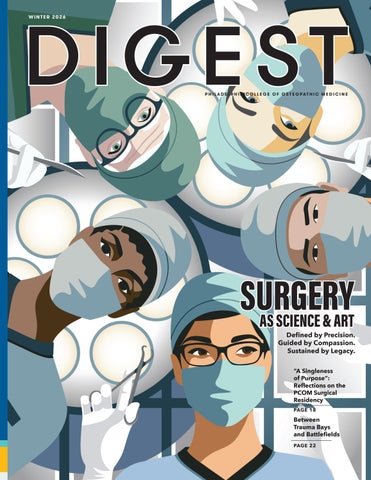
ABOUT THE COVER: Berlin-based illustrator Yordanka Poleganova creates bold, visually striking work that tells a story at a glance. For this issue of Digest, she reimagines the iconic 2017 New Yorker “Operating Theatre” cover, depicting generations of PCOM surgeons who practice surgery as both science and art, defined by precision, compassion and legacy.
2
PHI L A D EL PH I A COL L E G E O F O ST E O PAT HI C M E DI C I N E
DIGEST WINTER 2026 FE AT UR E S
14
Founders’ Day Tribute
John J. McPhilemy, DO ’78, FAOAO, orthopedic surgeon, educator and sports medicine trailblazer, receives the 2026 O.J. Snyder Memorial Medal.
18
“A Singleness of Purpose”: Reflections on the PCOM Surgical Residency
22
Between Trauma Bays and Battlefields
26
From Scrub In to Sign Out
Arthur Sesso, DO ’81, looks back at legendary figures and the rigorous PCOM residency they established—a culture of discipline, mentorship and dedication that shaped generations of surgeons.
Through his program at Cooper University Health Care, John Chovanes, DO ’02, RES ’06, trains military medical teams for high-stakes moments— turning trauma bays into battle-ready classrooms.
Follow Kara Evans, DO ’23 (RES ’29), through a day at Temple Health – Chestnut Hill Hospital.
SE CT I O N S 5
News
16 United & Ignited
10 Field Notes
29 Shoutouts
11
Office Hours and Second Opinion
30 Class Notes
12
Pulse Check
13
In Their Words
35 Quick Takes
Second-year osteopathic medical students develop proficiency in scrubbing, gloving and gowning through the Primary Care Skills course.
DIGEST
3
DIGEST VOL. 87, NO. 1, USPS, 413-060 Digest Magazine is produced by the Office of Marketing and Communications under the direction of Wendy W. Romano, chief marketing and communications officer. EDITOR Jennifer Schaffer Leone, MA PUBLICATION DESIGN Abigail Harmon CONTRIBUTORS Anna Bokarev
Dear Alumni and Friends, Surgery exists at the intersection of precision and humanity—where scientific mastery meets judgment, creativity and trust. Every procedure relies on rigorous training and advanced technology, yet its true measure is defined by the hands, decisions and compassion of those who deliver care. In this issue of Digest Magazine, we highlight the evolving science and enduring art of surgery through the work of PCOM alumni across the nation. Many began their professional journeys in PCOM’s surgical residency programs, while others trained in programs elsewhere— each united by a shared commitment to excellence, innovation and lifelong learning. Today, 1,455 PCOM DO alumni surgeons, alongside 160 additional PCOM alumni healthcare professionals—including physician assistants and psychologists—are advancing surgical care, transforming clinical practice, and shaping the future of health systems nationwide. The individuals featured in these pages represent only a snapshot of that collective impact. Together, they embody a legacy defined not only by technical expertise, but by leadership, service, and vision— ensuring that as surgical science advances, the art of surgery remains profoundly human.
Gabrielle DePietro Janice Fisher Kristen Hopf Brandon Lausch Jennifer Schaffer Leone Alexis Martina Meghan McCall Lauren Marie Raziano (DO ‘28) Ally Wengel Joy Williford PHOTOGRAPHY Bruce Fairfield William Griffith Melissa Kelly Anthony Stalcup ILLUSTRATION Yordanka Poleganova QUESTIONS OR COMMENTS pcomcommunications@pcom.edu CLASS NOTES OR ADDRESS CHANGES alumni@pcom.edu Periodical postage is paid at Upper Darby, PA, and at additional mailing offices.
Jay S. Feldstein, DO ’81 President and Chief Executive Officer
Opinions expressed are not necessarily shared by the College or the editor.
© 2026 Philadelphia College of Osteopathic Medicine. All rights reserved.
4
PHI L A D EL PH I A COL L E G E O F O ST E O PAT HI C M E DI C I N E
N E WS
Photographer: Jason Miczek
FROM FIRSTS TO FREEDOM BELLS: HOW PCOM IS SUPPORTING AMERICA250
PCOM is joining Philadelphia’s celebration of America’s 250th anniversary through partnerships that highlight the city’s innovative spirit and strong sense of community. As the presenting sponsor of 52 Weeks of Firsts and co-leading sponsor of Bells Across PA, PCOM is helping to amplify the themes of creativity, civic pride and community wellness that unite the city. This pride was on full display at the National Constitution Center in October during the official launch of 52 Weeks of Firsts, a year-long tribute to Philadelphiaborn “firsts.” Each week, free celebrations across more than a dozen neighborhoods will spotlight surprising Philadelphia-born achievements in art, science and culture— from the first Slinky to the first pencil with an attached eraser. Representing PCOM at the kickoff was Peter Bidey, DO ’08, dean and
chief academic officer of the College’s Osteopathic Medicine program, who highlighted how Philadelphia’s history of collaboration mirrors PCOM’s 125year commitment to advancing health, education and service. PCOM’s America250 celebrations will continue throughout the new year with Bells Across PA and the City of Philadelphia’s Ring It On! One Philly, A United Celebration. Through this project, 20 artist-designed replica
Peter Bidey, DO ’08, dean and chief academic officer of the College’s Osteopathic Medicine
program, at 52 Weeks of Firsts press conference.
Liberty Bells will be placed in parks and along commercial corridors, connecting neighborhoods with a shared symbol of freedom and unity. Through these partnerships, PCOM honors Philadelphia’s role as a birthplace of ideas while reinforcing its own mission to serve, educate and inspire.
FROM CLASSROOM TO GLOBAL PLATFORM: NINJA NERD
Zach Murphy, MS/PA-C ’20—better known to his millions of followers as Ninja Nerd—brought his signature energy and teaching style to PCOM Georgia during a special visit hosted by the Student Government Association and the Neurology and Psychiatry clubs. Speaking to a standing-room-only crowd of students, faculty and staff, Mr. Murphy shared his personal journey from PA student to internationally recognized medical educator. He reflected on the experiences that shaped his drive to make complex science accessible and he offered candid insights into the motivation behind his widely watched teaching platform available on YouTube. Throughout the day, students expressed how deeply they connect with his lessons and content, emphasizing how his engaging teaching style has had a positive impact on their medical education and retention.
Zach Murphy, MS/PA-C ‘20, mingled with students at PCOM Georgia.
DIGEST
5
N E WS
ONCE CHILDHOOD CANCER SURVIVORS, NOW FUTURE PHYSICIANS AT PCOM Over a decade ago, two South Jersey children fought the same life-threatening illness under the same hospital roof, a shared experience they will never forget. After years of no direct contact, those children, now young adults, found themselves reunited not only in the same place, but with the same vocation. In June 2007, four-year-old Dawson Nailor was diagnosed with leukemia, just two weeks before his fifth birthday. That December, four-year-old Ellie Koerner, received the same diagnosis, just three days before Christmas. Both were treated at Children’s Hospital of Philadelphia (CHOP) and its Specialty Care & Surgery Center in Voorhees, New Jersey, where they endured chemotherapy, biopsies and long hospital stays. Despite living only 10 minutes apart, they never crossed paths again—until last summer, when they found themselves side by side as first-year students in the Doctor of Osteopathic Medicine program at PCOM. Mr. Nailor was first to make the connection at a networking event during orientation week. “Can I ask you a crazy question?” he said to Ms. Koerner. “Did you happen to have leukemia as a kid?” “We sit down, and we’re catching up, and we know all the same people. We know all the same doctors. It was a crazy scene to be having this conversation,” Ms. Koerner recalls. Unlike Mr. Nailor, who stayed quiet about his diagnosis through childhood, Ms. Koerner has long turned her experience into advocacy. She founded the Ellie Koerner Leukemia Foundation to raise funds for CHOP and the local Ronald McDonald House, organizing an annual toy and supply drive that brings joy to hospitalized children. She and her family have also shared their story through THON, the massive student-run fundraiser at Penn State, her alma mater. For Mr. Nailor, acceptance came later. In high school, a biology class awakened his curiosity about how his body had healed. He began to embrace his story, channeling it into leadership by organizing and running his school’s Relay for Life events. “Once I understood what I’d survived, I became proud of it,” he said.
6
PHI L A D EL PH I A COL L E G E O F O ST E O PAT HI C M E DI C I N E
Dawson Nailor (DO ‘29) and Ellie Koerner (DO ‘29) at PCOM’s annual White Coat Ceremony.
Both are active in CHOP’s Childhood Cancer Survivorship Program, helping other survivors transition into healthy adulthood—a mission close to home for both. The serendipitous encounter came full circle at PCOM’s White Coat Ceremony when Mr. Nailor’s and Ms. Koerner’s families reunited for the first time since the children’s treatments nearly two decades earlier, astonished by the coincidental circumstances that brought their families back together. Both Mr. Nailor and Ms. Koerner credit their care teams with inspiring their path to medicine. “I saw firsthand the doctor I want to be,” Mr. Nailor said. “A friend first, because I saw how important that feeling was as a patient. I want to be the reason a child isn’t afraid during treatment—to be their light during one of the darkest times of their lives.” Mr. Nailor hopes to specialize in pediatric oncology, giving back to the field that saved him. “I want to offer not only excellent medical care but also compassionate, honest conversations that help families navigate such a difficult time,” he said. Ms. Koerner, meanwhile, imagines a career in family medicine or dermatology. With deep PCOM ties—her father and grandfather are both alumni— she grew up around stories of osteopathic care grounded in empathy and connection. That ethos resonates deeply with her own journey as a survivor.
For Mr. Nailor and Ms. Koerner, the reunion at the White Coat Ceremony symbolized full-circle strength. “Our white coats are a testament to our hard work, strength, and determination,” Ms. Koerner said. “We fought through cancer for two years, and now we’re dedicating the rest of our lives to giving back—in the most hands-on way possible.”
N E WS
CELEBRATING 20 YEARS:
PCOM GEORGIA’S DNA ART WALL GETS A BOLD NEW LOOK In honor of PCOM Georgia’s 20th anniversary, the campus’s beloved DNA Art Wall in the atrium underwent an exciting transformation. After a competitive submission process that drew 79 entries from artists across the country, the project was awarded to Atlanta-based mural artist Mister Totem. A celebrated figure in street art and graffiti, Mister Totem is known for his vibrant style and skill in visual storytelling. With an international reputation
and ties to Atlanta’s largest graffiti network— a community that has shaped much of his artistic output—Mister Totem created a concept that blends the College’s history with his signature expression, creating a striking centerpiece for the Suwanee campus.
An unveiling celebration on January 15 brought
together the artist, PCOM Georgia faculty, staff,
students and community members to mark the moment.
A NEW HUB FOR RURAL HEALTH TAKES ROOT AT SUNBELT AG EXPO PCOM South Georgia celebrated the official dedication of its new PCOM South Georgia Rural Health Initiative Building at the 47th Sunbelt Ag Expo, the region’s largest farm show. The facility was donated by the Ag Expo team to create a community health hub that supports the College’s ongoing efforts to improve and expand health education in rural South Georgia. PCOM President and CEO Jay S. Feldstein, DO ‘81, was joined by Georgia Governor Brian P. Kemp, First Lady of Georgia Marty Kemp and Sunbelt Ag Expo Executive Director Chip Blalock for a dedication and ribbon cutting ceremony where together they emphasized the importance of community collaboration in advancing healthcare education. Inside the new facility, PCOM South Georgia students offered blood pressure screenings to visitors and showcased the Simbulance, a mobile simulation lab designed to enhance emergency response training. Recognizing the increasing importance of mental health in agriculture, the College is dedicated to raising awareness of the often-unseen struggles faced by those working behind the barns and tractors—many of whom
endure significant physical, emotional, and financial hardships.
PCOM leadership joined
“Farmers are the backbone of America, working long days of sweat and sacrifice while often quietly bearing physical, financial and emotional burdens with little access to support,” said Dr. Feldstein. “The Sunbelt Ag Expo recognizes this challenge, and PCOM South Georgia shares this commitment. Together, we aim to raise awareness and provide resources for farmers, their families and their communities.”
Marty Kemp, Georgia
Georgia Governor Brian P. Kemp, First Lady
Commissioner of Agriculture Tyler J. Harper, and Sunbelt Ag Expo
Executive Director Chip Blalock for a ribbon-
cutting on October 14.
DIGEST
7
N E WS
DINING COMMONS, REIMAGINED PCOM’s newly renovated Dining Commons is now open on the second floor of the Howard A. Hassman Academic Center, offering expanded seating, global flavors, American classics and a 24/7 grab-and-go market. Added conveniences— including cashless checkout, self-service kiosks and mobile ordering—make it easier than ever for students, faculty and staff to dine on their schedule.
PCOM leaders and campus partners celebrate the opening of the newly renovated Dining Commons with a ribbon cutting.
At PCOM Georgia, cafeteria enhancements now offer more dining choices and added convenience, with mobile ordering and selfservice kiosks available to streamline the dining experience for the campus community.
Students enjoy PCOM Georgia’s upgraded dining with more choices and convenience.
8
PHI L A D EL PH I A COL L E G E O F O ST E O PAT HI C M E DI C I N E
N E WS
HEALING BEYOND THE STATISTICS The human impact of gun violence is often lost in statistics. PCOM’s Support and Healing through Empowerment Learning and Trauma Education in Recovery (SHELTER) Program works to bring those stories forward and strengthen how communities heal. Funded by the Pennsylvania Commission on Crime and Delinquency (PCCD), SHELTER expands trauma-informed training and provides emotional and psychological support for individuals, families and neighborhoods affected by firearm-related trauma. Its impact is already visible on campus and across the state. PCOM recently hosted the Souls Shot Portrait Project, a powerful exhibition honoring lives lost to gun violence. In addition, SHELTER Co-director Erik Langenau, DO, MS, MAPP ‘23, was appointed to the PCCD Executive Committee on Gun Violence Prevention, helping ensure that survivor experiences and clinical insight inform statewide conversations about healing and support. The Souls Shot Portrait Project, which was displayed in Rowland Hall, paired local artists with families who have lost loved ones to gun violence. Each portrait invited viewers to pause and reflect on the individual behind the statistic. For longtime PCOM staff member Amanda Mills—whose late fiancé was memorialized in a previous installment—the exhibition was both meaningful and healing, underscoring the importance of trauma-responsive care and community remembrance. Co-directed by Dr. Langenau and Michelle Lent, PhD, interim chief research and science officer, SHELTER is rooted in PCOM’s whole-person philosophy. Survivors of firearm violence often face long-term psychological effects—chronic stress, hypervigilance, depression, anxiety and post-traumatic stress symptoms—that can persist long after physical injuries heal. SHELTER helps close this gap by preparing clinicians to recognize these invisible wounds and respond with sensitivity, validation and trust-building care.
A visitor views artwork
featured in the Souls Shot Portrait Project exhibition. Faculty of the SHELTER
Program and Amanda Mills
(left) gather to celebrate the opening of the gallery in Rowland Hall.
Through workshops, training modules and interdisciplinary collaboration, the program equips healthcare teams with practical skills to understand trauma responses, reduce stigma, and integrate empathy into everyday care. The goal is to ensure that anyone affected by gun violence feels supported, heard and respected throughout their recovery. As communities across the nation continue to confront the effects of gun violence, the SHELTER Program stands as a model of meaningful response—uniting education, community partnership and trauma-informed care. Its mission is clear: healing is possible, and every survivor deserves dignity, understanding and hope.
DIGEST
9
IN S IGHTS
Field Notes
SHAPING SURGEONS: TRAINING THE NEXT GENERATION by Kristen Hopf
PCOM’s General Surgery Residency blends rigorous clinical preparation with an osteopathic, whole-person philosophy—forming surgeons who lead with skill, empathy and resilience.
Lindsey Perea, DO ’13, RES ’18, FACS, program director for the PCOM General Surgery Residency program, is a trauma and acute care surgeon at Penn Medicine Lancaster General Health and the medical director of trauma and acute care surgery research in Lancaster. A graduate of both PCOM’s DO program and its General Surgery Residency, she is board certified in general surgery and surgical critical care. Dr. Perea’s exposure to the medical world and path toward surgery began in high school—first as an EMT and driver in an ambulance, then working as a tech in an emergency room for 10 years. At 17, a mentor predicted she would become a trauma surgeon. “At the time, I said there was no way—that it was too high-paced of a field,” she said. During medical school, however, she explored multiple specialties before committing to general surgery. Her surgical foundation began at PCOM, where residents she worked with as a student became early mentors. After residency and a fellowship in surgical critical care at Cooper University Health Care, she joined Lancaster General Health—just as PCOM residents began rotating there. “Stepping into the program director role meant ensuring patient safety while supporting residents as they grow,” Dr. Perea said. “I aim to lead with an open-door, transparent approach and value feedback in both directions. My focus is continual improvement and making sure the program continues to evolve.”
10
PHI L A D EL PH I A COL L E G E O F O ST E O PAT HI C M E DI C I N E
Residents in the program complete over 200 major surgeries annually while learning from faculty across several affiliated hospitals, benefiting from dedicated academic time that includes daily teaching rounds and departmental meetings at each institution. Simulation and hands-on experience are central to the curriculum, and Dr. Perea and her team have expanded vascular trainings and breast biopsy labs, added multifaceted simulation days and developed a robust robotics simulation and training program combining didactic and practical components. Research also remains a core element of the program with residents presenting nationally at conferences every year. There are also daily opportunities to teach students and interns. “Residents are all required to do scholarly activity of some type during every year. I encourage them to get involved with research because, as surgeons, providing evidence-based care is critical,” Dr. Perea said. Surgery and surgical education are inherently interdisciplinary, requiring close collaboration across specialties and within teams in the operating room, which naturally reinforces a holistic, wholeperson approach to care. Dr. Perea notes that surgical residents often naturally embody adaptability, humility and empathy—qualities that deepen through real-life experiences, from high-stakes surgeries to everyday patient care. Those moments, she says, reinforce an essential truth: every patient is someone’s loved one, and bringing one’s genuine, human self to the work is fundamental to good surgical care.
200
Over
“ I aim to lead with an open-door, transparent approach and value feedback in both directions— my focus is continual improvement and making sure the program continues to evolve.”
Residents in the program complete over 200 major surgeries annually while learning from faculty across several affiliated hospitals.
IN S IGHTS
Office Hours
Second Opinion What pulls someone toward surgery and what keeps them there? Students, residents, and fellows share why they chose—or plan to choose—this demanding path.
WITH
by Jennifer Schaffer Leone
JOHN MILLILI, DO ’11, RES ’16
A SURGEON’S TOUCH: MENTORING STUDENTS IN A DYNAMIC COMMUNITY PRACTICE by Lauren Marie Raziano (DO ‘28)
John Millili, DO ’11, RES ’16, is a board-certified general surgeon at Shore Medical Center in Somers Point, New Jersey, specializing in laparoscopic and robotic procedures. “Welcoming PCOM students for rotations brought renewed passion back into our practice,” he says. “Their curiosity reminds you why you chose medicine in the first place.” As a clinical educator, Dr. Millili is intentional about hands-on learning. “In the OR, a student is like a sponge,” he explains. “They absorb the rhythm of the room, the procedures and the subtle details you can’t find in a textbook.” From a surgical center overlooking the ocean, he helps students build confidence by recognizing their strengths and tailoring opportunities to their interests. “As a smaller community practice, we adapt the surgical experience to what students care about,” he says. “General surgery touches every field. Whatever a student is passionate about, we can connect to their learning.” For Dr. Millili, teaching is part of the legacy he hopes to leave: shaping future physicians with the precision, compassion and curiosity that define his own practice.
RYAN BONNER (DO ’26) “My interest in surgery grew from a fascination with working with my hands and from mentors who showed me what this path could be. I’m drawn to the beauty of human anatomy and to solving complex problems—whether in the OR, ICU or clinic—through both technical skill and clear thinking. Surgery demands discipline and teamwork, but its breadth and strong tradition of mentorship make it uniquely rewarding. To me, becoming a surgeon means committing to service grounded in compassion, steadiness and integrity. It’s stepping into difficult moments to offer patients real solutions and meaningful health care.” KATHRYN HOFFMAN, DO ’21, (RES ’27) “What first drew me to surgery was the rare ability to recognize a problem and correct it almost immediately with my own hands. Even amid the rigor of training, the diversity of patients and the constant variability of operative cases keep my curiosity sharp and my passion alive. To me, becoming a surgeon is both an honor and a responsibility—an opportunity to care for patients in their most critical and vulnerable moments with an approach that is both decisive and deeply human.” CHRISTINA MONACO POLONI, DO ’19, RES ’24, COMMUNITY PRACTICE SURGICAL ONCOLOGY FELLOW, CITY OF HOPE, DUARTE, CALIFORNIA “When I think about what draws trainees to surgery, it’s often three things: a personal or family connection, a strong internal drive and the reward of seeing the impact of your work. Surgical training is demanding—long, intense and requiring sustained resilience. The only way to keep that fire alive is to genuinely enjoy the ‘bread and butter’ of your specialty because that’s what you’ll spend most of your career doing. … Surgeons carry countless patient stories with them. Some are heartbreaking; others are uplifting. Those experiences shape how we see life and remind us why we chose this path and why this calling matters.” ABDUL WALTERS, MS/BIOMED ’16, DO ’20, (RES ’26) “I knew I wanted to be a surgeon at the age of eight. I was inspired by my grandmother, an OR nurse who worked nights to care for my cousins and me. She would tell us stories of the surgeons she admired. Because I grew up without strong male role models in Panama, her stories gave me a goal to aspire to. Becoming a surgeon is my way of honoring my family’s sacrifices and serving the community that shaped me. It’s a privilege to step in at a patient’s most critical moment and make a meaningful difference.”
DIGEST
11
IN S IGHTS
Pulse Check
A heartbeat of PCOM life—dynamic moments, shared connections and events—that bring our campuses to life.
4
1
5
2
3
1. High school students immersed themselves in hands-on exploration through PCOM Opportunities Academy—discovering pathways in medicine and health care while practicing critical thinking and problem-based learning through interactive labs and activities.
4. More than 150 participants joined the PCOM Georgia Blaze 5K to celebrate 20 years of PCOM Georgia. The scenic course wove through downtown Suwanee and the Brushy Creek Greenway, and funds raised will support scholarships, helping to empower the next generation of clinicians.
2. PCOM South Georgia students volunteered at Archbold Medical Center’s Camp HEAL, helping children coping with loss through interactive games, creative crafts and reflective activities that encouraged connection.
5. The PCOM Georgia Physical Therapy Student Council put the community’s anatomy skills to the test with the Blindfolded Boneyard Battle—in theme with Halloween and National Physical Therapy Month—challenging participants to identify bone replicas by touch alone.
3. This fall, PCOM’s Community Wellness Initiative and PCOM Hearts welcomed community members for a Healthy Aging Community Day, offering wellness insights, interactive activities and shared meals to promote healthier, longer lives.
12
6
PHI L A D EL PH I A COL L E G E O F O ST E O PAT HI C M E DI C I N E
6. PCOM South Georgia’s new on-campus Fitness Trail opened in fall 2025, providing a space for students, faculty and staff to get moving and recharge.
IN S IGHTS
In Their Words Certificate of Honor Recipient Recognized for Exemplary Guidance at PCOM by Alexis Martina
During her 14 years at PCOM, Margaret M. Wilkins, DO, FACOFP, assistant dean of clinical assessment, has left a lasting mark on students, faculty and staff. Drawing on her experiences as a mother and practicing osteopathic physician, Dr. Wilkins guides future physicians through the rigors of medical school with empathy, insight and determination. The Office of Institutional Advancement spoke with her about how compassion and perseverance have become the hallmarks of her career in medical education. Q: How did your experiences as a student, resident and physician shape your professional practice? A: When I was a medical student, I had a newborn baby. One of the deans of my school recognized this and created a space on campus where I could nurse and care for my baby. That kindness stayed with me. By contrast, during residency with my second child, the experience was very different. I was expected to work 80–100 hours per week without consideration for my need to pump. I nursed my first child for nearly a year and a half but my second for only six months. That experience changed me. I vowed that, if I ever became a leader, I would approach everyone with compassion and understanding—because I had lived those challenges myself. Medicine is demanding enough without the additional pressures life can bring. Q: What is the structure of your wellness and mentoring initiatives? A: I lead with the principle that one can be kind yet firm. My wellness curriculum addresses common challenges physicians face, including sleep deprivation, burnout, self-care, mindfulness, stress— providing students and residents with tools to build resilience and recognize that it’s okay to care for themselves while pursuing a medical career. Through faculty mentoring, I support those entering the academic world, helping them gain confidence and thrive as teachers and educators. I provide lectures, resources and tools to ease their entrance into the academic sphere. It can be daunting initially, and my hope is to help them succeed and flourish.
“ I lead with the principle that one can be kind yet firm … providing students and residents with tools to build resilience. …” Q: What do you hope people take away from your mentorship and wellness programs? A: Since joining PCOM in 2012 as director of faculty development for the Osteopathic Postdoctoral Training Institute, I have focused on wellness programs because I know they help students and residents build confidence and resilience. My goal has always been to cultivate kinder, more compassionate educators and practitioners. I want students and residents to remember that while it’s important to work hard toward their dreams, it’s equally vital to practice wellness and empathy. If you want to do it, you can still find the ways to do it while still being the person you are. You have the power to make medicine a gentler, healthier and kinder field.
DIGEST
13
FOUN DE RS ’ DAY
FOUNDERS’ DAY 2026
John J. McPhilemy,
DO ’78, FAOAO
RECIPIENT OF THE O.J. SNYDER MEMORIAL MEDAL by Kristen Hopf
14
PHI L A D EL PH I A COL L E G E O F O ST E O PAT HI C M E DI C I N E
FOUN DE RS ’ DAY
PCOM proudly honors John J. McPhilemy, DO ’78, FAOAO, as the recipient of the 2026 O.J. Snyder Memorial Medal, the College’s highest distinction. A retired orthopedic surgeon, former chair of PCOM’s Department of Orthopedic Surgery, and longtime medical director and team physician for the Philadelphia 76ers, Dr. McPhilemy is celebrated for a lifetime of leadership, service and unwavering commitment to the ideals of osteopathic medicine.
A PHILADELPHIA PHYSICIAN, SHAPED BY PCOM
Born in South Philadelphia and raised in the West Oak Lane section of the city, Dr. McPhilemy’s entire educational and professional journey—from grade school through medical school and residency—has been rooted in the city he continues to serve. He graduated from St. Joseph’s Preparatory School in 1965, and earned his undergraduate degree from Saint Joseph’s College in 1969 before graduating from PCOM in 1978. In the decades since, he has watched osteopathic medicine grow in prominence, influence and size, noting that the profession’s whole-person approach to healthcare has increasingly shaped the broader medical landscape.
medical director and team physician for the Philadelphia 76ers, in a time when osteopathic physicians were less commonly represented in professional sports medicine. His leadership and impact in the field earned him the Sports Medicine Physician of the Year Award from the Philadelphia Congress of Sports Medicine in 2005, and he was named the NBA Team Physician of the Year in 2010. Dr. McPhilemy was the first osteopathic physician invited to join the Philadelphia Orthopedic Society, and later became its first DO president from 2011 to 2012. He also served as president of the American Osteopathic Academy of Orthopedics, and has held leadership roles within numerous osteopathic and orthopedic professional organizations and societies. For Dr. McPhilemy, the defining strength of osteopathic medicine has always been its emphasis on treating the whole person, a philosophy that has guided his clinical practice, teaching, and leadership—and continues to shape his work today. “We don’t just focus on one body part or one disease,” he said. “We connect all the parts into one and care for the entire person.” Still practicing three days a week with Rothman Orthopaedics, Dr. McPhilemy remains active in medicine while consulting for PCOM’s surgical residency program—a role that reflects his enduring commitment to the growth and success of the institution that shaped his career. “For me, there has always been a sense of obligation to give back,” he said. “PCOM gave me the chance to do something I always wanted to do—to become a physician—and I hope I’ve made the College proud.”
LEADERSHIP IN ORTHOPEDIC SURGERY AND EDUCATION
Much of Dr. McPhilemy’s career has been dedicated to educating future osteopathic physicians. He credits his mentors’ unwavering commitment to osteopathic medicine—among them John Brendan Wynne, DO ’56; Nicholas C. Pedano, DO ’61, FACOS; and former PCOM President Thomas Rowland, Jr., DO (Hon.), LLD (Hon.), DSC (Hon.)—with shaping his own approach to leadership. From 1992 to 2025, he served as chair of PCOM’s Department of Orthopedic Surgery and played a key role in expanding the College’s orthopedic surgery residency program, which grew from four residents during his own training to a nationally competitive program producing physicians across the country. “I’ve had the privilege of helping educate nearly 150 residents who have gone on to practice all over the United States,” Dr. McPhilemy said. “I’m not going to say PCOM is the best orthopedic surgery residency program in the country, but there are none better. When you look at other programs, whether osteopathic or allopathic, PCOM can stand head to head with any of them.”
“I’m not going to say PCOM is the best orthopedic surgery residency program in the country, but
there are none better.”
ADVANCING THE OSTEOPATHIC PROFESSION BEYOND PCOM
Throughout his career, Dr. McPhilemy has been a trailblazer in orthopedic medicine. He served for more than 25 years as DIGEST
15
UN ITE D & IGN ITE D
A Night to Ignite:
Celebrating Generosity, Advancing Opportunity PCOM GEORGIA HONORS SUPPORTERS AND RAISES VITAL SCHOLARSHIP FUNDS FOR STUDENTS This fall, PCOM Georgia hosted its A Night to Ignite Soirée to celebrate the progress of the United & Ignited comprehensive fundraising campaign and to honor the donors whose generosity, commitment and passion continue to strengthen the campus. Nearly $125,000 was raised during the event—all of which will be awarded as scholarships to students from Gwinnett County and the surrounding region. A highlight of the evening was the presentation of the Ignite Awards to Clyde and Sandra Strickland, as well as to the Osteopathic Institute of the South (OIS), accepted by its president, Barry A. Doublestein, DSL. The Stricklands were recognized for their $1 million gift supporting scholarships for doctoral students in the osteopathic medicine, pharmacy and physical therapy programs—the largest outright gift to PCOM Georgia during the United & Ignited campaign. Combined with their previous contributions, the Stricklands are now the largest donor-endowed scholarship contributors across all three PCOM locations.
Ignite Award recipients Sandra and Clyde Strickland (top and bottom left) and Neil Nickelson, DO (center) and Barry Doublestein, DSL (right), representing OIS.
TO VIEW MORE PHOTOS, SCAN THE QR CODE
16
PHI L A D EL PH I A COL L E G E O F O ST E O PAT HI C M E DI C I N E
OIS was honored for its instrumental role in advancing osteopathic medicine in Georgia in the early 2000s. In 2022, the organization selected PCOM as a recipient of its foundation’s support, resulting in the creation of the OIS Endowed Student Emergency Fund. This fund assists students facing urgent needs such as food, housing and transportation. The soirée also celebrated many additional supporters, including East End Advisors, the PCOM Alumni Association, Piedmont Eastside Medical Center, Jackson EMC, Metro Waterproofing, Northeast Georgia Health System, Studio Usher, the Atlanta Braves, CCS Fundraising, Georgia Gwinnett College, Primerica Foundation, Coca-Cola Bottling Company of Lawrenceville, Trane, Vantix Electric and Warren Averett, LLC. “Thanks to the generosity of our sponsors and supporters, we have raised vital funds to empower the purpose, practice and passion of PCOM Georgia students,” said Jay S. Feldstein, DO ’81, president and CEO of PCOM. “We sincerely thank everyone who contributed to making A Night to Ignite a success.”
UN ITE D & IGN ITE D
by Meghan McCall
UNITED & IGNITED RAISES OVER $57 MILLION FOR STUDENT SUCCESS
PCOM’s United & Ignited campaign continues to inspire generosity across our community, with more than $57 million raised toward its $65 million goal. These gifts are transforming the student experience by supporting scholarships, academic innovation, campus improvements and initiatives that prepare students to thrive as healthcare leaders.
AS OF JANUARY 1, 2026, UNITED & IGNITED HAS ACHIEVED THE FOLLOWING MILESTONES:
At PCOM South Georgia, faculty and staff recently came together to create an on-campus fitness trail—an inviting, restorative space designed to support movement, mindfulness and connection. Winding just steps away from classrooms and study areas, the trail offers a natural pause in the rhythm of academic life, giving students, faculty and staff an accessible way to reset and recharge. For many, it has already become an essential part of their day.
CAMPAIGN SUPPORT
7,838
A Student Perspective: A New Fitness Trail Brings Wellness and Community to PCOM South Georgia
PROGRESS
“The trail is my favorite thing on our campus,” said Emily Reagin (DO ’27). “On days when it feels like studying is endless, it gives me peace of mind and lets me get movement in when there’s little time for a real break. Mental health is so important—and this trail has helped me tremendously.”
GIFTS MADE TO THE CAMPAIGN
$57,310,487 OF
$65M TO SUPPORT UNITED & IGNITED VISIT CAMPAIGN.PCOM.EDU.
Students enjoying the fitness trail at PCOM South Georgia.
DIGEST
17
“A
Singleness of Purpose”
Reflections on the PCOM Surgical Residency by Janice Fisher
What follows is a retrospective look at the training of generations of PCOM surgeons from Arthur Sesso, DO ’81, whose many decades as PCOM student, resident, faculty member and department chair afford him unique insight into pivotal times and memorable colleagues. 18
PHI L A D EL PH I A COL L E G E O F O ST E O PAT HI C M E DI C I N E
“It was an interesting time to be there.”
– Arthur Sesso, DO ’81
“It was an interesting time to be there,” says Arthur Sesso, DO ’81. That’s his understated take on PCOM’s surgery department in the late seventies. Dr. Sesso now chairs the department and also serves as senior associate dean of osteopathic curricular innovation and oversight. What he witnessed as student and resident was a transition between divergent views of what it meant to be a surgeon. Yet the two factions had a singleness of purpose that enabled the department to transcend its differences and strengthen its commitment to training and mentoring its own—a commitment that continues to this day. For the old guard, Dr. Sesso says, “There was no other life but surgery. You were not allowed to be engaged, to be married. ‘Resident’ meant you resided in the hospital.” A younger group was more
open to residents “having a real life, and having time to themselves.” Although 1981 saw the formation of the Accreditation Council for Graduate Medical Education (ACGME), which sets standards and accredits residency and fellowship programs for physicians in the United States, ACGME’s now-familiar 80-hour surgical resident rule was instituted only in 2003. As a resident, recalls Dr. Sesso, “I averaged 118 hours of work a week. You never had a weekend off.” The old guard’s mindset was almost monastic, Dr. Sesso acknowledges. “Even if you were sick, you didn’t get sick. You didn’t call out or take time off.” He was one of two residents at the time; the other was H. Harry Tourigian, DO ’80, whom Dr. Sesso describes as an unsung hero. With a fellowship in cardiothoracic surgery at the Cleveland Clinic Hospital, Dr. Tourigian was “starting to break the boundaries of what the public traditionally thought of as an osteopathic physician.
Unfortunately, he died within one month of completing that fellowship.” Dr. Sesso and Dr. Tourigian were being trained when the gulf between old and new guard was at its widest. But even though the older surgeons “had been too long doing things their way, and couldn’t change, they were promoting the next generation,” Dr. Sesso says. “Henry D’Alonzo [DO ’51], Nick Pedano [DO ’61], Galen Young [DO ‘35]—they were pushing for the new guard. So were Bob Jama [DO ’69], Bill Henwood [DO ’76], Dan Wisely [DO, FACOS, LLD (Hon.)]. Archie Feinstein [DO ’43] is another icon of the department. While they came from a different generation, they knew that a new direction had to be taken, and they had the courage to do it.”
Complex Individuals Dr. Sesso describes the prevailing mentality among the surgical old guard: “We
FORMATIVE MENTORS & KEY INFLUENCES Galen S. Young Sr., DO ’35
Nicholas C. Pedano, DO ’61, FACOS
Galen S. Young Sr., DO ’35, taught students, interns and residents for 44 years and chaired the Department of Surgery and the Division of General Surgery before being named professor emeritus of surgery. Dr. Sesso describes Dr. Young as “the prototypical surgeon” and adds, “His love for surgery was exceeded only by his love of osteopathic medicine.” Among his gifts to PCOM was the funding of the Professional Chair in Surgery that Dr. Sesso now holds. Dr. Young became chancellor of PCOM in 1990, serving in that capacity until his death.
Nicholas C. Pedano, DO ’61, FACOS, completed his internship and residency at the Hospital of PCOM, where he was also an attending surgeon, chief of surgery for over 25 years and president of the medical staff. He trained more than 75 surgical residents at PCOM. Dr. Sesso was not only Dr. Pedano’s successor but also his student, resident and associate, taking over their surgical practice after Dr. Pedano retired. Dr. Sesso describes those relationships as “the greatest learning experiences of my life.”
Thomas F. A. Powell, DO ’56
Thomas F. A. Powell, DO ‘56, clinical professor of surgery, and later, professor emeritus, dedicated 30 years of service to PCOM. As the College’s first Black surgeon, he broke barriers, mentored generations of surgeons and left a lasting legacy in the diversity of medicine.
DIGEST
19
were facing a common enemy, illness and death, and we were not going to lose. Dr. Jama, one of our first surgeons trained in traumatic surgery, always said, ‘Come back with your shield or on it.’ If you lost a battle, someone didn’t walk away. So there was that feeling that you functioned as a combat team, and that you won or lost together.” In a similar vein, department chair Dr. Young liked to say that a calm sea does not make a sea captain. Stress was considered absolutely appropriate to becoming a surgeon. Dr. Sesso offers as an example Dr. D’Alonzo. When he went into the operating room, this “very nice, affable man would become someone who cursed and screamed and yelled. And the minute he left, he’d revert back.” His OR colleagues knew Dr. D’Alonzo was extremely compassionate and concerned about his patients, and “just about every other surgeon in the department was the same,” says Dr. Sesso, “though they all had different ways of expressing it.”
Dr. Sesso also points out that although “these surgeons could have earned more money elsewhere, they chose to work at City Line Avenue, with an inner-city population that didn’t have great healthcare insurance. That was a significant commitment to begin with, and they also chose to train younger surgeons, another big responsibility.” The unpaid work of training residents and students was motivated by the surgeons’ very specific sense of obligation to the osteopathic profession at PCOM. Most of them were PCOM alumni, which made the training process akin to an apprenticeship. Drs. D’Alonzo and Pedano were residents of Herman Kohn (DO ’27, FACOS). “There was no love lost between Dr. Kohn and either of those two surgeons, but there was a tremendously deep respect,” Dr. Sesso says. So when Dr. Kohn’s wife needed surgery, his residents performed it. The dynamic among these surgeons was “We’re sparring with you, but we’ll go to our deathbed for you.” Tom Powell (DO ’56) too, “would argue with the other surgeons, but at the same time go to the wall to defend them.” With every generation of residents, the older camp trained the younger camp.
“Yet, those people who gave birth to the next generation were still there, still practicing, still doing surgery the way they were trained to do it,” says Dr. Sesso. “And I don’t know anyone from the younger side of it who doesn’t have respect for those who started it.”
New Ground, Old Loyalties Dr. Sesso’s own residents span decades and specialties. “James Tayoun [DO ’90, FACOS] is a very good surgeon who also has a specialty in vascular surgery. He currently serves as chairman of surgery at Shore Medical Center in New Jersey. And he’s taking our students, so he’s continuing the tradition of in-house training of our residents. “Christie M. Hirsch-Reilly [DO ’12, RES ’17, assistant professor of surgery, PCOM Georgia] was the first Georgia student to apply to our surgical residency, and her practice is now in Charlotte, North Carolina. It’s hard to imagine, but at first the Georgia schools were not producing specialists. So she was a groundbreaker. “Bill Craver [DO ’87, FACOS] became my partner in surgery for a long time. He
FORMATIVE MENTORS & KEY INFLUENCES
20
H. William Craver, III, DO ’87, FACOS
James M. Eaton, DO 1928
Leonard H. Finkelstein, DO ’59, MSc ’63, FACOS
H. William Craver III, DO ‘87, FACOS, former professor of surgery, dean and chief academic officer, osteopathic medical program, PCOM South Georgia, held administrative positions at all three of PCOM’s campuses, and helped establish the Moultrie campus. His earlier career was in surgery. From 1992 to 1997, he was academic coordinator of PCOM’s surgery residency program.
James M. Eaton, DO 1928, may have been the first osteopathic physician to specialize in orthopedic surgery, according to a 1979 history of the osteopathic orthopedic profession. Dr. Eaton joined PCOM’s Department of Surgery in 1930, became its chairman in 1952, and helped formalize the department’s oneyear surgical residency, which had begun in 1942, into an AOA-approved, three-year program. Dr. Eaton performed surgery directed at spinal disease and herniated disks, becoming one of the first surgeons in Philadelphia to perform a laminectomy.
Leonard H. Finkelstein, DO ’59, MSc ’63, FACOS, chancellor, past president and professor emeritus, had a storied PCOM administrative career. But he was also a prominent urologic surgeon. In 1984, he became the first osteopathic urologist to publish in Surgical Clinics of North America, and he was the first osteopathic physician not affiliated with an allopathic institution to publish in the American Journal of Surgery.
PHI L A D EL PH I A COL L E G E O F O ST E O PAT HI C M E DI C I N E
trained hundreds of surgical residents and thousands of students.”
Different World, Different Challenges Surgeons today can do things that Dr. Sesso’s cohort “couldn’t even imagine. Let’s go back to Dr. D’Alonzo,” suggests Dr. Sesso. “He loved to do aortic aneurysms, which would take 6 or 7 hours. The patient would lose a great deal of blood and would be in the hospital for weeks. Today, a vascular surgeon from our department can do an aortic aneurysm percutaneously, through a needlestick in the groin. That takes maybe an hour or two, and the patient goes home the same day.
“The baton keeps getting passed on, and each generation moves the department a little further.”
“One of the very first things I was asked as a first-year medical student,” Dr. Sesso continues, “was to read a CAT scan. I had never seen it before. Today, a surgeon has to be able to understand CAT scans of all kinds, know when to use them and when not to, know how to make the right diagnosis based on very early symptoms rather than waiting until late in the process of disease. They have their own set of problems that I never could have imagined.
“And they continue to train our residents. Lindsey Perea [DO ’13, RES ’18] was my student and my surgical resident; she’s now in charge of the surgical residency. [See Field Notes in this issue.] The baton keeps getting passed on, and each generation moves the department a little further.”
Sherman Leis, DO ’67
Frederick G. Meoli, DO, FACOS
Sherman Leis, DO ’67, was the first osteopathic physician to be a chief surgical resident at a major American university hospital. He was also the first osteopathic physician fully trained in plastic and reconstructive surgery. He founded PCOM’s own residency training program in plastic and reconstructive surgery in 1991, stepping down in 2012 after having trained approximately 85 residents.
Frederick G. Meoli, DO, FACOS, served PCOM for many years as assistant professor in the Department of Surgery, and became emeritus assistant professor. He practiced general surgery for more than 40 years and was chair of the Department of Surgery at the University of Medicine and Dentistry of New Jersey – School of Osteopathic Medicine. He was among the earliest surgeons to introduce minimally invasive surgery and stereotactic breast biopsies to South Jersey.
DIGEST
21
Between Trauma Bays and Battlefields
IN THE CRUCIBLE OF CRISIS, SKILL MEETS DISCIPLINE, AND THE NEXT GENERATION OF SURGEONS IS FORGED. by Jennifer Schaffer Leone
John Chovanes, DO ’02, RES ’06, has stood over patients pulled from the burning towers of the World Trade Center, on dust-choked streets in Baghdad and Kabul, and inside remote combat outposts where the line between life and death can be measured in millimeters. In those moments, steadiness becomes a lifeline—a lifeline that he now passes on to the next generation of surgeons.
At PCOM, he found his mentor in Arthur Sesso, DO ’81, chairman of surgery, who shaped both his clinical precision and his connection to military medicine.
“Trauma surgery is a profound and honorable vocation. It is a calling,” he says. “When the moment comes, you act calmly, competently, respectfully and, at times, very intensely. You bring your best every single time.”
He remembers how Dr. Sesso once made the surgical residents wear red bands on their white coats so everyone in the hospital could identify them. “He wanted us visible—responsible—and committed to the team.”
Early Lessons in Urgency
Building Elite Readiness at Cooper
Before entering medical school, Dr. Chovanes was immersed in acute care. One of Pennsylvania’s youngest EMTs, he went on to serve as a paramedic, an emergency department nurse and later as one of the earliest flight paramedics with University MedEvac—the first medical evacuation helicopter in Pennsylvania and New Jersey. “I learned early on that trauma is a great equalizer,” he says. “Anyone can become a patient in the blink of an eye. Your job is to be ready.”
22
“Dr. Sesso was a leader’s leader—a real ‘Rat Patrol’ guy,” Dr. Chovanes recalls with a laugh. “He pushed us to prove ourselves each day, each case. He required that we be meticulous, disciplined and fearless.”
When Dr. Chovanes arrived at Cooper University Health Care in 2010, he entered a uniquely demanding clinical ecosystem: New Jersey’s busiest Level I trauma center, serving a population of 2.7 million. “The mission here at Cooper is simple,” he says. “We prevent premature death and suffering. It’s collaborative, high-pressure, and one of the few places where you can learn this work exactly as it is—without dilution, without abstraction.”
PHI L A D EL PH I A COL L E G E O F O ST E O PAT HI C M E DI C I N E
Today, he serves as the founding medical director of Cooper’s Section of Military, Diplomatic, and Field Affairs (MILDAF), a program he established to prepare elite medical personnel for the unpredictability and extremity of combat and field operations. MILDAF embeds specialized teams directly into Cooper’s trauma bays for immersive, real-time clinical experience. Trainees include U.S. Army Special Forces medical sergeants, Special Operations surgical and critical care teams, FBI and federal tactical medics, Department of Homeland Security medical personnel, and U.S. Department of State medical providers assigned to high-threat diplomatic posts. The program is not theoretical—and intentionally so. “It is not simulation,” Dr. Chovanes emphasizes. “These are real people with real injuries. The patterns mirror what you would see downrange. But here, you are never alone. You have seasoned trauma surgeons standing beside you. They become your guardian angels.” For operators preparing for austere, resource-limited or high-risk environments, the experience is transformative. It builds not only clinical mastery but the psychological composure that trauma care
Photo courtesy of Cooper University Health Care
demands when seconds compress and the margin for error disappears.
Service on the Front Lines Since 2001, Dr. Chovanes has completed six deployments with the U.S. Army Reserve Medical Corps, serving at the 325th Combat Support Hospital in Tikrit, Forward Operating Base Salerno in Khost, and Camp Manion during the “Third Battle of Fallujah.” He received the Army Commendation Medal for meritorious service and the Soldier’s Medal for heroism after providing emergency surgical care to a Port Authority officer trapped in the rubble of the World Trade Center on September 11, 2001. In January 2024, he was honored with the John P. Pryor, MD Distinguished Service Award – The Eastern Association for the Surgery of Trauma. The award is named for the Army trauma surgeon killed in action in Iraq on Christmas Day 2008, recognizing his exceptional contributions to military medicine and trauma surgery. “People imagine heroism,” he says. “But trauma surgery—civilian or military—is long hours, difficult cases, and no glamour. You do it because restoring someone, giving them back their life, matters.”
This commitment extends beyond the battlefield. Dr. Chovanes maintains a close partnership with the U.S. Army Medical Command and the Office of the Army Surgeon General, led by Lt. Gen. Mary Krueger Izaguirre, DO ’95, through embedded military–civilian training programs. As part of the Army Medical Department Military–Civilian Trauma Team Training program, he hosts active-duty Army medical personnel—surgeons, nurses, and technologists—for multi-year assignments in Cooper’s high-volume trauma environment, giving them immersive, real-world experience before deployment. “When you hit the ground overseas, you cannot be learning the basics,” Dr. Chovanes says. “Every trauma I see here, I ask myself: How would this play out in combat? That mindset keeps you sharp. Moreover, it reinforces the Army’s mission to maintain a highly-trained, deployable medical force.”
A Legacy Grounded in Faith and Service Dr. Chovanes’s work is sustained as much by faith and family as it is by training. “I have a wife and three children. My legacy to them is simple: Be true, serve well and bring your best every day. Faith
is what carries you through the hard moments,” he says. He also thinks of Dr. Sesso often—not only for his surgical instruction, but for the small lessons that stayed with him. “Dr. Sesso told me to buy an old M37 4x4—the grandfather of all trucks—and rebuild it. It wasn’t about the truck,” he recalls. “It was about commitment, patience and attention to detail. If you respect the small tasks, you’ll respect the big ones.”
Teaching More Than Technique Dr. Chovanes mentors medical students, residents and military trainees who come to Cooper to learn not only surgical technique, but the mental and emotional steadiness required in crisis. “Plenty of people have the hands. Others have the brain. Still others can communicate,” he says. “But not everyone can hyper-concentrate when a life hangs by a thread. That focus—that calm in the storm— is what separates good from great. “You show up calm, competent and compassionate every time,” he says. “That’s the mark of a life and a career that truly matters.”
DIGEST
23
BRIDGING SKILL AND COLLABORATION
PCOM-TRAINED PHYSICIAN ASSISTANTS ELEVATE PERIOPERATIVE PRACTICE THROUGH CLINICAL ACUMEN, INTERDISCIPLINARY COORDINATION AND PATIENT-CENTERED CARE. by Anna Bokarev Jason Kuchta, MS/PA-C ‘04, MBA, DFAAPA, with Tri Rivers Musculoskeletal Centers in partnership with UPMC and Butler Health System. Photo provided.
Physician assistants play an increasingly sophisticated role in surgical settings, integrating technical skill, diagnostic reasoning and patient advocacy across every phase of care. Their contributions extend beyond procedural support; they anchor perioperative continuity, optimize clinical workflow and reinforce the patient-centered ethos central to contemporary surgical practice. “Working side by side in the operating room, the surgeon and I develop a rhythmic cadence that can get the patient through the operation faster,” says Alison Ranade, MS/PA-C ’08, a physician assistant in the UC Davis Medical Center Cardiothoracic Surgery Department in Sacramento, California. She anticipates the surgeon’s needs, manages key operative steps and helps streamline the procedure. Her skills and versatility help reduce the time the patient is on the heart lung machine, improving patient outcomes. Before a patient goes into surgery, Ms. Ranade spends time getting to know them, taking their medical, surgical and social histories. Her attention to detail outside the operating room is crucial to the work inside of it—intricate information can help her and the surgeon work together to navigate intraoperative decisions. “A patient’s anatomy, comorbidities or prior interventions can change how we approach cannulation sites or device placement,” she explains. Working with patients perioperatively, physician assistants are uniquely positioned to bridge the different stages of the healthcare journey. Jason Kuchta,
24
MS/PA-C ’04, an orthopedic surgical physician assistant and advanced practice provider (APP) supervisor at the University of Pittsburgh Medical Center Tri Rivers Musculoskeletal Centers, ensures this continuity in day-to-day practice. In addition to helping manage a robust adult reconstruction surgical service, he co-leads a team of 32 APPs.
way to ensure patients have control over their health care,” he affirms. Whether that means breaking down medical jargon, anticipating the patient’s questions or preparing patients for life post-procedure, physician assistants integrate patients into their healthcare experience and fuel their agency in medical settings.
The whole-person philosophy also helps bridge collaborative, technical skills with the personal connection surgical patients need.
Doing so requires strong interpersonal skills. Haley Geosits, MS/PA-C ’23, has developed her approach based on her unique experience as a patient. Ms. Geosits works with otolaryngology patients at Thomas Jefferson University Hospital in Philadelphia, the same hospital in which she was diagnosed and treated for thyroid cancer prior to starting physician assistant school. Because of her personal perspective, Ms. Geosits understands firsthand the fear and vulnerability patients may feel. Now, when she connects them to resources like creative arts therapy or teaches them how to use medical devices like laryngectomy tubes at home, she draws on both her clinical training and her lived experience to deliver the best possible care.
“One of the beautiful things about health care is that in the end, you’re dealing with people,” says Jarrod Luttjohann, MS/PA-C ’12, a vascular surgery physician assistant in rural Georgia. For him, building confidence and trust is an integral part of working with surgical patients. He knows he’s met that goal when he enters a patient’s room and sees their expression shift from worry to relief.
Grounded in a training model that emphasizes collaboration, adaptability and the whole-person approach, PCOM physician assistants are redefining what it means to support surgical care. Their ability to move fluidly between technical execution, care coordination and patient advocacy strengthens perioperative systems and elevates the surgical experience.
Trained to be adaptable and to work across specialties, Mr. Kuchta coordinates diagnostic imaging; facilitates communication with orthopedic surgeons, anesthesiologists and nursing teams; and helps guide postoperative protocols that promote early mobility and safer recovery trajectories. “The continuity we provide helps maintain momentum from clinic to OR to recovery,” he notes. “Patients benefit when every transition is intentional.”
“Developing meaningful relationships is not only a way to comfort patients. It is a
PHI L A D EL PH I A COL L E G E O F O ST E O PAT HI C M E DI C I N E
Holding Space for Healing in Times of Change A BIOPSYCHOSOCIAL APPROACH TO RECOVERY by Kristen Hopf As a rehabilitation psychologist, Tracy E. Ransom, PsyD ’10, BCB, MSCP, works with patients at one of the most vulnerable points in their lives. In acute rehabilitation settings, she supports individuals recovering from traumatic brain injuries, spinal cord injuries, strokes, amputations, or other life-changing conditions that require surgery—helping them process big changes while rebuilding a sense of self and hope for their futures. In the days and weeks following a major surgery, recovery extends beyond physical care. For patients navigating sudden changes to mobility, independence or identity, the emotional aftermath can be just as disorienting—and just as important to address. “A lot of what patients experience after surgery is grief—not just grief for what they’ve lost physically, but grief for the version of themselves they no longer recognize,” Dr. Ransom said. That grief may emerge alongside anxiety and depression, particularly as patients confront changes in their roles within their families or communities. People who once served as caregivers may suddenly find themselves needing to be cared for, a shift that can challenge identity and confidence. Through a biopsychosocial evaluation, Dr. Ransom learns about each patient’s background, support system and personal goals—information that helps guide individualized care within a larger interdisciplinary team that includes physicians, physical and occupational therapists, speech therapists and recreational therapists.
she helps patients see these feelings not as failures, but as part of the healing process. Dr. Ransom also integrates tools like cognitive behavioral therapy, animal assisted therapy and mindfulness into her sessions, encouraging patients to shift away from rigid, all-or-nothing thinking. She explains that recovery rarely follows a straight path. “A lot of my work is helping patients understand that what they’re feeling is common, and that they’re not alone in it,” Dr. Ransom said. “Recovery isn’t a straight line from point A to point B—it’s a winding road, and discouragement often comes when it doesn’t look the way people expect.” These tools, combined with close collaboration across disciplines, allow Dr. Ransom to support patients both emotionally and practically as they work toward their rehabilitation goals. Moments of progress carry profound emotional weight for both patients and clinicians, and Dr. Ransom’s role highlights that healing is not just about repairing the body. It is about honoring vulnerability, restoring identity and walking alongside patients as they find their way forward.
A core component of Dr. Ransom’s approach is psychoeducation—helping patients understand the emotional and neurological responses that often follow trauma or surgery. By identifying reactions such as frustration, fear or impatience, Dr. Ransom and
facility dog Nellie.
DIGEST
25
FROM SCRUB IN TO SIGN OUT:
A DAY IN THE LIFE OF A GENERAL SURGERY RESIDENT I’m Kara Evans, DO ’23, a second-year resident in PCOM’s General Surgery Residency program. This photo essay follows a typical day while I’m on rotation at Temple Health – Chestnut Hill Hospital, a 148-bed community hospital in northwest Philadelphia that serves a diverse mix of neighborhood residents, suburban families and patients who come through the Emergency Department needing urgent surgical care. The service is busy, and no two days look the same.
THE DAY BEGINS:
Coffee in hand, I’m on campus while the hospital is still quiet—those few calm moments before the day truly begins.
5:30am MORNING ROUNDS:
Efficient and focused. We assess pain control, drains, labs and wounds, and plan next steps for patients recovering from procedures ranging from appendectomies to bowel resections and colectomies.
6:00AM MORNING SIGN-OUT:
The night team reviews overnight events: new ED consults, post-op issues, clinical changes and cases that will set the priorities for the morning.
6:15AM 26
PHI L A D EL PH I A COL L E G E O F O ST E O PAT HI C M E DI C I N E
OR PREP:
Reviewing imaging, confirming instruments and scrubbing in. The case mix varies day to day and offers broad exposure across general surgery. Today includes a laparoscopic cholecystectomy, an inguinal hernia repair and a colectomy. The afternoon is likely consult-heavy: a possible bowel obstruction, appendicitis or wound evaluation.
7:00aM
AFTERNOON ROUNDS AND TEACHING:
We regroup with attendings, senior residents and nursing staff to check post-ops, review new admissions and update families. There’s often a brief teaching point – practical and directly applicable to patient care.
4:40pM
PRE-SIGN-OUT:
I take a brief pause, grab a snack, and prepare for evening sign-out. Clear handoffs are critical. After finishing documentation, I change out of scrubs and leave the hospital, exhausted but fulfilled.
6:35pM DIGEST
27
Shaping Care, Coast to Coast PCOM ALUMNI ARE DELIVERING SURGICAL CARE WITH SKILL, COMPASSION, AND OSTEOPATHIC LEADERSHIP NATIONWIDE. THESE PROFILES HIGHLIGHT JUST A FEW OF THE 1,455 PCOM SURGEONS ADVANCING PATIENT CARE ACROSS SPECIALTIES AND COMMUNITIES. KATHLEEN E. ACKERT, DO ’20 Minimally Invasive Gynecology Fellow, Mount Sinai Hospital Dr. Ackert specializes in fibroids, abnormal uterine bleeding, infertility, endometriosis and chronic pelvic pain. She is the first DO to match Mount Sinai’s Minimally Invasive Gynecologic Surgery and Complex Benign Gynecology fellowship.
CHANNA BLAKELY, DO ’19 Vascular Surgery Assistant Professor, University of Texas Medical Branch at Galveston Dr. Blakely is the first PCOM graduate to match an integrated vascular surgery residency and the first African American woman and DO in UTMB’s vascular surgery program.
CHAD GORDON, DO ’02, FNPS Professor and Director of Neuroplastic and Reconstructive Surgery, Johns Hopkins School of Medicine Dr. Gordon was the first DO plastic surgeon trained at the Cleveland Clinic and helped lead the nation’s first craniofacial transplant. A pioneer in neuroplastic surgery, he holds 21 patents, leads first-in-human studies and is founder and chief medical officer of CraniUS, developer of the NeuroPASS™ device.
28
MARCIN A. JANKOWSKI, DO ’05, RES ’10, MBA, CPE, FACOS, FACS, CPHQ System Surgical Quality Officer and Vice Chair for Surgical Quality, Patient Safety and Performance Improvement, ChristianaCare Dr. Jankowski leads system-wide initiatives in surgical quality, patient safety, and performance improvement, strengthening compliance, reducing patient harm and advancing excellence in surgery.
FRANCIS P. SUTTER, DO ’76
MICHAEL G. TECCE, DO ’15
Chief of Cardiac Surgery, Lankenau Medical Center, Main Line Health
Plastic and Reconstructive Surgeon, Main Line Health
Dr. Sutter is a leader in robotic and beating-heart cardiac surgery. A pioneer of minimally invasive coronary bypass, he has performed over 2,700 robotic-assisted CABG procedures— more than any surgeon worldwide— and is the first DO to earn MD board certification in cardiothoracic surgery.
Dr. Tecce was the first DO to match into integrated plastic surgery. He brings cutting-edge reconstructive and aesthetic techniques to the community, restoring both form and function after injury or cancer.
PHI L A D EL PH I A COL L E G E O F O ST E O PAT HI C M E DI C I N E
MEREDITH PERRY JANKOWSKI, DO ’06, CPE, FACOS, FACS Division Chief of Urology, Shore Medical Group; Senior Partner and COO, Jersey Urology Group Dr. Jankowski is a urologic surgeon and the first woman division chief at Shore Medical Center. A U.S. Navy veteran, she served with the Marine Corps in Afghanistan during Operation Enduring Freedom.
CLAS S N OTE S
Shoutouts
ALAN L. MESHEKOW, DO ’74, FACOS, DFACOS
Alan L. Meshekow, DO ’74, FACOS, DFACOS, was awarded the 2025 Orel F. Martin Award at the American College of Osteopathic Surgeons (ACOS) Annual Clinical Assembly in September. The highest honor bestowed by ACOS, the award recognizes Dr. Meshekow for his decades of dedicated service to the osteopathic profession. Prior to his retirement, he practiced for 40 years in Massillon, Ohio; served on numerous national and local committees and boards; and was a professor at Ohio University College of Osteopathic Medicine, A.T. Still University and Des Moines University College of Osteopathic Medicine.
BENJAMIN LAM, DO, RES ’00, FACOS, FACS Benjamin Lam, DO, RES ’00, FACOS, FACS, was named president-elect of the American College of Osteopathic Surgeons (ACOS). A graduate and former program director of PCOM’s Plastic & Reconstructive Surgery Fellowship program, Dr. Lam runs a thriving plastic surgery practice in Bucks County, Pennsylvania. He will be inducted as ACOS president for 2026–2027 at the Annual Clinical Assembly in New Orleans in the fall of 2026. DIGEST
29
CLAS S N OTE S
1988
Patrick L. Elliott, Jr., DO, Dover, DE, joined Bayhealth General Surgery as a general and acute care surgeon in Dover.
1989
SAMUEL STRAUSS, DO ’71, MPH,
Round Rock, TX, retired as adjunct clinical associate professor of Aerospace Medicine at Texas A&M College of Medicine. Previously, Dr. Strauss served at NASA as the deputy medical director of the Neutral Buoyancy Laboratory at Johnson Space Center, where he supported astronaut spacewalk training in the pool and microgravity flights on the NASA zero gravity DC-9 aircraft. Additionally, Dr. Strauss was in the U.S. Air Force as a senior flight surgeon and chief of aerospace medicine and went on to retire at the rank of colonel.
1975
Alexander Nicholas, DO, West Chester, PA, professor and chair, Department of Osteopathic Manipulative Medicine, PCOM, received an award from the German American Academy of Osteopathy for outstanding commitment to the teaching of osteopathy in Germany. Dr Nicholas has been teaching in Europe for more than 25 years and has been instrumental in the education of students at PCOM.
1979
Bruce B. Frantz, DO, York, PA, was appointed to the State Board of Osteopathic Medicine for Pennsylvania on June 11, 2025. Dr. Frantz was
30
Gregory McDonald, DO, Philadelphia, PA, chair and director, Forensic Medicine program at PCOM, was featured on the Excerpt podcast in the episode titled “Ultrapotent Nitazenes Present a New Front in the Opioid Battle” (September 4, 2025). In the episode, Dr. McDonald details how nitazenes are stronger than fentanyl and addresses the impact they are having in communities around the world. James P. Davison, DO, Tampa, FL, wrote an article for the Tampa Free Press titled “Fake Weight-Loss Drugs Are Flooding Florida, State Leaders Must Act Now” (May 30, 2025). In this piece, Dr. Davison addressed a rising issue of
copycat compounded drugs for patients aiming to fight obesity in the state of Florida. George J. Papanicolaou, DO, Byfield, MA, was featured on the Dr. Hyman Show podcast in the episode titled “Rethinking ADHD: Root Causes, Real Healing, and the Power of Functional Medicine” (July 28, 2025). In the episode, Dr. Papanicolaou discussed how ADHD and other mental health challenges are often rooted in inflammation and imbalances in the body and how addressing diet, lifestyle and root causes can lead to real healing. Additionally, Dr. Papanicolaou was featured on the Dr. Hyman Show podcast in the episode titled “Inflammation: The Hidden Fire Behind Pain, Aging, and Disease” (October 20, 2025). For the episode, Dr. Papanicolaou discussed how to reduce chronic inflammation, arthritis and joint pain using a functional medicine approach.
nominated by Governor Josh Shapiro for this role. Bradley J. Meek, DO, Glendale, AZ, retired after 17 years as regional director of medical education for the A.T. Still University – School of Osteopathic Medicine of Arizona in Mesa.
1980
Timothy N. Tetzlaff, DO, Sault Sainte Marie, MI, retired from practicing family medicine after more than 40 years.
1983
Alfred M. Sassler, DO, Fort Mitchell, KY, retired from full-time faculty at University of Cincinnati Medical Center and now holds the title of associate professor emeritus of otolaryngology.
PHI L A D EL PH I A COL L E G E O F O ST E O PAT HI C M E DI C I N E
LISA J. FINKELSTEIN, DO ’87,
Jackson, WY, was the 2025 recipient of the Charles A. Ballenger Distinguished Osteopathic Surgeon Award at the American College of Osteopathic Surgeons (ACOS) conference in Salt Lake City, Utah. This award is presented annually to an ACOS member in recognition of outstanding accomplishments as a surgeon, educator and/ or researcher. Uniquely, Dr. Finkelstein’s late father, Leonard H. Finkelstein, DO ’59, MSc ‘63, FACOS, chancellor, past president and professor emeritus, received the same honor in 1992.
CLAS S N OTE S
chief of thoracic medical oncology at Fox Chase Cancer Center in Philadelphia. David Kuo, DO, FACOFP, Blue Bell, PA, associate dean of Graduate Medical Education at PCOM, has been appointed chair of the Board of Directors of the National Board of Osteopathic Medical Examiners.
1997
Robin Mae Motter-Mast, DO, Towson, MD, was honored as one of Maryland’s Top 100 Women for 2025 by the Maryland Daily Record (May 5, 2025). Dr. Motter-Mast serves as chief of staff and medical director of care transformation at Greater Baltimore Medical Center in Towson.
RICHARD A. WEAVER, DO ’91,
Greenville, NC, is a full-time pain medicine specialist and director of National Spine and Pain Centers in Greenville. In his personal life, Dr. Weaver is venturing on a cycling expedition across the state of North Carolina, where he is exploring parts of the state and meeting new people.
1991
Robert J. Lloyd, DO, Moultrie, GA, has been appointed dean of the Osteopathic Medicine program at PCOM South Georgia. Dr. Lloyd joined PCOM in 2010 and served as interim dean for six months prior to his appointment.
in South Kingstown. In this role, Dr. Colvin is the critical bridge of communication between hospital administration and oncologists.
1995
Michele Holly Frech, DO, Buffalo, NY, received the Buffalo Business First 2025 Excellence in Health Care Award, which recognizes outstanding professionals in the Western New York health care industry. Dr. Frech is the medical director for Neighborhood Health Center’s OB-GYN Department in Buffalo.
Michael Ernest Fiorina, DO, Butler, PA, was appointed chief medical officer of Independence Health System Western Pennsylvania. Gerald V. Maloney, DO, Mishawaka, IN, joined Franciscan Alliance, Inc., as chief medical officer. The nonprofit operates a 12-hospital system in Indiana, Illinois and Michigan. Prior to this role, Dr. Maloney spent the last 19 years as a physician executive at Geisinger Health in Danville, Pennsylvania.
1994
1996
1992
Gerald Alexander Colvin, DO, Providence, RI, was named medical director of hematology and oncology at South County Health Cancer Center
Hossein Borghaei, DO, King of Prussia, PA, joined the Lung Cancer Research Foundation on the scientific advisory board. Dr. Borghaei is the
1999
Anthony Xavier Baroni, DO, Sewickley, PA, was appointed chief medical officer of Allegheny Health Network West Penn Hospital in Pittsburgh. In this role, Dr. Baroni oversees clinical operations, services and programs to uphold high patient care standards.
2000
Edward Robert O’Dell, DO, Philadelphia, PA, was appointed vice president of medical affairs at Main Line Health. In this role, Dr. O’Dell is responsible for referral development by building collaborative connections among practices and specialties, promoting coordinated care, and expanding access for Main Line Health’s patients. Adam S. Rosen, DO, San Diego, CA, published his second book, O.R. Confidential: Confessions of a Gen X Surgeon. In the book, Dr. Rosen details the arduous journey that he and many others took to becoming physicians. Additionally, Dr. Rosen has a YouTube channel dedicated to patient education that has 30,000 subscribers and counting. The channel contains videos about total knee and
hip replacement surgery, rotator cuff tears, plantar fasciitis, osteoporosis and more.
2001
Lori A. Alfonse, DO, Zionsville, PA, was interviewed by CBS News Philadelphia in a segment titled “A Pennsylvania Doctor Rocks 31 Different Pairs of Pink Shoes to Honor Breast Cancer Patients” (October 21, 2025). For Breast Cancer Awareness Month, Dr. Alfonse wore a different pair of pink shoes every day in honor of her patients. Dr. Alfonse is the deputy physician in chief at the Cancer Institute of Surgical Oncology at Lehigh Valley Health Network.
2002
Franklin James Berkey, DO, Bellefonte, PA, was appointed program director for the Penn State Health Family & Community Medicine Residency at Mount Nittany Medical Center. Additionally, Dr. Berkey is a professor at the Penn State College of Medicine and assistant chief of staff at Mount Nittany Medical Center. Terry L. Pummer, DO, Rochester, NY, joined Rochester Regional Health St. Lawrence as medical director of Advanced Wound Care Services. Jonathan Shingles, DO/MBA, Allentown, PA, is the director of emergency services at Penn State Health Lancaster Medical Center. Dr. Shingles has more than 20 years of experience in emergency medicine, health care administration and physician advisory services and has worked at Penn State Health since 2021.
2003
Scott D. James, DO, RES ’03, Plymouth, MA, was named physician partner at the Vascular Care Group, a leading provider of vascular care services across New England. In this role, Dr. James leads care at the group’s Plymouth location.
DIGEST
31
CLAS CLAS S N S OTE N OTE S S
William Morris Chasanov, II, DO, Lewes, DE, was appointed to the board of the Delaware Community Foundation. Dr. Chasanov is senior vice president and chief health system design officer at Beebe Healthcare.
2008
KELLY ANNE CURTIN, DO '07,
Hummelstown, PA, has published a children’s book with her daughter titled Molly and Potato (September 2025). Written from her daughter’s perspective, the book follows her emotional journey as Dr. Curtin underwent chemotherapy and radiation treatment for advanced kidney cancer. Molly and Potato is designed to help children navigate difficult emotions while highlighting the power of resilience, love and hope. At the time of the book’s release, Dr. Curtin had completed her cancer treatment. Tamika Lashunda Perry, DO, Dallas, TX, wrote an article for the Dallas Weekly titled “Memorial Day Is the Start of Outdoor Summer Cooking and Eating” (May 25, 2025). In the article, Dr. Perry provided tips to properly store food during Memorial Day weekend in order to prevent food poisoning.
2004
Scott Lionel Girard, DO, South Asheville, NC, joined AdventHealth in South Asheville as an internist. Refky Nicola, DO, Buffalo, NY, was featured in a “Member Spotlight” by the Radiological Society of North America (June 23, 2025). In the spotlight, Dr. Nicola discussed his career in radiology and addressed the challenges and accomplishments he has faced in the field.
32
2005
Adam Jacob Kotkiewicz, DO, Tampa, FL, joined Tampa General Hospital Cancer Institute as an oncologist.
2006
Christine J. Hammond, MS/ ODL, Wynnewood, PA, co-authored a research study titled “Infections with Chlamydia pneumoniae and SARS-CoV-2 and Alzheimer’s Disease Pathogenesis” that was published in Frontiers of Aging Neuroscience (June 13, 2025).
2007
Sudeep Dustin Burman, DO, Austin, TX, was interviewed by CBS Austin for his treatment of a patient utilizing new hightech wound care. Dr. Burman described used Restrata®, a cutting-edge electrospun fiber matrix material, to provide his patient a better quality of life.
PHI L A D EL PH I A COL L E G E O F O ST E O PAT HI C M E DI C I N E
Stephen Daniel DeMeo, DO, Raleigh, NC, was the recipient of the 2025 Harry E. Dascomb, MD, Award from WakeMed for excellence in clinical teaching and care. The award is WakeMed’s highest teaching honor. Dr. DeMeo is a pediatric clerkship site director for the Campbell Medical School at WakeMed and regional assistant dean for the school’s clinical campus in Raleigh.
2009
Jared Lee Wallace, MS/PA, Soldotna, AK, was featured by the American Academy of Physician Associates’ News Central in an article titled “PA Jared Wallace Aims to Change the Trajectory of Diabetes in the Rural Community of Kenai, Alaska” (September 25, 2025).
2010
Aaron Phillip Brinen, PsyD, Nashville, TN, wrote and published a book for individuals with psychosis titled Living Well with Psychosis (June 2025). In this book, Dr. Brinen provides step-by-step guidance for becoming a strong self-advocate, navigating treatment options, managing symptoms that cause distress, and coping with stigma. Charles Joseph Calais, DO, San Antonio, TX, is an allergist-immunologist with All-American Allergy Asthma & Immunology Center in San Antonio. Scott Gary Glickman, DO, RES ’10, Melbourne, FL, joined Total Spine and Orthopedics in Melbourne as a neurosurgeon.
Chadd Kenneth Kraus, DO, Allentown, PA, was elected chair of the board of directors of the American College of Emergency Physicians (ACEP) for the 2025–2026 year at ACEP25 in Salt Lake City, Utah. Dr. Kraus is an emergency physician and vice chair, research, in the Department of Emergency and Hospital medicine at Jefferson Health Lehigh Valley in Allentown. Erin Elizabeth Miller, DO, Clarks Summit, PA, was interviewed in the lockhaven. com Express for an article titled “What Is Stage 0 Breast Cancer? DCIS Is Very Slow Growing and Highly Treatable” (October 6, 2025). In the article, Dr. Miller addressed the severity and differences between two stage 0 forms of breast cancer, DCIS and LCIS.
2012
Minu Susan Poulose, PsyD, Mohegan Lake, NY, was featured on the School Psyched Podcast in the episode titled “Minu Thomas and Lindsay Bourdeau on DBT Applications” (August 30, 2025). Additionally, she was featured on the same podcast in an episode titled “DBT to Honor Identities, Foster Belonging, and Support Validating Environments for All” (October 19, 2025). Dr. Poulose is the director of consulting services at Cognitive & Behavioral Consultants, where she oversees a large team of trainers and consults to numerous schools, agencies and organizations nationally.
2013
Petagaye English, DO, Findlay, OH, joined Blanchard Valley Health System as a family medicine physician. Scott David Glassman, PsyD, Cherry Hill, NJ, director, Master of Applied Positive Psychology program, PCOM, was featured in Medium in an article titled “Why Smiling Is a Profitable
CLAS S N OTE S
Habit” (May 7, 2025). In the article, Dr. Glassman shared insight on the physical and psychological benefits of smiling. Jason Edward Kaplan, DO, Southampton, PA, clinical professor and chair, Division of Cardiology, PCOM, was named one of the Pennsylvania Medical Society’s 2025 Top Physicians Under 40. Rebecca Barbara Lantz, DO, State College, PA, was appointed senior director of Penn State’s on-campus, comprehensive student health care center. Dr. Lantz brings nearly a decade of experience in college health and a strong background in both clinical practice and health care administration. James Preston Nangeroni, DO, Manahawkin, NJ, is a general and bariatric surgeon at Stafford Surgical Specialists in Manahawkin.
2014
Courtney Hinton, DO/MBA, Raleigh, NC, was selected by the American College Health Association (ACHA) as a 2025 recipient of the ACHA New Professionals Award. Dr. Hinton serves as the interim medical director and associate medical director of campus health at North Carolina State University. Stephanie Lyn Lewis, DO, Philadelphia, PA, was appointed chief of Hospitalist Services for ChristianaCare Hospitalist Partners. In this role, Dr. Lewis sets strategy, works with clinicians, and leads efforts to improve outcomes and enhance the experience for patients and caregivers. She was named one of the Top 50 Women Leaders of Philadelphia for 2025 by Women We Admire.
2015
Richard Joseph Edwards, DO, Fort Lauderdale, FL, was interviewed by The DO for an article titled “A Prescription for
Partnership: How a DO and an MD Are Running a Concierge Medicine Practice Together” (October 6, 2025). In the article, Dr. Edwards discusses working alongside his wife, Monica Sher, MD, at their private practice, Elite Medical Concierge, in Winter Park. Kerri M. Garruba, MS/Psy ’10, PsyD ’15, Lebanon, PA, obtained board certification in clinical health psychology from the American Board of Professional Psychology. Dr. Garruba leads the Primary Care Mental Health Integration program at the Lebanon Veterans Affairs Medical Center. Dana Lynn Mincer, DO, Fort Washington, PA, opened a holistic, lifestyle-focused direct primary care practice called Love Health DPC in Fort Washington. Dr. Mincer’s practice looks beyond symptom resolution to identify why illness occurs and address root causes to restore health. Chasity Nichole Spagnola, DO, York, PA, was named one of the Pennsylvania Medical Society’s Top Physicians Under 40. Dr. Spagnola is a family medicine physician with WellSpan Health in York County. Sarah Williford, PharmD, Orange Park, FL, is the operational systems manager at the Way Clinic in Orange Park. The Way Clinic is a nonprofit that works to provide access to health care and offer free medical services to uninsured, low-income residents.
2016
Shane Michael Barre, DO, Hershey, PA, was promoted to fellowship director of acute pain medicine and regional anesthesiology at Penn State College of Medicine in Hershey. Tashinea Michelle Bernadin, DO, Fayetteville, GA, opened The Healthy Woman Primary Care in Newnan. The Healthy Woman is dedicated to providing comprehensive health care to all women.
Angela Antonia Genoese, DO, Camden Wyoming, DE, was appointed program director of Bayhealth’s Family Medicine Residency program. In this role, Dr. Genoese oversees the clinical and didactic training for the program’s 24 family medicine residents and supervises a team of faculty members involved in the program. Neil Martin Linder, DO, Conyers, GA, is an internist at Piedmont Rockdale Hospital in Conyers.
2017
Courtney G. Dougherty, MS/ Psy ’12, PsyD ’17, Galloway, NJ, was named interim head coach of Stockton University’s women’s soccer team. Robert Allen Whitaker, PsyD, Washington, DC, is an associate professor in the School of Psychology at Gallaudet University.
2018
Andrew Gerasimos Canakis, DO, Berlin, MD, joined TidalHealth in Berlin as a gastroenterologist. Haley Ethredge, PharmD, Donalsonville, GA, was named director of the Pharmacy Residency at Southeast Health. In this role, Dr. Ethredge oversees Southeast Health Medical Center’s Pharmacy Residency, which offers a structured, postgraduate training program designed to accelerate pharmacy skills beyond entry-level. Casey A. Keen, MS/FM, Doylestown, PA, is publishing a memoir titled The Alchemy of Motherhood in May 2026. Drawing from both her personal experience and research into medical studies, journals and expert reports, she sheds light on birth trauma and the often overlooked realities of postpartum recovery/mental health, including the physical, emotional and systemic challenges many women face, while exposing the serious
gaps in health care that impact maternal outcomes. Cole Stiles Seaton, DO, Valdosta, GA, was named co-director of South Georgia Medical Center (SGMC) Health’s Stroke program in Valdosta. In this role, Dr. Seaton is responsible for implementing best practice guidelines and enhancing SGMC Health’s high-quality stroke care for patients.
2019
Imran Gruhonjic, DO, Lakeland, FL, joined the Watson Clinic Main in Lakeland as an orthopedic surgery and sports medicine specialist. Nicholas James Minissale, DO, Cherry Hill, NJ, joined Beebe Healthcare as an orthopedic surgeon at First State Orthopaedics Southern Division. Rebekah Matilda-Marie Padilla, DO, Jacksonville, FL, welcomed a baby in June 2025. Additionally, Dr. Padilla became board certified with the American Board of Radiology in October 2025. Charles Jung Hwan Yoo, DO, Johns Creek, GA, joined Resurgens Orthopaedics in Johns Creek as a total joint replacement specialist.
2020
Krishan Andrew Bajnath, PharmD, Dacula, GA, was interviewed for Business Matters in an article titled “Krishan Bajnath’s Journey: From College Grad to Pharmacy Leader” (June 25, 2025). Cory Elizabeth Barrows, DO, Memphis, TN, joined West Cancer Center in Memphis as a palliative care physician. Thulisile Buthelezi, MS/Psy, Downingtown, PA, is the owner of Siza, an organization that provides behavior analysis services. Located in Malvern, the organization is celebrating its third anniversary. Anthony James Guillorn, DO, Scranton, PA, is an orthopedic surgeon at Inspira Health in Scranton.
DIGEST
33
CLAS CLAS S N S OTE N OTE S S
Adrienne Marie Koder, DO, RES ’20, Bentonville, AR, was named to Talk Business & Politics’ Forty Under 40 (August 11, 2025). Dr. Koder is a pediatric orthopedic surgeon and operating room medical director at Arkansas Children’s Northwest in Springdale. Suraj Malhan, MS/FM ’15, DO, Philadelphia, PA, was named one of the Pennsylvania Medical Society’s Top Physicians Under 40. Dr. Malhan is a neurologist in Philadelphia who specializes in headaches.
University of Rochester Medicine Finger Lakes Health as a family medicine physician.
2021
2024
Samantha Margaret Leggio, DO, Colquitt, GA, joined Colquitt Regional Health Systems’ Sterling Group Internal Medicine team as an internal medicine physician. Paulina E. McCabe, DO, Lawrence Township, NJ, was interviewed in the article “In the Transition to Practice, Consider Your Own Backyard” for the American Medical Association (May 20, 2025). John Charles Turner, Jr., DO, Lawrence Township, NJ, was spotlighted in a YouTube video by Princeton Orthopaedic Associates titled “Meet John Turner—Sports Medicine” (September 8, 2025).
2022
Ahmed Abdulrahman, PharmD, Woodstock, GA, is an assistant professor of pharmacy practice at South University School of Pharmacy. Sierra Armbrust, DO, Chattanooga, TN, graduated from the Atrium Health Floyd Medical Center Family Medicine Residency program in Rome, Georgia. Dr. Armbrust will go on to Chattanooga, Tennessee, to practice family medicine. Evan Charles DeFalco, DO, Manor-Fisher, PA, is working as a family medicine physician for Penn Highlands Mon Valley in Manor-Fisher. Madison Hill, MS/MPH ’17, DO, Penn Yan, NY, joined
34
REMEMBERING DR. HITNER
2023
Ganiat Asuni, PharmD, Lawrenceville, GA, co-authored a research article titled “Multiple Myeloma Inhibitory Effects of Natural Compounds: Enhancement through Nanoparticle Carriers” in Frontiers in Pharmacology (June 16, 2025). The research explores the inhibitory effects of key natural compounds on MM cells. Georgia P. Gagianas, DO, Venetia, PA, married T. J. Perry on May 26, 2024. Hannah G. Karr, DO, Newark, DE, co-authored a research article titled “Incidence and Risk Factors of Developing a Dysrhythmia After Blunt Thoracic Trauma” published in the Journal of Clinical Medicine (September 4, 2025). Maegan McCall, MS/Biomed, Houston, TX, co-authored a research study titled “Infections with Chlamydia pneumoniae and SARS-CoV-2 and Alzheimer’s Disease Pathogenesis” that was published in Frontiers of Aging Neuroscience (June 13, 2025). Macy M. Rowan, DO, Valdosta, GA, was featured in a Resident Spotlight in the Moultrie Observer (June 3, 2025). Dr. Rowan is a resident at Georgia South Family Medicine Residency program, where she is able to practice close to home.
2025
Zachary S. Thorogood, PA-C, Philadelphia, PA, authored a chapter titled “Does Ruxolitinib, in Comparison to Best Available Therapy (BAT), Improve Pruritus Symptoms in Patients with Polycythemia Vera?: A Systematic Review” in Medical Research and Its Applications, Vol. 9, 2024.
PHI L A D EL PH I A COL L E G E O F O ST E O PAT HI C M E DI C I N E
HENRY W. HITNER, PHD, Fort Washington, PA, passed away
on August 20, 2025. He dedicated more than three decades to PCOM, serving as professor and vice chair of the Department of Neuroscience, Physiology and Pharmacology before retiring in 2006. In 2007, he was named professor emeritus in recognition of his distinguished career and lasting contributions to the College. Dr. Hitner was a recipient of the Christian R. and Mary F. Lindback Award for Distinguished Teaching and was beloved for his deep commitment to students. A passionate scientist, he extended his influence far beyond PCOM through his authorship of Pharmacology: An Introduction, which served as a valuable resource for learners around the world. He will be remembered for his warmth, humor and lasting impact on the PCOM community.
IN MEMORIAM Joseph Albert, DO ’91, Reading, PA, December 25, 2025 Horace Barsh, DO ’61, Philadelphia, PA, December 14, 2025 Daniel H. Belsky, DO ’57, Voorhees, NJ, October 11, 2025 Bruce D. Cunningham, DO ’70, Vineland, NJ, August 15, 2025 John W. Gillota, DO ’64, Medina, OH, February 12, 2025 David W. Heeter, DO ’91, Annville, PA, June 29, 2025 William R. Hemsley, Jr., DO ’56, Yucaipa, CA, December 11, 2025 Norman H. Ilowite, DO ‘55, New York, NY, October 12, 2025 Cell U. Kim, DO ’77, Philadelphia, PA, November 16, 2025 Robert A. Kimelheim, DO ’83, Frankford, DE, September 11, 2025 Jane R. Littman, RN ’53, Lansdale, PA, August 5, 2025 Charles W. Lowney, DO ’64, Hyde Park, MA, December 14, 2024 Jerri L. Maroney, Psy’D ’05, Harrisburg, PA, November 12, 2025 Mark Osevala, DO ’85, Camp Hill, PA, July 16, 2025 Edward S. Polashenski, DO ’80, Drums, PA, August 8, 2025 Joseph I. Rothstein, DO ’63, Woodmere, NY, March 24, 2025 Julie Marie Sanicola, DO ’08, Hagerstown, MD, December 12, 2025 Jerrold M. Snyder, DO ’78, Richboro, PA, September 25, 2025 Michael Francis Stretanski, DO ’97, Sunbury, OH, August 2, 2025 Joan M. Watkins, DO ’72, Tampa, FL, December 12, 2024
WRAP-UP
Quick Takes
How do you define excellence in surgical care, and what values or lessons do you hope the next generation of surgical professionals will carry forward? by Jennifer Schaffer Leone
“Trauma and critical care surgery often reveal a surgeon’s true skill in the hardest moments—when decisions must be made quickly and with incomplete information. This means staying steady under pressure, exercising sound judgment and working with a team to do what is best for the patient. For the next generation, I hope they never lose sight of the person behind the injury, value teamwork and remain humble enough to keep learning as trauma care ever evolves.”
– TIMOTHY A. LEONE, DO ’02
General, Trauma and Acute Care Surgeon, Penn Highlands Healthcare
“At the heart of breast surgery lies a dedication to the values that have shaped our field for generations. It begins with a commitment to lifelong learning and teaching, continually refining one’s knowledge as science, techniques and technologies evolve. It requires precise surgical skill but also something less tangible and equally essential: the ability to truly connect with patients from all walks of life. In breast surgery, excellence means listening deeply, understanding the personal significance behind each decision and delivering care that is both technically exceptional and profoundly human.”
– LINA MARIE SIZER, DO ’11, FACS Breast Surgical Oncologist, Main Line HealthCare Breast Surgical Specialists, and Associate Professor of Surgery, PCOM
“Reconstructive surgery is more than technical skill; it reflects the ability to integrate science, technology, judgment and teamwork while managing unexpected challenges effectively. In surgical oncology, it requires a commitment to continual learning and the thoughtful application of advancing cancer care to each patient. For the next generation of surgical professionals, I hope they uphold values that protect patients and the integrity of the profession, while remaining open to new skills and innovations that improve patient outcomes.”
– LISA WETHERHOLD, MS/PA-C ’02
Advanced Practice Clinician, Reconstructive Plastic Surgery, Fox Chase Cancer Center
“Excellence in surgery is grounded in sound judgment, operative expertise and preparation. Equally important is taking the time to listen—to understand a patient’s goals and to determine whether surgery is the right solution. As surgery becomes increasingly specialized, the best outcomes often come from collaboration across disciplines. Some of my most rewarding cases are those shared with colleagues from other specialties. I hope the next generation of surgeons carries forward a commitment to teamwork, accountability and clear communication—always keeping the patient at the center of every decision.”
– STEVEN S. YOCOM, DO ’93, RES ’99, FACOS Associate Professor of Clinical Neurosurgery and Director of the Spine Program, Cooper Medical School of Rowan University, and Clinical Professor of Surgery/Neurosurgery, PCOM DIGEST
35
Philadelphia College of Osteopathic Medicine 4170 City Avenue Philadelphia, PA 19131
NONPROFIT ORGANIZATION U.S. POSTAGE PAID UPPER DARBY, PA PERMIT NO. 167
ACCELERATE EXCELLENCE | EXPAND OPPORTUNITIES | ENHANCE EXPERIENCES
Ignite the purpose, practice, and passion of PCOM students.
LEARN MORE AT CAMPAIGN.PCOM.EDU
PCOM.EDU