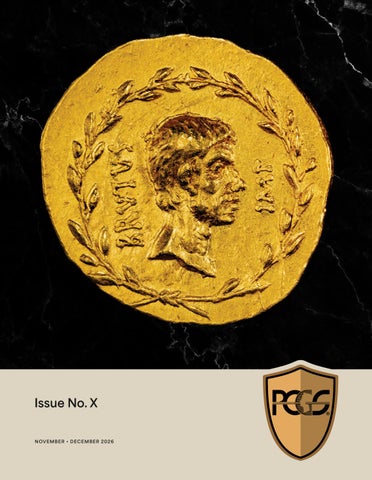
Issue No. X N OV E M BE R • D EC E M B E R 2026
Realize Top Prices for Your U.S. Currency in a Stack’s Bowers Galleries Auction
Fr. 187k. 1880 $1000 Legal Tender Note. PCGS Banknote Very Fine 25. Realized $280,600
Fr. 226a. 1899 $1 Silver Certificate. PCGS Banknote Superb Gem Uncirculated 69 PPQ. Realized $41,480
Visit Us Online at StacksBowers.com
Contact Our Experts Today for More Information!
Fr. 270. 1896 $5 Silver Certificate. PCGS Banknote Superb Gem Uncirculated 67 PPQ. Realized $48,800
Fr. 271. 1899 $5 Silver Certificate. PCGS Banknote Superb Gem Uncirculated 67 PPQ. Realized $36,600
Fr. 1503*. 1928B $2 Legal Tender Star Note. PCGS Banknote Very Fine 25. Realized $17,080
Fr. 1700. 1933 $10 Silver Certificate. PCGS Banknote Very Fine 25. Realized $9,150
Fr. 1938-H. 2003A $2 Federal Reserve Note. St. Louis. PCGS Banknote Choice Uncirculated 64 PPQ. Realized $24,400
Fr. 2407. 1928 $500 Gold Certificate. PCGS Banknote Gem Uncirculated 65 PPQ. Realized $170,800
Peter A. Treglia 949.748.4828 PTreglia@ StacksBowers.com
Michael Moczalla 949.503.6244 MMoczalla@ StacksBowers.com
LEGENDARY COLLECTIONS | LEGENDARY RESULTS | A LEGENDARY AUCTION FIRM 1550 Scenic Ave., Ste. 150, Costa Mesa, CA 92626 949.253.0916 • Info@StacksBowers.com 470 Park Ave., New York, NY 10022 212.582.2580 • NYC@StacksBowers.com Visit Us Online at StacksBowers.com
America’s Oldest and Most Accomplished Rare Coin Auctioneer SBG BNR Insider Consign PR 261101
Costa Mesa • New York • Boston • Miami • Philadelphia • San Francisco • New Hampshire • Oklahoma Hong Kong • Copenhagen • Paris • Vancouver
Stack’s Bowers Galleries is Proud to Offer
One of the Finest
1919-D 1919 -D Walking Liberty Half Dollars Part of the Mack C. Chase Collection of Walking Liberty Half Dollars Featured in the November 2026 Showcase Auction
1919-D Walking Liberty Half Dollar. MS-65 (PCGS). CAC. Exceedingly Rare PCGS Population: 10; 1 finer (MS-66).
Auction: November 16-20, 2026 • Costa Mesa, CA Whitman Expo Lot Viewing: November 10-13, 2026 • Baltimore, MD Official Auctioneer of the Whitman Expos
For More Information: 800-458-4646 (CA) • 800-566-2580 (NY) • Info@StacksBowers.com LEGENDARY COLLECTIONS | LEGENDARY RESULTS | A LEGENDARY AUCTION FIRM 1550 Scenic Ave., Ste. 150, Costa Mesa, CA 92626 949.253.0916 • Info@StacksBowers.com 470 Park Ave., New York, NY 10022 212.582.2580 • NYC@StacksBowers.com
America’s Oldest and Most Accomplished Rare Coin Auctioneer
Visit Us Online at StacksBowers.com SBG PCGSInsider Nov2026Walker 261101 Costa Mesa • New York • Boston • Miami • Philadelphia • San Francisco • New Hampshire • Oklahoma Hong Kong • Copenhagen • Paris • Vancouver
2 EDITOR’S NOTE
Editor-in-Chief JOSHUA MCMORROW-HERNANDEZ
Issue No. 10 As the year 2026 winds to a festive close amid a flurry of holidays, it’s hard to believe just how big this milestone year has been for PCGS. We kicked off 2026 celebrating our company’s 40th anniversary, saw the encapsulation of the historic Tyrants of the Golden Horn collection of ancient coins, reveled in the excitement of 2026 Quarter Quest, and unveiled many exciting changes to our submission process, labels, and more. We’ve covered these and so many other benchmarks in PCGS Insider this year. And on behalf of the entire PCGS team I thank you for your continued support – and look with great anticipation to what 2027 brings. But the famous Waterford crystal ball hasn’t dropped over Times Square in New York City to ring in the new year just yet! There’s still so much to talk about as we close out this 40th anniversary year at PCGS, and you’re going to get the scoop in this issue of PCGS Insider. Where better to start than at the very beginning? That’s right, check out that front cover. On it, you see an ancient Roman Brutus Aureus, which is graded PCGS MS64 and is this issue’s Featured Coin. Kyle C. Knapp tells the tantalizing tale of this rare coin struck some 2,000 years ago by Marcus Junius Brutus. We also catch up with PCGS Co-Founder David Hall, who recalls the early years as the company was establishing itself as the innovative leader of the numismatic industry. We also take a solemn moment to remember a PCGS co-founder who is no longer with us: Bruce Amspacher. We’ll introduce you to one of this hobby’s brightest rising stars, Nate Leonauskas, and meet up with Jason Feldman, a longtime collector who stays busy on the PCGS Set Registry. Sanjay C. Gandhi talks about a modern Indonesian silver proof set that proves rarer and more challenging with each passing year. Abigail Zechman shares the details on a 2024 United States commemorative silver dollar that honors the life of abolitionist and human rights pioneer Harriet Tubman. And as Charles Morgan reflects on 40 years of the PCGS revolution, you’ll find much more in-depth commentary and analysis from our team of numismatic experts. Before we close out 2026, I want to remind you that you still have several opportunities to catch up with the PCGS team in person on bourse floors and drop-off events spanning the country. PCGS will be at the Whitman Expo in Baltimore, Maryland, November 12-14, and then we hold the PCGS Trade and Grade Showcase in Las Vegas, Nevada, December 9-11. Plus, we have Walk-in Wednesday events each Wednesday at our headquarters in Santa Ana, California, and on November 4 and December 2 in Jersey City, New Jersey. Happy Holidays and a Prosperous 2027,
Joshua McMorrow-Hernandez PCGS Insider Editor-in-Chief
Creative Director JACK ARCHER Art Director GEOFF PARRISH KEITH DEWALD Designer JAMES DAVIS Production Artist CHRIS WILSON Staff Writers HEATHER BOYD VIC BOZARTH SANJAY C. GANDHI JAIME HERNANDEZ KYLE C. KNAPP CHARLES MORGAN JAY TURNER NATHANIEL UNRATH EDWARD VAN ORDEN ABIGAIL ZECHMAN Contributing Writers RONALD BURNETT JESSE KRAFT, PH.D Advertising TARYN WARRECKER ARIANNA TORTOMASI PCGS INSIDER PCGS Insider Magazine USPS Pending Periodical #226, Copyright © 2026 by The Collectors Universe is published bimonthly by The Collectors Universe, 1610 E St Andrew Pl, Santa Ana, California, 92705. Application to Mail at Periodicals postage is Pending at Santa Ana, CA and additional mailing offices. Printed in Canada. Nothing herein is intended to provide financial advice. Past sales do not guarantee future results. POSTMASTER Send address changes to Collectors Universe, 1610 E St Andrew Pl, Santa Ana. California, 92705. BUSINESS & EDITORIAL OFFICES 1610 E St Andrew Pl Santa Ana, CA 92705 (949) 567-1234 ACCOUNTING & CIRCULATION OFFICES 1610 E St Andrew Pl Santa Ana, CA 92705 (949) 567-1234 Call (949) 567-1234 to subscribe. Periodical postage is paid at Blaine, WA.
insider@PCGS.com / @PCGScoin
Breaking Records - It's What We Do And we'd like to do it for your coins, too!
WORLD RECORD
$1,181 ,250
SET BY GREATCOL LECTIONS
AUGUST 2026
(PCGS PRICE GUIDE $775,000)
Results speak louder than words. GreatCollections has now auctioned two different 1893-S Morgan Dollars for 7-figure world records. This latest example realized $400,000 over the PCGS retail Price Guide, selling for $1,181,250. If you have coins for sale, contact GreatCollections today. There is no collection too small or too large for us to handle. Call 1-800-442-6467 or visit GreatCollections.com to consign today.
Whether Buying or Selling, use
www.GreatCollections.com lan Russell President
Andy Wedding Consignment Director
Raeleen Endo Director of Client Services
Official Auctioneer
GreatCollections · 17891 Cartwright Rd Irvine, CA 92614 · Tel: 1.800.44.COINS · info@greatcollections.com
4
5 TABLE OF CONTENTS
6
Featured Coin
9
PCGS 40: David Hall
12
A Tribute to Bruce Amspacher
14
Extraordinary 1846 Gold Proof Set
16
Women on Money: Harriet Tubman
19
Inside PCGS: Heather Boyd
22
Inside View
24
YN Spotlight: Nate Leonauskas
26
Collector Spotlight: Jason Feldman
28
PCGS Abroad
30
Notable Notes
34
1970 Indonesian Proof Set
40
Market 101
42
Varieties, Errors & More
44
Auction Action
47
PCGS Newsflash
48
Show Schedule/Crossword Puzzle
Featured Coin:
Coinage of Brutus from the Tyrant Collection By Kyle C. Knapp
7 FEATURED COIN: COINAGE OF BRUTUS FROM THE T YRANT COLLECTION END
Examining and certifying coins from the famed Tyrant Collection has been an unrivaled privilege for PCGS experts over the past year. Somewhat astonishingly, the display at the recent American Numismatic Association World’s Fair of Money in Pittsburgh, Pennsylvania, was but one tranche of a wide-ranging and comprehensive collection of historically and conditionally significant pieces illustrating humanity’s long and difficult struggle with the distribution, moderation, and transfer of political power. Two exceptional and famous pieces from the collection demonstrate the enduring resonance of coinage as a propaganda mechanism and offer a tangible link to the fateful final years of the Roman Republic. The Casca aureus and Eid Mar denarius of Brutus are not only among the most recognizable and valuable ancient coins, but they are also of the class of numismatic issues most inextricably linked to transformative historical events in terms of design. Marcus Junius Brutus is a name today often associated with betrayal, treachery, and violence. A more thorough look into the life of Caesar’s most famous assassin offers a more layered, nuanced portrait. (Our) Brutus was a direct descendant of Lucius Junius Brutus, long revered as the leader of the revolt which overthrew Tarquin the Proud and put an end to over 200 years of elective monarchy, ushering in the Republican period, during which the moderation and containment of absolute power would become both a central political goal and vexing logistical problem. Brutus is likely to have taken great pride in this familial legacy of liberation as he navigated the quickly changing world of the late republic nearly five centuries later. After a long and impressive consolidation of power, Julius Caesar was proclaimed dictator perpetuo (“in perpetuity”) in January or February of 44 BCE. Fear of a return to the reviled days of unilateral rule gave rise to graffiti throughout the capital urging Brutus to assume the
historical mantle of his gens. Ultimately, he would indeed become one of the dozens of tyrannical figures who conspired to fatally attack Caesar on the Ides of March, initiating a chain of events that reshaped Rome and much of the Western world. Perhaps aiming to defend the act as one of deliberative political necessity rather than gratuitous violence, Brutus attempted to address the senate, but the commotion had been too much; his words were not heard. The negotiated settlement following the assassination provided for a funeral for Caesar at which Mark Antony’s eloquent
oration definitively turned public opinion against the Liberatores (as the conspirators deemed themselves). Tensions would escalate throughout the summer, eventually blossoming into a civil war that would find Brutus and ally Cassius pitted against Antony and Octavian. It was during these monumental battles in Asia Minor the military mints accompanying Brutus would strike the infamous coins pictured here during the fall of 42 BCE. Each features an obverse portrait of Brutus – in “baroque” style on the gold aureus and “realistic” style on the silver
denarius. Portraiture of this kind was atypical of Brutus’s coinage and may have been a last resort to rouse political favor as his battlefield outlook bleakened. The reverse of the denarius is perhaps the most well-known and coveted design in all of numismatics, commemorating the Ides of March with a pileus between two daggers. Both are extraordinarily rare: 17 Casca aurei are traced today, along with perhaps a hundred Eid Mar denarii. Shortly after their issue, Brutus – knowing the battle was lost – would take his own life with the same dagger which had impaled Ceasar. The raw violence of the act, the numismatic glorification of the weapon, the personal closeness of perpetrator and victim; these facts can trace a reprehensible sketch. The counternarrative, however, is encapsulated by the central element of the Eid Mar die: the pileus. Used in manumission ceremonies and broadly regarded as emblematic of liberty and personal freedom, Brutus no doubt sought to frame his actions as those of one defending the republic. Supporting this interpretation is the careful construction of the act itself: not in a dark alley by anonymous criminals, but in an official place by dozens of high-ranking members of society making no effort to conceal their identities. It was in fact Brutus who vetoed the idea of assassinating Mark Antony along with Caesar, and who agreed to the settlement permitting a public funeral in honor of the deceased. Whatever side one falls upon, the events of 44-42 BCE, transported from that time to the present so simply and beautifully on these two coins, gave centuries of life to the debate over when violence is permissible to check political power and how, if deemed necessary, it should be carried out. The Roman Republic would not survive the turmoil following Caesar’s assassination and the subsequent civil wars. Brutus’s act – justified or contrived, heroic or evil – brought about the end of one of the most studied periods of human civilization and ushered in another. The Roman Empire was about to begin.
Protect Your Timeless Collection Choose the premier grading and authentication service for paper currency—PCGS.
Learn about service levels, grading standards, and our limited lifetime guarantee.
9 PCGS 40: LOOKING BACK WITH CO-FOUNDER DAVID HALL →
PCGS 40:
Looking Back with Co-Founder David Hall By Joshua McMorrow-Hernandez
Above: David Hall / Courtesy of Stack’s Bowers Galleries
10
As we wrap up the 40th anniversary of PCGS, which was founded in 1986, we take a moment to look back on the company’s founding with one of the principle people who helped make PCGS what it is today. That man is David Hall, a numismatist’s numismatist who serves the hobby as both a renowned dealer and expert researcher. Hall’s knowledge about the industry was paramount in ensuring PCGS’s early success. Along with PCGS’s other cofounders, Hall built a company that provided solutions to many problems that plagued the numismatic marketplace of the mid-1980s. Overgraded and misrepresented coins were especially rampant across the industry at the time – so much so that the Federal Trade Commission was busy taking coin telemarketers to task. Something had to be done. Meanwhile, Hall was busy with a variety of projects. He was touring the country on the coin show circuit, buying and selling the best coins he could procure, and working on a project with some of his colleagues. The idea? “It was kind of a book project, in a way,” Hall reminisces. “It was developing on an idea that Gordon Wrubel, John Dannreuther, and I kept talking about.” Essentially, it was an early version of PCGS CoinFacts – one might say an expanded version of A Guide Book of United States Coins (widely known as “The Red Book”) that provided population figures, information on finest-known examples, and other data beyond mintages and pricing alone. “Way back when, that information was all conjecture and opinion,” recalls Hall. “At the time, a lot of the information we had on coins was based on mintage. If you look at early ‘Red Books’ and look at Barber coins, for example, you’ll see that the most expensive coins were the ones with the lowest mintages. But what about survival rates? What are their grades? What’s the finest one? The answers to these questions aren’t possible without grading.” Other organizations had already been offering their versions of grading and authentication services, but none were doing – most certainly at scale – what Hall and his group of respected dealers were proposing: a third-party service that authenticates coins, encapsulates them in tamper-evident holders, and then guarantees the grade of each coin. It was a novel concept – one the industry needed to see come to fruition. And badly. During the American Numismatic Association Convention in Baltimore, Maryland, in the summer of 1985, Hall, Wrubel, Danreuther, and others presented the idea to other dealers of high-end coins. The idea impressed…
Right: Vintage PCGS advertising from its earlier years
11 PCGS 40: LOOKING BACK WITH CO-FOUNDER DAVID HALL END
Once we decided that we were going to build a grading company, it took about three to six months to develop a business plan and get the company operational,” explains Hall. Many not only wanted to become dealers authorized to submit coins to this new grading service, but they even wanted to invest. Before long, a combined $100,000 investment, a solid business plan, and faith in the idea transformed into Professional Coin Grading Service. The company launched on February 3, 1986, with 32 authorized dealers and a groundswell of support. “Our business plan was based on the concept of grading 3,000 to 4,000 coins a month. Well, by the second month we were getting 35,000 coins and had to hire a bunch of people! Before long we had 30 or 40 people working for us.” PCGS proved its worth early on, reinventing the marketplace. With the independent authentication and grading services that PCGS provided, it was now possible to safely engage in sight-unseen trading, something many in the industry had long wanted. This gave buyers and sellers (retail and wholesale) a new sense of confidence in what they were trading. And the timing perhaps couldn’t have been better. Amid tumultuous stock market woes in the autumn of 1987, investors were looking for alternative commodities. They turned to venture capital, timber, art, wine, and – yes – even coins. PCGS’s third-party grading services made it possible for Wall Street hedge fund groups and individual investors alike all around the country to add coins to their portfolios, and do so with a faith and confidence that just wasn’t possible only a few years earlier. Coins became a multi-billion-dollar industry during the late 1980s. PCGS was at the forefront of this massive growth, booming in ways that even Hall and the company’s other cofounders perhaps couldn’t have possibly imagined when the company launched its operations. “A big part of what we did was the grading guarantee. When we began buying back mistakes, people knew we were there for the long haul.”
“
Indeed, the tamper-evident holders and grade guarantees were two major factors that allowed PCGS to reshape and innovate the coin hobby. But it was also the quality of the grading and depth of expertise that PCGS built into its framework from day one that helped the company stand out, just as it does today. “I used to tell the graders to ‘let the coins talk to you – it will tell you the grade,’” Hall says. “A coin is what it is. If you look at enough of them, you know what grade you’re looking at.” He adds, “The one thing people don’t understand is how impressive expertise is, and it’s the same in all collectibles. Expertise is what matters.”
Above: A vividly illustrated page from an early PCGS brochure
12
1942-2006:
Remembering PCGS Co-Founder Bruce Amspacher Above: Bruce Amspacher, 1942-2006
13 PCGS 40:REMEMBERING PCGS CO-FOUNDER BRUCE AMSPACHER 1942-2006 END
“He was one of those John Dannreuther or Gordon Wrubel types – guys who had seen so much and knew so much. He just knew. A great thing about him was he was good at articulating the stories about coins and helping others understand them.” ~David Hall
As we close out the 40th anniversary year at PCGS, we remember one of the cofounders who is sadly no longer with us: Bruce Amspacher. He was one of the original cofounders who by every account gave PCGS its very name: Professional Coin Grading Service. Amspacher began his numismatic career in the late 1960s and eventually worked for some of the biggest names in the numismatic industry, including A-Mark, New England Rare Coin Galleries, and Steve Ivy Rare Coins. He also was the editor of the Bruce Amspacher Investment Report (widely known as “The BAIR”) and Gary North’s Investment Coin Review. By 1985, Amspacher had begun collaborating with a group of coin dealers that included David Hall, John Dannreuther, and Gordon Wrubel, all of whom went on to launch PCGS together on February 3, 1986. Amspacher was a man remembered for his incredible attention to detail, photographic memory, and a love for many hobbies. Beyond his passion for coins, some of his favorite pastimes included bowling, reading, Hummel figurines, and watching Jeopardy! He was posthumously inducted into the PCGS Hall of Fame in 2020.
“I first met Bruce when we both worked for New England Rare Coin Galleries in the 1970s. I immediately liked Bruce – despite his chain-smoking cigarettes! He was a terrific writer, and that was one of my passions, too. I had written a few articles but in 1996 was the principal author of the PCGS grading guide. Bruce and I had different styles of writing, as I wrote quickly (still do) and would go back and edit what I had written. I often wrote so fast that I would leave out words! Bruce wrote one sentence at a time. He would craft each sentence until it was perfect. I saw him spend 20 minutes writing a particular sentence. Different strokes for different folks. Bruce passed away years ago, but he was an influence on all of us.” ~John Dannreuther “One of the most fascinating coin dealers of all time flew under the radar early in his career. But that didn’t last long. His prowess as a numismatist became evident to his peers. Bruce was recognized as one of the top dealers to ever walk the bourse floor. As one of the original founders of PCGS, Bruce was instrumental in its launch and success. He was blessed with a near-perfect photographic memory. He had a quick wit that was manifested in a rather dry humor. People loved his puns. He was also a master of limericks. We showcased his talent at a coin show when we challenged him to write a limerick about a fellow coin person. We gave him 30 minutes to come up with something. He came back in 20 minutes with a perfect characterization of the subject. No pencil or paper – just off the top of his head. He asked me what my wife and I would like for our 25th anniversary. I asked him to write a limerick about our family. It was very poignant and it is framed and displayed in our home. I am proud to call Bruce my fiercely loyal friends for 50 years.” ~Gordon Wrubel
J.P. Morgan’s Extraordinary 1846 Gold Proof Set at the American Numismatic Society By Jesse Kraft, Ph.D.
Above: The three 1846 proof gold coins that banking magnate J.P. Morgan donated to the American Numismatic Society / Courtesy of American Numismatic Society
15 J.P. MORGAN’S EXTRAORDINARY 1846 GOLD PROOF SET AT THE AMERICAN NUMISMATIC SOCIET Y END
Proof gold of any year is considered a highlight of any collection, but pieces struck before 1858 command extra attention. An intact year set of pre-1858 proof gold is virtually unheard of today. These coins were struck with specially polished dies and these coins represent some of the most coveted treasures in American numismatics. Their mirrored fields and brilliant finish make them stand out from their business strike counterparts, while their low mintages make them practically unobtainable. The American Numismatic Society’s 1846 proof gold set remains in absolutely superb condition to date. Three glittering proof gold coins are each more stunning than the next. Only five quarter eagles, three half eagles, and five eagles are known to exist in proof condition. The year 1846 was an active period in United States history. On February 27 of that year, the Liberty Bell rang for the final time when its famous large crack expanded during a celebration of Washington’s birthday. On May 14, the United States declared war on Mexico, ultimately leading to President James K. Polk to add more land to the Union than any other president — more than the Louisiana Purchase and the original 13 colonies combined. On June 19, the very first organized game of baseball — now known as America’s pastime — was played in Hoboken, New Jersey. On August 11, the Smithsonian Institution was
officially founded in Washington, D.C. By the end of the year, the ill-fated Donner Party was snowbound in the Sierra Nevada, and Iowa was admitted as the 29th state of the Union. Economically, the United States was nearing the end of a severe depression triggered by the Panic of 1837. The Walker Tariff of 1846 helped immensely by promoting international free trade. So much foreign gold and silver was entering the country that Congress felt compelled to establish the Independent Treasury System on August 6. This institution served as a compromise to the heavily politicized Second Bank of the United States — whose charter President Andrew Jackson allowed to expire in 1836 — as well as an alternative to growing calls for a branch mint in New York City. At the United States Mint in Philadelphia, it was largely business as usual. However, the Mint was quietly expanding its clandestine operations of striking special coins and medals for select customers, a practice catalyzed by the famed 1804 Draped Bust Dollar, the first of which reached a private collection on May 9, 1843. Selling exclusive proof sets in very limited quantities also served as a way for Mint officials to generate extra revenue. Occurring roughly a dozen years before the Mint openly offered sets to the public,
total annual mintages rarely exceeded five gold proof sets — which were quietly distributed to key collectors, such as Jacob Giles Morris and Matthew A. Stickney. An 1846 proof gold set eventually made its way into the American Numismatic Society collection thanks to banking magnate J.P. Morgan. The set was likely a part of the cabinet assembled by J. Colvin Randall (1832-1901), a Philadelphia collector and dealer who pioneered the attribution of early American gold and silver coins by die variety. Following Randall’s death, his remaining coins were acquired directly from his estate by Morgan. Morgan kept the coins for only a year before donating them to the American Museum of Natural History, along with nearly 600 other United States coins (mostly in proof condition). In April of 1908, during a broader consolidation of museum holdings across New York City, Morgan consented to transferring his coin collection to the American Numismatic Society, where these extraordinary pieces have stunned visitors ever since.
Women On Money:
Harriet Tubman By Abigail Zechman Above: 2024 Harriet Tubman Commemorative Silver Dollar
17 WOMEN ON MONEY: HARRIET TUBMAN END
Harriet Tubman is a true symbol of freedom and strength. Born enslaved, she used the Underground Railroad to escape. Despite the danger, she went back 13 different times to free others. After her efforts, it would have been easy to sit back and let someone else pick up the fight, but she never looked at it that way. She never stopped fighting for a better world. On September 17, 1849, Tubman and her brothers made their escape from slavery. However, the men regretted leaving their families behind and went back, making Tubman go with them. Later that fall, she ran away again, this time on her own, making it to Philadelphia and freedom. However, when she got there, she couldn’t stop thinking about everyone left behind. She started making trips back to guide her friends and family to freedom, becoming more comfortable on the path with each journey. Tubman rescued about 70 people using the Underground Railroad and left clear instructions, helping another 60 or so escape on their own. It was incredibly dangerous for her to return, but she willingly took the risk to ensure others could experience the same freedom she did. One of her proudest achievements, which she spoke of for her entire life, was that she never lost a passenger on any of her journeys. When the Civil War broke out, Tubman saw this as another opportunity to help her people. She volunteered to support the Union as a nurse in Port Royal. She used her extensive knowledge of natural remedies to help the soldiers while preserving their limited supplies. But that still wasn’t enough for her. In 1863, started to use the skills she had developed during her time as a conductor on the Underground Railroad to lead reconnaissance missions, providing the military with critical information. Her intelligence team played a key role in
the Raid on Combahee Ferry, where multiple plantations were raided and burned, freeing hundreds of slaves. Because of this, she is often credited as the first woman to lead U.S. troops in an armed assault. After the war, Tubman retired to a farm in New York, but spent the rest of her life caring for people in need. She also turned her efforts to the women’s suffrage movement, working alongside women like Susan B. Anthony. She spent her entire life fighting for a better, more equal world. In 2024, the United States Mint released a trio of coins honoring the incredible life of Harriet Tubman to celebrate her 200th birthday. Each of the three coins represents a different time in Tubman’s life. The silver dollar represents her success as a conductor for the Underground Railroad, the half dollar showcases her work during the Civil War, and the five-dollar gold coin highlights her later years. The silver dollar is one of the most impactful designs of the series. The obverse of this coin shows Tubman staring out at you determinedly. Her hand is outstretched, encouraging you to seize the opportunity for freedom. This is important symbolism because Tubman lived her whole life with an open hand. She did everything she could to pull those around her up with her. The reverse of this coin is a true masterpiece. Two hands are tightly clasped, helping each other along the road to freedom. The arms create a bridge where we see a group of silhouettes traveling. Behind them is the night sky where we can see the Big Dipper constellation pointing to the North Star, guiding the way. An interesting design element is the North Star being incorporated into the legend; it is the “O” in “Of.”
CERTIFIED FOR
THE SEASON
For 25 years, APMEX has been the trusted source for meaningful numismatic gifts. This holiday season, shop our collection of PCGS-graded rarities and low-population treasures to find something truly one-of-a-kind for every collector on your list. Scan the QR code or visit click.apmex.com/pcgs-rare-picks to shop certified coins you can trust.
BUY NOW
19 INSIDE PCGS: HEATHER BOYD →
Inside PCGS:
Heather Boyd PCGS Marketing
Heather Boyd began working for PCGS in 2018 and has been guiding the success of the company’s marketing department ever since. Over the last many years, she has overseen the company’s messaging and promotional campaigns for a multitude of projects, including the debut of PCGS Banknote, the unveiling of Near-Field Communications devices in our holders, and the launch of PCGS Ancients grading services – not to mention more PCGS auction partnerships, PCGS shows, and other events than I can even hope to being counting. As someone who also has a marketing background, I’ve learned a great deal working alongside Heather and believe we all can glean many kernels of marketing wisdom – and general career advice – from her! ~Joshua McMorrow-Hernandez, Editor-in-Chief, PCGS Insider
By Heather Boyd Above: Heather Boyd / Courtesy of Heather Boyd
20
Q. Please share with our readers when you began at PCGS and what you do here. A. I started with PCGS in July of 2018 – it is hard to believe it has already been eight years. I was brought in as the director of marketing and now lead marketing efforts across all PCGS offices around the world. I kind of stumbled into the opportunity while looking to expand my horizons. Q. What were your childhood, education, and early adult years like? Did your early childhood or youngadult interests and schooling lead you down the path that brought you to PCGS? A. Growing up I always qualified as quite the nerd. I would stay home “sick” just to read, so you could say I’ve always been a sucker for good storytelling. I knew early on I wanted to go into marketing, where storytelling can become a career. I graduated from Chapman University with a B.S. in Business Administration with a marketing emphasis, and when I found the opportunity to work for PCGS, it was an obvious choice. What company could have more stories to tell than one that authenticates and preserves real pieces of history? Q. What was your career like prior to PCGS? How did your past experiences prepare you for your current position at the helm of PCGS Marketing? A. Before coming to PCGS, I led marketing for a software-as-a-service company and later an EB-5 investment immigration company. Both allowed me to become a strong generalist with hands-on experience in many of the parts that make marketing tick. Both also had high complexity when it came to learning regulations, terminology, and motivators for customers, which I think prepared me well for diving into the unique and exciting world of numismatics.
Above: Eisenhower Dollars are a personal favorite for Heather Boyd
21 INSIDE PCGS: HEATHER BOYD END
Q. What is it about your role that you enjoy most?
Q. How has the numismatic hobby evolved during your years with PCGS? What are your observations on how it has changed, and what do you feel has changed for the better?
a large collection to look back on, each one representing a holiday, a dinner, a birthday party, a memory with one of the greatest men I have ever known is so special. Now, I continue A. That’s easy – the people, both on our team to collect based on sentimentality, a coin to here at PCGS and within the hobby. I started holder in a special label we created, a coin my early days learning about the hobby and our customers by moderating our forum A. Technology is playing a huge role in the from each show I attend, a coin that reminds (message boards). I met some truly wonderful evolution of the hobby, more tools, more ways to me of someone I love. I’ll never win an award people there and later at shows that bring me buy and sell, and more ways to communicate in the PCGS Set Registry, but my collection so much joy to reflect on. One of my favorite are hitting the market every day. As a result, is worth more than a 1933 Double Eagle in stories to tell involves the tragedy of the Camp we’re seeing more and more people enter into my eyes. Fire, which devastated the California town numismatics and reconnect with old collections. of Paradise in 2018. Our forum community We’re also seeing more and more young folks Q. What about other hobbies and came together to support one of our beloved on the bourse floor and in online communities. passions? members, CrazyHoundDog, whose family lost When I had started, expanding the proverbial everything. A GoFundMe was posted that pie of the “coin curious” as I like to call them A. Ha! We have close to a zoo here. My husband raised quite a bit of money, and we reached out was a hot topic, and it is exciting to watch it and I have three dogs (a golden retriever, a white Swiss shepherd, and a Doberman to him to reholder the coins from his collection happen in real time. mix), two cats, two leachianus geckos, and I that survived in his fireproof safe and were in PCGS holders. It was such a heart-warming Q. What can you share about how do monarch butterfly conservation – I raise experience to watch the community rally you’ve sought talent for the PCGS over 100 healthy monarchs each season that around someone, and to work for a company Marketing Department, and what skills grow up in my Monarch Watch-certified that truly cares. As a thank you, the member or other special attributes do you feel “waystation.” So, we have a full house! I also found me at the next major coin show and help make someone a standout in this serve as the vice chair on the board of directors for a non-profit organization called Oparc gifted me an Ike dollar that had been kept industry? that helps adults with physical and mental raw in the safe. It is completely blacked and crumbling, hardly recognizable. But I had A. The primary things I look for are passion disabilities reach their full potential and lead shared in a post how much Ikes meant to me for marketing, hunger to learn, and culture fit. fulfilling lives through training, employment, and I had a large collection of them gifted to Most skills can be taught; for me, it has always and social opportunities. me by my great-grandfather over time every been most important to find the right person time I went to visit him. It brought me to for the team, and the rest comes naturally. Q. Do you have any words of advice for tears at the time and is again while I recount We’re so lucky to have found so many talented those seeking a professional leadership this. It remains my more cherished coin in individuals that already have the full package role in the hobby? of skill set and personality, and that is my collection. what has made our team such a force to be A. Don’t be afraid to take risks and put yourself out there. So many people are held Q. You’ve been with the company for reckoned with. back by their internal monologue that tells eight years… Can you describe how your role has evolved over that time Q. Tell us about your personal them they are not good enough, not qualified, and how the company has also grown involvement with the hobby... I not ready. As the amazing hockey player understand you have a special affinity Wayne Gretzky once said, “You miss 100% of over the years? for Eisenhower Dollars! What has your the shots you don’t take.” So send that email, introduce yourself on the bourse floor, and do A. Absolutely! These days, my role has taken numismatic journey been like? whatever it is you have been putting off. I was me away from moderating the forum and our team has grown significantly. When I first A. I shared a bit about this earlier, but prior only 25 when I was offered the opportunity to joined, I only oversaw marketing for our U.S. to PCGS, my coin collection consisted entirely lead marketing for PCGS. If I had listened office; now my role has expanded to include our of Ike dollars gifted to me by my now late to my own doubts, I would never be where I offices in Europe, Hong Kong, and Shanghai, great-grandfather (love you, Gpa!). Every am today. visit with him was such a gift, and having and we produce more content than ever!
22
The Inside View By Charles Morgan
Above: Coins graded by PCGS during the late 1980s, when David Hall’s landmark book provided a glimpse into the numismatic industry
23 THE INSIDE VIEW END
In 1987, a year after the founding of PCGS, David Hall published A Mercenary’s Guide to the Rare Coin Market. Hall outlined a “battle plan” for those seeking significant profits in numismatics. The book stands as perhaps the capstone of a genre of numismatic investment books that has since largely disappeared.
Despite the decline of the genre, there is something sincere and powerful about A Mercenary’s Guide to the Rare Coin Market that you don’t necessarily see in other books of its kind. David Hall and his close-knit coterie of dealer “insiders” did more than just understand how to make money; they possessed a vision for the market and willed it into existence.
I believe this shift occurred for three reasons:
Over the course of 417 pages, Hall lays out the core concept of consensus grading and demonstrates that once a coin reaches a certain grade, its individual characteristics render the generic “type coin” concept moot. He makes the case for collecting quality coins, warns against investing in ultra-rarities, and explains the lasting appeal of Morgan Dollars and U.S. gold coins. Considering how much the market has changed 40 years later, the fact that many of Hall’s observations remain relevant today is a testament to the power of seeing the market through an insider’s lens.
•
•
•
Market transparency: The information asymmetry between “insiders” and collector-investors was drastically reduced by the standardized market PCGS established. Price correction: The pre-PCGS market significantly undervalued premium-quality coins; once these values were realized, the “easy” arbitrage disappeared. Technological advancement: The rise of the internet, highresolution digital imaging, and the digitization of historical archives created a flow of information far more sophisticated than anything envisioned during the glory days of investment guides.
This perspective is clearly seen in Chapter 12, where Hall discusses the Indian Cent. After providing an overview of the design, features, collectibility, and the “four pillars” of grading, Hall begins a date-by-date journey that foreshadows PCGS’s eventual acquisition of CoinFacts. Hall and CoinFacts founder Ron Guth were simpatico because they viewed coins through a lens familiar to all insiders: each piece has a personality, the challenges of acquiring “premium quality” (PQ) examples vary by date, and the secret to building a profitable collection lies in knowing which coins to “stretch” for and which to pass on. Although I discovered A Mercenary’s Guide to the Rare Coin Market long after becoming an avid consumer of PCGS CoinFacts, seeing the progenitor of such a valuable numismatic resource laid out so clearly and brilliantly was a “Eureka” moment. Ultimately, we all want the inside story; we want to know coins better than the competition. Building a collection is a competitive pursuit, and every collector — regardless of purchasing power — seeks that special something to make their set stand out. Even in this age of information inundation, there is still ample room for discovery and much to learn from 40-year-old books.
Above: 1894 Morgan Dollar graded PR65 in vintage PCGS holder
24
YN Spotlight:
Nate Leonauskas By Joshua McMorrow-Hernandez Eighteen-year-old Nate Leonauskas says much of his numismatic journey has evolved through a series of serendipitous moments that have culminated into a lifelong passion. “One single 1946 Lincoln Wheat Cent from my mom’s change was all it took to spark an obsession with American coinage,” says Leonauskas reflecting on that fateful numismatic moment he experienced at the age of five. These days, he focuses more on collecting crown-sized coins spanning the globe, “Thalers, 8 reales, écus, scudos, ducatons, daalders — you name it — with a primary focus on the 16th to early 19th centuries,” he clarifies. “Crown-sized coins have an immense amount of history, with some of my favorite types being those intertwined with American history,” he says, keenly aware of the connection between these large-sized silver coins of yore and the influence they had on creating the United States silver dollar in the late 18th century. He says even when he was much younger on the bourse floor and feeling out of place there as a child, there were plenty of older individuals who included him in their conversations. They became fortunate opportunities where he gleaned much invaluable numismatic wisdom. “Honestly, new connections are really, just, random. A stranger at the airport convinced me to go to the American Numismatic Association (ANA) World’s Fair of Money, where I learned so much,” he says. “An ANA district rep led me, while I was paging at a show, to the Witter Coin U table, which led me to San Francisco. It really comes down to the social aspect and all the great opportunities to just nerd out about coins with more people.” Leonauskas was inspired to keep learning more about the hobby he loved while also building an inclusive environment where other young collectors like him could grow in numismatics. So, he was totally onboard when a new organization called Young Numismatists of America was founded in March 2025. “I promoted the idea of creating a publication – as did several other members. By the club’s second meeting, I was elected to the
Above: Nate Leonauskas
25 YN SPOTLIGHT: NATE LEONAUSKAS END
editor position, where I promptly began collecting articles and rallying club support.” Two months and several sleepless nights later, he launched The Young Numismatist magazine in June 2025 to give other young collectors a platform for fostering their writing and research skills. “Understandably, YN’s typically don’t have a ton of experience in numismatic writing. That’s why a key aim of The Young Numismatist is providing YN’s with the ability to enter the world of numismatic writing in a low-stakes, reinforcing, and inclusive environment. This ties in with the goal and motto that I’ve promoted from the beginning: ‘education, engagement, and empowerment.’” He admits he can’t take all the credit for the idea of the magazine. “Unbeknownst to me at the time, a prior iteration of the club launched their own publication: The Young Numismatist, around 1974/5 (I guess our name isn’t that creative!), and The Young Numismatist Digest, around 1994/5.” He believes that modern technology may help his generation’s version of the magazine live longer and reach further than before. “The fact that we can now connect over the internet is a large reason why our publication has had more longevity than attempts in decades past.” Like just about any magazine editor will attest, Leonauskas feels the pressure under the hands of the clock. “The time commitment is by far and away the greatest challenge.” His multi-
faceted role as an editor runs the gamut from writing to graphic design and everything in between. He also helms fundraising efforts for the club – something that has yielded many fruits for The Young Numismatist magazine, including enough funds to help bring special issues to print. Leonauskas finds growth and personal improvement amid the challenges of a busy schedule and full slate of responsibilities. “Time constraints aren’t all bad, as they force me to improvise and have made me confront my slight perfectionism.” He feels he has found his calling and hopes to continue growing as a numismatic writer and editor. “I would absolutely be open to pursuing other numismatic literary projects,” he says, believing he has a book in him 20 years down the pike. “I’ve found it to be genuinely rewarding to be able to bring people together with a tangible creation, and I would like to continue that in some form.” He also could see his numismatic career path opening as a dealer. “After – and throughout – college, coin dealing seems to be a real possibility, and in a way, I feel building collections for clients could be a similarly gratifying form of dealing.” Like so many others at the dawn of their adult years, Leonauskas is weighing a variety of aspirations to see where his future may take him. “I’m keeping my options open and seeing if coin dealing or writing is where my path leads. No matter what I do professionally, I expect to continue numismatic writing at the very least as a way of giving back.”
26
Collector Spotlight:
Jason Feldman By Joshua McMorrow-Hernandez Above: Jason Feldman / Courtesy of Jason Feldman Right: 1874-CC Liberty Seated Dime, PCGS MS63
27 COLLECTOR SPOTLIGHT: JASON FELDMAN END
Jason Feldman was about seven years old when his father introduced him to numismatics. The two enjoyed going to coin shows together at Hollywood Mall in South Florida during the 1970s. “That’s where I began trying to pick out the finestquality Mercury Dimes I could find,” recalls Feldman. “There was virtually no premium pricing back then. You just sorted through lots of dimes until you found the quality you wanted.” Feldman’s love of dimes continued into his adult years, when he stumbled upon a dealer at an American Numismatic Association Convention who had a bag containing hundreds of Liberty Seated Dimes. “I figured I’d buy as many different dates and mintmarks as I could and ended up with about 35 dimes.” Feldman used that initial chance purchase to begin his collection of Liberty Seated Dimes which, along with his other Liberty Seated coin sets that include half dimes, quarters, and half dollars, now ranks among the best of the best on the PCGS Set Registry. “At a certain point I realized quality had to come first, and that’s what led me to PCGS and the Set Registry. I wanted certainty that I was buying original coins,
and I wanted expert opinions on the higher-grade pieces. I also recognized that grading would eventually help with the liquidity of the collection. Coins could be properly inventoried and accounted for, which matters once you’re dealing with this many pieces. Even for the circulated coins, I wanted a more complete record of exactly what was in the collection.”
and that quality requires patience. Early on, I built up boxes of coins I’d now call mistakes, and eventually had to sell most of them off. In ‘Seated’ dimes specifically, I actually assembled an entire second set before the lesson really sank in. The first attempt just wasn’t built to the standard I wanted. Now upgrades to my dime set are rare, but when the right coin comes along, I get it.”
Feldman has built several PCGS Registry Sets that rank number one, including his Among his favorite coins are what he calls headlining Liberty Seated Dimes Major the “centerpiece” of his collection: an 1874Varieties Set, which has been top-ranked CC Liberty Seated Dime. “I was fortunate since 2015. He also fields 28 active but to acquire one of the finer certified examples, incomplete sets on the Registry, with graded PCGS MS63. It was a must-have his focus on finishing a handful of sets for my collection. What makes it even more that include his Liberty Seated Quarter memorable is how I acquired it. I won the assemblage as well as a broader type live bidding while I was in the middle of the collection. “My most ambitious project Atlantic Ocean on a cruise. Thankfully, the combines circulation strikes and proofs ship’s internet connection held long enough across the entire Liberty Seated Dime series, for me to secure the coin.” He also has high 1837 to 1891. It’s ranked number one and hopes of one day acquiring his dream coin, has held that spot every year since 2019.” an 1894-S Barber Dime. That set boasts 174 of 177 coins, with Feldman adding, “the final three are among “If you collect the right way, it can be both the rarest early proofs in the series, which a rewarding hobby and, in many cases, a makes true completion a long shot.” solid long-term investment. My collecting journey has had plenty of peaks and valleys, As Feldman remarks, “The biggest challenge and it’s been a blast the whole time.” was learning that quality always comes first,
28
PCGS Abroad:
A Coin of Eric Bloodaxe By Jay Turner
29 PCGS ABROAD: A COIN OF ERIC BLOODAXE END
The coinage of the Vikings is special for numismatics given the colorful history and its storied aspects. Recently a rare Viking coin from the legendary Eric Bloodaxe was submitted to PCGS for grading and certification, becoming the first of the issue to be certified. With the history of the Dark Ages, historical fact and legend often get blurred. Eric son of Harald Fairhair, the ruler who was credited for unifying Norway, was said to be his father’s favored son. Eric, an aggressive Viking raider, campaigned in the Baltic and British Isles. The name Bloodaxe may have been used during his lifetime or bestowed to him posthumously as a successful raider and success in killing his rivals and brothers to eventually gain rule of Norway after his father. His reign was short and quickly displaced by his younger half-brother Haakon the Good. Eric and his family were forced into exile. Eric took his rule in York, Britain, and became involved in the struggle to control Northumbria. He ruled from 947-948 and again between 952-954. It was during this second reign that this coin was struck. The coin features a sword design and is aptly known as the “sword” type penny. Above the sword is “ERIC” and below is “REX” or “king.” The other side features the inscription “RADVL : F : ALZ” and a cross in the center. “RADVL” stands for Radulf, the moneyer who issued the coin in Jorvik (York). This coin is currently unique with this inscription, with other published Radulf inscriptions differing. Eric was killed in 954, with sources saying he was betrayed during a conflict in Stainmore in northern England. His death ended the Viking rule of York and Northumbria. His legacy continued past his death as a symbol of the Viking warriorking. From Norse sagas to the poem of Eiriksmal where Odin welcomes him to Valhalla, Eric became a semi-legendary figure. The coin was graded PCGS MS62. It was auctioned on April 1, 2026, by Spink in Auction 26004 as lot 10, where it sold for £80,000 plus the buyer’s premium, totaling to more than $129,000 USD. This piece of archaeological evidence of Viking and Eric Bloodaxe rule in England is now protected and certified by PCGS for future generations.
Above: Great Britain (952-954) Penny S-1030 Eric Bloodaxe, PCGS MS62
30
Above: Pick #10 1873 1 Yen Great Imperial Japanese Circulating Note
31 NOTABLE NOTES: THE OF TEN IRRESISTIBLE (AND SOMETIMES INTERNATIONAL) APPEAL OF COLLECTING NATIONAL BANK NOTES →
Notable Notes:
The Often Irresistible (and Sometimes International) Appeal of Collecting National Bank Notes By Nathaniel Unrath Collecting National Bank Notes is extremely popular, and it’s not hard to see why. For the uninitiated, or those who need a refresher, National Banks in the United States were chartered by the U.S. government to issue money in their own names via notes printed under the auspices of the Treasury Department using a set of standardized designs. There were ultimately over 14,000 National Banks, so the likelihood that one operated in your hometown, or nearby, is pretty good. There were four groups of designs: three large size and one small size; in the Friedberg book Paper Money of the United States these are Fr. #380-707 and 1800-1804, respectively. The first designs (First Charter Period) were issued beginning in 1863, and, as you would expect from notes created during the Civil War, they are chock-a-block, replete, just absolutely crammed with patriotic imagery. An interesting fact about the First Charter Period National Bank Notes: the first issues (“Original Series”) were not produced at the Bureau of Engraving and Printing (BEP), as it was not officially recognized until 1874. Prior to that, the Treasury Department only overprinted the seal and serial numbers. According to the Friedberg book: “Until July 1875, National Bank Notes were wholly produced in New York City by the American, Continental or National Bank Note Companies. Their imprints appear on the notes. These three companies engraved and manufactured the plates and accomplished the main printing in their own premises on their own bank note paper.”
Something else interesting about the Continental Bank Note Company: the United States was not the only country for which they printed National Bank Notes. Japan and the U.S. had a complicated relationship in the years surrounding the Civil War. Commodore Perry and “gunboat diplomacy” brought about the Convention or Treaty of Kanagawa in 1854, ending Japan’s 220-year-long sakoku (national seclusion). Likewise, the Meiji Restoration kicked off an intensive “Westernization” program at the end of the 1860s, emphasizing industrialization along European (and American) lines. Economic thinking may have also been along American lines: Japan established its own system of National Banks and issued two series of notes, in 1873 and again in 1877-78. These are listed in the Japan section of the Pick book (Standard Catalog of World Paper Money, General Issues) as Pick #10-14 (1, 2, 5, 10 20 yen) and 20-21 (1 and 5 yen). Who designed and printed the first issue, and whose imprint is on the front and back of each note? The Continental Bank Note Company of New York. This Notable Note is a Pick #10 1873 1 Yen Great Imperial Japanese Circulating Note from the 22nd National Bank in Okayama. The congruency between the designs for both countries is striking. Black borders, large vignettes at left and right, standardized text at top and bottom, bank information below center, reverse with a large central black vignette surrounded by a green border composed primarily of round guilloches. The back border even has the area at far left/right used for the state die and bald eagle in the U.S. design, except this has the obverse and reverse of a gold 1 yen coin. And, of course, Continental Bank Note Company is inscribed at bottom front, and, in this case, on the back at top center.
32
The design of the Japanese National Bank Notes also contrasts greatly with other Japanese paper money of the era. The previous Japanese issues (Pick #1-9, from the Great Japanese Government Ministry of Finance) were all vertically oriented. That and the subsequent series (Pick #15-19, issued by the Great Imperial Japanese Government) are about half the size. The previous series has stylized dragons and cockerels, and the subsequent series has a portrait of Empress Jingu on higher denominations, but neither series sports such arresting vignettes. There is disagreement over exactly what is portrayed in those vignettes. The reverse is generally considered to represent the defeat of the Mongols (actually Kublai Khan’s Yuan Dynasty of China leading a combined force of Mongols, Koreans, Chinese, Jurchens, and others) in Hakata Harbor. But which time period? This happened twice: first in 1274 CE (the Battle of Bun’ei) and again in 1281 CE (the Battle of Kōan). In both cases, a divine wind (kamikaze) helped destroy the invading forces. The right vignette on the front may depict Minamoto no Tametomo (or Chinzei Hachirō Tametomo), a samurai of the 1170s, famous for allegedly sinking an entire ship carrying invaders from the rival Kanō clan with a single arrow. Or maybe it is Kamitsukeno no Tamichi (or Tamichi no Kimi), an Imperial general who, in 367 CE, led, and ultimately died in, the suppression of a rebellion by the Emishi, an indigenous horse people in the far north of Honshū (the Japanese “main island”). Under this interpretation, the vignette of the ship at
left represents the Emishi launching a sneak attack, infamous as they were for their use of guerrilla tactics. Regardless, the vignettes on this note do seem to tell a story, one of a maritime power rebuffing invaders and consolidating its power. The Japanese design is certainly more colorful than its American counterpart. The bank information, serial and three seals are in three different shades of red. There is an additional green serial overprint in Japanese at upper left, plus a pale green and a blue seal. The charter information for the National Bank is located on the bottom red line (第二十二国立銀行, or, “The 22nd National Bank”). The 22nd National Bank was established in Okayama (岡山), capital city of the prefecture of the same name, Chūgoku region, in the far west of Honshū. (The prefecture of Hiroshima is also in the Chūgoku region.) It never failed, closed, or shut down. In 1923, 11 banks, including the 22nd National Bank, merged with Hozen Bank, which was then dubbed Yasuda Bank. In 1948, Yasuda Bank changed its name to Fuji Bank, which itself was ultimately absorbed by Mizuho Bank, currently the third largest “megabank” in Japan. PCGS Banknote is the only grading service to recognize the name, location, and charter number of individual Japanese National Banks on their label.
HIGH-END COINS
DO NOT NEED A MILLION BIDDERS. THEY NEED THE RIGHT ONES.
VCD Auctions runs focused, curated sales of exceptional United States coins, type coins for advanced sets, condition rarities, CAC-approved pieces, early copper, Registry coins and gold Proofs along with historic ingots and Pioneer gold when the material belongs there. A focused catalog means less time searching through hundreds or thousands of lots. Fewer coins to sort through. Clearer descriptions. More time to focus on the coins that matter.
ONLY 10% BUYER’S PREMIUM
More of the bid stays on the coin, giving serious bidders more room to compete.
ONE LOT AT A TIME Every lot has an approximate closing time. A bid in the final seconds adds 13 seconds, giving the other bidder a chance to respond. And the next lot does not close until the previous lot is finished. No sniping. No multiple lots closing at once. Just one lot at a time until the bidding is done. Charles Jonath Chief Numismatist 702.949.7515 bidnow.vegascoindealer.com/ NOW ACCEPTING CONSIGNMENTS FOR UPCOMING SALES SCAN TO CONSIGN OR REGISTER TO BID
HIGH-END U.S. COINS • RARE & HISTORIC INGOTS • CURATED COLLECTIONS
35 THE 1970 INDONESIAN 25TH ANNIVERSARY OF INDEPENDENCE SILVER PROOF SET →
The 1970 Indonesian 25th Anniversary of Independence Silver Proof Set By Sanjay C. Gandhi
I went to the Summer FUN (Florida United Numismatists) Show in Orlando a few months ago. About 15 minutes passed after I entered the show, and I found myself standing at the table of Adam Biagi, whose company name is Pacifica Trading Co. Adam looked up at me and said, “What’s up, dude?” “Not much, man,” I replied. We exchanged some pleasantries. Adam had a large-sized zipper-topped plastic storage bag in his hand with some sets and I noticed, “Ah, an uncertified 1970 Indonesian proof set – nice.” Adam says, “Yeah, those things aren’t as cheap as what they used to be back in the day.” I replied, “Yeah they are about this price.” Adam looks at me and says, “I guess I sold that too cheap.” “Well, these things happen,” I consoled. Back in my prime eBay days, Adam and I were fierce competitors – and on friendly terms. Adam works hard. He is exceptionally knowledgeable about world coins, and he has his pulse on multiple markets. We would view each other’s “No Reserve” eBay auctions with keen interest as new trading ideas
Left: Illustration of Indonesian red bird of paradise, 1873, Daniel Giraud Elliot, female and male / Courtesy Wikimedia Commons
may emerge for either one of us. This was also a time when I was learning as I was buying coins – sometimes learning about coins from multiple countries takes trial and error. If you lose money, you generally won’t repeat the same mistake. The massive run in the Chinese coin market made it impossible to find coins from China at prices reasonable enough for reselling. This forced my buying habits to drastically change in 2012. I remember seeing the 1970 Indonesian proof set offered on eBay several times. The set celebrates the 25th anniversary of Indonesian independence that occurred on August 17, 1945. These coins also spotlight cultural icons within Indonesian society that helped shape and define the country as well. Back in 2012, these sets sold for about $300 and included the 200, 250, 500, 750, and 1,000 rupiah coins. They were made from .999-fine silver and struck at the Paris Mint in France. The obverse of each coin carries the date 1970, the denomination, and a 1945-1970 dualdating feature. Also seen is a bird, the national emblem, clutching a banner with the Latin phrase Bhinneka Tunggal Ika – “Unity in Diversity.” Each coin also shows an I over B, which denotes the Bank of Indonesia at the 9 o’clock position, and has an oval with “1000” near 4 o’clock marked, indicating silver purity. Each reverse denotes 25 Tahun Kemerdekan, which translates into “25th Anniversary.”
36
All five coins were packaged in a folder with individual slots; each coin is housed in a soft plastic sleeve with a flap that closes over it, and the folder that snaps shut. Only 4,250 sets were produced.
GENERAL SUDIRMAN Sudirman was a battalion commander of the Defenders of the Homeland in 1944, which were sponsored by the Japanese. Sudirman was stationed in the Bunyumas, situated in the southwestern part of what was known as Central Java (part of present-day Indonesia), and he successfully managed to thwart a rebellion from his own soldiers. He soon found himself jailed in Bogor City. Indonesia claimed its independence on August 17, 1945, and in short order he broke out of jail and met with the newly elected President Sukarno in Jakarta. Ironically, he was now assigned the task to oversee the surrender of Japanese soldiers in Bunyumas. Before an official confirmation, he continued fighting and launched a successful assault on the British and Dutch Army. On November 12, 1945, Sudirman was elected commander-in-chief of the newly formed Indonesian Armed Forces fighting in the Indonesian National Revolution. Between 1948 and 1949, he led his troops in guerrilla warfare for 100 kilometers while suffering from tuberculosis. Before new cadets can graduate from the Indonesian Army, they must complete the 100-kilometer journey that General Sudirman undertook. General Sudirman is recognized as a national hero, and flags flew at half mast when citizens found out he had died on January 29, 1950. The 1,000 rupiah coin which depicts General Sudirman is the largest coin in the set and measures 55 millimeters, which is about 50% larger than the size of a Morgan Dollar. It weighs about 1.29 ounces. and the coin is the most condition sensitive within the set due to the open fields on both sides. The portrait of General Sudirman is also delicate due to the relief of the coin. It will be difficult to find an example that will grade PCGS PR69 DCAM as there is only one graded. The last example sold by Stack’s Bowers Galleries for a little over $1,900 and to date PCGS has only graded one example in PR69DCAM. No PR70 exists to date and if one were graded it would bring a healthy price.
Above: PCGS PR68DCAM 1970 Indonesia 1,000 Rupiah General Sudirman
37 THE 1970 INDONESIAN 25TH ANNIVERSARY OF INDEPENDENCE SILVER PROOF SET →
GARUDA BIRD Garud in the Hindu Sanskrit language translates to eagle. Garuda is derived from Hindu culture and represents the bird that Lord Vishnu uses to navigate the skies. This bird is king of all birds and moves swiftly, serving as a protector and the enemy of all serpents. The national emblem of Indonesia is Garuda Pancasila. This Garuda symbolizes the greatness of the nation and the Javan hawk-eagle. The bird is also on the flag and on all currency that was designed by Sultan Hamid II in 1950. Garuda Indonesia is also the official government airline company of the nation. Sometimes Garuda is depicted as half man and other times is seen in bird form like on the 1970 750 rupiah coin. The 750 rupiah is the most sought-after coin in the 1970 Indonesian proof set and weighs .96 ounces. Almost all of these coins are beautifully struck, offering crisp details. This coin also reigns as the most expensive in the set, with details varying in terms of frostiness. In the last few years, specimens graded PCGS PR69DCAM have been bringing a consistent $1,500 to $3,000 at auction. Given the trajectory of this coin in the last decade, Garuda will more than likely keep flying toward the Sun. After all, he is a divine eagle-like sun bird. WAYANG DANCER Wayang is a traditional form of puppet theatre, which has its roots from the ninth century in Java (present-day Indonesia). This type of theatre is an art of storytelling that was influenced by the Ramayana and Maharabharata – both epic Hindu stories from India based on wars. When humans perform this type of puppet theatre, it’s known as Wayang Wong. The human dance imitates movements of puppets, and sometimes these dancers are masked. The dancers’ movements are fluid and graceful; they may be frozen at times, and they are intriguing to view in person. Some actors must memorize lines for the storyline and a chorus sometimes perform in unison with them. This type of performance dance is well entrenched within Indonesian culture and remains so to the present day. The 500 rupiah coin depicting the Wayang Dancer in a grade of PCGS PR69DCAM is almost as difficult to score as General Sudirman and will cost $1,000 or more – if you can find one. The fields on this 20-gram coin are open, and any field hairlines may detract from the grade.
Above: PCGS PR67DCAM 1970 Indonesia 750 Rupiah Garuda Bird Below: PCGS PR68DCAM 1970 Indonesia 500 Rupiah Wayang Dancer
38
MANJUSHRI STATUE The Candi Jago Temple is a Hindu-Buddhist temple that was built in the 13th century in Tumpang Village. It was originally called Jajaghu, which translates into the English language as majestic. Built in 1268 to honor the death of Singhasari King Vishnuvardhana, who was considered a reincarnation of the Hindu god Shiva. It’s in this temple that the name Adityawarman (who was a Javanease King at the time) appears in 1343 above the statue of Manjushri statue. The name Manjushri in the Hindu Sanskrit language literally translates into “Beautiful One with Glory” or “Beautiful One with Auspiciousness.” In Buddhism, a bodhisattva is defined as one who attains enlightenment. Manjushri is the oldest and most important bodhisattva in Mahanya literature which is mainly the religious and philosophical text of Mahayana Buddhism. The country is predominantly Muslim but Buddhism is an integral part of this country’s culture. Finding a PR69DCAM example of the 250 rupiah is easier than finding those of the 500 and 1,000 rupiah denominations. This design of this 10-gram coin is one of the best within the set, and in the highest designation to date the coin may cost $750 or more.
GREAT BIRD OF PARADISE In the jungles and tropical rainforests of Indonesia, a bird exists by the name of Cendrawasih – the bird of paradise. This avian species boasts more than 40 varieties across the country, and some of the birds are named after their colors. Like the Cendrawasih kuning kecil is named after the color yellow, the dominant hue on the bird. A Cendrawasih parotia is mainly black but a colorful pattern exists below the front of their neck that resembles an upsidedown butterfly. Patterns that these birds display may mesmerize the toned coin collector who appreciates multiple colors. The bird that is depicted on this coin has its tail feathers draped in an elegant manner and more than likely would exhibit dark reds and vibrant yellows. These birds are revered within Indonesian culture because they dance elegantly when they mate and represent the pinnacle of nature’s beauty. The 200 rupiah denomination is the smallest coin in the set. It has open fields around the design and weighs eight grams. This coin can be found in PR69DCAM more easily than the largersized coins because the design is generally well struck. This may cost a collector $600+ who is seeking a finest-known specimen.
Above: PCGS PR65DCAM 1970 Indonesia 250 Rupiah Manjushri Statue Bottom: PCGS PR67DCAM 1970 Indonesia 200 Rupiah Great Bird of Paradise
39 THE 1970 INDONESIAN 25TH ANNIVERSARY OF INDEPENDENCE SILVER PROOF SET END
Sets that are uncertified have traded in a range of $1,500 to $2,500 for several years. The coins could be toned, perhaps cloudy (which is normal), or in some cases may have been improperly cleaned. If you find a cloudy set, you may consider using PCGS’s Restoration Service, which is the best in the business. Prices for PCGS-graded Indonesian proof sets have fluctuated in the past several years within a range $1,800 to $5,000. Why the variance in price? Not all sets are the same in terms of quality. The grades may vary, and not all of the coins may have graded equally. One set may have three coins that are graded higher and two coins may have graded lower than average. The set contains less than four ounces of silver but could become more sought after if the precious metal climbs in price. What other options do you have if you’re hoping to build a set of silver coins from Indonesia? The next silver proof issue was struck in 1974 for the WWF (World Wildlife Fund) conservation series at the Royal Mint in London. Only two proof coins were issued: the 2,000 Rupiah Javan Tiger (mintage 18,000), and the 5,000 Rupiah Orangutan (mintage 17,000). Finally, three more proof issues were coined: the 1987 10,000 Rupiah Baba Rusi (mintage 25,000), 1990 10,000 Rupiah Playing Badminton (mintage 20,000), and the 1999 10,000 Rupiah UNICEF Children of the World.
No other silver issues have been struck for Indonesia since its independence in 1945. With such few choices, the thought crosses my mind, “How can these issues not potentially increase in value?” Collectors have limited options for buying Indonesian silver proof coins, and there are very few of these coins available in general. And this brings us back to the 1970 Indonesian 25th anniversary silver proof set, which is a true highlight of the modern Indonesian catalog. Indeed, as market demand changes, prices for this prized set will fluctuate. More of these coins will become certified over time and subsequently fewer and fewer ungraded sets will be available. This seems to be a natural progression as more collectors are seeking the finest set available, which may come from grading multiple sets as PR69DCAM coins are in high demand. Sometimes buyers get excited and multiple sets will appear on the market during a short period of time. However, as of this writing, there has yet to be a set sold at auction with all the coins warranting a grade of PCGS PR69DCAM. If a set of this caliber appears at auction, it would almost certainly bring a record price. None of these coins have ever graded PR70 in any designation, but we could possibly see such a numismatically “perfect” example emerge. Meanwhile, the collecting community awaits the time when Indonesia strikes more silver proof sets. Until then, we have these splendid coins to collect!
Market 101:
When Heirs Sell Coins By Vic Bozarth
Above: A spread of PCGS-graded coins
41 MARKET 101: WHEN HEIRS SELL COINS END
On a practical basis, you want your heirs to get the best price possible if your coins are sold. There are steps you can take now to ensure that your heirs are in a position to sell your coins, that those coins bring fair money if sold, and/or even possibly provide the catalyst to your heir to continue to collect themselves.
In addition to grading and upgrading my collections, I also want to consolidate my collections. Frankly, I can be a bit of a packrat – just ask my wife! However, you don’t want your heirs shoveling your stuff out the door. Not only am I selling off netgrade and undesirable coins, but the piles of generic stuff have to go too.
Recently I have been sending some of my coins, medals, tokens, currency, and exonumia to PCGS for grading. While I’m not planning on going anywhere soon, there are several parallel purposes for grading these items. First, let’s look at maxing out the sales valuation and I’ll explain the other purposes later.
Ultimately my goal is to have fewer more-expensive coins. Consolidate.
Speaking frankly, while an heir might have an interest in your coins as a collector, most don’t. That being said, making any future valuation calculations can vary wildly depending on whether your coins are raw or PCGS graded. Ultimately the amount of money left on the table when your coins are liquidated by an heir is directly proportional to the preparations you the collector takes to ensure your heir is able to sell them easily at a fair price. From decades of handling phone-valuation calls, I start with a basal valuation of a piece “if authentic.” Depending on date and condition, the item might carry a premium over this basal value, but most don’t. Hope springs eternal and “might” is such a hopeful word. Conversely, If the caller had a PCGS coin, I would quote a concrete buy price based on the PCGS coin grade knowing the coin was absolutely authentic and as described. Remember, too, that your heir can call multiple dealers across the entire world for a competitive quote on a PCGS-graded coin. Sending my coins to PCGS allows me to weed out and potentially upgrade any coins that net grade or that I don’t like. Selling those less-desirable coins provides funds to both pay for the PCGS grading fees and possibly make new purchases.
Right: 1861 Liberty Head Double Eagle
The largest unanswered question is where to draw the line on perceived value. Is your coin worth sending to PCGS for grading? Consider that PCGS grading can maximize the value of your coin, and in many cases the enhanced saleability of the PCGS product most often mitigates the grading expense. Remember to keep your focus on maximizing the value and saleability of your numismatic items. There is no question guaranteed authenticity and an accurate grade will aid you and your heirs when the time comes to sell your collection.
Varieties, Errors & More:
Shared Reverse Dies By Edward Van Orden Above: The reverse design seen here commonly shared across four coins, two of them dimes and two quarter eagles from 1802 and 1804
43 VARIETIES, ERRORS & MORE: SHARED REVERSE DIES END
During the earliest years of the United States Mint, the process of making hubs (devices used to make other hubs and dies) and dies (used to strike coins) was a laborious, time-consuming, and expensive process. Steel bars had to be forged, from which they were cut to make them workable for engraving and for pressing other hubs and dies.They needed to be softened and rehardened numerous times by heating and cooling them (processes called annealing or tempering). They also required polishing and repolishing, also known as lapping, at various stages of their use. As for the design, all elements were done by hand using chisels, punches, and gravers. The portrait of Liberty, the eagle, and wreath were hand-engraved into the hubs. The remaining elements (stars, letters, numerals, dentils, berries, arrows, clouds, star patterns, letter sizes, motto placement, etc.) were either hand-engraved or hand-punched into each die, which ultimately struck coins.
“Uncentered Bust”), 1796 BB-62, BB-63, & BB-64, and 1797 Stars 9x7, Small Letters BB-72. As for well-known rarities, both of the 1796 Draped Bust Half Dollar obverses (15 Stars and 16 Stars) and the 1797 Overton-101 (O-101) share the same reverse. The 1802/0, Reverse of 1800 Half Cent, of which roughly 35 are known, not only shares the reverse of the 1800 Cohen-1 (C-1) but was created with an unused 1800-dated obverse die. The reverse of the 1823/2 Browning-1 (B-1) quarter dollar was later used for the 1824/2 B-1, the 1825/4 B-1, and 1828 B-2 issues. (Incidentally, the 1823/2, 1824/2, and both 1825/4 obverses were all made with leftover 1822 dies).
Because of the time and effort required, once a die was completed, it would likely be used until it chipped, broke apart, or no longer provided enough of an impression – which could happen with repeated lapping. If it was still functional at the end of the year it was intended to be used, the die could be reused in subsequent years. Unlike obverse dies, which were also reused but required the date to be altered or overstruck. Reverse dies did not require any modifications and therefore could be quickly put back into service.
Perhaps the most economical and practical utilization of reverse dies was the cross-denominational use of them between the Draped Bust Dimes (1796-1807) and Draped/Capped Bust Quarter Eagles (1796-1807). Not only were the designs of each reverse identical and less than a millimeter difference in diameter, they also had no stated denominations. As a result, seven of these “dual-denomination” reverses were used to strike both dimes and quarter eagles! One reverse, reused for the highly desirable 1804 13-Star Reverse Bass Dannreuther-1 (BD-1), was previously used for the 1802 Jules Reiver-4 (JR4) dime, the 1802 BD-2 quarter eagle, and, after the 1804 BD-1 quarter eagle, the 1804 JR-1 dime. The 14-star reverse is shared by the 1804 BD-2 $2.50 and 1804 JR-2 10c; the 16-star reverse, the 1797 BD-1 $2.50 and 1798/7 JR-1 10c.
This ease of reuse is why there are numerous shared reverse dies for every denomination. Examples include seven of the rarest Capped Bust, Lettered Edge die pairs which share a reverse with another year. Reverse F of the 1795 Sheldon-79 (S-79) large cent was redeployed as Reverse U and paired with six different obverse dies in 1796. The reverse on the 1798 Small Eagle, 15 Stars, Bowers Borckardt-81 (BB-81) dollar was used the previous three years for the 1795 BB-51 (the
The Draped Bust Half Dollars of 1801-1807 and Draped/ Capped Bust Eagles of 1797-1804 also share the same non-denominational Heraldic Eagle Reverse designs with less than a millimeter size difference. The only known occurrence of a cross-denominational die between them? An unused 1805-1806 half dollar reverse die used to strike the famous 1804 Plain 4 Proof (JD-1) Eagles, of which three are known.
44
Auction Action
By Jaime Hernandez
1848 CAL. LIBERTY HEAD QUARTER EAGLE, PCGS MS62 The discovery of gold in California in 1848 compelled hundreds of thousands of individuals to take a chance on California in hopes of making it big by striking it rich. During this early Gold Rush period, a special shipment of gold was sent to the Philadelphia Mint, in order to produce 1,389 strikes of the 1848 Gold Quarter Eagle, with the Mint adding the inscription “CAL.” on the reverse. The spacing and shape of the letters within the CAL. punches are the same, but the position of this addition varies from coin to coin. And while the “CAL.” inscription symbolizes the discovery of gold in California, the 1848 CAL. Liberty Head Quarter Eagles do not constitute a congressionally approved commemorative issue, and this is why it isn’t officially cataloged among classic commemorative coins. However, these are nevertheless historic coins, of which relatively few exist. Based on the combined authenticated examples, there may only be about 150 to 200 specimens remaining in all grades combined. A PCGS MS62graded example sold for $146,400 at Heritage Auctions on April 29, 2026.
45 AUCTION ACTION →
1917-D STANDING LIBERTY QUARTER PCGS MS68FH The mintage of the 1917-D Standing Liberty Quarter is 6,222,400, which is about average for the series during the period. However, most examples are believed to have been worn beyond collectibility, damaged, or melted over the past 100 years or so. Therefore, finding surviving examples in exceptionally high Mint State grades can be challenging, especially in the case of landing specimens with Full Head designation given how softly this issue was typically struck. PCGS has graded one lone example in PCGS MS68 with the Full Head designation and no other coins are grading higher. In April 2026, Heritage Auctions sold this PCGS MS68FH example for $134,200.
1865 3 CENT SILVER, PCGS MS68 The 1865 3 Cent Silver had a miniscule mintage of 8,000 and fewer are believed to exist. Examples seldom appear in the marketplace, especially in higher Mint State grades. PCGS has graded roughly 130 specimens across all grades. Amazingly two examples have been graded in MS68, and another achieved MS69. It’s amazing that any 3 Cent Silvers survived at all given how small they are – many were reportedly lost through holes in pockets and purses. It’s rare when an example shows up in MS68, let alone a high grade. But in June 2026, an 1865 3 Cent Silver graded PCGS MS68 appeared in a Stack’s Bowers Galleries sale and realized an impressive $42,700.
46
1795 13 LEAVES DRAPED BUST EAGLE, PCGS MS61 America’s first $10 gold coins were struck in 1795 and are known as eagles. The 1795 Draped Bust Eagle was struck in two different major reverse varieties: one bearing 9 Leaves on the branch located beneath the eagle and the other donning 13 Leaves on the branch. The 9 Leaves variety is extremely rare – much rarer than the 13 Leaves – but this is not to say that the 13 Leaves variety is common by any means. In fact, only about 500 examples of the 1795 13 Leaves Draped Bust Eagle are believed to exist in all grades combined. And when it comes to obtaining an uncirculated example, the coin becomes almost unobtainable for most collectors due to its scarcity and high cost in Mint State grades. PCGS has graded only 53 examples across all Mint State grades. In May 2026, GreatCollections sold a PCGS MS61 example that hammered for $160,312.
FR. 42 1869 $2 LEGAL TENDER NOTE, PCGS BANKNOTE CHOICE UNC 63 The Series 1869 $2 Legal Tender Note, widely catalogued as Fr. 42, tends to be scarce overall, especially in uncirculated condition. Not only is this issue relatively rare, replaced by a new series just several years later, but the design is also particularly attractive due to its stunning, multi-color “rainbow” look. On its face, the note exhibits both black and green main printing ink on white paper with blue partial tint, overprinted with a massive Treasury seal and serial numbers in red. It’s no wonder collectors love this series. Uncirculated examples of this type don’t show up on the market that often. When one does, it tends to bring strong bidding action. That is exactly what happened on March 12, 2026, when Stack’s Bowers Galleries sold an example graded PCGS Banknote Choice UNC 63, which realized the hefty sum of $6,600.
47 PCGS NEWSFLASH: PCGS OPENS DIRECT COIN GRADING SUBMISSIONS TO NON-MEMBERS END
PCGS Newsflash:
PCGS Opens Direct Coin Grading Submissions to Non-Members By PCGS Staff
Ever wanted to sample PCGS grading services without having to become a member? Now you can with PCGS NonMember Direct Submissions, which means you can submit a limited variety of coins to PCGS without having to pay for PCGS Collectors Club membership for directsubmission privileges. “This new direct-submission opportunity for non-members is ideal for those who might have one or two coins they wish to submit to PCGS for grading,” explains PCGS President Stephanie Sabin. “It’s also great for those who want to test the process of submitting to PCGS before committing to any of the various PCGS Collectors Club memberships, which offer a wealth of discounts, benefits, and other perks but also require an upfront fee. Ultimately, collectors still enjoy more benefits, more submission options, and a greater range of grading services when they join PCGS
Collectors Club. However, this is about giving the numismatic community more choices, more options, and the chance to explore the world-class service before joining Collectors Club.” Non-member direct submissions of coins with a maximum declared value of up to $750 can be made for as little as $45, or nearly $25 less than the cost of the lowestpriced Collectors Club membership tier of $69 per year; at the lowest-priced Collectors Club membership tier, members still need to pay at least $24 more to submit their first coin. “Of course, the benefit of joining PCGS Collectors Club is that $24 minimum charge represents a significant discount from the $45 non-member submission fee, plus you get a $3,000 maximum declared value cap at that level. And for those who want to submit multiple coins, that’s where the benefits of membership start stacking up,” Sabin further says. “Plus, there are
many other membership benefits, including higher maximum declared values, faster turnaround times, access to more services and more submission pricing tiers, and up to eight vouchers for regular grading submissions in the higher membership tiers.” Additionally, PCGS Collectors Club members enjoy free admission to PCGS events throughout the year, discounts in the PCGS Store, PCGS Insider magazine subscription, complimentary PCGS grading vouchers, and more. However, with non-member direct submission, you can sample PCGS grading without upfront costs of membership, giving collectors more options for grading coins with PCGS than ever before. For more information about PCGS NonMember Direct Submission, please visit PCGS.com.
48 PCGS CROSSWORD PUZZLE / SHOW SCHEDULE
PCGS Crossword Puzzle
DOWN 2. The iconic ship depicted on both a 1920 silver half dollar and a 2020 gold $10 coin. 3. The U.S. Mint facility that struck the stunning Reverse Proof Gold Mayflower coin for its 400th anniversary. 4. The protective, tamper-evident plastic casing that PCGS places graded coins into. 5. The 4th-century saint whose tossing of gold coins into stockings inspired the modern Santa Claus legend. 6. PCGS encapsulation helps prevent this natural chemical darkening of silver coins over time. 8. The PCGS Price ______ provides up-to-date market values for silver, gold, and other U.S. coinage. 10. Wampanoag Chief whose clasped hands appear on the 2011 Native American $1 coin, commemorating a 1621 Thanksgiving peace. 11. The ultimate online U.S. coin encyclopedia powered by PCGS. 12. The Thanksgiving bird Benjamin Franklin famously argued should be our national symbol over the eagle. 15. He appears on a silver half dollar (1948–1963) and playfully championed the turkey’s noble qualities. 19. The 1621 Wampanoag ______ was the longest-lasting peace agreement between colonists and Native Americans, honored on a modern dollar coin.
ACROSS 1. The historic 1620 arrival location commemorated on early silver half dollars. 7. The ultra-rare 1918 $10,000 banknote features the “Embarkation of the...” 8. A gift from the Magi, and the precious metal used to strike the 2020 Mayflower 400th Anniversary $10 coin. 9. The premium PCGS high-resolution photography service that captures the frosty white of silver or the bright luster of gold. 13. A beloved Christmas tree type; one is prominently featured on the 1920 Maine Centennial half dollar. 14. The “P” in PCGS, denoting the expert level of their numismatists. 16. PCGS evaluates a coin’s condition and assigns this number on a scale from 1 to 70. 17. This bright metal was used to mint the 1920–1921 Pilgrim Tercentenary commemorative half dollar. 18. Because St. Nicholas lived in the 4th century C.E., the gold coins he gifted were likely from this ancient empire. 20. According to British tradition, finding this silver coin in your Christmas pudding brings good luck. 21. Foil-wrapped chocolate coins that date back to 17th-century holiday traditions.
PCGS Thanksgiving & Mayflower Crossword A Numismatic Puzzle — Fall/Winter 2026
1
2
3
4
5
6
7
8
9
10
14
11
12
15
16
17
18
19
20
21
PCGS Show Schedule
* On-site grading
Clues on following page
WALK-IN WEDNESDAY Every Wednesday Collectors Lobby Santa Ana, California
November 4 / December 2 Harborside Office Jersey City, New Jersey
NOVEMBER
DECEMBER
November 12 - 14 Whitman Baltimore Winter Expo Baltimore Convention Center Baltimore, Maryland
December 9 - 11 PCGS Trade & Grade Showcase MGM Grand Las Vegas, Nevada
Find solutions to the PCGS Crossword at www.pcgs.com/info/crossword See full show schedule at PCGS.com/shows
13
49
The Coin That Shouldn’t Exist
1893-CC Branch Mint Proof The only Carson City Branch Mint Proof. One of just 12 Branch Mint Proofs known.
MIKE RINKOR MIKE@RINKOR.COM
RINKORRARECOINS.COM 707-546-2575
DON RINKOR DON@RINKOR.COM