Issue No. 9 S E P TE M BE R • OCTO B E R 2026
Realize Top Prices for Your U.S. Currency in the Stack’s Bowers Galleries
November 2026 Showcase Auction Auction Dates: November 16-20, 2026 • Costa Mesa, CA
Fr. 348. 1890 $1 Treasury Note. PCGS Banknote Gem Uncirculated 65 PPQ.
Fr. 359. 1890 $5 Treasury Note. PCGS Banknote Gem Uncirculated 65 PPQ.
Fr. 1166b. 1863 $20 Gold Certificate. PCGS Banknote About Uncirculated 50 Details. Restorations.
Stockton, California. $10 1873. Fr. 1146. The First National Gold Bank. Charter #2077. PCGS Banknote Choice Very Fine 35.
Realized $36,000
Realized $516,000
Realized $31,200
Realized $43,200
Contact Our Experts Today for More Information!
Peter A. Treglia 949.748.4828 PTreglia@ StacksBowers.com
Michael Moczalla 949.503.6244 MMoczalla@ StacksBowers.com
Official Auction of the Whitman Expo. Philipsburg, Montana. $10 1882 Brown Back. Fr. 485. The First NB. Charter #4658. Serial Number 1. PCGS Banknote Choice Very Fine 35.
Bonham, Texas. $100 1902 Red Seal. Fr. 686. First NB. Charter #3094. PCGS Banknote About Uncirculated 50.
Consign U.S. Currency by October 1, 2026
Fr. 1700. 1933 $10 Silver Certificate. PCGS Banknote Superb Gem Uncirculated 67 PPQ. Low Serial Number.
Fr. 2201-A. 1934 Dark Green Seal $500 Federal Reserve Note. Boston. PCGS Banknote Superb Gem Uncirculated 68 PPQ.
Visit Us Online at StacksBowers.com
Realized $36,000
Realized $99,000
Realized $66,000
Realized $48,000
LEGENDARY COLLECTIONS | LEGENDARY RESULTS | A LEGENDARY AUCTION FIRM 1550 Scenic Ave., Ste. 150, Costa Mesa, CA 92626 949.253.0916 • Info@StacksBowers.com 470 Park Ave., New York, NY 10022 212.582.2580 • NYC@stacksbowers.com Visit Us Online at StacksBowers.com
America’s Oldest and Most Accomplished Rare Coin Auctioneer SBG PCGS BN Insider Consign 260801
California • New York • Boston • Miami • Philadelphia • New Hampshire • Oklahoma Hong Kong • Copenhagen • Paris • Vancouver
NOW AVAILABLE FOR DIRECT PURCHASE! U.S. Coins • World and Ancient Coins • U.S. and World Paper Money Exceptional Coins and Paper Money Now Available at Stacks.com!
VISIT STACKS.COM OR SCAN HERE TO SHOP NOW
1826/6 Quarter Eagle. BD-1. Rarity-5+. MS-61 (PCGS). CAC. CMQ.
$175,000
1875 Half Eagle. AU-53 (PCGS). CAC.
$525,000
FRANCE. 10 Louis d’Or Restrike, “1640” (c. 1972). Paris Mint. Louis XIII. PCGS MS-67.
$32,000
1804 Eagle. BD-1, Taraszka-31. Rarity-4+. Crosslet 4. MS-62 (PCGS).
1866-S Double Eagle. No Motto. MS-61 (PCGS).
$190,000
$205,000
GREAT BRITAIN. Noble, ND (1422-30). London Mint. Henry VI. PCGS MS-64.
$21,000
1885-CC Double Eagle. MS-62 (PCGS). CAC.
$89,500
Fr. 347. 1890 $1 Treasury Note. PCGS Banknote Superb Gem Uncirculated 67 PPQ.
$19,995
all items are certified by a leading grading service
1915 Pan-Pac $50. Round. MS-64 (PCGS). CAC. CMQ.
$155,000
GREAT BRITAIN. Charles II Coronation Gold Medal, 1661. London Mint. PCGS AU-55.
$15,000
Fr. 1180. 1905 $20 Gold Certificate. PCGS Banknote About Uncirculated 53 PPQ.
every listing reviewed for accuracy and fair pricing
$17,750
every transaction is escrowed and independently verified
GREAT BRITAIN. 5 Guineas, 1699 Year UNDECIMO. London Mint. William III. PCGS AU-58.
$55,000
Stack's Marketplace • A Trusted Marketplace For Collectors Stack's Bowers Galleries Headquarters • 1550 Scenic Avenue, Suite. 150, Costa Mesa, CA 92626 949.748.4882 • info@Stacks.com All prices subject to change; SBG PCGSInsider all sales subject to availability. Marketplace 260901 Visit Us Online at Stacks.com California • New York • Boston • Miami • Philadelphia • New Hampshire • Oklahoma • Hong Kong • Copenhagen • Paris • Vancouver
2 EDITOR’S NOTE
Editor-in-Chief JOSHUA MCMORROW-HERNANDEZ
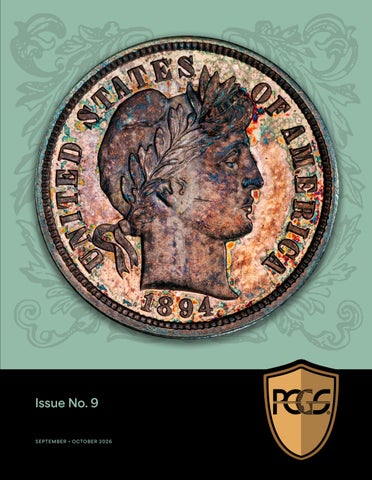
Issue No. 9 As we fall into autumn, many numismatic minds begin turning toward end-of-year collecting goals, visiting the last coin shows on the year’s calendar, and spending warm moments indoors perusing the collection. It’s also a time of reflection, and it brings to mind the many wonderful milestones that PCGS has marked so far in 2026 – and the year still isn’t quite over. Certainly the biggest highlight of 2026 has been our company’s 40th anniversary. It’s a symbolic milestone for us at PCGS, but in the grander scheme it also calls to mind that it was 40 years ago that the third-party grading revolution, which forever changed the hobby, began with PCGS back in 1986. In this issue, we continue our PCGS 40 series with reflections on our company’s early days by PCGS Co-Founder John Dannreuther. And, I mentioned a moment ago that it’s fall. That means it’s football time in America. Our own Carter Gaddis hits the numismatic gridiron with hobby legend Jeff Garrett, who explains how he ran a replica of the historic Libertas Americana Medal to the 50-yard-line of Super Bowl LX, where it gained national attention as the flip coin to kick off the biggest football game of the year. The PCGS Grading Room team also has plenty to share, with Jeff Howard shedding light on alternative forms of payment during the United States Civil War, Philip Thomas telling the story of Confederate money and Grierson’s Raid, Edward Van Orden surveying varieties of United States “Tennials” past, and Jay Turner revealing a recently minted mated-pair error from Great Britain. You’ll also meet young numismatist Wade Spencer, whose love for the hobby set him on an entrepreneurial path that opened doors to his own coin business. And we venture to the “Land Down Under,” where you’ll meet collector Don Edwards and find out about his impressive PCGS Set Registry collection that spans the gamut of the Australian numismatic catalog and beyond. But before we delve into these cool stories, we must address the sevenfigure elephant in the room: that beautiful coin gracing the cover of this issue. That’s right! It’s the 1894-S Barber Dime, and it’s a PCGS PR63 stunner. It was recently consigned to Stack’s Bowers Galleries, and you’re going to find out much more about this outstanding piece that once resided in such prestigious cabinets as the Norweb and Charles Litman Collections. As you make your plans for the autumn, please be sure to stop by and say hello at one of the many shows happening this fall. The PCGS team will be at Long Beach Expo: The Collectibles Show, in Southern California September 9-11, and PCGS Trade and Grade Showcase in Philadelphia, being held October 21-23.
May your autumn be bright and colorful!
Joshua McMorrow-Hernandez PCGS Insider Editor-in-Chief
Creative Director JACK ARCHER Art Director GEOFF PARRISH KEITH DEWALD Designer JAMES DAVIS Production Artist CHRIS WILSON Staff Writers VIC BOZARTH CARTER GADDIS SANJAY C. GANDHI JAIME HERNANDEZ JEFF HOWARD CHARLES MORGAN PHILIP THOMAS JAY TURNER EDWARD VAN ORDEN ABIGAIL ZECHMAN Contributing Writer RONALD BURNETT JOHN DANNREUTHER JESSE KRAFT, PH.D Advertising TARYN WARRECKER ARIANNA TORTOMASI PCGS INSIDER PCGS Insider Magazine USPS Pending Periodical #226, Copyright © 2026 by The Collectors Universe is published bimonthly by The Collectors Universe, 1610 E St Andrew Pl, Santa Ana, California, 92705. Application to Mail at Periodicals postage is Pending at Santa Ana, CA and additional mailing offices. Printed in Canada. Nothing herein is intended to provide financial advice. Past sales do not guarantee future results. POSTMASTER Send address changes to Collectors Universe, 1610 E St Andrew Pl, Santa Ana. California, 92705. BUSINESS & EDITORIAL OFFICES 1610 E St Andrew Pl Santa Ana, CA 92705 (949) 567-1234 ACCOUNTING & CIRCULATION OFFICES 1610 E St Andrew Pl Santa Ana, CA 92705 (949) 567-1234 Call (949) 567-1234 to subscribe. Periodical postage is paid at Blaine, WA.
insider@PCGS.com / @PCGScoin
The JFM57 Top Registry Set of Silver Commemoratives 144 Coins - All PCGS Certified & Approved by CAC
The JFM57 Top Registry Set of Silver Commemoratives represents one of the finest collections of classic U.S. silver commemorative coins ever assembled. Comprising all 144 coins, each PCGS certified and CAC approved, the set was carefully built over the past 20 years with an unwavering focus on quality and rarity.
Unreserved. Bidding Ends Sunday, September 6th, 13th, 20th and 27th. Selections from the set will be on display at the ANA World’s Fair of Money in Pittsburgh, PA (Table 1100).
Whether Buying or Selling, use
www.GreatCollections.com lan Russell President
Andy Wedding Consignment Director
Raeleen Endo Director of Client Services
Official Auctioneer
GreatCollections · 17891 Cartwright Rd Irvine, CA 92614 · Tel: 1.800.44.COINS · info@greatcollections.com
4
Coins Tell the Story of America For 250 years, coins have preserved the milestones, struggles, artistry, and freedoms that shaped our nation Every rare coin is more than precious metal. It's a survivor, a witness, and a storyteller. From the nation's earliest days through periods of growth, conflict, and innovation, America's coins have passed through the hands of those who helped shape its future. As more collectors enter the market, quality matters more than ever. The finest coins stand apart through rarity, eye appeal, and lasting desirability. They're not just pieces of history. They're the stories worth preserving. Discover coins that still define what money was meant to be.
888-663-2453
blanchardgold.com
More Than 50 Years of Service
5 TABLE OF CONTENTS
6
Featured Coin
9
Reflecting On Our Origins
13
Celebrating 250 Years
16
Women on Money
17
Alternative Forms of Payment
21
Inside PCGS: Abigail Zechman
24
Inside View
25
YN Spotlight: Wade Spencer
26
Collector Spotlight: Don Edwards
29
PCGS Abroad
30
Notable Notes
32
Market 101
34
Pinnacle of Canada
36
Numismatics of Greenland
41
Varieties, Errors & More
43
Auction Action
46
PCGS Newsflash
48
Show Schedule/Crossword Puzzle
6
F
E
A
T
U
R
E
D
C
O
I
N
:
1894-S Barber Dime PCGS PR63 CAC By Joshua McMorrow-Hernandez
There are three major rarities in American numismatics: the iconic 1804 Draped Bust Dollar, the legendary 1913 Liberty Nickel, and the beloved 1894-S Barber Dime. Unlike either the 1804 Draped Bust Dollar or the 1913 Liberty Nickel, the 1894S Barber Dime was officially recorded by the United States Mint during the year of its striking. However, the circumstances under which these three magnificent rarities were produced prompt more questions than factual answers can satisfy. That’s most certainly the case with the 1894-S Barber Dime, a coin whose very origin leaves many wondering.
Above: 1894-S Barber Dime, PCGS PR63 CAC
7 FEATURED COIN: 1894-S BARBER DIME, PCGS PR63 CAC END
Only 24 proof Barber Dimes were struck at the San Francisco Mint in 1894, which begs the questions: “Why just 24 dimes?” “Why were they struck as proofs?” American Numismatic Association President Farran Zerbe reportedly learned upon a visit to the San Francisco Mint in 1905 that a minor accounting shortfall spurred production of enough dimes to help balance the books. In 1972, numismatist James Johnson published a story based on the memories of Hallie Daggett, the daughter of San Francisco Mint Superintendent John Daggett, who asserted the dimes were produced as souvenirs for her father’s banker friends visiting the San Francisco Mint. In 1994, numismatic researcher William Burd published an article suggesting that the elder Daggett may have held a reception to commemorate his nomination to his post a year earlier and produced the dimes as presentation pieces for East Coast dignitaries attending the event. More than 130 years later, no official documentation has turned up definitive answers that explain how or why the 1894-S Barber Dime came to be. However, it’s fitting that, like the 1804 silver dollar and 1913 nickel, the 1894-S dime carries a tempting air of mystique and an element of the unknown. Every great coin has a story, and there is no shortage of stories with this prestigious rarity, which now is estimated to number just 13 survivors across all grades. The finest numismatic cabinets have hosted at least one example of the 1894-S Barber Dime. This specimen, graded PCGS PR63, once resided in the esteemed collection of the Honorable R. Henry Norweb and Emery May Holden Norweb, both scholars of the highest numismatic degree. The Norweb Collection laid claim to many of the finest trophies, including this 1894-S Barber Dime, which has been consigned to Stack’s Bowers Galleries. For more than three decades this legendary rarity has been off the market, widely known to have been the centerpiece of the Charles Litman Collection. The specimen dazzles with its resilient surfaces, awash in hues of champagne and dappled with kisses of aquamarine, lavender, and russet. Sparks of fiery orange and indigo punctuate the center-right obverse and upper-central reverse fields. A sharp strike and bold devices proclaim this coin a prized crown jewel fit to grace the most renowned collections. John Pack, Stack’s Bowers Galleries executive director of consignments, commented, “I have been in communication with the owners of this coin for many years and was delighted to finally have this legendary coin arrive on my desk. After decades of being held in the same collection, it is exciting to plan for our upcoming offering of it as a highlight of our Summer Global Showcase Auction, its first public auction appearance since our Norweb Sale in 1987.”
PCGS Quarterly Special Receive a limited edition Ruby Red Box when you submit coins for grading. Through September 30 or while supplies last.
Encapsulate your coins in one of these special labels for $7:
America’s 250th Birthday
PCG/ 40th A00i+er.ary
9 PCGS 40: REFLECTING ON OUR ORIGINS →
PCGS 40:
Reflecting on Our Origins By PCGS Co-Founder John Dannreuther
Above: John Dannreuther
10
Forty years is a long time – although, to me, it seems like yesterday that PCGS began grading coins in the spring of 1986. The 40th anniversary of PCGS is a time of reflection, as trying to remember how it all began is a mixture of personal memory and reading what others have written about the early days. Some things are absolute. The beginning of PCGS was a project to write a comprehensive coin encyclopedia. We not only wanted to “tell the coin story,” but also felt that more accurate pricing was needed for many rarities. Certainly, commonly traded coins were not the pricing problem. However, with certain issues such as No Motto Half Eagles and Eagles, we felt the pricing guides were inaccurate, especially for the higher grades. In fact, numerous coins that were priced did not even exist in the grades listed. For example, some coins were priced in uncirculated grades that did not exist in that condition. The book project was tossed aside the night that David Hall brought the first “slab” into one of our coin show meetings. David, Gordon Wrubel, Bruce Amspacher, and I had been meeting at night in one of our hotel rooms after the coin show closed discussing our book project. David brought the first prototype slab to that meeting, a circulated Washington Quarter, and the four of us had a collective epiphany. David envisioned coin pictures on the wall, trading graded coins without physically having them in hand (sight-unseen bidding), and other benefits of third-party-graded and -encapsulated coins. That night, we all felt the revolution coming, although none of us realized how large the tsunami of third-party grading was going to be. A little background might be interesting to those who are unfamiliar with the four of us who were the genesis of this company. Of course, David Hall needs no introduction – he is most well-known as the face of PCGS. David and I met in the 1970s and soon realized we had a lot in common besides coins. He had played in a band and was into music just as I was (he has a large record collection) and was an avid sports fan (yes, he is responsible for PSA and the card grading industry as well). However, my life as a coin dealer only came about after college when my father developed macular degeneration; he could no longer see the coins and enjoy collecting them. He asked me to sell his collection, and that led me to change professions from music to coins.
Above: The grading room at PCGS in the company’s early days / Courtesy of Gordon Wrubel
11 PCGS 40: REFLECTING ON OUR ORIGINS →
Gordon Wrubel also liked music and was in a doo wop group in his younger days. We all had common interests besides coins. Bruce Amspacher is the fourth member of this group and the least known. Bruce had been on the bowling team in college, along with first PCGS President Steve Mayer. I first met Bruce when we both worked for New England Rare Coin Galleries in the 1970s. I immediately liked Bruce, despite his chainsmoking of cigarettes! He was terrific at writing, which is one of my passions, too. I had written a few articles but in 1996 was the principal author of the PCGS Grading Guide. Bruce and I had different styles of writing, as I wrote quickly (still do) and would go back and edit what I had written. I often wrote so fast that I would leave out words! Bruce wrote one sentence at a time. He would craft each sentence until it was perfect. I saw him spend 20 minutes writing a particular sentence. Different strokes for different folks. Sadly, Bruce passed away years ago, but he was an influence on all of us – he even came up with the company’s name: Professional Coin Grading Service. I am often asked what it was like in the early days of the company. I spent the first 10 years of PCGS traveling every other week from my then residence of Memphis to California to grade. It is easy to look at graded coins in holders and decide whether you consider them average, below average, or above average for the grade. Grading 1,000 to 1,200 raw coins per day is another story. In my youth, I had several manual labor jobs – loading poison onto an airplane in the sweltering heat of summer, mowing lawns, breaking up concrete in the tower of an electrical plant, hauling heavy glass panes up a ladder for a greenhouse, and a few others that required physical labor. However, I believe that grading is a tougher job. It is mentally and physically exhausting. At the end of each day, I would go to dinner, then head back to my hotel and collapse on the bed. The next morning, the same routine would unfold – the best part of grading was getting to see the great coins that were submitted. That was reward enough for someone who enjoyed seeing the “cool” coins that came through the doors of PCGS – they still arrive today. Since I am still a consultant for PCGS, I get to see some of the unusual items that appear for the first time in the grading room, such as the recently unearthed 16th example of one of the most famous United States coins, James A. Stack’s 1804 Draped Bust Dollar. Along with fellow numismatists John Kraljevich and Vicken Yegparian, we were able to spend an hour examining this spectacular example at the 2025 American Numismatic Association Convention. The coin was in the
12
END
PCGS grading room at the show and the three of us were afforded the opportunity to examine it. No matter how many coins one examines, seeing an unknown rarity appear is a thrill. Another rarity that was graded by PCGS a few years ago was a coin that I had not seen since 1986. Attending a Dallas coin show that year, I was treated to the viewing of the unique 1844-O half eagle in proof. The late Mike Brownlee laid out a velvet pad and carefully emptied the contents of a manila 2x2 envelope. I immediately recognized it and exclaimed, “The Parmelee coin!” This half eagle and its brother, the proof 1844-O eagle, were in the famous 1890 Lorin G. Parmelee auction and properly described as proof examples from the New Orleans Mint. Parmelee was a “Boston bean baron” and his 1890 sale is one of most important 19th-century auctions. Branch Mint proof coinage is rare, as nearly all proof coins were struck at the “mother mint” in Philadelphia until the late 1960s, when the San Francisco Mint became the main production facility for proofs. When I arrived at the PCGS grading room that day, I was handed the 1844-O half eagle and made the comment that “I had not seen this coin since 1986.” The graders all looked at me with that quizzical look of “how did you see this coin?” I told the graders the story of how I saw it in 1986 at that Dallas show. It is a spectacular coin that one does not forget – it is graded PR67DCAM! There are many stories from the first 40 years of PCGS. Being a part of this journey was something I could not imagine in the beginning of my coin collecting days in the 1950s. At the start of PCGS, I did not envision the impact that third-party grading would have on our industry. One of the most important collections that I have helped form would not exist without third-party grading. The owner collected coins as a youngster, as many of us did, but said he would never have bought coins as an adult without the advent of third-party certification. The PCGS grading and authenticity guarantee gave him the confidence to build a world-class collection. I have heard this same story from many well-heeled collectors. It has been an amazing 40-year ride!
Above: 1881-S Morgan Dollar in early PCGS holder
13 AMERICA’S COIN TOSS: CELEBRATING 250 YEARS →
America’s Coin Toss:
Celebrating 250 Years By Carter Gaddis
Above: 1776 (1783) AR Medal Betts-615 Libertas Americana Medal that inspired the replica flipped at the Super Bowl / Courtesy of Jaclyn Nash, National Museum of American History
14
Two moments stand out for Jeff Garrett when he thinks about how he helped the National Football League (NFL) choose the ideal centerpiece for one of its most visible ceremonies in the year of America’s 250th birthday — a modern restrike of a Libertas Americana medal. The first memorable moment: the pregame coin toss at Super Bowl LX in Santa Clara, California. Garrett was there in person at the NFL’s invitation, settled in his seat at the 40-yard line, a few rows up at Levi’s Stadium. He witnessed Hall of Fame quarterback Joe Montana flip the medal high in the air, saw it bounce and come to rest on the red-painted portion of the NFL logo at midfield. The Seahawks called tails. It came up heads. The Patriots won the toss. Meanwhile, Garrett looked on with pride — and a little nervousness. “I wasn’t part of any rehearsal, so it was going to be a complete surprise to me,” Garrett said. “I was kind of proud that we were able to pull this off and help them flip a coin that has historical importance. So, it was neat to have been a part of that.” The Kentucky-based numismatist and author watched as the director of the National Museum of American History, Anthea Hartig, took possession of the Libertas Americana medal after the ceremony. It was the medal’s next leg on a journey to Washington, D.C., where it became part of the National Numismatic Collection. THE EXPERTS CONFER Here we come to Garrett’s second foundational memory of his role in the historic selection. In the latter half of 2025, he had worked with Smithsonian representatives, including Ellen Feingold, curator of the National Numismatic Collection, to come up with a recommendation to the NFL for a suitable coin. They needed a symbol that paid homage to the semiquincentennial of the Declaration of Independence, while also meeting the NFL’s size and weight standards. The NFL’s original idea had been to use a 1776 Continental Dollar for the coin toss, but the experts at the Smithsonian weren’t so sure.
Above: Jeff Garrett at the big game where the Libertas Americana medal was flipped under the national spotlight / Courtesy of Jeff Garrett
“Recent scholarship has shown that [Continental Dollars] were probably medals made in Europe and the design did not translate into ‘heads and tails’ very well,” Garrett wrote in an essay recording his thoughts on the experience. As a consultant for the Smithsonian and a 2025 inductee into the PCGS CoinFacts Hall of Fame, Garrett’s knowledge of coins is extensive. He owns the well-known Mid-Atlantic Rare Coin Galleries in Lexington, Kentucky, and is a past president of the American Numismatic Association. In other words, Jeff Garrett really knows his stuff. And he’s just wild about the Libertas Americana. So much so that he dedicated a significant portion of office space to the venerable medal. The coin even met the NFL’s desire for a patriotic nod to the country’s 250th anniversary. “The date on the Libertas Americana says on the front, ‘July 4, 1776,’” he said. “So that really struck them. Once they saw that suggestion really ticked all the boxes they were looking for, they were like, ‘OK, that’s it. We don’t need to go any further.’”
15 AMERICA’S COIN TOSS: CELEBRATING 250 YEARS END
THE AH-HA MOMENT Garrett’s “ah-ha” moment happened during a call to brainstorm ideas to help the NFL choose its Super Bowl LX coin. “On my office wall, I have a picture — about a four-foot by fivefoot frame — a picture of an original (Libertas Americana) that I sold years ago for half-a-million dollars, almost,” Garrett said. “When I was on the phone with [the Smithsonian], I just kind of looked up and said, ‘Boy, that would be a great coin.’” American Founding Father Benjamin Franklin gave birth to the idea of the Libertas Americana as a way to commemorate the young nation’s victory in the Revolutionary War and honor France’s critical role. Franklin commissioned the medal and worked with French designers Augustin Dupré and EspritAntoine Gibelin. As Freidman wrote in an article on the medal’s origin: “This medal showed the world what American liberty looked like: a confident young woman, hair flowing behind her as she charges forward toward possibility and promise, unafraid of what is ahead.” The original Libertas Americana is well represented at the Smithsonian, but there was never a thought given to using an original version in the coin toss ceremony. “I had a restrike, a five-ounce version, which was too big,” Garrett said. “We went on eBay and found one. I bought it on eBay and had it shipped to me. And as soon as I got it, I turned around and had it shipped to New York.” ONE FINAL STEP Once the NFL gave the go-ahead, it was time to seal the deal with the Highland Mint. The Florida company usually creates the Super Bowl coin toss medals, but this time around they were enlisted to transform Garrett’s restrike into a one-of-akind piece. Highland engraved three distinctive marks: the NFL shield logo, the word “heads” on the obverse, and the word “tails” on the reverse. Garrett, who appreciates numismatic history as well as anyone, was all-in on the engravings.
Above: National Football League referee holds a Libertas Americana replica used as the flip coin for Super Bowl LX / Courtesy of Jeff Garrett
“There’s a long history of coins being engraved for important events,” he said. “When they made the first Morgan Dollars in San Francisco, they had them engraved. […] Not only did I give permission, but I encouraged it, because it’ll be cool.” Thinking back to Super Bowl Sunday and everything that led to it, Garrett is proud that he could play such a unique role as the United States celebrates its semiquincentennial birthday. “The NFL did a stellar job giving numismatics its day in the sun at one of the most high-profile events on the globe,” he wrote in his reminiscent essay. “Hopefully, this is just a taste of things to come as the country begins celebrating our nation’s 250th anniversary.”
16
Women On Money:
Indira Gandhi By Abigail Zechman “Whenever you take a step forward, you are bound to disturb something.” — Indira Gandhi In 1966, Indira Gandhi made history as the first and only female prime minister of India and the world’s second-ever female prime minister. She made many controversial political moves during her time in power but will always be remembered as one of the most powerful women in the world. Indira was born into British-ruled India. She grew up watching her father fight for Indian independence and then become the first prime minister of the new Republic of India. Gandhi was naturally drawn into politics through her father’s involvement, so it was no surprise when she began to participate in political movements herself. Gandhi was initially elected as prime minister because other members of her party saw her as weak and malleable as a woman and hoped to use her as their political puppet. Despite her reluctance to take on such a large political role, she was an iron-willed and determined leader, quickly proving her party wrong and becoming a dominant political figure in her own right. One of Gandhi’s greatest accomplishments during her early years as prime minister was the Green Revolution. This series of programs was introduced to help India become agriculturally self-sufficient. Gandhi wanted to ensure India’s strength and stability and didn’t want to rely on aid from other countries. She strongly encouraged Indian scientists and farmers to collaborate with other countries, an endeavor that led to the development and success of new grain varieties. That, combined with increased government and financial support for agriculture, helped India go from a country often reliant on food aid to a major agricultural exporter. Above: 1985 Indian 20 Rupees honoring Indira Gandhi
Another big political move came when Gandhi supported the Bengali movement to separate East and West Pakistan in the Indo-Pakistani War. India had been supporting East Pakistan in their liberation attempt for months with resources and training, but Gandhi was trying to avoid entering the war. Unfortunately, an attack on an Indian airbase changed things, and India officially declared war on Pakistan in December of 1971. The Indian army was so swift, smart, and powerful that West Pakistani forces surrendered just 13 days later. This victory led to the formation of Bangladesh from East Pakistan and showcased India’s power. Later in her political career, Gandhi made more controversial decisions, one of which led to her assassination. Operation Blue Star was a military action she ordered that involved storming a prominent temple to remove armed separatists. This action led to extensive damage to the temple, a holy site. The Sikh community was greatly offended by these events and the lack of respect for their holy site. A few days later, Gandhi was assassinated by her Sikh bodyguards in retaliation for her acts. In 1985, India issued a commemorative coin honoring Indira Gandhi following her assassination. The obverse features the Ashoka Lion Pillar, the National Emblem of India. This statue symbolizes power, courage, and national pride. The four lions face in cardinal directions, representing protection. The reverse of this coin features a proud portrait of Gandhi. Below her are the symbolic dates 1917-1984, the dates of her birth and death. She may have been a controversial leader at times, but this commemorative coin highlights the respect the people of India had for their former prime minister.
17 CIVIL WAR ALTERNATIVE MONEY →
Civil War Alternative Money By Jeff Howard
Above:1864 Patriotic Civil War Token F-2/270a Copper Union Forever
18
During the Civil War, the United States faced a severe shortage of coins and reliable paper money. This led to the creation of several types of emergency currency, both federal and private, between 1861 and 1865. These creative innovations filled the gap in everyday commerce when gold, silver, and even copper coins disappeared from circulation due to hoarding, wartime uncertainty, and monetary laws passed by the U.S. government. As George and Melvin Fuld noted in their benchmark Patriotic Civil War Tokens reference, “No other short period in our history has produced such wide changes in our monetary system.” By late 1862, all coins – gold, silver, and even copper-nickel cents – disappeared from circulation. Suddenly there was no way to make change for everyday transactions. An alternative had to be introduced immediately. The largest impact of the coin shortage was felt in the larger metropolitan areas such as New York City, Philadelphia, Baltimore, and Chicago, and eventually every area in the North. During the Civil War, a variety of different emergency money was introduced into commerce, and the first was the standard United States postage stamp. Stamps did not handle circulation well due to their flimsy nature. As a quick remedy, merchants issued small advertising envelopes marked with the face value of the stamp that was placed within the envelope. This solution may have provided extra protection and longer circulation life in the interim. However, less-ethical people quickly caught on to the obvious workaround of this new system and simply removed some or all of the stamps from the envelope. John Gault entered the scene with one of the more fascinating and innovative contributions to the circulating money crisis. Inadequate circulation life and unscrupulous individuals rendered the plain postage stamp a poor solution. Gault patented a novel brass encasement with a mica (transparent, hard plastic-like material) so the postage stamp was easily viewable. These cases were created in denominations from one to 90 cents by the Scovill Company of Waterbury, Connecticut, and generally included a merchant’s advertisement on the reverse. These were popular and effective for a short time with hundreds of thousands produced, and they circulated well into 1863. The United States Post Office Department ordered local post offices to stop selling stamps for use as currency and to stop using them as currency. Both stamp envelopes and encased postages are intriguing, popular niches in the collecting world.
19 CIVIL WAR ALTERNATIVE MONEY →
Stamps were not the only paper products used to fill the void of circulating coinage. Both federal and private fractional currency instruments were manufactured in large quantities. Continuing with the postage stamp innovation, the Union government issued fractional postage currency in different denominations that were backed by U.S. postage stamps. Private fractional issues, with no intrinsic value, were created in vast quantities with highly variable quality, creativity, and durability. Many of these fiat fractional currencies were accepted and circulated for some time after the Civil War ended. However, because of their huge quantity and lack of any intrinsic value, they were nicknamed “Shinplasters” by the skeptics. Small cardboard pieces with an affixed value known as a scrip had merchants stamped onto them and were commonplace for aiding everyday transactions. These initial innovations were accepted and used. Yet, the most popular and pragmatic of these emergency currencies were the copper-nickel cent lookalike tokens that popped up in small quantities as early as 1860. These tokens were abundant by late 1862. These Civil War tokens broadly belong in two categories: patriotics and store cards. Store cards carried the merchant’s name, noted what type of business they were conducting, and their location. Patriotic tokens do not advertise any specific merchant information but instead feature patriotic, political, and other themes not directly related to a business. The tokens frequently had motifs that mimicked the design of the copper-nickel Indian Cents that were struck from 1859 through 1864, other Liberty Head designs, busts of popular generals, presidents, and various political hopefuls.
Above:A white metal Patriotic Civil War token emblazoned with “Our Army”
20
END
These tokens were enthusiastically adopted by the public and became the most effective form of emergency currency. They also added a sense of normalcy to everyday transactions. Incredibly popular, these pieces also sparked a wave of collector interest with many people starting collections from the beginning. Many interesting mules, varieties, and off-metal restrikes were made to order by collectors. Some of the most fascinating and desirable tokens are overstruck circulating federal coinage such as Flying Eagle Cents and Liberty Seated Dimes. Some of these dies were used as late as 1940 by enterprising collectors who were able to procure and resurrect the old dies! It is estimated that over 25 million patriotic and store card Civil War tokens were created. However, the often-spurious production and lack of redeemable value caused the federal government to intervene. In April and June of 1864, acts of Congress forbade private firms or individuals to issue any form of currency. These Congressional acts and the end of the Civil War quickly closed the chapter on the fascinating creative emergency money that effectively aided commerce and fueled collector interest during a tumultuous time in U.S. history.
Above Right: Patriotic Civil War token declaring users to “Value Me As You Please” Bottom Left: 1863 John Matthews Token from New York Bottom Right: 1863 M.L. Marshall Token from New York
21 INSIDE PCGS: ABIGAIL ZECHMAN →
Inside PCGS:
Abigail Zechman By Abigail Zechman
When I attended my first coin show, the 2012 Winter Florida United Numismatists (FUN) Convention, I had no idea how it would change my life. Unlike many numismatists, my journey into this hobby didn’t start through a family member. Instead, it all started with a Girl Scout patch. My troop went to the coin show for our “Fun With Money” patches, and as an art- and history-obsessed kid, I found the world of numismatics fascinating. I left that show with a bag full of coins, A Guide Book of United States Coins (“The Red Book”), and a new community. Funnily enough, I didn’t get the collecting patch until about six years later.
Above: Abigail Zechman
22
My family was incredibly supportive of this new hobby of mine; they took me to every single day of every single FUN show after winter 2012 so I could page and get to know the dealers, went to coin club meetings with me so I could engage with numismatists outside of shows, and even helped me put together my competitive educational exhibits when I repeatedly left them until the last minute. Thanks to their support, I quickly built a real numismatic community and always looked forward to the next FUN show when I could see all my coin collecting friends and mentors again. That community is what really kept me so engaged in the hobby. In 2016, I attended my first American Numismatic Association (ANA) Summer Seminar, and that is where my casual collecting interest became a true passion. Getting to spend two whole weeks surrounded by people my own age who loved coins as much as I did and meeting and learning from industry rockstars was exhilarating. It was the following year of Summer Seminar that I decided I wanted to work professionally in the industry; the year after that, I realized my true passion lay in numismatic education. I loved teaching people about numismatics, getting them excited about coins, and helping them find their own path in this industry. My decision to pursue a career in numismatic education was a bit of an odd one to most people. It wasn’t really a role that existed anywhere outside the ANA at the time, but I was determined to make it work. I became even more involved in numismatics, giving educational talks at coin clubs and shows, building educational exhibits, seeking out new learning opportunities, and just getting involved wherever I could. All that work led to me becoming Young Numismatist of the Year in 2018. As I got older, I took every internship and job opportunity offered to me and even served on the board of FUN for four years, hungry to learn more and be part of this industry that had already played such a huge role in my life. When I was given the opportunity to join PCGS in an education-focused role, I was shocked. As I mentioned earlier, when I decided to pursue numismatic education, I knew the opportunities would be limited, so I never imagined I would one day work for one of the most respected companies in the industry. As education coordinator, I helped expand PCGS’s educational initiatives. I hosted internal training sessions to introduce staff to the world of numismatics, wrote articles highlighting underrepresented areas of the hobby, and revamped our informational videos. I also helped launch new customerfocused initiatives, including grading contests and events for young numismatists.
Above: Abigail Zechman at age 10 / Courtesy of Abigail Zechman
23 INSIDE PCGS: ABIGAIL ZECHMAN END
This year, I stepped into a new role at PCGS as program manager of numismatic education and development. In this position, I develop internal training programs and external educational materials while also helping bring new numismatic talent to our team. Our staff is filled with incredibly talented individuals, and I’ve enjoyed helping them continue to develop their skills, deepen their knowledge, and grow within the company. Being involved in numismatic hiring has also given me the opportunity to support passionate and talented individuals, just as others once supported me. One of my favorite parts of my job is the time I get to spend with young numismatists (YNs). Throughout my numismatic journey, I was fortunate to find incredible mentors and friends who helped shape my path and guided me to where I am today. Now, as a numismatic professional, I have the opportunity to do the same for the next generation of collectors. I serve as a YN counselor at Summer Seminar, mentor YN coin clubs, and have helped organize multiple YN events and programs. I love mentoring young collectors, catching up with them as they run around the bourse floor, and watching them forge their own paths within the industry. Supporting these young numismatists has become one of the most fulfilling parts of my career. I think my career is proof that you don’t have to fit yourself into a box to succeed. Growing up in the industry, I was fortunate to have many people who supported me, but there were also plenty who didn’t always respect me or view me as a “real numismatist” because I wasn’t pursuing a career as a grader or dealer. If I’m honest, neither path ever really interested me. What I am passionate about is education and creating material tailored to specific audiences and topics. I’m also deeply passionate about coins and the numismatic hobby, and I never saw why I couldn’t make a career out of both. Because I refused to let others discourage me from forging my own path, I now get to do what I love at one of the most respected companies in the industry. Today, I’m proud to be a numismatic professional who gets to share my love of coins with others and inspire new collectors along the way. I hope my unique approach to the industry encourages others to pursue their own passions and create their own paths, even if it is outside the status quo. When talking about my personal coin collection, my true obsession is ancient coinage. They are what hooked me on numismatics from the beginning. The first coin I ever bought
Right: Abigail Zechman with Tony Bonaro at the Florida United Numismatists Show in Orlando
was from MedievalVenice. While I collect a little bit of everything, my main focus is Roman coinage featuring female portraiture. I am currently trying to assemble a complete collection of all the coins depicting Fulvia, a powerful political figure of the Roman Republic. Of course, I do tend to get bored focusing on just one collection, so I am also assembling a date set of Buffalo Nickels, coins featuring inspirational women, Red Books (A Guide Book of United States Coins), and anything else that piques my interest. Outside of numismatics, I am an avid reader and musical theater lover. You may have even noticed a few musical theater references in some of my past articles. I also love to travel. My favorite trip was to Italy, where I finally got to visit Venice myself, connecting my love of travel to my love of numismatics.
24
The Inside View:
One Coin Starts a Journey By Charles Morgan When a collector uploads a coin to the PCGS Set Registry, they are embarking on a journey. Often, the destination is still a bit of a blur. Each addition increases the set’s completion percentage, while the grades and attributes of those coins begin a tally that lets the collector see how they measure up against fellow travelers. Just as in the days of penny boards and coin albums, some coins are merely “hole fillers,” destined to be replaced when something better comes along. For many collectors, this is the moment where the possibilities seem endless. What personality will the set take? This is largely dependent upon the personality of the owner. Do you chase grades or chase coins? If you chase grades, what is your target? For which coins will you make exceptions? If you chase coins, what “look” are you after? How long are you willing to wait to realize your goal? The key word is goal. For many, it’s the thrill of the chase that gets them hooked: the pride of ownership, the hours of intense study, and the heat of the hunt. If you are new to the hobby, you might be surprised to learn that collectors often move on almost immediately after completing a goal. I can’t tell you how many times I’ve seen major sets sent to auction within a year of the journey’s end. It makes sense; once the hunt is over, it’s time to turn that focus toward the next one. In my years as a professional numismatist, I’ve always admired “collecting excellence.” In my view, excellence isn’t the exclusive purview of the ultra-wealthy; it is the stock-in-trade of the fully engaged. Years ago, I followed the progress of a friend who pursued a complete set of classic silver commemorative coins. His criteria were specific: the coins had to have great eye appeal and Above: The 1972 Type 2 Eisenhower Dollar with its indistinguishable islands below the funnel-like outline of Florida, a coin of choice for one of Charles Morgan’s numismatic friends
absolutely no toning. Given the age and composition of these coins, it is difficult to find both qualities in a single example. A knowledgeable collector or dealer can “dip” a lightly tarnished coin, but you can never be sure what the curation process will do to its eye appeal. Some coins can handle it, while others can’t. Many learn this lesson the hard way. For my friend, the coin he feared most was the Cincinnati Half Dollar. I assumed it would have been the 1915-S PanamaPacific (which always seems “oily” to me) or the typically yellow and spotted 1928 Hawaiian. I don’t think I’ve seen more than one or two white examples of the latter that didn’t look lifeless. Another friend began his journey with Eisenhower Dollars. He had a talent for finding examples with exceptional eye appeal and early die states. Over several years, he built and upgraded; some coins he bought, while others he “made” himself. Every weekend he was on the hunt for rolls and sets, looking everywhere for a better coin. He single-handedly added at least a thousand coins to the PCGS population reports and had a knack for finding 1972 Type 2s. He simply lived in the right place and knew what to look for when others didn’t. I bring up these two collectors because the PCGS Set Registry provided them the opportunity to compete, both against others and against their own ideals, and to network. I remember a group of us “Ike nuts” meeting in Pennsylvania to review each other’s collections. One participant even mailed us his coins to look at because he couldn’t make it in person. Now that I’m at PCGS, the Set Registry means even more to me. It is the bridge between us and the collectors. When I look at certain sets, I see the hard work, the grind, and the personality. It’s what you do. It’s what we do as Collectors.
25 YN SPOTLIGHT: WADE SPENCER
YN Spotlight:
Wade Spencer By Joshua McMorrow-Hernandez Wade Spencer began his numismatic journey at the age of five, influenced by his grandfather who was a numismatist himself. “I started collecting Buffalo Nickels because I loved the Indian design on the obverse, and that is still my favorite coin. I am actually doing a gem or near-gem set of Buffalo Nickels for myself right now.” It was Spencer’s love for the hobby that inspired him to become a numismatic entrepreneur. At the tender age of 12, Wade joined US Coins in Houston, Texas, an early career decision that set him on a path of success. “I learned so much there, and I would like to give them a lot of credit because without them I don’t know where I would be.” Where he went was on a path toward building his own business, which he opened in 2021 under the banner of Legacy Coin Auctions, a venture he spun off from his initial entrepreneurial tilt as owner of Republic Numismatics. “The goal was and still is to supply collectors with nice, high-end coins for their collections and have a big wholesale presence as well,” the 19-year-old says. He’s handled some incredible coins, including a PCGS-encapsulated 1893-CC Morgan Dollar graded PR64CAM. “That is the coolest coin I have ever owned.” It was Spencer’s passion for numismatic knowledge and his clearly demonstrated knack for handling top-tier coins in a wholesale setting that poised him for his next career move: relocating to Tulsa, Oklahoma, to work for Stack’s Bowers Galleries. “Working for Stack’s Bowers Galleries, I have been able to see and handle many notable coins and every day is a surprise.” Spencer is a highly motivated self-starter, but he’s not only about selling coins. He also has a heart for educating others about the hobby. That compelled him to teach others at the American Numismatic Association Summer Seminar, something he began doing at age 17 when he became the event’s youngest grading instructor. “I have had a lot of tremendous mentors over the years, but some YNs are not in the same boat and I love to help upcoming dealers and YNs any way I can.”
Above: Wade Spencer / Courtesy of Wade Spencer
26
Collector Spotlight:
Don Edwards By Joshua McMorrow-Hernandez Australian collector Don Edwards began his numismatic journey when he was a kid, enjoying coins alongside his prevailing philatelic passion of collecting stamps. As so many young collectors experience, Don found other interests. “But I was still interested in coins even though I wasn’t collecting them,” he says. “After a while you start to settle down and begin a family and money spent on hobbies goes by the wayside. It wasn’t until about 15 years ago that I again started collecting, this time Australian coins.” Edwards says he initially set out to focus on collecting Australian pre-decimal coins from pennies through crowns. “I would collect the best available coins and store them in coin albums, then I discovered PCGS and realized that getting them graded and put into holders was a much better collecting option.”
Above: Don Edwards / Courtesy of Don Edwards
27 COLLECTOR SPOTLIGHT: DON EDWARDS END
He carried on collecting the best PCGS-graded pre-decimal Australian coins he could afford for a few years. Then, something happened. “For some reason that only collectors would know, I started collecting Australian decimal coins from one cent through $5 denominations.” He collected the best Australian decimal coins he could afford and eventually migrated into collecting proof decimal coins. “So, from initially only wanting to collect pre decimal coins my collection has grown quite substantially.” The biggest challenge Edwards faced in collecting Australian coins is just the sheer number of coins issued by the “Land Down Under” since 1910. “Pre-decimal coins were never issued with many mintmarks or privy marks, but most issues in the last 25 to 30 years have had multiple mintmarks and privy marks issued with each series of coins – mostly in the $1 denomination.” Despite the monumental task in pursuing the bulk of the Australian catalog, Edwards felt compelled to trudge forward. “When I first started entering coins into the PCGS Set Registry I noticed there was a competition against other collectors to achieve as many points and medals as possible.” Many of the Set Registry objectives involved collecting coins from other countries, so Edwards expanded his collection beyond the island nation of Australia so he could compete in more categories. “Hence, some coins in my collection are from British North Borneo, and include the U.S. 2019 Apollo 11 series and the U.S. 2019 Quarter Quest.” Even as his collection reached across the Pacific to places like British North Borneo (a former British protectorate now known as Sabah and part of Malaysia) and the United States, Edwards maintains a special place in his heart for the coins of his Australian homeland. He doesn’t necessarily have a favorite coin, but his favorite set is his Australian Dollars Commemorative, Circulation Strikes (1984-Present) assemblage of 658 coins. “I am still needing two coins to 100% complete the set,” Edwards explains. As he closes in on some of his magnificent collecting goals, Edwards advises others who wish to build PCGS Registry Sets to start off by collecting coins within their budgets. “Many times I have started with lower-grade coins and waited until higher grades came along in auctions or other sites that I could afford. Part of the fun for me is searching and acquiring higher-graded coins that I already have.”
n o i t c e l l o c r u o h y t i g w n r e i s Selli a e n e e b r has neve in o day! C o t r n o e ti t c t e i ll W our co
Scan me!
o sell y t 0 9 6 -5 1 78 . Call (415) all, we buy them all m Large or s
1883 $2.50 PCGS AU-55 CAC 1903 $20 PCGS MS 64 CAC
1880-S $1 PCGS MS 68 CAC
2299 Lombard St San Francisco, CA 94123 wittercoin.com (415) 781-5690
sales@wittercoin.com
29 PCGS ABROAD: 2026 MINT ERROR DISCOVERY END
PCGS Abroad:
2026 Mint Error Discovery By Jay Turner
The mint error was caused when two planchets, instead of the normal one, had gone into the press and got struck together. What occurred was a striking error in which one coin featured the obverse and a brockage effect on the other side, while the other coin featured the reverse design and a counter-brockage. Mated pair error coins like this are incredibly rare. Even rarer is that it occurred on Great Britain 2026 £25 gold issues commemorating the Royal Tudor Beast, which features the Queen’s Lion. After the discovery of the mint error, the submitter was notified and given the option of using a PCGS dual holder for encapsulation to keep the mated pair together. The submitter agreed and the coins were certified as such. While there are always interesting coins at the PCGS Paris office, this discovery was a highlight of the show.
At the last Paris show something amazing and unusual occurred. That was the discovery of two error coins by PCGS staff. Even more unusual was the significance of the errors and that it was on a new gold bullion issue, which usually has very strict quality control. In the PCGS office in Paris, we will often get bullion for certification from across Europe. This bullion can range from vintage to modern issues. One submitter got very lucky with submitting a new Great Britain bullion struck at the Royal Mint. The coins were submitted in their original rolls, and it’s from there that a PCGS receiver noticed two of the coins were very different. What the PCGS receiver had found was a rare mint error.
Above: Great Britain 2026 £25 Royal Tudor Beast Queen’s Lion Mated Pair Error, PCGS MS69
30
Notable Notes:
A Numismatic Souvenir of Grierson’s Raid By Philip Thomas
Space and time. Cause and effect. Supply and demand. Tacos and Tuesdays. Very few pairs of things collaborate together within this oftentimes acrimonious and shambolic world of ours as harmoniously
Above: 1862 Confederate States of America $5, Type 53
as history and numismatics. Intrinsically linked at their foundations and inextricably attached at their hips, human events that have happened in the past can frequently best be illustrated by their concurrently
circulating monetary instruments – coins and paper alike – which serve as tangible, story-telling, eyewitness artifacts of the era.
31 NOTABLE NOTES: A NUMISMATIC SOUVENIR OF GRIERSON’S RAID END
Numismatics tells tales of wars and warlords, emirates and empires, bankers, barons, dukes, and dictators, spanning across all continents of the globe and dating back nearly as long as recorded human history itself. In most cases, this history is demonstrated more subtly and may require a little autonomous research to make the appropriate connections. In others, these historical associations stand out like a bold, flashing neon sign. This PCGS Insider issue’s Notable Notes features a piece with a heaping helping of history written ostentatiously all over its face (or across its back, if we are to be more literal and less idiomatic), attesting to a crucial falling domino within the U.S. Civil War subplot that foretold the beginning of the end for the Confederate States of America.
of the Mississippi River and effectively splitting the Confederacy in half. This would isolate vital Trans-Mississippi Confederate states from their southeastern siblings and sever vital Confederate supply lines of feed, armaments, and manpower in both directions.
By the spring of 1863, the Civil War had largely become a stalemate, hampered by supply shortages, combat casualties, starvation, disease, impressment and political turmoil on both sides of the divide. In an effort to turn these bleak tides, Union President Abraham Lincoln and his military advisors and generals set their sights on the city of Vicksburg, Mississippi, which was at the time considered to be the “key to the south.” By securing Vicksburg, the Union would have full operational control over the entire north-south length
Enter Union Colonel Benjamin H. Grierson (on horseback) and 1,700 of his closest cavalrymen from Illinois and Iowa to commence what Union General William T. Sherman described as “the most brilliant expedition of the war.” Originating in Tennessee before piercing through the heart of Mississippi, Grierson’s raiders galloped nearly 600 miles through hostile territory, destroying critical enemy railway lines, bridges, factories, and other wartime infrastructure, crippling the Confederate supply network into Vicksburg and beyond.
However, the Confederacy also very well knew about Vicksburg’s strategic importance and by the prior summer had transformed it into a heavily fortified stronghold (ie. “Bring it on – we dare you!”). A certain major general in the Union Army’s Department of the Tennessee – a handsome, bearded 40-year-old by the name of Ulysses S. Grant – would have been recklessly foolhardy to attempt a direct siege. But then, an idea was born.
Remarkably, the devastating physical destruction and advantageous spoils gathering that Grierson and his men were able to achieve over these 17 days may not have been the most strategically fruitful aspect of this daring operation. Perhaps more importantly, it provided a compelling diversion away from the defense of Vicksburg, scattering thousands of Confederate troops across the state in ineffectual attempts to hunt down Grierson. This ultimately made the siege and fall of Vicksburg possible and it was accomplished by General Grant in the months that followed. This 1862 $5 Confederate States of America T-53 bears the PSA/DNAcertified signature of Colonel Grierson himself along with a hand-written, fountain-penned contemporary inscription indicating how the note fell into Union soldiers’ hands: “Captured at Newton Station Miss. on the Southern Railroad April 24th 1863 during the raid.” For both students of yesteryear and enthusiasts of paper money, this one-of-a-kind numismatic relic certainly represents a deeply impactful convergence of the two, checking both boxes at the same time. And the rest, as they say, is history.
32
Market 101:
Bicentennial to Semiquincentennial By Vic Bozarth
The United States Semiquincentennial celebration is a special type of occasion that comes around only once every half century. Some of us remember the U.S. Bicentennial in 1976, but for nearly two generations of Americans the Semiquincentennial will be their first major U.S. birthday celebration. In an average life span very few of us might expect to experience more than two such patriotic jubilees. In 1976, I was 15 years old and already an avid numismatist. I was so excited about my first “‘Tennial” celebration. The excitement surrounding the Bicentennial coin issues was really big. Indeed, the nation’s Bicentennial coinage was produced for a year prior to the Bicentennial itself in both 1975 and 1976, and all those issues carry the 1776-1976 dual-date feature. The Bicentennial coinage was highly anticipated and the numbers of coins produced was significant. The result is that 50 years later all the business-strike
Above: 1776-1976 Eisenhower Bicentennial Dollar
and proof issues are readily available with the price dependent only on the condition. Indeed, circulated examples of the clad 1776-1976 Bicentennial Quarter and 1776-1976 Bicentennial Half Dollar are both available at their face values, while the clad 1776-1976 Bicentennial Dollar demands only a modest premium over face value five decades after their issue. The Bicentennial issues were immensely popular – it seems just about everybody wanted a three-piece Bicentennial set in Mint State, proof, or both versions. In addition to the popular uncirculated set and proof set formats, the total businessstrike production for the quarters, half dollars, and dollar coins were astronomical. Combined, the Philadelphia and Denver Mints struck about 1.67 billion Bicentennial Quarters, approximately 522 million Bicentennial Half Dollars, and 220 million Bicentennial Dollars for circulation. Mintages provide a starting point when determining supply and demand. Clearly,
the production of clad Bicentennial coins was massive. Both clad and silver Bicentennial uncirculated sets and proof sets were minted in large quantities also. Ultimately, the matters of scarcity and rarity in numismatics most often involve time and attrition. While there are modern issues that see immediate price increases, most often these profitable modern issues are few and far between. Long-term value on classic numismatic material is almost always the best bet versus speculating on modern material. The U.S. Mint website offers 34 different Semiquincentennial products, as of this writing. While I’m excited about the Semiquincentennial U.S. Mint issues as a collector, they hold little interest to me as an investor. I’ll let the market and some time determine where the market takes us.
33
C E R T I F I E D
C O I N S .
T R U S T E D
S O U R C E .
GRADES GUARANTEED, NOT GUESSED
Every PCGS-certified coin we sell is professionally graded, sealed, and guaranteed — no guessing, no seller opinions, just verified authenticity collectors can trust. APMEX offers one of the widest selections of PCGS-graded coins, supported by a long-standing partnership and a return policy that backs every purchase. With over 25 years in the industry and millions of customers served, we make collecting smarter, safer, and more transparent. Scan the QR code or visit click.apmex.com/pcgs-rare-picks to shop certified coins you can trust. View our prices and contact us at: 800.375.9006
APMEX.com
BUY NOW
34
The Pinnacle of Canada’s Monetary Evolution By Jesse Kraft, Ph.D While numismatic rarity is measured in numbers, status is usually measured in condition. This 1845 Bank of Montreal Half Penny in the American Numismatic Society collection offers both — an artifact from a transitional period in Canada’s history that stands as the pinnacle of monetary evolution in its pre-Confederation economy.
Above: The famed 1845 Bank of Montreal token, with just four known / Courtesy of the American Numismatic Society -- ANS 1968.235.11, gift of R. Henry Norweb
35 THE PINNACLE OF CANADA’S MONETARY EVOLUTION END
The 1840s proved to be a transformative decade for Montreal. In 1844, the city was named the capital of the United Province of Canada in 1844, drawing a sudden influx of wealth, political influence, and international attention — only to lose that status by 1849. Despite its standing as a British colony, the city’s economy was heavily intertwined with the United States, particularly following the 1843 completion of the Chambly Canal, which linked Montreal to the Hudson River. The decade also marked the birth of the “Two Solitudes,” as the city’s demographic shifted from a Francophone to an Anglophone majority, driven by the arrival of thousands of Irish immigrants fleeing the Great Famine. This era of rapid modernization was perhaps best captured by the introduction of gas street lighting, a sophisticated touch of progress that stood in stark contrast to the city’s largely unpaved, mud-laden roads. In addition to political and social upheaval, Montreal underwent a significant monetary evolution in the 1830s and 1840s. This gem proof 1845 Bank of Montreal Half Penny represents the pinnacle of numismatic evolution in this period. Remarkably, just years prior, the city’s commerce was plagued by underweight “blacksmith” tokens, yet it transitioned to modern, high-quality coinage in less than a decade. The shift began in 1835 with a “copper boycott” when the Bank of Montreal refused to accept “nondescript copper,” valuing blacksmith tokens by weight rather than by face. While these tokens remained in circulation out of necessity for several more years, they were eventually supplanted by the heavier “bouquet sous.” By 1837, Montreal’s four major banks — the Bank of Montreal, City Bank, Quebec Bank, and La Banque du Peuple — coordinated to issue unified, full-weight “Habitant” tokens. In 1838, the Bank of Montreal began its own series, starting with the rare “side-view” type, followed by the “front-view” design shown here. While the 1842 and 1844 issues remain common, the 1845 date is an extreme rarity, with only four known examples in existence. Even though nearly half a million copper half-pennies were delivered to the Bank of Montreal on July 4, 1845, they were all dated 1844. In his 1919 monograph, The Copper Tokens of the Bank of Montreal, Eugene Courteau classified this piece as a pattern. However, it does not meet the technical definition of the term. While pattern coins are experimental trial pieces
used to test new designs, compositions, or denominations before official approval, this coin mirrors the design and denomination already produced by the Soho Mint in 1842 and 1844. It is more likely that this piece was struck in late 1844 in anticipation of an 1845-dated emission. Use of the 1845 dies was abandoned after it was realized that the solicitor general had only authorized production through January 1, 1845. Consequently, the mint reverted to the earlierdated dies to seemingly remain within the legal parameters of the authorization. Few coins epitomize rapid economic, social, and political evolution as effectively as this 1845 Bank of Montreal Half Penny. A rare survivor of a transformative period in Canadian history, it beautifully combines extreme rarity with unparalleled condition.
36
Numismatics of Greenland By Sanjay C. Gandhi
Above: Erik the Red woodcut print circa 1688 from an Icelandic publication of Arngrímur Jónsson’s Gronlandia / Courtesy Wikimedia Commons
37 NUMISMATICS OF GREENLAND →
GREENLANDS ECONOMY WAS HOT A Viking explorer named Erik Thorvaldsson was given the nickname “Red” because of the color of his hair and beard. Erik the Red also had a fiery temper to match. In the early 980s, he had heard of land in the Northwest that was discovered by a Norwegian sailor named Gunnbjörn Ulfsson about 100 years earlier. Erik packed up his clan and sailed to the land and explored the coastline. He decided to name this land Greenland – Grænland in Icelandic, or Grønland in Danish and the Norwegian languages. In 985, Erik the Red returned to Iceland and recruited people to move to Greenland. In a medieval 12th-century account from the Saga of Erik the Red, Erik is quoted as saying why he named the island Greenland: “It would encourage people to go there that the land had a good name.” Erik the Red convinced a number of Norwegians and Icelanders to join him, ushering 25 ships to Greenland; unfortunately only 14 ships survived the voyage. Much of the economy in these lands centered around survival, but the practice of whaling was important. Whales were used for their meat, bones, blubber, and their skins. The Dorset peoples were the first inhabitants of Greenland; they did not hunt whales, and the Vikings had probably first encountered them when they arrived on the island. Inhabitants also hunted seals and walrus in the same manner. However, walrus ivory was the most lucrative source of income for the Vikings and became known as “Arctic gold.”
The Vikings used ivory to make buttons, belt buckles, carvings, and religious relics. Demand for walrus ivory became insatiable across Europe, which became its largest consumer. The Vikings exchanged walrus ivory for timber, iron, silver, gold, and livestock. Around the year 1200, the Thule peoples, ancestors of the modern Inuit (Arctic Circle natives), had made their way to Greenland, as they were seafaring like the Vikings. The Dorset, Thule, and Vikings interacted with each other through commerce and personal relationships. The Vikings had overhunted Greenland’s walrus population, soon becoming almost non-existent. Norsemen were forced to travel deeper into the Arctic Circle to find walrus, which became taxing and risky. Scientists postulate that a mini ice age began in the mid-14th century, when Europe was devastated by a fatal pandemic caused by a bacterium known as Yersinia pestis and carried by fleas and rats. The pandemic became known as the “Black Death” and killed between 25 million and 50 million people in Europe during a seven-year period spanning from 1346 through 1353. The Vikings’ source of income from walrus ivory came to a screeching halt around 1400. The Dorset peoples also vanished from Greenland around this time, however the Thule peoples survived due to their advances in adaptation. Harsh conditions in Greenland reduced the land’s population by large numbers and Greenland was no longer a burgeoning country. By 1500, the Viking Norsemen were almost non-existent on the island of Greenland.
38
COME SAIL AWAY Between 1605 and 1607, Christian IV, who was king of Denmark and Norway, sent expeditions to Greenland for exploration of the Arctic Circle and Greenland to find lost Viking settlements. The Norsemen bequeathed Greenland to the Dano-Norwegian government, and they sought to reclaim these lands. During 1729, the Danish East India Company was dissolved, and the Danish Asiatic Company (in Danish, Asiatisk Kompagni) was established in 1730. This company was granted a 40-year monopoly in all trading with India, China, and all the countries that were then considered part of the “Far East.” The first ship that sailed as part of this trade arrangement was the Den gyldne Løve (The Golden Lion), which sank off the Northeastern Coast of Ireland. Locals held the silver cargo for safekeeping and demanded a salvage fee. Before the deal was to take place, a local gang overpowered the Danish guards and took their entire cache of silver. This event strained relations between the Dano-Norwegian and Great Britain. The second voyage on the ship named Cron Printz Christian (Crown Prince Christian) was successful in reaching Guangzao (Canton) China, and they mainly traded for tea, porcelain, and zinc oxide. Trade became successful with multiple voyages. Between 1732 and 1738, the Danish Asiatic Company went to Danish Tranquebar, which was Tharangambadi, in Kerala, India, and it was located close to Ceylon (Sri Lanka). Several denominations were struck in Danish Tranquebar, like the PCGS MS64 1756 Royalin silver coin. In 1772, the Danish Asiatic Company’s trading rights expired, and the Danish Crown took over trade. Prior to this transition, one of the greatest numismatic crowns was produced: the Greenland Dollar. GREENLAND DOLLARS The coin shown is known as the Danish Asiatic Company Piastre or the Greenland Dollar. Its pedigree is quite fascinating, tracing ownership back to Peter Christian Hauberg (1844-1928), the chief inspector for the Royal Danish National Museum’s coin and medal collection. An artist himself, Hauberg authored many important works on Danish coinage. His personal collection he amassed during his lifetime was auctioned in 1929. This specimen traveled to the Zinck family, who owned a large collection of Danish and Norwegian coins. Soon after the coin eventually landed in the hands of Andy Lustig, who noted, “And to this day, once or twice a year, the seller tells me how much he regrets selling it, and I tell him I feel the same way about letting it slip through my hands. I think it’s just one of those few great coins that should never be willingly sold.”
Above: PCGS MS66 “1771” (1774) Greenland Dollar or Greenland Piastre from Hauberg/Zinck pedigree owned once by Andy Lustig
39 NUMISMATICS OF GREENLAND →
This Greenland Dollar was sold for $162,000 at an Ira & Larry Goldberg offering in 2011. The Goldbergs noted, “Of this issue only 543 pieces were struck in 1771, with the bulk of the issue being restruck in 1774. Discerning between the two emissions by die combination analyses, it has been determined that only 5 of the 1771 strikes are known. Of 1774 mintage, which comprised some 44,900 pieces, only 20 pieces are known to have survived. Of these, half are in museum collections. Truly one of the ultimate classic numismatic rarities.” As the 1770s rolled along, the Danish Asiatic Company made many subsequent trips to Danish Tranquebar in India, which in 1779 became a Danish Crown colony. The voyages continued to Asia until 1834; in 1845, Great Britain forced Denmark to sell its colonies within India and the Danish Asiatic Company ceased to exist after its last board of directors term ended in 1847. THE BUDDING GREENLANDIC NUMISMATIC SCENE In 1806, Peder Christian Abildgaard was traveling the southern fjords when he found a major cryolite deposit that spawned the southwestern Greenland town of Ivittuut. The Inuits used cryolite as a cleaning and degreasing agent, and the mineral helped to cure animal skins so it would not decompose. Cryolite, also known as soda ash, was highly sought after by manufacturers of aluminum. A Danish company known as Oresund mined and processed cryolite, and they were one of the first companies to issue zinc mining tokens from 1859 through 1865. Five denominations were struck, beginning with the skilling up to the rigsdaler. One of the first trading and mining firms that made a commitment to set up in Eastern Greenland was Anthony Gibbs and Sons in 1863. Unfortunately, this plan never came to fruition but three token denominations were manufactured in brass: a skilling, 24 skilling, and a 1 daler. All of these pieces are highly collectible today. The 1 daler denomination is the scarcest and has a value in excess of $3,000 in a grade of PCGS MS63. The Invigtut Croyolite Mining and Trading Company of Greenland also issued zinc tokens from 1875 to the 1890s, with denominations ranging from 1 ore to 20 kroner. There are three series and some of the larger denominations are exceptionally rare in the third series.
Above: PCGS MS64 1756 Silver Royalin from Danish Tranquebar, located in Kerala, India
40
END
In 1910, a Danish-Inuit named Knud Rasmussen and Peter Freuchen founded a trading station at Cape York, in Northwestern Greenland near Mount Dundas. Rasmussen issued aluminum token denominations from the 5 ore to the 10 kroner. Most of the tokens had a frozen date of 1910, with the exception of the 5 and 10 kroner, bearing a date of 1932. These tokens were to be redeemed at Rasmussen’s trading post, which was set up for the Thule peoples. Rasmussen was a humanitarian who traveled over 18,000 miles via dogsled across Greenland, and he is known as the “Father of Arctic Anthropology.” He and his teams made several “Thule Expeditions,” which studied the native Inuit peoples and polar bears. The first coins of Greenland as a Danish Colony were struck in 1926. Four denominations were introduced, including the 25 ore and 25 ore with a hole (the latter a scarce variety), which are both made from copper nickel. The polar bear motif, hearkening to the animal’s appearance in Greenland’s coat of arms, is a design that’s popular with collectors; a 1926 25 Greenland Ore graded PCGS MS65 could be had for less than $100. The remaining two denominations, the 50 ore and krone, were struck in aluminum-bronze, and these two pieces in PCGS MS65 can also be purchased for about $100. The Vikings pursued a physically active lifestyle in harsh conditions.They were farmers, seafarers, explorers, warriors, and supported their families. Their time on the island of Greenland was relatively short, lasting a little over 400 years. Once the walrus ivory trade dried up, the Vikings abandoned Greenland. Those who survived the Mini Ice Age, migrated to Iceland and Norway to continue their lives. In 2026, the population of Greenland stands at fewer than 60,000 people. Greenland is an autonomous nation within the Kingdom of Denmark, and their unit of currency is the Danish krone. Ninety percent of the population consists of the native Inuit (Arctic Circle) peoples. While cryolite is no longer mined on the island, Greenland possesses many other natural resources like platinum, tungsten, gold, rare earth magnets, and the precious stone ruby was discovered there in 2017. Fishing accounts for 90% of the country’s exports with shrimp and fish being the most lucrative. Today, the walrus is a protected species that thrives on the island. Greenland is indeed a place rich in history, teeming with life, and whose independent spirit echoes the legacy of the many peoples who have called this unique Arctic Circle country home.
Above: PCGS MS63 1863 Daler Anthony Gibbs and Sons Token struck in brass Middle: PCGS MS65 “1910” (1913) 25 Ore Thule Kap York Trading Post Token struck in aluminum Bottom: PCGS MS67+ 1926 HCN GJ 25 Ore without hole struck in copper-nickel
41 ERRORS, VARIETIES & MORE: VARIETIES OF 1776, 1876, AND 1976 →
Errors, Varieties & More:
Varieties of 1776, 1876, and 1976 By Edward Van Orden
For so many Americans, the year 1776 The 1776 Continental Dollar is one of the “CURRENCY” acrossv the five obverse evokes patriotic sentiments surrounding most famous but historically controversial dies (“CURRENCY,” “CURENCY,” the adoption of the Declaration of issues in all of American numismatics. AND “CURRENCEY”). Regardless Independence. The American Revolution Why controversial? For one thing, there is of its controversial status as a genuine (or the “The American Rebellion” as the no known documentation authorizing its American Revolutionary-era coin or not, British called it) waged to secure it, and issue. Second, there are no known records the 1776 Continental Dollar continues to the Fourth of July barbecues and fireworks of their use in financial transactions nor be a curiously important and sought-after commemorate both. Throughout the contemporary publications that mention numismatic issue. nation, Americans also celebrate their them. What is known is that its design landmark anniversaries as they did for the elements (the sundial, the chain, and the The year 1876 saw its own “revolutionary” Centennial in 1876 and the Bicentennial in mottos “FUGIO” [meaning “I fly”] and events with Alexander Graham Bell 1976. For numismatists and Revolutionary “MIND YOUR BUSINESS”) were used receiving a patent for his telephone War history enthusiasts alike, there on the Continental Currency (or Fugio and the indecisive presidential election are a number of U.S. coin issues with notes) issued by the Continental Congress between Samuel J. Tilden and Rutherford each of these dates across different in 1776. (The sundial and chain were B. Hayes. For numismatists seeking an denominations and mints. In light of this later used for the 1787 Fugio coppers.) eye-catching 1876 die-error variety, there year’s Semiquincentennial celebration Also known are seven die pairings for the is the 1876-CC Doubled Die Obverse of the Declaration of Independence, Continental Dollar across three metals: (DDO) Liberty Seated Dime. Until 1996, we are featuring die varieties of the pewter (400-500 population), brass working dies produced at the U.S. Mint 1776 Continental Dollar, 1876-CC (15-20), and silver (four). And if this were hubbed at least two times in order to Liberty Seated Dime, and the 1976-D “1776” dollar wasn’t mysterious enough, get a strong impression of the image. Prior Washington Quarter. there are three different spellings of to a subsequent rehubbing, this 1876-CC
Above: 1776 Continental Dollar CURENCY
42
END
Liberty Seated Dime obverse die pivoted slightly counterclockwise about a point near the rim by the word “UNITED.” Known as Class V or Pivoted Hub Doubling, the result is strong doubling on the opposite side of the coin (in this case, the letters “OF AMERICA”) with subtle doubling on the lower folds of the gown and lower part of the rock. Additionally, this obverse die is paired with three different reverses, and each has a different mintmark placement. This doubled die obverse is considered a “Top 100 Liberty Seated Dime Variety” by enthusiasts of the series. Events of the year 1976 included the incorporation of both the Apple and Microsoft computer companies, and the election of Jimmy Carter, who became the first candidate from the Deep South to win the presidency since the Civil War. Also commemorating the Bicentennial year was the issuing of a quarter, half dollar, and dollar, each with a revolution-themed reverse. Like the 1876-CC Doubled Die Obverse Liberty Seated Dime, there is a 1976-D Bicentennial Quarter obverse die that also during rehubbing pivoted slightly counterclockwise about a point near the rim – this time near the dates. The result is strong doubling of the letters in “LIBERTY” on the opposite side of the coin (with subtle doubling on the motto and date). If the pivot point had been near the center, all of the obverse numbers and lettering (except the mintmark, which was punched after the die was hubbed) would be doubled and near equally spaced. Although over 860 million 1976-D quarters were struck, PCGS has attributed only 81 of them with this doubled obverse.
Above: 1976-D Doubled Die Obverse Washington Bicentennial Quarter, PCGS MS67 Below: Closeup of 1876-CC Doubled Die Obverse F-107b Liberty Seated Dime, PCGS AU53
43 AUCTION ACTION →
Auction Action By Jaime Hernandez
1792 25 CENTS EAGLE ON GLOBE JUDD-12, PCGS SP63 This 1792 Liberty and Eagle on Globe Pattern, also classified as Judd-12, was produced during America’s infancy. A talented artist named Joseph Wright had sketched images of Founding Fathers George Washington and Benjamin Franklin. Washington was so pleased with Wright’s work that he chose him to be the first U.S. chief engraver. Sadly, after Wright designed the Liberty obverse with Eagle on Globe reverse pattern, he became ill from yellow fever and passed away before he was officially bestowed with the title as an official U.S. coin designer. Only two examples of this issue are known to exist; one is preserved in the Smithsonian Institution and estimated to grade About Uncirculated, while the second known example is graded PCGS SP63 and the only known to be in private hands. On January 18, 2026, this PCGS SP63 specimen appeared in a Great Collections Auctions where it sold for a record $2,947,500.
44
1918/7-S STANDING LIBERTY QUARTER FS-101, PCGS MS64FH The 1918/7-S Standing Liberty Quarter Overdate is one of the major key-date coins for the Standing Liberty Quarter series.The key features of this overdate variety are prominent and easily seen with the naked eye. This variety was created when a Mint employee tried reusing a die from the previous year and ended up punching an “8” over the “7” in the date. Incidentally, the same year, the Denver Mint also struck a 1918/7-D Buffalo Nickel Overdate, so it appears that the Mint had some issues creating dies in 1918. The 1918/7S Standing Liberty Quarter was first discovered in 1937. Most graded examples appear to be in Fine to Very Fine grades. PCGS has graded roughly 115 examples in all Mint State grades combined, with only about 15 of these earning the coveted Full Head (“FH”) designation. The highestgraded examples from PCGS are in MS64FH. PCGS has only graded four examples in this grade and only two finer in MS64FH+. On April 29, 2026, Heritage Auctions sold a PCGS MS64FH specimen for $158,600.
(1943) WALKING LIBERTY HALF DOLLAR STRUCK ON STEEL CENT PLANCHET, PCGS MS62 Wow! What a neat error representing the extremely popular one-year type of the zinc-coated steel 1943 Lincoln Cent and the beloved Walking Liberty Half Dollar design. This error coin was struck during America’s involvement in World War II, when the United States Mint experimented with different alloys to replace the copper in the Lincoln Cent. What many individuals don’t know is that in the midst of transitioning coin compositions for the cent, the Mint accidentally struck other error coins besides the popular and widely known 1943-dated copper cents. One of the most amazing errors is this undated Walking Liberty Half Dollar struck on a 1943 zinc-coated steel cent planchet. It shows most of Lady Liberty’s motif with the exception of her head; however much of the half dollar design isn’t present here since it would not have fit on the smaller Lincoln Cent planchet. Overall, this amazing error coin doesn’t show up on the market often. On February 3, 2026, this PCGS MS62-graded example sold for $48,000 at a Stack’s Bowers Galleries auction.
45 AUCTION ACTION END
1988 DOUBLED DIE EAR LINCOLN CENT, PCGS MS63RB The Lincoln Cent offers an abundance of doubled die varieties, including the popular 1955, 1969-S, and 1972 doubled dies. There are a multitude of more obscure doubled dies, such as the rare 1988 Doubled Die Obverse Lincoln Cent. This piece exhibits prominent doubling below Abraham Lincoln’s ear, and this variety is aptly referred to as a “doubled ear.” PCGS has graded only two examples in all grades combined, with one specimen in PCGS MS66RD and another graded PCGS MS63RB. The latter specimen was recently sold in a DLRC auction, where it realized an impressive hammer price of $64,000.
ORIGINAL PACK OF 100. FR. 1654. 1934D $5 SILVER CERTIFICATES, PCGS BANKNOTE GEM UNCIRCULATED 65 PPQ It is possible to obtain packs of brand-new $1 bills or even $100 bills from local banks, usually without any extra fees above the face value of the notes. But how about a pack of Silver Certificates from Series 1934? Very nearly impossible! However, sometime in the 1950s someone did just that, managing to get their hands on an entire 100-note pack of 1934D $5 Silver Certificates – $500 worth of banknotes in total – from the bank. Well preserved for over 70 years, this pack was still banded with its original Bureau of Engraving and Printing strap, stamped “Jul 22 1952,” when it was graded PCGS Banknote Gem Uncirculated 65 PPQ. It was finally offered for sale via Stack’s Bowers Galleries on March 12, 2026, fetching $15,600.
46
PCGS Newsflash:
PCGS Announces 2026 Set Registry Award Winners By PCGS Staff PCGS recently announced its list of 2026 Set Registry Awards winners, with 60 sets and their collectors receiving recognition across a variety of categories representing the breadth of the United States numismatic catalog and nations around the world. More than a quarter century after PCGS brought the Set Registry online in 2001 and bestowed 15 awards to its members, the number of recognitions has grown by multiples, reflecting the incredible growth of this popular collecting platform from just 300 sets to nearly 200,000. “We are so excited to recognize our collectors during our company’s special 40th anniversary year,” said PCGS President Stephanie Sabin. “In honor of PCGS’s jubilee celebration, we are elevating the PCGS Set Registry Awards program so we can honor more than 60 sets and collectors and bestow each with keepsake plaques suitable for display, vouchers, and more. It’s also just one of the many benefits of using the free PCGS Set Registry. Our innovative collecting platform allows collectors to organize their sets across multiple categories and devices, complete exciting achievements in a friendly competition for the most points, and complete the highest-rated sets to win yearly awards.” Charles Morgan, PCGS manager of numismatic research and programs, further remarked, “Only one winner is recognized in each U.S. denomination and series category. The fiercely contested Lincoln Cent category highlights a rising collector demand for ultra-condition 20th-century rarities. In the classic U.S. coin categories, judges faced the difficult task of weighing sets containing many of the finest-known examples against complex sets requiring hundreds of difficult-to-find die pairings.” This year’s PCGS are as follows:
Above: 1916-D Mercury Dime, PCGS MS67
Set
Registry
Award
members
47 PCGS NEWSFLASH: PCGS ANNOUNCES 2026 SET REGISTRY AWARD WINNERS END
HALL OF FAME SETS •
“Monsters of the Midway” - Mercury Dimes FB Complete Variety Set, Circulation Strikes (1916-1945) - MADHATTER “An Ohio Collector” - Standing Liberty FH Quarters Basic Set, Circulation Strikes (1916-1930) “RSD” - Barber Quarters Basic Set, Circulation Strikes and Proof (1892-1916) “HALFDOME” - Indian Head $10 Gold Basic Set, Circulation Strikes (1907-1933)
• • •
PCGS SET OF THE YEAR •
• • • • • •
• • •
• • • • • • • • • • • • • • • • •
• •
“Elite” St. Gaudens $20 Gold with Major Varieties, Circulation Strikes (1907–1932) – Elite
PCGS SET CATEGORIES •
•
Best U.S. Type Set: Complete Dansco 7070 Modified Type Set, Gold Page (1796–Date) – “Winesteven,” Winesteven Best Half Cent Set: Half Cents with Major Varieties, Circulation Strikes and Proofs (1793–1857) – “The High Desert Collection,” The High Desert Collection Best Large Cent Set: Large Cents Die Variety Set by Newcomb, Circulation Strikes (1839–1857) – “D.L. Hansen Large Cents by Newcomb (1839-1857),” D.L. Hansen Best Small Cent Set: Lincoln Cents Complete Variety Set, Circulation Strikes and Proof (1909– Present) – “The Cotgreave Collection of unCommon Cents,” AlterityCoins Best Two-Cent / Three-Cent Set: Shield Two Cents with Major Varieties, Circulation Strikes and Proof (1864–1873) – “winesteve1,” winesteve1 Best Five-Cent Set: Jefferson Nickels FS Complete Variety Set, Circulation Strikes and Proof (1938– Present) – “Quantumnavy,” Quantumnavy Best Half Dime or Dime Set (to 1891): Liberty Seated Dimes with Major Varieties, Circulation Strikes and Proof (1837–1891) – “The Jason Feldman Liberty Seated Dime Collection with Proofs, 1837-1891,” Jason Feldman Best Dime Set (1892 to Present): Mercury Dimes FB Complete Variety Set, Circulation Strikes (1916–1945) – “Monsters of the Midway,” MADHATTER Best Twenty-Cent Set: Twenty Cents with Branch Mint, Proof (1875–1878) – “Black Cat Twenty Cents with Branch Mint Proof (1875-1878),” Black Cat Best Early Quarter Set / Best Bust Quarter Set: Capped Bust Quarters with Major Varieties, Circulation Strikes (1815–1838) – “The Link Early American Silver Capped Bust Quarter Variety Set,” Dr. Charles Link Best Liberty Seated Quarter Set: Liberty Seated Quarters, Proof (1858–1891) – “Chugum,” Chugum Best Barber Quarter Set: Barber Quarters Basic Set, Circulation Strikes and Proof (1892–1916) – “RSD,” RSD Best Standing Liberty Quarter Set: Standing Liberty FH Quarters Basic Set, Circulation Strikes (1916–1930) – “An Ohio Collector,” Z20014 Best Early Half Dollar Set: Capped Bust Half Dollars Prime Die Variety Set by Overton, Circulation Strikes (1807–1836) — “Bhnco54,” gpeters Best Liberty Seated Half Dollar Set: Liberty Seated Half Dollars Basic Set, Proof (1858–1891) – “chughum,” chughum Best Barber Half Dollar Set: Barber Half Dollars, Proof (1892–1915) – “laxdive,” laxdive Best Walking Liberty Half Dollar Set: Walking Liberty Half Dollars with Major Varieties, Circulation Strikes (1916–1947) – “Gerald Forsythe,” Gerald Forsythe Best Franklin Half Dollar Set: Franklin Half Dollars FBL Basic Set, Circulation Strikes (1948–1963) – “LDR,” lradabaugh Best Kennedy Half Dollar Set: Kennedy Half Dollars with Major Varieties, Circulation Strikes (1964– Present) – “RickJones,” RickJones Best Early Dollar Set: Early Dollars Complete Variety Set and Silver Plug, Circulation Strikes (1792–1808) – “MJ Sullivan Collection,” MJ Sullivan Collection Best Liberty Seated Dollar Set: Liberty Seated Dollars Basic Set, Circulation Strikes (1840–1873) — “American Girls,” SeatedCrazy Best Trade Dollar Set: Top 37 Trade Dollar Varieties — “The Concord Collection,” keoj Best Morgan Dollar Set: Morgan Dollars Complete VAM Set, Circulation Strikes (1878–1921) – “Andy Hansen,” Andy Hansen Best Peace Dollar Set: Peace Dollars, Circulation Strikes (1921–1935) — “Giovanni Peace Dollar Set,” BS91367 Best Modern Dollar Set: Eisenhower Dollars with Major Varieties, Circulation Strikes (1971–1978) — “The Band is Back,” James Sego Best Gold Dollar Set: Gold Dollar Date Set, Circulation Strikes (1849–1889) — “Diana L Hansen,” DLR87 Best Quarter Eagle Set: Liberty Head $2½ Gold Basic Set, Circulation Strikes (1840–1907) –
• • • • • • • • •
“No End in Sight $2 ½,” OldGoldIsMoney Best Half Eagle Set: Indian Head $5 Gold, Circulation Strikes (1908–1929) – “HALFDOME,” Legendnumis1 Best $3 Gold Set: $3 Gold, No 1870-S, Basic Set, Circulation Strikes (1854–1889) — “Witter Coin, ‘Lima Lake Collection,’” Witter Coins Best Pre-1933 Gold Proof Set: $4 Gold, Proof (1879–1880) – “Tangible Investments, Inc.,” Tangible Investments Inc. Best Eagle Set: Indian Head $10 Gold Basic Set, Circulation Strikes (1907–1933) – “HALFDOME,” Legendnumis1 Best Double Eagle Set: St. Gaudens $20 Gold with Major Varieties, Circulation Strikes (1907–1932) – “Elite,” Elite Best Commemorative Coin Set: Silver Commemoratives 144 Piece Mintmark & Variety Set, Circulation Strikes (1892-1954) – “J & L 144-Piece Commemorative Coin Set,” dodgers267 Best Bullion Set: First Spouse $10 Gold with First Strikes, Circulation Strikes (2007–Present) — “MATTS,” surefoot Best Colonial Coin Set: Early American Coins and Tokens Basic Design Set (1616–1820) — “Lafayette Collection” Earlyhalves Best Territorial Gold Set: California Fractional Gold — Complete Collection, Period One & Two (1853–1882) — “Kirk Evans Collection,” kriksnave Best U.S. Pattern Set: Complete Patterns, Die Trials, and Experimental Pieces — “The Black Cat Collection,” Black Cat Best Vintage World Coin Set: Australian Three Monarchs Basic Set, Circulation Strikes (1911-1964) – “Frehley,” frehley Best Modern World Coin Set: Canadian Elizabeth II Nickel Dollars with Varieties, Circulation Strikes (1968-1986), “SPP Ottawa”
COMPOSITE AWARDS — COMPETITIVE SETS (U.S. COINS)
• • • • • • • • •
“The JDG Trust Collection” Buffalo Nickels Basic Set, Circulation Strikes (1913–1938) – lunagately “Pocket Piece” Complete U.S. Type Set, Low Ball (1792–1964) – colorfulcoins “Shipwrecked” Franklin Half Dollars Basic Set, Proof (1950–1963) – Shipwrecked “Huskers” Jefferson Nickels FS Basic Set, Circulation Strikes (1938–Present) – Huskers “Alan Gary Tyler Collection” Morgan Dollars Basic Set, Circulation Strikes (1878–1921) – Alan Gary Tyler “Tim’s Morgan 50 Set” The Morgan 50 – Tim “Worn Out” Silver Commemoratives 50-Piece Type Set, Low Ball (1892–1954) – 78saen “David Reimer Chop Marked Trade Dollar Collection” Trade Dollars Chop Mark Set, Circulation Strikes (1873–1878) – DDR “The Brodie Collection” Washington Quarters Basic Set, Circulation Strikes (1932–1964) – Dr. John O. Phillips
COMPOSITE AWARDS — COMPETITIVE SETS (WORLD COINS)
• • • • • • • •
Australian Commonwealth Silver Type Set, Circulation Strikes (1910-1964) – “The Diamond Set,” The Diamond Set Australian Two Dollars C Mintmark Set, Circulation Strikes (2012-present) – “$2 QUEEN,” $2QUEEN British Crown Basic Type Set, Circulation Strikes (1662-1965) – “gigott,” gigott Bulgarian Three Rulers Set, Circulation Strikes (1881-1943) – “b.angelov,” b.angelov Japanese Non-Gold Decimal Coinage Denomination Type Set (1870-1948) – “Li’s,” JPkosen.com Mexican Onza Libertad Silver, Circulation Strikes (1982-present) – “RickJones,” RickJones Mexican Branch Mint 8 Reales Type Set, Circulation Strikes (1823-1897) – “libertycoin,” libertycoin Republic of China Yuan Sun Yat-sen Dollar Basic Set, Circulation Strikes (1932-1934) – “jimmydee1,” jimmydee1
COLLECTOR SHOWCASES
• • •
“Wounded Buffalo” 2026 Box of 20 – lunagately “Rainbow Rarities” 2026 U.S. Toned Coin Competition – Merc Madness “Israeli Showcase” 2026 World Toned Coin Competition – Atom
48 PCGS SHOW SCHEDULE / CROSSWORD PUZZLE
PCGS Show Schedule * On-site grading
WALK-IN WEDNESDAY Every Wednesday Collectors Lobby Santa Ana, California September 2 / October 7 Harborside Office Jersey City, New Jersey SEPTEMBER September 9 - 11 Long Beach Expo: The Collectibles Show Long Beach Convention Center Long Beach, California OCTOBER October 21 - 23 PCGS Trade and Grade Showcase Long Beach Convention Center Philadelphia, Pennsylvania See full show schedule at PCGS.com/shows
PCGS Crossword Puzzle ACROSS 1. A vampire-sounding acronym for the highly specific, textually documented die varieties of Morgan and Peace silver dollars. 4. The dark, ominous color named in the nickname of the famous 1899 $1 Silver Certificate featuring a large, predatory eagle. 7. The “bloody” color designation (RD) that commands the highest price premiums for pristine, uncirculated copper coins at PCGS. 10. A somber memento mori token distributed to attendees at 18th-century English burials, now a highly collectible branch of exonumia. 11. A highly reactive metal alloy that easily tarnishes to a deathly brown; the elemental composition of the earliest US half cents. 13. The casket-like shape of certain primitive emergency siege money, Japanese bar money, or odd-shaped tokens. 14. Morbid hobby slang for the plastic flip or return sleeve a coin comes back in when PCGS rejects it for regular numeric grading due to altering or cleaning. 15. A chilling word that, in numismatics, refers to the hardened steel stamp that strikes a coin’s design. 17. An eerie numismatic phantom; a faint “shadow” image of the reverse design showing through to the obverse due to a severe die clash. 19. This creepy-crawler’s name describes the incredibly complex, web-like geometric patterns found on Large Size US paper money. 21. The autumn harvest crop featured prominently on the reverse of Lincoln cents minted from 1909 to 1958.
Find solutions to the PCGS Crossword at www.pcgs.com/info/crossword
DOWN 2. A Frankenstein-esque adjective used by collectors to describe a coin possessing spectacularly vivid rainbow toning. 3. The protective, vault-like plastic tomb for a coin, revolutionized and introduced to the industry by PCGS in 1986. 5. The grim nickname given to oversized holders. 6. A bare-bones term for an intricate, bare-frame banknote underprint style designed to thwart 19th-century counterfeiters. 8. A crypt-like modifier paired with “Cameo” (DCAM) on PCGS labels to denote maximum contrast between frosted devices and mirror fields. 9. The ghoulishly historic color of the printed label found inside PCGS’s iconic, highly coveted early “Rattler” holders. 11. A death sentence for a coin’s original surface, forcing PCGS to relegate it to an unnumbered “Details” grading status. 12. The slow, chemical “witch’s brew” that oxidizes a coin’s surface metal, turning silver into a canvas of dark or iridescent colors. 16. The flying mammal of the night featured on the 2020 National Park Quarter, which spawned several popular doubled-die error hunts. 18. The nocturnal bird of prey stamped onto ancient Athenian tetradrachms, highly prized in historical type sets. 20. The orange-brown “decay” that forms on improperly stored iron minting dies, leaving raised pitting marks on the coins they strike.
49
A Study in Contrast Deeply mirrored fields. Frosted relief. Timeless beauty. Enduring value.
MIKE RINKOR MIKE@RINKOR.COM
RINKORRARECOINS.COM 707-546-2575
DON RINKOR DON@RINKOR.COM