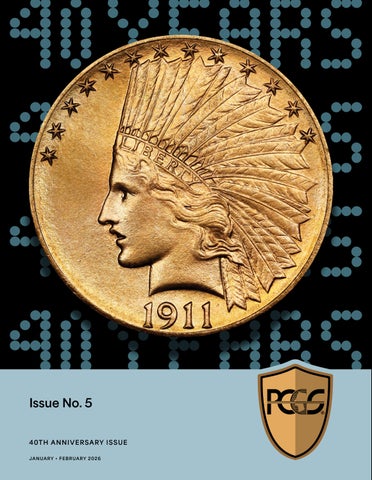
Issue No. 5 40TH ANNIVERSARY ISSUE JA N UA RY • F EBRUARY 2026
Stack’s Bowers Galleries Always Accepting Consignments Consign U.S. Currency to Our Spring 2026 Showcase Showcase Auction
Auction: March 9-13, 2026 • Costa Mesa, CA • Deadline: January 8, 2026 The Official Auction of the Whitman Expos
Fr. 187k. 1880 $1000 Legal Tender Note. PCGS Banknote Very Fine 25. Realized: $252,000
Peter A. Treglia 949.748.4828 PTreglia@ StacksBowers.com
Bonham, Texas. $100 1902 Red Seal. Fr. 686. First NB. Charter #3094. PCGS Banknote About Uncirculated 50. Realized: $66,000
Fr. 831. 1918 $50 Federal Reserve Bank Note. St. Louis. PCGS Banknote Choice Uncirculated 63. Realized: $50,400
Michael Moczalla 949.503.6244 MMoczalla@ StacksBowers.com
Fr. 1166b. 1863 $20 Gold Certificate. PCGS Banknote About Uncirculated 50 Details. Realized: $516,000
Fr. 2201-A. 1934 Dark Green Seal $500 Federal Reserve Note. Boston. PCGS Banknote Superb Gem Uncirculated 68 PPQ. Realized: $48,000
Fr. 121m. 1901 $10 Legal Tender Mule Note. PCGS Banknote Superb Gem Uncirculated 67 PPQ. Realized: $36,000
Contact Our Experts Today for More Information!
Visit Us Online at StacksBowers.com
LEGENDARY COLLECTIONS | LEGENDARY RESULTS | A LEGENDARY AUCTION FIRM 1550 Scenic Ave., Ste. 150, Costa Mesa, CA 92626 949.253.0916 • Info@StacksBowers.com 470 Park Ave., New York, NY 10022 212.582.2580 • NYC@stacksbowers.com Visit Us Online at StacksBowers.com
America’s Oldest and Most Accomplished Rare Coin Auctioneer SBG PMR Consign 2026 260101
California • New York • Boston • Miami • Philadelphia • New Hampshire • Oklahoma Hong Kong • Copenhagen • Paris • Vancouver
STACK’S BOWERS GALLERIES IS PLEASED TO PRESENT
The James A. Stack, Sr. Collection Part II: Gold Dollars through Eagles and Territorial Gold Coins February 3, 2026 • Griffin Studios • Costa Mesa, CA 1798 Half Eagle. Small Eagle. BD-1. Rarity-7. AU-53 (PCGS). CAC. CMQ. One of Only 5 in Private Collections. 1899 Half Eagle. Proof-69 Deep Cameo (PCGS).
1828/7 Half Eagle. BD-2. Rarity-8. MS-64+ (PCGS). CAC. CMQ-X.
The Sole Finest Certified Proof Liberty Head Half Eagle. From Elder’s June 1921 Auction.
The Sole Finest Graded 1828/7 $5. One of Two Known Examples of BD-2. From Stack’s 1944 J.F. Bell Collection Auction.
1911-D Eagle. MS-66 (PCGS). CAC. CMQ.
The Only CAC-Verified Example. From Mehl’s 1946 Atwater Collection Auction.
PCGS Population: 1; 1 Finer (66+).
The Sole Finest Certified of this Key Date Issue.
1830 Templeton Reid $2.50. AU-58 (PCGS). CAC. From Henry Chapman’s 1924 Nygren Collection Auction.
1933 Eagle. MS-66 (PCGS).
1852/1 Augustus Humbert $10 Gold. MS-62 (PCGS). CAC. CMQ. The Sole Finest Graded. From U.S. Coin Co.’s 1913 Jackson Collection Auction.
Undated (1849) Miners Bank $10. MS-62 (PCGS). CAC. CMQ. The Sole Finest Certified. From Stack’s 1944 E.M. Wharton Collection Auction.
Contact Us Today for More Information
800-458-4646 (CA) • 800-566-2580 (NY) • Info@StacksBowers.com
1850 Baldwin & Co. $10. MS-61 (PCGS). CMQ. From Mehl’s 1948 Geiss Collection Auction.
Learn More About the James A. Stack, Sr. Collection at StacksBowers.com
LEGENDARY COLLECTIONS | LEGENDARY RESULTS | A LEGENDARY AUCTION FIRM 1550 Scenic Ave., Ste. 150, Costa Mesa, CA 92626 949.253.0916 • Info@StacksBowers.com 470 Park Ave., New York, NY 10022 212.582.2580 • NYC@stacksbowers.com America’s Oldest and Most Accomplished Rare Coin Auctioneer
Visit Us Online at StacksBowers.com
SBG PCGSInsider Jan/Feb2026 JAStackFebHL260101
California • New York • Boston • Miami • Philadelphia • New Hampshire • Oklahoma Hong Kong • Copenhagen • Paris • Vancouver
2 EDITOR’S NOTE
Issue No. 5 We’re thrilled to kick off the 40th anniversary of PCGS! The past four decades have been truly transformative for numismatics, and when we look back to when we started in 1986 it’s amazing to think how much our hobby has evolved since we graded our first coin. Our success has been tied to the solid support of the numismatic community. Ultimately, our continued growth and the underpinnings of why we do what we do is to help make our hobby safer and more fun for everyone. It’s a mission at the very core of why we even launched this business. We began authenticating, grading, and encapsulating coins as a response to what was then an overwhelming need for an authoritative, consistent voice in coin grading and authentication. Over the last 40 years, we pioneered sight-unseen numismatic trading, created the first (and still largest) registry set platform in the hobby, and have encapsulated nearly 60 million coins, banknotes, tokens, and medals. We have also developed the largest, most comprehensive numismatic encyclopedia in the world with PCGS CoinFacts and continue leading the way in educating the public about our exciting, diverse hobby. Education is the key driver behind PCGS Insider, and in the pages of this issue we’ll be covering our company’s 40th anniversary through many different lenses. One of our feature articles shares the story of PCGS’s evolution as told by PCGS Co-founder Gordon Wrubel, whose life and career we profile in this edition. We’ll also traipse through the company’s growth by highlighting many of the key developments that PCGS innovated over the past 40 years. While we’re going to be celebrating our 40th anniversary all year long among the pages of PCGS Insider, it’s not only going to be about walking down memory lane. We’re excited to unveil the PCGS Set Registry Awards, with names of our Hall of Fame inductees and Platinum winners being reavealed in this issue. We also offer a variety of in-depth articles covering everything from classic Cuban coins to modern Goldback notes. But we kick things off with the PCGS Featured Coin, a 1911-D Indian Head Eagle graded PCGS MS66. This magnificent coin graces the front and back covers of this magazine and is profiled in great detail beginning on Page 6, where you can learn more about this incredible rarity from the James A. Stack, Sr. Collection being offered for sale by Stack’s Bowers Galleries. As the year continues unfolding, so, too, will our 40th anniversary celebrations. We’re going to be making many announcements throughout this jubilee year about exciting company developments to help enhance your collecting experience, so stay tuned!
Editor-in-Chief JOSHUA MCMORROW-HERNANDEZ Creative Director JACK ARCHER Art Director GEOFF PARRISH KEITH DEWALD Designer JAMES DAVIS Production Artist CHRIS WILSON Staff Writer SANJAY C. GANDHI ABIGAIL ZECHMAN EDWARD VAN ORDEN JAY TURNER JAIME HERNANDEZ VIC BOZARTH JOSHUA GUTIERREZ Contributing Writer GORDON WRUBEL Advertising TARYN WARRECKER ARIANNA TORTOMASI PCGS INSIDER PCGS Insider Magazine USPS Pending Periodical #226, Copyright © 2026 by The Collectors Universe is published bimonthly by The Collectors Universe, 1610 E St Andrew Pl, Santa Ana, California, 92705. Application to Mail at Periodicals postage is Pending at Santa Ana, CA and additional mailing offices. Printed in Canada. Nothing herein is intended to provide financial advice. Past sales do not guarantee future results. POSTMASTER Send address changes to Collectors Universe, 1610 E St Andrew Pl, Santa Ana. California, 92705. BUSINESS & EDITORIAL OFFICES 1610 E St Andrew Pl Santa Ana, CA 92705 (949) 567-1234 ACCOUNTING & CIRCULATION OFFICES 1610 E St Andrew Pl Santa Ana, CA 92705 (949) 567-1234 Call (949) 567-1234 to subscribe. Periodical postage is paid at Blaine, WA.
Happy New Year,
Joshua McMorrow-Hernandez PCGS Insider Editor-in-Chief
insider@PCGS.com / @PCGScoin
Selections from The M.J. Sullivan Collection
of Bust Dollar Die Varieties GreatCollections January and February 2026
FINEST OF TWO KNOWN
FINEST KNOWN. ONLY STRAIGHT GRADED EXAMPLE
FINEST OF THREE KNOWN
ONLY STRAIGHT GRADED OF TWO KNOWN
Whether Buying or Selling, use
www.GreatCollections.com lan Russell President
Andy Wedding Consignment Director
Raeleen Endo Director of Client Services
Official Auctioneer
GreatCollections · 17891 Cartwright Rd Irvine, CA 92614 · Tel: 1.800.44.COINS · info@greatcollections.com
4
5 TABLE OF CONTENTS
6
Featured Coin
9
The Genesis of PCGS
13
The Evolution of PCGS
20
Inside PCGS: Gordon Wrubel
22
PCGS Set Registry Awards
25
Market 101
26
Women on Money
27
Young Collector Profile
28
30
32
34
40
42
45
48
Collector Highlight Notable Notes PCGS Abroad Cuban Coinage Varieties, Errors & More Auction Action PCGS Newsflash Show Schedule
6
F
E
A
T
U
R
E
D
C
O
I
N
1911-D Indian Head Eagle, PCGS MS66 By Joshua McMorrow-Hernandez The name Augustus Saint-Gaudens is enshrined in the numismatic canon. The Beaux Arts sculptor is perhaps most widely known for his timeless contribution to the eponymous double eagle bearing his famous visage of Miss Liberty striding afore the dawning of a new day. Saint-Gaudens also designed one other officially struck United States coin before he passed away from cancer at the age of 59 in 1907: the Indian Head Eagle. The coin was one of many commissioned by President Theodore Roosevelt, who wanted Saint-Gaudens to redesign all of the nation’s circulating coins. Sadly, Saint-Gaudens’ life was cut short before he reached the entirety of that grand numismatic assignment. The Indian Head Eagle was first released in 1907 and remained in production until 1933. It has since proven not only an artistic endeavor deserving of the highest merit, but it has also challenged numismatists with a suite of rarities, the 1911-D chief among them. The mintage of the 1911-D $10 was merely 30,100, which was the lowest for the entire business-strike arm of the series. Yet, mintages don’t tell the complete story of a coin’s true rarity, which in the case of this piece owes to just how few examples were saved by collectors. The coin’s origins as a branch-mint issue did not inspire many numismatists of its time to collect the 1911-D Eagle. This was back when emissions from the Philadelphia Mint were by far the most sought-after releases of the day. The issuance of Executive Order 6102 by President Franklin Delano Roosevelt during the depths of the Great Depression in 1933 effectively stopped the minting of U.S. gold coins and private ownership of gold in bulk quantities; it also sent untold numbers of vintage gold coins to the melting pot. Many 1911-D Indian Head Eagles and other pre-1933 United States gold coins met their fates this way.
Above: 1911-D Indian Head Eagle, PCGS MS66
7 FEATURED COIN: 1911-D INDIAN HEAD EAGLE, PCGS MS66 END
By every measure, the 1911-D Indian Head Eagle is among the rarest of all issues across the entire United States $10 gold denomination. It is a top rarity in the context of 20th-century U.S. gold coins. The cumulative population of 1911-D Eagles in Mint State grades could be tallied on a grade-school abacus, with just five examples grading MS65 or higher. This resplendent MS66 specimen, hailing from the storied James A. Stack, Sr. Collection, boasts a sharp strike and lustrous golden surfaces. Off the market for at least 75 years, it is the sole survivor in MS66. No other specimen grades higher.
“In a collection and auction rife with major gold rarities and flanked by mega rarities like 1907 Rounded Rim and 1933 Indian Head Eagles, the James A. Stack, Sr. 1911-D Eagle is a standout for its sheer rarity and quality, sitting alone at the top of the Population Report,” remarks Vicken Yegparian, executive vice president of numismatics at Stack’s Bowers Galleries. “Unlike the 1907 Rounded Rim and the 1933, which are always found in Mint State quality, the 1911-D is usually circulated or in lower Mint State grades.” He continues, “Stack had begun collecting by the late 1930s and passed away in 1951, meaning that this coin was no more than three to four decades old when it entered the James A. Stack, Sr. Collection. It has haunted me since I first laid eyes on it, laying unassumingly among other Indian $10s in a Wayte Raymond board. Its luster is otherworldly, and a sheer absence of surface marks indicates to me that someone saved this purposefully and with great care back in 1911, in an era when mintmark collecting was not nearly as popular as it is today. This coin will be the keystone to a top PCGS Registry Set of Indian Head Eagles.”
This outstanding 1911-D Indian Head Eagle will cross the auction block at Stack’s Bowers Galleries’ Griffin Studios in February 2026. Its appearance is expected to draw many paddles into the air for what may be the last opportunity in decades to acquire this unique gem.
Sell Your Coin Collection with Confidence at Witter Coin. Big or small, we buy them all. Call Seth Chandler, Ben Brodie or Joe Pielago today!
1894 $2.50 Liberty Head PCGS MS66 $16,000
1813 $5 Capped Head PCGS/CAC MS54 $68,500
Home of WitterBrick
1895-S $1 Morgan PCGS MS62PL $9,000
WitterCoin.com sales@wittercoin.com (415)–781–5690
@wittercoin
2299 Lombard St San Francisco, CA 94123
9 THE GENESIS OF PCGS →
The Genesis of PCGS By PCGS Co-Founder Gordon Wrubel “If you grade a coin MS65, and John grades that same coin MS65, would the marketplace accept it?” “Sure! They do now…” “Then why don’t we grade the coins and put them in tamper-evident holders to guarantee grade and authenticity?”
That conversation convinced us that the time was right – and the market was ready – for what I and a few dealer colleagues of mine were about to pitch to the market. So, we pooled our money and brought PCGS to life.
PCGS MAKES THE GRADE When we embarked on starting up PCGS, we had every intention of innovating the concept of third-party grading, authentication, and tamper-evident encapsulation at scale. But we weren’t necessarily out to reinvent the wheel on the grading system itself by creating an entirely new and unfamiliar numismatic grading spectrum. By the mid-1980s, Dr. William Herbert Sheldon’s 70-point grading scale, which he publicized in 1948, had been long adopted and embraced by the numismatic hobby at large. However, we decided to expand and define more points on Sheldon’s 1-70 grading scale. For the circulated grades, we would use Poor 01; Fair 02; About Good 03; Good 04 and 06; Very Good 08 and 10; Fine 12 and 15; Very Fine 20, 25, 30, and 35; Extremely Fine 40 and 45; and About Uncirculated 50, 53, 55, and 58. In the important Mint State grades of 60 through 70, where much of marketplace confusion reigned, something unprecedented was done. We felt expert graders could define more than the commonly used grades of 60, 63, 65, 67. So, we delineated all 11 points on the Mint State scale to include 60, 61, 62, 63, 64, 65, 66, 67, 68, 69, and 70.
Above: Early PCGS holder with coin
In February 1986, several talented member PCGS Authorized Dealers were called in to our humble office to test our system of “consensus” grading. The results were gratifying. Our grading “lines” coincided rather well. At launch, we had a core group of 32 “charter” member dealers. Vetted and contracted “regular” authorized dealers were also coming on board. Charter members were required to make sight-unseen bids for PCGS coins in some areas of their expertise. At this point in time, coins could only be submitted by our authorized dealer network. The authorized dealers were required to “screen” submissions for counterfeits, damage, PVC, or coins of low value. As an incentive, in April of 1986, we decided to run a grading special for the month of May: submit any coin for a flat fee of $15.00. This opened the floodgates!
10
Our list of authorized dealers was growing rapidly, and we were deluged with submissions. By the end of May, we had a backlog of over 100,000 coins. We had to step up our grading and processing. ANOTHER COIN IN “THE WALL” Grading was a concerning problem. We called all the graders whose skills were known to us. They were asked to come out to California for a few days, a week, a month, or whatever time they could afford to be away from their businesses and families. They came from all areas of the United States. At one point we had a roster of 38 graders. To accommodate them, a satellite grading facility was opened. Rented apartments were provided for the out-of-towners. We also purchased two Ford Taurus sedans to shuttle the graders back and forth. Strict grading rules were established, for all with zero tolerance. We chipped away at the “wall” of coins and, after some months, we were back on an even keel. With a dozen or so of our “core” graders, we continued grading in our first grading room. The room itself was rather small. The furniture consisted of a conference table that could accommodate six graders, and a smaller table against the wall for a few more. A window had to be blackened out to keep out any ambient light. Each grader would be given a box of coins by a grading room attendant, from an anonymous submitter. The grader would examine each coin by removing it from its plastic flip onto a velvet pad. Then they would write the grade on a rectangular sticker on the back of the flip. Each grader had an assigned “spot” on the sticker and then the box was passed to the next grader. The box would be graded by three or more graders. The finished box then went to a finalizer, who determined the final consensus grade. At this point, we started building an instructional grading set, which was required viewing by all before beginning to grade. We also came up with some catchphrases to help graders stay focused. “Think Six” (66). One of our favorites was “Eye Appeal Adds a Little and Forgives a Lot.” We also had this mantra: “58 is not the only grade between 45 and 60.” Our company’s physical confines bursting at the seams, we soon moved to a larger office complex.
Right: Only privately obtainable 1933 Saint-Gaudens Double Eagle among many trophy rarities in PCGS holders
ONWARD & UPWARD Right from the start during the early days of PCGS, we were focused on innovation. In 1987, we published the PCGS Population Report, which was later moved to an online format. Soon, our innovative juices would propel us into unknown territory. During the late 1980s, we were expanding into grading world coins – a service we debuted in late 1987. We started with grading the coins of Canada, then Great Britain, then all of Europe, and eventually Asia. The demand for our product necessitated the opening of offices in Paris, Shanghai, and Hong Kong. Our world coin specialists traveled to these venues regularly, and they continue to do so to this day. All these efforts to expand and enhance our business required us to establish a marketing department, which was especially important in getting the word out to the general (read “nonnumismatist”) public and recruiting local talent. Among these publicity efforts were placing advertisements and articles about our company in the likes of The Wall Street Journal, Orange County Register, and People. The caption on our ads was PCGS, “The Standard for the Rare Coin Industry.” Employing visual media was also a big part in the increase of our footprint. Among these early efforts were taping an interview with a PCGS owner at a Hong Kong event in the late 1980s and releasing it to the media, with several United States television stations playing it. Before long, PCGS was making its way to primetime television. In 1989, PCGS-encapsulated coins made a cameo appearance in a gripping episode of Matlock, a television crime drama series starring versatile actor Andy Griffith. A few years later, PCGS played a starring role in the 1994 comedy Getting Even with Dad, a summertime feature film portraying Cheers star Ted Danson as a conman whose estranged son (Home Alone child actor Macauley Culkin) hides a bounty of stolen PCGS-graded coins as ransom in exchange for quality time with his absentee father.
11 THE GENESIS OF PCGS →
Above: Early PCGS brochure showcasing the many advantages the company offers the numismatic community
12
END
ENCAPSULATING SUCCESS PCGS moved into the 21st century with a suite of innovations that helped the brand redefine its importance in the numismatic sphere. In 2001, the PCGS Set Registry moved online to become the first numismatic collecting platform of its kind on the internet, allowing collectors around the world to safely share their collections with the world and compete for an ever-expanding variety of awards and recognitions, with some sets entering the venerated PCGS Hall of Fame. By 2008, PCGS was growing CoinFacts to become the largest and most comprehensive online numismatic encyclopedia, and Plus grading awarded truly deserving coins with not just a highly coveted designation but also new opportunities for PCGS Set Registry members and the marketplace at large. A series of landmark events helped solidify PCGS’s position not only as the trusted third-party coin grading company but also as a leader in numismatic advocacy and education. Collectors Corner gave collectors a place where they could purchase a wide array of coins and other numismatic items from well vetted, highly reputable dealers. PCGS TrueView revolutionized the art and science of numismatic photography, and PCGS Rare Coin Market Report, now PCGS Insider, grew as one of the hobby’s leading publications. The early 2020s saw the relaunch of PCGS Banknote and immediate market acceptance for the currency service as a leader for the authentication and encapsulation of paper money. The debut of Near-Field Communication (NFC) devices in all new PCGS holders pushed the company ahead of all its rivals as the first and only third-party numismatic grader to utilize the technologically advanced anticounterfeiting measure. The throes of the COVID-19 pandemic and a widespread return to collectibles hobbies for millions of Americans pushed PCGS to a prolonged period of record growth. PCGS President Stephanie Sabin has overseen continued expansion of the company with a multitude of new services and initiatives both for U.S. and world collectors, and in 2025 led the path toward grading and encapsulating ancient coins, beginning with the historic cash coins of China. Expansion, innovation, and the creation of new services and market support platforms is how PCGS became the dominant leader in the numismatic world. And as PCGS embarks on its 40th anniversary, expanding, innovating, and creating is exactly what the company will continue to do. PCGS leaders today believe, “If you are not moving forward, you are moving backward.” PCGS will only keep moving forward.
Above: Adoption of anticounterfeiting Near-Field Communication devices, introduction of pack grading for banknotes, and launch of ancients grading service among recent PCGS innovations
13 THE EVOLUTION OF PCGS HOLDERS →
The Evolution of PCGS Holders By PCGS Staff Since debuting in 1986, PCGS holders have evolved as time, technology, and tastes in the numismatic space have changed. Our holders have seen a multitude of changes over the years, from minor modifications in label fonts to total makeovers of the holder style – including state-of-the-art technology and anticounterfeiting upgrades. Let’s look back at some of the most important moments in the evolution of the PCGS holder.
14
THE FIRST PCGS HOLDER The first PCGS holders, known by collectors as Gen 1.0, were used for only the first few days of PCGS’s operation, which officially began on February 3, 1986. These earliest holders, among the kind known as “rattlers” by many in the hobby, are now extremely rare and are identifiable by their four alignment pins in the main holder body, their white unribbed cardboard label stock, and crude dot matrix printer font.
15 THE EVOLUTION OF PCGS HOLDERS →
REGENCY HOLDERS Regency holders were mainly used for encapsulation of rare or novel coins. The holders, with their dark-green backgrounds and absence of PCGS spec numbers on the label, looked distinctive from typical PCGS holders and helped the coins within them make a bold statement. Ultimately, about 700 coins were encapsulated in Regency holders from 1992 through 1996, with about half of those containing Israeli coins from the cabinet of actor and philanthropist Danny Kaye. Regency holders are very scarce today and in high demand from those who collect PCGS holders.
GEN 4.0 PCGS moved toward its iconic blue labels with the fourth generation of holders in 1998, by which time many of the most important trophy rarities, like this virtually elusive 1884 Trade Dollar, were being encapsulated by PCGS. Blue labels continue being used in PCGS holders.
16
MULTI-COIN HOLDERS PCGS continued innovating with larger, multifaceted holders, such as this two-coin arrangement showcasing two complementary matched-pair coin errors. These revolutionary holders are not only unusual, but they also provide a vivid, tangible way for coins to share their fascinating numismatic stories with the world.
SPECIAL LABELS PCGS has offered Special Labels for many years, and what makes them distinctive is that they convey the significance of the encapsulated coins by way of special titles and exclusive graphics. PCGS Special Labels are used for a variety of coins, including those from with historic provenance, like this 1879 $20 Liberty Head Quintuple Stella (Judd-1643) hailing from the cabinet of Texas Rangers baseball team co-owner Bob R. Simpson.
17 THE EVOLUTION OF PCGS HOLDERS →
PCGS BANKNOTE PCGS was proud to launch a new era of encapsulating banknotes in 2020. Ensuring superior protection of paper money of various sizes from throughout the United States catalog and representing nations around the world, these large PCGS Banknote holders provide unmatched protection and complete viewing of the entire note within. Rigid Half Pack and Full Pack holders were also introduced to preserve consecutive runs of rare and exceptional notes.
18
ANTI-COUNTERFEITING ADVANCES By the autumn of 2020, PCGS became the first company in the numismatic industry to utilize Near-Field Communication (NFC) devices in all of its new holders. NFC technology provides assurance that the coin and label pairing within the holder is authentic and graded by PCGS; collectors, dealers, and others can quickly scan the NFC-enabled PCGS holders with their smartphones and view the coin’s cert verification page online in a matter of seconds.
THE ANCIENTS ERA In August 2025, PCGS began grading ancient coins. PCGS’s long-anticipated entry into grading ancient coins began with authentication of the widely collected Qing Dynasty cash coins. PCGS became the first third-party coin grader to offer a comprehensive guarantee on ancient coins that covers both the grade and authenticity and grades these pieces on a 10-point grading scale.
19 THE EVOLUTION OF PCGS HOLDERS END
VISIT THE PCGS MUSEUM OF HOLDERS If you would like to take a journey through PCGS holder history, be sure to explore the PCGS Museum of Coin Holders (pcgs.com/holdermuseum), where you will find a generation-by-generation rundown of all the changes our holders have seen since 1986. This visual online reference is widely used by coin collectors and dealers, numismatic historians, and many others, and is the ultimate guide to the industry-leading transformations PCGS holders have experienced over the last four decades.
20
Inside PCGS: Gordon Wrubel By Joshua McMorrow-Hernandez
Back in 1985, the numismatic world was dealing with myriad issues that burdened the industry, burning both collectors and dealers. Among the challenges were a growing presence of counterfeit coins alongside plenty of real coins that were overgraded or in some other form or fashion not as represented. While virtually everyone can agree counterfeit coins are bad for the hobby, there was far more discordance on what constituted a coin that graded, say, Good-4 or Mint State-65; meanwhile novice collectors and emerging dealers couldn’t always spot an alteration, retooling, cleaning, or many of the other surface issues that clobber a coin’s value and its overall desirability. And that’s where the story about a man named Gordon Wrubel comes in. He and several other top dealers decided Background: Graders at PCGS during the company’s early days
to tackle some of the problems that were plaguing the market. But that wasn’t what originally brought these titans of industry together. “PCGS evolved from a book project,” Wrubel remembers. “Four ‘weekend warrior’ coin dealers would meet in a hotel room two or three times a month after the bourse closed to work on our book. It was envisioned to be the ‘ultimate Red Book’ of U.S. coins and would include prices, transactions, both public and private treaty, rarity ratings, and a condition census. The data was put into a computer, and ever-growing reams of paper printouts were compiled and analyzed.” Wrubel says he and his colleagues put their book plans on hold when they realized they needed to confront the problems with overgrading that began dominating the industry.
21 INSIDE PCGS: STEPHANIE SABIN GORDON WRUBEL END
“One member of the group suggested we start grading the coins, sealing them into tamper-evident holders, and guaranteeing the grade and authenticity of each coin we encapsulate,” recalls Wrubel, who added, “It seemed unconventional at the time.” But necessity is the parent of invention, and what Wrubel and his circle of entrepreneurial partners were about to do would change the coin industry forever. They pooled their money together and founded Professional Coin Grading Service. “In 1985, we saw a need in the marketplace,” Wrubel remarks. “In 1986, we addressed it.” They encapsulated their first coin on February 3, 1986, with 32 dealers signing up to become authorized dealers with direct-submission privileges. The group had a goal of grading 3,000 coins per month. However, they really had no idea how well the newfangled concept of authenticating, grading, and encapsulating coins was going to work – would they even receive 3,000 coins for grading monthly? “Early on, not knowing how many submissions we would receive, we decided to run a special,” says Wrubel. “So, for the month of May 1986, we pre-advertised a $15 flat submission fee for any coin. The program was such a success that we were oversubscribed.” Before long, they had a backlog of 150,000 coins that became known by the team as “The Wall.” He says, “We certainly did not want our dealer customers waiting six months or more to get their coins back! We eventually broke through ‘The Wall…’” Though a daunting mission, “The Wall” represented success – PCGS was not only accepted by the market, but the company clearly helped solve many of the problems that posed challenges to buyers and sellers on both sides of the coin case. “Our grading and encapsulation became acceptable to marketplace participants. We were exhilarated.” The growth to come could not have possibly been foreseen. Nearly 60 million numismatic items graded with a cumulative value of some $60 billion. PCGS CoinFacts is now the largest and most comprehensive numismatic encyclopedia of its kind anywhere. PCGS Collectors Club boasts more than 30,000 members. The PCGS Set Registry, which began in the 1990s and was the first set registry to go online in 2001, is approaching 200,000 sets. Wrubel recalls how in 2020, as the company prepared to embark on its 35th year, new innovations and additional services helped drive the penetration of the grading market by multiples of what it had been just a few years earlier.
Right: A 1786 New Jersey “Horsehead” Halfpenny copper piece
The achievements and accolades Wrubel and his team have earned over the years are well appreciated. Yet, after more than four decades at the company he helped found, Wrubel remains very much hands on with the day-to-day operations. “I now do final verification – the last check before the coins go out into the marketplace,” he explains. “When a special collection of copper coins comes in, I finalize the grades and designations.” As busy as Wrubel stays with his 40-year-long (so far) career at PCGS, he does find time to enjoy coins as a hobbyist. When he was a child, “Gordie” loved collecting pennies. “As a youngster, whenever I had a few pennies or a nickel to spend, I would run over to the little grocery store around the corner. They had a penny candy counter, and I would load up. Later I started looking at the dates and decided to find the oldest one I could get… When I found a 1909, I was hooked!” Over time, Wrubel’s collecting habits changed, and now his numismatic savors include Colonials, ancients, and artifacts from the ill-fated 19th-century ship known as the S.S. Central America. “The charm of early copper coins became the focus of my attention during my serious collecting years,” he says. “They were ‘warm’ and historic, in that they told the story of an emerging America.” Coppers remain at the forefront of what he collects today. “Currently, colonials – especially states coinage – command my attention. I am completely fascinated by Horseheads (New Jersey coppers).” For the man who so many around PCGS affectionately call “Gordie,” the love of numismatics is eternal. So, too, is his enthusiasm for the company he helped establish 40 years ago. “I am confident our company will continue this upward trajectory going forward.”
22
20 25
PCGS Set Registry Awards By PCGS Staff The PCGS Set Registry started with a few hundred sets back in the 1990s before becoming the first such collecting platform to hit the internet in 2001. During that year, PCGS held its inaugural Set Registry Awards event by bestowing 15 deserving sets with those first recognitions. Today, the annual PCGS Set Registry Awards recognize hundreds upon hundreds of sets across a variety of categories, reflecting the phenomenal growth of this exciting numismatic community over the past quarter century. The number of PCGS Registry Sets is approaching 200,000, with members from all over the globe participating. Among the hundreds of awards that are being bestowed to collectors throughout the PCGS Set Registry, we want to shine the spotlight on the latest PCGS Set Registry Hall of Fame inductees and Platinum Award winners. The first of these 2025 PCGS Set Registry Hall of Fame inductees is a collector known as Black Cat, whose Complete Patterns, Die Trials & Experimental Pieces set wowed the judges with its outstanding diversity. This set is a particularly daunting venture as it encompasses more than 2,000 pieces ranging from the 1700s through the 2000s. A set like this requires time, patience, and luck – three things that even the deepest pockets can’t buy. Therefore it’s stunning that Black Cat has managed a 27.69% completion rate, which is more than a dozen percentage points higher than the set positioned as runner-up. Meanwhile, the set’s weighted grade point average is 66.13 and, with bonuses, the GPA comes in at a whopping 67.15 – numismatic miles beyond the second-place set. In another feat of magnificence we also have the other PCGS Set Registry Hall of Fame inductee, which goes to Canadian Coins Complete Basic Set, Circulation Strikes (1858-1952) from The Lantern Collection, owned by Terry Butcher. According to Butcher’s About Me page, they started looking
23 2025 PCGS SET REGISTRY AWARDS →
through pocket change as a teenager but didn’t really pick up on the hobby until a couple decades later. “In the late 1980s I started going to a local coin shop that had weekly bid boards, and this reinvigorated my interest, which has gradually led to building the sets I have today over the past 30+ years.” Butcher’s PCGS Set Registry journey started more than two decades ago and now entails more than 170 sets that are ranked number one for Canada, not to mention dozens of other assemblages on the PCGS Set Registry. Their impressive Canadian Coins Complete Basic Set, Circulation Strikes (1858-1952) requires 384 coins and is 99.74% complete.
US HOF Black Cat WORLD HOF Lantern Collection, Terry Butcher
PCGS congratulates all the 2025 PCGS Set Registry Award winners, a complete list of whom can be found online under the “2025 Award Winners” tab at the PCGS Set Registry landing page. Many amazing sets continue to be built, which goes to show that, without participation of our members, the PCGS Set Registry would not have grown into what it is today. We wish all members the best of luck in building their sets ahead of the 2026 PCGS Set Registry Awards season!
Black Cat - Complete Patterns, Die Trials & Experimental Pieces
Canadian Coins Complete Basic Set, Circulation Strikes (1858-1952)
US PLATINUM Wondercoins’ Top 100 Modern Coins Set Top 100 Modern Coins High Desert Complete U.S. Type Set, Circulation Strikes (1792-1964) High Desert Complete U.S. Type Set (1792-1964) D. L. Hansen Complete U.S. Type Set (1792-1964) High Desert Copper Type Set, Circulation Strikes (1793-1964) High Desert Gold Type Set (1795-1933) Black Cat Gold Type Set 12 Piece, Circulation Strikes (1839-1933) - CAC Gold Type Set 12 Piece, Circulation Strikes (1839-1933) - CAC High Desert 20th Century Gold Type Set, Circulation Strikes (1900-1933) High Desert Large Cent Type Set, Circulation Strikes (1793-1857) OBSESSION Silver, Gold, Platinum & Palladium Eagles Complete Set, Circulation Strikes and Proof (1986-present) Black Cat U.S. Twenty Cents Complete Set, Circulation Strikes and Proof (1875-1878) U.S. Twenty Cents Complete Set, Circulation Strikes and Proof (1875-1878) High Desert Large Cents with Major Varieties, Circulation Strikes (1839-1857) High Desert Large Cents Basic Set, Circulation Strikes (1793-1857) High Desert Large Cents with Major Varieties, Circulation Strikes (1793-1857) High Desert Large Cents with Major Varieties (With the four Ultra Rarities), Circulation Strikes (1793-1857) Golden State Collection Large Cents Die Variety Set by Sheldon, Circulation Strikes (1793) Foreside Collection Flying Eagle Cents Basic Set, Circulation Strikes and Proof (1856-1858) Falcon Basic Indian Cents Basic Set, Proof (1859-1909) Falcon Major Indian Cents with Major Varieties, Proof (1859-1909) tompet38 Three Cent Nickels Basic Set, Circulation Strikes (1865-1889) The JDG Trust Collection Buffalo Nickels Basic Set, Circulation Strikes (1913-1938) The JDG Trust Collection Buffalo Nickels with Major Varieties, Circulation Strikes (1913-1938) The JDG Trust Collection Buffalo Nickels with Major Varieties, Circulation Strikes and Proof (1913-1938) Ray Overby Jefferson Nickels FS Basic Set, Circulation Strikes (1965-present) Ray Overby Jefferson Nickels FS with Major Varieties, Circulation Strikes (1965-present) KCV comp var Circ/Prf Jefferson Nickels FS Complete Variety Set, Circulation Strikes and Proof (1938-Present) The Halcyon Collection Roosevelt Dimes FB with Major Varieties, Circulation Strikes and Proof (1946-Present) The Link Early American Silver Capped Bust Quarter Date Set Capped Bust Quarters Basic Set, Circulation Strikes (1815-1838) The Link Early American Silver Capped Bust Quarter Variety Set Capped Bust Quarters with Major Varieties, Circulation Strikes (1815-1838) Three Sisters Collection Draped Bust Quarters Die Variety Set by A.W. Browning, Circulation Strikes (1796-1807) RSD Barber Quarters Date Set, Circulation Strikes (1892-1916) RSD Barber Quarters Basic Set, Circulation Strikes (1892-1916) An Ohio Collector Standing Liberty FH Quarters Basic Set, Circulation Strikes (1916-1930) Gerald Forsythe Walking Liberty Half Dollars Basic Set, Circulation Strikes (1916-1947) Gerald Forsythe Walking Liberty Half Dollars with Major Varieties, Circulation Strikes (1916-1947) Gerald Forsythe Walking Liberty Half Dollars, Proof (1936-1942) Ron Bauer Walking Liberty Half Dollars Walking Liberty Half Dollars with Major Varieties, Circulation Strikes and Proofs (1916-1947) Insanity of a Privateer Franklin Half Dollars Complete Variety Set, Proof (1950-1963) Knockin on Heaven’s Door Morgan Dollars Long Arrow Shaft VAM Set, Circulation Strikes (1878) Ramblin’ Rose 🌹 Morgan Dollars Thornhead Set, Circulation Strikes (1921-S) JE - Presidential Dollars FDI Major Variety Set Presidential Dollars First Day of Issue with Major Edge Errors, Circulation Strikes (2007-2011) Elsmore - Presidential Dollars First Day of Issue Complete Set with Edge Errors, Circulation Strikes (2007-2011) Presidential Dollars First Day of Issue Complete Set with Edge Errors, Circulation Strikes (2007-2011) D. L. Hansen One Dollar Gold with Major Varieties, Circulation Strikes and Proof (1849-1889) D. L Hansen $3 Gold Mintmark Set, Circulation Strikes (1854-1889) D. L. Hansen Complete $5 Gold Date Set, Circulation Strikes (1795-1929)
🥀
24
END
D. L. Hansen
Liberty Head $5 Gold with Major Varieties, Circulation Strikes (1839-1908) FallRiverCoins Utah Gold (Mormon 1849-1860) Robert H. Lande California Fractional Gold - Complete Collection, Period One Robert H. Lande California Fractional Gold - Liberty Head Octagonal Quarter Dollars, Period One Robert H. Lande California Fractional Gold - Liberty Head Round Quarter Dollars, Period One Robert H. Lande California Fractional Gold - Liberty Head Octagonal Half Dollars, Period One Robert H. Lande California Fractional Gold - Liberty Head Round Half Dollars, Period One Robert H. Lande California Fractional Gold - Liberty Head Octagonal Dollars, Period One Black Cat Trade Dollar Patterns - Short Set (1873) Trade Dollar Patterns - Short Set (1873) J & L Norse Set Norse American Commemorative Medals (1925) Low Hanging Fruit Barber Quarters, Low Ball (1892-1916) Colorfulcoins Liberty Seated Half Dollars, Low Ball (1839-1891) LOW Hanging Fruit Peace Dollars, Low Ball (1921-1935) Not Mint To Be--Pocketpiece Commemoratives Silver Commemoratives 50 Piece Type Set, Low Ball (1892-1954) Liberty Headdress Everyman Indian Cents (1859-1909) George’s Legacy Everyman Liberty Nickels (1883-1912) cornhusker collection GBR Everyman Barber Half Dollars (1892-1915) johnk1942 (3) Everyman Morgan Dollars Basic Set (1878-1921) D. L. Hansen 1800-1899 Mint Set with Gold
WORLD PLATINUM thush Angola Portuguese Colony Denomination Type Set, Circulation Strikes (1921-1974) thush Angola Portuguese Colony Complete Set, Circulation Strikes (1921-1974) EML Collection Congo (Free State) Centime Copper Set, Circulation Strikes (1887-1894) EML Collection Congo (Republic) 10 Francs Essai, Special Strikes (1965) RareRounds Egypt Abdul Hamid II Denomination Type Set, Circulation Strikes (1876-1909) JBW Rhodesia & Nyasaland 1/2 Penny, Circulation Strikes (1955-1964) JBW Rhodesia & Nyasaland Penny, Circulation Strikes (1955-1963) SouthernAurora South African Penny, Circulation Strikes (1892-1898) SWvdM South African George VI Denomination Type Set, Proof (1937-1952) SWvdM South African George V1 5 Shillings, Proof (1947-1952) AFA71 South African Elizabeth II 1/2 Pound & Pound, Proof (1953-1960) YY安徽壹角 China Anhwei Province 10C, Circulation Strikes (1897-1898) YY安徽两角 China Anhwei Province 20C, Circulation Strikes (1897-1901) TAIPEI COLLECTION 北洋一角 China Chihli Province 10C, Circulation Strikes (1896-1899) TCzuibang China Fukien Province Denomination Type Set, Circulation Strikes (1844-1932) TAIPEI COLLECTION 湖北七分二厘 China Hupeh Province 10C, Circulation Strikes (1894-1909) 202yi People’s Republic of China Early Hard Cent Complete Set, Circulation Strikes and Proof (1955-1978) Sun People’s Republic of China Commemoratives Complete Set, Proof (1984-Present) TCzuibang China Manchoukuo Fen, Circulation Strikes (1933-1945) sportsnutsf Hong Kong Elizabeth II 1000 Commemorative Dollars Gold, Proof (1975-1986) anilgupta British India Denomination Type Set (1835-1947) Anil Gupta British India Denomination Regal Design Type Set (1862-1947) Anil Gupta British India Rupee Silver Basic Set, Circulation Strikes (1835-1945) RW Israel Pruta Set Israel Pruta Complete Set, Circulation Strikes (1949-1957) Kaizan 海山 and Raiden 雷電, 一 圓 銀貨 Collection Japanese Mutsuhito 1 Yen, Circulation Strikes (1870-1912) The Palestine Collection Palestine Complete Set, Circulation Strikes (1927-1946) J & D Fishman Collection Palestine 2 Mils, Circulation Strikes (1927-1946) J & D Fishman Collection Palestine 5 Mils, Circulation Strikes (1927-1946) J & D Fishman Collection Palestine 10 Mils, Circulation Strikes (1927-1946) J & D Fishman Collection Palestine 20 Mils, Circulation Strikes (1927-1944) J & D Fishman Collection Palestine 50 Mils, Circulation Strikes (1927-1942) J & D Fishman Collection Palestine 100 Mils, Circulation Strikes (1927-1942) Modern Commemoratives Philippines Silver Commemoratives Basic Set (1947-Present) Yam’s Collection Philippines Gold Commemoratives Basic Set (1970-1999) Singapore Lunar 1 Singapore Lunar $10 Silver Set, Proof (1981-1992) Brandywine Syria UAR Complete Circulation Strikes Set (1958 - 1960) Syria United Arab Republic Complete Set, Circulation Strikes (1958-1960)
GDH 1/10 oz Gold Philharmonic 1991 - Date
Austrian Gold Vienna Philharmonic 1/10 oz, Circulation Strikes (1991-present) thush Finland 50 Pennia, Circulation Strikes (1907-1917) Geonaute French 5 Centimes, Circulation Strikes (1898-1921) Geonaute French 10 Centimes, Circulation Strikes (1898-1921) thush French Indo-China Colony Cent, Circulation Strikes (1885-1943) Johnjohn10 German 25 Pfennig Basic Set, Proof (1909-1912) Paul Menzies Ltd British Victoria Five Pounds Gold Date Set, Proof (1839-1893) Trident Collection British George III Crown Date Set, Circulation Strikes (1818-1820) chrisnapolitano British Victoria Three Pence Maundy Date Set, Prooflike (1838-1901) chrisnapolitano British Victoria Silver Penny Maundy Date Set, Prooflike (1838-1901) deepblue30 British Victoria Three Halfpence with Varieties, Circulation Strikes (1838-1862) wybrit British Victoria Halfpenny Date Set, Circulation Strikes (1838-1901) wybrit British Victoria Farthing Date Set, Circulation Strikes (1838-1901) thelondoncoincompany British Elizabeth II Gold Five Pound Commemorative Date Set, Proof (1990-present) Eoin Irish Florin Date Set, Circulation Strikes (1928-1968) Gene1865 Irish 1/2 Crown Date Set, Circulation Strikes (1928-1967) Gene1865 Irish 1/2 Crown Date Set with Mule, Circulation Strikes (1928-1967) jorgetierno Spain 20 Pesetas, Circulation Strikes (1887-1904) jorgetierno Spain 25 Pesetas, Circulation Strikes (1876-1885) Sheffield Collection No. 1 Swiss 1/2 Silver Franc, Circulation Strikes (1850-1967) Swiss Shooting Talers (by Seba & Paddy) Swiss Shooting Festival Commemoratives, Circulation Strikes (1842-1939) 49ermatt Swiss Shooting Festival Commemoratives 50 Francs (1984-present) Tryzub Ukraine Bullion Complete Set, Circulation Strikes (2011-present) Old Coin Dawg --- Bahamas Dollars Bahamas Dollars, Circulation Strikes and Proof (1966-1980) Lantern Collection Canadian Coins Complete Basic Set, Circulation Strikes (1858-1952) Lantern Collection Canadian Coins Complete Set with Varieties, Circulation Strikes (1953 to date) Uncommon Cents Canadian Large Cents with Varieties, Circulation Strikes (1858-1920) Uncommon Cents Canadian Large Cents, Specimens (1858-1912) Lantern Collection Canadian Complete Cents Basic Set, Circulation Strikes (1858-2012) Canadian Beaver Hunter Canadian Nickel Five Cents with Varieties, Circulation Strikes (1922 to date) Virginia Transplant Cuban Complete Copper-Nickel & Silver Set with Varieties, Circulation Strikes (1915-1961) Virginia Transplant Cuban Complete Gold Peso Set, Circulation Strikes (1915-1916) Virginia Transplant Cuban Complete First Republic Set with Varieties, Circulation Strikes (1915-1961) Fernando Baez Guerrero Complete (A) Dominican Republic Complete Set, Circulation Strikes (1937-Present) White Bear Collection Greenland Complete Set, Circulation Strikes (1926-1944) Pasadena Collection Guatemala Quetzal Gold Set, Circulation Strikes (1926) Fernando Baez Guerrero Haitian Silver 10 Gourdes, Proof (1967-1971) RFS Industries Mexican Ferdinand VII (Draped Bust) 8 Reales, Circulation Strikes (1811-1821) JD Foster Mexican Silver Cap and Ray Peso Basic Set, Circulation Strikes (1918-1945) Francisco J. Muñoz. Mexican Silver 100 Pesos Commemoratives (1985-1992) RickJones Mexican Onza Libertad Silver, Circulation Strikes (1982-present) Great Day Mexican 1/2 Onza Gold, Proof (1989-present) romanose05 1904 Panamanian Proof Set elp21091966 1904 Panamanian Proof Set luis Bolivia 1/2 Sol Basic Set, Circulation Strikes (1827-1863) luis Bolivia 4 Soles Basic Set, Circulation Strikes (1827-1860) Timbertop Australian 1/2 Pennies Complete Set, Circulation Strikes (1911-1964) Timbertop Australian Pennies Complete Basic Set, Circulation Strikes (1911-1964) Timbertop Australian Pennies Complete Set with Major Varieties, Circulation Strikes (1911-1964) Timbertop Australian Shilling Complete Set, Circulation Strikes (1910-1963) CB Gold Collection Australian Complete Sovereign Set with Varieties, Circulation Strikes (1855-1931) V.M. Lunar 1oz. Gold Collection Australian Lunar Gold $100 (1 oz), Circulation Strikes (1996-present) Lubah’s Tuvalu The Simpsons Series (2019-present) Tuvalu The Simpsons Series (2019-Present) CB Gold Collection British Commonwealth Sovereign Victoria (Jubilee Head) Complete Set, Circulation Strikes (1887-1893) Brandywine Krause Publications COTY Collection (1982-Present) Coin of the Year by Krause Publications (1982-present)
25 MARKET 101: KNOW WHAT YOU COLLECT
Market 101 Know What You Collect By Vic Bozarth
I always advocate collecting what you like; if you find something interesting enough to collect, wouldn’t you want to know as much as possible about it? Here’s where things can get tricky… After you have decided to start building a coin collection (especially if you are buying more expensive coins, cards, or other collectibles), the two biggest questions you may have will be: “what is a fair price?” and “how do you know what you have is authentic?” Determining a fair price for any coin comes down to computing a variety of factors, including the grade, eye appeal, and other specifics about any given coin. But knowing if your coins are real? That’s a far more important question that begs answers, and that’s where PCGS comes in. Before PCGS was founded in 1986, the coin marketplace had far too many overgraded and – in some cases – fake or altered coins, a great number of these masquerading as “bargains.” Surely there were bargains out there. But they almost always came with an issue. And, while experienced numismatists could generally identify fake coins, uneducated coin newbies were essentially on their own. When PCGS came into the marketplace, they leveled the playing field by first guaranteeing the authenticity of the items they certified and then grading numismatic items. Forty years later, PCGS-graded coins lead the market in demand with their underlying authenticity and solid grading history. While the tenor of coin markets may fluctuate, PCGS-graded coins garner exceptional demand today and have earned the trust of buyers novice and seasoned alike.
The history, indeed the story, a coin can tell is such a large component behind why I love numismatics! So many coins have a story, if you let them tell it. I’ve found investigating and learning everything about all my coins, as well as those I’ve bought and sold, was rewarding in building my numismatic knowledge and, ultimately, in terms of financial gain.
Above: 1907 Rolled Edge Indian Eagles – historic coins whose authenticity should be verified by those who collect them
26 WOMEN ON MONEY: SACAGAWEA
Women On Money By Abigail Zechman
In 1804, Meriwether Lewis and William Clark hired trapper Toussaint Charbonneau to help guide their expedition up the Missouri River. Charbonneau decided to bring his wife, Sacagawea, along on the expedition because she was about to give birth to their son. He also knew that Sacagawea, as a Lemhi Shoshone woman, would be helpful for navigating their region and interpreting for the expedition. Sacagawea proved herself to be a valuable resource and played a vital role in the success of the Lewis and Clark Expedition. During the expedition, Sacagawea – who was only 17 years old – had just given birth to her first son and was the only woman in the permanent expedition party. Her presence helped highlight the peace and trustworthiness of the expedition, signifying they were not a war party to the various tribes they met along the way. She was able to serve as a guide in the regions of modern-day Idaho and Montana where she grew up, providing invaluable insight for their return journey through the Rocky Mountains. Her work as an interpreter helped Lewis and Clark communicate with the indigenous tribes they encountered along the way, ensuring the group’s safety, and her knowledge of edible plants helped keep the expedition well-fed during their journey. Despite caring for her newborn the entire journey, Sacagawea helped lead the group, facing the same difficulties as everyone else. She possessed an incredible ability
Above: 22-karat gold 2000-W Space Flown Sacagawea Dollar
to remain calm in the face of danger and helped the group navigate many difficult situations. Sacagawea saved the expedition during a crisis when one of their boats capsized and many of their supplies fell into the water. While everyone panicked, she calmly jumped in and rescued all their supplies that were crucial to the expedition. Admiration for Sacagawea was expressed numerous times throughout Lewis and Clark’s journals; there is no question that she was a huge contributor to the expedition’s success. They respected her knowledge of the land, looking to her to choose long-term campsites and lead the expedition through dangerous mountainous routes. Sacagawea may have departed the group at the end of the journey, but she remained friends with the expedition leaders. She even visited Clark in St. Louis, leaving her son to live with him to get a proper education. In 2000, Sacagawea was chosen to be featured on the new golden dollar. The obverse features a beautiful portrait of the Lemhi Shoshone woman carrying her son on her back in the traditional Hidatsa custom. This highlights how she maintained her role as a mother while helping guide the expedition. The reverse features a proud soaring eagle that represents the freedom and courage Sacagawea demonstrated throughout her life.
Not only are they beautiful coins, but these golden dollars have also been the focus of multiple unique promotions from the United States Mint. In 2000, to promote the new Sacagawea Dollar, 5,500 coins were hidden in random boxes of Cheerios for customers to find. These “Cheerios Dollars” featured a special reverse that wasn’t discovered until years later and are now incredibly rare. In 2009, the U.S. Mint began changing the reverse design every year to honor the significant contributions of numerous Native American individuals and tribes. Most recently, seven 22-karat gold Space Flown Sacagawea Dollars were made available for private ownership. In 1999, a total of 12 gold West Point-minted Sacagawea Dollars were flown into orbit on Space Shuttle Columbia. Upon their return to Earth, these coins were stored in the Fort Knox Bullion Depository, with seven specimens being sold in a historical Stack’s Bowers Galleries auction in September of 2025.
27 YOUNG COLLECTOR PROFILE: BEN KAGAY
YOUNG COLLECTOR PROFILE: BEN KAGAY By Joshua McMorrow-Hernandez Among his accomplishments are attendance at various numismatic summer seminars, exhibition of his coins at large coin conventions, presentations on a variety of numismatic topics before significant audiences, and two years working as a coin authenticator for a major antiques dealer. He even placed second among young numismatists in a PCGS grading competition at the American Numismatic Association World’s Fair of Money in 2025. “I enjoy the hobby so much because of the endless amount of knowledge to learn and the nearly endless number of coins to collect,” Kagay remarks. “It’s practically impossible to run out of numismatic journeys to pursue, which makes the hobby exciting.”
Ben Kagay began his numismatic journey like so many young numismatists; he was nine years old when he found enjoyment plucking America The Beautiful Quarters from circulation and clicking them into albums. Nearly a decade later, Kagay pursues his coin callings by pursuing U.S. type pieces. “One set I’m working on is an 1883 Proof Set,” says the 18-year-old collector. “My favorite coin series is the SaintGaudens Double Eagle,” which Kagay says he likes because of its beautiful design and patriotic themes. It’s perhaps no surprise that one coin the young collector has his sights on is the 1907 High Relief Saint-Gaudens Double Eagle. “I think this coin is especially interesting because of its symbolic design and uniqueness.” Kagay’s transition from collecting coins straight from circulation to chasing pieces that have scarcely seen commerce in the past century reflects his deepening love for numismatics. “I credit almost all this growth to generous individuals and organizations dedicated to promoting numismatics,” says Kagay.
Right: 1907 High Relief Saint-Gaudens Double Eagle
He tells other young numismatists to channel their passions into certain numismatic subjects if they want to become proficient in their hobby field of choice. “Research and study your favorite part of numismatics and specialize in that area,” he advises. “This will enable you to one day be ‘the expert’ in that area.” While he is studying chemical engineering at the University of Oklahoma, Kagay still fosters his love of numismatics. “I’m certain that I will always be a coin enthusiast and perhaps start my own numismatic business in the future.”
28
COLLECTOR HIGHLIGHT Above: David Schwager
David Schwager By Joshua McMorrow-Hernandez
The numismatic world grows more diverse by the day, and not just in terms of who collects, but also what they collect. David Schwager is a terrific representative of these outside-thebox numismatic collectors. Most collect coins, but Schwager collects third-party holders. Widely regarded as “Slab Man,” he is well known in numismatic social media circles. He’s often spotted cruising bourse floors at coin shows around the country buying old or unusual third-party coin holders – and he’s always looking for any opportunity to snag sample holders. A young David began collecting coins when he was a child. However, like many young numismatists, he put the hobby aside as he grew older and other life circumstances and pursuits took priority. He came back into the numismatic fold decades later. “High gold prices in 2010 brought me into a local coin shop to sell a South African Krugerrand, and I became a regular at the store’s Saturday morning bid board events,” he recalls. “Collecting interests at different times have included Lincoln Cents, U.S. type notes, high-denomination French currency, and exonumia from Orange County, California.” Schwager became interested in expressly collecting holders when he grew aware of sample slabs on a numismatic podcast, leading him to find an unattributed sample holder at his regular coin store. “I began to buy and sell samples, but found almost no pricing information,” he says, compelling him to build his own price reference by manually inputting any data he could find from eBay sales. “The data set, and information exchanged with other specialists, became the basis for the first edition of the Sample Slabs book in 2015. The interest in and access to samples naturally led to researching and exchanging information about collectible holders of all types.” The following year, PCGS launched its online Museum of Coin Holders. “When people ask me questions about PCGS vintage holders, I can often refer them to this valuable resource.”
29 COLLECTOR HIGHLIGHT: DAVID SCHWAGER →
Schwager’s collection consists of some 300 third-party holders, including a slew from PCGS. One of his favorites is a PCGS first-generation holder with a serial number of 1080498, “making it about the 500th coin certified by PCGS during their first few days in February 1986,” says Schwager, further explaining that the first PCGS serial number was “about 1080001.” Just as ardent coin collectors have their Holy Grail coins (think the 1909-S VDB Lincoln Cent, 1804 Draped Bust Dollar, and the like), those who pursue coin holders also have their numismatic objects of desire. Schwager’s grail hails from the relatively short-lived PCGS Regency holder line of the 1990s. “A PCGS Regency sample appeared in 2016 and set a record sample slab price of $3,449 that still has not been exceeded. I would be one of several collectors intensely interested if it came up for sale again. Two are said to exist, but sample collectors and the market have seen only one.”
As “Slab Man” says, collecting primarily third-party holders (versus the coins within them) is now a mainstream numismatic pursuit. “When the first-edition Sample Slabs book came out in 2015, I had to explain to most people what a sample slab was. When the third edition launched in 2025, no explanations were necessary.” The growth in his niche of the numismatic hobby compels him to write for a variety of other publications and provide expert quotes for other authors; this allows Schwager to continue educating others about the appeal and challenge of collecting holders. Yet, as much as he enjoys the collectability of the holders, he also embraces their important role in making the hobby a safer place for everybody. “The reliability maintained by PCGS for 40 years gives buyers confidence, helping collectors build and buy with that confidence.”
Above: Regency sample holders are rare / Courtesy of David Schwager
30
Notable Notes
Arizona Goldbacks By Joshua Gutierrez
Above: 2025 Limited Early Release 3 Arizona Goldbacks, PCGS Supreme Gem UNC 70 PPQ
The purchase of California from Mexico in 1848 became a pivotal acquisition in ways the United States would have perhaps then never imagined possible. Not only did it add new territory that was eventually granted statehood in 1850 as the 31st state, but also the discovery of gold in California shifted the balance of wealth. Drawn to California were tens of thousands of migrants longing to manifest their destiny by rummaging their hands through Earth and claiming chunks of orange-yellow precious metal. Gold has been a game changer for many on an individual and national level. This can be seen countless times throughout history. In the United States, gold took an alternative form in 1863 with something called Gold Certificates, a type of currency that ran for decades. Some issues were used exclusively within private banking systems, and others were intended for public circulation – the last of which being the small-size series of 1928. These bills reflected an individual’s ability to deposit and redeem gold at a bank via Gold Certificates, fostering confidence and stability within the economy. However, the 1934 Gold Reserve Act was passed into law (following an executive order the year prior) during the height of the Great Depression. This required all Gold Certificates – both large and small size – to be surrendered. Possession of these bills was now considered to be illegal until 1964, when restrictions on private ownership were softened.
31 NOTABLE NOTES: ARIZONA GOLDBACKS END
In more recent years, one company has sought to restore the concept of gold-based monetary instruments by launching Goldback Inc. in 2019. Goldback bills, while not federally recognized legal tender, can be voluntarily accepted in certain designated states for which they were created. This was possible due to state legislatures that passed laws recognizing gold and silver as voluntary legal tender. As of late 2025, Goldbacks are accepted within the following eight states, with each state’s inaugural year provided in parentheses: Utah (2019), Nevada (2020), New Hampshire (2020), Wyoming (2022), South Dakota (2023), Florida (2025), Oklahoma (2025), and Arizona (2025). The denominations that are commonly available in Goldback form across all states are 1, 5, 10, 25, and 50, each representing an increasing quantity of gold (more on this later). However, for the new states and their 2025 releases, they will see a few additional denominations, such as ½, 2, 3, and 100, as well as something else that they call Alpha edition. These are the first Goldbacks produced in a new series and are distinguishable by the Greek alpha character (α) next to the mintage year on a Goldback. These are special bills printed for those that like to collect early edition notes. Even more recently, Goldback, Inc. unleashed its Limited Early Release (LER) program; an example from Arizona graded Supreme Gem Uncirculated 70 PPQ by PCGS Banknote serves as this issue’s Notable Note. The manufacturer of Goldbacks is an Oregon-based company named Valaurum, which was founded in 2012 with the hope to make gold easily accessible in a wide variety of denominations with trusted security features. These notes are created with patented technology that atomizes 24-karat gold between two polymer sheets. These paper-like pieces are known as Aurum, and it’s the smallest unit of verifiable gold on the market today. Gold has very unique properties; it is malleable and ductile while resisting corrosion and tarnishment. The way Valaurum verifies the amount of gold in each Aurum is by utilizing electrical measurements. Gold is an excellent conductor of electricity, and this allows precise measurements to be taken by testing each Aurum with exact voltages to guarantee the precise amount of gold. This gold content is measured in
troy ounces, a unit of measurement heavier than the standard ounce and used to weigh precious metals like gold and silver. One troy ounce weighs 31.104 grams, whereas a standard (or avoirdupois) ounce weighs 28.35 grams. Each denomination will contain a different fractional measurement of a troy ounce, making affordability possible for collectors and investors of all budgets. The quantities of gold by denomination range from 1/2000 of a troy ounce for the ½ Goldback to 1/10 of a troy ounce for the 100 Goldbacks. Goldbacks carry several key security features, such as micro-printing within the artwork that is specific to the state it represents. This ensures that it cannot be reproduced by any scanner, photocopier, or laser printer. On the reverse is dimensional gold. This occurs by spreading gold atom by atom onto a printed polyester substrate. The unprinted sections have a high sheen where the gold resides; on the printed sections is a matte finish. Goldbacks also have UV-reactive ink and their own unique serial numbers. Unlike those who headed for the hills of California in the late 1840s and early 1850s, people today don’t necessarily need to uproot their lives and travel thousands of miles to find wealth in gold. Many collectors and investors believe there is a new future provided by companies that set out to empower financial stability and fight inflation using an alternative form of currency. Gold could once again be returning into the hands of the public for use as a legal form of payment in everyday transactions. With Goldbacks, some people believe that future is already here.
32
PCGS Abroad King Kalākaua’s 1881 World Tour Pattern Coin By Jay Turner
Long before it was a state in the union of the United States, Hawaii was an independent kingdom. When Captain James Cook visited the islands in 1778, he gave them the western moniker of the Sandwich Islands, named after John Montagu, 4th Earl of Sandwich and the Lord of the Admiralty (the head of the Royal Navy at the time). While locally the kingdom was named Hawai’i, starting in 1810 with unification, the Sandwich Islands was what Hawaii was called by westerners until the reign of King Kamehameha I. When Cook arrived in 1778, the kingdom was inhabited by an estimated 300,000 to 800,000 native Hawaiians. However, the island’s indigenous population was decimated by foreign diseases; the 1878 census recorded only 44,088 native Hawaiians. King Kalākaua was faced with the need to increase populations for both labor and to save the declining population from going extinct. One of King Kalākaua’s dreams was to travel the world. Given the need for immigration and to bring world attention to his kingdom, he set off on a world tour in 1881 and became the first monarch to circumnavigate the globe. It was during this world trip when King Kalākaua is believed to have met with an owner of a nickel mine in New Caledonia, a French island colony in the Pacific. The mine began sourcing nickel in 1875 and by the 1880s was a major export for the island. King Kalākaua was offered a coinage contract for his kingdom, with New Caledonian nickel being used for the coinage.
Above: Hawaii 1881 Pattern 5 Cents, PCGS MS62
The patterns for this proposed coinage were struck at the Paris Mint, with pieces featuring the king’s portrait and inscriptions “KALAKAUA KING OF SANDWICH ISLANDS” as well as an 1881 date on the obverse. The reverse features the Hawaii crown mounted atop a garter incorporating a “5.” The text “AU MAU KE EA O KA AINA I KA PONO” is on the garter and contains a spelling error, with “AU” instead of the correct “UA.” On the edges of some coins is the inscription “MAILLECHORT,” referring to an alloy of copper, nickel, and zinc that is sometimes called “German Silver.” About 200 examples of these patterns were produced and shipped to the Kingdom of Hawaii following the king’s world tour. However, the coinage was never adopted. Two years later in 1883, the United States began producing circulating coinage for the Kingdom of Hawaii. One of these patterns, a rare 1881 Hawaii 5 Cent piece, was submitted to PCGS during a recent grading event in Paris. Many deceptive counterfeits were made by employing fake dies across several metals. Meanwhile, genuine examples often present conditional issues, as many pieces were used as pocket pieces or incorporated into jewelry. Prior to encapsulation of this example discussed here, PCGS had certified merely 20 specimens. The highlighted example was graded PCGS MS62 and boasts a PCGS Price Guide value of $29,500.
33
25 YEARS OF TRUST & JUST GETTING STARTED YOU BELIEVED IN US, 2 MILLION TIMES AND COUNTING.
When collectors demand authenticity, reliability, and unmatched selection—they turn to APMEX. More than $18 billion in retail transactions
Over 30,000 products in stock
Trusted by 2 million customers and counting
220,000+ 5-star reviews
Scan the QR code or visit click.apmex.com/pcgs-rare-picks to shop certified coins you can trust. View our prices and contact us at: 800.375.9006
APMEX.com
BUY NOW
34
Republic of Cuba Coinage 1915-1949: The Men Who Made it Happen By Sanjay C. Gandhi
Above: José Martí, PCGS PR63 DCAM 1915 Gold Cuba 20 Pesos
35 REPUBLIC OF CUBA COINAGE 1915-1949: THE MEN WHO MADE IT HAPPEN →
Cuba is a land rich with fertile soil and equally rich in history. An island nation colonized by Spaniards for centuries, one of Cuba’s native sons was José Julián Martí Pérez. Aware that Carlos Manuel de Céspedes wrote an 1868 manifesto calling on all Cubans to join an uprising, a 15-year-old Martí published a newspaper called La Patria Libre – translating to “The Free Homeland” or “The Free Fatherland.” Only one issue was released on January 23, 1869, and it featured his work called “Abdala,” a story about a young man from Nubia who is enslaved yet loves his country. In one part of this writing he says, “Well, tell the tyrant that in Nubia, There is one hero for each of his twenty spears.” His strong feelings of patriotism for his people’s land grew exponentially. On October 16, 1869, at the age of 16, José Martí was arrested and accused of treason. His journey to seek freedom for Cuba was just beginning. About a decade later, on January 3, 1880, Martí arrived in New York, and he stayed in a house owned by Carmita Miyares de Mantilla that welcomed Cuban exiles. During his time he was well aligned with the Junta Central Republicana de Cuba founded by José Lemus. He was also in personal contact with Máximo Gómez, Lt. General Antonio Maceo who were both in military service. Martí in his advocacy for Cuba was just as important as those fighting the war on the battlefield. He left for Santo Domingo, Dominican Republic, on January 31, 1895, and was killed when he appeared on the battlefield at Dos Rios in eastern Cuba May 19, 1895. Martí’s teachings about freedom continued through the people of Cuba and inspired many worldwide.
Above: PCGS PR64 1915 Silver High Relief Peso
Just as Martí’s journeys took him to the United States, so, too, was that the case for a man named William Barber and his young son, Charles. They embarked from London, England, to the United States in the mid-19th century. William was eventually hired by sterling silverware firm Gorham Manufacturing Company in Providence, Rhode Island. In 1865, William Barber was recruited by James B. Longacre, serving as the fourth chief engraver at the United States Mint in Philadelphia, to be an assistant. Unfortunately, Longacre died on January 20, 1869, and Barber became the fifth chief engraver of the United States Mint; his son Charles Barber was hired as his assistant. This is where the story between the Barbers, Marti, and Cuba begin intertwining.
COINING A CUBAN LEGACY William Barber’s creations included the famed 1877 $50 Half Union gold pattern and the silver Trade Dollar of 1873-1878 that circulated in East Asia. After years of designing multiple patterns and medals, William Barber died on August 31, 1879, leaving his talented son, Charles, to be appointed the sixth chief engraver at the United States Mint. Charles Barber became one of the most well-known engravers within American numismatics. He worked on many projects with engraver George T. Morgan and helmed designs for the Liberty Head (or “Barber”) Dime, Quarter, and Half Dollar. Barber also handled designs for the Liberty Head Nickel, the $4 Stella, and Hawaii’s coinage of 1883. He also designed coinage for a multitude of nations around the globe, including the Republic of Cuba.
36
The United States military ended the occupation of Cuba on May 20, 1902, following the conclusion of the SpanishAmerican War. Many years passed before Cuban coinage was struck; when it was, Cuban law dictated it hail from the United States Mint. On December 3, 1914, Barber received a letter from a man named Charles A. Conant that stated, in part: “My Dear Sir, I have been recently employed by the Government of the Republic of Cuba to aid them in carrying out the coinage measure which became law on October 29th 1914.” This law was enacted by Cuban President Mario Garcia Menocal as part of the National Defence Law. Further this law allowed the creation of a national currency that was to be struck in the United States.
Above: José Martí PCGS PR66 Cameo 1915 Cuba Gold 5 Pesos
Conant continues to note in the letter that, “I shall not be able to make a definite contract without authority from Havana, but would be glad to confer with you if you are interested in the subject. If you are in New York next week, would you be kind enough to endeavor to arrange an appointment? If necessary, I may go to Philadelphia but desire at least to hear from you on the subject first. Yours truly, Charles A. Conant.” A reply letter by Barber dated December 4, 1914, notes: “Mr. Roberts has correctly informed you regarding the services of any other artist, it would be entirely unnecessary in fact I would rather not be hampered with the services of someone who most probably had no experience
with coinage and the mechanical capabilities of the same. I may mention that we have made the dies for the coinage for almost all of the Central and South American countries, therefore can claim a pretty wide experience in this line.” Barber goes on to mention to Conant that he should call his office to set up an appointment. He did call, and they agreed to meet at the Bellevue-Stratford Hotel in Philadelphia on December 9, 1914. After their meeting, Barber writes Conanat to explain to him that, “The weight and fineness being already stated the next question to be decided is the diameter of each coin and the relative size one coin shall bear to the other.” On December 19, 1914, Leopoldo Cancio, who was secretary of finance from Cuba, wrote to Charles Conant, “I have decided to accept Mr. Barber’s proposition, as it seems to me that his familiarity with coinage at large will give the best results. Besides the fact that the law actually limits and determines the motives of the designs to appear in each coin, leaves hardly any room for artistic conceptions. In connection with Mr. Barber’s proposition of three thousand ($3,000) for the complete designs of seven coins, you are requested to investigate and submit to me his charges for the remaining designs required by law.” These designs were initially provided by Eduardo I. Montoulieu who graduated from Harvard University as an engineer. His role was in the Ministry of Public Works, and he was placed in charge of Cuban coinage minting operations.
37 REPUBLIC OF CUBA COINAGE 1915-1949: THE MEN WHO MADE IT HAPPEN →
CUBAN COINAGE TO THE LETTER From December 14, 1914 to February 24, 1915, Barber, Conant, and Cancio had many discussions involving design. Within these discussions, which includes a dozen letters, it’s interesting to note that all men were respectful of each other’s vision. Barber in one letter explains, “I wish to call your attention to one or two points in the designs, first, I have shown rays around the stars to convey the idea of light bursting from the star.” In other correspondence, Montoulieu and Cancio convey to Conant that the cheekbone of national hero Jose Marti on the obverse of the 5 peso gold coin is “too prominent and the moustache is too thick, the Adam’s apple is too prominent and the hair requires more detail.” In late February 1915, Eduardo I. Montoulieu became the secretary of finance, and he consulted further on the design refinements for the gold 5 Peso coin. There is much historic and cultural symbology in the coins that these men created together. Much of it culminates in the Cuban flag, which Carlos Manuel de Céspedes designed in 1868 during the uprising known as La Demajagua. The flag has a single star; colors of red, white, blue; and it was the October 10 flag used for the entirety of the 10 Years’ War. Each coin reverse would bear the phrase “PATRIA Y LIBERTAD,” which translates into “Fatherland and Freedom.” Additionally, the coinage bore a star, the date of mintage, and the weight and purity of the metal where applicable. The obverse exhibits the Cuban coat of arms with its royal palm tree, a key, and a Phrygian cap. The key located in the ocean before the sun represents Cuba. To the right of the key is Florida, and to the left is Mexico’s Yucatan Peninsula. Cuba has been referred to as the “Key to the Americas” or the “Key to the New World” in historical references.
Above: PCGS PR66 1915 Cuba 5 Centavos
The final die work for the 1, 2, 5, 10, 20, and 40 centavos and the peso was completed by jeweler Jos. K. Davidson & Sons in Philadelphia. The bill dated March 9, 1915, was made out to George T. Morgan. On the same day, March 9, Barber, Montoulieu, Superintendent of the Philadelphia Mint Adam Joyce, and Superintendent of Coinage Robert Clark witnessed the minting of the first coin, which was a 1915 10 Centavos. Production continued for the next few weeks, with the first coins loaded on a ship called Saratoga on April 2, 1915. The next day, the ship sailed from New York City and reached Havana, Cuba, on April 7, 1915. CUBAN COINS MAKE THEIR DEBUT IN 1915 On May 29, 1915, Director of the Philadelphia Mint Robert Woolley signed off a request from Montoulieu for the
creation of 1915 Cuba Proof Sets. The letter also notes that these sets are to be sold at the Philadelphia Mint. Discussions between Barber and the others continued about creating plasters for the gold 10 and 20 peso denominations, which were not yet finalized. These conversations went back and forth for a few months as noted in an article by Robert Menchaca titled “Cuban Coins,” which was published in the October 2023 issue of The Numismatist. The article provides a thorough introspective from “The Montoulieu Papers,” where Menchaca illustrates in detail the contributions to Cuban coinage from Eduardo I. Montoulieu. In his article he also notes that, “On October 12, 1915, Leopoldo Cancio told Montoulieu that the French and Spanish gold coins that the National Bank had seized in Cuba would be sent to Philadelphia to be melted and recoined into Cuban gold coins.”
38
By late 1915, the gold 1, 2, 4, 5, 10, and 20 pesos were going to be struck with Barber’s final designs. Proof coinage of all the denominations dated 1915 was struck, but what was produced in terms of numbers remains a mystery. A gold PCGS PR64CAM 1915 Cuba 20 Peso was sold by Heritage Auctions for almost $80,000 in 2024. Menchaca also notes that, “A common misconception is to treat 1915-16 Cuban coins in two distinct time periods when they were actually minted in a single, continuous campaign. Montoulieu simply requested the date on the working dies to be changed to 1916, and minting operations resumed already in the first week of January 1916.” The same seven denominations that were struck in copper-nickel and silver were struck again bearing the date 1916. Proof coins dated 1916 were struck as well and are much scarcer than 1915. It is easier to find a higher-graded 1915-dated coin than one dated 1916, simply because the dies were newer. Only the gold 1, 2, 5, 10, and 20 pesos for 1916 were struck in a proof finish, and they are all
Above: PCGS PR65 1916 Cuba 40 Centavos
exceptionally rare. The PCGS Set Registry listing 1915 Cuban Year Set Circulation Strikes is available for collectors to consider building. The central star design can be in a high-relief and low-relief variety for the peso, 40 centavos, and 20 centavos denominations. In addition, the 20 centavos has two edge varieties known as Fine Reeding and Coarse Reeding. A silver PCGS MS62 1915 Low Star Cuba Peso was sold by Stack’s Bowers Galleries for $8,000 in January 2021. BARBER, OTHERS HELPED MARTI’S LEGACY LIVE ON Charles E. Barber sadly passed away at the age of 76 on November 16, 1917. World War I brought a halt to production for Barber-designed Cuban coinage until 1920; the Cuban peso took a hiatus from 1916 only to return from 1932 through 1934 and can be purchased for about $350 in a grade of PCGS MS63. In 1932, the 20 centavos was introduced and is a conditional scarcity; for an example in PCGS MS63, a collector would have to shell out about $2,500.
39 REPUBLIC OF CUBA COINAGE 1915-1949: THE MEN WHO MADE IT HAPPEN END
The next coin struck from the Cuban catalog is the 1938 1 Centavo made from copper-nickel. This coin can be purchased for $250 in PCGS MS63. World War II put a crimp in things for collectors expecting more coinage from the era of Barber designs, but in 1943 the 1 centavo and 5 centavo were struck in brass. The coins are prone to spotting easily; once they enter circulation, they are doomed in terms of condition. In PCGS MS65 the 1943 one centavo can be had for about $100 and the 1943 brass 5 centavo in MS65 will cost about $200. The era of Barber designs on Cuban coinage came to a close with the denominations struck from 1946 through 1949. The 1 centavo and 5 centavos struck in 1946 can be had for a reasonable price in PCGS MS64 between $50 to $75. The 1948 and 1949 dates for the 10 and 20 centavos can be purchased for prices
Above: 1949 Cuba 20 Centavos, PCGS MS66
ranging from $75 to $125 in a grade of PCGS MS64. There are two notable varieties in the series. The first would be the PCGS 1915 High Relief, No Periods Silver Peso, which is missing periods after the weight and the “G,” which stands for grams. The second is the PCGS 1920 5 Centavos with no period after the “G.” Both of these varieties are exceptionally scarce, and you can expect to pay a few thousand dollars for either of these coins in AU grades. Charles Barber gets most of the credit for the designs seen on Cuba’s coins from 1915 through 1949. However, a majority of the design elements were proposed by Eduardo I. Montoulieu. They should equally receive credit as Barber refined the design elements and Montoulieu admiringly approved of his artistry. The language used by all the parties in their correspondence letters is immensely
respectful, and all of it led to the creation of Cuban coinage that eventually came to bear the likeness of José Martí. The first gold coins of the Republic of Cuba carried the effigy of Martí, who was also known as the Apostle of Cuban Independence. If José Martí was alive to see the proposal of gold coins minted in his honor, he might have refused at first – later politely thanking the Cuban government for the honors. Perhaps those close colleagues around him may have reminded him that, because of his efforts, Cuba became a free nation and his teachings paved the way for that. Maybe José Martí would recall one of his famous quotes: “The first duty of a man is to think for himself.”
40
Varieties, Errors & More:
Looking Back on 40 Years of Variety Attribution By Edward Van Orden From its inception in 1986, PCGS recognized all die and die-error varieties listed in the current edition of A Guide Book of United States Coins (also known as the “Red Book”). Early varieties, such as the 1794 Starred Reverse Liberty Cap Cent, 19th-century repunched mintmarks like the 1882-O/S Morgan Dollar, and the popular 20th-century overdates like the 1918/7-S Standing Liberty Quarter were all designated as such on their holders. However, they did not carry their more familiar known attribution names as we identify them today. That changed at the July 2008 Long Beach Coin, Stamp & Collectibles Expo, when PCGS officially announced it would begin attributing Morgan and Peace Dollars by VAM variety, or varieties cataloged by variety experts Leroy Van Allen and A. George Mallis in their seminal tome Comprehensive Catalog and Encyclopedia of Morgan & Peace Silver Dollars. Within a few years, the “Sheldon numbers” (introduced by Dr. William Herbert Sheldon in his seminal book, Penny Whimsy) for the early large cents (1793-1814) and the “Overton numbers” (introduced by Al C. Overton in his 1960 book Early Half
Left: A 1793 Strawberry Leaf Cent and comparisons of the Normal Leaf and Strawberry Leaf varieties
41 VARIETIES, ERRORS & MORE: LOOKING BACK ON 40 YEARS OF VARIETY ATTRIBUTION END
Dollar Die Varieties, 1794-1836) were also assigned to their respective die pairings. The attribution names for other early series denominations soon followed as well the “Fivaz-Stanton” (FS) numbers for many 19th- and 20th-century die varieties. To commemorate PCGS’s 40th anniversary, we are featuring three of the rarest, historic, and most famous varieties in all of American numismatics. Among the 13 of the 1793 Wreath Reverse Cent Sheldon varieties is the 1793 Strawberry Leaf (Sheldon NC-2 and NC-3). First announced in the American Journal of Numismatics in April 1869, this obverse features what appears to be a sprig of three leaves over the date. It has been known by other names early on (“Clover Leaf” and “Laurelblossom” among them) and was considered to be a pattern by Dr. Sheldon himself due to the lack of any evidence of die deterioration. It has since been referred to as the Strawberry Leaf Cent, of which only four specimens are known to exist between the two Sheldon numbers; the finest-graded specimen is a VG10 encapsulated by PCGS. The 1817/4 Capped Bust Half Dollar (Overton-102 and Overton-102a) is the indisputable “King of Half Dollars.” Descended since 1846 through a California family and brought to light in 1930, it was created by overdating an unused die from a previous year, a common practice at the time for economic reasons. Although the 1817/4 is not the rarest of the 450-plus identified Overton die varieties (only three are rarer), it is by far the most eye-catching. Of the 11 known to exist, the finest specimen, the discovery coin, graded AU53 by PCGS, was purchased by Louis E. Eliasberg, Sr. in 1953 from Al C. Overton himself for the then-substantial sum of $1,500. The 1861 Paquet Reverse Double Eagle is one of the rarest regular issues in all of American numismatics. In 1860, Assistant Engraver Anthony C. Paquet, retaining the basic elements of James B. Longacre’s earlier design, used reverse letters that were taller and narrower, a shield border consisting of two lines instead of one, and stars placed lower in a more elongated fashion away from the rays. The new reverse dies, however, caused striking problems. So, although their use was canceled at the New Orleans Mint before any were struck, the San Francisco Mint struck a few hundred before they were notified. The Philadelphia Mint also struck a number of examples, but many were melted, leaving only the two known to exist today.
Top: 1817/4 Capped Bust Half Dollar (Overton-102 and Overton 102a) Bottom: An 1861 Paquet Reverse Double Eagle contrasted with a regular 1861 Liberty Head Double Eagle reverse
42
Auction Action By Jaime Hernandez With 2025 behind us, we just closed the books on a year that will likely go down as one of the best in recent memory for the numismatic world. Untold numbers of spectacular coins and banknotes were sold throughout the year, many of those pieces shattering price records. The U.S. Mint also issued several new and exciting coin designs, while the vintage market was abuzz with headlining offerings – many of which had been previously unpublished and being pitched for sale for the first time in generations. This could portend good things for collectors in 2026. As we wait to see what the new year brings to the numismatic marketplace, let’s revisit a few head-turning items that crossed the block over the past few months.
1915 PANAMA-PACIFIC EXPOSITION $50 OCTAGONAL HUB TRIAL, PCGS SP65RD This amazing $50 1915 Panama-Pacific Exposition Hub Trial was struck on an oversized copper planchet. The 1915 Panama-Pacific $50 gold coins were originally struck in a fashion reminiscent of the $50 gold slugs produced by the United States Assay Office in San Francisco from 1851 through 1853. However, it is believed that this 1915 hub trial was made before the $50 1915 Panama-Pacific coins were officially struck. As of this writing, the 1915 Panama-Pacific Exposition Hub Trial is believed to be unique, as no other examples have surfaced in over a century. This $50 1915 Panama-Pacific Hub Trial was produced on a large, 60-millimeter-diameter planchet; bear in mind, a hefty Morgan Dollar measures a significantly smaller 38.1 millimeters. On August 27, 2025, Stack’s Bowers Galleries offered this PCGS SP65RD example at auction, where it sold for an impressive $180,000.
43 NOTABLE NOTES: STANDARD OIL TRUST SHARE CERTIFICATE WITH DUAL AUTHENTICATION AUCTION ACTION →
1900-S LIBERTY GOLD HALF EAGLE, PCGS MS68+ The 1900-S Liberty Head Half Eagle has a mintage of 329,000, yet far fewer examples exist today due to melting and losses through the bitter hands of time and the elements. PCGS CoinFacts estimates about 2,500 survivors across all grades combined, with most of those in grades up to MS64. Any examples grading MS65 or higher seldom hit the marketplace. That fact makes the appearance of this stellar PCGS MS68+ specimen all the more spectacular. The coin has a population of 1. On September 14, 2025, GreatCollections sold the only PCGS MS68+ example for $115,312.
2001-D 1C CENT MULED WITH A DIME REVERSE DIE, PCGS MS65RD When it comes to United States coins, mules are extraordinarily rare. It’s believed that there are less than 50 individual mule coins among all U.S. coinage. Some of the most famous mule error coins are the 2000-minted mules involving a Washington Quarter obverse and Sacagawea Dollar reverse on a “golden dollar” planchet. However, there are other incredible combinations that should have never been struck together on the same piece. One such mule that is not widely known but is extremely rare entails a 2001-D Lincoln Cent obverse muled with a Roosevelt Dime reverse. The coin was struck on a Lincoln Cent planchet and appears copper red. On January 15, 2025, Heritage Auctions sold a PCGS MS65RD example for an astounding $60,000.
44
END
2024 FLOWING HAIR HIGH RELIEF GOLD PRIVY MARK, PCGS PR70DCAM The United States Mint honored the 230th anniversary of the 1794 Flowing Hair Dollar by producing 2024 Flowing Hair High Relief gold coins. They proved to be one of the most popular offerings in the U.S. Mint’s catalog in 2024. The U.S. Mint initially offered the coins without a privy mark, but soon after the U.S. Mint announced it would also issue 230 coins with a privy mark; this made these coins some of the lowestmintage U.S. coins struck in modern history. Boasting a scant mintage of only 230 coins, these coins are very difficult for most collectors to get their hands on. On September 7, 2025, a PCGS PR70DCAM example sold for $59,737 via GreatCollections.
1863 $20 GOLD CERTIFICATE FR. 1166B, PCGS BANKNOTE ABOUT UNCIRCULATED 50 DETAILS / RESTORATIONS
In general, 1863 Gold Certificates of any denomination are extremely rare. A mere handful carry the $20 denomination, as this subject example boasts. The 1863 Gold Certificates of the $20, $100, $500, $1,000, $5,000, and $10,000 denominations were authorized by the U.S. government in 1863 during the height of the Civil War. However, they did not circulate until a few years later. The 1863 Gold Certificates were issued to facilitate tax transactions. The notes saw high redemption rates, and this explains why very few of these pieces exist today. It’s not often that an 1863 Gold Certificate appears; when an example does surface, it stirs much excitement in the banknote arena. On August 28, 2025, an 1863 $20 Gold Certificate graded PCGS Banknote About Uncirculated 50 Details / Restorations sold for $516,000 in a Stack’s Bowers Galleries auction.
45 PCGS NEWSFLASH: PCGS HIRES COINWEEK’S CHARLES MORGAN AS NUMISMATIC RESEARCHER, EXPANDS LEADERSHIP TEAM →
PCGS Newsflash PCGS Hires CoinWeek’s Charles Morgan as Numismatic Researcher, Expands Leadership Team PCGS welcomes longtime CoinWeek publisher and editor Charles Morgan to the team while promoting several internal specialists to new leadership roles within the company. Morgan joins PCGS as its manager of numismatic research and programs, a new position created by the company as it looks to further develop PCGS CoinFacts and enhance its numismatic education outreach programs. Meanwhile, several longtime PCGS employees are being elevated to new leadership roles, including Taryn Warrecker as director of sales, Luke San to become PCGS chief of staff, Jordan Lang as principal professional of business development management, and Colin Hudson as director of strategy and corporate development. “We are thrilled that we have so many bright minds and collector-oriented professionals rising the ranks,” said PCGS President Stephanie Sabin. “And we are excited to welcome Charles, who brings his decades of numismatic experience and the incredible industry insights he gained from helming CoinWeek, a popular website that had a large presence in the growing digital sphere of numismatics.” Sabin says Morgan’s talents go beyond running a popular coin media website. “Charles is a meticulous numismatic researcher who will bring new depth to PCGS CoinFacts and other educational hubs here at PCGS. He also has a background in creating immersive multimedia experiences that will add a new dimension to our many online and social media platforms.” Morgan became editor of CoinWeek in 2013 and was the host of the award-winning CoinWeek Podcast, producing more than 160 episodes from 2016 through 2024. During that time, Morgan also produced more than 500 videos covering a wide range of coin collecting topics and events. Above: Charles Morgan, Taryn Warrecker, Luke San, Jordan Lang, Colin Hudson
46
His extensive research background includes serving as the co-author of 100 Greatest Modern World Coins and acting as a contributor to several essential numismatic volumes, including the A Guide Book of United States Coins and A Guide Book of Modern United States Dollar Coins (both produced by Whitman Publishing). A winner of numerous NLG awards for writing, Morgan served as the executive director of the organization in 2021 and was also a member of the American Numismatic Association Board of Governors from 2021 to 2023. “My first foray into serious numismatic collecting came in 1999, when I bought my first PCGS-graded coin,” said Morgan. “From that moment on, PCGS – to me – was the gold standard in serious numismatic collecting and investing. The coin collecting hobby is where it is today thanks to PCGS, and I look forward to playing my part to write the next chapter of that great story.” Taryn Warrecker, who has been with PCGS for nearly two decades, has long been known in the industry for her ability to foster professional relationships in the hobby and is a familiar face to many on the bourse floors of coin shows across the country. “I’m energized by the opportunity to help more dealers grow their businesses through PCGS,” Warrecker said. “Whether it’s vintage, world, or show submissions, or showcasing special auction collections, my focus is on strengthening partnerships and getting more great coins in PCGS holders. As I approach 20 years with Collectors, I’ve never been more proud of our team or more confident in PCGS’s role at the heart of the hobby.” Luke San moves into a role that enhances PCGS President Stephanie Sabin’s ability to operate the company and flex its numismatic muscle. Coming from an engineering background, San worked in the aerospace industry and e-commerce giant Amazon before joining PCGS in 2023. “As PCGS chief of staff, I serve as Stephanie Sabin’s strategic partner across all aspects of the company,” San explains. “I play the role of conductor and ensure her staff can work efficiently, with clear priorities and communication across teams. It feels like a natural evolution of my previous role building PCGS’s new digital experiences, where thoughtful planning and collaboration were key to projects like the new Online Submission Center. I’m energized by the way PCGS is always seeking to innovate and look forward to meeting more of the passionate numismatic community.” Jordan Lang, with a background in finance and prowess for procuring and compiling actionable data, joins PCGS as principal professional of business development management. “My main goal in joining the PCGS team is to bring my experience in corporate financial planning and analysis, which is building budgets and communicating financials to the chief financial officer and executive staff,” explains Lang, who will
use his skills to help the sales team expand the company’s reach. “I will partner with everyone I can to build new understanding, tools, and communications so that they can accomplish more.” He adds that he will be using his skills “to help everyone at PCGS accomplish their goals and get them the resources they need.” Colin Hudson, who served three years on the Collectors Corporate Development team, moves into a new role with PCGS as director of strategy and corporate development. “In my first 3 years at Collectors on the Corporate Development team, I had the opportunity to partner with PCGS on a few projects and learn more about the business,” Hudson says. “I look forward to working with the team to identify and execute on growth opportunities for the company, and propel PCGS into its fifth decade.” STACK’S BOWERS GALLERIES ANNOUNCES ACQUISITION OF THE LONG BEACH COIN EXPO NEXT EVENT SCHEDULED FOR FEBRUARY 2026 BY STACK’S BOWERS GALLERIES Stack’s Bowers Galleries is pleased to announce that it has acquired from Collectors Universe, Inc. the popular Long Beach Expo, The Collectibles Show, one of the longestrunning and most respected numismatic events in the United States. Celebrated by collectors and dealers alike, this iconic West Coast venue has served the numismatic community for more than 60 years, offering a premier gathering place for buying, selling, education, and camaraderie. “Our mission is to ensure that this historic venue remains a vibrant hub for collectors and dealers,” said Brian Kendrella, President of Stack’s Bowers Galleries. “We are proud to support a show that has played such an important role in numismatics, and we look forward to strengthening its future, beginning with our first Expo in February 2026.” The first event under the new ownership will be a smaller and more intimate “invitational” edition of the show at the Long Beach Convention & Entertainment Center, Hall C. The show will be open to attendees February 18-20, 2026, with dealer setup on Tuesday, February 17. Stack’s Bowers Galleries, a proud Platinum Sponsor of the Professional Numismatists Guild (PNG), is pleased to offer members of the PNG special benefits as the show is reintroduced, including discounted table fees, priority table selection, and additional perks. PCGS will serve as a major supporter and the official grading service of the event, and PCGS Collectors Club members will enjoy free admission. “PCGS is thrilled to support the return of the Long Beach Expo to Southern California,” said PCGS President
47 PCGS NEWSFLASH: PCGS HIRES COINWEEK’S CHARLES MORGAN AS NUMISMATIC RESEARCHER, EXPANDS LEADERSHIP TEAM END
Stephanie Sabin. “The show has been a West Coast tradition for more than 60 years, and PCGS has had a presence at the show since our beginning in 1986. As the Long Beach Expo enters a new era, we are excited to continue serving a role in what is one of the most important events on the numismatic calendar.” Kerry Pieropan, a veteran of the rare coin industry, owner of Riverside Coin and Bullion, and director of Pacific Expos which operates the Buena Park and Anaheim coin shows, is serving as a special consultant to the Long Beach Coin Expo. Dealers and collectors interested in reserving a table are invited to contact the show management team, led by David Talk, by emailing info@LongBeachExpo.com or calling 562-250-3300. UNITED STATES MINT RELEASES 2026 AMERICAN INNOVATION $1 COIN PROGRAM DESIGNS
The Secretary of the Treasury selects the final design for each coin, which in 2026 will include: •
•
•
•
Iowa, Dr. Norman Borlaug – This design depicts Dr. Norman Borlaug holding a sheaf of wheat and wheat stalks, highlighting his pioneering work developing resilient crops capable of feeding a growing global population. Wisconsin, Supercomputer – This design exhibits a stylized aerial view of the Cray-1 supercomputer. The image emphasizes the Cray-1 not only through its shape, but also by suggesting the shape of a “C” for Cray-1 and “computer.” California, Steve Jobs – This design presents a young Steve Jobs sitting in front of a quintessentially northern California landscape of oak-covered rolling hills. His posture and expression, as he is captured in a moment of reflection, show how this environment inspired his vision to transform complex technology into something as intuitive and organic as nature itself. Minnesota, Mobile Refrigeration – This design features a 1940s-era truck with an early front-mounted refrigeration unit. The icons adorning the side of the truck identify the diverse temperature-sensitive goods whose widespread transportation was made possible by this innovation.
The obverse design of American Innovation $1 Coins features a dramatic representation of the Statue of Liberty in profile with the inscriptions “IN GOD WE TRUST” and “$1.” Each annual obverse design also includes a unique privy mark of a stylized gear, representing industry and innovation. In 2026, the privy mark will also incorporate a Liberty Bell with the inscription “250” to commemorate the Semiquincentennial of our Nation’s founding. The edge-incused inscriptions are “2026,” the mintmark, and “E PLURIBUS UNUM.” The United States Mint released the designs for the 2026 American Innovation $1 Coin Program. The 2026 designs honor innovations and/or innovators from Iowa, Wisconsin, California, and Minnesota. Authorized by Public Law 115-197, this multi-year series that began in 2018 honors American innovation and significant innovation and pioneering efforts of individuals or groups by issuing $1 coins with designs emblematic of innovation in each of the 50 states, the District of Columbia, and the five U.S. territories.
For more information about the 2026 American Innovation $1 Coins or to order them, please visit www.USMint.gov.
48 PCGS SHOW SCHEDULE
PCGS Show Schedule JANUARY January 6 - 10 Florida United Numismatists Convention * Orange County Convention Center Orlando, Florida January 7 / January 14 / January 21 / January 28 PCGS Walk-In Wednesday * Collectors Lobby Santa Ana, California Jersey City, New Jersey January 15 - 17 New York International Numismatic Convention InterContinental New York Barclay New York, New York FEBRUARY Every Wednesday PCGS Walk-In Wednesday Collectors Lobby Santa Ana, California Jersey City, New Jersey February 26 - 28 American Numismatic Association National Money Show * Savannah Convention Center Savannah, Georgia MARCH Every Wednesday PCGS Walk-In Wednesday Collectors Lobby Santa Ana, California Jersey City, New Jersey March 5 - 7 Whitman Coin Expo Baltimore Convention Center Baltimore, Maryland APRIL Every Wednesday PCGS Walk-In Wednesday Collectors Lobby Santa Ana, California Jersey City, New Jersey April 23 - 26 Central States Numismatic Society Convention Schaumburg Renaissance Hotel and Convention Center Schaumburg, Illinois * On-site grading
49
PREMIUM QUALITY
MIKE RINKOR MIKE@RINKOR.COM
RINKORRARECOINS.COM 707-546-2575
DON RINKOR DON@RINKOR.COM