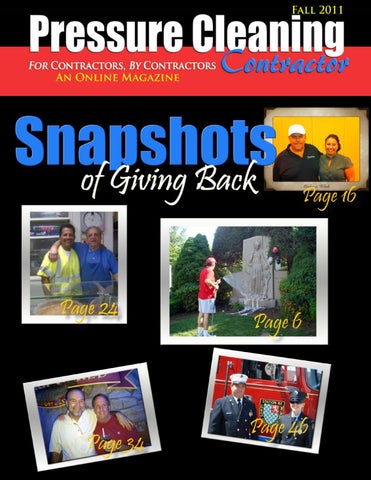
Page 16
Page 24
Page 6
Page 46
Page 34 1
Pressure Cleaning Contractor
Fall 2011
www.PCCMagazine.com
Your mobile wash solution for remote area cleaning
High Reach Pole included
$7495
Save over $4400
Just Add Water
Mobile Wash Skid package • Hot water pressure washer: 3000 psi, 4.8 gpm, belt drive pump Adjustable temperature, up to 250ºF • Single axle, 200g trailer: Rustproof, stainless hose reels with hoses • FREE High Reach Wash Pole • FREE freight*
Bonus Option: Add a 28” stainless Hydro Twister® for flat surface cleaning $895
Buy directly from your local Hydro Tek distributor. To locate one near you, call (800) 27-HYDRO or visit www.hydrotek.us Ask for the “Just Add Water” promo. Sales tax & battery not included. Free freight to your distributor in the Continental 2 Pressure Cleaning U.S. Special starts July 1, 2011,Contractor for a limited time. Fall 2011
www.PCCMagazine.com
www.PCCMagazine.com
In This Issue:
Fall 2011
Snapshots of Giving Back
6
TOC
Publisher/Editor: Allison Hester Web Supprt: Celeste Gothrop The publisher and editor of this magazine do not accept responsibility for the content of any advertisement, including statements made by advertisers herein, or for the opinions expressed by the authors of bylined articles. The intent of this publication is to provide general information only and is not intended to provide specific advice or recommendations. Appropriate legal, financial or engineering advice or other expert assistance should always be sough from professionals.
Contractor’s Good Deed Hits an Industry Home Run
16 24 34 45
Power Wash Community Makes a Child’s Wish Come True Pressure Washing Contractor Becomes Hero How the Industry has Given Back...to Me* Pastor Charlie Arnold: Spreading the Good News Through Power Washing*
Also in this Issue
4 Editor’s Note: Living Beyond Ourselves 12 Why I Use What I Use: How Paver Sealing Changed Jon Chapman’s Cleaning Business 15 What’s New: New, Redesigned Electric Recycle System from Hydro Tek 18 How Hard Water Affects Pressure Washing 22 What is Going Down the Drain? 25 The Catechism 26 An In-Depth Interview with Robert Hinderliter* 36 Choosing Cleaners with “Pow” 38 Referral Programs: Whny thy Work
41 The Growth of Certifications PCC Magazine Pressure Cleaning Contractor is published 12300 Nebraska Ave. bimonthly online N. Little Rock, AR 72118 501-517-1620 pccmagazine@live.com www.PCCMagazine.com Pressure Cleaning Contractor
Fall 2011
www.PCCMagazine.com
3
Editor’s Note
Living Beyond Ourselves
outside the industry. I’ve heard it was a wonderful evening and has triggered greater acts of benevolence, and for this I am thrilled. I have been in contact with John since the start of the events and have experienced his passion for this cause, so I am honored to tell the story. I worked until 2 a.m. this past Friday night so that I could post the cover article on our website and on the one of the industry boards. (I was too tired to cover the gambit of boards by that point.) A few short hours later, I awoke and checked the board to find two negative remarks about the story. It saddened me. Not so much that they didn’t like the article. What saddened me is that some people seem to take so much delight in tearing other people down. My goal is to inspire people to live beyond themselves. Look out for our fellow man. Frankly, if you don’t like agree with this philosphy, or if you’re offended with PCC’s direction, just don’t read it. This magazine is currently a labor of love for me. (In other words, it’s not a goldmind.) The magazine was originally my mission to help a hurting friend, Steve Stephens, who could no longer pressure clean after a car accident. I was trying to give him hope, help and a new role in the industry. However, it has become obvious to us both that he was not designed to be a publisher, but rather a consultant, speaker and teacher. And, as the story on page 34 tells, the selfless gift of an old friend is making that dream a reality. So while he will still contribute to the magazine some as a consultant, this is no longer my gift to him. Instead, it’s my gift to me. It’s my way of sharing my passion for encouraging others to do good works, which is what I love to do. And for many, I hope you will find this to be my gift to you as well. – Allison Hester
I learned last night that for the first time in its 20-year existence, the PWNA (Power Washer’s or North America) conference, held this past weekend, was opened with a word of prayer. I don’t know if it was because of the hurting economy. Maybe it was the bickering and divisiveness that is taking place within the industry. Perhaps it was because at least three attendees that I know of had family emergencies occur just prior to the event. Maybe it was something a simple as the fact that a pastor is on the PWNA board. Whatever the reason, Charlie Arnold, owner of Arnold Powerwash and pastor of the Seaside Church in Lewes, Delaware, asked God to bless the meeting and the people in attendance. And from the feedback I’ve gotten, God honored the prayer, making it perhaps the best meeting the PWNA has had in years. This, for me, was confirmation of two things I decided to do with this issue. First, Pastor Charlie Arnold, whom I met in July during the NCE event in Tampa, asked if I’d be interested in allowing him to write a new column for us where readers can write in and ask Biblically-based questions or send their Biblically-related experiences. I wholeheartedly agreed. I realize this is not a faith-based publication, but I am a faith-filled publisher. And the numbers of people who came and talked to Charlie this past weekend about life issues indicates to me that many people need this. So the intro to his new column is on page 25 of this issue and is available to everyone. Also, subscribers can read Charlie’s story starting on page 42. Secondly, as our cover story on page 8 explains, PWNA sponsored a non-PWNA sanctioned event in which John Tornabene, along with Babe Ruth’s granddaugher, Linda Ruth Tosetti, honored several industry members for their contributions inside and 4 Pressure Cleaning Contractor Fall 2011
www.PCCMagazine.com
EnviroSpec Allison
IRON HORSE SUPER SKID The Best Value in the Industry and here is why... We hear contractors all the time singing the praises of a particular brand of pressure washer and we always walk away scratching our head. Let’s see -- they all use the same engines, pumps, unloaders, generators, burners, nozzles, hoses, lances, guns, flow switches, pressure switches, filters, burner nozzles, safety valves, belts, pulleys, water filters, etc.
S�nce
1972
WHAT WILL $2,995.00 BUY YOU ?
The same thing it bought you in 1999... a HOT WATER SUPER SKID
3,500 PSI 5.6 GPM
► PRESSURE WASHERS ► REPAIR PARTS ► ACCESSORIES ► PUMPS LIMITED SPACE IN OUR FIRST 2012 SERVICE SCHOOL February 22-24 - Only 20 Seats
PRE�SEASON PREVIEW Play with all the new stuff before the season starts.
Learn how to troubleshoot and repair... ...Pumps, Unloaders, Injectors, Burners & Guns. Classes fill quickly so reserve your seat today. Call Joseph Walker for class itinerary. 1-912-487-1778
So - what is left? The Paint? The Frame? Limited Time Offer
Cost $175.00 donation to Suzie’s Friends - Lunches Included
FEATURED ARTICLE:
IN 1999 WE WERE SELLING 30+ SUPER SKIDS PER MONTH
at the most incredible price in the industry and nothing has changed! Go to http://www.envirospec.com
Or Call 1-912-487-1778 System Includes: ○ The New 2011 - 18 HP Briggs Vanguard Engine with a 20 AMP recharging system w/3-year warranty ○ Tri-Plex pump with ceramic coated pistons, extra large oil-bath and oversized full-load bearings ○ Premium pressure actuated unloader for years of ‘trouble free’ service ○ Safety pressure relief system that by-passes over pressurized water ○ Premium flow or pressure switch that controls burner firing sequence ○ Premium Series Beckett Burner equipped with Beckett’s precise fuel delivery management system ○ Schedule 80 vertical dual-pass coil that produces super hot - 200° plus - water ○ Marine grade battery compartment with cover for added protection & battery life ○ Oversized fuel & gas tanks that will run all day instead of a few hours ○ Allison ‘Super Suds Sucker’ Chemical Injection that allows for chem draw with as much as 300’+ of hose ○ 4-each premium high pressure quick connect nozzles and 1-each premium quick connect soap nozzle ○ Hose, Gun & Lance sold separately
► CLEANING CHEMICALS
Vertical Coil Only - No Substitution
TRUCK WASHING LOVE IT OR HATE IT - YOUR CHOICE!
The problem most pressure wash operators encounter is that they can't find the correct level of clean. Either they do such a lousy job, that even the boss from the window can see that the trucks look bad, or they hand scrub every inch of every truck and spend so much time that they can't make a living. There is a middle ground that must be found to succeed. The middle ground is usually found by either working with the proper pressure, temperature, and chemical, or by throwing manpower (brushers) at the fleet. The most successful are the companies that work smart, not hard. Working smart on a large fleet that is washed on a schedule can be very profitable. Many laugh at the low prices that are charged to wash large fleets, and of course there has to be a bottom line limit to pricing. But consider washing tractors all day at $8.00 each. Wash four per hour and you’re starving. Wash ten per hour, per person, and now you’re making a living. Working smart should allow you to do this. SCHEDULED WASHING: The time period between services makes a huge difference in the difficulty of washing vehicles. The longer a truck is run prior to wash service the more dirt and bugs it accumulates. Additionally, an electro-magnetic bond is created when the vehicle is... If you would like to see the rest of this article go to www.envirospec.com and click on ‘How to Wash Stuff’ and then ‘Fleet Washing.’ Learn from the Professional who, at one time, covered 7 states with one of the industry’s first and largest ‘Truck Washing’ companies
Contractor’s Good Deed Hits an Industry Home Run by Allison Hester
“The way a team plays as a whole determines its success. You may have the greatest bunch of individual stars in the world, but if they don’t play together, the club won’t be worth a dime.” – Babe Ruth 6
Pressure Cleaning Contractor
Fall 2011
www.PCCMagazine.com
In the early 1900s, there were no TV sets. No computers. No video games. No WWF, MMA, NASCAR or extreme sports. But there was baseball. Known as America’s pastime, baseball was a sport that brought people together. It was something almost everyone knew about and experienced at some level, whether playing in the schoolyard or attending a game at the ballpark. Baseball is a true piece of Americana. And perhaps the best known baseball player of all time is Babe Ruth. His big swing, home runs and largerthan-life personality ushered in the live-ball era, helping baseball evolve into a high-scoring, power game that exploded in popularity in the 1920s. And so, with these things in mind, let the game begin.
various events from the UAMCC, PWNA, Pressure Washing Institute and the Grime Scene, and after the cleaning, he placed those items on the tombstone and then took some photos. There was no real plan for doing this other than he felt like what he was doing was representative of something bigger – an
The Top of the First John Tornabene, owner of Clean County Powerwashing in Long Island, New York, was asked by a client to go to the Gate of Heaven Cemetery to clean a customer’s family mausoleum. This well-known cemetery happens to be where George Herman “Babe” Ruth is buried, and his gravesite is by far the most popular spot on the grounds. Even 63 years after Ruth’s death, fans stop by almost daily, leaving flowers and gifts to honor the “Great Bambino.” While on the property, John said he could not help but stop at the gravesite. As a pressure washing contractor, the thing that stood out behind all the gifts to honor Ruth was mold. John had seen the tombstone – and the mold – before, so he came prepared. “Before I headed up that way, I had already thought that if there was mold on it, I might have to clean it. The tombstone just seemed like it should be cleaned,” he says. He brought with him a bag of industry-related items he had collected from Before (Top) and after (bottom) the monument cleaning (with John Tornabene). Pressure Cleaning Contractor
Fall 2011
www.PCCMagazine.com
7
industry that, despite its differences and controversies, never fails to give back. Keep in mind, however, that John did this without the Ruth family’s permission, something that began to eat away at him. John’s brother-in-law later found a phone number for Babe Ruth’s granddaughter, Linda Ruth Tosetti, in Connecticut, and John called to fess up. Instead, he got an answering machine, so he left a message telling her what he’d done. Then he added, “I didn’t mean to disrespect your grandfather. He shined in life. He should still shine in death. If you feel you need to do anything, please do what you need to do. If I disrespected you in any way, I am truly sorry.” The following day, Linda’s husband, Andy, called back. The first words out of his mouth were, “Why did you do what you did?” John’s heart began to race. Again, “We want to know why you did what you did. Linda is shocked by this.” Gulp. Andy continued, “She can’t believe that these days someone would do something like this. She is so excited!” Later that day, Linda called John again to thank him and a friendship was born. John began to tell her about the power washing industry, about Clean Across America,
Andy, Kathy (John’s wife), Linda and John Cleaning for Heroes, and how the industry regularly gives to their communities by cleaning things for free. Linda, whose mission in life is to spread the word of her grandfather’s numerous charitable acts and to honor those who follow in his footsteps, wanted to do something special to thank John. Last night, that idea turned to reality. Ruthian Regards As John thought on the idea of what to do, he asked if she would autograph photographs
Linda Ruth Tosetti
The granddaughter of the legendary Babe Ruth, Linda lectures on the life of her world renowned grandfather, George Herman “Babe” Ruth, at various schools and universities. Linda had the honor of being inducted into the Latino American International Sports Hall Of Fame, in Laredo Texas in 2009. She has been a guest speaker at The Society of America Baseball Research, the Baseball Hall of Fame and Museum in Cooperstown NY, the Babe Ruth Museum in Baltimore Maryland, the Ted Williams Museum, Tropicana Field, in St. Petersburg, Florida, at the St. Petersburg Preservation Society. Linda Ruth Tosetti has also been a Contributor to Fox Channel News, ESPN, the Chicago Sun-Times, the New York Times, the Boston Globe, the Washington Times and has been an honored guest at Yankee Stadium and Fenway Park and various important sporting venues and events throughout America. She is considered a leading authority on the life and times of her fabled grandfather from an intimate family point of view. 8
Pressure Cleaning Contractor
Fall 2011
www.PCCMagazine.com
of her grandfather to pass along to some industry members of his choice. She agreed. Next, he had to choose the names, and limit the number of photos…a task that ate away at him, worried about leaving someone out or hurting feelings. He stresses that he does not know everyone in the industry, and the names selected were people he knew through various trade associations and industry bulletin boards. They were not sanctioned by any group. John, himself, paid to have the photos placed on plaques. “These pictures, when you have them in hand, are like holding a treasure. They’re surreal,” John adds. Among those he selected, three couples and one individual stood out to him as truly going above and beyond, so he asked Linda to give them a special photo. She agreed. Next, he asked the PWNA board to allow Linda to present the plaques during their annual convention on October 20 through 22. While again, this is not a PWNA-sanctioned presentation, they graciously agreed, inviting Linda to attend the annual meeting, speak during Friday night’s cocktail event – sponsored by Facilitec-USA and Scotts Pressure Wash – and present the plaques. “I want to thank the PWNA Board of Directors for allowing this to happen since they are the decisionmakers of the organization,” John adds. I especially want to thank Eric Clark (PWNA President) for taking a risk and letting me do this. It’s risky for an organization to go against the grain and allow something in that’s not sanctioned by any one group and is not clearcut as to what it is turning into. This has certainly been a work in progress. He trusted me when all I had were some big ideas and few answers.” Additionally, the recipients of the four special plaques were revealed and honored last night. The recipients were: • John and Shelly Allison of Envirospec and founder of Suzi’s Friends • Tom and Barbara Vogel of ACR Products • Rod Rodriguez and Beth Borrego of The Grime Scene. Pressure Cleaning Contractor
• Henry Bockman, founder of “Clean Across America” John also surprised Paul Horsley of Scotts Powerwash with a special plaque thanking him for his many volunteer efforts, both inside and outside the industry. However, there were two individuals John wanted to pay special tribute to, and they were each given special plaques plus
Top: The signed plaque of Babe Ruth that most recipients will receive. Middle: The signed plaque reserved for the six “special” recipients of John’s choice. Bottom: John busily packing and mailing
Fall 2011
www.PCCMagazine.com
10
Babe Ruth’s Charitable Contributions
George Herman “Babe” Ruth was the first prominent American athlete to become a major philanthropist. He was involved with over 40 charitable organizations that supported children and his fellow man. Additionally, George loved children and children loved George. He regularly visited hospitals, orphanages, prisons, schools, sanitariums and other similar institutions. During a 1933 visit to Hawaii, he spent time at a leper colony despite warnings from local authorities. He also participated in a number of human rights movements and was one of the first nationally-known figures to accept and support men and women of every race, creed and culture into baseball, supporting Negro League, Mexican League, Cuban, women and children’s baseball. He protested the Holocaust before the President was against it, using his name to draw attention to the Jews’ plight at the exact time that U.S. officials were hoping to sweep the Jewish refugee problem under the rug. And for every known charitable act, historians believe George did at least twce as many unrecognized acts of kindness. autographed bats. These two were: • Robert Hinderliter, Industry Pioneer and Founder of the PWNA. (See page 28 to read the in-depth interview featuring Robert’s many contributions to the industry) • Joe Walters of Joe Walters Insurance, PWNA’s first official member and long-time supporter of pressure washing contractors.
10
Pressure Cleaning Contractor
Additionally, a special photo was given to Nick Campanale of Nick’s Pressure Cleaning Services to present to All Children’s Hospital in St. Petersburg, Florida. The Ninth Inning Still, this was not enough for John. Since the gravesite cleaning, John and Linda have developed a unique friendship. They talk regularly on the phone. Their families have even gotten together for dinner and other outings. Linda’s mother, Dorothy, had a dying wish that her father, Babe Ruth, would receive the Presidential Medal of Freedom, the highest civilian honor one can receive, for his numerous charitable acts. Linda’s efforts to fulfill her mother’s dreamhave not succeeded just yet. “Just seeing how Babe Ruth – who was put in a reformatory orphange for 12 years, during which time he lost five siblings and his mother – still managed to not only make something out of his life, but to give back in so many charitable ways is simply amazing,” says John. “That is truly inspirational.” John has taken on his own mission, getting a national figure to recognize Linda’s “Ruthian” efforts as well as the generosity of the power washing industry. After several failed attempts, John came through in the bottom of the ninth.
Fall 2011
www.PCCMagazine.com
On October 18, just three days prior to Friday night’s plaque unveiling, U.S. Representative Steve Israel provided John with an official letter thanking Linda for her “tireless work in giving your grandfather Babe Ruth back to the people,” and also for her work in honoring the power washing industry. The same day, Alfonse D’Amato, the former New York Senator who “handpicked” Bob Dole to run against Bill Clinton, wrote a letter as well. In it he thanked Linda for her hard work, then added the following: “When I was in the Senate, I always thought it was most important to recognize those in my state who unselfishly gave to others. So I must applaud your support for the power washers who continuously give back to the communities.” John surprised Linda with these recognition plaques at last night’s event. His hope is that these national figures may just be the open door needed to fulfill Dorothy Ruth’s dying wish. In an interview prior to last night’s event John explained, “Even though Linda and her family have been pursuing this for years, we, the powerwashers, have helped her get noticed. She is going to be so surprised by this because it just doesn’t happen...but it did. And it’s through you guys that help others, and through me, a mere messenger.” And truly, John says that’s all he ever wanted to begin with. That’s why he placed his industry items on the gravesite of Babe Ruth in hopes that somehow, someway, it would help unite the industry and pay homage to the countless power washers who give back to their communities every day. “None of these power washers are perfect. Babe Ruth wasn’t perfect. But people have to Pressure Cleaning Contractor
start looking at what is impacting. What has left a positive influence on others? What makes people feel good, especially when we’re all hurting some during these terrible economic times. What is that? It’s when someone wants to help them out for free just because,” John concludes. “Its’ time this country gets back on track by giving to those in need, and we have powerwashers who are doing just that.” 11 Fall 2011 www.PCCMagazine.com
Why I Use What I Use
How Paver Sealing Changed Jon Chapman’s Cleaning Business neglect. The sealing takes one-half to one hour, “and we’re done. Five to seven hours total with an average ticket of $1000 on a typical pool deck.” And the product line he uses is by Seal ‘N Lock. Trial and Error Jon turned to Seal ‘N Lock after several unsuccessful attempts with a number of other products. First, he tried solvent acrylic sealers, but his customers began calling and complaining about “white blush” – i.e., white spots that appeared on the pavers due to trapped moisture under the acrylics. Solvent-based sealers require that contractors first wash the substrate in order for the sealer to adhere to it. Then they must wait several days for all of the moisture to evaporate from underneath. “It’s very hard to measure whether the moisture is all gone because although it can look dry, there still may be moisture underneath, which causes the pavers to turn white,” explains Russ Heitman, Director of Strategic Development for the Seal ‘N Lock (SNL) System Corporation. However, the white blush may not show up for a few months. “If it turns white, it’s very difficult and time consuming to fix,” Russ adds. “Now you’ve got a huge problem. For a $2,000 sealing job, you’re putting a $20,000 pool deck at risk.” That’s why Jon switched from solvent-based products to waterbased sealers, but he wasn’t happy with those either. “They didn’t have much shine and Fall 2011 www.PCCMagazine.com
Jon Chapman of Pro Pressure Clean and Seal in Tampa, Florida, started pressure washing part-time in 2003, going full-time by 2005. Initially, Jon focused solely on removing chewing gum, but quickly saw the need for roof cleaning, then deck and dock sealing, and now window cleaning. However, his biggest growth opportunity occurred in 2008 when he discovered the interlocking concrete paver sealing market. “Florida is a huge market for paver installations, and most installers don’t offer or don’t do a very good job of sealing,” he explains. “There are more docks than decks here in Florida, and since I was doing dock restoration, the paver pool deck was an obvious add on.” Today, paver sealing makes up as much as 60 percent of Jon’s business. He says a typical job, such as a pool deck with patio, takes around one to two hours to aggressively clean, depending on the amount of problems or
12
Pressure Cleaning Contractor
they were way too difficult to apply to make it profitable for me,” he says. Eventually, one of Jon’s local suppliers invited him to a demo by Rich Colletti of Seal ‘N Lock, “and I was hooked immediately,” he explains. “A one-day sealer. How cool is that? The dollar signs started flashing before my eyes.” Unlike the other sealers Jon tried, Seal ‘N Lock could be applied to damp surfaces so he did not have to make repeat trips to the client’s property. “One of the miracles of Seal ‘N Lock is that it releases all moisture during the curing process,” explains Russ. “This reduces your waiting time and lets you clean, sand and seal all in one day. With the cost of fuel, who wants to come back?” Another difference between SNL and other sealers, according to Russ, is that it is a twocoat process – that is, two coats of the same product – and it’s easier to apply than other products. In fact, contractors are encouraged to walk on the product between coatings to ensure the sealer does not pool in low spots, which can cause the pavers to appear darker than in higher areas. “We want evenness, so we want contractors to walk on it, spread it with a broom, or blow it with a blower, whereas other products don’t allow that,” says Russ. “A lot of the Seal ‘N Lock process is counter intuitive, which is why we strongly encourage contractors to take the Seal ‘N Lock Authorized Technician Course.” Although the SNL course has a list price of $249, for 2011 it’s being offered at a greatly reduced price – even free in many instances. “It is a professional grade product and therefore we highly recommend that contractors g it,” says Russ. “By taking the class, you learn tips, tricks and techniques, get registered for leads in your area, and receive ongoing training offerings.” Participants also get a 74-page manual, as well as access to the Seal ‘N Lock team. “We want to walk you through that first job,” stresses Russ. Additionally, for 2012, SNL will be adding even more value to their contractors’ toolboxes by offering products that not only enhance the paver’s current tint, but can actually recolorize Pressure Cleaning Contractor
it. “This will add tremendous value to the course and to the contractors’ list of services,” Russ adds. The Market Interlocking concrete paver sealing is a growing trend for pressure washing contractors. It’s not only a natural add-on service, it solves the all-too-common problem of ruining sand joints when power washing pavers. “If you’re not careful when cleaning, you can wash away the sand, which is a structural component of the pavement, which can lead to joint failure,” according to Russ. By sealing with SNL after cleaning, it actually locks the joint sand, “which other sealers don’t do. Now pressure washing contractors can wash it, sand it and seal it. At that point it ‘locks’ the joint sand, which makes future cleanings easier. Sealing adds value to their customers by enhancing the pavers’ color and protecting their investment from wear and stains. The full service ‘clean and seal’ contractor is seen as a true expert.”
Fall 2011
www.PCCMagazine.com
14 13
It was standing room only at the Seal ‘N Lock training at NCE East.
Jon said adding paver sealing to his business came fairly easily, as he only approached his current clients at first. Then he added the service to his website and worked hard on his SEO (search engine optimization). “Now I am almost always on the first page of Google in my area,” he adds.
14
Pressure Cleaning Contractor
While Jon still offers pressure washing and roof cleaning, he says he can now turn down the small jobs. “It seems like there are billions and billions of pressure washers in Florida and the pricing is ridiculous,” he adds. In a saturated market, paver sealing has given Jon a competitive edge. “Its profitable, and fun. I like my work, and I’m good at it,” he adds, pointing out the positive customer reviews he’s received on sites such as Angie’s List. T he most time-consuming part, according to Jon, is the sanding that occurs between the washing and sealing steps. “But with Seal ‘N Lock, we can wash sand in, wash off excess and be ready to seal in about another one to two hours.” n this market, Jon suggests calling some of the bigger paver manufacturers in your area and finding out who the installers are. “Start working the installers and get some SEO on your website for paver sealing.” Finally, Jon adds that he is happy to give free advice to anyone, but points out that so are the staff of Seal ‘N Lock. “So feel free to call.” To learn more, or to sign up for an upcoming training course, visit Seal ‘N Lock’s website at http://sealnlock.com or call them at 813-852-1500. To learn more about Pro Pressure Clean and Seal, visit http://roofsanddecks.com/ index.html.
Fall 2011
www.PCCMagazine.com
New, Redesigned Electric Recycle System from Hydro Tek
What’s New
Hydro Tek’s new, redesigned RZV10E1 is an affordable option for contract cleaners to recover, recycle and reuse their washwater on the jobsite. Simply set up the included sand berms to divert your washwater to one spot where you place the scupper attachment and vacuum up the washwater. The washwater is sent through a 7-stage filtration process and the filtered water transfers back to your power washer bulk tank. If you have the proper permits, there is a bypass mode that transfers the filtered water up to 100’ away into sanitary sewer or landscaping, instead of to your bulk tank. The RZV10E1 can be plugged into a standard 115v wall outlet or use with a 3500 watt generator for portability. Turnkey system comes ready to use with 10’ containment berms, 6’ deluxe rubber sand tube, vacuum scupper, and 50’ vacuum hose. It will recover and process up to 12 gpm to 5 micron. With its compact size, it mounts in tight spaces in your van, truckbed or flat trailer near your power washer, bulk tank, and generator. Maintaining your RZV vacuum filtration system is now easier than ever. The redesigned twistlock bag filters can be accessed by lifting the lid completely off where you can either clean or replace one or both of them as needed. A pressure gauge indicates when your pleated cartridge filters and carbon filters in the gray canisters should be replaced. There is a dump valve at the bottom of the conical holding tank to quickly purge the solids that have collected there. For those who have or are considering a Hydro Tek SC or SCU Series power washer, there is also an AZV model that is powered by the skid’s on-board generator instead of using an independent generator. For more information on both of these Hydro Tek Vacuum Filtration Systems, visit www.hydrotek.us/natlspecial and scroll down to the “No Water Wasted” video. 15 Pressure Cleaning Contractor Fall 2011 www.PCCMagazine.com
Power Wash Community Makes a Child’s Wish Come True In July, members of the pressure washing community – led by Paul Kassander of the PowerWashStore.com, with the help of Kory Finley and Ron Musgraves of the National Cleaning Expo – turned what could have been a simple skid giveaway into something much more valuable – a chance of a lifetime for a terminallyill child. During the NCE East event in Tampa, Florida, $5,472 was raised for the Make-A-Wish Foundation. Since 1980, Make-A-Wish has been giving children with life threatening medical conditions hope and strength by making their unique dreams come true. “Make A Wish seemed like the perfect Left: Kory Finley presenting a check to Make-A-Wish for $5,472. Right: Paul Kassander with the skid aution winner, Dave Muirhead of Sky View Window Cleaning
program. I have my own kids and can’t imagine what it would be like if my children were in the same situation as some of these other children,” says Paul. “Their stories are a reminder of why we’re all working to begin with – to take care of our families. If there’s something we can do to help bring a little joy into their lives, then that’s what is most important.” While many industry events raffle off donated equipment, Paul said he wanted to try to do something more significant at NCE. “I thought if I donated a simple pressure washer – something that everyone can use – we would have the ability to raise more money for a charity than if I was to just donate a washer to the event. I was looking for a way for the industry as a whole to give back to the community.” The skid donated was a cold water, 5.5 gpm, 2500 psi pressure washer with a Honda engine.
Pressure Cleaning Contractor
www.PCCMagazine.com
16
Fall 2011
The unit’s list price was $2500. Additionally, Kory Finley, who helped coordinate the NCE event, donated twin pump softwash cleaning system for the raffle. “That gave people other options since a lot of roof cleaners don’t use pressure washers,” Paul adds. Prior to and during the NCE event, raffle tickets were sold by the hundreds. Time was also given to allow a Make-A-Wish representative to give a special presentation during the event itself. During the event’s opening night reception, Ron Musgraves (NCE, Pro Power Wash, Pressure Washing Institute), AC Lockyer (Softwash Systems) and Chris Tucker (Apple Roof Cleaning) all took their turns getting soaked in a dunk tank, raising funds for the charity. “I was extremely pleased with the participation, and I was especially surprised at the amount of people who spent over $100,” Paul said. “I expected a lot more $10 or $20 donations, but several people gave $100 or more.” Paul says he was also pleased with the number of people who bought tickets who had no interest in the equipment itself. For instance, Paul pointed out that his direct competitor, Russ Johnson of Southside Equipment, donated $100 to the event. “I think that was a real standup thing to do,” explains Paul. “It went beyond our head-tohead competition as distributors and we came together for a good cause.” In the end, Pamela Starr, a presenter for Constant Contact, had the winning ticket. She then donated the machine back to auction off, which helped us raise another $1,000, the winning bid by Dave Muirhead of Sky View Window Cleaning. That, in turn, put the charitable event over the top, raising more than the amount needed to sponsor a child’s wish. “It was a great feeling to see the outpouring of support from around the country. I think most did it more out of the kindness of their hearts more than anything,” Paul adds. “I hope we can continue to do these kinds of things every year. I would love more than anything to be able to donate a $2,000 to 3,000 pressure washer and get this type of support. Instead of just donating $5000 to Make a Wish, let’s turn it into $10,000 or
more.” Paul says he was not surprised by the generosity of those there. “As a whole, the power washing industry gives a lot back but just doesn’t get the attention they deserve because they do it in the shadows. They do it at night, when people aren’t around.” He concludes that “things like this raffle help bring their generosity out in the open and let people know we are giving back. We need to get the word out that we are here and we want to help make our communities cleaner and protect the environment at the same time. The more awareness we can generate about what we do, the better businesses will be and the more professional our industry will become.” As a final note, Paul wanted to be sure to thank Kory Finley and Ron Musgraves for giving him the opportunity to raise money for Make a Wish. “ I wouldn’t have been able to do it without NCE putting that platform out there for us, which allowed us to do something big.” To learn more about Make-A-Wish, visit their website at www.Wish.org.
www.powerwashstore.com
17
How Hard Water Affects Pressure Washing by Linda Chambers, Soap Warehouse, www.SoapWarehouse.biz
For most of the country, hard water is a way of life; the only difference may be in the degree that you have it. So how does hard water effect pressure washing and what can be done about it? First, let’s discuss where hard water is found and where it comes from. Water hardness is rated by GPG - grains per gallon – and hard water, higher than 1 GPG, includes 85% of the country. The amount of hardness will vary from slight to extreme (see map below).
Rainwater dissolves minerals present in rocks as it passes though the ground down to the water table, aquifers and wells. Carbon dioxide, being heavier than air, also combines with rainwater underground and helps convert the carbonates of calcium and magnesium into bicarbonates. These bicarbonates, being soluble in water, cause hardness. These bicarbonate salts exist in the form of positive and negative ions, which can be used, as you will see later, in ways to help incapacitate or remove them by certain methods,
Hardness Levels · Soft water – less than 1 grain per gallon · Slightly hard – 1 to 3.5 grains per gallon · Moderately hard – 3.5 to 7 grains per gallon · Hard – 7 to 10.5 grains per gallon · Very hard – 10.5 and higher grains per gallon 18
Pressure Cleaning Contractor
Fall 2011
www.PCCMagazine.com
one being ion replacement. Disadvantages of Hard Water For the pressure washing contractor, the first effect of hard water is on the soaps and detergents. Because soap and detergents have an ionic nature, when they dissolve in hard water, each soap molecule reacts with any calcium ions, limits the formation of lather and instead forms precipitates or scum. This scum essentially renders the detergent ineffective so much more soap is needed to clean if used with hard water. The second major problem with hard water is that when it is heated, it will deposit solid calcium carbonate or lime scale. Scale is a poor heat conductor, and in a hot water pressure washers scale insulates water from the coil’s heat source. For many pressure washers, a hot water machine is a necessary time saver since heat increases the effectiveness of soap and helps break down and dissolve the contaminates they are trying to remove for their customers. But the scale produced in their machines when using hard water will very quickly start to reduce the machine’s effectiveness to heat and maintain hot water as well as restrict water flow in the other pressure washing equipment, even to the point of changing the flow rate (GPM) or PSI that the machine should be producing. As flow is restricted, it places a heavier strain on the pump’s motor, which can cause early wear and failure. Water Softeners To reduce the negative effects of hard water, many methods have been developed to remove hardness. These techniques range from adding softening chemicals to either the soaps, the water or both in order to avoid having to use larger quantities of detergent and stop lime scale. Portable filters can be used to filter water running through the machine to change the ions to prevent scale buildup on the heating element. Water softeners work using a technique called ion exchange, whereby calcium and magnesium ions are replaced by sodium ions, which do not cause hardness. Even separate machines containing magnets are now being used to alter the molecule’s action in the water just before entering the machine to inhibit scale build up with out using chemicals at all, just electricity. You May Already Be Using Softeners Soap manufactures are very much aware of this problem and many add softeners to their chemical mixes without the customers even knowing it. Pressure Cleaning Contractor
These softening benefits may be communicated in the detergent’s description, with phrases such as superior ingredients, great suds action, works well in hard water, or cleans well in cold water. This is just like carwash patrons who are unaware that they are getting extra sheeting and quick-drying chemicals added to their final rinse – whether or not they are paying extra for them – just because the carwash owner wants you to be happy with a dry car and come back again. And since these chemicals are not hazardous, they are not mandated to be listed on a MSDS or reported to consumers. Local water departments may also be adding softeners to the water supply that you are not aware of. In known hard water areas, ground waters may be treated by lime softening - as are many hard surface waters – or by ion exchange softening, in which calcium and magnesium ions are exchanged for sodium ions as the water passes through a bed of ion-exchange resin. To know how hard your local water is, you must have it tested or read up on it in the latest water department’s federal reports. Most are easy to find and copies can be supplied when requested as long as you live or own a business in their jurisdiction.
Fall 2011
www.PCCMagazine.com
1920
Costs to Create a Balance You, as the pressure washing professional, must gather information and then weigh the options available to find the most cost effective way to combat hard water and it effects on your equipment and bottom line. Here are some numbers we have gathered from speaking with owners of pressure washing equipment businesses that also handle pressure washing repair. • The pressure washer part most effected: the hot water coil, second is the pump itself. • The time and cost of descaling a coil: time 4 hours, cost average $260. • Cost of replacing a coil: $800 - $1,800 depending on size and brand of machine. Infrequency of runtime is a larger factor in regards to scale buildup compared to the length of runtime. In other words, you can't just say you should clean your coils after every 100 hours of runtime. A machine that was run 100 hours in five-hour long sessions all in one month will have much less scale buildup than a machine that ran 100 hours used in only one-to-two hour sessions that covered a six-
month long-time period. It seems one point that can play a role in buildup is the frequency of heating and cooling, along with the length of time that water circulates through the machine. For instance, here is a photo of the inside of a homeowner’s pump that was used only twice but three months apart. When the owner pulled it out again six months later, he was having trouble with stuck valves.
You can work from the front of the problem and buy soaps with added softeners, buy additional softeners to add to your chemical mix or water tanks, attach filters or electromagnet systems as water comes into your machines. Or, on the backside, just periodically use coil cleaners or pay to flush the scale from out of your machine to deal with hard water. Any way you go, costs will occur. It is just up to you to evaluate your options and find the most cost effective solution. Because the only other recourse is to ignore the facts about hard water and pay for it over and over again in mechanical repairs and replacement costs. Linda Chambers is Brand and Sales Manger at Soap Warehouse, where she has worked since July of 2007. She has AS degrees in Business, Agri-Science and Animal Health Technology. Her years of running her own and other businesses, marketing, science and work with computers have given her a wide range of knowledge that have been valuable in her current career path. She enjoys writing articles for industry publications, blogs, working on the computer with the Soap Warehouse web site and Social Media. She also travels for the company exhibiting at trade shows and industry events. Visit Soap Warehouse at www.SoapWarehouse.biz.
20
Pressure Cleaning Contractor
Fall 2011
www.PCCMagazine.com
Pressure Cleaning Contractor
Fall 2011
www.PCCMagazine.com
21
What is Going Down the Drain? When committing to do business, I feel that it is extremely important to have green policies and continuing education in place. It’s not only going to protect you as a business owner, it is going to protect the customers that you do business with and want to keep as clients. Various studies on grease disposal and its impact on the sewage systems in our country indicate there are several situations where our industry needs to take better care in the disposal efforts of the by-product from hood and filter cleaning. Educating our customers about these are key in supporting our efforts and providing a safer environmental solution to these rising issues. In the industry, a lack of knowledge on what happens to the chemicals and the grease after it is introduced to the drains has caused new issues with the sanitary sewer systems of our country, based off a study provided by North Carolina State University in Raleigh. When sodium or potassium mix with fat, it creates a fatty-acid salt, or chemical-soap. This becomes hard sediment in the sanitary sewage lines. The problem is more of an issue in certain
22
www.thegreasebox.com Pressure Cleaning Contractor
by Jason A. Wellman, FilterShine USA & The GreaseBox, LLC. high-volume areas of sewage lines. EPA officials nationwide are in the process of determining causes of issues similar to this and increasing fines on disposal of this nature. In most cases, grease traps are not designed to handle high volumes of grease, water and chemical intake. This can cause a couple of problems, including backup in the line or overflow passing the grease trap altogether. Both scenarios can potentially cause serious hazards. Fats, oils and grease (FOG) have been determined to cause 22 percent of sanitary sewer overflows in the US. Restaurants have been labeled as the highest level of FOG discharges into the sewer lines. Once a large FOG deposit has been discovered in a sewer system, the Environmental Services Department will determine the FOG’s origin. This can potentially lead to large fines, leaving the restaurant and all who partaken in the illegal dumping responsible.
Fall 2011
www.filtershineusa.com www.PCCMagazine.com
Potential Solutions You can help lower the exposure by educating the persons responsible for the facility and employees. You can also take steps to help lower grease discharge to the facility’s greasetrap by offering wastewater removal from the facility after your service is completed. “Some of our customers require a service such as wastewater removal,” says Alexy Abdo, Owner at Industrial Cleaning Solutions in Washington, DC. “Offering this service helps separate us from our competitors as well.” Alexy says that offering wastewater removal services does require extra time and preparations, however. “The disposal aspect of this service requires a few steps that must be met in order to complete the entire night’s work. Lining the work up with a disposal or wastewater drop-off point takes additional time as well, so in return it does increase the cost for the job.” Another option for reducing FOG liability is to neutralize the chemicals used. “This is a simple process that is also cost effective and safe for the sewage lines,” Alexy adds. “Kitchen exhaust and hood cleaners are notorious culprits of soil and water contamination through their use of degreasers and other cleaning agents that are comprised of chlorinated solvents,” says Jessica Smith, President of Mid-State Fire Prevention. “In many instances bioremediation can effectively remedy that situation.” Biological remediation (bioremediation) is the process of using microorganisms or their enzymes to remove toxic contaminants from the environment. The microbes break down the chemicals and convert them to water, carbon dioxide and amino acids, which are natural and harmless. In my business, when discharging to the treatment plants, we must have a wastewater discharge permit. The requirements for permitting are detailed: • All records shall be retained for a minimum of three years. • The appropriate cleaning schedule and procedures, as determined by the locality, help to eliminate illicit discharges and promote proper operation of the grease control device Pressure Cleaning Contractor
equipment and the public sanitary sewer system. • Hot water, acids, caustics, solvents or emulsifying agents should NEVER be used when cleaning a grease control device. We have a treatment plant that we deliver our waste to that converts the waste grease into clean-burning bio fuels and valuable animal feed ingredients, easing the burden on our landfills and the environment. MSFP contains the wastewater in controlled water reclamation devices at the establishments and transport the wastewater, FOG and settled solids for recycling or disposal at locations that accept such wastes. We have attended training programs in order to haul the FOG/wastewater. Our customer like that they have a track record to where the waste is going. We provide detailed documentation to our clients. Some in the industry have found new ways of recapturing the wastewater of filter cleaning when the cleaning is performed outside in a parking lot. As this practice is normally frowned upon due to the sensitive nature of the disposal, there are a few companies that have mastered the ability to reclaim 100 percent of the wastewater. In my opinion, this practice increases the level of exposure to the service provider and the facility. I have found that avoiding the situation by having a professional grease filter exchange Company is the simplest and greenest option. In the coming years, the EPA will be increasing in size to fight pollution in our water and air, with rising concerns of our planet’s temperature rising and fresh water resources at a dangerous situation for the Southwest section of our country. Lake Mead supplies water to seven of our states, including California, which happens to be our nation’s largest resource for winter agriculture due to the water supplied by Lake Mead for irrigation of farmers’ fields. It is our responsibility to prevent and help fight unneeded pollutants injected into our rivers and streams while helping to reverse the years of neglect that our fresh waterways have already face.
Fall 2011
www.PCCMagazine.com
24 23
Pressure Washing Contractor Becomes Hero On October 3, Carlos Gonzalez began his day as a pressure washing contractor but ended his day as a hero. Carlos, owner of New Look Power Wash in Fairfield, California, was driving home after cleaning a San Francisco hotel when he noticed traffic was stopping ahead. It was raining heavily, and he could see a car that was “obviously” facing the wrong direction. “I thought it was just a spinout, but as I got closer I noticed a woman standing next the car holding her arm,” he explains. No one else had stopped to help, so Carlos pulled over. “The woman walked very fast towards me and obviously had an arm injury,” he explains. By then, some other drivers stopped to help. Carlos instructed the woman to go sit in one of other vehicles that had stopped to assist. He told another individual to call 9-1-1. However, there was a bigger problem. “There was fire billowing out under the hood of her car and heavy black smoke was pouring out,” he explains. He looked at the car and determined he might be able to put the fire out with his pressure washer. Carlos Gonzales or New Look Power Wash stops to help injured woman whose car was on fire. He asked several people to stop traffic so he could back his Landa trailer up to get it within 150 feet of the fire. “I handed the Landa key to a gentleman and gave him instructions on what 24
Pressure Cleaning Contractor
I wanted him to do relating to turning the pressure washer on,” he says. “I put on a laddersaver nozzle, as I figured this would be my best bet to knock the fire down,” Carlos explains. “As I proceeded to apply water to the fire, a small explosion took place under the hood. I continued to apply the water up next to the car and eventually put the fire out.” Shortly thereafter, the California Highway Patrol and fire department arrived. Both were extremely thankful to Carlos’ quick thinking and bravery. Carlos says he always tries to keep extra water in his tanks for instances like this, and to help drivers whose vehicles have overheated and need water for their radiators. Carlos’ heroic efforts serve as a great example of how everyday pressure washing contractors give back every day.
Fall 2011
www.PCCMagazine.com
by Charlie Arnold, Arnold Power Wash A place for a devotional thought conveyed through questions and answers. If you have a biblical, business, or life question you would like answered from the Bible, then please submit to PCC and it will be considered for future publication. Perhaps you have a testimony you would like to share of how something yeou learned in the Bible helped your business. You may submit it for consideration for publication as well.
“For I Know the Plans I have for you,” says the Lord. “Plans to prosper you and not to harm you, plans to give you a hope and a future.”- Jeremiah 29:11 In a troubled economy and troubles at all other sides it is good to know that someone actually has a plan in the midst of the chaos. Our government process seems to be struggling to find the right plan for the future, some times even to a stale mate. Many business owners are struggling to re-write their plans to take into account current economic stressors. It seems that many times when there is something extremely difficult in our lives we tend to look to many of the wrong places for the answers. Some times people will listen to anyone who will talk to them and the outcome turns into more disaster. If you have a structural problem with a building, wouldn’t you go to the builder and/or the architect? If you have a problem with your plumbing, wouldn’t you go to a plumber for help? If you have equipment problems, wouldn’t you go to the repairman or the manufacturer? If you have a problem with seeing how to go forward in your life, the life of your Pressure Cleaning Contractor
business, a problem with re-writing your plans, wouldn’t it make sense to go to the one who created everything, the one who knows everything about your personal and business life, the one who can see further ahead of you than anyone else for help? If that makes sense to you, then why not accept the scripture verse above as meant for you and your business? Then seek out the Lord God by beginning to read His Word the Bible for direction. Once you get to know Him and begin to learn how to understand the Bible you will find there is more advice on how to live in this world and how to do business than any other self help book on the planet. Not much else is working so why not try it and see? Please forward Biblical questions or testimonies to PCC at pccmagazine@live. com for future publications. To learn more about Charlie Arnold, pastor of Seaside Church (www. seasidechurch.us/index.htm) and Arnold Powe Wash (www.ArnoldPowerwash.com.) Fall 2011
www.PCCMagazine.com
25
One-to-One
An In-Depth Interview with Robert Hinderliter by Allison Hester
When I started as editor for Cleaner Times Magazine back in 1994, the first distributor I met in person was Robert Hinderliter of Delco Cleaning Systems in Fort Worth. We were at a regional CETA (Cleaning Equipment Trade Association) meeting in San Antonio, and I found it strange that many of the other distributors there were treating Robert as if he had the plague. I soon discovered why. Robert had encouraged CETA (formerly known as CEMA) to allow end users into their annual trade show in 1992. In fact, he asked the industry to form a single association that would include manufacturers, distributors, suppliers and end 26
Pressure Cleaning Contractor
users. “The reaction of the dealers was that this would facilitate the contract cleaners being able to form direct relationships with manufactures and eliminate the need for dealers,” Robert explains. “The idea was overwhelmingly defeated.” Still, Robert Hinderliter is not known to give up easily on things he believes in. In turn, he has paddled against the flow and pioneered controversial a number of concepts that are now often accepted as the norm, from starting two contractor-based organizations, to working with environmental regulators, to creating the first online industry bulletin
Fall 2011
www.PCCMagazine.com
board, to selling nationwide. In early August, however, Robert decided to take a step back and resign as the Environmental Chairperson for both the Power Washers of North America (PWNA) and the United Associaton of Mobile Contract Cleaners (UAMCC). In this one-on-one, we get down to some of the nitty gritty he has experienced over the past 35+ years as a pioneer and trendsetter for this industry. Robert’s Background Robert earned a BS and MS in mechanical engineering from Oklahoma State University, a specialty in aircraft structures. His first job after college was with Boeing Aircraft in Wichita, Kansas. The Boeing factory was next to the Kansas Air National Guard, which he joined and then trained to become a pilot. Halfway through his training, President Johnson activated the Kansas Air National Guard for the Pueblo Crisis, and Robert ended up spending 28 months on active duty. He was sent to South Vietnam to fly EC-47s. While in Vietnam, Robert says he “objected too loudly about how we were fighting the war (i.e., shooting elephants and reporting them as cargo carriers, doubling the body counts given to the American public, strafing and bombing our own planes that went down in Cambodia to keep the technology out of communist hands, saying there was not a bomb shortage when aircraft were flying with ½ an ordinance load). I was told by a one-star general that I had two choices: shut up or be court marshaled. I shut up and kept my opinions to myself; however, I got to make First Lieutenant twice.” While he was flying for the Air National Guard in 1969, Robert asked a neighbor to build a mobile power wash unit for a part-time business. “ It was a hot water unit that ran off of a power take-off from the bobtail truck engine, which powered a hydraulic power plant that powered hydraulic motors that drove the Pressure Cleaning Contractor
water pump and generator. I thought it was a pretty neat design and got interested in the business.” Through a TV commercial, Robert met Bob Roe of Acme Power Wash, trainer for the Acme Mobile Power Wash national franchise. “He said he would train me in the power wash business for free labor,” says Robert. “This lasted about six months.” On April 1, 1973, Robert started Allied Mobile Power Wash in Fort Worth, Texas. That December, he delivered his first truck-mounted wash rig to another contract cleaner in Dallas. For the first 10 years, Robert worked both as a contract cleaner and a pressure washer manufacturer. Around 1978, he became a dealer for Bob Smith, founder of Delco Manufacturing Company, and was doing business as Rahsco Sales and Service. “I was the largest dealer for over 30 years.” When he first began in the industry, most people did not know what a high pressure washer was so much of his time was spent educating customers. “The first years you had to explain what you were doing, what were the benefits, and what it cost,” he says. “At that time, most of the equipment was sold out the back of a pickup truck by individuals that spent evenings in taverns. It was a pretty rough bunch. Some of the first trade shows were pretty wild with anything goes.” Then on July 5, 1982, the Penn Square Bank failed in Oklahoma City, leading to the collapse of the oil market – Robert’s dominant customer base. He lost about 70 percent of his business in the 90 days following. He did a market study and realized that contract cleaners were his second largest customer base, so he shifted his focus to this unusual market. “In 1982, no one was focusing on the contract cleaner market or their needs. We were the first to do it on a national basis with equipment, marketing and business support,” says Robert. “Other dealers saw it as an invasion of their territory with the typical reaction. Now with the Internet, a significant number of dealers will not service the contract cleaner market because it is so specialized and competitive.”
Fall 2011
www.PCCMagazine.com
28 27
In 1982, Robert’s wife complained that he “did not know the days of the week anymore,” having worked nine months without a single day off. She asked him to sell either the power washing company or the power wash dealership. In the end, he sold the contract cleaning side – Mobile Enterprises – to John Unsworth. Robert and Environmental Awareness Robert says he became aware of why the Clean Water Act was passed in 1968 while flying an Air Force EC-47 over the Atlantic Ocean off of the Northeast Coast. “These flights were at low level (above 500 feet)…and I was surprised that the Rocky Mountain springs were so clear that I could see the bottom of the rivers. I was unaware of how beautiful this part of the nation was.” However, when flying over Chicago, Robert saw the opposite – raw sewage and pollution being discharged into the Great Lakes. “It looked like the puss pocket of the world, and I decided I never wanted to go there.” Then, while flying over an area in New Hampshire with spring water, he flew above an industrial plant. “In the space of just a few feet, the entire river turned into a cesspool with occasional fires along the way. Now I understood what all of the debate was about.” However, it wasn’t until years later that the CWA began impacting Robert’s pressure 28
Pressure Cleaning Contractor
washing business. In the first quarter of 1991, Brian Camp, Jr., the Fort Worth Environmental Storm Water Inspector, called Robert to tell him that they were having to create Best Management Practices (BMPs) for the pressure washing industry. Specifically, Brian said that if a trade association for contract cleaners was not formed, then the liquid waste haulers and the coinop carwash association would write BMPs and ordinances for the pressure washing industry. According to Robert, these other groups would base their BMPs on their interpretation of the CWA and the best way to increase their own economic revenue streams. Under Brian’s mentorship, Robert learned the ways government develops ordinances. Specifically, Brian taught him the following: 1. The manner in which most ordinances are interpreted are driven by the economic revenue streams of the affected individual, companies or regulators. 2. Regulators of different municipalities vary on their interpretation of the CWA, “primarily because of jealousy among the municipalities, and second by their economic revenue streams. (The municipalities, however, claim it’s because of the different capabilities of their Publicly Owned Treatment Works [POTW] and sanitary sewer systems.)” 3. Regulatory personnel customarily received comments from trade associations, but not individuals. “I experience this almost always when dealing with EPA at the federal, state, county, and municipal level.” 4. Time spent with trade associations (public education) fill a part of their National Pollution Discharge Elimination Systems (NPDES) Permits which they are required to report annually. (Pubic Outreach and Education). 5. Regulators are politicians and will react to political pressure, “although they will always deny this public.”
Fall 2011
www.PCCMagazine.com
Because the regulators would only listen to a trade organization, Robert stated the PWNA in September of 1992. Following the International Kitchen Exhaust Cleaning Association’s (IKECA) format, he planned a trade show with educational seminars for April 1993. Around 225 people attended in Forth Worth. Joe Walters of Joe Walters Insurance Company was the first person to join the new group. Glenn Fellman was the second, and he also volunteered to be the executive director pro bono for the first year to get it started. The trade show made over $20,000. BMPs and Political Pressure While PWNA was originally created to serve as a political voice for the pressure washing industry, this has been one of the most controversial issues that the association has dealt with in recent years. “I assumed that the industry was aware of the purpose of trade associations and their political action committees. The Coin-op Wash Association had a budget of up to $500,000 to fight charity carwashes to protect their economic revenue stream. Of course they promoted that through environmental impact on the MS4.” A couple of years after PWNA was formed, Brian Camp, Jr. called Robert again to make sure he was aware that a public comment period was in effect for Fort Worth for a cosmetic cleaning ordinance. Brian forwarded the proposed ordinance for comment. “And Brian was right. It was heavily influenced by the economic revenue stream of the liquid waste haulers (sand trap services), the coin-op carwash services, and the City of Fort Worth,” he explains. “My estimate was that it would Pressure Cleaning Contractor
reduce my business by about 50 to 75 percent.” About halfway through the proposed ordinance, he says he realized they were “total garbage” He adds that “they were as bad as what has been happening in Houston, if not worse. They wouldn’t let you dump into the sanitary sewer. You had to do a lot of remediation of the wastewater. It was ridiculous.” Robert was perplexed, not knowing how to survive if the ordinance was passed. “I did not have the money to file a lawsuit and make a court challenge,” he explains. “After long consideration, I decided that regulators were basically politicians and would be react to political pressure.” The question then was how to apply this political pressure, especially since the public comment period was almost at the deadline. Robert contacted Brian and offered to sponsor an environmental conference in Fort Worth for environmental regulators and contractors if the City of Fort Worth would extend their public comment period. Brian agreed. Robert then spent about $5,000 of his own money to host the meeting. Around 100 contract cleaners and 40 environmental regulators attended, including representatives from EPA Region 6, the State of Texas, the DFW airport, and all of the larger municipalities of the Dallas/Fort Worth area. “My goal at the conference was to develop an ordinance and BMPs that were reasonable, rational and logical, and not a revenue stream for the municipalities or a cost burden for
Fall 2011
www.PCCMagazine.com
29 30
The Internet & Bulletin Board In the summer of 1995, when the world wide web was just starting to grow, Robert spent all of his free time learning about the Internet and what did and did not work. “I knew we needed to have a reason for customers to come to our website other than purchasing products,” he says. He came up with four major items to draw viewers that could be turned into customers: 1. An Industry Bulletin Board. Robert had to hire a programmer to get this done since there were no commercial products available at the time. 2. Free “How to Articles,” mostly written by Robert and Larry Hinckley. 3. A national listing of contract cleaners to help customers find contractors in their area. 4. An industry price guide based on a national survey. “The Bulletin Board had a major impact on contract cleaners. For the first time, they could communicate with one another nationally and swap trade secrets and how to do and price different jobs. The BBS soon turned into a social network.” Robert says that at first, the various bulletin boards that came about were respectful and professional. “But over the last 15 years, they have become very disrespectful and ugly,” he adds. “The majority of the first participants no longer contribute to the boards because of so much unprofessional conduct, which is a tragedy because of all of the knowledge they have to offer.” Just as the bulletin boards opened up new resources for contractors, the Internet changed the way business was done as well. In fact, “the Internet’s biggest impact on the industry is that knowledge has little or no value. Customer service is less valuable. People expect something for nothing. Price is king in the contract cleaner market.” Robert points out that as people who grew up with the Internet – i.e., those born after 1990 – move into management positions, the former style of business where relationships are formed will become less and less important. Customers will be shopping 30 Pressure Cleaning Contractor Fall
based on price only, not on customer service. “This hit me like a brick wall when I obtained a $250,000 contract for a business owner who did not buy the supplies from me because I was 10 percent higher,” he adds. Another example that happens fairly often is that they provide free customer support – sometimes several hours worth – then the person decides to buy from a supplier who doesn’t provide support but whose prices are slightly less. “Some do not seem to equate that it costs money to provide the support,” he explains. “It is surprising that you will see this same person complaining on the BBSs about a cheaper competitor who they do think is unfair or not doing a good job. I have even seen this to go as far as to see them taking pictures of their competitors and posting them on the BBSs. When I was young, this sort of social behavior was unacceptable and would have a large negative effect on one’s reputation.” According to Robert, this effect is not as strong on local businesses who still look for good service and support, although customers still bring up Internet prices. “All of the above are forcing customer support to be a separate product that is charged for. It is impossible to be financially viable and provide free customer support when competing with the discount houses without any customer service or phone lines.”
2011
www.PCCMagazine.com
the contract cleaners.” Having held similar seminars for the PWNA, Robert says he learned that discussions could go on for hours if plans were not already being proposed. “If you presented recommendations first, then discussions could be just about what they disagreed with.” So Robert created a set of BMPs that he thought would protect the environment but still be good for the municipalities, the citizens, the environment, and the contract cleaners. Robert says he felt that overall the meeting was good, although the discussion was very heated at times with several contract cleaners walking out – primarily because the regulators said nothing could go down the storm drain no matter what kind of reclaim equipment was used. At the end of the meeting, the City of Fort Worth announced that they would throw out the proposed ordinance and start over based on the comments that were made during the conference. Specifically, Robert also pointed out that while the contaminates in wastewater were a significant contributor of pollution in the MS4s (storm drains), they were an insignificant contributor of pollution in the sanitary sewer system. “Fort Worth has never been able to detect any wastewater from cosmetic Cleaners at their POTWs.” Robert says this highlighted the fact that most POTWs are operated as privately owned treatment works – picking and choosing which discharge they wanted to accept – rather than publicly owned treatment works, which are responsible to handle all waste generated in their community. “I got in trouble with EPA Region 6 for this statement Pressure Cleaning Contractor
because it was too blunt, but true,” he adds. “It offended regulators to publicly state it.” “The net result was that I wrote about 80 percent of the ordinance based on the public comments, which were very close to my original presentation.” The Fort Worth City Attorney translated everything into legal language with the help of EPA Region 6 in Dallas. Then section-by-section, the documents were examined by the various departments of the City of Fort Worth. Most changes came from the environmental department and the sanitary sewer department. Significant items were: 1. Contractors were given access to the sanitary sewer for a cost of $25 per year per wash rig. “Notice that Fort Worth did not use this to create an economic revenue stream, just to cover the cost of administration,” Robert adds. 2. Contractors could use their normal cleaning chemicals. 3. The only BMPs required were precleaning and filtering wastewater through an oil absorbent boom to remove hydrocarbons, and a sand filter to remove the debris. 4. Wastewater could be discharged to the sanitary sewer on site. The method of conveyance should be the method that provided the most remediation: sand trap, grease trap, oil/water separator and, if these were not available, then a commode, mop sink, or clean-out inlet could be used. There was no reason to haul wastewater from site to site unless there was no access to the sanitary sewer. Thoughts on Reclaim Equipment Just before the 1993 PWNA Convention,
Fall 2011
www.PCCMagazine.com
31
Robert worked with RGF Industries to develop a total recycling rig at a cost of about $30,000. It was given to his son, Michael Hinderliter, for field testing with his truck-washing business, Steamaway. “This rig was a test bed until 1996 after the cosmetic cleaning ordinance went into effect in Fort Worth,” says Robert. “A large part of the testing revealed that total recycling rigs were not necessary in most situations, and resulted in unnecessary wastes of time and money.” While his company does sell reclaim equipment, he says the company’s history shows that they do no push high dollar sales of unnecessary equipment. His philosophy has always been that the easier it is to comply with regulations, the more contractors will cooperate and help the environment. “Several contractors who have pushed environmental regulations after they have purchased expensive equipment want the rules to be very difficult in order to limit competition,” he says. Second, the EPA’s Model Ordinance – which he helped write – has been in effect since January 2, 1996, and has “produced one of the lowest pollutants in the MS4 in the nation at almost no cost to the municipalities or the contractors. It is reasonable, rational, and logical; it makes sense.” Robert points out that the model ordinance only requires the contractor to preclean and filter his wastewater. “Filtration can be with an oil absorbent boom and a window screen around the bottom of a sump pump, which directs the water to the sanitary sewer. This costs less than $200.” Additionally, he says that the model workshop shows contractors how they can comply with a child’s swimming pool for a drain blocker, a sump pump “from Home Depot,” and an oil absorbent boom. “It does not look very professional, but it works and is legal! The contractor can decide what technology he wants to use.” After the Internet hit in 1995, Robert made a website resource for regulators to create more traffic and hopefully more business leads. This helped him gain public recognition, referrals from regulators, and status within the regulatory community. “If you research the 32
Pressure Cleaning Contractor
Internet, you’ll find a lot of credit given to the PWNA, my business, and myself. A lot of the photos used in BMPs are from my resource for regulators.” For example, Robert recalls calling the Bay Area Stormwater Management Agencies Association (BASMAA) to request copy of their video and handouts. Whey trying to explain who he was, they interrupted saying “We know who you are Mr. Hinderliter.” When he received their literature, he found some of the material was copied verbatim from what he had written and some of the dialogue on the video was also a direct quote. “This was fine with me, except I wish that they had given me credit for their resource material.” Over the years, Robert has worked with regulators in several areas of the country, including EPA Region 6; BASMAA; Kansas City Metro Area; Atlanta, GA; Sacramento, California; Charlotte, North Carolina; San Antonio, Texas; and most of the larger DFW Metroplex Municipalities and Districts. He has also been in contact with Houston officials for several years now trying to help that situation. (For specifics on the Houston environmental situation, see the cover story in the July 2011 issue.) “Houston has been a concern because we have several customers in that area that we have helped survive there,” he adds. He adds that there have been several people “and a group” working on the Houston situation. “The biggest problem is that some people have done the right thing, but they do not have a clue of what they did right. This will limit their ability to duplicate what they have done right elsewhere.” Stepping Down In late August, Robert announced he was stepping down from his roles as Environmental Chairperson for the PWNA and the UAMCC. This happened shortly after a press release was distributed announcing the development of model cosmetic mobile power washing, best management practices (BMPs), workshop, and ordinance. The announcement was controversial for a number of reasons,
Fall 2011
www.PCCMagazine.com
including the idea that the BMPs were being distributed to municipalities. “I stepped down because I became the target of a lot of misinformation and bullying”, he says. “There was a small group of people who took over the BBSs that wanted to go in another direction and control everything.” The group in question “did not want to connect a political action committee with a trade association, which I thought was as basic as apple pie,” he adds.”If the trade associations for our industry do not get more politically active, then they will wake up one morning and wonder what happened. These political action committees have a large influence on how laws are written. Just watch the evening news or read the Wall Street Journal to verify this.” Roberts adds that “a lot of comments were made without even reading or trying to understand what I had written or proposed. It just took too much time away from our business to deal with a rude crowd bullies that were not respectful. The reputable contractors just quit participating in the online debates and discussions and reverted to private phone calls and emails. That was too bad because of all that they had to contribute.” From the beginning, Robert said he told both trade association presidents he was 70 years old and would only take the job for two or three more years and would like to mentor a vice chair from each association, “the same way that Brian Camp, Jr., mentored me.” Robert asked several people to take on the role, “but after the way I was treated, the best Pressure Cleaning Contractor
candidates with will not take on the job.” He adds that both associations are “finding it hard to obtain capable leaders because when they do get a good leader, he is crucified with false accusations and unprofessional conduct.” As a result, he believes the industry as a whole is going to suffer. “There is obviously going to be a technical vacuum for while. I was the only one in the industry who concentrated on writing regulations for the last 20 years, working with the regulatory community. Unless you are mentored, it is almost impossible to understand all of the interactions that are involved.” Robert’s Legacy When asked what he hoped his legacy will be, Robert says he has not really thought about it. “Other people determine your legacy.” However, if he had to choose, he says he would like to be remembered for developing regulations that are reasonable, rational and logical. “This has not been as much as a passion as it has been for business survival,” he concludes. “I did not wake up morning and choose this course. I did what I had to do to survive and helped a lot of people along the way, some to mutual benefit.”
Fall 2011
www.PCCMagazine.com
33
How the Industry Has Given Back ...to Me by Steve Stephens, Steve Stephens Consulting
Not too many months after being told I would not walk again and have very limited use of my arms and hands, one of my dearest friends in the world located me online. She had no idea of the trauma I was facing. It had to be devine intervention. Because, if I ever needed a real friend, it was then. Allison Hester and I had been wonderful friends years before when she served as editor of Cleaner Times Magazine. After Allison learned of my situation, she was truly devastated. Allison’s moral support played a big part in giving me the encouragement needed to get my body out of bed in the mornings when the pain was so devastating I just wanted to give up. No one can comprehend the mere act of putting weight on my feet. It is like submerging my feet in ultra hot boiling water every time my feet touch the floor! Even now, the water is still just as hot as it was the first day – actually, even hotter because feeling is returning.
34
Allison and I introducing my book, The Pressure Cleaning Marketing Bible, at the 2010 PWNA Convention.
Pressure Cleaning Contractor
However, if you have support from others, and believe God wants you to walk, you can walk in the fire of life. We will save the operations on my spinal cord, the numerous broken neck bones they actually removed, and severe conclusions for another time. The bottom line here is that I was almost completely mentally and financially broken. Although I had been writing for Cleaner Times since 1992, it was never a paid gig. I just considered it incredible advertising for my pressure washing company (HydroTech) and a sure-fire way to earn credibility with customers. Allison, who had gone back to work part-time for CT in 2009, talked to them about hiring me. (No one will ever really know how much I needed that writing money.) Then Allison and Charlene (CT’s publisher) had a garage sale for me that raised a muchneeded $1000. By this time, my savings was gone, CDs gone, money market gone, and I had broken the company up. I attempted to salvage my largest customer, but they were paying less than half of what they had paid seven years ago. I could no longer afford to pay my skilled technicians $25 an hour when our untrained competition was doing work for $12 an hour, if that. If I were a whole person at this time and not always spacey on medications I know I could have conquered the situation. But, not in a wheelchair, half coherent and scared of losing everything, including my mental state. My physical condition appeared to improve drastically over the next year. However, mentally, I would get lost – forgetting where I was, forgetting names, conversations I had been involved in, and tasks that I had said I would do. If I had an important meeting I would have to heavily medicate to deal with the pain. I would appear to be doing fine. As a matter of fact, the medications even helped my walking, but was it really worth the mental disability it was creating? While those meds were working, I really felt I was improving
Fall 2011
www.PCCMagazine.com
drastically. Then Randy Boss, a true man of character from Raleigh, donated his time in an attempt to repair my primary pressure cleaning rig. By the way, Randy operates all aspects of his company with the same principles he uses in his life. He and his company are all operated with impeccable moral standards and his life is a living model of how giving from his heart can really change lives. As Randy was working on my machine, he found quite a few parts that needed to be replaced. So, as so many of us do. He just called Envirospec. Now, if there is anyone that thinks outside of the box, that would be my friend Randy. He explained my story to the folks at Envirospec. He then took a big step and actually asked them to donate all the parts. Now get this – Envirospec said, “we’ll do better than that; we will donate an entire machine, a heater, and the whole works to help get Steve back on his feet.” Randy left nothing out. They flew in a representative to deliver the surprise gift. Allison Hester got a local TV station there to tell the story. My church and their film crew was there. Envirospec rocked Raleigh that day for sure! I felt so special and so honored. It was a joyous occasion of giving and the industry working together to get me back on my feet. Then the unthinkable happened. After all the work that Randy and his wife put in to doing such a series of noble acts. After all the compassion, money, reverence and respect that John Allison and the entire Envirospec family demonstrated to me, the new unit was stolen from Randy before I was ever able to even squeeze the trigger gun. At NCE East in Tampa, I was thrilled when I saw one of my dearest friends whom I had not seen in over 10 years, Rob Carey. Another man with undeniable character and integrity, one whom I am so proud to call my friend and an industry leader, Rob was the past president of PWNA. We served on the board of directors together for many years. However, like in so many situations, we got busy and lost touch. (How unfortunate that is, to lose sight of the most important things in life.) That night, about 30 of us all eating dinner and having the time of our lives. I go through the story that you have just heard. How our industry is actually full of giving people like Randy, John, Allison and so many others. I get to the part about the lowdown, good for nothing thief that was responsible for attempting to steal my joy. As it was, Rob Carey had attended Russ Johnson’s roundtable at Southside Equipment in Kentucky and won a brand new HydroTek SC 3000 stainless steel, ultra high heat thermal hot water, super charger, can’t-touch-this, Mac daddy, Binford 4009 5000 hp, aaarrrrggggg!!! That is one badPressure Cleaning Contractor
Longtime friends Steve Stephens and Rob Carey were reunited during NCE East in Florida. to-the-bone machine! Would you believe that Rob Carey turned right around and had them ship the machine of the pressure washing gods directly to my address? Friends, please have no doubts of how giving your industry can be. My life has been drastically changed through the giving of people like you. Now, as my body is healing, my brain is filled with a wealth of information to assist new and older contractors alike. My desire is to serve you. God has given me a burning desire to teach, consult and conduct workshops. My desire is to give back to the industry that has given me 30-plus years of wealth and wisdom. The wealth was taken away in an instant. However, the wisdom is yearning to be of service. May Hydro Tech always have a warm spot in the heart of those touched by our services. I pray that Steve Stephens Consulting will create an uneven spot as you sit – the uneven spot, of course, will be that of your fat wallet! It bothers me to know that there are those Jack leg, good for nothing, get rich quick freeloaders like the one who stole my gift from Envirospec that play an intricate part in damaging our industry’s reputation. However, no matter how dishonorable their actions, n they can never take away the nobility, compassion, and, most of all, the heart and actions of those like John Allison, Randy Boss, Allison Hester, Charlene Yarborough and Rob Carey. Their actions, their hard work, and their selflessness will last forever. Those deeds and those actions, will live on forever and never be forgotten. All proceeds from sales of Steve’s book, The Pressure Washing Marketing Bible go to support Steve in his recovery. To learn more or to order the book, visit the PCC Website, www.PCCMagazine.com.
Fall 2011
www.PCCMagazine.com
35 35
Choosing Cleaners with “Pow” by Steve Stephens, Steve Stephens Consulting Too often when we buy cleaners we spend way too much for far too little “pow.” We also often purchase products believing that just because the label reads concrete cleaner, it will in fact clean concrete. For example, a cleaner developed for grease removal may also destroy your surface. This is why a working knowledge of chemicals can save you thousands of dollars. Take a look at the ingredients in two of the most popular “all purpose” cleaners, Formula 409 and Fantastic. Both products have similar active ingredients. One is .003% and the other is .01% “pow.” (“Pow” is my word for active ingredient). What in the world is in the rest of the bottle? The cheapest filler known to the industry – water. I’m not saying you won’t find some pretty colors and a few bubbles in the package. I’m not even saying these products won’t do the job they were intended to do. But, as a cleaning professional, you will be purchasing huge quantities of chemicals. If you’re like me, you’d prefer not to purchase water. Sodium hypochlorite – the active ingredient in bleach – is a product that most cleaning professionals have used. Fifty-nine to 99 cents per gallon, sodium hypochlorite is used in our business as a fungicide and disinfectant. That’s why there are so many empty bleach bottles in the backs of power washing trucks. Do empty containers of XYZ House Wash or AAA Roof Wash look more professional? Probably. Are they more effective? Not really. Clorox, or just about any brand of household bleach, incorporates 5.25% sodium hypochlorite. Check out the many “off the 36
Pressure Cleaning Contractor
shelf” products of five to eight dollars per gallon. What is their active ingredient? Sodium hypochlorite. What is the percentage? 5.25%. Chemical literacy has its advantages. Twelve to 15% sodium hypochlorite solutions are easily obtained. However, just as any chemical, you want to make sure that it is safe for the surroundings as well as the surface you are cleaning. Knowing the active ingredients in your solutions will make you a much wiser contractor as well as save you money. By the way, sodium hypochlorite can be purchased at any chemical company, most janitorial supply stores and pool supply companies. It is very reasonably priced. Keep in mind, however, that it usually has about a three-month shelf life, so don’t buy too much. Know Your Stains, Know Your Products While many stains will literally always be removed by certain chemicals (e.g., hydrochloric acid for dissolving brick mortar and sodium hypochlorite for dissolving nonvascular growth), there are thousands of other stains that are going to require a bit of knowledge to annihilate. Unfortunately, this knowledge is not always an exact science because of the chemical makeup of the stain and the molecular structure of the surface to which the stain is adhering. An easy way to troubleshoot a stain is to separate all stains into two categories. To educate your clients, you can separate these categories in their proper term: polar and nonpolar. This is really quite simple (and it makes you sound impressive!). A polar stain is one that may be dissolved
Fall 2011
www.PCCMagazine.com
by water. For example, common dirt would be a polar stain, as would rust, calcium, nitrate, soda spills, water spills and many cheap paints. These stains may all be dissolved by water or water-based products. Non-polar stains, on the other hand, are stains that will not be dissolved by water. Examples include common oil spots on a driveway, hydraulic fluid, grease, food fats, tire or skid marks and oil-based paints. The easiest way to separate this in your mind is oil and water. To help avoid confusion, let’s look at some cleaners that seem to work miracles and discover how this is possible. Let’s say we have been working in the field and we have trouble with our unit. We solve the problem and go in for the day. We have really dirty hands because it was muddy out, but we also have oil and grease on our hands. Now, if we got by what we just learned, we would determine the dirt is a polar stain and the oil and grease are non-polar. So, do we need two different chemicals? No? Why not? How can soap alone work, or yet, how can magic solutions like Simple Green, 409, Fantastic, Purple Stuff and other products clean some of all kinds of stains? It’s because some chemicals are extremely unique in that
they have a polar end and a non-polar end. If you pour a polar solution in a glass container with a non-polar solution, you will see two distinct layers of solution. Why? Because oil and water do not mix. However, by adding a “mediator” – a chemical that will attract the polar and the non-polar end – magic occurs. A homogeneous solution is mixed and is now one solution. These solutions are rather unique. Soap is one of the most used cleaners today because of its ability to remove both types of stains. All-purpose cleaners, too, will remove mild stains of just about anything. However, when the time comes to get serious, you won’t use Mr. Clean to remove caked-on oil. (Although his Magic Erasers are awesome!) You’re going to troubleshoot that stain and go find the pow to do the job. Chances are you’re not going to want to waste a dime on stains that are not there. You’re going to want to put your money on the targeted stain. Knowing the active ingredients in the products you use will not only save you money, it will make you a better contractor. Just like today’s laundry soaps are now “concentrated,” the bottom line is you don’t need the fluff. You need the “pow!”
Finding the Pow! In order to find the pow, let’s evaluate the different parts of detergents and determine their purpose: Surfactant is a term that refers to a “surface acting agent.” These keep us from wasting chemicals by making our solutions “stick” to the wall or surface like bubble gum or shaving cream. If our solutions are adhering to where the stain is, we are less likely to waste our money on wasted chemical. Although this is a vital part of a surfactant’s job, there are actually several other functions that need to be considered. Wetting agents serve to make water wetter. This reduces the surface tension by getting between the hydrogen bonds. This gives you more penetrating poser and also helps loosen and eliminate soil. Deflouculation peptization dispersing acts to break up and suspend water-insoluble materials, such as clay and metal oxides, so they may be more easily removed. Detergency is the cleaning ability. This is a combination of all the surfactant’s functions. There is a tremendous amount of variation in the cleaning ability. This has a large impact, of course, in the pH of the solution in which the surfactant is added, as well as the pH of the surfactant. Pressure Cleaning Contractor
Fall 2011
www.PCCMagazine.com
37
Referral Programs: Why They Work By Linda Chambers, Soap Warehouse, www.SoapWarehouse.biz
Word-of-mouth is the best advertising.
Although this is a familiar saying, most contractors do not use the very people who create the best word-of-mouth advertising satisfied customers. It’s important that once you have satisfied your customer, you then learn how to use this satisfaction for a referral and/ or reference programs. You can literally turn their enthusiasm and their contacts into new jobs and profits for your business. There are two distinctly different types of programs – a referral program and a reference program. Both can help you capitalize on your customers’ satisfaction. Referral Programs In a referral program, you ask your satisfied customers to share your business information with neighbors, family and friends who might need services from you. In exchange for these 38
Pressure Cleaning Contractor
referrals, you give your customers a reward. In most instances, monetary awards will work the best, but future free or reduced service costs can also be an incentive. These monetary rewards do not have to be large rewards to be useful; even a reward as small as a $20 or $25 gift card can work. Plus these do not have to be given up front but only as incentive for a positive outcome. If you do not see the referrals and the jobs you do not pay anything out. And of course with free added job service in the future you have no immediate cash outlay at all. Don’t think you can afford these gift cards? Well, they can be also be beneficial to your business. Many grocery store chains have fuel centers and several also give cash discounts and even bonus points toward gas purchases. So buy cards to give as referral rewards and save yourself money on something your business needs every day – GAS. While referral programs can be effective,
Fall 2011
www.PCCMagazine.com
they do have one major drawback. Some people feel very uncomfortable about giving out information or approaching friends and family. Because of this, you must be careful and watch your customers’ reactions when you first ask if they’d like to be a part of your referral program. If they have a negative reaction to your request, do not try to overcome their objections. Tell them that you understand their feelings, and then change the subject. Still, there are some good reasons to start a referral program. Some customers will be happy to participate. Plus, referral programs are very easy and inexpensive to initiate and administer. There is another advantage to asking your customers for their referrals. It’s a good way to find out if your customers are truly satisfied with the work your company has done. If you discover that none of your customers are willing to act as referrals, you should reexamine your work. Are you making promises you can’t keep? Did you create expectations that you couldn’t - or didn’t - meet? Did your technicians do a good job? Did they clean up after themselves when the job was completed? Before you ask your customers to
participate in your referral program or give you a reference, you have to decide which kind of program would be best for your business. There are two types of referral programs you should consider. In one type of program, you ask your customers to give you the names, phone numbers or e-mails of the people they know who might be interested in using your services. Once you have the list, you contact the referred names and try to set up your free evaluation appointments. Using your customer’s name in the introductory process of your phone call, it could go like this: “Hello, Mrs. Green? My name is Jim Sample from ABC Sample House Washing. We just finished work for your friend Mrs. Winter and she suggested I call you. She said you might be interested in hearing about having your house and roof washed. I’d like to make an appointment with you at your convenience for a free evaluation. What day would work best for you?” An e-mail might be just as short but could also include links to your site or to a landing page.
“This is a must-have book for anyone wanting to get into the pressure washing business. It is a must have book for veteran power washers to have if you’re having trouble your marketing. This is a must-have book for your employees to read – if they do not know where your company direction is then your company will never grow. The pages in the book that talked about one person a week being wronged by you or your company had a dramatic impact on the way we are now doing business – not to say we were doing anything wrong, but it opened our eyes on what we do not want to do. AGAIN THIS IS A MUST HAVE BOOK! Buy it, read it, read it again, study it, put it to work and GROW!” – Bryan Henson, Xstream Pressure Washing”
Pressure Cleaning Contractor
Fall 2011
www.PCCMagazine.com
39
landing page to fill out this information, saving printing and mailing costs, and to receive a possible higher and faster return than old the hand-written method. Here’s an example: Dear Mr. Green, I am Jim Sample from ABCE Sample House Washing. Your friend, Mrs. Winter, gave me your email address and suggested I contact you. Sh thought you might be interested in having your house and/or roof washed like she just did. I’d like to direct you to our website where you can learn more about my company and our services. We offer a free, no obligation home evaluation and I would like to set up a time to stop by at your convenience. Our website is www.ABCSampleHouseWash.com and my number is 555-5555, 3. If your customer does not wish to fill out a form for the first type of program, explain that he can recommend or give out your company and services as reference directly to his friends and family by using the provided cards or pamphlets. Make sure they understand that if they want to receive the reward, the referrals must mention their name when they call you to make their appointment and they must receive a service for the referral reward to be paid. Contact alone is not enough; purchase must be the result. 4. Always fulfill your customer’s reward promptly for their referrals with a thank-you card when the referral turns into a customer. The past customer will be more likely to continue once they know the promise of reward will be properly acted on. At the Very Least, Ask for Testimonials You may find you have a very satisfied customer that states they have no friends or family locally or do not want to participate in either program. In this case ask for them to give you an oral or written statement about your work. You can give them a satisfaction survey card to fill out and give back or mail to you with a fill in the blank portion where these customers can write their comments that you can then use as testimonial statements. You can also do this in a follow up e-mail to them, within the 48 hours discussed earlier, asking for their feedback on your service. 40
Pressure Cleaning Contractor
Even better is to get it on video right after the service has been done. This way you can use the statements in print or on your website as a video clip. Pictures Speak Louder Than Words This may be a very well known saying, but it is still very true. Even if you never got the first taker for a referral program, you can still use your satisfied customer’s property and the job you performed to get you future work by taking pictures and video. Before and after photos show potential customers what you can do for them without words. They can see for themselves the results you have produced for others. Never miss the opportunity to take high- quality photos of every job you do. You can take long views that include your equipment in the picture, include your uniformed technicians performing the work, and close ups of the dirty vs. clean surfaces. Always make sure it can be recognized as being the same area or location and if possible in the same light, even if you have to drive back by a few days later. You want no doubt that the photos are the same property. Videos are also becoming more of the norm and taking the time to invest in creating some and posting them on your site and on YouTube will be worth it. Besides verbal testimonies, visual testimonies are the most influential single element for potential new customers. Over 80 percent of new customers find their new service provider online. You have to be there and stand out to get them. Get to work on starting or upgrading your referral programs. Good luck! Linda Chambers is Brand and Sales Manger at Soap Warehouse, where she has worked since July of 2007. She has AS degrees in Business, Agri-Science and Animal Health Technology. Her years of running her own and other businesses, marketing, science and work with computers have given her a wide range of knowledge that have been valuable in her current career path. She enjoys writing articles for industry publications, blogs, working on the computer with the Soap Warehouse web site and Social Media. She also travels for the company exhibiting at trade shows and industry events. Visit Soap Warehouse at www.SoapWarehouse.biz.
Fall 2011
www.PCCMagazine.com
The Growth of Certifications by Allison Hester This past August, over 60 contractors were certified at the NCE East event in Tampa, Florida, and NCE has certified over 200 contractors since its founding. This past weekend, dozens more became certified during the PWNA’s annual convention, where classes were so full that they had to add more at the last minute. There is no question that the certification trend is growing for power washers, and for good reasons. In today’s economy, not only do contractors need every competitive advantage they can get, customers need as much reassurance as possible to feel that their hard-earned dollars are being spent wisely. Still, some question the value of certifications for their personal businesses, and others question the value of some programs. For that reason, let’s delve deeper into the reasons certifications are being promoted by so many. A Better Educated Industry First, the obvious aspect of certification is that it helps to ensure that you, as a contractor, are properly educated. “As an industry, we lack a formal training program and we lack formal
Pressure Cleaning Contractor
standards,” says Pete Marantay of Contractor’s Foundation (www.ContractorsFoundation.com), who recently taught course at both NCE East and PWNA’s convention. “Most contractors are self-taught. They know some about cleaning. They come into the industry with an instinct and an idea, but not enough training to be able to successfully and safely go out there and clean.” Pete continues, “I’m trying to help raise the bar. If I can teach someone the ins and outs of how to clean, they stand a better chance of being successful and not causing damage.” Not only that, many believe that the more educated the industry becomes as a whole, the better off contractors will be when they don’t have to try to compete price-wise with uneducated lowballers. Russ Heitman of Seal N Lock came from the interlocking pavement industry and has seen how certifications can better an industry. “Certification there has been a major force of improvement for their industry. Not only is there the trade association program, we certified over 18,000 contractors at the time I was involved there. This created a higher standard across the industry.” AC Lockyer of SoftWash Systems (www. SoftWashSystems. com) agrees. “Our first responsibility is to make sure our soft wash professionals know the law, create a safe work environment and do an awesome job cleaning for their customers.”
Fall 2011
www.PCCMagazine.com
41 42
A More Marketable Business Beyond education, however, many believe there are valuable reasons to become certified. “Certification is about marketing, plain and simple,” says Ron Musgraves of NCE and www. PressureWashingInstitute.com. “It sets you apart from your competition.” Pete agrees with the marketing advantage. “When you’re standing on Mrs. Jones’ back deck explaining what you’re going to do, being able to say that you took a course on exactly how to do that, particularly if the course has credibility, helps you get the job, even if your price is higher than your competitors.” “Certifications give you additional advantage, in confidance, marketabilty, insurance, percieved value and more,” adds Jerry McMillen of Sirocco Performance Vacuums, who has certified around 100 contractors this past year through his Washwater Certification Program (http://www. pressurewasher.net/education-siminars.html), the next of which will take place in San Diego in November. He explains the benefits to taking his course, in addition to “finding how simplistic washwater control can be,” is that “BMPs are magnetic to pleasing the customer with a more compelling demo, and instant capture improves your ability to expand existing contracts and close better ones.” “In SoftWash Systems’ case, our certifications are not purely for impressing a customer,” explains owner AC Lockyer. “We strive to educate the soft wash professional first, making sure they are fully prepared to perform their daily duties in a safe, responsible manner. If our certifications offer the soft wash professional a competitive edge, that is an awesome byproduct!” Ron points out that by hiring a certified 42 Pressure Cleaning Contractor Fall
contractor, customers are actually lessening their liability. “That does not always mean that a contractor who has been certified will do the work the right way, but it does mean the contractor has been educated on how to do it properly,” he adds. “The customer can at least come back and say they did the best they could in hiring someone who was supposed to know the legal ways to clean.” So what are the arguments against certification? First is whether the certification is necessary. Many industry veterans may not see the point in getting certified if they have been cleaning for years, and that’s understandable. Still, the other arguments apply when it comes to marketing advantages and reducing customer liability. Additionally, as Pete points out, “taking the classes is a good idea even if you’ve been in the industry for awhile because it will reiterate things you may have already known but not thought of in awhile.” Second is whether the certification is credible. “All too often, manufacturers that offer their own type of certification where you basically sign your name and then fill in the manufacturer’s product name on every other line and you get a certificate,” says Pete. However, many courses take the process more seriously. For instance, Pete says the course he taught in Tampa required passing a 100 question, timed test online. “These guys were sweating bullets to pass the test. It was a whole lot different than just sign your middle name and you pass.” So do your research before choosing courses. The industry has a number of online resources and communities that love to share their opinions, so check them out. The next argument is the cost. While some courses, particularly in specialty fields of cleaning, 2011 www.PCCMagazine.com
are expensive, others range from free to a few hundred dollars. “If you spend $500 to take a class but you improve your working knowledge and your efficiency, you start earning that money back immediately,” says Pete. “Sometimes $500 can pay you back the first time you don’t cause damage on a job.” While events such as NCE and PWNA are an obvious place to take part in certification programs, it is not always necessary to travel to participate. More and more certification programs are becoming available online. For instance, in Tampa, Pete offered a webinar, allowing students who could not make the NCE event to still sit in on the course. Doug Rucker, founder of the Pressure Cleaning School (www.PressureCleaningSchool.com), has chosen to shorten his “Newbie Bootcamp” to one-and-a-half days of actual cleaning, then offer webinars for anyone interested in the classroom work, whether they attended the hands-on training or not. AC, who says the top concern he heard from soft wash professionals was that they needed systems for training their employees, created the SoftWash Traing and Certification Modules, which are online 24/7, 365 days a year “and can be completed at a student’s own rate and schedule.” However, for hands-on training, there is no exception to the face-to-face events. Beyond the marketing aspects, however, a lot of contractors simply want to do a better job, and certification programs are the ideal way to learn how to do just that. “There will always be the obvious ‘green star’ added to the marketing plan,” says Jerry, but I have to add that mix of people wanting to improve the quality of work they do for customers is inspiring.” To keep up with various events and certification offerings, be sure to check our industry calendar on this page. Pressure Cleaning Contractor
Upcoming Events Nov. 8-9, Clean & Green Solutions Pressure Cleaning & Roof Cleaning School, Houston, Texas, 281.883.8470 Nov. 18-19, Sirocco Wash Water Control Certification, San Diego, Calif., www. pressurewasher.net/education-siminars.html Nov. 18-19, Seal N Lock Training, San Diego, Calif., www.sealnlock.com Dec. 5-6, Clean & Green Solutions Pressure Cleaning & Roof Cleaning School, Houston, Texas, 281.883.8470 February 5, 5th Annual NOLA Networking Event, New Orleans, Lousiana, April 11-14, International Kitchen Exhaust Cleaning Association (IKECA) Annual Convention, San Francisco, Calif., www.IKECA.org
Fall 2011
www.PCCMagazine.com
43 44
Preacher
Firefighter
Business Owner
Honorary Col. JROTC on Blackhawk Helicopter
Chaplain Vehicle Rescue
Dover Speedway Water Rescue EMT-B
Pastor Charlie Arnold:
Spreading the Good News Through Power Washing by Allison Hester
The Apostle Paul was a tentmaker. Luke was a doctor. Peter, a fisherman. In the ministerial community, this is known as being “bivocational” – a full-time pastor who is supported by a second part- to full-time career. And it’s a term that Charlie Arnold, pastor of Seaside Church, is hoping to introduce to the power washing industry full force. Charlie officially entered the ministry in 1978, preaching his first sermon during a 44
youth led service. Later he went on to college and seminary. While attending a Southwestern Seminary where he got his Masters Degree. At that time, he was working at a local Mexican restaurant where the owners allowed him to lead a bible study for interested employees and patrons. Over the years, Charlie planted a number of churches across the country. Then in 1997, he was sent to Lewes, Delaware, where he started Seaside Church. Lewes is a resort community,
which offers demographic challenges. During the off-season, his town’s population is only around 5,000 people, but the summer booms with seasonal citizens numbering 200,000-plus. When he moved to Lewes, the only job he was able to find was delivering pizza. He also joined the volunteer fire department -- a role he first started in 1993 while in Galveston,Texas. Today he serves as the local EMS Chief. An admitted adrenaline junkie, Charlie says that “once it (firefighting) gets in your blood, it’s always there.” By 1999, Charlie began thinking about starting his own power washing business, a second career that would allow him to enter into the community and meet people, work at his own pace, and earn a decent living. In reading up on the industry, he came across the Power Washers of North America (PWNA). Charlie attended his first PWNA meeting and became certified in deck restoration. Then he purchased a pressure washer “with a little bitty wand and a 45-degree tip” and started working. During his business’ first few years, from 1999 to 2003, Charlie said he did not do much advertising. Instead, he focused primarily on learning and doing a little work while adding a third job as the grief coordinator for a funeral home to supplement his income. In 2003, however, the funeral home downsized and Charlie was laid off. Because Charlie had begun to build a name for himself as a pastor, grief counselor and firefighter, he decided to change his power washing company’s name to “Arnold Powerwash.” It worked. Customers began connecting the dots. Then, Charlie had brochures and business cards made up that provided information on his power washing services on one side, and information on his church on the other. “I never push the church when talking to potential customers, but I will certainly answer questions when asked.” (This goes for questions to PCC as well, as Charlie is starting to write a column for us. See page ?? for more.) Planting and Watering Charlie has started, or “planted” churches for many years in several locations across the Pressure Cleaning Contractor
country. “A lot of times it’s a ‘parachute drop.’ Just you and your family. You make a few core friends, then you start a church,” he says. It’s a tough process, but Charlie believes he has an idea that can make it a bit easier, and the key is power washing. Charlie’s idea is that rather than dropping a pastor and his family into a new community alone, start with a team of three – a teaching pastor, a youth pastor and a music minister – teach them to power wash, teach them to run a business, then plant a church. Each leader can focus on a different aspect of the cleaning industry – residential, industrial (fleets), and commercial – which will allow them to reach out to all aspects of the community. In addition, they will be bringing jobs to the area and beautifying the community to boot. He would train them, get them certified through PWNA and other resources, and connect them with the industry bulletin boards. Then he would mentor them both in
Charlie Arnold has gone beyond PWNA member and currently serves as secretary on the board of directors. He is also chairperson for the Ethics Committee and on the Education Committee. At this years convention he taught the Roof Certification class three time slots. “Every time I’ve attended a show, I’ve come back with items that have changed my business.” In fact, in 2010, Charlie says he came back with eight pages of singlespaced notes to implement. This, in turn, saved Charlie from losing his business. “So when I go to an event, I’m taking notes, but I’m also keeping a running page of ideas sparked on how to change my business.”
Fall 2011 Subsribe
www.PCCMagazine.com
45
pressure washing and church planting. Charlie has taken the first steps in making this idea a reality by presenting it to the Southern Baptist Church’s North American Convention Board. Plans are for him to host a bivocational conference for pastors from across the country. From there, he will present the power washing idea and move forward in training those who are interested in the concept. However, Charlie believes this is more than just a concept. It’s a God thing. A few months ago, G.L. Brown of WinstonSalem, North Carolina, joined the PWNA and contacted Charlie about mentoring him in wood restoration. The two had never met, but their paths had unknowingly crossed on multiple occasions. For six months, they studied at the same seminary in Texas at the same time. They served the same church in Florida, only at different times. They were both volunteer firefighters. Both pastors. Both church planters. And now, both power washers.
G.L., owner of All-Things-Wood, spent many of his bivocational years in meeting planning roles, but began interior wood restoration a few years back, adding deck restoration this past year. “It’s hard to find a bivocational career that is flexible enough for a pastor, but wood restoration has been a good fit,” he adds. It’s also an area where he has been able to “seek excellence to go beyond the status quo,” something he said church planters, in general, aim to do. Like Charlie, G.L. sees the benefits of Charlie’s church planting program, particularly the concept of starting with a team. He also has plans to “pay it forward,” taking the information Charlie is providing through mentoring then passing it along to others in the ministry as well. To learn more about Charlie’s business, church, or church planting idea, or if you have a Biblical-related question or comment to pass to Charlie, please email him at revca@mchsi. com, or you can contact us at pccmagazine@ live.com and we will pass on the information.
The Safety Issue Coming in December PCC Magazine 46
Pressure Cleaning Contractor
Fall 2011
www.PCCMagazine.com