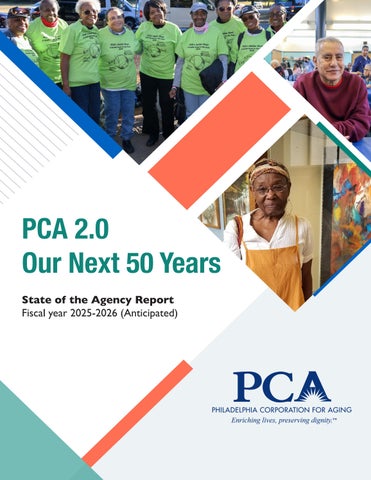
PCA 2.0 Our Next 50 Years State of the Agency Report Fiscal year 2025-2026 (Anticipated)
PCA is grounded in connection Philadelphia Corporation for Aging (PCA) grounds our work in connection. Linking older adults to the resources, support and community they need to thrive is always on our minds. As we step into our next chapter, PCA 2.0, we are taking purposeful steps to evolve how we serve Philadelphia’s aging population and meet the growing complexity of their needs.
Older adults will remain a central lens for all our planning. We are deepening our understanding of the barriers older adults face – whether geographic, cultural, digital or economic – and adapting our services to reduce those gaps. We are also elevating the voices of those we serve, ensuring that decisions reflect the lived experiences of older Philadelphians.
The past decades have shaped PCA into a trusted leader and community partner. Our foundation is strong. But today, we face new challenges that need fresh solutions. Older adults live longer and have different backgrounds, experiences and care needs. Funding structures are shifting. Expectations around aging are changing. To stay responsive, we must reimagine how we work — and with whom.
Through our Area Plan, PCA lays a clear roadmap: sharpen our focus on core programming under the Older Americans Act and expand access to homeand community-based supports. We will also increase resources for caregivers and explore innovative partnerships with medical providers, nonprofits, and city systems.
At PCA, we’re working in new and better ways. That means using technology more effectively, building stronger partnerships and finding different ways to fund our work. We’re focusing on programs that show real results and make it easier for people to get services. We’re also finding ways to make our work more efficient and to give our staff the support they need. How we work matters as much as what we do. We know this evolution won’t happen overnight. It requires careful planning, ongoing community input, and a strong commitment to doing things differently when needed. We are listening to what older adults are telling us. We are learning from data and realworld experience. And we are embracing change with both optimism and urgency. 2
Our vision for PCA 2.0 is simple: a more connected, equitable and responsive future for aging in Philadelphia. That means moving beyond traditional models and imagining aging as a period not of decline but of potential. Aging is a time to stay engaged, supported and empowered. We are grateful for the trust and collaboration of our community, partners and staff. Together, we are building the next era of aging services; one that is grounded in our mission but unafraid to transform in pursuit of greater impact. Sincerely, Najja R. Orr, DBA, FCPP President and CEO, Philadelphia Corporation for Aging
OUR FIRST 50 YEARS: NUMBERS OF IMPACT Since 1973, older Philadelphians and adults with disabilities have sought PCA’s experience and expertise in aging services to meet their needs. In our first 50 years, PCA has achieved these milestones:
PCA’S MISSION To improve the quality of life for older Philadelphians and people with disabilities and to assist them in achieving their maximum level of health, independence and productivity.
43 million
nutritious meals provided to older adults through PCA’s home-delivered and community-based meal programs.
5 million
rides sponsored by PCA for older adults through the SEPTA ACCESS program.
3+ million
callers provided with information, assistance, scheduling assessments and connections to programs through PCA’s Helpline.
2+ million
hours of companionship and assistance provided to adults who are homebound through the Senior Companion Program.
PCA is a private, nonprofit organization, serving as the Area Agency on Aging (AAA) for Philadelphia County, and the first place for older Philadelphians and adults with disabilities turn to for information and services to improve their lives. Established in 1973, PCA provides vital programs that allow individuals to remain engaged in their communities and empowered in their homes, while giving special consideration to those who have the greatest economic and social needs. With more than 50 years of experience caring for older adults, PCA touches the lives of 140,000 Philadelphians each year with more than 30 services.
1 million
initial and followup assessments for long-term care conducted. In PCA’s next 50 years, we will innovate, collaborate and strategize to surpass these milestones and achieve new ones.
3
DOM CARE: ANOTHER NAME FOR HOME
Kathleen Flynn (left) has been a Domiciliary Care resident since 2017 and currently lives with provider Patricia Fordham in her Logan home.
A special program in Philadelphia offers an essential alternative to institutional living for adults, age 18 or older, who require assistance to live independently. The Dom Care Program was piloted at PCA in 1978 to create home and family environments for adults who have barriers to living alone. It was the first program of its kind in the country.
Corporation for Aging’s (PCA’s) Dom Care Program, where Flynn is a consumer and Fordham is a provider. Joy Thomas is the Dom Care Manager PCA. “Dom Care stands for Domiciliary Care,” says Thomas. “Dom Care is a supported living arrangement for adults with disabilities, adults being over the age of 18 who cannot live by themselves.”
Kathleen Flynn started living at Patricia Fordham’s Ogontz home about three years ago. “I needed Fordham has been a provider in the program for a place to live, but I really wanted to live with a about eight years. “Well, I had an empty nest,” family,” Flynn says. Fordham says. “And I love helping people.” They 4
were
matched
through
Philadelphia Program consumers don’t need constant care,
just additional support for their physical, mental or Providers are certified to ensure their homes emotional impairment. are safe. PCA requires personal, medical and financial references for providers. There is also “We sit and we talk,” Fordham says. “Her self- a background check to ensure providers have esteem was very low. She was depressed. It was criminal history clearances. loneliness.” “They have a wonderful training program for Dom Dom Care encourages social engagement and Care Providers,” Fordham says. fosters a sense of community. Participants are supported in pursuing hobbies, attending social PCA’s long-term care department determines events, and maintaining connections with family eligibility for consumers interested in the Dom and friends. This comprehensive approach helps Care Program. reduce feelings of isolation and depression, which are common among individuals living in long-term “When anyone comes into this home, we make care settings. them feel so welcome they don’t even want to leave,” Fordham says. Although Flynn was lonely, she was also very independent. The two eat meals together, often Many participants view their Dom Care placements followed by what they call, “the kitchen dance.” not just as housing, but as a true home where they can form meaningful relationships and receive the “It’s her home as well,” Fordham says. “You know, emotional support they need. Home providers when you’re in the family home, you do what often become like family members, providing family does.” companionship, care and a sense of stability that many participants have lacked in their lives. Flynn is very happy with the arrangement. “I love her to pieces,” she says. “We’re girlfriends and “It has made a positive impact on my life,” says we’re sisters, and I respect her as a provider.” Flynn. “I’m so happy.” In addition to social support, providers also help with daily tasks. “It’s like supporting your other family members by doing anything that’s needed for them,” Thomas says. “Medication administration or management, transportation, or if they need assistance with laundry.”
135
The program also has a profound impact on the Philadelphia community by providing an alternative to nursing homes and other institutional settings. It alleviates pressure on the health care system and allows participants to age with dignity in a home-like environment.
adults connected to home sharing through PCA’s Domiciliary Care Program.
The program and service numbers in this report are anticipated for fiscal year 2025. 5
BUILDING A COMMUNITY FOR OLDER PHILADELPHIANS
More than 20% of Philadelphia residents are age 60 or older. That’s almost 320,000 people, and 9.5% of Pennsylvania’s entire older adult population. (2023 American Community Survey, 5-year Estimates Subject Tables, U.S. Census Bureau) With
more than 30 programs and services, PCA supports and empowers
older adults and adults with disabilities living in Philadelphia. Special consideration is given to those who have the greatest economic and social needs.
6
COMMUNITY & CONNECTION supports lifelong engagement
350+ outreach events staffed each year. COMMUNITY OUTREACH
These include health fairs, senior expos, faith-based gatherings and block parties.
PCA is committed to inclusion. Staff actively engage the community where they are and do outreach to populations of differing ethnicities and creeds. Special advisory councils engage with partner organizations and older adults in the Latino, African and Caribbean, Asian, clergy/interfaith and LGBTQ+ communities. “Listening to the voices of older adults and their families is at the heart of what we do,” says Wanda Mitchell, PCA director of community engagement. “By engaging directly with the community, we ensure our programs truly address their needs and make a meaningful impact. When older adults struggle with basic needs, like housing or food, their quality of life suffers. Our job is to provide a lifeline, ensuring they have the stability and support they deserve.”
THE PCA HELPLINE: 215-765-9040 | email: AskHelpline@pcaCares.org
This one-stop service connects older Philadelphians, adults living with disabilities and caregivers to resources that help them live a safe and independent life. The Helpline offers services in every language, including English, Spanish, Chinese, Cambodian, Hindi, Korean, and Vietnamese. Older adults who are hearing impaired may call 215-765-9041 (TDD). “So many people come to us feeling lost,” said Nolan Lawrence, director of the PCA Helpline. “They need help, but they do not know where to start. That’s where PCA comes in. Our role is to provide a clear path forward, ensuring individuals understand their options and feel supported throughout the process. We don’t just give people information and send them on their way. We make sure they understand their options and feel confident about the next steps. Then, we check in with them to ensure they’re getting the support they need.”
80,000+ callers helped
with information and referrals through PCA’s Helpline. 7
called Milestones, which you can pick up for free at the center.” Senior centers offer something fun and engaging to do after retirement, or even after work. The door is always open.
HEALTH & WELLNESS
SENIOR CENTERS: Lunch spots and so much more! PCA helps to fund 28 senior community centers and satellite meal sites throughout Philadelphia. Each center offers unique programming that promotes socialization and a healthy lifestyle through group dining, recreation, education and exercise. Every Wednesday, Ray Boyd, 76, teaches soul line dancing for older adults at the Firehouse Active Adult Center in West Philadelphia, which is operated by Philadelphia Corporation for Aging (PCA). “You can really find a senior center in every neighborhood,” says Jacqui Makowski, PCA senior center supervisor. “We can connect you. At our centers you can have a full array of activities.” Jacqueline King is a center counselor for the Firehouse Active Adult Center. She says they teach art classes, as well as computer classes, just to name a few. There are also activities to keep the mind and body healthy.
Evidence-based programs provide older adults with information, skill-building and screenings to help reduce the risk of disability and illness, and to manage chronic conditions. Topics include diabetes, chronic pain, falls prevention, and exercise-based programs. “PCA’s health promotion programs play an integral role in allowing older adults to determine which questions to ask your doctor and how to approach a concern,” says Lauren Jirinec, PCA health promotion specialist. “Often, older adults in our programs are afraid to ask questions or admit that they do not understand something and need further explanation. Resources, like the Diabetes Self-management Program, allow older adults to gain support from others who may also be suffering from the effects of diabetes, and also learn better menu planning and sugar management tactics.”
SENIOR FARMERS MARKET NUTRITION PROGRAM
This annual summertime program provides free vouchers for Pennsylvania-grown fresh produce to income-eligible older Philadelphians. The vouchers can be redeemed at certified farmers markets in Philadelphia.
“It’s very helpful,” says Joseph Kane, a member of “This has been great for me,” says Barbara Dantley, the South Philadelphia Older Adult Center for 11 a center member who volunteers calling bingo. “I’ve years. “They make it pretty convenient. They offer met quite a few people from all different walks of life. the full range of anything that’s grown in the garden. Through the exercise I’ve seen improvement with So you’re eating healthier. They have great apples endurance. It builds up my confidence and that’ll and other vegetables.” carry on everywhere else.” Daily congregate lunch meals are served to anyone 60 and older, Monday through Friday. It’s a nutritionally balanced whole meal, which includes bread, milk, juice, a hot or cold entree, and dessert.
TRANSPORTATION
Rides are available in accessible vehicles for older adults and adults with disabilities who are unable to use fixed-route public transportation. As mandated by the Pennsylvania Department of Aging, PCA certifies participants in Philadelphia’s shared ride “Everyone gets to know you,” Makowski says. “The program and coordinates rides with SEPTA ACCESS center helps older adults achieve friendship and for seniors who participate in activities provided socialization. Senior centers are also a resource for by PCA’s Senior Center network. This program information. PCA publishes a monthly newspaper, 8
offers door-to-door transportation to registered Philadelphians age 65 and older and people with disabilities who are unable to use fixed-route service.
SENIOR COMPANION PROGRAM
This person-to-person service program for older adults pairs companions, age 55-plus, with isolated older adults who need some assistance to remain in their homes. Trained Senior Companions provide socialization and assist with daily activities, including light meal prep, errands and accompaniment to medical appointments.
Numbers of impact in the community 315,569 meals served in group settings
1.25+ million total services provided at senior centers
EMPLOYMENT & JOB TRAINING
PCA funds two employment programs in Philadelphia that help mature workers learn valuable job skills and find new career opportunities. “We believe that every older adult should have the opportunity to live with dignity and respect, and that includes having the ability to earn a living to support themselves,” said PCA President & CEO Najja R. Orr, DBA, FCPP. “Our employment and job training programs help older adults overcome the barriers they may face in re-entering the workforce and provide them with the skills and resources they need to succeed.”
HEALTH INSURANCE COUNSELING
PCA knows that learning all you can about Medicare can be confusing. That’s why PCA offers a program that provides free, unbiased, confidential counseling. Pennsylvania Medicare Education and Insight (PA MEDI) is available to older Philadelphians who are eligible for Medicare. “Medicare beneficiaries often find the available money-saving options confusing, and many might not learn about them without the PA MEDI program,” said Deena Pollock, a PA MEDI counselor at Einstein Medical Center. “By working individually and confidentially with beneficiaries, we can identify their health care preferences, which has allowed us to successfully meet the needs of many individuals. I’ve witnessed numerous cases where our comprehensive and personalized approach has saved Medicare beneficiaries hundreds of dollars each month.”
10,986 sessions of
health information provided to 1,481 older adults
30,191 vouchers for
free produce distributed to older Philadelphians
100,000+ rides to vital appointments and important activities
20,000+ hours of Senior Companion services provided to homebound older adults
230 mature job seekers received employment assistance
500,000 people educated about Medicare
35,000 people received
information through community outreach
2,600 people received individual assistance from PA MEDI 9
HELP IN THE HOME fosters independence ASSESSMENTS
80,000+ assessments of older adults for long-term care
To determine an individual’s eligibility for long-term care services, PCA staff complete a comprehensive in-home evaluation of an older adult’s needs and functional status. This is used to determine the appropriate services and where they should be provided. “At PCA, we understand the unique needs of older adults and the challenges they may face,” says Shani Gilmore, PCA’s executive administrator of long-term care. “Our long-term care programs are designed to provide comprehensive assistance, advocating for their rights, empowering families and ensuring that older adults have access to the resources they need to thrive. We are committed to making a positive difference in the lives of our community’s elders and promoting a society that values and supports those who have contributed so much.”
CARE MANAGEMENT
PCA helps older adults age in place. High-quality care management ensures that individuals receive the support they need to navigate the challenges of daily living. These support services are designed to address the unique needs of each person in their home, helping to prevent unnecessary hospitalization and institutional care. PCA’s OPTIONS program can assist individuals in coordinating home- and community-based services, allowing participants to age gracefully in their homes. “Our services are not one-size-fits-all,” says Sean Outen, PCA’s director of Long-term Care OPTIONS. “Each person we help has a unique story, and our job is to craft a plan that respects their individuality while addressing their needs. The OPTIONS Program is about giving people choices. It allows them to stay in their homes and communities while receiving the care they need. That is a powerful thing.”
10
CAREGIVER SUPPORT
Thousands of Philadelphians provide unpaid care to family members or friends. Caregiving can be challenging, both physically and emotionally. PCA’s Caregiver Support Program provides a wide array of resources for these unpaid primary caregivers, including education and training, financial assistance, referrals and more. Older adults who are kinship caregivers, raising their grandchildren or other child relatives, can also receive support through PCA. Darlene McGlotten-Whitehead has been a caregiver to her 10-year-old granddaughter, Laila, on and off for the last eight years. She stepped up to be the child’s guardian about a year ago without hesitation. But providing for her granddaughter’s needs was a concern. So, she joined PCA’s Caregiver Support Program. “When I called PCA, it didn’t take but about two days and they were back with me,” McGlotten-Whitehead says. “We did the intake, and my case manager reassured me that everything was going to be alright.
If your grandchildren need school clothes, they help with that. And just knowing that takes a lot off you. I just pray and hope that a lot of grandmothers just reach out and get to this program, because it will help you.”
VETERANS PROGRAM
PCA helps U.S. military veterans gain greater control over their long-term care. The Veterans-Directed Care (VDC) program, a collaborative effort with the U.S. Department of Veterans Affairs (VA), is available to local veterans, 18 or older, who prefer to manage PCA’s Caregiver Support Program has given their own care services and live independently in their McGlotten-Whitehead a sense of pride that she can communities. help her granddaughter and let her know that she has somebody. “And I can just see her maturing to a level “This program is all about empowering veterans,” said that, you know, I could say I’m doing a good job,” she Marialana Crispin, assistant director of OPTIONS at says. PCA. “By helping veterans to be in control of their own care, we’re assisting them to maintain their HOME REPAIRS independence and dignity. This is a game-changer PCA’s Senior Housing Assistance Repair Program for veterans who want to remain in their homes. It’s (SHARP) provides minor repairs and modifications not just about providing care; it’s about giving them to make homes safer and more secure for income- the tools to take charge of their lives.” eligible Philadelphia homeowners. Our expert work meets or exceeds all city building codes and is fully guaranteed. “People want to remain in their homes,” says Mark Myers, PCA’s housing director. “They don’t want to go into a nursing home. They also don’t want to go into another type of living arrangement. By using these housing services, older adults can stay in their homes. We want folks to be as safe as possible. We want folks to have the equipment that they need as they age and to be able to do things at home that they need.”
HOME-DELIVERED MEALS
PCA delivers nutritious meals and provides regular contact to frail older adults and people with disabilities who struggle to afford balanced meals, are unable to cook or shop for food, and have no one to help prepare meals. “Our meal programs — both congregate and homedelivered — offer much-needed access to healthy food and provide opportunities for social interaction, which many older adults would otherwise miss out on,” said Bea Winn, PCA’s assistant director of health and nutrition, who has seen the program grow over her 27 years with the agency. “PCA is constantly striving to adapt and better meet the evolving nutritional and logistical needs of Philadelphia’s older adults. We’re working to expand our offerings to reflect the diverse cultures within our city and collaborate with local restaurants to better serve where the need is most urgent. We understand that a one-size-fits-all approach isn’t effective when the challenge of food insecurity is so vast.”
Numbers of impact in the home 583,472 personal care service hours 7,900 older adults receive care management and coordinated services 1,750 home-support visits 825+ caregivers receive financial reimbursement and support services 2,450 home modifications and repairs 1.2+ million homedelivered meals served 11
PROTECTION & ADVOCACY provides a safety net for vulnerable older adults OLDER ADULT PROTECTIVE SERVICES (OAPS)
10,000+ reports of suspected elder abuse PCA is committed to preventing and mitigating elder abuse. Our Older Adult Protective Services unit helps to detect, prevent and protect older Philadelphians from all forms of abuse, including physical, sexual and psychological abuse; selfneglect or neglect by a caregiver; and financial exploitation. “It’s imperative that we prioritize safeguarding older adults from abuse and exploitation to ensure their dignity and peace of mind,” says Tamikia Morris, director of Older Adult Protective Services at PCA. “Abuse is a major allegation, whether financial or otherwise, that we take very seriously. When we hear about it, we fully investigate it with extreme care. In the process, we have the opportunity to mitigate risk, harm or injury to an older adult.”
OMBUDSMAN PCA advocates for residents of long-term care facilities. The Ombudsman Program responds to complaints made by residents and family members; makes quality assurance visits to long-term care facilities; and consults with individuals, family members and care providers. “Residents in long-term care facilities have fundamental rights that must be respected,” says Lynda Pickett, assistant director of volunteer services, now retired from PCA. “Our Ombudsman Program is here to make sure these rights are upheld, whether it’s being treated with dignity, the right to privacy, or the right to have a say in their own care.”
1,200+ 12
resident complaint resolutions, facility visits and staff education sessions
LEGAL SERVICES PCA provides legal assistance, advocacy and education to older adults on a variety of matters, including consumer protection; benefits and entitlements; housing/real estate; probate, estates and fiduciaries; and domestic matters.
35,000 hours of legal assistance provided CRISIS ASSISTANCE PCA’s Emergency Fund for Older Philadelphians helps to meet basic human needs, including food, utilities, rent/ mortgage or other necessities, for those who have exhausted all other resources. The fund is managed by a coalition of community-based and human services organizations.
$195,000 in emergency grants provided to 1,100 older adults in crisis
Ms. E, 71, attends Mann Older Adult Center. She requested assistance with the purchase of an air conditioner. Ms. E suffers with high blood pressure and asthma. She had just moved to an apartment, which had no air conditioner, and was concerned about her health. A cash grant from the Emergency Fund allowed Ms. E. to purchase an air conditioner unit for her new apartment. “Thanks to the Emergency Fund, I was able to purchase the air conditioner, which kept me cool and safe during the summer,” Ms. E said. “Without the PCA fund, I don’t know how I would have managed during the summer’s high temperatures, given my health issues.”
13
FISCAL YEAR 2026 FINANCIALS Projected Revenue Public Support: PA Dept. of Aging: Aging Block Grant Other State Sources (Title XIX) Federal Awards City of Philadelphia
$62,554,000 782,000 5,241,000 94,000
Subtotal
$68,671,000
Other Revenue: In-Kind Contributions Foundation and Other Revenue
$96,000 25,253,000
Subtotal
$25,349,000
Total Revenue
$94,020,000
67% <1% 6% <1%
<1% 27%
PA Dept. of Aging: Aging Block Grant Foundation and Other Revenue 27%
In-Kind Contributions <1% Federal Awards 6% Other State Sources (Title XIX) <1%
14
67%
FISCAL YEAR 2026 FINANCIALS Projected Expenses Long-Term Care: 63% Adult Day Care Assessments Care Management Consumer Reimbursement Domiciliary Care Guardianship Home Delivered Meals Home Support Medical Equipment & Supplies Ombudsman Service Personal Assistance Personal Care Professional Evaluation Protective Services Subtotal
$159,000 7,829,000 9,390,000 3,167,000 792,000 577,000 10,171,000 212,000 255,000 668,000 5,616,000 7,940,000 92,000 12,711,000 $59,579,000
Community Services: 14% Congregate Meals Employment Services Legal Assistance Senior Companion Senior Community Center Services Volunteer Services
$5,834,000 1,169,000 409,000 377,000 5,676,000 3,000
Subtotal Access Services: 8% ADRC Information and Assistance Passenger Transportation
$13,468,000 $209,000 4,536,000 2,277,000
Subtotal
$7,022,000
Environmental Modifications: 4%
$3,549,000
Administration: 11%
$10,402,000 Total
$94,020,000
Administration 11% Environmental Modifications 4% Access Services 8%
Community Services 14%
Long-Term Care 63%
15
Thank You, Donors! We are grateful for diverse funding sources that allow PCA to remain impactful and strategic in challenging times. Thank you to our donors, grant makers and corporate partners for support and sustainability. PCA is pleased to acknowledge the individuals, foundations and companies that made contributions in fiscal year 2025. Every effort was made to ensure proper recognition of each donor. $20,000-$35,000
Always Best Care Senior Services PA Health & Wellness The W.W. Smith Charitable Trust
$10,000-$19,999
The Elmer Roe Deaver Foundation Highmark Wholecare Lindo Foundation The Nutrition Group The Philadelphia Foundation
Jennifer Sparks StairRide Company Telesystem Consulting Group Hue Trinh United Healthcare Community Plan of Pennsylvania John Whitman
$500-$999
Martha Takats Lin Thomas Norma Thomas Unitarian Universalist House Outreach Program VisionLink VitaCare Home Health, Inc. Laura Weinbaum Wellcare
365 Health Services AARP Pennsylvania $200-$499 Denise Adamucci African Family Health Organization Harry Bambrick Julie K. Bamberger-Herrmann $5,000-$9,999 CARIE (Center for Advocacy for the Rights Mary Brewster Icare Home Health LLC & Interest of Elders) Diane Brown Independence Blue Cross Central City Toyota Janet Burnham Mendoza Group Cigna Louis Colbert MFR Consultants Eden Home Care Systems Marvetta Coleman PECO Richard Eynon Nancy Dwyer Pegasus Technologies, LLC Fidelity Charitable Gift Fund Teja Goud Talla Trinity Health PACE/Mercy LIFE Global Alzheimer’s Platform Foundation Joanne Harmelin Willis Towers Watson Jeffrey Granett Teresa Heavens Willis US Holding Company LLC David & Linda Guendelsberger Jerry & Barbara Kaplan Lynn & Thomas Harris John & Lydia Krzeminski $1,000-$4,999 Holy Sepulchre / Everstory Partners Davin Lamm Anthony Adamucci Home Instead Joseph Leonardo AmeriHealth Caritas Family of Companies The Honickman Foundation Kristin Long B & W Family Foundation Impact Total Fitness Carol Ann Merritt William Bensley, Esq. InnovAge Anne Mitchell Cardinal USA Fuel Oil Jack Edmondson Inc Earl Murray Mark & Melissa Cooper Cornfeld Jefferson Health Plans John & Patricia Newby Mike Delaney Jewish Family & Children’s Service of Barbara Nickels Drexel University College of Nursing & Greater Philadelphia Carole & Kenneth Parker Health Professions AgeWell Collaboratory Constance Jones Philip Jaisohn Memorial Foundation Dunleavy & Associates Robert Krebs Mark & Mary Rems Emerald Business Supply, Inc. The Labov Plumbing & Heating Supply, Inc. Betty Jo Robinson ePlus Technologies Inc. Robena Lowry Jennifer Russell Wilmarie Gonzalez Sandra McNally Margaret Sayvetz Greater Exodus Baptist Church Christopher Miller & Dr. Danielle Christine Shiffer Mary Hugues Snyderman Erika Solomon James Branch Cleaning Service Monumental Post Acute Care Mark Weber KleinLife Northern Living Center by North City Francine Williamson Holly Lange Congress Elizabeth Winn Loving Care Senior Services, Inc. The O Insurance Group LLC Jacqueline Zinn Michael Beaumont General Contractor Barbara Oldenhoff Oak Street Health MSO, LLC Penn’s Village $100-$199 Najja R. Orr, DBA, FCPP People for People Jenimae Almquist Penn Asian Senior Services Philadelphia Senior Center / NewCourtland Carolyn Asbury Philadelphia Insurance Companies Reading Terminal Market Corporation Monika Briggs SarahCare Senior Services Helen Richardson Glenn Bryan
16
Craig Butler Linda Cashman Charities Aid Foundation of America Karen Chenoweth Pamela Chestnut Ann Danish Patricia Delacy Michael DiGregorio Dolores Dinyon Joseph Dougherty Joyce Drayton Jane Eleey Joseph Fabiano Mary J. Fallon Heather Finnegan Firehouse Active Adult Center Grant Frame Joseph Freedman Patricia Funaro Kristen Gallagher Mindy Gallagher Vincent Gallagher Shani Gilmore Shivankur Goel James Gregg Dorothy Heinz David Howard Camara Jordan Mark Kendrick Oredia Kennedy Joseph Klein Judith Kotler Esther Lee Jacquelyn Makowski Martin Luther King Older Adult Center Steven & Sylvia Mayover Richard & Patricia McCabe Amanda McIntyre Wanda Mitchell Curtis & Amparo Miyamoto Mark Myers Mason Noble Jen Norman Northeast Older Adult Center Lynda Pickett Carolyn Rice Gloria Rohlfs Samara Inc. Deena Schneider Jean Scholz Angela Scott Alex Seltzer Rheta Smith South Philadelphia Older Adult Center Philip Udo-Inyang Satya Verma Kathryn Vetter Elissa Viscelli Jeff Waxman Venice Williams
CHARITABLE FUNDS Contributions to PCA’s two charitable funds have allowed us to expand our reach, even during times of crisis and limited funding. Rodney D. Williams Philadelphia Fund for Seniors allows PCA to direct support to areas with the greatest need. The RDW Philadelphia Fund for Seniors was established in 2014 to supplement public funding that has not kept pace with the growing needs of older Philadelphians. Emergency Fund for Older Philadelphians provides crisis assistance to at-risk, low-income older individuals who are facing severe financial hardship. The Emergency Fund Coalition, which consists of 22 organizations, founded this fund in 1979 to meet urgent, unmet needs. Donations can be made to PCA’s charitable funds by visiting www.pcaCares.org/donate. PCA FUNDING & GRANTS PCA is funded primarily through federal and state sources. Governmental grants are received primarily through: • • • • • • • • •
Administration for Community Living AmeriCorps Pennsylvania Department of Aging Pennsylvania Department of Human Services Philadelphia Office of Behavioral Health & Intellectual disAbility Services U.S. Department of Agriculture U.S. Department of Housing & Urban Development U.S. Department of Justice via the Pennsylvania Commission on Crime & Delinquency U.S. Department of Labor
17
COMMITTED TO THE CAUSE: PCA LEADERSHIP In 2020, Dr. Najja R. Orr became PCA’s President & CEO, at a time when services for Philadelphia’s older adults required swift adaptation to meet growing demand. This included delivering more than 3 million meals to older Philadelphians through home-delivered and community-based meal programs. Prior to coming to PCA, Orr was Director for the Bucks County Area Agency on Aging.
Najja R. Orr, DBA, FCPP President & CEO
Orr currently holds leadership positions as chair-elect of the board for the American Society on Aging, a board member of Comprehensive Care Connections and OATS (Older Adults Technology Services), and southeast regional board representative for the Pennsylvania Association of Area Agencies on Aging (P4A). He is also a member of the Mayor’s Commission on Aging. Orr was inducted as a fellow at the College of Physicians of Philadelphia in 2021 and was selected among the 2022 Nonprofit Power 100 honorees by City & State Pennsylvania. In addition to being a staunch advocate for older adults, Orr is also a dedicated husband and father of four. Laura I. Weinbaum has a strong leadership legacy in nonprofit with 25 years of experience in operations, organizational development, data and quality assurance, training, fiscal management, and advocacy. Weinbaum previously was Vice President of Strategy and Impact at Project HOME for more than 20 years. As COO, Weinbaum works to take PCA to the next level of accomplishment as an Area Agency on Aging, identifying new funding streams and developing pivotal strategic partnerships — guiding PCA into new arenas that will bring about long-term growth and opportunities.
She holds several leadership positions in the Philadelphia community: Board Chair, Laura I. Weinbaum, MBA, MGA Commonwealth Housing Development Corporation; Leading for Change Fellow, Drexel University LeBow College of Business; and Adjunct Fellow, University of Chief Operating Officer Pennsylvania Center for Public Health Initiatives.
Monika Briggs has over two decades of diverse financial and operational expertise. Prior to joining PCA, she managed the embedded family office at a Philadelphia-area private equity firm, where she oversaw philanthropic initiatives and corporate sponsorships and served in leadership roles for five charitable organizations. Briggs is active in the Not-for-Profit Leadership Committees of both the Pennsylvania Institute of Certified Public Accountants (PICPA) and the New York State Society of CPAs (NYSSCPA). She is also a contributor to the PICPA’s CPA Now Blog on nonprofit matters. Monika K. Briggs, CPA Chief Financial Officer 18
Outside of work, Briggs is a mother of five who enjoys exploring the Philadelphia area with her family.
PCA BOARD OF DIRECTORS 2025
Glenn D. Bryan Chair
Louis G. Colbert Vice Chair
Satya B. Verma, OD Immediate Past Chair
Denise Adamucci Treasurer
PCA is governed by its board of directors, which guides the development and administration of agency programs, the Area Plan for Aging Services and the annual budget. An advisory council provides input to the board and acts as an advocating body.
PCA ADVISORY COUNCIL Sandra McNally, Chair Linda Tyler,Vice Chair George JS Choe Joseph J. DiMeo Jr. Teresa Elliott
Jacqueline S. Zinn, Ph.D. Secretary
Patricia Canela-Duckett
Florence Gallagher Nida Imperial Frederick Lewis David Nevison Susan Shifrin Vera Tolbert
Cheryl Croxton
Sandra McNally
Norma D. Thomas, D.S.W.
Sharlene Waller
19
MAIN OFFICE 642 N. Broad St. | Philadelphia, PA 19130-3409 Main phone: 215-765-9000 Fax: 215-765-9066 PCA HELPLINE Call us weekdays, from 8:30 a.m. to 5 p.m., for general inquiries or 24/7 to report suspected elder abuse: 215-765-9040 1-800-482-9060 (toll-free, outside Philadelphia) 215-765-9041 (TDD for hearing impaired) FIND US ONLINE: pcaCares.org Facebook.com/pcaCares.org X.com/pcaCares_org LinkedIn.com/company/Philadelphia-corporation-for-aging Read more about PCA’s programs, services and accomplishments at pcaCares.org.
© June 2025. Philadelphia Corporation for Aging. All rights reserved.