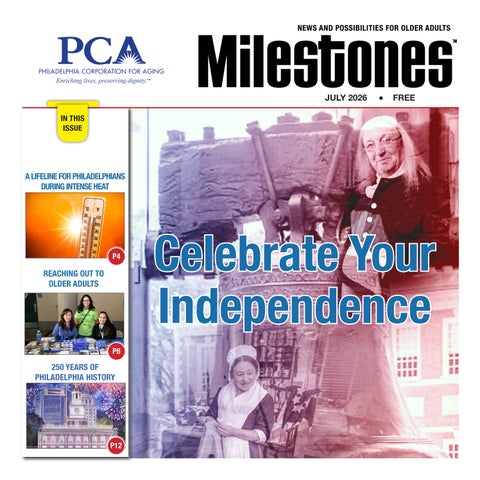
JULY 2026
FREE
IN THIS ISSUE
A LIFELINE FOR PHILADELPHIANS DURING INTENSE HEAT
P4
REACHING OUT TO OLDER ADULTS
P6
250 YEARS OF PHILADELPHIA HISTORY
P12
Celebrate Your Independence
Milestones 2
July 2026
PCA supports independence: Building a better community for older adults Philadelphia Corporation for Aging (PCA) is the Area Agency on Aging for Philadelphia County and is dedicated to serving Philadelphia’s older adults and adults with disabilities. PCA publishes Milestones and offers: • Care in the home • Caregiver & grandparent support • Employment & volunteer programs • Health education • Home-delivered meals Report suspected elder • Home repairs & modifications abuse 24/7 to the PCA Help • Information & referral line: 215-765-9040. • Legal services • Ombudsman services For general inquiries about • Protective services PCA or aging services, email • Senior centers AskHelpline@pcaCares.org • Transportation • Veteran-directed care or call 215-765-9040.
By Najja R. Orr, DBA, FCPP PCA President & CEO Published by Philadelphia Corporation for Aging Najja R. Orr, DBA, FCPP President and CEO
Milestones is published monthly and distributed at more than 800 locations throughout Philadelphia.
PCA Board of Directors 2026 Glenn D. Bryan, Chair Louis G. Colbert, Co-Chair Check us out online: pcaCares.org Jaqueline S. Zinn, Ph.D., Secretary Denise Adamucci, Treasurer Editorial & Distribution: Satya B. Verma, O.D., Immediate Past Alicia M. Colombo Chair 267-507-2168 Cheryl Croxton Patricia Canela-Duckett Lynette Killen Norma D. Thomas, DSW Sharlene Waller Arthur E. Helfand, DPM, Board Chair Emeritus
MilestonesNews@pcaCares.org Advertising: Kristin Long 215-606-7310 Kristin.Long@pcaCares.org Subscriptions: Home delivery: $12/year MilestonesNews@pcaCares.org
The views expressed in Milestones are not necessarily those of Philadelphia Corporation for Aging (PCA). Milestones will not knowingly accept or publish fraudulent or misleading advertising. Milestones reserves the right to edit, revise or reject ads. Milestones assumes no responsibility for errors, misprints, omissions or misinformation; for failure to publish an ad; or for any damages of any kind. Neither the publisher nor any other party is rendering expert advice in this publication. No part of this newspaper may be reproduced without the permission of PCA. ©2026 Philadelphia Corporation for Aging. All rights reserved.
Approximately 8.2 million people in the United States require home- and community-based services in 2026, according to the Centers for Medicare & Medicaid Services. This help might include a ride to medical appointments, help with meals, caregiver support or access to a senior center. These services do more than meet basic needs. They help people stay connected to their routines, relationships and communities. As we celebrate the 250th anniversary of the Declaration of Independence, let’s reflect on what independence means for older adults. At Philadelphia Corporation for Aging (PCA), we see how the right support helps older adults remain active, engaged and connected to what matters most. PCA works with organizations across Philadelphia to strengthen services for
older adults, caregivers and adults with disabilities. As the city’s older adult population grows, more residents are seeking support to help them age with dignity in the communities they call home. PCA continues to expand and adapt its programs to meet changing needs. That is why conversations about aging services matter. Last month, PCA hosted its annual State of the Agency and Budget Hearing. This public meeting shared updates on programs, funding priorities and the future of aging services in Philadelphia. Community members provided comments and suggestions about what older adults need to stay independent. [To read PCA’s State of the Agency Report for 2026-27, go to www.pcaCares. org/soa.] These conversations highlight a shared responsibility to support healthy aging. Strong services, ample funding and community collaboration all help older adults stay independent and connected to the places they call home. That’s why it’s vital to reauthorize the Older Americans Act (OAA) for 2026-2030. Created in 1965, the OAA is the primary federal law providing social, nutrition and supportive services to Americans 60 and older. Reauthorization would ensure continued federal support for essential services that help older Americans live independently and remain active in their communities. PCA remains committed to engaging with the community to find ways of improving the services we provide. Independence looks different for everyone. But all older adults deserve the same level of opportunity to live safely, with respect and connections in their community.
Milestones 4
July 2026
As heat intensifies, PCA’s Helpline becomes a lifeline for Philadelphians
By Bill Conallen
On the hottest days of the year, the danger often begins quietly. An older adult stays inside a home that has become warmer than expected. A neighbor notices someone has not come outside all day. Worries creep in about family members living alone. Are they drinking enough water? Will they recognize the warning signs of heat exhaustion? In Philadelphia, summer heat can quickly become a public health threat. Philadelphia Corporation for Aging’s (PCA’s) Helpline plays a critical role in helping residents stay safe. When the City declares a Heat Health Emergency, the PCA Helpline becomes the city’s Heatline. It connects callers with guidance, resources and support during periods of dangerous heat. The first Heat Health Emergency for Philadelphia during the summer 2026 was declared June 11-12. During activations, the Heatline (215-765-9040) is open to Philadelphia residents of all ages. Trained call center operators and nurses
from the Philadelphia Department of Public Health are on the line to help callers of all ages. The following information is provided: • Ways to prevent heat-related illness • How to recognize signs of heat stress • Options for staying cool
• • •
“Extreme heat can be dangerous very quickly, especially for older adults, people with chronic health conditions and those who may not have access to air conditioning,” said Nolan Lawrence, PCA Heatline director. “The Heatline gives Philadelphians a place to turn for clear guidance, immediate support and help connecting to resources that can keep them safe.” For many residents, this service can be more than a source of information. It can be a point of human contact during a time when heat, isolation and health concerns may overlap. Older adults are among those most vulnerable during extreme heat. As people age, they may be less likely to sense temperature changes or feel thirsty. Chronic health conditions and some medications can also increase the risk of heat-related illness. For people living alone, without reliable air conditioning or with limited mobility, severe heat can quickly become dangerous. Heat stress can build gradually, making prevention especially important. Health officials encourage residents to do the following during hot weather: • Drink water regularly, even before feeling thirsty
People without air conditioning at home are encouraged to visit public places where they can safely cool down. These locations can include cooling centers, libraries, senior centers and shopping centers. While indoors without air conditioning, residents are also urged to do the following: Heatline staff can also assist • Keep curtains or blinds closed family members, caregivers and during the hottest part of the day neighbors who are concerned about • Use fans only with the windows (Continued on page 5)
• •
Avoid alcohol and sugary drinks Limit strenuous activity Wear lightweight, loose-fitting clothing Limit outdoor activity, especially during the hottest parts of the day Spend time in air-conditioned spaces whenever possible
•
open Avoid using ovens or other appliances that can increase indoor temperatures
While fans can provide some comfort, they may not be enough during extreme heat. This is particularly true when indoor temperatures rise to dangerous levels. During a Heat Health Emergency, callers to the Heatline can ask about: • Precautions to take at home • Locations of cooling centers • Ways to identify symptoms that may require urgent attention
Milestones 5
someone else’s well-being. Public health officials urge residents to take heat seriously. Early signs of heat-related illness may include: • Heavy sweating • Weakness • Dizziness • Headache • Nausea • Muscle cramps More serious symptoms may indicate a medical emergency. These can include confusion, fainting, very high body temperature, hot or dry skin, vomiting, or loss of consciousness. If these symptoms appear, call 911 immediately. PCA’s role during severe heat is also preventive. The Heatline gives residents a place to turn before a sit-
July 2026
uation becomes critical. “Prevention is one of the most important tools we have,” Lawrence said. “A simple call can help someone recognize the signs of heat stress, make a plan to stay cool or check on a loved one before a situation becomes an emergency.” Through its year-round Helpline, PCA helps callers remain safe, informed and connected to services. These can include home-delivered meals, financial benefits, caregiver support, transportation, in-home care and other community programs. During extreme heat, that same infrastructure is mobilized to meet an urgent seasonal need. The Heatline’s importance has grown as Philadelphia faces hotter summers and more frequent extreme heat events. The city’s dense
neighborhoods, paved surfaces and older housing stock can intensify heat exposure. This is especially true in communities with fewer trees, limited access to air conditioning or higher rates of chronic illness. For PCA, heat stress prevention is not only a public health message. It is a community responsibility. Residents are encouraged to check on older neighbors, relatives and friends during periods of high heat. Consider those who live alone or may be reluctant to ask for help. Caregivers and family members can help by making sure older adults have water nearby, know where to go to cool down, have transportation if needed and understand when symptoms require medical attention. A phone call, a knock on the
door or an offer to help someone get to a cooler location can save a life. When a Heat Health Emergency is declared, the Heatline provides another layer of support. It gives Philadelphians a number to call, a person to speak with and a path toward help. For heat safety information or support during a Heat Health Emergency, call the PCA Heatline at 215-765-9040. For medical emergencies, call 911. The PCA Helpline is available weekdays, from 8:30 to 5 p.m., for general information and resources. Elder abuse can be reported 24/7. Bill Conallen is the public relations specialist at Philadelphia Corporation for Aging.
Milestones 6
July 2026
Mark Kendrick reaches out to older adults in the community
By Alicia M. Colombo
Philadelphia Corporation for Aging (PCA) assists more than 140,000 people each year. These older adults, caregivers and adults with disabilities receive vital information, resources and connection to services. For many of them, the first contact with PCA is out in the community. PCA’s Community Engagement Department maintains an active presence in Philadelphia County, representing PCA at 325 events each year. Through this outreach, the agency shares information about home- and community-based programs. These include
transportation, nutrition, senior community centers, volunteer and employment services, legal, ombudsman, and health promotion initiatives offered through PCA. “The role of outreach is to be a presence in the community. By being there, older adults are able to directly ask someone what PCA does,” said PCA Outreach Coordinator Mark Kendrick. “I present information about the variety of programs that PCA offers. My role is to be an outlet for the community to interface with PCA. Outreach staff will go to whatever space is willing to have us, whether it’s a house of worship, community event or senior center.”
Outreach efforts include tabling at events to share materials with the public and giving presentations about relevant topics. “The message we deliver is about staying healthy and keeping seniors safe in the community,” Kendrick said. “Outreach brings people what they need by sharing relevant resources for older adults. Part of that is sharing services and programs that PCA provides. The goal is getting people connected to resources.” Recent events have focused on the topics of men’s wellness and mental health. Kendrick, who has worked at PCA for 11 years, heads the agency’s Clergy Interfaith Coalition and African-Caribbean Elders Group. “In addition to general outreach to the entire community, PCA pays special attention to finding groups that are missed. A lot of general resources and information aren’t focused on the specific needs of special groups. Or, they are prepared with preconceived notions of what a group needs. We meet underserved populations where they are.” PCA has dedicated outreach staff and convenes advisory councils for special populations, including Asian, Latino, LGBTQ+ and faith-based elders. “The goal is to find the connector,” Kendrick said. “We reach the leaders and organizers – the ‘boots on the ground’ – who will bring the information into the community. We’re getting the information out there, whether it’s directly to the people
in need or by way of a community contact person. All these outreach efforts allow people to put a face to the information. We give them a direct line to PCA. They can ask a question to someone in the moment.” Prior to becoming an outreach coordinator, Kendrick worked as a service coordinator for PCA’s OPTIONS Program for five years. “People wait too long to reach out for help,” he said. “It’s so important to be aware of what’s available, so you know it’s there when you need it, or you can help someone else. We give people a lifeline: Reach out to the PCA Helpline to make a referral or to get an assessment for PCA services scheduled. The first step is making a connection, so they know they don’t have to figure it out alone.” To request a PCA community outreach staff to give a presentation to your group or set up a table at a community event, contact the PCA Helpline at 215-765-9040. Alicia M. Colombo is the editor of Milestones
(See page 15 for crossword)
Philadelphia Corporation for Aging Annual Numbers of Impact
Protection & Advocacy
Help in the Home
1.1 million home-delivered meals served
480,330
$156,500 in emergency Grants
personal care service hours
provided to 820 older adults in crisis
6,150
2,350
older adults receive care management and coordinated services
home modifications and repairs
690
135
caregivers receive financial reimbursement and support services
850
home-support visits
11,760
reports of suspected elder abuse
65,660
hours of legal assistance provided
1,820
adults connected to home sharing through PCA’s Domiciliary Care Program
resident complaint resolutions, facility visits & staff training sessions provided by Ombudsman
Community & Connection 716,900
total services provided at senior centers
14,700
hours of Senior Companion services provided to homebound older adults
120,000
92,325
84,200
297,900
rides to vital appointments and important activities
vouchers for free produce distributed to 18,465 older Philadelphians
assessments for long-term services and supports
11,500
4,150
1,750
230
meals served in group settings
people received information through 325 community outreach events staffed each year
people received individual assistance from PA MEDI
people attended health information sessions
These numbers are estimated for fiscal year 2026.
mature job seekers received employment assistance
79,300
people helped with information & referrals through the PCA Helpline
Milestones 8
July 2026
July 2026
Events
Send your calendar items two months in advance to: MilestonesNews@pcaCares.org Questions? Call 267-507-2168.
JULY 9 ENHANCE FITNESS
JULY 15 BINGO
JULY 10 SCRABBLE PLAY
JULY 16 POETRY CLASS
Low-impact, full-body workout designed for older adults to improve strength, flexibility & mobility. 10 a.m. Center in the Park, 5818 Germantown Ave. 215-848-772 | Free
THIS MONTH: JULY 4: INDEPENDENCE DAY JULY 7 OPEN TECH CENTER
Enjoy the classic crossword game with Discover the joy of self-expression. friends. 10 a.m. Center on the Hill. 215-247- Beginners welcome. 10:30 a.m. Center in the Park, 5818 Germantown Ave. 215-8488855 | $2 772 | Free
JULY 17 PINOCHLE
Computer lab with instruction available for technology topics, such as iPads, smartphones & Zoom. 10 a.m. KleinLife: Northeast Philadelphia, 10100 Jamison Ave. 215-698-7300 | Free
Sharpen your mind & enjoy friendly competition. Learn the rules, strategies & techniques. Beginners welcome. 1 p.m. Journey’s Way, 403 Rector St. 215-4871750 | Free
JULY 8 CHESS CLUB
Friendly competition, strategic thinking & social connection. Noon. Martin Luther King Older Adult Center, 2100 Cecil B. Moore Ave. 215-685-2715 | Free
10 a.m. Philadelphia Senior Center – Allegheny, 1900 W. Allegheny Ave. 267286-1455 267-286-1455 | $0.10 per board; Minimum of 6
JULY 20 MAT YOGA
JULY 13 CHAIR ZUMBA
Get moving & feel the beat with a lively mix of music, movement & energizing exercises. 9:30 a.m. KleinLife: Northeast Philadelphia. 10100 Jamison Ave. 215-698-7300 | Free
JULY 14 CARD GAME HOUR
Play any card game you would like with other center members. Cards provided. Noon. Lutheran Settlement House, 1340 Frankford Ave. 215-426-8610 | Free
Blend of poses, breathwork & meditation to become more in touch with your body. 4 p.m. Lutheran Settlement House, 1340 Frankford Ave. 215-426-8610 | Free
JULY 21 MEDITATION CLASS
Practice brain health through meditation. 9:30 a.m. Center on the Hill, 8855 Germantown Ave. 215-247-8855 | $12
Milestones 9
July 2026
Penn Medicine Dept. of Otorhinolaryngology
JULY 23 ART CLASS
Learn a variety of mediums, including painting, watercolors, papermache, sketching & collage. 11 a.m. Lutheran Settlement House, 1340 Frankford Ave. 215-426-8610 | Free
PARTICIPANTS NEEDED for the MACHA research study, assessing the effects of hearing loss and musical engagement on cognitive functioning
PARTICIPATION INVOLVES A detailed hearing assessment Questions about you, and your experience with music A cognitive assessment
JULY 26 LINE DANCE CLASS
Move, groove & have fun. Beginners welcome. 9:30 a.m. Martin Luther King Older Adult Center, 2100 Cecil B. Moore Ave. 215-6852715 | Free
JULY 28 MAHJONG
12:30 p.m. Center on the Hill, 8855 Germantown Ave. 215-247-8855 | $2
JULY 30 QUILTING CLASS
Tap into creativity & develop skills in a welcoming space. Noon. Martin Luther King Older Adult Center. 2100 Cecil B. Moore Ave. 215-685-2715 | Free
JULY 31 BALANCE TRAINING CLASS
Athletic-based exercises improve upper body conditioning, strength & functional skill. 9:30 a.m. KleinLife: Northeast Philadelphia, 10100 Jamison Ave. 215-698-7300 | Free
The total time commitment will be approximately 1.5 hours. Participants will receive up to $50 compensation. If you or a loved one is interested, please email chernlab@pennmedicine.upenn.edu or call 445-895-1653
Principle Investigator: Alexander Chern, MD
MACHA Study Musical associations of cognitive and hearing assessments
Recipe Box
Seasonal Pennsylvania vegetables unite in homemade ratatouille turn translucent, 5 to 6 minutes. Add bell pepper and cook, stirring occasionally, until softened, about 6 minutes. Transfer onion mixture to a large bowl. In the same pot over medium heat, heat 1 tbsp. of oil. Add zucchini, rosemary and two chopped garlic cloves. Season with 1/4 tsp. of salt and 1/4 tsp. of pepper. Cook, stirring often, until zucchini softens and turns golden, about 8 minutes. Transfer the zucchini mixture to the bowl with the onion mixture. In the same pot over medium heat, heat 1 tbsp. of oil. Add eggplant, thyme and two chopped garlic cloves. Cook, stirring often, until eggplant turns golden and translucent, about 8 minutes. Transfer eggplant mixture to the bowl with cooked vegetables.
In this classic French recipe, various vegetables are cooked down together to create a flavor-packed summer stew. Ratatouille is a simple meal, made with brightly colored, seasonal vegetables. The finished dish has an almost creamy consistency as the vegetables break down gradually during the cooking process. Ingredients: 2 medium eggplants, cut into 1/2” cubes Kosher salt ¼ cup extra-virgin olive oil 1 large yellow onion, chopped 8 cloves garlic, finely chopped Freshly ground black pepper 1 bell pepper, seeds and ribs removed, chopped 2 small summer squash, cut into 1/2” cubes 1 tsp. chopped fresh rosemary 1 tbsp. fresh thyme leaves 1 beefsteak tomato, finely chopped 1 tsp. granulated sugar 1 cup canned crushed tomatoes Fresh basil leaves, thinly sliced Crusty sourdough bread
In the same pot over medium heat, heat 1 tbsp. of oil. Add chopped tomatoes, granulated sugar, two chopped garlic cloves, 1/4 tsp. of salt and 1/4 tsp. of pepper. Cook, stirring often, until tomatoes begin to break down and caramelize, 6 to 8 minutes. Add crushed tomatoes, sliced basil and all reserved cooked vegetables to pot. Bring to a simmer. Reduce heat to medium-low. Continue to simmer, stirring occasionally, until vegetable textures begin to melt together, 8 to 10 minutes. Top with more basil. Serve with bread. (Source: www.delish.com)
In season this month The following fruits and vegetables are in season in Pennsylvania during July! Enjoy them now, when they are the most nutritious and delicious. • Apples • Nectarines • Green beans • Onions • Beets • Peaches • Blackberries • Peppers • Blueberries • Potatoes • Cabbage • Raspberries • Carrots • Summer squash Directions: • Cauliflower • Tomatoes In a colander, set over a large bowl, toss chopped eggplant with 1 • Cherries • Watermelon tsp. of salt. Let sit at least 30 minutes. Squeeze off excess mois- • Corn ture, and pat dry with paper towels. • Cucumbers • Eggplant Meanwhile, in a large pot over medium heat, heat 1 tbsp. of oil. • Kale Add onion and two chopped garlic cloves. Season with 1/4 tsp. of • Mushrooms salt and 1/4 tsp. of pepper. Cook, stirring occasionally, until onions
Milestones 12
July 2026
250 years of Philadelphia history
Painting by John Trumbull made in 1818 depicting the Committee of Five (John Adams, Robert R. Livingston, Roger Sherman, Thomas Jefferson and Benjamin Franklin) presenting their draft of the Declaration of Independence to the Second Continental Congress on July 2, 1776 at Independence Hall in Philadelphia.
By Jay Nachman
The Philadelphia region’s first lasting European settlement was the New Sweden Colony, which existed from 1638-55. It consisted of settlements, trading posts and forts along the Delaware River in the current areas of Delaware, New Jersey and Pennsylvania. Philadelphia’s oldest continuously occupied neighborhood is Tacony. Records of residents there date from a decade prior to William Penn’s arrival in 1682. Tacony is located along the Delaware River, in what is now Philadelphia’s Lower Northeast section. It is near the place where Penn made a Treaty of Peace with the Native Americans who originally inhabited the region. By 1770, Philadelphia was the largest and most important city in America, according to Jim Murphy, a certified tour guide in Phila-
delphia’s historic district for more than 10 years. By 1790, Philadelphia had two theaters, a subscription library, a hospital, 10 newspapers and 30 bookshops, according to Murphy. He is the author of “Real Philly History, Real Fast.” One reason for Philadelphia’s growth was that its founder, William Penn, established the colony in 1682 as a “Holy Experiment.” Because there was no persecution or religion tax, the colony, and later city, attracted supporters of religious freedom worldwide. “William Penn said, ‘Come and practice any religion you want, and you will not be bothered.’ The only caveat was you had to believe in Jesus Christ to hold office under the original Penn Charter of Privileges,” according to Murphy. Exemplifying Penn’s idea was a letter written in 1744 by a physician from Maryland, that read, in
part, “I dined at a tavern with a very mixed company of different nations and religions. There were Scots, English, Dutch, Germans and Irish; there were Roman Catholics, Churchmen, Presbyterians, Quakers, Newlightmen, Methodists, Seventh-daymen, Moravians, Anabaptists and one Jew.” By 1790, Philadelphia had more than 33 churches. “That was extraordinary, compared to the rest of the world,” Murphy said. While there was religious freedom in Philadelphia during the Colonial period, the majority of Black Philadelphians were enslaved. It was not until 1776 that Quakers would be excommunicated for being enslavers. “We tend to think of the Quakers as abolitionists, which indeed they were, but until 1776, someone could be a member of a meeting and hold people in bondage,” said Amy Jane Cohen, author of “Black History in the Philadelphia Landscape” and former director of education for History Making Productions. There was a free Black population in Philadelphia with more mobility and autonomy but with limited opportunities, Cohen said. In 1780, Pennsylvania passed the Act for the Gradual Abolition of Slavery. If someone was born before this law, their status remained if their owner registered their name within six months of its passage. If someone was born after the law’s passage, they would remain indentured until age 28. The law prevented the further im-
portation of enslaved people into Pennsylvania, although there were many loopholes and exceptions. In 1787, formerly enslaved men Richard Allen and Absalom Jones founded the Free African Society. It provided vital financial, social and spiritual support to free Black Americans. By the mid-1800s, the Industrial Revolution had begun. The 1876 Centennial International Exhibition was held in Fairmount Park from May 10 to Nov. 10. It was a showcase for both Philadelphia’s and America’s industrial strength, according to Dr. Lee Arnold, librarian emeritus at the Historical Society of Pennsylvania. The exhibition’s title reflected the breadth of the country’s industrial and agricultural might: “International Exhibition of Arts, Manufactures and Products of the Soil and Mine.” It was the first official world’s fair held in the United States. It was timed to celebrate the 100th anniversary of the Declaration of Independence’s adoption in Philadelphia on July 4, 1776. Arnold said businesses in Philadelphia focused on “quality products with quality ingredients.” The city was known for its quality rugs, saws and men’s hats. Philadelphia was also known for its ability to customize manufacturing for clients. For example, North Philadelphia’s Baldwin Locomotive Works supplied train engines around the world. The J. G. Brill Company, which was originally (Continued on page 13)
Milestones 13
located in West Philadelphia, manufactured streetcars, trolleys and other vehicles that were used internationally. These businesses helped Philadelphia earn the nickname “Workshop of the World.” Philadelphia’s manufacturing base peaked in 1953 with 45% of the population, or 365,000 people, employed in manufacturing. In the ensuing years, Philadelphia became a leader in services, particularly in education, law and health care, Arnold said. Today, the region has five law schools, five medical schools, two dental schools and five engineering schools. Philadelphia also is a city of firsts, Arnold said. The University of Pennsylvania School of Medicine was the first and only medical school in the 13 American colonies. The nation’s first hospital was Pennsylvania Hospital, founded in 1751. The first art school in the United States, the Pennsylvania Academy of Fine Arts, was founded in 1805. The first arts school for women, the Philadelphia School of Design for Women (now Moore College of Art & Design), was founded in
July 2026
1848. In 2015, Philadelphia was named by the United Nations Educational, Scientific and Cultural Organization (UNESCO), as the first World Heritage City in the nation. UNESCO cited Independence Hall for its “outstanding universal value” as the place where the Declaration of Independence and the U.S. Constitution were debated and adopted — documents that profoundly influenced democratic movements and lawmakers around the world. Both were debated in the Pennsylvania State House. “The Declaration of Independence spawned other independence movements that were throwing off monarchies right and left,” Arnold said. The U.S. Constitution is the oldest continuous written constitution in the world. “It created a whole new way of thinking that if God doesn’t provide, literally, a king for you, if you don’t have that, then who are you accountable for and where do they get their authority if it’s not divine? “And our founding fathers and mothers said, ‘The authority comes from us, not from a higher power. It comes from us. And if we don’t like how they are handling authority, we can exchange it. So those were really profound things that happened in that building,” Arnold said. “In the United States, we codified our rights and that really was a new thing.”
Jay Nachman is a freelance writer in Philadelphia who tells stories for a variety of clients.
PCA is Here for You!
Contact us for information and resources to assist older adults, caregivers and adults with disabilities in Philadelphia. PCA Helpline: 215-765-9040 | AskHelpline@pcaCares.org Call to report elder abuse 24/7. Learn about our services or request assistance online: www.pcaCares.org Milestones e-news: Receive Milestones newspaper by email for free. Email MilestonesNews@pcaCares.org to sign up for the e-news or to share ideas for Milestones.
Connect with PCA on social media!
Milestones 14
July 2026
Ben Franklin and Betsy Ross interpreters share their stories
By Jay Nachman Did Betsy Ross really sew the first American flag? It is possible, according to Carol Spacht, who has been interpreting Betsy Ross at the Betsy Ross House since 2004. The actor, who turns 70 next month, has been portraying Ross for 30 years. For decades, historians did not believe that Betsy Ross sewed the first American flag. That changed somewhat in 2015, when Mount Vernon discovered something interesting in George Washington’s original ledgers. When Washington was in Philadelphia in the fall of 1774, he dined with noted Philadelphian Benjamin Chew, who was chief justice of the Pennsylvania Supreme Court. Ross and her husband John worked with Chew. The day after Washington dined with Chew, he visited the Ross’ upholstery shop and ordered bed curtains.
“Does that prove that Betsy Ross made a flag for George Washington?” Spacht asked. “It does not. But it gives credibility to oral history and a family story. Therefore, we will never know. But who knows if another document might show up.” Betsy Ross interpreters are trained not to say Betsy made the first flag. “As we love to say, ‘It was Betsy’s first flag, more than likely.’ We call ourselves interpreters, and that’s important. Some people are now calling us character historians. We’re interpreting history in a personal way,” Spacht said. In addition to interpreting Ross, Spacht interprets Martha Washington and others in the region. She is also an accomplished seamstress. Ross sewed curtains and was an upholsterer. “So, she would have done just as I did, making curtains,” Spacht said. “She made curtains for beds. She made curtains for George Washington, documented by Mount Vernon, and it was 2015 when that was discovered.” When the Betsy Ross House made the decision to reopen the house’s upholstery shop in 2010, Spacht had her needle and thread at the ready. “Everything you see in the Betsy Ross House – and they are beautiful – was sewn by hand in the 18th century manner by all the Betsys over the course of about a decade,” said Spacht, who taught some of the younger interpreters to sew.
Interpreting a Founding Father
Benjamin Franklin was appointed the first postmaster general for the United Colonies by the Continental Congress on July 26, 1775. But it’s just a coincidence that Bill Robling, 81, worked for the United States Postal Service for 30 years before becoming a Franklin interpreter. While working, Robling acted and sang. He always had an interest in history being a historical actor. Since retiring in 2002, he has immersed himself in the life of one of Philadelphia’s Founding Fathers. Robling said he has spent thousands of hours studying Franklin, as what had once been an interest evolved into a passion. “This is one of the most fascinating people in history and not just our history, but in any history,” Robling said. “This is a man with a second-grade education who became one of the most famous people not just in America but in Europe and the world. Interpreting the iconic Founding
Father has taken Robling to several states and twice to the Benjamin Franklin House in London, where Franklin lived from 1757 to 1775 as chief colonial diplomat. “Sometimes you’re an educator, sometimes an actor, sometimes you’re an icon of Philadelphia,” he said. And, what words of wisdom might Ben have for the readers of Milestones? “Never stop learning. Never stop growing. Keep expanding your mind,” Robling said. “That is one thing Franklin did throughout his life, even to the end. And he lived 84 years. Franklin never stopped.” Spacht and Robling both work as interpreters for Historic Philadelphia, Inc. The nonprofit organization “makes our nation’s history relevant, real and fun by enlivening historic sites through storytelling, interactions and education,” according to its website. HPI operates the Betsy Ross House, Once Upon A Nation Storytellers and History Makers, and Franklin Square. Once Upon A Nation is presented in partnership with Independence National Historical Park. The Betsy Ross House, located at 238 Arch St. in Old City, is open daily, March to November, from 10 a.m. to 5 p.m. On Fridays and Saturdays in June and July, it remains open until 6 p.m. For more information, call 215-629-4026 or visit www.HistoricPhiladelphia.org. Jay Nachman is a freelance writer in Philadelphia who tells stories for a variety of clients.
Milestones 15
July 2026
Health Brief
Crossword
Spending time outside can help us stay active through exercise and socialization. In the summer, it is important to protect our skin and eyes from exposure to ultraviolet (UV) radiation. Too much sun exposure can damage the skin. It can cause sunburn, speed up skin aging and increase the risk of skin cancer. Older adults may notice that their skin becomes more sensitive to the sun as they age. Some medications can also increase sensitivity to the sun. This makes it more likely to get sunburnt. You can protect your skin by wearing light clothing that covers your arms and legs. A wide-brimmed hat helps shade your face, ears and neck. Sunglasses that block UV rays protect your eyes and reduce eyestrain from bright sunlight. Sunscreen is also important every Sources: U.S. Centers for Disease Control & day – not just when it is sunny or you Prevention | Cigna Healthcare are at the beach. Look for sunscreen with Sun Protection Factor (SPF) 15 or
1 2 3 4 5 { 6 7 8 { { 9 10 11 12 13 { 14 15 { 16 17 { 18 { 19 { 20 21 22 { { { { 23 { 24 {{{ 25 26 27 { 28 29 { 30 31 32 33 34 { 35 { 36 37 38 39 40 { 41 { 42 43 { 44 { 45 { { { 46 47 { 48 49 {{{ { 50 51 52 53 54 { 55 { 56 { 57 58 59 { 60 { 61 62 { { 63 { 64
By Neil Manausa
CREATORS NEWS SERVICE
ACROSS 1 Stand in for 6 Sis or bro 9 Isinglass 13 Commandment word 14 Canvas cover 16 Nose alert 17 Traditional greeting 18 Mine, to Mimi 19 For fear that 20 Best spot in the garden? 23 Hardy girl 24 Legend 25 Bullfight hurrahs 28 Cows and hens 30 Orange wraps 34 Government mortgage gp. 35 Legacy recipient 36 Wild West hangout 37 Where posies gab? 40 ___ as a ghost 41 Coral and Cortez 42 Understand 43 Deep-voiced singers 44 Riga native 45 Ruminant mammal
46 “Les Miserables” author 48 General’s assistant 50 Faux sweets? 55 Work a whistle 56 Hun king 57 Biblical weeds 59 Emanation 60 Chow ___ 61 Bring jubilation 62 Cafeteria item 63 Fit out 64 Toe, for one
15 Mischievous sprite 21 1st C. Jewish sect member 22 Alley cats 25 Gift ___: verbal mastery 26 ___ Apso 27 Wyatt, Morgan and Virgil 29 Clear the slate 31 Cacophony 32 Gift receiver 33 Disdainful look 35 Balloon filler DOWN 36 Bothersome sound 38 Hightail it 1 Speck on the hearth 39 Gaining lost ground 2 Kitchen master 44 Pillager’s partner 3 Kind of tale 45 Alaskan national 4 Divides into portions park 5 Harriet Beecher 47 Metric weight 6 Enterprise, for one 49 Old hat 7 Metrical foot 50 Insult 8 New ones sweep 51 Sabra’s dance clean 52 Half of CCCIV 9 Mountain material? 53 Kind of strip or race 10 Brainstorm 54 Tibetan snowman 11 Buyer’s consideration 55 Flutter eyelashes 12 Gallery display 58 Filming site
A R T
higher. Ample sunscreen should be put on any skin that is not covered by clothing. To avoid high levels of UV rays, plan outdoor activities earlier in the morning or later at night. Resting under shade or inside air-conditioned places will also make you feel relaxed during high temperatures. Drink water often, even if you do not feel thirsty. Hot weather can lead to dehydration faster than you might expect. Pay attention to your skin. If you notice new moles or spots, talk to your doctor about skin cancer screening. Early checks can catch problems sooner. Simple steps like those can help you safely enjoy spending time outdoors in your community with family or friends!
FLORA
S N E E R
By Janai Johnson
Flora
S E T
UV safety: Protect your skin and eyes this summer
Our Community. Our Health. We understand how important you and your family’s healthcare needs are. It’s important to us, too. PA Health & Wellness provides quality health insurance plans in Pennsylvania. Our approach is based on the core belief that quality healthcare is best delivered locally.
Call: 1-844-626-6813 (TTY 711) Visit: PAHealthWellness.com
Find us on Facebook & LinkedIn @PA Health & Wellness