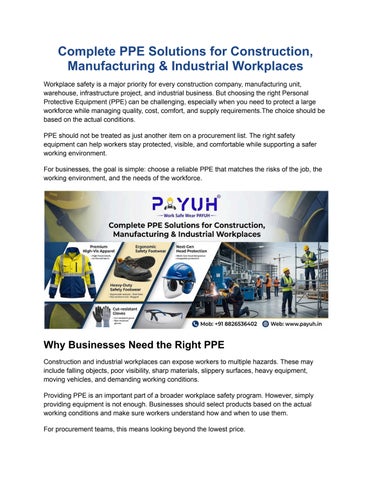
Complete PPE Solutions for Construction, Manufacturing & Industrial Workplaces Workplace safety is a major priority for every construction company, manufacturing unit, warehouse, infrastructure project, and industrial business. But choosing the right Personal Protective Equipment (PPE) can be challenging, especially when you need to protect a large workforce while managing quality, cost, comfort, and supply requirements.The choice should be based on the actual conditions. PPE should not be treated as just another item on a procurement list. The right safety equipment can help workers stay protected, visible, and comfortable while supporting a safer working environment. For businesses, the goal is simple: choose a reliable PPE that matches the risks of the job, the working environment, and the needs of the workforce.
Why Businesses Need the Right PPE Construction and industrial workplaces can expose workers to multiple hazards. These may include falling objects, poor visibility, sharp materials, slippery surfaces, heavy equipment, moving vehicles, and demanding working conditions. Providing PPE is an important part of a broader workplace safety program. However, simply providing equipment is not enough. Businesses should select products based on the actual working conditions and make sure workers understand how and when to use them. For procurement teams, this means looking beyond the lowest price.
A better approach is to consider: ● ● ● ● ● ● ● ● ●
Product quality and durability Worker comfort Visibility and fit Suitability for the working environment Product specifications Availability and supply capacity Consistency across bulk orders Supplier reliability Overall value over the product's usable life
When purchasing for dozens, hundreds, or even thousands of workers, these factors can make a significant difference.
1. Safety Jackets and Vests for Better Worker Visibility Safety jackets and reflective vests are widely used in construction sites, road projects, warehouses, logistics operations, infrastructure projects, and other workplaces where worker visibility is important. Industrial safety jackets can be particularly useful for workers operating around vehicles, machinery, or other moving equipment. The right jacket should provide suitable visibility while also being comfortable enough for regular use.
What Should Buyers Look For? Businesses should consider several factors before ordering safety jackets or vests in bulk.
Material: The fabric should be appropriate for the working environment and provide a practical balance between durability, comfort, and breathability.
Reflective tape: Reflective elements can improve visibility when light conditions are poor. Buyers should check the type, placement, width, and quality of reflective tape according to their workplace requirements.
Design: A practical design should allow workers to move comfortably while wearing the garment over their regular work clothes.
Colour:
Bright, high-visibility colours can help workers stand out against their surroundings. Orange and green are commonly used options for industrial and construction environments.
Fit and sizing: When ordering for a large workforce, having suitable sizes is important. Poorly fitting garments may affect worker comfort and acceptance. A reflective safety vest may be suitable for workers who need an easy-to-wear high-visibility layer over their regular work clothing. The right option depends on the working environment, visibility requirements, and job responsibilities.
Who Can Benefit from Safety Jackets and Vests? They can be suitable for: ● ● ● ● ● ● ● ●
Construction workers Road and highway workers Warehouse personnel Logistics teams Factory workers Infrastructure project workers Security and maintenance teams Utility and field-service workers
For B2B buyers, the right safety vest is not simply about appearance. It should be selected according to the workplace, visibility requirements, working conditions, and workforce needs.
2. Safety Shoes and Work Boots for Foot Protection Workers spend long hours on their feet, often in environments where their feet can be exposed to impact, compression, sharp objects, slippery surfaces, or other workplace hazards. This makes appropriate safety footwear an important part of a complete PPE program. Construction safety shoes can be considered for workers who operate on building sites, infrastructure projects, road projects, and other construction environments. However, the exact footwear requirements should always be based on the hazards associated with the specific job.
What Should Businesses Consider? Before placing a bulk order, procurement teams should evaluate:
Protection:
The footwear should be appropriate for the hazards workers may encounter. Depending on the application, buyers may need to consider features such as protective toe caps, slip resistance, puncture resistance, or other job-specific requirements.
Comfort: Workers may wear safety shoes for many hours each day. Comfort, fit, cushioning, and breathability can influence whether employees consistently wear them.
Durability: Industrial footwear should be able to withstand the demands of the working environment. Buyers should consider the materials, construction, sole quality, and expected usage.
Work environment: A warehouse worker may have different footwear requirements from a construction worker or factory operator. The decision ought to be made in light of the current circumstances. For factories, warehouses, workshops, and other industrial environments, industrial safety shoes should be selected according to the specific workplace hazards and tasks performed by workers.
Safety Shoes vs. Work Boots Safety shoes can be useful where workers need protection with a relatively lightweight design. Work boots may be preferred for environments where additional ankle coverage, durability, or protection is required. There is no single safety shoe that is ideal for every industry. The better choice depends on the workplace hazards and job responsibilities.
3. Safety Helmets and Hard Hats for Head Protection Head protection is another essential consideration for many construction and industrial workplaces. Construction sites, manufacturing facilities, maintenance areas, and other work environments may involve risks from falling objects, overhead hazards, or accidental impacts. Construction safety helmets are commonly considered for workers operating on building sites, infrastructure projects, and other environments where head protection is required.
What Should Buyers Check? When purchasing helmets for a workforce, businesses should consider:
● ● ● ● ● ● ● ●
Appropriate product specifications Fit and adjustability Suspension system Comfort during extended use Ventilation, where appropriate Compatibility with other PPE Product durability Workplace requirements
A helmet should fit securely and should not create unnecessary discomfort during long working hours. For factories, warehouses, workshops, and other industrial applications, industrial safety helmets should be chosen according to the hazards present and the requirements of the work environment. Businesses should also consider whether workers need additional compatible equipment, such as face protection, hearing protection, or other accessories, depending on the workplace.
Creating a Complete PPE Package for Your Workforce One of the biggest challenges for B2B buyers is managing multiple PPE requirements at the same time. Instead of purchasing products without a clear plan, companies can create a basic PPE package based on job roles. For example, a construction workforce may require: Visibility: Safety jacket or reflective vest Head protection: Safety helmet or hard hat Foot protection: Safety shoes or work boots Additional PPE can then be added based on the specific risks of the job. A warehouse team, for example, may have different requirements from workers operating on a construction site. Similarly, manufacturing employees working around machinery may require a different combination of protective equipment. This job-specific approach can help procurement teams avoid both under-protection and unnecessary purchasing.
What B2B Buyers Should Ask Before Placing a Bulk PPE Order If you are purchasing PPE for your company, asking the right questions before placing an order can save time and reduce procurement problems. Consider asking your supplier: ● ● ● ● ● ● ● ● ● ●
Can you supply the required quantity consistently? What product specifications are available? Can you provide different sizes and product options? Are samples available before a bulk order? What is the expected delivery timeline? Can you support recurring or large-volume requirements? Can products be customized according to business requirements, where applicable? What quality checks are carried out on the products? Which industries and applications are the products suitable for? Can you provide a quotation based on our required quantity?
These questions can help businesses compare suppliers based on more than price alone.
Why Choosing the Right PPE Supplier Matters For large businesses, PPE procurement is often an ongoing requirement rather than a one-time purchase. A supplier that can provide consistent products, communicate clearly, manage bulk requirements, and support repeat orders can make procurement easier. This is particularly important for construction companies and industrial organizations managing multiple projects or locations. A reliable PPE supplier should understand that business buyers may need a combination of products rather than a single item. From safety jackets and reflective vests to safety shoes, work boots, safety helmets, and hard hats, having access to multiple PPE categories can simplify purchasing and workforce safety planning.
Choose PPE Based on the Job, Not Just the Price Price is naturally an important factor in B2B purchasing. However, the cheapest PPE option may not always provide the best overall value.
A product that is uncomfortable, unsuitable for the working environment, or needs frequent replacement can create additional costs for the business. Instead, buyers should consider the complete value equation: Protection + Comfort + Durability + Suitability + Supply Reliability = Better PPE Value The right PPE should meet the requirements of the workplace while being practical for workers to use consistently.
A Smarter Approach to Industrial PPE Procurement Whether you are purchasing PPE for a construction project, manufacturing facility, warehouse, infrastructure development, or industrial workforce, start by identifying the hazards and job roles. Then determine the PPE required for each group of workers. A practical PPE procurement plan may include: Step 1: Identify workplace hazards. Step 2: Divide employees according to their job responsibilities. Step 3: Determine the PPE required for each role. Step 4: Compare product specifications and supplier capabilities. Step 5: Test samples where appropriate. Step 6: Confirm sizes and quantities. Step 7: Place the bulk order and establish a repeat-supply plan. This process can help businesses make more informed purchasing decisions and maintain a consistent PPE supply.
Looking for Complete PPE Solutions for Your Workforce? Finding the right PPE supplier can make workplace safety procurement simpler and more efficient. Payuh Industries offers industrial safety products for businesses looking to source essential PPE for their workforce, including safety jackets and reflective vests, safety shoes and work boots, safety helmets and hard hats, along with other industrial safety equipment.
Whether you need PPE for a construction project, manufacturing unit, warehouse, infrastructure project, or industrial workforce, choosing products based on your specific requirements is the first step toward a more organized safety program. Need PPE for your workforce or a bulk requirement? Contact Payuh Industries to discuss your product requirements, quantities, and quotations. Always select and use PPE according to the hazards of the workplace, applicable requirements, and the manufacturer's instructions. #IndustrialSafetyJackets #ConstructionSafetyShoes #IndustrialSafetyHelmets