Multi Vendor Marketplace Development Services: Creating Custom Platforms for Modern Businesses
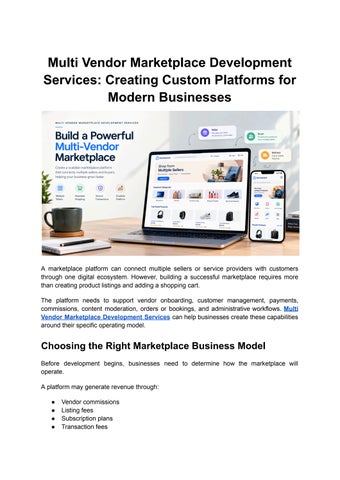
A marketplace platform can connect multiple sellers or service providers with customers through one digital ecosystem. However, building a successful marketplace requires more than creating product listings and adding a shopping cart. The platform needs to support vendor onboarding, customer management, payments, commissions, content moderation, orders or bookings, and administrative workflows. Multi Vendor Marketplace Development Services can help businesses create these capabilities around their specific operating model.
Choosing the Right Marketplace Business Model Before development begins, businesses need to determine how the marketplace will operate. A platform may generate revenue through: ● ● ● ●
Vendor commissions Listing fees Subscription plans Transaction fees
● Advertising ● Premium vendor services The technology platform can then be designed around the selected revenue model. For example, a subscription-based marketplace may require recurring billing, while a commission-based platform needs flexible transaction and settlement workflows.
Creating a Structured Vendor Onboarding Process A growing marketplace needs a reliable way to bring new vendors onto the platform. A vendor onboarding workflow can include registration, business information, document submission, verification, approval, and account activation. Once approved, vendors can access dashboards for managing their products or services. A Marketplace Development Company can build these workflows according to the marketplace's category, verification requirements, and administrative policies.
Managing Vendor Permissions Not every vendor should necessarily have access to every marketplace function. Role-based permissions can control what vendors can view and manage. For example, a vendor administrator may manage products and employees, while another user may only process orders. Permission systems can also help marketplace administrators maintain control over sensitive platform functions.
Automating Marketplace Operations Marketplace businesses handle many repetitive processes as vendor and customer numbers grow. Automation can support workflows such as: ● ● ● ● ● ● ● ●
Vendor approval notifications Product approval Order status updates Booking confirmations Payment notifications Commission calculations Customer alerts Vendor reminders
These workflows can reduce manual administration and create more consistent marketplace operations.
Providing Centralized Administration Marketplace administrators need visibility across the entire platform. A centralized dashboard can provide information about vendors, customers, listings, orders, bookings, transactions, commissions, reviews, and platform activity. Administrators can also manage categories, promotional content, marketplace settings, and user permissions from a single interface. This makes platform management more structured as the marketplace grows.
Building Marketplace Analytics Marketplace data can provide useful operational information. Analytics dashboards can track metrics such as vendor activity, product performance, order volumes, booking activity, customer engagement, and transaction values. Different dashboards can be provided for administrators and vendors. Vendors can monitor their own business performance, while administrators can review broader marketplace activity.
Supporting Different Marketplace Categories Marketplace technology can be adapted to different industries. A product marketplace may require inventory and shipping functionality, while a service marketplace may need appointment scheduling. A Multi Vendor Booking Marketplace can support reservations, availability, service durations, and booking confirmations. Similarly, Multi Vendor E-Commerce Website Development can focus on product catalogs, carts, checkout, inventory, and fulfillment. The underlying platform can be structured around the requirements of the selected business model.
Connecting Websites and Mobile Applications Customers may interact with marketplaces through websites, mobile applications, or both.
A shared backend can provide consistent data across these interfaces. Multi Vendor E-Commerce App Development can provide mobile functionality for customers and vendors, while the website can support broader browsing and administration requirements. This approach can create a connected experience across different digital channels.
Designing for Long-Term Growth A marketplace can grow from a small platform into a large digital ecosystem. The software architecture therefore needs to support increasing users, vendors, transactions, products, and integrations. Modular development can allow businesses to introduce new capabilities without rebuilding the entire application. For businesses considering custom software development services, marketplace architecture can be designed around current requirements while keeping future expansion in mind. Organizations can also explore Nextwebi for customized software and application development.
FAQs 1. What is Custom Marketplace Development? Custom marketplace development involves creating a marketplace around a business's specific vendor, customer, payment, product, booking, and administrative requirements.
2. How can marketplaces automate vendor management? Automation can support vendor registration, verification notifications, approvals, product reviews, account updates, and other repetitive administrative workflows.
3. Can one marketplace support both products and services? Yes. A customized platform can combine ecommerce functionality with booking or service-based workflows when the business model requires both.
4. Can marketplace administrators control vendor permissions? Yes. Role-based access can determine which features and information different vendor users can access.
5. Can marketplace platforms provide analytics?
Yes. Analytics dashboards can provide information about vendors, customers, products, orders, bookings, transactions, and other marketplace activities.