AI Order Management System: Building Smarter Multi-Channel Order Operations
Businesses today may receive orders from websites, mobile apps, marketplaces, retail locations, sales teams, and business portals. Managing these channels independently can make it difficult to maintain consistent inventory information and order visibility. An AI Order Management System Development Company can help organizations build centralized platforms that connect different sales channels with inventory, fulfillment, purchasing, and customer service operations. By introducing AI and automation into the order lifecycle, businesses can reduce repetitive processes and gain better visibility into their operations.
The Challenge of Multi-Channel Orders Each sales channel may have its own order format, inventory connection, and processing workflow. Without a centralized system, employees may need to move information between multiple applications. This can lead to duplicated work and inconsistent data. An AI-powered order management platform can collect orders from connected channels and bring them into a common processing environment.
The system can then apply predefined rules for validation, inventory allocation, fulfillment, and order routing.
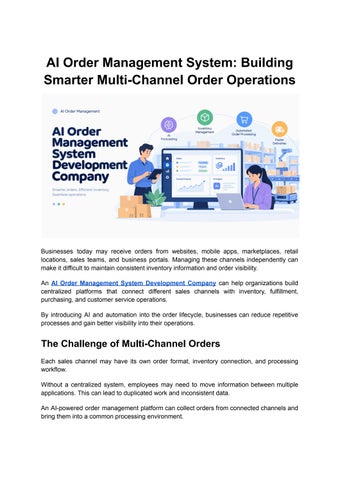
Creating a Centralized Order View One of the main benefits of AI Order Management is centralized visibility. Instead of checking different platforms individually, employees can access order information through a unified dashboard. A centralized view can provide information such as: ● ● ● ● ● ● ●
Total incoming orders Orders awaiting processing Orders being fulfilled Delayed orders Inventory-related issues Orders requiring manual review Completed shipments
This can help managers understand what is happening across different sales channels.
Using AI to Identify Order Exceptions Not every order should follow an identical workflow. Some orders may contain unusual quantities, incomplete information, unexpected delivery requirements, or inventory conflicts. AI can analyze incoming information and identify orders that differ from expected patterns. For example, if an order contains an unusually large quantity compared with typical transactions, the system can flag it for review. This does not mean AI makes the final business decision. Instead, it can help employees identify cases that deserve additional attention.
AI Inventory Management Across Channels Multi-channel businesses need accurate inventory information because the same product may be sold through several platforms. AI Inventory Management can analyze inventory movement across connected sales channels and locations. An AI Inventory Management Software platform can provide visibility into stock availability and help identify products that are selling quickly or approaching replenishment levels.
Connecting inventory data with order management can also reduce the risk of processing orders using outdated stock information.
AI Demand Forecasting for Multi-Channel Businesses Different sales channels may experience different purchasing patterns. A product may perform strongly through an ecommerce website but experience lower demand through another channel. Seasonal changes can also affect purchasing behavior. AI Demand Forecasting can analyze historical order information to identify patterns across products, locations, and sales channels. These insights can support inventory planning and help businesses prepare for expected changes in demand.
Automating Purchasing Decisions When demand increases, businesses may need to replenish inventory quickly. An Automated Purchase Order System can connect inventory conditions with procurement workflows. For example, when stock reaches a configured threshold, the system can create a purchase request or initiate a predefined purchasing workflow. Businesses can include approval processes requirements before an order is sent to suppliers.
where
employees
review purchase
This approach can reduce repetitive procurement administration while maintaining control over purchasing decisions.
Improving Customer Service With Better Visibility Order management also affects customer service. When customers ask about an order, support teams need accurate information about its status. A centralized platform can provide information about order confirmation, inventory allocation, picking, packing, shipping, and delivery. Customer service employees can therefore access the same order information used by operations teams instead of relying on disconnected records.
Connecting Order Management With Fulfillment
Order management should extend beyond the initial transaction. Once an order is confirmed, fulfillment teams need to know what products must be picked and where they are located. Automated Order Picking Systems can connect order information with warehouse workflows. An Automated Order Picking process can help organize tasks based on factors such as order priority, product location, warehouse availability, and configured fulfillment rules. AI can further analyze warehouse data to identify recurring delays or inefficient task patterns.
Supporting Business Growth As businesses expand, the number of orders, products, customers, and sales channels can increase significantly. A scalable AI order management platform can provide a foundation for handling this growth without requiring every additional process to be managed manually. The system can also integrate with ERP platforms, ecommerce applications, warehouse software, shipping providers, payment systems, and inventory databases. Businesses interested in developing customized AI-powered applications can explore Nextwebi's AI Application Development Services.
Conclusion Multi-channel order management requires more than simply collecting customer orders. Businesses need connected processes that coordinate inventory, purchasing, fulfillment, customer service, and operational data. AI can support these processes by identifying patterns, automating repetitive activities, highlighting exceptions, and providing centralized visibility. With the right architecture, an AI order management platform can become a central part of a company's digital operations. Businesses looking for broader software development capabilities can also visit Nextwebi.
FAQs 1. Why do businesses need AI order management? AI order management can help businesses coordinate orders across multiple channels while supporting automation, inventory visibility, fulfillment, and exception management.
2. Can AI order management handle multiple sales channels? Yes. Depending on the system architecture, it can integrate orders from ecommerce websites, mobile applications, marketplaces, sales platforms, and other connected channels.
3. How does AI help identify order exceptions? AI can analyze order information and identify unusual patterns or conditions that may require employee review.
4. Can AI order management connect with inventory systems? Yes. Integration with inventory systems can provide order processing workflows with more current information about stock availability and replenishment requirements.
5. Does AI replace employees in order management? AI primarily supports automation and decision-making workflows. Employees can remain responsible for approvals, exceptions, customer issues, and business decisions that require human judgment.