Phrases for a Crescent Moon: Arthur Okamura’s
By Matthew Villar Miranda
I. Waxing Crescent ∘ Ocean Shore
Oceanic Turn
We say, ‘Here is my friend, over there is the mountain, and way up there is the moon.’ But your friend is not only your friend, the mountain is not only the mountain, and the moon is not only the moon... We find the mountain or the moon or our friend or San Francisco within ourselves. Right here.
— Shunryū Suzuki Roshi, “First Talk” in Branching Streams Flow in the Darkness 1
The trajectory of Arthur Okamura’s (1932–2009) visionary art poetically slips between phases and phrases, a fluidity where the shifting phases of the moon and water enter into dizrect dialogue with the written and spoken word. Relocating to the coastal enclave of Bolinas, California, in 1959, Okamura submerged himself in an environment where land and sea, text and image, drift. In his practice, the elemental forms of water— ocean, fog, drop, ripple, and flow—became epistemological metaphors that mirrored the syncopated, poetic “phrases” of his collaborators, such as Robert Creeley, as well as the spiritual teachings of Shunryū Suzuki Roshi. Throughout his career, Okamura interplays between the oceanic imaginary and the text to visually dissolve the rigid boundaries of the world.
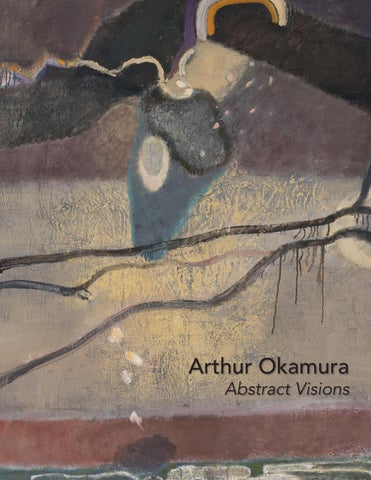
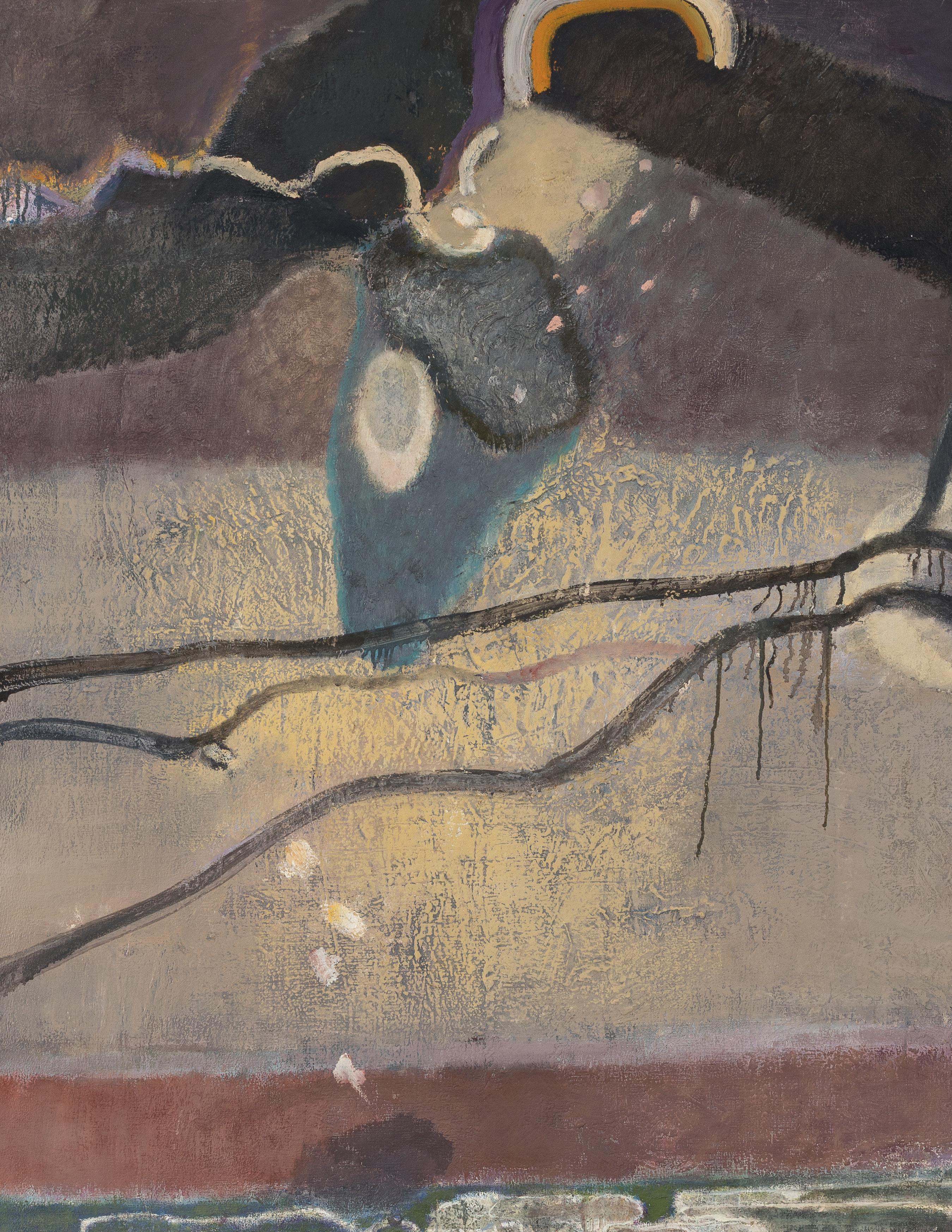
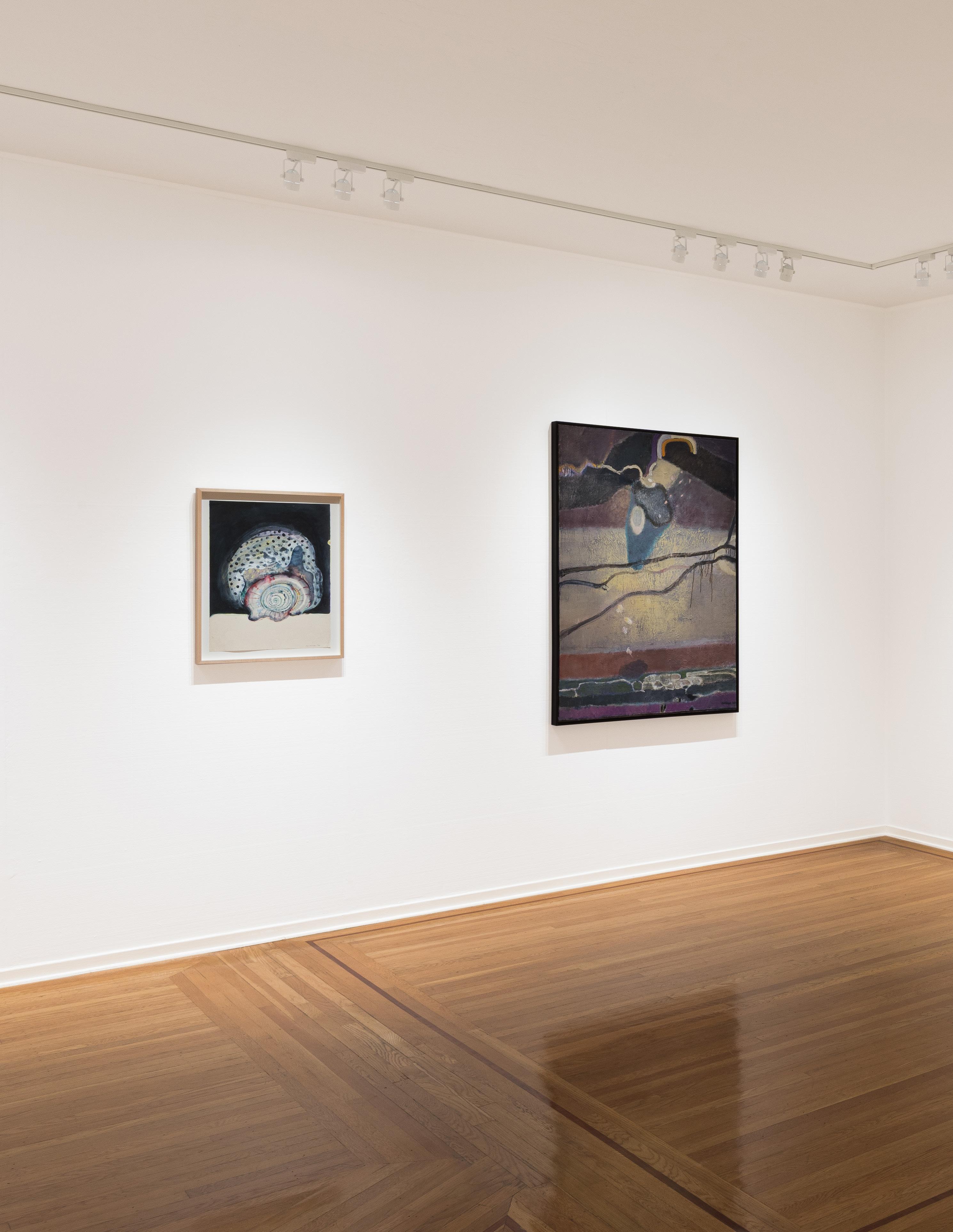
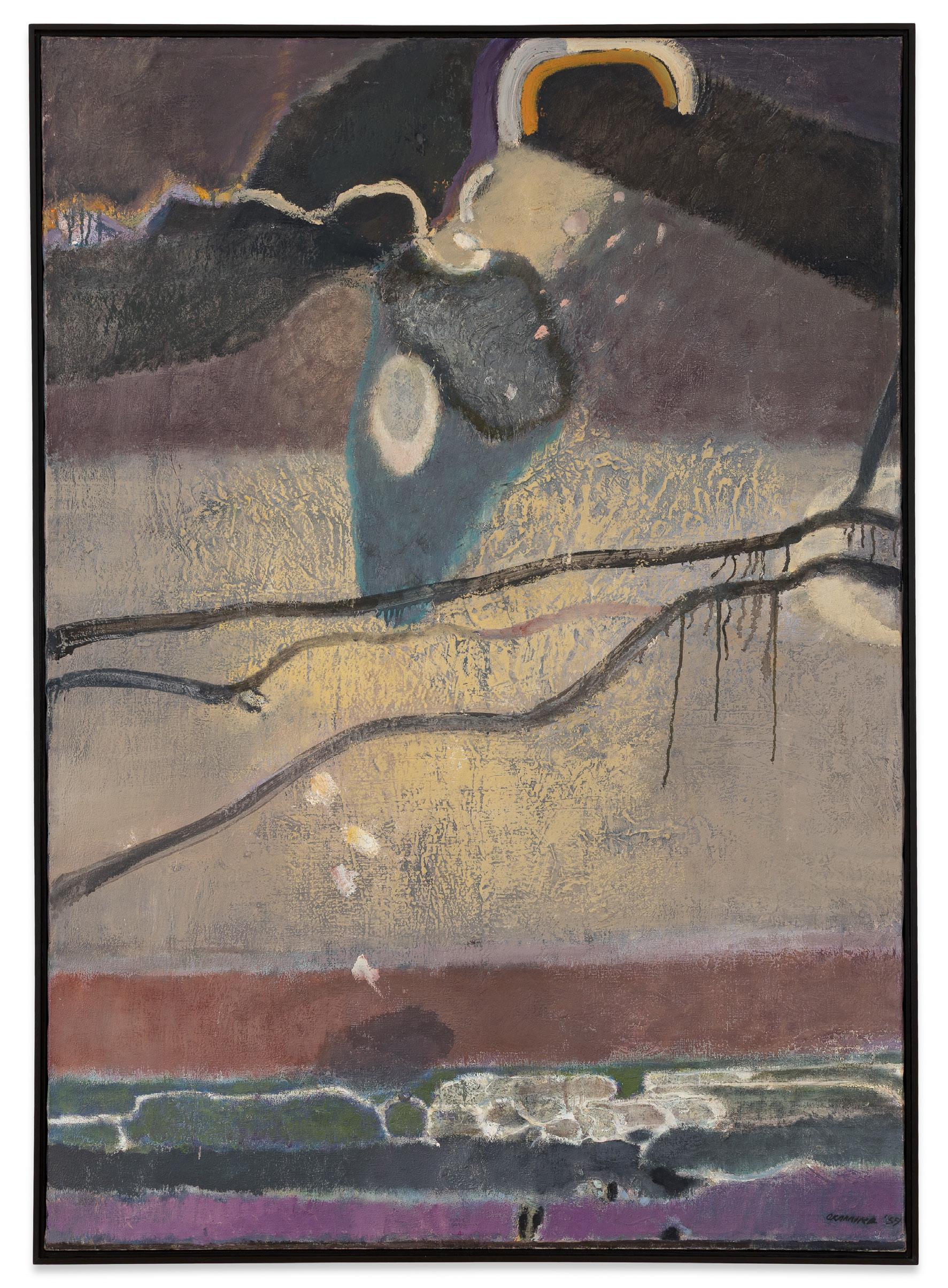
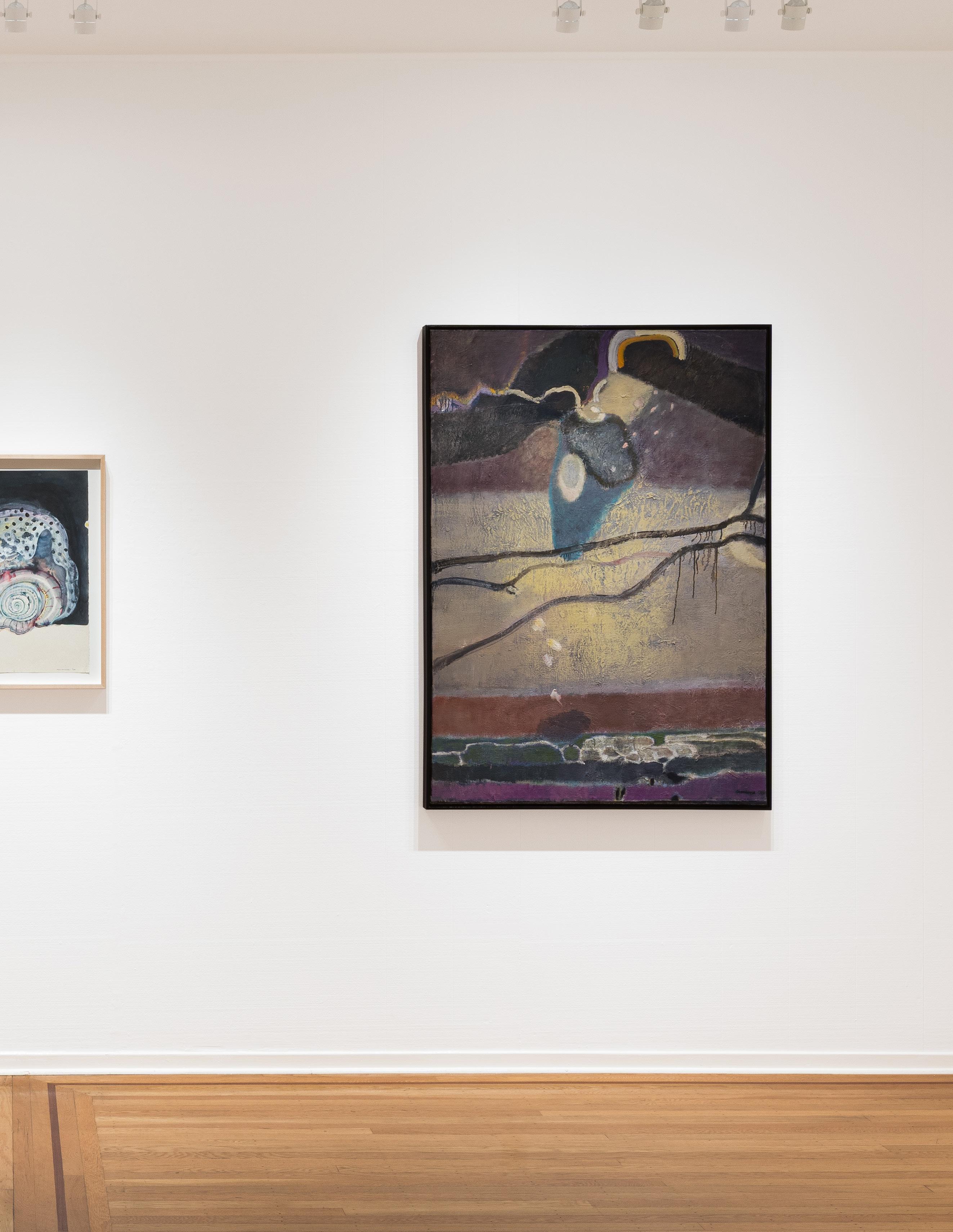
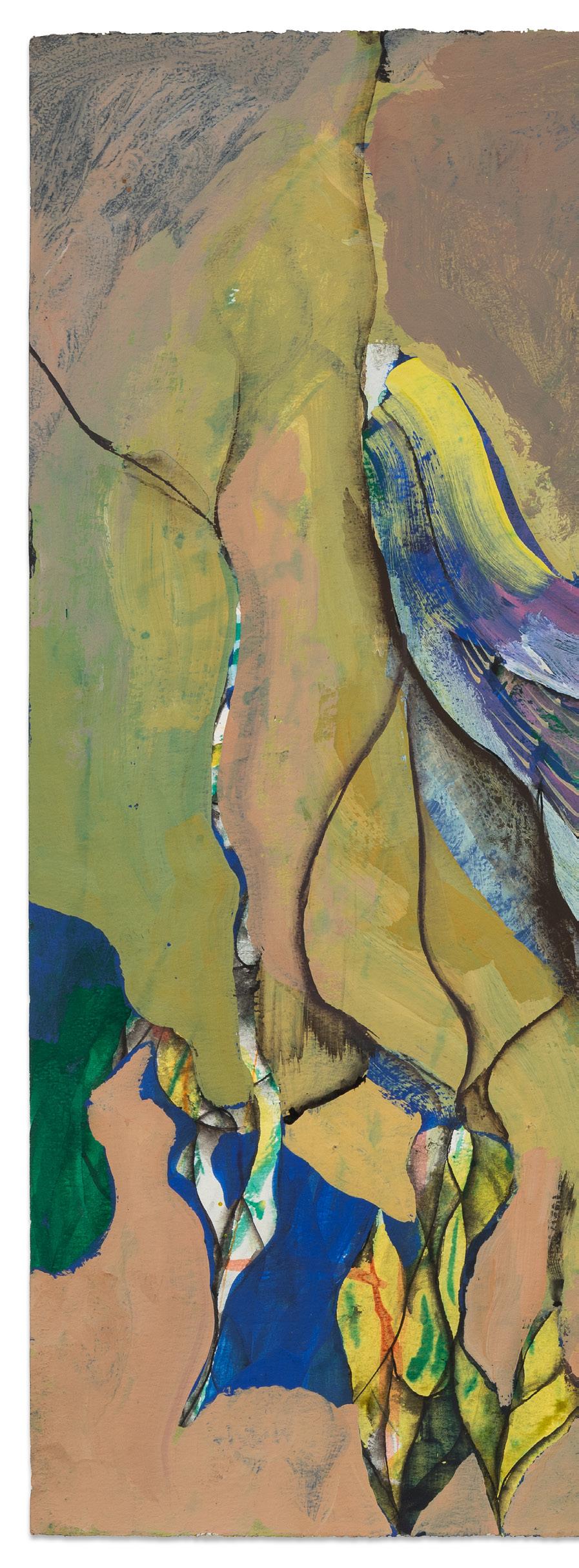
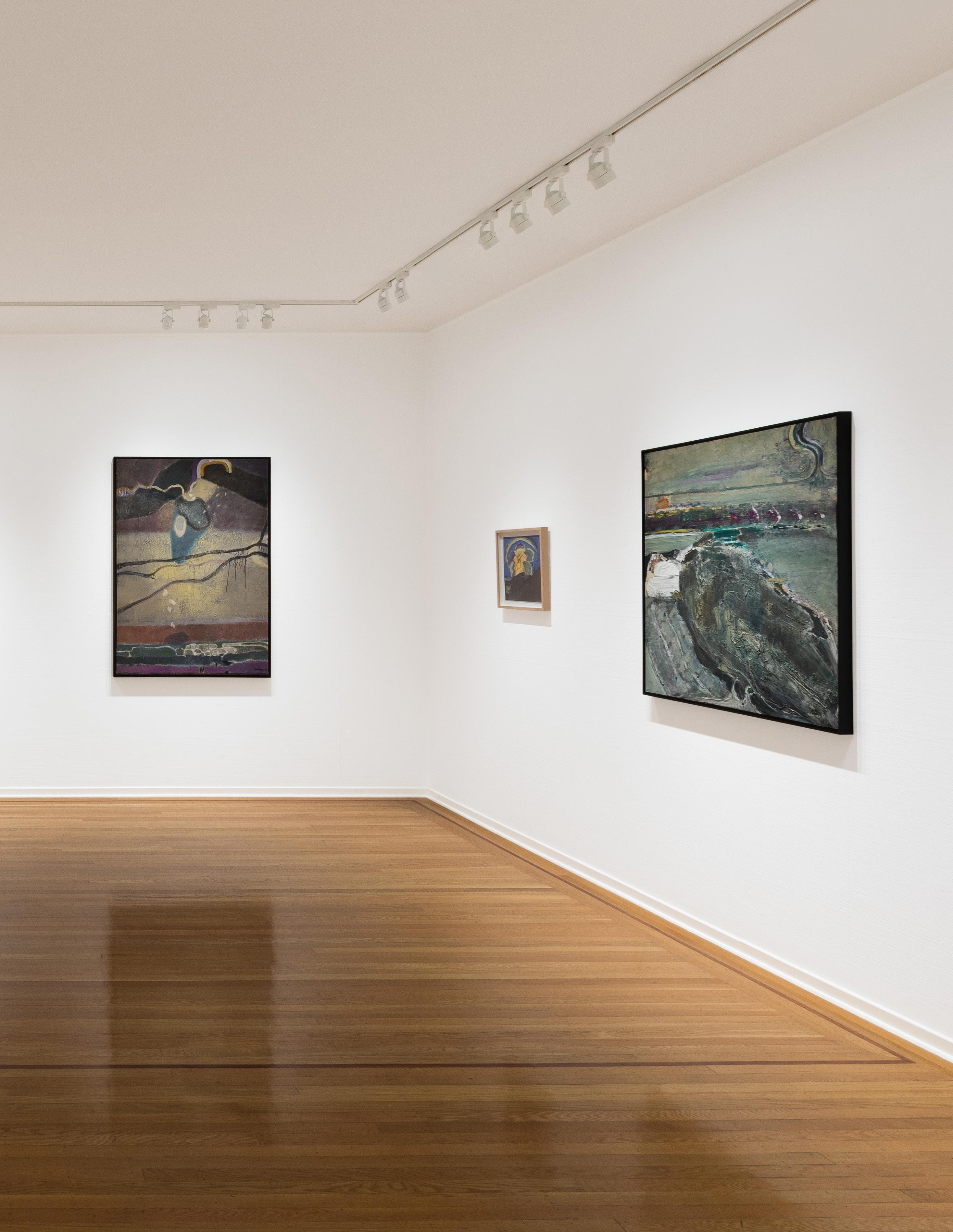
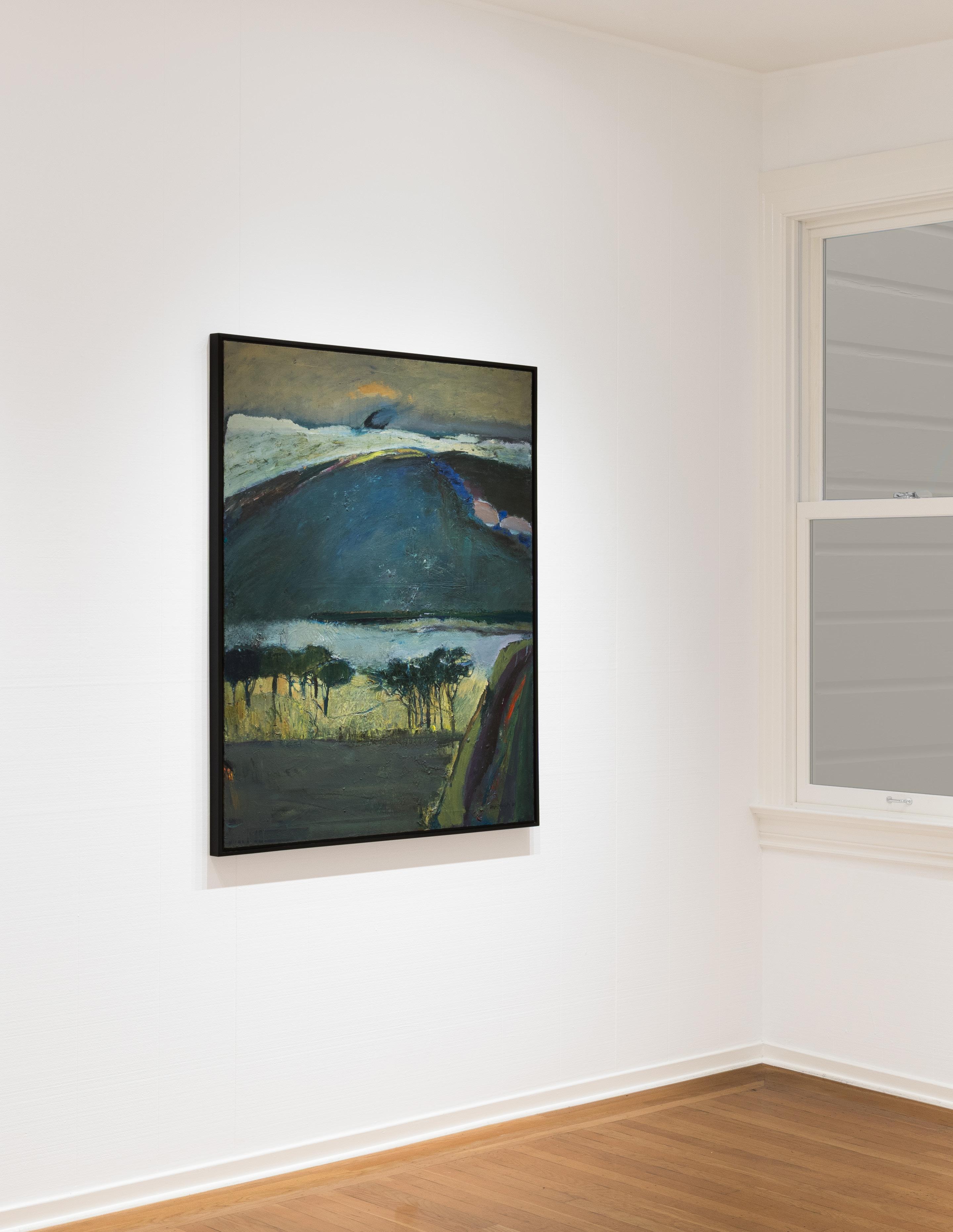
In his 1959 painting Phrases for a Crescent Moon (Plate 1), Okamura transforms the geography of the Pacific shoreline into a threshold of modulated light, color, gesture, and atmosphere. Blending the landscape’s traditional boundaries into atmospheric color fields, Okamura anchors the bottom of the canvas with a vibrant purple-and-magenta shore, giving way to fluid washes of blue and dark triangular forms that fade into a hazy, diffused distance of lemonglow and gold. Delicate paint streaks drip downward across the center of the canvas, like ocean spray condensed and trickling onto the surface. This emphasis on the horizon and the downward drip evokes Gaston Bachelard’s phenomenological meditation in Water and Dreams, where he notes that “water always flows, always falls, always ends in horizontal death.” 2 For Bachelard, water serves as
1 Shunryū Suzuki, Branching Streams Flow in the Darkness: Zen Talks on the Sandokai, ed. Mel Weitsman and Michael Wenger (Berkeley: University of California Press, 1999), 28.
2 Gaston Bachelard, Water and Dreams: An Essay on the Imagination of Matter, trans. Edith R. Farrell (Dallas: Pegasus Foundation, 1983), 6.
Plate 1:
Phrases for a Crescent Moon, 1959 oil on canvas, 56 1/4 x 39 3/4 inches
II. Eclipse ∘ Fog
For the moon; there is the cloud... When we see a part of the moon covered by a cloud, or a tree, or a weed, we feel how round the moon is.
— Shunryū Suzuki Roshi, Zen Mind, Beginner’s Mind 7
The boundlessness of Okamura’s ocean stood in stark contrast to the physical confinement of Camp Amache, where he spent three and a half years of his childhood incarcerated between 1942 and 1945. As art historian Karin Higa observes, the trauma of wartime incarceration forced many Japanese Americans into a strategic erasure of their heritage.8 Okamura’s postwar artistic evolution, however, was marked by a deliberate departure from this assimilationist pressure. Following his family’s release from Amache, they relocated to Chicago, where Okamura laid the technical and political groundwork for his career. He studied at the School of the Art Institute of Chicago and the University of Chicago, and worked in a commercial silkscreen studio alongside left-wing artists, including veterans of the Spanish Civil War’s Lincoln Brigade.9 Though Chicago offered crucial artistic development, Okamura left the city in 1956. Witnessing a random street mugging outside his window convinced him the metropolitan environment was “no place to raise a family,” prompting his move to San Francisco at the encouragement of his art dealer, Charles Feingarten.10 11
Once in the Bay Area, as Okamura reflected in an interview with Filipino American artist Carlos Villa and Jeff Gunderson, then Head Librarian and Chief Archivist of San Francisco Art Institute, he sought out avant-garde conversations that were “full of fire” and “new visions.”12 Yet, while he admired the “muscularity of the marks” of New York School painters like Willem de Kooning, Okamura explicitly distanced himself from their massive, aggressive canvases, noting he “never really ventured into” that physical scale because he “never had a studio to do it... not a New York loft.”13 Stepping away from the towering, New York-centric scale of Abstract Expressionism, Okamura cultivated his own visual language on the Bolinas coast. Seeking a dialogue between East and West, he merged his Western artistic foundations with an “idea of racial unconsciousness,” realizing that his abstract forms touched upon an inner vision he described as both “unexpected”
7 Shunryū Suzuki, Zen Mind, Beginner's Mind (New York: Weatherhill, 1970), 121.
8 Karin Higa, "From Enemy Alien to Zen Master: Japanese American Identity in California during the Postwar Period," in Hidden in Plain Sight: Selected Writings of Karin Higa, ed. Julie Ault (Brooklyn: Dancing Foxes Press, 2022), 103.
9 Arthur Okamura, interview by Carlos Villa, Jeff Gunderson, and unidentified interviewers, ca. 2006, conducted for the California Asian American Artists Biographical Survey (CAAABS), unpublished transcript, courtesy of Paul Thiebaud Gallery, San Francisco, 00:07:38.
10 Ibid., 00:22:40.
11 Foster Gwin Gallery, "Arthur Okamura," 2026, https://fostergwin.com/artist-bios/arthur-okamura/.
12 Arthur Okamura, CAAABS interview, 00:27:00.
13 Ibid., 00:41:08–00:42:22.
and “magic.”14 Using the ‘isometric space’ and negative shapes of Eastern painting, he alchemized the Pacific landscape into a new form of abstraction.”15
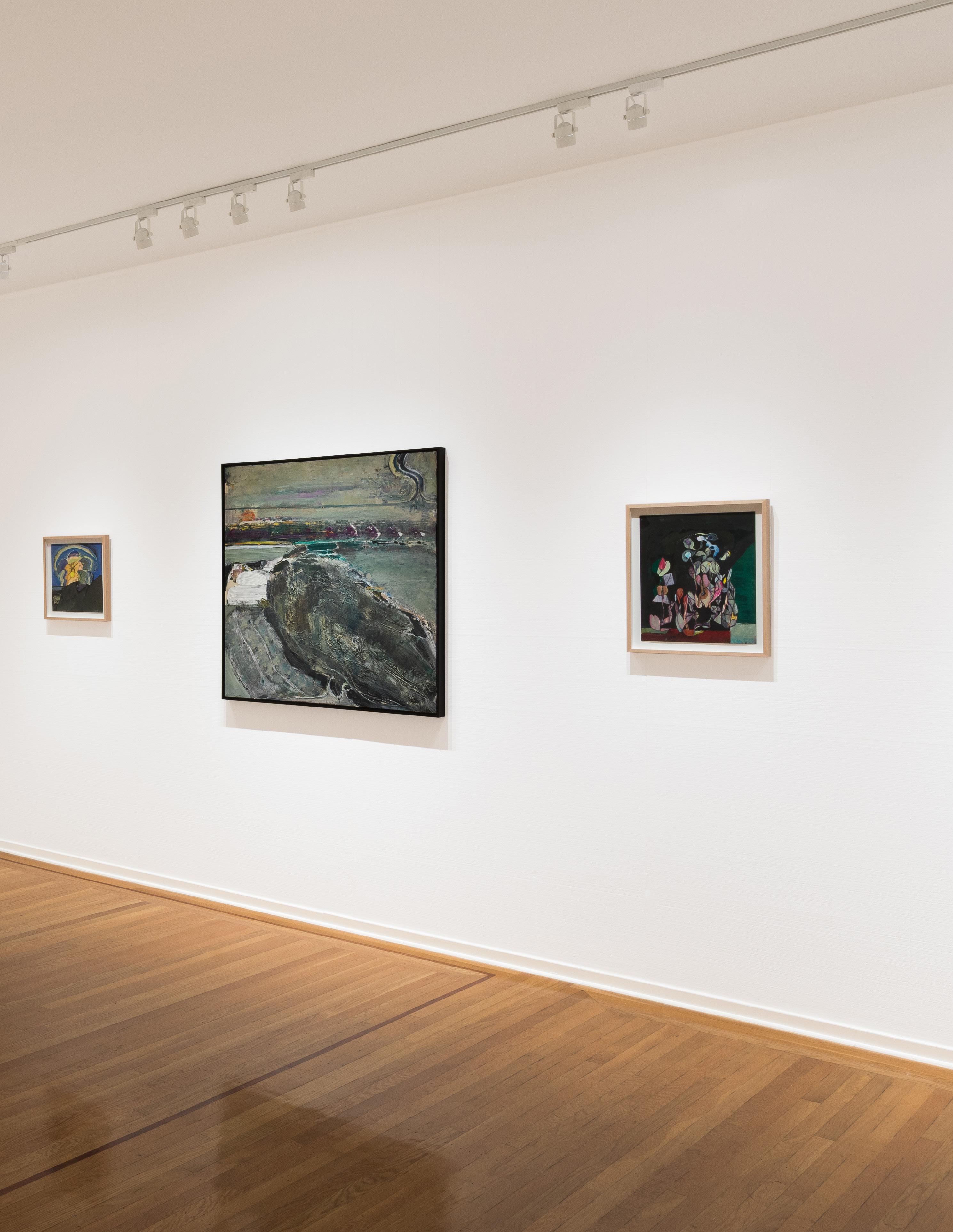
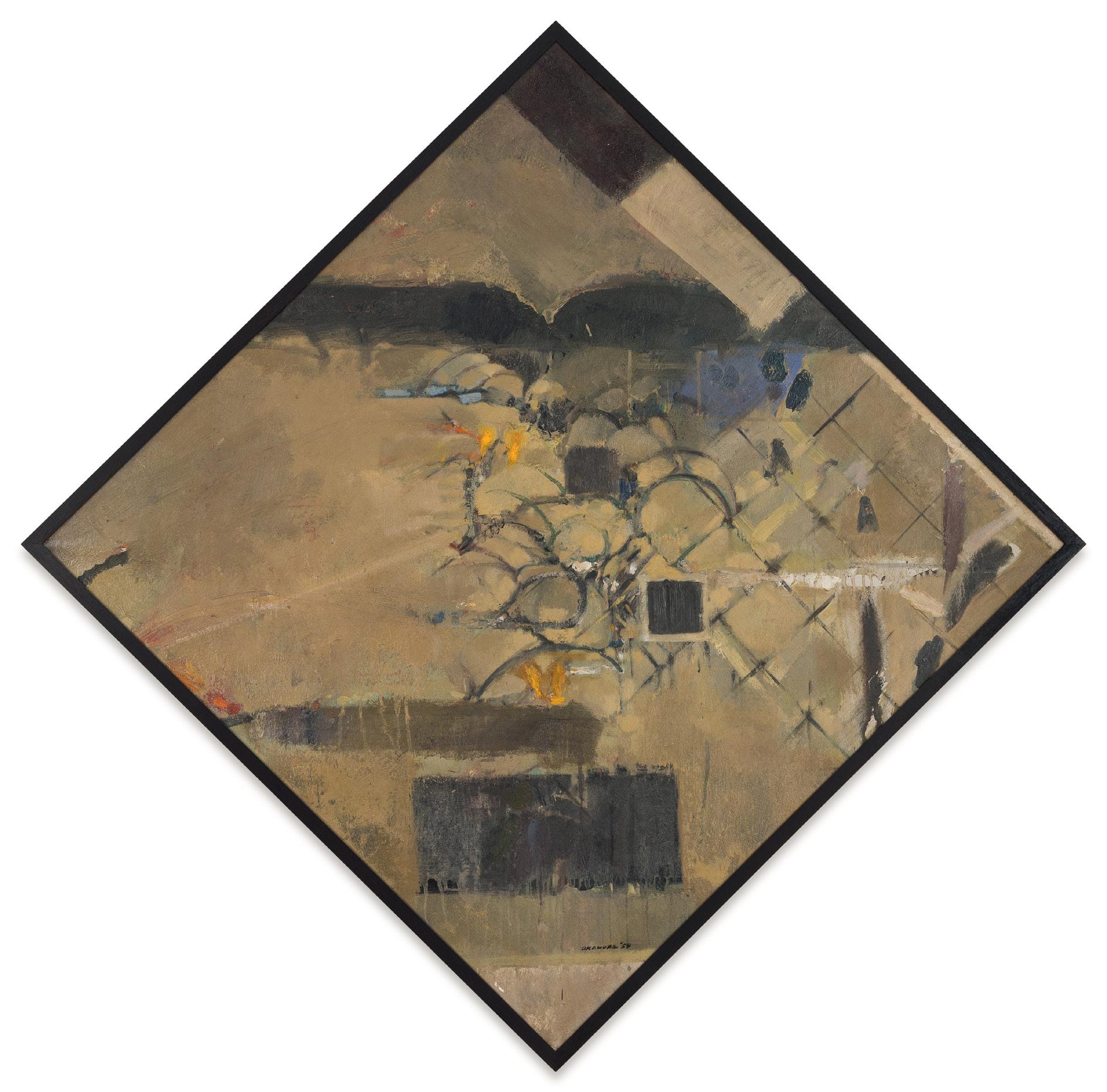
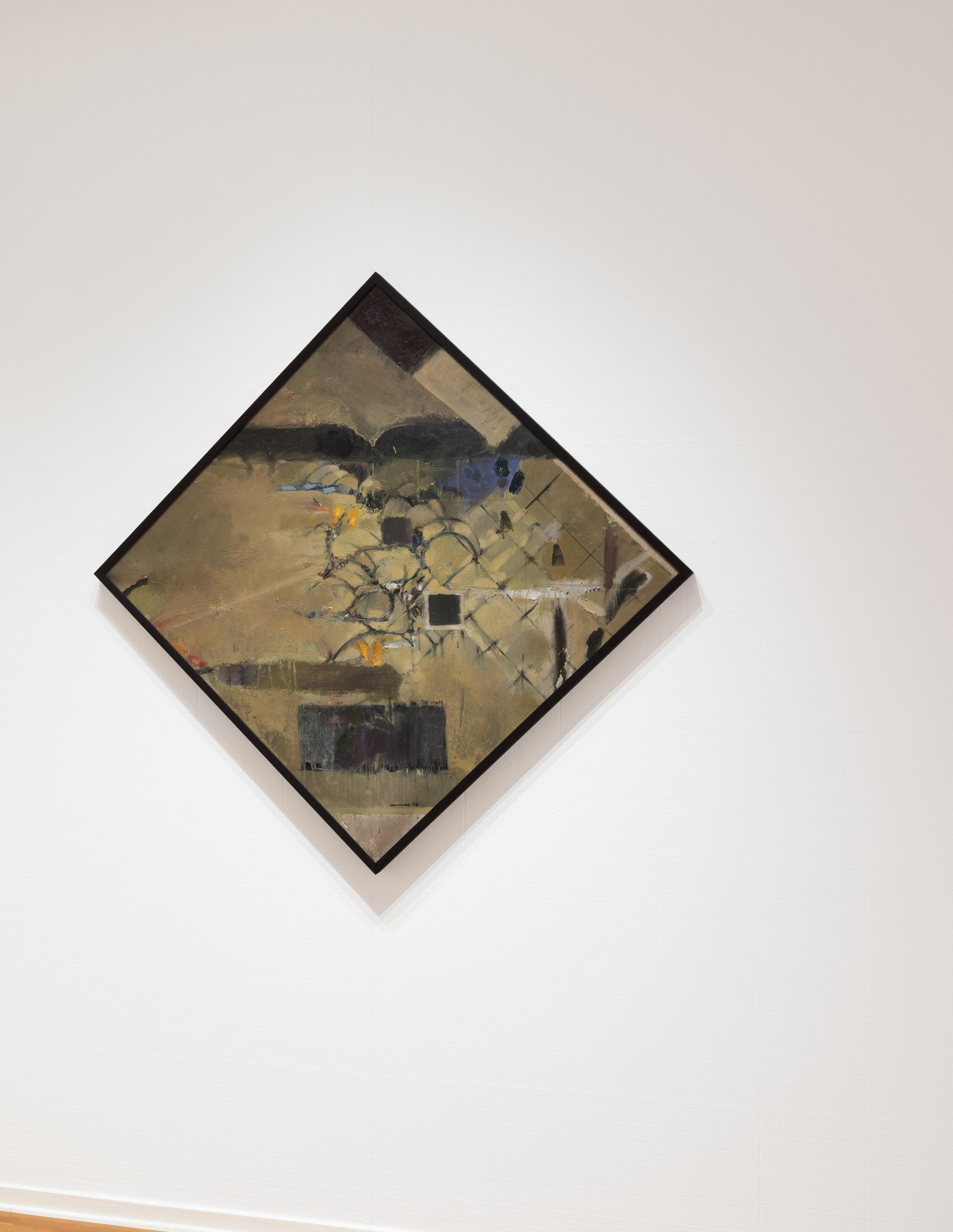
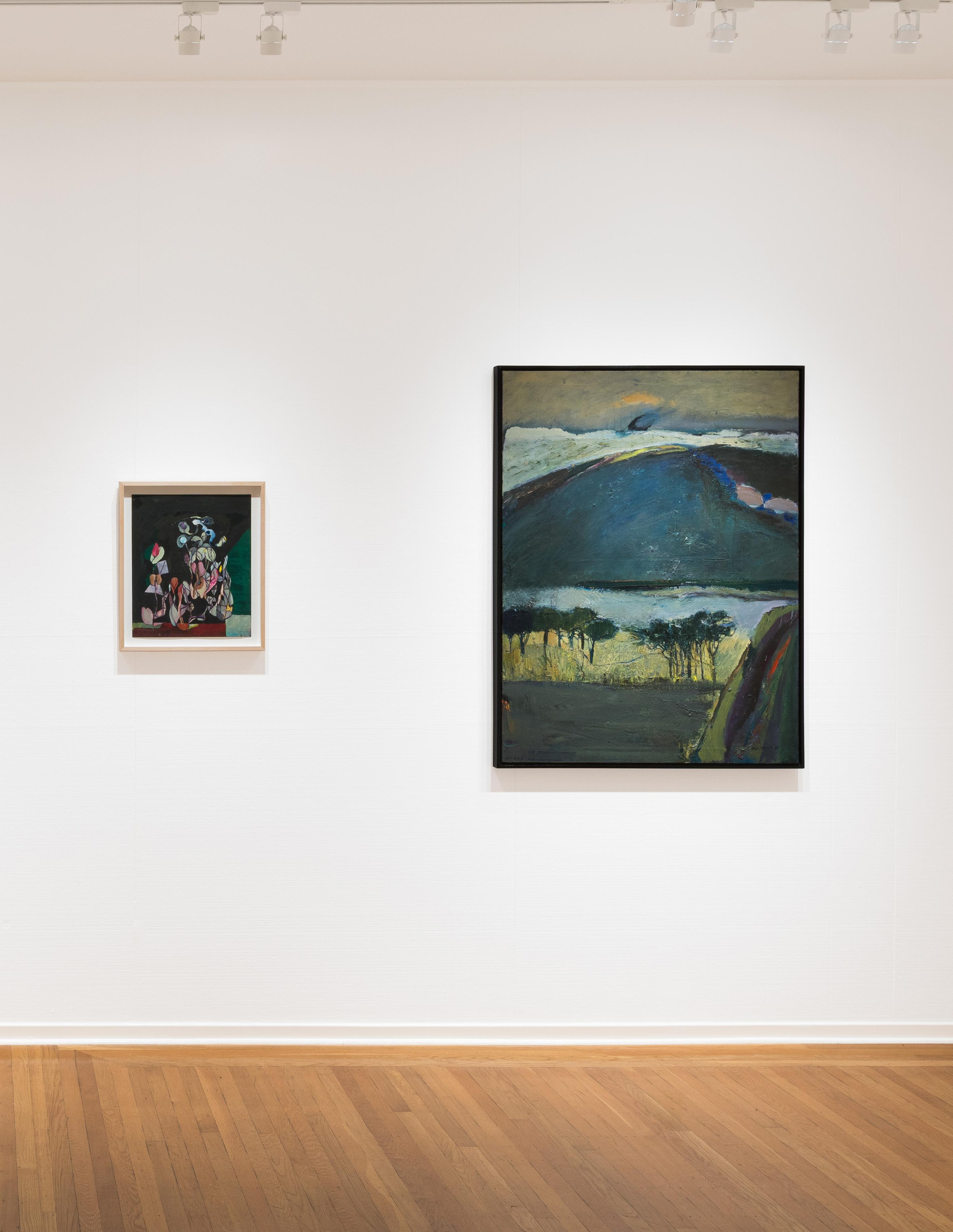
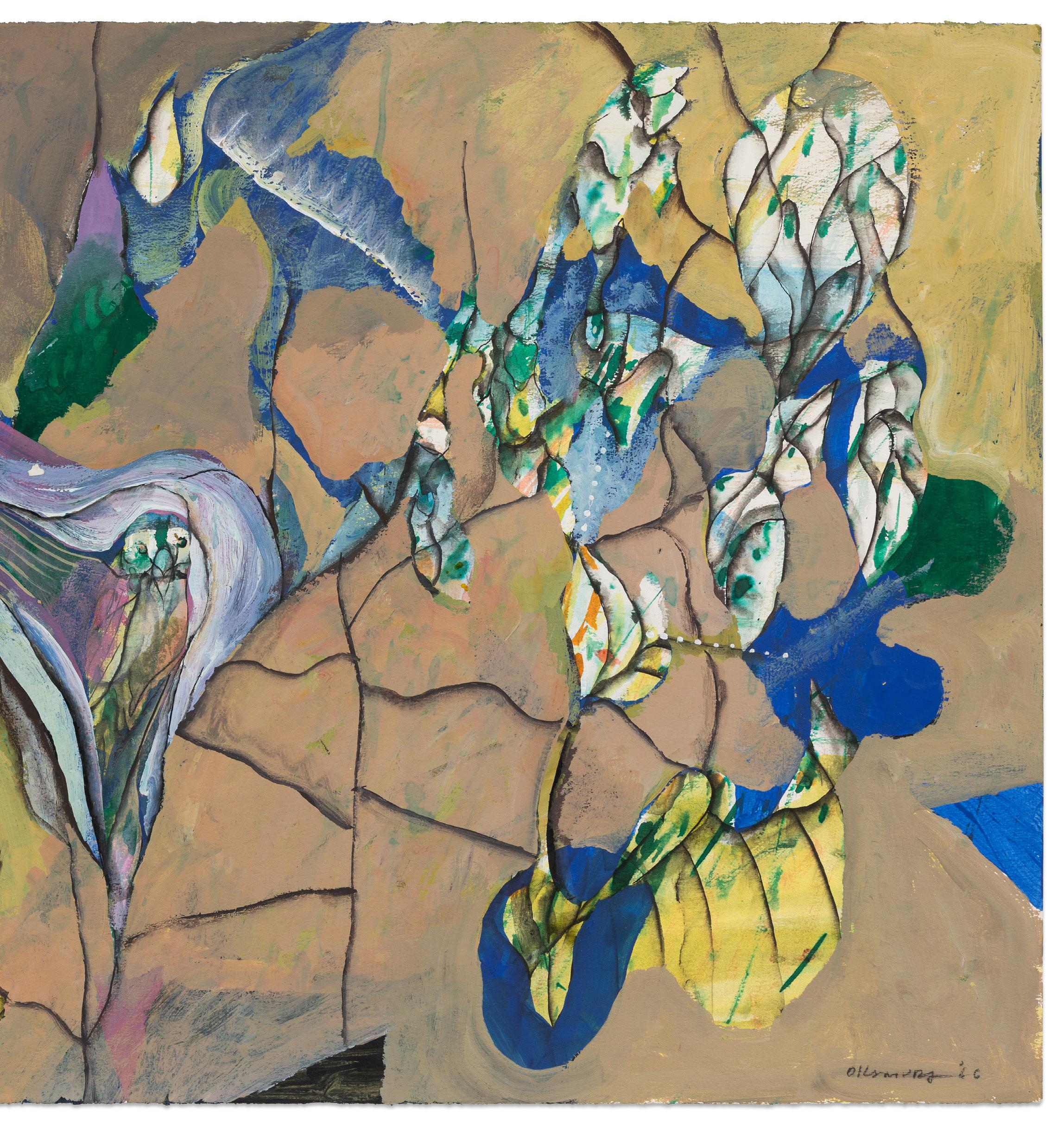
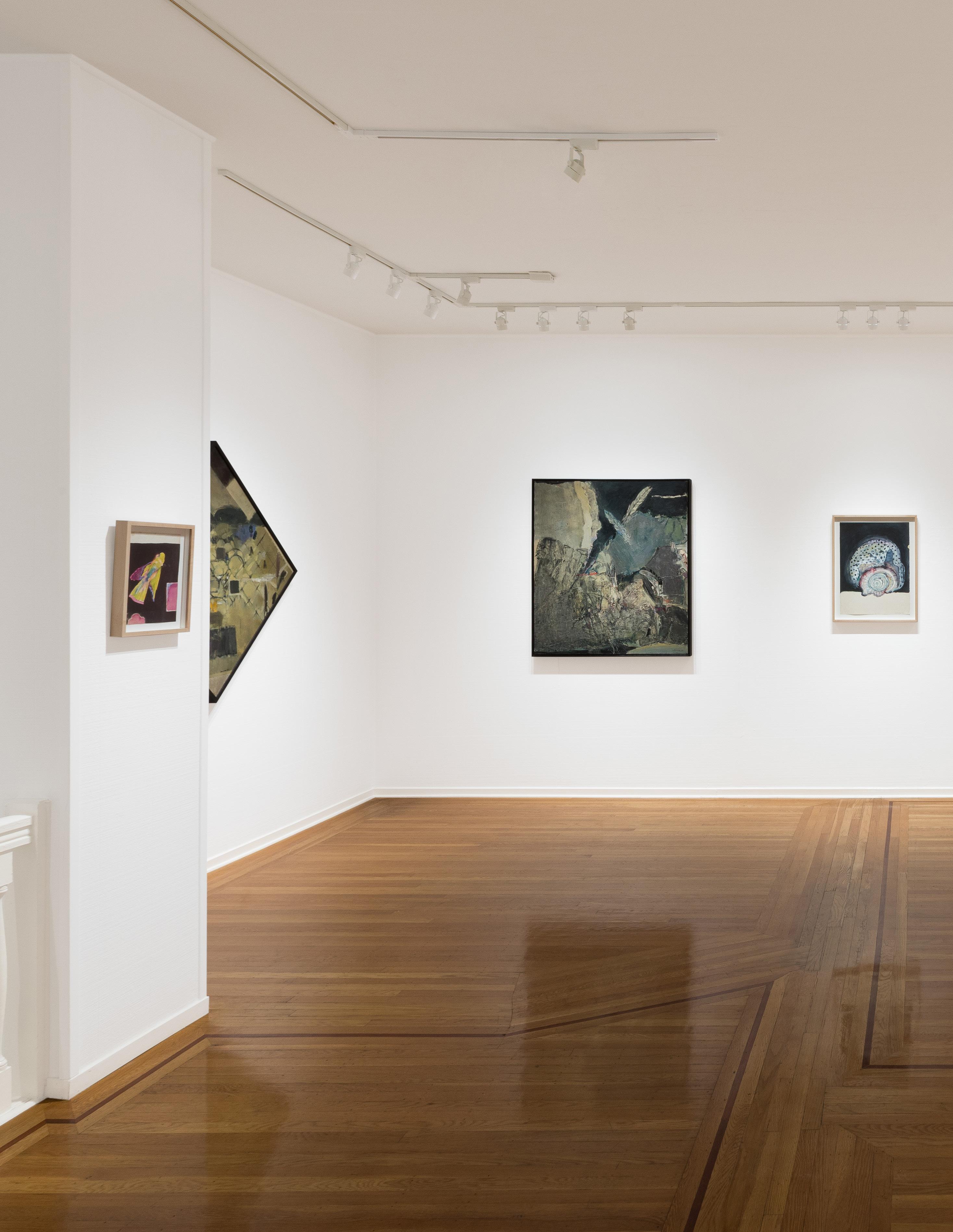
This atmospheric ambiguity and navigation of space is vividly rendered in his painting Smothered Tree in a Warm Fog (Plate 2). Created in 1959—a pivotal transitional year that marked his relocation to the Bolinas coast, the arrival of Suzuki Roshi in San Francisco, and the beginning of their formal Zen relationship—the work balances geometric scaffolding against the organic, dissolving presence of the fog.16 Painted on a canvas tilted on a diamond axis, the composition emerges as a drift and haze of squares, bands, and grids, punctuated by flecks of goldenrod, blue, and crimson. These rigid, geometric structures carry the classic traditions of Western modernism, evoking the strict visual order of painters like Kazimir Malevich, Ilya Bolotowsky, and Piet Mondrian. Still, Okamura buries these Western grids beneath billowing layers of taupes, tan, and olive green.17 As the dark reds and blacks of the underpainting recede into the mist, the sharp, fence-like crosshatches of the background begin to dissolve. While these strict lines may not be literal illustrations of the barbed wire at Camp Amache, their structural rigidity echoes the carceral boundaries of his youth. The fog here functions as a distinct phase of water, one that obscures, blankets, and softens the rigid grids of both Western artistic tradition and historical trauma, visually conjuring the melancholy, murky environment of the post-incarceration era.
The literal fog of the Bolinas coast blends with the psychological fog of the postwar world, an epistemic rupture captured in the phrases of Okamura’s closest collaborator, the poet Robert Creeley. Reflecting on this era, Creeley noted that “the experience of WWII, together with that of the atom bomb... blew away ‘humanism’ pretty much forever.” 18 The violence of the atom bomb and the barbed-wire fences of Camp Amache can be understood as the ultimate, destructive products of Western machine culture and “mad rationality.” As R. John Williams argues in The Buddha in the Machine, many artists turned to Eastern aesthetics not merely as a retreat to nature, but to embrace “Asia-as-technê”—a holistic, organic antidote to the alienating mechanization of the West.19 To navigate this obscured landscape of ‘blown-away humanism,’ Okamura turned to the teachings of Suzuki Roshi as a deliberate, aesthetic resistance to this mechanized violence. Rather than attempting to burn away the fog, Suzuki Roshi taught a radical acceptance of it, quoting the Zen master Tozan: “The blue mountain is the father of the
14 Okamura, interview by Poon Andersen.
15 Okamura, CAAABS interview, 00:10:03.
16 “Arthur Okamura: Abstract Visions," exhibition press release (San Francisco: Paul Thiebaud Gallery, 2026).
17 While painters like Bolotowsky, Malevich, and Mondrian famously used the diamond canvas to test the limits of pure, non-objective geometric abstraction, I argue that Okamura adopts the tilted axis here to ground his atmospheric, psychological landscape.
18 Robert Creeley, interview by Barbara Montefalcone, October 2004, in "Talking about Collaboration: Personal Memories and a Critical Study of Robert Creeley's Collaboration with artist Arthur Okamura," Journal of American Studies of Turkey 27 (2008): 118.
19 R. John Williams, The Buddha in the Machine: Art, Technology, and the Meeting of East and West (New Haven: Yale University Press, 2014), 1–5, 176.
Plate 2:
Smothered Tree in a Warm Fog, 1959 oil on canvas, 51 x 51 inches
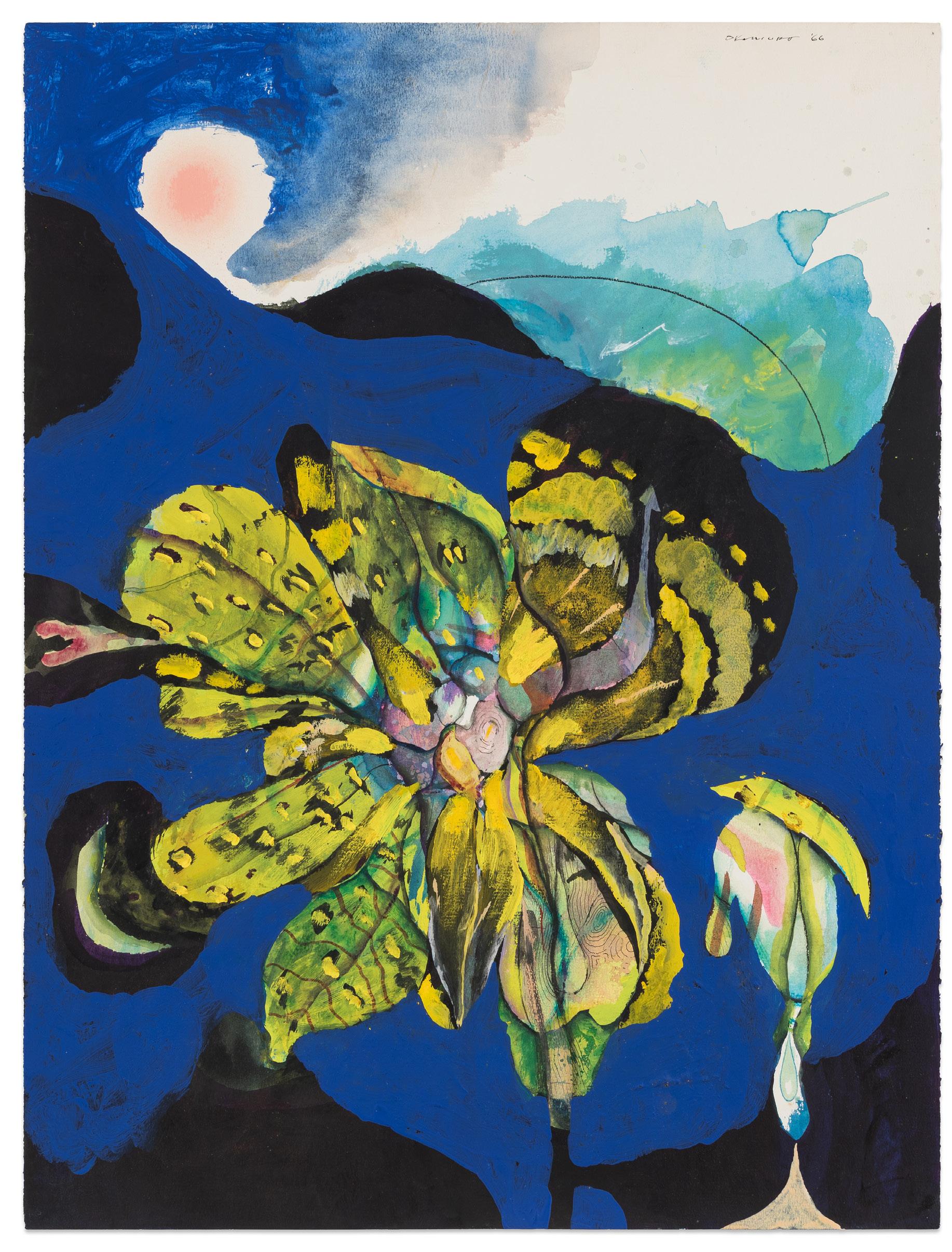
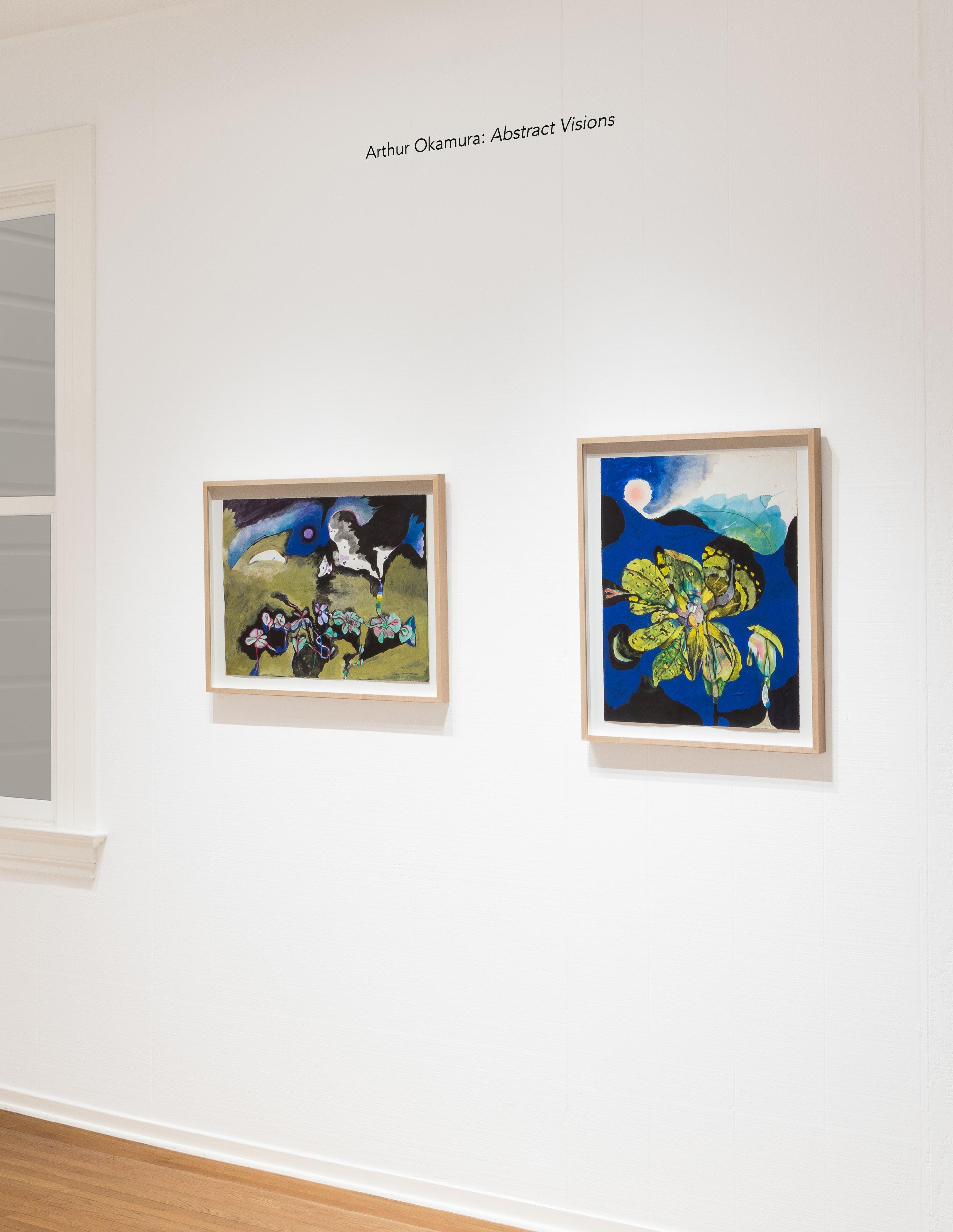
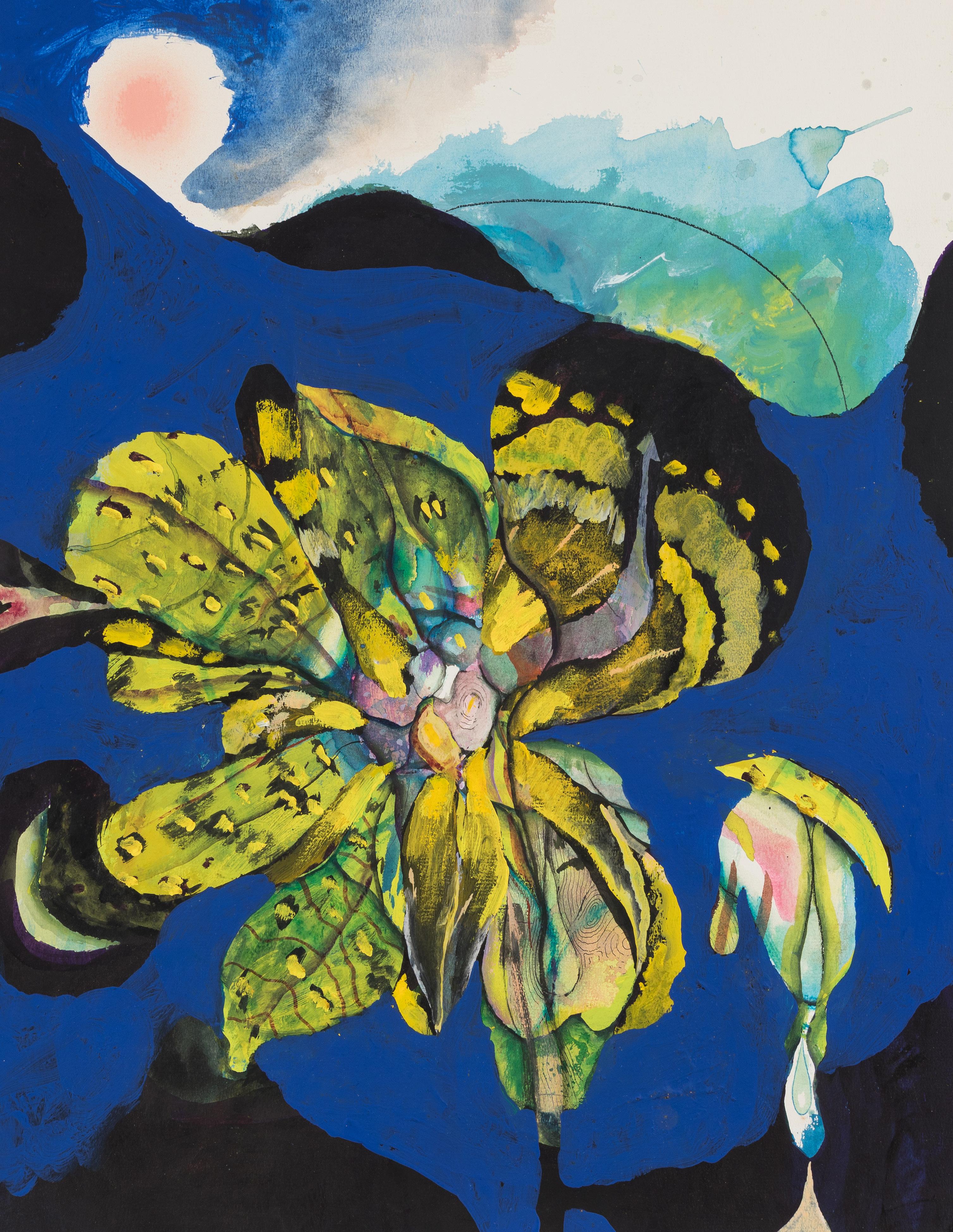
Plate 3:
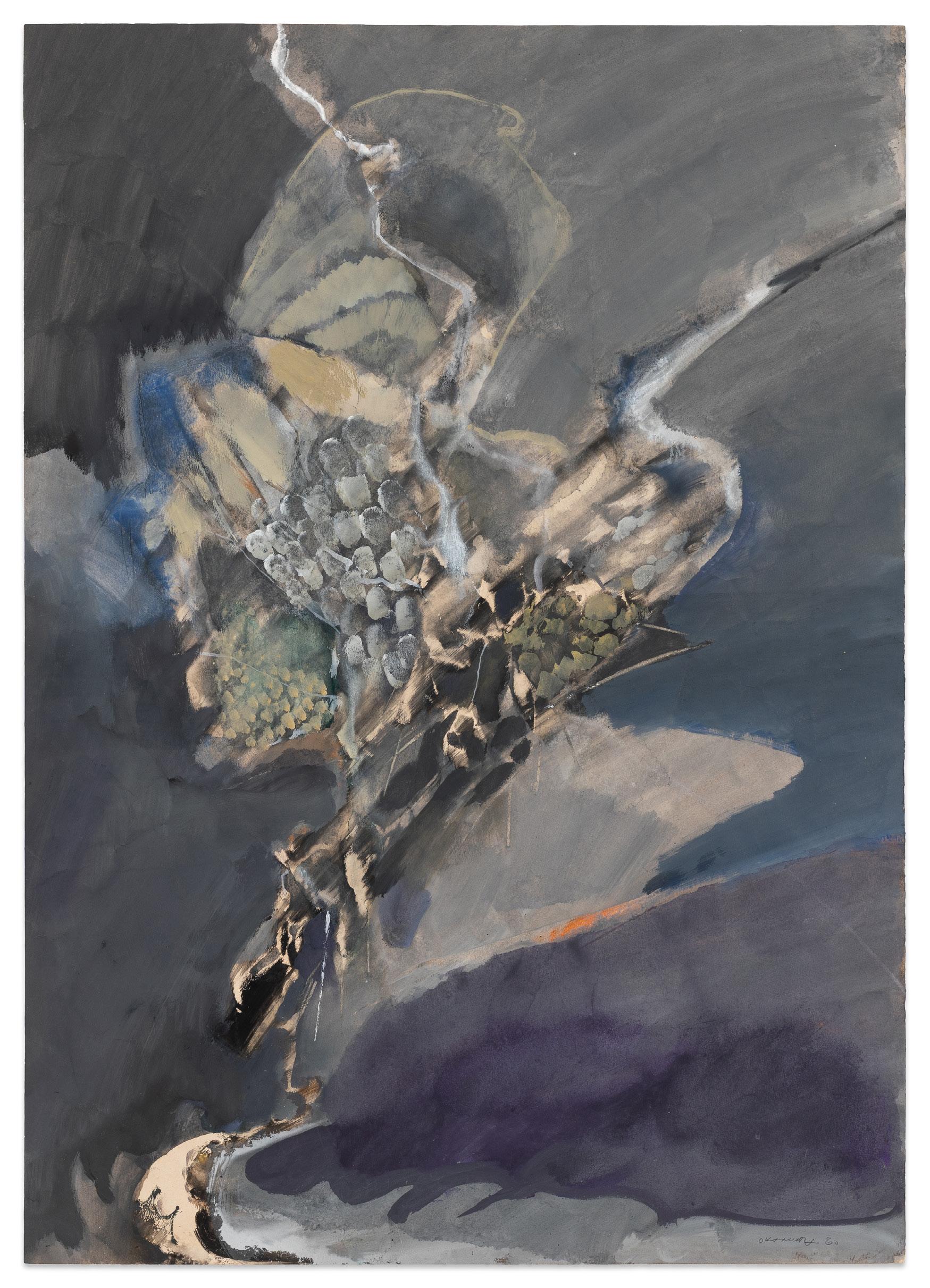
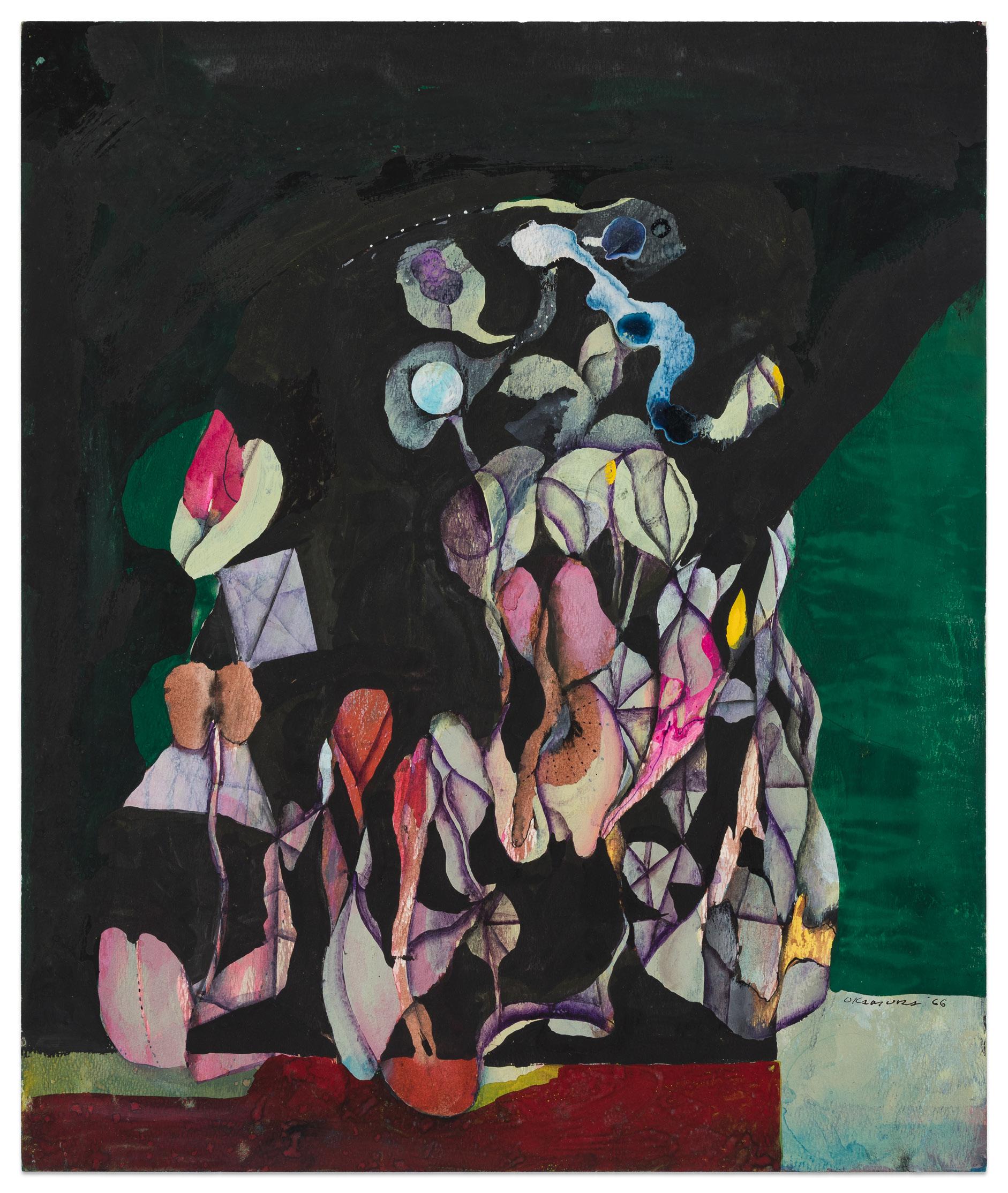
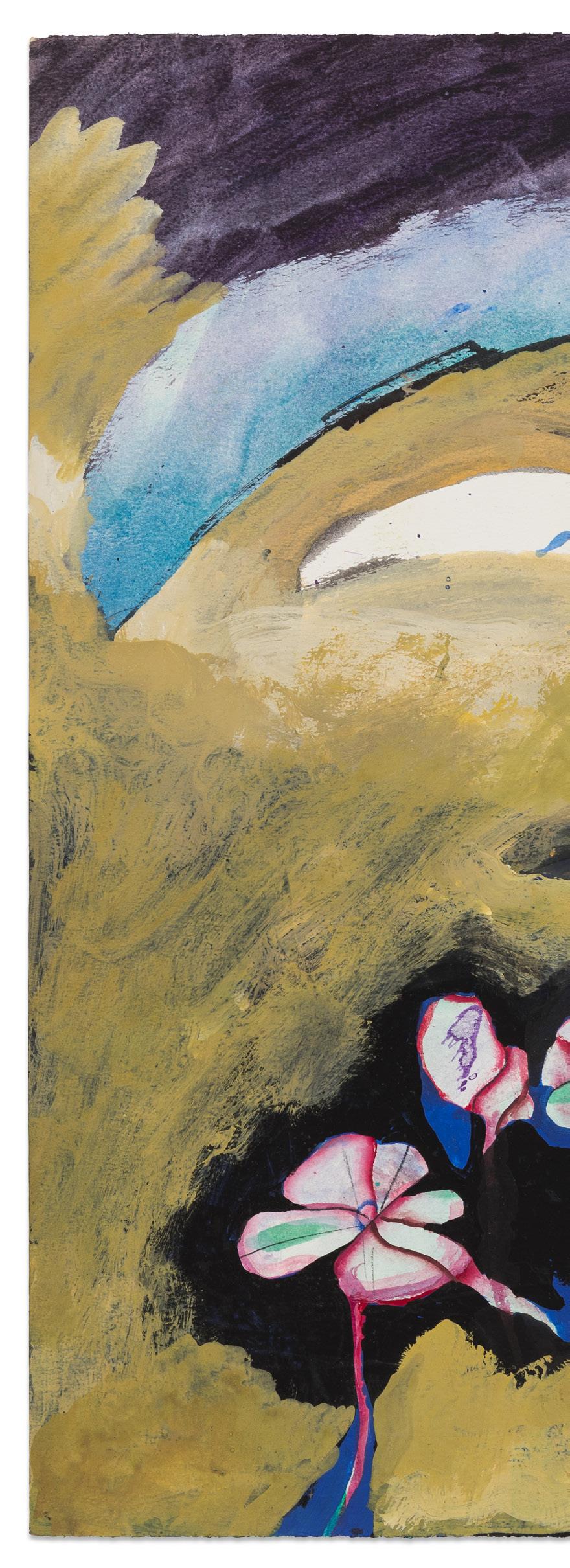
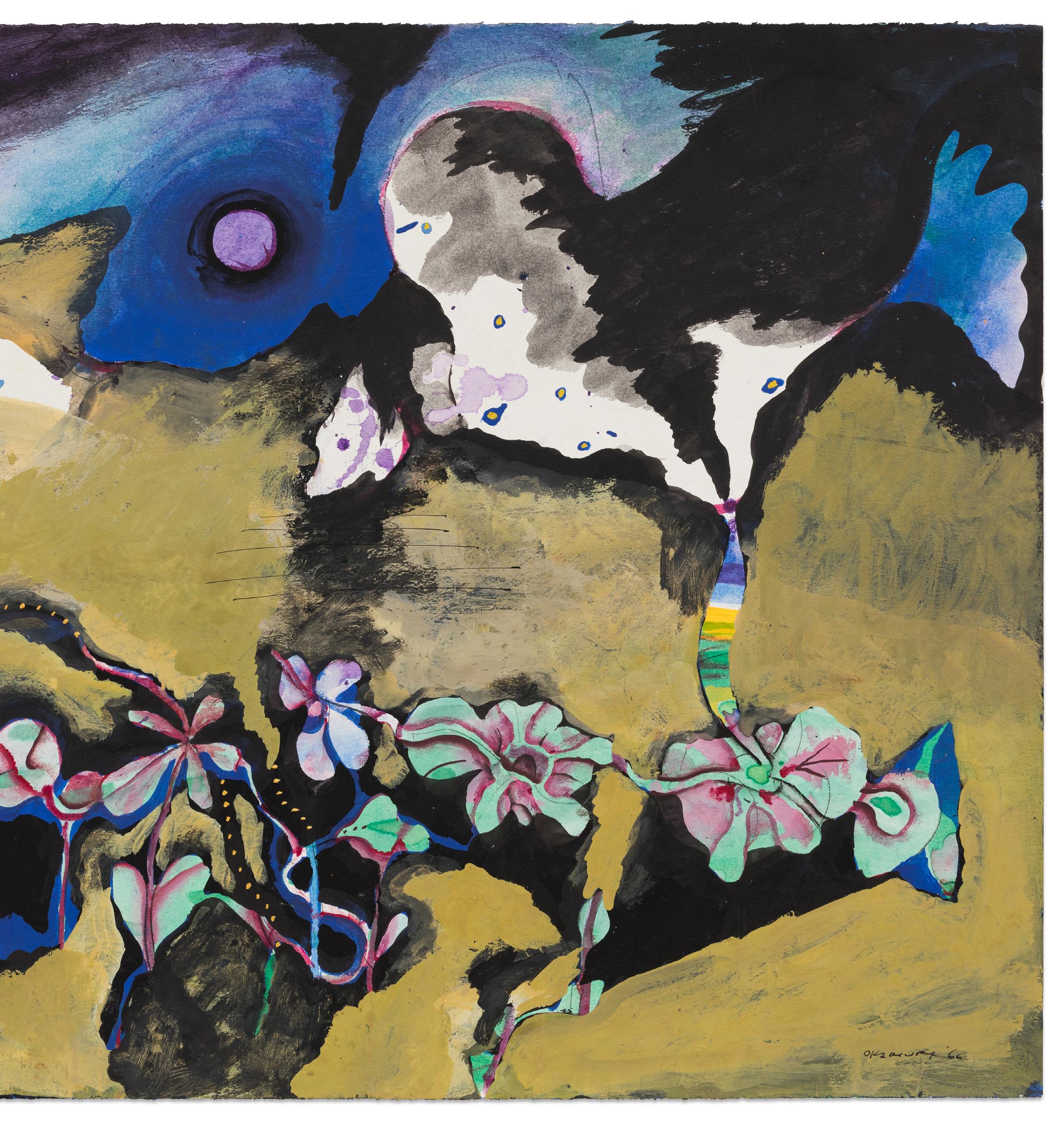
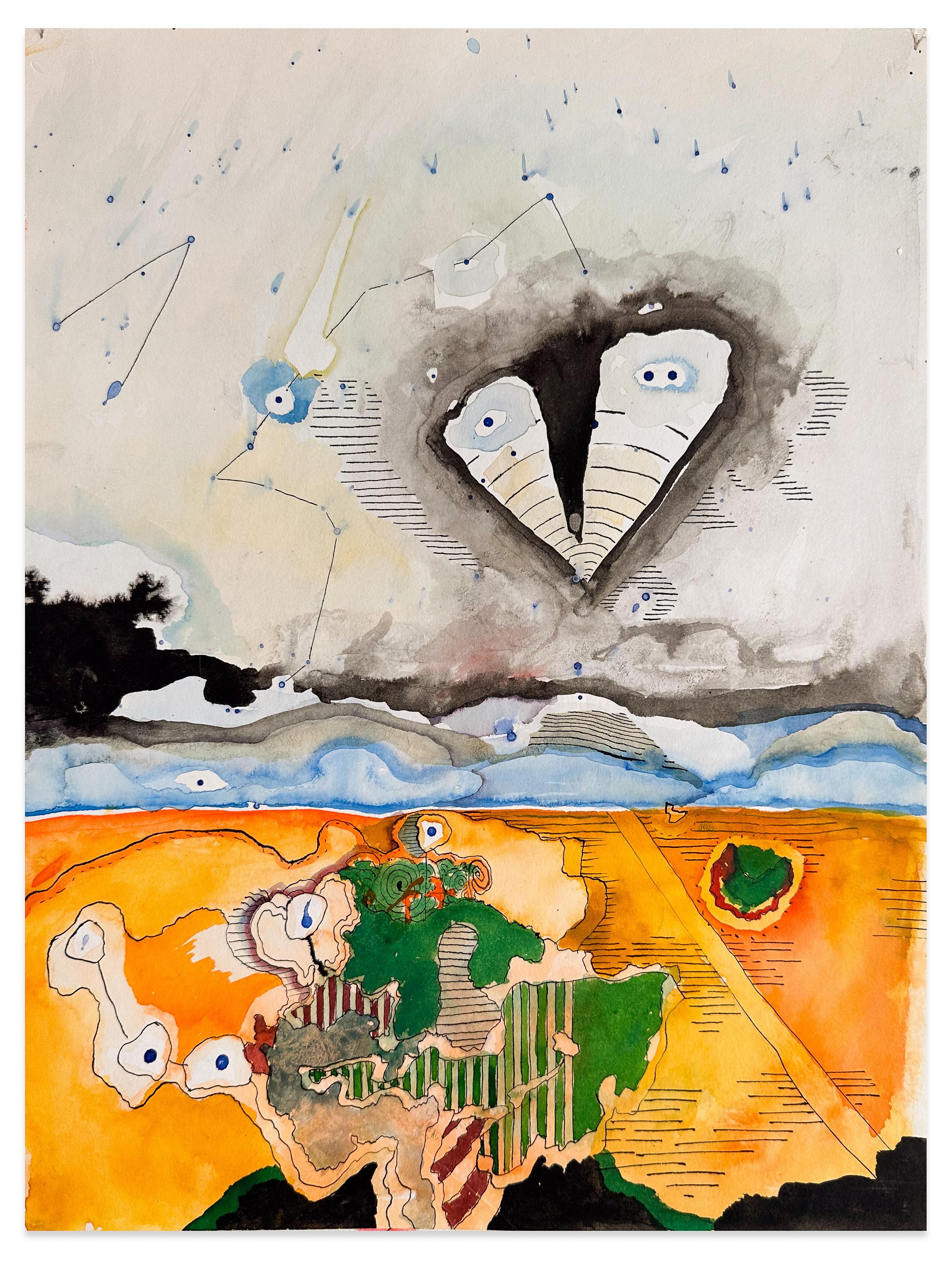
Blue Scents, 1966
mixed media on paper, 24 x 18 inches
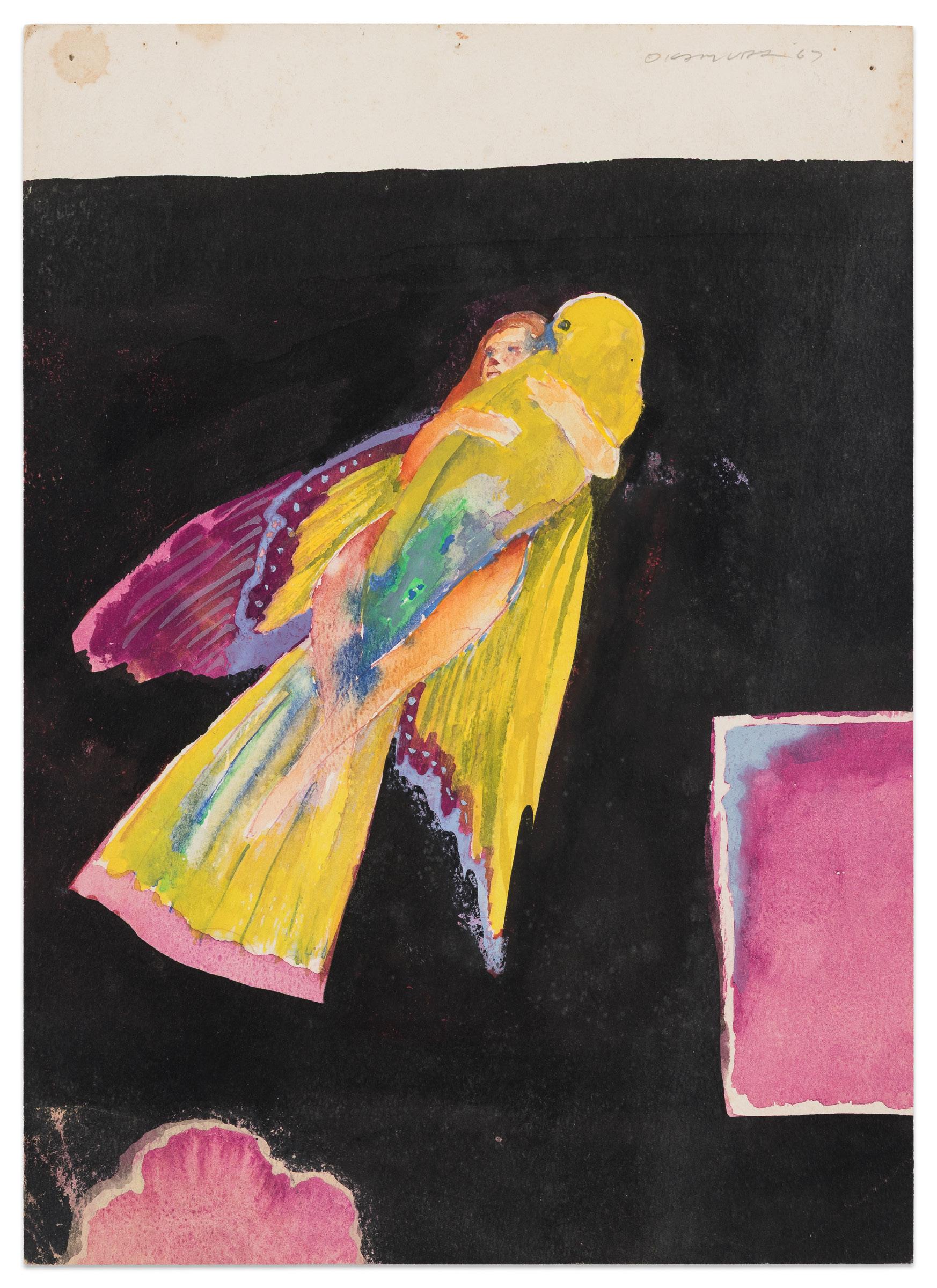
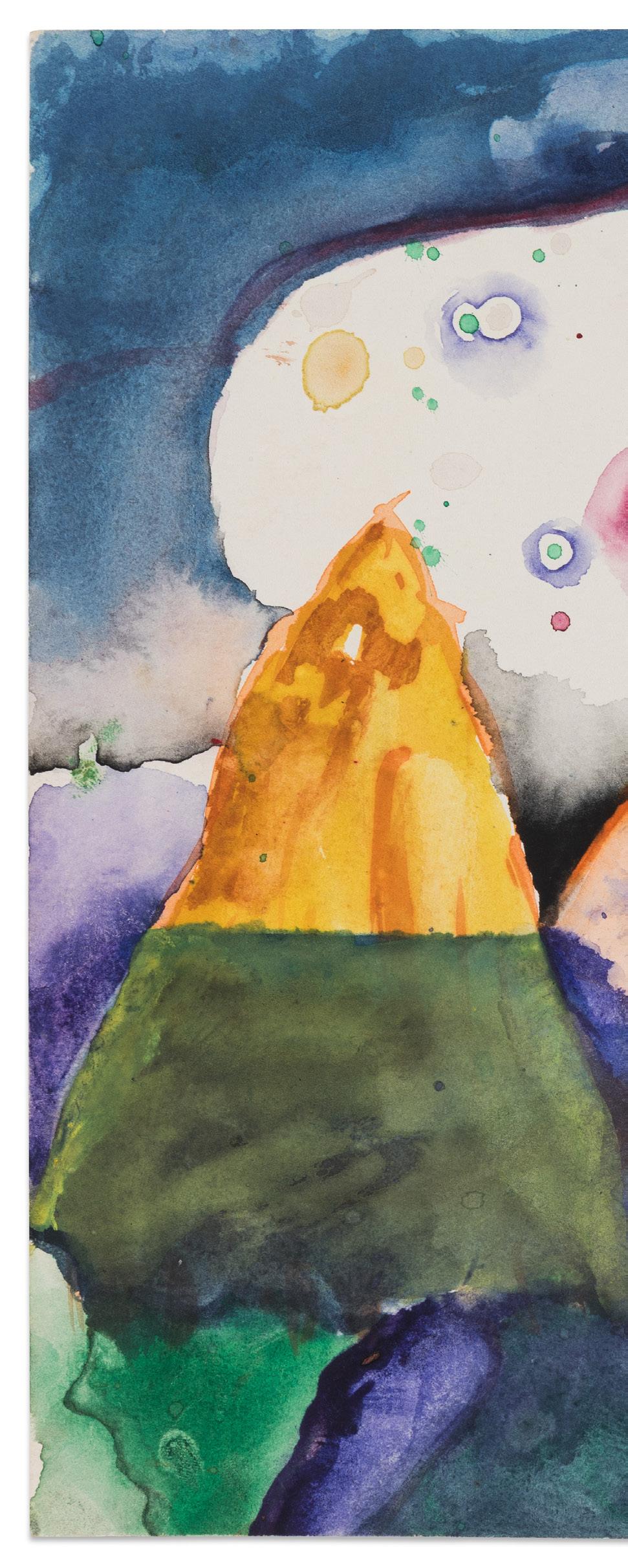
Plate 4:
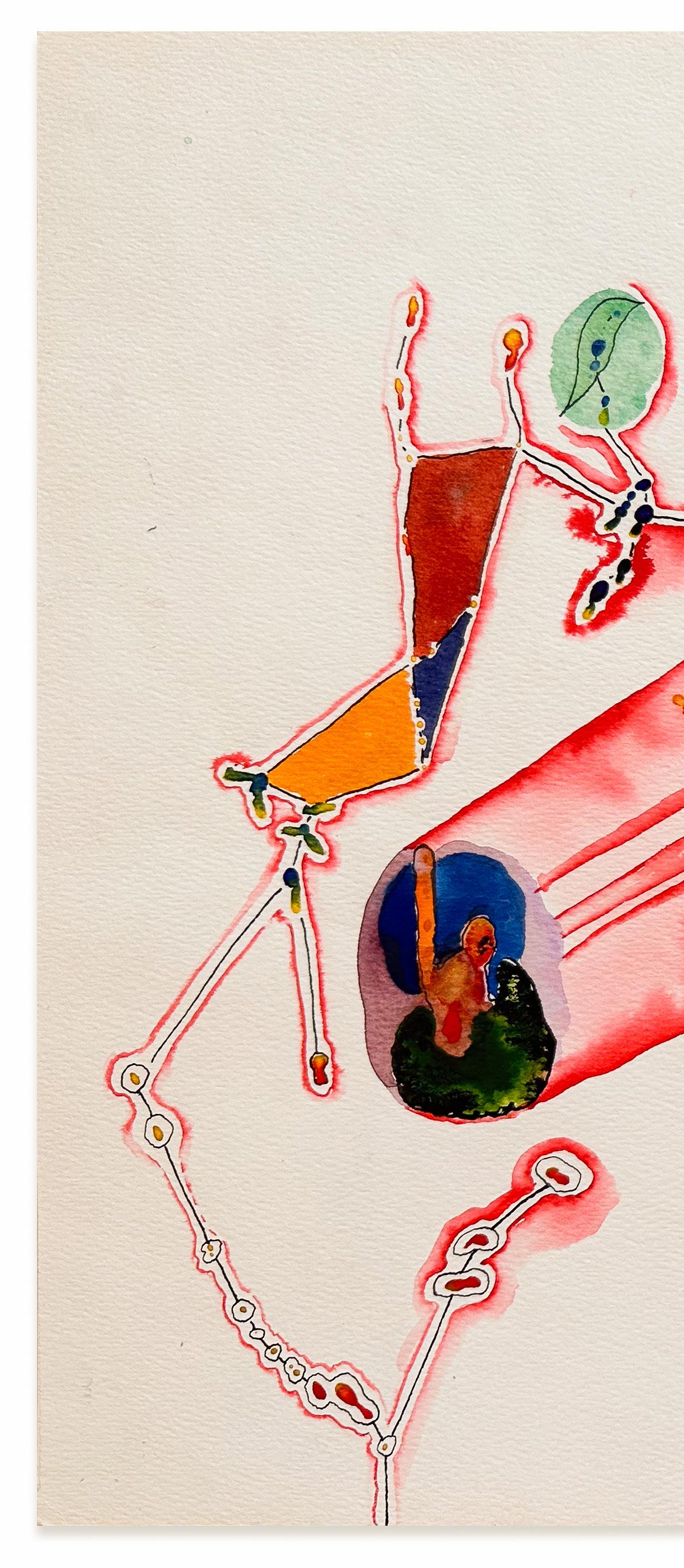
Bird Nude with Blacks, 1967
watercolor and graphite on paper, 11 1/2 x 8 1/4 inches
fauna, and sky sets the stage for the human-animal hybridity that would soon follow. Okamura explicitly recognized the spiritual gravity of this visual blending; in a 1970 letter to Creeley, he noted that he was “painting pictures of cows and butterflies paralleling the figure series,” explaining that this continuous metamorphosis of imagery gave him a “sense of less ego hassles.”29
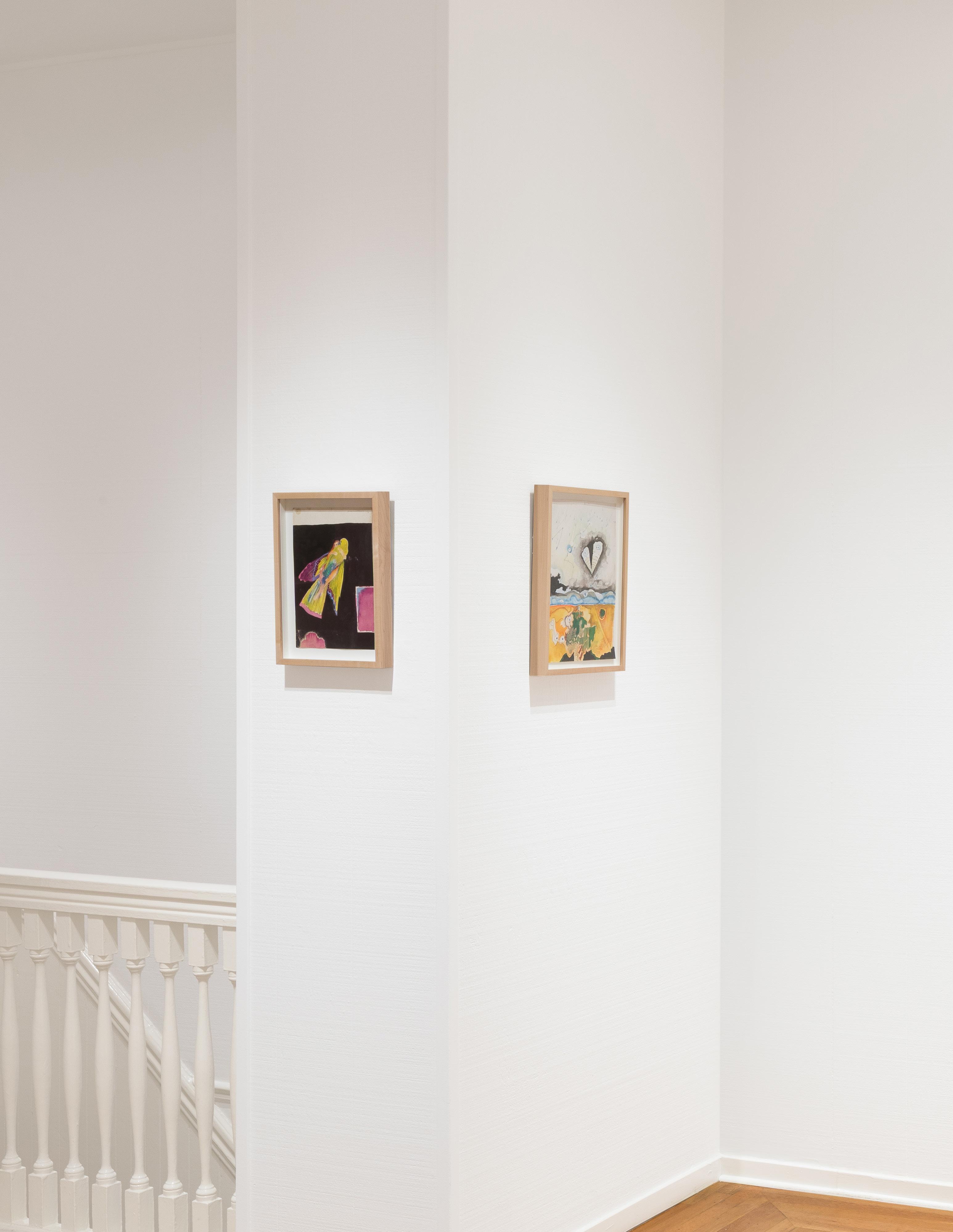
Okamura pushes such liquefaction to surreal heights in his 1967 watercolor Bird Nude with Blacks (Plate 4). Against the black expanse of the universe, a lustrous form floats, exposing a nude human intimately entwined with a bird. This psychedelic amalgamation pictures the planetary hydrocommons, making the interpermeation of species vividly literal. When situated within Okamura’s broader practice, the entwined woman in Bird Nude with Blacks acts as a parallel exploration to the “clusters of tiny people” he would soon develop alongside the poet Robert Creeley.30 Okamura’s visionary phase coincided with a deliberate, experimental departure from his grueling painting schedule. Feeling “up to here with painting,” he took a risk and temporarily abandoned the canvas to explore alternative mediums like sewing banners, creating polaroid lights, and printmaking. “I started to make prints again,” he recalled of this countercultural era, noting that he “made etchings with Kathan Brown at Crown Point Press at her house.”31
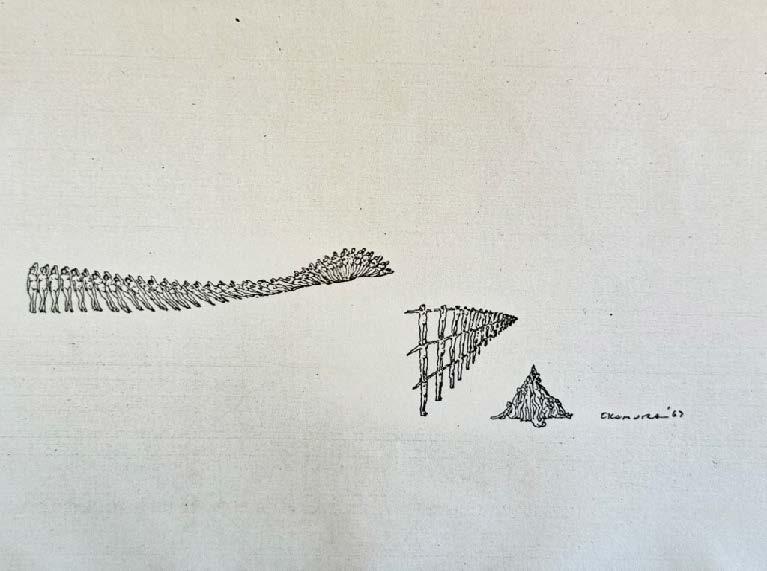
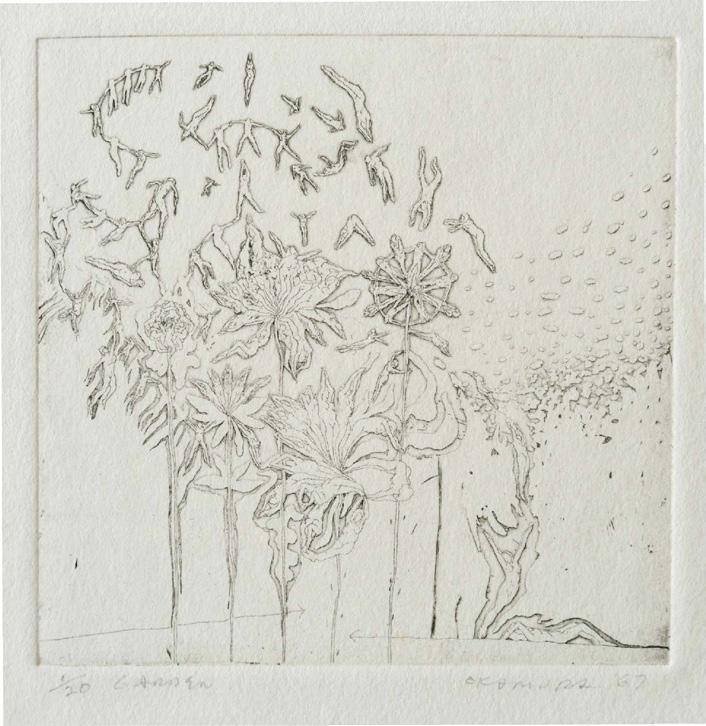
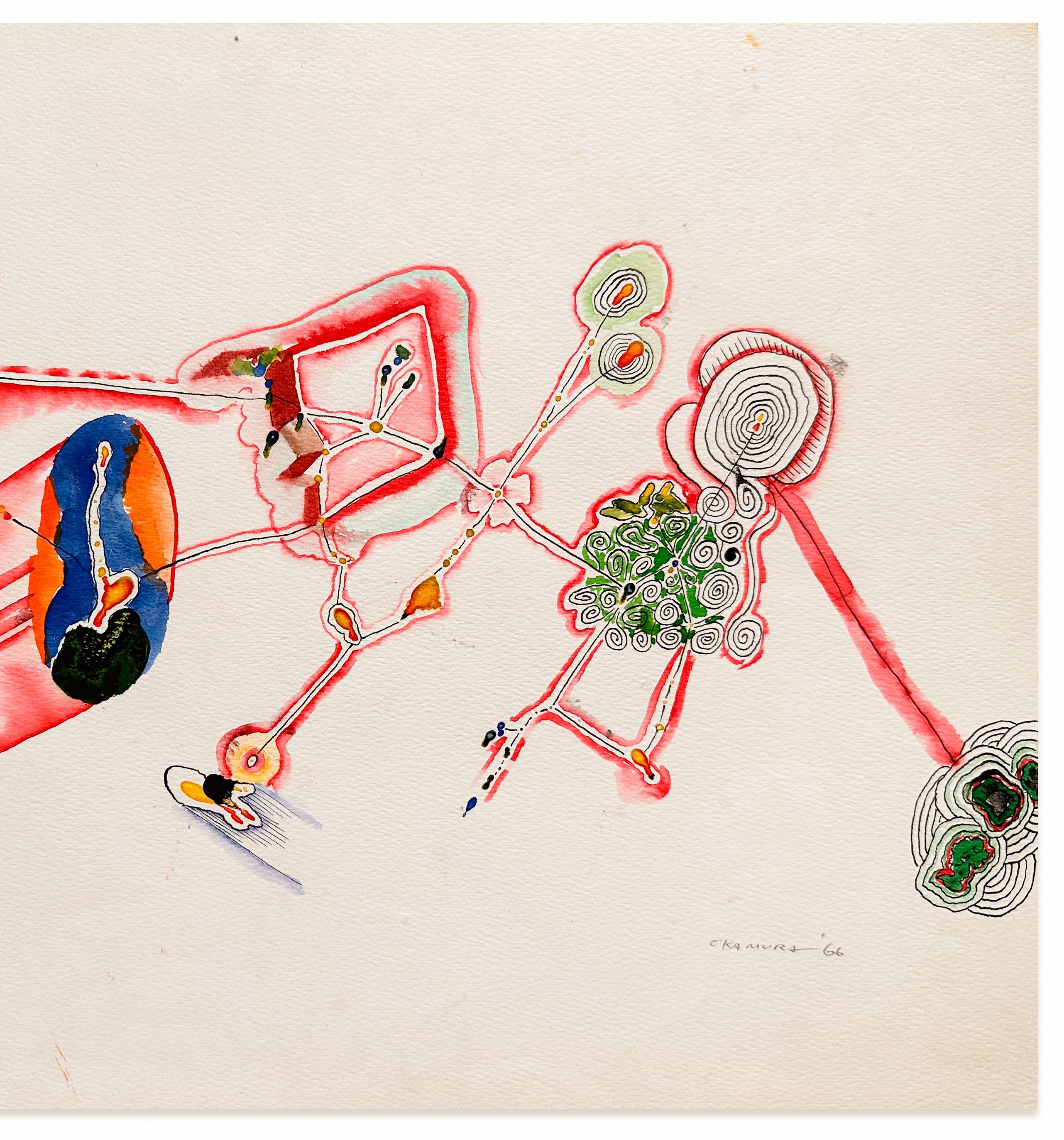
This period of intense experimentation aligns with the creation of Liquids32 (not pictured), 1967, an etching where fluid line work binds a mass of swirling, interconnected human forms. Femme bodies pose, dip, curl, kick, grasp, and hold one another, moving together like cosmic swimmers and divers. These figures stack and stand on one another, sometimes linking arms to form the rigid shape of a fence (Fig. 1)—perhaps a subtle, lingering echo of his barricaded past—while elsewhere they pile together, conjoining into the organic shapes of flowers, or tufts of dandelions carried by a wayward wind, in some places they form wheels, spreading their arms and legs to spur earthly stars. (Fig. 2)
Ultimately, these swirling bodies become indistinguishable from a single, splashing drop of water. By visually disassembling individualism, Okamura embodies the Esoteric Buddhist metaphor of “Indra’s Net,” an infinite cosmic net where every jewel reflects every other jewel in a “dynamic totality” without mechanistic boundaries.33 Through these clustered drops of humanity, Okamura aligns Indra’s Net with Denise Ferreira da Silva’s “elementary entanglement,” dismantling the illusion of separability to show that human difference is merely a singular expression of an interconnected universe.34
The visual dissolution of the drop rhymes with the phrases of both Robert Creeley
29 Arthur Okamura to Robert Creeley, March 10, 1970, Robert Creeley Papers (M0662), Series III: Manuscripts By Others, Box 59, Folder 5, Department of Special Collections and University Archives, Stanford University Libraries, Stanford, California.
30 Okamura, CAAABS interview, 00:51:13.
31 Ibid., 00:59:21.
32 See the Fine Arts Museums of San Francisco website: https://www.famsf.org/artworks/liquids
33 Williams, The Buddha in the Machine, 96.
34 Denise Ferreira da Silva, "On Difference Without Separability," in Incerteza viva (Living Uncertainty), 32nd São Paulo Art Biennial (São Paulo: Fundação Bienal de São Paulo, 2016), 65.
and Shunryū Suzuki Roshi. As Creeley reflected in an interview about his collaborations with Okamura, he rejected the classical Western concept of the “Great Chain of Being”—a strict, anthropocentric hierarchy that places humans above animals and nature. Instead, Creeley chose to view humans as small atoms entangled within a much larger reality.35 Okamura actively sought to collapse these vast scales in his physical practice, describing to Creeley the unique difficulty of hunching “over a 4 x 4 square” and trying “to make it equal to the space in the room and out of it.”36 Suzuki Roshi offered a parallel Zen framework for this atomic dissolution, invoking imagery that echoes the aquatic, avian, and botanical chimerism of Bird Nude with Blacks and Blue Scents. Quoting the thirteenthcentury Zen master Dogen, Suzuki Roshi taught: “There is no bird who flies knowing the limit of the sky. There is no fish who swims knowing the end of the ocean.” Because we exist in a “limitless universe,” the true bodhisattva’s way is to continue our effort without imposing artificial boundaries, recognizing that “a bird flies like a bird; a fish swims like a fish.”37 By visually collapsing the human, the bird, the fish, and the plant into a single, lambent being, Okamura manifests this limitless existence.
Expanding on this boundless existence, Suzuki used the metaphor of a waterfall at Yosemite to explain human suffering. He noted that it is a “difficult experience for each drop of water” to fall “from the top of such a high mountain,” because the water “was not originally separated, but was one whole river.” We suffer because we have feeling,
35 Montefalcone, "Talking about Collaboration," 118.
36 Arthur Okamura to Robert Creeley, c.a. 1970s, Robert Creeley Papers (M0662), Series 1: Correspondence, Box 115, Folder 27, Department of Special Collections and University Archives, Stanford University Libraries, Stanford, California.
37 Suzuki, Branching Streams Flow in the Darkness, 59.
Fig. 1. Arthur Okamura, Untitled, 1967, xerox reproduction of an original Okamura drawing.
Fig. 2. Arthur Okamura, Garden, 1967, etching on paper, edition 1 of 20, 9 1/2 × 10 1/4 in. (sheet).
which comes from being separated into drops. However, “when the water returns to its original oneness with the river, it no longer has any individual feeling to it; it resumes its own nature, and finds composure.”38 In Okamura’s etching Liquids and his transcorporeal hybrids, the drop does not represent a tragic loss of self but rather a vivid illustration of liberation, an ebullient return to the boundless “big mind.”
IV. Full Moon ∘ Ripple
...the circles, / the holes they / made, the / one / multiphasic / direction...
— Robert Creeley, 1
When the singular, fallen drop strikes the surface of the water, its energy radiates outward in ripples nested within one another. Echoing a lustrous full moon, Okamura’s visionary works of the mid-1960s embraced the fluid dynamics of concentricity.
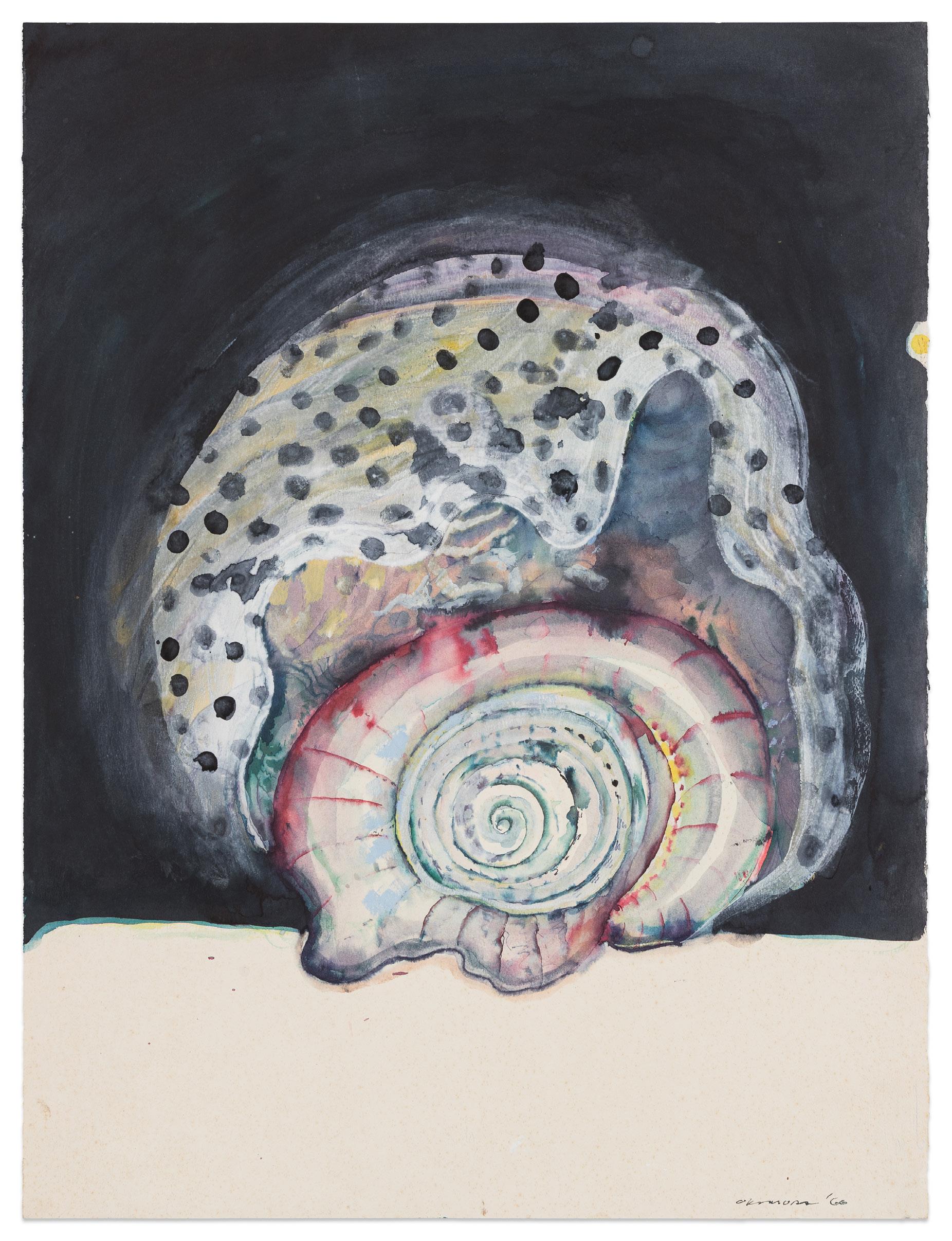
His 1966 mixed-media painting Jelly Shell (Plate 5) captures this rhythmic metamorphosis. Set against a bisected plane of black and white, the shell is rendered not as a calcified, solid object, but as a gossamer spiral structure composed of translucent watercolor washes of red, a wispy, breathy blue, and periwinkle. Above the spiral rests an amorphous, luminous mass, like a pearl and its encasing nacre, or the soft translucent bell of a jellyfish, scattered with dark polka dots. The shell visually ripples outward from its center, reverberating the expansive rings of a stone dropped in a coastal tide pool. By rendering the protective shell’s armor as a permeable, vibrating jelly, Okamura establishes a material paradox. He transforms a structure defined by its calcified hardness into a fluid, soft membrane, creating a biological form that is simultaneously protective and entirely porous.
The ripples of Jelly Shell serve as an aquatic metaphor for the “multiphasic direction” of Okamura’s forms, a concentricity that dialogues with the “phrases” of his poetic collaborations. For Okamura, drawing the expanding rings of a form required surrendering to an intuitive cadence. “Don’t draw your mind,” Okamura instructed Villa; instead, “Follow the rhythm. It’s too fast for thinking.”40 This philosophy of bodily rhythm directly informed his 1971 collaborative book with Creeley, 1
38 Suzuki, Zen Mind, Beginner’s Mind, 93–95.
0. In this
39 Robert Creeley and Arthur Okamura, 1∘2∘3∘4∘5∘6∘7∘8∘9∘0 (Berkeley: Shambhala; San Francisco: Mudra, 1971), unpaginated.
40 Okamura, CAAABS interview, 00:49:41.
Plate 5:
Jelly Shell, 1966
mixed media on paper, 24 x 18 1/4 inches
work, Okamura’s drawings of tiny, interlaced human figures spiraling into larger forms— the same molecular ‘little people’ that compose the atomic structure of Liquids and Bird Nude with Blacks—alternate with Creeley’s stanzas. Creeley’s syncopated prosody deliberately parallels the undulating structure of Okamura’s art.
The numerical book, 1∘2∘3∘4∘5∘6∘7∘8∘9∘0, visually traces the exact arrangement of the top row of a standard QWERTY keyboard.41 For Creeley and his fellow Black Mountain poet Charles Olson, the typewriter was not merely a machine, but a musical instrument. Because of its “rigidity and its space precisions,” Olson argued that the typewriter granted the poet the “stave and the bar a musician has had,” allowing them to “indicate exactly the breath, the pauses, the suspensions even of syllables, the juxtapositions even of parts of a phrases…”42 When asked about the meaning behind this specific title, Okamura replied: “Sequence, movement, time, circles.”43 As scholar Barbara Montefalcone observes, the typographical open circles (∘) separating each number in the title similarly act as temporal pauses between each keystroke, mimicking the expanding rings of water and reinforcing Okamura’s belief that rhythm grants a kind of “foresight.”44 Within the singular poem, titled “People,” which spans the book’s pages, Creeley explores the ephemeral quality of these nested lives through the imagery of “circles” and “holes”—spaces defined by both presence and absence. As the stanzas expand and contract on the page, the “people” continuously appear, vanish, and reassemble (“I knew where they were... I never saw them”), capturing the fleeting, transient nature of existence as it manifests and eventually fades, much like a ripple resolving into the wider ocean.45 This cadence and beat are embodied by the poem’s opening lines, where the steady “going” and “coming” of these ephemeral “lives” circle outward in “one / multiphasic / direction.”46
Translating the ripple’s cadence into form allowed Okamura to explore continuous metamorphosis. He traced this tendency back to an “early interest in a kind of surrealism,” noting a fascination with the “metaphysical” and a “shadowy kind of imagery” reminiscent of film noir.47 Montefalcone notes that his visionary phase was heavily informed by his lifelong fascination with optical illusions, parlor tricks, and Victorian “hidden images.”48 “I often look to illustrate the effects of camouflage,” he explained, noting his interest in “disruptive patterning, contour elimination, mimicry, [and] illusion.”49 When looking at Jelly Shell or his spiraling figures with Creeley, the viewer’s perception is frequently fleeting; forms hide within forms, oscillating between the seen and the unseen. Through the full-moon phase of the ripple, Okamura’s abstract realism unveils a reality as a mirage
41 Thank you to Greg Flood for noting the parallels between the book’s title and a QWERTY keyboard.
42 Charles Olson, "Projective Verse," quoted in Williams, The Buddha in the Machine, 128.
43 Montefalcone, "Talking about Collaboration," 115.
44 Okamura, CAAABS interview, 00:51:01.
45 Creeley and Okamura, 1∘2∘3∘4∘5∘6∘7∘8∘9∘0, unpaginated.
46 Ibid.
47 Okamura, interview by Poon Andersen.
48 Montefalcone, "Talking about Collaboration," 116.
49 Ibid., 104.
of continuous, concentric movement, in which the boundaries of the self shift.
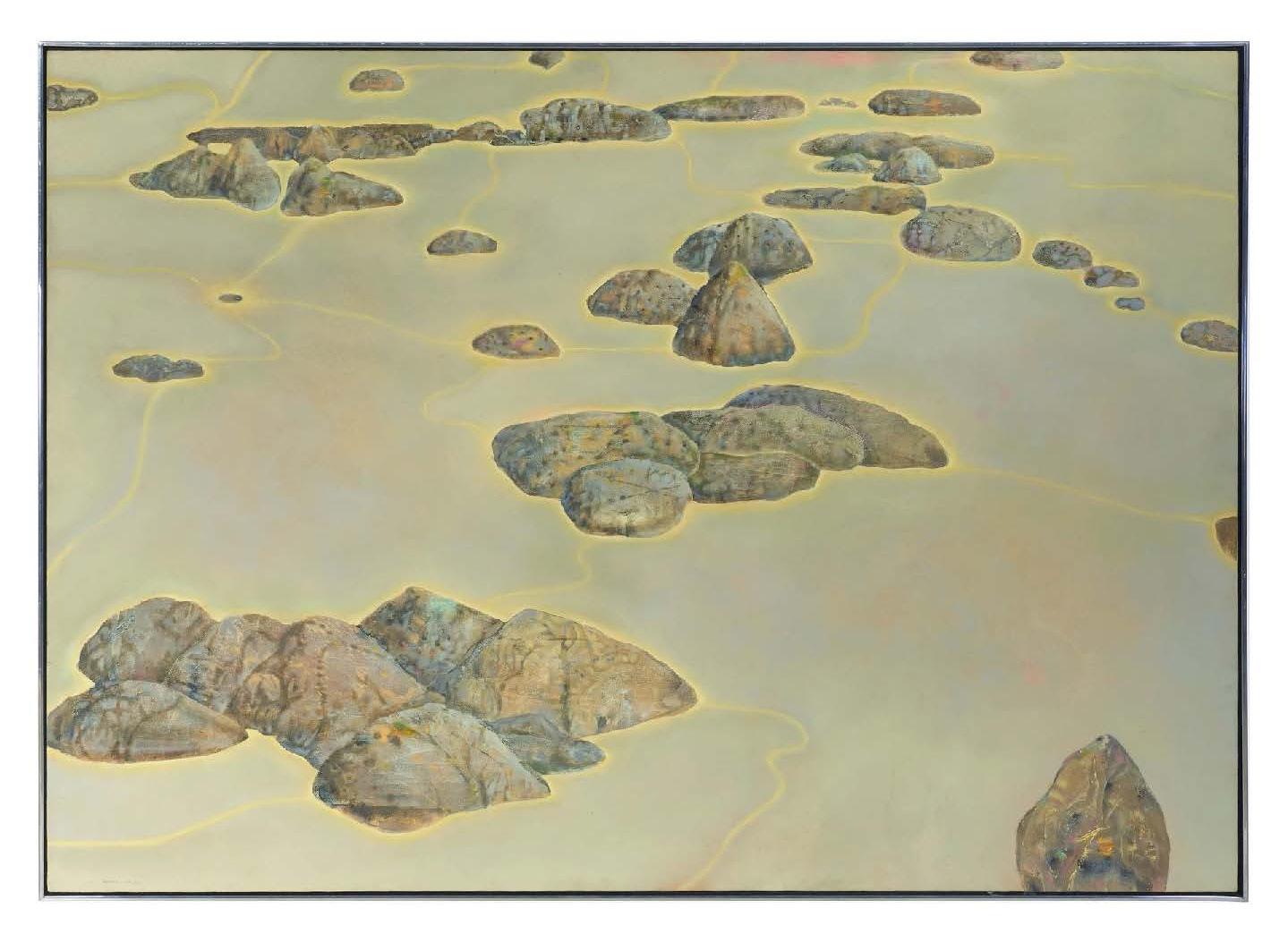
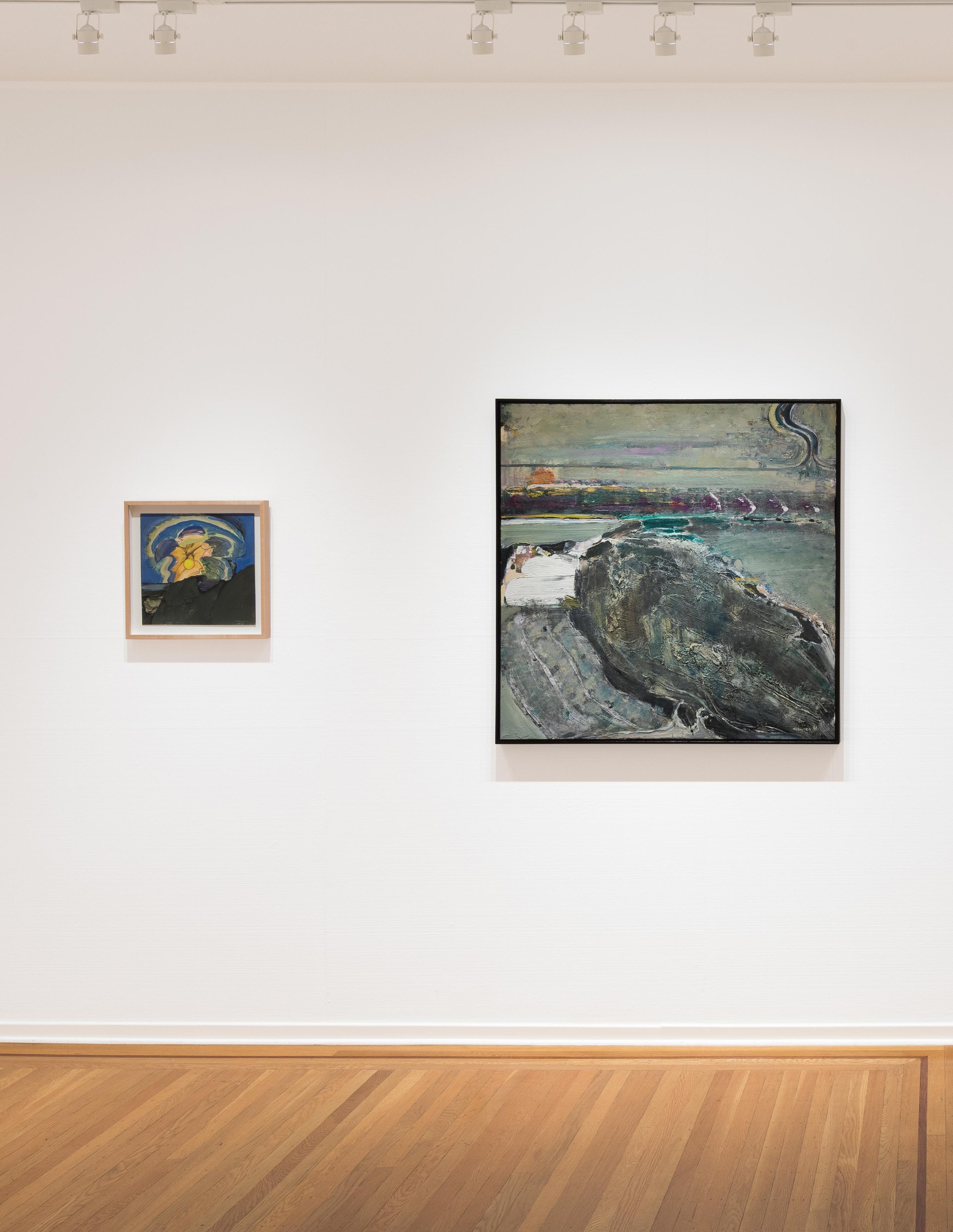
Concentricity carried profound spiritual meaning for the artist, culminating in his 1972 masterwork, Beach Rocks (Fig. 3), painted just one year after the death of Suzuki Roshi in 1971, the canvas expands the atomic ripples of his visionary phase into an elegiac meditation on impermanence.50 In Beach Rocks, a scattering of iridescent stones— reminiscent of the light-refracting Petroleum Agates found along Bolinas’s Agate Beach— rests upon a placid, smooth, watery expanse. Reserving built-up texture solely for the stones to anchor their physical weight, Okamura eschews the traditional, concentric rings of a raked Japanese dry garden (kare-sansui). Instead, he uses singular, pulsing lines of electric yellow to interconnect the stones across a buzzing canvas. These vibrant, striated lines create a visual whirr, illustrating the invisible Zen energies exchanged between the rocks and making the heavy, static stones appear to float in shallow water, with the surface catching the golden reflection of the sky above.51
Okamura noted that these pulsing lines denoted “the energy and vibration of this western spirit place where I live.”52 This dynamic interplay between the heavy, static rocks and the expanding, vibrating ripples resonates with Suzuki Roshi’s teachings on the nature of mind. He taught that a mind experiencing the ripples of thought or grief is
50 Theodore Barrow, "A Bolinas Rock Star," Alta Journal, January 18, 2024.
51 Author’s correspondence with Greg Flood, June 17, 2026.
52 Arthur Okamura, Arthur Okamura: An Exhibition of Books, Prints & Paintings (Los Angeles: Charles Feingarten Galleries, 1972), unpaginated.
Fig. 3. Arthur Okamura, Beach Rocks, 1972, oil on canvas, 48 × 68 in.
not a disturbed mind, but rather an “amplified” one. “Actually, water always has waves. Waves are the practice of the water,” He explained. “To speak of waves apart from water or water apart from waves is a delusion. Water and waves are one.”53 In Beach Rocks, the solid stones of his grief and the electric ripples of the water are one, picturing a coastal landscape where the teachings of his late master continue to beat and shimmer into oblivion.
V. Waning Crescent ∘ Flow
...the moon in the water is independent and the moon over the water is independent; but the moon over the water is also the moon in the water.
— Shunryū Suzuki Roshi, Branching Streams Flow in the Darkness54
Just as the gravitational pull of the waning moon gently draws the surging tide back into the deep, Okamura’s late-career Pacific visions return to the vastness of the horizon in the elemental phase of the flow. He rooted his return to the horizon deeply in his physical routine; as art historian Theodore Barrow notes, Okamura maintained a
Fig. 4. Arthur Okamura, Wave Edge, 2000, oil on canvas, 46 × 84 in.
53 Suzuki, Zen Mind, Beginner’s Mind, 35.
54 Suzuki, Branching Streams Flow in the Darkness, 126.
daily practice of walking the Bolinas shoreline, pacing along Agate Beach to study the tide and gather reference photos where “minuscule natural forms take on monumental significance”Okamura realized that capturing the intuitive animacy of this environment required abandoning static realism; writing to Creeley about his experience painting outdoors, he noted that “every moment there seemed to be complete changes happening so any attempt to keep up with it and get a representation was out of the question.”55
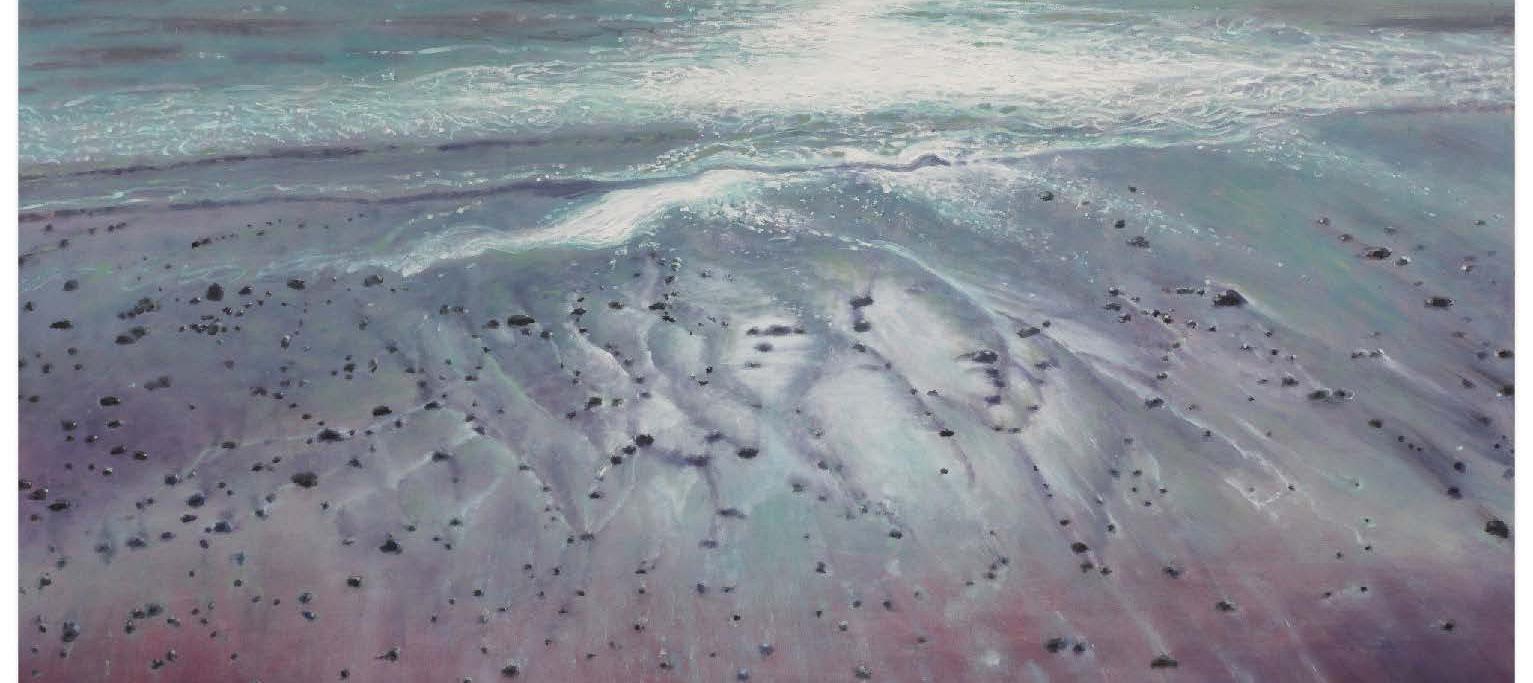
In his sprawling 2000 oil painting Wave Edge (Fig. 4), the canvas yields to a sweeping, horizontal wash of cresting water and wet sand scattered with stones. The sun melts into the ocean spray, blurring the edge between the sky and the sea. This emphatic return to horizontality completes the elemental journey; having fallen as a drop and radiated as a ripple, the water finally reaches Bachelard’s horizontal destiny. In Okamura’s visual grammar, this return conveys a sagacious sense of stillness, visualizing Suzuki Roshi’s teaching that the isolated drop of water eventually rejoins the river’s original oneness. The steady, rhythmic flow of Wave Edge transmutes the rigid carceral fences of his childhood memory. Under the ambient warmth of this late phase, the barbed traumas of his past evaporate into the coastal fog, returning as a gentle, atmospheric rainfall that disperses across the unbound expanse of the Bolinas coast.
This continuous tidal rhythm of form finds its philosophical anchor in Suzuki Roshi. In his talks collected in Branching Streams Flow in the Darkness, Suzuki Roshi draws on the image of the moon reflected on the water to teach the Zen principles of independence and interconnectedness. As the epigraph to this section illustrates, the dualistic mind usually only observes the moon high above the ocean, but true practice collapses this separation, revealing that the moon in the sky and the moon in the water are one and the same. The moon’s phase and the ocean’s flow are inseparable. Returning to the wisdom that initiated Okamura’s Pacific journey, Suzuki Roshi instructed that the nature of water is to be “something vast in which everything, including ourselves, exists.”56 By painting the wave’s flowing edge, Okamura sees the verge of “big mind,” reminding the viewer that life and the landscape are fluid expressions of one another. Life is layered within the land, continuously dripping in and out of it, taking distinct form for a moment before ambling back into the ocean.
Arthur Okamura’s career was defined by this poetic, rhythmic slippage between the elemental phases of the natural world and the phrases of his spiritual and literary collaborators. His post-incarceration visual practice of liberation was realized through deep, cross-disciplinary kinship. As he noted in his interview with Villa and Gunderson,
55 Arthur Okamura to Robert Creeley, September 13, 1974, Robert Creeley Papers (M0662), Series 1: Correspondence, Box 115, Folder 27, Department of Special Collections and University Archives, Stanford University Libraries, Stanford, California.
56 Suzuki, Branching Streams Flow in the Darkness, 85.
57 Okamura, CAAABS interview, 00:06:37.
Okamura consciously stepped outside of “racial habituation.”57 Abstract realism allowed him to be intensely present in a specific physical reality, living most of his days on the Bolinas shoreline at the exact cusp of land and sea, while summoning abstraction to allow forms to interconnect, reconfigure, and freely arrange the periphery between the static rock and the liquid flow. His recurring, metamorphic use of blue operates as a material pathway to Zen composure, offering peace from the bounded land and the historical repercussions of containment. From the atomized mist of Phrases for a Crescent Moon to the cresting flow of Wave Edge, Okamura metamorphosed the artifacts of his carceral memory, just as he turned the wings of monarch butterflies into blooming flower petals. Like the lunar-tidal cycle, Okamura’s visionary abstraction illuminates existence as a mirage of continuous, multiphasic movement, a crescent moon both high in the sky and floating freely in the watery gyre, endlessly buoyed by the phrases of the shore.
Shore (Ocean).
Matthew Villar Miranda is a curator, art historian, and PhD student at Stanford University (B.A., UC Berkeley; M.A., Arizona State University) whose research focuses on queer relations, Indigenous knowledge systems, and decolonial interventions by artists of the tropics and Austronesian Pacific diaspora. They have held curatorial positions and fellowships at the Los Angeles County Museum of Art, Arizona State University Art Museum, the Walker Art Center, Berkeley Art Museum and Pacific Film Archive, and the San Francisco Arts Commission. Matthew serves on the Board of Stakeholders for Museums Moving Forward (MMF), a Ford and Mellon Foundation-funded initiative comprised of a cross-institutional coalition dedicated to advancing equity within art museums. They also frequently contribute art criticism and essays to exhibition catalogs and journals, including recent and forthcoming publications for Phaidon, Silverlens Galleries, the Art Students League of New York, STPI Singapore, and Panorama.
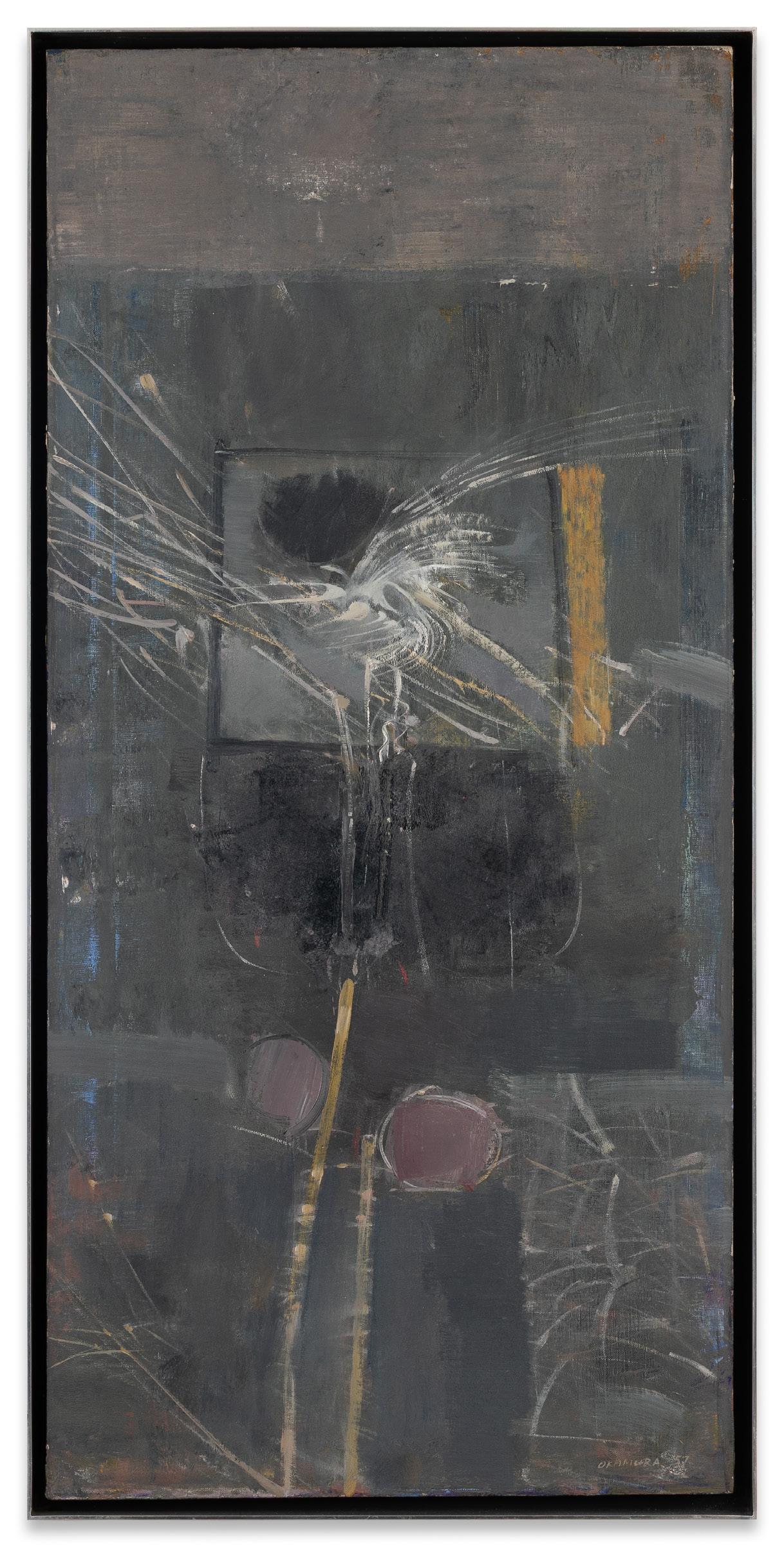
Plate 6:
Image #25, 1957 oil on canvas, 38 x 18 inches
Plate 7:
Cormorant in Flight, 1960 watercolor on paper, 27 1/2 x 19 1/4 inches
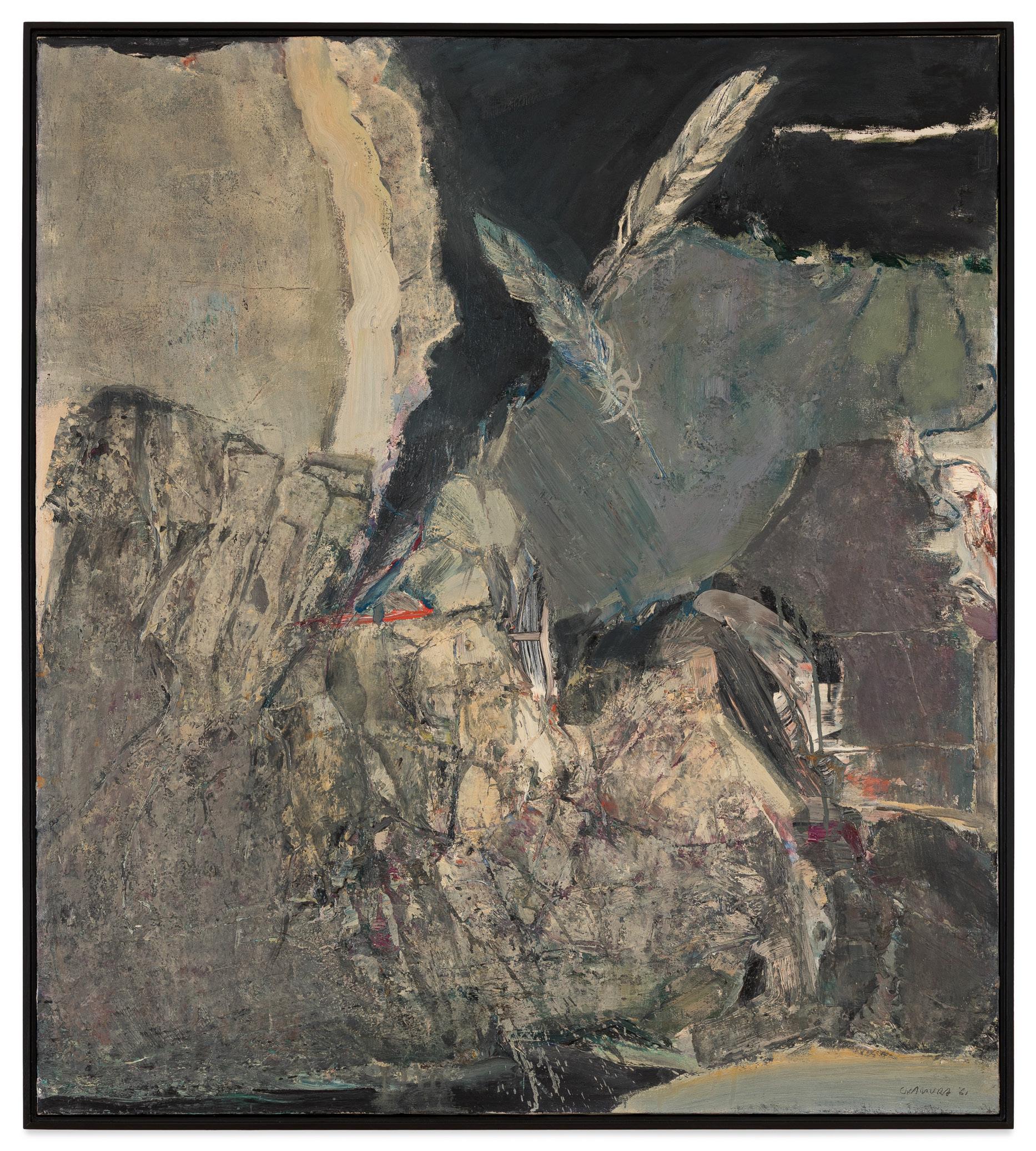
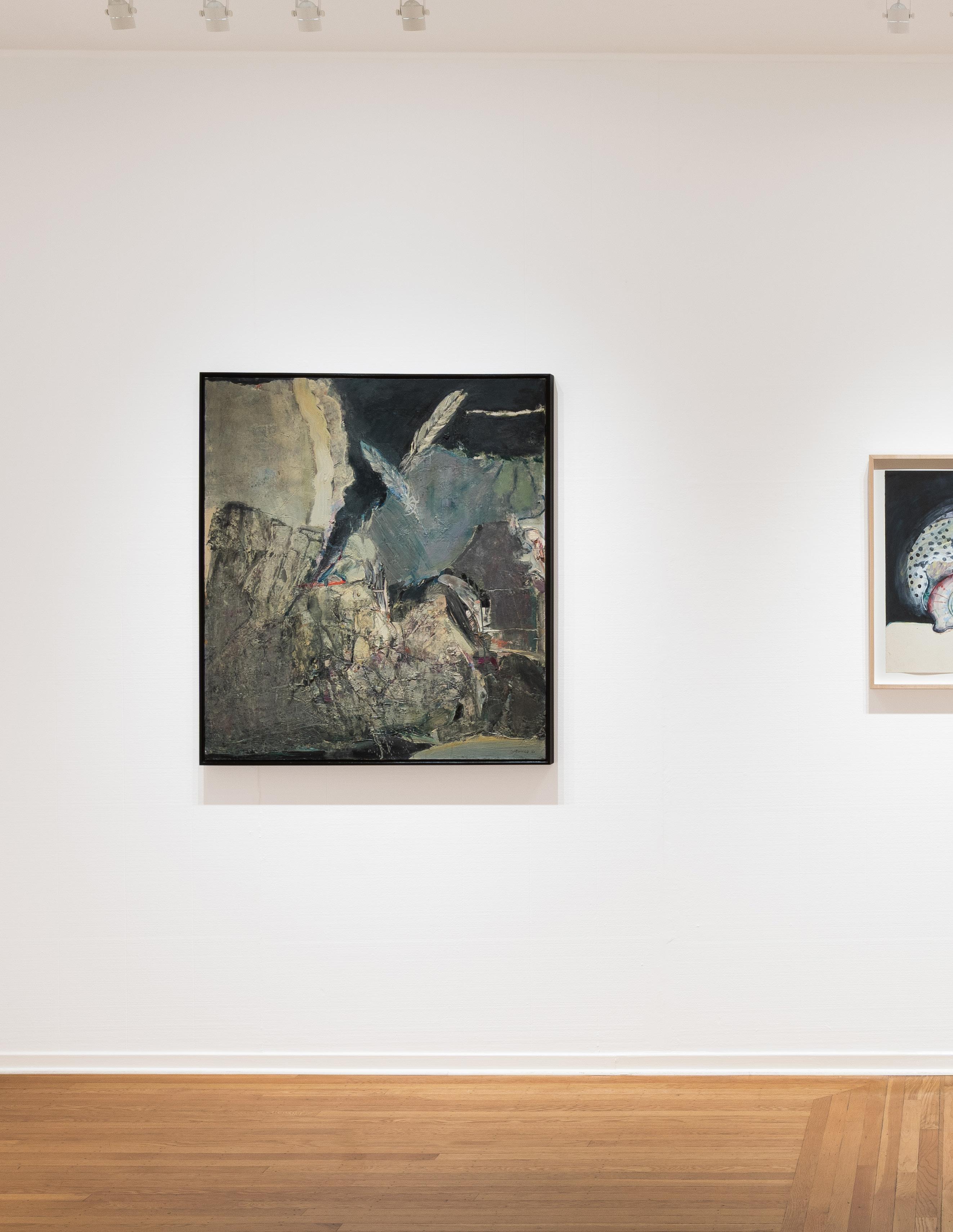
Plate 8: Rock & Feathers, 1961 oil on canvas, 45 x 40 inches
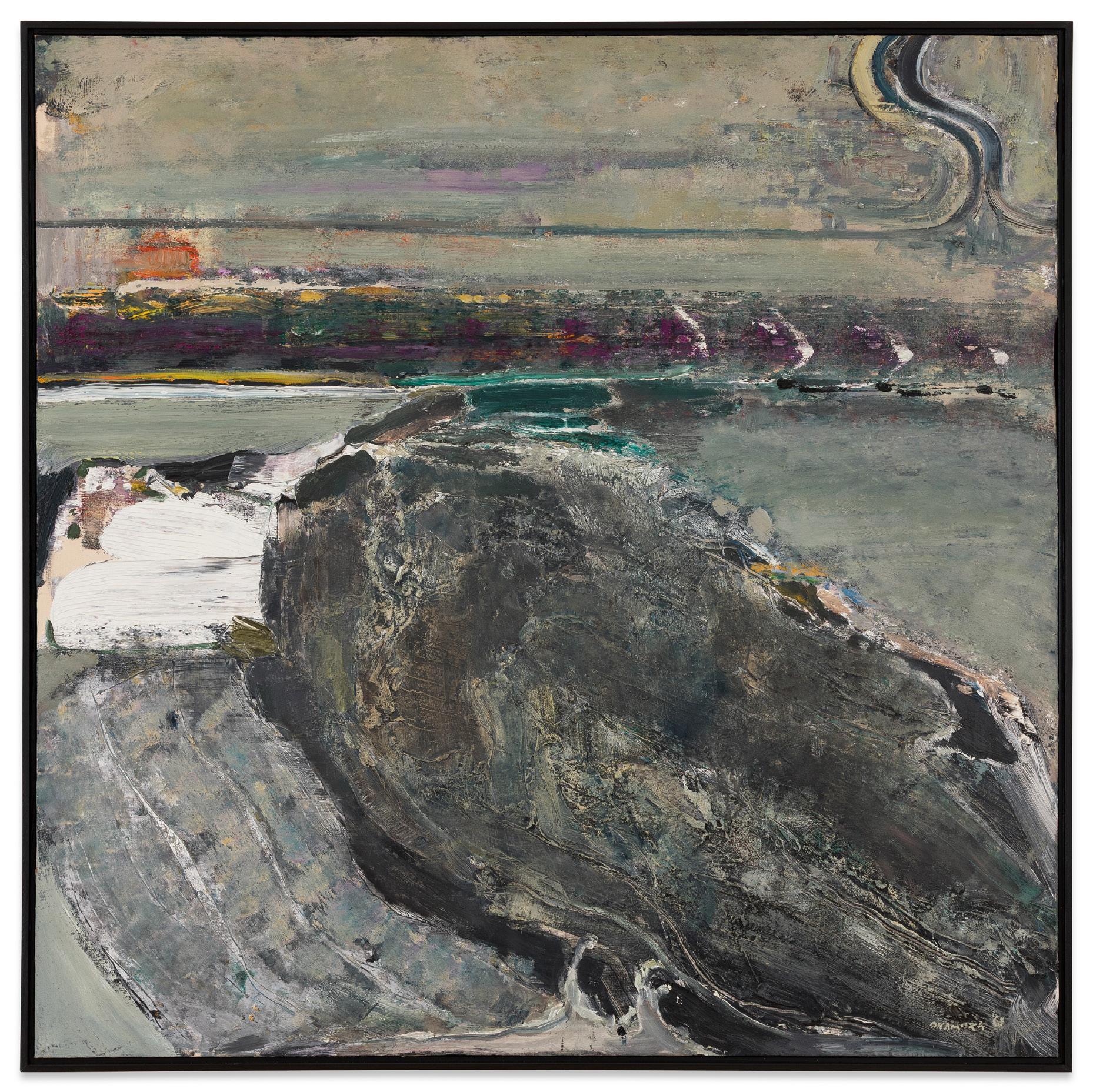
Plate 9: Dark Rock, 1961 oil on canvas, 42 x 42 inches
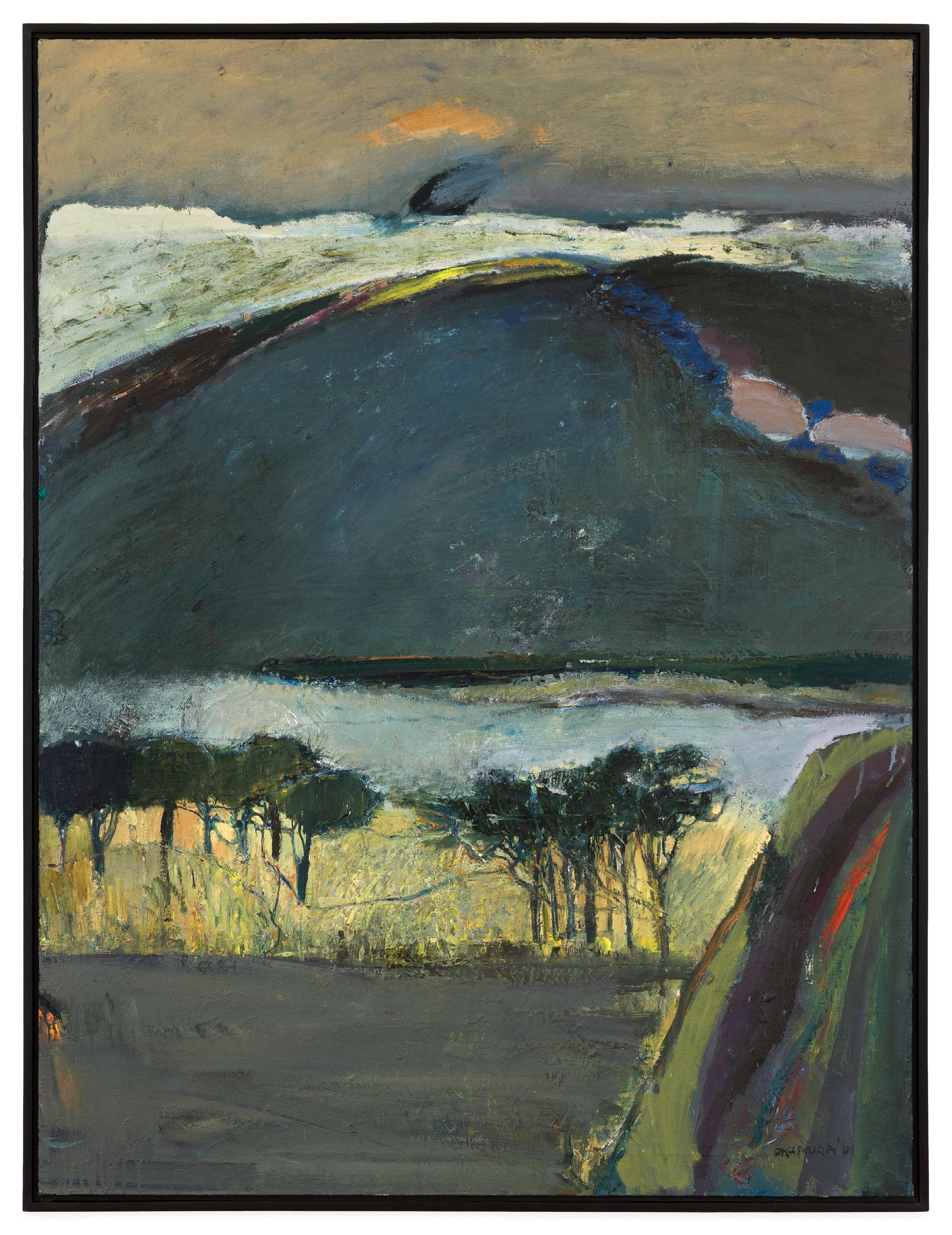
Plate 10: Fog in the Valley, 1961 oil on canvas, 49 1/4 x 37 inches
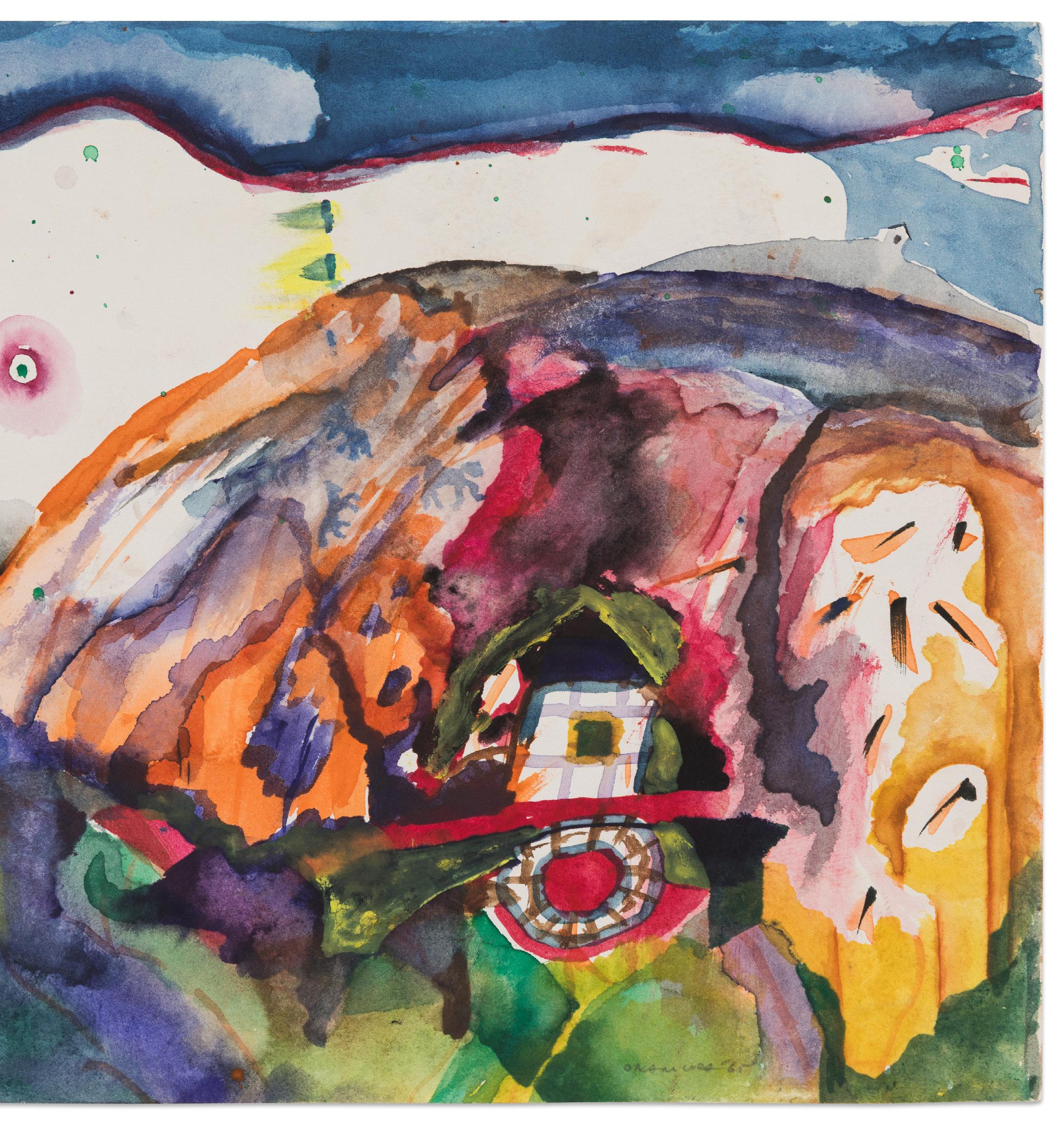
Plate 11:
Hill House, 1965
watercolor on paper, 10 1/4 x 14 inches
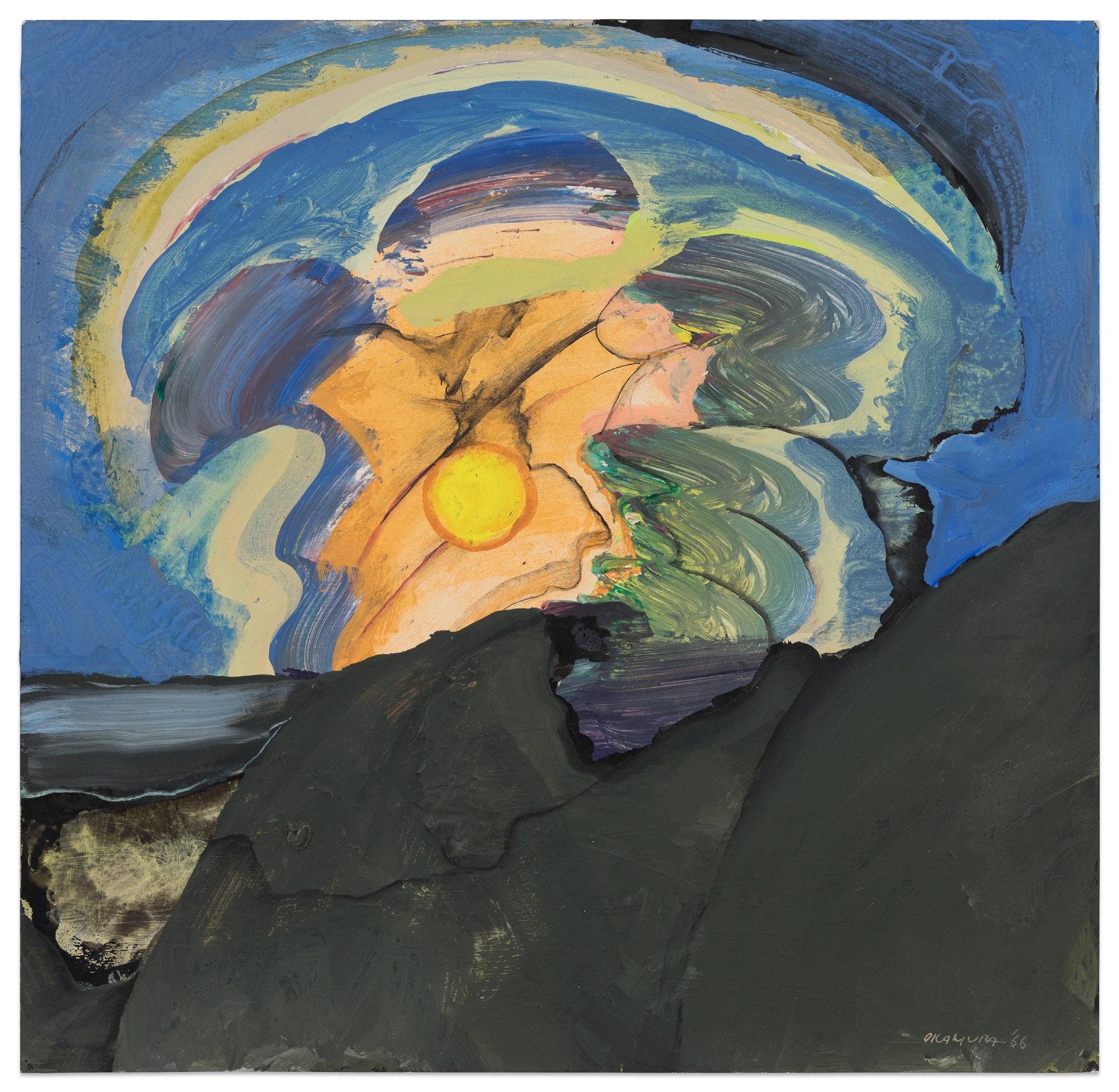
Plate 12: Sun Tree, 1966 mixed media on paper, 14 x 14 3/8 inches
Plate 13: Flower Game, 1966 mixed media on paper, 18 x 15 inches
Plate 14:
Bird Vines, 1966
watercolor, gouache, ink and acrylic on paper, 18 1/4 x 24 inches
Plate 15:
Approaching Storm, 1966
watercolor, gouache, ink and acrylic on paper, 18 1/4 x 24 inches
Plate 16:
Floral Constructions, 1966 ink and watercolor on paper, 10 5/8 x 14 inches
Plate 17:
Sky Happening, c. 1967 ink and watercolor on paper, 16 3/8 x 11 3/4 inches
Exhibition Checklist
Plate 1: Phrases for a Crescent Moon
1959 oil on canvas
56 1/4 x 39 3/4 inches
Plate 2: Smothered Tree in a Warm Fog 1959 oil on canvas 51 x 51 inches
Plate 3: Blue Scents 1966 mixed media on paper 24 x 18 inches
Plate 4: Bird Nude with Blacks 1967 watercolor and graphite on paper 11 1/2 x 8 1/4 inches
Plate 5: Jelly Shell 1966
mixed media on paper 24 x 18 1/4 inches
Plate 8: Rock & Feathers 1961 oil on canvas 45 x 40 inches
Plate 9: Dark Rock 1961 oil on canvas 42 x 42 inches
Plate 10: Fog in the Valley 1961 oil on canvas 49 1/4 x 37 inches
Plate 12: Sun Tree 1966 mixed media on paper 14 x 14 3/8 inches
Plate 13: Flower Game 1966 mixed media on paper 18 x 15 inches
Plate 15: Approaching Storm 1966 watercolor, gouache, ink and acrylic on paper 18 1/4 x 24 inches
Plate 17: Sky Happening c. 1967 ink and watercolor on paper 16 3/8 x 11 3/4 inches
Works not Exhibited
Plate 6: Image #25 1957 oil on canvas
38 x 18 inches
Private Collection
Plate 7: Cormorant in Flight 1960
watercolor on paper
27 1/2 x 19 1/4 inches
Private Collection
Plate 11: Hill House 1965
watercolor on paper 10 1/4 x 14 inches
Plate 14: Bird Vines 1966
watercolor, gouache, ink and acrylic on paper 18 1/4 x 24 inches
Plate 16: Floral Constructions 1966
watercolor and ink on paper 10 5/8 x 14 inches
Additional Figures
Figure 1: Untitled 1967
xerox reproduction of an original Okamura Drawing Robert Creeley Papers (M0662), Series III: Manuscripts By Others, Box 59, Folder 5, Department of Special Collections and University Archives, Stanford University Libraries, Stanford, California.
Figure 2: Garden 1967 etching on paper, ed. 1 of 20 9 1/2 x 10 1/4 inches
Figure 3: Beach Rocks 1972 oil on canvas
48 x 68 inches
Private Collection
Figure 4: Wave Edge 2000 oil on canvas
46 x 84 inches
ARTHUR OKAMURA
Born 1932 in Long Beach, CA
Died 2009 in Bolinas, CA
EDUCATION
1954 Yale University Summer Art Seminar, New Haven, CT
1951, 1953 University of Chicago, Chicago, IL
1950-54
The Art Institute of Chicago, Chicago, IL
SCHOLARSHIPS
1954 Edward L. Ryerson, Foreign Travel Fellowship
1954 Yale University Summer Art Seminar
1950-1954 Chicago Art Institute (four years)
TEACHING
1966-1997
California College of Arts & Crafts (Professor of Fine Arts)
1989, 1991 Watercolor Painting in Bali (Sponsored by Wilderness Journeys/Art Trek & University of California, Santa Cruz)
1987 Watercolor Painting in Tahiti
1977 Humboldt State College, Arcata, CA
1976 University of California, Santa Cruz, CA
Fort Wright College, Spokane, WA
1972 Guest Lecturer, University of Utah, Salt Lake City, UT
1964
1962
1959
Guest Lecturer, University of Utah, Salt Lake City, UT
Saugatuck Summer Art School, Saugatuck, MI
Saugatuck Summer Art School, Saugatuck, MI
California College of Arts & Crafts, Oakland, CA
1958 Academy of Art, San Francisco, CA
California College of Arts & Crafts, Oakland, CA
Director, San Francisco Studio of Art
1957 Central YMCA College of Chicago, Chicago, IL
Evanston Art Center, Evanston, IL
The School of the Art Institute of Chicago, Chicago, IL
North Shore Art League, Winnetka, IL
1956 Central YMCA College of Chicago, Chicago, IL
Evanston Art Center, Evanston, IL
SELECTED SOLO EXHIBITIONS
2024 Arthur Okamura: Buddha’s Garden, Paul Thiebaud Gallery, San Francisco, CA
2023 Returnings, House of Seiko, San Francisco, CA
2009 Arthur Okamura: Then, Now, and Beyond, Braunstein Quay Gallery, San Francisco, CA
2006 Arthur Okamura: Paintings, Braunstein/Quay Gallery, San Francisco, CA
2003 Paintings & Monoprints, Braunstein/Quay Gallery, San Francisco, CA
2001 Commonweal, Bolinas, CA
2000 Home With New Light, Braunstein/Quay Gallery, San Francisco, CA
1997 Fishes, Crows, Dogs, and People, Braunstein/Quay Gallery, San Francisco, CA
Miniature Show, Bolinas Museum, Bolinas, CA
As Seen At The Beach, Bolinas Museum, Bolinas, CA
1996 Early Paintings, Vorpal Gallery, San Francisco, CA
1995 Recent Bolinas Landscapes, Commonweal -20th Anniversary Celebration, Bolinas, CA
1994
1990
1988
1987
1986
FOCUS: Arthur Okamura (retrospective); Concurrently at the Bolinas Museum, Bolinas, CA, and Claudia Chaplin Gallery, Stinson Beach, CA
Braunstein/Quay Gallery, San Francisco, CA
Braunstein/Quay Gallery, San Francisco, CA
Braunstein/Quay Gallery, San Francisco, CA
Braunstein/Quay Gallery, San Francisco, CA
201 Fish, Braunstein/Quay Gallery, San Francisco, CA
1985 Dog Paintings, Braunstein/Quay Gallery, San Francisco, CA
1984 Canyon Paintings, Braunstein/Quay Gallery, San Francisco, CA
1983 Stinson Beach Art Center, Stinson Beach, CA
1982 Fruit Paintings, Braunstein/Quay Gallery, San Francisco, CA
1981 Bali Paintings, Braunstein/Quay Gallery, San Francisco, CA
1980 Commonweal, Bolinas, CA
1977 Hanson Fuller Gallery, San Francisco, CA
1973 Kent State University, Kent, OH
Honolulu Academy of Arts, Honolulu, HI
Charles Feingarten Gallery, Los Angeles, CA
1972 California College of Arts & Crafts, Oakland, CA
University of Southern Idaho, Twin Falls, ID
1971 Hanson Fuller Gallery, San Francisco, CA
Govett Brewster Gallery, New Plymouth, New Zealand
1968 Drawings, San Francisco Museum of Art, San Francisco, CA
Hanson Gallery, San Francisco, CA
1966 College of Holy Names, Oakland, CA
1965 M. Knoedler & Company, New York, NY
1964 Hanson Gallery, San Francisco, CA
University of Utah, Salt Lake City, UT
1963 La Jolla Museum, La Jolla, CA
1962 Calhoun Gallery, Dallas, TX
1961 California Palace of the Legion of Honor, San Francisco, CA
1959 Oakland Museum of Art, Oakland, CA
1958 Santa Barbara Museum of Art, Santa Barbara, CA
1956-1976 Feingarten Galleries, Chicago, New York, San Francisco, Los Angeles
1954 La Boutique, Chicago, IL
1953 Frank Ryan Gallery, Chicago, IL
La Boutique, Chicago, IL
SELECTED GROUP EXHIBITIONS
2026-2027 California Collectives: Asian American Moderns, 1924-1965, Riverside Art Museum, Riverside CA; Travelling to: Vincent Price Art Museum, East Los Angeles College, Monterey Park, CA; and Ontario Museum of History & Art, Ontario, CA
2025 Where Things Begin: 10 American Artists of the Asian Diaspora, Paul Thiebaud Gallery, San Francisco, CA
2023 TWENTY FIVE TREASURES 2023, Paul Thiebaud Gallery, San Francisco, CA
2008 A Body of Work, Bolinas Museum, Bolinas, CA
Holiday Special: Gallery Group Show, Braunstein/Quay Gallery, San Francisco, CA
2007 Coming Attractions: Gallery Group Show, Braunstein/Quay Gallery, San Francisco, CA
2003 Branching Out, Braunstein/Quay Gallery, San Francisco, CA
2001 Leading the way: visionary Asian American artists of the older generation, Gordon College, Waltham, MA
1997 Making Art Histories: On the Trail of David Park, San Francisco Museum of Modern Art, San Francisco, CA
SELECTED GROUP EXHIBITIONS (cont.)
As Seen At The Beach, Bolinas Museum, Bolinas, CA
Miniature Show, Bolinas Museum, Bolinas, CA
1996 Hand Made Books (Opening Exhibition), San Francisco Public Library, San Francisco, CA
1995 Chaos in the Backroom, Braunstein/Quay Gallery, San Francisco, CA
With New Eyes, San Francisco State University, San Francisco, CA
1994 Braunstein/Quay Gallery Artists, Shasta College Gallery, Redding, CA
Seas, Lakes and Rivers, San Francisco International Airport, San Francisco, CA
1993 60 Plus: Older Artists of West Marin, Bolinas Museum, Bolinas, CA
Gallery Route One, Pt. Reyes Station, CA
Sea Fever, Transamerica Pyramid, San Francisco, CA
Cats, Bolinas Museum, Bolinas, CA
1991 In The Garden, Bolinas Museum, Bolinas, CA
1990
Miniature Show, Bolinas Museum, Bolinas, CA
1988 Opening Show, Bolinas Museum, Bolinas, CA
Tropical Topics, Monterey Peninsula Museum of Art, Monterey, CA
1987 Art is…, The Art Museum of Santa Cruz County, Santa Cruz, CA
On The Trail, Claudia Chaplin Gallery, Stinson Beach, CA
1986 Tropical Visions, St. Mary’s College, Moraga, CA
Tropic Exotic, TransAmerica Pyramid, San Francisco, CA
1984 The Subject is Objects, St. Mary’s College, Moraga, CA
1983 Oversize Watercolors, Jane Haslam Gallery, Washington, DC
University of Illinois, Champaign, IL
1982 7th Anniversary Faculty Exhibition, California College of Arts & Crafts, Oakland, CA
1981 20th Anniversary Exhibition, Braunstein Gallery, San Francisco, CA
1979 Braunstein Gallery, San Francisco, CA
1976 Zen Gardens, San Jose State University, San Jose, CA
1975 Falkirk Community Cultural Center, San Rafael, CA
Two-Person Show with Joan Rosenbaum, Walnut Creek Art Center, Walnut Creek, CA
1974 Four from CCAC, Berkeley Art Center, Berkeley, CA
1973 A Sense of Place, Joslyn Art Museum, Omaha, NE
1972 Imaginary Painting from SF California State University, San Jose, CA
1971 Asian Artists, Oakland Museum of California, Oakland, CA
1970 Takashima 1970 Exposition, Osaka/Tokyo, Japan
Bay Area Art Faculties, College of Marin, Kentfield, CA
1967 Painters Behind Painters, California Palace of the Legion of Honor, San Francisco, CA
Pittsburgh International, Carnegie Institute, Pittsburgh, PA
1966 SECA Exhibits, San Francisco Museum of Art, San Francisco, CA
Crocker Art Museum, Sacramento, CA
1965 Pacific Heritage, Los Angeles County Museum of Art, Los Angeles, CA
1964 Recent Collections by Friends of the Whitney, Whitney Museum of American Art, New York, NY
Whitney Annual, Whitney Museum of American Art, New York, NY
Ravinia Art Festival, Lake Forest, IL
Corcoran Gallery, Washington, D.C.
1963 Whitney Annual, Whitney Museum of American Art, New York, NY
1962 Forty Artists Under Forty, Whitney Museum of American Art, New York, NY
Bay Area Artists, San Francisco Museum of Art, San Francisco, CA
Whitney Annual, Whitney Museum of American Art, New York, NY
1961 Great by Greats, Time Life Building, New York, NY
Sculpture and Drawing, San Francisco Museum of Art, San Francisco, CA
1960 Whitney Annual, Whitney Museum of American Art, New York, NY
San Francisco Annual, San Francisco Museum of Art, San Francisco, CA
1959 New Talent, American Federation of Art, CA
Dallas Museum of Art, Dallas, TX
Fresh Paint, M. H. De Young Memorial Museum, San Francisco, CA
Knoedler Gallery, New York, NY
Winter Invitational, California Palace of the Legion of Honor, San Francisco, CA
West Coast Painters, American Federation of Art, CA
San Francisco Annual, San Francisco Museum of Art, San Francisco, CA
American Exhibition, Art Institute of Chicago, Chicago, IL
1958-1959 Drawings of California Artists, Sponsored by U.S. Information Center, Berlin, Germany
1958 Contemporary Americans, University of Nebraska, Lincoln, NE
Recent Acquisitions, Denver Art Museum, Denver, CO
San Francisco Annual, San Francisco Museum of Art, San Francisco, CA
West Coast Painters, American Federation of Art, New York, NY
Fresh Paint, M. H. de Young Memorial Museum, San Francisco, CA
1957
Society of Contemporary Art, Art Institute of Chicago, Chicago, IL
Art In Asia and the West, San Francisco Museum of Art, San Francisco, CA
Contemporary American Painting, Art Institute of Chicago, Chicago, IL
Contemporary Americans, Los Angeles County Museum of Art, Los Angeles, CA
American Exhibition, Art Institute of Chicago, IL
1956 Ravinia Art Festival, Highland Park, IL
1955 University of Washington, Seattle, WA
1954 Pennsylvania Academy of Fine Art
Downtown Gallery, New York, NY
The Museum of Modern Art, New York, NY
The Art Institute of Chicago Annual, Chicago, IL
1953
1952
The Art Institute of Chicago Annual, Chicago, IL
The Art Institute of Chicago Annual, Chicago, IL
1951 The Art Institute of Chicago Annual, Chicago, IL
AWARDS
1976 San Francisco Art Commission - Purchase Prize
National Society of Arts & Letters, New York, Purchase Award
1960 Whitney Museum of Art – Neysa McMein Purchase Award
79th Annual, San Francisco Museum - Schwabacher-Frey Award
1959 University of Illinois - Purchase Award
1957 Contemporary American Paintings, Art Institute of Chicago - Martin Cahn Award
1953 Religious Arts, University of Chicago - 1st Prize
BOOKS
1995 Magic Rabbit, Publisher: Jungle Garden Press
1993 10 Poems by Issa - Co-Author Robert Bly, Publisher: Floating Island Publications
1984 Passionate Journey - Co-author Steve Kowit, Publisher: City Miner Books
1977 Sumeriana - Co-author Duncan McNaughton, Publisher Tombouctou Press
1972 Basho - Co-author Robert Bly, Publisher: Mudra
1971 Ox Herding - Co-Author Joel Weishaus, Publisher: Cranium Press
1,2,3,4,5,6,7,8,9,0 - Co-Author, Robert Creeley, Publisher: Shambala/Mudra
VIDEO
1980 The Art of Oil Painting, Sharyle Patton, Director, made in collaboration with Marin County Video
VIDEO (cont.)
1978 Screen Printing, Magda Cregg Productions
1977 The Art of Pastel, Sharyle Patton, Director
TELEVISION
1972 Pastel Drawings for Television Movie “The People,” John Korty, Director
SET DESIGN
1998 Watershed Environmental Poetry Festival, Martin Luther King Park, Berkeley, CA
1997 Watershed Environmental Poetry Festival, Bandshell - Golden Gate Park, San Francisco, CA
SELECTED BIBLIOGRAPHY
2003 Nagin, Carl. “Magic Markings”, SF Weekly, November 12, 2003.
1987 Mancuso, Jo. “Fish Out of Water”, Image, January 4, 1987.
1986 “Tropical Visions”, TransAmerica Pyramid Announcement, January 13, 1986.
1984 Hays, Joanne Burstein. “Beyond Ceramic Traditions”, Artweek, October 27, 1984.
1982 Boettger, Suzaan. “Broom’s Sculpture: Whimsical Art Providing Something to Chew”, San Francisco Chronicle, June 29, 1982. March, Al. “Okamura’s still‐lifes are on the move”, S.F. Examiner, June 14, 1982.
1981 Shere, Charles. “Okamura’s art reflects visit to Bali”, Tribune/Today, February 24, 1981. “The Primitive and the Tropical”, Artweek, February 21, 1981. Stiles, Knute. “Art”, The Voice February 13, 1981. Albright, Thomas. “Exotic Subjects in Abstract Realism”, San Francisco Chronicle, February 10, 1981.
1975 Thompson, Peter, ed.; “John Rosenbaum and Arthur Okamura”, Catalogue, The Civic Arts Gallery, May 21 ‐ June 28, 1975.
LISTINGS
Who’s Who in America
Who’s Who in the West
Who’s Who in American Art
Who’s Who Among Asian Americans
SELECTED PUBLIC COLLECTIONS
Alta Bates Hospital, Berkeley, CA Art Institute of Chicago, Chicago, IL
Achenbach Foundation for Graphic Arts, San Francisco, CA Borg Warner Collection, Chicago, IL
California College of the Arts, San Francisco, CA Cincinnati Art Museum, Cincinnati, OH
Container Corporation of America
Corcoran Gallery of Art, Washington D.C.
Crocker Art Museum, Sacramento, CA
Denver Art Museum, Denver, CO
di Rosa Center for Contemporary Art, Napa, CA
Fine Arts Museums of San Francisco, San Francisco, CA
HKNY Hotel, Okinawa, Japan
Hirshhorn Museum and Sculpture Garden, Washington, D.C.
Illinois Bell Telephone
Illinois State University, Normal, IL
Iris and B. Gerald Cantor Center for the Arts, Stanford University, Stanford, CA
Johnson Wax Collection, Racine, WI
Kalamazoo College, Kalamazoo, MI
Los Angeles County Museum of Art, Los Angeles, CA
J. Willard Marriot Library Special Collections, University of Utah, Salt Lake City, UT
Miles Laboratory, Pittsburgh, PA
National Gallery of Art, Washington, D.C.
National Society of Arts and Letters, Germantown, Washington, D.C.
Oakland Museum of California, Oakland, CA
Phoenix Art Museum, Phoenix, AZ
Rockefeller Chapel, University of Chicago, Chicago, IL
San Francisco Museum of Modern Art, San Francisco, CA
San Jose Museum of Art, San Jose, CA
Santa Barbara Museum, Santa Barbara, CA
Smithsonian American Art Museum, Washington D.C.
The Flood Family Collection, San Francisco, CA
United Gas and Pipeline Company, Dallas, TX
University of Illinois, Urbana-Champaign, IL
University of Southern Idaho, Twin Falls, ID
US Steel Service Institute
Whitney Museum of American Art, New York, NY
Cover: Phrases for a Crescent Moon (detail), 1959
Rear Cover: Blue Scents (detail), 1966
Copyright 2026 Paul Thiebaud Gallery. All Rights Reserved. Images Copyright 2026 The Arthur Okamura Art Trust.
Essay Copyright 2026 Matthew Villar Miranda.
Design: Greg Flood and Matthew Miller.
Pg. 19 - Figure 1: Courtesy of Stanford University Libraries and Matthew Villar Miranda. pg. 23 - Image courtesy of House of Seiko. pgs. 1, 6-7, 9, 13, 15, 17, 19, 21, 24, 27-29, 31, 33, 35-39, 41, 43-49, 51-53, 55-57, 66-67, 70 - photo: Matthew Miller.
No portion of this document may be reproduced or stored without the express written permission of the copyright holder(s).
PAUL THIEBAUD GALLERY