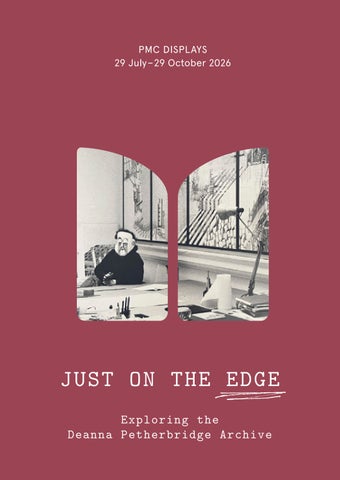
PMC DISPLAYS 29 July – 29 October 2026
JUST ON THE EDGE Exploring the Deanna Petherbridge Archive
Introduction
Item 40
Item 9
Deanna Petherbridge (1939 – 2024) was an accomplished, internationally recognised artist. Widely exhibited herself, she also curated major exhibitions and authored the highly influential publication The Primacy of Drawing (2010, rev. edn. 2026). As a visiting artist and academic, she undertook numerous residencies and lecture tours, including in Lahore, Melbourne and New Delhi. Her distinguished career included serving as Professor of Drawing at the Royal College of Art in London (1995 – 2001), and she was appointed a Commander of the British Empire (CBE) in 1996. By the later stages of her career, Petherbridge had achieved many of the conventional markers of success. She had served on boards and panels, judged competitions, held various academic positions, and seen her artwork acquired by numerous national museums and galleries. Yet this institutional and public recognition did not ever dispel her sense of remaining fundamentally adjacent to, rather than fully embedded within, the British art world. This display explores the origins and nature of her feeling that she was never fully accepted. Petherbridge’s sense of herself as an outsider cannot be attributed to any single cause. Rather, it was the cumulative effect of multiple intersecting factors: her commitment to drawing, her politically and intellectually engaged practice, her dual role as an artist and academic, her South African heritage, her temperament, her gender and her complex relationships with institutions. Taken together, these elements shaped a career in which she felt she remained persistently outside, rather than fully integrated within, the mainstream.
1
Key Events in the Life and Career of Deanna Petherbridge
Working on large canvases and sculptural reliefs 1967 Marriage with Abramovitz dissolved Leaves London and moves with Guy Petherbridge (b. 1944), to his house on the Greek island of Sikinos
1939 Deanna Sheila Schwartz is born in Pretoria, South Africa, on 11 February, the daughter of Harry Schwartz and Frieda Schwartz (née Goldberg)
Item 13
1956 – 1960 Studies Fine Art at the University of the Witwatersrand, Johannesburg, and tutors in History of Art c 1960 Marries Gerald Abramovitz (1928 – 2011), an architect and furniture designer 1960 Emigrates, with Abramovitz, to London; they travel by boat, spending several months visiting countries across North Africa and Europe 1961 – 1966 Lives in London, teaching art at the Carlyle School for Girls, Chelsea, alongside other jobs to help support herself and Abramovitz Awarded a place to study at the Royal College of Art, London, but is unable to afford the fees and take it up
2
Begins working on pen and ink drawings, developing the artistic style for which she has become best known 1971 Changes her name by deed pole to Deanna Sheila Petherbridge 1972 Returns, with Guy, to the United Kingdom for him to begin studying at the Conservation Institute at Camberwell College of Arts Attends weekly lectures at the Architectural Association and becomes friends with George Michell, Dalu Jones and others Commissioned to complete a liftshaft mural for a private residence in Hampstead 1973 Has her first solo exhibition, Deanna Petherbridge: Drawings, at Angela Flowers Gallery in London (12 March to 4 April)
Photograph of Petherbridge on Sikinos House lower terrace, with her cat Mukherjee, c. 1968, DSP/7/31
1975 Solo exhibition at the Whitechapel Art Gallery in London, The Iron Siege of Pavia and Other (9 Sep – 19 Oct 1975) 1978 Relationship with Guy Petherbridge ends Exhibits at the Hayward Annual Exhibition, London (23 August to 8 October) 1979 Visits India for the first time
3
1970s and 1980s Writes for various journals and publications – including Architectural Design, Art Monthly and the Financial Times – on topics such as vernacular architecture, public art, and patronage and sponsorship 1982 – 1983 Becomes Artist in Residence at Manchester City Art Gallery Holds her first retrospective exhibition, Deanna Petherbridge: Drawings 1968 – 82, at Manchester City Art Gallery (4 November to 4 December 1982) and Warwick Arts Trust, London (27 January to 26 February 1983) 1984 Designs sets and costumes for the ballet A Broken Set of Rules for the Royal Ballet, Covent Garden 1985 – 1986 Visits India under British Council sponsorship alongside undertaking a drawing residency (at Lalit Kala Studios, Calcutta (Kolkata)) and a lecture tour 1986 – 1987 Designs sets and costumes for the ballet One by Nine for Sadler’s Wells, Royal Ballet
4
1987 – 1988 Publishes Art for Architecture: A Handbook on Commissioning (London: Her Majesty’s Stationery Office, commissioned by the Department of the Environment)
Right: Item 34 Overleaf: Item 23
•
Undertakes a lecture tour of India, sponsored by the British Council, in association with her exhibition Temples & Tenements, held first at Fischer Fine Art, London (23 April to 22 May 1987) then tours India, visiting Madras (Chennai), Calcutta (Kolkata), Bombay (Mumbai) and Delhi (October 1987 to February 1988) 1988 – 1991 Commissioned by the Works of Art Committee of Birmingham City Council to undertake a large-scale mural spanning the foyers across all floors of the Symphony Hall, in the new International Convention Centre 1989 Commissioned by the Artistic Records Committee (ARC) of the Imperial War Museum to complete a mural, Boeing Assembly Plant (Seattle), for the new aerospace museum in Duxford Sponsored by the ARC to undertake a research tour of the United States to visit Boeing factories in Philadelphia and Seattle
1990 Exhibits Themata at Fischer Fine Art, London (17 January to 18 February) Designs sets and costumes for the ballet Bloodlines for the Royal Ballet, Covent Garden 1990 – 1992 Curates the touring exhibition The Primacy of Drawing for Regional Exhibitions, South Bank Centre, London 1994 Undertakes a lecture and exhibition tour to Singapore and Malaysia sponsored by the British Council
1995 – 2001 Serves as Professor of Drawing at the Royal College of Art, London 1996 Appointed a Commander of the British Empire (CBE) in the Queen’s Birthday Honours 1997 Launches the Centre for Drawing Research (PhD Drawing Programme) at the Royal College of Art 1997 – 1998 Curates the touring exhibition The Quick and the Dead: Artists and Anatomy for National Touring Exhibitions, Hayward Gallery, London
5
2000 Becomes a founding patron of the Campaign for Drawing 2000 – 2001 Serves as a Getty scholar at the Getty Research Institute, Los Angeles 2002 – 2006 Serves as Arnolfini Professor of Drawing at the Faculty of Art, Media and Design of the University of the West of England, Bristol
2003 Serves as Artist in Residence at Monash University, Melbourne (14 July to 25 October) 2005 Serves as a Visiting Professor and Artist in Residence at the Faculty of Art and Architecture, Beaconhouse National University, Lahore 2006 Gives a six-part lecture series, Drawing Towards Enquiry, at the
National Gallery, London, in association with Camberwell College of Arts and the University of the Arts, London (8 February to 15 March)
2016 – 2017 Retrospective exhibition Deanna Petherbridge at the Whitworth Art Gallery, University of Manchester (2 December 2016 to 4 June 2017)
2007 Undertakes a fellowship at the Yale Center for British Art, Yale University, New Haven
Places of Change & Destruction at Michael Richardson Contemporary Art, London (6 September to 14 October 2017)
Curates Drawing as Vital Practice, shown in association with the solo exhibition Petherbridge Alone with Soane, at Pitzhanger Manor Gallery & House, London
2018 Curates the exhibition Artists at Work for the Drawings Gallery at the Courtauld Institute, London
2007 – 2009 Serves as Professor of Drawing at the Faculty of Art, Architecture and Design of the University of Lincoln
2019 The Destruction of the City of Homs (2016) displayed in Walk through British Art: 60 Years at Tate Britain, London
2010 Publishes The Primacy of Drawing: Histories and Theories of Practice (New Haven and London: Yale University Press)
2022 Deanna Petherbridge: Drawing and the Domain of Politics at Michael Richardson Contemporary Art, London (25 February to 24 March)
2011 Serves as Artist in Residence at the National Art School, Sydney
The Deanna Petherbridge Archive is acquired by the Paul Mellon Centre
2013 – 2015 Curates Witches and Wicked Bodies for the National Galleries of Scotland, Edinburgh (27 July to 3 November 2013), and for the British Museum, London (25 September 2014 to 11 January 2015)
Item 9 6
2024 Deanna Petherbridge dies on 8 January aged 84 2026 A revised edition of The Primacy of Drawing is published, posthumously, by Thames and Hudson
7
The Archive
Item 4
The Deanna Petherbridge Archive is an exceptionally rich resource. It offers detailed insight into Petherbridge’s wide-ranging career as an artist, writer, curator and educationalist. It also reveals the varied initiatives with which she was involved, and her extensive travels. The core of the collection is a series of nearly 200 ‘Annual Files’, which record Petherbridge’s numerous professional outputs and diverse interests across decades of practice. Her use of these files for the arrangement of her records is unusual among art historians and other professionals working in the field of art history. As well as revealing the sheer volume of projects and initiatives in which she was simultaneously involved, they demonstrate that she did not compartmentalise her work from her personal life, or her artistic practice from her teaching and writing. They thus provide a particularly expansive account of her evolving concerns and interests. A key highlight of the collection is the extensive correspondence; including exchanges with artists, academics, and gallery and museum professionals worldwide, which reveal the international networks within which Petherbridge operated. This correspondence is of both a professional and a personal nature, often covering both within the same letter, demonstrating how private and public lives can become closely intertwined when someone is operating mostly in a freelance capacity and juggling multiple roles.
9
Furthermore, the archive is unusual in that Petherbridge kept copies of the letters she wrote and sent (traditionally, archives contain only letters that individuals have received and not the letters they have authored themselves). This contributes to the richness of the collection by showcasing complete conversations, and Petherbridge’s voice, opinions, humour and mannerisms shine through. Moreover, Petherbridge’s letters communicate her ideas and motivations notably clearly and vividly. They contain full, honest and directly articulated accounts of her thoughts on a wide range of subjects, including the motivations and inspirations behind her drawings. Beyond documenting Petherbridge’s life and career, the archive also serves as a valuable resource for researchers across multiple disciplines, working on various topics. These include studies of sponsorship and patronage in the arts, public art, vernacular architecture, travel, drawing practice and theory, freelance work and self-employment in artistic careers, the role of women in the arts, and the intersections between art and architecture. Furthermore, the archive demonstrates how Petherbridge contributed to scholarly and artistic discourse from the perspective of a practitioner, offering insights different from those of a purely academic scholar. Materials in the archive include correspondence, photographs, research notes, sketchbooks, visual items such as flyers and posters, and a wide range of ephemera.
Opposite: Item 5
10
The Legitimacy of Drawing
Item 30 (detail)
Over the course of her career, Deanna Petherbridge developed a highly distinctive practice centred on complex, monochromatic pen and ink drawings. Her sustained commitment to drawing – long regarded within the British art world as secondary to painting and other media – played a significant role in her feelings of marginalisation. Historically treated as a preparatory rather than a finished form in its own right, drawing was, in Petherbridge’s view, undervalued as a legitimate and relevant artistic medium. Petherbridge became increasingly committed to drawing – particularly pen and ink on paper – from the late 1960s onward. This was in part for practical reasons. As she explained in 2017 when interviewed by Studio International: ‘I discovered that pen and ink was more portable and have stuck with it ever since.’ However, it was also ideological, as she regarded drawing as a democratic and accessible form of artistic expression. In another piece published in 2017, in Interalia Magazine, she described it as ‘the poor person’s way of inventing’. Earlier in the 1960s, Petherbridge had worked primarily as a painter, influenced by surrealism and artists such as Francis Bacon, and engaging with anti-war imagery. During this period, she had also experimented with soft sculpture. However, extensive travel during the late 1960s and early 1970s prompted a significant shift in her practice. While living on the Greek island of Sikinos between 1967 and 1972, and travelling regularly to other places in Europe and North
13
Africa, such as Djerba, she increasingly turned to pen and ink drawing. In the 1970s, Petherbridge started to incorporate geometric elements of architecture into her drawings. Again shaped by her travels, these drawings focused on geometric patterns derived from Islamic art and vernacular architecture. Later, Hindu temples and historic sites across India became key inspirations. Over time, her work increasingly explored architectural themes, as well as her long-standing subject matter of war and conflict. Petherbridge’s unwavering commitment to drawing as a primary, self-sufficient medium reached beyond her own artistic practice. She curated national exhibitions that promoted drawing and spent decades researching the artistic medium, her work culminating in 2010 in the influential publication The Primacy of Drawing: Histories and Theories of Practice. In 1997, she launched the Centre for Drawing Research at the Royal College of Art in London – the first doctoral programme focused on the practice and theory of drawing in the United Kingdom. Correspondence in the archive illustrates the extent of Petherbridge’s advocacy. In a letter to Catherine Lampert, Director of the Whitechapel Gallery, dated 29 September 1989, she proposes an exhibition aimed at foregrounding drawing’s significance. She writes that, although drawing is ‘the primal medium… it is also the most undervalued and marginalised’. As well as being particularly interested in its use during moments of ‘stylistic or philosophical crisis in art’, she was also fascinated by its adoption by artists engaged with the politics of gender and race, considering it ‘less ideologically infected than other media’. On the same date, Petherbridge also wrote a letter (item 8) to Nicholas Serota, Director of the Tate Gallery, outlining plans for what she described as ‘a grand promotion of drawing, the need for a
14
Item 2
series of exhibitions, discussions, residencies, publications, films, whatever, to upgrade the status of drawing’. She observed the contradiction that, despite ‘the primacy of drawing, its universality, economy of means, intensity and ability to make clear the artist’s intentions’, the medium remained marginalised. Even institutional structures, such as the categorisation of separate museum departments of prints and drawings, contributed, in her view, to drawing’s diminished status. This correspondence also reveals Petherbridge’s strategic engagement with major British art institutions in the cause of advancing the medium of drawing, as well as her own position. In her letter to Serota, she acknowledges that her concern with the status of drawing is inseparable from her own artistic practice. Likewise, in her letter to Lampert, she describes her work – at the age of fifty – as both ‘a summation’ of years of practice and ‘an expansion of drawing-as-medium’. However, she also links her dedication to drawing to not being mainstream, describing herself ‘as an artist outside of a school or an ism or a trend, who has been developing a personal oeuvre slowly, in isolation, over a number of years’. Her concern with the marginal status of drawing, in many ways, reinforced her own position of operating, as she later wrote to one correspondent Jill Evans, ‘just on the edge’.
Opposite: Item 8 Above: D. Petherbridge, The Primacy of Drawing: An Artist's View (London: South Bank Centre, 1991), P 7 PETH
17
The Politics of Art
Item 9
While Petherbridge’s chosen artistic medium contributed to her feelings of marginalisation, the subjects she explored also played a significant role. As she reflected in Drawing as Metaphor, ‘The language of architecture has always served my drawing practice as a metaphorical means to deal with complex subject matter.’ For Petherbridge, art was never purely aesthetic. Rather, she believed that it could function as a meaningful form of critical engagement. This seriousness of intent may help to explain why Petherbridge often felt out of step with the British art world. Correspondence in the archive repeatedly reveals her sense of being misunderstood or insufficiently appreciated by UK audiences, whom she believed had little appetite for her politically engaged work. In a discussion with art historian Marco Livingstone in November 2015, she admitted: ‘I come back from trips where my reputation is high and I have been received with such respect and interest, so it’s excessively disheartening to be regarded as importunate at home.’ Livingstone responded sympathetically, suggesting: ‘People are perhaps sometimes intimidated by your seriousness and scholarship.’ He also observed that ‘the British tend to punish artists who are seen as intellectuals or known also as writers’. Livingstone’s response points to a key factor in Petherbridge’s feelings of marginalisation. Not only was her work politically charged but it also resisted the mainstream of more market-friendly and commercially successful movements within the contemporary British art scene.
19
Petherbridge herself articulated frustration with this tension particularly clearly in a letter to Catherine Whistler, Keeper of Western Art at the Ashmolean Museum, on 17 August 2018. Reflecting on her position in life, she wrote: ‘I will be 80 next year and, inevitably, I’m thinking about the future, including complicated reflections on my present standing as a “senior” women artist and my posthumous reputation.’ She went on to describe the work she was then making as ‘large multi-panelled works about wars, migrancy and political instability: the painful and significant issues that are threatening our world today’. Yet, she noted, she was also acutely aware that such material fell outside the interests of the commercial gallery system: ‘This is not the work that interests commercial galleries – especially as my means, as you know, are those of drawing involving complex subject-matter, metaphor, issues of representation and deliberate skills.’ She contrasted her work with more popular forms of contemporary practice, insisting: ‘These are not “conceptual” works in any sense: they do not employ photography, digital imagery, found imagery, film, video or installation. They are two-dimensional works that update the long historical traditions of works on paper that I have been researching for years.’ People within Petherbridge’s circle recognised and engaged with her sense of being underappreciated. In an email dated 18 September 2019, Henry Noltie, botanist at the Royal Botanic Garden Edinburgh, responded to her frustration with evident respect and sympathy. He agreed with her critique of what he called ‘the banality of the snowball-melting sort of contemporary art’, arguing that her own work represents ‘the polar opposite, with its richness of ideas and outstanding technical control’. For Noltie, the complexity of Petherbridge’s drawings was not a weakness, however, but a necessity: ‘I think one DOES need complexity to represent the struggles we face – in art as much as in life.’ His comments underscore the degree to which
20
Petherbridge’s strong artistic integrity demanded a level of intellectual and emotional engagement that could sit uneasily within a commercial environment. Underlying many of Petherbridge’s reflections on her position within the art world was a broader concern with what she perceived to be declining interest in quality and depth. She was deeply sceptical of what she saw as a growing culture of superficiality within contemporary art. This conviction appears repeatedly in her correspondence. Writing to artist Paul Neagu on 2 June 1987, for example, she sympathised with his disappointment at the reception of his recent exhibition, remarking: ‘I’m convinced that this country [the United Kingdom] is only interested in frivolous art and takes pains to put down anything that is serious. Your work is too intense and too real!’ At the same time, Petherbridge’s sense of marginalisation was also closely bound up with questions of identity. Extensive correspondence with Caro Howell (item 11) over Petherbridge’s corrections to her entry in the Dictionary of Women Artists reveals her resistance to being defined by her origins. She objected to the description ‘South African-born draughtswoman’, arguing that, after 36 years in Britain, this was not ‘the most significant fact’ about her. In a letter to Delia Gaze, overall editor of the Dictionary, Howell explained that Petherbridge ‘profoundly resents being labelled’ a South African artist, feeling that neither her life nor her practice bore any relation to a country she had ‘consciously turned her back on over thirty years ago’, and gave the opinion that such an association would be ‘extremely misleading’. However, despite Petherbridge not wanting to be defined by her nationality, it was arguably her experiences of growing up in South Africa during apartheid that shaped her political consciousness. She had been deeply affected by the injustices of the apartheid regime, particularly through her connection with Abramovitz’s assistant, John Mokone, a member
21
of the Pan Africanist Congress who had been imprisoned following the Rivonia Trial. She helped to secure Mokone’s release, but witnessing the realities of his imprisonment, together with the broader brutality of apartheid, solidified the couple’s decision to leave South Africa. Petherbridge later associated this move with a lingering sense of guilt, yet, despite this, the injustice and human suffering she saw informed much of her later understanding. Petherbridge’s engagement with global politics was lifelong and is a common theme throughout her personal correspondence. For example, in a letter to her sister, Pam Sacks, written while living on Sikinos, she reflects on the Greek junta government. Meanwhile, a letter sent to her friend the writer Sally Backhouse includes discussion of Israel and the political climate in 1970s England, while correspondence with her friend the lawyer Iris Avidi discusses the Troubles in Northern Ireland. These political concerns also consistently shaped Petherbridge’s career decisions. During November and December 2005, she travelled to Pakistan as part of a British Council-sponsored residency, serving as a Visiting Professor and Artist in Residence at Beaconhouse National University in Lahore. Although she returned to the United Kingdom earlier than planned, citing difficulties with pollution and the social conditions she encountered, the experience nevertheless proved generative. Writing to Pradeep Sachdeva on 18 October 2005, she described how her time in Pakistan had inspired a new artistic project focused on the themes of ‘displacement and replacement’.
Opposite: Letter from Petherbridge to Catherine Whistler, Keeper of Western Art, Ashmolean Museum, concerning Petherbridge's reflections on her career, and posthumous reputation, 17 August 2018, DSP/1/180
22
Institutional Reluctance
Item 24
After relocating to London in 1960, Petherbridge struggled to feel fully at home within the cultural atmosphere of the ‘Swinging Sixties’. She found it difficult to adjust to what she perceived as the frivolous and commercialised mood of 1960s London from the politically charged environment of apartheid South Africa. Petherbridge certainly quickly became absorbed in an active social and professional life, engaged in music as well as artistic practice and art historical study. However, she also had to work through a number of key disadvantages. Although she was awarded a place to study at the Royal College of Art, she could not afford to take up the opportunity. She thus lacked the crucial institutional support, professional networks and peer structures that often help to sustain burgeoning artistic careers. Petherbridge thus felt herself to be in many ways at the margins of the British art world and, as such, she developed her early practice independently. Perhaps in response to the marked lack of support experienced at the beginning of her career, Petherbridge made questions of patronage and sponsorship a sustained focus of her writing. Her articles for Art Monthly (see item 16) throughout the 1980s established her as a visible and informed commentator on the subject. Letters in the archive reveal how she increasingly became someone to whom others turned for practical advice. Correspondence with Richard Stone (item 15), for example, concerning
25
grants and funding streams, indicates that she had become an important resource for artists attempting to navigate often opaque systems of support. Petherbridge was sustainedly preoccupied with helping to create pathways and to demystify the sector. Petherbridge’s concern with access, and funding, also informed her commitment to public art. Her contributions to Art within Reach (1984), a survey of contemporary public art in Britain, and her authorship of Art for Architecture: A Handbook on Commissioning (1987–88), show her not simply advocating for art in public places but also engaging deeply with the practical and political questions of who commissions art, for whom and under what conditions. Alongside her extensive writings on the subject, she also entered public art competitions, including in 1977 Art into Landscape II (item 29), which called for designs for landscape improvement projects across various local authorities in Britain, and a competition to design the escalator shafts at Holborn Station in 1980. At the same time, even as Petherbridge critiqued the art world, she gradually became an active participant within the establishment. She was involved in the Percentage for Art Steering Group and the Arts Council Art Panel (1987–90), and became chair of the Special Projects Committee at the Arts Council (1989–90). As well as taking on the prestigious role of Professor of Drawing at the Royal College of Art, and working as an external examiner for a number of art schools, she also became a founding patron of the Campaign for Drawing (2000), a charity promoting drawing and visual literacy. All this indicates the extent to which Petherbridge came to occupy an influential position within British art institutions, becoming a respected presence within the mechanisms through which artists were taught, validated and funded. But she occupied that position of power and influence with a deep understanding of the experiences of being disadvantaged and marginalised.
26
Item 15
Even then, growing official recognition did not dispel Petherbridge’s sense that she remained on the margins of the establishment, rather than fully within it. This tension is particularly resonant in relation to her work as Professor of Drawing at the Royal College of Art – a role that appears to have brought with it both status and discomfort. In her retrospective account (item 25) of the self-portrait Hole in the Head (item 24), written in 2018 to accompany the work’s inclusion in the exhibition CLOSE: Drawn Portraits, Petherbridge describes the drawing as an intensely personal expression of anger, alienation and silencing, produced working in what she called ‘the noxious environment of a very sexist educational establishment’. Petherbridge’s ambivalence towards institutional recognition is further underscored by correspondence relating to her proposed election to the Royal Academy. In September 2013, artist Anne Desmet wrote to inform Petherbridge that she had put her name forward for election as a Royal Academician, noting that she had ‘long admired [Petherbridge’s] work… and marvel both at your artistic vision and your technical skill’. Indeed, this was not the first time she had been nominated. Years earlier, Petherbridge’s friend and fellow artist Michael Sandle had also proposed her, but without success. As part of her reply asking Desmet to withdraw her name from the election, Petherbridge reflected on this earlier rejection: ‘Michael’s trial with my name was so unproductive, that I realised that I have more enemies than friends amongst RAs, most of whom I’ve known forever in various capacities.’ She went on to speculate that ‘there might be a cavilling spirit amongst (male?) RAs’ before adding that ‘a recent RA woman that I used to know well, would most definitely black-ball me!’ Petherbridge’s sense of not quite fitting in extended beyond her relationship to artistic institutions. She firmly held the conviction that artistic practice and scholarly research were mutually
28
reinforcing rather than separate pursuits. She believed that a serious artist required a thorough knowledge of art history while an art historian’s scholarship would be improved by first-hand experience of making art. This commitment to the bridging of artistic practice and scholarship ran throughout her career. As she placed great importance on quality and depth in her artwork, fighting the superficiality of which she deeply disapproved, so she undertook extensive research for her publications. During her work on The Primacy of Drawing, she pursued numerous obscure references with remarkable persistence, to be sure that her arguments would convince the academic community. However, this interdisciplinary position often left her feeling caught between worlds, feeling fully accepted neither by the artistic community because she was also an academic, nor by academics because she remained, first and foremost, a practising artist.
Item 26
29
Beyond Labels: An artist not a women artist
Item 20
Questions of gender form another crucial dimension of Petherbridge’s position within the art world. She consistently rejected the label of ‘woman artist’, insisting instead on being recognised simply as an artist. She did not deny the significance of gender but resisted its totalisation. In 1978, Petherbridge took part in the Hayward Annual Exhibition, a group exhibition which included male and female artists, but was primarily intended to foreground the work of women and to address ongoing gender imbalance in British art. The exhibition was particularly conceived in response to protests over the underrepresentation of women in the 1975 Arts Council exhibition Condition of Sculpture. As well as showing in the Hayward Annual Exhibition, Petherbridge was invited to take part in an accompanying public panel titled ‘Women’s Art and the Woman Artist’ alongside Mary Kelly, Liliane Lijn and Griselda Pollock. Despite her contribution to a show designed to promote women’s art, Petherbridge rebuffed the idea that being a woman was an essential part of her artistic identity during the panel. When preparing for this discussion, Petherbridge articulated her view with particular clarity, exploring the tensions and complexities experienced by women artists navigating the art world and the feminist movement in the 1970s. She wrote (see item 19): ‘I believe myself to be an Artist, and not a woman artist. Being a woman is obviously not irrelevant, and it plays a very great part in terms of opportunities and
31
discrimination – but with regard to me being an artist, that is the primary consideration, and my womanness is only one of a whole set of variables… which shape my creativity.’ She went on to question attempts to define artistic qualities in gendered terms, asking who could meaningfully ascribe ‘imagination, creativity, sensibility, subtlety’ to either men or women. The structural inequality noted here was also a subject of Petherbridge’s writing on art education and institutional frameworks. In correspondence with Tess Jaray, between 9 December 1981 and 5 January 1982, regarding a draft proposal to the Council for National Academic Awards, she addressed the underrepresentation of women teaching on Fine Art courses. She began bluntly: ‘The need to put forward this proposal derives from the undeniable fact that women are very unfairly represented on the teaching staff of Art colleges … in spite of the fact that well over 50% of students are female.’ Petherbridge’s diagnosis of the problem is especially striking. She does not frame it primarily as the result of deliberate discrimination but rather as the product of what she calls a ‘historically ratified mechanism’. As she explains, ‘Most heads of department would genuinely maintain that in all cases they have chosen the best applicant for the job.’ However, this claim obscures the fact that women have, ‘as a matter of course… been given less chance to exhibit or become well-known’. The result is not only reduced visibility but also, as she notes, diminished confidence in ‘their art practice and their ability to promote it’. She argues that the very mechanisms through which artistic authority is recognised – exhibitions, reputation, confidence, public visibility and professional validation – have been historically shaped by male privilege, rather than innate male artistic superiority. Similarly, when working on her revised edition of The Primacy of Drawing (published posthumously
32
in 2026), Petherbridge refused to include a large number of drawings created by women (or of women) in the historically framed sections, because she did not want to suggest that, somehow, there had been gender equality in the field. She was emphatically not interested in artificially balancing the historical record and thereby making the canon appear more evenly distributed than it actually was. Instead, through the gaps in the publication, she sought to evidence women’s historical absence. Petherbridge also tackled assumptions about gendered practice. In correspondence with Lindsay Harris (item 21), a student, she challenged the idea that geometric abstraction was inherently masculine, questioning why such visual languages should be culturally coded in gendered terms: ‘Why geometry should belong exclusively to men and not to women is beyond me…’ She thus refutes the notion that women’s art should look any certain way and objects to the belief that artistic forms carry fixed gendered identities. As well as refusing to conform to patriarchal norms, Petherbridge was also resistant to feminist expectations. While she recognised the practical and political importance of feminism in expanding opportunities and reshaping institutions, she was also cautious about defining artistic identity solely through the lens of gender. In 1989, she authored an article for Art Monthly titled ‘Feminisme! C’est Moi’ in which she discussed her work in relation to feminist practice. She explained that she could see ‘the need for a revisionist view of art history’ and that she respected ‘women artists committed to specifically feminist practice’. However, she noted that her ‘own practice as an artist has developed in a very specific way and is resistant to certain kinds of appropriation’.
33
Just on the Edge
Item 36
Petherbridge appears never to have felt fully recognised or respected within the British art world to the extent she believed she deserved. As this display has explored, that perception was shaped by a range of intersecting factors. However, material in the archive consistently complicates this view, revealing an artist and scholar who was in fact widely respected, intellectually influential and deeply involved in shaping critical discourse. Petherbridge’s career therefore suggests a much more complex dynamic than simple marginalisation: even as institutional recognition increased, her identification with a position at the margins persisted. Petherbridge reinforced this impression in her oral history (C466/152, Deanna Petherbridge, Artists Lives, held at the British Library and recorded in 2003), in which she described herself as lacking ‘political nous’. She presented herself as unwilling or unable to be manipulated, and as conducting herself with a blunt South African directness that did not easily conform to the codes of the British art world. Rather than strategic self-positioning, institutional diplomacy or a desire for commercial popularity, what appears to have driven Petherbridge – and what this display showcases – was a combination of artistic integrity, political consciousness and a strong sense of self. This understanding is perhaps most clearly articulated in Petherbridge’s remark to Jill Evans in May 2017 that ‘it is a positive thing to always have been just on the edge and never (thank goodness) in the mainstream’. This remark suggests that she came to understand her marginalisation not so much as a disadvantage but rather as a position from which she could maintain her critical independence.
35
List of items
The Legitimacy of Drawing Item 1 Photograph of Petherbridge’s work ‘anti-Vietnam war’, stitched and glued canvas collage with expanded fibre infill, 1965 AR: DSP/7/1 Item 2 Two photographs of Petherbridge’s soft sculpture in her Sikinos studio courtyard, c.1967 AR: DSP/7/1 Item 3 Photograph of Deanna & Deux Chevaux Libyan Desert, 1968 AR: DSP/7/31 Item 4 Petherbridge’s sketchbook Visit to India 1979, 1st Indian Visit Notebook, Jooprum, Agra, Sanchi, Rajastan, 1979 AR: DSP/5/6
36
The Politics of Art
Item 5 Petherbridge’s sketchbook, Sketches for Cities, Notes on Fortifications, open at a page featuring architectural sketches, c.1970s AR: DSP/5/7 Item 6 Invitation card for the preview of the exhibition The Primacy of Drawing: An Artist’s View, Bristol Museum and Art Gallery, 1991 AR: DSP/1/102
5 April – 9 September 1996 AR: DSP/1/129
Item 9 Unpublished draft article written by Petherbridge for Tate Etc., titled ‘Destruction and Graphic Strategies of Excess’, 4 July 2017 AR: DSP/1/180
Item 12 Photograph of Petherbridge with her two sisters, Claire and Pamela, on the beach in South Africa, 1940 AR: DSP/7/31
Item 10 Letter from Petherbridge to her friend Sally Backhouse discussing travel, her opinions on Israel and other matters, 6 January 1971 AR: DSP/4/3
Item 13 Photograph of Petherbridge at approximately eight years old, taken in Pretoria, 1947 AR: DSP/7/31 © David Cross
Item 11 Correspondence between Petherbridge and Caro Howell concerning changes to Petherbridge’s entry in the Dictionary of Women Artists and her preference not to be referred to as a South African artist,
Item 14 Photograph of Petherbridge (at the back of the photograph) in a hat costume for a student freshers’ parade, University of the Witwatersrand, Johannesburg, 1956 AR: DSP/7/31
Item 7 Flyer advertising the Centre for Drawing Research at the Royal College of Art, London, 1997 AR: DSP/3/5 Item 8 Letter from Petherbridge to Nicholas Serota, Director of the Tate Gallery, concerning her proposal for ‘a grand promotion of drawing’, 29 September 1989 AR: DSP/1/89
Item 39
37
Institutional Reluctance Item 15 Correspondence between Petherbridge and the artist Richard Stone concerning sources of grants and funding streams, 5 – 15 September 1980 AR: DSP/1/19 Item 16 Draft article written for Art Monthly titled ‘Patronage and Sponsorship: The PS at the bottom of the art balance sheet’, c.1980 AR: DSP/1/18 Item 17 Photograph of Petherbridge receiving her Commander of the British Empire (CBE) at Buckingham Palace, 1996 AR: DSP/7/32 Item 18 Selection of letters that Petherbridge received in 1991 relating to her work on steering groups, committees and judging panels, and invitations to contribute to publications, workshops and conferences, 1991 AR: DSP/1/98
38
Beyond Labels: An Artist, Not a Woman Artist Item 19 Petherbridge’s notes for a public panel associated with the 1978 Hayward Annual Exhibition titled ‘Women’s Art and the Woman Artist’, September 1978 AR: DSP/1/10 Item 20 Hayward Annual Exhibition flyer, 1978 AR: DSP/1/10 Item 21 Letter from Petherbridge to student Lindsay Harris discussing Harris’s research into geometry in art, with particular reference to its use by women artists, 19 October 1994 AR: DSP/1/117 Item 22 Photograph of Petherbridge’s work Impious Diagram of the City of Ecbatana (1972), from her Cucurbitas Series, c.1970s AR: DSP/7/7 Item 23 Photograph of Petherbridge, c.2010s AR: DSP/7/32
Wall Item 24 Self-Portrait (Hole in the Head), 2000 – 2001 Pen, ink and wash on paper Kindly lent by the Katrin Bellinger Collection Item 25 Petherbridge’s description of her selfportrait Hole in the Head, written for its inclusion in the catalogue of the exhibition CLOSE: Drawn Portraits, held at the Drawing Room, London, 3 September 2018 AR: DSP/1/180 Item 26 Britain 1966: The Establishment Sleeps, 1966 Ink, chalk and gouache on paper Kindly lent by the Artistic Estate of Deanna Petherbridge Item 27 Unknown Design, c.1980s Gouache on paper Kindly lent by the Artistic Estate of Deanna Petherbridge Item 28 Untitled, 2002 Black and sepia ink and wash on oatmeal paper Kindly lent by the Artistic Estate of Deanna Petherbridge
Item 29 Play Cones (for the exhibition Art into Landscape II), 1977 Ink on paper Kindly lent by the Artistic Estate of Deanna Petherbridge Item 30 Untitled (unfinished), c. early 1970s Pen and ink on paper Kindly lent by the Artistic Estate of Deanna Petherbridge Item 31 Untitled, c.1989 – 91 Coloured ink and wash on paper Kindly lent by the Artistic Estate of Deanna Petherbridge Item 32 Costume Study for ‘One by Nine’, 1987 Pen and ink and coloured wash on paper Kindly lent by the Artistic Estate of Deanna Petherbridge Item 33 Letter from Petherbridge to the author Sidney Jowers discussing the inspiration for her costume and set designs for the ballet One by Nine, 30 January 1989 AR: DSP/1/89
39
Item 34 Critic’s Mask, 1982 Pen and ink on paper with elastic Kindly lent by the Artistic Estate of Deanna Petherbridge
Item 39 Study for The Iron Siege of Pavia, 1974 Pen and ink on paper Kindly lent by the Artistic Estate of Deanna Petherbridge
Item 35 Letter from Petherbridge to Graphic Design student Janette Ralph discussing the inspiration for her masks exhibited as part of a group exhibition at the Royal Exchange Gallery, Manchester, 23 February 1983 AR: DSP/1/42
Item 40 Photograph of Petherbridge working on The Iron Siege of Pavia in her studio in Radnor, Surrey, 1975 AR: DSP/7/31
Item 36 Photograph of Petherbridge wearing her Critic’s Mask in front of her The Concrete Armada; taken in her studio while she was Manchester City Art Gallery’s Artist in Residence, 1982 AR: DSP/7/32 © Tim Farrington Item 37 In the Shadow of the Mandra: Terraces, Sikinos, c.1968 Pen and ink on paper Kindly lent by the Artistic Estate of Deanna Petherbridge Item 38 Audio extract: Deanna Petherbridge interviewed by Linda Sandino and Cathy Courtney, Artists' Lives, 2002 – 18, catalogue reference C466/152. © British Library Board.
40
Item 41 Draft article written for Architectural Design titled ‘Some thoughts on battlepieces’, 1975 AR: DSP/1/10
Acknowledgements The Paul Mellon Centre would like to extend special thanks to Gillian Lazar and Steve Sacks for their continued support with all activities surrounding the Deanna Petherbridge Archive, in particular generously loaning drawings for this display. Thanks also go to the Katrin Bellinger Collection for loaning the drawing Hole in the Head. The display was curated by Hannah Jones, Deanna Petherbridge Archive Project Cataloguer, who also authored all texts and the accompanying brochure. The author would like to thank Charlotte Brunskill, Niki Kalli, Maisoon Rehani and Kate Retford, for their help in preparing this display.
About the Deanna Petherbridge Archive The Deanna Petherbridge Archive is in the process of being catalogued and is open to all. If you are interested in consulting material from the collection, please visit our website for more information or contact collections@paul-melloncentre.ac.uk. Associated event Drawing as Knowledge: Practice, Theory and History, Paul Mellon Centre and the Warburg Institute, London, 16 – 17 September 2026
The text was copyedited by Hazel Bird. The display and booklet were designed by Luke Gould.
The Centre is confident that it has carried out due diligence in its use of copyrighted material as required by the UK Copyright, Designs and Patents Act 1988 (as amended). If you have any queries relating to the Centre’s use of intellectual property, please contact: copyright@paul-mellon-centre.ac.uk
For more information about our research collections see our website: www.paul-mellon-centre.ac.uk. Alternatively contact us by email at collections@paul-mellon-centre.ac.uk or phone 020 7580 0311