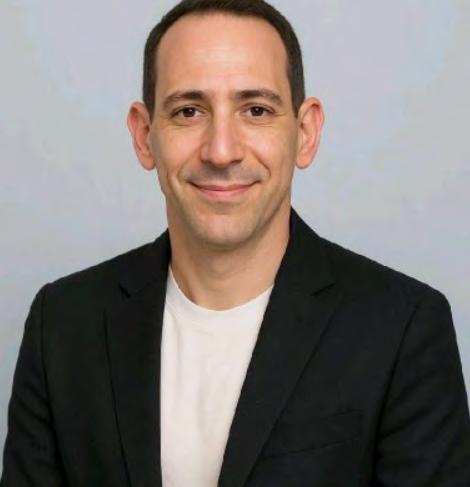
GC speaks exclusively to Roxane El Mawla Group CEO of UEXO
Note from the editor
View from the top. 03
Niki Saki 04-09
Roxane El Mawla 10-13
Benjamin Moore 14-15 BeTuvalu
Epico Finance
Vykintas Barakauskas 16-20
24-25 Kent Riboe
Card Nest LLC
Dr Eric Pope Ackaah 26-31
Varda Bachrach 32-35 Charge After
HFQ Fund Management S.a.r.l
Mindaugas Suklevicius 36-39
Pedro Coelho 40-43
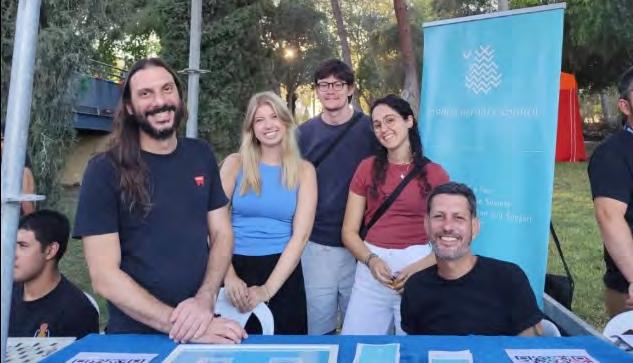
Cyprus Refugee Council 70-71
GC: GET AWAY
Casale Panayiotis 72-75
GC:BRAIN
GC:SPORTS
ZK Sports 80-85
VIEW FROM THE TOP
There is something about a summer edition that invites a slightly different pace.
Not necessarily slower in ambition, but perhaps a little more reflective. A little more willing to pause, look around, and appreciate the people, ideas and businesses shaping the industries and communities we spend so much of our time writing about.
This latest edition of Game Changers Magazine does exactly that.
On our front cover, we are delighted to feature Roxanne El Mawla of UEXO, whose story reflects the kind of leadership, energy and perspective we always enjoy bringing to our readers. Cover features are never simply about profile pieces for us. They are about highlighting people who are building, adapting, creating and pushing forward in their own way. Roxanne is a fitting face for this issue and we are pleased to have her leading our summer edition.
Inside the magazine, we have another broad mix of personalities, businesses and ideas from across finance, business, lifestyle and luxury. We are proud to include features and contributions from Niki Saki of X Chase, Benjamin Moore of Bet Tuvalu, Vykintas Barakauskas of Epico Finance, The Banking Expert, Kent Riboe, Dr Eric Pope Ackaah of Card Nest LLC, Varda Bachrach of Charge After, Mindaugas Suklevicius of HF Quarters, Pedro Coelho of Your Mind Media, and Stacy Thomson of REDDI.
Alongside these interviews and business features, we also continue to build out the magazine’s lifestyle and editorial identity with this issue’s fashion selections, including GC: Femme with Eres and GC: Homme with Orlebar Brown. One of the things I have always enjoyed about Game Changers is that it has never been purely about one sector or one type of success. It is about the broader world around ambitious people — the business, certainly, but also the style, the thinking, the health, the travel, the culture and the quieter details that shape how people live.
That mix matters.
sit next to a wellness piece. A conversation about growth, payments, licensing, media or branding can sit alongside something a little more personal or reflective. Real life is not lived in neat categories, and I don’t think magazines should be either.
As this is our summer edition, it is also worth mentioning that the next issue may take a little longer than usual to arrive. Like many of our readers, contributors and partners, we will be taking a short break over the summer before returning refreshed for the editions ahead. Sometimes the best way to keep building something meaningful is to give it — and yourself — a little breathing space.
In a world where so much content is built for speed, outrage or algorithms, I still believe there is value in thoughtful magazines that allow different voices to sit together in the same place. A banking story can sit next to a fashion feature. A founder interview can
For now, I hope you enjoy this edition as much as we enjoyed putting it together.
Thank you, as always, for reading Game Changers Magazine, for supporting the people within its pages, and for continuing to be part of what we are building.
Enjoy the issue.
Paul Orford
EDITOR-IN-CHIEF
X-Chase
NIKI SAKI
Introduction / Opening
Q Your career has evolved from trading to building institutional-grade financial systems. How would you describe that journey in your own words, and what have been the defining moments along the way?
My journey started in the financial markets as a trader. In the early years, I was deeply involved in technical and fundamental analysis, market psychology, liquidity behavior, and understanding how capital moves through global markets.
Over time, I became increasingly interested not only in trading itself, but in the infrastructure behind the financial industry. That curiosity led me into the brokerage industry, where I worked closely with backend systems, liquidity operations, risk management, financial operations, and institutional structures.
Later, I built my own brokerage and hedge fund structures, which gave me firsthand experience in how complex it truly is to build and manage financial organizations at scale.
One of the defining moments in my journey was realizing that many investors and institutions wanted to enter the financial industry but lacked the infrastructure, systems, and operational expertise required to do so properly.
That realization became the foundation for X-Chase.
I founded X-Chase to become a company capable of designing, launching, and managing institutionalgrade financial systems for banks, brokerages, asset managers, crypto exchanges, family offices, and other financial organizations.
Today, my focus is no longer only on markets themselves, but on building the ecosystems that power them.
X-Chase
Q X-Chase is positioned as more than a traditional financial company. What was the original vision behind it, and how has that vision evolved over time?
From the beginning, the vision behind X-Chase was never to become just another brokerage or financial services company.
The original idea was to build an institutional ecosystem company capable of integrating technology, liquidity, operations, compliance, treasury, and financial infrastructure into one unified architecture.
As the company evolved, the vision became much larger.
Today, X-Chase is focused on helping organizations build complete financial ecosystems — including banks, brokerages, fintech infrastructures, crypto exchanges, family offices, and institutional trading environments.
We are building infrastructure rather than simply offering isolated services.
The evolution of the company came from understanding that the future of finance belongs to interconnected ecosystems, not standalone businesses.
Q As you expand into global markets, including the US, what strategic considerations are most important when entering a new financial ecosystem?
Every market has its own regulatory culture, banking structure, operational environment, and investor psychology.
When entering a new ecosystem, the first priority is understanding the institutional structure of that region — not only the regulations, but also how trust, liquidity, banking access, and business relationships function internally.
The second critical factor is partnerships.
Financial infrastructure is impossible to scale globally without strong institutional partners, legal advisors, banking relationships, technology providers, and local strategic networks.
Another major consideration is adaptability.
You cannot copy and paste one model into every jurisdiction. The structure must be localized while still maintaining global operational standards.
In markets like the US, credibility, compliance, operational transparency, and institutional positioning become extremely important.
Q In a highly competitive and regulated industry, how do you differentiate X-Chase from other firms operating in the same space?
Most companies specialize in only one layer of the industry.
Some focus only on technology. Others provide liquidity, legal services, compliance, operations, or marketing individually.
What differentiates X-Chase is that we understand how to architect the entire ecosystem as one integrated structure.
We approach financial institutions as interconnected systems rather than isolated departments.
Another important difference is that our perspective comes from real operational experience inside financial institutions themselves — not only consulting theory.
We build structures designed to operate in real-world institutional environments.
Leadership & Personal Growth
Q You’ve spoken about the challenges that come with growth and self-awareness. How has your perspective on leadership evolved over time?
In the beginning, I believed leadership was mostly about intelligence, decision-making, and execution.
Over time, I realized leadership is much more connected to emotional control, self-awareness, adaptability, and the ability to build strong people around you.
As organizations grow, complexity increases dramatically. You begin dealing not only with business challenges, but also with people, pressure, uncertainty, responsibility, and long-term consequences.
One of the biggest lessons for me has been understanding that sustainable leadership is not about controlling everything personally. It is about creating systems, empowering capable individuals, and building a structure that can function beyond the founder itself.
Leadership also requires continuous evolution. The version of yourself that builds a company is not necessarily the same version capable of scaling it globally.
Q What have been some of the most difficult lessons you’ve had to learn as a founder and leader?
One of the hardest lessons was understanding that not every opportunity is the right opportunity.
In fast-moving industries, it is easy to become distracted by short-term growth, partnerships, or rapid expansion. But long-term sustainability requires discipline and strategic patience.
Another difficult lesson was learning how important people are.
A strong vision alone is not enough. The quality of the people around you ultimately determines how far an organization can grow.
I also learned that growth comes with isolation. As responsibilities increase, decision-making becomes heavier, and fewer people truly understand the pressure behind those decisions.
At the same time, those experiences force you to become mentally stronger and more disciplined.
Q How do you maintain clarity and focus while operating at a high level in a fast-moving industry?
For me, clarity comes from structure.
When you operate in industries like finance, fintech, and institutional infrastructure, there is constant noise, rapid change, and endless opportunities competing for your attention.
Without clear systems and priorities, it becomes very easy to lose direction.
I focus heavily on long-term vision rather than shortterm emotional reactions.
I also believe mental discipline is critical. Highlevel decision-making requires emotional stability, strategic thinking, and the ability to remain calm under pressure.
Another important factor is surrounding yourself with highly experienced people who can challenge your perspective and contribute to better decisions.
From Trading to Strategy & The Future of Finance
Q How did your early experience in trading shape the way you think about risk, opportunity, and decision-making today?
Trading teaches you very quickly that emotions can destroy decision-making.
It taught me discipline, patience, risk management, and the importance of thinking probabilistically rather than emotionally.
One of the biggest lessons from trading is understanding that survival matters more than shortterm wins.
That mindset later became extremely valuable in business and institutional strategy.
Today, when I evaluate opportunities, partnerships, or expansion plans, I think carefully about downside risk, operational sustainability, and long-term positioning rather than only potential upside.
Q Do you still approach business decisions with a trader’s mindset, or has your perspective shifted as you’ve moved into building infrastructure?
Some elements of the trader mindset still remain — especially around risk management, timing, discipline, and strategic positioning.
However, building infrastructure requires a much broader perspective.
Trading is often focused on individual decisions and shorter time horizons, while institutional infrastructure requires long-term ecosystem thinking.
Today, I think more like a systems architect than a trader.
I focus on scalability, operational sustainability, institutional relationships, governance structures, and how different layers of an organization interact together over many years.
Q Looking ahead, what do you believe are the most significant shifts that will shape the future of financial services?
I believe the future of finance will be shaped by three major forces: infrastructure digitization, institutional convergence, and borderless financial ecosystems.
Traditional divisions between banking, fintech, brokerage, payments, digital assets, and asset management are gradually disappearing.
The next generation of financial institutions will operate as integrated ecosystems rather than isolated companies.
Artificial intelligence, automation, tokenization, digital assets, embedded finance, and real-time global financial infrastructure will also transform how financial services are delivered.
At the same time, trust, compliance, and institutional credibility will become even more important as the industry becomes more technologically advanced.
Q Where do you see the greatest opportunities right now — whether in infrastructure, technology, or market positioning?
I believe the greatest opportunities currently exist in institutional infrastructure and ecosystem integration.
Many emerging markets still lack sophisticated financial infrastructure despite having massive demand and economic potential.
There is also enormous opportunity in connecting traditional finance with modern financial technologies.
Companies capable of bridging banking, fintech, liquidity infrastructure, digital assets, and institutional operations together will have significant strategic advantages in the coming years.
Another major opportunity is building financial systems specifically designed for HNWI, UHNWI, family offices, and institutional capital flows.
Q Do you believe traditional financial institutions are equipped to adapt to these changes, or will we see a new wave of players redefine the spac
I believe both will happen simultaneously.
Some traditional financial institutions will successfully adapt because they already possess trust, capital, regulatory positioning, and institutional relationships.
However, many legacy institutions struggle with outdated systems, slow operational structures, and resistance to innovation.
At the same time, a new generation of companies is emerging — organizations that are technology-driven, infrastructure-focused, globally connected, and designed for modern financial ecosystems from the beginning.
The future will likely belong to hybrid institutions: organizations capable of combining institutional credibility with technological agility and ecosystemlevel thinking.
That is the direction we are moving toward with X-Chase.
ROXANE EL MAWLA
From Sales to CEO: Building a Global Financial Brand
Q You have spent more than a decade in financial services and international business. What first attracted you to this industry?
Financial services appealed to me because it sits at the intersection of strategy, technology and human behaviour. Markets are constantly evolving, and no two days are ever the same. Early in my career, I was fascinated by how financial products can empower individuals and businesses to achieve their goals. That fascination evolved into a passion for building organisations that create real value for clients while navigating an increasingly complex global landscape.
Q As Group CEO of UEXO, what is your vision for the company over the next five years?
Our vision is to establish UEXO as a globally recognised financial services brand known for innovation, transparency and client-centricity. We are focused on expanding our international footprint, investing in technology, and developing solutions that make financial markets more accessible and efficient. At the same time, we remain committed to maintaining the highest standards of governance and trust, which are essential for long-term growth.
Q Leadership often comes with difficult decisions. What has been one of the biggest challenges you've faced as a CEO?
Balancing short-term market realities with long-term strategic objectives. Markets can be unpredictable, and leaders must remain agile while staying committed to their vision. The key is to make decisions based on data, maintain open communication with your team, and never lose sight of your core values.
Q The financial industry remains largely maledominated. What has your experience been as a female leader?
I've always believed that competence, resilience and results speak louder than stereotypes. While challenges exist, they also create opportunities to demonstrate leadership and drive change. I hope that by succeeding in this industry, I can inspire more women to pursue leadership roles in finance and realise that there are no limits to what they can achieve.
Q What qualities do you believe define an effective leader in today's business environment?
Adaptability, emotional intelligence and integrity. The pace of change today means leaders must be comfortable navigating uncertainty while keeping their teams aligned and motivated. Equally important is the ability to listen, empower others and create a culture where people feel valued and inspired to contribute.
Q Technology is transforming financial markets. How do you see the industry evolving?
Technology is fundamentally reshaping how financial services are delivered. Artificial intelligence, automation and advanced analytics are improving efficiency and creating more personalised client experiences. However, technology should enhance human expertise rather than replace it. The future belongs to organisations that successfully combine innovation with trust and strong client relationships.
Q Q: What advice would you give to aspiring entrepreneurs and business leaders?
Don't wait for the perfect moment because it rarely arrives. Focus on continuous learning, embrace challenges and develop the resilience to keep moving forward when things don't go according to plan. Success is rarely linear. The individuals who achieve the most are often those who remain committed to their goals despite setbacks.
Q You speak several languages and have worked across different regions. How has that shaped your leadership style?
Exposure to different cultures teaches you the importance of perspective. Every market has its own business practices, customer expectations and opportunities. Being able to understand and connect with people from different backgrounds has helped me become a more adaptable leader and a stronger communicator.
Q What motivates you personally after achieving senior leadership success?
For me, success is not about titles. It's about impact. What motivates me is building something meaningful, helping people grow, and creating opportunities for both clients and colleagues. Seeing the positive results of those efforts is what continues to drive me every day.
Q Finally, what does being a Game Changer mean to you?
A Game Changer is someone who challenges conventional thinking and isn't afraid to pursue a different path. It's about creating opportunities where others see obstacles, embracing innovation and leaving a positive impact on the people and industries around you. True leadership is not about following trends - it's about helping shape the future.
BeTuvalu
BENJAMIN MOORE
Tuvalu License: A Rapidly Expanding Offshore Player for 2026
In the fast-paced world of online gaming, the Tuvalu Gaming License has quickly risen to prominence. Originally launched in mid-2025, it is already demonstrating strong momentum and positioning itself as one of the most active offshore licensing frameworks heading into 2026.
With a clear growth trajectory and increasing adoption across the industry, Tuvalu is moving beyond its initial launch phase and establishing itself as a serious offshore player.
Rapid Growth and Market Momentum
The Tuvalu license is experiencing rapid and measurable growth. By the end of 2026, approximately 129 licenses are expected to have been issued. Looking ahead, internal projections indicate 350–400 licenses during 2027, a scale that would place Tuvalu among the most active offshore jurisdictions in the market.
This level of expansion, achieved in a relatively short time, reflects growing confidence from operators and service providers who are actively choosing to operate under the framework.
Steady Flow of Operator Demand
Today, there is a steady flow of requests from operators seeking licensing under Tuvalu. This demand is not isolated. It is occurring alongside parallel growth from technology suppliers, game providers, and payment service providers that support licensed operators.
Such synchronized growth across multiple segments of the iGaming ecosystem is a strong indicator that the license is not only being adopted, but is being integrated into real-world operations, Payment Providers Software and Game Providers are joining the Ecosystem
Why Expansion Is Accelerating?
1. The licensing process remains fast and efficient, typically completed within 3–4 weeks, allowing operators to move quickly from application to launch. At the same time, pricing remains highly competitive, making the framework accessible without sacrificing regulatory clarity.
2. Combined with a centralized regulatory channel and predictable renewal structure, these elements support sustained growth rather than short-term adoption.
3. Licensing Requirements: Clear and Practical by Design, The Tuvalu licensing framework is built around clear and relatively simple requirements, designed to focus on substance rather than unnecessary formalities.
4. Applicants are required to submit basic, standard KYC and KYB documentation, including identity documents and corporate records, together with core AML policies. These requirements are aligned with common international compliance expectations, without introducing excessive administrative barriers.
5. A notable strength of the framework is that no local representative and no physical office in Tuvalu are required. This significantly reduces setup complexity and ongoing operational costs, especially for international operators managing distributed teams.
6. A compliance officer is required, but the obligation is minimal: only a name, email address, and phone number are needed. There is no requirement for CVs, criminal record certificates, or reference letters.
7. From a jurisdictional perspective, the license can be issued to companies registered in most countries worldwide. The main exclusions apply to jurisdictions under international sanctions or FATF restrictions,
as well as countries that require a mandatory local gaming license. These limitations are clearly defined upfront, providing certainty early in the process.
8. Application Stages and Timelines - approximately 3–4 weeks from start to finish
9. The Tuvalu licensing process follows a structured, step-by-step framework, designed to minimize risk and uncertainty for applicants.
Looking Ahead to 2027
Based on current data and market behavior, Tuvalu is on track to become one of the central offshore licensing hubs in 2026. The projected increase in license issuance, alongside expanding participation from PSPs and software providers, suggests continued momentum rather than saturation.
Rather than growing through aggressive promotion, the license is expanding through practical adoption and ecosystem integration.
Conclusion
From its launch in mid-2025 to its projected scale in 2026, the Tuvalu Gaming License is demonstrating how quickly a modern offshore framework can grow when it aligns with industry needs.
With increasing numbers of operators, payment providers, and software and game suppliers engaging with the license, Tuvalu is positioning itself as a key offshore jurisdiction for the coming year.
If you are evaluating offshore licensing options and want to understand how Tuvalu can support your expansion plans, contact us through our website to start the conversation.
Epico Finance
VYKINTAS BARAKAUSKAS
Q You've built your career around fintech, payments, and correspondent banking setups. What initially drew you into this space, and what has kept you there?
In 2019, I saw fintech founders, CEOs and CFOs personally chasing banking relationships because there was simply nobody in the market doing it at scale. That gap was obvious then and it still is. I am just trying to fill it by building banking partnerships for fintechs. I genuinely enjoy the constant search for banks willing to work with fintechs and helping companies, from early-stage to established players, add banking rails without building a large partnerships team internally.
Q How has your perspective on banking infrastructure evolved after working across different markets and client profiles?
My view has become more focused over time. Banking partnerships are not just a commercial priority, they are a business continuity issue. I have seen fintechs go under because they relied too heavily on a single banking partner that can discontinue the relationship in under a month and collapse the business. In the EU and UK, draft regulations were published in April 2025 requiring 90-day notice periods for account closures. The regulatory environment is finally catching up but that does not replace the need for redundancy. The framework I work from is straightforward: build a pool of banking partners with different risk appetites, distribute payment flows across them, and keep adding new relationships.
Beyond infrastructure, I have learned to watch for emerging banking and payment trends early. In 2023, almost nobody was talking about integrating stablecoin payments or on/off ramps into their banking stack. Now even the most conservative fintech players are scrambling to add those partners. When I first heard about on/off ramping, I did not know if it would gain market traction but it looked worth a small bet with minimal commitment. That bet has since
become a main revenue driver across most of the fintech partnerships I work on today. The lesson is to make small, low-commitment bets on emerging rails. The ones that work will scale and the ones that do not are easily absorbed.
Q You're described as having a strong network of banking service providers — how important is relationships versus technical structure in this industry?
The network matters but it is built on something more fundamental, which is a genuine understanding of what drives banking partnerships: reliability and trust, cost efficiency, and technical compatibility. Banks are still largely relationship-driven institutions and at a product and pricing level, those that serve fintechs are often more similar than different. What separates a good deal from a great one is almost always the human factor, like who leads compliance, who handles the integration and who gives you the commercial terms.
Three things I have learned from building these relationships. First, be completely direct about who you are, what you do and how you intend to use the banking provider. I have seen deals fall apart where even a high-risk client profile could have been approved but omitted information destroyed trust at the onboarding stage. Second, do not overstate volumes. False projections lead to inflated commitment demands that fintechs cannot sustain. The irony is that I have seen small fintechs achieve pricing normally reserved for much larger players purely through relationship quality and transparency. Third, meet face to face. A lot of deals can be done remotely but the most durable partnerships I have seen are always the ones cemented with a physical meeting, because it does not end after a 30-minute scheduled call. It can drag into hours of conversation, even unrelated to business, and that is what builds a real connection worth fighting for from both sides.
Q Epico Finance focuses on connecting clients to Tier 1 banks, EMIs, and payment providers. What gap did you see in the market that led to building this model?
In one sentence: fintechs need banking infrastructure but most do not have the right people or network to build it efficiently. That gap was visible in 2019 and it is still there today, especially given the lower VC funding environment for fintechs in 2024 and 2025 where there is simply less capital to spend on internal banking development. That is why most banking relationships are still led by founders, CEOs or CFOs. Hiring a dedicated banking BD is expensive, at a minimum of £80-100K annually with no guaranteed output, and that is a real barrier for small and mid-sized operators.
We solve that by acting as an external banking relations function, sourcing, connecting and negotiating on behalf of clients across our network. What is less obvious is that we also add value for companies that already have internal teams. Even with a dedicated partnerships function, the pace at which new banking and BaaS providers are entering or exiting the market makes it impossible to have spoken to every relevant provider. After seven years of building partnerships consistently, we still have not spoken to everybody. Our volume of deals and the visibility that gives us into real commercial terms and risk appetites is something an internal team cannot replicate on its own.
Q Many firms claim to 'introduce clients to banks.' What does Epico do differently in practice?
We do not mark up on transactions. All commercial deals arranged through us are independent and the client negotiates directly on the terms we helped structure. We also actively help clients get those terms as low as possible, even where that reduces our own revenue. Our model is built on volume and portfolio, not margin per deal, and we stay involved well after the introduction. Commercial terms, commitment structures and compliance requirements are all part of the deal and in several cases we have restarted a process with a different provider entirely when the first fit was not right. That post-introduction involvement is where most of the real value sits.
We are also not tied to a preferred panel of providers. Many introduction firms gravitate toward banks that pay the highest referral fees. We work across a wide range, which means we can place almost any client type including those where the commercial for us is minimal or non-existent. The goal is to place well, not to place lucratively.
What I am most proud of is the longer game. I have been in conversations with certain banks for years before they were ready to work with fintechs. Some of them I revisit annually and after a few years they decide to pilot fintech clients and I am the one who brokers those first deals. I have seen several banks start looking seriously at safeguarding and client money accounts as products for fintechs purely off the back of those long conversations. That kind of marketmaking is not something you can rush and it is not something a newer entrant to this space can offer.
Q What are the most common structural mistakes you see from MSBs, EMIs, or fintechs trying to scale?
Three mistakes I see consistently. First is weak compliance infrastructure, specifically around AML, KYC and APP fraud controls. Loose onboarding procedures and a reluctance to reject borderline clients always end the same way, which is banking partner loss, reputational damage or both. What has changed recently is that many reputable banking providers now require external AML audits before onboarding and resistance to that process effectively closes the door on tier-one banking relationships. The bar is still rising too. The EBA and FCA have both signalled tighter oversight of fintech payment flows in 2025 and what passed compliance review two years ago often does not today.
Second is underpricing. The race to the bottom is ongoing, particularly from newer entrants trying to capture market share by discounting aggressively. The outcome is predictable: investor capital burns faster than revenue grows and when they eventually re-price it damages client relationships. Sustainable margin from day one is not optional.
Third is operating in markets where the entity is not licensed. The clearest example is Canadian MSBs primarily serving EU and UK clients. FINTRAC compliance is genuinely more accessible than FCA or EU regulatory frameworks but using a Canadian licence to serve European markets without the relevant authorisation is a significant problem in any serious banking conversation. It signals either naivety or deliberate regulatory arbitrage and neither is attractive to a Tier 1 banking partner. The practical fix is whitelabelling under a relevant licence holder in the region, or pursuing the appropriate licence while onboarding clients on a non-solicitation basis.
Q How often do you encounter businesses that have a licence or structure in place — but still can't operate effectively?
More often than people would expect. A licence is a starting point, not a guarantee of anything. Operating effectively and scaling across markets typically requires multiple licences across multiple jurisdictions. The infrastructure side is actually the easier problem. It has been solved before and there is both public and private knowledge on how to do it, with providers existing for almost every use case.
What consistently determines whether a company succeeds is the human factor: who is making decisions, how they are made and with what quality of information. Which partners do they select? What terms do they accept? Which markets do they pursue? These are strategic decisions made by people and people, even experienced ones, misjudge, misprice and make calls that do not play out.
I worked with a licensed EMI that had all the right infrastructure on paper, core banking, multi-currency IBANs and on/off ramps. The reason they kept losing banking partners was not compliance. It was that their CEO was making partnership decisions without any BD expertise, consistently overcommitting on volumes they could not deliver and deliberately not paying monthly commitments while trying to renegotiate them lower. The licence was not the problem. The decision-making was.
Q You've worked closely with correspondent banking setups — how difficult is it today for businesses to secure reliable execution partners?
It is genuinely difficult and the barriers operate at several levels. The first is cost. A dedicated BIC and SWIFT implementation is not cheap to begin with and the partnership itself adds another layer of commercial complexity on top. This is not an entrylevel banking relationship. The second is compliance. Correspondent banks conduct enhanced due diligence on the fintech's full compliance framework and client portfolio before onboarding because they are taking on the risk of the fintech's underlying customers and that requires real scrutiny. The third is flow of funds. Many fintechs want to process C2B and B2C flows that carry inherently higher risk profiles and that narrows the field of correspondent banks willing to engage.
What I have seen working increasingly well is using an established EMI as the access point rather than approaching a correspondent bank directly. Many established EMIs now run FI dealing desks specifically
to monetise their correspondent banking access, offering fintechs the rails of a top-tier bank without the direct onboarding barrier. That is where a significant portion of our deals are being structured right now and for many fintechs it is a faster and more realistic route than going direct.
Q At what point should a company start thinking about multi-partner or multi-route infrastructure?
From the day they get their licence, not after their first banking crisis. If a company is operating under a white-label arrangement with another EMI that is a different conversation, but any company running its own licensed operation needs redundancy built in from the start.
The practical approach is to secure at least two or three redundancy accounts with low monthly commitments even if the transaction costs are higher. If your main account gets terminated you need somewhere to push volume immediately, not in six weeks after an emergency onboarding process. Once you are pushing real volume through a redundancy partner, renegotiating the commercial terms is straightforward. The fixed cost stays low and the optionality is there from day one.
Multi-route also means thinking about currency and jurisdiction exposure, not just provider redundancy.
A fintech processing significant EUR and USD volumes through a single banking relationship has a flow concentration risk that is just as dangerous as having a single provider. The goal is a stack where any single point of failure, whether that is a provider, a currency corridor or a jurisdiction, can be covered without business interruption.
Q What early warning signs should a business look for that their banking setup may not be sustainable?
Three signs I would flag immediately. First, compressed margins with no clear floor. If your pricing to clients is being driven down by competition while your own banking costs stay fixed or rise, you are on a timeline. I have seen situations where a fintech's FX revenue was barely covering their payment processing losses, a setup that worked while volumes were growing but collapsed under any pressure. Sustainable pricing from suppliers and to clients has to be evaluated together, not separately. A useful benchmark is that if your net margin on any single payment corridor falls below the cost of a single compliance incident in that corridor, the risk/reward is already inverted.
Second, banks requesting additional documentation on routine payments. When a banking partner starts asking for supplemental information on transactions that previously cleared without friction, it usually means their risk team has flagged something in your portfolio. At that stage, pushing higher-risk payment flows through an alternative partner is far better than waiting for the relationship to deteriorate further. Third, misalignment between what your banking partner agreed to and what you are actually pushing through the account. I have seen accounts closed because certain payment flows to restricted jurisdictions for example were never explicitly agreed upon and eventually triggered a review. Know exactly what your banking partner is comfortable with and if you have flows that sit outside that comfort zone, route them elsewhere proactively, not reactively.
Q If a company is already working with a similar advisory or introduction firm, why should they consider an additional partner like Epico?
We have placed clients ranging from crypto OTC desks to fund administrators to Canadian MSBs and private banks in Europe seeking EU and US banking access. The range is not accidental. It reflects seven years of building relationships across different risk tiers and that breadth is what allows us to be genuinely useful across a wide client spectrum, not just for vanilla payment flows.
We do not mark up deals and our model is built around acting as an internal banking relations function would, helping clients negotiate commercials, commitment structures and terms. We are building a business on a portfolio of active contracts, even where commissions are modest, rather than maximising margin on individual transactions.
For a company already working with an advisory firm the question is simply whether they are accessing the same network or a different one. In a market where provider fit is often highly specific by risk appetite, by jurisdiction and by flow type, having access to a second network is not redundancy. It is coverage.
Q What has been the most complex or interesting case you've worked on so far?
The most complex deal involved a company formation business that decided to build a full white-label banking app with an integrated accounting suite for their existing client portfolio. When I came in they had already advanced into a partnership with a provider that was not the right fit, cards and single-currency accounts only with no path to multi-currency or additional products. I worked with the founder to unwind that relationship and source a replacement, a provider offering multi-currency IBANs, card issuance and an interest-earning product.
Beyond sourcing I was involved in negotiating the commercial terms, building out the pricing model for end users and advising on the launch strategy. The product launched successfully and is now live across their client base. For a company formation business, adding a banking product created a new recurring revenue stream that had not existed before and boosted the valuation of the company meaningfully. That is the kind of outcome that makes a complex deal worth the extra scope.
Q Outside of work, what keeps you sharp in such a fast-moving and often unpredictable industry?
Conversations. That is genuinely it.
I talk to a lot of people, founders, compliance officers, banking executives, and I ask questions more than I give answers. Every time I hear something I do not fully understand I dig into it properly. That is how I got ahead of the stablecoin and on/off ramp wave in 2023. A founder mentioned it almost in passing and I did not know if it would have legs but I started building partnerships around it. It is now one of the most active areas in the deals I work on.
The best market intelligence is not in reports or industry summaries. It is in the heads of people actively building and running these businesses. The more of those conversations I can have, the sharper I stay. I genuinely enjoy them, which probably helps.
The Banking Expert
How to Save Your MSB
There is a common misconception within the money services business sector that licensing is the foundation of stability. In reality, licensing is only the beginning. What determines whether an MSB survives long term is not simply regulation, branding, or customer acquisition — it is infrastructure. More specifically, it is execution.
Many MSBs operate with a structural weakness hidden beneath otherwise successful businesses: dependence on a single execution partner or correspondent banking relationship. At first, this often appears manageable. Transactions are flowing, clients are active, and operations feel stable. The business begins to scale around the assumption that the relationship will remain intact indefinitely.
But in payments, stability is rarely permanent.
Risk appetites change. Compliance frameworks evolve. Banking partners reassess industries, jurisdictions, transaction flows, or customer profiles. Entire sectors can move from acceptable to undesirable almost overnight. When an MSB depends entirely on one execution route, a single decision made by a third party can place the entire business under immediate pressure.
This is where many MSBs discover that they do not truly control their own operation. A single execution partner creates concentration risk. Every payment, every settlement route, and every client transaction becomes dependent on one institution’s willingness, capacity, and internal policies. The moment friction appears, the effects spread quickly across the business. Payments begin slowing down. Certain corridors stop functioning properly. Manual reviews increase. Compliance requests become more aggressive. Client withdrawals take longer. Liquidity pressure builds.
Eventually, in more severe situations, accounts are restricted or terminated altogether.
At this point, the issue is no longer operational inconvenience. It becomes existential. For many MSBs, losing a primary execution partner is not a temporary disruption — it is the collapse of the business model itself. Businesses that once appeared healthy suddenly find themselves unable to process transactions efficiently, maintain customer confidence, or continue scaling.
This is why having multiple execution partners is no longer a luxury reserved for large institutions. It is becoming essential for survival.
A multi-partner infrastructure changes how an MSB operates under pressure. Instead of relying on a single route for all transaction flows, payments can be distributed across multiple channels. If one partner experiences delays, changes its risk policy, or reduces support for certain activity, flows can be redirected rather than halted entirely.
This creates flexibility, but more importantly, it creates resilience.
The difference between a fragile MSB and a scalable MSB is often invisible during periods of smooth operation. It only becomes visible during disruption. When problems emerge, businesses with one partner are forced into reactive survival mode. Businesses with multiple execution relationships maintain optionality.
Optionality is one of the most undervalued assets in payments.
It provides control over routing, access to different jurisdictions, flexibility in currencies, and the ability to reduce operational pressure on any single relationship. It also improves negotiating power. An MSB entirely dependent on one provider has very little leverage. The provider effectively controls execution, pricing, timelines, and risk tolerance. The MSB adapts to the provider’s limitations rather than operating on its own terms.
With multiple partners, the balance changes.
The MSB begins to control its infrastructure rather than simply renting access to someone else’s. This
distinction becomes increasingly important as the industry evolves. Regulatory pressure is intensifying globally. Banks are becoming more selective. Entire industries — including crypto, gaming, high-risk commerce, and cross-border remittance — continue to experience sudden shifts in banking support.
In this environment, relying on one execution partner is not efficiency. It is exposure.
There is also a psychological issue within many growing MSBs. During early success, stability creates complacency. If payments continue working, infrastructure rarely feels urgent. Most owners focus on growth, acquisition, and revenue generation rather than structural redundancy.
Until something breaks.
And in payments, issues rarely arrive gradually. Relationships can deteriorate very quickly once risk concerns emerge internally within a banking partner. By the time warning signs become visible externally, options are often already limited. This is why infrastructure planning must happen before problems occur, not after.
The strongest MSBs are not necessarily the ones with the largest client bases or the most aggressive growth strategies. Often, they are the businesses that quietly built operational depth early. They understood that payments are not simply about access, but about continuity.
Clients do not judge an MSB by how it performs when everything works perfectly. They judge it when delays happen, when corridors tighten, and when problems need solving quickly. This is where multi-partner execution infrastructure becomes a competitive advantage rather than simply a riskmanagement tool.
Ultimately, saving an MSB is rarely about finding one perfect banking partner. It is about ensuring the business is never dependent on one institution’s decisions for its survival.
Because in modern payments, resilience is no longer built through trust alone.
It is built through structure.
The Fake Pipeline
What I learned when my country manager invented eight months of busi ness
BY KENT RIBOE
The thing that gave it away was a single device ID, appearing in three different cities on the same afternoon.
Kenya is not a small country. Nairobi to Mombasa is 480 kilometres. The same phone could not be in three bars in one day unless someone had been very lazy, or very confident no one would ever check. Someone had been both.
What I had thought I was running, for the previous eight months, was a growing East African expansion of my venue loyalty platform. A country manager based in Nairobi. Weekly status updates. A pipeline of signed coffee shops, restaurants and global chains. Photos of the app in use. Roadmap conversations about which chain to approach next. Payments infrastructure quietly being prepared for the first transactions.
None of it existed.
The country manager had fabricated the entire operation. Fake venue accounts created from a small set of devices. Invented merchant onboarding records. A pipeline that lived only inside the CRM I had given him. When I asked for in-person photos, he produced them. When I asked for video, he stalled, then sent something I should have pushed back on harder. I did not.
The settlement was paid earlier this year. The number is private. Time was the more expensive line item.
I am writing this for two reasons. First, because this story is what changed how I run my company, and the changes are working. Second, because most founders have a version of this story and most never tell it. The win posts get written. The fraud sits in a drawer because admitting it feels like admitting the founder was stupid.
The founder was not stupid. The founder was a person who wanted something to be true and did not build the systems to verify whether it was. That is a different failure, and it is one most of us run.
How a 30-year operator misses fraud for eight months
I have been building companies for three decades. Twenty of them, across multiple jurisdictions. None of that experience prevented this. Here is what did, in the four ways I now think about it.
I wanted it to be true. Kenya was supposed to be the proof that the platform would scale beyond Plovdiv, beyond Europe, into emerging markets where the unit economics looked excellent on paper. Every weekly report that showed progress was a report I did not stress-test, because I needed it to be accurate. Confirmation bias is not an academic curiosity. It is what steers you away from the question you do not want to ask.
I trusted character over systems. The country manager came in through a route I considered solid. He spoke the right language, asked the right questions, referenced the right local players. Three decades should have taught me that character is a hypothesis until verified, and that hypotheses require independent evidence. Scandinavian transparency, it turns out, does not protect you from being defrauded. It may even mark you as a softer target, because you project a kind of trust that a skilled operator can read and exploit.
I had no independent ground-truth channel. Everything I knew about Kenya came from one person. I never spoke directly to a single venue. I never sent a friend-of-a-friend to walk into a listed coffee shop and order a latte. Any one of those things, done once, would have ended the scheme in week three.
I confused activity with results. The reports were full of activity. Meetings held. Conversations had. Interest expressed. The metric that matters in a loyalty business is scans. Real customers, real phones, real transactions. I watched vanity numbers for eight months because vanity numbers were what the reports served me.
Each of those, on its own, is a known failure mode. I have written about them, advised others on them, sat on boards where I would have flagged them in someone else's company in fifteen minutes. None of which protected me when the failure was my own.
That is the part worth sitting with. Experience is not a vaccine. The systems are.
What it cost
Money I can describe. Eight months of runway burned on an operation that returned nothing. The settlement. Server costs prepared for a market that was not there. Smaller amounts in legal and admin. On its own, survivable. Combined with opportunity cost, it is the most expensive mistake I have made in a decade.
The opportunity cost is the larger figure. Eight months I could have spent on Bulgaria, on the Philippines, on the product itself, on customers who actually existed. You do not get that time back when your runway is finite and your company is pre-revenue.
The human cost is quieter. Good people in my orbit were affected by proximity to the mess. A local team lead who had been doing honest work inside a fiction he did not know existed. Internal team changes that followed once the fraud surfaced fault-lines that growth had been hiding. Friends and family who had loaned the business money on the strength of a pipeline that was not there. That is the part I carry.
What I built on the other side
The honest answer is that the company is better now. I am not saying that to make the story redemptive. I am saying it because the operating model I am running today would not exist without what the fraud forced me to confront.
I stopped running country operations from Plovdiv. Instead of remote country managers reporting in, I am building a franchise model. Each country has a local operating partner with skin in the game, who earns when real customers scan real QR codes at real venues, and who loses if activity is fabricated. The incentives
now sit on the same side of the table as the truth.
I built verification into the architecture. Device IDs, scan-pattern analysis, geographic consistency checks. Not because I assume people will lie, but because I now know that if the system cannot tell the difference between a real venue and a fake one, eventually someone will exploit that.
I rebuilt Kenya from ground truth. A local partner I have spoken to weekly for six months. Every venue verified in person. A target list of chains that actually exist and actually trade. The pipeline is smaller than the fake one was. It is also real, which makes it larger in every way that matters.
The Philippines launches next week with the franchise model as the default from day one. Local operating partner, real venues verified before onboarding, scan-pattern checks live in the system. No country manager reporting in from afar. No pipeline I cannot independently see. The structure is right this time because the structure is what was wrong last time.
The lesson that travels
Trust is not the opposite of verification. Trust is what verification makes possible.
If you are running a business on distributed operators, remote contractors, franchise partners, country managers, anyone you cannot personally watch, your job is not to decide whether to trust them. Your job is to build the systems that make trust rational. That means independent data channels. Incentives that point at the truth. Enough in-person presence that fabrication is harder than delivery. A second pair of eyes that does not report into the person being evaluated.
I did none of that for eight months. I am doing all of it now.
If you are reading this with a tight feeling in your chest, wondering whether something in your own operation might be less real than you think, go and look. Not next quarter. Today. Open the backend yourself. Call a customer directly, without going through the account owner. Visit a venue. The worst case is you find nothing and go back to your day. The better case is you find it now, when it costs an afternoon, instead of later, when it costs eight months.
I learned this slowly. I am writing it down so the next person can learn it faster.
Kent Riboe is a Swedish serial entrepreneur. Thirty years across twenty companies, multiple jurisdictions. Author of three books on leadership and building things that last. He writes here regularly about what actually works when the startup dream meets the operator reality. His third book, The Pond, is published this year.
Card Nest LLC
DR ERIC POPE ACKAAH
Q Can you tell us a little about your background and what originally drew you into financial technology and fraud prevention?
Dr. Eric Pope Ackaah is a technology entrepreneur, innovator, and visionary leader with a deep passion for solving real-world financial and digital security problems through technology. Born in Ghana and a US Citizen living in the States for many years, building innovation to solve real-world problems through technology. Over the years, I have worked extensively across financial technology, information security, digital payments, remittance systems, software engineering, and enterprise technology solutions. Through my experience working with online payment systems and merchants globally, I witnessed firsthand how businesses — especially small and medium-sized enterprises — were losing enormous amounts of money to fraudulent transactions, chargebacks, and unauthorized payment disputes.
What drew me into fraud prevention was not just the financial losses businesses faced, but the emotional and operational impact it created. Many businesses spend years building customer trust and brand reputation, only to suffer devastating losses from fraudsters using stolen card information. I realized there was a major gap in the market. Most fraud systems were reactive rather than proactive. They only attempted to identify fraud after the transaction had already occurred.
That realization inspired me to create CardNest — a platform designed to fundamentally rethink online payment protection by focusing on stopping fraudulent transactions before they happen. Our mission is simple: to help businesses process payments with confidence, reduce losses, and build trust in digital commerce.
Q What was the moment or problem that made you realize there was a need for CardNest?
The defining moment happened after my second fintech business, LolliCash, faced several chargebacks after fraudulent customers stole credit/debit card information to make payments on LolliCash. When this happened, I lost huge revenue, and the payment gateway ended up shutting down my merchant access, restricting payment activities, and holding back LolliCash revenue due to the fraudulent transactions leading to huge chargebacks. In addition, observing
how frequently merchants and online businesses were dealing with chargebacks and fraudulent payment disputes despite using existing payment security tools. Businesses are still losing thousands — and in some cases hundreds of thousands — of dollars every month to stolen card transactions.
What stood out to me was that many fraudsters no longer needed physical cards. They simply purchased stolen card information online and used it across websites and digital platforms. Some also make their own fake cards, and existing systems like OTPs and traditional 3DS authentication were not enough to fully address the problem because fraudsters had become increasingly sophisticated.
I realized businesses needed something more intelligent, adaptive, and proactive — not just another fraud monitoring tool. That was the birth of CardNest. We wanted to create an AI-powered fraud prevention ecosystem capable of scanning, detecting every legitimate debit/credit/ATM card, analyzing transaction behavior, identifying suspicious activity patterns, validating transaction legitimacy, and preventing fraud before payment authorization occurs. We are not just reacting to fraud; we are building technology designed to prevent it from entering the payment ecosystem in the first place.
Q Online fraud and chargebacks are massive issues for merchants today. What do you think most businesses still misunderstand about payment security?
One of the biggest misconceptions businesses have is believing that traditional payment security measures alone are enough to protect them. Many merchants assume that because they have CVV verification, OTP authentication, or 3DS enabled, they are fully protected against fraud. Unfortunately, modern fraud has evolved far beyond those mechanisms.
Today’s fraudsters use automation, make their own fake credit/debit cards, synthetic identities, device spoofing, stolen card databases, and behavioral manipulation to bypass conventional systems. Businesses often fail to realize that fraud prevention must become a continuous intelligence process rather than a simple security checkbox.
Another misunderstanding is that fraud prevention and customer experience cannot coexist. Many businesses fear that stronger fraud protection will create friction and reduce conversions. At CardNest, we believe security should be intelligent, seamless, and invisible to legitimate users. The future of payment protection lies in AI-driven behavioral intelligence and real-time risk analysis that work quietly in the background without disrupting the customer journey.
Q CardNest focuses on preventing fraud before a transaction happens. Why is proactive fraud prevention becoming so important in modern payments?
Proactive fraud prevention is becoming essential because fraud itself has become proactive. In 2024, the U.S.A reported over $12.5 billion in online credit/ debit card fraud, and cybercriminals are highly organized, technologically advanced, and constantly evolving their tactics. Waiting until after a fraudulent transaction occurs is no longer sustainable for businesses operating in digital commerce, as KYC, 3DS, chargeback management tools, and anti-fraud services have failed in addressing online card fraud. However, clients/businesses who have been using most of the other technologies before using CardNest have seen a huge difference – CardNest has not only blocked all fraudsters coming to their platforms, but we have also saved our clients/businesses hundreds of thousands of dollars each day from chargebacks, boosted clients and customers’ trust.
Traditional systems typically analyze fraud after payment authorization or after chargebacks occur. By then, the damage has already been done. Businesses lose money, customer trust suffers, operational costs increase, and disputes consume valuable time and resources. CardNest was built around a different philosophy: prevention before payment. Our AI and machine learning technology analyze transaction patterns, behavioral signals, device intelligence, and payment risk indicators in real time to identify suspicious activity before checkout is completed. This approach significantly reduces financial losses while helping businesses maintain trust, confidence, and operational efficiency.
As online commerce continues to expand globally, proactive fraud prevention will no longer be optional — it will become a critical requirement for survival and growth.
Q How difficult is it for a business to integrate CardNest into their existing payment infrastructure, and what types of companies are best suited for it?
We intentionally designed CardNest to be scalable, flexible, and easy to integrate. Our API-first infrastructure allows businesses to integrate our fraud prevention technology into websites, payment gateways, mobile applications, and digital commerce platforms with minimal disruption to their existing systems.
Whether you are a startup, a mid-sized online merchant, a fintech company, a remittance platform, or a large enterprise processing high transaction volume, CardNest is designed to adapt to your business environment.
The integration process is straightforward and developer-friendly, which can be completed within 48 hours. Our team works closely with businesses during onboarding to ensure smooth deployment, customization, and optimization. We understand that every business has different risk profiles and operational needs, so our technology is built to be highly configurable.
The businesses that benefit most from CardNest are organizations handling online payments, banks, FinTechs, remittances, and any business taking online payments, especially industries vulnerable to high fraud exposure, such as fintech, e-commerce, remittance services, digital marketplaces, subscription platforms, and payment processors.
Q Your platform mentions AI and behavioral analysis. How important is machine learning in the future of fraud prevention?
Machine learning is absolutely central to the future of fraud prevention. Fraud patterns evolve daily, and static rule-based systems simply cannot keep pace with the sophistication of modern cybercriminals.
Machine learning allows CardNest to continuously analyze enormous volumes of transactional and behavioral data in real time. Our AI models learn from transaction patterns, customer behaviors, device activity, geolocation intelligence, anomaly detection, and risk signals to identify suspicious behavior more accurately over time.
The true power of machine learning lies in adaptability. Fraudsters constantly change tactics, but AI systems can evolve dynamically to recognize emerging threats and unusual behaviors before significant damage occurs.
In the future, fraud prevention will increasingly rely on predictive intelligence rather than reactive security. The companies that leverage AI-driven protection will have a significant competitive advantage in securing transactions, protecting customer trust, and scaling globally.
Q Many companies struggle with balancing security and customer experience. How does CardNest avoid creating friction for legitimate users?
This is one of the core principles behind CardNest. We strongly believe security should not come at the expense of user experience. One of the biggest reasons customers abandon online purchases is excessive friction during checkout.
CardNest uses intelligent passive verification and realtime behavioral analysis to minimize interruptions for legitimate users – our solution takes less than 10 seconds to scan, detect, analyze, and prevent online credit/debit card fraud. Rather than forcing customers through unnecessary authentication layers, our system focuses on identifying suspicious activity quietly in the background.
Our technology analyzes transaction behavior, risk indicators, device intelligence, and contextual patterns in milliseconds, allowing legitimate customers to complete transactions smoothly while high-risk activity is flagged or blocked.
This balance between strong security and frictionless customer experience is critical in modern digital commerce. Businesses need protection, but they also need fast and seamless checkout experiences to maximize conversion and customer satisfaction.
Q What have been some of the biggest challenges in building and launching a fintech security platform like CardNest?
Building a fintech security platform comes with significant technical, operational, and regulatory challenges. One of the biggest challenges has been staying ahead of rapidly evolving fraud tactics. Cybercriminals are extremely adaptive, which means our systems must constantly evolve through research, innovation, and machine learning advancements to detect any legitimate bank debit/credit cards globally and all security features.
Another major challenge is balancing fraud detection accuracy with customer experience. Overly aggressive fraud systems can block legitimate transactions, while weak systems expose businesses to financial losses. Finding the right balance requires continuous optimization and intelligent risk modeling.
Scalability and trust are also critical. Businesses need to know that the technology protecting their transactions is secure, reliable, and capable of operating at enterprise scale. Building that level of infrastructure and trust takes significant investment, testing, and commitment to excellence.
Despite these challenges, they have also fueled our innovation. Every challenge has pushed us to create a stronger, smarter, and more resilient platform.
Q Looking ahead, where do you see CardNest evolving over the next five years, particularly with crypto, KYC, and digital identity verification?
Over the next five years, we see CardNest evolving into a comprehensive global transaction trust and digital identity intelligence platform. Fraud prevention is no longer just about payments; it is becoming deeply connected to identity verification, behavioral intelligence, and digital trust ecosystems.
We are actively exploring advancements in AI-driven KYC verification, behavioral biometrics, identity intelligence, crypto transaction monitoring, and decentralized fraud prevention technologies. As cryptocurrency adoption continues to grow, fraud risks within digital assets and blockchain ecosystems will also increase significantly.
CardNest aims to position itself at the intersection of payment security, digital identity, and intelligent transaction trust. Our long-term vision is to build technology that enables businesses and consumers to transact securely across traditional finance, digital banking, and emerging decentralized ecosystems.
The future of commerce will depend heavily on trust, and CardNest intends to become a leading force in shaping that future.
Q Finally, for businesses interested in learning more or integrating CardNest, what is the best way to contact you and start the conversation?
Businesses interested in learning more about CardNest or exploring integration opportunities can visit our official website at CardNest Official Website to schedule a live demo or connect directly with our team.
We work closely with businesses to understand their fraud prevention challenges, payment environments, and operational goals before recommending tailored solutions. Whether you are a startup seeking scalable payment protection or an enterprise managing high transaction volumes, our team is committed to helping you strengthen security while maintaining a seamless customer experience.
At CardNest, we believe the future of digital commerce depends on intelligent trust, and we are excited to partner with organizations ready to secure the next generation of online payments.
VARDA BACHRACH
Charge After Marketing in the Age of AI
Varda has been in marketing long enough to have experienced the rise of the internet, search engines, social media, and mobile. Today, as Director of Marketing at ChargeAfter, she is navigating what she describes as the fastest technology shift of her career: the rise of AI.
Q You’ve spent over two decades in marketing, with much of the last decade in fintech. What makes this moment so pivotal?
What makes AI different is the pace. I've never seen a technology move this quickly, and that speed is forcing marketers to rethink the basics. Nowhere is this shift more disruptive than in search, where the traditional path from discovery to website traffic is breaking down.
Q Search has long been a cornerstone of digital marketing. How is the rise of AI changing the way you build visibility and connect with your audience?
Online search, a staple of digital marketing, is rapidly changing. While we don't yet know exactly what it will look like 12 months from now, the core indicators are clear: AI-powered "no-click" searches are changing how people discover information online.
You've no doubt seen the shift yourself. When you search in Google today, you're increasingly presented with an AI-generated answer before you see a list of websites. This means that: people are increasingly learning about, researching, and evaluating brands without visiting their websites.
What's also important is that AI doesn't rely on what you say about yourself. It evaluates information from across the web, drawing on trusted publications, industry experts, customer conversations, and other authoritative sources.
Photography by Alon Bresky
For marketers, that changes the playbook. The focus is shifting from keyword optimization to building industry authority. It's no longer enough to optimize your own website; you need to ensure your brand is part of the conversations happening in the places your audience trusts. By building visibility and credibility across the broader digital ecosystem, you create the signals that both people and AI engines use to evaluate your brand.
That doesn't mean websites are becoming irrelevant. They remain critical destinations for research, validation, and conversion. What's changing is that discovery increasingly happens elsewhere.
Q AI may help buyers find information faster, but major business decisions are still made by people. How do you build trust in an increasingly digital world?
One of the biggest misconceptions about AI is that it reduces the importance of human connection. I actually think the opposite is true.
AI can help buyers find information, compare solutions, and narrow their options. But when it comes to significant B2B purchasing decisions, trust is still built through conversations, relationships, expertise, and shared experiences.
That's why I believe industry events, video content, speaking opportunities, and social media remain so important. They create opportunities for personal engagement and relationship building, as well as space for bands to showcase their people, expertise, and perspective.
Technology is changing how trust is discovered, but human connection is still how trust is earned.
Q With AI reshaping so many aspects of work, which skills do you believe are most valuable for marketers today?
Some of the most valuable skills will continue to be deeply human ones. Knowing how to collaborate with colleagues, sales teams, executives, customers, and partners remains essential. Technology can accelerate work, but business is still built on relationships.
Deep industry knowledge is also becoming increasingly important. AI can help create content, summarize information, and automate tasks, but it doesn't replace a genuine understanding of your market, your customers' challenges, or the nuances of your product. The marketers who stand out will be those who combine technology with deep industry knowledge and the ability to connect customer needs with business goals.
As teams become leaner, and we have to be honest, this is already happening, marketers will need to move fluidly between strategy and execution. That makes a handson mindset critical. Today, AI tools help me write, edit, design, and produce much more independently than I could just a few years ago. The distance between an idea and execution is shrinking. Tasks that once required multiple specialists can increasingly be accomplished by a single marketer with the right tools and expertise.
They'll also need to be comfortable working with data. As customer journeys become more fragmented and discovery happens across multiple channels, marketers must be able to connect activities to business outcomes.
Finally, adaptability has become a prerequisite. The pace of change is unlike anything I've seen in my career. Marketers don't need to have all the answers, but they do need to be curious, experiment constantly, and remain open to new ways of working. Change can be uncomfortable, but standing still is not an option.
HFQ Fund Management S.a.r.l
MINDAUGAS SUKLEVICIUS
Q How did you move into the field of fund management and leadership?
I transitioned into fund management after building my foundation in the banking sector, starting in commercial banking before moving into private wealth management. This experience gave me an understanding of client relationships, capital allocation, risk management, and long-term financial structuring.
That professional background led to the establishment of DHF Asset Management S.à r.l., now known as DHF Fund Management S.à r.l. As market demand grew and the platform gained traction, we continued to expand our capabilities. Today, we have established HFQ Fund Management alongside DHF Fund Management S.à r.l. to broaden our service offering further, while continuing to manage 16 funds and support additional fund structures currently in development.
Leadership, for me, came from building a structure where investment managers can focus on their strategy while we take care of the operational, regulatory, and back-office burdens around them.
Q You founded HF Quarters with a clear focus on financial discipline and transparency. What specific pain points did you see in the traditional fund administration industry that you were determined to solve?
The biggest pain point was that many investment managers were being slowed down by the complexity around fund setup, regulatory requirements, banking relationships, administration, and day-today communication. A manager may have a strong investment strategy, but without the right structure and operational support, it becomes difficult to scale. We wanted to remove that burden. Our approach is to ask the client for a clear picture of their goals, intentions, and strategy, then build a detailed structure around the full flow of funds. The client should not have to struggle with the back office; they should be able to concentrate on investment performance and investor confidence.
Q HF Quarters specializes in fund setup and management in Luxembourg. What edge do these jurisdictions provide for modern investment managers?
The main edge is access, flexibility, and credibility. Luxembourg is the strongest example: it gives managers the possibility to pool capital from investors in different countries, excluding sanctioned jurisdictions, and place that capital under a flexible alternative investment fund structure. The SCSP structure we work with can be set up in around three to four weeks, which is much faster than many other jurisdictions. For modern managers, jurisdictions such as Luxembourg matter because they help create a professional framework around the fund, support international investor access, and give managers a stronger platform from which to scale.
Q Your team has expertise across diverse sectors. How do you ensure that such a multidisciplinary group maintains a unified vision when navigating the high-pressure world of regulatory compliance?
We keep the team aligned through constant communication, hands-on execution, and a shared understanding of who we serve. Our clients are strong capital holders, high - net - worth individuals, and top-level professionals, so we respect their time and provide services that are quality. The team speaks 11 languages and supports clients and investors across different regions, but the vision stays the same: no one gets ignored, no one gets left behind, and nothing should lag because of poor communication. A multidisciplinary team works when everyone understands that the purpose is not only compliance, but partnership.
Q HF Quarters prides itself on a collaborative approach. Can you share how your team’s internal synergy directly translates into better outcomes for a client who might be launching their very first fund?
For a first-time fund manager, internal synergy means they do not have to solve every problem alone. We explain what a fund really is, what fees and cost structures
to expect, how the strategy should be assessed, and whether the strategy can work with larger capital. We also help with brand-building support access to better banking relationships, regulated brokers, PR, and investor communication where possible. Because our team works together across structure, operations, communication, and market positioning, the client receives a full package rather than a purely transactional setup service.
Q You emphasize a client-focused service. How does your team balance the rigid requirements of global compliance with the need for personalized, hightouch service?
We balance both by being honest, efficient, and reachable. Compliance has strict requirements, but the client experience should not feel cold or slow. We begin by understanding the client’s goals, intentions, and strategy, and then we build the structure around those needs while staying within the regulatory framework. At the same time, we are transparent when something may not work. If we feel a strategy is not ready for larger capital or may struggle to attract investors, we say so directly and suggest where the manager should improve before moving forward. That honesty is part of the high-touch service.
Q What advice does HF Quarters give to emerging managers to help them stand out during a rigorous due diligence process?
Our advice is to make sure the strategy is clear, scalable, and credible before launching. It is one thing to trade money from friends and family, but it is another to convince investors who do not already know you. Emerging managers need to show that their product is strong, that the strategy works with larger amounts of capital, and that they have a track record or story that can build trust. We also encourage managers to pay attention to brand visibility and credibility, because fund marketing is not about exaggerated promises. It is about translating the real story of the fund into trust.
Q How is HF Quarters helping clients turn compliance from a burden into a competitive strategic advantage?
We turn compliance into an advantage by taking away the complexity that can distract managers from their core strategy. The biggest challenge at the start is often understanding the regulatory environment, and this is exactly where HF Quarters adds value. By structuring the fund properly, supporting communication, helping with banking and regulated broker relationships, and ensuring the manager understands the operational expectations, we make compliance part of the fund’s credibility. A strong structure gives investors more confidence and allows the manager to focus on performance.
Q From your perspective, what are the most critical operational foundations a manager must lay early on to ensure they can grow without sacrificing transparency or performance?
The first foundation is a strategy that can scale beyond a small circle of friends and family. The second is a clear fund structure that shows how the flow of funds will work and how investments will be made. The third is transparent communication with investors and service providers. The fourth is a realistic understanding of costs, fees, regulatory obligations, and operational processes. Finally, managers need a credible brand and a team around them that can support banking, brokers, PR, administration, and investor questions. Without these foundations, growth can create pressure that damages both transparency and performance.
Q Looking forward, what do you want the longterm impact of HF Quarters to be on the global fund management landscape?
I want HF Quarters to be known as a long-term partner for investment managers and fund incorporations, not just a service provider. We are already international, with clients and funds connected to regions such as the Netherlands, the UK, the US, and the Middle East, and with strategies across gold, forex, equities, and real estate. The long-term impact should be to make professional investment management more accessible, efficient, and transparent for serious investors around the world. If our partners grow, we grow with them, and that is the kind of ecosystem we want to keep building.
Your Mind Media
PEDRO COELHO Financial Market Analyst at Your Mind Media
Q Financial markets have become increasingly headline-driven over the past few years. How do you separate short-term noise from meaningful longterm trends?
Reactive markets are nothing new, but they have become much faster. My approach begins with a macro thesis centred on monetary policy cycles, fiscal dynamics and geopolitical developments. When a headline hits, the first question is: Does this change the thesis, or is it just noise? In my day-to-day work, I produce daily macro reports covering foreign exchange and commodities, which require constant reassessment with every update. Quantitative tools such as cointegration analysis also help to distinguish structural relationships from short-term dislocations.
The Middle East is a current example, with each escalation or development triggering sharp reactions in several assets. However, the underlying supply structure and dollar dynamics remain the dominant long-term drivers.
Q Volatility often creates fear among retail investors. In your opinion, how should traders and investors approach periods of uncertainty?
Volatility is fear made visible, but it's also where opportunities are created. Investors who sold in a panic in March 2020 locked in losses that the market recovered from within months. The key distinction is between volatility that challenges your assumptions and volatility that merely tests your resolve.
During periods of uncertainty, I focus on what has actually changed. For example, the data, the policy response and the structural dynamics. If the thesis remains valid, the noise becomes an entry point rather than a reason to exit. The most important discipline for retail participants is separating capital they can afford to risk from capital they cannot, because fear-driven decisions rarely occur in isolation from financial pressure.
Q AI is transforming nearly every industry. How do you see artificial intelligence changing financial analysis and market forecasting over the next five years?
AI is already part of the daily routine for financial analysts, helping synthesise information faster and reducing time spent on repetitive tasks. The real shift has been the accessibility of large language models, which dramatically lowered the barrier to building capable analytical workflows. But the models are only as good as the judgment applied to them. Critical thinking is what separates useful AI from noise.
Over the next five years, I expect financial analysis to become faster and more data-rich, with forecasting models increasingly embedded in professional workflows. The role of the analyst should also evolve from doing to managing, curating inputs, questioning outputs, and making the final call.
Q Social media has dramatically changed the way people consume financial news. Has this improved market accessibility or increased misinformation?
Social media has achieved both. Access to financial information is now more democratic than ever, with realtime data, analyst commentary and market reactions available to anyone with a smartphone. This is genuinely valuable. However, the same infrastructure that has made information more accessible has also allowed misinformation to spread quickly. In 2023, for example, a fabricated report of an explosion at the Pentagon, accompanied by an AI-generated image, spread across Twitter and triggered a brief but real dip in the stock market. The market didn't wait for verification. This highlights the fundamental tension between speed and accessibility, which comes at the cost of signal quality. The solution isn't to have less information, but rather better filters.
Q Many younger investors are entering the markets for the first time through trading apps and digital platforms. What is the biggest mistake new traders make?
There isn't one single mistake, but if I had to name the most costly one, it would be treating the market like a salary. New traders often start out with a target, such as "If I make X this month, I can fund a holiday". This mindset is fundamentally at odds with how markets work. While institutional investors compound their gains over time, retail traders withdraw their profits, reset their baseline and then wonder why they aren't building wealth. Furthermore, a lack of basic financial literacy regarding definitions such as leverage, margin calls and position sizing, coupled with the tendency to follow digital influencers with no empirical market experience, is a formula for consistent losses. The market doesn't care about your goals. Understanding this early on is the difference between a costly lesson and a successful career.
Q What role does sentiment play in modern markets compared to traditional fundamentals?
Sentiment has always mattered, but in modern markets, it moves faster and has a greater impact. The recent Nvidia earnings cycle is an example of this, where
strong results and guidance ahead of expectations did not prevent the stock from falling because the numbers were not considered extraordinary enough. This is an example of sentiment overriding fundamentals in real time. Social media, algorithmic trading and 24-hour news cycles have shortened the period during which pure emotion drives price.
However, I would argue that fundamentals haven't lost their relevance. They've simply been pushed to a longer time horizon. Companies with solid financials and durable competitive advantages tend to reassert their value over time. The discrepancies between these two factors create opportunity. Understanding both is what distinguishes traders from investors.
Q How important is media visibility and thought leadership for financial brands operating in today’s competitive landscape?
In the world of financial services, visibility without credibility is just noise. The barrier to publishing content has decreased, as anyone can now post market commentary, launch a newsletter or build an audience on social media. This makes differentiation more difficult. For financial brands, thought leadership must be earned through consistency and accuracy rather than volume. Firms that demonstrate genuine analytical depth over time are those that build lasting visibility, not those that chase engagement.
In my day-to-day, we produce daily macro content for clients across multiple markets. The important thing is not how often you publish, but whether your analysis holds up when the market moves. In a competitive landscape, trust is a key sustainable advantage.
Q Your Mind Media works closely with financial institutions and fintech brands globally. What trends are you seeing in how these companies communicate with audiences?
The most consistent tension I observe is between speed and credibility. Fintech brands have mastered rapid digital communication, using short-form content, social channels and real-time updates. Traditional financial institutions were slower but carried more weight. The brands gaining ground are those that combine analytical rigour with accessible formats. They don't dumb down the content, but make it simpler without losing depth. There is also a clear shift towards owned media, such as regular reports, newsletters and branded analysis, which build direct relationships with audiences. In a landscape where trust is the core asset, the consistency of insights provided is more important than the frequency of posts.
Q What market themes do you think will dominate headlines for the remainder of 2026?
Two themes are likely to dominate the rest of 2026. The first is the Middle East, where ongoing geopolitical developments are putting pressure on oil prices and feeding into inflation dynamics that are already complicating central bank decisions. Any escalation could lead to a fresh supply shock and increased inflationary pressures. Second is US policy unpredictability. The erratic nature of trade and fiscal decisions emanating from Washington is creating a new layer of uncertainty affecting everything from the dollar to global growth expectations. The intersection of these two forces is where the real complexity arises. Central banks are having to navigate inflation that they did not cause, while corporations are having to manage costs in an unstable geopolitical environment, and investors are having to distinguish temporary volatility from structural shifts. It won't be a quiet second half of the year.
Q In an era of information overload, where do you personally source credible market intelligence from?
In an environment where everyone has access to the same headlines, gaining an edge requires going deeper. My main sources of information are institutional, such as central bank communications, official economic releases, yield curve behaviour and monetary policy expectations derived from futures markets. Reuters,
Bloomberg and CNBC also play a crucial role in reporting breaking news. More important is the process applied to that information. I run automated workflows that aggregate and filter content from multiple sources before analysis begins. This reduces noise before it reaches the final output. The goal is quality, not quantity. In practice, credible market intelligence isn't about where you look. It's about what you do with it before forming a view.
Q Finally, what advice would you give to aspiring analysts looking to build credibility and longevity in the financial industry?
There are three things that stand out from my own experience. First, maintain critical judgment, especially with AI tools. They're powerful, but they're not infallible, and in this industry, errors carry real costs, both financial and reputational. The analyst who blindly trusts a model output is exposed in ways they often don't see coming. Second, invest in communication. The ability to articulate a thesis clearly, to a client, a portfolio manager, or a room, is what separates technically competent analysts from influential ones. Markets reward good judgment, but careers are built on trust. Finally, develop a disciplined process for filtering information. Knowing what matters, why it matters, and what the implications are for specific assets is a skill that compounds over time.
GC:THINK
Taking advice from a degenerate
There is something inherently uncomfortable about taking life advice from someone who appears, at least on the surface, to have rejected most of the structures that society associates with success. We are conditioned to seek guidance from people who are composed, disciplined, and demonstrably in control of their lives. The assumption is simple: those who have succeeded must understand something the rest of us do not.
And yet, the words of Charles Bukowski continue to resonate with a depth and persistence that far exceeds many of the more polished voices that dominate modern discourse. This is not because he offers a system for success, nor because he presents a model life to emulate. In many respects, he does the opposite. What he provides is not instruction, but reduction — a stripping away of assumptions that most people rarely question.
At the centre of this lies a phrase that, on first reading, feels almost deliberately unhelpful: “don’t try.”
It is easy to dismiss this as laziness dressed up as philosophy, or as the convenient worldview of someone unwilling to engage with effort in a meaningful way. However, when placed alongside another of his most well-known ideas — expressed in the poem “go all the way” — the apparent contradiction begins to resolve itself. On one hand, Bukowski tells us not to try. On the other, he insists that if we do commit to something, we must do so completely. The tension between these two ideas is not accidental. It is, in fact, the point.
Modern life is built on the assumption that effort is inherently virtuous. We are encouraged to persist, to refine, to optimise, and to improve ourselves continuously. The underlying belief is that with enough discipline and consistency, almost anything can be achieved. When something fails, the explanation is rarely structural or existential; it is personal. We did not try hard enough, long enough, or in the right way.
Bukowski challenges this at a more fundamental level. His objection is not to effort itself, but to effort that is misaligned. “Don’t try,” in this context, is not an endorsement of passivity, but a rejection of forced identity. It is a refusal to engage in the kind of sustained performance that many people mistake for purpose.
This distinction matters because a significant portion of modern existence depends on exactly that kind of performance. Careers are often pursued not because they emerge from genuine inclination, but because they align with external expectations. Businesses are built around trends rather than conviction. Even personal identities are, increasingly, shaped by what is visible, acceptable, or rewarded.
Maintaining these choices requires effort — not the natural effort of doing something that compels you, but the ongoing effort of convincing yourself that you care. Over time, this creates a specific kind of fatigue. It is not the exhaustion that comes from meaningful work, but something quieter and more persistent: the fatigue of sustaining something that never fully settles into place.
It is here that Bukowski’s perspective becomes uncomfortably relevant. If something does not arise naturally — if it requires continuous reinforcement to remain viable — then no amount of discipline will fully resolve that tension. You can improve your systems, refine your habits, and extend your effort indefinitely, but you will still be building on a foundation that lacks alignment.
This is where most interpretations of his work stop, often concluding that his philosophy encourages withdrawal or indifference. However, this ignores the second half of his thinking. In “go all the way,” Bukowski makes it clear that when something is real — when it does emerge from a place of genuine compulsion — the appropriate response is not moderation, but total commitment.
This is not a call for balance. It is, in many ways, the opposite.
Once something passes the filter — once it is no longer something you are trying to become, but something you cannot avoid — then the expectation shifts entirely. The question is no longer whether you should engage with it, but whether you are willing to accept the consequences of doing so fully.
Because “going all the way” is not a clean or structured process. It does not accommodate careful planning or controlled risk. It demands time, energy, and attention, often at the expense of stability and comfort. It can disrupt relationships, challenge identity, and remove the safeguards that make life predictable.
This is precisely why such advice is rarely emphasised in mainstream narratives. It does not scale, it cannot be easily taught, and it offers no guarantees. It is far easier to promote effort as a universal solution — something that can be applied consistently, measured, and improved over time.
Bukowski, by contrast, removes that framework entirely. He replaces it with something far less comforting: a requirement for honesty.
The central question his work forces is deceptively simple: are you pursuing something because it is genuinely yours, or because you have learned to want it?
This is not always easy to answer. Many people become highly effective at operating within systems that reward persistence, even when those systems are misaligned with their deeper inclinations. Success, in this sense, can become a trap. It reinforces the very behaviours that created the initial disconnect, making it harder to step back and reassess.
As a result, people do not necessarily fail in obvious ways. Instead, they succeed in ways that feel incomplete. They build careers that function but do not fulfil, businesses that grow but drain, and lives that appear coherent from the outside but feel constructed from within.
This is the quieter danger that Bukowski’s philosophy addresses. Not failure, but misdirected success.
By refusing to “try” in the conventional sense, he eliminates the possibility of sustaining something that requires constant justification. What remains, ideally, is something that does not need to be forced — something that persists without effort because it is already aligned.
And once that is identified, the expectation changes completely.
There is no longer room for hesitation or partial commitment. If something is truly yours, engaging with it fully is not a choice so much as an inevitability. The challenge is not finding motivation, but managing the intensity of something that does not easily switch off.
This is where “don’t try” and “go all the way” converge. They are not opposing ideas, but sequential ones. The first removes what is false. The second demands everything from what remains.
It is not a comfortable framework, and it offers very little in the way of reassurance. It does not promise success, stability, or even clarity in the short term. What it does offer is a reduction in a different kind of risk — the risk of spending a significant portion of one’s life pursuing something that was never fully authentic to begin with.
Coming from a more conventional source, this might read as recklessness or even irresponsibility. But coming from someone who spent much of his life observing, documenting, and refusing to disguise the less appealing aspects of existence, it carries a different kind of weight.
Not because it is aspirational.
But because it is difficult to dismiss.
And perhaps that is why people continue to listen.
Not to follow his life, but to question their own.
GC: HEALTH
Why Silence Now Feels Uncomfortable.
There was a time when silence was simply part of the background of life. It wasn’t something to pursue or avoid, but something that existed naturally in the spaces between activity. It filled the gaps between conversations, accompanied long walks, and sat quietly in the room without demanding attention. It was, in many ways, unremarkable.
Today, silence feels different.
For many people, it is no longer neutral. It carries a sense of unease, a subtle discomfort that is difficult to explain but easy to recognise. When the noise stops — when there is no music, no conversation, no scrolling, no background input — something shifts. The absence is felt immediately, and often the instinct is to fill it as quickly as possible.
This reaction is not accidental. It reflects a deeper change in how we experience attention and rest.
Modern life is saturated with stimulation. Not in extreme bursts, but in a constant, low-level stream. Notifications, messages, short-form content, background audio — all of it designed to occupy attention without requiring much effort. It is not overwhelming in isolation, but continuous in a way that leaves little room for stillness.
Over time, the brain adapts to this environment. What was once occasional stimulation becomes the baseline.
The mind begins to expect input, to operate with a steady flow of external engagement. In this context, silence is no longer familiar. It becomes a deviation from the norm.
And when that input disappears, something else takes its place.
Thought.
Not structured, purposeful thinking, but the quieter, less controlled kind that emerges when there is nothing else to focus on. Reflections that have been postponed. Emotions that have not been fully processed. Questions that were never urgent enough to address, but never fully resolved either.
Silence creates the conditions for these things to surface.
For many, this is where the discomfort begins.
Without distraction, the mind is left to move on its own terms. It drifts, revisits, connects. It brings forward fragments of experience that were previously obscured by activity. In a culture that prioritises forward motion and constant engagement, this kind of inward attention can feel unfamiliar, even unsettling.
This is closely linked to the disappearance of boredom. Boredom was once a natural state — an indication that
there was nothing immediate to engage with. It created space, often leading to reflection, creativity, or simply rest. Today, boredom rarely has the chance to fully form. The moment it begins, it is interrupted. A phone is checked. A feed is refreshed. A new piece of content fills the gap.
What was once a pause has become a transition.
The result is a growing dependency, not on any specific form of stimulation, but on stimulation itself. The mind becomes accustomed to being occupied. When that occupation is removed, the absence is not experienced as rest, but as something missing.
There is also a psychological dimension to this shift. Distraction does more than entertain — it creates distance from certain forms of awareness. Thoughts that are uncomfortable, emotions that are unresolved, and questions that lack clear answers can remain in the background when attention is continuously directed outward.
Silence removes that distance.
It brings the internal landscape into focus, without filters or interruption. For some, this can manifest as restlessness — a need to engage with something, anything, to break the stillness. For others, it appears as a more diffuse unease, a sense of discomfort that does not seem tied to any specific cause.
In both cases, the response is often the same: reintroduce noise.
This reaction is reinforced by the structure of modern life. Constant connectivity is not only common, but expected. Being available, responsive, and informed has become part of normal functioning. Silence, in this context, can feel like disconnection — not just from devices, but from the world itself.
And yet, historically, silence served a different function. It provided space for processing. It allowed experiences to settle, thoughts to complete, and emotions to be integrated rather than deferred. Without these periods of stillness, mental activity becomes continuous but fragmented. Things are experienced, but not fully absorbed.
This does not immediately present as a problem. Daily life continues as normal. Tasks are completed, conversations are had, and information is consumed. But beneath the surface, there is often a growing sense of fatigue — not from doing too much, but from never fully stopping.
The irony is that many of the things people seek — clarity, calm, focus — are not found in more input, but in the absence of it.
Silence, when reintroduced gradually, begins to function differently. What initially feels uncomfortable starts to settle. The mind, no longer constantly redirected, becomes less reactive. Thoughts slow down. Attention stabilises. The need to fill every moment weakens.
This is not an immediate process. At first, silence can feel unnatural, even frustrating. The instinct to reach for distraction remains strong. But with time, the discomfort begins to shift into something else — not emptiness, but space.
And in that space, something important happens.
Not productivity. Not optimisation.
But awareness.
The kind that does not emerge when attention is continuously occupied.
This does not require a rejection of technology or a complete withdrawal from stimulation. It is not about eliminating noise entirely, but about restoring balance. Allowing for moments where nothing is happening, and resisting the urge to immediately change that.
Because silence itself has not become more difficult.
We have simply become less familiar with it.
And like anything unfamiliar, it feels easier to avoid than to understand.
Until, eventually, the absence of it becomes the real source of discomfort.
GC: FEMME
ERES
There is something revealing about swimwear that goes beyond the obvious. It is not just the physical exposure, but the absence of distraction. No layering, no tailoring, no structure to hide behind. What remains is intention — how something fits, how it moves, and ultimately, how it presents the person wearing it. In this space, excess becomes immediately visible, and often unnecessary. It is here that Eres has quietly built its identity.
Founded in Paris in 1968 by Irène Leroux, Eres emerged at a time when swimwear was undergoing a shift. The late 1960s were defined by liberation in many forms — cultural, social, and aesthetic. Fashion was becoming less restrictive, more expressive, and more aligned with the changing role of women in society. Swimwear, however, had not fully caught up. It remained either overly functional or overtly decorative, rarely achieving a balance between the two. Eres entered this space with a different approach.
From the beginning, the brand focused on simplicity — not as an absence of design, but as a discipline. Clean lines, precise cuts, and a refusal to rely on embellishment became its defining characteristics. The objective was not to create something that stood out immediately, but something that revealed itself over time. This was a subtle but important distinction. In a category often driven by trend and visibility, Eres positioned itself around restraint.
A key part of this approach was material innovation. In the 1970s, Eres introduced a new type of fabric that would become central to its identity — a soft, lightweight material known as peau douce. Unlike traditional swimwear fabrics, which often prioritised durability over comfort, this material offered both. It moved with the body rather than against it, creating a second-skin effect that aligned with the brand’s philosophy of ease. The technical aspect of the garment became inseparable from its aesthetic.
Over time, Eres refined this approach rather than expanding away from it. While many brands in the swimwear space moved towards louder prints, seasonal trends, and rapid turnover, Eres remained consistent. Collections evolved, but the underlying principles did not. This consistency allowed the brand to build a recognisable identity without relying on logos or overt branding. It became known not through visibility, but through recognition.
In 1996, Eres was acquired by Chanel. The acquisition brought the brand into a larger luxury framework, but notably, it did not alter its direction. If anything, it reinforced its position. Within a group known for heritage and control, Eres continued to operate with a clear and focused identity. It was not absorbed into a broader aesthetic, but allowed to maintain its own.
What makes Eres particularly relevant now is the way it aligns with a broader shift in how people approach consumption. There is an increasing awareness — not just of sustainability, but of longevity, quality, and intention. Consumers are beginning to move away from constant acquisition towards more considered choices. In this context, Eres feels less like a brand responding to change, and more like one that anticipated it.
Its pieces are not designed for a single season. They are not tied to a specific moment or trend. Instead, they exist in a more neutral space — adaptable, enduring, and largely unaffected by the cycles that define much of the fashion industry. This does not make them static, but it does make them stable. There is a confidence in that stability, both from the brand and from the wearer.
There is also a psychological dimension to this approach. Swimwear, perhaps more than any other category, is tied to perception — how individuals see themselves and how they believe they are seen by others. Many brands address this by adding — more structure, more detail, more distraction. Eres does the opposite. It removes. It simplifies. In doing so, it places the focus back on the individual, rather than the garment.
This can be confronting. Without embellishment, there is little to hide behind. But it can also be liberating. The absence of excess allows for a different kind of confidence — one that is not constructed through external signals, but through comfort and familiarity. The garment becomes an extension of the body, rather than something imposed upon it.
In many ways, Eres operates outside the usual dynamics of fashion. It does not chase visibility, yet it remains visible. It does not rely on rapid change, yet it remains relevant. It does not position itself as revolutionary, yet its consistency challenges the norms of an industry built on constant reinvention.
This is perhaps where its significance lies. Not in what it adds, but in what it chooses not to. In an environment where attention is often gained through amplification, Eres demonstrates that restraint can be equally powerful. That clarity, when applied consistently, can create its own form of distinction.
The beach, as a setting, is often associated with freedom — a break from structure, from routine, from expectation. And yet, even here, there is a tendency to perform. To present a version of oneself that aligns with an idea, rather than a reality. Eres quietly resists this. It offers something that does not require performance, only presence.
In the end, its appeal is not about transformation, but about alignment. The alignment of material, form, and intention. The alignment of brand and identity. And perhaps most importantly, the alignment between how something looks and how it feels. In a category defined by exposure, that alignment becomes not just desirable, but essential.
GC: HOMME
ORLEBAR BROWN
There was a time when swimwear existed in a category of its own — separate from tailoring, separate from design, and largely separate from consideration. It was functional, often disposable, and rarely associated with identity. You wore it because you needed to, not because it said anything about you. That separation is what Orlebar Brown set out to challenge.
Founded in 2007 by Adam Brown, the brand began with a simple observation. Men had wardrobes for work, for evenings, for travel — but when it came to the beach or the pool, the options collapsed into something far less
intentional. The typical swim short was either overly athletic or aggressively casual, neither of which aligned with the rest of a well-considered wardrobe. There was a gap between how men presented themselves in most environments and how they appeared in moments of leisure.
Orlebar Brown’s response was not to reinvent swimwear entirely, but to reframe it. The concept of the “short you can swim in” became central — a piece that could move between environments without requiring a change. This was a subtle but significant shift. It positioned swimwear not as a separate category, but as part of a broader system of dress.
The execution of this idea came through structure. Tailoring principles were applied to garments that had previously been defined by their absence. Side fasteners replaced elasticated waistbands. Clean lines replaced excess fabric. The silhouette became sharper, more intentional, and more aligned with traditional notions of fit. It was, in essence, the translation of tailoring into a different context.
This approach extended beyond aesthetics. It introduced a different mindset around leisure itself. The beach, the pool, the resort — these were no longer spaces where presentation was abandoned, but environments where it was adapted. The idea of relaxation remained, but it was no longer synonymous with disorder. There was a sense that even in moments of downtime, there could be continuity in how one chose to appear.
As the brand developed, this philosophy expanded into a broader offering. Shirts, trousers, knitwear — all designed with the same balance of structure and ease. The collections were not built around seasons in the traditional sense, but around environments. Resort, travel, warm climates — contexts rather than calendars. This gave the brand a degree of consistency that is often difficult to maintain in fashion, where change is typically driven by external cycles.
In 2018, Orlebar Brown was acquired by Chanel, a move that placed it within a larger luxury framework. The acquisition did not significantly alter the brand’s direction, but it did reinforce its positioning. Within a group known for control and longevity, Orlebar Brown’s measured approach to growth and identity found a natural alignment.
What makes the brand particularly relevant is how it intersects with a broader shift in lifestyle. Work and leisure are no longer as clearly separated as they once were. Travel is more frequent, environments are more fluid, and the boundaries between formal and informal have softened. In this context, clothing that can operate across different settings becomes increasingly valuable.
Orlebar Brown’s design language reflects this shift. It does not rely on overt signals of status or trend. Instead, it focuses on proportion, material, and consistency. The result is something that feels considered without being conspicuous. It is not designed to attract attention immediately, but to hold it over time.
There is also an element of discipline in this approach. Leisure, when stripped of all structure, can become indistinct. Days blend together, environments lose their definition, and presentation becomes secondary. By introducing a degree of formality into informal settings, Orlebar Brown creates a counterbalance. It suggests that relaxation does not require the absence of intention, but rather a different kind of it. This is perhaps where the brand’s influence lies. Not in dramatic innovation, but in subtle recalibration. It takes an area of life that was previously overlooked and applies the same level of thought that is given to more formal contexts. In doing so, it elevates not just the garment, but the environment in which it is worn.
The psychological aspect is also worth noting. Clothing has always been a way of navigating identity — of signalling, consciously or otherwise, how one wishes to be perceived. In environments associated with
leisure, these signals are often reduced or removed. Orlebar Brown reintroduces them, but in a controlled way. The message is not one of excess or display, but of coherence. Of maintaining a sense of self across different contexts.
This coherence is subtle. It does not announce itself. It does not rely on logos or overt branding. Instead, it is embedded in the way the garment fits, the way it moves, and the way it integrates with the rest of a wardrobe. It is a form of consistency that becomes more apparent over time, rather than immediately.
In a broader sense, Orlebar Brown reflects a shift in how luxury is defined. It is less about accumulation and more about refinement. Less about visibility and more about precision. The value lies not in how much is added, but in how much is resolved. Each element has a purpose, and anything unnecessary is removed.
The beach, like any environment, carries its own expectations. It is often associated with escape — a departure from routine, from structure, from the demands of daily life. But escape does not necessarily mean abandonment. It can also mean recalibration. A different pace, a different setting, but the same underlying principles.
Orlebar Brown operates within this space. It does not seek to redefine leisure, but to refine it. To bring a level of clarity to an area that was previously undefined. In doing so, it creates something that feels both familiar and new — a continuity of identity that extends even into moments that were once considered outside of it.
In the end, its appeal lies in this balance. Between structure and ease, between formality and relaxation, between presence and restraint. It is not about dressing for the beach, but about understanding that even there, how you present yourself still matters — not as a performance, but as a continuation.
GC: EAT
Tocayo
The Art of a Moving Table
There is a particular kind of restaurant that doesn’t ask to be understood immediately. It doesn’t guide you gently through familiar territory, nor does it rely on a single culinary identity to anchor the experience. Instead, it operates in motion — somewhere between cultures, between courses, between intention and instinct. Tocayo sits comfortably in that space, not trying to resolve its contradictions, but allowing them to define it.
Positioned as a Latin American–Japanese fusion concept, Tocayo could easily fall into the trap of overexplanation. It doesn’t. The menu is not presented as a thesis, but as a sequence — a series of small decisions that, when taken together, form something more cohesive than expected. You are not here to decode it. You are here to move through it.
That movement begins lightly. The opening dishes arrive without weight, both literally and conceptually. A tuna tartare, clean and sharply cut, sets the tone — precise, controlled, and without unnecessary complication. Alongside it, the salmon nori introduces a softer texture, something slightly more layered, while the beef carpaccio remains deliberately restrained, almost quiet. These are not dishes designed to dominate the table. They are designed to start it.
The natural instinct might be to assign importance to each plate, to rank them, to decide what stands out. Tocayo resists that. The experience is cumulative. Each dish plays a role, not as a centrepiece, but as part of a broader rhythm.
As the evening progresses, that rhythm begins to build. The prawn dumplings arrive with a sense of structure — soft but defined — followed by the wagyu gyoza, richer, more indulgent, yet still controlled. It is here that the fusion becomes more apparent, though never forced. The combinations feel less like experimentation and more like alignment — ingredients and techniques meeting at a point that feels considered rather than constructed.
The crab bao is perhaps the clearest expression of this. Textural, balanced, and quietly confident, it doesn’t announce itself as a highlight, but inevitably becomes one. Not because it overwhelms, but because it fits so precisely into the flow of the meal.
By the time the larger plates arrive, the table has shifted. There is a familiarity now — not with the menu itself, but with the way it behaves. The beef fillet, cooked over the Kamado, brings a deeper, more grounded element to the sequence. There is smoke, there is weight, but it remains measured. The flap steak follows with a slightly more relaxed character, while the shrimp risotto adds an unexpected layer — richer, more comforting, yet still aligned with the overall direction of the evening.
Nothing feels excessive. Even at its most substantial, the menu avoids heaviness. Portions are designed to be shared, but more importantly, they are designed to be paced. This is not a place for ordering everything at once. It is a place for allowing the table to evolve.
The wine follows that same logic. Rather than committing to a single bottle, the evening moved in stages — a crisp white wine to begin, clean enough to sit alongside the tartares and lighter dishes, followed by a lighter red as the dumplings and bao introduced more depth. By the time the beef arrived, a more structured red felt natural, not as a decision, but as a continuation. The wine does not lead the experience here. It supports it, adapting as the table shifts.
What Tocayo understands, perhaps more than anything, is that dining is no longer a fixed structure. The traditional sequence — starter, main, dessert — feels increasingly rigid in a setting like this. Instead, the experience is built around momentum. Plates arrive, are shared, discussed, cleared. The table resets, and the process repeats. It is less a meal and more a progression.
The space itself reflects this. The interior is deliberately restrained — clean lines, minimal distraction, nothing that competes with what is happening at the table. And yet, it is not passive. There is an underlying energy to the room. Conversations overlap, glasses are refilled, dishes move in and out with a quiet efficiency. It is social, but not chaotic. Controlled, but not static.
This sense of movement is part of what defines Tocayo. It is a place that feels alive in the best possible way. The pacing allows the evening to breathe, giving each dish the space it deserves rather than rushing the experience. As the room fills, there is a natural energy that builds — conversations, movement, and atmosphere all working together without ever feeling
overwhelming. Rather than a controlled performance, Tocayo feels genuine and dynamic, where the rhythm of the evening unfolds organically and adds to the overall experience.
What Tocayo ultimately offers is not a single standout dish or a singular identity. It offers a way of dining that feels aligned with how people now choose to spend time. Less structured, more fluid. Less about arrival, more about progression.
You don’t go to Tocayo for a defined outcome.
You go for the movement.
And if you allow it, the table takes care of the rest.
GC: GOING OUT
Lost + Found Drinkery
There is a certain kind of bar that does not try to compete for your attention. It does not rely on volume, spectacle, or scale to define the night. Instead, it works in a more controlled, deliberate way — through atmosphere, through pacing, and most importantly, through what is placed in front of you. Lost + Found Drinkery operates with that understanding, and it is what separates it from much of the surrounding nightlife.
Set slightly away from the more obvious rhythm of the city, the bar feels intentional from the moment you enter. The space is intimate, but not restrictive.
Lighting is low, but not obscuring. There is a quiet confidence to the room — nothing overly designed, nothing demanding attention, yet everything clearly considered. The bar itself becomes the centre of gravity, not as a performance stage, but as a place of focus.
What defines the experience here is not the environment alone, but the way the evening is structured around the drinks. At Lost + Found, the cocktail is not a supplement to the night. It is the foundation of it.
We began with the Tommy’s Margarita, a drink that can often be overworked elsewhere, but here arrived stripped back and precise. Clean, sharp, and perfectly balanced, it set the tone immediately. There was no excess, no unnecessary flourish — just clarity. It reset the pace of the evening and allowed everything that followed to build naturally from it.
From there, the Last Word introduced a different kind of structure. Herbal, slightly sharp, and beautifully balanced, it carried a quiet complexity that unfolded gradually rather than all at once. It was the kind of drink that holds your attention without demanding it — controlled, composed, and entirely resolved.
The shift into something more layered came with the Dead End, one of the bar’s signature serves. This is where the identity of Lost + Found becomes unmistakable. The drink arrived with depth — smoke, subtle sweetness, and a darker, more contemplative profile. What stood out was not just the flavour, but the restraint. Nothing felt exaggerated. Each element was present, but carefully measured, allowing the drink to evolve as you sat with it.
Then came the Zombie 1950, which could easily have tipped into excess given its tropical profile. Instead, it was executed with the same discipline that defines the rest of the menu. Bright, sharp, and slightly dangerous
in its balance, it delivered intensity without losing control. It was vibrant, but still aligned with the tone of the evening — a reminder that even the more expressive drinks here are grounded in precision.
There is a tendency, in many modern cocktail bars, to push complexity as a marker of quality. Layers, ingredients, presentation — all built to create immediate impact. Lost + Found takes a different approach. The creativity is evident, but it is disciplined. Each drink feels reduced to its essential form, where nothing is included without purpose and nothing is left unresolved.
This sense of control extends into the atmosphere. As the evening progresses, the room fills gradually, without a sudden shift in energy. Conversations overlap, but never compete. There is movement, but it remains measured. It is a social environment, but not a performative one. People are present, engaged with the space and with each other, rather than with the idea of the night.
What becomes noticeable over time is the absence of urgency. There is no pressure to move on, no expectation to escalate. The pacing is deliberate, allowing the evening to unfold rather than forcing it forward. Drinks arrive at the right moment — not too quickly, not delayed — maintaining a rhythm that feels natural rather than managed.
It is in this rhythm that the bar finds its strength. The night does not peak in a single moment. It builds quietly, through consistency rather than contrast. Each element — the drinks, the space, the pacing — aligns without drawing attention to itself.
There is also a subtle shift in how time is experienced. Without the usual markers of a louder, faster environment, the evening becomes more focused. You begin to notice details that would otherwise be lost — the precision of the drinks, the balance of the room, the way the atmosphere holds steady even as it becomes busier. It feels alive, but never overwhelming.
This sense of movement is part of what defines Lost + Found. It is a place that feels alive in the best possible way. The pacing allows the evening to breathe, giving each drink the space it deserves rather than rushing the experience. As the room fills, there is a natural energy that builds — conversations, movement, and atmosphere all working together without ever feeling overwhelming. Rather than a controlled performance, it feels genuine and dynamic, where the rhythm of the evening unfolds organically and adds to the overall experience.
What defines Lost + Found is not a single standout feature, but the accumulation of small, well-executed
decisions. A drink that lands exactly as it should. A space that maintains its tone. A pace that allows the night to breathe. Together, these create something that feels cohesive, rather than constructed.
There is a confidence in that approach. Not the kind that needs to be signalled, but the kind that comes from clarity. The bar understands what it is trying to be, and more importantly, what it is not.
It is not trying to be loud. It is not trying to be expansive. It is not trying to be everything.
Instead, it focuses on precision — in the drinks, in the atmosphere, and in the experience it creates.
Lost + Found is not a place you go to extend the night. It is a place you go to refine it. Where the drink becomes the centre, not the background. Where the space supports the moment, rather than competing with it. Where the night does not escalate, but settles into something more controlled.
And in that control, it becomes something rare.
Not louder. Not bigger. Just better.
GC:LIFE
STACY THOMSON - REDDI APP
CEO & Founder of REDDI - a private members-only dating club.
“Close, But Not Too Close”
Understanding Avoidant Attachment
There is a particular kind of contradiction that exists in modern relationships. Someone can care deeply, enjoy your company, and still feel an instinctive pull away the moment things begin to feel too close. It can appear confusing, even contradictory — how can someone both want connection and resist it at the same time?
For many, this pattern is not a conscious choice but a reflection of something more deeply ingrained: an avoidant attachment style.
Attachment theory suggests that the way we connect with others is shaped early in life, often through our relationships with caregivers. These early experiences form a kind of emotional blueprint, influencing how we navigate closeness, trust, and vulnerability as adults. Within this framework, avoidant attachment sits under the category of insecure attachment styles — not as a flaw in character, but as an adaptation.
At its core, avoidant attachment is built around one central aim: avoiding emotional pain.
Those who develop this style often learn, at an early age, that emotional expression is either discouraged, ignored, or met with discomfort. A child who reaches out and is not met with warmth, or whose needs are dismissed or punished, begins to internalise a simple but powerful belief — that closeness is unreliable, and vulnerability carries risk. Over time, the safest response becomes selfsufficiency.
As adults, this can manifest as a strong preference for independence. People with avoidant attachment styles are often capable, composed, and self-reliant. They may thrive in environments where autonomy is valued and may not feel a strong need for constant companionship. In fact, being alone can feel more comfortable than being emotionally exposed.
However, this independence comes at a cost.
While avoidant individuals may form relationships, emotional intimacy can feel unfamiliar or even threatening. Expressing feelings, particularly those that involve vulnerability, can be difficult. Even when they care deeply for someone, translating that into words or actions that invite closeness can feel unnatural.
This creates a dynamic where connection is desired, but distance is maintained.
One of the more challenging aspects of avoidant attachment is the tendency to withdraw. This can happen subtly — a reduction in communication, a shift in tone — or more abruptly, such as ending a relationship without clear explanation. From the outside, it can seem confusing or even dismissive. Internally, however, it is often a form of self-protection. If closeness is associated with discomfort or eventual rejection, stepping away can feel like regaining control.
There is also often a guarded view of others. While avoidant individuals may have confidence in their own independence, they can be more sceptical of others’ intentions or reliability. This can show up as judgement, criticism, or a general reluctance to fully trust.
Importantly, these behaviours are rarely deliberate. Attachment styles operate largely beneath conscious awareness. They are not decisions made in the moment, but patterns that have been reinforced over time. For those who experience them, the behaviours can be just as confusing internally as they are to those on the outside.
The question, then, is whether this pattern can change.
The answer is yes — but not through force or simple awareness alone. Shifting an attachment style involves gradually reworking the underlying assumptions about connection and safety.
One of the first steps is learning to express emotions, even in small ways. For someone accustomed to internalising feelings, this can feel uncomfortable at first. It does not have to begin with direct conversations. Writing, creative expression, or speaking with someone familiar can act as a starting point. The goal is not immediate openness, but developing a relationship with one’s own emotional world.
Reflection can also be valuable. Looking back at early experiences, particularly those involving caregivers, can help provide context. Understanding where certain patterns began does not change them instantly, but it can reduce the sense of confusion around them.
Equally important is the willingness to step outside of established comfort zones. This does not mean forcing intense closeness, but rather allowing for gradual, consistent engagement. Building trust in small increments — through conversations, shared experiences, and mutual understanding — can begin to challenge the expectation that connection leads to discomfort. Developing curiosity about others can also shift perspective. Avoidant attachment often involves a focus on self-reliance, but relationships are, by nature, reciprocal. Learning about others — their experiences, motivations, and perspectives — can foster empathy and reduce the instinctive distance that often forms.
For many, professional support can play a key role. Therapy provides a structured environment in which these patterns can be explored safely. While it may initially feel counterintuitive to open up to a stranger, it offers a space where vulnerability is not only accepted but expected.
It is important to recognise that avoidant
attachment is not a fixed identity. It is a pattern that developed for a reason — often as a way to navigate an environment where emotional needs were not consistently met. In that sense, it is not something to be criticised, but something to be understood.
Change, however, requires patience.
It involves slowly replacing the expectation of discomfort with the possibility of trust. It means allowing space for connection, even when the instinct is to retreat. And it requires accepting that vulnerability, while uncertain, is also the foundation of meaningful relationships.
In a world that often celebrates independence above all else, avoidant attachment can go unnoticed, even rewarded. But connection, in its truest form, requires something more.
Not the absence of independence.
But the willingness to let someone in.
GC: CHARITY
PETE HENDERSON Founder of E2G FOOD
Q You spent years witnessing humanitarian crises firsthand as a BBC cameraman. Was there a specific moment that ultimately inspired you to create E2G FOOD?
I was in Sudan filming the famine, and a woman had a baby in her arms and two children by her side. They walked up to me, and whilst no words were exchanged, I could see they needed food and water. As a journalist, you're there to document the story, not become part of it. But I remember feeling helpless. That image stayed with me for over a decade because I kept asking myself a simple question: what if I'd had something in my pocket that could have helped them right there and then?
Q Many organisations have been trying to tackle hunger for decades. What did you believe was missing from the existing aid model that E2G FOOD could solve differently?
We don't have a food shortage problem. We have a nutrition access problem. The world produces enough calories, yet millions remain malnourished. We believed the missing piece wasn't simply more food, it was better nutrition, greater transparency, local ownership and easier participation.
Food is good, but we saw a gap in the market for food that could be eaten instantly, with no cooking or water, and that provided someone with rich nutrients, vitamins, and minerals. That is what our bar does - 15g
protein, 27 vitamins and minerals, and two bars have the same nutritional profile as a healthy meal.
We are making it as easy as possible for someone to donate wherever they are. From an app or website on their device to our latest Tap2Feed machines, which people will find in hotels, airports, stations, events, or anywhere. People simply walk up to our screen, choose a donation amount and tap with their card - in 15 seconds, a donation is made and a life impacted.
A decentralised system for production and distribution was important for us too. How can we support local systems - outsourced manufacturing enables job retention and expansion, and we can cater to local tastes and food supplies. We donate the food bars raised to local distribution partners, such as schools, NGOs or charities, to make the final impact - they know their networks best and are trusted by the communities.
Finally, we wanted to bring track and traceability to the ecosystem. Why can you track and trace a pizza or clothes to your house but not see where food aid is going? We developed TrackYourImpact, an app and web-based platform that enables donors to choose a campaign and receive live delivery updates as their food donation moves from the factory to the end community.
Q E2G's mission goes beyond simply feeding people. How would you describe the bigger vision behind the company?
Our vision is a decentralised global network where nutritious food is produced locally, delivered transparently and powered by collective action to support vulnerable communities. Together, we can achieve this.
Q The newly launched Tap2Feed Network allows people to donate through a simple contactless tap. What inspired this concept, and why do you believe micro-philanthropy could play a significant role in tackling global food insecurity?
Everyone wants to make a difference in society, but it is about showing up in places where people already are and giving people the flexibility to donate food aid for the same price as a cup of coffee. Our ambition is to have 1,000 Tap2Feed nodes, physical and dgital, that generate $50 a day, totalling $18.5 million a year, which would feed nearly 10 million people with high-protein food bars - that is the power of micro-philanthropy. And, on top of that, every impact is tracked from the factory to the end community, putting trust back into the system.
Q In an increasingly cashless world, do you see Tap2Feed becoming as common as contactless payment terminals in public spaces?
Yes, that is the vision! Not only will we have our own screens that people can purchase to be part of the node network and make an impact in their local community, we will also integrate the Tap2Feed technology into everyday payment moments i.e., at checkouts. Watch this space and follow us for more updates and how you can make a difference in your community and beyond.
Q One of E2G's most interesting innovations is the Track Your Impact platform. Why was transparency such an important part of the model from day one?
It was when my wife’s face lit up after she received a text message saying her blood donation had been used, that I realised why can’t we track food aid? In today’s society, everything is trackable from food to clothes to blood donations, so I mobilised a team to develop TrackYourImpact for food aid donations. Trust and transparency are a huge part of who we are externally through the platform, but also internally through conversations.
Q Donor trust is a major challenge across the charity sector. How does technology help bridge the gap between donors and beneficiaries?
Tech-enabled delivery verification provides donors with live updates as their food donation gets made in the factory, in transit and when it reaches the community. Our ambition for the TrackYourImpact platform is that it is an online hub where people can follow each other's impact, come together to support campaigns and together achieve more impact. Already, technology is enabling people to choose campaigns and track the impact to the community and receive images of the food being eatensoon we will add videos and live stream features - we are excited for how much potential there is to unlock.
Q Your FOOD bars were specifically designed for emergency situations. What makes them different from traditional food aid solutions?
They are not a snack or a hot meal, but they are a scientifically designed food bar with complete nutrition. Each bar has 250 calories, 15g of protein and 20 vitamins and minerals. They do not require water or cooking like other traditional food aid responses, making them easy to use for low-infrastructure environments and scalable community delivery
Q E2G has spoken about creating localised food systems alongside emergency relief. Why is local production so important to the long-term solution?
The future of humanitarian aid cannot be shipping everything from one side of the world to the other. We need resilient local food systems that create jobs, build skills and strengthen communities while improving nutrition. For instance, Spirulina is one of our highly nutritious ingredients in our bars - when you look at total protein percentage by dry weight spirulina outshines traditional protein staples. We are growing this superfood in a community-led microfarm in Zimbabwe, which is not only providing nutrition through the dried powder being added to local dishes, but enterprise and education to the local community in partnership with the Gwebi Agriculture College.
Q You've built partnerships across the UK, the UAE and beyond. Why was the Middle East an important region for E2G's growth strategy?
The Middle East is an important region for E2G because it sits at the intersection of humanitarian need, philanthropy
and innovation. The region has a long history of supporting communities affected by conflict, displacement and food insecurity.
For us, the Middle East is more than a market. It is a strategic partner in rethinking how nutrition reaches vulnerable communities. Through partnerships across the region, we can connect donors, businesses and local organisations to create faster, more transparent and more effective nutrition systems.
Q The humanitarian sector is often viewed as slowmoving. How difficult has it been to introduce innovation into a space traditionally dominated by large organisations?
Large systems move slowly, but that's exactly why innovation matters. We're not trying to improve food aid by, let’s say 5%. We're reimagining how people engage with giving, how nutrition is delivered and how impact is tracked.
Since 2025, and thanks to our community of FOODIES who’ve donated, we have supplied over 185,000 FOOD bars to 20 countries and worked with trusted local partners to deliver the final impact.
Q Looking ahead, where would you like to see the Tap2Feed Network in the next five years?
Everywhere. From coffee shops to gyms to golf clubs to events and airports, we want this to be the future of donating. A simple tap can change a life, and the donation can be tracked to the end community. Working together is how we will really make an impact.
Q If you could sit down with world leaders and ask for one change to help accelerate the fight against hunger, what would it be?
Stop measuring success by tonnes of food delivered and start measuring it by nutritional outcomes. Hunger isn't simply about calories. It's about ensuring every person has access to the nutrients they need to live healthy, productive lives.
Q For entrepreneurs reading this interview, what advice would you give to those looking to build businesses that combine commercial sustainability with genuine global impact?
If you believe in your product, then stick to it. You might need to change the model that sits around it, but keep to what you believe in. And always surround yourself with people who are better than you - listen, learn and be open to partnerships.
Q Finally, when you look back 10 years from now, what do you hope E2G FOOD's legacy will be?
I want people to think - why didn’t we do that sooner? If, in ten years' time, transparent giving, local production and nutritious food delivered by local partners for vulnerable communities are simply considered the norm, then we'll have achieved what we set out to do.
If you want to learn more about the work at E2G FOOD, please contact info@e2gfood.com.
If you want to make a difference today and feed someone in need with nutritious food, then click on the link or scan the QR code. Tap, Feed, Track. https://rb.gy/ip3aof
GC: CHARITY
Cyprus Refugee Council
There are people who exist inside systems, and then there are people who exist between them. The difference is not always visible, but it is significant. To be inside a system is to have structure — access to services, recognition, a defined place within the framework of society. To exist between systems is something else entirely. It is to move through spaces that were not designed for you, relying on processes that are unclear, delayed, or simply unavailable. This is the space where organisations like the Cyprus Refugee Council operate.
Cyprus, by geography, sits at a crossroads. For decades, it has been a point of arrival — sometimes temporary, sometimes permanent — for people leaving conflict, instability, or economic hardship. These journeys are rarely straightforward. They are shaped by uncertainty, urgency, and the hope that somewhere ahead, there will be a structure capable of absorbing them. But Cyprus is not new to this. It has a long track record of accepting people from outside its borders — not only those fleeing difficult circumstances, but also those seeking a place to rebuild, to live with their families, and to create something new. Over time, these individuals have not remained separate from society. They have become part of it. They have opened businesses, created employment, and contributed to the cultural
and economic fabric of the country. The narrative is often simplified into categories — refugee, migrant, foreigner — but the reality is more complex. Many who arrive eventually integrate, adapt, and add value in ways that are not immediately visible at the point of entry.
And yet, arrival is not resolution. It is the beginning of a different kind of complexity. For many asylum seekers and refugees, the moment they arrive in Cyprus, they enter a system that is not designed for speed. Applications take time. Decisions are delayed. Documentation becomes both essential and difficult to navigate. During this period, individuals often find themselves in a state of suspension — present in the country, but not fully integrated into its structures. It is within this gap that the Cyprus Refugee Council works.
Founded as an independent non-profit organisation, the Council focuses on providing legal, social, and psychological support to those who fall into this category of uncertainty. Their role is not simply to assist, but to translate — to help individuals understand systems that are often opaque, and to advocate on their behalf when those systems become barriers rather than pathways. Legal advice is a central part of this work. For someone seeking asylum, the process is not just administrative — it can determine their future, their safety, and their
ability to remain. Understanding rights, obligations, and procedures is critical, yet often inaccessible without guidance.
Beyond legal support, there is the practical reality of daily life. Housing, employment, healthcare — each of these areas presents its own challenges, particularly for those without established networks or resources. The Council provides social support that helps bridge these gaps, offering a point of stability in an otherwise uncertain environment. There is also a psychological dimension that is less visible, but equally important. Displacement is not only physical. It carries emotional weight — uncertainty, isolation, and, in many cases, trauma. Access to psychological support is therefore not an additional service, but a necessary one. It acknowledges that integration is not just about systems, but about people.
What makes this work distinct is not just what is provided, but where it sits. The Cyprus Refugee Council operates in a space that is neither fully governmental nor entirely informal. It engages with institutions, but remains independent. It supports individuals, but also challenges the structures that affect them. This dual role — both supportive and critical — allows it to function as something more than a service provider. It becomes an intermediary.
This position is not without its challenges. Operating between individuals and systems requires constant navigation. Policies change. Pressures shift. Public sentiment evolves. The work is often reactive, shaped by external conditions that cannot be fully controlled. And yet, this is also where its relevance lies. Because the people it supports are not static cases. They are individuals whose circumstances are changing in real time, requiring responses that are equally adaptive.
There is a tendency, when discussing migration, to reduce it to numbers or policy debates. Figures are cited. Positions are taken. Conversations become abstract. But at ground level, the reality is more immediate. It is a person trying to understand a process they have never encountered before, a family waiting for a decision that will determine where they can live, an individual navigating a system in a language they do not speak. In these moments, the question is not theoretical. It is practical. Who helps?
The Cyprus Refugee Council exists as one answer to that question. Not as a solution to the broader issue, but as a point of intervention — a place where complexity is addressed in tangible ways through guidance, support, and advocacy. There is something important in recognising the role of organisations like this, not in a sentimental sense, but in a structural one. They operate in areas where systems are incomplete, where processes exist but do not fully function for everyone, and where the gap between policy and reality becomes visible.
In those gaps, their work becomes essential. In a world that often focuses on scale, efficiency, and outcomes, this kind of work can appear small. It is measured in individual cases, in specific interventions, in moments that do not always translate into broader metrics. But its impact is cumulative. It shapes experiences, influences outcomes, and provides a degree of stability in situations defined by uncertainty.
The people it supports may eventually move into systems — gaining status, structure, and recognition. Some will build lives, businesses, and families here, adding to the same society that once felt unfamiliar. Others may continue to navigate the space between. Either way, the presence of an organisation that understands that space, and is willing to operate within it, makes a difference. Not always visible, but significant nonetheless.
GC: GET AWAY
Casale Panayiotis
There are places you travel to in order to escape, and then there are places that quietly alter your rhythm without ever announcing that they are doing so. Casale Panayiotis belongs firmly in the latter category. Set within the folds of the Troodos Mountains, it does not present itself as a conventional hotel, nor does it attempt to compete with the polished uniformity of modern luxury resorts. Instead, it offers something far more subtle — an experience that unfolds gradually, reshaping your sense of time over the course of a stay.
We spent two nights there, and what became apparent almost immediately was that this is not a place designed for efficiency. It is designed for immersion. The hotel is not contained within a single structure but dispersed across a series of restored stone houses throughout the village of Kalopanayiotis. This fragmentation initially feels unfamiliar. Reception sits in one part of the village, the rooms in another, the spa further down the hill. Yet within hours, this layout begins to make sense. You are not moving through a hotel; you are moving through a place.
Our room reflected this philosophy. Closer to a junior suite than a standard hotel room, it opened out onto a private balcony overlooking the valley, where the
mountains seemed to stretch indefinitely into the distance. The design avoided anything that might feel overly styled. Exposed stone walls, wooden beams, and soft, ambient lighting created a space that felt authentic rather than constructed. There was a quiet confidence to it — nothing excessive, nothing performative. It did not try to impress. It simply felt right.
Mornings carried a different quality. The silence was noticeable, not in a dramatic sense, but in the absence of interruption. Sitting on the terrace with coffee became less of a routine and more of a moment. The air felt cleaner, the pace slower, and the usual urgency that defines most environments seemed to fall away without resistance. It is in these small, almost unremarkable moments that the hotel begins to reveal its strength.
The structure of the stay encourages movement. Walking from your room to breakfast means passing through narrow village paths, crossing small bridges, and encountering the texture of the surroundings in a way that a traditional hotel corridor could never replicate. At first, this requires a small adjustment. Soon after, it becomes the defining feature of the experience. You begin to engage with the environment rather than simply observe it.
At the centre of the stay sits the Myrianthousa Spa, built into the hillside and designed with the same understated approach that defines the rest of the property. It does not rely on spectacle or scale. Instead, it offers a sequence of spaces — hydrotherapy pools, steam rooms, quiet areas — that guide you gently into stillness. Even the addition of a snow room, which could easily feel like a novelty elsewhere, is integrated in a way that feels purposeful rather than decorative. Time behaves differently here. It stretches slightly, just enough to create a sense of distance from the outside world.
Evenings follow the same philosophy of restraint. Dining is rooted in local Cypriot cuisine, with an emphasis on simplicity and execution rather than reinvention. There is no attempt to overcomplicate the experience. The food arrives as it should, the service remains attentive without intrusion, and the setting allows the meal to exist without distraction. After dinner, the village settles quickly. There is no pressure to extend the night, no curated entertainment designed to hold your attention. You are left with a choice — to walk, to sit, or to return to your room — and that simplicity becomes part of the appeal.
Over the course of the weekend, a subtle shift takes place. The need to check your phone fades. The sense of urgency that often defines even the most relaxed trips begins to dissolve. You stop measuring time in activities and start experiencing it in moments. This is not something the hotel forces upon you; it is something
that emerges naturally from the way the environment is structured.
It would be inaccurate to describe Casale Panayiotis as flawless, but that is not the point. There are moments where the experience feels slightly uneven — a walk that is longer than expected, a pace that is slower than you might be used to. Yet these elements do not detract from the stay. If anything, they reinforce the sense that this is a real place, not a controlled environment designed for perfection. It has texture, variation, and a degree of unpredictability that makes it feel lived in rather than staged.
What the hotel ultimately offers is not luxury in its conventional sense, but something more considered. It provides space — physical, mental, and emotional. It removes excess rather than adding to it. It allows you to step out of your usual rhythm and into something quieter, more grounded, and more deliberate.
Casale Panayiotis is not a destination for those seeking immediacy or high-energy experiences. It does not attempt to entertain you at every turn, nor does it offer the seamless convenience that defines many modern resorts. Instead, it asks for a small adjustment in return for something far more valuable. It asks you to slow down.
And over the course of a weekend, that becomes its greatest strength.
GC:BRAIN
You’re Probably Wrong — And That’s the Point
There is a quiet assumption that underpins much of modern thinking: that once we arrive at a conclusion, our job is to defend it.
An opinion forms — about a person, a decision, a business, a strategy — and from that moment on, the role of thinking subtly changes. It is no longer about discovering what is true, but about protecting what has already been decided. New information is filtered through that lens, accepted when it confirms the view, dismissed when it challenges it. Over time, this creates a sense of internal consistency that feels like clarity.
But clarity and accuracy are not the same thing.
What feels stable is often simply unchallenged.
There is an alternative way of thinking, one that is less comfortable but far more aligned with how reality actually behaves. It comes from what is known as Bayesian reasoning, a framework developed from the work of Thomas Bayes and later expanded across fields as diverse as medicine, economics, and artificial intelligence.
At its core, Bayesian thinking replaces certainty with probability. Instead of asking whether something is true or false, it asks how likely it is to be true, given what is currently known — and how that likelihood should change as new information appears.
This shift may seem subtle, but it fundamentally alters the way decisions are made.
In a Bayesian framework, beliefs are not fixed positions. They are estimates — provisional, adjustable, and always open to revision. A view is not something you arrive at and hold indefinitely; it is something you continuously refine.
You might believe something is highly likely, moderately likely, or unlikely. But rarely — if ever — completely certain.
That final step, the move to absolute certainty, is where most thinking begins to detach from reality.
This idea has long been applied in disciplines where uncertainty is unavoidable. In medicine, doctors update diagnoses as new test results emerge. In data science, models adjust predictions as more information becomes available. In forecasting, probabilities are revised continuously as events unfold.
What unites these fields is a shared understanding: knowledge is incomplete, and decisions improve not by defending initial assumptions, but by updating them.
The difficulty is that humans are not naturally inclined to think this way.
Research by Daniel Kahneman and Amos Tversky demonstrated that human thinking is shaped by heuristics — mental shortcuts that simplify decision-making but often introduce systematic errors. We rely on intuition, anchor to first impressions, and seek confirmation rather than contradiction.
As Gerd Gigerenzer has explored, these shortcuts are not inherently flawed. They allow us to function efficiently in a complex world. But they also make it difficult to revise beliefs once they are formed. They favour speed and certainty over accuracy.
In practice, this means we are wired to defend our views, not update them.
This tendency becomes most visible in situations where outcomes are uncertain.
Consider a simple example. A new business relationship begins well. Communication is smooth, expectations are met, and early interactions reinforce a positive impression. Based on this, a belief forms: this is a reliable partner.
At this stage, the belief is not absolute, but it carries weight — perhaps an internal probability of 80 or 90 percent.
Then small inconsistencies begin to appear. A delay. A miscommunication. A shift in tone.
A non-probabilistic response tends to move in extremes. Either the signals are dismissed — framed as isolated issues — or they trigger a sharp reversal, turning confidence into distrust.
Both responses share the same flaw: they treat belief as binary.
A Bayesian approach avoids this.
Instead of reacting, it adjusts. The probability shifts — not dramatically, but proportionally. Confidence reduces gradually as evidence accumulates. There is no need for immediate certainty, only alignment with the direction of the data.
This allows for a more stable form of decisionmaking, one that responds to change without overreacting to it.
Despite its advantages, this way of thinking is rarely encouraged.
In most environments, confidence is valued more than accuracy. People who speak in definitive terms are perceived as more credible. Clear answers are preferred to nuanced ones. Saying “I know” carries more weight than saying “it is likely.”
Over time, this creates a culture where changing one’s mind is seen as inconsistency, rather than refinement.
Yet research suggests the opposite.
Philip Tetlock, in his work on forecasting, found that the most accurate individuals — often referred to as “superforecasters” — are those who are willing to update their views frequently. They do not cling to initial assumptions. They revise them, sometimes in small increments, as new information becomes available.
Accuracy, in this sense, is not about being right from the beginning. It is about becoming less wrong over time.
There is also a psychological dimension to this process.
When beliefs are held as fixed, contradictory information feels threatening. It challenges not only the belief itself, but the identity built around it. This
is the effect of confirmation bias — the tendency to favour information that reinforces existing views while ignoring what contradicts them.
Bayesian thinking reduces this tension by removing the expectation of certainty.
It assumes that your current understanding is incomplete, and that revision is both necessary and inevitable. Being wrong is not a failure. It is the starting condition.
Of course, updating beliefs requires judgement.
Not all information is meaningful. Some signals are noise, others are indicative of real change. The challenge lies in distinguishing between the two — in recognising when an adjustment is warranted and when it is not.
This is where experience plays a role. Over time, patterns become clearer, signals more recognisable, and updates more precise. But the underlying principle remains constant: beliefs should move with evidence.
This mindset is particularly valuable in environments defined by uncertainty — financial markets, business strategy, human relationships.
In all of these areas, outcomes are not fixed. They evolve. The ability to adjust quickly, without ego or resistance, becomes a form of intelligence.
There is something quietly powerful about this approach.
It does not rely on bold claims or rigid positions. It produces adaptability — a willingness to remain aligned with reality as it changes, rather than forcing reality to conform to belief.
The uncomfortable truth is that you are probably wrong.
Not entirely.
But enough that holding your views too tightly will distance you from what is actually happening.
Bayesian thinking does not eliminate uncertainty.
It allows you to work with it.
And in doing so, it offers something more valuable than certainty.
The ability to keep updating — and to stay just a little closer to the truth than those who don’t.
GC:SPORTS
ZK Sports Partners with Eden Gallery and Alec Monopoly for Exclusive Monaco Grand Prix Collaboration
Global - 2nd June 2026 - ZK Sports has announced an exclusive partnership with internationally renowned contemporary art destination Eden Gallery and its exclusive celebrated artist and internationally recognised DJ, Alec Monopoly, during the 2026 Monaco Grand Prix, bringing together the worlds of luxury sport, contemporary art, music, and high-profile global networking.
The three-way collaboration will see ZK Sports host a series of private experiences and curated activations across the Monaco Grand Prix weekend. These will feature bespoke artwork, VIP hospitality and immersive brand experiences designed to connect sport and culture at one of the world’s most prestigious sporting events.
The partnership reflects the growing intersection between elite sports audiences and the global contemporary art scene, particularly within destinations such as Monaco, where luxury
lifestyle, investment, and entertainment continue to converge on an international stage.
As part of the partnership, Alec Monopoly will also perform exclusive DJ sets across both Saturday and Sunday of the Monaco Grand Prix weekend, adding a live entertainment element to the experience and further blending the worlds of art, music, and luxury lifestyle.
Oliver Kent, Co-Founder and Managing Director at ZK Sports, commented on the new collaboration:
“Monaco represents the perfect meeting point of sport, culture, luxury, and global influence. Partnering with Eden Gallery and Alec Monopoly allows us to create something far beyond traditional hospitality. This collaboration is about building unforgettable experiences that connect influential audiences through creativity, energy, and worldclass entertainment.”
Artist Alec Monopoly added:
“Monaco during Grand Prix weekend has an energy unlike anywhere else in the world. Bringing art into that environment with ZK Sports and Eden Gallery creates a completely different experience - it’s about culture, excitement, and bringing people together through creativity and entertainment.”
Cathia Klimovsky, Founder of Eden Gallery, commented:
“The Monaco Grand Prix weekend brings together some of the world’s most influential audiences across sport, business, and culture. Partnering with ZK Sports to bring Alec Monopoly allows us to create an experience like no other, which will reflect the evolving relationship between contemporary art and global lifestyle sporting events. We’re excited to showcase creativity in a setting that naturally attracts innovation, ambition, and international attention.”
The collaboration further strengthens Monaco’s position as a global hub where luxury brands, sport, entertainment, and art increasingly overlap, attracting high-net-worth audiences, investors, athletes, celebrities, and international business leaders throughout the Grand Prix weekend.
ZK Sports continues to expand its footprint across premium sporting and lifestyle experiences globally, with a focus on delivering unique partnerships that bridge sport, culture, entertainment, and community engagement.
About ZK Sports
ZK Sports & Entertainment is a fully integrated sports agency, offering Official Sports Packages to the world's greatest sports events, Corporate Hospitality & Travel Management, Sports & Entertainment Sponsorship Consultancy and Sports Marketing Campaign Management.
The Corporate Hospitality & Travel division, focus on providing multinational and regional companies with VIP experiences to the major sports and entertainment events globally. The events we cover include FIFA World Cups, UEFA Champions League Finals, F1 Races, Premier League and La Liga matches, the Golf & Tennis Majors, Fashion Shows, Awards Events, major Concerts and much more.
The Sponsorship Consulting division focuses on working directly with Sports Teams, Athletes and Tournaments, as well as major Entertainment projects, to help maximise their sponsorship revenue and partner them with global and local brands.
The Sports Marketing Division work with brands to help create and activate initiatives within the sports world. Through key industry contacts and data driven analytics, we make sure our clients maximise ROI, whilst creating unique and exciting work.
Clients that have worked or currently work with ZK Sports & Entertainment include: Gillette, Adnoc, Pepsico, Etisalat, Deutsche Bank, GSK, Zurich Insurance, Visa, Dubai First, Head & Shoulders and many more.
Eden Gallery is an internationally recognised contemporary art gallery group representing leading modern and pop artists across major global cities. EDEN was founded in 1997 by Cathia Klimovsky with a vision to transform the relationship between artist and art lover.
Equipped with a disruptive DNA and an unparalleled work ethic, EDEN has become one of the fastest growing art brands in the world, with 12 iconic locations spanning the globe, over 110,000 sq. ft of permanent art spaces and a constantly evolving roster of leading contemporary artists.
Contact https://www.edenart.com +1 (646) 509-6353
About Alec Monopoly
Alec Andon, professionally known as Alec Monopoly, is a street artist, and DJ, originally from New York City. He is noted for using the Parker Brothers board game Monopoly character "Mr. Monopoly". The artist has also worked in the urban environments of Miami, Los Angeles, Europe, Mexico, and throughout Asia using varied materials (including stencils, spray paint, epoxies, varnishes, and newspapers) to depict various iconic pop culture characters.