Paula Youmell, RN Holistic RN, Natural Health Educator, Author
Gluten Free and Loving Life!
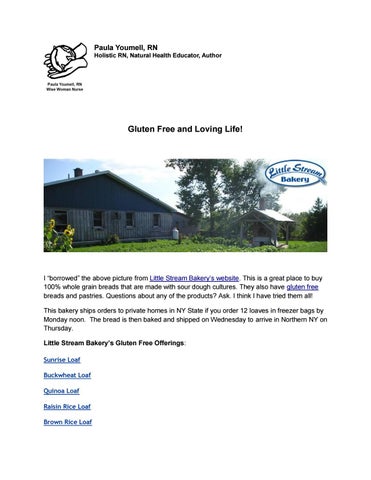
I “borrowed” the above picture from Little Stream Bakery’s website. This is a great place to buy 100% whole grain breads that are made with sour dough cultures. They also have gluten free breads and pastries. Questions about any of the products? Ask. I think I have tried them all! This bakery ships orders to private homes in NY State if you order 12 loaves in freezer bags by Monday noon. The bread is then baked and shipped on Wednesday to arrive in Northern NY on Thursday. Little Stream Bakery’s Gluten Free Offerings: Sunrise Loaf Buckwheat Loaf Quinoa Loaf Raisin Rice Loaf Brown Rice Loaf
Gluten Free, Whole Grain Flours to Enhance Your Health
As science learns more about the makeup of a healthy diet, one fact has become clear: refined grains (any refined foods) are counter-productive to vibrant health—and our waistlines. Saying that a grain is “whole” means that it has three essential parts: the endosperm, the bran, and the germ. Unlike the refined white flour in processed food and in most of our home’s pantries, in which the nutritious bran and germ have been removed, whole-grain flours contain plenty of fiber, vitamins and minerals, plus healthy plant compounds such as lignans, phytoestrogens, and phenolic compounds. These important nutrients can help us maintain a healthy weight and reduce the risk of numerous diseases including: type 2 diabetes, hypertension, cardiovascular disease, stroke, gallbladder disease, respiratory dysfunction, gout, osteoarthritis, and some cancers.
Avoiding grains that contain gluten adds up on the health benefits. Buying organic is another useful step as organic foods avoid the pesticides (Round-Up, glyphosates, etc.) that disturb gut health. How To Grind Your Own Gluten Free Flours Oat flakes grind easily in a regular blender. Buy certified gluten free and certified organically grown. (see oat information below). Millet, quinoa, amaranth, and teff also grind well in a high quality blender. Nuts and seeds: All nuts and seeds can make yummy, gluten free flours. These flours are cheaper if you grind your own. You need a very good blender for this; see vita mix information below. NutriBullet is another blender people have great results with. Many companies now make high quality blenders to grinding of flours at home. Electric coffee grinder: Teff grinds beautifully in a coffee grinder. Millet, amaranth, quinoa, and oat flakes as well. Grind Âź cup at a time. Yes, it will take a few minutes but think of the fun you are having in your kitchen. ď Š Hand grinders: These work well for whole oats, brown rice, wild rice, and buck wheat. I have never used them to grind nuts or seeds into flours. Teff does not work well in a hand grinder as the seed is too tiny and it passes through the stainless steel grinding burrs untouched. Quinoa, amaranth, and millet are also challenging in a hand grinder. Vita Mix Dry Pitcher: This is a high powered blender that grinds any grains, nuts, seeds, etc. into flour beautifully. The vita mix regular blender does not grind flour, more of a paste, and you need to purchase the dry pitcher with the blender base. This is an expensive blender ($500ish). It lasts forever, has amazing customer service for repairs, and is worth every penny if you cook. I have had mine for 14-15 years and use it to make all kinds of foods, for canning prep work, sauces and soups, pudding, batters, nut butters, flours, and so much more.
How to Store & Measure Whole-Grain Flour Whole-grain flours contain a small amount of fat in the germ. This oil is responsible for the superior flavor and nutrition of whole grains, but it also means the flour can actually go rancid, whereas refined “white” flours never will go rancid (or at least they take forever to get to the rancid state). Unmilled whole grains can be stored almost indefinitely, but once they are ground into flour, they must be kept in the refrigerator or freezer. The flour should smell fresh, nutty and mild, never sour or rancid Use a fork to vigorously fluff up the flour in your bag or container. Then use a spoon to dip the now-aerated flour out of the container and into your dry measuring cup. Fill until you measuring cup is completely full or even overfull, but do not pack it in. Use the edge of a knife to scrape excess flour off and level it at the top of the measuring cup. When baking with whole grain flours use ¾ cup to each cup of all purpose, refined flours called for in recipes.
Types of Flour All of the following flours are exceptionally nutritious. To reap the biggest dietary benefits, try to incorporate a number of them into your cooking rotation. Variety in grains gives you variety in nutrition. But remember to buy only the quantities that you have the room to store in your fridge or freezer.
Amaranth flour has a bold flavor some describe as woody, grassy, or malty. Try pairing amaranth flour with other bold ingredients such as chilies, coffee, and pungent spices. Bean flours have varying degrees of starchiness. The flavor is the same as the bean. The most popular bean flour is garbanzo bean flour, also called gram flour (don’t confuse it with graham flour which is made from wheat). Buckwheat flour is rich and earthy with a savory quality. Most people either love it or hate it. Try it to find out which type you are. Corn flour is both sweet and bitter, so it pairs well with sweet and savory recipes. Corn flour comes in a range of grittiness so be sure to choose the coarseness you’ll want in your finished product. Buy organic corn flours to avoid GMOs and nasty pesticide chemicals. Millet flour has a mild, corn like flavor. Use it in recipes where you might use cornmeal. Nut flours add moist fat that carries the specific nut flavor into your recipe. The most popular nut flours are almond, chestnut, coconut, hazelnut, pecan, and walnut. To make your own, grind shelled nuts in a food processor, but watch closely. There’s a fine line between nut flour and nut butter. Making homemade coconut flour is a bit more complicated. Oat flour is mild and nutty, and adds tremendous moisture to baked goods. Oats can be used to create various textures. Thick rolled oats add chewiness or crunchiness, depending how long they are cooked. Chop them in a food processor (or use “quick-cooking oats”) and you’ll have the familiar texture of your grandma’s oatmeal-raisin cookies. Pulverize them completely and you’ll have moist, fine-textured oat flour. Oats are gluten-free only if they are certified gluten-free. Oats get cross contaminated with wheat / gluten in the handling and processing of them as they are in facilities and on equipment used for wheat production. Oats, by nature, are gluten-free. Potato flour is mild-flavored and is usually used to add starch to baked goods. Use only 100% whole potato flour, not potato starch, to avoid eating refined food. Quinoa flour is even more strongly flavored than amaranth, with a touch of bitterness. Try it in recipes that will also feature savory ingredients such as soy sauce or meat. Rice flour can be sticky or not. The starches in short-grain rice tend to create sweeter, stickier flours than those made from long-grain rice. The less-starchy flours from long-grain brown rice behave more like wheat flour. Rice flours have the specific flavors of the type of rice. Brown rice and wild rice flour is whole food; white rice flour is not a whole food. Seed flours such as flax seed bring the flavor and oils of the seed into your recipe. For the freshest product, grind seeds just before using in recipes. Grind in a coffee grinder or food processor.
Sorghum flour tastes much like wheat, but a bit sweeter. It is made from the same plant that makes sorghum sweetener. Teff flour is strong-flavored and malty. It is usually fermented briefly before use, which adds an intense sourness. This Ethiopian flour is most commonly used to make the dark bread injera. Tapioca flour is a starch extracted from cassava root. If it is 100% whole ground root, not refined, great. I have not been able to find such a thing. If you do, let me know. Using in small amounts to thicken gravy is ok. Using large quantities in bread recipes, not so healthy, as it is refined food stuff.
Potential Sources of Gluten in Processed Foods & Beverages
Watch for these words on labels. They are a tip-off that the product contains gluten: 1. Emulsifiers 2. Flavorings 3. Hydrolyzed Plant Protein 4. Natural Flavorings 5. Stabilizers 6. Starch 7. Oats Food Products to be very wary of: • • • • • • • • • • • • •
• •
Baked Bean (canned, not home made from your own soaked beans) Baking Powder Beer Breading and coating mixes Brown Rice Syrup (May contain malted barley) Canned meats and fish in broth Caramel Color (Usually corn derived, but check) Cheese products- Sauces and some shredded cheeses Condiments (Carefully read condiment labels. Gluten is often used as a stabilizer or thickening ingredient in ketchup, mustards and Oriental sauces) Deli Meats, breaded fish and meats, pre-packaged ground beef products and hot dogs Dextrin (Usually corn derived but always check) Dry-roasted nuts Flavorings, food starches, seasonings, and malt are general and vague words to watch for on labels of packaged foods. These terms are often clues that the product may contain gluten. For example, "malt" vinegar and "malted" milk powder contain gluten. Frozen French fries (In the coating) Gravy Products (Dry products, bouillon cubes, and processed, canned products)
• • • • • • • • • • • • • • • •
Hydrolyzed Vegetable Protein (HVP) and Texturized Vegetable Protein (TVP) Imitation fish, meats and cheeses Instant flavored coffee/cocoa mixes Licorice candy (black and red) Matzo Meal Modified Food Starch Mono and di-glycerides Pickled Products Salad Dressings Sauces, including soy sauce which is commonly made by fermenting wheat. (Check ALL processed sauce labels- From BBQ sauce to ice cream toppings, chili pepper products and tomato sauce products-all may contain gluten) Sausage Self-basting poultry products including turkey with added "solutions" Snack foods including flavored potato chips and corn chips Soups, stocks and broth Spice and herb blends (spices and herbs in their natural form do not contain gluten) Rice products with seasoning packets
Bottom Line: Read labels, contact manufacturers, ask questions, and don't use products that you are not 100% certain are gluten free. Gluten Free products: Cookies, crackers, bread, pasta...etc. Most of these products are garbage; absolute crap and degenerate cellular health. Your cellular health depends on your wise, whole food choices. Gluten free packaged products and mixes are made with just as refined or worse ingredients as white flour bread and sugar, they just happen to be gluten free. Do not be fooled thinking that “if they are good for people with celiac disease, they must be healthy: trust me, they are not. They are not healthy foods for people with celiac. Buying gluten free products: Use the same label and ingredient reading, whole food detective skills that I teach in Natural Foods Know How online course. Learn what whole foods are, read labels, and buy only 100% whole foods. Do not settle for less than whole foods feeding your cellular health. Your body, your body cells, and your health depend on you. Good article to prep your mind for being a gluten detective with food: (although I do not agree with the ice cream recommendation, Refined food is refined food.) http://celiacdisease.about.com/od/theglutenfreediet/a/Pantry.htm
Gluten Free Products… A word of caution: when a health problem arises manufacturers are quick to respond with ' food products' of all types and flavors to help solve your problem. Gluten free products are HIGHLY processed and full of junk ingredients. This is equivalent to the “Health Food Store Syndrome” – people buying anything in a health food store because:
it must be good for me, this IS a health food store it is organic (organic potato chips are still potato chips) the company name has the words nature, health, holistic…etc. in it
Gluten free does not mean it is healthy. There are thousands of gluten free products on the market: cakes, cookies, breads, pizza crusts, boxed mixes; processed food heaven. Learn to read labels. Most of these products are full of fillers. Yes the “fillers” in question are gluten free, but they are also refined, nutritionally devoid foods. If the natural, whole food nutrition is not in the food, the refined food product will rob your body cells of nutrients and contribute to degenerative diseases. You are trading off one huge health problem for another of equal degenerative quality. Ingredients to look for and avoid are: white rice flour, corn starch, potato starch, tapioca starch. Basically cheap, filler ingredients that just do not seem real; keep refined ingredients out of your diet. These fillers create a host of health problems in your body including blood sugar and insulin issues that contribute to inflammation, create health problems, and exacerbate current health issues. Brown rice bread without fillers is a good alternative and is carried at most health food stores and in health food sections of grocery stores. Watch out for added sugar and avoid the White Rice Flour bread and products; these are refined, white rice. Again, read ingredients carefully. www.littlestream.com has 5 varieties of gluten free bread that are whole foods. Gluten free breads tend to be denser and heavier. Gluten is what makes bread rise up and feel fluffy. This is why commercial white breads are so fluffy. Gluten free does not get fluffy. The brown rice, brown rice and raisin, sunrise, and quinoa loaves are mild tasting. The buck wheat loaf is very yummy but has a strong taste as buck wheat is strong like rye. (If you ever ate real rye bread, not the commercially baked variety with maybe a ¼ cup of rye flour per loaf, but real 100% rye bread.... it is dark, almost black and strong tasting. Russian Black Bread is a perfect example of great rye bread. I am not teasing you here to try real rye bread; rye has gluten. I am just giving explanations for better understanding of buckwheat’s amazing flavor.)
Eating Gluten-Free Outside the Haven of Your Kitchen
First of all, I will confess, this is not always easy. For those with true celiac disease, it can seem nearly impossible unless you live in an urban area with gluten-free restaurants. On a happy, whole food note, with conscious thought around food choices, gluten-free eating can happen away from home. It just takes patience, conscious thought around food, and the will to feel great all the time. Accept nothing less than vibrant health and you will create it! Ok, so first of all it requires mindfulness around food choices; making a concerted decision to learn, grow, and pay attention to what is on a menu and how to order for whole food and glutenfree eating. So, you walk into a restaurant‌ now what?
1. Let your server know you are eating gluten free. They may be able to help you make easy choices. Do not be disappointed if they are not particularly informed about gluten. Be ready to be your own menu detective. 2. Do not feel like you have to order meals exactly as they appear on a menu. Piece together, like a puzzle, your own appetizer, salad, and entrée options using bits and pieces of what is offered on the menu. All menu options can be pulled apart and pieced back together to create your own unique meal. 3. Watch for sauces, gravies, and salad dressing: they are thickened foods. Alert: thickened means the inevitable use of flour and that flour will more than likely be refined wheat flour. Avoid these options and find another puzzle piece to enjoy. Ask questions: perhaps that Alfredo sauce is thickened with cornstarch or tapioca starch. Make certain the server is 100% certain of the information they are handing out. Have them ask the chef. 4. It does matter when you just have a little: the “oh, it won’t hurt me just this once” attitude can get the digestive tract and immune system inflammatory ball rolling again. 5. Salad dressing: ask for pure olive oil and lemon wedges. Keep a jar of Mrs. Dash’s Table Blend in your purse or coat pocket if you want to add a bit of herbs to the lemon and olive oil. 6. Skip bread, pasta, noodles, and desserts. They will be made with wheat flour unless the restaurant is conscious of providing gluten-free options. The gluten-free bread offered will most likely be white rice, potato and tapioca starch based. If bread is essential for your enjoyment of the meal, deep breathe, and enjoy the gluten free offerings. 7. If a restaurant offers gluten free pasta question what the pasta is actually made out of. Also, make certain the pasta is being cooked in a separate pot, with clean water, not being cooked in the hot pot that gluten containing pasta has already been cooked in. Yes, this happens, as kitchen personnel are not always aware of how cross contamination occurs or even that cross contamination can actually occur. 8. When going to visit friends and family let them know you eat 100% gluten-free to heal your health. Offer to bring something to share. You will help others to learn, enjoy your yummy food, and you know you will have at least one thing you can eat.
Be positive, think health and healing, and make choices for your wellness; for the health of each and every one of your beautiful body cells. You will appreciate how vibrantly well you feel every day!
Products to Heal the Gut Lining
Slippery Elm Bark (yummy added to plain, unflavored, unsweetened yogurt)
Marshmallow root & powder: Can also be added to yogurt or made into an herbal infusion (medicinal tea)
Drink a shot glass of aloe juice, on an empty stomach, before each meal
Gut health products, by RenewLife, containing L-Glutamine.
More Tips To Help Heal The Gut: 1. 2. 3. 4. 5. 6. 7.
Chew Relax Yoga or another mindfulness technique or exercise for body, mind, spirit Mindful eating Bone Broth Sauerkraut Plain, unsweetened, unflavored yogurt from animals living on and eating pasture, naturally fed animal foods create healthy fats 8. Gluten Free Bread Recipe I will post another PDF file with just gluten free recipes
A Deep Dive Into Gut Health & Healing: Gut Health For Vitality eCourse Questions? Please ask: pyoumell@paulayoumellrn.com or post in the comments at the bottom of the classroom dashboard page.
Copyright © Paula Youmell, RN, Wise Woman Nurse ™ Downloadable products are the copyrighted intellectual property of Paula Youmell, RN, Wise Woman Nurse™ and intended for the Home Study course buyer or Paula's health coach clients only. The course content, the link sent in your email, YouTube links / web addresses, issuu web addresses to the PDF files, and the web address of this page are not to be shared with any outside parties unless you have requested and been granted permission from Paula Youmell, RN. Thank you for maintaining my privacy. With LOVE & Deep Compassion for You on Your Healing Journey, Paula