in tro
Ῠsla de Santa Catalina
&
Providence Island pur ita nos, esclavos & pir atas pur ita ins, sl aves & pir ates
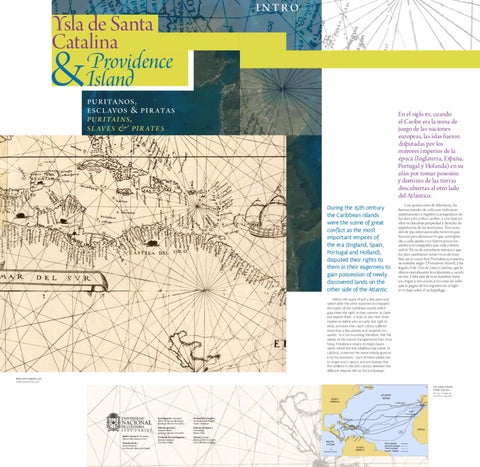
En el siglo xv, cuando el Caribe era la mesa de juego de las naciones europeas, las islas fueron disputadas por los mayores imperios de la época (Inglaterra, España, Portugal y Holanda) en su afán por tomar posesión y dominio de las tierras descubiertas al otro lado del Atlántico. During the 15th century the Caribbean islands were the scene of great conflict as the most important empires of the era (England, Spain, Portugal and Holland), disputed their rights to them in their eagerness to gain possession of newly discovered lands on the other side of the Atlantic.
Con apenas años de diferencia, las fuerzas navales de cada uno realizaron exploraciones y registros cartográficos de las islas y las costas caribes, y con base en ellos reclamaban propiedad y derecho de explotación de los territorios. Tres tratados de paz internacionales tuvieron que hacerse para demarcar lo que correspondía a cada quién, y no fueron pocos los asaltos y reconquistas que cada colonia sufrió. No es de extrañarse entonces que las islas cambiaran varias veces de nombre; así es como hoy Providencia conserva su nombre anglo (Providence Island), y ha legado el de Ysla de Santa Catalina, que le dieron inicialmente los españoles, a su isla vecina. Cada uno de esos nombres tiene un origen y una razón, y es como un sello que la pugna de los imperios en el siglo xvii dejó sobre el archipiélago.
Within the space of just a few years one nation after the other explored and mapped the coasts of the Caribbean islands which gave them the right, in their opinion, to claim and exploit them. It took no less than three treaties to define who actually had right to what, and even then, each colony suffered more than a few attacks and renewed conquests. It is not surprising therefore, that the names of the islands changed more than once. Today Providence retains its Anglo-Saxon name, whilst the tiny neighbouring island, St. Catalina, conserves the name initially given to it by the Spaniards. Each of these names has an origin and a reason, and are stamps that the conflicts in the 17th century between the different empires left on the archipelago. Mapa oficial español, 1527. Official Spanish Map, 1527.
Los cuatro viajes de Colón, 1492-1503. The Four Voyages of Columbus, 1492-1503.
Investigación | Research Hazel Robinson Abrahams Santiago Moreno González
Traducción al inglés |
Edición general |
Edición de textos |
Translation into English
Annie Chapman
General edition
Text editing
Rector General | Principal Moisés Waserman Lerner
Asistente de investigación |
Director Sede |
Carolina Villate
Diseño | Design Patricia Melo González César Puertas Céspedes
Santiago Moreno González
Branch Director
José Ernesto Mancera Pineda
Research assitant
María Villa
0
Una isla desconocida donde Simón Zacarías enterró un tesoro. An unknown island where Simon Zacarias buried a treasure.
1
En el nuevo mundo In a new world Planisferio de Cantino, 1502. Biblioteca Estense, Modena, Italia. Cantino Planisphere, 1502. Estense Lybrary, Modena, Italy.
Por 1605 navegaba con destino a Sevilla una flota de nueve galeones cargados de cuantiosas riquezas del continente.
Fuente: Archivo General de Indias Source: West Indies General Archive
In 1605 a fleet of nine galleons laden with riches from the continent were en route to Seville. They were only a few days out from Cartagena when, at some point on their way to Cuba, four of them disappeared in a hurricane. The five surviving vessels limped into port, practically destroyed, and during the following months, all attempts at finding the lost galleons were in vain. A clue as to their whereabouts turned up some ten years later when Simon Zacarias, a navigator of Flemish origin, claimed he had been shipwrecked in the Caribbean and was able to survive on an unknown island, where he found the remains of a galleon containing a great treasure. Unable to take it with him, he buried it, and set sail for Cuba on a raft. During the voyage he was captured and taken prisoner. Several attempts were made by Zacarias, in custody of the Spaniards, to find the island and recover the royal treasure. Various declarations and at least two drawings of the mysterious island exist in the Archives of the Indies. However, Zacarias’s failure to find it
during these expeditions led the Spaniards to doubt its existence, and he remained in prison for years, until Diego de Mercado stated to the King that the story was true, and pleaded for the man to be released so that another search could be made. The result of this expedition, which took place in 1620, is not revealed, but what is known is that Zacarias mentioned the existence of the island of St. Catalina. What was the treasure and which island was it? As we shall see, the battles between the fleets of the different empires which ensued after the discovery of St. Catalina were numerous, and although it’s possible that Zacarias buried his treasure in another part of the Caribbean, the dispute over the archipelago was not so much of a material kind, but the similarity of the drawings of that mysterious island with the island of Providence does make one wonder. Nonetheless, to understand exactly what was at stake, we must go back a little further in time…
Habían zarpado semanas antes de Cartagena y en algún punto del trayecto a Cuba cuatro de ellos desaparecieron a manos de un huracán. Las cinco naves restantes llegaron a puerto prácticamente destrozadas, y durante los meses siguientes se hicieron en vano todos los esfuerzos posibles por hallar los galeones perdidos. La investigación sobre su destino apuntó diez años después a un piloto de barco de origen flamenco llamado Simón Zacarías: él decía haber naufragado en el caribe y haberse salvado gracias a una isla desconocida en la que encontró los restos de un galeón que encerraba un enorme tesoro. Como no podía llevarlo consigo, lo enterró y zarpó en una balsa con destino a Cuba, pero fue interceptado y tomado preso. Desde 1617 fueron varias las incursiones que hizo Zacarías bajo custodia española para recuperar el tesoro real, y en el Archivo de Indias se conservan varias declaraciones suyas y al menos dos dibujos sobre la isla misteriosa. El fracaso de las expediciones llevó a la conclusión de que la isla no existía, y Zacarías permaneció preso por años, hasta que Diego de Mercado, declaró al rey que la historia era cierta y solicitó su liberación para reemprender la búsqueda en 1620. El resultado de esa expedición no se conoce, pero se sabe, por otra parte, que Zacarías dio noticia también de la existencia de la isla de Santa Catalina. ¿Cuál es en definitiva el tesoro y cuál es la isla desconocida? Como se verá, no fueron pocas las pugnas entre las flotas de los imperios que Santa Catalina desató desde su descubrimiento, y quizá el tesoro de Zacarías fuera sepultado en otro rincón del Caribe, pero el botín en disputa por la época en el archipiélago no era sólo material, y el parecido que sus dibujos de la isla misteriosa guardan con Providencia no deja de inquietar. Para comprender lo que estaba en juego, es preciso ir un poco más atrás en la historia...
En 1480 las coronas de España y Portugal firman el Tratado de Alcazobas Toledo, en el que se reparten el dominio del nuevo mundo: España del paralelo 28 (que pasa sobre las islas Canarias) hacia el norte y Portugal hacia el sur. Tratado de Tordesillas, 1494. Treaty of Tordesillas, 1494.
The Treaty of Alcazobas Toledo is signed in 1480 between Spain and Portugal, in which the New World is divided between these two powers: north of Parallel 28 (which passes through the Canary Islands) is granted to Spain, and south of that Parallel is granted to Portugal. However, rivalry springs up between them again in 1492 when Spain captures some islands to the south of the limit established. Then, much to the wrath of Portugal, Pope Alexander vi issues a Papal Bull declaring that the Spanish Crown has right to all territories discovered by Christopher Columbus. Later, in 1494 both empires decide to negotiate directly, which results in the Treaty of Tordesillas. This time it is agreed that a divisionary meridian establishing the areas of influence will be set down at one hundred leagues west of the Azores and Cabo Verde: to the west for Castile and Aragon and to the east for Portugal. France, as well as England and Holland, are excluded from this agreement of division of land. In the case of the islands of San Andres and Providence situated in the middle of the New World, it is believed they were discovered by the Spanish captains Ojeda and Nicuesa during their expedition from Jamaica at the beginning of 1510. Notwithstanding, St. Catalina first appears with that name in the Universal Chart “which includes everything that has been discovered in the world up to now” made by Diego Rivero (cosmographer to His Majesty in the Year of 1520).
Pero su rivalidad revive en 1492, cuando España coloniza algunas islas al sur del límite trazado. En 1493, ante el descontento de Portugal, el Papa Alejandro vi expide unas bulas en las que otorga a los reyes de España los derechos sobre todos los descubrimientos de Colón, y luego, para 1494, ambos imperios deciden negociar directamente y firman con el Tratado de Tordesillas. En él establecen, esta vez con un meridiano divisorio, que las zonas de influencia quedarán delimitadas a cien leguas al oeste de las Azores y Cabo Verde: al occidente para Castilla y Aragón, y hacia el oriente para Portugal. Tanto Francia como Inglaterra y Holanda son excluidas del acuerdo de repartición de tierras. Por lo que a las islas de San Andrés y Providencia se refiere, estando ubicadas en el centro del nuevo mundo, se cree que fueron conocidas por los capitanes españoles Ojeda y Nicuesa en su expedición a tierra firme desde Jamaica, a principios de 1510. Con todo, la isla de Santa Catalina aparece por primera vez con ese nombre sólo en La carta universal en que se contiene todo lo que del mundo se ha descubierto fasta agora, de Diego Rivero (cosmographo de Su Majestad, Año de 1529).
1480 Mapa oficial español, 1527. Official Spanish Map, 1527.
2
3
los imperios se disputan el Caribe the empires fight for the Caribbean
…hasta que se firma la paz. …until a peace treaty is signed.
En 1558, ante la insatisfacción del Imperio Británico por ser excluido de la repartición del nuevo mundo, la reina Isabel i de Inglaterra decide subsidiar la piratería y enfrentar bélicamente a los españoles.
Tras los constantes ataques a ciudades y barcos españoles acometidos por el corsario inglés Sir Richard Hawkins, Felipe ii de España decide organizar una flota que habría de ser conocida como “La Armada Invencible”, en 1588.
En 1577 encarga a Sir Francis Drake la organización de una expedición contra los intereses españoles en la costa americana del Pacífico. De ahí que Drake se convierta en el primer inglés en cruzar el estrecho de Magallanes y en dar la vuelta al mundo. Así mismo, en 1578 Humphrey Gilbert recibe una comisión donde la reina le otorga el derecho de descubrir y colonizar nuevas tierras. El objetivo del aventurero, que debía cumplir con su medio hermano Walter Raleigh, era crear una colonia más allá de los mares para ser poblada por gente inglesa. El plan de colonización de Raleigh en Colonia y Dominio de Virginia, en América del Norte, termina en un fracaso en 1584, aunque la isla a la que va a parar, Roanoke, abrirá el camino para posteriores colonias y como lugar donde los corsarios pudieran descansar en los meses en que les era imposible navegar en el Caribe.
Mapa satelital de la cuenca del Caribe, 2009. Satellite map of the Caribbean basin, 2009.
Jamestown
Bermuda
Después de duros enfrentamientos durante cuatro años, las dos potencias deciden firmar el Tratado de Londres, en 1604, en el cual España le hace ciertas concesiones a los ingleses para el comercio en las Indias Españolas, a cambio de que se comprometan a no prestar ningún tipo de ayuda a los Países Bajos (invadidos entonces por España) y a abrir el Canal de la Mancha. En la competencia con España y Portugal en la exploración del nuevo mundo Inglaterra se encuentra en clara desventaja, y una vez firmada la paz se ve obligada a buscar una ruta a América por el noreste para sacar las riquezas de las indias por ella y compensar su rezago frente a España, cuyas arcas crecían sin medida con el saqueo del oro de México y Perú.
Conferencia de Somerset House, 1604. A la izquierda la delegación hispano-flamenca y a la derecha la inglesa. The Somerset House Conference, 19 August 1604. Spanish delegation on the left, English delegation on the right.
BAHAMAS
La Habana
CUBA Tortuga Veracruz
LA ESPAÑOLA JAMAICA
PUERTO RICO
La Armada Invencible, batalla de agosto de 1588. The Invincible Armada, battle in August 1588. Providencia y Santa Catalina San Andrés
Portobelo
The English Crown is highly displeased at being excluded from the division of the New World, and in 1558 Queen Elizabeth i of England decides to subsidize piracy and confront the Spaniards. In 1578 Humphrey Gilbert is given a commission by the Queen in which he is granted the authority to discover and colonize new lands. The objective of this adventurer, which would be carried out with his half-brother Walter Raleigh, is to establish a colony overseas with English people. Raleigh’s efforts of populating the Colony and Dominion of Virginia end in failure in 1584, and he ends up on the island of Roanoke, which would pave the way for later colonies, as well as being a place where pirates would take refuge during the months when it was impossible to sail in the Caribbean.
In view of the constant attacks ons Spanish cities and vessels by the English pirate Sir Richard Hawkins, Philip ii of Spain decides in 1588 to form a fleet which would be known as “The Invincible Armada”.
Cartagena
Colonias europeas en América y sus metrópolis, siglo xvi. European colonies in America and their metropolis, 16th century.
1558 Españolas / Spanish Portuguesas / Portuguese Holandesas / Dutch
After four years of bloody battles both powers decide to sign the Treaty of London in 1604, wherein Spain makes certain concessions to England regarding trading the in Spanish Indies, on the condition that England solemnly guarantees that she will withhold all aid to the Netherlands (which had been invaded by Spain) and to open up the English Channel. Once the treaty is signed, England is put in an obvious disadvantage when competing for the New World riches with Spain and Portugal, so she is obliged to seek a route to America via the north-east to transport riches from the Indies in an effort to keep up with Spain, whose coffers overflowed with gold plundered from Mexico and Peru.
1588
4
5
Los ingleses llegan a América The English reach America
buscando un lugar seguro, looking for a safe haven,
La situación para los ingleses en el viejo continente no es mucho mejor.
Mapa de Virginia, publicado por John Smith (1612). Map of Virginia published by John Smith (1612).
La dura oposición de algunos sectores protestantes puritanos contra Carlos i de Inglaterra (rey anglicano a quien acabarán asesinando), desata una persecución religiosa por parte de la corona, y genera el éxodo de cientos de británicos que buscarán en tierras americanas la oportunidad de organizarse de acuerdo a sus intereses políticos, económicos y religiosos. Tras la firma del tratado de paz con España, los ingleses deben retirarse del negocio corsario (la piratería en dominios españoles) y la idea de colonización por el norte propuesta por Gilbert y Raleigh se consolida. Las dificultades de la época, en parte debidas al crecimiento de la población, se ven compensadas con la fundación de las compañías Plymouth y London, a las que se asigna el manejo y poblamiento de la Colonia de Virginia (usa).
Retrato de James i (entre 1603 y 1609), de Nicholas Hilliard. Portrait of James by Nicholas Hilliard, from the period 1603-09.
Ubicación de Jamestown, Virginia. Location of Jamestown, Virginia.
“La historia general de Virginia, Nueva Inglaterra y las islas Somers”, capitán John Smith. “The Generall Historie of Virginia, New-England, and the Summer Isles”, by Capt. John Smith.
The situation of the English people in their own country isn’t very satisfactory.
Boceto del Fuerte Jamestown enviado al rey Felipe iii de España por su embajador Zuniga.
1600
Sketch of the Jamestown fort sent to King Philip III of Spain by his ambassador Zuniga.
Retrato de Carlos i, Anthony van Dyck.
Strong opposition to Charles I (the Anglican king who would later be assassinated), from certain protestant sectors, has led to a religious persecution on the part of the Crown, resulting in the exodus of hundreds of citizens seeking opportunities in the far-off lands of the Americas, and a chance to establish themselves according to their political, economical and religious beliefs. After signing the peace treaty with Spain, England is forced to retire from piracy (in Spanish territories), and the idea of colonizing the north begins to take form. The difficulties experienced at the time –partly due to the increase in population– are compensated by the founding of the Plymouth and London Companies, to which the management and population of the Colony of Virginia are assigned.
Portrait of King Charles i by Sir Anthony van Dyck.
With King James i coming to the throne in 1603 the Puritans hope that the persecution carried out during the reign of Elizabeth i –resulting from religious, economic and political differences– will come to an end. On realizing that this is not to be, they decide to give support to the various companies of investors whose goal is to form a new England in the Americas. Taking this into account, John White of Dorchester, a well-known Puritan, inspired by Gilbert and Raleigh’s project, is prompted to go in search of a place for “the repressed people” of England. The English project of colonization was at that time instigated by various Puritan leaders –many of them members of Parliament, who not only were under strong religious pressure, but also disagreed with the tonnage dues and weight taxes imposed by King Charles I. Thus the project originated for the colonization of Virginia, Maryland, Massachusetts and Saybrook, and in which the islands of Bermudas, Barbados and St. Catalina would turn out to be key links in the colonization of the New World.
Con el inicio del reinado de James i (1603), los puritanos pensaban que la persecución sufrida en tiempos de Isabel i debido a sus diferencias religiosas, económicas y políticas, había tocado su fin. Al darse cuenta de que no es así, deciden apoyar las diversas compañías de inversionistas que se dirigen a América a formar una nueva Inglaterra. Es entonces cuando John White de Dorchester, uno de los más reconocidos puritanos, inspirado en el proyecto de Gilbert y Raleigh, sugiere ir en busca de un lugar seguro para la “gente oprimida” de Inglaterra. El proyecto colonizador inglés estaba motivado entonces por diversos líderes puritanos, muchos de ellos parlamentarios, que no sólo tenían fuertes tensiones religiosas sino que estaban inconformes con los distintos impuestos de tonelaje y peso fijados por Carlos i. Es así como se comienza el proyecto colonizador de Virginia, Maryland, Massachusets y Saybrook, donde las islas de Bermuda, Barbados y Santa Catalina marcarían eslabones claves de la colonización en el nuevo mundo. Portada de “Descubrimiento de las Bermudas”, un relato de Sylvester Jordain sobre la pérdida del Sea Venture, el buque insignia de la compañía de Virginia en los arrecifes de las Bermudas y las aventuras de sus supervivientes. La mayoría de los sobrevivientes del naufragio de Somers llegaron a Jamestown en 1610, entre ellos John Rolfe, quien se casó con Pocahontas (la hija del líder de la confederación Powhatan, una tribu nativa americana). John Smith, el primer gobernador de la isla, salvado por Pocahontas, se convertirá en el primer historiador de la isla. Cover of Sylvester Jordain’s “A Discovery of the Barmudas”, a first-hand narrative of the loss of the Sea Venture, the flagship of the Virginia Company, on the reefs of Bermuda, and the adventures of its survivors. It’s worth noting that the majority of the survivors of the Somers shipwreck reached Jamestown in 1610, and amongst them was John Rolfe who later married Pocahontas (daughter of the chief of the Powhatan Confederation, a Native American tribe). John Smith, the first governor of the island, whose life was saved by Pocahontas, became the island’s first historian.
1603
6
7
se toman las islas Bermudas they take the Bermudas Supuesto retrato de Sir George Somers, almirante de la Compañía de Virginia y fundador de las Islas Somers (Bermudas). A portrait believed to be of Sir George Somers, Admiral of the Virginia Company and founder of the Somers Isles (Bermuda).
y los españoles se enteran. and the Spaniards discover their intentions.
Las dos primeras colonias inglesas en América habían fracasado, de modo que James i se empeña en fortalecer la expansión, y le da a la Compañía de Virginia un Royal Charter (la autorización real) para su colonización. En 1609, una flotilla bajo el mando del Almirante Sir George Somers parte a rescatar la colonia de Jamestown, fundada años atrás y azotada por la hambruna. Pero su nave naufraga cerca a las islas Bermudas (descubiertas en 1500 por Juan Bermúdez), con lo cual, a pesar del fracaso, los sobrevivientes ganan un nuevo territorio. Las islas son reclamadas por la corona inglesa y la capitulación de la Compañía de Virginia se extiende para incluirlas. Rebautizadas como Islas Somers, ellas resultaban estratégicas en el Atlántico, ya que desde allí era posible abastecer de nuevos
Mapa de las Bermudas, con ilustraciones de las fortificaciones y lugares importantes, incluyendo la ciudad de San Jorge, la Casa del Estado y las fortificaciones del castillo de las islas (1624). Map of Bermuda, with illustrations of fortifications and important sites, including St. George’s Town, the State House, and the Castle Islands Fortifications (1624).
colonos otros territorios. En 1612 se funda en ellas la colonia británica de St. George, que pasará a ser la más antigua posesión inglesa continuamente habitada en el hemisferio occidental. En enero de 1620, Diego de Mercado envía una carta a España dando aviso de la invasión inglesa a Bermudas. La carta, aparte de describir la situación, habla de los recursos explotados por los ingleses (las perlas, el cedro y el tabaco) y afirma que los ingleses mantienen allí fuertes relaciones con los piratas: “Diego de Mercado minero de las minas del Rl (real) de San Franco (francisco) de la provincia de San Miguel vzo(vecino) desta ciudad digo que entre otras proposiciones y avisos que di a su magd (majestad) asi pa (para) estas provas (provincias) como pa (para) los reynos del Piru y nueba España di razon de un avisso que me dio Simon Zacarias flamenco piloto de la mar del norte como se podrian echar los yngleses que tienen poblada las yslas que llaman de las bermudas por los gravisimos daños y robos que an hecho y hazen a los mareantes de las yslas de barlovento y otras partes pa (para) lo qual V.Sa (vuestra señoria) sea servido mandar me llamar en siete de enero deste presente año pa (para) que yo diere razon de la horden que podria aver pa (para) el dho (dicho) efeto (…)”
Meses más tarde, Diego de Mercado se dirige en otra carta al rey para informarle de la situación de la isla de Santa Catalina en 1616: Retrato de Felipe iii de España (1578-1621), por Diego Velásquez. Portrait of Phillip iii (1578-1621), by Diego Velásquez.
“Simón Zacarias, piloto flamenco de la mar del norte me dio noticia como unos mercaderes ingleses vecinos de la ciudad de Londres que son los que tienen pobladas la Bermudas, han tratado de poblar la Isla de Santa Catalina”. En seguida explica que los ingleses planean poblarlas organizando la agricultura y llevando animales domésticos, pero también que practican la piratería: “y se ha dicho en estas tierras y en sus provincias y en la tierra firme que el mismo paraje han robado enemigos algunas fragatas (…) que hacen viajes a ella a pescar perlas que dicen tiene mucha redondez y netas de buena ley y de camino hacen los robos dichos”.
Además, explica sus ventajas como fortín: “tiene un puerto a la banda del sur que en la entrada tiene una isleta en medio (…), es fácil de fortificar la entrada y en toda la isla no hay otro puerto ni cala ni otra parte donde puedan surgir (anclar) navíos sino es en el dicho puerto por lo demás los bajos y arrecifes donde es imposible poder surgir”. Y finalmente anuncia la amenaza que la isla supone si se consolida como colonia inglesa: “seria como segunda Bermuda y se harían inexpugnables porque es de su natural fortísima y con moderada fortificación seria imposible tomarla”. A pesar de las advertencias, la corona española tiene un territorio demasiado grande por conquistar y controlar, y el proyecto inglés en las islas tomará un rumbo cada vez más firme…
Mapa de la isla Santa Catalina, Archivo General de Indias. West Indies General Archive map of Santa Catalina Island.
La misiva plantea en detalle, además, cómo debería atacar a los ingleses la corona española para sacarlos de las islas.
The first two attempts at forming English colonies in America end in failure and King James i intercedes in the endeavour by granting a Royal Charter to the Company of Virginia for its colonization. A fleet under the command of Admiral Sir George Somers sails in 1609 to rescue the colony of Jamestown, founded some years before and struck by famine. His ship is wrecked not far from the Bermudas (discovered by Juan Bermudez in 1500), and in spite of the failure to reach their destination, a new territory is gained by the survivors. The islands are claimed at once by the English Crown, and the terms of surrender of the Company of Virginia are extended to include them. They were baptized The Somers Islands and proved to be of strategic importance in the Atlantic for supplying other territories with settlers. A letter is dispatched to Spain by Diego de Mercado in January of 1620, advising the King of the invasion of the Bermudas by the English. This letter, apart from describing the situation, speaks of the resources exploited by the invaders (pearls, cedar wood and tobacco), and also states that the English there maintain thriving relations with pirates:
“I, Diego de Mercado, a miner at the Royal Mines of San Franco (Francisco) in the Province of San Miguel, citizen of this city, declare that among other proposals and information that I gave to Your Majesty, for these provinces as well as for the kingdoms of Peru and New Spain, I mentioned an account given to me by Simon Zacarias, a Flemish navigator of the northern seas, of how to get rid of the English who have settled on the islands known as the Bermudas, owing to the serious damage and thievery done, and being done, by them to the navigators of the Windward islands, and other places, for which purpose Your Lordship deigns to summon me on the 7th January of this year to inform me of orders to be carried out to this effect (…)”
1609 The letter sets out in detail how the Spanish Crown should carry out the assault on the English to expel them from the islands.
Months later, in 1616, another letter is dispatched to the King by Diego de Mercado, informing him of the situation on the island of St. Catalina: “Simon Zacarias, a Flemish navigator of the northern seas, has informed me that English traders from London, who are settled on the islands of Bermuda, are trying to colonize the island of St. Catalina”.
The island’s advantages as a fort are also exalted: “There is a port on the southern side which, at the entrance has an island in the middle (…) it’s easy to fortify the entrance and there is no port nor cove or other spot where any vessel can anchor, apart from the aforementioned port, because of the shallows and reefs which make anchoring an impossibility”. He ends by underlining the threat that the island poses if it falls into the hands of the English: “It would become a second Bermudas and would be impregnable because, as a natural fort, it would, with a few modifications, become impossible to seize”. In spite of these warnings Spain has a vast territory to conquer and control, and the English project on the islands will gain a firmer foothold as time passes…
1616
He goes on to explain that the English plan to settle on the island, organize agriculture and take over domestic animals, but he also mentions that they carry out acts of piracy: “and it is said in these lands and in the provinces and on terra firme, that in that same spot enemies have looted numerous vessels (…) that they go there to dive pearls which are said to be first class and perfectly round, and that on the way, they carry out the aforementioned assaults”.
8
Los ingleses redescubren la isla de Santa Catalina, The English rediscover the St. Catalina island, En abril de 1628 Sir Nathaniel Rich, uno de los representantes más influyentes de la Compañía de las islas Somers, recibe del gobernador Philip Bell una extensa carta en la que describe cómo el surgimiento de una nueva isla puede ayudar a los ingleses a minimizar los problemas internos que enfrentaba su compañía:
Rutas de Elfrith en el Caribe.
“El capitán Cammock con treinta hombres quedaron en una isla llamada San Andreas, lugar muy fértil y promisorio que, según espero, será del agrado de los aventureros. No obstante ser su propia isla (la de Elfrith), le era desconocida. (...) El nombre de ella (la isla) es Santa
Elfrith´s Routes in the caribbean.
Catalina que está a 20 o 30 leguas de la otra, donde quedaron sus hombres, pero difiere mucho de esta última en la bonanza y fertilidad del suelo, y lo que es muy importante, la mitad de la gente puede fortificarla y hacerla invencible, lo cual conviene a los que están en la otra isla. Nadie podrá nunca hacerse tan fuerte, lo que llena de confianza, pues se está más libre de enemigos y más alejado de daños y peligros”.* Elfrith ofrece al gobernador Bell la isla descubierta por él y luego se organiza la expedición a la isla desconocida. La intención principal era fundar una colonia puritana en un lugar que Elfrith tenía ya bien localizado. Llegan primero a San Andrés, donde dejan a Sussex Cammock y George Needhaus con treinta hombres sembrando tabaco. Luego visitan Santa Catalina, dejando a Samuel Axe como gobernador y encargado. A su regreso a Inglaterra describen las islas como ideales para los propósitos iniciales de la expedición. La nueva expedición para la ocupación de la isla se publica en septiembre 28 de 1629 y define que la colonia debía asentarse en Santa Catalina.
9
conforman la Compañía, a Company is formed Los promotores de la Providence Island Company eran un distinguido grupo de hombres de negocios y líderes puritanos. Entre ese grupo se encontraban John Pym, Earl de Warwick y su hermano Lord Holland, Lord Brooke, Sir Gilbert Gerard, Lord Robartes, Sir Benjamín Rudyerds, entre otros; todos ellos estrechamente vinculados en relaciones de comercio y parentesco. La compañía funcionaba como una bolsa de valores donde sus principales representantes invertían diferentes sumas de dinero en los negocios de producción agrícola. Después de ser invitados por Warwick a una reunión el 19 de noviembre de 1629 en Broke House (Londres), el 4 de diciembre se sella la cédula que constituía formalmente la compañía en los siguientes términos: “El Gobernador y la compañía de expedicionarios de la ciudad de Westminster adquieren el derecho de hacer una plantación en las islas de Providence o Catalina y Henrietta o Andrea y en las islas adyacentes situadas en las costas de América”. Fue así como se constituyó Providence en vez de Santa Catalina y se rebautizó San Andrés como Henrietta, en honor de la reina Henrietta María de Francia (esposa de Carlos i que, pese a las tensiones del rey con los puritanos, había apoyado sus empresas). Los primeros colonos, viajando desde Bermudas, llegan a la isla cerca del día de Navidad. Muy pronto las islas se convertirán en la segunda colonia puritana en América después de Massachussets.
*Las actividades colonizadoras de los puritanos Ingleses, Arthur Percival Newton, Kenikat Press, Washington, 1914, p. 33.
Daniel Elfrith offers the island, which he discovered, to his father-in-law Governor Bell, and an expedition to this unknown land is organized. The first intention was to found a Puritan colony in a spot Elfrith already had in mind. They reach San Andres first and leave Sussex Cammock and George Needhaus there with thirty men to plant tobacco. On their arrival at St. Catalina they leave Samuel Axe there as governor-in-charge. Once back on English soil they describe the islands as being ideal for the first purpose of the expedition. On 28th September, 1629 it is published that a new expedition to populate the island will be organized. The island chosen for this colony is St. Catalina.
1628 * The Colonising Activities of the English Puritans, Arthur Percival Newton, Kenikat Press, Washington, 1914, p. 33.
Portrait of Henrietta Maria, by Sir Peter Lely.
The Providence Island Company was backed by a distinguished group of Puritan businessmen and leaders. Among these were John Pym, Robert Rich, the Earl of Warwick, and his brother Lord Holland, Lord Brooke, Sir Gilbert Gerard, Lord Robartes and Sir Benjamin Rudyerds, all close business associates as well as relatives. The Company functioned like a stock exchange, wherein its principal representatives invested various sums of money in businesses related to agricultural produce. After a meeting convened by Warwick on the 19th November 1629 at Brake House (London), a seal is put to the document which formerly establishes the Company in the following terms:
In April of 1629 Sir Nathaniel Rich, one of the most influential representatives of the Company of the Somers Islands receives a long letter from governor Philip Bell in which he explains how the appearance of a new island, might help the English ease some of the internal problems currently affecting the Company: “Cammock with thirty odd men is left upon an island called St. Andreas, which is a very fertile and hopeful place and such as is hoped will give the adventurers good satisfaction. Notwithstanding his own [Elfrith’s] island, which was pinted and aimed at, he hath yet reserved undiscovered to himself. So i put it only into my Lord’s own hands and yours with such selected friends and companions as shall be thought worthy to be made partakers thereof. (…) The name of it [the island] is Katharina and [it] lies not above 20 or 30 leagues from the other where his men are left, but it differs much more from that place both in the pleasantness and rich fertility of the soil, and, which is very material, half the charge will fortify this mand make it invincible, which must go to the other where they are. Neither indeed can that possibly ever be made half so strong, but which is notwithstanding hopeful because freer from enemies and more out of harm’s way and all danger”.*
Retrato de Enriqueta María de Francia por Sir Peter Lely.
Lord Brooke, Sir Benjamin Rudyerd, y Jhon Pym. Jhon Pym, the Earl of Warwick and Sir Benjamin Rudyerd.
“The Governor and the Company of Adventurers of the City of Westminster attain the right to set up a plantation on the islands of Providence or Catalina, and Henrietta or Andres, and all the adjacent islands situated off the coasts of America”. Thus it was that St. Catalina became Providence, and San Andres was re-baptized as Henrietta, in honour of the French Queen Henrietta Maria (the wife of King Charles I who, in spite of her husband’s tensions with the Puritans, supported their enterprises). The first colonists set out from the Bermudas and arrive at the island close to Christmas Day. They very soon become the second Puritan colony in the Americas, after Massachusetts.
1629
10
11
ocupan la isla, they begin their life on the island,
viajan en el Seaflower, they sail on the Seaflower,
Con la llegada del Seaflower se pone en marcha la colonia en Providencia.
El Seaflower es el primer barco de la Compañía en llegar a Providencia directamente desde Inglaterra.
“Mayflower” modelo de embarcación similar al “Sunflower”. Clipart cortesía de FCIT (http:// etc.usf.edu/clipart). “Mayflower” ship model similar to the “Sunflower”. Clipart courtesy FCIT (http://etc.usf.edu/clipart).
En el emblemático barco, que zarpa del Támesis en febrero de 1631, viajan Jhon Dyke y John Tanner, y Daniel Elfrith como capitán. Con ellos vienen noventa hombres más, incluidos un barbero cirujano y un director espiritual. Luego de hacer una escala en Bermudas para recoger algunos colonos partidarios de Elfrith y a pesar de las precarias condiciones en las que viajaba (debido a las malas provisiones suministradas por Dyke), el Seaflower llegará a Providencia a fines de mayo de 1631. El barco parte de vuelta hacia Inglaterra el 21 de diciembre 1631. En el viaje es atacado por un navío de guerra español cerca de La Habana y obligado a defenderse. Con este ataque la Compañía confirma el riesgo que significa una colonia en el corazón de las Indias y desde entonces toma medidas en materia de armamento y fortificaciones.
Enseguida se dan instrucciones minuciosas sobre los arreglos eclesiásticos de la isla, así como la orden de construir dos casas parroquiales, una cerca del puerto y otra en la playa suroeste. Los pobladores se dividen en tres clases: los trabajadores o plantadores que debían cultivar la tierra y compartir las ganancias proporcionalmente con la Compañía; los artesanos, que debían compartir sus ganancias o trabajar para ella con derecho a recibir carne, bebida y cinco libras de salario anual; y los aprendices, sirvientes mayores de catorce años que entraban en contrato por un número definido de años recibiendo alimento, bebidas y ropa durante su preparación. A todos los colonos se les exigía un juramento donde declaraban que los inversionistas eran los verdaderos dueños de las plantaciones. Puritano. Ilustración del libro Nuestro país, Benson J. Lossing (1895).
With the arrival of the Seaflower, life begins in earnest in the Providence colony.
A puritan. From Our Country by Benson J. Lossing (1895).
The first Company ship to arrive at Providence directly from England was the Seaflower. The first Company ship to arrive at Providence directly from England was the Seaflower. Amongst those on board this emblematic vessel, which sailed from the Thames in February 1631, were John Dyke and John Tanner. The captain was Daniel Elfrith. Ninety other men accompanied them, including a barber-cumsurgeon, and a spiritual guide. After a stop at the Bermudas to pick up some of Elfrith’s followers, and in spite of the precarious conditions endured by those on board (owing to the poor provisions provided by Dyke), the Seaflower arrives at Providence towards the end of May 1631. The ship sails again for England on the 21st December of that same year and is attacked near Havana by a Spanish warship and is forced to defend herself. This assault alerts the Company to the risk of having a colony so isolated in the midst of the Indies, and steps are taken for arming and strengthening its defenses.
“Mayflower” modelo de embarcación similar al “Sunflower”. Clipart cortesía de FCIT (http:// etc.usf.edu/clipart). “Mayflower” ship model similar to the “Sunflower”. Clipart courtesy FCIT (http://etc.usf.edu/clipart).
Detailed instructions are given as to ecclesiastical issues plus the order to build two parish houses, one near the port and the other on the southwest beach. The population is divided into three classes: workers, or planters, who cultivate the land and who must share their profits proportionally with the Company; craftsmen, who must also share their profits, or work directly for the Company in exchange for food, drink, and a salary of five pounds a year; and apprentices –servants over fourteen years of age– who enter into contract for a defined number of years, receiving only food, drink and clothing during their apprenticeship. All the colonists were obliged to declare under oath that the investors were the true owners of the plantations.
“Puritanos ingleses escapando a América” de Emanuel Leutze. Fuente: Historia de los Estados Unidos de Spencer, 1858. “English Puritans Escaping to America” by Emanuel Leutze. Source: History of the United States; Spencer, 1858.
Vida puritana. Ilustración del libro Historia popular de los Estados Unidos de Bryant, William Cullen y Sydney Howard Gay (1881). Puritan Life. From A Popular History of the United States by Bryant, William Cullen and Sydney Howard Gay (1881).
1631
12
13
organizan los negocios,
construyen fuertes, and strengthened the island’s defenses
organize business
La Compañía instruía a los colonos en el método de cultivo, les suministraba las plantas, semillas y herramientas necesarias, y daba las instrucciones para su uso.
Libro de cuentas de la Compañía. Company’s accounting book.
The Company, as well as instructing the colonists on methods of planting, provided the plants, seeds, the necessary tools, and instructions on how to use them. Algunas de las plantas que se cultivaban en la isla: tabaco (Nicotiana tabacum), yuca (Manihot esculenta) y marihuana (Canabis sativa). Some of the plants were grown on the island: tobacco (Nicotiana tabacum), yucca (Manihot esculenta) and marijuana (Cannabis sativa).
Tobacco was the first crop to be planted and it turned out to be of a fine quality (during some seasons it was as fine as that grown in the Indies). However, the Company objected to it being the principal crop, for economic as well as ethical reasons. The most valuable export was the dyewood obtained from the island’s forests, and from trade with the Miskito Indians. Two different types of wild cotton were grown as well as other varieties brought from Jamaica. It was thought that silk grass (Cammock linen, or hemp) could be another worthwhile crop as it was in high demand in the English textile industry. The staple diet of the farmers was sweet potatoes, and other produce such as sugarcane, cassava, plantain, pineapples, oranges and bananas, were abundant. Fishing was good, especially on the nearby cays, where sea turtles were plentiful. On the other hand, raising cattle brought over from England and Tortugas was not successful because the fields were not fenced. Even though the land was fertile and the efforts on behalf of the Company were tireless, production didn’t reach expectations. Quite often, lack of care in packaging resulted in the products having to be sold for a lower price in England.
Ubicación de fuertes en Providencia (Fuente: Las actividades colonizadoras de los puritanos ingleses, de Arthur Percival Newton). Fort’s location in Providence Island (Source: The Colonizing Activities of the English Puritans, by Arthur Percival Newton).
El tabaco fue el primer cultivo que se ensayó en la isla, y resultó de muy buena calidad (en algunas temporadas era tan bueno como los de las Indias), pero la Compañía lo objetaba como cultivo principal, por razones económicas y también éticas. El producto más valioso de exportación eran los árboles de tinte (dye-woods) obtenidos de los bosques de la isla y sobre todo en comercio con los indígenas Miskitos. Además se cultivaron dos clases de algodón silvestre y otras variedades traídas de Jamaica. Se creyó que el silk-grass (o lino de Camock, al parecer el mismo henequen o cabuya), podría ser un artículo rentable, dada la demanda de la industria textil inglesa. La batata (wild potatoes) era el alimento base de la dieta de los agricultores; y otros productos como caña de azúcar, yuca, plátanos, piñas, naranjas y bananos se daban en abundancia. La pesca era buena, especialmente la de tortugas en los cayos vecinos. En cambio, había dificultades para criar el ganado proveniente de Inglaterra y de la isla de Tortuga, pues los lotes no estaban cercados. A pesar de la fertilidad de la isla y los esfuerzos de la Compañía, la producción no era tan buena como se esperaba, pues a menudo la falta de cuidado en la preparación y embalaje de los productos impedía obtener un buen precio en Inglaterra.
Firma de Warwick.
Ante el temor por un ataque de los españoles, los colonizadores ingleses establecen trece lugares fortificados con cuarenta piezas de artillería. En 1629 Samuel Axe levanta la primera fortaleza y queda encargado de la fortificación de la isla. La primera defensa, localizada al extremo norte, recibe el nombre de Fuerte de Warwick, en honor al jefe de la expedición. Así mismo se construyen otros fuertes con localizaciones estratégicas: el Fort Henry, para proteger la bahía suroeste de la isla y la entrada del sur del Puerto de Santa Catalina; Darley’s Fort, en la misma península en que se hallaba el fuerte Warwick pero más hacia el este, de modo que la aproximación del enemigo al puerto pudiera impedirse con más antelación; y el Black Rock Fort, en Black Point. El Mound era la estación de observación, que avistaba los barcos enemigos cuando venían por el frente sur de la isla, y mandaba razón a los fuertes para que se preparasen al ataque y tomaran todas las precauciones del caso.
Warkwick’s signature.
1633
Fearing attack from the Spaniards, the English colonists set up defenses in thirteen spots of the island with forty pieces of artillery. In 1629 Samuel Axe constructs the first fort, and is put in charge of erecting defenses on the rest of the island. The first of these, at the northern point, is named Fort Warwick, in honour of the leader of the expedition. Forts are erected in other strategic points: Fort Henry to protect the bay at the southwest of the island and the entrance to the south of Catalina’s port; Darley’s Fort, on the same peninsula as Fort Warwick, but a little further to the east, had the advantage that any approaching enemy ships could be sighted well beforehand and their arrival prevented; and Black Fort at Black Point. The Mound was an observation point, from which enemy ships arriving from the south of the island could be sighted. A message was then sent to the other forts to prepare to attack and take the necessary precautions.
1629
14
15
la convierten en base de piratas turning it in a base for pirates Aunque los piratas no eran recibidos en Providencia tan acogedoramente como en Tortuga, el hecho de que las naves corsarias llegaran frecuentemente a la isla y vendieran a los colonos armamentos capturados a los españoles, hizo que la colonia se convirtiera paulatinamente en puerto de piratas. Dibujo de la Isla Tortuga, durante el periodo “Hermano de la Costa”, siglo xvii.
La idea de colonia puritana modelo fue paulatinamente abandonada, a medida que se imponían actividades que significaran ganancias económicas. Con la piratería la isla devino fuente de botín para los directivos de la Compañía y para los corsarios; pero para la sede londinense la situación no era buena, pues no estaba logrando las ganancias esperadas por su inversión en la isla. Así, el proyecto de colonización de las Islas Somers y de Providencia resultó para los puritanos una historia de desencanto: poco a poco fueron viendo como su idea de organizar una sociedad bajo los mandatos de la religión, de la justicia y la equidad, se esfumaba. Ambas islas se convirtieron paulatinamente en estación de descanso o nido de piratas, en fortificaciones donde descansaban los corsarios antes enfrentarse a los barcos españoles o antes de ir a la conquista del Darién.
Drawing of Tortuga island during “Brother of the Coast” period, 17th century.
Guaridas piratas en el Caribe. Pirate’s haunts in the Caribbean.
Pirates were not as welcome on Providence as they were on Tortugas, but the fact that they came frequently to the island and sold arms captured from the Spaniards to the colonists, led the island to become, progressively, a port for buccaneers. As activities other than those originally envisaged for the colony were imposed, and which, needless to say, turned a greater profit, the principles of the Puritan colony were gradually abandoned. Piracy was extremely profitable for the managers of the Company and, of course, for the pirates themselves. However, for the shareholders in London, the situation was not so beneficial, because the profits on their investment in the island weren’t what they expected. Thus, like the colonization of the Somers Islands, Providence was a disappointment for the Puritans, and their hopes of organizing a society based on religious values, justice and equality, gradually faded. Both islands became a refuge for pirates, a stronghold where they lay in wait for Spanish galleons, or plotted raids on The Darien.
Frontispicio del libro “Piratas de América” de Alexander O. Exquemelin. Frontispice of “The Buccaneers of America”, by Alexander O. Exquemelin.
y en hogar de esclavos. and a home for slaves. Los altos costos que representa para la Compañía de Providencia traer mano de obra inglesa la llevan a optar por el uso de esclavos.
Esclavos haciendo tabaco. Slaves making tobacco.
Inspección y venta de un esclavo. Inspection and sale of a slave.
Rutas del comercio de esclavos en el Atlántico, 1600-1800 aprox. (Cortesía de la Oficina de Archivos e Historia de Carolina del Norte, en www. ncmuseumofhistory.org). Atlantic slave trade routes, ca. 1600-1800 (Courtesy of the North Carolina Office of Archives & History, in www. ncmuseumofhistory.org).
The costs of bringing workers from England to the island leave the Company no option but to use slaves. The first of these arrive from Tortugas in 1633 to work on the tobacco plantations. Work on the sugar plantations was reserved for the white servants. The increase in the black population and the fact that many of them had been in bondage to the Spaniards, comes to be seen as a threat to the colony’s stability, and although slavery is not an ethical problem for the Puritans in the Company, the residents on the island begin to feel uneasy. Samuel Rishworth, who is opposed to slavery –in his opinion is dishonour for christians– decides it should be abolished and urges the slaves to escape and hide in the mountains. In 1637 the Company forbids new slaves to be brought to the island. The shareholders in London consider the number already there too high, and recommend each white man to limit himself to one slave, or maximum two. This measure causes some tension amongst the colonists. A rebellion breaks out in May of 1638 –the first in an English colony– led by a number of slaves who had already managed to escape and joined by others who were still in bondage. The revolt was quelled by capturing some of them and killing others. From then on all slaves are removed from the plantations and put to work on the island’s defenses.
Los primeros esclavos negros arriban en el año de 1633, desde Tortuga, para trabajar en plantaciones de tabaco, pues los cultivos de azúcar se reservaban a los sirvientes blancos. El aumento considerable de la población negra y el hecho de que muchos de ellos provenían del sometimiento de los españoles, comienza a significar una amenaza para la estabilidad de la colonia; por eso, aunque la esclavitud no significa un problema ético para los puritanos de la Compañía, en la isla los residentes no se sienten del todo tranquilos. Entonces uno de los inconformes con esta situación, Samuel Rishworth, se decide por el abolicionismo (para él, al contrario, la esclavitud constituye una pena para los cristianos) y recomienda a los esclavos correr y refugiarse en las partes altas de la isla. La Compañía prohíbe la entrada de nuevos esclavos hacia 1637, pues los accionistas en Londres consideran que el número de esclavos es peligrosamente alto; recomiendan que cada hombre blanco tenga uno o dos esclavos como máximo, lo cual trae consigo un ambiente de tensión entre los colonos. Para mayo de 1638 estalla una rebelión (la primera en una colonia inglesa) desatada por los esclavos que habían logrado escapar y algunos otros que aún seguían sometidos. La revuelta es sofocada una vez recapturados algunos y asesinados otros. En adelante se retiran todos los esclavos de las plantaciones para trabajar sólo en la construcción de las fortificaciones de la isla.
Plano de un barco de esclavos. Slave ship plan.
1633
16
17
España busca reconquistar la isla,
Plano de la isla de Santa Catalina, 1640 (Fuente: España, Ministerio de Cultura. Archivo General de Indias –mp. Panamá, 61). St. Catalina’s map, 1640 (Source: Spain, Ministry of Culture. West Indies General Archive –mp. Panamá, 61).
Spain tries to recapture St. Catalina,
luego de varios intentos, la gana, after numerous attempts, finally succeeds, Al enterarse de la masacre de los prisioneros y la detención de varios frailes dominicos, los ánimos en Cartagena se caldean.
En 1635 España realiza varios intentos de atacar a sus rivales, que desde 1625 se habían precipitado sobre las islas todavía no ocupadas de las Antillas, y estaban estrangulando sus rutas de comercio entre las Indias y Europa. In 1635 Spain launches various attacks on her rivals who, since 1625, have been taking over the unoccupied islands in the West Indies, cutting off her trade routes between the Indies and Europe. The first attack, which was successful, was on Tortugas, one of the main pirate strongholds. Providence was next, but the fleet, under command of Cartagena’s governor Nicolas de Judice, was sighted as it was sounding the sandbanks to the southwest of the island. The Spanish ships spent five days in their wary approach, only to come within range of Fort Warwick’s heavy artillery, forcing them to retreat in the middle of the night. Providence was safe, for the time being. In 1640, taking advantage of reinforcements from Brazil, Melchor de Aguilar renews the struggle by dispatching his Sgt. Major Antonio de Maldonado to Providence. The fleet arrives in May, but once more the sandbanks thwart the attack, and the enemy is forced to gain the shore in longboats. With the majority of the soldiers disembarked, the Spaniards attack the forts repeatedly, but after a bloody battle they are finally driven back. The English, exhilarated by their victory, proclaim the 11th June as Thanksgiving Day. Unfortunately Governor Carter mars his triumph by slaughtering the Spanish prisoners after having promised to spare their lives.
El primer ataque, que resultó exitoso, fue a la isla de Tortuga uno de los principales sitios de piratería. Después intentaron atacar Providencia, pero la flota (al mando del gobernador de Cartagena Nicolás de Judice) fue divisada cuando se acercaba por el suroeste fondeando en los bancos de arena. Cinco días llevaban las embarcaciones españolas tanteando el camino, sólo para acabar al alcance de la pesada artillería de Fuerte Warwick, ser repelidas y tener que emprender la retirada en medio de la noche. Por el momento Providencia estaba a salvo. En 1640, Melchor de Aguilar, aprovechando la llegada a Cartagena de refuerzos de Brasil, reemprende la lucha y despacha a su sargento mayor, Antonio de Maldonado, hacia Providencia. Se aproximan a la isla en mayo, pero nuevamente los bancos de arena obstaculizan el ataque y se ven obligados alcanzar la playa en chalupas. Habiendo desembarcado la mayor parte de sus soldados, los españoles asaltan una y otra vez los fuertes, pero al final son vencidos en la dura batalla. El alborozo inglés por el repudio exitoso es grande, y es así como el jueves 11 de junio es proclamado Día de acción de gracias. Sin embargo, a pesar de haberles prometido la vida, el gobernador Carter manchará su victoria condenando a muerte a los españoles tomados prisioneros.
1635
El almirante Francisco Díaz de Pimienta obtiene autorización real para desalojar a los británicos, y en mayo de 1641 una armada con dos mil hombres llega a la isla y logra penetrar sus arrecifes. Pimienta se toma la casa del gobernador y la iglesia, defendidas sólo por algunos mosqueteros. Ante la numerosa flota los guardias se ven obligados a rendirse; los frailes, que llevaban tres años en cautiverio, son puestos en libertad. Entre tanto, los demás ingleses se han refugiado con las mujeres y los niños en una península al norte, de modo que Pimienta envía allí a uno de los frailes con una bandera de tregua: si se rinden se les respetará la vida. Así es como el gobernador Carter, el sargento mayor Hunt y sus principales oficiales deponen las armas, agradecen personalmente al almirante su clemencia, y entregan los restantes puestos de guarnición. Esta reconquista de los españoles da como resultado la captura de seiscientos esclavos negros y de un gran botín de oro (más de medio millón de ducados), y de índigo y cochinilla, dos pigmentos muy apreciados en la época. Aunque Pimienta ha recibido previa instrucción de desmantelar los fuertes ingleses y marcharse, la posición estratégica de la isla y sus recursos naturales son tan grandes que el almirante duda en cumplir la orden. Si abandona Santa Catalina se arriesga a que los imperios rivales la ocupen nuevamente; y él sabe ya de los intereses de Holanda, que ha ofrecido a los ingleses 600 mil piezas de oro por ella.
Firma de Francisco Díaz Pimienta. Francisco Diaz Pimienta’s signature.
Plano de la isla de Santa Catalina, 1641 (Fuente: España, Ministerio de Cultura. Archivo General de Indias –mp. Panamá, 066). St. Catalina’s map, 1641 (Source: Spain, Ministry of Culture. West Indies General Archive –mp. Panamá, 066).
On learning of the massacre of the prisoners, and the detention of some Dominican monks as well, tempers become heated in Cartagena, and Admiral Francisco Diaz de Pimienta obtains Royal permission to expel the English. In May of 1641 a fleet with more than two thousand men on board manages to penetrate the treacherous reefs and reach the island. Pimienta seizes the governor’s residence and the church. The latter is defended by only a few musketeers who, faced with such fierce opposition, are forced to surrender, and the monks who have been held captive for three years are released. Meanwhile the rest of the English have fled to one of the northern peninsulas with their women and children. Pimienta sends one of the monks to their hideout with a flag of truce: if they surrender, their lives will be spared. Governor Carter, Sgt. Major Hunt, and the other officers lay down their arms, thank the Admiral personally for his clemency, and surrender the garrisons. This victory results in the capture of six hundred black slaves, a booty of more than half a million ducats, as well as indigo and cochineal, dyes which, at that time, were highly prized. Pimienta’s orders were to dismantle all the English forts on the island before leaving, but on realizing the strategic location of the island and the plentiful natural resources, the Admiral hesitates to carry them out. If St. Catalina is abandoned there is great risk that rivaling empires will seize it once again. He is aware that the Dutch have already offered the English six hundred thousand pieces of gold for the island.
1641
18
19
trata de mantenerla y poblarla. struggles to sustain and populate it. Para sostener la colonia el gobernador español a cargo debía recibir de la corona refuerzos que no llegaron, al menos en cantidad suficiente. La fortaleza y la moral de la guarnición declinaron rápidamente, y la prosperidad que Pimienta había visualizado para Santa Catalina se vio frustrada. En 1648, Juan de Somovilla, capitán de Ingenieros, hizo una inspección a la isla e informó que ella era muy valiosa por su clima saludable, su fertilidad y su buena provisión de agua y madera, y recomendó mantener la colonia por razones económicas y estratégicas (D. Rowland, p.p. 298312). Para 1660 el puesto era ya un punto débil en la línea de defensa de España contra sus rivales y las juntas de guerra pidieron mejorar las defensas. Una Real Cédula de 1661 sentencia:
Isla de Santa Catalina, 1648 (Fuente: España, Ministerio de Cultura. Archivo General de Indias –mp. Panamá, 69). St. Catalina’s map, 1641 (Source: Spain, Ministry of Culture. West Indies General Archive –mp. Panamá, 69).
“ha resuelto la Junta de Guerra que la Isla de Santa Catalina se mantenga (…) y que se fortifique de acuerdo al informe y planta que ha dado el ingeniero Juan de Somovilla Tejada. Se le ordene informe sobre si convendría poblarla con negros que colaboren a su fortificación y defensa, dándoles libertad y tierra” .* Otra Cédula del mismo año solicita al presidente de Panamá enviar información de las condiciones en Santa Catalina, particularmente en el sentido de su población. “Y para hacer menos oposición de los soldados al servicio de la isla se sugirió que 50 o más mujeres que han estado llevando vidas escandalosas en Cartagena y Panamá deberían ser enviadas a Santa Catalina. Este plan debería suplir ese Edén tropical con al menos una proporción de Evas y también podría mejorar el tono moral de las ciudades”.** * Archivo de Sevilla, Panamá, 230. ** Ibid, D. Rowland.
In order to sustain the colony, it was essential for the Spanish government to have reinforcements from the Crown. These never arrived, at least not in a sufficient amount. Strength and courage rapidly declined in the garrisons, and the prosperity Pimienta envisaged for St. Catalina was thwarted. In 1648 an inspection of the island was made by Engineer Juan de Somovilla, who reported that its healthy climate, fertile soil and abundant supply of water and timber, not to mention its strategic location, made it worthwhile maintaining. By 1660 it had become a weak point in Spain’s line of defense against her rivals, and the war councils demanded that the defenses be improved. A Royal Decree in 1661 announces that: “the war council has resolved that the island of St. Catalina shall be maintained (…) and that fortifications shall be carried out in accordance with the report and plans supplied by Engineer Juan de Somovilla Tejada. A report is required as to the suitability of populating the island with blacks to help with the fortifications and defense, in exchange for freedom and land”.*
Another Decree, issued the same year, requests the President of Panama to send a report on the conditions of St. Catalina, regarding its inhabitants. “And to mitigate the opposition of the soldiers who are serving on the island, it is suggested that fifty or more of the women in Cartagena and Panama who lead a loose life be sent to St. Catalina. This should supply a sufficient amount of Eves to this tropical Eden, and at the same time, improve the morals of the cities”.**
1660
* Sevilla’s Archive, Panamá, 230. ** Ibid, D. Rowland.
Los ingleses lamentan haberla perdido The English lament their loss A pesar de su fracaso financiero, la Compañía de Providencia descubrió la debilidad de España en el Caribe Occidental y continuó la tradición isabelina de hostilidad hacia ese país. Además, todo ello preparó el terreno para fundar Honduras Británica y luego ocupar Jamaica en 1655. En 1654 Oliver Cromwell envía al Caribe una expedición con el fin de establecer en la zona una base de operaciones para contrarrestar militarmente el dominio de España. En 1660 los españoles se retiran de Jamaica, y en 1670 firman el Tratado de Madrid, donde reconocen oficialmente la soberanía inglesa. Con Cromwell convertido en Lord Protector, al fin existía la posibilidad de llevar a cabo la política puritana por medios puritanos; continuar el trabajo interrumpido y fundar, con mayores medios a su disposición, el Imperio Inglés en el Caribe. De ahí que Warwick y Cromwell lamentaran no poder contar con Providencia como base estratégica dentro de su Plan de Occidente (The Wester Design). Cromwel estaba al tanto de la situación estratégica y de la importancia de Providencia, como se puede ver en una de sus cartas (de octubre de 1655) al General Fortescue, entonces comandante de Jamaica: “Pensamos, y de eso se habla mucho entre nosotros, luchar contra los españoles por el dominio de esos mares; y por lo tanto desearíamos de corazón que la isla de Providencia estuviera otra vez en nuestras manos, pensando que gracias a su ventajosa situación respecto a Tierra Firme y especialmente para obstaculizar el comercio del Perú y Cartagena, usted no solo tendría gran ventaja de saber de él y sorprenderlo, sino aún de bloquearlo”.* * Newton, 1914, p. 323.
Retrato de Oliver Cromwell por Robert Walker (1649 aprox.). Oliver Cromwell by Robert Walker (c. 1649).
Although they had failed financially, the members of the Company of Providence recognized Spain’s weakness in the Caribbean, and carried on the Elizabethan tradition of hostilities towards that country.
Plano de la Isla de Santa Catalina, 1663 (Fuente: España, Ministerio de Cultura. Archivo General de Indias –mp. Panamá, 74). St. Catalina’s map, 1663 (Source: Spain, Ministry of Culture. West Indies General Archive –mp. Panamá, 74).
This prepared the way for the founding of British Honduras and, later, the occupation of Jamaica in 1655. In 1654 Oliver Cromwell sends an expedition to the Caribbean with the intention of establishing a military operations base to counter Spain’s dominion of the area. The Spaniards withdraw from Jamaica in 1660, and in 1670 sovereignty is recognized. With Cromwell as Lord Protector, it was possible finally for the Puritans to carry out their plan according to their standards: continue the interrupted work and establish, with more resources now at their disposition, the English Empire in the Caribbean. It was greatly lamented by Warwick and Cromwell that they couldn’t count on Providence as a base within The Western Design program. Cromwell was well aware of the strategic location and importance of Providence, as is seen in one of his letters in October of 1655 To General Fortescue, who was the governor of Jamaica. “We think and it is much designed amongst us, to strive with the Spaniards for the mastery of all those seas; and therefore we could heartily wish that the island of Providence were in our hands again, believing that it lies so advantageously in reference to the Main, and especially for the hindrance of the Peru trade and Cartagena, that you might not only have great advantage thereby of intelligence and surprise, but even block up the same”.*
1655 * Newton, 1914, p. 323.
20
21
y recuperan su base de operaciones. then, they recovered their headquarter.
Los españoles emprenden su rescate. The Spaniards attempt a rescue. Para retomar la isla el gobernador de Panamá, Juan Pérez de Guzmán, despachó una fuerza de 250 hombres en cuatro barcos al mando del capitán José Sánchez Jiménez, alcalde de Portobelo.
Plano de la Isla de Santa Catalina, 1666 aprox. (Fuente: España, Ministerio de Cultura. Archivo General de Indias –mp. Panamá, 77). St. Catalina’s map, c. 1666 (Source: Spain, Ministry of Culture. West Indies General Archive –mp. Panamá, 77).
El descuido en el refuerzo de las defensas españolas en la isla fue aprovechado por cinco veleros procedentes de Jamaica que tomaron a su gobernador por sorpresa en mayo 25 de 1666. La responsabilidad oficial de este ataque a Santa Catalina fue negada por Inglaterra y se atribuyó a “algunos piratas que navegaban en esos mares y que no estaban sujetos a rey inglés”. Los ingleses afirmaron que los bucaneros no debían atacar Santa Catalina, y que su misión era tomar la isla de Curazao, pues Inglaterra estaba en guerra con los Países Bajos. El capitán Mansvelt o Mansfield al mando de la expedición era un viejo capitán holandés, oriundo de Curazao, y era considerado el padrino de los piratas por su ambición y capacidad de reclutar hombres. Se cree que vio en el capitán Henry Morgan sus mismas ambiciones, tanto así que lo nombró vicealmirante en una de sus últimas aventuras. Mansvelt hizo caso omiso de la encomienda, y tomó rumbo hacia la isla de Santa Catalina con Morgan, para establecer en ella su base de operaciones. La isla estaba desprotegida, y fue fácil ocuparla dejando 72 hombres y un pirata francés de la isla de Tortuga llamado Le Sier Simon como gobernador. Mansvelt siguió su camino con Morgan para atacar a Panamá, pero al enterarse de que allí los esperaban al acecho decidieron volver a Jamaica. A su regreso no fueron bien recibidos; habiendo firmado la paz con Inglaterra, para España la toma de Santa Catalina constituía una nueva afrenta.
La flota española llegó a Santa Catalina el 12 de agosto de 1667. Los ingleses se habían retirado a la pequeña isla adyacente, así que Sánchez les envió una demanda de rendición, explicando que había sido instruido para tomar la isla “por orden de ambas coronas”. El comandante inglés rehusó reconocer su autoridad, pues gracias al gobernador de Jamaica sabía ya que había sido declarada la guerra entre las dos coronas.
Después de conocer la condición de las defensas inglesas, los españoles prepararon y desplegaron su ataque y los ingleses se rindieron. Se recogió mucha información de la ocupación de la isla en sus documentos y de la voz de los prisioneros españoles tomados; entre otras cosas, se logró confirmar las sospechas de la participación de la colonia británica de Jamaica en la anterior toma.
Five ships from Jamaica took advantage of Spain’s negligence to reinforce the island’s defenses and took the governor th by surprise on May 25 1666. England officially denied all responsibility for the attack, attributing it to “pirates who sail those seas and are not the English King’s subjects”. The English even stated that the pirates should not have seized St. Catalina and that, instead, their mission was to take the island of Curacao, being that England was at war with the Netherlands. In command of this expedition was Capt. Mansveldt (or Mansfield), an old Dutchman from Curacao, considered to be the godfather of all pirates because of his ambition and his skill in recruiting men. It is believed that he saw those same qualities in Capt. Henry Morgan, and named him Vice Admiral in one of his last exploits. Mansveldt ignored his orders and set sail for the island of St. Catalina with Morgan to set up an operations base. They found the island unguarded, and it was taken without difficulty. Seventy-two men were left there and a French pirate from Tortugas by the name of Le Sier Simon was named as governor. Mansveldt went off with Morgan to attack Panama, but on finding out that an ambush was awaiting them, they headed back to Jamaica. They were not well received on their return; having signed a peace treaty with England, Spain took the attack on St. Catalina as a confrontation.
1666
Juan Perez de Guzman, Governor of Panama, sent two hundred and fifty men in four ships under the command of Jose Sanchez Jimenez, Mayor of Portobello, to reclaim the island. The fleet arrived at St. Catalina on August 12th 1667. The English had retreated to the small adjoining island, and Sanchez ordered them to surrender, stating that he had been instructed to take back the island “on the orders of both Crowns”. The English commander refused to recognize his authority because, thanks to the governor of Jamaica, he knew that war had been declared between the two countries.
After inspecting the conditions of the English defenses, the Spaniards attacked, and the English surrendered. A great deal of information was found in their documents, and was supplied as well by the Spaniards formerly taken prisoner. Amongst other things, the suspicion of the participation of the English colony on Jamaica in the seizure of St. Catalina was confirmed.
1667
22
23
Morgan regresa
y la deja deshabitada. and leaves the island abandoned.
Morgan returns
Lo cierto es que España no fue capaz de mantener una fuerte defensa de la isla después de 1677 y Santa Catalina no permaneció por mucho tiempo en su poder. En 1670 Henry Morgan se hizo famoso por su ataque a Panamá al mando de mil bucaneros, el cual que fue posible haciendo previa toma de Santa Catalina. En esta ocasión un tiempo inclemente ayudó a los españoles, que inicialmente lograron defenderse con éxito desde la isla pequeña. Entonces Morgan entabló conversación con el comandante español y lo convenció de rendirse; éste, sin embargo, para salvar su reputación hizo un curioso arreglo con Morgan: los bucaneros pretendían hacer un furioso ataque, de modo que los españoles fingirían resistirlo y sólo luego se rendirían. La farsa, que incluía una supuesta captura del gobernador español, fue llevada a cabo con satisfacción de ambas partes. La isla brindaba grandes ventajas para una base de bucaneros, así que Morgan permaneció en ella por un tiempo con parte de sus hombres. Antes de partir para Panamá destruyó todos los fuertes excepto el de Santa Teresa; pues planeaba retornar a la isla después de sus operaciones en el Istmo. Al final, sin embargo, la llegada de un nuevo gobernador británico a Jamaica con órdenes de frenar los ataques de sus corsarios a puestos españoles, hizo el plan insostenible. Planta de la Ysla de Santa Catalina, aprox. 1666 (Fuente: España, Ministerio de Cultura. Archivo General de Indias –mp. Panamá, 78). St. Catalina’s map, c. 1666 (Source: Spain, Ministry of Culture. West Indies General Archive –mp. Panamá, 78).
The truth is that Spain was unable to maintain adequate defenses on the island after 1677, and St. Catalina wouldn’t remain under her rule for long. Henry Morgan became famous in 1670 by leading one thousand buccaneers to attack Panama, which was facilitated by seizing St. Catalina beforehand. On this occasion bad weather was in the Spaniard’s favour, and they were able to successfully defend the little island. Undaunted, Morgan had a talk with the Spanish commander and convinced him to surrender. In order for the Spaniards to save face, it was agreed that the buccaneers would pretend to launch a furious attack, to which the Spaniards would feign resistance and, later, surrender. This farce, which also included the supposed capture of the Spanish governor, concluded satisfactorily for both parties. The island had great advantages as a base for the pirates, and Morgan remained there for quite a while with some of his men. Before leaving for Panama, he destroyed all the forts with the exception of St. Teresa, as his plan was to return after his operations on the isthmus. This plan was foiled, however, with the arrival of a new British governor to Jamaica, who had strict orders to put an end to all attacks by pirates on Spanish holdings.
La última referencia a Santa Catalina que contienen los registros españoles del siglo xvii data de 1688, cuando se le ordenó a un destacamento de la Flota Anual cooperar con el Escuadrón de Barlovento para doblegar la isla y poblarla si resultaba prudente. Las instrucciones fueron obedecidas, aunque los pilotos que frecuentemente navegaban cerca de Santa Catalina habían reportado no haber visto a nadie allí durante más de año y medio. Cinco buques a mando de Nicolás de Gregorio y seis buques de la Escuadra de Barlovento zarparon desde Cartagena en diciembre 17 de 1688 y llegaron a Santa Catalina dos días después. Avistaron varios barcos a sotavento en el momento de la llegada, pero no establecieron contacto con ellos. Una exploración a fondo de la isla no reveló indicios de ocupación reciente. El comandante de la expedición y el gobernador de Cartagena consideraron que no era aconsejable colonizar la isla de nuevo, y Santa Catalina quedó sin guarnición, como refugio de buques piratas ocasionales o de esclavos evadidos. Santa Catalina no volvió a ocupar un lugar de importancia en los planes españoles después de 1688. Los intentos de construir una colonia permanente en la isla habían fracasado aunque, a pesar de ello, los esfuerzos de España habían sido exitosos para prevenir un gran peligro… al fin y al cabo, el propósito principal de defenderla era impedir que sus enemigos tuvieran una base para atacar sus ciudades y sus rutas de comercio y construir sus barcos.
Tratado de Utrech, por el cual se da fin a la Armada de Barlovento, creada por España para defender sus territorios ultramarinos americanos. Treaty of Utrech, by wich ends the Armada of Barlovento, a military institution created by the Spanish empire to protect its overseas territories Americans from attack their enemies in Europe, also as pirates and privateers.
The last reference in the Spanish registers is in 1688, when a detachment from the Annual Fleet was ordered to co-operate with the Barlovento squadron to force the island to submit and, if it was deemed prudent, to populate it.
1677 Retrato de Morgan en “Piratas de América” de Alexander O. Exquemelin. Morgan’s portrait in “Buccaneers of America”, by Alexander O. Exquemelin.
The orders were carried in spite of reports from captains who frequently sailed close to the island that not a soul had been seen there for over a year and a half. Five ships under the command of Nicolas de Gregorio and six from the Barlovento squadron set sail from Cartagena on December 17th 1688, arriving at the island two days later. Numerous ships were sighted on the leeward side, but no contact was made with them. A minute inspection of the island revealed no trace of recent occupation and both the commander of the expedition and the governor of Cartagena considered it inadvisable to repopulate the island, and St. Catalina remained without garrison, and became a refuge for occasional pirate ships and runaway slaves. After 1688 St. Catalina had no importance in the Spaniard’s plans. The attempts to permanently colonize the island had failed, even though Spain’s efforts had been successful in preventing great danger… the main reason to defend it was to impede the pirates from using it as a base from which to attack her cities and trading routes, and to build their ships.
Vista del Navío Nuestra Señora de la Concepción y de las Ánimas, perteneciente a la Armada de Barlovento, 1690. Pintado por Martín Amigo (Fuente:www.todoababor.es).
1688 “Our Lady of the Conception” belonging to the Barlovento’s Armada, 1690. Painted by Martin Amigo (Source: www.todoababor.es).
appx.
Un tesoro de isla A treasure island Sólo cien años después, a finales del siglo xvii, harán los descendientes de los puritanos ingleses un nuevo intento de poblar la isla. Es entonces cuando finalmente se establecerán en el archipiélago los anglosajones y los pobladores negros, que vendrán de Jamaica, Gran Cayman, la costa de Nicaragua y Corn Island a trabajar en las plantaciones de algodón y coco y en la construcción de barcos. La isla, que fuera durante más de un siglo botín de piratas y pretexto de tantas muertes y saqueos, recibirá el legado de su actual riqueza: una cultura, un pueblo, un horizonte de vida pacífica; la lengua y las costumbres del que hoy se denomina grupo raizal. Las islas de San Andrés, Providencia y Santa Catalina deben a un paciente misionero norteamericano de apellido Levingston la primera alfabetización de sus habitantes. Con el propósito de que tanto blancos como esclavos pudiesen leer la Biblia y conquistarlos para su fe, él se dedicó a enseñar a sus gentes a leer y escribir. A pesar de ello, nuestra gente permaneció durante mucho tiempo ignorante sobre su propia historia y sus orígenes multirraciales, asumiéndose simplemente como descendiente de los ingleses. La comunidad dirigida por este misionero implantó costumbres anglosajonas que se fueron adaptando a la vida isleña.
A mediados del siglo XX, otro norteamericano e historiador, de nombre James Parson, en plan de estudio sobre el archipiélago descubrió la ignorancia de los habitantes sobre su propio pasado. A el se le debe lo que por siglos se sabía en el resto del mundo pero era ignorado por los nativos. Por primera vez se habló en las islas de los puritanos y del África. Escrito estaba ya en los archivos de Inglaterra y España, pero sólo entonces llegaba a las islas algo de esa vasta historia. Poco a poco ha ido tomándose un interés cada vez mayor por esta historia y por nuestra identidad isleña. Para contribuir a esa tarea, gracias al apoyo de la Universidad Nacional de Colombia Sede Caribe, se ha realizado esta investigación que presenta al público en forma amena y fácil de comprender la historia temprana de nuestras islas, los sucesos que marcaron la historia del archipiélago de San Andrés, Providencia y Santa Catalina, y algunos documentos cartográficos y epistolares claves del período que va de 1629 a 1680. Providencia y Santa Catalina tienen en su historia, su cultura y en su gente una valiosa herencia, que sin duda, es su más valioso tesoro.
One hundred years later, at the end of the 17 century, descendents of the English Puritans settled on the island once again, and black settlers from Jamaica, Cayman Islands, the Nicaraguan coast, and Corn Island, came to work on the cotton and coconut plantations and to build boats. th
One hundred years later, at the end of the XVII century, descendents of the English Puritans settled on the island once again, and black settlers from Jamaica, Cayman Islands, the Nicaraguan coast, and Corn Island, came to work on the cotton and coconut plantations and to build boats. The island which had belonged to the pirates for more than a century and was the scene of countless slayings and lootings, would finally receive the legacy of its present history: a culture, a people, a vision of peaceful life; the language and the customs that identify the native people today. The first inhabitants of the islands of San Andres, Providence and St. Catalina owe their literacy to a patient North American missionary by the name of Philip Livingston. He taught his people to read and write so that not only the white settlers, but the blacks too, would be able to read The Bible and be persuaded to convert to his faith. In spite of this, our people remained ignorant of their history, and their multi-racial origins, for many years, simply assuming that they were descended from the English.
The community, under the guidance of this missionary, imposed Anglo-Saxon customs that became part of daily life. Towards the middle of the XX century another North American, a historian by the name of James Parson, came to do research on the archipelago, and found the inhabitants to be completely ignorant of their past. Thanks to him, what was common knowledge to the rest of the world but unknown to the islanders, their history was revealed. For the first time the subjects of the Puritans and of Africa were spoken of, and a small part of the vast history which is documented in the archives of England and Spain, finally arrived at the islands. With the passing of time, interest in the past and in our island identity, has been growing, and as a contribution to this, here is the early history of the archipelago of San Andres, Providence and St. Catalina, the events that left their mark, and some charts and letters – keys which open the door to the past and give us a glimpse of the years between 1629 and 1680. Providence and St. Catalina have their history, their culture and their people, a priceless inheritance which, without doubt, is their most valued treasure.
Bibliografía principal | Main bibliography Archivo general de Indias. Ministerio de Cultura. España. A.O. Exquemeling, De Americaensche Zee-Rovers, Ámsterdam, 1678. A.P. Newton, The Colonsinning Activities of the English Puritans, New Haven, 1914. R.D. Hussey, “Spanish Reaction to Foreing Aggretion in the Caribbean about 1680” en: The Hispanic American Historical Review, Agosto de 1929.
D. Rowland, “Spanic Occupation of the Island of Old Providence, or Santa Catalina, 1641-1670” en: The Hispanic American Historical Review, Agosto de 1935. J.J. Parson, San Andrés and Providencia, Los Angeles, 1955. K.O. Kupperman, Providence Island 1630-1641, Cambridge, 1993. C. Bonifacio, El misterio de la isla misteriosa y su tesoro, La escafandra, 2008, texto publicado en web: http://www.escafandra. org/E08-ISLAMISTERIOSAI.htm