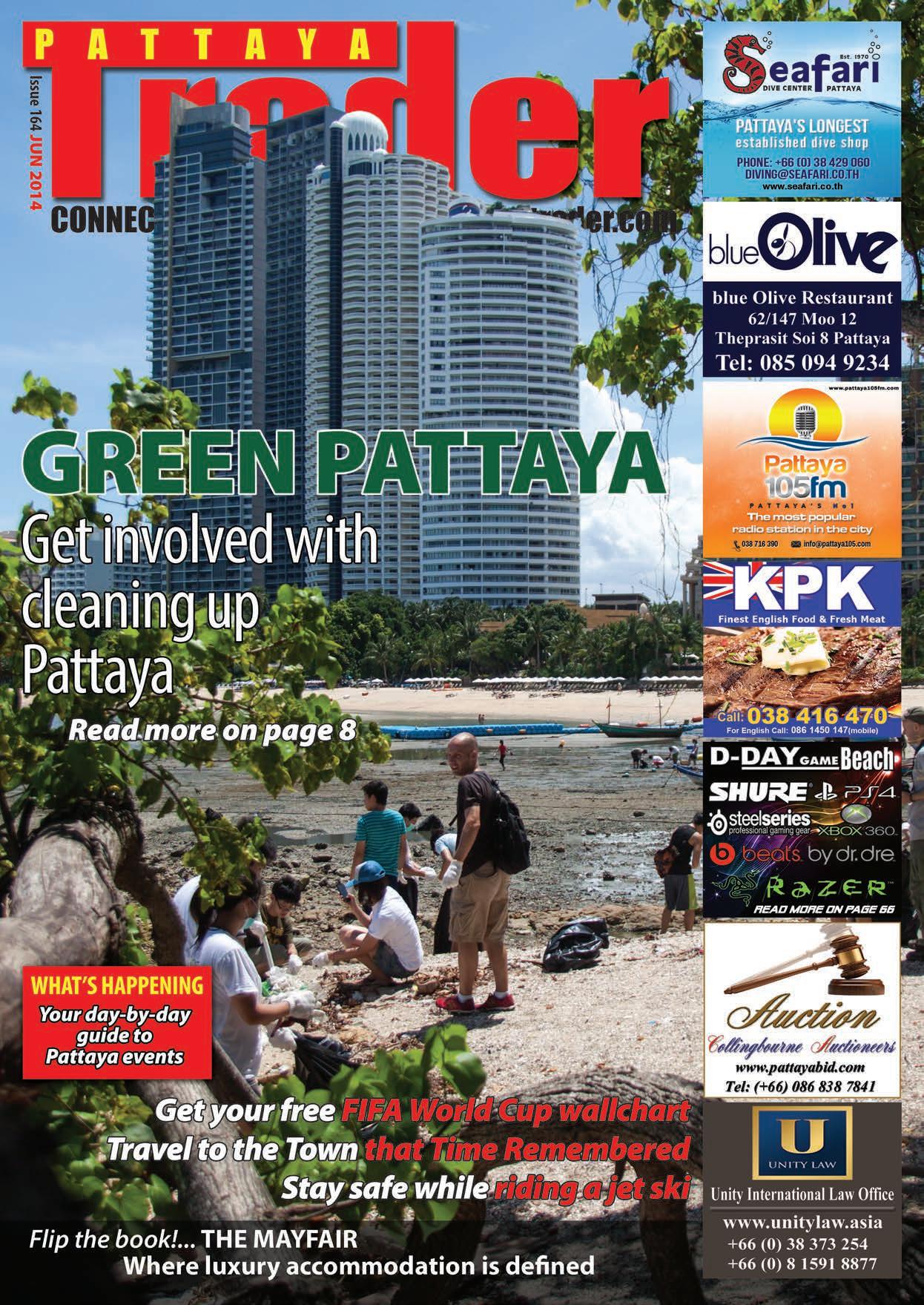

Afew years ago, you could not even swim in the Pattaya Beach area. The water was so polluted that you risked your health taking a dip. Now, while it is still not perfect, it is good enough for tourists to enjoy while the expats look on with amazement. Sadly, Wongamat, Cosy Beach and Paradise Beach have fallen into the same state and once hidden oases for residents of Pattaya are now as grey as Pattaya Beach. You have to take the boat or the car if you want to experience semiclean water, but even on the islands off Pattaya like Koh Larn, the plastic trail from Pattaya shows it presence. In Bang Saray, where there are klongs all the way to the beach, there is a ton of garbage dumped on the sand every day. Pattaya closed this klongs a long time ago and, therefore, Pattaya experiences floods whenever it rains since water has no place to go.
It is not only Pattaya that experience this kind of problem—it is all over the world and places like Bali have beaches full of plastic where you can not even swim. Phuket, down in southern Thailand, has a big problem with their klongs leaking dirty
water—so dirty that the consul would not even reveal the test results. In recent days, officials declared that the problems was fixed since inspectors went there to check after a heavy rainfall and high tide. All the garbage had washed away and, since it was high tide, you could only see water— problem solved.
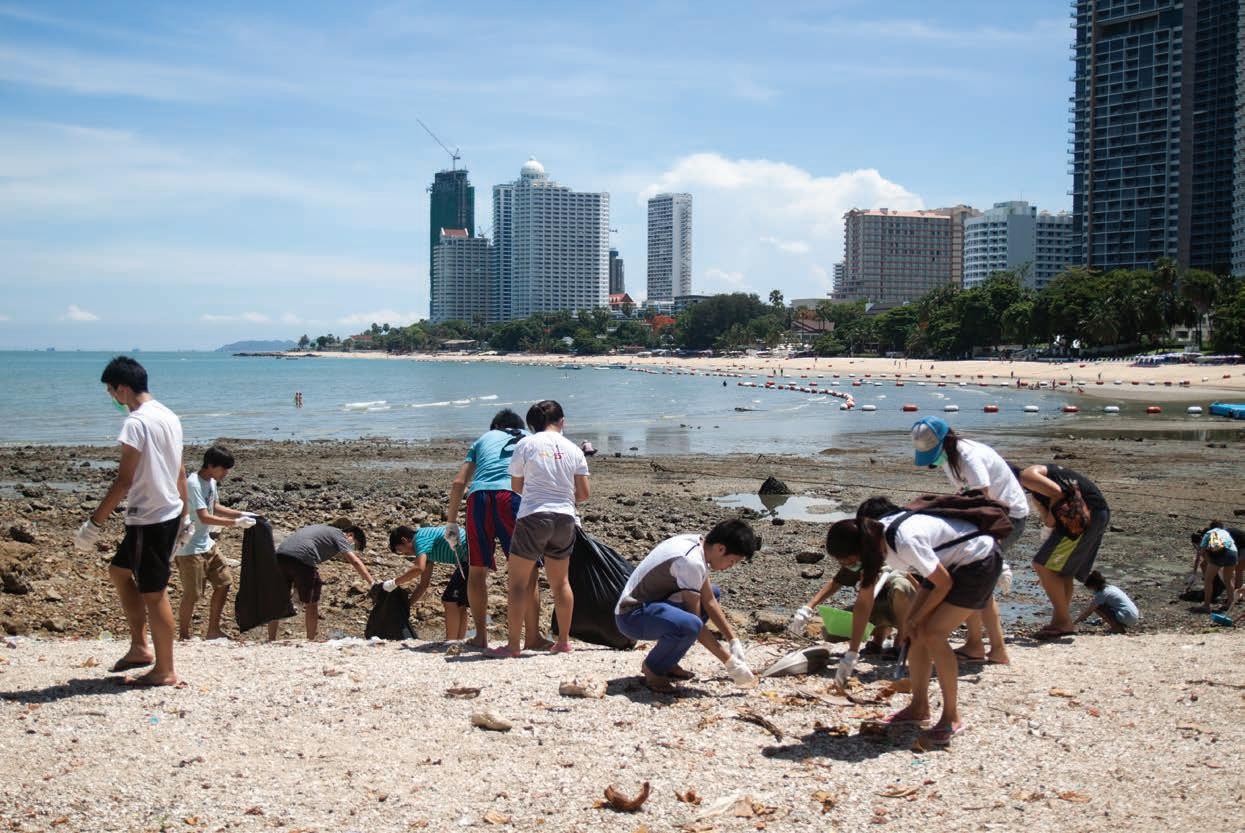
You could say that this is the same mentally that created Green Pattaya—the lack of people doing anything for their environment; just waiting for someone else to pick the garbage up or waiting for the rain to wash it away. This May, Green Pattaya cleaned klongs in Phratumnak to prevent 20 bags of rubbish from reaching Pattaya Beach and then cleaned Wongmat Beach of glass and other dangerous objects.
In June 2012, Neo LothongKum was training for his 999-km charity run from the top of Thailand down to Pattaya. He saw the rubbish along the roads and beaches he ran to. He saw that he could contribute something towards a clean environment in Pattaya and, since April 2013, Green Pattaya has been holding regular cleanup events. Neo and Nigel Quennell
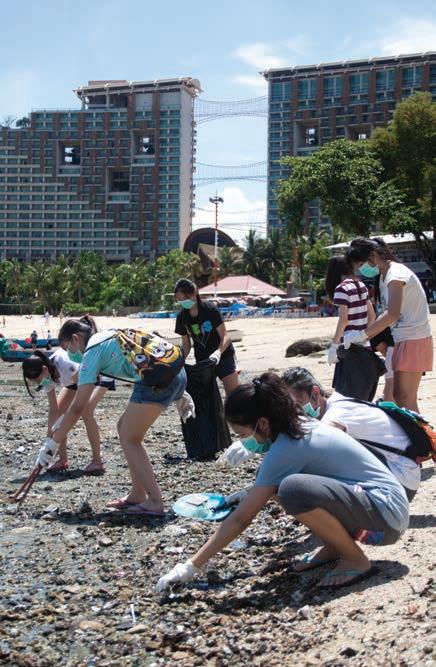
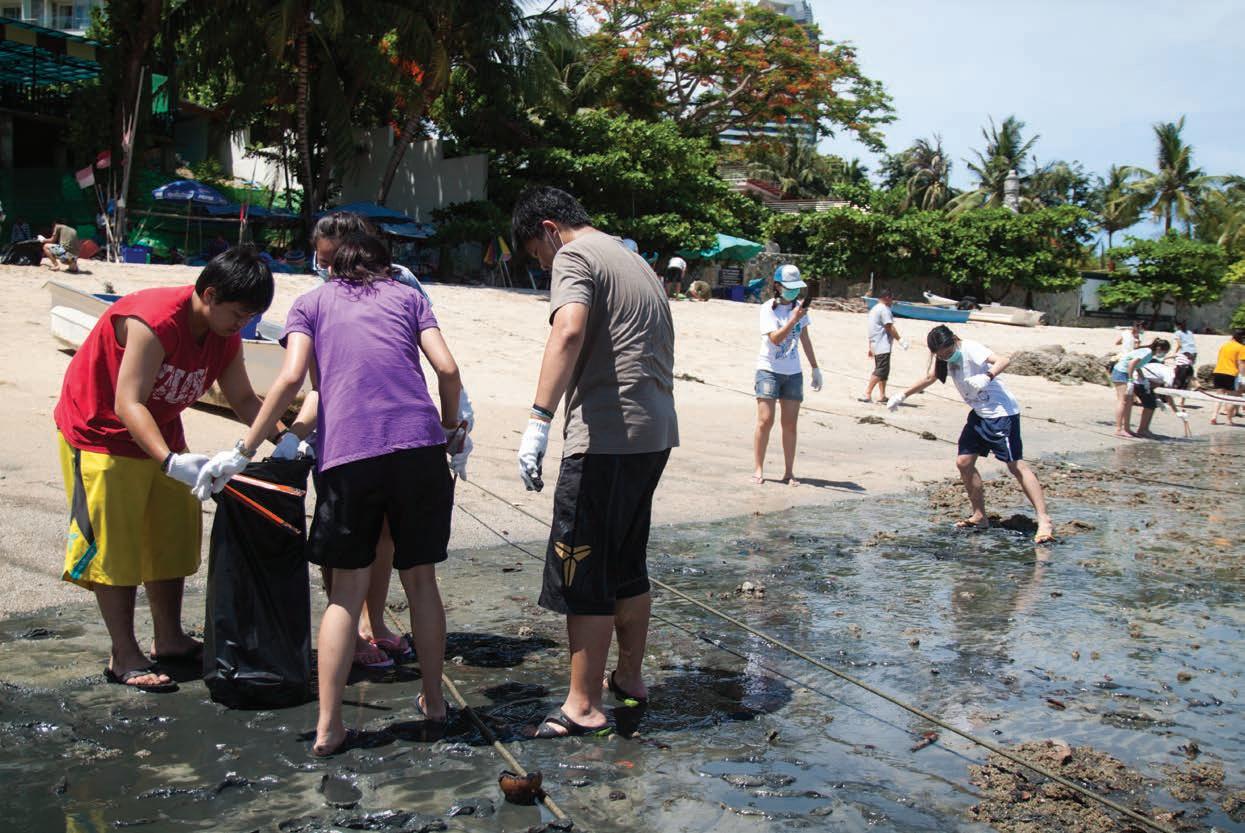
created Green Pattaya on 6th June 2012. Both Neo and Nigel were, at that time, board members of Rotary Club Eastern Seaboard (RCES) and Green Pattaya was adopted as a club project. From a Rotary project, Green Pattaya has now evolved into something much bigger and is a now a Thai community project. The activities are monitored by Rotary E-Club of the Carolinas, a registered charity in USA.
Green Pattaya is an independent local campaigning organisation that acts to change attitudes and behaviour, to protect and conserve the environment and create more green areas. It comprises online campaigners, local charities, companies, individual and government agencies to work and clean in and around Pattaya to create awareness. Green Pattaya have always understood that cleaning alone will not lead to any long-term solution and are that working together with others is the key. They are exchanging information with other Green-minded organisations in Pattaya, Bangkok and Phuket. They have also teamed up with a few schools in Bangkok that they do regular cleanings and teachings.
1. Create regular clean-up events.
2. Defend the ocean and its beaches.
3. Create local recycling zones and parks
4. Encourage local agriculture and sustainable trades
5. Create awareness about environmental issues
6. Create a sustainable programme in which local people and businesses agree to accept responsibility for the cleanliness of a piece of public land, park or beach.
7. Work towards the continuous involvement of the people, local civic authority and corporations in environmental issues.
8. Involve the people, local civic authority and corporations in creating awareness of the benefits of a cleaner environment.
9. Educate children about environmental issues
10. Share information and network with NGOs, charities and good causes

The next Pattaya cleaning will be on World Ocean Day on the 8th June and Green Pattaya is hoping that many companies, schools and NGO can join in to help clean different places in Pattaya. Furthermore, Green Pattaya is looking for long-term sponsors to accomplish what Phuket has done: a group of paid cleaners cleaning different spots in the city where city hall do not have time. In Phuket, they also have different companies cleaning one spot every two weeks, which is something Pattaya could easily achieve, creating a much cleaner city. If each company chipped in a few thousand baht a year, the city could be visibly cleaner within weeks.
Visit facebook.com/GreenPattaya for more information.
• Each cleaning cost about 800 THB
• Each cleaning collects about one big truck-load of rubbish
• Each cleaning is visited by an average of 40 volunteers
• Each cleaning is covered by most the of the English-speaking media in Pattaya
• Each cleaning is saving tons of garbage reaching the beaches each year
• Nobody is getting paid to volunteer in the cleanings
• All accounts and books are open to the public

by Ben Reeves
If you’re a regular reader of this new attractions section, you will recall that it was once written that bungy jumping is one of those activities which is perceived as dangerous but, in fact, isn’t. Scuba diving was also listed, in that article, as just such an activity. When you are swimming around 10 metres underwater and your sole supply of breathable air is in a pressurised cylinder strapped to your back, it is fairly difficult to believe that there is no real hazard. Of course there are dangers, but they mostly come from failures of judgement on the part of the diver. This is where there is a difference between diving and bungy jumping. With that latter, there’s no all that much that you can do wrong and certainly nothing that would be likely cause serious injury.
The similarity between these activities is that your safety is in the hands of the professionals who will guide you through the experience the jumpmaster or diving instructor. The better these are, the safer you are. If age equates to wisdom, then you could do a lot worse than using Seafari Dive Center
The modest-looking shop on Soi 12 off Pattaya Beach Road represents the oldest dive centre in Pattaya. It was started by the late American expat Bill Burbridge in 1970, a time when Pattaya was still very much a tourism embryo with pristine waters and more greenery than it boasts today.
The extensive experience of the Seafari Dive Center enables them to arrange and enhance the fantastic experiences available in the waters around Pattaya and the Near and Far Islands. A particular favourite dive site for Seafari is the furthest of the Far Islands - Koh Rin. Nearly two hours away by boat, the site is known as home to turtles, small sharks, bizarre and colourful nudibranchs and a huge array of other tropical fish and coral formations.
Virtually uniquely amongst Pattaya-based diving operations, Seafari often arranges diving trips away from the city. When conditions
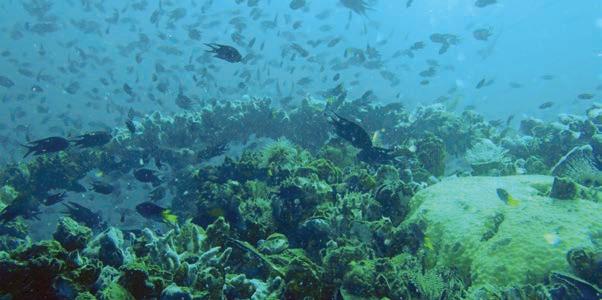


are appropriate, trips are arranged to visit the so-called “Harddeep” wreck near Sattahip. The remarkable Rayong Pinnacles are also frequently visited, though they are virtually unknown in Pattaya. Only the local dive centres in Rayong Province visit the location more often. Seafari’s most recent trip to this exceptional location, as part of a tour of the best locations along the Eastern Seaboard, included a close encounter with a whale shark the largest fish on the planet.
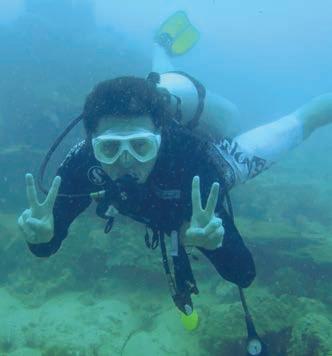
Seafari arranges trips even further afield. Twice a year in April and November they lead a trip all the way to Sabang Beach, near Puerto Galera in the Philippines for a week of diving and relaxing in breathtakingly clear water.
Along with the experience of your instructors, the maintenance of your equipment is vital to making diving a perfectly safe activity. A visit to the shop will demonstrate how seriously this is taken at Seafari, where the equipment store and workshop are on-site at the back of the store.
So, while you are swimming around at a depth of 10 metres with your only supply of breathable air being the cylinder on your back, you can be comfortable in the knowledge that said cylinder and the tubes and regulators supplying that air to you are not going to fail. Furthermore, your experienced instructors can make sure that you don’t do anything which is going to get you into trouble and will, on the contrary, guide you round an amazing underwater world.
With bungy jumping, the pleasure of it is the sensation of dodging death; overcoming your instincts for self-preservation and throwing yourself into thin air with nothing to stop you slamming into the ground at considerable speed except for a glorified elastic band. Diving is a completely different discipline and the pleasure is from seeing a landscape that goes unnoticed by the majority of people, sometimes for their entire lives. The bizarre shapes, colours and animals to see defy description, but with a tank of air and a good instructor, you can enjoy it and be a part of it at least until your air runs out.
Pattaya Soi 12
Central Pattaya
Open: 8am - 6pm Tel: 038 429 060
Web: www.seafari.co.th
Refreshments: Hot lunch on dive trips




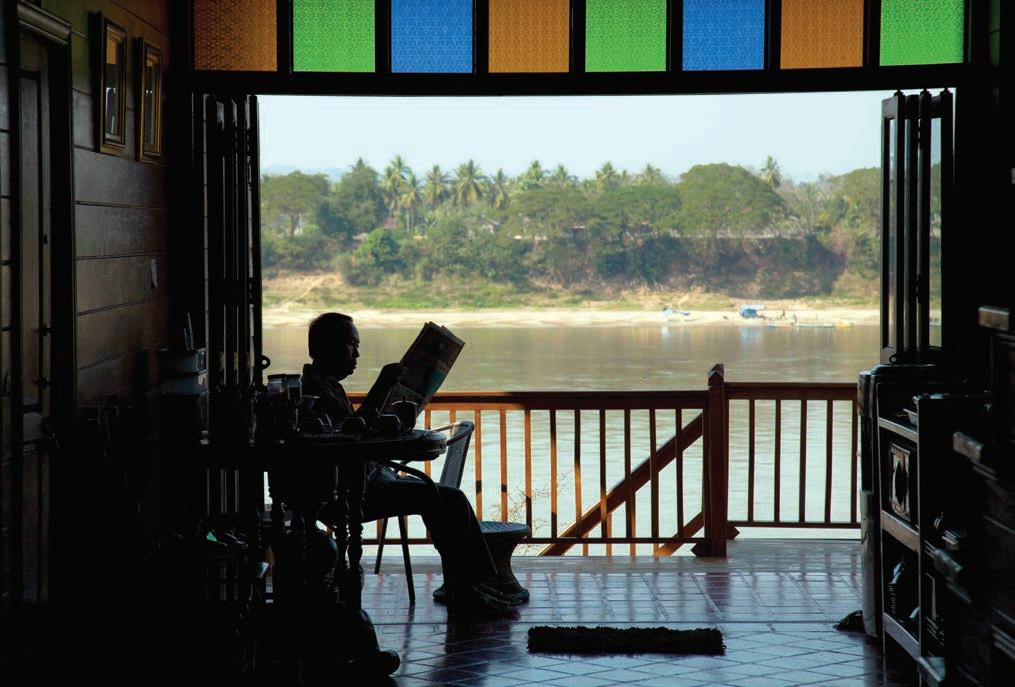
Across the Mekong River, the low blue hills of Lao fade as a firestorm dusk dials down to darkness.
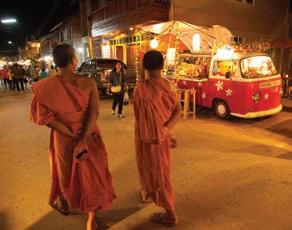
The beer is cold and my fish—fried with ginger and garlic—is crisp, tangy and cheap. A few hours later, I fall asleep in a classic, old Indochine mansion. I awake to a hullabaloo of gossip and chanting monks in the street outside.
“It could all be 100 years ago, but it’s not. Chiang Khan, an old river port in Loei province, northeast Thailand, has become the town that time remembered. Perched on the banks of the Mae Nam Khong, until recently Chiang Khan was an unremarked settlement whose glory days—if any—of the rubber trade, opium smuggling and cross-river spats with colonial French or communist Laos, were well behind it. Like a Mekong-moated Brigadoon, its riverfront road, Chai Khong and century-old teak shop-houses were slipping into a picturesque decrepitude.
in search of something more authentically Thai than mega-malls and franchised life, the word spread that here was a piece of heritage that hadn’t yet been slam-dunked with T-shirt stalls and night market kitsch.
Chiang Khan, the beauty of diamonds coconut long glass, she was as silk to the island and curry source of culture.
“Yes, the town has much history,” a local woman tells me, “but it is written in Thai—and I haven’t read it, either.” It’s hard to get hard facts about Chiang Khan, other than it has several fine, old Buddhist temples; there is a population of about 10,000 people; and the town celebrated its centenary in 2009. I find a Thai website that, having run itself through an English translator app, describes the town in fantastic cut-up poetics that William Burroughs might applaud: “Chiang Khan, the beauty of diamonds coconut long glass, she was as silk to the island and curry source of culture.”
And then the Janus-faced joker of tourism wandered into town. Starting with a trickle of savvy Bangkokians
By luck I have booked a riverfront room in a building that itself is history, a cache of Siamese-Lao memory. The Loogmai Guesthouse, its manager Khun Neng tells me, was the first concrete building in town. She guesses it is “about 60
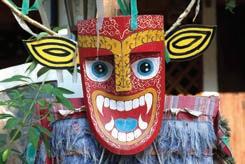
years old” (I might add another 20 years to that) and was built by Vietnamese craftsmen for a rich Thai-Lao-Chinese family in the style of a French Indochinese villa—two storeys, broad teak plank flooring, archways, louvered shutters, ceiling fans and a steep stair leading from the ground-floor trading area to family quarters above. My upstairs room is an airy, whitewashed cube with a bed, no wardrobe and perfect WiFi. Very Thai.
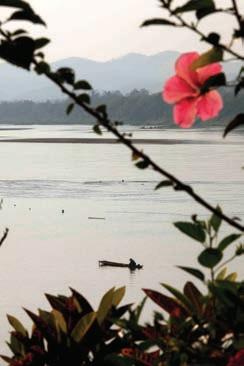
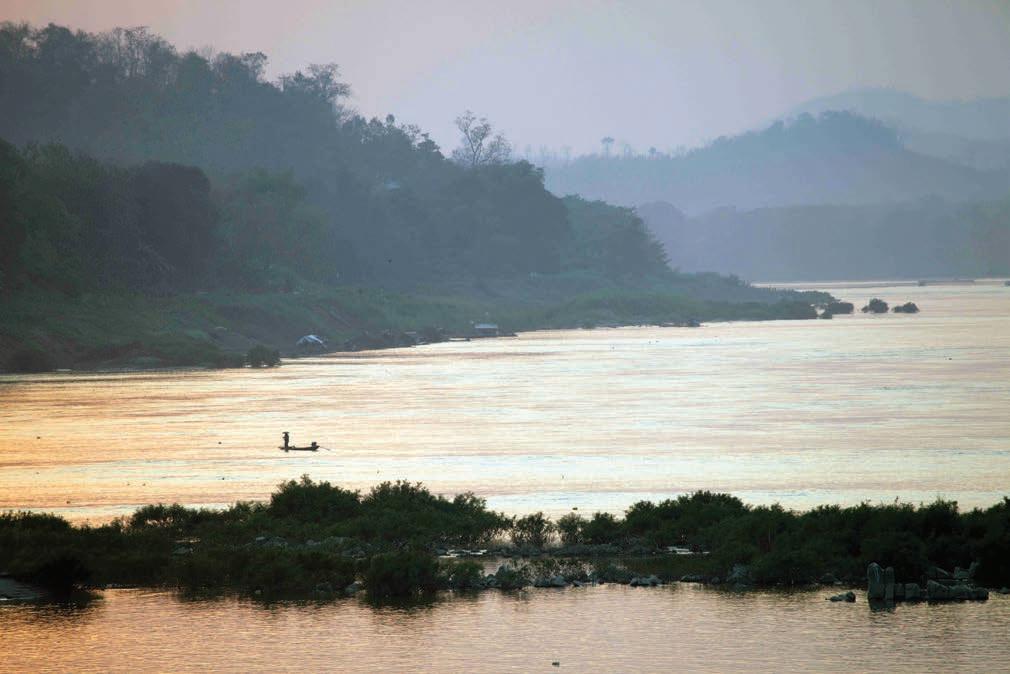
The town stretches languorously along the Mekong shore like a cat on a couch. Sensibly, Chiang Khan’s citizens long ago constructed a promenade right along the riverbank. This is where you stroll those lavish Mekong sunsets or morning mists. On the river, fishermen in pirogues net the eternal tides that slip past, running from Tibet to the South China Sea. From the far bank I can hear music—a zither-like khim or bouncy Isaan jigs—and see Lao kids splashing on sandy river beaches.
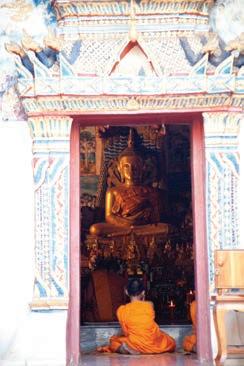
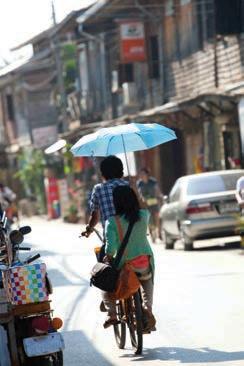
Chiang Khan has boomed in the past few years. It has been well and truly “discovered” by Thais (although not yet by foreigners), many drawn nostalgically to a past that they never had: Buddhist monks receiving alms and sticky rice at dawn, rambling family homes made of ancient teak on streets with few vehicles, and local specialities like hand-sewn quilts and maphrao kaew (sugar-coated dried coconut) snacks.
What visitors don’t yet come here for is banana boat rides, girlie bars, day spas and elephant shows. Instead, I have a simple choice of bicycle hire (50 baht/day) or motorcycle (150 baht), Buddhist wats foot massage, stroll, read, drink by the river, eat by the river and a few more wats. Or coffee. Some of the best conversations I have here are with café owners. On the trendy Soi 9 side-street off Chai Khong, two well-off escapees from Bangkok, Em and Arm, tell me how they visited Chiang Khan, “fell in love it”, bought a run-down shophouse and transformed it into the “See I 249” coffee and music shop.
Farther along Chai Khong—now designated contradictorily as both a “cultural street” and “walking street”—I drink at the Ganga Guesthouse, a beautifully restored teak shophouse that bristles
with antiques and curios (including the family SUV parked in the front room). The proprietors, also ex-Bangkokians, tell a story that might be, as Thais joke, “same-same but different.” Having settled here a few years ago in their quest for a quiet, creative retirement, they are already considering moving on, due, ironically, to the visitor influx that they were bellwethers of.
Those changes now see the old, meandering, wooden, Mekong-side way of Chai Khong Road transformed each evening into an open-air arcade of logo T-shirts (“I love Chiang Khan”, etc), trinket stalls and snack carts. The irony is that much of the booty for sale is no longer locally-made but mass-produced tat that one sees everywhere from Mae Sot to Hat Yai.
Some 619 out of the town’s 2,317 vintage shophouses are registered with the municipality's architectural campaign, although I doubt that offers much protection against “progress.” My own handsome lodgings, Loogmai Guesthouse—almost worthy of heritage listing—is being extensively redeveloped into something that will be, predictably, “hip, chic and boutique”, and anodyne?
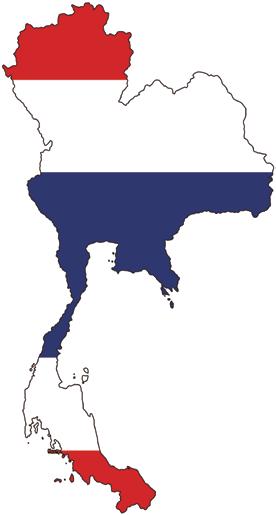
Still, it’s a beautiful place. I hop on my bike and ride through a cool morning, south along the river towards one of Chiang Khan’s main attractions, the Kaeng Khut Ku rapids. I read that “the shiny rocks here are supposed to be very beautiful.”
Like me, the writer however didn’t actually see the rapids because the river’s flow was too high at that time. No worry. Instead I get birdsong, an old , plenty of exercise and the eternal Mekong flowing past like time.
Gwith Brian S.
reen coconuts for drinking are served fresh in restaurants and by street vendors all over Thailand.
This, of course, would be a Young Coconut, which is otherwise known as a Má Práao-òn. The water within the má práao-òn is low in sodium and rich in sugars and amino acids. This naturally well-balanced fluid is thought to be one of nature’s most refreshing drinks, with a welldeserved reputation for being flavourful, nutritious and healthy.
Portuguese explorers first encountered this tropical tree-borne fruit in India during the mid-16th century. The three indentations found on the base of the fruit’s shell reminded Vasco de Gama’s very superstitious sailors of the grinning skull-like visage of Coco, the Portuguese nation’s fabled and most feared ghost. Hence, the seed-like fruit was christened the Coco-nut, because of its resemblance to this legendary specter, and because of the hard outer shell that encased both the refreshing liquid and the edible flesh.
Botanically speaking, the coconut is technically not a nut, which must consist of a single dry edible seed within a hard shell. It is, in fact, a drupe or a stone fruit, similar to a peach or a cherry. Like other members of the genus drupe, the coconut is comprised of an outer-skin (epicarp) covering either a fibrous, pulpy or succulent middle layer (mesocarp), which in turn, surrounds an inner-shell (endocarp) containing a seed. It is the coconut’s endocarp in which both the water and the flesh are housed.
Today, some botanists swear that the coconut originated in the Americas, while others maintain that it was indigenous to either Melanesia or the regions surrounding the Indian Ocean. Regardless of its origin, the coconut, aided by seafaring people and European explorers, has since spread to virtually every location across the globe that can be described as “tropical”.
One thing that distinguishes the coconut from any other fruit is the fact that a single coconut contains between 200 and 1,000 ml of clear water or juice. As a coconut matures, the water dissipates and forms the edible flesh found on the innerwall of the seed. By definition, a young coconut, which is sometimes known as a green, tender or jelly coconut, is harvested before it has fully matured.
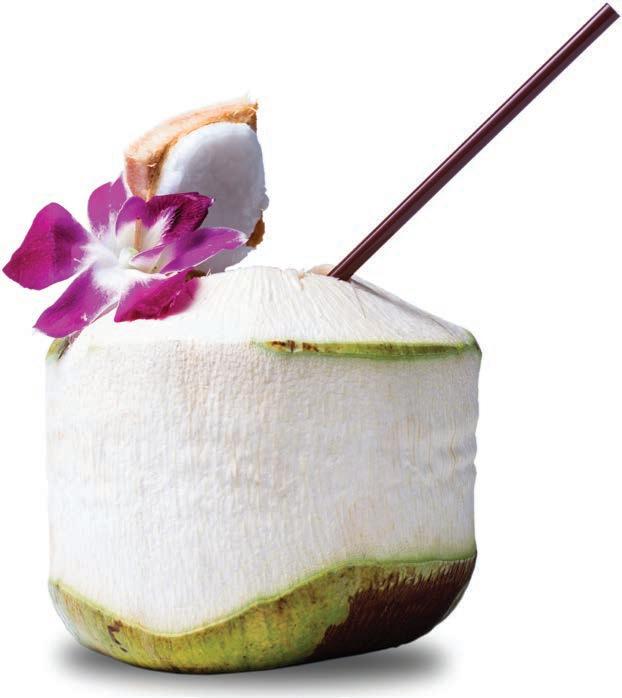
The water within will be sweet, sterile and full of vitamins, minerals, electrolytes and carbohydrates in the form of natural sugar. When consumed fresh, the unique chemical makeup of coconut water promises to hydrate the body and is rumored to alleviate the ill-effects of a broad range of afflictions that range from dehydration to hangovers to kidney stones to cancer.
má práao-òn, place it on its side and cut the top (pointed side) away with a sharp knife or cleaver. Continue trimming away the husk until the top of the “nut” is visible. When the top of the nut is exposed, turn the coconut so it’s facing up. With your fingers well out of harm’s way, use the base of the knife like a cleaver and chop down at the base of each spine. Make sure that your chop has enough force to cut completely through the inner-shell. Repeat this step at the base of each spine and in between each spine until the top of the shell feels loose. Then using the knife blade, pry the top off. If water
leaks out during the process, drain a small amount into a container and continue. Upon completion, insert a straw or pour the liquid into a glass. Finally, crack open the empty shell, and scoop out the soft white flesh with a spoon.
Whether it’s iced or straight from the shell, the sweet and slightly nutty flavor of nám práao (coconut water) is perfectly suited to quench any tropical thirst. It can be consumed plain or blended with other ingredients, like lemon slices, mint leaves or orange zest to enhance its naturally great flavor. Fresh coconut water is sold in bottles and cans at many supermarkets. Nám práao is also fermented into coconut vinegar and made into a jelly-like dessert called woon ma práao orn. The sweet meat of a young coconut, called néua má práao can also be eaten or used as the base for creamy desserts, such as puddings, shakes and ice cream. The younger the coconut, the more translucent its meat will be. At its youngest, the flesh is almost purple. As the coconut ripens, the pulp’s color will gradually become firm and turn to white.
Coconut water is low in calories, and cholesterol free. It’s a good source for B-complex vitamins, like riboflavin, niacin and thiamin. Its high mineral content includes calcium, iron, manganese, magnesium and zinc. Plus, the water from just one coconut has more potassium than four bananas. It has no known allergic reactions. Therefore, it’s safe for pregnant women, infants and the seriously-ill to consume. It has significant anti-ageing, anti-carcinogenic and blood thinning properties. It has numerous natural enzymes which speeds-up and assists the human body’s metabolism, and the digestive process. In the tropics, it’s also commonly used instead of an intravenous drip to replenish electrolyte deficiency caused by dehydration or acute diarrhea. In addition, the chemical makeup of coconut water is said to be nearly identical to human plasma, and can be injected directly into the human bloodstream. Although this practice is not recommended by physicians, there are documented cases of British soldiers in the Pacific Theater during Second World War and by the Khmer Rouge regime in the 1970s successfully using coconut water as an intravenous fluid when medical saline was unavailable. Furthermore, research has shown that the lauric acid present in coconut flesh protects against heart disease, stroke and hardening of the arteries, while strengthening the immune system and protecting against viral, bacterial and fungal infections.