Patagon Journal Nº 30 www.patagonjournal.com
Patagonia and the World's Last Wild Places / Patagonia y los Últimos Lugares Salvajes del Mundo
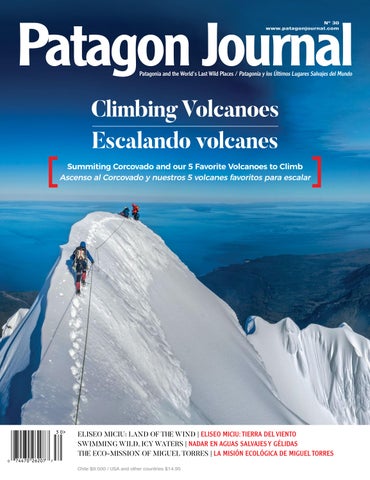
Climbing Volcanoes Escalando volcanes Summiting Corcovado and our 5 Favorite Volcanoes to Climb Ascenso al Corcovado y nuestros 5 volcanes favoritos para escalar
Patagon Journal • Nº30 www.patagonjournal.com
ELISEO MICIU: LAND OF THE WIND | ELISEO MICIU: TIERRA DEL VIENTO SWIMMING WILD, ICY WATERS | NADAR EN AGUAS SALVAJES Y GÉLIDAS THE ECO-MISSION OF MIGUEL TORRES | LA MISIÓN ECOLÓGICA DE MIGUEL TORRES Chile $9.500 / USA and other countries $14.95
EDITION / EDICIÓN 30
contents
<contenidos>
18 9 24 32
FEATURES ARTÍCULOS MOUNTAINEERING / MONTAÑISMO
9 The Elusive Corcovado El esquivo Corcovado By Camilo Novoa
18 5 Favorite Volcanoes to Climb in Chile / 5 volcanes favoritos para escalar en Chile
PROFILES / PERFILES
54 The Sustainability Crusade of Miguel Torres La cruzada sostenible de Miguel Torres By Rodrigo Barria
By Camilo Novoa PHOTO ESSAY / ENSAYO FOTOGRÁFICO SCIENCE / CIENCIA
24 Monitoring Chile’s Active Volcanoes Monitoreo de los volcanes activos de Chile
40
60 Portraits of the Land of the Wind Retratos de la tierra del viento By Eliseo Miciu
By Debora Gutierrez EXPLORATION / EXPLORACIÓN
32 The Island of Rain La isla de la lluvia By Isaac Gurdiel
DESTINATIONS DESTINOS 72 Huellas Mountain Reserve Huellas Reserva de Montaña
By Javiera Benavente CULTURE / CULTURA
48 Jineteada in Patagonia Jineteada en la Patagonia By Barney Lindsell
86 Instituto de Conservación de Ballenas By Rodrigo Barría
By Paula Fernández
FLY FISHING PESCA CON MOSCA
EXTREME SPORTS / DEPORTE EXTREMO
40 A Journey Through Wild, Icy Waters Travesía en aguas salvajes y gélidas
NGO PROFILE PERFIL DE ONG
DEPARTMENTS SECCIONES
88 Stories to read between rivers Historias para leer entre río y río By Luis Goycoolea
CURRENTS ACTUALIDAD
80 Scenic designation for Carretera Austral, New marine park, Bird flu strikes elephant seals, Rivers agreement, Kelp ban Designación escénica para la Carretera Austral, nuevo parque marino, gripe aviar y elefantes marinos, acuerdo sobre los ríos, veda de huiro
COVER/PORTADA: Volcán Corcovado, Chile. Photo by Camilo Tapia, Pamela Norambuena, and Emilio Torres
2
Patagon Journal
ENVIRONMENT MEDIOAMBIENTE
91 Glaciers in crisis Glaciares en crisis By Camilo Hornauer
SPECIES PROFILE PERFIL DE ESPECIE
96 Magellanic Woodpecker Carpintero negro
¡Descubre el extremo sur de América y futuro Parque Nacional!
Cabo Froward Backpacking Expedition Excursión de 6 días al extremo sur del continente. Recorre una de las zonas más indómitas y remotas de Magallanes en el trayecto hacia el futuro Parque Nacional Cabo Froward, el próximo tesoro natural que se sumará a la emblemática Ruta de los Parques de la Patagonia.
Discover the southern tip of America and future National Park
6-day trek to the southernmost tip of the continent
Explore one of the most untamed and remote areas of Magallanes on the journey to the future Cabo Froward National Park, the next natural treasure to be added to the iconic Route of the Parks of Patagonia.
Duration: 6 days
Difficulty: Challenging
Departure point: Punta Arenas
Check dates and prices at www.chilenativo.travel
MOUNTAINEERING | MONTAÑISMO
The Elusive | El esquivo
CORCOVADO Diary of an unlikely summit | Diario de una cumbre improbable An expedition to this iconic volcano by 3 climbers almost ended before it began, but instead finished in pure elation on the summit. Una expedición a este icónico volcán por tres escaladores estuvo a punto de terminar antes de empezar, pero al final culminó con pura emoción en la cima. By CAMILO NOVOA
Patagon Journal
9
Expedition to the uncharted Santa Inés Island
Expedición a la desconocida Santa Inés:
The Island of Rain La isla de la lluvia By ISAAC GURDIEL PÉREZ
PAULO RODRIGUEZ
Explored by very few and shrouded in mystery and eternal rain, this is an account of a journey through one of the most inhospitable areas of Patagonia, place where most of the mountains and landscape still have no name.
Inexplorada, misteriosa y envuelta en un aguacero eterno. Un viaje por una de las zonas más inhóspitas de la Patagonia donde muchos de sus rincones y montañas aún ni siquiera tienen nombre.
A
A
t last, Santa Inés Island comes into view. I feel strange. I’m also nervous. The expedition has begun. Yesterday, we set sail from Mansa Bay, just south of Punta Arenas. It is only now, however, that I remember the words of
Saint-Loup from his expedition some 80 years ago: “For the past two weeks, the expedition has traveled horizontally, and I have lived worry-free. That is over now.” I wonder: Will we be able to land where we plan to and set up a good base camp despite
32
l fin tengo ante mis ojos la isla Santa Inés. Hay sensaciones extrañas. También nerviosismo. La expedición ha comenzado. Ayer zarpamos de Bahía Mansa, al sur de Punta Arenas, pero es ahora cuando aparecen en mi
Patagon Journal
mente las palabras de Saint-Loup en su expedición de hace casi 80 años: “Durante las dos semanas en las que la expedición ha avanzado sobre un plano horizontal he vivido sin preocupaciones. Esto se acabó”. Me pregunto, ¿podremos desembarcar dónde tenemos previsto
EXPLORATION | EXPLORACIÓN
our unfamiliarity with the terrain? Will we find a viable access route to any of the glaciers after crossing the rainforests? Since this is southern Patagonia, will there be any good weather windows? My good friend and partner on this expedition, Paulo Rodríguez from Talcahuano, also considers these unknowns, but his optimism and good vibes dispel them. “Amigo, we’re already here. What’s not ready is done. Let’s just go.” Thus began our first direct contact with Santa Inés, a relatively unexplored place despite being one of the largest islands in southern Patagonia.
y montar un buen campamento base a pesar de desconocer totalmente el terreno? ¿Podremos encontrar una ruta de acceso viable a alguno de los glaciares tras atravesar los espesos bosques húmedos? ¿Siendo la Patagonia Austral, tendremos alguna ventana de buen tiempo? Paulo Rodríguez, mi buen amigo de Talcahuano y compañero en esta expedición, también se plantea estas incógnitas, pero su optimismo y buena onda las despejan: “Amigo, ya estamos arriba. Lo que no esté listo ya fue, vamos na más”. Así comenzó nuestro primer contacto directo con Santa Inés, un área muy poco explorada a pesar de ser una de las islas más grandes de la Patagonia Austral.
The pioneers
V
Carrying gear to the edge of the Nati Glacier. Porteando material al borde del Glaciar Nati.
ery few expeditions have explored the island’s interior, which is covered by dozens of mountains and glaciers, some of which form the Santa Inés Ice Field. Compared to expeditions carried out on glacial surfaces elsewhere in the Magallanes region—such as the Darwin Mountain Range in Tierra del Fuego or the Southern Patagonian Ice Field—it is surprising that Santa Inés has not received more visitors. Located southwest of the Strait of Magellan at its exit to the Pacific Ocean, between Clarence and Desolation Islands, the island was named by the ill-fated Spanish navigator Pedro Sarmiento de Gamboa in 1579 during his first voyage to the region. However, there is an explanation for the lack of visitors. It is largely due to the difficulty of accessing the island’s interior because of the dense forests and steep walls surrounding the extensive fjords, which are closed at their heads by glaciers spilling into the sea. The harsh climatic conditions of southern Patagonia have also impacted the scarcity of expeditions. The legendary Italian explorer Alberto M. de Agostini described them as “300 days of storms and the other 65 not very pleasant.” In 1960, the renowned explorer Eric Shipton, who by then had already participated in countless expeditions around the globe, many of them in Patagonia, wrote the following while sailing through the strait: “For hundreds of kilometers, the coasts of this labyrinth of channels are uninhabited, and the interior of most of the islands is completely unexplored or very little known. Santa Inés is no exception. Although none of its mountains are higher than 1,200 meters, its central part appears to be covered by an extensive layer of ice.”
Patagon Journal
33
Los pioneros
S
on pocos los grupos que han accedido al interior de la isla, cubierta en su interior por decenas de montañas y glaciares, algunos de los cuales forman en conjunto el Campo de Hielo Santa Inés. Comparando con las expediciones desarrolladas en otras superficies glaciares de la Región de Magallanes, como Cordillera Darwin en Tierra de Fuego o el Campo de Hielo Patagónico Sur, sorprende que Santa Inés no haya recibido más visitantes. Situada al suroeste del Estrecho de Magallanes en su salida al océano Pacífico, entre las islas Clarence y Desolación, fue nombrada así por el malogrado navegante español Pedro Sarmiento de Gamboa en 1579 durante el primero de sus viajes a la región. Pero la escasez de visitas tiene explicación: se debe a las dificultades de acceso al interior de la isla con los típicos bosques tupidos de la zona y escarpadas paredes rodeando extensos fiordos cerrados en su cabecera por glaciares que llegan hasta el mar. Las duras condiciones climáticas de la Patagonia Austral, que el conocido explorador italiano Alberto M. de Agostini definió como “300 días de tormentas y los otros 65 nada agradables”, han incidido notablemente en la escasez de expediciones que han conseguido aventurarse a su interior. En 1960, el conocido explorador Eric Shipton, con innumerables expediciones por todo el globo y muchas de las mismas en la Patagonia, escribió mientras navegaba por el Estrecho:“Durante cientos de kilómetros, las costas de este laberinto de canales están deshabitadas, y el interior de la mayoría de las islas está completamente inexplorado o se conoce muy poco. Santa Inés no es una excepción y aunque ninguna de sus montañas tiene más de
Cold-water swimming in Patagonia Nadar en la Patagonia
A Journey Through Wild, Icy Waters Travesía en aguas salvajes y gélidas By JAVIERA BENAVENTE
TIMOTHY DHALLEINE
EXTREME SPORTS | DEPORTES EXTREMOS Overcoming her fear and frigid temperatures, the writer went swimming in unexplored southern Patagonian lakes. It was pure adrenaline!
Superando su miedo y las gélidas temperaturas, la escritora se atrevió a nadar en los inexplorados lagos del sur de la Patagonia. ¡Fue pura adrenalina!
A
re you crazy?” Why would you go to Patagonia to swim in freezing waters?” Isn’t it too risky?” I heard these questions over and over again from friends and family who didn’t understand why I was venturing to the southernmost part of Chile to swim. To be honest, I wasn’t entirely sure what I was doing either until I arrived in Puerto Natales for the first time. I had the itinerary, knew we were going to swim in cold water, and knew those who organized the trip had done it before. Still, I had self-doubt and was afraid for the unknown.
“
My beginnings in open water
I
am 28 years old and a journalist by profession. My swimming journey began at various pools in Santiago, Chile, where I trained with the RPM Team triathlon club at the invitation of my brother. I had taken swimming lessons as a child, so learning their techniques was not difficult for me, though the team I trained with was quite demanding. At RPM Team, I focused exclusively on swimming and eventually my teammates convinced me to participate in a triathalon event with them in Concón, a town on the Pacific coast about 100 kilometers from Santiago. However, I was anxious and somewhat panicked about the idea of swimming in the ocean. Searching on Instagram, I found Raymar, a local swimming group in Concón. Every weekend, I took a bus from Santiago to Concón to train with them in the ocean
TIMOTHY DHALLEINE
The Raymar swim group from Concon. El grupo de natación Raymar de Concon.
E
stás loca?”, “¿Por qué to prepare and gain confidence “¿ irías a la Patagonia a for the triathalon competition. nadar en aguas géliSuccess! I completed the das?”, “¿No es dematriathalon and was hooked. And siado arriesgado?”. that’s when I realized that open Escuchaba estas preguntas water swimming was for me. I una y otra vez de amigos y fakept going to Concón for swim miliares que no entendían qué practice with Raymar. And after me había llevado a aventurarme several months of training with hasta la zona más austral de them, one day the club’s founders Chile para nadar. proposed a swim in the icy waters La verdad, yo tampoco tenía of Patagonia to its members. del todo claro lo que hacía, hasta I didn’t hesitate to sign up. que llegué a Puerto Natales por primera vez. Swimming in wild waters Tenía el itinerario del viaje, ourteen swimmers from sabía que íbamos a nadar en the advanced group at the aguas frías y que quienes haswimming school joined me. bían organizado esta travesía We were already accustomed ya lo habían hecho antes. Aun to swimming in the ocean two así, sentía miedo de superar to three times a week, both in mis límites y enfrentarme a algo winter and summer. Although, completamente desconocido. there was one important detail:
F
we had never swum in such cold water. To create this exclusive wild water route, the found-
Patagon Journal
Inicios en aguas abiertas
T 41
engo 28 años y soy periodista de profesión. Mi expe-
riencia en la natación comenzó en diferentes piscinas de Santiago de Chile, entrenando con el club de triatlón RPM Team. Fue gracias a mi hermano, quien me invitó a unirme a su grupo de entrenamiento. Aprender la técnica del crol no me resultó difícil, ya que de niña había tomado clases de natación y el equipo con el que entrenaba era bastante exigente. En RPM Team me dedicaba exclusivamente a nadar, pero mis compañeros lograron convencerme de participar en un TOPMAN en Concón, una ciudad costera a poco más de 100 kilómetros de Santiago. Sin embargo, la idea de nadar en el mar me generaba no sólo ansiedad, sino pánico, por lo que decidí viajar a Concón antes de la carrera y unirme a un grupo de nado de la zona. Buscando en Instagram, encontré a Raymar, un grupo de
The Jineteada in Patagonia Jineteada en la Patagonia Eight seconds in the dust with Chile’s bravest riders.
Ocho segundos en el polvo de Chile con los jinetes más valientes.
.
By BARNEY LINDSELL
MARCELO MASCAREÑO
CULTURE | CULTURA
BARNEY LINDSELL
W
hile backpacking through the town of Cerro Castillo in Chile’s Aysen region, I hitched a ride with a JCB operator to reach a nearby trailhead. Our conversation turned to horses. When I told him that I was an avid rider and had been working on ranches in southern Patagonia, his eyes lit up. “You’re just in time,” he said. That weekend an annual event called the International Jineteada and Folklore Festival would be taking place in the neighboring town. Bringing together more than 75 international competitors and hundreds of horses for a sport here that is similar to bronc riding in North America, I knew I couldn’t miss this. Two days later, I squeezed into the back of a beat-up Toyota pickup and hitchhiked to the sunny little hamlet of Puerto Ingeniero Ibáñez, where my introduction to the jineteada would begin that evening. After settling into a tiny hostel I was befriended by a trio of Chilean bikers (all ex-Marines), who invited me to join them at the event. We followed a short dirt road to the edge of town, reaching a huge, floodlit, wooden corral surrounded by food stalls and stadium seating. Once inside, we watched the opening ceremony of the three-day competition. With vats of piscola (Coca-Cola and pisco) and huge Styrofoam containers of roasted lamb, potatoes, and salad shared between us, it was a lot of fun. I watched the locals dance la cueca chilena under the floodlights long into the early morning. The next day, I woke up in my hostel to the sounds of clinking pots and pans, accordions, and voices of all ages. In the kitchen, I met a group of parents and their teenage kids
M
ientras viajaba de mochilero por la localidad de Cerro Castillo, en la región chilena de Aysén, le pedí a un conductor de una excavadora que me llevara al principio de un sendero cercano. La conversación derivó hacia los caballos. Cuando le conté que adoraba montar y que había estado trabajando en ranchos del sur de Patagonia, se le iluminaron los ojos. “Llegas justo a tiempo,” me dijo. Ese fin de semana se celebraba en el pueblo de al lado el Festival Internacional de Jineteadas y Tradiciones. Reunía a más de 75 competidores internacionales y cientos de caballos para un deporte similar a la monta de potros en Estados Unidos y no podía perdérmelo. Dos días después me hicieron un espacio en la parte trasera de una camioneta Toyota destartalada en la que me llevaron a la aldea soleada de Puerto Ingeniero Ibáñez donde conocería la jineteada por primera vez. Después de instalarme en un pequeño hostal, entablé amistad con un trío de motoristas chilenos, todos ellos exmarinos que me invitaron a ir con ellos al festival. Recorrimos un camino de tierra corto hasta las afueras del pueblo y llegamos a un corral de madera enorme iluminado con focos y rodeado de puestos de comida y gradas. Una vez dentro, asistimos a la ceremonia de apertura de aquella competición de tres días. Con envases de piscola (Coca-Cola con pisco) y enormes recipientes de poliestireno de cordero asado, papas y ensaladas para compartir, lo pasamos muy bien. Vi a los lugareños bailar la cueca chilena bajo los focos hasta las tantas de la madrugada. Al día siguiente, me desperté en el hostal con el sonido de ollas y sartenes, de acordeones y de voces de todas las
Patagon Journal
49
Seconds before disaster the crowd can’t help but watch the inevitable unfold before them. Segundos antes del desastre, la multitud no puede evitar contemplar cómo se desarrolla ante sus ojos lo inevitable.
The Sustainability Crusade of La cruzada sostenible de
Miguel Torres By RODRIGO BARRÍA
M
iguel Torres is now approaching 80, but he doesn’t look his age. The patriarch of Miguel Torres Wineries appears dynamic, lucid, and attentive. Always accompanied by a leather bag, he often supplements his comments and answers with a document, a photocopy of a press release or a record that he keeps in that personal space and shows to confirm or expand on the context of some of his answers.
Miguel Torres is sitting on the second floor of the restaurant La Bodeguita, which the winery owns in the posh Santiago neighborhood Vitacura, when he decides to move to a more private space. A group of Japanese women who have arrived for lunch are talking at a volume that makes Don Miguel uncomfor table. “I’ll go and say hello to them later,” he says, surprising those accompanying him in this
54
M
iguel Torres ya se empina sobre los 80 años, pero su estampa no va a la par de esas ocho décadas encima. El patriarca de la Viñas Miguel Torres se ve dinámico, lúcido y atento. Acompañado siempre de un bolso de cuero, suele complementar sus comentarios y respuestas con algún documento, fotocopia de alguna nota de prensa o registro que tiene guar-
Patagon Journal
dado en ese espacio personal y que muestra para confirmar o ampliar el contexto en algunas de sus respuestas. Miguel Torres está sentado en el segundo piso del restaurante La Bodeguita que la viña tiene en Vitacura, cuando decide mover las cosas para ir a un espacio más reservado. Un grupo de japonesas que ha llegado a almorzar están conversando a un volumen que incomoda a don Miguel.
PROFILES | PERFILES
Miguel Torres has made it a mission to transform how the global wine industry is confronting climate change and the environmental crisis. Miguel Torres se ha propuesto como misión transformar la manera en que la industria mundial del vino está afrontando el cambio climático y la crisis medioambiental.
space surrounded by windows and bottles of the winery’s various products. “Do you speak Japanese?” they ask him incredulously. “I can get by,” he says. Miguel Torres has not been to Chile since 2023, which is why his schedule is so tight. In the morning, he met with the winery’s commercial department, then he has a meeting with some journalists, and later he will talk with the restaurant’s chef.
The beginnings of Torres
T
he Torres family founded their first winery in Vilafranca del Penedès in 1870, more than 150 years ago, and since then, subsequent generations have continued the legacy of their connection to the land and the vines. In 1979, Miguel Torres was the first foreign wine company to establish in Chile. The Torres family chose the Curicó area in central Chile as their home because of its excellent conditions for making wine.
Patagon Journal
“Después voy a ir a saludarlas”, dice mientras sorprende a las personas que lo acompañan en ese espacio rodeado de ventanas y botellas con los distintos productos de su viña. ¿Usted habla japonés?, le preguntan algo incrédulos. “Me defiendo…”, dice él. Desde el 2023 que Miguel Torres no venía a Chile. Por eso su agenda es apretada. Por la mañana ya se reunió con el área comercial de la viña,
55
después tiene un encuentro con algunos periodistas y luego conversará con el chef del restorán.
Los inicios Torres
L
a familia Torres fundó su primera bodega en Vilafranca del Penedès en 1870, hace más de 150 años y desde entonces las siguientes generaciones han seguido con ese legado de vinculación con la tierra y las vides. En 1979 Miguel Torres fue la primera empresa vitivinícola
PHOTO ESSAY | ENSAYO FOTOGRÁFICO
Portraits of the Land of the Wind Retratos de la tierra del viento By ELISEO MICIU
60
Patagon Journal
P
atagonia is more than a destination: it is an eternal, icy heartbeat marked by relentless winds and landscapes that defy the imagination. My goal has been to reveal the soul of this land and venture beyond its iconic destinations, such as the Perito Moreno Glacier and Mount Fitz Roy, to understand why it has remained almost untouched and how century-old horses and vast flocks of sheep have found a beloved home in its ice and steppes. I have lived in northern Argentine Patagonia for the last 22 years, and my frequent forays into Chubut, Santa Cruz, and Tierra del Fuego have allowed me to discover that the region is an enigma that only reveals itself fully when riding on its plateaus, buffeted by cold winds that seem to pierce everything. Despite sub-zero temperatures and biting winds, activity in the countryside never stops. Gauchos, wrapped in ponchos, organize drives that last for days, moving huge flocks
L
a Patagonia es más que un destino: es un latido eterno y gélido marcado por vientos implacables y paisajes que desafían la imaginación. Mi empeño ha sido exponer el alma de esta tierra y adentrarme en ella más allá de sus grandes íconos, como el glaciar Perito Moreno y el monte Fitz Roy, para comprender por qué permaneció casi virgen y cómo caballos centenarios y vastos rebaños ovinos han encontrado en sus hielos y estepas un hogar entrañable. He vivido en el norte de la Patagonia los últimos 22 años y mis frecuentes incursiones en Chubut, Santa Cruz y Tierra del Fuego me han permitido descubrir que la región es un enigma que sólo se revela en plenitud cuando se cabalga en sus mesetas golpeadas por fríos vientos que parecen atravesarlo todo. A pesar de las temperaturas bajo cero y el viento cortante, la actividad en el campo no se detiene. Los gauchos, envueltos en
Patagon Journal
61