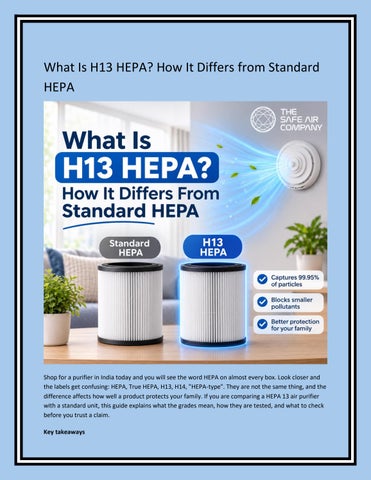
What Is H13 HEPA? How It Differs from Standard HEPA
Shop for a purifier in India today and you will see the word HEPA on almost every box. Look closer and the labels get confusing: HEPA, True HEPA, H13, H14, "HEPA-type". They are not the same thing, and the difference affects how well a product protects your family. If you are comparing a HEPA 13 air purifier with a standard unit, this guide explains what the grades mean, how they are tested, and what to check before you trust a claim. Key takeaways
• • • • •
HEPA stands for High-Efficiency Particulate Air, and it is a tested standard, not a marketing word. H13 is a grade under the European standard EN 1822, with a minimum of 99.95% efficiency at the most penetrating particle size. True HEPA, as commonly defined in the US, means at least 99.97% at 0.3 microns. The two standards measure differently, so they are not a simple like-for-like comparison. "HEPA-type" and "HEPA-like" have no standard behind them. HEPA filters capture particles, not gases or odours.
What Does HEPA Actually Mean? HEPA is a class of filter designed to trap very fine airborne particles. The best-known definition comes from the US Department of Energy: a filter must capture at least 99.97% of particles at 0.3 microns. That size was chosen because it is close to the hardest size for a filter to catch, so a filter that performs well there tends to perform well on both smaller and larger particles.
How HEPA Traps Particles A HEPA filter is a dense mat of very fine fibres. It does not work like a sieve. Particles are caught in three ways: by hitting a fibre directly, by sticking to a fibre as they pass close by, or, for the smallest particles, by moving erratically until they touch one. This combined effect is why filtration holds up well even for particles smaller than the gaps between fibres.
What HEPA Is Good At Capturing A properly rated filter can trap dust, pollen, pet dander, mould spores and fine particles such as PM2.5, which is a major concern in Delhi NCR during winter.
What Is H13 HEPA? H13 is a grade defined in the European standard EN 1822, which classifies high-efficiency filters by how well they perform at the most penetrating particle size, often called MPPS. Under this standard, the filter in a HEPA 13 air purifier must reach at least 99.95% overall efficiency. Two details are worth knowing: • •
Filters are tested at the hardest size. MPPS varies by filter, but it often falls between 0.1 and 0.3 microns, so the test targets the toughest particles. Local leak performance matters too. EN 1822 also sets a minimum for how well the filter performs at any single spot, which helps catch pinholes and weak areas that an average figure could hide.
The international standard ISO 29463 follows a similar approach, and its 35 H grade corresponds to the same 99.95% efficiency.
HEPA vs H13 HEPA vs True HEPA The three terms overlap, which is why buyers get confused. This table sets out the differences.
Term
Where it comes Typical minimum efficiency from
Notes
True HEPA
US definition (DOE)
99.97% at 0.3 microns
Common on consumer products
H13
European standard EN 1822
99.95% at the most penetrating particle size
Medical-grade classification
H14
European standard EN 1822
99.995% at the most penetrating particle size
Higher grade, used in sensitive environments
HEPA-type or HEPA-like
No standard
Not defined
Marketing term, no guarantee
Is H13 Better Than True HEPA? Not necessarily, and it is worth being careful here. The two figures come from different test methods, so 99.95% for H13 and 99.97% for True HEPA cannot be compared directly. Both describe filters that capture the vast majority of fine particles. What matters more is that the filter is genuinely certified to a recognised standard and is installed so air cannot bypass it.
Why the Grade Is Only Half the Story A filter's rating describes the filter itself. The air in your home depends on the whole system. • • •
Sealing: If air leaks around the filter edges, some of it skips filtration entirely. Airflow: A strong filter paired with weak airflow cleans slowly. Coverage: A single portable unit works on one room, not the rest of the home.
•
Maintenance: A clogged filter loses effectiveness over time.
This is why independent measurement matters. Readings of PM2.5 before and after, taken in your own home, tell you more than a spec sheet.
What HEPA Cannot Do Honest guidance should include the limits. A HEPA filter captures particles, but it does not remove gases, odours or volatile compounds such as paint fumes or cooking smells. Those require other media, such as activated carbon. Anyone selling a HEPA filter as a fix for odours is overstating what it does. Also avoid devices that generate ozone. Ozone can irritate the lungs and is not what people with asthma or allergies need.
How to Check a HEPA Claim Before You Buy Use this short checklist when comparing products: 1. Look for a named standard. Words like H13, EN 1822 or True HEPA with a stated efficiency are good signs. 2. Be wary of vague labels. "HEPA-type", "HEPA-like" and "99% filter" with no test size say little. 3. Ask how the filter is sealed so air cannot bypass it. 4. Check coverage and airflow against the size of your home. 5. Ask about replacement cost and schedule, since filters are a running expense. 6. Look for measured results, not only rated numbers. A good hepa air purifier choice comes down to these checks rather than to a single word on the box.
Where H13 Filtration Fits in a Whole-Home System Portable units place the filter inside a room. Whole-home systems apply the same filtration to the entire living space. Safe Air Haven, by The Safe Air Company, is one example. A unit placed outside, on a balcony or service area, draws in outdoor air and passes it through a washable pre-filter and two H13 HEPA filters in series, each rated at 99.95% efficiency at 0.3 microns. The filtered air is supplied through the home, creating gentle positive pressure that helps keep polluted air from leaking in. As with any HEPA-based system, it targets particles and does not remove gases or odours. If your goal is steady protection in every room, a whole-home approach to indoor air purifier needs is worth considering, whichever brand you evaluate.
Final Thoughts H13 is a meaningful, tested grade, but it is not magic. Understanding what the label means, what the test measures and what it leaves out helps you separate real filtration from marketing language. Check the standard, ask about sealing and coverage, and look for measured results in a real home.