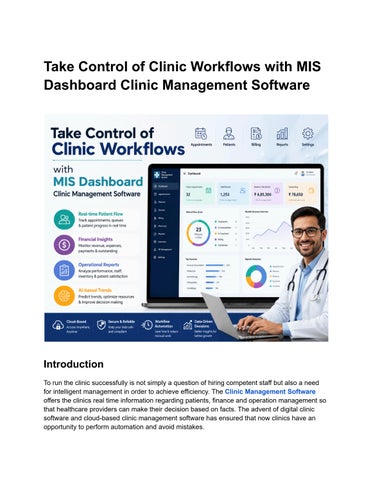
Understanding MIS Dashboard in Clinic Management
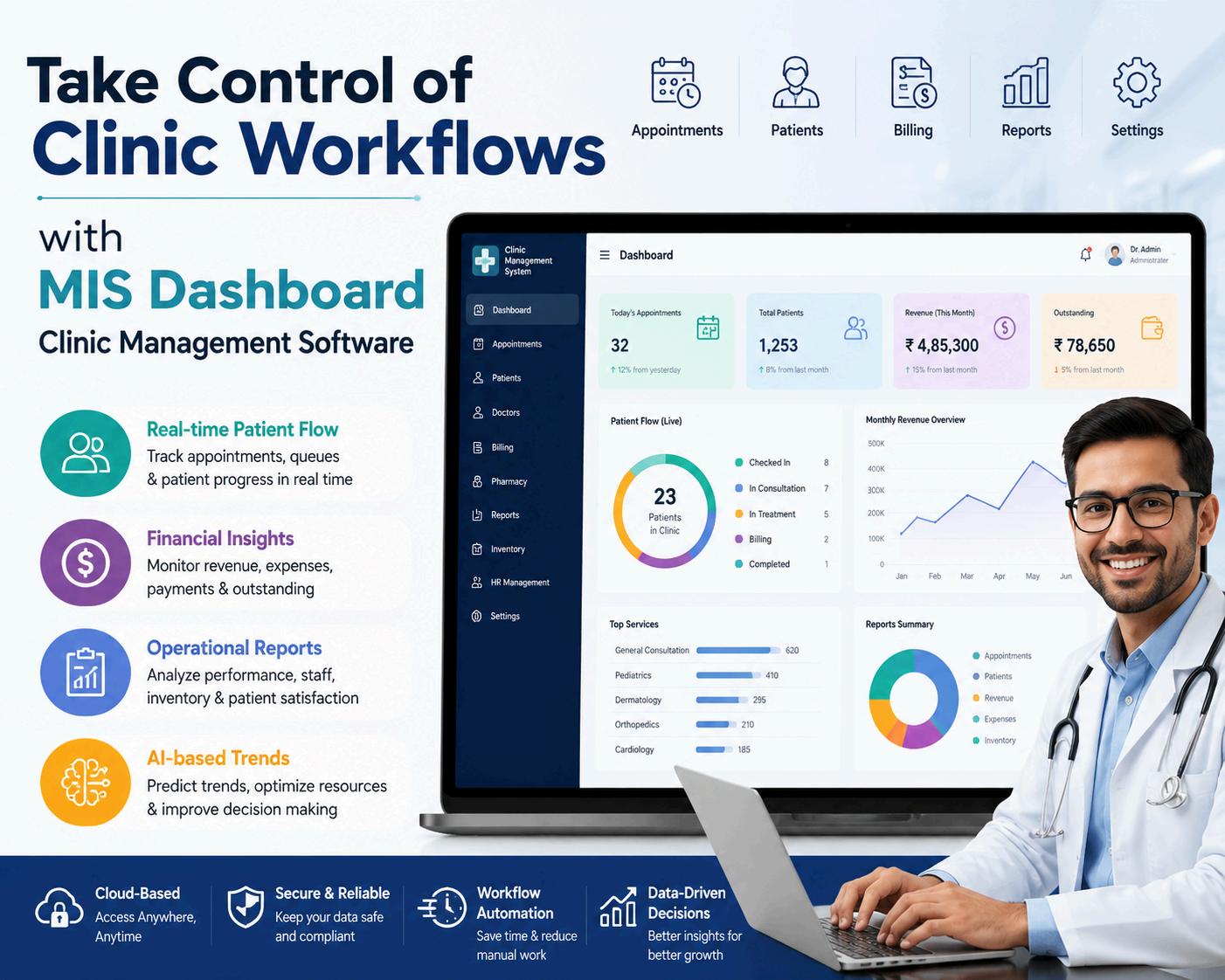
An MIS Dashboard is the most important component of any contemporary Clinic Management System All essential information is aggregated on the dashboard, ensuring total control over processes in the hands of healthcare administration. The ability to analyze patient visits or the financial performance of the clinic via a dashboard helps the decision-makers respond fast and effectively Clinics that implement modern medical clinic software can handle scheduling, booking, and resource management without any human involvement.
Benefits of MIS Dashboard:
● Ability to monitor both patients and personnel in real-time
● Availability of operational and financial information at hand
● Automation of reports for hospitals
● Use of AI technology to analyze trends
A Cloud-based Clinic Management Software makes it possible to operate such a dashboard from anywhere. It is an excellent choice for clinics in India.
Real-time Patient Flow
Movement control of patients in a clinic is essential for efficient operation and service delivery as well as high levels of patient satisfaction. MIS Dashboard in Clinic Management Software allows administrators to track each and every patient from the time of admission to discharge Tracking of movements of the patients will ensure effective use of clinic resources
Some of the key features include:
● Real-time tracking of queues to eliminate possible congestion
● Notifications of appointment time to improve patient attendance
● Monitoring of patient queue time and time spent in treatment
● Real-time integration with the online clinic management system
These features allow staff to concentrate more on caring for the patients rather than doing paperwork For instance, in a multi-specialty hospital that uses Clinic Hospital Software, there was an average improvement of 30% on patient waiting time through the help of live workflow.
Modern medical clinic software offers an easy way for managing appointments and consultation as well as emergencies. Besides, Cloud-based Clinic Management Software guarantees availability of data wherever needed hence quick and informed decision-making by both the administrators and doctors Through Clinic Workflow Automation, the risk of making mistakes in manual scheduling is eliminated.
Financial Insights
One of the most challenging aspects associated with clinic management can be finance Financial modules are incorporated in the latest advanced clinic management software in India right in the MIS dashboard and allow administrators to get insights regarding their finances
Key finance-related modules include:
● Automatic billings and invoicing in order to avoid mistakes made by humans
● Processing insurance claims and accelerating payments
● Collecting data concerning revenue and expenses in order to budget
● Creating customized financial reports for better decision-making
On account of this, clinics can make the right decisions that will result in their increased profitability and appropriate accounting In addition, the use of clinic management software will enable automatic data processing, which will give the precise picture of the cash flow
Benefits of getting financial insights can be described as follows:
● Avoiding any human mistakes in terms of financial accounting
● Simplifying the process of payments and receipts' processing
● Identifying expensive departments in order to distribute resources
In this regard, the implementation of finance management in clinic management software in India simplifies the work of clinic administrators even more and makes sure that all regulations and standards are met It takes only a few clicks to generate necessary financial reports for stakeholders.
Operational Reports
Operational efficiency is the essence of an efficient clinic MIS Dashboard provides operational reporting to enable the management to monitor anything ranging from the performance of their employees to the quality of services provided to their patients
Type of Report
● Number of appointments/consultations to identify trends
● Attendance and workload of staff for proper scheduling
● Inventories/equipment utilization for effective resource allocation
● Feedback/trends of patients’ satisfaction for improving quality of care
Using these types of reports can help a clinic easily identify any inefficiency, plan proper scheduling, and allocate resources efficiently. The introduction of medical clinic software has automated all this process saving on administrative expenses for the clinic
Sub-Benefits of Operational Reports:
● Fast detection of inefficiencies within the clinical process
● Better management of staff efficiency and accountability
● Improved delivery of services to patients based on data insights
Using the Cloud-Based Clinic Management Software, it will be possible for managers to monitor operations reports from any remote location since they will all be stored online. With that in mind, it will become easier to coordinate activities in several clinics from one central location
AI-based Trends
AI-Based Analytics represents the next level of Clinic Workflow Automation. Advanced Clinic Management Systems available in India use artificial intelligence to foresee patient behavior and resource demands and plan budgets accordingly This enables clinics to be proactive in their activities rather than reactive.
AI-based Features include:
● Proactive prediction of the busiest periods in terms of patients and appointments scheduling
● Automated diagnosis and treatment suggestions
● Analysis of trends for seasonal health issues
● Forecasting revenue and resources needed by a clinic
With such software, a clinic can effectively organize workload management, minimize overbooking, and offer personalized treatment services Cloud-Based Clinic Management Software makes sure that these forecasts can be accessed and analyzed remotely by an administrator.
Benefits of AI trends:
● Anticipate patient inflows and arrange necessary staffing in advance
● Optimize inventory to prevent wastage and save money
● Spot the aspects of clinic operation requiring improvement
With AI-enabled Digital Clinic Software, a clinic is no longer only able to respond to the challenges but also anticipate future problems and solve them ahead of time For example, using predictive analytics, an administrator will be notified about possible patient surge due to past experience
Why Clinics Should Invest in a Complete Clinic Management Software
Implementation of complete Clinic Management Software makes it possible to integrate all operations necessary within the clinic, including patients’ movement, accounting, and even AI-based trend analysis into one easy tool
Benefits Include:
● Efficient patient process management through Clinic Workflow Automation
● Efficient financial management and reporting through Digital Clinic Software
● Scalability and remote usage through Cloud-Based Clinic Management Software
● Better healthcare for patients through medical clinic software
The need for a good Clinic Management System in India is crucial for any medical institution striving towards effectiveness and excellence in terms of patient satisfaction Whether you have a clinic or hospital, it’s vital to implement a Clinic Management System in India with MIS Dashboard and gain full control of your business processes.
Why Clinics Need a Comprehensive Management System
Modern clinics need not only basic software; the full-fledged Clinic Management Software is what guarantees that all processes, from patients' flows to financial and managerial ones, are controlled
The most important characteristics of such software are:
● Patient Tracking at any time (Clinic Workflow Automation)
● Financial components for billing and accounting (Clinic Hospital Software)
● Access from cloud (Cloud-Based Clinic Management Software)
● Analytic capabilities using AI technology (Digital Clinic Software)
An online clinic management system can help clinics cut their admin staff's workload greatly and increase efficiency
Benefits of Using Clinic Management Software in India:
● Workflows optimization and decreased errors
● Better care and customer interaction
● Data collection and accessibility
● Scalability for developing medical facilities