REGENERATIVE GROWTH: SOWING A COMMUNITY EMBEDDED FOOD ECONOMY IN EAST NEW YORK
Regenerative Growth: Sowing A Community Embedded Food Economy
In East New York
By Ashley Lehrer
For The Purpose of Obtaining The Degree of
MS in Design and Urban Ecologies At Parsons School of Design
The New School May 10th, 2021
Thesis Advisors: Professors William Morrish + Gabriela Rendon
Acknowledgments
Thank you to my collaborators Alexis, Brittany, Frank, and Jill for welcoming me into the Universe City family, I am thrilled to continue to grow with you. I don’t think I could have done this without the support of the brilliant DUE and TUP ‘21 cohort; it was an unexpected journey to be in graduate school during a pandemic, and it forced us to learn and participate in novel, often frustrating, ways. To my New School professors, you gave me the platform to excell in this process, thank you. It is also important for me to acknowledge Lenapehoking peoples whose land I call home. And of course, thank you Mom, Dad, and meu companheiro Ricardo for your endless love, patience, and wisdom.

Abstract
There is a need for local, community owned and operated, food economies that provide opportunities for the full life cycle of goods, from production to waste management. The East New York Industrial Business Zone is a prime location to build and initiate the infrastructure needed for NYC to provide access to healthy foods and economic opportunities for historically underserved populations. In Brooklyn, while there have been studies and articles that reflect the need for a localized food system, a multi-nodal food port based on the principles of food sovereignty and circular urban food systems has not been fully described. This project will provide a deeper formulation in phasing a development trajectory for Universe City NYC to grow into a local economic engine for the people it intends to serve. The focus of this thesis is to analyze existing food governance mechanisms in NYC and illustrate the measured urgency for local economic investment and increased access to fresh, healthy foods, workforce development, agri-tech education, and to local food business incubation in East New York. In partnership with Universe City (UC), utilizing frameworks of Democratic Organizing, Regenerative Economics, and Food Sovereignty, a participatory planning process toward the development of a 10 year plan has been initiated. In creating the participatory process, this thesis defines and articulates steps taken to imbue each phase of strategic development with the needs and dreams of stakeholders towards collective growth.
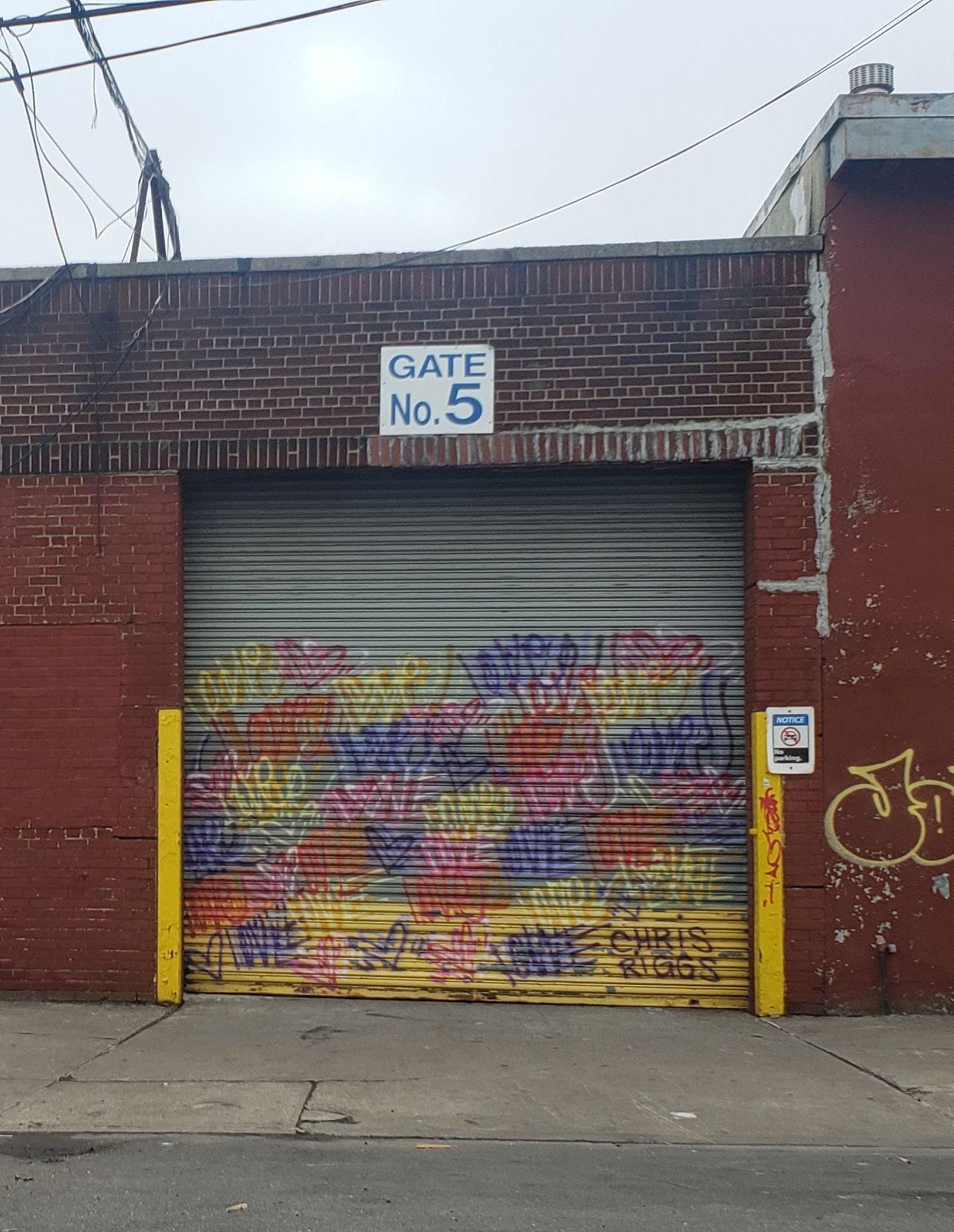
figure 2: exterior of universe city nyc at 234 glenmore avenue, east new york
A ROTTING SYSTEM; RIPE FOR
Historical Context
Food insecurity is a persistent problem in the face of vast excess and waste that is created by the extractive capitalist, commodity, and profit driven industrial agribusiness food chain that is now the dominant form of food production and distribution in the United States. Since industrialization in the late 1800s, urban agricultural land has vanished and the food urbanites eat travel further and further to get to their plate. During this period, farms have increased in size and began to produce only one type of crop, while also phasing out natural forms of pest management in exchange for toxic pesticides that harm both the farm workers and consumers1. As industrialization evolved, productivity increased as prices have decreased, along with quality and nutritional value, allowing cheap unhealthy products to be more affordable to low income and disenfranchised populations. This is where health, hunger, and food security meet to form the proliferation of diet based diseases that disproportionately affect low income communities2
The great depression brought similar circumstances as the current pandemic: massive unemployment and food waste. The government stepped in to purchase the excess food products and resell at discounted prices to low income populations. Through the purchase of stamps, these were exchanged as currency for food, with some commodity items available for free3. Mutual Aid groups also emerged during this period, in California agricultural communities created self help associations before the initiation of Food Stamps that would barter and trade resources to support themselves. Many of these groups developed into large councils who used protest, strike, and other agitation tactics to push for governmental support in a time before social services4. By the end of the 1930s many welfare policies were implemented like social security and the first iteration of Food Stamps in 1939. These cooperative community groups performed many similar roles as the ones that have emerged today, helping to pay rent, care for children, and feed the community. Once funding and jobs were subsidized through the government by the New Deal and other welfare programs, these groups diminished. Since the 1980s social services have been slashed by the federal government, putting communities
into similar circumstances as the Great Depression, where all of a sudden hoards of people are out of work without sufficient government support, and leaning on each other for essential needs.
The initial Food Stamp program was implemented between 1939-1943, lapsing at the end of WWII when there was a post war boom that ended the policy and was not reintroduced until 1961 by John F. Kennedy. Lyndon Johnson followed, expanding the policy by providing additional food stamps at no cost to people below a certain income bracket through the Food Stamp Act of 1964. National food assistance programs continued to expand through the 1960s and 70s. Each farm bill that passed provided additional supports such as the Special Supplemental Nutrition Program for Women, Infants and Children (WIC) in 1972 and in 1977 seeds were available to purchase through food stamps to encourage home gardening. The expansions come to a halt when Ronald Reagan is elected. He slashed the Food Stamp budget, eliminated the ability for Food Stamps to count for essential products like medication, and made it easier for people to be disqualified. In 1990, the Mickey Leland Memorial Domestic Hunger Relief Act, restored some of the budget but the program implementation changed, where some of the funding is in the form of Block Grants and other state level policies. One win is for homeless populations who are now able to utilize food stamps to purchase prepared foods at participating restaurants.
New York City has a strong legacy of charitable and supportive organizing, one of the first major food assistance establishments was the Bowery Mission in the 1880s, still operating today. Faith based pantries continue to be the majority of non governmental organizations that provide nutrition support to those in need. During the civil rights movement cooperatives and mutual aid organizations became popularized with many food cooperatives established in California and New York, like the Park Slope Food Coop that began as a wholesale food buying cooperative in 1973 and now has 17,000 worker-owners, providing enough revenue to support new cooperatives through funding and structural support. The Black Panthers also began a free grocery
campaign which eventually extended into free breakfast for school aged children. This program was so successful that by 1969 it had expanded from Oakland to 23 other cities. In 1966, the federal government also launched a free breakfast program through the Childhood Nutrition Act, and J Edgar Hoover saw the Panther program as a threat5. The direct connection is not clear but the federal program grew exponentially between 1969 and 1972 effectively ending the Panther’s Free Breakfast for Children Program. GrowNYC emerged in 1970 as a body to support environmental issues regarding noise and air quality, they eventually grew to include recycling and community garden creation and retention against an ever development hungry city. Today’s GrowNYC provides incredible distributive justice through youth run markets, wholesale buying clubs, health bucks, and composting throughout the boroughs. The alternative food systems, based in community knowledge and health, allow for greater control over food access and are integrated with food rescue organizations.
The 1980s in New York City produced two major actors in the struggle for food security: City Harvest and The Food Bank for New York City. Each organization holds an important place in the NYC food system. In 1982, City Harvest began when a group of friends came together to rescue food being thrown away by supermarkets; today, City Harvest rescues millions of pounds of food each year to be redistributed to those in need. The Food Bank for New York City was formed in 1983 as a hub for food donations to be distributed to pantries and other anti-hunger organizations. Strategically located in Hunts Point, the food bank accepts donations from the wholesale cooperative markets and national entities. They collect important data on meal gaps and how pantries operate, this information has revealed the precariousness of life for the two million New Yorkers who are food insecure each day6
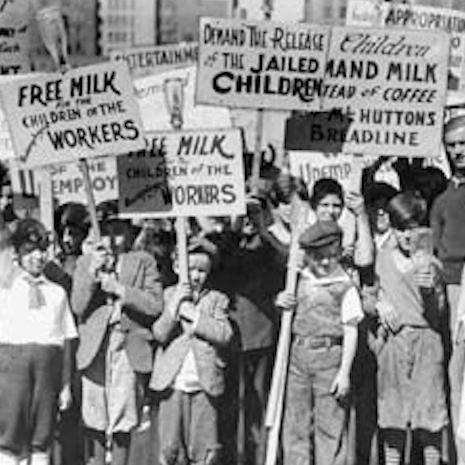
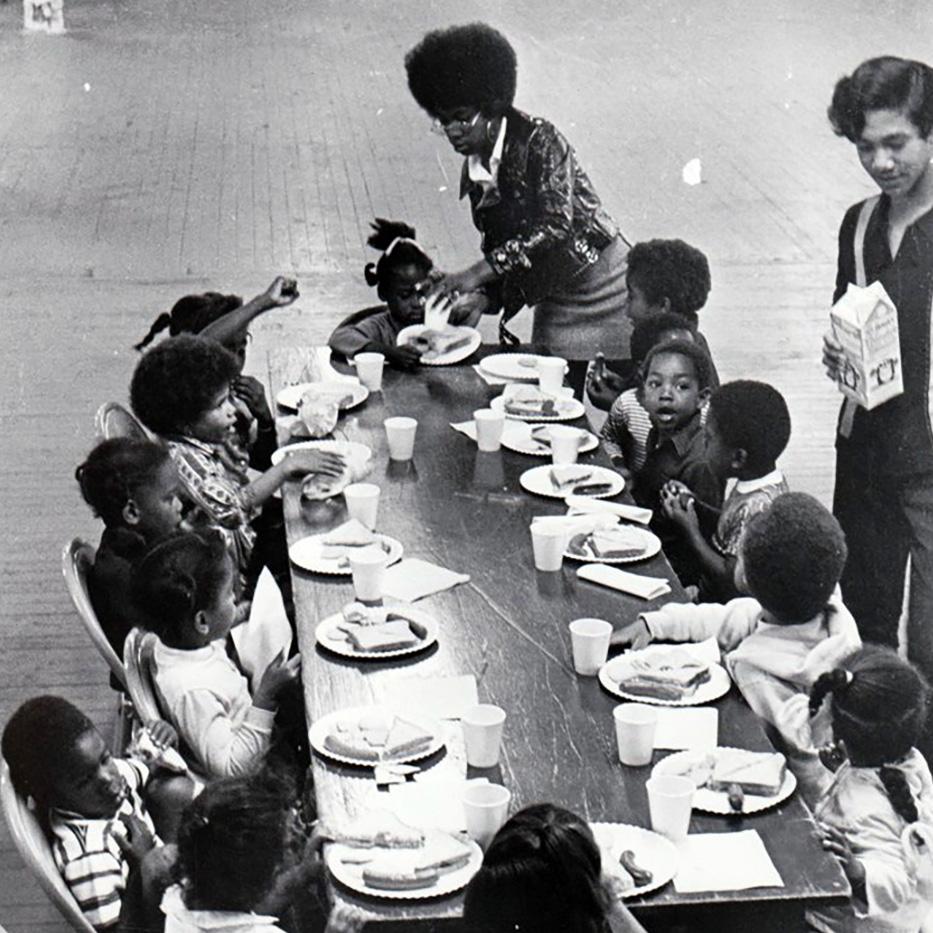
figure 4: children marching for food and freedom, 1930s figure 5: black panther free breakfast program, 1960s
National + New York City Nutrition Assistance Timeline
1939-1943
In the midst of the great depression, FDR signs the Agricultural Adjustment Act setting the groundwork for Food Stamps. Known as Federal Surplus Relief Corporation, the government purchased farm commodities to redistribute at discounted prices. to citizens.
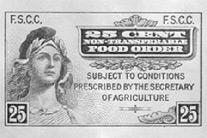
As part of the New Deal, the first Food Stamps are issued.
Low income individuals could purchase a book of orange stamps, for ever $1 spent on stamps, they received 50 cent blue stamps good for items in surplus such as beans, flour, eggs, and vegetables.
1961
JFK reintroduces Food Stamps as pilot program in some states, individuals must still buy stamps + surplus stamps are eliminated.

Lyndon Johnson signs the Food Stamp Act. Individuals must still purchase stamps, but additional bonus stamps are awarded based on income level. It was still a goal to more effectively utilize agricultural surplus, besides access to nutrition.
The Great Depression saw massive unemployment leading to hunger. During this time, ‘breadlines’ and soup kitchens arose, mostly from faith based institutions to need the needs of the hungry masses. These services were meant to be temporary but many congregations continue to provide meals to food insecure and hungry individuals. 1930s
1879
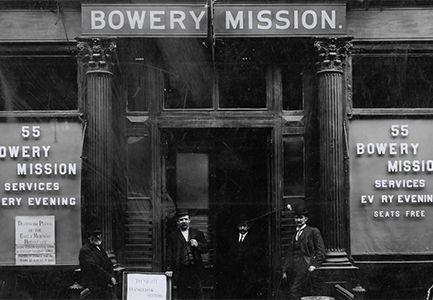
The Bowery Mission was founded to feed and house unemployed and homeless New Yorkers and hungry tenement dwellers. Still operating today, the mission is known for its massive thanksgiving celebration each year; in 2019 they served close to 15,000 meals during the holiday week.
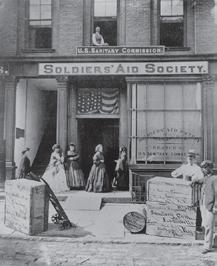
Fraternal + Civil Societies are mutual aid groups that were formed by formerly enslaved peoples, laborers, immigrants, and other marginalized groups to support the needs of newcomers, the sick, elderly, and poor. These groups provided many forms of support from pensions to burials; some were early forms of labor unions and many are still in operation today.
References included in the works cited section (pgs X-XX)
2020 2010 2000 1990 1980
1972
Pilot program for the Special Supplemental Nutrition Program for Women, Infants and Children (WIC) begins; made permanent in 1974.
Ronald Reagan makes major budget cuts to Food Stamps, coordinating with a rise in food insecurity and hunger during the 1980s. Lowers the threshold for eligibility and more rules for disqualification, such as some medical expenses no longer counting towards income deductions. 1990
1977
SNAP revisions include: eliminating purchase requirement, expanding purchase of seeds and plants for home cultivation, national eligibility standards, and expansions for minority populations.
1996
EBT expanded nationally and other improvements initiated under the Personal Responsibility and Work Opportunity Reconciliation Act
Some of the budget is restored with stricter eligibility guidelines under the Micky Leland Memorial Domestic Hunger Relief Act. Some funding is now in the form of block grants to states, necessitating more restrictions to food stamp usage. Homeless populations now able to use food stamps at participating restaurants. EBT is also established.
1967
The first food bank is established in Phoenix, Arizona by a man who was a frequent food pantry volunteer in order to create a place for food discarded by stores to donate for distribution to those in need. The concept spread and by 1980 there were 200 food banks across the United States.
1982

1969
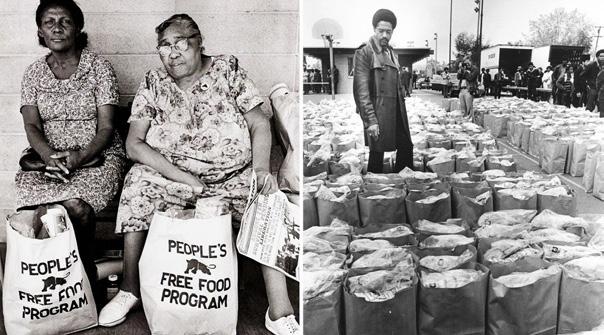
Black Panther’s People’s Free Food Program began in 1969 providing free breakfast and lunch to school age children. Soon the program expanded to provide groceries free of charge to community members in need. The program was considered dangerous by J Edgar Hoover, who saw it as a major threat and the FBI made efforts to undermine the program and its expansion. The media attention around the program ultimately influences the establishment of the National Free School Breakfast Program in 1975, still in operation today.
2014
2019 38 Million Americans are enrolled in
45 million Americans utilize SNAP. The Farm Bill directs 31 million to aid national, state, and local organizations in cultivating programs that increase SNAP spending on fresh foods.
2008
Food Stamps renamed Supplemental Nutrition Assistance Program (SNAP) under the Food, Conservation, and Energy Act. Increases minimum benefit and EBT becomes the only distribution method. New initiatives created to incentivize use of SNAP at farmers markets.
•Pandemic EBT (P-EBT) provides access to increased funds for families children who receive free + reduced lunch.
•Expanded SNAP benefits + online shopping
•Substitution for unavailable WIC foods
•$3 Billion of fresh produce purchased from farms and distributed in food boxes to Food Banks, Pantries, Tribal Nations + local nonprofit organizations.
1983
Food Bank of New York City is founded. Serving nearly 400,000 meals a day, food is donated from the Fulton Fish Market, Hunts Point produce, meat, and cooperative markets, as well as governmental agencies and national food rescue organizations.
City Harvest is founded by a group of New Yorkers who saw the waste created by restaurants and stores, developing partnerships to reclaim the excess food, distributing to those in need. Since then, City Harvest rescued 800 Million pounds of food that has made its way to families, workers, and the elderly across NYC.
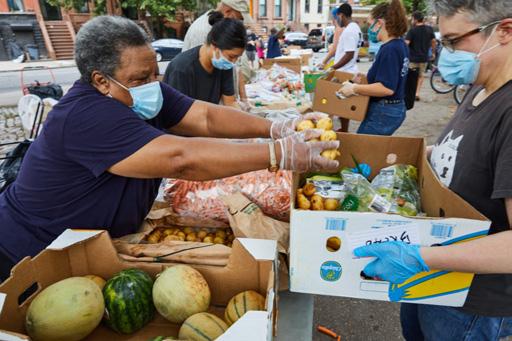
The Bedford Stuyvesant, Brooklyn chapter of Food Not Bombs was initiated by A New World In Our Hearts out of the Occupy movement. Food Not Bombs is a worldwide decentralized movement, founded in 1981 in response to government support of expanded nuclear energy industries, which rescues food that would otherwise end up in a landfill. Generally vegan and vegetarian, volunteers gather every Saturday to distribute groceries to those in need.
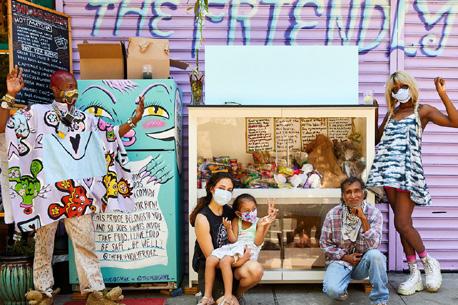
A sharp increase in mutual aid networks arose out of the COVID-19 pandemic. One of the most effective and supportive tactic to serve people with no barriers or stigma attached were the community fridges that provided 24 hour access to free foods to anyone in need. As of April 2021, over 100 free fridges serve New York City alone.
Problem Statement
The current food system in NYC is unevenly and inequitably distributed physically, demographically, and culturally. There are areas with incredible varieties of health food retail businesses and other neighborhoods with one supermarket, where bodegas are the main source of nutrition, with little autonomy as to what foods are available. Additionally, New York City is heavily dependent on imported products, raw materials, and added value merchandise; with most of the money spent in the city enriching companies far away. Hunts Point is the largest food hub in NYC, four bridges and two tunnels bring in the majority of food to the boroughs, with very few freight train or barge usage despite existing infrastructure7. The communities that live adjacent to these truck routes have higher rates of asthma, and tend to be low income, BIPOC populations, creating negative impacts on public health8. The aggregation of services into the Hunts Point Peninsula has benefits for the industry, but not for the people. Despite being the center of the food system in NYC, the community of Hunts Point has some of the highest bodega to supermarket ratios in the city, few farmers markets or other modes to access local foods, and has high rates of SNAP recipients with few emergency food providers. With COVID-19, the need for food assistance became extreme, due to increased unemployment and high cost of living. Now, the necessity for integrated and community focused food systems, supported by publicly funded policies and initiatives, is blatantly evident as New Yorkers continue to struggle to feed their families. New York City lacks sufficient nutrition education and opportunities led by and for disenfranchised communities to foster public health, intergenerational wealth, and access to affordable, culturally appropriate foods9.
In response to the interwoven effects of COVID-19, the current food system in New York City was pushed to the edges of its silos (diagram 1). Supply chains broke down, waste increased, and workers at Hunts Point continued to feed the city despite being disproportionately exposed to the virus. There is a need to diversify the flow of food in NYC and form community based approaches to the existing food justice realities that were exacerbated by the pandemic. Hunts point sells 60% of the produce, 40% of the meat and fish
products that feed New York City, 99% traveling from there to their final destination by truck. Hunts point is also home to the Food Bank for New York City and GrowNYC’s wholesale distribution center, and a number of large private food distribution warehouses. The concentration of these services may have historically been advantageous, but has created an uneven system that needs diversification, not to mention the fact that the peninsula is also in a major flood zone. A city wide network of neighborhood level food hubs would allow greater opportunity for community based services, workforce development, resiliency, and potential for food sovereignty to be achieved by marginalized populations. This thesis explores one pathway towards addressing the need for local control of the food system through efforts grounded in community led decision making.
nyc food system + Covid-19
Thesis Objectives Universe city nyc food port
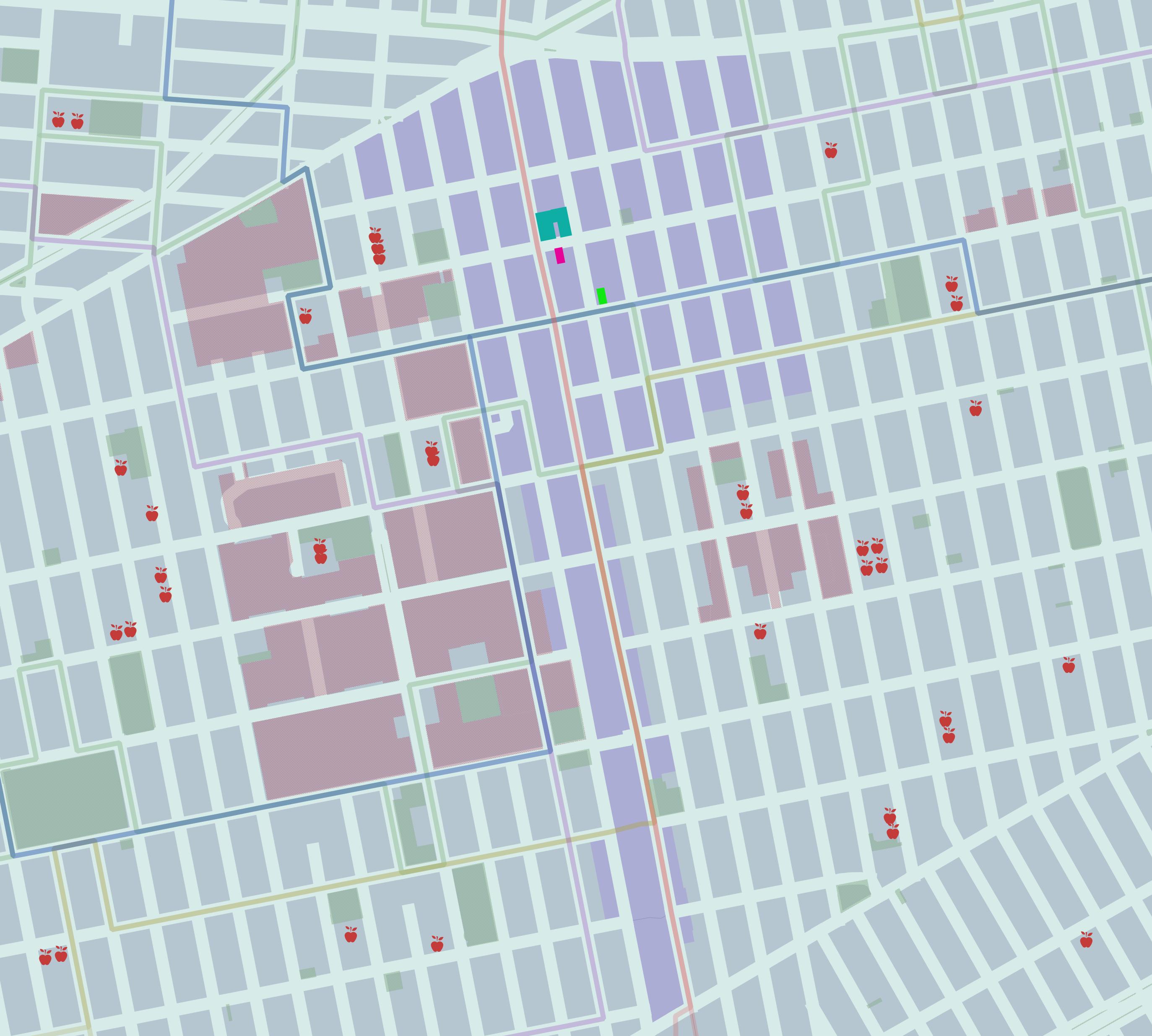
There is a need for community driven food economies that provide opportunities for the full life cycle of goods, from production to waste management. I have imagined these relationships by negotiating the flux of socio spatial processes, environmental dynamics, and scalar intermediaries that exist within and between the food systems of East New York and Hunts Point. New York City communities deserve dignified, locally controlled, and affordable access to fresh food everyday. The East New York Industrial Business Zone (ENYIBZ) is a prime location to build and initiate the infrastructure needed for NYC to provide access to healthy foods and economic opportunities for historically underserved populations.
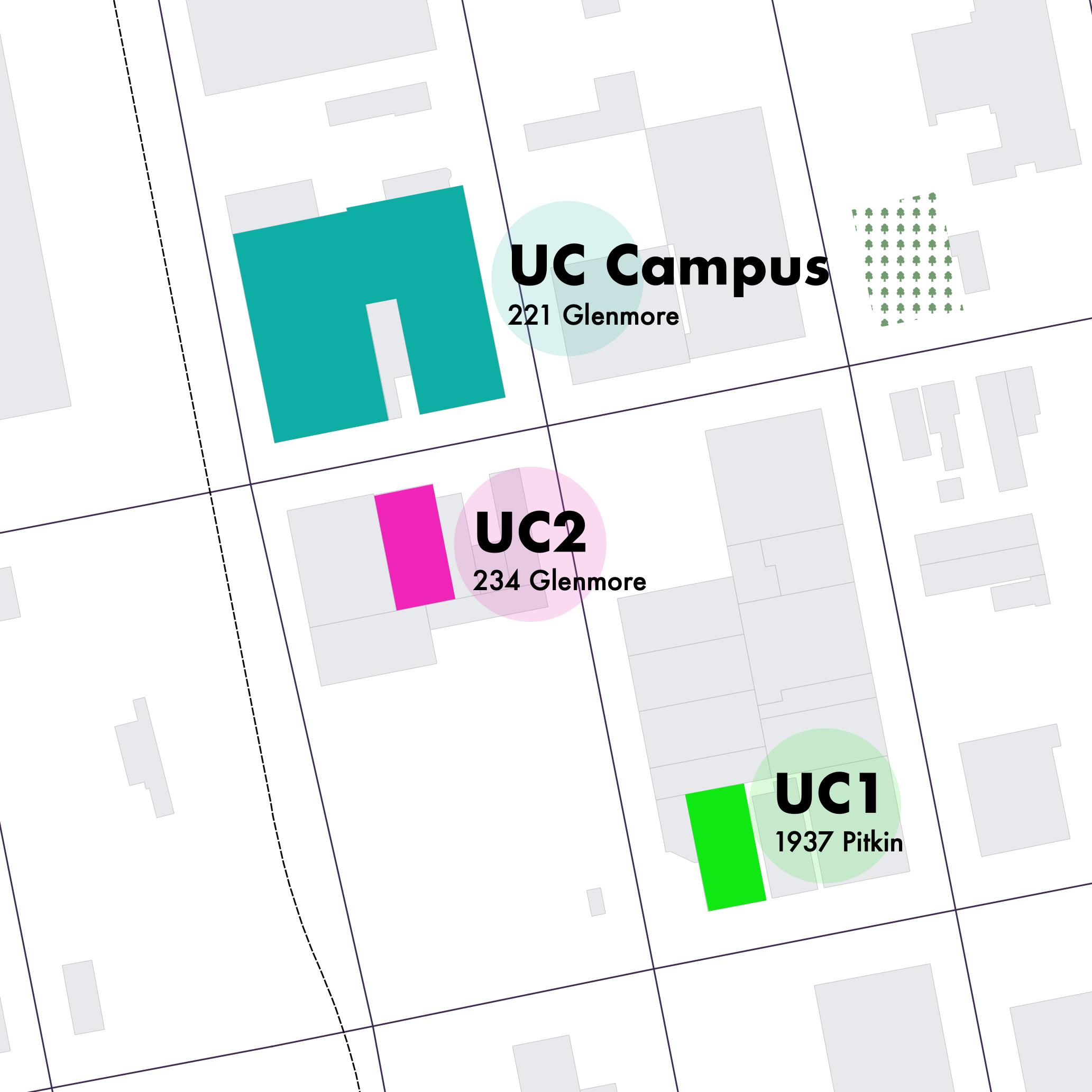
Universe City NYC is a business located in the ENYIBZ seeking to grow a cooperatively run Food Port to benefit the local economy and provide education and workforce development in the agricultural and food manufacturing fields (diagram 2). In order to be able to grow this food port, many major problems must be addressed including physical limitations, food safety standards; and the overall organization of Universe City (UC) must be improved. In creating a process to develop a strategic plan for the Universe City Food Port, I have visualized and defined the steps and elements needed to activate and achieve near, medium and long term goals.
Grounded by insights gleaned from case studies, reports, existing policies, and regenerative frameworks that support the development of the Universe City Food Port, this thesis aims to illustrate the measured urgency for community driven economic investment and increased access to fresh, healthy foods, workforce development, agri-tech education, and to local food business incubation in East New York, a historically disenfranchised community. Aligning the goals of Universe City will the goals outlined in the NYC 10 year Food Plan, released in February 2021, provide an opportunity to state the importance and necessity that the future Universe City Food Port could offer to its embedded community, and to bring the greater NYC food system closer to meeting their environmental, economic, and social justice goals.


Research Questions
It is established that most city food policies operate through dominant, extractive capitalist modes and prioritize formal non-profit organizations and corporate entities. These current policies do not substantially support economic empowerment of local communities and may actually increase displacement10. However, there are policy approaches to food insecurity that can uplift public health outcomes and promote food sovereignty. The City Council proposed some of those ideas in their Growing Food Equity report from 2019, including the proposal to support Community Food Hub Incubators and further Food Waste Prevention Plans. How can city agencies invest, financially and legislatively, in the formation of neighborhood level food economies? Which initiatives support hyperlocal food systems that seek to support underserved communities? Many food policies in NYC are market driven and rely exclusively on increased proximity to solve intersecting issues of food insecurity and health. Could their requirements be extended to include ventures such as Universe City that aim to go beyond their current approach?
Long standing organizations like GrowNYC have been instrumental in the development of an alternative food system in NYC, while establishing a crucial link to the existing food system in Hunts Point. They have developed networks that support regional farms and increased access to fresh foods through CSAs, Farmers Markets, and Food Boxes. These methods promote regenerative economics and community control; they also accept SNAP and other institutional nutrition assistance programs that incentivize buying fruits and vegetables. How can the city support the success that these organizations have had in affecting community health through programs and incentives that promote the expansion and deepening of these formations?
Currently, GrowNYC and the EDC are working to develop a Regional Food Hub within the industrial zone of Hunts Point that will aid the city’s mission to increase the flow of New York grown food products into the food system and increase the capacity for important programs like wholesale buying clubs and Fresh Food Boxes. This however, does not necessarily provide the opportunity to address the interwoven issues of food insecurity,
food access, and their roots: high cost of living and lack of living wage job opportunities for the embedded community11.
With COVID-19 causing both unemployment and disruptions to the supply chain, food insecurity has increased for the most vulnerable populations. The food pantry system of New York is currently operating beyond its infrastructural capacity and new modes of distribution have emerged through solidarity networks, by and for the embedded community, to meet the needs of the local population. The Emergency Food Assistance Program (EFAP) requires non-profit (501c3) status to receive support and is the main funding system for the city to provide financial assistance to pantries through offsetting operating and procurement costs. Currently, Mutual Aid networks would not be able to directly benefit from this program (and may not want to). Nutrition support is seen in many forms, institutional and informal, but which actually support public health, local economies, and food security?
The East New York Industrial Business Zone (ENYIBZ) went through a redistricting process with the EDC in 2015. The ENYIBZ was reduced from 40 to 10 blocks and promised $17 Million in investments as well as 3900 jobs for the community. Those promises are still yet to be acted upon and the community has begun organizing around Economic Justice for East New York to hold the city accountable. The IBZ contains shelters, a number of light manufacturing businesses, storage facilities, and the highest concentration of school bus operators in the city. With these elements aligned, there is a case for major investment in the Universe City Food Port as a holistic approach in addressing the unmet promises from the EDC. How can the development of the Universe City Food Port be supported through investments in the ENYIBZ and the larger goals outlined in the NYC 10 year food plan?





Methodology
This thesis incorporates multiple research and design methodologies. Quantitative data sources include governmental agencies on federal level, American Community Survey data and USDA specifically for mapping and policy analysis. Other sources are organizational reports, such as Hunger Free America and The Food Bank for New York City; as well as NYC governmental agency data from the DOHMH, Mayor’s Office of Food Policy, HRA, and EDC. Policy and statistical analysis have illuminated the efficacy of food legislations as well as the lack of initiatives that provide substantive improvements to the daily life of food insecure populations in NYC. Recent articles from the New York Times, Center for Food Policy at Hunter College, and academic papers also provide a basis for research and insights.
Participatory and Qualitative analysis of food justice webinars, conversations with Universe City founders, mentors, and community members have grounded the design thinking and guiding values. The co-founders of UC and local leaders they engage with are the foundational influence in the approach of the design project, their articulation of the relationships and environments within which they navigate are central to the intentions of this thesis. Webinars, talks, and online courses provided important knowledges directly from those who are working in and experiencing the issues this thesis grapples with first hand. Some events include Movement Generation Course Correction: Just Transition in the Age of COVID-19; A Growing Culture: Hunger for Justice Series; Mayoral Food Forum 2021: Town Hall on the Future of Food in New York City; Resetting the Food System from Farm to Fork ; and most recently, Beyond Access: Notes on Delight, Food, and the Black Radical Imagination with Dr. Ashanté Reese. These live discussions have been hugely important during the pandemic where social distancing has brought forth an opportunity to attend talks and events that would otherwise be more difficult to access in person. Incorporating these recorded experiences as part of the research methodology presents challenges in how to translate and cite the knowledge produced and divulged within these online spaces.
When initiating the thesis, interviews with key stakeholders in the local and regional food system were essential to solidifying the problem statement and research questions. Some inquiries included: How did COVID-19 affect your services and capacity to reach this year’s goals? What was revealed or changed in the past year that you didn’t expect or exceeds your expectations? What challenges does NYC’s food system face to achieve sustainable and regenerative practices? The advice and recommendations from these informants provided clarity on which scales, stakeholders, and concerns are most relevant to the current foodscape of the New York region.
Case studies provide important knowledge and analysis that inform the methods by which this troubling urban circumstance has been studied and solved. The two studies included in the research chapters are intended to provide analysis of what is working, what relationships are providing new, regenerative, and supportive models for health and food justice. GrowNYC is a long standing organization that has expanded to encompass an alternative food system in New York City. Their services are throughout the five boroughs and have become a well funded quasi-city institution. Already located in the Hunts Point, they have been incorporated into the revitalization of the IBZ to build a 20,000 sqft regional food hub, greatly expanding their capacity. The Corbin Hill Food Project, began out of Upper Manhattan and serves as a food hub and food box delivery service in the Bronx and Manhattan. They have expanded to operate and contract upstate farms to grow exclusively for their network and strive for the goal of community control over the food system.
Mapping the food environment and demographic data in and surrounding the Universe City site is crucial to spatially understanding the layered impacts of uneven soft and hard infrastructures on this neighborhood. I have constructed maps on QGIS utilizing open data sources, both NYC based and from non-profit organizational surveys. The types of data include demographic information, environmental, economic, and health indicators.
Relevance
This project is unique for this particular geographic context. There are many examples of grassroots generated Alternative Food Systems, but most are in South America and Europe. In Brooklyn, while there have been studies and articles that reflect the need for a localized food system, a multi-nodal food port based on the principles of food sovereignty and circular economics has not been fully described. This project will provide a deeper understanding in phasing a development trajectory for, what has been until now, a DIY space to grow into a local economic engine for the people it intends to serve. While the development process described here may appear idealistic, it is flexible and based on realistic time frames that include programs, policies, and other certifications which impact the life cycle of food in NYC. This project will also hopefully communicate the opportunities for city administrations to support UC as a long term investment that will ensure lasting infrastructures for a community that has been given many, of what have been until now, empty promises. The combination of policy analysis and actionable strategic planning aims to describe the interactions between conventional practices, innovative approaches to troubling urban circumstances, and activation of justice based principles that need to be assimilated into economic and community development plans at large.
2. JUST FOUNDATIONS
FRAMEWORKS FOR REGENERATIVE FOOD SYSTEMS
Literature Review
Beginning at the scale of the extractive and discriminatory mechanisms found in the conventional food system, FoodSecurity,FoodJustice,orFood Sovereignty?Crises,FoodMovements,andRegime Change by Eric Holt-Gimenez provides a succinct overview of the shifts in power and intention around food governance and economics in the post industrial era. He shows how the monopolization of global food production has formed a corporate food regime. This ‘rule-governed structure’ has benefited from the processes of capitalism where “it constantly expands, squeezing profits from the food system by destroying existing forms of production and consumption and replacing them with new ones”12. This process of consolidation and extraction allows the global food system to produce 1.5 times more food than needed to feed the population meanwhile, one sixth of the world’s population is too poor to buy this food, resulting in overproduction, waste, devaluation of food and hunger where “many of the fifty million people now suffering from “ food insecurity ” in the United States are people of color and displaced immigrant farmers working in poorly paid jobs — frequently in the agrifoods sector”13.
The growing injustices produced by this system gave rise to grassroots food movements, with different aims and perspectives. Some concentrate on justice for those directly affected by land, livelihood and health loss due to the corporate regime and others around local and sustainable food production and quality of life issues. This framing provides a distinction between the progressive and radical approaches to food justice which Gimenez structures succinctly:
The Progressive Trend: “It is grounded in the notion of citizen empowerment and employs a food justice discourse. This discourse, coming from the traditions of environmental justice, denounces the ways people of color and underserved communities in rural and urban areas are abused by the present food regime, and invokes the notion of a gradual, grassrootsdriven transition, or passage, to a more equitable and sustainable food system. Institutions and groups in this trend promote local production, processing, and consumption of food, and are busy inventing
new business models to better serve economically disadvantaged communities. The approach to the food crisis is based on the right to food, better safety nets, and more citizen involvement in decisions regarding community food systems.”14
The Radical Trend: “The international trend seeking the radical transformation of food systems addresses the root causes of poverty and hunger in the food system, based on the notion of entitlement to food-producing resources and the redistribution of wealth. The discourse is framed by the concept of food sovereignty and the democratization of the food system in favor of the poor and underserved. The model advanced is one of local and international engagement that proposes dismantling the monopoly power of corporations in the food system and redistributing land and the rights to water, seed, and food-producing resources.”15
He sees these two approaches as partners in one movement that seeks to change the fundamental mechanisms of the corporate food regime to one that “seeks to change food systems in favor of the poor and underserved, and strives for more sustainable and healthy environments”16. With different target audiences, tactics, missions and partners the progressive and radical trends have the potential to shift the modes of production and beneficiaries of the global corporate food regime. Gimenez then points to the main challenges for the movement for justice in the food system. First, address immediate and ongoing realities of environmental degradation, hunger, food insecurity and malnutrition, and then to enact structural changes that will create a sustainable and equitable global food system. To do this he advocates for strong social movements that can shift political will away from the corporate regime; working horizontally- across movements, tactics, and networks. At Universe City, the progressive and radical trends are in conversation, holding each other up and working from both sides of the movement to align stakeholders from both the activist and commercial sectors to reach our goals.
Continuing Gimenez’s characterizations of trends within food movements, The Prefigurative Power Of
UrbanPoliticalAgroecology:RethinkingTheUrbanisms OfAgroecologicalTransitionsForFoodSystem Transformation by Chiara Tornaghi a and Michiel Dehaene argue that “urban-rural links have been conceptualized so far in most agroecological and food systems literature is largely reformist (occasionally progressive), and that an agroecology-informed food system transformation needs radical approaches able to see and engage with the challenge of ongoing neoliberal urbanisms and urbanizations.”17 They bring these links, approaches, and tactics into conversation through an illustration of urban political agroecology praxis. Problemitizing active urban agricultural projects and the promise of a return to ‘peasant’ activities, the authors argue that while these actions are helpful for visibility in the food justice movement, there tends to be little focus on political ecologies that would systematically change food systems in the urban sphere. Pulling on examples from the global south, they propose “a systemic approach to exploring spatial dimensions of the food system,”18 looking towards infrastructure design for meaningful connections between the urban and rural. ExploringTheConceptOfAgroecologicalFood SystemsInACity-regionContext by Mette Vaarst et al. introduces the factors necessary for the development of food system infrastructure through ecological and regenerative means. To achieve this system the related infrastructures of waste management, water, and energy must be reorganized to encourage reuse and reduction of resource extraction in earnest. Emphasizing the relations between urban, peri-urban, and rural these two articles suggest localized production and cooperative ownership of land as systemic goals19
The importance of the urban realm is negotiated in these texts, citing the continued need to “build on the work of critical geography that has unpacked the intimate link between capitalism and urbanization”20 and rely on Gimenez’s cry for radical transformations the support agroecological farming while actively dismantling oppressive and unjust mechanisms. This transformation of the food system would include breaking up speculative land practices, including urban soils in land use discussions, shift the logics that uphold commodification of food and “enable the full politicization of biopolitical
relations across the spectrum, moving away from technical and functionalist approaches solely focused on food.21” Practices that illuminate ways urban processes are commodified, challenge the alienation between the urban and the ecological within the city, and ones that “try to bridge urban struggles for social justice, land justice, and citizen-based forms of autogestion with the imaginaries of resource sovereignty and peasant farming22” and lately those that are forming collective infrastructures for urban urban agroecological food production create fertile ground for radical transformation.
Furthermore, Chiara Tornaghi a and Michiel Dehaene have defined three “disrupting mechanisms: “i) interrupting logics of substitution ii) embodying an ecology of care and more-than-human solidarities; iii) building resourceful communities through empowering infrastructure”23. Universe City NYC seeks opportunities to act through these and other mechanisms to transform and open the NYC food system to locally controlled and circular economies through cooperation and community autonomy. Some ways UC participates in the transformation is by disrupting the notion of ‘food from nowhere’ through producing food for the sustenance of East Brooklyn communities and advocating to cultivate land abandoned by the state as a site for organic waste process and soil regeneration, urban agricultural education and sustenance farming through collective participation. Lastly, through the creation of infrastructure to aid food security services and spaces for food entrepreneurs, UC is working to build an ecosystem of community resources for economic and social empowerment of under resourced populations.
Connecting back to the urban-rural linkages, Vaarst et al. provide a trajectory for understanding both the principles that form an Alternative Food System (AFS) and those that facilitate agroecological practices to define an agroecological food system. Where AFS elements of bioregional food production and consumption; minimal links in the food chain; all food supply workers have real relationships with one another; with opportunities for resource and knowledge sharing; and burdens of the food system are shared equitably, an agroecological
food system move to incorporate food sovereignty and recharacterizing waste as an essential part of food production through soil regeneration and management at multiple scales. “An agroecological food system in a city-region context will consist of a complex web of smaller food systems, for example, involving CSAs, urban, and peri-urban farming and a number of different supply chains and levels of organization, which interact and overlap internally as well as with surrounding landscapes and food systems.24” Universe City seeks to form this web through cooperative ownership of this multi-nodal and horizontal food system that leverages market priced products to grow for the autonomy of the BIPOC residents of East Brooklyn.
Embedded in the context of racial history in Brooklyn, and as a white settler anti-racist academic, I feel the need to examine my place within this subject. The power and class relations that are present in farmers market and community garden politics are ones that can reify the inequalities that the movement attempts to challenge. I in no way want to indicate what health or nutrition or culture or values should be held by those who will be using and maintaining these spaces, nor do I want to make any assumptions about community needs or wants. In TheElusiveInclusive:BlackFoodGeographiesand RacializedFoodSpaces by Margaret Marietta Ramírez, she argues that current efforts do not effectively address the power imbalances that exist within communities and organizations25. In this article, Black geographies can contest spatial politics and harness knowledge that can utilize histories and traumas towards food systems transformation are highlighted. Ramirez goes further to show how white community food activists can place their work in opposition to gentrification and whiteness.
As race is embedded in food politics, “black geographies offer an alternate telling of history and a different spatial imaginary of the world, expanding geographers’ conceptions of how space is produced across geographies of domination.26” With the legacy of slavery present, the position of white activists must take their cultural supremacy into consideration when building community food projects. She also emphasizes the need for justice in the food monument, despite the popularization of ‘food sovereignty’ as “its social justice roots in black social movements would be lost, submerging generations of black struggles for equity that are often tied to the land.27” This is important because historically, “land was an intrinsic tool in black
autonomy, and the seeds for liberation were passed on through the generations28” and in the urban context, farming can cultivate self-reliance and self-determination for black geographies. With this foundation, especially for those who come from positions of privilege, critical food studies and community food work must stop replicating these colonial power dynamics and center alternative geographies that are led for and by the embedded communities.
Ashanté Reese’s book, BlackFoodGeographies:SelfRelianceandNostalgiainEverydayLife, diligently guides the reader to understand the complexities of unraveling the social, racial, environmental, and economic scales of injustice within food systems and scapes. Reese’s work and framing support Ramirez’s call for disruption of whiteness in the food movement through “research that highlights how Black people shape place in their pursuit of food.29” As an anthropologist, Reese uses the term “geographies of self-reliance” to connect the spatial and socio-cultural elements of food access. She goes on to exert Food desert as a term that does not allow for negotiation beyond the spatial, one that tends to be characterized by what is missing and often overlooks the abundance of other ways that are present. Instead, the term food apartheid more accurately describes the historical inequities; examining the whole food system, race, poverty, and “forces us to grapple with how the state, policies, and practices normalize inequality.30” Food apartheid allows for analysis of systemic mechanisms that form discriminatory and oppressive practices, from modes of capitalism to residential segregation and supermarket redlining - towards “an understanding of how the geographic distribution of food is a reflection of anti-Blackness and oppression as much as it is about class and economic capital.31”
Self-reliance, here, is a strategy for community building through mutual solidarity, rather than institutional charity. Reese characterizes black communities’ emphasis on self-reliance as a cultural and political framework, founded in the writing of W.E.B. DeBoise who saw it as “a necessary, community-controlled vision and a process toward liberation.32” Through education, technical innovation, and entrepreneurship self-reliance is forged. And through this theoretical framing, geographies of selfreliance in the production and consumption of food can be situated. The ways in which residents must navigate their environments to obtain foods that are culturally
relevant, affordable, and fulfilling; and how spatial transformations for community sustenance both reflect “the affirmation of what is possible when we listen to Black people’s food stories beyond an all-encompassing narrative of lack.33” At Universe City, we refuse to see East New York as lacking, rather it is full of possibilities, of equitable futures, knowledge, expertise, and selfreliance through the construction of horizontal systems that feed the community through regenerative food economies and ecologies.
ExternalStressors: Political Will
SYSTEMS + DESIGN APPROACH
Circular Economies
According to the Ellen MacArthur Foundation, the main tenets of a circular economy revolve around resource choice and use at each step in the process of production, consumption, and waste management: “Rather than simply aiming to do less harm, the circular model builds economic, natural, and societal capital. Underpinned by a transition to renewable energy sources, it is based on three principles – design out waste and pollution, keep products and materials in use, and regenerate natural systems”34. To do this designers must navigate multiple scales and stakeholders to “identify and address the unintended consequences of our design decisions.35” In this process, both systemic and everyday effects can be negotiated.
In relation to the food system, the Ellen MacArthur Foundation outlines the importance of regenerative systems for environmental sustainability and public health. A circular food economy strives to mold local and global systems through these three objectives:
Sourcing Food Grown Regeneratively, And Locally Where Appropriate
This approach centers the need for systems that “enhance rather than degrade” through techniques of production and cultivation that care for and concentrate on the health of local ecosystems. Recognizing that cities will not be able to produce enough food to sustain their populations, the circular economy depends on forming strong relationships between farmers and consumers, collaborating to adopt and promote regenerative practices. Beyond urban-rural connections, high yield urban agricultural systems based on aquaculture and hydroponics will allow for year round production for hyperlocal consumption. Additionally, peri-urban areas currently account for 40% of the world's agricultural land and could be developed further to balance local and global supply chain needs. Building a regenerative system encourages deepening and diversifying the food system through education, native crop cultivation, and resilience through regional production in urban contexts.
Making The Most Of Food
This section presents a group of theoretical and practical design frameworks. Each having a part in the systems needed for just and equitable local food economies. After I go over the main aspects of each concept, I relate it to the ways Universe City practices their tenets. Circular Design, Jemez Principles of Democratic Organizing, Food Sovereignty, and Regenerative Economics all support the formation of actionable plans for programming and business operations.
Reduce and avoid waste through shifting the system to focus on the social and environmental costs of allowing this extractive and irresponsible market “externality” to endure. Designing waste out of food systems is the ultimate goal. Because cities are the final destination for many food products, in our current global commodified system, there inevitably will be some amount of waste. This reality provides an opportunity to transform those materials into valuable products- soil, fertilizer, biofuel to name a few potential solutions. This requires a change in priorities, care and responsibility from governments and institutions. Policies and programs must be established that give individuals and businesses alike an economic incentive to form processes which reduce and recycle food waste.
Designing And Marketing Healthier Food Products
This tenet is about influence, by supporting products and services that exemplify circular design methods, public preferences can push providers and producers to meet the desires of their constituents. Public education and other service announcements regarding regenerative products and processes is important for overall awareness at large.
figure 6: ellen macarthur foundation report cover
Circular Universe City
Universe City continues to establish a circular food system within their food port and greater IBZ. UC’s project exemplifies how a circular food economy can grow in a dense urban environment while elevating the local population through direct involvement with employment, food access, and educational opportunities. To understand the implications of this framework, the report CitiesandCircularEconomyfor Food by the Ellen MacArthur Foundation, published in 2019, provides a detailed outline of the potential processes and results. The report begins with two facts that strongly articulate the need for circular food systems in cities: for every one dollar spent on food, two dollars are spent on the health and environmental impacts due to the extractive and wasteful system currently in place; and it is expected that 80% of all food will be consumed in cities by 2050. The Foundation positions cities as “catalysts” for change in the local food system, which would affect the global food supply chain due to the growing concentration of urban populations. The main tenets of a circular economy revolve around reducing, reusing and recycling of all materials at each step in the process of production, consumption, and waste management: “Rather than simply aiming to do less harm, the circular model builds economic, natural, and societal capital. Underpinned by a transition to renewable energy sources, it is based on three principles – design out waste and pollution, keep products and materials in use, and regenerate natural systems.36”
The difficulties for urban agriculture to become circular is described, noting that indoor farming would require investment in renewable energy and aquaponics to build closed loop regenerative systems. As outdoor urban farming is seasonal and land is highly valued, while indoor farming is only suitable for certain vegetable varieties, the relationship between urban and rural is essential to growing circular and regenerative food systems for cities37. Universe City is committed to investing in an ecology of food production practices including indoor aquaponic and closed loop hydroponic farming, seasonal and educational outdoor urban farms, as well as peri-urban and rural agriculture for a holistic and resilient food economy. Additionally, UC programming includes diverting excess food from landfills through food distribution and collecting organic
waste for composting to regenerate soil nutrients in their farming efforts. The benefits of localized and circular food systems in cities are reducing air pollution, exposure to harmful pesticides, water use, and diversifying the network of producers where wealth can be held in the local communities. These effects, both micro and macro, will create a stronger food system based on responsibility to each other and the environment. The report suggests that cities should embrace three ambitious goals: to grow most of the food the city consumes, to develop and promote healthier food products, and to source foods that are grown locally and even more so, regeneratively.
Jemez Principles for Democratic Organizing
The Jemez Principles for Democratic Organizing were formed in 1996 at the Working Group Meeting on Globalization and Trade. The participants were representatives from Environmental and Economic Justice organizations in the United States. These six principles aim to guide groups in democratic decision making practices for diverse needs38:
“To achieve just societies that include all people in decision-making and assure that all people have an equitable share of the wealth and the work of this world, then we must work to build that kind of inclusiveness into our own movement in order to develop alternative policies and institutions to the treaties policies under neoliberalism.”
“It is important to reach out into new constituencies, and to reach within all levels of leadership and membership base of the organizations that are already involved in our networks. We must be continually building and strengthening a base which provides our credibility, our strategies, mobilizations, leadership development, and the energy for the work we must do daily.”
“We must be sure that relevant voices of people directly affected are heard. Ways must be provided for spokespersons to represent and be responsible to the affected constituencies. It is important for organizations to clarify their roles, and who they represent, and to assure accountability within our structures.”
Practicing Democratic Decision Making
Universe City has set a goal for operating with bylaws that reflect a worker owned cooperative and with that must make decisions collectively. Project development processes include input from stakeholders and partners within East New York and Brownsville along with governmental representatives and business partners to bring our intentions for justice based work to multiple sectors. Organizational services are constantly expanding capacity to reach more communities through a horizontal meshwork of recipients, through the free fridge network, educational programming, and as a local business incubator. UC is part of the East Brooklyn Food Consortium where they just launched their first Community Food Assessment in collaboration with Collective Fare, Teens For Food Justice, Collective Food Works, and Grow Brownsville. BK Food Access NYC has created a survey to aggregate the food needs of the Langston Hughes NYCHA residents, located in Brownsville, Brooklyn.
There are established relationships and partnerships with tenant associations, educators, and community members who serve as representatives for their varied needs.
Food Sovereignty
“Groups working on similar issues with compatible visions should consciously act in solidarity, mutuality and support each other’s work...communications, strategies and resource sharing is critical, to help us see our connections and build on these.”
“We need to treat each other with justice and respect, both on an individual and an organizational level, in this country and across borders.... It must include clarity about decisionmaking, sharing strategies, and resource distribution”
“As we change societies, we must change from operating on the mode of individualism to communitycenteredness. We must “walk our talk.” We must be the values that we say we’re struggling for and we must be justice, be peace, be community.”
The six principles of Food Sovereignty, as determined by the 2007 Forum for Food Sovereignty in Mali, are also driving this praxis39. Universe City is developing a Food Hub that Focuses on Food For People in that what we eat should be valued for more than its monetary worth. The production model incorporates a percentage of the yield to be consumed by the community for its use-value and sustenance. UC Values Food Providers through respect for the labor, time, and resources needed to produce agriculture. Not only is UC a food provider but it intends to provide a market and resource for regional producers, processors, and distributors.
There is definitely recognition among the founders that more tactics for clearer and continuous communications needs to be strategically, continously and inclusively, implemented, especially as the organization grows. I have observed honest conversations about past conflicts that resulted in reconciliation and remained respectful throughout. Honesty and accountability are exhibited openly within the business, and the understanding that we are all growing and learning together is paramount to their success.
For the development of the strategic plan, a community stakeholder focus group will be held to review the goals that have been established, phasing and potential grants or funding opportunities through governmental partnerships. Before implementation, the needs, goals, and concerns of those who provide support and services from UC must be taken into consideration. The goal of UC is to grow within the community, through solidarity and cooperation. The strategic plan will reflect those foundational partnerships that allow UC and fellow organizations to go synchronously.
The goal of Universe City encompasses the need to Build Knowledge and Skills, Make decisions Locally in that the business is run as a workers cooperative and is committed to networks of solidarity. Moreover, UC will Localize Food Systems as a food port, not only a place for food production and aggregation, but also a space to provide training to develop strong, empowered cooperative workers for their collective future. The Universe City Campus also Works with Nature by maximizing the use of natural resources through aquaculture, adapting existing infrastructure for regenerative ecological uses, and circular systems reusing water and processing organic waste.
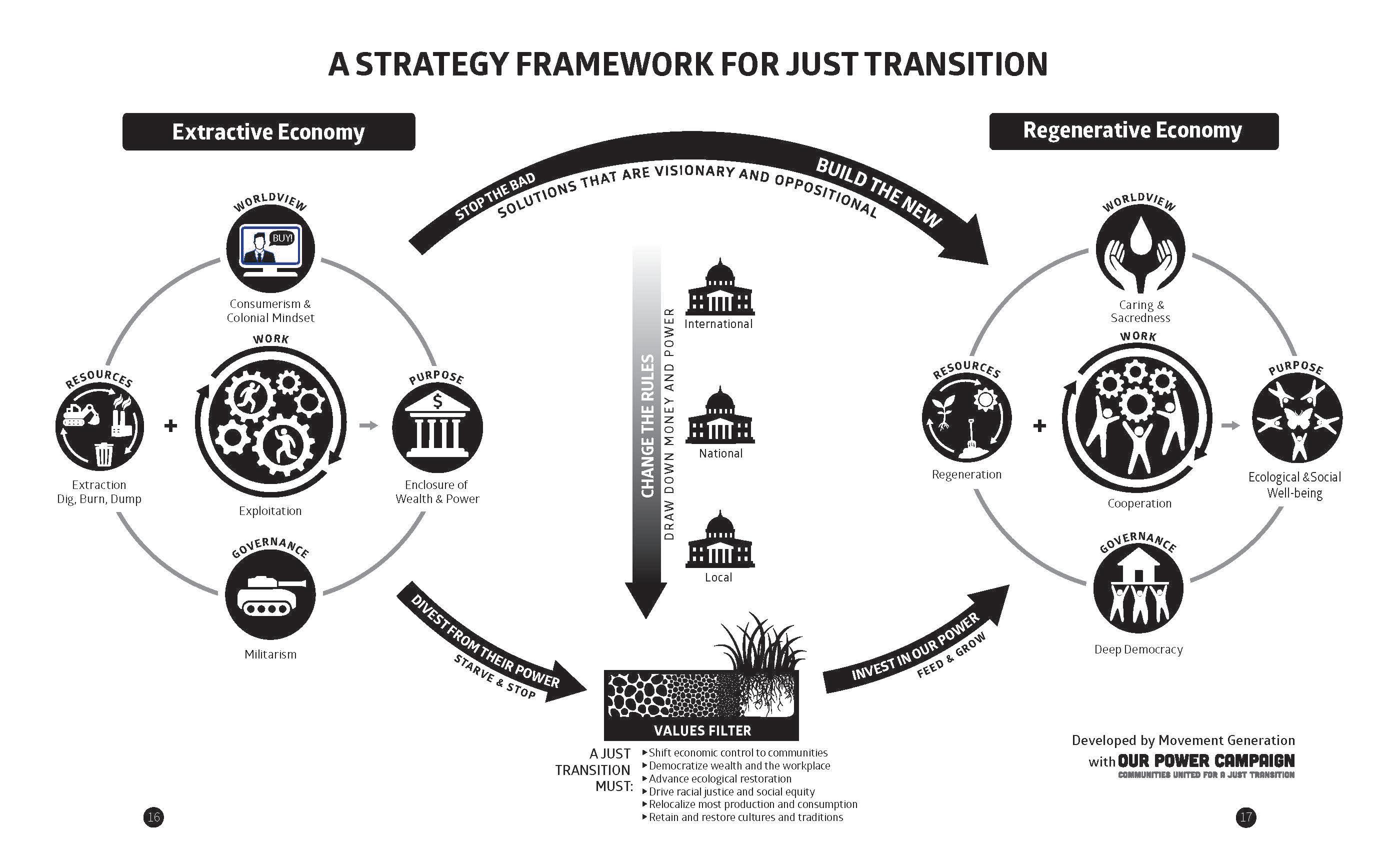
Just Transition to a Regenerative Economy
This framework and strategy stems from grassroots efforts to develop guidelines for the transition from extractive modes of production and consumption to a circular economy based on justice, maintenance, care, and solidarity. Two organizations have been particularly instrumental in my understanding of these concepts: Movement Generation and the Climate Justice Alliance. The former provides educational and collaborative tools to imagine and define what it looks like to move “From Banks and Tanks to Cooperation and Caring;” their zine, which was a formative guide for my intentions of this project40. The latter is a network of grassroots organizations, both of frontline communities directly affected by climate injustices, as well as groups that support the movement toward racial, social and environmental justice.
The framework provides clear motivations and values to embody throughout the development or implementation of a project. Climate Justice Alliance has defined a Just Transition as:
“...a
vision-led,
unifying
and place-based set of principles, processes and practices that build economic and political power to shift from an extractive economy to a regenerative economy. This means approaching production and consumption cycles holistically and waste free. The transition itself must be just and equitable; redressing past harms and creating new relationships of power for the future through reparations. If the process
of transition is not just, the outcome will never be. Just Transition describes both where we are going and how we get there.41”
Based on the Principles of Environmental Justice established during the first National People of Color Environmental Leadership Summit of 1991 and the Jemez Principles for Democratic Organizing, the framework incorporates Food Sovereignty, Cooperative management, and Circular economics to form broader guidelines of operation.
There are many interpretations of a just transition, for this project, I have decided to incorporate the eleven values described in the Just Transition Toolkit produced by representatives from the Climate Justice Alliance, Movement Generation, and ReGenerative Finance in 201442. The toolkit provides an overview of traditional terms of investment and options for re-definition. Instead of risk being characterized as the potential for financial loss, in a just transition the risk being weighed is the potential for social and ecological degradation. In other words, the current economy drives social and environmental erosion, and that is more risky on an existential scale than working towards just systems. Similarly, return is framed through an ecological perspective, that the balance between ecosystems is the ultimate goal. Here, both risk and return benefits hinge on the ability to “profit” through increased biodiversity, racial justice, and strengthened communities.
The following set of values will be constantly reviewed and re-engaged through the production of this thesis; which was also the intention of the creators when articulating their values to build regenerative economies. I have summarized each value as to how I have interpreted the key factors needed for constant consideration:
Eleven Principles of a Regenerative Economy
Curated by: Climate Justice Alliance, Movement Generation, and ReGenerative Finance
Build Community Wealth:
Financial investment should be moving flows of money from large institutions to local communities, providing pathways for the dollars to directly impact the lives of disenfranchised populations.
Democratize The Workplace:
Cooperative businesses should be galvanized through the benefits of collective ownership and workers rights to manifest a just economy.
Drive Social Equity:
Working against historic and current social, racial, or environmental injustice and exploitation is essential to a regenerative economy. Investing in communities where these issues are pervasive should be a priority.
Retain Culture and Tradition:
The needs of those receiving investment should be the top priority, moving from the extractive economy that places the investor first to a regenerative relationship that benefits the workers. Economic activities should be motivated to improve lives as a measure of success. “Capital is subordinate to people.”
Relocalize Primary Production and Consumption:
The development of “Short Chain” and “Known Chain” production and consumption systems, such as in the Food and Energy sectors, is imperative. These localized systems can more easily produce community wealth and regional economies.
In direct opposition to capitalist forces that put communities in the position to sacrifice their ways for economic survival; a regenerative economy centers the protection of lands and traditions as central to building a strong economic system. Also making intentional investments in reparations for land that was taken and disfigured through colonization, slavery, and resource extraction.
Advance Regenerative Ecological Economics:
All investments should support “ecological resilience, reduce resource consumption, restore traditional life-ways” moving away from extractive modes that deplete natural resources and negatively impact collective well being to ones of maintenance and care.
Strengthen the Public Sector:
Shifting resources from the private sector to the public realm is necessary to support the investment of regenerative infrastructures, such as clean energy and zero waste, are linchpins of a just transition.
Build Movements and Power:
Collaboration with grassroots groups and movements should be central to the new economy. Imbuing the people’s social and political power with financial power from existing structures. Those that have experienced struggles for justice know what their community needs and their knowledge should be highly valued throughout the transition to, and within, a regenerative economy.
Restore Indigenous Sovereignty and Promotes Decolonization:
The US economy is built upon systemic racism and imperialism. Through recovering sovereign lands and protecting sacred sites, a regenerative economy strives to repair and honor indigenous lands, ways, and knowledge as essential to our past, present, and future.
Restore Right Relationship with Ourselves and Our Communities:
Working to heal from the exploitation of extractive economies by building cross generational, class, and racial relationships; though sharing power and resources we can build healthy and sustainable communities.
Shift Economic Control:
Regenerative Economics in East New York
This model is in line with the established mission of Universe City and guided my approach to the Strategic Plan’s development and implementation, committing to the need for the transition to regenerative economics as a path towards sustainable and just futures. As this value system brings together many aspects of the three preceding framework, the design project extrapolates from these principles to define success. Bringing together the goals defined by the NYC 10 year food plan, insights from policy analysis, community input, and regenerative economic values, the strategic plan and development process aim to meet the terms of this theoretical framework and the established needs as defined by
residents on the ground. Through collaboration with governmental agencies and representatives, as well as public support from community members pushing for the development of UC, and their extended network, a local economy is emerging. The long term goal for these relationships is to build infrastructures that support local entrepreneurs to build a circular food economy that benefits the embedded population.
alignments across Design project guiding frameworks
RELOCALIZE PRIMARY PRODUCTION AND CONSUMPTION
BUILD COMMUNITY WEALTH
ADVANCE REGENERATIVE ECOLOGICAL ECONOMICS
SHIFT ECONOMIC CONTROL
DEMOCRATIZE THE WORKPLACE
DRIVE SOCIAL EQUITY
BUILD MOVEMENTS AND POWER
RESTORE RIGHT RELATIONSHIP WITH OURSELVES AND OUR COMMUNITY
RETAIN CULTURE AND TRADITION
FOCUS ON FOOD FOR PEOPLE VALUE FOOD PROVIDERS
STRENGTHEN THE PUBLIC SECTOR
RESTORE INDIGENOUS SOVEREIGNTY AND PROMOTE DECOLONIZATION
MAKE THE MOST OF FOOD
SOURCE FOOD GROWN REGENERATIVELY AND LOCALLY WHERE APPROPRIATE
WORKS WITH NATURE
MAKE DECISIONS LOCALLY LOCALIZE FOOD SYSTEMS
EMPHASIS ON BOTTOM-UP ORGANIZING
LET PEOPLE SPEAK FOR THEMSELVES
WORK TOGETHER IN SOLIDARITY AND MUTUALITY
BUILD KNOWLEDGE AND SKILLS
BUILD JUST RELATIONSHIPS AMONG OURSELVES COMMITMENT TO SELFTRANSFORMATION
BE INCLUSIVE
DESIGN AND MARKET HEALTHIER FOOD PRODUCTS
How might we design and implement goals for a Community Embedded Food Economy that strengthens localized food systems, based on regenerative economic values, while centering community power through food sovereignty and democratic organizing?
REGENERATIVE ECONOMICS
DEMOCRATIC ORGANIZING
CIRCULAR FOOD
ECONOMY
FOOD
SOVEREIGNTY
3. RESEARCHING NYC FOOD SYSTEMS
Decoding Food Governance
NYC’s food governance is centralized through the Mayor’s office of Food Policy, which coordinates the many city agencies to receive or supply food to New Yorkers. While they are not a policy making body, the MoFP is able to influence policy makers and orchestrate the way food flows through the city. The cart below shows the many departments that directly feed NYC residents or through retail, urban agriculture, or transportation management. There are programs, policies, and initiatives that work with one or more of these agencies to increase access to fresh foods which are described in diagram 7.
Many food policies rely on the assumption that greater neighborhood level access to fresh foods will improve public health, but it has been seen that affordability is the greatest factor when buying food for low wealth populations. The next phase of food governance initiatives need to concentrate on finding ways to make locally grown fresh foods physically and fiscally accessible to all.
New York city and state governments have been vocal in their intentions to focus on strengthening the urban and rural connection through the regional foodshed, shifting institutions to source more foods from regional producers43. New York City and State public schools and hospitals have been tasked to shift 30% of all food purchases to NY producers as well as to minimize their landfill waste by composting their organic materials within the next five years. This directive is in response to the Good Food Purchasing Program which has been adopted recently by New York City Mayor’s Office of Food Policy (MoFP) to drive their decision making towards equity and responsibility in procurement and post consumption processes. The GFPP is a framework that incentives procurement of food through the lens of supporting local economies, ensuring the workforce is valued through fair wages and safe conditions, responsibility to animal welfare and environmental sustainability, and promoting wellbeing through offering and purchasing nutritious food through city agencies.
The research and analysis provided in this chapter is divided into sections: Decoding Food Governance provides an overview and dissection of institutional mechanisms that form and control the food system in NYC, as well as those that provide nutritional support. Followed by an interview with Samantha Levy whose insights are described and analyzed to establish a basis for how to approach the current barriers within the regional food system. Then Government Initiated Nutrition Support Programs and Pandemic Era Nutrition Support Policies + Programs take food access initiatives, both institutional and community based, illuminating the challenges faced and reactionary solutions forged to address essential needs. The following sections, Planting Desired Futures within Existing NYC Food Plans and Initiatives and NYC Ten Year Food Plan Reflects Support for Community Level Capacities describe and analyze some goals stated within publications published by the New York City Council and Mayor’s Office of Food Policy (MoFP) in the last few years. These documents outline the desires and intentions of city officials to impart equitable practices within the food
system. Policies and areas of support are outlined in relation to current challenges and injustices that have been measured or indicated through qualitative and quantitative data collected by the City Council and MoFP. These recommendations are important to consider in connection to the development and implementation of Universe City’s goals in order to have greater opportunities to work in tandem with the city’s phasing timeline.
The penultimate section, Evaluating Alternatives to the Linear Food System, poses examples of horizontality in other food systems that operate within NYC. Starting with an interview from Olivia Blanchflower, we describe the activities of GrowNYC and then Corbin Hill Food Project as models to respond to and build from their implementation and impact.
Finally, the section Regenerative Design for Urban Food Systems establishes Community Embedded Food Economy principles and goals, then argues for the realization of the Universe City Food Port in the ENYIBZ.
FOOD GOVERNANCE AGENCIES
Office of Food Policy (MoFP)
+ Coordinates Policy among Agencies
Department
Council
Office of Contract Services (MoCS)
Procurement Agency
of Citywide Administrative Services (DCAS)
Procurement Agency
Management (EMD)
+ Response
(EDC)
nyc food governance approach + potential potential
priority
Affordability access
Provide Funding and Tax incentives to Supermarkets + Developers to open stores in areas determined by the Supermarket Needs Index, thereby providing neighborhood level access to full service supermarkets.
An Online resource for Emergency Food Assistance Providers. Access to operational support, funding opportunities, and the Plentiful app.
Makes Farmers Market products more affordable to SNAP users by providing $2 in credit for every $2 purchased through EBT.
SNAP recipients with high blood pressure can fill a prescription of $30 per month to spend at farmers markets.
Increase number of permits and lower fees and other barriers to starting a green cart business in designated (low income + high bodega ratio) areas for interested business owners. Some help in accessing EBT machines.
Establish a value based framework for all food purchases across agencies, with transparency. The GFP standards incentivize regional producers, regenerative farming practices, nutrient dense foods, and labor rights.
Nutrition assistance for low income individuals, families, women, and infants. Each month, a balance is transferred to EBT cards which can be used at participating food retail stores like a credit card. Because this is a federal program, many undocumented people are not comfortable utilizing this benefit.
Expand to be able to support groups that are not 501(c)(3), like Mutual Aid. Provide connection between Pantries that need food and organizations that have food to donate.
Could be more closely related to purchases of vegetables or other whole foods.
Need more participating Pharmacies, or should be automatically prescribed through Medicare/SNAP when the diagnosis is made. May cause gentrification by adding services and new housing to a low income neighborhood. The program could expand to support the expansion of alternatives to supermarkets like CSAs and Urban Farms to build capacity. The program could be more informed by the needs of the communities it serves.
Provide EBT machines to all Green Carts. Help support business owners maintain carts. Increase number of permits each year. Build connections between cart operators and regional farmers.
This was recently adopted and has the potential to shift the NYC food chain to be more responsible and equitable. However, without a policy attached and run by an agency with no decision making power, little action may be taken to enforce this framework.
SNAP/EBT/WIC is constantly changing with every Farm Bill. The fear of retribution for receiving this support is real and should be eliminated (ie. Public Charge). Expanding SNAP to use for prepared foods is essential for unhoused people.
Farm to Institution with Samantha Levy
Samantha Levy
National Farmland Trust New York Policy Manager September 23rd, 2020
The New York State Farm to Institution Network is providing important regional support for School Food Authorities to purchase local foods. One benefit of this program is that each school meal with regional products will be subsidized to allow for the cost difference between locally produced foods and commodity food to be absorbed by the state government44. The following is a summary of an interview with Samantha Levy, New York Policy Manager at the National Farmland Trust, she sheds light on the issues confronting this effort and what she sees as the opportunities for New York City to achieve the 30% threshold.
The organizational mission for the National Farmland Trust is to “save the land that feeds us” by stemming the loss of farmland, keeping farms as viable businesses and public service. In New York State, Samantha ensures environmentally sound farming practices while helping to keep farmers on their land and encourages a diverse new generation of farmers. She practices coalition building to advocate and empower community voices through direct advocacy, media outreach, and fundraising.
The farm to institution program was established in 2012, and many school districts throughout New York state already participate in some manner. In August 2020, the Farm to School program released its annual report,
“Most of all, why is local food better? Not only will foods be fresher and higher quality but kids can develop at greater appreciation for how food is made and where it comes from.”
- Levy on the significance of the Farm to School Network
which did not include analysis pertaining to the effects of COVID-19. The report also did not include the New York City Department of Education data, as in NYC there is one School Food Authority (SFA) that provides meals to one million students. Currently, a few select schools in the Bronx as well as some charter schools participate in the Farm to School Network through grant programs. With the highly centralized system at the NYC DOE, the way to reach the 30% NY State grown foods goal is unclear. Initiatives like NY Thursdays, Garden to Cafe, and NY Apples are an important step towards Public Schools in NYC to have access to local healthy foods. It is important that schools are able to procure 30% New York State grown foods, because they will be provided increased spending per meal from the state, increasing the ability to serve healthy, culturally appropriate meals.
The annual report found that in New York State, where each town or school has its own SFA, there is a strong relationship between the percentage of white students in the school and access to local foods. New York State schools in urban centers tended to buy less New York grown foods. Funding and resources seem to be a linchpin, and Samantha wonders if there is a connection between Parent Teacher Associations, and other fundraising sources, that affect local food procurement, as schools in wealthier areas tend to have more access to these products.
The GrowNYC Regional Food Hub provides a way for the NYC SFA to be able to participate, “one of the only ways” Samantha says. She explained that with NYC spending 3 billion dollars on food annually, they have the potential to leverage their purchasing power for NY farmers, who would be awarded massive contracts. As one farmer will not be able to provide the quantity necessary for schools, the regional aggregation hub is needed. “NYC could drive the market” says Samantha, having all cabbage in schools be New York grown could change the supply chain for local farmers. There are so many variables in farming, and Samantha wonders if farmers would feel confident in signing contracts a year before harvest, will this program be economically viable for them? Will the risk of not being able to provide the quantity they were contracted to produce be a deterrent for New York state farmers to do business with the NYC SFA?
We spoke about what could diversify the process, Samantha has thought about breaking up the central SFA into a borough or community district based administration, which would definitely complicate the system, but would also allow for a more culturally relevant and community controlled decision making process. Samantha continues to question if the findings in New York State show a direct correlation between access to local food and population demographic. If so, does the centralized SFA actually allow for more equal distribution? I mentioned that when I was in Public School in NYC I never ate fresh vegetables, Samantha responded that the growth of fresh foods in schools is largely due to Michelle Obama’s Healthy Hunger Free Kids Act which brought salad bars into schools. Of course, much of the successful program was slashed by the Trump administration.
Samantha asserted: “Most of all, why is local food better? Not only will foods be fresher and higher quality but kids can develop at greater appreciation for how food is made and where it comes from.45”
Samantha also mentioned Urban Agriculture, which “can’t feed large groups of people but provide important educational, social, and nutritional opportunities for school aged children.” The social and emotional effects
are just as important as the nutrition, as well as the support the program provides to the local economy. She declared that today, “half of the calories children eat come from school;” that is why farm to school programs are essential to the success of childhood health and education.
A localized, neighborhood level, food hub could aggregate these regional products and have contracts with the NYC SFA to deliver prepared meals to surrounding public schools. There are other programs in NYC that provide locally grown products, like the Garden to Cafe program, but these are majority seasonal gardens that supplement but do not replace the products sourced through the NYC School Food Authority. If communities had greater control over the foods served in school, the local economy would benefit through regenerative economic modes. The dollars used to purchase goods would remain in the local economy rather than enriching national school food producers who are not aware of the dietary needs of urban populations.

Government Initiated Nutrition Support Programs
FeedNYC Pantry Support Services
Food pantries and soup kitchens in New York City range from religious institutions to community development organizations, but in order to be supported administratively and financially by the government they are required to be a formalized non-profit organization.
FeedNYC is the Policy Committee on New York City Hunger Resources, “an alliance of government and not-for-profit organizations committed to alleviating hunger among New York City residents by supporting NYC’s network of Emergency Food Programs.46” This alliance supports many services to registered Emergency Food Assistance providers including capacity building, training, and access to food donations from City Harvest and the Food Bank for NYC. Pantries and soup kitchens tend to be volunteer run, often by senior citizens who have been deeply affected by the pandemic. FeedNYC is a hub for grants, funding opportunities, organizational guidelines, and food safety certifications for emergency food providers. Recently, the Plentiful app was launched to help pantries plan more sustainably by allowing pantries to post up to date accounts of what they have on offer and individuals are able to reserve a time to pick up the goods they request, giving both recipient and service provider more control and direct communication.
FeedNYC was formed in response to the need for a centralized place for EFAPs to access information and resources. The system is centered around the persistent issue of food insecurity in NYC, despite that daily reality for more than 1.4 million New Yorkers, the programs are still characterized as ‘emergency’ services. This focus on emergency is troubling for many reasons, namely that there is a connotation that these vital sources of nutrition should only be accessed as a last resort. The stigma that is already present in needing to utilize nutrition support is only amplified by the lack of recognition that this is not an emergency, rather a daily necessity for so many working families and individuals47. The pandemic has only made this necessity more visible, where each day individuals line up to receive food from EFAPs. There is risk with that visibility, and according to a report by the New York Times, many people feel ashamed to be on those lines, fearing being seen by coworkers and neighbors48. Additionally, the risk is even higher for undocumented populations who do not want to be
identified and potentially characterized as a ‘public charge’ which could be cause for deportation, further marginalizing this population.
FeedNYC is a vital source for EFAPs and is a governmental and nonprofit industry alliance with the commitment to “ensure that New Yorkers who seek emergency food are served with dignity and have access to high quality, culturally diverse food; that choice is available to the greatest extent possible; that they are provided opportunities to connect to other resources to improve their ability to afford food.49” It may connect community organizations to food and financial support, but it does not engage with local food producers or allow the embedded community to have control over the goods they are able to procure. Environmental justice is not a part of their mission, nor is employment opportunities in the food sector. As FeedNYC organizations, the Food Bank for New York City purchases goods to be distributed to EFAPs, and City Harvest rescues foods that would otherwise end up in landfills. While both recognize the need for culturally appropriate products, neither are able to give much autonomy in what is provided to the communities themselves. FeedNYC does not provide opportunities for organic waste recycling, but City Harvest is a crucial organization for NYC to reduce food waste in general.
The pantry system in NYC is crucial to the food insecure and hungry in the city, providing food free of charge to anyone who is in need, however this system may not be able to provide communities a pathway to food security without workforce and employment opportunities to those they serve. There is room for restructuring in this alliance, not only to view their services as merely ‘emergency,’ but to restate and examine the reality that living in NYC is expensive and how to provide opportunities for those who rely on nutrition assistance to attain food security.
Pandemic Era Nutrition Support Policies + Programs
In April of 2020, a Food Czar was appointed to run a cross agency effort to meet the needs of food insecure and hungry New Yorkers. Katherine Garcia, the Sanitation Department Commissioner held this position during the most intense moments of the pandemic. The $170 Million effort included setting up Grab + Go meal sites at schools across the city, organizing deliveries to home bound and elderly individuals, amassing a stock pile of $50 million worth of food to counteract any disruptions to the food system, and administering P-EBT cards with $600 to all Public School children regardless of status or age. Additionally, the GetFoodNYC portal connects with AccessNYC to help individuals apply for SNAP and WIC, in June 1.7 million New Yorkers received SNAP funds, a 12% increase since before the pandemic. The federal government made temporary adjustments to SNAP requirements to incentivize more people to apply and NYC is encouraging everyone that as well. The SNAP dollars assigned to NY are typically not all used by the end of the fiscal year and with the expansion of eligibility the city is eager to help all those who can to receive these benefits. All NYC nutrition services can be found on the GetFood portal or by calling 311 for those who do not have access to the internet.
The stock pile of shelf stable products and fresh produce became a lifeline for the pantries that were now running out of food to distribute each day. Pantries and soup kitchens in need were able to request foods to be delivered by the city free of charge through NYC’s Pandemic Food Reserve Emergency Distribution program. Despite this much needed program, the Food Bank for New York City reported that, by August 2020, over a third of NYC pantries and soup kitchens closed and of those that remained open, a third were running out of food at least once a week50. This stockpile was supplemented by the USDA Farm to Family Food Box program which has continued to purchase billions of dollars worth of US produced food products throughout the pandemic. These boxes made their way to community based organizations across the country, but contracts between the USDA and local distributors required formalized nonprofits to be the intermediary to receive these boxes. This federal program was a reaction
to the effects of the pandemic closing schools, hotels, restaurants and other institutions where a large portion of food is delivered to consumers. By purchasing these food products, the federal government was able to avoid much of the food waste that was so devastating to see amid growing unemployment and food insecurity.
Pantries and soup kitchens continue to distribute these boxes en mass. However, the products included in these boxes are not necessarily healthy or culturally appropriate, as described by Olivia Blanchflower at GrowNYC. It is important to point to where long term governmental interventions could provide more community control and support regional food producers. Community Food Assessments (CFA) are an established tool to understand the needs of the population surveyed and their food environment. New York City could utilize a CFA to evaluate the efficacy of the policies and institutions that seek to support access to fresh foods and improve community health outcomes. According to Johns Hopkins Center for a Livable Future, CFAs are a comprehensive and resource dependent process that has the potential to measure all aspects of local food systems51. Once the findings are compiled through a community based participatory research process, the CFA is able to communicate strategies to strengthen education, built environment, policy, social services, and coalition building opportunities to grow more just and equitable foodways. The regenerative economy framework goes further, to look at the environmental impacts and autonomous mechanisms that are crucial to sustainable and just food systems. While the government nutrition programs described above are important to the charity and nutrition supports that many families rely on, they provide few opportunities for economic empowerment for embedded communities to become food secure.
Planting Desired Futures within Existing NYC Food
Plans and Initiatives
In 2019, the New York City Council published their report “Growing Food Equity in New York City, A City Council Agenda” which outlined numerous ways the city was interested in promoting food justice, sovereignty, and sustainability into the food environment of NYC. Their introduction is in agreement with many of the principles of food sovereignty stating that, “In New York City, one of the richest cities in the world, everyone should have equitable access to healthy food, every community should have greater control over their food options, every person should have enough nutritious food to live a healthy life, and every neighborhood should have food businesses that reflect that community’s cultures and diversity.52” Going further to declare that is it the responsibility of the government to ensure each citizen the right to food and recognizing the role of the USDA in loss of land ownership by black people due to discriminatory practices. The report recognized that lowincome and communities of color are disproportionately affected by food insecurity and poor health outcomes and have been on the front lines fighting for a more just food system53. They also reinforce the notion that the state should support “sustainable agricultural businesses, especially among minority and women farmers and ranchers who continue to overcome the impacts of historical discrimination in access to farmland, credit, and other government assistance. Furthermore, the State should support the creation of more processing and distribution facilities and healthy food retail outlets, all of which could create more jobs while providing New Yorkers with healthier food in our schools, senior centers, colleges, hospitals, and homes.54”
Next, the city council lists the aspects of food justice that their body wants to affect directly:
“We need to increase nutrition and farming education. We need to end hunger in higher education. We need to make healthy food more accessible to all New Yorkers, regardless of where they live. We need more support for environmental stewardship and for those greening and growing food in our city. We need more urban agriculture to provide healthy food and education to our neighbors while combating climate change and
building resiliency. We need to reduce food waste. And we need to build community power by incubating and supporting hyper-local food economies, where residents can have successful food businesses and neighbors can eat healthily while keeping their food dollars in their neighborhoods.55”
The report goes onto outline 2020 legislative wins and recommendations including improving the ability of the Mayor’s Office of Food Policy (MoFP) to play a more prominent role in decision making by providing them resources work with community groups and city agencies to identify food justice neighborhoods and act as a conduit for supports to access healthy and fresh foods. The City Council wants to convene stakeholders to produce a “citywide food plan that brings a strategic framework, goal-oriented planning, and coordination to key areas of the food system, including hunger, nutrition, access to healthy food, food waste, food and farm economies, and urban agriculture and sustainability.56” They are interested in establishing an office of Urban Agriculture, Community Garden permanence with expanded programming and job opportunities, a Food Education Center, and make sure that the city food policies align with the commitments stated in the OneNYC 2050 Plan; a comprehensive document outlining the long term resiliency goals for the city. These food justice informed governance systems will be crucial to the development of neighborhood level food economies and the City Council is also aware of the need of such infrastructure to be established when they outline the components of a Community Food Hub Incubator:
“The City should fund a Community Food Hub Incubator to coordinate interested communities to develop more local food businesses and farm-to-city food projects. The incubator would help build a solidarity economic model that supports and connects growers, producers, community food projects, local small businesses, and existing infrastructure
assets such as transportation, storage, and accessible kitchen space. The incubator could also provide technical assistance, tools, and training; convene stakeholders; and bolster efficiencies through shared resources. The goal of the incubator will be to develop community-scale healthy food economies, thereby increasing equitable access to healthy food throughout the city.”scale healthy food economies, thereby increasing equitable access to healthy food throughout the city.
57”
In reviewing the goals for a Community Food Hub, the City Council is quite aware of the elements necessary for communities to achieve food sovereignty. They recognize the need for community control and increased ability to access the foods that are culturally relevant. There
is emphasis on the need for education and technical assistance, however not explicitly education with emphasis on agricultural technologies and food sector employment. Environmental sustainability and resilience is addressed. but the connection to providing economic opportunities in relation to organic waste management and regenerative agriculture is not. Hunger and Food Insecurity is mentioned but the issue of stigma attached to nutrition assistance is only peripherally mentioned. Local businesses are prioritized, especially in the framing of building solidarity economies at the neighborhood level. Community groups are also centered and should be prioritized as strategic stakeholders, knowledge bearers, and those that have direct experience with the issues the City Council intends to impact. Unfortunately, collective ownership and cooperative decision making is not clearly stated as a goal, however solidarity economies are included which do emphasize the importance of these methods in gaining consensus with diverse stakeholders.
key takeaways
• IT IS THE GOVERNMENT’S RESPONSIBILITY TO ENSURE EACH CITIZEN THE RIGHT TO FOOD
• THE USDA HAS DISCRIMINATORY PRACTICES THAT CAUSED THE DISPOSSESSION OF LAND OWNED BY BLACK PEOPLE
• NY STATE SHOULD SUPPORT MINORITY AND WOMEN FARMERS THROUGH ACCESS TO LAND, FINANCIAL ASSISTANCE AND LEGAL RESOURCES
• NYC NEEDS TO MAKE FRESH + AFFORDABLE FOOD ACCESSIBLE TO ALL NEW YORKERS
• NYC NEEDS TO BUILD HYPER-LOCAL FOOD ECONOMIES WITH PROCESSING, DISTRIBUTION + BUSINESS INCUBATION CENTERS
NYC Ten Year Food Plan Reflects Support for Community Level Capacities
“Access to affordable, high quality food is a fundamental human right and New York City’s food system is foundational to its economy58”
states the Food Forward plan, released by the Mayor’s Office of Food Policy (MoFP) in February 2021. As the first sentence of the executive summary, it is a bold declaration that should be held to account. The summary continues to describe the inequities within NYC’s food system, directly recognizing that “too many people lack access to affordable, healthy foods; food businesses and other organizations struggle to operate profitably; food workers face challenging labor conditions; and the supply chains that feed New Yorkers are opaque and inefficient.59” To address this undesirable reality, the MoFP has constructed a ten year plan that centers collaborative efforts and racial equity. The goals are influenced by the newly adopted Good Food Purchasing Program and the Racial Inclusion and Equity Task Force, which is a group formed in the wake of COVID-19. They conclude the summary with a recognition of the lack of transparency in government decision making and assure that new mechanisms will be in place for the goals stated in this plan to be achieved through participatory democratic means.
Many statistics are presented to mark the breadth of the food system and its challenges. One statistic that exemplifies the struggles present for New Yorkers specifically is that the average cost of a meal in this city is 30% higher than the national average. This points to an essential issue with the current food system, and is a reflection of why 1 in every 5 New Yorkers are currently experiencing food insecurity60. This plan aims to address this issue from multiple perspectives; through helping food businesses provide living wages to their employees,
support BIPOC communities to receive economic benefit from the services that are located in their neighborhoods and support the capacity for solutions formed by the community to grow, and to build infrastructure and technologies that lower the city’s impact on the environment while innovating the mechanisms by which to produce and procure food for 8.4 million residents.
The goals of this plan are divided into five areas and throughout four implementation phases. Each phase includes around ten goals, spread across the various objective areas. The first goal is to ensure New Yorkers have many opportunities to access affordable, nutritious, and culturally appropriate food. They intend to achieve this through expanding food assistance benefits such as increased access to SNAP, permanently expanding free summer meals to families, and incentivizing nutritious eating through healthcare programs. SNAP applications and assistance through the Human Resource Administration is faulty at best, when reviewing the program I found many indicators that recipients are often unable to reach someone for their questions or concerns61. There should be automatic registration for all New Yorkers who qualify. While this is not included in the food plan Katherine Garcia, COVID Food Czar, former DSNY commissioner, and current Mayoral Candidate expressed this need as a goal for her administration62
Equitable Distribution is the next tactic to achieve this goal, through investment in infrastructure needed within the emergency food network, expanding the reach of farm to consumer programs (farmers markets and CSAs), and improving food served in schools and hospitals. Lastly, resituating the intentions of food procurement will help to support the creation of neighborhood level food hubs, and build commercial kitchens to prepare nutritious meals for schools, hospitals, elderly, and those experiencing homelessness.
The second goal area takes the impact of the food on the economy into consideration. Seeing that 79 percent of food workers are people of color in NYC, there is an imperative to support those populations in owning, operating, and benefiting from the food industry at all stages in the system. The plan specifically remarks that cooperative ownership models need to be incentivized
and the principles of economic democracy should align with city governance. In the short term, the MoFP will coordinate existing policies to support cooperatives into the food business realm and will explore avenues, through community based organizations and other neighborhood business associations, for increased financial and technical assistance for these entities. An important goal is to open the city procurement participation to a wider pool of vendors, especially those who are small or Minority and Women Owned Business Enterprises, helping to navigate the bidding process. The current vendor process is complicated and difficult for small businesses to facilitate, overwhelmingly only medium and large scale vendors have vending authorization and the contracts are not providing economic empowerment for the communities embedded in these networks. To counteract this, the MoFP plans to launch a community hiring initiative, support workforce development for food technology and expand career pathways through DOE and DOHMH training and employment programs.
The third goal area provides an overview of the status of the current food supply chains in NYC. A major infrastructural and systemic issue that the city must contend with is the implications of a truck based transportation system. With 99% of the last mile of food delivery performed by trucks, there is a disproportionate effect on the health of low wealth and BIPOC communities due to the racial history of development in NYC. The air pollution created by this transportation infrastructure is seen in the high levels of asthma in children living close to these roadways. Additionally, the cross section of climate change and the food supply indicate that the city must make improvements to allow for low impact and reparational processes to heal the harms done through the current system. Some ways this plan intends to address these issues is by implementing the FreightNYC infrastructure improvements for a “well-functioning and sustainable food movement system.63” The Industrial Business Zones throughout the five boroughs have the capacity to support localized food hubs and support many food businesses that need space for processing and manufacturing. The Central Brooklyn Food Hub (CBFH) is highlighted in this plan,
citing the importance of this infrastructure as a model to demonstrate the importance of building “connections with neighborhood food retail businesses but be at different scales and will emphasize different elements of food distribution, depending on neighborhood needs and development opportunities.64” Furthermore, declaring that the city will support a proposal to the state for development of the CBFH.
There are few points in this plan that are short term, policy based, and follow GFPP guidelines. The goal that satisfies all three categories is building legislation to prioritize the procurement of regionally grown foods. The MoFP is clear in their intention to significantly increase the share of regional and local foods to be purchased by the city - which would be incredibly important to invest in local economies - allowing New York businesses to receive a majority of the 500 million dollars spent by the city on food each year. Alongside this policy is a promise to review the existing regulations that form barriers to urban agriculture and will explore city owned lands that could be utilized as urban farms. These lands are often in low income and underserved areas that also experience food apartheid and insecurity. If the city allows the embedded communities to have autonomy over these farms, there could be major impacts on health and food sovereignty, empowering and addressing historical injustices these populations have faced in NYC. The plan also indicates an interest in developing high yield, energy efficient, indoor vertical farming within the city to further provide a market for local production.
Sustainable production, distribution, and post consumption services are the fourth goal described in this plan. The MoFP is clear in their intention to make sure that 90% of city wide organic waste is collected for use in composting and bio fuel, among other possibilities. Mandates to separately collect organic waste should be required for schools and city run agencies by 2025 and all residential properties by 2029. While restaurants and other businesses are not mentioned in connection with a target year, there should be programs that provide incentives for industries to recycle properly. New York State just passed legislation to require all supermarkets to donate all still edible foods to pantries, soup kitchens and
other food rescue organizations; this legislation currently does not apply to NYC and should be amended to do so. An important proposition included in this section is:
“[T]he City will provide technical support to groups that divert waste from landfills while creating local regenerative food systems on their own terms. In addition, the City will aim to identify and address barriers to community-level salvage operations or businesses, composting, regenerative agriculture, micro-digesters, and other community-level and community-owned waste management solutions.65”
These are issues that have been voiced clearly and persistently by community gardeners, composters, and recyclers who have advocated for community controlled, and city supported services to be strengthened and historic divestment to be directly remediated.
The final goal area addresses the need to gather stakeholders from all stages of the food system to share knowledge and do the hard work of engagement between diverse actors with different goals and objectives. Through this plan, the city will broaden the strategies they have to connect, develop tools, and foster ‘multi-sectoral food policy’ for decision making about the food system. Specifically engaging NYCHA residents and leaders through an innovation lab to develop programs that directly serve that population, with meaningful participation in the creation and maintenance of these initiatives. The MoFP plans to conduct surveys that will aggregate useful data to build
new matrices around food insecurity, emergency food provision, and indicate vulnerabilities and strengths within the food system. These surveys will be formed and performed in collaboration with community groups and academic institutions. The city will also push for curriculum around nutrition, climate change, and food systems to be instituted as well as programs that bring urban and rural communities in communication.
For the purpose of this project, the plan has been coded to highlight the areas in which Universe City’s goals are complementary to those of the MoFP (diagram 17). By aligning the phasing of UC’s infrastructural and programmatic development with that of the city, we hope to be able to become a key player in the transition to regenerative systems for NYC’s food economy.
Evaluating Alternatives to the Linear Food System
In this section, existing organizations that strengthen the regional food economy, community autonomy, and regenerative production practices will be described. Analyzing their programming through the frameworks of Food Sovereignty, Circular Economics, and Democratic Organizing the benefits and supports needed to grow their influence over the conventional food system can be seen. GrowNYC is a long standing organization that has had a major impact on the locally produced foods New Yorkers have access to and the Corbin Hill Food Project is an example of a community based food hub that Universe City seeks to amplify.
Uplifting the Impact of GrowNYC
GrowNYC is a multifaceted organization whose services range from composting to wholesale regional food procurement. Their mission is “to improve New York City’s quality of life through environmental programs that transform communities block by block and empower all New Yorkers to secure a clean and healthy environment for future generations,66” and according to the organizations website, over 3 million New Yorkers participate in their diverse range of programs each year. Their programming is not specific to one neighborhood or community, rather they are working towards environmental sustainability for the city as a whole, where “every New Yorker can flourish.” They have four main programs: Food Access and Agriculture, consisting of youth-led farmers markets, fresh food boxes and Greenmarket Co. which sells regionally grow foods to a variety of food businesses; Conservation services for organic waste, textiles, Stop’n’ Swaps, as well as hazardous items like batteries; Green Space operations in schools and communities where they have a variety of training programs; and Educational services to engage students with the natural environment of NYC.
GrowNYC purchases from regional producers for wholesale buyers, like restaurants and food pantries
and for their direct to consumer programs, Fresh Food Box and Farm Stands. GrowNYC programs provide a market for small-medium size wholesale producers to reach underserved communities. Some of GrowNYC’s services begin to disrupt the predominant modes of distribution. The Fresh Food Box program at GrowNYC provides a service similar to a CSA but does not require a financial commitment upfront, which is often a barrier to participation for low-income communities67 GrowNYC acts as its own distribution hub, purchasing products by the pallet, according to customer orders and availability. The pallets of food make their way directly to the community, where each recipient receives their order pre packaged into farm boxes. These boxes include around 10 items and cost $14, EBT and Health Bucks are accepted. GrowNYC also operates a wholesale farmers market in Hunts Point with products from over 100 regional growers. This distribution site is open to all and products are delivered from regional farms each morning.
In partnership with the EDC and NYS Agriculture and Markets, GrowNYC will be growing their footprint in the Hunts Point IBZ with a 60,000 square foot Regional Hub, 20,000 of which will be dedicated to the aggregation
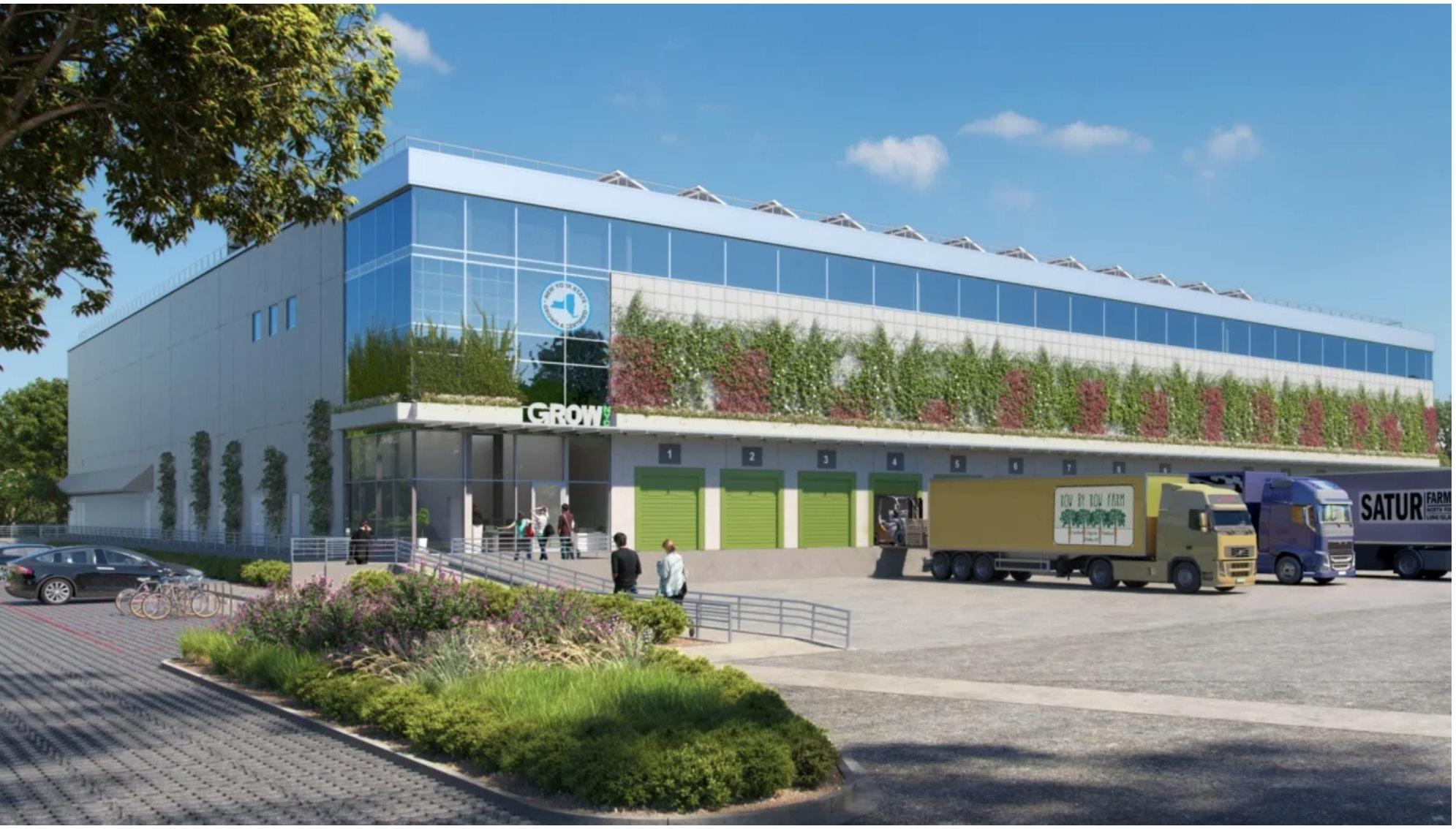
“It’s
a needed market for regional farmers to disrupt the consolidation of the global food system and compete against large conventional farms”
foods grown all over the tri-state, allowing for a greater capacity for access to regional farm products by public institutions. The GrowNYC Regional Food Hub will add much needed infrastructure to meet sustainability and Good Food Purchasing Program goals for the city. The Regional Food Hub recently broke ground and is expected to begin construction Spring 2021.
I spoke with Olivia Blanchflower, who oversees their wholesale purchasing and distribution programs, previously working with the organization as a farmers market manager and youth program coordinator. She knows firsthand the effect of COVID-19 on the capacity of GrowNYC to serve communities in need as well as what crucial systemic changes could provide an opportunity to end hunger and achieve a just food system in NYC. Olivia works with Samantha Levy developing the Farm to School program for New York City. As the NYC Department of Education serves one million students breakfast and lunch each day, the only way to provide local food at that scale is by bringing together products from many farms, something the Hub would be able to support.
- Olivia Blanchflower on the GrowNYC Hub
figure 8: EDC Rendering of the GrowNYC Hub
Evaluating Existing Modes
Effects of COVID on Consumer Priorities with Olivia Blanchflower, Wholesale and Distribution Manager at GrowNYC

GrowNYC Director of Wholesale and Distribution
September 17th, 2020
In response to demand from the community for greater access to local produce and increased opportunity for farmers, the GrowNYC Regional Hub plan was introduced in 2016. Olivia sees the Hub as a “needed market for regional farmers to disrupt the consolidation of the global food system and compete against large conventional farms.68” While there will be some seasonal variety, the Hub will offset availability through investment in canned and frozen regional goods. In all endeavors, GrowNYC strives for transparency. All marketing includes the farm(s) each produce is sourced from and growing methods. However, As the scale of the wholesale operations increase, Olivia is concerned that they may not be able to provide as much detail. One major market Olivia hopes the Hub will impact is Dairy, New York is the largest producer of yogurt in the country and fluid milk is consistently overproduced, the Hub will be able to provide an increased market for dairy farmers.
The Hub was included in the fiscal year 2020 City Council discretionary budget, but of course, GrowNYC is reckoning with a different funding future. Olivia “intends to continue to do what they are doing” and the Regional Hub plan is still proceeding. It will be built on city owned
“You know where your money is going...We are all thinking more about our connections to people and food...if you can get groceries in a way to connect to community and support farmers people are interested”
- On the success of the Fresh Food Box during COVID-19
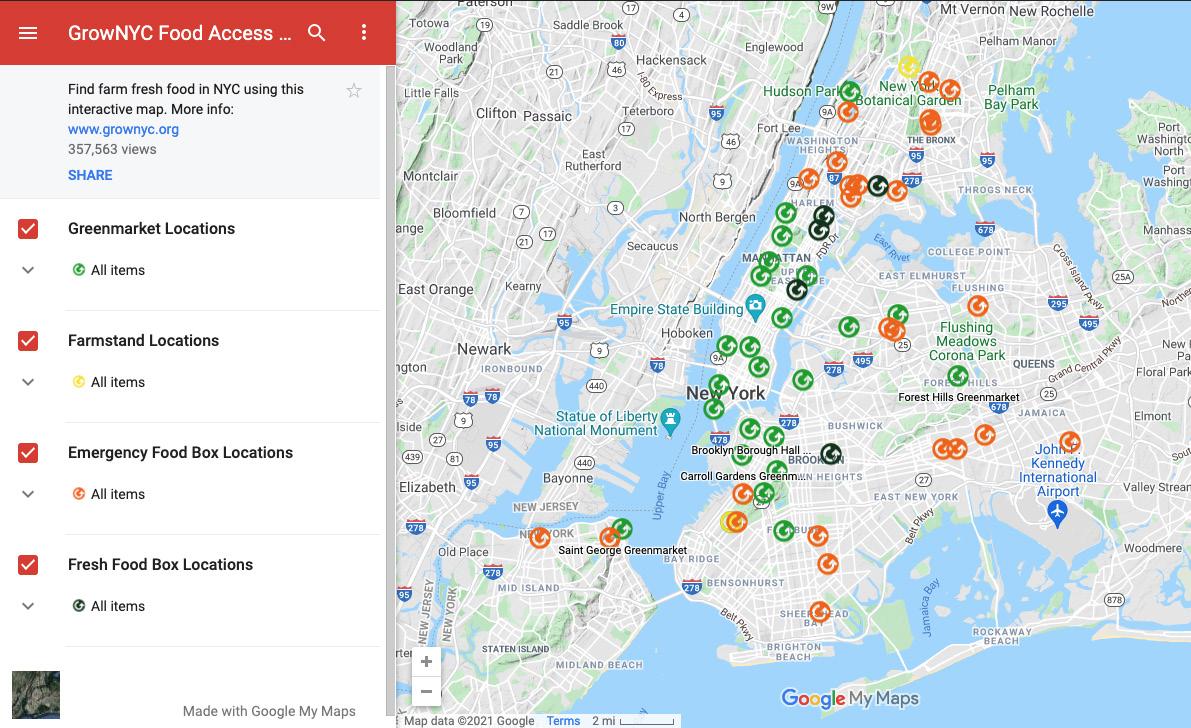
land a quarter mile away from their current facility in Hunts Point. Olivia believes the crisis has only highlighted the need for the Hub because there isn’t currently enough refrigerated space for the food that they aggregate. The Hub will increase the GrowNYC warehouse space by 15,000 square feet, and will have large refrigeration capacity. Two thirds of the space will be rented out to other food retailers, in order to offset costs of the emergency food access programs, food boxes, and farm stands (which is almost 30% of their total distribution). Investment at this scale will allow GrowNYC to sustain itself, and to allow for increased volumes. The high quality space will be a game changer for GrowNYC, they will acquire a global food safety certification and have room for farm to institution programs to procure regional food supply for citywide distribution. Since March 2020, the wholesale buying program ‘Fresh Food Box’, established in 2012, has increased by 150%. Boxes are sent to each site, similar to a CSA model, where participants pay a week in advance, year round. Even though they had to close some sites, they exceeded purchase expectations during the pandemic. People wanted to buy food closer to home, or deliver directly to home69. Many more large wholesale orders for entire buildings whose tenants organized together.
Olivia thinks this increase in the Food Box program will stick around beyond this current situation, and there is great potential for expansion. Communities see this program as a transfer of wealth from amazon/ fresh direct to local producers and allows for limited physical interactions. “We are all thinking more about our connections to people and food...if you can get groceries in a way to connect to community and support farmers people are interested70
The Emergency Food Box program partners with community groups and gets a set amount of food donated each week. Distribution is determined by NYC demographics including income level, where people work, percent of immigrants in the area who are unable to access relief funding, as well as the existing network of food banks and pantries. GrowNYC distributes 40004400 boxes each week, during COVID every box must be prepackaged, which has significantly increased the labor involved. They partner with Upstate Growers and Packers Foundation, sourcing most products from central New York with some conventional items. Olivia see’s the city’s response to COVID as strong, many individuals and organizations wanted to help and the DSNY Food Tzar provided GrowNYC a contract that paid for
emergency food procurement and distribution. The USDA Farm to Family program also paid for emergency food, and have continued to renew GrowNYC’s contract. Olivia pointed out that the program is run through the Agricultural Marketing Service, not the Emergency Food Administration and contracts were given to corporate dining, wedding caterers, and other food related businesses that have no experience in emergency food distribution or a connection to or knowledge of what foods people using this service like to eat. She said that this program is not necessarily beneficial to farmers, as the UDSA is purchasing their goods at the lowest possible price point. The first contract was for dairy and meat only boxes, or produce only boxes; the second contract was for combination boxes only. The meat had to be precooked, and only chicken or pork; in NYC, pork is not a particularly inclusive item to include due to the Halal and Kosher populations. Many highly processed, salt laden products were included such as hot dogs, scrapple, and canned meat products. Olivia pointed out that these products were not only unhealthy but unfamiliar to many diets for the populations that received these boxes.
Olivia Blanchflower
Corbin Hill Food Project Is a Model for Universe City
Mutual Aid and Free Food Fridges
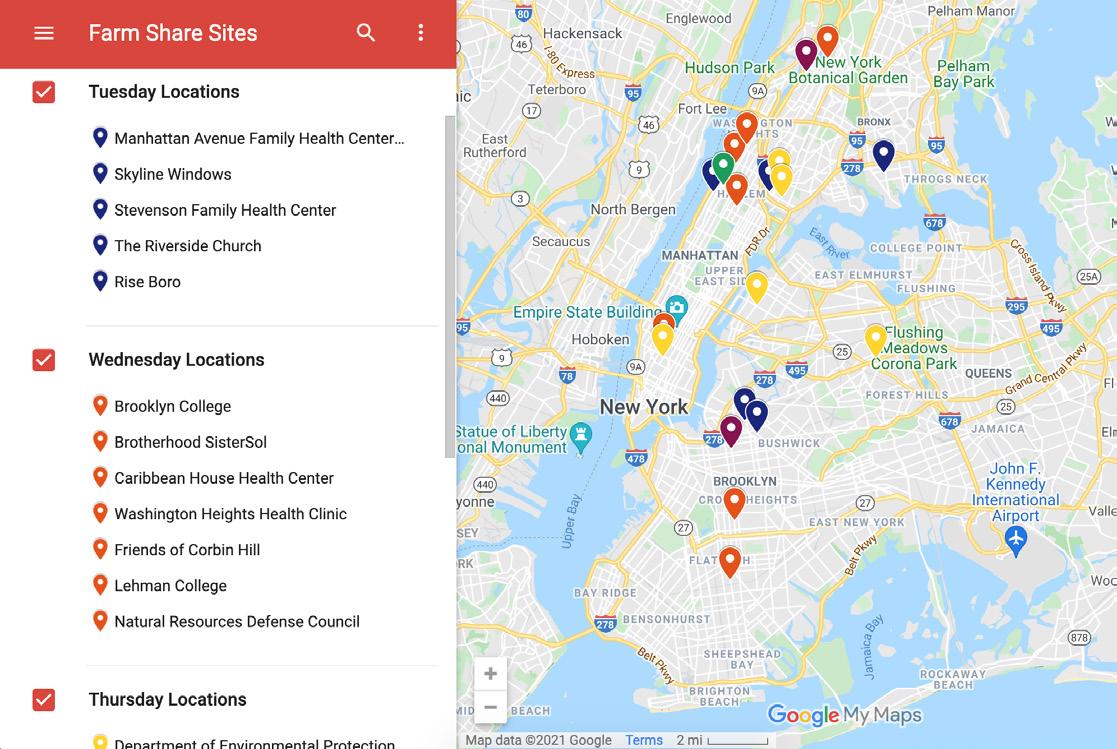
Similar to GrowNYC, Corbin Hill Food Project seeks to provide communities throughout NYC access to farm fresh foods. Their mission is to “supply foods to those who need it most” with a long term vision to “achieving food sovereignty, racial equity, and community ownership. We believe access to fresh, affordable food is a basic human right, and we won’t stop until it’s available for all.71” Founded by Dennis Derryck in 2010, he says “Corbin Hill does not view itself as solely an aggregator of food serving vulnerable populations. It has a longer term vision that entails a community owning its food system through sovereignty, community control, and the shifting of power through decision making within a community’s food system.72” The project began, and is still, based in Harlem - directly providing access to fresh foods in that neighborhood from their farm in Schoharie County, NY and partnerships with 42 New York State farmers to aggregate and deliver their products. They have expanded in the past five years to aggregate foods from over 200 growers in the Northeast to supply their growing farm share program. Now they have a wholesale aggregation service that sources sustainably produced goods national and international, concentrating on culturally appropriate foods for the communities they serve. They have also begun to develop BIPOC and women led farms to produce goods for the programs exclusively. Their social impact model provides a way for higher income folks to subsidize the cost of the boxes for SNAP recipients, growing equity and justice through their programs.
Corbin Hill is central to the network of emerging Black farmers in the New York region, they provide a crucial connection to the NYC market and seek to expand the capacity of the New York foodshed. In analyzing their programming in relation to regenerative economics, Corbin Hill is successful in enacting the majority of the principles. They concentrate on providing culturally appropriate foods, going further to seek out farmers who grow these items as well as encouraging regional farmers to do so, while prioritizing cooperative and local food businesses. Their primary goal is to get fresh affordable foods to “those who need it most” and understand the importance of local economies for the resilience of the New York food system. As they are a Harlem based organization, the majority of their farm share sites serve Northern Manhattan and the Bronx, with a few sites in the other boroughs, the Brooklyn and Queens sites are in high need neighborhoods; including a CSA program at the New School. Corbin Hill’s work does not directly address hunger and food insecurity beyond accepting SNAP/EBT, which is crucial, but their products are still potentially cost prohibitive to those groups at $20 per food box. While education and training is part of their work, it does not seem explicitly central to their operations. It is important to note that Corbin Hill Food Project is a Hub, building a regional food economy, but does not yet provide circular systems to address waste and technical innovation.
Mutual Aid groups have been a staple support system for marginalized and immigrant populations for decades, but the pandemic has brought them into the limelight for a new audience on a broad scale. Many of the Mutual Aid (MA) groups that have grown over the pandemic concentrate on direct action to support the needs of their communities. For the majority of these groups, food access and distribution was the most needed form of support. MA fundraises from allies and purchases or seeks donations of healthy and culturally appropriate foods that are delivered directly to those who seek assistance.
The first Free Food Fridge in New York City was established early in the pandemic by A New World In Our Hearts, an anarchist organization that has been a part of the NYC landscape since Occupy Wall Street. Their work has included food distribution for years, with Bed-Stuy Food Not Bombs and the Free Store that have provided free food and goods to the Brooklyn community for years. This fridge is now one of over 100
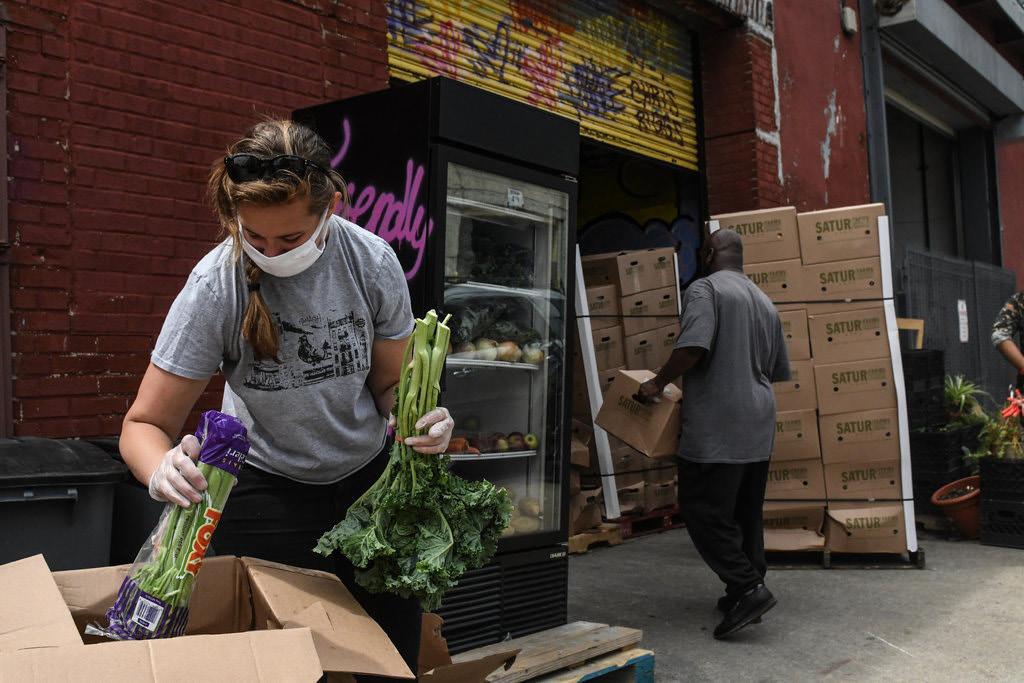
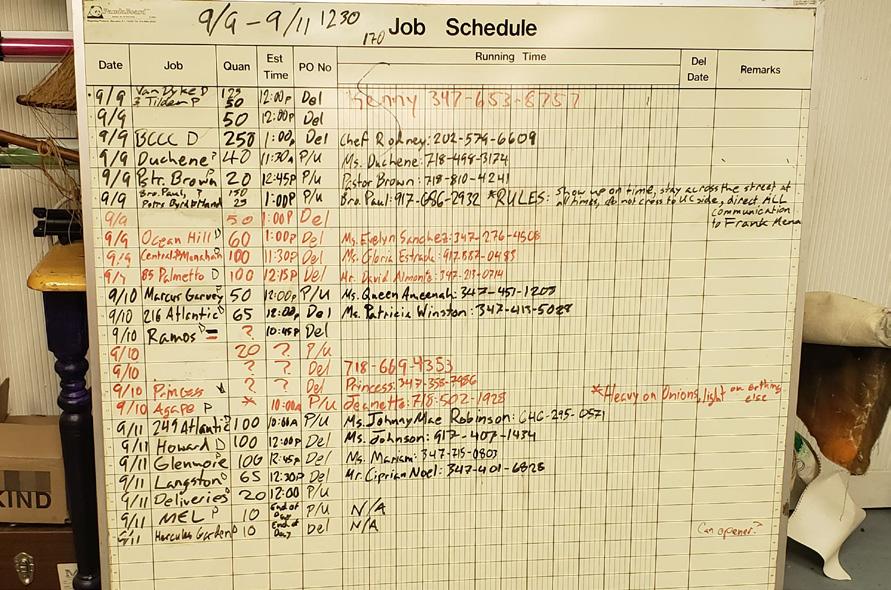
community fridges, and growing, throughout the five boroughs73. Each fridge is sponsored by an individual or business and provides completely barrier free access to fresh prepared and raw foods to anyone who needs. This mechanism is important to not only rescue foods that would otherwise be wasted by restaurants, catering, and supermarkets, but the organizers have made partnerships with formal nonprofits to utilize food bank and USDA food box products to refill the fridges. As a completely volunteer run and maintained form of nutrition assistance, each day lead organizers report to volunteer drivers of the location and quantities of food available to fill fridges that day. Drivers then communicate through messaging platforms as to how much and when they are able to pick up and refill fridges. There is no permanent space to aggregate these foods, except for the driveway of a kind volunteer. No direct support has been provided to the Free Fridge organizers by city agencies, only indirectly through association with pantries who have received goods through the local or federal programs.
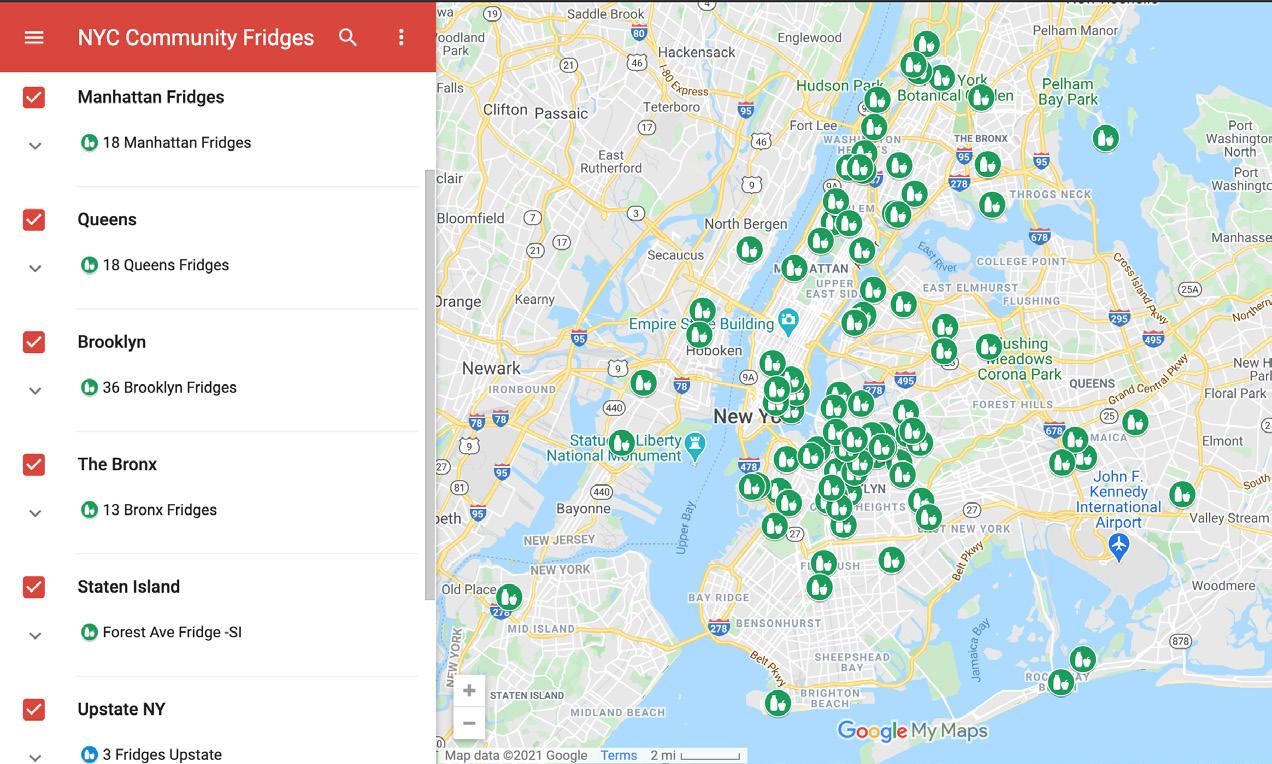
REGENERATIVE DESIGN FOR URBAN FOOD SYSTEMS
The following section describes the various considerations taken when defining and designing the strategic plan with Universe City. First, a set of principles for a Community Embedded Food Economy which encompass the theoretical frameworks, indications gleaned from policy analysis, and desired outcomes as described by the embedded community form a guide to measure the intentions of a regenerative food system. Next, these principles are utilized to advocate for Universe City as a model that can achieve these goals. Specifically outlining current issues and assets present in East New York, as well as the mission and goals of UC, which were determined through collaborative means by myself and the cofounders. Finally, we look at the existing assets and infrastructures of East New York. On the following page is a diagram of activities that are encompassed by a food port, Universe City utilizes this structure to create a regenerative food economy in ENY.
Defining Principles + Goals for a Community Embedded Food Economy
Utilizing established theoretical and practical frameworks that measure the effectiveness of a variety of existing modes, further analysis of these elements have informed the creation of Community Embedded Food Economy (CEFE) goals. The Food Sovereignty Assessment goals from the First Nations Development Institute, principles of democratic organization and regenerative economics, as well as circular design have been synthesized to form a comprehensive definition of what a socioenvironmental justice focused food economy could look like. These goals are informed by the intention for community empowerment to be actualized through a localized food system that can minimize food insecurity and bring autonomy to disenfranchised populations. Community empowerment through local food economies has the potential to address overlapping troubling urban circumstances that are evident across the NYC landscape: high costs of living, unemployment, lack of local opportunities and self-determination are consistent barriers to health for underserved communities. A food port embedded within a community that addresses these concerns could improve health outcomes and support the capacity for community members to build intergenerational prosperity.
While these seven principles attempt to include the major themes expressed by the frameworks from which they were derived, they do not provide the nuance that the original concepts engage with, and those are reinforced in the analysis that follows. The overarching purpose of these goals is to establish the expectations for a food system that addresses the social, environmental, and economic injustices that affect the populations that live near and are served by their future local food hub. The interest of a Community Embedded Food Economy should reflect the Just Transition to a Regenerative Economy principles because without imbuing just practices into the existing mechanisms, equity will never be secured. The case studies included in the previous chapter are existing New York City food initiatives and policies that are currently working towards these goals. They are being highlighted here to show what works and what could be strengthened to achieve the goals of a Community Embedded Food Economy.
When looking at the goals for a CEFE, GrowNYC embodies many of the goals. The programming offered by GrowNYC may not be specific to a community but they do provide opportunities for community control through their wholesale farm boxes, garden maintenance and support, circular systems through landfill waste reduction, as well as youth education and job training through the Youth Market program. They are the largest scale regional and local food production, aggregation, and delivery organization in New York City and have become quasi-governmental with the extensive investment from the city to build their Regional Hub in Hunts Point. They hover between market based and neighborhood level interventions to the predominant food system and provide much needed opportunities for women and minorities to receive training in agricultural businesses and operations. While their services reach throughout the five boroughs, their hub is situated among the established Hunts Point Wholesale Distribution center, removed from the communities they serve. Most of their Greenmarkets are in Manhattan and other high income areas, with about the same number of Emergency Food Box locations in the outer boroughs and lower income areas. They partner with Community Based Organizations to facilitate these Fresh Box locations and accept solicitations from groups that would like to have Food Box services in their neighborhood.
Free food Fridges, providing barrier free access and nutrition support, are more in line with the goals of a Community Embedded Food Economy which are run for and by the community, with no stigma or shame attached. Those who utilize these fridges do not have to wait in a line, divulge personal information, or take foods they do not want; individuals have full control over their relationship to this resource. For this reason, the long term infrastructure to support these Fridges should be supported through partnerships between formal and informal organizations; they are highly desirable by communities, with additional Fridges being established consistently. There is opportunity for expansion of this form of support, free stores are being established alongside the fridges; full of clothing, sanitary products, home goods, and educational materials. This barrier free mode is crucial to the most marginalized populations,
including the unhoused and undocumented who often have little trust for institutional support systems. The government should see the success of these programs and help to build hard and soft infrastructures for the sustainability of this vital community embedded service.
elements of a Community Embedded Food Economy
The embedded community will have the ability to choose the foods they receive and will be able to access high quality products at affordable prices
Cooperative decision making and collective ownership is encouraged and supported by local governmental institutions, led and determined by local community voices.
Emphasis on education and training towards workforce development and employment within the food system, especially for under served populations
Hunger and food insecurity should be approached as an ongoing issue not an emergency service - with no social stigma or barriers attached
Justice informed circular systems prioritize cooperative businesses
Local businesses and entrepreneurs are prioritized, supported through cooperative purchasing and resource sharing to strengthen the food economy and maintain autonomy
Mechanisms must operate under social, environmental, + economic justice for community well being and empowerment, circular systems lead to long term sustainability
Community members are the experts
Community members are key stakeholders in the food system, advising and collaborating to bring the most culturally relevant and desirable products to their recipients - they are the experts who hold knowledge about their needs and have the right to self-determination
Advocating for a New Model
Universe City NYC Can Meet the Goals of a Community Embedded Food Economy
Universe City NYC (UC) is on a mission to meet the goals of a CEFE as a multifaceted food port that is informed by, supports, and is invested in the needs of East Brooklyn residents. Not only do the long term goals of UC align with the intentions outlined by the City Council, they are also directly responding to the investments that the NYC Economic Development Corporation (NYCEDC) promised through the rezoning process in the East New York Industrial Business Zone (ENYIBZ). The founders are part of the community as both residents and manufacturers in the area. UC is also strategically located one block away from a defunct Long Island Railroad station that is currently only used for private freight transportation. This freight line connects the ENYIBZ directly to the Hunts Point Food Hub and has the potential to be a crucial asset to the organization. A food port goes beyond a traditional food hub which aggregates, stores, distributes, and markets products. Adding to this list is farming, processing, community kitchens, retail, and recycling to form a food port. Inspired by the (never constructed) Louisville Food Port, UC sees the food port model as a pathway to providing educational and workforce development opportunities, as well as expanding their capacity as a cooperative business incubator.
UC is founded on the premise that a closed loop system is a sustainable, resilient path towards waste reduction and agroecological practices for urban food systems. The goals for a CEFE were formulated to address the myriad social, economic, and environmental injustices that have been poorly addressed by the conventional food chain. The food port will address these issues by putting production and processing into the hands of the community, allowing for more control over the foods that are consumed and sold. The Good Food Purchasing guidelines, which were recently adopted by the city government, put the city on the path to sourcing at minimum 30% of all food procurements from local producers, UC wants to be a partner for the city to feed public school children and health center patrons hyperlocal fresh greens and prepared foods.
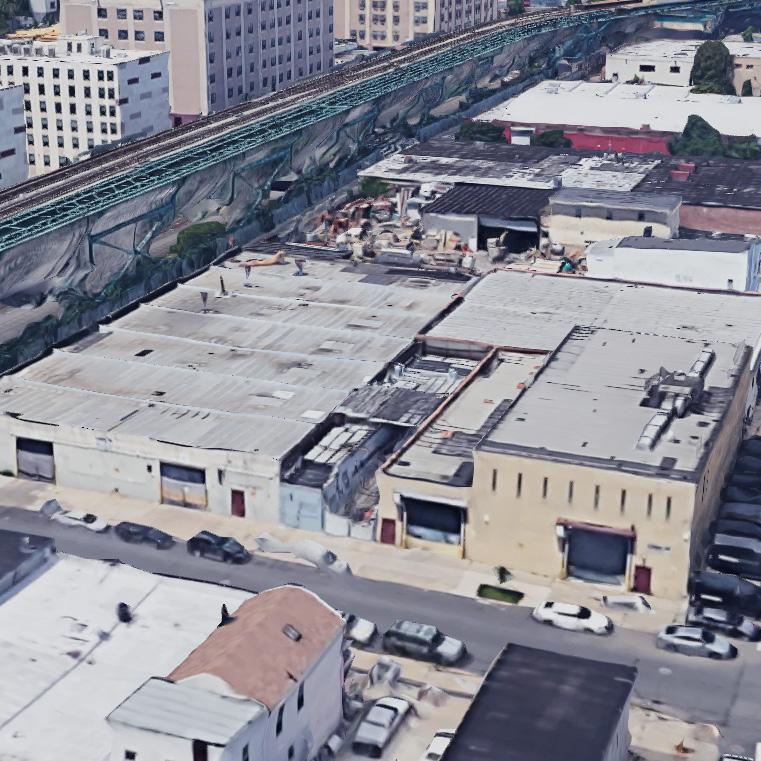
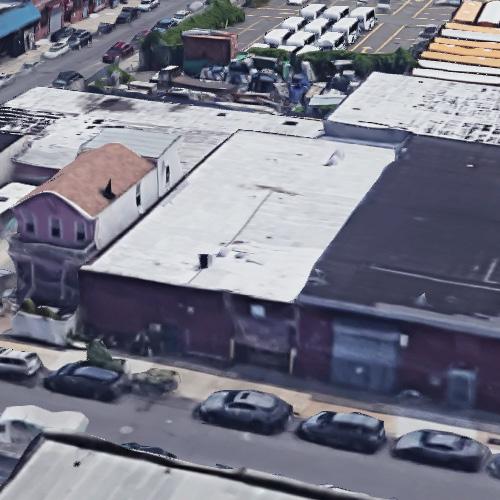
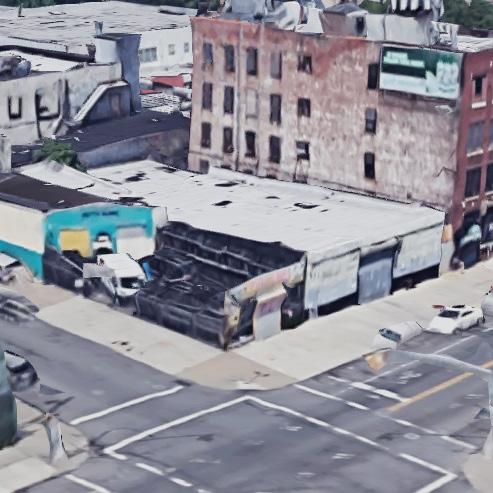
Currently: Legion Lighting
Future Site of:
Central Brooklyn Food Hub
Agri-tech Research +
Design Lab
Food Entrepreneur Kitchen
+ Development Space
Currently: Universe City HQ
Future Site of:
UDSA Food Processing
Facility
Cold + Dry Storage
Vertical Aquaponic Farm
Universe City Offices
Currently: Maverick Metals
Future Site of:
Industrial Ecology
Compost Hauling Center
Bk Builders Shop + Fabrication Lab
Situating Infrastructures in East New York freight for foodways
East New York has been historically marginalized, first as a site for Jewish migrants to land and settle in the 1800s, then red lined during the 1930’s due to the immigrant population, white flight then led to urban abandonment in the 1950s, and has since become home to a predominantly Black population. There has been little economic investment since the industrial age when East New York was a center for many forms of manufacturing. Recently, there has been increased interest due to the infrastructural connections to the Long Island Railroad, industrial parks, and commercial corridors that have been largely disenfranchised. The Department of City Planning (DCP) and NYCEDC began a rezoning process in 2013, the effects of which have only been partially beneficial to the embedded community. While there are new and renovated parks and gardens, there were also hotels, storage facilities, and more shelters built due to this rezoning. Though there was a community engagement process, it seems as if there has been little invested in providing access to local employment, fresh foods, and increased affordable housing; the three resources that UC observes as essential to health and well being. NYC has a grand plan for the long term resiliency of the city, OneNYC, and UC could be a pilot project to demonstrate the potential for CEFEs throughout the boroughs.
The founders of Universe City are committed to providing the ability for community members to choose the foods they receive and access high quality products at affordable prices through high yield aquaponic production of nutrient dense greens and fish. They will develop a educational program in partnership with Cornell Cooperative Extension and CUNY Medgar Evers in Crown Heights to provide Agri-tech and Controlled Environment Agricultural systems for the future of production food in NYC to be led by BIPOC, infused with indigenous knowledges. Through organic waste and food rescue services, UC is committed to environmental justice and regenerative practices. Long term food security is central to UC’s mission, through both barrier free food distribution services and employment training programs, they intend to end the reliance on charity and stabilize food security in East New York. As a cooperative business incubator, they will leverage their space and entrepreneurial skills to help those seeking
economic empowerment, without engaging in extractive practices like requiring equity stake in the businesses with which they cooperate. They partner with existing community groups, knowing that they are the experts on community needs and wants, leaning on their knowledge and seeking advice from elders in the community.
Cooperative decision making, democratic organizing, and collective ownership are key to achieving a Community Embedded Food Economy and UC will use these frameworks to guide their growth and navigate institutional partnerships to make sure autonomy is maintained.
Universe City is barely two years old and in need of major investment by the government and other institutions who advertise their commitment to community driven decision making, bringing justice to historically marginalized populations. Universe City provides an opportunity for these entities to fulfill their promise to give BIPOC and low-income communities the investment they deserve. UC is deeply connected to the people they serve, constantly learning from those who are ingrained in the local food system of farmers and gardeners. They look to continue to lift all parties who are committed to this project with them, and have outlined the pathways they see can allow them to achieve their goals.
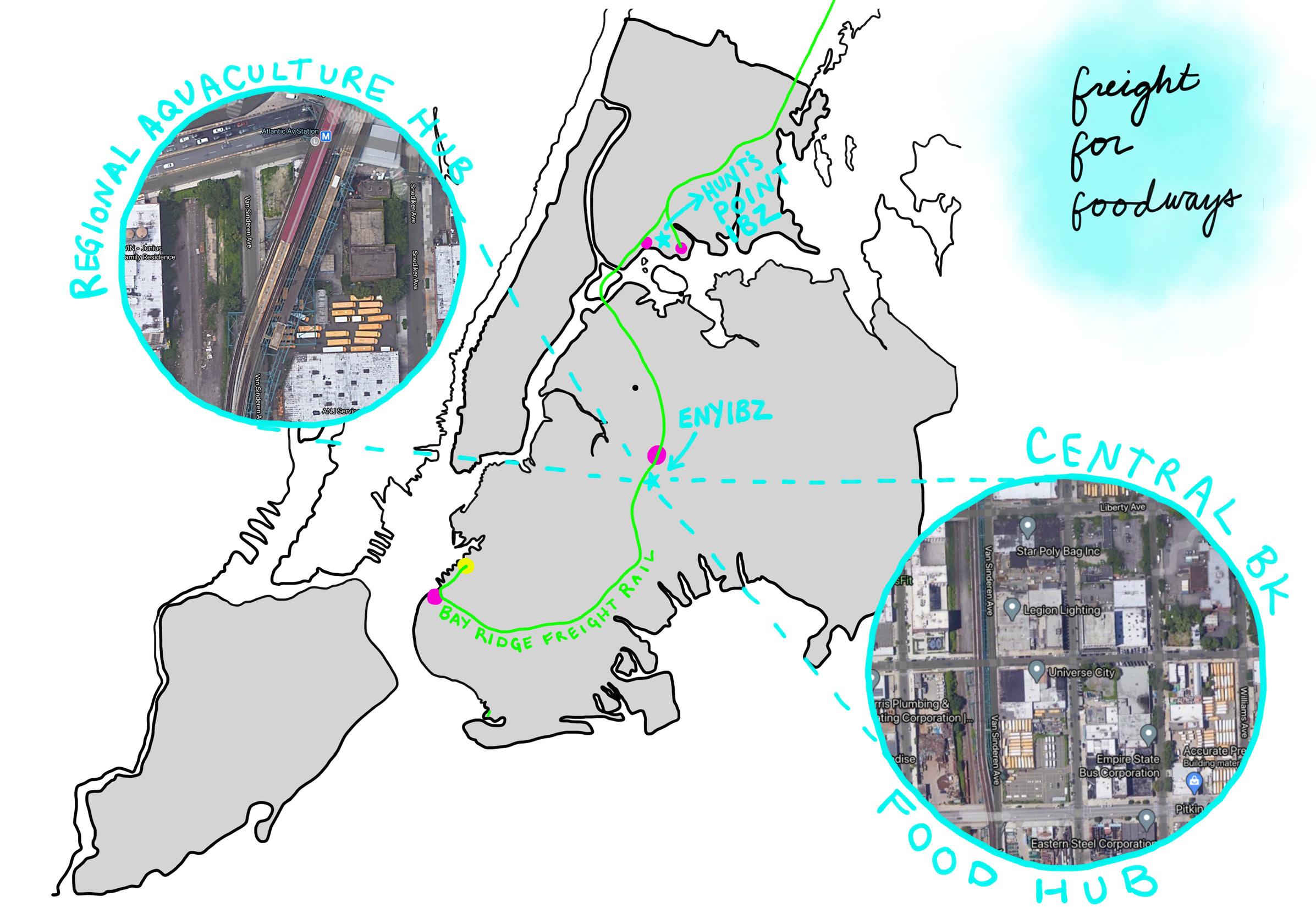
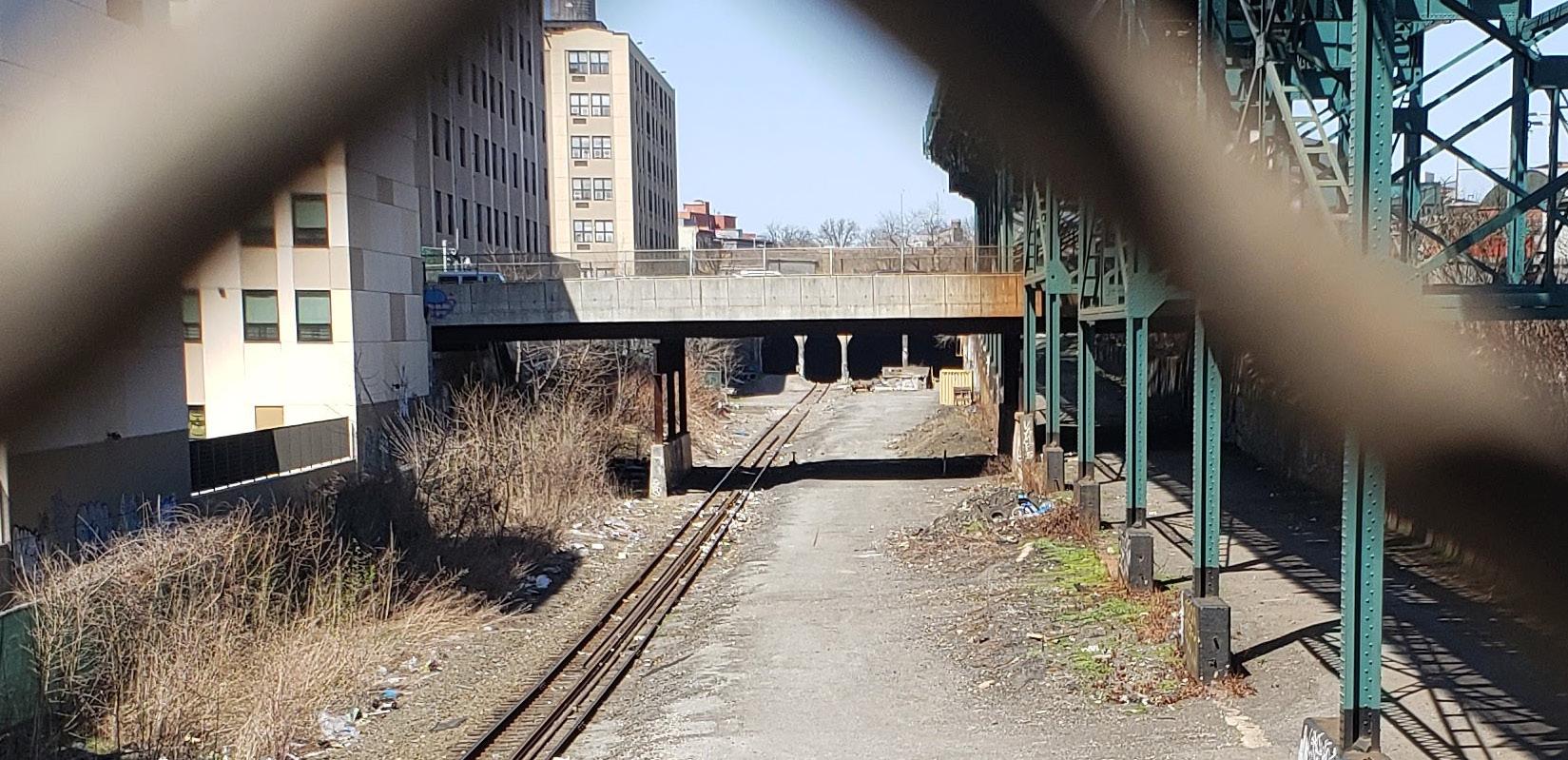
Foodways + Land
Foodways + Land
new york + Brownsville
Use in East New York and Brownsville
Use in East New York and Brownsville
Brownsville
east new york
PROGRAM ANALYSIS AS POTENTIAL APPLICATION BY UNIVERSE CITY infrastructure
focus area
UC Usage food economy education+Access
Provide Funding and Tax incentives to Supermarkets + Developers to open stores in areas determined by the Supermarket Needs Index, thereby providing neighborhood level access to full service supermarkets.
An Online resource for Emergency Food Assistance Providers. Access to operational support, funding opportunities, and the Plentiful app.
Makes Farmers Market products more affordable to SNAP users by providing $2 in credit for every $2 purchased through EBT.
SNAP recipients with high blood pressure can fill a prescription of $30 per month to spend at farmers markets.
Increase number of permits and lower fees and other barriers to starting a green cart business in designated (low income + high bodega ratio) areas for interested business owners. Some help in accessing EBT machines.
Establish a value based framework for all food purchases across agencies, with transparency. The GFPP standards incentivize regional producers, regenerative farming practices, nutrient dense foods, and labor rights.
Nutrition assistance for low income individuals, families, women, and infants. Each month, a balance is transferred to EBT cards which can be used at participating food retail stores like a credit card. Because this is a federal program, many undocumented people are not comfortable utilizing this benefit.
Universe City is developing an indoor farm and market within the program zone, this market will exclusively sell locally produced greens and added value products from local businesses. While not a typical supermarket, the space and activities are in alignment with this program to apply for IDC Funding.
Grow Brownsville is awaiting its 501(c)(3) status. Once finalized, GB will apply to become a registered EFAP, and with that status will access funding and resources provided through this program.
Universe City will accept SNAP and EBT for purchase of their products and seek to participate in the program. Through the Greens + Browns Belt, Ebenezer Market, and in association with CSA’s and Food Boxes UC will provide access to this program’s benefits.
Universe City sees this program as an opportunity for entrepreneurship and building soft food infrastructures in areas that experience food apartheid. In partnership with bodegas, green carts can provide increase, hyper-local, access to affordable fresh foods, building selfreliance through community ownership.
UC is a GFPP alliance member. As a main goal to produce food for Schools, Hospitals, and other institutions, the GFPP will give UC grown green the priority in governmental contracts as they work in alignment with the values set by this program.
Not only will all UC retail products accept SNAP, EBT and WIC but will work with community based organizations to advocate for expanded access to this resource. Working to facilitate the continued infrastructure around community fridges, UC sees SNAP as a way to track the impact of this common resource.
3.DESIGN PROJECT
Organizational Background
Universe City (UC) opened in 2019, founded as a worker-owned cooperative with the mission to “work together to replicate the Circular Economy model, an economic system aimed at eliminating waste and the continual use of resources. Universe City NYC is redefining the importance of building a strong economy around our Community by emphasizing Agriculture, Social Enterprise, and Community Healing practices.74” They began hosting classes and events “to connect individuals together and to our planet as we learn the importance of working together to change the world through sustainability,75” as well as developed their in house businesses who support each other’s financial success. They have developed a vision to see an urbanrural farming network supporting each other in their aligned interests by “creating a decentralized food port model that will lead the way for localized economies and create the smallest environmental impact within our cities.76”
with their own skills to help achieve that desired reality. Brittany and Jill’s families have run businesses within the East New York Industrial Zone for close to a century, while Frank and Alexis grew up in Brownsville and are community artists and educators. Since then, they have focused on establishing a cooperative business space, aquaponic farm, and food port that provides economic opportunities and health benefits for communities throughout East Brooklyn. Together they transformed an underused 5,000 square foot warehouse into an aquaponic farm and co-working space for worker owned businesses with a goal to expand into the other two sites collectively owned by the co-founders.
STRATEGIC PLANNING PROCESS FOR UNIVERSE CITY NYC
UC was started by four individuals with deep roots in East New York. Siblings Alexis, Creative Director and Lead Farmer, and Frank Mena, Executive Director, are natives of East New York, and friends Brittany Markowitz, CFO, and Jill Bellovin, COO, are fourth generation owners of industrial businesses in the area. They met during a Department of City Planning CivLabs series that Alexis was facilitating, and the idea for Universe City was born. The founders realized they all had similar visions for the future of their community, each
When the pandemic began, Alexis was working with another food justice organization in the area and began transitioning their service to food distribution. He secured a partnership with Brooklyn Multi-Service Health Center (BMS) and City Harvest, where volunteers processed and delivered grocery bags to community members in need. This operation grew significantly, and required a larger setting to keep up with increased need. Universe City became the center for East Brooklyn food distribution by early summer and served 15,000 families each week with City Harvest. They began partnering with Mutual Aid groups and other food rescue organizations, extending their network and impact area greatly. The goals for Universe City have grown to include the capacity for long term food distribution, supplemented with UC grown greens.
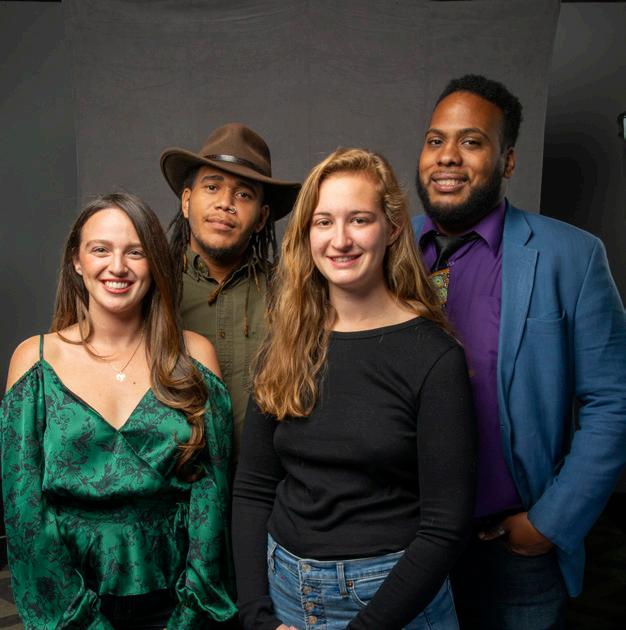
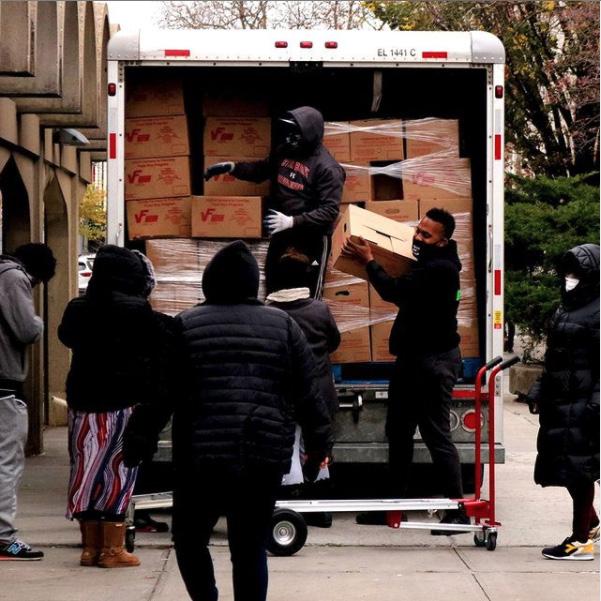
“The more we have control over how we produce the food, how we process the food, and how we distribute the food as a community, then we have a higher and greater chance for finding wellness solutions for our people”
-
Franklyn Mena,
Growing our Partnership
I became aware of Universe City early on in the pandemic when Alexis spoke during a webinar with the organization A Growing Culture, and followed them on instagram. As I began to think about developing a partnership, I revisited Universe City and was amazed when I looked on their website and realized how closely my interests aligned with their collective mission. I reached out to them and was warmly received by Brittany who invited me to visit on a Friday to talk and help out with their weekly distribution of 2000 USDA boxes to NYCHA residents and senior centers. After a few weeks and a number of conversations, we initiated a partnership, where I am now effectively a part of the Universe City network of cooperators, as their in-house Development Director.
UC is located within a number of overlapping city agency initiatives, they are part of an Industrial Business Zone, FRESH program zone, and Business Improvement District. With multiple manufacturing spaces and vacant lots in their purview, as well as each founder bringing a diverse knowledge base, they have unique potential to actualize the Food Port they envision. My work will synthesize their intentions through a process to develop a strategic plan, outlining the institutional mechanisms, guiding principles, and funding structures they can use to achieve this goal.
Ongoing Efforts and Needed Support
Universe City NYC responded quickly to the need of their community when the pandemic began, shifting their efforts away from building their aquaponic farm, to becoming the center for emergency food distribution in East Brooklyn. Partnering with BMS and City Harvest, they were able to serve 15,000 individuals each week, delivering over 2.5 million pounds of food to NYCHA residents, Senior Centers, Faith based organizations, and Free Food Fridges between March and December 2020. They did this work with $60,000 from crowdfunding, grants and loans; operated by countless volunteers, and the powerful support of their community partners. In looking to achieve food sovereignty for the East New York and Brownsville communities, they are negotiating how to continue this work while building their farm and expanding their overall capacity as a business and nonprofit organization.
In Growing Food Equity, the City Council described a Community Food Hub Incubator and Universe City is on the road to creating just that, a place to support not only high yield urban agriculture that will address the nutritional needs of the surrounding community, but also provide opportunities for local food businesses, education and training, to create a local economy built on circular economic principles. They need support; funding through governmental discretionary dollars or grants, individual donors, and charitable non-profit organizations are all on the table. We are seeking relevant non-profit grants to apply for in partnership with a fiscal conduit, a community collaborator who has worked with Universe City to distribute emergency food and provides workforce development for formerly incarcerated persons. We are also in negotiations with BMS who, until recently, had been reluctant to fund UC further, but has changed their tune and will be proposing a path forward to ensure the long term sustainability of UC as an Emergency Food Assistance Provider and Food Hub for East Brooklyn.
A Plan and a Vision
My project is a development process by which a 10 year Strategic Plan for Universe City NYC will be produced. We are producing this plan to be able to work with the new mayoral administration next year, as well as the many upcoming funding opportunities we plan to apply for. When fully complete in September, it will incorporate maps, diagrams, goals, and plans to visually communicate the meshwork of stakeholders and operations that are desired outcomes for the business. Beginning with basics, I have displayed all the engaged entities in their respective relationships to Universe City, as well as produced a map of the East New York Industrial Business Zone and the surrounding points of interest (diagrams 3 + 11). Through a long term participatory and iterative design process, I plan to co-create the systems that will provide UC the financial and structural support to build their cooperative to the scale they seek to influence. My outline for the overall strategic plan includes six main parts: Introduction to UC, Goal overview and profiles, Food Systems Diagrams, Embedded Context Maps, Development + Strategic Planning, and Vision of the Desired Future. Each section will have multiple spreads and subsections. I have used strategic plans such as the Flushing Waterway Vision Plan by Riverkeeper, and the T-Rex plan by the Regional Plan Association as a reference point for this project. Throughout the summer I will develop my graphic design skills further and seek additional guidance, as this publication needs to be functional for the use of Universe City NYC.
I am working very closely with the founders of Universe City to make sure this project represents their intentions. I have also worked to maintain the visual language of the brand that Universe City has been able to cultivate. In order to facilitate the realization of the UC Food Port and develop a path to move forward with actionable plans, we have had to go down to the nitty gritty of Universe City. Beginning in January 2021, the UC founders and I held weekly, day long, workshops where we performed the difficult task of prioritizing goals and further understanding the immediate needs of the organization. As UC is simultaneously planning for
future goals, alongside figuring out ways to maintain themselves immediately, I have become a fixture in the day to day operations of UC. Many meetings occur each week, from discussing potential education contracts with various institutions, to chats with potential funders and local representatives. I have had the opportunity to engage with the DOE School Construction Authority who are building a Learning Garden in South Brooklyn, as well as a remote project based Middle School regarding programming possibilities. We have taken meetings with the DCP, EDC, Economic Justice Coalition, Farm School NYC, and a Program Manager at the Good Food Purchasing Program. I feel prepared to continue the development process during the summer, with current programming contracts solidified, and a more concrete understanding of the needs that the network of community collaborators have identified through the ongoing community focus group sessions.
New York City, as well as state, federal and nongovernmental, based programs of which UC qualifies have been analyzed, while also proposing possible entry points where a cooperative, social value enterprise to utilize the many programs that are typically accessed by extractive, market based, developers as an application of the just transition to regenerative economy principles in practice (diagram 12). In order to uphold the goals of a CEFE, the movements and methods that are central to UC goals will employ those principles (diagram 15). Each founder of Universe City has a different stake in this organization, with collective responsibility towards continuing to grow the capacity of their business. When setting goals for UC, we are taking into consideration various scenarios that could present themselves. The community is essential to the success of UC and holds the knowledge of what is needed and who can help get us there; this is why the consistent convening of local stakeholders is required to review our inclinations and gather perspective as to how we will be able to collaborate towards shared futures.
UNIVERSE CITY NYC STAKEHOLDERS + COMMUNITY NETWORK
Cypress Hills - East New York Coalition
Bed-Stuy Restoration
Brownsville ENY Homeowners Association
Equity Advocates
Mens Elevated Leadership (M.E.L.)
Brownsville Residents Green Committee
JohnnyMae Robinson
Black Alliance for Just Immigration NYC
and
Civic Engagement
Teens for Food Justice
Agape Food Rescue
Ladies of Elegance + Isabaliah Farms
Oko Farms
East Brooklyn Food Distribution Networks
GROW BROWNSVILLE
Howard Houses
Glenmore Plaza Houses
Seth Lowe Houses
Ocean Hill Houses
Tilden Houses
Langston Hughes Houses
Brownsville Houses
Marcus Garvey Houses
Cypress Hill Houses
Grace Towers
Florentino Houses
Liberty Ave Houses
Bushwick Houses
Hope Gardens


Hope Gardens Senior Housing
Vernon Houses
Roosevelt Houses
Lincoln Terrace
CAMBA Family Shelters
Stone House GreenTop Farms
Agape Food Rescue
Isabaliah Farms
Feniix Fridge
What We Already Accomplished
My participation in the organization has primarily increased their ability to document and visually communicate their goals and objectives to the public, both to potential stakeholders and community members. I have produced diagrams and maps as part of the overall development plan for Universe City, concentrating on the elements that will best suit their current needs (for grant applications and stakeholder meetings), which have been incorporated into existing communication documents. I have been a part of many conversations with local food businesses, organizations, and developers that are crucial to the long term success of Universe City. In early January, we had a meeting with the Department of City Planning who requested a document that outlines their grand plan, goals and mission for the overall picture of Universe City NYC. I will present the strategic plan in association with that ongoing conversation. We also recognized the need for a 2020 Impact Report, which I produced in January, for distribution to active and interested stakeholders, it has been sent to NYC mayoral candidates such as Eric Adams and was given to Andrew Yang and Assemblywoman Latrice Walker when they visited Universe City (diagram 14).
Universe City has been working as a “scrappy grassroots organization who wants to make an impact in our community,” said co-founder Alexis Mena. The strategic plan development process will create a holistic document that gathers all the ideas, energy, desires, and futures that the founders have envisioned as the organization grows. It is apparent that the time is now to facilitate the transformation into a social impact business venture with the tools in place to reach their goals. Working with Universe City, at least, every Thursday has provided ample time to work through new developments and continue to develop this project collectively. I am active in most conversations and updated with any new information that arises. UC is a fast paced environment, with new opportunities and challenges to address each day. The strategic plan development process reflects that, with flexibility allowing the design to respond to shifting ground. For the purpose of initiating the collaborative planning process, we concentrated on articulating the short term goals that UC seeks to achieve over the next three years. The first community focus group will introduce those goals as a way to contextualize the larger mission of the organization.
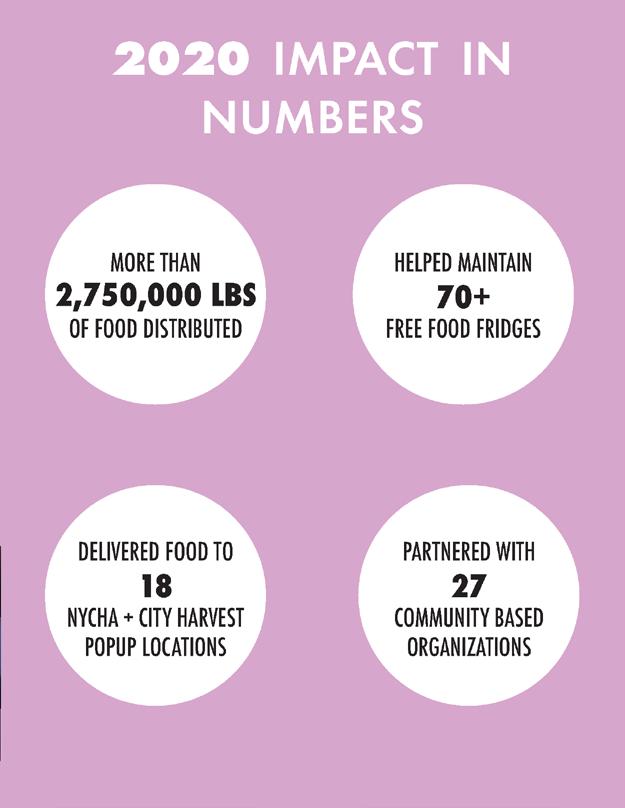
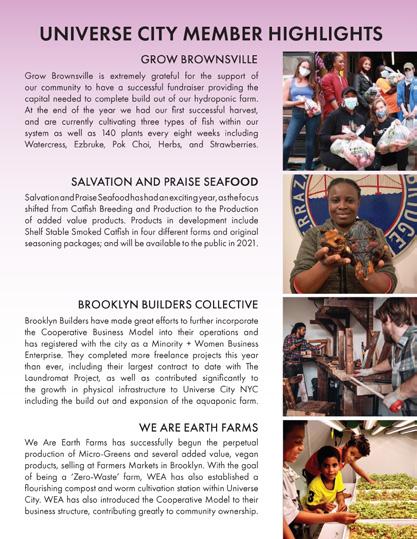
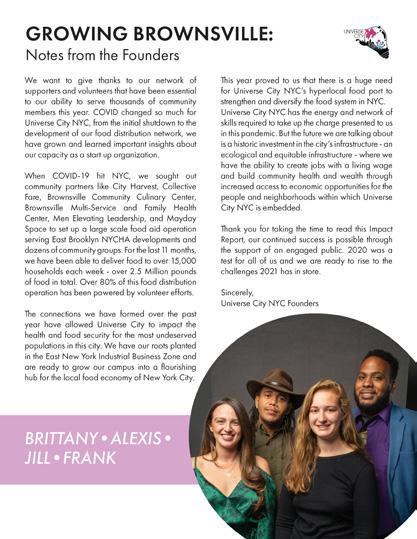
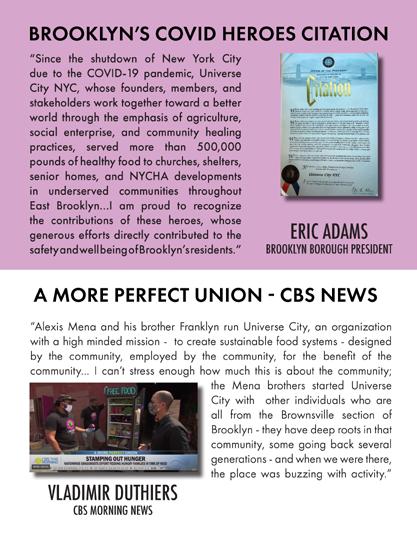
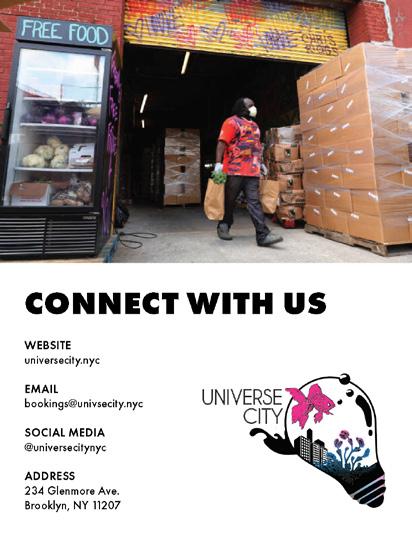
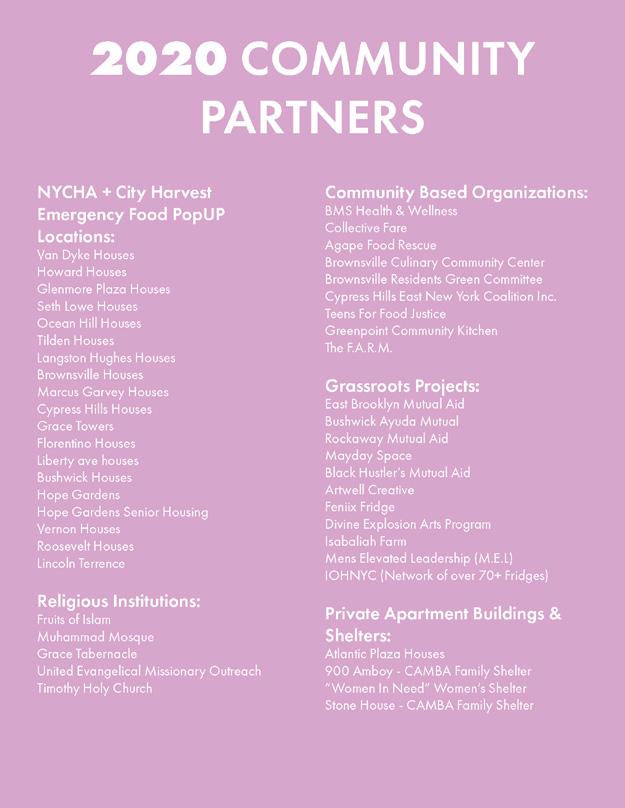
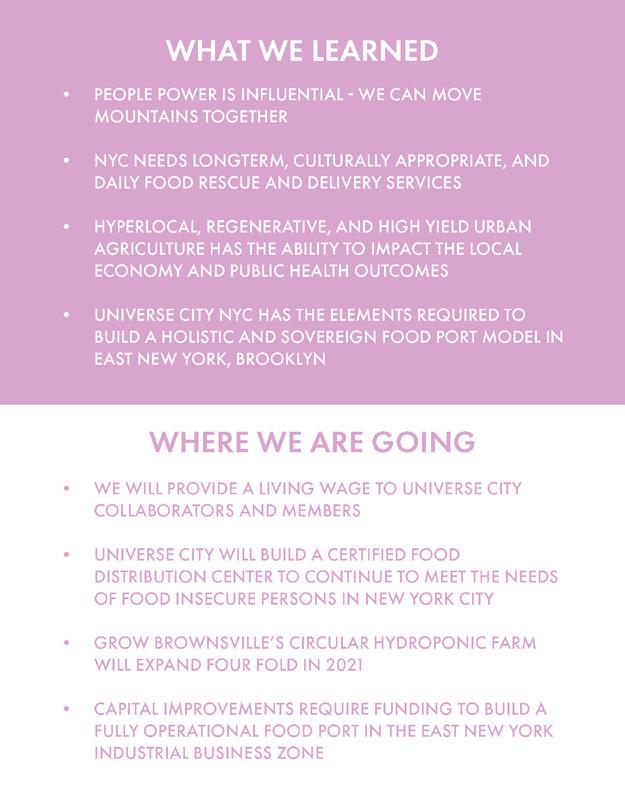
A Continued Partnership
I will continue with Universe City after graduation, working as their in-house Development Director. This position will give me the ability to advise and contribute to partnership development, fundraising, and public engagement with the founders, working collaboratively to grow towards our long term goals for Universe City NYC. This strategic plan will be a living document, evolving with each goal achieved. To engage the local residents further we will host a Neighborhood Survey during the summer, led by participants of the Summer Youth Employment Program. The findings will be analyzed for potential expansion of the Universe City Campus or as assets for the Glenmore Green and Brown Belt. A food access survey has also been initiated to gain better understanding of the needs and wants of the population served by UC and the project partners: Teens for Food Justice and Collective Food Works. Universe City has been working collaboratively to bring the pilot survey with Langston Hughes NYCHA residents. It serves as baseline to develop a larger survey to be distributed to Brownsville and East New York communities broadly.
There are a number of relationships that are currently being negotiated between UC and various parties, including Procida Development on a farm and retail space in a new affordable housing project and community facility in East New York. The Department of City Planning and Brooklyn Borough President Eric Adams have been in conversations on providing funding and institutional support for the growth of Universe City. Alexis has established a conversation with Cornell Cooperative Extension to partner with Medgar Evers College on Controlled Environment Agriculture and Technology certification courses to eventually become a degree program. They are also looking at a city owned lot a few blocks away to build a large scale composting facility, vertical farm and outdoor education center. We also just initiated conversations with Agritecture, the leading company in commercial scale Controlled Agriculture System design and implementation to assess the overall feasibility and integration of food production, aggregation, processing, distribution, organics recycling and Agri-tech education at the UC Campus. These partnerships are crucial to form strong foundations for long term sustainability of Universe City and is included among the program profiles within the Strategic Plan.
who represents eny?
Who represents Brownsville? Who represents Universe City?
It happens that the East New York Industrial Business Zone is along the boarder of five jurisdictional boundaries with in varying levels of government. Community districts 5 (East New York) and 16 (Brownsville) meet on the block of Universe City; while congressional, senate, state assembly, and city council boundaries are all close by. The current elected officials of these governmental bodies are show on this map. Universe City has varying levels of engagement with each representative. The closest relationship it to Assemblywoman Latrice Walker who has attended multiple events and supported Universe City throughout the pandemic. Senator Jessica Salazar requested for Universe City to write a letter of request to receive discretionary funding from her office in 2021. The cofounders hope that with further articulations through the strategic plan, Universe City will be able to gain fiscal sponsorship for various capital investments and operations from these officials.
Each year, every community board in NYC releases a StatementofCommunityDistrictNeeds. The 2021 report for East New York list of three most pressing issues for the community: Health are services, Land use trends, and Trash removal and cleanliness. The health care needs focus on the lack of affordable fresh foods in the area. They site a recent data survey which found that for every 1 grocery store in CD5 there are 5 fast food franchises and 10 bodegas, and there are only 8 fruit and vegetable stores to serve the 183,000 residents. The board is requesting funding to support local business in providing fresh produce and further to build direct connections between local gardens, farms and supermarkets, bodegas, and grocery stores.

Community Board 16, of Brownsville, reports affordable housing, health care services, and youth and children’s services as their top priorities. When describing the needs for affordable housing they mention that with high populations of both elderly and homeless New Yorkers in the area, access to affordable fresh foods and job training resources are essential to securing the well being of low income residents who of the district.
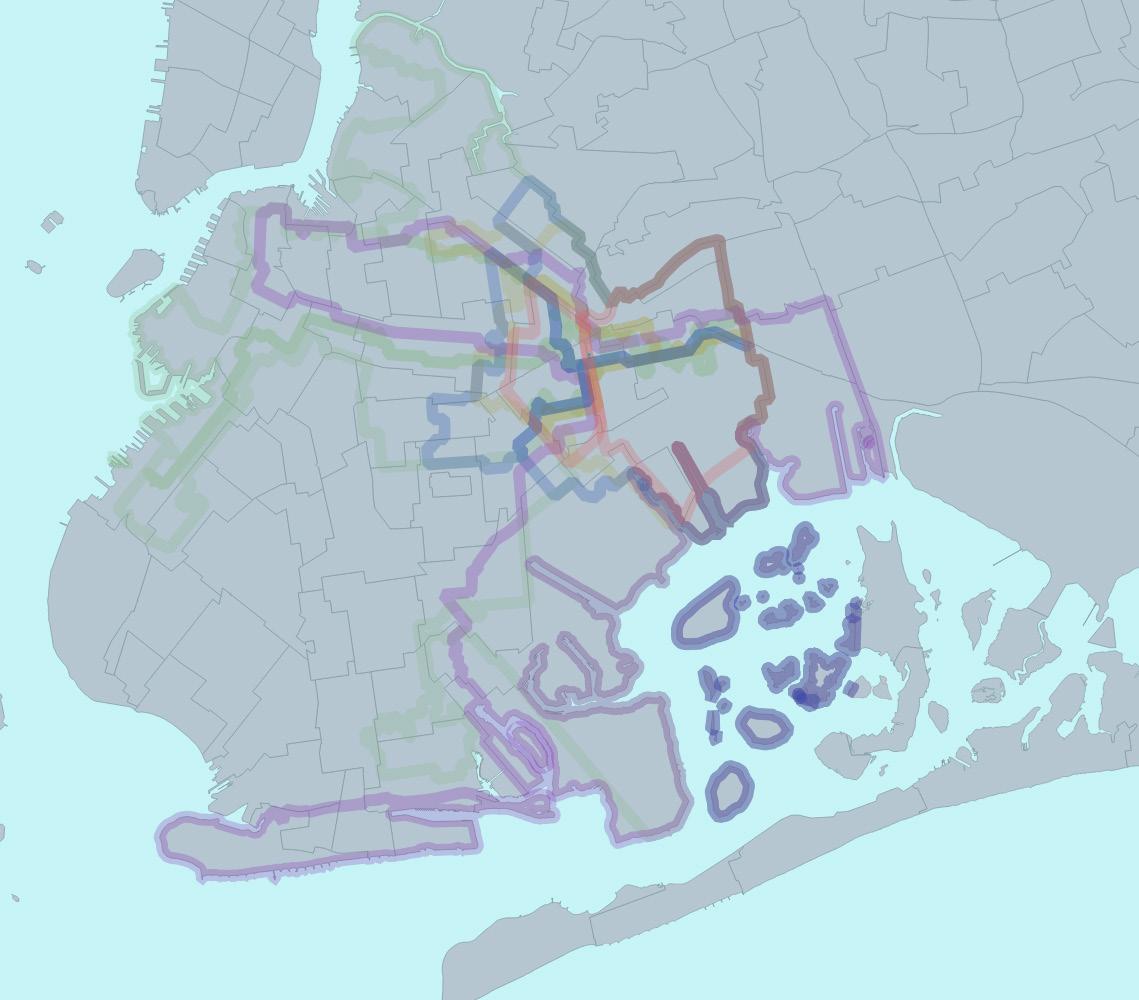
Julia Salazar District 18
Roxanne Persaud District 19
Darma Diaz District 37
Inez Barron District 42
Hakeem Jefferies
Lartice Walker District 55
Advocating for a New Model
Situating the Strategic Plan Development Process
Through my burgeoning partnership with Universe City NYC, I have been able to understand some of the crucial issues they address through their organizational mission and see the need for capital investment sources as a foundational barrier to reaching their desired future. In our initial meeting, my first objective was to write everything down; their network of partners and collaborators, their current projects, infrastructural assets and needs, as well as their short, medium and long term goals. I then realized that the most immediate need is a document that can communicate not only their goals and development phases, but also the importance of establishing Universe City NYC as an investment that can provide governmental agencies an opportunity to achieve the promises they have made to the East New York community.
The ENYIBZ promised $17 Million in funding and 3,900 jobs created in the area; the City Council and MoFP have demonstrated the desire to invest in the creation of community based food hubs; the city procurement agencies have recently committed to follow the Good Food Purchasing Guidelines. Meanwhile, the ENY community is already engaged in Food Sovereignty based initiatives and seek more opportunities for workforce development and public health programs. There is a strong coalition of food justice organizations and businesses serving East Brooklyn neighborhoods, their ongoing collaborations with and support of Universe City show solidarity to uplift the community as a whole. Teens for Food Justice has been able to build hydroponic farms in schools, Collective Fare trains and hires community members, ENY for Economic Justice has rallied to put the EDC to task, Brooklyn Packers have grown their business partnering with Universe City, all working to strengthen each other’s capacity and impact.
All of these existing practices point to the importance of producing a document that aligns Universe City’s intentions with the interests of their community and those of NYC governmental agencies. We hope that with this detailed plan, the EDC and DCP will be able to play supportive roles in actualizing the future as determined by UC and community leaders. The proposed city politics, policies, and plans are often vague and their
implementation does not match up with the expectations of the community they represent. This strategic plan will illustrate what the ENYIBZ could become: an economic driver for residents while achieving the goals of NYC to reach a more sustainable, regenerative, and just food system.
Design Project Goals and Format
The goal of this project is to outline and visualize the mission, values, short and long term goals of Universe City NYC that allow for community driven strategic plan development. This thesis includes the plan development process, infrastructural and programmatic goals in relation to the city’s 10-year food plan. The product of this ongoing project will take the form of a publication which can be utilized by Universe City as an introduction to their organization for governmental officials, prospective investors, project partners, and ENY community members.
Alexis felt that before we fully develop the plan it would be advantageous to convene a focus group of advisors, stakeholders, and community partners to present the goals outlined by the Strategic Plan. This intention of this meeting was to provide insight and guidance that allows Universe City, and the network of organizations that are engaged in similar work, to cross pollinate and see where objectives align. For this initial call to interested actors in the field, UC compiled a list of over 100 invitees. Those ranged from gardeners, the East New York CLT, local businesses, past collaborators, mentors, and local government administrators. Following the Jemez principles and regenerative values, the Community Stakeholder Focus Group was held on April 8th with close to fifty attendees, the conversations from that event have been analyzed and the strategic plan will adjust where necessary to better represent the needs of the community.
For the purpose of the focus group, I worked with the UC founders to determine what was to be shared during the meeting and objectives for the session. We decided that this would be a perfect opportunity to share the full
vision of Universe City to the varied group of individuals that would be attending, many of whom only know a portion of what UC aims to accomplish. We provided an overview of UC’s Mission, Movements, and Methods; then active members were able to introduce themselves, followed by current project + updates, then short term goals with some ideas of how and who would be involved with each one. I also included some maps geographically locating local assets, demographics, systems, and the food environment in ENY. We presented short term goals that align with the Food Forward Plan to show our commitment to work alongside governmental agencies to build a just food system in NYC.
This first phase of the strategic plan development process will include a series of community stakeholder focus groups to better align the goal of UC with that of organizational partners, advisors, and policy makers. The initial meeting went over current and short term goals, the next will cover 5-7 year goals, with a third looking at the 10 year vision for Universe City. To build an advisory group, a survey has been sent out to the community stakeholder list to see who would be interested in having a more pointed place in the development process to advise and structure the networks needed to achieve the programs we set out to build. We plan for three groups to be formed from the basis of the conversations had at the initial focus group. The areas of interest seem to be in alignment with those of UC and include economic justice, food security, and education/workforce development. From my experience at the first session, I would like to better prepare a methodology that facilitates more conversational exchanges between community members. The remote nature of this era does create some barriers to provide a safe and welcoming space for genuine connections to be made. We designed prompts for the breakout groups which were moderately successful. I think I did a disservice to my group by taking too much space in the room, worried that the conversation would not happen organically and I will make sure I take a step back next time.
This thesis has provided the opportunity to define the planning and development process that will culminate in the Strategic Plan. Following the completion of the
semester, we will continue to implement the planning process, with community focus groups in June and August, to produce a complete Strategic Plan by September. The completed document is essential for UC to communicate their intentions to multiple publics. Considering the needs and priorities of UC networks, and in light of the upcoming mayoral race and recent invitations to apply for capital funding from local representatives, we have concentrated on government officials as the intended audience for this incarnation of the strategic plan. All mayoral candidates have different visions for the future of the food system in NYC, we want to demonstrate that UC not only has the vision but also the knowledge of how to implement our goals, and support from an interconnected community of stakeholders. In doing so, we hope to gain not only institutional support but also grow awareness of our long term intentions to seek foundational funding through other sectors, public and private.
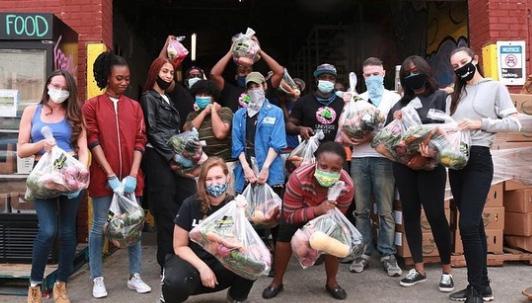
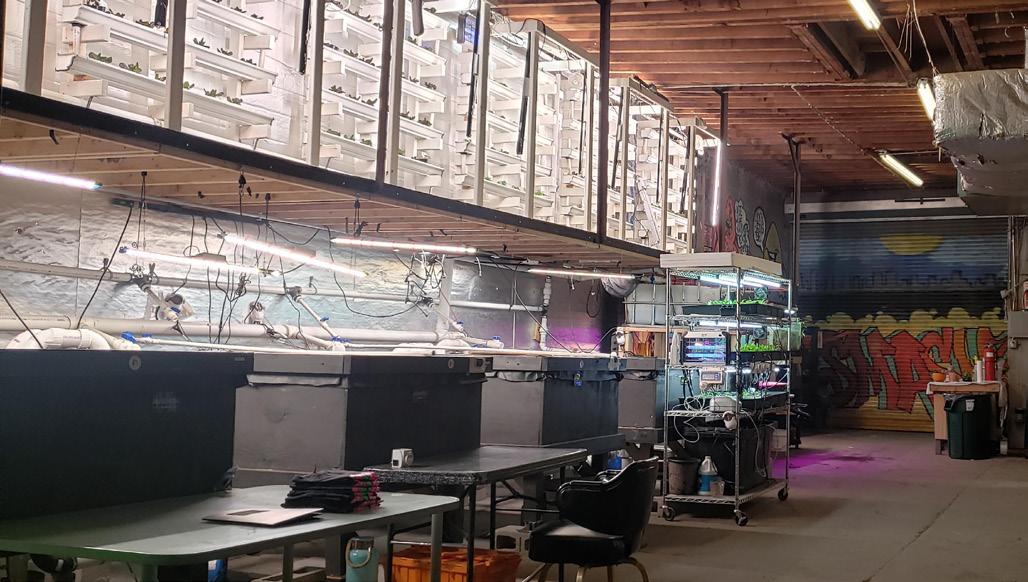
Collaborative Design Strategy
I have relied on direct collaboration with the Universe City founders to form the goals and objectives for the development of this publication. I have created an outline and framework for review and comment, which I then have applied to the design project; this will happen multiple times as the publication is formed. During the week of March 8th, we defined the overall goals and objectives for the 10 year phasing of growth. I have outlined the basic components of the short term goals and have begun to determine which policies and other resources will be advantageous to each item.
The timeline for implementation of each goal will need some technical assistance from our advisors to define how long each milestone will take to complete. The goals, and details around strategy for achieving the goals, will go through the same participatory process. We are working to understand how we might realize these goals, connecting with possible partners, and researching mechanisms that could support UC, then reviewing these findings with community stakeholders, where we then can analyze our educated assumptions with the knowledge that emerges through focus groups. Once the third focus group analysis is finalized, we will be able to compile the strategic plan for publication.
Every Monday I sent the week’s progress to UC and received feedback on Thursday to move the project forward. Alexis and I have worked together to develop some of the visual language. Brittany focuses on certifications and other legal documents that will be needed to implement the goals. Frank contacts stakeholder and community leaders for advice and answers to any questions we may have about the project. Jill writes potential grants that will be applicable to various goals throughout the ten year plan. Together we determine any adjustments that need to be made in order to produce an actionable and sincere strategic plan for the sustainability of Universe City. We then created a document outlining our current status to present at the focus group, for transparency with our trusted community partners. Some slides from the April focus group are included on the following page. After each focus group we will take time to synthesize the insights from the attendees with UC’s proposed goals.
The Community Stakeholder Focus Group is a pivotal
point in the development of this project. With their concerns and recommendations, I have the opportunity to incorporate the broader community’s vision for UC’s ecosystem. Due to the restrictions of COVID-19, this workshop must be remote and the ease of communication is somewhat hampered by the online environment, however the variety and high volume of attendants can be seen as a benefit to having the session virtually.
Alexis and Frank are well connected and liked by their community and recognize how this is an invaluable opportunity to evaluate our work. I am thrilled to have this opportunity and have planned the meeting to facilitate an organized and productive session. We also used this meeting as an opportunity to communicate our work to the worker-members of UC to get their opinions and understand how they see their growth within UC. I would like for the next meeting to be perhaps hybrid, in person and remote, to be able to work together on a piece of paper allowing for a different level of engagement where more in depth conversations occur. Many participants were only able to speak for a short period of time to a handful people, unable to circulate the way a physical space allows. There was a considerable amount of deliberation about what and how much to divulge during this meeting. Initially, we thought of introducing the full ten year goal chart, but with limited time and so many possibilities still up in the air, we thought it would be more beneficial to limit the goals to the next three years. Those include: Industrial Ecology, the Glenmore Green and Brown Belt, Regional Farm Hub Network, building a USDA certified Food Processing center, Cold and Dry storage for food distribution organizations, and becoming an institutional vendor for the DOE + DOHMH food services. We provided our ideas about who would collaborate with UC in order to fulfill these goals, as well as how we plan to access funding and institutional support.
After sharing our plans and ongoing work, we hoped a discussion would ensue with the goal of identifying the wants and needs of the communities represented by attendees, share what aspects of UC’s work intersects with their own, and to gain the attendees perspective on the goals UC has set and gather potential resources
or gaps we may have missed. The break out rooms did not work perfectly, some people were not able to figure out how to join; we definitely need to do more technical preparation before the next meeting. Overall, each breakout group wrote a number of useful notes that have been analyzed and compiled by myself and UC. We have looked through the transcripts from the meeting and have drawn a number of insights from this exercise which are included in the Community Focus Group Report (diagram 18).
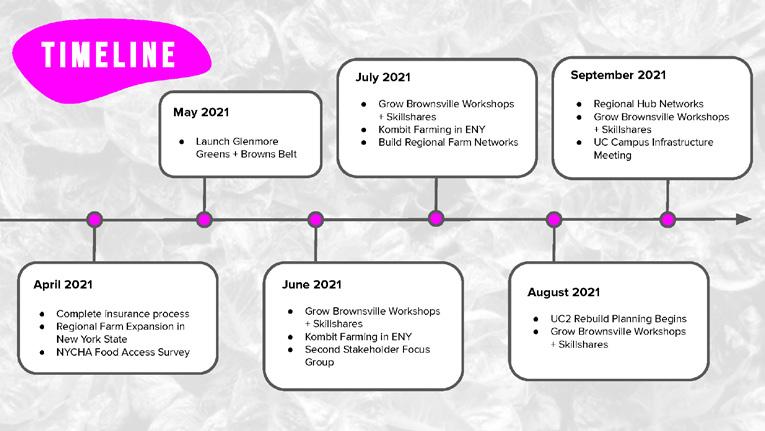
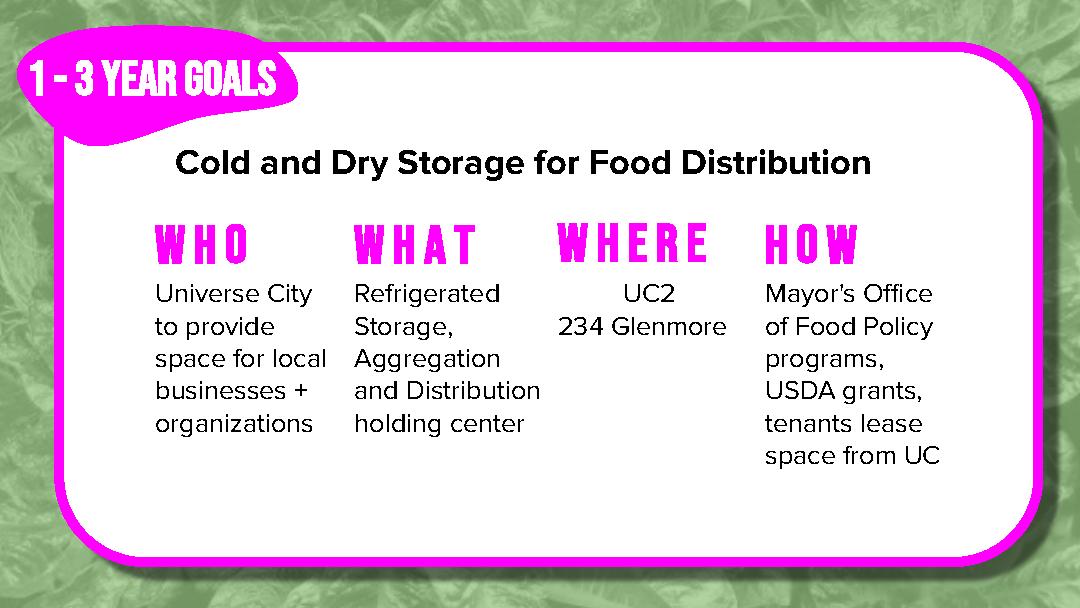
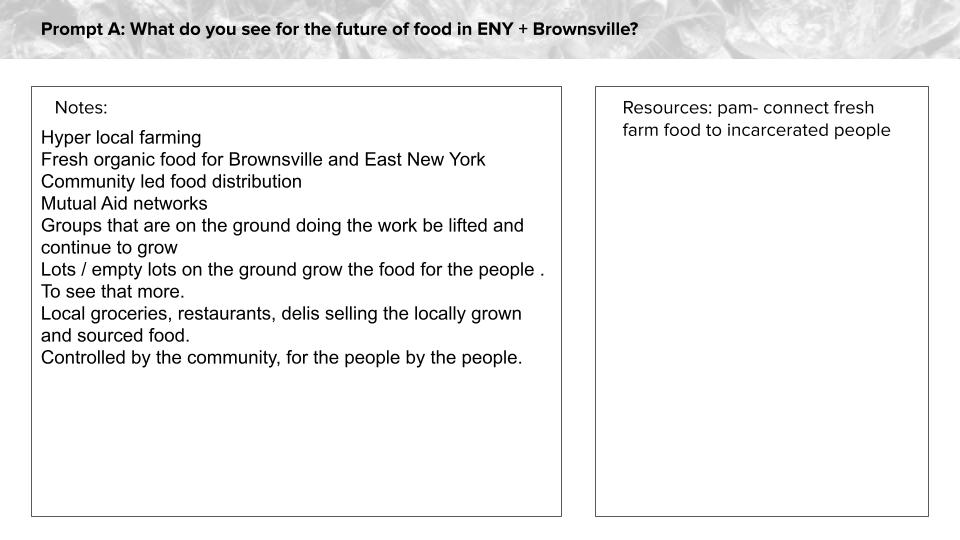
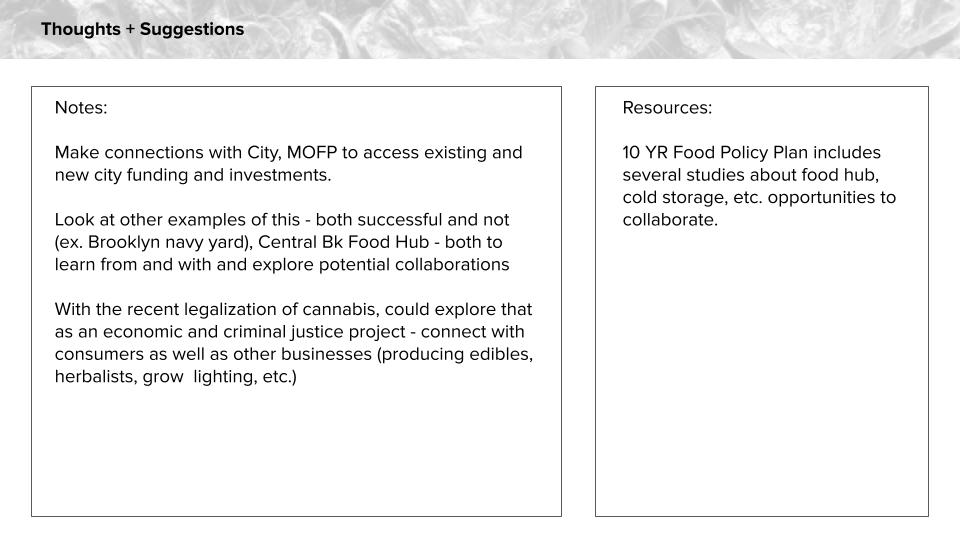
Focus Group Analysis + Next Steps
The inaugural Universe City community focus group was attended by 50 partners, advisors, mentors, and allies from East Brooklyn, the broader food justice movement, and other justice focused organizations. Over the course of two hours, and six breakout sessions, a number of priorities emerged from the conversation. These areas included increasing food production, the need for permanent infrastructure, community ownership, economic justice, workforce development, youth education, and public health. Many approaches to each subject were discussed, some of which aligned directly with the goals and objectives of UC and others presented totally different possibilities for intervention.
When responding to the prompt ‘which goals would you like to see UC prioritize,’ food production was highlighted by three of the breakout groups. The intersection of nutrition education, public health, affordability and land use were at the forefront of the discussion. There is an understanding in the community that there is an abundance of potential farming land in the neighborhood, and they want to see those spaces owned and controlled by the community as long term food infrastructure. Some comments include:
“We have tons of community gardens in our neighborhood that are either under utilized or not used at all, you know, and they’re overgrown things like that. And I think that by collaborating with the network of gardeners and farmers and the community, we could really revive all those gardens and make them usable again.”
“We need to grow within and around our community because that supports everybody. It supports jobs. It supports every part of the community to grow your own food and to have your own resource.”
“Providing sustenance and food, and also this therapeutic element you know, which is so just inherent in gardening and farming, I think those therapeutic benefits and, how can we access those to support, you
know, people who are, who are currently incarcerated or, or their loved ones, or somewhere in between, the variety of carceral settings that this nation has.”
“...Collaborations within the neighborhood between gardeners, farmers and schools to not only teach the youth and other members of the community how to grow food and make it accessible and affordable, but also make it a collaborative effort because as a team together, everyone achieves more. And we want to make sure that fresh produce gets into the hands of everyone in our community because that’s what we deserve as a basic human right.”
These participants’ perspectives illustrate the common need for a community controlled food economy that not only provides access to affordable fresh food, but also acts as a conduit for education, jobs, justice, and self-determination for residents of Brownsville and East New York. As a conduit, UC is able to act as a shared infrastructure for the community, a space for collective decision making, entrepreneurship; and as a food hub for central Brooklyn, UC is able to promote community control and transparency within the local food system. One group raised the concerns that food production through neighborhood greening could cause gentrification, which is a valid concern. However, representatives from the East New York Community Land Trust were in attendance and remarked that their efforts were in tandem with that of UC and hope to be a force that facilitates long term affordable housing and community ownership to resist the persistence of gentrification. In a discussion with UC founders, Alexis noted that UC is “actively pushing against the ethnic cleansing that happens in the neighborhood through institutional systems- carceral, healthcare, the criminalization of poverty- and we have to ground our efforts in history and recognize our place in the process to ensure we are working with the community so that our outputs support the local economy and residents.”
Responses regarding the future of food in East New
York ranged widely. Some ideas included rooftop farms for restaurants and throughout the IBZ, bee colony cooperatives, in school programming for agricultural and nutrition education, growth of family owned businesses, and community wide food security through community controlled food supply- eliminating the need for food pantries. Participants argued that job training and education is key to realizing this desired future, ushering in a new generation of farmers not only to expose youth to the nutritional benefits of fresh foods but also, as one attendee remarked, “the intersection of restorative practices and kind of having the understanding of and recognition of reparations for past investment prioritizing food and land for black and Brown, new Yorkers who have experienced economic segregation and apartheid.” Participants noted that there is huge potential for partnerships with local food retailers to sell community grown food and how those connections could impact health disparities that impact the community. Alongside businesses, many participants encouraged UC to inquire about the potential of activating NYCHA land for community farms and the possibility of reclaiming golf courses for food production.
A number of questions were also raised during the focus group, some rhetorical and others genuine. One participant inquired:
“Why do we even need emergency food in the first place? Why aren’t we food sovereign? Why don’t we have everything we need within 15 minutes of our own home?”
This set of questions sums up a number of the issues Universe City is trying to address. And through coordinated and collaborative efforts between aligned initiatives, the future of Brownsville and East New York will see a local food economy that provides community controlled systems for food security, health, and business ownership to allow for self-sustaining neighborhoods. Another common question was:
“How can we make sure that we make the food accessible and affordable?”
This will continue to be defined, and UC plans to sell a certain amount of produce through market rate and boutique contracts in order to offset the costs of providing free or low cost high quality foods to the community. Other participants requested that we continue documenting this process with transparency for the community as well as governmental representatives. They asked how UC plans to garner support for the work with the MoFP’s ten year plan goals and how they will advocate for legislation around urban farming (production and education), community land ownership, and locally owned businesses. Documentation will definitely continue, for the eyes of the community but also specifically for advocacy towards city, state, and national administrations to seek funding and resources.
Following this initial focus group, it has been requested to repeat this event for the Brownsville Food Access Coalition, whose monthly meeting happened to be on the same day, at the same time. The representative that attended felt the discussion was useful for all the members to engage in and the UC founders were excited to continue this conversation with an even more deeply aligned group of organizations. The report included in this thesis (diagram 18) was sent to all participants and invitees as a publication that highlights the key themes generated through the focus group. A report will be produced after each focus group, which is planned to occur bi-monthly, the next installment is scheduled for mid June to go through UC’s medium term goals. The June meeting will also coordinate around the needs of the Glenmore Avenue Greens and Browns Belt, which seeks to activate 15 community gardens throughout the summer through a Haitian communal farming practice called Kombit, bringing together elders and youth from the neighborhood to grow food for sustenance. This project was well received by the focus group participants and UC hopes that the alignments uncovered through this initiative will lay the groundwork for long term, sustainable and regenerative, community controlled farming, increase food security, and access to nutritious fresh free food for residents in need.
strategic plan development process
This diagram is an overview of the trajectory practiced to align the objectives of Universe City with those of community stakeholders, through a designed process of participatory decision-making towards collective growth. The following spreads go into further detail of each phase, describing the tactics and analysis utilized in each step. This process is iterative and will continue to evolve as new information is considered. Rather than designing a prescriptive set of steps, that may be limiting and unrealistic, this process is displayed more in line with the unexpected realities that are present when working on moving ground. Each phase is broken into components that each contain a few key elements that support the intentions of a democratic, consensus driven process. Some steps may need to be repeated as new possibilities present themselves or partner priorities change. Flexibility and inclusiveness are central to the design of this process. And the strategic plan that whose production will follow this process will be a living document, ready to respond to unexpected opportunities.
WINTER 2020
1. analyze
Evaluate current projects
Define preliminary short, medium, and long term goals based on mission, vision + values of UC
Gather knowledge about stakeholders, ongoing programs, and community needs
SPRING2021
2. cooperate
Connect with partners, collaborators, and community members for participatory planning process
Analyze + inform existing goals with the recommendations of community stakeholders
From engaged stakeholders, form steering committees to advise UC on goals, strategies + resources
3. strategize
With stakeholders voices engaged, create a preliminary10 year plan articulating strategic approach to workshop with advisory groups
Advisory Group meets regularly with UC team
Align phasing with ongoing community activities, legislative and administrative intentions, uplifting the needs of partner organizations
10 Year Plan is ready for distribution
Organize responsibilities
Evaluate current projects
Seek Resources
Assess partnerships
Set milestones/ timeline
WINTER 2020
Regular Check-ins
1. analyze
Facilitates sustainable practices
Determinewherethe work will lead Connecttoeffortsintheembedded
Engage in Advocacy
Generates living wages for workers
GOALSETTINGCRITERIA
Define goals that support mission, movements + methods
Gather knowledge of stakeholders, local programs, and community needs
Local Civic Participation
Surveys + Conversations
Aligned with community needs + wants
Builds capacity for existing activities
Where are alignments?
Where are conflicts? Where are gaps?
KEYQUESTIONS
Analyze + inform existing goals with recommendations of community stakeholders
SPRING2021
Form stakeholders committees to advise on strategies + resources
2. cooperate
Connect with partners, collaborators, and community members for participatory planning process
HOSTCOLLABORATIVE EVENTS
Enhance ability forself-determination
Cultivate spaces of safety + appreciation Invite stakeholders + partners
Share work + receive insights Prompt guided discussions
with UC team
Mayor’s Office of Food Policy
Department of City Planning
PARTICIPATION + PERSISTENCE
Economic Development Corporation
Department of Education
With committees, form a 10 year plan articulating strategic approach for goals, advocacy + fundraising activities
Brownsville Residents Green Committee
Align phasing with community initiatives + governmental intentions, uplifting the needs of partner organizations
GOAL PRO FILE CONTENTS
Timeline + Milestones
SHORT (2021-2024) MEDIUM (2024-2027) LONG (2027-2031)
Resources + Funding
Mission, Movement + Methods
Partners + Stakeholders
East New York Community Land Trust INTEGRATE + AMPLIFY
East New York Economic Justice Coalition Collective Food Works
Cypress Hills Local Development Corporation
SEPTEMBER 10 Year Plan is ready for distribution
Implementing the Strategic Plan Development Process
Over the next three months the work that I have initiated through the thesis project will continue, I will continue to lead the development process leading to the implementation of UC’s strategic plan. The publication I create will outline the intentions of Universe City, their goals, and their ideal 10 year development phasing. This document will provide the opportunity to clearly communicate their needs and the timeline within which they seek to implement their goals. The strategic plan will be primarily my responsibility to complete, with guidance and collaboration from the UC founders and our mentors. Along with the Universe City founders, I have brought in mentors to help with business development. First a mentor from the SCORE network, an Small Business Administration program, is helping to identify potential funding sources and specific philanthropists who might be interested in funding the capital improvements needed for UC. Second, I happened to have been introduced to two architects from Grimshaw Architects who were looking for new, innovative, and sustainable projects to advise. They will be advising us on the strategic plan to help me establish the phasing and implementation for UC projects and programs.
This project will provide a base for further work in more technical applications or architectural renderings and 3D modeling of which they plan to provide, through their network. Safer DIY Spaces, a non-profit organization out of California, has offered to pay for architectural plans that will allow Universe City to legitimize their warehouses for use in food production and processing. At the moment, the priority for Universe City is in gaining access to land that is prepared to grow food, solidify education and workforce training contracts that provide income for the founders, and other business opportunities that can immediately support the living expenses of the UC team who have been dedicating most of their time and energy into the organization.
In order to be able to maintain the level of work that the public now anticipates from UC, the founders definitely feel pressure to secure the properties that have been in the family, and was recently offered a multi million dollar
real estate deal from a shelter developer. Legion Lighting contains 40,000 square feet of space that would easily accommodate indoor growing, as well as commercial kitchens, processing and distribution for UC and possible collaborators: Brooklyn Packers and Collective Fare. UC feels a decent amount of pressure to find an alternative to the current deal, and would be willing to work with the city or private developers to make sure the site remains in the manufacturing industry. There is a new initiative through Small Business Services called Owners to Owners, helping to transfer ownership to workers as the current owners seek retirement. Perhaps this, in conjunction with either the organizations previously mentioned or the Central Brooklyn Food Hub, could facilitate a situation where UC still can develop this location as part of the Food Port.
With an electrical fire on a rainy day in February having destroyed the aquaponic farm, the founders are in a holding position at their usual location, unable to accept food donations for distribution. Other opportunities have shown themselves, like the food access survey, webinars with Brooklyn Tech and the Queens Public Library, and a contract with a local business to install and maintain a free fridge and pantry in front of 234 Glenmore. I am balancing the work needed to get these current projects off the ground, while visualizing how these projects fit into the overall goals and determining what we need to do right now to get our larger projects activated. Funding to continue this strategic plan development process would be helpful, as would funding to cover capital investments (ie. a down payment on one of the warehouses). We are looking at federal, state, and city funding opportunities which I will have more time to dedicate to applying to, utilizing the planning documents we have completed thus far. Luckily, the founders each have different connections that have allowed the business to continue growing through the pandemic. The UC co-founders collectively work together to secure educational and business collaborations in East New York and Long Island. While seeking support through their channels, we all come together to align the many pieces each person brings to the table. With Thursdays having become a day to work on strategic development, the founders have been able to create a more consistent
schedule to execute their immediate responsibilities.
I have operated with the awareness that there are existing policies, programs, and platforms Universe City can engage with to establish their food port. In coordination with city agencies, grants from nongovernmental organizations, and support from private investors, the justice focused enterprise of Universe City’s imagination can become reality. As a cooperative business that works both in the commercial and social services sectors, they have a unique position in the meshwork of emerging food sovereign economies. Diagram 12 shows how these existing mechanisms will be considered and applied through the strategic development of Universe City. Some programs include FRESH, with the connections at the EDC we will indicate how and why they should expand eligible food retail businesses beyond supermarkets to incorporate CSA and Food Box initiatives. As a Minority and Women owned Business Enterprise (MWBE), UC has priority to be contracted for city sponsored developments and access to much needed funding.
The Food Forward 10 Year Plan from the Mayor’s Office of Food Policy outlined a number of goals that are in alignment with those of Universe City and Grow Brownsville, their 501(c)(3) organization pending nonprofit status. The following examples are the overlapping goals outlined as part of the short term (2021-2022) implementation phase; the medium and long term goals actually have even more overlapping objectives. The highlighted goals align with the needs of the community as expressed through the focus group, as well as connect to the larger scale food system needs that Universe City seeks to influence to further the transfer of control to the embedded community.
Diagram 17 shows these connections and demonstrates the need for institutional support for the implementation of Universe City’s goals. We will present these alignments to the contacts we have at various agencies and will continue to contact influential actors in the East New York community for assistance.
Food Forward NYC 10 Year Plan
Mayor’s Office of Food Policy February 2021
Some Aligning Goals:
Transform the emergency food network
UC is working to transform the emergency food network through sponsored and permanent Free Food Fridges in East New York and to provide storage as a EFAP
Create financing and technical assistance plans to support worker-owned cooperatives UC bylaws are framed as a Cooperatively owned business, and want to secure support through the financial and technical assistance that has been proposed by the MoFP
Continue to implement FreightNYC
UC will advocate for the FreightNYC plan to utilize the Bay Ridge Line as a direct connection between Hunts Point and East New York Food Hubs
Deepen regional engagement through a NYCRegion Food Working Group
UC is currently forming relationships with regional food producers to be able to aggregate and distribute their goods with in the NYC market
Partner with the non-governmental sector to maximize community participation in food policy
Decision-making
UC and the East Brooklyn Food Consortium are conducting an independent survey to gain data on resident’s needs and concerns to be able to build services that respond effectively and gain quantitative insights for advocacy efforts within governmental agencies.
universe city goals
EBENEZER PLAZA URBAN FARM + MARKET
INSTITUTIONAL VENDOR
COLD AND DRY STORAGE FOR FOOD DISTRIBUTION
COMMERCIAL ORGANIC WASTE HAULING
GREENS + BROWNS BELT OF NEW YORK
USDA FOOD PROCESSING CENTER
REGIONAL FARM HUB
UC CAMPUS IS THE CENTRAL BROOKLYN FOOD HUB
UC2 AGRI-TECH LAB
UC2 HIGH YIELD CEA EXPANSION
CORNELL EXTENSION + MEDGAR EVERS CERTIFICATE PROGRAM
WORKFORCE READINESS PROGRAMS
ACTIVATE BAY RIDGE FREIGHT LINE
REGIONAL AQUACULTURE HUB AT THE POWER STATION
STARRETT CITY ORGANIC WASTE CENTER AT DSNY BK LOTS
UPSTATE FARM EXPANSION
CORNELL EXTENSION + MEDGAR EVERS DEGREE PROGRAM
MARICULTURE PRODUCTION / R+D EDUCATIONAL PROGRAM
LICENSE + FRANCHISE CURRICULUM
related food forward goals
(numbers correspond to MoFP document)
1B: Explore new ways to expand farmers markets and other programs that bring fresh fruits and vegetables to underserved communities
2C: Launch a Food Community Hiring Initiative; 3A: Push for changes in state procurement law
1B: Transform Emergency Food Network; Study ways to improve access to cold storage in underserved communities
4A: Collect 90% of citywide organic waste by 2030; 4C: Bolster community-owned waste management initiatives
5A: Partner with non-governmental sector to maximize community participation in food policy decision-making; Explore the creation of a food justice fund
2A: Create financing and technical assistance plans to support worker-owned cooperatives
5A: Deepen Regional Engagement through a NYC-Region Food Working Group
3A: Support the development of borough and neighborhood-based food hubs, starting with the Central Brooklyn Food Hub; Pursue development of critical food supply chain facilities
3C: Pilot innovations in urban farming technologies
3C: Explore new spaces for urban farming; Remove barriers for urban farming; Pilot innovations in urban farming technologies
3B: Advance educational and other partnerships between City institutions and regional farms
2C: Support training for food technology careers; Support the creation and expansion of career pathways in the food sector
3A: Continue to implement FreightNYC; 4B: Plan for a cleaner, more efficient, and more resilient food transportation network
3A: Strengthen the city’s Industrial Business Zones; Support federal funding for infrastructure; 3B: Promote the creation of regional food aggregation centers
3A: Support federal funding for infrastructure; 4A: Collect 90% of citywide organic waste by 2030; 4C: Bolster community-owned waste management initiatives
1B: Pursue federal support for businesses and nonprofits that provide fresh produce in underserved communities
3B: Advance educational and other partnerships between City institutions and regional farms
4C: Advocate for the inclusion of local seafood and seaweed in New York State Grown & Certified Program
5B: Partner with the private and civic sectors on food education campaigns around sustainability and nutrition
needed resources
Energy efficiency support, Contracts with restaurants + institutions
Registration and certification guidance from DCAS + DOE
Financial investment for capital improvements
Contracts with businesses + institutions
Access + support from DCP + NYCParks to activate vacant lots + GreenThumb gardens; Programmatic funding
Financial investment for capital improvements; Institutional support for the USDA certification process
Agricultural + Aggregation partners, Contracts for distribution
Financial investment for real estate purchase + capital improvements
Investment in technology materials + funding for programming
Financial investment for real estate purchase + capital improvements (including HVAC, energy efficiency, + biosecurity)
Institutional programming grant or funding for curriculum development
Program funding, business + institutional partnerships
Advocacy campaigns, Environmental Impact Assessment, feasibility study + Institutional support
Prioritize investment through EDC East New York IBZ, Environmental Impact Assessment, feasibility study + Institutional support
Institutional access to desired area, funding for installation, materials, and workforce
Institutional vendor contracts, Financial support for real estate purchase as workerowned cooperative farms
Institutional programming grant or funding for curriculum development
Major institutional grant funding + social impact/emerging sustainable technologies investors
Contracts with interested parties- National+ International
COMMUNITY FOCUS GROUP
REPORT #1
Overview: UNIVERSE CITY NYC’s mission is to create community led Cooperatively Owned Food Sovereign Hubs where we incubate Food Production, Permanent Infrastructure, and Manufacturing founded on Circular Principles of Economic, Social, and Environmental Justice.
Ongoing Projects:
• Rebuild at 234 Glenmore
• Regional Farm Expansion
• Community Fridge Partnerships
• NYCHA Food Access Survey
ATTENDEES:
Alexis Mena
Ashley Lehrer
Brittany Markowitz
Franklyn Mena
Jill Bellovin
Alexa Sloan
Andy Millien
Bruce Richard
Bryan Glick
Celina Trowell
Chanel Haliburton
Chanti Louison
Christiana Fierro
Christina Artwell
APRIL 8TH, 2021
6PM-8PM EST
Colleen Walsh
Cynthia Sweeney
Duncan Odell
George Del Barrio
Gregory Ingram
Heather Hall
Hercules E. Reid
Izoria
Jasmine Harris
Jaxx Artz
Jessica Myers
John Napolitano
Johnnymae
Josie & SirRoan
Meeting Agenda:
• Introduction, Land Recognition, Welcoming
• UC Founders share their mission and vision
• UC Updates and current projects
• Overview of 3-5 Year Plan
• Break out into small groups
• Collective conversation and next steps
Kaemel Hilaire
Kate Harvie
Keith Carr
Leah Eden
LJ
Loretta
Lucy Lesser
Manny Almonte
Michelle Neugebauer
Mistress Mauve
Nevin Cohen
Olivia Watts
Pam K
Patrice Brown
Meeting Goals:
1. Understand the wants + needs of community stakeholders
2. Receive feedback on 1 - 3 year goals
3. Identify where our work intersects
IN THE ZOOM ROOM
Peter Courtien
Peter Procida
Querube Suarez-
Werlein
Raymond Figueroa
Renee
Shana Sadeghi-Ray
Shari Rose
Sharon Daughtry
Shear Avory
Suzanne Ventura
Zakya Warkeno
QUOTED & NOTED:
“WE HAVE TONS OF COMMUNITY GARDENSINOURNEIGHBORHOOD THAT ARE EITHER UNDER UTILIZED OR NOT USED AT ALL...I THINK THAT BY COLLABORATING WITH A NETWORK OF GARDENERS AND FARMERS AND THE COMMUNITY, WE COULD REALLY REVIVE ALL THOSE GARDENS AND MAKE THEM USABLE AGAIN.”
Upcoming Projects:
REGIONAL FARM HUB
GLENMORE AVE GREENS AND BROWNS BELT
INDUSTRIAL ECOLOGY
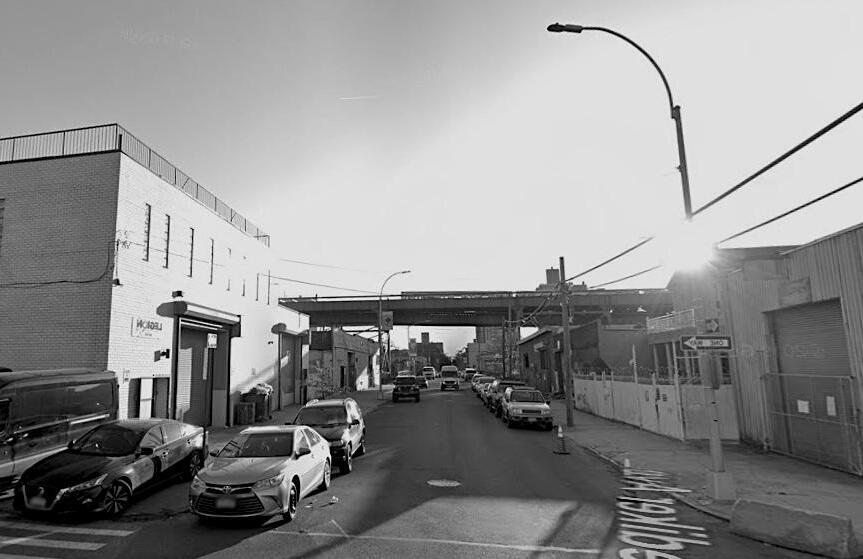
“WE NEED TO GROW WITHIN AND AROUND OUR COMMUNITY BECAUSE THAT SUPPORTS EVERYBODY. IT SUPPORTS JOBS. IT SUPPORTS EVERY PART OF THE COMMUNITY TO GROW YOUR OWN FOOD AND TO HAVE YOUR OWN RESOURCE.”
REPORT #1
INSIGHTS:
Producing food and infrastructure for and by the community can yield improved physical and mental health for both elders and youth, provide space for education, meaningful jobs, and entrepreneurship opportunities. It is important that while growing a self-determined and community controlled local economy, focused on food security for the residents of Brownsville and East New York, gentrification is resisted through community land ownership that creates permanent affordability. Support for family run businesses are needed in this community to create a sustainable local food system and build intergenerational wealth. Documenting these processes and maintaining transparency will not only allow advocacy around governmental programs to financially and legislatively support this work, but also promote communal ownership and participation.
TAKEAWAYS:
• Partnerships with local food retail businesses to serve and sell locally grown food is important to the impact of this work
• Restorative justice and community healing is crucial to farming and collaborative decision making
• Building infrastructures that allow for local control of the food system should be prioritized
• Food produced must be affordable and accessible to all
NEXT STEPS:
• Form advisory groups around priority areas
• Activate existing GreenThumb gardens for community food production
• Organize next focus group to continue conversation around medium term goals.
RESOURCES:
Mayor’s Office of Food Policy 10 Year Plan goals + programs
NYC Parks + GreenThumb for more gardens at NYCHA
MRTA Legislation Possibilities
Advocacy for publicly owned land with local organizations
THESIS TRAJECTORY
COVID-19
Effects on the Food System
USA + Brazil
Governmental Responses
USDA Farm to Family Boxes
Nutrition Assistance Expansion
FeedNYC + GetFoodNYC
Community Responses
Mutual Aid
Community Fridges
Movimento Sem Terra
Conversations + Webinars
A Growing Culture
Movement Generation
SCALAR INTERMEDIARIES
Mapping the NYC Food System Actors
Stakeholders
Infrastructures + Governance
Nutrition Assistance (Formal + Informal)
COVID-19 Reshuffling
On the Ground with North BK Angels
Juneteenth Event: First encounter with Universe City co-founder Alexis Mena
INSIGHTS + ANALYSIS
Market based food economy is Unsustainable + Unjust
Communities lack autonomy
NYC needs regenerative approaches to the food system
GOALS OF A COMMUNITY EMBEDDED FOOD ECONOMY Food Sovereignty
Circular Economy Democratic Organizing Regenerative Economics
• Present strategic plan to DCP + EDC
NY URBAN-RURAL Connection
Conventional Food System
Commodification
Globalization
Regional Food Economy
Hunts Point Food Hub
Food Justice Movement
Rural Workers Ministry
CSAs + Farmers Markets
Conversations + Webinars
Catskill Mountainkeeper
Sonia from Apple Pond Farms
PRELIMINARY
FOUNDATIONAL INTERVIEWS
Jonathan Warton Professor of Political Science + Urban Affairs
Samantha Levy Farmtrust USA NYS Policy Manager
Olivia Blanchflower GrowNYC Wholesale + Distribution Manager
PARTNER: UNIVERSE CITY NYC
“It is Universe City NYC’s mission to bring food sovereignty and intergenerational economic development to the East Brooklyn community.”
• sustainable urban farms
• food sovereign hub
• education + workforce development
• community food assistance
• regenerative economies
• social + environmental justice
First Publication: 2020 IMPACT REPORT
UNIVERSE CITY NYC 1st Meeting November 13th, 2020
2021-2031 STRATEGIC PLAN Short - Medium - Long term Goals Policies + Programs
Stakeholders + Partners
Phasing + Implementation
Focus Group + Engagement Process
Responsibilities:
• Oversee Implementation and strategy of UC Goals
DEVELOPMENT DIRECTOR
• Partnership development for Food Systems + Community Advocacy projects
• Urban Ecology curriculum for Grow Brownsville
• Grant and Funding Management NEXT STEPS:
• Continue my role at Universe City to implement plan as the... FORMALIZE PARTNERSHIP
• Produce planning documents for new + ongoing projects
Self-Reliance + Entrepreneurship: To Conclude and Continue
This thesis has researched and proposed potential solutions towards forming locally controlled food systems in New York City in contrast to the top down and extractive arrangements that currently exist. The COVID-19 pandemic revealed weaknesses within the existing food procurement and delivery system; exposing the siloed food chain that feeds NYC and the numerous challenges to gain control over what food is available in underserved neighborhoods that have been disproportionately effected by the pandemic, food apartheid and high rates of food insecurity for decades.
Community led responses to the crisis, including mutual aid and free food fridges, show that other ways are possible. But these solutions are not necessarily sustainable for long term economic and social impact on the food environment of disenfranchised communities. At Universe City NYC, after delivering over 2.5 million pounds of food to NYCHA residents, community fridges, senior centers, and food pantries, they are poised to form infrastructures that support food security and regenerative food systems for the Brownsville and East New York community through food production, aggregation, and distribution. Even before the pandemic, city administrators called for investment in local food systems, infrastructure, urban agriculture, and organic waste management. The research presented
throughout this thesis shows that there is capacity, knowledge, and community power to support the creation of neighborhood based food hubs, storage, and composting facilities. GrowNYC and the Corbin Hill Food Project show that alternative, regenerative, and justice informed practices exist and are desired by NYC residents.
Universe City NYC presents the next generation of the NYC food system. Their holistic approach, based in circular systems and food sovereignty, is crucial to form a community embedded food economy in East New York. With a multidisciplinary approach, their vision for a self-determined future is based on building intergenerational wealth through education and entrepreneurship. This thesis has outlined the ongoing development of the Universe City Food Port, and has elevated the impacts they have already achieved. Looking towards implementing their desired future, this thesis has initiated a process to develop a strategic plan for the next ten years, through collective decision making and collaboration with local organizations to align and elevate ongoing efforts towards food sovereignty and justice. By forming this process, this thesis will act as a foundation for advocacy and outreach to access support from initiatives proposed in the recent Mayor’s Office of Food Policy Food Forward 10-Year Plan, as well as local

representatives, and other fundraising opportunities. Additionally, the policy analysis included in the thesis illuminate ways that market based and access oriented solutions that currently drive ‘improvements’ to the food system do not provide substantial impact on food security and nutritional health for populations that are affected by the current inequitable food environment of NYC.
In connecting policies, examples of alternative food systems, the frameworks needed to cultivate just transitions to a regenerative economy, and a vision for the Universe City Food Port, this thesis contributes to the ability for policymakers, food justice advocates, and the embedded community to imagine a trajectory for how to grow food systems based on local ownership and control. The mission, methods, and movements that Universe City works to create have the ability to not only promote the local economy but also engage in communal self-reliant systems of food production. Universe City is poised to contribute to the resilient and sustainable food system that is needed for NYC, especially in black and brown communities that have major disparities in health outcomes and neighborhood level access to affordable fresh foods. As a major step towards the production of their strategic plan, a focus group was convened with community leaders, mentors, advisors, and partners to share the proposed

goals for the next two years and gain their insights for collective action and reveal critical alignments. This event generated enormous information about the priorities of the community and the concerns they have about the impact of this work. Universe City will act on the priorities presented by the community, namely to grow food, provide opportunities for education and workforce development, and to build permanent infrastructures to enhance community control of the food system. Recognizing these shared priorities, Universe City will move forward with their current goals and this iterative community engaged process will continue to instill transparency and guide the organization’s progress.
Many of the research questions that initiated this thesis, including “How can city agencies invest, financially and legislatively, in the formation of neighborhood level food economies? Which initiatives support hyperlocal food systems that seek to support underserved communities?” have been addressed through policy analysis, interviews with stakeholders, and reports described throughout this manuscript. Looking to understand if market driven food policies in NYC could have their requirements extended to include ventures such as Universe City, I have proposed actions that reflect both UC’s desired capacities and social justice impacts the city aim to achieve.
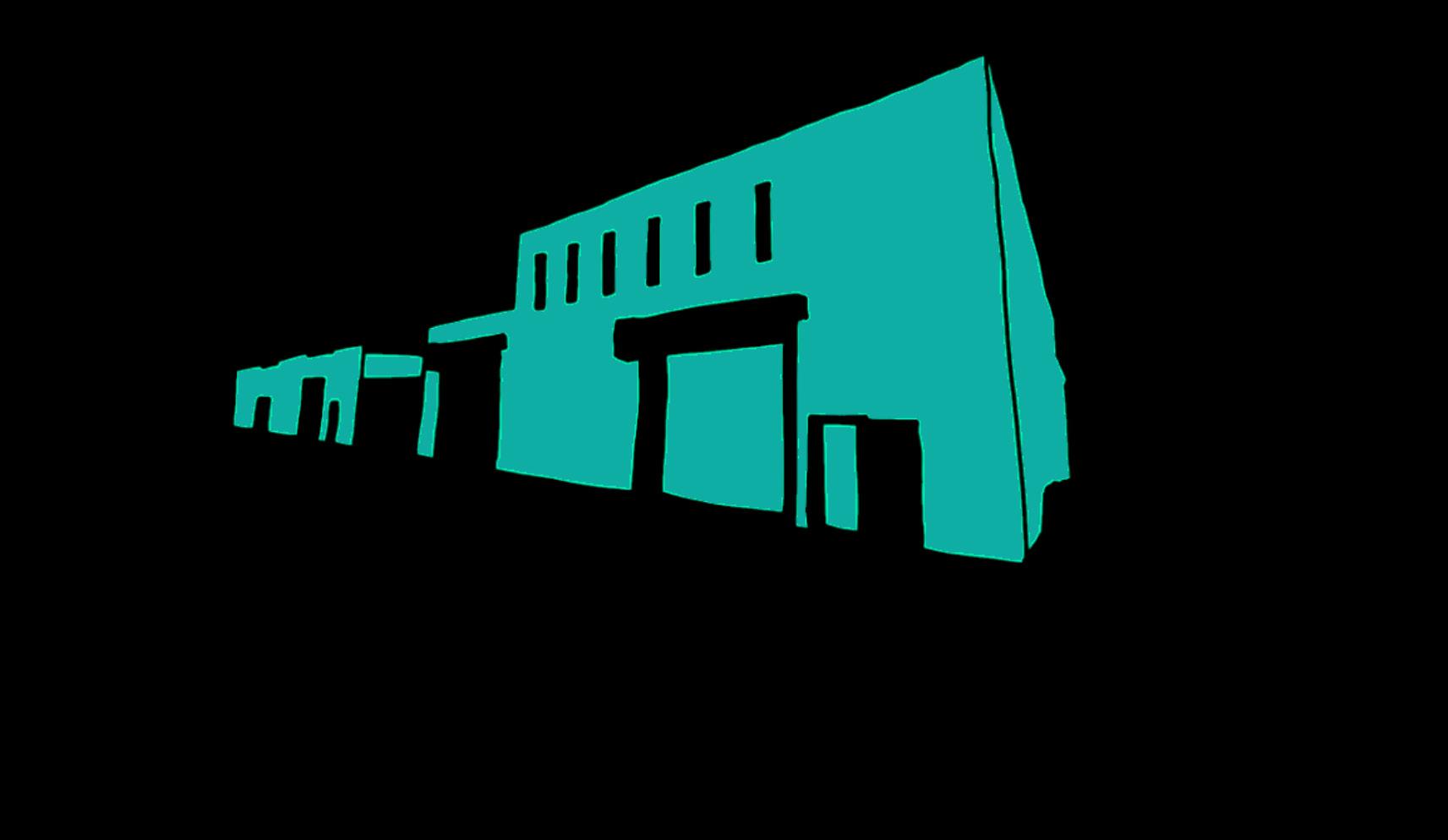
Perhaps it is no longer a question of which form of nutrition support, institutional and informal, actually supports public health, local economies, and food security, but rather that we need to find opportunities for the systems to better interact to reflect the needs of different populations. Both forms have their own purpose, however it is imperative that top down food assistance is able to provide the sense dignity and solidarity that grassroots forms of food assistance are able to promote. Some of Food Forward NYC has plans to do that, and if Universe City receives some the investments the EDC is set to provide in the ENYIBZ, it is on track to become a locally controlled food port achieving many goals set by the MoFP, while directly benefiting of the surrounding community.
In “Wewillnotperish;we’regoingtokeepflourishing”: Race,FoodAccess,andGeographiesofSelf-Reliance, Ashanté Reese’s research and writing emphasizes the relationship between self-determination and entrepreneurship that produces systems of self-reliance for black and brown communities. Here, ‘self’ is both individual and communal, recognizing that “self-reliance becomes a mechanism through which to resist structural violence77” and with that, self-reliance also “bridges spatial and sociocultural components of accessing food78” and for Universe City “entrepreneurship [is] one method of embedding self-reliance in their spatial context.79” The work of Universe City and their collaborators is to create a variety of pathways towards communal self-reliance. Producing food via sustenance farming, providing space and business resources to entrepreneurs, as well food storage and processing infrastructures are among the myriad ways this community is building their capacity for ownership and control over their foodways.
The process initiated by this thesis project is ongoing, and work that is essential for the ability to articulate and manifest the outcomes that UC seeks for themselves and their community. Throughout the summer, the strategic plan will unfold through deeper engagement with residents on the ground as the Glenmore Ave Greens and Browns Belt is activated. As opportunities for in person work emerge from the pandemic that forced us all
behind screens, meaningful participation will be possible and allow for an accelerated progress. The limitations felt within the context of academia will be opened, and allow for more time dedicated to the continuation of this project in a manner that responds directly to the needs of Universe City.
Articulating the principles and goals of a Community Embedded Food Economy as based on the theoretical and practical frameworks posed in this thesis can be a mode for further research and development. As New York City enacts their commitments to strengthening neighborhood level control over the food system, land use, and a just transition to regenerative economics, this set of goals has the ability to guide and reinforce policymakers decision making. Constantly reminding them that local residents are the experts with the knowledge and understanding to articulate what is best for them and their communities. Self-determination is key to repair the historic oppression and systemic racism that is still too pervasive. Movements and organizations like Universe City NYC have the promise of creating networks of care and self-reliance towards health, wealth, and empowerment for the community they serve.
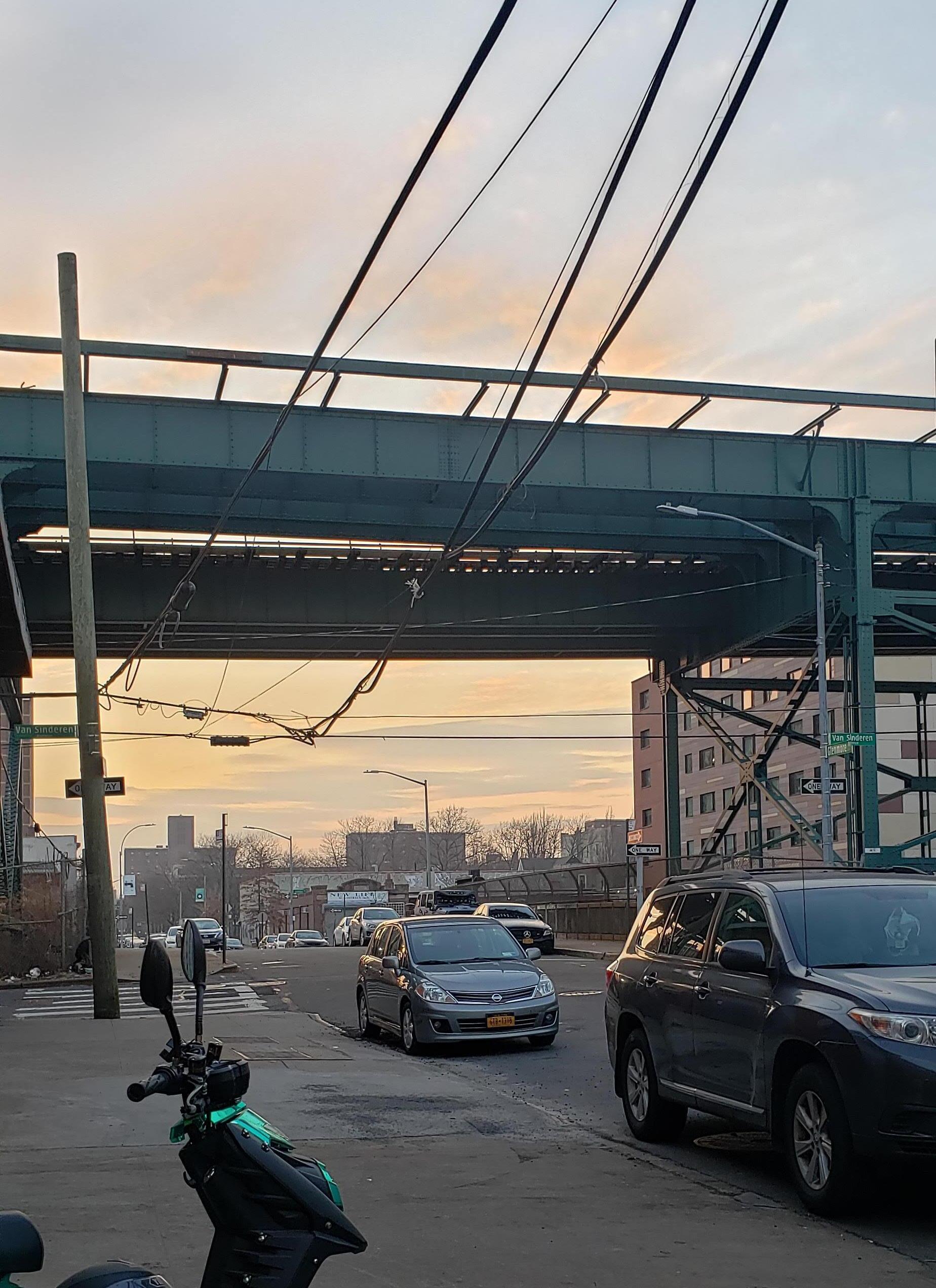
Endnotes
1 Alkon, Alison Hope, and Agyeman, Julian, eds. Cultivating Food Justice : Race, Class, and Sustainability. Cambridge: MIT Press, 2011, Chapter 14, pgs 309-330. Accessed April 24, 2021. ProQuest Ebook Central.
2 ibid.
3 “A Short History of SNAP,” USDA, accessed April 25, 2021, https://www.fns.usda.gov/snap/shorthistory-snap.
4 Maya Adereth et al., “The United States Has a Long History of Mutual Aid Organizing,” Jacobin, accessed April 25, 2021, https://www.jacobinmag. com/2020/06/mutual-aid-united-states-unions.
5 Arielle Milkman, “The Radical Origins of Free Breakfast for Children,” Eater (Eater, February 16, 2016), https://www.eater.com/2016/2/16/11002842/freebreakfast-schools-black-panthers.
6 Triada Stampas and William Guillaume Koible, “New York City’s Meal Gap 2016 Trends Report,” Food Bank for NYC, 2016, https://www.foodbanknyc.org/ wp-content/uploads/Meal-Gap-Trends-Report-2016. pdf.
7 Rep. Five Borough Food Flow. NYC, NY: New York City Economic Development Agency, 2016.
8 Hinterland K, Naidoo M, King L, Lewin V, Myerson G, Noumbissi B, Woodward M, Gould LH, Gwynn RC, Barbot O, Bassett MT. Community Health Profiles 2018, Bronx Community District 2: Hunts Point and Longwood; 2018; 14(59):1-20.
9 Nathan A. Rosenberg and Nevin Cohen, Let Them Eat Kale: The Misplaced Narrative of Food Access, 45 Fordham Urb. L.J. 1091 (2018). Available at: https://ir.lawnet.fordham.edu/ulj/vol45/iss4/5 10 ibid.
11 Alison Hope Alkon et al., “Foodways of the Urban Poor,” Geoforum 48 (2013): pp. 126-135, https://doi.org/10.1016/j.geoforum.2013.04.021.
12 Alkon, Alison Hope, and Agyeman, Julian, eds. Cultivating Food Justice : Race, Class, and Sustainability. Cambridge: MIT Press, 2011, Chapter 14, pgs 309-330. Accessed April 24, 2021. ProQuest Ebook Central.
13 ibid.
14 ibid.
15 ibid.
16 ibid.
17 Chiara Tornaghi and Michiel Dehaene, “The Prefigurative Power of Urban Political Agroecology: Rethinking the Urbanisms of Agroecological Transitions for Food System Transformation,” Agroecology and Sustainable Food Systems 44, no. 5 (2019): pp. 594610, https://doi.org/10.1080/21683565.2019.16805
93.
18 ibid.
19 Mette Vaarst, Arthur Getz Escudero, M. Jahi Chappell, Catherine Brinkley, Ravic Nijbroek, Nilson A.M. Arraes, Lise Andreasen, Andreas Gattinger, Gustavo Fonseca De Almeida, Deborah Bossio & Niels Halberg (2018) Exploring the concept of agroecological food systems in a city-region context, Agroecology and Sustainable Food Systems, 42:6, 686-711, DOI: 10.1080/21683565.2017.1365321
20 Chiara Tornaghi and Michiel Dehaene, “The Prefigurative Power of Urban Political Agroecology: Rethinking the Urbanisms of Agroecological Transitions for Food System Transformation,” Agroecology and Sustainable Food Systems 44, no. 5 (2019): pp. 594610, https://doi.org/10.1080/21683565.2019.16805
93.
21 ibid.
22 ibid.
23 ibid.
24 Mette Vaarst, Arthur Getz Escudero, M. Jahi Chappell, Catherine Brinkley, Ravic Nijbroek, Nilson A.M. Arraes, Lise Andreasen, Andreas Gattinger, Gustavo Fonseca De Almeida, Deborah Bossio & Niels Halberg (2018) Exploring the concept of agroecological food systems in a city-region context, Agroecology and Sustainable Food Systems, 42:6, 686-711, DOI: 10.1080/21683565.2017.1365321
25 Margaret Marietta Ramírez, “The Elusive Inclusive: Black Food Geographies and Racialized Food Spaces,” Antipode 47, no. 3 (April 2014): pp. 748-769, https://doi.org/10.1111/anti.12131.
26 ibid.
27 ibid.
28 ibid.
29 Reese, Ashanté M. Black Food Geographies: Race, Self-Reliance, and Food Access in Washington, D.C. CHAPEL HILL: University of North Carolina Press, 2019. Accessed April 25, 2021. http://www.jstor.org/ stable/10.5149/9781469651521_reese.
30 ibid.
31 ibid.
32 ibid.
33 ibid.
34 Ellen MacArthur Foundation, Cities and Circular Economy for Food (2019)
35 ibid.
36 ibid.
37 ibid.
38 “Jemez Principles for Democratic Organizing,” Jemez Principles for Democratic Organizing (Jemez, NM: Southwest Network for Environmental and Economic Justice, 1996).
39 “Nyéléni 2007 Forum for Food Sovereignty” (Sélingué, Mali: Nyéléni , 2007), pp. 1-39.
40 Movement Generation Justice and Ecology Project, From Banks and Tanks to Cooperation and Caring: a Strategic Framework for a Just Transition (Oakland, CA: Movement Generation Justice and Ecology Project, 2017).
41 ibid.
42 ReGenerative Finance, Climate Justice Alliance, and Movement Generation, “Just Transition Toolkit.,” Just Transition Toolkit. (ReGenerative Finance, 2014).
43 Kate MacKenzie, et al., “Food Forward Nyc: A 10-year Food Policy Plan,” Food Forward Nyc: A 10year Food Policy Plan § (2021), pp. 1-47.
44 Samantha Levy and Kali McPeters, “Growing Opportunity for Farm to School How to Revolutionize School Food, Support Local Farms, and Improve the Health of Students in New York” (Saratoga Springs, NY: American Farmland Trust, 2020), pp. 1-40.
45 Levy, Samantha. Interview with NYS Farm to Institution Policy Manager. September 25th, 2020.
46 “FeedNYC,” FeedNYC, accessed April 25, 2021, https://www.feednyc.org/.
47 Rebecca T. de Souza, “Feeding the Other: Whiteness, Privilege, and Neoliberal Stigma in Food Pantries,” 2019, https://doi.org/10.7551/ mitpress/11701.001.0001.
48 Nikita Stewart, Annie Brown, and Stella Tan, “A Day at the Food Pantry,” New York Times, November 25, 2020.
49 “FeedNYC,” FeedNYC, accessed April 25, 2021, https://www.feednyc.org/.
50 William-Guillaume Koible and Insiah Figueroa Figueroa, “Fighting More Than Covid-19: Unmasking The State Of Hunger In Nyc During A Pandemic” (NYC, NY: Food Bank for New York City, 2020), pp. 1-30.
51 Anne Palmer and Joyce Smith, “Understanding and Addressing Food Security in Southwest Baltimore” (Baltimore, MD: Johns Hopkins Center for a Livable Future, 2007), pp. 1-50.
52 Nadia Johnson et al., “Growing Food Equity
in New York City” (NYC, NY: New York City Council Legislative Division, 2019), pp. 1-63.
53 ibid.
54 ibid.
55 ibid.
56 ibid.
57 ibid.
58 Kate MacKenzie, “Food Forward Nyc: A 10year Food Policy Plan,” Food Forward Nyc: A 10-year Food Policy Plan § (2021), pp. 1-47.
59 ibid.
60 ibid.
61 “SNAP Center - Jamaica, NY,” Yelp, accessed April 25, 2021, https://www.yelp.com/biz/snapcenter-jamaica.
62 Mayoral Food Forum 2021: Town Hall on the Future of Food in New York City, YouTube (YouTube, 2021), https://www. youtube.com/watch?v=4yNSWhtbu0I&ab_ channel=HunterCollegeNYCFoodPolicyCenter.
63 Kate MacKenzie, “Food Forward Nyc: A 10year Food Policy Plan,” Food Forward Nyc: A 10-year Food Policy Plan § (2021), pp. 1-47.
64 ibid.
65 ibid.
66 “About GrowNYC,” GrowNYC, 2021, https:// www.grownyc.org/about.
67 ibid.
68 Blanchflower, Olivia. Interview with GrowNYC Wholesale and Distribution Manager. October 5th, 2020.
69 ibid.
70 ibid.
71 “Mission & Vision,” Corbin Hill Food Project, 2021, http://corbinhill-foodproject.org/mission.
72 ibid.
73 NYC Fridge. Accessed April 25, 2021. https:// nycfridge.com/.
74 Universe City NYC, Accessed April 25, 2021. https://universecity.nyc/.
75 ibid.
76 ibid.
77 Ashanté M. Reese, “‘We Will Not Perish; We’Re Going to Keep Flourishing’: Race, Food Access, and Geographies of Self-Reliance,” Antipode 50, no. 2 (June 2017): pp. 407-424, https://doi.org/10.1111/ anti.12359.
78 ibid.
79 ibid.
“A Short History of SNAP.” USDA. Accessed April 25, 2021. https://www.fns.usda.gov/snap/shorthistory-snap.
Aberg-Riger, A. (2020, December 22). A Visual History of Mutual Aid. Bloomberg CityLabs. Retrieved May 9, 2021, from https://www.bloomberg.com/ news/features/2020-12-22/a-visual-history-of-mutualaid
About Food Bank for NYC. (2021, May 07). Retrieved May 10, 2021, from https://www. foodbanknyc.org/
“About GrowNYC.” GrowNYC, 2021. https:// www.grownyc.org/about.
Adereth, Maya, Maya Adereth, Matt Karp, Branko Marcetic, Eileen Jones, Enzo Traverso, Drew Pendergrass Troy Vettese, et al. “The United States Has a Long History of Mutual Aid Organizing.” Jacobin. Accessed April 25, 2021. https://www.jacobinmag.com/2020/06/ mutual-aid-united-states-unions.
Alkon, Alison Hope, Daniel Block, Kelly Moore, Catherine Gillis, Nicole DiNuccio, and Noel Chavez. “Foodways of the Urban Poor.” Geoforum 48 (2013): 126–35. https://doi.org/10.1016/j. geoforum.2013.04.021.
Bowery Mission History. (n.d.). Retrieved May 10, 2021, from https://www.bowery.org/
de Souza, Rebecca T. “Feeding the Other: Whiteness, Privilege, and Neoliberal Stigma in Food Pantries,” 2019. https://doi.org/10.7551/ mitpress/11701.001.0001.
Feeding America: Our History. (n.d.). Retrieved May 10, 2021, from https://www.feedingamerica.org/ about-us/our-history
FeedNYC. Accessed April 25, 2021. https://www. feednyc.org/.
Ink, S. (2021, April 29). Our story. Retrieved May
10, 2021, from https://www.cityharvest.org/our-story/
Jemez Principles for Democratic Organizing. Jemez, NM: y Southwest Network for Environmental and Economic Justice, 1996.
Johnson, Nadia, Andrea Vazquez, Crystal Pond, Chloë Rivera, and Laura Popa. Rep. Growing Food Equity in New York City. NYC, NY: New York City Council Legislative Division, 2019.
Koible, William-Guillaume, and Insiah Figueroa
Figueroa. Rep. FIGHTING MORE THAN COVID-19: UNMASKING THE STATE OF HUNGER IN NYC DURING A PANDEMIC. NYC, NY: Food Bank for New York City, 2020.
Levy, Samantha, and Kali McPeters. Rep. Growing Opportunity for Farm to School How to Revolutionize School Food, Support Local Farms, and Improve the Health of Students in New York. Saratoga Springs, NY: American Farmland Trust, 2020.
Levy, Samantha. Farm to Institution with Samantha Levy. Other, September 2020.
Mayoral Food Forum 2021: Town Hall on the Future of Food in New York City. YouTube. YouTube, 2021. https://www. youtube.com/watch?v=4yNSWhtbu0I&ab_ channel=HunterCollegeNYCFoodPolicyCenter.
Mayor’s Office, and Kate MacKenzie, FOOD FORWARD NYC: A 10-YEAR FOOD POLICY PLAN § (2021).
Milkman, Arielle. “The Radical Origins of Free Breakfast for Children.” Eater. Eater, February 16, 2016. https://www.eater.com/2016/2/16/11002842/freebreakfast-schools-black-panthers.
Movement Generation Justice and Ecology Project. From Banks and Tanks to Cooperation and Caring: a Strategic Framework for a Just Transition. Oakland, CA: Movement Generation Justice and Ecology Project, 2017.
Palmer, Anne, and Joyce Smith. Rep. Understanding and Addressing Food Security in Southwest Baltimore. Baltimore, MD: Johns Hopkins Center for a Livable Future, 2007.
Ramírez, Margaret Marietta. “The Elusive Inclusive: Black Food Geographies and Racialized Food Spaces.” Antipode 47, no. 3 (2014): 748–69. https://doi. org/10.1111/anti.12131.
Reese, Ashanté M. “‘We Will Not Perish; We’Re Going to Keep Flourishing’: Race, Food Access, and Geographies of Self-Reliance.” Antipode 50, no. 2 (2017): 407–24. https://doi.org/10.1111/anti.12359.
ReGenerative Finance, Climate Justice Alliance, and Movement Generation. Just Transition Toolkit. ReGenerative Finance, 2014.
Rep. Five Borough Food Flow. NYC, NY: New York City Economic Development Agency, 2016.
Rep. Nyéléni 2007 Forum for Food Sovereignty. Sélingué, Mali: Nyéléni , 2007.
Rosa, A. (2020, July 8). See That Fridge on the Sidewalk? It’s Full of Free Food. New York Times. Retrieved May 9, 2021, from https://www.nytimes. com/2020/07/08/nyregion/free-food-fridge-nyc.html
“SNAP Center - Jamaica, NY.” Yelp. Accessed April 25, 2021. https://www.yelp.com/biz/snap-centerjamaica.
Stampas, Triada, and William Guillaume Koible. “New York City’s Meal Gap 2016 Trends Report.” Food Bank for NYC, 2016. https://www.foodbanknyc.org/ wp-content/uploads/Meal-Gap-Trends-Report-2016. pdf.
Stewart, Nikita, Annie Brown, and Stella Tan. “A Day at the Food Pantry.” New York Times, November 25, 2020.
Thadeaus, P., K.holliday, P., & IOH, P. (n.d.). In our hearts. Retrieved May 10, 2021, from https:// inourheartsnyc.org/
Tornaghi, Chiara, and Michiel Dehaene. “The Prefigurative Power of Urban Political Agroecology: Rethinking the Urbanisms of Agroecological Transitions for Food System Transformation.” Agroecology and Sustainable Food Systems 44, no. 5 (2019): 594–610. https://doi.org/10.1080/21683565.2019.1680593.
1. National + New York City Nutrition Assistance
3. Universe City Nyc Food Port 4. Spheres Of Influence 5. A Circular System
6. Alignments Across Design Project Guiding
7. NYC Food Governance Approach + Potential
8. Scales Of Food Production - Distribution - Assistance + Access In New York City
9. Elements Of A Community Embedded Food Economy
10. Freight For Foodways
11. Mapping The Food Environment Of Cd5 +16
12. Program Analysis As Potential Application By
City
13. Universe City Nyc Stakeholders + Community Network
14. Who Represents Eny?
15. Universe City Short Term Goal Activities + Alignments
16. Strategic Plan Development Process
17. Universe City Goals
18. Community Focus Group Report #1
19. Thesis Trajectory
List of Figures
1. Lettuce Grown Aquaponically at Universe City NYC. Photo by Alexis Mena
2. Exterior Of Universe City NYC at 234 Glenmore
Avenue, East New York. Photo by Ashley Lehrer
3. Contents Of a USDA Farm to Family Food Box. Photo by Ashley Lehrer
4. Children Marching For Food and Freedom, 1930s.
Source: https://kairoscenter.org/beyond-mutual-aid/
5. Black Panther Free Breakfast Program, 1960s. Photo by Ducho Dennis
6. Ellen MacArthur Foundation Report Cover
7. Movement Generation + Our Power Campaign
Just Transition Framework. Source: https:// movementgeneration.org/justtransition/
8. EDC Rendering of the GrowNYC Hub. Source: https://edc.nyc/press-release/grownyc-breaksground-on-ny-state-regional-food-hub-in-bronx
9. Screenshot of GrowNYC Food Access Webmap. Source: https://www.google.com/maps/d/u/0/ viewer?mid=1fqTOVOwP6fj4NXOpFHT2Y4 8e3zEghRiJ&ll=40.760619747874344%2C73.98352704302141&z=11
10. Corbin Hill Food Project Farmshare Sites. Source: http://corbinhill-foodproject.org/locations
11. Jill Filling The UC Free Fridge as Pictured in The New York Times. Photo by Stephanie Keith
12. Google Map of Community Fridges Maintained by Amber G, Astoria Fridge Organizer. NYC Fridge Google Map
13. Universe City Food Distribution Schedule September, 2020. Photo by Ashley Lehrer
14. Looking North Along the Bay Ridge Freight Line From Glenmore Ave and Sinderen Ave. Photo by Ashley Lehrer
15. UC Co-Founders From Left: Brittany, Alexis, Jill, Franklyn. Photo by KLM Photography
16. Frank + Friends Unloading a Truck Full of Usda Food Boxes at a NYCHA Community Center
17. One Summer Day Packing Food Distribution Bags of Produce at UC
18. The Original Universe City NYC Closed Loop Aquaponic Farm System. Photo by Ashley Lehrer
19. Winter Sunset Looking West Down Glenmore Avenue. Photo by Ashley Lehrer
Abbreviations
BIPOC Black Indigenous People of Color
BK Brooklyn
BMS Brooklyn Multi-Service Health Center
CBO Community Based Organization
CBFH Central Brooklyn Food Hub
CLT
CFO
COO
Community Land Trust
Chief Financial Officer
Chief Operating Officer
CSA Community Supported Agriculture
CEFE Community Embedded Food Economy
CUNY City University of New York
DCP Department of City Planning
DOHMH Department of Health and Mental Hygiene
DOE Department of Education
DSNY Department of Sanitation New York
EBT Electronic Benefit Transfer
EDC Economic Development Corporation
EFAP Emergency Food Assistance Program
ENYIBZ East New York Industrial Business Zone
ENY East New York
FRESH Food Retail Expansion to Support Health
GFPP Good Food Purchasing Program
HRA Human Resources Administration
IBZ Industrial Business Zone
MA Mutual Aid
MoFP Mayor’s Office of Food Policy
NYC New York City
NYCHA New York City Housing Authority
P-EBT Pandemic Electronic Benefit Transfer
R+D Research and Design
SCORE Service Corps of Retired Executives
SFA School Food Authority
SNAP Supplemental Nutrition Assistance Program
UC Universe City NYC
US United States
USDA United States Department of Agriculture
WIC Women, Infants + Children Program
Glossary
Community: Three part definition as used by Argawal and Gibson, “a small spatial unit, homogeneous social structure, common interest and shared norms.” EnchantmentandDisenchantment:TheRoleofCommunity in Natural Resource Conservation, 1999. https://doi. org/10.1016/S0305-750X(98)00161-2
Food Apartheid: Coined by Karen Washington, it “underscores that this is the result of decades of discriminatory planning and policy decisions” because areas called ‘Food Desserts have “access to food— cheap, subsidized, processed food” and doesn’t describe the “root causes of inequity in our food system on the basis of race, class, and geography. Let’s face it: healthy, fresh food is accessible in wealthy neighborhoods while unhealthy food abounds in poor neighborhoods.” Source: https://www.karenthefarmer.com/faq-index
Food Insecurity: According to the US Department of Health and Human Services,“the disruption of food intake or eating patterns because of lack of money and other resources.” Source: https://www. healthypeople.gov/2020/topics-objectives/topic/ social-determinants-health/interventions-resources/ food-insecurity
Food Justice: “is a highly interdisciplinary research area organized around three central axes: social movement activism, the development of alternative food practices, and analyses of inequalities in conventional and alternative food systems.” Glennie and Alkon, Food Justice: Cultivating the Field, 2018. https://iopscience. iop.org/article/10.1088/1748-9326/aac4b2.
Food Sovereignty: As defined during the convening in Mali in 2007, “Food sovereignty is the right of peoples to healthy and culturally appropriate food produced through ecologically sound and sustainable methods, and their right to define their own food and agriculture systems.”
Source: https://nyeleni.org/spip.php?article290
Regenerative Economy: “An economy based on reflective, responsive, reciprocal relationships of interdependence between human communities and the living world upon which we depend. The purpose of a Regenerative Economy must be social and ecological well-being” -Movement Generation