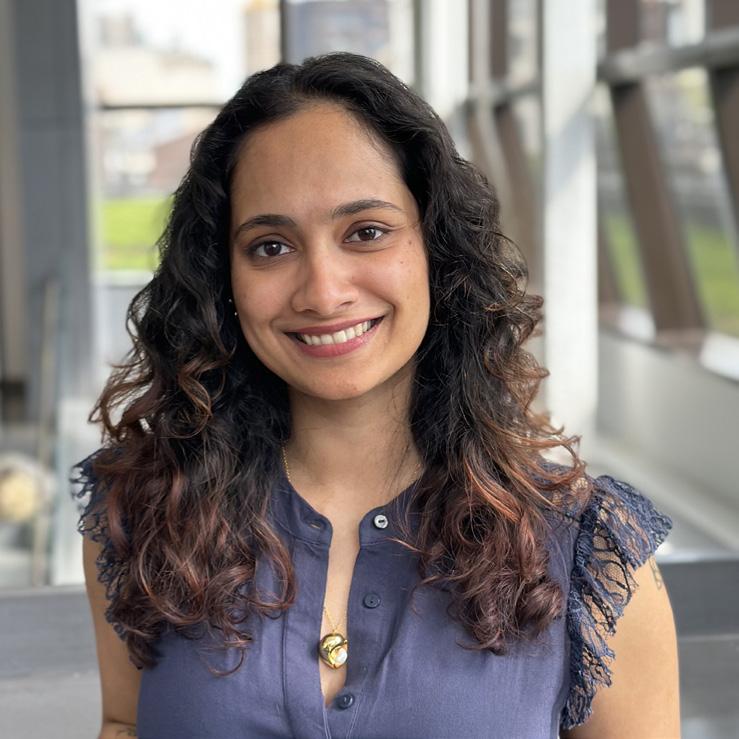
The master’s in Design and Urban Ecologies takes a design-led, justice-centered approach to understanding and transforming cities and urbanization processes. By integrating design, planning, policy, and community advocacy, the program prepares students with the skills and experience needed to tackle today’s urban challenges. Inspired by The New School’s commitment to environmental and social justice, students from diverse backgrounds work closely with community partners to develop plans, strategies, initiatives, and policy platforms leading to meaningful urban change.
The program bridges public policy, urban planning, community advocacy and other disciplines through a design-led approach to understand and shape the forces and agents at play in urban growth, restructuring, and development. Students work alongside grassroots organizations, policymakers, and affected communities to co-create new forms of urban intervention that prioritize equity, resilience, and sustainability. From confronting housing insecurity and environmental degradation to responding to mass migration, racial injustice, and public health crises, students apply participatory research methodologies and hands-on design practices that center the needs and aspirations of marginalized communities.
Our program’s studios and seminars are guided by real-world engagements in New York campaigns that challenge systemic inequalities and support long-term transformation. Emphasizing collaborative processes over topdown solutions, the program prepares students to navigate and influence the complexities of urban development with critical insight and creative agency.
By bridging theory and practice, and fostering deep connections between people, place, and policy, the Design and Urban Ecologies program positions students to become changemakers in the fields of planning, advocacy, design, and urban governance. Graduates emerge prepared to lead and support bold, systemic interventions that help cities become more just, inclusive, and livable for all.
Gabriela Rendón
Associate Professor of Urban Planning and Community Development Program Director, MS Design and Urban Ecologies Program
INTRODUCTION
YET TO BE RECEIVED FROM EVREN/JILLY
As the globe spins into senselessness, and in spite of every kind of information at our fingertips, we struggle to piece together all that is unfolding. There is a shared understanding, however, that each of us, no matter where we are from, is yearning for a vision for a future that is rooted in history, hope and resistance. In War Talk, Arundhati Roy prophetizes, “The corporate revolution will collapse if we refuse to buy what they are selling— their ideas, their version of history, their wars, their weapons, their notion of inevitability. Another world is not only possible, she is on her way. On a quiet day, I can hear her breathing.”
Our Design and Urban Ecologies cohort of 2025 has worked against all odds to show us a glimpse of what this sense of possibility, this other world might look like if our responses to radical violence were crafted with radical love and in relationship with each other. Over the last year, students have redefined the ways in which academic outcomes are expected and produced research and proposals that challenge us to resist anguish and embrace our urgent responsibility to reimagine alternative ways to move through the political, social, cultural, environmental and economic realities of our everyday lives. While being firmly rooted to the ground, they have branched out into visions that will hopefully bear fruits and benefit many for years to come. To invoke Audrey Lorde, as we continue experimenting with these journeys where classrooms become political spaces teeming with creativity, “To refuse to participate in the shaping of our future is to give it up. Do not be misled into passivity either by false security (they don’t mean me) or by despair (there’s nothing we can do). Each of us must find our work and do it.”
Soraya Barar’s People’s Kitchen: Advocating for New Public Infrastructure through Cooperative Cooking Practices reimagines the kitchen as a radical site of public care,
resistance, and community power in the face of food apartheid, housing insecurity, and systemic violence. Against the backdrop of racialized food access, immigration struggles, and failing infrastructure, her thesis projectproposes the People’s Kitchen—a public, cooperative cooking space grounded in mutual aid and prefigurative politics. Anchored in East New York, a neighborhood shaped by disinvestment and resilience, the project culminates in a facilitation guide for launching communityrun kitchens inside public spaces like libraries. Through mapping, interviews, and case studies, the thesis uncovers how collective cooking can address health disparities, decentralize care, and reclaim public space. More than a meal, the People’s Kitchen models a future where nourishment becomes an act of dissent and joy—a blueprint for building inclusive, peoplepowered infrastructure from the ground up.
Socheata Chey’s Stormwater, Stewardship
& Systemic Challenges examines New York City’s green infrastructure strategy—particularly rain gardens—as a solution to urban flooding, revealing major gaps in maintenance, equity, and public engagement. While rain gardens offer environmental and aesthetic benefits, the NYC Department of Environmental Protection struggles to manage over 2,500 of them due to limited staffing, lack of centralized oversight, and no real-time monitoring. Many of these gardens are concentrated in low-income, flood-prone neighborhoods, yet fail to meet city standards, raising concerns about the true effectiveness of the city’s flood resiliency efforts. Through spatial analysis and case studies, the research proposes three-pronged solutions: a centralized digital platform to track maintenance, educational programs to raise community awareness, and incentive-based stewardship models. By integrating technology, education, and compensation, the study calls for a more sustainable and equitable approach to managing green infrastructure—empowering local residents while enhancing the city’s
Avery Crower’s The Right to
Disconnect:
Reclaiming Power, Privacy, and Protection in the Digital World reimagines digital equity as more than just access, emphasizing the need for transparency, autonomy, and collective governance. As digital infrastructure spreads across urban systems, her thesis challenges the idea that “inclusion” is inherently empowering— arguing instead that it can reproduce surveillance and systemic control. Anchored by a Technology Vulnerability Index (TVI) for NYC and a partnership with Community Tech Lab NY, the project maps digital inequities and develops a Digital Privacy Toolkit —Understanding Your Digital Self. Framed through parts of the body to make abstract concepts tangible, the toolkit helps communities protect and reclaim their digital lives. Through research, workshops, and community engagement, the thesis highlights how marginalized groups are most affected by digital vulnerability and least protected. It calls for a future where connection is inseparable from protection, and where digital resilience is rooted in networks of care, resistance, and collective empowerment.
Aqdas
Fatima’s Towards a
Radical Practice of Repair: Codesigned Approaches
to
Caring
for Public Infrastructure repositions urban repair as a critical and proactive practice essential to creating equitable, resilient cities. In a context of accelerating climate change, systemic disinvestment, and deepening inequality, it focuses on how repair—often carried out informally by marginalized communities in New York City—is both overlooked and undervalued. Drawing from fieldwork, interviews, and critical theory, the study highlights the social, spatial, and political dimensions of repair, revealing its role in sustaining urban life. Three tools emerged from her research: a participatory digital map that documents local repair efforts and needs, a community repair toolkit to support grassroots maintenance initiatives, and a workshop facilitation guide for learning about local repair needs and co-designing solutions. These resources, co-developed with local organizations, aim to embed repair-thinking into urban design, policy, and education. By integrating concepts like social reproduction, right to the city, and ecological care, the project challenges growth-driven planning models and advocates
for a more just, collaborative approach to maintaining and reimagining our shared urban environments.
Isabelle Groenewegen’s Bridging the NatureCulture Divide: A Personal Journey Towards Socio-Ecological Praxis is a project rooted in her personal experience, reframing Western views of nature through intimate engagement with urban ecologies. Set in Lenapehoking (New York City), it explores soil as both a record of colonial violence and a living force that nurtures life and resists boundaries between human and more-than-human. Drawing on Bruno Latour, Anna Tsing, and Robin Wall Kimmerer, the thesis challenges the natureculture divide and proposes a socio-ecological praxis—a creative, justice-driven approach that includes ecosystems as collaborators in social practice. This thesis proposal activates a creative, community-rooted project in Bushwick, Brooklyn, bridging art and ecology through collaboration with No North Brooklyn Pipeline on Living Soils Rising. Centered around healing the contaminated land near the National Grid Liquid Gas Facility by Newtown Creek, the project raises awareness of environmental justice efforts impacting nearby NYCHA residents. Rooted in the rich cultural history of Bushwick and the ecological legacy of Lenapehoking, her project reflects a broader curatorial vision: to foster deeper connections between people and more-than-human ecosystems, and to reimagine the urban commons through care, resistance, and creative action.
Rhay Lloyd’s Kinship and Community; Exploring Queer Socio-Spatial Networks through Black Kinship Ties explores how Black kinship networks—rooted in African traditions and shaped by slavery, Reconstruction, and the Great Migration—have evolved into powerful systems of care within BIPOC queer urban communities. Challenging the isolating white nuclear family model, these expansive kinship ties offer socialization, social control, and social security to entire neighborhoods, creating communal resilience in the face of capitalism, segregation, and displacement. Grounded in Black Marxist thought, the work critiques the racial blind spots of traditional Marxism and situates urban exploitation within a longer history of colonial extraction. Focusing on New York City, the project traces how Southern
kinship traditions gave rise to ballroom culture, rent parties, and other queer social formations that defy capitalist and bureaucratic constraints. Ultimately, this thesis reimagines community and space-making through the radical, anticapitalist lens of Black queer kinship—a model of mutual aid and solidarity that continues to sustain life where systemic neglect persists.
Leah Roy’s (Re)Imagining Public Space
Through the Lens of South Asian Women challenges the myth of public space as universally inclusive, focusing on the lived experiences of South Asian immigrant women in New York City. It reveals how public spaces—shaped by histories of exclusion and dominant norms—often marginalize women of color through over-policing, lack of cultural infrastructure, and everyday microaggressions. Through interviews, storytelling workshops, and community-centered design, the project surfaces narratives of resilience and resistance, illustrating how women adapt and reclaim space despite systemic barriers. Participants in her project co-created modular, culturally resonant urban interventions, reimagining spaces like Jackson Heights and Harlem with shaded seating, designated food vendor zones, and areas for intergenerational gathering and connection. Her thesis calls for a shift from top-down planning to participatory design, positioning marginalized communities as cocreators of urban futures. By centering care, culture, and lived experience, this work offers a blueprint for more equitable, just, and inclusive public spaces.
Lauren Leiker’s Brick by Brick: Poughkeepsie, Privatization, and Public Housing investigates the shift from public to privatized housing in the U.S., focusing on the Rental Assistance Demonstration (RAD) program—a federal initiative that encourages local housing authorities to transfer public housing to private management. Through a case study in Poughkeepsie, New York, her thesis examines how RAD reflects broader neoliberal trends that dismantle public responsibility for affordable housing amid a national cost-of-living crisis. Drawing on interviews with residents and housing workers, her study reveals how policies made at the federal level deeply impact local communities. In response, the project includes a tenant rights booklet distributed through local
family centers, aiming to empower residents with critical housing knowledge. Grounded in theories of spatial justice and urbanism, this work situates Poughkeepsie’s experience within global patterns of housing policy transformation, calling for more equitable, community-centered solutions to the housing crisis.
Natalie Temple’s Reframing the Narrative: Centering Women in Carceral Discourse challenges the dominant, male-centered narrative of mass incarceration by foregrounding the rapidly growing—and deeply neglected— experiences of women and gender expansive individuals under carceral control. Her work examines how despite making up a smaller share of the incarcerated population, women face unique, systemic failures that the criminal legal system was never designed to address. Drawing on Pathways Theory, Data Feminism, and Narrative Power, this research combines data analysis, spatial inquiry, and interviews to expose how gender-blind policies—from sentencing to reentry—routinely marginalize women’s needs. Her thesis responds with an actionable intervention: Shifting Visibility, a visual primer for law students, designed to reframe how future legal practitioners engage with incarceration. By integrating storytelling and trauma-informed perspectives, the project aims to shift legal education toward genderresponsive practice, empowering a new generation to center women’s lived experiences in efforts toward decarceration and systemic reform.
Evren Uzer, Georgia Traganou, Miodrag Mitrasinovic May 14, 2026
Organizing Block Power: Bed-Stuy Block Associations and Participatory Governance in New York City
Contested Spaces, Generative Conflict, and Insurgent Practices
Delaney Connor
Indeterminate Edges
Molly Meng
Shivani Dave
LEARNING IN MOTION: A MOBILE CIRCULAR ECONOMY
EDUCATION MODEL FOR BROOKLYN’S EVERYDAY THIRD SPACES
RUTH WONDEMU
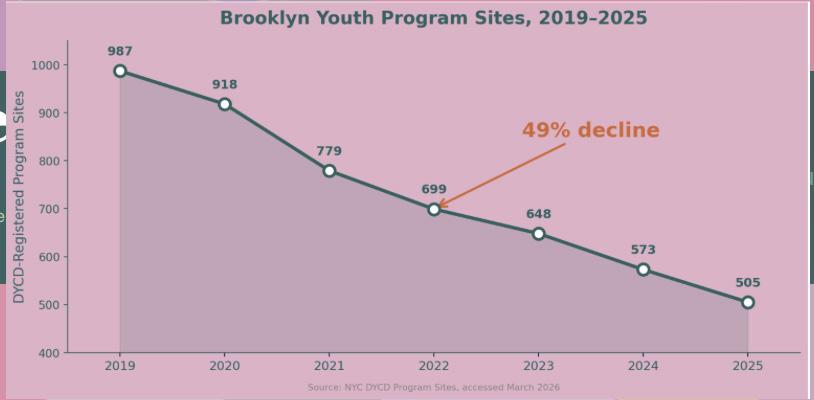
Brooklyn has lost 49 percent of its youth program sites since 2019. Every one of those disappeared programs was somebody’s safe space, their Tuesday afternoon. Young people are also inheriting a climate crisis they did not create, and the two are intertwined stories of disinvestment. Environmental education and climate justice are not optional in this moment; they are foundational to how the next generation will inherit, respond to, and shape the conditions around them. The decline of afterschool programming has laid the groundwork for new entry points, and Brooklyn anchors this research because it holds both the disinvestment and the density of civic infrastructure that make a model like this possible to explore.
This thesis asks how mobility can transform environmental education from niche programming into public infrastructure. Organizations across New York City actively practice circular work through upcycling, repair, and creative making. They operate in silos and lack the scale to reach the youth most affected by infrastructure loss. The connective tissue does not exist yet, but it can. Public infrastructure is already where people are; what is missing is the practice of treating it as a site of inquiry. Drawing on AbdouMaliq Simone’s “People as Infrastructure” and Krzysztof Wodiczko’s “Critical Vehicle,” this work treats the Bezu Cart as invitational infrastructure, meeting people in the public spaces they already occupy.
The research is grounded in a on-going case study with Brooklyn Public Library. What began as a Climate Teen Night activation has built into an ongoing Climate Justice afterschool programming track. Learning in Motion tests its proposition through Bezu Creations, which reframes abundance not as accumulation but as what is already here. It lives in the materials we discard, the knowledge communities carry, and the connections that form when people make something together. The Bezu Cart, a repurposed laundry cart, circulates across six Brooklyn Public Library branches from Central to Gerritsen Beach to McKinley Park. The starting curriculum is built around three hands-on stations: propagation, where participants take home cuttings and learn how to grow them; upcycled plastic planters, reclaimed bottles become vessels for new growth; and weaving with rescued yarn from local textile reuse warehouses.
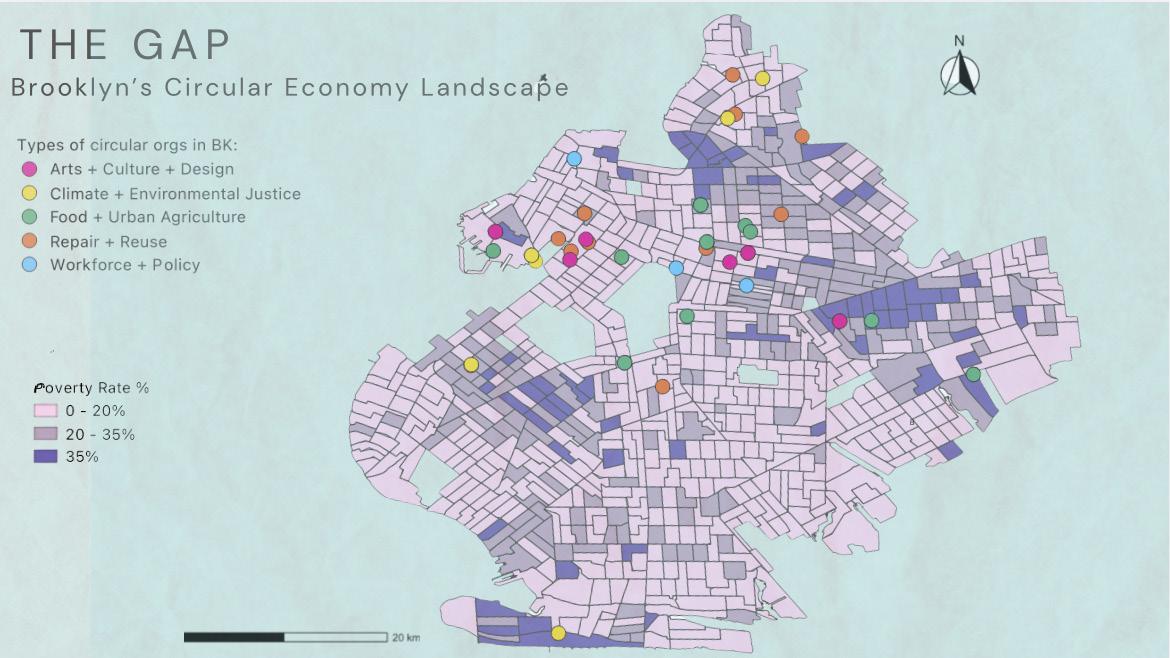
Through spatial mapping, participatory workshop facilitation, and ethnographic engagement, this research reveals the infrastructure gap and tested mobility as the vehicle that carries environmental education into historically disinvested neighborhoods. The work has been built alongside librarians, circular
Finger weaving with reclaimed fabric,Brooklyn Public Library, 2025. Photograph: Ruth Wondemu.
The Gap: Brooklyn’s circular economy ecosystem mapped against poverty rate by census tract. Circular organizations cluster in North Brooklyn, while neighborhoods with the highest poverty rates remain underserved. Map: Ruth Wondemu, 2026.
Brooklyn DYCD-registered youth program sites, 2019–2025: a 49 percent decline. Source: NYC DYCD Program Sites.
organization founders, and community partners, with the goal of cooperative stewardship over time. The pilot affirms that Brooklyn’s youth are not lacking sustainable agency; they are lacking accessible avenues to it. Many participants shared that they had never owned a plant before or had the chance to learn to make with their hands.
The work is less about teaching what is new and more about offering a counter to extraction, where ancestral and everyday sustainable practices can be received and passed on.
Ultimately, this work has produced a tested mobile model, a spatial analysis of Brooklyn’s circular economy ecosystem, and the first in a series of seasonal activity zines that double as facilitator guides, laying the groundwork for future site starter kits. This thesis offers Learning in Motion as an opening for environmental education to be embedded in everyday civic life, made possible only through the networks and communities that already make Brooklyn, New York what it is.
Slow Circuits: Repair as CounterPractice to Digital Urbanism
ANTONIA SIMON
This thesis emerges from a critical paradox: as urban life becomes increasingly dependent on personal devices, the social and ecological costs of that dependence remain largely invisible in the very metropolitan centres they claim to serve. Obscured by the allure of the innovative smart city, New York City’s public services have swiftly migrated to digital platforms over the last two decades in the service of an efficiently managed, growing metropolis. Yet beneath this frictionless veneer lies a more troubling reality.
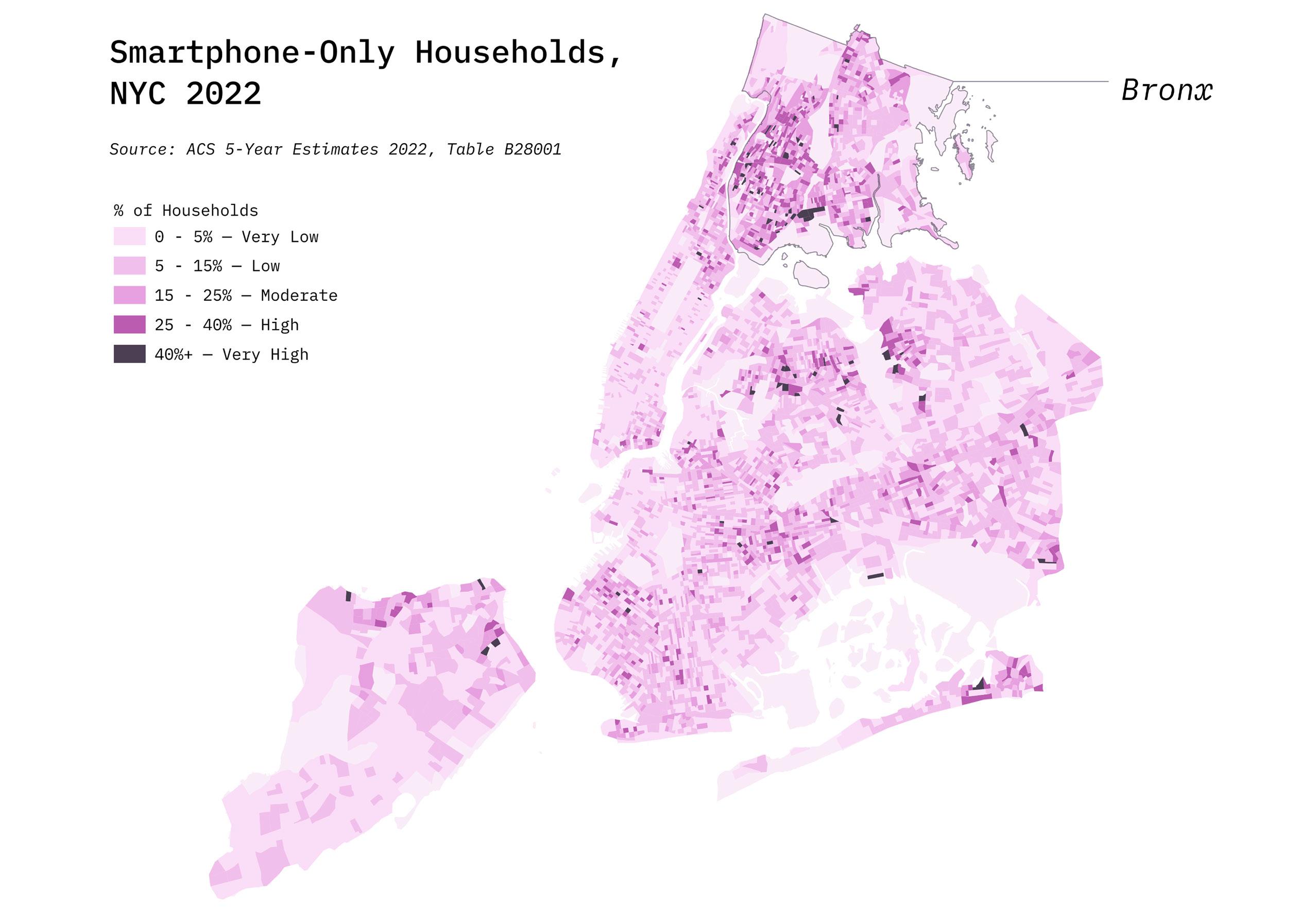
Through ethnographic fieldwork, data visualisation, and mapping analysis, this thesis demonstrates that the social and ecological externalities of digital urbanism are systematically exported, into the private lives of residents and outward to the urban periphery. The result is what Kallianos, Dunlap, and Dalakoglou (2023) term infrastructures of harm: a condition in which digital access has become a prerequisite for participating in urban life, yet the very devices that enable that access simultaneously harm those who lack it, hyperexpose those who hold it, and impose profound and unequally distributed environmental costs.
It is within this contradiction that this thesis asks what an alternative paradigm for digital urbanism could look like. Drawing on decolonial and feminist scholarship, I advocate for a shift toward digital urban ecologies, a framework that holds the externalities of digital infrastructure in relation to its benefits through the development of infrastructures of care (Traill et al., 2024). Through international and New York City case studies, three modalities of repair emerge: repair as maintenance, as reconfiguration, and as reappropriation. Across these three modalities, this thesis positions repair as a prefigurative practice that shifts techno-relations from top-down, centralised corporate ownership toward decentralised, collectively governed technology.
These arguments are tested and enacted through four design interventions. The first synthesises insights from international and New York City repair practices into a design framework for municipal digital infrastructures that support socio-ecological justice. The second operationalises this framework through the development of the Slow Circuits Library.
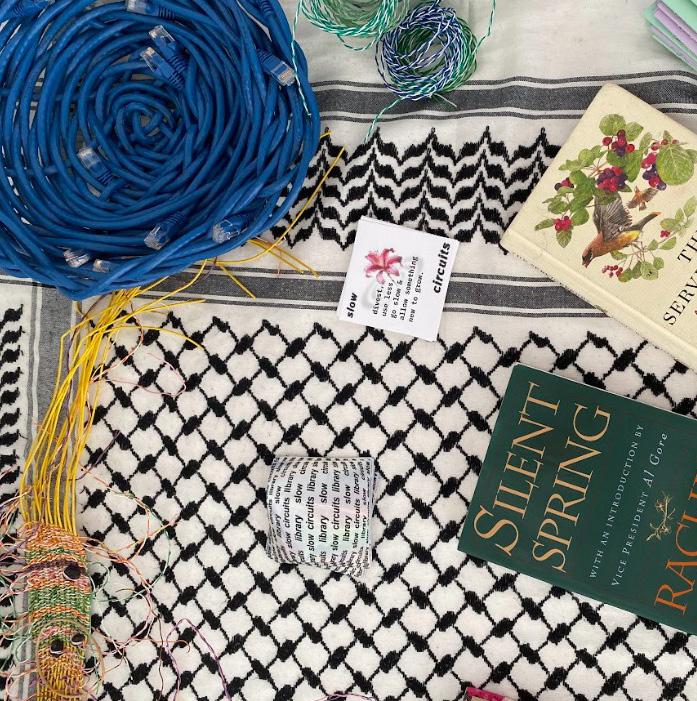
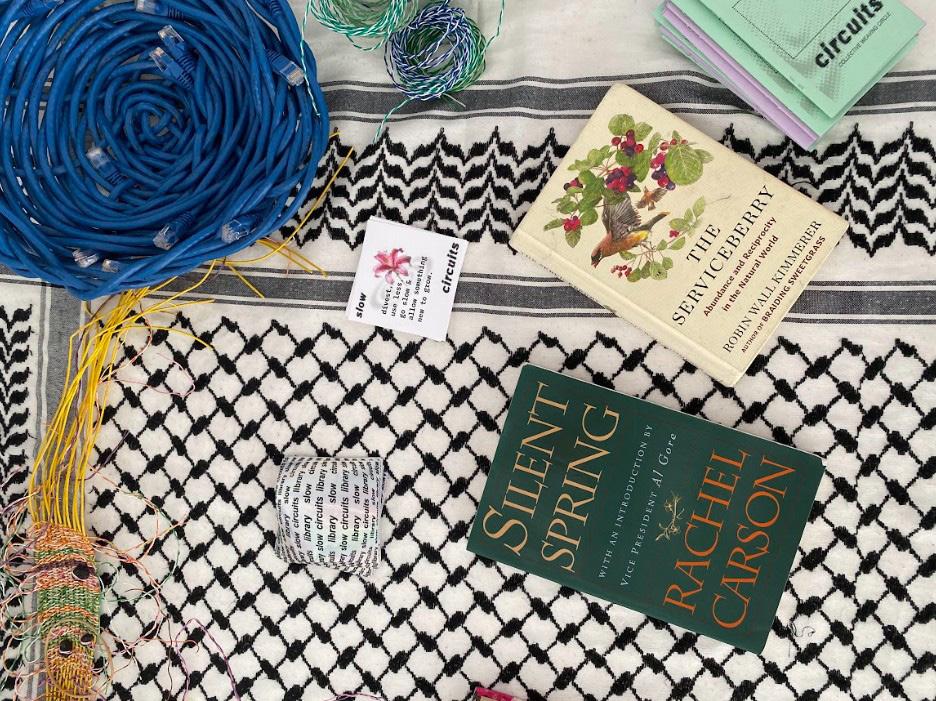
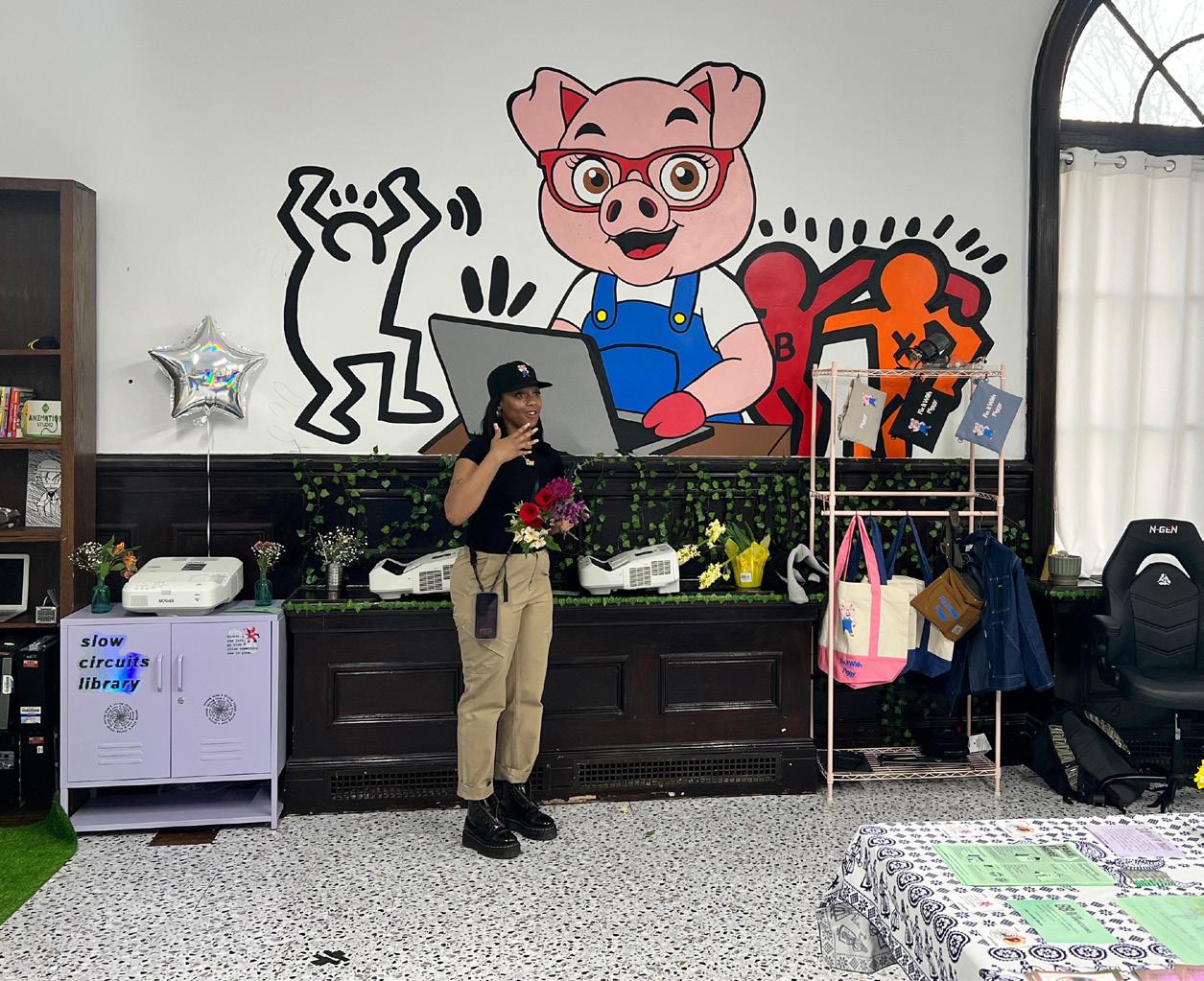
As a library of refurbished technology hosted in Fix It With Piggy, this intervention enacts repair as reappropriation, repositioning devices as collective rather than privately owned resources, and treating technology as a communal luxury (Ross, 2015). The third intervention, the Weaving Circle Workshop, enacts repair as reconfiguration through a participatory workshop using discarded ethernet cables as a method of yarning (Bessarab and Ng’andu, 2010), facilitating collective reflection on the socio-ecological harms of modern technology and inviting participants to envision how they want to live with it. The fourth scales these local initiatives to the municipal level through a policy recommendation, the NYC Public Library Digital Commons, a proposed local law to expand digital access and reduce e-waste through New York’s public library network.
Together, these four interventions advance a paradigm of digital urban ecologies grounded in circularity, collective determination, and communal stewardship, forming a vision for technology in the city vested in socio-ecological justice.
Weaving Circle Workshop. Photograph: Antonia Simon, April 18, 2026
Smartphone-Only Households, NYC 2022. Map: Antonia Simon, 2026. Data: U.S. Census Bureau, American Community Survey.
Slow Circuits Library Opening at Fix It with Piggy. Pictured: Ashonda Culcleasure. Photograph: Antonia Simon, April 1, 2026.
The Soundscapes of Gentrification: Power, Belonging and Sonic Resistance in Harlem
AROOJ FATIMA
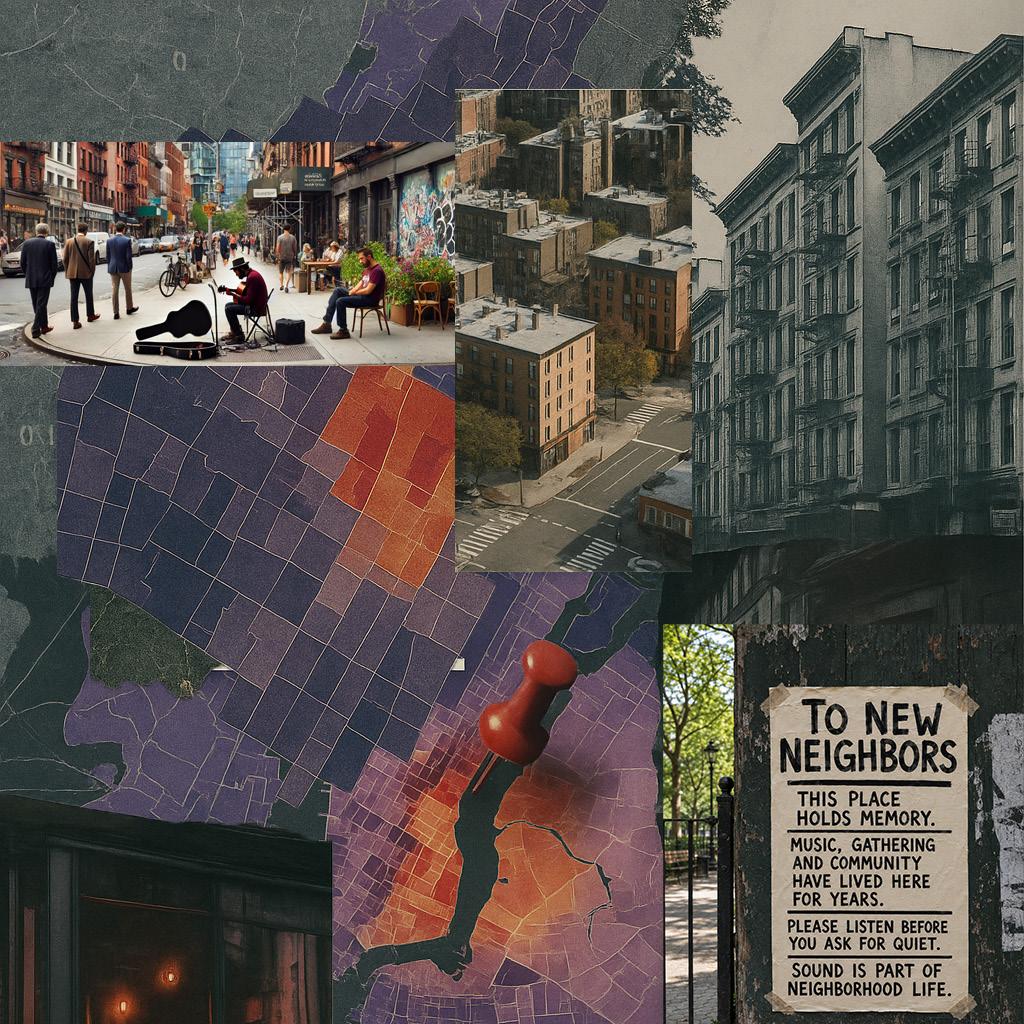
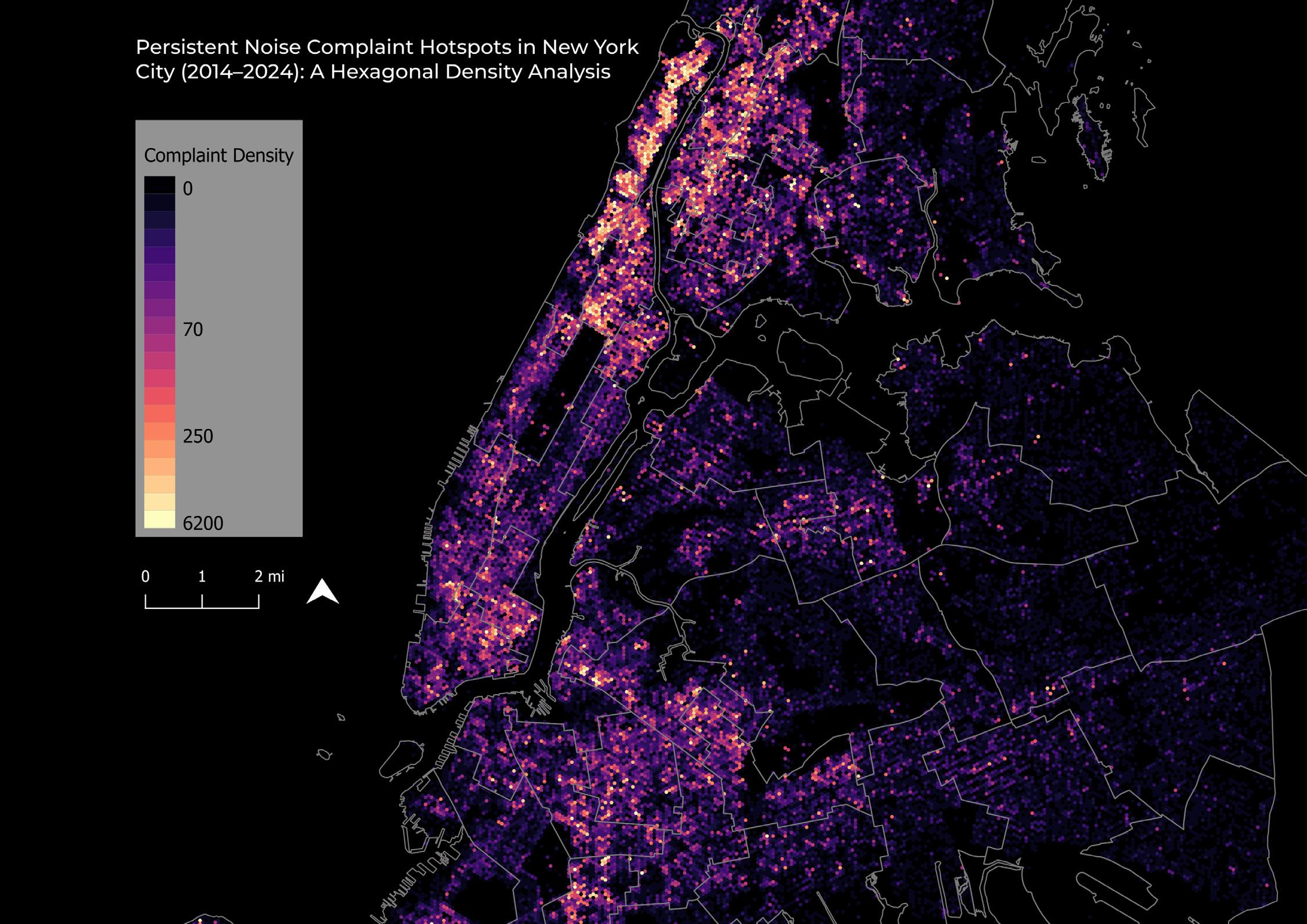
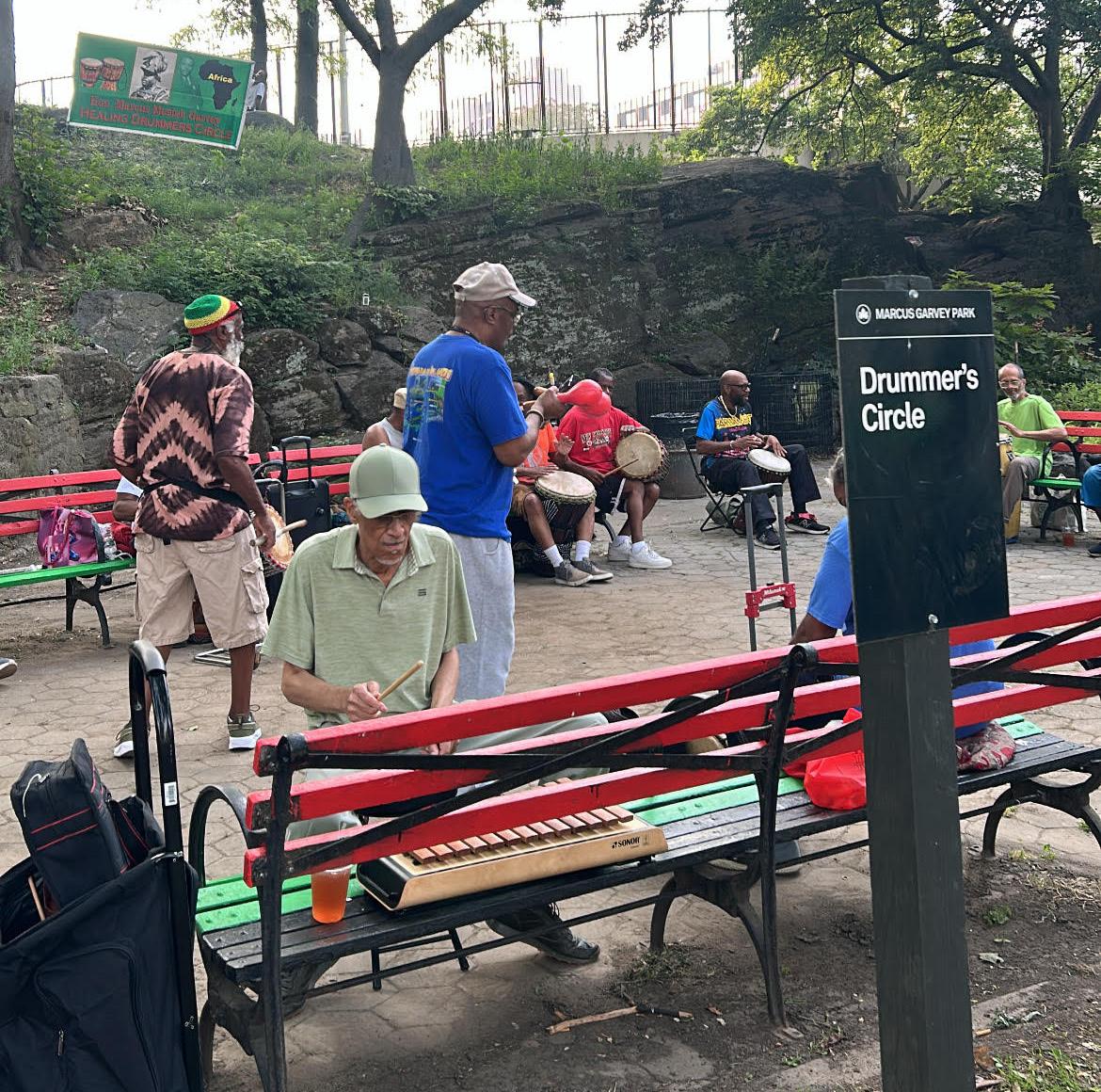
This thesis examines how gentrification reorganizes Harlem’s sonic public realm by shaping who can remain audible in public space and which sounds are recognized as legitimate. Focusing on the Marcus Garvey Park Healing Drum Circle, it argues that Black and immigrant sonic practices are increasingly recorded as disturbance through redevelopment, complaint systems, park management and publicspace governance. The project approaches sound as a political, spatial and historical question through which struggles over power, belonging, cultural memory and urban change become publicly perceptible. In Harlem, sound is part of how public life is organized, interpreted and contested, extending far beyond atmosphere or background.
The thesis is situated at the intersection of urbanism and public realm studies, sound studies and listening-based documentary practice. It draws on work in soundscape theory and the history of listening, acoustic territoriality, urban justice and the politics of difference, and rhythmanalysis and ethical listening, especially the work of Emily Thompson, Brandon LaBelle, David Harvey, Iris Marion Young, Henri Lefebvre and Saidiya Hartman. Within this framework, the thesis works through the concepts of the sonic public realm, sonic commons and auditory equity to show how urban inequality operates through institutional classifications, spatial management and everyday judgments about which sounds belong.
Methodologically, the project combines spatial analysis of ten years of NYC 311 noise complaint data with census, land-use, zoning and redevelopment indicators; policy and governance analysis of the
NYC Noise Code, park rules and amplified sound permitting; spatial ethnography and oral histories with drummers, longtime residents and park users; a citywide sound perception survey; and listeningbased methods including field recording and documentary practice. Together, these methods connect citywide patterns of complaint and redevelopment with the lived negotiation of audibility in Harlem and the specific spatial conditions of Marcus Garvey Park. They also make it possible to follow sound across scale, from neighborhood transformation to the intimate politics of public gathering.
The findings show that sound governance in Harlem is unevenly distributed and deeply political. Complaint intensity intersects with redevelopment pressure, rising rents and demographic change, suggesting that public sound becomes especially contested where neighborhood expectations are being recalibrated. At the scale of Marcus Garvey Park, the thesis shows that topography, circulation, vegetation, programmed uses and management practices shape which sounds remain visible, tolerated or marginal. The Healing Drum Circle emerges as an enduring form of collective memory, public pedagogy and sonic resistance, revealing how community life can be displaced through complaint, classification and spatial management even in the absence of formal removal.
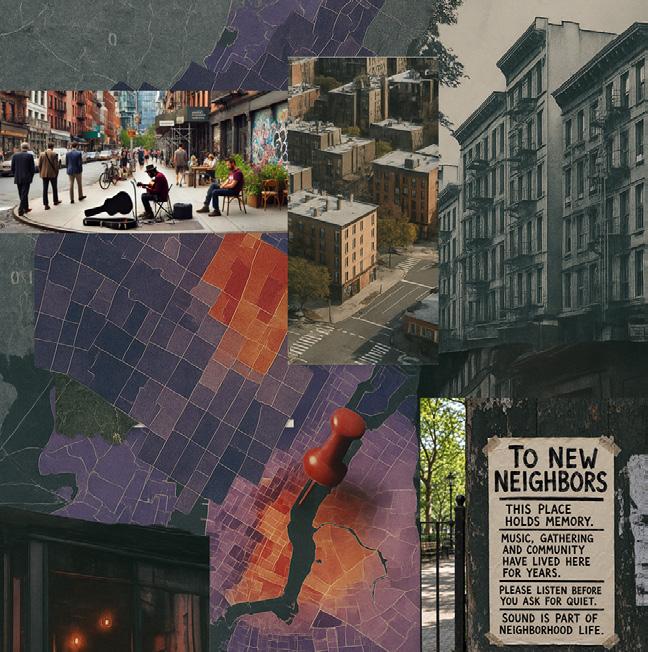
Harlem’s sonic public realm. Illustration: Arooj Fatima, 2026.
The thesis culminates in a chaptered audio documentary that carries these arguments into a listening-based public form. Drawing on oral history, field recording, ambient sound and governance language, the documentary mobilizes sound as method, evidence and medium. It allows memory, conflict, spatial tension and public misunderstanding to be heard in relation and extends the thesis beyond the written page through a form that remains closely aligned with its subject. In this way, the project contributes to urbanism and sound studies by arguing that any serious account of gentrification must consider not only who can remain in the city, but also who can remain audible within it.
Persistent Noise Complaint Hotspots in New York City (2014-2024). Map: Arooj Fatima, 2026.
Healing Drum Circle at Marcus Garvey Park, Harlem.
Photograph: Arooj Fatima, 2026.
Organizing Block Power: Bed-Stuy Block Associations and Participatory Governance in New York City
DELANEY CONNOR
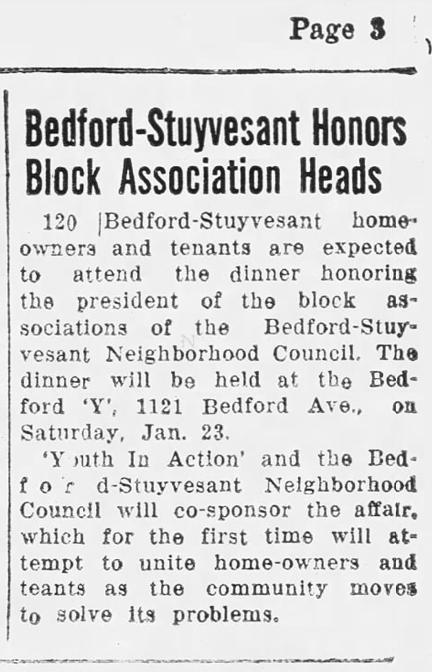
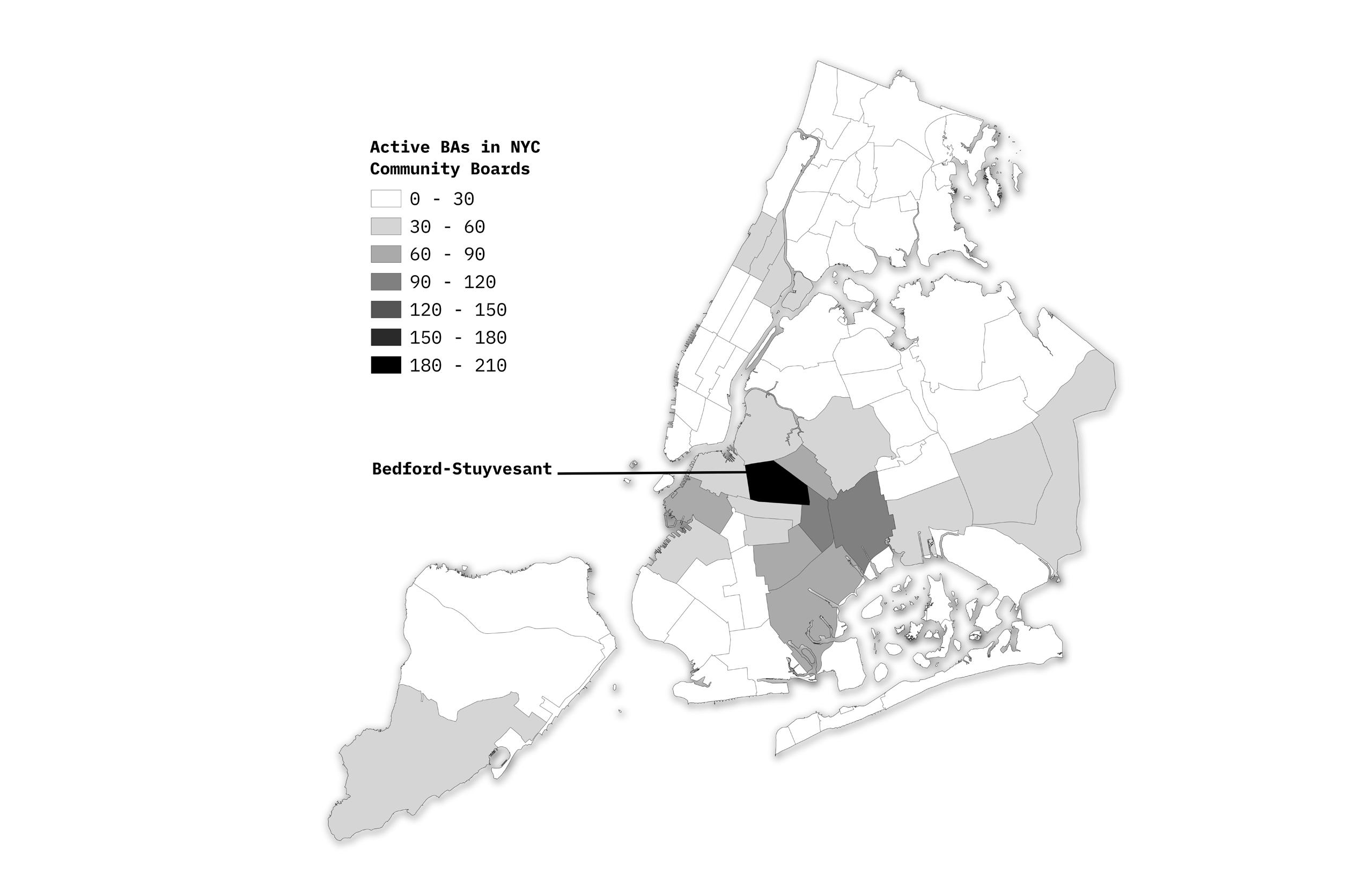
Bedford-Stuyvesant, Brooklyn contains the highest density of block associations of any neighborhood in New York City. Its roughly 130 active associations represent one in five citywide and are the product of over a century of place-based organizing by homeowners and tenants alike, confronting redlining, municipal disinvestment, and displacement. Yet these formations are often dismissed as parochial and tied to homeowners’ interests. This thesis draws on historical and contemporary research into BedStuy’s block associations to argue how and why the city should support, network, and integrate block associations into its participatory governance agenda.
Building on sociologist Eric Klinenberg’s social infrastructure framework and AbdouMaliq Simone’s concept of “people as infrastructure,” I theorize block associations as solidarity infrastructure, defined as spaces where connection and trust convert to organizing and action. Drawing on Nancy Fraser’s distinction between weak and strong publics, Murray Bookchin’s libertarian municipalism, and Silvia Federici’s work on commoning, I show how block associations, when resourced and confederated, can catalyze neighbors to act on their shared interests.
The research combines participatory action research, ethnographic observation, semi-structured interviews, archival work, spatial analysis using NYC Open Data, and case studies. Over twelve months I attended more than 50 community meetings, interviewed block association leaders, community board members, and municipal staff, administered a 101-response resident survey, and produced a publicly accessible web map of active associations citywide.
Old Bed-Stuy Block Association Sign. Photograph: Sara Hodges.
Canarsie Courier Article, 1976. Center for BK History.
As a Bed-Stuy resident organizing a block association on my own block, I practice a prefigurative methodology grounded in the sort of relationality this thesis avows.
Following a literature review, the historical chapter traces the block association form’s transformation across four arcs: white homeowner associations in the early 1900s, their reappropriation by Black organizers amid mid-century racial turnover, their expansion during the disinvestment of the 1970s fiscal crisis, and their adaptation amid present-day gentrification.
From contemporary fieldwork, three findings emerge. First, block associations cultivate both bonding among longtime neighbors and bridging across longtime and newer residents, highlighting how they uniquely foster cooperative relationships across differences. Second, existing associations are persistently under-supported: leaders cite
administrative burden and lack of funding as barriers, newcomers struggle to locate associations, and residents desire training for starting new associations. Third, associations operate in both defensive and offensive modes by mobilizing residents against threats like deed theft and displacement, while also working towards proactive neighborhood changes.
The thesis concludes with a programmatic proposal for the Mamdani administration’s Office of Mass Engagement with a phased approach to seed a block association on every residential block in New York City through organizing and canvassing mobilization, modest annual grants to incentivize and register associations, and neighborhood, borough, and citywide block association summits. It envisions a New York City where everyday New Yorkers, organized block by block, can build collective power to shape the decisions that govern their lives.
NYC Block Association Density by Community Board. Map: Delaney Connor, 2026.
indeterminate edges
MOLLY MENG
Within a city’s complex terrain, which hosts a bustling diversity of demographics and lived experiences, public spaces serve as the irreducible backdrop and container for this plurality. In contemporary cities, where capital and city governance have increasingly pushed public life into private domains, the capacity of everyday urban spaces to foster social cohesion is eroded. Established planning practices, working from a top-down spatial logic, tend to favor capital’s logics of circulation and movement efficiency, neglecting local social needs and the embodied experience of what produces a place.
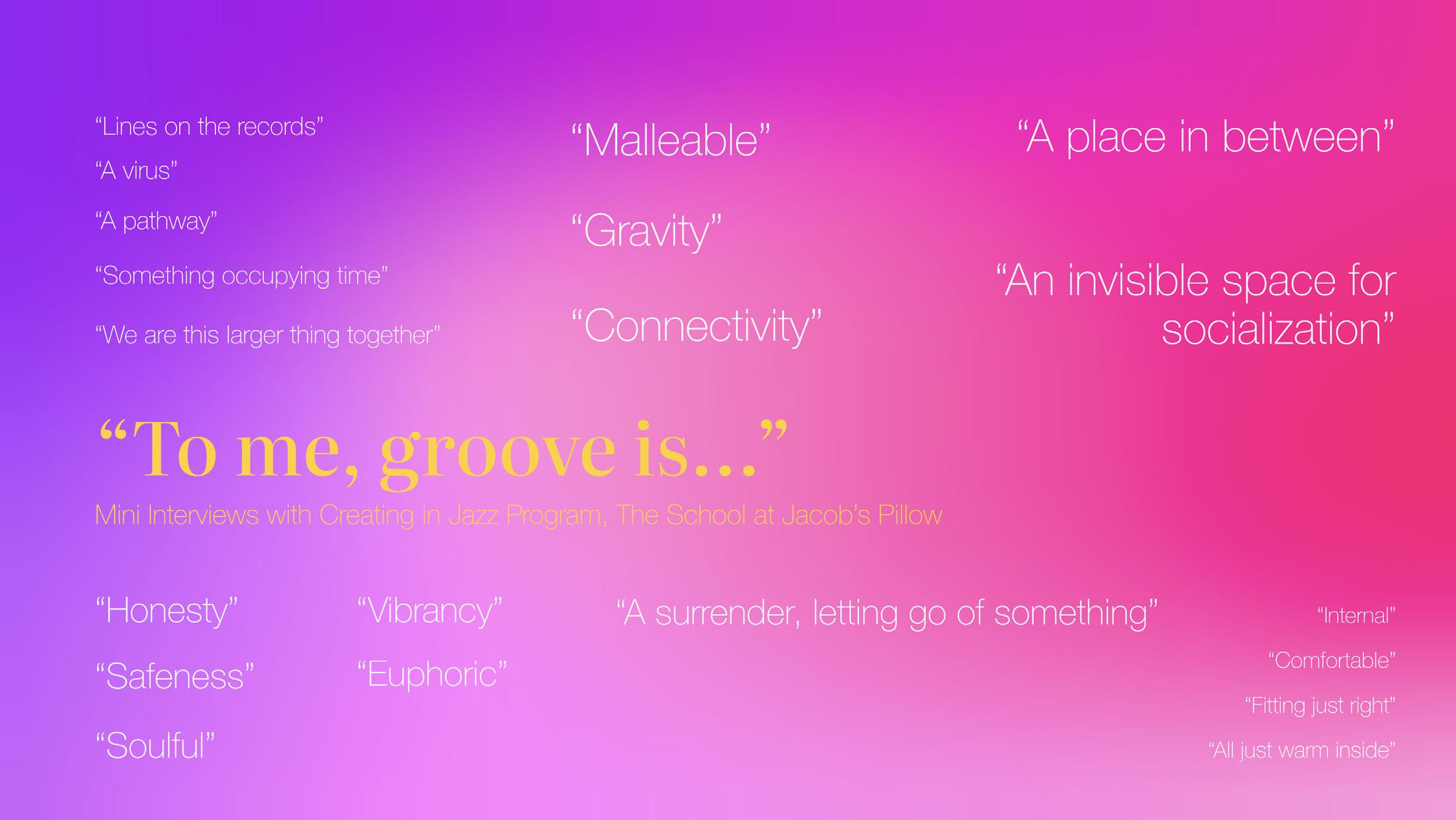
In an effort to restore potential and reinvigorate public social life in local urban spaces, this thesis introduces the Indeterminate Edge as both an existing phenomenon and a call for a generative urban future. Drawing from ethnomusicology and phenomenology, indeterminacy is not defined as the absence of form or function, but rather as a positive, generative, and mediating spatial condition. Inspired by “groove” in African American social dance and music traditions as “an experience of the social” (Wynter n.d., 879) and “productive sites of resistance” (McKittrick 2021, 166), these indeterminate liminal spaces offer both predictability and adaptability. They allow for individual expression, social interaction, and negotiation while serving as an evolving social infrastructure.
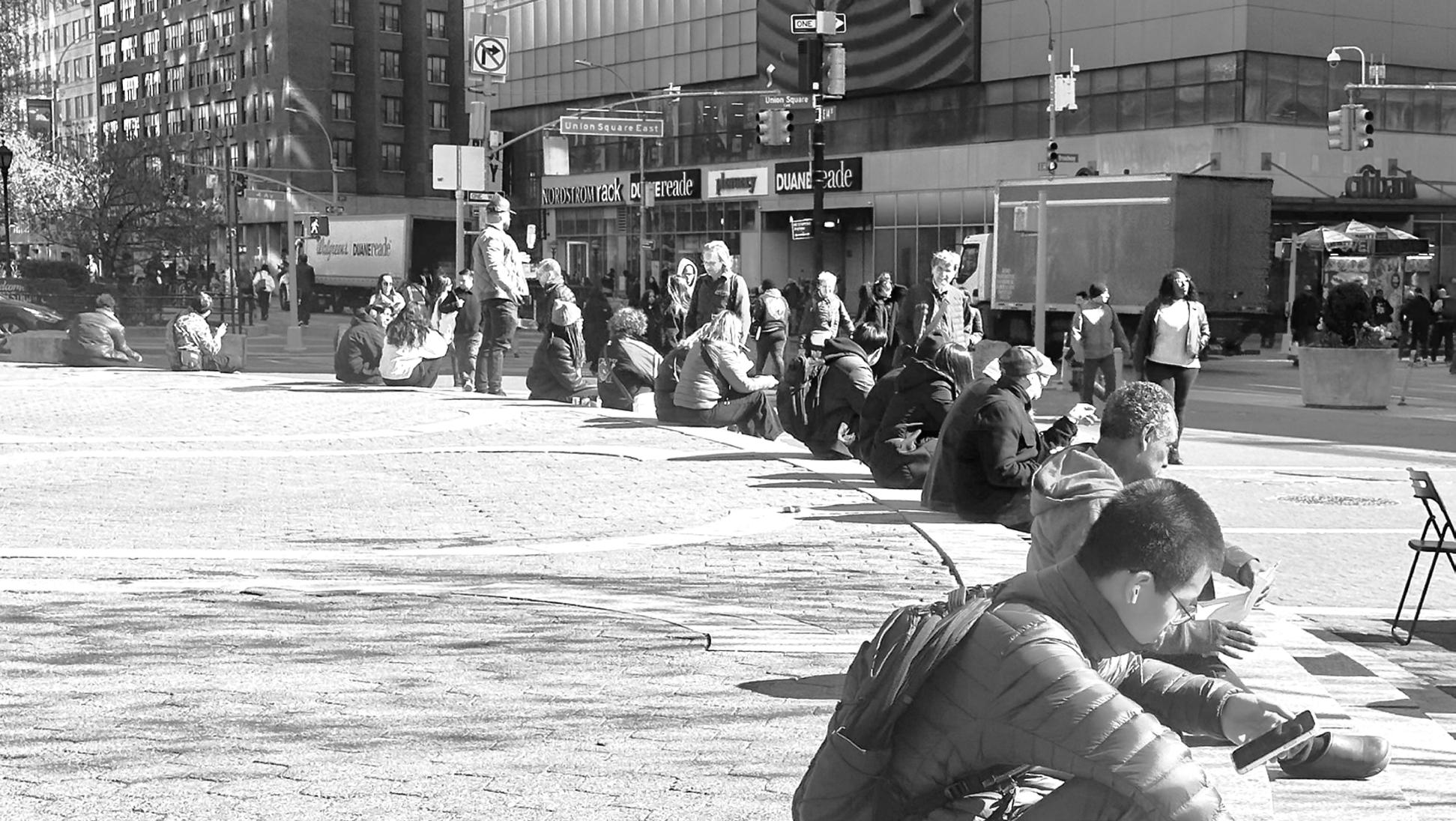
Edges themselves, the broader category from which the Indeterminate Edge emerges, are social and liminal spaces that negotiate the time-space of a place and serve as local mediators between different spatial fabrics. Upon closer examination, edges play a significant role in hosting the experience of the socializing public in urban spaces. Elders playing chess at the corner of a plaza, teenagers gathering on the sidewalk to play games after school, residents sitting on the steps of a brownstone in front of a building: these edges are among the most immediate and accessible public spaces.
On an urban scale, an edge also manifests at the collision of different socio-economic contexts, especially relevant given that “the biggest metropolitan areas are now the most unequal” (Badger and Quealy 2019). These structural inequalities expose competing publics in urban processes to direct confrontations, leaving underresourced urban communities at a disadvantage in stewarding the places they dwell.
In urban spaces, the concept of the Indeterminate Edge manifests as spaces designed to be claimed for the practice of the right to the city (Lefebvre 1996). Drawing on jazz ethnomusicology and dance practice for its relational understanding of structure and improvisation, this thesis proposes a categorization of edges observed in public spaces and situates the typology within the context of the NYC DOT Pedestrian Plaza program. The framework advances Jan Gehl’s “edge effect” (Gehl 2011, 149) by making explicit the relations between edge types, offering new ways of reading the socio-spatial patterns through which plazas do or fail to hold public life. The Indeterminate Edge is offered not as a design recipe but as a way of seeing: a methodology for recognizing where and how public space is already being claimed, and for building the conditions under which such plural occupations can persist.
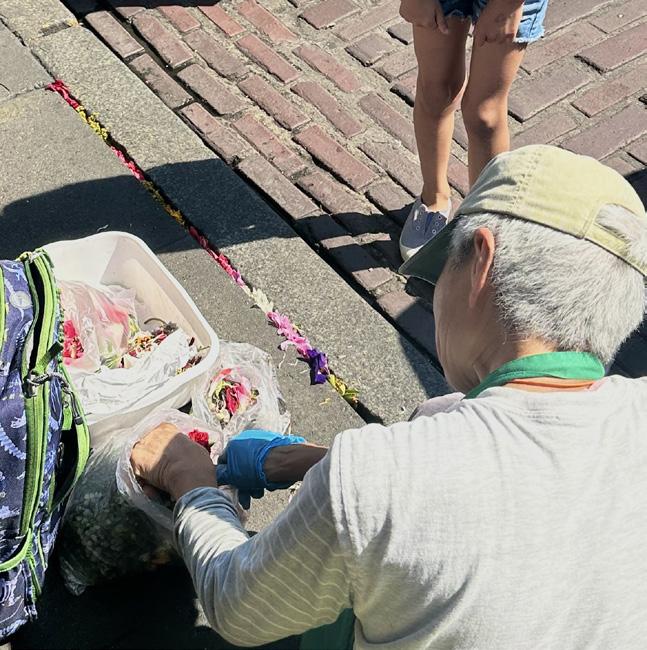
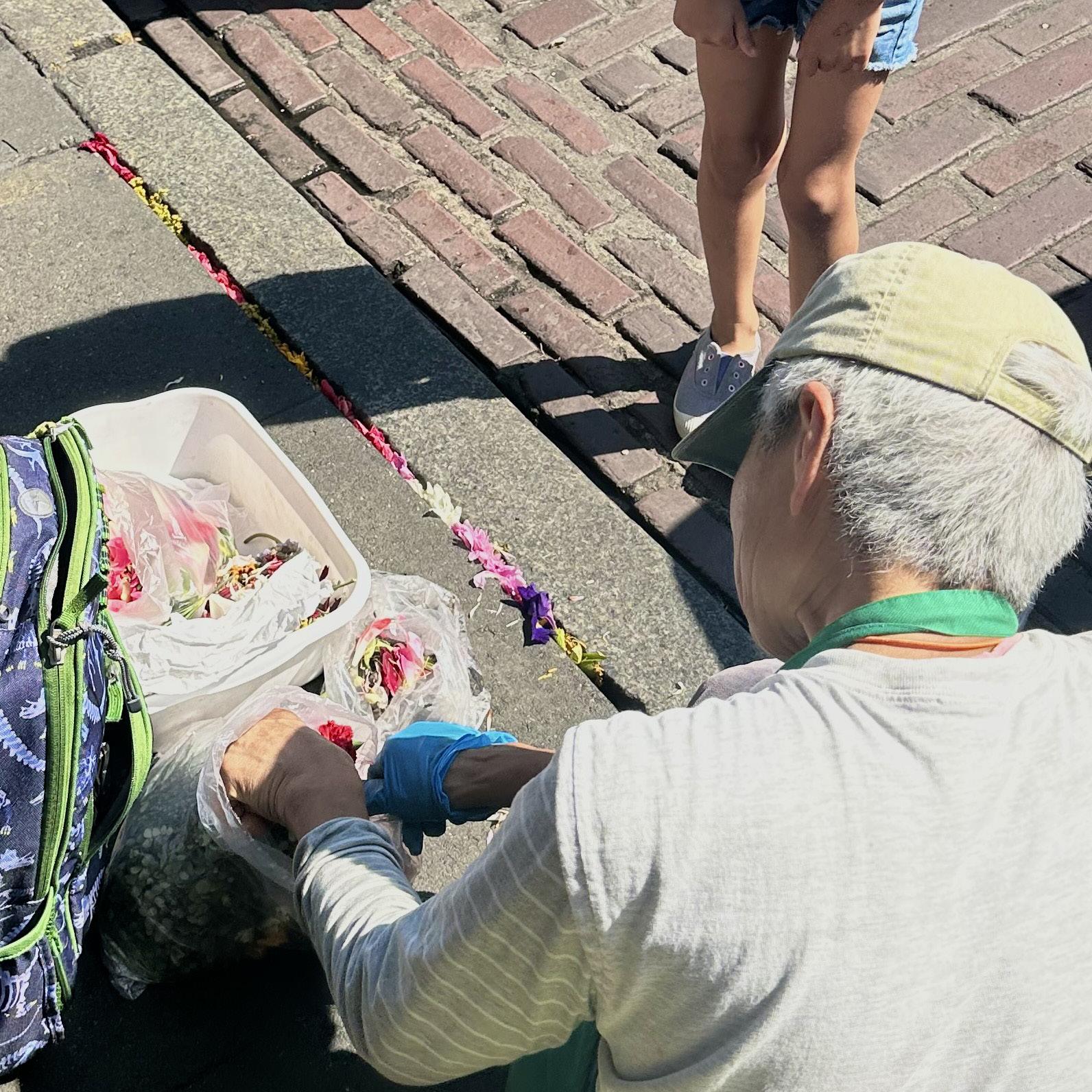
A Woman Filling the Sidewalk Seam with Flower Petals at Pike Place Market, Seattle, Photography: Molly Meng.
Interviews with Dancers and Musicians at Creating in Jazz, The School at Jacob’s Pillow. Visual: Molly Meng
People Sitting on the Staircase at Union Square Park, Photography by Molly Meng 2026.
Contested Spaces, Generative Conflict and Insurgent Practice
SHIVANI DAVE
This thesis argues that conflict and contestation are not symptoms of democratic public space failing, but the conditions through which it is produced. Rather than treating instability as a design problem to be resolved, this research proposes a dialectical framework for insurgent urban practice: a way of understanding and working with the tension between institutional power and community insurgence, oriented toward helping urban practitioners support and amplify people’s insurgent spatial practices depending on what specific conditions require.
The central concept is insurgent citizenship, developed by James Holston through the study of Brasilia and São Paulo’s auto-constructed peripheries, where residential illegality became the entry point into a new form of participatory citizenship. Holston defines citizenship not as a legal status but as a process of struggle over rights and recognition, rooted in how marginalized communities occupy, build, and claim space in ways that defy official planning and authority. This thesis extends that framework across distinct urban situations - Mumbai, and Tijuana - not as a comparative study but as a method for revealing different dimensions of the same concept under different regulatory regimes, scales of informality, and relationships to the state.
In Mumbai, Dharavi’s centuries of incremental mixed-use auto-construction demonstrate how social and economic citizenship can precede legal recognition by generations. The work of SPARC and the (Indian) Alliance in that context offers the thesis its most instructive case of planning with insurgence: a practice that has neither succeeded in transforming institutional power nor been absorbed by it, but that persists in the space between, adjusting
to what communities require. In Tijuana, Fonna Forman and Teddy Cruz’s Community Stations show what insurgent practice looks like when it exceeds the nation-state framework entirely, building transnational civic infrastructure through conscious institutional engagement and incremental community-led construction that democratises urbanisation from below.
The theoretical framework draws on Faranak Miraftab’s concept of insurgent planning and the distinction between invited and invented spaces of citizenship; Solomon Benjamin’s occupancy urbanism, which positions the claiming of space through use as a political act rather than a survival strategy; and David Harvey’s evocation of Lefebvre’s concept of right to the city, which grounds the entire argument in the claim that those who produce the city have a right to shape it. Together, these frameworks make legible the termite work - Miraftab’s term for the informal micro-politics of life, care, and resistance - that formal planning has consistently failed to acknowledge.
The thesis lands in New York City, where these questions are immediate. The city’s sanctuary status, a municipal commitment not to enforce federal immigration law, is under acute federal threat. The communities most dependent on that protection are also among the most spatially active and organisationally sophisticated in the city, having built civic infrastructure through decades of insurgent practices in areas like Corona (Queens), Sunset Park (Brooklyn), South Bronx, that long predates any policy designation.
The research site, at the New York City scale, provides the legal regulatory context, decentralised planning
Pockets of Occupied Spaces by People and Groups on Linear Sidewalks. Illustration Shivani Dave.
frameworks and sustained community-led efforts that bring the people’s insurgent practice into view. The city scale is also where the coexistence of the dialectic between institutional power and insurgent practice are observable.
The framework proposed here does not offer a methodology in the conventional planning sense; a set of steps that, if followed correctly, produce a desired outcome. What it offers instead is an orientation, a way for urban practitioners to locate themselves in relation to the people’s insurgent practices already underway in the public spaces they work in, and to ask, honestly, what their participation in those practices can and cannot do. The two modes of engagement this framework identifies - to support and to amplify - are not linear stages of the process. They are and will remain contextual. An urban practitioner might move between them within a single project, or find that only one is available given the conditions they are working in.
What matters is that the choice between them is made in response to what communities are already doing in place, not in response to what institutional frameworks have prepared urban practitioners to see.
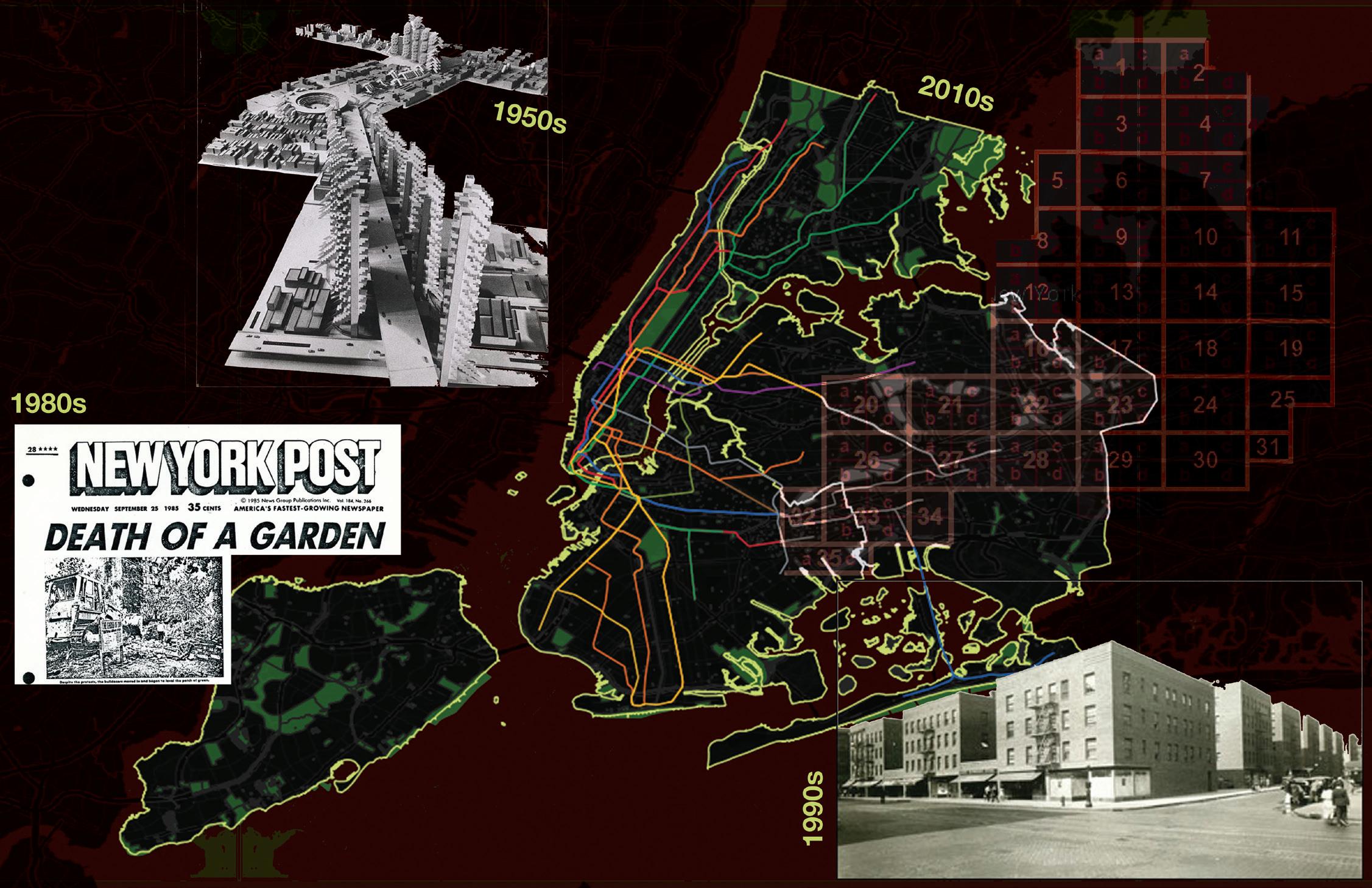
Institutional Planning Decisions Over Time in New York City. Illustration Shivani Dave
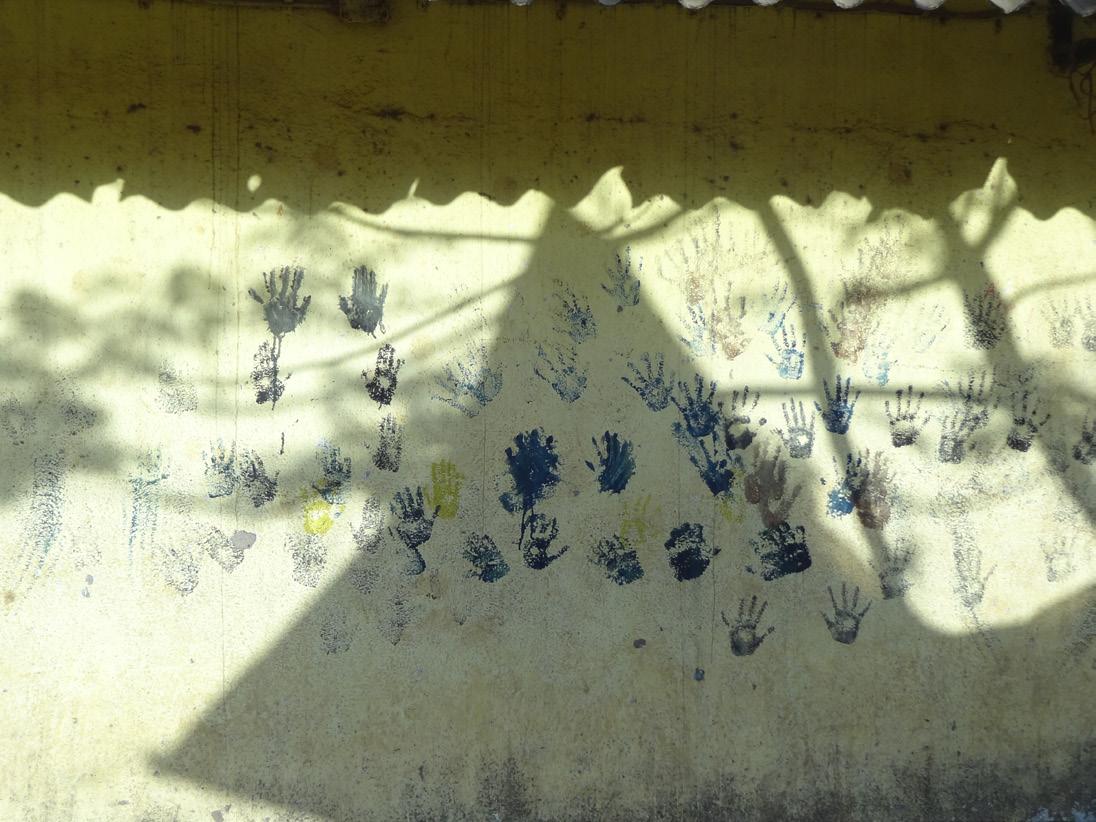
Participants Handprints - First Attempts at Co-production for a Mural in a Mumbai Municipal School. Photograph Shivani Dave
MS DUE Class of 2026
ANTONIA SIMON
Antonia Simon is a designer and researcher whose work seeks to rebalance the relationship between nature and technology within urban ecosystems through collective design. Her interest in the design of everyday life was born through observations of her home city, Hong Kong, and developed during her undergraduate studies in Anthropology and Computer Science at Georgetown University. After several years as a Senior Strategist at EPAM Continuum in London, she is pursuing her graduate research in Design and Urban Ecologies at Parsons School of Design, where her thesis explores digital urban ecologies that centre repair, circularity, and collective ownership.
As a Social Impact and Aronson Fellow at the New School, she developed the Slow Circuits Library, a library of refurbished technology in The Bronx. When she isn’t there, she’s happiest in nature, cooking and dancing with her friends and family.
AROOJ FATIMA
Arooj Fatima is an architect, urban researcher and designer interested in how cities are shaped by infrastructure, ecology, memory and everyday public life. Her practice began in Lahore, where she studied Architecture at the National College of Arts and later worked across architectural design, interiors, master planning and landscape projects. These experiences shaped her attention to built form, public life and environmental systems, while her work with urban waste, GIS and machine learning has expanded her ability to read cities through both spatial and quantitative evidence.
She is currently completing her graduate research in Design and Urban Ecologies at Parsons School of Design, where her thesis examines how gentrification transforms Harlem’s sonic public realm through complaint systems, park governance and the politics of listening. Outside research, she is usually sketching faces, crocheting or making bead purses and jewelry by hand.
DELANEY CONNOR
Delaney Connor is an urban designer and community organizer whose work examines how the built environment shapes collective life. Originally from Seattle, she completed her undergraduate studies in New Orleans, where she developed interests in creative resistance and the spatial politics of displacement. She then spent several years in Bozeman, Montana, working on homelessness and legal reform - experiences that ground her commitment to research methods centering community knowledge and reciprocity.
Connor is currently completing a Master’s in Design and Urban Ecologies at Parsons School of Design, where her thesis examines block associations in Bedford-Stuyvesant. Her research interests include solidarity infrastructure, political subjectivity, and block-level organizing. Outside her studies, she enjoys cooking large pots of soup and exploring NYC by bicycle.
MOLLY MENG RUTH WONDEMU SHIVANI DAVE
Molly (Hanzi) Meng is a designer, urbanist, and researcher whose work explores the creation of timespace in urban public spaces. Her interest in public space as a social resource was shaped by her time living across Xi’an, Beijing, Shanghai, Seattle, and New York. Her background as an industrial designer from designaffairs GmbH trained her to attend deeply to the materiality of spatial functions. This led her to develop Indeterminate Edges, a theory that frames often-neglected urban edges as critical sites for social emergence and as infrastructures of the immediate sensorium for worldmaking under the neoliberal city.
Drawing on her practice in improvised jazz and African American social dance forms, Meng’s research positions groove as social infrastructure. This intersection of groove and urbanism recently earned her The New School Student Research Award. Outside of her academic work, she is a celebrated dancer in the international Lindy Hop community, where she practices the social making of space, one dance at a time.
Ruth Wondemu is a Design Researcher and Community Systems Strategist whose work investigates how public systems and the people inside them hold together. Raised in the Washington, D.C. metropolitan area as a first-generation Ethio-American, she earned her B.S. in Public Health from Kent State University. She built her career in public service, beginning with AmeriCorps and continuing through over five years in Emergency Management at FEMA. That work moved her through neighborhoods across the country, where she saw firsthand how civic systems lift people up or let them fall.
An ongoing curiosity about how to redesign these structures led Ruth to enter the Design and Urban Ecologies MS program at Parsons School of Design. Her thesis, Learning in Motion, explores how to connect fragmented reuse networks in historically disinvested neighborhoods. The physical vehicle for this research is Bezu Creations, named after the Amharic word for abundance. Currently operating as a humble laundry cart, Bezu travels across six Brooklyn Public Library branches, bringing low-barrier upcycling practices into the rhythms of everyday civic life. In her free time, Ruth loves rollerblading, coaching, and of course, upcycling!
Shivani Dave is an urban planner, journalist and illustrator interested in exploring people-centered strategies for urban transformations. Through her academic experience at the School of Environment and Architecture, Mumbai, where she received her Bachelor’s in Architecture, she discovered that her interests lie in applying the fundamentals of architectural research and writing within urban contexts - developing phenomenological ideas about how people produce and inhabit city life. After a Postgraduate Diploma from the London School of Journalism, she went on to create reported essays and visual stories at Question of Cities, an online journal at the intersection of urbanisation, ecology, and equity.
Her graduate research at Parsons School of Design examines insurgent urban practices at a moment of acute political precarity. Her broader practice is oriented toward challenging what counts as legitimate urban knowledge: whose ways of knowing the city are recognized, whose are systematically overlooked, and what it means to practice planning at that boundary.