Comparative Analysis of Nazi Germany and the Islamic Republic of Iran
Comparative Analysis of Nazi Germany and the Islamic Republic of Iran
Parham Moosavi
Introduction
Nazi Germany (1933–1945) and the Islamic Republic of Iran (1979–present) emerged in different eras and contexts, yet both developed into authoritarian regimes with strikingly similar mechanisms of control. Nazi Germany, under Adolf Hitler’s National Socialist German Workers’ Party (Nazi Party), was transformed into a one-party totalitarian dictatorship from 1933 to 1945. (The Nazi Party)
The Islamic Republic of Iran, established after the 1979 revolution led by Ayatollah Ruhollah Khomeini, became an authoritarian theocratic republic grounded in Shia Islamic principles (Report on Human Rights Practices for 2019 - Iran).
Despite divergent ideologies – racial-fascist ultranationalism in Nazi Germany versus Shi’a Islamist theocracy in Iran – both regimes centralized power around a supreme leader figure, suppressed dissent, orchestrated pervasive ideological propaganda, built up militarized security apparatuses, and heavily intervened in their economies to enforce state goals. This paper provides a balanced, scholarly comparison of these two regimes. It begins with the historical contexts that birthed each government, then examines their political structures and governance, use of propaganda and ideology, approaches to military expansion and security, methods of social control and legal frameworks, and economic policies.
Through an objective analysis supported by academic and archival sources, the paper highlights how each regime’s strategies align or differ, offering insight into the authoritarian playbook across different cultural and historical settings.
Historical Background
1
Nazi Germany (1933–1945): The Nazi regime arose in the aftermath of World War I and the collapse of Germany’s experiment in liberal democracy, the Weimar Republic (1919–1933).
Severe economic hardship, hyperinflation, and mass unemployment during the Great Depression, combined with public disillusionment at the perceived humiliation of the Treaty of Versailles, created fertile ground for extremist politics. (The Weimar Republic)
Adolf Hitler’s Nazi Party capitalized on these crises and the public desire for order. Hitler was appointed Chancellor on January 30, 1933; within months his government used the Reichstag Fire incident and political maneuvering to eliminate opposition and secure dictatorial powers. By the passage of the Enabling Act in March 1933, Hitler’s cabinet gained the legal authority to issue laws without parliamentary consent, “laying the foundation for the complete Nazification of German society.” (The Enabling Act).
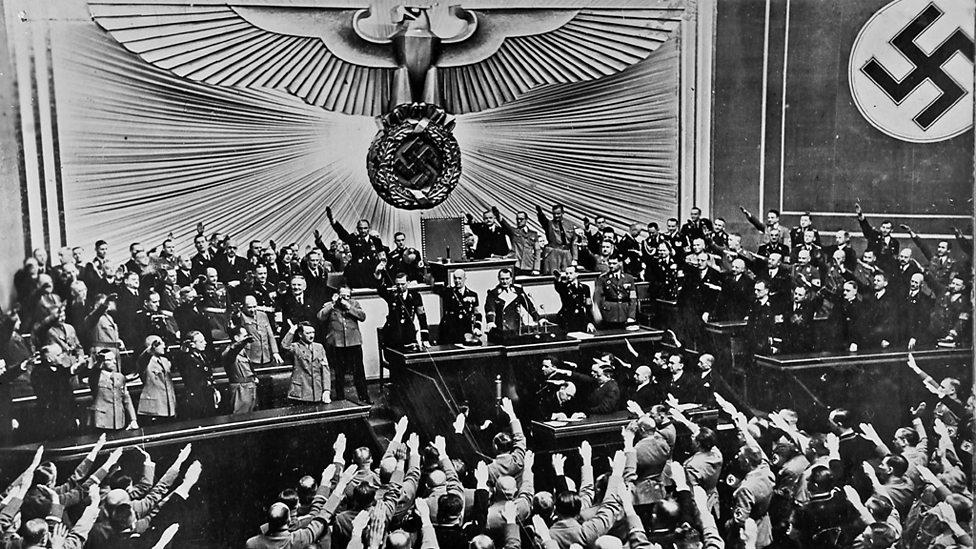
The German Reichstag celebrates the annexation of Austria, March 1938 - courtesy of US National
Archives
This pseudo-legal coup d’état, combined with ruthless suppression of rivals, meant that Germany’s 12-year-old democracy came to an abrupt end as the Nazis established a one-party dictatorship in 1933 (The Weimar Republic) ( Foundations of the Nazi State)
Hitler assumed the title of Führer (Leader) after President Hindenburg’s death in 1934, cementing his position as head of state, head of government, and supreme commander of the armed forces. Nazi Germany, also known as the Third Reich, thus entered an era of totalitarian rule under Hitler that would last until its defeat in World War II in 1945.
Islamic Republic of Iran (1979–present): The Islamic Republic was born from a revolution that ended decades of monarchical rule under the Pahlavi dynasty. Widespread discontent with Shah Mohammad Reza Pahlavi’s autocratic governance, social injustices, and Western influence (including a 1953 coup backed by the U.S. and U.K.) coalesced into mass protests in 1978–79.
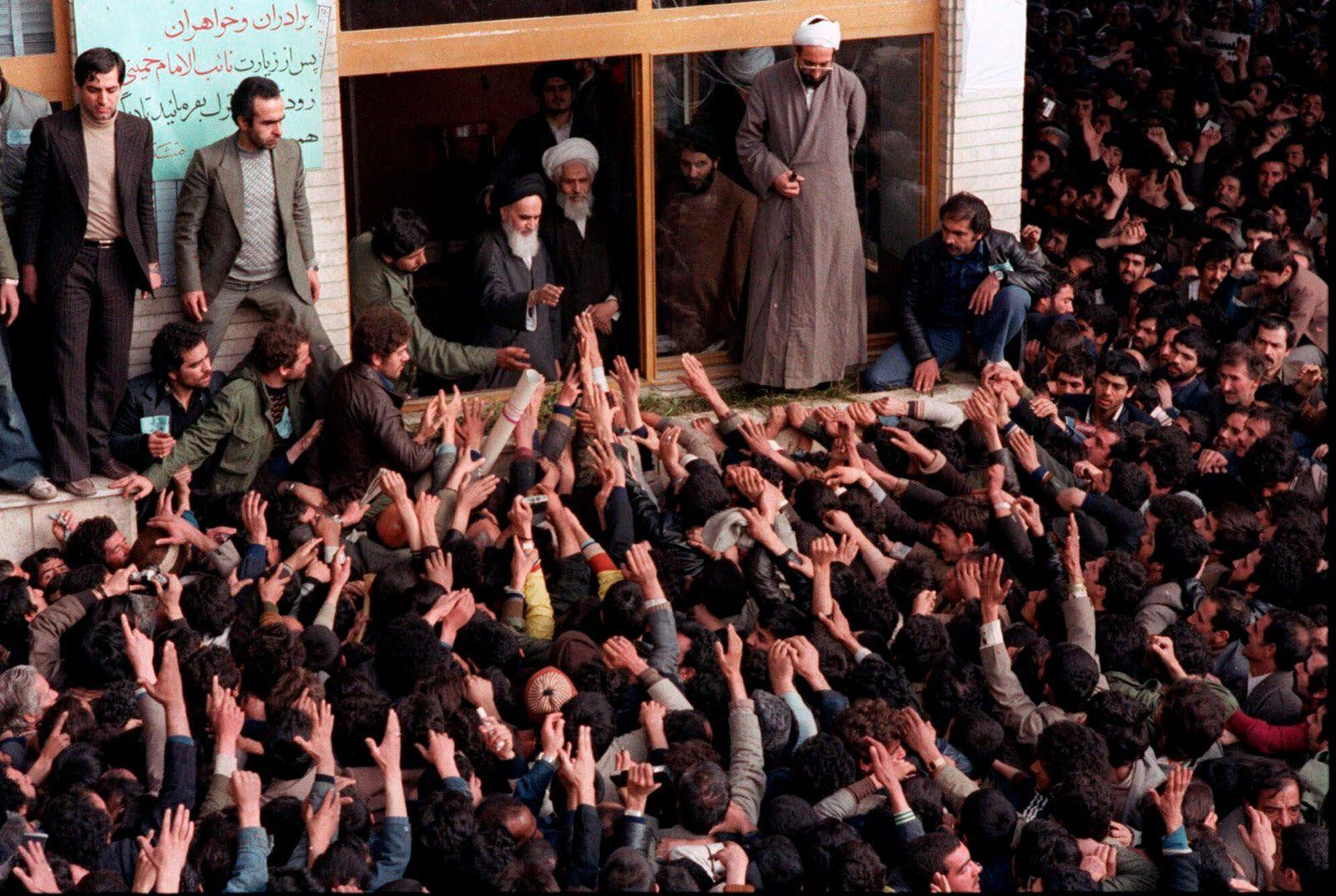
On February 11, 1979, the Shah’s government collapsed, and Ayatollah Ruhollah Khomeini, a Ruhollah Khomeini (at open window) greeting supporters after returning to Tehran from exile, February
2 1979 - Britannica.com
radical Shi’a cleric exiled for opposing the Shah, returned to Iran amid enormous popular support (Iranian Revolution).
In April 1979 a national referendum officially established Iran as an Islamic Republic, with Khomeini as Supreme Leader (Rahbar), the highest authority. Thus, much as Nazi rule marked a sharp break from Weimar democracy, Iran’s revolution replaced a secular monarchy with a new theocratic regime. The revolutionary leadership sought to purge the old order and implement governance based on Shi’a Islamic principles. By late 1979, a new constitution was approved, embedding the concept of Velayat-e Faqih (Guardianship of the Islamic Jurist) – Khomeini’s doctrine that a top Shi’a cleric should guide the state – into Iran’s political framework (Iran: Exporting the Revolution)
The early years of the Islamic Republic were tumultuous: the new regime faced internal opposition (from liberal, leftist, and ethnic groups), which it violently suppressed, and it became embroiled in a devastating war after Saddam Hussein’s Iraq invaded Iran in 1980. Nonetheless, the revolutionary regime endured, consolidating power under Khomeini’s austere ideological vision. It has persisted for over four decades (now led by Ayatollah Ali Khamenei since 1989), maintaining an authoritarian rule that, like Nazi Germany, arose from promises of cultural regeneration and social justice amid a backdrop of upheaval (Iranian Revolution) (Report on Human Rights Practices for 2019 - Iran)
Political Structure and Governance
Centralized Leadership and One-Party Rule: Both Nazi Germany and the Islamic Republic of Iran are characterized by highly centralized authority vested in a singular, dominant leader and his supporting elite. In Nazi Germany, Adolf Hitler stood at the apex of a Führer dictatorship. After 1933, all rival political parties were banned and Germany was “transformed from a democratic state into a one-party Nazi dictatorship” within months (Foundations of the Nazi State). Hitler wielded absolute power as Führer, and the Nazi Party permeated all institutions. The governing principle was the Führerprinzip, whereby “authority in government, the party,
economy, family, and so on, flowed downward from Hitler and was to be obeyed unquestioningly.” (Foundations of the Nazi State).
Under this structure, the Nazi state eliminated any checks on Hitler’s power: the Reichstag (parliament) became a mere rubber stamp, and even the cabinet and civil service were subordinate to Hitler’s will. High-ranking Nazis like Hermann Göring, Joseph Goebbels, and Heinrich Himmler had significant responsibilities (economy, propaganda, SS security apparatus, etc.), but all derived their authority from Hitler. The Nazi regime thus functioned as a personalist dictatorship with a single party (the NSDAP) monopolizing political life. Indeed, “the Nazis ruled Germany as a one-party, totalitarian dictatorship from 1933 to 1945.” (The Nazi Party)
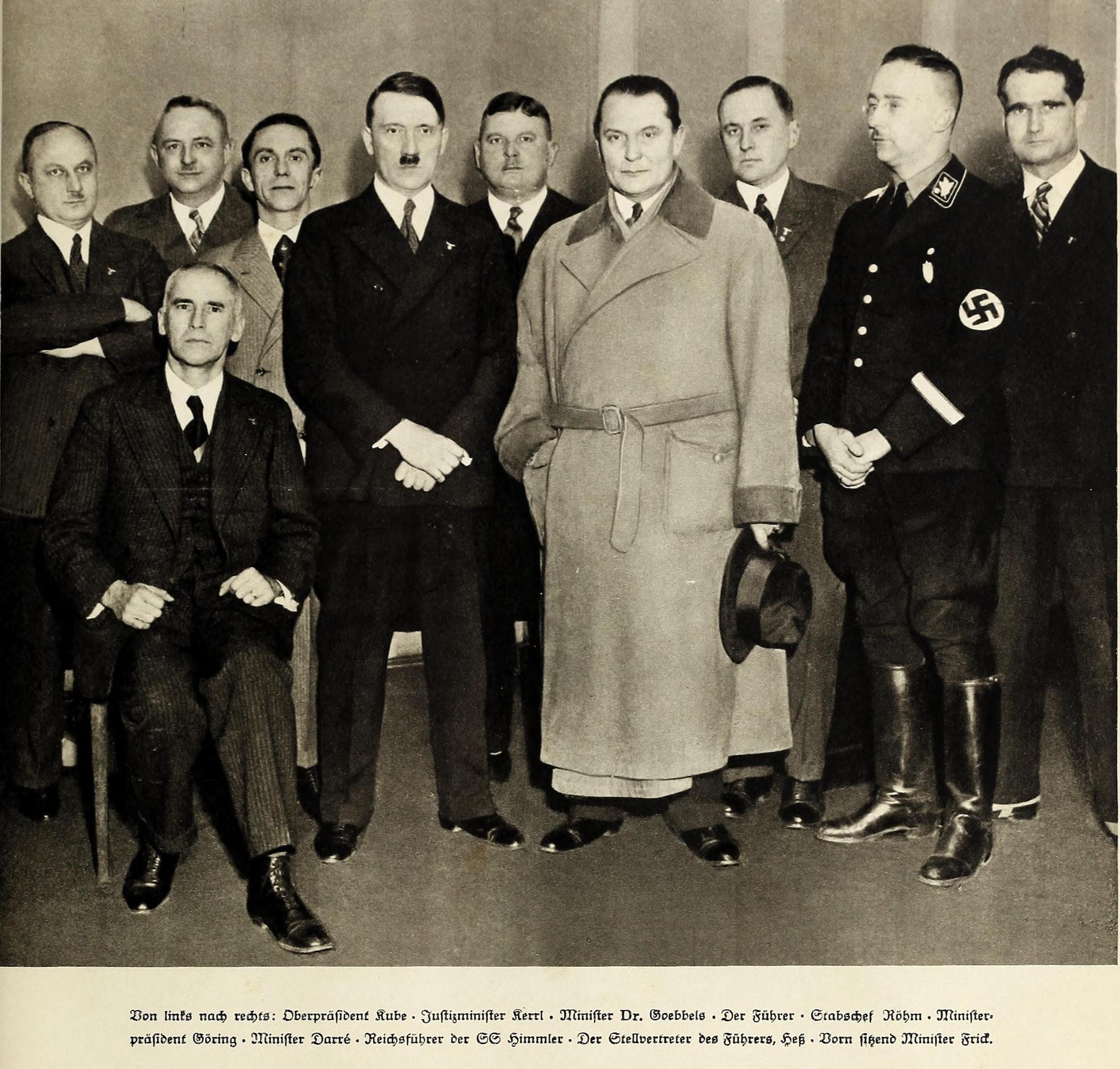
3 The staff of the Führer taken on the day of his appointment as Reich Chancellor on January 30, 1933. - 3 Wikimedia.org
The German populace was expected to demonstrate loyalty to Hitler personally – exemplified by the oath of allegiance the armed forces swore directly to him – reinforcing the leader’s central, semi-divine status in the political system.
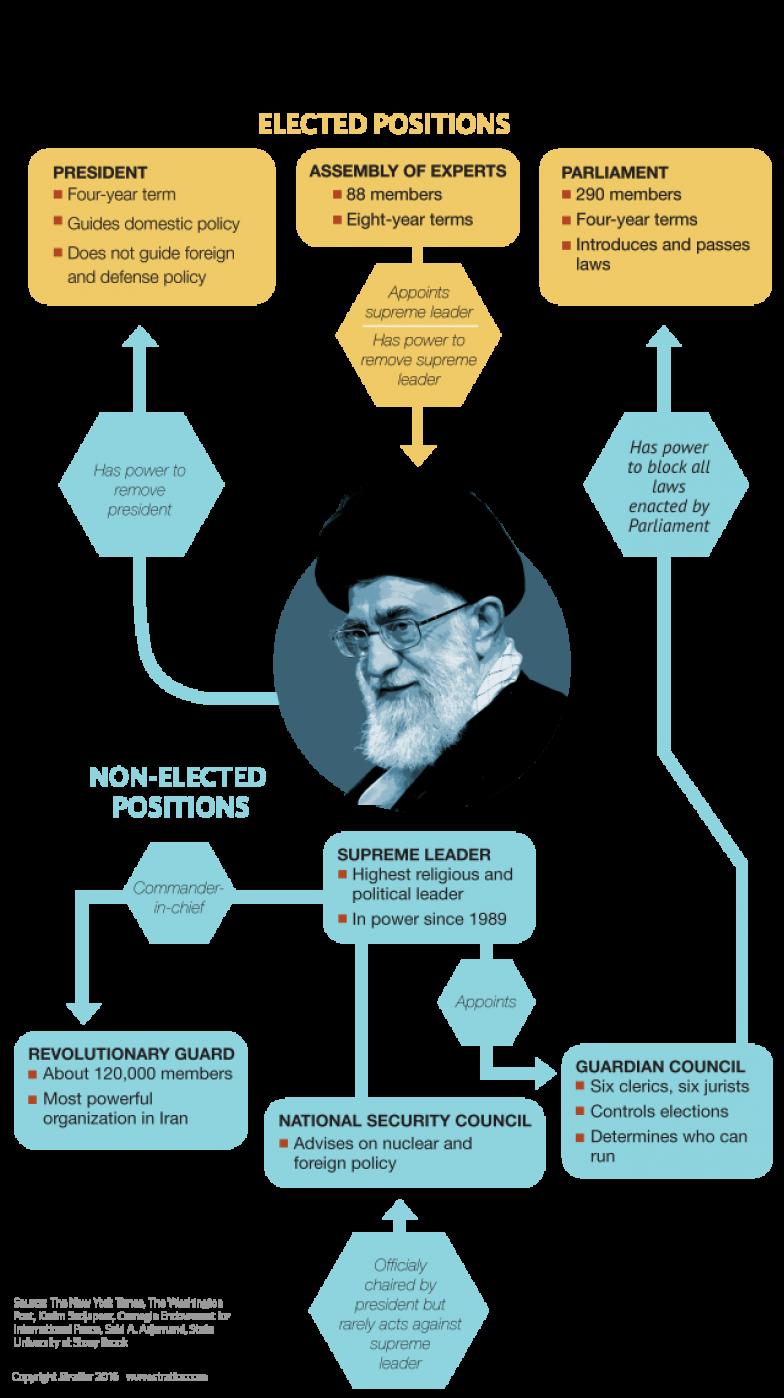
In the Islamic Republic of Iran, a parallel centralization exists around the figure of the Supreme Leader (Vali-ye Faqih). According to Iran’s constitution, the Supreme Leader is the head of state and holds ultimate governing authority, combining religious and political leadership. Khomeini (1979–1989) and his successor Ali Khamenei (1989–present) have served as this paramount leader. Iran’s system is sometimes described as a hybrid, with elected institutions (a president, parliament, and others) existing alongside clerical oversight. In practice, however, Iran’s governance is an “authoritarian theocratic republic” in which Shi’a Muslim clerics and their vetted allies dominate all key power centers (Report on Human Rights Practices for 2019 - Iran).
The Supreme Leader “oversees virtually all functions of government either directly or indirectly” (supreme leader of Iran) and is considered the guardian of Iran’s Islamic revolutionary ideology. He appoints the heads of the judiciary, the commanders of the military and Revolutionary Guard, the Friday prayer leaders, and half of the powerful Guardian Council.
The Guardian Council, in turn, must approve all candidates for the presidency and parliament, effectively disqualifying any dissidents and ensuring that elections are neither free nor fair (Report on Human Rights Practices for 2019 - Iran).
Even the Assembly of Experts – the body that formally chooses (and theoretically can remove) the Supreme Leader – is itself filled with clerics approved by the Guardian Council, meaning the Supreme Leader largely controls the selection of his own overseers (Report on Human Rights Practices for 2019 - Iran)
Thus, much like Nazi Germany’s one-party rule, Iran’s Islamic Republican structure concentrates power in a ruling elite and a singular leader. While Iran permits some controlled political competition (e.g. between “hardline” and “reformist” factions), all participants must be loyal to the Islamic Revolution’s principles and to the Supreme Leader.
There is no legal avenue for secular or anti-regime parties to operate. In summary, both regimes engineered political structures that revolve around centralized, unaccountable leadership: Hitler as the unchallenged Führer in Nazi Germany, and the Supreme Leader in Iran, who rules “essentially by divine right” under the doctrine of Velayat-e Faqih (Ayatollah Ali Khamenei: Supreme Leader of the Islamic Republic of Iran).
Administrative and Governance Systems: Once in power, both regimes restructured state institutions to align with their ideology and to tighten control. In Germany, Hitler’s government undertook a process the Nazis called Gleichschaltung (coordination or synchronization). This involved bringing all federal states (Länder), local governments, civil associations, and professional organizations under Nazi control or replacing them with Nazi-led bodies (Foundations of the Nazi State)
By 1934, Germany was a highly centralized state; regional governors (Gauleiters) appointed by the Nazi Party wielded local authority in lieu of autonomous elected officials. The Nazis also merged the party and state to a great extent – for example, Nazi Party officials were placed in key positions throughout the bureaucracy, and the SA and SS (party paramilitary organizations) assumed policing and security roles alongside or above the regular police. Although Hitler never promulgated a formal new constitution, the Enabling Act and subsequent laws effectively gutted the Weimar constitutional framework. The entire machinery of governance was subordinated to Nazi Party directives and Hitler’s personal orders, eliminating the separation of powers (The Enabling Act).
Notably, the judiciary was also neutralized: German judges, many of whom welcomed Hitler’s nationalist government, did not resist the Nazification of law and instead saw themselves as servants of the Führer’s state (The Enabling Act).
Special courts, like the infamous Volksgerichtshof (People’s Court), were established to try political offenses, bypassing standard due process and delivering draconian sentences to regime critics (including death sentences for trivial anti-Nazi acts) (German Resistance to Hitler)
The Islamic Republic of Iran similarly built a parallel Islamist institutional framework atop the pre-existing state. The 1979 constitution created unelected bodies dominated by clerics – most importantly the Guardian Council and the Expediency Council – with the power to override or veto the decisions of elected legislators. The Supreme Leader’s writ extends throughout the state: he directly controls the most coercive and non-democratic institutions, including the Revolutionary Guard Corps (IRGC), the regular army, state broadcasting, and the judiciary (Report on Human Rights Practices for 2019 - Iran).
The IRGC, established in 1979 as an ideological armed force loyal to Khomeini, has evolved into a pillar of the regime’s governance. It not only provides for national defense and internal security but also wields significant political influence (IRGC veterans often hold public office) and economic power (through control of businesses and bonyads, as discussed later). Administratively, Iran maintains a veneer of a republic – it has a president (as head of government) and a parliament (Majles) – but these officials operate within narrow parameters set by the theocratic leadership. For instance, reformist President Mohammad Khatami (1997–2005) saw many of his legislative initiatives, such as loosening press restrictions, blocked by the Guardian Council’s veto for being “un-Islamic”.
The Supreme Leader can and does intervene on major policy matters and often issues directives (known as “red lines”) that no official may cross. Additionally, Iran’s constitution enshrines Shari’a (Islamic law) as the supreme law: “All laws and regulations must be based on Islamic criteria and the official interpretation of sharia”, meaning secular legislation is subordinate to religious doctrine (2015 Report on International Religious Freedom - Iran)
This results in a governance system where clerical jurists have final say over legal and political questions, analogous in function (if not ideology) to the Nazi Party’s omnipresent oversight over the German state. In summary, both regimes replaced prior pluralistic or secular institutions with ones that ensured total alignment with the ruling ideology – Nazi Germany through party “coordination” of every aspect of government, and Iran through the integration of clerical authority and revolutionary organs into every state function – thereby entrenching their authoritarian rule.
Propaganda and Ideological Control
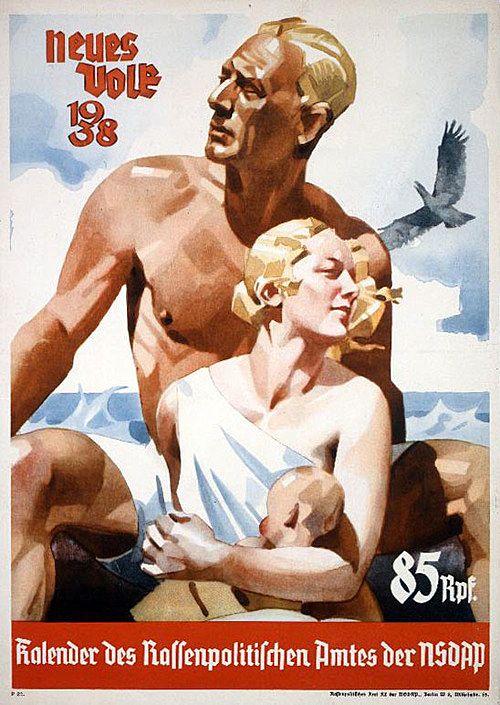
Nazi Germany – Propaganda, Censorship, and Cult of the Führer: The Nazi regime was infamous for its sophisticated and aggressive propaganda machine, orchestrated by Joseph Goebbels’ Ministry of Propaganda and Public Enlightenment. From their early days, “the Nazis used propaganda to win the support of millions of Germans”, crafting appealing messages of national revival, unity, and racial pride (Nazi Propaganda and Censorship)
Ludwig Hohlwein: Neues Volk Kalender 1938 - Wikipedia.org
After seizing power, Nazi propaganda saturated virtually all media: newspapers, radio broadcasts, films, posters, rallies, art, and even school curricula were harnessed to glorify Hitler and the Nazi Party, instill the regime’s racist and ultra-nationalist ideology, and mobilize public support. A central propaganda theme was the creation of the Volksgemeinschaft (“people’s community”), an ethnically pure national community. Nazi propagandists promoted the myth of a unified Volksgemeinschaft open to all “Aryan” Germans (regardless of regional or class differences) while explicitly excluding those deemed alien or inimical to the nation’s racial purity (Foundations of the Nazi State)
Thus, media incessantly extolled “Aryan” virtues and German traditions, while demonizing minorities (especially Jews) as well as ideological foes like communists and liberals. AntiSemitic propaganda became increasingly extreme, portraying Jews as Germany’s mortal enemy responsible for all misfortunes – a message that paved the way for public acquiescence in the persecution and ultimately the genocide of Jews (The Nazi Party).
To maintain the effectiveness of propaganda, the Nazi state imposed strict censorship and eliminated independent voices. Goebbels’s ministry either took over or shut down opposition newspapers and publishing houses; radio broadcasts were unified under state control (the Volksempfänger cheap radio was distributed to households to ensure everyone heard Nazi messaging). Censorship helped suppress any ideas the Nazis saw as threatening (Nazi Propaganda and Censorship).
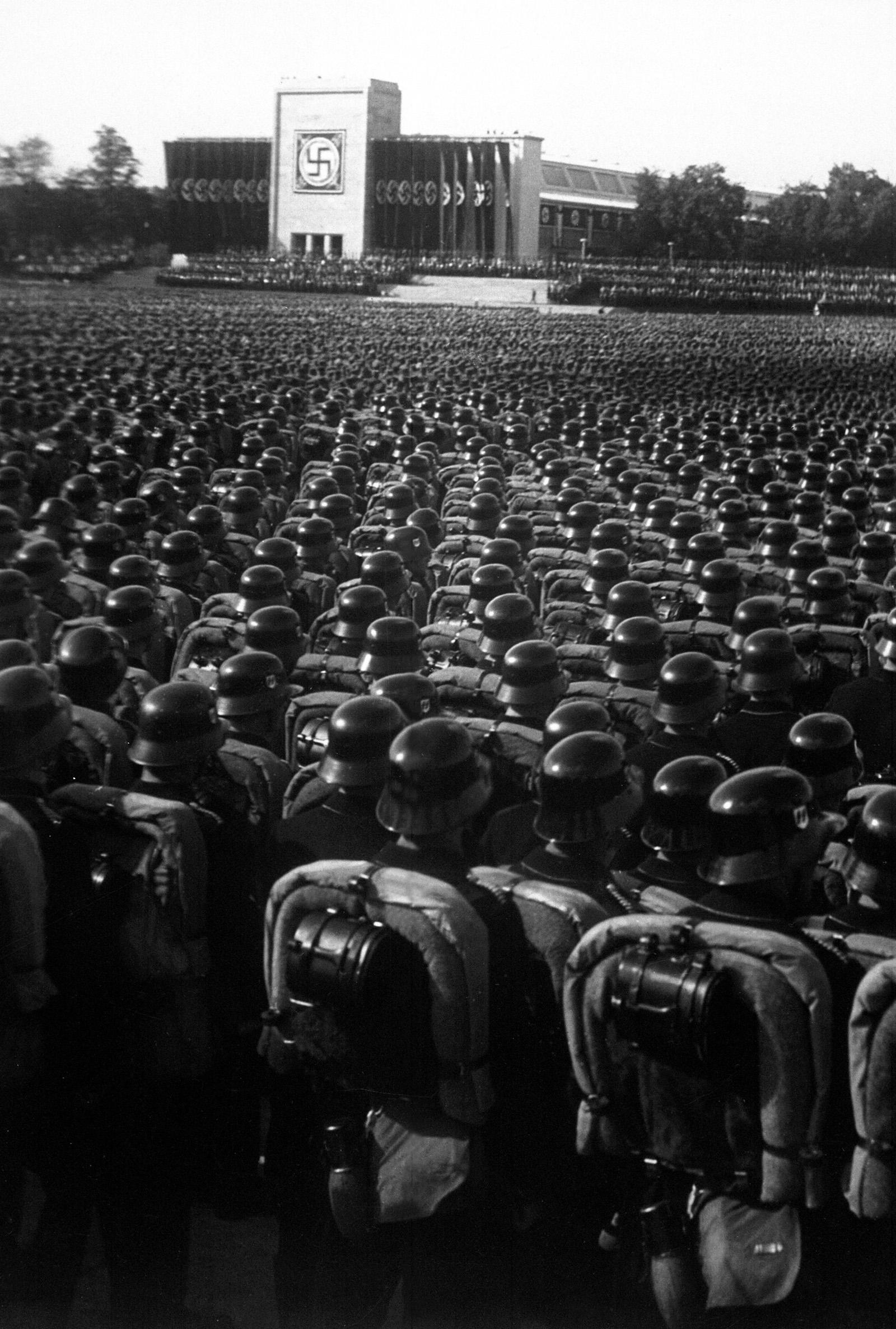
books by Jewish or dissident authors were infamously burned in May 1933, modern art was denounced as “degenerate,” and jazz or other foreign cultural influences were banned. Together, propaganda and censorship created an information monopoly. The image of Hitler as Germany’s savior was carefully cultivated through mass rallies (such as the Nuremberg Party rallies, filmed gloriously by Leni Riefenstahl), ubiquitous portraits and slogans, and the equating of Hitler’s will with the nation’s destiny. Many Germans, weary of the chaos of Weimar years, found the Nazi narrative compelling: Hitler was depicted as the strong leader restoring order, pride, and prosperity (Totalitarianism and expansionism).
This cult of personality around Hitler – bordering on deification – ensured that loyalty to the regime was largely personal loyalty to the Führer. Even as Nazi policies turned aggressive and violent, propaganda framed them as necessary defensive measures or great national achievements (for example, the annexation of neighboring territories was sold as the rightful unification of German peoples). By monopolizing mass communication and continually “shaping perceptions and manipulating cognitions” (Religious Propaganda in Iran). The Nazi regime was able to substantially mold public opinion and behavior to align with its totalitarian goals.
Islamic Republic of Iran – Ideological Propaganda and Information Control: The Iranian regime likewise relies on intensive propaganda and control of information to legitimize itself and propagate its revolutionary Islamist ideology. In place of Nazi racial theories, Iran’s official ideology is a blend of Shi’a Islamic fundamentalism and anti-imperialist revolutionary rhetoric often termed “Khomeinism.” State media and institutions continuously promote the ideals of the 1979 Islamic Revolution: religiosity, anti-Western resistance (especially against the United States and Israel, often labeled “Great Satan” and “Zionist regime”), and loyalty to the Supreme Leader and the clerical establishment.
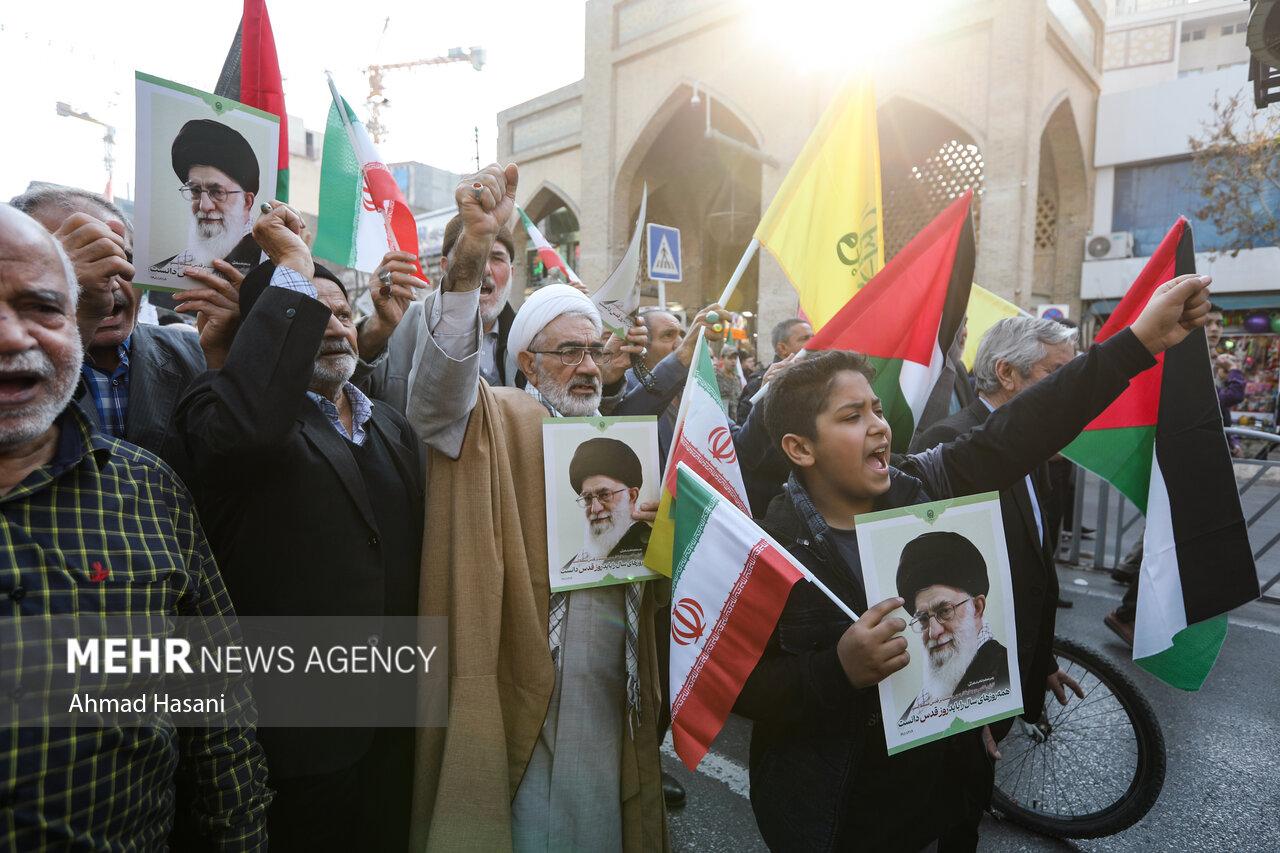
From the beginning, Ayatollah Khomeini was elevated by propaganda to a near-saintly status –his image and words adorned public spaces, and schoolchildren were taught to revere him as the Islamic Republic’s founding father. Under Khomeini and later Khamenei, the regime has maintained a monopoly over broadcast media via the Islamic Republic of Iran Broadcasting
(IRIB), which by law is the government-run national broadcaster. The Supreme Leader directly appoints the head of IRIB, and as noted in official reports, “holds constitutional authority over the judiciary, government-run media, and other key institutions.” (Report on Human Rights Practices for 2019 - Iran).
All television and radio stations in Iran are state-owned, ensuring that news and entertainment content align with Islamic values and regime narratives. Dissenting views or unfavorable news (e.g. about government corruption or protests) are filtered out. In addition to traditional media, the Iranian authorities tightly monitor and restrict the internet and social media – a modern parallel to Nazi censorship. Iran has developed one of the world’s most sophisticated censorship systems for the internet, employing filters, site blocks, and surveillance to quash online criticism (Iran's Web Spying Aided By Western Technology).
Websites of opposition groups, many foreign news services, and popular social media platforms are frequently blocked. When street protests erupt, the regime has even shut down internet access regionally or nationwide (notably during the November 2019 protests) to impede organizers and control the narrative (Report on Human Rights Practices for 2019 - Iran ).
Propaganda in the Islamic Republic is disseminated through various channels: daily prayers and Friday sermons (often used by state-picked imams to deliver political messages), the education system (with textbooks emphasizing Islamic morals and revolutionary history), pro-regime rallies (such as the annual Islamic Revolution anniversary and Quds Day marches where governmentorganized crowds chant slogans against Israel and America), and a host of state-sponsored cultural productions (posters of martyrs from the Iran–Iraq War, war films, and literature praising jihad and sacrifice). Iranian state-controlled media also operates internationally (for example, Press TV in English) to promote the regime’s perspective abroad (Covid-19 News and Information from State-Backed Outlets Targeting French, German and Spanish-Speaking Social Media Users).
Like Nazi Germany, Iran pairs propaganda with harsh penalties for speech it deems dangerous. Criticizing the Supreme Leader or the foundational doctrine of Velayat-e Faqih is a red line; those
who cross it risk charges such as “propaganda against the state” or “insulting the sacred,” which carry imprisonment or worse (Report on Human Rights Practices for 2019 - Iran).
Independent newspapers and magazines do exist but are under constant watch, and many have been shut down by the judiciary for crossing speech boundaries. Journalists face harassment and arrest; Iran is consistently ranked among the world’s worst jailers of journalists. This coercive environment produces a chilling effect on free expression.
While the style and content of propaganda differ (Nazi Germany exalted Aryan racial supremacy and militaristic nationalism, whereas Iran emphasizes Shi’a Islam, anti-colonialism, and Shi’ite victimhood narrative centered on historical injustice), the underlying mechanism is similar: the state monopolizes the narrative to maintain ideological conformity and loyalty. Both regimes also use propaganda to justify their repressive actions. For instance, just as Nazi propaganda portrayed purges and anti-Jewish laws as necessary for national survival (The Nazi Party).
Iran’s officials frequently label dissidents as “foreign agents” or “terrorists” to discredit protest movements and rationalize crackdowns. In summary, propaganda and censorship are indispensable tools for both Nazi Germany and the Islamic Republic of Iran, enabling each regime to indoctrinate its population with its guiding ideology and to stifle alternative viewpoints that might undermine their rule. Through a coordinated information strategy, they foster a controlled reality: in Nazi Germany, one in which the Führer’s mission and racial utopia seemed attainable and opposition unthinkable, and in revolutionary Iran, one in which defending Islamic governance against internal and external “enemies of Islam” is portrayed as the righteous path for society.
Militarization and Expansionism
Nazi Germany – Rearmament and Aggressive Expansion: A defining feature of Nazi rule was its relentless militarization of German society and expansionist foreign policy. The Nazi regime rapidly rebuilt Germany’s armed forces – in blatant violation of the post-WWI Versailles Treaty –as part of Hitler’s vision to restore German greatness and secure Lebensraum (“living space”) for
the German people. Soon after coming to power, Hitler withdrew Germany from the League of Nations (1933) and from arms limitation talks, signaling his refusal to be constrained. Massive rearmament programs began covertly and then openly: unemployment plummeted as “the jobless were put to work in extensive public-works projects and in rapidly multiplying armaments factories.” (Totalitarianism and expansionism).
By 1935, Hitler felt confident enough to reintroduce conscription and unveil a vastly expanded military (the Wehrmacht), laying the groundwork for a war machine. This militarization was not merely for defense; it was ideologically driven. Nazi ideology glorified war and conquest as a means to regenerate the nation and eliminate perceived threats. The regime inculcated militaristic values in youth through organizations like the Hitler Youth (where boys underwent paramilitary training) and in the population at large via frequent military parades and propagandistic celebration of soldiers. The entire economy was gradually geared toward war-readiness, especially under the Four Year Plan starting in 1936, which explicitly aimed to “re-orientate the German economy towards rearmament and preparing for war”.
Hitler’s expansionist strategy unfolded in the late 1930s: the German military occupied the Rhineland in 1936 (a demilitarized zone per Versailles), annexed Austria in the Anschluss of March 1938, and dismembered Czechoslovakia (taking the Sudetenland in late 1938 and the rest of Czech lands by March 1939) without facing armed resistance from Western powers. These “bloodless victories” were celebrated domestically as diplomatic masterstrokes and steps toward undoing the unjust post-WWI settlement. (Totalitarianism and expansionism).
In September 1939, Hitler launched World War II by invading Poland, after which Nazi expansion escalated dramatically. By 1941, Nazi Germany had conquered or dominated most of continental Europe. This “continuous string of … foreign conquests” won Hitler substantial popular support at home (at least until the wars fortunes turned) (Totalitarianism and expansionism), as many Germans saw it as the fruition of national revival. The regime’s militarization was total: the SS evolved into a parallel army and occupation force (Waffen-SS), and occupied territories were brutally exploited for resources and slave labor to feed the German war effort. In sum, Nazi Germany exhibited a classic pattern of authoritarian expansionism – a heavily militarized state pursuing imperial conquest. The regime’s legitimacy became tied to military success, making aggression a self-reinforcing policy. Hitler’s brand of authoritarianism ultimately led Germany and the world into a catastrophic global conflict, demonstrating the destructive potential of unchecked militarization under an ideological dictatorship.
Islamic Republic of Iran – Militarization and Regional Ambitions: The Islamic Republic of Iran’s approach to military power and expansion has been more complex and, in some respects, constrained compared to Nazi Germany’s overt conquests, yet it shares the theme of using militarization to secure the regime and project influence. After 1979, Iran’s new leaders prioritized consolidating control over the military and security apparatus. They created the Islamic Revolutionary Guard Corps (IRGC) as a parallel force to the regular army, tasked with protecting the revolution from both internal and external enemies. Over time, the IRGC has grown into a powerful institution with its own ground, air, naval, and special forces (e.g., the Quds Force for external operations). The Iran–Iraq War (1980–1988) was a formative crucible for the Islamic Republic. Iraq’s invasion rallied Iranian society across political divides to defend the nation, which in turn bolstered the regime’s authority to mobilize and militarize. Khomeini famously framed the war as a test of the revolution’s endurance, even calling it “a divine blessing” in uniting the country. The protracted war effort led to the expansion of Iran’s armed forces and the inculcation of a siege mentality that the regime still invokes.
The IRGC emerged from the war as a highly respected and entrenched pillar of the state, often likened to a modern Praetorian Guard. The Supreme Leader holds ultimate command over all security forces in Iran (Report on Human Rights Practices for 2019 - Iran), and militarization in Iran’s context has meant ensuring these forces’ loyalty to the revolutionary ideology. Dissent within the military was purged (for instance, many Shah-era officers were executed or expelled), and the Basij militia was formed as a nationwide paramilitary network of volunteers to enforce ideological discipline at the grassroots level and provide auxiliary manpower in crises.In terms of external ambitions, Iran’s constitution actually contains an explicit revolutionary mandate: “the policy of exporting the Islamic Revolution” to other countries (Iran: Exporting the Revolution).
Khomeini and his circle believed that the Islamic Republic should assist oppressed Muslims and promote Islamic governance beyond Iran’s borders. However, unlike Nazi Germany, Iran did not embark on direct invasions to spread its ideology (apart from the Iran–Iraq War, which it saw as defensive, although Iran did attempt to carry the war into Iraqi territory to topple Saddam).
Instead, Iran’s expansionism has been more subtle and often deniable, carried out through ideological and asymmetrical means. Tehran’s preferred strategy to expand influence has been supporting allied militias and proxy groups abroad rather than territorial conquest. A prime example is the creation of Hezbollah in Lebanon: in the early 1980s, Iran “helped create the [Hezbollah] terrorist group in Lebanon”, sending some 1,500 IRGC advisers to train Shi’a militants during Lebanon’s civil war (How Iran Exports its Ideology)
Hezbollah became “an instrument of the Iranian regime”, allowing Iran to project power against Israel and in the Levant without formally deploying an army (How Iran Exports its Ideology)
Similarly, Iran has supported Shi’a militias in Iraq (especially after the 2003 U.S. invasion toppled Saddam), aided the Assad government in Syria’s civil war, and backed groups like the Houthi rebels in Yemen. Through these activities, Iran has sought to “export its revolutionary ideology in an effort to establish similar [Islamic] movements in the region” (How Iran Exports its Ideology), fulfilling Khomeini’s vision in practice.
This has sometimes been called Iran’s “Shi’ite Axis” or “Axis of Resistance” strategy – forging a network of friendly armed actors across the Middle East to counter U.S. and Israeli influence and to encircle Iran’s rivals. The approach has yielded Iran significant regional clout, even as it
officially denies interference, portraying itself as supporting legitimate “resistance” or “Islamic awakening.”
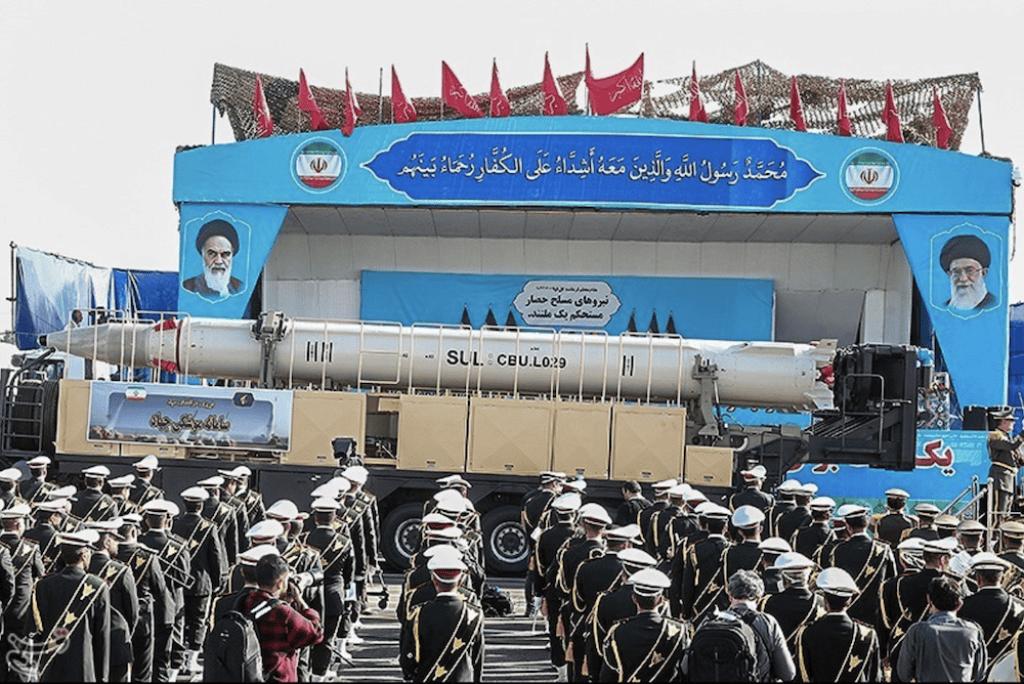
Militarily, Iran’s investments have focused on deterrence and asymmetrical warfare capabilities: a large ballistic missile program (to threaten U.S. bases or regional adversaries), developing drones, and possibly pursuing nuclear technology for leverage (though Iran claims its nuclear program is peaceful, outside observers see a strategic hedging). The ideological underpinning is that Iran must be strong enough to deter foreign aggression (a lesson from the Iran–Iraq War and from the U.S. military presence in the Persian Gulf) and to champion Muslim causes. The term “Resistance Economy” also emerges in this context – an economic doctrine pushing for selfsufficiency to withstand sanctions and war, reflecting how national security imperatives permeate Iran’s economic and military policy.
In comparing the two regimes, Nazi Germany’s expansionism was explicit and immediate, aiming at redrawing the map of Europe, whereas Iran’s expansionism has been revolutionary and ideological, aiming to reshape political alignments in the Middle East rather than annex territory. Both, however, used military build-up to fulfill ideological ends: Nazi Germany openly built a war machine to conquer what Hitler saw as Germany’s racial destiny, and Iran quietly builds networks and missile arsenals to fulfill what Khomeini described as the duty to “expand Islamic rule” beyond its borders (ISLAMIC GOVERNMENT).
Importantly, both regimes justified military endeavors as defensive or transcendent missions: the Nazis claimed to be uniting German peoples or preempting supposed threats (propagandistically framing aggression as self-defense), while the Iranian leadership claims to be defending the Islamic world from imperialism or terrorism. Each narrative has served to rally domestic support. In Nazi Germany, early military victories were wildly popular and helped silence critics (Totalitarianism and expansionism).
In Iran, the regime has leveraged conflicts (like the fight against ISIS or clashes with the U.S.) to stir nationalist and religious fervor, portraying the nation as under constant threat and thereby demanding public unity behind the armed forces and the regime.
Social Control and Suppression of Dissent
Nazi Germany – Terror and Total Social Regulation: Nazi Germany implemented a pervasive system of terror and social control to eliminate dissent and enforce conformity. From the moment Hitler took power, the regime moved to crush any actual or potential opposition.
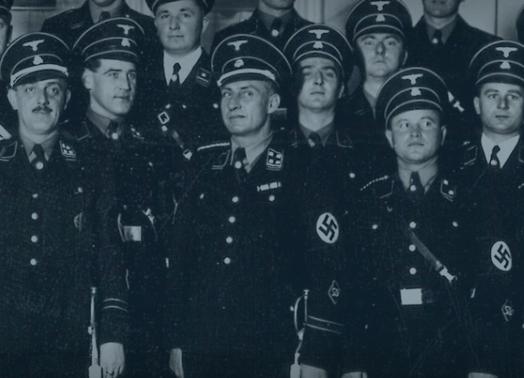
The Gestapo (Geheime Staatspolizei), Nazi Germany’s secret state police, was the central instrument of repression. It “ruthlessly eliminated opposition to the Nazis within Germany”, using surveillance, arbitrary arrest, and torture to instill fear (Gestapo - Nazi political police).
Under Heinrich Himmler and Reinhard Heydrich’s direction, the Gestapo and the SS established an extensive network of informants; ordinary citizens were encouraged (and sometimes intimidated) to report disloyal remarks or behavior by neighbors and colleagues. As a result, open
Staatspolizei – Institute pf National Remembrance
criticism of the regime virtually disappeared – as one account notes, “the Gestapo and the Security Service (SD) suppressed open criticism of the regime” (German Resistance to Hitler).
Those suspected of anti-Nazi sentiments, from communists and social democrats to outspoken churchmen or academics, were often arrested and sent to early concentration camps, which the Nazis opened within weeks of taking power. For example, Dachau camp was established in March 1933 to detain political prisoners. By May 1933, leading Socialists were being interned in camps like Kislau (German Resistance to Hitler)
Left-wing parties (Communists, Social Democrats) had been the Nazis’ main political opponents; they were banned and “crushed… by force” – hundreds of their members were jailed, killed, or forced into exile (German Resistance to Hitler).
The Nazis also outlawed trade unions and replaced them with the German Labor Front under Nazi control, thereby removing organized labor as a source of opposition and tying workers’ interests to the regime.
The Nazi state strove to control not just overt political activity but the entire social sphere – a hallmark of totalitarianism. Independent civic organizations, youth clubs, and cultural associations were either disbanded or absorbed into Nazi organizations (this was part of Gleichschaltung, the coordination policy). For instance, all youth groups were merged into the Hitler Youth (for boys) and the League of German Girls, where attendance eventually became virtually compulsory. Many young Germans knew no life outside of Nazi organizations, which indoctrinated them and also served to police their behavior.
The regime enforced a strict code of ideological loyalty: teachers, professors, judges, and civil servants had to be vetted for political reliability (and often had to join the Nazi Party or its affiliates). Those who did not conform were removed from their positions.
Religious institutions were pressured as well; while the regime reached a Concordat with the Catholic Church in 1933, it later violated it by harassing Catholic clergy and suppressing churchaffiliated groups (German Resistance to Hitler)
Some Protestant churches were coerced into a pro-Nazi unified Reich Church, while dissenting pastors (like Dietrich Bonhoeffer of the Confessing Church) were arrested. The net effect was that German society was regimented at every level, with surveillance and propaganda reinforcing each other: people were bombarded with Nazi messaging and also fearful of the consequences of dissent. By creating this climate, the Nazis sought not only to silence opposition but to engineer active consent – or at least acquiescence – from the populace. For many Germans, genuine enthusiasm for Hitler (fueled by propaganda and early successes) mingled with fear of punishment, resulting in widespread outward conformity.
Even small acts of defiance, such as listening to foreign radio broadcasts or telling anti-Hitler jokes, were risky and could lead to denunciation and arrest. The judiciary offered no protection –special courts handled political cases and meted out severe penalties. In one illustrative instance after the failed July 1944 attempt on Hitler’s life, the People’s Court under Judge Roland Freisler summarily condemned thousands to death for suspected disloyalty (German Resistance to Hitler).
In short, Nazi Germany enforced obedience through a combination of terror (secret police, camps, executions) and social control (mass organizations, ideological monitoring of daily life), effectively suppressing dissenting voices throughout its 12-year rule.
Islamic Republic of Iran – Revolutionary Policing and Societal Control: The Islamic Republic of Iran has likewise employed a range of coercive measures to stifle dissent and enforce social conformity with its ideological and moral codes, although the texture of control differs given Iran’s religious foundations and modern technologies. In the immediate aftermath of the 1979 revolution, Khomeini’s regime moved swiftly to neutralize political opposition. Various groups that had participated in the revolution – liberals, Marxists (like the Tudeh Party), Islamist guerrillas (MEK), ethnic minorities with autonomy demands – were sidelined or violently purged by 1981. Revolutionary courts sentenced scores of regime opponents to death in the early years. The Komitehs (Revolutionary Committees) and the Pasdaran (IRGC) acted as parallel enforcers, arresting dissidents and enforcing Islamic codes (such as compulsory veiling for women).
Over time, these functions became more formalized in institutions. The Ministry of Intelligence and Security (MOIS), established in 1984, functions akin to Iran’s secret police, conducting surveillance, infiltration, and covert operations against domestic opponents and exiles abroad.
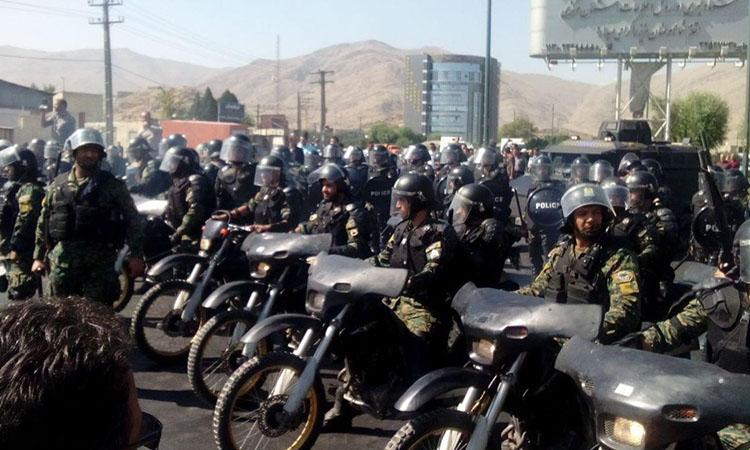
The IRGC’s Basij militia, a volunteer paramilitary force with local units across Iran, is a key instrument of social control: Basij members monitor neighborhoods, report “anti-revolutionary” activity, enforce dress codes and Islamic norms, and mobilize regime loyalists to counter protestors.
Security forces in Iran have shown a pattern of using severe violence to crush public protests, such as student demonstrations in 1999, the Green Movement after the disputed 2009 election, and more recent protests in 2017–2018, 2019, and 2022. For example, when widespread protests erupted in November 2019 over a fuel price hike, the government responded by blocking internet access nationwide for about a week and deploying lethal force; an estimated 1,500 protesters were killed by security forces (notably IRGC and Basij units) during that unrest (Report on Human Rights Practices for 2019 - Iran). The regime did not hold perpetrators accountable,
underscoring a climate of impunity for violence against dissenters (Report on Human Rights Practices for 2019 - Iran).
Akin to the Gestapo’s informant network, Iran’s authorities maintain extensive surveillance of citizens. Reports document that security agencies “monitored the social activities of citizens, entered homes… and monitored telephone and internet communications” without warrants (Report on Human Rights Practices for 2019 - Iran)
Activists and opposition figures often find themselves and even their family members under watch or subject to intimidation. In one instance, relatives (including an elderly grandfather and an eleven-year-old nephew) of a slain protester were detained to warn others against public mourning or criticism (Report on Human Rights Practices for 2019 - Iran)
This intimidation through family and community is reminiscent of tactics used in other authoritarian states to deter activism by raising the personal costs. The judiciary in Iran, particularly the Revolutionary Courts, plays a harsh role in suppressing dissent. Political prisoners are commonly charged with vaguely defined national security crimes such as “spreading corruption on earth,” “enmity against God (moharebeh),” or “propaganda against the system.”
These courts often conduct closed-door trials without due process, resulting in long prison terms or even executions. Iran has one of the highest rates of execution in the world, and while many are for drug offenses, a significant number are political. In 1988, for instance, thousands of imprisoned dissidents (primarily leftists) were executed in a mass secret purge. Today, prominent dissenters – journalists, human rights lawyers, feminists, minority rights activists, and even reformist politicians – face arrest and imprisonment. The fear of arrest is a constant undercurrent in Iran’s civil society, constraining open organization of opposition.
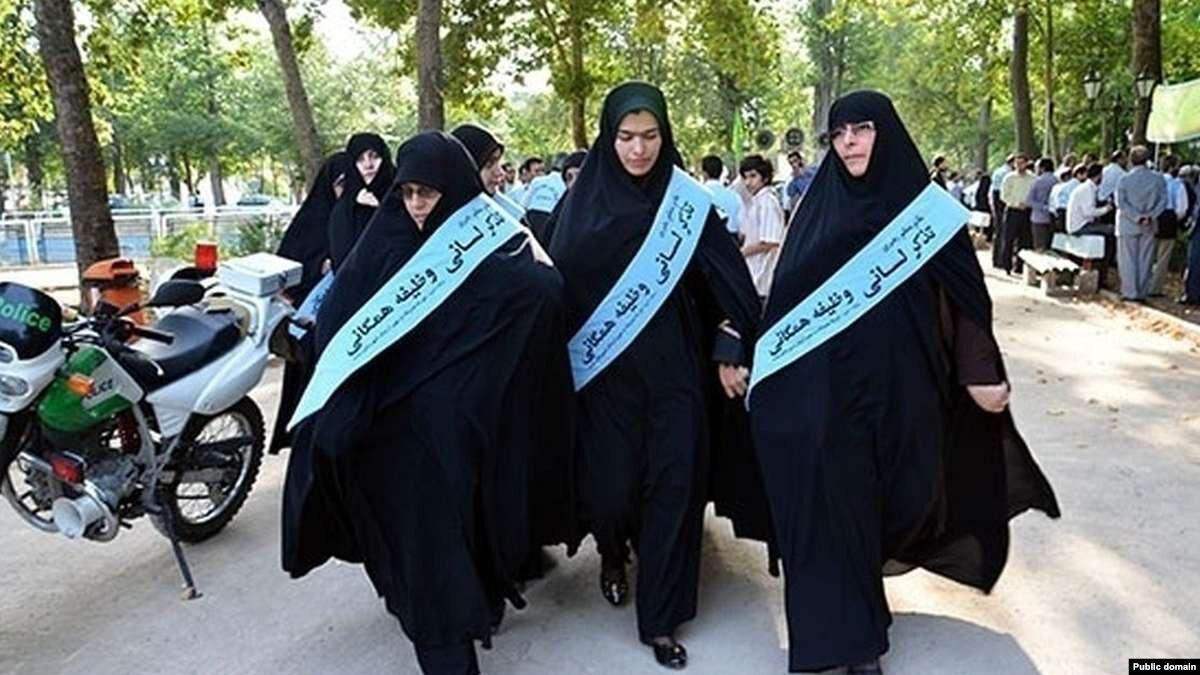
Apart from political dissent, the Islamic Republic imposes strict social controls to enforce its interpretation of Islamic morality. The “morality police” (Gasht-e Ershad) patrol public spaces to
ensure women observe mandatory hijab (headscarf and modest dress) and that mixed-gender mingling or other prohibited behavior (like alcohol consumption) is curtailed. Violators can be fined or detained; repeat offenders have faced jail or lashing under Iran’s sharia-based laws. This top-down imposition of social norms aligns with the regime’s view that maintaining an Islamic society is integral to its legitimacy.
However, it has also been a source of persistent tension and periodic backlash from segments of the population, especially younger, more secular Iranians. The cycle of enforcement and resistance (for example, waves of stricter hijab enforcement followed by protests, as seen most recently in the 2022 Mahsa Amini protests against the morality police) illustrates the regime’s determination to control personal behavior as part of its broader authoritarian strategy.
In effect, Iran’s regime maintains power through a blend of ideological policing and brute force similar in function to Nazi Germany’s repression, even if motivated by religion rather than race. Regular and paramilitary security forces like the Basij are frequently accused of “numerous human rights abuses, including acts of violence against protesters” (Report on Human Rights
Practices for 2019 - Iran), showing the state’s reliance on loyalist militias to do its dirty work –comparable to Nazi use of the SA/SS and Gestapo.
And much like in Nazi Germany, independent labor unions, genuine opposition parties, or free student unions are not permitted. Strikes or organized protests are quickly labeled as threats to national security.
The result is a controlled society where outward opposition is dangerous. Nonetheless, it is important to note that unlike Nazi Germany – which achieved near-total suppression of public dissent for most of its existence – the Islamic Republic has faced recurring public protests and displays of discontent (albeit met with repression). This suggests that maintaining complete control in the modern Iranian context (with a more literate population, modern communications, and a diversified society) has been a dynamic challenge, requiring constant adaptation of surveillance and coercion tactics.
Both regimes, however, illustrate the authoritarian imperative of suppressing dissent through intimidation, violence, and the pervasive monitoring of society to maintain an atmosphere in which meaningful opposition cannot coalesce.
Legal Frameworks and the Rule of Law
Nazi Germany – Law as a Tool of Dictatorship: Under Nazi rule, the legal system was radically subverted to serve the regime’s authoritarian and ideological ends. Rather than outright abolishing all legal structures, the Nazis co-opted and transformed them, giving a veneer of legality to repression. The cornerstone was the Enabling Act of 1933, which effectively nullified the Weimar Constitution.
As noted, this law “allowed the Reich government to issue laws without the consent of parliament”, providing the basis for Hitler’s dictatorship (The Enabling Act)
In effect, separation of powers ceased – Hitler and his cabinet could legislate by decree, including passing laws that contravened constitutional rights. Subsequent legislation outlawed opposition parties and removed democratic elections, cementing one-party rule. German judges and legal professionals, with few exceptions, adapted to the new order; courts continued to function, but under the premise that Nazi policy was the law. Judges took an oath of personal loyalty to Hitler and, as one source notes, “viewed Hitler’s government as legitimate” and themselves as servants of the state who owed him their allegiance (The Enabling Act).
This meant that traditional judicial independence evaporated – many jurists willingly enforced Nazi decrees, and those who did not were replaced. For example, Jewish judges or lawyers were expelled from the profession under the April 1933 Law for the Restoration of the Professional Civil Service (which purged Jews and political dissidents from state jobs). Special courts like the Sondergerichte were set up to try political offenses swiftly, and the aforementioned People’s Court was created in 1934 specifically to handle cases of treason or undermining the war effort, notorious for its almost predetermined guilty verdicts.
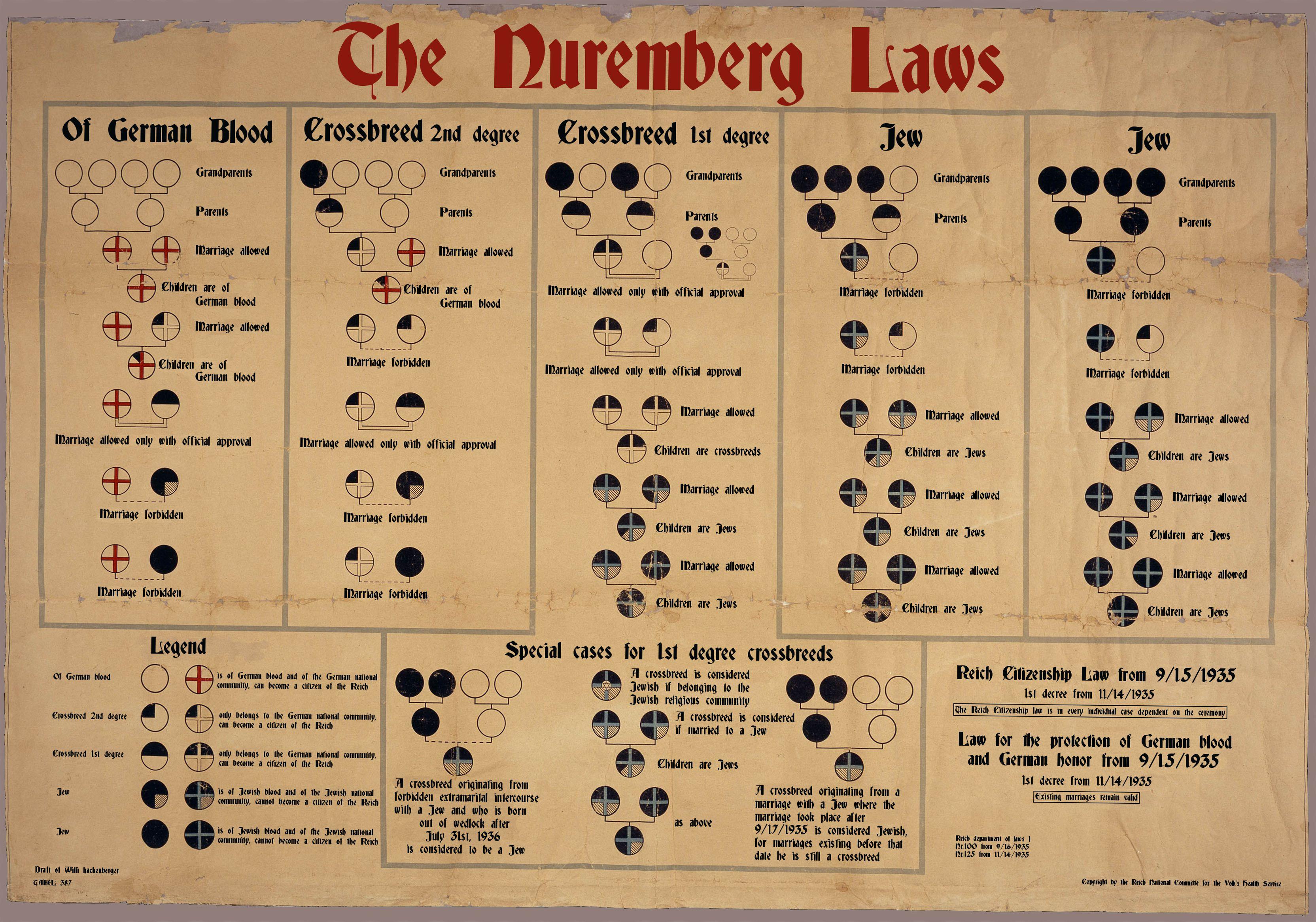
Nazi law-making systematically institutionalized the regime’s ideological goals. One of the most infamous sets of statutes were the Nuremberg Laws of 1935, which legally codified Nazi racial theories. These laws – the Reich Citizenship Law and the Law for the Protection of German Blood and Honor – “embodied many of the racial theories underpinning Nazi ideology” and provided “the legal framework for the systematic persecution of Jews in Germany.” (Nuremberg Race Laws).
They stripped German Jews of citizenship and forbade marriage or sexual relations between Jews and “Aryans,” among other restrictions. Passed unanimously by the rubber-stamp Reichstag (by then composed solely of Nazis), the Nuremberg Laws marked an intensification of legalized discrimination (Nuremberg Race Laws).
Over the following years, hundreds of additional decrees would further marginalize Jews –banning them from various professions, segregating them, and ultimately facilitating their deportation to ghettos and death camps during the Holocaust. Other laws targeted the regime’s
enemies: communists and socialists were criminalized; later, in wartime, even jokes about Hitler or defeats could be treated as treason.
The legal principle of nullum crimen sine lege (no crime without law) effectively vanished as the Nazis could always create new decrees to retroactively justify their actions. For example, after the “Night of the Long Knives” in 1934 – a purge in which Hitler had SA leader Ernst Röhm and other rivals extrajudicially executed – the regime passed a law legalizing those killings as necessary state self-defense. Legal statutes became a blunt instrument to enforce conformity: curfews and residency restrictions on Jews, compulsory membership in state youth or labor organizations, and so forth. 12
In summary, the rule of law in Nazi Germany was supplanted by the rule of Hitler. The judiciary and police became enforcers of the Führer’s will, and laws were enacted or discarded according Nazi Classification of Jewish People - worldhistory.org
to ideological objectives. Far from moderating the regime, the legal system was an enabler of its atrocities. It is telling that many elements of Nazi persecution were done “legally” – from the disenfranchisement of Jews to the euthanasia program (for which secret directives were given a legalistic cover). This complete perversion of legality shows how an authoritarian regime can weaponize law to suppress rights and legitimize repression.
Islamic Republic of Iran – Theocratic Law and Suppression of Dissent: In Iran, the postrevolution legal framework represents a fusion of theocratic principles with elements of modern state law, all subordinated to the supreme authority of the religious leadership. The Iranian constitution (ratified in 1979, amended 1989) declares Sharia (Islamic law) as the foundation: “All civic, penal, financial, economic, administrative, cultural, military, political, and other laws and regulations must be based on Islamic criteria.” (In the Name of Allah, Most Gracious, Most Merciful) (2015 Report on International Religious Freedom - Iran)
This means that conformity with Islamic jurisprudence (as interpreted by the Shi’a clergy) is the ultimate measure of a law’s validity. A Guardian Council of 12 jurists (half appointed by the Supreme Leader, half by the judiciary and approved by parliament) has the power to strike down any legislation it finds inconsistent with Islam or the constitution. In practice, this has meant that laws expanding civil liberties or rights can be quashed if deemed contrary to the regime’s interpretation of Islam. For instance, attempts to enhance women’s rights in family law, or to abolish the death penalty for juveniles, have been stymied by conservative jurists citing Sharia. The Iranian judiciary is headed by a cleric appointed by the Supreme Leader, and revolutionary ideals often guide its heavy-handed decisions.
The penal code of the Islamic Republic contains numerous provisions that criminalize dissent and religious deviation. As documented in international reports, the penal code specifies the death penalty for offenses such as “attempts by non-Muslims to convert Muslims” (apostasy/ proselytizing), “enmity against God” (moharebeh, often applied to armed opposition or even political protest deemed a threat), and “insulting the Prophet” (sabb al-nabi) (2015 Report on International Religious Freedom - Iran)
These charges are intentionally broad. Moharebeh, for example, has been used to sentence political dissidents, Kurdish activists, or anyone accused of violent resistance to the state, even if indirectly. Another frequently used charge is “efsad-e fel-arz” (spreading corruption on earth), which similarly can encompass a wide range of anti-regime activities. Such laws create a climate of legal uncertainty – critics never know if their actions might later be construed as capital offenses. Iran’s judicial system, especially the Revolutionary Courts, lacks transparency and due process protections.
Political trials often last only minutes, lawyers may be barred or intimidated, and evidence can be primarily coerced confessions. Under these conditions, the law serves not to protect citizens, but to justify the regime’s suppression. For example, after the 2009 protests, numerous protesters and journalists were tried en masse for moharebeh or conspiracy against the regime; some received death sentences, others long prison terms, based largely on fabricated evidence and forced confessions.
Additionally, Iran’s legal code enforces the regime’s ideological and moral doctrines on the populace. The constitution itself states that citizens’ rights are conditional upon conformity with Islamic criteria (2015 Report on International Religious Freedom - Iran), effectively allowing the state to deny fundamental rights (free speech, assembly, etc.) if exercising those rights is judged “un-Islamic.” Laws mandate the Islamic dress code for women (with penalties for “bad hijab”), segregation by sex in certain contexts, and adherence to Islamic codes of conduct.
The legal discrimination against women and religious minorities is significant: for instance, a woman’s testimony in court is worth half a man’s by law; Baha’is, a religious minority not recognized by the constitution, have no legal status and can be denied education or property rights; conversion from Islam (apostasy) is not explicitly codified as a crime but has been punished under the umbrella of religious law, sometimes by death. Such laws reflect the ideology of an Islamic state, just as Nazi laws reflected Aryan supremacist ideology. Both sets of laws curtail the rights of segments of the population (Jews under Nazi rule; women, Baha’is, sometimes Sunnis or others under the Islamic Republic) to enforce the ruling doctrine.
However, an important difference is that Iran’s regime does maintain formal legal processes and some avenues of redress (appeals, Supreme Court reviews, etc., though heavily stacked in the regime’s favor). There is a written constitution and a parliament that debates laws (albeit within limits). Nazi Germany, in contrast, operated largely on Führer decrees and extrajudicial orders especially as time went on (with the exception of civil and commercial law which continued in a routine way for ordinary matters). Despite this difference in form, in substance both regimes converted the law into an instrument of authoritarian control and ideological enforcement.
In Nazi Germany, legality became whatever served Nazi ends; in Iran, legality means whatever conforms to the leadership’s interpretation of Islam and revolutionary principles. Dissent is criminalized in legal terms in both: “treason” and “race defilement” in one; “blasphemy” and “sedition against God” in the other. The presence of draconian laws in Iran’s books serves to deter opposition – for instance, knowing that peaceful protest can be treated as baghi (armed rebellion) or moharebeh, punishable by death, has a chilling effect.
Iran’s recent use of the death penalty against protestors (executing a handful for alleged violence against Basij members in late 2022) showcases how the law can be wielded to terrorize would-be dissidents under a cloak of religious righteousness.
In both Nazi Germany and the Islamic Republic of Iran, the letter of the law is subordinate to the ideology of the state. Rule of law, in the liberal democratic sense, is absent – there is no independent judiciary protecting individual rights against the state. Instead, law and courts become one more weapon in the authoritarian arsenal, giving the repression a formal legitimacy. The Nazi judge Roland Freisler’s shouting trials and the Iranian Revolutionary Courts’ opaque verdicts are separated by culture and time, but both exemplify “show justice” serving dictatorship.
Economic Policies and Autarky
Nazi Germany – State-Directed Economy for Recovery and War: Economic policy in Nazi Germany was geared toward two primary objectives: recovery from the Great Depression to win popular support, and rapid rearmament to prepare for war and territorial expansion. When Hitler
assumed power in 1933, Germany’s economy was in dire straits with millions unemployed (over 30% unemployment).
The Nazi regime implemented large-scale public works and infrastructure projects, such as the construction of the Autobahn highway network, to stimulate employment. These “work-creation schemes were a primary source of investment immediately following the Nazi rise to power, in an attempt to reduce unemployment” (Economic policy). Indeed, within a few years, official unemployment fell dramatically (virtually reaching zero by 1939, though partly by removing women and Jews from the labor force and conscripting many young men).
Hjalmar Schacht, Hitler’s early economic minister and Reichsbank head, employed deficit spending and inventive credit programs (like MEFO bills) to finance this job expansion without alarming conservative business elites. Private companies benefited from government contracts for construction and later armaments; the Nazis, contrary to their socialist-sounding name, did not broadly nationalize industry but rather partnered with industrialists under a framework of state guidance. Workers, on the other hand, lost independent representation as unions were banned –the German Labor Front (DAF) under Robert Ley became the sole labor organization, which regulated wages and working conditions largely in the interest of the regime’s goals.
Starting in 1936, the emphasis shifted to preparing Germany for war. Hitler felt that war for Lebensraum was inevitable and thus pushed for autarky (economic self-sufficiency) and militaryindustrial buildup. He announced the Four Year Plan in 1936 with the ambitious aim that in four years Germany would be ready for war and economically self-reliant in critical sectors (Steps towards war: the role of Hermann Göring).
Hermann Göring was put in charge as Plenipotentiary of the Four Year Plan, reflecting the regime’s approach of placing Nazi officials in control of key economic levers. Under the plan, the government imposed tighter controls on imports and exports, developed synthetic substitutes for imports (like artificial rubber Buna and synthetic fuel from coal) to reduce dependence on foreign materials, and prioritized resource allocation to arms production. The Four Year Plan explicitly “aimed to re-orientate the German economy towards rearmament and preparing for war.”
Heavy industries (steel, chemicals, armaments) expanded rapidly, often with state incentives or directives. The Nazi economy became a war economy well before war broke out – by 1939, a vast portion of state spending was on the military. Though some consumer goods shortages emerged due to rearmament, the regime kept civilian morale reasonably content through propaganda and modest improvements for the average “Aryan” household (unemployment was solved; programs like Strength Through Joy offered leisure activities). When war began, plunder of occupied Europe further fed the German economy – forced labor from occupied territories and loot (food, raw materials, art, gold) were exploited to sustain both the military and the home front.
The ideological aspect of Nazi economic policy should not be overlooked. The Nazis eschewed the extremes of pure capitalism and Bolshevik socialism, instead advocating a “National Socialist” economy where private property existed but was subordinate to the interests of the Volk and Führer. They promoted the concept of a harmonious classless national community (Volksgemeinschaft) in the economic realm by subsidizing certain farming communities (especially “Aryan” farmers to keep them loyal and to maintain food production) and trying to bridge class divides with nationalist appeals. However, in practice, big business did well under Nazi rule by aligning with its goals, while politically or racially targeted groups lost property and economic position (e.g., Jewish businesses were Aryanized – transferred to non-Jewish ownership, often at fire-sale prices). Ultimately, Nazi economic intervention was successful in the short-term – Germany’s swift recovery from the Depression and its military resurgence were real, winning public support – but it was unsustainable and based on preparing for a war of conquest which, once lost, left the economy in ruins.
Islamic Republic of Iran – Theocratic State Control, Oil Economy, and Sanctions: Iran’s economy in the Islamic Republic era has been characterized by significant state involvement, a large hydrocarbon sector, and the heavy impact of external sanctions and war. In the immediate post-1979 period, many of the Shah’s policies were reversed or altered. Early revolutionary rhetoric included populist and quasi-socialist themes: wealth redistribution, helping the mustazafin (oppressed) classes, and reducing dependence on Western powers.
In practice, the new government nationalized numerous industries and banks (some of which were already state-owned under the Shah), and it confiscated property from the Shah’s family and
associates. A network of semi-state charitable foundations called Bonyads took control of a substantial portion of the economy, especially the assets seized from the old elite. Bonyads are ostensibly charitable trusts but have evolved into sprawling conglomerates – they “play a major role in Iran’s economy,” controlling an estimated 20% of Iran’s GDP, and are answerable only to the Supreme Leader Abrahamian, Ervand, History of Modern Iran, Columbia University Press, 2008, p.178.
These include entities like the Mostazafan Foundation (Foundation of the Oppressed) and Astan
Quds Razavi (which manages the Imam Reza shrine endowment) – they enjoy tax exemptions and often operate monopolies in their sectors (from agriculture to mining to retail). Rather than effectively aiding the poor, these Bonyads have been criticized for inefficiency and patronage, “channeling revenues to groups supporting the Islamic Republic”Millionaire mullahs by Paul Klebnikov, 7 July 2003, The Iranian
They form a parallel economy that undermines transparent competition and funnels resources to regime loyalists (often war veterans or clergy).
Another pillar of Iran’s economy is the Revolutionary Guard (IRGC). Over the last few decades, the IRGC has built a vast business empire encompassing construction (through its engineering arm Khatam-al Anbiya), oil and gas, telecommunications, automotive, and more. The IRGC and its Basij cooperative have been estimated by some experts to control as much as a quarter of Iran’s economy through various front companies and consortiums ifmat.org 2017-2021.state.gov
The IRGC’s economic clout not only funds its own operations (sidestepping budgetary oversight) but also gives it further leverage in politics. The U.S. Treasury has sanctioned several major Bonyads and IRGC-affiliated firms as part of its pressure campaign, noting that these supposedly charitable or revolutionary entities actually dominate lucrative sectors of the economy for the benefit of the ruling elite home.treasury.gov.
In summary, post-revolution Iran’s economy is a mixed system where revolutionary institutions (Bonyads, IRGC) and the government together control large swathes of resources, alongside a private sector that is often heavily regulated or connected to those power centers.
Oil has remained the lifeblood of Iran’s economy, as it was under the Shah. Iran has the world’s fourth-largest oil reserves and second-largest gas reserves. The oil industry was nationalized earlier (in the 1950s) and after 1979 it stayed under state ownership (National Iranian Oil Company). Oil revenues fund a significant portion of the government budget and are a key source of foreign currency. This dependency has made the economy prone to boom-and-bust cycles based on oil prices and vulnerable to sanctions targeting oil exports. The Iran–Iraq War in the 1980s devastated infrastructure and drained financial resources (Iran’s economy contracted and living standards fell sharply). Rationing and government control were extensive during the war (a command economy approach with coupon booklets for basic goods).
After the war, President Akbar Hashemi Rafsanjani (1989–1997) undertook some market reforms and reconstruction, encouraging foreign investment in oil and trying to liberalize trade. However, these efforts were limited by internal resistance and later by sanctions. Periods of reformist or moderate leadership have seen pushes for privatization and economic opening, while hardline periods emphasize self-sufficiency and resistance to globalization.
A consistent feature has been subsidies and populist economic measures to maintain the support of lower-income Iranians – for example, heavy subsidies on fuel, bread, and other essentials (though some subsidy reforms were attempted in 2010s due to budget strain). Unemployment and inflation have been persistent issues, partly due to mismanagement and corruption, but also due to international isolation. Western sanctions, especially those intensified from 2010 onward over Iran’s nuclear program, severely hampered Iran’s banking and oil sectors. In response, the Supreme Leader and hardliners touted a “Resistance Economy” doctrine, urging domestic production, diversification away from oil, and trade with non-Western partners to weather sanctions rethinkingiran.com aei.org
This is conceptually similar to Nazi autarky in that it promotes self-reliance under hostile external conditions, though Iran’s success in achieving it is debatable. Iran did expand certain industries domestically (e.g., a sizable steel and automotive industry, and a pharmaceutical sector) and cultivated trading partners like China and regional neighbors to circumvent sanctions. But corruption and the opaque influence of Bonyads/IRGC often stifle healthy economic growth, making Iran’s economy relatively stagnant in per capita terms over the long run.
Ideologically, the Islamic Republic’s constitution calls for an economy that is neither capitalist nor communist but Islamic, which in theory means an economy of social justice with an important role for the state and community welfare. In practice, Iran’s economy might be described as state corporatist – large parts run by state or quasi-state entities – with a veneer of market activity. While Nazi Germany’s economy achieved full employment and a form of industrial “miracle” (albeit unsustainable and war-oriented) britannica.com britannica.com,
Iran’s economic record is more mixed. It avoided complete collapse despite war and sanctions, and it improved education and infrastructure significantly since 1979, but it never fully delivered on revolutionary promises of prosperity for all. That said, both regimes saw the economy as subordinate to political goals. The Nazis subordinated the economy to preparation for war and racial objectives (e.g., excluding Jews from the economy).
The Iranian regime subordinates the economy to preserving the regime (e.g., ensuring key groups like the IRGC are economically vested in the system) and to resisting foreign pressure, even at the cost of efficiency. Both intervened heavily in markets and property rights when it suited state interests: the Nazis directed production quotas and price controls during the Four Year Plan; Iran’s government similarly can dictate currency exchange rates, suddenly ban certain imports to protect currency reserves, or seize property of those deemed “economic disruptors.”
In each case, economic policy serves the overarching strategy of regime survival and dominance – by delivering enough material benefit to key constituents and by gearing resources toward the regime’s defining projects (military build-up and expansion for Nazis; regional influence and ideological propagation for Iran).
Conclusion
Nazi Germany and the Islamic Republic of Iran stand as two distinct embodiments of authoritarian rule, separated by different eras, cultures, and ideologies – yet a comparative examination reveals convergent strategies in how such regimes seize and maintain power.
Both regimes emerged from periods of profound crisis and positioned themselves as the only solution to restore national pride and security: Hitler’s government arose from the ashes of
Weimar turmoil and promised to rebuild Germany and avenge the humiliation of WWI, while Khomeini’s Islamic Republic was born of revolution against a Western-backed dictator, vowing to restore Iran’s independence and Islamic identity.
Each then constructed an authoritarian state with centralized leadership (the Führer and the Rahbar each wielding supreme authority) and the suppression of dissent as a fundamental policy (through terror apparatuses like the Gestapo or the IRGC/Basij, mass arrests, and elimination of opposition).
Both used ideological propaganda extensively – be it Nazi ultra-nationalism and racial mythology or Iranian revolutionary Islamist discourse – disseminated via controlled media and education to mobilize support and justify regime policies. Militarization was another hallmark: Nazi Germany built an overpowering military and pursued outright expansionism leading to world war, whereas the Islamic Republic militarized internally and engaged in regional power projection and proxy conflicts in line with its revolutionary goals.
In the economic realm, both regimes embraced state intervention and economic control as means to an end: the Nazis directed the economy toward rearmament and autarky, dramatically reducing unemployment but ultimately bankrupting the state in war; Iran’s leaders likewise manage large sections of the economy through state and parastatal entities, using oil revenues and controlled markets to withstand sanctions and reward loyalists, albeit often at the expense of efficiency and broader prosperity.
Despite these similarities, the comparison also highlights important differences in scope and outcome. Nazi Germany was a totalitarian dictatorship of a distinctly fascist character, which in twelve years orchestrated industrialized genocide and global aggression, ultimately collapsing in total defeat. The Islamic Republic of Iran is a theocratic authoritarian regime that, while repressive and aggressive in its region, operates within a different international context and set of constraints – it has not embarked on direct wars of conquest beyond its borders, and it shows a degree of adaptiveness (holding periodic elections within a limited spectrum, for example) that Nazi Germany eschewed.
The Iranian regime’s longevity (over 44 years and counting) compared to the Third Reich’s short lifespan suggests it calibrates repression and legitimation in a way that has so far prevented
implosion or overthrow, whereas Nazi Germany’s unbridled aggression led to its destruction. The ideologies driving each also produce different policies (for instance, Iran’s laws are influenced by religious doctrine, yielding strict social moral codes, whereas Nazi law was racist, yielding overt racial persecution). Nonetheless, the governing strategies of concentrating power, eliminating pluralism, indoctrinating the populace, empowering a loyal security elite, and controlling economic levers are common authoritarian patterns exemplified by both.
From a scholarly perspective, studying Nazi Germany and the Islamic Republic of Iran side by side reinforces the insight that authoritarian and totalitarian systems, despite differing in ostensible purpose – one pursued racial utopia, the other claims divine mandate – often resort to analogous means to achieve absolute rule. In both cases, the promise of societal rebirth was coupled with the reality of state violence and curtailed freedoms.
The comparison underscores the fragile balance such regimes maintain: they rely on fear and coercion but also must cultivate some genuine belief in their legitimacy, whether through propaganda victories or appeals to faith and nationalism. Ultimately, Nazi Germany’s fate serves as a cautionary tale of how extreme authoritarianism can lead a nation into catastrophe. The Islamic Republic of Iran’s future remains uncertain; it continues to face internal dissent and external pressures.
What is clear is that the fundamental authoritarian mechanisms – centralized autocratic leadership, suppression of dissent, ideological propaganda, militarization, and economic intervention – have been crucial to both regimes’ ability to govern, revealing core attributes of authoritarian governance across different contexts.
By examining these parallel strategies, we gain a deeper understanding of how such governments operate and the conditions that enable or constrain them, an understanding that is vital for historians and political scientists analyzing the past and present of authoritarian rule.
References
American Enterprise Institute. (n.d.). IRAN’S ECONOMY RESISTANCE: IMPLICATIONS FOR FUTURE SANCTIONS. [online] Available at: https://www.aei.org/research-products/ report/irans-economy-resistance-implications-future-sanctions/ #:~:text=Sanctions%20www,term%2C%20including%20Western%20sanctions[Accessed 28 February 2025].
Britannica. (n.d.). Iranian Revolution. [online] Available at: https://www.britannica.com/event/ IranianRevolution#:~:text=The%201979%20revolution%2C%20which%20brought,exile%20in%20194 1%2C%20and%20his[Accessed 28 February 2025].
Britannica. (n.d.). Nazism: Totalitarianism and Expansionism – Part 1. [online] Available at: https://www.britannica.com/event/Nazism/Totalitarianism-andexpansionism#:~:text=The%20history%20of%20Nazism%20after,put%20to%20work%20in%20 extensive [Accessed 28 February 2025].
Britannica. (n.d.). Nazism: Totalitarianism and Expansionism – Part 2. [online] Available at: https://www.britannica.com/event/Nazism/Totalitarianism-andexpansionism#:~:text=of%20unemployed%20rapidly%20dwindled%20as,and%20foreign%20co nquests%20from%201934[Accessed 28 February 2025].
Britannica. (n.d.). Nazism: Totalitarianism and Expansionism – Part 3. [online] Available at: https://www.britannica.com/event/Nazism/Totalitarianism-andexpansionism#:~:text=continuous%20string%20of%20diplomatic%20successes,who%20had%20 previously%20opposed%20him[Accessed 28 February 2025].
Britannica. (n.d.). Supreme Leader of Iran. [online] Available at: https://www.britannica.com/ topic/supreme-leader-ofIran#:~:text=Supreme%20leader%20of%20Iran%20,government%20either%20directly%20or%2 0indirectly [Accessed 28 February 2025].
Central Intelligence Agency. (n.d.). Document CIA-RDP81B00401R000500100001-8. [online] Available at: https://www.cia.gov/readingroom/docs/CIA-RDP81B00401R000500100001-8.pdf [Accessed 28 February 2025].
Encyclopedia USHMM. (n.d.). The Nazi Party. [online] Available at: https:// encyclopedia.ushmm.org/content/en/article/the-nazi-party-1#:~:text= [Accessed 28 February 2025].
Encyclopedia USHMM. (n.d.). The Enabling Act. [online] Available at: https:// encyclopedia.ushmm.org/content/en/article/the-enablingact#:~:text=The%20Enabling%20Act%20allowed%20the,%E2%80%9D [Accessed 28 February 2025].
Encyclopedia USHMM. (n.d.). The Weimar Republic. [online] Available at: https:// encyclopedia.ushmm.org/content/en/article/the-weimarrepublic#:~:text=central%20Germany%20where%20the%20constitutional,was%20doomed%20fr om%20the%20start[Accessed 28 February 2025].
Encyclopedia USHMM. (n.d.). Foundations of the Nazi State. [online] Available at: https:// encyclopedia.ushmm.org/content/en/article/foundations-of-the-nazistate#:~:text=Following%20his%20appointment%20as%20chancellor,party%20Nazi%20dictator ship [Accessed 28 February 2025].
Encyclopedia USHMM. (n.d.). Nazi Propaganda and Censorship. [online] Available at: https:// encyclopedia.ushmm.org/content/en/article/nazi-propaganda-andcensorship#:~:text=The%20Nazis%20used%20propaganda%20to,the%20Nazis%20saw%20as% 20threatening[Accessed 28 February 2025].
Encyclopedia USHMM. (n.d.). German Resistance to Hitler. [online] Available at: https:// encyclopedia.ushmm.org/content/en/article/german-resistance-tohitler#:~:text=The%20government%20of%20Adolf%20Hitler,and%20institutions%20with%20N azi%20goals[Accessed 28 February 2025].
Imam Khomeini. (2014). Islamic Government. [online] Available at: http://staticsml.imamkhomeini.ir/en/File/NewsAttachment/2014/1358-IslamicGovernment.pdf [Accessed 28 February 2025].
Jewish Virtual Library. (2019). Report on Human Rights Practices for Iran. [online] Available at: https://www.jewishvirtuallibrary.org/report-on-human-rights-practices-for-2019iran#:~:text=The%20Islamic%20Republic%20of%20Iran,The [Accessed 28 February 2025].
Oxford Internet Institute. (2020). Covid-19 Misinfo Targeting French, German and Spanish Social Media Users. [online] Available at: https://demtech.oii.ox.ac.uk/wp-content/uploads/sites/ 12/2020/06/Covid-19-Misinfo-Targeting-French-German-and-Spanish-Social-Media-UsersFinal.pdf [Accessed 28 February 2025].
Refworld. (2016). U.S. State Department Report on International Religious Freedom in Iran. [online] Available at: https://www.refworld.org/reference/annualreport/usdos/2016/en/ 111697#:~:text=The%20constitution%20declares%20the%20country,five%20major%20Sunni%2 0schools%20be[Accessed 28 February 2025].
Rethinking Iran. (n.d.). Batmanghelidj: Reality of Iran’s Economic Response. [online] Available at: https://www.rethinkingiran.com/iran-sanctions-reports/ batmanghelidj#:~:text=Iran%20www,reality%20of%20Iran%27s%20economic%20response [Accessed 28 February 2025].
United Against Nuclear Iran. (n.d.). How Iran Exports its Ideology. [online] Available at: https://www.unitedagainstnucleariran.com/ideologicalexpansion#:~:text=How%20Iran%20Exports%20its%20Ideology,an%20effort%20to%20establis h [Accessed 28 February 2025].
United Against Nuclear Iran. (n.d.). Iranian Influence in Lebanon: Hezbollah Model. [online] Available at: https://www.unitedagainstnucleariran.com/ideological-expansion/iranian-influencelebanon-hezbollahmodel#:~:text=The%20preferred%20strategy%20employed%20by,dominance%20throughout%2 0the%20Middle%20East[Accessed 28 February 2025].
United Against Nuclear Iran. (n.d.). Iranian Influence in Lebanon: Hezbollah Model (Alternate). [online] Available at: https://www.unitedagainstnucleariran.com/ideologicalexpansion/iranian-influence-lebanon-hezbollahmodel#:~:text=Despite%20Hezbollah%E2%80%99s%20rhetorical%20goal%20of,Iranian%20re gime%20that%20has%20pledged[Accessed 28 February 2025].
USCIRF. (2022). Iran Propaganda Report. [online] Available at: https://www.uscirf.gov/sites/ default/files/2022-07/2022%20Iran%20Propaganda%20Report.pdf [Accessed 28 February 2025].
Wall Street Journal. (n.d.). [online] Available at: https://www.wsj.com/articles/ SB124562668777335653 [Accessed 28 February 2025].
The Holocaust Explained. (n.d.). Economic Policy in Nazi-Occupied Europe – Work Creation Schemes. [online] Available at: https://www.theholocaustexplained.org/life-in-nazi-occupiedeurope/economic-policy/#:~:text=Image: %20Work%20creation%20schemes%20were,as%20shown%20in%20this%20photograph[Access ed 28 February 2025].
The Holocaust Explained. (n.d.). Economic Policy in Nazi-Occupied Europe – Hitler’s Memorandum and the Four Year Plan. [online] Available at: https:// www.theholocaustexplained.org/life-in-nazi-occupied-europe/economic-policy/ #:~:text=Hitler%E2%80%99s%20memorandum%20formed%20the%20basis,the%20Four%20Ye ar%20Plan,%20with[Accessed 28 February 2025].