Private Jewish day school is now shockingly affordable.
Families making up to $350k are eligible.
See how affordable it is samisfoundation.org/jewish-day-school-affordability-seattle/
CONTENTS
May 2026
In Every Issue Play List 30
Local Resources
Schools + Preschools 10
Camps + Activities 19
Parenting
EDUCATION
Tips to Find the Right
Preschool 10
It may seem early, but now is the right time to start looking for the perfect fit
HEALTH + WELLNESS
Supporting Kids With End-of-School Anxiety 15
Ideas for smoothly ushering your children through the transition to summer
CAMPS + ACTIVITIES
Backyard Science
Supply Checklist 22
Grab these supplies so you can set up crazy cool outdoor experiments in no time
RAISING GREAT KIDS
So Your Kid Wants to Write a Book? 23
A local tween novelist (and her dad) share tips for getting published
Features
Joy Hacks for Parents 6
Say sayonara to parenting stress and embrace the fun again
COMMUNITY
On Raising MVPs 12
Local mom and women’s soccer coach Stephanie Cox talks achievement, athletics and motherhood
Walk This Way 18
Meet a group of women who are reimagining the way moms find community
Family Fun
OUT + ABOUT An ‘Exquisite’ Opening 27
Put this uniquely interesting look at animal and marine life on your list of spots to take the kids
May Play List 30
Supersweet ways to spend time as a family, flowers and all
Photo by Jane Gershovich / JaneG. Photography
Cover photo of University of Puget Sound women’s soccer team head coach Stephanie Cox and her daughters (l to r) Kaylee and Grace. Photo by Jane Gershovich / JaneG. Photography
Photo by Meredith Charaba
Moms, You Deserve a Gold Medal
With the FIFA World Cup 2026 games making their way to Seattle this summer and Mother’s Day landing squarely in the middle of the month, I couldn’t think of anyone more uniquely qualified to tie these two seemingly disparate strands into a neat little bow than South Sound mom and soccer star Stephanie Cox. I was honored to have the opportunity to sit down with her and talk mom to mom about — what else — motherhood. It was a total thrill for me because while I often get to gab about mom life, it’s not every day I get to swap parenting war stories with an Olympic gold medalist and former Seattle Reign player. But that day, I did.
Despite technical difficulties, Stephanie and I were able to find more than a few minutes to talk about her notable career as a professional athlete, and as the head coach of the women’s soccer team at the University of Puget Sound. Turns out we’re both raising daughters who are keeping us busy running from one practice to another, continually cheering on their accomplishments from the sidelines, and feeling their losses right alongside them, too.
I don’t know about you, but I always find it reassuring to connect with other moms who are in the thick of it, who “get it.” Because being a mom — well, it’s a lot. At the risk of plagiarizing an all-too-relatable movie title — it’s everything, everywhere, all at once. And it often goes unnoticed.
But, if ever there is a time the strenuous, challenging and infinitely rewarding work of motherhood is noticed, celebrated and elevated, it’s Mother’s Day. The day those handmade cards delivered with a kid-prepared breakfast in bed make the endless loads of laundry, late-night homework help sessions, driving duties, birthday party planning, appointment scheduling, clothes and shoes shopping, bedtime reading, question answering, mystery illness diagnosing, playdate coordinating, activity scheduling, cooking, cleaning — you get the picture — worth it. Because we do what we do for our kids. And what we do is exceptionally important and worthy of recognition.
At ParentMap, we get it. We intimately understand how much you carry every day, moms. For that and more, you all deserve a gold medal.
DIRECTOR OF COMMUNITY PARTNERSHIPS + ADVERTISING SALES
Jessica Collet
DIRECTOR OF STRATEGIC PARTNERSHIP SALES
Stephanie Kakon
SENIOR ADVERTISING AND PARTNERSHIPS MANAGER
Ida Wicklund
EVENTS + COMMUNITY
PARTNERSHIPS SPECIALIST
Brenna McCown
ADVERTISING CLIENT SERVICES MANAGER
Mallory Dehbod
CLIENT SERVICES ADMINISTRATIVE ASSISTANT
Bronwyn Jones
DIGITAL ADVERTISING + MARKETING SPECIALIST
Taryn Weiner
PRODUCTION COORDINATOR
Tamryn Nell
ART + PRODUCTION
SENIOR DESIGNER
Amy Chinn
ADMINISTRATION
BUSINESS MANAGER
Carolyn Brendel
OPERATIONS ASSISTANT
Erika Widjaja
CONTACT INFORMATION
Advertising information 206-709-9026 or advertising@parentmap.com Fax 206-709-9031
Who is your favorite fictional mom?
Lorelai Gilmore, “Gilmore Girls”
Chilli Heeler, “Bluey”
Joyce Byers, “Stranger Things”
Clair Huxtable, “The Cosby Show”
Marmee, “Little Women”
Calendar submissions calendar@parentmap.com
Editorial submissions editor@parentmap.com
Distribution distribution@parentmap.com
Joy
Hacks
By Tonya Strickland
Puget Sound parents share ways they add sparkle to their busy days
When it comes to reclaiming little pockets of joy while surviving the day in and day out of parenting, I can’t help but lean into one of the most relatable things I’ve heard in the last decade.
Ten years ago, when I had a 3-yearold and a newborn, my friend Liz and I
were commiserating about the way our days were suddenly measured in child snack intervals and nap schedules. It was the type of conversation where venting felt good but grasping for solutions seemed futile. But then Liz recalled something a gal pal once told her.
Apparently, this woman (who I will forever call Queen of All Moms Everywhere) told Liz that just a few swipes of iridescent eye shadow was her new favorite thing — so she could get a little sparkle back in her life.
Let that sink in.
Doesn’t it just … resonate? It’s so relatable. Soon, new ideas spilled into our Debbie Downer talks as Liz and I — inspired by her sparkly friend — started to find ways to bring the joy back.
These are some of the ideas we talked about.
Secret earbuds
Liz shared that she often listened to podcast documentaries with one earbud in and one out while washing dishes. That way, she could sneak some “grown-up talk” into her afternoon while still hearing her young kids in the living room. Her podcast sesh was a small reprieve from the same old at-home routine (and a chance to not hear the “Blaze and the Monster
Machines” theme song for the billionth time). Clearly, Liz and her sparkly friend were on the path to discovering the secret of life.
Parked-car mini retreat
I’m not really a podcast person, but I did enjoy sitting in our silent vehicle when the kids fell asleep in the back seat.
There’s just something about the buffer of a parked car’s interior that shields you from reality for a bit, invites you to scroll your phone, lets you finish that last song, do absolutely nothing but sit and watch the birds or get lost in thoughts that are actually yours. This still works for me today now that the kids are ages 12 and 10, and while they don’t nap (ha), I feel fine letting them bolt from the car and into the house solo while I hang back for 10 minutes.
Predinner dance
Circa 2016, when my kids were 3 and 1, I’d often turn up the music on Alexa and dance around our round living room rug. We’re not even really that into dancing around here, but for some reason that round rug served as our mini dance floor and it just worked. Back then, the two songs we played were almost always anything by Justin Timberlake and Anna Kendrick on the “Trolls” soundtrack; and “HandClap” by Fitz and The Tantrums.
Taking the wild road
This one isn’t a metaphor. Back when we lived in California, I’d quite literally seek out a specific backroad in town to avoid the freeway while heading to Trader Joe’s. It wasn’t a scary, windy road, but a pass that sported some pretty awesome dips and inclines that were just plain ol’ fun to drive over, ideally with all the windows down and
the music on. One of the best little joys around. Never too fast though, be safe out there.
Sanity walks
In a past life, I had a pretty sweet Instagram audience who I’d vent to on solo chats after my husband Bowen got off work. But only if I forced myself out the door for what I called a “sanity walk.” It was a 2-mile loop around the neighborhood to clear my head from the day’s relentless parenting stuff and get some endorphins … or something. I never actually wanted to go. (My Instagram friends would always laugh at me for this.) But goshdarnit, those sanity walks helped me feel better every single time.
Mail runs
Both houses we’ve lived in as parents have had those corner cluster mailboxes, so grabbing the mail always turns into a mini outing. Back in the day, I’d also share our “Mail Runs!” on Instagram. Which would usually be the kids running up the hill, sometimes barefoot, sometimes in diapers, always making me laugh a few paces behind them. Ten years later, we still do it (minus the diapers). Except now they run after we come home from a drive. I pull up to the boxes, the kids hop out, grab the mail, throw it into the window I rolled down and then dash home while I drive the car. It’s still their little wild-andfree moment and honestly, the perfect reset between the car ride and whatever comes next on a school night.
What other parents have to say
Here are some ideas other Puget Sound parents shared for their small, relatable and easy-to-try joy hacks. (Spoiler: Quick solo walks appear to be the key to happiness.)
continued from page 7 FEATURE JOY HACKS
The micro date with each kid One parent spends 10 to 15 minutes alone with each child. Kids feel seen, and parents get to hear more about their day without it feeling like they’re losing a game of 20 Questions.
Heather Blacketer of Seattle says finding one-on-one time with each of her three kids has brought a new kind of joy into their routine, especially as her kids get older. She shared that her eldest son recently initiated a nightly check-in where he opens up about his day. “It’s totally driven by him and the conversation is so much better than whatever I get from him after he gets home and I ask him how his day went,” she says. “He just started talking one day. So I very quickly put everything else aside, phone down, and said, ‘I would love to hear about your day, honey.’”
Awww.
The 5-minute rule
State Park while her kids are at school.
Another South Sound mom, Lucy Dishman, says she turns a playground sesh into a combo outing at one of the regional parks with a sports complex: “Snack Shack lunch, play at the park and walk the trails!”
Ruth MacIntyre from Gig Harbor also enjoys walks on a good public trail, often with a dog (or two), she says, adding her appreciation that “we live in such a beautiful place” here in Washington state.
Small treats, local spots and mini escapes
No, this isn’t the distant cousin of the 3-second rule on whether floor snacks are still fair game. (We’ve all been there.) The 5-minute rule is less about what you salvage, and more about what you add back in. It’s to show that parents don’t need a whole weekend away or a perfectly planned self-care routine to get a reset.
Shanon Kearney Lessard, a Gig Harbor mother of two boys and “one very active dog,” says she walks at parks because it “brings me joy especially when the trees and flowers are blooming or the sun is shining.”
South Sound mom Laura Doepker appreciates a good fresh air fix with a solo hike through Gig Harbor’s Kopachuck
Savoring where we live (even in the chaos)
A recurring theme is slowing down just enough to notice the views. The point isn’t the activity. It’s the pause. A tiny, intentional break from the constant doing, reminding, packing, wiping, answering. A moment of not just managing life … but just being in it.
Gig Harbor mom Kimberly Ann finds her moments of joy in “savoring how the light reflects on the water, the boats, the trees — the view whenever driving across the bridges and remembering to feel grateful to live in such a beautiful place,” she says. “Even if hurrying to get back for kids’ sports practice.”
Serrah Petermann-Linares, a Gig Harbor mom of three, says little indulgences close to home can often feel like a reset button. Bonus points for her specificity: She personally recommends the Bourbon Caramel Macchiato from Cutters Point Coffee. She also says, “a walk downtown along the harbor, savoring Gig Harbor Toffee, coffee or lunch with a friend, and spending time to dock the boat at the Tides Tavern or Anthony’s” on Gig Harbor’s downtown waterfront are great joys.
Seattle mom Heather Blacketer shared the super relatable momof-three life hack of keeping an occasional secret candy stash to stay sane. But she also loves a good mental reset for the whole family by “doing something that requires getting out of the house … this is easy when the weather is nice — we can get outside to our neighborhood … bike ride or walk. When the weather stinks we’ll sometimes try indoor stuff, like a children’s museum or an indoor activity gym.”
Micro “me time” moments
Small moments matter. Because sometimes five minutes is all you’ve got.
Heather returns here to laugh at the idea of getting any long-term “me time” to speak of, but relishes in wearing earbuds to catch a quick podcast — and she also swears by solo walks. (She’s basically a Tonya-Liz combo.)
Middle school mom Frances Condit Hoffman of Gig Harbor says “one of my tiny joys I try to do a couple times a year is going to Harbor History Museum by myself (or with my spouse on a date).” While she enjoys bringing her two kids there (amid their busy school and baseball schedule), she makes the effort to return solo so she doesn’t feel rushed through the exhibits. “I just love to wander through with nobody else impacting my time and attention.”
Boundaries: The weekend edition
Reclaim your weekends by lowering expectations. Instead of packing weekends with sports and errands, families commit to just one planned thing. The rest of the day stays open. Protecting joy sometimes looks like not adding more.
Think:
• Less rushing
• More spontaneous fun
• Less burnout
• Fewer expectations
Heather shares one more hack: Be intentional about the weekend hours. “We are thoughtful about trying not to over schedule extra stuff,” she says. “Kids have activities and sports that we need to work around. Then there’s life management chores/errands we need to do. We will then plan more stuff but will say no to other stuff if it starts to feel like too much.”
In the end
All in all, you start to see the pattern. Most of these joy hacks aren’t big, sweeping life changes. They’re simple, relatable (and repeatable) moments. A walk outside. Noticing the view on a drive you’ve done a hundred times. Saying no when the schedule starts to feel like too much. Letting connection with your kids happen naturally instead of forcing it. Remember to treat yourself with a nice coffee or a candy stash. Joy hacks are not just about getting away or recapturing your pre-kid days — they’re about building little moments you can come back to again and again. ■
Tonya Strickland is a longtime journalist and momof-two who shares pictures, tips and stories about places to take kids.
We get you coverage with free and low cost Apple Health and Marketplace insurance to fit your family’s needs.
So you can focus on what matters. Soyoucaocusoatattes.
Your Family’s Next Art Adventure Starts Here.
7 Simple Tips for Finding the Perfect Preschool (And Why Now Is the Time to Look!)
By Rebecca Hastings
We were running errands when one of my teenagers shouted and pointed, “Look! It’s our old preschool!” Soon, my other two teens were chiming in, “I loved it there!”
It made me happy that my kids remembered their days there as fondly as I did. Finding a preschool may seem stressful, but when you focus on the right things, you can find the perfect place for you and your kids.
Why now is the time to look While it may seem early, now is the perfect time to look for the best preschool for your family. Schools are still in session, so you can visit and see things in action. This allows you to see class sizes, how teachers interact with students and the way the school operates on a daily basis.
Parents are often surprised at how early preschool slots fill up. If you want to avoid falling in love with a school just to be put on a waitlist, now is the time to explore your options.
1/ Talk to kids. At the park, at the library, at your friend’s house. Find out what the kids loved doing on a given day or their
• Parent Partnership program
• In-person Monday and Tuesday (drop-o )
• At home Wednesday, Thursday and Friday
• Videos for at home subjects
• Art, music, and drama included Enroll now! KardiaClassical.org
favorite thing about preschool. Ask to see their latest project. You can learn a lot from kids if you pay attention.
2/ Talk to parents. See what schools they love and why. Find out if they are friends with other families there. Ask about the teachers who make it great. The most important thing is to talk to real people. Don’t rely on social media for accurate information.
3/ Consider the schedule. Does the school have a schedule that works for your family? There are schools with two-day-a-week programs and schools that meet five days a week. Some meet for two hours while others meet for the whole day. Think about what you and your child would benefit from.
4/ Ask about educational philosophy. Every school has a unique approach. Some schools focus heavily on academics, while others focus on social skills. Some schools stress nature-based learning while others focus on the arts. Don’t get caught up in what these approaches are called, but think about your child and how their interests line up with what the school offers.
5/ Talk money. Consider tuition costs as well as extras like fundraisers, field trips and parties. Be bold about asking these questions before you choose a school, so you are not stressed later about unexpected expenses. Finding a school that your family can afford will create a less stressful environment for you and your child.
6/ Find out about parent involvement. Ask how much parents are expected to be involved and make sure it is something you are comfortable with. Some schools ask parents to volunteer regularly during the school day, while others only invite parents for holiday and yearend programs. Extras like fundraising or events can also be a requirement. Find out what is expected so you know if you can participate at that level.
7/ Ask to observe. See if there is a good time for you and your child to visit during the school day. Watching the school in action is one of the best ways to discover if it will be a good fit. Chat with some parents at drop-off or pickup. Observe the kids as they work together. All of it fits together to create the atmosphere where your child will learn.
Finding the perfect preschool doesn’t have to be stressful. Be realistic about your family’s needs and how they match up with the school. With these simple tips, you can discover a learning environment that will be perfect for your child. ■
Rebecca Hastings is a former teacher who is passionate about faith and family.
Community Profile
Raising MVPs
The University of Puget Sound women’s soccer team head coach, Stephanie Cox, shares her winning parenting playbook
By Allison Sutcliffe
There’s a reason so many of us invoke sports metaphors when we talk about parenting. Newly minted parents are rookies. Couples play man-to-man defense when taking their kids out — well, pretty much anywhere in public — and they move to a zone defense when they’re outnumbered. And who among us hasn’t chided “get your head in the game” when facing down a rambunctious group of post-birthday cake toddlers at a bouncy house party? Certainly not me.
It’s not so much that parenting is a sport, but rather much of what goes on in sports also applies to parenting. Who better to excavate these connections and help us unearth valuable lessons she derived from years of playing professional soccer in Puget Sound than parent Stephanie Cox.
Cox grew up playing soccer in Elk Grove, California before her exceptional skills landed her a spot on the Youth National Teams and eventually earned her a scholarship to the University of Portland. She has represented the U.S. at the Women’s World Cup in 2007, won an Olympic gold medal in 2008, and has twice played for the Seattle Reign in 2013–15 and 2019–21. These days, she coaches the women’s soccer team at the University of Puget Sound in Tacoma, and, like so many of us, spends her weekends cheering on her two daughters, ages 10 and 13, on the field and on the court, alongside her husband, Brian.
I had the chance to sit down with Cox to talk sports, achievement and parenting. Here’s what she shared:
ParentMap: What lessons from your time as an elite athlete apply to being a parent? And how has your history with sports shaped the way you parent your daughters?
Stephanie Cox: Parenting is hard work and also very humbling, and there are a lot of lessons that translate from being an elite athlete into parenting. One of the things that I tell my players now as a college coach is to focus on the things that they can control, but be aware of the things that they can influence. They can’t control the referee or the opponent or the weather. While they cannot control their teammate, they can influence them by their communication and encouragement.
As parents we cannot control our kids but we can influence them. Our response to them should be level, like an athlete, not too high or not too low, so that they can gain stability from us while they are trying to manage their own emotions. We can influence them by how we give them structure and model discipline, as well as how we respond to our own adversity in our lives.
During a high intensity game, you have to be flexible and adaptable, ready to shift to take advantage of the moment. I think that this mentality has made me
a better parent as I am able to adjust to varying demands and stay present so that I can support my kids and my family in the best way possible.
PM: Intense pressure to perform on the field is part of being a pro athlete. How has that experience influenced the way you approach navigating things like stress, competition or disappointment with your daughters?
SC: I have had loss at the highest level with my team, losing in penalty kicks to Japan in the 2011 Women’s World Cup. And while this loss was heartbreaking, I was able to come away from it and realize that there was so much to be proud of and put it in perspective because it is not life and death.
With these high-level moments, I am able to put my own daughters’ wins and losses in perspective as well. Their losses are moments for them to reflect and take pride in their effort while also motivating them to work harder or adjust things so that they can try for a different result the next time. I see sports as a safe space for them to experience failure and disappointment so they can develop resilience and grit in their character.
PM: How do you protect them from similar pressures and/or encourage balance in your kids’ lives?
Photo courtesy pugetsound.edu
SC: I look back on my childhood and see that I made a lot of sacrifices in my pursuit of soccer. We didn’t have many extended family vacations and I didn’t have many hobbies outside of sports.
Now, as a mom, I have tried to provide an environment that supports other interests like baking and cooking together, or other physical activities like skiing and pickleball. We’re fortunate to spend a lot of time together, and we’re especially enjoying this new phase, where our trips revolve around my daughter’s soccer tournaments. We are also fortunate that we can take a lot of time together, but also are enjoying this new phase where our trips are centered around soccer and my daughter’s tournaments. I am always mindful of balance as I want to be conscious of burnout. But I also understand that in order to develop a specific skillset or sport, commitment, discipline and sacrificing other opportunities will probably be necessary.
PM: Risk-taking is often required for achieving notable athletic success. How do you decide when to encourage your daughters to take risks versus when to pull back?
SC: I think that parenting is very individual, and I have two very different daughters that my husband and I try to support in different ways. My youngest daughter needs to be encouraged a bit more to pursue risky things and environments that stretch her. I look for opportunities that let her play with friends and a familiar coach, helping create a sense of safety so the sport is the only thing pushing her out of her comfort zone. For example, she doesn’t always want to run cross country for her school, but this is something that her dad and I have realized is good for her to push through.
My older daughter is always looking to put herself out there, so sometimes I choose to temper her enthusiasm and
paint a bigger picture. We just missed one of her soccer games for a family trip down to Palm Springs. We were all disappointed because we thought she was going to be able to do both, but then the game day changed and she couldn’t make it. It was hard for her to miss, but I knew that it was important for her to come with us, and that in the larger scheme one game
was not catastrophic. I hope these intentional breaks will keep her passionate about pursuing growth as a young soccer player just as much as a pro needs a recovery day for their body and mind.
I did drive her to eastern Washington on Labor Day for one game since she missed the rest of the tournament
Stephanie Cox and her daughters (l to r) Grace and Kaylee
Photo by Jane Gershovich / JaneG. Photography
continued from page 13 COMMUNITY
while she was on the road with my college team in Texas. So it definitely is moment-by-moment and taking advantage of the time that we have together!
PM: What advice do you have for parents who are raising kids in today’s competitive sports environment?
SC: Youth sports can be very intense and parents are a huge part of this environment. I think that it is important to be reflective and remind yourself what your goal and intention is with your child’s time on the field or court. Before our kids get out of the car for a practice or a game, we always tell them to work hard, be a good teammate and have fun. These values direct our conversations on the way home as well: Where were they encouraging, how was their work rate and effort,
and did they enjoy themselves.
If your goal is character building and creating memories, then there are so many opportunities for that. If your goal as a parent is a college scholarship and pro dreams, that may be harder to control, and can put a lot of pressure on your child and on your experience together.
PM: Any final thoughts for parents?
SC: Parenting is a hard thing and I am sure that my husband and I get it wrong sometimes, but we hope to approach each stage of parenting with humility and unity so that we can support our daughters in the best way possible! ■
Allison
Sutcliffe is ParentMap’s managing editor.
Favorite Puget Sound family activity: Walking the harbor in our hometown.
Favorite place to grab a bite with your kids: We love going down to Netshed for brunch or Iscreamery for a cone!
Favorite Washington vacation destination: We are lucky to have a family cabin out on Mason Lake where we can soak up the summer sun!
What you love about raising kids in Puget Sound: I love this community where we know that other adults and families are cheering our kids along in their journey.
Wellness
Recognizing and Responding to Kids’ End-Of-School Anxiety
A Seattle Children’s psychologist explains why summer’s arrival isn’t always as joyful as it seems
By Kellie Schmitt
For children, times of transition and changes in routine can prompt anxiety — even when the change represents something as seemingly joyful as summer break.
These pre-summer jitters can impact children and parents alike as they face uncertainty about the months ahead. Previously structured schedules may fluctuate with a different camp every week. As they face summer uncertainties, students are swarmed with end-of-the-year projects, final grades, assemblies and goodbyes. Plus, a nagging question might disrupt the fun of the final stretch: What will happen to my friendships over the summer?
Sponsored by At Seattle Children’s we provide hope, care and cures to help every child live the healthiest and most fulfilling life possible.
Together, we deliver superior patient care, advance new discoveries and treatments through pediatric research and serve as the pediatric and adolescent academic medical center for Washington, Alaska, Montana and Idaho — the largest region of any children’s hospital in the country. May is Mental Health Awareness
More resources from Seattle Children’s at ParentMap.com/MHM
“Changes can increase anxiety,” explains psychologist Dr. Kalina Babeva, the codirector of Seattle Children’s Mood and Anxiety program. “There are certainly reasons to be nervous at the end of the school year.”
Understanding anxiety’s alarm
End-of-school anxiety can show up in a variety of ways depending on the child, the age and the intensity of the feelings.
Some children might try to avoid the situations triggering those strong feelings — including school itself — while others might go into overdrive with perfectionism. Safety behaviors might arise, too, like needing a parent to be nearby. Physical symptoms can appear, ranging from sweating and increased heart rate to dizziness and stomachaches.
For all children, communication and discussions around anxiety are key. Using kid-friendly language can normalize the experience. For example, you might explain that anxiety is a universal human emotion that people experience in response to real or imagined threats. Sometimes, though, the alarm becomes too sensitive, much like a smoke detector going off without a fire.
“Tell your kids that anxiety is natural — it’s the same as feeling scared,
nervous or worried,” Babeva says. “Anxiety helped our ancestors stay safe when encountering a predator (e.g., a lion) and they had to run or fight to stay alive. In current times, there are fewer physical threats to our safety, but our bodies might still react like we are encountering a lion. We, thus, want to work on recognizing and treating anxieties that are out-of-proportion to the situation. ”
Spotting end-of-year stress
Even though the incidence of anxiety disorders has risen significantly over the past decade — and anxiety disorders now affect up to 30 percent of adolescents — they are often underrecognized, according to the American Academy of Pediatrics.
Identifying the symptoms of anxiety can be tricky since they vary and children do not always verbalize their worries. For some children, the endof-year stress might lead to bigger emotional responses to things that don’t normally upset them. They might struggle to fall asleep, have a harder time sustaining attention or experience appetite changes. Others might say they feel sick and ask to stay home from school since spending time with parents can be comforting.
If your child does not have an acute
from page 15
illness, though, it’s important to respect their school routine, Babeva advised. That might mean encouraging them to go to school even if they’re not feeling their best. Emphasize they can do hard things and consider small rewards such as a post-school preferred treat.
“We acknowledge something is hard, and we express that they can handle it,” she says.
An older child experiencing endof-school-year anxiety may focus obsessively on homework as a way of overcompensating and coping with uncertainty. This habit raises concerns if it’s crowding out other things they want or need to do such as socializing or sleep. If that’s the case, parents can work with teachers to find out how long assignments should take and set limits on schoolwork time.
For all children, sticking to consistent routines can help ease transitions. Even if daytime schedules shift during the summer, parents can ensure predictable mealtimes, bedtimes, family activities and exercise.
“Being consistent at home can alleviate some of the other anxieties,” Babeva says.
If anxiety symptoms persist beyond a few days and disrupt a child’s life — including their school attendance — it may be time to seek professional support, she advised.
Use anxiety to boost resilience
As parents, it’s tempting to want a child’s problems — in this case, anxiety — to vanish.
“When our child is feeling nervous or distressed, we really want to alleviate the discomfort and help them escape situations that make them feel nervous,” she says.
But excess accommodation isn’t the best approach. Take the example of a
child who is fearful of having a babysitter come for a parent’s evening out. Staying home in response to a child’s anxieties strengthens the sense that the fear is valid. Likewise, avoiding school or summer activities due to worry poses a setback to a child’s long-term development.
“That tends to reinforce the anxiety over time,” Babeva says. “Instead, we recommend facing fears in a developmentally appropriate way.”
If a child fears a new summer camp, that might mean visiting the location in advance and walking through what the day might bring, instead of calling in the grandparents and scrapping the plan altogether. Parents might also coordinate with a child’s friends to ensure there is a friendly face at the camp. These steps can make anxiety feel more manageable.
“The goal isn’t to completely get rid of anxiety,” she says. “It is to build our children’s self-efficacy or belief that they can manage hard things.”
That approach reflects a broader mindset shift when it comes to anxiety: Don’t be afraid of it. Reducing or eliminating situations that provoke anxiety for children is not a recipe for long-term success, she emphasized.
Parents can also help by sharing stories from their own lives, describing how they coped with fears in a healthy way. Giving children the tools to address, rather than avoid, anxiety will offer lifelong benefits.
“We’re trying to build fear tolerance and resilience,” she says. “That is what will help our children thrive in the long term.”
Avoid these anxiety-related parenting traps
• Rescuing: Don’t save a child from doing the thing that’s spurring their anxiety if it is actually not dangerous. (e.g.,
ordering for themselves at a restaurant)
• Excessive assurance: Don’t tell a child repeatedly that they are okay or that something bad won’t happen. (e.g., “You will never get a bad grade.”)
• Overprotecting: Don’t go overboard to prevent a child’s distress.
• Teasing: Don’t make fun of a child for experiencing anxiety. (e.g., “It’s so silly to be afraid of those little bugs.”)
Source: Seattle Children’s
Practice these strategies for facing fears
• Expect anxiety as part of learning
• Start with small, easy steps
• Validate your child’s experience
• Encourage with confidence
• Ask your child about successes
• Reward brave behavior
• Share your own experiences of facing fears
• Manage your own distress
• Keep practicing
Source: Seattle Children’s
Additional resources
• Anxiety in Children and Teens
• Seattle Children’s Mental health resource hub
• Psychiatric Urgent Care
• Youth Mental Health First Aid Class ■
Kellie Schmitt is an award-winning health reporter based in Edmonds, Washington. She covers health policy, public health and children’s health for a variety of publications including the Johns Hopkins University Public Health Magazine and USC’s Center for Health Journalism.
When do you need to treat a fever?
What are good rules for screen time?
What is positive parenting?
Parent since TRUSTED
When do you turn a car seat forward-facing?
Parenting doesn’t come with a manual—just a million questions that change as your child grows. Seattle Children’s is here with expert guidance you can trust and return to—again and again—with real answers for everyday parenting. From first steps to first heartbreaks, we got you.
Trust the Best
Community
The Quiet Movement Changing How Moms Find Community
By Kristen Russell
Every week, somewhere in Tacoma, a group of mothers meet for a simple ritual: a walk. No sign-ups, no dues, no expectations. Strollers roll alongside baby carriers. Conversations start easily and pause often for feedings, snacks, a fussy toddler or a much-needed break. For the women who show up, these walks are about more than exercise. They’re a lifeline.
In Tacoma, a growing chapter of The Mom Walk Collective is tapping into something many mothers feel acutely but rarely articulate: how isolating modern motherhood can be, and how hungry moms and other caregivers are for low-pressure, real-life connection.
A quiet crisis of isolation
Motherhood has always been demanding, but for many parents today it is also profoundly lonely. In 2023, then U.S. Surgeon General Vivek Murthy warned that loneliness had reached the level of a public-health crisis. Research suggests parents are feeling that strain acutely: In a 2024 Ohio State University survey, about twothirds of U.S. parents said the demands
of parenthood sometimes or frequently feel isolating. A recent literature review found that about 1 in 3 new parents reported always or often feeling lonely during pregnancy and the first five years of parenthood. Research consistently shows higher rates of loneliness, anxiety and depression during the postpartum period, especially when social support is limited.
For generations, extended family networks, neighbors and informal caregiving circles helped buffer those early years of parenting. Today, those structures are often fragmented by geography, work schedules and the rising cost of living. Many parents find themselves raising children far from family, juggling the logistics of dual incomes or navigating caregiving largely on their own.
These days, isolation isn’t personal, it’s structural, shaped by systems that leave little room for community.
A simple antidote to loneliness
The Mom Walk Collective grew out of that need. What began as a grassroots idea has expanded into a network
of more than 300,000 moms across 350-plus cities, primarily in the U.S. and Canada — all organized around the same low-pressure premise: walking together, regularly. While the focus is on connecting mothers, some local chapters also host family-friendly walks or events where partners or other caregivers are welcome.
It’s not a fitness club, and it’s not a parenting class. There are no memberships, no productivity goals and no expectation that anyone show up polished or prepared. Walking, organizers say, is the medium because it’s accessible, gentle and flexible enough to accommodate real life. The power lies in the pairing of movement and connection.
Bringing the walk to Tacoma
Kristen (who requested her last name not be used), the stay-at-home mom of a 3-year-old daughter, helped bring The Mom Walk Collective to Tacoma after relocating to the area last year. Though she grew up in the Pacific Northwest, moving cities with a young child left her without the informal net-
work many parents rely on.
“I know how it feels to need community,” she says. “I wanted to help create a space for moms in Tacoma to connect, and to find that for myself, too.”
Tacoma’s walks began in June of 2025 and have steadily grown. Attendance varies from week to week, typically ranging from three to 15 moms, but more than 50 have attended at least one walk so far. The group meets at public parks and trails around the city, with at least one weekday and one weekend walk each month to accommodate different schedules. Plans are communicated via the group’s Instagram page, and any mom is welcome to join.
The paths are stroller- and baby-wearing-friendly. Safety is emphasized, and there’s only one rule: no mom left behind. The group pauses as needed for feedings, snacks or breaks, normalizing the interruptions that often make parents feel unwelcome elsewhere.
“I hope that any mom who attends a walk feels less alone,” says Kristen. “Parenting can be really isolating at times, even if you’re not physically alone.” She’s seen that shift happen in real time: moms meeting for the first time on a walk, exchanging numbers and going on to form close friendships outside the group. Practical resources are shared freely, too — recommendations, referrals and hard-won advice passed along from one parent to another.
In addition to walks, the Tacoma chapter hosts a monthly mom’s night out, usually dinner at a local restaurant, with plans to expand into other activities like craft nights or workout classes.
What moms find when they show up
For Kelly Miller, a Tacoma mom with a 2-year-old daughter, joining her first walk meant stepping outside her comfort zone. An introvert by nature, she was nervous about attending, but quickly felt at ease.
“Everyone was instantly warm and welcoming,” she says. “We had so much in common to talk about: our kids, the challenges of motherhood and advice from moms with older children. I couldn’t wait to join the next one.”
Miller works full time as an accountant, while her husband stays home with their daughter. Many parent meetups happen during the workday, making them inaccessible to working moms. Tacoma’s Mom Walk chapter intentionally plans some evening and weekend gatherings, a detail Miller says made all the difference.
Since joining, she describes feeling part of a larger community, one she can turn to for advice, reassurance or simply understanding. “It doesn’t feel like my husband and I are in this alone,” she says. “And I feel more rooted in Tacoma as I make friends and explore the city.”
That sense of rooting — both socially and geographically — is a recurring theme among attendees. Moms exchange phone numbers, share resources and often meet up outside the scheduled walks. Some talk openly about hard seasons; others prefer to just listen. Support doesn’t always come in the form of solutions. Sometimes it’s simply knowing someone else has been there.
Why walking works
Research backs up what these moms experience firsthand. Walking — even at low intensity — has been shown to reduce symptoms of depression and anxiety compared with inactivity, and higher daily step counts are associated with fewer depressive symptoms overall. In studies focused on the postpartum period, walking and other physical activity are linked with improvements in mood and reduced depressive symptoms. Broader reviews of physical activity also find that movement boosts mood, eases stress and supports emotional well-being.
Just as important is the structure itself. Side-by-side walking can feel less intimidating than face-to-face conversation. There’s no pressure to maintain
eye contact or carry a conversation without pauses. The format allows for both vulnerability and companionable silence.
The Mom Walk Collective is intentionally open and free, welcoming moms at every stage — first-time parents, seasoned caregivers and everyone in between. But organizers are clear-eyed about the limits.
Scheduling conflicts, accessibility challenges and child care realities still exist. Not every mom can attend every walk, and not every need can be met by a single group. Kristen sees that flexibility as a key feature of the walks. “If a mom can’t make it one week, that’s okay,” she says. “I hope she can join us next time.”
The Tacoma chapter continues to adapt, varying times and locations, listening to feedback and expanding offerings, while keeping the barrier to entry intentionally low.
Rebuilding the village, one walk at a time
Across Washington, Mom Walk chapters have sprung up in communities from Bellevue and Issaquah to Wenatchee, Woodland and Moses Lake. Their growth points to a simple truth: Community still matters, and it doesn’t have to be complicated.
In an era when many traditional support systems have eroded, grassroots, peerled communities are stepping in to fill the gaps with simple, repeatable acts of connection. A walk. A conversation. A shared understanding that parenting was never meant to be done alone.
For the moms gathering on Tacoma’s trails, that quiet recognition may be the most powerful thing of all. ■
Kristen Russell is ParentMap’s head of content and brand strategy.
Looking for your village? Find groups for parents and caregivers
• The Mom Walk Collective: Free, informal organized walks for moms in Issaquah, Fall City, Snoqualmie, Tacoma, JBLM and Moses Lake. New cities are occasionally added; check the website to find your nearest location (or start a group in your city).
• Families of Color Seattle (FOCS): Location and peer-led parent support groups and resources.
• MomCo (formerly MOPS): A Christian faith-based network of neighborhood mothers’ groups.
• PEPS: Parent peer-support groups (including expectant parents, newborns, parents of teens, affinity groups and single parent groups) with both online and select in-person meetings in Greater Seattle.
• Parent Trust for Washington Children: Offers resources, community education and coaching designed to strengthen families and parenting confidence.
• Positive Parenting Seattle: Community classes and support designed to empower families with practical strategies and connection.
• Listening Mothers: Mindful parenting courses for parents of babies from birth through 6 months.
Backyard Science Supply Checklist
Have these supplies at the ready to set up simple outdoor experiments at home in no time
By Allison Sutcliffe
When my oldest was in preschool more than a decade ago, his co-op teacher gave me hands-down the best outdoor activity of all time (shoutout to teacher Kylene at Admiral Co-op Preschool) — water painting. Not watercolor painting. Not “get out paper and trays and brushes and towels” painting. Just painting with plain old water from the tap. One sunny day, I handed him an old paintbrush, filled up a bowl with water and watched him paint the fence Karate Kid-style from the comfort of my hammock. That was the start of my quest for simple outdoor activities.
When he was older, we’d spend hours outside doing science experiments. Over the years we’ve learned about air pressure, photosynthesis, chemical reactions, botany and more in our backyard. I always made sure to have a few basic supplies and some extras on hand so we could pull off most experiments without making a trip to the store. Add these essentials to your shopping cart before summer officially starts and consider yourself ahead of the curve.
• Safety goggles
• Magnifying glass
• Handheld binoculars
• Solo cups
• Mentos
• Hydrogen peroxide
• Yeast
• Vinegar
• Glue
• Borax
• Cornstarch
• Baking powder
• Glass jars
• Balloons
• Measuring cups
And if all else fails, pull out water and a paintbrush. Happy experimenting! ■
Allison Sutcliffe is ParentMap’s managing editor.
Raising Great Kids The Write Stuff
Lessons on getting published from a tween novelist
By Gemma Alexander
So, your kid wants to write a book? Before you wave it off until “someday,” meet Anisha, a local tween who has done what many kids – and adults –only dream of: She wrote and published a book. Her middle grade novel, “Alexia: Secrets, Challenges, and Growing Up – One Diary Entry at a Time” was released on Dec. 22, 2025. Her experience navigating the novelist’s path from bright idea to printed pages with some help from her dad offers a realistic roadmap for creative kids who want to share their stories with the world, and for parents who want to help without taking over.
From the start, Redmond seventh grader Anisha Pradeep avoided the trap that catches most aspiring authors. Instead of starting with the dream of publishing a book, she started with an idea for a story she wanted to tell. Or rather, many stories. Like many first-time novelists, Pradeep had already been writing short stories for years before she tackled a full-length book.
“My inspiration for writing started in first grade, actually. Because in first grade I got bored a lot. It was like the pandemic time and there was not much to do. We lived in a small apartment during that time in Canada. So, I thought, ‘I need another place where I can take my imagination.’ At that time, I was not a big fan of reading, but I loved making up stories,” Pradeep relates.
“Over time, I gently nudged her to expand her thinking: adding more characters, focusing on conversations, and exploring how different personalities
interact, especially with strong char acters, emotional tension, and shaping a compelling story arc. What began as simple ideas slowly evolved into stories with more structure and depth,” says her father, Pradeep Srinivasamurthy.
As she got older, Pradeep started reading more, and that further fueled her own writing.
“Friends were a bit hard for me in fifth grade. Certainly during that time, I needed a person who could understand me well, and I couldn’t exactly find that person. So, I got really interested while reading books because it felt like there was a whole other world where another person was able to relate with me,” says Pradeep. “It always feels good to know that someone else goes through the same experience as you, to know that you’re not the only one in the world feeling this really strong feeling. So, I think writing is really important.”
problems: friend drama and then big mistakes and embracing your challenges and going through big changes. She goes through a little bit of her own journey,” says Pradeep.
Her own experiences gave her the idea for the book’s main character, Alexia, a new student at an elite boarding school. Alexia’s life is different from Pradeep’s, but her feelings are very familiar.
“It’s about this middle school girl who goes through the same problems like everyone else. Normal, teenage
She chose to write the book in first person. “It’s like a diary from her own point of view, because do you really want to hear from someone else? Well, I mean it’s not the best because whenever there’s someone else’s point of view, it’s really neutral. There’s not much detail. When it’s from Alexia’s point of view, she’s explaining how she saw [things] in her way and how she felt it.”
Pradeep began writing the story, and when she had written about 30 pages, she showed them to her father. He enthusiastically encouraged her to keep writing with the goal of publication. But it was a long process. Pradeep added
Anisha Pradeep
Summer adventures
RAISING GREAT KIDS
continued from page 23 to her Google Doc every day after school, often spending a couple of hours. During summer she wrote even more, up to five hours at a time.
“This took up to a year and a half. Because I was getting into middle school, and that’s the time where it got really difficult for me to balance all of it,” says Pradeep.
But for a driven storyteller, the ideas keep flowing. Even as she plugged away at her book and got busier with school, she started a website called Story Pebbles.
“I was actually first inspired by Wordle. Everyone used to play it, like a really quick five-minute game. So, then I’m like, ‘Oh my gosh. What if I had a website where people could read my five-minute stories just in their free time?”
Once she finished the novel, the focus shifted from creativity to business, and her dad took on a bigger role, helping her research publishers. Once upon a time, getting published meant passing layers of gatekeeping by agents, publishers and editors who each took a cut of the sales price. Today, the process is both much easier and much more complex. Authors can still follow the traditional publishing path, which takes longer and pays less. Or they can self-publish, using publishing platforms and tools that range from completely DIY to full service.
After doing their research, Pradeep and her dad settled on Notion Press, a nonexclusive publishing platform based in India that follows the printon-demand model. That means that instead of printing thousands of books and hoping they sell, Notion minimizes cost and risk by only printing a book when an order is placed.
“For a first-time young author, I felt a guided approach would help her debut more confidently. We worked through editing, formatting, and design,” says Srinivasamurthy. The cover design was a big project for Pradeep.
“For the cover design, I was actually inspired by other books, especially the book ‘Tune It Out.’ I saw how it was really pretty and aesthetic, and it was like super simple, but it showed a lot about the main character,” says Pradeep. Her design
depicts her main character in surroundings that are meaningful to the story.
Now, “Alexia” sits on the library shelves at Anisha’s school and may soon be added to King County Library’s collection. Anyone can buy it in hardback or paperback on Amazon (where it’s also available on Kindle) or through Barnes & Noble.
“I think every single part of it was really fun because it’s something I’m really passionate about. Writing is like my life. The biggest challenge I could say is probably finding the publishers. It was a bit hard,” she admits.
With the book out and exams complete, Pradeep has time to think about her next project — a science fiction book — and to write more stories for her website. She also teaches free yoga classes for elementary school students in her neighborhood. Looking further ahead, Pradeep dreams of a career in medicine as a gastroenterologist. But she has enough ambition to aim for a dual career.
“You could say, I’m already a published author. So, I mean, this is already like a profession for me. I really hope that I can keep it going for a long time, even when I’m an adult,” she says.
For the adults raising other creative kids, Srinivasamurthy shares this advice: “If there’s one thing I’d share with other parents, start small, create simple platforms for your child to share, and let them grow at their own pace. The confidence builds over time.”
And for other kids with stories to tell, Pradeep has some advice.
“Never give up, because you’re doing something you want to do. It’s really impactful, and you’re doing great. Of course, there will be highs and lows, but no matter how many lows there are in life, just never give up. Try and trust me, it may be bitter at the start, but it will be a really sweet ending.” ■
Seattle-based freelance writer Gemma Alexander has been writing at the intersection of parenting and the arts for more than 13 years. Her ParentMap feature, “Middle Earth Adventures: A Family Guide to New Zealand’s Wonders and Challenges,” won the 2025 Gold Award for travel writing from Parenting Publications of America.
How would you describe your family? No two are the same. Trust in me to capture the joy and love of those closest to you. Every unique shoot, from portraits and candid shots to maternity and newborn, will bring to life the dynamic love your family shares.
GRAND OPENING
May 30th | 9AM-11AM
A BRAND-NEW, CHRIST-CENTERED PRESCHOOL FOR CHILDREN AGES 12 MONTHS TO 5 YEARS
N NTERED PRESESCHOOL
•Caring teachers and staff
Experience the King’s difference at the Grand Opening
•Bounce houses, face painting, balloon animals & more!
•Exclusive tours of our brand-new facility
•Christ-centered care and learning
•Brand-new building with state-of-the-art security
•Flexible part or full day programs that suit your schedule
ENTER TO WIN: A FREE MONTH OF TUITION
19303 Fremont Ave N | Seattle, WA 98133
Visit the Application Booth at our Grand Opening to be entered to win.
Come see where faith and learning begin. RSVP today at kingsschools.org/elc
Out + About
‘Exquisite Creatures’ Exhibit in Seattle Inspires Budding Artists and Scientists
Story and photos by Meredith Charaba
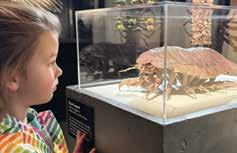
Many of our interactions with nature are fleeting, whether it’s a hummingbird that quickly sips from a feeder before flitting off, a small lizard that scurries under leaves at the sound of our approaching footsteps or even a flower that blooms for a short period before the petals fall away. I’ve often found myself wanting to freeze time and get a closer look, especially with my young daughter.
That’s what intrigued me most about the “Exquisite Creatures” exhibit in Seattle: the opportunity to see preserved birds, reptiles, amphibians, insects and plants up close, pausing to appreciate their natural beauty and seeing them in a completely different way. I just knew I had to check it out with my family.
What families can expect
When we first walked into the exhibit, we were greeted warmly by the staff. Before viewing the exhibit, there is a short introductory video that gives a behind-the-scenes look at artist Christopher Marley’s process. We browsed the gift shop while waiting for our turn to be ushered into the mini theater (which was, admittedly, just long enough for my daughter to become emotionally attached to a plush axolotl).
The four-minute film explains Marley’s approach to appreciating the natural world. He looks at it all from an artistic perspective — never once having taken a biology class — and allows each organism to tell its own story through
his work. It’s a brief introduction to the artist and the exhibit, providing context ahead of viewing the art itself. After the film, we stepped inside the exhibit, where we were suddenly face-to-face with creatures in incredible displays.
Throughout “Exquisite Creatures” you’ll see plants and animals from around the world, some of which we would otherwise not have the opportunity to see. Marley says, “I want [“Exquisite Creatures”] to be a catalyst for greater/ renewed feeling of awe and wonder. This is why I’ve worked to source and represent species that are not widely known, and to creatively represent those that are, because discovery reignites such feelings. I want people to notice how nature, creativity, awe,
continued from page 27
wonder and gratitude are all connected.”
Marley’s work is hung in the gallery on black walls, with a layout that leads you naturally from piece to piece and ends back at the gift shop. Some of the organisms are displayed in glass cases on pedestals, drawing even more attention to the incredible detail found in nature (and allowing you to see it from all angles!).
First, we were drawn to chameleons, gripping onto frames with their tails curled, as if they were midstep on a tree branch. There were birds in vibrant hues with their wings outstretched, and lizards racing toward the top of a frame. I was struck throughout the exhibit by the way Marley shows movement. It’s easy to forget that these animals are no longer alive.
The exhibit is not limited to animals, either. In addition to the insects, reptiles, amphibians and oceanic creatures, you can expect to find stunning displays of flowers, cactuses, fossils and minerals. However, you won’t find any mammals (or, for different reasons that are explained, roaches).
Nearly all the specimens in the exhibit are kept true to their natural form, but the artist does take a few creative liberties, from the preserved blacktip shark cut into sections with backlit agate, to a turtle with a contorted hazel tree growing from its back. Even a python appears to set aside its menacing ways as finches peacefully rest on it in Armistice.
Every color in the rainbow is represented in the exhibit, and vibrant hues are on full display. But even the color brown — what Marley refers to as “the most humble of hues” — gets a moment in the spotlight. Horned frogs, beetles, butterflies, parakeet eggs, katydids, turtles, damselflies and cowrie shells
are carefully arranged in Marley’s Kaleidoscope in Brown. It’s worthy of close examination.
Soft music plays in the background, further encouraging reflection and slow movement through the exhibit. The exhibit balances this reverence for nature with clever quips and anecdotes on small black tiles next to each piece, bringing a bit of levity to the experience. For example, according to Marley, the blue tongue skink sticks out its tongue at potential predators “in an effort to make them feel so stupid that they attack some other animal instead.”
We spent an hour and a half exploring the exhibit, stopping at each work of art to admire the organisms and get a closer look at scales, feathers, petals and bones. I personally could have stayed even longer, as I felt like there were so many small details and more to appreciate the longer I looked at each piece of art. Alas, an hour and a half is about the limit for my little one’s attention span just before lunchtime.
Inspiring young artists and scientists
Marley’s work serves as an inspiration to budding artists and scientists alike. My young daughter was mesmerized by the geometric patterns, unique displays, and creatures she had never seen before. The displays invited us to consider our own place in the Earth’s ecosystem and the incredible beauty found in nature.
One of the pieces of artwork included a sliding magnifying glass, allowing us to pause and look closely at each insect in the frame. And the option to illuminate different works of art with the push of a button gave us another way to see the specimens and appreciate their natural beauty. The lighting, frames and displays are all made in-house by the artist and his team. (The backlit urchins were my favorite. My daughter, meanwhile, loved the snakes most.)
Marley has spent years developing his processes and evolving his art. His advice to young artists: “Create, create, create! Experiment with as many materials, ideas, techniques, mediums as you can. Don’t worry for one minute if it’s any good. No one cares and very few even know the difference.”
He adds, “The important thing is that you put as many hours in as you possibly can to first discover, then hone your skills. And the more volume you pile up and the faster you fail at as many things as you can, the quicker you can become truly excellent at what you love.”
Sourcing and preserving specimens Marley ethically sources each specimen for the exhibit, relying on a network of institutions and individuals from around the world. (Two of the largest snakes in the exhibits were once beloved pets!) All of the vertebrates in the exhibit died of natural or incidental causes,
including oceanic vertebrates that are bycatch from fishing vessels. Insects are farmed or collected in the wild by indigenous people. Marley is licensed by the U.S. Fish and Wildlife Service, and he keeps conservation efforts at the forefront of his work.
Marley’s process for preserving specimens differs from taxidermy, as each organism is kept intact and preserved in its original form. Marley explains, “Many of my processes are proprietary. I’ve been tinkering for nearly three decades and have been fortunate to stumble upon some methods that seem to work better. Nature herself seems to inform some of the preservation and restoration tricks that my team and I employ to make things look fresh forever. Again, nature and human creativity are intimately intertwined.”
What’s next for the exhibit “Exquisite Creatures” has been tempo-
rarily displayed in museums and nature centers around the United States, most recently at the Oregon Museum of Science and Industry before landing in Seattle. Marley shares, “We’re most interested in creating a permanent home and Seattle is a top-tier contender! It is already looking like we will be extending our lease and staying longer than we’d planned. Perhaps forever!”
Marley is also continuously working on the exhibit and creating new pieces to share. He is planning a substantial update to the exhibit this spring with 20 new pieces of art, giving visitors even more to appreciate (and an excuse to return!).
Location: 900 Alaskan Way in Seattle. Dates: The exhibit currently runs through Aug. 31, 2026. New dates may be added. ■
Meredith Charaba is ParentMap’s family fun editor.
SUMMER MATH CLASSES
NOW ENROLLING
May Play List
Fun-filled activities to make the most of family time — and moms!
Check out many more happenings online at parentmap.com/calendar
By Julie Dodobara
Moms, ’tis the month for your family to celebrate you, so let the pampering begin! And, for the rest of the month you’re looking for ideas to keep the crew busy, we’ve got you covered. Think live shows, fair fun, train rides, free comics, cultural fests and more. Enjoy the springtime bonanza of fun happening out there.
� Deepen your appreciation for our beautiful Pacific Northwest by celebrating the blooms and greenery that are uniquely ours — from fawn lilies to pink salmonberry blossoms — at Oxbow Farm’s Spring Native Plant Festival. There, you and your family will find native plant-focused workshops, guided walks, crafts and more, Saturday, May 2, 10 a.m.–4 p.m. Free; workshop add-ons $5.
� Refresh your home library by heading out to a local shop to score a free comic book! This year, 24 titles
are included in this enticing giveaway which happens annually on Free Comic Book Day. Mark your calendars for Saturday, May 2 and get the entire crew reading.
� May is full of cultural delights as Seattle Center packs in three Festál events this month in its series celebrating our collective heritages. Turn up for an Asian Pacific Islander Heritage Month Celebration May 2, get a Glimpse of China, Saturday, May 9 and finally, experience the Spirit of Africa through traditional and modern music and dance on Saturday, May 16.
� Railroad fans, get on board and make the drive to scenic Skykomish to enjoy unlimited free rides on scale mini trains. Saturday, May 2 is the first day of the season for Great Northern & Cascade Railway as they welcome enthusiasts of all ages. Trains continue to run on Saturdays through October.
� Treat all the mom figures in your life to Seattle’s sweetest water tour — back for another season. Hop aboard the Ice Cream Cruise at Fisherman’s Terminal and take an informative tour of Lake Union sights while
Highlighted Events for May May 2 |
Spring Native Plant Festival Carnation
savoring a cool ice cream treat. The 45-minute tours start Sunday, May 3 and continue weekly through September (including Mother’s Day, May 10). Fares $16–$24.
� It’s a fiesta for the whole family! Gather with the community to celebrate Cinco de Mayo at Downtown Redmond Park on Sunday, May 3. The day will be packed with traditional Mexican culture including lively music, dancing and lots of delicious food from 11 a.m.–6 p.m. Free; food for purchase.
� Don’t be late for this very important date! International Ballet Theatre presents “Alice In Wonderland,” a dance theater performance created especially for younger audiences based on Lewis Carroll’s beloved story. Come along for an enchanting journey at Meydenbauer Center in Bellevue. Saturday–Sunday, May 9–10; tickets $35–$45.
� Our ParentEd Talk series welcomes Better Screen
Time founder Andrea Davis to share her strategies on resetting your family’s tech use and rebuilding connection. Register and join us Tuesday, May 12, at noon, or receive the recording to watch anytime. $10 per talk or $50 for the entire eighttalk series. Members of partner schools join for free.
� Let your kids play to their hearts content all weekend at the Lacey Spring Fun Fair, happening Saturday–Sunday, May 16–17. This kid paradise features free rides, inflatables, live entertainment, circus train, pony rides, STEAM fair and a car show on Sunday at St. Martin’s University.
� On extra-low-tide days, head to local beaches to inspect all kinds of marine critters who normally live under cover of seawater.
May 12 | Tuesday
ParentEd Talks: The Family Tech Reset: Hope and Help for Rebuilding Connection
Online
Touch gently and learn more about what you see from Seattle Aquarium beach naturalists. Programs take place along six Seattle beaches from Shoreline to Des Moines, May 17 and 19. Free. Additional dates through July 12.
� Head to the heart of Ballard for marching bands, elementary kids on unicycles, Scandinavian organizations and the whole neighborhood together for the 17th of May Parade back again on Sunday, May 17. The parade starts at 6 p.m. and runs along Northwest Market Street. Hipp Hipp Hurra!
� The iconic Northwest Folklife Festival has been a Memorial Day weekend tradition going back more than 50 years for our community. The theme this year is “Ubuntu,” or “belonging.”
May 24–June 14
Disney’s “Frozen”
Kitsap Forest Theatre
You’ll feel that sense of belonging at this free family-friendly festival as you partake in amazing performances, cultural traditions, ideas and people-watching at the Seattle Center, Friday–Monday, May 22–25.
� Kitsap Forest Theatre invites families to enjoy a unique and kid-friendly theater experience — outdoors! Hear your favorite songs amid towering trees and fresh air at this season’s opener, the much-loved musical, Disney’s “Frozen.” Weekend performances take place May 24–June 14 in Bremerton. Tickets $12–$30; ages 5 and younger free.
� On Memorial Day, Monday, May 25, honor local service members who have passed on as well as veterans and active military in Arlington’s annual Memorial Day Parade. The parade begins at 10 a.m. and runs along North Olympic Avenue.
� Honk! if you love marching bands, drum lines and street bands — playing for free in three Seattle locales. Join the festivities on Friday, May 29, 6–10 p.m. in the Georgetown neighborhood; Saturday, May 30, noon–8 p.m. at Columbia Park; or Sunday, May 31, noon–6 p.m. at Pratt Park. ■
Julie Dodobara is ParentMap’s calendar editor.
Get the kids’ faces painted at Northwest Folklife Festival