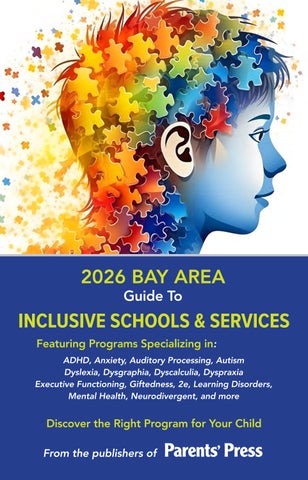
2026 BAY AREA Guide To
INCLUSIVE SCHOOLS & SERVICES Featuring Programs Specializing in:
ADHD, Anxiety, Auditory Processing, Autism Dyslexia, Dysgraphia, Dyscalculia, Dyspraxia Executive Functioning, Giftedness, 2e, Learning Disorders, Mental Health, Neurodivergent, and more
Discover the Right Program for Your Child From the publishers of
Belong. Flourish. Thrive. Stanbridge Academy is an independent K-12 school built for students with ADHD, dyslexia, autism and related profiles. We offer an 8:1 student-teacher ratio; robust academic programming; executive functioning and social-emotional curriculum built into every day; and a full school experience, including dances, sports and other extracurricular activities. Schedule a call with our admissions team to learn more about Stanbridge: admissions@stanbridgeacademy.org Stanbridge is a certified K-12 Non-Public School, fully accredited by the California Association of Independent Schools and the Western Association of Schools and Colleges.
stanbridgeacademy.org | 515 E. Poplar Avenue, San Mateo 2
Parents’ Press | Guide to Inclusive Schools
www.ParentsPress.com
Every Student Has the Capacity to Excel
Why Headlands Preparatory School? Individualized Learning
1:1 & Small Group Classes
Mastery Learning Model
Full-Time & Part-Time Options
Flexible Scheduling & Pacing
Strong Community Connections
Learn More
Contact Us
admissions@headlandsprep.com
www.headlandsprep.com 415-944-2254
www.ParentsPress.com
Guide to Inclusive Schools | Parents’ Press
3
Making a Positive Impact Immersed in a joyful school community, Prospect Sierra students think and feel deeply, develop a lifelong love of learning, and are prepared to make a positive impact on the world.
Campus Tours for Fall 2026 Now Available
4
Parents’ Press | Guide to Inclusive Schools
www.ParentsPress.com
TK-8 School
TK-8 School
LEARN MORE TODAY! www.ParentsPress.com
Guide to Inclusive Schools | Parents’ Press
5
The Bay Area Resource Guide to Inclusive Schools takes the guesswork out of finding the right program for your child, from start to finish.
Contents 8
Is my child just struggling or is it something more?
37
What Information to Look ior in an Evaluation
12
What does “inclusive education” mean?
38
14
Understanding Neurodiversity: A Parent’s Guide
The Difference Between 504 plans and IEPs
40
18
Common Myths about Neurodiversity
How Public Schools Must Support your Child
42
22
Early Signs of Learning Differences by School Stages
How Private and Independent Schools Support Neurodiverse Learners
24
What to do When You Suspect Help is Needed
45
When to Seek a Different School Environment
28
How to Approach Your Child’s Teacher about Learning Challenges
30
Twice-exceptional (2e): What You Need to 49 Featured Private Day School Profiles Know Profiles Neurodiversity by 68 Featured Private Day Type: What ADHD, School Listings Dyslexia, and Autism 72 Glossary of Key look like in School Terms Executive Function: What it is and How 74 What Does Accreditation mean? Schools Can Support it
32
34
36
6
Who can do an evaluation for learning differences?
46
75
Parents’ Press | Guide to Inclusive Schools
How to Prepare for, What to Expect During & What to do After your first IEP or 504 Meeting
Accreditation & Affiliation Key
Designed and Published by 875-A Island Dr., Ste. 421 Alameda, CA 94502 www.parentspress.com Publishers | Parenting Media Art Director | Debbi Murzyn Associate Editor | Jean Abernathy Digital Content Editors Katie McKean & Michael McKean Advertising Sales & General Info: sales@parentspress.com To Add Your School parentspress.com/schoolprofile-submission Guide to Bay Area Inclusive Schools is published annually by Parents’ Press ©2026 www.ParentsPress.com
Educating Neurodiverse Students in 6th-12th Grade for Over 22 Years!
The Springstone School, a Nonpublic School (NPS), accredited by the Western Association of Schools and Colleges (WASC), and certified by the California Department of Education (CDE). Springstone is an all Special Education school serving neurodiverse students from the Bay Area with Executive Function challenges that affect their ability to organize and prioritize information and make meaningful social connections.
We invite you to visit Springstone to learn more about our unique programs! We offer monthly Group Tours and Program-Specific Tours for parents and advocates. We also offer Saturday and Thursday Open House events for parents, advocates, and families! You are also welcome to schedule a discovery call by clicking the “schedule an admissions call” button on our website!
Springstone has two programs, a Middle School serving GROUP TOURS grades 6th-8th and a Community High School serving Friday Mornings: grades 9th-12th. Springstone offers a serene and calm 10:30am-11:30am learning environment, nestled along the Las Trampas September 19th, 2025 creek in Lafayette. Students are placed privately or October 24th, 2025 through their home school district with a referral and may November 14th, 2025 be enrolled year-round. December 12th, 2025 January 30th, 2026 Springstone provides an academically rigorous curriculum February 20th, 2026 following the framework of the California Common Core March 13th, 2026 Standards. Small, self-contained, structured classrooms April 24th, 2026 (8:1 student to teacher ratio) allow for individualized instruction, collaboration, discussion, and conversation within multiple modalities.
OPEN HOUSES
Springstone’s programs integrate pragmatic language, Saturday Mornings: 10:00am-12:00pm, occupational therapy, mindfulness, organizational skills, Thursday Evenings: 5-7pm work skills, and life skills in the academic classroom, as Saturday Morning, October 18th, 2025 well as in the community. We have a one of a kind ACCESS Saturday Morning, January 17th, 2025 program, bringing project-based learning within the Thursday Evening, November 6th, 2025 greater community. We believe our students will develop Thursday Evening, February 19th, 2026 strategies for use in academic and social settings if they are part of a community that understands, accepts, and challenges them. Come visit us to learn more!
Learn more about our programs and RSVP for one of our events by visiting our website
The Springstone School 1035 Carol Lane, Lafayette, CA 94549 www.ParentsPress.com
www.thespringstoneschool.org
925.962.9660 info@thespringstoneschool.org Guide to Inclusive Schools | Parents’ Press
7
Is my child just struggling or is it something more? Early Signs of Learning Differences by Age Group
Every parent watches for milestones. We notice the first steps, the first words, the first time our child reads a sentence on their own. When progress seems slower than expected, it can be hard to tell whether it’s a normal phase or a sign that something deeper may be going on. Learning differences often appear gradually, and the early signs can look different depending on a child’s age, sex or situation. We have included some of the most common signs to look for but this is not a complete list. During Preschool Years Many early indicators of a learning difference emerge as children begin exploring sounds, letters, and numbers. A child might have trouble remembering nursery rhymes or recognizing rhyming patterns. Some struggle to follow multi-step directions, even simple ones like “put on your shoes and grab your backpack.” Others may avoid drawing, coloring, or puzzles that require fine motor 8
Parents’ Press | Guide to Inclusive Schools
Every child has a unique learning profile. Noticing when progress stalls or shifts is the first step toward getting the right support in place, long before frustration turns into self-doubt. coordination. While every child develops at their own pace, persistent difficulty with these early skills may suggest challenges with auditory processing, working memory, or visual-motor coordination. In the Early Elementary Years Once schol begins, expectations shift. Teachers often notice when a child can explain ideas clearly in conversation but struggles to put those ideas on paper. Trouble learning sight words, reversing letters like b and d past first grade, or reading slowly with frequent guessing are possible signs of dyslexia. In math, difficulty remembering basic facts or consistently >>> www.ParentsPress.com
For Dyslexic & Twice-Exceptional Learners
When children feel confident about how they learn, they do better in school. Tailoring teaching methods to your child’s strengths creates academic breakthroughs that build confidence, reduce anxiety, inspire learning, and prepare them for future success.
www.ParentsPress.com
525 San Antonio Avenue Palo Alto, CA 94306 Guide to Inclusive Schools | Parents’ Press 650-543-4560 • AthenaAcademy.org
9
– Continued – confusing operation symbols can point toward dyscalculia. A child who understands new material but forgets it the next day may be experiencing working memory deficits. Parents might also see patterns of avoidance: stomachaches before school, frustration with homework, or daydreaming when tasks become hard. Upper Elementary and Middle School Years As academics grow more complex, so do the signs. A student may grasp big ideas but miss smaller details on assignments. Writing might remain disorganized, with incomplete sentences or thoughts jumping around. Problems with organization, time management, and planning can reflect executive function challenges often associated with ADHD. Teachers may describe a child who participates well in class discussions but fails to turn in homework or loses materials regularly. These patterns can persist despite effort, suggesting that skill-based support rather than discipline is needed. During Adolescence By middle or high school, learning differences sometimes appear through emotional or behavioral changes. A once eager
10
Parents’ Press | Guide to Inclusive Schools
learner might begin to withdraw, showing anxiety about tests or group work. Some students mask difficulties by working longer hours or choosing easier classes. Others act out of frustration, feeling misunderstood or “lazy” when they’re actually working harder than peers. Challenges with sustained attention, reading comprehension, or written expression may become more visible under increasing academic pressure. Next steps When parents notice patterns that persist for months or affect self-esteem, it’s worth starting a conversation with teachers or a pediatrician. Early observation doesn’t mean a diagnosis, but it opens the door to support. Schools can often provide screenings or referrals to specialists who assess reading, writing, math, and attention skills. Recognizing early signs isn’t about labeling a child—it’s about understanding how they learn. Every child has strengths and challenges. Identifying them early helps educators, parents, and students work together toward success, ensuring that learning differences don’t become barriers to confidence or curiosity. •
www.ParentsPress.com
www.ParentsPress.com
Guide to Inclusive Schools | Parents’ Press
11
What does Inclusive Education mean? Defining Inclusive Schools and How Diverse Learners are Supported When parents hear the phrase inclusive education, it can sound broad or abstract. In practice, inclusion is a way of teaching that recognizes students learn differently and still deserve access to the same classroom, curriculum, and community. Inclusive education isn’t a program or a label. It is a mindset that shapes how schools design lessons, group students, and measure success. An inclusive classroom brings together students with varied learning styles, abilities, and needs. Some may have diagnosed learning differences such as dyslexia, issues with reading fluency, or ADHD. Others may simply learn best through visual, hands-on, or movement-based approaches. The goal is not to separate students who need extra help but to design instruction flexible enough for all students to engage meaningfully.
12
Parents’ Press | Guide to Inclusive Schools
When schools offer multiple ways to show understanding, the focus shifts from what a student can’t do to how they best learn and express ideas. Inclusion begins with understanding. Teachers use information about each child’s learning profile to adapt materials and teaching methods. For a student who struggles with reading, text may be supported with audio versions or enlarged print. A child who processes information slowly might be given extra time or shorter assignments focused on key concepts. Classrooms often use strategies like peer collaboration, small-group learning, and visual organizers so every student can participate.
www.ParentsPress.com
Inclusive education also depends on teamwork. Teachers, learning specialists, and aides work together to plan lessons that address different skill levels without isolating students. Parents are part of that conversation too. When families share insights about what helps a child learn at home, educators can apply those ideas in the classroom. This partnership helps students feel seen and supported rather than singled out. Support for diverse learners can extend beyond academics. Many schools recognize that inclusion involves social and emotional growth as well. Flexible seating, quiet zones, or calm-down corners help students who need breaks from sensory input. Counseling or social skills groups give children opportunities to build confidence and practice communication in a structured way. These supports are not reserved for students with formal plans; they often benefit the entire class. Inclusive education also challenges the idea that students must meet one standard of success. When schools offer multiple ways to
www.ParentsPress.com
show understanding—through projects, oral presentations, or creative media—students can demonstrate knowledge in ways that fit their strengths. This approach shifts the focus from what a student cannot do to how they best learn and express ideas. The Bay Area has a long history of diverse classrooms and a growing awareness of learning differences. Many public and independent schools now integrate inclusion into daily practice rather than treating it as a separate program. For families, that means looking for signs of collaboration: teachers who communicate clearly about accommodations, classrooms that value peer support, and school cultures that emphasize belonging. Inclusive education continues to evolve as educators learn more about the science of learning and the needs of neurodiverse students. Its aim remains consistent: every child, regardless of learning profile, participates fully in the shared experience of education and feels they have a place within it. •
Guide to Inclusive Schools | Parents’ Press
13
Understanding Neurodiversity: A Parent’s Guide Introducing ADHD, Autism, Dyslexia & the 4D’s, 2e Learners, and Mental Health Every child learns and experiences the world in a unique way. The idea of neurodiversity recognizes that differences in how brains work are natural and expected, not problems to be fixed. For parents, understanding this perspective can help shift focus from what a child struggles with to how that child learns best.
might start several projects at once, forget materials, or appear distracted even when they are trying hard to pay attention. Structure, clear expectations, and consistent feedback help them thrive. Many also benefit from opportunities to move or engage actively in learning.
Neurodiversity includes a wide range of learning and thinking styles. Some children have neurological or developmental differences that affect attention, processing, language, or social interaction. The most common include ADHD, autism, and learning differences such as dyslexia. Some children are also twiceexceptional, meaning they are both gifted and have a learning or attention challenge. These differences can affect how a child approaches tasks, relates to others, and manages emotions.
Students in mainstream schools with Autism usually are on level 1 of the spectrum. Level 2 and 3 students typically need an environment with many more services provided. Level 1 students experience the world through distinct sensory and communication patterns. Some prefer routines and predictable environments; others process information visually or need extra time to respond to questions. Social interactions can feel challenging, not from lack of interest but from different ways of interpreting cues. Supporting an autistic child often means reducing sensory overload, using clear language, and recognizing the importance of interests that bring calm or focus.
Children with ADHD often have strong curiosity and creativity but may struggle with focus, organization, or impulse control. They
>>> 14
Parents’ Press | Guide to Inclusive Schools
www.ParentsPress.com
www.ParentsPress.com
Guide to Inclusive Schools | Parents’ Press
15
– Continued – Dyslexia, a difference in how the brain processes written language, can make reading and spelling difficult. A dyslexic child may understand stories deeply when read aloud but struggle to decode words on a page. Early support using structured, phonics-based instruction helps them build confidence. Dysgraphia and dyscalculia, which affect writing and math skills, may appear alongside dyslexia or separately, requiring tailored strategies. Dyspraxia is a condition that affects motor coordination and planning, causing difficulties with movement, impacting learning.
of the profile—strengths and struggles—is essential to providing balance.
Twice-exceptional learners, sometimes called 2e, combine high ability with one or more learning differences. A 2e student might grasp advanced concepts quickly but have trouble writing essays or managing time. These students can experience frustration when their intelligence is underestimated or their challenges overlooked. Recognizing both sides
Understanding neurodiversity means seeing difference as part of human variety. For parents, it begins with observing how a child learns, reacts, and connects, and then working with teachers or specialists to provide support that fits. Recognizing and respecting these differences helps children develop a sense of belonging and confidence in their own way of thinking. •
16
Parents’ Press | Guide to Inclusive Schools
Mental health also plays a key role in how children learn. Anxiety, depression, or low self-esteem can develop when a child consistently feels misunderstood or unsupported. Many schools now include social-emotional learning programs to help students build resilience, communication, and self-awareness alongside academics. For neurodiverse children, emotional well-being is closely tied to feeling accepted and capable.
www.ParentsPress.com
OUR COMMUNITY CAN’T WAIT TO MEET YOU!
PRESCHOOL ELEMENTARY
serendipityschool.com www.ParentsPress.com
JOYFUL DISCOVERY MEANINGFUL LEARNING Guide to Inclusive Schools | Parents’ Press
17
Common Misconceptions About Neurodiversity Addressing Myths and Stigma 2. Myth - Children who Learn Differently Need to Try Harder Another myth suggests that children who learn differently simply need to try harder. This view overlooks how the brain’s wiring influences memory, attention, and processing speed. A student who forgets instructions or loses focus after ten minutes is not necessarily unmotivated. They may be expending more energy than peers to complete the same task. 1. Myth - Learning Differences Reflect Low When adults interpret this Intelligence Learning differences are not struggle as laziness, it can A common misconception erode a child’s confidence. is that learning differences a sign of low intelligence. Structured support and reflect low intelligence. In They reflect how a explicit teaching methods reality, most students with make a greater difference dyslexia, ADHD, or other child’s brain processes than increased pressure. learning challenges have information, not how average or above-average 3. Myth - Identifying a cognitive ability. A child capable they are. learning difference will lead may read below grade level to labeling while grasping complex Some parents worry that identifying a ideas in math or science. The difficulty lies learning difference will lead to labeling or not in thinking but in how the brain processes lower expectations. Evaluations, however, are specific types of information. Recognizing that not about defining limits. They reveal how a intelligence and learning style are separate is one of the first steps toward support. >>> Learning differences often exist in plain sight but are easily misunderstood. Myths about attention, effort, and intelligence can shape how children are perceived at home and at school. Understanding what learning differences are—and what they are not—helps families and educators respond with clarity rather than judgment.
18
Parents’ Press | Guide to Inclusive Schools
www.ParentsPress.com
Success Starts with Understanding When school doesn’t work for your child, it affects everything. At Winston Prep, we build an education around your child- their strengths, their challenges, their potential. Our individualized, skills-centered approach leads to lasting success in life and learning for neurodivergent students. Discover a model that works by joining our next Open House. Scan the QR codes to learn more
Winston Preparatory School San Rafael Ages 8-21
Marin County
Winston Transitions San Francisco Ages 17-21+
ebi.school
Transitions SF
New York | Connecticut | New Jersey | California | Winston Transitions | Winston Online | Winston In College www.ParentsPress.com
Guide to Inclusive Schools | Parents’ Press
19
– Continued – child learns so instruction can be matched to that profile. Labels such as dyslexia or ADHD are educational tools, not identities. They allow teachers to design lessons, accommodations, and assessments that remove unnecessary barriers. Early understanding often prevents the frustration that builds when needs go unnoticed. 4. Myth - Learning Differences can be Outgrown There is also the belief that learning differences can be outgrown. While some students develop stronger coping strategies with age, the underlying processing differences usually remain. A dyslexic student may become an excellent reader through targeted instruction but still find decoding slow. An adolescent with ADHD may learn time-management skills yet continue to struggle with sustained focus. Growth occurs through support, not by waiting for the challenges to disappear. 5. Myth - Technology or Tutoring can “Fix” a Student Families sometimes hear that technology or tutoring can “fix” learning differences. 20
Parents’ Press | Guide to Inclusive Schools
These tools can help, but they work best when combined with patient teaching and emotional support. Progress happens gradually as students discover approaches that align with their strengths. The goal is not to erase difference but to build skills and confidence. 6. Myth - A Child Who Needs Help is Less Capable Misunderstandings also affect how peers and teachers view students. A child who needs extra help might be seen as less capable, while one who finishes quickly may be assumed to have no challenges. Inclusive classrooms aim to counter this by showing that learning variability is normal. When schools present multiple ways to access material and show understanding, all students benefit from a richer learning environment. Reducing stigma begins with replacing assumptions with knowledge. When parents and educators see learning differences as part of human diversity, they open space for every child to succeed through understanding rather than comparison. •
www.ParentsPress.com
Challenged to Think. Prepared to Lead. Every child learns differently— and at Hilldale, that’s built into the student experience with intention and care.
For families, this creates something important: the confidence that their child is being both supported and challenged in ways that help them thrive.
This means children are afforded opportunities for meaningful and engaging enrichment or given the time and support they need to fully understand a concept. Rather than a one-size-fits-all pace, learning is responsive and intentional. Groups shift, lessons adapt, and teachers continuously refine their approach based on how students are progressing.
Inquire Now
79 Florence St. Daly City, CA 94014 | www.hilldaleschool.org
www.ParentsPress.com
Guide to Inclusive Schools | Parents’ Press
21
Early Signs of at Different
These common signs do not diagnose a learning difference and are in no way a complete list of what you may be witnessing. If you observe a consistent pattern that persist over several months, it may signal that a child needs extra support.
PRESCHOOL (AGES 3–5) ❑ Struggles to recognize or remember rhymes and songs ❑ Has trouble following simple multistep directions ❑ Avoids drawing, coloring, or using scissors ❑ Difficulty remembering shapes, colors, or letters ❑ Trouble expressing thoughts clearly or finding the right words ❑ Often becomes frustrated with new tasks or transitions ❑ Seems unusually sensitive to sounds, textures, or clothing tags ❑ Plays alongside others but has difficulty joining group play
ELEMENTARY SCHOOL (GRADES K–5)
❑ Has messy handwriting or avoids writing altogether ❑ Mixes up sequence of events or skips steps in directions ❑ Appears inattentive or easily distracted, even with familiar routines ❑ Shows frequent frustration, perfectionism, or low confidence about schoolwork
MIDDLE SCHOOL (GRADES 6–8) ❑ Difficulty organizing materials or remembering assignments ❑ Trouble summarizing or explaining what they’ve read ❑ Needs constant reminders to begin or complete tasks ❑ Struggles to manage time, especially with long-term projects
❑ Avoids reading aloud or complains that reading feels “hard”
❑ Often forgets instructions or loses materials
❑ Frequently reverses letters or numbers after first grade
❑ Avoids reading-heavy or writingheavy subjects
❑ Takes much longer to complete homework than peers
❑ Becomes anxious about school performance or group work
❑ Has trouble remembering spelling words or basic math facts
❑ Grades fluctuate sharply between subjects or assignments
❑ Understands material when spoken but struggles to write it down
❑ Seems bright in conversation but underperforms on tests
22
Parents’ Press | Guide to Inclusive Schools
Neurodiversity School Stages HIGH SCHOOL (GRADES 9–12) ❑ Persistent trouble with reading comprehension or note-taking ❑ Avoids classes requiring written reports or timed tests ❑ Difficulty prioritizing or breaking down large assignments ❑ Has strong verbal skills but inconsistent academic results ❑ Appears constantly overwhelmed despite effort ❑ Relies heavily on parents or teachers to stay organized ❑ Withdraws socially or avoids participation due to embarrassment ❑ Reports stress, anxiety, or fatigue related to schoolwork ❑ Loses interest in subjects once found enjoyable
SIGNS COULD LOOK DIFFERENT IN GIRLS Learning differences can appear more subtly in girls, who become skilled at masking struggles as they get older through effort, organization, or social awareness. ❑ Works very hard but still underperforms academically
❑ Daydreams or seems “quietly distracted” rather than disruptive ❑ Shuts down or falls asleep in class ❑ Spends excessive time on homework or rewriting assignments ❑ Often takes on a “helper” role to hide confusion ❑ Excels verbally but avoids subjects requiring rapid recall or problem-solving ❑ Reports stomachaches, headaches, or fatigue before school ❑ Displays strong empathy but internalizes stress or shame ❑ Receives good grades due to effort, masking reading or processing difficulties
When concerns arise, parents can document observations, talk with teachers about their observations and see if they have samples of work reflecting useful information in order to request screening or evaluation through the school or a qualified professional. •
❑ Becomes anxious or perfectionistic about small mistakes
Parents’ Press | Guide to Inclusive Schools 23
What to do When you Suspect Help is Needed How to Start: documentation, school conversations, child’s doctor involvment, evaluations Parents often notice small signs before anyone else does. A child who once enjoyed reading begins to avoid it. Your once social child no longer hangs out with friends. Homework takes far longer than expected. Directions are forgotten, or frustration grows over simple tasks. Your child no longer looks forward to school. These patterns can raise a quiet question: is this just a developmental phase, or could it point to a learning difference? Knowing how to move from observation to action helps families take informed, constructive steps.
1. Write Down Observations, Concerns and Specific Worrying Signs and Behaviors Write down specific examples of what you’re seeing—missed milestones, missed assignments, repeated letter reversals, slow reading, struggles with attention, changes in social interactions 24
Parents’ Press | Guide to Inclusive Schools
and/ or behavioral comments from teachers or school administration. Include when the behavior began, how often it occurs, and what seems to help or make it harder. Teachers and specialists rely on concrete examples to understand patterns, so written notes are more useful than general concerns. Saving graded work samples can also show how difficulties appear over time.
2. Reach Out to Instructors After gathering observations, start a conversation with your child’s teacher. Ask how your child performs in class compared with peers, whether similar challenges appear across subjects, and what supports have already been tried. Teachers can describe how your child follows directions, retains lessons, interacts with classmates or participates in discussions. Many learning differences reveal themselves through >>>
www.ParentsPress.com
ills Middle School H n o i s Mis Mission Hills School &
Where minds minds are are thinking thinking while while faces facesare aresmiling! smiling! Who We Are At Mission Hills Middle School and Mission Hills School, we are dedicated to raising confident, intellectual, and well-rounded students prepared for a brighter tomorrow. Our competency-based approach recognizes that every child is unique, setting meaningful expectations that both challenge and support them. By balancing academics, social growth, and physical development, we ensure that every student has the opportunity to reach their highest potential.
What We Offer
�� Academics �� Creativity �� Leadership ⚽ Balance �� Community
Why Families Choose Us
�� Individualized Learning �� Supportive Environment �� Future Readiness �� Well-Rounded Growth �� Strong Teacher Support
Join the Mission Hills Family! www.mhmschool.org 250 Tamarack Drive Union City, CA 94587 (510) 493-2189
www.ParentsPress.com
2330 Pomar Vista Avenue Castro Valley, CA 94546 (510) 317-8627
Guide to Inclusive Schools | Parents’ Press
25
– Continued – inconsistency—strong verbal reasoning but weak written expression, for example—and teachers often notice these contrasts.
3. Talk to Your Pediatrician Bring up your concerns with your child’s pediatrician to see what they recommend. Your pediatrician may refer you to a Neuropsychologist for further evaluation. Evaluations typically include academic testing, cognitive assessments, and sometimes behavioral or emotional screening. Private evaluations, conducted by psychologists, can offer deeper insight, especially if the family seeks a more detailed profile of strengths and challenges. While private testing can be costly, it provides individualized recommendations and is accepted by most schools as part of the decisionmaking process. If cost is a concern find out what your school district will cover in their evaluation. 4. Get Feedback from Other Parents Who Have Gone Through This Process with the School It’s worth your time to seek out advice from other parents who have gone through this process with your child’s school. Ask them what disabilities their child needed accommodations for, how receptive administration was, if they ran into any roadblocks or if they needed to bring in outside help. Also, ask what accommodations are working for their child and if they had used outside tutors. Find out if they have any suggestions or tips. 5. Request a Meeting with Your Child’s School If observations suggest persistent difficulties, request a meeting with the school’s learning specialist, counselor, or principal. Under federal and state law, public schools must evaluate students suspected of having learning differences or disabilities when concerns are documented. Parents can submit a written request for an educational evaluation. The school will set up a 504/IEP review committee of the counselor, teachers and a school 26
Parents’ Press | Guide to Inclusive Schools
admin then review classroom performance, teacher input, and existing data before determining the next steps. Find out how long it will take to complete the evaluation and if district evaluators will be called upon to assess. Schools can provide written information about assessments or refer families to outside professionals who specialize in learning differences. Familiarize yourself with district policies on 504/IEP procedures as well as the federal Individualized Education Program (IEP) section 504 of the Rehabilitation Act of 1973 to ensure your child’s rights are respected.
6. School Meeting to Discuss Findings Once results are available, the school team will set up a meeting with parents and student to review findings and discuss next steps. During this stage, communication matters as much as results. Ask evaluators to explain findings in plain language. Clarify what each term means— processing speed, working memory, expressive language—so you understand how they relate to daily learning. Request written reports and share them with teachers to plan supports that align across home and school. If the evaluation identifies a qualifying learning difference, the child may receive a 504 Plan or an Individualized Education Program (IEP). These outline accommodations and teaching strategies that support learning within the classroom. For students who do not meet eligibility criteria, informal supports or targeted interventions can still make a difference or you can elect to bring in outside help and appeal the decision. Throughout the process, stay focused on collaboration. Learning differences are best addressed when families, teachers, and specialists share information and strategies. Early action helps prevent frustration from becoming discouragement. Documentation, open dialogue, and careful evaluation turn uncertainty into understanding—and help children receive the support they need to learn with confidence. • www.ParentsPress.com
K-8 progressive education in Oakland’s Temescal
parkdayschool.org (510) 653-0317 www.ParentsPress.com
admissions@parkdayschool.org Guide to Inclusive Schools | Parents’ Press 27
How to Approach your Child’s Teacher About Learning Challenges Conversations about learning challenges can feel uncomfortable at first. Parents may worry about oversharing, or they may fear that raising concerns will label their child. Teachers may also hesitate, unsure how to describe patterns that suggest a child is struggling but are used to having these conversations with worried parents. The goal of any conversation is not to assign blame but to exchange observations that help everyone understand how the child learns best.
If the teacher confirms concerns, ask what supports are already being used. Many classrooms employ small-group instruction, flexible seating, or visual aids. Teachers can explain what has helped and what remains difficult. If the teacher hasn’t seen the same issues, describe when they tend to occur at home—before school, after sports, or during homework. Context often clarifies patterns that aren’t immediately visible in the classroom.
Start by preparing. Before meeting with the teacher, write down specific examples of what you notice at home. These could include homework that takes hours to complete, avoidance of reading, frequent forgetfulness, or emotional reactions to schoolwork. Keeping notes over time helps you describe patterns rather than isolated incidents. Bring a few work samples if they reflect the issue. A record of concrete examples allows for a focused, productive discussion.
Keep the discussion collaborative. Use language that centers the child’s needs rather than the problem. Phrases like “What strategies might help?” or “How can we reinforce at home what’s working at school?” encourage shared responsibility. Teachers appreciate when parents show interest in continuity between home and classroom practices.
Choose a time when the teacher can talk without distraction. A short conversation at pickup rarely allows for depth. Request a meeting through email, stating that you would like to discuss how your child is managing classroom expectations. Framing it as a shared effort to support learning sets a cooperative tone. Once the teacher has agreed to meet, ask if you should bring your child or meet without. During the meeting, start with openness rather than conclusions. Instead of saying, “I think my child has dyslexia,” begin with what you’ve seen: “She seems to struggle with reading longer words and often forgets them the next day.” Then ask for the teacher’s perspective: “Have you noticed similar things at school?” Teachers observe students in structured settings and can offer valuable insight about attention, participation, and social interaction.
28
Parents’ Press | Guide to Inclusive Schools
If both home and school concerns persist, ask what the next steps might be. The teacher may suggest involving a learning specialist, counselor, or administrator to discuss additional support. If formal evaluation is mentioned, request guidance on how to begin the process. After the meeting, stay in contact. Ask for periodic updates about progress and continue sharing what you see at home. Communication doesn’t end with a single conversation—it evolves as your child’s needs and skills change. Talking about learning challenges can feel personal, but teachers and parents share the same goal: helping a child succeed in a way that feels manageable and encouraging. A calm, factual discussion built on trust can uncover what works best and set the stage for meaningful support. •
www.ParentsPress.com
Heart Smart & Head Smart At Aurora School, students grow into confident, resilient learners, grounded in academic depth in a community that truly knows them.
Build
Grow
empathy, understanding, and lasting relationships
into confident, capable, independent thinkers
Thrive
Lead
in small, multi-grade classrooms where learners are mentors
by serving communities and creating change
Now enrolling K-8 • Flexible Tuition 40 Dulwich Road, Oakland 94618 auroraschool.org 510-428-2606 www.ParentsPress.com
Guide to Inclusive Schools | Parents’ Press
29
Twice-exceptional (2e): What Parents Need to Know Evaluations that consider both cognitive ability and academic performance are the clearest way to understand these patterns. A comprehensive assessment by a psychologist or neuropsychologist measures intellectual potential, processing speed, reading fluency, word decoding, attention, and academic achievement. Results can clarify how giftedness interacts with learning differences and can guide the right mix of challenge and support.
Some children show remarkable curiosity, creativity, or reasoning while also struggling with tasks that seem simple for their peers. They may speak like young adults yet have trouble organizing a paragraph. They might solve advanced math problems but forget to bring their homework. These students are often described as twice-exceptional, or 2e—children who are both gifted and have a learning difference such as dyslexia, ADHD, autism, or a processing disorder. Being twice-exceptional does not mean a child’s strengths cancel out their challenges, or vice versa. Instead, both exist at the same time, sometimes masking each other. A gifted student with dyslexia might use strong reasoning skills and vocabulary to hide reading struggles. A child with ADHD might seem inattentive when lessons move too slowly, while excelling during hands-on or conceptual activities. These patterns can make identification difficult and can lead to confusion or frustration at school. Recognizing a 2e profile often begins when parents or teachers notice uneven development. A student may score high on problem-solving tests but low on written output, or display advanced comprehension alongside weak spelling. They may thrive in subjects that allow independent exploration yet falter when required to follow detailed instructions. Emotional intensity is also common; some 2e learners experience strong reactions to success and disappointment alike, reflecting a deep investment in their own performance. 30
Parents’ Press | Guide to Inclusive Schools
For twice-exceptional students, balance is key. Gifted programs may focus on enrichment but overlook learning supports, while special education programs may address challenges without providing enough intellectual stimulation. Ideally, instruction combines high expectations with scaffolding. This might include extended time on tests, assistive technology for writing, or enrichment projects that let the student explore advanced topics in depth. Social and emotional experiences also play an important role. Many 2e children are aware that their abilities do not always match their output and may feel misunderstood by peers or adults. Providing spaces where effort is valued alongside talent helps build confidence. Teachers who emphasize process, not just results, can help students manage frustration and develop resilience. At home, parents can encourage independence while helping with organization and planning. Break large assignments into smaller tasks, and allow downtime between activities that require sustained focus. Celebrate curiosity and creativity as much as academic achievement. Twice-exceptional learners remind educators and families that ability and need are not opposites. When both are recognized, students can engage deeply with learning while developing skills that make their strengths more accessible. Understanding the full picture—what a child can do and what they need to do it—creates the foundation for growth and confidence. • www.ParentsPress.com
www.ParentsPress.com
Guide to Inclusive Schools | Parents’ Press
31
Neurodiversity by Type: How ADHD, Dyslexia, and Autism Present in the Classroom No two students experience learning the same way. For children with the most familiar neurodiversy’s, ADHD, dyslexia, or autism 1, classroom challenges often appear in subtle but consistent patterns. Recognizing how these differences look in school settings helps parents and teachers respond with appropriate support rather than assumptions. ADHD in the Classroom Students with Attention-Deficit/Hyperactivity Disorder may struggle to regulate focus, manage impulses, or sustain attention on tasks that don’t immediately capture their interest. Some appear frustrated or restless, frequently leaving their seats or blurting out answers. Others seem quietly distracted, staring out the window or losing track of assignments. Homework may be left incomplete not because of unwillingness but because organization and working memory make the process difficult to manage. These students often perform best when expectations are clear and routines predictable. Breaks during long lessons, visual reminders of steps, and positive reinforcement help maintain engagement. They may also benefit from movement—walking to sharpen a pencil or delivering materials—since short bursts of activity can reset attention. Teachers often describe students with ADHD as bright and curious but inconsistent in performance. Predictable structure can help those strengths emerge more steadily. Dyslexia A student with dyslexia may read slowly, skip words, or guess based on context. Spelling errors appear even after repeated practice, and written assignments can take much longer than expected. Reading aloud is often stressful, not because the child lacks understanding, but because decoding each word requires significant effort. Despite these challenges, many dyslexic learners think in strong visual
32
Parents’ Press | Guide to Inclusive Schools
or spatial terms, excelling in problem-solving, storytelling, and creativity. Early signs include difficulty recognizing letter sounds, confusing similar-looking letters, or avoiding reading activities altogether. Teachers might notice that a student can explain a concept verbally but cannot express it effectively on paper. With explicit reading instruction and access to tools such as audiobooks to listen to while reading text or text-to-speech software, students with dyslexia often make steady progress. Support focuses on accuracy first, then fluency and confidence. Autism Students on the autism spectrum vary widely in how they experience learning and social interaction. Some may speak fluently but struggle with unspoken rules of conversation, while others communicate more comfortably through gestures or technology. Sensory sensitivities can affect concentration—bright lights, background noise, or crowded spaces may lead to discomfort or withdrawal. In group settings, students with autism might prefer clear routines, visual schedules, and advance notice of transitions. Abstract instructions can be confusing, but concrete examples and step-by-step explanations help clarify expectations. Many show deep knowledge of specific interests and can focus intently when engaged in those areas. Teachers often note precision, attention to detail, and strong memory for facts. Across all three learning differences, patterns may shift with age and support. Recognizing what these differences look like in the classroom allows families and educators to separate skill from behavior and effort from access. When students understand that learning differently is simply learning uniquely, the path toward progress becomes easier to see. •
www.ParentsPress.com
NOW ENROLLING
K-12
OUR EDUCATIONAL ANCHORS Socratic & Critical Thinking
F OR 2 0 26–2027 1: 1 0 C L ASS SIZE
Hands-On, Project-Based Learning Innovation & Entrepreneurship Personalized Learning Community Engagement Portfolio-Based Assessment Physical Health & Wellness Learning isn’t one-size-fits-all. It’s driven by curiosity, creativity, and connection. As a neuroaffirming community, we celebrate the many ways students think, learn, and grow.
PROJECT-BASED LEARNING
EXECUTIVE FUNCTIONING
COMMUNITY BUILDING
Students engage in hands-on, realworld projects that deepen understanding and spark curiosity.
We build essential life skills like organization, time management, and self-regulation into daily learning.
Our school fosters a strong, supportive community where students, families, and staff grow and thrive together.
Empowering learners. Building bright futures. Individualized Support (925) 365-9109
www.ParentsPress.com
Inclusive & Neuroaffirming
Bridging Potential with Purpose
bridgequestacademy.com
juliawilkinson@bcbhinc.com
Guide to Inclusive Schools | Parents’ Press
33
What is Executive Function and How to Support it Executive function refers to the group of cognitive skills that help students plan, organize, manage time, remember information, and regulate emotions. These skills act like an internal management system that allows children to set goals and follow through on them. When executive function skills are underdeveloped, everyday school tasks— such as turning in assignments, remembering directions, or preparing for a test—can become unexpectedly difficult. Executive function develops gradually and varies from child to child. Some students naturally create checklists, while others forget what they were supposed to do before they even begin. These skills are not indicators of motivation or intelligence but of how the brain handles planning and self-regulation. For many students with ADHD, learning differences, or anxiety, executive functioning challenges are part of their learning profile. In the classroom, weak executive function can show up in subtle ways. A child may understand a math concept but consistently leave problems unfinished. Another may appear unmotivated when, in reality, organizing materials or sequencing steps is overwhelming. Teachers may notice that the same student who can explain ideas verbally struggles to translate those ideas into writing. Recognizing these patterns early allows schools to create structures that reduce cognitive load and support independence. Schools address executive function through both direct instruction and environmental adjustments. Some classrooms explicitly teach planning and time management as part of the curriculum. Students might learn to use planners, break down large projects into smaller parts, or estimate how long tasks will take. Teachers often model these processes out loud, showing students how to prioritize and adjust when plans change.
34
Parents’ Press | Guide to Inclusive Schools
Organizational supports also help. Visual schedules, color-coded folders, and consistent routines make expectations predictable. For older students, digital tools like reminders or task trackers can serve as external systems for what is still developing internally. Some schools use learning specialists or educational therapists to provide small-group or individual coaching focused on executive function strategies. These sessions emphasize transferable skills such as note organization, project planning, and test preparation. Self-regulation is another part of executive functioning that schools nurture through emotional awareness and behavior supports. Simple check-ins, mindfulness breaks, or quiet workspaces can help students regain focus after frustration. When teachers allow flexible movement or brief pauses, students learn to manage their energy and attention in more effective ways. Parents can reinforce these efforts by encouraging routines at home and giving children structured choices—such as when to start homework or how to organize a workspace. Using the same vocabulary and strategies that teachers use builds consistency between settings. Over time, with repetition and support, students internalize these skills. They begin to plan ahead, anticipate challenges, and take ownership of their learning. Executive function may not appear on a report card, but it shapes how students approach every subject. By recognizing and teaching these skills, schools give students tools that extend far beyond academics, helping them navigate both the classroom and daily life with greater confidence. •
www.ParentsPress.com
www.ParentsPress.com
Guide to Inclusive Schools | Parents’ Press
35
Who Can do an Evaluation for Learning Differences? When a child continues to struggle despite consistent support, an evaluation can help identify why. Assessments are not about assigning labels but about understanding how a child learns, processes information, and responds to different types of instruction. Knowing who conducts these evaluations and what each type offers can help parents decide how to begin. Evaluations can be completed through public schools, private clinicians, or independent specialists. Each path serves a slightly different purpose, and the right choice often depends on the child’s needs, available resources, and timing. Public schools are required by law to evaluate students who may have a learning difference or disability affecting their education. Parents can submit a written request for an evaluation to the principal, councilor or special education coordinator. Once approved, the school assembles a multidisciplinary team that may include a school psychologist, speech-language pathologist, occupational therapist, and classroom teacher. The process is free to families, and results determine whether the student qualifies for an Individualized Education Program (IEP) or a 504 Plan. School-based evaluations focus on how learning differences affect classroom performance. Testing might include measures of reading, writing, math, memory, and attention, along with teacher observations and work samples. The outcome guides instructional planning and access to school-based services. Private evaluations, typically conducted by licensed psychologists or neuropsychologists, offer a broader and more detailed profile of a child’s strengths and weaknesses. They often include standardized cognitive testing, academic assessments, and emotional or behavioral screenings. Private evaluators can identify many conditions such as dyslexia, ADHD, or auditory processing disorder, and they usually provide written reports with individualized
36
Parents’ Press | Guide to Inclusive Schools
recommendations for home and school. These assessments can take several sessions and may involve surveys from parents and teachers. Families sometimes choose private evaluations when they want deeper analysis, second opinions, or quicker results than the school timeline allows. Reports from private clinicians are accepted by most schools, and parents can request that findings be considered during IEP or 504 meetings. Educational therapists and learning specialists do not diagnose learning differences, but they often assist with informal assessments to identify areas of weakness and guide intervention. They may use screening tools to examine reading fluency, comprehension, writing mechanics, or executive functioning. Their insights can help determine whether a full evaluation is warranted and can inform targeted tutoring or support strategies. Before selecting an evaluator, parents should review credentials, ask about experience with children of similar ages, and request a sample report outline. Evaluations should provide practical recommendations that connect directly to classroom performance and daily routines. After the assessment process, families receive a written report summarizing results. Ask for a meeting if not offered to review findings and clarify terminology such as processing speed, working memory, or phonological awareness. Sharing results with teachers ensures that supports are consistent between home and school. Whether completed through a public school or privately, an evaluation can replace uncertainty with understanding. It offers a clear starting point for planning the next steps toward helping a child learn in the way that works best for them. •
www.ParentsPress.com
What to Look for in an Evaluation An evaluation can feel like a turning point for families seeking answers about how a child learns. The process often results in a detailed report filled with scores, charts, and unfamiliar terms. Understanding what those results mean—and how to use them—helps parents move from information to action. Evaluation reports vary depending on who conducts them, but most include several sections: background information, test results, interpretation, and recommendations. The background section outlines the reason for testing, relevant history, and classroom observations. The test results list scores for cognitive abilities, academic skills, attention, fluency, and processing as well as the social considerations. Interpretation ties these results together, describing how a child’s strengths and challenges interact. Recommendations translate findings into practical steps for learning. Many parents begin by focusing on scores, but context matters more than individual numbers. Evaluations often compare a child’s performance to peers using standard scores or percentiles. A standard score near 100 represents average performance. Scores above or below that mark show areas of strength or weakness, but slight variations are normal. Patterns across scores tell the story: for example, strong reasoning paired with slow processing speed may suggest a child understands concepts but needs extra time to express them. Key terms appear in reports. Processing speed refers to how quickly a child takes in and responds to information. Working memory measures how well they hold and use information briefly in their mind. Phonological awareness relates to hearing and manipulating sounds in words, often connected to reading difficulties. Understanding these terms helps parents see how test results link to classroom experiences such as reading fluency or written output.
www.ParentsPress.com
When reviewing the report, highlight the narrative sections that explain what the data means. Evaluators typically describe how results align with classroom performance or home observations. Pay attention to statements about how a child learns best—visually, verbally, or through hands-on experiences. These details guide teachers in choosing effective strategies. The recommendations section is often the most useful. It might include suggestions for teaching methods, accommodations, or home supports. Schools use this section when determining eligibility for an Individualized Education Program (IEP) or a 504 Plan, so keeping the report organized and available is important. Parents should schedule a follow-up meeting with the evaluator to review findings in plain language. Ask specific questions: Which results had the greatest impact on the conclusions? Which supports are most critical? How can progress be measured? Request examples of classroom strategies that match your child’s profile. Sharing the report with teachers helps ensure consistency between home and school. If the evaluator recommends re-testing after several years, note the timeline. Learning profiles evolve, and updated evaluations help schools adjust accommodations as students grow. An assessment report is both a snapshot and a roadmap. It reflects where a child is now and offers direction for future learning. When parents understand the language of the report, they can collaborate with educators to create an environment where that understanding becomes meaningful support. •
Guide to Inclusive Schools | Parents’ Press
37
The Difference Between a 504 & IEP: Which Option is Better for Your Child’s Situation When a child struggles to learn, focus, or keep up in class, families often hear about two types of school-based support plans: the 504 Plan and the Individualized Education Program, or IEP. Both exist to help students access their education, but they serve slightly different purposes and are guided by different laws. Understanding how each works helps parents know what to ask for and why.
For a 504 Plan, the evaluation may involve reviewing classroom performance, grades, and teacher input. If a disability is confirmed to impact learning, a 504 team, including parents and educators, develops the plan. This team determines which accommodations best match the student’s needs, such as preferential seating, reduced homework load, or the use of assistive technology.
A 504 Plan falls under Section 504 of the Rehabilitation Act of 1973, a civil rights law that ensures students with disabilities have equal access to education. It provides accommodations—changes to how learning happens—without altering what is being taught. These adjustments might include taking tests in a quiet location, seating location, or permission to take breaks when needed. A 504 Plan is designed for students who can meet grade-level expectations with supports in place.
For an IEP, the process is more detailed. It includes formal testing by specialists, such as a school psychologist or speech-language pathologist. The evaluation identifies areas of need and determines eligibility under one of thirteen IDEA disability categories, which include learning disabilities, ADHD, autism, and emotional disturbance. If eligible, the IEP team creates a customized education plan with specific goals and services. Parents receive a written copy and must provide consent before services begin.
An Individualized Education Program (IEP) is part of the federal Individuals with Disabilities Education Act (IDEA). It applies to students whose disability significantly affects learning and who require specialized instruction. An IEP outlines measurable goals, services such as speech therapy or resource support, and progress tracking. It also includes classroom accommodations, but it goes further by specifying how instruction will be delivered and by whom. IEP’s require students to be pulled from the classroom for specialized instruction. In high school, your student will need to set aside a class each semester for specialized learning. The first step in obtaining either plan begins with documentation. Parents, teachers, or doctors may note ongoing academic or behavioral concerns. Families can submit a written request for evaluation to the school principal or special education coordinator. Schools are required to respond within a set period—usually within weeks—and outline the next steps.
38
Parents’ Press | Guide to Inclusive Schools
Both plans are reviewed annually, though they can be updated at any time if needs change. Parents play an important role during these reviews by sharing observations, asking about progress, and ensuring recommendations remain relevant. Sometimes, families pursue a private evaluation to supplement school findings. Independent reports can clarify needs or provide data that supports requests for services. Schools must consider this information when making decisions, even if they conduct their own testing. Whether through an IEP or a 504 Plan, the goal is the same: to remove barriers that prevent a child from accessing learning. Knowing the distinctions between the two helps families collaborate with schools in a way that ensures every student receives the support they need to thrive. •
www.ParentsPress.com
Saint Raymond Catholic School • Value centered Catholic education • Rigorous academic curriculum • Small group work in math and English language arts instruction • Personalized attention to student; Differentiated learning; Targeted Learning Specialists
• Promotion of nearly 100% of graduates to desired high school • Highly qualified faculty and staff • Active organized athletic program • Extraordinary parent community • Multitude of leadership and cocurricular opportunities for students
We invite you to our Open House on Sunday, January 25. Please RSVP. 1211 Arbor Road, Menlo Park, CA 94025 650-322-2312 | www.straymond.org
Year Round School
Only Children Believe They Are Capable of Everything!
Education • Love • Patience working as hard as we can to bring Quality Education to all Children who are bright and have been called Twice Exceptional (2E)
415-525-4035 or visit https://www.kfsschool.org/ 3140 Balboa Street • San Francisco www.ParentsPress.com
Guide to Inclusive Schools | Parents’ Press
39
How Public Schools will Support your Child & Understanding your Rights
Families often wonder what help public schools can provide when a child struggles with learning, attention, or emotional regulation. The short answer is that public schools are required by law to identify and support students with disabilities or learning differences that affect educational progress. Knowing what these rights include—and how to use them— can help parents advocate effectively. Two federal laws outline a student’s right to support: the Individuals with Disabilities Education Act (IDEA) and Section 504 of the Rehabilitation Act of 1973. Together, they ensure that students with disabilities can access free, appropriate public education in the least restrictive environment possible. While the laws overlap, they differ in how services are provided. To justify a Section 504 plan, a student must have a physical or mental impairment that substantially limits one or more major life activities, and there must be a record of that impairment or they must be regarded as having one. To qualify for an IEP, a child must first have a disability as defined by the Individuals with Disabilities Education Act (IDEA), and second, that disability must negatively impact their ability to learn and require specialized instruction to make progress. The disability must fall into one of the 13 categories listed in IDEA, such as autism, emotional disturbance, or a specific
40
Parents’ Press | Guide to Inclusive Schools
learning disability, and the impact can affect academic, social, or behavioral performance. A medical diagnosis alone is not enough; the school’s evaluation must determine that the child needs special education and related services. Families also have the right to disagree with a school’s findings. They can request an independent educational evaluation (IEE) at the district’s expense or share a private evaluation for the school to consider. Schools must take external reports seriously and document their response. Supports and services should not be static. Plans are reviewed annually and can be revised whenever a child’s needs change. Parents can request progress reports, classroom data, or another meeting at any time. Importantly, federal law protects students from discrimination based on disability. Schools must provide access to field trips, electives, and extracurricular activities with the same opportunities as their peers. Public schools across the Bay Area differ in size and resources, but all are bound by the same legal framework. When parents understand these rights and participate actively in the process, they help create an environment where their child can learn, grow, and be supported within the system that serves every student. • www.ParentsPress.com
Exciting News: We’re Adding 1st Grade Beginning Next School Year Apply Today for the 2026–2027 School Year! Charles Armstrong School is renowned for serving students with Dyslexia and related language-based learning differences. Armstrong’s comprehensive learning program unlocks the unique potential of students in Grades 1 through 8, changing the trajectory of their lives. www.charlesarmstrong.org 1405 Solana Drive Belmont, CA
Preschool through Eighth Grade Located just west of I-280 at Alpine Road
woodland-school.org admissions@woodland-school.org www.ParentsPress.com
Guide to Inclusive Schools | Parents’ Press
41
How Private & Independent Schools Support Neurodiverse Learners
Private and independent schools across the Bay Area vary widely in philosophy, size, and structure, yet many share a growing commitment to serving neurodiverse learners. While public schools must follow federal mandates for accommodations and special education, independent schools have more flexibility in how they design their programs. This flexibility allows them to tailor learning environments to students who benefit from smaller classes, individualized instruction, and alternative teaching methods. Neurodiversity refers to the natural variation in how human brains process information. It includes students with ADHD, autism, dyslexia, dyscalculia, executive function challenges, and twice-exceptional (2e) profiles—students who are both gifted and have learning differences. For many families, the search for a private school begins when a child’s learning needs exceed what a traditional classroom can easily provide. Support in independent schools often begins with class size. Smaller classes allow teachers to notice subtle learning patterns and adjust instruction in real time. A student who needs 42
Parents’ Press | Guide to Inclusive Schools
additional time for reading, for example, can receive quiet support without feeling singled out. Teachers in these environments tend to have greater freedom to modify pacing, use multisensory instruction, and focus on mastery rather than speed. Many private schools now include dedicated learning specialists or resource teachers. These professionals collaborate with classroom instructors to develop learning plans, coach students on organization and study strategies, and monitor progress. In schools without formal special education departments, specialists may serve as bridges between families, teachers, and outside providers such as tutors, therapists, or educational psychologists. While independent schools are not bound by Individualized Education Programs (IEPs), many use similar structures. Parents often share psychoeducational evaluations from private clinicians, and schools use these reports to design tailored support plans. Accommodations are typically revisited each year to ensure they remain relevant. >>> www.ParentsPress.com
INCLUSIVE SCHOOL PROFILES
Guide to Inclusive Schools | Parents’ Press
43
– Continued – Some Bay Area schools specialize in serving specific populations, such as students with language-based learning differences or those who are twice-exceptional. Others integrate inclusive practices into general education classrooms. This might include project-based learning, social-emotional curricula, or advisory programs that build executive functioning and self-advocacy skills. For neurodiverse learners, community and culture often matter as much as instruction. Environments that emphasize understanding, flexibility, and strengths-based learning help students feel seen and capable. Teachers trained in recognizing different learning profiles can address challenges early, reducing the frustration and anxiety that sometimes accompany traditional settings. 44
Parents’ Press | Guide to Inclusive Schools
Families considering private schools should ask questions about teacher training, available supports, and how the school measures progress. Visiting classrooms, speaking with learning specialists, and reviewing sample schedules can reveal whether the environment fits the child’s needs. Private and independent schools cannot replace the legal protections of public education, but they can offer creative, personalized approaches to learning. In the Bay Area, many now view neurodiversity not as an obstacle to overcome, but as an integral part of building a more flexible and responsive educational landscape. •
www.ParentsPress.com
When to Seek a Different School Environment Every child learns differently, and sometimes the fit between a student and their school doesn’t feel right. Parents might notice mounting frustration, slipping grades, social withdrawal or a sudden change in attitude toward learning. For neurodiverse learners’ environment can make the difference between surviving and thriving. Knowing when it’s time to explore other school options takes observation, patience, and collaboration. The first signs of a mismatch often appear gradually. A child who once enjoyed school may begin complaining about stomachaches before class or say they feel “dumb” or “behind.” Homework time turns into conflict, or teachers report that the student seems disengaged, distracted or disruptive. These patterns don’t automatically mean a school change is necessary, but they do signal that something in the learning environment isn’t working. Before making any decision, families can start by gathering information. Request a meeting with the teacher or learning specialist to discuss what’s happening in class. Ask about participation, group work, and behavior during lessons. Sometimes the issue stems from a gap in support—a reading intervention that hasn’t yet been added, or classroom strategies that need adjusting. Small changes such as clearer routines, movement breaks, or additional feedback can improve the situation without changing schools. Sometimes one teacher can make a child feel not supported. Work with teachers to educate them on what helps your child succeed in order to prevent the need to change schools. If a child already has an IEP or 504 Plan, review whether accommodations are being implemented as written. If progress remains limited despite support, the plan may need revision. Parents can request new goals, updated services, or a re-evaluation to understand whether needs have shifted. Schools are legally required to respond to these requests and work collaboratively with families.
www.ParentsPress.com
When a student’s challenges extend beyond what the current school can realistically provide, exploring alternatives becomes appropriate. Some children benefit from smaller settings with lower student-to-teacher ratios, structured programs that focus on executive function and emotional regulation, or schools that specialize in specific learning differences such as dyslexia or autism. For twice-exceptional learners, environments that value creativity and flexibility can help balance intellectual strengths with areas of need. Families should also consider social fit. A student who feels isolated or misunderstood may struggle even in academically supportive settings. Observing how teachers and peers respond to differences can offer important clues. If a child spends much of the day managing anxiety or masking their challenges, it may be a sign that the culture—not just the academics—isn’t aligned with their needs. Transitioning to a new school takes planning. Visit potential schools, ask detailed questions about how they support learning differences, and request to observe classrooms if possible. Discuss how the school tracks progress and communicates with families. The goal is to find an environment where the child’s learning profile is understood, not accommodated as an exception. A change in school is rarely an easy decision, but it can be a turning point toward renewed confidence. When students feel supported, seen, and capable, learning becomes something they approach with curiosity instead of resistance. Finding that environment begins with noticing, asking, and trusting that fit matters as much as instruction. •
Guide to Inclusive Schools | Parents’ Press
45
How to Prepare for, What to do Assessment
BEFORE THE MEETING 1. Gather Documentation
Collect all relevant reports and records in one place. This includes: ❑ Recent report cards or progress notes
Be specific: note patterns such as difficulty following directions, trouble remembering steps, homework battles, reluctance to go to school or anxiety around tests, exhaustion after school and self-soothing mechanisms 4. Clarify Your Goals
❑ Teacher emails or communication logs
Decide what outcomes you hope to achieve and what accommodations you want to ask for.
❑ Samples of classwork & tests showing strengths & struggles
Having clear priorities helps you stay focused during the meeting.
❑ Private evaluations, medical documentation, prior school communication or therapy notes
5. Bring Someone for Support
❑ Any prior testing completed by the school or outside professionals ❑ Prepare a one page overview of student’s challenges, history, parent observations and teacher comments (See #3). 2. Review any Outside Evaluations, if available Take time to read through and understand the assessment report and review recommendations. 3. Write Down Parent Observations List what you see at home—areas where your child thrives and where frustration appears and how this is acted out. List all developmental challenges and when first observed and how they have changed over time. 46 Parents’ Press | Guide to Inclusive Schools
A trusted friend, advocate, or spouse can help take notes and ensure key points are captured. Having a second set of ears, a note taker and observer, can make it easier to process and understand everything afterwards. 6. Prepare Your Child on What to Expect During the Meeting For a neurodiverse child a meeting like this can be very uncomfortable. Emphasis that this meeting and the people in attendance will be their support team and all want to provide help. These meetings typically last about an hour, and start with discussion about the positive qualities of the child then transition to discussing how the child performs and opportunities to provide assistance. Let your child know who will be attending. Encourage self-advocacy and sharing.
What to Expect & After the First Meeting DURING THE MEETING
to taking long academic tests such as AP, PSAT, ACT or SATs.
If any term or process feels unclear, ask for an explanation in plain language. You have the right to understand every part of the discussion before agreeing to anything.
Confirm that supports are specific and measurable. Instead of “extra help,” look for clear statements such as “30 minutes of small-group reading intervention three times per week.”
1. Ask Questions Freely
2. Share Your Perspective
Push back if it appears accommodations are missing. Only Describe what you’ve seen at home sign the final plan once you are and how it compares with school confident it is the best plan for your observations. This helps the team form child. a full picture of your child’s learning needs. Provide a written overview. 2. Request a Digital Copy of the Finalized Plan With older children work with them to have them read a statement of what Make sure you receive a signed they experience at school. copy of the IEP or 504 Plan for your records any time there is a 3. Keep Calm modification. You may need to send this to outside entities. You may run into staff who don’t see the need for support. Try to answer 3. Keep Communication Ongoing objections thoughtfully. Schedule periodic check-ins with 4. Take Notes and Request a Copy teachers or case managers. Ask how of Minutes the plan is being implemented and whether adjustments are needed. Write down key points, especially With each new teacher ensure they about goals, timelines, and who is have received a copy of the plan responsible for each step. If your and offer to discuss best practices school provides written notes, ask for helping your child learn. when you’ll receive them. 4. Stay Organized
AFTER THE MEETING
Create a dedicated folder for all correspondence, reports, student work and meeting notes. Good records make future meetings Ensure the proposed accommodations smoother and help track progress address all situations from in class over time. learning, homework, field trips, sports and school sponsored extracurriculars, 1. Review Proposed Accommodations or Services
Parents’ Press | Guide to Inclusive Schools 47
School Open Houses
Open House Information at www.ParentsPress.com
48
Parents’ Press | Guide to Inclusive Schools
www.ParentsPress.com
Featured Profiles
www.ParentsPress.com
Guide to Inclusive Schools | Parents’ Press
49
INCLUSIVE SCHOOL PROFILES
Prospect Sierra School
Prospect Sierra: Where Minds and Hearts Grow Together At Prospect Sierra, we believe children learn best when academics and emotional growth go hand in hand. Every day, our exceptional teachers help students connect rigorous academics with creativity, ethics, and empathy. The result is deeper intellectual engagement, greater self-awareness, and the courage to be kind, thoughtful citizens. We encourage families to visit our campuses in person—it makes all the difference. In the classroom, you’ll see project-based learning in action, where academics, the arts, socialemotional growth, service, and equity are woven together. These hands-on experiences help students make meaningful connections between what they learn at school and the world beyond. New for Fall 2026: The Learning Center (TLC) Prospect Sierra is proud to launch The Learning Center (TLC), a program designed for students with language-based learning differences such as dyslexia, dysgraphia, and dyscalculia. TLC combines Prospect Sierra’s whole-child approach with specialized instruction, creating a unique opportunity for students who benefit from both targeted support and a vibrant, inclusive community.
Prospect Sierra is an independent TK–8 school of 450 students on two spacious campuses in El Cerrito, with shuttle transportation to Berkeley and Oakland. We’d love to welcome you for a visit— because seeing Prospect Sierra in action is the best way to understand the difference it can make for your child. Contact our Admissions Office at admissions@ prospectsierra.org to learn more or schedule your visit. Elementary School (TK-4) 2060 Tapscott Avenue, El Cerrito, CA 94530 510.809.9018 Middle School (5-8) 960 Avis Drive, El Cerrito, CA 94530 510.809.9025
www.prospectsierra.org 50
Parents’ Press | Guide to Inclusive Schools
INCLUSIVE SCHOOL PROFILES
The Springstone Middle & Community High School
Educating Neurodiverse Students in 6th through 12th Grade for Over 22 Years! The Springstone School is a Nonpublic School (NPS), accredited by the Western Association of Schools and Colleges (WASC), and certified by the California Department of Education (CDE). Springstone is an inclusive alternative learning Middle and Community High School serving neurodiverse students from across the Bay Area. Springstone primarily serves students with Autism, ADHD, Anxiety and Executive Function challenges that affect their ability to organize and prioritize information and make meaningful social connections. Springstone offers a serene and calm learning environment, nestled along the Las Trampas creek in Lafayette. Springstone has two unique programs, a Middle School program serving grades sixth through eighth and a Community High School program serving grades ninth through twelfth. Springstone students are placed privately or through their home school district with a referral and may be enrolled year-round. We believe our students will develop strategies for use in academic and social settings if they are part of a community that understands, accepts, and challenges them.
instruction, collaboration, discussion, and conversation within multiple modalities. We use a wide variety of materials including use of Chromebooks, textbooks, hands on learning, and online resources. Each classroom is fully equipped with Promethean Smart Boards and are integrated with the Google classroom suite. Our one of a kind ACCESS program brings our students into the greater Bay Area community for project-based learning, community connection and facilitating further independence. Our programs integrate pragmatic language, occupational therapy, mindfulness, organizational skills, work skills, life skills, volunteerism, and travel training into the academic classroom as well as into activities that take them out into the community, to best prepare our students to be engaged and caring global citizens. We invite you to visit Springstone to learn more about our unique programs! We offer monthly Group Tours for parents and advocates as well as Open Houses for families.
Springstone students learn organizational and planning skills within the context of an academically rigorous curriculum that follows the framework of the California common core standards. Small, selfcontained, structured classrooms (eight students per class) allow for individualized 1035 Carol Lane • Lafayette, CA 94549 • 925-962-9660 www.thespringstoneschool.org
Guide to Inclusive Schools | Parents’ Press
51
INCLUSIVE SCHOOL PROFILES
Headlands Preparatory School
Headlands Preparatory School is an award winning, WASC-accredited, college preparatory school for grades 6 through 12 with a long history of helping students succeed through individualized learning. Headlands’ unique onetoone and small group teaching model allows us to tailor instruction to each student, ensuring that students master the material and achieve success in their courses and increased confidence for future learning. Founded on the principle that all students can grow as individuals and learners within a supportive environment, Headlands Preparatory School provides an individualized program aimed at empowering students to develop through learning and engagement. From highly gifted students who find a traditional classroom setting too limiting, to students with learning differences who need a specialized teaching approach to shine academically, Headlands Prep meets students where they are to maximize both their learning and their self-confidence. Headlands Prep has established itself as a thriving independent school in the Marin community, offering a quality program responsive to the needs of its students.
The individualized teaching approach utilized in classes allows students numerous opportunities to develop and articulate their own thoughts, interests, and opinions. At Headlands, parents, teachers, and administrators partner together to create a supportive, positive, and respectful environment to set the stage for students to flourish in a nurturing and uplifting learning community. Students engage in a transformative educational experience that helps build academic self-esteem, develop self-awareness, and contribute responsibly to the global community. Students experience both personal and academic growth as both are nurtured and challenged side by side to develop 21st-century individuals prepared for any path they choose upon leaving Headlands Prep.
Building on its four pillars of individualized learning, academic mastery, personal growth, and community engagement, Headlands Prep works with each student to identify their strengths and unique learning needs. Headlands Prep currently offers 152 UC-approved courses, including 34 AP and 26 Honors courses. Most courses are taught 1:1, while some electives are meet in small groups.
1050 Bridgeway • Sausalito, CA 94965 • 415-944-2254 www.headlandsprep.com 52
Parents’ Press | Guide to Inclusive Schools
Bridge Quest Academy is a K–12 independent, multi-age school designed to support twice-exceptional (2E) learners, including students with ADHD, ASD Level 1, anxiety, and learning differences. We specialize in serving bright, capable students who may not thrive in traditional educational settings but excel when given structure, flexibility, and individualized support. Our program blends rigorous academics with project-based learning (PBL), executive functioning development, and social-emotional learning (SEL). Students engage in hands-on, real-world projects that build critical thinking, collaboration, communication, and problem-solving skills. Multi-age classrooms allow students to work at their academic level while developing leadership, mentorship, and peer connection across grades. At Bridge Quest Academy, we emphasize small class sizes, personalized learning plans, and strong home-school partnerships. Our staff understands neurodiversity and is trained to support regulation, positive behavior strategies, and growth mindset development. We incorporate outdoor education, movement-based learning, and structured social groups to strengthen confidence and independence.
INCLUSIVE SCHOOL PROFILES
Bridge Quest Academy
Students participate in thematic “Quest” units that integrate core subjects such as math, reading, writing, science, and social studies into meaningful applications. For example, our Entrepreneurship Quest culminates in a student-run Business Fair, where learners design, budget, market, and present their own products or services. These experiences prepare students for real-world challenges while fostering ownership and self-advocacy. Beyond academics, we prioritize character development, resilience, and community. Our school culture is rooted in belonging, accountability, and curiosity. Students are encouraged to take healthy risks, reflect on growth, and celebrate progress. Bridge Quest Academy is more than a school. It is a supportive learning community where neurodiverse students are understood, challenged, and empowered to bridge their strengths into lifelong success.
4706 Clayton Road • Concord, CA 94521 • 925-365-9109 https://bridgequestacademy.com
Guide to Inclusive Schools | Parents’ Press
53
INCLUSIVE SCHOOL PROFILES
Athena Academy
The School of Confidence For Dyslexic and Twice-Exceptional Learners Unlock Potential Through Confidence
Thrive Academically & Beyond
When children feel confident about how they learn, they do better in school.
Celebrate Unique Strengths
At Athena Academy, this philosophy drives everything. Rather than simply accommodating differences, Athena celebrates the dyslexic and 2e mind as strategically gifted. Through project-based learning, multisensory language arts, and a strong social-emotional foundation, students discover their learning style is not only valid but also valuable. Small class sizes ensure personalized attention and a close-knit community where every child is seen, heard, and supported.
Most specialized schools focus on remediation and fixing what feels wrong. Others emphasize therapy alongside academics. While these approaches have merit, they often miss a crucial element. What is most needed is a celebration of the neurological strengths that make dyslexic and 2e minds uniquely powerful.
Here, students gain more than academic skills. They learn to self-advocate, express themselves, and recognize their dyslexic or 2e mind as a powerful asset. Every day they are encouraged to take on challenges, try new things, and believe in their own potential.
These children are not broken versions of typical learners. They are visual-spatial thinkers with extraordinary abilities to see patterns, think in pictures, and solve problems creatively. When teaching methods align with these natural strengths rather than working around perceived deficits, something remarkable happens. Academic breakthroughs create confidence, which inspires learning and eases anxiety
We understand that choosing a specialized school can feel overwhelming, but when confidence becomes the foundation, everything else follows. Academic success, emotional wellness, and readiness for the future naturally take root.
Every parent of a dyslexic or twice-exceptional (2e) child knows this frustration: your child has been diagnosed, you understand their challenges, yet they continue to struggle academically and emotionally. Traditional accommodations help, but something fundamental is still missing.
Join us on a path where your child not only learns but thrives in every way.
525 San Antonio Avenue • Palo Alto, CA 94306 • 650-543-4560 www.AthenaAcademy.org 54
Parents’ Press | Guide to Inclusive Schools
Sterne School is a co-ed independent day school serving 4th–12th grade students Bay Area-wide. Our small class sizes and integrated supports are designed to amplify each student’s strengths. Sterne is an inclusive school where neurodiverse learners thrive. We offer project-based learning, combined with a college preparatory curriculum and a full complement of enriching student life opportunities. Sterne’s Lower, Middle, and High School programs are designed as a seamless progression from foundational literacy and math skills to a comprehensive college prep program. Our approach takes into account the whole student: their unique learning profile, their strengths and interests, and areas of growth. Strong arts, athletics, and experiential education round out the student experience. Sterne's small class sizes give students the opportunity to truly connect with subject matter, teachers, and peers. Our faculty helps students build academic stamina, develop executive function skills, and engage in social-emotional learning. Whether your student is struggling with dyslexia, dyscalculia, ADHD, anxiety, or if your child simply thrives in a more tight-knit school community, Sterne celebrates each student's uniqueness and brings joy to learning.
INCLUSIVE SCHOOL PROFILES
Sterne School
All Sterne students have a wealth of opportunities through our student life programs that offer something for everyone. Located in the heart of San Francisco, our vibrant, urban campus features state-of-theart facilities, including a new Performing Arts & Athletics Center housing a digital film studio, a black box theater, a music room and recording studio, and full gymnasium. We provide competitive and recreational athletics offerings open to every grade; dozens of student clubs and affinity groups; local, national, and international experiential learning; leadership opportunities, electives, social events, and afterschool enrichment. All Sterne students have a wealth of opportunities to “start with strengths” and pursue their passions. . To find out more or to arrange a visit please contact us at admissions@sterneschool.org
838 Kearny Street • San Francisco, CA 94108 • 415-922-6081 www.sterneschool.org Guide to Inclusive Schools | Parents’ Press
55
INCLUSIVE SCHOOL PROFILES
Alta Vista School
Alta Vista School: Where Curiosity Takes Flight At Alta Vista School, learning takes flight through our STEAM-powered curriculum grounded in social-emotional learning. From Junior Kindergarten through 8th grade, students are encouraged to ask bold questions, investigate big ideas, and explore how the world works — while imagining how they can make it even better.
questions, extend beyond the classroom, and integrate collaboration, community service, and social-emotional growth—helping students build knowledge, skills, and confidence to make an impact.
Learning Through Exploration
Technology With Purpose
Learning at Alta Vista is hands-on, experiential, and centered on student curiosity. Beginning in Junior Kindergarten, students engage in interdisciplinary, inquiry-based projects that nurture creativity, critical thinking, and selfdiscovery. As they progress through Middle School, they deepen their STEAM knowledge, apply concepts to real-world challenges, and take increasing ownership of independent projects.
Students use Chromebooks, iPads, cameras, 3D printers, laser cutters, and more as tools to explore, experiment, and solve real-world problems. From robots to coding, technology is intentionally woven into learning to support collaboration, creative expression, and innovative thinking.
All students, from Junior Kindergarten through 8th Grade, participate in school-wide engineering challenges, where an approach to an engineering puzzle evolves as students grow in the breadth and depth of their learning. Public speaking is honed through traditions and independent initiatives, and it’s not uncommon to see students help lead school-wide presentations.
• K–5: 10:1 (two lead teachers per class, plus 6+ specialists)
Small class sizes and close teacher mentorship foster confidence, resilience, and a strong sense of identity, preparing students for success in high school and beyond. Our program also includes specialist classes and electives in Spanish, Visual Arts, Music, Drama, Gardening and Sustainability, Tinkering, and Physical Education, giving every student the chance to explore their interests and uncover new talents.
Small Classes, Big Impact • Junior Kindergarten: 8:1 (two lead teachers)
• Middle School: Up to 40 students per grade, with 10–18 students divided into three sections Visit Us Campus tours are now open for registration! Visit altavistaschool.org/admissions/tour-avs to learn more.
A Curriculum That Inspires Our rigorous academic program balances standards with flexibility for student-driven exploration. Lessons are framed by guiding
450 Somerset Street & 2558 Mission Street • San Francisco, CA 415-467-3700 • www.altavistaschool.org 56
Parents’ Press | Guide to Inclusive Schools
INCLUSIVE SCHOOL PROFILES
Winston Prep Marin and Transitions SF
Individualized Learning. Lifelong Success.
to classroom, the skill development, goals, methods, and approach are consistent throughout a student’s day.
Winston Preparatory School, located in San Rafael, provides an individualized learning environment for students in grades 3-12 with learning differences such as dyslexia, nonverbal learning disorder (NVLD), and executive functioning challenges (ADHD).
As a result, students experience extraordinary transformations. Winston Prep’s high school graduation rate is 99.7% versus 70.8% nationwide for neurodivergent students. Approximately 80% of Winston graduates enroll in college versus just 33% nationwide for neurodivergent students.
We believe what matters most is developing a deep understanding of how your child learns and creating the right environment to help them reach their full potential. Before they spend their first day at Winston Prep, our expert faculty spend weeks designing an academic program based on your child’s unique learning profile. At the core of our research-based model is the Focus Program– daily, 1:1 sessions tailored to each student’s unique learning needs. This is where students work closely with a learning specialist on developing skills and strategies they need most, from reading comprehension to executive functioning skills to self-advocacy. Focus sessions are woven into the school day and directly support success across all academic areas. Though the content varies from classroom
Join us at Winston Prep’s next Open House to learn more. Register at www. winstonprep.edu/open-houses, or contact Pavati Zeno, Director of Admissions, at pzeno@winstonprep.edu. Does your child need more time to prepare for life after high school? Winston Transitions, located in San Francisco, supports neurodivergent young adults in developing the skills, confidence, and independence needed to thrive in adulthood. Programming is individualized and includes academic enrichment and remediation, social-emotional development, employability training, and community integration. Learn more at winstonprep.edu/ transitions.
1 Saint Vincents Drive • San Rafael, CA 94903 • 415-993-5533 www.winstonprep.edu Guide to Inclusive Schools | Parents’ Press
57
INCLUSIVE SCHOOL PROFILES
Serendipity School
Individuality. Discovery. Community. At Serendipity School, learning is joyful, hands-on, and full of discovery. Children are celebrated for who they are, supported in exploring who they are becoming, and connected to a community where they truly belong.
solving are at the heart of this process, supported by a dynamic curriculum that nurtures curiosity, creativity, and a lifelong love of learning.
Learning comes alive through personal, academic, and community engagement, empowering children to grow with curiosity, compassion, and a strong sense of purpose. We nurture learners who are not only joyful and resilient, but also thoughtful citizens prepared to engage meaningfully with the world.
Serendipity is more than a school—it is a place to belong. In our inclusive community, students, families, and educators grow together with care and purpose. Children are empowered to contribute, take risks, and engage with the world around them with compassion, confidence, and responsibility.
As a progressive independent school, Serendipity is dedicated to the whole child—mind, heart, and spirit. Our experiential approach invites children to question, explore, and discover with wonder and joy. With support for individual needs, opportunities for voice and choice, and a culture of collaboration, students grow as creative thinkers, compassionate community members, and engaged participants in a diverse and democratic world.
“Serendipity finds the little thing that makes each child unique and expounds upon that. It creates children who are confident, self-aware, and ready to face the world.” Serendipity School Parent
Community
Programs Preschool, Kindergarten, and Elementary Locations San Mateo & Belmont, CA
Our Pillars Individuality At Serendipity, every child is truly known and celebrated. We honor each student’s interests, strengths, and voice while encouraging exploration of identity. Students learn to understand themselves and others, embrace challenges, and build the confidence and resilience to grow as self-aware learners. Discovery Learning is an active journey. Through handson projects and rich academic engagement, students think critically, explore creatively, and find joy in discovery. Collaboration and problem
San Mateo and Belmont, CA 650-574-7400 Preschool, 650-596-9100 Kindergarten and Elementary www.serendipityschool.com 58
Parents’ Press | Guide to Inclusive Schools
Hilldale School is a premier private school that serves Preschool - 8th grade and is dedicated to fostering academic acceleration, creativity, character development, and community engagement while providing a supportive, engaging, and challenging learning environment where bright, gifted, and 2e students are encouraged to become confident thinkers, compassionate leaders, and lifelong learners. At Hilldale, the understanding that every child learns differently is built into the student experience with intention and care. Through a carefully curated, accelerated curriculum, regular assessments, and flexible grouping, instruction is differentiated and social-emotional learning is made explicit. This ensures that students are either given meaningful and engaging enrichment opportunities or the time and support they need to fully understand a concept.
INCLUSIVE SCHOOL PROFILES
Hilldale School
For families, this approach creates something essential: the confidence that their child is being guided in ways that help them thrive academically, socially, and emotionally. Hilldale also offers a well-rounded program that includes science and technology exploration, arts, and leadership opportunities. The school places a strong emphasis on community and values-based education, promoting respect, responsibility, kindness, and perseverance. Faculty and staff work closely with families to support each student’s personal and academic growth. Known for its close-knit environment, Hilldale School prepares students for success in high school and beyond while encouraging them to make meaningful contributions to their communities. Challenged to Think. Prepared to Lead.
Rather than following a one-size-fits-all pace, learning at Hilldale is responsive and intentional. Student groups shift as needed, lessons adapt in real time, and teachers continuously refine their approach based on student progress. This dynamic model helps ensure that each child is both supported and appropriately challenged.
79 Florence Street • Daly City, CA 94014 • 650-756-4737 https://hilldaleschool.org
Guide to Inclusive Schools | Parents’ Press
59
INCLUSIVE SCHOOL PROFILES
Park Day School
What Sets Park Day School Apart Park Day is widely renowned as the top Bay Area school helping students develop intrinsic motivation and a love of learning. #1 Deeply Progressive, Whole-Child Philosophy “Students learn to take risks, think critically, and if they mess up or make a mistake, to try again – not because someone told them to, but because they are curious.” — PDS Parent Park Day’s foundation is progressive education, prioritizing project-based learning, real-world relevance, and student voice and engagement. Students think critically, work collaboratively, and lead with purpose. #2 Developing Intrinsic Motivation & Engagement “Park Day taught my child how to think, not what to think.” — Alumni Parent
#3 Equity and Justice as Core Commitments “This is the version of the world I want to see out in the universe.” – PDS Parent Diversity, equity, inclusion, and belonging are student- and curriculum-centered. Students explore identity, fairness, and social systems in age-appropriate ways from day one, building empathy and civic responsibility from the ground up. Helping students think critically and use ethical reasoning is part of teaching practice and community life. #4 An Unmatched Campus “The campus is like Narnia – growing up here was magic.” - PDS Alum Tucked into 4 acres in the heart of Oakland, Park Day’s campus offers a whimsical and unique learning environment. Inquire today!
At Park Day, students are invested in their learning because they see its value, not just because it's assigned. Academic rigor means learning challenging content paired with a joyful, student inquiry-based approach. Interdisciplinary projects invite students to problem-solve in a way that is relevant and engaging.
360 42nd Street • Oakland, CA 94609 • 510-653-0317 www.parkdayschool.org 60
Parents’ Press | Guide to Inclusive Schools
Aurora School is a progressive K-8 school in Oakland's Upper Rockridge neighborhood. Established in 1988, we feature elevated academics, project-based learning, and multi-grade classrooms. Social-emotional learning is embedded in our curriculum. At Aurora School in Oakland, K-8 students grow into confident, resilient learners, grounded in academic depth in a community that truly knows them. We believe in preparing students with skills and knowledge that traditional classrooms are not designed to teach. Our graduates are equipped to think deeply, care fiercely, and act with purpose. We know academic excellence flourishes when students feel safe, supported, and connected. That’s why Social-Emotional Learning is woven into everything we do. Since 1988, our approach has helped students build self-awareness, solve problems, and form strong relationships so they leave Aurora ready for what’s next, with both head and heart leading the way. Aurora features multi-grade classrooms, where students in grades K/1, 2/3, 4/5 and middle school share learning spaces. Having teachers loop with their students for two or more years has been shown to build stronger relationships and enable more successful intellectual outcomes. It also gives older students the opportunity to model empathy by mentoring their younger peers, who become mentors themselves the next year. Students form friendships beyond their age group, and teachers differentiate learning so that each student is academically challenged.
INCLUSIVE SCHOOL PROFILES
Aurora School
Aurora School features: • Elevated academics with a focus on social justice and service learning • Scaffolded, project-based curricula for K-8 • Social-emotional learning at the core of our curriculum • Multi-grade classrooms where students learn mentoring and empathy • Specialist classes including art, music, Spanish, woodshop, and physical education • One of the largest K-8 school libraries in the area • High school prep program for middle schoolers • Historic campus with abundant outdoor spaces in Upper Rockridge • Flexible tuition to ensure economic diversity • A diverse and supportive community where everyone is celebrated for who they are Want to learn more? Visit auroraschool.org
40 Dulwich Road • Oakland, CA 94618 • 510-428-2606 www.auroraschool.org
Guide to Inclusive Schools | Parents’ Press
61
INCLUSIVE SCHOOL PROFILES
Stanbridge Academy
Stanbridge Academy is an independent K-12 school built for students with ADHD, dyslexia, autism, and related profiles. With a nurturing, inclusive environment and an individualized, whole-child approach, Stanbridge empowers students to thrive academically, socially, and emotionally. Small class sizes (typically 8:1) allow teachers to tailor lessons using universal design, multi-modal strategies, and real-time adjustments based on student needs and interests. Stanbridge is a is a certified K–12 NonPublic School, fully accredited by the California Association of Independent Schools and the Western Association of Schools and Colleges. Each student has a personalized learning profile with clear goals and accommodations, developed in collaboration with faculty and learning specialists. Beyond academics, Stanbridge integrates social-emotional learning, counseling, and speech support throughout the day. Using tools like The Zones of Regulation and Social Thinking, students build self-awareness, emotional regulation, and confidence— preparing them for life beyond the classroom in a supportive, connected community.
Highlights of the Stanbridge Academy program: • Experiential learning is integrated into the program through overnight and day trips, as well as on-campus assemblies and activities. • We provide a comprehensive school experience with electives, after school activities, and sports teams that compete as part of the BASSAL League. • Transition programs include preparing our high school students for college; training for the workforce (including student internships at Bay Area businesses); and building independent life skills. • Tuition includes experiential trips, textbooks, and supplies. • The program supports include full-time counselors, a speech and language pathologist, and a part-time occupational therapist. • Additionally, our resource specialists are available to support students and staff. • We serve students from across the Bay Area. The school also operates shuttles from the San Mateo Caltrain station in the morning and back to the station after school.
515 E. Poplar Avenue • San Mateo, CA 94401 • 650-375-5860 www. stanbridgeacademy.org 62
Parents’ Press | Guide to Inclusive Schools
Mission Hills Schools: Where Academic Excellence Meets Creativity and Community At Mission Hills Schools, students thrive in an environment that balances strong academics with creativity, innovation, and a vibrant school community. With intentionally small class sizes—ranging from 12 to 24 students—our classrooms foster individualized instruction, meaningful relationships, and active participation. Each student is known, supported, and challenged to reach their full potential. Academic excellence is at the heart of Mission Hills. Our dedicated faculty cultivates a love of learning through engaging instruction, project-based learning, and an emphasis on critical thinking. We prepare our middle school students not only for high school success, but to become confident, capable learners for life. Innovation is woven into the curriculum, empowering students to explore, question, and lead with curiosity.
INCLUSIVE SCHOOL PROFILES
Mission Hills Schools
Mission Hills operates on two campuses to serve families across the East Bay. Our Union City campus welcomes students from Transitional Kindergarten through 8th grade, while our Castro Valley campus serves students in Transitional Kindergarten through 5th grade. Both campuses offer open enrollment yearround on a first-come, first-served basis. Whether students are building foundational skills in the classroom, participating in schoolwide celebrations, or learning to express themselves creatively, Mission Hills provides a safe, nurturing space where children grow academically, socially, and emotionally. Discover the difference a supportive, academically rich, and community-driven school can make. Join Mission Hills Middle School and experience a place where students don’t just learn—they belong, thrive, and shine.
Equally important is our commitment to fostering a warm, inclusive community. At Mission Hills, students and their families don’t just attend school—they become part of the Mission Hills family. From lively spirit days to engaging school events and volunteer opportunities, there are countless ways to get involved and stay connected. Our community values kindness, collaboration, and school pride. 250 Tamarack Dr • Union City, CA 94587 • 510-493-2189 2330 Pomar Vista Ave • Castro Valley, CA 94546 • 510-317-8627 www.mhmschool.org
Guide to Inclusive Schools | Parents’ Press
63
INCLUSIVE SCHOOL PROFILES
Redwood Day
Since 1963, Redwood Day has been committed to shaping the lives of young people in Oakland and its surrounding communities. Our 4-acre campus is proudly part of a residential neighborhood in the heart of Oakland, close to Oakland's Dimond, Fruitvale, and Glenview districts. We are immediate neighbors to homes, an EBMUD reservoir, and a city park and includes close to 400 students all learning together. At Redwood Day, everything we do is designed to keep every child engaged and growing. Cognitively, that means an academically rigorous curriculum, worldclass teachers, and a focus on the growth and development of the individual student. Our teachers are at the forefront of cutting-edge educational practices. They connect our curriculum to each child, helping students gain the skills they need to reach for their next academic challenge. Socially and emotionally, we teach students to work through challenges, respect each other’s differences, and honor their diverse
community. We provide students with tools to solve conflicts, take risks, make ethical decisions, embrace difficult conversations, and lead with courage and integrity. As a diverse community, we find great strength in pluralism and embrace every opportunity to weave diversity in thought and action into our social, emotional, and academic lives. Diversity is an essential element of education at Redwood Day. Over half of our students identify as students of color, and about 35% identify as white. Our community embraces diversity in its many forms, including socioeconomic, neurodivergence, gender identity and sexuality, zip codes, and family structure. We invite you to contact us to learn more about our program and to schedule a visit to our beautiful campus.
3245 Sheffield Avenue • Oakland, CA 94602 • 510.534.0800 rdschool.org 64
Parents’ Press | Guide to Inclusive Schools
Tilden Prep is a WASC-accredited collegepreparatory school for grades 6-12 that teaches UC approved courses one-to-one and in small groups, in person and online. This allows us to individualize the pace and teaching method to address a wide range of educational, social and emotional needs. "...Some kids simply need one-on-one instruction to learn...Tilden has the academic curriculum both for the students who are struggling or are looking for something far more challenging than public schools offer." - Tilden Parent
1231 Solano Ave • Albany • 510-525-5506 1475 N. Broadway, Suite 200 Walnut Creek • 925-933-5506 www.tildenprep.com
Call us at 510.525.5506 (Albany) or 925.933.5506 (Walnut Creek) to learn more about our full-time, part-time, and tutoring programs and how we can help your student boost their self-confidence and excel in school and beyond!
Charles Armstrong School Charles Armstrong School is renowned for serving students with dyslexia and related languagebased learning differences in Grades 1–8. With a comprehensive, research-informed program, Armstrong helps students unlock their unique potential and change the trajectory of their academic lives. Every student on campus shares a diagnosis of dyslexia, creating a deeply empathetic community where children feel understood, supported, and empowered to succeed.
1405 Solana Drive Belmont, California 94002 650-592-7570 www.charlesarmstrong.org
Armstrong’s holistic admissions process honors each family’s journey and recognizes the many paths that lead students to its vibrant learning community. Teachers and support staff truly understand the dyslexic learner, offering targeted interventions alongside enriching arts, athletics, and specialty programs. Families are warmly welcomed to explore the campus, meet faculty, and experience a school that is truly life-changing.
Guide to Inclusive Schools | Parents’ Press
65
INCLUSIVE SCHOOL PROFILES
Tilden Preparatory School
INCLUSIVE SCHOOL PROFILES
Chronos Academy Chronos Academy is a place where precocious, driven, and curious children thrive. Our program is designed to engage students with the fascinating narrative of human innovation. Together, we explore the history of diverse peoples, ideas, sciences and the arts. We learn about inventors and creative thinkers of the past and how those innovations have evolved to the advancements of our age. Gifted students have unique needs, and often learn to mask their gifts in traditional school settings. By celebrating our students’ efforts and successes, enthusiasms and quirks, we foster confidence and perseverance in learning. By setting their own pace, our students are free to race ahead in some subjects, while receiving extra support where they need it.
110 Magnolia Avenue Larkspur, CA 94939 415-383-2283 www.chronos.academy
By working at their own pace, our students reach their potential as they… … Work in small classrooms of 8-12 students … Receive daily small-group or 1:1 learning support … Connect every lesson to a global timeline … Memorize to music … Make projects in the workshop every day Learn more about Chronos on our website.
Woodland School At Woodland, learning is joyful. Teachers and students alike take pleasure in the productive struggle of learning in an environment that is inclusive and safe enough for risk-taking, and diverse and varied enough to provide ample challenge for all. Through authentic experiences and inquiry, students deepen their understanding of the world and connect to issues facing themselves and others. They are engaged socially and collaboratively in this process, drawing on one another’s perspectives to enrich their own and others’ growth. Teachers nurture and support students by thoughtfully designing opportunities that develop independent, lifelong learners prepared to be the stewards of tomorrow.
66
360 La Cuesta Avenue Portola Valley, CA 94028 650-854-9065 woodland-school.org
Parents’ Press | Guide to Inclusive Schools
Please join us for our Admission Preview Day/Open House on Saturday, October 25, 2025
KFS SCHOOL was founded by Kahlon Family Services LLC in January of 2016, our school’s mission every day is working as hard as we can to bring quality education toall Children who are bright and have been called Twice Exceptional (2E).
3140 Balboa Street San Francisco, California 94121 415-525-4035 www.kfsschool.org
Our educational inspiration stems from believing in the potential and strength of each child. We actively guide every aspect of each child’s individuality, character and well-being on a personal level and in a group setting. We provide each child with a comprehensive environment to nurture his/her learning style through their own curiosity, passion for learning, and social interaction. We strive to create opportunities for learning, exploration, creativity and self-expression. Flexible seating and movement desks. We are a year-round school!
Sand Hill School Sand Hill School at Children’s Health Council (CHC) is a specialized independent school serving students in grades 2–8 with learning differences such as dyslexia and ADHD, many of whom also experience school-related anxiety. Designed for students who have not thrived in traditional settings, Sand Hill provides a structured, supportive environment where each child is understood and challenged.
650 Clark Way Palo Alto, California 94304 650-688-3605 www.sandhillschool.org
With small classes and evidence-based instruction grounded in neuroscience, students receive highly personalized learning. Academics are integrated with social-emotional and executive functioning support, helping students build confidence, organization, and self-advocacy skills. Enrichment opportunities in the arts, leadership, and outdoor learning foster creativity and engagement. As part of CHC, students also benefit from access to clinical expertise, ensuring comprehensive support and a successful transition forward.
Guide to Inclusive Schools | Parents’ Press
67
INCLUSIVE SCHOOL PROFILES
KFS School
Featured Listings 68
Parents’ Press | Guide to Inclusive Schools
www.ParentsPress.com
FEATURED INCLUSIVE SCHOOL LISTINGS
Inclusive Private Schools
Grades Gender Stud-Fac Ratio Enrollment
Alta Vista School
JK-8 All Gender 9:1 320
$39,999 FA Available
Arbor Bay School
K-8 Co-Ed 3:1 to 6:1 40
Independent
$47,160
Athena Academy
1-8 All Gender 6:1 65
Independent, Learning Difference: Dyslexia
$49,500 FA Available
Aurora School
K-8 All Gender 8:1 74
Independent English, Spanish
$5,250 $39,871 FA Available
Bayhill School
7-12+ All Gender 8:1 85
Independent Special Needs school focused on Learning Differences and 2E
7-8 $42,100 9-12 $49,900
WASC, CAIS, NPS
Bridge Quest Academy
K-12 All Gender 12:1 10
Independent Special Needs Spanish
$16,000$21,500
WASC Pend. 2E, ADHD, ASD Level 1 Anxiety & LD
Charles Armstrong School
1-8 All Gender 4.3:1 250
Independent, Learning Difference: Dyslexia, ADHD, Language-based
$59,750$61,950
NAIS, CAIS, WASC
Chronos Academy
TK-8 All Gender 8:1 22
Independent
$31,000$40,000 or Indexed Tuition
WASC
Crestmont School
K-8 Co-Ed 6:1 55
Independent Spanish
$24,500
East Bay Montessori
TK-8 All Gender 10:1 80
Independent Spanish
$29,900$33,900 FA Available
AMS, BAMA, ISSFBA, NAIS
GATE Academy
Pre K-8 All Gender 10:1 55
Independent French
$26,200
Gifted Education WASC
450 Somerset St. San Francisco • 415-467-3700 www.altavistaschool.org pgs. 11, 56 1017 Cedar Street San Carlos • 650-244-1519 www.arborbayschool.org 525 San Antonio Avenue Palo Alto • 650-534-4560 www.athenaacademy.org pgs. 9, 54 40 Dulwich Road Oakland • 510-428-2606 www.auroraschool.org pgs. 29, 61 1940 Virginia St Berkeley • 510-984-0599 www.bayhillhs.org
4706 Clayton Rd Concord • 925-365-9109 https://bridgequestacademy.com pgs. 33, 53 1405 Solana Drive Belmont • 650-592-7570 www.charlesarmstrong.org pgs. 41, 65 110 Magnolia Ave Larkspur • 415-383-2283 www.chronos.academy p. 66 6226 Arlington Blvd. A Richmond • 510-237-4164 https://crestmontschool.org 7075 Cutting Blvd. El Cerrito • 510-236-8802 www.eastbaymontessori.org 1 St. Vincent Drive San Rafael • 415-491-4700 www.gateacademy.org
More Schools at www.ParentsPress.com
Affiliation Notes Languages
Tuition Range Tuition Assistance
Accreditation/ Associations
WASC
Guide to Private Schools | Parents’ Press
69
FEATURED INCLUSIVE SCHOOL LISTINGS
Inclusive Private Schools
Grades Gender Stud-Fac Ratio Enrollment
Golestan School
Affiliation Notes Languages
Tuition Range Tuition Assistance
Accreditation/ Associations
PreK-5 All Gender 7:1 100
Independent Persian Immersive for Preschool
$31,588$34,860 FA Available
Ashoka Changemaker School
Headlands Preparatory School
6-12 All Gender 1:1 65
Independent Spanish, French, ASL, Japanese
$35,000$65,000 FA Available
WASC
Hilldale School
PK-8 Co-Ed 5:1 190
Independent Special Needs Preschool & Early Intervention Programs
$30,960 FA Available
ISSFBA, NIPSA 2E, ADHD, ASD Level 1 Giftedness & LD
KFS School
K-8 All Gender 4:1 Up to 12
Independent Year Round Flexible seating and movement desks.
$45,600 Year round school
WASC Accreditation
Kids Connection Elementary
2yr-G5 All Gender 245 Varies
Independent Spanish Mandarin in Extended Day
$23,110 $22,400 FA Avalable
320 San Carlos Avenue El Cerrito • 510-704-8541 www.golestankids.com 1050 Bridgeway Sausalito • 415-944-2254 www.headlandsprep.com pgs. 3, 52 79 Florence Street Daly City • 650-756-4737 https://hilldaleschool.org pgs. 20, 59 3140 Balboa Street San Francisco • 415-525-4035 www.kfsschool.org pgs. 39, 67 1998 Beach Park Boulevard Foster City • 650-578-6691 https://kidsconnectionschools.com p. 43
70
Parents’ Press | Guide to Private Schools
More Schools at www.ParentsPress.com
FEATURED INCLUSIVE SCHOOL LISTINGS
Inclusive Private Schools
Grades Gender Stud-Fac Ratio Enrollment
Millennium School
6-8 All Gender 5:1 100
Non Denominational Spanish
$500 $45,985
Mission Hills School
TK-5 All Gender TK/K - 10:1 G1-G8 - 15:1 106
Independent Spanish
$13,000 FA Available
Mission Hills Middle School
TK-8 All Gender TK/K - 10:1 G1-G8 - 21:1 400
Independent Spanish, French
$14,000 FA Available
Odyssey School
6-8 All Gender 5:1 50
Independent Japanese
$45,000 FA Available
CAIS Accredited
Orion Academy
8-12 All Gender 8:1 64
Independent Special Needs Latin
$49,500 $58,000 FA Available
WASC
Park Day School
TK-8 All Gender 8:1 350
Independent English, Spanish, After school
K-5 $37,980 6-8 $40,620 FA Available
CAIS, AISAP, POCIS, ISBOA ISSFBA, NAIS NBOA, PEN
888 Turk St San Francisco • 415-992-8520 www.millenniumschool.org 2330 Pomar Vista Avenue Castro Valley • 510-317-8627 www.mhmschool.org pgs. 25, 63 250 Tamarack Drive Union City • 510-760-7068 www.mhmschool.org pgs. 25, 63
201 Polhemus Road San Mateo • 650-548-1500 www.odyssey-school.org 1868 Clayton Rd. Concord • 925-377-0789 www.orionacademy.org 360 42nd St. Oakland • 510-653-0317 www.parkdayschool.org pgs. 27, 60
More Schools at www.ParentsPress.com
Affiliation Notes Languages
Tuition Range Tuition Assistance
Accreditation/ Associations
ISSFBA, WASC
Guide to Private Schools | Parents’ Press
71
FEATURED INCLUSIVE SCHOOL LISTINGS
Inclusive Private Schools
Grades Gender Stud-Fac Ratio Enrollment
Prospect Sierra School
TK-8 All Gender 9:1 470
Redwood Day
Tuition Range Tuition Assistance
Accreditation/ Associations
Independent Spanish
TK: $28,800 ES: $36,050 MS: $40,810 FA Available
CAIS, NAIS, POCIS, Green Ribbon School, Ashoka Changemaker School
K-8 All Gender 8:1 ≈400
Independent Spanish, Mandarin
K-5 $37,510 G6-G8 $42,040 Inclusive Tuition Model / TA Available
CAIS, WASC, NAIS, POCIS
Salesian College Preparatory
9-12 All Gender 15:1 425
Independent, Catholic, Private, International Student Program French, Spanish
$22,300 FA & Scholarships Available Call for info
WASC, WCEA
Sand Hill School
2-8 All Gender 7:1 60
Independent English
$56,000 FA Available
WASC
Stanbridge Academy
K-12 All Gender 8:1 80
Independent Spanish
$59,800 FA Available
CAIS, WASC
Sterne School
4-12 All Gender 8:1 190
Independent Spanish
$47,600 $51,000 TA Offered
CAIS, WASC NAIS, ISSFBA, BAAD
960 Avis Drive 2060 Tapscott Ave. El Cerrito • 510-809-9000 www.prospectsierra.org pgs. 4-5, 50 3245 Sheffield Ave. Oakland • 510-534-0800 rdschool.org pgs. 31, 64
2851 Salesian Ave. Richmond • 510-234-4433 www.salesian.com p. 53 650 Clark Way Palo Alto • 650-688-3605 www.sandhillschool.org pgs. 43, 67
515 E. Poplar Avenue San Mateo • 650-375-5860 www.stanbridgeacademy.org pgs. 2, 62 838 Kearny St San Francisco • 415-922-6081 www.sterneschool.org pgs. 15, 55
72
Parents’ Press | Guide to Private Schools
Affiliation Notes Languages
More Schools at www.ParentsPress.com
Grades Gender Stud-Fac Ratio Enrollment
Synapse School
TK-8 All Gender 8:1 310
Independent Spanish and Mandarin
$42,400$51,200 FA Available
WASC, NAIS, CAIS
The Springstone Middle & Community High School
6-12 All Gender 8:1 56
Independent
$36,000 (including ACCESS and Technology fees)
WASC, Certified by CDE
Tilden Preparatory School
6-12 All Gender 1:1 100
Independent Regular/Honors/AP courses in all high school subjects
WASC, UC Regents Approved, NCAA Approved
Tilden Preparatory School
6-12 All Gender 100
Independent Regular/Honors/AP courses in all high school subjects
WASC, UC Regents Approved, NCAA Approved
Valley Montessori School
ToddlerGrade 8 All Gender G1-8 12:1 400
Independent Montessori Curriculum Spanish
$6,000 $22,000 FA Available
AMS, CAIS, WASC, CA Green Business Cert.
Winston Preparatory School
3-12 All Gender 3:1 32
Independent Special Education
Please Call FA Available
NYSAIS, NEASC, NAIS
Woodland School
PS - 8 All Gender 9:1 325
Independent Spanish
$36,170 $46,190 FA Available
CAIS, WASC
3375 Edison Way Menlo Park • 650-294-4570 www.synapseschool.org/
1035 Carol Lane Lafayette • 925-962-9660 www.thespringstoneschool.org pgs. 7, 51 1231 Solano Ave. Albany • 510-525-5506 www.tildenprep.com p. 65
1475 N. Broadway Walnut Creek • 925-933-5506 www.tildenprep.com p. 65 1273 N Livermore Ave. Livermore • 925-455-8021 www.vmschool.org
1 Saint Vincents Drive San Rafael • 415-993-5533 www.winstonprep.edu pgs. 19, 57
360 La Cuesta Drive Portola Valley • 650-854-9065 https://woodland-school.org pgs. 41, 66
More Schools at www.ParentsPress.com
Affiliation Notes Languages
Tuition Range Tuition Assistance
Accreditation/ Associations
Guide to Private Schools | Parents’ Press
73
FEATURED INCLUSIVE SCHOOL LISTINGS
Inclusive Private Schools
Glossary of Key Terms 504 Plan A plan developed under Section 504 of the Rehabilitation Act of 1973 that provides accommodations and supports to help students with disabilities access learning in a general education classroom. It may include extra time on tests, preferential seating, or access to technology. Accommodations Changes in how a student learns or demonstrates understanding without altering the learning goals. Examples include audiobooks, speech-to-text software, or shorter assignments. ADHD (Attention-Deficit/Hyperactivity Disorder) A neurodevelopmental condition that affects attention, impulse control, and self-regulation. Students with ADHD may have difficulty staying organized, focusing, or sitting still, even when they are motivated to learn.
Assessment / Evaluation Formal or informal testing used to understand how a student learns. Educational psychologists, school administration, or specialists may assess reading, writing, math, attention, or processing skills to identify strengths and challenges. Assistive Technology Tools that help students with learning differences access the curriculum. Examples include text-to-speech programs, audiobooks, graphic organizers, and typing aids. Auditory Processing Disorder (APD) The brain’s ability to interpret and understand sounds. Symptoms of APD include difficulty understanding speech in noisy environments, following directions, and distinguishing between similar-sounding words. APD is a condition where the ears are fine, but the brain has trouble processing the sound signals Autism (Autism Spectrum Disorder - 1) A neurodevelopmental difference that affects communication, social interaction, and sensory processing. Autistic students may prefer routines, need clear structure, or experience 74
Parents’ Press | Guide to Inclusive Schools
sensory sensitivity, while also showing strong focus and specific interests. Behavior Intervention Plan (BIP) A plan that outlines strategies to address a student’s challenging behaviors. Cognitive Processing How the brain receives, organizes, and uses information. Difficulties with processing speed, memory, or auditory and visual input can affect reading, writing, or math performance. Dyscalculia A learning difference that impacts understanding of numbers and math concepts. A student with dyscalculia may have trouble remembering math facts, estimating quantities, or solving multi-step problems. Dyspraxia A condition that affects the brain’s ability to plan and coordinate movements. Symptoms include clumsiness, poor balance, and difficulty with fine and gross motor skills like writing, tying shoes, or catching a ball. Dysgraphia A learning difference that affects handwriting, spelling, and organizing written thoughts. It can make writing physically uncomfortable or slow, even when ideas are clear. Dyslexia A common learning difference that affects reading accuracy, fluency, and spelling. It does not reflect intelligence but relates to how the brain processes written language. Executive Function A group of mental skills that help with planning, organizing, focusing, remembering instructions, and managing time. Students with weak executive functioning may lose materials, forget deadlines, or struggle to start assignments. Functional Behavioral Assessment (FBA) A process used to try to solve a child’s behavioral problems. It can uncover why a student is having behavioral issues by identifying social, emotional, and environmental causes. www.ParentsPress.com
Giftedness A higher-than-average ability in one or more areas, such as intellectual, creative, artistic, or leadership capacity. It is characterized by keen observation, curiosity, and strong memory, but can also involve intense emotional experiences, a strong sense of justice, and a need for intellectual challenges.
Phonological Awareness The ability to recognize and manipulate the sound structures of spoken language, such as words, syllables, and rhymes.
IEP (Individualized Education Program) A legally binding document outlining special education services for students who qualify under the Individuals with Disabilities Education Act (IDEA). It includes goals, accommodations, and progress monitoring.
Processing Speed A difficulty in how quickly a person can take in information, understand it, and respond. Common signs include getting overwhelmed by too much information, needing extra time to answer questions or make decisions, and having trouble following conversations or multistep directions.
Inclusion / Inclusive Education An approach that allows all students— regardless of ability or learning style—to learn together in the same classroom with appropriate supports and differentiated instruction. Learning Differences (LD) A general term describing variations in how individuals process, store, and use information. Includes conditions such as dyslexia, dysgraphia, dyscalculia, ADHD, and auditory processing disorder. Masking The act of suppressing neurodivergent traits to fit in with neurotypical expectations. Modification A change to what a student is expected to learn, such as reading a book at a lower grade level. Neurodivergent An individual whose brain functions differently from what is considered “typical” in society. Neurodiversity The concept that brain differences such as ADHD, autism, dyslexia, and others are part of natural human diversity, not deficits. It emphasizes understanding and acceptance of varied ways of thinking and learning. Occupational Therapy (OT) A support service that helps students develop fine motor, sensory, and self-regulation skills needed for daily classroom activities.
www.ParentsPress.com
Present Level of Performance (PLOP) A description of a student’s current academic and functional abilities.
Reading Fluency The ability to read a text accurately, quickly, and with proper expression, serving as a bridge between recognizing words and comprehending meaning. Specialized Instruction Tailored teaching methods and goals to meet a student’s unique needs, which is a key feature of an IEP and not typically a 504 plan. Speech and Language Therapy Specialized instruction to help students improve speech clarity, comprehension, expression, and social communication. Supplementary aids and services These supports help kids learn in the general education classroom. One example is assistive technology, like audiobooks or keyboards. Twice-Exceptional (2e) Describes students who are both gifted and have a learning difference, such as dyslexia or ADHD. These learners often show advanced reasoning or creativity but struggle with certain academic or executive skills. Working Memory The ability to hold and manipulate information in mind for short periods. Students with weak working memory may lose track of steps in multi-part directions or forget what they just read. •
Guide to Inclusive Schools | Parents’ Press
75
What Does Accreditation Mean?
A
ccreditation and professional affiliations and associations indicate a private school has been evaluated by and met or exceeded specific criteria set forth by a designated and agreed-upon accrediting- or affiliation-granting body. These accreditations, affiliations, and associations can be national, regional, or local, covering religious beliefs, educational philosophies, or special interests and last for a specific number of years, often with prescribed steps in the interim to assure compliance. What they have in common is that they serve as a sort of stamp of approval, signifying to colleges and universities that their members operate schools with meaningful education standards. “Accrediting is done by a variety of accrediting organizations,” points out the California Department of Education online (www.cde.ca.gov), citing the Western 76
Parents’ Press | Guide to Inclusive Schools
Association of Schools and Colleges, or WASC, as an example of an established organization that accredits both private and public K–12 schools. “WASC accreditation generally ensures that the credits and diploma awarded by the schools it accredits will be accepted by colleges and prospective employers,” says the CDE, which does not accredit schools. WASC is one of five regional accrediting associations for schools and colleges, and its territory includes schools operating in California. “School accreditation is a peer-review process that fosters excellence in education and encourages school improvement through discovery, dialogue, compliance, and commitment. Accreditation enables a member school to develop clearly defined goals and objectives based on its mission and philosophy,” says the California Association of Independent Schools (www.caisca.org). • www.ParentsPress.com
A Key to Private School Accreditations, Affiliations, and Associations Here is a list of some of the accrediting, affiliation, and association bodies that schools list in our Regional Guide to Private Schools. ABC - Arts in Basic Curriculum, www.abcinstitutesc.org ACSI - Association of Christian Schools International, www.acsi.org AEFE - Agence pour l’Enseignement Français à l’Etranger, www.aefe.fr AISAP - Assoc. of Independent School Admission Professionsals, www.aisap.org AMI - American Montessori Internationale, www.montessori-ami.org AMS - American Montessori Society, www.amshq.org BADA - Bay Area Directors of Admission, www.issfba.org BAMA - Bay Area Montessori Association, www.camontessorialliance.org CAIS - CA Association of Independent Schools, www.caisca.org CDE - CA Department of Education, www.cde.ca.gov CMA - CA Montessori Alliance, www.camontessorialliance.org Cognia - Cognia Performance Standards, www.cognia.org CPSTEME - Carnegie Science Seal of Excellence for STEM, www.carnegiesciencecenter.org CQEL - CA Quality Early Learning, www.caqualityearlylearning.org CSEE - Center for Spiritual and Ethical Education, www.csee.org IALDS - International Association of Lerner Driven Schools, ialds.org IB, IBO - International Baccalaureate, www.ibo.org ICGS - International Coalition of Girl’s Schools, girlsschools.org IMC - The International Montessori Council, www.montessori.org/imc ISBOA - CA Independent Schools Business Officer Association, www.isboa.org ISSFBA - Independent Schools of the San Francisco Bay Area, www.issfba.org NAES - National Association of Episcopal Schools, www.episcopalschools.org NAEYC - National Association for the Education of Young Children, www.naeyc.org NAIS - National Association of Independent Schools, www.nais.org NBOA - Business Leadership for Independent Schools, www.nboa.org NCAA Approved - National College Athletic Association, www.ncaa.org NCEA - National Catholic Educational Association, www.ncea.org NCGS - National Coalition of Girl’s Schools, girlsschools.org NCPSA - National Council for Private School Accreditation, www.ncpsa.org NIPSA - National Independent Private Schools Association, www.nipsa.org PASCH - Schulen: Partner der Zukunft, www.pasch-net.de PEN - Progressive Education Network, www.progressiveeducationnetwork.org POCIS - People of Color in Independent Schools of N CA, www.nocapocis.org SHCOG - Sacred Heart Commission on Goals, www.sacredheartusc.education TABS - The Association of Boarding Schools, www.tabs.org WASC - Western Association of Schools and Colleges, www.acswasc.org WBSA - Western Boarding Schools Association, www.westernboardingschools.org WCEA - Western Catholic Education Association, www.wcea.org WDA - World Association of German Schools Abroad, www.auslandsschulnetz.de
www.ParentsPress.com
Guide to Inclusive Schools | Parents’ Press
77
Find the Right School For your Child!
FIND IT
Bay Area PRIVATE SCHOOLS
Covering
San Francisco • Marin • Sonoma • Napa Silicon Valley • Peninsula Alameda and Contra Costa Counties
PLUS...The Online Bay Area
School Open House Event Calendar parentspress.com/bay-area-school-open-house-information
78
www.parentspress.com/bay-area-schools/
Parents’ Press | Guide to Inclusive Schools
www.ParentsPress.com
GUIDE TO
PRIVATE SCHOOLS BOARDING • DAY SCHOOLS
Families have a choice when it comes to finding the RIGHT school, and choices have grown over the last 20 years. As you make these important choices, know that there is a school for every child. We hope and know that you will find this resource a tremendous help as you explore the regions amazing private school options.
INSIDE: • Read about the types of private schools and how to start you search • Use our timeline to plan, month by month, your search and execution of getting accepted at your school of choice • Learn what exams are needed, how to nail the school interview and tips for writing a remarkable entrance essay. • Explore tuition assistance opportunities
And, discover the private schools and preschools who are inviting you to consider them as the right program for your child and your family. PARENTS’ PRESS | Connecting you with families for over 40 years!
www.ParentsPress.com
Guide to Inclusive Schools | Parents’ Press
79