Presented by: PARAS MONGIA
Contents ➢WATER SUPPLY AND DEMAND STUDY IN LPCD ➢WATER DISTRIBUTION SYSTEMS ➢QUALITY OF WATER SUPPLIED ➢COMPARITIVE AND QUANITITATIVE ANALYSIS OF WATER SUPPLY IN VARIOUS SECTORS OF GURGAON M.Plan 1st year- Gurugram Area Planning
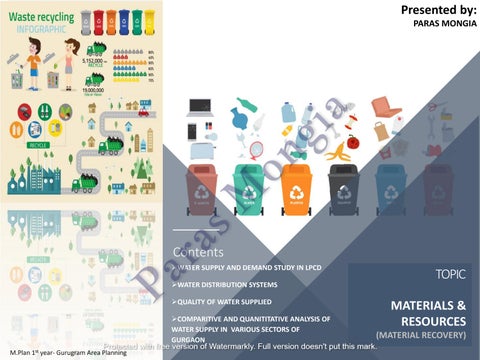
TOPIC MATERIALS & RESOURCES (MATERIAL RECOVERY)
Extended Producer Responsibility Extended producer responsibility (EPR) is a policy approach wherein a producer is held responsible for the post-consumer stage of a product, typically for defined tasks of separate collection (e.g., for e-waste or hazardous waste components), reuse (e.g., disposal-refund systems for bottles), recycling (e.g., for used cars), and storage and treatment (e.g., for batteries). The advantages of EPR systems include : reduction in natural resource demands of packaging and product containers; • Creation of incentives for environmentally friendly product designs; • Reduction in waste disposal costs for ULBs; • Provision of A monetary incentive to the consumer to return the • Product or package; and • Creation of infrastructure for collection and recycling of material.
EPR is currently practiced for waste fractions generating from electronics, batteries, packaging, and consumer durables (e.g., home appliances, electronics, and home and office furniture) for their appropriate and safe disposal. EPR policies are usually legislated at state and national levels. SOURCE : http://cpheeo.gov.in/upload/uploadfiles/files/Part2.pdf
CASE : GOA, PANAJI, INDIA Extended producer responsibility (EPR) initiatives were adopted through innovative measures like – tie-ups with local dairies for paying residents a specified amount for returning washed empty plastic milk bags at the local dairy booths; and – tie-up with Tetra Pak (company) for buyback of empty tetra packs.
SOURCE : http://cpheeo.gov.in/upload/uploadfiles/files/Part2.pdf
EPR TOOL KIT: Deposit Refund Systems a) An appropriate discount will be given for every used battery returned by the consumer.
EPR TOOL KIT: QUOTAS a) b)
Formalization of Informal Sector: Total 3710 rag pickers have been identified, which are doing collection and segregation of plastic waste in 361 MRF centers. Initiatives by MCG for the construction of Roads: In Gurugram as a pilot project, the first road was constructed with plastic waste in sector 51 Gurugram on19th December 2018. Thereafter the usage of plastic waste material in road construction is made compulsory from 1st April 2019with a private party and as per the terms of MOU the company will purchase the plastic waste from rag-pickers @ Rs.6/kg which will provide additional income to them by making them self-reliant, segregate the suitable material, shred it to usable size and then will provide it to the road contractors for its use in bituminous road construction. Authorized agency has already started the setting-up of Collection-cum-purchase-cum-processing center for plastic to roads, at various places from 17 May 2019.
EPR TOOL KIT: Product Bans As per the Haryana state Govt. notification dated 20th August 2013, the Government of Haryana has put complete ban on use of virgin and recycled plastic carry bags and recycled plastic containers. a) b) c) d) e) • • •
No person shall manufacture, stock, sell or use carry bags and articles such as plates, cups, tumblers, spoons, forks and straw made of virgin or recycled plastic in the state. No person shall use the containers made of recycled plastic for storing carrying, dispensing or packaging of food stuffs. Ban on the use of plastic pet water bottles in all the govt. offices an initiative by state govt. Many ULBs has banned the use of plastic/ thermocol based utensils for distributing langar/ devotional food at religious places which helped in reducing 2-5% of plastic waste generation in the city. Levy of Penalties : A fine of Rs. 25,000-50,000 for first offence to the manufacturing units who found to be violating these directions and later for subsequent offence the cancellation of license/ consent along with machinery/ material used will be occupied. A fine of Rs. 2,500-5,000 for first offence to the retailers, vendors and other establishments who found to be violating these directions and later for subsequent offence the cancellation of trade license of the violator under the relevant municipal laws and Shops and Establishments Acts by municipal authority. A fine of Rs. 250-500 per offence to any individual who found to be using or littering cups, tumblers, plastic bags/ carry bags, etc.
EPR TOOL KIT: Product Charges a) Plastic waste challan against violation: MCG is regularly doing monitoring and issuing challans to violators for open burning of waste (garbage or plastic), littering and use of polythene in and around the city b) File a half-yearly return of their battery’s sales and buy-back to the State Board latest by 3 June and 30 December of every year.
EPR TOOL KIT: Collection Systems a) Responsibilities of manufacturer, importer, assembler and re-conditioner.- It shall be the responsibility of a manufacturer, importer, assembler and re-conditioner to (i) ensure that the used batteries are collected back as per the Schedule against new batteries sold excluding those sold to original equipment manufacturer and bulk consumers. (ii) ensure that used batteries collected back are of similar type and specifications as that of the new batteries sold.
DIFFERENT TYPES OF E-WASTE
DIFFERENT TYPES OF PLASTIC WASTE
SOURCE : http://cpheeo.gov.in/upload/uploadfiles/files/Part2.pdf
DIFFERENT TYPES OF BATTERIES
Role of Stakeholders in the process of EPR
SOURCE : https://www.slideshare.net/CircularEconomyAsia/epr-and-packaging-insights-89568284?from_action=save
SOURCE : http://cpheeo.gov.in/upload/uploadfiles/files/Part2.pdf
SOURCE : http://cpheeo.gov.in/upload/uploadfiles/files/Part2.pdf
SOURCE : http://cpheeo.gov.in/upload/uploadfiles/files/Part2.pdf
E-WASTE TOTAL E-WASTE COLLECTED IN GURUGRAM
MATERIAL RECOVERED FROM E-WASTE IN GURUGRAM
BANDHWARI MSW PLANT TOTAL COLLECTION OF BHANDWARI MSW PLANT
1100 TPD (TONNES PER DAY)
TOTAL COMPOST GENERATED
35.45 TDP (TONNES PER DAY)
TOTL POWER SUPPLIED TO POWER PLANT
10 MW (MEGA WATT)
TOTAL BIO-GAS GENERATED
3000 m3
INFERENCE : From the above data it is clearly noted that the total recovered materials from the waste is nearly 20%
BANDHWARI LANDFILL SITE
MATERIAL RECOVERY PATTERN
E-WASTE
MATERIAL RECOVERY PLASTIC WASTE
THANK YOU