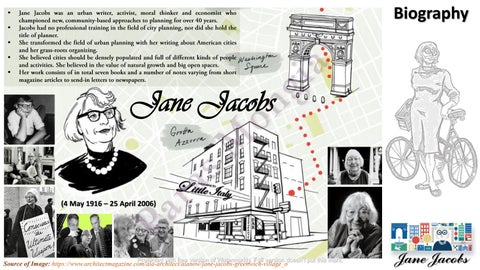
Biography
▪ ▪
▪ ▪ ▪
Jane Jacobs
(4 May 1916 – 25 April 2006)
Source of Image: https://www.architectmagazine.com/aia-architect/aianow/jane-jacobs-greenwich-village_o
Jane Jacobs
Ideologies Eyes on Street Social capital Citizen Science
Cities as Organized Complexity
Generators of Diversity
Ten Big Ideas
Form Still Follows Function
Local Economies
Gradual Money Innovation Make Many Little Plans
Source of Image: https://bewarethebibliophilia.tumblr.com/post/110094268697/citieshave-the-capability-of-providing-something
Jane Jacobs
Perspectives
Cities as Ecosystems Mixed-Use Development. Bottom-Up Community Planning The Case for Higher Density Local Economies
Source of Image: https://archive.curbed.com/2016/5/4/11582798/jane-jacobs-illustrated-guide-james-gulliver-hancock
Jane Jacobs
Works Done
Jane Jacobs spent her life studying cities. Jacobs had a trenchant writing style and did not make any attempt to disguise her opinion. Her books include:
•
The Death and Life of Great American Cities (1961)
•
The Economy of Cities(1969)
•
The Question of Separatism: Quebec and the Struggle over Sovereignty (1980)
•
Cities and the Wealth of Nations (1985)
•
Systems Of Survival: A Dialogue on the Moral Foundations of Commerce and Politics (1992)
•
The Nature of Economies (2000)
•
Dark Age Ahead (2004)
JACOB
AN
ACTIVIST:
Anti-Spadina movement •
•
•
In 1962, Jacobs headed a committee to stop the development of a highway through Lower Manhattan in New York City. Jacobs' campaign to save her own neighborhood of Greenwich Village, which was designated by Moses for slum clearance and a new expressway. After a popular campaign of social activism—which included Jacobs' arrest—Moses' plans were largely abandoned, signaling a victory for Jacobs' ideals, if not exactly a personal victory.
-"Intricate minglings of different uses in cities are not a form of chaos. On the contrary, they represent a complex and highly developed form of order.“ -"Old ideas can sometimes use new buildings. New ideas must use old buildings.
Source of Image: https://in.pinterest.com/pin/32158584827040184/
AS
Jane Jacobs
The Death and Life of Great American Cities- “Cities have the capability of providing something for everybody, only because, and only when, they are created by everybody.” • • •
• • •
In this book Jane Jacobs is concerned with the problems of city planning and the strategy that planners had followed throughout most of the twentieth century. The strategy of rebuilding has not been successful. It has not accomplished anything in eliminating slums or halting the decay of city neighborhoods. Jacobs provides a good analysis of what contributes to the success of neighborhoods by looking at city streets and sidewalks, parks and neighborhoods.
The differences in ages and shapes of buildings in a neighborhood mean something in terms of not only visual presentation but also of functionality and cost of rent. New buildings have high costs of construction to cover and therefore have to charge higher rents than older building. The reasons for the decay and regeneration of certain city neighborhoods are also examined. There are steps that can be taken to prevent decay or reverse the process of decay, but this wasn’t includes while city planning.
Source of Image: https://www.google.com/doodles/jane-jacobs-100th-birthday
Famous Works •
According to her, planning should not mean tearing down and rebuilding, for example, rebuilding of slums wasn’t the solution to end decay of neighborhood. Regeneration requires people who want to stay in the area.
•
Jacobs feels that the proper role of a city planner is to analyze neighborhoods and encourage the factors that promote success and discourage the factors that contribute to lack of success.
Jane Jacobs
Learning Outcomes The above study depicts the importance of community integration, neighborhood or local level planning and compactness based on higher densities. • The modern age living tends to focus more on technology and advancement resulting in loss of our Public realm. • Loose zoning led to the different land uses and lack of dependency of similar uses such as residential and commercial etc. • Focus on mobility and connectivity has resulted in more negative spaces and dead ends. Sources of Image: https://medium.com/citiesense/what-does-jane-jacobs-have-to-do-withorange-102a985d0f39 https://in.pinterest.com/pin/478366791663582105/ https://www.architectural-review.com/essays/reputations/jane-jacobs-19162006 http://zinasaunders.blogspot.com/2016/10/jane-jacobs-for-book-review.html