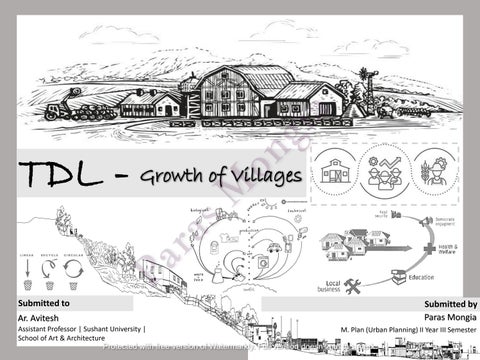
TDL - Growth of Villages Submitted to
Submitted by Paras Mongia
Ar. Avitesh Assistant Professor | Sushant University | School22/09/2022 of Art & Architecture
M. PlanShoaib (UrbanSheikh Planning) IIParas Year IIIMongia Semester
Policies - Rural Development Policies- Rural Development 1
Yashika Singhal (MPLAN 2nd
1
On the basis of Structure
2
On the basis of Residence
3
On the basis of Organisation
Nucleated Village Migratory Village
Co-operative Village
Linear Village Semi-permanent Agricultural Village
Dispersed Village
Permanent Agricultural Village
Mixed Village
4
On the basis of Ownership
Semi-Collective Village
Collective Village
Types of Villages
Land-Lord Village
A village is a clustered human settlement or community, larger than a hamlet but smaller than a town (although the word is often used to describe both hamlets and smaller towns), with a population typically ranging from a few hundred to a few thousand.
Ryotwari Village
Though villages are often located in rural areas, the term urban village is also applied to certain urban neighborhoods. Villages are normally permanent, with fixed dwellings; however, transient villages can occur. Further, the dwellings of a village are fairly close to one another, not scattered broadly over the landscape, as a dispersed settlement. Fig. Ancient Medieval Village Source: https://www.sociologydiscussion.com/village/classification/classification-of-villages-4-categories/2615
Policies22/09/2022
Shoaib Sheikh Paras Mongia Yashika Singhal (MPLAN 2nd
Various Type- of Villages - Classification Policies Rural Development Rural Development 2
Benefits of Circular Economy in Rural area/ Village Development ASSIGNMENT 01
Policies22/09/2022
Rural Development
3
Shoaib Sheikh Paras Mongia Yashika Singhal (MPLAN 2nd
Since the 21st Century, most of the developing nations including India started facing challenges due to modernisation, spilling-over of growing population and changing demographics, rapid urbanization, over utilization of resources, environmental pollution, climate change and conversion of agricultural/ rural land into other land uses to support various secondary and tertiary activities in urban areas/ cities. This eventually led to various adverse effects on social, environmental and economic dimensions of both urban and rural areas. This shift mainly dependent on the linear type of economy which literally means production of things with the help of available raw materials and its disposal at the end of its usage without reusing or recycling the end products. This type of process is not only costlier but also require more production and consumption equally. Over the time, this became very challenging for the urban and rural areas to efficiently use the resources and achieve cradle to cradle methodology. The concept of Circular economy/ flow/ cycle is the only solution which is to be adopted and as realized to be implemented in the system so as to have a sustainable growth in future with efficient utilization of available resources, less dependent on production from scratch and rather reusing the products in different ways at multiple times especially those materials which are harmful for the natural environment and can’t be decomposed for decades such as plastics, metals, fibres etc. Linear economy models lead to natural resource depletion, massive pollution, socioeconomic inequalities, and marginalized societies. Rural lands are easily targeted and exposed to urbanization process or other processes in agribusiness sectors that are detrimental to organic farming, natural landscapes, and local biodiversity. The circular economy if applied to rural areas provides a path to enlarge horizons for sustainability against the climate change. Rural areas are the primary sources which possess a variety of ecosystems and natural resources that are today’s society needs and demands (water, food, energy, raw materials, etc.), this is why the productive model of rural areas serves as an impulse for all those sectors linked to the production system. However, rural communities are more prone to natural hazards (floods, drought, erosion of soil, etc.) under the climate change context in addition to socioeconomic threats (depopulation, poverty, poor infrastructure, etc). To achieve the sustainable development goals (SDGs) of Agenda 2020, the transition towards circular economy approaches must be implemented in rural communities. Various sustainable economic solutions include bioeconomy, blue economy, sharing economy, and the digital economy.
Key Benefits of circular economy in village growth: Hence, circular economy is benefitting the village growth and development in multiple ways by retaining their character without any change in their function and typologies. Some of them are lesser impact on environment which is supremely important (by creating vital ecosystems such as soil, air and water bodies). These ecosystems provide services such as cleaning, products such as fertile farmland, pollination and clean drinking water. Circular economy also helps in boosting local economy and hence improves the condition of employability. Therefore, a holistic approach to the circular economy could prove particularly successful in rural areas because it provides a methodology that could aid rural territories in designing sustainable and resilient development strategies. •
Promote the modernisation of production methods and technologies with a view to improve the quality of agricultural produce and promote the certification of agri-food products
•
Improve the profitability of farms through diversification of products and services and the identification of pathways of development able to integrate the existing cultural, natural and environmental resources with high quality products
•
Build strong local and ethical brand identities that feed into virtuous circles of production and are environmentally and socially conscious
•
Ensure all community-based actions for rural development are aimed at strengthening and building new and existing synergies between agricultural production and the local ecosystem
•
Promote a multi-functional model of agriculture that inherently incorporates the economic value of agricultural and livestock farming with social values, environmental protection and the safeguarding of marginal areas
•
Fig. Circular (closed-loop) relationships
Fig. Site plan of the EI Center
Strengthen community identity, through building integrated and differentiated services and networks
Image Source: https://www.witpress.com/Secure/elibrary/papers/SC19/SC19026FU1.pdf
Policies22/09/2022
Shoaib Sheikh Paras Mongia in Rural 4AreasYashika Singhal (MPLAN 2nd
Policies - Rural Development of Circular Economy RuralBenefits Development
Policies for Rural Development ASSIGNMENT 02
Policies22/09/2022
Rural Development
5
Shoaib Sheikh Paras Mongia Yashika Singhal (MPLAN 2nd
Policy 1- MGNREGA (Mahatma Gandhi National Rural Employment Guarantee Act) •
National Rural Employment Guarantee Act 2005, was launched on the 2nd Feb.2006. Now the new name of this scheme is "Mahatma Gandhi National Rural Employment Guarantee Act" (or, MGNREGA).
•
This scheme is an Indian labour law and social security measure that aims to provide ‘right to work' to the people falling Below Poverty Line.
•
It guarantees 100 days employment in a year to the village people.
•
Fifty percent workers should be women.
•
Its 90% funding is borne by the central government and 10% by the state government.
Key Features of MGNREGA Objective: The primary objective of the scheme is to guarantee 100 days of employment in every financial year to adult members of any rural household willing to do public work-related unskilled manual work.
Benefits of MGNREGA 2005
Legal Right to Work: At least one-third of beneficiaries must be women. Wages must be paid according to the statutory minimum wages specified for agricultural labourers in the state under the Minimum Wages Act, 1948. Demand-Driven Scheme: The most important part of MGNREGA’s design is its legally-backed guarantee for any rural adult to get work within 15 days of demanding it, failing which an ‘unemployment allowance’ must be given. Decentralised planning: There is an emphasis on strengthening the process of decentralisation by giving a significant role in Panchayati Raj Institutions (PRIs) in planning and implementing these works. • The act mandates Gram sabhas to recommend the works that are to be undertaken and at least 50% of the works must be executed by them.
Policies22/09/2022
Policies - Rural Development Rural Development 6
MGNREGA is a bottom-up, people-centred, demand-driven, self-selecting and rights-based programme. Thus, MGNREGA remains crucial for integrated resource management and livelihoods generation perspective. Source:https://www.drishtiias.com/dailyupdates/daily-newseditorials/mgnrega-and-migrant-crisis
Shoaib Sheikh Paras Mongia Yashika Singhal (MPLAN 2nd
Present Scenario of Implementation of the Act
Source:- https://transformingindia.mygov.in/allinfographics/page/25/?sector=rural-development Source: https://transformingindia.mygov.in/all-infographics/page/757/?sector
• The nationwide lockdown imposed to curb the spread of the novel coronavirus disease (COVID-19) left Mahatma Gandhi Employment Guarantee Act 2005 (MGNREGA) workers in the lurch. • Thousands such workers, facing an economic crisis, have demanded an increase in the annual guarantee of work to 200 days per person. • The workers from across the country on June 29,2020 raised demands for higher benefits and reserving the rights for local planning by Gram Sabha. • Thousands of workers from 108 districts across 12 workers observed the day as ‘NREGA Adhikar Diwas’ and staged peaceful demonstrations from their worksites. Source:- https://www.downtoearth.org.in/blog/covid-19-rural-crisis-why-mgnrega-needs-a-harder-push-72130
Policies22/09/2022
Policies - Rural Development Rural Development 7
Shoaib Sheikh Paras Mongia Yashika Singhal (MPLAN 2nd
Policy 2 - Sarva Siksha Abhiyan • •
The SSA scheme is implemented in partnership with the State Governments to cover the entire country and address the requirements of 192 million children in 1.1 million habitations.
• • •
SSA has been operational since 2000- 2001. Its main aim is to make free and compulsory education to children between the ages of 6 to 14, a fundamental right. This programme was pioneered by former Indian Prime Minister Atal Bihari Vajpayee. Right to education is related to the 86th Amendment to the Constitution of India. Currently its expenditure is shared by the centre and state into 50: 50 ratios.
Source:https://www.examsexclusive.com/2 020/09/national-education-policy2020.html
In 2018, the Sarva Shiksha Abhiyan and the Rashtriya Madhyamik Shiksha Abhiyan were subsumed and merged to form the Samagra Shiksha Abhiyan scheme. Source:- http://ignited.in/I/a/242334
Policies22/09/2022
Features of the Sarva Shiksha Abhiyan Scheme The features of the SSA scheme are as follows: • This scheme was launched for the implementation of universal elementary education in a defined time frame. • This scheme provides quality basic education all over the country. • It facilitates promoting social justice by providing basic education to children. • It creates a partnership between the State, Central and the local government for imparting education. • It provides an opportunity for the States for developing its own vision of elementary education.
Policies - Rural Development Rural Development 8
Shoaib Sheikh Paras Mongia Yashika Singhal (MPLAN 2nd
Policy 3 - Antyodaya Anna Yojna (AAY) • • • • • •
•
The scheme was launched by the Prime Minister Atal Bihari Bajpayi on the 25 December 2000. The scheme provides food grains to around 2 cr. Below Poverty Line (BPL) families at a very subsidized rate. Total 35 kgs of food grains is provided to a family. Rice is provided at the rate of Rs. 3/kg and wheat at 2 Rs.2/kg.
The AAY Scheme has since expanded to cover 2.50 crore poorest of the poor households as follows: The AAY Scheme was expanded in 2003-04 by adding another 50 lakh BPL households headed by widows or terminally ill persons or disabled persons or persons aged 60 years or more with no assured means of subsistence or societal support. Order to this effect was issued on 3rd June, 2003. With this increase, 1.5 crore (i.e. 23% of BPL) families were covered under the AAY.
Source:- google.com/url?sa=i&url=https%3A%2F%2Fwww.mescoindia.com%2Fantyodaya-annayojana%2F&psig=AOvVaw0rDjmJS4hRMrVM21Qrrsu&ust=1635855820364000&source=images &cd=vfe&ved=0CAwQjhxqFwoTCNi60L2U9_MCFQAAAAAdAAAAABAD
Policies22/09/2022
Policies - Rural Development Rural Development 9
Shoaib Sheikh Paras Mongia Yashika Singhal (MPLAN 2nd
Policy 4 - Saansad Adarsh Gram Yojana (SAGY), Ministry of Rural Development, Government of India Aim & Objectives
Holistic Development through SAGY Approach
Source:- http://unnat.iitd.ac.in/app/webroot/files/generaldocuments/Guidelines%20and%20Case%20Studies%20for%20Integrated%20Villa ge%20Development%20Planning.pdf
Policies22/09/2022
Policies - Rural Development Rural Development 10
Shoaib Sheikh Paras Mongia Yashika Singhal (MPLAN 2nd
Strategies
Timeframe
Activities in Adarsh Village
Source:- http://unnat.iitd.ac.in/app/webroot/files/generaldocuments/Guidelines%20and%20Case%20Studies%20for%20Integrated%20Villa ge%20Development%20Planning.pdf
Policies22/09/2022
Policies - Rural Development Rural Development 11
Shoaib Sheikh Paras Mongia Yashika Singhal (MPLAN 2nd
Policy 5- Pradhan Mantri Gram Sadak Yojana • • •
Areas Under This Project
Pradhan mantri gram sadak yojana (PMGSY) was launched on 25th december, 2000. It centrally sponsored scheme to provide road connectivity in rural areas of the country. The aim of program is to connect all habitations with a population of 500 persons and above in plain areas and 250 persons and above in hilly and desert areas.
Connectivity Targets Under PMGSY • • • •
1,68,268 habitations were eligible for coverage under the program. Out of which 31,804 habitations had been reported either connected under other schemes or not feasible. Therefore, 1,36,464 habitations were targeted for providing road connectivity under PMGSY. Target of government of India under this program is 2,24,906 km.
Features of PMGSY PMGSY has large socioeconomic benefits 1. Access to market 2. Improved employment opportunities 3. Access to better health care facilities specially to pregnant mothers and children 4. Improved educational facilities specially for girl children Issues and Challenges •
• • •
Completion of Works in Some Hilly areas and LWE affected areas. Limited Contracting Capacity and Limited Time for completion Maintenance of already constructed Roads . Rural Roads Safety
Source:- https://transformingindia.mygov.in/infographics/paving-roads-for-rural-development/
Policies22/09/2022
Policies - Rural Development Rural Development 12
Shoaib Sheikh Paras Mongia Yashika Singhal (MPLAN 2nd
Institutional Framework of PMGSY
Green Technology Roads Constructed Till September, 2019
Mandate to construct 15% roads using new and IRC accredited technology since 2013-14.
Physical Process:- Road Length Constructed (km)
Source:- https://rural.nic.in/sites/default/files/Overview%20of%20PMGSY.pdf
Policies22/09/2022
Policies - Rural Development Rural Development 13
Shoaib Sheikh Paras Mongia Yashika Singhal (MPLAN 2nd
Case Scenario 1 - Impact of PMGSY on Socio-Economic Development of village settlements near Chandpur •
Accessible road transport network of rural area is one of the most important key factors for the development and transformation of the rural area and also the nation a whole.
•
The rural road connectivity helps the rural people to access the various economic and social services easily and propels the agricultural and industrial production.
•
It generates employment opportunity which reduces the poverty level and change the standard of living from traditional subsistence level to a modern way of self sufficiency to affluency.
•
The PMGSY road has improved the social, physical, financial and human capital of the population of the connected villages by which the villagers are coming up in the main stream and contribute in the progress of the nation.
Kushabaria Road, Murshidabad District, West Bengal Rural road increases the mobility level of passenger (persons) and goods (materials) which facilitates economic growth.
Location : Chandpur- Kushabaria road stretch, Domkal CD block of Murshidabad District, West Bengal, India
Source:https://www.researchgate.net/publication/327070746_Impact_of_PMGSY_on_So cio-Economic_Development_A_Case_Study_of_Chandpur_Kushabaria_Road_Murshidabad_District_West_Bengal
Shoaib Sheikh
Paras Mongia
Case Study of a Village – Study area, West Policies - Rural Development Policies- Rural Development 22/09/2022 14 Bengal Yashika Singhal (MPLAN 2nd
Objective To understand the socio-economic impact on the lives of the rural people who are beneficiaries as a result of enhanced rural connectivity provided through Chandpur-Kushabaria PMGSY road in the form of change in : a) Agricultural productivity and economic benefit through enhanced production and hike in price of commodities. b) Educational development through greater accessibility to educational institutions. c) Social development, rural transformation through enhanced social interaction, effective integration and fulfilling cultural and higher needs of life of the people.
Impact of PMGSY on different sectors : On Transportation
On Agriculture
On different attributes of socio-economic development
On Important Places
On Education
Source:https://www.researchgate.net/publication/327070746_Impact_of_PMGSY _on_Socio-Economic_Development_A_Case_Study_of_Chandpur_Kushabaria_Road_Murshidabad_District_West_Bengal
Shoaib Sheikh
Paras Mongia
Case Study of a Village – Study area, West Policies - Rural Development Policies- Rural Development 22/09/2022 15 Bengal Yashika Singhal (MPLAN 2nd
On Housing Condition
On Land Price
Other Impacts due to PMGSY :
Major Findings : ➢ Productivity of paddy, jute, and wheat etc. have increased perceived to be due to easier access to agricultural inputs such as HYV seeds, chemical fertilizers, pesticides, insecticides, herbicides etc. and saling out of agricultural produce. ➢ Some of the cash crops like banana, sugar cane etc. and vegetables have been recently introduced in the study area after the construction of the road to mainly as cash crops. ➢ Traditional transport modes are replaced by motorized vehicles offering much more quick and efficient transportation services. Conclusion : ➢ The aim of this programme is to connect the unconnected habitations of rural areas to urban centres or higher order roads by providing all weather road connectivity. PMGSY is the window for modern urbanization process for contemporary period. ➢ As a marvelous consequence of this mention worthy programme PMGSY, has played a very significant and pivotal role on the rural people of the remote study area to grow sense of modernism and self reliance. ➢ They are in a position to easily utilize their basic resources and facilities and also fulfill their need. Now they perceive that without touch of globalization and urbanization it is quite impossible to improve their socio-economic condition. ➢ This realization comes mainly after the implementation of the programme and creates a dream in their mind „billion‟s dream‟, a „Strong India‟. ➢ Thus it may be said with a certain amount of confidence that PMGSY has brought desired transformation in the rural area.
Source:- https://www.researchgate.net/publication/327070746_Impact_of_PMGSY_on_SocioEconomic_Development_A_Case_Study_of_Chandpur-_Kushabaria_Road_Murshidabad_District_West_Bengal
Shoaib Sheikh
Paras Mongia
Case Study of a Village – Study area, West Policies - Rural Development Policies- Rural Development 22/09/2022 16 Bengal Yashika Singhal (MPLAN 2nd
Design of Primary School in a Village area ASSIGNMENT 03
Policies22/09/2022
Rural Development
17
Shoaib Sheikh Paras Mongia Yashika Singhal (MPLAN 2nd
Kitchen
A
Staff Parking
A’ Staff Parking
Bus Parking
ASSIGNMENT GROUND FLOOR PLAN
III
Entry
Classrooms Staff room, Admin rooms, Principal room Library Toilets Playground
Policies22/09/2022
SECTION AA’
Shoaib Sheikh Paras Mongia Yashika Singhal (MPLAN 2nd
Policies - RuralSchool Development Rural Development Design of Primary in a Village 18
Policies22/09/2022
Rural Development
19
Shoaib Sheikh Paras Mongia Yashika Singhal (MPLAN 2nd