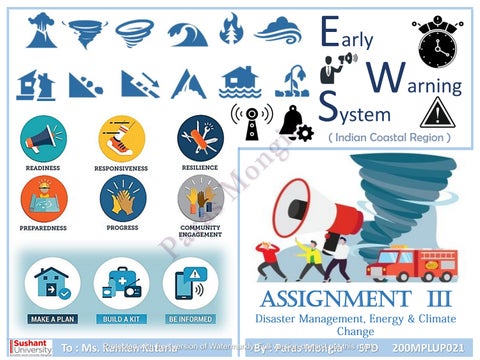
Early Warning System ( Indian Coastal Region )
ASSIGNMENT III To : Ms. Kankan Kataria
By : Paras Mongia
SPD
200MPLUP021
INTRODUCTION TO EWS The term ‘early warning’ is used in many fields to describe the provision of information on an emerging dangerous circumstance where that information can enable action in advance to reduce the risks involved. Early warning systems exist for natural geophysical and biological hazards, complex socio-political emergencies, industrial hazards, personal health risks and many other related hazards.
SAVING LIVES… • •
1
Without sufficient warning the provision of emergency supplies, training and evacuation materials can become worthless. The greater the time communities have to prepare, the greater the savings in human life, household assets, livestock and stored provisions.
WHY EWS ? Early warning systems can be set up to avoid or reduce the impact of hazards as flood, flash-floods, landslides, storms, forest fires etc. The significance of an effective early warning system lies in the recognition of its benefits by the members of the general public.
WHAT IS THE NEED OF EWS ?
The basic idea behind early warning systems is that the earlier and more accurately we are able to predict potential risks associated with natural and human-induced hazards, the more likely we will be able to manage and mitigate disasters’ impact on society, economies, and the environment. Accurate, reliable and timely early warning system enhances climate change adaptation efforts at all levels by: I. Enabling communities and institutions to make informed and timely decisions. II. Helping communities to time their activities with the expected impacts.
Key elements of Early Warning System
Observation and recording
Agencies for Forecasting
Importance of Early Warning System
Indian Coastal Region Map
Climate change implies an increased risk of potential hazards and even disasters. In order to prepare ourselves, we need early warning systems.
Risk knowledge and recognition
Warning and dissemination
Appropriate response
2
END TO END EARLY WARNING & THE PROCESS
Source: https://www.researchgate.net/figure/Subdivisi on-of-a-generic-EWS-in-its-four-fundamentalcomponents_fig1_234217392
Source: https://na.unep.net/geas/docs/early_warning_system_report.pdf
3
Source: http://www.taru.co.in/assets/report/publication/09_SummaryReport7cities.pdf
Types of Coasts which Cause Erosions | Coastal Erosion | Geography
Source: https://www.geographynotes.com/erosions/coastal-erosion-erosions/typesof-coasts-which-cause-erosions-coastal-erosion-geography/4820
4
Early Warning System | Indian Coastal Region | Disaster Management
•
In India, the Department of Ocean Development in association with Department of Science and Technology (DST), Department of Space (DOS) and CSIR Laboratories, is setting up an Early Warning System for Tsunami and Storm Surges in the Indian Ocean.
•
The existing analogue Cyclone Warning Dissemination System of India Meteorological Department (IMD), with 250 receivers installed along the Indian coast, is to be replaced with a state-ofart system.
•
The new system will provide more lead time to the disaster management officials and better voice quality for easy comprehension.
5
Source: https://www.researchgate.net/figure/ndian-classification-ofcyclonic-disturbances-in-the-north-Indian-Ocean_tbl1_241055039
Mechanism of Early Warning Systems | Cyclone Forecasting
Recently Cyclone Tauktae and Cyclone Yaas wreaked havoc in several states of India with the credit for the cyclogenesis can be given to exceptionally warmer Indian seas this year, making atmospheric and ocean conditions favourable for frequent formation of cyclones and their rapid intensification.
Source: https://www.civilsdaily.com/cyclones/ https://www.researchgate.net/figure/Year-to-year-variation-of-R2-coefficient-of-determination-of-regressions-for-two_fig3_296844989
6
Disaster Warning System in India | Disaster Management Cyclones are disastrous in many ways. They do more harm than any good to the coastal areas. • •
Early Stage
7
• • •
•
Mature Stage
Requirements for a Cyclone to form There are six main requirements for tropical cyclogenesis: • Sufficiently warm sea surface temperatures. • Atmospheric instability. • High humidity in the lower to middle levels of the troposphere. • Enough Coriolis force to develop a low-pressure center. • A preexisting low-level focus or disturbance. • Low vertical wind shear.
A Tropical cyclone is an intense circular storm that originates over warm tropical oceans and is characterized by low atmospheric pressure, high winds, and heavy rain. Cyclones are formed over slightly warm ocean waters. The temperature of the top layer of the sea, up to a depth of about 60 meters, need to be at least 28°C to support the formation of a cyclone. This explains why the April-May and OctoberDecember periods are conducive for cyclones. Then, the low level of air above the waters needs to have an ‘anticlockwise’ rotation (in the northern hemisphere; clockwise in the southern hemisphere). During these periods, there is an ITCZ in the Bay of Bengal whose southern boundary experiences winds from west to east, while the northern boundary has winds flowing east to west. Once formed, cyclones in this area usually move northwest. As it travels over the sea, the cyclone gathers more moist air from the warm sea which adds to its heft.
Source: https://www.civilsdaily.com/cyclones/
Destruction Caused by Cyclones 1) Strong Winds 2) Torrential rains and inland flooding 3) Storm Surge
Recent Cyclones in India
•
Cyclone Tauktae •
• •
• •
• •
• •
Very Severe Cyclonic Storm Yaas was a relatively strong and highly damaging tropical cyclone that made landfall in Odisha and brought significant impacts to West Bengal during late May 2021. Yaas formed from a tropical disturbance that the Indian Meteorological Department first monitored on May 23. Evacuations were also ordered, starting on May 24 on low-lying areas in East Midnapore and West Midnapore and Jhargram. As of May 28, 20 people have been reported dead due to Yaas. The total damages in West Bengal, the most heavily impacted state from Yaas, were estimated to be around ₹20 thousand crore (US$2.76 billion).
Source: https://www.civilsdaily.com/cyclones/
Extremely Severe Cyclonic Storm Tauktae was a powerful tropical cyclone in the Arabian Sea that became the strongest tropical cyclone to make landfall in the Indian state of Gujarat since the 1998 Gujarat cyclone and one of the strongest tropical cyclones to ever affect the west coast of India. Tauktae brought heavy rainfall and flash floods to areas along the coast of Kerala and on Lakshadweep. There were reports of heavy rain in the states of Goa, Karnataka and Maharashtra as well. Tauktae resulted in at least 169 deaths in India, and left another 81 people missing. 66 people died, at least 20 people are still missing after Barge P305 sank near Heera oil field, off the coast of Mumbai, although the Indian Navy said it had rescued 186 survivors of the 270 people aboard by May 19. Losses from Tauktae are estimated at ₹15,000 crore or US$2.1 billion.
Cyclone Yaas
8
Measures need to be taken for effective mitigation
9
Source: https://www.civilsdaily.com/cyclones/
CAP Implementation in India | Case Scenario •
•
•
The Common Alerting Protocol (CAP) is an XML-based data format for exchanging public warnings and emergencies between alerting technologies. CAP allows a warning message to be consistently disseminated simultaneously over many warning systems to many applications, such as Google Public Alerts and Cell Broadcast. CAP increases warning effectiveness and simplifies the task of activating a warning for responsible officials.
National Cyclone Risk Mitigation Project (NCRMP)
Source: file:///F:/3rd%20Sem/20MUP-4DM21T%20Disaster%20Management,%20Energy%20&%20Climate%20Change/PPT%203/CAP-2019-204.pdf
10
Project Stakeholders
Forecasting Agencies
CAP Implementation in India | Challenges and Future Strategies
11
• • • •
• •
Large Population, density varies Alerting mechanism is different for different states Different Hazard Profile for Different Areas Smartphone penetration is less only 30% cell broadcasting so SMS and Cell Broadcasting both options need to implement Support for Multilingual Message broadcast as India has 22 major languages Large number of Government and Private Organizations need to be integrated with CAP Early Warning Platform through Inter Working Functions, Support for Legacy systems
• All Radio Transmitters of All India Radio (420 stations) and Private FM Channels (157 stations) • Television – 16 Doordarshan Channels and 115 Private News Channels • Indian Railway – railway tracks of 121,407 km, more than 8000 stations, In the year ending March 2018, IR carried 8.26 billion passengers and transported 1.16 billion tonnes of freight. • Electronic Road Signage installed across National and State Highways • Electronic Sirens installed at 13 Cyclone Prone States • Integration with Social Media Crowd Sourcing Mechanism for Targeted Relief and Recovery of Disaster Affected People Source: file:///F:/3rd%20Sem/20MUP-4DM21T%20Disaster%20Management,%20Energy%20&%20Climate%20Change/PPT%203/CAP-2019-204.pdf
CAP Implementation in India | Targetted States and Key Projects
Source: file:///F:/3rd%20Sem/20MUP-4DM21T%20Disaster%20Management,%20Energy%20&%20Climate%20Change/PPT%203/CAP-2019-204.pdf
12
Thiruvananthapuram, Kerala
Measures need to be taken for effective mitigation
Some Current Affairs on EWS in India ✓ India is developing landslide early warning system: How does it work and why it's a challenging task ✓ Uttarakhand disaster: An early warning system for glaciers is needed
✓ Uttarakhand CM launches India's first earthquake early warning mobile app developed by IIT-Roorkee
13
Source: https://nidm.gov.in/easindia2014/err/pdf/session/3/4.pdf
✓ Odisha gets Rs 800 crore to boost early warning dissemination ….
Learning Outcomes | Challenges | Analysis • Post than pre focus: Disaster management in India is largely confined to post-disaster relief works. It is more about management than loss prevention. • Population: One-third of the population in India lives in the coastal area. Most of them are marginalized people who are ill-prepared and unable to cope up with a disaster. • Poor response: The warning of a cyclone is not properly communicated between the concerned agencies. In many cases, the warning is not taken seriously by the agencies which cause delayed effort for the prevention of a disaster. This was evident in the recent Ockhi cyclone disaster. • Lack of awareness: among people about the impact and magnitude of the disaster. Also what to act during and post disasters. • Coordination Issues: There is also a lack of coordination between the local communities for search and rescue missions. Also poor coordination state and center coordination and its agencies. 14 Source: file:///F:/3rd%20Sem/20MUP-4DM21T%20Disaster%20Management,%20Energy%20&%20Climate%20Change/PPT%203/CAP-2019-204.pdf
Thank You