JYVÄSKYLÄ On the Move
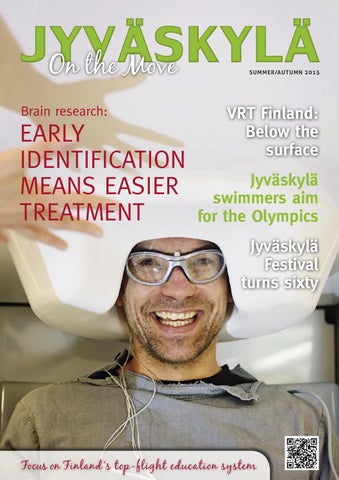
Brain research:
EARLY IDENTIFICATION MEANS EASIER TREATMENT
SUMMER/AUTUMN 2015
VRT Finland: Below the surface Jyväskylä swimmers aim for the Olympics Jyväskylä Festival turns sixty
Focus on Finland’s top-flight education system
1
JYVÄSKYLÄ City On the Move
THIS PUBLICATION IS BROUGHT TO YOU BY
SUMMER/AUTUMN 2015
Published twice yearly, Jyväskylä On the Move magazine showcases the expertise, culture and people to be found in the Jyväskylä Region.
CONTENTS
The City of Jyväskylä, with a population of 136 000, is one of Finland’s centres of growth. Recognised as a city of high-quality education, Jyväskylä is also internation ally known for the architecture of Alvar Aalto. www.jyvaskyla.fi Jyväskylä Regional Development Company Jykes Ltd. is a business promotion and development company owned by the four municipalities in the Jyväskylä Region. The aim of Jykes is to create a favourable business environment. By offering expertise, support and various networks for companies, Jykes creates opportunities and conditions for profitable business operations. www.jykes.fi The University of Jyväskylä is one of the largest, most attractive and dynamic research universities in Finland, with about 15 000 students, including international students from some 90 countries. www.jyu.fi JAMK University of Applied Sciences is a multidisciplinary institution of higher education with a strong international orientation and a student enrolment of 8 000. Our strengths are workplace-driven learning, close cooperation with the labour market and business, as well as extensive international contacts. www.jamk.fi Jyväskylä Educational Consortium provides vocational and general upper secondary education to young people and adults. The consortium’s educational institutions are attended by over 22 000 students. www.jao.fi
ISSN 1795-3146 (Print) ISSN 2342-1002 (Online) Editorial Office in this issue Jyväskylä Educational Consortium Viitaniementie 1 A, P.O.Box 472, FI-40101 Jyväskylä niina.luttinen@jao.fi, www.jao.fi Editor-in-chief Niina Luttinen Jyväskylä Educational Consortium Editorial staff and layout Viestintä-Paprico Oy, www.paprico.fi Printed by Kirjapaino Kari Ky Circulation 5 300 Cover photo by Petteri Kivimäki
2
16 4 6 8 9 10 12 14 16 18 20 22
TOP CLASS BY WORLD STANDARDS WHAT DOES PISA MEASURE? FINNISH VOCATIONAL EDUCATION GOES GLOBAL EDUCLUSTER FINLAND EXPORTS KNOWHOW EYES OPEN FAR FROM HOME JYVÄSKYLÄ SINFONIA: 60 YEARS AND NO LIMITS LAND OF GREEN GOLD INTERDISCIPLINARY BRAIN RESEARCH BELOW THE SURFACE JYVÄSKYLÄ SWIMMERS AIM FOR THE OLYMPICS COST SAVINGS BEAR OUT CLAIMS
Editorial board Satu Heikkinen (City of Jyväskylä), Miikka Kimari (University of Jyväskylä), Taija Lappeteläinen (Jyväskylä Regional Development Company Jykes Ltd.), Niina Luttinen (Jyväskylä Educational Consortium), Pauliina Hietalahti (JAMK University of Applied Sciences) English translation Peter Gregory and Tony Melville
20 J Y VÄ S K Y L Ä O N T H E M O V E
FIRST WORDS JUNE 2015
Education generates equality and well-being THE FINNISH EDUCATION SYSTEM enjoys a first-class inter national reputation. Our high-calibre system of education not only generates equality and well-being but provides the busi ness sphere with the foundation on which to build success in the global competition. Jyväskylä is known first and foremost as a city of education. The level of interest in our expertise, for instance, is revealed by the fact that virtually every week pedagogues and represent atives of educational administrations from different countries visit the city’s colleges and institutions of higher education. These international visitors want to make their acquaintance with a system whose 15 year olds have achieved top results in all the PISA studies conducted since the beginning of the 2000s. Teacher education has attracted particular attention. In Fin land the work of a teacher is highly appreciated at all levels, from early education right through to university level. In many developing economies teachers are unfortunately in a weaker position, which in vocational education, for example, may be an obstacle to interactive cooperation with businesses. JYVÄSKYLÄ’S SPECIAL STRENGTH when it comes to export ing education and expertise is that the major providers of edu cation, JAMK University of Applied Sciences, the University of Jyväskylä and Jyväskylä Educational Consortium, are engaged in close cooperation. The knowhow possessed by these organ isations is brought to the international market with the help of a jointly owned expert company, EduCluster Finland Ltd. What is more, Jyväskylä has a large number of small and mediumsized firms whose expertise is regularly made use of in interna tional projects. Experts from Jyväskylä Educational Consortium, for instance, have been involved in an educational export project which cov ered implementation of continuing education for vocational teachers in Shanghai. China, which is conducting a major over haul of its vocational education, wishes to boost the pedagogic and vocational expertise of its vocational teachers as well as the match between education and working life needs. Finland has long traditions of giving education a working life orientation. The needs of industry and commerce have a strong influence on
MIKA JUHANI LUOMANSIVU
what kind of edu cation and training is arranged here in Finland. In China questions associat ed with the promo tion of entrepren eurship have also come to the fore as the country’s eco nomic growth has shown signs of weakening. Where interna tional education export projects are concerned a solution-centred approach based on dialogue plays a key role. We do not attempt to dictate any absolute truths, rather we seek to develop education in the target country with due regard for local realities. FINLAND, TOO, IS FACED WITH major change. Multicul turalism and urbanisation are having a strong shaping effect on our society. In the latest PISA study Finland’s results fell away slightly, which provides grounds for analysing carefully the reasons for this change and putting the necessary counter measures in place. Industry is also on the brink of a new era. In future we need companies whose business is predicated on new innovations and high-level expertise. The major industrial players have al ready acknowledged the extensive opportunities presented by the bioeconomy. The rise of the bioeconomy is inevitable as fos sil fuels gradually run out. n Vesa Saarikoski CEO Jyväskylä Educational Consortium
3
Focus on Finland’s top-flight education system
P O T
by
Almost three-quarters of Finns aged 25–64 have at least successfully completed secondary education, in other words they have passed the matriculation examination or obtained a vocational qualification, while a third have gone on to higher education. The Finnish education system is considered one of the world’s best. Finland’s success is largely down to a highly uniform system of comprehensive education offered to the whole age cohort, well-trained teachers and a large degree 4
J Y VÄ S K Y L Ä O N T H E M O V E
S S A s CL d r a nd
a t s d worl
Class 6A at Jyväskylä’s Tikka primary school learn mathematics and other school subjects chiefly from textbooks, but apps and games are used alongside them.
of independence for schools. The solid reputation of the comprehensive school is based to no small extent on excellent PISA results. Secondary-level vocational education, in turn, enjoys greater appeal in Finland than in the other Nordic countries according to a recent study conducted by the University of Jyväskylä. This is exceptional, since elsewhere in Europe vocational education often struggles for appreciation. 5
Focus on Finland’s top-flight education system
WHAT DOES PISA MEASURE? Finland’s impressive success in the PISA study measuring the knowledge and skills of 15 year old pupils has continued for over a decade, a phenomenon which has sparked international interest in the Finnish education system. For the countries participating PISA generates valuable information that serves as a basis for educational development. Words by Timo Sillanpää Photo by Petteri Kivimäki
PROFESSOR JOUNI VÄLIJÄRVI from the University of Jyväsky lä’s Finnish Institute for Educational Research considers that the reason for Finland’s PISA success is the homogeneity of the education on offer. Differences between schools and areas are small, while differences within age groups are also minor. “The good results are also explained by teacher education, which is of high quality and distributed around different parts of the country. In many western countries appreciation of the work done by teachers has fallen in recent years, but in Finland this trend has not been noticeable,” says Valijärvi, who coordin ates the PISA study. Välijärvi believes that the high regard in which a teacher’s work is held can be traced to Finland’s history. The central building block of Finnish-language culture and the identity of the nation as a whole has always been egalitarian basic educa tion. Urbanization and population concentration can be observed in the PISA results both in Finland and in other countries that are rapidly becoming urbanized. “Although in Finland the effect of one’s home background is still one of the smallest among the countries studied, its impor tance has grown from 2003 onwards. Differences between areas are visible to the extent that especially the results of boys who remain in declining rural areas are weaker than those of girls.”
It is precisely on phenomena like these – brought about by societal change – that PISA offers valuable information. When a developmental trend has been identified, the curriculum can be changed.
Mathematics, science and reading PISA’s most important research question can be put like this: what is the level of scholastic performance in different coun tries and how evenly is this distributed between pupils, schools and different parts of the school system? “The study has three main domains, reading, mathematics and science, which alternate at three year intervals. In addition we focus on young people’s attitudes and beliefs concerning the topics being studied,” Välijärvi explains. PISA, which was introduced at the start of the 2000s, was originally a testing tool intended solely for the use of OECD countries. Today roughly 50 per cent of the countries participat ing in the PISA study come from outside the OECD. The reason why the OECD countries originally engaged in the PISA study was the question of whether the education sys tem produced suitably skilled people for the labour market and competencies for a decent life as a citizen of the modern world. “At the turn of the millennium it was thought that the coun tries of the west were successful in the global competition only
GALLUP: PUPILS IN CLASS 6 A, TIKKA PRIMARY SCHOOL
”
At school my favourite subject is textiles. It’s really nice to work with different kinds of fabrics, for example, right now we’re making a hoodie. My other favourite subject is history. When I’m older I want to become a writer or graphic designer. In my free time I like to read and write stories as well as draw and design my own things.” Heta Parikka, 12 Words by Pia Tervoja Photos by Petteri Kivimäki
6
J Y VÄ S K Y L Ä O N T H E M O V E
“In many western countries appreciation of the work done by teachers has fallen in recent years, but in Finland this trend has not been noticeable,” says Professor Jouni Välijärvi. Pictured here, teacher Sanna Paananen.
because of the high level of education and expertise. At that time the process of shifting production to countries with low la bour costs had already begun. In Finland we take the view that in addition education is a key tool in producing societal equali ty,” Välijärvi continues. The PISA studies have also shown that in Finland in the same age cohort there may be a gap of 6–7 years in terms of ex pertise between the strongest and weakest tenth of pupils. In most other countries the gap is bigger still. “What disturbs me most is if pupils who require special sup port are seen as problem cases. In many countries the differ ences between schools have become exacerbated precisely for these reasons.”
Information technology a part of the 2015 study Mathematics was the major domain of the studies conducted in 2003 and 2012, reading in 2000 and 2009. In the study to be carried out in 2015 science is the major domain for the second time. In 2015 PISA will be conducted with the help of information technology. The point of departure is that expertise will be best revealed in tasks that are as authentic as possible and mimic reallife situations. “The use of information technology in teaching is increasing
”
all the time. Information technology permits tasks in PISA that correspond to today’s knowhow demands and produce fresh elements for the study. These, for example, include finding in formation and navigation,” Välijärvi suggests. The rapid development of technology has given rise to new questions. In Finland too basic education has relied on schoollike study. Abundant use of technology, however, seems to em phasize skills of a different kind. “There are grounds for asking whether PISA measures young people’s new skills adequately enough, such as networking tak ing place in the mobile world,” Välijärvi points out. n
PISA AND PIAAC • PISA (Programme for International Student Assessment) is an OECD study of 15 year old pupils’ scholastic performance which is conducted every three years. PISA studies were carried out in 2000, 2003, 2006, 2009 and 2012. The results of the PISA study to be conducted in 2015 will be published towards the end of 2016. • PIAAC (Programme for the International Assessment of Adult Compet encies) is an international study of adult competencies launched by the OECD in which the basic skills of the adult population (16–65 year olds) are assessed as well as use of the same both in the workplace and everyday life. The average literacy and numeracy skills of Finnish adults are excellent by international standards, but the differences between age groups are large.
I like physics and chemistry, because in those you can carry out different experiments and test various phenomena. Not too long ago we experimented with series connection of lamps and making a lamp light up with a battery. I’m also interested in history, at least on those occasions when we deal with wars and revolutions. I don’t yet have any dream profession, but I like to do up old cars with my dad.” Joni Flyktman, 13
7
Focus on Finland’s top-flight education system
FINNISH VOCATIONAL EDUCATION GOES GLOBAL Kirsti Kosonen, Principal of Jyväskylä College, crystallizes the strengths of Finnish vocational education into three things: worklife orientation, study options and flexibility. Words and photo by Pia Tervoja
FINNISH VOCATIONAL EDUCATION has special characteris tics which are also of interest in the international sphere. Work life orientation is one of the most important cornerstones of vocational education. Study content is formulated in close dia logue with enterprises in the area and workplace learning is a central feature of the educational process. “Workplace learning lasts for at least half a year, but should he or she so wish a student can learn to become a profession al almost entirely in a genuine work environment”, states Kirsti Kosonen, Principal of Jyväskylä College. The aim of studying is to encourage the construction of indi vidual career paths. The range of study options also boosts stu dents’ motivation. According to Kosonen students can choose, for example, parts of different vocational qualifications and also take upper secondary school courses. In Finland all vocational upper secondary qualifications are broad-ranging and provide general eligibility for further stud ies in higher education. More and more young people indeed want to learn a practical trade before entering higher education. In Jyväskylä a special local characteristic could also be list ed among the strengths of vocational education. At Jyväskylä College a strong effort has been made to develop entrepreneur ship studies. “Students have the opportunity to set up their own coop erative businesses for the duration of their studies. There are over a hundred of these so-called Young Entrepreneurship (in FinnishNuori Yrittäjyys, NY) businesses each year.”
Important opening in Shanghai The developing countries have been quick to recognise the strengths of Finnish vocational education. China, for instance, wishes to improve the level of the country’s vocational educa tion by making use of Finnish expertise. Jyväskylä Educational Consortium, to which Jyväskylä Col lege also belongs, is involved in a ground-breaking vocational education export project which is of national significance. At the end of 2014 the China-Finland Center of Excellence in Vo cational Education was opened in Shanghai. Its purpose is to in crease the quality and worklife orientation of vocational educa tion in China. “We have committed ourselves to long-term educational de velopment in Shanghai. In 2014 we already arranged a pilot training programme in vocational teacher training for almost 60 vocational teachers. In April 2015 a new programme began in 8
“FINNISH EDUCATIONAL EXPERTISE INTERESTS THE DEVELOPING COUNTRIES FROM A VARIETY OF PERSPECTIVES.” KIRSTI KOSONEN
which local teachers are trained as trainers”, says Project Man ager Kirsi Koivunen. In addition to Jyväskylä Educational Consortium the Finnish consortium includes EduCluster Finland Ltd, Haaga-Helia Uni versity of Applied Sciences and Omnia, the Joint Authority of Education in the Espoo Region. Kirsti Kosonen emphasizes that Finnish education cannot be exported as it stands; rather the needs of the export country take pride of place. Where educational exports are concerned one also has to be prepared for the long haul. “It is important to operate in different international forums, since it is through these that new contacts are made. We are in volved, for instance, in WorldSkills competitions. One of our teachers is responsible among other things for arranging the whole Print Media Technology competition as competition dir ector and chief judge”, explains Kirsti Kosonen. “Where the export of vocational education is concerned there is less global competition than in university education, for ex ample. Finnish educational expertise interests the developing countries from a variety of perspectives”, Kosonen states. n J Y VÄ S K Y L Ä O N T H E M O V E
“CENTRAL FINLAND HAS BEEN BLESSED WITH FORESIGHT IN THAT EDUCATION HAS ALWAYS BEEN REGARDED HERE AS ONE OF OUR SPEARHEADS. ENTERPRISEDRIVEN PROFESSIONAL SERVICES BUSINESS, ON THE OTHER HAND, IS RELATIVELY NEW.” JAN-MARKUS HOLM
EduCluster Finland
EXPORTS KNOWHOW EduCluster Finland exports Central Finnish educational expertise to the developing countries. Extensive educational development projects are currently under way in the Arabian Peninsula and China. Words by Pia Tervoja Photo by Petteri Kivimäki SEPTEMBER 2014 WITNESSED the start-up in Doha, the Qatar capital, of an international school whose establishment and op erations are the responsibility of Finnish experts from EduClus ter Finland. The school forms part of the Qatar Supreme Edu cation Council’s Outstanding Schools Program, the purpose of which is to boost the quality of education in the gulf state. Two model schools in Abu Dhabi function on virtually the same principle. In addition Finnish teachers and experts are in volved in numerous other projects concerned with education al development. In the Chinese metropolis Shanghai, in turn, a major development assignment in vocational education extend ing over a number of years is in progress. State-level reform projects in which complete education sys tems and large-scale entities are overhauled constitute the core expertise of Central Finland-based EduCluster’s knowhow- driven business. ”For us these kinds of direct agreements are strategically im portant, but we also implement development cooperation pro jects, funding for which comes, for example, from Finland’s Ministry for Foreign Affairs, the European Union or develop ment banks,” explains EduCluster Finland’s Managing Director Jan-Markus Holm. In Central Finland the points of departure for business in volving professional services are good. The University of Jy väskylä is well-known in particular for the expertise to be found in the Faculty of Education.
Vocational education, in turn, has been developed purpose fully over many years and there is a clear demand for expertise of this sort in the developing countries. ”Central Finland has been blessed with foresight in that edu cation has always been regarded here as one of our spearheads. Enterprise-driven professional services business, on the other hand, is relatively new,” Jan-Markus Holm points out.
Demand all over the world EduCluster Finland Ltd – jointly owned by the University of Jyväskylä, JAMK University of Applied Sciences and Jyväskylä Educational Consortium – is responsible for the commercializa tion of educational exports and matters of a contractual nature, tailors the development project in partnership with the client and hunts for the best-qualified experts. At present its international clients are to be found chiefly in the Arabian Peninsula, next comes Asia, with South America in third position. ”We have a solid number of projects of varying scale under negotiation. The expectation is that the company will record growth of almost one hundred per cent this year.” In the near future the company will have more feet on the ground closer to its clients since it is in the process of estab lishing a subsidiary in Doha, Qatar. Holm believes that before too long the same need will arise in China’s most populous city, Shanghai. n 9
Focus on Finland’s top-flight education system
EYES OPEN FAR FROM HOME Chinese teachers of nursing plan to take the strengths of the Finnish training model from Jyväskylä back to their home university. Words by Tommi Salo Photo by Petteri Kivimäki FINNISH MODELS OF NURSING higher education have been disseminated in China, with that employed in Jyväskylä being particularly sought after. Last autumn 81 Chinese bachelor’s levelstudents of nursing started a programme at Beihua Univer sity, China, known as the Joint Nursing Programme of Beihua and JAMK University of Applied Sciences, Finland. A key element of this programme is for teaching in Beihua to be conducted by teachers from JAMK University of Applied Sci ences. In addition the educational cooperation agreement will bring teachers of nursing from China to Jyväskylä for on-the-job training, in order to promote implementation of the joint pro gramme and assure programme quality. ”My goal is to develop myself as a teacher by means of new European methods. We can take novel forms of education back to China and test how well they work there,” says Ling Gong, who arrived in Jyväskylä at the beginning of March. She arrived at JAMK University of Applied Sciences for a three-month training period with another Chinese teacher, Wei Liu. Ling Gong has worked in China as a teacher for ten years and Wei Liu for five. The two women, who are from the city of Jilin in north-east China, undergo training in Jyväskylä, follow lec tures and conduct discussions with Finnish experts.
”In Finland students use a lot of new technology as part of their studies and are highly motivated where online teaching, for instance, is concerned. Finnish students may also already possess working life experience, whereas in China students are generally fairly young when they start university.” ”In China organising small-group discussions is frequently difficult due to the large number of students. A lecture may well be attended by over a hundred people,” Ling Gong continues. She says that she has noticed that study in Finland is strong ly expertise-driven and always focuses on particular areas of knowhow. Ling Gong explains that together with Wei Liu they made an effort in advance to familiarize themselves with nursing cur ricula at JAMK as well as pedagogical methods. ”It would be good for our own students to come to study and work in Europe. Here the conditions for living and working are first-class,” Ling Gong says enthusiastically. The three-month period in Jyväskylä has provided an excel lent opportunity to get to know not only nursing higher educa tion but also local people, their culture and way of life. n
In Jyväskylä Chinese teachers Ling Gong (2nd left) and Wei Liu (centre) have acquainted themselves with models of Finnish nursing higher education, including the practices employed by Meini Korpela (left), Emmi Jääske läinen (right) and Tuuli Saarivaara (2nd right), students at JAMK University of Applied Sciences. u
Finland makes use of new technology Ling Gong hopes that the training period in Jyväskylä will open her eyes still further from an educational point of view.
GALLUP: PUPILS IN CLASS 6 A, TIKKA PRIMARY SCHOOL
”
My favourite subject in school is PE, because during the lessons you get to move and try out different disciplines. The most recent thing we had was apparatus gymnastics. In my spare time I go riding and I could imagine becoming a riding teacher, for instance. My other dream is linked to medicine. I would like to become a vet or an ordinary doctor, who helps other people.” Elsa Parikka, 12 Words by Pia Tervoja Photos by Petteri Kivimäki
10
J Y VÄ S K Y L Ä O N T H E M O V E
LEGACY OF UNO CYGNAEUS AND WOLMAR SCHILDT • Clergyman Uno Cygnaeus (1810–1888) is considered the father of the Finnish element ary school which provided the model for today’s comprehensive school system. In 1860 he published a proposal for the introduction of public education in Finland. Cygnaeus’ proposal included the creation of a Finnish-language training college for primary school teachers in Jyväskylä, which became a reality in 1863. • Jyväskylä district physician Wolmar Schildt (1810–1893) had a major influence on getting his student fraternity friend Uno Cygnaeus to set up the teacher training college in Jyväskylä rather than elsewhere. Thanks to Schildt’s activity the first Finnish-language grammar school, Jyväskylä Lyseo, was also established in Jyväskylä in 1858. He was also the first to put forward the idea of founding a Finnish-language university in Jyväskylä. The university envisioned by Schildt did not become a reality until significantly later, in 1966. Sources: Wikipedia, Jyväskylä University Museum, www.finnica.fi
”
Of all my school subjects my favourite is technical work, because we get to do different things in every class. The latest thing we did was making a lamp tester, which you can use to test whether a material conducts electricity. In the future I would like to do something connected with music. During piano lessons I play classical music, but otherwise in my free time I do beats for hiphop.” Viljami Sillanpää, 12
11
JYVÄSKYLÄ SINFONIA: 60 Founded 60 years ago, Jyväskylä Sinfonia is an adventurous city orchestra which crosses both artistic and geographic boundaries. Its spirited performances, which blend different art forms, have brought international fame. Words by Timo Sillanpää Photos by Petteri Kivimäki JYVÄSKYLÄ SINFONIA CELEBRATES its 60th anniversary in 2015. The Finnish classical music scene also has other reasons to celebrate in 2015, because this year marks 150 years since the birth of composer Jean Sibelius, and Aulis Sallinen – a com poser known for his operas – celebrates his 80th year. Jyväskylä Sinfonia was founded in 1955 and consists of 38 musicians. Known for its bold and versatile repertoire, the or chestra is especially popular with audiences in Central Finland but also has devoted fans outside its own region. Its Wednes day concerts are usually held in Jyväskylä City Theatre, and the 550 seats are generally almost sold out. The average seat occu pancy rate for the orchestra’s concerts at this venue, which was designed by Alvar Aalto, is around 95 per cent. “Combining different musical styles, performing film scores and popular music, and blending different art forms have in creased the orchestra’s popularity, especially during the 2000s. 12
The popularity resulting from this broadened repertoire shows that Jyväskylä Sinfonia has to keep re-inventing itself – like otherorchestras, it must find ways to positively surprise the audience at every concert,” says Kristiina Itäranta, Jyväskylä Sinfonia’s General Manager. An example of the way the orchestra brings together various art forms is the Action Painting concert held with artist Tiina Osara in 2011. Osara painted a work at the same time as the or chestra performed music by Edward Elgar, Domenico Cimarosa and Richard Strauss. During the performance her brush strokes were projected onto the wall of the concert hall. “Events like these have helped to raise our profile both within Finland and internationally. In particular, our critically ac claimed recordings have brought the orchestra to the attention of international audiences,” Itäranta states. The orchestra crossed another artistic boundary in April when Markku Andersson, who had recently retired from his post as Mayor of Jyväskylä, took the speaking role in a perform ance of “Yllätysjuhlat” (The Surprise Party).
Music knows no boundaries There’s no doubt that Jyväskylä Sinfonia is the city’s most inter national place of work. “Music knows no boundaries. The musicians in our orchestra are from more than eleven different countries: Ukraine, France, J Y VÄ S K Y L Ä O N T H E M O V E
Jyväskylä Sinfonia’s Easter Concert was Bach’s St John Passion performed in Taulumäki Church with top international soloists. The concert was led by Chief Conductor Ville Metvejeff and featured solos from Ida Falk Winland (soprano), Diana Haller (mezzo-soprano), Joshua Owen Mills (tenor), Leon Kosavic (baritone), Juha Kotilainen (Jesus) and Simo Mäkinen (Evangelist).
YEARS AND NO LIMITS Japan, Poland... Many originally came as visiting musicians but then fell in love with the city and settled down permanently,” Kristiina Itäranta says. International collaboration also extends to Jyväskylä Sinfo nia’s recordings, where it works with companies like Naxos, which specialises in classical music. The orchestra has ongoing cooperation with a worldwide net work of agents, one purpose being to attract visiting musicians. “Musicians from all over the world come to our auditions. Re cruitment is always based on artistic merit, and the judges only listen to the music – they don’t know who is playing. Our re cruitment process supports the formation of an international working community.”
Performances near and far Jyväskylä Sinfonia rapidly grew much more international dur ing the period 2003–2012, when Frenchman Patrick Gallois was Chief Conductor. During his period at the helm, the orches tra undertook concert tours to a number of countries includ ing Spain, France, and Japan. The current Chief Conductor Ville Matvejeff has maintained the international focus with concerts featuring world renowned soloists. At the same time as the orchestra looks for new internation al dimensions, the musicians have to serve the audience in their home city in ever more versatile ways.
“In addition to its regular concerts, nowadays the orches tra has to go out and bring its music to places where the audi ences are. Our smaller ensembles have brought the joy of music to audiences in places like shopping centres, mobile libraries, schools and old people’s homes. We occasionally perform con certs of light music with famous Finnish artists as soloists.” A lot of background work has to be done to organise a con cert featuring international soloists, and this work starts at least half a year before the concert. This time is needed because top soloists have full diaries and a few days have to be reserved for rehearsals. Travel tickets and accommodation also have to be booked in good time. Jyväskylä Sinfonia’s Chief Conductor is contracted to lead eight concerts in Jyväskylä each year, as well as recordings and tours. Metvejeff was appointed Chief Conductor in 2014 and his contract runs until the end of 2019. The orchestra’s Prin cipal Guest Conductor, Moshe Atzmon, has a contract until at least the end of 2016. n
JYVÄSKYLÄ SINFONIA • In 2014 the orchestra performed at a total of 108 musical events, including 62 concerts. The events were enjoyed by a total of 28 003 listeners during the year. The orchestra’s discography consists of almost 40 recordings. Recording companies it has worked with include Naxos. • www.jyvaskylasinfonia.fi 13
LAND OF GREEN GOLD Every year more wood grows in Finland’s forests than is used. In terms of the bioeconomy this provides a vast raw material resource for innovation of completely new types of products and services. Words by Tommi Salo Photos by Petteri Kivimäki and Tommi Salo
FINLAND HAS BEEN CALLED the land of green gold, and this will continue to be an appropriate description in future, too. The bioeconomy is regarded as one of Finland’s success factors, and in this country it is strongly based on wood. There is no shortage of wood in Finland, because more wood grows than is used. Annual growth is slightly over 100 million cubic metres while industrial utilisation is currently around 60 million cu bic metres per year. Utilisation could be increased to 70–75 mil lion cubic metres while remaining within the limits of sustain able forestry. Finland has the raw material, and it also has almost unlimit ed scope for processing it. Wood biomass could be used to man ufacture food, fibres, cosmetics, chemicals, energy, pharma ceuticals and material composites. “Nowadays the technology exists to manufacture almost any thing from biomass. The real questions concern what products it would be economically viable to make, and what products there would be viable markets for,” says Raimo Alén, Professor of Applied Chemistry at the University of Jyväskylä.
Using wood in composites Central Finland has know-how and a long track record in wood processing, so Alén sees cellulose derivatives as a possible addi tional local success factor.
“We used to make pulp and paper before. Now wood material is being increasingly used to produce energy and chemicals, for example. Someone could start manufacturing composites that combine wood and plastic,” Alén states. “In Central Finland we have a major competitive advantage in the forest bioeconomy. We also understand agricultural food chain models and we know how to manage the nutrient cycle in nature,” says Pekka Äänismaa, Director, Institute of Bioeco nomy at JAMK University of Applied Sciences. Work at the Institute of Bioeconomy has included research into new types of processing method for forest chips, and rais ing competence levels in areas like wastewater and water man agement, and in real-time monitoring of waterway emissions on fields, in forests and at peat production sites. Bioeconomy is such a broad concept that it cannot be de fined in simple terms. As an example, bioeconomy covers pro duction that utilises natural, renewable materials by adopting and developing new innovations and technologies. Bioeconomy means an economy that uses renewable natural resources to produce food, energy, products and services.
Converting plans into action Potential does not automatically mean a successful outcome. As elsewhere, the bioeconomy in Finland needs more entre
EDUCATING NEW PROFESSIONALS For the bioeconomy to achieve its growth potential, people will need to be educated and trained. One of the University of Jyväskylä’s research strengths in applied chemistry has been renewable natural resources and the chemistry of the living environment. In all, students in applied chem istry have graduated with over 200 Master’s and almost 70 higher degrees. “This is a growth area and we need more new people. Wood chemistry is an example of a field where Finland does not have enough experts,” Professor Raimo Alén states. JAMK University of Applied Sciences has trained new bioeconomy experts by offering targeted bioenergy courses to unemployed graduates. In 2016 the University of Applied Sciences will launch a new Master’s degree programme with a focus on bioeconomy.
14
Professor Raimo Alén
u
J Y VÄ S K Y L Ä O N T H E M O V E
“WE DON’T SIMPLY WANT TO PLAN THINGS, WE ALSO WANT TO PILOT AND TEST NEW SOLUTIONS.” PEKKA ÄÄNISMAA
preneurial activity and people with the right skills. The objective of Finland’s bioeconomy strategy is to increase the nation’s bioeconomy output to 100 billion euros by 2025 and to create 100 000 new jobs. It has been calculated that in Central Finland the bioeconomy will produce more than 2 000 new jobs in the next few years, after which the sector will account for almost 15 percent of all employment in the region. A new bioproduct plant is to be built in Äänekoski, north of Jyväskylä, and it is predicted that when production starts this plant will provide more than 2 500 jobs over the entire valuechain. The plant is the largest investment in the history of Finland’s forest industry and will also require more than 6 000 man-years of work during the construction stage. “In Central Finland the bioeconomy is being developed in a company-oriented way. We don’t simply want to plan things, we also want to pilot and test new solutions,” Äänismaa points out. “SMEs require a broad mix of skills, from bioeconomy professionals to IT specialists,” Alén states. n
15
INTERDISCIPLINARY BRAI Studying the human brain is like studying space, as it constantly offers researchers opportunities for new observations. With its interdisciplinary ap proach and world-class technology, the Univer sity of Jyväskylä’s Centre for Interdisciplinary Brain Research is aiming to be among the foremost in stitutes in the field. Its latest acquisition is an in strument for conducting MEG research, one of only about two hundred units in the whole world. Words by Timo Sillanpää Photos by Petteri Kivimäki and Mika Mäki TIINA PARVIAINEN, DIRECTOR OF THE Jyväskylä Centre for Interdisciplinary Brain Research, has a busy schedule. The Centre, which was established around three years ago, is now getting its MEG laboratory ready for use, and negotiations are ongoing with representatives of both the scientific and health care communities on how the facility will be utilised. “The MEG instrument cost three million euros, so it’s rather like an aircraft. We have to ensure its utilisation rate is as high as possible,” Parviainen says. Magnetoencephalography (MEG) is a research method that uses sensors around the subject’s head to measure weak mag netic fields created by the electric currents involved in commu nication between neurons. MEG is very accurate and enables areas of brain activity to be located within a few millimetres. “Clinical uses of MEG have included localising areas of epi leptic activity. New hopes for the clinical application of MEG in clude verifying road accident victims’ whiplash injuries. Even though structural changes might not be visible in magnetic imaging, MEG could show abnormalities caused by accidents,” Parviainen explains. She goes on to say that the objectives for brain research at the Jyväskylä Centre are high. It is intended that the laborat ories will be equipped with world-class technology. In addition to MEG scans, researchers can also perform EEG or TMS studies at the Centre. Transcranial magnetic stimulation (TMS) activ ates neurons in the brain with a magnetic field near to the sub ject’s skull. One of its uses is to determine which areas of the brain are linked to body functions. “In addition we are negotiating with Central Finland Central Hospital about the use of magnetic resonance imaging (MRI) in brain research,” Parviainen says.
Collaboration between scientific disciplines The University of Jyväskylä can apply its strong expertise in hu man sciences to the study of various processes of change. The 16
In MEG research the subject is exposed to different stimuli such as images or sounds that activate different areas of the brain. In this photo the subject is researcher Jarno Mikkonen, and Tiina Parviainen, Director of the Centre for Interdisciplinary Brain Research, is preparing the equipment to take a scan.
research is related to development and learning, or to treatment of undesirable states using, for example, music therapy, exer cise, or psychotherapy. Parviainen stresses that in addition to having access to cut ting-edge equipment, it is important that researchers in differ ent scientific disciplines such as psychology, sport science and music, join forces to work together. “Changes in the way the brain functions represent one impor tant research area. These changes are related to learning, cogni tive, linguistic and social development, and aging, for example. Longitudinal studies have been carried out in Jyväskylä in psy chological, pedagogical and other fields of research. The brain J Y VÄ S K Y L Ä O N T H E M O V E
IN RESEARCH EARLY IDENTIFICATION MEANS EASIER TREATMENT The development of Jyväskylä into a centre for brain research is also furthered by the study module in cognitive neuroscience, which was launched in autumn 2014 and incorporates study units from a number of faculties. “We are educating a new generation who will be able to flexibly combine different disciplines,” Parviainen says. Parviainen’s visions for the next few years cover a broad range of subjects. Research topics include the effects of physical activity on the brain basis of attention and learning. Learning difficulties have long been one of the university’s areas of strength, particularly research into the neural basis of dyslexia, which is now also being studied from the perspective of the internet in a project headed by Professor Paavo Leppänen. The neural basis for memory and learning is also at the forefront in the Department of Psychology’s brain research. Additionally, the list includes research projects linked to depression. “Brain research can help us to identify the processes that lie behind depression and compare the effectiveness of different ther apies in the treatment of depression.” Treatment for many of the problems that originate in the brain is easier when they are identified at the earliest possible stage. For example, early identification of increasingly common memory disorders would enable treatment to be started at an early stage, even in advance. n
research centre offers new possibilities for these research areas,” says Parviainen, who is presently conducting research into the effects of exercise on children’s brains. Once it is in full operation in autumn, 2015 the brain research centre will be able to pro duce big data on the human brain, and its dataanalysis work will be supported by ICT and statistics resources within the University. Parviainen believes it is important that brain research brings together specialists in both content and methodology. n
“BRAIN RESEARCH CAN HELP US TO IDENTIFY THE PROCESSES THAT LIE BEHIND DEPRESSION AND COMPARE THE EFFECTIVENESS OF DIFFERENT THERAPIES IN THE TREATMENT OF DEPRESSION.” TIINA PARVIAINEN
17
VRT FINLAND
BELOW THE SURFACE Jyväskylä-based VRT Finland Oy has developed a method of providing accurate information about the condition of underwater structures. There is huge worldwide market potential for its structural inspections, which are based on sonar and 3D-modelling. Words by Timo Sillanpää Photos by VRT Finland and Timo Sillanpää
AROUND 71 PER CENT of the world’s surface is covered by wa ter. There are vast numbers of structures below the water’s sur face: the bases and foundations of bridges, dams and canals, and quay walls, embankments, pipelines and power plant struc tures. The value of this infrastructure is immense: a one-kilo metre-long harbour structure alone can cost hundreds of mil lions of euros. “With our methods customers can see precisely what condi tion their structures are in. It’s estimated that around five per cent of all underwater structures are defective due to erosion caused by water and water traffic,” says Niko Tuominen, CEO of VRT Finland. The company’s potential customers include all organisations which own or maintain structures that are partially or com pletely underwater, including port and city authorities, indus trial and utility companies. “Disruptions caused by structural damage – for example in power plants and ports – are expensive. So the organisations responsible for the structures want to use the best possible in spection technology,” Tuominen points out.
Video is simply not enough VRT Finland was established by two construction engineers, Kirsi Hänninen and Olli Auer, in 2010. They were faced with the challenge of inspecting underwater structures of bridges.
18
Because videos shot by divers in murky waters did not provide sufficiently high quality data, they started to develop an inspec tion method based on sonar. “Multibeam and sonar technology have been used to survey the seabed, but applying them in the inspection of underwater structures is new,” Tuominen says. For its first few years VRT Finland focused on refining its business idea and developing the software needed for process ing sonar survey data. To enable structures to be visualised ac curately, the data has to be cleaned to remove interference that arises during the measurement process.
Rapid international growth The company has carried out a large number of projects in different parts of Europe. In particular, the northern parts of Swedenand Norway offer great potential due to major invest ments in the oil and mining sectors. “We’ve done surveys to assess the condition of several har bours in north Norway. There’s also market potential in the region’s offshore sector, which includes wind turbines and oil fields.” An important customer in Finland is the Finnish Transport Agency, which utilises VRT Finland’s method to survey under water structures for bridges and canals. VRT Finland also works with Fugro, a publicly quoted company that is the world’s
J Y VÄ S K Y L Ä O N T H E M O V E
THE CHALLENGE OF RAPID GROWTH VRT Finland’s innovative technology has launched the company on a strong growth track. In 2014 its turnover was EUR 330 000, and the estimate for 2015 is more than one million. “During the year we’ve created our own sales organisation as well as extensive distributor and customer networks in Europe,” explains Niko Tuominen, CEO. Tuominen believes that during the early stages of a growth venture it is important for the company to receive sparring from external experts. The potential for VRT Finland’s business idea was recognised in 2013 at the Kasvu Open competition for growth companies, where it won the award for best company. In 2014 the company set out to rapidly grow its business when it received venture financing for international growth and Niko Tuominen was appointed CEO. Now it is participating in the Young Innovative Companies programme run by Tekes – the Finnish Funding Agency for Innovation, which is also a source of business development funding. “Before you can establish business activities in a new country you have to do about half a year’s worth of ground work,” Tuominen says. n
largestprovider of maritime surveying services. It is also work ing with a port operator to establish a joint venture in Germany. “There are prospects for strong business growth in Germany during 2016,” Tuominen states. So far the company’s own employees have also handled in ternational projects. Now, however, there are plans to look for partners to do the fieldwork. “That would enable VRT Finland to focus on data analysis and on work to further develop the analysis methods.” n www.vrt.fi “Inspecting structures by sonar requires world-class technology. The multibeam technology used by VRT sends and receives a fan-shaped burst of 256 sound pulses, producing accurate measurement points from the structure under investigation. The points are processed using the method developed by VRT to produce visualisation images or data models. VRT’s method is a unique combination of high technology and software, and the sonar unit alone costs around EUR 300 000,” explain CTO Kirsi Hänninen and CEO Niko Tuominen. u
19
Jyväskylä swimmers aim for the Olympics
RIO AHOY! Ari-Pekka Liukkonen and Mimosa Jallow are hoping to make a big splash at the 2016 Summer Olympics. Totally committed to taking their swimming careers as far as they can, they are also great role models and a source of inspiration for young athletes. Words by Tommi Salo Photos by Jouni Kallio
TWO TOP SWIMMERS from Jyväskylä are planning to spend August 2016 far away from their home city. Ari-Pekka Liuk konen and Mimosa Jallow want to compete at Rio de Janeiro’s Olympic swimming stadium, the Estádio Olímpico de Desp. Aquáticos. Liukkonen (26) has already beaten the Olympic qualifying time in the 50-metre freestyle. Jallow, who is 20, has a more than realistic chance of beating her qualifying time during 2015. ”And then the Olympics will show who’s best, when all the swimmers will be there who’ve made a real effort to train for the competition,” Jallow says. ”I want to be in great condition in Rio. For me, qualifying doesn’t feel like such a big thing because I competed in the Lon don Olympics,” says Liukkonen, who came 25th in the 50-metre freestyle in London. Before they could even dream about taking part in the Olym pics the two swimmers from Jyväskylä spent a lot of time at the city’s AaltoAlvari Aquatic Centre. Jallow currently trains 8–10 times a week, Liukkonen 7–9 times a week. ”We’ve got great training facilities at AaltoAlvari. We can use both the 50 and 25-metre pools. And there’s also a fitness room and big gym. And of course there’s also the spa,” Jallow ex plains, glancing towards the jacuzzi. Liukkonen agrees that in Jyväskylä they have all the facili ties they need to be successful. The pools are available for train ing at reasonable times, so there is no need to train early in the morning or late at night. ”There’s a lot of differences around the world in training facilities. Some swimmers never get the chance to train in a 50-metre pool, others have exclusive use of a full-sized pool all the time,” Liukkonen says.
“YES, FOR ME JYVÄSKYLÄ IS A REAL SPORTS CITY.” MIMOSA JALLOW
Supported by scientific research Jyväskylä offers top athletes more than just training facilities. The University of Jyväskylä’s Faculty of Sport and Health Sci 20
J Y VÄ S K Y L Ä O N T H E M O V E
ences is Finland’s only university-level institute of its kind. In addition, a stone’s throw from the Aquatic Centre, are the premisesof KIHU – The Research Institute for Olympic Sports. ”KIHU and the University’s research projects have given ath letes information about themselves that they might never get anywhere else. Two examples of areas where KIHU has provid ed help are in monitoring recovery and mental training,” Liuk konen states. He also points out that world-class coaching for swimmers is available in Jyväskylä. Liukkonen and Jallow are coached by Marko Malvela, who has taken more than ten swimmers to toplevel international competitions. Many of the swimmers previously coached by Malvela are now themselves helping the stars of tomorrow to train. Like Liukkonen, Jallow is a full-time swimmer, but she also coaches juniors. Young swimmers born between 2002 and 2005 look to professional swim mers for a role model and want to achieve the same. ”Younger juniors ask a lot about training. I can put them straight, tell them what they’ll need to do to get to the top,” Jallow reflects. Liukkonen also knows a lot about acting as a role model – he was named Sports Role Model of the Year at the 2015 Finnish Sports Gala.
Relaxing with cycling and beach volley The two swimmers say they are looking forward to the coming year leading up to the Olympics. Liukkonen and Jallow train in a close-knit sprint stable of about ten swimmers, of whom three may go to Rio de Janeiro with coach Marko Malvela. ”The results speak for themselves, when you think about what’s been achieved here,” Liukkonen says. Swimmers aiming for the Olympics train and rest, and then train some more. When Liukkonen gets a free moment he of ten jumps onto his bike and rides around the lake in the cen tre of Jyväskylä. ”On a sunny day cycling is more like mental relaxation than training.” Jallow says that she also likes the track around the shore of Lake Jyväsjärvi. Playing beach volley on the shore of Lake Tuo miojärvi is also a good way of relaxing from competitive swim ming. ”Yes, for me Jyväskylä is a real sports city,” Jallow smiles. n 21
The green “Linkki” busses take care of the local transportation in Jyväskylä. Ways have also been sought in Jyväskylä to boost the number of people using public transport
Resource wisdom going strong in Jyväskylä
COST SAVINGS BEAR OUT CLAIMS If the resources assigned to environmental education or waste management counselling are increased, do we need to spend less money on keeping public areas clean? Each year Jyväskylä produces an environmental statement which reveals how much time and money are devoted to the environment. Words by Tommi Salo Photo by Merja Huovelin TALKING ABOUT THE WISE USE of re sources is easy. But how can we demon strate that good intentions have indeed been implemented? In Jyväskylä one concrete example of resource wisdom being put into practice is the environmental statement which is drawn up each year. This details en vironmental income and expenditure together with investments in straight forward euro terms. The environmental statement pro vides comparable data with respect to the city’s own operations as well as of ficial tasks. ”The environmental statement is a management and decision-making tool. 22
It can be used to demonstrate whether the measures we have taken support the implementation of resource wisdom. At the same time we can ponder how re source wisdom should best be moved forward,” says Mervi Saukko, the City of Jyväskylä’s Environmental Expert.
Individual years can be compared Saukko points out that the environ mental statement puts opinions and framework policies into concrete form. If an issue has been defined by the city as important, then the intention is also there to commit money and resources. ”The statement provides an immedi
ate indication of the investments made and the amount that has been spent on environmental protection, for instance.” In addition to providing hard numbers the environmental statement encourages interpretations. If more money has been spent on counselling and education, is this reflected in cost reductions, for ex ample, in the amount of money needed to keep public areas clean? Or can the de cline in revenue from the waste tax be considered a sign that recycling is work ing well, since this tax has to be paid on material that ends up in a landfill? ”In this manner environmental mat ters can be brought to the table for polit ical decision-making. The environmen J Y VÄ S K Y L Ä O N T H E M O V E
RESOURCE-WISE JYVÄSKYLÄ • The aim of the joint project involving the City of Jyväskylä and Sitra, the Finnish Innovation Fund, is to promote the wiser use of resources and to reduce environmental impacts in cooperation with local residents, businesses and organisations. • The depletion of natural resources, population growth and climate change are forcing societies around the world to become more efficient and cut emissions. • According to one study by embracing measures to reduce both emissions and the use of natural resources an urban region the size of Jyväskylä could create employment for a thousand people and bring about positive economic impacts worth a hundred million euro each year. • Trials have already been conducted in Jyväskylä on how the share of local food in public-sector kitchens could be increased and what form resourcewise living might take in the future as more strategies to reduce our material footprint are employed. • Ways have also been sought in Jyväskylä to boost the number of people using public transport, cut carbon dioxide emissions and fuel consumption as well as create a scalable, resource-saving model for making journeys to and from work. • The leftover food experiment which originated in Jyväskylä has now spread all over Finland.
tal statement for its part assists strategic planning in Jyväskylä,” Saukko emphas izes. The City of Jyväskylä’s environmental statement contains details of income and expenditure related to waste manage ment, actions that boost eco-efficiency, environmental taxes, water protection and waste water treatment, environ mental administration, the sanitation of public areas as well as nature and land scape conservation among others. In Jyväskylä the environmental state ment has been presented as part of the city’s annual financial report proper from the2009 financial year onward. Informa tion was gathered separately from the city’s annual financial report as long ago as in 2005. ”Compiling the data each year makes it possible to compare individual years. The information reveals in which direc tion we are heading,” Saukko states. n
IN BRIEF MIKA MÄKI/AKK SPORTS
• This year’s Neste Oil Rally Finland (30.7.–2.8.) will have a total length of 1 270.83 kilometres, including 319.38 kilometres of special stages. • 20 special stages in total. • As in previous years the event revolves around Jyväskylä, with rally HQ and the service park located conveniently at Jyväskylä Paviljonki congress centre.
RALLY FINLAND AGAIN SET FOR BIG JUMPS By Tommi Salo The Finnish round of the 2015 World Rally Championship, Neste Oil Rally Finland, serves up some familiar and well-proven elements as well as something completely new. The rally gets under way on the evening of Thursday 30.7. with the Harju special stage run right in the centre of Jyväskylä. The 2.27 kilometre long special stage on city streets – always a major crowd-puller – is given a reprise on rally Friday. In addition to the classic Harju sprint one high point of this year’s route is the fabled Ouninpohja special stage, which makes a welcome return to the rally itinerary at its full length. Frequently singled out as the world’s best special stage, Ouninpohja once again includes the famous “Yellow House Jump”. Rally Finland 2015 also features a completely new special stage, Horkka, which is run twice in the course of Saturday. Friday is the longest day of the rally. Drivers will cover nine special stages to the south of Jyväskylä with a total length of 157.63 kilometres – and this year without breaks for servicing. On rally Saturday eight special stages totalling 130.68 kilometres await the competitors. With the podium beckoning, the programme for Sunday takes in the legendary Myhinpää special stage, which is run twice as the day unfolds. The Finnish round of the World Rally Championship this year gets its very own music festival. The three-day Rally Zone event provides the perfect complement to this tradition-rich rally spectacle. Rally Zone runs from 30.7.–1.8. The festival area will be located right next to the Paviljonki service park. A variety of artists, Finnish and international, will appear at the Jyväskylä harbour venue on three rally evenings. n www.nesteoilrallyfinland.fi/en/ 23
IN BRIEF
ARCHITECTURE • ART • CULTURE • DESIGN • ENVIRONMENT SCIENCE • EVENTS • NEWS • SPORT • LIFE • EDUCATION
NEW MAYOR AIMS TO BOOST CITY’S BUSINESS POLICY PETTERI KIVIMÄKI
By Tommi Salo Timo Koivisto, Jyväskylä’s recently appointed Mayor, promises new initiatives in the city’s business policy. He says that new growth can be created by getting the main forces behind business in the Jyväskylä urban region – such as compan ies, business associations, educational institutions and state regional administrative bodies – working together more effectively. ”We need challenging targets that we’ve agreed on together, and we need concrete projects. The city’s new business development unit brings together the main business policy projects and employment-related issues,” Koivisto says. ”The city promises more business meetups, smooth permit processes, attractive urban development platforms for company partnerships, commercial areas and networks, as well as company location services and active marketing. Business policy will be a central aspect of my work as Mayor,” he adds. Timo Koivisto was appointed Mayor of Jyväskylä in November, 2014. He took up the post on 1st May, 2015. Koivisto was previously Jyväskylä’s Deputy Mayor. His predecessor, Markku Andersson, was Mayor of Jyväskylä for more than ten years before he retired. n
Timo Koivisto previously served as Deputy Mayor of the City of Jyväskylä for ten years.
Inspiring ideas from TEDx JyväskyläED By Pia Tervoja What’s the best way to present good ideas and practices to an international audience? The answer has to be the Internet. US non-profit organisation TED has been arranging TEDx confer ences since 2007, and the talks are streamed live on the Internet. The talks can also be watched later on the organisation’s website. Each month as many as
24
17 million people around the world watch the videos. The first TEDx event in Jyväskylä was held in March, 2015. The theme was “Navigating the Horizon through Flexible Learning Paths”. “We wanted a theme that would spotlight Central Finland’s educational expertise, ideas and thoughts about learning, education and learning paths. The Finnish education system emphasises flexibility, which enables individual career paths to be realised,” says Project Man-
ager Kirsi Koivunen of Jyväskylä Educational Consortium. The idea of TEDx events is that the talks are compressed into just 18 minutes. The Jyväskylä event featured ten talks, of which some were personal recollections and some described the results of recent research in education. n Videos of the Jyväskylä event can be watched at www.tedxjyvaskylaed.com
J Y VÄ S K Y L Ä O N T H E M O V E
PHOTO: TOUHO HÄKKINEN
CITY OF LIGHT EVENT 1.–3.10. 2015 has been officially proclaimed by the UN as the International Year of Light, to be coordinated by the UN’s specialised agency for education, science and culture Unesco. The aim of the theme year is to bring out the importance of light and light technologies in people’s everyday lives and for mankind as a whole.
UNIVERSITY OF JYVÄSKYLÄ INVOLVED IN EUROPEAN COMMISSION’S CBRNE RESEARCH By Timo Sillanpää The University of Jyväskylä’s Department of Mathematical Information Technology has received European Commission funding for its participation in an extensive project aimed at developing innovative, fast-response protection and rescue practices for deployment after attacks and major disasters involving materials that cause mass destruction. With eight countries and 19 partners taking part, the research project will particularly focus on the destructive effects of CBRNE materials. These include toxic industrial chemicals, chem ical and biological weapons, and radioactive materials and explosives. The project will begin in mid-2015 and last four years. The budget is approximately EUR 12 million. In addition to the University of Jyväskylä, three other organisations in the protection, rescue and safety fields are involved from Finland. “Our task is to develop a method using hyperspectral technology to analyse dangerous materials and determine their area of distribution,
particularly in incidents caused by toxic chem icals. When a disaster occurs, it is essential that the material in question is detected and identified in order to enable rescue work to be carried out in the appropriate way. In many cases these incidents involve chemicals that are explosive or otherwise pose a danger to rescuers and other people nearby. It’s safer to study these chem icals with a hyperspectral camera than by other methods,” states Project Manager Jaana Kuula of the University of Jyväskylä. She says that there was tough competition for the project’s funding, with defence research establishments and other organisations taking part from around Europe. “We were previously involved in a Finnish security-related project with support from Tekes, the Finnish Funding Agency for Innovation, and to secure a follow-on international project is an important recognition of our security-related research and hyperspectral expertise,” Kuula explains. The project is being coordinated from the UK, and most other participants are based in central and southern Europe. n
UPPER SECONDARY STUDENTS SUCCESSFUL IN TRANSLATION AND BUSINESS IDEA COMPETITIONS By Pia Tervoja Seventeen year old Hanna Lehmonen, a pupilat Jyväskylän Lyseo Upper Secondary School, has won the European Commission’s Juvenes Translatores translation competition. Over 3 000 young people of upper secondary school age from a total of 740 schools took part in the competition. One winner was chosen from each European Union country. The aim of the translation competition is to encourage young people’s interest in languages and give them an opportunity to try their hand at translating. On this occasion the texts used in the competition dealt with the European identity. Upper secondary school students from Jyväskylä were also victorious in the Ambassador’s Entrepreneurial Challenge business
idea competition arranged by the United States embassy. The winning team was made up of Matias Mäkitalo, Marikka Goyal, Sandra Telinen and Ilari Miettunen, all of whom attend Schildt Upper Secondary School. Their business idea is an online service called Nuoriosaa.fi, the aim of which is to give every young person their first contact with working life. Nuoriosaa.fi maintains regional Facebook groups, where employers and young workers meet. As a result of the competition the US Ambassador to Finland Bruce Oreck was given an invitation to Jyväskylä. At the meeting between Ambassador Oreck and the students concerned the discussion ranged over a variety of issues including entrepreneurship and future challenges. n
The Kangas project is the main urban development project in Jyväskylä for the next several decades.
EXPERTISE FROM JYVÄSKYLÄ ON SHOW AT MAJOR EXHIBITIONS By Tommi Salo Jyväskylä and its most important urban development platforms were in the spotlight at the MIPIMexhibition, which was held in March 2015 in Cannes, France. The Kangas and Hippos areas, Sairaalanmäki (Hospital hill) and the development of the city centre were on display to around 20 000 real-estate and investment professionals. “The MIPIM exhibition in Cannes was an important opportunity to meet real-estate professionals. We got great new contacts from our pre-booked meetings and people we met at the exhibition. They have already led to some surprisingly good follow-up discussions,” says Anne Sandelin, Director of Business Development and Urban Planning Projects, City of Jyväskylä. This was Jyväskylä’s first time at the Cannes exhibition. Jyväskylä participated with other large Finnish cities on a stand organised by the City of Helsinki.
Cyber security partnerships from Barcelona Jyväskylä based companies and local cyber security expertise were on show in March at the Mobile World Congress in Barcelona. The companies were looking for contacts and new customers at the world’s largest congress in the mobile sector. At the same time the Jyväskylä Region’s high level of cyber security expertise was on display. “Feedback from the companies confirms that they got real contacts from the congress. And on the cyber security front we found new operating practices and collaboration models,” says Taija Lappeteläinen, Marketing Manager, Jyväskylä Regional Development Company, Jykes Ltd. n
25
IN BRIEF
ARCHITECTURE • ART • CULTURE • DESIGN • ENVIRONMENT SCIENCE • EVENTS • NEWS • SPORT • LIFE • EDUCATION
Jyväskylä Festival
TURNS SIXTY
By Pia Tervoja Jyväskylä Festival is the oldest festival in the Nordic countries with an unbroken history. The six tieth staging of the festival in sunny July again offers a rich palette of non-verbal theatre, world music, special happenings for kids as well as a number of free events. Of the festival’s international guests perhaps the best known is England’s Chris Lynam, a veteran of non-verbal theatre, whose EricTheFred performance is a synopsis of the artist’s long career. ”The story told by the charismatic Chris Lynam is fable-like and in places bordering on the fantastic. The performance contains impress
ive shifts from darkness back into the light,” says Festival Manager Tanja Rasi. Another larger than life character is New Zealander Trygve Wakenshaw, who in turn represents the new generation of mime artists. Also guaranteed to cause a stir is Finding Joy by the UK’s Vamos Theatre, in which the stories of three generations intertwine in a piece of masked theatre. World music at the festival is provided by Malta’s Tribali and the Tuvan throat singing ensemble Huun-Huur-Tu. Also at Jyväskylä Festival there is a chance to see The New Rope String Band – currently on their farewell tour – who combine music with their own brand of sidesplitting comedy. n
60th Jyväskylä Festival 7.–12.7.2015, www.jyvaskylankesa.fi
A FESTIVAL WITH LONG TRADITIONS • The first Jyväskylä Festival, with a focus on music culture, was staged in 1956. • Over the years the festival’s emphases have changed. Nowadays the festival is known for its offering of high-quality non-verbal theatre and world music. • The festival comprises almost a hundred different events, half of which are free. • Jyväskylä Festival extends beyond the city’s boundaries, for instance, the opening concert has regularly been held in neighbouring municipalities. • In 2009 the festival attracted a record audience, almost 40 000 visitors. MIKKO VÄHÄ NIITTY
MIKKO VÄHÄ NIITTY
MATTI SAL MI
26
J Y VÄ S K Y L Ä O N T H E M O V E
KIHVELI SOIKOON SKIFFLE FESTIVAL 17.–19.7. Hankasalmi railway station in Central Finland is the venue for the world’s only regular international skiffle music festival. “Skiffle music has its origins in jazz, blues and country,” says the festival’s artistic director Jari Tuukkanen.
PETTERI KIVIMÄKI
ONE OF THE WORLD’S MOST INNOVATIVE LEADERS WORKS AT TIIMIAKATEMIA By Tommi Salo Tiimiakatemia’s Head Coach Ulla Luukas has been named as one of the world’s 50 most innovative leaders. The award was made by World CSR Day, an organisation that operates worldwide and specialises in themes related to corpor ate social responsibility. The judges making the selection based their choice on the following criteria: the solution of social, economic and environment related problems, the introduction of new approaches into organisational thinking, and the creation, development and adoption of new concepts. At Tiimiakatemia, the entrepreneurship centre of excellence at JAMK University of Applied Sciences, the judges were particularly impressed by the level of adaptability and the ability to ‘live the vision’. A thousand people visit Tiimiakatemia every year. Unknown to Luukas, representatives of World CSR Day had been among the visitors. They were impressed by the innovative team entrepreneurship learning methods, as a result of which Luukas was able to receive her prize in February 2015 at the World CSR Day conference in Mumbai, India. ”It was a great experience to receive the prize at an event attended by delegates from more than 80 countries. People are interested in the Tiimiakatemia story and the way we operate, and this trip will have helped to make Tiimiakatemia a little more well-known around the world,” Luukas says. n
EVENTS 1.–5.6. Neutrinos and Dark Matter in Nuclear Physics – NDM’15 congress Venue: University of Jyväskylä, Department of Physics www.jyu.fi/en/congress/ndm15
19.–21.8. 14th NORDCODE Seminar and Workshop Venue: University of Jyväskylä, Department of Computer Science and Information Systems www.nordcode.net/?page_id=1083
5.–7.6. The Good, the One, and the Many – The 1st Conference of the Nordic Network for the History of Philosophy Venue: University of Jyväskylä, Department of Social Sciences and Philosophy philevents.org/event/show/16266
2.–4.9. Bioenergy 2015 Venue: Jyväskylä Paviljonki – International Congress and Trade Fair Centre www.bioenergiamessut.fi
8.–11.6. Meeting of the Nordic Microscopy Society – SCANDEM 2015 University of Jyväskylä, Department of Biological and Environmental Science and the Nanoscience Center www.jyu.fi/en/congress/scandem2015 10.–12.6. XIII Kustaw Wasa seminarium: Nobility Reconsidered: New Perspectives on the European Aristocracy University of Jyväskylä, Department of History and Ethnology nobility2015.blogspot.fi 7.–12.7. Jyväskylä Festival Venue: Jyväskylä and surroundings www.jyvaskylankesa.fi 9.–11.7. SuomiPop festival Venue: Lutakonaukio www.suomipopfestivaali.fi 17.–19.7. Kihveli Soikoon skiffle festival Venue: Hankasalmi station www.kihvelisoikoon.com 30.7.–2.8. Neste Oil Rally Finland 2015 Venue: Jyväskylä and surroundings www.nesteoilrallyfinland.fi 7.–9.8. Alvar Aalto Symposium Venue: Alvar Aalto Academy, Jyväskylä City Theatre www.alvaraaltosymposium.fi 9.–14.8. Meeting of the International Association for the Evaluation of Educational Achievement – PIRLS Venue: University of Jyväskylä, Finnish Institute for Educational Research
7.–12.9. Athenis Finlandiae 2015 www.athenisfinlandiae.com 23.–25.9. 16th International Symposium ”Combined Endurance and Strength Training for Physical Fitness and Sports Performance: From Science to Practice” Venue: University of Jyväskylä, Department of Biology of Physical Activity www.jyu.fi/sport/laitokset/liikuntabiologia/en/ congresses/intl_symposium_2015 23.–25.9. FinnGraf 2015 Venue: Jyväskylä Paviljonki – International Congress and Trade Fair Centre finngrafmessut.fi 23.–25.9. Cybersecurity & ICT 2015 Venue: Jyväskylä Paviljonki – International Congress and Trade Fair Centre www.kyberturvallisuusmessut.fi 1.–2.10. Nordic Business Forum Live Stream 2015 Venue: Jyväskylä Paviljonki – International Congress and Trade Fair Centre www.nbforum.com 1.–3.10. City of Light event valonkaupunki.jyvaskyla.fi 15.–16.10. Svenskan i Finland 16 Venue: University of Jyväskylä, Department of Languages www.jyu.fi/hum/laitokset/kielet/oppiaineet_kls/ ruotsi/tutkimus/sif16/svenskan-i-finland 10.–12.11. Systech Conference – Systematic Learning Solutions Conference & Expo Venue: University of Jyväskylä 24.–26.11. European Lifelong Guidance Policy Network (ELGPN) Congress Venue: University of Jyväskylä www.elgpn.eu
27
28
www.cyberfinland.fi
@cyberfinland
J Y VÄ S K Y L Ä O N T H E M O V E