JYVÄSKYLÄ H U M A N
T E C H
C E N T E R
F I N L A N D
Open University – access for everyone u
S U M M E R / A U T U M N
20
IN THIS ISSUE: FOCUS ON BUILDING AND HOMES
Jyväskylä-based Siparila, full familiarity with wood Stakeholders are seizing power Translations ready in 15 minutes
2 0 1 4
10 12 18 1
SUMMER/AUTUMN 2014 Published twice yearly, Human Tech Center Finland magazine showcases the expertise, culture and people to be found in the Jyväskylä Region.
This publication is brought to you by
Contents
The City of Jyväskylä, with a population of 135 000, is one of Finland’s centres of growth. Recognised as a city of high-quality education, Jyväskylä is also internation ally known for the architecture of Alvar Aalto. www.jyvaskyla.fi Jyväskylä Regional Development Company Jykes Ltd. is a business promotion and development company owned by the four municipalities in the Jyväskylä Region. The aim of Jykes is to create a favourable business environment. By offering expertise, support and various networks for companies, Jykes creates opportunities and conditions for profitable business operations. www.jykes.fi The University of Jyväskylä is one of the largest, most attractive and dynamic research universities in Finland, with about 15 000 students, including international students from some 90 countries. www.jyu.fi JAMK University of Applied Sciences is a multidisciplinary institution of higher education with a strong international orientation and a student enrolment of 8 000. Our strengths are workplace-driven learning, close cooperation with the labour market and business, as well as extensive international contacts. www.jamk.fi Jyväskylä Educational Consortium provides vocational and general upper secondary education to young
12 4 6 8 10 12 14 16 18 20 22
Champion skier Matti Heikkinen chooses Jyväskylä Housing Fair in Jyväskylä: Something for everyone Living means more than having a home Full familiarity with wood Stakeholders are seizing power Satellite technology provides pep for business Finnish Music Campus ushers in the time of opera Translations ready in 15 minutes Mature students get more out of their studies At the heart of sports and well-being
people and adults. The consortium’s educational institutions are attended by over 22 000 students. www.jao.fi
Jyväskylä Human Tech Center Finland magazine
ISSN 1795-3146 (Print)
Editorial board
Editorial Office in this issue
Satu Heikkinen (City of Jyväskylä), Miikka Kimari
University of Jyväskylä,
(University of Jyväskylä), Taija Lappeteläinen
P.O.Box 35, 40014 University of Jyväskylä,
(Jyväskylä Regional Development Company Jykes Ltd.),
magazine has provided a broad introduction to
miikka.kimari@jyu.fi, www.jyu.fi
Niina Luttinen (Jyväskylä Educational Consortium),
Editor-in-chief
Heli Toivola (JAMK University of Applied Sciences)
knowhow, culture and business life in the Jyväsky-
Miikka Kimari University of Jyväskylä
English translation
Editorial staff and layout
Peter Gregory
Viestintä-Paprico Oy, www.paprico.fi
and Tony Melville
has been published since 2004. Over the years the
lä Region, and in particular to the region’s strength, the ability to combine technology and human sciences expertise. During the first few years the magazine appeared only in printed form but nowadays it can also be read online. The printed version,
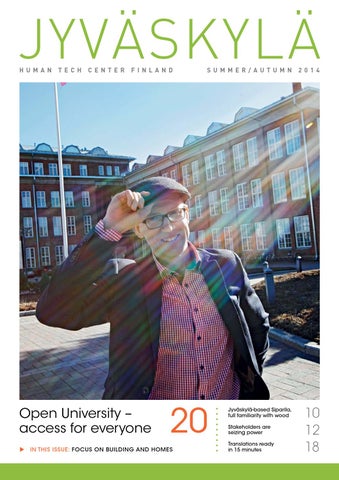
Printed by Kirjapaino Kari Ky Circulation 7 600 Cover photo by Petteri Kivimäki. Petteri Heinonen is studying business courses at the Open University of the University of Jyväskylä.
2
too, still has a devoted readership. Scan the accompanying QR code to go direct to the online version.
HUMAN TECH CENTER FINLAND
FIRST WORDS JUNE 2014
Attractive urban region continues to grow JYVÄSKYLÄ IS ONE OF FINLAND’S fastest growing cities. When I made the move to the University of Jyväskylä in 1988 the shore of Lake Jyväsjärvi was to all intents and purposes undeveloped. Mattilanniemi consisted of just a few university buildings and Hotel Alba. Lutakko was home to a plywood mill. The Rantaväylä city centre bypass was under construction and I was baffled why, in the centre of the lake, a bridge was being built to Kuokkala, which viewed from the city centre seemed to consist purely of forest. Now the scenery around Lake Jyväsjärvi is very different. Lutakko and Ainolanranta have been transformed into appealing residential areas and the site of this summer’s housing fair, to which the finishing touches are currently being applied, complements the housing already in existence around the lake. Lutakko has also acquired one of Finland’s finest trade fair, conference and congress centres, facilities occupied by JAMK University of Applied Sciences as well as the Innova tower and other premises at the disposal of the business world. UNIVERSITY BUILDINGS have arisen on Ylistönrinne and in Mattilanniemi which serve top-flight international research and spark admiration in foreign visitors. Teaching and research in human-centred technology began in Mattilanniemi’s Agora building at the start of the current millennium. Construction of the new Education building is in progress in Ruusupuisto park with scheduled completion in 2015, while in Mattilanniemi a new building project based on an architectural competition is at the planning stage. This will eventually house the Faculty of Social Sciences and Jyväskylä University School of Business and Economics. In addition to all this construction work on the lake shore we are also fortunate enough to have acquired a pedestrian and cycle way that circles the entire lake. The path is not only unique but also highly popular with walkers, cyclists and joggers. Jyväskylä as a city is rapidly gaining in appeal. Now I also understand that that bridge across the lake was part of a much grander plan. Jyväskylä is one of Finland’s most popular cities in which to study. The University of Jyväskylä is the third most popular university in Finland and JAMK University of Applied Sciences
PHOTO: HANNA-KAISA HÄMÄLÄINEN
also ranks third most popular in its own category. The majority of students come from outside the boundaries of Central Finland, and increasingly from other countries, too. Jyväskylä is quite evidently a good place to live, since so many also wish to remain here when their studies come to an end. Collaboration with educational organisations, the City of Jyväskylä, the surrounding municipalities and the business sphere functions well. The University of Jyväskylä, JAMK University of Applied Sciences and Jyväskylä Educational Consortium share a common strategy to promote entrepreneurship. Those organisations providing assistance to new enterprises have pooled their resources and established a joint Jyväskylä Enterprise Factory. WITHIN THE SCOPE of the Innovative Cities programme the City of Jyväskylä has been awarded national responsibility for cyber security. This is a challenging task, but Jyväskylä’s rapidly expanding ICT-branch businesses as well as close cooperation between enterprises, the university and JAMK create a firm foundation for success. Human-centred technology must also be rendered secure against cyber threats. n Matti Manninen Rector University of Jyväskylä 3
FOCUS ON BUILDING AND HOMES, 4–11
World Ski Championship gold medallist Matti Heikkinen is having his own house built on the Jyväskylä Housing Fair site at Äijälänranta. Originally from the Kainuu region in eastern Finland, the sports star has settled in Jyväskylä, which together with its surrounding areas has become one of Finland’s most attractive growth centres and a lively student city. Words by Pia Tervoja Photo by Petteri Kivimäki
4
HUMAN TECH CENTER FINLAND
World Champion skier Matti Heikkinen chooses Jyväskylä
“JUST THE RIGHT RELAXED ATMOSPHERE” FOR SKIER MATTI HEIKKINEN 2011 was a special year. He achieved the best performance of his sporting career when he took the gold medal in the FIS Nordic World Ski Championships over 15 kilometres, classic style, in Oslo. The same year it was announced that Jyväskylä would be organising the 2014 Housing Fair. “I found out that the Housing Fair site is at Äijälänranta, which is near the city centre but it’s still a quiet location. That’s when I started my building project, and it will be completed for the Housing Fair in summer 2014,” Heikkinen says. As a top sportsman, Heikkinen is used to driving himself to produce the best possible performance. He’s applied the same level of intensity to his house building project. “Our family had a long wishlist for the house. We wanted a single-storey building with plenty of space and light. And next to the house there will be a heated 20 square metre building where I can service my skis.” The Heikkinen family’s unique home was designed by Serum architects Ltd. Lakka Kivitalot will supply the basic structure, as well as paving and other products for the yard. The total living space will extend to 152 square metres.
From competitive sports to working life Matti Heikkinen (30) originally moved to Jyväskylä to study clothing design at JAMK University of Applied Sciences. He had to leave the course when sport started to take up more and more of his time. He later changed to the University of Jyväskylä’s School of Business and Economics, where he studies marketing. “Endurance sports are a full-time, professional activity. If you’re not fully committed then it doesn’t really make sense to SERUM ARCHITECTS
The architectural design of Matti Heikkinen’s ‘Lakka’ stone house was handled by Serum architects.
do it at all. My next big event is the 2015 World Championships in Falun,” states Heikkinen. “Fortunately, studying at the School of Business and Economics is flexible and I can focus on completing my studies when I’ve finished my sports career.” When he graduates, Matti Heikkinen intends to use his existing experience and contacts in his search for a job. “When you’re doing sports you learn to be patient, to manage your time and organise your life, and these skills are very useful in working life, too. In the world of sports, if you keep your eyes and ears open and remember to smile and shake hands when you meet new people, then you can build up quite a good network of contacts.”
City with a relaxed atmosphere Matti Heikkinen’s house has a view down to the shore of Lake Jyväsjärvi. In winter he’ll be able to set off skiing on the froze lake from his house. Nearby there is also the Halssila skiing area with a number of trails. “In winter I spend 200 days on the road, so for me the ski trails are not so essential. What’s important is that I’ll be able to go roller skiing on good bike tracks right from the house, and it will also be convenient for running in the forest. I might get a canoe, so I can explore Lake Päijänne,” he explains. With nature all around, Jyväskylä feels like a good place to live. Matti Heikkinen also points out that the regional identity in Jyväskylä is not too strong, making it easy for people from elsewhere to settle down in the city. “Jyväskylä is both small and big. And the people here are smart. It’s got just the right relaxed atmosphere,” Heikkinen says. n
A DYNAMIC CITY OF STUDENTS • Jyväskylä is one of Finland’s liveliest student cities. Of the population of 135 000, more than 45 000 are school pupils or students. Of these, around 30 000 are enrolled in vocational colleges, the University of Applied Sciences or the University. • Universities and colleges: University of Jyväskylä, JAMK University of Applied Sciences, Jyväskylä College, Jyväskylä Institute of Adult Education and the Jyväskylä Campus of the HUMAK University of Applied Sciences • The latest image survey shows that Jyväskylä has Finland’s best environment for bringing up children. The city is equal second in terms of its desirability as a place to move to, and it ranks third for its overall image. (Taloustutkimus 2014)
5
FOCUS ON BUILDING AND HOMES, 4–11
Housing Fair in Jyväskylä
SOMETHING FOR EVERYONE The main themes of the 2014 Housing Fair area situated on the shore of Lake Jyväsjärvi in the naturally beautiful Äijälänranta suburb of Jyväskylä are Innovative Architecture as well as Garden and Wood. In addition the fair carries a heavy emphasis on recycling and re-use. Functionalist solutions are visible in the architecture of the homes on display. Words by Timo Sillanpää Photos by Petteri Kivimäki
SUSTAINABLE DEVELOPMENT, opportunities for recycling and reuse as well as craft skills create the foundation for decoration of the three-room apartment in the Housing Fair’s highest building, the thirteen-storey Axis Mundi, or world pillar. The Kierto (’Cycle’) home is designed for an imaginary family that comprises a six year old preschool boy and his roughly 40 year old parents. The home is full of old furniture and memories from the parents’ childhood. “All the products came into existence via recycling and employing craft skills specifically for this home. In the Kierto home each piece of furniture and interior decoration product has been given a new opportunity, appearance and a new lease of life. The colour world in the home is peacefully graphical, but the nuanced soft furnishings and interior decoration items bring atmosphere to the apartment”, explains Marjo Tuhkanen,
PHOTO: TEAM RIKU LUOMAA, ANNA MÄKELÄ, PEKKA SEPPÄNEN AND MARIA AHOKAS
Suvi Kotiranta’s three-piece cushion set Aika uusiutua (’Time for renewal’) is made of recycled leather. The technique employed combines weaving and sewing.
6
p Visa Pohto examines the Kartano lamp he has forged.
t Axis mundi.
an instructor at Jyväskylä Institute of Adult Education. Twenty students of crafts and design at Jyväskylä Institute of Adult Education were involved in the decoration of the Kier to apartment. Keski-Suomi kierrättää ry – a local association focused on recycling/re-use – was also a partner in the project. “For the apartment we repaired, painted and upholstered various old pieces of furniture and had new items made to mea sure. The materials covered virtually the whole spectrum: old army blankets, dried-up timber, used leather jackets and recycled boards. We didn’t stint on stylishness since we wanted to demonstrate how recycled materials and craft skills can be used to achieve fabulous decorative solutions,” Tuhkanen continues. In total the Axis Mundi features five display apartments, each of which is decorated in accordance with an individual theme. Recycling/re-use is also to the fore in the apartment styled by Million, a Team Academy co-operative. n www.asuntomessut.fi/en/housing-fair-jyvaskyla-2014
“FOR THE APARTMENT WE REPAIRED, PAINTED AND UPHOLSTERED VARIOUS OLD PIECES OF FURNITURE AND HAD NEW ITEMS MADE TO MEASURE.” HUMAN TECH CENTER FINLAND
CAREFUL PLANNING VISIBLE IN THE DETAILS
p Pictured left to right Jyväskylä Institute of Adult Education students Virpi Nieminen, Satu Tervo, Kati Silvan and Anu Ylönen with instructor Marjo Tuhkanen. On the wall of the Kierto (’Cycle’) apartment hangs Virpi Nieminen’s KODIT (’Homes’) series of wall textiles, in the production of which various different textile techniques are used. In the students’ lap is Oili-Säde Huhtamäki’s Kyynel (’Tear’) felt cushion.
The Housing Fair theme Innovative Architecture takes its inspiration from the life’s work of the world-famous architect Alvar Aalto. The second theme, Garden and Wood, on the other hand provides a reminder of the Äijälänranta area’s history, which is strongly associ ated with farming and market gardens. In the planning of the area particular attention has been paid to qual ity architecture and the construction of diverse green areasas well as works of art and park furniture. The history of Äijälänranta has inspired Jyväskylä printmakers Tuomas Hallivuo, Jyrki Markkanen and designer Jonas Hakaniemi in the design of park benches, graphical details and lighting bollards made of crushed recycled glass. The transformers and electrical cabinets will be landscaped into the housing fair area as a whole by means of graphic works of art added to their exteriors. Copper information boards at different locations in the fair area will brief visitors on the area’s history. “The history of Äijälänranta is characterised by a strong tradition of farming and market gardening. The Housing Fair features a number of gardens based on different themes, including recycling and golf”, reveals Housing Fair Project Manager Anu Hakala. Also on show at the Housing Fair is a four and a half meter high bird tower, which was designed and built by Norwegian students of architecture. Beams from a log drying barn demolished on Rauhaniemi farm close to the housing fair area served as a the raw material. n
HOMES REFLECT ALVAR AALTO INFLUENCES The housing fair area comprises 37 single-family houses, a private day care centre and a 13-storey apartment block, Jyväskylä’s Axis Mundi. In a number of locations the designers have employed solutions characteristic of Aalto’s work: sheltered atrium gardens, design that extends into decorative details and shapes typical of functionalism. t House Luck (exhibit 35) is one of the homes on display where the influences of Aalto’s architecture are clearly visible. The exterior of the monolithic and minimalist house is unassuming and virtually windowless, but in contrast to that it features a light-filled, sheltered atrium garden. Here too recycled items have been used to decorate the house. t In similar fashion Villa Elissa (exhibit 8) honours the legacy of master architect Aalto. Materials favoured by Aalto, such as birch and brick, have been used in the construction.
u House A (exhibit 34) in contrast is a highly advanced location from an energy technology perspective, in the design of which the local energy util ity, Jyväskylän Energia Oy, had a hand. For heating both district heat and solar power are employed, with geothermal energy used for cooling. In this house a heat and electricity elasticity of demand service is being piloted: energy use is weighted towards those times of the day when consumption is lowest and energy at its cheapest.
p The largest house in the Housing Fair is Villa Muurame (exhibit 38), which has a living area of 308 square meters. At the opposite end of the scale to Villa Muurame is the area’s smallest single-family home, Noppa (‘Dice’), with a floor area of 76 square meters.
7
FOCUS ON BUILDING AND HOMES, 4–11
LIVING MEANS MORE THAN HAVING A HOME Jyväskylä’s competitive and attractive residential environment is based on diversity and areal balance. Construction venues are being opened up in the city centre, key suburbs and out in the countryside. In Jyväskylä people live close to their places of work and recreational opportunities. Words by Tommi Salo Photo by Suomen Ilmakuva Oy
WATER IS AN IMPORTANT ELEMENT when it comes to living and residing in the Jyväskylä Region. Finland’s second largest lake, Päijänne, as well as numerous urban lakes, ponds and rivers offer an opportunity to live and pursue different recreational activities close to water. Jyväskylä is also characterised by its varying terrain. In places it is flat, in others hilly. In any case, townspeople are never far from nature. “What is exceptional about Jyväskylä is the large difference in height between the immediate city centre and the Harju ridge. Sandwiched between Lake Jyväsjärvi and the Harju ridge is a compact central area,” says Head of Town Planning Architect Leila Strömberg of Jyväskylä’s special characteristics. She also emphasises Jyväskylä’s architectural legacy which stretches from Alvar Aalto to architects designing in the new millennium. In Jyväskylä effort has been put into forging a vision for living which extends to the year 2025 and stakes out the path for future dwelling patterns. The guidelines contained in the vision for living can be used long into the future to influence urban planning, architecture and, in turn, the lives of all citizens. “The way people live is generally quite 8
conservative. With the help of this vision for living town planners can bring something new to the way people lead their lives”, Strömberg points out. n u In Jyväskylä, closeness to nature is combined with the rhythm of the city. Thanks to the short distances and the lively urban centre, all the services, shops, schools and work are close at hand.
INTERESTING ENVIRONMENT GETS PEOPLE MOVING Development of future solutions for living alsodraws on Jyväskylä’s strong expertise in sport and health sciences. At the Univer sity of Jyväskylä environments that promote well-being by getting people physically active have been the subject of both research and planning. In particular the focus has been on improving people’s motor skills, among other things on developing balance. In addition the idea is to boost people’s motivation to engage in physical activity and to promote all-round well-being in an urban environment. ”If the environment motivates people to get going and change established habits, motor skills develop and physical activity increases unnoticed. Physical activity can be guided, for instance, by lighting solutions and locating information boards in such a manner that people do not always opt for the short-
est route”, explains Aki Karjalainen, Head of Planning and Development at the University of Jyväskylä.
Novel thinking on planning According to Karjalainen new urban planning requires experts in different branches to pool their energies as well as a broader change in the way people think and design physical activity. In the Jyväskylä Region novel thinking on design has already been brought to the school yard. ”The built environment is not able to offer the diverse opportunities for exercise or tempt people to engage in physical activity in the same way as natural environments for movement. It is essential to find solutions embodying different perspectives, in which designing solutions in natural and built environments are combined in a new way.” n
HUMAN TECH CENTER FINLAND
KANGAS – MORE THAN TRADITIONAL PLANNING Visions of a resource-wise and experimental style of living are set to find concrete expression in the Kangas area of Jyväskylä. Planning what to build and how people will live is usually conducted one plot at a time, but in the Kangas area the idea is to pursue solutions that encompass larger entities. At Kangas the intention is implement a centralised model for car parking as well as shared gardens and civil defence shelters. “Traditional planning can sometimes produce odd situations where two identical play areas, for example, are built right next to each other on separate plots. By planning at a more macro levelwe are seeking to enhance the appeal of living in the Kangas area and bring down investment costs,” says Anne Sandelin, the City of Jyväskylä’s Director of Urban Planning Projects. Sandelin emphasises that by employing wise solutions parking areas, for instance, can be filled during the day time with the vehicles of those working in business premises and in the
evening and at night with vehicles belonging to residents. “The goal is to find a model that renders the costs of vehicle use transparent. In other words the costs are picked up by the person who uses a car and perhaps needs a covered parking space.” The buildings in the Kangas area are to be oriented and their roofs designed in such a way that solar power can be utilized as efficiently as possible in the area. The City of Jyväskylä also intends to build a fibre optic network in the area, from which different actors can rent network capacity. As part of the Kangas area’s modern solutions the city is currently cooperating with the University of Jyväskylä to investigate bringing the benefits of electronic authentication to the homes in prospect. The construction of residential properties in the Kangas area is scheduled to begin in the spring of 2015. If all proceeds according to plan
the first residents should be able to move into this smart, pioneering suburb of the city at the end of 2016. n
JYVÄSKYLÄ’S KANGAS AREA • The old paper mill buildings form the heart of the area. • Covers about 30 hectares and lies close to the very centre of the city. • Construction of the Kangas area will begin in 2014–2015. • The first residents will arrive in 2016. • A strong role for pedestrians and cycling, an environment that supports an ecological lifestyle. • Resource-wise solutions for parking and waste management. • Use of smart solutions and measuring data • Utilization of solar energy. • Forecast for 2025: 3 000 residents, 2 100 jobs. 9
FOCUS ON BUILDING AND HOMES, 4–11
Full familiarity
WITH WOOD The use of wood in construction and interior decoration is increasing, what with the current concern for sustainable development and ecological thinking. Would your personal preference be for a familiar species of wood or a more exotic variety? Dark or light? Words by Tommi Salo Photos by Tommi Salo and Siparila “IT HAS TO BE BIRCH. It’s a timeless, classic species which possesses a certain dignity. Birch is a multipurpose material for furniture, panels and battens,” responds Designer Janne Tyynismaa of Jyväskylä-based company Siparila Oy to an enquiry about his favourite type of wood. In addition to birch popular wooden materials still include pine and spruce. Ash and beech on the other hand no longer feature at the top of house builders’ list of favourites. “Where hardwoods are concerned we’re selling a really big amount of oak at present,” reveals Siparila’s Managing Director Juha Sojakka. The Siparila duo have a precise understanding of what is currently hot when it comes to the use of wood and a fair idea of
10
what future trends will be, too. Established in 2003, Siparila is a wood supplier which offers its customers products, solutions and services for exterior cladding, interior decoration, sauna areasand gardens. As a material wood will emerge victorious as we shift from our disposable culture to more sustainable patterns of consumption. Wood stands up to time well and it is easy to maintain and modify if necessary. In recent years the surface treatment of wood has taken massive strides forward, and wooden surfaces outdoors as well can last for 15 years without the need for repainting. “Ecological awareness as a trend can be seen in the way the character of the wood, complete with knots and grain, is al-
HUMAN TECH CENTER FINLAND
t Siparila’s Janne Tyynismaa and Juha Sojakka maintain Finnish expertise and quality are highly regarded also where building and decorating in wood are concerned.
lowed to show in the end product. Not everybody wants their wood to have a glossy white surface any more. Where wood products are concerned ecological thinking also means that manufacture of the product does not damage or impoverish nature,” Tyynismaa continues.
Bringing new trends to the world In Finland, a country covered by lakes and forest, there is considerable expertise in using wood as a material for building and decorating. Tyynismaa is keen to point out that here people understand how wood behaves and where it can be used. “We are also ambitious in our pursuit of high quality,” he adds. At Siparila close attention is paid to what kind of signals about new trends are being sent from architects’ drawing boards beyond Finland’s borders. The company, with its commitment to using wood in a creative and open-minded manner, also endeavours to offer the world the latest Finnish solutions. “When building and decorating the use of wood must be quick and simple. Our intention is to launch a novel way of using wood panelling in the autumn of 2014,” Sojakka explains. In addition to Finland, Siparila’s products are sold to Japan, the Mediterranean countries, Denmark, the United Kingdom, Germany and Russia among others.
“Now it’s all about horizontal panels. In addition, people are after straight and sharp lines. When it comes to panels nobody is currently buying circular shapes.” In similar fashion the colour world has its own particular cycles. Designers and in consequence customers, too, go through different periods, sometimes lighter, sometimes darker. ”More and more brown is being used for interior decoration products. There are already signs of this on designers’ desks. I suppose the real question is which shade of brown will eventually come out on top,” Tyynismaa ponders. n www.siparila.fi
Prepare for brown to make a comeback Each home and its style of decoration are products of their own time. According to Sojakka, shifts in trends can be seen in interior panels, for instance.
WOODEN APARTMENT BLOCKS – CONSTRUCTION THAT IS LIGHT AND DRY By Tommi Salo As a building material wood is light in weight. This lightness makes it possible to produce ready-made structural components from wood and then lift them into place much more easily than would be the case with concrete elements when building an apartment block. When building in wood humidity control is of a high standard since the modules are fully prefabricated at the factory. “There are currently big expectations associated with building apartment blocks in wood. We’re now awaiting practical experiences from these new apartment block projects. Building apartment blocks in wood has been clearly conceptualized and the big players in the forest industry have demonstrated an interest,” says Senior Lecturer Marko Viinikainen, who teaches construction technology at JAMK University of Applied Sciences. Practical experiences in building apartment blocks in wood as well as living in them will be provided by the new wooden apartment blocks to go up in the Kuokkala area of Jyväskylä.
Lakea Oy is currently building three wooden apartment blocks, which will comprise a total of 150 apartments. The first block, the eight-storey Puukuokka 1, is scheduled for completion at the end of 2014. It will be the highest apartment block made of wood in Finland. The cross-laminated timber (CLT) modules used in the Puukuokka apartments are assembled at Stora Enso’s prefabricated house factory in Hartola, 90 kilometres south of Jyväskylä.
Fire safety comes first Changes to fire safety regulations and instructions in Finland have facilitated opportunities for using wood in construction and made possible the building of as high as eight-storey apartment blocks. Fire safety in tall apartment blocks has to be taken care of by using automatic extinguishing systems and structural solutions which slow the spread of a blaze. “It will be fascinating to see how carbon footprint demands influence the choice of building materials over the next few years,” comments Viinikainen on possible developments ahead. n
11
STAKEHOLDERS
are seizing power The Internet provides huge potential for consumers and stakeholders of organisations to share their experiences globally. When stakeholders and consumers seek information independently, the truth can no longer be defined in terms of the claims presented by the organisations’ communications and marketing machinery. Words by Timo Sillanpää Photo by Petteri Kivimäki
“WHEN WE CHANGE the way we communicate, we change society,” stated American media researcher and writer Clay Shirky in 2008. According to Professor Vilma Luoma-aho of the University of Jyväskylä Department of Communication, this quote encapsulates the significance of the change in communication for society. “The Internet is the fifth revolution in communication. It was preceded by the printing press, telephone, recorded media, and mass media. These predecessors of the Internet made it possible to distribute content to the masses, but it was not until the arrival of the social media that we have been able to combine groups and discussions, and quickly share content and experiences,” Luoma-aho explains. She says that the days of the old communication model – where it was possible to control who speaks and what they say – are over. Organisations’ faith-holders and hateholders can be found on the Internet, because the Internet makes the social capital of organisations visible. “We are justified in saying that stakeholders are seizing power, because they communicate among themselves about matters affecting organisations.” The future of search engines is another interesting field, because their role is continuing to gain strength.
The need for good journalism Luoma-aho says that nowadays communication has to be on the stakeholders’ terms. “Communicators have to find the right issue arenas where people discuss topics that affect them. By participating in these existing arenas at an early stage the organisation can increase its scope for wielding influence,” she states. In the past the world was more straightforward and cause- effect relationships were easier to identify. “Now we are living in a world that is full of surprises, a world that is growing ever more complicated. Communication has to 12
be antifragile, which, simply stated, means it must have the ability to react quickly to unexpected situations. The basis for antifragile communication is an organisation where people are satisfied with their work and act as messengers for the organisation.” The need for traditional journalism does not disappear in a complex world, and the social media do not replace it. In fact, Vilma Luoma-aho believes that the need for good journalism is now even greater than before. “When the volume of messages increases, there’s a need for journalists to filter the mass of information and present the important issues.”
Consumers are driven by experiences Professor Heikki Karjaluoto of the University of Jyväskylä School of Business and Economics specialises in consumer behaviour and new technologies in marketing communications. Today, consumers who are looking to buy a pushchair don’t go to a shop and ask the salesperson for advice. Instead they do a Google search on the words pushchair and experiences. This new pattern of consumer behaviour means that prices are compared on the Internet and the product is ordered from the supplier with the lowest price. Information about the product is gathered from other consumers, and recommendations strongly influence the decision to purchase. Market communicators have to know how consumers make their purchase decisions. “There is great potential in the social media’s culture of sharing. Marketing planners should analyse what kinds of content are shared in the social media. That’s what the strong brands are doing,” Heikki Karjaluoto says. “The fact that consumers are sharing their experiences of products and services with others is not new. These conversations used to happen among circles of friends and were restricted to a small audience. Now experiences are shared globally and they can reach a huge audience in the blink of an eye.” Karjaluoto says that many companies are wondering how to reach potential customers. When choosing their channel companies need to recognise that different generations use the media in different ways. The over 60s still use traditional media, but the younger generation can be reached via the Internet. “There’s a great puzzle about how committed young people are to brands. But it does appear that people are loyal to brands if they are satisfied with the products and services. It’s worthwhile applying marketing communications to reinforce customers’ commitment even after they’ve made their purchase decision,” he explains. n HUMAN TECH CENTER FINLAND
p “When the volume of messages increases, there’s a need for journalists to filter the mass of information and present the important issues,” says Professor Vilma Luoma-aho.
13
SATELLITE RELATED TECHNOLOGY PROVIDES PEP FOR BUSINESS Jyväskylä-based Magister Solutions Ltd undertakes close cooperation with ICT researchers. Founded in 2005, the company specialises in mobile, satellite and security technology and more than half of its employees are PhDs or PhD students. Words by Timo Sillanpää Photos by Timo Sillanpää and European Space Agency
MAGISTER SOLUTIONS WORKS in close cooperation with researchers in its own specialised fields. In many cases its employees have written their doctoral theses on subjects related to projects the company has implemented for its customers, which helps to increase interaction between business, industry and academia. Magister Solutions has 30 employees with an additional ten working in its two subsidiaries, Versine Oy and MDO Group Ltd. The subsidiaries specialise in software and service solutions for use in mobile devices. The research oriented company can trace its origins back to a joint University of Jyväskylä/Nokia project in the early 2000s to research mobile networks and devices. “From the very outset our company has worked with software based simulations that can test the performance of mobile devices and networks in a real-world-like environment. As an example, we can use simulations to check what will happen if a base station develops a fault or its loading is rapidlyincreased many-fold,” says Business Development Manager Kari Aho. In addition to mobile communication simula14
Magister Solutions will take part in this year’s Kasvu Open Fast Track Cyber growth path. The Kasvu Open concept was developed in Jyväskylä and the objective of Fast Track Cyber is to coach companies to seek growth in the field of cyber security. “We want to boost the commercialisation of Secapp. We aim to get it into use in the public and emergency service networks,” Kari Aho states.
tions the company’s business areas include R&D work on satellite communication and cyber security, as well as its own software product development, and training and advisory services. Magister Solutions works with the global giants of the ICT sector, including Nokia Solutions and Networks, Renesas, Nokia and the European Space Agency ESA. Magister made an important breakthrough when it began collaborating with ESA 18 months ago. Magister’s simulation software can be used to study communication between a satellite, ground station and user application. “Following a successful project with ESA we’ve gained new contacts in the field of satellite technology. Our aim for the next few years is to double our turnover through satellite related business. At the moment our turnover is about two million euros,” Kari Aho explains.
Application for critical communication Magister is currently commercialising the Secapp application for secure critical communication, which was originally developed at the UniversiHUMAN TECH CENTER FINLAND
ty of Jyväskylä. Secapp enables targeted warning messages to be sent to mobile phones. “The messages can be received on both smartphones and older mobiles. Messages can also be sent to other types of terminal devices such as work stations and tablet computers. The first large-scale commercial deployment of the application was at the Sochi Winter Olympics,” says Kari Aho. Magister has developed the Secapp critical communication application to work with a wide range of devices and operating systems. “One-way critical communication applications developed in the past were based on text mes sages. These messages can sometimes be significantly delayed, which could have fatal consequences if an accident has occurred.”
Cyber security increasingly important Secapp enables two-way communication. The sender can see whether the message has got through to the recipient or even whether the recipient might need help. The application can also facilitate other communication within large or-
“OUR AIM FOR THE NEXT FEW YEARS IS TO DOUBLE OUR TURNOVER THROUGH SATELLITE RELATED BUSINESS.” KARI AHO
ganisations, which will help to ensure that people know how to use it in a critical situation. Kari Aho says that cyber security is becoming increasingly important. He wonders why people continue to send confidential messages by email even though in general email is insecure. “There are a lot of new start-ups in the cyber security field because demand for information security products is growing all the time. In future we’ll be more dependent on mobile devices. Smartphones, personal smart watches and tablets, as well as wireless technology will mean that we’re no longer tied to a single place,” he says. In Finland Magister Solutions has its head office in Jyväskylä and it also operates in Tampere, Seinäjoki and the Helsinki region. Additionally, it has an office in the Czech Republic. Jyväskylä is a natural choice for the head office – the company originates from there, and a national cluster for innovation in cyber security is presently being set up in the region. n www.magister.fi
15
16
HUMAN TECH CENTER FINLAND
FINNISH MUSIC CAMPUS USHERS IN THE
TIME OF OPERA Performed in Jyväskylä in the late winter of this year, Christoph W. Gluck’s reform opera Orpheus and Eurydice was a tour de force from staff and students at the Finnish Music Campus. For students of music and dance the opera presented a unique learning experience. Words by Timo Sillanpää Photos by Iida Lindeman and Julia Merta
GERMAN OPERA COMPOSER Christoph W. Gluck’s reform operaOrpheus and Eurydice was performed for the first time in Vienna in October 1762. In the tale, with its basis in Greek mythology, Orpheus sets off to retrieve his beloved wife, who has died of a snake bite, from the underworld. The journey back is fateful: contrary to the wishes of the gods Orpheus turns to look at Eurydice, who falls back into the realm of death. Orpheus and Eurydice was staged at the Finnish Music Campus at the beginning of March. All four performances, as well as the dress rehearsal, were sold out. In addition the opera was followed on the internet by in excess of 1 500 viewers. This major production involved well over a hundred students and their supervisors from Jyväskylä College, JAMK University of Applied Sciences and the University of Jyväskylä. The opera was directed by one of Finland’s top names, Ville Saukkonen, who moulded Gluck’s masterpiece into a new shape: both the leading roles were played by women. “I reckoned that this could be the love story of two women. I added my own reform to it,” Saukkonen says with a laugh.
New technology garners approval In addition to students of music and dance the opera production involved media-branch students and professionals who took care of the video projection and lighting solutions. The visual solutions gathered acclaim from the critics. For example, Maija-Liisa Westman, writing about the opera for Keskisuomalainen, Central Finland’s leading newspaper, comment-
ed on the visual solutions employed in the opera as follows: The video material, which at worst may function like an ill-fitting accessory, was in fact the opera’s organic element. It reflected the same kind of beauty as Gluck’s music, and in combination with the lighting formed an impressive staging for the production. “New technology permits the use of imposing visualisations. Our partners in the implementation of these visualisations was Horizon College in the Netherlands,” reveals producer Joonas Kunnela. Responsibility for the costumes worn in the opera, as well as for hair and make-up, was carried respectively by students and their supervisors from the clothing, hairdressing and beauty care units of Jyväskylä College.
Musical theatre learning pathway begins Orpheus and Eurydice was the starting shot for the new programme in musical theatre to commence at JAMK University of Applied Sciences in the autumn of 2014 – the only one of its kind in Finland. After their first year studies students following the degree programme in music can opt for the director of musical theatre learning pathway, which combines studies of music, theatrical expression and dance. The other learning pathways in music are instrument teacher, musical director and preschool music teacher. Those graduating from the degree programme in music at JAMK University of Applied Sciences are termed music educators. n
ORPHEUS AND EURYDICE • Director: Ville Saukkonen Conductor: Evgeny Smirnov Choreography: Anne Joutsimäki Lighting: Arto Saarelainen Soloists: Helena Lehmus kero, Katariina Ylönen, Tiina Savolainen, Niina Hämäläinen, Kaisu Tajakka, Heta Sammalisto, Jenny Haapalainen, Jenni Lind
FINNISH MUSIC CAMPUS • Centre of Excellence in music education and research composed of JAMK University of Applied Sciences, the University of Jyväskylä and Jyväskylä College. • Over 700 students pursuing a professional qualification at the Music Campus. In addition there are approximately 1 500 students at Jyväskylä College taking basic studies in art. • For further information please visit www.musiikkikampus.fi
17
“AT THE MOMENT THERE SEEMS TO BE A LOT OF DEMAND FOR TRANSLATING WEBSITES AND CUSTOMER SERVICE MATERIAL.” 18
HUMAN TECH CENTER FINLAND
TRANSLATIONS READY IN
15 MINUTES Transfluent aims to be the world market leader in its own field and already counts a top American rock band and English Premier League football clubs among its clients. The company has 85 000 translators in its network ready to translate material – such as tweets from Twitter users – in near real-time. Words and photo by Tommi Salo Illustration by Martti Hänninen
WHEN AMERICAN ROCK band 30 Seconds to Mars goes on tour fans can read the band’s tweets in their own language. Some English Premier League clubs enable fans to communicate with them in their own language in the social media. This is all made possible by the rapid translation service offered by Transfluent Oy, which has operations in Jyväskylä. Transfluent’s translation jobs range from individual tweets to entire books. It already has 85 000 translators in its global network, ready to translate social media messages, games- related material, website updates and much more in near realtime. The company offers translations into more than one hundred languages.
Human translators get it right During the US Presidential elections in 2012 Transfluent translated Barack Obama’s Twitter messages into Spanish. One of the company’s latest breakthroughs is translating Facebook postings for artists with music industry giant Universal Music Group. The translations are targeted at markets where English is not widely spoken. “In the social media speed is essential. With tweets, for example, we should get the translations done within 15 minutes,” says Transfluent CTO Tomi Heiskanen. Near real-time translation is enabled by Transfluent’s technical development work. “We’ve automated all the stages of the translation process apart from the actual translation work. That’s always done by a professional. With human-powered translations the content and tone are always right,” Tomi Heiskanen explains.
Transfluent has built up its broad global network of translators from freelancers and translation providers. “At the moment there seems to be a lot of demand for translating websites and customer service material. Customer service messages may be fairly short, but there can be a lot of them.”
Product development to remain in Finland Transfluent aims to become the world market leader in its own sector. Achieving its growth targets would mean the company significantly increasing its workforce. At present Transfluent has 12 employees in Finland, the US, UK and Sweden. In spring 2014 it was looking to recruit around 15 new people – graphic designers, sales staff and programmers. The new employees will be based in Jyväskylä, Helsinki and San Francisco. In Jyväskylä there is currently one software developer in addition to Tomi Heiskanen. “Our idea is to keep our product development in Finland. We’re planning to make Jyväskylä our base in Finland, and we’ll be building a bigger technology development team here,” he states. He says that Jyväskylä’s strengths include a lower cost level than many other Finnish centres and a central geographical location. “Another benefit is that the University is very close. And there’s Expa, a game business cooperative, which is an advantage from the point of view of future prospects for the game cluster.” In 2013 business magazine Talouselämä ranked Transfluent among the 20 most promising Finnish startups. n www.transfluent.com
“IN THE SOCIAL MEDIA SPEED IS ESSENTIAL. WITH TWEETS, FOR EXAMPLE, WE SHOULD GET THE TRANSLATIONS DONE WITHIN 15 MINUTES.” TRANSFLUENT CTO TOMI HEISKANEN 19
”MATURE STUDENTS GET MORE OUT OF THEIR STUDIES” The Open University of the University of Jyväskylä offers academic courses to almost 15 000 students annually. The University has developed models to make the courses flexible and enable people to study whenever and wherever they wish. Words by Pia Tervoja Photo by Petteri Kivimäki
“SENIOR SPECIALISED AND MARKETING roles in the SME sector, and possibly founding my own company,” says Petteri Heinonen (44) about his plans for the future. He has extensive experience in industry, first as a production worker and later becoming an area sales manager for Oy Grönblom Ab, which imports machinery and tools for companies in technology industries. Heinonen’s broad experience alone is not enough to take his career forward because it’s already more than 20 years since he gained his vocational qualification. However, he is now nearer to achieving his career dreams because he is studying business cour ses at the Open University of the University of Jyväskylä. His ultimate aim is to graduate with an M.Sc. (Econ) Degree.
Distance learning ideal for students with families There are many reasons for Petteri Heinonen to study at the Open University. His work and family commit20
ments would not allow him to sit in lectures during the working week. The Open University offers an alternative: courses that progress at his own pace, many of which can be studied over the web. “They can even teach mathematical subjects over the web. I’ve watched lectures that have been saved on a server. Courses in languages and communications do require local teaching, of course, but they are a refreshing change and it’s interesting to meet the other students.” Heinonen is also pleased that the courses are reasonably priced with a broad selection on offer. His approach to his studies is very much oriented to his working life. The courses have already given him new perspectives on his daily work and, conversely, his work experience has helped him to get through his studies. “One benefit of studying as an adult is that you have a better idea of what the theory looks like in practice. Mature students get more out of their studies.” n HUMAN TECH CENTER FINLAND
GATEWAY TO THE ACADEMIC WORLD It is thirty years since the University of Jyväskylä first introduced Open University teaching, and the courses continue to grow in popularity. In 2013 the students gained almost 88 000 credits, which is more than one quarter of all the credits gained in Finland. The Open University’s courses are open to everyone. The majority of the students are people with a teaching background, who wish to enhance their qualifications. A second big group consists of workers from the healthcare sector. Young people who did not succeed in getting degree student status in higher education also make up a significant group. The growth in student numbers and courses completed can be largely explained by the flexible forms of study. The University has actively developed both distance and web-based study models. “We have implemented a comprehensive electronic service interface so students can register for courses, for example, or check the course materials on the web. We also offer web-based courses and even realtime web-based learning, where the students get together in a virtual meeting room,” says Merja Karjalainen, Head of Planning and Development at the Open University of the University of Jyväskylä. Also on the web students can access the OPTIMA learning environment, which enables them to interact using a text-based interface, as well as a web publication platform and a wide range of electronic materials. “Technology creates opportunities but we don’t get new technology just for the sake of it. We follow developments in teaching technology and acquire it selectively.”
Guidance and support keep students on track In recent years the Open University has provided increased guidance for students. By offering advice and different forms of support, the University has succeeded in getting students to commit to their courses and increasing numbers are completing their studies. “We’ve got support groups on Facebook, for example, and we provide extra tuition via the web-based systems. We can also give students guidance in planning their studies and in scientific writing,” Merja Karjalainen says. n
t ”I choose courses that will benefit me in my working life,” says Petteri Heinonen, who is studying business and economics at the University of Jyväskylä’s Open University. He started out by taking individual courses but now he is aiming for an M.Sc. in Economics. He believes that studying is worthwhile as he still has half of his working life in front of him.
2121
AT THE HEART
of sports and well-being
When a company engages in cooperation with the world’s leading brands, its own expertise has to be topclass from a global perspective. Technology developed by Firstbeat Technologies, a Jyväskylä-based firm specialised in heartbeat analytics, is now used in products made by Samsung, Garmin and Bosch among others. Words by Timo Sillanpää Photos by Petteri Kivimäki
ESTABLISHED IN 2002, Firstbeat Technologies is an expert company specialised in the development of heartbeat analysis software. The technology can generate precise and comprehensive data on the human body to support well-being at work, top-level sport and everyday fitness. In the space of ten years business has expanded and become more international at a rapid pace. State-of-the-art solutions for top-level sport are used by over 300 leading professional sports teams around the world. These include for example the San JoseSharks, Spain’s national football team, and England’s Football Association. Formula 1 team McLaren has also made use of Firstbeat’s solutions. “Roughly 95 per cent of our top-level sports products are sold on the international market,” reveals Managing Director Joni Kettunen. Firstbeat’s software is employed in the majority of Garmin heart-rate monitors. At the Mobile World Congress event arranged in Barcelona in February it was Samsung’s turn to unveil new products featuring Firstbeat technology. For instance, Samsung’s new Gear Fit smart wristband contains Analyzed by Firstbeat technology. “Collaboration with top consumer brands means that we have to be the very best globally in our branch. Garmin and Samsung’s new products offer fitness enthusiasts real-time data on the body’s recovery, training effectiveness and energy consumption,” Kettunen continues. Firstbeat’s software is also an integral part of Bosch’s e-Bike. Firstbeat analytics can estimate and control the physiological load of the rider.
Backed by multidisciplinary research Firstbeat draws extensively on multidisciplinary research in physiology, mathematical modelling and the behavioural sci-
22
ences. The company has developed a digital model of the human body based on physiological modelling of heartbeat data. The technology recognizes what is happening in the body: how the acid molecules move, how the level of fitness has changed and what kind of exercise routine or rest interval promotes an improvement in fitness. “Variations in heartbeat, that is, heart rate variability, constitute a window into the human body. From this data we can analyse and understand how the body is doing,” Joni Kettunen explains. The purposes to which Firstbeat’s methods have been put are many and varied. Workers are interested in the balance between stress and recovery. Top-level athletes, on the other hand, want to know the optimal ratio between training and recovery. Over the years Firstbeat has analysed an enormous quantity of measurement data. The data has reinforced many conceptions about factors that burden the body and also revealed new things about the body’s stress factors. At Firstbeat there is firm belief that demand for its applications will continue in future, especially in the promotion of vocational well-being. Firstbeat indeed has plans to expand its business related to vocational well-being in the international marketplace. n www.firstbeat.fi
FIRSTBEAT TECHNOLOGIES LTD • Originally a spin-off from Jyväskylä-based KIHU – Research Institute for Olympic Sports • The company employs 35 professionals in physiology, wellness services and information technology. • Firstbeat’s products are already familiar to millions of end users. • Company turnover in 2013 was approximately EUR 2.4 million.
HUMAN TECH CENTER FINLAND
FIRSTBEAT TECHNOLOGIES’ MARKETING COORDINATOR MAIJA KORKALAINEN TRIES OUT TECHNOLOGY DEVELOPED BY FIRSTBEAT ON JYVÄSKYLÄ’S HARJU RIDGE, A POPULAR VENUE FOR SPORTS AND RECREATIONAL ACTIVITIES IN THE CENTRE OF THE CITY. u
DAY-TO-DAY EASE IN THE TEN-MINUTE CITY Firstbeat Technologies Ltd’s Managing Director Joni Kettunen – holder of a PhD in Psychology – moved from Helsinki to Jyväskylä at the turn of the millennium. One important reason for the move was the fact that the family’s Akita Inu dog was not too happy living in a row-house in the Puistola area of the capital. “The dog needed more space to do his barking. Another reason for the move was that a strong cluster of technology, human-centred scientific research and entrepreneurship was rapidly emerging in the Jyväskylä Region. There’s no longer a dog in the family, but five kids succeed in putting some pep into everyday life,” says Kettunen. Kettunen lives with his family in the Säynätsalo area of Jyväskylä, an island enclave of exceptional natural beauty, and explains that he appreciates in particular the ease of daily life, the natural surroundings and the close proximity of Päijänne, Finland’s second largest lake. “The University of Jyväskylä and other educational institutions make the region lively and international. They also offer our firm a pool of trained experts and partnership opportunities linked to research,” Kettunen underlines. n
23
IN BRIEF
ARCHITECTURE • ART • CULTURE • DESIGN • ENVIRONMENT SCIENCE • EVENTS • NEWS • SPORT • LIFE • EDUCATION
SHARING BEST PRACTICES INTERNATIONALLY By Pia Tervoja When educational institutions collaborate across borders, their cooperation should optimally be ongoing and operate at multiple levels. Jyväskylä College – which is part of Jyväskylä Educational Consortium – has taken cooperation with its long-term partner, Horizon College in Holland, to a new level. “In addition to traditional exchanges for students and teaching staff we work together in the fields of education assessment and effectiveness, and course development. We evaluate the best practices together and learn from each other,” says Project Manager Rea Tuominen. From the student’s perspective, international cooperation offers the opportunity to acquire a broader skill set and learn new things. A good example is a study module for students of the creative industries that was produced as part of the Design Across Borders project. “In Holland the courses are weighted towards design while we concentrate more on practical skills, such as printing technology. So we’ve taught Dutch students the basics of digital printing, and our students have learnt design in Holland.” Rea Tuominen says that in future even more students will be able to take cross-border study modules. In addition there will be steady annual increases in international student exchanges. Each year around 550 students from Jyväskylä Educational Consortium study abroad, while the Consortium’s colleges welcome around 350 foreign students to the Jyväskylä Region. n u During the Design Across Borders project a study module was produced for students of the creative industries. Pictured here are Niina Hanhinen (right) of Finland and Esmee van Dommelen of Holland.
KASVU OPEN TARGETS GROWTH-SEEKING COMPANIES By Pia Tervoja Kasvu Open is a growth venture contest and sparring process that accelerates companies’ growth by bringing together growth-seeking entrepreneurs and growth venture experts. The Kasvu Open concept was developed in Jyväskylä four years ago and expanded at the beginning of 2014 to the whole of Finland. This year Kasvu Open will involve more than 150 SMEs from around Finland. Sparring will be provided by over 500 experienced business executives and finance providers. ”We are boldly expanding the model outside
24
our own region. We’ll be holding Kasvu Open events in ten different areas and, for the first time, we’ll also be organising the Fast Track Cyber growth track, with sparring from information security and ICT professionals,” says Matti Härkönen, Managing Director of Kasvun Roihu Oy. Fast Track Cyber challenges companies to grasp the growth opportunities available in the field of cyber security. Kasvu Open aims to ensure companies are better prepared for the international markets. Matti Härkönen says that there is a lot of international business expertise in Finland, but there is
a need for SMEs to get faster access to the professionals’ experience. “We want to use stories about legendary business figures to give entrepreneurs increased confidence. The Kasvu Open final, which will be held October 23–24 in Jyväskylä, is one arena where we can highlight these stories. There will be a sparring event for the finalists, which will be attended by more than one hundred finance providers and growth venture leaders. Around one thousand participants from all over Finland are expected to take part.” n www.kasvuopen.fi
HUMAN TECH CENTER FINLAND
REPELLING CYBER THREATS AT NEW TRADE FAIR In September 2014 Jyväskylä Paviljonki International Congress and Trade Fair Centre will host Finland’s first fair on the theme of cyber security. The exhibition presents solutions for companies and organisations to solve the information security challenge and guard against cyber threats.
JYVÄSKYLÄ FESTIVAL
INTERNATIONAL STARS OF NON-VERBAL THEATRE By Pia Tervoja Jyväskylä’s week-long urban festival offers concerts, theatre, the Festival Event Tent, a special programme for children and free admission performances around the city. This year’s Jyväskylä Festival is being held July 8–13 and brings together local artists, well-known Finnish performers, and international theatre and world music groups. Uniquely among Finnish summer events, Jyväskylä Festival features international stars of non-verbal theatre. Bernie Collins and Philippe Martz, a physical comedy double act from France, have been described as ‘Laurel and Hardy in colour’. Their Best of the Best show is the culmination of 20 years of working together. Another top-line performance is Thomas Monckton’s one-man show The Pi anist, which grows around the clown/mime artist’s adventures with his grand piano. Award-winning British variety artist Mat Ricardo will also make his Finnish debut in Jyväskylä. Ricardo weaves both variety and magic tricks into his performance – but he doesn’t use special effects, and everything happens right in front of the audience. n www.jyvaskylankesa.fi EEMELI TÄHKÄNEN
DEVELOPING TEACHER EDUCATION IN KOSOVO By Timo Sillanpää JAMK University of Applied Sciences’ Teacher Education College carries primary responsibility for the development of vocational teacher education in Kosovo. The goal is to develop, in cooperation with the University of Pristina, a two-year Master’s Degree in Vocational Pedagogy. Behind this endeavour is a policy contained in Kosovo’s universities act according to which from 2016 onwards all new teachers throughout the education system must have a master’s degree. This requirement – and also the new master’s programme – is unique in a European context, since in very few countries is such extensive pedagogic training demanded of vocational teachers. “The master’s programme in vocational pedagogy under development is based on JAMK University of Applied Sciences’ vocational teacher education and the manner in which higher degrees at our institution are implemented, with a close connection to working life. A dozen or so teacher educators from our end are involved in this development work,” explains Leena Kaikkonen, Research and Development Manager at JAMK University of Applied Sciences’ Teacher Education College. The development work is being conducted within the scope of the Med@UP project coordinated by the University of Pristina. The abbreviation comes from the words Modernizing Teacher Education in the University of Pristina. The project, which began in January, was this year granted Europe’s largest Tempus funding allocation, almost EUR 900 000. “Our model of vocational teacher education is regarded highly in Kosovo. The strong confidence of Kosovans in our expertise in the field of vocational education was born out of a development project carried through earlier in an educational export context,” Kaikkonen continues.
Educational exports spawn new business High-quality, wide-ranging educational expertise has created new business opportunities in the Jyväskylä Region thanks to the export of educational and expert knowhow. For instance, the Teacher Education College has conducted development work linked to educational systems in Nepal, Vietnam, Saudi Arabia and Kazakhstan, too. The University of Jyväskylä and Jyväskylä Educational Consortium have also been involved in different educational export projects. The principal actor in educational exports is EduCluster Finland Oy, a limited company jointly owned by the University of Jyväskylä, JAMK University of Applied Sciences and Jyväskylä Educational Consortium. n The Chipolatas performed at Jyväskylä Festival in 2013.
25
IN BRIEF
ARCHITECTURE • ART • CULTURE • DESIGN • ENVIRONMENT SCIENCE • EVENTS • NEWS • SPORT • LIFE • EDUCATION
MCKLEIN
The atmosphere was action-packed on the Ouninpohja stage in summer 2013.
LEGENDARY HARJU SPECIAL STAGE BRINGS WORLD CHAMPIONSHIP RALLY TO THE CENTRE OF JYVÄSKYLÄ By Tommi Salo This year spectators will have the chance to follow Neste Oil Rally Finland right in the centre of Jyväskylä when the Harju special stage is run on both the Thursday and Friday evening in the heart of the city. The Harju special stage was last run as part of a World Rally Championship (WRC) event in 1998. It has constituted a regular part of the Jyväskylä rally route ever since the competition’s inception. Where the forest sections are concerned the well-known Myhinpää, Päijälä and Ruuhimäki
26
special stages make a comeback. In total the itinerary comprises 26 special stages extending over some 360 kilometres, while the total length of the rally route including road sections is 1 600 kilometres. Arranged as a support event to Neste Oil Rally Finland, the Vetomies rally – a NEAFP event for four wheel drive and Finnish Group F two wheel drive cars – is also in the programme for this year. Already something of a tradition, the Rally Street happening in the city centre offers rally visitors the opportunity to enjoy everything
Jyväskylä’s lively pedestrianized central area can throw at them. Neste Oil Rally Finland’s headquarters and service park at Jyväskylä Paviljonki international congress and trade fair centre will provide entertainment for visitors throughout all four days of the event. The Finnish round of the WRC calendar will be run over Central Finland’s sand and gravel roads in and around Jyväskylä from 31.7.–3.8. n
www.nesteoilrallyfinland.fi
HUMAN TECH CENTER FINLAND
JYVÄSKYLÄ FESTIVAL 8.–13.7.2014 Jyväskylä Festival has a reputation for bringing together different artistic forms, with a programme that alternates between classical and light music, mime, and dance. Pictured here Mat Ricardo, one of Europe’s most in-demand comedy variety performers.
EVENTS 12.–14.6. Sataman Yö – harbour night festival and market Venue: Jyväskylä harbour
18.–20.7. Kihveli Soikoon skiffle festival Venue: Hankasalmi station, Hankasalmi www.kihvelisoikoon.com
12.–14.6. Parliaments and Methodology: Anthropological, Discourse-Oriented and Digital Approaches to Parliamentary History Venue: University of Jyväskylä, Department of History and Ethnology www.jyu.fi/en/congress/parliaments-andmethodology
19.–20.7. Päijännepurjehdus – sailing event from Säynätsalo to Padasjoki 31.7.–3.8. Neste Oil Rally Finland Venue: Jyväskylä Region www.nesteoilrallyfinland.fi
10.–12.9. CILC II 2nd International Conference on Interactivity Language and Cognition Venue: University of Jyväskylä, Department of Languages www.jyu.fi/en/congress/cilc2014 13.9. Finlandia Marathon www.finlandiamarathon.fi 8.–11.10. KoneAgria 2014 (Event for agribusiness professionals) Venue: Jyväskylä Paviljonki – International Congress and Trade Fair Centre www.koneagria.fi
15.–18.6. Sociolinguistic Symposium 20 Venue: University of Jyväskylä, Agora Center www.jyu.fi/en/congress/ss20/title-of-the-congress-here-replace
6.–22.8. The 24th Jyväskylä Summer School Venue: University of Jyväskylä, Faculty of Mathematics and Science www.jyu.fi/science/muut_yksikot/summerschool/en/
7.–10.7. European Conference on Research in Chemical Education 2014 (ECRICE2014) Venue: University of Jyväskylä, Agora Center www.jyu.fi/kemia/en/research/ecrice2014
25.–27.8. EARLI – SIG5 Venue: University of Jyväskylä, Department of Teacher Education www.jyu.fi/edu/en/earli-sig5-2014
8.–13.7. Jyväskylä Festival www.jyvaskylankesa.fi
3.–5.9. CyberSecurity exhibition Venue: Jyväskylä Paviljonki – International Congress and Trade Fair Centre www.paviljonki.fi
14.11. AFinla symposium: Flows of language learning Venue: University of Jyväskylä
8.–13.9. Athenis Finlandiae Athenis Finlandiae cultural event has been held annually in Jyväskylä since 2008. www.athenisfinlandiae.com
19.–20.11. FinnMateria 2014 Venue: Jyväskylä Paviljonki – International Congress and Trade Fair Centre www.paviljonki.fi
10.–13.7. Smithery Festival Venue: Kyläseppä, Karikontie 1, Petäjävesi 11.7.–10.8. Housing Fair in Jyväskylä 2014 Venue: Äijälänranta, Jyväskylä www.asuntomessut.fi
12.–14.11. Nordic Interdisciplinary Conference on Discourse & Interaction 2014 (Nordisco) Venue: University of Jyväskylä, Department of Languages www.jyu.fi/en/congress/nordisco2014
PÄIJÄNNEPURJEHDUS/PEPE KORTENIEMI
TIMO SILLANPÄÄ
11.7.–10.8. Housing Fair in Jyväskylä 2014 JANNE NOUSIAINEN
19.–20.7. Päijännepurjehdus – sailing event from Säynätsalo to Padasjoki.
19.–20.11. FinnMateria 2014
27
the name is anna and my job is help your BUSINESS GROW. In Jyväskylä that is all part of the package. If you’re thinking of starting or expanding your com pany’s operations in Finland, give Anna a call. She’ll be immediately able to tell you why com ing to Jyväskylä makes perfect sense. If you take a fancy to the region, Anna will get all excited and quickly put things in motion: she’ll map out your op portunities in the Jyväskylä Re gion. At the same time she’ll assist you with practical mat ters, such as finding the ideal premises. Give Anna a call and see what she has to offer. You are likely to benefit, because busi nesses that come to Jyväskylä make a habit of grow ing here. And there’s a reason for that. Anna Etkalo Soft Landing Services +358 40 559 2091 anna.etkalo@jykes.fi
Why the Jyväskylä Region?
1
Jyväskylä is big on commit ted, well-educated people and premises suitable for your com pany’s needs are immediately available.
2
Through Jyväskylä Regional Development Company Jykes Ltd you’ll also gain access to contacts beyond Finland’s borders– in Saint Petersburg and Shanghai, for instance.
3
Your family will love the region. Research shows Jyväskylä is a safe place to live and a fantastic environment in which to raise a family.
Read more: htjyvaskyla.fi jykes.fi 28
HUMAN TECH CENTER FINLAND