JYVÄSKYLÄ On the Move
S PRING 2016
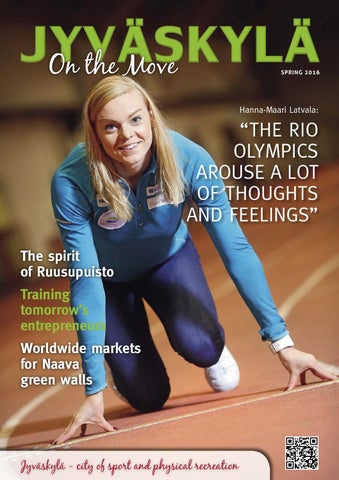
Hanna-Maari Latvala:
“THE RIO OLYMPICS AROUSE A LOT OF THOUGHTS AND FEELINGS” The spirit of Ruusupuisto Training tomorrow’s entrepreneurs Worldwide markets for Naava green walls
Jyväskylä - city of sport and physical recreation
1
JYVÄSKYLÄ City On the Move
THIS PUBLICATION IS BROUGHT TO YOU BY
S PRING 2016
Published twice yearly, Jyväskylä On the Move magazine showcases the expertise, culture and people to be found in the Jyväskylä Region.
CONTENTS
The City of Jyväskylä, with a population of 136 000, is one of Finland’s centres of growth. Recognised as a city of high-quality education, Jyväskylä is also internation ally known for the architecture of Alvar Aalto. www.jyvaskyla.fi Jyväskylä Regional Development Company Jykes Ltd. is a business promotion and development company owned by the four municipalities in the Jyväskylä Region. The aim of Jykes is to create a favourable business environment. By offering expertise, support and various networks for companies, Jykes creates opportunities and conditions for profitable business operations. www.jykes.fi The University of Jyväskylä is one of the largest, most attractive and dynamic research universities in Finland, with about 15 000 students, including international students from some 90 countries. www.jyu.fi JAMK University of Applied Sciences is a multidisciplinary institution of higher education with a strong international orientation and a student enrolment of 8 000. Our strengths are workplace-driven learning, close cooperation with the labour market and business, as well as extensive international contacts. www.jamk.fi Jyväskylä Educational Consortium provides vocational and general upper secondary education to young people and adults. The consortium’s educational institutions are attended by over 22 000 students. www.jao.fi
ISSN 1795-3146 (Print) ISSN 2342-1002 (Online) Editorial Office in this issue JAMK University of Applied Sciences Rajakatu 35, P.O.Box 207, FI-40101 Jyväskylä heli.toivola@jamk.fi, www.jamk.fi Editor-in-chief Heli Toivola JAMK University of Applied Sciences Editorial staff and layout Viestintä-Paprico Oy, www.paprico.fi Printed by Kirjapaino Kari Ky Circulation 5 300 Cover photo by Petteri Kivimäki
2
10 4 6 8 10 13 14 16 18 19 20 22 25
FINLAND’S FASTEST WOMAN RED BULL CRASHED ICE AT LAAJAVUORI CYBER-SECURE KANGAS THE SPIRIT OF RUUSUPUISTO SHANGHAI CALLING LEARNING ENTREPRENEURSHIP WHO WILL BE THE GAME WORLD’S NEXT STAR? JYVÄSKYLÄ GAME LAB MAKING A LIVING IN THE GAME INDUSTRY HIGH QUALITY INDOOR AIR A GREAT PLACE TO STUDY AND SKATE BABIES EXPLORING THE WORLD OF COLOUR
Editorial board Pauliina Hietalahti (JAMK University of Applied Sciences), Miikka Kimari (University of Jyväskylä), Taija Lappeteläinen, (City of Jyväskylä), Niina Luttinen (Jyväskylä Educational Consortium), Helinä Mäenpää (City of Jyväskylä), Karoliina Virtanen (Jyväskylä Regional Development Company Jykes Ltd.) English translation Peter Gregory and Tony Melville
14 J Y VÄ S K Y L Ä O N T H E M O V E
FIRST WORDS JANUARY 2016
New innovations and start-ups set to lift Jyväskylä RELATIVE TO ITS POPULATION Jyväskylä has the most stu dents of any city in Finland. The region’s 46 000 or so students can easily be spotted in the local streets and shops and give the city a lively, youthful atmosphere. These students possess a great deal of knowledge, expertise and creativity which it is vital to make use of in developing the Jyväskylä Region. Many students have ideas which may spawn significant innovations and growth enterprises of the future. All this demands that we listen to students’ views, involve them ac tively in development work and give them every assistance to start their own businesses. In this publication we showcase innovations that have come to fruition in Jyväskylä and the enterprises that have been born as a result – many of them started by students who have gradu ated from the many colleges and institutions of higher educa tion in the city. At JAMK University of Applied Sciences we have made a con certed effort in recent years to foster activities promoting stu dent entrepreneurship, for instance, by opening the multi-dis ciplinary JAMK Generator learning environment. The aim of this undertaking is to reinforce the entrepreneurship intentions of students in different disciplines and encourage students to launch businesses of their own during the final stages of their studies. All JAMK degree programmes irrespective of subject have an inbuilt entrepreneur pathway, by following which it is possible to take 70–80 ECTS credits worth of studies supporting and re inforcing entrepreneurship as part of the degree. Experiences of Generator activities have been good. Each year students graduating from JAMK University of Applied Sciences start 30–50 new enterprises. Why is new entrepreneurship important for the Jyväskylä Re gion? Back in the 1930s the Austrian economist Alois Schum peter introduced the concept of ”creative destruction”, by
which he referred to a phenomenon integral to the develop ment of society and industries in general, in which a new, more innovative operating model or enterprise inescapably, through competition, replaces the old, traditional architecture. In Fin land, too, and particularly in Jyväskylä we have encountered the effects of creative destruction, which are reflected in the current high rate of unemployment among other things. Unfortunately in places with a long industrial tradition cre ative destruction has resulted in the permanent disappearance of traditional industries and the jobs associated with them and the transfer of manufacturing to countries with lower produc tion costs. BY MAKING BETTER USE than at present of the innovation ac tivity that is a natural part of higher education institutions’ re mit, and by encouraging students and staff to launch new startup enterprises we can for our part counteract the impacts of creative destruction. New small and medium-sized enterprises and growth enterprises in particular are responsible for the cre ation of a significant proportion of new jobs. In Jyväskylä, over the next few years, a number of new pub lic investments are scheduled to begin. These include construc tion of the new central hospital as well as of the Kangas and Hippos areas. Urban development projects have a natural association with new enter prises and the kind of innovative op erating models which offer a growth platform for new student-inspired businesses, too. n
Jussi Halttunen Rector JAMK University of Applied Sciences PHOTO: HANNA-KAISA HÄMÄLÄINEN
3
Jyväskylä - city of sport and physical recreation
“The Rio Olympics arouse a lot of thoughts and feelings.” Hanna-Maari Latvala 4
J Y VÄ S K Y L Ä O N T H E M O V E
UNHURRIED SUCCESS Top Jyväskylä runner Hanna-Maari Latvala has not missed out completely on competing at the highest level, even though as a junior she was tempted to think so. With a solid foundation laid in her early years, at 28 she now has success firmly in her sights. Words by Tommi Salo Photos by Petteri Kivimäki
IN A FUNNY WAY the thought is absurd. Finland’s fastest woman, Hanna-Maari Latvala, who has run the one hundred metres in 11.30 seconds, has never been in a hurry. Latvala (28) was no star as a junior, so as she herself puts it, she has been allowed to develop quietly into a top sprint er. As she grew older the door to many junior championships slammed shut and Latvala indeed started to think that she would never get to test her speed against the world’s fastest. If we think of things now, as 2015 comes to a close, the situ ation is quite different. The Jyväskylä athlete has gained exper ience and success at the world and European championships, both outdoors and indoors. “The Rio Olympics arouse a lot of thoughts and feelings. The aim isn’t just to run there, but to put in a good performance, one that I personally can be satisfied with,” Latvala says of her next big goal. In Latvala’s case the summer of 2015 was largely lost due to a foot injury. The first serious injury for a long time caused the elite Finnish runner to ponder carefully the season to come. Lat vala is quick to state she will be pursuing her dream, provided she can train and compete injury-free. “The craziest goals can be achieved, if you dare to set crazy goals.” Many top-flight athletes have set themselves the target of Olympic gold, and in the summer of 2016 one of those will win the women’s 100 metres at the Olympics in Rio de Janeiro.
has rapidly become Finland’s leading athletics club, became her new sporting home. “My own development has mirrored that of JKU as a whole. In the club it is all about working together, and the club’s em ployees are really close to us athletes.” She is conscious that in Jyväskylä she is a role model for many junior athletes. JKU is a big club which has the potential to produce top stars in the years to come as well. “Functioning as an example is part and parcel of a top ath lete’s life. Naturally when I am giving everything to my training, I am totally focused and less social. Fortunately many are aware of that,” Latvala says with a smile.
Course books with her at camp How did Latvala fare when she applied to study at the Univer sity of Jyväskylä ten years ago? She was awarded a place and, in addition to her career in athletics, became a fully qualified sport psychology professional. u u
Dedicated to training and a perfect role model Latvala moved to Jyväskylä in 2006. In her own estimation, she was then still very green as an athlete. “I applied to the University of Jyväskylä to study sport. At that time it was not at all clear that I would become a top ath lete.” Latvala did, however, have extensive training behind her and in Jyväskylä she was accepted onto coach Petteri Jouste’s tough training programme. Jyväskylän Kenttäurheilijat (JKU), which
Top sprinter Hanna-Maari Latvala is committed to making even her wildest dreams come true.
5
Jyväskylä - city of sport and physical recreation Subsequently she has continued her studies, taking a range of courses in psychology at the University of Jyväskylä’s Open University. “My course books accompany me to camp. It’s nice to study at times when I’m free of other commitments.” Latvala says that she has tried to avoid being an over-per former during her studies. She has nothing but praise for the at mosphere that prevails in the university’s Faculty of Sport and Health Sciences, which allowed her to combine studying and her career in athletics. Nor has Latvala studied simply to pass the time. The career of a top athlete comes to an end well before the pension age of an ordinary worker, so it is useful to have something other than old competitor passes in your back pocket. “I’m interested in psychological coaching. A lot depends on how my own sports career ends. In other words whether I want to take a break from sport or just keep on going in the busi ness.” uu
Beautiful city in which to train Sprinters naturally have an affinity for warmth. During the win ter season Latvala has spent long periods at camps, in Florida, Teneriffe and elsewhere. She regards Jyväskylä, however, as a good city in which to train. In winter the Hippos Hall is an excellent facility and with the arrival of spring it is possible to get out on the beautiful Har ju ridge. “Jyväskylä has several good training facilities within a short distance of each other. Getting from one place to another is sim plicity itself on a bike. For an athlete following a tight daily routineJyväskylä is ideal.” KIHU – the Research Institute for Olympic Sports – makes another important contribution to the top athlete’s routine. Lat vala has benefited from the institute’s expertise in psychological coaching and the conduct of physiological tests among other things. “All in all Jyväskylä is a beautiful city, surrounded as it is by lakes and unspoilt nature. This is a fine place to relax, whenever my training schedule allows me the opportunity to do so.” n
NO QUARTER GIVEN In January at Jyväskylä’s Laajavuori ski centre we will discover who is the most explosive, graceful and audacious ice cross downhiller. For a short time Jyväskylä will be right in the spotlight, as the world’s best downhill skaters arrive in the city and take on the longest course in ice cross tour history. Words by Tommi Salo
AT THE END OF JANUARY Jyväskylä’s Laajavuori hill will witness a feast of speed – on skates. Spectators will have the chance to admire the daredevil pace of the world’s top ice cross downhillers at the Red Bull Crashed Ice event. The ice cross event is set to attract approximately 80 top names in the sport to Laajavuori. Over 10 000 spectators are ex pected to turn up. “We can offer spectators the best seats in the house, since the finish line is right in front of Laajavuori’s summer theatre,” says Arttu Pihlainen, chairman of the board of the Finnish All Ter rain Skate Cross Association, who hails from Jyväskylä. Pihlainen, who designed the Laajavuori track, is himself a winner of multiple Red Bull Crashed Ice events. He was also world champion in ice cross downhill in 2011. For the Laajavuori event Pihlainen has drawn up the longest track in the tour’s history, with a length of almost 650 metres. “At Laajavuori we’ll be building a fast course that makes use of natural ice and natural contours. Unlike many other courses, it won’t be built on scaffolding,” Pihlainen reveals. The competition track will remain in use after the event. The idea is to organise among other things a camp for juniors inter ested in ice cross downhill which will be open to all.
Competitions attract hundreds of millions of viewers
Hanna-Maari Latvala is an elite athlete, but she has managed to study at the same time.
6
The Laajavuori event is part of the Red Bull Crashed Ice series. The season began in November in Quebec, Canada. At the be ginning of January the tour arrives in the German city of Mu nich and from there it heads to Jyväskylä. The last tour event will be held in Saint Paul, in the United States. J Y VÄ S K Y L Ä O N T H E M O V E
In January 2016 at Jyväskylä’s Laajavuori hill we’ll discover which skater is the fastest down the long, demanding course set by a former world champion. PHOTO: INGMAR WEIN
“At Laajavuori we’ll be building a fast course that makes use of natural ice and natural contours”, says Arttu Pihlainen. PHOTO: RED BULL MEDIA HOUSE
“Downhill skating, or ice cross downhill, is a big discipline worldwide. The tour has major television agreements and hun dreds of millions of viewers. In Finland, too, there are already several hundred people who do the sport on a regular basis,” Pihlainen explains. Points from the three best competitions in the Red Bull Crashed Ice series count towards the final World Cup standings. In addition downhill skaters compete in the Riders Cup, with points from the three best competitions also counting.
So, in the opinion of a former ace, what kind of skater will come out on top in this winter’s competitions? “A downhill skater has to be in complete control of his body. You have to skate fluidly over the jumps and make sure you choose the correct lines – and when overtaking be as cheeky as possible. In my case I benefited from being in good physical shape, which was reflected in an explosive start.” n Red Bull Crashed Ice at Laajavuori, Jyväskylä 29.–30.1.2016
HIPPOS BRINGS TOGETHER ELITE ATHLETES AND ENTHUSIASTS By Tommi Salo Plans are in hand to transform Jyväskylä’s Hippos area into a modern centre of competence in sport and physical recreation. Its role will be to offer basic services in sport and movement and to serve competitive sports, sports research and education as well as wellness. The idea is to create an environment that both Olympic athletes and ordinary families will find appealing. “Hippos has everything it takes to become a centre of competence. The area already contains a lot of sports facilities, research and development expertise in sport and physical recreation as well as university-level education
in the same field. The area is also used by numerous sports clubs,” says Anne Sandelin, Director of Business Development and Urban Planning Projects at the City of Jyväskylä. According to Sandelin, in the future Hippos would attract a wide body of people with an interest in international-level events, competitive sports, training and sports research. “Hippos also has the potential to shape future trends in sport and fitness, for instance, in relation to self-measurement.” Development of Hippos has progressed to phase two, in which a development concept is being drawn up that covers key issues such as planning, buildings and investors. n
7
CYBER-SECURE KANGAS
Cyber security is a cross-cutting theme in all the solutions for the Kangas area of Jyväskylä. The basis for construction of a secure smart city’s infrastructure is Finland’s first cyber security strategy covering an entire city district. Words by Timo Sillanpää Photos by City of Jyväskylä
KANGAS IS AN AREA located very close to Jyväskylä city centrewhich is being transformed into a new-style smart urban district. By 2040 the area previously occupied by a paper mill will be home to roughly 5 000 people and provide some 2 100 jobs. At that time the area will feature approximately 85 000 square metres of premises for business. Construction of the infrastructure in Kangas started in 2014 and continues in phases according to detailed plans. The first new buildings will be completed in 2017. Thanks to the cyber security strategy drawn up for Kangas the cyber security of the ICT solutions in the area is already be ing taken into account during the construction phase. “We’re aiming to implement Smart City thinking in a com pletely new manner. As far as is known, of all the projects con 8
ducted worldwide employing the Smart City concept Kangas is the only one to assign cyber security such a prominent role right from the planning stage,” underlines Tanja Oksa, Project Manager at the City of Jyväskylä. According to Oksa Kangas will make use of solutions that will ensure the area is resource-wise, smart and secure.
Threats have to be recognised Elevating cyber security to the strategy level provides a guar antee that all the parties involved in developing the area recog nise the importance of cyber security. Security consultant Riku Nykänen from Relator Oy points out, however, that ICT tech nology advances so quickly that the strategy will require con tinual updating. J Y VÄ S K Y L Ä O N T H E M O V E
EXAMPLES OF THE KANGAS AREA’S SMART CITY SOLUTIONS Cyber security • A cross-cutting theme in all the area’s ICT solutions.
Smart home technology • Information on consumption of water and energy motivates people to save.
Living Lab • A variety of data is gathered in the area which can be utilized on the Living Lab principle to underpin research linked to urban development as well as the roll-out of new products. Area portal • Enables information to be communicated in real-time to residents and people working in the area. Electronic locking and access control • User rights of different levels can be given to people living/ working in the area. Keys do not fall into the wrong hands, for instance, when a lease ends. Smart keys can be enhanced with other services. Optical fibre net • Installation conducted concurrently with construction of basic infrastructure.
“If we think back 20 years, the internet was new. What the situation will be 20 years from now – that’s anybody’s guess.” According to Nykänen the purpose of the strategy is create the capability to react to constant changes in the ICT branch, which nobody can forecast accurately. Awareness of cyber threats and critical assessment of ICT solutions constitute the foundation when a concentration of cyber-secure homes and jobs is being created. Nykänen believes that as development of Kangas progress es successful practices linked to cyber security will emerge that can be made use of in other urban development projects as well. “Kangas represents a significant pilot scheme amid efforts to develop a cyber-secure urban district.” The Kangas area will see concrete implementation of the in ternet of things, in which numerous devices are in contact with the net. In Nykänen’s view this is simultaneously an opportun ity and a threat. “The net is certain to include a considerable amount of tech nology which will permit services in the smart city district, im prove the level of comfort and convenience enjoyed by resi dents and boost opportunities to function in a resource-wise
Smart solutions for elderly housing • Home safety and security as well as the functional ability of senior citizens can be predicted with the help of ICT solutions (for example, fast access to help in emergency situations). Resource wisdom • 400 car spaces less will be needed in the area by introducing shared-use parking. • Utilization of solar power, use of domestic energy sources in the generation of direct heat. • Smart waste management: waste containers equipped with sensors are emptied only when they are full.
manner. On the other hand the internet of things increases the so-called attack surface, in other words the chances for hackers to disrupt the operation of the devices in question,” Nykänen points out. n
EXTENSIVE CYBER SECURITY EXPERTISE IN JYVÄSKYLÄ Over the last five years Jyväskylä has developed into one of Finland’s key clusters of cyber security expertise. The Jyväskylä urban region was entrusted with the task of coordinating the national cyber security theme contained in the Ministry of Employment and the Economy’s Innovative Cities 2014–2020 programme. In response to the growing demand for labour in the cyber security field the University of Jyväskylä now offers a master’s level programme and JAMK University of Applied Sciences a higher polytechnic degree programme in cyber security. JAMK University of Applied Sciences’ cyber security research, education and development centre (JYVSECTEC) offers companies and organisations the opportunity to practice combating cyber threats in an internet-like, protected, closed environment (RGCE, Realistic Cyber Security Environment). The University of Jyväskylä conducts international research cooperation in cyber security with a number of countries including the United States, Israel, Estonia and Germany. n
9 9
This is the spot at Ruusupuisto where people pause and mingle. Juhani Koponen and Kirsi Moisan der are sitting in the ‘grandstand’, which is located right opposite the main entrance. The lobby of the Ruusupuisto build- ing contains a sculpted installation entitled ‘Ohitus’ by artist Veikko Hirvimäki. Hirvimäki’s installation consists of wolf figures that appear to pierce the wall.
10
J Y VÄ S K Y L Ä O N T H E M O V E
The spirit of
RUUSUPUISTO The University of Jyväskylä’s Ruusupuisto building is a place where people feel comfortable, sometimes overly so. In this jewel of modern campus construction completely new ways of learning can be created and tried out. Words by Tommi Salo Photos by Petteri Kivimäki ALREADY AT THIS STAGE PEOPLE in Jyväskylä talk of the Ruusupuisto spirit. By that they are referring to the atmosphere which permeates the University of Jyväskylä’s newest building. Ruusupuisto is a combination of the most modern campus design and the very latest pedagogic learning environments. The building has been made for its users and by listening care fully to their thoughts. Completed in the spring of 2015, the Ruusupuisto building is now home to the University of Jyväskylä’s Faculty of Edu cation, the Finnish Institute for Educational Research and the Open University. The new building is used by roughly 330 staff and about 1 000 students. “Our professionals in education are now under the same roof at the university. At the time the move took place people from the Faculty of Education were spread over at least thirteen dif ferent locations,” the University of Jyväskylä’s Director of Ad ministration Kirsi Moisander explains. On the basis of user experiences over the first six months Ruusupuisto has proved to be a place where people really feel comfortable. Almost too comfortable, one might say. “At Ruusupuisto there has been some talk that not even re tirement will get people out of the place. The students don’t show any signs of wanting to leave the campus for somewhere else either,” Moisander continues.
The Ruusupuisto (“Rose Park”) building’s name can be traced back to the early years of the last century. At that time there was a park on the spot where numerous roses were planted in the course of renovation work. The place has been known as Rose Park ever since.
Best results can be achieved sitting or standing What is it then that makes Ruusupuisto such an exceptional en vironment? Users themselves have been able to exert a consid erable influence on the end result. The lecture rooms are examples of the very latest pedagogical approach. If the best result can be achieved in some other way than by sitting in the traditional arrangement, then standing or sitting on a sofa or modifying the learning space in a manner that best supports learning is just fine. Ruusupuisto has also been equipped with absolutely leadingedge information technology and other technology that sup ports learning. “At Ruusupuisto we can develop and test novel pedagogical methods. Here it is also possible to establish how the oppor tunities afforded by digitalisation can be exploited,” Moisand er underlines. User-friendliness is also visible in the fact that Ruusupuisto can be reached from a variety of directions. u u
11
The Ruusupuisto building has four corner units that are reminiscent of dice. The middle of the building is where the majority of the action takes place, while as we go towards the edges things calm down.
u u Students are encouraged to move around on bikes,
which is borne out by the really large space for parking bikes outside the building. Major contributions to the atmosphere in the area are made by the buildings close to Ruusupuisto designed by master archi tect Alvar Aalto and Lake Jyväsjärvi that shimmers just a couple of hundred metres away.
Grandstand – a place to study or just relax The heart of the new building is a “grandstand” – some large steps, or terraced seating, located opposite the main entrance. The wooden grandstand attracts both students and other users of the building to work in the open space or just sit down for a while. Ruusupuisto is built on the principle that on each floor the majority of the action takes place in the middle and towards the flanks of the building things start to calm down. The flanks of the building feature what could be termed “dice”, which in a very natural manner separate the staff’s own workspaces from the communal areas. Where the walls and building service technology (HVAC) are concerned the spaces in the lobbies and dice are adaptable. In
the dice it is easy to create open spaces and rooms of different sizes. Multipurpose use has also been designed into the ground floor, where events and functions can be staged in the entrance hall with its ‘grandstand’ and catering can be laid on in the res taurant immediately next door.
Healthy environment also years from now Ruusupuisto has only just taken its first steps. The intention is that it will continue to be a modern and healthy learning envi ronment for a very long time. The Ruusupuisto project was implemented in accordance with the Terve talo (Our Healthy House) principle. Every effort was made to ensure good indoor air by selecting quality mater ials. At Ruusupuisto quality assurance will be conducted contin uously while it is in use. “The vital thing is to establish that the design and imple mentation correspond to needs. At Ruusupuisto indoor air is monitored at regular intervals, checks are made to ensure the ventilation is functioning properly, and a variety of other sur veys carried out,” reveals Juhani Koponen, Managing Director of PTS-Kiinteistötekniikka Oy, the company that acted as con struction consultants. He explains that personnel at Ruusupuisto are briefed on the results of surveys and studies. Guidelines on use have also been drawn up for everyone based in the building. n
The spaces at Ruusupuisto can be adapted according to need. New pedagogic methods can thus be handily incorporated into university study.
12 12
J Y VÄ S K Y L Ä O N T H E M O V E
SHANGHAI CALLING Shanghai and Jyväskylä are stepping up their well-established cooperation in the field of education. Two PISA success stories are working closely together. Words by Ismo Myllylä Photo by Jussi Ahonen A NEW CENTRE FOR Shanghai Teacher Training and Collabora tion is being founded at the University of Jyväskylä. The Centre is one aspect of closer cooperation agreed between the Univer sity of Jyväskylä and Shanghai Municipal Education Commis sion (SMEC) in September 2015. “Shanghai’s education system has already reached a high level, as can be seen in their success in the PISA studies. Never theless they want to further develop it with the help of Finland, another PISA success. The University of Jyväskylä has Finland’s broadest expertise in the field of education, which makes it a natural partner for Shanghai,” explains Elise Tarvainen, Direc tor of Global Operations, EduCluster Finland.
Bringing entrepreneurship into vocational education EduCluster Finland is owned by the University of Jyväskylä, JAMK University of Applied Sciences and Jyväskylä Education
al Consortium. It is the educational institutions’ operating arm in educational export projects. Jyväskylä Educational Consortium – which organises voca tional and general upper secondary education – implemented a pilot entrepreneurship education project in Shanghai in Oc tober 2015. The client was Shanghai Industrial & Commercial Languages School. “Entrepreneurship courses are still new in China, especially in the context of vocational education. Our partners in Shang hai now want to assess the potential for applying our model. In our model students can freely choose a total of 5 to 39 study weeks of entrepreneurship courses as part of their vocational qualification. For instance, those who want to can set up a Ju nior Achievement type mini-company as part of their studies,” says Project Manager Kirsi Koivunen of Jyväskylä Educational Consortium, who is responsible for educational exports. n
PISA SUCCESS IN FINLAND AND THE SHANGHAI REGION
Average scores and associated ranking PISA 2009 Mathematics Reading Science
PISA 2012
SHANGHAI
FINLAND
SHANGHAI
FINLAND
600 (1) 556 (1) 575 (1)
541 (6) 536 (3) 554 (2)
613 (1) 570 (1) 580 (1)
515 (12) 524 (6) 546 (5)
The figures in bold relate to the focus area of the year in question. The Shanghai Region first participated in the PISA studies in 2009. Source: Ministry of Education and Culture
Jyväskylä Educational Consortium’s experts has visited Shanghai in order to explain the special features of the Finnish system of vocational education to local teachers in the field.
13
Learning
ENTREPRENEURSHIP Students who set up cooperatives while they are studying can learn basic entrepreneurial skills and earn extra money. For the last couple of years the TRA Jiiri Cooperative has provided jobs for students on the Degree Programme in Civil Engineering at JAMK University of Applied Sciences. Words by Timo Sillanpää Photos by Petteri Kivimäki
THE SAUNA SUITE in a Jyväskylä apartment block is a hive of activity. Ville Venäläinen (25), Lauri Hyttinen (22) and Joel Tikanoja (23), who are studying Civil Engineering at JAMK University of Applied Sciences, are replacing the panelling on the walls. The TRA Jiiri Cooperative provides building and renovation services and was es tablished in early 2014. “Our invoicing for the first summer was about 34 000 euros, but in 2015 it had already risen to almost 100 000 euros. We were still doing renovation work during the autumn holiday, and there was more work available than we could take,” says Ville Venäläinen, Chairman of the cooperative. “Working in the cooperative has been a great learning experience. It’s also given me useful contacts for my future career. We’ve learnt that you have to start building networks while you are still studying,” says Lauri Hyttinen. “Civil Engineers should know how construction sites operate. And it’s a lot easier to talk to the people who do the practical work when you’ve used a circular saw and nail gun yourself,” says Joel Tikanoja.
Introduction to entrepreneurship Studies at Tiimiakatemia, the entrepreneurship centre of excellence at JAMK Uni versity of Applied Sciences, have traditionally been based on team cooperatives. During the last few years students in other fields have also been encouraged to set up cooperatives during their studies. In the cooperatives students learn the basic skills needed to run a business and entrepreneurial thinking. The cooperatives also provide opportunities to work dur ing the summer holidays, for example. “Each cooperative has a coach who gives advice on the commercialisation of the members’ skills, sales, acquiring customers, pricing, the cooperative’s finan cial management, and related matters. When the cooperative is already running the coach provides the members with sparring every couple of weeks,” says Marja Kämppi, a Project Worker at JAMK University of Applied Sciences. She adds that the cooperatives give students a chance to test whether entre preneurship would be an option for them when they finish their studies. And it’s a useful lesson even for those students who realise they are not cut out to run their own business. n
14
J Y VÄ S K Y L Ä O N T H E M O V E
The cooperative offers students at JAMK University of Applied Sciences the opportunity to try entrepreneurship during their studies. Civil Engineering students Lauri Hyttinen (from left), Ville Venäläinen and Joel Tikanoja say that the TRA Jiiri Cooperative has made a good start and it’s important for first and second year students to continue running it.
COOPERATIVES PROMOTE EMPLOYMENT PROSPECTS FOR VOCATIONAL STUDENTS By Timo Sillanpää Students enrolled in the vocational colleges operated by Jyväskylä Educational Consortium have the chance to join a cooperative during their studies. The cooperatives play a supporting role, particularly during the pivotal stage when students leave their course to start working. Two legally independent cooperatives, Pegosus and Verso, collaborate closely with Jyväskylä Educational Consortium. Their members are students, lecturers or graduates of the Educational Consortium. Verso is a cooperative for students at Jyväskylä Institute of Adult Education. “The cooperative enables students to test and develop their business ideas in an
entrepreneurialway but with very little risk. In addition they get both professional and business guidance to develop their business activities,’’ says Coach Mikko Laitinen, who is the cooperative’s Managing Director. The cooperative has around 110 members, whose skills cover a number of different areas. “Verso is primarily an environment where mature students can learn about entrepreneurship. I believe it’s precisely in the development of their entrepreneurial skills that Verso provides the students with the greatest added value,’’ Laitinen states. By contrast, Pegosus is a multi-disciplinary teaching cooperative for students at Jämsä College. It has around 45 members.
“The cooperative brings together students in different fields and enables them to create joint product and service concepts. As an example, members of the cooperative organised an occupational wellbeing event for a client company. The team involved included students from four separate fields. Pegosus’ strength is its multidisciplinary nature,” says Sanna Anttila, Cooperative Coach. “Pegosus provides an environment where vocational students can develop and deepen their professional skills. It gives many a chance to build the customer contacts they will need in their future career even before they graduate,” she adds. n
15
“I’VE GOT A DEGREE IN AUTOMATION TECHNOLOGY AND THAT’S THE FIELD I’VE BEEN WORKING IN. NOW I’D LIKE TO DO CREATIVE WORK AND EARN MY LIVING IN THE GAME SECTOR.” JARNO AUVINEN, KALJAMERI GAMES
16
J Y VÄ S K Y L Ä O N T H E M O V E
Who will be the game world’s
NEXT STAR? Jyväskylä has already found its own place in Finland’s game scene. It will be in an even stronger position when one of the city’s rising game development companies comes up with a global hit – and that time could be surprisingly close. Words by Tommi Salo Photos by Petteri Kivimäki and Tommi Salo THE GAME INDUSTRY is going through interesting times in Jy väskylä. A number of start-ups have been founded in the city, which are seeking capital from investors. At the same time second-generation game companies backed by experienced en trepreneurs have also grown up there. Jyväskylä has about twenty different companies involved in the game industry, and each typically employs 1–10 people. In addition there are a number of teams in the city with ideas for games or game commercialisation. “The new-generation game companies have the critical mass and potential to produce a hit,” says Tuomas Roininen, Chair man of the Board at Expa Game Business Cooperative. It has been calculated that there are more than 250 game companies in Finland, of which around 180 have been operat ing for less than four years. Well over half of the companies are based outside the Helsinki Metropolitan Area, which indicates that the industry is expanding.
Bringing people together Expa Game Business Cooperative brings people together within the Jyväskylä Region’s game industry. Its mission is to energise and reinforce the region’s game sector. It also creates opportu nities for collaboration and networking, and it distributes rel evant information.
Tuomas Roininen of Expa says that the game industry needs people with a variety of skills. Jyväskylä has the facilities to ensure these needs are met.
“We provide information on employment opportunities, for example, not only in the game industry but also in other fields. Gamification means that work is available across a broader spectrum of activities than just game design and development,” Roininen explains. Expa helps people interested in the game field to find likeminded individuals. In fact, companies have already been set up by people who have met through the cooperative. “Some games have been published through Expa, so we can help with low-threshold publishing. But we prefer to point game developers in the direction of professional publishers,” Roininen says. One of Jyväskylä’s strengths is employment-oriented train ing and education. The University and University of Applied Sciences teach students the right skills for the game industry, and game companies also benefit from the availability of gradu ates in other fields. “The game industry is much more than just coding. It also needs people with skills in marketing, communications, man agement and graphic design.” n
uu
USING GAMES TO INSPIRE AND TEACH MUSIC STUDENTS By Tommi Salo Gamification helps in the teaching of music. It’s an excellent additional element in both the theory and practice aspects of teaching and learning. Gamification is utilised in basic music teaching at Jyväskylä College, with various mobile applications and websites in use. “Music learning games have made the teaching of music theory more meaningful. In listening exercises focusing on harmony, melody and rhythm, for example, gamification has increased the number of practice ses-
sions and this can be seen in the students’ listening perception. The game also gives immediate evaluation feedback to both the student and teacher,” says Music Teacher Jarmo Kivelä of Jyväskylä College. Kivelä adds that game applications increase and support self-directed learning, with the students receiving visual feedback from their practice. Applications for theoretical studies and instrument teaching are available for students of all ages. “Mobile and tablet devices have brought diversity to music teaching and learning, and they have increased the potential for collaborative teaching.” n 17
uu
Jyväskylä Game Lab
NEW TEACHING METHODS AND SUPPORT FOR ENTREPRENEURS Words by Tommi Salo Photos by Petteri Kivimäki EXTERNAL SUPPORT PUTS game developers in an even stronger position. This support can involve bringing the right people together to form a team, providing working spaces, or helping with content for game development. Jyväskylä Game Lab (JGL) seeks to help people who are in terested in the game industry and aims to provide routes to game entrepreneurship and employment. It also creates new types of methods to support game related teaching at the Uni versity of Jyväskylä and JAMK University of Applied Sciences. The Jyväskylä Game Lab project started in Jyväskylä at the beginning of 2015. The first game teams started working at JGL a few months later. The idea is that in five months the teams develop a proto type game which they can use to make their own progress in the industry. In the best case the prototype would lead to pub lication, securing of finance, and establishment of a company. “One of the teams from spring 2015 is already progressing to the publication stage,” says Project Coordinator Hanna Hau vala of JAMK University of Applied Sciences.
Teaching methods are changing In addition to supporting entrepreneurship in the game indus try, JGL is seeking new ways of teaching game related sub jects. The aim is also to understand what the changes tak ing place in the world of work mean for teaching in a broader sense, and not just in the game field. “The University and University of Applied Sciences are both involved in JGL, so we have a real opportunity to devel op teaching methods with an emphasis on multi-disciplinary approaches,” says Project Manager Antti-Jussi Lakanen of the University of Jyväskylä. Jyväskylä Game Lab (JGL) – developing the game sector in to an international business through multidisciplinary and multi-skilled regional collaboration – is a project financed by the Central Finland Centre for Economic Development, Trans port and the Environment (European Social Fund financing, Leverage from the EU 2014–2020), the University of Jyväsky lä’s Department of Mathematical Information Technology, JAMK University of Applied Sciences and Jyväskylä Regional Development Company, Jykes Ltd. n 18
J Y VÄ S K Y L Ä O N T H E M O V E
“IT’S A BIG THING TO GET TO DO A REAL PROJECT. IT REALLY GETS YOU INTERESTED IN THE GAME INDUSTRY.” TEEMU TOIVANEN, SUMU GAMES
MAKING A LIVING IN THE GAME INDUSTRY JYVÄSKYLÄ IS CONTINUOUSLY training new people for the game indus try. They can start their own company, get a job at an existing company, or apply their gamification skills in other sectors. The Game Development Course at JAMK University of Applied Sciences has offered a basic introduc tion to the various aspects of game development, together with a periodof practical training which includes development of a game. Some of the course participants have carried on developing their games at Jyväskylä Game Lab. In the paragraphs below, three participants who developed their own game share their thoughts about game design and the opportunities avail able in the game sector.
” ”
Chief Game Designer Tapio Hänninen, Apestorm – Full Bananas: We made Apestorm as part of JAMK’s Game Development Course. It got positive feedback so we carried on developing it at Jyväskylä Game Lab (JGL). The Game Development Course and JGL offer a low-threshold oppor tunity to get to know the game sector. The idea of Apestorm is that three apes embark on an odyssey of bomb ing to wreak revenge on the human race. They are avenging man’s abuse of nature and destruction of bananas. I got the idea when I was planting pota toes on my parents’ farm. When we were developing the game our team got expert help and work ing spaces were provided. New contacts have created the network that we needed. It’s interesting to think that one day I might be able to make my living in the game industry.
Lead 3D Artist Jarno Auvinen, Kaljameri Games: The game industry is growing. I’ve got a degree in automation technology and that’s the field I’ve been working in. Now I’d like to do creative work and earn my living in the game sector. The JAMK University of Applied Sciences Game Development Course has been a great opportunity for networking. It also strengthens your know ledge about the game industry and shows you a broad cross-section of the field and what it’s like to work in it. A lot of different types of people are needed in the game sector, not just coders. The Running Beer game we were developing got to the demo stage. We succeeded in getting a lot of exposure for it in Finland and abroad, and we might well continue developing it as a hobby when the course is finished.
Game Designer and Producer Teemu Toivanen, Sumu Games: I’ve enjoyed playing games since I was small. I graduated with a Masters in Economics in 2014 and applied for the Game Development Course at JAMK University of Applied Sciences. I’ve done programming and marketing and I’ve managed projects before, and I think those skills could be useful in the game sector. It’s a big thing to get to do a real project. It really gets you interested in the game industry. We’re going to publish our new game Sam, Ur Eye! for Android. We are aiming to release it in early 2016, and then we’ll see who’s the last ninja standing. n 19
“In Naturbo the plants are grown without soil, using a combination of hydro- and aeroponics”, states CEO Niko Järvinen.
NaturVention aims to export Naava green walls to the world’s major cities
HIGH QUALITY INDOOR AIR NaturVention has calculated that millions of active green walls are needed all over the world to purify indoor air. The Jyväskylä based company says there are huge markets in major cities, where pollution levels mean it’s not even possible to get clean air into buildings from the outside. Words by Timo Sillanpää Illustration by Martti Hänninen Photo by Tommi Salo NATURVENTION’S PATENTED NATURBO TECHNOLOGY is the culmination of several years of development, major efforts on the part of the entrepreneurs, contributions from experts in many different fields, and capital from shareholders and in vestors. The technology boosts the air purification efficiency of a single plant to more than 100 times that of a regular indoor plant. The company’s CEO, Niko Järvinen, says that there is vast market potential around the world. “Especially in major cities, the outside air is so polluted that there’s no technology capable of improving the poor quality of the air inside buildings by bringing air in from outside,” he ex plains. But scaling this business up to a global level is a lot more challenging than going global with a mobile game, for exam ple, which spreads rapidly across the internet. Järvinen states 20
that in order to capture new markets the company will need ex ternal investments. “We believe we’ll be successful in the international markets. After all, what we are offering is a technology that really works: it’s the world’s smartest green wall”.
Starting from the Nordic countries NaturVention received its first orders from Swedish customers during the second half of 2015, and its Stockholm office will be up and running during the first half of 2016. “We’ll expand to the UK, Western Europe and China as quick ly as possible,” Järvinen says. He sees China as a market that is challenging but offers massivepotential in its major cities. “Our company has to be capable of meeting large-scale de mand. We have to establish contacts with local growers, be J Y VÄ S K Y L Ä O N T H E M O V E
How Naturbo works A fan creates negative pressure within the unit, causing air from the room to pass into the growing medium, and blows the purified air back into the room. The green wall also restores the moisture balance of the air.
The remote system transmits information on the weather situation from satellites and other sources.
Sensors in the green wall measure different variables from the green wall and its environment.
In the event of a malfunction the system will automatically fix the problem or alert the service organisation.
NaturboOS artificial intelligence analyses 14 variables and controls the operation of the green wall (watering, air circulation and lighting) automatically.
Microbes in the growing medium break down the impurities in the air into plant nutrients, water and oxygen.
cause we can’t transport the plants we need for our green walls all the way to China. We also need to set up a local sales, mar keting and service organisation,” he explains. The company’s founders, Niko Järvinen and Aki Soudunsaari, started developing green walls in 2010. “We tested a prototype green wall in a classroom where the teacher had health issues linked to poor indoor air quality. The symptoms cleared up in two weeks, which encouraged us to de velop the technology,” Järvinen states.
The genius of nature Järvinen explains that in recent years researchers have gained new insights into important aspects of the ways microbe popu lations work. Previously people tried to eliminate microbes, but now it’s clear that they have an essential role to play in human health. Microbes living in the root zone of the green wall break down harmful impurities in the indoor air into water, nutrients for the plants, oxygen and carbon dioxide. “The microbes adapt to purify the indoor air of the space where the green wall is located. Studies have concluded that around 90 percent of symptoms caused by poor indoor air are eliminated by the Naturbo technology.” The technology combines active hydroponic methods – dis
covered in research carried out by NASA during the 1970s – with microbe based biotransformation, which is used in wastewater treatment facilities. Biotransformation involves modifying the chemical structure of compounds by means of organisms or enzymes. “In Naturbo the plants are grown without soil, using a com bination of hydro- and aeroponics. Soil cannot be used because it could increase symptoms among people who are sensitive to impurities in the indoor air,” Järvinen says. So far the company has sold around 500 green walls, of which the majority are installed in public premises, offices and hotel conference rooms.
Careful plant selection NaturVention’s experts studied over one hundred different plants during the product development phase. “We have selected five plants that we use as standard in our green walls. Appearance and coverage are important criteria, be cause green walls are also visual elements in the room’s decor. The plants must not grow too quickly or cause allergic reac tions.” The plants used in NaturVention’s green walls include heartleaf, bird’s nest fern and peace lily. n 21
A GREAT PLACE TO
and skate!
Jyväskylä attracts an interesting mix of foreign students. For some Jyväskylä almost feels like a big city, while others have lived in places like Los Angeles and Beijing. But all are pleased with the high quality of their courses and the wide range of leisure activities available. Words and photos by Tommi Salo
1. Who are you and where do you come from? 2. What made you want to study in Jyväskylä? 3. What is Jyväskylä like as a place to study? 4. What do you think about the city and its people? 5. What are your plans for the future?
Stephanie Popp, University of Jyväskylä
1. I’m 27, I come from Los Angeles in the US and I study International Business and Entrepreneurship.
2. I was really interested in entrepreneurship and one of my friends recommended that I study in Finland. The programme at the University of Jyväskylä looked interesting, and it was the only place in Finland where I applied.
3. Studying at the University is flexible and open – in a pos itive way. Students can make choices about their studies and they have to be independent. In Jyväskylä you can steer your studies according to your own interests. And while you’re studying you also get the chance to work closely with com panies.
of sports activities. The air is clean and there are not so many people around. While I’ve been here I’ve tried sauna, swim ming, skiing and hiking. Jyväskylä is an active city and the people are friendly. Nearly everyone speaks English, so in a way it’s not so easy to learn Finnish.
5. I’ll finish my studies in spring, 2016. I’m interested in the 4. I’ve lived in Los Angeles, Beijing and Shanghai. It’s not easy to make a direct comparison between Jyväskylä and those cit ies. In Jyväskylä nature is never far away and there are lots
22
travel business, especially in owning and developing small ho tels. I’d like to stay in Finland, if I can find interesting work here. n
J Y VÄ S K Y L Ä O N T H E M O V E
STUDY Lucinda van der Meulen, Jyväskylä College
1. I’m an 18-year-old beauty care student from Leeuwarden in the Netherlands. I’m studying for a Vocational Qualification in Beauty Care at ROC Friese Poort in Leeuwarden.
2. I’d never been to Finland and I wanted to learn something new. We had a choice of places to do our exchange studies, and I chose Jyväskylä because here I really get to sit in a classroom and learn. Jyväskylä was my only option in Finland.
3. Jyväskylä College offered broadly-based quality teaching. It was cheaper to live as a student in Jyväskylä than at home in the Netherlands. I do figure skating, and there were great opportuni ties for skating in Jyväskylä.
4. I got a small info package about Jyväskylä in advance, and I
Kindersley in Saskatchewan, Canada.
saw photos of the city. I was pleasantly surprised at how beauti ful the city is. In Jyväskylä everything is close, so it’s easy to get around by bike, for example. Finnish people seemed to be quite reserved at first, but they turned out to be really friendly and helpful. Many people speak good English. I also saw the Northern Lights – that was an unbelievable experience.
2. I’d previously done an exchange in Kotka and I’d been to
5. I spent a total of 11 weeks in Jyväskylä and I made some
Jyväskylä before. So I’d already been here.
good friends during that time. Henrietta Rautavirta, in particu lar, showed me around, took me to Helsinki and made sure I had something fun to do every weekend. So it would be great to go back to Jyväskylä later. n
Jonathan Strutt, JAMK University of Applied Sciences
1. I’m 22 and I’m studying International Business. I’m from
3. I enjoy studying at the University of Applied Sciences be cause there’s a lot more to the programme than just theory. The courses include practical projects, and I’ve spent time working on real cases.
4. My home town in Canada has 5 000 inhabitants. Jyväsky lä is a city but it has all the advantages of a small town. It’s easy to get around, and nature is close by, with the lake and parks. I’ve been skating and tried cross-country skiing. The winter here is nothing new to me. You can make great friends with Finnish people, but it takes time to get to know them.
5. I’ll be studying in Jyväskylä until the end of 2016 at least. I’d like to get a job in Jyväskylä or somewhere else in Finland and stay here. n
• University of Jyväskylä: The total number of foreign students is 1 200, of whom around 520 are studying for basic degrees and about 340 are on further degree courses. There are around 340 exchange students. The application period for International Master’s programmes: 1.12.2015–22.1.2016. www.jyu.fi • JAMK University of Applied Sciences: There are 515 foreign degree students, who complete their degree studies at the University of Applied Sciences. The annual number of exchange students is 400. These students spend either one semester or the whole academic year at JAMK. The application period for Bachelor’s Degree Programmes conducted in English: 8.–27.1.2016. www.jamk.fi • Jyväskylä Educational Consortium: The Consortium’s colleges take in more than 300 foreign students each year. In upper secondary schools the foreign students take part in classes or joint projects. In vocational institutes they mainly develop their skills through on-the-job learning in companies in Cen23 tral Finland. www.jao.fi/en
IN BRIEF
ARCHITECTURE • ART • CULTURE • DESIGN • ENVIRONMENT SCIENCE • EVENTS • NEWS • SPORT • LIFE • EDUCATION
BACHELOR’S THESIS RESULTS IN CUTE ROBOT
TUURE VALO
By Timo Sillanpää In a YouTube video a cute-looking robot sails around a room, blinks its eyes and comes out with: “Hello world”. The robot owes its existence to the thesis written by Matti Jokitulppo, who graduated as an engineer from JAMK University of Applied Sciences in October 2015 with a degree in software technology. His thesis contains a detailed description of how the robot was built. “I had previously created virtually the same kind of robot on an Android programming course. The teacher of this course, Pasi Manninen, became interested in the robot and asked me to make my own robot for JAMK University of Applied Science as a bachelor’s thesis,” Matti Jokitulppo reveals. The robot can be controlled with any kind of Android-compatible device using a mobile application. Data is transmitted by means of Bluetooth technology. The web camera fitted to the robot sends the operator live video to make guiding it easier. In addition this strange contraption contains a speech synthesizer via which text entered into the control app is reproduced as ’speech’. “The robot was built chiefly for marketing purposes at fairs and exhibitions, for instance, for which reason one of the key goals was to make it interesting and capable of attracting plenty of attention,” Jokitulppo continues. Construction of the robot took about three months and the components used cost about 400 euro. “The biggest challenge was ensuring enough electricity. The new robot has so many lights that it consumes significantly more power than its predecessor.” At the current time Jokitulppo is working at Aalto University School of Arts, Design and Architecture in a research team involved with learning environments. He operates in the field of extended reality as a coder and also does ordinary web development. “Hopefully the robot brings some joy to people and awakens interest in
programming and electronics. Electronics involves far more than assembling logic circuits on a breadboard and calculating voltages. It can even be fun,” Jokitulppo states. n Watch the video of the robot: www.youtube.com/watch?v=9J1su0qU4Nk
UNIVERSITY OF JYVÄSKYLÄ JOINS IBM WATSON UNIVERSITY PROGRAMME By Ismo Myllylä The University of Jyväskylä is the first institution of higher education in Finland to be selected for inclusion in the IBM Watson University programme. The partnership agreement signed with IBM allows the university to make use of the Watson latest generation cognitive data processing system for teaching purposes. The Watson platform is a system offered as a cloud service which rapidly analyses large quantities of data obtained from different sources. Watson understands complex questions posed in spoken language and supplies answers based on analysis of the data. It also learns continuously from different interactive situations and augments its own information resources. “The volume of data in society is growing exponentially. Analysing and
24
refining data masses are undoubtedly the big challenges of the future and this is where cognitive data processing finds application. There’s a major shortage of data analysis experts and for this reason Jyväskylä is implementing this new leap in the field of data research and application. IBM Watson offers one important tool for the purpose,” explains Professor Pekka Neittaanmäki, Dean of the University of Jyväskylä’s Faculty of Information Technology. The data analysis study module which makes use of the IBM Watson system was made available to students at the University of Jyväskylä in the autumn of 2015. The University of Jyväskylä’s Faculty of Information Techno logy is the oldest and largest in its field in Finland. The Faculty of Information Technology has over 1 800 students pursuing a bachelor’s or master’s degree as well as 200 postgraduate students. n
J Y VÄ S K Y L Ä O N T H E M O V E
PHOTO: AKK SPORTS OY
NESTE RALLY FINLAND 28.–31.7. The Finnish round of the WRC calendar will be run on Central Finland’s sand and gravel roads. Jyväskylä Paviljonki Rally HQ and Service Park are full of action and entertainment during the rally weekend. www.nesteoilrallyfinland.fi
HANNA-KAISA HÄMÄLÄINEN
Maija starts to explore colour with a little help from her mother Susanna Vuohelainen (right) and Leena Pantsu of JAMK.
BABIES EXPLORING THE WORLD OF COLOUR By Pauliina Hietalahti A colour and music playschool developed at JAMK University of Applied Sciencesoffers activities with music and visual arts for families with babies. “The sessions are a rich mixture of singing, music and movement, and we progress to experiencing, touching and observing different materials, colours and light. Finally everyone gets to make their own mark,” says Leena Pantsu, Senior Lecturer in Music Education at JAMK University of Applied Sciences. Experiential Colour Workshops for Babies were first developed around ten years ago at the Pori Centre for Children’s Culture. Pantsu has produced a slightly more refined version of this Finnish innovation. The playschool sessions last 45 minutes. They start with music, songs, rhymes and observation to warm up and get ready for painting. They end with the actual painting, which the babies do with their accompanying adults. Even small babies – from three months onwards – can take part in the
painting. The “paints” are chosen to feel different: there’s warm, slippery beetroot jelly, corn cobs frozen in ice, moist grated carrot that paints a lovely shade of orange, and parsley with its irresistible smell. All the colours are safe, natural products. The babies enjoy experiencing them through taste and their other senses. “The babies are dressed only in their nappies. The colours, materials and sounds form a total, multi-sensory experience for them,” Pantsu explains. Both the adults and babies enjoy spending time together in the sessions. “The babies have different abilities to concentrate. Some are bold and get involved from the very start, while others take their time to think about things,” Pantsu says. New approaches to music education are being actively developed at JAMK University of Applied Sciences’ music playschool studio. Students of early-age music education at the University of Applied Sciences are closely involved in the activities of the colour and music playschool, either through teaching practice or thesis work. n
25
IN BRIEF
ARCHITECTURE • ART • CULTURE • DESIGN • ENVIRONMENT SCIENCE • EVENTS • NEWS • SPORT • LIFE • EDUCATION
MATHEMATICS AND CULTURE MEET IN JYVÄSKYLÄ PHOTO: OSMO PEKONEN
By Ismo Myllylä In August 2016 approximately 300 international- level mathematicians will gather in Jyväskylä for a Bridges Conference at which the connections between science and art will occupy centre stage. In addition to papers the programme for the five-day event comprises film, theatre, music, poetry and an art exhibition. “Proceedings will also include workshops on creative problem solving and mathematical crafts aimed at both schoolgoers and teachers. It is part of the very nature of a Bridges Conference that it is visible outside the conference hall, too,” explain Kristóf Fenyvesi and Osmo Pekonen, the duo responsible for the conference arrangements. The body staging the conference is the Bridges Organization, an American non-profit corporation which builds bridges between art, music and science. Gatherings have been held previously in the US city of Baltimore in 2015 and in the South Koreancapital Seoul in 2014. “People are really enthusiastic about coming to Jyväskylä. The city is considered to be the perfect size for the conference. Alvar Aalto and Finland’s success in the PISA (Programme for International Student Assessment) study have boosted people’s interest,” Pekonen underlines.
Jyväskylä attracts International congresses In 2014 fifty international conferences and congresses were arranged in Jyväskylä. These at-
tracted a grand total of 4 091 delegates. This makes Jyväskylä Finland’s fifth busiest congress city. The survey includes congresses at which at least 20 per cent of participants are from abroad. n
Pictured here, Kristóf Fenyvesi and Osmo Pekonen, the duo responsible for the conference arrangements.
Watch the promotional video for the Jyväskylä Bridges Conference www.youtube.com/watch?v=rexr77S3FbU Conference website www.bridgesmathart.org/bridges-2016
International Day at Work for charity By Tommi Salo International Day at Work is an event that brings together companies and foreign students in the Jyväskylä Region. The Day at Work organised in spring 2015 saw foreign students from the University of Jyväskylä and JAMK University of Applied Sciences working for a day at 16 companies and organisations in the region.
26
The companies paid a fee of 50 euro per student. The proceeds were donated to charity through ODW Finland, and in line with the international theme they went to support street children in Kenya and Zambia. For companies, International Day at Work offers the opportunity to meet future professionals while they are still studying and to bring international influences into the workplace. Employees in the company get the chance
to hear a foreign language and learn about the students’ home country and culture. International Day at Work has received positive feedback and will also be organised in the Jyväskylä Region in spring 2016. The event will be extended to last a whole week, which will give companies an increased range of choices. Members of the region’s Team Finland are responsible for organising International Day at Work. n
J Y VÄ S K Y L Ä O N T H E M O V E
JYVÄSKYLÄ HAS FINLAND’S BEST LIVING CONDITIONS According to a recent welfare survey conducted by the National Institute for Health and Welfare (THL), among cities with more than 50 000 inhabitants Jyväskylä has the highest proportion of people satisfied with conditions in the area where they live. PHOTO: SUOMEN ILMAKUVA OY
GRAPHOGAME SELECTED FOR INTERNATIONAL TRIAL OF LITERACY INNOVATIONS By Timo Sillanpää The Zambian version of Ekapeli or GraphoGame, which was developed at the University of Jyväskylä, has been selected to take part in a project to test literacy-promoting innovations. The project is organised by USAID, World Vision and Australian Aid. The competition – All Children Reading: A Grand Challenge for Development – was held for the second time in 2015. Fourteen innovations were chosen to take part from more than 200 applications. GraphoGame is based on research and helps children in the early stages of learning to read. “Our aim is to reduce learning difficulties by offering all children proactive support in their own natural school and home environments. We developed the GraphoGame learning environment to support children who are learning to read, and it has also proved to be a very useful tool in some of the poorest countries of the world,” says GraphoGame’s developer, UNESCO Professor Heikki Lyytinen of the University of Jyväskylä. According to the UNESCO report Education for All 2014, an estimated 250 million children around the world need support to learn to read. The majority of the countries where support is most needed are located in sub-Saharan Africa. “Our learning game’s effectiveness has been sufficiently well researched, so now it’s time to progress and develop practical services. Literacy is a basic requirement for a functioning society, and without it it’s difficult to get any other development started. Mobile phone training for teachers and practice with GraphoGame – in maths as well as reading – could be an integral part of aid projects and so contribute to sustainable development. Basic skills create a good start for success in life,” Lyytinen says. n info.graphogame.com www.lukimat.fi
FOLLOW JYVÄSKYLÄ GAME LAB’S EVENTS ON THE PROJECT’S WEBSITE WWW.JKLGAMELAB.FI AND ON SOCIAL MEDIA (FACEBOOK, TWITTER, INSTAGRAM).
EVENTS 3.–5.2. Electricity Telecommunications Light and Audio Visual 2016 Venue: Jyväskylä Paviljonki – International Congress and Trade Fair Centre www.sahkomessut.fi 17.–19.3. Populism as movement and rhetoric International conference Venue: University of Jyväskylä www.jyu.fi/en/congress/populistrhetoric2016 18.–20.3. Special exhibition for construction, renovation and interior decoration Venue: Jyväskylä Paviljonki – International Congress and Trade Fair Centre www.jklrakennusmessut.fi 9.–10.4. Jyväskylä Antiques fair Venue: Jyväskylä Paviljonki – International Congress and Trade Fair Centre www.mediapromessut.fi
12.–17.7. Jyväskylä Festival Venue: Jyväskylä Region www.jyvaskylankesa.fi 28.–31.7. Neste Rally Finland 2016 Venue: Jyväskylä and surroundings www.nesteoilrallyfinland.fi 31.7.–6.8. Computational Methods in Applied Mathematics (CMAM) Venue: University of Jyväskylä, Agora Center www.mit.jyu.fi/scoma/cmam2016/ 9.–13.8. Bridges Finland 2016 Venue: University of Jyväskylä bridgesmathart.org/bridges-2016 14.–19.8. ISSPIC-XVIII (International Symposium on Small Particles and Inorganic Clusters) Venue: Jyväskylä Paviljonki – International Congress and Trade Fair Centre www.jyu.fi/isspic18
9.–10.4. Jyväskylä Wellness fair Venue: Jyväskylä Paviljonki – International Congress and Trade Fair Centre www.hyvinvointimessut.fi
22.–24.8. Matters of Individuals in contexts – Psychology of Language Learning 2 www.jyu.fi/en/congress/pll2016
9.–10.4. Jyväskylä Craft fair Venue: Jyväskylä Paviljonki – International Congress and Trade Fair Centre www.kadentaitomessut.fi
24.–27.8. EUROSLA 26 – The 26th Conference of the European Second Language Association Venue: University of Jyväskylä, Agora Center www.jyu.fi/en/congress/eurosla26
8.–9.6. Conference on Responsible Tourism in Destinations Venue: JAMK University of Applied Sciences, Dynamo www.jamk.fi/en/Event-Calendar/four-seasons-inresponsible-tourism
27.–28.8. 8th International Alvar Aalto Design Seminar 2016 Venue: Jyväskylä City Theatre www.alvaraalto.fi
15.–17.6. Game development course for schoolgoers Venue: JAMK, Rajakatu 35
7.–9.9. Safety, Security, Rescue 2016 Venue: Jyväskylä Paviljonki – International Congress and Trade Fair Centre www.jklturvallisuusmessut.fi
20.–22.6. 8th Nordic Health Promotion Research Conference (NHPRC) June 2016 Venue: University of Jyväskylä, Agora Center www.jyu.fi/sport/laitokset/terveys/en/NHPRC
15.–16.9. ECIE 2016 – European Conference on Innovation and Entrepreneurship Venue: JAMK University of Applied Sciences, Dynamo academic-conferences.org/ecie/ecie-home.htm
20.–22.6. CoDesigns. Envisioning Multi-sited Language Education Policies Venue: University of Jyväskylä www.jyu.fi/en/congress/applied-summerschool/summerschool2016
2.–3.11. Cybersecurity 2016 Venue: Jyväskylä Paviljonki – International Congress and Trade Fair Centre www.kyberturvallisuusmessut.fi
3.–8.7. ECAART12 Conference 12th European Conference on Accelerators in Applied Research and Technology Venue: University of Jyväskylä, Agora Center www.ecaart12.fi
23.–24.11. FinnMateria 2016 Venue: Jyväskylä Paviljonki – International Congress and Trade Fair Centre www.finnmateria.fi
27
Inspiring and innovative the work environment of the future • Unique network • Living Lab environment • Resource-wise and cyber-secure operating environment • Sustainable urban neighbourhood • Well-being driven by community, culture and nature City of Jyväskylä jyvaskyla.fi/kangas
28
J Y VÄ S K Y L Ä O N T H E M O V E