JYVÄSKYLÄ H U M A N
T E C H
C E N T E R
F I N L A N D
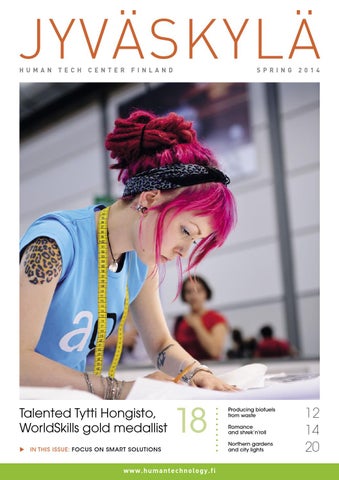
Talented Tytti Hongisto, WorldSkills gold medallist u
S P R I N G
18
IN THIS ISSUE: FOCUS ON SMART SOLUTIONS
Producing biofuels from waste Romance and shrek’n’roll Northern gardens and city lights
2 0 1 4
12 14 20 1
www.humantechnology.fi
SPRING 2014 Published twice yearly, Human Tech Center Finland magazine showcases the expertise, culture and people to be found in the Jyväskylä Region.
This publication is brought to you by
Contents
The City of Jyväskylä, with a population of 135 000, is one of Finland’s centres of growth. Recognised as a city of high-quality education, Jyväskylä is also internation ally known for the architecture of Alvar Aalto. www.jyvaskyla.fi Jyväskylä Regional Development Company Jykes Ltd. is a business promotion and development company
4
owned by the four municipalities in the Jyväskylä Region. The aim of Jykes is to create a favourable business environment. By offering expertise, support and various networks for companies, Jykes creates opportunities and conditions for profitable business operations.
4 4 6 7
www.jykes.fi The University of Jyväskylä is one of the largest, most attractive and dynamic research universities in Finland, with about 15 000 students, including international students from some 90 countries. www.jyu.fi JAMK University of Applied Sciences is a multidisciplinary institution of higher education with a strong international orientation and a student enrolment of 8 000. Our strengths are workplace-driven learning, close cooperation with the labour market and business, as well as extensive international contacts. www.jamk.fi Jyväskylä Educational Consortium provides vocational and general upper secondary education to young people and adults. The consortium’s educational institutions are attended by over 22 000 students. www.jao.fi
8 10 11 12 13 14 18 20 22
Editorial board Satu Heikkinen (City of Jyväskylä), Miikka Kimari
City of Jyväskylä,
(University of Jyväskylä), Taija Lappeteläinen
P.O.Box 193, 40101 Jyväskylä,
(Jyväskylä Regional Development Company Jykes Ltd.),
helina.maenpaa@jkl.fi, www.jkl.fi
Niina Luttinen (Jyväskylä Educational Consortium),
Editor-in-chief
Heli Toivola (JAMK University of Applied Sciences)
Repelling cyber threats at new trade fair
Superhero tempts new heroes to Jyväskylä Smart Kangas Ideas quickly put to the test Producing biofuels from waste Impetus for growth from Kasvu Open Romance and shrek’n’roll World championship sewing skills Northern gardens and city lights
Entrepreneurship studies from service park to chequered flag
Editorial Office in this issue
Master’s in cyber security boosts career prospects
Companies have to withstand even the worst of threats
24
ISSN 2342-1002 (Online)
Information is the crude oil of the future
One picture > a thousand words of marketing copy
Helinä Mäenpää City of Jyväskylä
English translation
Editorial staff and layout
Peter Gregory
Viestintä-Paprico Oy, www.paprico.fi
and Tony Melville
Printed by Kirjapaino Kari Ky Circulation 7 600 Cover photo by WorldSkills. Tytti Hongisto, Finland’s first WorldSkills gold medallist in the Fashion Technology category.
2
22 HUMAN TECH CENTER FINLAND
FIRST WORDS JANUARY 2014
Change also presents an opportunity WESTERN SOCIETY IS GOING THROUGH a far-reaching change which is forcing us to examine the basic structures of business and industry from a completely new perspective. The role of those branches of industry which flourished for over a hundred years, such as the metal, forest and paper industries, is declining as a source of livelihood. During a time of change the pressure to react quickly is acute. The old saying, the early bird catches the worm, applies equally well to urban regions. We must look to the future and formulate a clear vision of what sort of expertise will be needed in the years to come and which factors will serve to boost the appeal of such regions. According to forecasts in future years the Jyväskylä Region will continue to be one of Finland’s centres of growth. We have boldly embarked on a variety of investment projects, the impacts of which will extend decades ahead. We regard change as an opportunity. Construction of the Kangas area of the city is a major undertaking which will have a positive influence both on the urban landscape and on Jyväskylä’s image and appeal as a city. The Kangas area, which is set to become home to roughly 5 000 people and provide over 2 000 jobs, is situated just a stone’s throw from the city centre. The transformation of the Kangas area is an urban development project stretching over several decades, the aim of which is to create city dwelling based on an ecologically sustainable lifestyle. The energy and ICT solutions to be implemented in the area will permit research and development projects involving an entire city suburb. In this ambitious undertaking the city is working in close partnership with Sitra, the Finnish Innovation Fund. The second major project with impacts extending long into the future is the new central hospital, where a whole raft of leading-edge technological solutions will be employed. EXAMPLES OF NEW CONSTRUCTION will already be prominently on display at next summer’s Housing Fair in Jyväskylä. This national event will attract an estimated 150 000 visitors to the city. Located in a beautiful, quintessentially Finnish lakeside setting just a 10 minute drive from the centre of the city,
the Äijälänranta Housing Fair area will showcase the latest trends in housing and home decoration. Jyväskylä’s compact structure permits solutions for living in which nature, human-centred technology and an urban milieu combine harmoniously, offering opportunities for different kinds of experiments linked to green and energy efficiency.
PHOTO: PETTERI KIVIMÄKI
EVEN JUST A FEW YEARS AGO the expression ”cyber security” did not arouse a huge response. Now cyber threats are part of everyday life. Attacks on data systems belonging to various countries and banks have demonstrated how vulnerable a society that relies on data networks can be without adequate cyber security expertise. Jyväskylä has responsibility for national-level coordination of the cyber security expertise component of the Innovative Cities 2013–2020 programme. There is strong belief that perhaps even thousands of new jobs will be created in this branch over the next few years. The education and research knowhow found at JAMK University of Applied Sciences and the University of Jyväskylä forms a powerful cyber security infrastructure to serve both private companies and public sector organisations. The Jyväskylä Region has everything it takes to develop into a centre of excellence, both nationally and internationally, in cyber security expertise. n Markku Andersson Mayor City of Jyväskylä
3
FOCUS ON SMART SOLUTIONS, 4–11
4
HUMAN TECH CENTER FINLAND
IS THE CRUDE OIL OF THE FUTURE The Jyväskylä Region is now among Finland’s frontrunners where education and development work linked to the blocking of cyber threats is concerned. Jyväskylä can offer both education and research that have attracted international interest as well as exceptional development environments. In order to succeed companies must take increasingly strict care of their most valuable asset, information. Words by Tommi Salo Photos by Petteri Kivimäki and Shutterstock
JUST AS THE DIGITAL SOCIETY has increased prosperity, on the flipside of this development lurks the risk of different threats in the cyber operating environment. In addition cyber threats present an opportunity for those people willing to work hard to combat them. Jyväskylä is rapidly making a name for itself in Finland as a pioneer in this work. In 2013 the Jyväskylä Region was designated in Finland as the national cyber security coordinator for the Innovative Cities (INKA) programme covering the years 2014–2020. The Jyväskylä Region has acquired development environments that permit research, product development and testing.
For companies these form a common ecosystem in which firms can develop business based on cyber security. “For companies a loss of reputation due to a data system break-in, for example, is nowadays a big threat. Information is the crude oil of tomorrow in terms of value,” emphasises Jarmo Siltanen, Head of Department, ICT, JAMK University of Applied Sciences.
Jobs on the increase In Jyväskylä information security research and education have furthered scientific breakthroughs, the birth of innovations and technological progress. In Central Finland thousands of people u u
MASTER’S IN CYBER SECURITY BOOSTS CAREER PROSPECTS At the beginning of 2013 Juha Saarisilta, who works for the Finnish Defence Forces in an information security capacity, began his studies towards a Master’s degree in cyber security at JAMK University of Applied Sciences. It is his intention to graduate from Finland’s only Master’s programme in cyber security offered by a university of applied sciences in the course of 2014.
Why did you opt for an English-medium Master’s programme in cyber security at JAMK University of Applied Sciences? ”The degree will undoubtedly help me to progress in my career. A Master’s degree is a common requirement for many government jobs.”
How in particular will the programme equip you to take on future tasks? ”The programme offers new perspectives on cyber security and provides an opportunity to familiarize oneself with different teaching methods which could possibly be used for internal training. What’s more, the programme presents a great chance to extend one’s personal network.” What has been the most interesting aspect of your studies? ”The biggest benefit lies in discussions covering a whole variety of topics and group work sessions involving experts from different companies. In addition it’s been interesting to see what kind of teaching methods related to cyber security are used on the courses. It will also be fascinating to see how the final field exercise will be arranged in practice.” n
5
FOCUS ON SMART SOLUTIONS, 4–13
u
are already employed in a branch with a connection to security. “The employment prospects in the field of security are constantly improving. By the year 2018 it is estimated that approximately 500 new jobs in this field will have been created in Central Finland and that the value of the business will have grown by roughly 60 million euro,” Siltanen continues. Development work has been boosted by the JYVSECTEC project, coordinated by JAMK University of Applied Sciences and financed by the European Regional Development Fund, which has provided Central Finland with a research, education and development centre in cyber security. “The prospects are such that the number of students currently admitted to the programme will not be sufficient to satisfy future labour needs. Education for its own part is rapidly becoming an export product in high demand internationally”, Siltanen underlines. n
REPELLING CYBER THREATS AT NEW TRADE FAIR In September 2014 Jyväskylä Paviljonki International Congress and Trade Fair Centre will host Finland’s first fair on the theme of cyber security. The cyber security branch fair will showcase solutions to information and cyber security challenges facing companies and other organisations. The focus will be in particular on data security and cyber threats in industry and at other establishments responsible for maintaining infrastructure. ”The idea of the fair is to boost awareness of the risks currently being faced and to provide guidance on how to anticipate and eliminate them”, says Managing Director Leo Potkonen, Jyväskylä Fair Ltd. According to Potkonen there is now a clear need for such a fair, since security matters are a hot topic almost everywhere. KyberTurvallisuus (Cyber Security) will be staged simultaneously at Jyväskylä Paviljonki alongside the traditional Tekniikka (Technology) and Turvallisuus (Safety, Security and Rescue) events. n
TOP-FLIGHT EDUCATION AND RESEARCH ON OFFER IN JYVÄSKYLÄ • In January 2013 JAMK University of Applied Sciences launched a Master’s degree programme, the core element of which is cyber security. The two-year programme develops the capability to test cyber security as well as to anticipate and combat cyber threats. The next programme will begin in the autumn of 2014. The degree programme has also sparked international interest. • An RGCE (Realistic Global Cyber Environment), isolated from public networks and intended for educational, research, simulation and testing purposes, has been built at JAMK University of Applied Sciences’ Dynamo facility. Services produced by the RGCE are offered to companies and other parties for training purposes and testing their own information systems.
6
• The University of Jyväskylä’s Master’s programme in Information Security offered by the Faculty of Information Technology has two lines of study. The cyber world is examined from a societal, functional and technological perspective. • The CAP (Cyber Attacks Protection of Critical Infrastructures) research project begun at the University of Jyväskylä in autumn 2012 is developing an innovative method of protecting information systems. In the course of the project various technologies will be examined by means of which different forms of malware can be automatically detected, identified and classified. The aim of the Truly Protect project, on the other hand, is commercialization of a protection system for new innovative media.
HUMAN TECH CENTER FINLAND
COMPANIES HAVE TO WITHSTAND EVEN THE WORST OF THREATS Experts versed in cyber threats pose the essential question for any business: what is the worst thing that could happen to the company? THE REASONS FOR the increase in cyber threats and cyber crime are relatively simple. Since productivity and money have shifted to the online world, that’s where crime is also to be found. “For companies the most important business asset is information. What are the consequences, for instance, if a company’s customer and invoicing data are stolen,” asks Pasi Korhonen, Director, Security Services, Elisa Oyj, a major Finnish telecoms company. “Reliability is nowadays essential in all forms of business. Companies have a fear of losing their reputation. Risks are not thought through with sufficient care in all firms, and a clear picture of the whole, from devices to network interfaces, is often lacking,” adds Juha Peltomäki, Regional Manager of Central Finland, Elisa Oyj. Elisa is a telecommunications and ICT service company. Elisa has itself been involved in different cyber security exercises. It has also engaged in cooperation with JAMK University of Applied Sciences where testing of its own concepts and services in a genuine environment is concerned.
In addition Elisa has conducted method development work with the University of Jyväskylä. “Companies need information in order to make risk assessments, for example. Company personnel need to be trained in cyber security,” Peltomäki emphasises.
No sign of white flag Elisa’s specialists point out that each company decides for itself how much it is ready to invest in risk management. “This is not simply a matter for the IT department, the impetus has to come from senior management,” Peltomäki continues. Although cyber threats are commonly associated with global activities conducted by professional organisations, Korhonen is not prepared to wave the white flag. “Management of equipment, data protection and assessment of the worst case scenario constitute a good basis for developing one’s own activities and anticipating risk factors,” outlines Korhonen. n
7
FOCUS ON SMART SOLUTIONS, 4–13
Superhero tempts new Developed in Jyväskylä, the Mighty Jyväskylä game underlines two things. First of all, that an urban region can market itself successfully using the less rigid methods of the gaming world. Second, it is also a concrete demonstration that Jyväskylä wants to be involved in the games industry and generate new games-related companies and jobs in Central Finland. Words by Tommi Salo Photos by Petteri Kivimäki and Mighty Jyväskylä Illustration by Martti Hänninen TIMO KOMPASSI IS the Jyväskylä Region’s new superhero. His adventures and stories have already proved irresistible to several thousand people. Timo Kompassi is the swashbuckling character in the Mighty Jyväskylä game now used to market the Jyväskylä Region. The game was published in October 2013 and immediately during the first few weeks sparked great interest amongst online players. What is more, it was downloaded frequently as a mobile game. “We were looking for a non-stan dard way to market the Jyväskylä Region. By means of the game and the website related to it the intention is
TIMO KOMPASSI IS THE JYVÄSKYLÄ REGION’S NEW SUPERHERO.
“Mighty Jyväskylä was a major challenge for those who produced it, since usually no game sees the light of day in just three months,” explains the chair of Expa’s board Jonne Harja.
8
HUMAN TECH CENTER FINLAND
heroes to Jyväskylä to boost Jyväskylä’s image as a youthful city which has its finger on the pulse. The website combines entertaining content with matters that are important and of topical interest,” says Taija Lappeteläi nen, Marketing Manager at Jyväskylä Regional Development Company Jykes Ltd. In addition to the actual game the Mighty Jyväskylä website showcases among other things vacant jobs in the ICT branch and games-related educational programmes in the Jyväskylä Region. It also aims at making the games and ICT industries better known. “Using a game set in Jyväskylä it’s possible to attract students interested in the games and ICT branches to Jyväskylä and provide local companies with new talent. The objective is also to put successful games companies in motion,” Lappeteläinen continues. The Mighty Jyväskylä campaign was implemented jointly by Jykes, the City of Jyväskylä, educational institutions in the Jyväskylä Region as well as numerous private firms. When the time for playing Mighty Jyväskylä came to an end in December par-
ticipating players were entered into a draw to decide the winner of the 5 000 euro first prize.
Games experts not left alone Responsibility for practical implementation of Mighty Jyväskylä was taken by Peliosuuskunta Expa (Game Business Cooperative Expa). Expa is a novel kind of open community in Central Finland for all those interested in the games branch – makers of games, researchers, students and even teachers. “The game was a major challenge for those who produced it, since usually no game sees the light of day in just three months. The stipulation was that the setting for the game should be Jyväskylä, but otherwise we were given a pretty free hand to come up with a good game,” explains the chair of Expa’s board, Jonne Harja. Harja, who acted as project manager for the game, points out that in addition to marketing efforts at national level the Mighty Jyväskylä project was an important message to the games industry globally that serious development work
in the branch is being conducted in Jyväskylä. Expa develops and published games. Its purpose is to serve in particular as a network for individual games developers and companies in the branch. Expa also arranges courses and other forms of training according to demand. Expa is a local hub of the International Game Developers Association (IGDA), which offers game developers not only a local community but an extensive national and international support network. Expa Game Lab is an experimental game development club which commenced a number of game projects during the autumn of 2013. At the weekly meetings experiences are exchanged and solutions to problems found in a joint manner. “During the early part of 2014 we’re planning to work part-time on polishing a proof-of-concept or demo which we then intend to show to financial backers and publishers. Our sights are set on four new funded games businesses via the Lab or at least funded projects withinthe cooperative,” Harja reveals. n
www.mightyjyvaskyla.fi 9
FOCUS ON SMART SOLUTIONS, 4–13
Smart Kangas Over the next few decades Kangas will be Jyväskylä’s most important development project. Formerly the site of a paper mill, the area will be transformed into a cluster of new homes, jobs and services that will make use of the latest technology and solutions based on sustainable development. Words by Timo Sillanpää Photos by City of Jyväskylä
DEDICATED FOR OVER 100 years to the paper industry, the Kangas area situated within a stone’s throw of Jyväskylä city centre is being shaped into a suburb where smart megatrends in urban design and local innovation will enjoy pride of place. “The aim is to build to a measuring capacity into Kangas. With the help of the latest technology we have the opportunity to gather data about what’s happening in a complete area of the city to serve as a basis for developing services and new innovations,” reveals Anne Sandelin, Director of Urban Planning Projects, City of Jyväskylä.
Tracing causes and effects Not only the City of Jyväskylä and the University of Jyväskylä but also numerous companies are involved in the planning of Smart Kangas. Pasi Tyrväinen, Professor in Digital Media at the University of Jyväskylä, explains that the fibre optic network to be installed in Kangas already at the municipal engineering stage will provide the foundation for data collection. Mobile technology as well as sensors fitted to streets and buildings will allow a large volume of data on everyday existence in the suburb to be collected. Open Data Living Lab is the name given to this method. “For instance we can study what kind of weather and humidity conditions increase the risk of falling over, which factors increase energy consumption in homes or how housing for senior citizens can be improved,” Tyrväinen lists.
10
According to Tyrväinen the most important thing is to discover different cause and effect relationships in the urban surroundings which can benefit those entrusted with developing services and the urban structure. With the help of the data collected we can study, for example, what kind of services can be produced in an economically sustainable manner, what kind of new services townspeople need, how quality of life and energy efficiency can be improved and what kind of smart solutions can be dreamed up for waste management, say. Also involved in the planning of Smart Kangas is the Jyväskylä-based company Firstbeat Technologies. The method developed by this firm generates personal data on the effectiveness of physical recreation, stress management and the restorative effects of rest, for instance. “Thanks to Firstbeat’s solutions Kangas can be used to study the impact of different environmental factors on people’s well-being, to quote just one example. Awareness of the factors affecting one’s level of stress can assist with making the correct choices from a well-being point of view,” Tyrväinen underlines.
Cyber-secure suburb Jyväskylä’s strong cyber security expertise will also be made use of in the Kangas area. A large quantity of data will be collected for research purposes and the idea is to protect it in the best possible way. “We have every chance of turning Kangas into the world’s most cyber-secure suburb,” says Director of Urban Projects Anne Sandelin. n
Jyväskylä’s Kangas area
Planned for the Kangas area
• Covers about 30 hectares and lies close to the very centre of the city • The winner of the architecture competition for the Kangas area “Hjalmar’s Dream” was chosen in 2012 • Construction of the Kangas area will begin in 2014–2015 • The first residents will arrive in 2016 • Forecast for 2025: 3 000 residents, 2 100 jobs
• Development of culture and communality • A strong role for light traffic, an environment that supports an ecological lifestyle • Resource-wise solutions for parking and waste management • Use of smart solutions and measuring data • Utilization of solar energy
HUMAN TECH CENTER FINLAND
The old paper mill buildings form the heart of the area. Roughly 30 000 floor square metres of existing buildings will remain in the area. Around the old paper mill milieu a new heart – a concentration of homes, services and jobs – will arise, one that captures the identity of the Kangas area.
Outside the heart there will be a green zone, ”Kangas’s lungs”.
The outermost ring is reserved for residential buildings.
RESOURCE WISDOM BRINGS A CULTURE OF EXPERIMENTATION
IDEAS QUICKLY PUT TO THE TEST Surplus school food to be put on sale. Solutions for cutting hot water consumption. Services to meet the everyday needs of people living in remote areas. These and other solutions were tried out in the Jyväskylä Region in autumn 2013 on the basis of ideas put forward by ordinary citizens. The trials form part of the Towards Resource Wisdom project which the Finnish Innovation Fund Sitra launched in spring 2013 in partnership with the City of Jyväskylä. The objective of resource wisdom is to create solutions which provide a response to the challenges posed by dwindling natural resources, population growth and climate change. The goal of these experiments is to establish replicable models to serve as the basis of an ecologically resource-wise life style in urban settings.
“At a brainstorming event open to all we received over 200 suggestions, of which fifteen or so were tested straight away in the autumn of 2013. The threshold for starting these trials was low, which really helped people to get thinking. Ideas which did not receive funding at the experimental stage were gone over again at an ideas jam session organised in the late autumn,” explains Timo Rusanen, the City of Jyväskylä’s Development Director.
Culture of experimentation called for Many good ideas fail to make it because citizens are afraid that their innovations will get caught up in a jungle of bureaucracy and red tape. “What we need now in the public sector is a culture of experimentation, by means of which we can quickly discover which ideas work and
which don’t,” Rusanen ventures. Companies in the Jyväskylä Region have been issued with the challenge of creating industrial symbioses, in which businesses make use of each other’s spare capacity, waste products or raw material derivatives. For instance, the production of biofuels from different forms of waste could be one way of replacing fossil fuels. In the course of 2014 the most promising experiments will be refined into 3–5 projects with the aim of turning these into permanent operational models and new business activity. “An experiment in practice can serve to reinforce civic activity, reshape the city’s ways of working and highlight the opportunities for new business – in the best case all at the same time,” Rusanen claims . n
11
FOCUS ON SMART SOLUTIONS, 4–13
BioGTS launches new waste recovery technology
PRODUCING BIOFUELS from waste
Founder and CEO of BioGTS, Mika Rautiainen and Director, Business Development, Annimari Lehtomäki check a sample of biodiesel produced with the new technology. Mr Rautiainen has been involved in developing biorefinery technology since 2009.
12
HUMAN TECH CENTER FINLAND
Jyväskylä-based BioGTS has developed a new technology for cost-effective production of biodiesel and biogas from organic waste. The potential raw materials for the process include biodegradable wastes from municipalities, industry and agriculture. Words by Timo Sillanpää Photos by Petteri Kivimäki LARGE AMOUNTS OF WASTE oil and grease that are currently sent to landfill could be converted into biofuel using technology developed by BioGTS. Several countries will prohibit landfill disposal of organic waste in the near future, which will increase demand for biorefineries based on new technologies. “The wastes needed as raw material for the process are avail able, and there’s plenty of demand for the refined product,” says Annimari Lehtomäki, Director, Business Development at Bio GTS Ltd. The company’s own biorefinery is scheduled for completion in spring 2014. It will serve as a test and demonstration unit for the technology, converting one million kilogrammes of waste oils and greases into biodiesel and biogas each year. The raw materials will be cooking oils from restaurants, industrial greasesand fat-containing wastes recovered from sludge wells. “One million kilogrammes of waste oils and greases yield around 850 000 litres of biodiesel, the equivalent of the annual fuel consumption of about 700–800 cars,” Lehtomäki explains.
Main product: technology know-how The main business idea of BioGTS is not to become a biodiesel producer. Instead the company aims to build and develop bio refinery technology that can be easily replicated and scaled to meet local needs. “The new biodiesel production method even makes it possible to use fats, oils and greases that are mixed with water. The refining process consumes no clean water at all, mak-
ing it suitable for use in regions where water is scarce.” BioGTS supplies its biorefineries on a turnkey basis and engineering know-how from Central Finland plays an important part in the production of the components. The reactors are built from modules which are shipped to the receiving countries in containers. Installation and start-up takes only a couple of months. Biodiesel can be used in regular diesel engines, but it can also be mixed with fossil diesel. It has zero greenhouse gas emissions and up to 90 per cent lower particle emissions than fossil transport fuel.
Worldwide interest BioGTS announced its technology in summer 2013. In the latter part of the year the company submitted quotations to supply biorefineries to different countries around the world, including Brazil and Asian countries. The company is also developing new biogas production technology. Traditionally, biogas production has involved the use of agricultural sludges with a high water content, making for an inefficient process. The BioGTS process is particularly suited for handling drier waste fractions. The new technique also offers a better energy balance than traditional methods. “The water content of household biowaste, for instance, is around 70 per cent. Composting yields no energy at all, but our technology can convert it into renewable energy in a cost-efficient manner.” n
IMPETUS FOR GROWTH FROM KASVU OPEN BioGTS received an honorary mention in the 2013 Kasvu Open competition for growth companies. Developed in Jyväskylä, Kasvu Open is a growth enterprise competition and sparring process intended to generate new company startups and accelerate growth in existing businesses. Companies invited to take part receive sparring, free of charge, from experienced growth enterprise experts as well as the opportunity to make contact with investors and board-level partners. “For us, Kasvu Open happened at just the right time – our technology was ready for
launching in the marketplace. We received valuable expert advice on sales, marketing, international expansion and ways to further develop the business,” says Annimari Lehtomäki. BioGTS also took part in the Kasvu Open St Petersburg Runway-to-Growth event in October 2013, where companies from Central Finland had the chance to meet Russian investors and market experts.
Creating new success stories In the 2013 Kasvu Open competition, winner of the Start Again category was VRT Finland Oy. Winner of the Start Up category was Music.info Finland Oy. “New success stories are created when entrepreneurs boldly challenge themselves and receive sparring from experienced business leaders. New financing, distribution and networking opportunities also give businesses the incentive
to grow,” says Matti Härkönen, Coordinator of the Kasvu Open method. Kasvu Open was created some four years ago, inspired by the ideas of Marko Seppä, Professor of Growth Venture Creation. The growth venture mission was selected for further development by the Growth Enterprise Board of the Central Finland Chamber of Commerce. “In 2014 the fourth Kasvu Open competition will take a major step forward. We will have a big increase in the number of competition finalists, with one hundred finalists from around Finland.” “We want to challenge businesses from across Finland to go for growth. We will be organising sparring events in different parts of the country. The year will culminate with a major Kasvu Open event at Jyväskylä Paviljonki,” Härkönen says. n www.biogts.com www.kasvuopen.fi
13
Finnish premiere for Shrek the Musical at Jyväskylä City Theatre
ROMANCE AND SHREK’N’ROLL
Shrek the green ogre has his own kind of courage. The team who adapted Shrek the Musical for Finland also needed plenty of courage. They translated the successful Broadway show into Finnish and brought it to Jyväskylä City Theatre. Words by Tommi Salo Photos by Jyväskylä City Theatre and Petteri Kivimäki
14
HUMAN TECH CENTER FINLAND
Shrek the Musical is a story of friendship and love. In the morning Fiona (Maria Lund) dances with the rats, happy that she’s turned back into a beautiful princess.
uu 15
uu
SHREK IS NOT JUST a green ogre created for children. And he’s not just an anti-hero who tells adult-oriented jokes. He’s both, and more besides. Since autumn 2013 Shrek has been starring on stage at Jyväskylä City Theatre. The world-acclaimed musical comedy had its Finnish premiere in Jyväskylä on September 7th. “I was actively looking for new musicals for the stage. I saw Shrek in London a few years ago and I got the idea of bringing it to Finland,” says Kari Arffman, who not only directs the musical but also translated it into Finnish. Arffman, who is Manager of Jyväskylä City Theatre, admits that the new musical was a risk. “I was afraid people would see Shrek as a children’s musical. There’s always a tremendous lot of work goes into a musical, but with Shrek we additionally had to do the translation first.” Great feedback and big audiences have shown there was no need to fear that Shrek would be seen as a show for children only.
Creating the illusion on stage Shrek the animated movie wowed cinema audiences in the early 2000s. Then it was adapted into a successful Broadway musical. But bringing the show to theatre audiences in Jyväskylä still involved a lot of challenges. “The question was: how do we create the illusion on stage? The musical had to pay homageto the movie in its colour themes and characters. The aesthetics come from the film,” Arffman explains. From the director’s point of view the biggest challenge in the musical is coordinating all the different elements. A lot of work has to be done behind the scenes with very precise timing. “Everything has to work off-stage, from changing costumes to raising stages. We timed all the technical details. When you put on a big musical it’s essential that there’s open communication between everyone involved,” Arffman states.
Songs with feeling Shrek is a romantic musical comedy that speaks out in favour of friendship, acceptance of differences and true love. The story appeals to children but also contains adult-oriented humour. Shrek the green ogre sets off with his companion, Donkey to rescue Princess Fiona, who has been languishing in a tower for twenty years. “Fiona is basically a nice, well behaved princess, but every now and then she’s really rude and bad mannered,” says Maria Lund, the actress and singer who plays Fiona. “It was a really great honour to be involved in the Finnish premiere of Shrek. And especially as it’s being put on in Jyväskylä rather than Helsinki, for example,” Lund adds. She says that being part of the musical is just as entertaining for her as it is for the audience. A versatile performer, Shrek enables her to combine singing, acting and dance. “Singing lets you show feelings just as acting does,” Lund states. She admits that she is always moved when Shrek interrupts Fiona’s wedding and proclaims his love for her. “The most fun part of the musical is the rat dance – dancing together with the rats. Even though you’re out of breath you still have to be able to sing and dance.”
Risk takers needed Successful musicals from My Fair Lady to West Side Story and from Fame to The Phantom of the Opera are well-known the world over. And new musicals are being composed all the time, especially in the USA and Britain. Kari Arffman believes the main difficulty in bringing them to the Finnish stage is that the story is often built around a very local phenomenon. “Who will take the risk and produce a new Finnish musical? Actors in Finland have really developed in terms of the skills that are needed to put on musicals,” Arffman says. Until the next new musical comes along, theatre audiences in Jyväskylä can enjoy the green-themed tale of bold friendship and true love, accompanied by beautiful ballads and the rhythms of shrek’n’roll. n 16
HUMAN TECH CENTER FINLAND
FINDING THE RIGHT WORDS IN FINNISH Directing a musical is a big job in itself. But how much bigger is it when you have to translate a famous Broadway musical into Finnish before you can even start to tackle any other tasks? “It is a big job. For example, it’s quite a challenge to match the syllables in Finnish. There are also a lot of American expressions which I had to find good Finnish translations for,” says Kari Arffman, who both translated and directed Shrek the Musical. Arffman points out that in a musical the songs have to be integrated into the plot. The lyrics and dialogue are not separate elements. The audience have to feel that characters in the musical are singing to them. “The lyrics have to be understandable and easy to sing. I sat at a piano and sang all the songs as I worked on them.”
Approved by America Shrek is originally a computer-animated film created by DreamWorks in America. It was only natural that DreamWorks was interested in the Finnish translation of the musical. The translation, as well as Shrek’s masks and the set design had to be approved in the USA. “Getting the translation approved by a major studio gave my own professional confidence a boost. The most important thing for them was that the Finnish dialogue sounded right for the characters. I didn’t have to go and meet any lawyers,” Arffman says with a smile. n Performances of Shrek at Jyväskylä City Theatre will continue until 17.5.2014.
PHOTO TOP Fiona, played by Maria Lund (left), has a contest with Otto Kanerva’s Shrek to decide whose childhood was more difficult. PHOTO BOTTOM Singer and actress Maria Lund says it was a great honour to be involved in the Finnish premiere of Shrek in Jyväskylä.
17
WORLD CHAMPIONSHIP SEWING SKILLS “I get excited about recycled materials and clothes that have a special twist to them,” says Tytti Hongisto, Finland’s first WorldSkills gold medallist in the Fashion Technology category. A focused and determined young woman, Tytti has made great progress in her career and is now designing her own fashion collection. Words by Pia Tervoja Photos by WorldSkills and Petteri Kivimäki NOT MANY YOUNG professionals can call themselves the best in the world, but Tytti Hongisto (22) has a gold medal to prove it. Last summer Tytti competed in WorldSkills Leipzig 2013 in Germany and returned home with Finland’s first ever gold medal in the Fashion Technology category. The key to Tytti’s success was a combination of focus and concentration, fast sewing skills and broad practical experience. Tytti is also quick to mention the skills she has learned in her formal training. She graduated in dressmaking and tailoring from Jyväskylä College and qualified as a dressmaking apprentice at the Jyväskylä Institute of Adult Education. “Training in Finland is very broad-based, and that’s its strength. We study everything from design and patterning to producing the garments. In other countries they tend to focus on just one area.” Ahead of WorldSkills Leipzig, Tytti spent six months in intensive training with coaches to help her improve her skills, and she attended a training camp for the Finnish national team. At the same time she worked at Jyväskylä City Theatre during the day and continued with her design work and training at home in the evenings.
Getting it right the first time
“I PUT IN MY EARPLUGS AND JUST CONCENTRATED ON THE JOB I WAS DOING. TO BE HONEST I DIDN’T REALLY EVEN NOTICE THE AUDIENCE.”
18
At Jyväskylä City Theatre, Tytti joined a fascinating production – the Finnish premiere of the popular Broadway musical Shrek. The theatre’s wardrobe team had to produce more than one hundred costumes for the show. “The stage costumes were completely different from the WorldSkills competition entries, of course, but this job helped me get into the rhythm and routine of sewing and it gave me new ideas for my design.” In particular, Tytti says this interesting and challenging job taught her a lot about working with special materials. “There were also some special structures built into the costumes, and many of them consisted of several parts. And then there’s the added challenge of ensuring that
the performers can change their costumes very quickly.” At WorldSkills Leipzig the contestants had to create a three-piece Military Chic themed costume for women, including trousers, a blazer or coat, and a blouse or top. “If there’s no time limit you can go all out and make something really nice, but in a competition the biggest challenge is to complete the assignment within the time allowed. There’s no time for mistakes or to undo your sewing. You have to get it right the first time.” The WorldSkills competition attracted some 200 000 visitors, but Tytti says she felt no extra pressure from the spectators. “I put in my earplugs and just concentrated on the job I was doing. To be honest I didn’t really even notice the audience.”
Working on her own collection Tytti says that for her, the competition was most of all about challenging herself and making a good job. Winning came as a pleasant surprise, because the contes tants were not told their intermediate scores. Tytti Hongisto currently lives in Denmark. She moved to Copenhagen more or less by chance but enjoys living in this design city with its numerous fashion and clothing businesses. “I had no work when I moved to Copenhagen, but I soon got a job at a local dressmaking business. Right now I’m working with men’s suits.” In her free time Tytti works on her own collection. This talented young woman dreams of starting her own company, and she is now working towards that goal. Tytti does not yet want to reveal where she is heading with her first collection, but says she feels comfortable working with recycled materials. “I get excited about materials and clothes that have a special twist to them. It doesn’t really matter what garment I’m working on. Every item can be interesting.” n www.worldskills.org
HUMAN TECH CENTER FINLAND
WorldSkills Leipzig 2013 drew more than 1 000 contestants from 52 countries to show off their skills in 46 categories. Team Finland returned home with six medals. Jyväskylä College graduate Tytti Hongisto was Finland’s only gold medallist and the country’s first ever world champion in the Fashion Technology category.
19
HOUSING FAIR IN JYVÄSKYLÄ 2014
NORTHERN GARDENS AND CITY LIGHTS Alvar Aalto’s architectural idiom, experimental initiatives in energy technology and landscaping efficiency, new ideas for housing and living. Jyväskylä’s Housing Fair will attract around 150 000 visitors next summer. The essence of the event is captured in the Fair’s slogan, Northern gardens and city lights. Words by Timo Sillanpää Photo by Petteri Kivimäki
ILLUSTRATION: CITY OF JYVÄSKYLÄ
JYVÄSKYLÄ WAS THE home town of world-renowned architect Alvar Aalto (1898–1976). Aalto’s legacy will occupy a prominent place at the Finnish Housing Fair, which will be held in Jyväskylä in 2014. One of the themes of the Fair, Innovative Architecture alludes to Alvar Aalto’s life’s work. Aalto is known as a functionalist who strove for simple, geometric and beautiful but practical buildings. “Functionalist influences can be seen in the way many of the single-family homes on the Fair site are designed. Several of the houses have their own atrium, which was typical of Aalto’s work. The internal finishing materials he favoured are also popular with the builders here,” says project manager Anu Hakala. One of Aalto’s characteristics was detailed design which extended right down to the finishings. Hakala says that some of the Housing Fair projects also feature the same level of design detail.
Garden and Wood Located some 5 km from the centre of Jyväskylä, Äijälänranta will eventually look like this.
20
The Housing Fair site at Äijälänranta shows how a compact city like Jyväskylä makes it possible to build single-family homes HUMAN TECH CENTER FINLAND
THE HOUSING FAIR AS AN EVENT • The principal function of the Housing Fair Finland Cooperative is to improve the quality of housing and living conditions in Finland • Organised as a joint project between the Housing Fair Finland Cooperative, the host municipality, developers and clients, and construction companies.
HOUSING FAIR IN JYVÄSKYLÄ 11.7.–10.8.2014 • At the heart of the Housing Fair are 37 low-rise homes and a 13-storey tower block. • In future Äijälänranta will be home to 800–1000 residents. • Accessibility will be highlighted as a housing quality factor. • The environmental planning process was mainly inspired by the site’s natural surroundings and the visible legacy left by the earlier nursery gardening activities. • The Fair’s central themes, ‘Garden and Wood’ and ‘Innovative Architecture’, are also reflected in the site’s public art. The main piece, Puutarhurin taivas (“Gardener’s Heaven”), was designed by sculptor Pekka Jylhä. The area’s history can be seen in the design of the park benches and lighting bollards, and in the graphic art. These features have been planned by graphic artists Tuomas Hallivuo and Jyrki Markkanen, and by designer Jonas Hakaniemi. • Planning of the local play park involved children from the nearby Väinölä day-care centre. • The Housing Fair’s low-rise block no. 222 has been designated a Green Factor block. • The site features low-energy led lighting and a detailed lighting plan.
t Construction of the HauHaus single-family home was completed in November 2013. The house was finished with materials specially selected to cope with the family’s energetic pets – Spanish Water Dogs Turca and Carlos. The fenced backyard was also designed with the dogs in mind. Turca and Carlos will be sharing the house with Liisa Kuparinen and her partner.
CITY OF JYVÄSKYLÄ
that are close to nature and yet are only five kilometres from the heart of the city. The other central theme of the Fair is Garden and Wood, which not only refers to the area’s history but also conveys what the homes at the Fair are about. The site was first used for agriculture around the 16th century and in the first half of the 20th century it was home to a number of nursMaailmanpylväs (“Axis mundi”). ery gardens. One of the blocks at the Fair site will feature Finland’s first pilot implementation of the Green Factor scoring tool for landscapes. “One housing block will be constructed so that the Green Factor score of the individual plots exceeds a predetermined target. The objective of the Green Factor concept is to ensure there is more vegetation on plots, because planted areas improve the
diversity of the urban environment, filter out airborne pollution and improve the quality of runoff water,” project manager Hakala says.
From low-rise homes to apartment blocks The diversity of the Fair site offers housing for different stages of people’s lives. The homes range in size from 76 to more than 300 square metres. The site also has its own landmark – Maailmanpylväs (“Axis mundi”), a 13-storey, 44-metre high tower block. Each of the tower block’s apartments will have its own cooling system and under-floor heating. The balconies will feature sliding glass doors that integrate the balconies more closely into the apartments than can be achieved with traditional solutions. Contrasting the tower block are the site’s smallest singlefamilyhomes, two 76 square metre cubic “dice” homes. These minihouses are prototypes for small homes that are expected to be in demand in future. n www.asuntomessut.fi/en/
21
The courses at Entrepreneurship School Turning Point follow a rally theme. All the young people entering the school spend some time in the service park to see if they are interested in becoming entrepreneurs. Those who are really keen on owning their own business go all the way to the chequered flag. Jyväskylä College teaches entrepreneurship in a way that young people can relate to in their everyday lives. Words by Pia Tervoja Photos by Petteri Kivimäki
Hairdresser Diana Pimanova says that Seppä Enterprise Centre was the right place to start her own business. “I’m not very fast at learning and doing things. Here at Seppä I’m able to concentrate on developing my skills and serving my customers, and the cooperative looks after the finances and bookkeeping.” Diana’s customer is student Vilma Hassinen.
22
HUMAN TECH CENTER FINLAND
ENTREPRENEURSHIP STUDIES FROM
SERVICE PARK TO CHEQUERED FLAG AT THE SEPPÄ Enterprise Centre there’s a smell of hair spray and nail polish in the air. The hairdressers and beauticians are getting ready for their next cus tomers and checking their bookings. The salon looks like a genuine hair and beauty care business, but in reality it is a place where Jyväskylä College students learn about entrepreneurship. The young professionals are real entrepreneurs, however. They are members of a cooperative which operates within Jyväskylä College. Since summer 2013 young people graduating from Jyväskylä College have been able to work as team entrepreneurs at the Seppä Enterprise Centre. After two years they leave the centre and become independent. “There’s a good fit between the cooperative model and the world of education. It provides a community way of learning entrepreneurship. In particular, people who own hair and beauty care businesses work on their own. Here they get the chance to learn team entrepreneurship and build networks,” says Satu Mursula, Entrepreneurship Development Manager.
Building initiative and confidence Jyväskylä College regards entrepreneurship as so important that it has built its own systematic entrepreneurship education track, which is known as Entre preneurship School Turning Point. The various parts of the track take their names from the world of rallying. “The aim of the first phase, the service park, is to stimulate students’ self- motivation and inner entrepreneur. All students take this five study-week entrepreneurship course,” says Satu Mursula. During their second year the students progress to the warm-up stages, and they can set up a practice company for the year. In their third year the students reach the special stages, when they can join the cooperative as team entre preneurs. The chequered flag is the stage after the students complete their studies, when they can continue working within the cooperative either at Seppä or other premises of the College’s Enterprise Centre. “Not all the young people who start here can or even need to become entrepreneurs, but workplaces always need employees with an entrepreneurial mindset,” Mursula explains. n u (L to R) Saara Jussila, Janette Jutila and Ronja Ratilainen recently graduated as beauticians and are now entrepreneurs at Seppä Enterprise Centre. “Entrepreneurship teaches self-motivation. I’ve gained the courage to present my own ideas and opinions, and to put what I’ve learnt into practice,” says Ronja Ratilainen.
JAMK UNIVERSITY OF APPLIED SCIENCES: GIVING STUDENTS A TASTE OF ENTREPRENEURSHIP At JAMK University of Applied Sciences all new students take entrepreneurship courses. Entrepreneurship and innovation studies are worth five credits and give the students a taste of entrepreneurship. “All our students have the chance to see what kind of opportunities the world of entrepreneurship can offer them. At the same time all our members of staff come into contact with entrepreneurship and can think about incorporating new elements into their own work,” says Lecturer Juha Hautanen. The students complete the entrepreneurship and business sections in their own units. Innovation studies are taken in multi-disciplinary student groups. “We follow the Design Thinking method, where everything starts from the real customer and his or her needs. The students leave the classrooms, go to the customer’s and create new ideas and concepts to solve the customer’s problem. The customer gets to keep the ideas, but the students can also further develop them and consider whether the idea could lead to a product or even be the basis for a company,” Hautanen states. n
UNIVERSITY OF JYVÄSKYLÄ: FULL PALETTE OF ENTREPRENEURSHIP STUDIES The University of Jyväskylä has collected together entrepreneurship studies that are optional for all students and created a palette of career and employability studies. Students can select courses from the palette to gain credits up to almost the same total as a minor subject. “The majority of academic students do not actively think about entrepreneurship, but we want to encourage them to see entrepreneurship as a career alternative,” says Niina Pitkänen, Coordinator, Career Services. Entrepreneurship is a major subject at the University of Jyväskylä. Basic Business Studies are open to all students as a minor. These courses provide tools needed by students who wish to become entrepreneurs. In spring 2014 the University will launch its Intrapreneurship course. This takes a broad view of entrepreneurship as entrepreneurial activities and attitudes that can be applied by both entrepreneurs and employees. n 23
ONE PICTURE A THOUSAND WORDS OF MARKETING COPY
>
Social media offers businesses immense marketing opportunities especially when the funds available for creating public awareness are limited. In a visual world the photos taken by product users are powerful messengers. Words by Tommi Salo Photo by Petteri Kivimäki
JYVÄSKYLÄ-BASED HAPPEE has the biggest following of any floorball club in the world judged by the number of followers on Twitter and Facebook. In the autumn of 2013 the number of people following Happee on various channels of social media climbed well over the 10 000 mark. “It is essential to find the channel that works best in any one situation. Young people, for instance, also shift to those channels which their parents don’t follow. Nowadays a brand can be built through social media,” emphasises Happee’s marketing and communications coordinator Lasse Riitesuo. Riitesuo maintains that the interest in social media also boosts the number of live spectators at Happee’s matches. “After all, people are at bottom social animals who want to be in the same place as everybody else.” The former Happee and national team player has a particular preference for Twitter due to its speed and real-timeliness. The microblogging service offers an opportunity to bring floorball players, for example, even closer to spectators. “Nowadays players use Twitter regularly as their normal selves, which means that their private and professional identities become even more con-
fused. When it comes to social media it’s the one who has the best personalities on offer that wins”, Riitesuo suggests.
Instagram photos have a market value Social media has brought the superstars of sport closer to the spectators, but it has also brought ordinary users close to sports clubs and businesses. Riitesuo is an entrepreneur with an interest in the Jyväskylä-based company Zero Point Finland Oy. The business, which commenced operations at the start of 2010, has a product range that includes compression calf sleeves and socks. Zero Point’s products are used by people at the very top of the sporting world. The firm’s marketing and brand recognition efforts, however, have largely been made in social media via the user experiences of ordinary consumers. “Social media is a good channel when you set out to build a brand without substantial marketing resources. Awareness is created by means of users’ stories and recommendations,” Riitesuo continues. Zero Point makes use of Facebook, Twitter and Pinterest among others. Rii tesuo claims that photo-sharing and social networking service Instagram is
“After all, people are at bottom social animals who want to be in the same place as everybody else.” 24
however the most social of the social media when it comes to certain specific subject areas. “For instance in fitness sport many things are based on pictures. On the Zero Point website the Meet Our Heroes section has been created for ordinary users on the basis of Instagram photos.”
Entrepreneur committed to development work Riitesuo graduated in 2011 with a Bachelor’s degree in Business Administration from JAMK University of Applied Sciences. The ideas for marketing Happee in a completely new manner came to him during the time he was studying. “JAMK University of Applied Sciences’ Team Academy was first-class as a learning environment and Happee a suitable test laboratory where I could try out all kinds of new things.” After obtaining a degree Riitesuo, bubbling with ideas, sees a future for himself as an entrepreneur. Riitesuo, who in addition to Happee and Zero Point also works for Espoo-based Entetrainer Ltd, says he wants to commit himself to all that he is involved in via ownership, too. “Compression products are used in a variety of sports, so Zero Point has a constant opportunity to increase its repertoire of disciplines and its business. In addition to Finnish the online store already functions in English and German. In the future we also want to incorporate French, Italian and Russian.” n HUMAN TECH CENTER FINLAND
Lasse Riitesuo, Marketing and Communications Coordinator of floorball club Happee, dreams of touring Asia with his team. It is precisely in Asia that floorball is growing most rapidly as a sport.
25
IN BRIEF
ARCHITECTURE • ART • CULTURE • DESIGN • ENVIRONMENT SCIENCE • EVENTS • NEWS • SPORT • LIFE • EDUCATION
YOUNG PEOPLE’S WELL-BEING DEMANDS EXTENSIVE COOPERATION IN THE BALTIC REGION PETTERI KIVIMÄKI
By Timo Sillanpää Boosting employment and well-being among young people is one of the key challenges facing western society. Ten Finnish cities belonging to the Union of the Baltic Cities (UBC) have formulated an action programme complete with concrete proposals and examples which is aimed at promoting youth employment and well-being. “The world has become a more complicated place and for many young people it is much more difficult than earlier to enter employment and find the building blocks of a good life. For this reason it is vital that different urban regions use their networks to share the details of practices that have proved successful with as many professionals as possible who are involved with young people,” emphasises the City of Jyväskylä’s representative in the UBC working group, Research and Development Manager Pirkko Korhonen. Published in the autumn of 2013, the programme contains 17 proposed measures which have been divided into six separate themes. The proposals and examples will serve as the basis when municipalities and organisations draft their own plans of action for improving employment and well-being among young people. “In tough economic times decision-makers have a responsibility to ensure that services
Boosting employment and well-being among young people is one of the key challenges facing western society. Pictured here, trainee catering chef Annukka Haukkala.
related to the education and upbringing of children and young people remain available. For socially alienated youngsters and those in danger of becoming so there should be more services than at present working on the one-stop-shop principle, through which they could easily find guidance and support to inform and aid important choices at crucial points in their lives,” Korhonen continues.
The Union of the Baltic Cities consists of over a hundred cities from ten countries in the Baltic region. Promoting the well-being of young people has emerged as one of the pivotal themes of the UBC’s development work. Successful practices contributed to the action programme by Finnish cities in the network have also been shared with other members of the UBC. n
NEW LEARNING METHODS IN HEALTH AND SOCIAL STUDIES By Pia Tervoja The health and social welfare fields are facing great changes. Economic resources are decreasing and the population is aging. There is a need for new types of services which use mobile and other technologies. ”In addition to technical solutions, there’s a need for new approaches, knowledge, and a change in attitudes. Patients and clients should be supported on a path towards self-motivated health and well-being,” says Eila Latvala, Director,
26
School of Health and Social Studies at JAMK University of Applied Sciences. As working life changes, education must also reinvent itself. This autumn JAMK’s School of Health and Social Studies introduced a team learning model for first-year students. The model highlights the students’ own responsibility for learning, interactivity and multi-professional teamwork. “Nursing, physiotherapy and social services students, for example, previously studied in their own groups. In the new model they study
in mixed groups and take a multi-professional approach to solving practical cases. We’ve also remodelled our premises to support teamwork and dialogue.” The team learning model incorporates methods developed at the Team Academy, JAMK’s centre of excellence in entrepreneurship. Students at the Team Academy learn about entrepreneurship by setting up a cooperative-based business at the very start of their studies. n
HUMAN TECH CENTER FINLAND
HOUSING FAIR IN JYVÄSKYLÄ 11.7.–10.8.2014 Architect Alvar Aalto was masterful in his ability to combine classical themes with modern construction. Aalto’s spirit is carried on by Äijälänranta where diversified present-day housing is united with bold, innovative architecture.
Nursing education looks towards Asia
EVENTS
By Pia Tervoja JAMK University of Applied Sciences is entering into cooperation with Beihua University in China. A European type international nursing education programme is being established at the Chinese university. Beihua University was established in 1906. It is located in Jilin City, on the banks of the Songhua River in northeast China. “Beihua University is buying expertise from JAMK. We already have more than 20 years of experience in international nursing education. The main focus of the programme will be on areas like family wellbeing, health promotion and new generation online learning technologies,” says Eila Latvala, Director of JAMK’s School of Health and Social Studies. She states that Finnish nursing education is well regarded internationally. In Finland, too, nursing education is seen as being of high quality and the profession is respected. JAMK’s quality system has been audited both nationally and internationally. The ten-year educational export agreement is an important opening for JAMK in China. Under the terms of the agreement the cooperation can be extended in future. One objective for a later stage is to offer nursing students at Beihua the opportunity to study in Jyväskylä for a year. Students at Beihua will additionally be offered other courses at JAMK as well as Master’s degree courses at the University of Jyväskylä. Educational export company EduCluster Finland Oy is responsible for packaging educational exports and creating new openings. n
21.–22.1. Winter Road Congress in Finland Venue: Jyväskylä Paviljonki – International Congress and Trade Fair Centre www.tieyhdistys.fi 5.–7.2. Electricity Telecommunications Light and Audio Visual 2014 Venue: Jyväskylä Paviljonki – International Congress and Trade Fair Centre www.jklpaviljonki.fi 7.2. Martti Ahtisaari lecture Venue: University of Jyväskylä, Agora Center, Martti Ahtisaari hall 14.–16.3. Building Trade and Home Renovation 2014 Special exhibition for constructional engineering and professional repair building. Venue: Jyväskylä Paviljonki – International Congress and Trade Fair Centre www.paviljonki.fi 26.–27.4. Vapaalla 2014 Vapaalla 2014 is Central Finland’s largest leisure fair. The fair consists of four areas where visitors can examine free time from different angles. Venue: Jyväskylä Paviljonki – International Congress and Trade Fair Centre www.ainavapaalla.fi 12.–14.5. AILA-Europe/AFinLA: The 6th Junior Research meeting in Applied Linguistics The conference will focus on first and second/ foreign language learning and teaching. Venue: Vesala Camping Centre, Vesalantie 136, Vesanka www.jyu.fi/hum/laitokset/kielet/tutkimus/hankkeet/jrm2014/ 22.–23.5. EJTA conference How to teach for the new social media environment of journalism? Venue: University of Jyväskylä ejta.eu/events
CHINA Jilin City Songhua River
12.–14.6. Parliaments and Methodology: Anthropological, Discourse-Oriented and Digital Approaches to Parliamentary History The 3rd International Conference of the European Information and Research Network on Parliamentary History. Venue: University of Jyväskylä
15.–18.6. Sociolinguistics Symposium 20 Venue: University of Jyväskylä, Agora www.jyu.fi/en/congress/ss20 7.–10.7. European Conference on Research in Chemical Education 2014 (ECRICE2014) Venue: University of Jyväskylä, Agora www.jyu.fi/kemia/en/research/ecrice2014/ 8.–13.7. Jyväskylä Festival Finland’s longest established city festival. Venue: Jyväskylä www.jyvaskylankesa.fi 11.7.–10.8. Housing Fair in Jyväskylä 2014 Venue: Äijälänranta Housing Fair area www.asuntomessut.fi/en 31.7.–3.8. Neste Oil Rally Finland Venue: Jyväskylä Region www.nesteoilrallyfinland.fi 25.–27.8. EARLI SIG 5 Conference Challenges for the Future in Early Childhood Education. Venue: University of Jyväskylä www.jyu.fi/edu/en/earli-sig5-2014 3.–5.9. Cyber Security, Technology and Safety, Security and Rescue fairs CyberSecurity will be held for the first time in Jyväskylä. Venue: Jyväskylä Paviljonki – International Congress and Trade Fair Centre www.jklpaviljonki.fi 9.–12.9. CILC II 2nd International Conference on Interactivity Language and Cognition Venue: University of Jyväskylä www.jyu.fi/hum/laitokset/kielet/en/research/cilc2014 8.–11.10. KoneAgria 2014 The biggest and most comprehensive event for agribusiness professionals. Venue: Jyväskylä Paviljonki – International Congress and Trade Fair Centre www.koneagria.fi 12.–14.11. The Nordic Interdisciplinary Conference on Discourse and Interaction (NorDIsCo) The theme of the conference is discourse, communities and identities in the north. www.jyu.fi/en/congress/nordisco2014 27
the name is anna and my job is help your BUSINESS GROW. In Jyväskylä that is all part of the package. If you’re thinking of starting or expanding your com pany’s operations in Finland, give Anna a call. She’ll be immediately able to tell you why com ing to Jyväskylä makes perfect sense. If you take a fancy to the region, Anna will get all excited and quickly put things in motion: she’ll map out your op portunities in the Jyväskylä Re gion. At the same time she’ll assist you with practical mat ters, such as finding the ideal premises. Give Anna a call and see what she has to offer. You are likely to benefit, because busi nesses that come to Jyväskylä make a habit of grow ing here. And there’s a reason for that. Anna Etkalo Soft Landing Services 040 559 2091 anna.etkalo@jykes.fi
Why the Jyväskylä Region?
1
Jyväskylä is big on commit ted, well-educated people and premises suitable for your com pany’s needs are immediately available.
2
Through Jyväskylä Regional Development Company Jykes Ltd you’ll also gain access to contacts beyond Finland’s borders– in Saint Petersburg and Shanghai, for instance.
3
Your family will love the region. Research shows Jyväskylä is a safe place to live and a fantastic environment in which to raise a family.
Read more: htjyvaskyla.fi jykes.fi 28
HUMAN TECH CENTER FINLAND