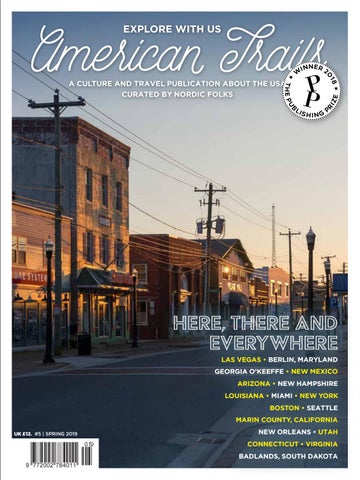
Here, there and everywhere LAS VEGAS • BERLIN, MARYLAND GEORGIA O’KEEFFE • NEW MEXICO ARIZONA • NEW HAMPSHIRE LOUISIANA • MIAMI • NEW YORK BOSTON • SEATTLE MARIN COUNTY, CALIFORNIA UK £12. #5 | SPRING 2019
NEW ORLEANS • UTAH CONNECTICUT • VIRGINIA BADLANDS, SOUTH DAKOTA
2
AMERICAN TRAILS SPRING | 2019
SINCE 1905 MN RED WING
.
AMERICAN MADE
REDWINGHERITAGE.EU
The Art of Traveling
W
e travel to look, to be surprised, to be moved, to recognize new territories both inside and outside of ourselves. We travel to escape and to face something unknown, to forget, find and remember, to rest or fatigue and, above all, to return. We travel to follow advice or start giving advice, to learn and unlearn what we thought we knew. We travel to understand that only those who accept being lost are truly on their way. We also travel to tell stories, and at American Trails we are entering our second year of doing that. We travel because we have to, but also because it is our job to inspire. We transform, as quickly as we can, each new destination into a temporary homeland, each stranger into a friend, and each flavor into a recipe. It’s all about people, places and passions. This, our first issue of 2019, takes you even further into the USA. To remote corners of Arizona, to urban farms in Vegas, to the shorelines of Maryland and Virginia, to cozy basements in Connecticut, to hidden treasures on the outskirts of New York City, to thirteen different states across America. We welcome you to 2019 with our soul, ready to use each reason the world gives us to keep on walking, honoring and savoring each moment. Happy reading! Jonas Henningsson and Jonas Larsson
5
AMERICAN TRAILS SPRING | 2019
Utah
SOLID AS A ROCK! PAGE 16.
Washington
South Dakota BADLANDS IS ALWAYS ON OUR LIST WHEN WE VISIT SOUTH DAKOTA. PAGE 128.
BEST DIVE BAR IN THE PACIFIC NORTH WEST. PAGE 44.
Nevada
SLEEP WITH THE FISHES? WE'RE IN TROUBLE IN VEGAS. PAGE 46.
California
WEST COAST GOATS AND MEN WITH BEARDS. QUESTIONS? PAGE 12.
Coast to coast
In this issue of American Trails you'll find at least two coasts, something inbetween, mules, ponys, horses, dogs, and goats. And yes, some really nice people as well. Do you want us to visit you? E-mail us at: info@amtrailsmag.com
Arizona
THIS STATE IS HOTTER THAN NACOGDOCHES. AND WE LOVE IT! PAGE 60.
Connecticut
WE HANG OUT IN THE BASEMENT WITH DAPHNE. SIDAN 76.
New Hampshire WE HIKE WHITE MOUNTAINS. PAGE 112.
New York FIND YOUR INNER SELF IN THE BIG CITY. PAGE 14.
Maryland
GREAT BEER IN BERLIN AND HOW YOU DEFINE A HORSE. PAGE 28.
Virginia
LAID BACK LIFE ALONG THE SHORES OF VIRGINIA. PAGE 28.
New Mexico
MIRIAM PARKMAN IS FOLLOWING IN THE TRACKS OF ICON GEORGIA O'KEEFFE. PAGE 18.
Louisiana
WE HEAD TO A SPORTSBAR IN NOLA – TO DANCE! PAGE 126.
Florida
TAKE US DOWN TO THE RIVER, ANTONIA! PAGE 78.
HEPCAT STORE
QUALITY & STYLE SINCE 1999
HEPCAT STORE · SANKT LARS VÄG 21 · LUND · WWW.HEPCAT.SE
Contents 5. THE ART OF TRAVELING
72. MY NEIGHBORHOOD
The journey continues.
Katie Lynd loves her Seattle home in hip Wallingford.
11. A TRIBE CALLED CONTRIBUTORS
Meet our fantastic writers and photographers. 18. GEORGIA O´KEEFFE
The icon that found a home in New Mexico.
76. CABARET VOLTAIRE
Daphne Martins basement in New London is one of the coolest venues around. 78. ANTONIA WRIGHT
One of the colorful artists in artsy Miami, Antonia Wright.
28. MARYLAND AND VIRGINIA
Surfers, weekend warriors, horses and ponnies in Maryland and Virginia.
92. PORTFOLIO
Calle Stoltz is one of Swedens best photographers. Here is a sample of his pictures from his US-travels.
44. TO DIVE FOR
Ballards best dive bar. Have a drink with us in Seattle. 46. FROM MOB LAWYER TO MAYOR OF LAS VEGAS
106. THE BEST BOSTON GUIDE
Arrive on time and think about what you ask, we where told before the interview with Oscar Goodman. We did nothing of the kind. 54. LAS VEGAS FOOD SCENE!
Vegas food scene is booming, we had to check it out, somebody has to.
Finally! We have been to one of our favorite cities on the Eas coast. 112. WHITE MOUNTAINS
Our New London correspondent Mattias Lundblad, takes a stroll on the Appalachian Trail. 122. FORGOTTEN CLASSICS
The Vinyl God, Donivan Berube, have found another forgotten classic.
60. LEAVING LAS VEGAS
So hot the car broke down, we met another mayor who saved the day.
9
AMERICAN TRAILS VÅR | 2019
COOLEST BOOTS STORE IN EUROPE
Sendra 7811
Sendra XXX
Sendra 16065
Sendra 7811
Sendra 4660P
Sendra 4660P
Sendra 4660P
Sendra 4660
Sendra 3241
Sendra XXXX
Sendra 3840
Sendra XXXX
SKO-UNO.COM 10
AMERICAN TRAILS SPRING | 2019
GAMLA BROGATAN 34, STOCKHOLM, SWEDEN
a tribe called
Contributors
Meet our fantastic writers and photographers!
MIRIAM PARKMAN, STOCKHOLM, SWEDEN
Miriam Parkman may live in a small apartment outside Stockholm, but in her dreams she is on the open plains in the US or where she grew up along the northern shores of Sweden. She is a member of the weaving community Studio Supersju, hold classes in vintage hair styles, she eats pancakes for breakfast every weekend and she doesn't say no to a beer or to dance lindy hop or two step.
American Trails EXPLORE WITH US
JONAS HENNINGSSON EDITOR IN CHIEF AND PUBLISHER HENNINGSSON@AMTRAILSMAG.COM
JONAS LARSSON CREATIVE DIRECTOR
MATTIAS LUNDBLAD, NEW LONDON, USA
Mattias Lundblad bought a Pentax in the city of Linköping as a fifteen-year-old and began to take pictures of musicians, people and nature. Later in life at a photo shoot in the US he met his American love. Now he calls New London, in between New York and Boston, his home. From here he sends pictures and texts to newspapers and magaszines in Scandinavia.
LARSSON@AMTRAILSMAG.COM
LINDA GREN PHOTO EDITOR GREN@AMTRAILSMAG.COM
ANDERS BERGERSEN STAFF PHOTOGRAPHER BERGERSEN@AMTRAILSMAG.COM
JOHAN LETH PROJECT MANAGER/EDITOR LETH@AMTRAILSMAG.COM
JAN SALOMONSSON TRANSLATOR JAN.SALOMONSSON@EXPRESSIVA.SE
CALLE STOLTZ, STOCKHOLM, SWEDEN
Calle lives in Stockholm with wife and two children. He started his career as an assistant at the age of 18. After three years, Calle began to work as his own and at the age of 23 he joined the photography agency Lund Lund. Now at 45 he is represented by Mink MGMT. Calle works both editorially and with commercially for H&M, Volvo, Indigofera, Eton, Camel Active, and American Trails.
ADVERTISING AND SPONSORSHIPS JONAS LARSSON LARSSON@AMTRAILSMAG.COM TEL: +46 70 76 01 720
OFFICE PAPER HEART PUBLISHING STORSKIFTESVÄGEN 40 141 39 HUDDINGE SWEDEN
SUBSCRIPTIONS INFO@AMTRAILSMAG.COM
PEDER EDVINSSON, VÄSTERNÄS, SWEDEN
Peder works as an editor, journalist and is the author of two books, the first from 2015 about a butterfly collector Fjärilsmannen and in 2018 a handbook on how to use a wood stove, Elda i vedspis. He used to travel more as an editor for the SAS Eurobonus magazine, but is now content with the weekly trip to his cottage on the coast north of Stockholm.
AMERICAN TRAILS MAGAZINE IS A QUARTERLY PUBLICATION AND AN ONLINE COMMUNITY, WHICH FOCUSES ON PEOPLE, PLACES, AND PASSIONS. WE DISTRIBUTE THE SWEDISH EDITION IN THE NORDIC COUNTRIES, AND THE INTERNATIONAL EDITION IN UK, USA AND IRELAND. WE DO NOT ACCEPT RESPONSIBILITY FOR THE LOSS OF UNSOLICITED MATERIALS. PERMISSION IS GRANTED TO QUOTE AND PRAISE US AS LONG AS THE SOURCE IS IDENTIFIED. FOR PERMISSION TO USE ANY OF OUR PHOTOS OR STORIES, PLEASE CONTACT THE EDITORS. ISSN 2002-7842
AMERICANTRAILSMAG.COM
A Man &His Goat INVERNESS PARK, CALIFORNIA WORDS AND PHOTO BY JONAS LARSSON.
You know that feeling when you fall in love; it’s a such a wonderful feeling. If the subject for your love is a male goat that goes by the name of “Nugget,” you probably understand that the love is totally platonic. We had just finished our breakfast at Inverness Park Market, a deli on Sir Francis Drake Boulevard, just a stone’s throw from the California coast in Marin County, when I laid my eyes on a handsome goat in the back of a truck. Nugget was quite reserved, but when his master John showed up, Nugget relaxed a bit. John tells me that he is renting out goats to clear bushes and small trees. “It’s way better than machines,” he explains. “They don’t make a lot of noise and they are way better for the environment. “Nugget is my favorite,” he continues. “He follows me wherever I go.” It turns out that John owns a farm that you can visit, and he takes tourists on hikes in the beautiful surrounding landscape. The two bearded gentlemen have to go to work, so we say our goodbyes. MEET JOHN AND NUGGET AT: FACEBOOK.COM/ELEPHANTMOUNTAINADVENTURES INVERNESS PARK MARKET DELI: INVERNESSPARKMARKET.COM
12
AMERICAN TRAILS SPRING | 2019
13
AMERICAN TRAILS SPRING | 2019
The garden of the wise CHINESE SCHOLAR´S GARDEN, SNUG HARBOR, STATEN ISLAND, NEW YORK WORDS AND PHOTO BY JONAS HENNINGSSON.
The road here leads through a dense bamboo forest reminiscent of the skyscrapers I just left behind. But when you enter Snug Harbor's Chinese Scholar's Garden, you do just that: leave everything behind you. Here you can think, breathe, and recharge. The setting is inspired by ancient gardens of the Ming dynasty that were built for scholars and philosophers. Today, New Yorkers come looking for a break from the frenzied city life. Originally built in the early 1800’s as a home for sailors, Snug Harbor offers an additional 13 gardens to explore. LEARN MORE AT SNUG-HARBOR.ORG
14
AMERICAN TRAILS VINTER | 2018/2019
15
AMERICAN TRAILS VINTER SPRING | 2018/2019 | 2019
16
AMERICAN TRAILS SPRING | 2019
Solid as a Rock
HOLE N"THE ROCK, MOAB, UTAH WORDS AND PHOTO BY JONAS LARSSON.
Five thousand square feet, 14 rooms, one bar and a bathtub all carved out from a huge rock close to Moab in southern Utah. It all started when Gladys and Albert Christensen’s young boys asked for a hideout. There are much more rocks than trees in this area, so Albert decided to carve into the mountain. Like many ambitious projects, it took much longer then expected. After 20 years, Hole N” the Rock was finally finished. It’s an amazing testament to a man and his dreams, though ultimately completed by his wife Gladys, who, after Albert passed away in 1957, ran the grounds as a tourist attraction for many years. Hole N” the Rock is still open to the public in its original state: the furniture, Albert’s paintings, his sculpture of Franklin D. Roosevelt, and even Gladys’ doll collection. 11037 SOUTH HIGHWAY 191, MOAB, UTAH • THEHOLEINTHEROCK.COM
Georgia O’Keeffe Dreamy Obsessions and Finding Your Way Back Home
Artist and icon Georgia O’Keeffe’s was born in 1887, and lived almost for a full century, in a world that was constantly changing, but she remained remarkably timeless in every aspect of her being. Miriam Parkman tells us the fascinating story.
A
WORDS BY MIRIAM PARKMAN • PHOTO BY MIRA SVANERED AND GEORGIA O’KEEFFE MUSEUM
Everything Georgia O’Keeffe made, painted, and sculpted is like a dream for any modern-day branding expert–she made paintings that became popular and sold well. She developed a personal, consistent style of clothing, which consisted of equal measures of androgynous artist and the dream of the Old West. She made a home for herself in an inaccessible region of New Mexico, which was quite an exotic place in those days. Every last object in her house reflected her as a person: minimalist and stripped bare, each with a clearly defined place and purpose. She married Alfred Stieglitz, who has been referred to as the “Father of Modern Photography,” and from the very first, she was a popular subject of his. This resulted in a kind of precursor to today’s Instagram feeds, in which her everyday life was documented for posterity.
and flowers, which my friends’ parents brought posters of back from a museum visit in the 1980s. In my mind, she was I associate her with the 80s. When I opened the book, I saw pictures of dreamy landscapes; mountains, cliffs, and hills in rusty red, orange, beige, and burned ochre, streaks of green minerals, sage-bushed desert plains, topped with turquoise skies and fluffy clouds. I was moved by them, and I become one of countless art students who have obsessed over O’Keeffe in the last 50 years. “I feel at home - I feel quiet - my skin feels close to the earth when I walk out into the red hills as I did last night - my cat following along like a dog.” THE SUN PRAIRIE, WISCONSIN YEARS
Georgia Totto O’Keeffe was born on her parents’ dairy farm in Sun Prairie, Wisconsin. During her teens and early youth, she occupied herself with training in classical painting, until her health issues and her father’s bankruptcy put a stop to that. Lacking financial means, she needed a source of income, and thus spent 1912–1918 living and working as a teacher in Amarillo and Canyon, Texas. Her afternoons were spent on the porch, producing lots of watercolors of the open vistas of Texas, its rugged settler towns, rickety pinwheels, and saturated, shimmering sunsets. Because of the shortage of time and daylight, she had to execute her watercolors quickly, and make them abstract and paired down. This was how the foundation was laid for what would eventually become her trademark
FROM DESERT KITSCH TO DREAMY OBSESSION
I was in my second year of the advanced textile crafts program at Handarbetets Vänner (“Friends of Handicraft”) when one of my teachers brought a book on Georgia O’Keeffe to our class. I knew I’d seen a picture of her before–she was that artist with the dark eyes and the lined face who wore a square, Spanish hat, and who made kitschy paintings of the desert, with animal skulls
18
AMERICAN TRAILS SPRING | 2019
19
AMERICAN TRAILS SPRING | 2019
FOTO: ALFRED STIEGLITZ. © GEORGIA O’KEEFFE MUSEUM.
Georgia O'Keeffe photographed by Alfred Stieglitz in 1920.
© GEORGIA O’KEEFFE MUSEUM.
Purple hills, Ghost ranch -2.
”I FEEL AT HOME – I FEEL QUIET - MY SKIN FEELS CLOSE TO THE EARTH WHEN I WALK OUT INTO THE RED HILLS AS I DID LAST NIGHT – MY CAT FOLLOWING ALONG LIKE A DOG” GEORGIA O'KEEFFE
style. During a trip to New York in her student days, she met Stieglitz, who was 20 years her senior, and in 1918, she accepted his financial support and relocated to New York. Stieglitz was married, but what began as a professional relationship soon evolved into a passionate affair, and they were married in 1924. It was Stieglitz who organized the first exhibition of Georgia’s artworks in New York in 1923. Her subjects reflected the emergence of the modern city, as well as untouched countryside, natural subjects, and nude studies of herself, sometimes executed in abstract perfection using solitary brush strokes, and sometimes in detailed oils and pastels–but always featuring the same bright colors. Georgia lived in New York for 11 years, spending her winters in the city and her summers in the Stieglitz family’s summer residence at Lake George. She produced and sold enough paintings that by the end of the 20s, she was more or less financially independent–a rather unique situation for a woman in those days. Her aversion to the social requirements of city life grew stronger, and she found herself constantly distracted from her work. She passed by Santa Fe when traveling through New Mexico in 1917, and she had dreamed of returning there ever since.
GO WEST
We’re going to back up a little here: while Georgia was first setting out on her path in classical painting in the early 20th century, a New York Socialite called Natalie Curtis headed out west. She had grown weary of the educated upper-class world where she grew up, but her privileged position nonetheless afforded her the means and opportunity to set out on an expedition without any particular objective. She abandoned a promising career as a concert pianist and started on a new life project: in her meetings with members of various aboriginal peoples, she was captivated by their culture of singing and music and began to note down and record what she heard. These expeditions attracted wonder and excitement, and she produced a series of books, the first of which was The Indian’s Book from 1907. She was an early proponent of the equal rights and value of all Americans, and she continued to preserve music from the North American Native and African-American communities throughout her life. As a result of her travels, she befriended Carol Stanley, a woman who had used her inherited wealth to build some of the first “Dude Ranches” in New Mexico– tourism businesses that offered well-to-do city folk the 20
AMERICAN TRAILS SPRING | 2019
21
AMERICAN TRAILS SPRING | 2019
© GEORGIA O’KEEFFE MUSEUM.
Artist and close friend Maurice Grosser at a visit at Ghost Ranch in 1944. Georgia didn't miss the chance to hitch a ride on his Harley Davidson -38.
opportunity to come and experience the life of a cowboy or cowgirl. San Gabriel, the dude ranch that Carol and her husband Roy ran, was one of the most frequented and exclusive summertime destinations in all New Mexico. In Lesley Poling-Kempe’s book Ladies of the Canyons (Arizona University Press), Carol, Roy, and their employed cowboys and wranglers appear in the typical western wear of the 1910s and 20s: white or plaid shirts, a bandana around the neck, slacks or jeans under wide chaps, with silver Concho buckles, high-heeled boots and hats with tall, rounded brims that were folded up at the sides. Carol and other women wore the same hats and boots, only with skirts or wide, suede pants with fringes at the hems, wide
belts over white shirts, and large, triangle-folded scarfs tied over their chests, all topped off with squash blossom necklaces. It’s a killer look. In 1917, Natalie was residing in Santa Fe with her husband, the artist Paul Burlin. That same year, another New York socialite, Mabel Dodge Luhan, arrived in Santa Fe after her then-husband convinced her that they should relocate to the Southwest. She soon realized that there was nothing for her to “discover” in Santa Fe, as women like Natalie had already been there long before she arrived. Instead, she headed for the nearby village of Taos, where she eventually founded a center for artists. In 1929, Georgia O’Keeffe would spend four months there while 22
AMERICAN TRAILS SPRING | 2019
23
AMERICAN TRAILS SPRING | 2019
ESTER + HARDAWAY © GEORGIA O’KEEFFE MUSEUM.
The house in Abiquiu.
In the background, ”The White Place”, a favorite scene often seen in Georgia O'Keeffe's paintings, In the foreground wrangler Daniel.
she searched for a place where she could indulge herself in her creative work without any disturbances.
jestic Sierra Pedernal mesa. It had been called the Rancho de los Brujos ever since the days when the Archuleta brothers used to hide rustled cattle in the protective shade of the cliffs, and kept people away by spreading rumors that the site was haunted by brujos–witches, spirits, and ghosts. In 1929, Carol was registered as the owner of what she would come to call the “Ghost Ranch,” and in 1931, when she moved into a run-down, crooked adobe casita by herself, bringing along her remaining belongings from San Gabriel, she had no idea how iconic the place she was founding would one day become. Forestry millionaire Arthur Pack and his family arrived at the almost-ready-to-be-opened Ghost Ranch in 1933.
FINDING YOUR WAY BACK HOME
Earlier that year, the stock market collapse and Roy’s gambling and drinking habits had brought the San Gabriel ranch to its knees, and it was declared bankrupt. The year before that, Roy had won the deed to an abandoned ranch at Piedra Lumbre (which means, approximately, “the valley of shining stone”) in a poker game. The property was in a landscape dominated by the wide-open plains and wind-worn rocks, mountains, and hills that surrounded the flowing Chama River, and was crowned by the ma24
AMERICAN TRAILS SPRING | 2019
GEORGIA O'KEEFFE. RAM'S HEAD, BLUE MORNING GLORY, 1938. . © GEORGIA O'KEEFFE MUSEUM.
Georgia O'Keeffe 1918 by Alfred Stieglitz.
AMERICAN TRAILS SPRING | 2019
25
FOTO: ALFRED STIEGLITZ. © GEORGIA O’KEEFFE MUSEUM.
Above: Ram's head, blue morning glory.
I GRIN FOOLISHLY WHEN I RECOGNIZE THE SUBJECT OF GERALD’S TREE 1 FROM 1937; THE GNARLY JUNIPER IS STILL THERE, LOOKING EXACTLY LIKE IT DID WHEN GEORGIA DEPICTED ITS SILVERY, PALE BARK AGAINST THE SATURATED, MASSIVE RED ROCKS AND THE PALE GREEN OF THE SAGE SHRUBS THAT COVER THE GROUND.
They purchased land from Carol and built a new adobe house, which they christened the Rancho de los Burros. Pack brought several of his wealthy friends there, and one of them would eventually tell Georgia about this remote place. It took her a few attempts to get to the ranch; it was notoriously hard to find, and there was nothing but a white cow’s skull marking the right exit from the road. After spending endless days driving her Ford Model A along the undulating, uneven dirt roads of New Mexico, searching for a place where she could create without being burdened by social expectations, she found the perfect place–which just happened to have already been built and developed by another woman. In 1934–5, when Georgia began her first long stay at Ghost Ranch, she never mentioned Carol by name. Arthur Pack bought Carol out in 1935, and in 1945, Georgia purchased the Rancho de los Burros from him. In the end, Arthur donated the remaining ranch to a church, which still runs it to this day. That same year, Georgia also built a house in Abiquiu, which was a 20-minute drive from Ghost Ranch. She renovated it extensively, and just as she had done before, she had large windows installed to allow her to fully appreciate the views from inside her rooms, and create the perfect environment to paint in. Her house in Abiquiu was square-shaped and surrounded an open courtyard. A door along one of the walls there would become her favorite subject to paint, along with the view of Sierra Pedernal. Georgia claimed Ghost Ranch as “hers” at first sight, and she would later describe Sierra Pedernal as her “private” mountain. “God has told me that if I paint it enough, it will be mine”. Now, she was living at Ghost Ranch in the summers, and in Abiquiu in the winters.
mountains I couldn’t wait to see, the day grew beautiful, blue, and bright. We had booked a horse back trail ride–a one-hour guided tour on horseback that takes you to some of the places that Georgia O’Keeffe featured in her paintings. Nothing could have prepared me for the emotions that I experienced as I, perching on the rather boisterous, but adorable, horse Nacho’s red-brown back, followed the tour, and finally found the answer to my question: did the places really look like they did in Georgia’s paintings? Did she filter the landscape and its colors through her own masterful and artistic mind, to express her indomitable spirit? The answer is clear, and powerful: no, she didn’t. It really looked like that–and it still does! I grin foolishly when I recognize the subject of Gerald’s Tree 1 from 1937; the gnarly juniper is still there, looking exactly like it did when Georgia depicted its silvery, pale bark against the saturated, massive red rocks and the pale green of the sage shrubs that cover the ground. I see the “White Place”, and the exterior of her house (which is not open to the public) tucked into the greenery, as though forever bowing down before the mythic Sierra Pedernal–and it brings me to tears. I’m crying because I’m actually experiencing first-hand the very same unrelenting nature that Georgia witnessed, seeing her whole, astounding palette of earth tones with my own eyes, experiencing a small taste of the ranching culture of the past, and also realizing that it would be more difficult for me to leave the city and move to these open expanses than it was for Georgia. This is the kind of place you want to live. Touring the house at Abiquiu the next day produces the same emotions–albeit in a less relaxed way. Photography is not allowed there, so I frantically sketch all the details that remain just as she left them and the house shortly before her death in 1986. The three sculptures that she made. The soft, curved Hopi style fireplace in the white, plastered wall. The handwoven bedspread made of single-filament, white, cotton yarn. The windowsill collection of rocks, shells, horns, fossils, and other objects that Georgia gathered
GHOST RANCH
When I visited Ghost Ranch in November 2018, it was wintertime in New Mexico. A snow storm caught us by surprise in Albuquerque the night before, but in the morning, the sky cleared up, and as we approached the red 26
AMERICAN TRAILS SPRING | 2019
during her walks. The Navajo woven pillow. The recessed couch with simple cushions where she would sit to listen to music next to the conspicuously expensive record player. The kitchen, with its open shelves full of various tea and coffee pots, glasses and crockery arranged by color, and a stainless-steel yoghurt maker. A beige section of wall above the plastered white strikes a contrast against the dark brown log beams in the ceiling, pots of geraniums and other plants which are still being watered and replanted, a plywood dining table, and a view into the dining room, where the angle of the window causes a slanted beam of light to hit the opposite wall.
female artist in the early 20th century, was ridiculed by her male peers for choosing flowers and brightly colored landscapes as her subjects. She says that she did what she wanted anyway, because “no one can tell you how to paint a landscape–you have to find that out for yourself ”. My visit is made complete when I get to see the original copies of some of my favorite paintings, just one day after getting to see the places where they were made. Fortified by Georgia’s words about always following your own mind, we make a cheeky stop along the road and fill an empty canteen with a sample of the characteristic red dirt. When I’m back in my own studio, at my own loom, I dye a yarn a bright orange-pink shade using pigments extracted from it. Inspired by a crack in a door in the house at Abiquiu, I make a sketch. The form is new to me, abstract, and I can see the square silhouette of Sierra Pedernal emerging from the lines. I start on a new weave, and the circle is completed.
THE CIRCLE IS COMPLETED
Georgia was famous for always following her own mind, and there is interview footage from the 70s where the reporter asks her what she did to get “permission” to go to New Mexico for months on end without Stieglitz before moving there permanently after his death in 1946. “I didn’t ask for permission, I just went!”. When I visit the Georgia O’Keeffe Museum in Santa Fe, the first thing I see is a film in which Georgia relates how she, a young 27
AMERICAN TRAILS SPRING | 2019
ESTER + HARDAWAY © GEORGIA O’KEEFFE MUSEUM.
The tour of the Abiquiu house is booked at the museum in Santa Fe and sets out from the O’Keeffe Visitor Center in Abiquiu.
Bryan: brewer, bar owner and Berliner.
First We Take
Berlin, Then We Take Chincoteague
The coast outside Washington D.C. is a well-kept secret. After a few fantastic days in the underrated US capital, we head for the sandbanks out by the ocean. WORDS BY JONAS LARSSON • PHOTOS BY ANDERS BERGERSEN
28
AMERICAN TRAILS SPRING | 2019
29
AMERICAN TRAILS SPRING | 2019
A perfect porch in Chincoteauge.
W
e might as well state it up front: Berlin is far from a big city. Berlin, Maryland, that is–you probably know that Berlin in Germany is quite the metropolis! However, they have more in common than just the name–two other things, in fact: they’re both really cool, and they both have some outstanding local brews. We check in at the Atlantic Hotel, one of the two places where you can stay the night here. The other one is a bedand-breakfast which is a block away. It looks really nice, too, but we’re staying here, at the historic city hotel with a great front porch that gives you a front-row seat to all the Main Street activity. The hotel opened at the close of the 19th century to accommodate “drummers”, merchants from the surrounding area who came into town to sell their wares. The owner used to pick them up in a horse-drawn omnibus at the railway station and drive them straight to the hotel, unless they had their own means of transport. Back then, the hotel had a stable at the back where you could keep your horses during your stay. Today, the beutiful Atlantic Hotel has been renovated in a Victorian style that’s very historically accurate, and very charming. I take a Victorian shower in my Victorian bathroom, and change into some fresh clothes. We’ve spent the whole day in the car, so it feels great to lose the trail dust. As I’m exiting the hotel, I notice a group of people having a good time on the porch. Their laughter blends with the clinking of their glasses. – Hey, cool guy! I turn around, and look quizzically at Lisa Moyer, who smiles back at me. – Well, I figure if you’re wearing a t-shirt like that, you must be a cool guy. We’ve been to Steamboat for some skiing, too. Did you enjoy it? – Yeah, it was awesome, I reply. – Champagne powder! Adam, Lisa’s husband, smiles at me. My Steamboat logo t-shirt turns out to be quite the icebreaker, so I sit down with this inviting crowd to take an afternoon drink. Yes, this is definitely a great town. 30
Well maintained, pretty brownstones downtown, and gorgeous houses everywhere. – Do you want to tag along to Burley? asks Bryan, who is the town’s brewer. – We’ll meet you there in an hour or so, I tell him, we have to get something to eat first. As usual, all we brought to eat in the car was beef jerky, and we’re seriously hungry at this point. –Try Blacksmith, it’s my favorite. Blacksmith is a block from here–which turns out to be the distance to most places in Berlin. It’s a great restaurant, inviting in that American way, with amazing staff, of course. Tiffany, who is waiting our table, is an all-star waitress. We have a drink at the bar after dinner, and I tell her that Tiffany is a rather unusual name in Sweden. –Well, you should go home and make babies and name them Tiffany, then! Her co-worker Heather bursts into laughter, and I laugh too. Quite a comeback! We thank them for everything, and I promise Tiffany to consider her suggestion. We meet up with our new friends at the Burley Café, which is right behind the Atlantic Hotel. It turns out Bryan is actually the owner of the place, and the manager’s name is Ryan. It’s all a bit confusing, but it gets less so once Bryan offers us a drink of his favorite beer: Aboriginal Gangster, a fruity IPA that isn’t too hoppy. The café has a great small-town vibe, and everybody seems to know everybody. Bryan’s mom and dad, Tim and Debbie, are here, and it all feels more like somebody’s living room than a bar. Our friends have work the next day, and unwillingly face the fact that it’s time for them to go home. Since we’re already at work, we decide to stick around to listen to Troy Mawyer, a local troubadour and all-around awesome dude. Troy plays Neil Young’s Helpless, a couple of Tom Petty tunes, and then a song by my favorite Seattle band, The Head and the Heart. The best performance of the evening is when Ryan, the manager, takes the stage to give us a stripped-down rendition of Purple Rain. It’s glorious. SURFERS AND WEEKEND WARRIORS
The next day, we have breakfast at the Baked Dessert Café, which is (you guessed it!) a block away from the hotel. After breakfast, we head over to Bryan’s brewery Burley Oak Brewing Company, which is in the outskirts of town. We’re going out to the coast later, to check out the ocean.
AMERICAN TRAILS SPRING | 2019
Berlin’s only hotel, the victorian Atlantic.
31
AMERICAN TRAILS SPRING | 2019
Our newfound friends Lisa and Todd at Burley Café.
Bryan shows us around the brewery. The bar is full of what he refers to as Weekend Warriors, and business seems to be good. Most of their sales are local, he explains, but they also export to Japan and Denmark. – What do you do when you’re not making beer? I ask him. – The same thing everyone else around here does: I go surfing. Bryan shows us his office, which is full of surfboards. I’m beginning to feel jealousy take hold of my heart. Brewing beer and surfing sounds like a pretty good way to live. To top it off, they have a live stage in the back yard (and a secret bar). Living the dream, basically!
We set off for Assateague Island National Seashore and Assateague State Park, a long shoal that reaches all the way to Virginia. Bryan gave us directions, and while it sounded simple when he told us how to get there, we somehow end up in Ocean City instead. We make a sharp u turn. Ocean City is the opposite of what we’re looking for. It’s probably great if you want to gamble, drink, and party, but we’re in the mood to chill on the beach with a beer, check out the surfers, swat mosquitos, and do our best Hemingway impressions as we gaze out over the sea under the setting sun. When we get there, we have to turn back again. There’s nowhere to get food, water and beer. It also turns out 32
AMERICAN TRAILS SPRING | 2019
Berlin is a small, tidy town with lots of charm. Cedar Lodge är en klassisk amerikansk lodge och ligger nära Yosmite National Park.
33
AMERICAN TRAILS HÖST | 2018
There is no need to rush in Chincoteague; an evening stroll along the quay is a must.
34 34
AMERICAN AMERICANTRAILS TRAILS VINTER SPRING | 2018/2019 | 2019
Taggigt och knotigt Bryan and och alldeles his dad, Tim, underbart. outside the cafĂŠ.
35
AMERICAN TRAILS VINTER SPRING | 2018/2019 | 2019
A beer flight at Burley Oak Brewing Company.
Horse or pony? Since we are in Assateague, Maryland, this is a pony!
there’s nowhere to stay, but no matter; we have the car! We head back to a store we passed half a mile back, stock up on Wonder Bread, sardines, some other items that could pass as food, a few beers, and a bottle of water. With all that stuff, we shouldn’t have too much trouble getting through the night in the car.
Apparently, the wither height of a horse has to be at least 4 foot 10 inches. In any case, they’re very cute. Not too shy, but it’s best not to pet them–people who have tried have ended up regretting it! We settle in at our camp site, which has a grill and a picnic table, and then head down to the beach. It’s just as mind-blowingly beautiful as we hoped it would be. Further on down the beach, people are driving their offroad trucks around, fishing, and barbecuing. We check out some cool surfers, and talk a little with David Yurko and Caz Rubacky, two surfers who are just about to head out on the waves. We have more questions, but Caz is too eager to get into the water. – Surfs up, dude! The beach breaks here are good–big, smooth, and calm. But don’t write that! You see, there’s hardly anybody here, they’re all up at Ocean City, even
IT’S ALL ABOUT THE WITHER HEIGHT
Assateague Island is pretty much just a long sandbar, with fascinating birds and wild horses, or ponies really. Legend has it they are the descendants of horses that survived a Spanish shipwreck in these parts a long time ago, but more probably, they stem from horses that have run away from settlers in the area over the years. An interesting fact is that while they are referred to as ponies on the Maryland side, they are considered horses in Virginia. 36
AMERICAN TRAILS SPRING | 2019
Caz Rubacky prays for big waves.
though the surfing is much better here, he tells us before hurling himself into the ocean. We lie there, jealously eyeing the surfers, but in the end, we decide that we’re having a pretty great time, too. The sun sets behind us, and I uncork the wine bottle and feel just like Hemingway. We build a fire of driftwood, and soon, we’re enjoying a meal of Wonder Bread, sardines, and beef jerky. I’m stiff as a plank when I head for the shower the next morning. Sleeping in the car is exciting and all, but it’s not exactly comfortable. Suddenly, I run into Adam Moyer, the guy from the hotel veranda. He’s wearing a wetsuit and carrying a surfboard under his arm. – Hi! You made it here, then, he says. – Yeah, piece of cake, I tell him. – We’ll have to talk later. I have to get in now, the tide is about to go out.
I think to myself that life here seems to be pretty great. Middle-aged surfers, just chilling and enjoying life in a place where time seems to move a little slower. CHINCOTEAUGE: NO STRESS
Chincoteauge is even more relaxed than Berlin, if possible, even though pronouncing it is much harder work. We roll into the small, coastal village in the late afternoon. The sun is low in the sky. It’s the end of the season, so there are plenty of vacancies in the motels and bed and breakfasts. We drive around the community aimlessly–in part because we want to have a look around, but also because we want to find a nice place to stay–we’re done sleeping in the car! When we find a motel that looks particularly pleasant in the warm glow of the afternoon, we stop. We check into Seashell Motel for two nights. It’s a quiet, 37
AMERICAN TRAILS SPRING | 2019
If you make it on time, you can make it to the top.
charming motel, just off the main road, which has great rates for what they offer. The next day, we rent a couple of bikes and head out to explore. The air is lukewarm, the sun is shining, and there aren’t many people about this time of year. We head for the ocean, following lovely bike paths that wind their way through the bird reserve, and even see a pony or two–but since we’re in Virginia now, I guess they’re really horses... It’s very windy when we arrive at the ocean. We ask the lifeguard Mark if the currents are dangerous. – Do you see where the water is completely flat? It’s deep there, and that’s where the water that the waves push in goes back out. There’s a strong current there, so be careful, he says. Mark turns out to be a homecomer; after 25 years working as a cop in Hawaii, he returned to his hometown and found work as a lifeguard instead.
– I had enough of all the violence and misery I saw every day, so I decided to go back home. This job is a lot better; people come to the beach for a good time, not to cause trouble. We take a dutiful swim and then get back on our bikes to do some more exploring. Mark told us about the lighthouse that we’ve seen jutting up over the horizon like Sauron’s tower in the Lord of the Rings movies. It’s a classic American lighthouse, with red and white stripes. It’s just closed for the day when we arrive, but we get some good pictures at least. THE BEST TACO IN THE WORLD
When we get close to the town again, we stop off at Pico, a taco joint that we spotted on our way out. It looks incredible–a metal shack with big bright letters on the roof 38
AMERICAN TRAILS SPRING | 2019
Everything happens at ChinkoTiki, the best location for sunsets and evening gatherings.
Pico makes arguably the best taco on the east coast.
promising… tacos! We’re certainly not disappointed; I’ve never had tacos anywhere near as good as these. We spend the rest of the day doing what this place lends itself best to: relaxing. We bike around a bit, and it’s all very charming. After a beer each in the motel garden, we nap in our sun chairs. Once the heat dies down a little, and that magical light finds its way down between the little houses, we get back on our bikes. We cycle along the canal that separates the island from the mainland and watch the sun set in the lagoon. Afterwards, we find our way back to the tiki bar we popped into briefly last night, ChincoTiki. Everybody welcomes us as though we were regulars. Chincoteauge isn’t a big place, and it seems that everybody in town was here last night, and they all remember the Scandinavians with the big camera. It’s last night all over again: Chelsea, the bartender, is charming
the socks off all the guys, and people are playing board games and enjoying a drink in the big, sandy outdoor seating area. Everybody is very friendly. We spend some time talking to Michael Fritz and Beth Larson, who are the ones who explain the whole deal about horses vs. ponies to us, but when a rather inebriated gentleman decides that I’m in need of salvation, we hit the road. He could be right, for all I know, but I tell him I’ll have to think about it. We’ve had a long day, and we’re on our way home when we run into Joe Scullion outside the American Legion, which is the local veteran’s association. Joe is a lanky, zany guy; a former coast guard who cuts lawns for a living these days. – Come on in, guys, we’re having a pool tournament, he tells us. 39
AMERICAN TRAILS SPRING | 2019
So these are horses; we are in Virginia right now.
40 40
AMERICAN AMERICANTRAILS TRAILS SPRING SPRING| |2019 2019
41
AMERICAN TRAILS SPRING | 2019
Sunset in Chinkoteague.
42
AMERICAN TRAILS SPRING | 2019
Boyd Sheets on the left doesn’t look very happy, but beneath that beard is a winner.
YOU HAVE TRANSPLANTS, WANNABEES, AND MARRIED INTOS. YOU SEE, PAUL IS A TRANSPLANT, AND I’M A MARRIED INTO. PAUL WAS BORN HERE, WHICH IS AS GOOD AS IT GETS.
We give each other a look. How often do you get to hang out with war veterans and play pool? Inside, we don’t just meet war veterans, we also meet long-time residents of Chincoteague. Paul and Rebecca Tatem insist on buying us a drink and telling us about the locals. –There are three kinds of people in Chincoteague, Rebecca says, and peers into my eyes. – You have Transplants, Wannabees, and Married intos. You see, Paul is a Transplant, and I’m a Married into. Paul was born here, which is as good as it gets. Wannabees are people who move here and want to be Transplants. And then there’s the people who marry a Transplant. She keeps staring intently at me until she cracks up and starts laughing. I’m just messing with you, we love everybody here, she says. – We’ve lived here for more than 30 years, but we’ve only been evacuated 3 times, Paul tells me. We get some pretty intense storms from time to time.
We sit there, listening to one tall tale after another, some of them quite unbelievable to be honest, but it’s a great crowd, and when Boyd Sheets, a gentleman who bears quite the resemblance to Santa Claus, takes home the pool trophy, we decide it’s time we headed back to our room. Rebecca sums up our whole visit with a single sentence: Isn’t this good living? Welcome to Virginia! Go to: americantrailsmag.com for more Maryland and Virginia hot spots or just get on a flight to D.C.
43
AMERICAN TRAILS SPRING | 2019
To Dive for
SLOOP TAVERN, BALLARD, SEATTLE WORDS BY JOE TOBIASON • PHOTO BY JONAS LARSSON
Though you are less-likely to see “Oof Da!” bumper stickers, The Sloop is still home to fishermen after a long day on the Puget Sound, and is one of the few true dive bars left in the rapidly gentrifying and modernizing Ballard neighborhood of Seattle. This traditionally Scandinavian neighborhood has seen most of the old guard disappear in favor of modern cuisine and trendy shops. The Sloop was originally opened in 1952 and moved to its current location in 1977. They are best-known to Seattleites as the home of the Sloop Yacht Club (a weekly social club that meets year-round and races in the summer) as well as their “Slooper Sized” beers, which deliver 34 ounces of your favorite suds. It’s also one of the few places where you can play a round of pool or darts in an area where every square foot seems to be quickly turning into condos. 2830 NW MARKET ST, SEATTLE
44
AMERICAN TRAILS SPRING | 2019
45 45
AMERICAN AMERICAN TRAILS TRAILS HÖST SPRING | 2018| 2019
46
AMERICAN TRAILS VÃ…R | 2019
A Sit-Down with
Mr Vegas
I managed to land an interview with Oscar Goodman, legendary mayor of Las Vegas. Mr Goodman has been in Las Vegas since its beginning and he knows everything worth knowing about this city. “Arrive on time and think about what you ask,” I was told before the meeting. Of course I arrived late and, of course, I asked the wrong questions. WORDS AND PHOTOS BY JONAS HENNINGSSON
47
AMERICAN TRAILS SPRING | 2019
“NOBODY ELSE WANTED TO BE HERE,” HE JOKES. BUT EVEN THEN, THE CITY HAD EVERYTHING A YOUNG ASPIRING LAWYER WAS LOOKING FOR.
I
t starts in the worst possible way. I've managed to get a meeting, a sit-down, with the longest-serving mayor in the history of Las Vegas, with a storied Mafia lawyer, with “Mr. Vegas” himself ! And I'm so late. My Uber driver is circling the outskirts of Vegas, and I’m panicking as the driver doesn't have the faintest idea of where Goodman’s office is located. After what feels like an eternity, we find the correct address. Once inside, I wonder who is interviewing who. “Don't you have a tie?” Goodman asks, rolling his eyes. “Are you coming here to interview me without a tie? And you’re late? And then you blame Uber?” He fixates his glare on me again. “And you’re unshaven. Do you have no respect for me at all?” I mumble that I am a swedish Viking and that Vikings neither shave nor wear a tie. To him, it just sounds silly. So instead of elaborating on my miserable morning, I turn on the tape recorder and lean back, letting Goodman tell his story. “I came here from Philadelphia in 1964,” he explains. “I had just taken my bar exam. My lady and I jumped into our car and drove across the country. We came here with 87 dollars in our pocket and since then we have had the best life in the world.”
humble watering hole to the multifaceted world city it has become. The fact that the Goodmans wanted to remain in Vegas seems obvious now. “Nobody else wanted to be here,” he jokes. But even then, the city had everything a young aspiring lawyer was looking for. “It was like a new country, the new frontier,” he recalls. “The city had a colorful history, and its possibilities seemed to be completely unlimited.” He felt as though he would fit right in. “I drink far too much and I play on everything that moves,” Goodman admits. “I am a degenerate player. I could bet on which direction a cockroach moves.” Few cities have changed as much as Las Vegas has in the last fifty years. “When we first came here it was a kind of cowtown, a watering hole,” he remembers. “You stopped the train here to let the animals come off and drink for a while, then pulled on. You didn't stay in Vegas.” But Goodman and his wife did not move on; they liked what they saw and decided to try their luck here. From those modest beginnings, Las Vegas grew quickly into a flashy gambling den. Nevada was the first state to legalize gambling, and that meant that many moved here to find happiness. But back then in the early 1960’s, the cityscape looked completely different; there were very few hotels and casinos larger than just two floors. Goodman explains: “When we came across the mountains and looked down at the city, my wife sighed: ‘Where have you taken me?’ I answered: ‘To the land of milk and honey.’ And that’s just the way it turned out.”
THE LAND OF MILK AND HONEY
Goodman and his wife Carolyn, who succeeded her husband as mayor in 2011, have been heavily involved in the city's entire development, from its earliest days as a 48
AMERICAN TRAILS SPRING | 2019
One advantage of not being able to sleep is that you have time to read all the books on the bestseller lists. Nordic noir is his favorite genre.
49
AMERICAN TRAILS SPRING | 2019
“Is this how an interview works?” he suddenly exclaims. “You do nothing? You just sit there and I talk?” He playfully threatens me: “You know I still have all my old contacts left. If someone does something I don’t like, there are many people who will gladly help me get rid of the problem as a way to show their appreciation for me. All I need to say is: ‘I don't like this man from Scandinavia,’ and you don't leave Vegas.”
50
AMERICAN TRAILS SPRING | 2019
them. I won all those cases, not because I was a genius, but because I was lucky.” “Well, the more you practice, the more luck you have,” I think to myself while taking a look around his office. In the captivating biography Being Oscar: From Mob Lawyer to Mayor of Las Vegas, which he wrote with George Anastasia, one can read about many of the 300 cases Goodman took on (he won nearly all of them). A tall stack of books is resting on a coffee table before me. Oscar reads my thoughts. “That's just the books I read last week. I have nothing else to do nowadays except to read,” he laments. “I read all the books on the bestseller lists. I can't sleep, so every night between two and four o’clock I read.” We talk about American storytellers, and Goodman mentions The Reckoning by John Grisham. “The first part is a brilliant look at the relationship between a lawyer and a suspect,” he raves. Goodman also likes Nordic crime, and shows me some books from his collection. We agree that Jo Nesbø is a common favorite.
WHAT ELSE IS THERE?
When Goodman studied law in Philadelphia, he also worked with the local prosecutor. In one case, a rich widow was murdered, and the assailants stole $300,000 that she had hidden under her mattress. They hurried to Las Vegas to wash the money the old way: at the gaming tables. But they were soon arrested and brought back to Philadelphia for trial. “My job was to work with their testimony, and at the end of a four-hour session we went out for dinner,” he reflects. “It was such a cold, nasty, rotten eastern night and they said: ‘What are you doing here?’ I answered: ‘What else is there?’ They replied: ‘Las Vegas,’ And that was it.” When Goodman first came to Vegas, there was really no room for a criminal lawyer. Most lawyers’ work came from divorce cases. There was one very sharp attorney who worked with crime, so sharp that he got all the cases to be had. But as the city grew, even infamous mobsters started making their way out to the desert. Goodman was lucky; he caught a case purely by coincidence, and he won. His client told all his friends, who in turn told all their friends. Now, these were not your average kinds of friends. By the age of 28, Goodman was representing Meyer Lansky (who worked with Benjamin "Bugsy" Siegel and Lucky Luciano, notorious gangsters). “Lansky was the financial wizard of a big crime syndicate, and I won his case,” Goodman says. “The government began introducing wiretapping, and I became an expert in such cases. I received every wiretapping case throughout the United States and had much success with
"I DON'T LIKE THIS MAN FROM SCANDINAVIA"
“Is this how an interview works?” he suddenly exclaims. “You do nothing? You just sit there and I talk?” He playfully threatens me: “You know I still have all my old contacts left. If someone does something I don’t like, there are many people who will gladly help me get rid of the problem as a way to show their appreciation for me. All I need to say is: ‘I don't like this man from Scandinavia,’ and you don't leave Vegas.” 51
AMERICAN TRAILS SPRING | 2019
“WE HAD NO GOOD HEALTHCARE LIKE WE HAVE NOW,” HE EXPLAINS. “WE HAD NO CULTURE; NOW WE HAVE A FANTASTIC PERFORMING ARTS CENTER AND A RICH CULTURAL LIFE. THIS WAS NOT A CITY WHERE CULTURAL PEOPLE LIVED. WE ALSO HAD NO MAJOR LEAGUE SPORTS; WE HAVE THAT NOW. I WANTED TO MAKE VEGAS A WORLD CITY.”
Goodman’s life is like a movie, and he has, of course, been involved in countless films and TV series. “It's my third career; I have so many roles, but I always play myself,” he says. “I’ve been in three different episodes of CSI, two episodes of Las Vegas, and a lot of movies. I got an offer as late as today about making another big thing.” In Martin Scorsese's epic crime film Casino, Goodman plays himself. We talk about his many years as mayor, his second career. He loved every day on the job, and did not mind that taking it meant a heavy cut to his salary. “We wanted to change everything,” he says. “We had no good healthcare like we have now,” he explains. “We had no culture; now we have a fantastic performing arts center and a rich cultural life. This was not a city where cultural people lived. We also had no major league sports; we have that now. I wanted to make Vegas a world city.” Goodman couldn’t have seen these changes through alone. “All we wanted to do, we managed to realize, and much has happened during my wife's years as mayor,” he praises. “I really give her the honor.”
When we are done with the questions, I ask politely if it’s possible to take some pictures. “I don't want to take pictures with you as you look!” he protests. I keep trying, suggesting some nice portraits outside the office. “There is nothing outside! Forget about it!” he roars. I obey and back off; that’s just how it works. You learn to leave him be. Turn the page and read more about how Las Vegas has changed during Oscar Goodman's time as mayor!
THE HAPPIEST PLACE IN THE WHOLE VALLEY
Downtown, which is now one of Las Vegas’ most exciting areas, was a veritable hell when Goodman began working as mayor, he says. “You really can't imagine what it looked like; downtown was a war zone. No electricity, no restaurants, no people, no nothing! Now it's the happiest place in the whole valley.” 52
AMERICAN TRAILS SPRING | 2019
More photos? Get out of here! Let me show you the exit.
53
AMERICAN TRAILS SPRING | 2019
Las Vegas REINVENTED Few cities have so many preconceived notions to tackle as Las Vegas. To work past them, the desert mecca has become a chameleon, capable of recreating itself into constantly shifting forms, from legalized gambling, to top-tier concert residencies and nightlife, to a full-fledged sports town. Now, art and local food culture is changing the city’s personality once again.
I
WORDS AND PHOTOS BY JONAS HENNINGSSON
start the day with brunch at the Atomic Kitchen and can't resist ordering the Seafood Shenanigans (more oysters!) as my starter, followed by an Urban Seed Salad with green oak lettuce, roasted baby turnips, minced herbs, toasted pumpkin and sunflower seeds, and goat gouda topped with a barrel-aged whiskey shoyu vinaigrette. My morning cocktail is Not Your Average Joe, a strong shot of Jameson mixed with Ethiopian cold brew, anise, milk and coconut. The food comes as quite the surprise, or at least not the typical brunch I’d associate with a Vegas dive bar. However, it feels quite reasonable to start the day with some cocktails. I spot some information about Urban Seed, a local farm and Atomic food supplier, chasing it all down with a Summer Camp Old Fashioned. Atomic Kitchen is the extension of the legendary Atomic Liquors watering hole, the dive bar that opened here on Fremont Street just at the end of the Second World War (under the name of Virginia's Café for a few years). During the 1950’s and 1970’s, the bar had its heyday. Everyone who’s anyone hung out here: the Rat Pack, Barbra Streisand, Hunter S. Thompson - and they all drank Atomic Cocktails. Not far from here, the United States military tested their atomic bombs during the Cold War, and it is said that a popular time-killer was to go up on the roof after a few drinks and scout for mushroom
clouds exploding into the distant horizon while the onlookers’ eyebrows were singed off. During the 1980’s the luster faded, and Atomic closed completely in 1991, my barmate Joe explains while the bartender slides an Old Fashioned across the counter. I have moved to the soft, dark, murky bar that doesn’t let in any daylight, instead embracing the guests with a comfortable laid-back atmosphere. Soon, this legendary establishment was helped back up by some local entrepreneurs, and today both locals and tourists hang out here once again. Many people, of course, want to drink cocktails where Johnny Depp, under the guise of Hunter S. Thompson, downed his drinks in an inextricably neurotic manner. I myself order a She's A Rainbow, a juicy New England IPA, and continue considering the town’s steady changes. I'm sure Hunter S. Thompson would have been as surprised by the menu as I am. What’s going on here, Vegas? To find out, I decide to go looking for Urban Seed, and I soon find their logo in an industrial area on the outskirts of town. LOCALLY GROWN AND SHORT-TRAVELED
There was a time when food in Vegas was seen as mere sustenance, and was often comped simply to persuade your continued concentration at the gaming tables. Now, some of the world's best restaurants are in Vegas and the range is amazing. People are even traveling here strictly for the 54
AMERICAN TRAILS SPRING | 2019
Esther’s is colorful, and one of the rising stars of the Vegas food haven.
55
AMERICAN TRAILS SPRING | 2019
world class dining experiences. Urban Seed Co-Founder Jared Krulewitz stands outside one of their greenhouses and thinks back to the company’s very beginning. Far behind him, Vegas skyscrapers point confidently to the sky. Until recently, no one cultivated the products that ended up on the city’s dining plates, that is until Krulewitz and some friends started Urban Seed. Now they supply many of Vegas' best restaurants and trendiest dining spots, with locally grown and short-traveled produce. On the outskirts of Las Vegas, on the other side of the railroad tracks, tossed out on the desert bed, is Urban Seed’s headquarters: a main building with adjoining shiny greenhouses that today have the same color as the sky. To challenge a whole city with a new way of thinking about food culture requires a great deal of strategy. Krulewitz and his gang had a plan. “We started by targeting the chef market and created a culinary board with international and local chefs to gain
intelligence from,” he says. “You know, being in Vegas, we have some of the best restaurants in the country, but we don’t have any food producers.” The chefs became a guarantor that they did the right thing and were on the right track. WHEN IT’S UP TO THE CHEF
Inside the Urban Seed offices, the message “Las Vegas Saves the World” is printed on a coaster in front of me. This very confident statement is about food, water and transport, but I will soon understand it’s also about community and society. It is evident that Urban Seed is on a mission that they think is important. There is an eager optimism in the office, as even the dogs seem to pour out all their energy, running around restlessly in the corridors and listening most unwillingly to commands for “silence, please.” The biggest problem with Vegas’ food culture was that it all had to be flown in. This reality brought plenty of 56
AMERICAN TRAILS SPRING | 2019
Jared Krulewitz is on a food mission.
VEGAS FOOD & DRINK ADDRESSES THE KITCHEN AT ATOMIC Atomic Liquors is a must of course, the classic dive bar where Hunter S. Thompson, Frank Sinatra, Barbra Streisand hung out. As if being the oldest free-standing bar in Vegas wasn’t enough, their recently opened Kitchen at the Atomic is the perfect addition. atomic.vegas/the-kitchen ESTHER’S KITCHEN This restaurant lends another outstanding vibe to the Arts District. Excellent sandwiches, sourdough pizza and salads are supplemented by elaborate cocktails and great craft beer. estherslv.com BIN 702 Bin 702 has been a staple of Container Park since its
setbacks, of course. The vegetables were either not mature enough, or way overripe, and therefore a lot of food was thrown away. It requires too much energy to move vegetables around this way. The average product that landed on a plate here traveled 1,500 miles because most of the food for people in the US is imported, while most of the crops raised domestically are targeted for animals. “So we started to grow vegetables and we let the chefs decide what they wanted,” Krulewitz reasons. “No one knows better than the chefs what is good, fresh food. In that way, we can say that we got our food certified by the chefs themselves.”
opening in 2013, offering good cold cuts, solid cheeses, awesome montaditos (we choose Cuban every day of the week!) and a decent beer and wine list. bin702.com MAKERS & FINDERS Superb coffee and perhaps the best brunch in the city. They have one location in the Downtown Arts District and another in Summerlin. makerslv.com SPARROW + WOLF Sparrow + Wolf made Vegas’ rising food culture even better when it opened this year, with an insatiable passion to present classic American cuisine
INDOOR AGRICULTURE
in an updated form. Enjoy lovely little dishes
According to Krulewitz, the future is all about growing in a controlled environment and under cover. “With just a little technology, you can grow vegetables and other things
backed with an impressive list of libations. sparrowandwolflv.com
57
AMERICAN TRAILS SPRING | 2019
FOTO: CAMILLA LINDQVIST
James Trees became sous-chef at Bellagio when he was just 21 years old.
The list of notto-miss bars is getting longer and longer.
58
AMERICAN TRAILS SPRING | 2019
Makers and Finders – best brunch in the city!
AFTER ESTHER’S, I AM READY TO EXPLORE VEGAS. I WALK DOWNTOWN AND REMEMBER WITH ANTICIPATION MAYOR GOODMAN’S WORDS ABOUT THE AREA THAT HAS GONE FROM WAR ZONE TO TREND-SETTER IN JUST A FEW SHORT YEARS. IT TRULY IS “THE HAPPIEST PLACE IN THE VALLEY”.
anywhere in the world,” he believes. “We are actually a technology company that has ended up in the cultivation industry. We design LED lamps so that we can grow indoors because there are few places that have far too much sunshine for far too many hours like Vegas does. But indoors, we control the light; it's always in-season for us.” “People are surprised when they order a salad at a restaurant here and the menu says that it is grown locally, that these tomatoes are grown with 95 percent less water and that they are grown right here, not in the Netherlands,” he says. “They are surprised at the crispness, at how well the vegetables can handle the dressing. But it is of course the taste that is absolutely crucial in the end.” “And people are prepared to pay more for local food when they know the grower, when they feel like they are part of the process,” he continues. “It's hard to understand solutions if you don't understand the problems, so we're really trying to educate people.” For Krulewitz and many others, their food is an important part of creating an identity for the city. Vegas is just now finding its own identity. “I think the most important thing about Vegas is that the city is maturing,” he says. “It's not just a place to go have fun for three days anymore. It’s a place to settle down and start a family. Moreover, it’s four-times cheaper to live here than in California.”
to galleries and art studios, small independent retailers are filling up the streets: vintage shops, second-hand stores, record exchanges, restaurants and small dives. It is far from The Strip with its glittering boulder buildings. Here, Vegas feels more like a small town. All this talk about food has made me hungry, and soon I slip into Esther’s Kitchen, which is a cornerstone of the Arts District’s upward trajectory. Esther’s is full of locals, with a long bar counter leading up to an open kitchen where the chef and owner James Trees resides. He has bright eyes hidden behind a deep-blue Dodgers cap; he also has a resumé longer than the bar itself. James has learned his profession under renowned chefs such as Luke Palladino, Bradley Ogden, Michael Mina, Alex Stratta, Jacques Van Statten, Eric Ripert and Gordon Ramsay. At just 21 years old, he became the Bellagio’s youngest sous-chef ever. Then he made it to TV, with appearances on Kitchen Nightmares and Hell's Kitchen alongside Gordon Ramsay and Andi Van Willigan. None of these accomplishments, though, seemed to matter as much as the dream of owning his own restaurant. Esther’s Kitchen is a mix of Italian comfort food and trendy bistro. I order slices of the sourdough pizza (with salami and fennel) and a heavenly sandwich, downing the food with a locally-brewed pale ale. After Esther’s, I am ready to explore Vegas. I walk downtown and remember with anticipation Mayor Goodman’s words about the area that has gone from war zone to trend-setter in just a few short years. It truly is “the happiest place in the valley.”
ARTS DISTRICT
After the inspiring lecture, I am ready for the Arts District. This area was established in 1999 (the same year that Oscar Goodman was elected mayor for the first time) to promote arts and culture in Vegas. Initially just an 18-block section of the city (nicknamed 18B by the locals), the Arts District has now grown even further to become a sought-after locale for more than just independent commerce and art. Many people want to put their name on a mailbox here too, as the address itself is becoming more popular. In addition
VIVA VEGAS!
In our next issue, we will explore the Las Vegas art scene in-depth. While you’re waiting, check out our website where you’ll find our guide to the city that is constantly reinventing itself. There too, you can order our last issue, or subscribe! AMERICANTRAILSMAG.COM
59
AMERICAN TRAILS SPRING | 2019
Any summer road trip through Arizona is bound to be sizzling hot. We enjoy that kind of thing, so we left Vegas behind and set our sights on cowboy towns, ghost towns, and, of course, the mighty Grand Canyon. WORDS AND PHOTOS BY JONAS HENNINGSSON
1
02. 103. 104. Degrees, that is. I’m anxiously watching the thermometer creep higher. 104 degrees Fahrenheit is 40 degrees Celsius. But the heat is only going to get worse over the next few days, so it makes sense to head out now. And so, I leave Las Vegas. Swooshing past the concrete giant that is the Hoover Dam, and the largest reservoir in America, Lake Mead. The Hoover Dam marks the border between Nevada and Arizona. I continue on towards the sunset and the mountains on the horizon. Tumble weeds, big, tangled masses of grass and other vegetation, are playing tag on the highway and across the plains. This is tumble weed country.
The landscape grows more and more desolate as the miles pass by. Once the sun makes up its mind to drop down into the desert, it happens quickly. The sky has soon turned a steely black, except for the glittering aura of Vegas, which lights up the night sky in the distance to the east; I can still see traces of Sin City in my rear-view mirror. Kingman, a mining town, is 3,000 feet above sea level, but even so, it is located in a basin surrounded by mountains. The landscape here is strange, hostile, and inviting all at once. Signs promising “Gas” and “Grub” indicate what visitors to these parts want more than anything else: a full tank, a full stomach, and to be on their way. A sign
Las Vegas 61
AMERICAN TRAILS SPRING | 2019
informs me that the desert begins here, and that filling the tank and stocking up on food is important for anybody who’s planning a long journey. But I decide to stop for the night and check into a run-down motel. The first European visitor to this area was Spanish explorer Melchor Diaz, who came here in 1540. However, the biggest changes didn’t occur until the latter half of the 19th century. In 1857, Edward Fitzgerald Beale, an American, came here to do a survey for a prospected railway line along the 35th parallel. Upon their arrival, his team encountered resistance from the local residents, the Mohave people. Fort Mohave was built in a strategic location along the Colorado river. In 1883, the first railway line opened, and soon, gold and silver was discovered in the region. A few decades later, the 3,000-mile-long National Old Trails Highway connected the country’s two coasts. In 1926, it was replaced by the Mother Road, Route 66, which reached from Santa Monica in California to Chicago. THAT BIRD IS CALLED A VULTURE
It’s early morning at the motel where I’m staying. I’m warming my frozen hands on my coffee cup– the blistering daytime heat turns into quite an unpleasant chill at night. Myrna, who’s sitting next to me, looks like she’s almost 90, but she’s as energetic as they come. – I eat like a bird, but that bird is called a vulture, she says cheerfully, and scoffs down her pancakes and toast. She slurps down her watery coffee greedily and tells me about her plans for the day in between bites. Whatever the motel itself may lack in charm, Myrna more than makes up for it. I give Myrna a friendly goodbye, and follow Mountain Rd Highway up the mountain. There are signs warning drivers about falling rocks at every turn of the serpentine road. This is where the Aspen Peak Trail passes through the gorgeous Hualapai Mountain Park. Tall ponderosas point straight to the pale blue sky. Their Swedish name is gultall (“yellow pine”)– but that name is nowhere near as cool. At the next bend in the road, a herd of deer gives me a weary look. There are houses tucked away all over this hilly landscape. A blinking sign alerts me to “Extreme
fire danger”. The chirpy weatherman on the news this morning explained that the temperature will go as high as 110 degrees in some places today. 110. Yikes, that’s 43.3 degrees Celsius. However, so far, the morning air is fresh and clear. I wind the window down and inhale the clean air. Along Ponderosa road, there are cabins nested among tall pines, and, here and there, somebody suffering from a case of hubris has perched their cabin precariously on the top of a cliff. Like Pete’s Hideout. A padlocked boom gate, and angry warnings to trespassers. I guess that view is just for Pete, then. Long Mountain Road takes me back down the mountain and out onto the plains– and while we’re on the topic of long stuff, I should mention the longest train I’ve ever seen; several miles of cars, rattling past me for what seems like forever. The railway that served as the USAs main artery in the mid-19th century sparked a lot of economic activity, of course, and changed everything for the inland regions. When the noise of the train has died down, the odd silence takes hold again. I set out on what used to be Route 66. THE MOTHER ROAD
Valentine, which feels like an abandoned movie set, or a ghost town, consists of a handful of houses. The Welcome sign announces “Population 36”. Some way outside this remote community, in the middle of the desert, is Bert’s Country Dancing. There’s nothing to look at besides endless horizon. Well, that and Bert’s little place, and the equally small abandoned motel next door. Bert’s really gets the imagination going: people used to gather here, this was where it all happened. Paxton, a little further along the road is, if possible, even more deserted. The only gas station is closed, as is the café. Time has come to a standstill here. Main street is as hot as a sauna, and there isn’t a soul in sight, so I settle for a quick walk through town before getting back into the car. On an endless, straight stretch of road, I stop to take pictures. The blueish black of the mountains as a backdrop by the horizon, the big sky, and the comforting yellow stripes on the road, guiding my way through the sweltering heat.
There's a new mayor in town. John Moore is probably the coolest at his post in the entire US.
63
AMERICAN TRAILS SPRING | 2019
“Me mule, you car. Get out of here!"
64 64
AMERICAN AMERICANTRAILS TRAILS SPRING SPRING| |2019 2019
65
AMERICAN TRAILS SPRING | 2019
Wild West Junction in Williams.
66
AMERICAN TRAILS SPRING | 2019
A night’s rest and then we are on the move again.
67
AMERICAN TRAILS SPRING | 2019
TUMBLEWEED ROLLING AROUND. THE SOFT HOWL OF THE WIND, LIKE AN EVER-PRESENT HISS OVER THE LAND. FROM TIME TO TIME, A CAR APPEARS ON THE HORIZON, BREAKING THE SILENCE BRIEFLY AS IT ROARS PAST, AND THEN DISAPPEARING OFF DOWN THE ROAD.
Tumbleweed rolling around. The soft howl of the wind, like an ever-present hiss over the land. From time to time, a car appears on the horizon, breaking the silence briefly as it roars past, and then disappearing off down the road. Seligman is one of the places that makes its living off of the fame of the Route. When the new, fancy Interstate Highway System was built, many of the small communities along 66 were circumvented. This produced a number of ghost towns– places where all dreams and vision where lost when the world stopped coming to them. Towards the end of the 80s, some hardy residents decided that enough was enough, and decided to try to attract those travelers that still do pass by sections of the original Route 66. After Seligman, I soon turn north. The Americana of Mumford and Sons is, quite appropriately, playing on the radio, and the saturated afternoon light paints the world with a warm palette: deep green trees, golden dry grass, reddish-brown mountains, and a deep blue sky.
GRAND CANYON
It’s a well-orchestrated experience. The visitors are herded up to the edge from the visitor’s center. And then, the sound of everybody gasping at once. Wow! Awesome! Great! A stream of Instagram posts hits the internet. OMG! – We have five out of seven hardiness zones here, and there is a huge abundance of animals and plants, Cheryl, who is our guide, explains enthusiastically when I tag along for a guided walk down the steep, jagged mountainside. Her job is pretty easy really: selling people on the wonders of the Grand Canyon. The canyon is 277 miles long, and a whole mile deep in places. However, the best way to experience it is far from everybody else. I follow Desert View Drive away from the hustle and bustle, and soon find an empty observation point where I climb as close to the edge as I dare to watch the sunset. An early European explorer said that it wasn’t 68
AMERICAN TRAILS SPRING | 2019
69
AMERICAN TRAILS SPRING | 2019
“Do you wanna dance, under the moonlight, hug and kiss all through the night? Oh baby, tell me, do you wanna dance?”
my car breaks down. I’m glad this didn’t happen in the much to see, just an obstacle. He was wrong. It’s a submiddle of nowhere, at least. Only yesterday, they found a lime experience, and a meditative one. A few hundred traveler who succumbed to the heat. But then, I remember feet away, a couple has climbed the jagged cliff face and that I’m staying with the mayor, the local Mr. Fix-It! found a protruding ledge. They’re perched up there now, – It’ll take a few hours, let’s go check out the bear embracing, and watching the burning sphere that is droppark while we wait. Get in! John tells me once he’s made ping down between the canyon walls. sure the rental company will be sending me a new car. The next day, I decide to explore the Sunset Crater While we’re touring the park, I can’t stop wondering National Park. Black lava dirt, yellow grass, green ponhow much beer these bears derosas, and a pale blue sky. actually drink. Right now, I feel like I’m in a movie set, I FEEL LIKE I’M IN A MOVIE SET, they’re seeking shelter from a technicolor Western from A TECHNICOLOR WESTERN FROM 1962. the heat in the shade. I bet 1962. The Wild West vibe is THE WILD WEST VIBE IS MORE THAN they’re thirsty, too. more than tangible; I don’t On my way back west I think anybody would even TANGIBLE; I DON’T THINK ANYBODY WOULD drive through Sacramento bat an eyelid if John Wayne EVEN BAT AN EYELID IF JOHN WAYNE Wash, where there are signs himself came riding down HIMSELF CAME RIDING DOWN THE TRAIL. warning me: ‘do not enter the trail. Instead, the only when flooded’. There’s no person I meet is a cyclist, Susan, who greets me with a risk of any floods today; the sun is beating down, everysmile, saying “Howdy… Oh thing is bone-dry, and the my God, it’s hot today,” bethermometer makes an insane leap up to 118 degrees. I fore struggling on up the mountain to the Sunset Crater. gasp in vain for some fresh air whenever I stop to admire CHECKING IN WITH THE MAYOR the views. 118 Fahrenheit. 47.7 Celsius. They’re talking about record temperatures on the radio. I’m very happy It’s not every day you get to check in with the mayor! But that I got the car replaced, and that the AC light is on. I in Williams, the person who greets me at The Drovers follow the straight road past parked trailers, with fenced Inn is John Moore, the mayor of the town. John runs Wild West Junction, a smoothly running Wild Westoff patches of dirt for gardens, where old cars are lodged in the sand. Along the road are clusters of metal mailboxes, themed entertainment complex, complete with a saloon and period-styled guest rooms with interesting names like cactuses defying the heat, and tumbleweeds rolling around Bordello. That evening, a young, local country band plays, in circles across the road. Route 66 soon winds its way up and the smell of barbequing wafts its way up to the black Sitgreaves pass. This mountain pass is one of the most fanight sky. John wanders around among the visitors with mous– and most feared– sites along the road. The hairpin a big smile and a shiny ten-gallon hat. curves and the steep drops provided the locals with a great Up the street, I find my way back to the present at the source of income back in the day, as many travelers were Grand Canyon Brewing Company, where I try a Horsetoo scared to drive themselves through the pass. shoe Bend Pale Ale that definitely takes the edge off the I’ve only been back in Vegas for a day or two when I heat. They produce a full range of craft beers, includfeel the desire to go back out there. I take a helicopter ing everything from Czech style light lagers to intensely ride, and re-experience my whole week-long odyssey in American, hoppy IPAs. People go fishing, hiking, biking, just a few hours. Past the Hoover Dam we go, through and climbing here, and it’s all a perfect match for craft the desert, and there it is: The Grand Canyon! The best beer, says John the brewer. moment of the tour is when the pilot sets the helicopter – And the draff, which is what’s left over when the down on the floor of the canyon, right by the Colorado brewing is done, gets sent over to the bear park. So the River, and produces a champagne picnic. It might not be bears get beer every day, he says, obviously very satisfied as adventurous as my last visit– but it’s just as hot! ¨with his pun, which I can tell he’s not dropping for the first time. My rental car breaks down just as I’m about to leave Williams the following afternoon. It’s 115 degrees, and 70
AMERICAN TRAILS SPRING | 2019
On the road – again.
71
AMERICAN TRAILS SPRING | 2019
take a walk in
Wallingford
Here at American Trails no neighborhood is too small or too boring, the greatness lies in the people who live there. In our restless search for the soul of the big cities Joe Tobiason met Katie Lynd and asked what makes her Seattle neighborhood so special. WORDS AND PHOTO BY JOE TOBIASON
K
atie Lynd is an active community member, Wallingford resident, and former moderator of the Wallingford neighborhood Facebook page.
between Interstate 5 and Highway 99, so getting pretty much anywhere in the city is really easy.
What are some can’t-miss spots in Wallingford? Molly Moon’s Ice Cream is a local shop that does amazing Why Wallingford? things to give back to the community. They took over a Well, at first I was passively persistent. When I moved parking space outside their store and put swings there. in with my partner Collin, he was Also, there’s Seattle Pop on the west already living in Wallingford. He's side of Wallingford. They started out at lived in various neighborhoods farmer’s markets and now have a fabuMY NEIGHBORHOOD throughout Seattle for 16 years. lous brick-and-mortar store. They make completely vegan popsicles as well as When I moved up from Portland Katie Lynd about five years ago, he was already some with dairy. Their flavors are seasonWALLINGFORD in Central Wallingford in an apartal, many of which include local berries when available. ment he really liked. We looked SEATTLE around the neighborhood for a There's a lot of Asian influence in WASHINGTON the neighborhood in terms of cuisine: new rental and didn't really find 14.35 anything better, so I settled into quite a few Thai places, Japanese food, JANUARY 3 his bachelor pad and we made it and amazing ramen. I am a huge fan of ramen, especially coming up from colour home. One big draw of staying in Wallingford, especially coming lege to discover: "Oh, this is what a really from Portland, was the scale and character of the neighwell-made ramen with bone broth is like.” For ramen speborhood. Wallingford has a pretty high concentration of cifically, there is a place called Kamonegi that I really like. craftsman and single-family homes that felt a lot like the The independent pet store Wally Pets has a special place Portland neighborhoods I was living in previously. It also in the hearts of our entire community. It’s run by Paul feels very walkable, being right next to a grocery store Brown who goes by “Brownie” or “Uncle Paul” or many and having everything from restaurants and hair salons other nicknames. It was a huge community effort to help to dog stores and great public transit access. It's right in him move into a bigger space, with local artists painting 72
AMERICAN TRAILS SPRING | 2019
Katie moved from Portland to Seattle and she loves her Wallingford neighborhood.
73
AMERICAN TRAILS SPRING | 2019
THE OCTOPUS BAR IS A FUN LATE-NIGHT HANG OUT. THE STAFF IS SUPER FRIENDLY, SERVING VERY STRONG BUT DELIGHTFUL DRINKS. THEY ALSO PROVIDE AN AWESOME HANGOVER BRUNCH THAT STARTS AT NOON.
a beautiful mural on the wall. He welcomes every animal that comes in, and when you get a newly adopted pet he offers lots of advice and free gifts. He's just always on the lookout to help connect people and their pets in the neighborhood. I adore Paul. Another great thing about Wallingford is that we have a lot of awesome parks in our neighborhood. If you're in Central Wallingford, you’re a stone’s throw away from several amazing fields and playgrounds. The Good Shepherd Center is a historic Seattle property that used to be a home for wayward girls. Now it houses a bunch of non-profits as well as an alternative school called the Meridian School, with artist lofts on the top floor too. The Fruit Tree Project collects all the fruit there and has a big cider pressing party. Overall, it’s a really neat asset to the community.
Saltstone has been an amazing addition to the neighborhood, providing pottery classes, open-studio hours, and now a retail shop where you can purchase their ceramics. What is life in Wallingford like? I got more involved with the community by consolidating houses. I had a lot of stuff that I didn't want to just throw in the landfill; I wanted to be able to give it away or donate it. So I found out about Buy Nothing Communities, which was started by some women on Bainbridge Island (only a 30-minute ferry ride from downtown Seattle). A spin-off of that service was the Wallingford-Fremont Community Group, allowing folks to ask for suggestions and recommendations as to their wants and needs. I was brought on to moderate that group in 2015. I did that for about a year and it made me feel so much more connected to my neighborhood. It allowed me to see the issues that folks were dealing with and answer any questions that they might have about getting involved in their community. I love so many things about the physical place of my neighborhood too. I have an urban planning background, and I’m a big proponent of making spaces livable for everyone. Wallingford has a bit of a reputation for being really staunch in protecting their single-family zoning, which I do not believe in. It actually has a history of mixed-use zoning that people seem to forget about, and there's a lot of pushback on the city’s proposed up-zoning, which just means creating greater diversity in the neighborhood. I'm all for infill and up-zoning because I want Wallingford to be accessible to people of all incomes, backgrounds, races, and socioeconomic status. In that way, it doesn't feel very welcoming at first glance, which can be really hard for folks to navigate. We have the oldest community parade in the city, the Wallingford Family Pride, and lots of really helpful services from the Boys and Girls Club to Solid Ground, a non-profit that helps lower-income folks get access to food and housing. I’d like to see our neighborhood showcase more of the under-represented groups that live in our neighborhood and make it such a vibrant place.
Where do you go for a good brunch? I love Tilth, which is a little higher-end (being a Maria Hines restaurant), but she sources super well and the food is just phenomenal. If you're looking for a classy way to start your weekend, this is the place. The Octopus Bar is a fun late-night hang out. The staff is super friendly, serving very strong but delightful drinks. They also provide an awesome hangover brunch that starts at noon. The Sea Monster Lounge recently reopened, and they have live music most nights. They were even doing a jazz branch in the summer. Wallingford does have a famed Dick’s Drive-In, of course. That was the first Dick’s I went to in Seattle, and you know exactly what you’re going to get: basic American hamburgers and fries for cheap. They’re perfect for a snack on the way home. What’s the art scene like? There are lots of murals on the buildings, and the art scene here is pretty great overall. Even places like chiropractic or optometry offices will feature a local artist, carrying some of their jewelry or hosting a pop-up shop. 74
AMERICAN TRAILS SPRING | 2019
KATIES HOT LIST
Wallingford, Seattle FAINTING GOAT GELATO • FAINTINGGOATSEATTLE.COM MOLLY MOONS • MOLLYMOON.COM SEATTLE POPS • SEATTLEPOPS.COM WALLY PETS SUPPLIES •FACEBOOK.COM/WALLYPETSWALLINGFORD GOOD SHEPHERD CENTER • HISTORICSEATTLE.ORG/ PROJECT/GOOD-SHEPHERD TILTH • TILTHRESTAURANT.COM THE OCTOPUS BAR • THEOCTOPUSBAR.COM SEA MONSTER LOUNGE • SEAMONSTERLOUNGE.COM EZELLS CHICKEN • EZELLSCHICKEN.COM CEDARHOUSE FLOWERS • CEDARHOUSEFLOWERS.COM SALTSTONE CERAMICS • SALTSTONECERAMICS.COM
75
AMERICAN TRAILS SPRING | 2019
76
AMERICAN TRAILS SPRING | 2019
Cabaret Voltaire WORDS AND PHOTOS BY MATTIAS LUNDBLAD.
In a large house in New London, Connecticut, about thirty people have gathered to listen to music. We are in Daphne Martin’s living room, where house shows have been held off and on for 17 years. Tonight, Brian Dolzani from Western Connecticut, Jeff Kelly from Indiana, and local songwriter James Maple perform. Martin chose her three-story house so that she could host shows there. She is a touring musician and part of a close-knit folk music community. It all started with jam sessions at a nearby bar. With time, those evolved into live performances, and then the house shows started. These days it is often touring musicians who make the stop in New London, which is strategically located halfway between New York and Boston. “It’s the kind of show I like best,” she says. “You get one-on-one interaction. As an audience you feel like you are a part of something; you get invited. House shows are the most appropriate venue for this style of music. You get a respectful listening audience that you can’t get at a bar.” Listen to Daphne Martin’s music at: daphneleemartin.com Follow Cabaret Voltaire’s calendar at: facebook.com/CabaretVoltaireNL
77
AMERICAN TRAILS SPRING | 2019
Antonia Wright Down by the river
In Miami River, a neighborhood in the outskirts of trendy Little Havana in downtown Miami, artist Antonia Wright creates her physical and courageous works of contemporary art. I went there to have a chat about control, resistance, the male gaze, and, particularly, food. WORDS AND PHOTO: JONAS HENNINGSSON
78
AMERICAN TRAILS SPRING | 2019
“If you have space, you start a band,” as the old saying goes.
79
AMERICAN TRAILS SPRING | 2019
I
’m beyond lost at this point; I keep giving the taxi driver new directions, and he keeps shaking his head in response. Miami River, located next to Little Havana, is a tangle of winding streets that my map app hasn’t fully charted yet. A highway reaches through the air above me like a suspended vein, and the Miami river oozes past below the warehouse buildings. The sun beats down on us from a humid sky. Soon, she appears in front of a sturdy gate, and holds it open as she waves to us. Antonia Wright, the Cuban-American artist who I’ve wanted to meet again to talk to some more ever since we were enrolled in the same photography class in New York five years ago. We’ve kept in touch online, but we haven’t managed to match up our schedules until now. Her home and studio, an old two-story drydock with high ceilings, is right by the Miami River. It has enormous warehouse doors, a gantry, and windows to let the sun-steeped Miami light in. Antonia Wright shares her home and studio with her life partner, the Cuban artist Roben Millarets, and their son, who we hear playing around upstairs. Outside their front door is a colorfully decorated VW, some scrap metal, a grill, and more scrap. The place is welcoming, without trying too hard to be. Here, Antonia has found a base where she can gaze out on the world and gather material for her works, which she executes as stills, moving pictures, sound and light, performances, and most of all writing. – I started out as a writer, and I have a Master’s degree in poetry. Poetry soon led me on to the performance of poetry, and from there, acting was only a small step away, which would in turn lead to photography and video. And that’s how it has gone on, in installations, sculptures, light, and audio, she explains. Well, that and photography, of course. Moving pictures and stills are core elements of Antonia’s art, and when we first met, five years ago in NYC, we were both taking a class on moving pictures at the International Center of Photography. I recall those intense days at the school, but I forgot to follow up with her and find out how her project developed. My own short film was about a feverish night in a New York penthouse where a temporary visitor brought things to a head. Antonia interrupts my thoughts to tell me that she has a half-Swedish sister who lives in Stockholm. – My mom got divorced when she met her new love, her Swedish husband, and, well, they had my sister. I visit her from time to time. Stockholm is so cool, and the archipelago is amazing– I love running out there on the islands! Antonia is a runner, and she recently finished a half marathon. When I tell her that I usually enter Vasaloppet 80
(a 60-mile ski race), we move on to discussing processes, how the mind can enter a meditative state and let go during a long race. I ask if perhaps her own work follows a similar path? – I read a great deal, Antonia tells me, and points to a stack of books that she is currently working her way through. – Right now, the way things look, I simply have to create a work that touches on feminism, she explains. We find a mutual favorite in Laura Mulvey’s classic Visual Pleasure and Narrative Cinema, which is there in Antonia’s stack, and begin discussing the male gaze, interactive art, and the issues of inclusion and exclusion in the art world. Approaching a new work can take several months, sometimes even years, she explains. – So, I do an extreme amount of research. It would be terrible if I didn’t do enough research; that way the work wouldn’t ever turn out as good as it could. UNDER THE WATER WAS SAND, THE ROCKS, MILES OF ROCKS, THEN FIRE
We talk about her project Under the Water Was Sand, The Rocks, Miles of Rocks, Then Fire, in which she is seen slowly walking across the ice in a fiery, colorful costume to dramatic music, before suddenly falling through the ice and being swallowed up by the landscape. The work is a recreation of a childhood event, when Antonia fell through the ice on a frozen lake in Massachusetts, where her family was living at the time. When she first had the idea of depicting this event, she wanted a greater degree of control than she had on that winter’s day in Massachusetts. – I went up to Lake Champlain in Vermont for this project, but there were lots of people around me on the ice this time. I wanted absolute control over the situation, including the framing, sound, and editing, she says. But no matter how much control she has, she never knows what the outcome will be. She never rehearses a work, and always uses the first and only take. This is how she created another one of her most famous works at the Vizcaya Museum and Gardens in Coconut Grove. In Suddenly We Jumped, she broke a pane of glass that was suspended above her, a literal glass ceiling for all the women of the world. Twelve audience members helped launch her into the air using a human-powered contraption resembling a catapult. A powerful statement and a piercing contribution to feminist discourse, opposing misogyny, particularly the Italian Futurist movement, which did not admit women into its ranks. – Speed, machines, violence, and war– that’s more or less the extent of the Futurist vocabulary. I was asked to do a
AMERICAN TRAILS SPRING | 2019
81
AMERICAN TRAILS SPRING | 2019
Down by the river is where Antonia Wright and Ruben found their place in life.
82
AMERICAN TRAILS SPRING | 2019
83
AMERICAN TRAILS SPRING | 2019
Antonia used to live in New York, but says it's so much easier to work as an artist in Miami – and to find a workspace like this.
Under the Water Was Sand, Then Rocks, Miles of Rocks, Then Fire is Antonia’s most well known work. She breaks through the ice on a lake and then disappears.
84
AMERICAN TRAILS SPRING | 2019
Control, one of Antonia’s art pieces.
85
AMERICAN TRAILS SPRING | 2019
Bildtext A whole life in a warehouse; Antonia has often put her life at risk to make art.
I WANT TO FEEL THAT ANXIETY, TENSION, AND ANTICIPATION, SO I NEVER TRY IT OUT BEFORE, NO, NO. IT WAS PRETTY CRAZY THAT TIME, THERE WERE LOTS OF PEOPLE THERE, AND IT WAS THE OPENING OF A GREAT BIG PARTY.
project on Futurism, and it felt rather ironic, seeing as they didn’t allow women to join the movement. Antonia never tries her physical projects out beforehand. They happen then and there, on one single occasion. – I want to feel that anxiety, tension, and anticipation, so I never try it out before, no, no. It was pretty crazy that time, there were lots of people there, and it was the opening of a great big party. Antonia White constantly puts her own health at risk to carry out her projects. The only way for her to truly communicate something seems to be to use her own body in her works, without any trace of fear.
out in the studio. Miami River is a placid, calm place. We leave the studio to catch some afternoon air, which is soft and warm, but also has a certain ominous quality to it. The chaos down there on the beach last night seems more like a bad dream to me than a real memory. The only thing reminding me that we’re in a big city is the rumbling of an airplane that’s approaching to land, but Miami River remains absolutely unruffled by this. – Memorial Weekend, with the thousands and thousands of visitors who invade the beaches and the streets, is the only weekend you really ought to avoid, Antonia laughs. She feels bad that I chose to come this particular weekend. – They call it the Urban Weekend, most of the people who come are African-Americans. It used to be lots of fun, with parties on the beach, but now, the police turn Miami Beach into a police state for the whole weekend.
MEMORIAL DAY
I’m happy to have escaped Miami Beach for a few hours. I look out the window, at the sky, which has shifted from steely blue to a metallic gray while we’ve been hanging 86
AMERICAN TRAILS SPRING | 2019
87
AMERICAN TRAILS SPRING | 2019
The Margulies Collection at the Warehouse is a must-see if you are interested in modern and contemporary art. margulieswarehouse.com
88
AMERICAN TRAILS SPRING | 2019
Antonias favorite hang out, Gramps.
YES, YOU LOAD IT HERE, AND THEN YOU FIRE IT LIKE THIS, SHE DEMONSTRATES. I ALSO BUILT A MUCH LARGER ONE, WHICH THE AUDIENCE STANDS BEHIND. THE BARRICADE ATTACKS THEM, BUT SHELTERS THEM AT THE SAME TIME.
They set up checkpoints on every street corner, and treat everybody like a suspect, even though everybody has just come here for a vacation. My mom had to show her ID just to get home.
on protest culture. The moment these objects are used, they become militarized, urging us to violence rather than shielding us from it. When I began to think about these objects, I realized that they have infiltrated our landscape without their presence ever really being questioned by anyone. They’re used in public spaces, to which everybody is supposedly allowed entry, but how public is a space really if you’re getting told where to go and where not to go? I think about what Antonia is telling me, with my memories of the roadblocks down by Miami Beach from this morning’s travels fresh in my mind. A vacationer’s paradise transformed into a war zone by the addition of a few lines of metal fencing to the urban landscape.
CONTROL AND RESISTANCE
There is a strange machine in the middle of the room that can be used to propel things through the air. Large crowd-control barricades, for instance. Antonia built it herself for the Art Basel fair, and it is a part of her new project CONTROL, an installation based on active audience participation. Antonia calls it a Performance-activated sculptural installation. – Yes, you load it here, and then you fire it like this, she demonstrates. I also built a much larger one, which the audience stands behind. The barricade attacks them, but shelters them at the same time– the very thing that is attacking them is shielding them. This is a commentary
MIAMI ART CITY
At the other end of the studio is a drum kit. Roben plays Afro-Cuban and rock & roll. A couple of road bikes, a Lemond and a Schwinn, are leaned against the big doors that 89
AMERICAN TRAILS SPRING | 2019
“Take my hand and I will show you the way.”
people used to reel boats through (“yes, I ride a bike, even though doing that in Miami puts you in mortal danger”). Antonia is Cuban-American. There is a megaphone in the bookshelf, of course. When Antonia was 14, she moved to Boston to study, and later, she lived on the West Coast and then in New York. Now, she’s back in Miami since nine years back. Miami is, simply, the perfect base for an artist. – I could never have a space like this in New York, but here, I can focus entirely on my work. The city is also a good base if you need to travel. There’s good support for artists here, too, from organizations and from the art world more generally, and this means there are a lot of opportunities. I’ve grown so much as an artist since I moved here– and the art scene has grown, too! You don’t have to fight quite as hard for every success as you do in New York– you don’t need to shout quite as loud, Antonia goes on.
ntonia begins writing down some of her favorite places, A and with a long list in my hands, I leave her and head out on the town. A torrential rain invades the streets before I reach Wynwood. The rain is flailing at the asphalt, and the neon signs seem almost beside themselves with joy over getting to reflect themselves into the many growing puddles. Wynwood is famous for street art, but gentrification has brought spiraling housing prices in its wake, and now, the best of the young, exciting galleries are all in Little Haiti. However, Margulies Warehouse is an institution, and a must-see for any visitor to Wynwood. Art collector Martin Marguiles has shown his collection here since 1999. I’m drawn in by the striking works by Ernesto Neto and Anselm Kiefer. After visiting a couple of smaller galleries, I start ticking off the places on Antonia’s list. Gramps has a cool, unpretentious vibe, and I take shelter there from the rain that’s pouring down outside. When the rain is done, the city has that fantastic sheen to it that has always kept me coming back for more. Of course it’s inspiring to live in a city like this, I think to myself as I press on to the next spot on Antonia’s list.
ANTONIA WRITES A LIST
The light that’s entering the room through the large windows is less intense now, as day fades into dusk, and I’m ready to move on. Our long talk has made both of us hungry, and our conversation turns to restaurants and bars. 90
AMERICAN TRAILS SPRING | 20T19
ANTONIA WRITES A LIST
MIAMI ART CITY
GRAMPS
ANTONIA WRIGHT
Craft beer and a relaxed atmosphere.
Video, photography, and performance, always
gramps.com
with social pathos, and always with the entirety of physical and spiritual life at stake.
LOVE LIFE CAFE
antoniawright.com
Healthy and incredibly tasty.
MARGULIES WAREHOUSE
lovelifecafe.com
Shows exciting new artists and has a fantastic permanent
LAS ROSAS
exhibition that features works by John Chamberlain,
Dive bar with live music.
Willem de Kooning, Olafur Eliasson, Donald Judd, Anselm
At its best late at night.
Kiefer, Sol LeWitt, Ernesto Neto, Isamu Noguchi, George
lasrosasbar.com
Segal, Tony Smith, and Franz West. margulieswarehouse.com
ENRIQUETAS Cuban sandwiches!
LOCUST PROJECTS
enriquetas.com
A non-profit gallery that works to support contemporary artists from across the globe.
CORNER BAR
locustprojects.org
All day café and trendy spot close to Pamm. Dogs and cocktails.
ICA
thecornermiami.com
Institute of Contemporary Art. There are always lots of exciting exhibitions on show here.
SOYA Y POMODORO
icamiami.org
The best Italian joint in downtown Miami. soyaepomodoro.com
PAMM Pérez Art Museum Miami (PAMM) collects
NIU KITCHEN
and exhibits modern and contemporary art.
A Catalan restaurant.
pamm.org
niukitchen.com
DE LA CRUZ
A LA FOLIE
Rosa and Carlos de la Cruz have been art
A hot café (which serves French food)
collectors for 40 years. In 2009, they made their
on Espanola Way by Miami Beach.
collection available to the public in this fine gallery.
alafoliecafe.com
delacruzcollection.org
THE STANDARD
ART BASEL
Well, it’s a hotel, but its enchanting hammam
Art Basel Miami is held in December each year.
makes it impossible to leave it off the list.
Artists from all over the world flock here to network
YARD BIRD
and find inspiration. Hundreds of the planet’s leading
Southern food and a good beer menu.
galleries exhibit modern and contemporary art.
runchickenrun.com
Painting, sculptures, installations, photographs,
THE ABBEY
artbasel.com/miami-beach
film, video, and digital art. The place to go for the best beer in Miami Beach. abbeybrewinginc.com BROKEN SHAKER Outstanding cocktails, in the Freehand Hotel. freehandhotels.com/miami/broken-shaker
91
AMERICAN TRAILS SPRING | 2019
92
AMERICAN TRAILS SPRING | 2019
PORTFOLIO BY PHOTOGRAPHER CALLE STOLTZ
93
AMERICAN TRAILS SPRING | 2019
I am fascinated by the nature and the silence of the National Parks. Some of these pictures are from Joshua Tree National Park, we were on a commercial mission and to attend a festival a few years back. It was really incredibly beautiful. There have been quite a few work trips to the US, most of the times NYC, LA and Miami. I would like to travel more in the US and Canada. Alaska, Nova Scotia and the northern states of the US are on the list. Desolation, the extreme nature and the open skies would fit me perfectly. Calle Stoltz MINKMGMT.COM/CALLE-STOLTZ
94 94
AMERICAN AMERICAN TRAILS TRAILS SPRING HĂ–ST | 2019 | 2018
95
AMERICAN TRAILS SPRING | 2019
96
AMERICAN TRAILS SPRING | 2019
97
AMERICAN TRAILS SPRING | 2019
98
AMERICAN TRAILS VÃ…R | 2019
99
AMERICAN TRAILS VÃ…R | 2019
100
AMERICAN TRAILS SPRING | 2019
101
AMERICAN TRAILS SPRING | 2019
102
AMERICAN TRAILS SPRING | 2019
103
AMERICAN TRAILS SPRING | 2019
104
AMERICAN TRAILS SPRING | 2019
105
AMERICAN TRAILS SPRING | 2019
Boston
american trails guide to
There are few cities in America with as much history to tell as Boston. It was right here that everything started, if by “everything” you mean the European colonization of the New World that would become the United States of America. The city rapidly became the financial, religious, political and educational center point of the New World, thereby known as New England. It was here that one of the most significant protests against British rule occurred that led to the American Revolution: the Boston Tea Party. You will know all about these historical events after your visit, but there is much more to enjoy than just history. Boston is walkable, the architecture is great and the contemporary food scene is what keeps me coming back over and over again. WORDS AND PHOTOS BY JONAS HENNINGSSON
“Hi I'm a Brewdog at Trillium Brewing Company.”
Books at Brattle
Few cities in America have so many great book stores. Many of those in Boston were established very early in the 19th century. Writers’ nights and late opening hours are common. My favorite is Brattle Book Shop on West Street, which has a wonderful collection of hard-to-find books and magazines. brattlebookshop.com
107
AMERICAN TRAILS SPRING | 2019
Mike’s City Diner
Wow, this diner is good! Among the regulars are police officers, firefighters and healthcare professionals from the nearby hospital. They may choose one of the signature breakfast specials like “Emergency Room” or “Intensive Care.” I love the atmosphere here, with the small talk between the staff and its many regulars. mikescitydiner.com
Freedom Trail
If you want to get a feel for the city and see its numerous historic buildings, you should follow the Freedom Trail. This promenade stretches for about four kilometers and follows a painted or walled red line through central Boston. Among the attractions are the Massachusetts State House, completed in 1798. You also pass a statue of one of the city's great sons: Benjamin Franklin.
109
AMERICAN TRAILS SPRING | 2019
James Hook & Co
James Hook is located in an insignificant building that’s near the water but without a view. Their shellfish is anything but insignificant though; it’s crazy good and as fresh as it gets. jameshooklobster.com
Bukowski Tavern
A great divey bar with locals who bring their own glasses (which you get if you go through the entire tap list within a month, try it!) to fill with exciting craft beers from the region. The bar is cash only, but there is an ATM in the building if you didn’t plan ahead. bukowskitavern.net
Seafood
Dirty Water Dough
Sampling seafood from the New England Coast is a must when you are here. Oysters, lobster and other fresh seafood from the Atlantic fills the shelves in markets and restaurants. Like at this place, Ye’ Old Union Oyster House. Other favorites for seafood include the contemporary Ostra and Row 34. unionoysterhouse.com • ostraboston.com • row34.com
For a while, the city's river, the Charles River, was so polluted that Bostonians replaced water with beer in their bread recipes. Dirty Water Dough uses their very own Dirty Water IPA in their excellent sourdough pizzas, with names like Blazin’ Buffalo and BBQ Chix. It’s a nice place to hang out on Newbury Street. dirtywaterdough.com
111
AMERICAN TRAILS SPRING | 2019
112
AMERICAN TRAILS SPRING | 2019
WHITE MOUNTAINS New Hampshire’s White Mountains offer some of the easiest and most-accessible hiking in the eastern United States. Only a few hour’s drive north from Boston, the area is one of New England’s most popular destinations. We took a three-day hike between huts on the Appalachian Trail. WORDS AND PHOTO BY MATTIAS LUNDBLAD
“
113
AMERICAN TRAILS SPRING | 2019
T
Many New England bumper stickers proudly proclaim: “This car climbed Mount Washington!” You can drive all the way to the weather observatory atop the mountain, which, at 6,288 feet above sea level, is the White Mountains’ and New England’s singular highest peak and is no doubt the region’s most popular destination. Even so, the main reason for visiting is the hiking. For many, this easily-accessible mountain range is their first experience with serious hiking, and traveling between huts provides a comfortable introduction. On the trails, you will find hikers of all ages and skill sets; poorly-prepared teenagers with bluetooth speakers strapped to their backpacks share the paths alongside seasoned wildlife experts with weather-beaten faces, specialized gear, a quick pace, and their very own trail mix recipes. My family and I find ourselves in the middle of that spectrum: four reasonably-fit adults who haven’t hiked that much lately. Mike Whitten, a tugboat captain from Connecticut who has gathered plenty of experience on the trails, has met up with us. We park our car at the hike’s endpoint and squeeze into the cab of his truck to head back to its start, the Ammonoosuc Ravine Trailhead. We have several paths to choose between, and decide on the easiest one to reach our goal of the day: the hut poetically named Lakes of the Clouds.
time, conditions can turn dangerous. Mount Washington has earned its reputation as “Home of the World’s Worst Weather.” On April 12, 1934, the observatory recorded what would for 62 years be the world’s highest wind velocity on the ground: 231mph. At least once a month, the wind reaches 100mph or more. The Lakes of the Clouds hut came into its first incarnation following two deaths in an unexpected weather event. In July of 1900, the Appalachian Mountain Club held its annual meeting on Mount Washington. Despite being in the midst of summer, a blizzard came seemingly from nowhere. Two members were caught on their way up the mountain and did not survive. Soon after, an emergency shelter was built with enough room for six people. Before long, people would stay overnight regardless of the conditions, and a larger hut was built. Today, it sleeps around 90 guests in triple-bunk beds with vinyl-covered mattresses and simple blankets. “The croo”, purposefully spelled that way, consists mainly of college students. They cook meals, give lectures, keep the hut tidy and stocked, and the guests safe. The season is short. Blankets, food, and equipment are flown up by helicopter in May. After that, it is usually fully-booked until mid-September, when the latrine is flown down and the hut is boarded up for the winter. Besides the three days per year when helicopter flights are allowed, the facilities are run with a minimal environmental footprint. Electricity for the faint lights is produced with solar panels. Everything that is brought in must be brought out, as there is nowhere to dispose of trash. Food and other consumables are hauled away by croomembers and tied to a wooden frame a few miles down the road on Mount Washington. “You get an interesting interview when you apply for a job here,” explains Kate Prisby, hut master at Lakes of the Clouds. “The most important questions are: ‘Are you able to carry 75 pounds on your back?’ and ‘What do you do for self-care?’ This is important, in case there is conflict,” she continues. “It can be intense living so close together.”
LAKES OF THE CLOUDS
It is a record-breakingly hot summer, but the shade of the woods and the flow of the Ammonoosuc River keep us cool. We quickly crossed the tree line and reached the hut before lunchtime, deciding to continue on to the weather observatory at the summit of Mount Washington. The air feels clear despite the intermittent huffing and puffing of a coal-fired steam engine. Excused by tradition, it drapes the area in a cloud of smoke, bringing a train car of tourists up the mountain. It is mostly quiet and serene above the treeline, but the tranquility is deceptive; at any
114
AMERICAN TRAILS SPRING | 2019
Charles and Rachel Cogbill are scientists studying and protecting the wild flowers of Mount Washington.
115
AMERICAN TRAILS SPRING | 2019
116
AMERICAN TRAILS SPRING | 2019
It's not called “Lake of the Clouds” for nothing.
117
AMERICAN TRAILS SPRING | 2019
The air feels clear, but that too is slightly deceptive. If you look at the horizon, you see a bluish haze. New Hampshire is sometimes called “the tailpipe of the United States,” we are told. The jet streams carry pollution here from all across the entire continent as they make their way toward the Atlantic Ocean. Therefore, acid rain has long been a problem in the White Mountains. The acidity is being monitored at Lakes of the Clouds, and it is slowly improving. The dwarf mountain cinquefoil, a tiny yellow flower exclusive to the White Mountains Region, has recently been taken off the list of endangered species. On a poster in the hut, a group of scientists are credited with having a large part in saving it. Two of them, Charles and Rachel Cogbill of Vermont, happen to be staying over at the hut on their way to surveying. “One of the main causes of acid rain is sulfur dioxide from coal-fired power plants that is merging with the rain clouds,” says Charles Cogbill. “This is something that you could not always talk openly about.” “In the 1980’s we couldn’t say that it came from the power plants,” he tells us. “We had to say ‘winds that 118
have passed the smokestacks of the power plants in the Midwest appear to bring acid rain.’” Charles Cogbill chuckles at the absurdity. With time, emission standards have tightened, and the acidity has decreased. Nowadays, you can often spot the dwarf cinquefoil growing between rocks on the trails. The lights are turned off early, and soon it is quiet except for some occasional snoring. The weather turns during the night, with rain and wind shaking the windows. In the middle of the night, the fire alarm goes off. It turns out to be a rain cloud making its way into the building, triggering the alarm. The morning thereafter promises wet hiking. Outside, the mountains are draped in rain clouds and we are not the only ones to drag out our departure after breakfast. The mist finally clears and we leave for the Presidential Range, where the summits are named after the founding fathers. Whitten has been here many times and knows practically each rock. Sometimes he is teasingly called a “peak bagger,” or someone who summits mountains merely to add them to a list. He was bit by the hiking bug a few years ago, and he was bit
AMERICAN TRAILS SPRING | 2019
Mike Whitten studies the map in the Lake of the Clouds dining hall.
hard. He drives the four long hours to New Hampshire, Maine or Vermont as often as he can. That usually means every weekend. His life is arranged for hiking. A mattress in the back of his pickup truck allows him to wake up at the foot of a mountain and immediately get on the trail. He already has his next five hiking trips planned. New Hampshire has 48 peaks over 4,000 feet, and Whitten has methodically summited them all, starting the previous summer. On the last one, he even got to celebrate his December 9th birthday. The trails are easy to follow, clearly marked with cairns to stay between. The Appalachian Mountain Club stresses the importance to stay on the trails in order to not disturb the sensitive biosphere. The closer you get to the summits, the rockier it gets. Glaciers left the area only some ten-thousand years ago, or in geological time a mere blink of an eye, after crushing these rocks on their way. We walk up Mount Jefferson and down, followed by Mount Adams, which appears to be nothing more than a large pile of rocks. This also seems to be the preferred spot for all the mosquitoes and black flies in the area. Whitten
gazes down the valley. He has found a trail that, to his surprise, is not familiar to him. After climbing all the peaks, his next goal is to use every trail to reach them. He starts planning a sixth hiking trip. From here, we can also see the goal of the day: Madison Spring Hut, the oldest of the AMC huts, dating all the way back to 1888. Looking the other way, we see the Randolph Mountain Club hut, a much more affordable option where you have to bring your own sleeping bag and food. We trot downhill towards the hut where people are resting before dinner. At 5:30, all are impatiently seated at the tables while the croomembers introduce themselves with jargon and jokes much-familiar from the previous night. THRU-HIKER MADEMOISELLE
Some space is reserved for “thru-hikers”, those long-distance adventurers who walk the entire 2,200 miles from Georgia to Maine. It was on the Appalachian Trail that the concept of thru-hiking started in the middle of the last century. Over the past few decades its popularity has certainly increased. Bill Bryson’s humorous autobiograph119
AMERICAN TRAILS SPRING | 2019
ical novel A Walk in the Woods, about hiking the Appalachian Trail unprepared, has, since its release in 1998, inspired many to spend months on the trails. For a small fee and help with cleaning, you can sleep on the dining room floor and eat leftover food, since camping outside is not permitted above the treeline. On this night, six or seven thru-hikers eat and help with the dishes right before the lights are turned off. Marie-Lea Rols introduces herself as “Mademoiselle”. Amongst thru-hikers, “trail names” are often given, and Mademoiselle does not know the real names of most people she has met, even those she has hiked very long distances with. Her name was given due to her being French. She has taken six months off from her work as a lawyer in the small town of Aveyron. She has previously hiked the Camino de Santiago pilgrimage route in the Pyrenees, but other than that, long trails like these are rare in Europe. “Hiking is a good way to organize your thoughts,” says Mademoiselle. When we meet, she has been out on the trails for over four months. “The best part is here in New Hampshire,” she thinks. “But it is also the hardest.” In the South, she was often able to walk through towns and get a good night’s sleep, washing her clothes in a hotel. Slippery, rocky trails, damp clothes and interrupted sleep on the dining room floors in the White Mountains are draining. When she reaches Mount Katahdin in Maine, she will have a couple of weeks left on her visa, if her estimates are correct, and she will use them to rest up at a nice hotel by a beach somewhere before returning to her normal life of practicing law. She rushes away in the early, misty morning to put more miles behind her. The rest of us enjoy a slow breakfast before descending back into the real world and its unreal heat. 120
AMERICAN TRAILS SPRING | 2019
121
AMERICAN TRAILS VINTER | 2018/2019
The road leading up to Mount Washington is foggy.
FORGOTTEN CLASSICS
Alexander “Skip” Spence
Searching for What Wasn’t There, Oar
In every issue, American Trails music editor Donivan Berube presents the story of an American album classic.
T
WORDS AND PHOTO BY DONIVAN BERUBE
he nightmarish backstory to Alexander “Skip” Spence’s one and only solo album sounds almost too harrowing to be true. Imagine losing track of your drummer after a show, only for him to reappear halfway through the night in a LSD-induced craze, trying to break down your hotel room door with a fire axe. It might sound simple to write the incident off as just another acid trip gone awry along the late 1960’s psychedelic rock explosion, but Spence had been building a solid career for himself years before this life-altering exchange, and would go on to record his 1969 cult masterpiece afterwards while moving in and out of various mental health institutions. FROM JEFFERSON AIRPLANE TILL MOBY GRAPE
In 1965, a 19-year-old Spence agreed to play drums for the newly formed Jefferson Airplane, even though he didn’t actually know how to play. He went home with a pair of drumsticks and held on tight through their first album, Jefferson Airplane Takes Off. The ride didn’t last long, as the band promptly fired him after he seemingly disappeared on
an unannounced vacation to Mexico. It was then that he was offered a spot to join Neil Young’s Buffalo Springfield, but declined in favor of forming the similarly psych-minded Moby Grape. This new venture found real commercial success as well as high praise from critics, but Spence only made it through two albums before things started to unravel. It was in 1968 that the infamous homicidal hotel incident occurred, after Spence had left a show with an unidentified woman and apparently dropped more acid than he could handle. Bandmate Jerry Miller described the night in Jeff Tamarkin’s 2003 Jefferson Airplane biography: "Skippy changed radically when we were in New York. There were some people there that were into harder drugs and a harder lifestyle. Skippy kind of disappeared for a little while. Next time we saw him, he had cut off his beard and was wearing a black leather jacket, his chest hanging out with some chains and just sweating like a son of a gun. I don't know what the hell he got a hold of, but it just whacked him. And the next thing I know, he axed my door down in the Albert Hotel. They said at the reception area that this crazy guy had held an axe to the doorman's head." Spence understandably had to be committed to an asylum, and was subsequently diagnosed with paranoid schizophrenia.
122
AMERICAN TRAILS SPRING | 2019
123
AMERICAN TRAILS SPRING | 2019
THE LEGEND GOES THAT ON THE DAY HE WAS RELEASED, HE FIRED UP A MOTORCYCLE WHILE STILL DRESSED IN HIS PAJAMAS, AND DROVE STRAIGHT TO COLUMBIA STUDIOS IN NASHVILLE TO RECORD HIS NEW SONGS.
At first he was taken to “The Tombs,” a Manhattan detention center that featured the famed “bridge of sighs,” an ominous platform connecting the prison directly to its criminal court. Soon he was transferred long-term to Bellevue, where he wrote the Oar album in its entirety. The legend goes that on the day he was released, he fired up a motorcycle while still dressed in his pajamas, and drove straight to Columbia Studios in Nashville to record his new songs.
San Francisco sense, but a sort of summit meeting of Delta Bluesmen and the spirit of Haight-Ashbury." The fact that someone living on the fringes of sanity could craft such an artful, meticulous piece of music is fascinating. And it’s not just that he wrote a good song. Spence arranged each part and produced the entire record himself, playing every instrument and singing each note you hear, with the help of a few of Columbia’s studio engineers to place the mics and hit record. While the one-man-band approach to home recording is commonplace today, Spence set the bar at unreachable heights almost a half-century earlier. Sometimes the drums may fall out of syncopation, or the guitars may sound a bit off-kilter, but it all fits together perfectly to form a record kaleidoscopic in approach but perfectly simplistic in delivery. There are clownish oddities like “Lawrence of Euphoria” and “Margaret - Tiger Rug,” classic-rock psychedelia like “War In Peace” and “Little Hands,” and outlaw country acoustic strum-alongs like “Cripple Creek” and “Broken Heart.” Each track sounds at the same time heavy while elated, joyous while melancholy, gentle while eerily unhinged. Moby Grape’s producer David Rubinson wrote a short essay for the back cover of the record, in which he describes it as “an oasis of undersell...so guileless, so remarkably un-self-conscious, that its integrity is its unity.” Spence died at the age of 53 due to complications arising from pneumonia and lung cancer. Reprise Records publicist Bill Bentley said of Spence’s last few days: “He was a free spirit, and he was not meant to be anything but. They had him on a ventilator, and every time he regained consciousness he tried to pull the tubes out. He knew he couldn’t breathe without it, but he wanted it out.”
FAILED EXORCISM
In an interview with Sundazed Records, another bandmate Peter Lewis described Spence’s decline thereafter: “The last really profound thing that happened to the band was when I took him to get an exorcism. Skippy was just hanging around. He hadn't been all there for years because he'd been into heroin all that time. In fact, he actually overdosed once and they had him in the morgue in San Jose with a tag on his toe. All of a sudden he got up and asked for a glass of water. He was snorting big clumps of coke and nothing would happen to him. We couldn't have him around because he'd be pacing the room describing axe murders. But even at his weakest, he could really mess with you mentally. It's the same thing that made him so loveable when I first met him. He could look in your eyes and play these things on the guitar that only he could think up.” Although recorded on a simple three-track tape machine, Oar’s production ranges from phased-out drums and echoing vocals to calm, singer-songwriter-like standards. In his book titled Unknown Legends of Rock ‘n’ Roll, Richie Unterberger described the album as "not psychedelia in the 124
AMERICAN TRAILS SPRING | 2019
Despite the illness that plagued his career, Spence managed to put together the perfect endcap to an entire decade of musical and mental unrest. Oar is as rewarding in the early morning as it is long after midnight, and no doubt will continue to inspire all those who stumble upon it in the years to come.
DISCOVERED BY A NEW GENERATION
Although Oar initially flopped and became one of Columbia Records’ lowest selling releases, it has certainly made its comeback for a new era of music lovers and record collectors alike. The first vinyl pressing from 1969 is extremely rare to come by, with original copies selling online for several hundred dollars when available. More recent reissues, however, have brought Spence into the spotlight for a newer generation, with MOJO Magazine calling it “the ultimate auteur record...nothing less than a spiritual and psychic journey.” The Rolling Stone likewise sang their praises: “Genius and madness coexist brilliantly on Oar’s deceptively still waters.” A 1999 tribute album titled More Oar featured covers and contributions from Tom Waits, Mudhoney, and Robert Plant of Led Zeppelin, amongst generations of other Spence fans. Beck even took a shot at it with his Record Club series, covering the entire album front-to-back with help from Wilco and Feist.
This story is partially rewritten, originally appearing in the Vinyl Me, Please online magazine.
125
AMERICAN TRAILS SPRING | 2019
126
AMERICAN TRAILS SPRING VÃ…R | 2019 | 2019
Kermit and The Sleeping Giant 7TH WARD, NEW ORLEANS, LOUISIANA WORDS BY JONAS LARSSON • PHOTOS BY ANDERS BERGERSEN
“No guys, you take a taxi. You don't walk there.” The woman in the hotel lobby is quite firm, and we do as we are told. Not that New Orleans is an unsafe city to me, but we are heading to the 7th Ward on the outskirts of downtown, so we take a cab. Bullet’s is a typical sports bar, but there’s nothing typical about it on Thursdays when Kermit Ruffins & Friends plays there. If you are lucky, James “The Sleeping Giant” Winfield will show up and pour out the blues like no one else can. And if you get hungry, there are always a couple of great food trucks parked out on the curb. 2441 A P TUREAUD AVE, NEW ORLEANS
128
AMERICAN TRAILS SPRING | 2019
Mako sica BADLANDS, SOUTH DAKOTA
WORDS BY JONAS LARSSON • PHOTO BY ANDERS BERGERSEN
The Lakota tribe call it: “Mako Sica.” French colonists called it: “Les mauvais terres pour traverse.” Both roughly translate to: “A very bad land to pass through.” And yes, during the 1800’s it must have been quite a struggle to pass through the sandstone maze with no water and extreme temperatures. With today’s technology and plenty of water, however, it's one of the most beautiful places on earth to visit. The best time to explore is in the morning or at dawn, when the shadows are long and the temperature is more agreeable. The landscape very much reminds us of the landscapes in the Star Wars movies, so don't be surprised if you run into Yoda! South Dakota is one of our favorite destinations, and the Badlands are always on our shortlist when we are there, especially since we learned that it was the hideout for Sitting Bull and his warriors when they were fighting against the United States Army in the late 1800’s.
129
AMERICAN TRAILS SPRING | 2019
131
AMERICAN TRAILS SPRING | 2019
WHAT RAIN? MEN’S OUTDRY™ EXTREME FEATHERWEIGHT SHELL
OUTDRY ™ EXTREME
THE ULTIMATE WATERPROOF, BREATHABLE TECHNOLOGY THAT KEEPS THE RAIN OUT 132 WHILE ALLOWING AIRFLOW IN, SO YOU STAY DRY AND PROTECTED IN EXTREME CONDITIONS. AMERICAN TRAILS SPRING | 2019