AN INTERNATIONAL TRAVEL MAGAZINE ABOUT PEOPLE, PLACES, AND PASSIONS IN THE US. CURATED BY NORDIC FOLKS
#17 THE ROAD TRIP AND BOURBON ISSUE | AMERICANTRAILSMAG.COM | £19,99 | €22.99 | $26.99
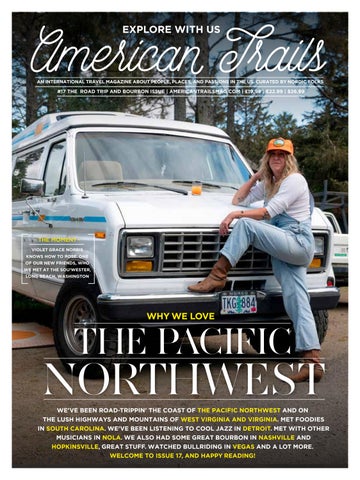
– THE MOMENT – VIOLET GRACE NORRIS KNOWS HOW TO POSE. ONE OF OUR NEW FRIENDS, WHO WE MET AT THE SOU’WESTER, LONG BEACH, WASHINGTON
WHY WE LOVE
THE PACIFIC
NORTHWEST
WE'VE BEEN ROAD-TRIPPIN' THE COAST OF THE PACIFIC NORTHWEST AND ON THE LUSH HIGHWAYS AND MOUNTAINS OF WEST VIRGINIA AND VIRGINIA. MET FOODIES IN SOUTH CAROLINA. WE'VE BEEN LISTENING TO COOL JAZZ IN DETROIT. MET WITH OTHER MUSICIANS IN NOLA. WE ALSO HAD SOME GREAT BOURBON IN NASHVILLE AND HOPKINSVILLE, GREAT STUFF. WATCHED BULLRIDING IN VEGAS AND A LOT MORE. WELCOME TO ISSUE 17, AND HAPPY READING!
CAN'T GET ENOUGH? VISIT OUR WEBSITE FOR SUBSCRIPTIONS AND BACK ISSUES
AMERICANTRAILSMAG.COM
FOLLOW THE BOT (SCAN THE QR-CODE) TO AN ETERNAL READING EXPERIENCE A.K.A. OUR FAVOURITE SHOP!
Before Anyone Did Anything SKO UNO Did Everything Lee Jeans, LEE 101, Dr. Martens, Wrangler Jeans, Levi’s Red Tab, Jofama, Solovair, Buffalo, Underground, Grinders. Sendra, Playboy, New Rock, Rock n Blue, Everyday Hero, Edwin, Nudie and more...
SINCE 1974
Gamla Brogatan 34, Stockholm sko-uno.com
The Coolest And Nicest Stores In Stockholm! Gamla Brogatan 23, Stockholm arbetarboden.com
Gamla Brogatan 34, Stockholm jeans-uno.com
Sense or Sensibility?
F
inding new trails in life can be exciting. How many wrong paths have we not taken that turn out to shape us as people? That could have looked different had we made other choices? And would we be worse off, or better? It’s hard to say, different is all we can know for certain. We took a path in 2017. The choice to start a magazine about people in North America, their passions and why they do the things they do, where they do them. Why? Tell me! What made you who you are, and why here? These are questions we ask pretty much anyone we meet on our travels – it makes for the best kind of reading. 2017 is eight years ago. Why did we choose to start such an ambitious project, when we could have just made customer magazines, fashion magazines, or straight up regular travel magazines? Easy gigs with financial stability. Nope, we decided to make a damn expensive magazine where we have to travel a lot and have no time left over for anything else. I think you already know the answer: it’s the feeling. Sensibility is for people with steady paychecks and 9-5 jobs. Nothing wrong with that, but we wanted to create a magazine about people fueled by the same restless soul as us. Always on the road, what’s around the next bend? Impulse control – out, flying by the seat of your pants – in. And this is what that gets you. Now we’re at a new trailhead, we’ve just chosen a new path. Starting with this issue, we’ve left the Swedish version, are down to two issues a year but up to many more pages per issue. It’s simply better this way, we were always more of a book than a magazine. Bored between issues? Our website will be serving up snacks starting this fall, with events, tips, and shorter articles on niche topics to keep you satisfied. In the best of worlds, American Trails would exist in several languages. But instead, we choose to celebrate the education system and our clever, non-English-native readers who can still enjoy the magazine in the one language. We also choose to celebrate joy, and romance. Romance, like the love of booze, cars, all things. Our most romantic and devoted colleague has written his first piece for the magazine in this issue. Normally, he’s busy holding up the heavens on his shoulders, or more typically photographing for us, other magazines, or ad agencies. But when Anders Bergersen was on his way back to the Thunderbird Motel in Marfa, Texas, at shit o’clock in the morning after a sunrise shoot, he hit the brakes next to a property full of old cars. Nothing stops Norway’s Steve McQueen, not even a (seemingly) blood-thirsty hound. That makes for a good read – you’ll find the article on page 206. There’s a trail ahead, it twists and turns, I can’t see what’s behind that pine, but I know that what’s there will be good. Happy reading! Jonas Larsson | Editor-in Chief | Head of all trails
5
AMERICAN TRAILS MAGAZINE #17
Washington & Oregon A ROAD TRIP DOWN THE OREGON COAST IS ALWAYS GREAT. BUT EVEN BETTER IN A FORD F 150, 1984. PAGE 100.
WASHINGTON
MONTANA NORTH DAKOTA
IDAHO SOUTH DAKOTA WYOMING
NEBRASKA
UTAH COLORADO
KANSAS
ARIZONA
NEW MEXICO
California
A SEQUOIA TREE CAN BECOME VERY OLD. THE GRIZZLY GIANT IS AT LEAST 1,000 YEARS. PAGE 18.
Nevada
PBR, PROFFESIONAL BULLRIDING IN SIN CITY. PAGE 132.
Utah
TEXAS
New Mexico
THE WHITE DUNES IN WHITE SANDS NATIONAL PARK, ALAMOGORDO. PAGE 16.
Texas
THE HIKE UP TO SCOUTS LOOKOUT VIA THE WEST RIM TRAIL IS A SCARY ONE. PAGE 56.
IT'S EASY TO FALL IN LOVE WITH OLD CARS. MEET BOB, A ROMANTIC CAR LOVER IN VALENTINE. PAGE 206.
6
AMERICAN TRAILS VÅR | 2020
Michigan THE FUTURE OF JAZZ MUSIC IN DETROIT. PAGE 148.
NEW HAMPSHIRE
MAINE
VERMONT
N.Y.C
MINNESOTA
MASSACHUSETTS
BROOKLYNS BEST KEPT SECRET, RED HOOK. PAGE 58.
MINNESOTA
WISCONSIN RHODE ISLAND MICHIGAN
CONNECTICUT NEW JERSEY
PENNSYLVANIA
IOWA
DELAWARE
OHIO INDIANA
MARYLAND
ILLINOIS
DISTRICT OF COLUMBIA WEST VIRGINIA
MISSOURI
VIRGINIA
Kentucky
WELCOME TO HOPKINSVILLE! YES WE ARE TALKING BOURBON. PAGE 74.38
NORTH CAROLINA
OKLAHOMA ARKANSAS
Rubrik ALABAMA
SOUTH CAROLINA
GEORGIA
VAD? | VAR, STAT/STAD
MISSISSIPPI
ALABAMA MISSISSIPPI TEXT OCH FOTO: JONAS LARSSON LOUISIANA
West Virginia & Virginia
TAKE ME HOME, COUNTRY ROADS AN APPALACHIAN ROAD TRIP. PAGE 20.
Första gången jag träffade Den Matt Pollitz så hade han sin Volvo-verkstad i en gammal plåtlada nere vid fiskebåtarna en bit ner på Market Street i Ballard, Seattle. Nu ligger nybyggda National Nordic Museum där, då lekte Matt med tanken på att hans verkstad kunde bli en interigerad del av museet. Det hade varit otorligt cool, men nu blev det inte så. Därför blev jag glad när jag såg att han omlokaliserat till en annan del av Ballard. En verkstad A HAVEN FORannanstans. SUN-SOAKING för gamla volvobilar ska självklart ligga i den genomnordiskaLONG stadsdelen, ingen En VACATIONERS, SOUTH intressant sak är att bilarna är relativt rostfria här, visserligen är det fuktigt i PacificCAROLINA North West FLORIDA A TOP-NOTCH men det snöar sällan i Seattle och man använder inte vägsalt,ISsåSECRETLY mossa ärALSO ett större problem än CULINARY DESTINATION. PAGE 158. rost … MEET THE BARREL BOYS OF Förutom NASHVILLE. att renoveraPAGE de gamla 74. trotjänarna så har han börjat elkonvertera dem också. Det bästa av två världar, även om en B18 alltid kommer att vara en B18.
Louisiana
Tennessee
WE ARE BACK IN NOLA. CAN GATUADRESS | HEMSIDEADRESS YOU HEAR THE MUSIC? PAGE 84.
7
AMERICAN TRAILS VÅR | 2020
South Carolina Florida
TO DIVE FOR! COWBOY UP IS A TRUE DIVE BAR IN FORT MYERS. PAGE 180.
Before Anyone Did Anything SKO UNO Did Everything Lee Jeans, LEE 101, Dr. Martens, Wrangler Jeans, Levi’s Red Tab, Jofama, Solovair, Buffalo, Underground, Grinders. Sendra, Playboy, New Rock, Rock n Blue, Everyday Hero, Edwin, Nudie and more...
SINCE 1974
Gamla Brogatan 34, Stockholm sko-uno.com
The Coolest And Nicest Stores In Stockholm! Gamla Brogatan 23, Stockholm arbetarboden.com
Gamla Brogatan 34, Stockholm jeans-uno.com
Content 5. TWIST AND TURN
100. ROAD TRIP | THE PNW COAST
Issue 17 – finally! Editor-in-chief Larsson is trying to find his way through the winding trails of life.
Put some Blondie on the speakers, roll down the windows, shout like a crazy person, and just go. So pretty.
6. THE MAP
132. PORTFOLIO | BULLS AND BRAVE BOYS | LAS VEGAS
Deep South, West Coast, or East Coast, nothing stops the American Trails Tribe!
This, even though it happened in Vegas, will get out. Check out Camilla Lindqvist's excellent photos of the crazy kids.
13. CONTRIBUTORS
146. I DO WANNA GET BURIED IN A CAR CEMETERY
Say hello to our friends, who are the best writers and photographers there are.
Ah, how we love these old trucks that line the backroads.
14. PINHEADS AHOY | ARLINGTON | TEXAS
Bring out your balls at this bowling museum.
Detroit has a proud music history; we're checking out the jazz scene. It's alive!
16. WHITE SANDS | ALAMOGORDO | NEW MEXICO
158. BARS, BEACHES, AND FOOD | SOUTH CAROLINA
A white sea of sand in New Mexico.
Long a haven for sun-soaking vacationers, South Carolina is secretly also a top-notch culinary destination.
16. READ ALL ABOUT IT! | L.A. | CALIFORNIA
A real bookstore is a true treasure. The Last Bookstore is one of the most unique and interesting bookstores around. 20. AN APPALACHIAN ROAD TRIP IN WEST VIRGINIA AND THE OTHER VIRGINIA
Cajsa Landin is behind the wheel. As always, we can be sure she will find all the interesting places.
Rubrik
148. THE JAZZ SCENE IN MOTOR TOWN | DETROIT
170. BURN THE TRAITOR! | CONNECTICUT
He is not forgiven nor forgotten. Benedict Arnold burns once a year still. 180. TO DIVE FOR | COWBOY UP | FORT MYERS
This is the watering hole where the cowboys of southwest Florida meet up for a drink.
38. HOPTOWN | KENTUCKY
182. RED WING RESCUE | STOCKHOLM | SWEDEN
Hopkinsville is a charming town with a lot to offer just outside the city limits – like craft distilleries.
Your boots are your best friends. But what happens when they get sick? You take them to the boot doctors.
56. A VERTIGO VIEW | UTAH
194. THE PYRAMID CLUB REVISITED | N.Y.C.
It's not the scariest hiking trail in Zion, but scary enough.
Start up the time machine. We're traveling to a paradise for drag queens and punk rockers. Come along to the 80s and The Pyramid Club in New York City.
58. HOOKED UP | N.Y.C.
In a God-forsaken part of Brooklyn lies Red Hook, and yes, we have the guide you need for the neighborhood. 74. DID I HEAR BOURBON? | NASHVILLE
In the country, we found some bourbon nerds, cheers! 82. GOATS GO FINE WITH WINE | WASHINGTON
Echoland Winery, located outside Walla Walla in Washington State, is a perfect example of a modern winery. Goats. 84. MUSICAL PORTRAITS | NEW ORLEANS
Photographer Peter Eriksson has dived deep into the musical world of NOLA. One of his favorite cities.
206. CARS AND DOGS | VALENTINE | TEXAS
Car cemeteries are like a drug to Anders Bergersen. In Texas, he fell back into his old addiction. 220. THE DINNER BELL | BENTON | KENTUCKY
The sign outside The Dinner Bell screams out that there is a smorgasbord here. Anything less than a grinding halt with the expensive rental car would be a misdemeanor. 222. VARSITY INN | WALLINGFORD | SEATTLE
Places like this are cultural institutions that are disappearing at an alarming rate, so head down to The Varsity Inn the next time you're in the Emerald City.
Stockholms Nicest
Workwear Store
SINCE 1974
Gamla Brogatan 34, Stockholm sko-uno.com
The Coolest And Nicest Stores In Stockholm! Gamla Brogatan 23, Stockholm arbetarboden.com
Gamla Brogatan 34, Stockholm jeans-uno.com
FOTO: ANDERAS BERGERSEN
American Trails EXPLORE WITH US
MAGAZINE
American Trails Magazine is a biannual publication and an online community, which focuses on people, places, and passions. We distribute the international edition in Europe and the USA.
EDITORIAL JONAS LARSSON EDITOR IN CHIEF AND PUBLISHER LARSSON@AMTRAILSMAG.COM BO SANDLUND ART DIRECTOR INFO@AMTRAILSMAG.COM ANDERS BERGERSEN STAFF PHOTOGRAPHER INFO@AMTRAILSMAG.COM
We do not accept responsibility for the loss of unsolicited materials. Permission is granted to quote and praise us as long as the source is identified. For permission to use any of our photos or stories, please contact the editors.
NATHALIE WOLF DESIGNER N.WOLF@AMTRAILSMAG.COM CHRESTIAN WILLHANS DESIGNER WILLHANS@AMTRAILSMAG.COM
ISSN 2002-7842
OFFICE
Rubrik
FREDRIK LUNDGREN DIGITAL CONTENT DIRECTOR LUNDGREN@AMTRAILSMAG.COM
PAPER HEART PUBLISHING TUNSTAVÄGEN 18, S-793 40 INSJÖN, SWEDEN
CAJSA LANDIN TRANSLATOR INFO@AMTRAILSMAG.COM
PER WOLF CEO P.WOLF@AMTRAILSMAG.COM JOHAN LETH PROJECT MANAGER | EDITOR LETH@AMTRAILSMAG.COM
ADVERTISING AND PARTNERSHIPS JONAS LARSSON LARSSON@AMTRAILSMAG.COM TEL: +46 70 76 01 720
C O LO P H O N PAPER COVER: AMBER GRAPHIC LAMINATED 300 G INLAY: MUNKEN ELK S PVA 120 G
FONTS TITLES: ACIER BAT, AW CONQUEROR DIDOT AND HEROE PRO BODY TEXT: ADOBE CASLON PRO 10/12 QUOTES: GOTHAM BOLD CAPTIONS: MUSEO SLAB 700 PRINT ÅTTA45 PRINT & MEDIA
A M E R I CA N T RA I L SM AG.COM
Taco-Mecca
Cosmic Accomodation Beer, booze & burgers www.garagebar.se
a tribe called
Contributors
In this issue we present four fantastic tribe members. Interested in joining the ranks? Send a line to info@amtrailsmag.com We are always interested in meeting new people and hearing their ideas.
CAMILLA LINDQVIST, STOCKHOLM, SWEDEN
Born in the north of Sweden but relocated to Stockholm to be a photographer. Camilla's focus has been lifestyle, portraits, interiors, design and travel reports around the world. In this issue she show her work from an unforgettable evening at the Professional Bull Rider Finals Week in Las Vegas. Page 132. Find out more: camillalindqvist.com Instagram: @photographercamillalindqvist CHRESTIAN WILLHANS, TÄLLBERG, SWEDEN
Our latest addition to the editorial team. Chrestian is deeply addicted to caffeine and holds the speed record for cars under 1000 cc on ice. He has previously worked as a graphic designer, art director, illustrator, copywriter, photographer, writer, marketing manager, TMA driver, and... fixer. Fun fact: his previous employment contract listed “Maserati and helicopter” under “other benefits”. Here, he sells himself for coffee.
Rubrik
CAJSA LANDIN, N.Y.C., USA
Cajsa Landin is a freelance writer and translator, based in New York but with one foot perpetually on the road in search of Americana. When she isn't off on assignments that involve drinking bourbon, she translates crime novels and psychology nonfiction, writes articles about child development and parenting, and is editor in chief of SWEA NY Magazine. cajsalandin.com SIMON NESTOR, JÖNKÖPING, SWEDEN
Writer, photographer, and commercial editor Simon Nestor lives in Jönköping, Sweden, but spends a lot of time in the American Midwest. With a passion for storytelling and a soft spot for American culture, he traveled to Detroit to explore the city’s legendary jazz scene. See what he found on page 148. Find out more: simonnestor.com Instagram: @simonnnestor @simonnestor.art
GABBA GABBA HEY! FOLLOW US ON
SOCIAL MEDIA @AMERICAN_TRAILS_MAGAZINE
14
AMERICAN TRAILS VÅR | 2020
Rubrik
VAD? | VAR, STAT/STAD
TEXT OCH FOTO: JONAS LARSSON
Första gången jag träffade Den Matt Pollitz så hade han sin Volvo-verkstad i en gammal plåtlada nere vid fiskebåtarna en bit ner på Market Street i Ballard, Seattle. Nu ligger nybyggda National Nordic Museum där, då lekte Matt med tanken på att hans verkstad kunde bli en interigerad del av museet. Det hade varit otorligt cool, men nu blev det inte så. Därför blev jag glad när jag såg att han omlokaliserat till en annan del av Ballard. En verkstad för gamla volvobilar ska självklart ligga i den genomnordiska stadsdelen, ingen annanstans. En intressant sak är att bilarna GROVE är relativt rostfria här, visserligen är det fuktigt i Pacific North West THE GRIZZLY GIANT | MARIPOSA | CALIFORNIA men det snöar sällan i Seattle och man använder inte vägsalt, så mossa är ett större problem än WORDS AND PHOTO BY JONAS LARSSON rost … As tall as the Statue of Liberty in NewFörutom York and least as de divine, The Grizzly Giant firmly attatrenovera gamla trotjänarna så har is han börjat elkonvertera dem också. Det bästa rooted in the Californian soil. Sequoias can live to be very old, often exceeding 1,000 years. av två världar, även om en B18 alltid kommer att vara en Grizzly, B18. with its 28 feet (8.5-meter) diameter at the base, should be in that class. It was born around the time of the Crusades on the other side of the Atlantic. GATUADRESS | HEMSIDEADRESS The tree looks different from most other sequoias; this bear has been through a lot. Lightning strikes that caused it to branch out. One of the upper branches, which looks like an upper arm biceps, six feet in diameter! The sooty foot of the tree tells us that there has been a forest fire here every five to twenty years. Grizzly is a tough cookie and will probably stand for a while longer. 15
Tree time YOSEMITE.COM
AMERICAN TRAILS VÅR | 2020
PEOPLE, PLACES AND PASSIONS
16
AMERICAN TRAILS MAGAZINE #17
V
Pinheads ahoy!
BOWLING MUSEUM & HALL OF FAME | ARLINGTON | TEXAS
WORDS AND PHOTO BY JONAS LARSSON
No one knows for sure whether it was the Egyptians who invented bowling 5,200 years ago or possibly some Germanic tribe in the 300s AD. But one thing is certain: it was in the United States that bowling got its current form. More precisely, on September 9, 1895, at Beethoven Hall in New York City, the American Bowling Congress was born. Then and there, the process of standardizing the sport began. A quick jump to the 1950s and the breakthrough of television. Now bowling became a televised sport and the interest exploded. You can learn all this and much more at the museum. Most of all, I was captivated by all the stylish bowling clothes from the 50s and 60s, but there is a lot to see and the museum is interesting even for those who are not hardcore bowlers. For example, this crazy golf ... sorry, bowling car. The only thing I missed was the purple jumpsuit that “The Jesus” wears in the movie “The Big Lebowski”. In my opinion, it’s the best bowling scene ever on the silver screen. But “The Dude” would probably have said: “That’s just like your opinion man.” BOWLINGMUSEUM.COM | 621 SIX FLAGS DRIVE ARLINGTON
n
PEOPLE, PLACES AND PASSIONS
E
18
AMERICAN AMERICAN TRAILS TRAILS MAGAZINE VÅR#17 | 2020
A sandy white sea
WHITE SANDS NATIONAL PARK | ALAMOGORDO | NEW MEXICO WORDS AND PHOTO BY CAJSA LANDIN
Climb over an enormous sand dune to find the landscape spread out before you: cool, white desert waves as far as the eye can see, wrapped in New Mexican mountains and punctuated by one lone sumac tower, just a stone’s throw from the Trinity atomic bomb testing site. As the sun sets in fiery orange and pink, and the ground melts into the wispy white clouds above the horizon, the ridged dunes look like they could be the bottom of the ocean, the snowy expanse of Antarctica, or the moon. The park is dotted with visitors, but you wouldn’t know it from the silence. The experience is overwhelming, like a reminder of your own insignificance but in a way that makes you think, alright then. If you’re looking for the ends of the Earth, then White Sands National Park is for you. Short and long hikes across the dunes, sand-sledding for the kids, and outdoor concerts on full moon nights. But as soon as the sun has set behind the ridge, hurry back to your car, because the middle of nowhere gets real dark in no time at all, and the wind will sweep away any trace of a trail. NPS.GOV/WHSA
19
AMERICAN TRAILS VÅR | 2020
20
AMERICAN TRAILS | #11
Take Me Home,
COUNTRY ROADS
AN APPALACHIAN ROAD TRIP | WEST VIRGINIA | VIRGINIA It’s too easy, isn’t it? Popping John Denver on the car stereo and drifting off down the winding roads. I hear her voice in the mornin' hour, she calls me. Sunlight trickling through leafy foliage, serpentine byways in green tunnels, punctuated here and there by an open overlook to deep gorges and milewide views. Almost heaven, West Virginia. WORDS AND PHOTOS BY CAJSA LANDIN
The magnificent New River Gorge Bridge, located near Fayetteville, West Virginia, is the longest steel arch bridge in the Western Hemisphere.
22
AMERICAN TRAILS | #11
For being a national park in the US, the outlook is blissfully unregulated. No fences, no signs telling you that a thousand-foot drop can kill you. There are fewer people than at parks out west, a camaraderie among strangers making their way out of the foliage. At the very edge of the outcrop, overlooking the bridge, two old ladies sit chatting. They turn around, smiling. “Do you want us to take your picture?” Before the bridge was built in 1977, the only way to cross the New River was to make your way down the gorge on a narrow 13 km switchback road and across a rickety bridge at the bottom, a bridge which remains today. I follow the now scenic one-way road into the depths. On the old bridge, someone has sprayed “Joseph loves Cynthia 2023”. Wonder if it’s still true in 2025. The river is fat here, calm, diving into little rapids, mostly muddled. That’s the way it goes when you, despite your name, are one of the world’s oldest rivers. The air is a thousand percent humidity. “Air you can wear,” as a woman said in the parking lot. Personally, I think I might be wearing mosquitoes. I stop in for coffee at Waterstone Outdoor Co. to get some work done, and I feel a little like the woman at the beginning of a Hallmark movie who is about to learn that
OLD RIVER, NEW RIVER
The car rolls across the bridge near Fayetteville, West Virginia, an unassuming highway overpass with a steady stream of thundering long-haul trucks. This isn’t the way to see it. A quick detour gets me to the Long Point Trailhead, an easy two-mile stroll into the forest that has me wondering if I’m on the wrong trail. It’s important to get everything just right, asap. Then, suddenly, the woods clear and there she is: the majestic New River Gorge Bridge, an inspiration hiding under the humdrum motorway. This steel arch bridge spans an impressive 924 meters and is part of the New River Gorge National Park. The gorge itself is over 240 meters deep, lined with billowing greenery the whole way down. 23
AMERICAN TRAILS MAGAZINE #17
TAKE ME HOME, COUNTRY ROADS | WEST VIRGINIA | VIRGINIA
I
’ve come to this part of Appalachia, straddling the state lines of Virginia and West Virginia, not sure what I’m looking for. My to-do list is peppered with sights to see, a few inklings of what this region is about, and the sense that I must do it all in a limited amount of time. But time, I will soon learn, runs on its own schedule here.
24
AMERICAN TRAILS | #11
TAKE ME HOME, COUNTRY ROADS | WEST VIRGINIA | VIRGINIA 25
AMERICAN TRAILS | #11
The charming center of Elk City, West Virginia.
The view from the trail at Mountain Lake Lodge, Virginia.
26
AMERICAN TRAILS | #11
deadlines aren’t everything. The barista tells me I have to see the bridge at sunset, so I do. It’s gorgeous. A family stands next to me on a little outlook platform. I want to tell them it’s gorgeous. The look in their eyes tells me they already know.
By the Kanawha Falls, the town’s first permanent building remains: the Glen Ferris Inn. I drag my bag into the carpeted, 19th century halls, passing a wraparound patio and a sunroom full of games. The receptionist tells me several prominent Americans have stayed here, presidents and Civil War generals alike. Most residents seem convinced they remained, but I think that’s just superstition.
PRESIDENT JACKSON, HAVE A SEAT
Eschewing the interstate, I hop on the windy scenic byway known as the Midland Trail, which bucks and weaves along the old New River, every turn a stomach-dropping view. On a narrow landing, the Mystery Hole appears, a secret attraction the kind you could only expect to find here. The fact that it is closed, and the hole will forever remain a mystery, irks my to-do list, but more so my curiosity. I shake the feeling around the hairpin turn of Devil’s Elbow, and the car rolls into Glen Ferris at twilight. Glen Ferris, a town of 200 people and the Kanawha Falls, figured in the Civil War before turning into a mining town. In 1930, drilling in nearby Hawk’s Nest led to the deaths of 400 mainly black workers after exposure to silica dust, one of the worst industrial disasters in American history.
TAKE THE UNEXPECTED EXIT
In the morning, after a deep sleep punctuated only by a few startled convictions that the empty rocking chair in the corner did, in fact, move, I reclaim the chair and try to remember how to feel stressed about my to-do list. It’s become clear that it’s hard to resist the calm here. The soft, swelling Appalachian Mountains, the old, slow river. The friendly West Virginia drawl that lulls you through conversations. Suddenly you’re rocking gently in a haunted inn along an aged river at sunrise, letting time and thoughts drift away around the river bend, and it feels just fine. Continuing on to Charleston, West Virginia’s unassuming capital, a large billboard catches my eye. For salt. Now I don’t know about you, but I thought salt came 27
AMERICAN TRAILS MAGAZINE #17
TAKE ME HOME, COUNTRY ROADS | WEST VIRGINIA | VIRGINIA
The views are spectacular on most trails in West Virginia and Virginia. Here is a view near Mountain Lake Lodge, Virginia.
28
AMERICAN TRAILS | #11
AMERICAN TRAILS | #11
29
TAKE ME HOME, COUNTRY ROADS | WEST VIRGINIA | VIRGINIA
THEY’RE BOTH EAGER TO TELL ME THEY’RE NOT THE WEST VIRGINIA STEREOTYPE. IT SURE FEELS TRUE, BUT THE WAY LILLIAN SAYS ANY-ALL-HOO MAKES ME THINK MAYBE SHE GOT ALL THE BEST PARTS OF THE STATE THAT MADE TAKE ME HOME, COUNTRY ROADS | WEST VIRGINIA | VIRGINIA
HER. A LITTLE BIT NORTH, A LITTLE BIT SOUTH. WEST VIRGINIAN.
from the ocean, and I am nowhere near one. This wasn’t on the itinerary, but maybe the itinerary doesn’t matter. Sometimes you have to get off the main road, let yourself be distracted by a billboard. I take the exit. J.Q. Dickinson Salt Works looks like a winery: same bucolic farmlands, same fancy barn that has you craving a folksy wedding. Lillian Kratz shows me around the operations, which have been around since 1817, pulling brine from deep in the ground out of what was once the ancient Iapetus Ocean. Turns out this salt does come from the sea. All it needed was time. While I scour the giftshop, Lillian entertains me with witty stories about growing up here as a preacher’s daughter. A man comes in, delivering insurance papers. A history buff who refurbishes hundred-year-old ice boxes, Matt Porta explains how West Virginia was different in the war. (Everyone is still talking about the war. They always mean the Civil one.) In fact, the state itself was created during the war, seceding from Confederate Virginia and joining the Union, partly to abolish slavery. “It’s the northernmost Southern state and the southernmost Northern state,” Matt sums it up, and the pieces of my experience here start to come together. It’s not quite the South. But it’s not not the South.
“Are West Virginians what you assumed?” he asks, not the first time I’ve heard it this trip. West Virginia has higher poverty rates than the rest of the country and is one of its poorest states. The main industry is coal mining – an industry that is both in decline and providing mostly low-income jobs, while also fueling declining health in its workers. Backwards hillbillies with a meth problem is a common trope. They’re both eager to tell me they’re not the West V irginia stereotype. It sure feels true, but the way Lillian says any-all-hoo makes me think maybe she got all the best parts of the state that made her. A little bit North, a little bit South. West Virginian. Armed with their list of recommendations for Charleston, I get back on the road: Taylor’s Books. Biscuit World. Nano Brewery. Bullock Distillery. The to-do list grows again. THAT’S JUST CAPITAL
Charleston is a small town of around 47,000 people but an impressive state museum, with a rickety old escalator and a lobby full of quilts. The museum is free – just like the national park, just like the other museums I’ve visited on this trip, an excellent quality in a state. The museum winds you through all of West Virginia history; it could be cheesy, but at the end of it, I feel happy. 30
AMERICAN TRAILS MAGAZINE #17
The Mystery Hole remains a mystery to us. Unfortunately, it was closed when we visited.
31
AMERICAN TRAILS | #11
The tranquility at Grist Mill in Babcock State Park in West Virginia.
32
AMERICAN TRAILS MAGAZINE #17
Matt and Lillian told me I had to go to Elk City, the up-and-coming part of Charleston, and it is clearly the cool neighborhood. Beautiful old buildings restored into breweries, coffeeshops, and bicycle repairs. I have a coffee (and the best pastry this side of the Atlantic) at The Vandalia Company before sauntering in to Kin Ship Goods, where I want to buy all of their on-brand possum mugs. The cashier tells me she moved here from Florida, and that she’s found the town liberal, forward-thinking, with a lovely community. This pocket is full of life, but remnants of a ghost town are just around the corner. Is West Virginia digging itself out of its mining rubble and toothless stereotypes? The state feels like a secret that hasn’t fully discovered itself yet.
roaring waters drowning out conversations but not smiles. I take pictures of a family in front of the old house. “Do you want one of you as well?” A middle-aged couple sit on a rock outcrop below the mill, fishing. I ask if they catch anything. The husband chuckles, shaking his head. “It’s a moment’s peace, at least,” he says, and maybe that’s the better catch. The drive curls through small towns along the New River, overlooks and river rafting landings, lush foliage and sweeping valleys, and before I know it, I’ve crossed the state line into Virginia, beginning a climb into the mountains. And then it appears as if out of a movie: the large stone edifice just outside of Blacksburg that is Mountain Lake Lodge, better known as Kellerman’s from Dirty Dancing. The movie was shot here in 1986 and still thrives off its legacy. You can stay in Baby’s cabin, play games on the sprawling front lawn, or wait for Patrick Swayze at the gazebo. The Hallmark movie feeling taps me on the shoulder again.
NOBODY PUTS BABY IN THE CORNER
Heading east again, I stop by the Grist Mill at Babcock State Park, and it’s the first breath of fresh, cool air I’ve had all week. My shirt unsticks from my spine. The Grist Mill sits at the top of a fall, spring flowers just starting to stretch their limbs in purples and pinks, the 33
AMERICAN TRAILS MAGAZINE #17
TAKE ME HOME, COUNTRY ROADS | WEST VIRGINIA | VIRGINIA
Nobody puts Baby in the corner at Mountain Lake Lodge!
New River Gorge Bridge attracts many visitors.
34
AMERICAN TRAILS | #11
AMERICAN TRAILS | #11
35
TAKE ME HOME, COUNTRY ROADS | WEST VIRGINIA | VIRGINIA BRIAN BENT | CALIFORNIA
TAKE ME HOME, COUNTRY ROADS | WEST VIRGINIA | VIRGINIA
West Virginia State Museum in Charleston, West Virginia, showcases the state’s history. Free admission.
The old library-turned-bar beckons in the early afternoon. It’s dark, all mahogany and leather seats and a big fireplace, and I want to live in here an entire winter. The bartender warns me, “It goes from Dirty Dancing to the Shining real quick,” while the couple next to me says “You have to try their fried green tomatoes.” The husband makes it clear that only his wife is here for the movie, he’s here for the golf.
southwest Virginia and into West Virginia. While he tells me all about the region, its history and its people, my lungs are busy slowing their breath, expanding to the horizon. The Virginias remind you to slow down, tell you that you may not always know what you need, but you’ll know it when you see it. The Appalachian Mountains took a few hundred million to get where they are, you can stand to sit on this rock a little longer. A couple approach, inching out to the ledge. I put down my bag, and a to-do list flies away on the wind. “Any-all-hoo,” I say to them. “Would y’all like me to take your picture?”
A VIEW TO THE END OF THE WORLD
In the end, though, it isn’t the dream of being lifted into the air by Patrick Swayze that wins me over and steals my heart. Around the lodge, 2600 acres of land have been preserved for public use and education, an immense treasure. Julius gives me a gator ride up to Bald Knob, sidewinding to the top of the mountain, and there it is: the whole world, I think, although Julius tells me what we see is 36
AMERICAN TRAILS MAGAZINE #17
The beautiful old Grist Mill is located at the top of a waterfall.
37
AMERICAN TRAILS MAGAZINE #17
HOPKINSVILLE || KENTUCKY KENTUCKY HOPKINSVILLE
the land of Legendary Aliens and
moonshiners We love small towns. Hoptown is at the top of our list, slumbering between rolling hills of corn, tobacco, and grains. A couple days of scenic road trips and world-class burgers teach us all we need to know all about evil aliens, moonshiners, and bourbon.
A
WORDS AND PHOTOS BY JONAS LARSSON
voice rings out. ”Kate! Kate!” my guide and newfound giggle buddy Amy yells at the top of her voice. I see a few women and children walking around, picking up trash along the sidewalk. Kate Russel comes up to say hello. “Hi! Glad you’re here! My husband Joey and I run the local brewery, come by for a beer.” Sounds like a good suggestion to me. But I’m curious why they’re picking up trash. “You have to stick together in a small town,” she says. “It’s important that it looks nice, so a group of us go out to clean up now and then.” I like it. Straight up feel-good material. It's time for lunch, and Amy brings me to mom-andpop diner Ferrell’s. They’ve been flipping burgers here since 1929, and it’s straight out of a movie. The place is no more than a hundred square feet, honest to God. Green stools line the short counter, and the two women behind it can barely turn around, but what a place!
The patties come balled up out of the fridge, this is the good stuff, no frozen burgers here, this is the real deal. I order a cheeseburger and a sweet tea. Hands down, this is the best burger I’ve ever had. No tired McDonald’s burger, no pretentious hipster concoction pierced with a cocktail stick. Just a wrinkly little burger that tastes truly amazing. The pickles alone! The meat! The cheese! The Emerson Fittipaldi of burgers. DEATH MARCHES AND ALIEN ATTACKS
After lunch, it’s time for an education. It’s been all laughs so far, but now it gets stuck in our throat as we visit the Trail of Tears memorial and its accompanying museum. From 1830 to 1850, 60,000 people from five different indigenous tribes were forced out of their homes in the South. The government had decided to relocate them to Oklahoma on the other side of the Mississippi, so the settlers could exploit their lands. In several rounds, they were sent away by foot, horse, or wagon, and tough conditions, starvation, and illness caused 15,000 people to 38
AMERICAN TRAILS MAGAZINE #17
THE LAND OF LEGENDARY ALIENS AND MOONSHINERS | KENTUCKY Kate Russel runs the local brewery with her husband.
39
AMERICAN TRAILS MAGAZINE #17
Amy outside the local museum. Aliens are a big deal in Hoptown. However, I only saw a couple when I was there.
40
AMERICAN TRAILS | #11
HOPKINSVILLE IS ALSO KNOWN FOR ITS FLOUR AND PANCAKE BATTER, SO NATURALLY THE MUSEUM HOUSES A GIGANTIC PLASTIC STACK OF PANCAKES WITH A PAT OF BUTTER ON TOP. “YOU DON’T KNOW FUNNY UNTIL YOU’VE SEEN ME HOIST THAT OUT OF MY TRUCK AND CARRY IT DOWN THE STREET TO THE MUSEUM,” AMY LAUGHS.
lose their lives. They’d winter here in Hopkinsville, stock up on supplies. Some of the locals took them in. Two of the Cherokee chiefs, Chief Whitepath and Chief Fly Smith, died here in 1838. We visit their graves, where two bronze statues of the men stand watch. It’s moving. The little museum showcases Cherokee tools and utility items, beautiful pieces with a powerful history. More history awaits, albeit of a less disheartening sort. Inside the old post office, lies the city museum. May sound a little stuffy, but instead, it’s good stuff. The exhibits are modern and interactive; kids (and I) love it. Notably, one of them is about the evil aliens that attacked a nearby farm in the 1950s, another about the local psychic who contacted the other side in the early 20th century. Totally my kind of museum. Modern, interesting, and a little eccentric.
Hopkinsville is also known for its flour and pancake batter, so naturally the museum houses a gigantic plastic stack of pancakes with a pat of butter on top. “You don’t know funny until you’ve seen me hoist that out of my truck and carry it down the street to the museum,” Amy laughs. HOOCH DISTILLERS AND MOONSHINE-MAKERS
I like museums as much as the next guy, but Amy is tugging at my arm to go to two distilleries. Can I get a cheers? We head out in the beautiful countryside. Smoke rises from barns where farmers dry tobacco, corn is harvested across the billowing hillsides, soybeans are almost ready. We roll up to Casey Jones Distillery. The barn doors to the rickhouse, where bourbon, rye, and whiskey are stored, 41
AMERICAN TRAILS MAGAZINE #17
THE LAND OF LEGENDARY ALIENS AND MOONSHINERS | KENTUCKY
Hopkinsville is not a big city, but it is a very charming small town.
It is not only the best burger I’ve had so far but also the most incredible little hamburger joint I’ve encountered. You’ll love the mom-and-pop diner, Ferrell’s.
42
AMERICAN TRAILS | #11
AMERICAN AMERICAN TRAILS TRAILS MAGAZINE | #11 #17
43
THE LAND OF LEGENDARY ALIENS AND MOONSHINERS | KENTUCKY
C.J. Casey has a fantastic history and produces bourbon and whiskey that are in high demand.
THE LAND OF LEGENDARY ALIENS AND MOONSHINERS | KENTUCKY The barrels are stacked high in The Rickhouse, where the whiskey gets its distinctive flavor.
45
AMERICAN TRAILS MAGAZINE #17
The people who work here are happy even though they’re not allowed to drink on the job.
46
AMERICAN TRAILS MAGAZINE #17
are open. We head in. A sweet scent of bourbon greets us. A voice calls, “Do I need to get my shot gun?”, promptly followed by a giant laugh. It’s Master Distiller, A.J., trying to scare his old friend – my new friend and guide – Amy. Not a chance. A.J.’s guard dog follows, a cute beast of all of three pounds who likes to be scratched. A.J.’s grandfather was legendary Casey Jones, West Kentucky’s best moonshine still-builder. So good that dudes like gangster king Al Capone from Chicago bought them. It was a way to support oneself in the tough years between the world wars, but highly illegal. So Casey got caught a few times, spent two years behind bars. After that, he quit the business. One more arrest and they would’ve locked him up and thrown away the key. As usual, I’ve gotten swept up in conversation with several nice distillers and hooch makers. Amy tugs at me, but I manage to taste a few of their fantastic bourbons before we have to move on. Casey Jones is a craft distillery whose flavors linger on your tongue, and I manage to grab a bottle of Rye Forward Mash Bill Bourbon on the way out. Amy races through the bucolic corn field landscape, dotted with abandoned houses, old tractors, and large
trucks harvesting corn in the fields. On our right, I see a barn with a gigantic mural along the side. “That’s where we’re going,” Amy says. “Isn’t it cool?” Merry Beth comes out to greet us – no guard dog here, only three guard cats fully busy sleeping in the shade on the porch. GRAIN TO GLASS DISTILLERY
M.B. Roland distillery is in Pembroke, or “Downtown St. Elmo” as Merry Beth, one of the distillery co-owners, calls it. (St. Elmo amounts to all of a few houses along the country road, at best.) Merry Beth and her husband Paul run a small-scale craft distillery here. When we arrive, artist Brad De La Torre is working on the giant mural we saw from the road. Brad is shirtless – understandable since it’s 85 degrees. I move up to get a closer look of the painting, and with the way the heat bounces off the tin wall, it’s a miracle that man hasn’t passed out. Merry Beth and Paul started out with a small distillery in 2009. “We started small. We’re not an old whiskey family like the Beams. Neither of us had been in the liquor industry before. Paul was in the military and got tired of ‘holidaying in Iraq’, I was a bank manager. On a trip to 47
AMERICAN TRAILS MAGAZINE #17
THE LAND OF LEGENDARY ALIENS AND MOONSHINERS | KENTUCKY
The only thing better than old bourbon is an old truck.
The countryside outside Hoptown is stunning.
48 48
AMERICAN AMERICAN TRAILS MAGAZINE TRAILS | #11 #17
AMERICAN TRAILS | #11
49
THE LAND OF LEGENDARY ALIENS AND MOONSHINERS | KENTUCKY
THE LAND OF LEGENDARY ALIENS AND MOONSHINERS | KENTUCKY
Merry Beth and her husband Paul run a small-scale craft distillery here.
50
AMERICAN TRAILS MAGAZINE #17
Cats make poor guard dogs.
M.B. Roland is a small-scale distillery that welcomes visitors and produces exceptional bourbon.
Brad De La Torre is working on the giant mural we saw from the road.
THE LAND OF LEGENDARY ALIENS AND MOONSHINERS | KENTUCKY
Japan, Paul got turned on to their topnotch whisky. When he came back, he said, ‘I want to try to make it.’ But the thing is, you can’t just try to make it, home distilling is illegal. I explained this to my husband. ‘Well then I think I want to make it for real, commercially,’ he said! That’s when I hear myself say, ‘Alright, let’s do it!’” Merry Beth says, shaking her head. “We bought this farm, which used to be a dairy farm run by an Amish family. Now we sell to 15 states and have 40,000 visitors every summer. Visitors get a tour of the distillery and a whiskey tasting. If they want, they can buy the whiskey they love the best.” She continues. “Before Prohibition, there were over 200 small distilleries like ours. By the end of it, about six larger ones remained. The large distilleries make good
whiskey, but it’s mass produced. We work with local farmers, local corn, winter wheat, and malt. It gives it a totally different taste, feels more genuine. You could say we go back in history, to a pre-Prohibition style. We buy our barrels from Kelvin Cooperage, a local cooper. Their take on the craft is similar to ours. They do everything by hand, roasting the wood over open flame, not with a blowtorch like so many others. It gives their barrels a totally different flavor, and the barrels are an important part of the process. We use two pot stills instead of column stills like many others do. That also helps give the whiskey a more historic style.” I try my way through a dozen or so varieties, bringing home a barrel aged bourbon that warms my chest when I try it, what is known as the “Kentucky Hug.” 52
AMERICAN TRAILS MAGAZINE #17
Diante poured me a fantastic amber; thank you, Diante.
THE LAND OF LEGENDARY ALIENS AND MOONSHINERS | KENTUCKY
AN IRISHMAN IN KENTUCKY
Amy and I have dinner at the Local. Finally, a real steak, it slides right down into my stomach, accompanied by two Guinness pints. And yes, Peter who runs the place is a real Irishman, even if he’s scrubbed out the dialect. “Anytime a friend calls from Ireland, my wife stares at me, wondering what language I’m speaking,” he laughs. BEER FOR A CHANGE
Hopkinsville Brewing Company opens at four: I’m ready and waiting. A long day like this one has made me thirsty, but mostly I need to get into cooler air. Late September, the Kentucky sun is on fire. Katie sits on a couch in the bar section with her husband, Joey, and the rest of the family, plus some friends. The sense of community is strong, a big family where everyone helps out. The brewery itself is actually two buildings, half of which is an old auto shop. Where the paint shop used to be, a lab and storage space has taken its place. “Other than power washing the place, we haven’t really done much to it,” Joey says. It’s so well done. A couple of old church pews and movie theater chairs nestle in with benches and tables. Cozy. “We started seven years ago. Joey and I were both in the military, that’s what brought us here, we served at Fort Campbell. When our service was up, we wanted to stay. There was no brewery in town, so we thought that would be good. Good business, sure, but we also wanted to do something nice for the town, create a space where people could meet. The library, museum, and others use our space sometimes, and we pour drafts at the library when they have events. We help each other. “Was there an unmet need?” I ask. “I’d say there was a subconscious unmet need, if you know what I mean,” Kate replies. It has become the obvious meeting place for the small town. And the beer? Wooee, good stuff. Diante at the bar pours me an amber that lands like a warm blanket in my belly. I have time for one more before returning to the hotel. The small-town charm has caught me, and Hopkinsville is a small town. It’s no bigger than that you can see it in a day or two, but it makes a perfect stop on your road trip. It’s particularly lovely to drive around the countryside around the town, tasting bourbon, visiting a distillery or two, and just enjoying the beautiful landscape. 54
AMERICAN TRAILS MAGAZINE #17
55
AMERICAN TRAILS 1 | 2017
Joey and Kate met at the army base here, just like many others we met.
PEOPLE, PLACES AND PASSIONS
56 56
AMERICAN AMERICAN TRAILS TRAILS MAGAZINE MAGAZINE #17 #17
BRIAN BENT | CALIFORNIA
A Vertigo View
SCOUT LOOKOUT | ZION NATIONAL PARK | UTAH WORDS AND PHOTO BY JONAS LARSSON
The hike up to Scout Lookout via the West Rim Trail is 3.3 miles (5.8 km) up and back. It may not seem that far, but you'll be carrying your body 1,223 feet (423 meters) up. That makes it a bit harder, doesn't it? That's not the worst problem on this gorgeous hike, though. No, it's the trail, which is narrow and slippery; on one side, a drop straight down - a couple of hundred meters; on the other side, a chain polished by cold, sweaty hands. It's your best friend, don't let it go. If, like me, you have a raging fear of heights, it's a - uh, small consolation. But, it's worth it, every day of the week. The view is stunningly beautiful, and once up there, you can go exploring. If you're not afraid of heights, I recommend Angels Landing. The scariest of all the hiking trails in Zion, but I was content to see 57 it from Scout Outlook. AMERICAN TRAILS MAGAZINE ZIONNATIONALPARK.COM | VISITUTAH.COM #17
NEW YORK NEIGHBORHOOD GUIDE CITY GUIDE | BROOKLYN | RED HOOK | NEW YORK
Off the Hook
IN BROOKLYN
Red Hook is the New York neighborhood you didn’t know you didn’t know about. In a little corner surrounded by water, easiest to reach by ferry from Manhattan, lie a tight-knit couple of blocks which, thanks to their isolation, have become a unique community. Here, you’ll find cozy restaurants, passionate entrepreneurs, epic dives and a small-town feel hard to reconcile with the busy Manhattan skyline behind it. WORDS AND PHOTOS BY CAJSA LANDIN
58
AMERICAN TRAILS MAGAZINE #17
59
AMERICAN TRAILS | #11
B R O O K LY N | R E D H O O K | N E W Y O R K C I T Y
Li’l bit of History At one time the busiest freight port in the world, Red Hook has a long history as a town of sailors, longshoremen, and dock workers. Being surrounded by water on the Brooklyn floodplain and separated from the rest of the city as both a peninsula and one of few neighborhoods without subway service, the neighborhood has been home to both low-income populations and creatives looking for cheaper rents. Its isolation has created a tight community and the feeling of being in a small town, not a world metropolis. Now home to a vibrant arts, culture, and small business initiative scene, Red Hook feels like a pot of popcorn, constantly bursting, popping, and making everything around it come alive. Most of the action is on Van Brunt Street, the perfect little street for a day of sauntering and saying yes to whatever entices you, but don’t be afraid to step off to nearby cobblestone streets – or even the industrial area at Red Hook’s very point, where wineries, breweries, piers, and pies all are perfect spots for soaking up the spirit of the neighborhood.
60
AMERICAN TRAILS MAGAZINE #17
61
AMERICAN TRAILS MAGAZINE #17
AMERICAN TRAILS MAGAZINE #17
62
B R O O K LY N | R E D H O O K | N E W Y O R K C I T Y
Four favorites in
red hook BonBon
Swedes will instantly recognize the clear containers of black licorice, milk chocolate, and gummies that make up lördagsgodis, pick-and-mix candy. Bobby, Leo and Selim started their first candy shop on the Lower East Side a few years ago and it has become wildly popular with expat Swedes and native New Yorkers alike. This is their warehouse, which they’ve decided to keep open on weekends. But get there early, there’s a line around the corner most days. BONBONNYC.COM | 66 DEGRAW STREET
360 Record Shop
A place this solid doesn’t need a fancy name. A store most locals know only as “Record Shop” is a neighborhood mainstay for classic records, used LPs, and little gems you couldn’t find anywhere else. Linger a minute, and you’ll see Red Hook culture at its finest: young and old dancing to records, reading books from the little shelf by the bench outside the door, chatting with Robbie and his strange rocks on the sidewalk, or hearing an impromptu from one of the regulars. That they host live music most weekends goes without saying. 360RECORDSHOP.COM | 360 VAN BRUNT STREET
A Red Hook institution
Ask anyone in Red Hook where you have to go, and they’ll say Sunny’s. An absolute institution a hundred years in the making, this legendary bar has everything you want in a dive – a back room for live music, a garden for summer drinks, weird figurines staring at you from above the bar, revelers spilling onto the cobblestone sidewalk outside – and, of course, a register that only takes cash. Go here, do it. SUNNYSREDHOOK.COM | 253 CONOVER STREET
Treat on a stick
It’s tempting to think no one will find a small storefront at the outskirts of an industrial area that sells nothing by key lime pie, but one look at the line on a Saturday afternoon and you know you’d be wrong. These pies are fantastic – pick up a Swingle, chocolate-dipped, frozen key lime pies on a stick in different flavors and enjoy it on the picnic tables or in the nearby park overlooking the Statue of Liberty. But take Steve’s own advice and grab extra napkins, you’ll need them. KEYLIME.COM | 185 VAN DYKE STREET
B R O O K LY N R E D H O O K | N E W Y O R K
At one time the busiest freight port in the world, Red Hook has a long history as a town of sailors, longshoremen, and dock workers. It’s surrounded by water, and separated from the rest of the city as both a peninsula and one of few neighborhoods without subway service.
65
AMERICAN TRAILS | #11
66
AMERICAN TRAILS | #11
AMERICAN TRAILS | #11
67
B R O O K LY N | R E D H O O K | N E W Y O R K C I T Y
B R O O K LY N | R E D H O O K | N E W Y O R K C I T Y
Mexican dive vibes
The first place you run into coming off the ferry, San Pedro is the kind of place where you could lose a whole afternoon to drinking margaritas and chatting with the bartender, or you could use it as your jumping-off point for a night on the town (aka Van Brunt Street). Grade A nachos, grade A staff, and an energy that perfectly balances between very laid back and very ready for anything. On a sunny Friday evening, get there early to grab the popular corner table out front and watch the world go by. SANPEDROINN.COM | 320 VAN BRUNT STREET
Widow Jane / Botanica
Tiburon 2
WIDOWJANE.COM | 220 CONOVER STREET
TIBURON2REDHOOK.COM | 361 VAN BRUNT STREET
Widow Jane distillery has expanded on the fine tradition of brewing and distilling in Brooklyn, making award-winning bourbon from heirloom corn in their old brick factory not far from the old docks. Botanica, their corner cocktail bar, serves up an excellent cocktail (or mocktail, if you are so inclined), and the sidewalk seating is perfect for people watching.
Do you technically need more patches, stickers, cards, ironic sweatshirts, or palo santo sticks that say Trust the fucking process? Define need. Tiburon 2 is the kind of store that draws you in, with its mix of bric-a-brac, vintage clothing, and spare game pieces, and it’s the perfect little shop to stop during that pocket of time between brunch and afternoon drinks.
69
AMERICAN TRAILS MAGAZINE #17
NYC Ferry
A popular alternative for bus-wary Manhattanites, the ferry brings you to Red Hook from Wall Street in about ten minutes, but it’s so much more than transportation. This little boat gives you great views of New York and its bridges, as well as a direct and easy route to the amusement of Coney Island, the beaches of The Rockaways, and destinations further uptown on both the Manhattan and Brooklyn sides. The perfect start – or end – to any sunny day adventure. FERRY.NYC | CLINTON WHARF
70 70
AMERICAN AMERICAN TRAILS MAGAZINE TRAILS | #11 #17
AMERICAN AMERICAN TRAILS TRAILS MAGAZINE | #11 #17
71 71
B R O O K LY N | R E D H O O K | N E W Y O R K C I T Y
Waterfront Museum and Showboat
Stepping onto this old barge is not just a visit at a maritime museum of sorts, it’s a whole experience. Most likely, you’ll get the chance to run into David, who not only runs the museum but is the one who originally rescued this 100+ year-old barge in the 80s and brought it to Brooklyn – and lives on it with his family. You’ll get an insightful history lesson about work on the waterfront and see tools and artifacts from ships of old, but mostly you’ll hear delightful stories of New York through the ages. Open Thursdays and Saturdays (it is a family home, after all), free to the public. Keep an eye on the calendar for events and performances. WATERFRONTMUSEUM.ORG | 290 CONOVER STREET, ON PIER 44
Strong Rope Brewery – Brew with a View
Your mother told you not to wander down among the warehouses and delivery trucks, but she was wrong. At the very end of Red Hook, in the middle of the industrial remains, lies Strong Rope Brewery. Yet another popular weekend destination for Manhattanites and sun-worshippers, the Brewery lets you try local brews from a looong list and then enjoy it in their large outdoor yard, great for groups, kids, dogs, and romantics hoping to catch the sunset behind the Statue of Liberty. STRONGROPEBREWERY.COM | 185 VAN DYKE STREET
72
AMERICAN TRAILS | #11
B R O O K LY N | R E D H O O K | N E W Y O R K C I T Y
Polt Atölye
Leather goods shop in front, workshop in the back. This place is the craft version of farm to table, where you can watch the team create beautiful little leather vases, coasters, cases, and other leather goods, as well as canvas goods and items created by other artisans. Fittingly for such a small outfit, they are open by appointment, or sort of generally if the weather’s nice. POLT.COM | 390 VAN BRUNT STREET
73
AMERICAN TRAILS MAGAZINE #17
RUBRIK
RUBRIK
DESTINATION/STAD |STAD/STAD Ingress.
It’s what’s TEXT: XXXXXXX | FOTO: XXXXXXXXXXXX
IN THE BOTTLE that counts
NASHVILLE BARREL COMPANY | NASHVILLE | TENNESSEE Nashville knows whiskey. We’ve met two guys (and one dog) who have bonded over their love of single barrel picking and are bringing this fine art to the eager masses – locals and visitors alike. Meet James and Mike of Nashville Bourbon Company. WORDS AND PHOTOS BY CAJSA LANDIN ADDITIONAL PHOTOS COURTESY OF NASHVILLE BARREL CO.
74
AMERICAN TRAILS MAGAZINE 74 #17 AMERICAN TRAILS | #11
75
AMERICAN TRAILS | #11
“TO PEOPLE WHO ARE BRAND NEW TO WHISKEY, AND DON’T KNOW WHAT TO EXPECT FROM IT, THE FIRST THING THAT STRIKES THEM IS THAT SPICY BURN AT FIRST THAT WARMS YOUR CHEST,” MIKE HINDS SAYS WISTFULLY, AND IT’S
IT'S WHAT'S IN THE BOTTLE THAT COUNTS | TENNESSEE
CLEAR WHY IT’S CALLED THE KENTUCKY HUG, EVEN ACROSS THE STATE BORDER.
Y
“
ou have to meet Stella,” he says. “She’s the boss.” Mike Hinds, the company’s CEO and co-founder, briefly leaves the room. I straighten my shirt. After some commotion, a golden doodle with the energy of a Red Bull-fueled toddler bounces in, wearing a bowtie, narrowly missing the chair she tries to land on. “She just got a trim, so she’s ready to represent the brand,” Mike explains. “People ask for her by name.” To say that this distillery does things their own way is an understatement. But let’s start at the beginning. We pull into a non-descript parking lot in an industrial area, about three miles from bustling downtown Nashville – far from the countless, half-finished skyscrapers reaching into the bright blue beyond. In the sweltering summer afternoon, Nashville feels like a city molting. Then we walk in the door at Nashville Barrel Company and instantly understand what the place is about. It’s got a homey feel, and based on the buzz around the small tasting bar, you can tell that while this is a place where locals go, everyone is welcome.
BEFORE BOURBON WAS COOL
“While the upside to buying a blended bottle from one of the big producers might be that you always know what you’re getting, the downside is that you know what you’re always getting.” Mike and James Davenport, Nashville Barrel Co.’s Chief Blender and co-founder, first met, as they say, “before bourbon was cool”. A self-proclaimed bourbon enthusiast, Mike was spending his free time picking single barrels and trying anything new and exciting. James, meanwhile, had several years of whiskey retail under his belt. Ultimately, however, it was their mutual commitment to charity work that brought them together. Mike was picking single barrels for a charity raising money for cancer research and found James, and soon they had founded the company to let more people in on the art and joy of picking barrels. Picking single barrels allows for a more unique selection and the ability for the drinker to really specify a flavor profile they’re looking for. Each barrel gives its own flavor and color to the bourbon within, a bit of magic that might disappear when blended with other barrels. A whole single barrel, however, is going to be pricey and hard to get a hold of, so the ability to buy into a 76
AMERICAN TRAILS MAGAZINE #17
A barrel sample never hurt anyone.
77
AMERICAN TRAILS MAGAZINE #17
IT'S WHAT'S IN THE BOTTLE THAT COUNTS | TENNESSEE
barrel with others is the way to go for most mere mortals. It’s what brought the Nashville Barrel gang and their old friends together to begin with, and making this experience available to regular shoppers has made new friends out of many customers. For people who aren’t experienced whiskey drinkers, the folks at Nashville Barrel Co. are more than happy to begin their education journey. “A lot of people know Jack Daniels, and that’s it,” says James, and notes that they’re seeing more people coming in who may not be “barrel heads” who know what they’re looking for. Beyond regular barrel tours, they run classes for people looking to expand their knowledge, all the way from the start. “To people who are brand new to whiskey, and don’t know what to expect from it, the first thing that strikes them is that spicy burn at first that warms your chest,” Mike Hinds says wistfully, and it’s clear why it’s called the Kentucky hug, even across the state border. With not a whiff of snobbism, anyone you talk to at the distillery can walk you through what to look for, how the whiskey experience may differ between bottles or barrels, and how to figure out what you yourself like. For people who still prefer other spirits, they also sell their WooShine liquors and rums, as well as blended and small batch whiskeys. HEARTS THE SIZE OF TENNESSEE
The dedication to charity that first brought them together still courses through Nashville Barrel Co. today. Organizations that support families of veterans are particularly meaningful to James, himself a veteran. He says supporting veterans means a lot to him, but that when it comes to bourbon, he wants to focus on what’s in the bottle and that his time in the military doesn’t affect how he works. At which point Mike interjects. 78
AMERICAN TRAILS MAGAZINE #17
79
AMERICAN TRAILS MAGAZINE #17
“TO HAVE THE BEST COCKTAILS, YOU HAVE TO START WITH THE BEST INGREDIENTS,” SAYS MIKE. HE EXPLAINS THAT STARTING WITH A HIGHER PROOF WHISKEY ALSO PREVENTS THE COCKTAIL FROM GETTING
IT'S WHAT'S IN THE BOTTLE THAT COUNTS | TENNESSEE
CRITICAL TO THE DRINK AND SHOULD NEVER BE SKIPPED.
“Maybe you don’t see it, but we do,” he says to his partner. “There’ll be times when we’re scrambling to finish things and running on no sleep, and he’ll just be up here getting it done. I think he doesn’t realize what he brings from his service, but we see it in how he shows up, the things he does.”
that. Ten years in, it’s candy. Ten years in, it’s a bourbon drinker’s rye.” Right now, their most popular bottles are the 7-year single barrel bourbons, but the Founders 14 straight bourbon series is dear to their heart. “That series means a lot to us,” James continues, “because those were the first 14 barrels that we bought.”
TOP NOTES OF HUMILITY
WHISKEY SOUR
Perpetually humble, it’s hard to get out of these two what might make Nashville Barrel Co. better than anyone else. But they clearly take pride in the product and what they put in their bottles. “What matters most to us is picking good products. Most of our whiskey is a lot older than what comes out of the big five,” says James. “And they add a lot of water to make it 80 proof, which ours isn’t. This is what gives our whiskey such full flavor.” Mike continues, “We do well because people know us and like us,” and it’s easy to agree. Listening to these two talk about whiskey is like cozying up with your favorite bedtime story as a child, except better because it includes whiskey. They bring a complete lack of pretentiousness to the table, and it’s clear that even complete novices could come here and feel okay about asking questions or be allowed to enjoy whatever they enjoy. Asking them to pick a favorite among their bottles, however, is like asking them to pick a favorite child. But they try. “I do like bigger, bolder, richer, in-your-face whiskeys,” says James. “It depends on the time of year, like typically in winter it’s rye time. People, when they think of rye, they think spicy, but it doesn’t always mean
Finally, we bond over a mutual love of the whiskey sour, a perfect cocktail made with whiskey, lemon juice, bitters, simple syrup, and egg white. Mike and James are happy to share their secrets to making it perfect. “To have the best cocktails, you have to start with the best ingredients,” says Mike. He explains that starting with a higher proof whiskey also prevents the cocktail from getting watered down. They both agree that the egg white is absolutely critical to the drink and should never be skipped. It doesn’t change the flavor, but it is everything when it comes to texture. “I also recommend trying chocolate bitters,” says James, for a twist on the classic Angostura. “And in winter you can use rye whiskey. It’ll give you that spicy holiday feeling.” With that, Stella barks, demanding to greet a new group at the door. She is the boss, after all.
80
AMERICAN TRAILS MAGAZINE #17
Mike and James Davenport at Nashville Barrel Co. However, the real boss is Stella, who is in the photo on the first two pages.
81
AMERICAN TRAILS MAGAZINE #17
THE MOMENT | WALLA WALLA | WASHINGTON WORDS BY JONAS LARSSON AND PHOTO BY ANDERS BERGERSEN
Everyone loves a wine tasting. The flavors, the aromas, the colors. We looked forward to a wine tasting at Echoland Winery outside Walla Walla in Washington. We had heard they have fantastic wines, a winery with modern architecture, and an incredible tasting room with panoramic windows. All of this was true when we got there. Moreover, the staff were some of the friendliest and funniest people we've met in a long time. So everything was great. But what made this an unforgettable moment was meeting the goats! In a paddock guarded by two sturdy Great Pyrenees dogs, a herd of adorable goats and a few sheep were grazing. The animal's job is to graze on the crops sown between the vines so they don't grow too high. A much better way than using smelly and noisy machines. The dogs? There are plenty of cougars, mountain lions, and coyotes here. 3281 MILL CREEK RD, WALLA WALLA, WA | ECHOLANDSWINERY.COM
82
AMERICAN TRAILS VÅR | 2020
83 83
AMERICAN AMERICAN TRAILSTRAILS MAGAZINE VÅR #17 | 2020
PEOPLE, PLACES AND PASSIONS
Rubrik
84
AMERICAN TRAILS MAGAZINE #17
NEW ORLEANS | LOUISIANA
A musical journey through
The Big Easy
What happens when we send one of our best photographers on his dream journey? Music-loving Peter Eriksson comes back with shining eyes, shining pictures, and shining text. Join us on a journey into the beating heart of New Orleans.
F
WORDS AND PHOTOS BY PETER ERIKSSON
rench Quarter in New Orleans. A mix of sin, alcohol, music, tourists, and parades might pop into your head when you hear the words. The parade street is the legendary Bourbon Street. At any bar you look in, the volume is more or less turned up to the maximum. In the evening, the volume is raised further if possible - as is the alcohol intake, often in the form of a daiquiri you buy "to go" at one of countless small bars. For me, a visit in the evening is enough to cross the experience off the list - it's well worth a visit, but it's much more fun to look beyond Bourbon Street to places where music culture still thrives in earnest.
The parallel Royal Street is also bustling with people, but the volume isn't nearly as high. If you're lucky, you can catch one of New Orleans' superbands playing at the corner of Royal Street and St. Peter (a stone's throw from the legendary Preservation Hall). The reason they're called "superbands" is perhaps mainly due to the lack of other names, but also because the musicians who gather and play are a large and diverse group of musicians. Many of them play in several other bands in New Orleans, and there may be a member or two from Deslondes or Tuba Skinny. Both local greats who have made a name for themselves outside the city. There may be guest musicians visiting, or musicians from one of the other countless bands that make up this "scene". The music is hard to pinpoint, whether it's a 85
AMERICAN TRAILS MAGAZINE #17
A MUSICAL JOURNEY THROUGH THE BIG EASY | LOUISIANA
cover of Hank Williams, early bluesman Bo Carter, or a jazz standard like St. James Infirmary Blues. The instruments are as diverse as the musicians (who can number up to 20!) and are often of the older variety; there are dobros, accordions, 'washtub bass' (a single-string bass made of string, a broomstick and an old galvanized wash tub as a resonator), banjo, clarinet, trumpet, tuba, washboard, etcetera - and if you're lucky, there might even be some tap dancing. The musicians themselves are as bohemian a mix as the instruments, and you jump in as the mood takes you, it seems; after I've been listening for half an hour, a tuba player appears on a bicycle, chats with some of the other musicians, and then falls in naturally in the middle of a song. It would be easy to label the music "retro", but that would be too easy. Instead, the music sounds like the kind of American music that has always existed, eternal music born out of the melting pot that American "folk music" actually is, a heritage from European and African folk music. In short, it's like listening to centuries of American musical history - but one that doesn't sound the least bit antiquated; instead, it's alive. SCENE I, THE TIGERMEN DEN, BYWATER
Although it's November, the temperature is almost 30 degrees Celsius when I meet Sam Doores at The Tigermen Den. The venue is located in Bywater and was built in the 1830s. It has, among other things, been a local shop and bar, but it has been dedicated to music for some years. Without knowing it, I am about to ruin a recording when I knock on a window with the curtain drawn - clumsy because I hear a rolling piano with accompanying accompaniment, and perhaps should understand better. After waiting a little while, the object of my visit - Sam Doores - appears, and we settle into a small grassy plot opposite the Tigermen's Den. Sam would probably never admit it himself, but he seems to be one of the central figures in the music scene here. In 2006, just after Katrina devastated much of the
86
AMERICAN TRAILS MAGAZINE #17
87
AMERICAN TRAILS 1 | 2017
Sam Doores has played with The Tumbleweeds/ The Deslondes, and Hurray for the Riff Raff, among others.
88
AMERICAN TRAILS | #11
SAM TELLS ME WHAT HE THINKS MAKES NEW ORLEANS SO VIBRANT MUSICALLY. ”OF COURSE, ALL THE MUSICAL HISTORY IS IN THE CITY'S VEINS, BUT THE FACT THAT SO MANY MUSICIANS HAVE BEEN ADDED OVER THE YEARS MEANS THAT
city, he arrived in New Orleans. Sam was attracted by director Jim Jarmusch's classic movie Down By Law and parts of Woody Guthrie's and Bob Dylan's autobiographies describing the city - but primarily by the music itself. He was on a road trip with a cousin, and the idea was that they would visit Jazzfest, but Sam stayed behind and has since used the city as a base both geographically and musically. Initially, he made a living on the streets as a 'busker' and he could earn enough to survive. A new acquaintance offered a sofa to sleep on, and the circle of friends gradually grew. After a while, Sam formed a band called The Tumbleweeds and simultaneously started playing with Hurray for the Riff Raff. When their record company pointed out that the name The Tumbleweeds was already taken, they needed to come up with a new name, which became The Deslondes, named after the street on which their studio was located. The Deslondes have been growing in popularity and have toured Europe on numerous occasions, but tellingly for the creative climate, most of the members of the band have also released solo albums, and I would argue that Sam's self-titled solo debut is one of the best albums of the last five years. Sam tells me what he thinks makes New Orleans so vibrant musically. ”Of course, all the musical history is in the city's veins, but the fact that so many musicians have been added over the years means that the scene is constantly infused with new blood and stays vital. There's also a certain attitude where many musicians are old-school hobos. They've jumped on trains all around the US, like Woody Guthrie did during the Depression in the 1930s, and got
off in NOLA. They brought an attitude of confidence and self-assurance in their approach to both life and music.” Sam seems to have played with everyone in New Orleans; he can sometimes be seen playing drums with a superband, piano or guitar with Deslondes, or with Sabine McCalla, Jackson & the Janks, or others. He has also organized small one-day happenings at The Tigermen Den called "For the sake of song," where he invites familiar artists introduced to the audience and often takes turns backing each other up. In short, Sam is a person who both attracts and withdraws from different contexts and musical collaborations, and he has several things in the pipeline that will continue to feed the loose collective of musicians. - "A new chapter," he says with a smile and explains that one - or maybe two! - new studios are being built for continued music production. SCENE II, THE LEVEE, HOLY CROSS
I’m looking at the New Orleans skyline with an increasingly falling sun as a backdrop at the levee in Holy Cross. The water in the Mississippi River is low and looks relatively harmless, but at times of the year, the waterline can rise 8-9 meters, and in the very place we are standing and admiring the beginning sunset, the levee broke when Katrina whipped New Orleans in 2005. It seems unreasonable that a place that feels so peaceful this evening was the cause of one of America's greatest disasters of the 21st century. A few minutes late, Max Bien Kahn shows up on his bike. He pulls out a bottle of white wine from his backpack and picks up a couple of mugs to offer a drink to accompany the sunset. Like Sam Doores, Max plays with 89
AMERICAN TRAILS MAGAZINE #17
A MUSICAL JOURNEY THROUGH THE BIG EASY | LOUISIANA
THE SCENE IS CONSTANTLY INFUSED WITH NEW BLOOD AND STAYS VITAL.
Preservation Hall is one of the most classic venues in NOLA.
90
AMERICAN TRAILS | #11
AMERICAN AMERICAN TRAILS TRAILS MAGAZINE | #11 #17
91 91
A MUSICAL JOURNEY THROUGH THE BIG EASY | LOUISIANA
"YOU'D LOVE IT. YOU CAN PLAY A GIG EVERY NIGHT WITH MANY DIFFERENT BANDS - AND RENT A ROOM FROM ME FOR TWO MONTHS.” GINA DECIDED TO TAKE UP THE OFFER WITH THE PLAN TO MOVE TO NASHVILLE AFTER THE TWO MONTHS WERE UP, BUT THE MOVE DIDN'T
A MUSICAL JOURNEY THROUGH THE BIG EASY | LOUISIANA
HAPPEN, AND NEW ORLEANS HAS BEEN HER HOME EVER SINCE.
a number of different bands in New Orleans, but perhaps he spends most of his time playing banjo and guitar in Tuba Skinny, a "Traditional Jazz, Blues, & Ragtime Band" as they describe themselves, and his own band Max and the Martians, which he describes as his "rock band" and which recently released a new album. Max says he came to New Orleans 12 years ago and soon after met a number of musicians who had settled there, including Sam Doores, Alynda Lee, and members of Tuba Skinny. Max would occasionally fill in as a guitarist in Tuba Skinny as they busked on the city streets, and after a couple of years, he became a regular member of the band. Max also confirms that many who have come to the city are hobos and "train hoppers." He elaborates that it was partly the music that attracted them to the city, but many were also relief workers in the years after Katrina - the feeling was that New Orleans was an "open city" because so much of it had disappeared and needed to be rebuilt. Tuba Skinny, like Deslondes, has gained a reputation outside of New Orleans, and Max has toured the US and Europe with them. The members of Tuba Skinny initially played with different musicians in different trad jazz bands. Eventually, they found a more settled form. Max, who had tired of more traditional rock after moving to Nola, had had enough of all the equipment that rock music requires, and liked the bare bones of acoustic music - and that you can play it wherever you are. “Brass Band culture is very much alive in New Orleans; it's not just an antiquated form of tourist attraction; the music has been passed down through generations and lives on. It’s essential to emphasize that the city is the
origin of jazz and that black people created the music in a largely black city. ‘Free black men’ once created the music that Tuba Skinny manages today. The attitude of the band is punk - we don't play the game of the record industry, we don't care about the rules, we record at home - more like a family than a business.” SCENE III, FATS DOMINO AVENUE, HOLY CROSS
A light and lukewarm rain is pouring down as my companion and I make our way to Gina Leslie's house in the Holy Cross neighborhood. Like in large parts of New Orleans, well-kept houses in various colors coexist with houses that seem to have fallen into disrepair since Katrina. The house Gina rents is a beautiful old two-story house split down the middle in a typical American way. Gina shares her part of the house with friends to get a reasonable rent. Inside, it feels like a typical musician's home in NOLA, slightly bohemian and, of course, with an old Gibson draping the sofa. Gina's dog Toni is overjoyed to have visitors and wagging his tail happily at my feet. A few nights before we meet, I see Gina and Max Bien Kahn taking turns accompanying each other on guitar and bass at BJ's in Bywater. As with many of the musicians we meet, it is difficult to describe what genre Gina's music is in, but there are elements of country, folk, and jazz. Most distinctive is Gina's voice, which is close to the listener in light arrangements where a slide guitar and a clarinet can coexist as if it is the most natural thing in the world. Gina grew up in a small town in Colorado. Like many Americans, Gina moved around, living, working, and 92
AMERICAN TRAILS MAGAZINE #17
Max Bien Kahn is one of many artists who stayed in NOLA after a visit.
93
AMERICAN TRAILS | #11
The Spotted Cat is one of many great clubs on Frenchmen Street.
94
AMERICAN TRAILS | #11
AMERICAN AMERICAN TRAILS TRAILS MAGAZINE | #11 #17
95 95
A MUSICAL JOURNEY THROUGH THE BIG EASY | LOUISIANA
Gina Leslie was born in Colorado but has moved frequently. In 2016, she settled in New Orleans.
96
AMERICAN TRAILS | #11
to create and play music. “New Orleans is the only city I know where you can make a living as a musician,” she concludes. SCENE IV, THREE MUSES, FRENCHMEN STREET
We're sitting at the bar of the excellent Three Muses, slurping down their equally excellent Yakamein (New Orleans' version of noodle soup). On the small stage, Leo Forde and his trio Double Whisky are playing Django jazz. The line-up is stand-up bass, violin, and Leo himself on guitar. Musically, it's more traditional and differs from Sam's, Max's, and Gina's music in that it professes more clearly to a particular genre. Still, you can hear that the love of the music is the same - it's good and genuine music. When it turns out that Leo is from Scotland, I decide to find out what a European's experience of moving to NOLA is like - can it really be as paradisiacal as the locals claim? But of course, Leo reinforces what I've already heard from Sam, Max, and Gina - and of course, his trip to New Orleans is also reminiscent of theirs. He came here in 2014. 97
AMERICAN TRAILS MAGAZINE #17
A MUSICAL JOURNEY THROUGH THE BIG EASY | LOUISIANA
studying in many places before setting her sights on New Orleans in 2016. Her friend Rick convinced her to come here. "You'd love it. You can play a gig every night with many different bands - and rent a room from me for two months.” Gina decided to take up the offer with the plan to move to Nashville after the two months were up, but the move didn't happen, and New Orleans has been her home ever since. “ I grew up in a musical family where I learned to play the violin as a child and had a good grasp of bluegrass and country. Then when I lived in Venice, LA, it was more pop and singer/songwriter - new music,” she says with a laugh. “I like New Orleans so much because I don’t want to play new music. I want to learn old music and be a ‘little fish’ in an environment like this.” Just like Sam and Max, she only had a single friend when she came to the city, but today, in addition to her music, she plays with at least 5-6 other bands. Gina confirms what Sam Doores and Max Bien Kahn (both of whom Gina also plays with) have said; you are constantly finding new people, contexts, and opportunities
A MUSICAL JOURNEY THROUGH THE BIG EASY | LOUISIANA
“It was only meant to be a short visit, but I liked the music as much as the weather and the people - and the community. It's such a friendly place. And there are musicians everywhere!” Leo first studied music in Scotland and then moved on to France to learn more about improvisational jazz, where he heard younger musicians playing 'Django jazz' and was inspired to start playing it himself. To do so, he moved to Philadelphia to study further. He went down to visit New Orleans for a short break, and loved the city instantly. “It got under my skin, and a little over a year later, I moved here,” he says. Like the other musicians, he didn't have any acquaintances before the move, but as soon as he got there, he sought out Frenchmen Street and soon found a bunch of musicians he still hangs out and plays with. In the beginning, he played with a few different bands and did some busking on the streets, which was enough to make a living. Today, he can choose projects a little more freely. He also emphasizes that it is not a competitive environment; on the contrary, you play and hang out with each other in different constellations.
“It’s like a bunch of friends”, he says with a laugh. When I say that it is difficult to describe the city without falling into clichés like “New Orleans seems so vibrant, friendly, and curious.” Leo laughs further and says, “But it really is!” I can't imagine a city getting a better rating than that. So, if you have just a bit of interest in American music culture, you must go here, but keep in mind that there is a risk that you will end up staying!
98
AMERICAN TRAILS MAGAZINE #17
Leo Forde and his trio Double Whisky play Django jazz at The Three Muses. Leo is on the far right.
ROAD TRIP GALORE
Keep on truckin'
HIGHWAY 101 | WASHINGTON | OREGON | CALIFORNIA Sure, there are legendary roads like Highway 1, Route 66, and The Great River Road. But you haven't gone on a road trip unless you've burned rubber down Highway 101 from Seattle to Frisco in an old Ford truck—in three days! WORDS BY JONAS LARSSON | PHOTOS BY ANDERS BERGERSEN
100 100
AMERICAN AMERICAN TRAILS TRAILS MAGAZINE | #11 #17
101 101
AMERICAN AMERICAN TRAILS TRAILS MAGAZINE | #11 #17
ROAD TRIP GALORE | WASHINGTON | OREGON | CALIFORNIA
A younger sibling acts as a defibrillator for the “Grandpa-Ford”.
I
wish you boys luck, I wouldn’t do it!” These were the not-so inspiring words Uncle Mike had sent us away with, delivered with a crooked, slightly concerned smile. Now, standing at a gas station with gas gushing out of the broken fuel line, I see what he meant. We’ve driven all of forty miles. But let’s start at the beginning. I’ve spent years lusting after Uncle Mike’s hunting truck, a black and red, 1984 Ford F150 4x4. A truck that can go anywhere, high gear, low gear, this thing is a tank. On the couch at my cousin Scott and his wife Tami’s house, Scott told me that the truck was getting put up for sale. “Ok, I’ll buy the pickup, how much does he want for it?” “Well first off, it’s a truck, not a pickup. Second, how would you get it to Sweden?” “Anders and I will drive it to San Francisco and put it on a ship, of course!” They couldn’t stop laughing. I WISH YOU BOYS LUCK
Cut to: six months later, at Sunland, the family summer home on a Columbia River bank. My friend – and photographer – Anders revs the engine. The ancient cliffsides rising around the river look down at us, smiling. The truck starts with a bang, and we make our way up Silica road winding on serpentine roads through East Washington’s spectacular landscape. For forty miles. Then here we are, at the before-mentioned gas station, scratching our heads while the gasoline creates a river on the asphalt. Those of you who read the last issue’s article know what happened next: the fuel pump burst and sprayed gas all over the hot V8 engine. So, let’s skip ahead to our friends Laura and Malte in Tacoma. We’re already two days late with a tardy start, so our first stop isn’t far, but it’s a good one. We haven’t seen each other in a few years, and it’s a sweet reunion. After laughing all through dinner, we sleep like children. The next day, our road trip really begins. The only problem is, we’re already low on time. Being low on time when you’re about to drive one of the most beautiful stretches in North America is a bad idea. A really bad idea. 102
AMERICAN TRAILS MAGAZINE #17
103
AMERICAN TRAILS MAGAZINE #17
AMERICAN TRAILS MAGAZINE #17
104
ROAD TRIP GALORE | WASHINGTON | OREGON | CALIFORNIA
Laura and Malte are some of the most generous and fun friends we have. Always laughter, good food, and drinks. And not too infrequently, some form of karaoke.
If Uncle Mike can’t fix it, it’s probably broken.
Cannon Beach, the night before, we were picked up by the police.
106
AMERICAN TRAILS MAGAZINE #17
107 107
AMERICAN AMERICANTRAILS TRAILSMAGAZINE MAGAZINE #17 #17
Day one WHere we discover our new favorite trailer park and meet some new friends “Anders, we really have to keep the pace, okay? It’s going to be beautiful the whole way, but we can’t stop all the time, okay?!” I say this with an assertive, firm tone. I’ve traveled with photographers before; I know how this goes. Anders nods, but also smiles one of his more mischievous smiles. Alright, shades on, safety belts strapped, radio up: it’s time for a three-day road trip along the Oregon coast! A giant fucking frying pan. That’s how Long Beach greets us. This half-forgotten beach town in Washington state’s southernmost corner is a gem. On our right, Seaview Cottages looks cozy but has no sea view. We roll into Sou’wester Historic Lodge & Vintage Travel Trailer Resort, old airstreams and vintage travel trailers surrounding a large wooden lodge. Plastic birds and various kitsch accoutrements arranged around the trailers. A band plays Americana to an enthusiastic crowd of eight. Liz greets us, and her smile is so wide that we nearly book a trailer on the spot, even though we don’t have time to stay. She shows us around and tells us about the place. There’s a VHS library, games, guitars to borrow if the mood strikes you; the décor is vintage cool. Anders and I both love it instantly. I strike up conversation with a group of friends who envelop us in their camaraderie right away and try to get us to stay the night, but we’re already so late. If you have any artistic dreams, play in a band, or just like chill people and places or lean a little hippie, this place is for you.
108
AMERICAN TRAILS MAGAZINE #17
ROAD TRIP GALORE | WASHINGTON | OREGON | CALIFORNIA
A frying pan welcomes you to Long Beach. It was created in 1941 to promote the city's first annual clam festival. Wellington Marsh Sr.'s clam fritter, cooked on the pan, required 200 lb (91 kg) of clams to make.
109
AMERICAN TRAILS MAGAZINE #17
Emily, Bianca, and Eli compare tattoos.
110 110
AMERICAN AMERICAN TRAILS TRAILS MAGAZINE MAGAZINE #17 #17
AMERICAN TRAILS MAGAZINE #17
111
ROAD TRIP GALORE | WASHINGTON | OREGON | CALIFORNIA
If you feel like it, you can borrow a guitar and try your hand at being a singer-songwriter.
According to her tattoos, Emily is also a shark hugger of the highest order.
Happy, smart, funny, and beautiful, we met Bianca and her friends at Sou’wester. An encounter that really lifted our trip.
AMERICAN TRAILS MAGAZINE #17
113
ROAD TRIP GALORE | WASHINGTON | OREGON | CALIFORNIA
ROAD TRIP GALORE | WASHINGTON | OREGON | CALIFORNIA
We also met these two fantastic guys, Eli and Johnathan, at Sou’wester.
114
AMERICAN TRAILS MAGAZINE #17
YOU CAN DRIVE 833 MILES IN THREE DAYS. You can drive from Cannon Beach, Oregon, to Eureka, California,
in one day, like we did. But we don’t recommend it. Highway 101 is a never-ending source of views, cozy little beach towns, and wild and varied nature. Give yourself at least five days. Sou’wester Lodge in Long Beach alone deserves a few nights. Stay in an RV or a trailer, hang out with cool people and explore the town.
115
AMERICAN TRAILS MAGAZINE #17
116
116
AMERICAN AMERICAN TRAILS TRAILS MAGAZINE MAGAZINE #17 #17
ROAD TRIP GALORE | WASHINGTON | OREGON | CALIFORNIA 117
AMERICAN TRAILS MAGAZINE #17
All styles are allowed. It really is a magical place.
ROAD TRIP GALORE | WASHINGTON | OREGON | CALIFORNIA
Sou’wester also has a vintage store located in a trailer.
118
AMERICAN TRAILS MAGAZINE #17
The excellent Violet Grace Norris knows how to pose.
Liz, a true Californian girl, works at Sou’wester.
119
AMERICAN TRAILS MAGAZINE #17
120 120
AMERICAN AMERICAN TRAILS TRAILS MAGAZINE MAGAZINE #17 #17
121 121
AMERICAN AMERICANTRAILS TRAILSMAGAZINE MAGAZINE #17 #17
ROAD TRIP GALORE | WASHINGTON | OREGON | CALIFORNIA
Day two
WHere we sleep on the bed of the truck and try to explain why to an officer of the law Cannon Beach “Hey guys, do you know who owns that truck?” “Yes, sir, I do.” “Okay, some people called in, concerned. Did you sleep on the bed of the truck?” “Yes, sir, we did.” “That’s illegal, in Oregon you’re not allowed to sleep in your vehicle.” Technically, we didn’t sleep in the car. We slept on it. But this isn’t a fight I’m about to pick with the nice police officer. “You know, this is Cannon Beach. Everybody knows one another. It’s fine, but I do need to check your IDs.” Neither Anders nor I show up in any police records, and officer Jordan wishes us a good trip. We spent the previous night on the beach. A dozen or so fires tried, unsuccessfully, to compete with the starry sky. I sat there freezing, happy to see Anders finally appear out of the dusky darkness. “Where were you?” “It’s so pretty, I had to take some pictures,” he apologized. “Fine, but this whiskey isn’t drinking itself,” I responded, swigging the bottle high over my head. We kept warm with the help of the liquor and the gorgeous view. As night approached, we tucked ourselves into our truck bed sleeping bags to watch the Big Dipper disappear in a fog rolling in from the Pacific Ocean until the Sandman did his thing. Cannon Beach is a must on any Highway 101 road trip in Oregon. This charming small town boasts a long, beautiful beach, pierced by Haystack Rock like a giant statue out in the water. The days are all about that beach life, but the chilly evenings might be the best part. Buy wood, make a fire on the beach, just hang out – perfection. The town itself is full of little shops, restaurants, and bars.
122
AMERICAN TRAILS MAGAZINE #17
The very friendly police officer Jordan makes sure we stay on the straight and narrow in Cannon Beach.
123
AMERICAN TRAILS MAGAZINE #17
Haystack Rock is not a rock album but rather a unique rock formation located at Cannon Beach.
124 124
AMERICAN AMERICAN TRAILS TRAILS MAGAZINE MAGAZINE #17 #17
ROAD TRIP GALORE | WASHINGTON | OREGON | CALIFORNIA 125 125
AMERICAN AMERICANTRAILS TRAILSMAGAZINE MAGAZINE #17 #17
ROAD TRIP GALORE | WASHINGTON | OREGON | CALIFORNIA
In Wheeler, Oregon, we heard a strange noise coming from the engine. The editor opened the hood and took a close look at the V8, and the problem was fixed.
126 126
AMERICAN AMERICAN TRAILS TRAILS MAGAZINE MAGAZINE #17 #17
127 127
AMERICAN AMERICANTRAILS TRAILSMAGAZINE MAGAZINE #17 #17
101 offers many varied views.
The Oregon coast is a wild and beautiful place.
128 AMERICAN TRAILS | #11
ROAD TRIP GALORE | WASHINGTON | OREGON | CALIFORNIA HIGHWAY 101 OFFERS SPECTACULAR VIEWS. The scenery ranges from rugged cliffs
and sandy beaches to deep forests and meadows. It's hard not to stop at every pull-off to admire the view.
129
AMERICAN TRAILS MAGAZINE #17
Day three ROAD TRIP GALORE | WASHINGTON | OREGON | CALIFORNIA
WHere we drive 497 miles (800 km) and meet Johnny Cash We’ve named the truck now. “Flatbed Ted”. Ted hums along peacefully, Elvis sings a Bossa Nova over the speaker. On our right, the Pacific Ocean thunders in over Oregon’s cliffs, washes over long, sandy beaches, blows a fog across the morning land. Sometimes, pretty often actually, we pull over, absorb the view and take some pictures. It’s my third time making this road trip, but I never tire of it. Each time, I discover something new and take the chance to revisit places I’ve longed for. There’s much to see. Suddenly, something moves in the periphery. A bald eagle dives to catch an unknown rodent, rising back up into the sky with powerful beats of its large wings. Nature is ruthless, but the road trip is good. In Newport, we cross the Yaquina River. On our journey, we will drive across eleven bridges in total, and some of them are almost as gorgeous as this, the Yaquina Bay Bridge. Constructed in 1934 in a mix of art deco, modernist, and gothic styles, it’s 120 meters (400 feet) of architect porn. We stop in Reedsport for a bite and end up at Don’s Main Street Restaurant on, yes, Main Street. An honest name for an establishment, must be good. “Should we get the Gut Buster?” Anders looks at me with a grin. I read from the menu: “1/2 pound Angus beef burger & cheese with grilled ham, 2 strips of bacon & a grilled hot dog with lettuce, tomato, onions, pickles, & sauce.” I shake my head, solemnly. “If I eat that, you’ll probably have to call an ambulance.” We acknowledge the risk of eating that much food and settle for two deluxe bacon cheeseburgers. At 8:05 sharp on Sunday evening, we roll into the Golden State, the California sun hanging low behind us. It paints the landscape in golds, ochre. It’s mind-numbingly beautiful. We are tired and the hour late. We check into a motel in Eureka, a small town on the coast, four hours from our goal in San Francisco. The next morning, we get up early. I’m loading things into the truck when I see a guy in a cowboy hat, accompanied by a very cute boy labrador jumping in his truck. Being a dog lover, I ask if I can say hi to the wild beast. “Absolutely, he’s just a little jumpy.” No shit, I get quite the puppy greeting, wet kisses and eager paws included. “Cute fella, what’s his name?” “Cash, Johnny Cash.” “Solid name,” I reply, before I get it. “Ah, hah! The man in black?” “Just so,” says the dog dad before they get back in the truck and drive off. We do the same. Four hours later, we’ve dropped the truck off with the freight company that’ll take it home to Sweden. A surprisingly easy process. We take one last look at Ted, kiss the hood, and say, “See you in Gothenburg in August, buddy.”
130
AMERICAN TRAILS MAGAZINE #17
Elliott Byrd and his dog Johnny Cash have driven from Florida to California to work.
Finally we arrived at the shipping company in San Francisco. 840 miles (1350 km) in three and a half days. A new personal best.
PORTFOLIO
Hats, Bulls AND
THE BRAVE BOYS of las vegas
SEEN TROUGH THE LENS OF CAMILLA LINDQVIST WEBSITE: CAMILLALINDQVIST.COM I N S TAG R A M : @ P H O T O G R A P H E R C A M I L L A L I N D QV I S T
132
AMERICAN TRAILS | #11
133
AMERICAN TRAILS MAGAZINE #17
The announcement of who is up next in the PBR (Professional Bull Riders) Finals Week echoes across the arena and of course the sandy arena is decorated with glitter, we are in Laaaas Vegaaaas! Our seats are so close to all the action that I can smell the bulls and hear the indistinct murmur of conversations between bull P O R T FO L I O | C A M I L L A L I N D QV I ST
riders and their teams; the energy and concentration are so palpable that it's almost tangible. I stand up to get a better angle to photograph from, but I am soon told with a few well-chosen swear words by the company behind me to sit down. A little further away, an older gentleman sits puffing on a fat cigar, unashamedly and against all the rules. Below me are ready-to-compete cowboys in Wrangler jeans, chaps, and cowboy hats pulled down so that the eyes are not visible, mysterious, and inaccessible. It feels like the Wild West, both among competitors and visitors. I am proud and happy that I and my camera visited for an evening. And I loved it! CAMILLA LINDQVIST CAMILLALINDQVIST.COM
134
AMERICAN TRAILS MAGAZINE #17
135
AMERICAN TRAILS | #11
AMERICAN TRAILS MAGAZINE #17
136
P O R T FO L I O | C A M I L L A L I N D QV I ST
137
AMERICAN TRAILS | #11
AMERICAN AMERICAN TRAILS TRAILS MAGAZINE MAGAZINE #17 #11
138 138
PPOORRTTFFOOLLI IOO | | CMAI M CK I LEL A L ULNI D NS DTQRVÖI SMT
139
AMERICAN AMERICAN TRAILS TRAILS MAGAZINE 1 |#11 2017
AMERICAN TRAILS MAGAZINE #17
140
P O R T FO L I O | C A M I L L A L I N D QV I ST
AMERICAN TRAILS | #11
141
PORTFOLIO | MICKE LUNDSTRÖM
P O R T FO L I O | C A M I L L A L I N D QV I ST
142
AMERICAN AMERICAN TRAILS TRAILS MAGAZINE VÅR#11 | 2020
143
AMERICAN TRAILS MAGAZINE #17
144
AMERICAN TRAILS | #11
AMERICAN TRAILS MAGAZINE #17
145
P O R T FO L I O | C A M I L L A L I N D QV I ST
PORTFOLIO | MICKE LUNDSTRÖM
Car Cemeteries WASHTUCNA | WASHINGTON WORDS AND PHOTO BY JONAS LARSSON
There is something special about abandoned places or, often, in our case, abandoned cars. During our many and usually long road trips in the US, we frequently pass these car graveyards. Old pickups, coupes, tractors, and work vehicles. All in various stages of decay. It is impossible not to be fascinated by them. What is the story behind them? When were they last driven? And, of course, an unhealthy interest in old cars plays a particular role. 146 AMERICAN TRAILSstop | #11 for. This old Chevrolet tow truck was definitely worth making an extra .
147 147
AMERICAN AMERICAN TRAILS TRAILS MAGAZINE | #11 #17
148 148
AMERICAN AMERICAN TRAILS TRAILS | #11 MAGAZINE #17
Jazz Music IN MOTOWN THE FUTURE OF
DETROIT | MICHIGAN
In the heart of Detroit’s downtown, Cliff Bell’s is a living piece of the city’s cultural history. A part that speaks the most to me as an avid jazz lover. Cliff Bell opened up the jazz club in 1935 and the venue has over the years since been a witness to the changing tides of music, culture, and community. WORDS AND PHOTOS BY SIMON NESTOR
149
AMERICAN TRAILS | #11
THE FUTURE OF JAZZ MUSIC IN MOTOWN | MICHIGAN
T
he time capsule that is Cliff Bell’s instantly transports the visitor to an era of art deco elegance and musical brilliance. As many other similar establishments, the club faced difficulties and by the 80s, the club closed and was left for many years to come. In the early 2000s, the jazz club received a much-needed revitalization, breathing new life into its veneered walls. The original charm was kept intact while adding modern touches, making it the go-to spot for jazz lovers today. In short, Cliff Bell’s is more than just a jazz club; it’s a symbol of Detroit’s resilience and the ongoing rebirth of a city. My wife and I had the pleasure of experiencing a slice of that wonderful pie of rich musical history as we visited the establishment in late December of 2023. I received the visit as a birthday gift from my her, who, like me, is a lover of good music. Specifically, jazz might be more my cup of tea. According to my Spotify Wrapped, I was among the top 0.05-0.1% of Chet Baker listeners on Spotify year after year. CLIFF BELL’S REVISITED
It was not my first visit; my wife brought me here the first time I visited the country. I was taken that time and never could let go. We have wonderful venues in my home country, Sweden, as well, but nothing quite like this, not 150
AMERICAN TRAILS MAGAZINE #17
The Cliff Bell’s jazz club is a time capsule
151
AMERICAN TRAILS 1 | 2017
AMERICAN TRAILS MAGAZINE #17
THE FUTURE OF JAZZ MUSIC IN MOTOWN | MICHIGAN
153
AMERICAN TRAILS | #17 #11
Quartet NOW! is a new group led by drummer Dr. Prof. Leonard King.
154
AMERICAN TRAILS | #11
AMERICAN TRAILS MAGAZINE #17
155
THE FUTURE OF JAZZ MUSIC IN MOTOWN | MICHIGAN
IN THE EARLY 2000S, THE JAZZ CLUB RECEIVED A MUCH-NEEDED REVITALIZATION, BREATHING NEW LIFE INTO ITS VENEERED WALLS. THE ORIGINAL CHARM WAS KEPT INTACT WHILE ADDING MODERN TOUCHES, MAKING IT THE GO-TO SPOT FOR JAZZ LOVERS TODAY. IN SHORT, CLIFF BELL’S IS MORE THAN JUST A JAZZ CLUB; IT’S A THE FUTURE OF JAZZ MUSIC IN MOTOWN | MICHIGAN
SYMBOL OF DETROIT’S RESILIENCE AND THE ONGOING REBIRTH OF A CITY.
that I can think of. The air, the aura, the way the employees not only carried themselves but the venue itself—it was breathtaking. Now, my second visit was no different. Alex Harding, William Hill III, and the other musicians made sure of it. More on that later. Here we are, drinks, a beer, and wonderfully talented musicians brought us into a different world. A few drinks in, and during steak dinner, a young musician, William Hill III, gets up on the stage. We had seen the nods and the seemingly quiet behind-the-scenes arrangement where this guy from over on the far right by the stage was sitting. He gets up and takes to the stage by the grand piano. He exchanges a few words with the band and then they take off at the speed of light. The young pianist fires off single notes here and there, and I think to myself, “Did that guy know what he walked into?” He did, as it turned out. Before the set has ended, his glasses had to be fished out of said grand, nestled in between the strings. His big fur hat is somewhere else. He had played part of the solo with his elbow and his heel. Think Thelonious Monk meets Little Richard.
A HUMBLE JAZZ GIANT
The main band we watched was Quartet NOW!, with a few changes in the lineup. They were, I believe, led by Alex Harding on baritone saxophone. I had the pleasure of talking to him after the set. We chatted for a moment, and he let me take a few photos of him in the dark setting. Since he was eating his dinner, I tried to keep it short. An impressive person with the air of a professional, yet humble jazz giant. By the end of our night, I asked the young pianist, William Hill III, if I could take a couple of pictures. He said yes, I took a few pictures and let him off the hook. A bit later, when passing his table again, he stopped me and asked if I could send him the pictures. I said “Of course, if I can take some more?” Fair deal, and out in the rain we went. Music is alive and well. Jazz is still young and fresh. Detroit is like the music that flourishes in it—regenerative. I left the old-school jazz club with a newfound belief in the future of the music I love.
156
AMERICAN TRAILS MAGAZINE #17
William Hill III is a pianist, arranger, composer, and bandleader from Detroit, Michigan, and a cool guy.
157
AMERICAN TRAILS | #11
PALMETTO STATE | SOUTH CAROLINA
Dazedand
content on The Grand Strand
Long a haven for sun-soaking vacationers, South Carolina is secretly also a top-notch culinary destination, with everything from five-star shrimp and grits to perfectly executed dive bar burgers. We pick up some hot boiled peanuts and meet up with Chef Jamie Daskalis to cure our grumbling stomachs – and discover much more to fill our plates. WORDS AND PHOTOS BY CAJSA LANDIN
158
AMERICAN TRAILS MAGAZINE #17
159
AMERICAN TRAILS | #11
Chef Jamie Daskalis from Johnny D’s Waffles and Benedicts in Myrtle Beach, South Carolina.
160
AMERICAN TRAILS MAGAZINE #17
“I grew up in the restaurant industry,” she explains. “My dad ran a diner up in New York, so I started as a server at 13 and eventually went on to study at the Culinary Institute of America.” Together with her dad, the original Johnny D, she brought the family business to South Carolina and now owns, runs, and is head chef at their three locations. “We have a cult following,” she says, and it’s easy to see why. With her infectious energy, focus on really good, local food, and welcoming environment, the restaurants attract both locals and tourists, which can be a tricky feat. “The feeling at these diners is anyone might be a regular. Big families come here to eat together, with in-theknow tourists mixed in,” Jamie says while simultaneously answering a question from the next table over. “No, I wouldn’t put dried greens on anything, that’s rude.” DINER TO WINER
At this point, we’re ready to follow Chef Jamie anywhere she points, so when she tells us tonight is the grand opening of her new wine bar downtown (because of course it’s not enough to own three very busy restaurants), we immediately change our plans so we can go. The Tasting Room wine bar is in a former warehouse in what is now the Arts and Innovation District, a district with the air of a neighborhood in the making. Their focus is on making wine fun and approachable . 161
AMERICAN TRAILS MAGAZINE #17
DAZED AND CONTENT AT THE GRAND STRAND | SOUTH CAROLINA
C
hef Jamie Daskalis enters a room like a whirlwind. It’s a stark contrast to the slow, peaceful pace of the rest of Myrtle Beach, South Carolina, a town that thrives on its beach-season vibe. Jamie didn’t get the memo. She somehow manages to answer my questions at the same time as picking up the phone, making a note to the serving staff, and greeting new customers by the door. When she tells us she grew up in New York, it all makes sense. We’ve rolled up to her restaurant, Johnny D’s Waffles and Benedicts, for some good home Southern breakfast cooking. The menu is genuinely American, an atlas-sized, laminated version where most dishes are served with that Southern staple, grits. But the real star is the waffle selection. Red velvet is the most popular, our server prefers the cinnamon roll version. Waffle purists, we order the classic waffle with strawberries, and it arrives puffy as a pillow. I could listen to the way Jamie talks about food all day long. It’s better than poetry. Her descriptions of even the most mundane details make my mouth salivate, and her new takes on quintessential Southern cooking – and on diner breakfast foods – make it easy to see that while Johnny D’s looks like your typical, old-school diner, what’s coming out of it is anything but.
162
AMERICAN TRAILS MAGAZINE #17
DAZED AND CONTENT AT THE GRAND STRAND | SOUTH CAROLINA
Angela’s Fresh Market is known for its h hot boiled peanuts.
163 163
AMERICAN AMERICAN TRAILSTRAILS MAGAZINE 1#17 | 2017
164
AMERICAN TRAILS | #11
“I BRING MY OWN BOTTLE OF HONEY TO RESTAURANTS TO POUR ON THE FRIED CHICKEN,” SHE REVEALS. “DON’T GET GENERIC HONEY IN THE BEAR BOTTLE, IT’S GOTTA BE REAL HONEY.” SHE SCOOPS UP BOILED PEANUTS INTO
“You don’t have to talk about soils,” says Lisa Lee, sommelier and co-owner of the wine bar. “We just wanted a place for people our age group to go have really good wine or cocktails without being stuffy.” “The food here will be different from the diners,” Jamie says as she sends charcuterie boards, salads, and dips our way. “Like, this here, see how the flavors are balanced? There’s the sweetness from the strawberries, acidity from the pickled onions, the prosciutto is cut really thin…” I drift off into a happy place, stuffing my face as she continues describing her food ambitions.
“Food is feeling,” he continues .”You have to feel it, taste something.” His soft-shell crab has us crying, so I point out that he must have unlocked that skill. “Yeah, but I fucked up all the time,” he intervenes, describing early culinary mishaps. “Then there was the time all the tomatoes flew off my pickup truck on the highway. So if you find some beautiful heirloom tomatoes growing along the highway, they’re from me.” The food of the region is a marvel. The chefs are keen to bring out local flavors, making something fine out of what has historically been poor man’s food and what’s been dredged from the bottom of lakes, rivers, inlets or ocean. The Coast is key. Even heading inland, you’re never more than a few hours from the sea. Grilled fish, oysters and clams, fried soft-shelled crabs, and shrimp every way abound. Family restaurants rule, and even fancy restaurants feel familial and informal. Be yourself, and add pimento cheese to taste. (Quick aside: what is pimento cheese? No one knows. Is it cheese? Don’t worry about it. All you need to know is everyone has their personal favorite brand, and that when you’ve scooped a little dab onto a cracker and put it in your mouth, you’ll want another. And another. Try it, and thank us later.)
SOUTH CAROLINA ON THE MENU
She’s picked the right place for a culinary expansion. The Grand Strand – an area of South Carolina that stretches 60 miles up and down the coast around Myrtle Beach – boasts over 2000 restaurants. Per capita, that’s more than Paris. Whatever you are looking for, you can find it here, from low-brow to high-brow (don’t worry, grits come with both). The state has noticed. Ten years ago, they started a South Carolina Chef Ambassador program, to highlight chefs who not only represent the best cooking in the state but who are actively involved in their communities. Jamie was Chef Ambassador in 2020-2021, and after buttering us up at the wine bar, she sends us to 2017 ambassador, Adam Kirby. “I’m a farmer first,” he says on a rare break from the kitchen, explaining how his 217 Bistro on Pawley’s Island sources a lot of their local ingredients in his own backyard. He also finds time to go fishing and hunting. “I wanted to leave Atlanta for the quiet life in the country,” he claims, but I wonder how much quiet life you get as a farmer slash chef slash hunter slash Little League baseball coach.
DON’T GET THE BEAR
It’s time to leave the coast and continue the foodie journey inland. But you can’t put the Grand Strand behind you without stopping in at Angela’s Fresh Market for some hot boiled peanuts. Debbie behind the counter tells me Angela’s has always had a stream of regulars who make this their first and last vacation stop year after year, picking up homemade pimento cheese (See? Told you!), boiled peanuts for the road, and local honey. 165
AMERICAN TRAILS MAGAZINE #17
DAZED AND CONTENT AT THE GRAND STRAND | SOUTH CAROLINA
A PLASTIC BAG. THEY’RE WARM, AND SALTY, AND ENTIRELY ADDICTIVE.
Myrtle Beach is so much more than just the beach.
166 166
AMERICAN AMERICAN TRAILS TRAILS | #11 MAGAZINE #17
AMERICAN AMERICAN TRAILS TRAILS MAGAZINE | #11 #17
167 167
DAZED AND CONTENT AT THE GRAND STRAND | SOUTH CAROLINA
The Tasting Room wine bar focuses on making wine fun and accessible.
“I bring my own bottle of honey to restaurants to pour on the fried chicken,” she reveals. “Don’t get generic honey in the bear bottle, it’s gotta be real honey.” She scoops up boiled peanuts into a plastic bag. They’re warm, and salty, and entirely addictive. EUPHORIC BITES
The reason for heading inland is that sometimes, just one meal from just one chef isn’t enough. Sometimes, you need a baseball stadium full of local food and drinks, minimum. If this sounds like your dream, euphoria in Greenville might be for you. A days-long food festival, it hosts wine and food events, cooking demonstrations, special dinners from award-winning chefs, and concerts around town. In true American Trails style, however, we headed straight for the Fluor Field baseball stadium, where chefs, restaurants, and food producers from the region tempt 168
you with their delights. The pro-tip is to set aside the full day, grab a refillable glass, and graze the food stands until you can’t move anymore. (Baseball stadiums are blissfully full of seating.) At one of the stands, we run into Jamie again. “You know, it was such an honor to be named Chef Ambassador as an out-of-stater,” she says while serving up delectable morsels to the crowds and waving at someone behind us. “I think it’s because I’m always looking for anything local.” No better place to do it, frankly. We saunter over to the stands, ready to pass out in the hot afternoon sun. But passing by a table of pimento cheese and chips, we just have to stop and try one. Just one. Or so we say.
AMERICAN TRAILS MAGAZINE #17
euphoria food festival in Greenvillet offers oysters and a diverse selection of local foods.
The Burning of
Benedict Arnold NEW LONDON | CONNECTICUT
The United States’ best-known turncoat Benedict Arnold had New London and Groton, Connecticut burnt to the ground in 1781. Every year, the people of the twin towns return the favor symbolically. WORDS AND PHOTOS BY MATTIAS LUNDBLAD
170
AMERICAN TRAILS | #11
171 171
AMERICAN AMERICAN TRAILS TRAILS MAGAZINE | #11 #17
Benedict Arnold is not a popular figure in the history of New London and Groton, but people enjoy remembering him once a year.
172
AMERICAN TRAILS | #11
and codes. The towns were attacked by 1600 soldiers and set ablaze. 140 buildings were burnt. “REMEMBER NEW LONDON!”
On the first anniversary of the burning, an effigy of Benedict Arnold was paraded through town and burnt for the first time. The ceremony was regularly held in the decades after, but eventually faded away. Until in 2013, when the local theater company Flock Theatre stepped up to revive the tradition, using old newspapers and articles for research. Derron Wood, Executive Artistic Director at the company, explains the meaning and history, while making the papier maché figure on his front porch together with Victor Chiburis. –"It’s a good way to learn about our quirky history," says Derron Wood, while both add layer upon layer with glue-soaked strips of paper to the body of the effigy. He compares what happened in New London with the September 11 attacks in our time – a collective trauma. In several cemeteries, the day September 6, 1781 keeps reoccuring on the tombstones. The stairs in Fort Griswold monument in Groton have 166 steps – one for each person who defended the fort against the British army on that day. “In the Revolutionary war, the battle cry was ‘Remember New London!’ after this happened,” says Derron Wood. But just as much as the burnings satisfied a need for revenge, it was a festival, and a reason to get together and drink. “It was the original Burning Man,” says Derron Wood, and explains a connections to Guy Fawkes night, the ritual 173
AMERICAN TRAILS MAGAZINE #17
THE BURNING OF BENEDICT ARNOLD | CONNECTICUT
B
urn the traitor! About a hundred people in New London, Connecticut have gathered by the firehouse with rifles, and are out for revenge. The person they are after is Benedict Arnold. He has been dead for over two centuries, and is there in papier maché form, on a wagon, with two faces, and a sign that says “Traitor”. Benedict Arnold has become synonymous with treason for many Americans. The reason for the anger goes back to September 6, 1781, a terrible day for New London and Groton, two towns straddling the Thames river where it connects with the Long Island Sound. The revolutioary war was raging, and the New London harbor was strategically and economically important both for the civil trade between Britain and the Caribbean, and for the newly formed Navy. It was also the only deep-water port that was not controlled by the British between Newport, Rhode Island, and New York. It was the perfect place to launch attacks on British ships. Benedict Arnold, who was born in Norwich a couple of towns up the river, was one of the heroes among the revolutionaries and one of George Washington’s most trusted army officers. Some say he lost faith in the revolutionary cause, some say he was mistreated and underappreciated by his peers. He had also donated lots of money to the Revolutionary cause, thought it was time to make some of it back. He secretly started negotiating with the British side and sold his services to them. They immediately sent him to New London and Groton, where he knew all the fortifications, weaknesses
AMERICAN TRAILS MAGAZINE #17
174
THE BURNING OF BENEDICT ARNOLD | CONNECTICUT
175
AMERICAN TRAILS | #11
Burn the traitor!
176
AMERICAN TRAILS | #11
THE BURNING OF BENEDICT ARNOLD | CONNECTICUT 177
AMERICAN TRAILS | #11
A fascinating encounter between old and new.
THE BURNING OF BENEDICT ARNOLD | CONNECTICUT
commemorating the arrest of the man behind the Catholic conspiracy to assassinate King James I and his parliament on November 5, 1605. “That was a British tradition, and now that we were not British anymore, people had to find someone else to burn. Benedict Arnold fit perfectly”. The burnings spread around the region, all the way to Philadelphia, but during the Civil War they fell into oblivion, until Flock Theater brought them back in 2013. After that it has been held every year, with a break for the pandemic years. THE MUSKETEERS GO FIRST
At the firehouse, more characters gather. Some of the men wear period coats and triangular hats. A bus full of fife and drum players from the neighboring town of Colchester pulls into the parking lot, and the musicians warm up. At 6:30 sharp, police stop traffic, and the parade takes off down Bank Street, the main business street in town. The musketeers go first, intermittently stuffing their rifles with gunpowder, and setting them off with a deafening bang echoing between the buildings. Then the Benedict Arnold effigy on the wagon, with a devil on stilts hovering behind. People peek out from the bars along the street, some of them surprised, some familiar with the event. Some join and chime in. “Burn the motherfucker!” “Hey! Watch your language – this is a family burning!” "GIVE PEACE A CHANCE! DON’T BURN HIM”
At the railroad tracks, the parade is held up by the New York-Boston train, with passengers clearly confused about what is happening, and what the shooting of muskets is about. Once the train leaves, the procession goes down to the pier by the river. Mayor Michael Passero has the honor of setting the two-faced effigy on fire, while proclaiming he is returning the favor of 1781. “Give peace a chance! Don’t burn him,” someone calls from the crowd, but is immediately shut down. Mobs have a bit of a tainted reputation since the January 6 insurrection at the United States Capitol, and some parts of the ritual have been cut out since not all of the usual participants are there. Quickly, the papier maché figure is turned into ashes. The exception is one of the legs, representing one that was wounded while fighting on the Revolutionary side. Instead, it gets cut off and returned to Benedict Arnold’s boyhood home in Norwich. For another year, New London has gotten ceremonial revenge.
178
AMERICAN TRAILS MAGAZINE #17
“It was a British tradition, and now that we weren’t British anymore, people had to find someone else to burn. Benedict Arnold was the perfect choice.”
179
AMERICAN TRAILS 1 | 2017
Giddy-up! TO DIVE FOR
COWBOY UP SALOON | FORT MYERS | FLORIDA WORDS AND PHOTO BY JONAS LARSSON
The bar is long, very long. It must be, many people want to get a seat in the narrow room. There aren't many cowboys at Cowboy Up this evening, but locals, rockers, and regular people in a party mood pack the bar. The party thermometer is going through the roof, the booze is cheap, and the fabulous ladies behind the bar are friendly and fast. No food is served here, but you can order or bring it in, according to the friendly bouncer. Downtown Fort Myers has many good bars, but none is as divey as Cowboy Up Saloon. 180 1609 HENDRY ST, FORT MYERS
AMERICAN TRAILS VÅR | 2020
AMERICAN AMERICAN TRAILSTRAILS MAGAZINE VÅR #17 | 2020
181 181
TO D I V E F O R | C OW B OY U P S A LO O N | F O R T M Y E R S | F LO R I D A
Love that lasts a (foot-)
long time SÖDERMALM | STOCKHOLM | SWEDEN
Love is a beautiful thing. Taking care of those you love is of utmost importance when it comes to having a long and beautiful life together. It might be your partner, cat, dog, friends, or family. But you don’t need to walk a mile in my boots to know where my love lies. It’s time to visit Doctor Dennis and Doctor Daniel to talk shoe care.
T
WORDS BY JONAS LARSSON | PHOTOS BY ANDERS BERGERSEN
here’s something special about craftmanship and knowledge, generations in the making. A work of hands. And a love of true artisan craft is special, too. You save up money, decline other temptations to be able to buy that pair of shoes or jeans, the jacket that isn’t necessarily expensive, but is an expense. After this, you wear them every day, too often, really, they wear down but become more beautiful until one day, at last, you realize that you can’t do it anymore. Your darlings need a doctor. They’re a part of you, your personality, your family and now this family member is unwell. But wait! You paid that extra money because they can be repaired or upgraded.
You bought an insurance of sorts, insured in knowhow and craftsmanship. We open the door to Södermalms Sko och Nyckelservice (Södermalm Shoe and Key Service) – at Folk ungagatan 102 in Stockholm, a tiny shoe repair shop. How Dennis, a second-generation cobbler, has managed to squeeze in two armchairs next to an old sewing machine for shoes, plus an extra cobbler and a ton of shoes, is a mystery. He and his colleague Daniel fit behind the counter in a shop of maybe 20 square meters (barely over 200 square feet). The ceiling is covered in shoes waiting to be picked up, things are piled everywhere. Shoes in various stages of repair, a ladder (!) and a gigantic shoemaking machine where Daniel is currently smoothing the sole of a pair of well-trodden Iron Rangers. It’s a show of creative 182
AMERICAN TRAILS MAGAZINE #17
183 183
AMERICAN AMERICANTRAILS TRAILSMAGAZINE MAGAZINE #17 #17
“IF YOU BUY A PAIR OF RED WINGS, THEY CAN PRETTY MUCH ALWAYS BE FIXED. ROLF PORSERYD, FAMED INTERNATIONAL REPORTER, BROUGHT IN HIS
L O V E T H A T L A S T S A ( F O O T- ) L O N G T I M E | S Ö D E R M A L M | S T O C K H O L M | S W E D E N
1974 RED WINGS. THOSE BOOTS HAD BEEN AROUND THE WORLD SEVERAL TIMES OVER. HE TOLD US WHAT THEY’D SEEN – SAHARA, RUSSIA, AFRICA, WAR ZONES! HE HAD SOME GOOD STORIES, PORSERYD.
“We had another customer, a sign painter who’s been working in his Red Wings for over twenty years. We’ve repaired them so many times, patchwork solution upon patchwork solution so that it barely has a single original part left, but he refuses to let them go.” Each pair of boots seems to have its own story, often regaled to the cobblers by their owners. It’s a treat to listen to Dennis while he brings out different shoes, shows them and explains.
solutions. Dennis and Daniel move comfortably around the tight space without bumping into each other once. It’s like watching the ballet. The fact that Daniel is working on a pair of Red Wing boots is no coincidence. Theirs is the only Red Wing-authorized shoe repair shop in Stockholm. The flagship store in central Stockholm sends bagfuls of boots to be repaired, upgraded, or resoled. But people also seek them out directly – it’s as though everyone knows that Södermalm is the place to get your boots fixed properly. “To become an authorized Red Wing repair shop,” he says, “you have to send samples to the factory in Minnesota. A guy working in heritage fashion recommended us, and the people at the factory liked what they saw. We’re the only authorized cobbler in Stockholm, even though there are others who could do the work.” Talking about the process, his voice is tinged with pride. Dennis explains that every Red Wing store has to have an authorized repair shop tied to them. Customers leave their boots at the store; they send them to the cobbler, who repairs or upgrades the boots before sending them back to the store. Quite a few boots come their way each week.
THE QUALITY OF REAL BOOTS
Red Wing boots are sewn, whereas glued shoes tend to crack and are hard to repair. Whether or not a shoe can be repaired often comes down to the outsole and the welt. The welt is what everything is stitched to. “It’s sewn by hand, and it can be tricky,” Dennis says, explaining how the shoe is assembled through the outsole, welt, and upper. “Some people bring in their Red Wings and say, ‘I love these boots, I’ve had them since 1970’.” We can do almost anything, but at some point, it gets really expensive. That’s usually where you hit a breaking point, when it’s more expensive to fix the shoe than to buy a new pair. But people love their boots like they love their kids, their dogs. They have to be saved. The mistake most people make is wearing their boots too much. They retain moisture and don’t get the chance to dry out between wears. This makes them sort of shrivel up and lose their shape. I don’t know if you want to put your hand in there,” Dennis says, presenting a pair of thoroughly worn but gorgeous Iron Rangers. “If you feel the front, you can tell that it’s sort of lost its shape. But the customer wanted us to fix it anyway. This one is borderline – it’ll end up costing the same as a whole new shoe.”
AROUND THE WORLD IN A PAIR OF BOOTS
“If you buy a pair of Red Wings, they can pretty much always be fixed. Rolf Porseryd, famed international reporter, brought in his 1974 Red Wings. Those boots had been around the world several times over. He told us what they’d seen – Sahara, Russia, Africa, war zones! He had some good stories, Porseryd. So that feels really valuable, taking care of a pair like that. It was still worth repairing them. He’d taken good care of them. The leather had cracked, but we fixed it with a leather patch on the inside,” Dennis continues. 184
AMERICAN TRAILS MAGAZINE #17
Dennis is a secondgeneration cobbler. His father taught him the trade.
185
AMERICAN TRAILS | #11
L O V E T H A T L A S T S A ( F O O T- ) L O N G T I M E | S Ö D E R M A L M | S T O C K H O L M | S W E D E N Daniel and Dennis work behind the counter in the small workshop. Finished shoes hang from the ceiling.
186
AMERICAN TRAILS | #11
187 187
AMERICAN AMERICAN TRAILS TRAILS MAGAZINE | #11 #17
It is the only place in Stockholm authorized to repair Red Wing boots.
You can pretty much always save your boots. However, it can sometimes be more expensive than buying new ones.
THE PLACE HAS THE AIR OF A VINYL RECORD SHOP. CHATTING WITH CUSTOMERS, THEIR ENTHUSIASM AND LOVE FOR THEIR BOOTS IS FASCINATING. BOUGHT – OR INVESTED IN, RATHER – MEANS SO MUCH TO THE OWNERS.
He continues, “The typical thing to do is replace the white sole. That’s everything up to the welt. There’s a cork layer in between, we replace that too.” He brings out a tin of sticky cork mixture, which he spreads out the same way you’d spread a thick mustard on bread. The next step is for it to dry. A customer enters the store and shows them a pair of moc toes. They sole is not completely worn thin, but they’re getting slippery, he says. “Sure,” says Dennis. “They’re not too bad, but we usually recommend replacing the whole bottom, 180 bucks, that means everything is new and you can walk as much as you want.” “Let’s do it, I love these shoes!” The place has the air of a vinyl record shop. Chatting with customers, their enthusiasm and love for their boots is fascinating. The nerd factor is high. It’s interesting to see how something you’ve bought – or invested in, rather – means so much to the owners.
The shoe will fare much better, the leather won’t shrink, and you can avoid cracks. They get their shape back. It doesn’t hurt to have shoe trees in your shoes over winter, but it doesn’t do much good either. The ideal material is North American cedar. Cedar kills bacteria, too. The absolute cream of the crop is red cedar but it’s terribly expensive. A lot of people who buy a pair of Red Wings don’t know how to care for them. People often get the advice to condition with wax or oil frequently. But 90% of boots we got in the last few years were actually over-treated. It rots the skin.” So how should one care for the boots? “Brush them and condition them if needed, but not too often. Apply a thin layer, let it absorb, then wipe off anything that’s left over. You can check if they need treatment by brushing them first. If they look matte, it might be time to add some conditioning. Young people are better at looking after their things. People born in the late 60s are the worst. They think they’re the best, they’ve done their compulsory military service so they know how to shine shoes, yada yada, but they’re actually the worst!” he says with a laugh. It’s like a club for people who like quality. A hobby, even a lifestyle, you buy good clothes and shoes instead of playing golf. You learn to take care of the pieces, so they last longer.
BOOT CAMP
The conversation moves on to shoe trees, and common mistakes that people make in caring for their shoes. It’s one aha-moment after another, hearing Dennis’s and Daniel’s insight. I almost feel ashamed over how terribly I treat my own shoes and boots. Now that I understand how much work goes into making a pair of shoes, I promise myself that in the future I’ll take better care of mine. “Some people buy nice shoes but only put them in shoe trees to store them for winter. That won’t help much. Shoe trees are meant to be used when you’ve just worn the shoes, when they’re a little moist. If it’s wet out and the shoes are wet, put the trees in overnight. Then you can take them out.
COBBLER SCHOOL
I ask Daniel what it takes to become a good cobbler. “First off, you need to be a loser, that’s the most important thing,” he says succinctly. “Start by having no future plans. That’s a good start.” He continues, “You need to be handy and curious and not afraid of messing up. A lot of the work is repetitive, but 189
AMERICAN TRAILS MAGAZINE #17
L O V E T H A T L A S T S A ( F O O T- ) L O N G T I M E | S Ö D E R M A L M | S T O C K H O L M | S W E D E N
THE NERD FACTOR IS HIGH. IT’S INTERESTING TO SEE HOW SOMETHING YOU’VE
L O V E T H A T L A S T S A ( F O O T- ) L O N G T I M E | S Ö D E R M A L M | S T O C K H O L M | S W E D E N
Dennis sews a new sole onto a pair of Iron Rangers.
AMERICAN TRAILS | #11
190
It may not seem like it, but the guys know exactly where everything is
191
AMERICAN TRAILS | #11
L O V E T H A T L A S T S A ( F O O T- ) L O N G T I M E | S Ö D E R M A L M | S T O C K H O L M | S W E D E N
Daniel, and Dennis are the core of the shoe repair shop. But sometimes Dennis’ dad , Dennis’s son, (in the white t-shirt), and the rest of the family have to step in.
sometimes we’ll get a brand-new material that we’ve never seen before. Then it’s trial and error. You think you’ve done it all, but you haven’t. The basics are pretty easy to learn, but you’ll never fully master all the details.” Dennis laughs and jumps in, “You can’t be all thumbs. Either you’ve got it or you don’t. You can tell pretty quickly if it’ll work or not simply by handing someone a hammer.” Daniel started in 2016 with a job at a shoe repair store. He started out as an apprentice but was allowed to work independently early on. “I never got my journeyman’s certification, though, but I think I’m just lazy,” he laughs. Dennis explains that you enter the profession with a 3-year apprenticeship, after which you can be licensed as a journeyman. “He’s really good, even though it’s hard to believe,” Dennis says, laughing. There’s an air of appreciation and respect in the store.
He continues, “It’s so nice. We’ve worked together for so long that all we have to do is pass a shoe to the other and he’ll know just what the next step is, without a bunch of instructions,” Dennis says. Besides the two of them, Dennis’s dad fills in sometimes, as well as Dennis’s son, who is 17. “He says he’s not planning on becoming a cobbler, just like I said. But I actually don’t think he will. My daughter, on the other hand, she could be, she is nimble and handy.” NEVER A COBBLER
Dennis says he never intended to be a cobbler like his father. He worked as a carpenter and played ice hockey. “I was supposed to start school but had terrible grades. Only one thing was certain: I wouldn’t end up a cobbler like my dad. I needed to get my grades up to go to college. This was like 20 years ago. Dad asked if I could work here while I was figuring out what to do, and now here we are,” 192
AMERICAN TRAILS MAGAZINE #17
New cork and soles are needed here.
he says, chuckling. “Dad’s on his 52nd year as a cobbler and is the longest-active, now-living cobbler in Sweden.”
to pick out stitches for ages. We had a peak time of two bags a week, about 15 pairs each. That was pretty stressful. I brought a bag home, and my wife and I sat on the couch, picking. These little thread pieces were scattered all over the apartment. But it’s a good problem to have.” Dennis shows me how to put on a new sole, filling it with new cork paste from a jar. Then the boots need to dry overnight. This morning has been a crash course. Now I’m itching for what’s next. Changing the soles of my moc toes feels like my next big investment.
EVENTS
Dennis says they often host events at the Red Wing store. “Working the events is fun, meeting people who share our interests,” he says. I ask if he can change my moc toe white soles to something thicker. “Absolutely,” he says. “That’s the good thing about these boots, we make loads of custom adjustments. It’ll cost you, but you get exactly what you want. I have a pair of Iron Rangers where I’ve added a leather sole and a higher heel with a slight curve. The only thing we can’t do is change a Super Sole. That requires a special machine that we don’t have. “There’s more to making a shoe than you think. When we get bags full of shoes from the Red Wing store, we have 193
AMERICAN TRAILS MAGAZINE #17
N.Y.C. | EAST VILLAGE | NEW YORK
The Pyramid Club
REVISITED
Start up the time machine, we’re traveling to a paradise for drag queens, punk rockers, performance artists, and anyone looking for a place to express their creativity. Come along to the 80s and The Pyramid Club in New York City’s East Village. WORDS BY JONAS LARSSON | PHOTOS FROM THE BOOK “WE STARTED A NIGHTCLUB”
194
AMERICAN TRAILS | #11
195 195
AMERICAN AMERICAN TRAILS TRAILS MAGAZINE | #11 #17
R E V I S I T E D N .Y. C . | E A S T V I L L A G E | N E W Y O R K C I T Y THE PYRAMID CLUB
I
f you want it, life can be a maze of new discoveries and acquaintances. Embrace them, and you might just have a real good time. I’m designing an album cover for my friend Keith. Now in his 70s, he’s releasing his first solo album. In collaboration with Keith’s partner, Katarina, we’ve decided on a collage covering Keith’s youth in New York. It’ll include images of iconic bridges and views from Queens and Brooklyn where he’s lived and made a living. But it’ll also be pictures of people he’s known and liked. Lady Bunny, and Hapi Phace. The super cool sign above the entrance to the Pyramid Club, with its all-knowing eye set in a pyramid, a cocktail glass, a sliver of moon, and stars – how can you not be curious about it? GO ALL PAOLO ROSSI ON THE WEB
The photo of Lady Bunny suffers from low resolution. I scour the web in search of better pictures. But I get stuck in the rabbit hole – I spend hours reading about the club and the people who hung out there, watch YouTube clips of a young Keith Streng in club land. Sadly, I learn that the club closed permanently in 2021, but I am thrilled to see that a new book about it just came out: We Started a Nightclub, the Birth of the Pyramid Cocktail Lounge as Told by Those Who Lived It, by Brian Butterick, Susan Martin, and Kestutis Nakas. I shoot Keith a quick message: we have to do an interview. I get press release and photos from the publisher. The image of an avant-garde nightclub at 101 Avenue A in the East Village takes shape. Back then, the East Village
was not a place you sent your god-fearing children, let’s just say that. In a world of cheap rents where the AIDS epidemic hadn’t yet caught up to people, a new generation of young creatives emerged, breaking the mold and creating their art in an atmosphere of unbridled joy and endless parties. Everything was allowed, everything was to be seen. In this creative hot pot, 23-year-old Bobby Bradley started the Pyramid Club. “An impresario who created a collaborative spirit, everything felt like one big YES!” says Ann Magnuson, a figurehead in 1980s music, film, and club nights, in the press release. “The feeling was that it was Ground Zero of the East Village, the most important club in the most important neighborhood in New York for art at the time. It could’ve been Carnegie Hall for how good it felt.” – Holly Hughes (Quote from the book) The club became a watering hole for people who wanted to express themselves creatively; downtown avant-gardists, punk rockers, kids running away from their pasts all contributed to the club’s popularity. I flip through the book. Some of it reminds me of my own 1980s clubbing days, other parts have me googling “How to build a time machine”, without much success. AIDS AND THE DAWN OF A NEW ERA
At the Pyramid Club, you’d find people like John Jesurun, John Kelly, They Might Be Giants, Red Hot Chili Peppers, The Fleshtones, 3 Teens Kill 4, and many more. They shared the stage with artists like Ethyl Eichelberger, John Sex, Tabboo!, Hapi Phace, and Lady Bunny. By making a 196
AMERICAN TRAILS MAGAZINE #17
Ann Magnuson was a key figure at the club.
Brian Butterick and others restarted the club in 1986.
197
AMERICAN TRAILS | #11
AMERICAN TRAILS | #11
198
THE PYRAMID CLUB
R E V I S I T E D N .Y. C . | E A S T V I L L A G E | N E W Y O R K C I T Y
199
AMERICAN TRAILS | #11
Bobby Bradley, a 23-year-old, started the Pyramid Club.
R E V I S I T E D N .Y. C . | E A S T V I L L A G E | N E W Y O R K C I T Y THE PYRAMID CLUB
home for obscure, genre bending, unpolished acts, the club played an integral part in influencing the city’s subculture scene for decades to come. They hosted theme nights and bar dancers (there are way too few people dancing on the bar these days). Five years later, when Bobby and his team had hosted thousands of original performances, kicking off a period of intense creativity in the East Village, drug addiction, AIDS, and other things started to wreck Bobby (and many others). The story of his fall is also the starting point of a remarkable renaissance that began in 1986. With Brian Butterick and Sister Dimension at the helm, the club found new life. It’s gone through many rebirths and phases since, until finally closing its doors one last time in 2021. KEITH STRENG AND A COFFEE
We’re at the kitchen table in Södermalm in Stockholm. Coffee and pastries on the table. Having read the book and looked at the pictures, I’m burning with curiosity. Almost a little star struck, sitting here talking to a person who’s actually been to the club. ”Yes, I know Brian [Butterick], he was a drag queen, everyone was. It was an East Village club that welcomed everyone. It was a drag club but also a rock’n’roll club. It was just a lot of fun; it was the best club that ever existed in any city at any time. I was there, and I was very lucky. When I hung out there, it was probably around 1983 to 1987 that was my time to be introduced to the Pyramid Club and become a regular.” “Was that when you lived in Brooklyn?” “No, I lived in New York City, at a resident hotel called Rutledge, 161 Lexington avenue. But you know, you could take a taxi up there for three dollars back then. I could stumble out from the Pyramid Club at three or four in the morning, get a taxi, and be home in ten minutes. I was only two stops on the downtown train, so I was in a good position to go to the Pyramid Club.” “And the other guys in The Fleshtones hung out there, too?”
200
AMERICAN TRAILS MAGAZINE #17
201
AMERICAN TRAILS 1 | 2017
It’s just another Roman-inspired party.
202
AMERICAN TRAILS | #11
AMERICAN AMERICAN TRAILS TRAILS MAGAZINE | #11 #17
203 203
THE PYRAMID CLUB
R E V I S I T E D N .Y. C . | E A S T V I L L A G E | N E W Y O R K C I T Y
204
AMERICAN TRAILS | #11
“YEAH, WE USED TO REHEARSE AT THE MUSIC BUILDING, WHICH WAS IN
EAST VILLAGE AND NEATLY REPORTED TO HAPPY HOUR AT THE PYRAMID CLUB. NORMALLY, WE TOOK A BREAK, WENT OUT FOR A PIZZA SLICE AND STAYED TILL TWO IN THE MORNING. THIS WAS LIKE NORMAL, EVERYDAY.”
“Yeah, we used to rehearse at the Music Building, which was in Hell's Kitchen. At five o’clock, we would stop rehearsing, and someone said, “Who’s on The Pyramid Express?” We took the F train to the East Village and neatly reported to happy hour at the Pyramid Club. Normally, we took a break, went out for a pizza slice and stayed till two in the morning. This was like normal, everyday.” “What kind of people hung out there?” “Artists, musicians and people who just wanted to have fun, people who just went in for a drink, people who just went in for a look, drag people, performance people, well actually you know, cool people. Everybody who was cool would grab a table at the Pyramid Club.” “There was a stage for the performers there?” “Yeah totally. The performance room had a small stage and a PA system. It started out as a place for performance artists, drag shows and also the best music in the world. Anything from disco to Motörhead, you name it. And it all made sense. They didn’t have rock’n’roll bands in the beginning, but then they started to. And if I may say, my band, The Fleshtones, was the very first rock’n’roll band that played in the Pyramid Club. They liked The Fleshtones, and we had a record charting on the Billboard dance charts; it was a song called Roman Gods and had a heavy rotation at all the discos; go figure, we’re supposed to be a garage band, but this is what we are known for. Most garage bands hated disco, but we loved it. We thought it was like R&B with a different beat. The Pyramid Club invited us to perform at an event there that was put together by 205
a photographer friend who asked us and said that the Pyramid Club wanted to have a rock’n’roll band and they think you would be perfect, and we said “We are perfect!” The show was sold out. It was amazing I wish there were photos of it. I mean it wasn’t hard, the Pyramid Club took about 180 people. You would enter in the bar to your right and then it was an aisle and then it was the main room and that was it. You had The Fleshtones on the stage and along the walls in the performance space you had drag queens on tables! It was electric, exciting and fun! People of all walks of life went there, it wasn’t just gay people or drag. Bikers went there, and it wasn’t a problem, it was a perfect club. I cherish the memory of the Pyramid Club. Actually, this solo album I’m making is about that time of my life. It meant a lot to me.” The pastries are gone, I’ve had way too much coffee. It’s a long way from this Södermalm kitchen to the 1980s Pyramid Club. But flipping through the book, listening to the interview with Keith later, a club feeling sort of comes over me. Maybe it’s just nostalgia, melancholy over a time that’s passed and a frustration over the wrecking ball of gentrification. But who am I to stop time? I continue to google time machine, flip through the book, and have another sip of my dry martini. Not too shabby, either.
AMERICAN TRAILS MAGAZINE #17
THE PYRAMID CLUB
SAID, “WHO’S ON THE PYRAMID EXPRESS?” WE TOOK THE F TRAIN TO THE
R E V I S I T E D N .Y. C . | E A S T V I L L A G E | N E W Y O R K C I T Y
HELL'S KITCHEN. AT FIVE O’CLOCK, WE WOULD STOP REHEARSING, AND SOMEONE
206 206
AMERICAN AMERICAN TRAILS TRAILS | #11 MAGAZINE #17
VALENTINE | TEXAS
Cars and dogs
in Valentıne
Love can appear suddenly and in the most unexpected places. If you are anything like Anders Bergersen – a person who loves cars – you might turn into Texas’ Don Juan and fire on all cylinders. Join him on a desert morning love affair. WORDS AND PHOTOS BY ANDERS BERGERSEN
207
AMERICAN TRAILS | #11
Prada Marfa is not a store but an art installation by Elmgreen & Dragset.
208
AMERICAN TRAILS MAGAZINE #17
AND IT GOES LIKE THIS
It’s just after eight in the morning, and I’m on my way back to my hotel in Marfa. I spent the night out in the desert near the Mexican border for a dawn shoot at Prada Marfa, the 209
AMERICAN TRAILS MAGAZINE #17
CARS AND DOGS IN VALENTINE | TEXAS
T
hose of us who work for American Trails are lucky. At this moment, I’m tingling with anticipation, a light tickle of joy about an approaching trip. We’re planning a real grand tour this time: first Florida, then Seattle, a tour of Washington state, Yosemite in California, then a visit to Red Wing, and a few final days in Chicago. We have a lot going on. I’ll be capturing the images, and my best buddy Larsson will do the writing. A real guys’ trip, it’s like a dream. Traveling around the U.S., my god! I was a teenager in the 80s and grew up with my head facing westwards. America was the big brother, that’s where everything happened. They were ahead of us in everything, it seemed so playful, so open and cool. I was going to move to America and save the day somehow. In many ways that’s still my plan. But life and the real world have moved on, other feelings have snuck in. As we all know, siblings can get under our skin in the most frustrating ways, and we’re living in a turbulent time. I’ve been asked so many times why I love America. Especially now. The answer is simple. For me, it’s always about meeting people. That’s what counts, those encounters. As a photographer, I’ve met loads of amazing people, but in the U.S., more than perhaps anywhere else, I feel like I’ve made friends for life. Often from completely random encounters. That’s what American Trails is about, too: people, places, and passions, telling readers about the fantastic people and places we visit. That’s the kind of story I want to tell in this piece. About the openness and playfulness that I love so much. To remind myself, I brought out a few pictures and a story about Bob and Debbie, who I met randomly a few years ago in southwestern Texas. People, dogs, cars, and meetings – a perfect combination.
CARS AND DOGS IN VALENTINE | TEXAS
Bob and Debbie.
ermanent art installation by artists Elmgreen & Dragset. p This high plateau part of Texas is freezing at night, even in April. I do my best to get some warmth back into my body. The car vents do their best to thaw me after the long night’s journey into day. All I can think of now is coffee and an eco-friendly scrambled egg at Thunderbird Hotel in Marfa. I’m excited. After weeks of anticipation, at last I find myself on a real Cowboy-land adventure, smack in the middle of longhorns and coyotes. The freezing nights, blistering days, land of the giant cacti, in Pancho Villa’s backyard on ancient Apache hunting grounds. It’s a punishing place, I imagine, you have to toughen up young if you’re going to survive out here. Learn where to find water, shelter from the sun and sandstorms. You have to be able to sit on a horse for days without complaining. (Or you do what I do, swipe that Visa card at Hertz and rent a car. A highly unromantic substitute for a horse. But it does have a start button, heat, and air conditioning.) Times have changed here, too. We have it easier, I think to myself, while I dream away to sleeping under a starry sky, frying bacon and beans over an open fire. It’s easy to
become a romantic in Texas. I’ve just shot an epic sunrise. The light shifted from blue to red to blindingly white. What was a dark sea moments ago has now turned into endless plains and distant mountains, and all of it is stored on a memory card. A CAR GRAVEYARD
The sky is bigger here. The heart feels bigger, too, and I am thriving – although, sure, I’d rather be up on that horse, or at least driving a 1960s Cadillac. I’m busy daydreaming about an old V8 when I roll across Valentine city limits. Valentine is a small place in Jeff Davis County, Texas. According to Wikipedia, it has 134 permanent residents. A few abandoned old adobe houses line the street, barely more than shanties with garages on each side of a classic, deserted, dusty country road. But this place doesn’t lack charm. A pickup here and there hints that there is life out here. And didn’t I see something over there? I have to turn around. An angry dog’s bark interrupts the silence as I carefully step onto the property and approach the house with 210
AMERICAN TRAILS MAGAZINE #17
Collecting cars is a way of life, and Bob is a master of the art.
CARS AND DOGS IN VALENTINE | TEXAS Bob’s beloved 1957 Cadillac painted Desert Bronze
212
AMERICAN TRAILS | #11
213
AMERICAN TRAILS MAGAZINE #17
CARS AND DOGS IN VALENTINE | TEXAS
Just another 1957 Fleetwood Cadillac.
215 215
AMERICAN AMERICAN TRAILS TRAILS MAGAZINE | #11 #17
AMERICAN TRAILS MAGAZINE #17
216
CARS AND DOGS IN VALENTINE | TEXAS
C A R LOV E I N V A L E N T I N E | T E X A S 217 217
AMERICAN AMERICAN TRAILSTRAILS MAGAZINE 1#17 | 2017
Bradley kit car on a VW chassis.
218
AMERICAN TRAILS | #11
I’VE JOTTED DOWN NAMES OF THE CARS, GUESSED MODEL YEARS, AND IMPRESSED BOB BY IDENTIFYING AN OLD FENDER. AND I’VE PET LUCY, THE ANGRY DOG WHO COULD SCARE A COWBOY TO SEA. NATURALLY, IT TURNS OUT
its steel gray garage. A giant dog crate stands next to it. Sounds like trouble. A large, aggressive dog on a chain blocks my path to the house, barking at me. It doesn’t seem to like me, and I realize my impulse control may need a readjustment. What am I doing here, a reasonable person might ask. But I did see a bunch of classic cars in the morning sun… I ignore everything I’ve heard about trespassing and hope for the best. This will be fine. The dog and I are trying to make friends, when Bob drives out on the porch in a motorized wheelchair. I introduce myself and my intentions while Bob looks me over. His warm Texas smile erases all doubts, and we start talking cars. It’s 8:30 on a normal Tuesday morning, nothing unordinary about it. “It started seven or eight years ago,” he says. “The collecting. Soon enough, I built the garage so I could work on them indoors.” “The ‘57 model is the nicest 50s Cadillac ever,” I say emphatically. Bob eagerly drives off in his wheelchair to find his other ‘57 Cadillac. In the large, steel gray building, inside a vehicle lift, sits a dusty – but fully remodeled – Caddy, painted Desert Bronze. It’s a jewel of a car. Bob smiles and tells me he’s put a lot of his own sweat into fixing the Caddy. While I’m busy wondering how he manages that from his motorized wheelchair, he simply stands up to open the garage door and let in some daylight. Cosmic!
I’ve jotted down names of the cars, guessed model years, and impressed Bob by identifying an old fender. And I’ve pet Lucy, the angry dog who could scare a cowboy to sea. Naturally, it turns out she’s sweet as a lamb, has a heart of gold, and only wants to cuddle. The day has barely started, but that infamous Texas friendliness makes it feel like ages ago that I drove past on the dusty highway. I write down a few thoughts to remember everything, try to catch the feeling of a lovely encounter with complete strangers in the early Texas morning, while Bob saunters around his cars. Shy in front of the camera, but quick thinking and completely fearless. “That over there is my new project, a 1929 Chevy,” he says, sharing a truth: “I just love doing this.” A few weeks later, back in Norway with a touch of jet lag and comfortably seated in front of the screen at my studio, I think back on my meeting with Bob and Debbie. How good it can be to work as a photographer. That my most unexpected and lovely encounters should happen on these trips. Maybe I could’ve learned more about the cars and Bob’s plans. Should I have taken more pictures? Should I have lingered, instead of finding an excuse and saying, “I better head out,” like I did? Hindsight is 20/20, as they say. We have plans, we have somewhere to be. We don’t want to be a bother. It’s innate. But I’m trying to learn from the Americans about friendly hospitality and making time for others. I realize it’s not actually Bob’s cars I want to talk about. They were great; they were the reason I stopped and turned around. But it’s people like Bob and Debbie I want to tell you about. The faces that stay with me after three weeks in Texas. And I think that all our interests, all the art, anything we do, all the places we visit, they serve us best as opportunities to meet and share a few moments in life.
“I JUST LOVE DOING THIS.”
We take a picture next to the car, and suddenly a whole hour has passed. I’ve already chatted with Bob’s partner, Debbie, who likes to paint landscapes. I’ve also been given permission to shoot the sun-soaked classics waiting outside in the steadily rising heat. 219
AMERICAN TRAILS MAGAZINE #17
C A R LOV E I N V A L E N T I N E | T E X A S
SHE’S SWEET AS A LAMB, HAS A HEART OF GOLD, AND ONLY WANTS TO CUDDLE.
Smorgasbord for all!
THE DINNER BELL | BENTON | KENTUCKY TEXT AND PHOTO: JONAS LARSSON
The sign outside The Dinner Bell screams out that there is a smorgasbord here. Anything less than a grinding halt with the expensive rental car would be a misdemeanor. Gravlax, pickled herring, Danish liver pate, you get the idea. After a few weeks in the South, my mouth is watering, and I see a fine Nordic smorgasbord before me. Now it is neither Thursday to Saturday nor is it four o’clock. It’s not Sunday either, and the place is closed, so I google. “Catfish, steak and gravy, fish, fried chicken, mashed potatoes, baked apples, sweet potatoes, white beans, green beans, turnip greens, corn, French fries, apple cobbler, cherry cobbler, banana pudding, rolls, cornbread, hush puppies and a salad bar!” Maybe the catfish is pickled? But as I said, the place is closed. I would have eaten anything because who doesn’t love a roadhouse? Beautiful sign, too. THEDINNERBELL.COM | 13444 US HIGHWAY 68 E, BENTON, KY
220
AMERICAN TRAILS VÅR | 2020
221 221
AMERICAN AMERICAN TRAILSTRAILS MAGAZINE VÅR #17 | 2020
PEOPLE, PLACES AND PASSIONS
Rubrik
Playing in the Varsity VARSITY INN | WALLINGFORD | SEATTLE TEXT AND PHOTO: JONAS LARSSON
Being in Varsity means that you are selected to be on the starting lineup of a university team. Varsity Inn is a diner that is alive and thriving, and it is always at the starting five when I'm in town. The proximity to the university, the humane prices, the huge portions, and the staff make this place irresistible. Located a few blocks above Gas Works Park and Lake Union in the laid-back Wallingford neighborhood, Varsity is the area's go-to breakfast and brunch spot. Places like this are cultural institutions and are disappearing or gentrifying at an alarming rate, so head down to The Varsity Inn next time you're in the Emerald 222 City. VARSITYINNRESTAURANT.COM | 1801 N 34TH ST, SEATTLE
AMERICAN TRAILS VÅR | 2020
223 223
AMERICAN AMERICAN TRAILSTRAILS MAGAZINE VÅR #17 | 2020
PEOPLE, PLACES AND PASSIONS
Rubrik
Happy in Mariposa
HAPPY BURGER DINER | MARIPOSA | CALIFORNIA WORDS BY JONAS LARSSON | PHOTO BY ANDERS BERGERSEN
It can be challenging to decide what to eat at Happy Burger. This classic diner has the most extensive menu in Sierra Nevada, according to its own claims. Mariposa is located just outside Yosemite National Park and is a cozy old gold mining town. We had visited Mariposa before, and even though there are many good places to eat here, we always end up at Happy Burger Diner sooner or later. There's something special about the cozy simplicity of diners like this one. Additionally, the burgers are excellent. There are also numerous options available for vegetarians and vegans. I always opt for a classic cheeseburger, keeping it simple, so to speak. The next issue will feature a big report from Yosemite and Mariposa County, don't miss it! 224
HAPPYBURGERDINER.COM | 5120 HIGHWAY 140 AT 12TH STREET, MARIPOSA AMERICAN TRAILS MAGAZINE #17
225
AMERICAN TRAILS MAGAZINE #17
! E B I R C S B SU
ivered to your el d e in az ag M s il ra Get American T iration and sp in f o s lb 2 y rl ea N door twice a year. re of Americana cultu d rl o w a er v co is D travel tips. is featuring 228 e in az k o o b e h T e. with each issu es printed on cl ti ar d an s to o h p g pages of stunnin heavy matte paper. will be released n o ti ca li b u p e th , Starting in 2025 d late October. an ay M te la in r, ea y twice a ou regular y es te an ar u g ly n o t Subscribing no t also saves you u b e in az ag m te ri o access to your fav ve s out on this exclusi is m 't n o D e. m ti d money an ! €69|$80|£59 ay d to e b ri sc b su l— dea FREE WORLDWIDE R E FF O O T D E S A E L WE ARE P TION ORDERS. IP R C S B U S L L A R DELIVERY FO lsmag.com ai tr an ic er am : to o g Scan the qr-code or
226
AMERICAN TRAILS MAGAZINE #17
DON'T MISS THIS AMAZING DEAL MA G A Z I N E