行动报
www.pap.org.sg
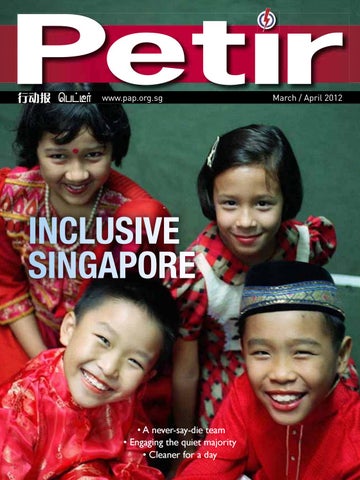
InclusIve sIngapore
• A never-say-die team • Engaging the quiet majority • Cleaner for a day
March / April 2012
Contents
04
Editorial
Inclusive Singapore: How we will get there Deputy Prime Minister Tharman Shanmugaratnam spells out the steps towards the goal of an Inclusive Singapore. * Also in Chinese, Malay and Tamil
09
Quick News
A round-up of new policies.
11
Hot Topic
An inclusive Budget to transform Singapore What the key issues are in this year’s Budget.
Inclusive Society: What it means to us Six new MPs share their thoughts.
18
Behind the Scenes
23 Behind the Scenes
Always here to serve Desmond Choo, Hougang grassroots adviser, is a die-hard fan of Premier League team Everton for the simple reason that they “never say die”.
New blood in Hougang Steven Lim and June Li, two new PAP activists in Hougang, enjoy their voluntary work despite heavy work schedules.
Close-up look at the Taiwan General Election Young PAP members watch Taiwan’s husting. Publicity and Publications Committee Chairman • Lawrence Wong Vice-Chairman • Seah Kian Peng Secretary • Lim Wee Kiak Members • Alvin Yeo, Arther Fong, Devi Vasantha Haridas, Kalyani Ramasamy, Chiang Heng Liang, Abdul Jafar Darwis District representative • Diana Pang Young PAP • Hamidah Aidillah PAP Policy Forum • Malminderjit Singh PAP WW • Teo Lin Lee Editor • Lim Huan Chiang Editorial and Design • Focus Publishing Limited (Tel: 6319 2392) Printer • timesprinters, Singapore. Photos courtesy of Singapore Press Holdings and istockphoto.com
MARCH / APRIL 2012
28
Face to Face
Competing views, a common interest An inclusive society cannot be one where those who shout the loudest always get what they want, says Senior Parliamentary Secretary Sim Ann.
36 Happenings Queenstown Branch stretches out to the needy
37
My Say
Up the next peak!
MPs get close and personal
Social entrepreneur Helen Lim tells why the conventional retirement is not the answer for people going into their Third Age.
Young PAP members learn about the ‘softer side’ of MPs Intan Azura Mokhtar and Mr Zaqy Mohamad.
38 Cyberspeak
30
32
Dialogue
View from the Front
What an inclusive society entails
For a gracious and inclusive society to come about, Minister of State and Mayor Amy Khor says three tiers of ‘inclusiveness’ must function well.
34 Forum
Budget 2012: Views from the Net Pickings from online comments.
39
Backbencher’s Bite
Stepping into a cleaner’s shoes
What MP Zainal B Sapari found out after he became a cleaner for three hours is something he will never forget.
The ethos of political office A reflection on what Singaporeans expect of their political leaders after the uproar over the departure of the Workers’ Party MP in Hougang.
40
Overheard
Best of the sound bites by parliamentarians.
MICA (P) 151/11/2011 Petir is published by the People’s Action Party Central Executive Committee. Material in this publication may not be reproduced in whole or in part without the prior consent of the publisher. Views expressed in this magazine are not necessarily those of the PAP or the government. All rights reserved. PAP Headquarters Block 57B, New Upper Changi Road, #01-1402, PCF Building, Singapore 463057 • Telephone: 6244 4600 • Telefax: 6243 0114 • Internet: www.pap.org.sg
EDITORIAL Inclusive Singapore:
How we will get there B
uilding an Inclusive Singapore is at the heart of our mission as the PAP Government. It is about many initiatives, all aimed at giving everyone a real chance to move up through their efforts, and enabling all Singaporeans to share in our nation’s progress. We took major steps towards this goal in this year’s Budget, and will make further moves over the next five years. It starts with restructuring our economy, so that we can lift up productivity and raise incomes steadily for all Singaporeans. There is much we can do to become more productive and to catch up with the most advanced economies. Today, what is produced by 10 workers in Singapore takes only seven workers to produce in the US or six workers in Switzerland. Some of the adjustments will be difficult for businesses, especially for our SMEs, as we slow down the growth of foreign workers. But we cannot avoid these adjustments, or postpone them. Instead, the Government is providing special help to our SMEs so they can
4
PETIR MAR / APR 12
upgrade and remain a viable and vibrant part of our economy for years to come. We are also stepping up social policy: first, to provide greater economic security for the elderly and Singaporeans with disabilities. To help older Singaporeans at work, we are raising their employers’ CPF contributions and also giving their employers a ‘Special Employment Credit’. But we are also concerned about today’s generation of retirees, as many of them have very limited cash savings. Their CPF balances are low because wages were much lower 20 or 30 years ago, and the Minimum Sum they were required to set aside was much smaller. However, many of our senior folks also have substantial savings in the value of their homes. In this year’s Budget, we introduced a Silver Housing Bonus to help them unlock these savings so they can use them in retirement. We are also expanding hospital and long-term care facilities, and making health care more affordable – including for middleincome Singaporeans. Second, we must keep social mo-
bility up. We must find every way to help Singaporeans who start off with a disadvantage to catch up and do well; every way to prevent disadvantage from repeating itself across generations and leading to a permanent underclass. This is a multi-year effort. We are starting when the kids are young, so that problems do not build up. It is about many things – not just financial assistance, but also tackling difficulties in learning and helping them gain confidence early on. We are providing better quality preschooling, specialised help for learning difficulties, and affordable after-school
By Tharman Shanmugaratnam Deputy Prime Minister and Minister for Finance & Minister for Manpower
The Government will make healthcare more affordable for lower-and middle-income Singaporeans.
care. Plus a breadth of opportunities for every child to discover what they like and what they are good at – opportunities to develop their strengths through the arts and sports; to broaden their horizons through overseas study trips; to develop their leadership abilities. And most importantly, we are providing more, well-trained teachers in all our schools, to help bring out the potential in every child. More is also taking place in the community. It’s quite inspiring. Singaporeans of all ages, some still students and others well into their careers, are coming forward to volunteer, once and often twice
a week. They are trying out different ways to help poorer children gain confidence, and giving them the exposure and varied experiences that better-off kids often take for granted. We are expanding our pathways in tertiary education, to match the aspirations of our students and give them the skills to do well in their careers. We are also investing heavily to give every adult worker the opportunity to keep up-skilling, or even return to a tertiary institution, mid-career, to enrich his/her knowledge. This will also meet the needs of middle-income Singaporeans, many of whom are in managerial or executive
jobs, and want to progress in their careers. When we add up all that we are doing, from health care to housing subsidies, from Workfare to the new GST Vouchers, the Government is providing substantially more resources to uplift and support lower- and middle-income Singaporeans. But an Inclusive Society is not just about Government redistributing resources to help the poor. Many societies have found that out. An inclusive society will depend on whether we can keep and strengthen the things that Singaporeans value most – a deep sense of responsibility for our families; everyone aspiring to improve, and parents wanting their children to do better than them; employers treating workers with respect, no matter how simple the job, and rewarding them fairly. And an Inclusive Society must also depend on the more successful feeling responsible for others in the community. We must keep up this spirit of everyone aspiring, and everyone taking responsibility. That’s the only way we will make a truly Inclusive Singapore.
PETIR MAR / APR 12
5
Singapura Yang Inklusif: Bagaimana Tharman Shanmugaratnam TPM merangkap Menteri Kewangan & Menteri Tenaga Manusia
M
embangunkan sebuah Singapura Yang Inklusif adalah misi utama kami sebagai pemerintah PAP. Ia menyentuh pelbagai inisiatif, kesemuanya bertujuan memberi semua rakyat setiap peluang yang sebenar untuk maju menerusi usaha mereka sendiri dan membolehkan setiap warga Singapura mengecapi kemajuan yang dicapai oleh negara ini. Kami mengambil langkah-langkah penting bagi mencapai matlamat yang telah digariskan dalam Belanjawan tahun ini dan akan melaksanakan langkah-langkah selanjutnya bagi lima tahun mendatang. Ia bermula dengan penstrukturan semula ekonomi kita, agar kita dapat meningkatkan penghasilan dan pendapatan 6
PETIR MAR / APR 12
secara berterusan. Banyak yang boleh dilakukan untuk kita menjadi lebih produktif sambil menyaingi pencapaian ekonomi dari negara-negara yang paling maju. Ketika ini, setiap yang dihasilkan oleh 10 pekerja di Singapura, hanya 7 pekerja sahaja di Amerika Syarikat atau 6 pekerja sahaja di Switzerland yang diperlukan. Beberapa penyesuaian yang sukar bagi perniagaan perlu dihadapi, terutamanya bagi syarikat-syarikat kecil dan sederhana (SME), sambil kita memperlahankan kemasukan pekerja-perkerja asing. Namun kita tidak boleh mengelak atau menangguh daripada menghadapi penyesuaian ini. Disebabkan itu, pemerintah menyediakan bantuan khas untuk SME kita agar mereka dapat terus menjalani peningkatan, kekal berdaya saing dan seterusnya merancakkan ekonomi bagi tahun-tahun mendatang.
Kita juga sedang mempertingkatkan dasar sosial: pertama, untuk menyediakan keselamatan ekonomi yang lebih mantap bagi warga tua dan yang kurang upaya. Kedua, kita akan terus mengukuhkan mobiliti sosial rakyat. Kita harus mencari huraian bagi membantu warga Singapura yang menghadapi hambatan diperingkat awal agar dapat terus bersaing dan berjaya; juga membantu mereka disetiap peringkat demi mencegah hambatan daripada berulang sehingga membawa kepada pembentukan kelas bawahan yang berkekalan. Ini merupakan suatu usaha yang mengambil masa bertahun-tahun. Kita akan memulakan ketika anak-anak masih dalam peringkat umur yang kecil, agar masalah-masalah tidak akan timbul. Ia turut merangkumi banyak lagi perkaraperkara lain – bukan hanya bantuan
dapat kita mencapainya kewangan tetapi juga untuk menangani kesukaran didalam pembelajaran serta membantu mereka meraih keyakinan diri di peringkat awal lagi. Kami sedang menyediakan prasekolah yang bermutu tinggi, bantuan lebih khusus bagi yang mengalami kesukaran belajar dan penjagaan selepas sekolah. Ini disamping menyediakan berbagai lagi peluang-peluang yang boleh diterokai oleh setiap anak-anak untuk menentukan minat mereka sendiri. Ada lebih banyak lagi yang sedang dilaksanakan didalam masyarakat kita. Ia agak mengkagumkan. Warga Singapura dari segenap lapisan usia termasuk pelajar dan karyawan tampil sebagai sukarelawan, sekali atau dua kali dalam seminggu. Mereka ini mencuba berbagai cara untuk membantu kanak-kanak miskin meraih keyakinan dan memberi mereka pend-
edahan serta menimba pelbagai pengalaman yang luas, tidak seperti kanak-kanak daripada keluarga yang lebih baik dimana ia kurang dititik beratkan. Bila kita merangkumi segala yang kita lakukan, dari subsidi penjagaan kesihatan sehinggalah kepada perumahan, dari Daya Kerja kepada Baucar GST yang baru, pemerintah sebenarnya menyediakan lebih banyak sumber bagi memperkasa dan menyokong warga Singapura yang berpendapatan rendah serta pertengahan. Tetapi sebuah masyarakat yang inklusif, bukanlah bermakna pemerintah akan mengagihkan semula sumber-sumber yang ada bagi membantu yang miskin. Kebanyakan masyarakat-masyarakat telah pun sedari akan hal ini. Sebuah masyarakat inklusif bergantung kepada sama ada kita dapat mengekalkan dan men-
gukuhkan lagi perkara-perkara yang amat dihargai oleh warga Singapura – sikap tanggungjawab yang lebih mendalam keatas keluarga kita; setiap warga menginginkan pencapaian yang lebih baik, ibu-bapa menginginkan anak-anak mereka mencatat pencapaian yang lebih baik berbanding dengan mereka; majikan melayan para pekerja secara hormat tanpa mengira betapa mudahnya pekerjaan itu dan memberikan ganjaran yang setimpal. Sebuah masyarakat inklusif juga bermakna adanya rasa tanggungjawab yang lebih mendalam terhadap orang-orang lain di dalam masyarakat itu sendiri. Kita mesti terus menyalakan semangat ini, agar setiap warga mempunyai cita-cita serta memikul tanggungjawab bersama. Itulah satu-satunya cara kita dapat benarbenar membentuk sebuah Singapura Yang Inklusif. PETIR MAR / APR 12
7
8
PETIR MAR / APR 12
QUICK NEWS This year’s Budget takes a
targeted approach to helping specific groups Elderly: Active ageing, funding retirement
To encourage older workers to continue working and to prepare the elderly for retirement, those above the age of 50 will have to contribute higher rates to the Central Provident Fund (CPF) every month. Their employers too will have to contribute more. The increase is steepest for those between 50 and 55 - their employers will contribute 2 percentage points more, and the workers, 0.5 percentage point more. A bigger proportion of the increased contributions will go to the Special Account meant for retirement savings, while the rest will be split evenly between the Ordinary and Medisave Accounts. This would boost their retirement savings. Workers above 55 will get twice their usual tax relief - $6,000 instead of $3,000. Those above 60 will have theirs doubled to $8,000. To encourage companies to hire older workers, the Government has started a Special Employment Credit (SEC) scheme which will subsidise a company’s wage bill for older employees. The Government will pay 8 per cent of the wages of older workers earning below $3,000 and a smaller proportion for those earning between $3,000 and $4,000. These subsidies to companies will more than make up for the increase in CPF contributions. The Government will also provide subsidies for more elderly-friendly features such as anti-slip bathroom tiles and grab bars, and for the hiring of domestic workers. Seniors who downgrade to a smaller HDB flat will receive up to $20,000 in a Silver Housing Bonus. The net sales proceeds from their flat will be channelled back into their CPF accounts, which will be matched dollar-for-dollar by the Government up to a maximum of $20,000. Of this amount,
Older workers will contribute more to the CPF every month, to better prepare them for retirement.
$15,000 will be in cash while the remaining $5,000 will go into their CPF. Proceeds from the downgrade will be committed to their CPF Retirement Fund and will be used to buy a CPF Life annuity, which will provide them with a monthly payout for the rest of their lives. The low-income: Help to stay in school and in good health
More help for the lower-income families will come in the form of a GST Voucher scheme. The cash payout of this scheme will offset at least half of the 7 per cent Goods & Services Tax lower-income families pay for their expenses. Lower- and middle-income households also get U-Save rebates on utility bills of between $180 and $260. Those above the age of 65 will also get a Medisave top-up of between $150 and $450, depending on their age and the value of their home. The Government will also top up several
funds for the needy: the Medifund – which pays for the medical bills of the needy who cannot afford them despite other medical subsidies – by $600 million; the ComCare Endowment Fund – which is used to support needy families – by $200 million; self-help groups and the CCC ComCare Fund by a total of $10 million. Education is another key area in which the Government is extending help. Children in these families will be given financial support from as early as kindergarten. The household income ceiling for the Education Ministry’s Financial Assistance Scheme will be raised from $1,500 to $2,500 per month, which will help 40,000 more students qualify for it. Other aid programmes, like top-ups to school advisory and management committees, are also being enhanced so that schools can introduce schemes such as transport assistance for students. The Edusave Endowment Fund, which provides the funding for bursaries and awards PETIR MAR / APR 12
9
to schools and students, will get a top-up of $200 million, bringing the fund to a total of $6 billion. Families with a household income ceiling of $3,500 can apply for the Student Care Fee Assistance Scheme which enables low-income families to enroll their children in before- or after-school care service centres.
companies to hire such workers. Employers hiring disabled workers will get a Special Employment Credit (SEC) of 16 per cent of the workers’ wages, capped at a maximum of $240 a month per worker. Disabled workers will also get a doubling of their income tax relief, which will now be between $4,000 and $12,000.
The handicapped: Special education and homes for disabled
For the sick: More spending on health care
The Government will roll out a new programme to help youngsters with mild speech, language and learning delays. There will also be more places in centres for those who need intensive early intervention, and improve special education schools. The disabled will get 250 more places in day-activity centres, where their families can leave them to go to work or have some free time to themselves. Costs of such services will also be subsidised, with a middle-income household getting about $5,700 a year in subsidies, while lower-income families get more. Homes for the disabled will be expanded by about 20 per cent to include 180 new beds. For the disabled who work, the Government has introduced measures to encourage
To curb a pressing problem of a shortage of hospital beds, acute hospitals will increase their number of beds by 1,900 or about 30 per cent of their current numbers by year 2020, while community hospitals will double their numbers to 3,600. All patients in community hospitals will now qualify for subsidies as well, instead of just half of the patients. The middle-income group will receive the largest increase in subsidy rates. Subsidies for nursing homes, community- and home-based care will also be raised, enabling two-thirds of households to qualify, up from just half. Lower- and middle-income families will get a $120 cash grant each month to help them hire a domestic worker to look after a
10 PETIR MAR / APR 12
needy elderly in the home. All Singaporeans insured under MediShield will receive a one-off Medisave top-up of between $50 and $400. For commuters: A smoother ride
The Government will partner with the two public transport operators to bring in 800 more buses over the next five years in order to ease the congestion during peak hours. The Government will pay for 550 buses and fund running costs for 10 years. There will also be more than 100 new trains operating on the various lines. For motorists: Greener travels
The current Green Vehicle Rebate scheme will be replaced with a Carbon Emissionsbased Vehicle Scheme where cars with low carbon emission will receive rebates of up to $20,000 while those with high levels of emission will pay up to $20,000 more. The special tax for Euro V-compliant diesel cars will be lowered from $1.25 per cc to $0.40 per cc. Motorists looking to buy a used car will no longer need to pay a 2 per cent transfer fee of the sale price, but just foot a nominal transfer fee of $11 instead.
Hot ToPIC
An IncluSIvE BudGET to transform Singapore
PETIR MAR / APR 12
11
Hot ToPIC “A continued rapid infusion of foreign workers will also inevitably affect the Singaporean character of our society.”
A
gainst the background of a slowing economy, this year’s Budget focused on tackling long-term challenges. There was more help for the elderly, the disabled and the lower-income groups. Throughout a two-hour speech before Parliament, Deputy Prime Minister and Finance Minister Tharman Shanmugaratnam made it clear: “It is a budget for the future.” Reducing foreign workers
Mr Tharman announced a reduction in dependence on foreign labour as the country’s increasing dependence on this segment was “not sustainable” in the long run. “It will test the limits of our space and infrastructure, despite our efforts to build more housing and expand our public 12 PETIR MAR / APR 12
transport system,” he said, adding that there has been a 7.5 per cent increase in foreign manpower over the last two years. “A continued rapid infusion of foreign workers will also inevitably affect the Singaporean character of our society.” Noting that this change will take time and that foreign workers have become indispensable to many of the industries here, Mr Tharman said: “Many smaller and newer firms would not have been able to survive and grow without access to skilled foreign workers.” The presence of foreign labour has also benefitted Singaporean workers, the minister said, pointing to a 17 per cent growth in income per household member in the last five years as evidence. However, he acknowledged that some Singaporeans at the lowest rung
of the income ladder, especially cleaners, did not see this growth in income. “We take that seriously, and are tackling the problem.” The Government will now reduce the maximum proportion of foreign workers that companies can hire. This level, known as the Dependency Ratio Ceiling, will be calibrated down in the manufacturing and services sector and will affect some 9,000 companies in all. To help companies here move away from its reliance on foreign labour, the Government will extend help to them so that they can reorganise and upgrade their operations. More help will go to firms which attempt to improve productivity, design better jobs to attract local workers and innovate in order to grow. “None of this will be easy,” Mr Tharman conceded. The only way to overcome
Budget
An inclusive to transform Singapore
Less dependent on foreign labour in years to come.
labour shortage, he said, was to improve productivity. And the Government has set a challenging target of raising productivity by 2-3 per cent each year for the next decade. “The Government cannot decide which companies should succeed or be phased out. But we will provide broad-based support to help as many businesses as possible to retain their roots in Singapore and grow, and help Singaporean workers who may be displaced to find new jobs,” said the minister. Enhancing public transport
Trains and buses were becoming too packed during peak hours in the mornings and evenings.
In order to curb this overcrowding of the public transport network, the Government will “significantly ramp up” bus capacity – where 60 per cent of all passenger trips are made – so as to relieve the daily congestion. The Government will partner the two public transport operators to bring in 800 more public buses. There will also be 100 more trains. “Reliable and convenient public transport is critical to the quality of daily life
for the majority of Singaporeans,” said Mr Tharman. He said that with the planned Downtown Line, Tu as We s t Ex t e n s i o n , Thomson Line and Eastern Regional Line coming up within the next decade, Singapore’s rail coverage will be comparable to cities with the most developed rail networks such as New York. By then, a total of 400,000 households will live within 400m of an MRT station, double the number today. Tackling income inequality
Economic pressures have led to widening income gaps which are being felt all around the world and especially in Singapore, which is a small city. Mr Tharman said: “We cannot leave PETIR MAR / APR 12
13
Hot ToPIC our social compact vulnerable to market forces. We have to do all we can to contain inequality and to sustain social mobility in each new generation.” To do this, the Government is looking out for those in the lower-income families as well as the middle-income ones. “We must find every effective way to help those who start off lower down to catch up and do well. Every way to prevent disadvantage from repeating itself across generations,” said Mr Tharman. Education was one key “springboard to success in Singapore”, said Mr Tharman, rolling out initiatives to help children from disadvantaged homes, from as early as kindergarten. Those who have learning difficulties will also get more specialised help. For those who are already in the workforce, the Government will also invest heavily to upgrade their skills and education. Significantly, the new schemes in this budget will be more permanent, such as the GST vouchers, Medisave top-ups and
14 PETIR MAR / APR 12
U-Save rebates for utilities. Mr Tharman also spoke of a need for more social workers who can help lowincome families overcome the multitude of complex problems and issues they face. More will be done to attract Singaporeans into the social sector, said Mr Tharman. “The solution to low incomes does not
“The solution to low incomes does not only lie in supporting incomes through government transfers, as many societies have found...” only lie in supporting incomes through government transfers, as many societies have found,” he said. The arsenal of economic and social strategies in Budget 2012 is all aimed at reaching the defining goal of an “inclusive
society and a stronger Singapore”. However, in doing so, the right balance in the country’s public finances must be struck. “We must avoid the path that many developed countries took, where successive governments, across the political spectrum, committed themselves to continually expanding social entitlements - in social security, health care and unemployment - without the ability to pay for them,” said Mr Tharman. “Their massive public debts have now resulted not just in a financial crisis, but a social crisis, with their citizens being forced to make painful adjustments in living standards for several years to come.” Building this ideal of an “inclusive society” is not just about the Government redistributing resources to help the poor, said Mr Tharman, reminding everyone that they needed to be responsible for themselves and their families. “An inclusive society will only blossom if we grow this spirit of responsibility and community,” he said.
Budget
An inclusive to transform Singapore
PETIR MAR / APR 12
15
Hot ToPIC
Inclusive Society: What the theme for Budget 2012 was to build an inclusive nation. We asked some new MPs who took part in the debate for their views
“Building an inclusive society, where no one gets left behind, involves tremendous effort. It requires us to swim upstream – against powerful forces of globalisation and human nature. Many countries are riven by wide gulfs of wealth and poverty. Others tried political ideology and welfarism, but ended up blunting the will to work and falling into the spiral of unsustainable debt. Budget 2012 makes significant long-term investments to help uplift our seniors, our disabled Singaporeans and those from disadvantaged backgrounds. Yet, government programmes and policies form only one piece of the jigsaw puzzle. Because inclusivity is a state of the mind and of the heart, it cannot come about because of infrastructure and investment alone. Everyone must step forward to play an active part – as employers, as civil society, and as everyday Singaporeans. Caring for the disadvantaged, respecting hard work, and keeping an eye out for one another, must become embedded in our DNA as a Singaporean way of life, before we can truly move towards an inclusive community. ” – MP Desmond Lee “A lot has been said about the problems that arise from an aging population. I, and several others, have however voiced our objection to the term ‘Silver Tsunami’ because of the inherent negativity of such a description. We would do well to recognise that seniors can continue to contribute to nation-building, and we must cherish and celebrate what they bring to our community, even as we tackle the challenges of an aging society. Ageism and any moral panic of aging and the aged should be strenuously rejected, so that we may truly realise our vision of building an inclusive and progressive society.” – MP Chia Shi-Lu “This year’s Budget marks a milestone for its unstinting commitment to build an inclusive Singapore. During the debate, I became increasingly convinced that we need a ‘whole of government’ approach, especially for issues that cut across a broad spectrum of sectors and populace. While ministries fulfil their respective responsibilities and roles, there is a greater need for an integrated, multi-agency, multiministry approach to tackling today’s challenges. Our world has grown more interconnected with multiple touch points, links and networks. As we embrace the spirit of inclusiveness, I look forward to different departments, multi-agencies, inter-ministries and diverse talents coming together to pursue the future of Singapore in unity.” – MP Low Yen Ling 16 PETIR MAR / APR 12
Budget 2012
Budget
An inclusive to transform Singapore
it means to us “To me, Budget 2012 is a people-centred one which ensures that no Singaporean gets left behind. In short, it’s a budget with a heart. I am glad to see a sizeable focus on the lower-income households and the elderly. While the reduction in the dependency on foreign workers is welcomed, I hope that Singaporeans too will adjust their expectations and consider joining an industry where there is great demand for such workers. At the same time, it is important for us to accord more respect and greater recognition to jobs which we have taken for granted such as cleaners, construction workers and caregivers. My wish is to see more done for the handicapped especially in terms of financing their healthcare needs.” – MP Intan Azura “Budget Debate 2012 was a first for me, and I was humbled to make my maiden contribution. The theme this year was clear – to build an inclusive Singapore. I took the opportunity to raise the issue of mental health. Mental illnesses remains plagued by stigma, which discourages social acceptance and prevents sufferers from stepping forth to seek help. In a truly inclusive society, more can be done to promote greater social acceptance, enhance accessibility and affordability to professional mental health care, and strengthen the support framework for both patients and caregivers. I was undoubtedly happy with the Ministry of Health’s initiatives to promote a more integrated and community-based mental health care. Nevertheless, we need to continue working in this area, especially to combat social stigma and improve care for those with mental health issues. Budget 2012 is one step in the right direction.” – MP Tin Pei Ling “Are we an inclusive society? How can we become more inclusive? Many measures during the Budget debate were hailed as representing a move towards the ideal of an inclusive society. For us to recognise that we aren’t quite there yet is significant in that we take a step to discuss our inadequacies, our gaps, and move closer to the non-material aspirations of our society. In a separate thought-stream, the announcement of a mandatory day off once a week for maids brought a storm of discussion. Maybe this too should be held up as an example of a measure of a more inclusive society. Many people spoke up for various groups who were vulnerable, under-represented, ‘un-included’. However, when, as a society, we speak up for people who will never vote for us, for people whom we do not identify as being ‘part of us’, then we will be truly inclusive.” – MP Janil Puthucheary Illustration by istockphoto.com
PETIR MAR / APR 12
17
BEhIND ThE SCENES close-up look at the
Taiwan General Election Young PAP’s Yap Jun Lin took in campaign MtVs and an electric atmosphere, along with a personal encounter with President Ma Ying-jeou
Members from Woodgrove YP and Chua Chu Kang YP had an in-depth understanding of the political scene in Taiwan.
A
t 6.30am, all bleary eyed, we gathered at Changi Airport Terminal 1, ready for the first day of YP International Relations Taiwan trip 2012. There were 30 of us, we exchanged smiles and broke the ice – introducing ourselves, sharing of our interests and things that we do as members of the PAP. Then, lift off to Taiwan! Many of us tried the fried oyster omelette, mega chicken chop, smelly toufu, beef brisket noodles, ai yu jelly drink, white honey bitter gourd juice, escargots, Kurobuta sausages. There were also the spicy ma la steamboat and the original Din Tai Fung xiao long bao. The second week of January was also a time to sample the political culture, since the YPs witnessed Taiwan’s campaigning for their General Election. The YPs received first hand experience of the political situation in Taiwan through visits 18 PETIR MAR / APR 12
Yap Jun Lin from Chua Chu Kang YP with a lifesized poster of Taiwanese President Ma Ying-jeou.
to Kuomintang’s, Democratic Progress Party’s and People’s First’s headquarters as well as campaigning sites. The youths were also given the opportunity to speak with the candidates of the respective parties. The air was electric, with the upbeat and heightened atmosphere of the Taiwan political scene. From the gigantic billboards of the candidates covering the side of buildings, to the ear-deafening shouts of “dong shuan” (which means “elected” in Taiwanese) at the crowded rallies, we were truly awed by politics that was so close to the hearts of Taiwan citizens. One memorable incident was when we chanced upon the incumbent Republic of China President Ma Ying-jeou, having a campaign dinner at a local eatery. It was like having a celebrity come to your neighbourhood, with “die-hard fans” eagerly capturing every movement with blinding flashes. Marketing strategy was all part of the
political game plan. During our visits to the different parties’ campaign headquarters, we witnessed Lego monuments of candidates, lunch boxes printed with the themes of different political parties, campaign music videos made by activists, and the list goes on. These promotions formed the core of the campaign and where aimed at not only the mature voters, but also the youths, with bright colours, upbeat music, and youthful themes. Ms Roseline Chin, Head of YP International Relations says: “We had many sessions of informal political discussions across different generations within the party and with our Taiwanese friends.” She said that the discussions were fruitful. “We learnt that there is a need to establish a stronger youth platform and voice for Singaporean youths and where YP can learn to be stronger youth activists in the area of the arts and the environment.”
PEtIR READERSHIP SURVEY 2012 To: MacPherson Road Post Office Locked Bag No 69 Singapore 913486 Fold here...
Name: Contact: NRIC: Address:
Rules and Regulations: Winners will be notified by post. Only respondents using the original survey form will be accepted.
Fold here...
FOld uPWARdS
INTRODUCTION: As part of our efforts to continuously improve our Petir magazine, we look forward to hearing from our Petir readers, their perceptions and experience with the magazine. We would be most grateful if you would kindly agree to participate in this survey and send it back to us by end of May 2012. All respondents will stand a chance to participate in a lucky draw. 10 lucky winners will each receive a $50 shopping voucher*.
Q1.
Q2.
Q3a.
When was the last time you read an issue of the PETIR Magazine? (Please select ONLY one answer) 1-2 months ago 3-4 months ago 4-6 months ago More than 6 months ago Rarely/Occasionally In the last 6 months, how often do you read the PETIR magazine? (Please select ONLY one answer)
How do you usually obtain a copy of PETIR? (Please select ONLY one answer)
IF PICK IT UP YOURSELF b. From where do you usually pick up a copy of Petir?
c. Do you have difficulty picking up a copy of Petir regularly? Q4 a. Which sections do you read regularly in PETIR? (You may select as many as possible)
❑ ❑ ❑ ❑ ❑
b.Of the sections you read, which sections of PETIR magazine would you rate as your FAVOURITE? (Please select ONLY one answer)
Every issue (3 issues) 1-2 issues Less often
❑ ❑ ❑
Delivered to you Pick it up yourself Read someone’s copy Others (specify:
)
❑ ❑ ❑ ❑
At branch office Others (specify:
)
❑ ❑
Yes, (specify location: No
Editorial Hot Topic Quick News Face to Face Dialogue View from the Front My Say Behind the Scenes Happenings Cyberspeak Forum Backbencher’s Bite Overheard
)
❑ ❑
a.Regular
b.Favourite
❑ ❑ ❑ ❑ ❑ ❑ ❑ ❑ ❑ ❑ ❑ ❑ ❑
❑ ❑ ❑ ❑ ❑ ❑ ❑ ❑ ❑ ❑ ❑ ❑ ❑
Q5. What would you say are the reasons for reading PETIR? (You may select as many as appropriate) Views of various Ministers/MPs Keep up with latest happening and development of the party Community projects carried in various branches To equip myself with policy knowledge and party positions Others (specify: ) Q6.
❑ ❑ ❑ ❑ ❑
Next, please rate PETIR on the following aspects. (Circle your choice)
Content Layout/design Variety of topics Coverage of the latest happening Relevance Overall appeal
Very Poor Poor 1 2 1 2 1 2 1 2 1 2 1 2
Good 3 3 3 3 3 3
Very Good 4 4 4 4 4 4
Q7. How would you rate your OVERALL reading Experience with PETIR magazine? (Please select ONLY one answer) Very Enjoyable to read Somewhat enjoyable to read Not too enjoyable to read Not at all enjoyable
❑ ❑ ❑ ❑
Q8. Which of these statements best describes how you feel about PETIR? (Please select ONLY one answer) PETIR is a MUST-READ for me. I read PETIR only when specific stories/contents appeal to me I only read PETIR when I have the time or feel like it.
❑ ❑ ❑
Q9a.
Apart from this magazine, do you also log on to PAP website to get updates on the Party?
b.
IF YES When was the last time you logged on to the PAP website to get updates on the Party?
Yes (Proceed to Q9b and Q9c) No (Proceed to Q10)
Yesterday/Today 2-3 days ago 4-6 days ago 1-2 weeks ago Longer ago c.
❑ ❑
❑ ❑ ❑ ❑ ❑
Do you download and read the digital copy of Petir (in PDF format) from the PAP website? Yes No
❑ ❑
Q10.
If we were to have an online version of Petir, what would you like to see? (Please tick as many as appropriate) Contributions by political leader and MPs Contributions by activists Multimedia features (photos and videos) Forum for online discussion Updated listing of party activities and events Others (specify: )
Q11.
Which of the following formats would you like to read Petir most in the future? (Please select ONLY ONE answer) Magazine (print) Online (via computer) Online (via mobile phone/ tablets e.g. iPhone, iPad, Kindle, etc)
❑ ❑ ❑ ❑ ❑
❑ ❑ ❑
Lastly, some demographic information about yourself. 20-24 years 25-29 years 30-34 years 35-39 years 40-44 years 45-49 years 50-54 years 55 years & above
❑ ❑ ❑ ❑ ❑ ❑ ❑ ❑
Gender
Male Female
❑ ❑
Ethnicity
Chinese Malay Indian Others (specify:
❑ ❑ ❑ ❑
B1
Age
B2.
B3
B4
)
What is your job title?
B5 Please indicate your Monthly Personal Income.
* Shopping vouchers sponsored by NTUC FairPrice.
Below $2,500 $2,500 – 3,000 $3,001 – 4,000 $4,001 – 5,000 $5,001 – 6,000 Above $6,000 Not working/retired
❑ ❑ ❑ ❑ ❑ ❑ ❑
BEhIND ThE SCENES
Always here to serve
Writer Suresh Nair catches up with Mr Desmond Choo, Adviser to the Grassroots organisation in Hougang, to find out what has been going on now that the constituency is without an MP. In an hour-long interview, he spoke on a wide range of subjects, including his reason for supporting Premier League club Everton. 1. What has been your experience in Hougang post-Yaw Shin Leong? Do you see a visible change in the residents’ approach towards you? I never really look at things, pre and post-elections. My approach is that if you need assistance, you will get it. It has not always been easy for us in Hougang. But we are increasingly getting more positive feedback from residents. At the same time, we do get people coming to say this is not the right way to run the place. You’ve to be accountable to the people. They want transparency and accountability. 2. Can you talk about the long-term structure/plans you have for the branch and for the constituency? Three major areas. We’re focused on
making Hougang a more friendly and accessible place for senior residents. Make sure their homes and families are safe; put in more infrastructure changes; organise more senior activities to make sure they lead a meaningful and quality life; make sure that they are taken care of when they have chronic sicknesses. Education is another priority, to make sure that the lower-income has the opportunity to move up, especially to provide their children with good pre-school education, through tuition programmes, transport subsidies and subsidised activitybased programmes at the PAP Community Foundation (PCF). Third and to me, the most important, not programmes but people – to bring in a very good crew of volunteers who will continue the spirit of service. You will see we are constantly mentoring the younger
generation on what’s right and what can be improved in government policies. So grooming good volunteers is one of my core plans. During house-to-house visits, I encourage young people to serve as volunteers to make the community better. We’re seeing more Hougang residents stepping up to serve. That’s solid encouragement. 3. Do you see a renewed enthusiasm in your party colleagues and activists as they try to fill the void which the former MP has left behind? We’ve always been here to serve the people of Hougang. It’s not just about offering a shoulder to lean on but also a genuine helping hand. We’re here to build relationships. It’ll take time but progressively, residents will see that we’re making PETIR MAR / APR 12
23
BEhIND ThE SCENES a difference and improving their lives. That’s why after we lost in Hougang, on the second day, we continued to reach out to the people and we’ve not stopped. With or without Yaw Shin Leong, we will continue to do the best we can for the residents here. 4. Has there been an increase in the number of people seeking help from you in your weekly Meet-the-People session? If so, have you brought in extra people to assist you? Seasonality aside, there is an average increase but it is not large. We’re not a typical Meet-the-People session like other PAP constituencies. We call it Monday coffee sessions – residents come for mingling, sharing of views on policies, and bonding with grassroots leaders. We usually get 30-40 people, depending on the “season” but we stay behind, most times way past midnight most Mondays to attend to the residents. 5. What are the common problems that are brought up at these sessions? And has there been any difference after the recent Budget where the Government set out measures to help the elderly and the lowincome families? Mostly people-based issues especially for the older workers who need financial assistance. There’s now a renewed energy to seek employment because the Government is encouraging seniors to get back to work. Overall, the feedback on the Budget has been good. We’ve had positive vibes, with strong support for the focus on building an inclusive society, especially to uplift lower-income families, help seniors live long and well, and support Singaporeans with disabilities. It marks a step up in support of these three groups of Singaporeans. 6. The PAP has tried hard to win over Hougang the past two decades. How do you plan to convince the residents? I’m here to serve the people of Hougang, and contribute in the best way I can. 24 PETIR MAR / APR 12
Mr Desmond Choo chats with residents during the Monday coffee-sessions.
I am fully committed to this cause, and I am backed up by a strong and experienced PAP team with a proven track record. I know many residents still remember Mr Low Thia Khiang because he had worked hard in Hougang for many years. And I respect Mr Low for the work he had done. But Mr Low is now an MP in Aljunied, and it will not be possible for him to cover two constituencies all the time. I believe Hougang residents know that it is important to choose the right person, who can represent them, resolve their problems, and make a real difference on the ground. I ask for a fair chance to prove myself.
8. How long will it take to win over Hougang hearts? What’s the right formula to win over the younger, newer voters?
7. PM Lee Hsien Loong said he will find the right time to call for a by-election. When will it be?
I am 34, and my wife’s Pamela, with the Ministry of Manpower, who wholeheartedly supports my new journey into politics. We married just two months after the General Election 2011. She is a huge pillar in my life. I am quite sure that I would not have lasted the journey without
(Laughs) I don’t know. But I’m sure of one thing – that we’ve to be ready and prepared for a contest at any time.
We must be committed and stay the course. Service is the right way, with passion and sincerity, to care for the poor and the aged. Over time, word will spread that we’re genuine in making a difference for the people of Hougang. Then people can see by our actions that we are here to serve, and that we’re up to the mark. 9. Who is Desmond Choo the public never knew?
her support, faith and care. I learnt a lot about life by supporting Everton Football Club (laughs). They’re a rare breed of fighters in the English Premier League. Not much financial resources but plenty of fighting spirit with one of England’s best managers in David Moyes. They lose more than win but they always fight the hardest in every match. You can pick up a lot of lessons from Everton as they’re a never-say-die team. 10. Eric Low (previous PAP candidate) fought for a long time in Hougang and never tasted success. How long will you do so? (Laughs) He lost more hair progressively as he’s been here for 12 years. Eric fought hard and he was a fierce fighter. I will be here as long as the party feels I can do a competent job. Frankly, I was a little surprised when I was first told I
was contesting in Hougang. I had no idea how to fight, no expectations. But after being here for close to a year, and even after the results of the last GE, I know I will not leave Hougang. The party activists have backed me, supported me. Some of my volunteers have lost five times but they still persevered. Some may feel the chances are slim but they still want to fight. There is a strong fighting spirit and a special spirit of service amongst our people in Hougang. 11. How much fire do you have in your belly as a budding politician? Look at my volunteers, they inspire me – some of them have lost five times but they’ve not lost the passion to serve or the desire to help the residents. These are volunteers who believe in the cause we’re fighting for, and they’re making a genuine
difference to the Hougang community. Majority of them live in Hougang and they get called names at the wet market or coffee shops. But they do not give up, they never say die, and they’re still here to serve. They’ve fire in their bellies! 12. Will it be a major surprise if you’re not fielded in Hougang in this upcoming by-election? I am fully prepared to be fielded. The party has not decided. But it knows the work my team and I have done in Hougang, consistently over the past year. In the last GE, our activists and volunteers all worked very hard. We were disappointed at the results. But I am a firm believer in always doing better. And I have full confidence in my people. We’ve stared at defeat, and now we’ve come back from failure, ready to give of our best, and to fight another contest. PETIR MAR / APR 12
25
BEhIND ThE SCENES
new blood in Hougang By Suresh Nair
S
teven Lim and June Li are amongst the new PAP faces who have stepped forward to serve the residents in Hougang. Both are single and they use their spare time away from hectic work schedules to offer a helping hand as volunteers, as they did when I met them on a sunny Sunday morning in April, serving porridge at the Poh Teck Siang Tng Temple. “There are many who are poor and ageing, and need many forms of financial assistance. They are looking to a new Member of Parliament who cares for them,” said Mr Lim, 31, an insurance financial consultant, who joined Desmond Choo and the PAP Hougang team of activists three months ago. Ms Li, 24, an administrative assistant, too showed her caring side as she helped the old folks to the food. “I understand their problems, especially the older constituents, as I have served grassroots organisations, like Residents’ Committees, since 2008,” she said. Mr Lim, who lives in Hougang Avenue 5 and is fluent in English, Mandarin and Teochew, had previously helped out at orphanages and old folks’ homes. He is acutely aware of the needs of the people in the constituency after attending Mr
26 PETIR MAR / APR 12
“There are many who are poor and ageing, and need many forms of financial assistance. They are looking to a new Member of Parliament who cares for them.” – Mr Steven Lim
Choo’s coffee-sessions. “There are many people crying out for assistance, from financial help, study loans for their kids to getting their permanent resident status and getting flats,” he explained. He came aboard as an activist in the Teochew-majority constituency of 23,000, because he was “very concerned about the ageing population who need special attention”. Ms Li, who also lives in Hougang Avenue 5, is single and speaks English, Mandarin and Hokkien. She finds satisfaction in her voluntary work and does not mind sacrificing her evening leisure time. Although her day is long as she leaves for work at 5.30am and returns only after 7.00pm, she still manages to find time for voluntary work. “I don’t find it tiring when I help out in constituency work. I get a special thrill
when I serve the people and meet new friends every day,” she said. According to Ms Li, the Hougang residents “want a sincere MP who cares for them and who is willing to bring their problems to the attention of the relevant government agencies”. “Mr Choo fits the bill perfectly as he has built up a very strong rapport with the residents by listening to their problems,” she said. “His sincerity is very clear and now we are beginning to see more cases every Monday at the coffee sessions. Many residents interviewed were looking forward to the by-election, to elect a new MP to represent their interests and address their needs. Private bus manager, Mr Thomas Tay, 52, noted that “the pace of overall constituency redevelopment has been clearly slower in Hougang the past two decades”. Agreeing with these sentiments, Ms Hamidah Yusoff, 45, an
The smiles say it all for spirited volunteers Mr Steven Lim and Ms June Li.
“I don’t find it tiring when I help out in constituency work. I get a special thrill when I serve the people and meet new friends every day.” – Ms June Li
airport supervisor, said: “We’re in the news every day and it’s not good for Hougang. Anyone coming to this constituency knows it needs a major facelift and this can only be done with an MP who cares for the residents.” After serving in Hougang for the past few months, Mr Steven Lim sensed a
change in the attitude of several residents. “The Hougang folks want a caring and responsible leader and there is a newfound confidence in Mr Choo,” he said. Another highlight was the recent Budget announcements. Mr Lim noted that the majority of the residents appear “pleased with the Budget”. He said: “I
have interacted with many senior citizens and they genuinely feel that the Government is showing interest in their welfare and going the extra mile to make life a little more comfortable for them.” Long-serving PAP activists in Hougang welcome the entry of new blood, which has helped to strengthen the team. PAP Hougang assistant secretary Lionel Jerome de Souza said: “They have the passion and perseverance to make a difference and we must encourage more youngsters to come forward. We commend them for making a huge sacrifice. They are clearly focused on the long term and will help to get more young Singaporeans to support our cause”. PETIR MAR / APR 12
27
FACE TO FACE
competing views, a com Senior Parliamentary Secretary and first-term MP Sim Ann tells of her experience of turning voices of discontent into a chorus of engagement, taking into account the quiet majority By Nazri Hadi Saparin
C
ommunity engagement and building an inclusive society have been buzzwords since the last General Elections. But nothing beats real life experience to underline their importance, and how challenging it can become. Just ask Member of Parliament (MP) for Holland-Bukit Timah GRC, Sim Ann. In a matter of weeks, she was faced with two incidents that tested her ability to cater to competing interests. Sim Ann is also the Senior Parliamentary Secretary for Law and for Education. One was the resistance from some Toh Yi residents who petitioned against the HDB’s plans to build studio apartments in their estate. The other issue centred around residents who are farming illegally on a 1,800 sq metre strip of land, under the custody of the Singapore Land Authority (SLA). After a period of consultation, HDB decided to stick to the original site for the studio flats while the illegal farmers were given a three-month extension from the SLA, as the grassroots consider whether to rent part of the state land for interim community use. These were difficult issues that required discussion, debate and eventually, a clear decision. In the case of the studio apartments, some residents remained unhappy and made their voices heard through online platforms such as Facebook. Despite these continued voices of discontent, Ms Sim is quietly satisfied that the outcome was reasonable. She knows that not every demand can be fully met 28 PETIR MAR / APR 12
Ms Sim Ann believes that getting the MPs to walk the ground is still an important platform to collect views from the community.
and the process of consultation as well as engagement must be combined with the need to avoid policy paralysis. In the end, she is guided by one clear principle – the need to serve the larger public interest. “An inclusive society cannot be one where those who shout the loudest always get what they want, at the expense of others. To me, that is not an inclusive society. That is a dysfunctional society,” says the first-term MP. When dealing with social issues, an MP cannot discount the broad middle
group, who do not see the need or are not quite ready to voice their opinions so openly, she says. Just because a group of people do not speak out does not mean that they do not count. “I think this is a very important parameter to keep in mind when we are talking about inclusive society. Otherwise it is very easy to get distracted by very loud views, coming from what might turn out to be a small group of people.” That is why, despite how strong the influence of social media is, Ms Sim is a
mon interest
strong believer in old-fashioned face to face meetings. That is why MPs walk the ground, do house visits and listen in to what people are saying at the coffee shops. “When you do that, you will find that the picture that emerges finally forms the balance of views from the community. They can sound rather different from Facebook or other websites. It can also sound different from what you get from the mainstream media,” she says. In Toh Yi’s case for instance, Ms Sim
says amongst the residents whom she reached out to, those against the studio apartment were in the minority, even in the blocks closest to the proposed site – something that was not reflected by the social media and news reports. As for the illegal “farm plots”, the state land had been enjoyed by a small group of people, about 20 households. In fact, the illegal farming issue also surfaced due to complaints from residents who were troubled by smoke caused by the burning of leaves as well as mosquitoes breeding at the plots. “Walking the ground puts you in touch with a wealth of very interesting feedback from residents. In the case of Toh Yi, some told us quite frankly they don’t like to have a new block right next to their home, obstructing their view. I understand that. That is human nature. “There were also many residents who told us that they didn’t really mind because they felt they would not be affected. And there were also those who told us clearly they welcomed it. “If you just judge from the petition, you will see there is a number of very upset people. If you just judge from certain news headlines, you will conclude that the whole estate is up in arms. But that is really not true.” Apart from face-to-face outreach, Ms Sim says she and her team of grassroots activists maintain a strong social media presence, and placed great emphasis on making sure they connect with residents online. These days, in the new norm, as she puts it, engagement is multi-faceted. “If I can give an analogy, it is like the event we are in used to be a triathlon, now it is a decathlon. We used to compete in
three events, now you are competing in 10. I think that sums it up,” she said. Having been a grassroots volunteer herself, Ms Sim says she feels that the demands on community leaders have increased. Her block visits now take longer, compared to when she used to tag along as part of the entourage of volunteers. Before, residents were not too concerned if they get to meet the MP or not, but the situation is different today. “When they see the banner, they are a lot more conscious about the fact that there is a block visit, they expect to meet the MP, and to raise issues. We have to work out new ways of keeping residents updated, for instance when we encounter a few households with a lot to say, and are not able to visit the remaining units in the block in time ” she explained However, such high demands and expectations spur her on. “It is just the way it is now, and the sooner we get used to it and understand how to operate, the better. I see this as a challenge. And I take it positively and so does my team.” Beyond her constituency, Ms Sim also works in the Ministry of Education, where she has been assigned to work on special education. To her, the Government’s focus on special education is one of the clearest ways in which the state is signalling its commitment to building an inclusive society. “My hope is, our students with special needs, whether mild, moderate or severe, with the skills and knowledge imbued in them during their school years, they can go on and lead meaningful adult lives and participate as fully as they can in society.” PETIR MAR / APR 12
29
DIALOgUE
MPs get close and personal T
he Young PAP (YP) members wanted something different. Something more personal that they could empathise with. Enter “MPs Unplugged”, a dialogue series thought up by YP’s Political Discussions Committee to have party Parliamentarians talking about their experiences and giving their views, and also to share “the softer side of their lives” with their listeners. The inaugural session, with MP for Ang Mo Kio GRC, Dr Intan Azura Mokhtar and MP for Chua Chu Kang GRC, Mr Zaqy Mohamad, was held at the NTUC Income Marina Bay Centre on Feb 18. And, by many accounts, it was a resounding success. The two MPs were candid in their engagement with close to 100 YP youth activists and members of the public. In the two-hour session, they disclosed interesting insights into their lives – their families, hobbies and their dreams and aspirations. Dr Intan spoke about her reason for going into politics while raising three children. To her, it is an extension of her community work which she has been doing for many years. She said her mantra in life is to always have “sincerity, humility and empathy”. Her dream is to open up a centre for disabled children. Apart from forays into their personal lives, the two MPs also fielded questions from the audience. For example, Mr Zaqy was asked: “Do you think the PAP lives too much on the glory of the past?”
30 PETIR MAR / APR 12
His response was: “I think greater empathy has been displayed by the PAP of today. The Government of today is a complex one, facing multiple challenges. And as politicians, we need to take more time to explain to the residents about a particular policy – the whys and the hows. There needs to be greater transparency alongside consultation and communication. That is how I think the PAP will grow from strength to strength.”
I think greater empathy has been displayed by the PAP of today. - Mr Zaqy Asked for her reaction to the dialogue, one member said she was touched by Dr Intan’s sharing, how “she believes that sincerity, compassion and humility form the hallmark of a person – whether he or she is a leader is immaterial”. Another member felt that the session went well partly because the two MPs are younger and therefore were able to connect with the younger people, most
Mr Zaqy was an avid rugby player during his school days and now plays football during free time. of whom were below 30. What also came through was the feeling that the speakers did not spout the “usual party line” as they realised that politics has evolved in the “new normal”. “There was an acknowledgement that the expectations of the electorate have changed significantly as compared to the past,” one member commented. What would they like to see in future Unplugged sessions? It was generally felt that the first one was a good start and they would welcome more informal sessions. Some said they should have a session to engage Ministers. The more adventurous ones said they would like to have a session where YP members get “to do a sporting activity or a hobby with the MPs” before engaging in an Unplugged dialogue. “Getting to know the MPs on a more personal basis makes them more personable and puts a human face behind the Man or Woman in White,” one explained. One important takeaway from the session was that the YP “has planted a seed in the minds of the young – that the Party is evolving, changing and trying to engage the young better. And that there is a greater cause that one is fighting for when they join the Young PAP. The call for a change from within.”
Dr Intan enjoys travelling with her family.
PETIR MAR / APR 12
31
VIEW FROm ThE FRONT
What an inclusive society entails
B
udget 2012’s theme of building an inclusive society has found favour with many Singaporeans. A total of 93.1 per cent of the 868 respondents in a post-Budget 2012 telephone survey conducted by REACH indicated their support for initiatives relating to the uplifting of lower-income families, helping our seniors live long and well, and supporting Singaporeans with disabilities. Indeed, significant enhancements have been made in this year’s Budget to strengthen our social safety net. In health care, for instance, we have raised the income-ceiling criteria for the Community Health Assist Scheme (CHAS). We have also increased the subsidies for community hospitals, nursing homes and other intermediate and long-term care facilities to cover low- as well as middle -income households. The Ministry of Health is also currently considering extending MediShield coverage to congenital diseases and mental illness. But as Deputy Prime Minister Tharman Shanmugaratnam has pointed out, “building an inclusive society is not just about Government redistributing resources to help those in need”. To my mind, there are three tiers of “inclusiveness”. For a gracious and inclusive society to arise, all three tiers need to function well.
level 1 – Government as enabler
The first tier of inclusiveness is at the macro level involving, most obviously, the Government. The Government provides leadership in building an inclusive society. The first aspect of the Government’s role and a necessary but insufficient condition 32 PETIR MAR / APR 12
for inclusiveness is a growing economy. A vibrant economy supplies the enabling milieu for inclusiveness. But, the objective of economic growth is to raise incomes for all Singaporeans so that they enjoy a better quality of life. A second aspect of the Government’s role is seeking balance. The Government must be ever watchful that growth reaches everyone, especially those who may be bypassed because of structural or other reasons. Over the years, the Government has introduced economic and social measures to help low- and middle-income Singaporeans and SMEs cope with the challenges of globalisation, alleviate income inequality and help them to do well. These measures include the Workfare Income Supplement and the Productivity and Innovation Credit. Budget 2012 introduced further stepped-up initiatives such as the Special Employment Credit, enhanced Productivity and Innovation Credit, permanent GST top-ups and increased healthcare subsidies. The third aspect of the Government’s role is process. The recent GE results indicate that while the electorate value the credentials of the PAP Government and decisively returned it to power, a significant vocal minority has signalled that they reject policy-making that stands the test of intellectual rigour, but which they perceive has ignored the concerns raised. Central to this whole issue is the question of consultation with stakeholders and the “inclusiveness” of policy-making. The challenge for policy-makers now is winning over both hearts and minds.
To do so, we should not be afraid to consult, and consult widely, deeply, often and as early as possible. This would be the hallmark of an inclusive government and would also foster a more inclusive society as more Singaporeans are involved in policy-making and thus take ownership of these policies. Hence, ministries, government agencies such as REACH, Ministers and MPs have been stepping up their efforts to engage Singaporeans, both online and offline. The Health Ministry, for instance, is preparing to engage the public on the review of MediShield. However, there is a caveat to this. Even
By Dr Amy Khor
came out subsequently to speak against these negative reactions show that there is hope! level 3 – companies in co-operation
The Bukit Brown incident shows that the process of engagement is evolving as stakeholders learn to adapt to a changing world.
as we consult and seek to embrace alternative views as far as is practicable, doing so must not compromise on certain core values such as meritocracy, prudence, racial harmony, and the pursuit of long-term collective good rather than individual private interest. These are non-negotiable items that underscore good governance. As Deputy Prime Minister Teo Chee Hean recently noted, “... it is often not possible to satisfy everyone. There will be competing interests and demands, some of which contradict one another. Often there will have to be trade-offs and difficult decisions which the Government must not shy away from.”
level 2 – community in participation
At the second level, individuals and the community must be big-hearted enough to take responsibility for others. Like it or not, we are our brother’s keeper. Singaporeans, as individuals and as a community, must step forward to help the less able among them – befriend them, refer them to help agencies, donate to, or champion a cause to better society. Recent incidents of residents rejecting a nursing home, an eldercare centre and even studio apartments in their neighbourhood show that we still have some way to go in attaining an inclusive society. Nonetheless, the many who
At the third level, companies can also step forward as socially responsible corporate citizens to uplift the lives of Singaporeans and strengthen society. At the South West Community Development Council, where I am Mayor, I have seen an encouraging increase in corporate social responsibility and corporate philanthropy over the years. This bodes well in our bid to embrace inclusiveness. But, besides corporate philanthropy, as DPM Tharman said recently, the test of inclusiveness for companies would also be whether employers treat their workers with respect, help them develop themselves and reward them fairly. As the recent incidents involving the Bukit Brown Cemetery, and the siting of HDB studio apartments and a nursing home show, the process of building an inclusive society will continue to evolve as all stakeholders – the Government, people and private organisations – learn to adapt to the changing social, economic and political landscape and work with each other to improve the lives of Singaporeans. But the aim of a fair and inclusive society has always been a Government imperative and a goal worthy of all our strenuous efforts and support. The writer is the Minister of State for Health and the Mayor of the South West District PETIR MAR / APR 12
33
FORUm
The ethos of political office
W
ith Yaw Shin Leong unceremoniously booted out from his party and losing his seat at Hougang SMC, the political scene in Hougang is livening up once again. Hougang residents have had the chance to vote in every General Election to date since 1988 when the SMC was first formed. But what is new this time is the backdrop for political reawakening – an alleged affair by a married opposition MP, his secrecy and reluctance to come clean even with his own party leaders, and the eventual expulsion from office. While the natural reaction has been one of shock, some have seized the occasion to raise questions on the ethos of political office in contemporary times. Political Personality Quotient (PPQ)
I think there are three variables which determine the answer to ethos: moral standing, individual popularity and personal capability/ability (which some of the political salary debate was centred on). These factors, after all, are skeletal qualities that our electorate have come to expect in candidates fielded in elections. I would thus like to believe that this question on ethos can be answered simply by assessing the three variables collectively in a single, qualitative equation (which I would term as the Political Personality Quotient or PPQ). Simply put, the Political Personality of a person is the simple summation of his individual popularity, personal ability/ca34 PETIR MAR / APR 12
pability and moral standing. This proposition may sound simplistic but it is based on the fact that we have had successful and respectable politicians in the past who have possessed these qualities – and possessed them so clearly and evidently that they held the ground for many years. The ‘Hougang Feeling’
Having been a Hougang boy myself, I can vouch for this warm and enchanting ‘Hougang Feeling’ that Hougang residents attest in their housing estates. The people of Hougang place great importance on personal touches and neighbourly relationships – perhaps a modern-day version of the ‘gotongroyong’ spirit of the old days. It is, therefore, not a surprise that Hougang residents have great affinity to a grassroots-branded political approach. Some people may think that this means Hougang residents do not mind choosing a grassroots personality ahead of a more sophisticated candidate (who may be blessed with the ability to fulfil a prominent position in the Civil Service), if the former comes across as genuine and is able to make his/her presence felt with a ‘ground approach’ to dealing with constituents’ needs. From the perspective of the PPQ, a
personable candidate with the ability to deliver grassroots-style service right from the heart would probably score well in the popularity index if he is able to strike a chord with voters. Coupled with good moral standing, this candidate would be able to win the hearts of voters over time, if not instantaneously. ‘Ability’ in this stance thus does not mean hard, sophisticated skills alone; it should also mean soft skills that appeal to the heart and would perhaps create a more lasting impression with voters.
By Ganesan Arasapam
Illustration by istockphoto.com
What about moral standing? A stand-out factor in the PPQ is the consideration on moral standing. On one level, one could think that a very high score on ability and popularity could “make up” for a poor moral standing score. For example, it was not too long ago that Mr Bill Clinton, the 42nd American President, was embroiled in the much-publicised Monica Lewinsky scandal. While Mr Clinton would undoubtedly score well on his capabilities, the
scandal certainly dented his ethical standing. He was not impeached on that occasion (a striving American economy during his term in office was perhaps his saving grace), but certainly, the stigma of his act has clung on to him ever since. Do Singaporeans share the same moral or political values as the Amercians?
the world. In Singapore, it is perhaps reasonable to tie it to the generally expected norms on basic qualities defining Political Personality. T.S Eliot wrote, “The general ethos of the people they have to govern determines the behaviour of politicians.” So, the people of Singapore and their sense of values, will determine the political leaders they elect. The three factors discussed here – personal capabilities, popularity and moral standing – are simplified stratifications of a diverse range of considerations that could help the PPQ. An assessment of the PPQ will be an important consideration for any voter, but perhaps more so for residents in a single ward.
Basics that should not be forgotten
The defining ethos for political office is difficult to pinpoint, given the everchanging landscape of politics around
The writer is a volunteer at Keban Baru Branch PETIR MAR / APR 12
35
hAppENINgS
Queenstown Branch stretches out to the needy
T
hey are there bright and early. Some come in wheelchairs. Once a month, needy residents living in Queenstown receive a ration bag containing basic essentials such as instant noodles, Milo, cream crackers and shower gel. It is all part of the PAP Queenstown Branch’s ongoing “Lend A Helping Hand” project, which has reached out to thousands of less-privileged Singaporeans since its inception in Nov 2007. The latest distribution exercise on March 18 saw some 240 residents receive their ration bags at Queenstown Market and Tanglin Halt from their MP Chia Shi-Lu along with branch activists and grassroots leaders and volunteers.
36 PETIR MAR / APR 12
“We have some support from the temples, and I help to fund this programme along with donations from wellwishers and branch members.” - Dr Chia Shi-Lu
“We have some support from the temples, and I help to fund this programme along with donations from well-wishers and branch members. If we are short of fund, Queenstown CCC also chips
in,” said Dr Chia as he greeted grateful residents. The local community has been supportive of the project too, said Dr Chia. Some provision shop owners who heard of the initiative, for instance, have come forward regularly to donate bags of rice, cooking oil and soap. Volunteers then gather to repack the items into even quantities for each ration bag. The “Lend A Helping Hand” project has been growing over the years, having started with just 70 beneficiaries to reach nearly 250 today. Dr Chia said there is currently enough scope to pack up to 300 ration bags each month, depending on the demand.
my SAy
up the next peak! Helen Lim, a managing director of Silver Spring, a social enterprise focusing on seniors, gives her take on why our Small and Medium Enterprises should tap the silver talent in our midst.
I
t has often been thought that once you reach 50, it is downhill all the way. It is as though the oncoming waves would inevitably push you over to make way for the young and the energetic, especially at the workplace. A new group of corporate professionals is, however, challenging this notion. Upon retirement and after a short break, they soon realise that the conventional retirement is not the answer for the rest of their third age, the final 15 to 30 years or so. They want to contribute, to make a difference. This can be the answer to the talent much needed by our Small and Medium Enterprises (SMEs) – the ready knowhow of negotiating regional deals, their availability to spend months at a developing country, overseeing a major project, among other things. Even on the local scene, there are many opportunities to harness the experience of senior talent. Take for example, the food and beverage industry. Cafes run by seniors, passionate in cooking and serving, can be a successful model. The Chatters chain, with three outlets – Chatters @ Silver Spring, Chatters @ Silver Circle and Chatters @ Ren Ci – has a total of 15 staff of which 14 are aged 52 to 68 and there has been no staff turnover since May 2010. Each senior joining Chatters has an interesting personal story, a willingness to give his or her best, to march up the next peak together. But it is not only the group of 50s who have been restructured out of their corporate management roles in the last couple of economic downturns. There are also those in their 60s and 70s who feel they have much to contribute back to society
in a meaningful and purposeful way. Recently at a Personal Mastery workshop, a 64-year young PMET, who “retired” two years ago, stood up to say that if given the opportunity to return to a meaningful role at a SME, he will pledge 50 per cent of his salary to charity. Imagine if more of us could think like him! What a wonderful way to create a new wave of philanthropy. With the right resource matching, SMEs can tap on this rich source of silver talent. In my experience, working as a certified Re-Career Coach with SME clients, I have found that the key to success is two-fold: matching the right resources and then ensuring that in the first 100
days on-boarding processes allow for effective orientation on both sides.” The stability that ensues and the attractive Government grants for engaging seniors, make it worthwhile for SMEs to switch tactics and strategy. I urge the SME community to seriously consider options of hiring seniors to fill positions requiring ready expertise. They can be in jobs that call for a certain level of maturity to negotiate regional and global projects and handle complex issues. Another advantage these seniors have over their younger competitors is their availability to travel at short notice. This latent repository of senior talent is here for the tapping!
Helen Lim has employed senior workers to help her run the cafe. Going clockwise are Helen Lim (65), Juanita Theseira (55), Chef Charles Chow (62) and Catherine Tan (68). PETIR MAR / APR 12
37
CyBERSpEAK
Budget 2012:
views from the net
A sampling of the online responses to the recent national Budget
More support for the elderly who are single and/or childless. They usually don’t have families to fall back on. – Gavin Ng I believe that more support should be given to, and channelled through VWOs and/or ‘force-multipliers’ who are trying to help these segments, so that the effects can be multiplied/output maximised with the limited resources, rather than see them end up being sub-optimally deployed. – Lee Junior Don’t hope for freebies. Rather, watch out for how your life can be improved by investing our Budget in the right things – encourage local businesses, boost employment, healthcare, diversity of education… – Roadrunner 2092 The Government’s stand of not nationalising bus companies has been that it can lead to inefficiencies due to the lack of competition, etc. But if these same private bus companies will not be making any profit from the expansion of the bus fleet, then what are the incentives for the bus companies to be more efficient and competitive than if bus companies are nationalised? – EY In many ways, the 2012 Budget represents a shift towards a new pact between the PAP Government and the people. 38 PETIR MAR / APR 12
It recognises the desire of a younger generation to go beyond a naked drive towards material well-being and accumulation of wealth. Bread-and-butter issues are, of course, still important, but for the new post-materialist generation, it is not enough to merely grow GDP per capita, but also to ensure that in our pursuit of growth, nobody gets left behind and we build a cohesive and inclusive society... – Calvin It is a caring Budget this year, looking out for the welfare of most Singaporeans. The Budget looks into several key areas and ensures that we have a sustainable future ahead while affirming that we are provided for. Yet there is still some unease... – Komala M The theme of this year’s budget, “An Inclusive Society, A Stronger Singapore” struck a chord with me. It reflects the Government’s recognition that certain pockets of society have been left behind in our relentless pursuit of economic growth, and much could and should be done to help them as best as possible. I am particularly heartened by the Government’s initiative to “Help Seniors Unlock (their) Savings” and to “Expand (existing) Healthcare Facilities”. – Yin Xin It is heartening to hear that gripes on the ground are taken seriously and that the financial difficulties of certain lowerincome groups have been acknowledged. – Hazel Lin
BACKBENChER’S BITE
Stepping into a cleaner’s shoes Zainal B Sapari MP for Pasir Ris-Punggol GRC
R
ecently, I took on a task that many might think it unimaginable for a Member of Parliament to do. I became a cleaner for one morning. It was an eye-opening experience and one that I will never forget. In all, I spent close to three hours sweeping a void deck, cleaning litter left on tables and stools, wiping table tops and benches, sweeping away dried leaves and cigarette butts along a road, cleaning a lift lobby, sweeping and mopping corridors. My day started at 6.30am. I met Mr Ng, the conservancy cleaner whose job I would be covering, at the void deck of a 17-storey HDB block. Using his cleaning equipment of two brooms and a dustpan, I set off to clean the void deck, which was strewn with tissue paper, cigarette butts, cotton buds and food wrappers. I wondered, could these be litter thrown by residents from their flats? Some of the concrete tables and stools were littered with used cups, styrofoam food boxes, plastic, and cigarettes butts. This, despite having a bin three metres away! It saddened me because it makes me wonder if our social graces have caught up with our First World living environment. I was then given a wet cleaning rag to wipe the table top and benches. The floor, however, needed a good scrubbing as it was stained by spilled coffee and curry. I also had to clear the trash from three bins and Mr Ng promptly replaced the bins with clean trash bags. I swept dried leaves along a service road in an area bigger than the void deck. Cigarette butts were hard to sweep. Seeing the amount of litter caused by smokers, I joked with Mr Ng that the
Government should increase the taxes on tobacco again. I swept the lift lobby, mopped the floor and swept the corridors, which were generally clean. However, residents’ habits of placing objects like potted plants and bicycles made cleaning more challenging. It made me reflect that perhaps Town Councils should exclude the cleaning of the corridors in front of the flats in their tender specifications. Shouldn’t flat-owners be responsible for cleaning the front area of their homes? After the corridors, I cleaned the centralised rubbish chute at every floor. Bulky items left by residents slowed down my work as they had to be brought down or thrown into the rubbish chute. I went floor by floor and ended at 9am. Tired but satisfied with completing my
Zainal experienced the life of a cleaner and was more appreciative of the cleaners’ work after the sweep.
task, I decided to take a walk back to the void deck which I cleaned earlier. To my dismay, there was fresh litter. The experience left me more aware and appreciative of the work that cleaners do daily. I also realised how much litter there is for them to clear. This, in a city with a reputation of being clean. I wonder, is Singapore clean because Singaporeans have good clean habits or is it because we have good, hard-working cleaners? Many cleaners are above 50 years old and they work on contracts. In Parliament, I have spoken about the need to improve on their welfare and working conditions. Many of them work long hours, have low salaries and do not have good working benefits. Their jobs are labour-intensive, but are made more challenging due to the inconsiderate behaviour of people who litter or leave their things lying about in common areas. Inflationary pressures and the Government’s move to tighten foreign manpower supply will increase labour costs and probably lead to an increase in conservancy charges as well. There has been a push for greater use of technology but there must be a fundamental change in job allocation too so that there is greater specialisation and technology can help enhance worker productivity. What is needed is a change in mindsets. Fines and novel forms of punishment like Corrective Work Order (CWO) worked in the past and can be a quick-fix solution, but for true, everlasting change, mindsets must change. There must be greater awareness on the challenges of the job of cleaners and the social message of being considerate towards others must be stressed upon. Otherwise, we will never become a truly gracious society. PETIR MAR / APR 12
39
OVERhEARD It’s not just what the Government does, it’s also about how the electorate sees its role in the new environment, and how it sees it can contribute and what it thinks its responsibilities towards making the system work in a different way. – Prime Minister Lee Hsien Loong, saying that greater engagement with the people after General Election 2011 has been helpful but it must work in a two-way process.
“The community must look out “During my house-to-house visits, I am bound to meet residents who tell me that they got cheated, for one another, and the able be it a small amount or a big amount.” must stoop to help the less – Dr Lily Neo on the different kind of problems facing her able. In this way, the holes are constituents because of the many elderly living in her constituency, Kim Seng-Kreta Ayer. plugged and more sustainable solutions can be proffered.” “There certainly will be pain – Minister of State Dr Amy Khor on how we with change, but we must can help the less fortunate in society and what an inclusive society means. always remember that there will be bigger and larger pain without change.” “In the long term, a key determinant of the price or the cost of water is the cost of energy. So, no Minister for the Environment and Water Resources in Singapore can ever give you a warranty that water prices will not change in the future.” – Minister Vivian Balakrishnan, saying that the cost of water is beyond his control.
“Governance with compassion requires a good heart. But it requires a strong head too. Much of the problem in the western welfare model is that there are too many good hearts and too few strong heads. Solutions become unsustainable...let us always be aware of this hazard.” – Minister Khaw Boon Wan, warning of the imbalance between ideal and reality and that one should only help within one’s means. 40 PETIR MAR / APR 12
– Minister Lim Swee Say, explaining the inevitability of change in his talk to SMEs. Foreign manpower was tightened during the recent Budget and it became an issue with the SMEs.
“Inclusiveness must first mean building a robust and sea-worthy vessel with strong engines of growth.” – Leader of the House Dr Ng Eng Hen speaking at the end of the recent Budget debate.
“If Singapore has a First World social safety net, then this may mean First World taxes.” – Deputy Prime Minister and Finance Minister Tharman Shanmugaratnam, explaining the cause and effect of having a First World social safety net during the recent Budget debate.