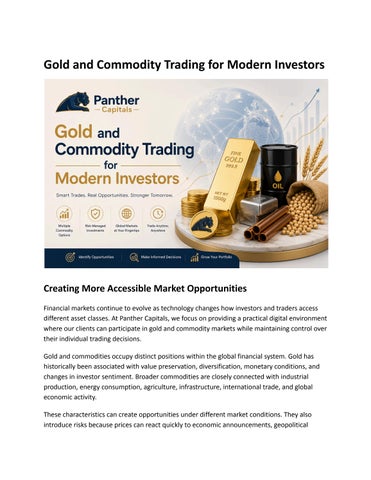
Gold and Commodity Trading for Modern Investors
Creating More Accessible Market Opportunities Financial markets continue to evolve as technology changes how investors and traders access different asset classes. At Panther Capitals, we focus on providing a practical digital environment where our clients can participate in gold and commodity markets while maintaining control over their individual trading decisions. Gold and commodities occupy distinct positions within the global financial system. Gold has historically been associated with value preservation, diversification, monetary conditions, and changes in investor sentiment. Broader commodities are closely connected with industrial production, energy consumption, agriculture, infrastructure, international trade, and global economic activity. These characteristics can create opportunities under different market conditions. They also introduce risks because prices can react quickly to economic announcements, geopolitical
developments, changes in supply and demand, currency movements, and unexpected global events. Our objective is to provide convenient market access while encouraging traders to approach each opportunity with clear objectives, appropriate risk considerations, and an understanding of the factors influencing prices.
Bringing Gold Trading Into a Digital Environment Technology has made participation in financial markets considerably more convenient. Instead of depending entirely on traditional processes, traders can monitor prices and manage market activity through digital channels. Our gold trading platform provides clients with access to gold market opportunities through an environment designed around usability and straightforward participation. We aim to make the process practical while ensuring traders retain responsibility for determining when and how they participate. Gold can experience periods of relatively stable movement followed by sharp price changes. These movements may occur after economic data releases, central-bank announcements, geopolitical developments, or significant changes in currency markets. Access to market information can help traders observe these developments and evaluate whether current conditions align with their strategies. Convenient access should always be accompanied by preparation. Before entering a position, traders can consider their intended exposure, potential downside, investment or trading horizon, and circumstances that might cause them to exit. By establishing these factors in advance, market participants can create greater structure around their decisions instead of reacting solely to short-term price movements.
Understanding the Forces Behind Gold Prices Gold prices are shaped by multiple economic and financial influences. Interest rates are particularly relevant because they affect the relative attractiveness of assets that do not generate interest. Changes in expectations surrounding monetary policy can therefore influence demand and market sentiment.
Inflation is another consideration. Gold has historically attracted attention during periods when investors are concerned about changes in purchasing power. However, the relationship is not fixed, and gold does not necessarily move higher whenever inflation increases. Currency performance also matters. Because gold is internationally priced using major currencies, exchange-rate movements can influence its affordability across different markets. A significant currency movement may consequently contribute to changes in demand. Geopolitical uncertainty can also influence market behaviour. During periods of heightened uncertainty, some participants may reconsider their portfolio exposure and allocate capital differently. This can increase gold-market activity, although the direction and duration of any resulting movement cannot be assumed. We believe considering these factors together can provide more context than focusing on a single market indicator.
Developing a Structured Approach to Gold Trading decisions can become more difficult when prices move rapidly. Strong market movements can encourage participants to act before fully assessing the risks involved. A structured approach can help reduce this tendency. We encourage traders to identify why they are considering a position before committing capital. A decision might be based on economic conditions, a broader market trend, technical price behaviour, or a combination of factors. Position size is equally important. Even when a trader has a strong market view, allocating excessive capital can create unnecessary exposure if prices move in the opposite direction. Time horizon should also be considered. Someone responding to shorter-term price movements may use a different approach from an investor assessing broader economic trends. Distinguishing between these objectives can help traders choose methods that are more appropriate for their intended participation. No approach can eliminate market uncertainty. The purpose of structure is to help traders manage that uncertainty according to predetermined considerations rather than relying entirely on emotion.
Accessing Opportunities Across Global Commodities
Commodity markets represent an important part of the global economy because they connect financial activity with physical resources used by consumers, businesses, governments, and industries. Through commodity market trading, we provide access to opportunities influenced by production, consumption, inventories, international trade, economic activity, weather conditions, and geopolitical developments. Commodity categories can behave very differently. Precious metals may respond strongly to monetary conditions and investor sentiment, while energy markets can be affected by production decisions, transportation conditions, inventories, and global consumption. Agricultural markets can respond to weather, seasonal production patterns, crop conditions, and international demand. These differences make it important to evaluate each market individually. A factor that creates significant movement in one commodity may have little effect on another. Our role is to provide practical market access while allowing clients to select opportunities that align with their strategies, risk tolerance, and market outlook.
How Supply and Demand Influence Commodities Supply and demand are central forces within commodity pricing. Changes on either side of this relationship can influence prices, particularly when markets experience unexpected disruptions. Supply can be affected by production decisions, natural events, infrastructure problems, geopolitical tensions, transportation interruptions, or restrictions on international trade. When available supply falls while demand remains relatively stable, prices may face upward pressure. Demand is influenced by economic growth, manufacturing activity, consumer behaviour, infrastructure investment, energy requirements, and technological development. Economic slowdowns can reduce demand for certain resources, while periods of expansion can increase consumption. Inventories can provide additional information about the balance between production and consumption. Rising inventories may indicate that supply is exceeding current demand, while declining inventories can suggest tightening conditions.
These relationships can change quickly. Traders should therefore consider the wider economic environment rather than relying on a single piece of information when assessing commodity markets.
Considering Global Events and Market Sentiment Financial markets are connected across countries, industries, and asset classes. An event occurring in one region can influence commodity prices elsewhere because global supply chains and trade relationships are closely interconnected. Geopolitical events can affect production routes, transportation networks, energy supplies, and expectations about future availability. Even when physical supply has not yet changed, expectations surrounding potential disruption can influence market pricing. Government policies can have similar effects. Import restrictions, export controls, taxation changes, environmental regulations, and production policies may alter market expectations and affect supply or demand. Market sentiment can amplify these movements. Traders may respond quickly to news and economic developments, creating periods of increased volatility. We believe traders benefit from separating immediate market reactions from longer-term economic implications. A short-lived price movement does not necessarily establish a lasting trend, while structural changes in production or consumption can have more persistent effects.
Using Market Analysis to Support Decisions Different analytical methods can provide useful perspectives when evaluating gold and commodities. Fundamental analysis focuses on economic conditions and the forces affecting supply, demand, currencies, monetary policy, and broader market sentiment. Technical analysis considers price behaviour itself. Traders may examine market trends, previous price areas, momentum, volatility, and other patterns when assessing potential positions. We do not view these approaches as mutually exclusive. Market participants may use fundamental information to understand why conditions are changing and technical observations to assess how those changes are appearing in price behaviour.
The appropriate method depends on individual preferences and strategies. What matters is that decisions have a clear rationale rather than being based entirely on short-term emotion or isolated market movements. Regularly reviewing the reasoning behind a position can also help traders determine whether the original conditions remain relevant.
Managing Exposure Across Different Markets Risk management remains essential when participating in gold or broader commodity markets. Prices can move against expectations even when analysis appears well supported. One important consideration is capital allocation. Traders can determine in advance how much of their available capital they are willing to expose to a particular market. This can reduce the potential impact of an unfavourable movement on the wider portfolio. Diversification can also be considered, but simply holding several positions does not necessarily reduce risk. Assets may be influenced by similar economic factors and can sometimes move in the same direction during periods of market stress. Understanding relationships between markets can therefore provide additional context. Currency movements, interest rates, inflation expectations, and global economic conditions may simultaneously influence several positions. We encourage clients to consider their total market exposure rather than evaluating each position in isolation.
Maintaining Discipline During Market Volatility Volatility is a natural feature of financial markets. For traders, rapidly changing prices can create opportunities, but they can also increase uncertainty and risk. Emotional reactions may become stronger when markets move quickly. Traders can feel pressure to enter a position because they fear missing a movement or remain invested because they expect an unfavourable position to reverse. A predetermined trading process can provide structure during these periods. Before entering a position, participants can establish the conditions supporting the decision and determine what developments might invalidate their original reasoning.
Reviewing decisions after trades are completed can also be useful. The objective is not simply to assess whether a trade generated a positive or negative result. Traders can consider whether the decision followed their intended process and whether the level of exposure was appropriate. Consistency in decision-making can become particularly valuable when market conditions are uncertain.
Connecting Gold and Commodities With Broader Portfolios Gold and commodities can provide exposure to economic forces that differ from those affecting conventional assets. This may make them relevant when investors are considering broader portfolio diversification. Gold can be influenced by monetary policy, currencies, inflation expectations, and investor sentiment. Other commodities may respond more directly to industrial demand, production capacity, weather, inventories, or consumption. Holding exposure across different markets can potentially create a broader investment profile, but diversification cannot guarantee positive returns or eliminate losses. We encourage investors to consider how each position contributes to their overall financial objectives. The amount of capital allocated, expected holding period, liquidity requirements, and personal tolerance for market fluctuations should all influence portfolio decisions. This broader perspective can help ensure that individual trades remain connected with the investor's overall strategy.
Building a Responsible Trading Experience At Panther Capitals, we aim to make gold and commodity markets accessible through a digital experience that supports practical participation and informed decision-making. Technology can simplify access, but it does not remove the uncertainty associated with financial markets. Prices remain influenced by changing economic conditions, global developments, supply and demand, currencies, monetary policy, and investor behaviour. For that reason, we place importance on a structured approach. Understanding the market, establishing objectives, considering potential downside, managing capital exposure, and reviewing decisions can all contribute to more responsible participation.
Gold provides exposure to an internationally recognised market with its own economic and financial drivers. Commodities connect participants with resources that support industries and economies around the world. By providing access to both areas, we enable our clients to consider a wider range of market opportunities according to their individual objectives. Our focus remains on creating an accessible environment where traders can monitor markets, evaluate opportunities, and make their own decisions while recognising the risks involved. Combining practical access with preparation and disciplined risk management can provide a stronger foundation for navigating changing gold and commodity markets.