1
2
Illustration by Javier Kowalski
BOOK A STREET ARTIST MAGAZINE ISSUE 2 / FEBRUARY 2014 EDITORS IN CHIEF Guille Lasarte & Charlotte Specht CREATIVE DIRECTOR Guille Lasarte guille@pantamagazine.com MARKETING DIRECTOR Mario Rueda mario@bookastreetartist.com CONTRIBUTORS Duck Productions, Urban-Think Tank, Stefanie Moshammer, Nuno Manuel da Fonseca, Lara Seixo Rodrigues, Fernando Mendes, Luísa Cortesão, Martha Cooper, Brooklyn Street Art, Hello Europe, Michael Bosanko, Caro Curbelo, Colectivo Licuado, Lucia Perez, Noel Silvera, Javier Kowalski, Maria Tavares, Nuno Ribeiro, duVarret, Fabian Stürtz, Lucas Toledo SPECIAL THANKS TO LATA 65, Underdogs Gallery, Vasco Cruz, Robyn Landau www.pantamagazine.com FOUNDERS OF BOOK A STREET ARTIST Charlotte Specht charlotte@bookastreetartist.com Mario Rueda mario@bookastreetartist.com www.bookastreetartist.com
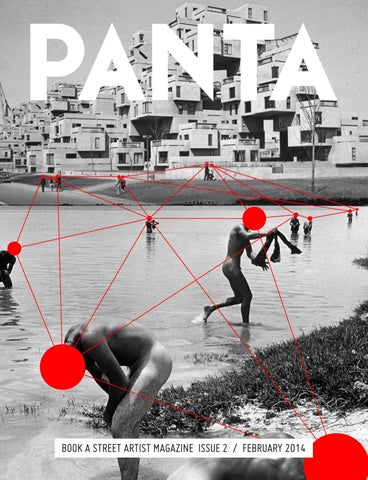
Cover collage by duVarret
2
LETTER FROM THE EDITORS After receiving a humbling amount of positive feedback for the first issue, which had 17,000 views worldwide, we return to give you the second issue of PANTA – a slightly fatter edition this time. Brought to life by the start-up Book a Street Artist, PANTA aims at being an international outlet for the arts, where diversity is integral to its quality. We have had an overwhelming amount of submissions from talented artists, designers, illustrators, photographers and writers from around the world for the second issue, and we are eternally grateful to these souls for sharing their work with us and believing in our magazine. Our goal for the second issue was to have a wider array of international collaborators, and thanks to all your contributions, we have reached that goal. We believe that street art and, by extension, art in general makes the world a better place to live in. Art stimulates creativity and reflection, it builds community, and is a means of communication that transcends cultural, social, racial and economic barriers. We would say this world needs a little bit more art, and a lot less bullshit! Thanks for reading and enjoy!
3
12
13
14
Duck Productions is a photography & video duo based in Lisbon, Portugal, made up of Catherina Cardoso and JoĂŁo Catarino. To see more of their work, check out their Facebook and tumblr: www.facebook.com/duckproduction duckp.tumblr.com
16
INTERVIEW
LIGHT RIDER Interview by Charlotte Specht Photography by Michael Bosanko
Michael Bosanko is a UK-based photographer and light artist. Lucky for us, he stumbled on light art by mistake. Hadn’t he accidentally kicked his tripod that one evening, who knows if Michael would have become the fascinating light artist he is today. He has created works for brands like Rolls-Royce, British Airways, Chivas, Orange, Amnesty International, and the list goes on and on. Nevertheless, he is a down-to-earth kind of guy who shares his art with everyone in a humble way.
18
I like the idea of creating something that doesn’t exist. What were you first – a photographer or a light artist? It’s hard to say. Professionally, I was a photographer first. Artistically, I have been creating works ever since I could pick up a pencil. Is it true that your first experience with light was when you made a mistake while taking a photo? Very true. I was shooting a night scene in Greece. I kicked my tripod, and the moon in the shot caused a streak of light across the camera’s sensor. The rest, as they say, is history... All these big names you have worked for – does it actually mean anything to you? Or do you get acknowledgement through other things? The clients I create work for puts me in touch with avenues I have never considered before, like writing, directing, animation and so on. Every project I do is amazing, whether it’s for a client, or for myself. I create a lot of work for private clients, which pushes my creative boundaries, which in turn pushes what I am capable of. How much graffiti is in “light graffiti” – which techniques or characteristics do you borrow from graffiti for your light creations? It’s a term I am never fully comfortable with. In reality, it’s not graffiti, but it seems to be the buzz word at the
moment, so I’m happy to ride with it. It also gets called light painting, but it’s not even that. Like everything, people feel the need to categorize things, and that’s fine by me. I see no point in getting precious about what it should be called, as it should be accessible to everyone, with no boundaries or elitism. What was the longest time your camera stayed on a long exposure? I once created a light art piece that went over 60 minutes. It involved continious light painting the entire time. What fascinates you about painting with light? Why is it “better” than actually painting with paint? Is it? I mean, all the casual viewer sees is me moving around with lights, but no trails. That’s the camera’s job, to capture the effects of time and light. It is no better or worse than painting with paint. It’s just another form of artistic expression. What inspires your artwork? I often become fueled by my own imagination. In the dark, it’s easy to let your inner thoughts wander, and conjour something out of nothing. The environment also influences my work, like the effects of light on water, or how light interacts with various surfaces.
19
Are you a collector of anything? I collect torches. Sometimes, when the mood takes me, I’ll scour rocky coastlines for fossils. What’s worth fighting for in this world? What’s worth fighting for... I guess love, peace, and unicorns. We know you love to travel – which was your strangest travel experience? I’ve never really had a strange experience. When I am in unfamiliar places, I usually thrive in the unknown. If you could be an animal, which one would you be and why? The idea of flying fascinates me. If I could fly like a bird, I’d be in my elements. What would you be if you weren’t an artist? I’d pursue photography. Outside that, I’d pursue writing and tattooing. I am learning tattooing as type; the sheer idea of using people as canvas is amazing. Do you have plans for 2014? Can we expect new projects? Naturally, I will be continuing my journey with light art, which I’ve now been doing for almost a decade. It’s also likely I will work more with animation and light art. I’ve explored it, but I want to do something totally amazing in the new year... ◆ bookastreetartist.com/michaelbosanko
Stencil by Luísa Cortesão
INITIATIVE
Text by Nuno Manuel da Fonseca Photos by Lara Seixo Rodrigues
LATA 65 a project by WOOL
23
Advances in Western medicine and the democratized access to health care services in the last century brought, among other things, the increase of life expectancy. In any country that may be considered developed, we know we won’t be hit by disease as our ancestors were. However, as we all know, quantity does not mean quality. And quantity without quality may not be a very good thing at all. As a society, we are still trying to figure out how to approach these extra years which we refer to as the “senior years”. In Europe, a relatively small territory with many countries and big cities, the phenomenon of population ageing can easily be detected. If you walk through parks and gardens, you will see baby strollers, but you will also see many groups of older people whose life has not been drastically reshaped because of their age. Lisbon is a city where this issue is particularly notable. LATA 65, a project developed by Lara Seixo Rodrigues [Wool – Festival de Arte Urbana] and Fernando Mendes [Cowork Lisboa], comes to life with the purpose of providing quality days for elderly people. The idea is simple: to organize street art workshops for retired people. For a few days, the participants learn with street artists about street art history, graffiti, the most widely used techniques, stencil-making, and other painting methods. Finally, they go on the street to share their ideas with the world on the city’s walls. In the two workshops already given, there was a huge enthusiasm from the students. It seems this project awakes a potentially forgotten creative mind and, above all else, brings back the feeling of having fun, vital at any age.
A nice surprise in this project was the presence of Luísa Cortesão, a former doctor, today a young artist in her 60s. Talking with her about LATA 65, one can understand what motivates someone to focus on graffiti after retirement. Luísa, why did you decide to do LATA 65’s workshop? My daughter told me about it, and since I have always been interested in these kinds of things, I decided to go for it. What do you think of having older people doing something commonly related to younger generations and to certain age irreverence? It is not related to age. In my case, what motivates me is curiosity and this has nothing to do with age but with personality. Behind curiosity there is, of course, the naughty side to go on the street and paint a wall. Since Luísa participated in the LATA 65 workshop, she has been continuously working on her stencil technique. In her artistic interventions, you can find political and environmental messages, but the universe she explores the most is the one where you can find small witches (“my grandchildren” – she clarifies), dragons, sea snakes, winged horses and also an old lady with a spray can (already an informal icon for LATA 65 itself). “L is not an artist” is the name of Luísa’s artist page on Facebook, where you can find images of all her little creatures. Luísa, you reject the ‘artist’ title, why? Because I’m not. I have always enjoyed walls and taking pictures of them, this just represents an extension of that. Of course it requires a different kind of work, to think about the drawing, to take the material to the location and to execute it, but
the drive is always the same—it’s the curiosity to see how it will turn out in the end. And this is it. There is no false humbleness here. You can feel Luísa has fun with the entire ritual of preparing the stencil and painting on the street. Nevertheless, she believes that the focus on this will only last until the moment she becomes interested in something else. There is no juvenile urgency in pursuing an artistic career. With this, there is objectivity in the creative process, which is reflected on the quality of the results. This is the difference between ‘just for fun’ and ‘just for money’. When the legendary street art photographer, Martha Cooper, visited Lisbon a couple of months ago, she insisted on meeting Luísa Cortesão and photographing her while she was working. You don’t consider yourself an artist, so how does it feel when someone like Martha Cooper is interested in meeting you and photographing your work? I assume she thinks ‘well, here’s another crazy old lady’… I don’t know… I didn’t know her, but now I know who she is… that she wants to take pictures of my work makes me proud. Luísa doesn’t see herself as an artist and doesn’t know how to interpret all this interest in something that she does just for fun, but she’s cool, all this mystery amuses her. I’m not going to ask you ‘why do graffiti?’ I get it, it’s something which you have fun with. Well, I don’t know what to answer. Why do I do it? You know, I could be resting at home, enjoying retirement, but… No! This helps me keep my mind alive!
Photo by Fernando Mendes
LATA 65 project has been widely praised and discussed in the media on a national and international level. It was also a winner of the Lisbon participatory budget for 2013, in which various projects are presented to obtain funding from the city. For this year, there are already 24 events planned at a local level, but there are also a number of national and international organizations interested in welcoming LATA 65. This project aims to avail the creative spirit we all have, no matter the age, and provide a way for elderly people to keep intellectually stimulated whilst promoting the idea that life isn’t over just because they are not considered part of the, strangely called, “active population”. LATA 65 is not the only way to achieve this, but the initiative points to a path where retirement is an another active phase of life and not the beginning of a passive existence. We all have the right to a dignified role in society even after retirement, because this is also a country for old men. ◆ www.facebook.com/Lata65 www.woolfest.org
Photo by Luísa Cortesão
It’s difficult to explain how it happened, but we went from being the vague memory of the “Switzerland of the Americas” to a kind of “new Amsterdam of the south”. To all this we should also add the affair that our president and his “Mujica way of life” has with the international press. Everyone wants to interview him and they’ve run out of headlines to describe him: “The poorest president in the world” according to the BBC or the “Uruguayan Mandela” according to the Italian newspaper La Repubblica… accidentally on purpose, Mr. Pepe has arrived on the pages of publications like Monocle with his casual and relaxed style. To top it off, Uruguay was named “Country of the Year” by The Economist and The New York Times recommends it as one of its “Places to Go in 2014”. Could all this be too much? I’m not so sure we’re ready to be in style.
Here in Uruguay, we can’t understand what all the commotion is about, if everything in the supermarket is getting so expensive [due to inflation], and in our neighborhood the butcher has been robbed again… for the second time. The heat wave continues and the February rainy season is upon us. We’re in headlines around the world but not much here has changed, or at least not too much. We obviously welcome the good news, but in the day-to-day, each Uruguayan continues more or less with their daily routine – getting up, preparing a mate and if the weather allows, going to paint. Why not? Montevideo has hundreds of available walls, unpopulated areas, lost streets, abandoned buildings and warehouses that are desperately asking for color. The city has learned to accept the gift of the artists, and the Montevideanos seem to have as well.
On this page: Mural in the Centro Cultural Pera de Goma, Montevideo, by Colectivo Licuado On the opposite page: 1. Mural by THEIC 2. Mural by Malandro 3. Mural by Alfalfa 4. Mural by MADE
Mural by David de la Mano
Mural by Colectivo Licuado in Villa Soriano
Mural by Alfalfa & THEIC
There are walls that were there for years, grey, old, alone, sad… one day, Alfalfa arrives and paints a fish that takes up half the block, or MADE comes and puts a tiger in a tie and suit to guard the corner… What are you going to tell them? To erase it? I say: welcome! Everything started slowly (slowly is a word that goes very well with Uruguayans), and with time streets and neighborhoods were conquered. First the street Constituyente… then while Alfalfa appropriated the Ciudad Vieja, Fiolence, Noel, THEIC and Fitz painted in Parque Rodó, Cordón and Palermo. KNCR Crew marked the Cerro and the northwestern part of the city with their impossible typographies. Lälin, Crew del Sur, Zêsar… the list is long and the names pile up. Muta Montevideo arrived – a street art encounter that united 30 artists from the entire region in a single weekend to change the face of the Goes neighborhood. David de la Mano had already done his thing in the Prado and the Puerto. Now he unleashed a giant mural to rescue the old Hotel Palace from oblivion in the heart of Punta del Este. His intervention marks the beginning of what will be the “District of Urban Art” in the main tourist destination of the country. Something is happening, and fortunately it’s not a monopoly of the capital.
Starting in the west, in Colonia del Sacramento, eight artists reveled as they painted a collective mural more than 200 meters wide. Towards the north, in the quiet town of Villa Soriano, it’s now common to see street artists of JAZ – Franco Fasoli, Harry Gelb, Camilo Nuñez and Florencia Durán of the Colectivo Licuado wandering around town during their stay in Residencia Vatelón. If we jump to the other end of the map, in the coasts of Rocha, many small white fisherman houses have become canvases for Irene Lasivita, Alejandro Sordi, Alabama and Noel. Martín Lorenzo -MADE- painted all the walls he wanted in Maldonado and then came to conquer Montevideo with his creatures and yellow people. In recent years, the walls of this country are shedding their skin. They’ve ceased to exclusively be political wallpaper or football poetry and have started to let themselves be loved by a legion of artists that have been gaining confidence, growing in size and finding their identity. The local street art scene is spreading artworks that are worth seeing. Artists who are part of a movement that transcends our country are joining the global stage where the street functions like a channel of direct and sincere contact with people. Welcome.
ARCHITECTURE
The
39
MODERN/ POSTMODERN
Divide
Text & Photography by Urban-Think Tank
Visit our site to purchase: www.pantamagazine.com
72
Photography by Fabian StĂźrtz Fabian StĂźrtz was born in Cologne, Germany in 1984 and still lives there today. The self-taught photographer has been working as a freelancer since 2006. www.fabian-stuertz.com
PHOTOGRAPHY
Finn Martin (†) Musician 2006
Thomas 2011
Kristian Auth & Matt Fox Disc Jockeys 2010
78
Andy Strauß NRW Slam 2011
79
Osaka Monaurail 2013
Roger Waters - The Wall 2012
88
INITIATIVE
HELLO EUROPE Text by Charlotte Specht Photos by Hello Europe
Hello Europe is a project brought to life by three Portuguese friends on a mission to find and promote the best buskers on a 50-day journey in 15 European countries. Their goal is to find and spread the amazing talent that there is on the streets by recording and sharing street art performances, while trying to break existing stigmas against buskers. They help artists gain exposure by shooting videos of their street shows and sharing them on their social media platforms, which have more than 10,000 followers. Furthermore, Hello Europe is currently promoting a contest between 25 buskers across Europe. Anyone can vote online for their favorite artist, and the winner receives an InterRail pass. On their trip they learned that busking differs from city to city, not only in terms of legislation but also with regards to each city’s culture. In Vienna, for example, they came to learn that city dwellers, in general, prefer silence over music in the urban environment—something which they found to be the opposite in countries like Spain or Portugal. But, regardless of the city, they found that talent is just about everywhere, sometimes in the most unexpected and hidden corners. One of these talents is SoRyang, an Austrian pianist who was born in South Korea. Her passion for piano developed at a young age, and the idea of playing on the street was on her mind for a long time, but the difficulty of transporting the piano made the dream seem almost impossible. She finally succeeded in 2006 by building a wheeled cart for transporting the piano. Since then she never stopped and makes her street music her profession and way of life.
www.helloeurope.pt www.bookastreetartist.com/soryang
“Street Art exists everywhere. It’s part of a city. It gives life, sound and color.” - Guilherme Duarte from Hello Europe
94
PHOTOGRAPHY
H Y B RID
L AND S CAPE
Photography & Text by Stefanie Moshammer
Hybrid Landscape shows traces of human intervention into our environment. It’s a landscape formed by globalisation and capitalism, a cultural landscape that represents our society. Human presence has made its influence almost everywhere, so certain places become hybrids, a mix of nature and human intervention.
www.stefaniemoshammer.com
95
THE BEAUTY OF BANALITY, THE MIX OF POETRY AND IRONY AND THE EXTRA IN THE ORDINARY. PHOTOGRAPHY IS NOTHING – IT’S LIFE THAT INTERESTS ME.
98
ILLUSTRATION / PAINTING
Artworks by JAVIER KOWALSKI
kovvalski.tumblr.com
SUBMIT YOUR WORK TO PANTA
For more info, visit www.pantamagazine.com