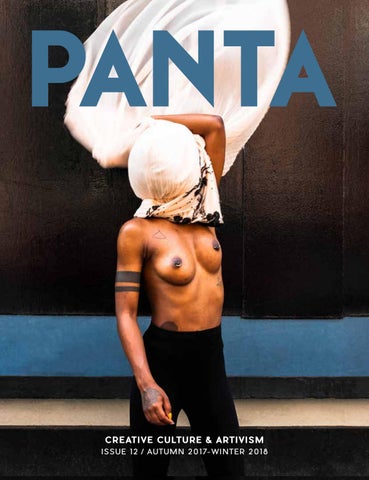
CREATIVE CULTURE & ARTIVISM ISSUE 12 / AUTUMN 2017-WINTER 2018
Join our family www.pantamagazine.com
SUBSCRIBE 3 ISSUES
Germany 36€ Rest of the World 48€
ISSUE 12 / AUTUMN 2017-WINTER 2018 EDITORS IN CHIEF
Charlotte Specht & Guille Lasarte MARKETING & ADVERTISING
Mario Rueda mario@bookastreetartist.com COPY EDITOR
Charlotte Kench PROJECT MANAGER
Sophie Smeets PROJECT ASSISTANTS
Juliette Antoine & Oliver Dougherty CONTRIBUTORS
Matthew Coleman, Roxanne Goldberg, Sidney King, Janielle Williams, Sheva Khati, JOS*, Camille Charlier, Casiegraphics, Andrea Servert Alonso-Misol, Michelle McSwain, Andrew Scheinman FEATURING
Heba Y. Amin, Carina Hesper, Ian Davis, Sandra Zegarra Patow, Macka B, Boa Mistura, Mark Hartman, Shepard Fairey, EyeEm PRINTER
MEDIALIS Offsetdruck GmbH Heidelberger Str. 65/66 12435 Berlin, Germany PUBLISHER
Book a Street Artist Taborstraße 4 10997 Berlin, Germany onelove@bookastreetartist.com www.bookastreetartist.com ISSN 2509-842X www.pantamagazine.com panta@bookastreetartist.com
Cover and back cover photos by Mark Hartman and Sandra Zegarra Patow
G2095 BLOOD ORANGE A crimson, almost blood-colored red, full of spirit and denseness. A distinct & tasteful shade of red. Make your choice among 215 tones in Montana GOLD’s flowing color system. #montanacans #germanspraypainT
I S S U E 12 / C O N T E N T S
Light In an elegant play between light and shadow, contributing photographer Matthew Coleman presents us with portraits of the artist Heba Y. Amin and shares some words about their soulful conversations.
LETTER FROM THE EDITORS
If there’s anything PANTA’s 12th issue has brought to our attention, it’s that art has a life of its own. That said, not all creative projects make it past the cutting room floor. For the work of an artist to find its wings and fly the studio coop is one thing; for it to spark vital conversation and tangible change is… pretty much why we’re here. From Boa Mistura, who spend time with local people to make sure their colourful murals are relevant to the community; to Macka B’s catchy cucumber song, which is already inspiring the next generation to put veggies in their lunchbox; PANTA is committed to featuring artists whose work has taken flight in the imagination of others and become part of something much greater than their creators might have ever anticipated. We hope you enjoy our latest offering.
Perspectives of Power LA-based painter Ian Davis draws us into his geometric world of power relations and authoritarian archetypes through his impressively detailed paintings.
Out of Sight, Out of Mind Dutch visual artist Carina Hesper gives us a glimpse into the lives of visually-impaired Chinese orphaned children through her photo series Like a Pearl in my Hand.
Free At Last A photo series by Peruvian artist Sandra Zegarra Patow, centred around women who demonstrate their freedom and courage by unveiling their breasts.
Painting by Ian Davis
The Best Mandarin Flavour Explosion Yet another mouthwatering recipe by our psychedelic chef – this time a dessert inspired by Japanese cartoons and walks in the Lisbon summer heat.
Art is Everywhere EyeEm and PANTA partnered up for a mission given to photographers around the world to capture the theme ‘Art is Everywhere’.
Bright, Bold, Big Madrid-based art collective Boa Mistura implements street art projects around the world, spreading optimism and empowering local communities.
70
Narratives Conceptual artist Heba Y. Amin develops a research-based art practice, scrutinising topics including urbanism and technology in contested territories, and touches on such compelling issues as flawed memory and imposed infrastructures.
Lyrical ‘Livity’ Reggae musician and activist Macka B opens us up to his universe of healthy food, good beats and the philosophy of positivity that underlies it all. Island American photographer Mark Hartman explores the faces of Coney Island and the human souls behind them, revealing their strikingly stark beauty.
Manufacturing Quality Dissent since 1989 Iconic street artist Shepard Fairey gives us his insights on his journey as an artist and activist and his long-lasting engagement of sticking it to the man.
narratives CONCEPTUAL ART
Words by Roxanne Goldberg Photos courtesy of Heba Y. Amin
There’s a school in Egypt, where the children play around the remnants of a decaying palace. Prohibited by law to tear down the historic building, the school administrators will wait until the structure collapses. Then they’ll be able to claim the land for private use. This palace-inside-a-school is just one of many deteriorating structures Heba Y. Amin has explored in recent decades. Using Super8 film, the Berlinbased artist records grainy black-and-white images of fallen urban landscapes in her native Egypt. When viewed alone, the shattered windows, broken monuments and solitary towers have no local context. But as vessels holding on to haunted memories, they feel familiar and timeless.
7
12
PHOTOGRAPHY
light
Words & Photography by Matthew Coleman of artist Heba Y. Amin
14
Photography / Matthew Coleman
I remember meeting Heba at her apartment, close to Admiral-Brücke, in Kreuzberg, beside the running river. There was an estate nearby to where she lived, with each section painted a different colour, as the sun was softly dancing in the sky, a play of light and shadow, of shade, of tone. Conversations ran headlong into the insanity of this world and its politics, drones, and the invasion of privacy. Discussions arose, on mass immigration, the shifting planes of power, the race war in America and the documentary 13th. We spoke of the Arab Spring and what it was like to be Egyptian and to have witnessed Tahrir Square during the uprising where, at its peak, around six million people descended into Cairo to create the biggest mass of people in human history. She told me of her ‘Homeland Hack’, of writing graffiti on the walls of a scene for the TV series, calling them racists – both jaw-dropping to hear and brilliantly playful in its conception. We took pauses between pictures, talking between shots without thinking of what to photograph, but staying open to the bouncing back and forth of knowledge. I introduced her to the world of documentary filmmaker Adam Curtis, his film The Power of Nightmares, and how the West has used this device as a means to spread fear and loathing since the 1940s. We spoke of Berlin as seen through the lens of the documentary Karl Marx Stadt. Hours dissolved into one another as we shared our ideas on various things we’d seen and read. It’s a rare thing to be able to engage in a long discussion on these subjects; most people avoid them, some don’t last more than a few minutes. We went on for hours, and ended up drinking a beer outside Heba’s favourite café near the bridge. Amidst a world of angst, there are lights like Heba who draw our attention to matters as important as these; shining their light on the dark corners of the human psyche and all of the atrocities it’s capable of.
PAINTING
28
perspectives of power Words by Juliette Antoine Photos by Sheva Kafai Paintings by Ian Davis
From a cursory glance it would seem that Ian Davis’ paintings are the product of a highly mathematical and meticulous mind. However, the contradiction between the artist and his geometric and organized style is just one of the many fascinating aspects of his work. As it turns out, “the paintings are highly organised – I am not,” he confides. “I fake it, mathematically.” Davis recently relocated from New Jersey to Los Angeles and it is in his small and cluttered studio – amidst piles of books and wheeled carts stacked with pots, sketches and paintbrushes – that the artist spends hours inventing strange and familiar worlds.
Detail of Inland (2014) Acrylic and spray paint on linen 60 x 65 in.
30 Painting
Ian Davis
Davis’ creative process resembles a formulated kind of improvisation. Although he is interested in depicting particular actions in particular settings, this doesn’t necessarily mean the concepts or intentions behind his artistic choices are clear to him from the outset. “That’s probably the key,” he explains. “I need to have an interest in describing a situation, but it’s important that I don’t know why [that is].” In other words, the painting can only come to life if Davis has something to figure out whilst painting it, in the hope that it will eventually make sense. The characters that occupy Davis’ paintings usually depict power relations and authoritarian archetypes on a grand scale. Viewers are offered an aerial view
of these structures and a detached perspective from which they can be critiqued. The homogeneity of Davis’ figures and the harsh geometry of their surroundings are disconcerting and symptomatic features of his overall body of work. Although Davis’ characters are rendered anonymous to the viewer due to their ant-like proportions, there is still just enough distance between the characters themselves that it’s possible to make out the shape of each isolated individual amidst the sheep-like masses. Davis’ flawless execution of perspective and framing work to highlight the surreal nature of each scene and accentuate the dictatorial quality of these structures as well as their stern, bureaucratic functioning.
Davis manages to cleverly convey the absurdity of human activities on a large scale.
31
32 Painting
Ian Davis 33
Broadcast (2014) Acrylic and spray paint on linen 75 x 80 in.
Architects Acrylic on linen 57 x 50 in.
34 Painting / Ian Davis
Mine 50 x 54 in.
There is a striking harmony between form and content, wherein the very techniques Davis uses to construct such rigid worlds also mirror what is taking place within them. Despite the fact that Davis’ settings are often portrayed as stark and dismal, the artist doesn’t perceive these environments as inherently menacing. He insists that, “generally, [the paintings] aren’t about their locations,” and that they are, quite simply, “just settings for an activity to take place.” That said, the conflict between humans and the natural world is a recurrent theme in Davis’ art. Davis’ work often explores the contemporary challenges we are faced with in light of our relationship with the environment and the consequences of our actions within it. ‘History of Nature’ (2016) is an apt illustration of this. A departure from the grey and muted tones that dominate the majority of his work, it depicts one of nature’s most terrifying acts in warm, bright and fiery hues. An erupting volcano blazes across the canvas as a gathering of humans stand at the cusp of cascading lava and, despite their miniscule size, can be seen hauling furniture into the molten river.
36 Painting / Ian Davis
History of Nature 50 x 57 in.
Davis’ commitment to denouncing the whirlwinds of folly and damage perpetrated by humankind could be described as an act of ‘artivism’; a portmanteau born from the convergence of creative expression and social, political and environmental activism. However, he is reluctant to think of his paintings in this way: “I don’t want my work to come with instructions on how it should be used,” he explains, and doesn’t consider artivism as much more than an upgraded term for art. “Aren’t they the same thing?”, he asks. There’s a sense of impending doom to be found in Davis’ paintings. This is perhaps due to the fact that regardless of whether they are set in jungles, deserts, laboratories, looping highways or volcanic eruptions, Davis manages to cleverly convey the absurdity of human activities on a large scale. “The man versus nature struggle always makes man look ridiculous and impotent,” says the artist. “There’s no question which one wins.”
38 Painting
Ian Davis 39
Whilst a critique of Western society and political systems is evident in the majority of his paintings, Davis is tired of solely portraying what is wrong with humans and the world. Although he admits that in the past year, “the state of the world has moved much closer to the somewhat exaggerated scenarios I’ve been painting,” the artist is currently thinking about weaving more optimism into his work and attempting to find an alternative to imputations of blame. “I’ll admit that I haven’t figured out how to respond yet. [...] If anything, I’d like to bring more of a sense of the surreal or ridiculous. Maybe I want to bring the focus back to man experiencing a sense of wonder.” Davis’ thoughtfully rendered political allegories confront us with the rigid and often inane ways in which our world is structured. Without being overburdened by cynicism and despondency, these paintings are striking reminders of our place within an immense and fragile ecosystem and as cogs within a much larger machine – both of which we don’t necessarily control or understand. The distant, aerial viewpoints offer us a seemingly objective outlook into some of humanity’s attempts to organize itself. Despite the fact that ultimately, nature adheres to its own rules. ∆ The word ‘dystopian’ springs to mind, which is no surprise given that the artist references the likes of Aldous Huxley, George Orwell, Orson Welles and Stanley Kubrick as influential in his first steps towards these quasi-apocalyptic depictions of our world – present and/or future. However, Davis insists that his work is more concerned with power than dystopia: “I’m getting exhausted with it. It’s become ubiquitous, that word, ‘Dystopian’ […] It’s not only in the air and in the atmosphere, but in the media, in our films, music, everywhere. I didn’t see things this way ten years ago. My nine-year-old the other day said, out of nowhere: ‘it seems like nobody is going to do anything about climate change’. That’s pretty dark.” Neither does he view his works as damning prophecies and is not set on resolving mankind to Orwellian futures. On the contrary, Davis sees his works as suggestions that might empower us with the ability to reflect on what could happen. “I’m just trying to describe possible scenarios,” he says, “they feel a bit dark because I think, generally, man operates from a dark place.” With this in mind, it’s up to the viewer to decide whether to adopt an air of cynicism – or one of hope – upon viewing the crowds of faceless figures in barren surroundings.
Surgeons (2015) Acrylic on linen 16 x 19 in.
COLLABORATION
40
Art is Everywhere
Art is Everywhere
After almost 100,000 entries, what occurred was a proliferation of unexpected and unconventional photographic examples of art all around us. Soon, the photographers of the top ten images will find a copy of this issue in their mailbox. But for now, thanks to the technological brain of EyeEm, we want to show you the top five entries. With PANTA holding dear the notion that art is valuable in any context, we hope the opened eyes and minds involved in this mission will continue beyond its deadline.
a collaboration with EyeEm
Photos on this page by Gunther Kleinert
41
In an alleyway, on the side of a bus, in a toilet, up a tree or in a car park. Whether it’s based on music, performance or aesthetics, art interweaves our lives more than we might expect. In fact, when you open both your eyes and your mind, you can’t help but see the constancy of art all around us, in dynamic and nonconforming shapes. So do you really have to go to a museum or gallery to find art? No, art is everywhere! (Just don’t forget to upload a photo of it...) With this in mind, a few months ago we teamed up with our friends from EyeEm to set out a mission for photographers to capture the ever-presence of art in our surroundings and in unusual spaces. Photographers uploaded their images with the tag ‘Art is Everywhere’, before the site’s artificial intelligence analysed and collated the best submissions.
Clockwise from top, photos by: Gunther Kleinert Jack Eslot Young-Jun Lee
free at PHOTOGRAPHY
and the shedding of unwanted layers Words by Charlotte Kench Photography by Sandra Zegarra Patow
43
44 Photography / Sandra Zegarra Patow
A
fter a long day, there’s nothing quite like walking in the front door and taking off the various garments and guises of our public persona. These private and unsung moments of our days are usually accompanied by a sigh of relief – whether it’s flicking off the heels of our shoes, unclipping a sturdy support bra or unzipping a uniform and letting it fall to the floor. There’s a freedom to be felt in the casting off of unwanted layers – even if it is just a momentary respite before we head back out the door. But what if we were denied access to these instinctive and unencumbered selves? What if removing those unwanted layers came at the risk of judgement, harrassment, punishment or arrest? Whilst it might be hard to see the parallels between the censorship of female nipples in the West (#freethenipple) and the imposition of black burqas on Muslim women in Syria in areas seized by ISIS (on women whom might otherwise choose to wear bright and colourful hijabs), the discourse surrounding both of these hot-button issues is primarily concerned with women’s choice of clothing – or lack thereof. Sandra Zegarra Patow’s photo series Free At Last happens to arrive at a fascinating nexus between the two. The Peruvian artist, who is currently studying Interactive Media Design at the Royal Academy of Arts in The Hague, photographed various women waving their hands above their heads whilst a layer of
vibrant, windswept fabric covers their faces and exposes their breasts. The portraits were taken in broad daylight on the streets of Rotterdam, where they were later exhibited as part of an all-female art and music festival called ‘Queens of the Industry’. Zegarra Patow was inspired to create the series after stumbling across the image of a woman standing on the back of a pickup truck, pulling a dark layer of clothing over her shoulders to reveal a vibrant red, yellow and turquoise dress underneath. The moment was captured by press photographer Jack Shahine as a group of women, children and men entered Rojava in Northern Syria, after having fled an ISIS-controlled territory in which the women had been forced to wear the large, black burqas against their will. The accompanying footage by Shervan Derwish shows various women joyfully casting off the shrouds of darkness that were imposed on them in favour of their own bright clothing and colour-coordinated hijabs. Unfortunately, the West is quick to misinterpret images such as these as representative of Muslim women everywhere and leap to the assumption that all Muslim women who wear hijabs, niqabs, chadors or burqas are not exerting their free will and religious right to do so. Head coverings and self-determination are not mutually exclusive – what matters is whether they are imposed by force or freely adopted as a part of one’s clothing and identity.
Photography / Sandra Zegarra Patow 47
48 Photography / Sandra Zegarra Patow
Photography / Sandra Zegarra Patow
...in principle it’s possible to wear whatever we want, but as soon as we show ‘too much skin’ we’re labelled immodest, receive unwanted attention and [told] that we’re ‘asking for it’. Right: Self-portrait of the artist
On the flip side of the conceptual coin is the notion that ‘the less layers on a woman’s body, the more liberated she is’. The irony of this is not lost on Zegarra Patow, who is “bothered by the fact that even in Western society, women’s freedoms are still limited to a certain extent.” She contends that, “in principle it’s possible to wear whatever we want, but as soon as we show ‘too much skin’ we’re labelled immodest, receive unwanted attention and [told] that we’re ‘asking for it’.” Echoing the sentiments of Lina Esco, the founder of the ‘Free the Nipple’ movement, Zegarra Patow also began to question why it is that “exposing a female nipple is grounds for being banned from social media, whereas graphic videos of beheadings are, apparently, permitted?” Back in 2013, Facebook decided to lift its previous ban on videos of people being decapitated. Mainstream media at the time was quick to point out the gaping discrepancy in the site’s censorship code, especially as breastfeeding photos were removed at the touch of a button. It was these kinds of double standards, as well as Shahine’s striking photograph, that drove Zegarra Patow to create Free At Last and ultimately, a unique contribution to the broader discourses surrounding both. A consideration of Zegarra Patow’s photo series would not be complete without referring to what has been so
aptly coined by French artist La Sauvage Jaune as ‘The Lottery of Indecency’. Accompanied by a crosssection diagram of a divided woman – one half covered and the other half topless – is a pertinent depiction of the fine line that women (including trans, femme and non-binary women) must tread between the extremes of being labelled ‘indecent’ or ‘oppressed’, ‘outspoken’ or ‘uptight’, ‘sexual’ or ‘submissive’ as a result of their choice of clothing. No matter which side of the diagram you most identify with, you’re either damned if you do or damned if you don’t. Free At Last occupies an interesting space in the Lottery of Indecency by obscuring the subjects’ faces whilst exposing their bare breasts at the same time. Zegarra Patow invited her subjects to revel in a ‘moment of freedom’ and in doing so, has invited her viewers to consider both sides of this lottery as they are presented simultaneously. There is obviously a considerable difference in the censorship of female nipples in the West and fleeing a violent and oppressive regime in Northern Syria. However, there is a relief that comes with the shedding of a forced and unwanted layer; one that sought to restrict, deny and quash you. Free At Last is about moments of freedom and choosing which layers you’d like to don or dismiss. ∆
51
THE PSYCHEDELIC CHEF
52
The Best Mandarin Flavour Explosion Words, recipe & illustrations by JOS*
I’ve never been to Japan, but it’s one of those culinary destinations that I’m dying to visit. Instead, I enjoy it through videos, books, films, and even manga comics that show me their culinary rhythms. The animated films from Studio Ghibli are one such example. It’s incredible how a cartoon manages to show the different textures of so many good foods and inspires you to take their recipes and cook like a crazy person with the orchestra of Zelda as background music – just to add another geek level to the experience. Japanese people are also famous for their video blogs, in which they consume food in large quantities in front of a camera. This is how one morning, whilst laying in bed and browsing YouTube, I came across a Japanese blogger walking on the streets of Osaka talking about the famous sponge cheesecake of Uncle Rikuro. Just seeing this cake on the screen made my mouth water, its texture is like a fluffy pillow. You don’t know whether to eat it or lay your head on it and take a sweet nap – that’s why this cake has different nicknames: you can call it ‘soft pillow Japanese cheesecake’ or ‘cotton cheesecake’. I had no choice but to get out of bed, go to the kitchen and open the fridge to look for the ingredients and start baking. The ingredients are so basic that they were already there waiting for me, ready to be blown up into the form of a spongy cake.
right there on the street under the summer sun, surrounded by passing tourists. I told Charli my secret way of eating mandarins, which is to take each segment and taste the flavours and aromas whilst sniffing the inside of the mandarin peel at the same time… and we called that moment, “The Best Mandarin Flavour Explosion.” That’s why I dedicate this cheesecake to my friend Charli, by adding mandarin to the recipe.
Ingredients: I was excited because I wasn’t sure if I was going to achieve that caricature-like texture and I didn’t know if I still had baking skills, so I got down to it. I took out the mixer and a white polka-dotted Portuguese ceramic bowl and right then and there, I cracked the eggs to initiate the ritual. This recipe has a lot of tricks that I love – the first one is to mix the egg whites to make merengue. With this step alone I could have ruined the recipe because I could’ve eaten all that merengue with a spoon on my own, like a dog with rabies drooling all over. But I controlled myself! I was still in my underwear, sweating – because this story takes place on one of those very hot, sticky summer days where it’s not the best idea to start baking – but the kitchen was vibrating with all that Japanese atmosphere, so I was enjoying myself. I also remembered that a few days before, while I was walking through Lisbon, I ran into Charli (PANTA’s copy editor). It was one of her last days in the city because she was returning to her homeland of Australia and we stopped to chat about everything and nothing
• 250g Philadelphia cheese • 6 egg whites • 70g sugar • 60g butter • 100ml milk • 1 tbsp mandarin juice • 2 tbsp mandarin peel, finely chopped • 60g wheat flour • 20g corn starch • 1/4 tbsp salt
Merengue: • 6 egg whites • 200g sugar
Method: 1 Preheat the oven to 130ºC. Grease up an 8” x 3” round baking pan with butter. Cut a strip of baking paper and stick it on the edge of the pan covering all the inner circumference. This is an important trick of the recipe because by taking out the paper at the end, the top of the cake will be baked a golden brown and the sides of it will remain yellow on account of being covered by the paper. 2 Merengue: in a water bath, whisk the 6 egg whites and the 200g of sugar until you can’t feel the grains of sugar anymore (this step is only to mix the egg whites with the sugar well, it may take around 7-8 minutes). Then, blend the mix to achieve a very shiny white colour and make sure that the mix forms peaks when you dip a spoon into it. Put the mix aside. 3 In a bowl, beat the 6 egg whites with the 70g of sugar and the Philadelphia cream cheese at room temperature. In a separate bowl, mix the butter and the milk (you can put the butter in the microwave for 30 seconds to melt it). 4 Add the mix of butter and milk to the egg whites with sugar and Philadelphia cheese, add the mandarin juice, chopped mandarin peel, flour and starch. Beat everything together. 5 Add the merengue with the mix from step 4 with soft movements (don’t beat) so that the merengue remains spongy. 6 Pour the mix in the pan prepared earlier and place it in a pot with water, as if you were baking flan, and let it bake for 1 hour and 20 minutes.
54
MUSIC
Lyrical ‘Livity’ M AC K A B and his recipe for a life of positivity Interview by Mario Rueda Words by Charlotte Kench Photos by Camille Charlier Illustration opposite by Casiegraphics
If anyone can help you overcome a lifelong aversion to Brussels sprouts and broccoli, it’s Macka B. Although the ‘Cucumba’ video – his lyrically impressive and highly informative song on cucumbers – went viral only recently, this robust Rasta man is by no means a newcomer. In fact, Macka B – born Christopher Macfarlane in Wolverhampton in England – has been sharing his fruitful insights with the world as a reggae artist and practising Rastafari since the early 1980s. Long before he started sharing his much beloved ‘Medical Monday’ and ‘Wha’ Me Eat Wednesday’ video installments, Macka B had already toured the world with
his music, released over twenty records in thirty years and made a name for himself as an influential dancehall toaster and DJ to boot. Fortunately for the rest of us, the secret to maintaining this inexhaustible level of passion and commitment is something he is more than willing to share with the world. Macka B recently paid a visit to the German capital and performed at an open-air concert following the Hanfparade, an annual ‘Hemp parade’ for the legalisation of marijuana. After the show, PANTA was granted an exclusive interview whilst nestled between a couple of pot plants in the Berlin Hanf Museum.
56 Music / Macka B
Notwithstanding the fact that smoking cannabis and wearing dreadlocks are some of the central practices to the Rastafari movement, there’s more to being a Rasta than the popular, two-dimensional stereotypes might suggest. In fact, there are several denominations of the movement – called ‘mansions’ – each with their own set of interpretations and practices. Many followers of the Rastafari movement also adhere to a holistic approach to their diet and speech. As anyone who has seen or heard Macka B in action will know, healthy food and thoughtful wordplay are vital ingredients for the aptly named ‘Lyrical Chef ’. Understanding Ital and Iyaric – Rastafari approaches to food and language – might lend us an insight into Macka B’s boundless vitality and it might also account for why his video on the nutritional benefits of cucumbers has garnered over 2.8 million views online. Put very simply, Iyaric is a dialect of English that was created by Rastafari as an act of resistance against the imposed colonial language. It consists of modified
English vocabulary by which words with negative, divisive and mortal connotations are replaced with positive, unifying and immortal ones. ‘Livicated’ replaces ‘dedicated’ for example, to avoid connotations of death. Ital (from the English word ‘vital’) refers to food that is considered as ‘close to nature’ as possible. It typically excludes food that has been chemically modified or which contains additives, pesticides, meat and animal products. It’s evident that as a strict vegan and talented lyricist, Macka B’s music is intimately connected to his way of life as a Rasta: “Rastafari faith is like a foundation for me… It shaped me to be the person that I am.” The use of Iyaric language (e.g. ‘I and I’) can be heard across Macka B’s extensive discology – which also includes a warning on the harmful chemicals used in the meat industry (‘Too Much Chicken’), the perils of excessive alcohol consumption (‘Don’t Drink Too Much’) and a list of over ninety ingredients that one might enjoy as part of a varied vegan diet (‘Wha’ Me Eat’).
Music is such a powerful medium. It can change the world. Putting something to music and putting a little humour into it can break down a lot of barriers.
Music / Macka B 59
Who here eats BERRIES? For some Rastafari, Iyaric, Ital and following an holistic way of life – also known as ‘livity’ – is part of their commitment to Jah, a single God that partially resides in all living things. “That’s one of the reasons why I say to eat less animals,” he explains. “If you are vegetarian or vegan, you’re cleansing your temple, you’re getting closer to nature and that’s where the vibes [are].” Whether you subscribe to the concept of ‘vibes’ or not and regardless of whether you’re a Rasta, a meat eater or an Episcopalian pescetarian, Macka B’s seamless ability to transform otherwise mundane nutritional information into catchy and educational ditties is extremely impressive. Songs about the antibiotics in chicken meat isn’t the only thing setting Macka B apart in an industry driven by money and reputation – and his commitment to his message isn’t conditional either. “I’ve been keeping true to myself and saying the same message for thirty years and I’m not saying [it] for monetary gain,” he insists. The fact that “the media tends to focus on the negative side of reggae and hip-hop,” (and the influence of violent and sexually explicit content on the youth) only seems to strengthen Macka B’s commitment to being a refreshing and different voice in the genre. “A change is going to come [and] it’s going to take certain people in the media to keep pushing the conscious messages,” he says. “Music is such a powerful medium. It can change the world. Putting something to music – even if it’s just in a rhythmical way – and putting a little humour into it, can break down a lot of barriers, especially for the
people who wouldn’t ordinarily take in the message.” Whether it’s his sharp sense of humour, infectious energy, or the warm timbre in his voice as he rattles off a list of vegetables (and finds a way to make silica sound interesting enough to want to Google more about it), it’s certainly working. Beyond the millions of online views, the impact of ‘Cucumba’ is already beginning to take shape offline. It’s pretty standard to go to a concert and have the lead singer ask the audience “How are you all feeling tonight [insert city here]?” and be met with rapturous applause. It’s another thing entirely to inspire this kind of enthusiasm from a crowd of adults with the question “Who here eats BERRIES?” Fortunately, it’s not just adults who are taking to his message of wellbeing, as Macka B is well aware of the “unhealthy messages that are being pushed onto the youths [by the media]” and the fact that “youths are passing away before their time [as a result of ] what they’re eating.” With his help, the next generation is already jumping on the bandwagon. “A lot of youths are into [the Cucumba song],” he beams, “People say, ‘Macka B, my daughter is into it and she’s taking cucumbas to school!’” As it turns out, anyone can follow a nutrient-rich diet and eat less meat – a fact that many of Macka B’s songs will actively encourage – but not just anyone can get people from all ages and walks of life genuinely excited about eating fruits and vegetables with a song. It’s a recipe that he’s been perfecting over thirty years and it looks like Macka B is keeping to it. ∆
90
VISUAL ART
M ANUFACTU RING Q UA LITY DIS SENT SIN CE 198 9 Interview by Roxanne Goldberg Photos by Jon Furlong & courtesy of Obey Giant Art
The year was 1990 and the Soviet Union was set to collapse, Germany was undergoing reunification and global nuclear war was no longer a major threat. It was a time of prosperity and hope for much of the world. Shepard Fairey, who was then studying at the Rhode Island School of Design, remained skeptical. Long before he designed the iconic ‘Hope’ poster for Obama’s presidential campaign in 2008, Fairey was getting acquainted with an assortment of university reading that included Noam Chomsky, Martin Heidegger and Andy Warhol’s diaries. They would provide him with the academic backing for his own manifesto and the premise that has guided his artistic practice for over 25 years: question everything. If you’ve ever wondered about the face behind the now-ubiquitous OBEY stickers, it’s time you learned about Shephard Fairey.
Visual Art / Shepard Fairey 93
I think what’s most important is to invite in – or seduce – the people who are not already supporters of the activist causes Roxanne: What in your childhood or early adult life has you believe in. made you such an ardent supporter of humanitarian, social and political causes? I see a lot of Shepard Fairey: I grew up in a conservative place, the same Charleston, South Carolina, and I was miserable until I discovered skateboarding and punk rock. Bands like people being The Clash and the Dead Kennedys inspired me to feel that tapped for using one’s voice for social commentary is very important to make sure that conservative conformity isn’t the only option. support, with From there I took an interest in how art and music intersect the driver being with activism and social justice movements. guilt or obligation In your view, what is the most successful means of rather than an growing activist support for these kinds of causes? Where do you believe support is most needed today? inspiration to find I think what’s most important is to invite in – or seduce – the people who are not already supporters of the activist common ground. causes you believe in. This might sound obvious, but We're all in this unfortunately I see a lot of the same people being tapped for support, with the driver being guilt or obligation, together and rather than an inspiration to find common ground. We’re injustice anywhere all in this together and injustice anywhere threatens justice everywhere. I can only speak for myself, but I’ve found threatens justice that the images which appeal viscerally and which lead the everywhere. person to the issue tend to work the best. Once the image is rattling around in their brain they are more or less forced to contemplate the subject matter it deals with.
In terms of activist work, in which ways does art succeed – or fill in the gaps – where traditional activism fails or falls short? Can you share an example in your work? Art can succinctly crystallize an idea, sometimes even a complicated idea. The power of art is that it can overwhelm predispositions if it captures the imagination. For the last few years, the U.S. has been very politically divided with a lot of mud-slinging and anger. I think it’s safe to say that it has not been much of a pro-humanity era. With the ‘We The People’ series, my collaborators and I believed that images that appealed to the better nature of people’s humanity could actually rally them to change their narrative from anger and exclusion to dignity and inclusion.
94 Visual Art / Shepard Fairey
I think you can see that a lot of my work is about making the machinations of commercial manipulation more visible by using them in a transparent way. Do you identify with the term ‘artivism’? Do you believe artists have a responsibility to be activists? In that same vein, do you believe art is inherently political or must it be made intentionally so? I’m ambivalent about ‘artivism’ as a term. I think art and activism can exist separately or together. I love making pictures, and expressing my opinion about things going on in the world, so it’s natural for me to merge the two. I don’t think that all art is political, some of it is decorative, but something like street art without permission is inherently political because it’s an act of defiance. I prefer when that street art act of defiance also says something meaningful, but a demonstration of courage counts for a lot in and of itself. The political climate has shifted since your 2008 ‘Hope’ poster catalyzed the grassroots movement around the Obama campaign. What kind of power do you believe art has to incite change in this changing political landscape? What role do you think the artist will play in the future? I always think that art has the potential to change things, but there are many variables that determine when the public will be receptive to certain ideas and how they should take shape visually. I’m constantly making images that I hope will steer people’s conversations and philosophies in a constructive direction, but I’m only one person and real change happens when there’s a genuine chorus of people pushing for similar ideas. I do believe that an image can be a common reference point for that chorus. I was lucky to create an image like that for Obama. I hope artists will play a bigger role in the future but
that’s up to them. A lot of artists are afraid to speak their mind through their art. Maybe they’re afraid that being outspoken will harm their market or bring criticism about their opinions, but I feel we have an obligation to do what we can with our voices. For artists, art is our megaphone. Subversive humour seems to be the defining characteristic in your work and artist persona. When and how is humour most effective in art? What are some of your favourite examples? Humour is disarming. When people are laughing, they don’t have their guard up. They are more receptive to a message delivered with humour. I like Banksy’s work a lot, he has tons of examples of great humour but my favourite is his piece using Pablo Picasso’s quote: “Good artists borrow, great artists steal” and he’s crossed out the Picasso attribution and written Banksy underneath it. All artists borrow and steal and Banksy is demonstrating the concept with humour. It’s honest and reflexive. You’ve faced criticism for engaging in the commercial art world and advertising industry whilst condemning the assault of commercial imagery on American society. Do you believe an artist can successfully match up the corporate art world with artivism without losing something in the process? The ‘commercial world’ is not a monolithic, onedimensional thing. I have lots of critiques of aspects of capitalism, but I think it’s possible to work within it ethically. I don’t do much commercial work now because I don’t need to, but when I was younger and poor the only way for me to survive and continue Bias By Numbers (2017) Mixed media (stencil, silkscreen and collage) on canvas 44 x 60 in.
Visual Art / Shepard Fairey 97
making art was by doing commercial design. However, even then I turned down work from companies I felt ethically uncomfortable with. If it were considered impossible to critique a system you interact with, I think that we’d all be living on islands or not critiquing anything. I do think that artists can work with the corporate world without losing anything, but they have to be shrewd enough to navigate things carefully. I always treated it as a Robin Hoodesque approach: using money from commercial projects to fund my own street art and activist projects that frequently called into question conspicuous consumption and blind obedience.
Above: Fairey working on Liberté, Égalité, Fraternité in Paris (2016) Photo by Jon Furlong Right: Obama Hope (2008) Mixed media (stencil, silkscreen and collage) on canvas 48 x 72 in.
With this ‘Robin Hood effect’ in mind – having two distinct identities as a corporate player and an activist artist – how do these identities relate and inform one another? Do your working methods differ? Earlier in my career, when I had to take on a lot of commercial projects just to survive, I still wanted to be proud of the work I was doing. My craft as an artist and my desire to make strong work merged with the commercial projects. Sometimes I was even able to encourage clients to abandon concepts that exploited culture in a short-sighted way and do projects that supported the culture they’d like to be allied with instead. I wasn’t always successful, but I did genuinely think that it would be better for the corporate client and the world at large. Now that I get to be more selective about my corporate projects, a lot of them are only corporate in the sense that the bands or filmmakers I’d like to support have enough commercial viability to be considered corporate. I actually approach these projects as artist-to-artist collaborations rather than corporate projects. I’m in the very luxurious position to be able to choose my projects and work with artists I admire like Interpol, Led Zeppelin, Franz Ferdinand, Blondie and filmmakers Matt Reeves and Matt Ross. I enjoy collaborating with other artists and activist organizations but when I’m working on my own art I’m happy to have the freedom to say what I want to say visually and philosophically.
Fairey working on Chinese Soldiers in Hong Kong (2016) Photo by Jon Furlong
Your trademark: ‘Manufacturing Quality Dissent Since 1989’ is punchy, defiant and perfectly conflates the tension between revolution and consumerism. How did you come up with it? I’m a big fan of language and a lot of the slogans that end up in my pieces are subversive takes on famous phrases from people like Marshall McLuhan and Noam Chomsky. Walter Lippmann coined the phrase ‘manufacturing consent’. The basic philosophy behind my art is ‘question everything’, so you can see the connection to ‘manufacturing dissent’. I added ‘quality’ and ‘1989’ to take on the feel of branding in a cheeky way. I think you can see that a lot of my work is about making the machinations of commercial manipulation more visible by using them in a transparent way.
Shepard Fairey 99
98 Visual Art
You wrote the Obey Campaign manifesto whilst studying at Rhode Island School of Design in 1990. How did your education and experiences at RISD contribute to your art practice? How have your influences changed since then and who are you inspired by today? RISD was very rigorous from both the studio art class and the academic class demands, plus I had never been in a situation with so many talented peers to compete with. I developed my work ethic at RISD, mostly because it was essential for survival. I majored in illustration because it allowed me to take electives in other departments like photography, graphic design
loved the poster art from San Francisco’s Filmore, Barbara Kruger’s pop meets propaganda and artists from punk rock like Winston Smith, Raymond Pettibon and Jamie Reid. Today I’m influenced by a lot of the same stuff. I really love Naomi Klein’s writing and her take on important issues. I just read a great book called Blood in the Water: The Attica Prison Uprising of 1971 and Its Legacy by Heather Ann Thompson that demonstrates the racial bias in the criminal justice system from policing to sentencing and the treatment of inmates. I’m very inspired by the art and philosophy of Vhils, the street and studio artist from Lisbon, Portugal, and I’m still inspired by Banksy’s smart and ambitious projects.
and printmaking. I fell in love with screen printing, which led to my aesthetic of a limited palette with bold imagery. That aesthetic was much easier to execute with the limitations of screen printing, so I turned those limitations into an asset rather than a liability. I was reading the works of various people: Freud, William Blake, Orwell, Heidegger, Andy Warhol’s Diaries, to name a few. Even though the group was eclectic they all had some influence on me. A combination of what I was reading and the need to defend my work in the class critiques (that could be very brutal) helped me refine and articulate my mission with my work. I was digging a lot of the pop artists like Jasper Johns, Warhol, Rauschenberg and Lichtenstein, but I also
Is there anything you’ve never been asked in an interview that you want to share? No one ever asks me what kind of car I drive, which may or may not be revealing. I drive a 2007 Prius, which I bought a few months after seeing the documentary An Inconvenient Truth and it was considered the best car for the environment at the time. I’m still driving it, not because I can’t afford an upgrade, but because it drives fine and the best thing for the environment is to drive the same car for as long as possible. A lot of our carbon footprint comes from the materials and labour needed to manufacture a new car. Also, I don’t want to abandon my collection of hard-to-find punk rock stickers and my novelty Judas Prius sticker. ∆
Above: Peace Waratah, Sydney, Australia Photo by Jon Furlong Opposite page, from left to right: Greater Than Fear (2017) Screenprint on paper 18 x 24 in.
Defend Dignity (2017) Screenprint on paper 18 x 24 in.
Protect Each Other (2017) Screenprint on paper 18 x 24 in.