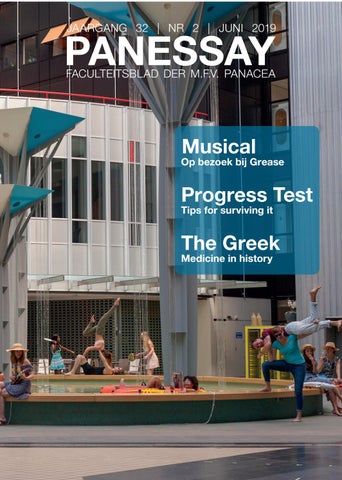
JAARGANG 32 | NR 2 | JUNI 2019
PANESSAY
FACULTEITSBLAD DER M.F.V. PANACEA
Musical
Op bezoek bij Grease
Progress Test Tips for surviving it
The Greek Medicine in history
Andreas Vesalius
De dood als uitkomst Wat er toen gebeurde zal je verbazen Nunc ullamcorper scelerisque tempor. Integer a molestie sapien. Donec aliquet laoreet orci nec dictum. Proin lorem leo, sollicitudin pulvinar risus et, iaculis vulputate urna. Aliquam ex felis, fermentum id venenatis non, sollicitudin ut elit. Donec volutpat consectetur risus id rutrum. Morbi in libero turpis. In et euismod mi. Etiam quis neque lorem. Cras sed leo nec mi faucibus rhoncus ac eu sapien. Cras accumsan ipsum non tincidunt lacinia. Nulla euismod mauris at eros tincidunt, vel feugiat nulla vulputate. Fusce nec dolor orci. Donec nibh urna, sollicitudin et blandit sit amet, sollicitudin vulputate velit. Quisque aliquet lectus quam, rhoncus scelerisque metus dictum ut. Suspendisse ex metus, luctus quis purus sit amet, condimentum porta eros. Quisque posuere eros eros, quis venenatis nibh mollis dignissim. Praesent placerat lectus ac augue mattis, id lorem sagittis. Cras sed neque elit. Pellentesque iaculis fringilla augue, at consequat metus imperdiet et. Proin ornare faucibus elementum. Suspendisse non tellus a sapien molestie malesuada. Nulla ut felis eget ex aliquam tristique ut in ex. Sed dignissim luctus mi, sit amet commodo erat mollis non. Integer ut justo vel odio lobortis tincidunt. Nam maximus dignissim finibus.
Het brein van mannen en vrouwen is anders geprogrammeerd en dat los je niet zo maar even op Nulla facilisi. Morbi facilisis nec lectus id lacinia. Suspendisse vulputate porta arcu. Phasellus suscipit, arcu laoreet fringilla interdum, sem libero porttitor metus, ut consectetur neque ante scelerisque metus. Integer sed fringilla diam. Donec tempor augue facilisis nulla porta, sed accumsan ante lobortis. Ut accumsan mi at urna tincidunt, non viverra odio vestibulum. Nullam faucibus, urna sed laoreet facilisis, lectus metus aliquam lacus, eget pellentesque nulla ex ac dolor. Vestibulum in nunc tortor. Cras in nulla vitae ligula
2
convallis mollis vel et dui. Aliquam feugiat ac sapien et varius. Aliquam a elit vulputate velit tincidunt cursus vel sit amet ipsum. Sed sed accumsan lacus. Maecenas sodales sit amet lectus quis auctor. Phasellus et purus tellus.Donec interdum arcu nec erat facilisis elementum. Nullam id lorem sed quam tincidunt malesuada ut aliquam odio. Etiam eu aliquam sem. Aliquam a elit vulputate velit tincidunt cursus vel sit amet ipsum. Sed sed accumsan lacus, vestibulum dapibus diam. Vestibulum ut nisi quis lacus sagittis laoreet nec at augue. Integer ac diam lacus. Sed eu lorem at ex porta pellentesque. Nunc at enim eleifend, tincidunt dolor a, pretium sapien. Vivamus nec ullamcorper sapien.
Vulputate Usna Nunc ullamcorper scelerisque tempor. Integer a molestie sapien. Donec aliquet laoreet orci nec dictum. Proin lorem leo, sollicitudin pulvinar risus et, iaculis vulputate urna. Aliquam ex felis, fermentum id venenatis non, sollicitudin ut elit. Donec volutpat consectetur risus id rutrum. Morbi in libero turpis. In et euismod mi. Etiam quis neque lorem. Cras sed leo nec mi faucibus rhoncus ac eu sapien. Cras accumsan ipsum non tincidunt lacinia. Nulla euismod mauris at eros tincidunt, vel feugiat nulla vulputate. Donec augue nulla, tristique non orci nec, ornare dictum Fusce nec dolor orci. Donec nibh urna, sollicitudin et blandit sit amet, sollicitudin vulputate velit. Quisque aliquet lectus quam, rhoncus scelerisque metus dictum ut.
30
30 20
24
Cocolumn
Sunny diseases
Medicine in history
De beschouwende bouwvakker
Got that summer sickness
The Greek
8
18 Prof. Progress Test
Criminal law
10 tips
When medicine turns criminal
5
Uit de hokken
Doctors in crime
18
6
Commissiepagina
Sunny diseases
20
8
Prof. Progress Test
Trauma-ethiek
22
10
Liefde voor het vak
Medicine in History
24
11
Onderwijscolumn
Naamsbekendheid
26
12
Grease
The Elephant Man
28
14
Casuspagina
Cocolumn
30
16
Fotopagina
Activiteitenkalender
31
Uit de hokken
Redactioneel Zomervakanties zijn voor mij altijd een - vaak onbewust - moment tot zelfreflectie. Wat heb ik geleerd dit collegejaar (veel), vond ik dit leuke onderwerpen (soms), heb ik iets van de statistieksyllabus onthouden (nee)? Na het laatste tentamen over zo’n twee weken acht ik het niet uitgesloten dat ik in een existentiële crisis schiet: wie ben ik naast de geneeskundestudent? Kan ik wel naar behoeven functioneren zonder een dreigend tentamen of taakdeadline? Gelukkig hoef ik daar niet al te lang over na te denken gezien ik mijn twee weken durende keuzeonderwijs in juli heb gepland. De masterstudenten zullen ongetwijfeld schrijnen bij het feit dat ik dan alsnog zo’n zeven weken langer vakantie heb dan de magere twee waar zij het mee zullen moeten doen. Om de zomer een beetje in te luiden hebben we de fonteinpatio van het UMCG omgetoverd tot een heus
stadsstrand en kun je verderop in deze editie lezen over ziekten die vaker voorkomen in de zomer dan in andere seizoenen. Ook niet onbelangrijk is onze VGT-hulp waarin we dit keer niet in specifieke, maar in algemene tips voorzien: handig voor de aankomende eerstejaars, want hoe veel vragen moet je nou eigenlijk invullen, en wat is die voortgangstoets überhaupt? Maar hij is zeker ook geschikt voor de al verder gevorderde student die zijn score misschien wil dan wel moet verbeteren.
Van het bestuur Terwijl de zon heerlijk schijnt, kan jij weer genieten van de nieuwste PanEssay. Neem hem mee naar het Noorderplantsoen of lees hem bij ons op de bestuurskamer; wij zijn nog hard bezig met afronden voordat wij kunnen genieten van de zomervakantie. We hebben al een mooi voorproefje gehad met de fantastisch georganiseerde buitenlandse reis. Iedereen heeft genoten van Turijn en alles wat deze mooie stad in de bergen te bieden heeft. Verder zijn er de afgelopen maand verschillende leuke activiteiten georganiseerd. Zo was de diesweek een echt feest en hebben jullie gelukkig veel activiteiten afgevinkt op jullie bucketlist. Verder zijn de JV3 Into the Coschappenavond, de bevallingsworkshop van de UrgenCie en de onderwijsactiviteit van JV1 georganiseerd. Gelukkig hoeven we niet alleen terug te kijken, maar hebben we ook nog veel leuks in het verschiet.
Zo komt de Docent van het Jaarverkiezing er weer aan, die dit jaar nóg spetterender zal zijn dan andere jaren. Ook kan je deze week bij ons op de bestuurskamer langs komen voor het bestuursinformatieuurtje, zal het epische AkCie eindfeest plaatsvinden en kunnen de coassistenten naar de Co-outdag! Vlak voor iedereen Groningen weer zal verruilen voor warmere oorden heeft de MusicalCie nog een mooie afsluiting: de musical Grease, die op 27 en 28 juni plaats zal vinden. Vergeet niet je kaartjes te kopen! Nu het einde van het semester nadert, wensen wij alle bachelorstudenten succes met de laatste loodjes. Voor alle hardwerkende masterstudenten: hopelijk genieten jullie net zo hard van jullie welverdiende vakantie. Heel veel leesplezier en tot het volgende academische jaar!
5
Commissiepagina
Vouchercommissie Van gynaecoloog tot patholoog-anatoom, psychiater tot chirurg, jeugdarts tot geriater. Je kan zoveel kanten op in de geneeskunde. Misschien heb je al precies voor ogen welk specialisme het gaat worden, en zijn die tentamens slechts hobbels op je weg. Misschien heb je nog geen idee wat je wil en zie je in de coschappen wel wat bevalt. Voordat je echt als co aan de slag kan, moet je natuurlijk wel je tentamens halen. Gaat dit niet zo makkelijk? Wil je juist meer verdieping over jouw lievelingsonderwerp?
Of wil je gewoon een indruk krijgen van hoe het in de kliniek gaat? Maak gebruik van het voucheronderwijs! Met al je gekke ideeĂŤn kan je bij ons terecht, er kan vaak meer geregeld worden dan je denkt. Dus heb je hulp nodig bij het onder de knie krijgen van de stof of wil je meer aandacht voor een onderwerp omdat je het gewoon interessant vindt, dan ben je bij ons aan het goede adres! Zo zijn er al veel leuke voucheractiviteiten geweest, onder andere over cardiologie en chirurgie, maar er is heel veel mogelijk. Dus pick your poison en gebruik je voucher!
BeCO Houd je stevig vast, want de mooiste maand van het jaar zit er weer aan te komen: de Benefietmaand! Als Benefietcommissie Oktober gaan we dit jaar ons best doen om zoveel mogelijk geld in te zamelen voor het goede doel van dit jaar: het Alzheimerfonds van het UMCG. Zoals uit de naam van onze commissie al blijkt, zal dit komende oktober zijn. Dit lijkt misschien nog ver weg, maar wij zijn al druk bezig om hier een gezellige en succesvolle maand van te maken. Hierbij hebben we jullie hulp hard nodig! We organiseren een heerlijk diner met een veiling, een andere extra activiteit en natuurlijk het meest epische feest van het jaar: het ORGIE! Door naar alle activiteiten te komen steun je niet alleen een mooi goed doel: gezelligheid en een mooi feestje zijn gegarandeerd! Bijzijn is meemaken, dus houd je agenda vrij. Can you drink yourself to another galaxy to support this charity?
6
AlmanakCie Ook dit jaar is de Almanakcie weer druk bezig om de almanak voor jullie samen te stellen. In december hopen we jullie weer blij te maken met een nieuw boek vol verrassingen. Het thema houden we nog even geheim, maar de voorbereidingen zijn in volle gang. De lay-out is druk bezig met alle nieuwe ontwerpen en de acquisitie heeft hard gewerkt om dit allemaal mogelijk te maken. Natuurlijk kunnen jullie weer rekenen op een hoop leuke foto’s en nieuwtjes. Wij kijken er naar uit om de almanak aan jullie te mogen presenteren en wensen jullie alvast veel leesplezier voor in de toekomst!
Tropen Wij zijn de Commissie Tropengeneeskunde! Tijdens vele gezellige diners de afgelopen maanden hebben onze Duitse Esther, de Nederlanders Alice, Michiel en Daniek en de Zweedse Hugo een crash course Tropengeneeskunde opgezet voor tweedejaars geneeskundestudenten. Niet alleen hebben we fascinerende lezingen georganiseerd over tropische ziekten, ook zijn vele andere onderwerpen aan bod gekomen waar je niet snel wat over te horen krijgt! Wie onder andere hun ervaringen hebben gedeeld met ons zijn een oorlogschirurg, een arts die op missie is geweest met Artsen Zonder Grenzen, en experts op het gebied van gezondheidszorg voor vluchtelingen en maternale gezondheid
in de tropen. Hier bovenop zijn wij ook nog even kort teruggekeerd uit de tropen, om een bezoek te brengen aan het Tuberculosecentrum in Haren! We are the Tropical Medicine Committee! Over many lovely dinners in the past few months, our German Esther, Dutchies Alice, Michiel and Daniek and Swede Hugo have put together a crash course on tropical medicine for second year Profile Education students. Not only have we just organized fascinating lectures about neglected tropical diseases, but we have also hosted presentations on other topics we don’t hear much about otherwise: war surgery, Médecins Sans Frontières, migration medicine and asylum-seeker care.
7
Thomas van der Korst
Prof. Progress Test Top 10 tips and tricks for surviving the progress test Stepping into the dissection room for the first time and getting hit by that smell, seeing your very first patient on your own or the first time you assist with a surgical procedure: all of these are frightening (but exciting) first experiences with which all medical students will be confronted. Those impressions will stay with them for the rest of their lives. However, these have nothing on the actual most frightening and terrifying experience a medical student will have to face: the Progress Test. Four hours. Two hundred questions. Hundreds of other students squeezed into a freezing room. The best part: you will not even understand most of the questions, especially in the first year.
Personally, I have attended a full sixteen of these tests (passed them all) and thought I would share some tips & tricks which I have learned so you do not have to spend the next five years of your life learning the ins and outs of taking Progress Tests. Some of these might seem a bit obvious to the veteran Progress Test takers, but still be sure to go through the whole list because every single one of these tips & tricks is guaranteed to make your test-taking life easier.
Tip #1 – Playing the statistics game. Hans would be proud of you. As Hans would say: “Hello I am Hans Burgerhof, and I work as a statistician in the UMCG.” We should all aspire to be like him, especially when it comes to the Progress Test. Passing is not a matter of having medical knowledge, it is a numbers game. First, you need to understand how points are assigned. A correct answer gives a full point. Not answering gives zero points. Answering wrong is more complicated (see the table). As you can see in the table, a question with 4 options causes 1/3rd of a point to be subtracted if you answer it wrong. This means that if you answer two of these questions wrong, and one correctly, you get 1/3rd of a point. So, answering more questions is always better. Therefore, a general rule of thumb is that if you can eliminate one answer, you should just guess the answer
8
to the question. This way you can still feel a little confident about your answer, and you are still statistically more likely to get a positive point total in that question. May the odds be forever in your favor.
Tip #2 – Intuition: not just a caveman’s game Maybe you like to think of yourself as a rational being who has got where they are based on smarts, good looks and hard studying, and that might even be true. However, these things are completely irrelevant for the Progress Test. It is about knowing stuff on the level of: ‘Oh, I think I remember reading or hearing about that somewhere, but I am not really sure… I guess it is C. Probably…’ This might seem amateurish and it is not the black and white way of knowing things you are used to on regular tests. This is what you call intuition. Because chances are: the answer is actually C. So the tip here is that you should not go back and change answers after you have filled them in. Except of course when the answer to a question is hidden in another question.
Tip #3 – Wait, how many questions SHOULD you be answering? For first timers, I guess I will keep it short. The first test I filled in 30 questions of which 18 were correct, and 12 were incorrect. I scored above average that way. So I guess you will be fine with answering like 20ish questions for the first test. But answering more is always better. So after that first test, which can be a little intimidating, focus on the first two tips. Answer more questions and trust your intuition.
Tip #4 – Eat breakfast. Seriously. I think this tip speaks for itself. The test starts at 9 AM, and you are allowed to keep working on it until 1 PM. So worst case scenario you are sitting there for four hours. Most people cannot function that long without breakfast and even if you can, you will not be doing the best you can. But then you say: “I do not want to get up that early, Professor.” Well, you really don’t have to. Just make breakfast the night before, it is not like you have anything better to do anyway. You can even keep watching Netflix while preparing it. If that is too much of a task for you, just take some fruit with you and eat it on the bicycle.
Tip #5 – No. Seriously. SERIOUSLY, EAT BREAKFAST. NO EATY MEANS NO THINKY.
Tip #6 – Progress Test essentials checklist: what to take with you to the test. Well, this is the most boring tip. Bring a pencil (or two), an eraser, a bottle of water and a snack (a cookie or whatever, I think technically you are not allowed to take food but everybody does it). Maybe bring a spare pair of pants because one time I ripped pants on the way to the Aletta Jacobshal. Maybe that was a little bit too much information…
Tip #7 – Take a break, but not too long. Or: the story of how I almost fell asleep during a Progress Test Four hours is really waaaaaaay too much time to spend on a Progress Test. You could get away with finishing the test, spilling your water on it, forgetting the answers you have filled in and redo the entire test in that amount of time. Therefore, (if you do not drop the water on your test) you have more than enough to take it easy. Take a break every now and then. I take a break every 50 questions and then I just sit there for five minutes doing absolutely nothing. Just relax.
And if you want a big break just go to the toilet, you are allowed to go there, freshen up and come back in your own time. This will help you with not stressing out during this Herculean feat.
Tip #8 – Haters gonna hate. #YOLO. This is another tip about not stressing out. Some people seem to be done in 30 minutes and some seem to take the entire four hours. However long you take the other people always seem to be doing better because either they are done real quick or are taking their time. Well, just do not worry about how others are doing. Just take it easy, take your time and do not change your answers. Haters gonna hate, you are your own person.
Tip #9 – Analysing your performance: the ONLY effective way to prepare for the next test. Seriously do not do anything else for preparation than what I am telling you here. When the results come out, you can go to the website: http://prof.ivtg.nl/prof. Here you can check how you did compared to the rest of the Dutch faculties or just the students in your LC. But the most important thing is pressing on the domain button and looking through the different options. For example, when sorting through the domains you can see that I am TERRIBLE at anatomy and great at paediatrics and geriatrics. This tells me I should either study anatomy real hard or just give up on it altogether and never answer an anatomy question ever again. Just generally studying for the Progress Test is impossible without the aid of something like our Professor Progress Test articles and you should not attempt it if you want to stay sane.
Tip #10 – “You know the rules and so do IIIII” Rick Astley knows what’s necessary to pass the year, do you? I saved the best for last. What do you need to do to pass the year? Well, you will find the answer here. As an example, we will just use the first year, but it is the exact same for all years, just with 4 more knowledge levels per year. To pass the first year’s Progress tests with a pass (P or V) you need to have: attended 4 Progress Tests (so you can never skip one without advance permission), finish at least one test at knowledge level 3 and another separate at knowledge level 4, and the very last test needs to be at least at knowledge level 1. So technically you only need to pass the last test of the year with a knowledge level of 4 and any other test at knowledge level 3 and you are fine. So do not stress if the first and/or second tests do not go that well, you can still easily make up for it. For the really smart people, you need to have 2 G’s at knowledge level 4 in the last three tests of the year. Of course, you also need to pass the other tests in that year at level 1 at least.
9
Anouk van der Horst-Schrivers
Liefde voor het vak Doorgaan tot de details Twee jaar geleden heb ik een groep geneeskundestudenten begeleid met hun bachelorthese en -product. Zij hebben voor patiënten met schildklierkanker, samen met de patiëntenvereniging, een unieke website gebouwd met jodiumarme recepten (www.jodiumarm.nl). Hun inspanning staat niet in een peer-reviewed Q1 of Q2 blad, maar ik ben van al mijn publicaties het meest trots op deze. De behandeling van patiënten met schildklierkanker begint met schildklierverwijdering, gevolgd door radioactief jodium om het achtergebleven schildklierepitheel te vernietigen. Een week voor deze behandeling volgen mensen een jodiumarm dieet; dit maakt de behandeling effectiever. Door je lichaam depleet te maken voor jodium krijg je een upregulatie van de jodiumtransporter in het schildklierepitheel. Dit dieet wordt aanbevolen in bijna alle (inter)nationale richtlijnen. Omdat je altijd nieuwsgierig moet zijn en kritisch op wat waar is en wat niet, zijn we gaan uitzoeken wat het bewijs is achter de richtlijn. Annika, Koen, Niek, Ilse en Nicolien zijn daar achter gekomen. Het wetenschappelijke bewijs voor een jodiumarm dieet is flinterdun en gebaseerd op artikelen uit de tijd dat ik zelf nog op de kleuterschool zat en een p-waarde of een onderzoeksopzet met een laag risico op bias niet altijd gebruikelijk was. Met andere woorden: de kwaliteit van de onderzoeken voldeed en voldoet niet aan de standaard die nodig is om duidelijke aanbevelingen te maken. Tegenwoordig wordt in de opleiding geneeskunde aandacht besteed aan allerlei competenties. Deze competenties zijn een leidraad om goede dokters op te
leiden. Ik zou daar twee competenties, of eigenschappen, aan willen toevoegen: liefde voor de mens en door willen gaan tot de details, of geneuzel. Een website met jodiumarme recepten (we zijn op dit moment wel bezig om prospectief bewijs voor het volgen van dit dieet te onderzoeken) was er nooit gekomen als we geen liefde voor de mensen met schildklierkanker hadden gehad en iets niet tot het detail hadden uitgezocht en uitgetest (want alle recepten moesten ook geproefd worden). Dat is mijn passie. Het vak Endocrinologie kenmerkt zich door ziektebeelden die voorkomen van jong tot oud, meestal chronisch aanwezig zijn, zowel goedaardig als kwaadaardig kunnen zijn, een gunstige prognose maar ook een slechte prognose kunnen hebben. Door de chronische aard van veel aandoeningen bouw je als endocrinoloog een band op met je patiënt en zijn of haar familie of vrienden. Zo’n een of twee keer per jaar ontmoet je elkaar op de polikliniek, spreek je elkaar tijdens een telefonisch spreekuur, of tussendoor bij een telefonische vraag en soms tijdens een (onverwachte) opname. Veel beslissingen rondom de zorg en behandeling betreffen aanpassingen gericht op het vinden van een nieuw, beter evenwicht. Binnen de Endocrinologie zit in het in de details. Het verzamelen van details door met patiënten te praten, ze te kennen omdat je ze jaren achtereen ontmoet. Hoe meer je weet, hoe meer je kan verzamelen, hoe beter je datgene wat je verzamelt op waarde kan schatten en daarmee de puzzel kan leggen, hoe beter je beslissingen kan nemen. Een vak waarin liefde voor de patiënt (en zijn naasten) en geneuzel tot zijn recht komt. Mocht ik ooit stoppen met werken, dan zou ik graag een afscheid willen organiseren voor de patiënten die ik begeleid. Ik zou ze graag zelf nog een keer willen spreken, maar ook willen voorstellen aan Anika, Koen, Ilse, Niek of Nicolien, mijn toekomstige collega’s waarvan ik overtuigd ben dat zij dezelfde liefde voelen voor “mijn” patiënten. Misschien wel onder het genot van een smoothie sinaasappel-banaan met slecht 5 μgr jodium.
10
Lisette Holslag
Onderwijscolumn Op weg naar de top “Wat doet een communicatieadviseur nou eigenlijk in de praktijk?” Die vraag werd me jaren geleden gesteld door een stel Groningse studenten. Geen willekeurige studenten, maar nota bene vierdejaars studenten Communicatiewetenschappen. Ze hadden geen idee wat het communicatievak op de werkvloer inhield; ze klaagden dat ze alleen maar bezig waren met onderzoek doen. Terwijl het zo’n mooi vak is waarbij je zo goed kunt bijdragen aan het behalen van organisatiedoelen en meer tevredenheid over of zelfs trots op de organisatie. It starts with a plan
Landschap inrichten
Met liefde heb ik deze studenten verteld over het vak dat ik al mijn hele werkzame leven met hart en ziel uitoefen. Over hoe je altijd begint met een plan voordat je meteen de communicatiemiddelen induikt. Dus niet meteen die website gaan bouwen of die digitale nieuwsbrief gaan schrijven. Ook al wil de opdrachtgever dat nog zo graag en jeuken je handen. Het aloude “bezint eer ge begint” geldt ook hier nog steeds. Eerst je goed verdiepen in de context en de problemen, dan pas de communicatievisie en -doelen formuleren, vervolgens zorgvuldig de strategie uitstippelen, de kernboodschap vaststellen, de doelgroepen definiëren en differentiëren plus de geschikte communicatiekanalen hanteren. Zodat je alles uiteindelijk in een communicatiematrix kunt gieten: met wie communiceer ik wanneer en via welke kanalen met welke boodschap? En hoe regel ik de respons? Hoe meet ik het effect van mijn acties? Dat is waar strategische communicatie over gaat.
Mijn opdracht is om het Informatie- en Communicatie Landschap (opnieuw) in te richten. Gerda Croiset, de prodecaan van het UMCG had een dergelijk project ook in Amsterdam georganiseerd en dat bleek heel succesvol: het VUmc steeg gestaag van de onderste regionen in de NSE naar de top! Die ‘truc’ moesten we in Groningen ook maar gaan toepassen. Dat de Amsterdamse werkwijze niet eenvoudig gekopieerd kon worden naar de Groningse situatie, was mij van meet van af aan duidelijk. Hier kennen we immers een heel andere opzet van de studie: vier Learning Communities met competentieonderwijs, wat geldt als een innovatief concept maar wat in de praktijk ook de nodige kinderziektes met zich meebrengt.
De bachelorstudenten zijn ontevreden over de informatievoorziening Ontevreden studenten Toen ik afgelopen december begon als interim communicatiestrateeg bij het Onderwijsinstituut van het UMCG, ben ik natuurlijk meteen gestart met een plan. Eerst goed onderzoeken waar de communicatieschoen wringt. Bij het OWI blijkt het onder meer te gaan over de bachelorstudenten geneeskunde die ontevreden zijn over de informatievoorziening die hun studie betreft: te veel mails, niet weten waar je met vragen terecht kunt, van het kastje naar de muur gestuurd worden, onvindbare of verouderde informatie op Nestor, niet weten wat er met al die evaluaties gebeurt en ga zo nog maar even door. Ik heb tientallen studenten en medewerkers gesproken, colleges en bijeenkomsten bijgewoond, stapels nota’s en rapporten gelezen voor ik me een eigen mening vormde over hoe dit communicatievarkentje te wassen.
Die ‘truc’ moesten we in Groningen ook maar gaan toepassen Aan de slag Nu de problemen grotendeels in kaart zijn gebracht, de gewenste resultaten zijn geformuleerd en er een strategie is uitgeknobbeld, gaan we aan de slag met twee teams: een Informatieteam en een Communicatieteam. In beide teams zijn studenten uiteraard vertegenwoordigd, naast medewerkers van het OWI die veel contacten met studenten hebben. Het Informatieteam gaat aan de slag met het screenen van alle “need to know informatie” op Nestor en met de vraag: hoe gaan we onze studenten beter informeren zodat zij uiteindelijk meer tevreden zijn over de informatievoorziening. Het Communicatieteam buigt zich over de “nice to know informatie”: hoe communiceren we beter over onze mooie opleiding zodat studenten, docenten en medewerkers niet alleen meer tevreden, maar zelfs trots zijn op hun studie/werk? Zodat alle inspanningen van alle verbeteracties ertoe leiden dat de opleiding tot Groningse arts weer de plek krijgt die zij verdient: aan de top!
11
Chris Lenselink Suzanne Schuurman
Grease Achter de schermen Op 27 en 28 juni treden onze muzikale medestudenten op met de iconische musical Grease, en wel in de Stadsschouwburg. Wij namen een kijkje in de keuken en gingen in gesprek met de mensen die de musical mogelijk maken. Alice van Ginkel – voorzitter MusicalCie Wij als commissie wilden graag een bekende musical, waarbij wij ook humor erg belangrijk vonden. Grease kent bijna iedereen, maar dit script is echt fantastisch! Het is weliswaar een verhaal dat een beetje teruggaat in de tijd, desondanks denk ik dat menig bezoeker enkele aspecten zal herkennen. Ik denk dat vooral die herkenning de musical zo leuk maakt! Wat ook erg leuk is aan deze musical, is dat er meer jongens in spelen dan in voorgaande musicals. Dit leidt ertoe dat er veel dynamiek in de musical zit en dat je veel kan genieten van de zalige mannenstemmen dit jaar! Tijdens deze anderhalf jaar hebben wij als commissie geleerd hoe we in oplossingen moesten denken. Bij het organiseren van een musical komt echt ontzettend veel kijken, veel meer dan dat het van de buitenkant soms lijkt. Je moet repetitieruimtes hebben, een borrellocatie, externe repetitieruimtes voor de repetitiedagen en doorlopen. Wat ik nog wel belangrijk vind om ook te benoemen is dat het bij de musical natuurlijk niet alleen om de spelers gaat. Dat zijn weliswaar de mensen die je tijdens de musical ziet, maar het orkest en ook de crew zijn echt onmisbaar, dus vergeet ook vooral hen niet! Zij zijn namelijk ook iedere week aan het repeteren en aan het werken met kleding en decor. Dat is ook vooral het leuke aan de musical: je doet het echt met elkaar, iedereen doet zijn uiterste best om daar in de stadsschouwburg 27 en 28 juni de bezoekers een fantastische avond te laten beleven.
Jorrit Boonstra – regisseur Grease is een prima musical voor deze tijd. De thematiek is nog steeds actueel. Groepsdruk, waar hoor je bij, is diegene waar jij gek op bent ook verliefd op jou? Erachter komen wie je eigenlijk bent. Deze dingen maken mensen nog steeds mee, op de middelbare school, maar ook net zo goed tijdens je studententijd of op je werk. Ik vind het fantastisch om met Grease aan de slag te mogen gaan. Het is een uitdaging met
12
veel mannenrollen, maar we hebben een hele leuke cast waar ik mee mag werken en die er vol voor gaat. Zodra cast en orkest samenkomen merk je echt de kracht van musical en dat is altijd een fantastisch moment. Greased Lighting is een hele spannende scène. Het is een nummer dat iedereen herkent en je wil er ook echt mee uitpakken. Je bent ontzettend afhankelijk van het decor (lees, de auto), maar door ruimtegebrek kunnen we daar pas op het laatst mee gaan oefenen. De jongens die de T-Birds spelen maken er al wel echt een show van en de rest van de castleden die eromheen dansen staan er ook vol energie, dus dat scheelt. Het is fantastisch om zo’n talentvolle groep studenten te zien dansen, zingen, muziek maken en acteren. En omdat het best wel uniek is dat zoveel mensen, cast, crew, orkest en professionals in een relatief korte tijd keihard en passievol aan de slag gaan om in de schouwburg van Groningen iets prachtigs neer te zetten. De afgelopen musicals die we hebben neergezet werden heel enthousiast onthaald door publiek en pers, dus ik zou deze kans zeker niet laten liggen om een geweldige avond te hebben.
Koen Brummel - Danny Zuko Ik vind de rol van Danny echt heel leuk. Ik herken me gedeeltelijk in die rol, maar ook gedeeltelijk niet. Bij de auditie moesten we ook kijken naar wie je zelf was tijdens je middelbareschooltijd, en ik was zeker geen arrogante klootzak, maar hij is op sommige momenten ook heel onzeker. Daar herken ik me wel in. En het is ook leuk om een rol te spelen die niet dicht bij jezelf ligt. Ik bereid me vooral voor door filmpjes van andere uitvoeringen te kijken en thuis ook te oefenen hoe ik iets zou spelen, maar door wel steeds te kijken hoe ik iets van mezelf daarin kan plaatsen. Je merkt soms wel dat het een oude musical is, je kan bijvoorbeeld niet je telefoon even pakken op momenten dat wij dat wel zouden doen. Dat maakt het ook wel weer leuk, samen met de liedjes en het dansen, wat ze in die tijd natuurlijk veel meer deden.
Lotte Zuur - Marty Twee jaar geleden heb ik met de musical Aïda meegedaan en dat was echt superleuk. Ik vond muziek en dans sowieso wel leuk en ik heb ook toneel gespeeld, dus ik heb het gewoon geprobeerd. Het was zo goed bevallen, dat ik het nog een keer wilde proberen. Daar was geen twijfel over. Ik vind Grease oprecht een hele leuke film en een hele leuke musical. Er wordt een hoop gedanst en is toegankelijk voor iedereen. Ik kijk zelf heel erg uit naar de eerste scène. Die eindigt met het nummer “Die zomernacht”, dat vind ik echt een heel leuk nummer.
13
Arno Bourgonje
Dr. House in de praktijk XI Een bloedstollende casus Tijdens je klinische stages komen al die dozijnen atherosclerotische ambtenaren, collaberende communicatieadviseurs en icterische installatiemonteurs je allang de conchae uit, waardoor een bijzondere casus een welkome uitdaging kan zijn. Een casus met een ronduit interessante diagnose. In deze editie presenteren wij zo’n casus, met een diagnose die zich doorgaans niet vaak laat stellen… Hoofdklacht(en)?
Lichamelijk onderzoek
Vermoeidheid, pijn en blauwe plekken.
Bij algemene inspectie wordt een bleke, matig zieke jonge vrouw gezien met helder en adequaat bewustzijn. De vitale functies zijn als volgt: pols 78/ min regulair aequaal, RR 112/68 mmHg, saturatie 98%, T38.2°C. Bij inspectie van haar gelaat bemerkt de huisarts lichtgeel verkleurde sclerae en vermoedt hij een lichte facialisparese aan de rechterzijde. Bij onderzoek van de extremiteiten worden verspreid over beide benen een groot aantal petechiën waargenomen.
Anamnese Mw. De Vries, 26 jaar, komt op het spreekuur van de huisarts omdat ze zich de laatste dagen behoorlijk ziek is gaan voelen. Het begon allemaal met vermoeidheid en lichte hoofdpijn, maar vervolgens kwamen ook buikpijn en keelpijn opzetten. Mw. De Vries is werkzaam als verpleegkundige in het ziekenhuis en was ondanks deze klachten eerst nog wel op haar werk verschenen.
Aanvullend onderzoek Eergisteren bemerkte ze echter aan het einde van haar werkdag dat ze op verscheidene plaatsen op haar lichaam (ellebogen, onderbenen en voeten) ineens blauwe plekken had ontwikkeld. Ze had niet het idee dat ze zich bijzonder vaak had gestoten die dag, dus dat vond ze erg vreemd. Sindsdien is patiënte toenemend zieker geworden en ze denkt nu ook koorts te hebben ontwikkeld. Gisteravond, voordat ze ging slapen, viel haar verder na een toiletbezoek op dat haar urine zeer donker van kleur was (colakleurige urine). Dit was voor haar de druppel en daarom had ze direct vanochtend gebeld voor een afspraak alhier. Patiënte heeft een volledig blanco voorgeschiedenis. Behoudens een oraal anticonceptivum gebruikt ze verder geen medicatie. Mw. rookt niet (heeft wel 5 jaar lang gerookt, maar ze is sinds 3 jaar gestopt), drinkt sporadisch alcoholische dranken (uitsluitend op verjaardagen) en gebruikt geen drugs. De familieanamnese levert het volgende op: haar moeder heeft systemische lupus erythematodes (SLE) en astma en haar vader lijdt aan diabetes mellitus type 1. Mw. heeft nog twee broers die verder allebei gezond zijn.
14
Patiënte werd door de huisarts direct doorgestuurd naar het ziekenhuis voor nadere analyse. Allereerst werd een breed, oriënterend laboratoriumonderzoek ingezet, dat de volgende waarden opleverde: Hb 7.4 mmol/l (N: 8.5 – 11.0 mmol/l), CRP < 5 mg/l (normaal), BSE 3 mm/h (N: < 20 mm/h), leukocyten 7.8x10⁹/l (N: 4.0 – 10.0x10⁹/l), trombocyten 24x109/l (N: 150 – 400x109/l), reticulocyten fractie 33.5% (N: 2 – 20 %), LDH 645 IU/l (N: < 248 IU/l), creatinine 96 μmol/l (N: 60 – 110 μmol/l), eGFR 65 ml/min/1.73m2 (N: > 90 ml/min/1.73m2), totaal bilirubine 54 μmol/l (N: < 17 μmol/l), fibrinogeen 3.0 (N: 2.0 – 4.0 g/l), PT 12,1 s (N: 8,7 – 12,7 s), APTT 31 s (N: 21 – 31 s). Tevens werd een bloeduitstrijkje gemaakt, waarop kapotte, vervormde erytrocyten werden gezien (zogenaamde ‘schistocyten’ of ‘fragmentocyten’) en een zeer laag aantal trombocyten.
Wat is uw DD? Differentiaaldiagnostisch werd in deze casus gedacht aan een infectie (bijv. meningokokken of HIV-infectie), een auto-immuunziekte zoals systemische lupus erythematosus, of trombotische microangiopathie op basis van trombotische trombocytopenische purpura (TTP), het hemolytisch-uremisch syndroom (HUS) of diffuse intravasale stolling (DIC).
Wat is uw (werk)diagnose? De diagnose in deze casus luidde uiteindelijk: trombotische trombocytopenische purpura (TTP). TTP is een zeldzame, ernstige hematologische aandoening dat de bloedstolling treft. De verschijnselen van de ziekte ontstaan als gevolg van een trigger voor het neerslaan van hyaliene trombi in de microcirculatie, waarbij trombocyten worden verbruikt en de erytrocyten mechanische hemolyse ondergaan door contact met de ontstane trombi. Deze trigger voor trombusvorming kan onbekend zijn (primaire of idiopathische TTP) of afgegeven worden in de aanwezigheid van een andere oorzaak (secundaire TTP). De primaire, idiopathische vorm van TTP is hierbij de meest voorkomende variant. Deze vorm wordt veroorzaakt door een verminderde activiteit van het enzym ADAMTS-13, een eiwit dat verantwoordelijk is voor het ‘knippen’ van de von Willebrand factor (vWF), waardoor deze adequaat kan functioneren in de circulatie. Bij de productie van vWF wordt eerst een groot vWF eiwit gevormd (‘ultra-large vWF’) dat nog in kleinere stukken ‘geknipt’ moet worden door ADAMTS-13 om functioneel te worden. Bij het ontbreken of verminderd actief zijn van ADAMTS-13 gaan trombocyten sneller binden aan vWF en ontstaan er sneller en uitgebreidere trombi. Bij de idiopathische vorm van TTP wordt verondersteld dat autoantilichamen, gericht tegen ADAMTS-13, verantwoordelijk zijn voor het onderdrukken van de activiteit van ADAMTS-13. Hierdoor kan idiopathische TTP worden beschouwd als een auto-immuunziekte. Andere (zeldzame) oorzaken van TTP worden geschaard onder de ‘secundaire’ variant en betreffen o.a. geneesmiddelengebruik (bijv. ciclosporine, alfa-interferon, orale anticonceptiva), stamceltransplantaties, maligniteiten, ernstige infecties met sepsis tot gevolg, zwangerschap of ernstige lever- en nierfunctiestoornissen. De vaakst optredende symptomen en verschijnselen betreffen (in afnemende volgorde van frequentie): micro-angiopathische hemolytische anemie, trombocytopenie, neurologische stoornissen, nierfunctiestoornissen en koorts. De diagnose wordt doorgaans gesteld op basis van de symptomatologie en routine laboratoriumonderzoek, waarbij gelet wordt op het volledig bloedbeeld, de hemolytische parameters en de stollingsparameters. Het bloeduitstrijkje toont een karakteristiek beeld (zie afbeelding). In sommige ziekenhuizen bestaat ook een speciale test voor het meten van de activiteit van het ADAMTS-13 enzym, dat als laatste diagnosticum ingezet kan worden om TTP vast te stellen.
Hoe ziet de behandeling eruit? Hoe is de prognose? De behandeling bestaat uit voornamelijk uit het geven van plasmaferese. Via een infuusnaald en een
pompsysteem wordt bloed bij de patiënt afgenomen en naar een machine geleid. De machine zorgt middels een centrifugesysteem ervoor dat het bloedplasma van de patiënt gescheiden wordt van de bloedcellen, waarna de bloedcellen weer worden teruggegeven aan de patiënt in donorplasma met daarin een ‘schone’ eiwitfractie. In het geval van TTP betekent dit dus dat de mogelijk aanwezige autoantilichamen worden verwijderd en functionerend ADAMTS-13 wordt toegediend. Deze procedure wordt gedurende enkele dagen herhaald, net zolang totdat het ziektebeeld langzaam stabiliseert. Bij uitblijven van de gewenste effectiviteit wordt soms nog prednison aan de behandeling toegevoegd, dat ervoor zorgt dat de B-lymfocyten functie en daarmee de productie van autoantilichamen extra wordt onderdrukt. Bij onvoldoende effectiviteit hiervan kan ook worden overgeschakeld op andere immunosuppressiva, waarmee de autoantistofproductie door B-lymfocyten wordt onderdrukt. Als hiermee nog steeds onvoldoende succes wordt bereikt, of bij het optreden van meerdere recidieven, kan als laatste redmiddel een splenectomie (miltextirpatie) oplossing bieden. De prognose is in principe gunstig. Mits tijdig en adequaat wordt gediagnosticeerd en behandeld, kunnen de genezingspercentages oplopen van 70 tot 90%, waarbij de ziekte zich gemiddeld binnen 1-2 weken begint te stabiliseren. Patiënten worden verder dringend geadviseerd om af te zien van, dan wel te stoppen met roken, omdat dit een belangrijke risicofactor vormt voor een recidief. Afloop van de casus Bij de patiënte uit de casus werd gedurende anderhalve week plasmaferese gegeven in combinatie met een prednisonbehandeling. Hierop herstelde zij vlot en het klinisch beeld verdween al spoedig.
Op een uitstrijkje van perifeer bloed worden zgn. ‘fragmentocyten’, ‘schistocyten’ of ‘helmcellen’ waargenomen: vervormde en beschadigde erytrocyten als gevolg van mechanische beschadiging door aanwezige hyaliene microtrombi in de microcirculatie. Bron: www.hematocytologie.eu
15
Bart Hofsté
Doctors in crime When medicine turns criminal “I believe in hanging. Just so long as I’m not the one being hanged…” A witty remark from one of the main antagonists of Truman Capote’s true-crime masterpiece: In Cold Blood. For his quadruple murder of the Clutter family, Richard Hickock was subsequently hanged himself. In medicine too, there are the occasional Hickocks. Jane Toppan, Harold Shipman, Josef Mengele – just to name a few wicked souls. Heck, ‘angel of death’ is even considered a well-known criminal offender type in criminology. Though such serial killers and monsters are noteworthy, they are but a tiny bleep on the radar of criminal law. You as a future doctor, perhaps even as an assistant, could at some point come into contact with it too. Although the chances are slim, the consequences could be dire. So, keep your rap sheets clean and your lives from turning FUBAR with this brief introduction on Dutch criminal law 101. Are you interested already? Forget about it. Most medical errors are not accounted for via criminal law procedures. Complaint procedures, civil liability cases, as well as disciplinary law (tuchtrecht) are the routes most often taken. Contrary to those other routes, however, a criminal case cannot be initiated by those injured, but can only be commenced by the Dutch public prosecutor: the OM. According to the principle of opportunity, the OM is not obligated to prosecute and may abstain from doing so. Those with a significant interest may then file a complaint according to the so-called art. 12-Sv procedure. Jomanda, the quackery wizard from Deventer (or Lady of the Light, whichever you fancy), was only prosecuted after the Association Against Quackery issued precisely such a complaint. Jomanda was later acquitted of all charges. Of note, legal persons (think hospitals, healthcare inspectorates or board of directors) can be subject to criminal prosecution as well. A medical error could result in a criminal case if a person working in (mental) healthcare or alternative medicine can be reasonably suspected of having committed a criminal offence as defined in the Dutch Criminal Code (DCC) or other such laws. It is necessary that such offences are prohibited by law, in line with the principle of nulla poena sine lege.
18
Criminal cases could result from both an act or an omission, which may or may not be characterized by a lack of qualifications or incompetence. Criminal cases usually commence with a report of a non-natural death by a forensic physician (the municipality coroner) to a district attorney. If the district attorney suspects a criminal offense, she may then issue a forensic autopsy and start criminal investigations. All notifications of non-natural deaths involving possible criminal cases must be reported to the OM Medical Expertise Centre Rotterdam. What are some relevant criminal offences that are mentioned in the DCC? Examples include murder, manslaughter, assault, involuntary manslaughter, culpable severe bodily harm, and intentionally leading or leaving a person in a state of helplessness. Both murder and manslaughter are characterized by intent: in both cases, a perpetrator kills another person, willingly and knowingly. The difference between the two is premeditated malice. In Dutch law this is defined as a moment of calm contemplation preceding the act, as the opposite of acting out of impulse. Involuntary manslaughter is a culpable offence whereby a perpetrator kills another person without him intending to do so. Culpable severe bodily harm is likewise characterized by a lack of intent. Given this track record of offenses you want to avoid adding to your resume, you may have noticed the distinction between offenses characterized by intent, and those characterized by culpability. A note on these two technical-legal terms. Intent consists of two necessary conditions that must be met: knowing and willing. For a perpetrator to have criminal intent means that he must have willingly and knowingly acted out the offense. His knowing and willing must have been aimed at carrying out that offense. There are gradations of intent, ranging from intent with a clear purpose to probable intent.
In manslaughter, for example, there is probable intent when a perpetrator knows there is a significant chance (don’t think statistics here) that another person could die from his actions. Nevertheless, the perpetrator acts accordingly, thus willingly accepting the probable death of the other person. This is different for involuntary manslaughter, which is characterized not by intent but culpa. Here too, there is a significant chance another person could die from a perpetrator’s actions. However, the perpetrator does not willingly accept such a probable death. He mistakenly believes the chance of another person dying from his actions is negligible, and if at the time he had known otherwise, he would have refrained from having acted out accordingly. Thus, it is said that the perpetrator is culpable of another man’s death: he acted out in a way that was imprudent, negligent or thoughtless. Moreover, for the perpetrator to be culpable, he also must have been able to act otherwise. Hence, culpa likewise consists of two necessary conditions that must be met: accountability and avoidability. Usually, avoidability will imply accountability. Being able to act otherwise, and not doing so, will imply being accountable for not doing so. Vice versa, avoidability is usually assumed if there is accountability. If a perpetrator has acted in a way that was imprudent and thoughtless, it is assumed that he could have acted otherwise as well.
This begs the question: how prudent and thoughtful should you act? In most cases, it will suffice to act in such a way as is expected of an average and normally reasoning adult person. Relevant to medical professionals, however, there is this gnarly German thing called Garantenstellung. Was ist das, you say? Imagine you are a hypercompetent neurologist with an übergenius intellect that puts the clinical reasoning skills of Shaun Murphy to shame. If you screw up now, should you be held up to the same average standard? Case in point. This is why medical professionals such as doctors are generally held up to a higher standard, namely that of the average prudent caregiver of a given speciality (not the Shaun Murphy-standard, however). Accordingly, accountability is assumed more easily. There are still many things left unsaid: causality, grounds for exceptions, punishment, and so forth. It is instructive to see how the particulars play out in real-life criminal cases, such as those involving the neurologist EJS, the gastrointestinal surgeon Nick R or the infamous case of Lucia de B. In addition, it is important to know how relevant legal doctrines are applied in specific areas such as abortion, euthanasia, fraud or confidentiality. With some of the basics of Dutch criminal law now in your back pocket, we may explore such fascinating topics in an upcoming edition of PanEssay.
19
Angelique Wortelboer
Sunny diseases The darker side of summer Last year summer vacation in the Netherlands: it was a hot summer. It was dry, it was sunny, it was fun. And with all the climate change, the heatwaves will probably keep coming. Is that bad? for my mood: no. For a lot of other things: yes. And on top of that, the chances of getting, for example, those annoying ticks and other not so great diseases will rise too.
The reality Even before climate change became a big deal, there were already some conditions that appeared more in summer than in other seasons. Causes for these conditions include high temperatures and more available nutrients in the water or soil. So here are some conditions listed.
Summer depression Whoever thinks that only the winter can cause depression, is terribly wrong: summer depression can also occur. In the Netherlands, only 0.1 percent of the Dutch population gets this. Also, 1 in 300 people get milder symptoms. So, summer depression is a seasonal thing, just like winter depression: it comes back every year in the same period, in this case summer and sometimes even in spring. With winter depression, people get depressed because of less sunlight. However, people with summer depression, can get depressed because of, for example, too much sunlight. They describe it as if the light cuts through them. Another possible cause of summer depression could be that they feel left out, because ‘’everyone’’ is having fun and doing fun things in the summer, while that person might not think that about themselves. Furthermore, in the summer people wear less clothes and some people might feel more self-conscious about their body, which can lead to summer depression.
Heat stroke Your body has a ‘cool’ cooling system when your body gets too warm: you will become thirsty and you will sweat a lot. However, when it is too warm and your body does not have enough access to water, because you do not drink enough water for example, the heat in your body cannot go anywhere and you will overheat. This situation can be disastrous when
20
you remain overheated for a prolonged period. In Dutch, it is called zonnesteek, but sun exposure is not necessary. People working at blast furnaces might experience it as well. When you have a heat stroke, your body temperature reaches 40 degrees Celsius or above. You can get dizzy, headaches, or experience nausea. These are important signals to stay out of the sun. However, if the heat does not go down over time, the condition can be worsened by seizures and shock. If the body reaches 42 degrees Celsius, the person has a very high chance of dying. The things you can do for someone who has a heat stroke are: putting the person under a cold shower or in a cool environment, letting the person drink, and advising rest. Yet, if the person continues vomiting, becomes confused and loses consciousness, call 112.
Weil Syndrome (Leptospirosis) This disease is rare in the Netherlands, but the RIVM discovered an increase in cases since 2014, probably caused by milder winters and hotter summers. The disease is caused by Leptospira, which can infiltrate the body by mucous membranes of the mouth, nose or eyes. In the Netherlands the Weil syndrome is caused by rats, which carry the bacteria. They can then be
spread by rat-urine. Infection can occur when people swim in lakes where rats live. After someone acquires the syndrome, it first presents with flu-like symptoms, such as fever, muscle aches and oversensitivity to light. Worse cases can occur when the infection causes kidney and liver problems or meningitis. The treatment consists of penicillin G, doxycycline or erythromycin. In case of delayed treatment the disease of Weil can cause death in 20% of cases. Luckily, as previously stated, not many get infected in the Netherlands each year: only 20 people.
Ticks In the Netherlands these are becoming a bigger problem because of the warmer climate. Ticks are small arachnids, which are present in trees, bushes, and in high grasses. They latch onto human skin and bite to drink blood. However, when they do this they can cause disease, such as Lyme. Lyme is caused by the Borrelia bacterium. Around twenty percent of ticks contain these bacteria. Luckily you can prevent this disease by removing the tick with with a tweezer-like instrument. You can prevent the tick from biting by wearing clothes that cover your skin or wearing DEET. Lyme can have different manifestations. Firstly, a red spot can appear until 3 months after a bite. Myalgia and arthralgia can also appear in the first weeks. After that, nervous system problems and heart problems can also occur. However, these can also be the first signs. Treatment is with antibiotics. If you really want to avoid tickbites: go to Tekenradar.nl, which predicts where the chance is higher or lower to come across a tick. However, sometimes every province has a high risk.
A possible threat: the tiger mosquito
Blue-green algae If you look at the image above, you might expect that blue-green algae are a kind of algae, but they aren’t: they are bacteria, cyanobacteria to be more specific. However, just like plants they can use photosynthesis to produce energy. They do not only live in water, also on the ground and on tree branches. The perfect environment for blue-green algae to live in is water that has too many nutrients, often caused by the agricultural sector; a temperature between twenty and thirty degrees Celsius; and water which does not flow too fast and that is not fully in the sun.
Last year on RTL nieuws: ‘’If the summers stay this warm, the Tiger mosquito will stay indefinitely in the Netherlands.’’ According to expert Willem Takken this will take only two years. You might think: ‘’So what?’’. Well, the thing with these mosquitos is that they can spread diseases such as dengue and zika. Luckily, right now these diseases do not occur in the Netherlands, but it can happen later on. Also, the common mosquito as the Dutch know it, only stings during the evening. However, the Tiger mosquito also does this during the day. All in all, there are indeed some diseases that occur more during the warm months. Luckily, most of them can be avoided and you can still have a great and healthy summer!
Because the summers in the Netherlands are becoming warmer, the environment is becoming more favourable for blue-green algae. Unsurprisingly, they are expected to bloom in future summers. This will result in a layer of algae resting on the water surface. The dying cyanobacteria will stay in the lowest part of the layer and will secrete toxins. When it comes in contact with your skin, it gives rise to skin irritation. When the toxins stay on the skin and that skin comes in contact with eyes or mouth, it can also lead to eye irritation, nausea, stomach cramps, vomiting and diarrhoea. Most of the time these symptoms will disappear in two to three days.
21
Chris Lenselink
Trauma-ethiek Moralen tijdens het Golden Hour Je zou misschien minis is. SEH-artsen mechanisch werk als duwen, toch? Niets is
denken dat trauma-ethiek een contradictio in teren traumatologen doen immers toch niets anders dan reanimeren, hechten en gewrichten terug in de kom minder waar. Ook in acute situaties is ethiek onmisbaar.
Verschillen Spoed- en trauma-ethiek is niet zonder reden een apart vakgebied. Op veel manieren presenteren patiënten zich anders bij de Spoedeisende Hulp (SEH) dan bij andere primaire of secundaire zorg. Hieronder worden de belangrijkste verschillen uitgelegd die ten grondslag liggen aan de ethische dilemma’s. Patiënten komen naar de SEH met een daadwerkelijk (of dusdanig geïnterpreteerd) medisch of chirurgisch noodgeval. Een belangrijk principe luidt dan ook dat ziekten die leven of ledematen in gevaar brengen moeten worden uitgesloten, en dat er daarna naar minder ernstige aandoeningen kan worden gezocht. Dat is natuurlijk logisch, maar betekent wel dat er een forse tijdsdruk op de schouders van de spoedartsen rust, en diagnostiek en empirische behandeling gauw moeten worden opgestart. 2. Patiënten die voor zorg naar de SEH komen hebben geen vrije artsenkeuze. Veelal kiezen mensen hun huisarts of specialist na rustig op zorgdomein.nl te hebben gekeken, en bouwen zo een vertrouwensband op over soms enkele jaren. Voor een SEH-arts is het nodig om in korte tijd het vertrouwen van de zorgvrager voor zich te winnen. 3. Een aanzienlijk aandeel van de patiënten op de SEH heeft een veranderde mentale status. Denk aan oorzaken als alcohol en drugs, maar ook hoofdtrauma, pijn, en psychiatrische aandoeningen en angst wegens een plots veranderde gezondheidsstatus. Het kan natuurlijk zo zijn dat een aandoening wordt vermoed, maar niet bevestigd is tijdens presentatie op de SEH, wat de situatie nog eens bemoeilijkt. 4. Naast snelle diagnostische handelingen, moeten ook therapeutische behandelingen snel worden opgestart. Vaak gebeurt dit zelfs met onvolledige gegevens. Er is vaak geen tijd om even snel op PubMed (of Wikipedia) te kijken en om rustig de opties door te nemen. Rustig overleggen met een 1.
22
specialist zit er ook niet altijd in. Bij behandeling van een acuut myocardinfarct of sepsis moet snel worden gehandeld. 5. De SEH is een minder gesloten afdeling dan reguliere verpleegafdelingen. Het is niet ongebruikelijk dat er bijvoorbeeld paramedici of politie aanwezig zijn. Dat brengt gelijk een conflict in medisch beroepsgeheim met zich mee. Moet de SEH alle medische gegevens van een (mogelijke) dader altijd doorgeven aan de politie of zich beperken tot de patiënt behandelen?
Hoe neem je behandelopties door met iemand in een hyperglycemisch coma? Relevantie Allemaal leuk en aardig, maar wat moeten we nou met ethiek in de acute setting? Spoedsituaties zijn bijzonder omdat veel van de traditionele ethische principes hier niet gelden. Hoe vraag je een patiënt met ventrikelfibrilleren om informed consent om te defibrilleren? Of hoe neem je de behandelopties door met iemand in een hyperglykemisch coma? Dat kan dus niet. Ook het beroepsgeheim kan nog wel eens erbij inschieten, als bijvoorbeeld gegevens van een ander ziekenhuis worden opgevraagd zonder informed consent. Om dit een beetje te reguleren zijn er wetten gemaakt. In Amerika bijvoorbeeld, moet elke patiënt die op de SEH komt een medische screening en stabilisatie krijgen. Zo staat er ook in de wet dat levensreddende behandelingen toegestaan zijn zonder toestemming van de patiënt, als hij bewusteloos is en er geen directe familie aanwezig is. Het moge duidelijk zijn dat trauma-ethiek specifieke aandacht behoeft, maar dat principes als autonomie en beroepsgeheim hier niet in alle gevallen tellen. Het is dan ook niet verrassend dat er een specifieke Code of Ethics is voor de Amerikaanse SEH-artsen. Hierin wordt de uitzonderlijke rol van acute zorg onderschreven.
Toepassen in de praktijk Zoals zo vaak in de ethiek, is er geen protocol of flowchart die je even kan volgen, omdat elke patiënt en situatie uniek is. Daar komt ook nog eens bij kijken dat ethische dilemma’s op de SEH veelvuldig voorkomen. Ontzettend belangrijk is het evalueren van de besluitvormingscapaciteiten van de patiënt om zo tot een mogelijk informed consent te komen. Als je vermoedt dat er alcohol of narcotica in het spel zijn, dan kan je aannemen dat de besluitvorming suboptimaal is. Daarnaast is het ook vitaal om je te realiseren dat zowel het klinische als mentale beeld tijdens een SEH-bezoek kan veranderen. Een patiënt die zich tijdens het koken in zijn arm gesneden heeft maar hechtingen weigert, zelfs na uitleg van het risico op littekens en infecties, is waarschijnlijk op dat punt competent genoeg om die beslissing te nemen en verantwoordelijkheid te dragen voor de consequenties. Daartegenover kan iemand na een zwaar motorongeluk slechter beslissingen nemen die zijn eigen uitkomst positief beïnvloeden, dus is het niet ongebruikelijk dat zorg wordt verleend waar hij - op dat moment - niet zelf voor kiest. Bij levensreddende zorg is informed consent soms dus niet mogelijk, maar wordt gebruik gemaakt van implied consent: het is aannemelijk dat een patiënt een levensreddende behandeling wil ondergaan. Er zijn hier wel twee belangrijke uitzonderingen: de patiënt heeft een wilsverklaring getekend of de arts acht de behandeling vergeefs. Laatstgenoemde brengt natuurlijk het dilemma met zich mee wanneer dat het geval is. Soms is er zelfs helemaal geen keuzevrijheid, terwijl een patient wel goede besluitvormingscapacitieten heeft. Het gaat dan vaak om publieke gezondheid. Denk aan geforceerde behandeling bij groep-A infectieziekten, zoals virale hemorrhagische koorts (ja, daar valt ook Ebola onder). Reanimeren is een van de weinige behandelingen die begonnen wordt zonder enige vorm van toestemming. Dat is ook logisch, want tijdens een hartstilstand telt elke minuut. Alleen
in geval van een wilsverklaring of niet-reanimerenformulier wordt hiervan afgezien. Dat betekent dat een terminale patiënt ook gereanimeerd kan worden. Het is, ethisch gezien, echter geen probleem om de reanimatie te stoppen als er aanneembaar bewijs is dat de persoon in kwestie dan wel een andere besluitnemer gelooft dat reanimatie niet gewenst is.
Casus Een dertigjarige vrouw wordt ‘s avonds de SEH binnengebracht nadat ze aangevallen is door een man op straat. De ambulanceverpleegkundigen melden dat ze op haar hoofd was geslagen en enkele minuten buiten bewustzijn is geweest. Toen ze aankwamen was de vrouw matig aanspreekbaar. Ze heeft een diepe snee op haar voorhoofd en haar adem ruikt naar alcohol. Wanneer ze arriveert op de SEH, wordt ze agressief jegens het personeel en weigert ze diagnostiek en behandeling. In dit geval is het zeer de vraag in welke staat de besluitvormingscapaciteiten van de vrouw zich bevinden. Is het mogelijk dat de alcohol parten speelt? Zou ze wel zorg aannemen wanneer ze geen alcohol op had? Daarnaast weten we niet hoe erg haar hoofdwond is. Ze was immers geslagen en bewusteloos geweest. Vertroebelt dit haar beslissingen? Heeft ze misschien drugs gebruikt, of heeft ze aan psychiatrische aandoening?
De gevolgen van een foute beslissing zijn groot Als ze vraagt te vertrekken, heeft de SEH-arts twee keuzes. Of haar laten gaan, of behandeling tegen haar wil starten. Omdat de gevolgen van een foute beslissing groot kunnen zijn, zoals een cerebrale bloeding, is het te verdedigen dat de SEH-arts toch diagnostiek toepast en wacht tot de alcohol uit haar systeem is.
23
Gwen Miedema
Medicine in History The ancient Greeks We can learn a lot about the people of ancient times and their thought processes when we look back at how they used to regard medicine. How practical where they when it came to treatment and how did they think the body worked? In this article we will discuss the Ancient Greeks, who were active from 700 BC until around 600 AD. This spans about 1300 years of history and it was the time of some of the greatest minds in Western history, but some of the things believed to be true were still a little odd. When we look at the Ancient Greece, we see diversity in ways of thinking regarding health, the body and what caused the ailment. Many would regard the Greeks as the founders of modern medicine with science and cause and effect as the center of treatment. However, this was not the case everywhere. As mentioned before, 1300 years is a long time. There was a bit of a learning curve. What was believed to be the right method of treating a disease might differ depending on the time period, region, social class and many other factors. Practices might have clashed with each other’s ideas in the same time period. Many Greeks were curious about the inner workings of the world and sought answers in various places. Some found illness to be divine punishment, but more and more curious souls began to search for a different explanation. There were few health and safety regulations at the time, so many practices would be questionable in our eyes to say the least.
gallbladder, would cause aggression and too much black, made by the spleen, would cause depression. Hippocrates believed that all these fluids had a different taste. Doctors would learn the tastes of these humors and then could diagnose the imbalance in the patients by, for example, helping themselves to the vomit of the sick patient. This seemed like a good idea back then.
Although records show that the first early medical school was started around 700 BC, where they would observe sick patients and learn from them, a medical degree was not a requirement to be a practising doctor. Every quack could hit the road and prescribe patients what they thought was right. This could range from herbs, to prayer and diet changes. Surgery was rarely suggested outside of war, due to the dangers which came with it. They were mainly herbalists. A popular theory was the theory of the four humors. Hippocrates, maybe the most famous physician of all, is often credited with the development of this theory. This is the theory that the blood, yellow bile, black bile, and phlegm influence the body and emotions of a person. These humors need to be in balance, the right strength, and well mixed for a person to be healthy. For example, too much yellow bile, made by the
24
Some other weird practices This was not only done for vomit and other bodily fluids. Maybe one of the more surprising practices was that doctors at the time that followed the same
teachings as Hippocrates, would taste your earwax. The reason behind this is already explained. An imbalance in the humors could be tasted that way according to the respected physician. But this balancing of the fluid went further than the taste of the fluids. If a person was too hot they would have to much blood and yellow bile, as those are the ‘hot’ humors. The cold ones then would be phlegm and black bile. If a person was sweating too much they would have too much “wet” in them. The wet humors were blood and phlegm, and the dry where yellow and black bile. This created a handy chart about wat was wrong. Fever? Hot and wet/sweaty? That would be to much blood. Thus, an imbalance in the humors would also cause a fever. This was usually the result of too much blood, or bad blood. The cure was quite simple really: bloodletting. Simply removing the excess blood would cure you. Leeches could also be used. This method has been used for several different ailments over the years. For example, blood draining was prescribed as a cure for the plague.
Female medicine and anatomy seemed to be a struggle for physicians at the time. The womb was believed to be a seperate being with its own thoughts. Another famous figure, Plato, described how the womb would detach from the wall and be loose inside the body if the woman didn’t have sex for a prolonged period of time. The womb would be so yearning to bear children that it would try to suffocate the woman, cause seizures, and hysteria. Thus women were told from a young age to marry young and have many children to prevent this from happening. If it still did happen, and the womb broke free, the women could undergo a range of techniques to get the womb back to its place. It could range from taking a bath to having a massage in that region to push the womb back to its position. One could also rub smelling oils between the tights so that the womb would free up and go to its original position. All sound medical practices. Unfortunately, this was not the extent of the lovely treatment women got at the time. Dirt and other rather unhygienic means were used to treat women. The idea behind this was that women could more easily catch bad spirits and energy and this would result in ailments. In most cases bad smell, could drive out these forces. If a woman had a miscarriage for example, she would have cow feces thrown on her to drive out the bad forces that caused the miscarriage. This was not the only use for feces in ancient Greek medicine. They also put land crocodile dung on their eyes to help with scars and other skin conditions. But don’t worry, they did mix it with water so it would be easier to spread. There where a lot of weird and unethical practices they had, similar to other time periods, but they were the creators of modern medicine. Let’s just all be grateful that medicine has advanced since the start and will hopefully continue to do so in the future.
It was all about balance. Is a person warm? Keep them cold. Wet? Keep them dry. Dry? They have too much of the dry humors, so we must give hem laxatives or make them vomit, drying them out more. Their theories didn’t always work out. They also had different kinds of practices that didn’t involve balance. If a woman didn’t want to be pregnant there where a couple of things she could do to prevent it, like rubbing honey on her genitalia before the act. Some physicians had more eccentric ideas about birth control. One doctor told women that sneezing would help. After making love, she would have to squat, rinse with water and sneeze. Sneezing probably didn’t contribute that much to the efficacy of this method.
25
Suzanne Schuurman
Naamsbekendheid Deel 2: nog meer eponiemen in de geneeskunde Nu je weet wie Babinski, Hashimoto, Crohn en Gilles de la Tourette waren (zo niet, zie dan PanEssay december 2017, ook online) is het tijd om je kennis uit te breiden met enkele nieuwe portretten. Wie waren de mensen achter de namen die wij zo vaak tegenkomen? Wilhelm Röntgen Leefde: 1845 - 1923 Geboren te: Remscheid, Duitsland Gespecialiseerd in: natuurkunde
John Langdon Down Leefde: 1828 - 1896 Geboren te: Cornwall, Engeland Gespecialiseerd in: chirurgie, obstetrie
Röntgen was enig kind van een Duitse vader en een Nederlandse moeder en groeide op in Apeldoorn. Toen hij probeerde toegelaten te worden tot de natuurkundestudie aan de Universiteit Utrecht, werd hij afgewezen omdat hij de klassieke talen onvoldoende beheerste. Het lukte wel om in Zürich werktuigbouwkunde te studeren, waarna hij aan verschillende universiteiten leerstoelen bekleedde. In 1901 ontving hij de allereerste Nobelprijs in de natuurkunde voor zijn onderzoek naar X-stralen. Hier reageerde hij tamelijk bescheiden op: de geldprijs schonk hij aan zijn universiteit en het idee dat de straling naar hem vernoemd zou worden vond hij vreselijk (jammer dan). De eerste röntgenfoto die hij van een ander maakte was van de hand van zijn vrouw, die totaal ondersteboven was van het resultaat. Met de straling ging Röntgen overigens uiterst zorgvuldig om: nadat hij bij zichzelf erytheem ontdekte, beschermde hij zich als een van de weinige onderzoekers met lood. Het mocht niet baten; hij stierf op 77-jarige leeftijd aan darmkanker..
• • • • •
26
Down, zoon van een kruidenier-apotheker, werkte eerst als assistent van een chirurgijn (aderlaten, kiezen trekken – niet je gebruikelijke taakjes als coassistent) en op een farmaceutisch laboratorium. Hierna studeerde hij geneeskunde in Londen, waar hij nogal goed in bleek te zijn. Toch nam hij daarna tot ieders verbazing de vrij onpopulaire functie aan als hoofd van het Earlswood Asylum for Idiots, waar zijn eerste prioriteit was om alle inwoners met mes en vork te leren eten. Later omschreef hij voor het eerst een jongetje met trisomie 21 in zijn werk ‘Observations on an Ethnic Classification of Idiots’. Hoewel die woordkeuze in 2019 niet meer door de beugel zou kunnen, was Down juist oprecht geïnteresseerd in etnologie; hij concludeerde dat rassen niet wezenlijk van elkaar verschillen en dat vrouwen óók intelligent kunnen zijn. Down overleed op 67-jarige leeftijd, waarop alle winkels sloten en het gehele dorp in stilte toekeek hoe zijn lichaam per koets door de straten bewoog. Kon erger, toch?
Wist je dat?
Harvey Cushing in 1988 door de United States Postal Service op een 45-centpostzegel geplaatst was? Old Lyme, een dorpje in Connecticut, de eer heeft voor altijd met de tekenziekte geassocieerd te worden sinds een epidemie in 1975? Sergei Korsakov de eerste Russische professor in de psychiatrie was? Henry Heimlich een voorstander was van malariotherapie, het besmetten van iemand met malaria om bijvoorbeeld aids te behandelen? Paul Pierre Broca een van de 72 Fransen is wier naam op de Eiffeltoren gegrift staat?
Hendrik-Willem Pasterkamp
The Elephant Man A remarkable story about a remarkable man August 5, 1862. In a small house at 50 Lee Street, Leicester, a child was born. It was the son of Joseph Rockley and Mary Jane Merrick. They were gifted with a handsome, healthy little boy. At least, that’s what they thought, because little did they know, that that little boy was going to live one of the most tragic and famous lives in the whole of medical history. century, Joseph was sent to a regular school. The only people he could really talk to were his teachers and his mother.
Half man, half elephant
At birth, Joseph Carey Merrick (he was named after his father) seemed just an ordinary little boy. Nothing went wrong during childbirth, and the days after he also seemed fine. But it was at the age of only 2 years old, that he started to develop swellings on his lips and a bony lump started to grow on his forehead. Since it was only the 19th century, no one could explain what was happening to poor Joseph, and no one knew how his condition was going to progress. His mother blamed his state on the fact that she was knocked over and frightened by an elephant when she was pregnant with Joseph. In the 19th century, it was a common belief that emotional distress during pregnancy could have disastrous consequences for the baby. As Joseph grew, his right arm began to grow bigger than his left and also his feet were greatly enlarged, with patches of loose, greyish skin appearing all over his body. As one could imagine, he had an increasingly complicated life. Being that special education was not only commonly available until the late 20th
28
Joseph never had a good relationship with his father, and when his mother died due to bronchopneumonia in 1873, he was forced to work on the streets, selling his father’s products. Because of the tumours, now also appearing in his head, growing in size, he was unable to speak and walk properly. Joseph often frightened people that met him on the streets up till the point where people only stared and made fun of him and was, therefore, unable to do his job. When he got home, he was beaten by his father who would say that he didn’t earn enough money. His father got remarried, and when his stepmother had also started taunting him, he decided to leave home for good. After moving in with his uncle at age 17, he had to make a living working in a workhouse. He found his work there unbearable and therefore decided to quit in 1884. It was at this point that there was no other option than for him to try and make good use of his condition working for a circus. From here on out, he was referred to as “the Elephant Man, half man, half elephant,” this because of his greyish, elephant-like, skin colour. He had a tough time here as well, as he was constantly harassed by mobs of people, which was such a big problem that he had to wear a cape and veil to conceal his deformities. There was a different kind of audience he attracted as well: medical doctors and students also went to visit him to research his remarkable condition. Amongst these people was a surgeon named Frederick Treves. After he first saw Joseph, he wrote the following about him: “[he was] the most disgusting specimen of humanity that I had ever seen ... at no time had I met with such a degraded or perverted version of a human being as this lone figure displayed.” And, other than doing research, he wanted to have nothing to do with
him. Joseph, however, did not want any research to be performed on him as he felt like “an animal in a cattle market.” When the circus and especially the so-called ‘freak show’ Joseph was in, started attracting violent crowds of people and was, therefore, beginning to raise concern amongst the British people, the circus was forced to move to Belgium. In Belgium however, Joseph was robbed of his savings by the circus’ new owner, and he was left fending for himself. With no one to turn to, Joseph managed to return to Britain but was there also because he was now unable to verbally communicate. After his arrival, he was quickly the centre of attention once again and was arrested by the police. The police brought him back to Frederick Teres since he was the last person known to have been in contact with Joseph. Even though Treves swore he wanted nothing to do with Joseph, the two developed a close relationship, and Treves provided human connection and a place to stay for him in the hospital. Other than his incurable condition, Joseph was healthy, and therefore the hospital saw no reason to let him stay any longer. It looked like Joseph was going to be back on the streets, but after the chairman of the London Hospital, Carr Gromm, posted a letter in The Times, Josephs condition and ask for help were made public and, out of empathy, enough financial donations were made to provide him with a home and constant care. He was also aided by the British upper class, including the Prince and Princess of Wales. He spent his time writing literature and talking to Treves, who could still understand him. He was also able to go to the theatre every once in a while and was finally able to have regular social interactions again and spend the remainder of his life in reasonable comfort. Despite newfound efforts, Joseph’s condition began to deteriorate. On April 11, 1890, Joseph Carey Merrick was found dead in his apartment, lying in his bed with his head on his knees. His head was beginning to grow so big and bulky that he slept sitting up, and thus it was presumed he died due to asphyxiation because of a crushed trachea. But later it was found out that he actually died because of a severed spinal cord that might have happened when his head fell back while sleeping. Up until this date, it is unknown which disease the elephant man really had, but after studying pictures and the bones of Joseph Merrick, two possible diagnoses were given: neurofibromatosis and Proteus syndrome, or maybe even a combination of the two. Neurofibromatosis is a condition in which benign tumours appear in nervous tissue, depending on which type of cell develops into the cyst, three types of neurofibromatosis can be classified. The cause of this condition is believed to be genetic. A defect of the NF1 tumour suppressor gene causes the uncontrolled proliferation and differentiation of the aforementioned
nervous cells. Unfortunately, there is no known cure for neurofibromatosis and treatment involves ‘regular’ cancer treatment: chemotherapy and surgical removal of the tumours. The second and more interesting condition Joseph might have had, is the so-called Proteus syndrome. The syndrome is named after the Greek god Proteus, who could change shape. Proteus syndrome is recognised by an overgrowth of bone, muscle, fatty tissues and blood and lymph vessels. The condition is progressive, meaning that, at birth, a child may seem fine, but as time moves on, the patient will develop all kinds of possible symptoms. The most common symptoms are tumours of skin and bone, and they lead to problems relating to speech, mobility and breathing. Since the symptoms are usually severe, patients often die early due to deep vein thrombosis or pulmonary embolism. The causes of Proteus syndrome are thought to be genetic, and multiple genes are believed to be involved, although no real scientific evidence has been found. Having discussed both conditions, one can see the similarities in the case of Joseph Merrick. It was thought, that both his mother and his sister also had physical disabilities, although they were less severe. This may point to a genetic cause of Joseph’s problems. Being there is such little information about Joseph Merrick, we might never know what was really wrong with him, and maybe that’s why the case of ‘the Elephant Man’ is such a mysterious and interesting one.
29
Suzanne Schuurman
Cocolumn De beschouwende bouwvakker Het coschap orthopedie in de Tjongerschans is er een vol tegenstellingen. Het begint al in de bus, waar het ‘verboden te eten en drinken’-bordje prijkt naast de buschauffeur die onder het rijden nog snel even haar ontbijt naar binnen werkt.
Aangekomen in Heerenveen geniet ik vijf weken lang van het Friese woord voor knie (knibbel!), van de sportieve (lees: voorste kruisbandruptuur) én de minder sportieve patiënten (lees: artrose). Aan het eind concludeer ik: niets is hier wat het lijkt.
wel praten?!’ van de orthopeed. Natuurlijk heeft de arts heel goed door dat endorotatie bij deze coxartrose pijnlijk is, maar nu is die diagnose wel mooi bevestigd.
Met in mijn hoofd het stereotype beeld van de orthopeed loop ik de OK binnen. Timmerlieden zijn het, bouwvakkers, klusjesmannen. Een blik op de steriele tafel bevestigt dit: de hamers, beitels en schroeven liggen klaar. Met geweldige kracht wordt een kunstheup in de femur van een fragiel uitziende negentigjarige getimmerd. Het gat waar de steel in kan, is gecreëerd met een drilboor die mij me doet afvragen of de OKmedewerkers geen gehoorbescherming zouden moeten dragen. Bloed, botfragmenten en vulgaire grappen worden de lucht in geslingerd – alleen de bouwvakkersdecolletés blijven verhuld door de steriele jassen.
worden de lucht in geslingerd
Maar wie denkt dat het hier om lukraak hameren gaat, heeft het mis. Je zou het bijna vergeten doordat het gesprek vrijwel alleen over voetbal gaat, maar ondertussen is de chirurg bezig met millimeterwerk. De zaagvlakken voor de knieprothese, van tevoren nauwkeurig berekend op basis van MRI-beelden, worden op precies de juiste hoeveelheid graden gevolgd. En als er iets fout gaat wordt er in een seconde omgeschakeld van de wedstrijd van Heerenveen gisteravond naar het osteoporotische bot dat het dreigt te begeven onder bovengenoemde drilboor. Ook op de poli leer ik dat schijn bedriegt. ‘Is dit pijnlijk? En dit?’ lijkt de orthopeed aan niemand in het bijzonder te vragen terwijl hij aan een versleten heup sjort. De eigenaar van de betreffende heup verkrampt en laat een ingehouden piepje horen. Zijn echtgenote kijkt zorgelijk naar de arts, die niets door lijkt te hebben en fluitend het lichamelijk onderzoek voortzet. ‘Hij heeft pijn, hoor,’ is een uitspraak die ik al meerdere malen heb gehoord, telkens gevolgd door een geïrriteerd ‘Hij kan toch zelf
30
Bloed, botfragmenten en vulgaire grappen
De orthopeed, hoewel nu misschien enigszins neergezet als een sadistische beul, is overigens een keurige, professionele dokter. Dit totdat iemand uit zijn voetbalteam op het spreekuur verschijnt, waarop hij plots verandert in een studentikoze pestkop en de patiënt voor Feyenoordliefhebbende kakkerlak uitmaakt. Een mooi contrast met het feit dat ik ook getuige mag zijn van een anti-voetbalbetoog door een van zijn collega’s. Volgens hem is voetbal een ‘een sport voor en door criminelen,’ en moeten ze van elke overtreder de licentie permanent intrekken zodat toekomstig voorste kruisbandletsel voorkomen kan worden. Graag had ik deze twee orthopeden samen in een voetbalstadion geobserveerd. De vele verschijningsvormen van de orthopeed – timmerman, beul, precisiechirurg, hooligan, voetbalhater – verrasten en vermaakten mij, en bewezen dat ze als geen ander in staat zijn om zich afhankelijk van de context te transformeren. Op maat voor de patiënt, net als de protheses die zij zo vakkundig plaatsen.
Colofon De PanEssay is het faculteitsblad van de M.F.V. Panacea. Zij verschijnt vier keer per jaar. Ook zijn wij online te vinden op panacea.nl/panessay. De redactie opereert onafhankelijk van het bestuur der M.F.V. Panacea, volgens artikel 20 lid 6 van het Huishoudelijk Reglement der M.F.V. Panacea. Kopij kan via e-mail worden aangeleverd. De redactie behoudt zich het recht voor taalkundige wijzigingen aan te brengen of stukken niet te plaatsen. Plaatsing van een stuk houdt niet in dat de redactie de daarin weergegeven zienswijze onderschrijft. Hoofdredactie Chris Lenselink
Activiteitenkalender Juni 17 19 19 20 20 21 24-25 25 26 27 27-28
Akcie eindfeest Docent van het jaar verkiezing Thema-inloopuur Bestuursinformatieuurtje EHBO cursus Co-outdag M1 IJsjes uitdelen CMB EHBO cursus Tentamen 1.2.4 Tentamen 2.2.5 Musical Grease
Juli
Redactie Angelique Wortelboer Redactie | Lay-Out Bart HofstĂŠ Redactie Chris Lenselink Redactie | Lay-Out Sophie Reese Redactie Hendrik-Willem Pasterkamp Redactie Marit Schulte Lay-out Suzanne Schuurman Redactie Gwen Miedema Redactie | Lay-Out Thomas van der Korst Redactie Klaas te Nijenhuis Redactie
4 5 8-12 9 11 12
Redactieadres M.F.V. Panacea, t.a.v. PanEssay Antonius Deusinglaan 1 9713AV Groningen
September
E-mail panessay@panacea.nl Online www.panacea.nl/panessay Facebook PanEssay Oplage 1850 stuks Drukker OCC Crossmedia, te Breda Lithografie Klaas te Nijenhuis Coverfoto Chris Lenselink Nienke Jensma Sluitingsdatum eerstvolgende editie 28 augustus 2019
EHBO cursus Co-out dag CSO M3 Tentamens M1 EHBO cursus EHBO cursus Masterborrel
Augustus 30 31
1 -2 3 19
1e Facultaire introductiedag Introductiekamp
Introductiekamp 2e Facultaire introductiedag PanIC Zomerfeest
Oktober Hele maand Benefietmaand 7 BeCO Orgie 10 BeCO Benefietdiner 24 Co&Carrière avond MR