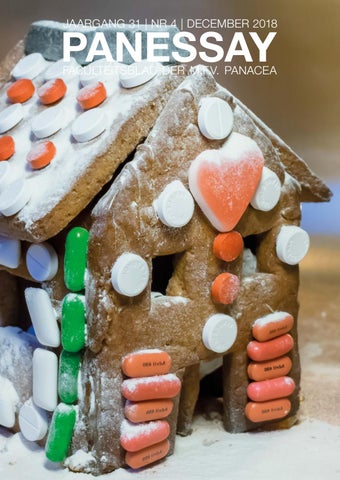
JAARGANG 31 | NR 4 | DECEMBER 2018
PANESSAY
FACULTEITSBLAD DER M.F.V. PANACEA
8
26
Simulatiepatiënten
24
Medical proverbs
Medicine in history
Weird dutch 101
Of mummys
19
20 A red Christmas
Law and liability
Morose morbidities on Christmas eve
How careful are you?
5
Uit de hokken
A red Christmas
19
6
Commissiepagina
Of law and liability
20
8
Simulatiepatiënten
Dokterscolumn
22
Patiëntcolumn
23
Medicine in History
24
Medical proverbs
26
Co-column
28
The miracle drug
29
G2020 memes
30
10
f.t bestuur
11
The future of ageing
12
Medical Statistics
14
Dr. House in de praktijk IX
16
Fotopagina
18
Onderwijscolumn
Uit de hokken
Redactioneel Ik durf best te zeggen dat ik trots ben geneeskunde te studeren. Veel leken associëren dokters toch als mensen met status. Is het niet bijzonder dat feitelijk vreemden hun leven in jouw handen durven te leggen? Dat lijkt echter ver weg wanneer je als bachelorstudent zit te blokken op healthy coping mechanisms. En ja, op elke sociale gelegenheid word je aangesproken met een of ander euvel, vaak teleurgesteld dat je het antwoord schuldig moet blijven. Waarom vragen ze dan ook nooit iets over de ziekte van Kawasaki? Tsja. Maar wat was ik trots dat ik zelfs vóór dr. House de diagnose Lambert-Eaton myastheen syndroom had gesteld. Over een jaar of vier kan ik dat misschien in de praktijk brengen. Misschien. Nu de winterwende eraan zit te komen, heeft de PanEssay haar eigen wending ondergaan. Niet in de laatste plaats met een fors aantal nieuwe leden. Welkom! Met deze frisse wind op de redactie hebben we in deze
editie al een groot aantal nieuwe, creatieve artikelen in petto, en laten we een aantal oudere rubrieken achterwege. Een nieuwe doelstelling van de PanEssay is dan ook om onderbelichte onderwerpen meer aan het licht te brengen, zo hebben we dit keer achtergronden over medisch recht en de productie van morfine. Internationals moeten zeker niet vergeten de Nederlandse spreekwoorden te bestuderen. Rest mij alleen nog jou een fijne kerst te wensen, hopelijk loopt het niet zoals beschreven op pagina 19.
Van het bestuur Tegen het einde van het jaar is het alweer tijd voor PanEssay jaargang 31 nr. 4… de laatste PanEssay met onze foto op de vijfde pagina. Over ruim een maand geven wij het stokje over aan onze opvolgers. Zij zullen vol energie en met een frisse kijk op de vereniging in februari beginnen aan hun bestuursjaar. Maar voor het zover is, zijn wij nog even aan het genieten van ons plekje op de bestuurskamer. De BeCO heeft inmiddels een mooi geldbedrag ingezameld voor het Beatrix Kinderziekenhuis en alle commissies zijn bezig punten te scoren voor de Commissie Battle door op activiteiten aanwezig te zijn. Zo was de Herfstborrel een geweldig succes, is er gelift naar Lille en is er een gouden Almanak gepresenteerd op het
AkCie Almanakfeest. Daarnaast zijn patiënten in het ziekenhuis wat gelukkiger gemaakt met cadeaus die mede dankzij jou uitgedeeld konden worden! Verder is iedereen net gewend aan het studeren, maar er ook wel enigszins klaar mee. Het is dus tijd voor twee weken rust en dus ook tijd om deze PanEssay door te spitten. Na de vakantie gaan wij een laatste maand optimaal genieten van onze tijd in de bestuurskamer en van nog een paar activiteiten. Iedereen is natuurlijk van harte welkom op de bestuurskamer en op alle activiteiten om ons daarin te vergezellen! Verder wensen we iedereen een goede vakantie; fijne kerstdagen en een gelukkig nieuwjaar!
5
Commissiepagina
YR1 Wij zijn de nieuwe Year Representation 1 (YR1), dé vertegenwoordiging van de eerstejaars in Global Health en Molecular Medicine 2018/2019. Wij beoordelen het onderwijs door wekelijks de hoorcolleges, de werkcolleges, de LC tasks en de practica te evalueren, en streven naar eerlijke tentamenuitslagen door jullie klachten in behandeling te nemen. Daarnaast organiseren wij samen met de Jaarvertegenwoordiging 1 (JV1) een
interessante onderwijsactiviteit en een gezellige After Tentamen Borrel waarbij we tot in de vroege uurtjes proosten en stoom afblazen. En die jaartrui waarmee studiegenoten lopen te pronken? Die ontwerpen wij ook! Kunnen wij je ergens mee helpen? Stap dan gerust op een van ons af, of stuur even een e-mail naar yr1@ panacea.nl.
L-R: Jules, Asal, Anouk, Lotte, Koen, Madeline, Ulf, Femke, Anniek, Nathalie
UrgenCie Wanneer iemand een bloedneus, een brandwond of een uitgeslagen tand heeft, weten je vrienden zich ineens heel goed te herinneren dat jij geneeskundestudent bent. Terwijl jij – in tegenstelling tot het slachtoffer – met je bek vol tanden staat omdat je na een aantal bachelorjaren vanalles weet over de citroenzuurcyclus, maar helemaal niets van verbandjes. Gelukkig is daar de UrgenCie. Met onze EHBO-cursus krijg je een certificaat van het Oranje Kruis en kun je je kennis in
6
de praktijk brengen als EHBO’er op evenementen. Je verdient dan vrij snel je cursusgeld weer terug en bent betaald aanwezig op evenementen als de KEI-week en Kermesse. Naast cursussen organiseren en EHBO’ers inzetten op evenementen, organiseren we ook workshops. Je kunt bijvoorbeeld leren intuberen, gipsen of hechten lang voordat je op de derde verdieping bij het KTC komt. Houd de website in de gaten voor de cursussen en workshops!
SympCie Wij zijn de SympCie, oftewel de Symposiumcommissie. Ons doel is om het meest interessante, inspirerende en grootste Panacea-evenement van het jaar te
organiseren. Als SympCie-lid heb je de touwtjes in handen en alle vrijheid met betrekking tot het symposium. Zo bedenken we met z’n allen eerst het thema en op basis daarvan gaan we op zoek naar interessante sprekers en workshops. Verder is het onze taak om zoveel mogelijk sponsoren binnen te halen, zodat we genoeg geld hebben om dit geweldige evenement mogelijk te maken. Daarnaast houden we ons bezig met het beheren van de begroting en het promoten van het symposium, om zoveel mogelijk mensen te overtuigen om te komen! De dag bestaat uit meerdere plenaire sessies en workshoprondes, een heerlijke lunch en een afsluitende borrel. Het thema is nog een verrassing, maar de datum is bekend: we zien jullie graag op donderdag 14 maart!
MASH Vind jij het ook zo zonde dat er tegenwoordig in ziekenhuizen zo veel wordt weggegooid? Zeker omdat er in Afrika grote tekorten zijn aan medisch materiaal? Dat vinden wij ook! Daarom verzamelen wij medisch materiaal zodat het een tweede leven krijgt! Wij zijn de MASH (Medial Aid by Student Help) en wij zetten ons al sinds 1977 in voor het Turiani Ziekenhuis in Tanzania. De MASH bestaat uit negen studenten die ervoor zorgen dat overgebleven medisch materiaal verzameld, gesorteerd en verstuurd wordt naar het Turiani Ziekenhuis. Om dit te kunnen doen hebben we natuurlijk geld nodig. Naast het zoeken van sponsoren
organiseren we een jaarlijkse lezing met leuke, interessante sprekers en verkopen we verse stroopwafels op verschillende markten. We staan 15 december op de kerstmarkt bij het Hoornse Meer, dus kom vooral een kijkje nemen, koop een heerlijke verse stroopwafel en steun de MASH! Vergeet ons niet te volgen op onze facebookpagina “MASH-Medical Aid by Student Help” om op de hoogte te blijven van onze activiteiten. Ook hebben wij een Instagrampagina (@medicalaidbystudenthelp) waar we nieuwe updates en leuke kiekjes posten! Liefs, MASH ‘18/19
7
Suzanne Schuurman
Komt een simulatiepatiënt bij de dokter Elke week komen de masterstudenten ze tegen en elke week krijgen ze een andere diagnose. Het zijn niet patiënten die slechte zorg krijgen (misschien soms toch wel), het zijn de mensen die ons helpen om een goed consult te voeren: de simulatiepatiënten. We hebben drie van hen geïnterviewd om inzicht te krijgen in deze mensen waarmee we het geregeld over eczeem en erectiestoornissen hebben, maar waar we toch zeer weinig van af weten. Heeft u een favoriete casus? Jan (twintig jaar ervaring als simulatiepatiënt): Ik heb wel een favoriet. Dat is een mooie casus: een man die is doorverwezen door de huisarts omdat hij gesteriliseerd wil worden. Daar zit een hele sociale onderlaag onder, want het blijkt dat zijn vrouw gisteren verteld heeft dat zij een ander heeft. Dit onthult hij niet meteen, hij komt gewoon met het sterilisatieverzoek. De studenten moeten dan non-verbaal kunnen scannen dat er meer aan de hand is: ja, hij zegt dat wel, maar ik zie ook iets anders. Dezelfde casus speel je bij iemand die daar doorheen prikt heel anders dan bij een ander die dat niet benoemt. Als de student dat niet doet, dan ga je gewoon alleen op het inhoudelijke in, een sterilisatieverzoek. De eerste verdieping is dan als ze eruit vissen van: hé, gister heeft zijn vrouw verteld... Dan wordt die hulpvraag al anders. En soms komen ze er ook op: ik moet u nu toch als dokter vragen of u al over een soatest heeft nagedacht. Dan ben je honderd procent meegegaan met hoe je de patiënt het beste kan helpen. Nou, dat vind ik fantastisch om mee te maken.
En u geeft dat dus niet uit uzelf al weg. Rein (half jaar ervaring): Dat is het spel, wat geef je weg en wat niet. Ik vind rollen waar meerdere lagen in zitten, waarin je ook kunt spelen met je emotie, gewoon het interessantste. We verschillen daarin, de één geeft zo min mogelijk weg en de ander die denkt: ja, je komt bij de dokter en dan zeg je zo veel mogelijk relevante dingen in de hoop dat je geholpen wordt. Maar soms vind ik ook dat het een soort puzzel is en dan moeten ze er zelf maar achter zien te komen.
Gaat het ook wel eens volledig mis? Rein: Ja, dan krijg je een verstijfde student. Ik kan van één keer een student herinneren die zó’n tunnelvisie had, die dacht precies te weten wat het was en dat was het helemaal niet. En die kwam er ook helemaal niet meer uit. Vervolgens dacht ik: laat het maar gebeuren.
8
Want ik kan wel gaan proberen te helpen maar dat heeft geen zin, daar leert iemand niks van. Dat werd dus een ongemakkelijk gesprek. Jan: Nog een voorbeeld. Ik speelde een rol voor een arts in opleiding die erg onzeker was. Bij het lichamelijk onderzoek moest ik voor haar gaan staan en toen zei ze iets van: ‘Ik kijk waar het vet zich bevindt. Hihi, wat zeg ik nu?!’ Ze viel helemaal uit haar professionele context op dat moment. Maar daarna pakte ze het wel weer op en ging ze heel gestructureerd verder. Toen moest ze even overleggen met de docent, waarna ze terugkwam voor het beleidsgesprek. Ik zag dat ze het met de docent over die onzekerheid had gehad en daardoor zichzelf nu een stuk sterker neerzette. Ik merkte gelijk het verschil! Dat is voor ons als simulatiepatiënt gewoon mooi om te merken, dat je echt aan het bouwen bent.
Hoe bereidt u zich voor op een rol? Roelof (drie jaar ervaring): Je krijgt de casus toegestuurd, je leest het en je probeert je in te leven. Dat gaat over het algemeen wel. Ik heb ook soms dat ik iets uit de rol zelf al een keer ervaren heb als patiënt. Aan de ene kant niet zo leuk, aan de andere kant is het dan wel makkelijker om de rol te spelen.
Dan speelt u ook deels uzelf? Roelof: Precies. Een keer merkte ik echt, dit gaat over mij. Ja, dat... Ik wist er op een gegeven moment wel op een goede manier mee om te gaan. Maar ik merkte wel dat het heel dichtbij kwam.
Hoe is het om lichamelijk onderzoek te moeten ondergaan, zijn jullie bang voor de resultaten? Hoe is het om het lichaam open te stellen? Jan: Dat klinkt filosofisch.
‘neuken’. Alles komt wel op tafel. Dus wat is nou het woord om te weten of je wel de penetratieachtige... ‘Naar bed gaan.’ Daar wordt nou veel mee geworsteld. En op nummer twee komt dan poep en pies. Rein: Ja, het verschilt ontzettend per persoon. Maar in de professie waarin jullie je gaan begeven moeten die dingen heel normaal zijn.
Hoe merkt u het verschil tussen een eersteen vierdeblokker? Roelof: De zenuwen. Onder de vlekken en zo.
Roelof: Ik onderga het gewoon.
Heeft u dan medelijden? Rein: En je weet dat dit gebeurt, anders moet je dit werk niet doen. Jan: Koude handen is wel vaak een dingetje. Roelof: Maar daar verontschuldigen ze zich vaak voor. De stethoscoop wordt dan meestal warm gemaakt...
Naast het opwarmen van de handen nog een gouden tip voor studenten? Jan: Ik vind niet dat je een soort robot moet zijn die alles perfect moet doen. Dan krijg je dat bijna altijd in je achterhoofd meedraait van: ‘O, dat had ik moeten vragen en dat heb ik niet gedaan, of dat valt me op en dat ga ik nu niet benoemen, of dat doet ‘ie en daar heb ik niet op gereageerd, moet ik daar nog wat mee? En waar is het kaartje nu? De stethoscoop is weg!’ Daaruit voortvloeiend komt dan de gouden tip van: benoem alles wat er met jou gebeurt in dialoog met de patiënt. Ik speel wel eens een rol, dan moet ik heel nerveus doen, op tafel tikken. Dan zijn er dus mensen die dat niet benoemen, die worden zelf steeds onrustiger. Gelijk zeggen wat je ziet! En dan is het kijken hoe je daar samen uitkomt.
Roelof: Dan probeer ik ze wel gerust te stellen.
Maakt u zich wel eens zorgen over iemand? Dat u een arts in opleiding tegenover u hebt en denkt: ik weet niet of dit wel wat gaat worden? Deze zou ik niet als arts willen hebben? Roelof: Dat heb ik wel meegemaakt, dat ik denk: nou, die moet maar eigenlijk niet slagen. Die moet maar geen arts worden.
Waar ligt dat dan aan? Roelof: Aan de houding, aan de manier van praten, aan... Gewoon ook een gevoel. Maar het gebeurt niet vaak. Rein: Ja, ik heb het één keer gehad dat ik dat gevoel had. Maar goed, mensen kunnen nog steeds leren en zich ontwikkelen. Dit is ook maar een momentopname. Roelof: Ik heb ook wel eens een student waarvan ik denk: poeh, dat is toch wel te gek, zeg. Zó goed. Rein: Een natuurtalent, ja. En gelukkig zijn die er veel meer.
Is het wel eens heel grappig om patiënt te spelen? Rein: Ik kwam een keer binnen bij de groep na het consult, moesten ze ineens keihard lachen. Ze hadden (op de live videoverbinding met de spreekkamer, red.) alleen mijn achterhoofd gezien en de hele tijd zitten nadenken of ik de tweelingbroer van André Kuipers was. Roelof: Vanmorgen vroeg iemand of ik last had van mijn geheugen. Dus ik zat daar: “Kan ik me niet herinneren.” Dat was wel lachen.
En de drugsvraag? Roelof: Ja, maar dat vragen ze ook altijd een beetje... Nou ja, niet besmuikt maar altijd zo van: ‘Gebruikt u ook drugs, want ja, dat moeten we wel vragen.’ Flauwekul, dat moet je gewoon vragen. Jan: Ja, seks hè. ‘Heeft u wel gemeenschap gehad’ of
9
f.t. bestuur
Even voorstellen Lieve lezers, Het is dinsdag 21.00 uur, de alom befaamde Panaceaavond. De dobbelstenen worden weer achter de bar vandaan getoverd en BP18 zit te genieten van een drankje in Villa Volonté. Het potje Mexxen kan beginnen! Na een aantal spannende rondes wordt er 32 gegooid. KB19 stormt de kamer binnen en roept “VAST”. Iets magisch gebeurt: KB19 wint steevast elke ronde en zo ontstaat f.t. ‘19! F.t. ’19 wil zich graag aan jullie voorstellen. Als Voorzitter zal Ymke dit jaar het reilen en zeilen van het bestuur in de gaten houden. Tamar Muntslag zal dit bestuursjaar de functie van Secretaris vervullen en zorgen voor de nodige orde. Penningmeester Christiaan draagt dit jaar de verantwoordelijkheid voor de gelden van de Vrouwe. Juliëtte zal alles op alles zetten om de beste sponsoren te werven als Commissaris Externe. Als Commissaris Interne zal Thomas de commissies onder zijn hoede nemen. Tamar van der Aart zet zich komend jaar in voor de bachelorstudenten als Commissaris Onderwijs.
10
En last but not least: Sherilyn zal als Commissaris Master en Carrière onze masterstudenten door het jaar heen helpen. Wij hebben erg veel zin in de komende periode en hopen jullie snel te zien op de bestuurskamer!
Thomas van der Korst
The future of ageing A vision of the future by a well-adjusted human being Getting old is majorly depressing. You peak in your twenties and then everything starts to go. Your looks, your health and your social life. Well, at least that is what I think will happen. I actually have no idea, I am in my twenties right now. According to my mother though, I peaked when I was two years old. So apparently you also get really bitter when you get older. Maybe there is a way to age gracefully and healthily, let’s find out. Well, you ask, why don’t we just stop the whole ageing process and stay forever 21? You are not the first person to think of this, you might have noticed this ‘original’ idea appearing in EVERY MAJOR ORGANISED RELIGION EVER. However, any real research into the science of aging has stayed out until the last 60-ish years. But, have you noticed the nice building next to the faculty? This is the ERIBA building where they are currently doing research on aging. A few years back (does that make me sound old?) I followed a science elective organised by them about immortality research. I was thoroughly disappointed to find out that all we have discovered thus far is how and why we age (probably,) but no actual way of stopping it. There is currently not even a way to make worms immortal. Such a bummer.
Maybe we cannot stop the slow march of Death that comes for us all, but maybe we can do something to at least make the ride more fun. Imagine a world where you can do anything you want, I mean literally anything. Like walking around your house naked without your cat judging you or that when someone is not interested in you they actually say they are not interested anymore instead of ghosting you. These oddly specific examples could soon be a reality. Well, a virtual reality. Yes, I am proposing a Wall-E type of society where all humans live in a virtual world with endless possibilities while being fed through a tube on an electric wheelchair. Of course, only me and like twelve other people who cope with the stress of our studies through emotionally unhealthy escapism are actually excited about this. Luckily I already
made the first financially ill-considered financial step towards this exciting possibility by spending 1200 euros on a VR headset in 2016. It is awesome, but it certainly did not justify that kind of money… Or we can continue what we are currently doing, since the previously discussed options are too far in the future and some might even say, childishly idealistic. We can just continue living our lives by always living in the moment and making the best of what is happening in our lives. To accomplish this marvelous feat of gaining a healthy and well-adjusted mindset is actually really simple. You only need to stop caring about every person on Earth and their opinion of you and the crushing psychological weight of existence. (Yes, this is from a meme. Sue me.) I personally think the Matrix-like reality (is this already a dated reference?) sounds the most appealing, especially if we can do the karate-stuff too... Anyways, the best options are still limited to uninspiring TEDx talks and poorly-researched blog posts, while practical research and technology will still have us waiting for decades or centuries to come. However, in this conclusion I introduce you to the real solution which we could implement now. Namely, everybody over the age of 29 should be put into ‘long-term storage,’ so they never have to accept the slow descent of biological decay.
11
Chris Lenselink
Medical statistics Professor Progress Test For many of us, medical statistics might just one of if not the most abstract subject of our entire curriculum. Intimidated by terms like ‘non-parametric test’ and ‘logistic regression,’ you tend to just skip those terrifying questions on the Progress Test and just avoid anything related to research. Fear not, however, this PanEssay will explain some of the basics so you can get back to actual physician matters. Descriptive statistics First, it is vital to distinguish between the different types of variables. We have numerical and categorical variables, each with their own subtypes. Numerical variables are quantitative, meaning they have a value. The first subtype of these is the continuous variable, which can have any value (2.81, 98, -5.6), for example height. Discrete variables can only have integers which means that there cannot be decimals in the number (3, 48, 2), for example the number of children someone has. The opposite of numerical is categorical, which are qualitative variables. When there is a natural order in those, you call them ordinal, for example pain scales. Nominal variables do not have such an order. Examples of this are marital status or presence of disease (0 is no and 1 is yes). For continuous variables, perhaps the most important concepts to grasp are the three averages, the mean, the median and the mode. The mean is defined as the sum of all values in a particular set, divided by the number of values. The mean of 1, 2 and 3 is therefore 2. You can only use the mean in a (near) normal distribution, where the spread of data is approximately equal on both sides of the midpoint. Normal distributions have the classic bell shape. Having said that, not all data is normally distributed. Sometimes, the distribution is skewed. In this case, you should not use the
12
mean but the median. It is the point which has half the values above, and half below. Furthermore, you can use the mode to describe data. This is the most common of a set of events. The mode is not often used. Another important concept is the standard deviation (SD). It indicates how data varies around a mean; it can therefore only be used in normal distributions. A high SD thus indicates high dispersal. 1 SD includes 68.2% of the data, 2 SD 95.4% and 3 SD 99.7%. This then raises the question: how can you tell whether data is normally distributed? A histogram could be used, although this exclusively shows a normal distribution. It is also possible to make a Q-Q plot or do a statistical test (e.g. Shapiro-Wilk).
Confidence Let’s say you did an awesome study and found a mean. Hurray! However, how do you know whether your result is representative, or in other words, significant? You want to be confident about your result, and therefore a mean is generally given with a confidence interval, a range in which you can be fairly sure the true value lies. The true value is the mean of the entire population, but your study yielded a sample mean from a smaller group. Say you investigated a diet and measured weight loss. You found a mean of 4 kg weight loss with 95% CI [-2;6]. This means you
Other tests Non-parametric tests are used when the data is not normally distributed or the data is categorical. Therefore, you cannot use the mean but are confined to the median. The principle remains the same, however: looking for the P-value. The other tests are the Mann-Whitney test, Wilcoxon test, Kruskal-Willis and Friedman. are 95% sure the true mean difference lies between -2 kg and 6 kg. Moreover, as 0 is included in the interval, there can actually be a weight gain, and the diet may be ineffective. In other words: there is more than a 5% chance that there is no true change in weight.
The prime example of a statistical test is the t-test. A related concept is the P-value, or probability value. It is used to see how likely it is that a hypothesis is true. Usually, this is the null hypothesis: there is no difference between two groups, so the means are equal. If P = 0.5, it means that the chance of this result or a larger result happening is 50%, indicating that the result is not significant. A P-value smaller than 0.05 is generally accepted as showing a significant difference, yet the smaller the P-value, the better. This may seem small, but if 20 studies have a P-value of 0.05, one of those studies could show a result that actually is not true. If P < 0.05, the null hypothesis is rejected and therefore, there is a difference.
The Chi-Square test measures the difference between expected and actual frequencies, or the relationship between two categorical variables. The expected frequency is the frequency that holds when the null hypothesis were true. If the observed and expected frequencies are equal, the Chi value (X2) equals 0. The Chi value itself is not relevant when interpreting, just go to the P-value. It is used often in contingency tables. An example would be the relationship between marital status and eye colour. Fisher’s exact test is similar.
Parametric tests The above-mentioned concepts are essential to all statistical tests. Each test is used for a different set of circumstances. There are a lot of different tests, and the details can be quite complicated. Luckily, when interpreting, it is generally sufficient to jump straight to the P-value to see whether you have a significant result. Parametric tests can only be used in normal distributions. The prime example of a statistical test is the t-test. You can use this to see whether the mean of a population equals a certain value, or if the means of two populations are equal (e.g. comparing an old and a new treatment). It is possible to have a one-tailed or two-tailed t-test. Returning to the example, in the one-tailed version you expect the new treatment to be better than the old one, and in the two-tailed version you test that it can both be better or worse. Another subtype is the paired t-test, this you could use for instance, when you measure blood pressure with two devices on the same subject (and you can use the one- or two-tailed again here). The other important parametric test is the analysis of variance test (ANOVA), where you check whether sample means from different groups correspond to each other.
Relationship When there is a linear relationship between two variables, they are said to have a correlation, shown by correlation coefficient r. If there is a perfect relationship between two variables, r = 1. An r from 0.6 onwards is regarded as high correlation. In normal distributions, you use Pearson’s coefficient, otherwise the Spearman rank correlation coefficient. A related concept is regression: how one set of data relates to another. A regression line is the line that fits bests through the data points on a graph, and the regression coefficient gives its gradient. The R2 value gives the amount of variation that is explained by the regression. An R2 of 0.81 shows that 81% of the change in A can be attributed to the change in B. In logistic regressions, each case can only belong to one of two groups (binomial), like having a disease or not. The outcome is the probability that a certain case belongs to one group and not the other. Risk scores are a good example here.This aid should get you started in the field of most commonly used statistical concepts.
13
Arno Bourgonje
Dr. House in de praktijk IX Een verrassende afsluiting Tijdens je klinische stages komen al die dozijnen vermoeide verpleegkundigen, eczemateuze elektrotechnici en flatulente fietsenmakers je allang de conchae uit, waardoor een bijzondere casus een welkome uitdaging kan zijn. Een casus met een ronduit interessante diagnose. In deze editie presenteren wij zo’n casus, met een diagnose die toch vaker zal voorkomen dan men zou verwachten… Een 76-jarige man komt op de centrale spoedopvang (CSO) vanwege sinds enkele weken ontstane hartkloppingen en kortademigheid.
Hoofdklacht? Hartkloppingen, met daarbij soms wat kortademigheid.
Anamnese Op een regenachtige vrijdagavond verschijnt een 76-jarige man op de centrale spoedopvang (CSO), vergezeld door zijn dochter. Sinds maandagavond bemerkte hij het ontstaan van hartkloppingen die nu eens kwamen opdagen, dan weer verdwenen. De hartkloppingen gingen soms gepaard met kortademigheid. Bij navraag blijkt het te gaan om een snelle hartslag met een onregelmatig ritme. Hij herkende de klachten al van eerder: enkele maanden geleden had hij ook zo’n periode met hartkloppingen. De hartkloppingen nemen langzaam af als hij gaat liggen, terwijl ze ’s ochtends bij het opstaan juist het hevigst zijn. Omdat het nu toch wel lang blijft aanhouden, had hij uit twijfel maar zijn dochter gebeld om hem naar de CSO te brengen.
enkele maanden geleden had hij ook zo’n periode met hartkloppingen Meneer vertelt dat hij vorige week nog een kuur doxycycline had afgemaakt, die hij eerder van de huisarts had gekregen voor een bronchitis. Hij vertelt verder bijna nooit ziek te zijn, maar wel merkt hij dat zijn conditie de laatste jaren fors achteruit is gegaan. In de voorgeschiedenis van de patiënt staat onder andere essentiële hypertensie, diabetes mellitus type 2 en een longembolie op 56-jarige leeftijd. Hij gebruikt de volgende medicatie: hydrochloorthiazide 25 mg 1 dd, metformine 500 mg 3 dd, gliclazide 80 mg 1 dd en paracetamol 500 mg zo nodig. Hij heeft zo’n 40 jaar lang gerookt, maar is inmiddels al 10 jaar gestopt. Alcohol drinkt hij alleen in het weekend, maximaal 5 EH. De familieanamnese levert geen bijzonderheden op.
14
Lichamelijk onderzoek Bij algemene inspectie wordt een niet-acuut zieke, wat vermoeid ogende man gezien met helder en adequaat bewustzijn. Alhier lijken de vitale functies niet bedreigd: er is sprake van adequate ventilatie en stabiele hemodynamiek. De vitale functies zijn als volgt: pols 89/min regulair aequaal, RR 129/79 mmHg, SaO2 90%, T 36.2 ºC. Bij auscultatie van het hart wordt een normale eerste en tweede harttoon gehoord, zonder souffles of extra tonen. Bij longauscultatie wordt vesiculair ademgeruis waargenomen, zonder bijgeluiden. De percussietonen zijn normaal. Aan de extremiteiten zijn normale pulsaties voelbaar van de a. tibialis posterior en a. dorsalis pedis, ook worden er geen oedemen gezien.
Wat is uw DD? Differentiaaldiagnostisch kan in deze casus worden gedacht aan cardiale problematiek, zoals (paroxysmaal) atriumfibrilleren, decompensatio cordis, angina pectoris of een acuut coronair syndroom, dan wel pulmonale problematiek (gegeven het dyspnoeïsche component), zoals een pneumonie, longembolie, astma of COPD.
Aanvullend onderzoek Allereerst werd een ECG afgedraaid, dat een sinusritme van 85 slagen/min liet zien, een rechter hartas en een klein rechterbundeltakblok. Oriënterend laboratoriumonderzoek leverde het volgende op: Hb 9.1 mmol/l (N: 8.5 – 11.0 mmol/l), CRP < 5 mg/l (normaal), BSE 2 mm/h (N: < 20 mm/h), leukocyten 6,8x10⁹/l (N: 4 – 10 x109/l), trombocyten 365x109/l (N: 150 – 400 x109/l), ASAT 22 U/l (N: < 35 U/l), ALAT 21 U/l (N: < 45 U/l), creatinine 78 μmol/l (N: 60 – 110 μmol/l), troponine 16 ng/l (N: < 14 ng/l), NT-proBNP 24 pmol/l (N: < 15 pmol/l), D-dimeer 0.45 mg/l (N: < 0.50 mg/l). Een arteriële bloedgasanalyse liet een pH zien van 7.46 (N: 7.35 – 7.45), pO2 van 10.2 kPa (N: 10.0 – 13.3 kPa), pCO2 6.2 kPa (N: 4.7 – 6.4 kPa), bicarbonaat 26 mmol/l (N: 22 – 29 mmol/l) en een zuurstofsaturatie van 89% (N: 95 – 100%). Een X-thorax toonde geen bijzonderheden of afwijkingen. Een transoesofageale echocardiografie werd als
laatste ingezet om eventuele oorzaken van centrale cyanose op te sporen, wat de uiteindelijke diagnose opleverde.
Wat is uw (werk)diagnose? Uit de echo van het hart bleek dat er bij meneer sprake was van een rechts-links shunt op basis van een persisterend foramen ovale, dat toenam bij verandering van liggende naar zittende positie. De uiteindelijke diagnose luidde op basis van deze bevindingen het ‘platypneu-orthodeoxiesyndroom’. Platypneu betekent ‘kortademigheid in verticale positie’ (zitten of staan), de term orthodeoxie verwijst naar een daling van de arteriële zuurstofverzadiging tijdens de beweging van liggende naar verticale positie. De oorzaak hiervan ligt in een houdingsafhankelijke rechts-links shunt in het hart of de longen. Hierbij ontstaat menging van zuurstofarm bloed met zuurstofrijk bloed als gevolg van een anatomische of pathologische afwijking, waardoor de arteriële zuurstofverzadiging daalt. Als de oorzaak in het hart is gelegen, zijn de meest voorkomende oorzaken een persisterend foramen ovale (PFO) of een atriumseptumdefect (ASD). Bij een pulmonale etiologie zijn vaak voorkomende, denkbare oorzaken o.a. longemfyseem, arterioveneuze malformaties (AVM) of iatrogene schade. Het foramen ovale (zie afbeelding) is een open verbinding tussen het linker en rechter atrium die normaal aanwezig is in de foetale circulatie. In de normale situatie sluit het foramen ovale na de geboorte, maar bij een aanzienlijk deel van de mensen (ca. 25%) wordt het foramen ovale onvolledig gesloten. Meestal leidt een persisterend foramen ovale niet tot problemen met de circulatie en blijft het asymptomatisch. Bij een klein deel kunnen echter problemen ontstaan als gevolg van de open verbinding tussen rechts en links, bijvoorbeeld een embolie die in de linkerkant van de circulatie terecht kan komen en aldaar kan leiden tot een CVA. Ook wordt in de literatuur frequent een associatie gerapporteerd tussen patiënten met migraine en een persisterend foramen ovale: om onbekende redenen heeft ongeveer 50% van de migrainepatiënten hiermee te maken. Ook wordt in de literatuur frequent een associatie gerapporteerd tussen patiënten met migraine en een persisterend foramen ovale: om onbekende redenen heeft ongeveer 50% van de migrainepatiënten hiermee te maken. Het is lastig om te verklaren waarom de patiënt uit de casus alleen klachten krijgt van zijn rechts-links shunt in verticale positie en de klachten en de daling van de zuurstofsaturatie herstellen bij terugkeer naar de liggende positie. Er zijn meerdere verklaringen beschikbaar, waarvan de meest waarschijnlijke een (anatomische) afwijking van de aorta betreft. Een verwijde aorta (aneurysma), het stug worden van de aorta (als gevolg van het verouderingsproces) of een kronkeling in de aorta (tortuositas) zijn situaties die kunnen leiden tot tractie op de atria
van het hart in verticale positie. Deze tractie kan leiden tot een veranderde stand van de atria en een meer opengetrokken, onvolledig gesloten foramen ovale of compressie van het rechteratrium. Hierdoor lijkt er met name in verticale positie meer rechts-links shunt op te treden dan in liggende positie. Bij de patiënt uit de casus werd geen pathologie van de aorta aangetroffen, waardoor waarschijnlijk een verouderde aorta de boosdoener is geweest.
Hoe ziet de behandeling eruit? Hoe is de prognose? De behandeling bestaat uit percutane of chirurgische sluiting van het foramen ovale. Bij de eerste methode wordt met een hartkatheterisatie een soort ‘parapluu tje’ ingebracht en over het foramen ovale gelegd om deze te laten sluiten. Deze sluiting is een langzaam proces van endotheelvorming over het gesloten defect, dat bij de meeste patiënten zeker een half jaar in beslag neemt. Daarnaast kan het foramen ovale ook chirurgisch worden gesloten na een thoracotomie. De keuze tussen enerzijds percutane sluiting en anderzijds chirurgische sluiting wordt gemaakt op basis van metrische gegevens verkregen bij de echocardiografie (o.a. de grootte van het defect en de grootte van de rechts-links shunt) en de klinische conditie van de patiënt. De prognose is na operatieve interventie in principe zeer gunstig; sluiting van het foramen ovale leidt tot vermindering van de klachten. Zonder ingrijpen leidt een dergelijk syndroom op onvermijdelijke wijze tot zuurstofafhankelijkheid.
Afloop van de casus Bij de 76-jarige man uit de casus werd een percutane sluiting van het persisterend foramen ovale verricht, met goed resultaat. Na herstel van de ingreep zijn er geen klachtepisoden meer opgetreden.
15
Elisa ter Kuile
Onderwijscolumn Adviserend student-lid van de Raad van Bestuur van het UMCG Ik hoor jullie denken: Wat een dure titel, wat doe je dan en wie is dit überhaupt? Ik denk dat het merendeel van jullie nog nooit van deze functie heeft gehoord. Ik moet eerlijk bekennen: tot halverwege mijn derde jaar wist ik ook niet van het bestaan van deze functie af. Daarom hoop ik met deze column meer inzicht te geven in de toch wat onbekende rol van het student-lid van de Raad van Bestuur. Ik zal mezelf eerst even voorstellen: mijn naam is Elisa ter Kuile, ik ben 21 jaar en ik ben net klaar met mijn bachelor geneeskunde. Tijdens mijn bachelor ontwikkelde ik steeds meer interesse voor de managementkant van de gezondheidszorg. Ik wilde graag nog iets met deze interesse doen voordat ik aan mijn coschappen zou beginnen en daarom heb ik een eigen minor samengesteld aan de Faculteit Bedrijfskunde met de focus op healthcare management. Toen ik vervolgens deze vacature zag, leek dit bestuursjaar mij de unieke kans om een kijkje te nemen in de bestuurlijke kant van het ziekenhuis, maar óók van de universiteit. Ik was dan ook enorm blij toen bekend werd dat ik deze functie vanaf 1 september 2018 tot september 2019 mocht vervullen! Nu genoeg over mij, ik zal jullie meer vertellen over wat mijn functie nou precies inhoudt. Iedere faculteit van de RUG heeft één student in het faculteitsbestuur: de studentassessor. Omdat onze faculteit zo nauw verbonden is met het UMCG, heeft de medische studentassessor een net wat uitgebreidere titel gekregen. Als adviserend student-lid denk je mee over het onderwijs en onderzoek op het hoogste niveau. Je bent de schakel tussen de Raad van Bestuur en de studenten en vertegenwoordigt daarbij de belangen van alle studenten van de Medische Faculteit. Hoe vertegenwoordig je de belangen van zo ontzettend veel studenten? Om de studenten van alle medische opleidingen te kunnen vertegenwoordigen moet je continu op de hoogte zijn van wat er bij hen speelt. Dit doe ik door eindeloos met studenten te praten en allerlei overleggen bij te wonen. Deze overleggen variëren van koffiedrinken op de bestuurshokken van de studieverenigingen tot het halfjaarlijks overleg met het College van Bestuur van de RUG. Op onze faculteit worden de studenten actief betrokken bij de medezeggenschap, zo hebben wij de vrij unieke en naar mijn mening zeer waardevolle overkoepelende belangenbehartigingsorganen ProMed (geneeskunde), ProDent (tandheelkunde) en ProMove (bewegingswetenschappen). Daarnaast vergader ik wekelijks met de studentassessoren van
18
de andere faculteiten van de RUG en heb ik regelmatig op landelijk niveau vergadering met het Interfacultair Medisch Studentenoverleg (IMS). De informatie die ik krijg uit de vele overleggen moet vervolgens op de juiste manier bij de juiste mensen in de hogere organisatorische lagen terecht komen. Hiervoor zit ik iedere maandag bij het Overleg Vergadering Onderwijs en Onderzoek (OVOO). Bij deze vergadering adviseer ik onder andere de decaan en lid van de Raad van Bestuur, Marian Joëls en de prodecanen van Onderwijs en Onderzoek, Gerda Croiset en Erik Boddeke, over de studentenzaken. Het is uiteindelijk ook weer mijn taak om dingen aan de studenten terug te koppelen. Adviserend student-lid van de Raad van Bestuur is een behoorlijk serieuze functie, waarbij je heel actief bent binnen het onderwijs en het UMCG. Naast al het serieuze zijn er genoeg leuke commissies, borrels, diners en congressen waar je allemaal voor wordt uitgenodigd en waar ze gelukkig verwachten dat je gewoon nog even lekker student bent! Mocht je nog vragen hebben dan kan je altijd een mail sturen naar studentlidrvb.umcg@umcg.nl of als je mij ziet lopen, spreek me gerust aan op de faculteit.
Placebo
A red Christmas Morose mortalities on Christmas eve Holiday season is the time to be jolly, unless your main occupation involves preventing the general population from prematurely ending their existence in a variety of increasingly original ways. Indeed, in the majority of the western world, the birth of Christ is celebrated by increasing hospital admissions by upwards of 20%. A glühwein induced drunken haze suspends all critical thought, permitting the free flow of radical ideas. Classics include ‘lets bike across the lake’ or ‘I could make that jump’. Here follow some of the most christmas-like ways to kick the bucket before year’s end. 1. Falling while putting up the Christmas lights
4. Driving accident
The most horrific aspect of falling to your death in this manner, is that you will most likely be sober, and therefore also lucid enough to experience the momentary shock, terror and slight unease of meeting the cold hard ground face first. Should you be lucky enough to not be impaled by the antlers of your life-sized Rudolph the red-nosed reindeer garden decoration, you might get off with just a femoral fracture. You will then find yourself in the privileged position of being unable to run away once aunt Greta starts her yearly 3 hour-long seminar about her 12 cats.
After a long day of forced social interaction with your estranged family, getting drowsy behind the wheel is only natural. However, careening off the road because you fell asleep in the suede seats of your BMW is not something a healthcare professional would want showing on his CV - or epitaph for that matter. Which is why I am a strong advocate of reintroducing the USSR’s mandatory vehicle: The lada riva. With no clutch, a gearbox which requires you to solve the Riemann hypothesis every time you want to change gears and an actual living rooster to squeeze for a claxon, this baby is sure to reduce sleep related traffic accidents by 700%.
2. Lighting the Christmas tree on fire 5. Bursting your Belly While this is frankly more likely to cause a sudden and abrupt redecoration of your interior than an actual fatality, using central heating is still preferable over this form of thermogenesis. Dozing off to the soothing warmth of some enkindled spruce branches admittedly sounds like a perfectly healthy way to spend Christmas eve. However, according to NHG guidelines, keeping human beings at temperatures above 200 °C has adverse effects on long-term survival.
3. Hypothermia
Eating exorbitant amounts is a national tradition, Passing that stool will require an obstetrician The human being is capable of extraordinary feats, However, he should consider how much he eats Simple physics says: 5 liters and you’ll burst, Your stomach can stretch, but only so far, Don’t go beyond, no matter your thirst Go home, go rest, just skip the bar Everything in moderation, don’t let your blood get too viscous, We of the PanEssay, wish you a merry merry Christmas.
Even though the Kill All Polar Bears fund has made marked increases to global temperature levels, the determined among us will still be able to find spots where sub-zero temperatures persist. Periodically changing the skin color of your extremities from red to purple to a nice crisp gangrene black is a process which takes time and dedication, but inebriation helps to pass said time. Maybe skip the evening walk in the snow after your 3rd litre of box wine?
19
Bart Hofsté
Law and liability How careful are you? A fundamental principle of liability law is that everyone has to bear his own burdens, unless there exists a good reason to lay this burden on someone else. Like Hamlet, we all have to carry the ‘slings and arrows of outrageous fortune’ that befall us as we go through life. There are instances, however, when it would be clearly unjust to bear this burden ourselves. One such example is when somebody else is culpable for a fault which causes you to sustain damages, say by causing a traffic accident. Alternatively, it may be unreasonable for you to have to carry the consequences of a certain risk. Imagine you are walking down the Herestraat, when suddenly you are bitten by a dog. Why would you have to carry the burden of such risk, and not the owner of the dog? There could even be cases where somebody else profits from the damages that you sustain, say by selling you tobacco...
It may be unreasonable for you to have to carry the consequences of a certain risk In medicine, patient liability claims are often grounded on alleged faults made by their treating physician. There are all sorts of reasons why patients file such claims, not the least of which is that doctors – being human and all – sometimes do make mistakes. The question then is whether in such a particular case it would be just to convey the burden from patient to doctor: is (s)he liable? If so, can the patient seek damages? In answering this question, I hope to offer a brief introduction into a field of law that is important to understand for your future careers as doctors: Dutch liability law. The two doctrines which form the legal basis of most liability claims are the wrongful act (art. 6:162 DCC) and the breach of contract (art. 6:73 DCC). A wrongful act occurs when the conduct of the physician is wrongful and can be attributed to him. Moreover, the patient must have suffered damages, and a causal link must be established between that physician’s conduct and the patient’s damages. A breach of contract occurs where there is an accountable imperfection in the compliance with an obligation arising out of a
20
contract, for example the medical treatment agreement that exists between patient and doctor based on the Medical Treatment Contracts Act (MTCA). A wrongful act may occur without any such agreement. Consequently, patients may choose one or both doctrines as grounds for their claim. The consequences are the same: liability on the part of the physician and/ or the hospital.
What is meant by a reasonably acting and reasonably competent physician? To judge whether the physician’s conduct was wrongful or whether there was an imperfection of compliance, a single criterion is used, namely that of the reasonably acting and reasonably competent physician. In the MTCA, this is contained within the notion of the prudent care provider (art. 7:453 DCC). For the wrongful act, this is contained within the notion of an act or omission in violation of what according to unwritten law has to be regarded as proper social conduct (art. 6:162 paragraph 2 DCC). What is meant by a reasonably acting and reasonably competent physician? Unfortunately, no single answer can be given that applies to all physician’s in all circumstances. Instead, it must be judged on a caseby-case basis. In comparing the physician’s conduct with that of the criterium, a judge will always pay close attention to the particular circumstances of the case. Moreover, the physician needn’t live up to a perfect or even optimal standard. What is required is that the care provided was, within those given circumstances, adequate. If, however, the conduct of the physician was unreasonable or considered incompetent by professional standards, such conduct will be considered wrongful.
Let’s look at a real-life case to see how the particu lars play out. A neurosurgeon has made a localization error and subsequently operated on a patient with a herniated nucleus pulposus (HNP) at L3-L4, instead of L2-L3. Contrary to the Court of Appeal, the Supreme Court ruled that, in the given circumstances, the neurosurgeon lived up to the standard of the reasonably acting and reasonably skilled neurosurgeon. The neurosurgeon localized the HNP via the palpation method. According to a consulted medical expert, this method may in rare cases give rise to precisely such a localization error, but was nevertheless accepted as the method of choice within the profession. There were no particular circumstances which should have prompted the neurosurgeon to deviate from it. Hence, by using this method, the neurosurgeon provided adequate care under the given circumstances, and could not be said to have committed a wrongful act. Consequently, he could not be held liable.
Deviating from established protocols constitues an imputable imperfection In the above example the neurosurgeon stuck to the specialty’s method of choice to localize the HNP. Art. 7:453 DCC, in codifying the notion of the prudent caregiver, also makes mention of professional standards. These standards are put in concrete terms through codes of conduct, protocols, oaths, legal rules, inspection guidelines, technical rules, etc. Healthcare providers are legally expected to know and base their conduct on these professional standards if they are to act as prudent caregivers. A general rule is that deviating from established protocols constitutes an imputable imperfection on the grounds of art. 6:74 DCC, and is only allowed under extraordinary circumstances if doing so is in the patient’s best interest. On
the other hand, the criterion of the reasonably acting and reasonably competent physician may necessitate deviating from such protocols due to extraordinary circumstances. Hence, simply abiding by the protocol does not pardon the physician from acting wrongfully per se.
Simply abiding by the protocol does not pardon the physician from acting wrongfully per se A word on evidence. Most liability claims are handled via an amicable settlement or arbitration. If, however, the patient takes the case to court, evidence becomes paramount. As a Dutch saying goes: being right does not yet mean being proven right. A notable characteristic of procedural liability law, is that in some circumstances a judge may invert the burden of evidence in favor of the patient with respect to causality. It is then the physician, when confronted with a liability claim, who must provide evidence that the damages the patient sustained, were not due to his alleged fault. He may for example argue that the damages would have occurred without his fault either way. If he cannot, the judge will accept the causality as being formally proven.
Being right does not yet mean being proven guilty There you go. You now know some of the basics of Dutch liability law that will become relevant to your future career in medicine. Of course, I’ve only been able to scratch the surface. If you’re up for more medical-legal articles, keep your head up for the next editions of PanEssay, since I may go into such other fascinating topics as medical disciplinary law, medical-criminal liability or any other area of law pertinent to daily medical practice.
21
Marko Pol
Dokterscolumn Ecce homo Meneer De Jong is het type patiënt dat je het liefste mijdt. Een zonderlinge man, die leeft op een woonark zonder elektriciteit. Hij wast zich in de sloot waarin zijn ark ligt. Hij rookt en drinkt zijn maandelijkse uitkering binnen drie dagen op. De rest van de maand laaft hij zich aan de forse hoeveelheden oxycodon die hij om onduidelijke redenen voorgeschreven heeft gekregen. Hij is nu bij ons vanwege een chronisch subdurale bloeding, opgelopen door het vele vallen. Met zijn hele hebben en houwen is hij de afdeling opgekomen. De tweede set kleren die hij bezit, is in een muf ruikende slaapzak opgerold. Hij kreeg een eenpersoonskamer vanwege de penetrante lucht die hij verspreidt. Vanwege de bloeding heeft hij hoofdpijn, moeite met spreken en balansproblemen. Via een boorgat hebben we bloed weg laten lopen en een drain geplaatst, die de volgende dag werd verwijderd. Het lopen en praten gaat een stuk beter na de operatie. Toch blijft hij maar klagen over hoofdpijn, waar hij meer pijnstilling voor wil hebben. “Anders maak ik er een einde aan dokter, hier valt niet mee te leven.”
Toch blijft hij maar klagen over hoofdpijn, waar hij meer pijnstilling voor wilt hebben Omdat er geen neurologische uitval is en hij verder goed opknapt, wordt het afgedaan als grootspraak van een verslaafde die op zoek is naar meer dope. Geregeld scheldt hij de verpleging de huid vol. De psychiatrie wordt erbij gevraagd, verder wordt de man zoveel mogelijk met rust gelaten. Totdat er na drie dagen een scan van zijn hoofd wordt gemaakt. Hier wordt veel intracranieel lucht gezien, waarschijnlijk opgelopen tijdens de operatie. Opeens is zijn hoofdpijn te verklaren. Mevrouw De Vries is het type patiënt dat je wel graag op je afdeling wilt hebben. Vriendelijk, nooit klagend, hard werkend aan haar langzame herstel na een operatie aan een hersentumor en een familie om haar heen die begripvol meedenkt. Terwijl ik op weg ben naar de artsenkamer, klaar om naar huis te gaan aan het einde van de dag, schiet haar dochter me aan. “Het gaat goed hè! Al vind ik wel dat ze wat anders praat.” Ik loop nog langs bij mevrouw De Vries. Er valt me niks bijzonders op, het gaat inderdaad heel goed na haar hersenoperatie. Ze is helder, maakt grapjes, beweegt symmetrisch en aan de spraak valt me niks op. Ze
22
benadrukt nogmaals hoe goed ze het vindt gaan en hoe dankbaar ze is dat de verpleging haar in bed heeft geholpen toen het lopen vanmiddag wat minder ging. Dit noteer ik vlug en om kwart over 6 loop ik het ziekenhuis uit. Ik ga de voetbaltraining vanavond halen.
Heeft mijn haast om de voetbaltraining te halen mijn beslissing beïnvloed? De volgende ochtend. Mevrouw De Vries ligt op de IC, na een uitgebreid herseninfarct, vastgesteld om 9 uur ’s avonds. Ik val stil. Was de opmerking van haar familie een voorbode van het infarct? Heb ik iets gemist? Had ik haar uit bed moeten halen om haar uitgebreider na te kijken? Had ik dan iets kunnen voorkomen? Heeft mijn haast om de voetbaltraining te halen mijn beslissing beïnvloed? “The secret of the care of the patient is in caring for the patient” is een beroemde quote van dr. Francis Weld Peabody, professor aan de Harvard Medical School. Toch is die compassie soms lastig. Het kan moeilijk zijn begrip op te brengen voor mensen die zichzelf verwaarlozen of een gevoel van walging bij je oproepen. Het is goed om dit te beseffen, want het beïnvloedt je redeneren. Hetzelfde geldt ook andersom, te veel compassie kan je beoordelingsvermogen ook verstoren. Ik gunde mevrouw De Vries geen herseninfarct en wilde de aanwijzingen daarom misschien ook wel niet zien. Niets menselijks is ons vreemd, maar tegenwoordig gaat er bij mij een belletje af als ik merk dat ik wel erg veel of weinig compassie voor een patiënt heb. Het kleurt namelijk hoe ik kijk en luister, een van de lastigste dingen als jonge dokter. Vraag je altijd af: wat voor patiënt heb ik voor me, waarom doet hij zoals hij doet? En wie ben ik, waarom doe ik de dingen zoals ik ze doe? Meneer De Jong en mevrouw De Vries zijn uiteraard fictief, doch gebaseerd op werkelijke patiënten.
Bart Hofsté
Patiëntcolumn Ervaringen van de andere kant Het gaat precies zoals men zegt. De grond verdwijnt onder je voeten, de klok staat even stil. Uit ongeloof kun je niet bevatten wat je zojuist gehoord hebt en alles gaat verder langs je heen. Hoe het is om als patiënt het meest slechte nieuws van je leven te ontvangen, moet ongeveer ook zo zijn. Het overkwam een zeer dierbaar iemand in mijn leven. Ze was zojuist terug van een consult bij haar huisarts. Maandenlang had ze al last gehad van opgezette lymfeklieren en de laatste tijd voelde ze zich steeds meer vermoeid. Ook had ze onverklaarbare koorts en ’s nachts brak haar soms het zweten uit. “De huisarts heeft een sterk vermoeden van lymfeklierkanker,” vertelde ze me. Enkele weken later zaten we in de spreekkamer van de hematoloog. Een bijzonder warmhartige man; hij sprak met veel empathie naar zijn patiënt. Uit het pathologisch onderzoek bleek sprake te zijn van mantelcellymfoom - een uiterst nare diagnose, zoals we zouden leren. Toch viel deze diagnose niet heel erg rauw op ons dak. Wellicht omdat we al met het ergste rekening hielden, maar vooral vanwege de geruststellende hematoloog. “Met de nieuwste kennis en inzichten zetten we in op genezing”, vertelde hij ons. “Genezing… als in genezing?” vroeg ik haast uit ongeloof. “Dat is onze inzet. We kunnen niet garanderen dat het lukt, maar de kansen zijn vandaag de dag aanzienlijk beter dan vroeger.” Zijn affectie stelde ons gerust.
Wat volgde was een jarenlange strijd die ze elke dag weer opnieuw moest aangaan Die inzet zou echter wel heel wat van haar vergen. In het vooruitzicht lag wekenlange, intensieve chemotherapie met rituximab, een ware cocktail van afgrijselijk klinkende stoffen, met als climax een laatste megadosis chemo die nagenoeg haar gehele immuunsysteem zou platleggen. Voor dat laatste zou ze dan een stamceltransplantatie moeten ondergaan. Tot op de dag van vandaag ben ik nergens zo van onder de indruk geweest als de inzet waarmee zij zich door dit alles heen zou vechten. Wat volgde was een jarenlange strijd die ze elke dag weer opnieuw moest aangaan. In de eerste weken het verwachte haarverlies. Daarna misselijkheid, misselijkheid en nog meer misselijkheid. Intense vermoeidheid. Bizarre veranderingen in smaak
– wat voorheen lekker was, smaakte nu naar metaal. Pijnlijke mondzweren. Merkwaardige tintelingen over haar huid. Dat alles viel in het niks bij wat komen zou. Als gevolg van de laatste megadosis chemotherapie moest ze wekenlang in quarantaine. Helaas vonden daar als gevolg van een infectie een onophoudelijke rits van complicaties plaats, met als gevolg dat zij uiteindelijk met acuut nierfalen, longoedeem en sepsis moest worden opgenomen op de intensive care. De dagen die ik toen aan haar zijde stond waren de moeilijkste in mijn leven. Ze zou al met al anderhalf jaar lang ziekenhuis doorbrengen, maar wonder boven wonder herstelde ze.
Ze heeft haar leven weer kunnen oppakken en geniet er nu weer met volle teugen van De nasleep die thuis volgde bleek ook verre van zonder complicaties. Als gevolg van de afgrijselijke tijd die ze had doorgemaakt - die zich in geen woorden laat beschrijven - kreeg ze last van posttraumatische klachten. Hartkloppingen, angstaanvallen, nachtmerries en flashbacks naar bijna-doodervaringen vielen haar ten deel. Als naaste probeer je er zoveel mogelijk voor de ander te zijn door mee te leven, een luisterend oor te bieden, afleiding te geven, maar in feite sta je machteloos. Ze ging in therapie bij een EMDR-therapeut. Ook die behandeling vergde veel van haar. Ze moest de traumatische gebeurtenissen opnieuw beleven om ze te kunnen verwerken, maar na wekenlange intense sessies heeft de therapie gewerkt. Uiteindelijk is deze patiëntcolumn een verhaal van hoop. Want ondanks alles wat ze heeft moeten doorstaan, met steun van haar naasten en met de inzet en kunde van alle zorgverleners, gaat het nu erg goed met haar. Lichamelijk en geestelijk is ze niet meer de oude, maar ze is hersteld, gelukkig en gezond. Ze heeft haar leven weer kunnen oppakken en geniet er nu met volle teugen van. Ikzelf, als naaste, ben iedere dag nog dankbaar voor haar doorzettingskracht, voor het wonder van de moderne geneeskunde, de inzet van alle artsen, onderzoekers en verpleegkundigen, en voor iedere dag die we samen nog mogen beleven.
23
Gwen Miedema
Medicine in History Ancient Egypt Egypt is said to be the birthplace of the first great civilisation in history. A lot is known about Egypt in ancient time, including a lot of their medical practises, knowledge about disease and the human body. What did they know during the fourth millennium BC and what did this say about their take on the sick and injured? How did one become a doctor and how did these doctors help the ones in need? Doctors (or ‘swnw’) in ancient Egypt were very well-trained for their time. They were the first doctors that could document their findings due to the invention of writing. Therefore, they could learn far easier from their predecessors and they could also make observation of the world around them and record this. In addition, due to mummification and its rituals performed by the priest (where they took out most of the organs) they had a great understanding of the anatomy of the human body. However, they possessed little knowledge about the function of these organs. For example, they believed that the heart contained all the knowledge and intelligence of a person (This is the reason they left the heart inside the mummy while embalming). Yet, they still believed that life had a spiritual basis and thus medicine and magic would often go intertwined.
How did you become a doctor? If someone wanted to become a doctor, they had to study as a scribe in ‘the house of life’ and study the papyri that were stored in the house. There were doctors and students present, but also priest and scribes. However, there were no patients: the doctors would go to those in need of treatment.
Both men and women could become doctors Not everybody could become a doctor. You could only become a doctor if you had a parent who was already one. However in some cases, it was possible for boys with parents with other professions to be accepted as a student, although this was not easy. Both men and women could become doctors. Despite that, the education of the boys and girls was separate. It is thought that this was because it was beneath a male doctor to listen to a female doctor. This meant that all the boys would have a male doctor as a teacher and all the girls a female doctor. While free women had more rights during that time than women in other regions, and were seen as almost equal to men in many regards, leadership was still seen as a male job.
24
What causes a disease? As mentioned before, the Egyptians were exceedingly scientifically advanced for their time: they looked for the causes of disease, and did not view it (solely) as the wrath of the gods. The scholars of that time came up with the ‘blocked channel theory’ which was the first ‘logical’ theory about the origin of disease that is seen in history (even if it was very wrong.)
Garlic was used for many ailments, like stiffness and problems with the heart. The theory was based on the fields of farmers. If the irrigation channel to a field became blocked the field would be ‘damaged’. If it was not blocked, the field would flourish and sprout crops. In humans, the irrigation channels were the 46 tubes or channels of the body. These channels were the blood vessels as you might expect, but also the lungs, intestines, etcetera. They knew they were there, but they did not realize that all these channels had different functions. As long as water (urine), air and blood could flow freely through these channels, a person would not be sick. And so, treatment of disease was based on the clearing of these channels. It was also believed that evil spirits could be transported via these channels.
How was disease treated? The people of that time had discovered many medicinal remedies, some of which worked a lot better than others. Even if they did not correctly understand the workings of most of their medicines, through trial and error they did find some treatments that worked. For example, honey was used as an antiseptic. Garlic was used for many ailments as well, like stiffness and problems with the heart. To the Egyptians, garlic was an excellent clearer of the channels. It was even found in many tombs and some believe that they even worshiped garlic. But even today, garlic is thought to be a good remedy for everything between a cold and a sore foot, even if it is not scientifically proven.
Interesting enough, they also had somewhat effective contraceptive methods. For example, acacia (a plant) was left for fermentation after which the resulting substance could be used as a spermicide. The fermentation of acacia produces lactic acid which has been proven to ‘kill’ sperm. But the treatment was not limited to herbs and such. Doctors of that time would also perform minor surgery. For this they used metal tools as is evident by the bronze and copper surgical tools that were found in the tomb of Qar, a royal physician. For surgery, their tools included knives, hooks, saws, spoons and scales. Besides that, they also burned incense during surgery. A surgery that was commonly performed was male circumcision. In addition to this, a prayer to one of the many gods would most likely be advised in many situations, if not most. The belief that life was at the mercy of the gods was still very present and one needed to be in their good graces to be able to make an recovery.
Fun fact: In ancient time they even had a (kind of) working pregnancy test, about which they thought could predict if a woman was having a boy or a girl. The women had to plant 2 seeds: one wheat and one barley, and the women would then urinate on them for several days. If the wheat plant would grow, it would be a girl. And the barley would indicate a boy. If neither of the plants grew, the woman was simply not pregnant. The papyrus that holds this information is the earliest written record of a pregnancy test.
The earliest written record of a pregnancy test This method was tested back in 1963. They found out that seventy percent of the time, the urine of a pregnant women would indeed make a plant grow, while the urine of a non-pregnant women or man would not. The practice of medicine in the Egyptian empire was largely unchanged until the Battle of Pelusium (525 BC) when the Persians invaded Egypt.
An invocation to I-em-hetep, the Egyptian deity of medicine. Oil painting by Ernest Board.
25 25
Angelique Wortelboer
Medical Proverbs “That is a rib out of my body!” ...Wait what? “Een gat in zijn hand hebben,” “het komt voor bakker” and “de bloemetjes buiten zetten”: all these phrases might sound a bit weird for a non-Dutch person, but these are some proverbs that Dutch people use in daily life. So for you as a medical student, here are some proverbs explained which have a medical or anatomical twist to them. And hopefully, you can use them too. ‘Hij heeft een gat in zijn hand’’ Literal translation: He has a hole in his hand Explanation: If someone says that about another person, 99% of the time it does not mean that that person really has a hole in her or his hand. It means that a person cannot handle his or her money very well and spend way too much instead of saving up. A situation where this proverb is applicable, is for example when your lazy friend is spending too much money on ordering pizzas, instead of buying ingredients and cooking a much cheaper meal.
‘’Je kunt me de bout hachelen’’ Literal translation: You can eat my shit Explanation: People say this when they are really mad at someone. It is similar to saying ‘go to hell.’ A bit of background information: the proverb does not originate from Old Dutch, but from a secret language used by thieves and tramps. A situation where you can apply it, is if you are doing a group project and someone is not doing their job for the trillionth time, you might think that this person “me de bout kan hachelen.”
‘’Ik zie er geen been in’’ Literal translation: Not seeing any bone in it Explanation: It means that it is no problem doing a particular task. For example, if Bakels is asking you to come to the front to draw a graph. When you actually know how to draw it, you can say this. But here is a warning: some people will take this phrase negatively. This is because it can sound as if you are fed up with, in this instance, the graph you have to draw. The proverb originates according to het Uitdrukkingenwoordenboek van Van Dale from eating meat: if there are less bones, it is easier to eat.
26
‘’Hij breekt het hoofd over iets’’ Literal translation: He is breaking his head over something Explanation: As you might suspect, it should not be taken literally. It means that someone is really trying to find the answer or solution to a very difficult question or problem. So if you are trying really hard to find out what the outcome of a statistical test mean even after watching all the statistical videos, you are actually “je hoofd aan het breken” over statistics. “Van iemand de nieren proeven’’ Literal translation: tasting somebody’s kidneys Explanation: This proverb might sound a bit gruesome, but it really means that you are trying to understand someone or you are trying to find out what someone’s
it is only used for people who are strong verbally, not physically. So you can tell to persons who are very assertive and are verbally strong: “jij hebt pas haar op je tanden!” But beware, it is not certain if they will appreciate the compliment. ‘’Dat is een rib uit mijn lijf!’’ Literal translation: That is a rib out of my body! Explanation: People say this if they have to pay for something, which is in their eyes too expensive. Its origin is again in the Bible, where Eva was made out of a rib of Adam. For students it is quite a relatable proverb: paying tuition, college books, health insurance, rent. Especially when you are not working, paying this stuff would be a good situation where you could say: “Dat is een rib uit mijn lijf!”
‘’Van de hand in de tand leven’’
worth is. The proverb originates from the Bible, where kidneys represented the conscience of a person. User’ ‘]s warning: if you say ‘I’m tasting his kidneys’ do expect a lot of head turning, because it is not a very commonly used proverb and it may sound very strange to people who’ve never heard it.
Literal translation: living from the hand in the tooth Explanation: This means that you spend immediately the money you have earned or received from for example ol’ Uncle DUO: you do not care how you are going to survive for the whole month, but you just spend it on whatever you like. There is also a proverb which is similar to this one: “van hand tot tand leven’ (living from hand till tooth). However, this means that you do not have a lot money and you can only afford the essential things, like food and rent.
‘’Het ligt me zwaar op mijn maag’’ Literal translation: It is heavy on my stomach Explanation: It means that something is bothering you. For example, when you have three weeks of study material that has to be done in one week and you are stressing about this, then the study material can ‘zwaar op de maag liggen’. The proverb is also used literally. For example, if you are eating with your housemate and you made a fatty dish. After eating it, your stomach might feel bloated. This can also be a situation where the food “zwaar op de maag ligt.”
‘’Hij is gepokt en gemazeld’’ Literal translation: He is poxed and measled Explanation: As you might know, chickenpox or measles are diseases that happen mainly in children. Therefore, if you are ‘poxed and measled’ it means that you have overcome these children diseases. This was the literal explanation, but it also means that someone is very experienced in his field of work. You could say this about for example a neurologist who worked for twenty years in the field of neurology: he is “gepokt en gemazeld.”
‘’Iemand een oor aannaaien’’ Literal translation: Sewing an ear on someone Explanation: It means that you are fooling or swindling someone. It is derived from the use of teachers to punish schoolchildren for their stupidity with donkey-ears. The children had to wear those donkey-ears at school.
‘’Haar op je tanden hebben’’ Literal translation: Having hair on your teeth Explanation: This means that you are assertive and you can man up. The source of this proverb is from when people thought that having a lot of hair meant that that person had power. Having hair on places where it is practically impossible, such as on your teeth, must give great power to that person then. Yet,
27 27
Suzanne Schuurman
Co-column Allergisch voor hooikoorts Het tweede coschap, ditmaal op de afdeling longziekten in het pittoreske Scheemda, zit er al weer op. Ik zou nu een verhaal kunnen houden over de ethiek rondom de rokende longkankerpatiënt, maar de de hoofdredacteur heeft ons helaas - wel terecht - een filosofiequotum opgelegd. Daarom betreft dit stuk mijn andere grote hobby: taal! Want wat je allemaal niet voor uitspraken tegenkomt in het ziekenhuis… Arts die niet snapt wat lekentaal is en wat niet:‘Die malaise, komt dat de laatste tijd ook in uw familie voor?’ Wat verwacht hij dat de patiënt hierop zegt: ‘Nee, maar die hyperbilirubinemie en dyspnoe d’effort wel’? ‘Een pijnlijke mevrouw op de SEH’ In normaal taalgebruik is iets pijnlijk als het pijn veroorzaakt, maar dat zal hier wel niet het geval zijn...
‘Ga aan het werk met de afgesproken afspraken.’ Afgesproken?!
De G2020-master: beoordeeld worden met een Not Yet On Track NYOT? Nyoti? Yeti? Gnocchi?
In de patiëntenlijst tijdens de overdracht staat in de kolom ‘primair probleem’ bij een overleden patiënt ‘geen’ Want als je dood bent kun je ook geen probleem meer hebben (toch nog wat filosofie!)
Subtiel opscheppen ‘In retrospectie, hè, terugkijkend’ (ZEG DAN GEWOON TERUGKIJKEND) ‘Ja ik heb hier dus mijn promotieonderzoek naar gedaan… maar maakt verder ook niet uit’ ‘De weledelzeergeleerde dr.’ - klinkt niet alleen walgelijk maar is ook dubbelop
Chirurg tijdens buikoperatie: ‘Opereren is net Sinterklaascadeautjes uitpakken, zo veel verpakkingen moet je openmaken’ Hoor wie klopt… eh… percuteert daar, kind’ren
Patiënt: ‘Niemand luistert hier naar je! Als je nou serieus even genomen wordt...’ Wil je dat echt? Zeker weten? Arts: ‘Staat de drain op afloop? Je mag er wel even aan gaan zuigen hoor’
Mooie typfouten Gedodderd (med een stenddd?) Verplaagkundigen (arts: ja dat zijn ze ook!) Malignitiet (hoe noem je een mammacarcinoom ook wel?) Patiënt werkt als electyrischien (en jij bent dislectyrisch?)
‘tablettn veur de aedemhaling’ Overdracht: ‘Meneer K. is een carcinoom…’
Longarts: ‘Ze hijgt als een oud paard’
28
‘Beesten kweken’ Fantastic Beasts and Where to Find Them III: the Urine Sample
‘Gewicht: 824 kg’ Kommaatje vergeten?
Patiënt: ‘Nou bedankt dokter… Dan kan ik nu weer verder met mijn de rest van mijn problemen…’ Arts: ‘Prima, OK, doeg!’ Empathie: NYOT
‘U mag doorgaan met je medicijnen’ Co’s zijn niet de enige die in de knoop raken met tutoyeren.
Hendrik-Willem Pasterkamp
The Miracle Drug A brief insight into the history and modern synthesis of morphine “Presently she cast a drug into the wine whereof they drank, a drug to lull all pain and anger, and bring forgetfulness of every sorrow...“ This is a passage of the well-known book Odyssey written by Homer. It was written in the 8th century BC and describes the heroic journey of Odysseus, a journey of myths and mysteries, of beasts and heroes, and of Gods and their divine blessings. One of these blessings was the so-called ‘Nepenthes’ a plant that could be mixed with wine to create something that would ease all the pain and makes one forget all their misery and despair. This is perhaps the earliest described use of opium leaves. Opium is harvested from the Papaver somniferum or, in normal English, the opium poppy. Hippocrates and Socrates also mention it as a hypnotic, narcotic and styptic drug and were sceptic of its use because of its severe side effects. In literature of the Byzantine Empire its usage is also described, this time as a mixture that would ease all pain but that can have hypnotic side effects. An ancient Roman emperor named Marcus Aurelius was even presumed to be addicted to the poppy leaves. Much later the same poppy leaves were a vital part of our Dutch economy during the Dutch Golden Age of trade and exploration, During this time it was popular to mix the opium with tobacco to induce a ‘dream-like state’ that would ‘heighten one’s senses’. The British took drug-trafficking to an entirely new level by monopolizing the opium trade and therefore starting the two extremely destructive Opium Wars against China. The Chinese still hold a grudge over that to this day. It was not until the early 19th century that a man named Friedrich Sertürner managed to extract the very first alkaloid out of the opium plant. He administered this to himself and three young boys. All four almost died. He called the alkaloid Morphium after the Greek goddess Morpheus, the Goddess of Dreams, because morphium had the tendency to induce sleep. Sertürner himself became addicted to the drug and warned against using the drug on patients. Nevertheless, morphium became very popular, especially when treating pain and opium addiction. But due to a lack of knowledge, a lot of people became addicted to what was now called morphine. Especially during the American Civil War, a lot of soldiers suffered from Soldier’s Disease, which was basically an addiction
to alcohol and morphine caused by pain treatment. During the early 20th century, laws were made to control the use and distribution of morphine. After almost a decade of research, morphine is now widely used and even listed in the World Health Organization’s List of Essential Medicines: the most effective and safe medicines needed in a health system. Modern synthesis of morphine is a complicated process, it consists of drying the opium poppy, extracting the alkaloids and finally extracting the morphine from the alkaloids. The morphine content of the poppy straw, or its exudate, is about 20%. This is generally the highest amount of all the alkaloids. The poppy straw is dried and the crude opium is extracted with water, and then filtered. The extract is then mixed with ethanol and made strongly basic with ammonium hydroxide. Morphine usually precipitates and is further purified by means of crystallization as its sulfate. When morphine is used in modern medicine, it is usually administered as this sulfate. The remaining parts of the opium poppy, which are mostly the seeds, can be eaten or used for further cultivation.
• Around 500 tons of morphine is produced each year. In 2013, around 45 tons were used directly for pain. • About 70 percent of morphine production is used to create other opioids, including heroin and hydromorphone. • Heroin can be made out of morphine, it is a lot more potent but short lasting. Because of its excessive use as pleasure-drug, heroin possession is considered illegal in most countries. • The heroin market has an estimated value of $55 billion. • Most opium poppies are cultivated in Afghanistan and Hungary. • Morphine is highly addictive, long time treatment can lead to withdrawal symptoms afterwards.
29
Placebo
MEMES
30
Colofon De PanEssay is het faculteitsblad van de M.F.V. Panacea. Zij verschijnt vier keer per jaar. Ook zijn wij online te vinden op panacea.nl/panessay. De redactie opereert onafhankelijk van het bestuur der M.F.V. Panacea, volgens artikel 20 lid 6 van het Huishoudelijk Reglement der M.F.V. Panacea. Kopij kan via e-mail worden aangeleverd. De redactie behoudt zich het recht voor taalkundige wijzigingen aan te brengen of stukken niet te plaatsen. Plaatsing van een stuk houdt niet in dat de redactie de daarin weergegeven zienswijze onderschrijft. Voorzitter Chris Lenselink Redactie Angelique Wortelboer Redactie Bart HofstĂŠ Redactie Redactie | Lay-Out Klaas te Nijenhuis Hoofdredactie Chris Lenselink Lay-out Sophie Reese Hendrik-Willem Pasterkamp Redactie Marit Schulte Lay-out Suzanne Schuurman Redactie Redactie | Lay-out Gwen Miedema Redactie Thomas van der Korst Redactie Nienke Jensma Redactieadres M.F.V. Panacea, t.a.v. PanEssay Antonius Deusinglaan 1 9713AV Groningen E-mail panessay@panacea.nl Online www.panacea.nl/panessay Oplage 1400 stuks Drukker OCC Crossmedia, te Breda Lithografie Klaas te Nijenhuis Coverfoto Chris Lenselink Nienke Jensma Sluitingsdatum eerstvolgende editie 4 februari 2019
PanEssay
Activiteitenkalender December 20 Tentamen 1.1.4 Tentamen 2.1.4 After Tentamen Borrel jaar 2 22 Kerstvakantie Januari 6 Einde Kerstvakantie 8 Tentamen 3.1.4 Nieuwjaarsborrel 14 YR3 Internationaliseringsavond 17 CuCo Activiteit 23 Tentamen 1.1.5 25 BOCCie Ouderdag 29 Tentamen 3.1.5 31 Tentamen 2.1.5 31 Thema-inloopuur Februari
6 Voortgangstoets 7 SpoCo Activiteit 11 AkCie Valentijnsfeest 19 Pan-F Photoshopworkshop 20 Acquisitieworkshop 27 Tentamen 1.2.1 Maart 7 Tentamen 2.2.1 Algemene Ledenvergadering 14 Symposium 2019 16 t/m 21 SpoCo Wintersport