5 minute read
BREAKING BOUNDARIES: THINK TALK 4 EXPLORES GENDERS IN LITERATURE


According to Mrs. Karen Laking, ISRD Division Chief, the overview and rationale of the seminar were conceptualized in consonance with the International’s Women’s Month celebration with the objectives of informing, retooling, appreciating, and valuing the participants on ways to integrate gender perspectives in apprehending and teaching literature. Furthermore, Mrs. Laking also added that the activity aims to present literary research to highlight the importance of literature in the academe since literature plays a vital role in society. One of its primary functions is to bring about changes in society, especially since gender lends in apprehending literature is not given so much emphasis in literature classrooms. She emphasized that it is time that writings by women and the LGBTQA+ should also give space in the classroom since many of these writings are of literary value.
Advertisement
Caught in the Bad Romance: What the Tagalog Romance “Kung Iibigin Ka Muli” Tells Women by Ms. Pryce Environ E. Quintos
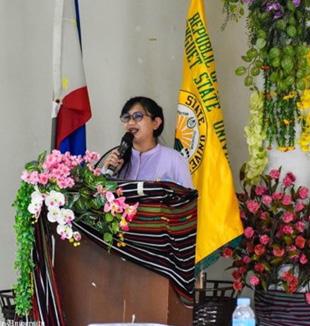
The first speaker was Ms. Pryce Environ E. Quintos - a faculty in the Department of English, College of Arts and Humanities at Benguet State University. Ms. Pryce is a feminist in progress. Her journey as a feminist traces back to her days as a spoken word poetry performer in open mic communities and poetry slams, to her days as a contributor for Baguio Chronicle from 2012 to 2015, to her time as a student in the MA Language and Literature program of the University of the Philippines Baguio, and now as the host of her weekly podcast, A Feminist in Progress.
She presented her paper, Caught in the Bad Romance: What the Tagalog Romance “Kung Iibigin Ka Muli” Tells Women, which was initially written for her Cultural Criticism in the MA Language and Literature program at the University of the Philippines Baguio.
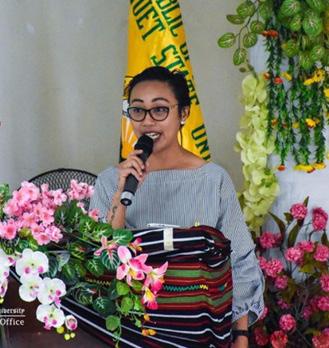
She shared that her professor wanted the class to interrogate this contemporary reassessment of the romance novel by looking at a Filipino romance novel, Kung Iibigin Kang Muli. They were asked to analyze this work and, assuming that this is typical of the Filipino variety of the form, discuss whether it validates the positive values of the romance novel. She mentioned that her paper tries to do just those. She wrote this nearly ten years ago. While most of her assertions in the paper still stand, her journey as A Feminist in Progress has provided space for enriching her knowledge and perception of what the Tagalog Romance “Kung Iibigin ka Muli” tells women.
My Dearest Brian,…Love “Melanie” by Mrs. Karen O. Laking
The second speaker was Ma’am Karen O. Laking- a faculty College of Arts and Humanities, Benguet State University. She had been handling literature subjects both at the undergraduate and graduate levels. She particularly loves to teach Philippine Literature in English, Literary Theories and Criticism, Poetry, Art, and Popular Culture. At present, she is the Gender and Development
Coordinator of the CAH. Also, she serves as the Division Chief of the Language, Literature, Arts, and Communication of the Institute of Social Research and Development.
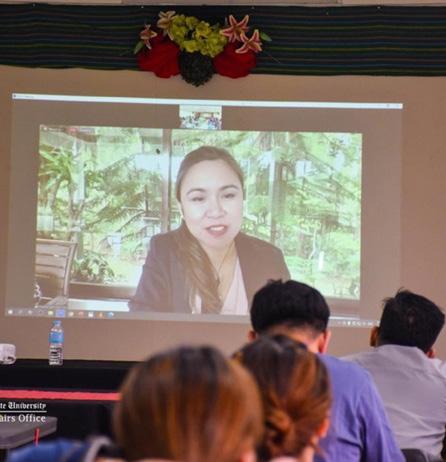
Ma’am Karen presented a literary critique of a gay story, “Letter to Brian” by Danton Remoto, using the Queer Lens. The short story was published in Ladlad 2 (anthropology of Philippine Gay Writings). She clarified that it was originally written in the Filipino language and was translated by the author into English.
Mrs. Laking shared the 5 sections of her paper ; (1) Brian’s story, (2) Coming out of the gay sensibility through Remy the parlorista, (3) Melanie the Drage Queen, (4)The rising director;s apprentice, the professirs lover; Brians homosocial and homoerotic bonds and (5) It’s not you, It’s Me !. She imparted her observations of the characters, contexts, relationships and different aspects of the story. Mrs. Laking ended her presentation with her poem in response to the story, in the perspective that the narrator awaits Brian’s return.
His/Her Version of Truth: Marriage and Separation in the Igorot Community as Depicted in Daguio’s the Wedding Dance.”
By Ms. Tyrene Basal
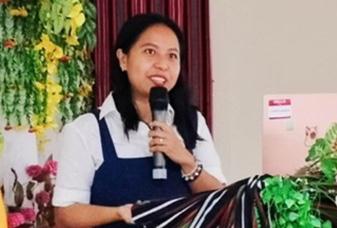
Ms. Tyrene Basal, a CAH faculty member, delivered a thought-provoking discourse titled “His/Her Version of Truth: Marriage and Separation in the Igorot Community as Depicted in Daguio’s The Wedding Dance.”
Ms. Basal’s eloquent speech revolved around the poignant love story of Awiyao and Lumnay, delving into the profound impact of their tribe’s customs and traditions on their destiny. It unveiled the unspoken laws of marriage and separation, where a man’s remarriage is sanctioned if his wife is unable to conceive, unraveling a captivating and contentious glimpse into Cordilleran culture.
Ms. Tyrene’ s resonant speech provided a profound introspection into the cultural beliefs and practices that mold the dynamics of marriage and separation within the Igorot community. A fresh perspective enlightened on the significance of lineage in their culture, as well as the societal pressures that accompany it. The tale of Awiyao and Lumnay stood as a powerful testament to the transformative potential of literature in raising awareness and effecting change. Subsequently, an engaging open forum was conducted, where both on-site and online participants had the opportunity to pose questions and engage in a vibrant discussion with the speaker. This forum fostered a deeper understanding of the topic while serving as a platform for sharing diverse thoughts and ideas. Overall, the forum proved to be a resounding success, enriching all involved with valuable insights
“Lesbian Writing: Pushing Against Boundaries Through Non-Fiction in the Philippines.”
By Dr. Jhoanna Lynn. B. Cruz
Dr. Jhoanna Lynn B.
Cruz,
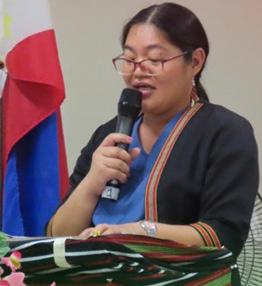
the esteemed department chair of the Department of Humanities at UP Mindanao, was the last speaker who graced the event with her captivating talk on the topic of “Lesbian Writing: Pushing Against Boundaries Through Non-Fiction in the Philippines.” Dr. Cruz’s illuminating presentation shed light on the myriad challenges faced by lesbian writers in the country, as revealed through her meticulous creative practice research. Through her unique perspective as a Mindanao Writer, she unveiled the perceptions surrounding lesbian writers within the community, often hindering their path to success. Notably, Dr. Cruz candidly acknowledged that her own adherence to heteronormative writing skills and rigid literary standards contributed to her invisibility as a lesbian writer. She further expounded on the subjective nature of a lesbian writer’s identity and graciously shared several insightful strategies from her non-fiction practice, including narrative structure, wordplay, graphesis, collage, poetic erasure, and playing dress-up.
In her concluding remarks, she underscored the significance of nurturing and advancing lesbian writing in a society dominated by heteronormativity and patriarchy. Her speech culminated with the inspiring quote, “Writing is making oneself visible. The woman who writes thus finally enters.”
The seminar concluded with the closing remarks of the esteemed director of ISRD, Gigy Banes, who delivered a speech encouraging educators, urging them to embrace the gender dimensions within written literature She further inspired the attendees to craft local literary works that seamlessly integrate the rich history and vibrant culture of the Cordillera region, as previously emphasized by the school’s honored president, Dr. Felipe Salaing Comila. With conviction, she implored participants to capture the narratives of LGBTQIAETC individuals, drawing upon their unique perspectives, as genuine expression stems from lived experiences. Encouraging a comprehensive approach, she stressed the importance of exploring literature through interdisciplinary lenses, allowing for a deeper understanding and appreciation of the multifaceted dimensions of human existence.
In a thought-provoking observation, she highlighted the scarcity of emphasis on gender roles in literary discussions and urged all teachers to emphasize this when discussing literature.