Praying for
Cooler Weather & HIGHER TIDES
Hunt for
TROUT
Along Channel Drop-Offs
Redfish Run KICKS OFF This Month September 2026
Only $4.95
TSFMAG.COM
TIDE PREDICTIONS & SOLUNAR FEED TIMES INSIDE!
TSFMAG.com | 1
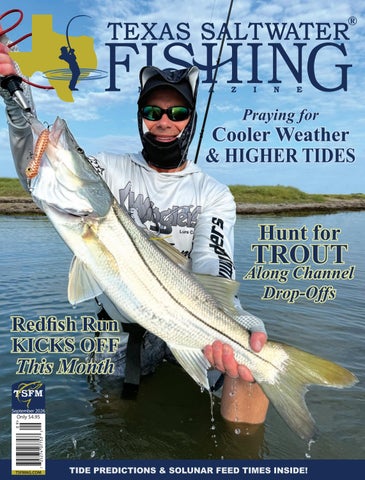
ABOUT THE COVER Lower Laguna anglers have been enjoying great success in landing snook this summer. Universal City police chief Johnny Siemens came looking for one and was rewarded with the wonderful specimen on our cover. Johnny’s trophy was tricked with a Mansfield Knocker in shallow water during a mid-morning solunar feeding period.
CONTENTS
SEPTEMBER 2026 VOL 36 NO 5
FEATURES
DEPARTMENTS
8 When Your Bay Fishes Small 12 Getting the Good out of the Gutters 18 Say it with me…SEPTEMBER! 22 Reflections of the Way Life Used to Be
26 Let’s Ask The Pro 28 Shallow Water Fishing 32 TSFMag Conservation News 34 TPWD Field Notes 36 Extreme Kayak Fishing & Sharks... 40 Mostly Sight-Fishing 42 Bird’s Eye View 44 Youths in Fishing 53 Science & the Sea
Steve Hillman Kevin Cochran Chuck Uzzle Joe Richard
18 WHAT OUR GUIDES HAVE TO SAY
48 The View from Matagorda 50 Mid-Coast Bays with the Grays 52 Hooked up with Rowsey 54 Wayne’s Port Mansfield Report 56 South Padre Fishing Scene
Bink Grimes Shellie Gray David Rowsey Wayne Davis Ernest Cisneros
44 REGULARS 6 Editorial 46 Product Highlights 58 Fishing Reports and Forecasts 60 Catch of the Month 62 Gulf Coast Kitchen
62
54 4 | September 2026
Jay Watkins Dave Roberts CCA Texas Sarah McHaney Eric Ozolins Jake Haddock Trevor Kucia Noah Raleigh UT Marine Science Institute
EDITOR AND PUBLISHER Everett Johnson | Everett@tsfmag.com Office 361-785-3420 Cell 361-550-3637 VICE PRESIDENT PRODUCTION & ADVERTISING DIRECTOR Pam Johnson | Pam@tsfmag.com Office: 361-785-3420 Cell: 361-550-9918 PRODUCTION / SOCIAL MEDIA DIRECTOR Jennifer Shive | Jen@tsfmag.com ADVERTISER REPRESENTATIVES Bart Manganiello | bartalm@optonline.net Pam Johnson | pam@tsfmag.com Office 361-785-3420 Cell 361-550-9918 Everett Johnson | everett@tsfmag.com Office 361-785-3420 Cell 361-550-3637 CIRCULATION SUBSCRIPTION – PRODUCT SALES Vicky Morgenroth Store@tsfmag.com | Office 361-785-3420 DESIGN & LAYOUT Stephanie Slann Artwork@tsfmag.com SOCIAL MEDIA COORDINATOR Bob Barrera Texas Saltwater Fishing Magazine is published monthly. Subscription Rates: One Year (Free Emag with Hard Copy) Subscription $32.00 E-MAG (electronic version) is available for $15.00 per year. Order on-line: WWW.TSFMAG.COM MAKE CHECKS PAYABLE TO: Texas Saltwater Fishing Magazine Attn: Subscriptions P.O. Box 429, Seadrift, Texas 77983 * Subscribers are responsible for submitting all address changes and renewals by the 10th of the prior month’s issue. Email store@tsfmag.com for all address changes or please call 361-785-3420 from 8am - 4:30pm. The U.S. Postal Service does not guarantee magazines will be forwarded. HOW TO CONTACT TSFMAG: PHONE: 361-785-3420 FAX: 361 792-4530 MAILING ADDRESS: P.O. Box 429, Seadrift, Texas 77983 PHYSICAL ADDRESS: 58 Fisherman’s Lane, Seadrift, TX 77983 WEB: www.TSFMAG.com PHOTO GALLERY: photos@tsfmag.com PRINTED IN THE USA. Texas Saltwater Fishing Magazine (ISSN 1935-9586) is published monthly by Texas Saltwater Fishing Magazine, Inc., 58 Fisherman’s Lane, Seadrift, Texas 77983 l P. O. Box 429, Seadrift, TX 77983 © Copyright 1990 All rights reserved. Positively nothing in this publication may be reprinted or reproduced. *Views expressed by Texas Saltwater Fishing Magazine contributors do not necessarily express the views of Texas Saltwater Fishing Magazine. Periodical class permit (USPS# 024353) paid at Victoria, TX 77901 and additional offices. POSTMASTER: Send address changes to Texas Saltwater Fishing Magazine, Inc., P. O. Box 429, Seadrift, TX 77983.
TSFMAG.com | 5
EDITORIAL
SOMEHOW WE’VE GOTTEN OFF TRACK Winter Storm Uri came crashing to the Texas coast on February 14, 2021, and wreaked havoc on our inshore fishery. The exact number of spotted seatrout that died in the days that followed will never be known. Suffice to say it was bad enough that anglers felt the impact for several years; landings were sparse until the population began to recover. TPWD reacted immediately with emergency regulations to conserve the spawning biomass and then followed up with a coastwide three-fish bag limit (15- to 20-inch retention slot). Along with that set of regulations came Texas’ first-ever trophy September Issue trout tag that enabled anglers to retain a fish 28-inches or greater length. The intent was Highlights to allow anglers to retain a lifetime trophy for taxidermy, or maybe even a new state record. Follow and Like Somehow, we got off track but understanding us on YouTube! that will require a bit of backstory. Legions of anglers joined ranks during the days of sparse landings, swearing off retaining trout entirely, practicing catch and release rather than killing them until the population recovered. It suddenly became very “Gucci” to release trout. CCA Texas removed trout from
6 | September 2026
their STAR Tournament. Notably, the Saltwater Legends Series – currently the largest inshore payout series in the state – switched to a catch-video-release format, where contestants have documented weights and released literally thousands of trophy fish. So, now for the backstory; here we are six years since Uri and trout fishing has improved many-fold. Reports from Sabine to South Padre bear witness. And, naturally, some of those who swore off killing trout have done a bit of backsliding. Fair enough, we’re now enjoying a greatly improved fishery, and this was actually anticipated, hence the three-fish limit and tight retention slot. What was never expected, though, was fishing tournaments allowing, perhaps even encouraging, participants to “cash in” their trophy tag and bring trout longer than 28-inches to the weigh-in. And then, using their bonus tag to do it again the second day. I am a member of TPWD’s Coastal Resource Advisory Committee, and also the CCA Texas Government Affairs Committee. Along with being the editor and publisher of this magazine I get involved in lots of meetings, planning sessions, and discussions on the topic of fisheries management. Believe me when I say that using the trophy tag to weigh oversize trout in a fishing tournament was never the intent of the regulation. While entirely legal, I can only hope and pray the folks running these events will reconsider their position in the future.
PACKS LIGHT. HITS HEAVY. Introducing Turtlebox Cub. Built for the pursuit and ready for wherever you set up, this cube-shaped design delivers loud, premium sound in a compact footprint.
WWW.TURTLEBOXAUDIO.COM
TSFMAG.com | 7
I’ve had a lot of fine young men this summer who are great fishermen. Patrick Byrd is no exception. Of course knowing his dad it comes as no surprise.
STORY BY STEVE HILLMAN
M
y clients and I left the marina very early this morning. In fact, we could barely see. It’s not my style to run across the bay in the dark but trout were getting harder to find and other fishermen were becoming overzealous. I was careful and I took it easy in the low light conditions. I didn’t care for it much but I wanted my customers to be able to experience the school of fish I’d been on. Apparently I’d left the dock too late as I noticed there was another guide anchored there as I got closer. I’d seen this movie before. It was time to find somewhere else to fish. Galveston Bay is a little more than 600 square miles. It’s about 384,000 acres and is the largest bay in Texas and the seventh largest estuary in the United States. It’s relatively shallow, averaging only 7 feet deep and is surrounded by 232 miles of shoreline (“Galveston Bay 101”, gbep.texas.gov). Despite the fact that it’s a huge system it fishes really small at times. Just because there’s water doesn’t always mean there are fish in that water. Like most systems, there are many factors influencing how big or small the Galveston Bay Complex fishes. A thorough understanding of those factors and how to react will yield better results for us as anglers. Let’s dig deeper. Habitat – Some areas around the bay are making a comeback with regards to seagrass beds and oyster reefs but the majority of the areas that flourished with seagrass, oysters and clam beds are absent from where they were 20 years ago. Because of this fish are more concentrated in the areas with said habitat because of the marine life it supports. Barren mud flats have little to offer our target species that are in search of food and refuge. I use Google Earth to try to find reefs and grass beds in addition to online research through sites like the Texas Parks and Wildlife, Galveston Bay Foundation and the Nature Conservancy, just to name a few. I also pay close attention to where commercial oyster dealers are harvesting and transplanting live oysters on their private leases. Where there’s live habitat there will usually be fish. Once I’m in those areas I’ll look for signs such as slicks and/or bait concentrations, especially along reef edges, points, and grass lines. All serve as ambush points. Seasonal changes – As one would expect our trout pattern changes with the seasons. Fish spread out all over the bay during the summer months as water warms, forage species become plentiful and metabolism increases. There are usually lots of options early during the summer. There are still good numbers of trout on shorelines but open water reefs and structure come into play as well. Working birds over migrating shrimp can also be an option at times. This is typically the time of year when fishermen can spread out and still have a productive day on the water. TSFMAG.com | 9
Excessive freshwater inflow is one of several factors that can make a bay system fish smaller than it really is. (Photo credit: tidesandcurrents.noaa.gov)
The fall season is very similar to the late spring and early summer pattern in that most fish are still following bait migrations but are also beginning to stage near bayou drains and river mouths, especially in the wake of each passing cool front. Fish are still typically spread out enough to where we can find and catch trout and reds without having to deal with much boat traffic. This is especially true for those of us who pretty much choose not to work birds. These days, working birds usually results in catching a bunch of undersized fish and it’s simply not worth it. Not to mention you’re going to run the risk of unnecessarily killing trout you can’t retain. The exception is working birds over shallow reefs and/or in back lakes. Many times these schools will have legal sized trout and reds. The schools out in open water over mud are usually babies and undesirable species. Then there’s the winter pattern. Colder water and lower tides tend to concentrate fish in and along guts, up bayous, and in nook and cranny areas. Many of our trout these days seem to concentrate more into neighborhood canals because of the warmer canal water, green (and white) lights that glow all night long, and abundant forage species. These areas are very easy to fish and are protected from the elements so they’ve become very popular. Because of this I tend to focus less on neighborhood canals and more on bayous, ditches and creeks with similar water depths, above average water temperatures and good concentrations of bait. There are plenty of areas like these throughout the complex if you do some digging. Springtime trout tend to frequent coves and shorelines possessing some sort of habitat, especially near bayou drains. In this regard, the fish are somewhat concentrated not to mention the spring winds force us to wade tight to the shorelines. This limits the productive areas especially once others catch on to the patterns. Unfortunately, shorelines around the Galveston Bay Complex experience anywhere from 2 to 4.5 feet of erosion each year due to constant wave action, subsidence and other factors. On paper, our bay is getting bigger but from a fishing perspective the loss of shoreline habitat makes it fish smaller than it is. I’ve found that shorelines further back in the bay(s) have experienced fewer negative impacts from erosion, etc.
Towards the end of summer (mid-July through mid-September) our legal-sized trout here in the Galveston Bay Complex tend to concentrate in fewer areas. This is when I begin to notice boats I haven’t seen since the previous year. They are in search of areas with a better bite because their previous “spots” have dried up. This leaves me with basically two choices: I can leave the dock very early with hopes of beating someone to the “spot” or I can try to find another area or “spot” to fish. I typically do the latter which involves finding an area with similar structure and habitat that exhibits most of the same characteristics as the spot I lost to other boats. Many times my new spot isn’t quite as productive as my previous one but it’s usually good enough to get me and my clients on enough action until I can go back to the better spots later in the morning after other boats have left. There are also times when our trout will actually pull off the shell and get on top of the cool mud bottom nearby. Sometimes the sweet spot is no longer the We’ve had some days through the years where we caught two trout on one lure, but I don’t remember ever sweet spot. When this happens, most anglers catching one trout on two lures like Rusty Plackemeier will just assume the fish are gone and they’ll and Frank Thomas did on one of our recent trips! go elsewhere. 10 | September 2026
Graham Pawlik put on an absolute clinic on this day, but it wasn’t all that surprising, knowing his family history.
Pablo Torres didn’t expect this giant red to be mixed in with our trout, but he took care of business just the same.
It’s sometimes a longer run to get there but it gets me away from the more popular stretches of shoreline “community” spots. Wind – During the winter months wind speed and direction aren’t that big of a deal but during the warmer months when fish pull out of the bayous, rivers and deep backwater pockets, wind can become a problem. Our Achilles’ heel through the years seems to be that dreaded summertime southwest wind. There just aren’t many things we can do on a stiff wind out of that direction these days. Back in the “Good Ole Days” we could go to places like Half Moon Shoal and catch all we wanted. If we were wading then we could go to the Bolivar Pocket. Now things are different and there are fewer productive areas from which to choose. As I type this the forecast for the next 4 days is predicting southwest winds 15-20mph. In my mind I’m already visualizing my possible fishing areas. I’ll probably also spend a little time looking at Google Earth. I’ll look at the predicted tide levels and whether I have drifting trips or wading trips. I will also take into consideration if other fishermen may frequent areas I’m considering and devise a back-up plan. Freshwater Inflow – Thank God we haven’t had to deal with heavier-than-normal inflows much this year but excessive freshwater run-off will concentrate fish in smaller areas. Not only do the fish concentrate but so do the boats. Ninety-five percent of the time you can find a similar area with suitable habitat and salinity but without the boat traffic. The NOAA OFS (Operational Forecast System)
Spotted Eagle Ray Follow and Like us on YouTube!
Ryan Cantrell with one of many nice specks he caught on deep mid-bay structure.
Salinity Nowcast hydrodynamic model shows the approximate salinity ranges for the bay system you choose (tidesandcurrents.noaa.gov). The very best method is to spend some time out on the bay assessing the situation for yourself, paying close attention to water clarity, bait concentrations and areas where saltwater becomes fresh and vice versa. There is also a distinguishable difference in the way salt and freshwater smells. Simply put, salt water smells like the beach and fresh water smells somewhat musty. Also, don’t forget to pay attention to your prop wash while idling. If you observe green water coming up from beneath the murky freshwater surface layer then you’re most likely in an area with good enough salinity levels to catch fish. There will be times when it seems like there are fish on every street corner. Everyone will be catching and we won’t be able to wipe the smiles from our faces. Then one day the patterns drastically change because of one or more factors. The same number of boats will still be on the water but the productive areas will shrink to a fraction of what they were before. It may change for only one day because of a hard southwest wind or it could be for weeks because of a massive rainfall event. The smiles will fade and many will be left wondering what to do. Take the time to learn your fishing areas and what factors influence them, then keep your knowledge close to the vest. Use antidotal information and every tool available to develop a plan for success. Do this and you can keep smiling…even when your bay fishes small.
STEVE HILLMAN
CONTACT
Gray Stewart was able to trick some really solid trout on a morning when calm winds opened up lots of options for us.
Steve Hillman is a full-time fishing guide on his home waters of Galveston Bay. Steve fishes the entire Galveston Bay Complex, wading and drifting for trout, redfish, and flounder using artificial lures. Phone 409-256-7937 Email captsteve@hillmanguideservice.com Web www.hillmanguideservice.com
TSFMAG.com | 11
GETTING
out
GUT
THE GOOD
of the
TERS STORY BY KEVIN COCHRAN
E
xcluding the narrow channel known as the Intracoastal Waterway, the Yarbrough Basin holds the deepest water in the Upper Laguna Madre, averaging about seven feet. Lying between Baffin Bay and the Land Cut, this area holds prime potential for producing trout of epic proportions. Framed on its east side by Padre Island, flanked on its west by a series of small spoil islands adjacent to the Intracoastal and bordered on both its southern and northern ends by vast, shallow flats, Yarbrough has several famous spots, frequented by many of the area’s top trout hunters and guides. In its southern end, an old oil-field channel runs out of the depths and into a huge expanse of shallow water known as the Middle Grounds. This channel basically bisects Murdock Flats, an area with a name generated many decades ago, before the Land Cut connected the two Laguna Madres. A generally east to west oriented edge formed by grass-capped sand bars separates the Yarbrough Basin from Murdock Flats. For the most part, fishing Murdock’s means working either the edge of the sand bars which sit at the cusp of the flat, where the water slopes into the basin, or working the shallows farther away from the edge, toward the Middle Grounds. People can and do catch some true trophy trout in Murdock’s, most of which come to the hands of waders who sight-cast them in water barely deep enough to cover their boots. Most anglers don’t relish the idea of covering lots of acreage on foot, fishing for trout in super skinny water while hoping for a few opportunities to cast directly at big fish, after spotting them. For the average angler, in most situations, the area with the ripest potential for producing trophy trout in South Yarbrough is a place known by most locals as the Gutters. This area lies in the southwest corner of Yarbrough, tucked between Murdock’s and the long spoil island lying on the east side of the northern entrance to the Land Cut. This spoil protects the famous area to its west, known as Summer House, from the wrecking effects of strong onshore winds, but it does nothing to help the water in the Gutters hold up when such winds whistle intensely.
So, anglers hoping to catch fish in the Gutters generally benefit from benign conditions. Generic summer weather provides those on a daily basis. In this windy region, during the dog days, wind speeds do normally ramp up somewhat in the afternoon hours, but light onshore winds or westerly winds whisper most mornings, allowing the water in the Gutters to hold its clarity well. Hot weather also creates patterns which tilt the odds in favor of anglers hunting monster trout in this place. Apparently, the name Gutters came about naturally, as a result of people taking the general layout of the area into account. A long, natural gut lying adjacent to the spoil island defines the place, widest on its northern end, narrowest in its southern extremes, where it fizzles out and enters a transitional area with depths intermediate between the shallows of the Middle Grounds and the gut. Wading in the gut proves basically impossible, though it reaches depths of only four feet or so. Anyone who has tried will attest to the fact the super soft bottom will swallow one up to the knees or worse, making movement difficult, even dangerous. Though waders can’t venture into the gut, they can work the grassy flats on both sides of it. Significantly, fish do use the gut as a kind of highway, a path to pass from the depths of the basin into the shallows of the Middle Grounds, especially when water temperatures reach extreme values, either hot or cold. I know this to be true because I’ve seen it with my own two eyes. One poignant memory stands out among many which prove big trout swim up the gut to access the potholes in the transitional area at its southern end. On the calm summer morning, quiet settled over a slick surface on the water of the ULM. I stood in knee-deep water to the southeast of where the gut funnels into the transitional area between the Gutters and the Middle Grounds. A huge school of mixed red and black drum surrounded me; they finned around slowly, actually bumping into 14 | September 2026
my legs at times. I’d caught a few reds and regular-sized trout on a Super Spook early, before the bite slowed to a crawl. While debating whether to try some other kind of lure, I saw something which focused my attention intently. I watched some kind of large fish rise out of the depths of the gut and move into the shallow water covering grass beds framing silty potholes in the transitional area, pushing a tall wake ahead as it went. Just beyond my casting range, the fish began moving westward, toward the spoil island, away from me. I began chasing after the moving wall of water, struggling to cover distance in the soft potholes. I quickly realized I’d never catch up to the fish, which I feared would head off into the Middle Grounds and disappear. Then, a stroke of luck blessed me. The fish turned and swam eastward, toward where I stood, not in a direct line, but coming ever closer as it weaved through the potholes, eventually nearing my casting range. I freed the spool on my reel when it came right to the edge of my reach, then waited a little longer before sending my Spook out beyond where I could see evidence of the fish, then pulling it directly into its path. As the wake came within a few feet of my bobbing plug, the fish stopped, and I twitched my rodtip four or five times, walking the dog right into the strike zone. And then it happened. A trout of epic proportions shattered the silence, blasting off on the cigar shaped plug and knocking it at least three feet into the stagnant air while emerging completely free of the water. To this day, I wonder how big the fish was; she appeared supernaturally huge. We’ll never know, because none of the nine points on the treble hooks riding on my plug stuck in her skin. After she landed with a loud splat, she swam swiftly to the north and west, still pushing a steep wake, then slid back down into the world from which she had risen.
Jennifer Crisp Bernard holding a pretty trout caught in the shallows just south of the Gutters.
Rob Ramsey holding a trout he caught on a Super Spook in transitional area of the Gutters while fishing with the captain in April.
I, along with my customers and friends, have caught quite a few big trout in and near the Gutters during the summer heat wave, usually while we’re cussing the reds, culling through numbers of them. I vividly remember sizzling days on which we caught dozens of keeper reds and a handful of trout measuring between 26 and 30 inches. Normally, though, the Gutters produces big trout better during the milder seasons of spring and fall, when water temperatures range from the 60s into the low-80s. During transitional months like April and October, this area can fill up with the kind of trout trophy hunters covet. But tide levels in those months, associated with the two equinoxes, often run high. While bull tides make accessing the shallows at the southern end of the Gutters’ namesake gut in a boat easier, they also urge the trout to move into the vast expanse of shallows in the Middle Grounds,
Slow-sinking twitch baits produce plenty of fat trout on all the flats surrounding the Yarbrough Basin.
where they can prove difficult indeed to locate. In an ideal situation during spring and fall, low tides pull water out of the Middle Grounds, leaving the shallowest parts of the area high and dry and driving the fish toward the Gutters, concentrating them in the transitional area. In situations like those, anglers throwing slow-sinking twitchbaits, conventional topwaters and other floating lures which dive to shallow depths when twitched, then float back toward the surface on the pause, sometimes catch numbers of big trout, including some meeting or exceeding the 9-pound and 31-inch marks. Often, floating versions of Paul Brown Lures produce well in such situations. At other times, soft plastics rigged a foot or so under small corks provoke strikes from the monsters better than all other offerings. The silty potholes forming the transitional area produce best, but
Mike Bernard caught this trout and several other similar ones on sinking Paul Brown lures worked close to the edges of the gut in the Gutters.
Anglers hoping to catch bigger than average trout in shallow water normally do so on floating Paul Brown Lures, Leles and conventional topwaters.
TSFMAG.com | 15
Yarbrough Follow and Like us on YouTube!
multiple wakes to the south of us. Before we could get out of the boat, I saw at least a half dozen shrimp jump out of the water, fleeing the snapping jaws of hungry predators. “Boys, I see what I see,” I told my customers. “We ain’t worth much if we don’t catch ‘em in here today.” We did proceed to catch plenty of trout and reds that day, including one trout weighing well over nine pounds. For the next few days, while the water gradually warmed and the tide level rose, we caught a bunch more. These kinds of scenarios have graced me and many others amply over the years, in this place with the ugly name and the pretty potential.
KEVIN COCHRAN CONTACT
the edges of the grass beds framing the gut also produce big fish. Sometimes, especially when moderately strong winds blow at the bank of the spoil island, wading the shallows between the gut and its shoreline prove most productive. Less often, big trout lurk in the depths of the gut, aggressively biting lures worked over its mooshy bottom. This pattern works better in the year’s coldest season. During the winter months, big trout sometimes retreat from the shallows of the Middle Grounds while temperatures rapidly descend after the passage of a strong cold front. When temperatures bottom out and begin to tick upward, the same fish use the gut to make their way back toward the shallows, sometimes stopping and staging on the soft muck for a while before venturing back out into the grass beds and potholes. Some of the best action in this area occurs during warm spells after north winds calm in the wake of a strong front. My friend Jason King alerted me to the possibility of something significant happening down there one January, when he and a friend caught a bunch of over-sized and upper-slot reds on a day when water temperatures barely nudged up to about 50F after bottoming out in the mid-40s. The next day, when I arrived and punched the Power Pole into the mud just east of the transitional area, I could see
Kevin Cochran is a long-time fishing guide at Corpus Christi (Padre Island), TX. Kevin is a speckled trout fanatic and has created several books and dvds on the subject. Kevin’s home waters stretch from Corpus Christi Bay to the Land Cut.
TROUT TRACKER GUIDE SERVICE Phone Email Web
361-688-3714 kevincochran404@yahoo.com www.captainkevblogs.com
pack up for your perfect
ROAD TRIP TO port arthur, TEXAS
Get ready for surf, sand and sunrises in Port Arthur, the Cajun Capital of Texas. Drive on over to Texas’ upper Gulf Coast for a family vacation overflowing with fall time fun. From sports and music hall of fames at the Museum of the Gulf Coast to overnight camping and paddling one of three rated trails at Sea Rim State Park to fishing and beach combing at McFaddin Beach, and even filling up on the best Cajun seafood in all of Texas, you’ll love every memory-making moment.
visitportarthurtx.com 16 | September 2026
TSFMAG.com | 17
Schooling trout taking surface plugs is one of the highlights of the fall.
Say it with me...
SEPTEMBER! STORY BY CHUCK UZZLE
D
on’t look now, but things are about to get real once we flip that calendar page; September is here, and everything finds another gear while ramping up expectations. The brutal days of July and August are about to be left behind in favor of those first sweet north breezes that bring both comfort and a whole host of options for anyone who is lucky enough to live here in Texas and have some days off. September is perhaps one of the most anticipated months of the year as almost everything we hold near and dear gets going or gets better. As if anything gets better than fishing, we now get to start hunting season, football season, and all things that go along with both of those. If I had to describe September in one word, the first that comes to mind is options, simply because there are plenty of those to go around. Virtually every fish that lives in Texas waters is available this month, so there are no bad choices from the gulf to your favorite freshwater lake. It’s all good and will only get better. At some point this month we will catch our first glimpse of some low humidity and light winds out of the north, courtesy of a weak front that will be a sign of more to come. The importance of these weather events is that they will kickstart the shrimp migration and turn the fish on like a kindergarten class on cupcakes with extra icing. Once the first good front dumps the marsh it will only get better with each successive front. Speckled trout and redfish will go absolutely nuts as the endless buffet of white shrimp washes out of the marsh drains into the open lake where it will become a free for all. Sabine anglers consistently are rewarded during the fall months with some of the best schooling activity on the coast, so it’s no wonder this month is so highly anticipated. This year’s schooling activity has the potential to be a little different than recent years due to the noticeable rebound of the speckled trout population. Both the numbers and quality of fish are the best we have seen in many years. Over the past few years we have dealt with huge numbers of undersized trout while trying to find those few 15 inch-or-better fish. Don’t get me wrong, catching 50 or more fish a day is an absolute blast but at some point it’s nice to catch some quality fish. After such an incredible spring and summer where we caught some of the best fish we’ve seen in a while, the prospects for a great fall run look very promising.
TSFMAG.com | 19
The PrawnStarZ from Z-Man has become a great option for catching both numbers and quality fish.
Obviously, as we mentioned before, the schooling activity will be a given and the techniques will not vary a whole lot. Soft plastics on jigs and also under rattling corks will cover almost all your bases and get you plenty of bites. A couple of my more productive choices for these situations would be the PrawnstarZ and Big BallerZ from Z-Man, and the tried-and-true Gulp! products from Berkely. The PrawnstarZ have become a staple for me while fishing with a cork because of the unbelievable realism and durability they provide. ZMan now offers them in a loose body version rather than the pre-rigged originals so you can use them in different applications. The Big BallerZ gives you the option to rig standard on a jighead or in weedless fashion, which is a nice when conditions call for a more subtle presentation. The Big BallerZ has a segmented body and ball shaped tail that creates erratic action and draws some impressive strikes. The Gulp Turbo Shrimp and Swimming Mullet are also favorites for this style of fishing and beyond. The patented Gulp! attractant on these soft baits is a major plus when fish are finicky or you need that little extra to get that bite. Flounder fishermen on Sabine virtually live and die with the Gulp! if they aren’t throwing live bait because it’s truly a proven producer. If chasing schooling fish isn’t your choice and you are looking for some 20 | September 2026
Beautiful trout like the one displayed here have become more common on Sabine after some fantastic summer months.
Fishermen and waterfowl hunters aren’t the only ones looking forward to September.
better quality or perhaps trophy fish, you are in luck because you can find them in September. The deeper water venues like the jetties and ship channels will be holding some healthy fish along structure drop-offs, so crankbaits or swimbaits will be a top option. Obviously, tide will be a major factor so adjust your approach in order to have a more life-like presentation. Casting into the current so your bait swims with it will get you more bites as predator fish will hold in areas while facing the flow of the water. An up-current cast will be more lifelike and is more prone to getting bit than fishing opposite of the water movement. Perhaps the star of the fall months and the most disrespected player in this game will be the redfish. Schooling activity will do nothing but increase as we get deeper into September and October. The big schools of oversized redfish will show up and start stomping around all over the lake, eating everything in sight so keep your eyes open for any surface activity. Throwing topwater plugs at these big fish should be done at least once so you can witness the impressive strikes that they provide. Normally we are throwing Coastal Pro rattling corks with soft plastics to these big bullies and they really eat it up; both the bait and the cork are fair game so don’t be surprised if you get fish trying to eat both at the same time.
Sizing up September Follow and Like us on YouTube!
far to the north. Texas will have a 9-day season this year instead of the 16-day version we have grown so accustomed to, so days in the marsh will be held at a premium. Dove on the other hand should be as plentiful as ever and as long as we don’t have any crazy weather events the season should be as strong as ever. Options galore and nothing but good stuff ahead for all of us who enjoy the great outdoors here in Texas. Keep your eyes on the temperatures and celebrate a break from the heat. As always, take a kid with you next time you head outdoors and share our sport with the next generation.
CHUCK UZZLE
CONTACT
Options abound this month and there is no way to check them all out. From trout and redfish in the rivers or open lake all the way to the gulf and beachfront, it’s all in play. The nearshore waters and beachfront will come alive with great numbers of bull redfish and sharks foaming the surface as they herd pogies by the acre. Another option that’s gained traction in recent years is fishing for tarpon off the beach. The stretch of water between the Sabine jetties and Galveston is some of the best water you can find to catch some truly quality tarpon. In fact, we have been seeing tarpon regularly along Sabine jetty and beachfront during the summer and it will only get better and more consistent as we head into September. It goes without saying that any mention of September without acknowledging teal or dove season is a blatant party foul and should be punished accordingly. Both dove and teal season are held in high regard here in Texas and are one of the few things anglers will willingly lay their rods aside for. The wet July we experienced helped the marshes in a big way and gave the rice farmers a shot in the arm as well. The full moon in August ushered in the earliest of the migrating blue wings with the majority of the population still
Chuck fishes Sabine and Calcasieu Lakes from his home in Orange, TX. His specialties are light tackle and fly fishing for trout, reds, and flounder. Phone Email Website
409-697-6111 wakesndrakes@yahoo.com wakesndrakes.com
TSFMAG.com | 21
Reflections
Kids starting out young with an aluminum boat.
of the Way Life Used to Be
STORY BY JOE RICHARD
M
arking its 40th anniversary this year, the movie Stand by Me has recently been recognized as an ode to the untamed childhood freedoms many of us enjoyed back in the day. Set in 1959 and telling the tale of four 12-year old boys striking out on a two-day adventure in the Oregon woods, much has changed since then, including a marked decline in kids allowed to be outdoors alone for any length of time. These days, many youth are practically air-tagged so their parents know exactly where they are. It’s been a revelation that today’s teenagers can’t believe boys in the movie were allowed to just hike out of town. What, no cell phones or debit cards? How was that even possible? In recent years, some parents have even been arrested after a “concerned citizen” reported kids walking to the grocery store or playing in the park mere blocks away. Nearly gone are the days of jumping on a bike with a fishing rod and heading for a favorite lake or coastal shoreline miles away. Or taking off in a jonboat across the bay, for that matter. It’s probably a good thing I was 15 by the time we moved to Port Arthur where fishing opportunities were unlimited. Even better that I didn’t fish the “high-energy” Sabine jetties until 18, an environment that even today older guides avoid—with all that wave action, ships, currents and granite rocks to deal with…
Young fishermen learning to catch their own bait, always a handy skill.
Author on a banner redfish day on Port Arthur’s Pleasure Island in August, 1969.
Before Port Arthur there was Lubbock, where I was all over town, riding the city bus and fishing every scrap of water all day without food or water. Happy to escape endless chores my stepdad dreamed up whenever a dust storm wasn’t blowing. Lubbock had a curfew for kids, but a friend and I rode bikes to Maxey Lake at 5 a.m. and once had to “hit the dirt,” to evade a patrol car’s spotlight, laying face-down in cedar bushes in someone’s front yard. It’s possible he saw our fishing rods and bikes and shook his head before driving off. At the end of my eighth-grade year, the family abruptly moved a long ways across the state to Port Arthur, a serious fishing paradise. After a grueling drive in early June, with three cats and no AC in the car, we arrived. Grabbing my Zebco rod, I walked across the street to the Intercoastal Waterway (ICW) and was catching croakers while the moving van was still in the driveway. Across the water was Pleasure Island and thick forest, which became my second home for the next three years. That island offered more freedom than most kids can dream of. When the downtown drawbridge was hit by a barge that very October, construction began on the towering bridge to the island that still stands today, built to accommodate ocean-going ships. But it took three years to complete, during which time visitors were stuck with using a small ferry boat hauling mostly golfers. When I was stranded on the island after sunset that November, an elderly couple running the marina, the Smileys, took me in like a stray cat, allowing me a second home every weekend and a refuge when school let out. I tallied 20 (lower slot sized) redfish in a month just fishing around the marina, before expanding my range. On one memorable occasion, Mr. Smiley took me shrimping at night (not entirely legal). When his twin, hand-cranked red Johnson motors broke down on a full moon night, choppy easterly waves carried us right back to the seawall. We also ran up scaup ducks (he called them blackjacks) on Sabine Lake, where the old man emptied a 12-gauge pump gun while I drove the boat. He and his wife were pure Cajun, saving every duck feather for pillows, and anything that flew became excellent gumbo. There were also trap lines to run. Within a year, I had my own 12-foot Gibson “v-bottom” jonboat with a 5-horse Evinrude, exploring and camping along Sabine Lake with new-found friends. Needless to say, that first
boat suffered from a steep learning curve, mostly dragging it through rocks, onto a seawall and later even the Galveston jetty. There was no bait without using a castnet. The following year, Brown and Root began building the north and south levies, lopping off about 20 percent of Sabine Lake for ICW dredge fill, while inadvertently trapping trout, redfish, flounder and black drum by the thousands. It was great fishing for a year or more, but way better when Hurricane Camille (in Mississippi) raised our local tides by 3-4 feet, shoving fresh green Gulf water through those 4-foot drain pipes, where fishing action exploded. Three high school buddies, Mike Spencer, Bob Bellows and Clay Smith rode up on their bikes, lugging 191 trout on massive stringers draped all over handlebars and themselves. (No bag limits in those days). Their shocking picture ran in the Port Arthur News that following Thursday. My eight upper slot redfish that same day by comparison looked a pittance; turns out I was a quarter mile away from the real action. I realized we would need a better means of transportation. A new friend, Dan Ferguson, had just moved to Port Arthur and had access to a family car, a Ford Torino, which offered a fast ride to the honeyhole. Next day was Labor Day so we put the hammer down, drove through Louisiana back roads around to Pleasure Island and parked at the second pipehouse structure on the south levy. The tide was still high, the fish hungry and we nailed the trout and a few drum. Our Tout Tails were shredded so we switched to 7-inch purple Fliptail bass worms (used while camping at new reservoirs called Sam Rayburn and Toledo Bend) and those worms worked just as well on trout. Back home next day, our local fish market guy on Dallas Avenue, an American/Sicilian named Vic Pavia, told me to leave the trout with him, they were semi-frozen in a big plastic bag, he wanted to thaw them out for a closer look. Next day he said he didn’t want them. Back home the bag was a little light; 30 fish were missing. It wasn’t the first or last time he ripped us off. Back then, fishermen in town sold their catches; even Dr. Couch, who owned an awesome 23-foot Formula boat and was known for his offshore exploits. There were few fish rules and regs and no size or bag limits. Our freedom was such that waiting out each Friday in high school was torture. We’d rush home, load the car, grab a case of cheap soda,
24 | September 2026
canned tamales, Wolf Brand Chili, and Mrs. Certainly shocking by today’s standards, this Baird’s cinnamon rolls, and hit the road. We massive haul of trout and redfish occurred fished every weekend for six months on the during an era that preceded modern-day north levy, which always contained clear regulations; a time when recreational anglers green water, camping without a tent. If it often sold their catches to seafood dealers when they experienced exceptional luck on rained we slept in the truck. (I didn’t have a the water. Photo courtesy of Mike Spencer. driver’s license until the following summer.) Back in town you could rent a cotton beach He soon became a sharpshooter with a seine and head for nearby Louisiana beaches Garand rifle and wound up in Normandy, where the water was always chocolate the Netherlands (a bridge too far), and the brown, but plenty of trout that jumped over Battle of the Bulge. His platoon was featured the line of corks like salmon. Or tail-walked in the Band of Brothers TV series. Wounded in a flurry of whitewater. several times, he was finally shipped home The year before, we drove the length and then it was back to guiding for bass of the foggy island at night, three 10th up to ten pounds on Arkansas rivers or graders on the roof rack of a Plymouth increasingly, the state’s new reservoirs. He Belvedere station wagon, firing away with grew up with more outdoor freedom than .410 shotguns, once bagging eight rabbits. most people today can dream of, but I can Borrowed a Brown and Root truck at certainly relate. Except his family was dirt midnight when our car got stuck on Johnny poor, he jumped out of airplanes targeted Barlow’s island golf course. (Rabbits love by German flak guns, and he was wounded golf courses). During the day we learned to several times. shoot ducks, too. While it’s fun to opine about today’s No cell phones in those days, so our folks youth being deprived of unfiltered had only a vague notion where we were, experiences in nature, the truth is that there trusting we’d return each Sunday night is probably a happy medium between the with a box full of mostly flounder, a few forced interaction (hunting to feed a family) upper-slot redfish and maybe a few ducks. and 24-7 helicopter parents. It is indeed Twice I swam the ICW to the Port Arthur a different world from the 1959 narrative side without a life jacket when a ship wasn’t of Stand by Me and knowing where your approaching, to shorten the walk home or kids are is probably a good idea. Truth be because the car broke down. On the second told, those lads in the movie could have swim during June (at night), there was no benefited from a little more quality parental place to climb out of the deep water, as the guidance and the same was true with me. seawall towered above us. A thin drain pipe With so many memorable experiences protruded from the vertical seawall and we from my youth—and a few learning grabbed hold in an outgoing tide, chinning curves—my hope is that this next ourselves out of the water. When you’re 18, generation and their parents will find a anything is possible. way to unplug and make it a goal to catch There is no doubt that American youth their own dinner from time to time. There’s before us had even more freedom. Back nothing like serving up a meal of grilled then most folks lived in rural areas with redfish or fried flounder, a gift from the much stronger connections to the outdoors, Author 59 years after his days living outdoors, and knowing it will be enjoyed. at the marina on Pleasure Island. where young men grew up fast and were often expected to help feed or support the family. (Three million of them worked in the Civilian Conservation Corps leading up to WWII). I was reminded of this recently while Joe Richard has fished the Gulf since 1967, starting out of Port Arreading Shifty’s War, a biography about Darrell Powers, who came from thur, but his adventures have taken him up and down the entire coast. humble beginnings. Lacking shoes until he was 12, he was responsible He was the editor of Tide magazine for eight years, and later Florida for helping feed a family of seven. Running traplines by the time he Sportsman’s book and assistant was eight, his family ate muskrats, possum, lots of bullfrogs and also magazine editor. He began guiding flathead catfish caught with limb lines. If dad gave him a .22 bullet, out of Port O’Connor in 1994. His he’d better return with a rabbit. specialty is big kingfish, and his latest book is The Kingfish Bible, By the time he was 16, he’d been guiding river float trips for years New Revelations. Available at and was highly recommended. When the war began he still couldn’t Seafavorites.com read or write, much less become a pilot like he wanted, but they gave him his wings on a paratrooper’s uniform with the 101st Airborne.
CONTACT
JOE RICHARD
TSFMAG.com | 25
J AY WAT K I N S
ASK THE PRO
THE COVE PATTERN The heat wave continues but the rain we received in while we were in the area. This certainly did occur at May and June has allowed for some good water quality times, and I learned from it and soon adopted this into conditions and even some stacking of fish along our my day-to-day guiding business. Today, it is probably south shorelines, which has helped improve our fishing the most important aspect of fishing that I try to teach for the time of year it is, which is truly the toughest of clients with a genuine interest in becoming better year times to catch quality trout. Like I stated in the last issue ‘round anglers. of the magazine, I like the challenges the conditions I try to avoid pushing through these small areas where create for us this time of year. In this month’s article I feel fish are staging during non-feeding periods. Coves I want to touch on my confidence in fishing coves provide good opportunities to properly stand and work and pockets that lie adjacent to nighttime feeding at an angle to the drop-off, bending each cast and areas. I have written pieces on this in previous years, providing multiple opportunities per cast for the angler but understanding this pattern is an absolute must to get a bite. Casting at angles to the drop-off allows the for success this time of year and therefore warrants lure to come across in front of the fish and hopefully in repeating. I have also discovered some new but small front of more fish. When positioned properly, you’ll never nuances to the pattern that have helped me better walk through the area holding the fish. This allows you to predict what I will find prior to working the pattern. I get revisit the area later in the day. David Rowsey reinforced great satisfaction out of calling the shot. Had this happen this concept to me on one of our first fishing trips just yesterday with a guy and that is the first thing he told together. I have never forgotten that lesson from a very me, “You called it!” And I loved it. young David Rowsey. I guess the first thing one needs to know is how to It is also highly possible that the area will reload identify a nighttime feeding area. Any area of shallow throughout the day. I believe that what one fish prefers, water adjacent to deeper drop-offs must have at least a others do as well. Over the years I have come to believe few of the following structure elements before we can that larger trout will slowly mill through areas that consider them as nighttime feeding zones. These are provide all that is needed for them in the way of cover bottom grass, scattered oyster shell, sandy potholes and food. This belief provides me with a high level of amid dense grass, bottom contours such as humps and confidence, which in turn creates staying power. These guts, shoreline fish highway, and a drain or slough that two things play a tremendous role in our success. feeds a backwater marsh area. We don’t need all the I made a comment on a recent Instagram post above, but most will have at least three of the six types (official_jaywatkinssrfishing) about a very distinct and of structure mentioned. predictable summer pattern that I had observed for an I prefer my coves to be windward, but leeward is not entire week. I am not sure whether my observations over a total showstopper, as we are most often spending a a 5-day period would qualify as a seasonal pattern, but it good amount of our fishing time working the dropwas definitely the pattern that week. The trout we were offs that outline the coves. I have to say that this pattern requires confidence in the chosen area and plenty of staying power. I gained my staying power as a guide when I knew fishing time was short or on busy weekends and holidays back when I fished every day I could. Tournament days also contributed, with limited time frames and boundaries (back then), that did not allow for extremely long runs. It would not have mattered much as most everyone fished in relative proximity to wherever the tournament was being held. Fifty to sixty miles one way would have been considered an exceptionally long run. With that said, Gorgeous late summer we learned to choose an area and then just fish it sunrise over Aransas Bay. for the day and hopefully the bite would develop 26 | September 2026
Marie Hicks with another very nice midday trout.
Thinking beyond dog days…thank goodness they don’t last forever Follow and Like us on YouTube!
a greater percentage of the time. In the soft plastic category, I like several different models and brands. Something that I believe is paramount in lure selection goes like this: Give them what they want to eat, not what you want to catch them on. I have the luxury of choosing from some of the best soft plastic companies and products out there. I prefer a straight-tailed bait in 5-inch model, and I want the lure to dart and dive erratically in response to rod twitches. Having said that, there are special times when a 3-to-3.5-inch model is the ticket, for sure. Some big trout can be tricked with a smaller presentation. My favorite soft plastic brands today are MirrOlure, Texas Customs, and 6th Sense. All of these companies have proven to be aggressive and willing to produce lures that anglers need. I will go with clear body colors when fishing shallow in the morning hours and then go to a darker color when fishing deeper, later in the day. Some of my favorite clear-water colors are Pistachio, Bone, Opening Night, White, Clear Red/Gold Gitter and Smoke/ Red glitter. The darker colors I prefer are Watermelon Red glitter, Plum, Watermelon Green Gitter, and Morning Glory. I like Chartreuse and Spanish Bone in the 6TH Sense Party Paddle when needing to keep a lure above the shallow grass in the coves during early morning or late afternoon wades. I hope something in this article will help you gain some confidence during the remainder of our hot summer weather. May Your Fishing Always Be Catching – Guide, Jay Watkins
C O N TA C T
catching were on distinct submerged grass edges; the same ones each day, and the fish were typically not feeding until midday. It was that way every day, at the same time and in the same area. I think this qualifies the terms I used in that post. Small windows of similar patterns manifest themselves during summer when nighttime feeding patterns are in place. It is also highly likely that as the daytime water temperatures increase to uncomfortable levels, that the fish will pull out to deeper submerged grass edges and potholes to wait out the heat. These fish can be caught if you use some of the information in this article. It is not uncommon to see daytime water temperatures as great as 90° degrees in the shallows. During the dog days, trout do not want or cannot afford to travel long distances to feed; it is simply not cost effective in terms of energy expended versus nutritional value gained. This is the basic foundation of the whole Cove/Pocket pattern. Understand that the Cove or Pocket does not have to be very big to hold some decent numbers of fish. Bigger is not always better; in fact, smaller areas increase our odds of putting a lure in front of the fish. And, just so you know, this pattern can often play out for many of the same reasons during periods of harsh winter weather. Structure and bait must also be present, of course. If there is submerged grass there will be bait present at some point during the day. This of course is another pattern for another time. I pretty much stick to soft plastic lures when fishing this cove pattern. There are periods when we can get them to react to slowsinking or suspending lures such as the Soft Dine and MirrOdine, and the Custom Corkys, but the soft plastics tend to be more reliable
Rolando Rod with a very nice midday trout.
Jay Watkins has been a full-time fishing guide at Rockport, TX, for more than 45 years. Jay specializes in wading yearround for trout and redfish with artificial lures. Jay covers the Texas coast from San Antonio Bay to Corpus Christi Bay. Telephone Email Website
361-729-9596 Jay@jaywatkins.com www.jaywatkins.com TSFMAG.com | 27
DAV E R O B E R T S
S H A L L O W W AT E R F I S H I N G
KING SALMON—FISH THE NUSH Earlier this year I had a friend reach out and offer a spot on a fishing trip they had planned. They had someone back out and needed to fill the empty hole and figured they would ask me. I asked where and all they replied with was King Salmon fishing at Fish the Nush Lodge in Alaska. Without hesitation, I agreed to join them. I’ll be the first to say that I am a true Texan, but there is something special about Alaska. Refusing an invitation to make a fishing trip up there is simply not in my vocabulary. Alaska is truly one of the most unique and beautiful places I have ever had a chance to visit. Fast forward a few months and I was on a plane headed north – way north. We touched down in Anchorage and then caught a flight over to King Salmon, which was a fitting name for what we were embarking on. We met a pilot and he helped with our bags and brought us down the road to the dock where he had his float plane tied off. Now, when it comes to flying, I am not the biggest fan, but getting on a float plane and taking off on the river was the neatest experience to me—I loved it. A short 30-minute flight and we touched down on the Nushagak River, just in front of our lodge. We eased up to the dock and 28 | September 2026
were warmly greeted by the owner, guides, and staff. The owner, Pete, gave us a quick tour of the place and showed us the cabin that we would be bunking in. He told us to get settled in and come back over to the main kitchen area where the chef had a big pot of chili going; a fitting meal for the cooler temperatures we had that day. Also, by far the best bowl of chili I have had outside of Texas! We finished lunch and Pete gave us the option to hang out there for the afternoon or we could go fishing for a few hours until dinner time. Hastily removing ourselves from the dinner table to find our jackets and waders was the answer to that question! We walked down to the river, hopped on a boat and took off. Our guides, Tim and Bill, decided we wouldn’t go too far and check out a stretch of river they call Pyscho. Salmon fishing is completely foreign to me, so this was a whole new learning experience. Every rod was rigged up with a large in-line spinner; imagine a rooster tail like you would use for crappie, but 10” long. About 4’ above the spinner was a large weight, maybe a pound, and the idea was that we were going to troll it behind the boat and cover certain sections of the river. It wasn’t long into our float that my rod bent over.
Before I knew it, I was fighting a strong and hearty fish. After a few good runs and several trips around the boat, we finally got her in. It was a beautiful fish around 30” and we decided to put it in the box. The way the King Salmon regulations work up there, an angler is allowed five king Salmon a year, only one of which can be longer than 28 inches. I figured that an oversize on the first day is just as good as one on the last day, so I marked it off my license. We caught one other smaller fish that we safely released back into the river before heading back for dinner. When we got back to the dock, I heard one of the guides ask if my fish had sea lice on it and there was a quick reply that it did. With my curiosity, I had to ask why. They explained to me that if a fish still has sea lice on them it has been in the river less than 24 hours, meaning that the fish I caught had just migrated inward. All of the fish we are targeting are moving upriver to spawn, and the guides had explained to us that we were a few days shy of the mass migration. They explained that Summer Solstice is historically when the salmon begin to make their greatest push upriver. For reference, when we were there, the sonar count done by the Game and Fish Department was
showing an average of 5,000 Salmon per day. On the Summer Solstice it jumped to 10,000 and then hit 30,000 a few days afterwards. The next day we got on the boat with Dante, and the sun was trying to break through the clouds. You never know what you might get with Alaskan weather, so always appreciate the sun when you get it. We took off and hit an area and not long afterward one of the other boats hooked up with a nice fish. After a few drifts, we finally landed what they call a tweener, which is a perfect upper-slot fish. As the day went on we moved downriver and began to hit a few different places. We hung into a few more fish and some other species until it was time to head back to the lodge. Joaquin was our guide the next day and one of the more experienced guides on the river. Naturally, I had plenty of questions about the fishery and fishing tactics and he was eager to answer all of them. Not long into our morning, John’s reel began to peel drag and we knew he had a good fish on. Joaquin instructed him perfectly on how to fight this fish and showed him how to control and direct it all the way to the net. John was 65 years old and that day was his birthday; he landed his first fish ever, a solid 33” King Salmon! We
TSFMAG.com | 29
downriver and hit a long stretch of gravel beach that he personally liked. Nearing the end of the beach and about 10 minutes before we needed to head back, Kimra’s rod slams over and the drag takes off. There was no doubt that she had a big fish on. After about 10 minutes of fighting and circling the boat several times, they finally got it in the net. It was a giant in comparison to what we had been catching all week. We took several pictures along the gravel beach and decided to head back in with grins on our faces the whole way. That fish went 36” and was the biggest of the week. I guess the Fishing Gods favor the bold sometimes! All in all, it was a trip that was full of laughs, great times and great memories. To top it off, the food was by far the best I have ever had at a lodge, much less anywhere else. Their chef, Chris, is arguably one of the best in the entire state. The lodge itself had a clean, comfortable place for us to sleep, plenty of hot water for a daily shower, and a nice front porch that overlooked the river after a long day of fishing. It was a neat place to sit and watch moose and bear on the adjacent riverbank. Between the fishing, guides, staff, food and views and being in the middle of the Alaskan bush, it was a truly impressive place.
Summertime on Sabine Follow and Like us on YouTube!
C O N TA C T
continued on and landed a few more fish that day and it seemed that all of the other boats did just as well. The Summer Solstice was only 5 days away, and the fishing was continuously getting better with each passing day. That night we were treated with a large slab of prime rib. Needless to say, we all slept well that night! The last morning came and we were all up early and eager to go. We enjoyed our morning coffee and a hearty breakfast. I found out that I would be on Dante’s boat once again. We discussed what we had left to accomplish towards a tag-out, and all I needed was one tweener, while my friend Kimra needed only one oversize fish. We knew what the mission was and away we went. On our second drift of the morning, Kimra’s rod bent over and she began to fight a fish. Knowing that it had potential to make the oversize category, Dante quickly jumped up and grabbed the net. After a few runs, they finally landed it and he began to measure. It was barely over 28” and Kimra decided to roll the dice; let it go and try for a bigger one – a bold move to say the least. We finally found a good solid stretch where we were pulling in 1-2 fish per drift but no overs. I caught my tweener and I was done for the day. Dante made the decision to head a little further
Dave Roberts is an avid kayak-fishing enthusiast fishing primarily the inshore Upper Coast region with occasional adventures to surf and nearshore Gulf of Mexico. Email: TexasKayakChronicles@yahoo.com Website: www.TexasKayakChronicles.com
“We contracted the construction of the TSFMag office building with Farrell Jackson. Jackson also built my son’s bay house here in Seadrift. We were completely satisfied with both projects…a professional and trustworthy contractor.” ~ Everett Johnson | Editor/Publisher, TSF Mag
Barndominiums • Metal Buildings • Boat and Mini Storage • Metal Frame Homes • Commercial Buildings Call us for custom buildings and homes on your own property! 30 | September 2026
361-576-3825 Office | 361-576-3828 Fax 36 Hunters Circle, Victoria, TX 77905
www.RafterJConstruction.com
SOUTHEAST TEXAS
FISHING CLASSIC BUILDING A NEW SOUTHEAST TEXAS TRADITION SATURDAY, SEPTEMBER 12, 2026 PLEASURE ISLAND PORT ARTHUR, TEXAS “EVERY CAST TELLS A STORY. MAKE SURE YOU ARE A PART OF SOUTHEAST TEXAS HISTORY”
REGISTER TODAY SETXFISHINGCLASSIC.COM PRESENTED BY SCAN TO REGISTER
SETXFISHINGCLASSIC.COM
INFO@SETXFISHINGCLASSIC.COM
PLEASURE ISLAND PORT ARTHUR, TEXAS TSFMAG.com | 31
Nurdles line the banks of the Victoria Barge Canal in Calhoun County.
Story by Shane Bonnot
T S F M A G C O N S E R VAT I O N N E W S
TINY PELLETS, BIG TROUBLE: THE LONE STAR PRE-PRODUCTION PLASTIC CRISIS Texas’ waters face an ever-present threat that demands attention from conservation-minded anglers and outdoor enthusiasts: pre-production plastic pellets, commonly called “nurdles,” are washing up along coastal and inland shorelines across the state and accumulating in waterways. These tiny, peppercorn or fish egg sized pellets— commonly clear, white, or gray in color—are the raw feedstock for virtually all plastic products. Though they appear insignificant, their ubiquity and persistence pose serious risks to marine life, fisheries, public health, and coastal economies. The problem is widespread. Recent citizenscience efforts, including the International Plastic Pellet Count, found pellets at seven out of ten surveyed locations. Globally, researchers estimate that more than 10 trillion pellets enter waterways each year, and limited observations along Texas waterways have yielded more than 2.3 million collected pellets, according to data gathered by Nurdle Patrol, a citizen-science project led by the Harte Research Institute at Texas A&M University– Corpus Christi. Preproduction pellets are now the secondlargest source of marine microplastic pollution worldwide, yet public awareness of their presence 32 | September 2026
and impacts remains low. Texas is uniquely vulnerable because it is the nation’s leading plastics manufacturing hub. At least 36 production facilities in the state process preproduction materials, creating numerous opportunities for pellets to escape into the environment during transport, storage, and handling. Routine activities, such as loading and unloading, equipment failures, rainfall events, and inadequate containment, can release pellets that are then transported by wind, runoff, and drainage systems into estuaries, bays, and the Gulf of America. Once released, these pellets do not disappear. They persist for centuries, slowly fragmenting into eversmaller microplastics, acting as sponges for chemical contaminants, concentrating pollutants from the surrounding water. Marine organisms that ingest pellets face not only physical blockage and internal injury but also exposure to toxins, such as organic pollutants and heavy metals, absorbed by the pre-production plastics. Impacts on marine life and fisheries are concerning and well-documented. Studies show microplastic ingestion causes “false satiation” in fish, reducing natural feeding and leading to malnutrition and stunted growth.
Microplastics can impair respiration, interfere with nutrient uptake, and carry endocrinedisrupting and carcinogenic chemicals that affect reproduction and development. Lowered growth rates, reduced reproductive success, and higher mortality from cumulative stressors can translate into weaker fisheries, and for key Texas commercial and recreational species, these effects threaten population health and longterm sustainability. This ecological damage has direct economic consequences. Texas’ outdoor recreation sector supports nearly 300,000 jobs, generates about $14 billion in wages, and contributes roughly $31 billion in value to the state economy. Commercial and recreational fisheries, beachfront tourism, marinas, charter operations, and related service sectors rely on healthy waters and abundant fish stocks. Visible pollution, both littered beaches and contaminated seafood, deters visitors and reduces revenue for coastal communities. Unfortunately, surveys show Texas beaches contain up to ten times more plastic debris than other Gulf Coast beaches, a disparity that threatens the state’s tourism and fishing reputation and the livelihoods that depend on it. Public health concerns compound the problem, and much like asbestos or glyphosate before them; microplastics present a pattern of widespread exposure preceding comprehensive health research; a public health gamble we’ve lost before. Microplastics and the chemicals they carry can accumulate in seafood tissues, posing potential exposure risks to consumers. A primary health concern is inflammation and its contribution to the development and progression of cardiometabolic disease and cancer. The full spectrum of human health effects from microplastics exposure requires far more study, which is why The National Institutes of Health (NIH) issued requests for proposals to study the human health risks of nano-microplastics. Although science is still evolving, the possibility of chemical transfer through seafood consumption raises food safety questions and could erode consumer confidence in Texascaught products – further jeopardizing commercial fishers and local seafood markets. Despite the massive scale of this pollution, Texas regulations fall
short. The Texas Commission on Environmental Quality (TCEQ) has authority under Surface Water Quality Standards to control pollutants yet has failed to adopt comprehensive rules targeting pre-production plastics. Current regulations ban the discharge of “floating solids, other than trace amounts,” but what constitutes a “trace amount”? For a facility producing hundreds of trillions of pellets annually, even a trace amount means millions of pellets released into waterways. Worse still, some manufacturers are now requesting permit modifications that could weaken restrictions on floating solids, arguing that regulations are too vague or burdensome. What Texas needs is not regulatory rollback, but stronger, enforceable standards with clear definitions and accountability measures. The most effective policy response is the adoption of zerodischarge standards for preproduction plastic pellets. Zero discharge requires facilities handling pellets to prevent releases through mandatory best management practices, clear reporting requirements, and enforceable permit limits. Key components of zerodischarge programs should include: • Robust containment systems around production, shipping, loading, unloading, and storage areas to prevent pellet escape; • Regular equipment maintenance and inspection protocols to reduce accidental releases; • Comprehensive employee training in spill prevention and handling procedures; • Rapid response and cleanup procedures when releases occur; • Mandatory reporting of all pellet releases to regulatory authorities and public disclosure of incidents.
CCA Texas members can play a decisive role in advancing zerodischarge standards. Practical steps include contacting the Governor and legislators, requesting they tell TCEQ to incorporate zero discharge of preproduction plastic standards in the Surface Water Quality Standards update; participating in public comment periods and requesting public meetings on relevant permits; supporting citizen science efforts such as Nurdle Patrol to document pollution and track progress; educating local communities and elected officials about pellet impacts; and reporting local accumulations to authorities to help identify pollution sources. The evidence is overwhelming; the technology Nurdles travel long exists to stop this pollution, and inaction distances in the coastal continually harms both our natural resources and currents as evidence the communities that depend on them. Conserving by these found on Mustang Island. Texas waters and fisheries requires sustained advocacy from the public and regulatory resolve by TCEQ. Zerodischarge standards represent the most practical and effective approach to prevent a preventable source of pollution while preserving the economic and cultural values of Texas’ coast. For the sake of marine life, local economies, and future anglers, action is imperative. Make your voice heard: demand zero discharge. Help ensure Texas’s waterways are productive, healthy, and beautiful for generations to come.
TSFMAG.com | 33
Sarah McHaney holding a horse conch that was collected in a bay trawl in Nueces Bay.
B y S a r a h M c H a n e y | C o r p u s C h r i s t i B a y E c o s y s t e m Te a m
FIELD NOTES
SHELLING WITH SARAH FOR SEASHELLS ON THE SEASHORE
There is nothing like a low tide and rising sun for a shell collecting enthusiast. From the calm shores of the bay to the roaring shores of the Gulf, shelling is a fun and free activity that many beach goers on the coast enjoy. However, what some may not realize is that the beautiful shell souvenirs we collect and admire were once the external skeletons of living marine organisms. These organisms belong primarily to two major mollusk groups: gastropods, which include snails that typically possess a single coiled shell, and bivalves, such as clams and oysters, which have shells composed of two hinged valves. Shell collectors are most often drawn to a handful of visually striking shell types—lightning whelks, olives, horse conchs, oysters, fighting conchs, bay scallops, quahogs, angel wings, and others. In the wild, the living organisms that once occupied 34 | September 2026
these shells greatly contribute to the overall health of the ecosystem. They provide a food source for commercially and recreationally important finfish such as sheepshead and black drum. In addition, some organisms, like oysters, help create habitat for finfish and other various invertebrate species by forming reefs that stabilize soft sediments. Many bivalves also serve as crucial filter feeders that improve water quality and reduce harmful algal blooms. Sometimes, the remaining shells of these gastropods even serve as homes to hermit crabs, which are another beloved creature of the Texas coast. The ecological importance of these species is part of the reason why they are monitored along with finfish and other invertebrates by the Texas Parks and Wildlife Department’s (TPWD) fisheriesindependent monitoring program. As one of the longestrunning fisheries datasets
in the United States, this program uses standardized sampling gears business but rewarding in the meals they provide. Quahogs are great and methods to monitor population trends over time. This data is then steamed or baked, then thrown into pastas and/or chowders. used to set regulations to manage the harvest of marine resources There are countless ways to find, prepare, cook, and enjoy these which contribute to the conservation of our bays and estuaries. Texas treasures. So, if you’re not shelling, consider harvesting one On the topic of harvest of marine resources of these animals yourself! These recreational – beyond collecting the uninhabited shells of opportunities require a bit more time, these gastropods and bivalves, you can also gear, and knowledge than shell collecting harvest some of the organisms for table fare! if you want to be successful. You’ll need a Oysters are among the species of bivalves valid TPWD fishing license with a saltwater that are most frequently harvested because endorsement and be familiar with the state’s they are so delicious and can be enjoyed in a regulations. For example, it is unlawful to take variety of ways: raw, steamed, baked, or fried. more than 15 live univalve snails a day, which A common way to harvest is by “cooning” or includes no more than two of each of the gathering by hand. Although it’s not always an following snails: lightning whelk, horse conch, easy task, there’s nothing like a fresh oyster! Florida fighting conch, pear whelk, banded Other popular species that are sought tulip, or Florida rock snail. So please make out for their tasty meat are bay scallops, sure to review the current harvest seasons, quahogs, and horse conchs. Horse conchs restricted areas, and regulations before your are the largest gastropods in North America next clam or snail harvest. and are carnivorous. They eat other mollusks The seashells of Texas are cherished by all such as snails, clams, and fighting conchs. who walk a shoreline, comb the sand, and If you are lucky enough to find and harvest find the perfect one. Sometimes, the shell one, horse conchs can be especially delicious you find shelters a quiet life that you gently if you know how to prepare and cook return. Other times, you may want to harvest The better half of a bay scallop them. The key is to make sure the meat is it for a tasty addition to your seafood dinner. and quahog nestled in the sand. tenderized to improve texture, then season But every so often, you will find a vacant to your liking. Common dishes made with shell, perfectly polished by tide and time horse conch include fritters, ceviche, stews, to take home and display. Just remember curries, and chowders. Not to mention, their the next time you pick one up that they are shells are glorious and could make for quite a connected to a much more complex story statement piece in your home. about our coastal ecosystems, ecological Bay scallops are also a delicacy! They connections, and the long-term health of can be found in shallow seagrass beds, Texas bays. Understanding where shells come collected either by hand while wading or if from—and what they once supported—helps you’re adventurous enough, you can also highlight why they are such an important find them while snorkeling. Bay scallops are part of our ecosystem. most enjoyed in a creamy pasta dish and are prepared by searing in a hot pan. Just be careful not to overcook them, as that can be easy to do. Lastly, “clamming” for quahogs (pronounced “koh-hawgs”) can be a fun and rewarding activity! The most common way to find them is by using your feet to feel for the hard shells in the mud, or simply looking for them in shallow, clear water. It can be messy
Check the TPWD Outdoor Annual, your local TPWD Law Enforcement office, or tpwd. texas.gov for more info.
TSFMAG.com | 35
Here’s a true fish of a lifetime; topped off with a successful release.
ERIC OZOLINS
E X T R E M E K AYA K F I S H I N G & S H A R K S F R O M T H E S A N D
RISKS AND REWARDS
The summer of 2026 has been an unusual season in the surf of south Texas; El Nino has definitely disrupted our normal patterns and routines. Relentless south and southeast winds pounded the coast, wrecking the water clarity for long periods of time. From the Rio Grande up to the Coastal Bend, the strong winds sent currents racing along the shore. This current carries water from south to north along our coastline, causing upwellings of cold water in the middle of our hottest months. If prolonged for several weeks or more, this pattern can become a significant detriment to our fishery. On Padre Island, we’ve endured these cool, dirty upwellings since June; the patterns persist as I type, in early August. This is by far the longest stretch I’ve ever witnessed with this unwelcome anomaly. Nonetheless, hard times on the beach coexist alongside some rare surprises. The problem this pattern creates for beachgoing anglers starts with the fact that many fish completely avoid the ugly, cold water. Some species get pushed out to deeper water; others run to the Upper Coast in search of greener water. Shark species like tigers and hammers will flee the upwellings in search of more 36 | September 2026
normal water. So, we lose most of the fish we target in a normal summer. This season, we’ve endured the effects of another destructive nemesis. Along most of Padre Island, I’ve witnessed an invasion of juvenile ribbonfish in the surf. Their presence has attracted all kinds of birds, who wind up eating them and fighting over them. These slender, silver fish are top predators in their own right, ferocious for their size. They cause us big problems when floating debris like seaweed carried by the current gets hung on our lines. The ribbonfish then slash at it, thinking it’s prey, and their rows of razor-sharp teeth often cut our lines. For the last two months, I’ve endured these attacks on a massive scale, with roughly 75% of the lines I’ve had out for sharks cut by these menacing critters. The combination of the ugly water and the pesky ribbonfish can make us feel like it’s not worth fishing the beachfront, but the main reason to keep running baits out into the dirty water is to take advantage of the rare surprises it can provide. We don’t catch many dusky sharks from our beaches; the few we do land always ride in with the cool currents associated
Ozmosis Rod putting in the work!
with these upwellings. A dusky shark is an impressive animal, resembling a 500-pound, 10-foot blacktip on some kind of steroids. Pound for pound, these are some of the strongest fish on the planet. I know because I was blessed to land one of the largest duskys ever caught in Texas. We also have some sandbar sharks swimming around during events like these. Normally, the species is present only during the winter months, sometimes also early in the spring. But when the cold, ugly water rolls in, some sandbar sharks come with it. They provide us another target to replace our usual toothy suspects. Another rare species can make its presence known during upwellings. Mako sharks show up in small numbers. This year, on the
Here’s author Oz preparing to release a hammerhead shark.
Jeff Hobb’s hammer demonstrates the exceptional height of their dorsal fin.
busy 4th of July weekend, the first mako came to the sand on a Texas beach. This rare occurrence certainly helps soothe the sting of the loss of so many other spectacular species. During recent days, pretty water has crowded the dirty stuff close to the beach. The catching on my charters has been inconsistent, but promising. On one trip, a regular client from Austin came to the coast with high hopes. No stranger to catching big sharks; Jeff had already landed a massive 12-foot tiger while fishing with me. When I watched the relentless winds let up quite a bit, I knew we’d have a short, but promising window in which to catch a tiger. When we put out baits, I knew we could see some good results, as we deployed them in some green water a few hundred yards from shore.
The business end of trophy great hammerhead.
TSFMAG.com | 37
38 | September 2026
away from us, back to the depths from where she came. Strangely, the shark was really thick, either super fat and healthy, or pregnant. Normally, the great hammerheads give birth sometime in June. Maybe the El Nino cycle delayed her birthing cycle. It’s hard to say for sure. We do know the massive shark did much more than just make the trip worthwhile. For Jeff, she represents the catch of his lifetime, and she’s one of the largest sharks landed on the Texas Coast this year. Such a catch would be welcome any year, but in a crazy summer like this one, it feels even more significant. I’m hoping we get some kind of moderate tropical event soon; cyclones usually reverse the effects of the cold upwellings. Even if nothing changes, we’ll continue dealing with the conditions we’ve got, hoping to experience something rare and amazing in one of the least predictable, yet most rewarding and surprising fisheries on the planet.
C O N TA C T
With shark baits out, we started trying to catch baits in the cast net. We ended up with some small whiting and experienced a slow bite when we cast them into the dirty water closer to shore. While working through this, we heard a clicker start going off on top of the truck. One of the shark rods went off, and the reel sounded like a racing Harley. The monster generating the noise had picked up a cownose stingray and was blistering through the water toward the horizon. Jeff battled this true sea monster on the Ozmosis rod and an Alutecnos 80W reel. For the first few minutes, he could do little more than watch line disappear off the reel. After a few more minutes, the shark slowed and started to turn. I told Jeff, “This is your time.” With the shark swimming toward us, keeping pressure on the line became imperative, to prevent the hook from popping out. Being a fairly experienced angler, Jeff battled the shark with precision. We strongly suspected we knew what kind of shark it was, but for a while it stayed deep, refusing to come to the surface and confirm our suspicions. When Jeff succeeded in pulling the beast onto the second bar, we confirmed what we believed to be true. He had nearly tamed a massive great hammerhead. The speed of the original run made by this fish resembled those made by many others I’ve caught and witnessed; they’re truly speed demons. Our good luck continued when the shark crossed the bar and I was able to subdue it with the tail rope. I got the shark situated, executed an easy removal of the hook, then made some quick, accurate measurements. At 13 feet 5 inches in length, Jeff’s impressive adversary weighed close to 900 pounds. After a few snaps of the camera, we helped the shark out to deeper water, so she could swim
For the past decade Eric ‘Oz’ Ozolins has been promoting shark catch and release and assisting various shark research programs. Eric offers guided shark fishing on Padre Island National Seashore. Also renowned for extreme kayak big game fishing, Eric is the owner of Catch Sharks Tackle Company. Email Websites
oz@oceanepics.com oceanepics.com | catchsharks.com
TSFMAG.com | 39
Having a good line counts on days like these.
JAKE HADDOCK
M O S T LY S I G H T- F I S H I N G
FLY LINES In the world of fly fishing, your fly line is everything. Unlike conventional tackle, where the weight of your plug, soft plastic, or spoon loads the rod to determine the distance of your cast, fly casting is reliant on the weight of the line itself. Too light of line, and the angler may have a hard time getting the rod to load; too heavy, and the rod will flail around like a wet noodle, lacking the power to cast much distance with any accuracy. Matching a line to the rod for a given situation is an essential but complex endeavor. To further complicate things, even fly lines of the same size may vary in weight, model to model. This measurement is known as grain weight, which is the weight of the first 30 feet of fly line. These standards or weights are set by the organization known as AFFTA. By AFFTA standards a 7-weight fly line is supposed to be around 185 grains and an 8-weight line 210 grains. That being said, a popular saltwater fly line such as the RIO Flats Pro in 7-weight is actually 210 grains. I believe what we have seen happen in the last many years as rods have gotten faster and stiffer; line manufacturers have built heavier lines to compensate.
40 | September 2026
So, for example, in some cases a 7-weight rod may cast more like an 8-weight. On the flip side, my Scott Wave rods cast great with a true to weight line and will load very easily with one that is an extra half-size heavy. This is why it’s so important when buying not only a fly rod but a fly line to visit a first-class fly shop such as Gordy & Son’s Outfitters to test cast many different fly lines on your rod to find the best match. They have fly reels spooled with almost every line on the shelf, and a casting pond to boot for the most realistic testing
Lots of great information on a fly line box…use it!
grounds. With modern fly lines costing on average of $100 a pop, it pays to try and find the right line the first time. Aside from lines being different weights, they are made in different shapes as well. These shapes or “tapers” can further “dial in” your outfit for certain fishing scenarios. For example, if I’m going on a trip where I know most of my shots will be made into the wind, without a doubt I would use a Scientific Angler Grand Slam line. I didn’t like this taper for years until I realized what it was really good for. It has a very blunt front taper that quickly transitions into a very elongated rear taper. This helps punch your cast into the wind to turn the leader over, even with a weighted fly. The line being three quarter-size heavy certainly helps with this as well. However, for fishing downwind on your average Texas shoreline this wouldn’t be my first choice. Most people automatically go to the “redfish” tapers, but I’m not a fan of them. Reason being the heads are very short, typically 30’ which is great; a lot of our shots are close, but for casting to anything outside of 40’, you’re now fishing in your running line; which is much thinner and more prone to tangles. Aside from that, I do not know why, but I have tried the redfish taper of three different manufacturers, and they all seem to not want to turn the leader over cleanly. Could be user error, but that’s my personal experience. What I have found is basic saltwater taper lines in 40’ head range work exceptionally well. Currently, my go to line is the Scientific Anglers Mastery saltwater floating line. It’s a half-size heavy line which helps load my Scott Fly rods quickly, and the head length is 37.5’. Therefore, I have a range of about 47’ before getting into the running line. My favorite part about this line is the price. The Mastery series of lines are on the lower end of the Scientific Anglers line up and retails at $80. I would put the Mastery series of lines up there with other brands top shelf lines any day of the week. For more advanced casters, there is a taper that SA calls Bonefish Plus, which is a 50’ head and similar in shape to the Grand Slam, but only a half-size heavy. This line was recommended to me by Baron at Gordy and Sons, and I can attest it is an absolute missile. With a high-
end rod such as the Scott Sector, no fish swimming within 90’ is safe. As you may be able to tell by my line recommendations, I am a big fan of Scientific Angler fly lines. Funny enough, they are the first fly lines I remember buying more than 20 years ago when I got into this sport. Since then I have tried all the other brands of fly lines available and about two years ago I made the switch back to SA. I truly think they are the best fly lines on the market. The coatings of their lines simply last longer, giving you more bang for your buck. I also appreciate the grain weight offerings of their saltwater tapers being half-size or three quarter-size heavy, a nice option instead of having to go up a full size heavy, which often can feel like you’re overloading a fly rod. No matter what brand of line you choose there are a few important things to look for. First off, make sure it’s a tropical style line. These lines will have coatings that are made for warmer climates and just perform better in Texas. Most tropical lines, but not all, are made on a monofilament core. Mono core lines are my personal preference; I think they handle better and get fewer tangles. Basic saltwater tapers, or “all-purpose tapers” with a head length around 40’ seem to work very well in most scenarios. Pay close attention to the grain weights on the back of the box, as this can vary as much as a full weight or even two, depending on the exact model of line. Lastly, if at all possible, visit a fly shop with test lines available and cast as many as you can. Until next time, tight loops.
C O N TA C T
This is my go-to fly line.
Jake Haddock grew up in the back bays of Port O’ Connor where he developed a great passion for saltwater fishing. In his younger years he was a youth writer for this publication. In present day he enjoys guiding light tackle and fly clients in Galveston and occasionally Port O’ Connor. Phone Email Website
713-261-4084 frigatebirdfishing@gmail.com www.frigatebirdfishing.com TSFMAG.com | 41
C A P TA I N T R E V O R “ L I T T L E B I R D ” K U C I A
BIRD’S-EYE VIEW
THE GRIND MAKES YOU BETTER This summer has definitely tested me more than most. Looking back over the past few months, I can’t think of many days where the conditions lined up perfectly. It feels like every trip has been a grind in one way or another. Between the steady wind, hot temperatures, and water temperatures climbing into the upper-80s and occasionally the 90s in some places, nothing has come easy. As I’m writing this, our bay is sitting right around 89°, and you can definitely see how it’s affecting the fish. As guides, we all love those mornings where everything comes together. Light winds, clean water, and fish doing exactly what you hope they’ll do. The reality is those days have been few and far between this summer. Instead, it’s been about adapting every single trip. Whether it’s changing areas, adjusting the game plan, or simply putting in more time to find fish, this season has reminded me that consistency comes from hard work, not perfect conditions. The shallow flats have probably taken the biggest hit. Warm water holds less oxygen, and when you combine that with little tidal movement and a steady south wind, those fish simply don’t want to spend all day sitting in inches of water. There are still opportunities, but they’re much shorter windows than what we’re used to seeing. Timing has become everything. One thing I’ve noticed more than anything this year is 42 | September 2026
the movement of our redfish. Many of the fish I normally expect to see cruising shallow flats have shifted toward deeper water around the channels and jetties. It makes sense when you think about it. Cooler water, stronger tidal flow, and higher oxygen levels create a much more comfortable environment during the hottest part of the summer. While there are still reds to be found shallow, they’ve definitely been less consistent than in years past. Now for the positive side of things. If there’s one thing that has kept me optimistic all summer, it’s our trout fishery. In my opinion, I’ve never seen this many quality trout while standing on the tower. Honestly, there have been days where I’ve spotted more trout over 25 inches than I have redfish. That’s something I never would’ve expected to say a few years ago. It seems like every week I’m seeing more healthy, mature trout spread throughout our bay system. Whether they’re laid up over potholes or roaming grass flats, they’ve become a much more common sight than I remember. I truly believe the current trout regulations are starting to show their impact. Protecting those larger breeding fish gives them more opportunities to reproduce, and I think we’re finally beginning to see the results firsthand. Time will tell, but from what I’ve witnessed this summer, our trout population is heading in a really positive direction.
One thing I’ve been looking forward to every summer is chasing tarpon along the beachfront. Unfortunately, Mother Nature has had other plans. Persistent winds have kept the Gulf stirred up for much of the season, making it difficult to safely get offshore and sight-fish for rolling tarpon. When the swells build and the water loses its clarity, those opportunities disappear quickly. It’s been frustrating because I know those fish are out there, but getting to them has been another challenge in an already challenging summer. Even with all the obstacles, seasons like this remind me why I love guiding. Anyone can catch fish when conditions are perfect. The rewarding days are the ones where you have to earn every bite. You learn more about the fish, more about your water, and honestly, more about yourself. Every difficult season adds another layer of experience that you’ll carry into the next one. If there’s one lesson I’ve taken from this summer, it’s to stay patient. Fish are constantly adjusting to their environment, and we must do the same. Some days the bite may only last 30 minutes. Some days the fish won’t be where they were yesterday. That’s just part of fishing. As we move toward late summer and eventually into fall, I’m hopeful things begin to settle down. Cooler nights, lower water temperatures, and more consistent weather should bring fish back onto the flats for longer periods. Until then, I’ll keep grinding, keep adapting, and appreciate every opportunity this bay gives me. After all, the toughest seasons usually teach us the most.
The Okuma Inspira Inshore Rod Series is built to deliver dependable performance for anglers targeting fish in bays, estuaries, and coastal waters. Featuring lightweight, responsive 24-ton carbon blanks, these rods provide excellent sensitivity for detecting subtle bites while maintaining the strength needed to handle hard-fighting inshore species. Okuma’s UFR (Ultimate Flex Reinforced) tip technology increases lifting power and durability without sacrificing a crisp, natural action. SeaGuide stainless steel guides with Aluminum Oxide inserts ensure smooth casting and reliable performance with both braided and monofilament lines. A blank-thru reel seat with a double locking nut enhances sensitivity while keeping reels securely in place, while cork fore and rear grips provide lasting comfort throughout the day. Finished with a stainless steel hook keeper, the Inspira Series delivers exceptional value and confidence on the water.
TSFMAG.com | 43
NOAH RALEIGH
YO U T H S I N F I S H I N G
MEET NOAH RALEIGH: TEXAS SALTWATER FISHING MAGAZINE’S NEW YOUTH WRITER! Editor’s Note: In keeping with our theme of Take a Kid Fishing, we are introducing the newest member of the TSFMag team, Noah Raleigh. Noah is an incredible young man who is 100% consumed with fishing. Advanced beyond his young age in knowledge and skill, it is our hope that other youthful anglers will follow along as he contributes to our magazine, and their own knowledge. Welcome aboard, Noah! Everett Johnson-Editor Hi! My name is Noah Raleigh, and I am super excited to be the new youth writer for Texas Saltwater Fishing Magazine. I am 11 years old and a sixth grader at Our
44 | September 2026
Lady of the Gulf Catholic School. I live in Port O’Connor, Texas, which is a great place to live when fishing is pretty much your favorite thing in the whole world. I have been fishing since I was three years old. My family and I fish the bays and jetties around Port O’Connor, and we also go offshore. We have even traveled to Costa Rica for some awesome fishing adventures. My personal-best catch is a 110-inch sailfish that I caught near Los Suenos, Costa Rica, when I was nine years old. Catching that sailfish was one of the most exciting things I have ever done. It was huge, fast, and definitely did not want to get near the boat. Fishing is more than just a hobby for me. I love learning about different fish, trying new baits, tying leaders, and figuring out what works best in different fishing conditions. I also enjoy helping other kids learn how to fish without making everything sound too complicated. When I graduate, I hope to own my own fleet of fishing boats. That way, I can spend my life working on the water—and hopefully catch plenty of fish too! In my articles, I will share fishing stories, helpful tips, lessons I have learned and instructions that are easy for kids to understand. Sometimes fishing can seem confusing, especially when you walk into a tackle shop and see hundreds of hooks, weights, lines and other supplies. My goal is to make it easier—and a lot more fun! My first series is called “A How-To on How to Fish—But for Kids!” We are starting with the basics of making your own fishing leaders. Buying a premade leader may be
easier, but tying your own is more fun, can give you better quality, and lets you impress your friends with your awesome “knot-know-how.” In my first article, I will teach you how to make a simple knocker rig. A knocker rig is a bottom rig that can help you catch redfish, speckled trout, black drum and flounder. You only need three main things: leader line, a hook, and an egg sinker. We will also talk about choosing the right fishing line, using circle hooks to help protect fish from injury and picking the correct weight for the current. Then, step by step, we will tie everything together until you have made your very first leader. Grab your fishing pole, pack some snacks, and get ready to learn. The fish might not always cooperate, but we are going to have fun trying! See you on the water!
TSFMAG.com | 45
PRODUCT Daiwa Announces BG SW/BG LT “Born for Big Game”, the next generation of a saltwater legend arrives as one continuous series that spans from a versatile 2500 inshore frame up to a monstrous 20000 offshore powerhouse. The inshore sizes (2500–4000) introduce AIRDRIVE DESIGN to strip front-end mass, slashing startup inertia for immediate rotational response and refined, light-tackle precision. Oppositely, the massive blue-water sizes (5000–20000) deploy POWERDRIVE DESIGN, an over-the-top powertrain that treats the heavy-duty aluminum chassis as a singular, highly efficient matrix to maximize winching torque against pelagic giants. | MSRP $179.99 – $279.99
Okuma Fillet Knives Okuma’s new fillet knives are built for anglers who demand precision, durability, and comfort at the cleaning table. Featuring sharp, corrosionresistant stainless-steel blades, each knife delivers long-lasting edge retention and the ideal balance of flexibility and strength for clean, controlled cuts in both fresh and saltwater. Ergonomic, non-slip handles provide a secure grip in wet conditions, reducing fatigue during extended filleting sessions. For a complete fish-processing solution, the Okuma Fillet Knife Kit includes multiple knife sizes, sharpening steel, and a durable storage case for organization and transport. The new Tools & Accessories collection is available through authorized Okuma dealers and online retailers. For more information go to www.okumafishingusa.com
Gamakatsu 620 HD Hooks If you would like to tie your own assist hook option to better fit your fishing tactics, Gamakatsu has the 620 HD Hooks to meet your needs. Choose your hook size to suit your fishing situations; create a custom dropper length to better fit your fishing style and bait. This will allow you to rig your bait more effectively and catch more fish on your boat.
46 | September 2026
HIGHLIGHTS Daiwa Procyon Inshore Rods Premium technology comes to coastal anglers at an exceptional value. The new Procyon Inshore rod series delivers elite engineering to handle the wide-ranging demands of shallow saltwater environments without a premium price tag. The lineup features six authoritative 7-foot, 2-piece models — three spinning and three casting rods — with actions ranging from Medium-Light to Medium-Heavy to provide the ideal selection for launching artificial lures or managing live bait. At the heart of each rod is DAIWA’s HVF NANOPLUS graphite blank, utilizing Nano Alloy technology to reduce resin content while maximizing carbon density for a lightweight, highly sensitive feel. Outfitted with braid-ready Fuji Titanium Oxide ring guides and premium natural cork handles, these rugged 2-piece configurations deliver massive lifting power. | MSRP $99.99
6th Sense Abstract Urchin-Style Creature Bait The hottest thing in bass fishing today is now catching on with the saltwater fishing crowd! Urchin-style creature baits have many soft appendages, which pulse and flash when the lure is retrieved. Most anglers rig these versatile lures either on a drop shot or a frog hook. They can also be rigged in weightless fashion and fished on top. Available now in three colors and two sizes, with more on the way, Available at Fishing Tackle Unlimited’s Katy and Gulf Freeway Locations and www.fishingtackleunlimited.com
Anglers Resource Introduces Fuji MC Guide The NEW Fuji MC guide is a refined, high-performance option built for modern medium to heavy-duty rod applications. Designed with a sleek, strength-focused frame and a precisionground foot for easier wrapping, the MC delivers durability without unnecessary weight. MC is as light as KW, but as strong as HB frames. The series is now available in a range of premium ring options, including Gold SiC, CC Alconite, GM SiC, and Polished SiN, giving builders expanded flexibility in both performance and aesthetics. Further broadening its application range, select frame and ring combinations are now offered in sizes up to 30, making the MC a versatile choice for builds that demand stronger guides without compromising efficiency. TSFMAG.com | 47
BINK GRIMES
THE VIEW FROM Matagorda
If you can’t get excited about the outdoors in September… Well, you might need a B12 shot! Specks, whitewings, redfish, bluewings, tarpon, tripletail, and weekend football. The last four months of the year are M ata go r d a traditionally the best for Texans. I look forward to north breezes that cut the humidity and mercury readings. Cooler nighttime temps do wonders Bink Grimes is a full-time fishing for coastal fishing and for captains who and hunting guide, freelance have been fighting the heat for the writer and photographer, and past three months. Expect tides to swell owner of Sunrise Lodge on Matagorda Bay. and expect redfish to fill the back lakes and grassy shorelines, all while readily eating small topwaters and weedless Telephone 979-241-1705 soft plastics. Bloated water levels Email also encourage large, solitary trout to binkgrimes@yahoo.com extend their boundaries to the upper Website reaches of estuaries. matagordasunriselodge.com We find large schools of redfish on the north shoreline. Live shrimp, mullet and topwaters work well. Back bay areas like Oyster Lake, Crab Lake and Lake Austin hold healthy populations. Don’t be surprised to see birds working in the back lakes on calm days as shrimp begin to leave the marsh. Reefs along the north shoreline of West Bay hold trout, redfish and black drum on live shrimp. Shell Island, Twin Island and all the points along the north shoreline are littered with shell. Redfish have been known to school in large numbers in late September in these locales. The bruiser redfish will be on the beachfront and along the jetty rocks. Cracked blue crabs and fresh pogies are a nice snack for the big spawners. If water temperatures continue to hang in the 80s, East Matagorda Bay trout will remain in a summer pattern. That means over deep shell in East Bay, where Bass Assassins, Down South Lures, MirrOlure Soft-Dines, Gulps, and live shrimp are best under a cork. Small topwaters like She Pups and Super Spook Jrs get blown out of the water as well. Most waders forget about the grass beds in September, but they still hold fish; redfish especially. Guts and cuts along the south shoreline often get overlooked, and West Bay becomes a ghost town in September, though fishing remains consistent. 48 | September 2026
Wading the mid-bay reefs in East Bay produce throughout the year. With higher tides, the muddy bottoms around Brown Cedar Flats hold both trout and redfish for waders and drifters. The far east end of the bay gets really good this time of year. Lots of tarpon were found along the beach from Matagorda to Port O’Connor in August and those same migrating schools should still be there this month. Our tarpon fishery is an untapped resource, but it would blow your mind to see all the huge schools of poons rolling and daisy-chaining so close to the beach. Lots of tripletail have been showing on the beach with all the sargassum seaweed in the Gulf. Don’t be surprised to see a few inshore dorado show on those same grass lines in the heat of the day. Teal season runs Sept 19-27 this year and we will be hunting the mornings and fishing the afternoons. Don’t forget about dove season getting started on Sept 1. Few things rival a dozen acrobatic teal cutting their wings over a prairie pond and dropping into your decoys. Summer rains have marsh ponds in great shape and second-cropped rice fields are being flushed as we speak. Forecasted wet fall and winter seasons should bode well for habitat after the past two seasons of drought. Dove numbers look strong as well. Regular duck season in the South Zone will run Nov.729 and Dec.12-Jan.31, 2027. Please continue to take care of our fishery. Catch and release is cool and releasing more than you take does nothing but improve our estuaries.
September’s gonna be Doves, Teal…and hopefully a whole lotta Surf Fishing! Follow and Like us on YouTube!
TSFMAG.com | 49
CAPT. SHELLIE GRAY
MID-COAST BAYS With the Grays
The heat of summer is still here but hopefully we will receive our first cool front between the middle to latter part of this month. As excited as I get at the thought of a cool down, I know the first Port O'Connor fronts are typically nothing more than Seadrift a wind shift. But, with shorter days and longer nights, our temperatures will begin declining soon…fingers crossed. The redfish bite has been very hit Captain Shellie Gray was or miss the past month or so. Most born in Port Lavaca and has anglers, including myself, struggled to been guiding in the Seadrift/ Port O’Connor area full time find redfish willing to bite while fishing for the past 24 years. Shellie from the boat. The most productive specializes in wading for method has definitely been while trout and redfish year round wade fishing. We all know that redfish with artificial lures. are typically the easier of all the major inshore species due to their voracious Telephone feeding habits. But, for whatever reason 361-785-6708 Email every year, we see our angling success bayrats@tisd.net declining from late July through the Website first part of September. The redfish www.bayrat.com seem to become more cooperative Facebook @captsgaryandshelliegray towards the end of September, or after the first cool fronts have blown through. This also happens to coincide with the Redfish Spawning Run that occurs every year during September through October. In case you aren’t familiar with what is popularly called the Redfish Run, here’s what happens. Every year a migration of mature redfish moves through the passes to the Gulf to spawn. These migrations are triggered by reduced hours of daylight (shorter photo period) and cooler water temperatures. A bull red is any redfish greater than 28 inches length. These fish are typically anywhere from 3- to 5-years of age, or older. Reaching this size and maturity in such a short span has always amazed me. Maybe this is why redfish have become such a popular and easy species to be raised and sold by private fish farms. Once redfish have spawned and the eggs fertilized there is a 24hour incubation period. Larvae are then carried into our shallow bays and estuaries by tidal movement and wind. This is where redfish will
grow and thrive for the next few years before the cycle repeats itself. I personally do not target bull redfish while this migration is taking place. It just has never been my cup of tea to harass these big brutes during such an important event. I know for many the thrill is real and it should be. These big fish can weigh upwards of 15 pounds to as much as 50 pounds. This is definitely a fight that leaves lasting memories for many, but I would much rather hunt the smaller and younger of the species along a quiet shallow shoreline away from the hustle and bustle of boats vying for easy targets. Now that you are more familiar with the bull redfish run, let’s talk about some of the areas to target the smaller juvenile reds that make for much better table fare than the larger bulls. While we are best known for protected shorelines and backwater lakes, an area that doesn’t get much attention is the Intracoastal Waterway. Due to the almost non-stop tugboat/barge traffic, the underwater structure of the ICW comprises many humps and washouts along its shorelines, carved by tugboat wheel wash and wakes, especially on the north side. The waters stretching from Port O’Connor south towards Charlie’s Bait Camp includes predominantly sandy bottoms with intermittent grass beds. Heading south from Charlie’s to San Antonio Bay you will find mostly oyster beds on the north side of the ICW that can vary from a few inches to about 6 feet in depth. Naturally, the washouts and edges of grass beds provide excellent ambush points for feeding game fish. Because these areas have steep drop-offs and also because of the strong tugboat wakes, I do not recommend wade fishing in the ICW. Your best bet is to use your trolling motor to navigate while making casts into the troughs and trenches. Some of these may be hard to visualize until the sun reaches a height that makes them more visible. My go-to bait is Bass Assassin’s 4-inch Sea Shad in Purple Chicken or Mama’s Chicken with chartreuse tail on a 1/16th ounce jighead. I have also enjoyed good results with the Gulp Jerk Shad under a popping cork. Now that you’ve read this article and have a little better understanding of what the ICW has to offer, give it a try on your next outing. Without a doubt, some of my best and heaviest catches have come from this busy waterway. If you ever have any questions about fishing the ICW feel free to reach out to me. Bayrats@tisd.net or mobile 361-649-8729.
Bo Craig was proud to show off his best catch.
Seeing more solid trout caught this year, like this one that Allison Craig tricked into biting, has been very encouraging.
50 | September 2026
TSFMAG.com | 51
DAVID ROWSEY
HOOKED UP WITH Rowsey
Besides the sound of early morning Although this year is showing abnormal good catches for the heat topwater crashes, the next favorite of we are experiencing, this wasn’t the norm in years past. So, when Billy my five senses used in the outdoors called it was always an easy decision to join him on the beach. Our would be that of smell. A whiff of goal was always surf trout. Even in the heat of late summer, they are gunpowder smoke as a group of doves big and broad-shouldered, ferocious on topwaters for what seemed all swoops into a waterhole for a quick day, and their guts would just be jampacked with every kind of food Upper drink, followed by the musty smell of source you could imagine. We caught lots of them; and the biggest hit a wet dog delivering a bird to hand for me was all the things I didn’t normally get to see in Baffin. Laguna/ after a swimming retrieve would run a Tarpon rolling just off the third bar, giant rays, sharks in the first gut, Baffin close second. In the new normal of our big schools of redfish passing through. Spending a day like that was current world of instant gratification, always exceptional when you had Billy by your side. He was absolutely self-indulgence, and everybody staring masterful in explaining what they were gonna do and how they were at a computer in their hand; I am so going to react. September and October can be absolutely magical David Rowsey has 30 years grateful that I, and most of you reading on the beach. If you’ve never experienced it, I highly recommend it if in Baffin and Upper Laguna this, found a deep passion for nature you want to get away from bay fishing for just one day. I would not be Madre; trophy trout with many years ago. Being outdoors and scared to get out there, even on the hottest days. artificial lures is his specialty. appreciating something AI could never The best program I can recommend right now for bay fishing in lateDavid has a great passion for conservation and encourages even try to create. “Slow down, son; or summer heat would be the deepest structure you can wade, with hard catch and release of trophy fish. you are going to run right past what grass lines and some bait flipping on them. Keeping clients focused you are looking for.” has been like herding cats when they’re getting a million small bites. Telephone From my late-20s into my early-50s I But if you’re patient enough to deal with that, the big ones are right 361-960-0340 was blessed to befriend a local legend. there with them, so don’t get discouraged if you have all the right Website www.DavidRowsey.com Many of you will know of whom I speak elements and conditions present, and you’re only catching small fish. Email but, if not, please look up Capt. Billy Your patience will be rewarded. david.rowsey@yahoo.com Sandifer. He was a character like few Remember the buffalo. -Captain David Rowsey @captdavidrowsey others, but you had to be pretty tight with him to see that side (a bit Michael Fry with a fat of a double-edged sword if we 7.25-pound summertime brute. are being honest). Billy’s legend as a beach fisherman would We have been very blessed to be something on the scale of John Wayne in western movies. see a lot of these this summer. Larger than life abilities, stories for days, brutal criticisms, The conservative regulations enacted following the Freeze of valued advice, philosophical insights, and intense knowledge of 2021 are paying off in a big way. all things Padre Island. Fish, birds, history, shipwrecks, etc. September and October were always Billy’s busiest months for beach fishing charters. Occasionally a client would cancel, or the weather would be very marginal, something Billy wouldn’t want to put clients through, although the trout fishing might actually still be decent. That’s when I’d get a phone call about 9:00 at night. “The beach is loaded,” he’d say. “But the water is ugly and rough. I considered going by myself, but I’ll probably need someone to take a picture of my worldrecord trout. Be here at 0600.” I’m not a flakey man, but when Billy would ring my phone with such coded invitations I would usually drop whatever I had going the next day in the grease. Even if the fish didn’t eat, any day on the beach with Billy was like drinking out of the same water bottle as one of your superheroes. Of course, it was a masterclass in how to read the beach for the most productive of the ever-changing sandbars, blowouts, and pinches; that would hold the best trout. The fish always seemed to take a back seat though as the day played out. Billy’s knowledge and stories were the real prize, while his humor and one-liners had your ribs cracking like you had set the hook 400 times with a long-handled rod. 52 | September 2026
Science and the
Sea
TM
Why Crabs Scuttle Sideways Nearly all animals with legs move mostly forward and backward to get around. But one marine creature tends to move a bit differently — crabs. Among more than 7,900 species of true crabs, which are those with four pairs of walking legs, a pair of claws and a tiny tail, the vast majority move sideways. A few other animals may move sideways, but true crabs are the only group where it’s the dominant form of locomotion. But what is especially unique about this adaptation is that it evolved just once, in a single ancestor about 200 million years ago.
A crab’s sideways movement is an adaptation that evolved from a common ancestor and helped crabs thrive in oceans around the world. Credit: NOAA Photo Library. To understand how remarkable that is, it helps to remember that evolution is random and disorganized, even as it’s responding to what helps a creature survive and reproduce in a particular environment. Mutations are always happening during reproduction. Most of these minor changes to genes have little effect, so they don’t alter a species’ evolution. Every so often, however, a mutation gives an organism an advantage over its peers. When that kind of mutation gives a creature a big enough survival or mating benefit, that individual and its descendants, who also have the same mutated gene, are more successful. Over generations, the mutated gene and the new trait it created gradually become a dominant feature of the species. As new species evolve from the species with the beneficial gene, they too carry the trait created by that gene. Researchers from Japan watched how 50 species of true crabs move, and they combined their observations with existing data on the evolutionary relationships of true crabs from 344 species’ genes. They learned that the sideways locomotion evolved just one time during the early Jurassic period in an early ancestor of crabs. It likely gave crabs quite an edge in survival, letting them more quickly and easily escape predators during the Jurassic’s rapid expansion of marine habitats. Sometimes, it seems, one really happy accident is all it takes to change the course of a critter’s history and its gait.
www.ScienceAndTheSea.org
© The University of Texas Marine Science Institute TSFMAG.com | 53
WAYNE DAVIS
WAYNE’S Mansfield Report
Greetings from Port Mansfield! At Mansfield Knockers will be tied on for sure and since the water will the time of this writing we are still be air clear on the flats, I will be using a clear or semi-clear plug such dealing with extreme heat and windy as Glass Minnow or something similar. On the contrast, redfish will conditions, along with unusually low still crush bright colors such as Cinderella Story. Here’s a tip on bright Port water levels. I know this sounds like last topwaters versus clear; in my opinion, a big trout in a finicky mood month’s theme, but it is what it is. On will take a clear or translucent topwater over a bright one. Sure, they Mansfield the bright side, there does seem to be will also hit a bright-colored one as well, but the difference is how a hint of relief, maybe just a hint. With finicky they might be. this at hand, most anglers have been That said, why not play the cards to your advantage and work that playing the deep-water game and, clear water stuff with a clear topwater? Additionally, suspending baits Captain Wayne Davis has since the water is so low, quite a few such as the Darter in both junior and full-size models will be great been fishing the Lower have been chest-deep working deepbaits for that thigh deep stuff on the east side sand. My go-to soft Laguna-Port Mansfield for over 20 years. He specializes water ledges, spoil banks, and points plastic will be a Wig-A-Lo rigged on a 1/8-ounce jighead, probably in wade fishing with lures. that fall off into deeper water. A lot of Lagunaflauge or Bone Diamond. smaller trout are being caught, along Snook are showing themselves here and there, and we have landed Telephone with a fair number of keepers, while several and tagged a few for our friends over at Harte Research 210-287-3877 employing these tactics. Institute. One true giant has come to hand (more on that later) and Email I, however, have been playing what a story that will be. captwayne@kwigglers.com the shallow game early and have Flounder are also scattered along sandy ledges and bottoms, and specifically been targeting potholes and sandy areas that have bait a few are even still in drains in back bays, but with the water being showing. There have been small schools of mullet in the shallows, so low those areas are not targeted as often as when tides are more and there have been good trout and reds under them. Running generous. a topwater along the outer edges of the mullet schools, we have In closing, it has been a tougher than normal summer for most of landed some good trout up to seven pounds. Keep in mind there are the Lower Texas Coast and with that usually comes a most welcome not a ton of big trout showing lately, but enough to keep me and my uptick in fishing when fall arrives. It is always good to exercise good guys on this pattern until about 11:00 am, or so. Redfish have also releasing techniques and only keep what you need. kept us busy in the same zones, but truth be told they are all between Until next time, remember fresh is better than frozen. 18-22 inches. I have not caught an upperslot redfish in quite a while. I anticipate fishing will bust wide open soon, once these winds back down. This year they have been on the high side for way longer than normal. With a reduction in the winds anticipated and a decrease in temperature, fishing will undoubtedly improve twofold. It is not just us down here feeling the lull in good fishing, but it is the same up and down the coast. I have seen this pattern before and know it is just a matter of time before topwaters will become the lure of choice. You see, once a hint of cooler weather arrives, like a light switch, redfish and trout will filter up from the deeper water in good numbers and eagerly respond by Shaun McDaniel was super pleased to land this gorgeous Lower Laguna snook crushing tops and thumping soft plastics. Jimmy Frausto with a very on a Mansfield Knocker topwater lure. September is also popular for dove nice summertime trout. Tagged for Harte Institute and released! hunting, providing the cast-and-blast option for many outdoorsmen. Expect heavy boat traffic early in the morning, but by about 11:00 a.m. it should thin out, Planning ahead for fall… giving those still fishing more flexibility. Redfish will begin schooling in knee- to thigh-deep water. Big trout over twenty-five inches often mullet imitating twitchbaits mix along the outer edges of those redfish schools, so always work the school from the outside in as I noted earlier. One of my clients lost a Follow and Like us on YouTube! trout well over thirty inches using this tactic a few years ago. 54 | September 2026
TSFMAG.com | 55
CAPT. ERNEST CISNEROS
SOUTH PADRE Fishing Scene
I thought last summer’s big trout bite as far away from the bank as they can while anglers with boats end up was noticeably better than average. as shallow as their boat can go. Well, just for the record, this summer’s This time of the year, the east side sand flats will hold stable salinity big trout bite has been even bigger and levels, whereas the west side back-bay areas will often become fresher, Arr o y o better. Trout do not pack their heaviest due to land-based runoff. C ol o ra d o weights during summer, so we judge We continue to have great success tricking reds on the fivet o Po rt them by length, and we’ve been seeing inch Z-Man PaddlerZ, four-inch DieZel MinnowZ, and five-inch Big I sa bel some really long ones. I remember Ballerz. Good colors have been Plum/Chart, Sexy Penny, and Gold thinking last summer how good our Fire in all three. winter trophy season would be but it Trout fishing has been off the charts for both keeper-size and big A Brownsville-area native, didn’t happen as I expected. So, this trout. Catching scores of trout has been and will continue to be easily Capt. Ernest Cisneros fishes the Lower Laguna Madre from year, I will take what we have currently attainable. Like the redfish schools in the ICW, the trout can also be Port Mansfield to Port Isabel. happening, and to say that my clients found there but in even bigger numbers along the drop-off. Trout like Ernest specializes in wading have been landing their personal best to feed in slightly off-colored water – green, slightly murky, or even and poled skiff adventures for in the middle of the summer is the brown can be productive. If we’re not somewhere along the ICW we snook, trout, and redfish. absolute truth. are probably working flats holding 3-4 foot depths. September is by far our wettest For trout in clearer water I like the Z-Man MinnowZ in Beer Run and Cell 956-266-6454 month. The average number of rainfall Pearl. In murky to off-colored, I go with Sexy Penny and Redbone. I Website days for September is ten. Cloudy days like to rig all my Z-Man baits on Eye Strike’s Texas Eye jig heads on the www.tightlinescharters.com and decreasing hours of daylight will larger baits and the Texas Eye Finesse jig heads on the smaller models. contribute to both air and water temps These lures are as close to completely weedless as you can get when beginning to dip down a bit. Fishing success always seems to improve rigged properly. Check out the accompanying video on how to rig a as this change occurs after a long, hot summer. Z-Man ElaZtech bait properly. Tides should soon return to normal from summertime lows, and Flounder fishing has been pretty solid when targeting them along could receive a boost from tropical weather developments anywhere the edges of the ICW, deeper guts on the flats, and old oil field channels. in the gulf. If this happens and they rise higher than normal, expect Snook fishing has been and will continue to be good on our fish to spread out with the excess water in the bays. If the water September’s two-tide days. The majority of snook spawning occurs doesn’t rise much above normal levels, the same areas you have been earlier in summer, which means the fall months can be prime time for catching fish this summer will continue producing this month. landing a heavyweight trophy. Redfish action almost always begins to improve during the fall months in and around Walker Winters landed his personal best Feliberto Jiménez also scored a personal the middle section of the Lower Laguna trout recently on a pearl Z-Man PaddlerZ. best trout with Capt. Ernest recently. Madre, especially at or near the Arroyo Colorado. Currently, we’ve been noticing a few redfish schools forming in that area and several schools of mostly oversize reds staging in the ICW. A good GPS can help you locate them from the deep, and a trolling motor like Power Pole’s MOVE is an effective tool to stay on them. When fishing the ICW, it’s best to use a heavier jighead, like Eye Strike’s 1/4-ounce Trout Eye, bounced off the bottom. I like to alternate my casts between the three- to fourfoot depths along the edge of the drop-off, as well as twenty or more yards out toward the middle, and all the water in-between. I use this same technique whether wading or drifting. Redfish diet this time of year in the Lower Laguna is mostly mullet and pinfish. Knowing this, I try to target areas with plenty of both. In general, these areas tend to be shallow in the morning with incoming tides. Experience has taught me to never underestimate how shallow a redfish can swim or crawl, sometimes with half their body exposed. I Follow and Like us on YouTube! often think it’s funny how bank fishermen try to throw their bait or lure
How to Rig a Z-man DieZel Minnow
56 | September 2026
AG G E T F R E E E -M OPY W I T H H A R D CE ! PURCH A S receive a Order today and . iption for $32.00 12-month subscr mily members fa Hurry and sign up e same rate! th at s nd ie fr or and/
SUBSCRIPTION
FORM
To order subscriptions simply fill this form out below & mail it to the address below, fax, email or go online.
361-785-3420 Monday – Friday 7:30 a.m. – 4:30 p.m.
361-792-4530
AM EX
12 months print - $32.00 12 months digital only - $15.00 24 months print - $56.00
Auto Renewal available with all subscriptions! Subscribing for more than yourself? Please write additional information on a separate sheet of paper.
TSFMAG.com | 57
FISHING REPORTS
Trinity Bay - East Bay - Galveston Bay | James Plaag Silver King Adventures - silverkingadventures.com - 409.935.7242 James says trout fishing all across the Galveston Bay System remains very good, lots of good fish being caught in lots of places right now, better than we’ve seen in recent years. I typically don’t go all that much this time of year, being so hot and all, but we’ve been able to get out there early and enjoying 30 to 40 solid trout in a few hours, returning to the dock before the heat really sets in around midday. I have guys that want to go so we get an early start and it’s been good. We had a day last week, probably had close to 40 fish on topwaters, in ten feet of water. How’s that for summertime fishing? Our best producing topwater right now in the deeper water is by far the She Dog, it’ll definitely rattle ‘em up. The tail bite is good almost all the time, and right now the Bass Assassin 4-inch Sea Shad in Meat Hook color is the hottest thing we’re throwing. James is anxious to get his late summer-fall tarpon program under way but says we need to see the winds calming before he can get real serious about it. Jimmy West | Bolivar Guide Service - 409.996.3054 Jimmy had just gotten off the tractor, mowing and discing fields, in preparation for dove season that opens statewide on September 1st this year. “I think we’re in for a pretty good dove season despite the unusually heavy rains in late spring and early summer that is just giving me fits, trying to control the grass and non-seed producing weeds thriving in my fields. I’ve been seeing promising numbers of birds and have my fingers crossed that my tractor work will pay dividends for my hunters. On the fishing side of things, Jimmy says the trout bite remains strong, out in the middle, over deep shell and other structure. “It’s a soft plastic bite for the most part, given how hot it’s been and the depth they’re holding in.” Jimmy’s favorite trout spot in his neck of the woods is the surf at Bolivar Pocket. “The water conditions just haven’t been the best lately, lower than normal late summer tides and nagging southwest winds have the surf pretty murky most days. You can still get on a few decent fish on calm days, but we need a change in the weather pattern for it to get right again.” West Galveston - Bastrop - Christmas - Chocolate Bays Randall Groves | Groves Guide Service 979.849.7019 - 979.864.9323 Randall says he’s had good results on recent charters, despite dealing with the persistent heat wave. “I have been using the cast net a lot lately. The trout and reds have been loving live shad and mullet. It’s possible at times to catch them on lures, but the action is much faster on the fresh live bait when the weather is so hot. Most of my customers enjoy using the live bait, and I like the fast action too. When the wind dies down, the fishing in the surf goes off immediately. On one recent occasion, we found redfish blowing mullet out of the green water once it got to the beach. The action on topwaters was fast and furious that day; we caught big reds until our arms ached. This is always a welcome change from the regular fishing we do all year. When we’re throwing soft plastics at the fish, we’re having the best luck using natural colors with some flash in them, like tequila gold or glow with chartreuse tail. I think these lures effectively mimic ribbonfish, which are typically plentiful in our waters this time of year. A white Skitter Walk works well too around ribbonfish.”
58 | September 2026
ORECASTS F from Big Lake to Boca Chica
AND
Matagorda Bays | Capt. Glenn Ging - Glenn’s Guide Service 979.479.1460 - www.glennsguideservice.com It’s still hot, but fall is getting closer. With the heat, fishing deeper water and areas with good water exchange from the Gulf has been the best plan. Drifting in East Matagorda Bay has been very consistent lately. Live shrimp dangled under Coastal Corks have been the best option, but Gulp! shrimp and Marker 54 shrimp hanging under corks have been producing just about as well. Hogie’s Major Minnows, Down South Lures, and Bass Assassin Sea Shads in Chicken on a chain and salt-n- pepper/chartreuse tail have been good for me. When drifting, I rig them on quarter-ounce heads. The west end of the bay and the shell reefs near Bird Island and Chinquapin have been producing solid numbers of trout, with quite a few of them measuring more than 25 inches. In West Matagorda Bay, waders are still doing well fishing the grass beds with live bait. I have had good luck fishing reefs in three to six feet of water with both live shrimp and paddletails. Tripletail have been fairly slow, but there are a few being caught. Redfish have been pretty sparse, but I expect them to show up anytime now in the popular back-lakes and along grassy shorelines. Palacios | Capt. Aaron Wollam www.palaciosguideservice.com - 979.240.8204 The Tres Palacios River is flooding for the second time this summer. Our fish have been staging in back-bays that are not affected from the runoff, also out in West Matagorda Bay around wells and shell pads. Trout fishing has remained our focus. We have been having success catching good trout by fishing live shrimp rigged under Coastal Corks in four to five feet of water, over shell. We’ve also had success drifting shallower reefs throwing Marker 54 shrimp under Harvey corks. When we find a good school of fish, we slide the anchor out and work on them. Redfish have been scarce to say the least, though we are finding a few way, way back in the marshes off the ICW. Drum are starting to show up about four miles from town over shallow shell pads. Fresh dead shrimp fished shallow under corks have worked best for them. They’re averaging about 16 inches, and drum of this size are among the best eating fish in our bays. September should be a rebound month for us if we don’t get any more rain. At the end of the summer, we focus on deep structures, but we’ll return to the rivers if the water runs salty again. Port O’Connor | Lynn Smith Back Bay Guide Service - 361.935.6833 Lynn sent a familiar message when he gave this report. “We are still hoping to spend as much time in the surf as possible if winds die down at the end of August and into September. We expect a hot run of fishing in the surf, especially south of the pass, if we’re able to get out there at the end of the season, since the fish have largely been left alone all summer. When we’re not able to fish the surf, the action in the back-lakes usually makes up for the loss, as bull tides fill them with trout, redfish and black drum. In shallow portions of the lakes, it’s not uncommon for us to find all three of those species tailing in the same locations. Sight-casting them in such a situation is fun for anyone. Out in the main bays, the action usually remains steady around the major reef systems. The fish hang around the edges of the reefs most of the time, biting soft plastics best. When tides are high and coming in, they’ll
venture up onto the tops of the reefs looking for meals, and when this happens they bite topwaters with aggressive intentions.” Rockport | Blake Muirhead Gator Trout Guide Service - 361.790.5203 or 361.441.3894 Blake was eagerly looking forward to cast-n-blast season when he made this report. “In September, I’ll be splitting time between the flats and the fields, fishing during the morning hours and doing dove hunts in the afternoons. We also hunt teal this month. I anticipate a good season, since we’ve had so much rain in the Rockport area this summer. Around the equinox, we usually have some higher than normal tides, and I like to wade shorelines with emergent grass, fishing tight to the grass. We get a lot of blow ups from trout and reds within a few feet of the bank during September. On most days, the bite is best in places which are funneling water between the back-lakes and the main bays, or spots where water is moving from the Gulf into the bays. We also do well at times throwing soft plastics like dark Sand Eels with bright tails into the potholes a bit farther from the shoreline. If I’m throwing topwaters, I favor Skitter Walks with some black or blue on them, also some chrome. This is a great month to spend time on the water in the Coastal Bend.” Upper Laguna Madre - Baffin Bay Captain James Sanchez Guide Service - 210.260.7454 Technically, the fall season starts on September 22nd, but we’re still a long time away from any relief from the heat. This month, trout will be feeding on mullet schooled up along the edges of flats, sandbars and spoil islands adjacent to deep drop-offs. Throwing a Mansfield Knocker can produce some great action, but we’ll quickly go sub-surface with a Double D if they’re weakly blowing up on them. As the morning progresses, we’ll slide off into deeper water and throw a KWigglers Ball-Tail Shad in Texas Melon, Bone Diamond or Plum Perfect rigged on eighth-ounce jigheads. Another productive option is to drift deep sets of potholes or seagrass lines in three to five feet of water. Soft plastics on quarter-ounce jigheads work well, but I like to rig them under a Four Horsemen popping cork with an 18 to 24-inch leader. As long as boat traffic doesn’t scare them, we’re finding redfish on shallow flats and shorelines. On calm days, wading quietly will allow sight-casting them with a Wig-A-Lo Junior in natural colors. Additionally, schools of redfish will start moving out for their annual spawn. On the way, they can be found on flats near the ICW or in open water under flocks of gulls. Corpus Christi & Baffin Bay | Capt. Chris Elliott’s Guide Service captchriselliott@yahoo.com - 361.834.7262 The summer heat wave is still in full swing, showing no signs of letting up anytime soon. Those who plan to head out on the water in the next few weeks should plan on getting up early to beat the heat. Lately, we have been having a lot of success with topwaters first thing in the mornings, using them on shallow flats where we’re finding fast action, catching lots of redfish and trout. The most consistent action has been on flats near deeper water like the ICW. We are also still finding good sized schools of black drum in the shallows, mostly on flats with lots of sandy bottom. Best time to attempt to sight-cast them is midday. Small Berkeley Gulp! lures or a piece of dead shrimp skewered on a jighead works great to get the attention of the puppy drum. While working this drill, it’s best to watch for redfish cruising around over the sand with the black drum. Anyone planning to do any wading in the Baffin Bay area this time of year should wear long pants, as jellyfish are abundant and they’ll drive all but the toughest anglers wearing shorts from the water.
P.I.N.S. Fishing Forecast | Eric Ozolins 361.877.3583 - Oceanepics.com For the first time in decades, the water fronting Texas beaches has been dirty for the entirety of the summer, mostly due to the effects of a major cold water upwelling event. Much of the action, aside from random pup sharks, has been extremely slow as a result. With activity potentially building in the tropics, a tropical storm in the Gulf could quickly bring the tides up and fix all this. If and when the water clears, expect large baitballs of dusky anchovies to get the action started in the surf once again. Skipjacks, Spanish mackerel and jackfish will all be attacking them. All of these species will smash any spoon or topwater thrown where they can easily see it. And, if the clearing water coincides with a calm spell, we should have some excellent fishing for trout. While the water is still warm, tossing topwaters in the mornings and evenings is the best way to target them. Mullet schools will get thicker as the season progresses. Tossing out mullet live or dead could produce a redfish or a random tarpon. For those wanting to chase birds, there should be no shortage of action. Feeding gulls will follow the baitballs. Port Mansfield | Mike & Michelle Frazier Mohawk Mafia Charters - 956.607.4681 September in Port Mansfield means it’s time for Cast & Blast season. Most anglers will be heading out early, not only to beat the heat, but to make time for the afternoon dove hunting. Making a short run out of the harbor, the flats not far north of the East Cut should produce plenty of both trout and redfish most days. Topwaters like Mansfield Knockers normally attract plenty of attention from both species while the sun hangs low. Getaway Lodge in Port Mansfield has some of these lures in an exclusive color, called Sweet Heat, which works great. If winds are light during the morning hours, the west shoreline around Century Point will likely be very productive. Wading in waist-deep water using soft plastics like the KWigglers Wig-A-Lo in Bone Diamond rigged on a 3/32-ounce jighead is my favorite choice when I’m working this area. Just down the shoreline, Gladys Hole is another good choice for folks looking to encounter numbers of redfish, with the occasional big trout mixed in. I like throwing gold quarter-ounce spoons around the edges of the hole over there, also working them through shallow potholes closer to the shorelines. Lower Laguna Madre - South Padre - Port Isabel Aaron Cisneros | tightlinescharters.com - 956.639.1941 This summer, fishing for trout in the Lower Laguna Madre has been great. Sand bars along the edges of the Intracoastal have been holding great numbers of trout in all size ranges. The best bite has been happening in water ranging from four to about eight-feet deep. We’re using four-inch Z-Man Scented Jerk Shads rigged on quarter-ounce heads, working them slow, close to the bottom, for best results. As winds pick up, the action in sand pockets in four to five feet of water turns on. Slicks popping in these areas help pinpoint where trout are located. Big BallerZ in Redbone rigged on eighth-ounce jigheads work great when the fish are in the potholes. The redfish bite has been fairly good in the deep water, since the water is so hot. We are finding our redfish leaving the shallows quite early in the mornings, seeking cooler temperatures in depths up to about eight feet. Deep holes near sand flats and back-bays are holding concentrations of them. We like working our lures through them at consistent speeds. As winds pick up, color changes on the east side hold plenty of fish, and they all like gold, quarter-ounce weedless spoons.
TSFMAG.com | 59
MaKenzie Pittman Galveston West Bay - 16” flounder
Michael Pittman West Galveston Bay - 28.75” redfish
Jasmine Cavazos San Leon - first redfish! 60 | September 2026
Holly Chiarello Offatts Bayou - spotless redfish
Marley Zamora Brownsville - 18” personal best trout!
Aj Castro Bayside - 21” flounder
Jennifer Diaz Galveston Bay - trout
Noel Cruz Lower Laguna Madre - 28” trout
John Jordan Laguna Madre - 28” redfish
Andrew Crisp Galveston West Bay - 40” REDFISH CPR
Hatch Campbell Baffin Fay - 28” 7 lb trout
Sealy & Max Morris Rockport - redfish
Ethan Tyler Port Aransas - 30.5” 12 lb redfish
Photo Gallery Guidelines First come – first published! Photos are judged on artistic merit and sporting ethic displayed. No stringer, cleaning table, or hanging board images allowed. Digital images only. Adjust camera to high or best quality. All images become property of TSFMag. Email to: Photos@TSFMag.com Include short description of your catch with name, date, bay system, etc.
Yvonne Rocha Matagorda - 26” trout CPR
Ross Halter Sabine Pass - 45” jack crevalle TSFMAG.com | 61
PAM JOHNSON
Gulf Coast
Got ideas, hints or recipes you’d like to share? Email them to pam@tsfmag.com or send by fax: 361 792-4530
Shrimp & Avocado Caesar Salad with Hearts of Palm SHRIMP INGREDIENTS
A fresh, hearty Caesar-style salad loaded with seasoned shrimp, creamy avocado, hearts of palm, tomatoes, Parmesan, and crunchy croutons.
1 lb large shrimp, peeled and deveined 1 Tbsp olive oil ½ tsp garlic powder ½ tsp paprika ½ tsp dried parsley ¼ tsp oregano Salt and black pepper, to taste
SALAD INGREDIENTS 2 large heads of romaine lettuce, chopped 1 large avocado, sliced 1 cup hearts of palm, drained and thinly sliced 1 cup cherry or grape tomatoes, halved 3 green onions, thinly sliced 1 cup seasoned croutons ½ cup freshly grated Parmesan cheese ½–¾ cup Caesar dressing, or to taste ½ tsp dried parsley ¼ tsp dried oregano Freshly ground black pepper 62 | September 2026
PREPARATION Preparing the Shrimp. Pat the shrimp dry. Toss with olive oil, garlic powder, paprika, parsley, oregano, salt, and pepper. Heat a large skillet over medium-high heat. Add the shrimp and cook for about 2–3 minutes per side, just until pink and opaque. Remove from the heat and allow to cool slightly. Prepare the salad. Place the chopped romaine in a large serving bowl. Add the tomatoes, green onions, and thinly sliced hearts of palm. Add about ½ cup Caesar dressing and toss gently. Add more dressing as needed—you want everything lightly coated without making the salad heavy. Add the toppings. Arrange the avocado slices and cooked shrimp throughout the salad. Add the croutons and generously sprinkle with freshly grated Parmesan. Finish the seasoning. Sprinkle with parsley, oregano, and freshly ground black pepper. Add a final light dusting of Parmesan just before serving. Tip: Add the avocado, shrimp, and croutons after tossing the lettuce with the dressing. This keeps the avocado from getting mashed, the shrimp looks beautiful, and the croutons crunchy. Optional finishing touch Serve with extra Caesar dressing and Parmesan on the side. A squeeze of fresh lemon over the shrimp right before serving also brightens up the entire salad. Yields – 4 Servings
Bulkhead & Seawall Repair The Deep Foamjection™ process will create a solid barrier preventing future erosion and degradation of sea wall/ bulkhead sub structure.
Before
Benefits: Fast/Affordable Risk Mitigation Environmentally Friendly Convenient No Heavy Equipment
After
Concrete Lifting: Sidewalks Driveways Porches & Stoops Pool Decks & Patios
Drill.
Pump.
Patch.
1-800-595-1880
catfoam.com New & Improved Protection Heights
Available in
10” Capitan 14” Ambusher
TSFMAG.com | 63
TEXAS SALTWATER FISHING HOLES
TEXAS’ LARGEST SELECTION OF TROLLING MOTORS & CHARGERS
• Bay Fishing, Offshore, Floundering, Waterfowl, Dove • Night Fishing off Lighted Pier • Right On The Water • Lodging with/without Meals www.matagordasunriselodge.com 979-241-1705
Check out our YouTube Channel! 64 | September 2026
TROUT REDFISH FLOUNDER
Capt. Lynn Smith’s Back Bay Guide Service Port O’Connor Area
Wade & Drifting the Back Bays & Surf
Call 361.983.4434 (cell 361.935.6833) Email lynn@tisd.net (tswf.com/lynnsmith)
Brought to you by
Te x a s S a l t w a t e r F i s h i n g M a g a z i n e l
w w w. t e x a s s a l t w a t e r f i s h i n g m a g a z i n e . c o m
The Bates Salty Hundo—the next evolution in precision engineering for saltwater anglers.
Available at