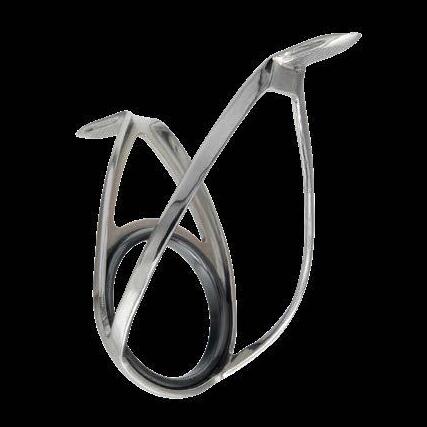
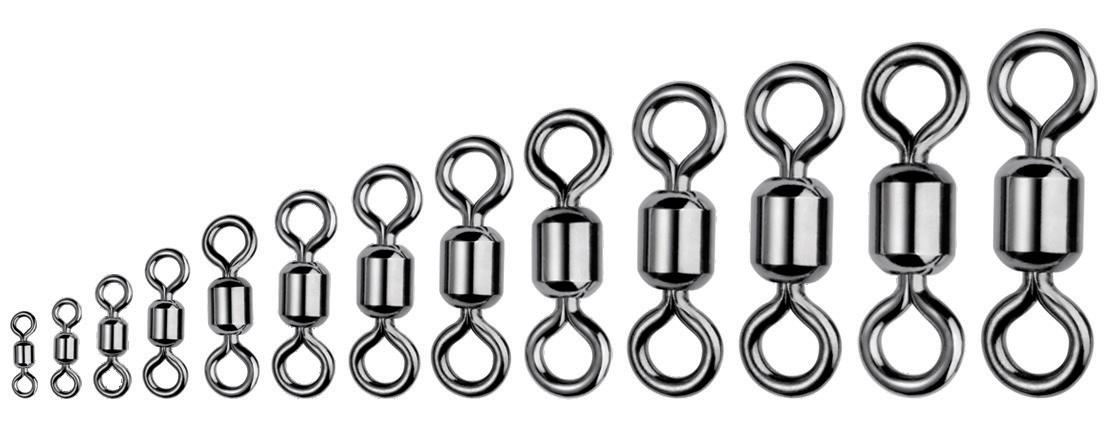
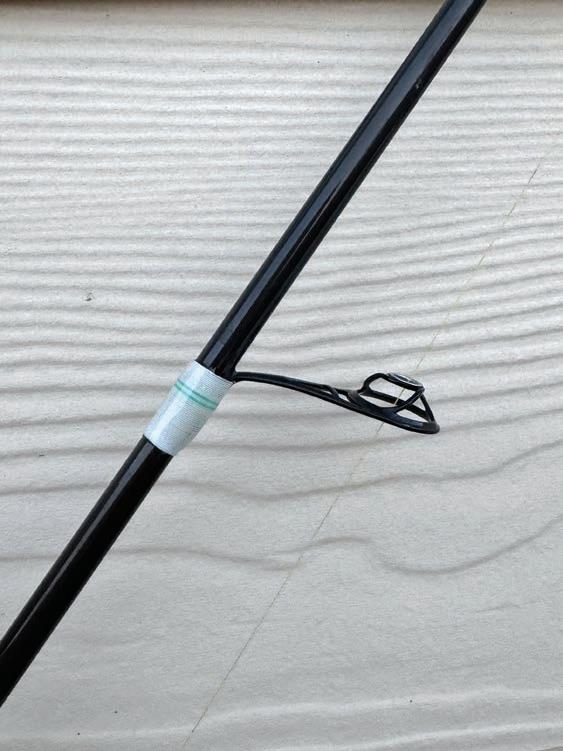
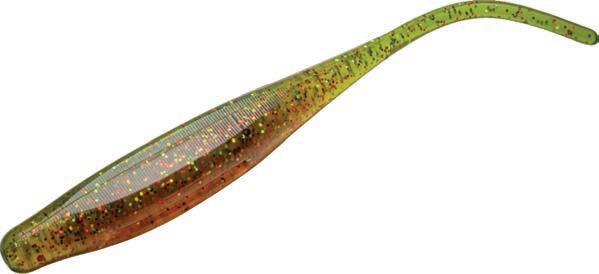
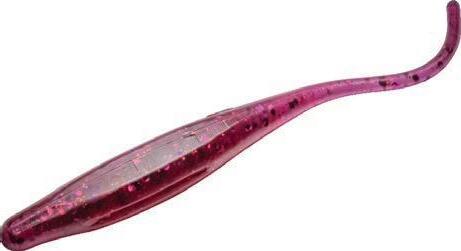
Available in sizes 8, 10, 12, 16, 20 and 25, in Polished SiC, Gunmetal SiN, and BB Alconite.
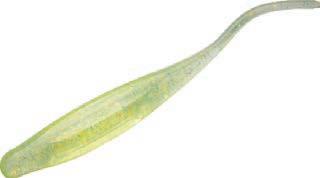
Sheds tangles faster than ANY other guide on the market • Reversable design makes it perfect for casting and spinning applications • Innovative foot shape promotes finish penetration and hold with less material
As light as a KW, as strong as an HB, more affordable than an HN
TANGLE FREE DESIGN
Pre-shaped and polished feet!
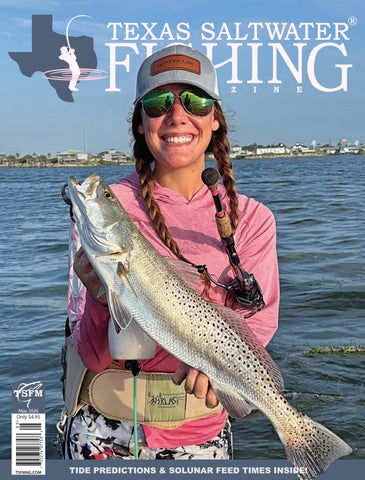
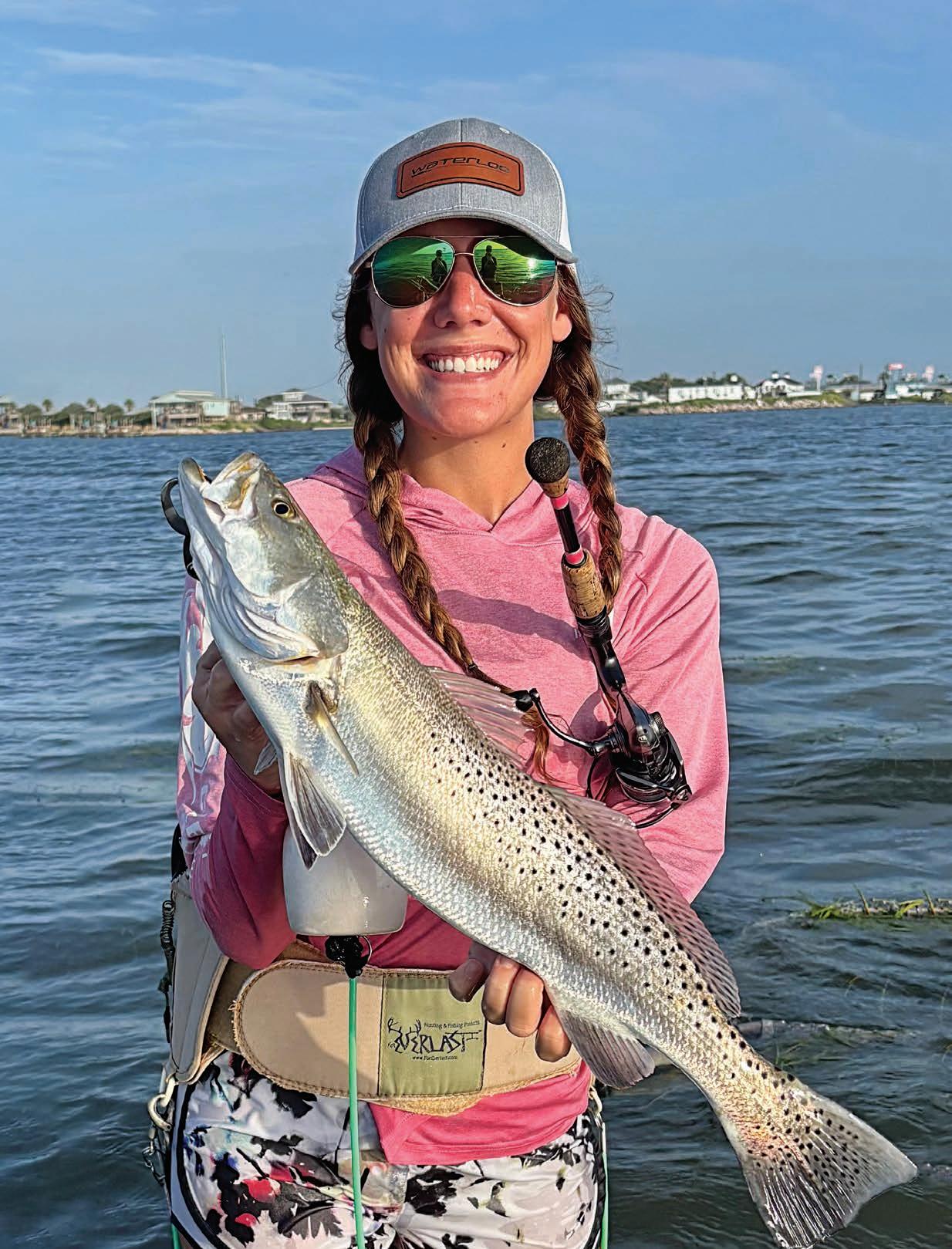
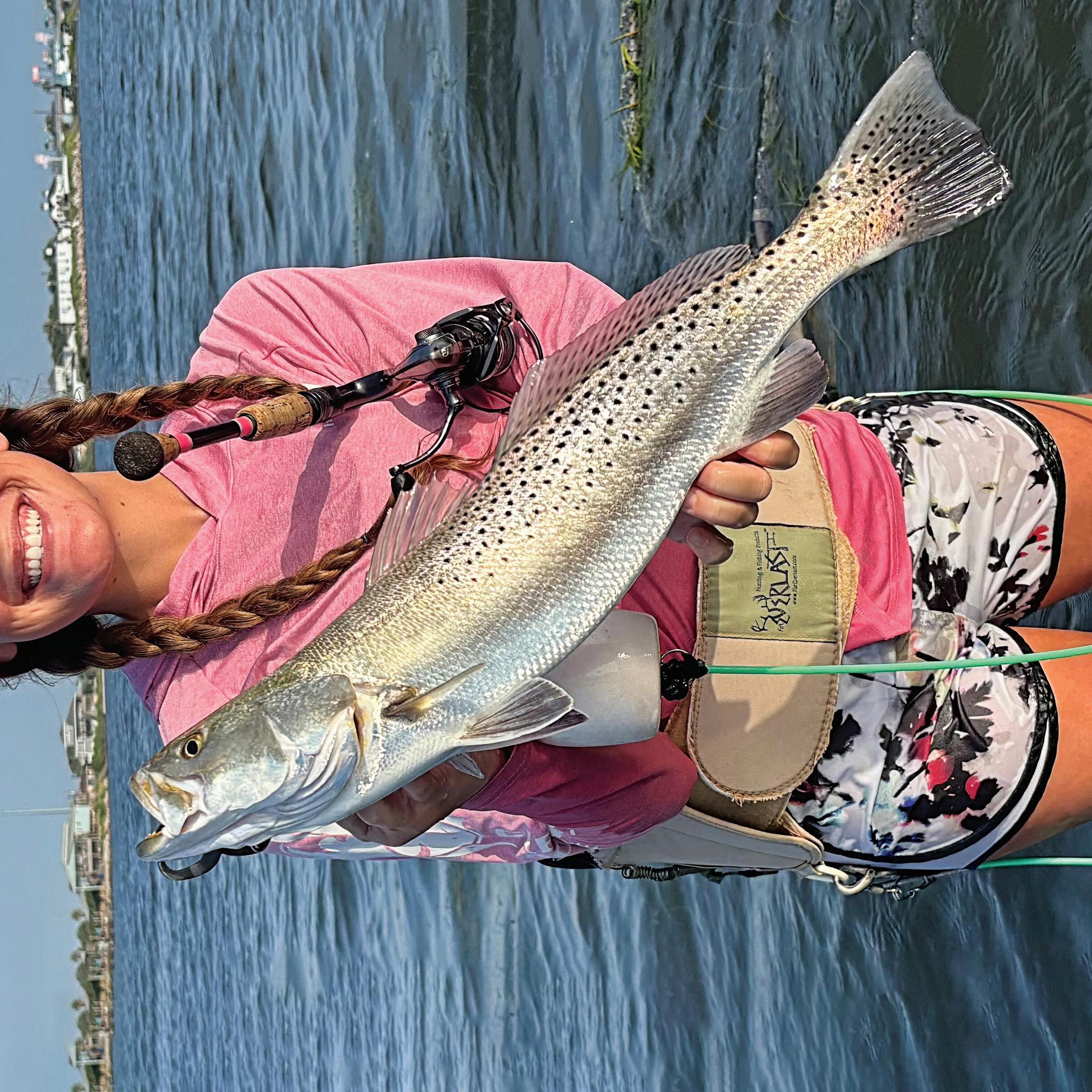
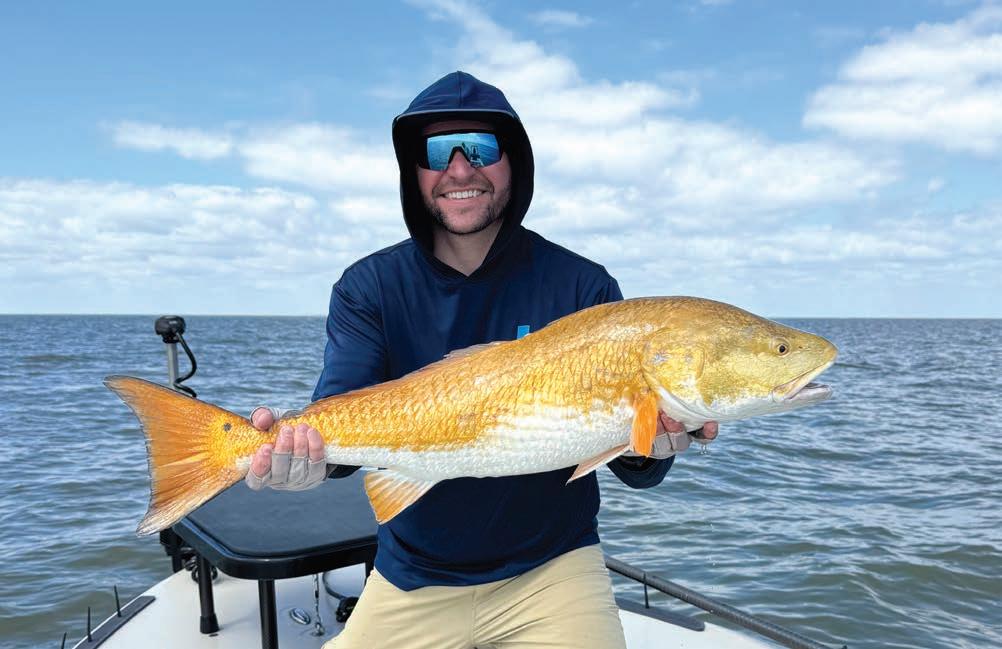
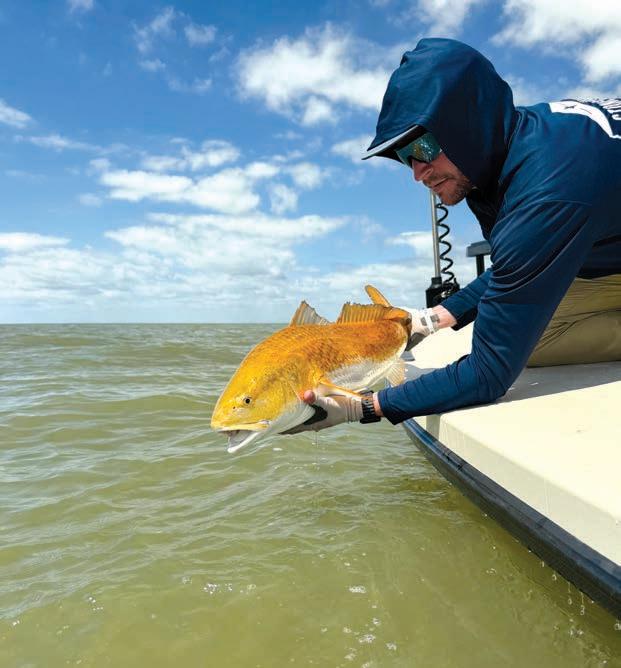
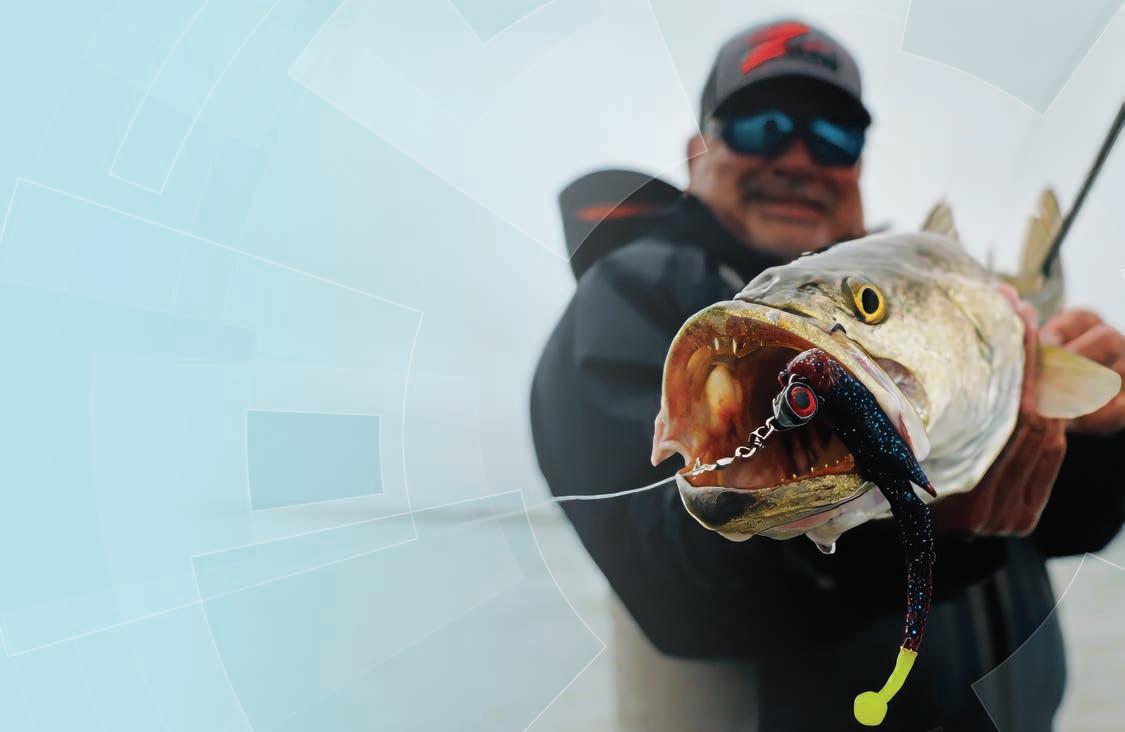
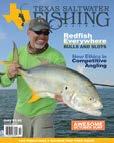
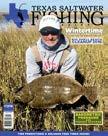
ABOUT THE COVER
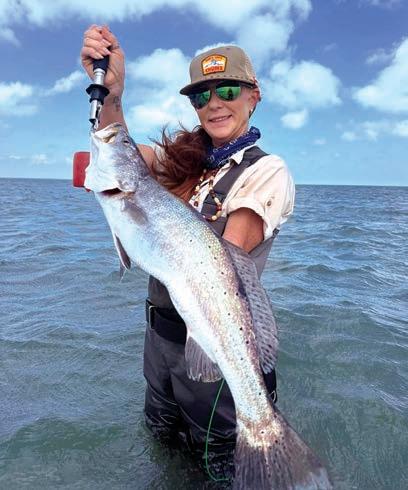
Megan
EDITOR AND PUBLISHER
Everett Johnson | Everett@tsfmag.com Office 361-785-3420 Cell 361-550-3637
VICE PRESIDENT
PRODUCTION & ADVERTISING DIRECTOR
Pam Johnson | Pam@tsfmag.com Office: 361-785-3420 Cell: 361-550-9918
PRODUCTION / SOCIAL MEDIA DIRECTOR
Jennifer Shive | Jen@tsfmag.com
ADVERTISER REPRESENTATIVES
Bart Manganiello | bartalm@optonline.net
Pam Johnson | pam@tsfmag.com Office 361-785-3420 Cell 361-550-9918
Everett Johnson | everett@tsfmag.com Office 361-785-3420 Cell 361-550-3637
Texas Saltwater Fishing Magazine is published monthly.
Subscription Rates: One Year (Free Emag with Hard Copy)
Subscription $32.00
E-MAG (electronic version) is available for $15.00 per year. Order on-line: WWW.TSFMAG.COM
MAKE CHECKS PAYABLE TO: Texas Saltwater Fishing Magazine Attn: Subscriptions P.O. Box 429, Seadrift, Texas 77983
* Subscribers are responsible for submitting all address changes and renewals by the 10th of the prior month’s issue. Email store@tsfmag.com for all address changes or please call 361-785-3420 from 8am - 4:30pm. The U.S. Postal Service does not guarantee magazines will be forwarded.
Don’t look now but one of the prettiest and best fishing months of the year is sneaking up on you. I’m talking about May, of course. People who live on the coast will be quick to tell you how pretty the weather can be. But don’t be surprised if they keep that part about great fishing to themselves. Even the most generous of sorts can become tight-lipped and downright stingy about sharing the when, where, and how details they’ll be enjoying the next several weeks.
One of my favorites this month is wading Middle Coast shell reefs for plump speckled trout. Never mind those grunting little pencils, male trout are hardly what May on the reefs is about. We gotta have them to fertilize the millions of eggs those females are releasing but when they get too thick I won’t be long in packing up and finding another reef with lots of mullet and shrimp flipping along the crown.
I see lots of people fishing, or perhaps I should say taking casting practice, on the reefs. Especially those who wade. First thing you have to realize is that it’s not a footrace. Slow and easy is the name of the
game, even if you’re in the boat riding the troll motor. Couple more things to watch out for – don’t crunch ‘em off, and for Heaven’s sake stand still when you get a bite. I feel like I need a lasso sometimes, to keep my wading companions from taking a couple steps forward every time they catch a fish, and ignoring my warning about crunching. I cannot tell you how many times we found nice fish and everybody caught two…when we should have caught twelve. Sometimes we’re our own worst enemy.
May is full of fun events for the fishing community. The kids will be getting out of school toward the end of the month and I cannot imagine anything they’d enjoy more than a few days at the coast to get the summer kicked off. A trip to your nearest outdoors store is definitely in order to replace last year’s too small PFDs, and some new wading boots and belts. If you really want them to become serious anglers you need to get them outfitted properly. And, by all means, get them registered for the CCA Texas S.T.A.R. Tournament. Failing to register and missing out on a S.T.A.R. scholarship makes for one really sad tale.
May is gonna be a hoot. Make safety and caution your bywords on the water…and take a kid fishing every chance.
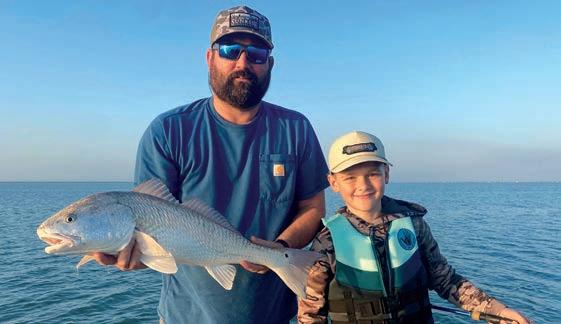
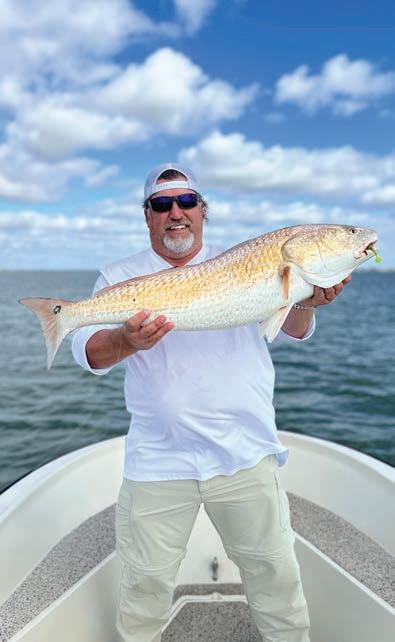
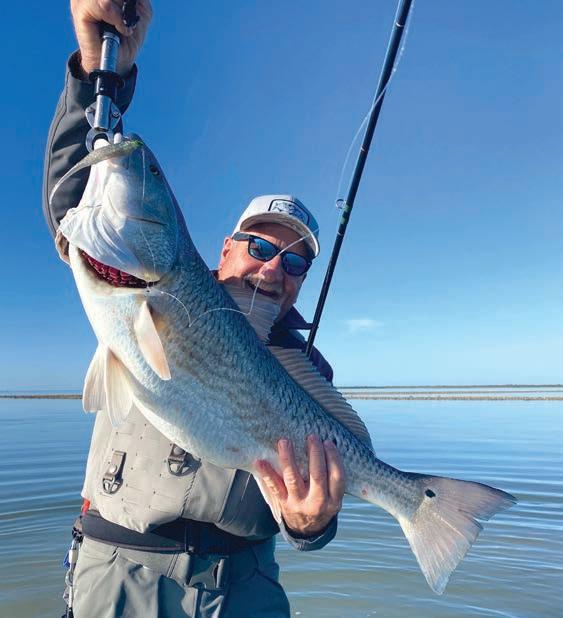
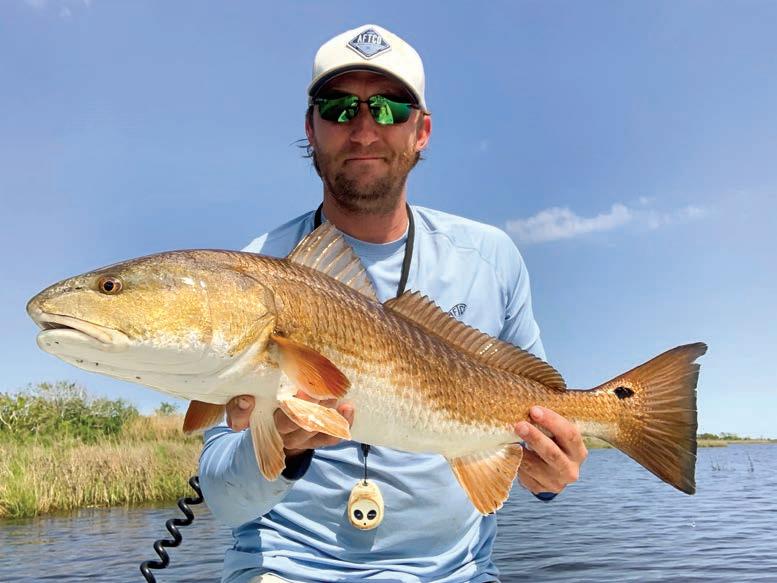
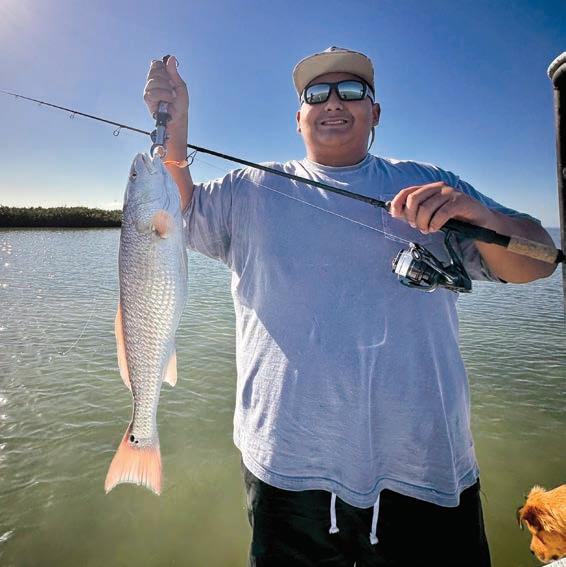
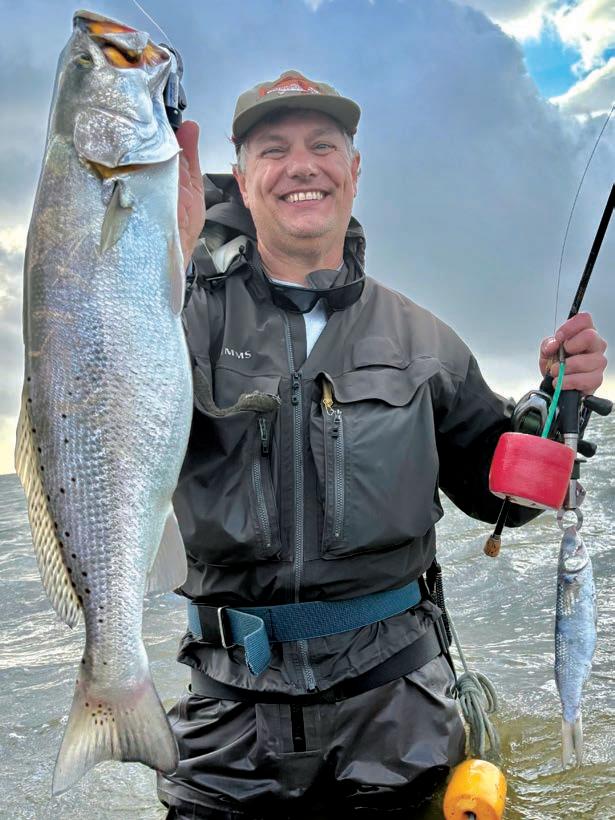
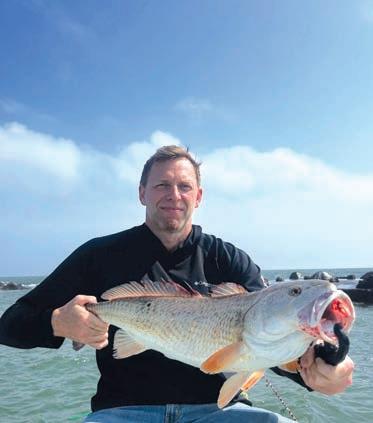
Clay White with a solid red he caught on a Gulp!
Under a rattle cork while casting near a marsh drain.
CATCHING THEM The Way They Want
. . . NOT THE WAY WE WANT
STORY BY STEVE HILLMAN
We just fished our way through what’s usually the toughest stretch of the year (March and April) here on the Upper Texas Coast. There were some days when the fish just didn’t want to cooperate, but we were able to make adjustments. We tried old tricks and different methods and most of the time were able to get commitments from stubborn fish. While May is one of the most consistent months for catching trout here in Galveston Bay we will still occasionally have those stubborn trout days where we have to catch them the way THEY want to be caught instead of the way WE want to catch them.
My favorite way to catch trout, or any fish for that matter, is on topwater lures. Many of the strikes on surface plugs are massive explosions but some of my largest trout consisted of subtle slurps as my plug simply disappeared from the surface. I’m fine either way, I guess, but the former is certainly preferred. In calm surface conditions I prefer Heddon Super Spook Jr’s, One Knockers, and Rapala’s Baby-size Skitter Walks. MirrOlure Top Dogs and full-sized Skitter Walks are my two favorites in moderate chop conditions while She Dogs and Super Spooks work better for me in seriously choppy water. My top color choices are Pink/Chrome, Blue/Chrome, Chartreuse and solid black. The speckled trout pattern Skitter Walk is deadly in clear to trout green water also.
A close second choice of lures to trick them on for me would fall into the category of twitchbaits. Texas Customs Double D, the Borboleta LeLe, and MirrOlure’s family of twitchbaits which include (but are not limited to) Paul Brown Original Corkys, Soft-Dines, MirrOdines, Catch 2000s and Catch 5s are all at the top of my list. Some of the most violent strikes I’ve ever experienced are when a trout or a redfish crashed into my twitchbait like a freight train, sending a shockwave through my 30-pound braid that is absolutely unmatched. Twitchbaits work year-round but are especially effective when trout are suspended and feeding on recently hatched shad. Such is usually the case throughout the month of May.
We throw soft plastics (I often just refer to them as tails or worms) the majority of the time and I have to say that not only trout but reds, flounder, black drum, sand trout, gafftop and just about every other carnivorous species we can think of will eat a tail. Tails come in a wide variety of shapes, sizes and colors designed to mimic just about any type of prey you can think of, from a shrimp to a mouse and literally everything in between. Their versatility allows us to rig them on different styles and weights of jig heads to perform specific tasks. We can also fan our casts and cover lots of water when chunking them. Because of the attributes I’ve mentioned (and too many others to list) soft plastics are the most effective category of lures for tricking our target species on a year-round basis. I love to throw worms and they are in my top three choices. The strikes can vary from soft and subtle to very aggressive. Tails can be worked in a multitude of ways. My preferred retrieval method is jigging but there are days when just a simple cast and reel (straight retrieve) method works the best. The majority of the time, soft plastics will get the job done but there will be times when they won’t.
When none of my top three choices of baits will work I have to open my mind a little more than I like and start giving in to using methods that aren’t necessarily my favorites – so that I can achieve the best results for my clients. I was faced with this scenario on a recent trip with some new clients. Worms didn’t work and I couldn’t even get those agitation blow-ups on topwaters than I can normally produce. Twitchbaits weren’t doing any better because all of the fish seemed to be lying near bottom – already fat and happy.
I always say that finding the fish is the easy part but making them eat can be a different story. I took my three new guys straight to where we had caught good numbers of nice trout the day before. The water was a little muddy from the high winds we experienced the night before and the tide was a little lower, but small slicks confirmed that we were in the right location. Unfortunately, slicks popping up doesn’t always mean that the trout are actually feeding. I can’t tell you how many times I’ve heard someone say, “Well, they have to eat!” My answer is always the same. “Yes. They do in fact have to eat, but not necessarily while we’re here.” As a matter of fact, there are many times when the trout start slicking that the bite is actually over. These “throw up slicks” are some of the best looking and best smelling slicks you’ll ever see. They can also be the most frustrating.
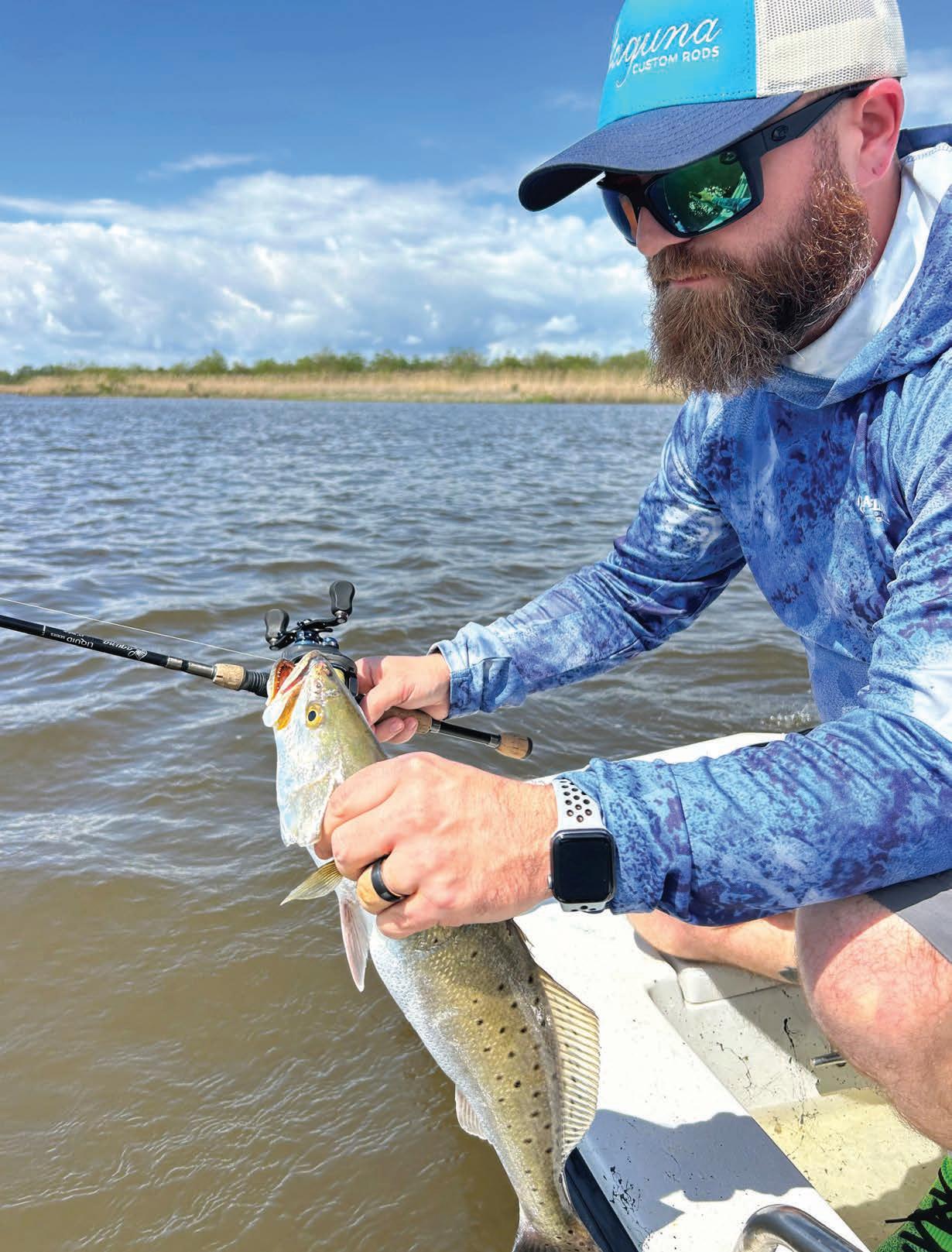
Since I don’t have the luxury of waiting for the fish to feed again I have to do my best to manufacture ways to entice these full-bellied fish during a negative feed, such as the one we were currently dealing with. One of the most reliable methods I’ve used through the years is certainly not my favorite but it works and that is rigging a soft plastic or Berkley Gulp! under a rattle cork. I had recently gone red fishing with a buddy of mine and we’d caught some reds using this method. This style of fishing certainly isn’t anything new. Folks have been using
I was able to get in on the fun too! 4” Slammin’ Chicken Saltwater Assassin Sea Shad rigged on an 1/8 oz. Pro Elite jig head straight-retrieved over shell in shallow water.
Some days big fish want little baits. Corby Stepanski caught this 38 ½” redfish on a 4” Chicken On A Chain Saltwater Assassin Sea Shad.
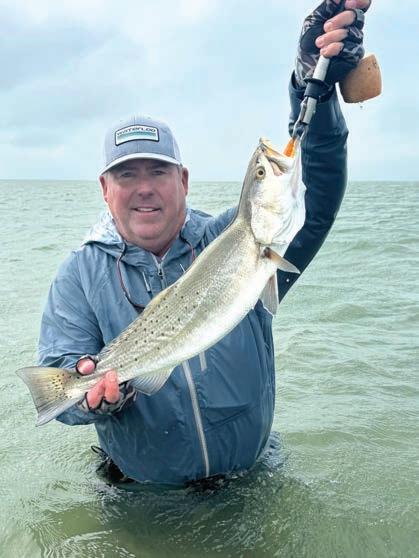
Jake White caught this 23” trout using the cork and jig method while casting along the edge of a small oyster reef.
this technique for years (see Mansfield Mauler) but it’s just never been my favorite way to fish. Regardless of my personal preferences, I had to try something to get these guys bit. I rigged two rods with a 3.5” Watermelon/ Red Glitter Saltwater Assassin Lil P&V’s and one with a 4” Pearl White/Chartreuse Gulp! Paddleshad. I personally continued to throw a regular Bass Assassin on an 1/8th ounce jig head. Over the next two hours or so we caught 12 trout and one 17-inch black drum. I caught 2 of the 12. We obviously didn’t set the world on fire but the cork and jig method clearly worked the best at enticing stubborn fish in the off-colored water.
May is shaping up to be an awesome month here on Galveston Bay, based upon everything I’m seeing now with bay wide salinity levels, bait hatches, and numbers of trout throughout the entire complex. There will be many mornings when we’ll be able to slip over the side, wade towards our favorite little shoreline reef and get our adrenaline flowing with those violent topwater blow-ups. Watching them eat a surface plug is exhilarating then watching these energetic trout shake their heads and go airborne out of the shallow water during the fight is next level stuff. Then there will be days when we’ll have to stay in the fiberglass and drift mid-bay reefs while casting to slicks. Sometimes
drift fishing is the better option, especially here on the Upper Coast as water temperatures rise throughout the summer.
We all have our favorite ways to fish but at the end of the day it’s about catching. Being in touch with the line and lure while actually feeling the bite adds another level of excitement. There’s a sense of accomplishment that comes with being able to finesse a trout, feel the strike, and then knowing when to set the hook. Fighting the fish properly and bringing it to hand at the right time brings everything full circle. The entire process is very gratifying. All of this being said, there will be times when the bite gets tough and it becomes time to pull out the ole rattle cork to get the job done. Sometimes we have to catch ‘em the way THEY want… not the way we want.
STEVE HILLMAN
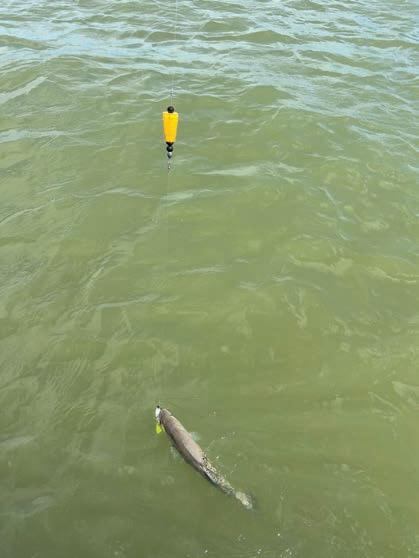
The vigorous popping action of a 4” Gulp! Paddleshad on an 1/8th oz. Assassin jig head rigged under a Four Horseman popping cork was the ticket on what would’ve otherwise been a tough day.
Here’s a good one I caught on a 4” Slammin’ Chicken Saltwater Assassin during a transitional tough stretch.
Ivan Hayes caught a lot of trout doing what he loves (wading with lures) on one of our recent trips.
To See or
Not to See
STORY BY KEVIN COCHRAN
In recent years, the technologies associated with sonar devices have made locating fish from a boat much easier than ever before. These days, anglers can use fish finders to determine the precise locations of fish beneath and beside the boat, and they can judge the size of the fish accurately. Competitors in modern bass tournaments now rely heavily on side-scanning sonar equipment to locate and target fish, at least some of the time.
When an angler can see fish on a digital screen, especially when the device also allows the angler to watch how the fish react to a lure passing close to them, the art of angling changes significantly. The skills associated with catching fish one can see differ from those associated with catching fish one can’t see. Anglers watching fish react to a lure can make adjustments to lure choice and presentation faster and more effectively than those fishing “blind,” without such visual evidence.
Recently, I saw proof of this while watching a televised bass tournament. One of the anglers spotted a big bass on his screen, then made several targeted casts, watching how the fish reacted to his lure. He eventually succeeded in catching the fish by tweaking his presentation slightly, after making at least five casts at it. Without a way to see the fish and how it behaved in the presence of his lure, the man would never have made so many casts into the same spot without earning a strike.
Historically, expert anglers developed skill sets over time, through experimentation, while fishing in situations in which they couldn’t see the fish they targeted. In essence, the word fishing has always implied fishing blind. This explains why the word has been used in other contexts in a specific way. For instance, when one says someone is “fishing for compliments,” one means the person is dangling comments in the ether, hoping to elicit desired responses. Similarly, a person fishing in the conventional sense selects a lure and presents it in the water within reach, perhaps altering the presentations made with the lure over time, until an appropriate response is earned, in the form of a strike. If a strike doesn’t occur within a reasonable amount of time, the angler will likely change lures and repeat the testing process. The setting of the situation, whether the fishing occurs on the open ocean or in a tiny pond, whether from the deck of a boat or from land, will affect how much time the angler will spend experimenting with lures in one spot before moving to another and starting over.
Astute anglers have long used this whole process as a way of developing multiple skill sets, with the intention of improving their abilities not only to make lure choices and execute presentations appropriate for the moment, but also to choose the right specific places in which to target the fish they desire to catch. Because of what I call Absolute Number One, the ability to locate fish exerts profound influence on how many fish an angler catches, including whether they catch any fish at all. No one, no matter how experienced, skilled or lucky, can catch a fish unless at least one fish swims within their reach. Since they normally couldn’t see the fish they targeted, anglers
traditionally used the process of choosing and presenting lures to make judgments related to the abundance of fish in the places where they made efforts, using the strike-rate as the key indicator. Because this was so, anglers couldn’t easily separate their ability to locate fish from their abilities to choose appropriate lures and presentation styles. These skills sets were inseparable and intertwined. Today, this truth rings much less true for some anglers, at least some of the time.
Using electronic devices to locate fish, particularly devices as sophisticated as modern side-scanning fish finders, diminishes the importance of the process of using lure choice and presentation style to locate fish. Consequently, I’d argue the use of these devices reduces the level of excellence of the best anglers, over time. I’ll reference the ages of the anglers often showing up at the tops of the leaderboards in modern bass tournaments to make my case. Many of today’s top pros are barely old enough to buy a bottle of champagne to celebrate their wins; some have little or no whiskers on their chins.
When I was their age, middle-aged men ruled the bass fishing world. Back then, ascending to the top of the fraternity required more than talent and desire; doing so required ample experience. This is less true today than ever before. Guys come right out of high school and start winning big events. Mostly, this happens because they utilize the side-scanning sonar devices more effectively than older competitors.
Some will say this justifies the evolution I’m describing. They’ll accuse me of being the old man yelling at the neighbor’s kids, telling them to get off my lawn. They’ll say it doesn’t really matter how an angler locates the fish he catches, only that he does in fact catch them. And I really have no way of proving them objectively wrong, but this doesn’t change the essence of the situation. The sport has certainly changed, and the anglers winning the events rely on different skill sets than they did decades ago.
A similar evolution has occurred in competitive coastal fishing in Texas. When I started fishing in Troutmasters tournaments nearly thirty years ago, few of the anglers I competed against regularly targeted fish they could see. Significantly, most of us didn’t have really shallow-running boats equipped with fully-rigged towers.
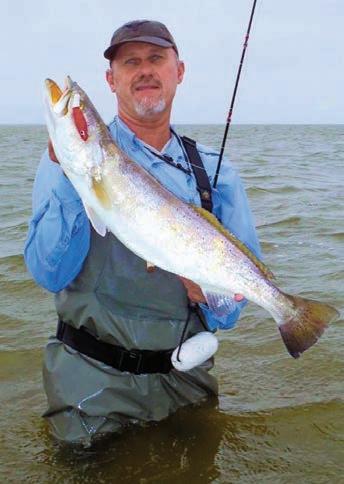
The captain caught this gorgeous ten-pound trout after a friend saw a giant fish in the exact location the day before, while returning to the dock after a morning of fishing.
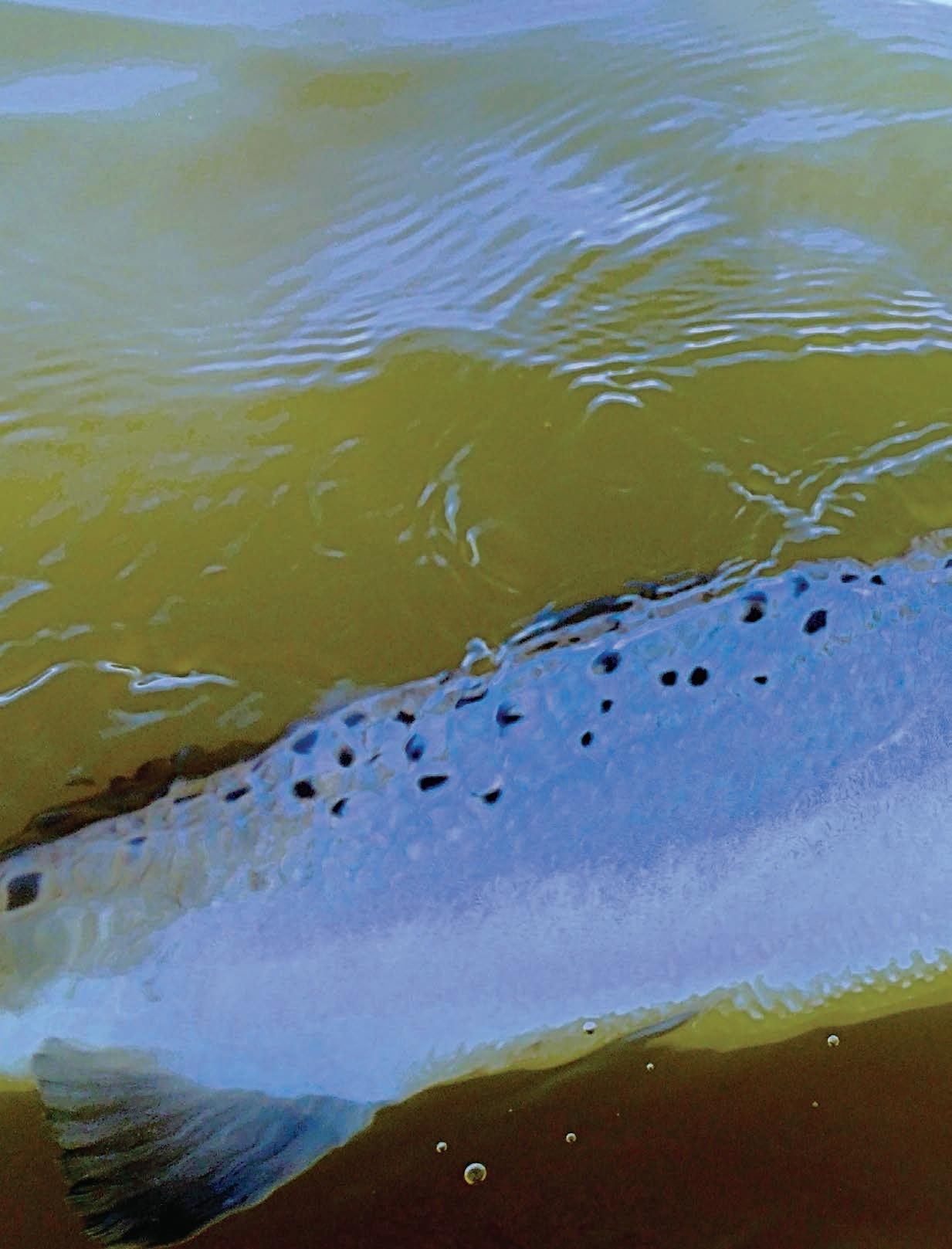
In clear water, more pigment moves to the surface of the skin of a fish. Jason King caught this colorful, excessively dotted thirty-inch trout in the clear waters of the Upper Laguna Madre.
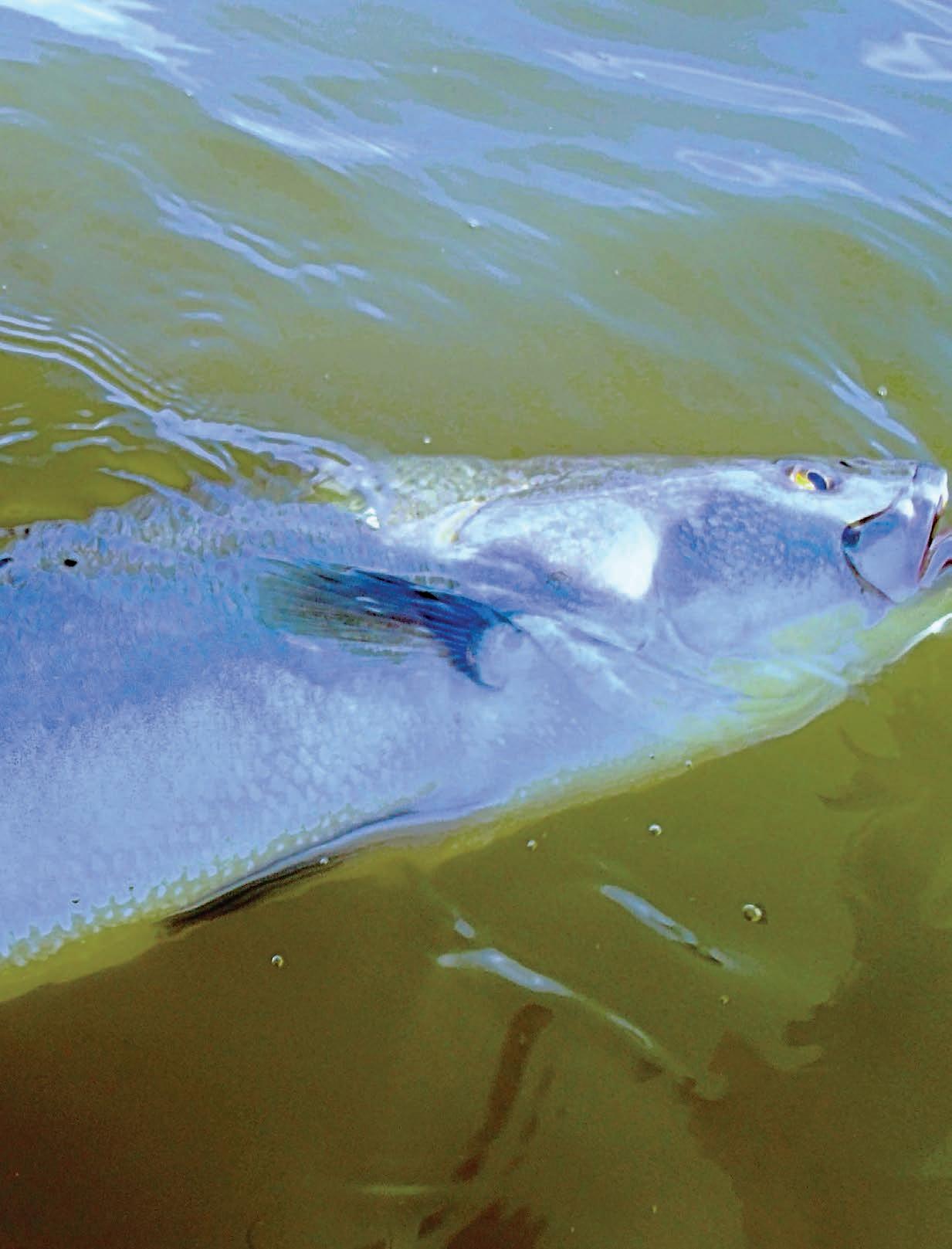
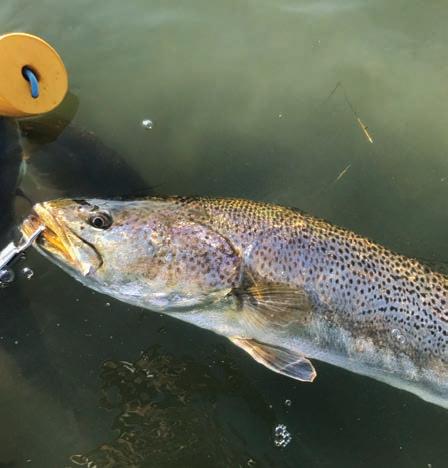
In murky water, when anglers must fish blind, lure choice and presentation style become supremely important. Captain Kev bent the tail sharply down on an Original Paul Brown Lure and presented it with sharp jerks of the rodtip to entice this monster trout to bite.
Most of the time, we fished blind.
Predictably, most of the best trout anglers in the state in those days had logged many trips on the water. Most were at least middle-aged; few had yet to reach the age of thirty, and none had just come off a college campus, much less a highschool one. But today, as in the bass fishing world, increasing numbers of young people prove themselves capable of competing at a high level in trout tournaments.
I don’t participate in these events any more, but I have plenty of friends who do. They describe how the habits of many modern competitive trout anglers exploit technological advances in boat and motor designs. They tell me, “All the top guys have burn boats, or a partner who has one. They spend a day or more prior to an event running around looking for fish to target once the gun goes off. Then they use a go-fast boat to try and win a race to the spot.”
Burning shallow flats to locate fish affects anglers in some of the same ways as does using side-scanning sonar devices to locate them in deeper water. Standing on the tower of a boat and casting at visible fish closely resembles using sophisticated sonar devices, because both situations eliminate all doubt about whether fish are present before an effort is made to catch them. Additionally, both situations allow anglers to quickly judge the efficacy of lure choices and presentations based on the way the fish react to their lures, in real time.
don’t want limits placed on where they can fish. Some of those competitors no doubt make long runs from the launching point, so they can attempt to catch fish they recently located while burning.
In other ways, burning fish on days prior to an event differs significantly from finding them on a screen during the hours of an event. Burning a school of trout one day, then returning to the place a day or two later, during tournament hours, requires anglers to base their predictions about the abundance of fish in the place on their ability to earn strikes in a timely manner, unless they attempt to spot the fish again before trying to catch them. In some cases, the anglers will choose to wade into the place where they spotted the fish previously, then try to catch them without seeing them.
In all cases, seeing the fish some time before trying to catch them does reduce the importance of skills related to using lure choice and presentation to locate fish. Over time, anglers who rely too heavily on seeing fish before they attempt to catch them will become less skilled in their ability to make productive predictions about lure choice, presentation style and location. Tournament organizers will have to decide whether they care about this or not.
Apparently, the top brass running bass tournaments don’t care. Though most of them do place limits on the use of sophisticated sonar devices during some of their events, they don’t declare them completely illegal. A similar situation prevails in modern trout tournaments. I’m not aware of any coastal fishing organization which prohibits competitors from deliberately burning fish in the days leading up to tournaments, nor indeed during the hours of their events. In fact, most coastal tournament organizers don’t even use boundaries to define venues for their events, likely because many of the competitors
How Clarity Affects Decisions
Whether to allow competitive anglers to use burn boats or sonar devices to see the fish they hope to catch before they begin fishing for them is indeed the question. Leaving the answer up to the competitors elevates the risk of compromising the integrity of these pursuits, making them less interesting in the end. People running all these organizations definitely take the preferences of the participants in their sports seriously, unwilling to outlaw emerging technologies, strategies and behaviors which diminish the value of some historically important skill sets.
Let me be clear. I’m not saying I’d never try and catch a fish I see while running around in a boat looking into the water, nor that recreational anglers shouldn’t use highly effective fish finders. But I don’t believe it’s wise to allow competitive inshore anglers to burn coastal flats purposefully to locate fish, nor to allow professional bass anglers to use supremely effective fish finders. These behaviors change both the nature of the competitions and of the competitors, elevating the importance of artificial devices and diminishing the relevance of time-honored skill sets, favoring tech-savvy young gamers over experienced old salts.
KEVIN COCHRAN
Kevin Cochran is a long-time fishing guide at Corpus Christi (Padre Island), TX. Kevin is a speckled trout fanatic and has created several books and dvds on the subject. Kevin’s home waters stretch from Corpus Christi Bay to the Land Cut.
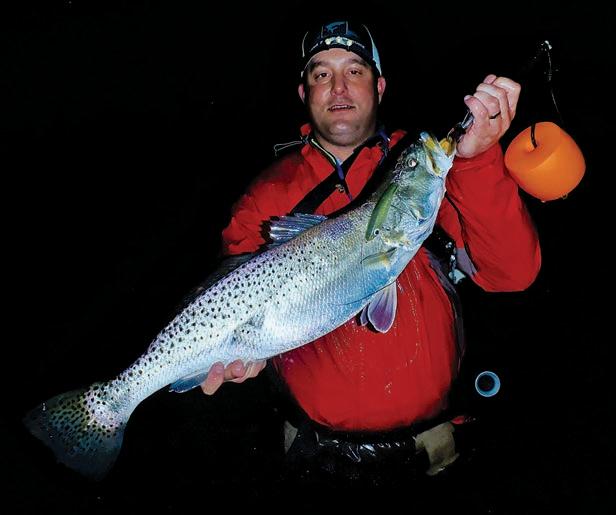
Big trout like the one held by Clint Shack in this photo often bite best during dark hours when the water runs stupid clear.
Jared Darby with one of many solid trout taken on a swimbait along a rocky shoreline.
IN THE ZONE
STORY BY CHUCK UZZLE
What do you think of when you hear phrases or sayings such as sweet spot, right down the middle, center cut, right down Broadway, or in the zone?
Most folks would agree that this means whatever you are doing you are doing it exactly right and doing it in the perfect spot. Whatever the activity may be it’s always preferable to be in the most advantageous spot, the one where your odds are better and the chances for success increase. Fishing is no different. In fact, it’s one of the best examples of needing to be in the right spot to be successful, and there are plenty of variables in this equation.
Generally the first thing that comes to mind when you think about being in the right spot is where you are going, or to be more precise, where you will be fishing from. Yes, boat location is an important aspect but its not the most important one. Visualize for a moment that you are looking down from overhead at the face of a clock, numbers 1 through 12 all around in a circle. Now in the center of all these numbers is a point where the hands are connected to the face of the clock. In this scenario if a fish was positioned at the center from which the hands rotate you could be in a boat and cast from any of the numbers toward the center and have a chance at catching that fish. So, even though boat placement is important there are other things that are actually more important.
Perhaps the most crucial factor in this “fish catching equation” is depth. More precisely, the depth at which you present the lure or bait. So many people neglect this aspect of angling, and they miss out on some really great opportunities.
Correct presentation and depth control are critical to a fisherman’s success. Classic example of missed opportunities would be something as simple as throwing a soft plastic on a jig head that is too heavy. The too-heavy jig will sink so fast that most fish won’t give it a second look as it spends too little time in the strike zone. A lighter offering will be easier to keep in front of those fish for longer periods, which will undoubtedly produce more strikes as well as more fish. Once an angler realizes at what depth the fish are holding that angler can now focus on that depth and adjust their offering to match that depth.
This scenario also works in reverse, from the top down, so to speak. I have seen many anglers stubbornly refuse to change lures, especially topwater plugs in the summer when fish are short-striking and not completely committing to eating that plug. Rather than swap to a sub-surface offering that will put the lure in the strike zone, too many fishermen just continue to hope that one of those fish will eventually rise all the way up to the surface and close the deal. This type of thinking rarely pays the kind of dividends that switching over to a different offering made for that situation does.
Over the last several years I have become much more aware of the depth of water I fish and how I fish it as a result of some exploration. I have switched up my approach to different types of structure and begun to match lures better with those depths. Crankbaits, jerkbaits, square bills, and other depth-specific offerings have become new and valuable weapons for my clients and myself. It just makes sense to keep your bait in the zone as long as possible and the results that come from that approach are nothing short of extraordinary.
At this point, once you embrace the thought of putting the right lure in the right depth you can begin working on the other variables.
I am constantly amazed at how so many fishermen attack an area on the water from such horrible directions. I see so many anglers basically take the “lazy” way out instead of using the correct approach. For example let’s think about tidal flow and how to attack it. I see so many people never even consider what that water is doing and how it affects everything from predator to prey. Instead of facing into the current and fishing a lure with a natural approach most anglers just blindly cast in every direction hoping for the best. If most fishermen could ever see under water to witness how fish position themselves in relation to current or flow they’d change their tactics immediately. Fish naturally face into current so presenting your bait with the current instead of against it is a simple way to catch more fish. Yes, I know, sometimes its not comfortable to do this but if you want to be successful this presentation is certainly the way to go.
This can also be said for fishing in windy conditions, sometimes it’s a pain to have to cast against the wind but there are times you have to do it for a more natural and lifelike presentation.
Earlier I mentioned “boat positioning” as one of the things many anglers think about when referring to being in the zone. Having your boat in the proper location is also critical when you decide to fish a certain area in order to achieve the aforementioned lifelike presentation. There is one common example that comes to mind of how to attack an area that so often gets little to zero consideration and that’s the direction of your retrieve in relation to the structure you are fishing. I see tons of anglers fishing a shoreline or some structure such as jetty rocks or grass lines using only a perpendicular approach. This means the angler casts to a target and reels their offering away from the target. Think about casting from deep water towards a shoreline and retrieving the lure back towards the deep water. Number one
this isn’t a natural look, baitfish seldom swim in this manner. Instead the angler should be casting parallel to the structure so their bait swims along the edge.
This approach does two things, it keeps the bait in the correct depth of water longer and it also allows the bait to travel along the structure in a more natural manner. Think about watching mullet travel down a shoreline, they run parallel to it and that’s exactly how anglers should fish it when they get the opportunity.
As we look ahead the coming weeks have potential to be very special. Like most other venues along the Texas coast, Sabine Lake dodged winter weather and is in fabulous shape. There have been some really respectable trout caught already this spring and it appears that trend may continue.
Our neighbor to the east, Lake Calcasieu, is also in really good shape and is also kicking out quality fish. Look for the bite at the jetty to crank up this month and the beachfront won’t be far behind. There will still be a solid flounder bite happening and the redfish will still be doing their thing along the shorelines with the high water levels left over from spring’s tides.
Overall things are about as good as we could ever hope for coming out of the winter months, so its critical that we continue to be good stewards of the resource. For those of us who have been waiting for Sabine to start showing signs of what she once was we may just get a glimpse of good things to come. Enjoy the fabulous conditions and take a kid fishing every time you get a chance.
CHUCK UZZLE
Phone 409-697-6111
Email wakesndrakes@yahoo.com
Website wakesndrakes.com
Chuck fishes Sabine and Calcasieu Lakes from his home in Orange, TX. His specialties are light tackle and fly fishing for trout, reds, and flounder.
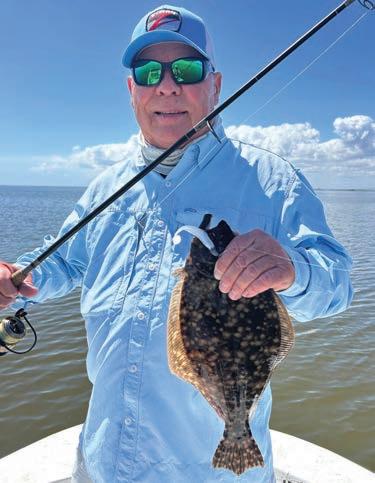
Larry Fagg tricked this solid flounder while probing a shallow shoreline.
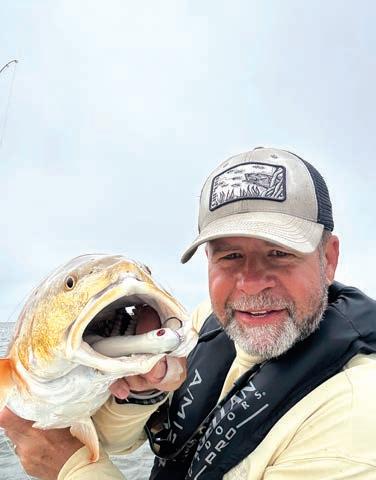
When the lure placement is right it’s tough to keep it away from a determined redfish.
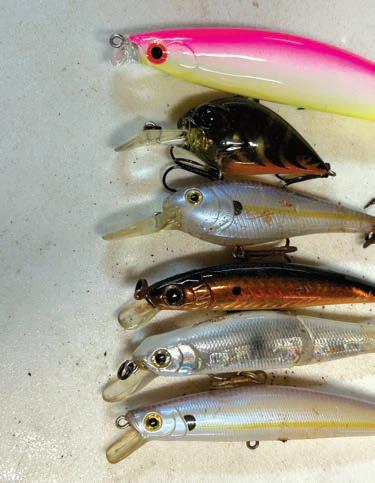
Various shapes and sizes of bills on swimbaits and jerkbaits will allow you to fish at specific depths.
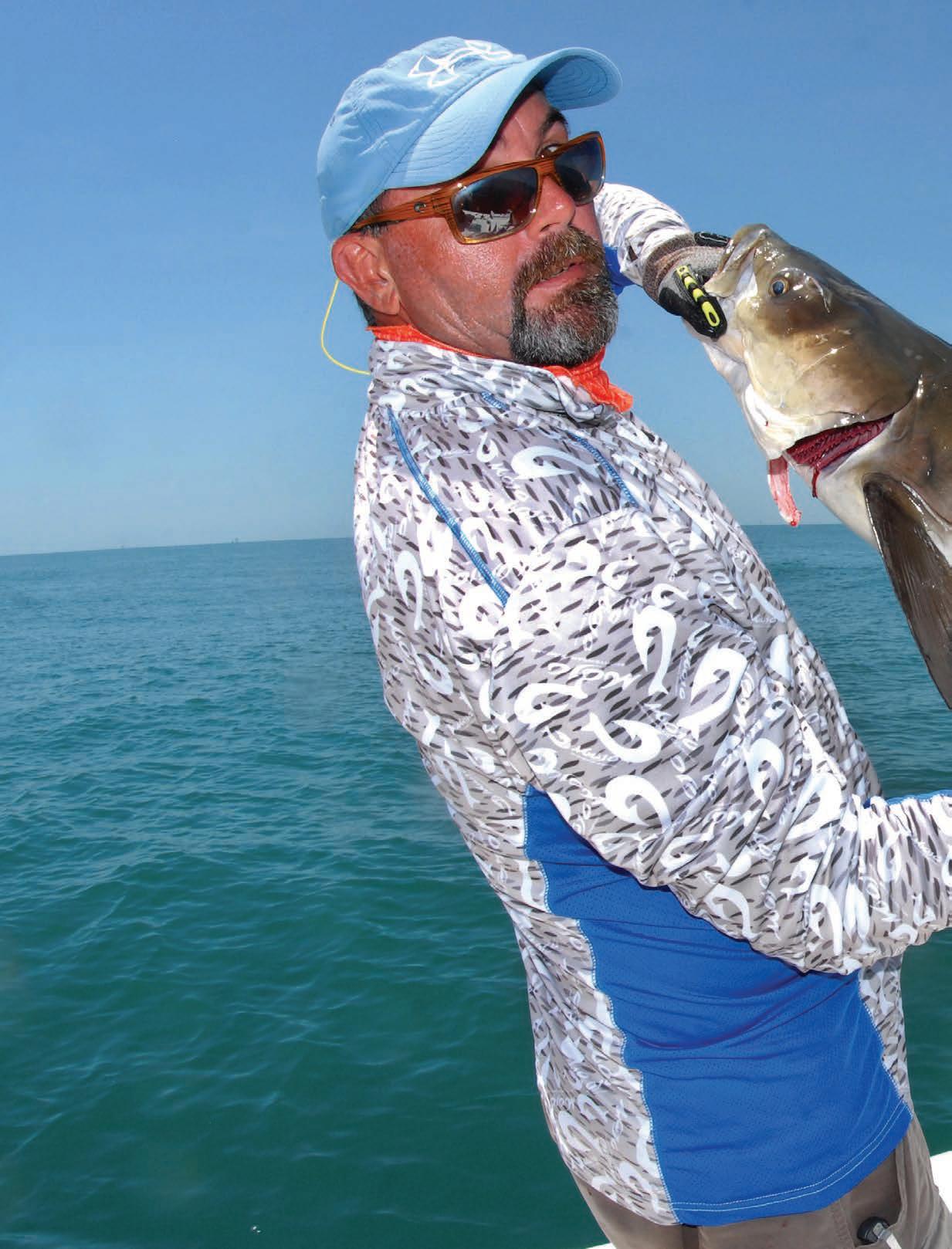
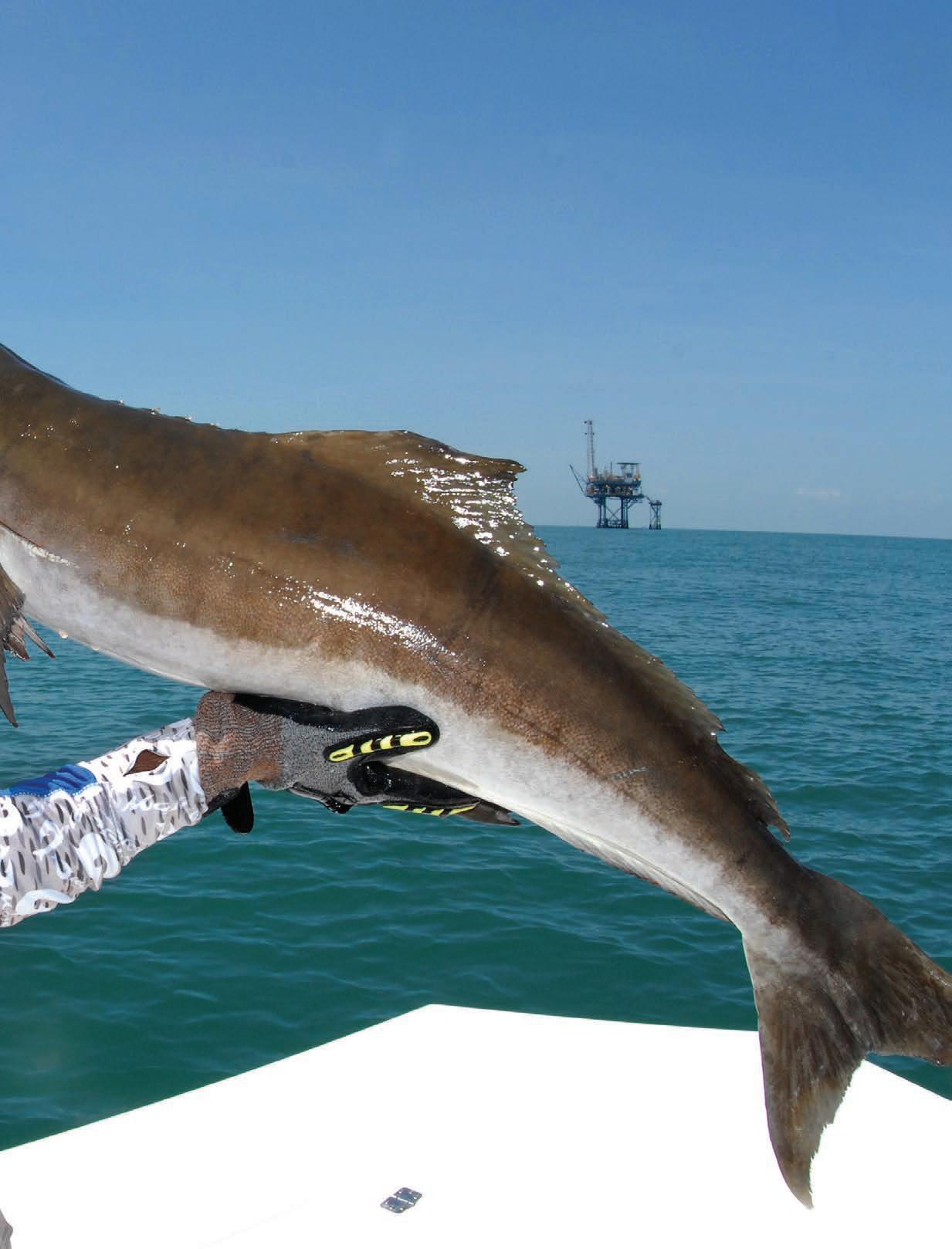
Beginning this May, offshore anglers are asked to keep an eye out for newly tagged cobia (ling) and also tripletail, part of a new Gulfwide study. The goal is to more accurately assess the movements of these offshore fish, whose numbers are clearly down in some areas, in some cases drastically so, especially cobia. As a result Florida’s Gulf Coast, decades-old, high-stakes cobia tournaments have been cancelled for several years now, for lack of fish.
WATCH FOR Tagged Ling & Tripletail
STORY BY JOE RICHARD
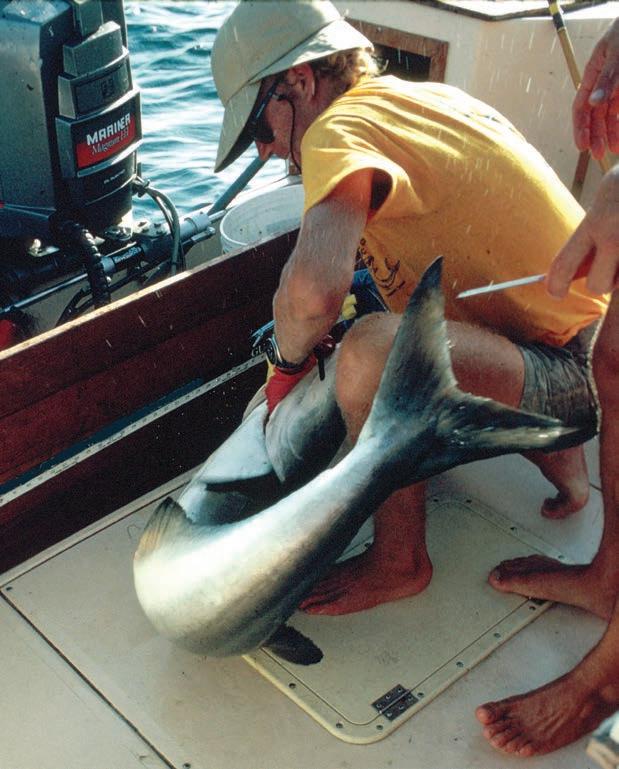
Capt. Curtiss Cash in Port O’Connor, about to release another ling (cobia).
Were they almost wiped out locally, or moved away? Biologists are trying to determine if cobia are more localized than earlier believed. While some migrate south every winter to southern latitudes, others may be waiting offshore for spring and summer to return; they are definitely not a cold water fish.
This new Gulf-wide project is led by the University of South Alabama’s Dr. Shawn Powers and will involve 100 fish tagged in each Gulf state. The project is funded by the Gulf States Marine Fisheries Commission. In Texas, Matt Streich is director for the Center for Sportfish Science and Conservation, part of the Harte Research Institute in Corpus Christi. They will be responsible for tagging cobia and tripletail from Port O’Connor south to at least Port Mansfield. Dr. Dave Wells and Dr. Jay Rooker at Texas A&M at Galveston will be responsible for tagging on the upper half of the Texas coast.
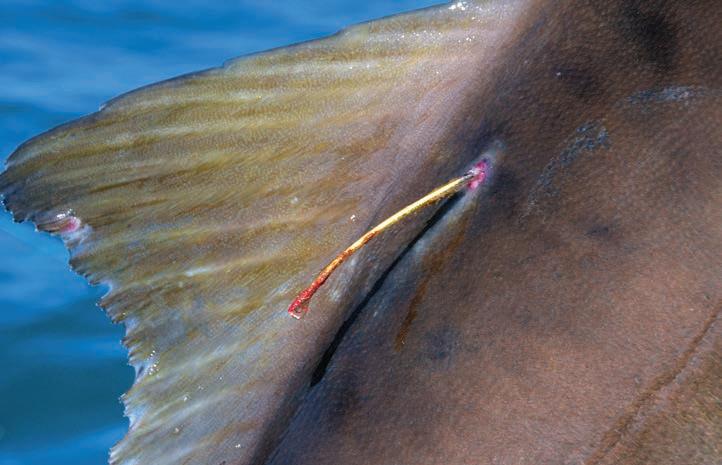
Each of the state teams involved will be carrying the easily-visible shoulder dart “spaghetti” tags, and anglers reporting the tag’s number and size of fish will earn a nice reward. Some of these fish may also carry an internal, cylinder-shaped sonic tag surgically placed inside the body cavity (not the gut), found only if the fish is cleaned and examined. Cobia carry the bigger, 3-inch models, while tripletail will carry the smaller, 2-inch variety. These acoustic tags cost a few hundred dollars each and last for up to three years, and will hopefully be mailed back to the appropriate address, where it can be installed in a new fish.
In addition, scientists are going to plant about 50 external satellite tags across the Gulf in these fish. Easily tracked by downloading the data from a satellite onto a laptop computer.
At this writing, Streich said the color of the tags had not been decided, though they’ve used yellow before. The tags will be a bright color and fairly easy to notice. While tagging the fish, they will also collect available fin clips, which have proven useful for genetic studies and hopefully provide more information on Gulf and Atlantic fish, which are thought to be slightly different genetically. “Cobia are found all over the world and remain the same species, but genetically they’re different enough not to breed together,” says Dr. Streich.
New technology makes it easier to determine DNA and it will be welcome information, providing more insights on these mysterious fish which at times, seem to come out of nowhere when fishing. In my 2002 book The Cobia Bible, a map illustration shows populations found in warm waters stretching from Japan to North Australia, and also across the Indian Ocean before wrapping
Closeup of recovered spaghetti tag off Port O’Connor. The tag was from Mississippi.
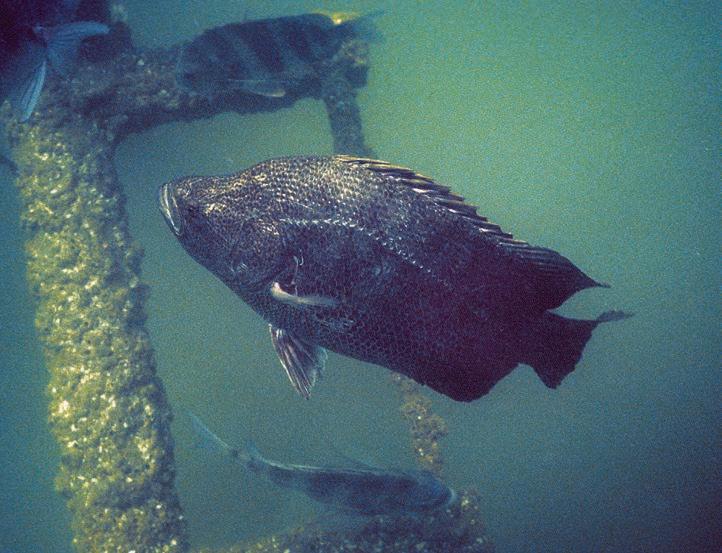
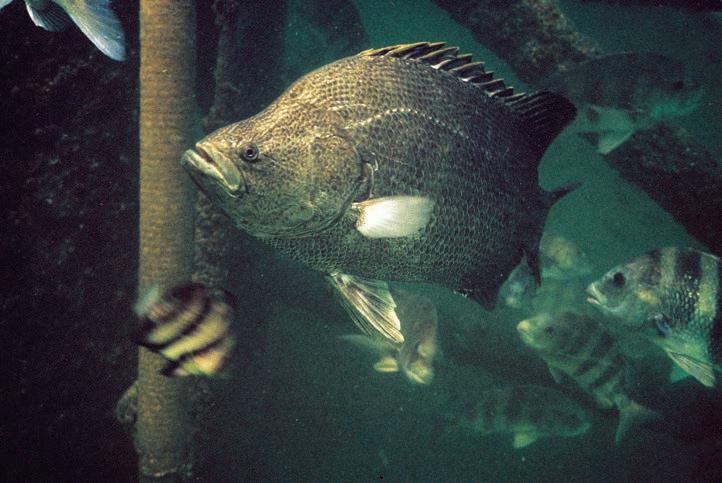
Tripletail inside a near-shore platform off Sabine Pass.
Tripletail favor structure and they’re hard to stop, once hooked.
around Africa (except for the chilly Med). That covers what must be a million or more square miles. Cobia also prowl from New York to Brazil, including our own Gulf.
We’ve been tagging cobia since 2020, mainly studying connectivity with [migrations into] Mexican waters,” says Streich. “Most of the fish we tagged were not going way down into Mexico. They were kind of stopping near the border. I think many of the fish we’ve recovered are somewhat localized, not going through a full migration to other regions. We don’t know what proportion of these fish carry those behaviors. We’re hoping this new tagging effort will help figure out those questions.”
“Our recent years of tagging have also seen a study on catch-andrelease mortality. So far the numbers are very low, which is what we expected. They seem very hardy. There were no mortality estimates in the past, so we’re doing that now. There are still lots of questions about fish movement however,” says Streich.
“Our sonic tags have a high retention rate; they’re placed inside the fish, with the incision sewn up. We have receivers that listen for these fish swimming in the area. The receivers are placed on offshore gas and oil platforms and PVC pipes in the estuaries and have to be retrieved every 4-6 months and their data downloaded. Each sonic tag has its own unique ID. In offshore waters, a receiver can detect fish 200-600 meters away. Inshore, it’s 200-400 meters. Gulf-wide there are close to 800 receivers. There are other fish-tagging groups in the Gulf such as ITag and if we detect their fish, they’re notified.”
As for tripletail, they seem to be getting more scarce. There was no bag limit on these fish until in recent years, and sometimes they were slaughtered, including one episode in upper Matagorda Bay where they covered the deck of one boat in hot weather. As often happens, a bag limit on these fish arrived late and is now three fish per angler. The big ones have become more scarce, and some days the only tripletail spotted are all undersized, the classic sign of overfishing. Back in the 1970s they were plentiful enough each summer, and the many we saw off Port Arthur averaged about 12 pounds, with my top fish weighing 22 and 24 pounds. The long-standing Texas state record was caught in 1984 in Matagorda Bay, and it weighed 33.5 pounds, a powerful fish. Yet, there are still big tripletail out there. The new record, weighing 33.8 pounds, was caught a year ago last April, “in Texas coastal waters.” Odds are 5-1 the new record came from Matagorda Bay once again.
Okay folks, now you know the program this summer, it’s time to head offshore when the wind quits blowing and find these fish. As for myself, I haven’t seen a cobia in three years except for an occasional short fish. I’m done harvesting them, having caught more than my fair share. Even began tagging and releasing these fish back in 1987. But if I catch another, I will certainly be watching for tagged individuals that can be recorded and released. And my luck with tripletail apparently ran out. If I turn the boat around to cast at a floating tripletail, my boat’s wave-slap under the bow spooks them into diving out of sight almost immediately. Another time, two dolphins showed up and harassed a surfaced tripletail into diving. What are the odds on that.
If you do catch a cobia or tripletail of legal size this summer be sure to watch for a black sonic tag in the body cavity and keep it and the accompanying, colored dart tag in a safe place. They are easy to lose, which I have done. If I catch another algaecovered tag, I will be sure to scribble the tag number on the nearest piece of paper or (as I have done in the past), with a lead weight on the dash of the boat. As I learned the hard way, a tag is too easy to lose in the laundry. I took a picture of the tag but that was no guarantee either; the tags are thin as spaghetti and difficult to focus the camera lens on, where the number can be later read. That fuzzy yellow tag in the picture, still attached to a cobia, came from Mississippi and was caught off Port O’Connor, but the tag’s number is unreadable.
JOE RICHARD
CONTACT
Joe Richard has fished the Gulf since 1967, starting out of Port Arthur, but his adventures have taken him up and down the entire coast. He was the editor of Tide magazine for eight years, and later Florida Sportsman’s book and assistant magazine editor. He began guiding out of Port O’Connor in 1994. His specialty is big kingfish, and his latest book is The Kingfish Bible, New Revelations. Available at Seafavorites.com
Tagging stick ready for another cobia during a 1987 Galveston tournament.
GETTING THE MOST OUT OF GUT AND BAR STRUCTURE
I am excited about this month’s article because of its specific nature and because this pattern presents itself in just about every bay system on the Texas coast… if not the whole Gulf Coast. At this writing, tides in the Rockport area remain very low and we are unseasonably warm for this time of year. The average air temp for this specific period is around 75°F, but in the past several days our air temps have been running mid- to high-80s. As a result, the water temperatures are now reaching as high as 76°. It is spring and springtime weather patterns can be unpredictable, which makes it even more important that we be flexible with our fishing game plans and mindset.
One of my favorite patterns to fish during springtime is the gut and bar structures that lie parallel along the face of nearly all barrier and spoil Islands. These features have been created over time by predominant wind and wave action. The breaking of a wave creates a washing effect as well as a depositing effect. With every wave, sediments are stirred up from the seafloor and then settle again as the wave crests and breaks, thus creating deeper channels known as guts, and also forming shallower sand bars between them. I have seen some shorelines that possess as many as four or five such features. The majority of these shorelines possess at least three clearly defined gut and bar features within the Texas Middle Coast bay complexes.
One of the first things to remember is that the depths in each gut can vary, which is a good thing. The guts themselves can be the only structure game fish might need to create an ambush point during feeding periods. Just as important are the shallow sandbars that separate each shoreline gut. Game fish prefer to reduce the size of their feeding zones when possible and will certainly ease up on top of shallow bars and feed when opportunity presents.
This is likely true, especially during nighttime feeding, or when present atop the shallow bars any time that low-light conditions prevail. Trout will especially use the deeper guts as hideouts and quiet zones during non-feeding periods. What this means is that the fish will slip off the top of the shallow bars to the deepest portions of the gut and sit out the downtime between feeding periods. This does not imply that fish cannot be caught during these times or at these locations. Truth be known, the fact that the
deeper water can be easily seen and easily fished can tip the odds in our favor during tough periods of the day.
It should also be known by just about everyone at this point, that a food source of some type must be present. During spring, a wide variety of food sources become available, including species that are rarely visible, such as pinfish, shrimp, small crabs, and occasionally young menhaden (shad.) Mullet are usually visible as are needlefish (ballyhoo.) Trout eat needle fish at this time of year on a regular basis.
The ideal gut and sandbar structure for me would first be located windward. Then I want the guts and bars to have varied depths. Submerged grass is essential, and the ideal gut or bar would feature both shallow and deep, distinct grass beds, plus a clear shallow grass edge with breaks, bends, and underwater points. I realize. It’s a big request but these magical areas do exist.
Weather patterns and other activities throughout the year hold many of the keys to the development of such areas. For instance, when tides are low during winter months, if a freeze event occurs there will usually be a significant die-off of bottom grass in shallow water. Maintenance dredging of channels and open
Ben and Ashley Horton doubled up!
bay disposal of the spoils will negatively impact these areas as well. Drought periods, which we are currently dealing with, will also affect the growth of our grass. How about Brown Tide, how does this loss of clarity affect growth of bottom grass?
In the northern portions of the Aransas Bay Complex we have seen the destruction of oyster reefs due to overfishing. Sadly, as these reefs have been depleted, we have also seen extensive shoreline erosion along with the disappearance of large stretches of historic gut and bar formations. In a perfect world we would have none of these issues, but nothing is or ever will be perfect.
All of these effects will always influence what we do and how we do it. Each spring I survey all the areas of shoreline and barrier spoils, looking for the proper ingredients that enable them to hold bait fish and game fish. The main ingredients are bottom grass, shallow feeding areas, moving water and quick access to deeper and darker water. With the proper polarized glasses, one can easily see the changes in water color and the darker colors of the submerged grass. I love my Waterland Co. Mineral glass sunglasses. As the name implies, they are made of glass and are very light. Believe me when I say that I’m hard on eyewear and these haven’t suffered the first scratch in six months of hard use.
Once out of the boat, the fishing process begins, and you have to be aware of the areas where bait fish are most active. Where is that in relation to the guts, sandbar or grass beds? Have you seen any slicking in the area and, if so, where did the slick originate? Where it
Fishing Parallel Shoreline Guts
first pops to the surface is where the fish are. Wind and current can both move the slick and more times than not the fish that created the slick are only under or near it for a short time. This is especially true in shallow water.
Over the next two months we will see increased slicking activity as menhaden migrate into our bay systems. Be sure to make mental notes where fish are caught within the structure as well as where bites are received. A bite is a fish catching opportunity and a location where we know for certain that there is at least one fish present. Once a bite pattern has been established it should play itself out throughout the area that you are in and can also be applied to other areas with similar structure.
Today we had several areas where the guts held small, submerged grass beds and these smaller areas of structure were holding the larger trout. I was telling my guys to let the lure tickle the edge of the grass as the lure approached the bed. For nearly an hour multiple fish at a time were being hooked and landed. This group had the proper tools to see the structure, cast to it accurately, with rods that were sensitive enough to feel every tick of the lure against the grass, and the subtle take of the fish mouthing the lure. It writes easier than it plays out in real-time but your technique and can be refined with practice. When this happens, your confidence will soar, and you will have become a better angler.
May Your Fishing Always Be Catching! -Guide, Jay Watkins
Jay Watkins has been a full-time fishing guide at Rockport, TX, for more than 45 years. Jay specializes in wading yearround for trout and redfish with artificial lures. Jay covers the Texas coast from San Antonio Bay to Corpus Christi Bay.
Ashley Horton was very pleased with this trout she landed.
Sonny Horton with a super fat red!
DAVE ROBERTS
THE BENEFITS OF APRIL SHOWERS
If there is one good thing about Springtime, it might be that even if the weather doesn’t always please us, it can be somewhat predictable. One thing you can count on is that there will be plenty of wind. The other factor that can be a guaranteed is that we will get some scattered showers throughout the short-lived season. Don’t let these spring rains discourage you though as they can be helpful. We all know the old adage of “April showers brings May flowers.” Well, it will bring flowers to your yard but it will also bring something just as great to your marsh.
As I am looking at the current radar for the next week, it is showing scattered showers popping up nearly every day. Of course this keeps me off the water but it gives me time to do a few things that I need to catch up on. One of those is some yearly maintenance on the boat,
like changing the engine oil and some other basic PM stuff. The other is that I need to find some time for would be tying a few flies – my fly boxes have become quite depleted. It is that time of the year and I might as well knock it all out at ounce.
Once this rain is over I am going to want to be prepared for what’s bound to come. The best part of these showers is that the fresh water inflow to our marsh system helps bloom the wigeon grass in the back ponds…and this is exactly what you are wanting to find! By now there should be a bit of fresh grass beginning to show in certain areas of some ponds. It will usually appear first in small patches along the shorelines or in the back of pockets. When the weather gets right and we get a little bit of rain and some good sunlight, the
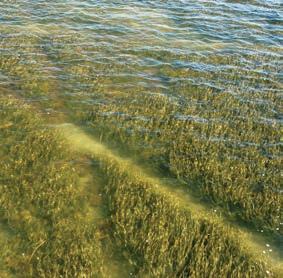
Seagrass is critical to good fishing. Marine organisms depend on it for survival—for food, shelter, and oxygen. But boat propellers are destroying Texas seagrass, which is seriously impacting saltwater fishing in the coastal shallows. When boaters do not lift their propeller in shallow water, the prop cuts and uproots the seagrass beds—leaving long barren trenches or “scars” that may take years to heal ... if ever.
Stop Prop Scarring –Lift, Drift, Pole, Troll
It is ILLEGAL in Texas to uproot seagrass with a propeller. Avoid damaging seagrass –lift your prop!
When in shallow waters, lift your motor and drift, pole, or troll through it. After all, there’s nothing like a redfish on light tackle in shallow water. Let’s keep it that way!
For more information visit: www.tpwd.texas.gov/seagrass
growth will really explode. I have fished a pond midweek that didn’t have much grass in it and thought that I would check back on it in a month. The very next day we got a good rain that was followed with a full day of sunshine and by the weekend, that whole pond had blossomed with good, thick grass. Also, what came along with the grass was quite a few redfish had moved into that pond as well. It didn’t take them long to figure out that is where they needed to be.
There is a lot more to the importance of seagrass than you might think. For starters, it gives the bottom a solid base and can help with erosion from tides and storms. There are several ecological benefits to it but I’ll let a biologist cover that in a proper way. Strictly for the viewpoint of anglers, it’s a must have. Good hearty grass beds give cover and homes to every kind of baitfish that lives in our estuaries: shad, mullet, shrimp, crabs, mud minnows, and the list goes on. Everything thrives in it! Another thing that the grass does is that it helps filter some of the dirt and particles in the water. The result is that it will clean the water and clear it up.
Fishing in the grass can have its own set of difficulties but with the right lures, it can be done very effectively. The first rule of thumb is to stay away from treble hooks. It is just too much of a hassle. If you want to and have the time, you can change the treble hooks out to singles and that will help but it’s not perfect. If you want to throw a topwater then I would recommend throwing a popping Spro frog. Trust me, a redfish will crush it! Another set up is to have a light bellyweighted widegap hook. With this, you can put on a swimbait and rig it weedless and won’t have to worry about hanging up in the grass. With that same hook, you can rig up a Ribbit frog which can also be worked as a topwater by reeling a little quicker or it can be slowed down and swam through virtually any portion of the water column. These are a few of my personal go-to lures when I find marsh redfish staging and feeding in heavy grass.
Spring is almost over and the dog days of summer will be here before you know it. I know that the current weather forecast can be tough for an angler but don’t let it get to you. Just remember, Mother Nature has a plan and with that, she’s going to bring anglers something great.
Dave Roberts is an avid kayak-fishing enthusiast fishing primarily the inshore Upper Coast region with occasional adventures to surf and nearshore Gulf of Mexico.
Email: TexasKayakChronicles@yahoo.com
Website: www.TexasKayakChronicles.com
BUILDING UPON SUCCESS:
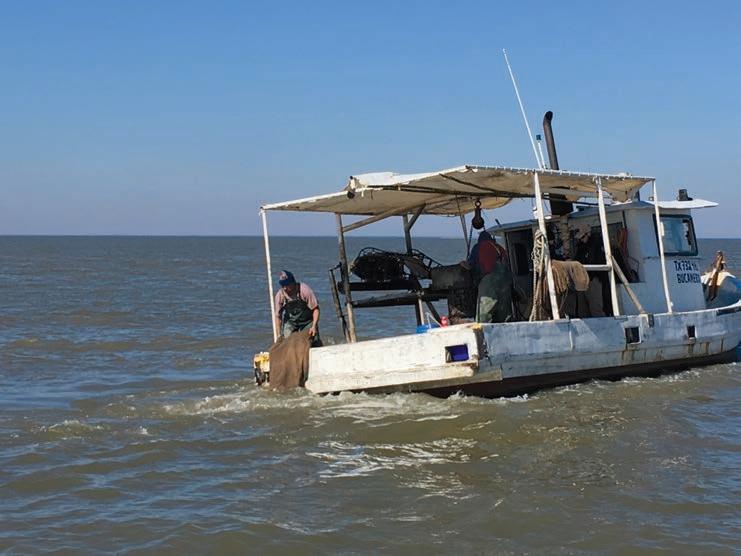
OYSTER LICENSE BUYBACK EFFORTS CONTINUE IN 2026
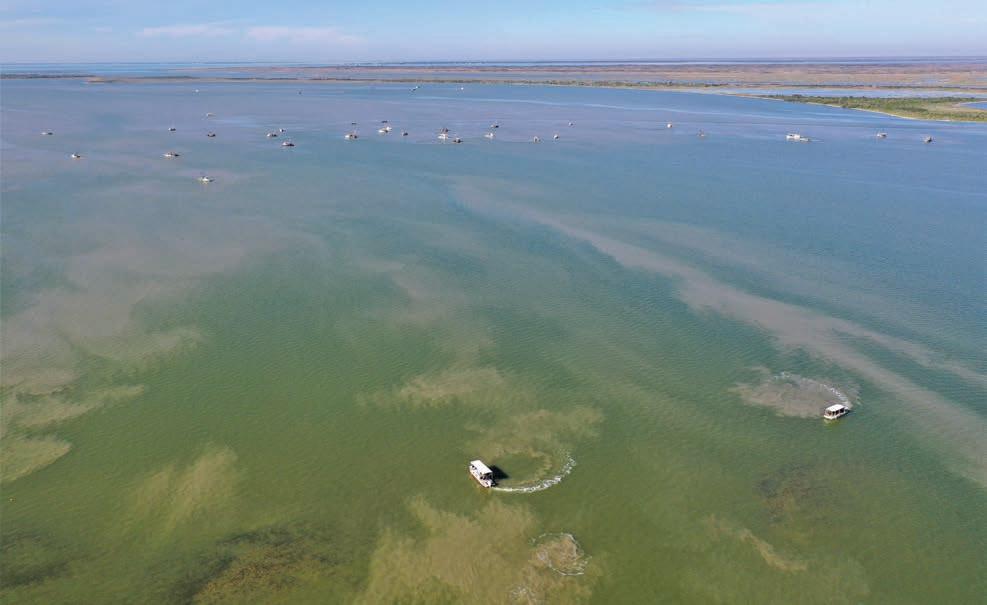
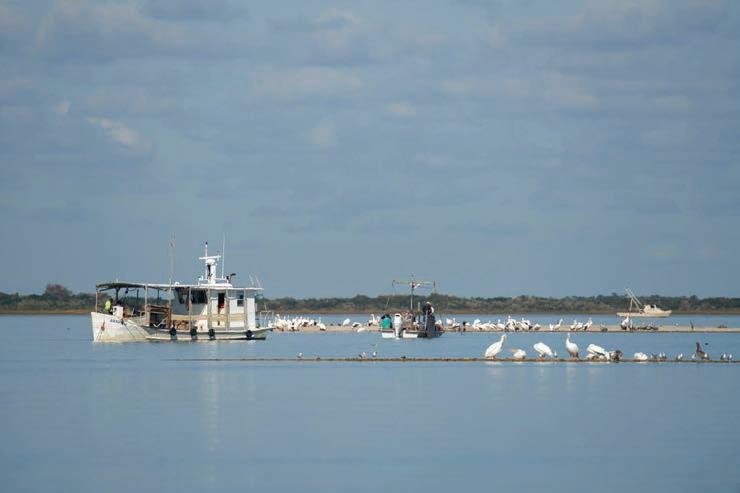
Texas Parks and Wildlife Department (TPWD) is accepting applications for the Oyster Boat License Buyback Program, offering commercial oyster boat license holders a limited opportunity to retire their licenses for a fixed price of $30,000. The application window runs from March 13 through May 15. For a second consecutive year, privately donated funds are supplementing state resources to support the program and make the flat rate offer possible.
TPWD administers voluntary buyback programs across several inshore fisheries, including shrimp, crab, finfish, and oysters, all of which have operated under license moratoria since 2005 or earlier. These voluntary retirements reduce the number of active licenses, easing fishing pressure on public reefs and helping to stabilize oyster populations over time. Revenue for buybacks comes from a surcharge on commercial licenses and, increasingly, from private philanthropy that leverages public dollars to increase the incentive for license holders to participate.
Last year’s round marked an unprecedented outcome for Texas oyster conservation. Through a $30,000 flatrate offer supported by both public funds and private donations, TPWD and partners secured contracts to purchase and retire 112 commercial oyster boat licenses, roughly a 20–21% reduction in the state’s oyster license pool. That result followed a shift in TPWD’s approach: earlier rounds (2018–2024) used a reverse-bid process
that yielded limited participation. After stakeholder feedback, TPWD adopted a straightforward fixed-price offer in 2025, a change that significantly increased interest and participation among license holders, including many with recent landings on public reefs.
The $30,000 purchase price reflects a true publicprivate partnership. In the recent model, TPWD provided $15,000 per license in public funds, matched dollarfor-dollar by private contributions. A $1 million anchor gift from Coastal Conservation Association Texas (CCA Texas) helped catalyze further donations through the Texas Parks and Wildlife Foundation (TPWF) and other supporters. The S. Reed Morian Oyster Buyback Program, administered by TPWF, served as the fundraising vehicle that channeled philanthropic resources into the buyback effort. Major donors and supporters include the Reed Morian Foundation, the Brown Foundation, the Earl C. Sams Foundation, Jeffery and Mindy Hildebrand, Beaver and Joanie Aplin, John and Mary Eads, Bobby and Sherri Patton, and many volunteer-led grassroots donors across CCA Texas chapters.
Oyster reefs are foundational to Texas’ coastal ecosystems. They create structured habitat used by more than 300 species, stabilize shorelines, buffer wave and storm energy, and improve water quality through filtration. While individual filtration rates vary, oysters are efficient filter feeders that can substantially reduce turbidity and help maintain healthier benthic and marine
Photo by John Blaha.
communities. Restored reefs provide significant ecosystem services — estimates place their annual value from ecosystem functions and recreation far above the direct commercial harvest value per acre from public reefs. Given multiple stresses on Texas oyster habitats — including dredging, severe weather events, drought, floods, and historical overharvest — reducing fishing pressure on public reefs is a key tool in a broader strategy to restore reef health and support sustainable fisheries.
To assist license holders during the application period, TPWD Coastal Fisheries staff hosted one virtual and two in-person workshops in early April to explain the application process and answer questions about the Oyster Boat License Buyback Program. Oyster license holders seeking more information can email cfish@tpwd.texas.gov or call (512) 389-8575. For direct questions about the Commercial Fishing License Buyback Program, contact TPWD’s Coastal Fisheries Commercial Fishing License Buyback Program manager, Zack Thomas, at (512) 389-8448 or zack.thomas@tpwd.texas.gov.
Looking ahead, TPWD and partner organizations, including CCA Texas and TPWF, anticipate continuing the buyback approach where funding and legislative support permit. Sustaining the momentum will require ongoing collaboration among state agencies, conservation groups, industry stakeholders and private donors. The recent rounds demonstrate that combining public surcharge revenues with philanthropic contributions can produce measurable conservation outcomes, reducing fishing pressure on public reefs and advancing long-term goals for healthier, more sustainable coastal ecosystems and fisheries.
Photo credit Hank Arnold.
Photo credit TPWD.
By Texas Parks & Wildlife
FIELD NOTES
ARTIFICIAL REEFS, REAL PARTNERSHIPS: HOW COLLABORATION BUILDS LIFE BENEATH THE WAVES
If you’ve ever fished offshore in Texas, you probably already know the basic rule: structure is everything. Find the structure, you find the fish. For a long time, oil and gas platforms acted like accidental fishing hotspots, vertical oases in the mostly flat Gulf. Now, as those platforms come down, the fishing spots go with them.
What most anglers don’t see is what it takes to replace that lost structure, and who actually makes it happen. Building habitat at sea is not as simple as dropping some concrete on the bottom. It takes
science, planning, permits, materials, money, and above all, it takes partnerships.
The Texas Parks and Wildlife Department (TPWD) Artificial Reef Program relies on these partnerships to turn restoration funding into real, fishable reefs. They work with Friends groups, industry partners, and grant programs to make it happen.
PartnershiPs and how reefs are funded
The Artificial Reef Program doesn’t rely on state general
Photo by Kline Lab, University of Texas - Rio Grande Valley.
Photo by Kline Lab, University of Texas - Rio Grande Valley.
Photo by Kline Lab, University of Texas - Rio Grande Valley.
revenue, or even revenue from fishing license sales. Every reef in the water is a product of partnerships. TPWD works with nonprofit Friends groups, material donors, and funding agencies to get the materials, handle permits, and deploy reefs responsibly in state and federal waters.
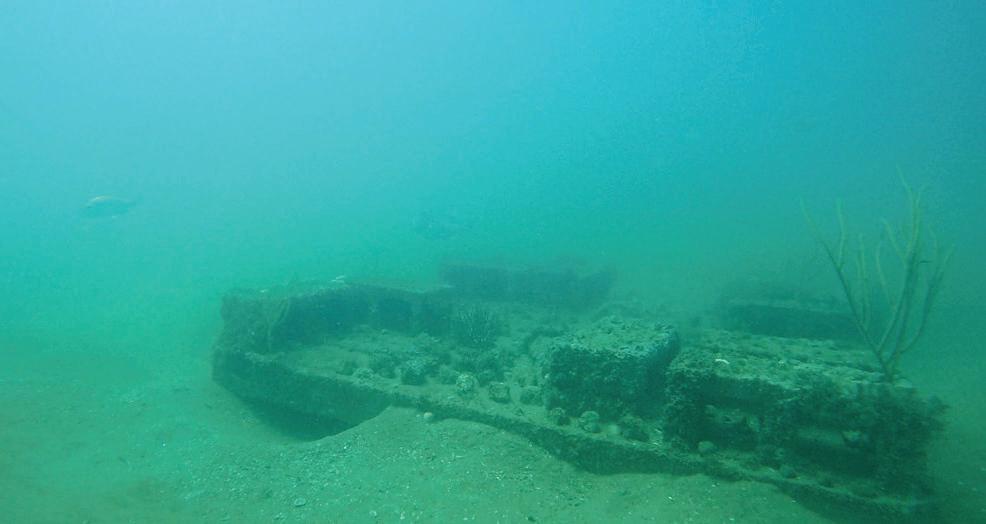
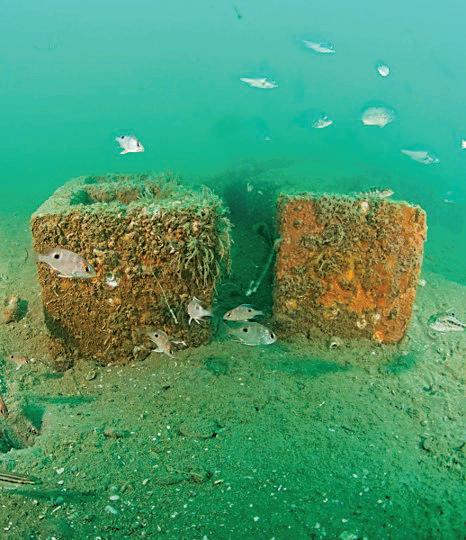
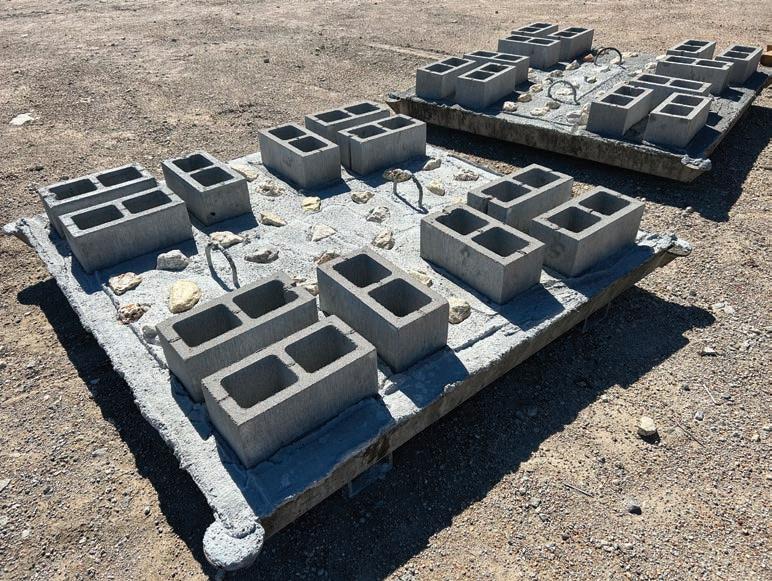
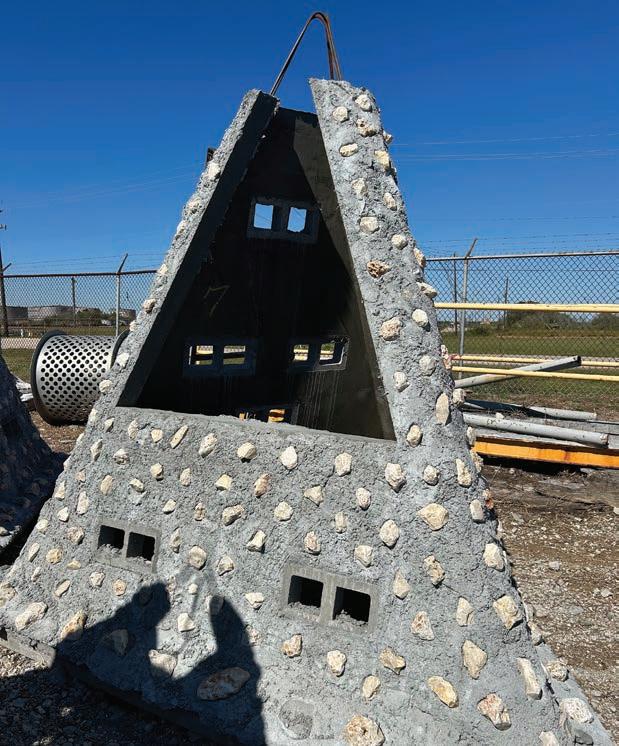
Grant funding often brings these partnerships together. One of the biggest examples is the $2.58 million RESTORE Grant from the Texas Commission on Environmental Quality (TCEQ) RESTORE Program, which is currently underway to expand reef habitat along the Texas coast. This project will place over 500 high-relief concrete pyramids and 300 low-relief concrete plates in the Sabine Pass and Port O’Connor regions, and up to 500 tons of concrete railroad ties in the South Padre Island Region. The RESTORE Act came out of the 2010 Deepwater Horizon oil spill. Settlement funds go back into Gulf Coast restoration. This isn’t regular taxpayer money; it’s specifically meant to fix environmental and economic damage from the spill. In Texas, TCEQ uses the money to restore coastal and marine resources, including offshore fish habitat. In a way, money from one of the worst environmental disasters in the Gulf is now being used to rebuild fishing habitat right now.
With RESTORE funding, TPWD and its partners are creating and improving reef sites in areas most affected by lost offshore structures, including the Sabine Pass, Port O’Connor, and South Padre Island regions. These areas lost a lot of structure when platforms were removed, structure that used to support thriving reef fish communities. RESTORE funding helps replace that habitat on a scale that matters for fishing.
LocaL Partners and industry contributions
The Texas Artificial Reef Program relies heavily on oil and gas industry donations generated from reefing decommissioned oil rig platforms. These contributions allow TPWD to maintain and expand reef habitat along the Texas coast. Grants like RESTORE
add extra funding for areas or projects that need more help. Friends groups also play a big role. They fundraise, provide materials, and advocate locally. For example, Friends of Sabine Reefs help support reef development in the Sabine Pass area, while Friends of RGV (Rio Grande Valley) Reef do the same in the South Padre Island area, making sure the projects match local needs. Together, industry, grants, and Friends groups create a resilient funding model that allows Texas to reef structures whenever possible, and replace habitat when reefing isn’t an option.
reefing, design and dePLoyment
Part of the work involves deciding what happens to decommissioned oil and gas platforms. Whenever possible, TPWD works with industry partners to turn the rigs into permanent reefs through the Rigs-to-Reefs program. These structures provide good habitat and are safe for navigation. But it’s not always simple. Nearshore platforms are often cheaper and safer to remove completely because of towing distances, cutting, and navigational requirements. Farther offshore, reefing is usually the better option; it’s safer, cheaper for the company, and good for habitat. When reefing isn’t possible, purpose-built reefs funded by grants like
RESTORE are used instead.
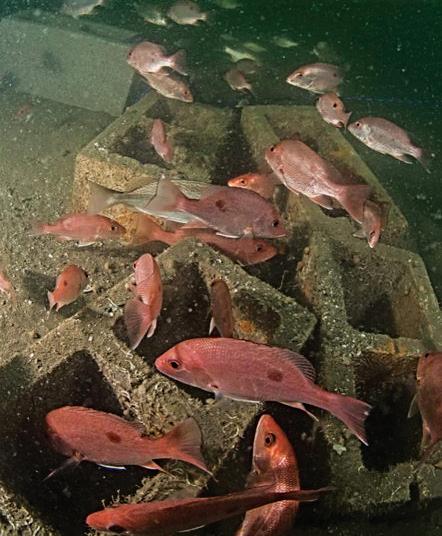
The RESTORE-funded project uses designed concrete reef structures, including high-relief pyramids and low-relief plates. These are chosen to support fish at all life-stages—smaller structures for juvenile fish and taller, more complex structures for adults like red snapper. Partnerships make it possible to put the right structures in the right places. Across the Texas coast, the project is expected to create or enhance at up to 100 acres of reef habitat in Texas waters, with structures designed to last for decades.
RESTORE funding also pays for a lot of behind-the-scenes work anglers don’t see, including environmental and archaeological surveys, state and federal permitting, reef construction and deployment, navigational safety, and post-deployment surveys. These steps make sure reefs are safe, built in the right spots, and provide the most benefit.
the bottom Line
Texas artificial reefs aren’t the work of a single agency or funding source. They’re built through shared responsibility, investment and partnerships. The program relies on industry donations from reefed oil rigs for much of its funding, while grants like RESTORE provide additional support for projects that need it. Rigs-to-Reefs partnerships preserve valuable structure, Friends groups contribute local energy, donations, and advocacy, and TPWD provides the science, planning, and oversight.
The bottom line is simple: without these partnerships, much of this habitat and the fishing it supports would be gone. The work
being done ensures there are still plenty of fish to find, and will be for generations to come.
This project is paid for [in part] with federal funding from the Department of the Treasury through the State of Texas under the Resources and Ecosystems Sustainability, Tourist Opportunities, and Revived Economies of the Gulf Coast States Act of 2012 (RESTORE Act). The statements, findings, conclusions, and recommendations are those of the author(s) and do not necessarily reflect the views of the State of Texas or Department of the Treasury.
TPWD Artificial Reef Program would like to thank the following partners for their generous donations to supplement our current nearshore reefing efforts:
Cheniere Energy | Bayou Bend CCS | Golden Pass LNG | Motiva Enterprises | Sempra Port Arthur LNG | Valero Port Arthur Refinery | BNSF | Coastal Conservation Association | Texas Parks & Wildlife Foundation
Check the TPWD Outdoor Annual, your local TPWD Law Enforcement office, or tpwd.texas.gov for more info.
ERIC OZOLINS
EXTREME KAYAK FISHING & SHARKS FROM THE SAND
THE CURRENT STATE OF LAND-BASED SHARKING
We live in a time of constant change, specifically in the world of land-based sharking. As someone who’s been dedicated to targeting toothy critters from the sand for over 25 years now, I’ve made a lifestyle out of chasing thousand-pound sea monsters. I’ve seen plenty of changes during these decades spent on the beach. Rules, regulations, technologies, methods and tackle have all evolved significantly. I wonder where this all will lead, as more time passes.
Texas anglers have been catching sharks from our beaches for about a century. Historically, Padre Island has been the coastline mecca for sharkers, for a variety of good reasons. Due to the geographical layout of our coast, the strong winds we endure create favorable currents along the many miles of this, the world’s longest undeveloped barrier island. Deep water lies closer to shore in South Texas than farther up the coast; the continental shelf is closest to the coast in this part of the state. Big sharks don’t have to travel far from the depths of the open ocean to reach the PINS beach. This entire region has long been a fish haven and is regarded as one of the best surf fisheries in the entire Gulf.
For decades, a few dedicated sharkers landed a few
true behemoths from various Texas jetties. The so-called golden era of shark fishing in Texas occurred from the late-1950s to the end of the 1970s. This was a time when the waters off the Texas coast held peak numbers of big sharks swimming within reach of people fishing from land. Though I encounter people today who say we have more sharks than ever to target, I’d argue they’re wrong. Because we have so many to target, we have greater numbers of people fishing for sharks today. Hence; more are caught than ever before. But undoubtedly, during the decades in the middle of the 20th Century, many more sharks swam in the Gulf in general, and in Texas waters, than they do today.
Texas anglers in the 60s could easily catch multiple big sharks on the same day, using what now seems like clumsy fishing gear and swimming or rafting bloody shark baits impressive distances out from the beach. Putting the technologies, tackle and methods used today in play back then would no doubt have resulted in catches unheard of now. During the 80s and 90s, the numbers of pioneering shark anglers dwindled. Many of the original expert sharkers became too old to participate regularly in a sport with such a strong
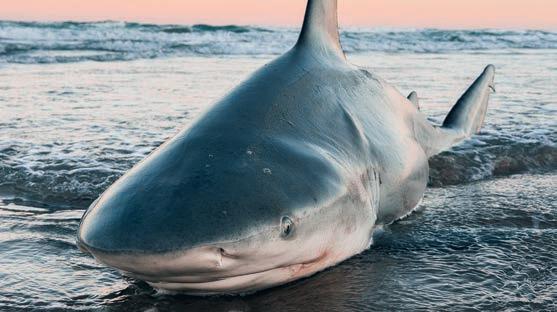
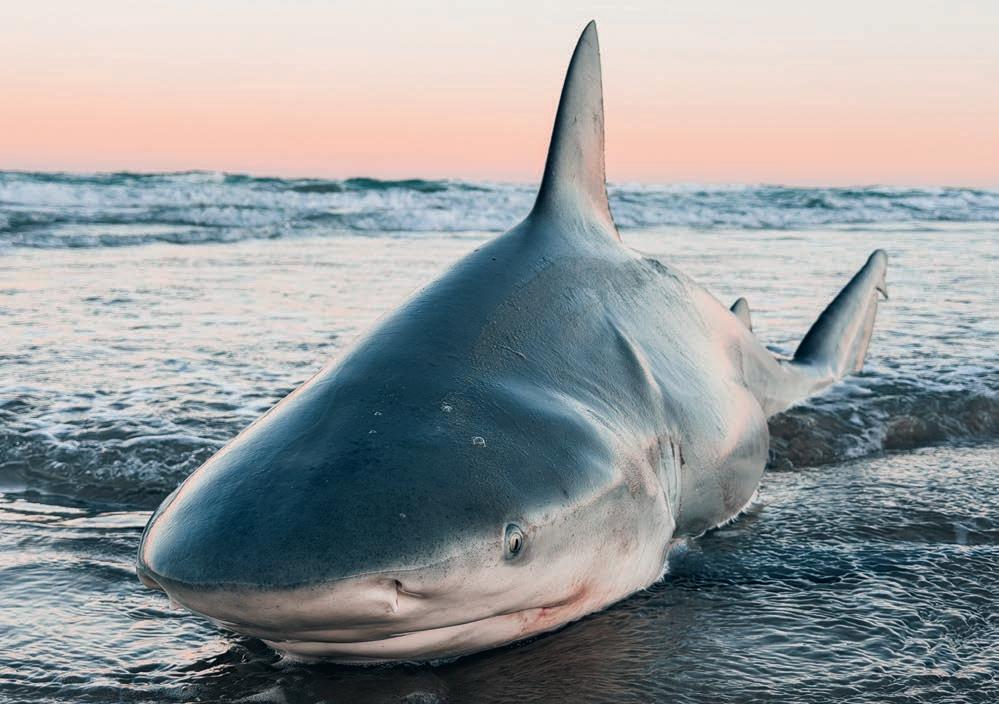
Very nice specimen of early spring bull shark landed by charter client.
physical component. Eventually, they passed through the golden gate, to the final beach.
For some time, a smaller number of sharking enthusiasts came along to replace them. By the early-90s, the state of the world’s (and the Gulf’s) shark fishery reached an all-time low. The fishery had been abused for years by then; people slayed sharks for self-aggrandizing photos, to make trophies of their jaws and worse, they killed some purely for spite, in response to irrational fears. Long-liners from many nations began to target sharks for their fins, to quell the appetites of Asian markets, where shark-fin soup is considered a delicacy. Mexican gill-nets washed ashore on Padre Island from time to time, full of dead sharks. All these factors decimated big-shark populations.
To try and recover from this sickening, short-sighted war on sharks, officials began to implement and enforce regulations around the turn of the 21st century, hoping to save the fishery. Both state and federal officials helped put pressure on illegal foreign activity in our waters. As we approached the 2020s, I began to document evidence of a recovering shark fishery, an improved one, but still with lower numbers of fish than we had during the glory days. We aren’t catching big numbers of giant sharks anymore, but we do encounter them more regularly than we did during the worst of times. When I started fishing the beaches seriously for big sharks around 2000, it took me multiple years of dedicated sharking to finally catch my first truly big tiger. These days, I encounter them much more regularly. In those days, kayaking baits was the optimal deployment method. Today’s methods of bait-deployment make the idea of kayaking baits seem crude, at best.
Perhaps the most important change in the sharking world since the beginning of the 21st Century came with the dawn of social media. Now, anglers share photos of their catches and videos of their adventures with thousands of others, soon after the events happen. The concept of monkey see-monkey do becomes real in such a world. After seeing someone post photos of sharks caught from the beach, other people want to catch some of their own. During the early 2000s, in a span of a few years, the number of people participating in the sport grew almost exponentially.
During this time of rapid growth in interest, technological advancements contributed to the evolution of the sport. New, giant aluminum fishing reels paired with high-quality braided lines provided a major advantage to sharkers, when compared with old, traditional Senator-class reels spooled with monofilament lines. The gear finally gave anglers the edge in their fights with these beasts. Additionally, because of the increased interest, bait shops began stocking many of the best baits known to attract monster sharks in fresh form. Then, the ability to vacuum-seal quality shark baits of all kinds gave anglers another useful tool to use in the quest.
In present times, copious numbers of skilled anglers flood our state’s beaches, many of whom first noticed the sport while scrolling through Facebook and Instagram on their phones. Many of these new-age sharkers use drones to deploy their baits well offshore. Some can send baits weighing as much as ten pounds hundreds of yards from the beach. Surely, the use of drones is a double-edged sword, with both positive and negative aspects. Recently, the federal wildlife management agencies have tried to ban the use of drones for fishing, but they did so with a vaguely worded law. State game wardens have been all over the place on the issue, with some issuing tickets, others not enforcing the law. I
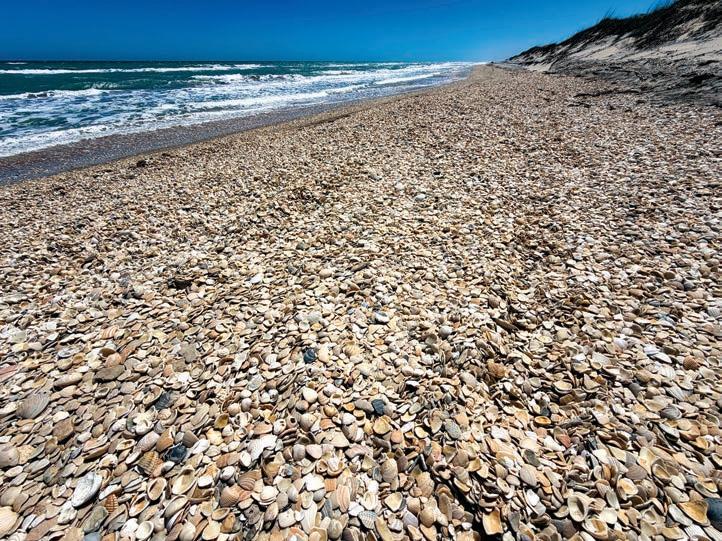
Newly developed shell bank on Padre Island National Seashore; thousands of years in the making and Mother Nature still isn’t done.
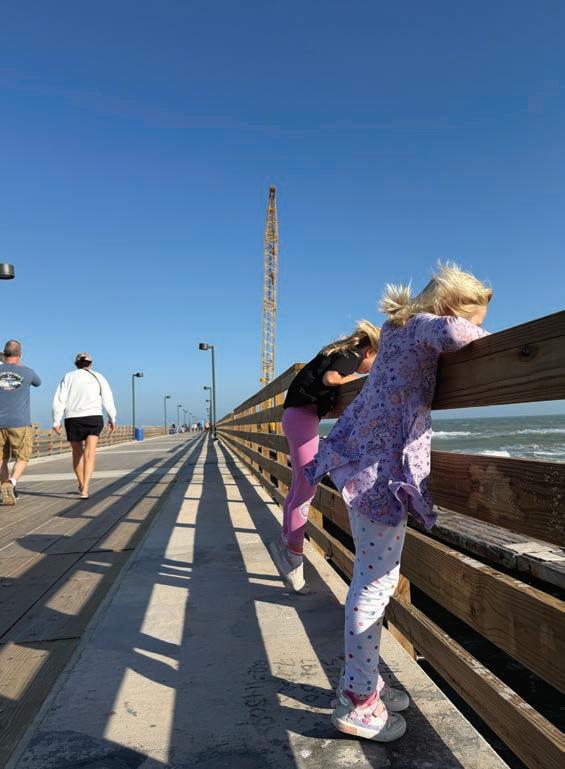
The Ozolins daughters check out the new Bob Hall Pier.
expect a clear resolution, official decision and public declaration on the use of drones in the near future.
Meanwhile, our fishery remains in a state of recovery. Big sharks are now being caught frequently, partly because more people than ever are targeting them, using ever-improving equipment and methods. Offshore enforcement of illegal activity has dramatically reduced the harm to sharks. While we still have an established problem with shrimpers illegally and discretely finning sharks, sending them to Mexican ports and shipping them to Asia, this problem is currently being addressed by multiple enforcement agencies.
With any luck, we’ll see more and more interest develop for targeting big sharks from the beach. Many people have now experienced the magic of an up-close and personal encounter with one of the ocean’s true monsters. Maybe the ugly habits humans have historically displayed when dealing with sharks will give way to the respectful concept of catch, photo and release, and we can populate a world in which all anglers learn to respect the strength and beauty of this enchanting family of apex predators.
CONTACT
For the past decade Eric ‘Oz’ Ozolins has been promoting shark catch and release and assisting various shark research programs. Eric offers guided shark fishing on Padre Island National Seashore. Also renowned for extreme kayak big game fishing, Eric is the owner of Catch Sharks Tackle Company.
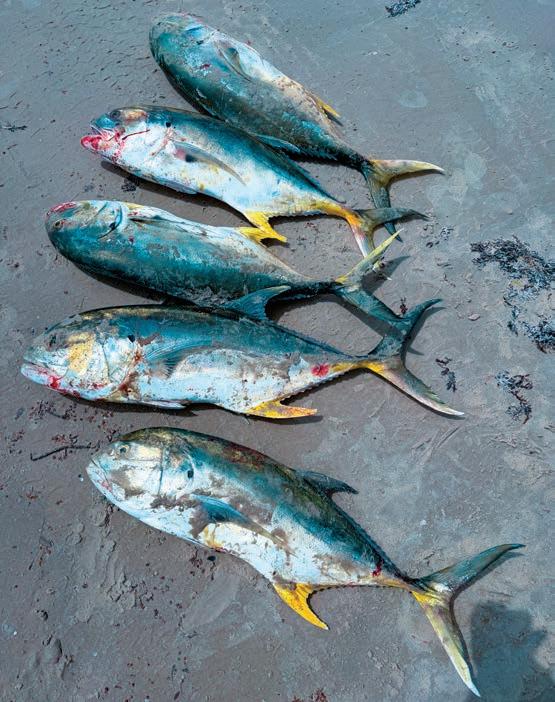
Springtime invasion of jack crevalle is a great time to stock the freezers with shark bait.
JAKE HADDOCK MOSTLY SIGHT-FISHING
LIGHT TACKLE REVELATIONS
The last few years I have gone to great lengths to dial in my light tackle gear and wanted to share a few things that I have learned along the way. Keep in mind this is just my opinion and you shouldn’t stop experimenting with your own tackle to find what works best for you and your fishing style.
First off, as many of you have probably figured out by now from reading previous articles, when I’m talking about light tackle I’m usually referring to spinning gear. Not that casting gear isn’t utilized on my boat, but most of the time if fly tackle isn’t being used the egg beaters are the weapon of choice. Why? Well, they cast light lures very well and are simple enough to hand to a lesserskilled angler and get them right into catching fish. When placed in the hands of a skilled angler, there’s no fish on the flats that is safe, simply because the range these outfits offer is unmatched.
Nick made quick work of this bull red with the 15lb combo.
I’m going to break down three different classes of spin tackle from rods, reels, and lines, and then wrap it all up with small common details that make a big difference.
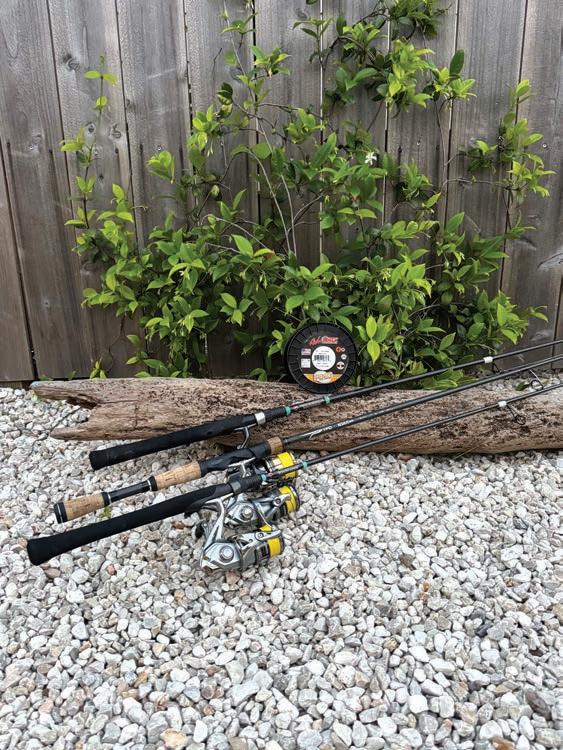
Let’s start with the lightest outfit I utilize and then work up from there. This particular rod is a 7’ light power with a fast action, rated for 4-8lb line. This rod was originally put together for the purpose of throwing very light bucktail jigs. While it can launch a light bucktail a country mile it doesn’t quite have the power to punch the thicker hooks of my hand tied jigs through the tough tissue of a redfish’s mouth. What would often happen is my angler would get the eat and have the fish for the first run, but after the fish changed course it would come unbuttoned. So, it doesn’t quite work so well for its intended purpose, but it does do great work with most ned-rigged baits – which have hooks often made of much thinner wire. I also have found this rod to be quite handy on the rare occasion I need to live bait wary sheepshead with a shrimp or small crab. When I’m doing this I’m using a very light owner mosquito hook, around size one or two, so the only weight is from the actual bait itself. Hence, the reason this outfit works well. The reel I typically pair with this rod is of the 2500 size, and is spooled with 8lb braid. Leader size is 12lb fluorocarbon about, 3 feet long, stepped to a small section of 20lb fluorocarbon when needed.
The next outfit is the most often used spinner on my boat. It’s a 7’1” medium-light, fast action rated for 4-10lb. I feel that this rating could easily be 6-12lb as this rod does have some power but that’s just what is on the blank. It is paired with a 3000 size reel and spooled with 10lb braid. That is followed by about 2 feet of 20lb fluorocarbon but 15lb
would be a great fit as well. This combo is the bread and butter which fits the majority of scenarios I find day to day. It throws everything from 1/4oz weedless spoons to bucktail jigs, and has enough backbone to properly set the hook.
The last outfit I will cover today is one that was originally put together to be the do-all type, but was too powerful for some of the lighter lures to be thrown with accuracy. So it sat in a corner collecting dust for several years until recently when I found a job for it. It’s a custom rod built on an American Tackle Matrix blank. From memory, it was labeled as a 7’ medium, fast action 8-15lb. Don’t let this rating fool you, it’s very powerful for its class. Recently I’ve been needing a heavier outfit to throw bulky artificials like the Z-Man Kicker Crabz to large black drum and bull reds, as well as something to better handle a teaser plug for jacks. For context, this is where I remove the hooks from a topwater plug to stir fast moving jacks into a frenzy and coax them into range for my angler to present a fly.
CONTACT
Captain Nathan Beabout USCG/TPWD Licensed
Full time guide since 2007
Seadrift, Port O’Connor, & Port Mansfield, TX Facebook, Instagram, LinkedIn
Phone 210.452.9680
Email www.nmsportsmansadventures.com
The range of spinning tackle typically used on the author’s boat.
WIND, BIRDS, AND OPPORTUNITY: SPRING FISHING ON THE TEXAS COAST
March and April are known for one thing on the Texas coast: wind. Day after day of it. It can make long runs across open water uncomfortable, muddy up your normally clear water, and test your patience in a hurry. But if you’re willing to push through it, this time of year can quietly turn into some of the best fishing of the season.
Right at the beginning of April, the shrimp hatch kicks off. It arrives as a major shift in the ecosystem and everything starts to revolve around it. As those small shrimp begin to move, schools of redfish start grouping up and feeding aggressively. They’re not scattered anymore. They’re organized, pushing bait, and working together.
The wind actually plays into your favor here. It muddies up the water, which might not look ideal at first, but it gives redfish and trout the confidence to stay shallow and feed harder. In that dirty water they rely less on sight and more on instinct, and that means they’re less cautious and more willing to eat.
This is where the birds come into play.
Seagulls become one of your best tools this time of year. They’re not just randomly flying around. They’re keyed in on the same thing you are. When shrimp are getting pushed to the surface by feeding fish, they start popping and skipping across the water, trying to escape. The birds see it instantly. They’ll hover, circle, and then dive, picking off whatever gets left behind.
If you see birds working low and tight over the water, there’s a strong chance fish are underneath them. Not every group of birds holds fish, but when you find the right ones, it can make locating schools almost effortless.
A lot of days this time of year turn into a run-and-gun game. You’re covering water, keeping your eyes up, and reacting to what the birds are telling you. When you find the right group, it can happen fast. Multiple fish fired up, competing, and willing to eat just about anything that looks like a fleeing shrimp.
This is one of the most fun bites to be on with clients. It takes a lot of the guesswork out and turns it into more of a reaction game. Good casts, staying ready, and capitalizing when the opportunity shows up. When everything lines up, it can feel nonstop.
That being said, not every school is easy. Boat pressure, missed shots, or getting too tight too fast can shut things down just as quickly as they can get fired up. A lot of times it’s about setting up away from the birds, making longer casts, and letting the fish come to you instead of running in right on top of them.
It can feel easy when it all comes together, but there’s a tradeoff.
You have to be willing to fish through the gauntlet of spring weather. The wind doesn’t let up just because the bite is good. It takes longer to get where you’re going,
longer to locate the right signs, and sometimes longer for everything to line up. More often than not, the best bite doesn’t happen early. It usually happens best when most people are already heading in.
Those last couple hours of the day can make all the difference. The wind might lay just enough, the bait gets more active, and the
fish settle into a better rhythm. That’s usually when things really start to happen.
Staying a little later, grinding through the conditions, and trusting what the birds and water are telling you is what separates an average day from a special one this time of year.
PRODUCT
The PrawnStarZ™ Family Expands
New 2.5” and 3” models join the lineup alongside an unrigged 3.5” LB version! ZMan® is turning up the heat with the expanded PrawnStarZ™ lineup, now in stock with three new models ready for action: downsized 2.5” and 3” pre-rigged versions, plus a 3.5” LB (Loose Body) model for maximum rigging flexibility. Together, these additions give anglers more ways to match the hatch and the same proven profile and bulletproof durability that made the original an instant inshore legend.
St. Croix ROGUE V Nearshore Saltwater Rods
Consisting of 39 high-performance Boat, Jig, and Slow-Pitch conventional and spinning models, all-new ROGUE V nearshore rods are crafted from St. Croix’s new Matrix Composite material with FRS, TET, and ART technologies for extreme strength and durability while maintaining the thin diameters and lightweight handling characteristics saltwater anglers demand. ROGUE V features technique-optimized premium EVA handles, strong and worryfree K-style stainless-steel guides, and clean, tech-forward aesthetics. Retail $195 to $255.
C.A.T. Foam Seawall Repair
C.A.T. Foam uses advanced polymer resin injection technology to repair and strengthen marine seawalls. We fill voids and stabilize the structure by injecting resin into the soil behind damaged walls. The resin expands and hardens, restoring the seawall’s integrity and preventing further erosion. This cost-effective, non-invasive method offers a durable alternative to full replacement, protecting valuable coastal infrastructure with minimal environmental impact. Trust C.A.T. Foam for reliable, long-lasting seawall repairs.
UGLY STICK 50th Anniversary
Limited Edition Combo
For half a century, Ugly Stik has been the trusted rod on countless fishing adventures. To celebrate the milestone, the brand is introducing the 50th Anniversary Limited Edition series, built to honor its reputation for strength and durability. These spinning combos feature Ugly Tech™ construction, Ugly Tuff™ guides, and the iconic Ugly Stik® Clear Tip® design anglers have relied on for generations. Designed to deliver the same toughness and performance that define the brand, this special release serves as a tribute to 50 years on the water. Available for a limited time in 2026 while supplies last, the 50th Anniversary series offers anglers a chance to own a piece of Ugly Stik history.
Turtlebox Ranger
Built for life on the go, Ranger delivers premium sound in a compact, rugged design. It’s waterproof, drop-proof, and ready for any adventure.
SPRO Has a Power Swivel for All Your Needs
Fishing conditions can be challenging from time to time, and you may need a little help keeping your line from twisting, or simply just may need to attach your leader to your main line. In these cases, turn towards SPRO and tie on a Power Swivel to help you keep things straight. SPRO offers Power Swivels in sizes 10 - 5/0. SPRO Swivels come in individual packs or bulk packs to fit all your fishing and rigging needs. Please look for these SPRO Power Swivel Products at your favorite tackle shop.
Matagorda
Bink Grimes is a full-time fishing and hunting guide, freelance writer and photographer, and owner of Sunrise Lodge on Matagorda Bay.
If you like fishing over oyster shell; May is your month. When prime aquatic real estate like oyster reefs become submerged with fresh, clean salt water from the gulf, species like speckled trout and redfish gravitate to the structure. Water is power – I like bloated tides.
The mid-bay reefs in East Matagorda Bay really start to hold fish during May. If the middle of the bay is green with an incoming tide, I beg my clients to get wet and wade the shell with me. I can’t tell you how many large trout have come from these reefs on She Pups, Top Dogs, Super Spooks and Skitter Walks. If anglers are reluctant to get out of the boat, all that scattered shell in the middle of East Bay holds just as many big trout and redfish. Some days they school and other days you have to hunt for them.
You would be surprised how many huge trout are caught out of the boat by Matagorda captains. You don’t often see them at the cleaning table, thanks to conservation-minded attitudes, but there are some long specks that hit soft plastics, Gulps, DOA Shrimp and live shrimp under a popping cork.
When tides are above normal, fish the falling tide. When water levels on flats are low, wait for the incoming tide and look for the slicks. With the warm water this month there should be plenty of mullet, shad and minnows that produce big oily slicks when gorged by trout.
When water levels are normal, there are hotspots on flats and shorelines where fish appear first on the incoming or outgoing tide. That’s not necessarily the case on flood tides. Waders who enjoy good catches
concentrate tight to the shorelines or relocate to shorelines in the back lakes.
Fish disperse with all of the water, but when the water begins to fall with the outgoing tide, the trout show up where they always do.
Expect this May to be breezy; but, don’t fret, all that extra water affords much more leeward shorelines to fish. With meteorologists prediction a shift to an El Nino pattern, expect lower barometers and more wind. That bodes well for our drought. We need the rain and the fish need it just as bad.
Hypersaline bays stress the food chain, just like they stress our woods, pastures and yards. Rain is a good thing and we are praying for a wet 2026.
Another bright spot this month could be the surf. Trout to five pounds and more redfish than you can handle are normal, especially around the jetty.
We toss Bass Assassins, Down South Lures and MirrOlure Soft-Dines, but a live shrimp free-lined along the rocks really gets rocked.
Sand and grass along the south shoreline of West Bay will consistently hold solid trout and redfish. Glass minnows, mullet and shrimp flood the grass beds and the fish thump topwaters better than any month of the year.
It’s technically still spring but for us it’s the beginning of summer and we can’t wait. Our fishery is in good shape and we are encouraged by the size and quality of upper age-class fish showing in our bay system. Keep doing what’s best for our resources. Please release more than you take.
Port O'Connor Seadrift
Captain Shellie Gray was born in Port Lavaca and has been guiding in the Seadrift/ Port O’Connor area full time for the past 24 years. Shellie specializes in wading for trout and redfish year round with artificial lures.
Heading into late-spring there are noticeable differences in our bay system between now and a couple of months ago.
Bay waters have warmed tremendously and we are now seeing an abundance of bait in all areas of that hold good structure. By good structure I am talking about oyster reefs, guts and sand bars that run along sandy shorelines, and also the emergence of new seagrass beds.
Seagrass serves several roles in our ecosystem – as a filter to improve water clarity – its roots help prevent erosion by stabilizing bottom sediments – and it provides structure where forage species can hide and game fish can feed. Even understanding all these benefits, it can still be frustrating at times, trying to fish in areas with abundant seagrass.
Without going into a lot of detail of various names and types of seagrass, just keep in mind there are differences in the way different types of grass grow. I typically find seagrass to be less dense on hard, sandy bottoms. Don’t get me wrong, you will come across some areas with dense beds of grass but for the most part, on hard sandy bottoms, seagrass just doesn’t grow as lush or thick as it does in the back lakes with mostly muddy bottoms. So, while you might be able to work a soft plastic on a plain jighead with ease through most grass beds on sandy bottoms, grass in back lakes calls for a totally different set-up. This is where weedless set ups really shine.
Before braided line became all the rage, I used mostly 12-pound mono on all my reels and Texas-Rigged weedless set-ups were my go-
to for fishing in dense strands of grass. Texas rigs were easily tied to the main line by using a #10-barrel swivel, which helped reduce line twist and also prevented the free sliding worm-weight from traveling too far up the line during the cast, finished with a 4/0 to 5/0 offset wide-gap hook. Personally, I feel the wide gap hooks provide for a better hookup ratio. Now, with almost all my reels spooled with braided line, I use a monofilament leader attached to the braid using a uni knot and no longer use barrel swivels.
Maximizing the benefits of this style of terminal rigging, I now use Bass Assassin’s weighted swimhooks, which eliminates the old bullet weight we used to use. Bass Assassin’s 5-inch scented Die Dapper in Mama’s Chicken or Purple/Chartreuse works extremely well with this set up. I mention these two colors specifically because they are a great choice right now. Our water color is pretty perfect this time of year. We have just enough wind and movement to keep the water from being too clear but not so much that it makes it muddy.
Another great weedless option that produces good catches is the Johnson Silver Minnow in quarter- to half-ounce sizes. Even though their name says Silver Minnow they come in many colors, my favorite of which are gold, silver and black. On cloudy days I opt for gold or silver and on bright, sunny days I have really have good results using the black ones. Remember when you are retrieving these spoons, they are meant to wobble and not spin. If you see your spoon spinning on the retrieve, then you need to slow it down till it wobbles instead.
Wading right now will yield good results, fishing the sandy bottomed shorelines of our major bays. San Antonio and Espiritu Santo bays will be my go-to areas looking for active bait and scattered grass between the guts that run parallel to the shorelines. On cloudy days I will usually find my best bite fishing knee- to hip-deep. On cloudless days I get a better bite fishing hip to chest deep. I fish the oyster reefs in San Antonio Bay the same way as I just mentioned. If wading is not your forte, then look to drift over some of the deeper reefs in San Antonio Bay. Don’t be surprised if you don’t get bites on your first or second drift. I find myself “reef hopping” more often than not till I come across a decent bite. On the windier days I prefer to drift in the back lakes like Long Lake, Shoalwater Bay, the Lagoon and Contee lake. Before closing I want to shoutout a big “Happy Mother’s Day” to my beautiful mother. Mom, your love and sacrifices have shaped me into the person I am today. I am forever grateful for your unconditional love and support. You are my greatest inspiration. Love you more!
David Laughlin landed this hefty red on a recent trip with Capt. Shellie.
Krissy Johnson was very pleased to land this San Antonio Bay trophy.
Port Mansfield East Cut & Beach Cleanup A CALL FOR VOLUNTEERS
Come join us in beautiful Port Mansfield, Saturday, June 13, 2026, for the 17th running of the Port Mansfield East Cut and PINS Beach Cleanup.
We need you, both boat captains and ground troops, to work the beaches and shorelines collecting all the awful trash that finds its way to our beautiful waters. Remember, we will arrange boat transportation to the work area for all volunteers without boats. This is a great opportunity for all who love the ecosystem of the Lower Laguna Madre and PINS beach near the Port Mansfield East Cut to join in restoring these beautiful waters and shorelines and leave them better than we found them.
The event kicks off with a full breakfast at 7:00 AM, launching from the Port Mansfield Chamber of Commerce Event Center. We will also provide a full lunch back at the pavilion upon conclusion of the days trash pickup and work at approximately 1:30PM. At the conclusion of the day’s events, we will celebrate an evening meal at the Chamber Pavillion, complete with a Taco Buffet, Karaoke, Drinks, and Lots of Fun!
Remember, we provide two nights free lodging. Come join us for a full day of hands-on conservation effort and a fantastic feel-good event to help keep the PINS beaches and Mansfield Channel cleaner than it was the day before.
Anyone wishing to sponsor via financial contributions are encouraged to contact Brooks Bassler, our Sponsorship chairman, brooks@bbstexorleans.com
Kathie Bassler: 979-204-5185 or email: kathieb@basslerenergyserviocces.com relative to volunteering for this event and to secure lodging.
Upper Laguna/ Baffin
David Rowsey has 30 years in Baffin and Upper Laguna Madre; trophy trout with artificial lures is his specialty. David has a great passion for conservation and encourages catch and release of trophy fish.
Well, here we are, shedding those Simms waders for quick-drying technical clothing, also made by Simms, so that we blow dry almost as soon as we get out of the water. The warm weather certainly warrants the shift in gear, but I kinda like being dry all day in my G4 waders. That transition in gear sort of reminds me of opening day of dove season in reverse… summer is almost over, but not quite. The water is almost cool enough for waders in the morning, but way too warm a couple hours into the day. I guess transitioning is just part of our routine or tradition as outdoorsman. Trading one seasonal activity for another is something I think most of us look forward to, and a good excuse to buy more Simms gear!
May is one of the most exciting months of the year here in Baffin and the Upper Laguna. Big, big tides will be rolling in on the full moon during the first week this month. New water that has come into the bay to this point has brought us game fish, bait fish, shrimp, and much-needed highly oxygenated water from the south. All of that was a precursor to what happens about the time this article hits the newsstand. The new life forms just mentioned will be amplified tenfold in May and there will be fish on what seems like every corner. Whether looking for trophies or lots of bites, May always produces big in both categories.
As many of you understand the dynamic of having a warm winter that we just experienced, fishing has been less than typical of what we expect for a winter spring season here in Baffin. Don’t get me wrong, we have caught some magnificent, large trout this season, but there were days when it required real effort to accomplish it. That warm water didn’t allow for a muchneeded grass die off to open more structure to target, and our long drought has kept our bays excessively salty. Well, short of a major storm passing through and providing huge tidal rises, this big water coming on the May full moon is our only way of refreshing the bays for the summer season. I can’t remember a year where it’s been more needed than now.
I receive an abundance of messages every week asking/ stating something to the effect; “We are pretty green when it comes to wading and fishing with lures… are you ok with that?” I am not only ok with it; I love teaching folks new to this game. Watching a new customer, or kid develop over the years is truly one of the most gratifying parts of my job! The only thing I require is a good attitude, and a willingness to learn. As it turns out, the next couple of months, where bites are
plentiful, is about a good a time as you can ask for if you are ready to jump into the game, get your feet wet, and begin to understand why this type of sport fishing is so popular in Texas. I’m blessed with some of the best lure fishermen on the coast that jump up on the deck of my Haynie 25 Magnum just to watch them get off as quick as they can for the first wade in that magic hour of first light.
Those are the easiest days as a guide, but there is really something special about developing someone new to the sport and watching them become a “top stick” in the game over the years. As I’m writing this my head goes to a guy that competed very well in the Legend Series this year with multiple fish in excess of 7-8 pounds. I can remember the day we went through the technique of “walking the dog” with a topwater and watching his lure being pulled in a splashy straight line to having it zig-zag and pause properly. Thirty minutes later he smashed a real one!
So… if you want to learn to fish lures in the salt, or fish them better, know when it’s time to switch from one style of lure to another, or simply understand how to “read the signs” of bait and structure… call me and let’s get on water together. Getting you to the next level is really not hard if you have the “want to” and willingness to learn.
Remember the Buffalo, Capt David Rowsey
Michael Curran with a big girl that weighed just over 8# )without mullet) Note the 1/2# mullet it kicked out as he was landing on Boga. Old school Red Shad Bass Assassin for the win.
“We contracted the construction of the TSFMag office building with Farrell Jackson. Jackson also built my son’s bay house here in Seadrift. We were completely satisfied with both projects…a professional and trustworthy contractor.” ~ Everett Johnson | Editor/Publisher, TSF Mag
Port Mansfield
Captain Wayne Davis has been fishing the Lower Laguna-Port Mansfield for over 20 years. He specializes in wade fishing with lures.
Telephone 210-287-3877
Email captwayne@kwigglers.com
WAYNE’S Mansfield Report
Greetings from Port Mansfield! Let me start by saying it turned out to be one heck of a late spring bite, especially for big trout. Before I get into that let me set the tone on our current conditions. Water levels have returned to typical late spring tides, significantly expanding our back-bay opportunities. The results have been consistently rewarding and thrilling. Southerly winds also remain on the higher end, but it has not affected us much in the back bays fishing over grass and scattered sand pockets.
Since history has a way of repeating itself, we should take a little stroll down memory lane, back to the third week of March 2018. “Mississippians” Patrick and Glen came down simply to target trophy trout. This was back when there were way fewer trophy trout guides staking claim to Port Mansfield waters as their wintertime residence. Although it was just eight years ago, our all-day wade was quiet with no other boats in sight. We had the perfect setup as I have mentioned in previous stories. In short, we were days, if not minutes within the spawn of trophy trout and we stopped smack dab in the middle of them. From plentiful six pounders to Glen’s 10 pounder, it was a trip of a lifetime. It was a day I thought would never repeat itself until the fourth week of March this year. With remarkable things never lasting forever, the big females spawned and almost immediately thereafter tons of small male trout moved in and did what they do and fertilized thousands of eggs. This year, I chose a similar location and started fishing in what seemed to be an excellent spawning area. My decision was based on years of studying the water and recalling patterns from 2018, as well as other comparable instances during my wade fishing career. My anglers covered the area well, missing a few fish up to seven pounds. Something was not right so I moved our group no more than five hundred yards. When I did luck happened to assist me with my decision to move. We landed right in amongst them. On this particular day they did not eat like I had hoped but my mind was working overtime with what was happening. The female trout were set up to spawn in this zone. The next day, Stephen Hicks and crew arrived, and I obviously had a plan and a good one at that. I explained to them the layout and what I thought we should do and how to approach the area. We hit the zone and in full transparency we absolutely crushed the big upper-slot redfish
until we were forced to check another area many miles away, despite my resistance to do so. We moved to “pretty” water and caught a ton of fish, but not the ones we wanted. The next day it was simple, I dug in on staying in the zone I knew would produce the fish they (and I) wanted. At one point on day two we even had a little group vote on moving because of tons of big redfish were ruling the show and secondly, we were drudging through a somewhat muddy bottom, and the water clarity was not “pretty.” Despite the conversation I convinced us to stay put.
I remember telling the guys, sure we can move to pretty water but if you want a double-digit trout it is going to happen here. As patience was key things unfolded nicely with multiple big trout coming to hand to include a solid 10-pounder that I caught via sight cast and taped slightly beyond the 30-inch mark. Stay tuned for her photo to appear in the near future.
With fish like that it was certainly a trip to remember. We played the right hand with a sprinkle of luck on top, and it was another record trip for us. I only wished someone else had landed that double digit trout, although landing eights and nines is not too bad either.
As far as lures are concerned, you guessed it; Mansfield Knockers dominated with a few good Corky thumps. That beautiful 10-pounder couldn’t resist a good ole KWigglers 4-inch paddle tail.
And, for the record two days later, I went back in to catch another pile of big fish, only to be reminded that history doesn’t always repeat itself as we only caught a ton of small, grunting male trout doing their thing.
Until next time, remember fresh is better than frozen.
Hayden Willett poses with his career-best eight pounder.
Stephen Hicks was mighty pleased with this beautiful nine pounder.
Arroyo Colorado to Port Isabel
A Brownsville-area native, Capt. Ernest Cisneros fishes the Lower Laguna Madre from Port Mansfield to Port Isabel. Ernest specializes in wading and poled skiff adventures for snook, trout, and redfish.
The Lower Laguna Madre, which stretches approximately 130 miles north to south and varies 2- to 6-miles east to west, is generally considered in three sections. The lower portion lies from Port Isabel/South Padre Island to slightly south of the Arroyo Colorado. The middle section lies from just south of the Arroyo Colorado to Port Mansfield, and the upper section lies from Port Mansfield to the southern end of the Land Cut. Basically shaped like an hourglass, the ends are not only wider but also generally deeper. The average depth of the Lower Laguna Madre is 2.8 feet.
Recently, I fished all three sections. The Port Isabel-South Padre area, has scattered fish on both the west and east sides of the ICW. I found no big concentrations other than fishing on or near the ICW for trout. Noticeably, I have not seen the big numbers of trout as we are accustomed this time of year.
The sand on the east side holds a good number of redfish and some big trout, but catching them is highly dependent on the tide. Generally speaking, high tides here produce better than low tides. As clear as the water is on the sand, the fish are wary, so long casts are required.
The middle section of the Laguna is shallower and muddier than the other two. Which is why it has the most “working bird” opportunity this time of year. I went into detail on how to look for and fish these birds last month. Last year, we noticed the birds worked into June, but after May, you will normally see a significant drop in bird activity as the winds lay down for the summer.
What was remarkably good fishing about a month ago on the east side potholes, just north of Green Island, has now tapered off and I suspect this is due to increased boat traffic. As tides rise in springtime the shorelines of the spoil islands north of the Arroyo will attract lots of bait, and therefore lots of game fish. The amount of bait present will tell you when the fish should be there.
As I mentioned earlier, I’ve been bouncing around from east to west and north to south. Port Mansfield has healthy numbers of redfish, more than I have seen in the other sections, and they seem to be liking potholes. They also seem to be liking the edges of grass lines up shallow. This time of the year, if you can find an abundance of bait fish along the west shoreline north of Port Mansfield, you will probably find fish there. The east side of the ICW, particularly the sand, has been
showing scattered fish and little bait activity.
Moving on into May, continued warming will provide improved snook fishing opportunity. It is still not the peak month to find them up shallow, but this when it starts to happen. There will also be good concentrations of big snook in the Brownsville Ship Channel. Last year, we caught many large females working the drop-offs, docks, and drainage canals during moving tides.
I must emphasize that if you want to become a better angler you should be putting effort into the science of fishing – studying the tides, solunar feeding periods, and how the moon in general affects the tides and the fish. All this information will help you know what is happening around you and how the fish are behaving. I will admit you won’t always get it right, but over time you will notice patterns and gain a better understanding and valuable knowledge of the fish you are after.
I will close with two pieces of advice if your desire is to become more consistent in your catching. First – Strive to fish a spot you’ve never fished before every time you get on the water. If you find fish, take notes. What was the season, what was the tide doing, water temperature, water depth? I cannot say how many honeyholes I have found by fishing spots I had never fished before.
Second – Try to fish with anglers more skilled than yourself as often as you can. Better anglers have greater skill sets that you can pick up on and, hopefully, most will be willing to share. Imitating the way they fish can accelerate your own learning process exponentially.
If you are reading this article and enjoy this magazine, you are ahead of the game. Now, get out there as often as you can because nothing can compare to experiencing it yourself. Wishing you the best fishing.
Chase Carlisle was more than pleased to land his first snook on a recent charter.
You can bet 10-year-old Greyson Carlisle was pleased with his first snook.
FISHING REPORTS AND FORECASTS from Big Lake to Boca Chica
Trinity Bay - East Bay - Galveston Bay | James Plaag
Silver King Adventures - silverkingadventures.com - 409.935.7242
Though James thinks of May as something of a transitional month, one in which anglers in the Galveston area can have difficulty finding patterns which will produce consistently, he does expect good fishing in the last full month of spring. “Wading is often the best way to go in May. We usually have some good fishing for trout in several areas within a short boat ride from my house. The flats behind San Luis Pass, areas around Campbell’s Bayou and shorelines on the south side of East Bay all have tremendous potential for waders this month, especially on mornings when the tide’s coming in. The topwater bite and on hard baits like 51M MirrOlures and MirrOdines and Catch 5s is often good. Soft plastics will produce plenty of fish, particularly when the fishing is done in places with plenty of shrimp around. Normally, when an area’s full of shrimp, we see some flocks of gulls working. This is a great month to focus on places with slicks popping. Not all slicks are created equal, of course. If the bite is really good without any visible slicks, then they start popping, the bite can often end, most likely because the fish are full.”
Jimmy West | Bolivar Guide Service - 409.996.3054
Jimmy was upbeat as he gave this report, saying that fishing has been very good so far this spring, and in more than a few places. “Not surprisingly with the continuing drought, our water conditions have been nice and salty all winter and spring, and that always makes for good fishing. We’re getting good numbers of decent trout all across the Galveston Complex right now, nothing really big, just nice keeper-size, averaging in the 16- to 19-inch class, with occasional 22-23-inchers. I caught a six-pounder a few days ago on a MirrOdine but that hasn’t happened too often lately. Some mornings we get maybe 30 or 40; just nice solid fish. Right now, I’m mostly wading with tails but we can also drift shorelines and get ‘em out of the boat when the wind is down. With water temperature continuing to rise I expect to see them pulling out to the middle and staging on the open water reefs pretty soon. And, we should also begin to see birds beginning to work during May as the shrimp begin to move toward the gulf.
West Galveston - Bastrop - Christmas - Chocolate Bays
Randall Groves | Groves Guide Service
979.849.7019 - 979.864.9323
Randall said he’d been catching plenty of trout by fishing around large schools of button shad when he gave this report. “The amount of bait can make it tough to get the fish to bite, but because they throw so many slicks when feeding on the little greasy shad, it’s pretty easy to stay in places where the trout are feeding on them. By May, we’ll have more types of bait in the bays, and the patterns will likely change. We generally see an influx of shrimp, menhaden and ribbonfish this time of year, and we usually find the catching easiest when we’re throwing Norton Sand Eels in dark colors with chartreuse tails rigged on three-eighth ounce heads. If the lure fishing is tough, we’ll bring out the cast nets and gather up some of what’s swimming around in the area. This usually leads to some fast catching. The best bite on lures often occurs during the calm lull early in the mornings, when the fish will blow up on topwaters readily. As the sun climbs higher in the sky and the wind starts to blow more, experimenting with lures like Paul Brown Lures in both the slow-sinking and floating versions often leads to continued catching.”
Matagorda Bays | Capt. Glenn Ging - Glenn’s Guide Service 979.479.1460 - www.glennsguideservice.com
May is always a good month for fishing in the Matagorda area. With our early warm-up, we are ahead of schedule this year, and once the spring winds subside a little the fishing should become consistent. With the return of normal tides and as we get more days of lower winds, our options open up significantly. Drift fishing in East Matagorda over deep, scattered shell will remain good for trout and a few reds. Live shrimp dangled under Coastal Corks is the most popular method for most, but drifting with soft plastics is often productive as well. Bass Assassin 4” Sea Shads and Down South Burner Shads are good options, as there are lots of glass minnows and small shad for the trout and reds to target. Wading the grass beds in West Matagorda is another great option this month. The topwater bite should be strong, and I like throwing bone and chrome Spook Juniors this time of year. Paddletails in roach or salt and pepper/chartreuse rigged on eighth-ounce jigheads are a good bet as well. If we get a window to get in the surf or fish the jetties, both should hold good fish this month.
Trout fishing has been on fire in our local waters as of this report. We’re catching them up shallow over shell, throwing She Dogs in green/chrome, also pink/chrome Skitter Walks. Lots of small shad and mullet have hatched out, and these fish have been showing up in big clouds around shell pads in shallow water. The deep shell pads out in the bay are holding fish as well. Down South Lures in chicken of the C and Coastal Brew Darts in Nuke Juice rigged on quarter-ounce heads have worked well in the deeper water. Our redfish have been way back in the marsh and have not really come out to the shorelines yet. We’ve been targeting these fish with 4.5” Vudu Shrimp under popping corks for best results. Black drum have been plentiful over shallow shell pads, biting fresh dead shrimp rigged about two feet under popping corks. We should soon see our yearly migration of glass minnows, and brown pelicans will lead the way to the fish. Any soft plastics that are clear with metal flakes work well around the minnows, as do small, clear topwaters. We should soon see the first signs of tripletail, which will show up around the structures out in the main bay.
Port O’Connor | Lynn Smith
Back Bay Guide Service - 361.935.6833
During the month of May, I generally concentrate my efforts in the shallows along shorelines which have some variable depths, in the form of guts running parallel to shore and potholes in the grass beds. In these places, I always look for good concentrations of bait fish, like glass minnows and shad, but mostly mullet. Big rafts of mullet, with pods bunched tightly and moving rapidly along just under the surface, usually indicate some trout and reds are actively feeding in the area. In such situations, we like to throw topwaters and slow-sinking twitchbaits, keeping them moving right into the pods, if possible. In some cases, when we’re able to cause the pods to break up with our lures, we get strikes most every time. The best action during the middle of spring often occurs during the morning hours, when tides are rolling in. In scenarios like that, I like to fish around some of the oyster reefs. There, I look for lots of bait and slicks popping. This month is a good one for fishing in the back-lakes and
coves, especially when tides run high and fill up all the nooks and crannies with water after the equinox.
Rockport | Blake Muirhead
Gator Trout Guide Service - 361.790.5203 or 361.441.3894
Blake says he usually stops fishing for reds in the marshes on a daily basis from the air boat in May. “This month, I usually start targeting trout from the beginning of each trip. I like to fish for them on main-bay shorelines with a sandy bottom covered with ample grass beds most of the time. We also catch some when conditions are right while fishing on some of the reefs out in the bays, especially San Antonio Bay. On the shorelines, we do best with regular-sized topwaters, usually ones with some chrome on them, when the bite is good. When it gets tougher, dark soft plastics with bright tails work better. And, of course, about the middle of the month, I start to use live croakers more and more. We do still wade while we’re throwing them. This month is also a great month to start making more regular trips out into the surf, when the wind allows. In some years, we get to spend a bunch of days out there. Generally, the trout fishing is more consistent along the beachfront this month than it is earlier in the year, and the fish run bigger on average than they do later in the summer.”
Upper Laguna Madre - Baffin Bay
Captain James Sanchez Guide Service - 210.260.7454
May will bring consistently warmer weather and a break from the strong spring winds we’ve experienced over the past two months. Tides usually run higher following the big moons associated with the equinox. While fish may be scattered, narrowing the search to find them means locating a stable supply of baitfish. In the mornings, we’ll target trout that are holding in shallow potholes on seagrass flats and shorelines. I often recommend starting with a Mansfield Knocker or subsurface lures like Paul Brown Lures and Mansfield Knocker Darters. As water temperatures rise, trout will move toward nearby depth changes in waist-deep water. Then, KWigglers Ball-tail Shads or junior versions rigged on eighth-ounce jigheads work better. Top colors include Texas melon, bone diamond and plum perfect. Redfish can be found on flats and along the shorelines of spoil islands or drains that cut in between them. Topwater lures can be effective for them at times, but KWigglers Wig-A-Los or Four-inch paddletails are more consistently productive for the reds. When wading, fan casting is a great technique to cover water and find fish. Standing and casting repeatedly at the scenes of strikes works best once fish are found.
Corpus Christi & Baffin Bay | Capt. Chris Elliott’s Guide Service captchriselliott@yahoo.com - 361.834.7262
Spring in South Texas usually brings higher tides and high winds to the bays on a daily basis. Our main lures during spring are going to be paddletails and topwaters. We’ll on the lookout for redfish schooling up shallow on the flats first thing in the mornings. When we find them, we usually have some hot topwater action in knee deep water during the first few hours of the day. Redfish are a hoot to catch on top, since they have to climb out of the water to get the lures, because their mouths are on the bottom of their heads. As our water temperatures continue to climb, we will look for trout to start showing up on the flats with the redfish. They’re usually willing to blow up on topwaters too. During the windy afternoons, we’ll be focusing on spoil islands and windblown drains or depressions lying close to area shorelines. Bait will be concentrated in these area. Redfish, trout and flounder will find their way into these places looking for easy meals. Weedless spoons and paddletails worked with steady retrieves usually work well to trigger strikes from the predators in these kinds of locations, while winds crank with some intensity.
P.I.N.S. Fishing Forecast | Eric Ozolins
361.877.3583 - Oceanepics.com
Texas nearshore waters have been warmer than the historical average for most of this year. For about a month, we finally had a decent jackfish run in the surf; they crashed the beaches on calm days, when the water ran clear. They were easy to catch on all kinds of lures. Aside from the jack action, the red drum are active on the beaches too. Gold spoons or live/dead baits will work to get the attention of any reds in the area. A few trout are slowly starting to show up in the surf; they can be caught on spoons and slow-sinking lures. Starting about the middle of May, trout can be caught more regularly on topwaters. Spanish mackerel are around when the water is clear, and they readily take small spoons. When they’re present, wise anglers put a light-wire leader in front of the spoons, to prevent the teeth of the macks from cutting the main line. Tossing shrimp this time of years usually yields a variety of fish, including whiting, pompano and hardheads, which can be numerous enough to become a source of frustration. Black-tips, big bulls and scalloped hammerheads will provide thrills this month for those of us addicted to sharking.
Port Mansfield | Mike Frazier
Mohawk Mafia Charters - 956.607.4681
In the Lower Laguna Madre, May is the month when spring patterns start to feel more like summer patterns. The first waves of king and Spanish mackerel typically begin to show up out at the jetties. A proven setup for catching them is a 48-inch, three-hook piano wire leader rigged with ribbonfish. They’ll strike aggressively whether this rig is free-lined or slow-trolled. For those willing to push a little farther, a run to the artificial reefs can provide quality red snapper action. Be sure to rig baits on circle hooks and keep a venting tool within easy reach when targeting them. Running offshore in a bay boat this time of year can be rewarding, but it demands respect for weather patterns, which can shift quickly. Back in the bays, the shallow flats between Butcher’s Island and Dubb’s Island come alive in May. Schools of redfish cruise these areas, providing excellent sight-casting and wading opportunities. Topwaters such as Mansfield Knockers can draw explosive strikes in low light, while a quarterounce weedless gold spoon remains a dependable producer throughout the day. Speckled trout fishing also hits a steady stride this month. Drifting near the Weather Station continues to produce solid numbers with KWigglers Balltail Shads on eighth-ounce jigheads.
Lower Laguna Madre - South Padre - Port Isabel Aaron Cisneros | tightlinescharters.com - 956.639.1941
Unceasing daily winds during spring can become a great source of aggravation to South Texas anglers. Even so, recently warmer weather and the push of big tides have made for some great fishing in the Lower Laguna Madre. The best action for trout has been happening on flats covered by two to three feet of water, lying adjacent to drop-offs to significantly deeper water. We’ve been finding most of our fish by focusing efforts around sets of bright, sandy potholes. Four-inch Z-man Big BallerZ in redbone rigged on eighth-ounce Trout-eye jigheads have worked best. We’re having the best luck working them quickly through potholes we can target visually. Finding flocks of working birds has been a key to catching in the windy late-afternoons. The redfish bite has been exceptionally good in the back-bays and shallows less than two-feet deep, tight to muddy shorelines. Spook juniors rigged with single hooks have been getting plenty of attention, as have four-inch DieZel MinnowZ in the motor oil color. Drifting over potholes in three or four feet of water and throwing weedless spoons is another way to effectively target the reds once the winds start to get up in the afternoons, which they almost always do.
Shawn Rathburn Galveston Ship Channel - 18” trout
Joe David Galvan Red Dot Pier - 16” redfish
Douglas Woods Port Mansfield - 7 lb trout
Jake Dickey Land Cut - 29” 7.25 lb trout
Sean Dylan Port Mansfield - 30” 8 lb first trout!
Brendan Murdy Seadrift - 28.5” trout
Stephen Valentine Rockport - 36” black drum
Trey Raymer Seabrook - 42” 24 lb personal best red!
First come – first published! Photos are judged on artistic merit and sporting ethic displayed. No stringer, cleaning table, or hanging board images allowed. Digital images only. Adjust camera to high or best quality. All images become property of TSFMag. Email to: Photos@TSFMag.com Include short description of your catch with name, date, bay system, etc.
Photo
Piersyn Zwahr Sargent - 28” personal best redfish!
Gunner Kubeczka East Bay - 39” bull red
Ryder Dodd Galveston South Jetty - 16” black drum
Heather Rowe St Charles Bay - black drum
Eric Elizondo Lower Laguna Madre - 40” jack crevalle
Colby Stinson Galveston South Jetty - 27” first saltwater catch!
Aj Castro Mustang Island jetties - 29” trout
Bruce Dodd Galveston South Jetty - 29” redfish
Got ideas, hints or recipes you’d like to share?
Email them to pam@tsfmag.com or send by fax: 361 792-4530
Crab & Shrimp Enchiladas
INGREDIENTS
2 tablespoons olive oil
½ cup chopped onion
1 lb. (25-count) shrimp, peeled and deveined
1 lb. lump crab meat
1 (8 oz.) package Philadelphia Cream Cheese
1 can cream of mushroom soup
1 can cream of chicken soup
1 can green chiles
1 cup grated cheddar cheese (divided)
2 cans El Patio Enchilada Sauce
12 corn tortillas
Cooking spray (PAM)
PREPARATION
1. Preheat oven to 350°F. Spray a 9x12-inch casserole dish with cooking spray.
2. I n a large skillet, heat olive oil over medium heat. Add chopped onion and shrimp; sauté until shrimp turn pink.
3. Add crab meat, cream cheese, cream of mushroom soup, cream of chicken soup, green chiles, ½ cup cheddar cheese, and 1 can of enchilada sauce. Stir until fully combined and heated through.
4. Spoon about 3 tablespoons of the mix ture into each tortilla. Roll and place seam-side down in the prepared casserole dish.
5. Spread any remaining filling over the top of the enchiladas. Pour the remaining can of enchilada sauce evenly over the dish.
6. Sprinkle with the remaining cheddar cheese.
7. Bake for 20 minutes, or until the sauce is bubbling and the cheese is melted.
Yield: Serves 4
Bulkhead & Seawall
Science Sea
Self-Aware Cleaner Fish
People use mirrors for grooming activities like shaving, washing their face, and applying makeup. Under the sea, though, hundreds of marine fish rely on cleaner wrasses to groom them. These little fish eat parasites and dead tissue from the skin of larger fish at “cleaning stations.” Now it turns out those cleaner fish understand how to use mirrors too, when given the opportunity!
A few years ago, scientists in Japan demonstrated that cleaner wrasses can recognize themselves in photos and mirrors. In those experiments, the fish did not attack photos showing their own face (even with their face edited onto an unfamiliar body), but they did attack photos of a cleaner wrasse that had an unfamiliar face—even when that face was photoshopped onto their own body. Those experiments also confirmed that the fish knew the photo was of themselves. When the photo included a mark on their throat that looked like a parasite, the fish tried to rub their throat to get rid of the parasite. They didn’t do that when shown an unfamiliar fish’s face having a parasite mark.
In a new study, the same scientists continued testing how cleaner wrasses interact with mirrors. They gave the fish a mark that looked like a parasite and then put a mirror in the tank. Within an hour, the fish used the mirror to find and rub off the fake parasite. But after several days with the mirror, they did something more surprising: the fish picked up a piece of shrimp from the tank floor and dropped it in front of the mirror, tracking its movement in the reflection as it fell to test how the mirror worked. This kind of behavior, which has been observed in manta rays and bottlenose dolphins, shows a level of self-awareness that people didn’t know cleaner wrasses had. It also suggests that many more animals have self-awareness than people realized!
Cleaner wrasses can recognize themselves in mirrors and use them to track the movement of objects around them. Credit: Osaka Metropolitan University
Brought to you by
IF YOU HOOK THEM, THEY WILL COME.
The PENN® Pursuit® V spinning combo is great for inshore, boat, and surf fishing. This combo combines the Pursuit V spinning reel and a graphite composite rod for an affordable and durable fish-taming setup. The reel features our proven HT-100TM drag system and a 4-sealed stainless steel bearing system, making the Pursuit® V a great value for saltwater anglers.