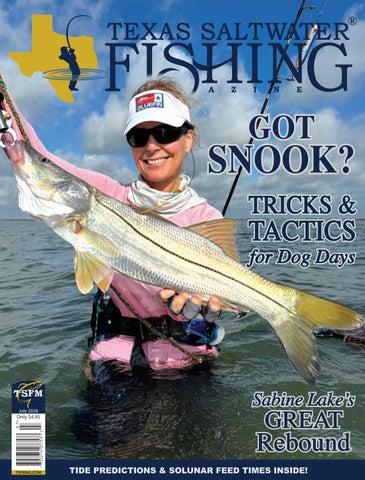
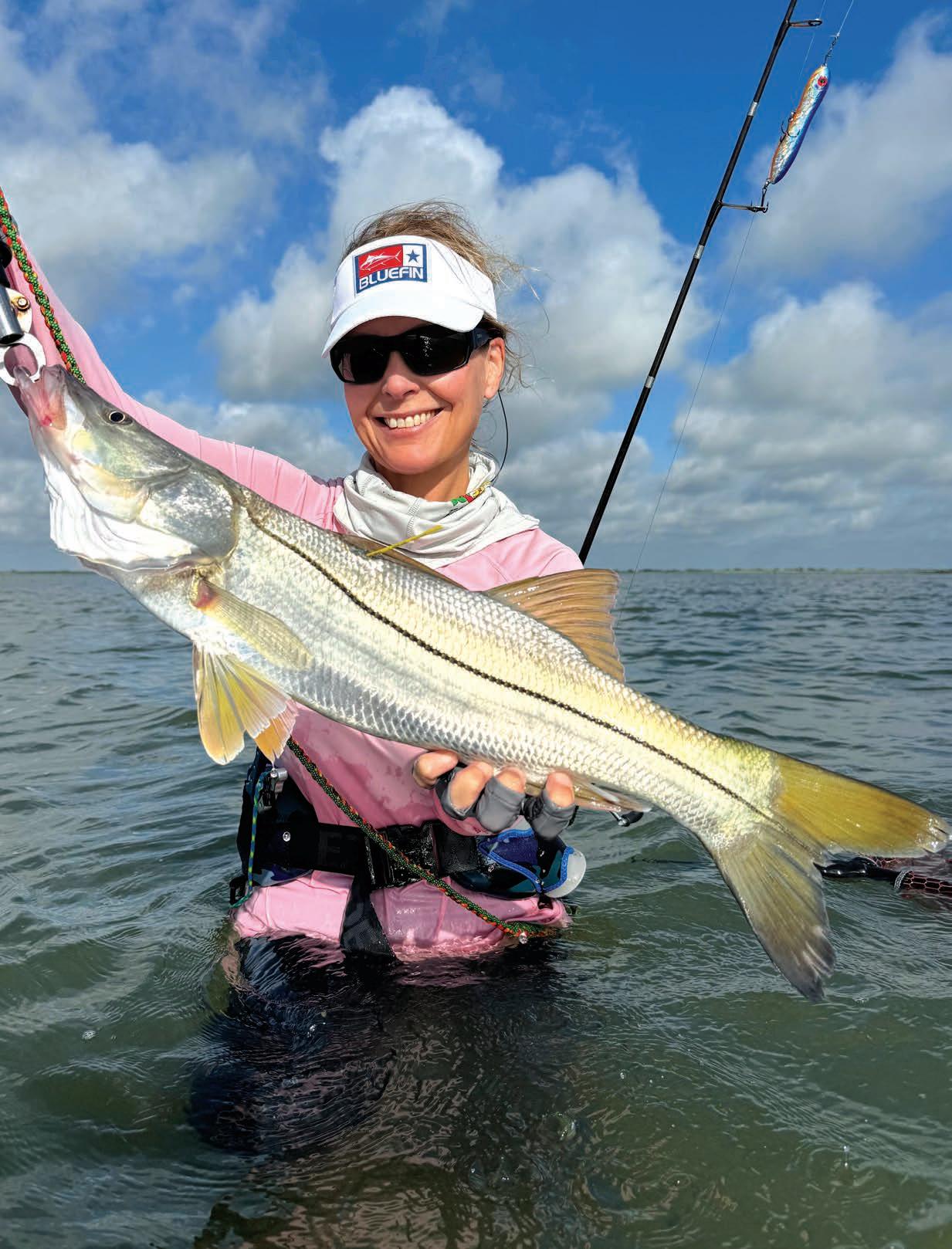
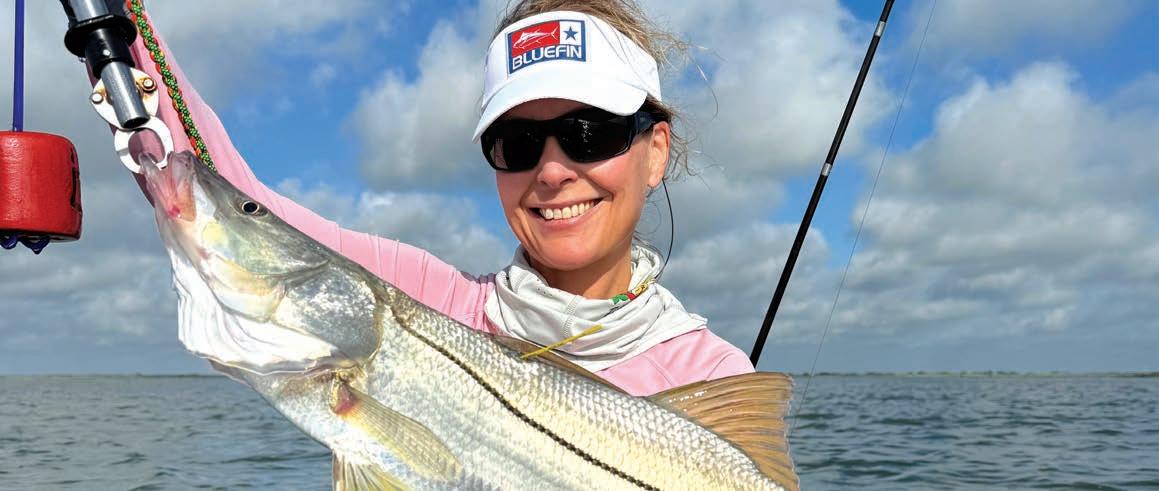
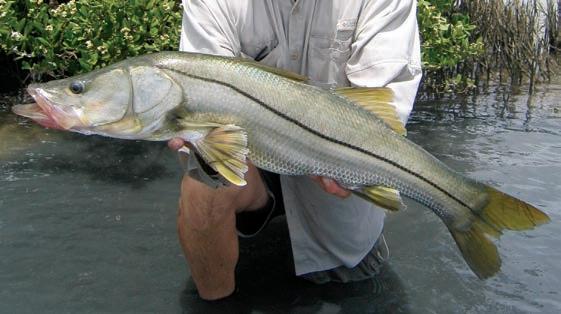
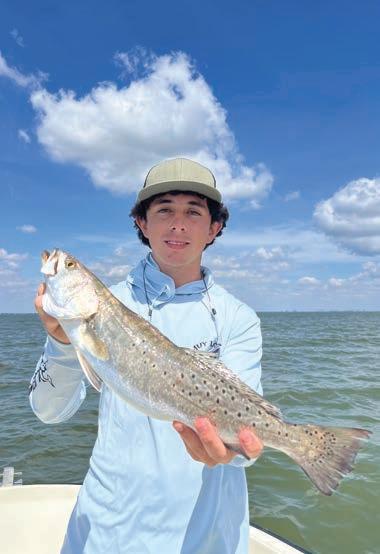
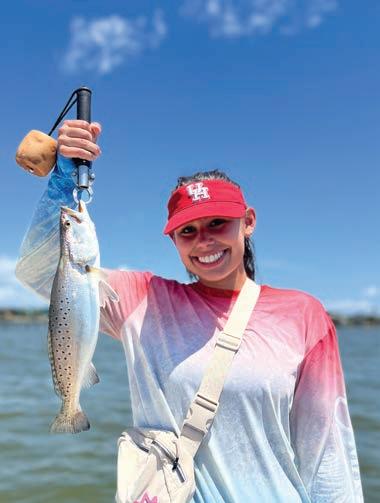
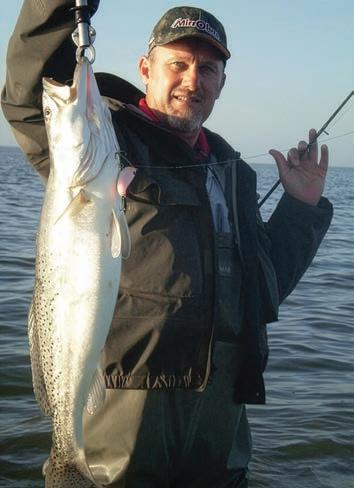
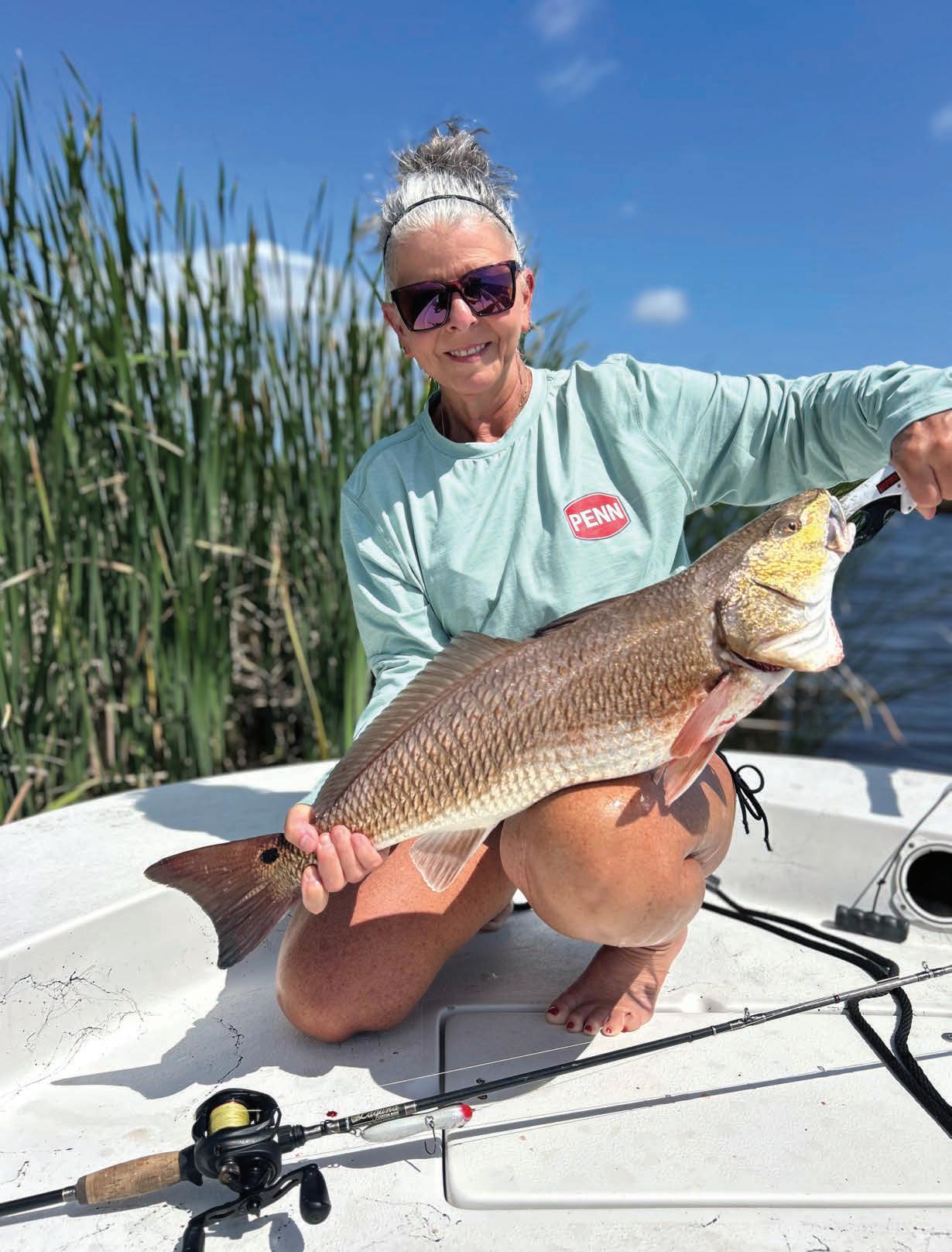
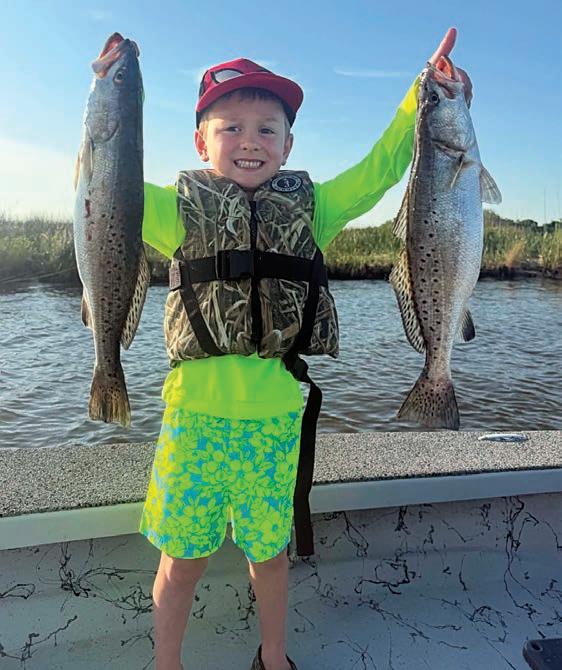
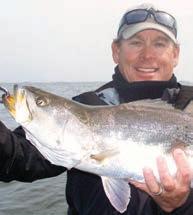
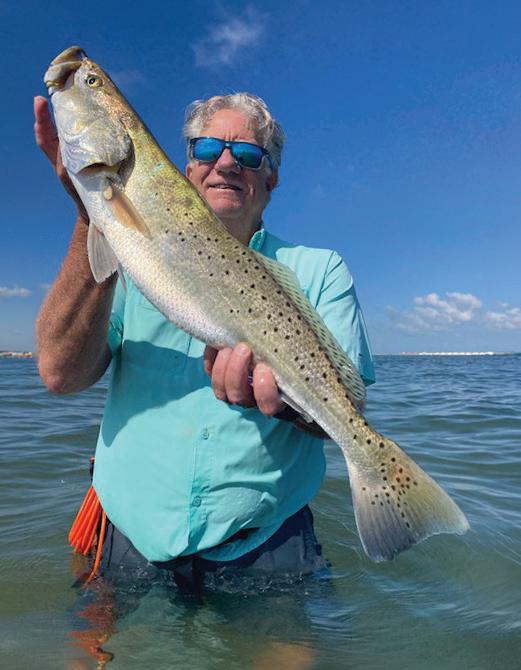
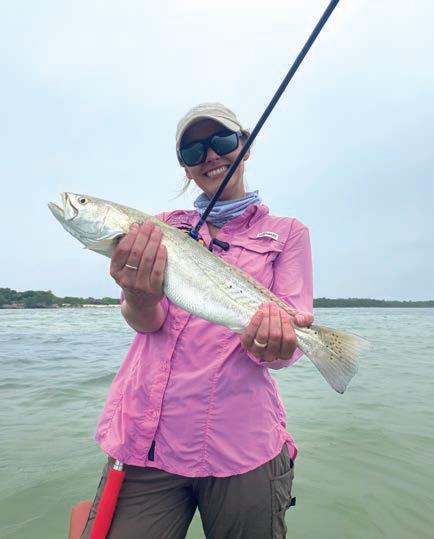
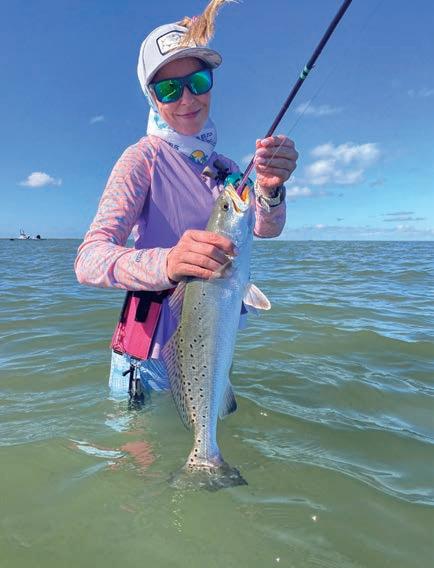
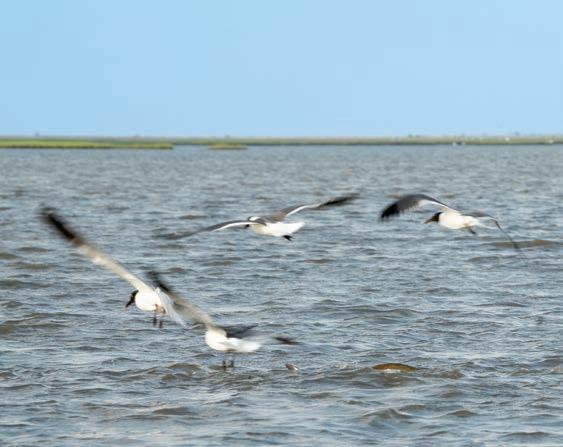
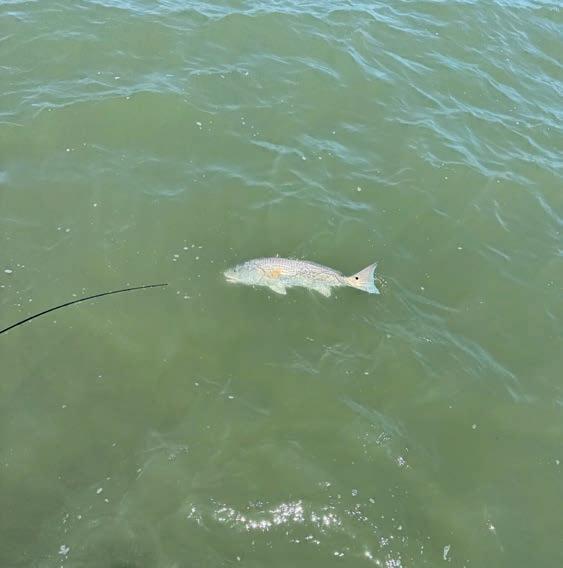
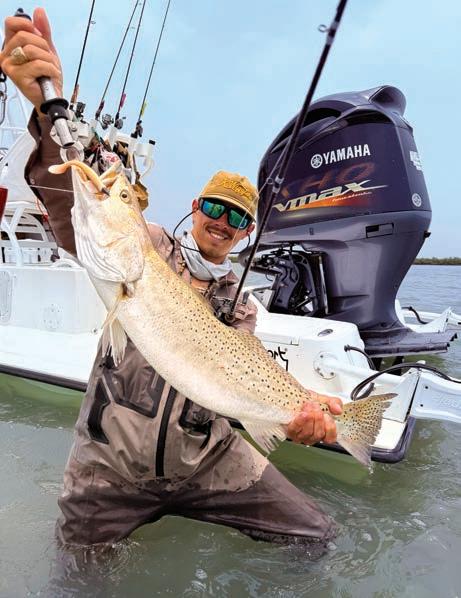
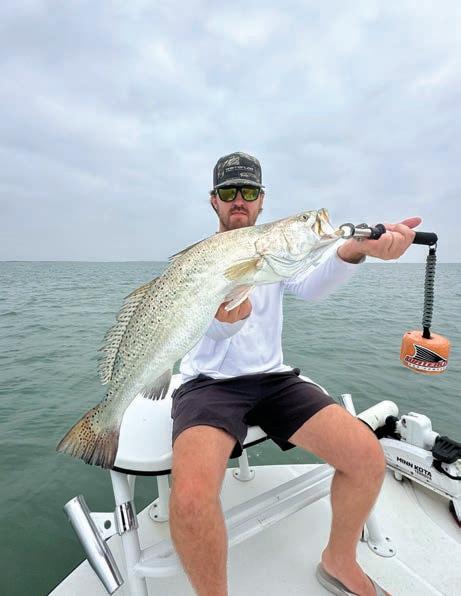
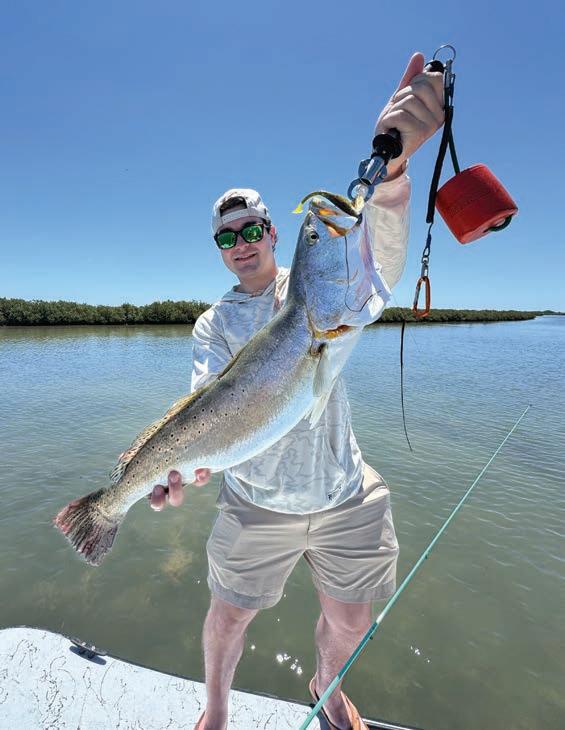
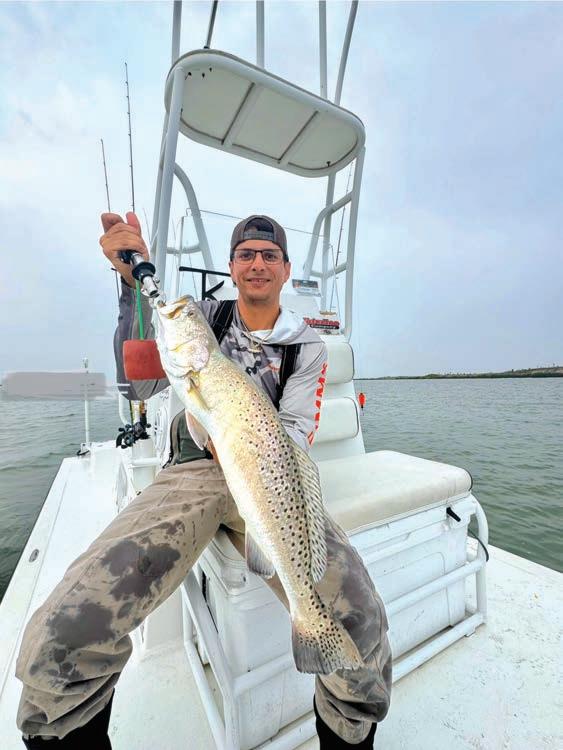
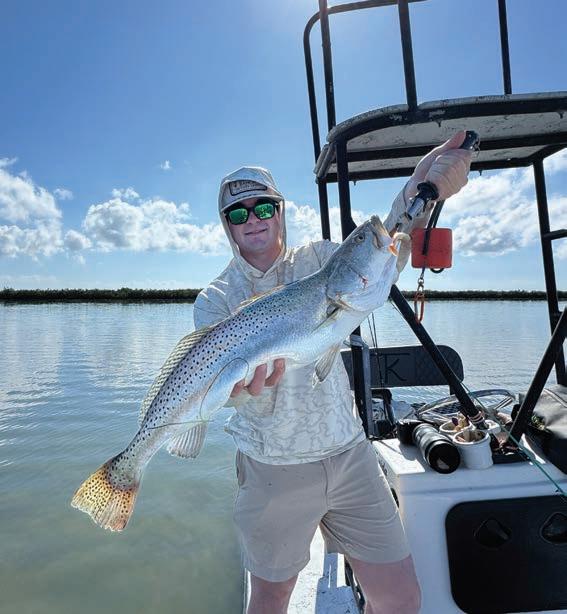
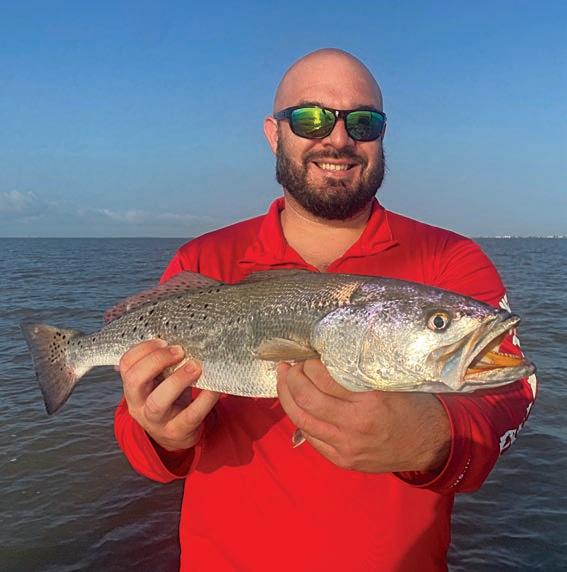
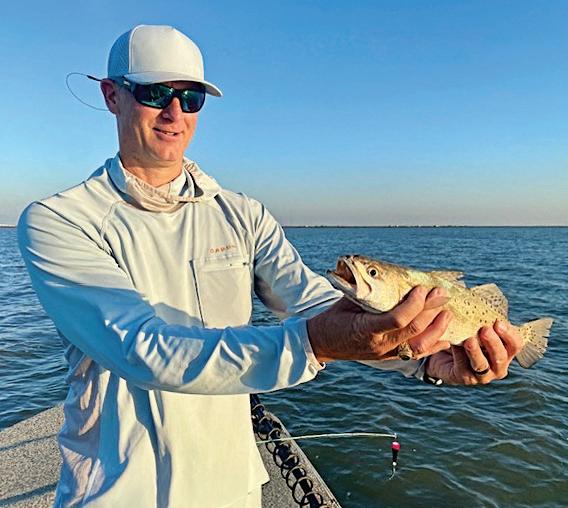
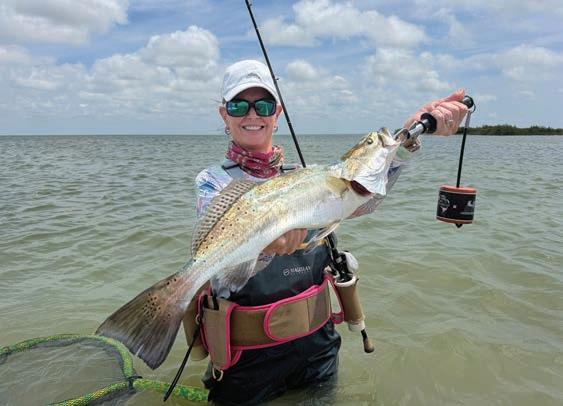
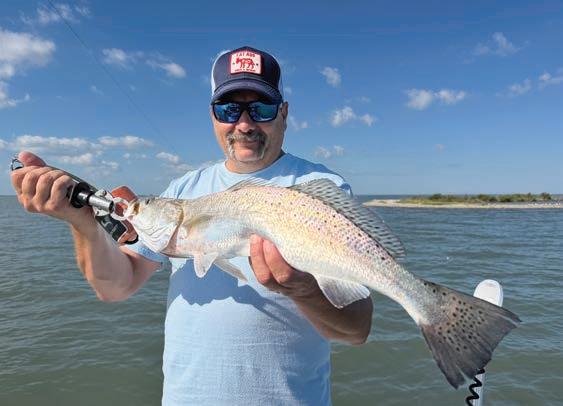
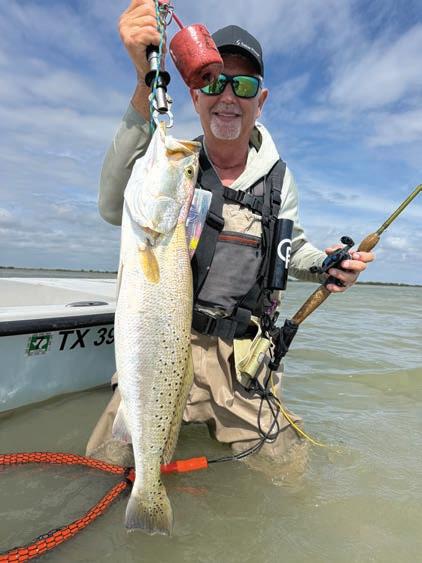
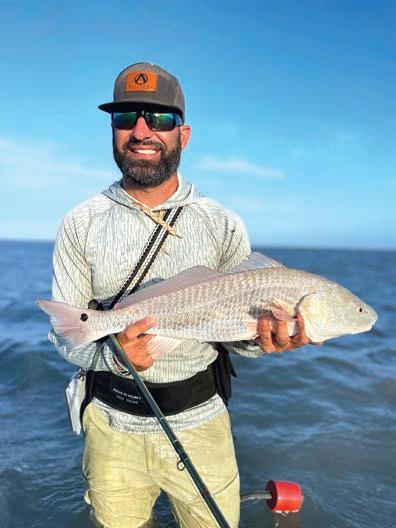
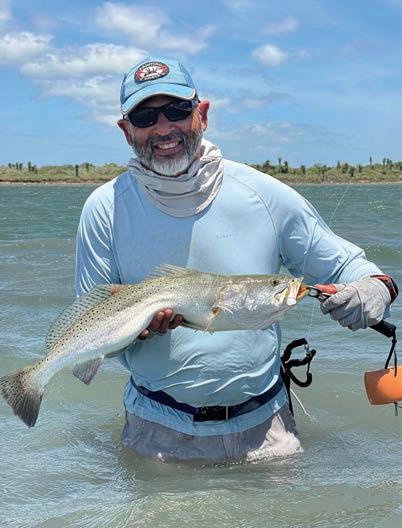
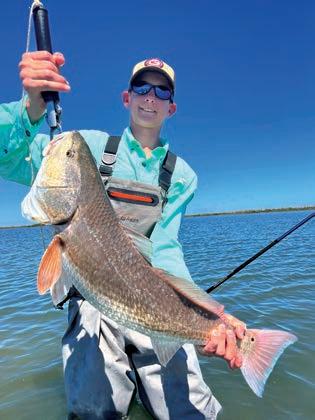
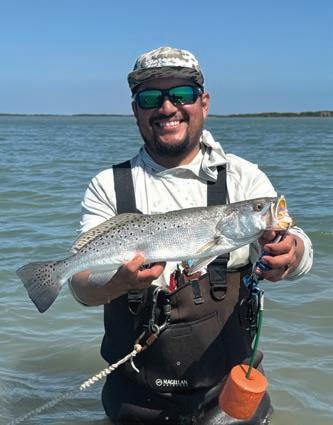
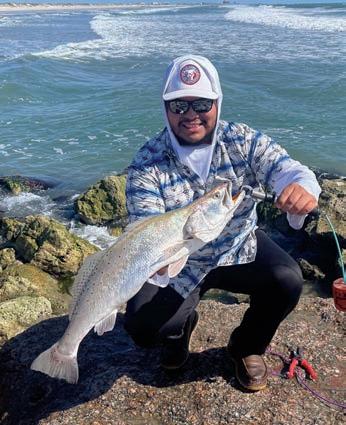
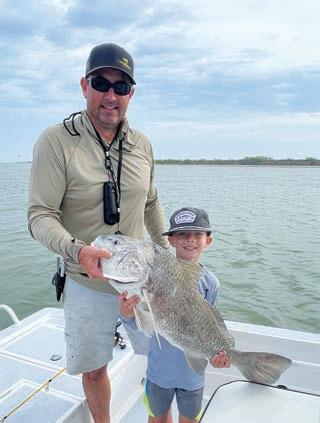
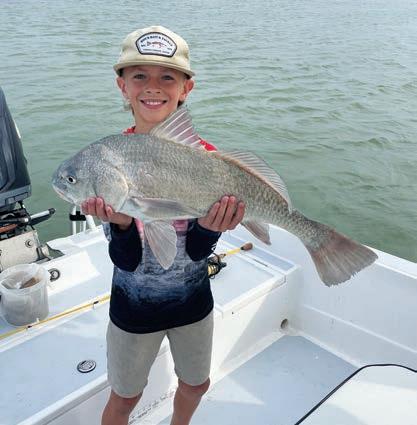
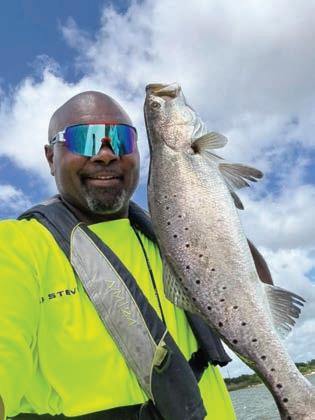
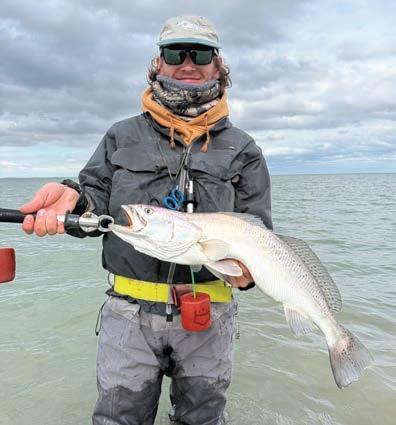
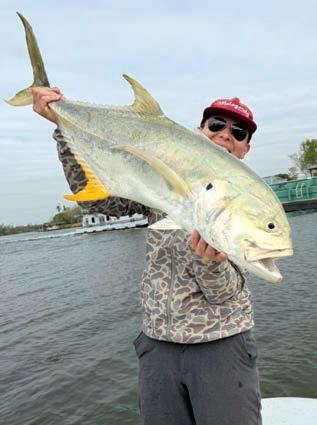
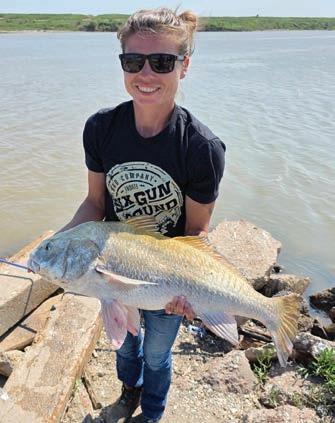
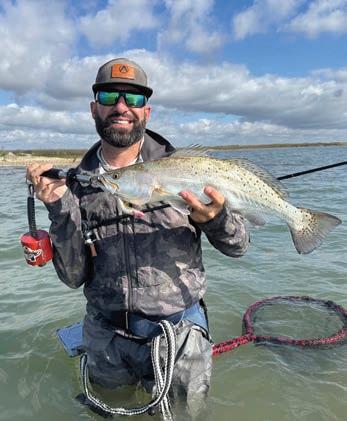
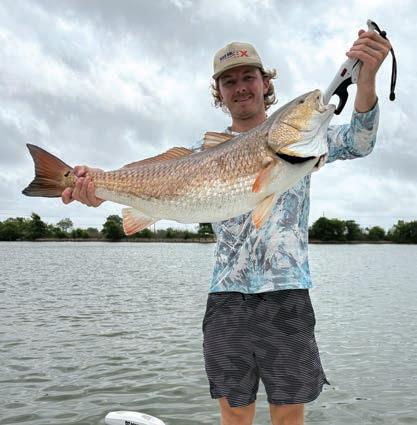
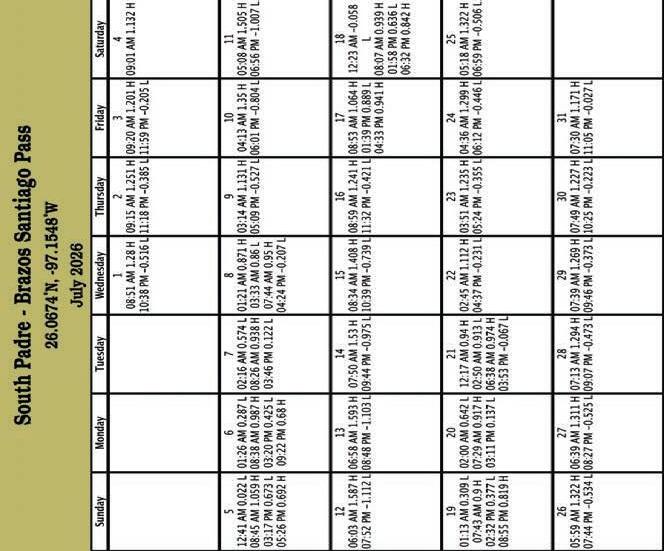
Recently new to wade fishing and especially with topwaters, Catie
was anxious to add a Lower Laguna Madre snook to her species list. As you can see here, it didn’t take long for her to trick a fine specimen on a Mansfield Knocker. This fish was tagged for Harte Research Institute and released to fight another day. Way to go, Catie!
EDITOR AND PUBLISHER
Everett Johnson | Everett@tsfmag.com Office 361-785-3420 Cell 361-550-3637
VICE PRESIDENT
PRODUCTION & ADVERTISING DIRECTOR
Pam Johnson | Pam@tsfmag.com Office: 361-785-3420 Cell: 361-550-9918
PRODUCTION / SOCIAL MEDIA DIRECTOR
Jennifer Shive | Jen@tsfmag.com
ADVERTISER REPRESENTATIVES
Bart Manganiello | bartalm@optonline.net
Pam Johnson | pam@tsfmag.com Office 361-785-3420 Cell 361-550-9918
Everett Johnson | everett@tsfmag.com Office 361-785-3420 Cell 361-550-3637
Texas Saltwater Fishing Magazine is published monthly.
Subscription Rates: One Year (Free Emag with Hard Copy)
Subscription $32.00
E-MAG (electronic version) is available for $15.00 per year. Order on-line: WWW.TSFMAG.COM
MAKE CHECKS PAYABLE TO: Texas Saltwater Fishing Magazine Attn: Subscriptions P.O. Box 429, Seadrift, Texas 77983
* Subscribers are responsible for submitting all address changes and renewals by the 10th of the prior month’s issue. Email store@tsfmag.com for all address changes or please call 361-785-3420 from 8am - 4:30pm. The U.S. Postal Service does not guarantee magazines will be forwarded.
POSTMASTER: Send address changes to Texas Saltwater Fishing Magazine, Inc., P. O. Box 429, Seadrift, TX 77983.
Celebrating 250 years of American freedomHere’s 250 more!
Follow and Like us on YouTube!
HOORAY FOR 250!
Wave the banners. Strike up the band. The Good Old USA turns 250 this month!
Folks who grew up in the current era probably wouldn’t believe it, but the success and continued existence of this greatest nation the world has ever known wasn’t always a sure bet. Actually, back in 1776, political experts around the world considered the whole idea of self-governance via the concept of a constitutional republic as an odds-on favorite for failure. How in the world could a ragtag bunch of rebellious colonists who somehow managed to drive the British from their shores ever have a snowballs chance?
Well, so much for all that sort of nonsense. But the road wasn’t always easy. You might recall an enormous test of the founding concepts of life, liberty, and the pursuit of happiness during the 1860s – the Great American Civil War. Abraham Lincoln spoke of it in his famous Gettysburg Address. “Four score and seven years ago our fathers brought forth on this continent, a new nation, conceived in Liberty, and dedicated to the proposition that all men are created equal…
Now we are engaged in a great civil war, testing whether that nation, or any nation so conceived and so dedicated, can long endure.” Even eighty-seven years later, hosts of supposedly learned folks were still saying, “See, I told you so!”
Here in the year 2026, the concepts of our founding are still being tested, and I am amazed at the number of folks who have enjoyed great wealth through celebrity are threatening to leave this country, supposedly out of political rancor. I say, “Go! But on your way out, please tell us where else on earth you could have been more fortunate.”
I was raised in a very patriotic family. My father was a USMC veteran of the Korean War Era. As youngsters, he taught us the love of our nation and respect for our flag. I can still recall the American flag waving and strains of the Marines Hymn and National Anthem blaring from the crackly speaker of an old Decca phonograph on the Fourth of July. If your upbringing might have been different, please excuse me while I salute the American flag.
We are by and large a very coddled society, as compared to our forebears. But that aside, where else on earth could we enjoy the level of prosperity that allows participation in pastimes such as sportfishing? Never forget how blessed we are to be Americans and citizens of the Greatest Nation the World Has Ever Known!
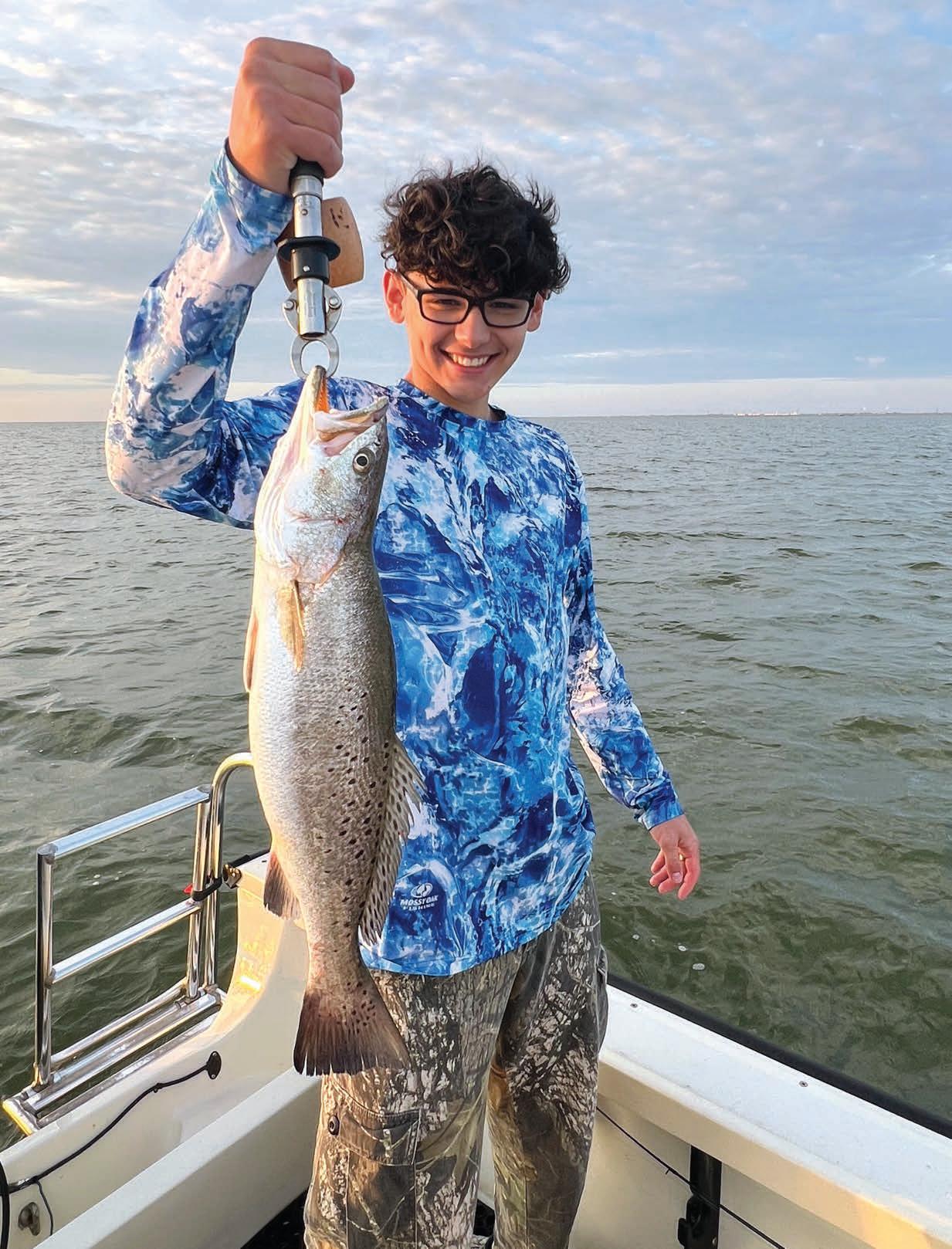
Alec Vasquez caught this beauty and many others on his first-ever saltwater fishing trip!
STORY BY STEVE HILLMAN
I’ve written a lot about the changes Galveston Bay has seen through the years. We are not unique here on our part of the coast. Virtually every estuary, bay, sound, lake, river and any other body of water we can think of has experienced changes over time. Some have been caused by man while others have been Mother Nature induced. In most cases it has been both. We are simply a place marker on a timeline. We’re here for a finite amount of time, and we notice the changes during our stay while having the privilege of using the resource. Those who came before us did the same thing, but they observed different changes than us even though they probably said many of the same things that we say now. “Man! I sure miss the good ole days” or “Things just aren’t what they used to be.”
I feel like at this point it would be somewhat exhausting to give detailed explanations of all of the changes we’ve experienced here in the Galveston Bay Complex, but please feel free to peruse some of my past articles in this fine publication to listen to my take on said changes. My article titled “Assessing Thirteen Years of Trout Stack-Ups in Galveston Bay” from August 2021 does a good job of explaining many significant changes that have impacted our bay system. To give a quick summary, we’ve had thousands of acres of our primary habitat (oyster reefs) silted over with the biggest culprit being Hurricane Ike on September 13, 2008. Since then we’ve had droughts, floods, and channel dredging projects along with natural erosion and subsidence. We’ve lost virtually all of our seagrass beds. In my opinion, our toughest years for catching trout in the last twenty were the ones immediately following the floods of Hurricane Harvey in August 2017. Our bay system got almost completely purged (by fresh water) of trout, and we had to basically start from ground zero. The summers were especially tough. On a side note, 2018 and 2019 were two of the best years I’d had in East Matagorda Bay in years for numbers and big trout. Many others believe that many of the trout from Galveston Bay followed the freshwater wedge down the coast to Matty following the floods.
It’s not that we didn’t have any fish (mainly referring to speckled trout) during those lean years. We still had some 30-60 fish days, but we caught most of them in just a few spots, and the majority of the specks were younger age classes (1- to 3-year-old fish). Our bay reminded me of a guitar that was out of tune. If you were good enough and tried hard enough, you could still make it sound good, but it still needed tuning. And then the tune-up efforts began.
TPWD, CCA, Nature Conservancy, Galveston Bay Foundation, U.S. Army Corps of Engineers, Texas GLO, the oyster industry and countless volunteers have contributed more than 1,300 acres of oyster reef restoration projects since Hurricane Ike. River rock, limestone and oyster shell have been the main substrates (cultch) used. Cultch used to be planted in flat layers adjacent to existing live reefs, but in recent years the substrate is typically placed strategically in mounds with a more eccentric rise above the bay floor to help prevent siltation. Jetty-like revetment walls constructed of concrete chunks and granite along with shoreline Spartina (cord grass) planting projects have also provided habitat in many areas of our bays. There are even a few areas where I’m seeing a resurgence of seagrass. Speckled trout limit changes September 1, 2019 (10 trout to 5) and March 26, 2024 (5 to 3 with a 15–20-inch slot) have certainly played a role in improving overall numbers (biomass) and more mature age classes in the population.
So here we are in July of 2026. Despite everything that has happened along the way, things are doing pretty darn good. In years past my focus areas for trout this time of year would be predominantly open-bay oyster reefs, channel spoils and old well pads. Wading the Pig Pens, Fat Rat and the north shoreline of East Bay would also be in the mix, especially during the early hours of the day. While we do still catch some fish in those areas, I tend to focus more of my attention on man-made structures and oyster reef restoration sites these days during the hotter weather months. We still catch fish in those other areas I’ve mentioned, but we no longer see the giant rafts of mullet or the big schools of trout that we used to see there.
Slicks out over deeper reefs and rock structures and wells in 9- to 13-feet water are producing well for us. A lot of folks automatically think they need to rig their soft plastics on heavier jig heads (1/4 or 3/8 ounce) when fishing deep water. This is true for the most part, especially when there is a moderate to swift current, and/or some
wind. There are other times when winds are light and tide movement is minimal, causing trout to just suspend somewhere in the water column. We witnessed this on yesterday’s trip.
We were in about 10 feet of water. I had three new clients. Vanessa, Victoria and I were rigged with Assassins on conventional 1/8-ounce heads, while Alec was using one of my rods still rigged with a Pro Elite 1/8-ounce head from a previous trip. He was absolutely wearing out nice trout while we were only able to trick a few. I finally switched the rest of us over to exactly how I had him set up (Laguna Shrimp Saltwater Assassin Sea Shad rigged on eighth ounce Saltwater Assassin Pro Elite lightweight jig head). Needless to say, I wish I would’ve done it sooner. Sometimes little changes like that change the entire outcome of your day.
We don’t always go deep this time of year. We’ll continue to catch plenty of fish along sandbars near San Luis Pass and along broken shorelines, especially early in the morning. Topwaters like MirrOlure She Pups and Rapala Skitter Walks can produce some excellent results. Sometimes, we’ll even catch them way up shallow in the middle of the day. We witnessed this just recently when rain showers cooled the surface water and increased the dissolved oxygen level. The trout pulled up much shallower than they would otherwise have for the particular spot we were fishing.
I’ve also witnessed dolphins and sharks pushing trout up shallow and making them easier to catch (when they don’t completely run them off). This has actually become a very common occurrence here in Galveston Bay in recent years. Dolphins used to hang out around shrimp boats which provided easy meals as they simply just gorged on the shrimpers’ bycatch. Nowadays, there are fewer shrimpers, so dolphins and sharks focus more on us (fishermen) and their inherent ability to hunt down prey. There are a few places here in Galveston Bay that I don’t even like to fish because dolphins anxiously wait at the side of my boat for us to release trout.
Mike Silva with a solid trout on what’s become one of my favorite colors since Bass Assassin rolled it out (Flamingo Flash).
Conner Austin tricked this thick one while drifting over live oyster in about 7 feet.
Bill Austin has been coming down from North Texas for years to fish with me. He always seems to time it just right. He did it again on his recent trip!
We are finally getting some significant rainfall amounts as I type this article. I’ve gotten almost 8 inches in the last two days here where I live, and the Lake Livingston dam is currently discharging at a rate of 7,500 CFS. That’s a far cry from the 85,000 CFS it was flowing at this time two years ago. It’s been so dry that most of it is getting soaked into the ground. I’m praying that our salinity levels stay balanced throughout the entire bay system so we can continue to increase our resident populations of trout.
It seems like we’re continuously having shad hatches and there are lots of shrimp in the bay. I’ve also noticed more blue crabs swimming past my boat as we drift. We’re catching quite a few black drum while we’re trout fishing. Water clarity has been incredible. There was recently a big tarpon hooked somewhere up the San Jacinto River and a small tarpon a friend / client of mine caught way up a bayou, not far from where I live. These are all very good signs. I think about all of the places we caught trout and redfish back in the day. It was amazing. Then I think about the areas within our bay where we catch them now, and I think to myself, “Wow! So much has changed.” The good news is that I’m now seeing some fish show up in a few of those “back in the day” places! I’m even seeing occasional huge rafts of mullet now which is refreshing. All forms of marine life are important, but seeing our bays full of mullet is a tell-tale sign of a healthy fishery.
Things are most definitely different nowadays. Social media has changed fishing and just about everything else. Very few folks write checks anymore. “Hey captain, do you have Zelle?” “How about Apple Pay or Venmo?” Everything is done online and electronically now. Things have changed. It’s not bad. It’s just different. We can’t turn the clock back to the mid-eighties or whichever time period that we remember as being the best, but there is something we can do. We can enjoy what we have now and appreciate the changes that have been made by those who have cared enough about our resources to step up and make a difference. Good luck and happy fishing!
STEVE HILLMAN
is a full-time fishing guide on his home waters of Galveston Bay. Steve fishes the entire Galveston Bay Complex, wading and drifting for trout, redfish, and flounder using artificial lures.
Steve Hillman
Victoria Vasquez with her first trout ever on a weak tide day when the trout were not easy to trick.
Kyle Murfitt popped a good one on one of his custom soft plastics (KTX Baits)!
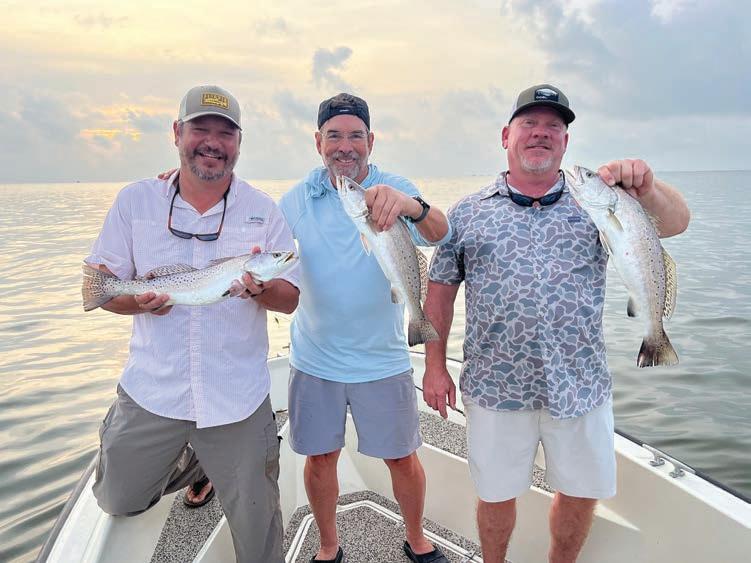
We’re seeing a lot of 18-21 inch (3 to 4 year old) trout in our system this year as shown here on a stellar catching morning with longtime client- friends, Frank Mistretta, Kent LeMonte and Dutch Duckett.
Critica
al Mass
STORY BY KEVIN COCHRAN
Absolute Number One governs the efforts of anglers with unwavering certainty. In order to catch fish, one must find fish. It would be easier to grab a wet sponge and safely bathe a Bengal tiger or to land a paper airplane on the surface of the sun than to catch a fish in a place where no fish swims. Absolutes establish simple, foundational clarity, but making consistently productive decisions about angling efforts requires reliance on more complex principles.
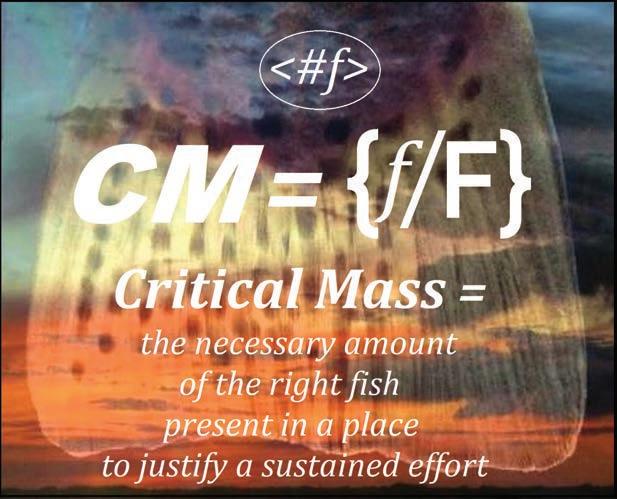
Ideally, anglers fish in places holding plenty of fish. In the context I’ve invented here, which focuses specifically on coastal anglers fishing with artificial lures, I use the term Critical Mass (CM) in a specific and limited way. For the purposes of this discussion, Critical Mass represents the amount of fish present in a place necessary to justify a sustained effort. In the previous statement, the term amount has two significant and separate meanings. The amount of fish does mean the raw number of fish, but in a more complex way, the term amount represents the number of targeted fish as a percentage of the total number of fish present.
The term fish also has multiple meanings in this context. In the graphic I’ve included with this piece, I’ve used the character ƒ to represent the targeted, or desired fish, and a capital F to represent fish, generally. Significantly, I only consider species which might be caught by an angler trying to catch the targeted fish (ƒ) when thinking of fish in general (F).
Anglers’ priorities affect the values of Critical Mass. One angler fishing for one trophy fish creates a context for CM which differs from a group of anglers targeting limits of fish. More anglers desiring to catch and/or keep more fish increases not only the value of CM, but also the need for
larger areas, where more anglers can cast at spots holding desired fish. The nature of the area, especially whether it’s likely to facilitate new fish replacing caught fish, influences the original value of CM, which evolves over time. Certainly, targeting fish roaming around the rocks of a jetty differs significantly from targeting them in a tiny corner of a back-lake, and those differences affect CM.
The specific numeric value(s) of Critical Mass prove difficult or impossible to determine. Obviously, an angler can’t catch a speckled trout measuring at least thirty inches in length unless at least one swims within reach. Likewise, four anglers attempting to catch limits of redfish need at least twelve reds measuring at least twenty inches but not more than twenty-eight inches within their reach. However, percentages favor people who fish in places holding more than the minimal number of the right fish. Most likely, the raw number of the right fish must be at least three or four times the minimal amount to justify a sustained effort in a place, and those fish probably must represent at least 33% of the fish (F) present in the place.
Some species of fish significantly affect the value of CM, while others don’t. The snapping jaws of hordes of dink trout and/or ladyfish can make catching big trout nearly impossible. On the other hand, sheepshead and black drum don’t readily strike conventional lures, so anglers fishing for trout, reds and flounder in places holding large schools of those species can largely ignore them. Trophy trout anglers can’t ignore a bunch of reds swimming around in the spot where they hope to land a monster trout. In many cases, the reds show much more willingness to strike lures than big old trout, and they take time to land after they’re hooked, so they can pose real problems for folks hoping to catch the trout of a lifetime in places where decent numbers of them swim among a larger number of the bronze bullies.
Unless we can see the fish, we must use our experiences and our ability to earn strikes in a timely manner to make educated guesses about whether the CM is present in a place. Doing this successfully means calculating the expected bite-rate appropriately, considering the timing of the outing and the conditions in play, as well as making
smart choices with regard to lure choice and presentation style. Guides and competitive anglers who hope to survive and thrive must become proficient at all these things over time. When I look back on my career to this point, I realize I made many predictions related to CM, though I didn’t think of those decisions in the terms stated here. Three poignant anecdotes clearly illustrate what I mean.
On the last day of September 2001, four partners and I caught a bunch of trout weighing at least four pounds, the biggest nearly seven, in a Rockport Troutmasters event. We made this catch on a day when most of our competitors brought light sacks to the scales, either barely able to get three fish big enough to qualify, or failing to do so. Importantly, we caught our fish in a tiny corner of a cove, and we hooked and lost several others while doing so. I knew this would cause trouble for us on the second day of the event.
I told the others, “We just caught over a dozen big trout in this little pocket, and we sore-mouthed at least ten more. I don’t see how we have enough fish left for tomorrow.” We all needed three more fish on day two, a total of fifteen trout. “If we aren’t catching the right fish in numbers by 11 o’clock, I’m bailing out of here to go find three keepers to weigh.” When the hour arrived, the five of us had managed to catch just a single four-pound trout between us, landing no smaller trout, no reds, no other fish at all. We did leave the place, all agreeing we’d arrive at the scales wearing the smell of skunk if we didn’t.
It’s possible a CM of big trout still swam around close in front of us on day two, since those kinds of fish can become tough to catch for a while after they feed vigorously one day, as they did for us on the first day of the event. I doubt it, though. Seems much more likely we reduced the number of fish too much on day one, and the nature of the spot didn’t readily facilitate it filling up with new fish overnight. Sometimes, in other types of places, new fish arriving in a place can alter CM negatively, as it did for me at the end of a really productive run catching big trout in 2008.
I’d been fishing at Summer House nearly every day for about a month, at first catching a fairly modest number of trout, but with a
The captain caught this monster trout after making a decision to fish in a spot where the bite had slowed significantly over the previous few days, proving at least one of the right fish still swam within reach.
Clay Baldwin caught this flounder while fishing with Captain Kev, trying to catch a trophy trout. If too many other fish swim in a place holding a few big trout, catching the trout becomes more difficult.
The jagged jaws of hungry medium-sized trout like the one Terry Larner holds here can pose problems for anglers targeting trophy trout.
healthy percentage of the fish weighing over five pounds, up to nearly eight. On the memorable day, things changed, when I and four clients landed at least 120 trout by lunch time, but the biggest stretched the tape to just 23 inches. “We got to move,” I said. “We have too many smaller trout in here now. Even if we still have some of the big ones, the others are beating them to our lures.”
We moved and proceeded to catch 15 trout over 25 inches, with the biggest measuring close to 29. In the new location, one with an obvious CM present, we caught no smaller trout at all. In this case, my focus on the priorities of my customers drove me to leave fish to find fish. I knew they wanted to catch a trophy trout, and I strongly believed we would fail to catch big ones if we stayed in a spot holding so many smaller trout. Obviously, a guide with the goal of returning to the dock with limits of trout would have already gone in before I chose to leave so many solid trout biting, in search of bigger ones. This scenario differs significantly from another one in which I successfully made a calculation related to CM
In 2010, in the midst of the best run of big trout fishing I ever experienced, I and my clients had caught at least one trout weighing at least nine pounds four trips in a row when I stuck the Power Pole in the mud in the North Badlands to begin a new day. “I hope y’all like the scenery here,” I told the two guys in my boat. “If we get one bite within the first two hours, we’ll be here all day. This spot has been producing monsters for us, but it’s getting tougher to catch ‘em as the water warms up.”
The streak had started in the place after water temperatures bottomed out at 50°F. At first, we caught plenty of trout, including several over seven pounds, with the really big ones serving as icing on the cake. Over the coming days, as the water warmed, we caught fewer and fewer fish, but we still managed to bring at least one giant
Critical Mass One
to hand. On this, the final day of the streak, I caught a four-pound trout about 45 minutes after we stepped into the shallows, and I stayed true to what I had told the guys at the start. Four hours later, I coaxed a fish to strike my Fat Boy with deadly intent; she nearly yanked the rod out of my hand. Right at thirty inches in length, the fat sow trout weighed a shade over ten pounds. Two hours later, one of my clients caught the biggest trout of his life, reinforcing my belief in the decision I’d made.
On that occasion, fishing on an expansive flat with few fish present, we did manage to prove we still had a Critical Mass within our reach. I didn’t choose to stand and grind that day thinking of the terms I’ve used in this piece. But I did base my choice on our priorities and on my perception of how the nature of the place and the evolving conditions exerted influence on how many of the right fish we’d likely encounter if we stayed. The next day, I didn’t fish the spot for long, because I believed the number of big trout present in the place had fallen to a point where we’d crash and burn if we stood on it all day.
Anyone interested in establishing a consistent level of productivity must make accurate predictions with regard to the likelihood of CM being present in the places they choose to fish. They must always keep their priorities at top of mind. In places with clear water, where anglers can see the fish they target, these predictions become simplified. But in other places, where anglers can’t see fish, they must adeptly apply their skill sets, to assess whether a Critical Mass of the right fish swims within their reach.
KEVIN COCHRAN
Kevin Cochran is a long-time fishing guide at Corpus Christi (Padre Island), TX. Kevin is a speckled trout fanatic and has created several books and dvds on the subject. Kevin’s home waters stretch from Corpus Christi Bay to the Land Cut.
T ROUT TRACKER GUIDE SERVICE
Phone 361-688-3714
Email kevincochran404@yahoo.com
Web www.captainkevblogs.com
The presence of a CM of fish in a place does not guarantee people can catch them. On the day Matt Mauger caught this pretty trout, he caught about a dozen others like it, while the captain caught nearly nothing.
Perfect upper slot redfish can be found from the back lakes to the jetties.
AND SO IT
BEGINS
STORY BY CHUCK UZZLE
It’s almost unimaginable that we are halfway through the year and the months will now fly by at a seemingly faster pace. Sabine Lake has just been terrific this spring and the momentum continues to build. Quality fish that we thought might never come back have made appearances in several different areas leaving plenty of choices for anglers. As we stare down the second half of the year with high hopes and optimism, it’s not a stretch to think we may be in for something special.
Easily, the biggest story thus far in 2026 has been the resurgence of the speckled trout population, both in terms of numbers and quality. The overall health of the trout population right now has to be as good as it’s been in at least 10 years, when we went on that horrible run of weather-related bad luck. The dry winter we experienced started things off on the right foot as the perennial big freshwater runoff from the lakes to our north never materialized. In fact, Sam Rayburn and Toledo Bend stayed well below pool, with Rayburn still extremely low as I write this column, while Toledo Bend is back near normal levels. The lack of runoff allowed the salinity on Sabine to reach higher than normal levels, which kickstarted the fishing into high gear where it remains.
Several really solid patterns have already emerged as consistent “fish catchers”, and they should continue to produce as the temps climb. The bite along the east shoreline has become much more dependable as good numbers of trout are stacking up near the mouths of the major bayous on the tide changes. This is much more in line with what we are accustomed to seeing this time of year, especially with the brown shrimp that are so incredibly abundant.
Another solid pattern has been throwing swimbaits and shallow running crankbaits along shoreline structure. The rocks that line the channel and the jetties are perfect places for this technique, and they have really shined for us so far this year.
And, of course, let’s not forget the program in the channel where shallow shell meets the dropoffs; this is where many of the bigger fish that have been caught this year came from. You can fish these areas several ways and catch quality trout. There is a surprisingly good topwater bite at times along with large 5” soft plastics, and Corky-style plugs. If you find some shell along the breaks of the channel with a few mullet hanging around, you should set up shop and wait for those trout to show up because they aren’t going to be far behind.
Switching gears a little bit I can honestly say in my 35-plus years of guiding on Sabine I have never seen as many big redfish and jack crevalle in the lake as I have seen lately. These fish are incredible to watch when they really get into a feeding frenzy because nothing that swims is safe. These schools will drive anglers mad as they move so fast while chasing down an easy meal. Many trolling motors have been tested while trying to jockey for position on one the marauding schools.
The best bet is to idle on the outside of the school and then cut the distance to a point where you can reach them with a long cast. Topwater plugs will produce incredible blowups, so be ready if that’s the route you choose to go. I’ve been throwing a Nutty Knocker from Flatwater Baits that is rigged with single hooks instead of trebles so unhooking these big fish is much easier and, contrary to what you may think, you really don’t suffer on your hook-up ratio either.
If I’m not throwing a topwater, I’ll usually have a Coastal Pro rattling cork and soft plastic on a 7-foot medium action Laguna spinning rod which allows me to make ultra-long casts and still have plenty of backbone for hooksets and the fight that follows. Be prepared for some chaos with the rattling cork because you will have to deal with multiple fish at the same time fighting over the cork during the retrieve which definitely makes things interesting.
For those of you that have been waiting for this time of the year to head for the gulf, you are in luck because there will be plenty of options. Starting closer to shore the jetties will be a fantastic option to start your day off, especially that hour before sunrise where you can get your arms stretched by some psycho trout along the rocks on topwater plugs and swimbaits.
A little farther out you can choose to run the beachfront and sightcast tripletail or look for the foamy water as the redfish and big sharks eat everything in their path. The near shore rigs and wellheads will
have trout stacked on them from time to time and, more often than not, they will be really solid fish. Don’t be afraid to hop around and find some that will cooperate.
It amazes me when I look back at the journey Sabine has been on and how far it’s come in the last few years. There were many days I wondered if we would ever see anything that resembled what we had so long taken for granted. I am very encouraged at this time and also thankful for how things have come together. I truly hope the fishing stays as hot as the temps.
Speaking of the temperatures, it would be a disservice to not offer a few words of precaution surrounding fishing in the heat at this time of year. It cannot be overstated at how important it is to take all the necessary precautions during the summer months. Staying hydrated is the most key factor during the hotter months and for some reason it’s the most overlooked. Sunscreen has become a huge topic as to whether it’s good for you or harmful, so I’ll leave that to you as a personal choice. Keeping some sort of shade on yourself with a wide brimmed hat or bandana will do wonders that you will feel at the end of the day. Of course, quality eyewear is a must for many reasons, all the way from general UV protection to being a functional tool to help you catch more fish.
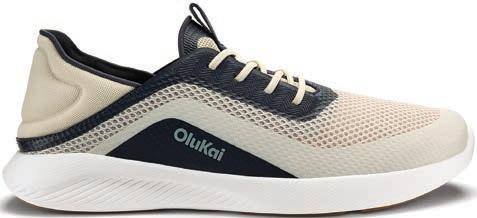
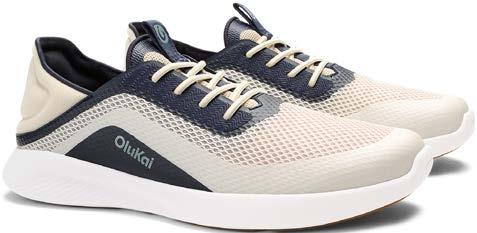
One thing we don’t talk about enough is wearing the right clothing that both protects you and helps keep you cool. Quality shirts, shorts, or fishing pants will make a massive difference in the way you feel during the day. I recently picked up a new Magellan shirt that has a great feel to it and it has become one of my favorites. It’s a ventilated hoodie from the Jacob Wheeler collection and it doesn’t feel like any shirt I’ve worn before, which makes it easy to wear and stay protected from the sun. Finding functional clothing that doesn’t break the bank is difficult sometimes, but this model from Magellan certainly offers plenty of bang for the buck.
You can get your string stretched is almost a sure bet with all the jacks that are roaming Sabine Lake.
Sailor Mitchell with a pair of solid Sabine Lake speckled trout.
To say I’m pretty fired up about our prospects for the summer and beyond would be a gross understatement and just downright false in every way. There are good things going on in just about every corner of Sabine, and it’s a great time to take advantage of those opportunities. The summer is also the perfect time to take a kid fishing as well, so don’t miss out if you have a chance to do so. Stay safe, stay hydrated, and enjoy.
Follow and Like us on YouTube!
CHUCK UZZLE
Chuck fishes Sabine and Calcasieu Lakes from his home in Orange, TX. His specialties are light tackle and fly fishing for trout, reds, and flounder.
Quality redfish are about as consistent as it gets thanks to a plentiful supply of brown shrimp leaving the marshes.
Swimming
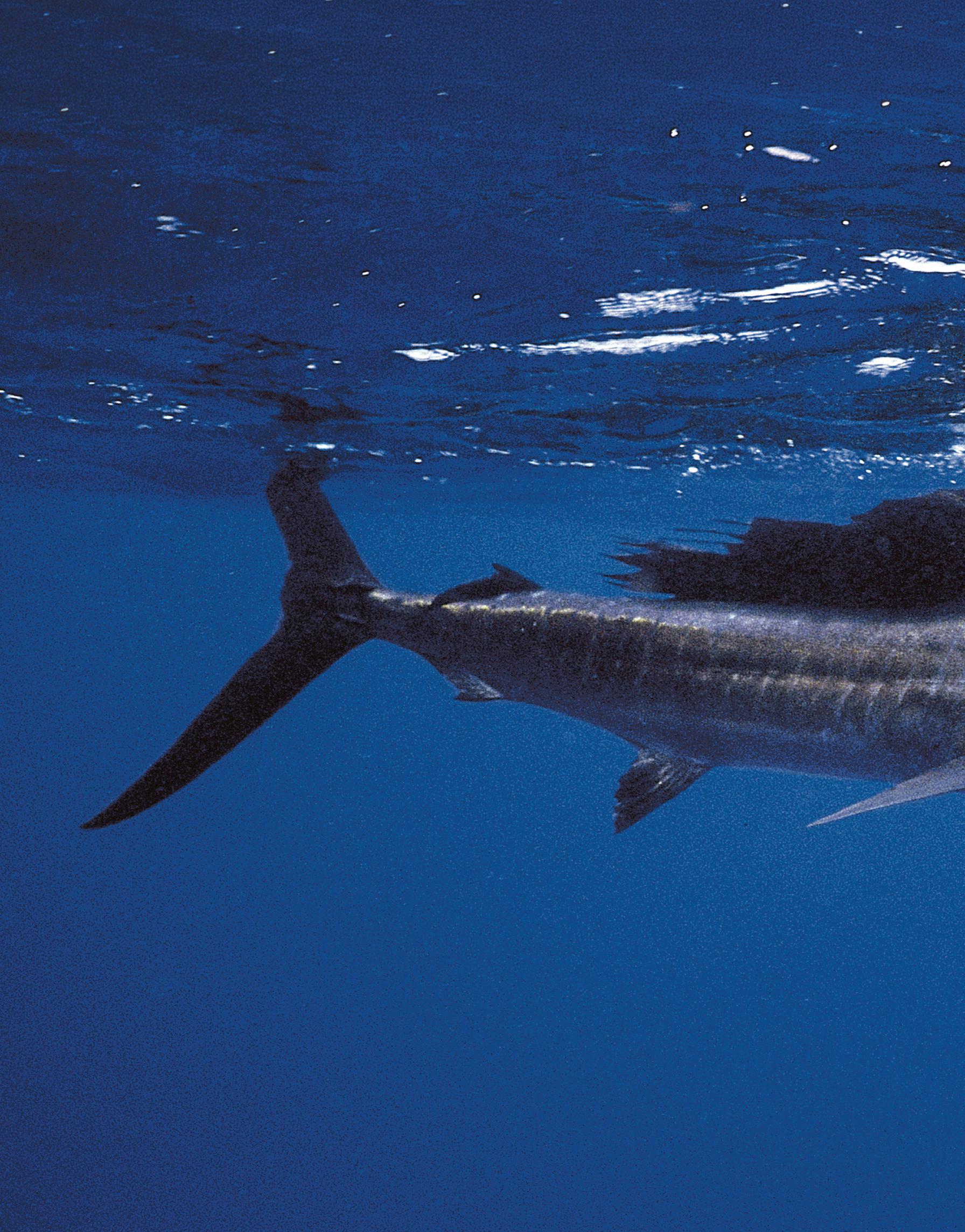
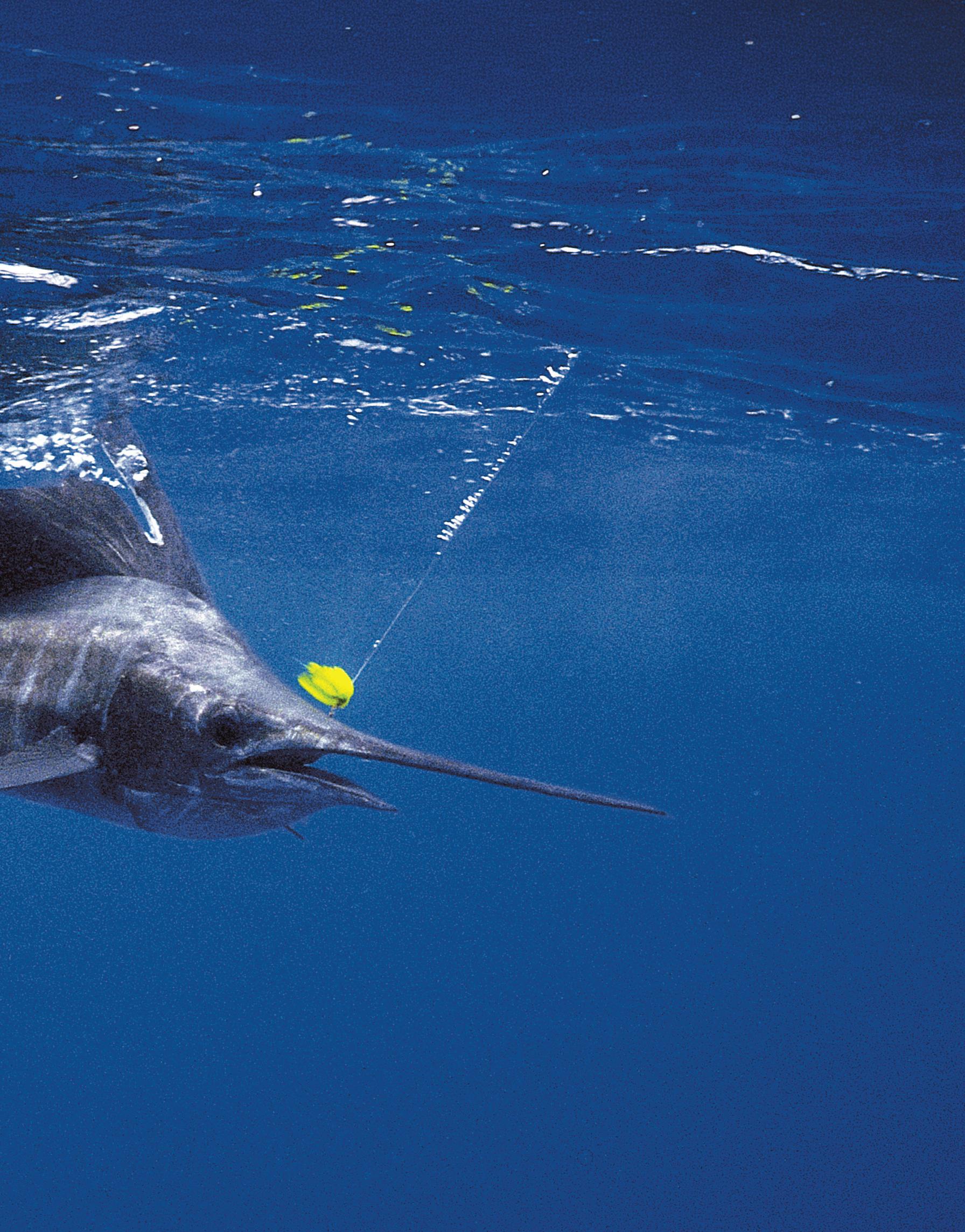
Atlantic sailfish off Cozumel.
Fish WITH THE
STORY BY JOE RICHARD
There have been plenty of fishermen out there with the proverbial wet butt and a hungry gut, but some of us were often soaked from head to toe even when it wasn’t raining. We photographed fish underwater.
Tired of spearing fish, I began photographing them with a new Nikonos III camera in 1979, scoring closeups of a tarpon and barracuda on a single roll of film while snorkeling inside a platform eight miles off the Port Mansfield jetties in a 14-foot jonboat. (A calm day in August). For a dozen years after, I jumped overboard with a number of game fish species. I quickly learned that holding my breath while using a snorkel, carried an advantage in that bubbles from a scuba tank could spook the fish. The photos were handy for illustrating articles on favorite fish species, although it was a thankless and rather expensive task.
Back then, each roll of slide film cost $20 to buy and develop, and this was in late 1980s dollars, the equivalent of almost $60 in today’s currency. About one third of every film roll was thrown away, due to poor exposure, focus, distance, or the wrong angle. (At least the fish didn’t have their eyes closed). And then there was the cost of fishing off the coast and actually catching something in water clear enough to photograph. You had to have a boat, too.
So, there were years of making these underwater photos, often clambering back aboard at the end of each session without even a dive ladder. Lots of adventures, but as the years went by, I gradually became weary of soggy clothes and by then, I’d achieved my goal of photographing most of the popular gamefish species in the Gulf. Aside from building up my personal collection for freelance articles, there was limited financial incentive from employers and increased risk, which dawned on me one day when another employee wondered aloud why I didn’t jump overboard to photograph a hooked wahoo in the Atlantic during February—in the same area where big, satellite-tagged white sharks spend the winter, tracked by biologists on a weekly basis.
A few months prior I’d jumped overboard at the jetties, where bull sharks were common, to get a cover photo of an angler lifting a 20-pound snook into his boat. The photo was captured while treading water with a land camera (and wearing a life jacket. Off to the press. It was around then that I began to question my enthusiasm. I could picture the parent company’s reaction to a mishap: “Missing a leg? No problem, put that man on disability.”
Years before that In the Houston office they nicknamed me after the Charles Bronson movies, assuming my jumping overboard equaled a desire for a short lease on life. My equipment back then was simple and had no flash until my brother bought one at the PX on Guantanamo Bay. Duct tape kept the battery compartment better sealed when underwater. Mostly I used available light, and that meant a sunny sky near midday. I never got hurt while in the water, although a jumping kingfish hit me in the back of the neck with its mouth closed. Out in the Pacific, Buddy Shultz paid a young spear fisherman named Amado to hover close by, watching for sharks, while I took closeup pictures of a big, hooked sailfish alongside the boat.
My camera had a 30-inch minimum focus, so it was better to film bigger fish that filled the viewfinder. You have to move slowly around these fish in a non-threatening manner. My deepest dive was 155 feet at the deepwater rigs off Galveston, which was full of fish, including rare grouper that had never seen a diver.
There were other guys jumping overboard to capture fish on film. In January 1986 a young artist from Jamaica appeared in
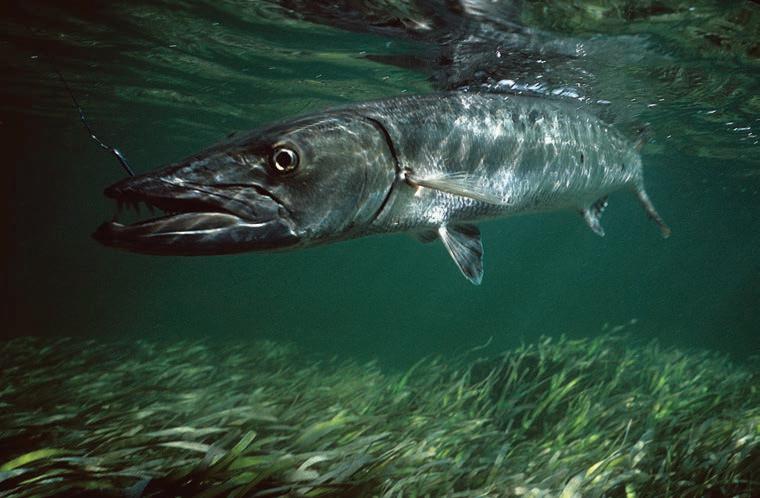
Barracuda near Key West.
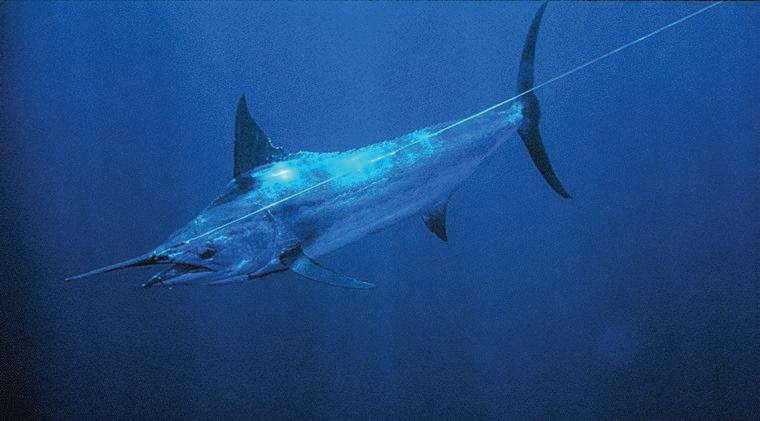
Blue marlin 20 miles off Mazatlan.
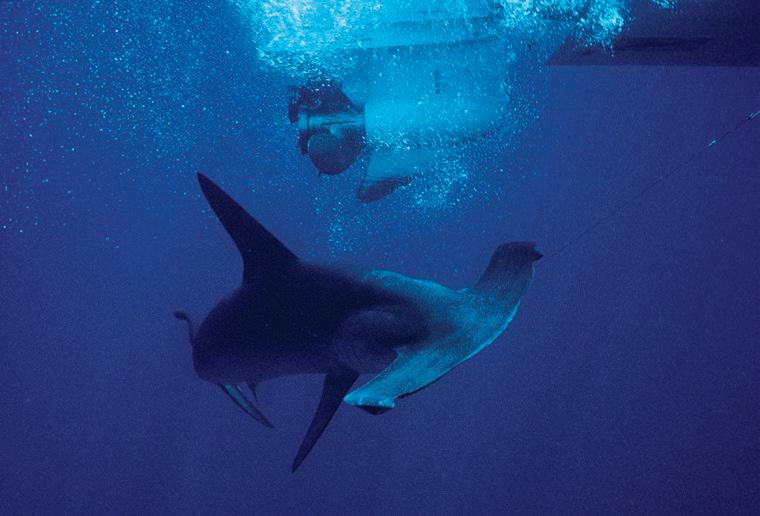
Hammerhead shark in the Pacific.
my doorway at the CCA office, carrying a collection of pen and ink drawings he’d made, inspired by Hemingway’s classic novella, The Old Man and the Sea. The drawings depicted a Cuban fisherman handlining an epic blue marlin from his small skiff, as well as other scenes of him fighting off sharks with a harpoon, with his half-eaten marlin tied to the boat. The young artist was hoping to sell his paintings at CCA banquets. Problem was, they already had a stable of Texas coastal artists such as Jack Cowan, Herb Booth, Al Barnes and Sam Caldwell. Nobody seemed interested in this well-spoken young stranger with the hint of a British accent.
So, I invited him to lunch. We talked about diving and illustrating fish, and he examined the latest issue of Tide magazine, which showed my recent encounter with a blue marlin 20 miles off Mazatlán. He was curious why the big fish didn’t attack, and how it passed right by me while I clicked off 36 color slides. I told him the big fish only eyeballed me up and down as it passed by, like I’d seen many ling (cobia) do. He then asked how I was able to get such a rich blue background, instead
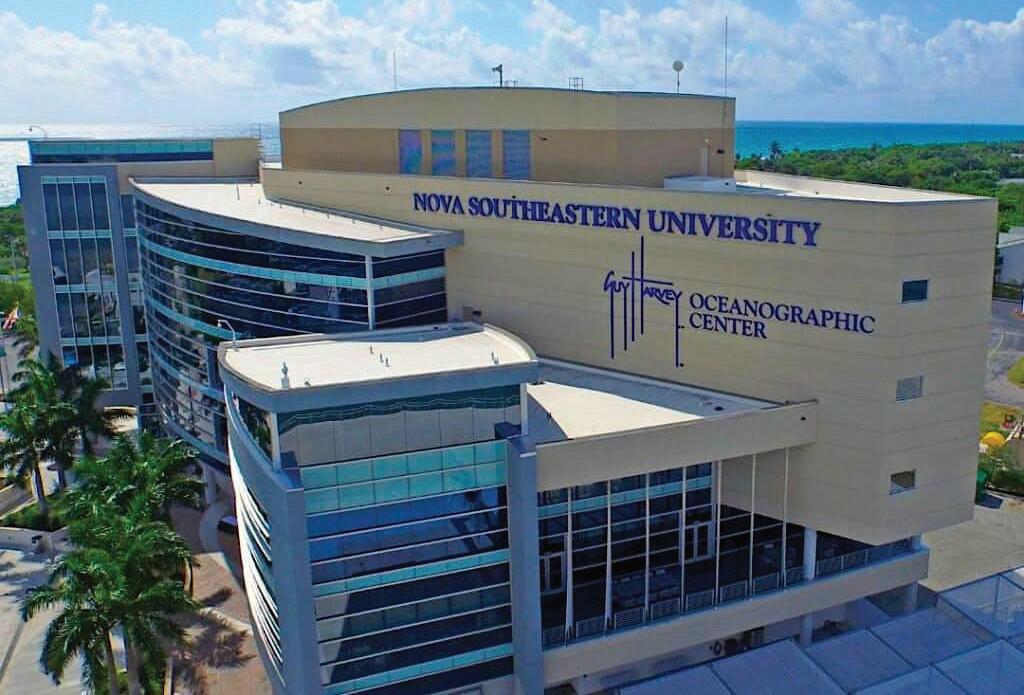
Today, Guy donates his work to many marine conservation causes, including CCA. In 1999, he partnered with the Oceanographic Center at Nova Southeastern University to create the Guy Harvey Research Institute (GHRI) in Dania Beach, Florida, for the purpose of providing “the scientific information necessary to understand, conserve and effectively manage the world’s marine fishes and their ecosystems.” The GHRI provides global-level leadership in the generation of scientific data necessary to conserve the world’s fish resources.”
For more information: guyharveyfoundation.org
of a dull blue/gray. As I described how I fooled the camera by using a different ASA setting (now called ISO).
His name was Guy Harvey, and needless to say he found his way into a phenomenal career with his fish photography, underwater art and founder of one of the world’s leading marine conservation organizations. A true class act, he never forgot me in later years, sending his latest painting when I came out with another fishing book, four times now, each with his distinctive autograph. He’s certainly one of the most admirable people I’ve ever known. Twenty years later we fished on the same boat in a marlin tournament out of San Juan, PR and it was great to see him. By then he had a twelve-year-old son on the boat, and they practiced boxing with each other when the fishing was slow. He also has a daughter; both are now grown, and they help manage his business. He’s even painted a marlin on the bow of a 1,000-foot Norwegian cruise ship.
JOE RICHARD
CONTACT
Joe Richard has fished the Gulf since 1967, starting out of Port Arthur, but his adventures have taken him up and down the entire coast. He was the editor of Tide magazine for eight years, and later Florida Sportsman’s book and assistant magazine editor. He began guiding out of Port O’Connor in 1994. His specialty is big kingfish, and his latest book is The Kingfish Bible, New Revelations. Available at Seafavorites.com
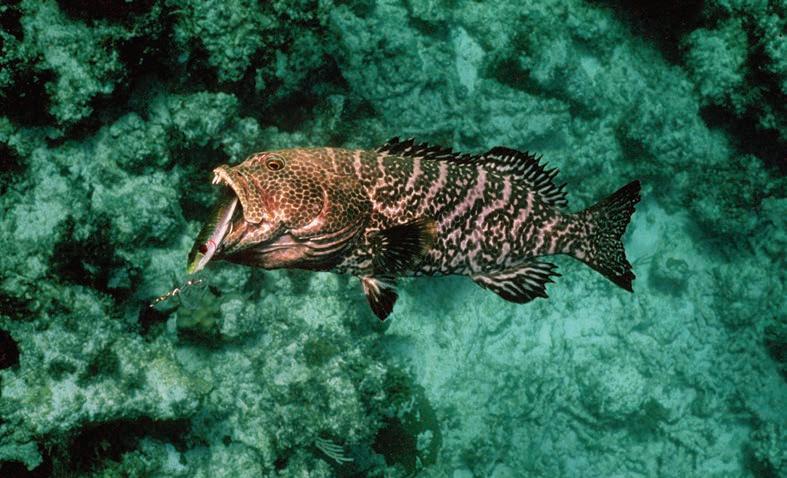
Tiger grouper in The Bahamas.
TEXAS SNOOK
The Lone Star State’s Hidden Gamefish
STORY BY JOEL ANDERSON | TPWD PERRY R. BASS MARINE SCIENCE TEAM LEADER/FACILITY MANAGER
One of the great things about coastal fishing in Texas is that the state represents a natural confluence of two different ecological settings: temperate river bays in the north, and semi-tropical lagoons in the south.
The relatively deep, cool, brackish waters in places like Galveston and Matagorda Bays in the north give way to relatively shallow, warm, and salty waters in the Laguna Madre, with a broad diversity of habitats throughout. The result is an incredible diversity of predators that can be targeted throughout the state. Snook are a group of predatory game fish species that have historically been associated with the tropics, but they are increasing in both abundance and geographic range in Texas, and they present an excellent challenge for anglers that want to venture from the coastal fisheries “usual suspects.”
One thing many anglers might not know about snook is that there are several different species. To understand which snook species reside in Texas, it is worthwhile to track their diversity back through ancient time. Snook have an incredibly interesting evolutionary past that has not always included residency here in Texas. Based on DNA evidence, it is believed that the snook family originated in the Pacific Ocean and then branched out into the Atlantic prior to the rise of the isthmus of Panama, when fish were able to move freely between oceanic basins through a now extinct body of water called the “Central American Seaway.” During this time, a great deal of differentiation between different populations of snook resulted in a number of different snook species, all of which used different habitats and had different behaviors. When the isthmus of Panama formed about three million years ago, populations of snook in the Pacific and Atlantic were cut off from one another. To this day, “sister” species of Pacific and Atlantic types continue to exist in both oceans. In other words, many of the species of snook that reside in the Atlantic have mirror image species in the Pacific.
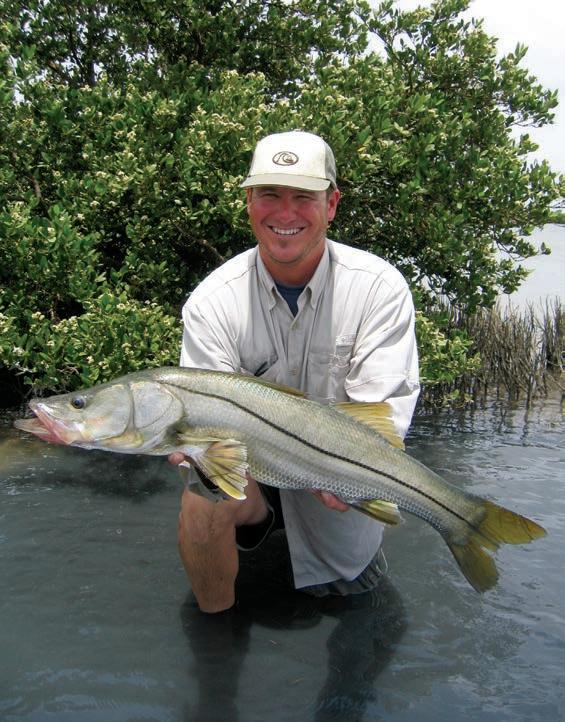
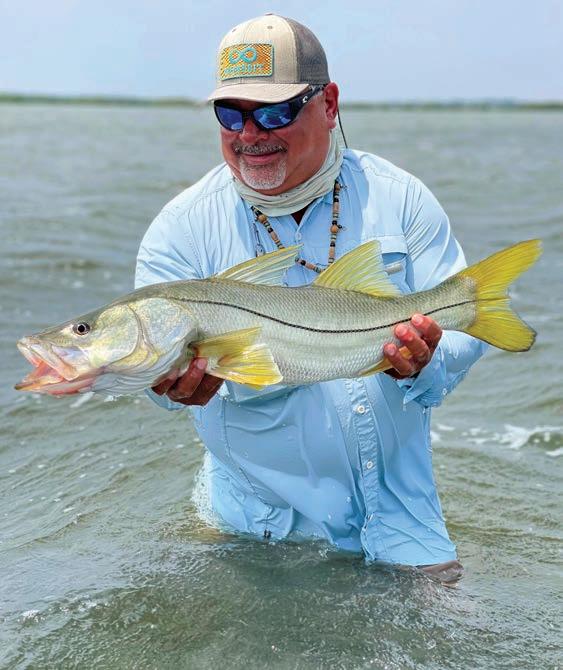
Richie Hominga with a monster South Texas snook that weighed a bit over 17 pounds – wade fishing with Capt. Ernest Cisneros – the heaviest ever landed on one of his charters.
Capt. Ernest Cisneros is passionate about snook. Ernest practices a strict conservation ethic; all snook landed on his charters are quickly photographed and released.
There are at least seven recognized species of snook currently in the Atlantic basin, many of which have at least some presence in the Gulf. Perhaps the most common and abundant of these species is unironically referred to as the common snook. This species is found throughout the known range of snook species in the Atlantic, from North Carolina to Brazil, and is prized as a sportfish throughout that range. If you’ve hooked up on a lunker snook in Texas, there is a good chance it was a common snook. In addition to being the most abundant species in Texas, it also grows to a larger size than any of the other species found in the state.
Beyond the common snook, the question as to what other species reside in Texas has remained a mystery for biologists. Because snook are a relatively young group of species in a historical sense, they all look very similar and can be very challenging to tell apart. In the past 10 years, collaborative research between the Texas Parks and Wildlife Department (TPWD) and the Florida Fish and Wildlife Conservation Commission has set out to answer the question of what “other” species of snook reside in the greater Gulf. To answer this question, researchers in both states collected hundreds of fin tissues from snook using agency-collected as well as anglercollected samples. The DNA from fin clips in both states were then compared to DNA from known specimens of all of the different Atlantic snook species. What these researchers found was an amazing diversity of snook species in the Gulf. In Texas, the species known by anglers as “fat snook” was identified as being a completely different species from the one in Florida that has the exact same name. Additionally, they were able to identify the presence of a third rare species in Texas, the Mexican snook. This species had never before been observed in the state but was observed twice in the Laguna Madre, and once in Aransas Bay.
While most snook species have been confined to tropical and semi-tropical parts of the southern Gulf due to its relatively warm waters, the common snook is a species on the move. In Texas, it wasn’t very long ago that anglers had to venture to the southern coast to have a chance at landing a snook. Now, it’s not uncommon to hear reports of anglers as far north as Galveston Bay hooking into one. Common snook were first observed in a TPWD gill net in Galveston in 2012, and then in Sabine Lake in 2017. Last year, authors in Mississippi documented several catches of juvenile common snook in that state, in a paper published in the journal Gulf and Caribbean Research. The presence of these individuals in the far northern reaches of the Gulf suggests that the common snook now resides in nearshore waters throughout the Gulf basin.
Fishing regulations for snook in Texas are fairly conservative (daily bag of one snook; 24 to 28 inches slot), in deference to the fact that all snook species are still relatively rare compared to other predatory fishes in the state. These species are also fairly sensitive to cold winter temperatures. For instance, a great deal of mortality of all snook species is typically observed during times of extreme cold weather like winter storm Uri in 2021. With that said, the finding of common snook in the northern Gulf just a few years after the winter storm indicates that the species might be more resilient to these events than once thought. Perhaps this once tropical species will become a more common catch for anglers throughout the Gulf, adding another classic catch to the portfolio of predatory targets available to coastal anglers in Texas.
A Not-So-CommoN CAtCh
BY EVERETT JOHNSON
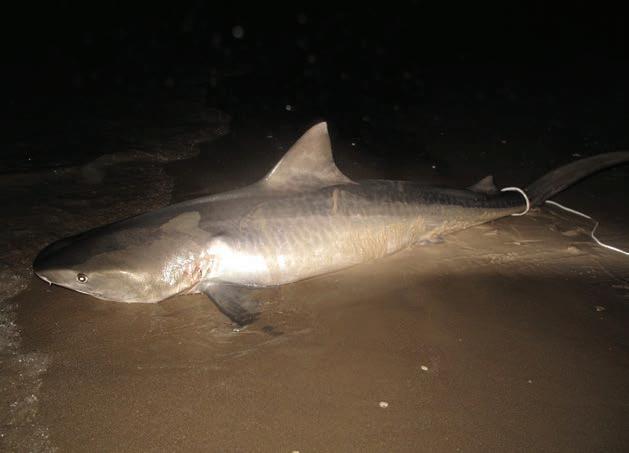
I received an email recently from Brock Sanders of Baytown, Texas. Brock was excited to share a tale of good fortune while fishing Trinity Bay with family members. That good fortune, believe it or not, was a snook caught on a popping cork rig with live shrimp – the group was reportedly targeting the more common species for that area of speckled trout and redfish.
Now I’m not exactly sure what the criteria might be for classifying a catch as rare, but I can assure you that landing a snook in Trinity Bay doesn’t happen every day. Our friends over at TPWD Coastal Fisheries say they captured only one or two in gill nets during population sampling in the Galveston Bays since that program began back in the late-70s, and no documented landings on rod and reel. So, yeah, at the risk of being mistaken, I’m going to go ahead and call it rare.
In Brock’s own words: “We launched from Thompsons Bait Camp and fished one of our favorite spots. We caught several trout and a few redfish. We decided to move locations closer to the channel, fishing some rocks. After a few casts, I hooked what I thought was a redfish by the way it was fighting, but as it got closer to the boat, I yelled, SNOOK! My wife jumped on her phone and Googled it. We captured a few pictures and released the fish to fight another day. I’ve fished the Galveston Bay area since I’ve been a kid and have never caught a snook or even heard of anglers in our area catching them. I’ve only seen them on TV. So, we were all amazed by the experience.
Snook are definitely more common in the southern portions of the Lower Laguna Madre, to the extent that fishing guides like Capt. Ernest Cisneros can target them specifically, and with considerable success. It’s a seasonal fishery, for sure, but Ernest says that a few of his charter groups have landed as many as 50 snook during a morning of wade fishing, when all the water and weather conditions aligned. The average production is more likely to be in the 20s.
So, if you have never landed a Texas snook and hope to someday add it to your species list, give Capt. Ernest a call – 956-266-6454.
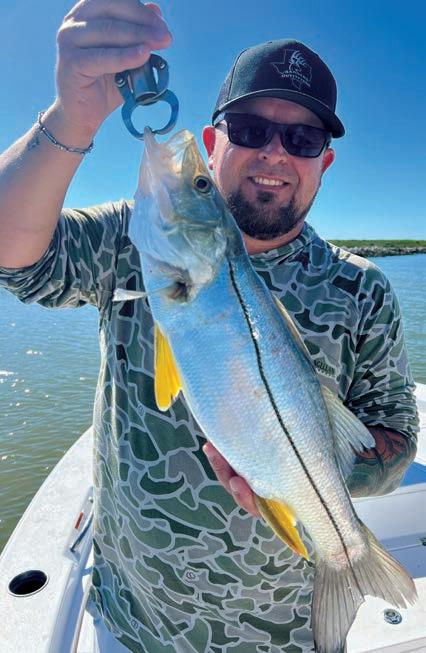
Brock Sanders of Baytown, TX with a most unexpected landing in Trinity Bay back in May 2026.
Redfish Bay Marina, LLC. Ushers in a New Era for the Texas Coast
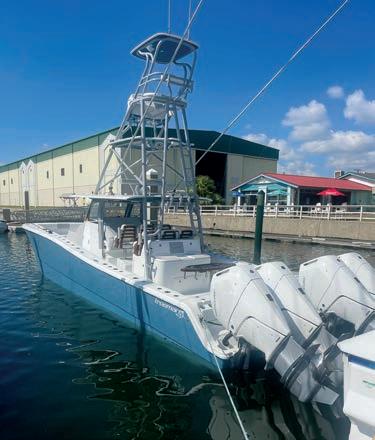
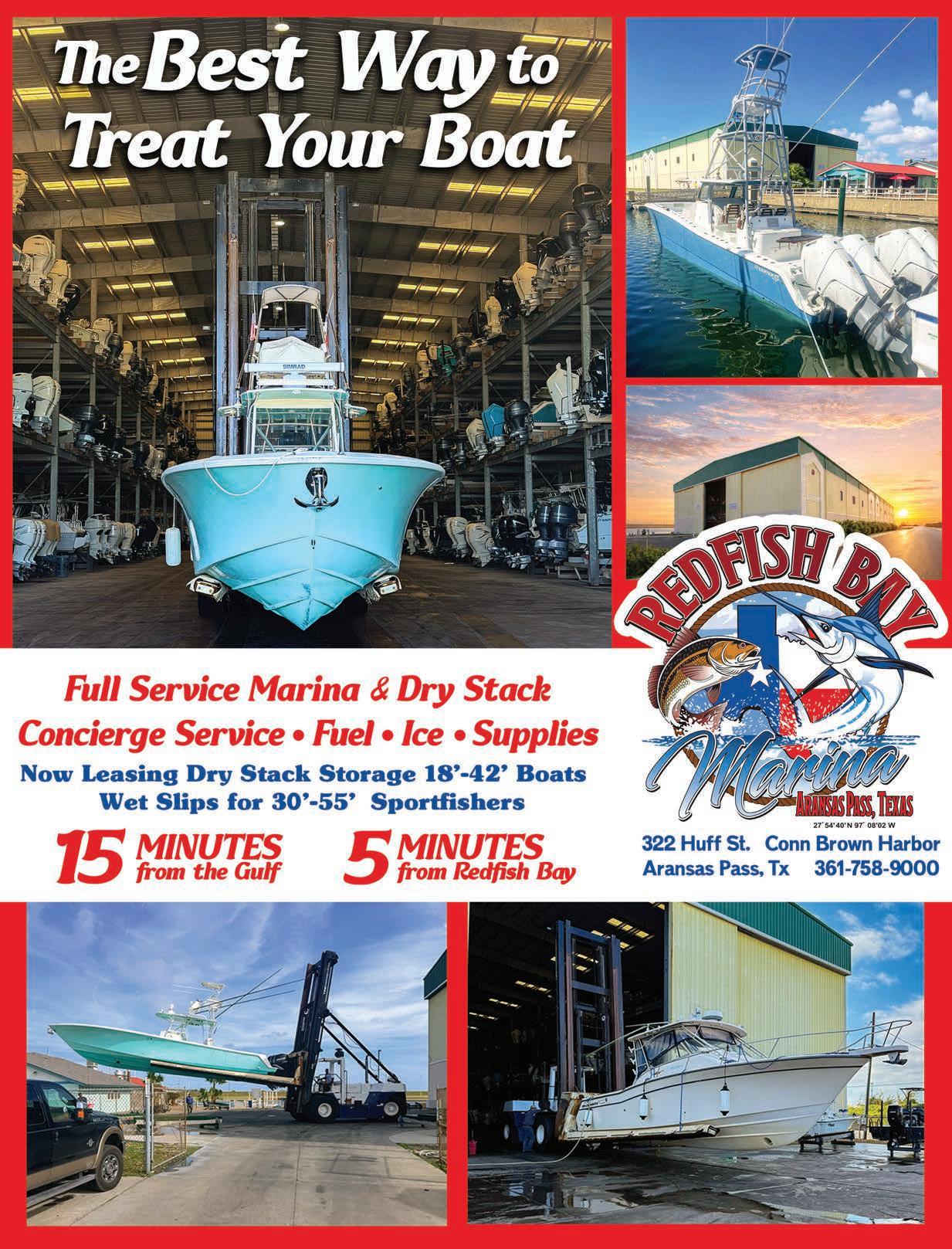
Along the working waterfront of Conn Brown Harbor, a new chapter is unfolding for one of the Coastal Bend’s most recognizable boating destinations: Redfish Bay Marina in Aransas Pass. What was once known as Redfish Bay Boathouse is rapidly evolving into something much bigger than a dry-stack marina. Today, it stands at the intersection of boating, fishing, and coastal tourism.
Positioned just 5 minutes from the famed flats of Redfish Bay and 15 minutes from the Port Aransas jetties leading into the Gulf of America, the marina has long served as a launch point for serious anglers and offshore enthusiasts. The facility includes more than 200 indoor boat racks, wet slips, fueling capabilities, staging docks, and waterfront amenities designed to support both bay fishermen and offshore crews. The structure itself was originally engineered to withstand major coastal weather events, a necessity on the Texas coast.
The ability to handle larger offshore center-console boats is a unique aspect of Redfish Bay Marina, LLC. This July, the marina will take delivery of a new marina forklift capable of moving boats up to 32,000 lbs. and boats up to 42ft in length, in addition to the 25,000 lbs. forklift currently being used, making Redfish Bay one of only 2 drystack marinas on the Texas coast capable of storing these larger boats.
Redfish Bay Marina, LLC. Also has 18 wet slips for boats from 35 feet up to 55 feet with water and power hookups. The marina is currently building an ice plant with freezer storage to handle and stock all the frozen offshore bait you need, as well as bulk ice to fill your boat.
But the biggest story isn’t just what the marina has been; it’s what it is becoming.
In late 2025, the property officially transitioned to new ownership as Redfish Bay Marina, LLC, signaling a renewed long-term vision for the harbor-front destination. The new ownership group plans to continue expanding operations while strengthening the marina’s role as a centerpiece for recreational fishing and boating along the Middle Texas coast. That blend of old-school coastal culture
and modern investment is exactly what makes Aransas Pass so unique right now, and the local growth shows it.
The waters surrounding Redfish Bay continue to attract anglers from across Texas and beyond. Online fishing communities regularly point to the Aransas Pass and Port Aransas area as one of the state’s premier destinations for redfish, speckled trout, and shallow-water sightfishing. Kayak anglers, fly fishermen, and offshore boaters all converge here because of the region’s unmatched access to flats, channels, and Gulf waters within a relatively short run.
The marina sits directly in the middle of a coastal lifestyle boom that shows no signs of slowing down. Fishing tourism remains strong; offshore participation continues to grow, and Texas coastal communities are increasingly becoming year-round destinations rather than seasonal getaways.
What comes next for the marina appears to center on expansion, community engagement, and elevating the overall waterfront experience. The ownership group intends to preserve the marina’s identity as a serious boating facility while continuing to develop amenities and harbor front opportunities around it.
At its core, Redfish Bay Marina still feels unmistakably Texas coastal, the smell of salt air at sunrise, the sound of outboards firing up before daylight, and fishermen swapping stories at the docks after a long day on the water.
In a coastal region experiencing rapid change, the marina represents something increasingly valuable: a connection between the heritage of the Texas fishing coast and the future that is arriving with it.
And if current momentum is any indication, Redfish Bay Marina is poised to become far more than a place to store boats. It is becoming one of the defining waterfront hubs of the Coastal Bend.
For information regarding the storage of your boat, please call the marina at 361-758-9000.
DOG DAY TACTICS FOR QUALITY TROUT
So, what is it about the dog days of summer that attract so many anglers to the Texas Coast? I believe it’s the weather patterns, so favorable for being on the water. This would apply to all waters, inshore, offshore, and the Gulf surf. I fish the surf very little and have not fished offshore in who knows how long. When asked why this is the case with me, I just tell people that I have not mastered the inshore gig yet.
As a guide, I learned early on that if I wasn’t careful I could get too many pokers in the fire. I loved hunting but hunting season is short and winter is always such a great time of year for fishing. I was and still am not much of a risk taker. My theory has always been to take the best odds for success and then apply the work.
I actually have a large number of clients that hire me specifically during the summer months, wanting to target the best trout that summer has to offer in the Rockport area. While it is certainly true that quality trout can become tougher to catch when the water temperatures rise above 85°, but they can be caught in decent numbers if you know where to look throughout the day and how to make them eat. Over the next few paragraphs I will attempt to give you my take on how to best accomplish success during the summer months.
Early start to the fishing day is an absolute must. I depart the dock in the gray light, not a fan of running in the pitch black at this stage in my career. I do have great lighting on my boat, but I am typically not having to race to an area; a few minutes later to the first spot is not really all that critical. Last year I used the light under the bow to locate bait once I got close to the area that I had in my game plan for the day. Most of the time the water was alive with bait fish, and I think my clients got as big a kick out of seeing the bait fish in the lights as they did catching the trout.
It is not uncommon to see large trout cruising in the lights with the bait fish. It was common to get out of the boat, wade about 10 to 15 yards left or right of the boat and start catching them. Most of the time the bite lasted until the sun got up and then would immediately shut off. Solid confirmation that trout feed in the dark and grey light most of the time, but this activity is short lived. This is where the learning portion of the day begins. So, in the dark the trout are shallow with the bait but when the sun comes up, the bite ceases while the bait remains. It is my belief that the trout simply go slightly deeper and remain in the area where the food source remains. Does not make sense that trout would move
very far and burn up energy that they will need for the next feeding period. By staying in the area and working deeper bottom structures and deeper depths that are adjacent to the area where the bait fish are stagging often proves to be the ticket.
Contrary to what some say, I have always believed that if I can stay with the fish, I can make them bite. I have always referred to this as the “deep and dark pattern.” Deeper water provides some darkness that I believe the fish prefer when the water gets hot. Speaking of hot water, you need to be able to monitor the water temperature throughout the day. Back in the early years I carried an aquarium thermometer on a string. Hey, it worked, and it helped me develop an understanding of summer and winter water temperature patterns.
I throw soft plastics, even small paddletails and suspending lures almost exclusively during the summer months. Yes, other lures work as well but I have more confidence in the lure types mentioned. I prefer lures that are easy for the fish to get to and eat. There are periods during the summer months where we have to hit the trout on the nose to get them to eat. There might not possibly be a better time of the year for anglers to depend on the lures that they consistently catch fish on. I would even suggest NOT looking at blogs and social
Chauncey Krause getting it done despite elevated air and water temperatures.
media very much and just concentrating on getting out there and working at it. Seldom do I see hard work in the fishing world not pay off in the long run.
Water conditions are typically good in the summer months. Light winds overnight allow bay waters to settle, leaving them clean by morning. Water clarity and the amount of sunlight drive my bait color decisions when selecting lures for the day. Here’s a list of lure colors I rely on this time of year and recommend that you always have handy –Watermelon/Red Glitter, Plum/Blue Glitter, White, Bone, Pistachio, Voilet Night, Chartreuse and Pink.
Truth be told, there are so many companies out there making soft plastics today that it is possible to have too many choices in your head at times. I am basic and basic can be viewed as boring, but basic for me has also been proven to be a staple in the industry. In suspending baits, I like gold flash for overcast days or in off-colored water. Likewise, I like silver flash in the clear stuff and on cloudless days. Another truth here is that I often throw gold predominately because I have a ton of confidence in the gold flash for trout. I grew up throwing a gold spoon with a yellow and red bucktail for trout on mid-bay reefs in the Aransas Bay Complex. I seldom threw anything else, but when I did it was the MirrOlure 52 MR Series. My go-to numbers were 28 and 19. Both had gold sides.
Cass Caspary taking advantage of the man made tidal
Color is important for sure, but to catch fish reliably in summer it’s all about real estate. Location – location – location is the term real estate agents use when describing the good stuff. So, what do the best properties offer? Moving water is a must for me. I don’t care if it is wind-driven, tidal, or barge and ship traffic. Man made water current is one thing that many anglers never even think to consider.
During my high school years we would wade the I.C.W. between Cove Harbor and Palm Harbor. Caught tons of fish but on slow days when a barge would pass by, if we were close to a small depression or washout that the barge activity created, we got bit. Took me a few
years to really tap in on just how many areas there were in this small stretch of shoreline that allowed us to catch fish when the barges were passing.
I have used this tactic my entire career in just about every bay system that I have fished and it works in all of them. Summer heat drives the water temperature up to levels where I like to have a deep-water access nearby for the trout to drop into. It goes back to the deep and dark pattern I spoke about previously. Having a food source present is also a big player. Bait this time of year is plentiful and usually visible in the early morning hours. Bait fish love moving water and deeper water as well when water temperatures are in the mid80s and higher.
When it comes to lure presentations with my soft plastics, I like a quick, deliberate twitch that helps keep the lure in the strike zone longer. Bites tell us where the strike zones are so always be aware of the water depth that you are receiving your bites in. This zone will definitely change throughout the day. As a rule, I am not a paddletail guy, but early in the morning the 6th Sense Party Paddle works well for me and my clients because they can slowly swim and lightly lift or twitch the lure over shallow grass and potholes. Of course, I am still a fan of the MirrOlure Lil John XL and our new Jay Watkins Series straight-tail lures by Texas Customs. A bait that is very versatile and casts extremely well. When it comes to the Double D by Texas Customs, I like to bang mine deep into the water column and then create a quick, almost vibrating action with the rod tip. Short pauses here and there allow the lure to stop and suspend and then start to float to the surface. I have a tremendous amount of confidence in the Double D. Summer is my toughest season for quality trout, but they can be located and caught. You just have to be more focused and more aware of what the conditions are telling you to do. Listen and you shall learn.
May Your Fishing Always Be Catching -Guide, Jay Watkins
Jay Watkins has been a full-time fishing guide at Rockport, TX, for more than 45 years. Jay specializes in wading yearround for trout and redfish with artificial lures. Jay covers the Texas coast from San Antonio Bay to Corpus Christi Bay.
Telephone 361-729-9596
Email Jay@jaywatkins.com
Website www.jaywatkins.com
Blair Donaldson working deeper drop-offs during midday hours.
pattern.
DAVE ROBERTS
SHALLOW WATER FISHING
COMMON MISTAKES
“Experience is simply the name we give our mistakes”Oscar Wilde
The thing about humans is that we are far from perfect and were born to make mistakes. When it comes to living life, I believe that there are a lot of aspects that go hand in hand with fishing. Some of those being patience, adaptability, determination, and mistakes.
When it comes to making mistakes on the water, I have learned that a majority of these are small things that an angler might not even realize he’s doing. Most of the time it will go unnoticed by the angler because they may be oblivious to their actions. After all, success to a fisherman can be simply catching a single fish in a day. However, there are a few things that I see some anglers do that could turn your one fish day into being a lot more successful.
FISHING POINTS, BAYOUS AND PINCH POINTS
No matter where you go on the Gulf coast, every body of water has its own distinct and unique features. When you are focusing on the main lake or bay area, there is likely a place that has a point jutting out from a shoreline. More than likely, an angler will be sitting directly on top of the point. I can’t blame them as every point has potential to hold fish. The main problem that I observe is that the angler wants to pull all the way up and anchor directly on the tip of the point. I’m sure that by doing this he might catch a few fish, but there is a more productive way to
target this area. Ideally, you want to stop a distance of say 50 or 75 yards off the point and then ride the troll motor toward the point or drift in and fan cast the area thoroughly during the approach. Quite often, I have found fish to be staged just off and/or around the point, waiting for bait to be swept across it by wind-driven or tidal currents. If you drive your boat all the way to the point, anchor and begin fishing, you have likely already spooked and pushed the fish out of the area.
The same thing goes for fishing the mouths of bayous and pinch points between marsh ponds. I see anglers wanting to pull all the way into the mouth of a bayou or slough and then sit directly in the middle of it. Once again, this is the area that you want to be casting to and fishing. The best way to fish the mouth of a bayou or slough is to work your way from outside of the mouth toward the inside. Cover as much water as you can, and once you get a bite, stop and continue to fish. The same principle goes with fishing a pinch point between two ponds. If you watch my video that is uploaded for this month, I show exactly what I am explaining here.
FISHING THE WRONG WAY IN THE CURRENT
Without a doubt, a moving tide can be a key component to catching fish. Moving water means bait will be moving and fish might be feeding. Several years ago, I learned the importance of fishing tidal currents the “right” way. I was fishing a large flat along the ICW and the water entering or exiting the main lake would
flow across it. I learned that the outgoing tide produced a better bite than incoming, but it seemed that the fish still preferred my lures presented a certain way.
From my experience fish will always face into the current, no matter the direction of flow. Well, I learned that if I presented my lure in the down-current direction it would ride too high in the water column during the retrieve. If I cast directly in the up-current direction, my lure would sink straight to the bottom and travel too quickly. However, once I started to cast across the current, my lure would stay in the portion of the water column the fish were occupying and my presentation evidently appeared more natural to them. Fishing “across the current” was the key to figuring that spot out.
There are times when fish will stage and feed on certain currents better than others and therefore something we should try to pay attention to. As mentioned earlier, about fishing bayous, pinch points and main lake points, you want to target the down-current side of things as much as possible. For example, if you are looking at a main lake or bay point and the current is moving right to left, you want to target the left side of that point. This is where eddies can occur; bait will be swept across it, and fish will have their face pointing directly into the oncoming flow.
BEING TOO NOISY
If there’s one thing I’ve learned the hard way is that if fish know you are there, odds are they’re going to be tough to catch. Don’t get me wrong; I have found plenty of fish that maybe weren’t exactly the wariest or brightest, but the majority will react negatively. That being said, if you are pulling up to a shoreline, bayou, reef, flock of working birds, etc., stop about 100 yards out and idle or troll in. I have never understood why some fishermen run full speed and shutdown right on top of the spot they’re going to fish. If the noise from the motor is not enough to spook a fish, then the giant wake you roll over them will be. If you don’t have the luxury of a Power Pole or trolling motor with Spot Lock and still using an old-fashioned anchor, place it in the water as gently and quietly as you can. There is no reason to “shot put” a 15-pound anchor into the water.
WRONG TACKLE
I believe that this is going to pertain mostly to people who use live or dead bait. If you plan on fishing with such, I believe that making your own leaders will increase your success. I completely understand that buying a premade steel leader is easy, but making your own is much better. For one, some fish will drop the bait as soon as they get a good feel of that steel leader. Along with that, the leader itself might not break, but the cheap snaps and swivels they use will not stand up to the pull of a strong fish. All an angler has to do is buy a pack of
quality swivels, bullet weights, hooks, and some heavy monofilament. By the way – Berkley Big Game is hard to beat. Get all your supplies together and learn to tie a simple Carolina Rig. You can find plenty of instructional videos online; it is very simple.
There are a lot of factors that are easily overlooked and can reduce the odds of having a successful day on the water. Most of the time, anglers have the right idea, but they either get in too big a hurry or simply don’t pay attention to all the details. Sometimes, it takes some trial and error to figure out what works best. What Oscar said, and I believe there’s a lot of truth in it…The best way to learn is to keep making mistakes.
CONTACT
Dave Roberts is an avid kayak-fishing enthusiast fishing primarily the inshore Upper Coast region with occasional adventures to surf and nearshore Gulf of Mexico.
Email: TexasKayakChronicles@yahoo.com
Website: www.TexasKayakChronicles.com
HABITAT PROJECTS MOVING FORWARD
For decades, Coastal Conservation Association Texas has remained committed to protecting and enhancing the marine habitats that sustain Texas’ coastal fisheries. Through the generous support of members, volunteers, and conservation partners, CCA Texas has funded more than $17 million in habitat restoration and enhancement projects spanning the entire Texas coast. From marsh restoration and oyster reef creation to artificial reefs and seagrass conservation, these contributions continue to improve the health and productivity of our bays and estuaries, while ensuring future generations can enjoy the rich natural resources of the Texas coast. The following updates are projects that CCA Texas has contributed to and are ongoing.
Certificate of Location Conservation Reefs
• Ranch House Reef (Mesquite Bay – This 10-acre site has been approved by TPWD Coastal Fisheries. CCA Texas is currently working with Gulf Trust to move the effort forward. Currently, the project team is waiting for notification from the Texas Historical Commission about whether the project will need an archaeological survey. That decision is expected by the end of May 2026. If the decision is that the archaeological survey is
not needed, then the project team will meet as quickly as possible with the TPWD Ecosystem Resources Program Director to lay out specifics for the resource survey. If the archaeological survey is required, it will need to be completed and then the project team will complete the resource survey. Once these processes are completed, the project team will then move forward with the USACE permitting process. To date, CCA Texas has $500,000 allocated to this project, and there are ongoing funding solicitations being made to other entities for construction funding. Gulf Trust will be the permit holder for this project and assisted by CCA Texas to complete the effort.
• East Matagorda Bay - This 15-acre site has been approved by TPWD Coastal Fisheries to move forward. CCA Texas is currently working with the Matagorda Bays Foundation to move the effort forward. Currently, the project team is waiting for notification from the Texas Historical Commission about whether the project will need an archaeological survey. That decision is expected by the end of May 2026. If the decision is that the archaeological survey is not needed, then the project team will meet as quickly as possible with the TPWD Ecosystem Resources
Healthy oyster reefs are the bedrock and basis for healthy eco-systems up and down the Texas coast. CCA Texas is committed to the conservation, restoration and protection of critically important oyster habitat. Photo courtesy of John Blaha.
Program Director to lay out specifics for the resource survey. If the archaeological survey is required, it will need to be completed and then the project team will complete the resource survey. Once these processes are completed, the project team will then move forward with the USACE permitting process. To date, CCA Texas has $500,000 allocated to this project, and there are ongoing funding solicitations being made to other entities for construction funding. Matagorda Bay Foundation will be the permit holder for this project and assisted by CCA Texas to complete the effort.
• To date, CCA Texas has committed $1,000,000 to conservation COLs and looks forward to supporting and expanding these efforts in the future.
Ayers Reef Restoration and Creation
The Ayers Reef project is ongoing and nearing final stages of approval. The project is currently waiting on Texas General Land Office for final approvals for the Coastal Boundary Surveys, however the USACE permit is in hand. Current projections are to go out for bids later this year and start construction in spring of 2027 when tide heights are favorable. While this has taken time, the final stages are within sight of this important and critical effort. This project will restore/create approximately 11 acres of reef providing habitat and critical shoreline protection to the area.
Carancahua Reef Restoration (Carancahua Bay)
CCA Texas received notification from Matagorda Bay Foundation on May 5, 2026, that they received the USACE permit for the Carancahua Reef restoration effort. This project is currently permitted for 8.6 acres. Matagorda Bay Foundation and CCA Texas are currently working to set a date to bring in local recreational anglers to discuss materials to be used, construction methods and the end goals of the project. Once materials and preliminary design are decided, any required next step engineering will be completed and the job placed out for bid, most likely fall of 2026. CCA Texas has committed $1,000,000 to this project.
Carlos
Reef Restoration Phase II (Carlos Bay)
In 2024, TPWD completed the first phase of the Carlos Reef Oyster Restoration Project, placing a relatively uniform layer of 1-2 inches of cultch material across 70 acres of Carlos Reef. However, TPWD’s permit for this project allows for restoration of up to 306 acres of degraded oyster habitat, which means an additional 236 acres of oyster restoration is possible within this already permitted project footprint. Based on TPWD’s knowledge of this area, they believe there are approximately 7080 acres of high priority restoration potential within the existing target areas. TPWD is currently working on obtaining a lease for these areas and conducting field assessments that will guide the exact locations of the proposed restoration efforts, which is now being called “Carlos Reef Oyster Restoration, Phase II.” CBBEP has been working with TPWD to identify additional funding sources for this project. Based on the Phase I restoration effort, cost is expected to be $3.0 million for Phase II. CCA Texas has committed $1,000,000 to be the anchor funding partner in the project. CBBEP, CCA Texas, and other organizations are currently working to raise the remainder of the funds for the effort.
Newcomb
Marsh Restoration Project (Copano Bay)
The proposed project is Phase 2 of the “Newcomb Marsh Wetland
and Shoreline Protection Project,” which is a Tier 1 project in the 2023 Texas Coastal Resiliency Master Plan. The Newcomb Marsh project is located within Copano Bay along the southwest portion of the Lamar Peninsula, immediately south of Holiday Beach, Texas. The total project area includes 2.5 miles of shoreline and 280 acres of estuarine marsh habitat. Newcomb Marsh is a tidally influenced coastal marsh consisting primarily of wetland habitats that have been eroding and subsiding. To address these shoreline and habitat losses, local stakeholders are pursuing a project to provide protection and restoration to the area. CCA Texas provided $35,000 in the initial Phase I effort of the project. These dollars are part of community matching funds for CEPRA grants. CCA Texas has committed an additional $50,000 to Phase 2 of this project, bringing the total commitment to $85,000 to date.
Gordy Marsh (Trinity Bay)
In mid-January, GBF signed an agreement with NRDA for $1.25 million for additional construction funds for the breakwater. With the final signature from trustees, the project is ready to move forward and go to procurement which GBF anticipates happening in May of this year to get the best water conditions over summer for construction. CCA Texas has contributed $200,000 to this living shoreline project.
Oyster Lake Shoreline Protection (West Galveston Bay)
GBF is still working through their CEPRA agreement with GLO. GLO made some changes to procurement procedures and engineering contracts that GBF wanted to walk through. GBF anticipates a Spring 2027 procurement and summer 2027 construction. Oyster Lake Phase III was planted with 10,000 cordgrass stems in May of 2025. Additional plantings behind Phase III have taken place this Spring. CCA Texas has committed $630,000 through the four phases of the Oyster Lake Shoreline Protection efforts.
Serpulid Reef Project
This project is currently in permitting. All the pre-construction site monitoring is complete. All the permit documents are complete, and HRI has received notification that the army corps has begun their review process. This project focuses on restoring Serpulid reefs in Baffin Bay using innovative restoration modules called “Crabitats”, which are approximately 34” x 34” x 34” (L x W x H) and are constructed of Portland cement using a 3-D printing. Although these units (as the name implies) were originally designed to provide crab refuge, they are of particular interest for Serpulid reef restoration because their design provides extensive internal surface areas for Serpulid worm attachment and reef development. This innovative approach aims to enhance Serpulid worm recruitment success, improve Serpulid reef stability, support recreational angling, and promote long-term sustainability of this key habitat. CCA Texas has contributed to Oyster Lake Shoreline Protection efforts.
Nearshore Reefing – Port O’Connor MI 562
CCA Texas recently funded $50,000 for a “materials of opportunity” deployment into the Port O’Connor MI 562 nearshore reefing site. Approximately 350 – 400 tons of concrete railroad ties provided by Friends of RGV were deployed into the Port O’Connor MI 562 site, taking advantage of the deployment vessels returning to Louisiana.
To learn more about CCA Texas, banquets in your area, advocacy efforts and more, be sure to visit www.ccatexas.org.
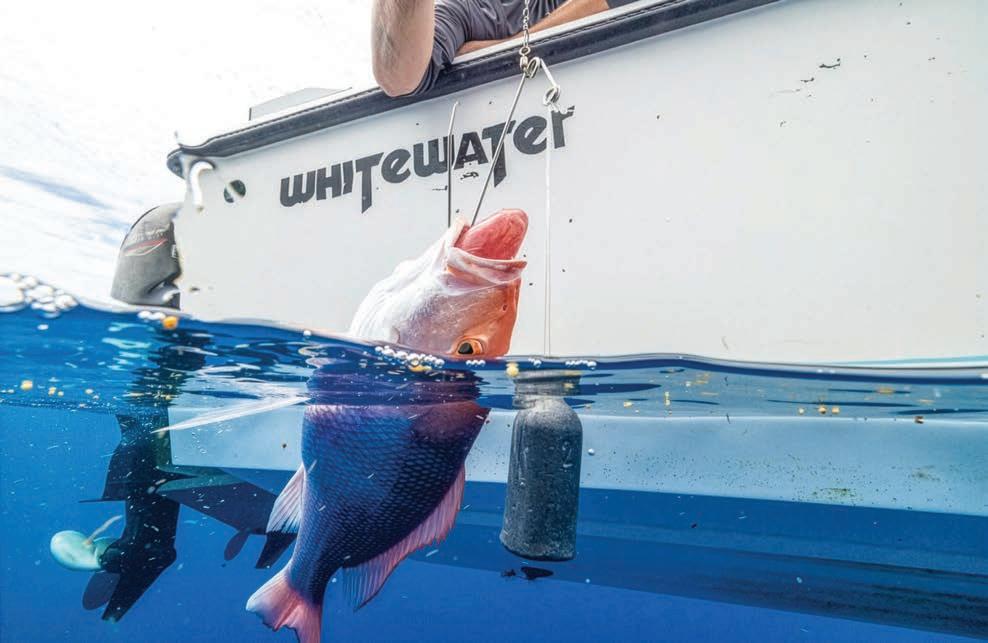
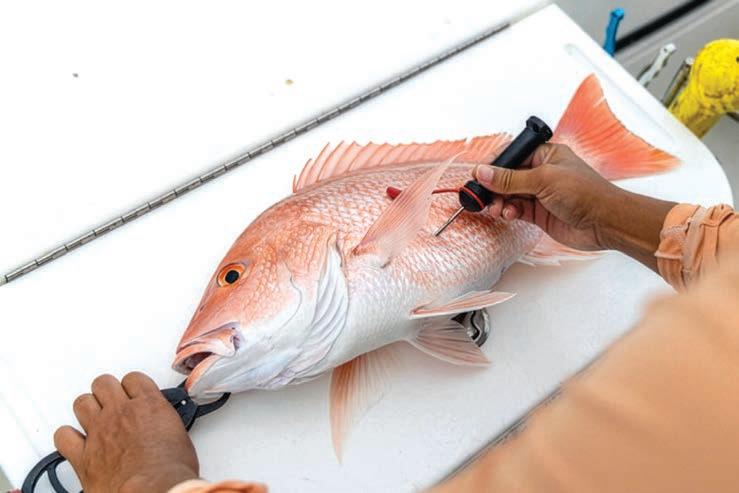
Figure 1: A Red Snapper showing visible signs of barotrauma after being brought up from depth. Before release, a descending device is attached to help return the fish to deeper waters. Photo Credit: Return ‘Em Right
By Cat Eckert & Hanna Bauer FIELD NOTES
BETTER DATA FOR BETTER MANAGEMENT: ANGLERS CAN HELP IMPROVE THE RED SNAPPER FISHERY
If you’re a recreational angler in Texas, you probably know the thrill of hooking a Red Snapper offshore, or the careful calculation that goes into deciding whether to keep it or throw it back. While most anglers are focused on what will eventually end up in their cooler, few give much thought to the fish that are caught and then released. But did you know that the fish you release, the ones you “discard,” are just as important to fisheries managers as the ones you keep? These discards are an important data point to assess the health of the population and are often extremely difficult to quantify in recreational fisheries.
Why Your Released Fish Matter
Even released fish aren’t guaranteed to survive. If you’ve ever caught a Red Snapper offshore, you’ve likely witnessed some of the effects that catching can have on the fish you’ve landed. Sometimes fish sustain injuries from the fishing gear itself (e.g., line entanglement, hook injuries), or experience increased stress from the “fight” or handling. If you’ve been out in the Gulf, you’ve also probably seen Red Snapper floating at the surface of the water—an effect of something called barotrauma. When fish are reeled up rapidly from deep water, the sudden drop in pressure causes gases in their body to expand, resulting in bloating, bulging eyes, and stomach
protrusion, all of which prevent them from swimming back down to the bottom after release and leave them particularly vulnerable to predators.
Gear-related injuries, stress, and barotrauma all increase the likelihood that a discarded fish will die. This information is of particular interest to scientists and managers throughout the Gulf, because whether or not a discarded fish makes it back into the population can impact how many fish can be sustainably harvested by anglers.
Introducing the disCARD Study
To address the data gap regarding recreationally discarded reef fish in the Gulf, Texas Parks and Wildlife Department (TPWD) has teamed up with Mississippi State University (MSU) and the four other Gulf states to launch the “disCARD” Project. The goal is simple: to collect discard information from you, the angler!
Each Gulf state, from Texas to Florida, will distribute physical cards (disCARDs) to anglers before they leave the boat ramp for a Gulf fishing trip. Anglers will be asked to record the fish they release on the disCARD itself, noting things like:
• Species of fish discarded (Red Snapper, Greater Amberjack, or Cobia)
• Depth of water where a fish was released
• Released in state or federal waters
• Reason for discarding (undersized, reached bag limit, etc.)
• Fish fate upon release (alive or dead)
it return to depth and improve its chance of survival. Photo Credit: Return
Each of these data points provides crucial information for managers. For example, the depth of the water where a fish was caught and released can affect its likelihood of survival. Additionally, understanding the difference between discard rates in state and federal waters can help guide season openings and closures. Even things like an angler’s reason for releasing a fish can help managers to understand a lot about the fishery—we might glean information on the effort required to reach the bag limit, the rate at which you are encountering undersized fish, or even preferences for keeping certain sizes of fish. Each of these data points give managers the information needed to better assess the status of populations and understand what you, as an angler, value.
Once anglers are finished with their trip, they can simply text a photo of the card to submit it—no app is needed thanks to the work put in by MSU and Bluefin Data. It’s that easy!
What Might Texas Anglers See at the Ramp?
In Texas, disCARDs will be distributed at ramps in three areas along the Texas coast: Galveston Bay, San Antonio Bay, and the Lower Laguna Madre. These locations were selected to represent any potential regional differences in offshore fishing behavior. To account for any seasonal variation in offshore fishing, this project will run for a total of 18 months (May 2026 through November 2027).
So, if you’re leaving for an offshore fishing trip from a ramp in one of these three bays over the next year and a half, keep an eye out for TPWD staff, grab a disCARD, and be a part of gathering stronger science and supporting a healthier fishery for everyone. Your fish matter—every single one!
Be Part of the Science
The disCARD Project is a huge step towards addressing an important gap in offshore reef fish management in the Gulf. Information about the fish you throw back might seem small, but it’s critical for managers to maintain healthy fisheries. When we have data on how many fish are released and in what condition, we can replace assumptions with actual numbers in Gulf-wide stock assessment models. This can improve decisions on things like catch limits and season lengths, ensuring that fish populations stay healthy while anglers continue to enjoy great fishing.
However, getting this information depends on anglers like you participating. By filling out a disCARD and sharing what happens on your trip, you can help scientists and managers collect real data to replace current assumptions. In short, stronger science means better fishing. Your participation directly helps managers make decisions that benefit both the fish and the people who love to catch them, ensuring better and healthier Gulf fisheries for years and generations to come!
Check the TPWD Outdoor Annual, your local TPWD Law Enforcement office, or tpwd.texas.gov for more info.
Figure 2: A Red Snapper is vented before release to help
‘Em Right
Figure 3: A TPWD technician distributes disCARDs at a boat ramp, giving anglers an opportunity to collect information on released offshore fish and help improve discard estimates for better fisheries management.
ERIC OZOLINS EXTREME KAYAK FISHING & SHARKS FROM THE SAND
HUNTING THE MIDNIGHT TIGER
Hunting big sharks has been my core interest for most of my adult life. Most who know me think of me as The Shark Guy. I’ve pursued the Gulf’s largest predators for a quarter of a century now and have been lucky enough to land and release over 15 different species of toothy critters in Texas waters. I caught the vast majority of them out of the surf, but I’ve also tangled offshore with silky sharks, dogfish, cat sharks and even the elusive oceanic whitetip shark.
These days, more than ever before, I yearn to find my way into a fight with a shark I’ve never landed before. Each species displays unique characteristics, and to gaze into their eyes offers us a glimpse into nature’s epicenter. I find many species of sharks intriguing, but of all the sharks I’ve encountered, one holds a claim as my spirit animal–the majestic tiger shark.
Galeocerdo cuvier occupies a special place in my heart for good reason. During the introductory period to my life’s work of shark fishing, as one century rolled into another, I spent lots of time fantasizing about the monsters of the ocean, ones I hoped to find on my angling expeditions. During those days, we had no drones and remote-controlled boats to use for bait deployment. All strikes and sharks were hard-earned,
after we plowed through the waves on kayaks, jet skis or inflatable Zodiacs to dunk our baits in the brine.
Partly because of this handicap, we caught fewer monster sharks back then. Because of improvements in technologies and gear and the dissemination of useful information via social media and the internet, we have caught many more sharks today than ever before. People think we have more sharks these due to a population explosion, but I contend our perception of shark numbers is skewed by our improved ability to catch them. Surely, the warm summer months offer us the best potential for encountering some truly epic specimens.
As we get into the warmest part of the year, during the sweltering doldrums, I routinely deploy the largest baits I can find, mostly hoping to entice a tiger into a fight. The chance of catching tigers during July and August reaches a peak for good reasons. Large stingrays invade our beachfront waters, mostly at night. Both southern and roughtail rays come into the shallows to feed, often between the beach and the first bar.
The largest rays reach weights more than 200 pounds; some of them are also pregnant and vulnerable. For a 1000-pound tiger shark or 14-foot hammerhead, these flat, dangerous rays provide an
Vivid
ultimate buffet. Some of the biggest sharks in the Gulf prowl close to the beach on these sultry summer nights, hoping to chase down and eat the rays. Prey like jack crevalle, drum and tarpon also stay on the menu for both tigers and hammers, but the relatively slow tigers in particular prefer the rays over the more elusive species.
When I target tigers, whether on charters or for myself, the process always starts the same way; I deploy giant baits. Southern and roughtail rays are fairly easy to catch for use during the summer months, so they account for at least half of the baits I use during the heat wave. When they’re available, I obtain cownose stingrays, a slightly smaller species of ray with oily, bloody, somewhat soft flesh. The only issue with cownose rays is their softness. Sharks commonly rip them right off the hook.
Ideally, I like to deploy multiple types of big baits. If I can, I send out two or three different types of rays, along with whole or giant chunks of jack crevalle. Varying the sizes of the baits enhances one’s chances too, as some really big sharks seem to prefer whole rays and fish, while others more readily attack smaller offerings.
During typical tiger missions, I like to get two to four big baits distributed in an even spread, ranging from 400 to 800 yards from the sand. I prioritize having the fresh baits out about a couple hours before sunset. From all my experience, the majority of big tigers feed from the late-afternoon hours through the last hour of night. Having the baits deployed before darkness falls increases the chances for a hook-up once the beasts come into the surf to feed.
I’m often asked how moon phases affect my strategies. Truth be told, I’ve caught an array of tigers and other sharks during every possible tide and lunar cycle. That said, I’ve also learned how the summer full moons produce enhanced windows for big shark activity. The pitch-black nights associated with new moons also generate elevated amounts of activity among these apex predators. The effects of these strong moon phases are measurable, but folks heading to the beach should focus more on getting the right kinds of big, fresh baits out in a properly aligned spread than on how big or small the moon is and when it will fall and rise.
People specifically targeting tigers need to realize some of these creatures are huge indeed. Being prepared to handle a shark weighing several hundred pounds or more means having other people around to help with the landing and release processes. Unlike some of the feistier sharks, like bulls, tigers are relatively docile, inclined to thrash around briefly once pulled into the shallows, also to calm down quickly, making them somewhat easier to handle. Tigers also prove fairly hardy, so a good percentage of them survive catch and release.
Because they’re so big, strong, beautiful and sturdy, tigers occupy a niche at the pinnacle of the list of desired species for most land-based Texas sharkers. With a giant mouth and menacing teeth, they’re perfect subjects for incredible photo opportunities. I’ve lost track of how many of these monsters I’ve caught over the years. Whether the next adds to my own number or is a client’s first, I know the encounter will generate a most welcome and familiar form of giddy excitement, one I always feel when I stare into the eyes of a tiger.
For the past decade Eric ‘Oz’ Ozolins has been promoting shark catch and release and assisting various shark research programs. Eric offers guided shark fishing on Padre Island National Seashore. Also renowned for extreme kayak big game fishing, Eric is the owner of Catch Sharks Tackle Company.
Several large stingray baits in the kayak, ready for deployment offshore.
JAKE HADDOCK
MOSTLY SIGHT-FISHING
DOG DAYS
My uncle asked, “have you ever worked so hard that you’ve laid under your truck like a dog?” “Why would anyone want to lay under their truck?” I asked in return. Later that summer I found myself out on a job, on a particularly humid July afternoon, with the kind of sweat worked up that soaks through your socks. With no shade trees in sight, I remembered my uncle’s smart-ass remark. A short army crawl later I was in an oasis. I’ll be damned, he’s not crazy after all.
What I experienced was quite remarkable; the breeze seemed to just come out of nowhere. When I was standing out in the open, there was hardly a breath of wind, or so it seemed. Lying under the truck seemed to compress the air and made the variable wind feel like a nice breeze; the shade didn’t hurt either. Once I realized I wasn’t near death, I got to thinking; I wonder if this is what the fish feel like sitting on the edge of a flat next to a channel during the heat of the day? Funny how my brain works sometimes, but when you’re as mentally ill for the game as I am you just never know when or where inspiration will strike.
I really enjoy fishing in the heat of the summer as I have probably mentioned before. To me, the fish become very predictable and there are typically a lot of options
on the table. Fishing on days with some decent tide movement usually helps, and one thing is for certain; getting an early start this time of year is definitely in your best interest. I’m not typically one that wants to be at the ramp before the sun is up, but this time of year is an exception. It’s unmistakable, the magic that occurs on the water as the sun is rising on a hot summer day.
Right now, you’re probably questioning how can you sight-fish before the sun is even fully up? Well, I can give you a few scenarios that might help explain how and when that can happen. First would be the fact that summer mornings with low tide levels are notorious for congregating schools of reds in the marsh. These are easily spotted by the wakes they create, and the gulls that hover above them. How’s that for a target to cast toward?
Second would be tailing reds. Quite often when there’s a strong tide movement sweeping across shallow grass flats at first light, we see redfish tails wagging above the surface as they root bottom for whatever forage might be present.
Lastly, and probably my favorite when sight-fishing at daybreak, would be chasing “backing” redfish. This is where the fish are swimming and feeding so shallow that the top half of their body is exposed. Stalking these fish
Tyler with a nice jack on a slow redfish day.
can be challenging as they’ll often disappear briefly while slumping down in slightly deeper water. Putting the sun to your back does little good here as the angle is so low that your shadow is projected farther than usual, often spooking fish. I’ve actually found it helps to work towards the sun or at a slight angle whenever possible. This way your shadow doesn’t spook fish and, better yet, the rising sun reflects off the redfish’s head like a beacon. You can literally spot them from a hundred yards away at times. Now it’s all on you to sneak close enough for a good shot at them.
After the early morning festivities have played out, I will often go to areas of open flats with favorable water clarity for spotting fish. Seagrass flats are a great place to look as the sun is reaching its optimum angle. Single cruising reds are often the target here. This game can play out for the rest of the day at times with good tidal movement. However, when tidal flow begins to weaken and the water temperatures begin to spike, fish activity can come to a screeching halt. That’s when a lot of people simply give up and pack it in for the day.
This is a perfect time to look along channel edges. Deep channels have cooler, more oxygenated water than shallow flats, giving fish a break from the brutal heat, and somedays boat traffic. Speaking of boat traffic, if you are easily angered by boats driving by while you’re trying to fish then this tactic may not be for you as some channels are often highly trafficked boat lanes. As I try to explain to customers, it’s kind of like going deer hunting on the side of the highway…only this is legal. Anyways, the channels have large amounts of water flow, even at times of weaker tide movement. Hence, the reason they are a good place to look when things aren’t fishing well in the shallow backwaters.
The edges of these channels simply give the fish an opportunity to slide up quickly to look for a bite to eat, then slide back off into the deeper, cooler water. I often look for edges with seagrass, but scattered oyster, riprap, articulated brick mat, or even barren sand bars are all edge structure that will produce shots at cruising fish. It takes some experimenting in your local area to find which type of structure will work for you. This strategy is probably the most reliable opportunity for sight-casting during the heat of the day.
However, when this tactic isn’t working, another thing you can do is cruise around open water hoping to spot some birds working above a school of jacks or bull reds – two species with reputation for feeding vigorously when all others have shut down. Knowing the likely areas for them to feed in your local waters helps as they’ll often show up in the same places time and time again in the summer months.
So, when you start to hear the cry of cicadas in the trees and see dogs panting in the shade of a pickup, think about what the fish are likely doing to survive in hot bay water. I bet if you put yourself in their shoes, you might find more fish than you thought possible in the dog days of summer. Until next time…
Jake Haddock grew up in the back bays of Port O’ Connor where he developed a great passion for saltwater fishing. In his younger years he was a youth writer for this publication. In present day he enjoys guiding light tackle and fly clients in Galveston and occasionally Port O’ Connor.
Phone 713-261-4084
Email frigatebirdfishing@gmail.com
Website www.frigatebirdfishing.com
Pearl making sure I don’t lose another one.
Upper-slot red caught mid-afternoon while sliding along the ledge of a channel.
Nice bunch of gulls showing the way to a school of reds.
THE RETURN OF SUMMER ON THE TEXAS COAST
July has always felt like the turning point on the Texas coast. After months of battling relentless wind, muddy water, and weather forecasts that never seem to cooperate, even June had its disappointments, summer finally starts to show its full self in July. The days are longer, the mornings become calmer, and the island slowly comes alive again. Boats start lining the boat ramps before sunrise; restaurants stay packed late into the evening, and you can feel the energy of summer settling back into town. For me, it is one of the most exciting times of the year, not only because fishing improves, but because business starts picking up and I get to spend more time doing what I love every single day.
This spring seemed like it tested everyone’s patience. April winds and May showers never failed. It felt like every weather app showed another week of strong southeast winds, overcast skies, or scattered thunderstorms. Sight-casting in those conditions can become almost impossible at times. Dirty water, heavy chop, and low visibility make even finding fish difficult, much less getting a clean shot at them. Still, that is fishing on the Texas coast. You learn to adapt, stay patient, and take advantage of every opportunity the weather gives you.
Even with all the rough conditions, the fishing trips this past month have been an absolute blessing. Some days were tough, but those challenging days often make
the successful ones even more rewarding. Watching clients hook into quality redfish, hearing someone yell after seeing their first tailing fish, or seeing a kid catch a fish they will remember forever reminds me why I enjoy guiding so much. As business begins picking up for the summer, I feel incredibly grateful for everyone who books trips and trusts me to put them on fish. Every trip is another chance to make memories on the water, and that is something I never take for granted.
Summer fishing has always been my favorite season. There is something different about the atmosphere around the island once June rolls around. The water starts cleaning up, the tides become more consistent, and those early mornings on the flats can be downright beautiful. Calm winds at sunrise, nervous bait flickering across the surface, and waking up knowing there is a full day on the water ahead never gets old. After grinding through the windy spring months, summer almost feels like a reward.
Of course, one of the biggest reasons I look forward to summer every year is tarpon season. There is nothing quite like seeing a giant silver king rolling across the surface at first light. The anticipation alone is enough to get your heart racing. You can spend hours scanning the horizon, waiting for one fish to show itself, and the moment it does, everything changes. Every cast matters. Every detail matters.
Last year, I dedicated a huge amount of time trying to figure tarpon fishing out. Anyone who has chased tarpon knows they can humble you quickly. One day they are feeding aggressively, and the next day they refuse everything you throw at them. I spent countless hours learning from mistakes, experimenting with different setups, and paying attention to the smallest details. Whether it was choosing the right pound-test line, dialing in lure selection, adjusting hook styles, or learning how fish react under certain conditions, every trip taught me something new.
That is what makes tarpon fishing so addicting. It is not just about catching the fish. It is the process behind it. The preparation, the patience, and the constant learning are all part of the obsession. And when everything finally comes together, it creates a feeling that is almost impossible to describe.
The first time you come tight on a tarpon, you understand immediately why people dedicate their lives to chasing them. One second, everything is calm, and the next second, the water explodes. A hundred-plus-pound fish launches itself completely out of the water, shaking its head violently while your drag screams. Your hands shake, your heart pounds, and pure adrenaline takes over. It is chaos in the best possible way. Even if the fight only lasts a few minutes, it becomes a memory burned into your mind forever.
That is what excites me most about this summer. I feel like all the time I invested last year is finally starting to come together. There is still plenty to learn because tarpon will always keep you humble, but I feel more prepared heading into this season than ever before. Hopefully the summer weather cooperates, the winds finally lay down, and we get plenty of opportunities to chase those fish.
After the kind of spring we had, I think everyone on the coast is ready for calmer days, clear water, and long summer mornings. The busy season is here, the fishing is only getting better, and there is no place I would rather be than out on the water watching another sunrise over the Laguna Madre.
PRODUCT
Olukai Kialoa
Crafted to move through the water with ease, Kialoa is built for docks, fishing with friends, and impromptu getaways on the coast. A lightweight, breathable design paired with dependable wet-surface traction makes it an easy choice for those who move seamlessly between land and sea. The quick-dry mesh upper delivers airflow and support, while slip-on convenience keeps transitioning effortless.
DAIWA Tournament D-FIN
Suzuki Marine Teams With Fuel 1 A Purfuels Retailer Of Sustainable Marine Fuel
Suzuki Marine has partnered with Fuel 1 to provide an opportunity for its dealer network to offer certified Sustainable Marine Fuels to its customers right from their facilities. By teaming up with Fuel 1 — a national retailer of advanced fuel delivery and portable fueling systems — Suzuki Marine is helping its dealers better serve their communities by meeting an important consumer need, maximizing the performance and reliability of their customer’s boats, and supporting sustainability goals important to Suzuki Marine and the entire recreational boating industry. Working with Fuel 1 provides Suzuki Marine dealers with important advantages, such as the ability to deploy a fully supported fueling ecosystem with zero capital investment. Fuel 1 will provide free Micro-Station Deployment; fully branded portable fueling stations installed at participating dealer locations.
The DAIWA Tournament D-FIN that delivers a unique rock and roll action, mimicking the pitch of a distressed baitfish. This secondary body roll strategically reflects the sun, flashing its UV-infused colors to trigger reaction strikes from wary speckled trout and redfish. Whether you’re poling a skiff or pedaling a kayak across a wind-swept flat, the D-FIN offers unmatched versatility. It tracks incredibly well weightless, on a weighted swimbait hook, or on a traditional jig head. Molded with a uniform softness, it maintains a fluid, natural swimming action even at the ultra-slow retrieve speeds often necessary for pressured fish. Infused with a proprietary salt blend and natural squid attractant, the D-FIN ensures a scent trail to attract predators. A field-proven technical advantage for the Texas coast.
TKO
At TKO, we have designed a Flying Fish to perfectly match both appearance and action in the water. It is extremely versatile and can be cast, trolled, or run under a Kite. Troll up to 8 to 10 knots. Wings are designed with a specific degree of angle to perform on or just under the surface. Thru-body rigging can provide a conventional way to achieve sliding movement. Lure skips along the surface or is cast into schools of feeding fish. Every predator fish in the ocean loves flying fish. Mainly attracting Dorado, Tuna, Wahoo, Sailfish, and Marlin. Because of its metallic reflective flashing 3-D finish, predator fish cannot resist attacking. You can also rig 3 in a Daisy Chain with a Lure/bait running a little farther distance behind. FISH ON! Contact 281-852-2330
Gamakatsu Introduces GSPECX™ Performance Eyewear: Precision Optics Built for Serious Anglers
Gamakatsu announces the launch of its all new GSPECX™ Performance Sunglasses, a purpose-built eyewear system designed to give anglers a critical visual advantage. Developed with fishing-specific applications in mind, GSPECX™ represents an evolution in performance optics, combining advanced lens technology with durable, ergonomic frame design to meet the demands of modern anglers.
At the core of the GSPECX™ system is a multi-layer polarized lens platform engineered to dramatically reduce glare, enhance contrast, and improve overall clarity in dynamic light conditions. Built using a layered construction that includes hydrophobic coatings to shed water, anti-reflective treatments to eliminate back glare, and scratch resistant layers for long term durability.
St. Croix Mojo Inshore Rods
The Mojo Inshore 7’ light spinning rod (JIS70LF) was designed to excel in the presentation of small plastics on ultralight jig heads to trophy trout in spring and fall. Offering excellent sensitivity and lightweight SCIII/IPC construction, this is a rod that wade or boat anglers can cast all day without fatigue. The medium-light and medium power models in the durable, high-performance Mojo Inshore series are bread-and-butter trout and redfish rods throughout the rest of the season. The 23 models available will cover any inshore presentation. Available at Academy Sports+Outdoors and stcroixrods.com. Retail $190-$245.
Matagorda
Bink Grimes is a full-time fishing and hunting guide, freelance writer and photographer, and owner of Sunrise Lodge on Matagorda Bay.
July is really the first month we expect to get in the surf on a regular basis. And truth be told, we need the surf in July. It’s hot, tides are low, and the ebb and flow of currents seem to produce a different attitude within the fish compared to East and West bays.
It’s important to try and fish the surf the first day it greens up and flattens out. It’s been my observation that by the third day of a green surf the trout become tougher to catch. Predators like sharks, mackerel, huge redfish, and tarpon find the clear shallows and try to find an easy meal.
Yes, all these fish eat speckled trout. We prefer they eat all those shad, pogies, mullet and shrimp roaming the first gut, but specks sometimes get caught in the fury.
July is normally about southwest winds that push dry, blistering air off the Mexican desert and give us arid days while sucking water out of the bays and draining tides from the shorelines.
With tides low and water temperatures feeling like bath water, a change in fishing tactics is in order. Water clarity can certainly become an issue. If we can find streaky water – off-colored water with hints of green streaks – we feel like we can find fish to catch.
Though winds do dip below 10 knots this time of year, weak tides often do not allow bays to clear up, especially when water temperatures are in the upper 80s, and tides are running two feet below normal. When the water gets around 85 ° , it takes the bay a
little longer to clear. That’s nothing new for July - we deal with it every year.
Those low tides congregate fish in deeper guts. All those redfish that have been hanging out tight to the shorelines in June, end up schooling in the middle of East Bay. Often, we catch more reds than trout while drifting 4-5 feet of water out in the middle. If you happen to see a slick you better fish it.
While wading, I like to be somewhere around the pass or jetty. Tides are going to be strongest around the pass. I like to work the grass beds within sight of Port O’Connor. Fish there love a Super Spook Jr. or She Pup, and plastics like Bass Assassins, Down South Lures and MirrOlure Soft Dines.
Our bays are in the best shape I can remember in years. The first half of 2026 has seen great catches, even in windy conditions. It is so encouraging to see all the 2–4-pound fish that are being caught in both East and West Bays.
Attitudes are changing and hopefully more folks will get on board with the “Keep only a few if you must and release the rest.” I am grateful for a customer base who cherish our estuaries and want to do everything they can to be good stewards of our waters. Catch and release is cool; still, there is nothing wrong with keeping a few fish to eat.
Please take care of our natural resources. Pick up your trash, be good neighbors, treat others with respect and let’s all be good Americans.
Happy Fourth of July!
Port O'Connor Seadrift
Captain Shellie Gray was born in Port Lavaca and has been guiding in the Seadrift/ Port O’Connor area full time for the past 24 years. Shellie specializes in wading for trout and redfish year round with artificial lures.
Things are looking very promising here on the Mid-Coast as we head into our summer fishing season. Over the past couple of weeks we have received generous rainfall in our area and we are very thankful it came when it did. Every bay system along the coast needs freshwater inflow to help balance salinity levels and it looks as though the amounts received lately will help restore that balance after some serious drought conditions during the past year.
July’s calmer winds open many doors when it comes to planning fishing activities. Not only do the winds remain reasonably calm but the direction will be consistently southeast. The possibility of early-season tropical weather activity will be one of the few things that might disrupt that pattern.
Matagorda, Espiritu Santo, and San Antonio Bays have hard, sandy shorelines with patches of seagrass and deeper guts. San Antonio also has some of the best-producing mid-bay oyster reefs of the entire Texas coast. These are the areas that fish will migrate to this time of year in search of not only bait, but also deeper and cooler water, while our light summer breezes help ensure the water remains sufficiently oxygenated.
As of late, wading waist-deep or anchoring along drop-offs adjacent to deeper water have been one of the most reliable keys to catching. Holding steady when you find a decent bite is imperative to staying in the fish. I watch too many anglers unknowingly walk forward as they reel in a fish. After a few fish the angler has inadvertently wandered into the area where fish were staged and he had been catching them. Naturally, the bite shuts down because of this.
This can be a real headache if it happens to be one of those days when it took hours to find the bite, only to lose it shortly thereafter
because of this scenario.
Another scenario that shuts down a bite quickly is having a shark or two crash the party. I have no science to explain it, but I can definitely say sharks in our bay waters now seem more numerous, and certainly more aggressive, than I can ever recall in the past.
In years past, most sharks that I encountered were easily spooked away when I would slap the water with my rod. Now it doesn’t seem to faze them whatsoever. Because of this I have gone from using a shorter stringer to using a long stringer, like ForEverlast’s 15-foot G2 Pro Stringer. Do not tie your stringer to your body or your belt. Instead, attach the stringer only by slipping the metal spike into the small holster on your wading belt. Some anglers prefer to wade with fish bags, but I have seen too many anglers get pulled backward and down by sharks trying to eat the fish inside the bag.
You also don’t want to go without your protective stingray gear. I sometimes wonder if the abundant numbers of stingrays aren’t a big part of the reason the sharks have become more numerous in shallow water. Good protection from stingrays is strongly advised. I personally don’t leave my boat without my ForEverlast Ray Guard Shields placed over my Southerly wading boots.
The mid-bay reefs in San Antonio Bay have been producing some nice trout catches in the last couple of weeks. You may have to do a little reef-hopping some days, but I can assure you it is worth the hunt. Before deciding to fish any reef in San Antonio Bay, make sure there is bait present. Birds working over and along the reef are also noteworthy because it is no secret; there will be fish underneath. However, in our neck of the woods, if those birds are not tight to a reef, be forewarned that the species under them may not be the ones you’re hoping for – small trout, ladyfish, and gafftop are more than likely what you’ll find.
Our trout numbers are looking strong so far this year. The reduction in bag limit to the present three per day per angler, along with the 15- to 20-inch keeper slot, enacted back in March 2024, seems to be helping the numbers rebound. I think in a couple more years our trout fishery will be even far better than we are enjoying today.
I shouldn’t have to remind you that July is one of our hottest months, so getting an early start in the morning can be the key to catching versus just going fishing.
Kellie Holley put in the work and earned this beautiful catch.
John Hutto with a nice trout caught while drifting with Capt. Shellie.
Upper Laguna/ Baffin
David Rowsey has 30 years in Baffin and Upper Laguna Madre; trophy trout with artificial lures is his specialty. David has a great passion for conservation and encourages catch and release of trophy fish.
El Nino for the big win in Baffin Bay. Hope you guys are enjoying these coastal rains as much as we are in the moisture deprived Coastal Bend. Hopefully someone will come up with a properly designed and operated desal plant in this area before our city government builds the debacle they’ve been proposing and crushes the whole local ecosystem. I’m not kidding when I say that our local government is going to end up being the theme for a Netflix series, what with the horrific management of our local water supply system. Another story for another day. As much as I fight to keep technology out of my old soul and hands, I am sitting here on the back porch of my little cabin on a spoil island in Baffin Bay. It’s raining really good to the southeast and the island I call home seems to be right on the line where the storm clashes with the angle of the sunset over on the Kenedy ranch. Fishing was pretty rough today with all the rumbles and bolts, but we managed a good dinner of grilled shrimp and sides on the stick burner. With this misting rain in my face, a paper pad wouldn’t survive this back porch attempt at writing, but I guess I’m feeling pretty blessed and inspired to be able to sit in such a place after a very long day and have the opportunity and mechanism available to write my thoughts and share them with people that would almost certainly love to be in my shoes. Life is good on the island! Everything seems to heat up fast in South Texas. That’s surely welcomed when you are talking about trout crashing a lure, but right now I’m speaking of the blistering heat radiating from the sun and its impact on the next three months of fishing. If you are looking to keep the rod bent, I would highly recommend not being the trout snob that I can be and correctly accused of often.
Years of guiding have taught me many things about fishing, and perhaps even more about people. Every couple of days I get fresh faces on the boat with different skill levels and expectations. Quick decisions and adjusting on the fly to fulfill everyone’s idea of a great day on the water is different with every group of anglers. Take me for example, I am probably my happiest after a summer morning bite to just stand on a sandbar or shoreline and stalk a big trout the way a blue heron waits patiently for a mullet to swim by. If I do not see my quarry or the opportunity never presents itself, I’m perfectly fine with that because I am as much rewarded
by the hunt itself as I am when the actual opportunity arises and I see that gray ghost appear out of nowhere. Now, my clients, almost without question, will not have the patience for that style of fishing that I find so rewarding.
For the next few months our days will almost always be spent in areas where deep water lies adjacent to a flat, sandbar, or shoreline. Any of those scenarios that includes loads of bait will almost always produce a great trout bite. Regardless of the four solunar feed periods that happen every 24 hours, that magic hour of the sunrise will give you what you’re looking for. That bite usually plays out by 9:30 or so. However, a solunar feed period stacked on top of it can certainly prolong it.
When folks hire me for a full day of fishing, that’s exactly what they get. Coming to the dock because we caught a limit of three trout per person in the first 30 minutes is not in my vocabulary. So, what do we do the rest of the day after the trout bite plays out? For the other trout snobs like me we find the deepest and coolest structure that has active bait. More often, though, we’ll end up on a skinny flat stalking whatever shows up first – usually redfish.
Now, having said that, we will likely catch a few more trout, and possibly even some long ones that like to hang around the reds, picking up a few scraps here and there that the reds scare up and send their way. Watching fish eat your lure in the shallows during this type of hunt will give you a whole other level of love for the sport if you have not yet experienced it. Now is the time!
Remember the Buffalo! -Capt David Rowsey
Charles Schneider has served God as a pastor throughout his life and is also as hardcore a trout man as you will ever meet. So happy for him!
Science Sea and the
A Baffling Golden Orb
More than two years ago, scientists found a mysterious “golden orb” two miles below the ocean’s surface in the Gulf of Alaska. Since then, they have been trying to figure out what it is. Could it be an egg of some sea creature? A species of sponge never seen before? Some other new organism? At last, they have an answer, but the discovery emphasized just how much people have to learn about the ocean’s depths.
NOAA’s Seascape Alaska 5 expedition found a mysterious “golden orb” (left) 2 miles deep. Genetic testing confirmed it was part of a giant deep-sea anemone (right). Credit: NOAA Ocean Exploration.
The golden orb was initially attached to a rocky outcropping at 2 miles deep. Researchers aboard a 2023 deep-sea expedition of the National Oceanic and Atmospheric Administration collected a sample using a remotely operated vehicle, but they were unable to identify it. They sent it to the Smithsonian National Museum of Natural History, where a team with expertise in genetics, deep sea biology, and animal structures worked to solve the puzzle.
The object didn’t have normal animal anatomy, but its surface was covered in stinging cells called cnidocytes, commonly found on corals and anemones. Then one scientist recognized that the cnidocytes were a specific type called spirocysts. Spirocysts are only found in a class of corals and anemones called Hexacorallia, so the researchers compared the golden orb to another Hexacorallia specimen found in 2016. The spirocysts looked similar, but a genetic comparison could confirm that.
Their first attempts to analyze the organism’s DNA did not reveal firm answers, probably because DNA from other organisms contaminated the sample. But further testing confirmed that the golden orb’s DNA was nearly identical to that of the 2016 Hexacorallia, a deep-sea anemone called Relicanthus daphneae. Scientists hadn’t recognized it because the orb was only part of the base of the anemone that attaches to rock.
It took two and a half years and a team of scientists, but they solved the mystery of the golden orb at last.
Port Mansfield
Captain Wayne Davis has been fishing the Lower Laguna-Port Mansfield for over 20 years. He specializes in wade fishing with lures.
Telephone
210-287-3877
Email captwayne@kwigglers.com
WAYNE’S Mansfield Report
Greetings from Port Mansfield. Summer is already in full swing, and fall will be here before you know it. We still have a few hot months ahead, but it is hard to believe that somehow July is already here.
July brings a few things to mind, especially a crowded bay system that has me focused more on enjoying time on the water and catching quality fish. Of course, we still aim for big fish, and I position my groups each day in areas that believe give us the best opportunity, but heavy boat traffic and fishing pressure can definitely affect our choices and our chances.
The best approach to July fishing is starting a little earlier in the calf-deep, and then as the day progresses, you simply follow the fish toward belly-deep water. It’s an easy pattern, and a proven one at that. With wind on the lighter side, I like to hit shorelines and windward points early, and you can bet topwaters will be my first choice. As the day unfolds, I typically switch to a KWigglers Wig-A-Lo if I’m still fishing shallow and will eventually end up chunking a Ball Tail Shad if I end up deeper. Keep in mind, if I am catching fish on topwaters early and the bite remains steady, I will likely stay with the surface lures all day. Never force a change just to change if you are catching fish. I have seen anglers many times wanting to move just to say they did, despite being in fish.
Winds should also be on the lighter side in the mornings, and undoubtedly water clarity will be nearly pristine. I cannot help but point out deep water grass lines in 3-5 feet of water will also hold quality “box” trout, along with the occasional “kicker” trout. Anglers who elect to remain in the boat and drift-fish and those who like wading neck deep can and will catch fish, but that is just not my game anymore. Shallow water fishing is what I enjoy the most.
years of fishing for them are key, with patience being by far the most important component. I have also learned that once located they will hold in the same area for a week or so and then will move on to stage in another area. The opportunity is brief, so when it comes you need to make the most of it. Last season we had between thirty and forty hookups with about half of those resulting in landings. Biggest last season was a ten pounder but most averaged 3-6 pounds.
Speaking of snook, this month’s cover photo is Mrs. Catie Davis showing off her best snook to date, and you guessed it, a Mansfield Knocker was the lure that did the trick. Catie really does not know any other lure, as she explains that a topwater is like a bobber with hooks. Congratulations to my bride for landing a nice south Texas Snook.
As this month progresses into the next, expect hot conditions across the bay, with water temperatures nearing 90°. As noted earlier, the best approach is to start early in shallow water and then move deeper as the day wears on. This tried-and-true pattern should continue to produce reliable results.
In closing, I will be heading to ICAST in Orlando this month with my good friends from Fishing Tackle Unlimited and the owners of this fine magazine. FTU meets with manufacturers to learn what is coming next in the fishing industry, from rod components and reels to sunglasses and apparel. You can count on them to find and order the latest products for their stores in Houston and Katy, Texas. I will share more as I learn it.
Until next time, remember fresh is better than frozen.
Snook will also be a targeted species this month and with a little luck we will be able to have a few shots at them. Every year is a little different as I have been tracking them now going on for seven years. Just when I think I have figured out where they will be, they shift patterns for reasons I cannot explain. Generally speaking, they do not move too far and often they can be right around you and you don’t even know it. Patience and
“We contracted the construction of the TSFMag office building with Farrell Jackson. Jackson also built my son’s bay house here in Seadrift. We were completely satisfied with both projects…a professional and trustworthy contractor.” ~ Everett Johnson | Editor/Publisher, TSF Mag
Arroyo Colorado to Port Isabel
A Brownsville-area native, Capt. Ernest Cisneros fishes the Lower Laguna Madre from Port Mansfield to Port Isabel. Ernest specializes in wading and poled skiff adventures for snook, trout, and redfish.
When July comes around my first thoughts are of scorching heat and calm bay waters. And then while I am out there, I find myself hoping for a breeze, even though I was complaining nonstop about the wind just a few weeks ago. Air temperatures usually hit the high 90s and sometimes go over 100. This type of heat also causes the bay water to rise higher than normal. I remember one July when it hit 100 degrees. That is the only time I have seen it that high, and there were no fish around in those conditions.
During summer, it is normal for water temperatures to rise into the low 90s, which feels more like a hot tub than a place to fish. When it gets this warm I fish in depths of 3- to 4.5-feet when wading, and even deeper if I’m drifting. I have always encouraged to equip your boat with some type of device to measure water temperature; this is equally important in February, our coldest month, as in July, our hottest month. During summer, deeper water stays cooler, the same as it stays warmer in winter. Locating the most favorable water temperatures during exceptionally hot and cold weather can make a big difference in your fishing success
Fishing around the full and new moon is usually best because of the two tidal movements each day. This month, the new moon is on July 14th, and the full moon is on July 29th. You will notice stronger tides four to five days before and after these dates, which are the best times to fish.
Based on my research there will be 20 days with favorable tidal flows in July. Check a tide chart for two-tide days and a lunar calendar for moon phases. Or, you can find all this information in the foldout center section of this magazine.
Catching redfish in the hottest part of summer is not always easy, but we do a fair job of it. During July, try the shallows early in the morning. With little or no wind, you might spot tailing redfish in shallow water. Do not underestimate how shallow they can go. Productive areas include spoil island shorelines, deeper portions of back bays, and the eastside sand. You will often see large schools of mullet this time of year, and where there’s mullet there’s usually redfish.
temperature they prefer. Fishing late in the evening can be excellent as the water cools and there is less boat traffic. Gold spoons are always effective, I also recommend ZMan’s Paddlerz scented baits along with their Diezel Kickerz. That twin tail action is hard to beat.
Trout can get picky when water temperatures go above the mid-80s, so in July, you’ll mostly find them in deeper water and the ICW is always a great place to start. When I fish the ICW I use a 1/4 oz jighead and let it sink to the bottom, no matter whether I’m fishing the middle or the edges. A slow jigging presentation is usually the best way to get bites. And the best part is, when you find one you can usually catch several.
Early in the day, trout will leave the cooler depths of the ICW as the shallow flats have also cooled during the night. Perhaps the best signs that trout have entered the flats are slicks appearing nearby.
Potholes on the flats are good spots for trout all year as they serve as both deeper and cooler resting places and perfect ambush points. Like I said above, trout can get picky in the hottest month. If short-strikes become a problem, try downsizing to four or even three-inch baits.
Snook are in full spawning mode this month, which means it will be even more important to target the strongest two-tide days. Remember, snook always feed best when the tide is moving.
Flounder numbers always seem to increase during July and you will often see tarpon rolling and jumping along the beaches near the Mansfield Jetties and Brazos Santiago Pass on South Padre Island. Overall, this month is going to be hot, so plan to fish early and late for best results. Pay attention to the tides, keep track of moon phases, and focus on deeper water.
As the day gets hotter, redfish move to deeper, cooler water. Good places to try are flats along the edges of the ICW and deeper potholes on flats. You can catch redfish any time of day if you find the depth and
Roye Strawn experienced a great summertime redfish bite.
Luis Briones not only placed first in the redfish division but also landed this nice trout.
FISHING REPORTS AND FORECASTS from Big Lake to Boca Chica
Trinity Bay - East Bay - Galveston Bay | James Plaag Silver King Adventures - silverkingadventures.com - 409.935.7242
James was pretty excited when he gave this report, “Man, you could probably just reprint my report from last month; there’s been hardly any change, except the fishing might be a tad better. We had a really solid day last week. We’d been catching steadily all morning when I went to get the boat. Two of the guys were hooked up again when I pulled up. We’d caught 84 solid keepers by 11:00 am, and that doesn’t include the little ones…we don’t even count them!” The topwater bite has been pretty reliable. James says his groups are throwing tops and tails about 50-50. The trout have been liking the blue and chrome She Pup, and when the wind dies and the surface goes flat, the little Booyah Spook will usually continue to draw some action. As for the soft plastic side of things, James says the 4” Bass Assassin Sea Shads in the shrimp color have been productive, also the Little P&V in anything that looks “shrimpy”, since we have plenty of shrimp in the bays right now. James predicts these patterns will hold through July in the Lower Galveston and West Bay region.
Jimmy West | Bolivar Guide Service - 409.996.3054
When we spoke to Jimmy, he mentioned he was hoping the weather forecast would hold overnight, so he’d be able to get into the surf in the morning. It takes a special weather pattern and he’d been able to fish it several days in the past week or so. “Lots of really nice fish in the surf right now; plenty of solid keepers up to 20-22-inches, with occasional bigger fish up to five pounds and slightly heavier. No monsters, but really quality fish.” Out in the bay, Jimmy says there had been a steady topwater bite until the string of thunderstorms put an end to it. “You can basically find decent trout action anywhere out in the middle, where there’s shell bottom, right now. Soft plastics are producing well enough, but it’s hard to take the topwaters off to explore that pattern. Wading and drifting are both very good, but to be honest I really don’t care to stay in the boat unless I really have to.” In addition to fishing on the best weather days, Jimmy is also busy prepping dove fields with a tractor and a disc. September will be here before you know it!
West Galveston - Bastrop - Christmas - Chocolate Bays
Randall Groves | Groves Guide Service
979.849.7019 - 979.864.9323
Heavy rains falling in the days prior to this report had caused the fishing for redfish in the area around San Luis Pass to become best for people able to locate pockets of salty water. “The reds have been moved around by the freshwater runoff, and they’ve been stacked up in areas holding some of the saltier water. By July, we should have salty water all over, and they’ll spread back out. One of the places with a reliable salinity level is the surf. In the middle of summer, with warm, soft onshore breezes blowing, we get some of the best opportunities for catching easy limits of trout in the surf. As soon as the green water makes it to the beach, we’ll be there. We throw live shrimp under popping corks some, also lures like tequila gold Norton Sand Eels rigged on 3/8-ounce heads. In the early morning hours, we’re usually able to catch plenty on topwaters. Our favorites this time of year have some chrome on the sides and bellies, with darker colors, like blue and black, on the backs. If we get some prolonged calm weather, we might also head into the Gulf in search of king mackerel and other pelagics.”
Matagorda Bays | Capt. Glenn Ging - Glenn’s Guide Service 979.479.1460 - www.glennsguideservice.com
The summer of 2026 has been really good in Matagorda so far. Our trout numbers have improved tremendously, and we’re catching good numbers of keepers with a few big ones. As the summer heat sets in, I’ll be looking for trout in deeper water and in areas with more tidal flow. Drifting with live shrimp and Gulp! shrimp under Coastal Corks will be a good bet. I’ll also be fishing Bass Assassin four-inch Sea Shads and Down South Lures Southern Shads close to the bottom, rigged on quarter-ounce jigheads. Wading the grass beds in West Matagorda Bay will be a good option too, for those willing to get an early start and beat the heat. I like throwing Spook Juniors and five-inch Bass Assassin Sea Shads down there in the summer. Hopefully the surf will give us a few windows of opportunity as well. The times we’ve been able to get in the surf this year have been very productive. We’ve been catching plenty out there on shrimp, topwaters and tails. Tripletail have been fair so far; a few are coming in from West Bay, but folks are working hard for them. Live shrimp under corks has been the best option.
With lots of fresh water running into our bays in days prior to this fishing report, our fish loaded up in salty areas in the bay. Our trout have moved out to the deep shell in the middle of West Matagorda Bay and onto the grassy shorelines across the bay from Palacios. When fishing the deep shell, we’ve been doing best on live shrimp rigged about four or five feet under Coastal/Harvey corks. We’ve also had good luck wading the shorelines early, throwing small topwaters like blue/chrome She Pups and bone Spook Juniors. As the sun warms up the flats, the fish have been moving out into the guts, and we’ve been catching them pretty good on Down South Lures in Color X and purple reign. The runoff has pushed the reds out of the local rivers; we’ve been finding a few on shorelines over shell and they’ve been hitting three-inch white Gulp! shrimp under Harvey corks. Surf fishing should turn on any day now, and could be epic in July, if we continue to have lots of freshwater in the back-bays. She Dogs and Super Spooks will work great on the beach as the sun comes up.
Port O’Connor | Lynn Smith
Back Bay Guide Service - 361.935.6833
In July, Lynn expects to head into the surf as much as possible. “We love to fish the beachfront during the summer heat wave. Early in the mornings, we like to stay tight to the beach, throwing topwaters in the shallows. Normally, we get plenty of blow ups from some of the bigger trout using that plan. As the days warms up, we wind up wading out onto the bars and working the deeper guts, using either slow-sinking twitch baits or soft plastics. When we’re not able to get out there, we will be working some of the sandy flats close to the pass, where we have plenty of grass beds lying adjacent to guts with much deeper water and good currents. We throw a lot of topwaters while working this pattern too, also the classic slow sinkers like Paul Brown Lures and others. Several areas offer great potential for catching some of the strong, healthy trout that venture through the pass and into West Matagorda Bay. Depending on the wind direction and speed, we’ll adjust our location
accordingly. Some of these spots produce plenty of bites on both incoming and outgoing tides. It’s a great time of year to fish Port O’Connor.”
Rockport | Blake Muirhead
Gator Trout Guide Service - 361.790.5203 or 361.441.3894
“In July, I’ll be mostly wading the shorelines in Aransas, Mesquite and San Antonio bays, fishing in places where we find plenty of visible bait activity. Early in the mornings, I usually start off working in the knee to thigh-deep water, throwing topwaters and twitchbaits, then move out deeper once the sun gets higher in the sky and temperatures rise. I like to stay in areas with a combination of hard sand and grass on the bottom this time of year, as the trout and reds seem to prefer those areas over places with soft mud and shell. That said, we will be fishing the oyster reefs in all the bays some of the time. We usually find the best bite around the oysters when winds are light and the water is calm and green. The bite is normally better on soft plastics when we’re fishing the shell. The surf is always a great option when winds calm and the breakers fall down to about a foot or less, allowing the water to run green to the beach. I expect to be out there a lot in July and August. The bite’s often great on topwaters early in the morning along the beachfront.
Upper Laguna Madre - Baffin Bay
Captain James Sanchez Guide Service - 210.260.7454 July offers excellent fishing for those best prepared for the hot days. Redfish can be caught early in the mornings in the shallows along shorelines and on expansive flats. Smaller topwaters like Spook Juniors work well in the morning hours when the winds are light. Four-inch paddletails also work well to catch the reds. When the grass gets thick and makes working them difficult, rigging a Wig-A-Lo weedless helps. When targeting trout, especially larger fish, getting an early start is essential because of their short feeding window before water temperatures rise. With typical lower summer tides, focusing on areas adjacent to deep dropoffs with concentrations of mullet is always a good bet. Good numbers of trout will also be caught by anglers wading in thigh to waist-deep potholes on flats and around spoil islands. Using a Mansfield Knocker can create exciting surface action at sunrise. From mid-morning through the afternoon, trout will move toward deeper, cooler water. To catch them when they’ feeding less actively, we use soft plastics and work them slowly through the deeper potholes. I recommend using KWigglers Ball-tail Shads rigged on eighth-ounce jigheads in colors like Texas melon, bone diamond, plum perfect, and Laguna lemonade.
Corpus Christi & Baffin Bay | Capt. Chris Elliott’s Guide Service captchriselliott@yahoo.com - 361.834.7262
As we head into the dog days of summer after the 4th of July, look for our tides to drop to some of their lowest levels of the year, while water temperatures continue to increase. This is the time of year when getting on the water before daylight or fishing the late afternoons until sunset makes more sense than fishing during the middle of the day. In the first few hours of the morning, we look for redfish and trout to be up shallow on the flats and on top of sand bars and spoil banks, but we’re also prepared to follow them into deeper water as the sun rises and temperatures increase. Throwing topwaters the first thing in the morning will continue to be our primary game plan, but as the sun rises, we will be transitioning to soft plastics rigged on light jigheads as the fish slide off the flats into deeper, cooler water. We like to work the lures slowly, keeping them close to the bottom, once the sun starts to heat up the water closer to the surface. This is also a great time of year for sight-casting redfish and black drum in super shallow water.
P.I.N.S. Fishing Forecast | Eric Ozolins
361.877.3583 - Oceanepics.com
The speckled trout bite has been in full force lately, with many caught on topwaters, spoons, soft plastics and hard baits like MirrOlures. This is the time of the year where the baitballs really start to materialize offshore; on some afternoons they venture all the way to the beaches. These frenzies can involve jack crevalle, Spanish mackerel, skipjacks and tarpon joining forces to obliterate the bunchedup bait. Throwing spoons or topwaters into the fray should result in fast bites from a variety of fish. Despite skipjacks being a non-edible species, they’re extremely fun to catch, especially on light tackle or fly. Shrimp and Fish-bites thrown out will mostly result in bites from whiting or hardhead catfish, but a pompano or drum is not out of the question. As we get into shrimping season in July, a lot of the smaller blacktip sharks move offshore, looking for easy meals behind the nets. Meanwhile, the hot stagnant nights will produce some monster tiger, bull and hammerhead sharks. This time of year it is best to put out big baits if big sharks are the target. Running smaller shark baits like whiting usually results in bites from scalloped hammerheads and large rays.
Port Mansfield | Mike Frazier
Mohawk Mafia Charters - 956.607.4681
In July, we will find ourselves fishing our normal summer patterns. Because we usually get calm mornings and breezy to windy afternoons, we have to adjust our tactics during the days. In the calm lull during the mornings, we normally focus our efforts on the west shoreline north of Century Point. If we’re drifting, we stay in three or four feet of water, using live shrimp under popping corks. If wading, we like to spread out and use soft plastics and topwaters, throwing them toward the bank. My favorite topwater this time of year would be a Ruby Tuesday Mansfield Knocker. On some days, we wind up walking all the way up on the shoreline, into ankle deep water, to work the sand line up there. Using a KWiggler Bail Tail Junior rigged on an eighth-ounce Knotty Hooker jighead, we’re usually able to land a flounder or two. When the wind picks up, we normally move to the east side of the bay, and venture up onto the sandy areas between Butchers and Dubbs Islands to chase reds, throwing topwaters, four-inch paddletails, and weedless gold spoons. The Saucer Area south of town is always a good choice this time of year as well.
Lower Laguna Madre - South Padre - Port Isabel Aaron Cisneros | tightlinescharters.com - 956.639.1941
In South Padre in the month of July, the trout fishing is usually best when winds are calm during the morning hours near the Intracoastal dropoff, on the tops of sand bars. Lately, trout of all sizes have been mixed together in the same areas. We’re catching everything from slightly undersized fish up to 28-inchers. In the afternoons, as the winds pick up, the color changes where the green water meets the brown water on flats on the east side of the bay in three to four feet of water produce best. Slicks and active bait will help eliminate dead water and pinpoint locations holding feeding trout and reds. Z-Man Big BallerZ in the motor oil color rigged on quarter-ounce jigheads are a great choice during windy conditions. The heavier jighead helps us feel a soft bite using a light, fast-action rod. As tides drop from their super high spring levels, redfish are showing up in drains and on flats in water less than three feet deep. Spook Juniors rigged with single hooks work great for the reds early in the mornings. Later in the days, as the winds start to blow, Z-man DieZel Minnows work better for them.
Kenneth Caldwell Port Aransas jetties - 43” bull red
Cesar Vida-Bautista Wilson’s Cut - 22” trout
Zane Harris POC - 29” 9 lb redfish
Everardo Gonzalez Port Mansfield - 32” redfish
Jose Salazar Pleasure Island - 47” black drum CPR
Aaron Caldwell Port Aransas jetties - 40” bull red
AJ Castro Mustang Island jetties - 29” trout
Rich Gonzales Sabine Pass - 36” bull red CPR
First come – first published! Photos are judged on artistic merit and sporting ethic displayed. No stringer, cleaning table, or hanging board images allowed. Digital images only. Adjust camera to high or best quality. All images become property of TSFMag. Email to: Photos@TSFMag.com Include short description of your catch with name, date, bay system, etc.
Photo
Colton Howze 27” drum
Jaxon Howze 31.5” drum
Steve Ingram Sabine Pass - 23” trout CPR
Douglas Woods trout
Harrison Lee Colorado River - 22 LB jack crevalle
Galina Tomayko Freeport - 22 lb personal best black drum!
Roye Strawn Bastrop Bay - 26.5” 5.5 lb trout
Drake Varnado Sabine Pass - 35.5” bull red CPR
Got ideas, hints or recipes you’d like to share?
Email them to pam@tsfmag.com or send by fax: 361 792-4530
Coast Jen’s Cajun Fish & Shrimp Pasta
PREPARATION
1. Start boiling linguine in salted water.
2. Prep all vegetables (chop, slice, etc.)
3. Combine milk, flour, and cream cheese in a blender. Should look like a slurry. Set aside.
4. Season fish with Cajun seasoning and garlic powder (to taste).
5. Bake fish at 375 degrees until the internal temperature is 145 degrees. When done baking, shred and set aside.
6. Sauté garlic, bell peppers, and onion in skillet with olive oil until vegetables soften. Season with Cajun seasoning and garlic powder to taste. Sauté for one minute, then set aside in a large sauce pot.
7. Add mushrooms and canned tomatoes to the skillet. Season with Cajun seasoning and Garlic powder to taste. Sauté for 3-4 minutes.
8. Reduce heat and add chicken broth and slurry. Stir and sauté for about 3 minutes.
9. Add sauce to the large sauce pot with the sautéed vegetables and simmer on low heat.
10. Season shrimp with Cajun seasoning and garlic powder to taste. Sauté shrimp until cooked through and add to sauce pot.
(optional)
11. Add fish to the large sauce pot. Stir and simmer for 2-3 minutes.
12. Drain linguine. Plate and top with sauce. Top with scallions (optional).