February 2026
Only $4.95
TSFMAG.COM
TIDE PREDICTIONS & SOLUNAR FEED TIMES INSIDE!
タンパーツ (
パイプシート用) NEW
• Exceptional Strength & Smoothness
W1
W2
/D1 O/D2 O/D3 W1
mm
mm
• Superior Corrosion Resistance I/D2 I/D1
TC-USKCS
Ultralight Skeleton Casting Seat
O/D
W
W2
mm
mm
mm
1.4 17.5 18.5
2.0
2.2
3.4 19.5 20.5
〃
〃
5.8 21.7 22.6
〃
3.2
7.8 23.7 24.6
〃
〃
パ
NEW
• Ultra-Lightweight Construction T2C-MTCSK O/D3 I/D O/D2 O/D1
U
サイズ
希望小売価格(円)
850 16.5 900 18.5 T2RVTG6F 1,050 20.5 〃 22.5
900 950 1,100 〃
I/D1 I/D2 O/D
W
mm
mm
mm
mm
16.5
18.6
21.4
5.2
18.5
20.6
23.4
〃
20.5
23.0
25.8
〃
22.5
25.0
27.8
〃
TRVTG6F
サイズ
19.5 21.5
希
1,20 1,30
TSFMAG.com | 1
2 | February 2026
RIPTIDE TERROVA
®
Imagine if all you had to focus on was fishing. Minn Kota® Riptide Terrova® trolling motors are built to deliver dependability for bay boats and skiffs, season after season, so you can own your spot and stay locked into the moments that matter.
BUILT TO FISH
FISH WITH RIPTIDE TERROVA © 2026 Johnson Outdoors Marine Electronics, Inc. All Rights Reserved.
TSFMAG.com | 3
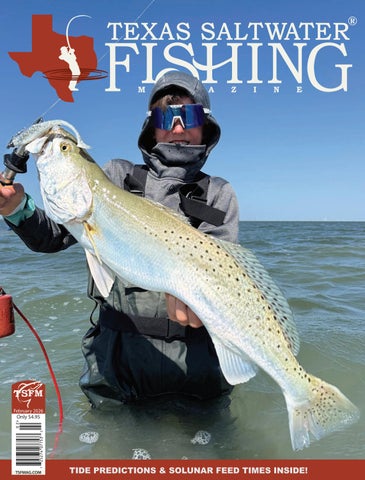
ABOUT THE COVER Young Ben Lyons was fishing alongside his dad and his group on a high-pressure blue bird day. Ben stayed with it all day, tossing his favorite Bone Diamond Wig-A-Lo soft plastic. About midday, when the bite was the toughest, Ben hooked up with this beautiful 28plus. He did it all on his own!
CONTENTS
FEBRUARY 2026 VOL 35 NO 10
FEATURES
DEPARTMENTS
8 February Expectations 14 Breaking Down the North Badlands 20 Heads or Tails 24 Guy Time
28 Let’s Ask The Pro Jay Watkins 30 Shallow Water Fishing Dave Roberts 32 TSFMag Conservation News CCA Texas 34 TPWD Field Notes Danny Martinez, Grant Maresh 36 Extreme Kayak Fishing & Sharks... Eric Ozolins 40 Mostly Sight-Fishing Nathan Beabout 42 Bird’s Eye View Trevor Kucia 43 Science & the Sea UT Marine Science Institute
Steve Hillman Kevin Cochran Chuck Uzzle Joe Richard
36
8 WHAT OUR GUIDES HAVE TO SAY
48 The View from Matagorda 50 Mid-Coast Bays with the Grays 52 Hooked up with Rowsey 54 Wayne’s Port Mansfield Report 56 South Padre Fishing Scene
Bink Grimes Gary Gray David Rowsey Wayne Davis Ernest Cisneros
50
4 | February 2026
REGULARS 6 Editorial 46 Product Highlights 58 Fishing Reports and Forecasts 60 Catch of the Month 62 Gulf Coast Kitchen
62
EDITOR AND PUBLISHER Everett Johnson | Everett@tsfmag.com Office 361-785-3420 Cell 361-550-3637 VICE PRESIDENT PRODUCTION & ADVERTISING DIRECTOR Pam Johnson | Pam@tsfmag.com Office: 361-785-3420 Cell: 361-550-9918 PRODUCTION / SOCIAL MEDIA DIRECTOR Jennifer Shive | Jen@tsfmag.com ADVERTISER REPRESENTATIVES Bart Manganiello | bartalm@optonline.net Pam Johnson | pam@tsfmag.com Office 361-785-3420 Cell 361-550-9918 Everett Johnson | everett@tsfmag.com Office 361-785-3420 Cell 361-550-3637 CIRCULATION SUBSCRIPTION – PRODUCT SALES Vicky Morgenroth Store@tsfmag.com | Office 361-785-3420 DESIGN & LAYOUT Stephanie Slann Artwork@tsfmag.com SOCIAL MEDIA COORDINATOR Bob Barrera Texas Saltwater Fishing Magazine is published monthly. Subscription Rates: One Year (Free Emag with Hard Copy) Subscription $32.00 E-MAG (electronic version) is available for $15.00 per year. Order on-line: WWW.TSFMAG.COM MAKE CHECKS PAYABLE TO: Texas Saltwater Fishing Magazine Attn: Subscriptions P.O. Box 429, Seadrift, Texas 77983 * Subscribers are responsible for submitting all address changes and renewals by the 10th of the prior month’s issue. Email store@tsfmag.com for all address changes or please call 361-785-3420 from 8am - 4:30pm. The U.S. Postal Service does not guarantee magazines will be forwarded. HOW TO CONTACT TSFMAG: PHONE: 361-785-3420 FAX: 361 792-4530 MAILING ADDRESS: P.O. Box 429, Seadrift, Texas 77983 PHYSICAL ADDRESS: 58 Fisherman’s Lane, Seadrift, TX 77983 WEB: www.TSFMAG.com PHOTO GALLERY: photos@tsfmag.com PRINTED IN THE USA. Texas Saltwater Fishing Magazine (ISSN 1935-9586) is published monthly by Texas Saltwater Fishing Magazine, Inc., 58 Fisherman’s Lane, Seadrift, Texas 77983 l P. O. Box 429, Seadrift, TX 77983 © Copyright 1990 All rights reserved. Positively nothing in this publication may be reprinted or reproduced. *Views expressed by Texas Saltwater Fishing Magazine contributors do not necessarily express the views of Texas Saltwater Fishing Magazine. Periodical class permit (USPS# 024353) paid at Victoria, TX 77901 and additional offices. POSTMASTER: Send address changes to Texas Saltwater Fishing Magazine, Inc., P. O. Box 429, Seadrift, TX 77983.
TSFMAG.com | 5
EDITORIAL
MAGIC MONTH OR JUST ANOTHER GOOD ONE?
February is likely the most celebrated month of the year for catching trophy trout. Does this mean you can’t get one in any other month? Not hardly... but the fact that Jim Wallace pulled a 13 pound - 11 ounce state record speck out of Baffin Bay on Feb 06, 1996 certainly doesn’t dampen February’s reputation. Neither was February’s reputation the only one carved in stone that day. You see, Wallace used a little-known lure called a Corky that day, made by an equally obscure lure tinkerer in Pearland, TX., named Paul Brown. And the rest, as they say, is history. All the hype and hysteria aside – all things February Issue February, Wallace, Brown, Corky, and State Record – let’s dig in a bit deeper and see what Highlights else we can learn. We’ve already touched on the fact that Follow and Like February is not the exclusive realm of trophy us on YouTube! seatrout. Indeed, lots of out-sized specimens have been landed in this last month of winter, but March and April actually have better potential if you consider that the fish are still winter-fat and also likely to have ovaries swollen with roe. The additional weight of which can tip the scale favorably before they
6 | February 2026
begin to spawn in early spring. And then there’s Wallace and Brown, two very likely candidates or culprits, depending how well you might have known them in their respective prime. Wallace was an incredibly talented angler and spent more days pursuing big trout during his career than most anglers ever get to pursue any pastime in a lifetime. And Brown, the term inveterate tinkerer might apply, driven certainly does. The man simply never gave up. Pure and simple, that’s how the Corky came to be. Nothing really magic about it; it’s greatest attribute is that it just kind of sits there. Paul listened to dozens of anglers and finally perfected the sink rate and the way it darted and settled after a twitch. Rather uninspiring in some ways, you either love it or you don’t. The proof of the pudding though is what the fish think. And now let’s have a closer look at that state record. Prior to Wallace’s giant, the record was held by Mike Blackwell. Blackwell’s record weighed 13 pounds – 9 ounces and also came from Baffin, no surprise, back in 1975. Wallace edged him out by a scant 2 ounces and Mr. Blackwell, we are told, fished like a demon all these many years after seeking those missing few ounces to win back the Holy Grail of Texas trout fishing. But back to February; while certainly a great excuse to heave off for a mid-winter fishing trip, is there really any other magic in it?
GET HOOKED ON THE SUZUKI LIFESTYLE ®
FIND A DEALER NEAR YOU TODAY! 5 YEAR LIMITED WARRANTY applies to qualifying purchases of Suzuki outboard motors sold and delivered to the retail purchaser, for pleasure (non-commercial) use only, from April 1, 2021 through March 31, 2026. See Suzuki Limited Warranty for additional details. Suzuki, the “S” logo, and Suzuki model and product names are Suzuki Trademarks or ®. © 2025 Suzuki Marine USA, LLC. All rights reserved.
TSFMAG.com | 7
Brian Castille has a knack for catching over-sized reds, even in the middle of a school of trout!
February Expectations STORY BY STEVE HILLMAN
O
ne of the things I’ve always enjoyed about winter fishing here in Galveston Bay is its predictability. I just love it when I know that, when I drop the boat into the water, there’s a very high likelihood my game plan for the day will produce positive results. The main reason for this is because our trout have already moved into their winter areas, and they’re not leaving until seasonal changes force them to relocate. February is pretty much the last month we can enjoy this winter consistency before March brings seasonal shifts in the patterns. It reminds me of the “snowbirds” from New England who move to Florida every winter, then return to their primary residences in March or April. Assuming salinity levels remain constant, we’ll continue to focus on fishing areas with mud and shell, especially during early February. Areas along drop-offs, such as reefs near the Intracoastal Waterway, will continue to produce—especially when targeting the small breaks in the reefs where current velocity is typically stronger. These little “Venturi” areas are mini highways for bait, and the swift current can also create muddy streaks, which gives us yet another bullseye to throw at. These stretches of shallow oyster reef are typically characterized by jagged clusters of live oysters, often making it difficult to throw a soft plastic rigged on a jighead without getting hung up. Twitchbaits such as Texas Custom Lures Double Ds, Borboletta LeLes, and MirrOlure MirrOdines not only help prevent getting snagged, but are usually more attractive to the trout anyway given the bottom landscape and conditions this time of year. Despite the location’s overall predictability, this doesn’t mean there won’t still be a few curveballs thrown our way. Fluctuations during pre-front and post-front conditions will temporarily result in feeding habit changes and even minor relocations within the areas our trout are living. In other words, they won’t go too far. There are some very simple keys to remember: Pre-front – Water is warmer, barometric pressure is lower, fish are typically shallower and can be somewhat spread out. Good baits include topwaters and soft plastics. If it’s calm, I like MirrOlure’s new Gunn Dog. It profiles well as a shad or pinfish and has a very subtle rattle. If it’s choppy, I’ll switch to a Top Dog or even a She Dog. One of the things I’ve always loved about MirrOlure is that they have a lure for every possible condition. And—you can never go wrong
TSFMAG.com | 9
Rusty Plackemeier with a behemoth redfish he tricked on a Watermelon / Red Glitter Saltwater Assassin Little P&V!
Jeff Lindenberger caught this one while casting to small cuts through a shallow reef near deep water.
with soft plastics, especially during winter warm-up periods when our fish tend to spread out. We can always cover more water in less time chunking tails. The Flamingo Flash Saltwater Assassin rigged on a 1/8-ounce Pro Elite jighead has been deadly this winter, fishing in this “clearer than normal” water. Post-front – Cooler water, barometric pressure is higher, fish typically get closer to deep water (or near the bottom in deep water during extreme cold events) and tend to become more bunched in tighter schools. While the fact that they may be more concentrated makes them easier to target, it doesn’t necessarily mean they’ll be easier to catch. Pre-front feeding frenzies, high barometric pressure, lower water temperatures, and reduced metabolism can give us a headache when trying to figure out ways to trick our little freckled friends. Sinking twitchbaits such as MirrOlure’s Paul Brown Corkys and sluggish wintertime trout are a match made in heaven. I once asked, “Mr. Brown, why will trout eat a Corky when often times they won’t even touch another bait?” He smiled and said, “Well Steve, I guess it’s kind of like someone who’s on a diet but sees that Snickers bar on their desk they’ve been looking at all day. Sooner or later, they’re gonna eat that candy bar.” I’ll never forget when Mr. Brown told me that. Sometimes the only shot we have at tricking an appetite-suppressed post-front trout is to put a small-profile bait such as a MirrOlure Lil John or Saltwater Assassin P&V right in their face. These baits have saved my bacon on what would have otherwise been extremely tough catching days. The hot one for me 10 | February 2026
Reed Purdy came all the way from Michigan only to fish in 35° weather. So much for a warm Texas welcome!
right now is the Watermelon/Red Glitter P&V. Typically, later in February we’ll experience more frequent warming trends. We’ll see more days with higher tide levels caused by easterly winds and lower barometric pressure. Water temperatures will obviously fluctuate as cold fronts push through the area, but they should remain warmer overall than earlier in the month. Tiny forage species such as minnows, shad, and worms will become noticeable as we reel in our lures. I often see tiny minnows sprinkle out of the water around my soft plastic. I’m never sure what species they are—just like I’m not 100 percent sure what those little pink worms are that I see every year around this time. I’ve been told they are polychaete worms, or cinder worms, but I’m not sure. Regardless, higher tides, warmer water, and tiny forage will trigger the beginning of a seasonal pattern shift in our trout. While we’ll continue to catch fish over mud and shell bottoms near deeper water—such as guts, bayous, and various types of ledges—many of our fish (especially trout) will begin to frequent new areas because of the changes mentioned above. We’ll tend to focus more effort on shoreline marsh drains that dump into the bay, especially those with oyster reefs and/or bottom grass present. Our feet will spend lots of time walking coves with soft-bottomed bowl areas as we wade for above-average-sized trout. Speaking of wading, for years I struggled to find boots that provided any real level of comfort, but now I’m absolutely ecstatic to say I’ve hit the jackpot. My new Southerly wading boots are not only the most comfortable
TSFMAG.com | 11
Kirk Debban landed this solid speck while fishing a shallow flat during a brief warm period.
Wintertime Clear Water Catching! Follow and Like us on YouTube! 12 | February 2026
the mid-70s, yet our catching stayed consistent because we made the proper adjustments. We’ve caught fish on just about every lure imaginable—even old Rebel Broken Backs and spoons. I’m still in awe of how many incredible options we have as anglers for nearly every scenario. As consistent as this winter’s fishing has been, new patterns will emerge in the weeks to come. My advice to all fellow anglers is to be ready and know how to react when the time comes. Lord knows we have all the lure choices on the planet, along with the best electronics, gear, and resources. The rest is between our ears.
STEVE HILLMAN
CONTACT
I’ve ever used (and it’s not even close), but they’re also lightweight and exceptionally easy to slip on and off over my Southerly waders. They’re also extremely durable. I deal with plantar fasciitis and wear custom orthotics, so if they’re that comfortable for me, that’s really saying something. The waders, undergarments, and jacket all fit the bill for premium quality, comfort, and durability. As far as lure choices for late February, I’ll be chunking a lot of Saltwater Assassins rigged on lighter jigheads such as 1/16-ounce and Pro Elite 1/8-ounce heads. We’ll incorporate more full-sized (5-inch) rat-tail worms into our repertoire when using Assassins, and more Lil John XLs and Provokers when chunking MirrOlure soft plastics. We’ll still have days when downsizing to smaller Sea Shads (paddletails) is necessary, but our bigger-bait days will become more frequent based on historical patterns. Topwaters and twitchbaits will have their moments to shine as well. As I reflect on this winter’s fishing, I can honestly say it’s been both fun and productive. We’ve fished in extremely different conditions, with water temperatures ranging from the low-40s to
Lots of 3-pounders like this one this winter but still fun! They’ll be 5 and 6 pounders before you know it!
Steve Hillman is a full-time fishing guide on his home waters of Galveston Bay. Steve fishes the entire Galveston Bay Complex, wading and drifting for trout, redfish, and flounder using artificial lures. Phone 409-256-7937 Email captsteve@hillmanguideservice.com Web www.hillmanguideservice.com
*
**
OfFER VAlID: JANUARY 5-MARCH 30, 2026
Choose from either up to $10,000 in instant savings or a 36 month HondaCare Protection Plan® with the purchase of select new 40HP-350HP Honda Marine outboards.
SELECT NEW OUTBOARD MODELS Honda 40HP-50HP Honda 60HP-100HP Honda 115HP-140HP Honda 150HP Honda 200HP-225HP Honda 250HP M300 McLaren Performance† Honda 350HP
INSTANT SAVINGS OPTION $ 200.00 SAVINGS $ 300.00 SAVINGS $ 400.00 SAVINGS $ 1,000.00 SAVINGS $ 1,250.00 SAVINGS $ 1,500.00 SAVINGS $ 1,750.00 SAVINGS $ 10,000.00 SAVINGS
oR
36 MONTHS HPP OPTION (MSRP) $ 565.00 VALUE $ 920.00 VALUE $ 1,165.00 VALUE $ 1,490.00 VALUE $ 2,290.00 VALUE $ 2,730.00 VALUE N/A $ 4,460.00 VALUE
*At participating Honda Marine dealers only. Qualified retail customers may receive savings off the selling price of a Honda powered boat package or Honda Marine engine(s) sold for repower. This promotion is limited to select new Honda Marine BF40–BF350 outboard engines, 2021 and newer models, in stock, sold and delivered between January 5, 2026, and March 30, 2026, delivered to a U.S. resident. May be combined with certain other promotions. Only Honda Marine outboard engines sold for personal use qualify for this promotion. Fleet, rental, commercial, and government sales, demo engines, and engines sold under special pricing/promotions including (but not limited to) guides, brand ambassadors, and tournament fishermen are ineligible. **Manufacturer’s Suggested Retail Price. Dealers set their own pricing. Actual contract coverages, limitations, and exclusions may vary. HondaCare Protection Plan® not available in South Carolina. See your dealer for details. The HondaCare Protection Plan® is administered by American Honda Service Contract Corporation in the state of Florida, License #60083. HondaCare® and HondaCare Protection Plan® are registered trademarks of Honda Motor Co., Ltd. †M300 model is not available for repower. 36-month HondaCare Protection Plan® does not apply to the M300 model. For Honda Marine warranty information, visit marine.honda.com/support/warranty. Honda Marine reserves the right to modify, amend, cancel or revoke, in whole or in part, this promotion at any time without prior notice. All Honda outboards meet EPA and CARB emission levels. Always wear a personal flotation device while boating and read your owner’s manual. © 2026 American Honda Motor Co., Inc. TSFMAG.com | 13
Breaking Down the
North Badlands STORY BY KEVIN COCHRAN
F
ound at the intersection of Baffin Bay and the Upper Laguna Madre, two of our state’s most respected big trout fisheries, the Badlands sits perfectly positioned to produce specks of epic proportions. Some parts of the area hold water of decent clarity when wind speeds crank up off the Gulf, and also when they whistle behind the passage of strong cold fronts. The Badlands has variable depths and a bottom covered by four different constituents—sand, mud, grass, and rocks; these facts enhance its potential for consistent productivity. Some parts of the Badlands produce better numbers of big trout than others. I and most of my friends have encountered more monster trout in the North Badlands than in other parts of the area. This section of the Badlands has two dominant features—a relatively deep, grassy flat extending south from the gut wrapping around the Point of Rocks, and farther south, a shallower, soft flat covered with thick grass beds and scattered rocks. A long line of floating cabins approximately marks the boundary between these two parts, which I call the Point of Rocks Meadow and the Badlands Crown.
Much of the time, the water in the Point of Rocks Meadow proves known anglers who’d say the same. I’m aware of a loaded list of trout too deep for wading. Less often, low tides allow anglers to wade measuring well over thirty inches—up to and exceeding thirtythe entire area. Grass covers most of the bottom on this flat, which two—as well as plenty of heavy beasts stretching the Boga to the stretches for over a mile at its widest point; a few small serpulid rocks ten-pound mark and beyond, up to about twelve, which were caught and numerous sets of potholes create anomalies which provide in these famous places. Most, but certainly not all, of the biggest targets for lure chunkers when the water runs clear. On the northeast specimens bit during cold-weather events, from about Thanksgiving margin of the meadow, a deep gut funnels water from north to south, through Spring Break. out of the intracoastal and into the shallows surrounding the cabins. The North Badlands produces trophies best during cold snaps, Identifying specific sweet spots in the Meadow proves difficult, though big trout certainly populate parts of it year-round. The most since grass beds grow and die off, and because tide level plays such important variables affecting exactly which parts of this area will a prominent role in determining which parts of the flat the fish provide the best potential in a given moment include tide level, temporarily prefer. wind speed and direction, and water temperature. At a basic level, South of the long chain of cabins, on the Badlands Crown, lower tides enhance fishing in deeper parts of the area, while higher identifying micro-spots with high potential proves somewhat easier tides enhance the shallower parts. Colder water temperatures for folks with trained eyes. The grassy bottom in the eastern two-thirds accentuate the potential of the shallower parts of the area, while of the Crown, normally covered by water warmer ones favor the deeper parts. less than thirty inches deep—often less These generalizations do have merit, than twenty—feels much like banana but only when considered in a more pudding. Wading anglers who choose to complete context, given other aspects of try and cover lots of ground in this place a particular situation. often become exhausted and frustrated, The two most important some more likely to find themselves environmental variables are water stuck in the mud than landing a temperature and tide level, with water memorable trout. The deeper western temperature more important in the cold part of the Crown has a firmer bottom, part of the year, and tide level reigning with less complete grass coverage. supreme during the warmer months. Easier wading in this area, combined Conventional wisdom suggests trout with its long, well-known track record in the Badlands will retreat into deeper of producing giants, makes it one of water when extreme frontal events cause the most popular places frequented by water temperatures to plummet during guides and gurus looking to scratch the the first half of winter. Hypothetically, big-trout itch. trout in the North Badlands use the deep Both of these spacious areas produce channel lying close to the Point of Rocks trout reaching the extremes of what’s to make their way into the intracoastal possible in the Lone Star State, as many and its relatively warmer water. As soon The Captain caught this memorable trout in famous anglers have documented. I as conditions moderate, they return to western portions of the Badlands Crown during caught my longest trout to date here, the Point of Rocks Meadow. Anecdotal the most productive month of his career. and I could name several other wellevidence, in the form of excellent catches 16 | February 2026
Adrian Valdez caught one of the longest trout ever caught on Kev’s charters while throwing a soft plastic downwind at the face of a big rock on the Badlands Crown.
Bruce Smiley caught this pretty trout in the Point of Rocks Meadow, on a cold December day.
of big trout under conditions like these, supports the theory. the Badlands as a whole, creating a juicy scenario in the eastern part As conditions moderate slightly more, many of the biggest trout in of the Crown—especially when those winds veer more to the east. the area will show up in the shallows atop the Badlands Crown. Water During events like these, the water covering the grassy bottom close temperatures ranging from about 50 to 54 degrees best enhance to the spoil island separating the Eastern Crown from the intracoastal the potential for catching wall-hangers in this area from December maintains decent clarity, and savvy anglers willing to brave the walk can through February. Once water temperatures warm into the midencounter some epic fish to reward their efforts. This scenario also works 50s, the reliability of this pattern falls apart. Other factors further well when winds swing to the north of due east, during any timeframe, complicate the situation. Bitter north and northwest winds whistling but especially during the moderate months of spring and fall. in the wake of strong cold fronts will turn the shallow water covering A skilled angler chunking lures could catch a magnum trout in the Crown ugly brown. The deeper water covering the flat lying closer the North Badlands during any month on the calendar. I caught the to the Point of Rocks holds its clarity longer in such situations. longest trout of my career here in May; a customer also caught one Normally, in winter, the best scenarios for catching huge trout of the longest trout taken on my charters in this area during the on the Crown take place in water of marginal clarity. An angler’s last full month of spring. During the warm months, the two most knowledge of the locations of important environmental factors sweet spots on the flat becomes enhancing the potential for critical when silt in the water hides catching big trout in the North the bottom from probing eyes. Badlands become wind speed Another productive winter pattern and tide level. The best scenarios plays out in these locations when generally include conditions in strong onshore winds (southeast) which quiet onshore winds blow push most of the water off the softly across the Crown, with a Crown and muck up what’s left. tide level in the medium-to-high Then, good numbers of big trout range. In conditions like those, the often move into the deeper, water on the wide, shallow flat cleaner water of the Point of Rocks will run green to clear, as long as Meadow, where anglers wielding brown tide is either absent or only topwaters and slow-sinking twitch minimally present. baits can trick them—sometimes In such situations, anglers catching impressive numbers of tossing floating plugs like One five- to seven-pound fish, with an Knockers and slow-sinkers like occasional bigger one thrown in to Paul Brown Fat Boys can pull ice the proverbial cake. monsters out of hiding by focusing In warmer months, the same their efforts around rocks and Caleb McCumber with a rare 32-inch trout he caught on a January strong southeast winds will potholes. Sometimes big trout will outing in the Point of Rocks Meadow while fishing with the Captain. muck up most of the water in rest against grassy seams created TSFMAG.com | 17
Gators in the North Badlands Follow and Like us on YouTube!
18 | February 2026
present in the shallowest parts of the area likely runs lower than in cold water. Obviously, targeting small numbers of fish scattered far and wide across vast flats requires patience, diligence, and an acceptance of a lower success rate. Nevertheless, this area does attract plenty of anglers during the hot months, for good reasons. Winds often whisper at the start of a typical summer day, then pick up significantly around lunchtime. Anglers wading central and western portions of the Crown and throwing topwaters regularly reap rich rewards while the sun is low. Later, when wind speeds ramp up, standing upwind of rocks and throwing soft plastics as close as possible to their wind-blown fronts works better. These scenarios represent just a few of the many plans known to make anglers’ dreams come true in the rightly famous place known as the North Badlands.
KEVIN COCHRAN CONTACT
by pothole edges; other times, they’ll sit atop the rocks themselves, waiting to ambush prey. Particularly in spring, they tend to like perching on the rocks and don’t show much willingness to move off their edges to strike. These situations can necessitate presenting topwaters or floating twitch baits directly over the boulders. In the shallow, generally clear waters of the eastern portions of the Crown, Floating Fat Boys or Paul Brown Original Lures work well. Without rattles, these lures create less disturbance than conventional topwaters; their stealth sometimes makes them more effective in attempts to trick old trout into striking in the shallows. Additionally, the ease of presenting floaters at appropriate speeds in water less than twenty inches deep enhances their potential in places like these. As is the case anywhere, catching finicky fish on the Crown sometimes requires throwing soft plastics; dangling them under small corks helps anglers work them at the proper pace through the shallows. In the warmest months, anglers can expect to catch a few big trout in the Point of Rocks Meadow, especially when steady onshore winds muck up the Crown and blow the tide out. In better conditions, with good water clarity and slightly higher tide levels, the western half of the Crown offers ripe opportunity, though the number of big trout
Kevin Cochran is a long-time fishing guide at Corpus Christi (Padre Island), TX. Kevin is a speckled trout fanatic and has created several books and dvds on the subject. Kevin’s home waters stretch from Corpus Christi Bay to the Land Cut.
TROUT TRACKER GUIDE SERVICE Phone Email Web
361-688-3714 kevincochran404@yahoo.com www.captainkevblogs.com
TSFMAG.com | 19
The new Eagle Inshore spinning rod from Fenwick coupled with the Penn Clash reel is a well-balanced combo.
HEADS OR TAILS STORY BY CHUCK UZZLE
E
asily, one of the most common ways to describe an unknown situation that has the potential to be either off-the-chart good or soul-crushingly bad is to call it a coin toss—a totally random act influenced by nothing but fate. On one side of the coin is heads, an optimistic hope for success based on positive actions from previous encounters. On the other side of the coin is tails, the feeling of impending failure that seems to come around and ruin every little bit of hope that has falsely presented itself. Each time the coin is flipped, there is a split second of heightened anticipation that is met with celebration or dejection, depending on what side comes up. At this point in time, most Sabine Lake anglers are in that split second where the coin is up in the air. All are hopeful for the prospects of an even better year than 2025, but are also scared to death that things will somehow revert back to the difficult days of previous years. Each one feels like Charlie Brown getting ready to finally kick the football, believing Lucy won’t pull it away at the last second. Only time will tell. Taking a few moments to appreciate how far Sabine Lake has progressed in its “spotted seatrout comeback” does nothing but put a smile on my face. During 2025, especially the final quarter, one would be hard-pressed to ask for better overall conditions. Water clarity and salinity levels were borderline perfect, and that contributed greatly to the success most anglers enjoyed. Both of the big freshwater lakes to the north—Toledo Bend and Sam Rayburn—stayed well below normal pool levels, which kept discharges to a minimum. These consistent conditions for most of the year were a welcome change from years where fighting changing salinity and diminished clarity was a constant battle. It was such a treat to be able to see structure in some areas because the clarity was so good. I personally found several hidden gems I had never seen before, and they produced some exceptional fishing throughout the year. Many of these newly discovered areas will hold fish during the colder periods of the year, so finding them should pay dividends in February and March when we typically see our lowest temperatures.
TSFMAG.com | 21
One fish that never had to make a comeback because it never left was the redfish. 2025 had to be “the year of the redfish” because they were thick all year long and always willing to cooperate. For a good part of 2025, it didn’t matter what pattern you chose—from shallow to deep or marsh to Gulf—the redfish were there and ate everything you threw at them. The sheer numbers of redfish in the Sabine system have to be near some sort of record level, and that’s a huge bonus for anyone fishing this area. If there is any downside, it’s that many of them seem oversized, with slot fish fewer at times. The numbers of 30- to 35-inch redfish cruising the lake are mindblowing, and it seems like more show up every day—which is a great problem to have. These fish should continue to be prime targets even during the colder months ahead. As of late, thanks to the consistent bite on Sabine, I’ve been able to pare down my tackle choices, which is a major feat because I typically pack entirely too much. I’ve had great success with the new ZMan Prawn Starz in the 3- and 3.5-inch models for both redfish and speckled trout, with the occasional flounder mixed in. ZMan soft plastics are ridiculously durable and Chris Collins with a nice slotsized redfish that ate a crankbait. Jose Vidal with a solid Sabine redfish.
To truly feel like Sabine has returned to a somewhat normal state, we need to see some big trout showing up—the kind that turn your head and make you take a second look. For a long time, I wondered if we would ever see anything but 14inch trout, because it seemed like that’s all there was for quite some time. This past year, we really saw an increase in better fish—the 17- to 22-inch class trout that had disappeared for a while. After seeing those quality trout make a nice showing, it wasn’t long before a few 5- and 6-pound fish made an appearance, giving us hope that more and bigger fish are coming. I will truly be happy to see one of those 8- or 9-pound trophy trout finally get caught—even if it’s not me— just to know they still exist in our waters. 22 | February 2026
have incredible action, making them a favorite of mine when fished on a jighead or under a rattling cork. My affinity for swim and jerkbaits continues to grow as speckled trout eat them like there’s no tomorrow. I’m convinced these baits trigger reaction strikes when others won’t. I never leave the dock without a good selection on hand and rely on them as a safety blanket when things get tough. Other staples include Corkys, Soft-Dines, fiveinch paddle tails, and assorted topwaters, giving me coverage throughout the entire water column. These will be my everyday go-to baits over the next several weeks as we hunt for better fish. While on the subject of gear, I have to give a nod to the new Fenwick Eagle spinning rods. I had one on the boat recently and put it to work on some big redfish, and it performed very well. These rods are surprisingly sensitive with a solid backbone. The Eagle I fished was paired with a new Penn Clash spinning reel, making for a well-balanced outfit capable of handling a wide variety of species. Looking forward, we’ve finally reached the most anticipated time of year for the big-trout crowd—late winter and early spring. Some of the best fish of the year will be caught during the next few weeks all along the Texas coast. I’m hopeful Sabine will rejoin that party and begin producing those class fish again. Until that happens, there are plenty of other options to fish up and down the upper coast, and I plan to take advantage of them. If chasing fish in cold weather isn’t your idea of fun, don’t forget you can always stop by the Houston Fishing Show at the George R. Brown Convention Center, February 18–22. Come say hello or swap a story. And if you do get on the water, please stay safe, wear a PFD, and remember cold water can become dangerous very quickly. Hope to see everyone on the water or at the show. Make 2026 a great fishing year!
Continued great weather boosts Sabine trout recovery. Follow and Like us on YouTube!
CONTACT
CHUCK UZZLE Chuck fishes Sabine and Calcasieu Lakes from his home in Orange, TX. His specialties are light tackle and fly fishing for trout, reds, and flounder. Phone Email Website
409-697-6111 wakesndrakes@yahoo.com wakesndrakes.com
TSFMAG.com | 23
Here’s a club member who knows winter trout and wants me to go.
Guy Time STORY BY JOE RICHARD
A
ccording to the book Bowling Alone by Robert Putnam, there is far less socializing in our local communities today. People are more isolated; there are fewer Rotary Clubs, and church attendance is down. The same goes for Lions Clubs and Elks Lodges. Cell phones have replaced much of our human contact. Social media is rampant with folks constantly staring at their phones in restaurants and traffic. Storytelling around campfires—a tradition thousands of years old—now struggles to survive. We still keep that tradition alive while visiting friends in Port O’Connor, however. It’s one of our favorite pastimes on the coast each summer evening, because there are many stories to tell about locals and various misadventures on the water. It’s true that hunting provides a storytelling respite for guys, but the season doesn’t last all year. When I’d been married only a year, I was invited on a deer lease near Lockhart where a few Beaumont lawyers and a judge sat around the campfire. When it was pointed out that few deer had been seen on the lease, one guy said, “I don’t care; I just need a break from my old lady.” That was my first introduction to the idea of guys actually needing guy time. His statement seemed odd to me, because Amy and I fished together—even won tournaments—and still do. I was going to say that our situation is probably a rarity among married couples, but we may as well delete the word probably. With that said, over the years I’ve come to appreciate guy time—not so much as a break from a wife, but as a chance to enjoy camaraderie with others who share a passion for the outdoors. One form of socializing I enjoy is year-round fishing clubs. I’m currently a member of two: one saltwater and one freshwater. The saltwater club holds various tournaments, a Christmas auction with lots of used equipment, a winter clam roast, and an annual awards banquet honoring the year’s top male and female anglers. We also host monthly lectures from area guides and scientists working with saltwater species. Teenagers are part of the club and are learning the ropes.
TSFMAG.com | 25
The club runs a year-long carried lingering war trauma. contest featuring ten species— Today, they’ve largely been four offshore and six inshore. replaced by Vietnam veterans Using registered digital hand who still fish, and we even had scales, each fish’s weight is two game wardens among our converted into points, with the ranks, though one recently passed. largest fish of each species worth About half the members are now 25 pounds. Whoever finishes too old or stove-up to fish, but with the highest score at year’s they still show up every month end wins a $500 Bass Pro Shops for meetings at the clubhouse, gift certificate. Amy is currently enjoying fried crappie, hush leading the women’s division puppies, and cheese grits while for 2025, so we’ll be going on a eagerly hearing the latest fishing shopping spree in January—just reports. We regularly hold crappie like we did back in 1981 with a tournaments on area lakes, plus gift certificate from Port Arthur’s a redfish, trout, and mackerel SALT Club, though that one tournament every October. was to Gibson’s, which carried These older guys have shown only a few outdoor items and me techniques on five different fishing tackle. Then and now, lakes. Younger members in their we didn’t—and don’t—own an 40s are gradually replacing them. offshore boat, though there were Above our covered picnic table decades when we did. hang plaques bearing the names As a board member on the and birth-and-passing years of at tournament committee, several least 80 deceased members. Most of us will be pushing hard to drop of the group still uses jonboats, several offshore species for 2026 so I fit right in. This is a guys-only and replace them with inshore club, allowing plenty of goodfish. Ling, kingfish, and amberjack natured guy talk. A few of the are not doing well offshore. Gulf younger members still sip beer, This flounder scored a bunch of points with the saltwater club. Coast biologists I’ve spoken with but nothing like back in the day. are plainly worried but hesitant to go on record without deeper research into cause and effect. It seems logical to replace these troubled species with others that are doing better. The club was founded in 1969, when fish stocks were very different from today. Species like tripletail, black drum, and pompano—reachable with smaller boats—could be viable substitutes. Our serious offshore members with big boats have sometimes returned to port without a single keeper, after burning more fuel than I use in a year. The entire club caught only four or five kingfish and ling this past year. I still fish offshore occasionally aboard club members’ boats, knowing there’s no need to own one when you have friends looking for passengers. My other fishing club is made up of what I affectionately call “grumpy old men,” where the average age was at least 70 when I joined. They stick with freshwater, which isn’t nearly as tiring. Since 2020, we’ve lost 14 members to various causes—several were World War II veterans. The club dates back to 1950 and was named after Four Roses, a popular beverage at the time. Back then, Club member John Byatt is from England and put us on the members were much younger, fished hard, some serious mackerel last summer, some scoring 20 points. and held fish fries every Thursday. Some no doubt 26 | February 2026
I was coaxed into becoming club treasurer, managing $40 membership fees, raffle proceeds, $5 lunches, tournament entries, and payouts. I’ve learned a lot fishing with these guys. Cast your mind back to around 1969, when Toledo Bend Reservoir first opened to fishing. Most local high school kids didn’t know shinola about the new lake. The YMCA had started a boys’ fishing club in Port Arthur, and with great enthusiasm, we boarded a bus with camping gear for a warm spring weekend. They hauled us north, eventually turning down a (thankfully dry) dirt road to Green Acres campground, which had boat rentals. The next day we paddled into the nearest cove. Back then, crappie were stacked around every tree and brush top, with no limits in place. We caught heavy stringers using small hair jigs. On the dock was a contraption like a clothes dryer that spun fish clean, blasting scales back into the water. That first trip turned into many more adventures. With new driver’s licenses, we drove back on our own and filled stringers
This club member has a pontoon boat and trolls for big crappie.
again. We never would’ve known about that place without club membership. On one trip, we slid off the muddy road in a massive station wagon and waited hours for a tow. On another, returning after dark and distracted by a rabbit—we used to road-hunt rabbits on Pleasure Island—we hit a sharp curve near Burkeville on wet pavement and slid into the woods, slamming Marvin Cichowski’s dad’s red Thunderbird into a big tree. Our Styrofoam coolers didn’t survive, and crappie flew everywhere, even onto the dashboard. We hiked into town to make a call, and Marvin’s schoolteacher father—who had plenty to say—drove 92 miles on a Sunday night to retrieve us. We were hard on family cars for several years. We need more fishing clubs. How else are you going to learn new areas, techniques, and recent catches—by talking to tight-lipped strangers at the dock? Lurking on Facebook? Good luck with that. Just today, two buddies from my club called to report catching 20 trout from 16 to 22 inches, giving the exact location. They’re going back tomorrow—and want me to go.
JOE RICHARD
Spring lake fishing can be more relaxing than running up and down the coast.
CONTACT
Joe Richard has fished the Gulf since 1967, starting out of Port Arthur, but his adventures have taken him up and down the entire coast. He was the editor of Tide magazine for eight years, and later Florida Sportsman’s book and assistant magazine editor. He began guiding out of Port O’Connor in 1994. His specialty is big kingfish, and his latest book is The Kingfish Bible, New Revelations. Available at Seafavorites.com
TSFMAG.com | 27
Charlie Church with a chunk of a wintertime trout.
J AY WAT K I N S
ASK THE PRO
COLD WEATHER
APPROACHES & STRATEGIES Since we are presently in the thick of winter fishing, I believe it fitting that I write something about my attitude and approach to areas I intend to fish during the coldest times of the year, especially in some of the very small areas I like to fish. Too many times we place ourselves behind the eight ball, so to speak, by the way we approach the areas we intend to fish. I say this because I do not believe the majority of anglers are aware of how sensitive fish are to noise, especially sounds that can be transmitted through the water. Ask a seasoned tarpon guide what happens when you put the trolling motor down and bump it into gear. Ask today’s top bass anglers how bass respond to trolling motors and forward-facing sonar pings. Ignoring these facts would be unwise. I’ve noticed myself becoming careless and inattentive at times with my approach, and it hurts the odds. Don’t even get me started on loud music on the boat while you are trying to fish. 28 | February 2026
When seeking trophy trout, I prefer small coves or pockets along barrier islands or ICW spoils in colder weather. Over the years, I’ve gathered information on many coves and pockets with strong bottom structure, shallow feeding and warming areas, and quick access to deep water. I like deeper water nearby with similar bottom structure as the area being targeted, but even areas without structure can still attract fish. I start a minimum of 150 yards away from the zones that I intend to fish. Wading in carefully and attentively while fishing lets you observe and spot where bait is present. Incidentally, bait isn’t only found by watching baitfish themselves break the surface. Birds also show us baitfish presence. They can also show us the fish we are targeting. I remember early in my career, I was wading the Bray Cove area of Mesquite Bay when I noticed brown pelicans diving repeatedly in a shallow cove. While seeing pelicans
Jay Lucas shows off a winter-fat speck.
diving is by no means out of the ordinary, these birds would suddenly abort their dive as they got close to the water. Once in the area, I realized that the fish the pelicans were seeing were large trout and reds—too large for the pelicans to attempt to eat. I will never forget that lesson, and to this day I sometimes still see this happen. Our focus as we approach our intended fishing area is the most important aspect of the day. The discipline I will describe here must become second nature—something you do without thinking. Ospreys are my favorite bait-finding birds. They typically live close to the areas they fish and communicate with one another through their calls while hunting. Most of the time there are only one or two working the small coves or pockets, but I did once see a flock of 18 in one pocket. It was on a day after a dramatic drop in water temperature and tide. Stunned mullet were hugging the thermocline just off the bottom in the muddy offshore of the pocket. I could feel the lure bumping the baitfish as it fell to the bottom. A slight lift off the bottom was greeted with a light but very distinct thump—the thump we all wait for. We must monitor the water temperature as the day develops. Often, both baitfish and gamefish remain in deeper offshore waters until sunlight heats the uppermost layer of the water. Fish acclimate to the cold and will be more active in colder water than some might think. This is evident by the numbers of big fish that are caught in the most brutal winter conditions. Any time I can coordinate a moonrise or moonset minor feeding period with a warming trend, confidence is high for me. Many of my very best days occurred
Author with a nice one that ate a Texas Customs Double D.
during the shorter minor periods versus the longer major periods. Once you’ve reached the targeted area, slow down and be patient. Fan-casting the entire area lets us cover more water by presenting the lure to a wider range of targets. Creating some bend in your cast helps in allowing anglers to bring the lure out in front of the fish, which is definitely a more natural approach. With a natural angle, predators react with instinct, and that is always the best chance for us to get a big fish bite. Often, I’ll settle into one spot for most of the day if I’m getting enough signs that the right fish are present or likely to appear. If you get impatient and feel the need to leave, ease out if you are planning on returning to the area later in the day. I usually consider several locations and can relocate as needed, so I don’t always follow my own advice. Tournament fishing taught me to pick an area and camp there, knowing that the field of excellent anglers would be occupying some of the other high-potential areas. You can learn more about an area by committing to it and allowing yourself to watch the bites turn on and off, which they do. If I know the right fish are present, I am not leaving—period. Sometimes, this mindset comes back to haunt me. Even with that said, I don’t regret not moving, knowing that I had placed myself in an area with high potential. One thing that is hard to teach is the seeing of the unseen. I know—how does one see something that can’t be seen? I am talking about the movement of baitfish and also the gamefish
Continued on page 45... TSFMAG.com | 29
DAV E R O B E R T S
S H A L L O W W AT E R F I S H I N G
FROM ONE END TO THE OTHER On the Texas coast, winter has finally set in, and that means air and water temperatures are becoming more stable on the cold side. Weather and water temperatures over the next few months will still fluctuate with the arrival of cold fronts, but for the most part you’ll see only moderate changes during any given day—unless a real screamer of a norther makes its way to the coast, which can drop water temperatures to dangerously cold levels. Fishing can be surprisingly productive during winter, and I love taking full advantage of the opportunities this time of year provides. One of my favorite aspects of winter fishing is that an angler can go just about anywhere on their lake or bay and find fish. Now, I don’t mean you can stop at any random spot and expect fish to magically appear. What I mean is that redfish and trout will be holding true to their winter patterns and can be found in bayous, flats, shallow marsh areas, and even at the jetties. Fish tend to group up this time of year, and once you find them, you’re usually in for a fun day. When fishing during the colder months, it’s often said 30 | February 2026
that deep water is the key. I’m not arguing that point— it’s true—but that doesn’t mean every fish is glued to the very bottom of the deepest water around. Another bonus of winter is improved water clarity. Sight-casting can be as good as it gets any time of year, and personally, I believe winter may actually be the best time of year for it. When the forecast calls for decent weather with plenty of sunshine, I usually head straight to the marsh. Redfish will be nosing around, looking for an easy meal. To catch them, I like to throw lures that put off a lot of vibration. Quite often my go-to will be a Z-Man Chatterbait or a swimbait with a large paddle tail. In the swimbait category, I prefer a Keitech rigged on a 1/8-ounce bellyweighted swim hook. I believe the vibration from that tail gets a redfish’s attention and triggers a strike, even when they’re cold and sluggish. Overlooking the marsh during this time of year can be a serious mistake. Starting in early February, I tend to jump out of the boat and wade more. Our trout fishery has bounced back tremendously over the past few years, and I think we’ll finally start seeing better fish caught on a more regular
Beginning of the Year on Sabine Follow and Like us on YouTube!
C O N TA C T
basis. I’ll be wading shallower flats near dropoffs into deeper water. I’ve found trout like to sit along the edge of the flat and begin feeding once the tide starts dropping out. They wait for bait to be pulled across the flat and into deeper channels, and that’s when they really turn on. I like casting a Corky or soft plastic and letting it drift naturally with the moving tide. This can be extremely productive—so hang on to that rod. When it comes to fishing deeper water, I usually take one of two approaches. The first is targeting bayous and drains, which I save for days with less-than-ideal weather. Let’s be honest—you’re not always going to have perfect conditions during winter. We all have spots that are protected from the wind and can be safely accessed and fished. For me, deeper bayous are a go-to under these conditions, and the fishing can be excellent. Fish seek deeper water for refuge from the cold but still need to feed. Water movement is a must in these areas. I focus on bends in the bayous where holes are deeper and where shallow marsh ponds drain back in. The water flowing from those ponds is often slightly warmer—a perfect recipe for a few big bites. Along with Chatterbaits, I also like throwing a Rat-L-Trap or slowly jigging a Chatterbait along the bottom. Creating vibration is a key factor in attracting bites during cold-weather fishing. My second approach is fishing the jetties when I’m able to get there. This time of year, bull redfish will school up and tend to hold on specific sections of the rocks. It may take some time to locate them, but once you do, set the anchor and enjoy. As with other winter patterns, water movement is critical—preferably during a falling tide. I usually start with a Texas-rigged Gulp! shrimp using a 1/2-ounce bullet weight and a 5/0 offset hook, rigged weedless—or in this case, rock-less. Bounce the rig along the top of the rocks, then slowly drag it off and let it fall. It usually doesn’t fall very far before a big bull eats it. I’m excited about fishing over the next few months. Winter is one of my favorite times to be on the water and can lead to some incredibly successful days. If you’re planning on getting out there, pay close attention to the weather—it can change quickly. Be careful, wear your PFD, and go catch some fish.
Dave Roberts is an avid kayak-fishing enthusiast fishing primarily the inshore Upper Coast region with occasional adventures to surf and nearshore Gulf of Mexico. Email: TexasKayakChronicles@yahoo.com Website: www.TexasKayakChronicles.com
TSFMAG.com | 31
Story by Shane Bonnot
T S F M A G C O N S E R VAT I O N N E W S
YEAR-END REVIEW:
A SUSTAINABLE FUTURE FOR TEXAS COASTAL RESOURCES In 2025, CCA Texas made significant strides in coastal conservation to ensure the health and sustainability of our coastal resources, with much attention focused on our vital oyster fishery. This year was marked by strategic initiatives, legislative victories, and substantial financial commitments that collectively promise a healthier future for the state’s coastal ecosystems, benefiting recreational anglers, the environment, and local communities. Oyster Conservation and the Certificate of Location Program The Texas Parks and Wildlife Commission implemented pivotal amendments to the Statewide Oyster Fishery Proclamation that enhanced the Certificate of Location (CoL) program. This program leases areas in Texas coastal waters for private and restoration purposes, aiming to replenish oyster stocks and improve bay health. Originally limited to commercial oyster interests in Galveston Bay with 2,318 acres under lease, the program now allows non-profits and NGOs to lease up to 100 acres per restoration site. These locations will be closed to commercial oyster harvest, fostering sustainable practices in most bay systems. These CoLs serve dual purposes: facilitating oyster restoration and granting exclusive commercial harvesting
rights to commercial CoL holders, thereby reducing pressure on public reefs. This strategic approach is bolstered by a robust oyster license buyback program, effectively balancing ecological restoration with economic interests, reducing dependency on public reefs, and setting a new standard in oyster management. Million-Dollar Investments Spur Conservation Initiatives CCA Texas played a major role in the historic oyster license buyback campaign, contributing $1 million and helping reduce oyster boat licenses by 20 percent. This effort supports the long-term viability of the oyster fishery while safeguarding public reefs crucial for marine life and habitat stability. Furthering its commitment—and detailed in Director of Habitat John Blaha’s article in this same issue of CURRENTS—CCA Texas approved nearly $7 million for diverse conservation initiatives, including habitat restoration and educational outreach programs. In addition to the license buyback efforts, key projects include Baffin Bay research and serpulid reef restoration, oyster reef restoration, tarpon and sportfish tagging research, coastal fisheries and game warden summer internships, conservation education,
Strong advocacy efforts for Texas’ coastal resources have always been a big part of CCA Texas conservation efforts. When the opportunities present themselves for public or written comment, use that opportunity to express your views and participate in the process. You voice is heard.
32 | February 2026
and additional efforts supporting coastal fishery resources.
coastal ecosystems is a critical component of all desalination discussions. CCA Texas opposes releasing desalination discharge into bay systems and recommends deep-well injection or offshore discharge when necessary. This stance reflects a commitment to safeguarding fish habitats while accommodating water needs.
Legislative Wins for Coastal Stewardship and Mariculture The 89th Texas Legislature concluded with significant progress in coastal conservation and oyster mariculture. Notable legislation included House Bill 609 and Senate Bill 1215, which simplified Collaborative Efforts for Future operations for oyster farmers Resilience and preserved wild oyster stocks, 2025 was a pivotal year for Texas coastal respectively. These bills represent conservation, characterized by strategic The water needs of Texas will be a part of the discussion regarding a balanced move toward efficient legislative actions, targeted financial resource management and human needs across the state in coming yet ecologically sensitive practices, investments, and an overarching years. CCA Texas and others strongly advocate for solutions with the underscoring Texas’s commitment commitment to sustainable practices. least amount of impact to our ecosystems. CCA Texas is opposed to to environmental stewardship and The combined efforts of CCA Texas, releasing desalination discharge into our bay systems and recommends deep-well injection or offshore discharge when necessary. local economic development. Texas Parks and Wildlife, Texas legislative Additionally, Senate Bill 1930 offices, and conservation partners directed fishing stamp revenues toward specific conservation projects, underscore a shared vision for the long-term health of Texas’s coast. securing financial resources for habitat restoration and shoreline Looking ahead, sustained cooperation among these stakeholders will access—both essential for maintaining Texas’s rich biodiversity. remain critical. There is a collective focus on continued funding for oyster reef restoration under the CoL program, as well as additional Addressing Desalination Concerns oyster license buyback opportunities. CCA Texas remains vigilant regarding desalination impacts. As Thank you to all CCA Texas members for their dedication and demand for freshwater increases, ensuring practices that protect commitment to conservation. Wishing you all a prosperous 2026!
TSFMAG.com | 33
By Danny Martinez & Grant Maresh
FIELD NOTES
MATCH THE HATCH:
SEASONAL VARIATION IN RED DRUM DIET Do you ever wonder what redfish are eating and how that knowledge might help you catch more of them? Red drum, also known simply as “redfish,” are one of the most prized sportfish in Texas. They are widely known by anglers for their hard-fighting ability and excellent table fare. Back in the 1970s and ’80s, red drum numbers were on a sharp decline, but thanks to management and conservation measures, their populations have since rebounded. Today, they are considered one of Texas’ greatest conservation success stories. Red drum are opportunistic predators, meaning they feed on whatever is most abundant at the time. Understanding what’s on their menu not only tells biologists how energy flows through an ecosystem, but it can also help anglers determine which baits are most effective throughout the year. A research project conducted in the late 1990s by the Texas Parks and Wildlife Department’s (TPWD) Coastal Fisheries Division examined red drum feeding habits in Galveston Bay. Results suggested that red drum diets shift as the seasons change and different prey species become available. With the bay’s constantly changing environment over the years, it was time to revisit the big question anglers and scientists are pondering: how do red drum diets change with the seasons?
Figure 1: 2023 bag seine catch data showing seasonal differences in prey availability in Galveston Bay.
34 | February 2026
To find out, TPWD’s Galveston Bay Ecosystem Team partnered with Texas A&M University at Galveston to study red drum feeding habits in Galveston Bay. The goal was to identify seasonal diet patterns using stomach content analysis and bag seine catch data from TPWD’s Marine Resource Monitoring Program. This long-term program evaluates the health of Texas marine ecosystems through various sampling methods that track changes in marine organism populations over time. Stomach content analysis was performed on juvenileto-adult red drum collected from gill nets set throughout the Galveston Bay system during spring (April–June) and fall (September–November) of 2023. Bag seine catches documented which prey species were available in the bay, while stomach content analysis revealed what red drum were actually eating. Red drum stomachs were dissected, and contents were identified to the lowest taxonomic level possible (e.g., species). Three distinct prey categories emerged: fish, shrimp, and crabs. Common fish species found included Atlantic croaker, Gulf menhaden, pinfish, and mullet. Some prey items were too digested to identify and were classified as “unidentified species.” Shrimp were present but grouped together due to advanced digestion. Most crabs observed were blue crabs, with smaller numbers of
stone, mud, and fiddler crabs mixed in. Bag seine data revealed a clear seasonal shift in available prey (Figure 1). In spring, small baitfish dominated the samples, accounting for roughly 80 percent of the catch. These included Gulf menhaden, Atlantic croaker, pinfish, bay anchovy, and spot. Brown shrimp were also abundant during spring. Shrimp species (white, brown, and grass shrimp) made up the remaining 20 percent of the catch, with brown shrimp being most dominant, while crabs were scarce. By fall, the trend shifted dramatically, with crustaceans becoming more abundant. Shrimp accounted for approximately 45 percent of the catch, Figure 2: Seasonal differences in the diet of red drum from Galveston Bay crabs about 5 percent, and fish the based on stomach content analysis. remaining 50 percent. The fish community also changed, shifting from mullet, croaker, clearly influenced feeding behavior. and menhaden to more anchovies, mojarras, and silversides. So, what does this mean for anglers? Fish, shrimp, and crab When stomach contents were compared to prey availability, an presentations can all be effective year-round when targeting redfish. interesting pattern emerged (Figure 2). Red drum consumed roughly However, adjusting tactics seasonally may improve success—try the same proportion of fish in both spring and fall—about 45 percent shrimp under a popping cork in spring, then switch to curly tails of stomachs contained fish—but their crustacean preferences shifted. dragged slowly along the bottom or other crab-style presentations as Shrimp dominated their diet in spring, while crabs became more fall approaches. No matter the season, remember to match the hatch. common in fall. The slight increase in crab availability during fall bag seine samples likely contributed to their increased importance in red drum diets during that season. Overall, red drum maintain a balanced diet of fish and crustaceans year-round, adjusting based on availability. Even when baitfish numbers declined in fall, red drum continued to rely heavily on them as a primary food source, though the increased presence of crabs
Check the TPWD Outdoor Annual, your local TPWD Law Enforcement office, or tpwd.texas.gov for more info.
A redfish caught in a Galveston Bay bag seine with a school of gulf menhaden.a
A gulf menhaden found in a redfish stomach.
TSFMAG.com | 35
Oz winter trout release.
ERIC OZOLINS
E X T R E M E K AYA K F I S H I N G & S H A R K S F R O M T H E S A N D
WINTER – ALL BUT So far this winter in South Texas, what is usually somewhat mild winter weather has been much warmer than expected. We’ve had only a couple of cool snaps, but no truly cold weather. Mostly, we’ve experienced either spring-like conditions or downright hot weather. This has affected the fishing in both positive and negative ways. Though November weather on the beaches in the southern parts of our state is typically fairly nice, we do historically start to see some strong cold fronts moving through. The stronger fronts cool surf temperatures dramatically, which activates the hordes of pompano so many of us crave. This season actually started off quite well, with pomps of impressive size showing up in abundance. I landed 75 of the tasty critters over a two-day span. But when warm weather returned in December, the action slowed. The southerly breezes often associated with warmer winter weather dirty the water just enough to affect our ability to catch fish. This was certainly the case with the early pompano run. On top of that downturn, the early surge of excellent bull red activity also slowed to a crawl. Then, as December wore on, the weather didn’t cool down as expected—it warmed even more, creating confusion among anglers and seemingly dulling the feeding intensity of the fish. 36 | February 2026
Back in the spring and again through much of this winter, I’ve prioritized targeting the elusive mako shark from the beach. Here in Texas, makos are the Holy Grail of land-based shark pursuits. The caveat is that the window for catching makos from the beach depends on a complex algorithm of variables, including bait presence, water clarity, and water temperature. Recently, water temperatures have been close to ideal several times, only to stabilize above 70 degrees. Nonetheless, I’ve put in a valiant effort, deploying giant baits in strategic fashion. Though I’ve yet to pull a mako onto the sand, I’ve encountered plenty of other sharks—species that typically disappear from our surf this late in the year. The final month of 2025 was the most active and abundant December I’ve ever witnessed for blacktip sharks, with all sizes showing up regularly and biting aggressively. Shark-fishing enthusiasts need to get down here quickly to experience this action. It’s bizarre to watch six-foot blacktips demolish fifteen-pound baits. In a normal year, peak season for three- to four-foot juvenile blacktips is October, while mature females peak in March or April. The expected winter takeover of the surf by sandbar sharks never materialized this year. Blacktips, blacknose, sharpnose, and late-season bull sharks took advantage of their absence. One of the strangest anomalies of this winter was a lemon shark caught on Padre Island in
TSFMAG.com | 37
December. For those of us who typically target larger sharks, this warm winter has been a hindrance to the mission. Still, as I write this, I’ll continue to pursue winter’s toothy giants with hope. Away from the beaches, the unusually warm weather has affected other species as well. With exceptionally warm conditions in October and November, flounder in the southern portion of the state lingered in the bays and channels. This caused a backfire of sorts with the standard flounder closure. Around mid-December, when the season reopened, flounder were just beginning their move toward the Gulf, and anglers from the Coastal Bend southward enjoyed excellent action. Rod-and-reel anglers found red-hot fishing at passes and
jetties as large females headed offshore to spawn. Gigging also provided ample late-season opportunities. Because flounder are so highly prized—and heavily pressured by guides and commercial fishermen—I believe current regulations deserve reconsideration. Because winter surf action typically slows during the coldest months, I take that time to climb into the kayak and head into the bays to chase reds and trophy trout. Tide levels and warm temperatures have kept me off the water more than usual this winter, but when I did get out, I fared well—releasing over 100 trout and 40 reds in just two days. Most were modest in size, but I did manage a Texas Grand Slam, landing black drum, flounder, reds, and trout. Normally, late winter is prime Wintertime shark lines deployed in the night surf.
Oz winter redfish release.
DAIWA COASTAL BAITCASTING REELS
GULF COAST TOOLS OF THE TRADE COASTAL® 80 COMPACT HIGH CAPACITY
b ALUMINUM
FRAME & SIDEPLATE b ATD DRAG b 100MM SWEPT HANDLE
COASTAL® SV TW150 ANTI BACKLASH CONTROL
b SV SPOOL b UTD DRAG b 100MM SWEPT HANDLE
For more info visit: Daiwa.us 38 | February 2026
The Ozolins girls watching dolphins putting on a Christmas holiday show at Port Aransas.
My second concern—and the larger of the two—is the possibility of a harsh February freeze. Historical patterns show that warm early winters have sometimes been followed by devastating late freezes. With a high volume of mullet still lingering in the bays, basking in warm water, a sudden hard freeze could result in massive fish kills. For now, we’ll keep our fingers crossed and hope Mother Nature spares us the worst. In the meantime, we’ll take full advantage of the hungry fish feeding aggressively during this balmy winter.
Luc Harradence winter surf redfish.
C O N TA C T
time for targeting monster sow trout, but this year I’ll likely be running beach charters, capitalizing on rare opportunities. If I do manage to land another mako from the surf, I’ll know all the tedious preparation and hard work paid off. This has been an unusually strange winter, and two concerns stand out. The first is the extremely warm temperatures we’re seeing both before and after cold fronts. These conditions often bring thick, soupy fog along the coast. Anglers fishing the beach in dense fog must be extremely cautious. Vehicles traveling the beach may not see camps until they’re nearly on top of them. Setting up camp well away from established traffic lanes isn’t just a good idea—it’s essential.
For the past decade Eric ‘Oz’ Ozolins has been promoting shark catch and release and assisting various shark research programs. Eric offers guided shark fishing on Padre Island National Seashore. Also renowned for extreme kayak big game fishing, Eric is the owner of Catch Sharks Tackle Company. Email Websites
oz@oceanepics.com oceanepics.com | catchsharks.com
DAIWA’S SALTIST MQ REELS—THE SALTWATER STANDARD
SMOOTH, FLUID ROTATION SALTIST MQ b MONOCOQUE
ALUMINUM FRAME
For more info visit: Daiwa.us
TSFMAG.com | 39
N AT H A N B E A B O U T
M O S T LY S I G H T- F I S H I N G
FEBRUARY HAS REPUTATION FOR
TROPHY TROUT For those of us who enjoy spending days on the water during winter, February is when we start to get a little more excited about big trout. This month can still feel like winter, but it can also be the start of spring—it simply depends on whether Mother Nature shows up and what mood she’s in. In the months prior, some big fish have been caught, but from now through May is when we begin seeing them on a more regular basis. I hear it time and time again: “We didn’t know fishing could still be good during the winter.” I’m here to tell you it can be some of the best fishing you’ll ever experience. Just like last year, we’re not seeing a true winter. Yes, we get cold fronts, but within two or three days they’re gone and things warm right back up. February can host many days of great conditions—days with temperatures in the 50s to 70s, cloudy to partly cloudy skies, and a 10–15 mph wind. What more could you ask for? That said, the days don’t always have to be sunny and bright to be good. Some of my best days this month are on the chillier side with no
40 | February 2026
sun at all. Those are often the days when we see the most trophy trout action. These fish go on aggressive feeding runs as they prepare for the next few days of laying low and conserving energy. After a cold front pushes through, we can be left with extremely low water in the bays. Many main lakes and outside shoreline areas can then hold big schools of redfish. Some of these fish can be tough to approach or difficult to catch, but if you keep working different areas,
without the great companies and fine folks who stand beside me. I’m thankful that I get to make a living sharing my saltwater and hunting experiences with others. Thanks to Down South Lures for providing durable soft plastics with great action. I’d also like to thank Kresta’s Boats and Motors in Edna, Texas, for always keeping me on the water; Majek Boats for building a dependable, smooth-riding boat; Laguna Rods for an outstanding product that delivers excellent sensitivity; Fins Braid for dependable line that won’t fail when fighting fish; and Hookset Marine Gear for excellent wading products—their wading belts provide incredible back support, keeping me comfortable even after a long day on the water.
C O N TA C T
you’ll eventually run into schools that are aggressive. Either wading or sight-casting from the tower is a fun way to approach these fish. From the tower, when conditions are right—with low winds and sunny skies—you can cover more ground and pick off single cruising reds. The biggest thing to keep in mind when fishing in February is to always try to locate bait and dirty streaks in the water. Also, because tides can fluctuate so much this month, don’t be afraid to try new areas—especially if those areas have the key ingredients to hold fish. No matter which activity you choose, fishing should generally follow similar patterns to the previous months due to comparable weather conditions. Just be sure you know your tides for the day and the specific area you plan to fish. Stay courteous and mindful of others on the water—everyone is simply trying to enjoy this great resource we have. Whatever outdoor activity draws you in during late winter and early spring, N&M Sportsman’s Adventures has something for every enthusiast. I’ve dedicated myself to running a full-time guiding operation since 2007 and will always do my best to meet the needs and expectations of my customers. None of this would be possible
Captain Nathan Beabout USCG/TPWD Licensed Full time guide since 2007 Seadrift, Port O’Connor, & Port Mansfield, TX Facebook, Instagram, LinkedIn Phone Email
210.452.9680 www.nmsportsmansadventures.com TSFMAG.com | 41
C A P TA I N T R E V O R “ L I T T L E B I R D ” K U C I A
BIRD’S-EYE VIEW
RIDING THE COOL FRONT WINDOW This time of year is usually when anglers around South Padre start bracing for the cold. Heavy jackets come out, tides drop, and most people expect the flats bite to slow down. But this winter has been different—in the best way possible. Instead of true cold snaps, we’ve been getting a series of mild cool fronts. Just enough change to flip a switch without pushing fish out of the shallows. And when that happens, everything lines up. These fronts have dropped air temperatures without shocking the system. More importantly, water temperatures have settled right into the sweet spot, hovering between 65 and 75 degrees. That range is ideal for fish to get comfortable, feed aggressively, and remain predictable. When water temperatures stay in that zone for more than a couple of days, redfish, trout, and snook don’t just eat—they load up. What I’ve noticed most is how willing these fish are to stay on the flats. Instead of sliding off into deeper water after a front, they’re happily cruising turtle grass, pushing wakes, and setting up in areas that make sense day after day. That consistency is what makes patterning fish easier this time of year. You’re not chasing ghosts—you’re 42 | February 2026
Science and the
Sea
TM
Startling New ‘Death Ball Sponge’ Discovered You’ve heard of the Death Star weapon in Star Wars, but have you heard of the carnivorous death ball sponge in the South Atlantic Ocean? The predatory sponge is one of 30 new species that scientists discovered on an expedition around Antarctica—and there are likely more new species to come. Scientists on board the Schmidt Ocean Institute’s research vessel Falkor (too) collected nearly 2,000 specimens from 14 different animal groups while looking for new species in the South Sandwich Islands. This group of volcanic islands sits in the South Atlantic Ocean about 1,000 miles east of the southern tip of South America and about 1,100 miles northeast of the Antarctic Peninsula.
following predictable behavior. With stable water temperatures and light north winds following these fronts, the flats have been fishing as clean and clear as anyone could hope for. Sun angle still matters, of course, but once you find that window, you can watch fish react in real time—tracking baits, changing direction, and finally committing. That’s when things get fun. Fishing with clients lately has been nothing short of a blast. Between the conditions and the mood of the fish, most days have been productive without feeling rushed. When clients get to see fish before they eat the lure, everything slows down. The pressure disappears, and the experience becomes about making good casts and watching things unfold, instead of trying to force bites. Artificial baits have really shined in these conditions. The KWiggler 4-inch paddle tail has been a staple, especially when fish are cruising or loosely schooled. It has the right amount of tail thump without being overpowering in clear water. When I want something more subtle, the Wig-A-Lo Jr. in Bart’s Ninja has been money. It really excels when fish are following closely and just need a little extra reason to commit. That same bait in Flamingo has also been hard to beat. In clear water over healthy grass, it stands out just enough without looking unnatural. It’s been one of my most productive colors to date and has earned a permanent spot in the rotation. Gear matters when you’re fishing this way day in and day out, especially when guiding. Lately, I’ve been throwing the Salty Mag from Waterloo Rod Company, and it’s been a killer stick—reliable, sensitive, and strong when it needs to be. Whether I’m making long casts to schooling fish or working tight quarters in skinny water, it’s handled everything I’ve asked of it. Paired with my Bahia BC from Florida Fishing
New carnivorous “death ball sponge” discovered about 2 miles deep near the South Sandwich Islands. Credit: The Nippon Foundation-Nekton Ocean Census/Schmidt Ocean Institute So far, the scientists have evaluated less than 30% of the samples they collected. It will take time to examine and identify the rest, including whether they are an entirely new species or variations of known species. For example, they also collected “zombie worms,” from the genus Osedax, which researchers have seen before. These worms don’t have a mouth or gut. Instead, they secrete acid to “drill” into and absorb fats from animal bones, such as whale carcasses. Symbiotic bacteria living in the worms break down these fats, providing nutrients the worms can absorb. The “death ball sponge” was found at 3,600 meters—more than two miles deep—at a trench near Montagu Island. Scientists are currently calling it Chondrocladia sp. nov. because it looks like some known species of the genus Chondrocladia, but the “sp. nov.” stands for “species nova,” or “new species.” Although it does not yet have a species name, researchers have concluded that it’s a predator, based on the tiny hooks that cover large white spheres on stalks extending from the sponge. Imagine multiple round lollipops sticking out from a sponge anchored to the ocean floor, except licking these lollipops would be like licking a cactus.
www.ScienceAndTheSea.org
© The University of Texas Marine Science Institute TSFMAG.com | 43
Products, it’s become a trusted setup. These aren’t flashy choices; they’re proven, utility-grade tools that work consistently, trip after trip, letting me focus on reading water and fish rather than worrying about equipment. Another major factor this season has been the tides. We’ve experienced extremely low water levels lately, and that has changed the playing field entirely. Many back bays have gone dry, forcing fish out and into the open waters of the Lower Laguna Madre. When that happens, fish don’t scatter—they group tightly together. This concentration factor has made it possible to locate large schools of redfish, many of them upper-slot and larger. When you find them, it’s obvious: big pushes, nervous water, and schools moving with purpose. These are the conditions that reward patience and observation more than anything else. As good as this bite has been, I won’t lie—I’d love to see a true cold snap roll through. A real one. Those are the fronts that make fish feed with urgency. When trout, redfish, and snook sense tougher conditions are coming, they gorge. And when they gorge, the fishing can reach another level entirely. Until then, I’ll gladly take these mild cool fronts. Comfortable water, predictable patterns, happy clients, and fish that want to eat. Sometimes the best fishing doesn’t come from extremes—it comes from balance. And right now, South Padre has plenty of it.
“We contracted the construction of the TSFMag office building with Farrell Jackson. Jackson also built my son’s bay house here in Seadrift. We were completely satisfied with both projects…a professional and trustworthy contractor.” ~ Everett Johnson | Editor/Publisher, TSF Mag
Barndominiums • Metal Buildings • Boat and Mini Storage • Metal Frame Homes • Commercial Buildings Call us for custom buildings and homes on your own property! 44 | February 2026
361-576-3825 Office | 361-576-3828 Fax 36 Hunters Circle, Victoria, TX 77905
www.RafterJConstruction.com
within the pocket or cove. We see the bait moving as the water warms—little flips and pushes on the water’s surface that can be observed if paying close attention. Gamefish follow and set up under the baitfish. This is especially true with larger trout holding under or with larger mullet. I follow the movement and try to position myself where I can stand and cast to much of the area without moving very much. Moving creates noise, and I have become far more concerned these days with how this is affecting our outcomes. I am always mapping out the movement in my head as the day progresses. In doing this, one can predict where the bites are going to come from next and be prepared. The ability to anticipate the bite is huge. You are simply more ready when that opportunity presents itself. This results in a higher hook-set ratio and more fish being brought to hand. I prefer lures that allow me to keep them in the strike zones longer. Custom Corky Fat Boys, Floaters, Soft-Dines, Texas Custom Double D, MirrOlure Lil John/XL series, 6th Sense Party Paddle, and
Focusing on shoreline pockets and coves for wintertime trout. Follow and Like us on YouTube!
Jay Watkins Series soft plastics. Each lure enables different fishing techniques for this pattern. Along the middle to lower Texas coast, wintertime waters will likely be clearer, so there are many times when a clear-bodied bait is required. This is especially true when skies are clear and the sun is bright. Darker-bodied lures also work well in clear water if we have heavy cloud cover or fog—Morning Glory, June Bug, Plum, and Watermelon are my favorites. On bright days, I prefer Pistachio, Truth, Spanish Bone, Pink, Clear Chartreuse, and Moulting-colored baits. Last week, during a post-front warming trend, the new Texas Customs Pistachio soft plastic was killer for me and my guys. Simple rule of thumb: dark day, dark bait; bright day, bright bait. I hope some of this helps you the next time you are in the water. Always be mindful of the increased fishing pressure on the resource and release all the fish you don’t need. Just keep less and fish more! May Your Fishing Always Be Catching! —Guide, Jay Watkins
C O N TA C T
...continued from page 27.
Jay Watkins has been a full-time fishing guide at Rockport, TX, for more than 45 years. Jay specializes in wading yearround for trout and redfish with artificial lures. Jay covers the Texas coast from San Antonio Bay to Corpus Christi Bay. Telephone Email Website
361-729-9596 Jay@jaywatkins.com www.jaywatkins.com
TSFMAG.com | 45
PRODUCT ZMan Scented Jerk ShadZ Whether you fish fresh or salt, shallow or deep, these Pro-Cure® Super Gel-infused, salt-impregnated, 10X Tough ElaZtech® superplastic fork-tail soft jerkbaits are a must-have addition to your arsenal! This is a great bait option when mimicking mullet, menhaden or any other saltwater minnows. Our favorite rigging options for the 4” or 5” versions are with a Trout Eye Jighead for open water applications, a ZWG Weighted Swimbait Hook for thick grass and a Texas Eye Jighead for deeper potholes and structure. With 6 different sizes and dozens of different colors to choose from, the possibilities are endless. Whether you’re targeting redfish, trout, flounder, snook or any other inshore species, the Scented Jerk ShadZ is a great option!
Pflueger Trion Spinning Reel ($64.99) Redesigned for 2025; the Pflueger Trion Spinning Reel brings modern performance to a proven classic. Built with a lightweight graphite body and rotor, aluminum braid-ready spool, and a smooth 6+1 bearing system (4+1 on the 20 size), the Trion delivers strength and comfort for all-day fishing. The new Total Line Control System minimizes line twists and wind knots, while slow oscillation improves line lay and casting distance. Available in five sizes to cover a wide range of freshwater techniques, the Trion continues its legacy as one of the best values in spinning reels.
PENN Squadron IV Spinning Rods ($84.99-$139.99) Built for dependable performance across every saltwater scenario, the PENN Squadron IV series delivers a modern upgrade to one of PENN’s most trusted rod families. Each model—Inshore, Surf, Boat, and Jigging—is purpose-built to excel in its environment, featuring graphite composite or fiberglass-reinforced blanks for the ideal balance of strength, sensitivity, and durability. Outfitted with PENN Dura-Guides, corrosion-resistant hardware, and refined, application-specific grips, Squadron IV rods are engineered for lasting performance and comfort whether you’re casting from the surf, working structure inshore, or battling offshore giants. With updated cosmetics to match PENN reels and proven reliability throughout the lineup, Squadron IV rods give every saltwater angler the confidence to take on the next big catch.
46 | February 2026
HIGHLIGHTS Available at Fishing Tackle Unlimited: 6th Sense Judo Topwater The Judo Salt floating hard bait is a single-jointed topwater delivering unmatched realism, balance, and flow. It moves with an effortless, rhythmic chop that mimics real coastal baitfish and convinces predators to commit.
Minn Kota® All-New Riptide Kayak Terrova for Saltwater Saltwater kayak anglers seeking precise control, reliable power, and the ability to hold their fishing spot; the Minn Kota® Riptide Kayak Terrova delivers. Engineered for saltwater, this trolling motor features a durable 36” composite shaft, weedless prop, and advanced corrosion protection. Anglers can control the motor from the Micro Remote, a connected Humminbird® fish finder, or the One-Boat Network® App, giving effortless navigation in any situation. The advanced GPS trolling system includes Spot-Lock®, Autopilot, Drift Mode, and Follow Mode, allowing kayakers to lock in their position instantly. Seamless integration with Humminbird electronics enhances navigation and system control.
Daiwa XBraid X8 Jigman Developed for vertical jigging, the 8-strand phenom embodies specific characteristics to advance the jigging experience. For openers, X8 JIGMAN is constructed using the company’s proprietary WX weaving machines and nearly supernatural processes to create a consistent finished product, which is also 1.5 X denser than the competition. The tight weave causes X8 JIGMAN to slice the water and reduce drag while your lure sinks. The slickness of XBRAID’s X8 JIGMAN is further realized with its water-resistant coating. Sensitive and smooth on the spool, X8 JIGMAN utilizes IZANAS® strands, which are considered a generation beyond Dyneema. Lastly, XBRAID intelligently added three vivid line color changes every 50-feet. This makes depth tracking simple, especially when targeting suspended fish. MSRP $34.99 to $349.99
TSFMAG.com | 47
BINK GRIMES
THE VIEW FROM Matagorda
As I write this in late January, I am wearing short sleeves and shorts. If this continues, Punxsutawney Phil is likely to say winter is almost over. That’s fine by me—no more winter, no more chance of a freeze. M ata go r d a Nevertheless, don’t despair when a cool wave of air rolls through the region. There will still be a cold front or two in March, so revert back to Bink Grimes is a full-time fishing winter patterns when the and hunting guide, freelance north wind drops water writer and photographer, and temperatures and blows owner of Sunrise Lodge on Matagorda Bay. out the tides. Move to the mouths of the lakes. The water and bait will be Telephone 979-241-1705 pouring out of the back Email lakes, and the fish will ride binkgrimes@yahoo.com with the tide and bait. Camp Website out and wait for the redfish matagordasunriselodge.com to come through. Redfish are usually everywhere. Spots like Lake Austin, Oyster Lake, Crab Lake, and Boggy are great March hideouts. Make long drifts with live shrimp under a popping cork, or anchor on reefs. The cool thing is we can still catch fish when the wind blows hard. Redfish are not the only drum in abundance in March. Juvenile black drum—the eating kind—frequent reefs in West Matagorda Bay. Twin Islands, Shell Island, and Oyster Lake are all proven drum haunts in March. Live shrimp under a popping cork is the best bet. Oversized black drum, those over 30 inches, are the spawners and are catch-andrelease only by law, but that doesn’t mean they are any less fun to catch. Big black bruisers frequent the channels, rivers, and jetties leading to the Gulf, and a cracked blue crab is the most popular offering. Regardless of the weather, we will still be chasing speckled trout and redfish along the deep shell and mud of East Bay. December and the first several weeks of January and February were stellar for drifting with Down South Lures, Bass Assassins, Gamblers, and Hogies. Some days the fish want the swimming paddletail of the Sea Shad, while other days they prefer the 5-inch traditional Bass Assassin straight-tailed jerkbait. Make no mistake, we expect to catch some heavy trout in March while wading and drifting. You would be surprised how many big trout we release in East Matagorda Bay while jigging soft plastics out of the boat. We never discount West Matagorda Bay this time of year. Trout hang on the edges of the guts and sloughs, and we gingerly wade these areas with plastics and Corkys. West Bay’s grassy shorelines hold fishable water when spring blusters blow; and depending on how mild March becomes, the first signs of glass minnows could show as early as Spring Break. 48 | February 2026
The quality of trout being caught in our bays is improving daily. It has now been five years since the great freeze, and better days are ahead. Reduced bag limits and improved conservation attitudes among anglers have contributed. Spring Break in Matagorda comes alive with families spending time together on the water and on the beach. We will run both morning and afternoon trips and are kid- and family-friendly. We will be at the Houston Fishing Show February 18–22 at the GRB. Come by and see all the Sunrise Lodge gang and say hello.
Warm February? We’ll throw topwaters! Follow and Like us on YouTube!
183 Tomahawk Starting at $32,950
(with/90 outboard and trailer)
Our most popular and fastest pad hull. Build it your way. - Hunt or Fish - Wide 94” Beam and 68” Bottom - 14 Degree Pad Lift Hull - 19 Gallon Fuel Tank - 30 Gallon Livewell - Rod and Gun Storage - Seat Base Options - Aquatraction Flooring Option - Interior and Exterior Lighting Options
You can always trust the performance of an Excel and Yamaha.
TSFMAG.com | 49
CAPT. GARY GRAY
MID-COAST BAYS With the Grays
It looks as though Mother Nature is playing another one of her games here along the Texas Middle Coast—weather-wise, anyway. What I’m referring to is the steady 70- to Port O'Connor 75-degree air temperatures we’ve Seadrift been experiencing for the majority of December and thus far into January. A quick check of the long-range forecast seems to indicate this pattern could be Captain Gary Gray is a full with us for a while. While I’m not one time guide, born and raised in who usually complains about warm Seadrift. He has been guiding temperatures, the higher-than-average the Seadrift/Port O’Connor region since 1986. Gary temps made for a rather warm duck specializes in year ‘round wade season and really hurt our wintertime fishing for speckled trout and big trout fishing. I can recall duck redfish with artificial lures. hunts during Christmas week when I never wore my Southerly Fishing Telephone Gear Coastal Waders—I just pulled on 361-785-6708 Email my Southerly wading pants and got bayrats@tisd.net after it. Hopefully, by me saying this, I Website haven’t jinxed us into getting another www.bayrat.com hard freeze before the end of February. Facebook @captsgaryandshelliegray With the weather being milder and the Coastal Bend not receiving our regular blustery cold fronts in January and February, water temperatures in the open bays and back lakes have been surprisingly warm, staying mostly in the 65- to 70-degree range. These higherthan-normal water temperatures have kept the back lakes and main bay shorelines stocked with mullet and other forage species, simply because baitfish haven’t had to retreat to deeper water to survive. One thing that has remained pretty much normal over the past several weeks, however, is the tide level—or lack thereof. The few fronts we’ve had arrived from a northwesterly direction, and the winds that followed remained southwesterly for the most part. Naturally, the tides stayed exceptionally low. What that means is the average boater would be wise to enroll in a tow service such as Sea Tow or TowBoatUS. That’s because there are two types of boaters running around the
Seadrift/Port O’Connor area: those who are stuck, and those who are about to be stuck. As far as the fishing goes, we’re really still doing the same things we were doing in November, December, and January. With the long intervals between fronts, winds subside quickly and stay down until the next one arrives. That makes it possible to fish pretty much wherever you’d like. I’d even say that with lighter-than-normal winds and milder temperatures, I—along with many other anglers—have been able to fish the mid-bay reefs of San Antonio Bay and Mesquite Bay more days this winter than I did during the summer months. When fishing the reefs, the majority of our fish have come from the deeper ends—throwing out to where the shell tapers off and the bottom turns to mud. There were some days when the fish seemed stationed right on the edge of the shell, and you really needed to throw and work your lure parallel to the crown of the reef to get a strike. We’ve been throwing a lot of 4-inch Saltwater Assassins and 5-inch Sea Shads in Smoke Wagon and Purple Chicken, rigged on 1/16-ounce Assassin jigheads. Along the main bay shorelines of West Matagorda, Espiritu Santo, and the Mesquite Bay systems, redfish are stacked heavily, with some larger trout mixed in. The drains off those same shorelines that connect the backwater areas are also teeming with baitfish and gamefish alike. I also feel compelled to mention the stupid number of quality redfish and larger trout I’m seeing in super-shallow backwater areas—yes, “stupid” is truly the best way I can explain it. Now for the topic I’ve been avoiding. If we actually do get some true winter weather in the coming weeks, it will definitely change these extended fall-like patterns we’ve been enjoying. We’ll shift back to more traditional winter fishing areas such as deep-water drains and deeper back-lake spots like Pringle Lake, Army Hole, and the Victoria Barge Canal. At that point, we’ll downsize our lures and increase jighead weights to work the lower portions of the water column more effectively. Whatever happens, we’re very fortunate to live and fish along this stretch of the Texas coast, with so many diverse habitat options to explore—no matter how big of a tantrum Mother Nature decides to throw. Fish hard, fish smart! Hunter Maxwell enjoyed a lengthy tug-of-war with this bruiser of a black drum.
Wendell Odem with a nice wintertime trout.
50 | February 2026
TSFMAG.com | 51
DAVID ROWSEY
HOOKED UP WITH Rowsey
Here we are again, another trip around the moon as the kids say, and we are smack dab in the middle of everything trophy trout fishing. I hope y’all have made the time to get out and enjoy it, learned some stuff the old-fashioned Upper way, and had some Irish luck sticking a big one. We have been blessed to bring Laguna/ quite a few to hand already in 2026 and Baffin are looking forward to many more. This month marks five years since the devastating freeze of 2021. Living it and breathing it every day has David Rowsey has 30 years been quite the ride since that killer in Baffin and Upper Laguna event passed and all those trout came Madre; trophy trout with floating to the surface. I guess about artificial lures is his specialty. the only analogy I can make that even David has a great passion for conservation and encourages comes close would be watching your catch and release of trophy fish. house burn down and not being able to do anything about it—such a sick Telephone feeling. The same as a home going up 361-960-0340 in flames, we knew it would have to be Website www.DavidRowsey.com rebuilt, and that’s what so many have Email been doing up front and behind the david.rowsey@yahoo.com scenes over these past five years. @captdavidrowsey Like any remodel, you work with the good bones, tweak things that need to be improved, and modernize to improve function—not only for you, but also for the market. Any and all of my “scientific knowledge” comes from the end of my Waterloo rod, meticulously maintained journals, and real-life conversations with people in the water as much as I am. I have some strong relationships with real scientists who live and breathe fish and help keep my rev limit safely below redline—and who are willing to answer questions that lie way above my pay grade. They get all the questions I can’t answer in my own head, and I function as their eyes out there on the daily. These relationships are duplicated many times over between concerned sportsmen, guides, and scientists up and down the coast. The point in telling y’all this is that there is a vast number of people working for the betterment of the saltwater fishery. The passion involved is impressive, and I am forever grateful for it—especially where we now stand five years down the road. So, what are we now seeing? This time last year it became very obvious we were starting to see consistency in catching trophyclass fish again—i.e., the 8-pound range. It’s been a slow roll to get to this point, and one that couldn’t come soon enough. 2026 has been about the same as 2025 thus far, with about a half-dozen or so additional. A positive trend for my boat, and I know others are seeing about the same. Interestingly, our numbers were down slightly at the end of 2025 for “average fish,” although I would tend to blame that on December’s unusually warm weather. Honestly, we had some days during that month that were so tough I had to keep myself out of 52 | February 2026
my own head so as not to sink the ship… figuratively. Big change—January’s consistently cooler water temps and lower tide levels have finally put us where we need to be, and the results have been greatly improved catching. For all the struggles we had not only finding consistently solid trout, baitfish were equally hard to put your eyes on. I make the grand assumption that trout are like me and aren’t wasting time at any restaurant that’s out of food! The good news is January showed a vast improvement across the board, and I’m optimistic for February and the rest of spring. One other phenomenon I’m seeing in our waters—something I’ve never seen the likes of—is the amount of live grass throughout all waters in the Upper Laguna and Baffin that are shallow enough to grow it. Almost a wall-to-wall carpet. Frankly, I’m not accustomed to fishing these waters like this—I actually prefer a 50/50 mix of sand and grass. With so much grass acting as a bottom filter, our waters are staying air-clear much of the time. I’m more of a milky-green fan when it comes to water clarity for catching, and this air-clear water can make the bite very tough in low-wind conditions. So… praise this wind when it comes, and what used to be an excuse not to go is now every reason you need to be out there. Remember the Buffalo! —Capt. David Rowsey
Meshell Counterman with a stud Personal Best caught on a cold and windy morning in Baffin. Alewife 5” Bass Assassin proved to be the boss again.
TSFMAG.com | 53
WAYNE DAVIS
WAYNE’S Mansfield Report
Greetings from Port Mansfield! Here acclimate—depending on water temperature at the onset—or enter we are, pretty much in the heart of a state of reduced activity until conditions improve, such as during a trophy trout season, which will likely warming trend brought on by clear skies and sunlight. Although these continue through the month of April. circumstances often coincide with high barometric pressure, fish still Port As noted in previous months’ writings, need to eat and will respond to rising temperatures by moving—along our winter came a little later than usual, with baitfish—toward shallow areas, which warm more quickly. It’s at this Mansfield with delayed cold fronts spread out moment when anglers often have their best shot, despite the barometric longer than normal. So much so, the day pressure. Photos of sizeable trout set against clear blue skies are familiar following Christmas had us wet wading, to many, and this explains my perspective on the circumstances as water temperatures were in the upper surrounding those notable catches. Please note the photo below with Captain Wayne Davis has 70s. I cannot recall wet wading in late Catie and Marie, as we executed precisely on this strategy recently. been fishing the Lower December, but nonetheless, we were As we move through February, we can only hope cooler weather Laguna-Port Mansfield for over 20 years. He specializes doing just that. Following Christmas, we prevails and settles in across our bays. This will help give anglers what in wade fishing with lures. had a good cold snap which triggered they’ve been waiting for since last winter—bigger bites, heavier fish, just what I was hoping for, but it was and a legitimate shot at a personal-best trout. As mentioned above, I’ll Telephone unfortunately short-lived. During continue to follow this pattern and, with a little luck, it will pay off for my 210-287-3877 early winter, we’ve experienced huge anglers. A simple, slow approach will be key, which aligns well with my Email swings in temperatures, and it has been style of fishing, along with a grid approach if I’m confident fish are in the captwayne@kwigglers.com remarkable to see fish area. Patience will be another critical Stephen adapt accordingly. Quite frankly, it has not been too terribly component. Just recently, on a trip, I Hicks – CPR an hard to pattern them based on our mostly warm weather. knew we had big trout in front of us, but impressive trout With water temperatures in the upper 70s one day and we were dealing with zero wind and a lot on a Corky. then dropping to the upper 50s over the next couple of of floating grass. I knew we had to wait it days, fish vacate the shallow flats and fade out to at least out for some current to develop and for waist-deep water—or even deeper—depending on how wind to help us. Sure enough, the breeze many sunny versus cloudy days we receive. If it’s sunny, kicked in, funneled the grass away from they simply move back to the flats sooner to warm. If it us, and the water movement provided stays mostly overcast following a front, it may take a few some much-needed assistance. days for them to start transitioning back to the kneeOnce we had “open lanes,” thanks to deep water I so love to fish. Langmuir circulation (check Google), Something worth noting: occasionally, those sunny to work our topwaters and Corkys, it bluebird days can be in your favor, depending on the was on. We salvaged a day when some duration of a cold snap. During an extended period of cold might have become discouraged—and weather, fish will seek out and remain at depths that enable moved on. With that said, we did catch them to withstand low temperatures. They may gradually a break in getting some wind, and without it we might have chosen an entirely different approach. Nothing is Marie and Catie working a warming trend with high atmospheric pressure as described in the story. more frustrating than leaving fish to go look for fish. In closing, the Houston Fishing Show will take place February 18–22. This event provides an excellent opportunity for anglers to network and explore the latest products in the industry. Fishing Tackle Unlimited will offer exclusive deals on rods, reels, lures, apparel, and kayaks. Anglers interested in the G2 Green Rod are encouraged to visit our booth and experience it firsthand. I’ll be available to answer any questions regarding this rod. Please visit the FTU section, located near the Mansfield Knocker and KWigglers displays. Remember, fresh is better than frozen.
Big trout double hookup on high-barometric pressure day. Follow and Like us on YouTube!
54 | February 2026
TSFMAG.com | 55
CAPT. ERNEST CISNEROS
SOUTH PADRE Fishing Scene
Last month I discussed how I prepare significant illumination during nighttime hours. Therefore, fish might for fishing trips—both the evening be inclined to feed more under a bright moon than a dark one. So, before and on the morning of the trip. if this is true, could it perhaps explain why they might be sluggish in If you have not read it, I highly suggest their feeding the following day? Arr o y o you get your hands on a copy for some But what happens during winter? Sure, the moon might be bright C ol o ra d o insight, or at least a reminder. enough for them to feed, but will colder nighttime water temperatures t o Po rt In this month’s article, I want to cancel that activity because their metabolism is too low to allow it? I sa bel continue with Part II to hopefully This is what I mean when I say the moon’s movements and phases are enable you to gain more of an upper a complex puzzle. hand on these fish. A wise fisherman We have been doing very well on redfish lately, despite the everA Brownsville-area native, will always be quick to utilize any increasing pressure on the species since TPWD tightened the trout Capt. Ernest Cisneros fishes the Lower Laguna Madre from advantage available. regulations. Redfish are very plentiful on the flats east and west of Port Mansfield to Port Isabel. I mentioned last month that the the ICW, from the Arroyo Colorado all the way up to Port Mansfield. Ernest specializes in wading position of the moon in the sky affects a I suspect these fish will relocate to deeper water if and when we and poled skiff adventures for fish’s feeding behavior, and I stand 100% receive enough northerly weather to drive them off the flats. Current snook, trout, and redfish. behind that statement. I also stated that lure selection for reds has included ZMan’s Kicker Crabz, Big Ballerz, when the moon is at a forty-five-degree Paddlerz, and Diezel Minnowz on slightly heavier jigs than normal— Cell 956-266-6454 angle relative to the horizon—whether typically 3/16- to 1/4-ounce Texas Eye Weedless Hooks. Website above or below—I have noticed All of the unusually warm weather we experienced in December www.tightlinescharters.com increased activity in many creatures, not and January has caused the bigger trout to evade our efforts. There just gamefish. I’m talking baitfish, birds, are definitely some big trout out there, and a few are being caught, game animals, and even livestock can be seen becoming more active. but not in the numbers we expect in late December and January. Since This window usually lasts about an hour and a half February is typically the coldest month after the moon disappears below the horizon, or until of the year for us, I expect that pattern Richard and Gylma Garza got into several it rises above forty-five degrees in the sky. to change as soon as temperatures dip schools of redfish with the ZMan Kicker Crabz. Here’s another important fact: the closer the and colder weather settles in. moon is to Earth, the greater the gravitational pull When we finally fall into a more it exerts. Hence, the greater the effect the moon will normal weather and water-temperature have on creatures in the natural world. I challenge pattern, look for trout to stage in deeper you to pay attention to the moon’s position (angle) pockets throughout the bay system. in the sky as you fish. On warmer February days, look for the Here’s a great example: earlier the fish were nibbling better trout to slowly move shallow— the lure, and now they’re hammering it. Noting these not only to feed, but also to warm up. types of changes and comparing them to the day’s One of the things that makes February solunar predictions can be quite revealing. The moon’s such a good month to target big trout movement and phases are a complex puzzle that can is that they tend to congregate in be learned and understood with careful observation. bunches. Colder weather makes them I want to add yet another of my theories. It is hang out together, and for this reason, believed—and I agree—that a full moon can provide it increases your chances of landing a trophy-sized fish. Overall, trout fishing has been excellent for keeper-size fish Nick, Richard, and Jesse enjoyed a triple hookup along the ICW and East Cut, if that is what you are seeking. on solid trout…something we don’t see every day. Wrapping up, I invite you to check out the Houston Fishing Show, February 18–22, at the George R. Brown Convention Center in Houston. I will be at the Fishing Tackle Unlimited booth on February 20–22. Come by, say hello, and let me put one of the new G2 Finesse Green Rods in your hand!
Overcome glare while sight-fishing! Follow and Like us on YouTube!
56 | February 2026
AG G E T F R E E E -M OPY W I T H H A R D CE ! PURCH A S receive a Order today and . iption for $32.00 12-month subscr mily members fa Hurry and sign up e same rate! th at s nd ie fr or and/
SUBSCRIPTION
FORM
To order subscriptions simply fill this form out below & mail it to the address below, fax, email or go online.
361-785-3420 Monday – Friday 7:30 a.m. – 4:30 p.m.
361-792-4530
AM EX
12 months print - $32.00 12 months digital only - $15.00 24 months print - $56.00
Auto Renewal available with all subscriptions! Subscribing for more than yourself? Please write additional information on a separate sheet of paper.
TSFMAG.com | 57
FISHING REPORTS
Trinity Bay - East Bay - Galveston Bay | James Plaag Silver King Adventures - silverkingadventures.com - 409.935.7242 James had just completed a good run of fishing in the Galveston Bay complex to finish up 2025 when he gave this report. “We’ve been averaging about 24 trout per day, up to six pounds lately. It’s been good. The boat fishing was best through December. We caught best on Bass Assassin Sea Shads and Lil’ P&Vs in Flomingo Flash color. We’re wading almost all the time as of now, working mainly areas with a muddy bottom and at least a noticeable amount of bait present. When the tide dumps way out, we’ll try wading around on the reefs out in the middle. We’re also making a transition in our lure choices. Now, we’re throwing hard baits almost exclusively. The mainstay is the 51 MirrOlure, but we also like the Catch 5s and MirrOdines. We will be wading and throwing those lures most of the time over the next four months or so, switching up to topwaters like the She Pups when we see plenty of activity at the surface. When the bite gets tough from now through the end of the spring, and we have to throw soft plastics, we like the regular old Bass Assassin rat tails mostly.” Jimmy West | Bolivar Guide Service - 409.996.3054 Jim says the fishing is outstanding lately in his area around the Bolivar Peninsula. “We’re not catching any big trout in this warm weather, but we’re catching a bunch of regular sized trout up in the shallow water. Lots of two and three-pound fish coming to hand. There’s plenty of saltwater in the upper parts of both East and Trinity bays, and the fish are way up in the backs of the coves. The bayous are loaded with trout and redfish, too. In there, the fishing is better out of the boat, but out in the bays, people are catchin’ ‘em however they want, most by wading, others by making long drifts fairly close to the banks. Mostly, we’re throwing soft plastics on eighth-ounce jigheads when we’re wading. We’re using natural colors when the water is clear to green, and dark colors with bright tails when the wind stirs it up some. The action is actually slowest when the water gets really clear. Then, the fish get pretty finicky and hard to trick. The topwater bite has been sporadic at best, but could pick up significantly toward the end of winter. If this extremely warm weather holds, the bite will likely be steady.” West Galveston - Bastrop - Christmas - Chocolate Bays Randall Groves | Groves Guide Service 979.849.7019 - 979.864.9323 Randall says he likes the fishing in February about as much as in any month of the year. “This is one of the best months of all to target big trout. We like to wade most of the time when the weather allows in February, throwing slowsinking twitchbaits like Paul Brown Lures. This type of fishing is all about fond memories and images. On some of the best days, we catch plenty of memorable trout and capture some cool photos. We come back to the dock with a muddy boat and full hearts. On the days when wading isn’t the right choice, or if I have people who just like staying in the boat, I’ll be drifting in channels and some of the deeper open areas in two to five feet of water, staying in places with some shell on the bottom. My JH Performance BX253 is a dream boat for drifting. It easily accommodates four anglers when we’re drifting, giving us all plenty of room. When fishing out of the boat, we throw Norton Sand Eels in colors which include red and gold much of the time. Lately, clear glitter with a chartreuse tail is also working well.”
58 | February 2026
ORECASTS F from Big Lake to Boca Chica
AND
Matagorda Bays | Capt. Glenn Ging - Glenn’s Guide Service 979.479.1460 - www.glennsguideservice.com The fishing in Matagorda has remained really good in the mild winter weather. Redfish action has been really solid with the super low tides. Marsh drains and deep guts adjacent to shallow flats have been the hot spots for them. Gulp! shrimp dangled under Coastal Corks and white or root beer colored paddletails have been working to get their attention. Trout action has been good as well, with several productive options available. Drifting shell and targeting concentrations of mullet in two to five feet of water has produced solid trout all winter. Straight-tail jerkbaits like Bass Assassins and Coastal Brews in darker colors like plum and roach have been reliable. Wading shorelines in the same areas has been producing some really nice trout as well. The slow sinkers like Fat Boys and Soft Dines in addition to soft plastic jerkbaits are great options for the trout. With the dry winter we’re experiencing, the water quality in the river has held up since the early fall. I’ve been catching quality trout out of the river throwing soft plastics rigged on heavy jigheads and working them in and around the big shad schools typically holding anywhere from six to twelve feet deep. Palacios | Capt. Aaron Wollam www.palaciosguideservice.com - 979.240.8204 Fishing has been great in the Tres Palacios Area. We’ve been targeting typical winter spots and been doing pretty well every day. Our redfish bite has been on fire; we’ve been sight-casting lots of them on flats adjacent to the Tres Palacios river on low tides, using Cajun Pepper Matrix Shads. The colder water temps have the water a lot clearer than normal, and the reds have been easy to spot chasing bait on mud flats. Trout have been consistent as well. On colder days, we’ve been fishing around the harbor and in deep holes in the turning basins, throwing Down South Lures in White Ice for best results. During the warmer afternoons, we’ve been targeting fish on flats over shell/mud in about three feet of water, throwing Fat Boys in pearl/chartreuse and She Pups in pink/chrome. The flounder bite has been awesome since the re-opening as well, we’ve been targeting them in ditches and drains off bayous throwing natural colored Vudu Shrimp tipped with shrimp Fish-Bites and hammering some solid fish. Pier fishing remains solid with lots of fish being caught on 1st street pier and at the Pavilion Pier on Catch 2000s in green mullet and spec rigs in glow and pink. Port O’Connor | Lynn Smith Back Bay Guide Service - 361.935.6833 In February, fishing for some of the bigger trout in the Port O’Connor area generally means staying in places with ledges where shallow water lies close to deep water and where a muddy bottom has some shell scattered around in it. “We like to sleep in this time of year, especially when we have clear, cold nights. The fish are kinda sluggish early in the morning on days like that, much more active from the middle of the day on, after the sun heats up the shallow water covering a dark, muddy bottom. Then, the bigger trout will often come out of the channels and holes, looking for food around the reefs. They often prefer places with silty mud on the bottom, where some shell is scattered about, much more than a bottom covered solid with shell. Patience with slow presentations is often the key to earning strikes this time of year. We throw slow-sinking twitchbaits most of the time, working them at a snail’s pace and being
persistent in the right kinds of places, especially when we see any kind of bait concentration. Of course, it’s been really warm lately. A warm February is often prime time for chunking topwaters.” Rockport | Blake Muirhead Gator Trout Guide Service - 361.790.5203 or 361.441.3894 Blake had been experiencing excellent fishing on recent trips when he gave this report. “We’ve had lots of warm weather and relatively calm winds, so the water in the bays around Rockport is pretty and green most of the time. The fishing has been excellent around some of the reefs out in the middle, where we’re catching best on dark Sand Eels with light tails most of the time. The bite on topwaters has been better in the coves and along shorelines with a fairly soft bottom and patch reefs. Normally, February is a little early to start seeing the fish move more into areas with sand and grass on the bottom, but this winter has been so warm, we might well see just that. I’ll be looking for lots of bait in the shallows in bays like Aransas, San Antonio and Corpus Christi Bay along shorelines with a bottom covered mostly by grass with numerous bright potholes around. If this pattern develops, we’ll wade and throw topwaters as much as we can. Often, the best fish, including the bigger trout and upper-slot reds, will bite very close to the cord grass, no more than fifteen feet from the bank.” Upper Laguna Madre - Baffin Bay Captain James Sanchez Guide Service - 210.260.7454 In February, colder weather will drop water temperatures in the 50s and 60s, ideal for catching the biggest trout of the year. Already, we’re seeing better numbers of three to six-pound fish. The days before and after a cold front have been particularly productive. Southeast winds bring warmth and lower barometric pressure, prompting fish to feed in shallower areas. Wading seagrass flats near drop-offs or on windblown shorelines has been effective, especially as visible potholes provide excellent ambush spots for fish. In thigh- to waist-deep water, I favor soft plastics like KWigglers Wig-ALo and Willow-Tail Shad on 3/32-ounce jigheads. On the coldest days, I target muddy humps, rock formations and drop-offs along protected shorelines where mullet are present. Fishing around spoil islands can also yield big trout and redfish. Additionally, don’t overlook the option of launching later in the day and fishing through sunset. Water temperatures are at their warmest during this time, and I’ve found that the best action often occurs in the last hour of daylight or the first hour of darkness. As fish hold closer to the bottom, I prefer a KWigglers Ball-Tail Shad on an eighth-ounce jighead and Paul Brown Fat Boys or Soft Dine XLs. Corpus Christi & Baffin Bay | Capt. Chris Elliott’s Guide Service captchriselliott@yahoo.com - 361.834.7262 This time of year is all about being flexible. It’s a great idea to leave the dock with a game plan, but also to be prepared to pivot, depending on what Mother Nature gives us. On a recent trip, during a warm-up period, we were having a difficult time dialing in a steady trout bite on the flats and drop-offs. We had almost dead calm wind conditions and clear blue skies, indicating high barometric pressure. Knowing that the flats were not producing for us and wading along the drop-offs was only producing undersized trout, it was time to make that pivot. We located some pelicans around some deep rocks in the middle of the bay and decided fishing from the boat was going to be the game plan. We found a good concentration of trout stacked around these deep rocks, ready to eat. Throwing soft plastics around the edges of the rocks while making sure the lures stayed as close to the bottom as possible was the golden ticket to a good trout bite the rest of the morning. Mother Nature doesn’t always give the weather we want, so the best anglers always stand ready to make adjustments as needed.
P.I.N.S. Fishing Forecast | Eric Ozolins 361.877.3583 - Oceanepics.com As we transition into spring, we will likely have a lot of fog on the beach. Be very careful driving on local beaches and be alert for camps. With the mild winter, the water conditions are favorable for pompano. Expect days of incredible pomp catches when the water is clear. Traditional Fish-bites or shrimp will be the ticket. Red drum will be around, but expect to see mostly slot-sized fish. Casting shrimp, mullet or cut whiting will work well for the reds. Trout fishing can be hit or miss, but any that are available in the surf will likely be large and healthy. Black drum, both the slot and oversized variety, will be in the surf. Shrimp or Fish-bites will also work well for this species. Make sure to measure all drum caught. With hunting wrapping up, more and more game wardens will be checking anglers in the surf. Large sandbar sharks will be abundant, in the right conditions. Sandbars love to eat large whole whiting or sheepshead. If the water is warm, large blacktip sharks and medium-sized bull sharks will be possible. Structures and wrecks in the surf will produce a variety of fish on bait and lures. Port Mansfield, Texas | Ruben Garza Snookdudecharters.com - 832.385.1431 GetAway Lodge - 956.944.4000 This month is a great time to target some of the biggest trout in the Lower Laguna Madre and in the Lone Star State. Areas such as the Saucer and West Bay are perfect to start any adventure of that kind. On the calmer days, the West Shoreline is ideal. Also, the spoil dumps just north of Bennies Island shouldn’t be overlooked, especially on days with light winds prevailing. North of the East Cut by the oyster beds is another great area, and the potholes just southeast of the Weather Station can be a very productive spot. Also, south of Dubbs Island, where the sand meets with the grass, is another great spot to try for a monster trout. A KWigglers Ball-tail Shad rigged on an eighth-ounce jighead is always a potentially productive lure to try, in colors like plum/chartreuse, bone diamond, Mansfield Margarita or Flomingo. The entire area around Gladys Hole is always worth a look, especially while winds whistle out of the north following a front. Working Texas Custom Lures like floating Fat Boys in plum nasty, Gringo, double bubble and pistachio is a good way to encounter the kind of trout dreams are made of. Lower Laguna Madre - South Padre - Port Isabel Aaron Cisneros | tightlinescharters.com - 956.639.1941 The low winter tides have created conditions favoring some exceptional fishing on the Lower Laguna Madre lately. Trout fishing is best on average in water ranging from two to three feet deep. We’ve been fishing big sand pockets in open grass flats adjacent to drops-offs for best results. The presence of bait is a key factor this time of the year. Huge rafts of mullet aren’t necessary, but areas void of bait usually disappoint. The 4-inch Z-Man Big BallerZ in plum/chartreuse rigged on eighth-ounce Texas-Eye weedless jigheads have been working well. We’ve been working the plastics slow on colder days and switching up to faster retrieves on the warmer days. Redfish numbers are healthy on the shallow grass flats and on sand flats in less than three feet of water. Topwaters like the Bone Spook Juniors earn lots of blowups early in the mornings. In the cooler water, walking the dog slowly typically works best. Later in the days, as temperatures rise and the wind picks up, 4-inch Z-man DieZel MinnowZ in Motor Oil rigged on eighth-ounce a Texas-Eye jigheads work better. We like to pull them fast, with some erratic action over potholes to entice reaction strikes.
TSFMAG.com | 59
Katie Tysdal with husband, Chris, & son, Kade Harborwalk Marina - 25 lb 40” redfish
Hannah Smith Espiritu Santo Bay - 36” personal best red!
Jarrad Fluekiger Port Neches - bull red 60 | February 2026
Sabrina Alsobrook Galveston - bull red
Trish Seder POC - personal best red!
Gage Moore Port Aransas - personal best bull red!
Kevin Nectoux Sabine Pass - 36” black drum CPR
Mykel Hayden Chocolate Bay - 40” bull red
James Erickson with grandfather, Jim Wilkins Shoalwater Bay - 28” redfish CPR
Joe Newcomb Port Neches - bull red
Lizette Alonzo Lower Laguna Madre - 27” trout
Mike Garcia Arroyo City - 28” trout
Camille Colcleaser San Bernard River - 40 lb black drum
Ross Halter Port Arthur - 29” redfish CPR
Photo Gallery Guidelines First come – first published! Photos are judged on artistic merit and sporting ethic displayed. No stringer, cleaning table, or hanging board images allowed. Digital images only. Adjust camera to high or best quality. All images become property of TSFMag. Email to: Photos@TSFMag.com Include short description of your catch with name, date, bay system, etc.
Lola Castillo Port Aransas - 27” redfish
Don Yarbrough & grandson, Jon Brooks Yarbrough Little Hodges - fishing generations TSFMAG.com | 61
PAM JOHNSON
Gulf Coast
Got ideas, hints or recipes you’d like to share? Email them to pam@tsfmag.com or send by fax: 361 792-4530
Shrimp & Crab Appetizer Cups Flaky, cheesy seafood-filled bites that make the perfect appetizer for parties or brunch!
INGREDIENTS
PREPARATION
1 sheet puff pastry
Preheat your oven to 375°F.
2 Tbsp butter
Roll out the puff pastry to 16” x 12”. Use a 3” round object such as a cup or glass to cut out circles from the dough. Press each dough circle into a lightly greased mini muffin tin.
1/2 lb shrimp, peeled & chopped (optional: reserve a few whole shrimp for topping) 1 clove garlic, minced 1/2 cup lump crab meat (drained)
In a medium pan, melt the butter. Add the chopped shrimp and minced garlic and sauté for one minute. Remove from heat and add to a medium bowl. Add softened cream cheese, crab meat, mozzarella, parmesan, parsley, Old Bay, salt, and pepper.
4 oz cream cheese, softened
Spoon or use a scoop to fill each cup with the mixture. Brush exposed dough with egg wash for a perfect golden-brown crust.
1/2 cup shredded mozzarella cheese
Bake for 15–18 minutes or until the cups are puffed and deep golden brown.
1/4 cup grated parmesan
Sprinkle with fresh parsley and serve warm.
1/4 tsp Old Bay seasoning (or Cajun seasoning)
Yields – 18-20
1 tbsp chopped parsley (plus extra for garnish) 1 egg (for egg wash) Salt & black pepper to taste
62 | February 2026
New & Improved Protection Heights
Available in
10” Capitan 14” Ambusher
Bulkhead & Seawall Repair The Deep Foamjection™ process will create a solid barrier preventing future erosion and degradation of sea wall/ bulkhead sub structure.
Before
Benefits: Fast/Affordable Risk Mitigation Environmentally Friendly Convenient No Heavy Equipment
After
Concrete Lifting: Sidewalks Driveways Porches & Stoops Pool Decks & Patios
Drill.
Pump.
Patch.
1-800-595-1880
catfoam.com TSFMAG.com | 63
TEXAS SALTWATER FISHING HOLES M ATA G O R D A B AY Speckled Trout / Redfish
Fin Tastic Coastal Charters
USCG Licensed Captain Stan Sloan
832.693.4292 www.fishfcc.com
TEXAS’ LARGEST SELECTION OF TROLLING MOTORS & CHARGERS
• Bay Fishing, Offshore, Floundering, Waterfowl, Dove • Night Fishing off Lighted Pier • Right On The Water • Lodging with/without Meals www.matagordasunriselodge.com 979-241-1705
TROUT REDFISH FLOUNDER
Capt. Lynn Smith’s Back Bay Guide Service Port O’Connor Area
Wade & Drifting the Back Bays & Surf
Call 361.983.4434 (cell 361.935.6833) Email lynn@tisd.net (tswf.com/lynnsmith)
64 | February 2026
OWN AT THE GULF COAST’S BEST ADDRESS NOW From Gulf to Bay and back home again, your opportunities to connect at Whitecap NPI are unlike anywhere else in Texas. Parks, trails, and resortstyle amenities come together in a master-planned coastal community that encourages a healthy, active way of life. The quiet luxury of contemporary living is ready to welcome you and your family home.
HOMESITES From the mid $300s CONTEMPORARY HOMES From $1.5 Million
SEE FOR YOURSELF - VISIT OUR SALES CENTER 14353 Commodores Drive, Corpus Christi, TX 78418 (361) 600-7986 | sales@whitecaplivingnpi.com
WhitecapLivingNPI.com ©Diamond Beach Holdings, LLC - All information and services are subject to change. Availability, prices, materials, and options may vary. All photographs, renderings and other depictions are for the sole purpose of illustration and are subject to change. Imagery is representational and does not depict specific buildings, views or future architecture, community, amenities or other details. Marketing & Sales by Strategyst LLC. V31334-251216-TSF EQUAL HOUSING OPPORTUNITY. Models do not reflect racial or ethnic preferences. Not an offer or solicitation to sell real property. Whitecap NPI does not discriminate against any class of persons protected by federal, state or local law.
Brought to you by
Te x a s S a l t w a t e r F i s h i n g M a g a z i n e l
w w w. t e x a s s a l t w a t e r f i s h i n g m a g a z i n e . c o m