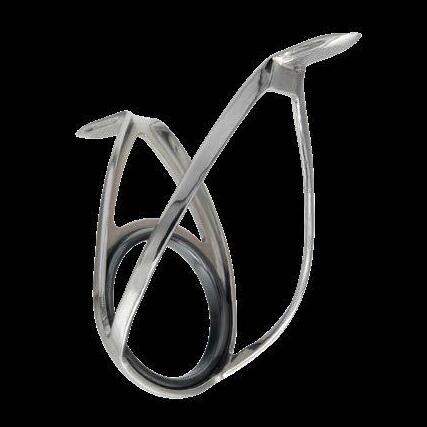
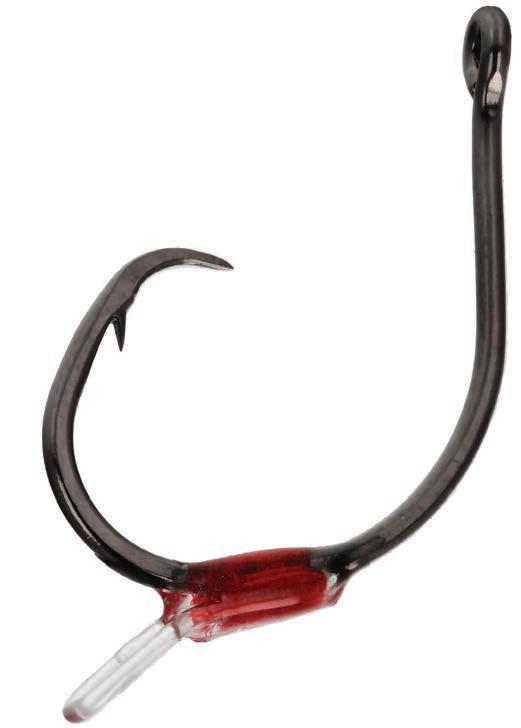
Available in sizes 8, 10, 12, 16, 20 and 25, in Polished SiC, Gunmetal SiN, and BB Alconite.
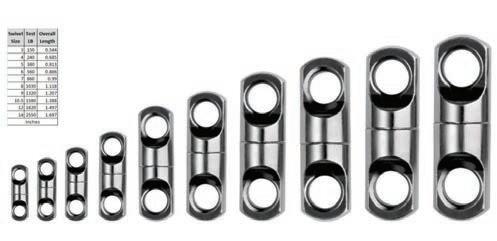
Sheds tangles faster than ANY other guide on the market • Reversable design makes it perfect for casting and spinning applications • Innovative foot shape promotes finish penetration and hold with less material
As light as a KW, as strong as an HB, more affordable than an HN
TANGLE FREE DESIGN
Pre-shaped and polished feet!
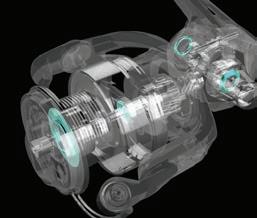
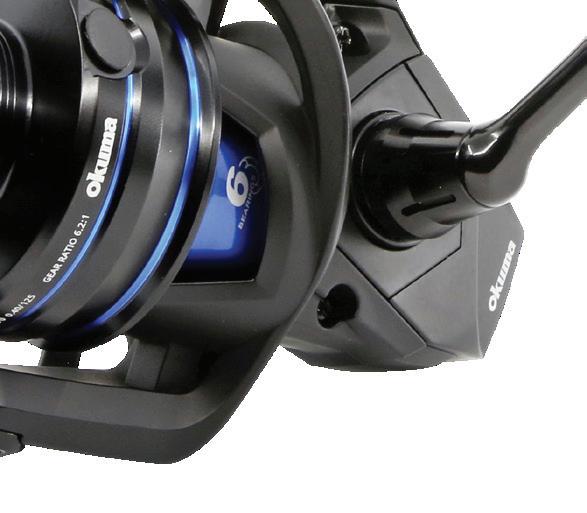
HYDRO BLOCK BODY
Sealed internal design limits water intrusion to the drag system and pinion gear, protecting critical components from salt exposure.
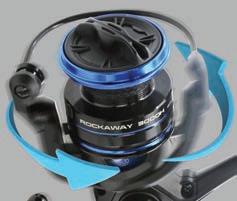
CFR – CYCLONIC FLOW ROTOR
Engineered airflow increases internal drying efficiency after use, reducing trapped moisture and corrosion.
Eliminates a primary water entry point found in traditional saltwater spinning reels, increasing long-term reliability. NO ANTI-REVERSE SWITCH
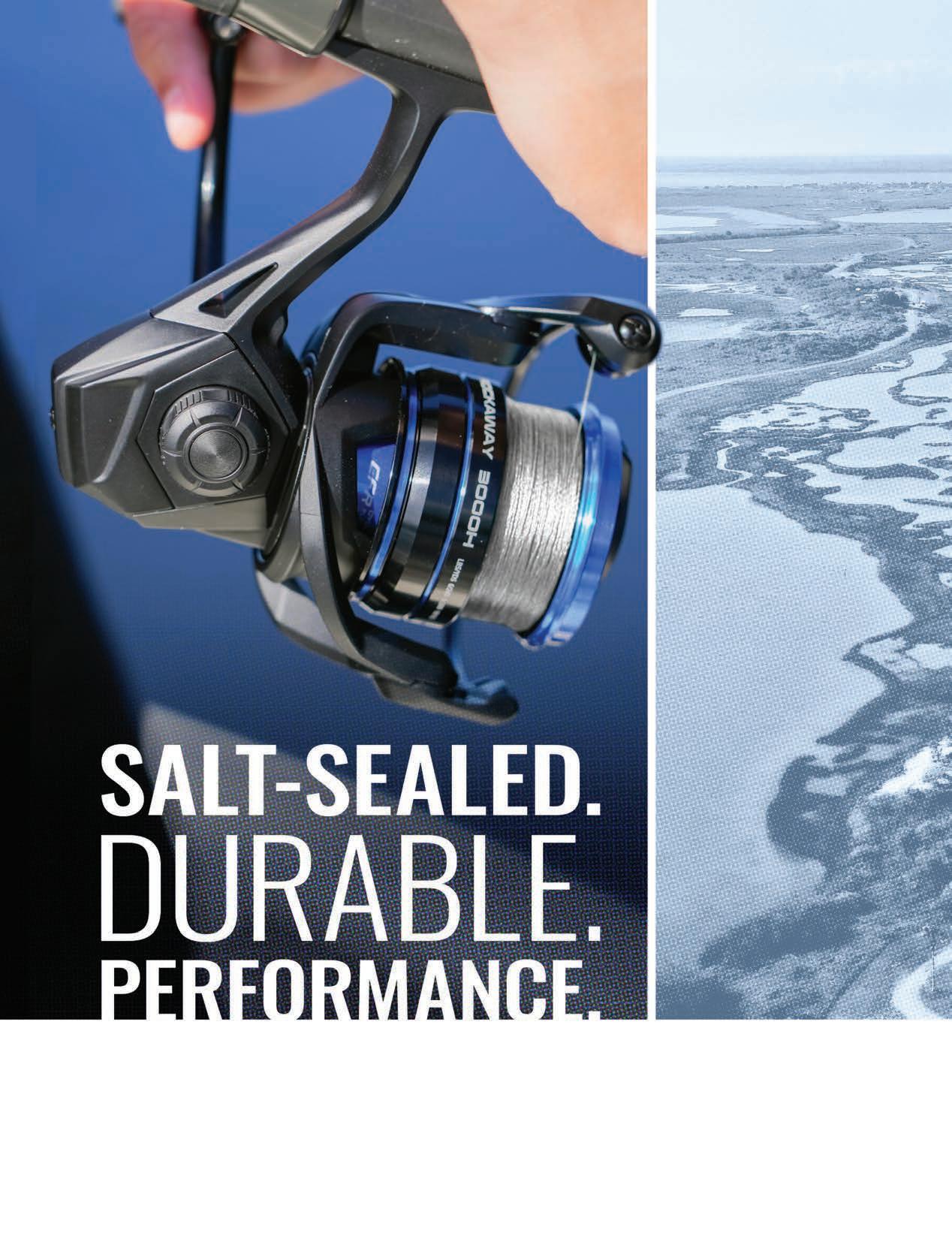
Rockaway SI keeps water out and strength in, engineered to reduce corrosion and deliver lasting saltwater performance.
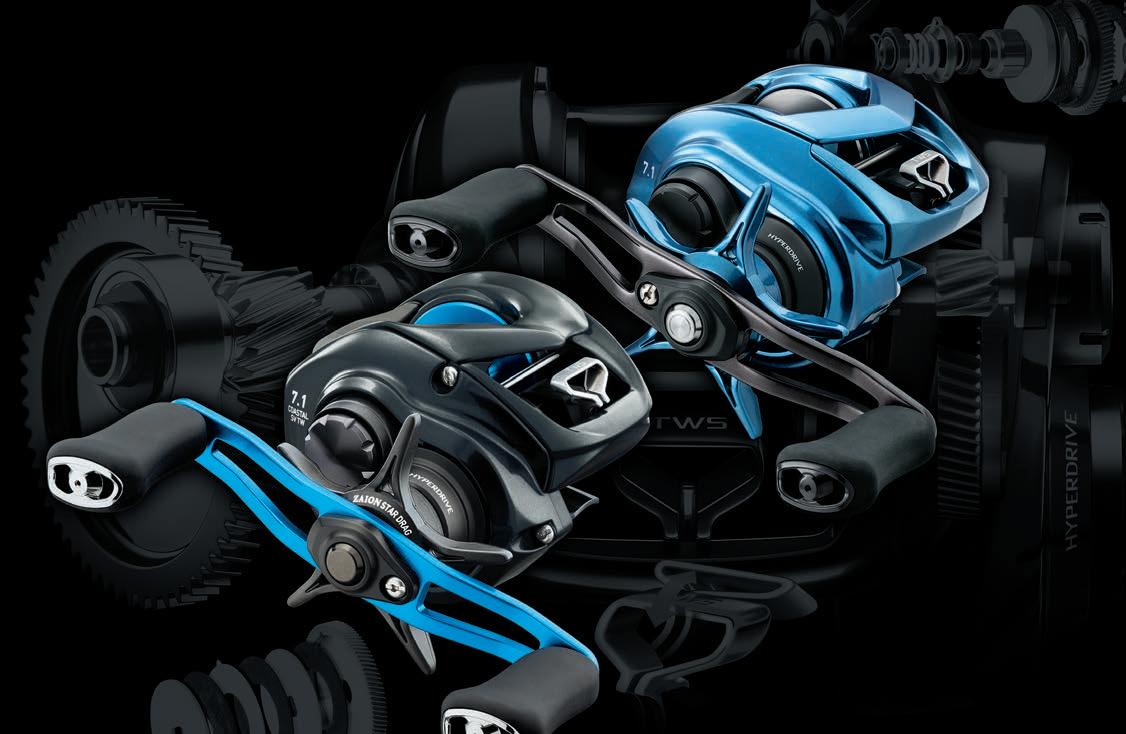
SPINNING REELS
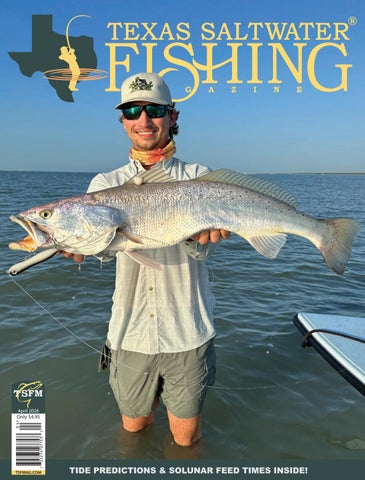
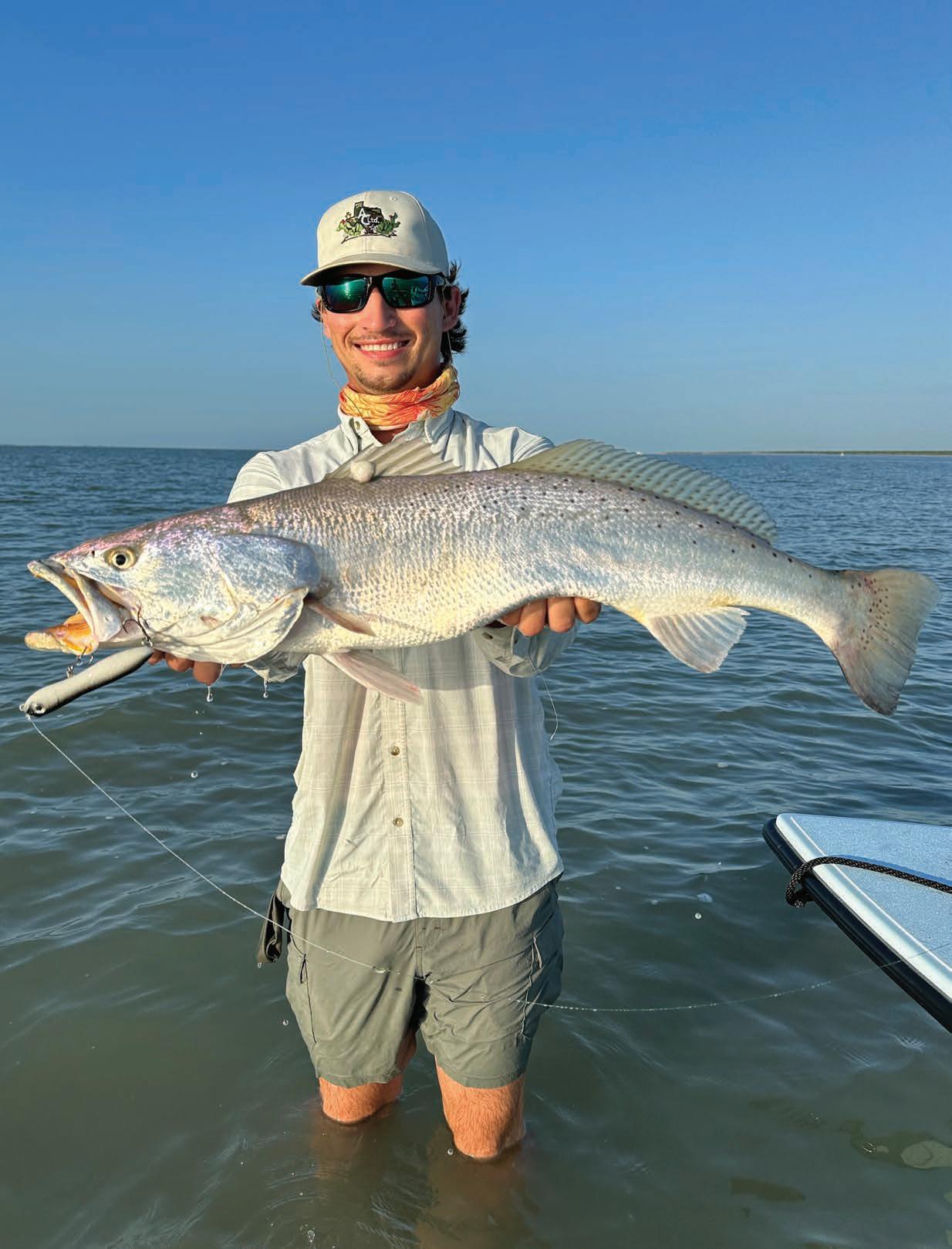
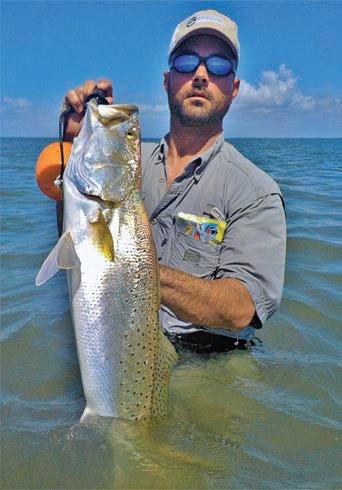
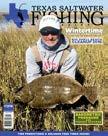
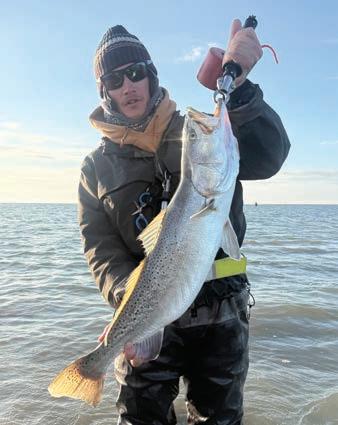
ABOUT THE COVER
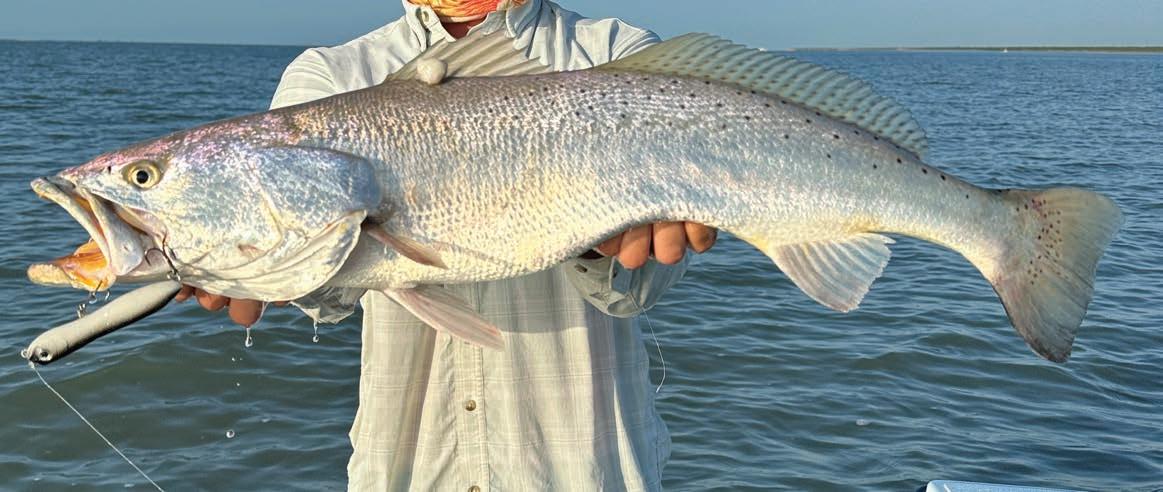
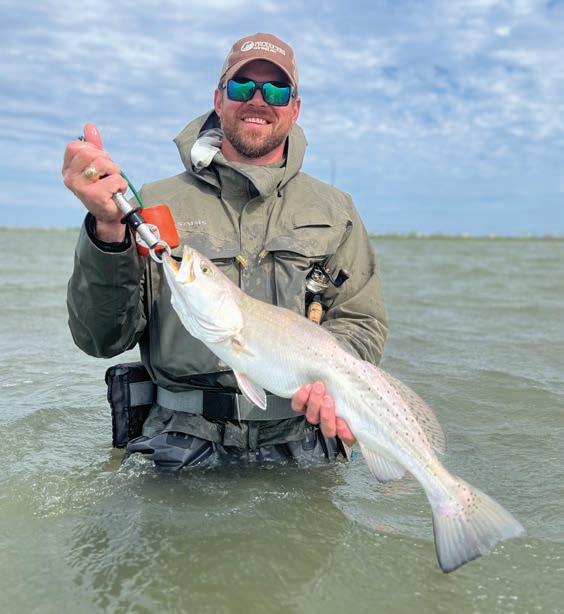
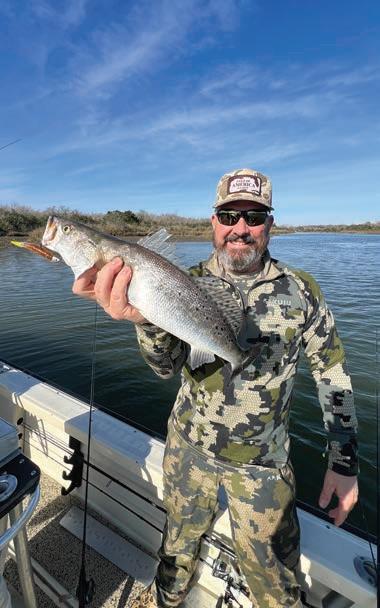
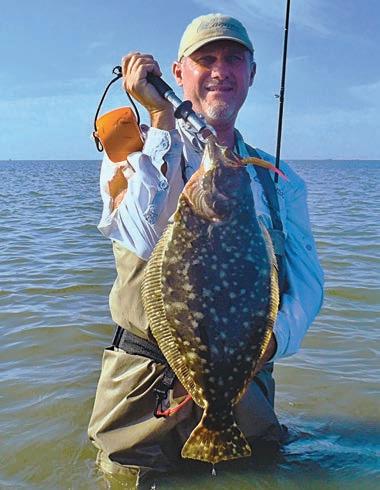
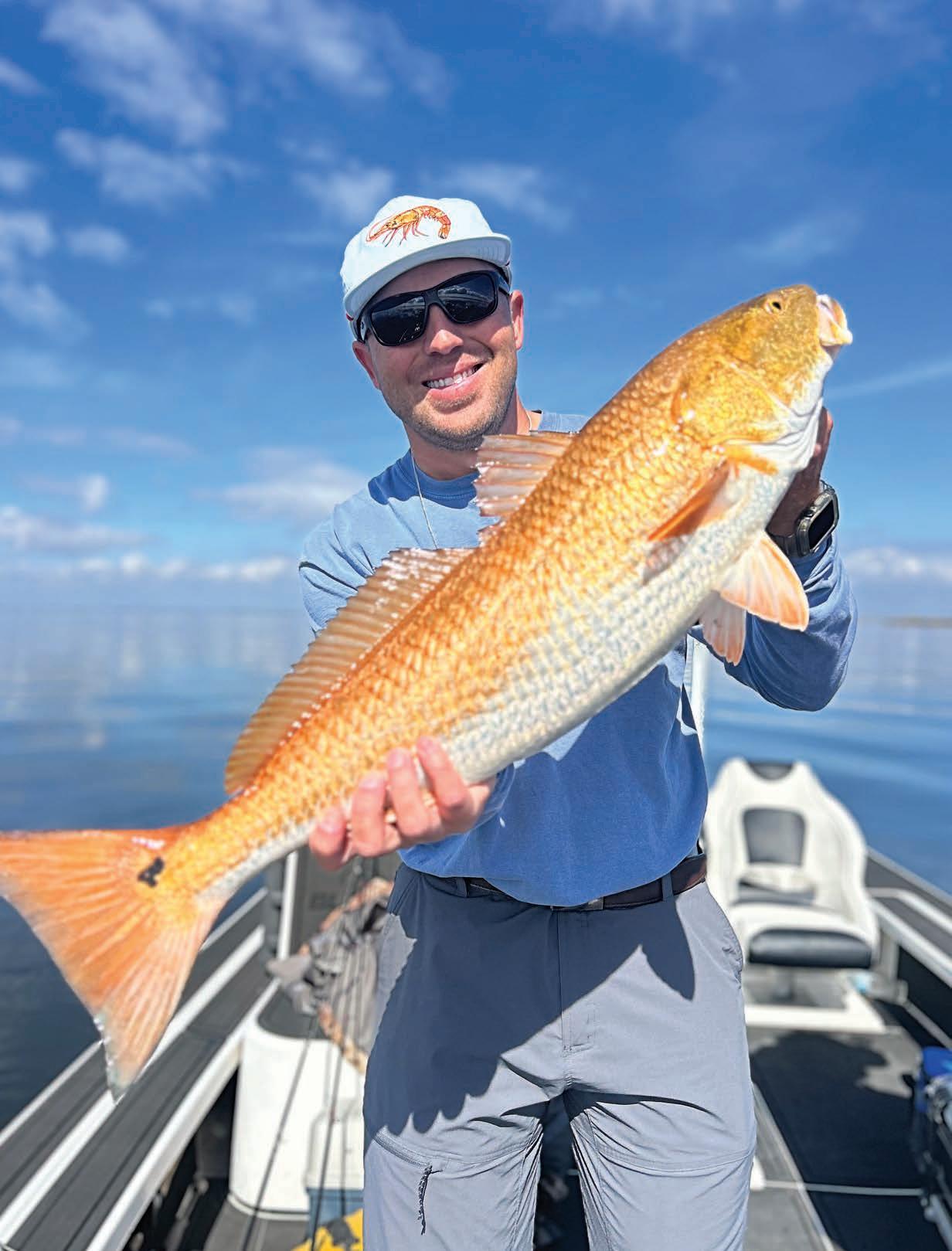
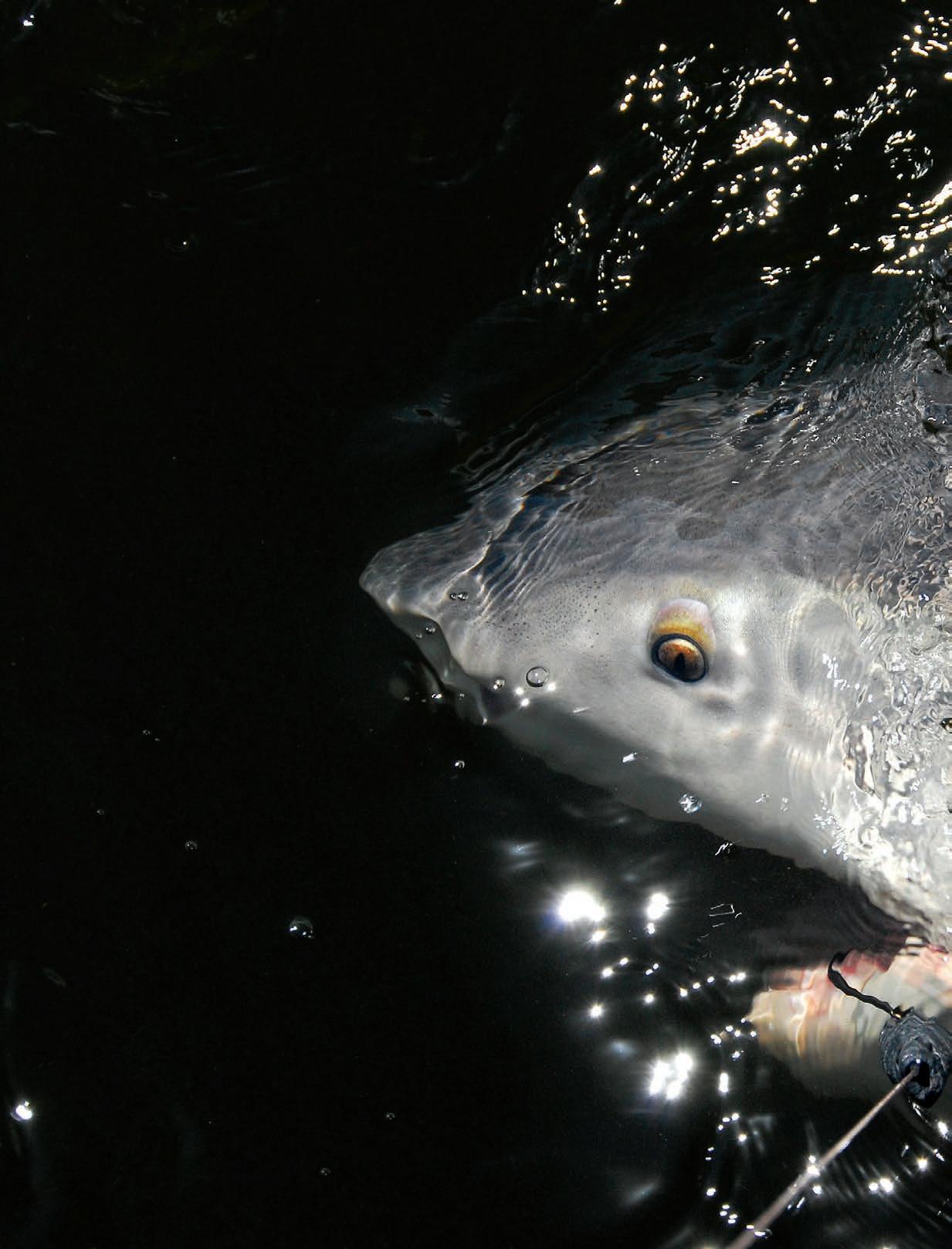
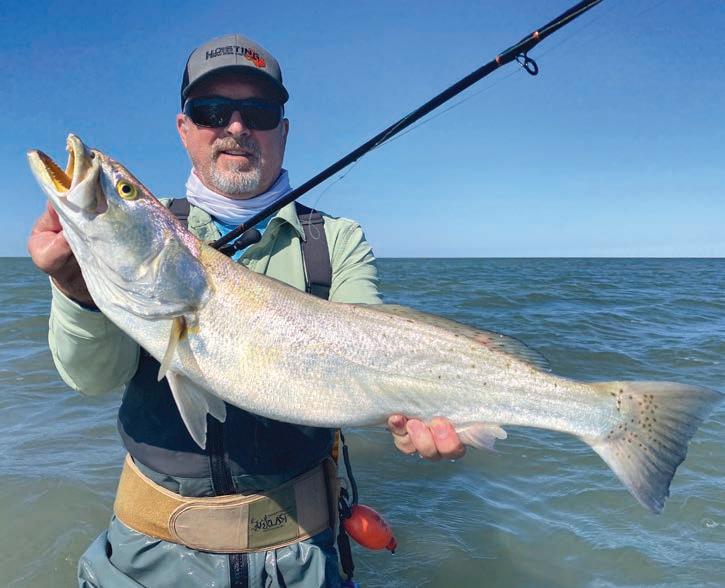
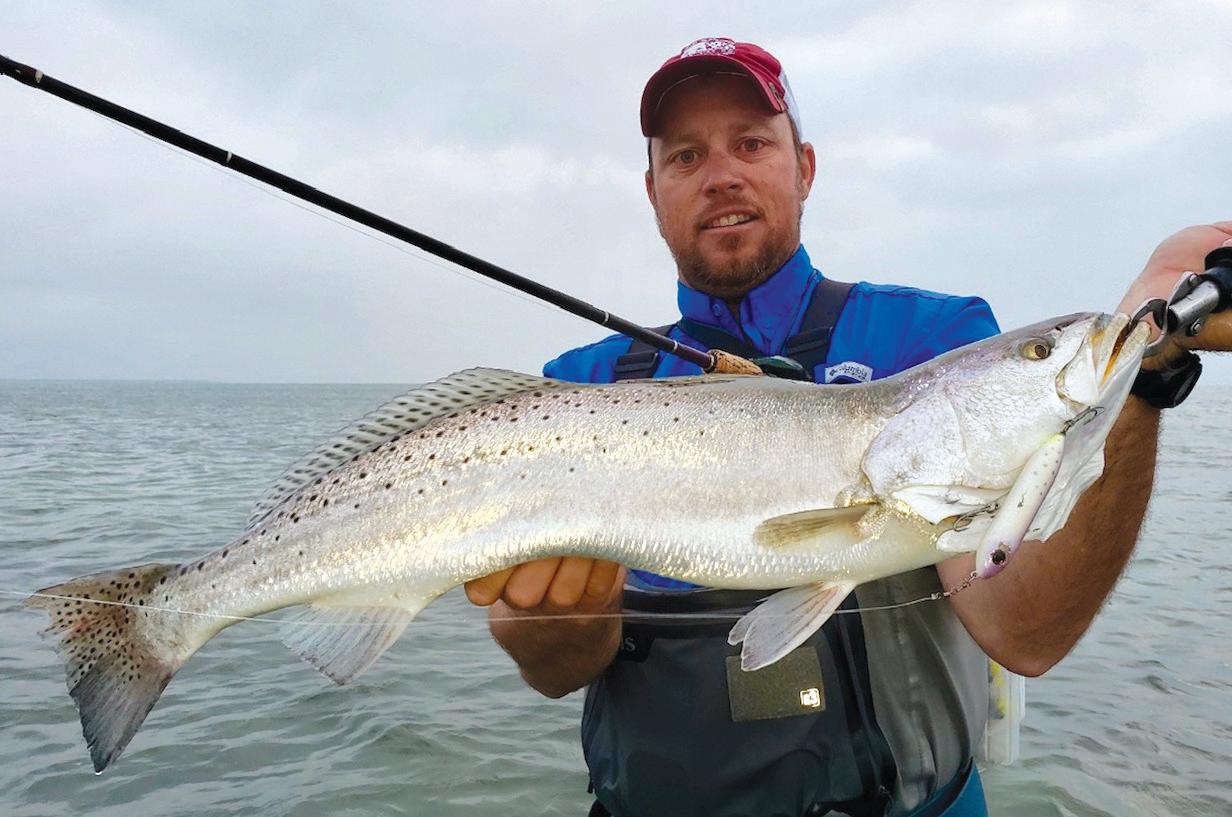
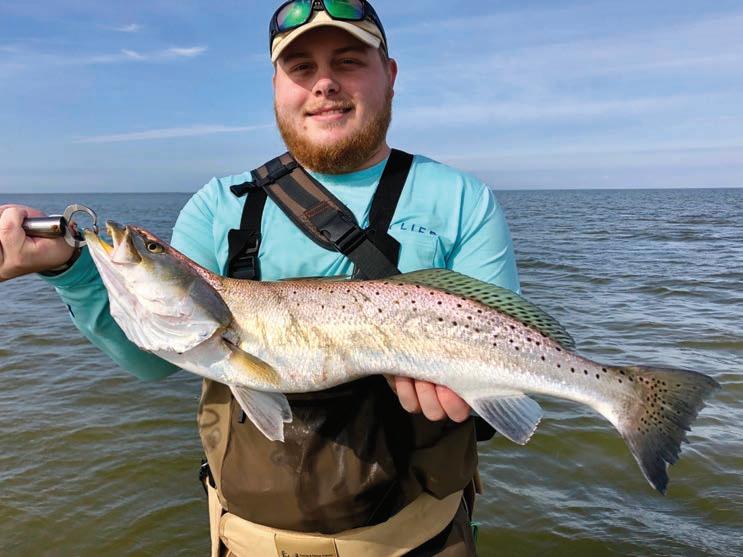
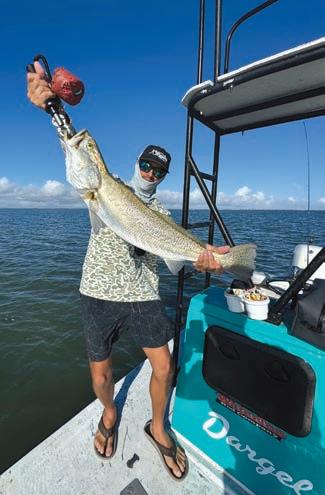
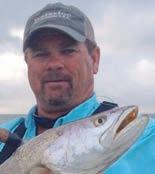
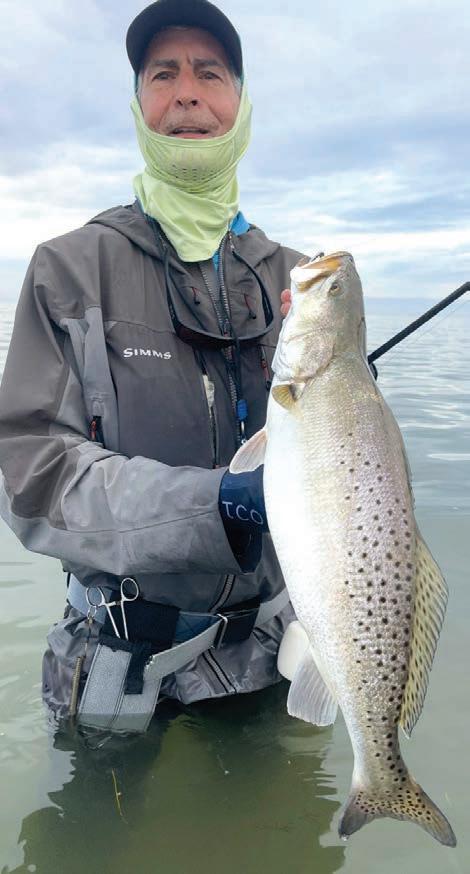
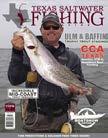
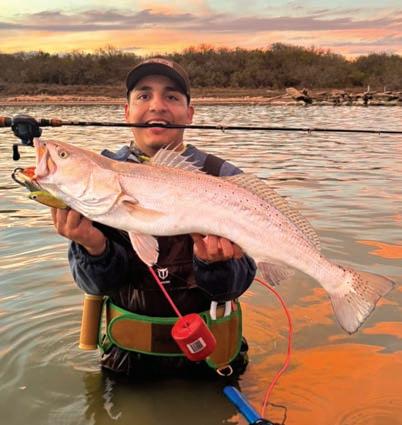
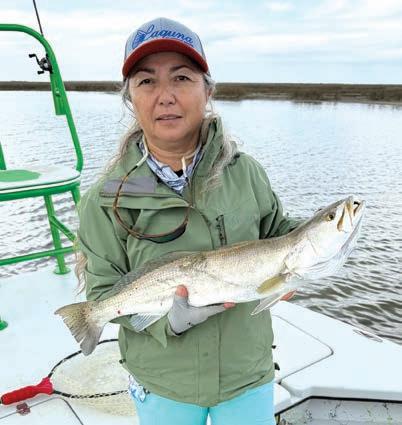
Bryce Long is this month’s cover angler displaying a gorgeous specimen from Baffin Bay. Bryce says the strike on his Mansfield Knocker came in shallow water, and the display she put on during the fight was nothing short of spectacular. Big trout have a way of doing that! Congrats on a great catch, Bryce.
EDITOR AND PUBLISHER
Everett Johnson | Everett@tsfmag.com Office 361-785-3420 Cell 361-550-3637
VICE PRESIDENT
PRODUCTION & ADVERTISING DIRECTOR
Pam Johnson | Pam@tsfmag.com Office: 361-785-3420 Cell: 361-550-9918
PRODUCTION / SOCIAL MEDIA DIRECTOR
Jennifer Shive | Jen@tsfmag.com
ADVERTISER REPRESENTATIVES
Bart Manganiello | bartalm@optonline.net
Pam Johnson | pam@tsfmag.com Office 361-785-3420 Cell 361-550-9918
Everett Johnson | everett@tsfmag.com Office 361-785-3420 Cell 361-550-3637
Texas Saltwater Fishing Magazine is published monthly.
Subscription Rates: One Year (Free Emag with Hard Copy)
Subscription $32.00
E-MAG (electronic version) is available for $15.00 per year. Order on-line: WWW.TSFMAG.COM
MAKE CHECKS PAYABLE TO: Texas Saltwater Fishing Magazine Attn: Subscriptions P.O. Box 429, Seadrift, Texas 77983
* Subscribers are responsible for submitting all address changes and renewals by the 10th of the prior month’s issue. Email store@tsfmag.com for all address changes or please call 361-785-3420 from 8am - 4:30pm. The U.S. Postal Service does not guarantee magazines will be forwarded.
Periodical class permit (USPS# 024353) paid at Victoria, TX 77901 and additional offices.
POSTMASTER: Send address changes to Texas Saltwater Fishing Magazine, Inc., P. O. Box 429, Seadrift, TX 77983.
STEPPED UP STOCK ENHANCEMENT, CONSERVATIVE MANAGEMENT, AND A WHOLE LOTTA LETTIN’ ‘EM GO!
It was five years ago this month that the devastating impact of Winter Storm Uri on Texas’ spotted seatrout fishery really began to sink in. Unlike some past freezes, the damage was difficult to quantify early-on. It had remained so cold for so long that the majority of dead fish remained submerged on the bay floor nearly two weeks before beginning to float, and when they did they were gobbled by throngs of cormorants, pelicans, and gulls before they could be counted. Those that floated to shore were a buffet for all manner of four-legged wildlife. And, there was also that whole Covid debacle that prevented TPW’s crews from getting in the field and putting forth their normal efforts. The ugly impact became increasing evident though, as more and more anglers took to the bays. Catching was slim to none – for the most part. But that was five years ago and the fishery is in a whole lot better shape today than immediately following the freeze. In fact, based upon our own fishing results and feedback from trusted sources, the current state of the fishery may actually be better than that which we
enjoyed before the freeze. So, let’s take a look at all that has transpired to make this incredible recovery a reality.
I would have to say the recovery is the product of three major building blocks (in no particular order of magnitude) – First would be TPWD’s shift in stock enhancement efforts to rear and stock greater numbers of speckled trout versus the historic emphasis on redfish. To put it in its simplest terms, I cannot imagine how increased stocking efforts could possibly result in having fewer trout swimming in our bays. It’s been five years, nearly a full life cycle for the species, which means stocked fish have been spawning and contributing throughout the recovery.
Next up is TPWD’s conservative shift in management regulations. I often hear folks criticize the current three fish bag limit and retention slot; but from my seat I must say that it appears to be working. It took a little getting used to in the beginning, but reserving prime age spawners (fish larger than 20 inches) from harvest has contributed remarkably to the recovery.
Last but certainly not least is the shift in angler attitude toward greater conservation and a whole lotta lettin’ ‘em go. Many thanks to all who have contributed; you’ve done a remarkable job!
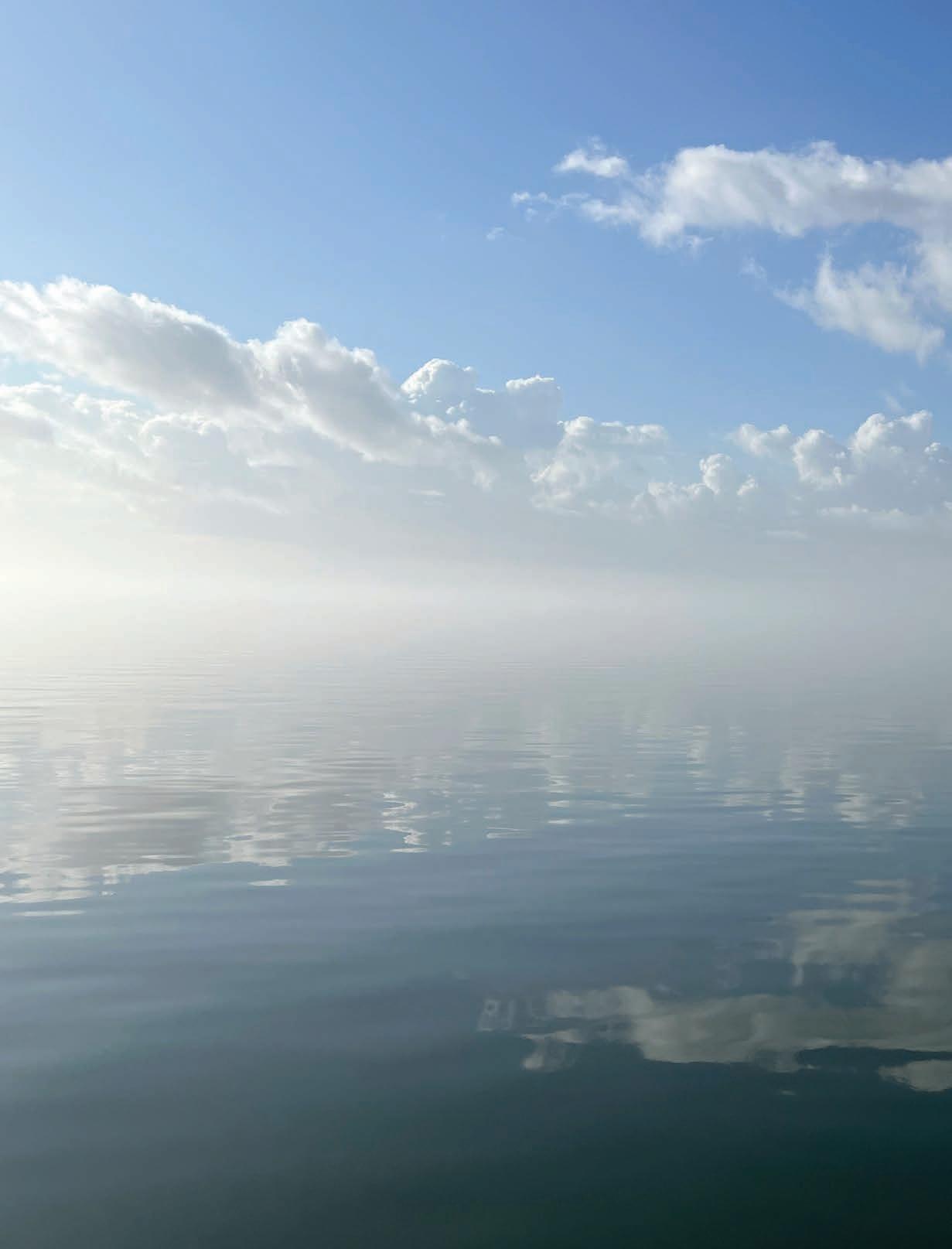
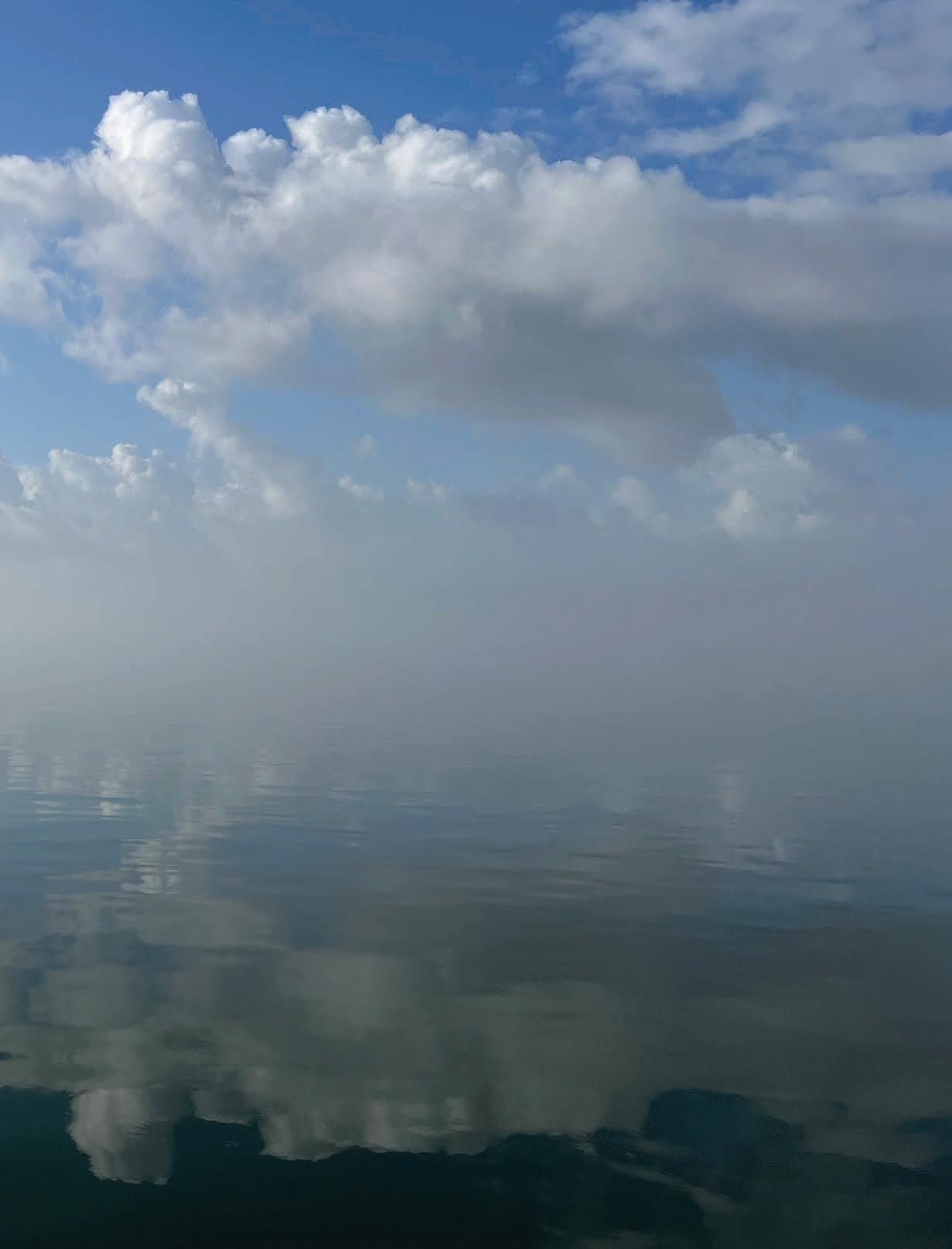
Picturesque mornings like this would make for a beautiful painting on the wall but they’re not always the best for catching fish.
GHWAYS
STORY BY STEVE HILLMAN
Our ride across the bay that morning was picturesque.
There wasn’t a ripple on the water and a thin layer of fog made everything appear much larger than reality.
V-shaped squadrons of brown pelicans gliding just above the water’s surface looked more like Boeing 747s.
The reflection of the sky in the water was as perfect as I’d ever seen it. If I were a painter or photographer, I would have been in hog heaven, but as a fisherman I already knew the challenges we would face given those conditions—especially at this time of year.
I killed my outboard about 100 yards from my intended anchoring spot and used my trolling motor, at very low speed, to ease into the area. I knew the fish were going to be ultra spooky with no wind, clear water and very little tide movement. I paused for a minute or two to survey the area before slipping the anchor over. I was hoping to see at least a few mullet flipping but hadn’t seen any.
“Okay guys, the tide is supposed to start going out within the hour. Let’s jump out and give it a shot,” I said.
The three of us spread out along a toenail-shaped stretch of cordgrass-lined shoreline divided by three bayou drains leading into the bay. Out in front of the drains, on the bay side, there was a trough that wrapped around parallel to the shoreline. Beyond that was a shallow flat stretching toward the middle of the bay.
About twenty minutes into our wade the tide began to trickle out, but I still hadn’t seen a single mullet or any other bait for that matter. The tide slowly pulling water out of a back lake through a bayou drain is usually a textbook scenario for success, but for some reason everything still appeared lifeless.
After probing every square inch of all three drains—inside and out—I told the guys to keep plugging while I went to get the boat. A little wind began to blow just as I started my two-hundred-yard trek. Then it blew a little more.
I thought I saw a mullet jump out on the flat toward the middle of the bay, so I just stood there staring until I witnessed another flip. I made my way through the wraparound gut and positioned myself where I could land my Bass Assassin Lit’l P&V right along the edge of the flat where the mullet were flipping.
Bam! The first trout of the day came to hand.
I fired off another cast and caught another one. Not knowing how long it would last, I yelled at the guys, “Y’all get over here!”
The three of us stood there for probably thirty minutes catching dozens of trout before the bite finally waned.
The key factors for our success at this particular spot were:
• The beginning of an outgoing tide
• Wind clouding the water, making it easier to trick trout
• Location (edge of a gut leading to a flat created an ambush point)
• The presence of bait
There are a few other things to note about that first wading spot. We were coming off a couple of late cold fronts, so water temperatures had dropped along with tide levels. I believe this was one of the reasons those trout were pulled away from the shoreline drains they typically gravitate to this time of year when tides are higher and water is warmer.
I also noticed they were more willing to eat smaller baits like Bass Assassin P&V’s and 4-inch Sea Shads as opposed to larger soft plastics. My theory is that this was likely a result of them having gorged themselves ahead of the cold fronts.
Our second stop found us about five miles down the shoreline in another area where I’d had recent success. By now the wind was gusting to almost 20 mph. If the water temperature had been warm like it is during the summer, this particular area likely wouldn’t have been fishable due to poor water clarity. Luckily for us that day, it was just cool enough (69°) that we had yet to see the full effects of suspended algae growth and organic matter.
The water had a sandy-green color but featured some well-defined color changes compared to our first stop. Anyone who has fished with me knows how much I like fishing color streaks. I just love having something to focus on. Nothing is worse than blind casting.
This area was somewhat similar to our first stop but had much more eccentric drop-offs along the edges of the guts. The bottom characteristics were slightly different as well, with this area having a softer, silty bottom—especially in the deeper guts. These slight differences, along with the wind, helped produce more obvious muddy streaks.
Once again, the beginning of our wade was somewhat uneventful with only a couple of trout caught during the first forty-five minutes or so. The later it got, the more westerly the wind became. I’ve never
Travis Schneider caught this 6-plus Galveston Bay trout while casting to flipping mullet along the edge of a gut in mid-April a couple of years back.
Frank pulled this nice speck out of the middle of a bunch of small ones while casting to a color change along the edge of a sandbar drop-off.
RIPTIDE INSTINCT ™ QUEST ™
What if your motor pulled its own weight?
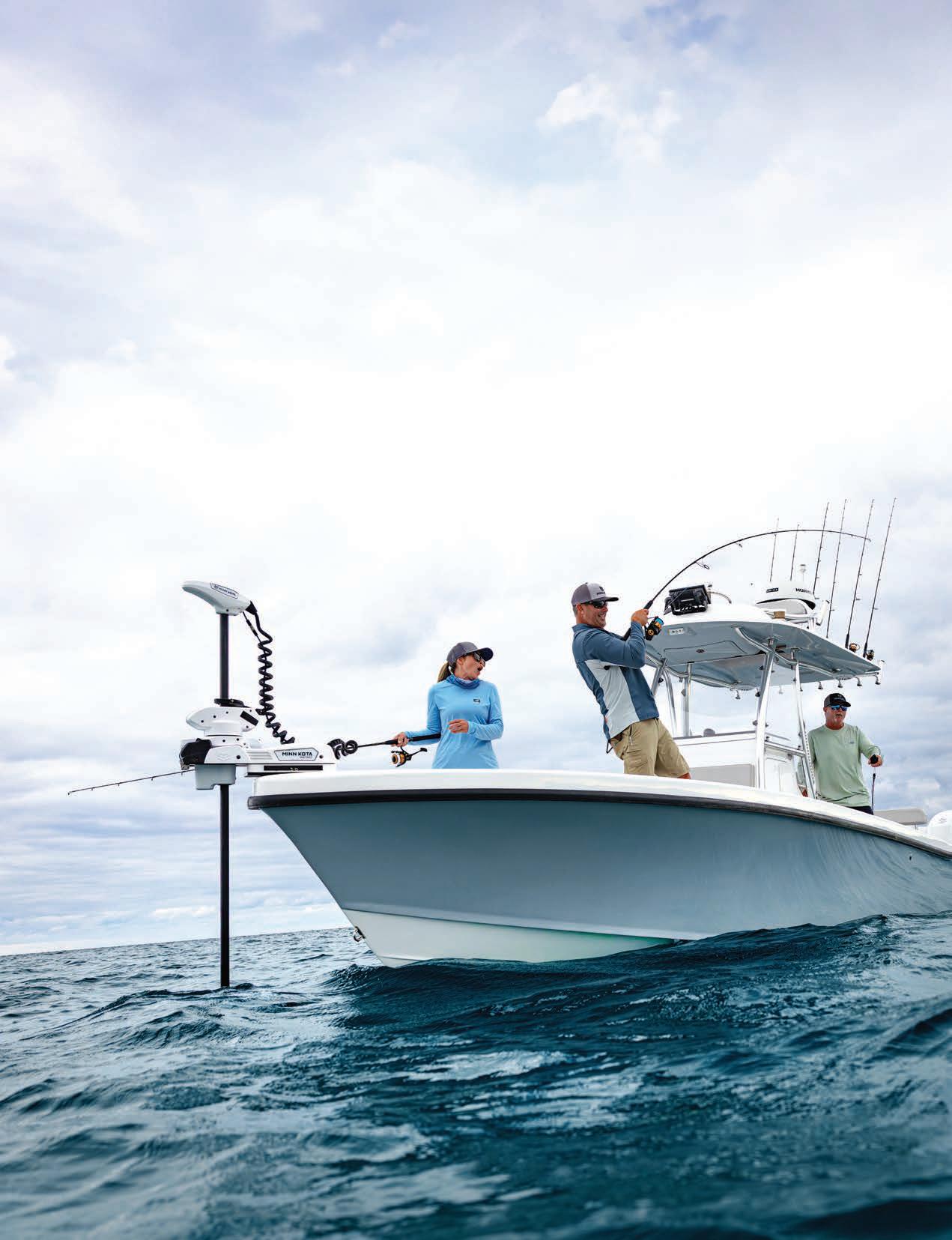
Minn Kota® Riptide Instinct™ QUEST ™ is the only saltwater trolling motor that stows and deploys itself so you can focus on the cast at hand.
BUILT TO FISH
FISH WITH
been a big fan of a west wind, but this time it actually helped us.
This time of year (early spring) we have a multitude of juvenile forage species like shad and glass minnows. They are still tiny, so they get carried along by wind and current. The wind speed and direction, along with the outgoing tide, pushed them up against the edge of a sandbar leading up from a deep gut.
This created the perfect scenario right before our eyes. It didn’t hurt that we were heading into a moonset minor feeding period either. Terns were dive-bombing the tiny forage species along the edge of the gut. The icing on the cake was a well-defined color change with a few small mullet flipping.
The cherry on top were the small slicks emerging from the drop-off. It was officially showtime.
We never caught any trout over 22 inches, but we caught a lot of them. Our main takeaways at this stop were:
• Well-defined sandy mud streaks
• A series of deep guts through sandbars creating “fish highways”
• Wind and current-driven bait concentrations creating a buffet scenario for trout
• Underwater shelves and drop-offs creating ambush points
• Slicks, terns and bait activity = dead giveaway
• A minor solunar feeding period helping the bite
Fish Highways
We proceeded to fish several other areas over the course of the day, replicating what we had learned at our first couple of stops. Most of what we experienced early in the day definitely played a role in our continued success, but the two most common themes at every stop were bait concentrations and some type of gut structure
Just about everywhere we went there were noticeable depth changes surrounded by shallower areas holding concentrations of bait. As simple as it sounds—where there was bait, there were fish.
April here on the Upper Texas Coast can present some challenges at times. There will be days—or at least periods during the day—when the fish just won’t seem interested in anything we have to offer. But if we spend more time focusing on these “fish highways” while watching for other key signs around them, we will end up having many successful days on the water.
Best of luck and Happy Easter!
STEVE HILLMAN
Steve Hillman is a full-time fishing guide on his home waters of Galveston Bay. Steve fishes the entire Galveston Bay Complex, wading and drifting for trout, redfish, and flounder using artificial lures.
Phone 4 09-256-7937
Email captsteve@hillmanguideservice.com Web w ww.hillmanguideservice.com
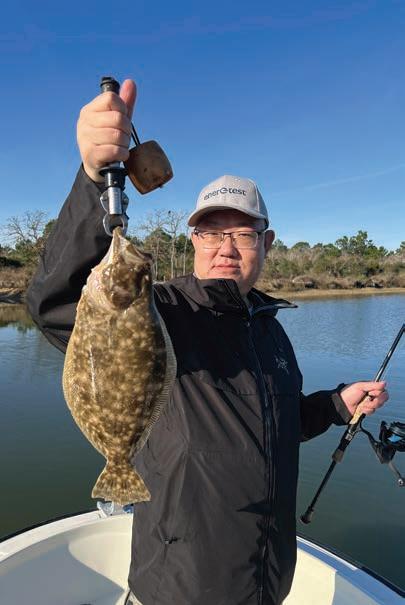
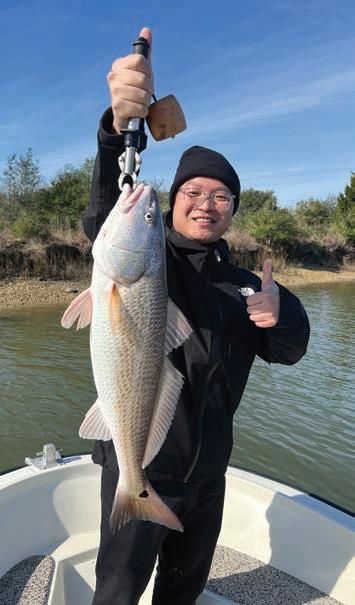
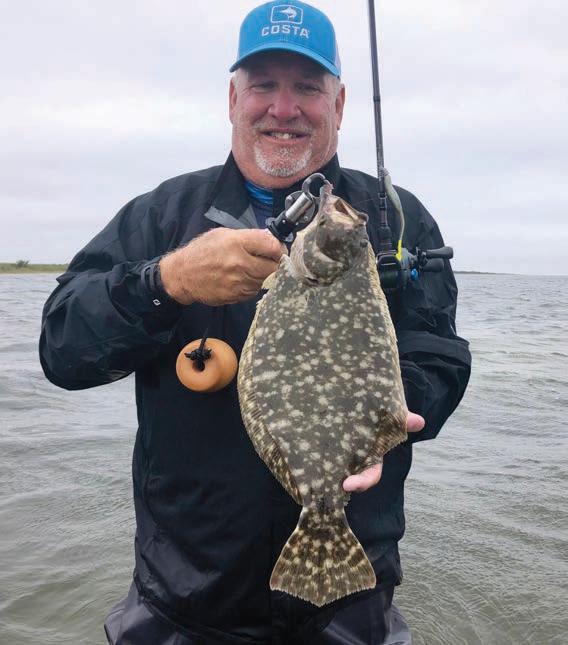
Steven was in all the way from China. Pictured here with the flounder portion of his Three Species Texas Slam (trout, redfish & flounder)!
Cody Scott caught some nice trout fishing deep ledges after a late winter/early spring cold front. Small baits like this MirrOlure Lil John fished along the drop-offs did the trick!
Reno with one of several solid redfish he tricked on Bass Assassin Sea Shads!
breaking SOUTH BA
Positioned at the intersection of the Upper Laguna Madre and Baffin Bay, two of the premier fisheries in Texas, all parts of the Badlands possess the potential to produce giant speckled trout. The water in this expansive area has variable depths, four different constituents cover the bottom, and the clarity of the water in some parts of the place holds up fairly well, even under the effects of strong winds blowing from two primary directions. These facts combine to enhance the area’s potential for productivity throughout the calendar year.
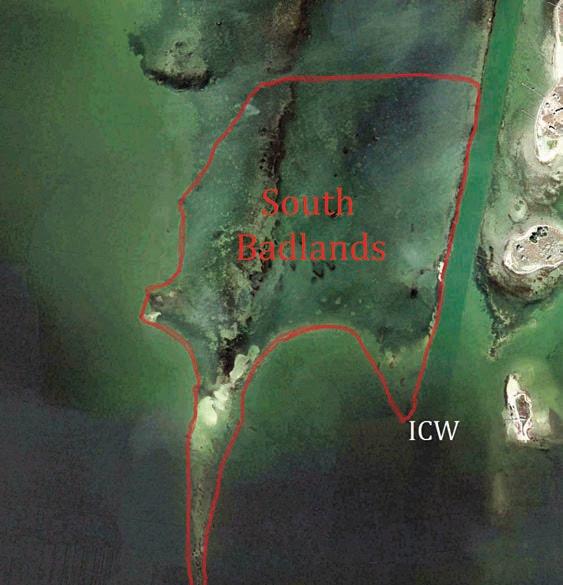
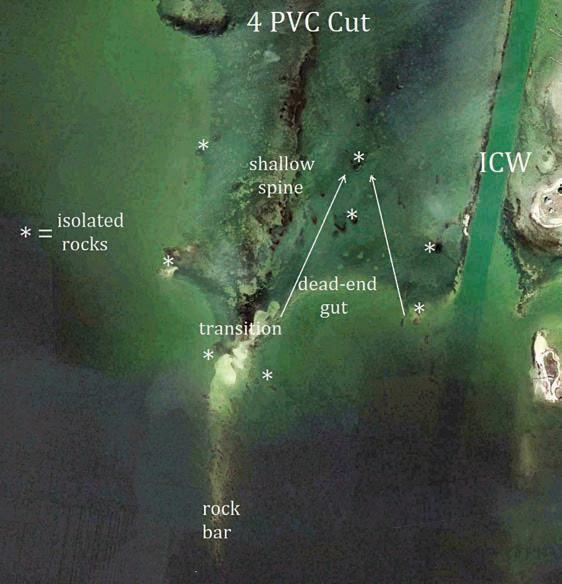
This truth applies to all three parts of the Badlands, including its southernmost region. A rocky Spine covered by shallow water stands out as the main feature defining the layout of the South Badlands. Oriented north to south, starting at the southern edge of a narrow pathway marked by four PVC markers in central parts of the Badlands, this Spine stretches for about a mile and a quarter, terminating at the northern edge of the Riviera Channel. Relatively deep water touches both sides of the slender rock bar, and the depths of the Intracoastal Waterway, the deepest water in the ULM/Baffin Bay system, lie close by.
down the ADLANDS
STORY BY KEVIN COCHRAN
A picturesque transitional flat with a mix of sand, mud, grass and rocks on the bottom forms the base of the narrow rock bar extending south from it. Certainly, when the water runs clear—which it often does—this portion of the South Badlands becomes a lure lover’s paradise. In some parts of it, a wading angler can stand in place and cast at multiple rocks, grassy seams, drop-offs and potholes.
The grassy northern half of the Spine is softer, wider and shallower than the southern half. On the west side of this northern half, grass beds adorn a gentle slope which falls off into the depths of the Baffin Bay Basin. Numerous rocks jut out of the bottom both atop the shallowest part of the Spine and on the grassy slope. A few big rocks lie in the depths just off the western edge of the grassy slope, within casting range of wading anglers.
To the east, between the Spine and the Intracoastal Waterway, a wide rocky flat provides excellent potential, especially when tide levels run fairly low. On its southern edge, a hard, curving sand bar runs out of the transitional area at the base of the rock bar toward the Intracoastal. This curving bar falls off into a deep, wide gut which funnels water out of the depths adjacent to the Intracoastal and
into the South Badlands. The gut narrows and ends near some rocks lying close to the eastern entrance of the pathway through the rocks marked by the four PVC pipes.
The complexity and variability of the topography of the South Badlands generates excellent potential for catching trout, including some really big ones, especially during the warm half of the year. Because this part of the Badlands lies farther away from any significant land mass than other parts of the area, the water quality here proves more susceptible to the effects of strong winds. Normally, the strongest breezes in this area come from either the southeast or the northwest. Winds howling off the Gulf create big waves in the deep water at the intersection of the Intracoastal and the Riviera Channel, and these waves roll into the shallows of the South Badlands, mucking up the clarity of the water fairly quickly. When the cold breath of Old Man Winter whistles from the opposite direction, the clarity of the water in the South Badlands suffers the same fate, and without the protection of a nearby land mass, water temperatures decline rapidly with the mercury in the thermometer.
For these reasons, anglers working this area need somewhat benign conditions to enhance their chances for success. Because it’s relatively easy to access without grave and obvious dangers, the rocky bar terminating at the Riviera Channel is perhaps the best-known productive part of the Badlands. Every summer, numbers of guides and weekend anglers line up on both sides of the rocks, pitching live croakers at the boulders and pulling plenty of trout into their boats. Others venture into the parts of the Badlands lying north of the bar, where wading is often the preferred method for targeting the trout and redfish which live here.
A broadly general truth applies to the Badlands as a whole in terms of its potential for producing big trout—colder water enhances the potential in the northern extremes of the place, and hotter water enhances the potential in the southern extremes. So, soon after a strong cold front, when water temperatures plummet below 50°F, fishing in the Point of Rocks Meadow makes good sense. On the other
hand, during the dog days of August, fishing in the South Badlands makes better sense.
On a typical summer day, the sun rises over relatively still waters as light winds whisper across Baffin Bay. While the calm lull persists, anglers can expect to catch plenty of trout and reds, with the potential for encountering trout weighing over seven pounds, in the shallower parts of the South Badlands using conventional floating plugs to earn their strikes. Often during this part of the day, trout chase mullet and other small fish and cause them to gather in tight schools. Those schools then find their way into the somewhat safer, super-shallow water covering rocks, grass beds and sandy humps. Later in the morning, as the sun climbs higher, the feeding activity slows and the herds of mullet and other prey species move into water of greater depths.
In this way, the patterns in play here during the summer heat closely resemble ones which work well on spoil banks, particularly those found along the Intracoastal south of Baffin Bay. In a place with so many structural elements covered by shallow water and surrounded by water of much greater depth, the trout become predictable in hot weather—most active late at night and early in the morning, less active during the heat of the day. Catching them proves easiest for lure chunkers while they harass bait soon after daybreak.
Catching them during the middle of the day is tougher but certainly possible. One way to catch trout in the South Badlands while warm winds whistle with some intensity after the summer sun reaches its zenith is to wade along the eastern edge of the transitional area at the base of the narrow rock bar and cast upwind into the deeper water to its east, presenting sinking twitchbaits downwind and down-current close to the rocks. In this hypersaline estuary, with unpredictable and minimal influence from tides on a daily basis, wind creates movement in the water. Predators feed while the water moves, and anglers hoping to coax them to bite lures generally need to present those lures moving with the flow of water, or at least crossways with the flow. Working them upwind of
THE BEST WARRANTY ON THE WATER JUST GOT BETTER.
WHILE OTHERS WATER DOWN THEIR WARRANTIES, WE’RE
EXPANDING OURS.
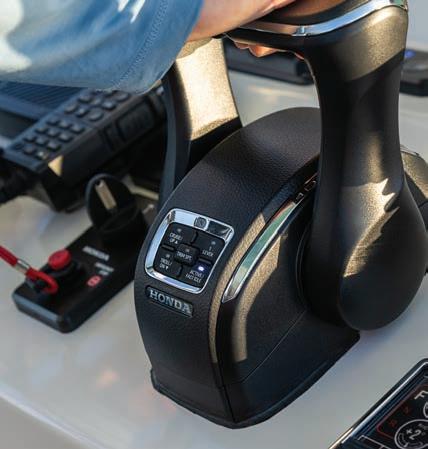
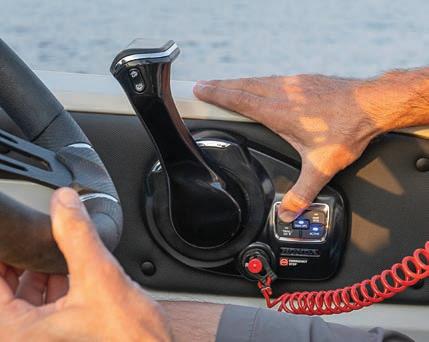
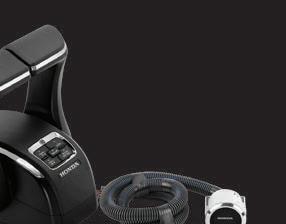
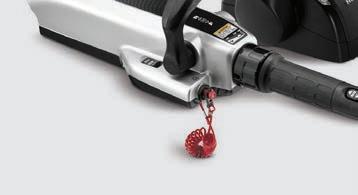
Introducing Honda Marine True 5 Limited Warranty expanded rigging coverage. The industry’s best warranty now provides five full years of peace-of-mind protection on Honda Marine rigging components and systems for new package boat sales and repowers.* Rigging coverage includes controls, control cables, gauges, switches, tiller handles, displays, and more.
True 5 is a factory-direct warranty, fully backed by Honda Marine. There’s no pro-rating that decreases coverage over time, and it’s fully transferable. So, get more coverage wherever the water takes you with Honda Marine True 5 Limited Warranty expanded rigging coverage. It’s the next wave in warranty protection.
the windblown faces of rocks makes perfect sense. If wind speeds make casting and retrieving lures upwind too difficult, waders can turn and cast their lures to the north and east where they land in the depths adjacent to the sand bar which curves into the gut between the Spine and the Intracoastal, then bring them across its edge.
I’ve made this pattern produce well many times when winds began to blow with some velocity after a calm morning. Fast, erratic presentations with topwaters enhance the potential for making this pattern produce plenty of bites. Small topwaters worked with lots of raspy action, speed bursts and pauses also work well when cast with the wind, where they
b
b
b
(2LB
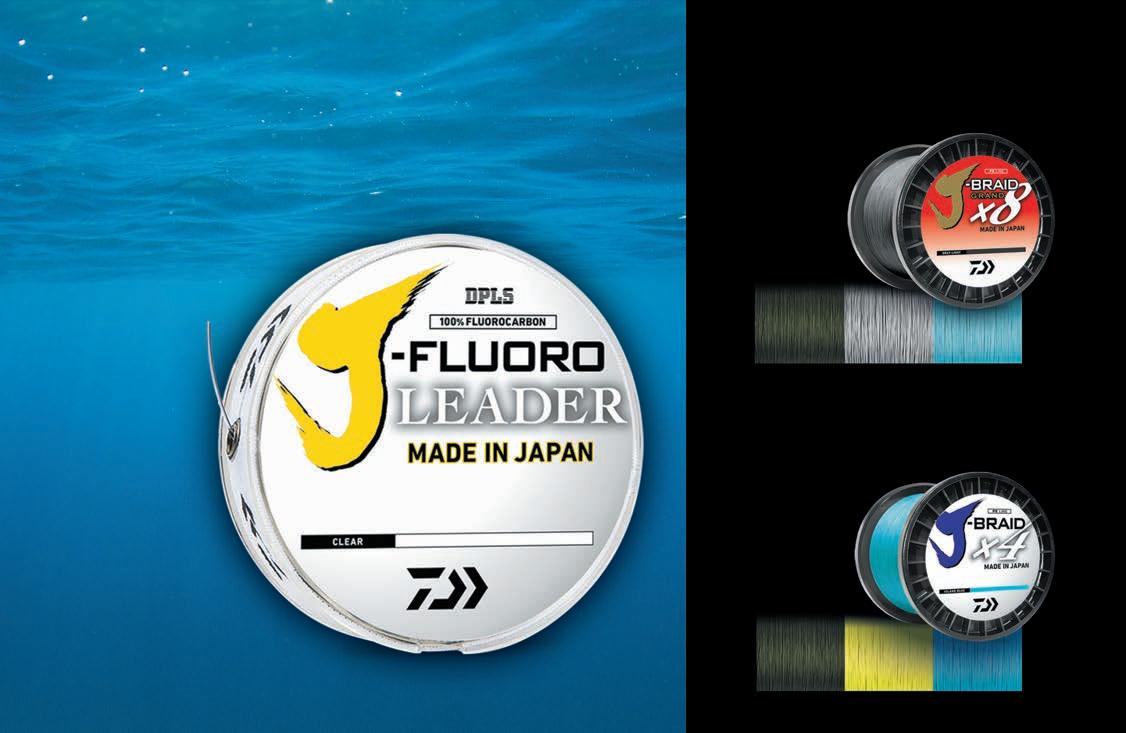
THE CLEAR LEADER
J-BRAID GRAND X8
b SMOOTH AND STRONG “IZANAS” MATERIAL
b OUR MOST ABRASION RESISTANT BRAID YET
J-BRAID X4
b STRONG TOUGH AND ABRASION RESISTANT
b 4 INTER-WOVEN STRANDS
b EXCELLENT KNOT TYING BRAID
Alton Morris caught this pretty trout on a hot summer day by tossing a soft plastic right at the windblown face of a rock near the Intracoastal in the South Badlands.
The sandy hump at the north end of the rocky bar in the South Badlands sometimes holds good numbers of big flounder.
Fishing around structural elements covered by shallow water lying close to deeper water often produces bigger than average trout during the summer heat wave.
land around the rocks lying off the western edge of the Spine. Soft plastics perform well in this drill too, as they tend to produce better when retrieved against the current than do slow-sinking twitchbaits.
When tides run low, wading around on the flat lying between the Spine and the Intracoastal can produce plenty of trout, including a few big ones. Out there, the fish tend to behave in the same ways they do in other places during our hottest season. Anglers give themselves a good chance at tricking a big trout or two by casting topwaters at herds of mullet gathered atop rocks while the light level is low, then casting soft plastics and/or slow-sinking twitchbaits at anomalies on the bottom in the gut itself after the sun rises higher and wind speeds increase. In all circumstances, casting lures right at the faces of rocks, where the wind pushes waves against them, generally works best. Often the fastest action in the heat of a summer day here occurs close to the Intracoastal in the southeastern corner of the South Badlands, where numerous rocks lie in shallow water within casting range of the ditch.
This focus on patterns which produce best in hot water isn’t meant to imply the South Badlands won’t produce big trout in other conditions. In moderate weather, with water temperatures ranging from 60 to 80°F, anglers could catch a whopper trout anywhere in this area, normally by casting twitchbaits and topwaters close to rocks and
Breaking Down the South Badlands
the potholes associated with them. In the cold months, fishing the shallow parts of the Spine two or three days after a frontal passage while winds run light can produce bites from big trout—most often on slow-sinking twitchbaits, less often on soft plastics rigged on light jigheads or dangled under small corks.
Like all parts of the Badlands, this place occupies a special space in the halls housing my most cherished memories. Real events, many of them involving tangles with trophy trout, spawned most of these. Others came from the ether to live on the pages of this magazine. I can still hear the naked wader laughing while he teases monsters in the gloaming with his hookless Ghost, still see the profile of the stoic hermit framed in the window of his floating cabin, and I’ll forever feel the urge to follow in the footsteps of the phantom of the flats. Father Time blessed me amply in the game, giving me many chances to play the cards Mother Nature dealt in this widely celebrated area.
KEVIN COCHRAN
Kevin Cochran is a long-time fishing guide at Corpus Christi (Padre Island), TX. Kevin is a speckled trout fanatic and has created several books and dvds on the subject. Kevin’s home waters stretch from Corpus Christi Bay to the Land Cut.
T ROUT TRACKER GUIDE SERVICE
Phone 361-688-3714
Email kevincochran404@yahoo.com
Web www.captainkevblogs.com
GULF COAST TOOLS
OF THE TRADE
Michael Billiot took this gorgeous redfish under near perfect conditions on a MirrOlure Soft-Dine in the Texas Chicken color scheme.
GOING TO THE NEXTLEVEL
STORY BY CHUCK UZZLE
It has always fascinated me to read or hear about successful people and the things they do that set them apart from average folks. Some people beat the odds with an incredible work ethic or determination that most cannot even fathom. All of those success stories usually have one thing in common—they all have a goal in mind and are willing to do whatever is necessary to achieve it.
Fishermen are no different. Their personal goals may range anywhere from simple relaxation to chasing records, but they all have something in mind that brings them a sense of satisfaction. One fisherman’s version of satisfaction may be simply being out on the water with a cold adult beverage while enjoying the peace and quiet away from a hectic job. Another fisherman may enjoy catching a few fish for dinner without any thought of records or trophies.
On the other end of the spectrum are those who want to be as good as possible—not only at catching fish but catching the highest quality of fish. These are the folks who strive to take their love and passion for the sport to the next level.
In fishing, like many other sports, there is a well-defined learning curve with several different stages. In the beginning, most individuals start off with very basic gear—equipment designed for use in many different situations. As the individual progresses, there comes a time when their talent begins to exceed the capabilities of the gear they are using. That’s when the world opens up and success rates begin to take quantum leaps forward.
A perfect example is a golfer who buys a set of clubs off the shelf and begins to play. After a while his scores drop and then plateau, never getting any better. The golfer then takes the next step and has clubs fitted specifically for him. Suddenly the scores begin dropping again, making the game more enjoyable and fueling the desire to get even better.
Fishermen are no different, and there is certainly no shortage of gear to help them take that next step toward becoming more successful.
Anglers who are ready to elevate their experience on the water usually begin by stepping up the quality of their basic tackle— namely their rods and reels. There are endless combinations of rods and reels available, and for the beginning angler that can make choosing one a daunting task.
Most rod manufacturers offer several different levels based on components—the rod blank itself, the reel seat, the guides and pretty much everything else that goes into building the rod.
I asked Randy Nickerson of Laguna Custom Rods how he explains the basic differences between the various levels of rods they produce to customers. He said:
“Obviously the lighter and more technical stuff is more expensive, but it can certainly make a difference in how well you fish. The sensitivity goes without saying, but the reduced weight really makes a difference at the end of the day.”
Choosing a rod is not an exact science for many anglers. Most of the time it’s done right there at the display rack using the old “whip and wiggle” test. That makes rod selection a very personal choice.
Once you find one that feels comfortable—based on the way it flexes and transmits power during a cast—you can begin to examine other options like higher-modulus blanks for greater sensitivity, different grip designs, or various styles of rod guides. All of these elements play a part in the overall makeup of the rod and can be tailored to fit each angler individually.
I personally use Laguna Custom Rods and have been very pleased with them in all categories. Their Liquid Series is considered an entrylevel rod and provides fantastic bang for your buck. They are light enough to fish comfortably all day and durable enough to confidently share with customers on the boat. They have the feel and sensitivity of a true custom rod at a very favorable price.
The higher-end models such as the Trident, Texas Wader, and Javelin are cutting-edge offerings that are ultra-sensitive yet extremely durable.
Once an angler settles on a rod and reel combination and begins to understand how lightness, action, and power work together to create greater sensitivity than a basic “one-size-fits-all” outfit, many anglers begin turning their attention to their tackle box and lure selection.
For a long time, freshwater anglers have customized lures to match specific presentations and fishing conditions. In recent years this trend of lure customization has taken off in the saltwater world and shows no signs of slowing down.
If you’ve never looked into custom lures, be prepared for a little sticker shock—they are not cheap. However, many of them border on being works of art. And if they catch the fish you are after, they are well worth the price.
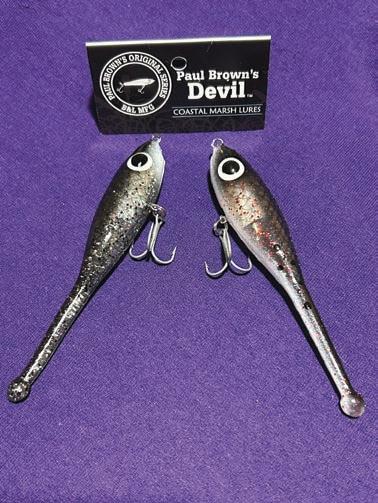
I spoke with Robbie Marsh, owner of Coastal Marsh Lures, and asked him, “What’s the number one thing a custom lure does for an angler?”
His answer was simple.
The unbelievable realism and finish on all the baits from Coastal Marsh more than pass test for any angler looking for an advantage over big trout.
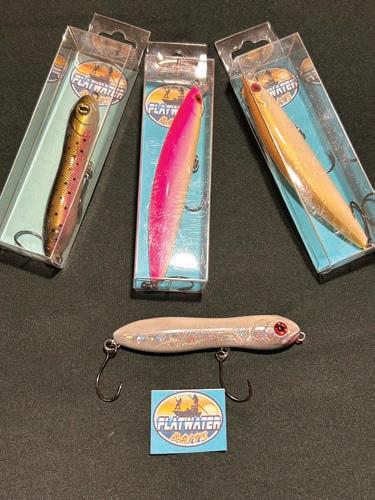
Beautifully hand painted plugs from Flatwater Lures are worth looking into for those wanting to elevate their fishing game.
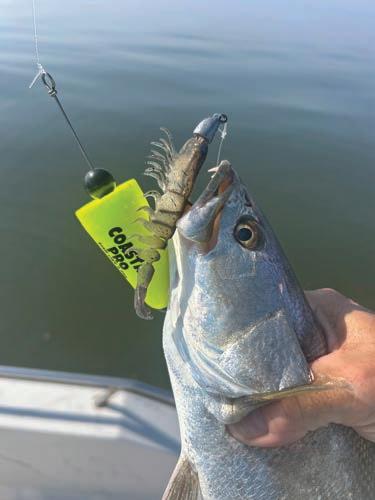
Coastal Pro rattling corks with ZMan Prawn Star shrimp are daily tackle mainstays and proven producers.
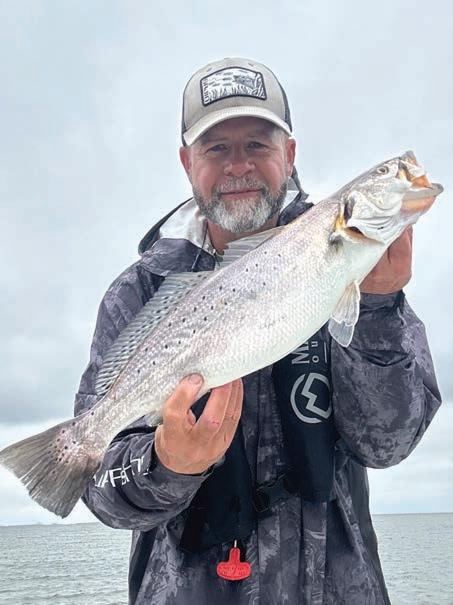
Quality trout continue to show frequently on Sabine Lake with favorable springtime conditions.
“It provides confidence to the angler. And when you are confident in your lure, you always fish better.”
Looking at Coastal Marsh’s beautifully designed racks of lures, it was hard to argue with that logic. The realism and detail on each bait make you think there’s absolutely no way a fish won’t eat it.
Another custom lure maker, Travis Meier of Flatwater Baits, offered his perspective on the evolution of custom lures.
“Like a lot of anglers, we started making custom baits because we couldn’t find the colors or patterns we were looking for on specific models,” he said. “There were color patterns available on one lure that we wanted on another, so we adapted—and it took off.”
Flatwater’s collection of hand-painted plugs is truly impressive. They feature incredible color patterns and a durable finish that holds up well despite being chewed on by fish and bounced off all kinds of structure.
Like many custom lure offerings, Flatwater baits come equipped with quality hooks and split rings, with options for treble hooks or single hooks for anglers dealing with floating or suspended grass.
As you can see, there are endless options available when it comes to upgrading your fishing gear. Anglers who prioritize their time on the
water are willing to do just about whatever it takes to become more proficient at their craft.
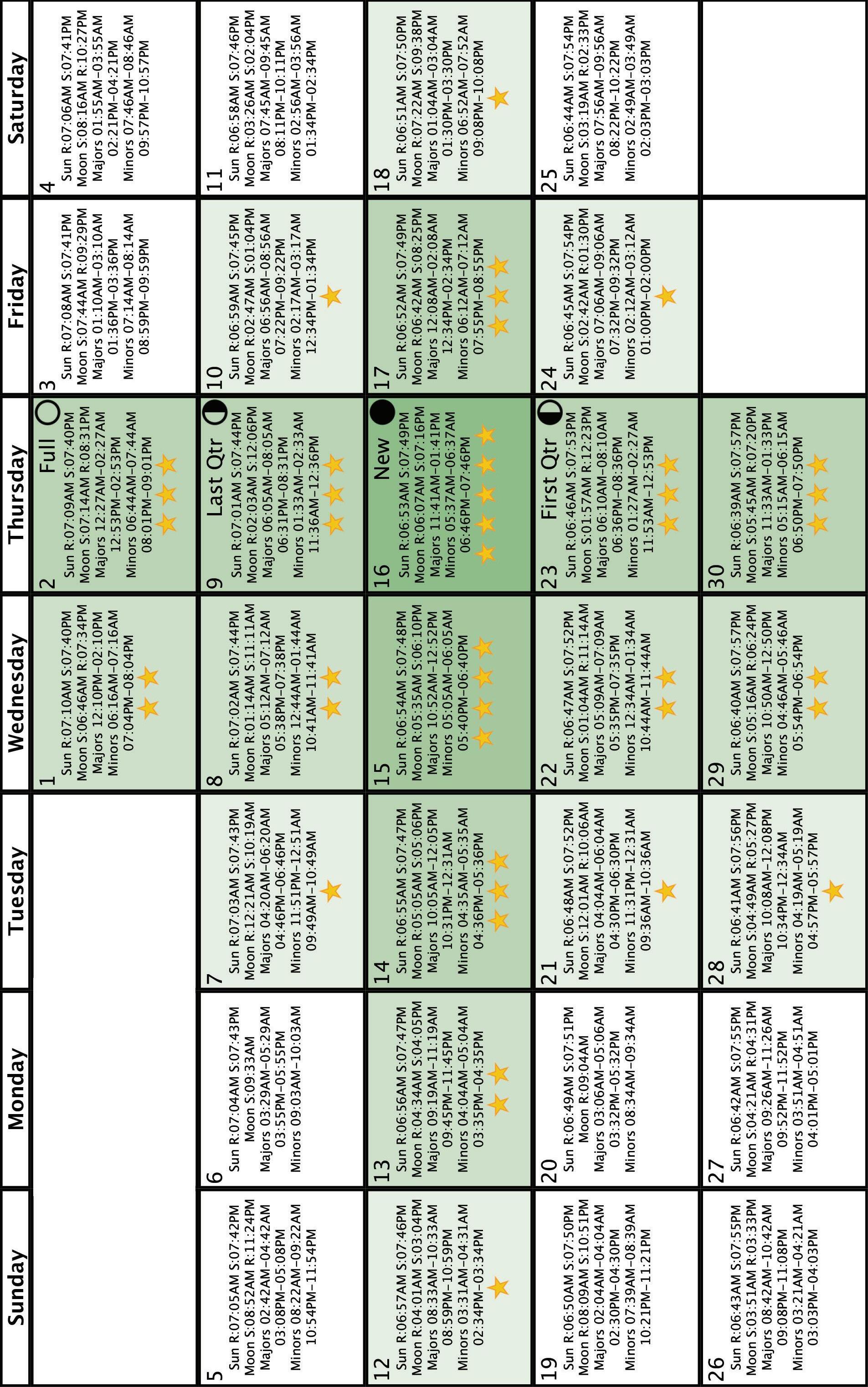
It’s not uncommon to see anglers studying solunar tables and tide charts during breaks at work in anticipation of their next day off—trying to be as prepared as possible to make the most of their time on the water.
The sport of fishing is constantly evolving, and those who strive to keep up with the newest and greatest tools have their work cut out for them. Still, it’s worth exploring the latest offerings that might help you become more successful.
Just be sure to bring some adult supervision with you and let them hold your wallet.
Enjoy the spring weather—and don’t forget to bring a kid fishing every chance you get.
Chuck fishes Sabine and Calcasieu Lakes from his home in Orange, TX. His specialties are light tackle and fly fishing for trout, reds, and flounder.
Phone 409-697-6111
wakesndrakes.com
GOT SHARKS?
STORY BY JOE RICHARD
I’ve had this pair of shark jaws on the wall so long that I seldom notice it—until recently. It came from a shell shop in Mazatlán, where countless ocean treasures from around the world are gathered for tourists, mostly shells stripped from Pacific coral reefs. Shark fins are sold for soup in parts of Asia for a pretty penny, their meat kept for consumption in Mexico, but the shark jaws are sold for souvenirs.
I didn’t actually pay for the jaws, which appear to be from a bull shark. An Elvis impersonator named Jessie, on his first visit to Mexico to fish for sharks, paid for them. His group caught nothing, so before heading for the airport he offered me a few Benjamins to buy several shark jaws. But that’s another story.
Except for rare and occasional fish fries decades ago, my policy has been to leave sharks alone. They ignored me (mostly) for many years when I dove the Gulf’s oil rigs, so I don’t target them—much less bring one home. Most fishermen avoid them as well.
As a result, shark numbers have greatly increased, even with heavy fishing pressure. Strict bag limits have certainly helped, and an entire generation of anglers now fishes without any thought of bringing a shark home for dinner. Even with a very low birth rate, sharks have now become a problem, chewing up prized gamefish before they can be landed. They’ve even been known to chase hooked snook onto beaches in South Florida multiple times in a day.
One young angler fishing near Flamingo was snatched from his boat because he rinsed his hands overboard—apparently forgetting his fish towel that day. His hand was chewed on, and the helicopter flight to the hospital must have cost a fortune.
So lately I’ve been thinking maybe it’s time to eat more shark—especially now that kingfish, ling and amberjack numbers are at historic lows in the Gulf.
After guiding my first and only shark-fishing charter, I never wanted another. Three young guys showed up in Port O’Connor with two buckets of beef lung and a .357 Magnum—which will shoot through a car engine, a bit much for dispatching sharks.
It was April with a north wind blowing, a little early for sharks compared to summer action. Those chunks of beef lung used for chum floated away like Styrofoam and attracted hundreds of seagulls. My 4/0 Senator reels would have been too small for a big shark anyway, and ultimately we had no bites.
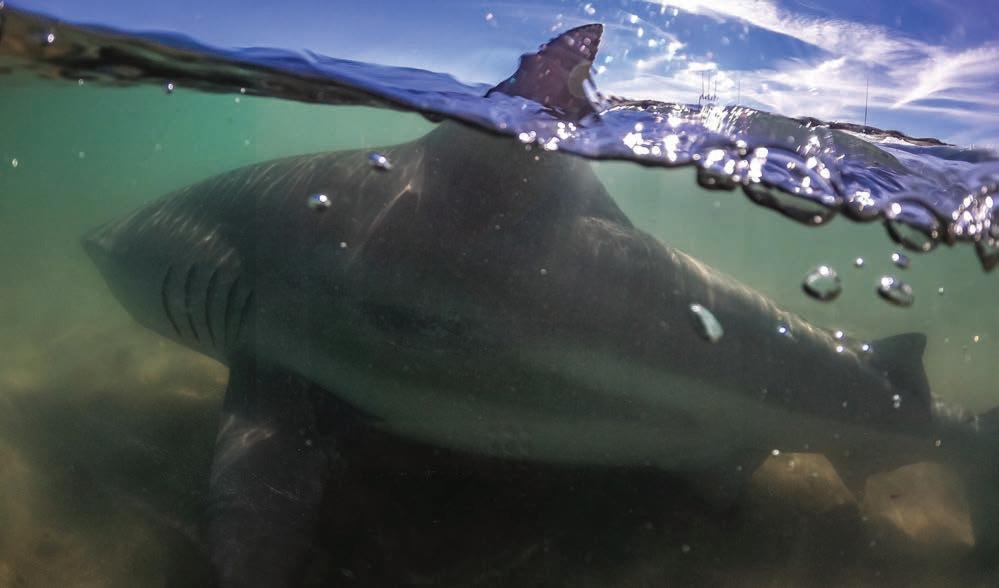
Bull sharks thrive
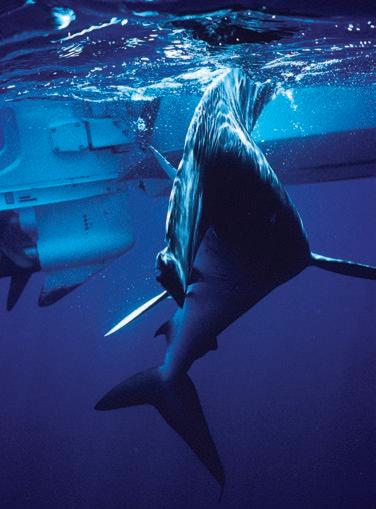
That’s not to say we haven’t had our share of shark encounters. We’ve had plenty with blacktips, the smaller coastal sharks that visit the Texas coast by the thousands each summer.
Every May and October there was a regular run of them through Pass Cavallo, providing fast action on 40–50 pounders that jumped and generally went crazy on the line. We used big circle hooks— meant for tarpon—and somehow I unhooked ten of those blacktips in one trip while they were still in the water.
I talked to them and they actually calmed down while I jiggled the hooks loose, which weren’t buried too deep. A regular shark whisperer, that was me.
I didn’t want to leave hooks in the sharks if it could be helped— but it’s not advised. Blacktips have wicked teeth and a friend of mine, Capt. Howard Horton in Galveston, wound up in the hospital after
they gaffed a three-footer into the boat and tried to unhook it. The shark, like most animals, went nuts and grabbed Howard’s hand. Off he went to the emergency room.
His fingers were saved and morphine eased the pain during a week-long hospital stay. As he later lamented, he went through all that trying to save a forty-cent hook.
On another occasion, our unofficial mayor of Port O’Connor, nextdoor neighbor Jimmy Crouch, volunteered to catch blacktip sharks when a group of outdoor writers were scheduled to visit for a fish fry.
It was typical June weather—windy every day with muddy whitecaps even eight miles offshore. No problem. Smaller blacktips love warm, muddy water.
We ran offshore, tied up to the first Gulf platform, and began catching three-foot blacktips until the cooler was full. The ammonia build-up inside that cooler was stunning. Once they were filleted back at Doc’s Dock, the smell disappeared and we told everyone they were trout.
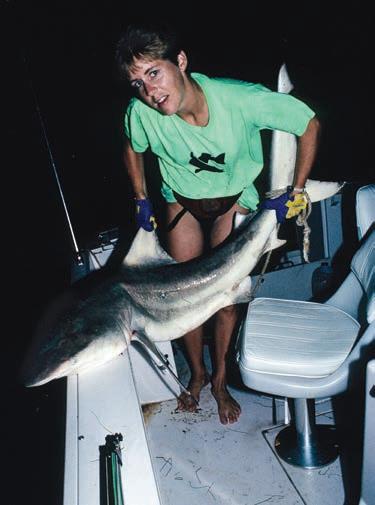
Everyone was impressed with our deep-fried sow trout fillets. Keeping that trip in mind, Amy and I decided to try a blacktip for our own fish fry. At sunset we caught an impressive five-footer in Pass Cavallo and, lacking a pistol, tried to tail-rope it and drag it backwards with the boat to drown it—knowing better than to drag a live shark into the boat, where bad things can happen.
When Amy tried to get a rope around its tail alongside the boat, it whipped around like a snake and came within inches of grabbing her elbow. Snap! Bad idea.
So I grabbed my seven-foot pole spear with three icepick points on the end, aimed for the shark’s middle gill— remembering a diagram showing where the heart is—and let fly. That shark never moved again. Stone dead. Ready for a picture.
Those five-foot blacktips might as well be called the “poor man’s tarpon” because they are jumping fools and very
Amy Richard with a blacktip shark that almost bit her at Pass Cavallo.
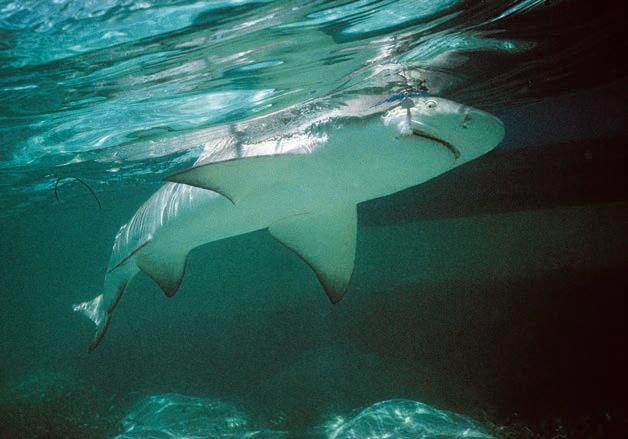
Lemon sharks are more tropical and thrive in the Florida Keys and The Bahamas. This one bit our fishing guide when he tried to grab it by the dorsal fin.
Hammerhead sharks roam the world’s seas. Battling big blacktop sharks off Sabine Pass in clear green water. Photo by Mike Spencer.
sporty on the end of a line.
A friend from my high school days in Port Arthur, Mike Spencer, still targets summer blacktips off Sabine Pass, taking younger relatives offshore until they reach green water. They then locate the big shrimp boats, which can be tracked online.
They use quality equipment—Shimano TLD reels with smooth drags—not Mickey Mouse tackle. During summer there are serious blacktips out there following the shrimp fleet, not the little ankle-snappers found in the surf.
Action is fast and furious with crazy jumps and blistering runs. When the sharks tire, Mike simply cuts the leader close to the hook. This is no sport for rookies. Mike has been fishing a long time and knows when to grab a leader—and when not to. He might even have a guardian angel to have survived this long on the Gulf.
As I do—except mine must be working in shifts.
Further south in Port O’Connor, Capt. Curtiss Cash says sharks are becoming a serious problem.
“Offshore, red snapper and sharks are the only game in town these days,” he says. “You can’t fish behind the shrimpboats because the sharks are thick. We’re overrun with sharks now. Every area I fish in shallow water has a shark there regularly—bull sharks, blacktips and two hammerheads. They just live there and eat everything.
“They stay in the channels and then move onto the flats; you can see them from more than a hundred yards away waving their tails. Way more than we used to see. They eat maybe one out of every 30 bull redfish we catch in deeper water.
“We even had a rare oceanic whitetip shark show up while we were snapper fishing— eight or nine feet long. A couple of hundred-pound sharks hanging around the boat suddenly scattered just before that whitetip appeared. It was awesome watching him cruise around. We quit fishing for twenty minutes just to watch. I was impressed.”
Fishery ManageMent
Curious about the trend of increased shark encounters while fishing—something also reported in Florida—I contacted Dr. Kelsey Banks, who studies sharks at Texas A&M’s Harte Research Institute.
She’s familiar with the issue of sharks impacting gamefish catches.
“Sharks are important to our marine ecosystem and help keep the food web in balance,” Banks explains. “The decline in king mackerel and cobia, specifically, is frustrating. While overfishing is something we can address through policy—bag limits, size limits, etc.—changes to the marine environment such as shifts in currents and water temperature are much harder to manage and may be compounding the issue.”
“These species often require very specific temperature ranges during their larval stages to survive and grow. So when anglers catch one of these coastal migratory pelagics and see a shark depredate the catch, it’s understandably frustrating.
“Increased negative encounters—such as depredated catches—with sharks are a concern for managers, anglers and scientists alike. Both research and policy discussions are underway exploring solutions such as deterrents or changes in fishing practices to reduce these encounters.
“However, there is currently no scientific evidence showing that increasing shark populations are responsible for declining fish populations.”
JOE RICHARD
Joe Richard has fished the Gulf since 1967, starting out of Port Arthur, but his adventures have taken him up and down the entire coast. He was the editor of Tide magazine for eight years, and later Florida Sportsman’s book and assistant magazine editor. He began guiding out of Port O’Connor in 1994. His specialty is big kingfish, and his latest book is The Kingfish Bible, New Revelations. Available at Seafavorites.com
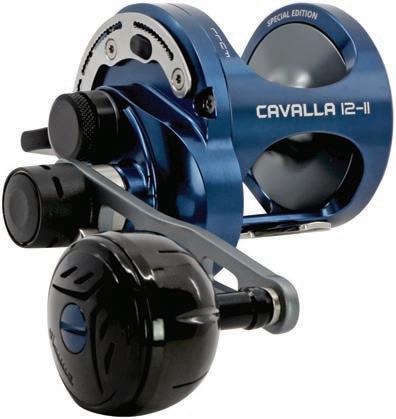
The Cavalla 2-Speed Limited Edition Midnight Blue Lever Drag reel is a compact powerhouse engineered for anglers who demand uncompromising offshore performance. Built on a rigid onepiece machined aluminum frame and side plate, the Cavalla maintains exceptional strength and alignment under heavy drag loads. Its Carbonite drag system, treated with Cal’s grease, produces up to 34 pounds of smooth, consistent stopping power. Precision 17-4 grade stainless steel gears and Okuma’s CRC corrosion-resistant coating ensure long-lasting durability in punishing saltwater environments. With refined two-speed gear ratios, a lightweight carbon fiber handle knob, and corrosion-resistant stainless steel bearings, the Cavalla delivers torque, control, and comfort in a limited-edition reel built to conquer serious bluewater battles.
JAY WATKINS ASK
THE PRO
FOLLOWING BAIT TO FIND FISH HAS WORKED MORE THAN 45 YEARS
I have returned from Port Mansfield and it is good to be back on my home water here in Rockport. Unseasonably warm so far this month, water temperatures are already running in the upper 70s. “The wind is your friend,” once again applies and is something that I want readers to understand. Waters in the Aransas Bay Complex will remain clear even in 20-plus mph SE or even ESE wind directions. An occasional late-season front will bless us with strong NE winds, and this churns the water up slightly more than the SE wind direction. Early season growth of submerged grass has been promising, and it significantly influences how I develop daily strategies for my clients. Moving water is important all year ’round in Rockport, but it’s especially relevant during the spring and summer seasons.
This month I will concentrate on two specific types of structure and both will be somewhat dependent on weather conditions. I often have anglers ask me as we push away from the dock where we are headed for the day. I think many are shocked when I say that I really don’t know for sure. I’m just going to let the conditions and hopefully some signs show us a promising starting point.
Once any submerged grass structure is located, it will (or should) only increase in size throughout the season. Reefs are my secondary structure, but they’re just as important as submerged grass beds. Both of these structure types are equally productive. I probably fish grass more in the spring due to easy access and the simple fact that areas in my bay system that hold an abundance of grass allow the water clarity to hold up better during periods of high wind.
San Jose and Matagorda Island shorelines have the majority of the scattered grass beds in my area, while Southern Aransas Bay’s grass flats feature more potholes and isolated grass beds. Our barrier island shorelines also offer excellent structure in the form of parallel guts. Within these guts, we find areas of scattered grass as well as small areas of elongated grass beds that provide distinct grass edges. The key in locating the fish is first locating the water depth with the most submerged grass. Sounds simple enough, but accomplishing it can actually be rather challenging.
Now, to complicate matters, bottlenose dolphins can appear regularly and consistently drive game fish away
Ford Clark with a chunky 7.5-pounder.
for a brief period. When you see this happening it is okay to leave and return a while later if needed. This allows time for your area to reload. I would personally rather have a boat run over the area where I am working than a pod of dolphins.
I say this because, to the best of my knowledge, boats do not eat fish. And while it’s true that we very occasionally see prop-chopped trout and reds on the flats, these dolphins will take fish off your line and will also be quick to gobble down every fish you release when they are present and feeding.
Never is there a time when I am not looking for a food source in any area where the bottom structure is consistent with that which I know game fish to be favoring at that time. The amount of bait present can easily increase with the passing of every tidal movement. In the spring we also start seeing slicking in areas where trout and reds alike are feeding. On windward spoils and shorelines, I tend to believe that most of the slicking I am observing comes from trout. I hold this belief based on a lifetime of experience. Shallow slicks usually indicate good trout of better-than-average size. If you see them but get few bites, the trout you’re after are likely making those slicks.
My best trout in Rockport typically come from shallow, windward spoils and barrier island shorelines. I prefer to run well offshore of these types of structures, outside the drop-off, when conducting my scouting runs each morning. This allows me to see everything I need to see without spooking the fish, which gives us better odds of catching once I decide to stop and fish an area.
The same is true when scouting reef structures. You want to run well offshore and then approach as quietly as you can. This just gives us better odds. And let’s face it, with fishing pressure on the rise along the entire Texas coast, we need to create our own luck as often as we can.
Try to stay as far away from the targeted area as possible when wading, making long casts to every piece of structure you can identify. Bites of any kind should stop everyone in the group in
their tracks. This is when we start working and can learn important details about the fishing area that we can use in other areas that match the characteristics of the current one.
Allowing the bite to develop around us is something it took me a while to practice as a young angler and guide. It is common for individuals, including myself, to encounter times when we feel pressure to produce and should therefore pick up the pace of our wading. While that approach does pay off at times, over the years I have learned that staying power pays larger dividends more often than not.
When fishing reef structures we need to avoid walking on shell as much as possible. When I was a youngster my dad would tell me that I was “crunching them off,” meaning I was pushing the fish I was trying to catch farther ahead than I could cast. I used the same phrase with my boys when they were learning to fish oyster reefs.
Now, speaking of walking on shell, walking amid scattered shell clumps is hard on our wading boots and can even be hard on areas of our legs that are not protected by the high-top lace-up style that I prefer. My boots of choice right now are the new Southerly brand and they are holding up very well to my normal schedule of fishing five days a week, about 40 weeks per year—a great program for testing just about any product used by fishermen who wade Texas bays.
I am often asked what time of the month I recommend for booking a fishing trip and my answer has long been the same. Whenever possible, I recommend scheduling your trips three to four days before the Full and New Moon phases, not only during spring but throughout the entire year. Now, having offered that recommendation doesn’t mean you will not have good days at other times of the month because you certainly can. The question, you see, was aimed at learning my opinion of the best times to book a trip, and I answered honestly.
I use a wide variety of lure styles during spring—probably more so than any other time of the year. The new MirrOlure and Custom Corky Soft-Dine Floaters have proven to be fantastic choices for us. The slower sink ratio allows anglers to work the bait aggressively
Author with a heavy-six.
Jay Anderson with a solid 7-plus.
over shallow grass, drawing aggressive strikes from trout and reds. Jay Ray used them before I did and has certainly gotten into a groove with them.
I also throw the Texas Custom Double D a lot this time of year during solunar feeding periods. I am also a huge fan of soft plastics and have fished most every type and style throughout my career. Bass Assassin, MirrOlure and now the new Texas Custom and 6th Sense series of soft plastics are my current go-to baits.
Chris Bush is really good at the mid-strolling style of fishing for trout and reds. I watched him closely this winter and was very impressed. I am not ready to write anything about this style of fishing because I am not qualified at this point, but stay tuned because I will be. These two companies I mentioned are at the forefront of the industry with these types of lures. I might even have to break down and purchase a bad-to-the-bone spinning rig we’ll just have to see.
I pretty much stick to a theory on lure color that is fairly simple and goes like this: clear water, clear-bodied lures. Dirty water, darker color patterns. Texas Custom’s Pistachio-colored soft plastics and
Finer Points of Fishing Windward Spoil Banks
Double D series are difficult to beat in clear water.
Spring is a terrific time to fish. Warming water temperatures and stronger tidal movements open the floodgates from the Gulf for our baitfish that reside offshore to re-enter the bays. Where the bait goes, we should follow.
There is little science that supports any specific direction that the bait goes once it enters the bay. I think that, in many bays, migration typically occurs from south to north. However, predicting this pattern is challenging because spring weather conditions are often very unpredictable. Some years the bait moves south and the fish follow. Other years it shifts to the north and game fish move with it. I believe trout follow bait no matter what the other conditions might be.
I know this to be somewhat of a gold standard: I follow the bait and it seems to have worked for over 45 years.
May Your Fishing Always Be Catching
– Guide Jay Watkins
Jay Watkins has been a full-time fishing guide at Rockport, TX, for more than 45 years. Jay specializes in wading yearround for trout and redfish with artificial lures. Jay covers the Texas coast from San Antonio Bay to Corpus Christi Bay.
Telephone 361-729-9596
Email Jay@jaywatkins.com
Website www.jaywatkins.com
SHALLOW WATER FISHING
NO MATTER WHERE YOU GO; THEY’RE STILL REDFISH!
I have been very fortunate in my life to have been able to travel and chase redfish all across the Gulf Coast. In my personal opinion, they are the perfect game fish to target. You can catch them shallow or deep, on live, dead, or artificial bait. They can be very aggressive and always put up a good fight. All of these aspects, combined with their quality as table fare, make them an ideal game fish species. In addition to all that, they can be found in every bay system, although targeting them specifically can take a little time to dial in. However, there are a few key points that have helped me find success in catching them no matter where I am fishing.
Earlier this spring I made a trip over to Venice, Louisiana and fished with my buddy John West. He runs Blue Mud Charters down there, and our goal was to see if we could pick up a few redfish on the fly. During a little lull in the action I asked him when he fishes a new place, what does he look for that might be helpful in getting dialed in. We agreed on a majority of the elements, but he went into greater detail about some aspects that I have never considered. I will circle back to those finer points later in this article but, for now, this is what I look for when fishing a new area.
GOOD TIDAL FLOW
I truly believe that moving water is a key component when it comes to locating redfish, or any game fish species for that matter. The tidal flow in an area completely dictates the movement of baitfish and feeding patterns. If you have ever paid attention to it, slack tide is a very difficult time to catch fish. Redfish will move with the tide and will take advantage of areas where eddy currents occur and other places where moving water brings baitfish to them, making them work less while providing an easy meal.
A few years back, I stopped off in St. Augustine, Florida and figured I would fish the area for a day or two before continuing my journey back home. I had never been there and was going in completely blind. Once I launched, I headed out into the boating lane, figured out what the tide was doing, and then looked at Google Maps. Knowing that the tide was going out, I focused on an area that had a main bayou with several braided drains and ponds at the end of it. I knew that as the water level dropped, bait had to exit the shallows and move into the deeper channel for shelter. This creates a perfect scenario for hungry redfish waiting at the mouth of a
DAVE ROBERTS
drain. I found great success that day in an area I had never seen before, and I credit it all to tidal movement.
LOOK FOR STRUCTURE
When you think about the word structure and fishing, a few different ideas come to mind. I like to think of it in two ways –manmade structure and natural structure. I don’t believe that I need to harp on the importance of oyster reefs, as I feel that these are a given. Other types of structure created by Mother Nature are the myriad shapes and sizes of submerged grass beds. I know that on the Lower and some Middle Coast bays, grass flats can go on for miles. Here on the Upper Coast and over in Louisiana though, we simply do not have such luxuries. However, if you can find ponds and areas that hold good amounts of wigeon grass, you will find plenty of fish. These grassy areas provide a perfect haven for shad, mullet, crabs and other smaller baitfish to thrive. Along with that, the grass helps clean the water and can provide great opportunities for sight-casting redfish.
Even though it was not our intention, manmade structures provide great habitat for redfish. Some examples include rock walls such as jetties and erosion barriers, pilings for piers and docks, and believe it or not, even duck blinds. While you might not believe it, duck blinds are always worth making a few casts around. These areas give redfish excellent ambush points for unsuspecting bait seeking refuge within the structure.
A HEALTHY ENVIRONMENT
If there is one thing I have learned from standing on a platform and trying to sight-cast redfish, it is this: you don’t realize how much dead water there is. What I mean is that there is a lot of water that may look fishy but is, in fact, totally devoid of fish. Why some areas are empty I will never fully understand but, that being said, I am a firm believer in finding areas that have plenty of other wildlife present.
Of course, shorebirds such as egrets are a great sign, but herons, ospreys, nutria, turtles and otters should never be overlooked. All of these animals either eat the same things redfish do or live off the grass that provides a home for the creatures redfish eat. I’ve watched otters chase and eat crabs. Osprey are often seen snatching mullet, and egrets love to eat shrimp. When it comes down to it, all aquatic life thrives in a healthy environment, and that includes redfish.
To circle back to my conversation with my buddy John about what he looks for in Venice, he mentioned that he always pays attention to which direction a shoreline runs. The reason being that the shoreline opposite the rising and setting sun will warm up quicker during winter and stay cooler during summer. These subtle changes are something anglers may not consider, but redfish will certainly take notice.
If you don’t believe me, turn your air conditioning thermostat down two or three degrees and I promise you will feel a noticeable difference. Along with that, he likes to focus on main lake shorelines, saying that once the tide begins to come in, this will be the first area to receive clean ocean water, making it easier to spot fish. After fishing a stretch, you can work your way further into the marsh and chase the clean incoming tide. Both of these are great tips to follow.
Redfish can be found all across the Gulf Coast and can be caught many different ways. If you plan on going to a new area and want to find a few fish, any of these things can help. If you are looking for real success, combine all three of these aspects and you will be able to find redfish no matter where you go.
Dave Roberts is an avid kayak-fishing enthusiast fishing primarily the inshore Upper Coast region with occasional adventures to surf and nearshore Gulf of Mexico.
Email: TexasKayakChronicles@yahoo.com
Website: www.TexasKayakChronicles.com
35 YEARS IN THE MAKING - THE TEXAS ARTIFICIAL REEF PROGRAM
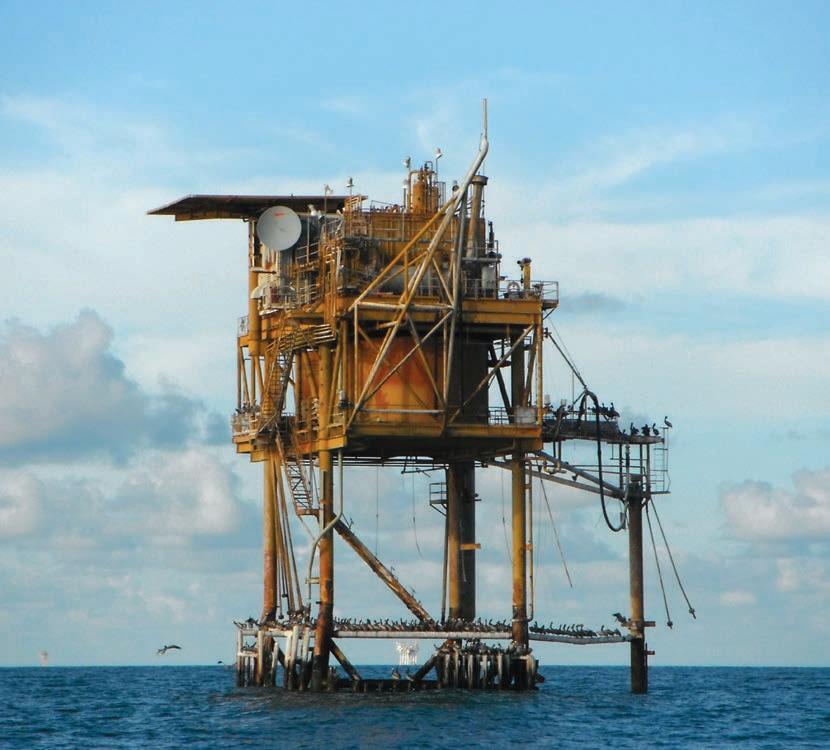
For 35 years, artificial reefing has become a cornerstone of Gulf restoration and recreational fishing off the Texas coast, filling a vital ecological and recreational gap where natural hard-bottom habitat is scarce. Managed by Texas Parks and Wildlife Department (TPWD), the Texas Artificial Reef Program was established by state law in 1990, and since its inception, has coordinated placement of ships, concrete modules, bridge sections, and portions of decommissioned oil and gas platforms to create durable, complex habitat on an otherwise flat continental shelf. These structures give barnacles, oysters, corals, and other sessile organisms a place to attach; those communities in turn attract juvenile and adult fish and concentrate food for predators—creating hotspots for anglers and divers alike. Simply put, build the habitat, and the fish (and the fishing opportunities) will follow.
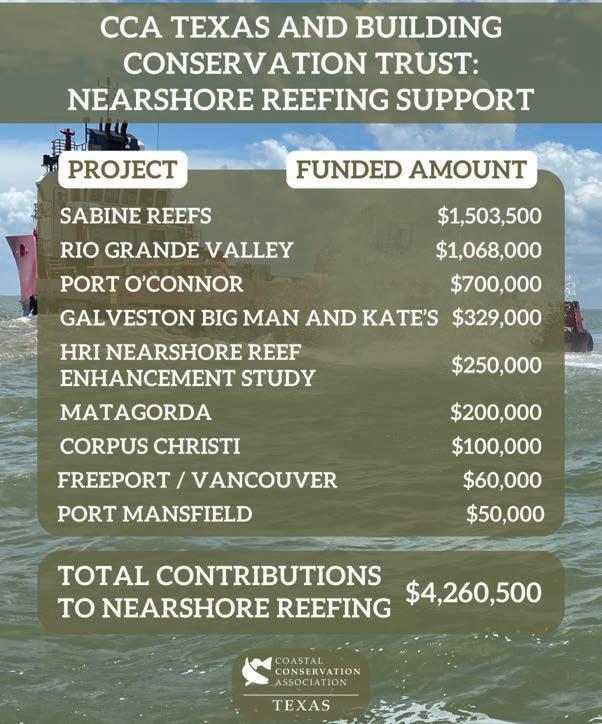
The program has permitted about 7,450 acres since inception, with a total of 94 reef sites (16 nearshore reefs, 66 rigs-to-reef, and 12 ships-to-reef), more than 10,000 concrete structures deployed and over $36 million funded. Currently, TPWD is working with CCA Texas, CCA’s national habitat program, the Building Conservation Trust, and friends’ groups (Texas Parks and Wildlife Foundation, Friends of Sabine Reef, Friends of RGV Reef) on deployments at sites including Sabine, Port O’Connor, the Rio Grande Valley, and the Queen Isabella Causeway. Some of these deployments are funded by a $2.4 million RESTORE grant originally secured by CCA’s Building Conservation Trust.
Why artificial reefs matter to fisheries
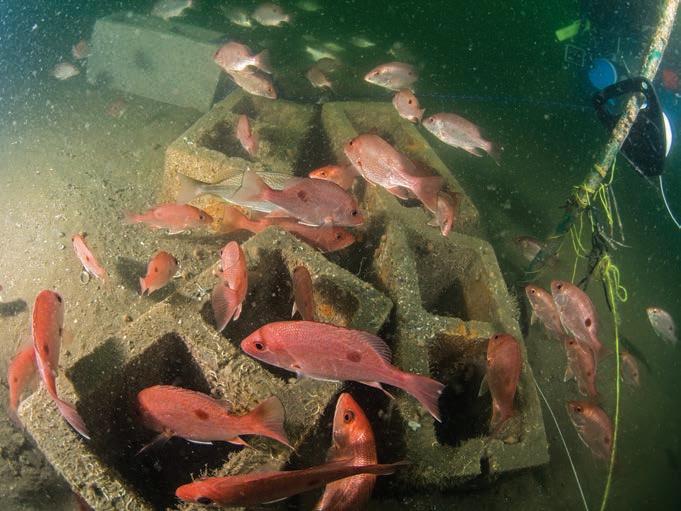
The Texas Gulf is largely a flat, sandy shelf with few naturally occurring “hard” habitats; where hard structure exists, natural ridges or manmade structures, fish and invertebrate life congregate. Artificial reefs provide the substrate needed for invertebrates and algae to grow, creating food and shelter for juvenile fish and forage grounds for larger gamefish such as red snapper, grouper, king mackerel, cobia, and amberjack. TPWD monitoring
finds red snapper commonly at artificial reef sites, and nearly 200 marine fish species have been recorded on reef-associated structures in Texas waters. These reefs increase local productivity and enhance fishing and diving opportunities.
Angler access is a central benefit of nearshore reefing. Texas manages fisheries out to 9 nautical miles from shore; inside that boundary, anglers are subject to state regulations and, in the case of red snapper, enjoy a near yearround recreational opportunity with a more liberal bag limit than federal waters. Because much of our state waters lack depth and structure attractive to reef fish, nearshore reefs sited at appropriate depths are especially valuable for creating new, accessible red snapper and reef fish fishing grounds for anglers. TPWD explicitly designs some reef sites to be reachable by smaller boats and to support local ecotourism and diving economies. One such example is the 20-acre HI-54 Shallow site 1.7 miles from the coastline in front of Sea Rim State Park, which received its first deployment of concrete culverts, granite blocks, and old oil rig structure pieces in June 2024. This reef site serves as a template for future reef locations since it is easily accessible and provides ample opportunities to target speckled trout, red drum, mackerel, jackfish, and sharks.
Site selection: opportunities and conflicts Selecting reef locations requires balancing ecological gain, public access, and other marine uses. The Texas
artificial reef plan and program guidance emphasize minimizing conflicts with shrimping grounds, navigation routes, endangered species habitats, and culturally sensitive sites while maximizing benefits for recreational and commercial fishers. State law and the Texas artificial reef plan direct TPWD to use best available science, coordinate permitting, and avoid unreasonable obstruction to navigation, hence the careful permitting, marking and monitoring that accompany reef projects. These competing uses and regulatory constraints explain why siting and permitting can be lengthy and why nearshore sites are carefully prioritized.
Funding and the rigstoreefs model
Although TPWD has a legislative mandate to run the artificial reef program, funding has been a limiting factor. A significant source of funding and material has come from rigstoreefs partnerships: when oil and gas platform owners donate
decommissioned platforms (or share realized removal-cost savings), TPWD can pursue permits and deployment. TPWD and partners have repurposed more than a hundred platforms into reef habitat. Conservation organizations (notably CCA Texas and the Building Conservation Trust), grant programs such as RESTORE, donations from private companies (such as Port Arthur LNG, Cheniere, Golden Pass LNG, Phillips 66, Motiva, Valero, BNSF Railway, and others), and support from friends’ groups have provided important financial support for nearshore projects. Still, sustained funding is needed to scale reef construction and monitoring.
Looking ahead
Nearshore reefing offers a pragmatic, costeffective tool to restore lost habitat, improve fisheries, and expand public access to quality fishing and diving. Some permitting woes may soon be alleviated as TPWD is working closely with the Army Corps of Engineers to create a programmatic permit and agreement to streamline the permitting process for constructing artificial reefs. Projects such as the Queen Isabella Causeway conversion and recent deployments at Sabine and Port O’Connor illustrate what coordinated publicprivate efforts can achieve: new habitat, stronger local fishing economies, and more places for anglers and divers to enjoy the Gulf. Continued partnerships, stable funding, and careful, sciencebased site selection will be key to expanding these benefits and carrying the artificial reef program forward for the next 35 years.
By Texas Parks & Wildlife FIELD NOTES
ONE YEAR IN: TRACKING OVERSIZED SPOTTED SEATROUT ACROSS THE TEXAS COAST
It has been a little over a year since the Texas Parks and Wildlife Department (TPWD) implemented the new oversized spotted seatrout (SST) tag on September 1, 2024. Now, the agency is taking a closer look at how the program and regulations are working along the Texas coast.
The current SST regulations consist of a three-fish bag limit and a slot size of 15–20 inches, in addition to requiring the use of an oversized tag for SST measuring 28 inches and greater. This mirrors the long-practiced system requiring an oversized tag for red drum (RDM).
In 1974, TPWD initiated a standardized statewide saltwater fish harvest survey. This long-running, coastwide program provides fishery-dependent data collected from anglers surveyed at boat ramps, wade and bank-fishing areas, private piers, and commercial lighted piers and jetties. Surveys conducted at boat ramps since the regulation change have allowed TPWD Coastal Fisheries staff to identify the bay systems—from Sabine Lake to the Lower Laguna Madre—where tagged SST were caught, assess angler compliance with the newly implemented regulations, and document the overall coastwide number of tagged SST reported each year. In addition, the program enables TPWD staff to compare the number of tagged SST with tagged RDM.
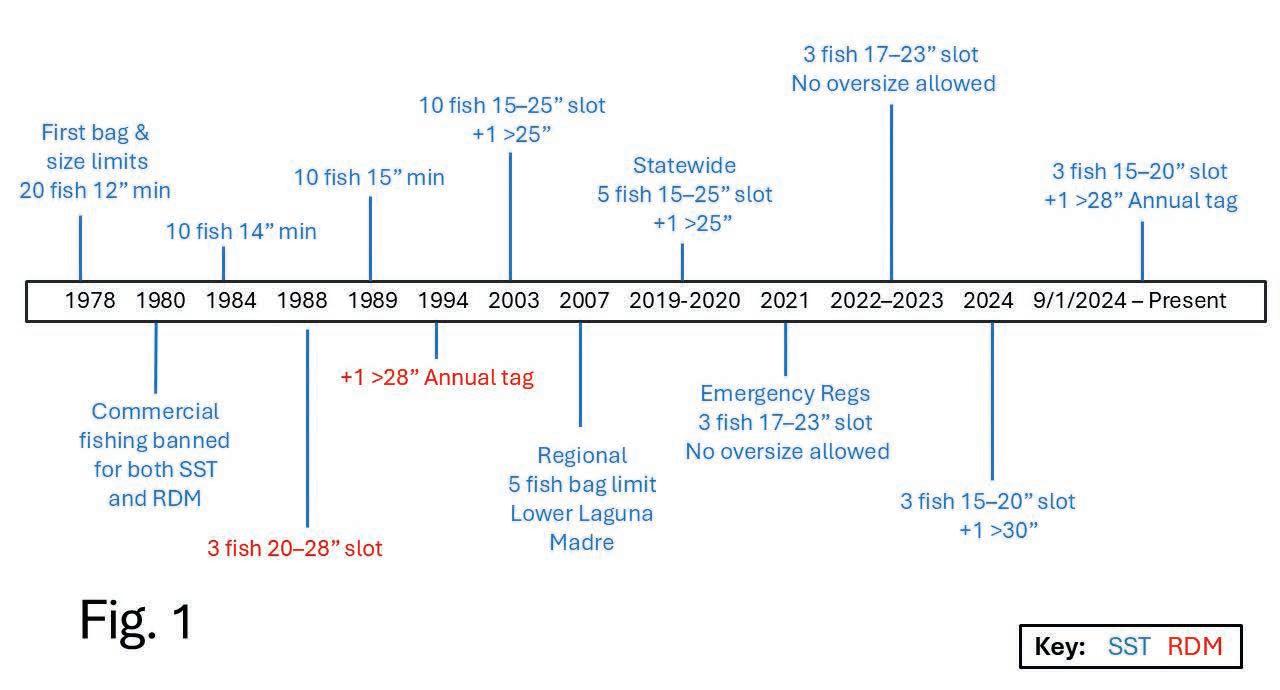
In the past, management regulations—including bag and slot size reductions for SST—have been implemented following major freezing events or due to other factors (e.g., angler preference) to rebuild or enhance stocks of this highly prized game fish (Fig. 1). This was the basis for the SST regulations following Winter Storm Uri in 2021, when an estimated 160,000 SST were lost coastwide. The freeze’s
impact on the SST fishery led to temporary, more restrictive bag and length limits to support population recovery.
The previous regulation consisted of a five-fish bag limit with a slot size of 15–25 inches, which could include one fish over 25 inches. After collecting angler feedback following the post-freeze regulations, the current rule reduced the bag and slot size and introduced an oversized SST tag, which anglers can now also report through the new digital reporting system.
These regulatory changes were supported by the Texas public, with anglers and fishing conservation groups across the coast attending scoping meetings to voice concerns and advocate for greater conservation of larger, older SST. Anglers also expressed strong preferences regarding the oversized, or “trophy,” size class of spotted seatrout. Feedback gathered through surveys and public scoping consistently indicated that Texas anglers value opportunities to encounter and catch trophy-sized trout.
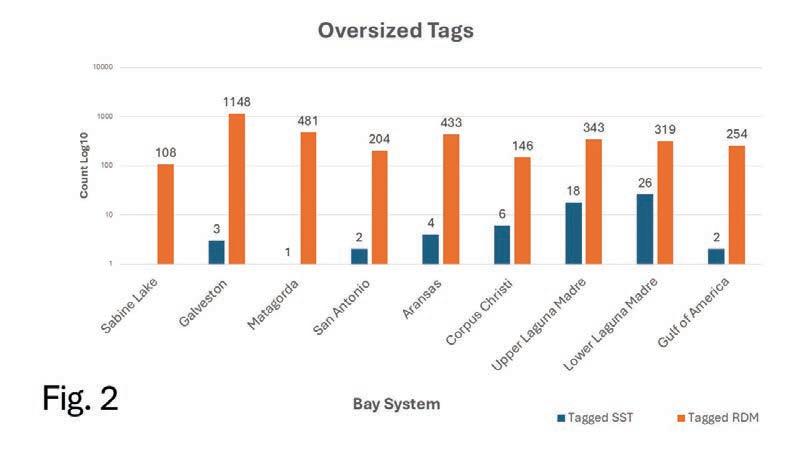
During the 2024–2025 period, a coastwide total of 62 oversized SST were observed or reported tagged along the Texas coast. Of these, only five were measured directly by TPWD staff using conventional tags during harvest surveys, while the remaining fish were digitally reported (Fig. 2).
It is highly probable that additional tagged fish were caught by anglers but went unrecorded, as some anglers may not have completed their trips at one of the survey sites or reported their catch digitally after using a traditional paper tag.
The absence of untagged SST among the five individuals observed indicates excellent compliance among saltwater anglers tagging their oversized SST. Likely not surprising to many avid anglers, the Upper and Lower Laguna Madre produced the majority of tagged oversized SST, contributing 78.3% of the total.
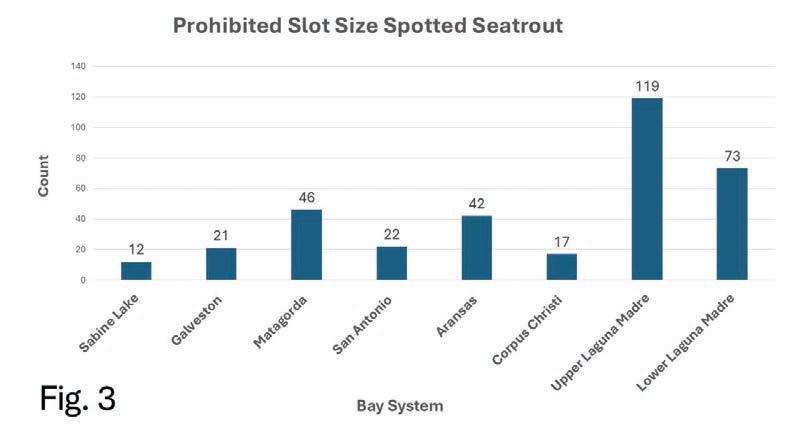
During coastwide harvest surveys conducted by TPWD staff from September 2024 to August 2025, TPWD staff encountered 15,358 SST, of which only 326 fish (2.1%) fell within the prohibited 20–28 inch slot. This indicates high angler compliance with the slot regulations (Fig. 3).
Compared to oversized RDM data, of the 9,503 RDM caught coastwide during the
same timeframe, 2,665 were tagged as oversized. Oversized fish tagged with conventional tags consisted of 550 RDM encountered by TPWD staff, while the remaining 2,115 were reported using digital tags (Fig. 2). Galveston, Matagorda, and Aransas Bay systems contributed 77.4% of the total tagged RDM.
Based on these results, it appears that the long-standing RDM regulations, combined with the digital tag system, facilitate greater tagging compliance among anglers targeting red drum.
Unlike RDM regulations, which have maintained the same bag and slot limits established in 1988 (with the exception of the oversized tag added in 1994), SST regulations have undergone several bag and slot modifications over the years (Fig. 1). These regulatory changes often result in a temporary delay in angler compliance.
As a result of this delay, several oversized trout are still being harvested that fall between the prohibited 20-inch maximum and the 28-inch minimum tagging size. This can be attributed to incorrect measuring techniques, uninformed anglers, or poaching. The lack of a prohibited slot in the RDM regulations simplifies measurement and tagging requirements, making compliance more intuitive.
Additionally, the seasonality and
SST and RDM caught by bay system. Log transformed scale to allow for comparison.
abundance of oversized RDM in passes, bays, and Gulf waters may help explain the increased number of oversized tags being utilized. In contrast, oversized SST make up only about one percent—or less—of the population depending on the bay system, and they predominantly reside within bay systems.
In 2026, we expect to see an increase in the use of oversized digital tags as anglers become more accustomed to the digital tagging system. Although recent creel surveys indicate a high degree of compliance with updated SST harvest regulations, additional reductions in the number of fish retained within the prohibited slot (20-inch maximum to 28-inch minimum) are still needed.
More often than not, improper measurement technique is the culprit. Always position the fish correctly on the measuring board with the mouth closed and the tail fin compressed. This alone could reduce the take of illegal SST close to zero.
Let’s ensure Texas’ spotted seatrout fishery continues to thrive for current and future generations. And if you’re looking to cross a trophy trout off your bucket list, we recommend heading to the south Texas coast!
Check the TPWD Outdoor Annual, your local TPWD Law Enforcement office, or tpwd.texas.gov for more info.
Counts of oversized tagged
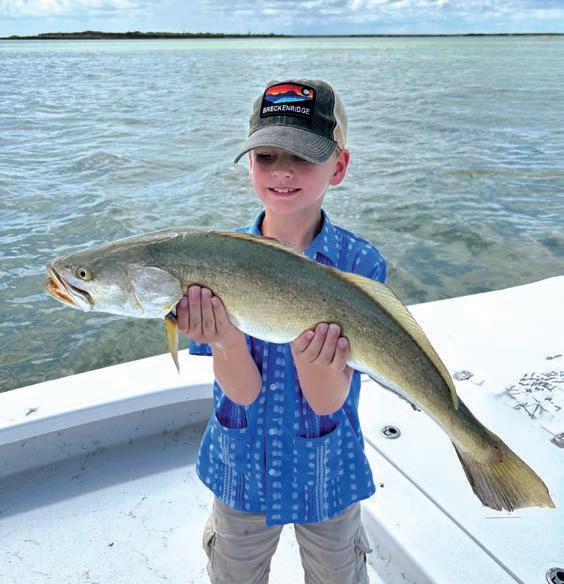
Grayson Tidwell holding a 28.25 in SST in the Lower Laguna Madre.
Count of prohibited SST caught by bay system.
ERIC OZOLINS
EXTREME KAYAK FISHING & SHARKS FROM THE
SAND
SALTY INNOVATION
The more experience we obtain on the water, the more ways we seek to do things more effectively and efficiently. The evolution of fishing technologies and gear has largely proceeded on a steady curve, driven by the anglers themselves. Most skilled anglers come up with objects and/or methods that enhance their chances at consistent productivity.
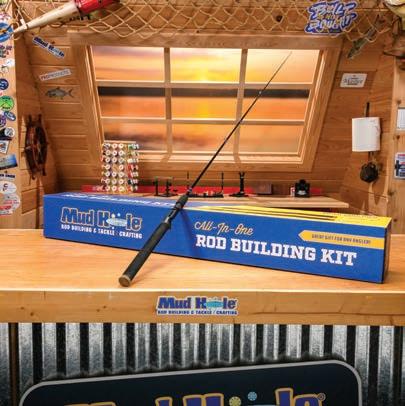
Some create lures, some make their own leaders, and some build their own rods. I’ve created unique leaders, poured my own weights, made custom offshore lures and jigs, designed and built rods and much more. I’ve done all these things, embracing this sport with creativity fueled by the desire to excel. I see these acts as a natural way of expressing creativity and fulfilling potential. To this very minute, I’m involved in making innovations in my fishing world.
In my youth, I lived in Central Texas, but I made many trips to the coast to explore the sharking game. During this time, I started to learn to construct my own entrylevel shark leaders. During the week, I would make a trip to the local Academy store and buy the heaviest leader material and biggest hooks they had. Then I’d spend weekdays building leaders. Most weekends, I raced down I-35 straight to the Gulf. I did this consistently for a couple of years, straight out of high school.
When I moved to attend college at Texas A&M–Corpus Christi, I fished the coast regularly. My focus was to expand my fishing potential to the max. In fact, the
charm of the saltwater largely drove me to choose this great university. But fishing gear is not cheap, so I needed to find work to finance my trips. My first job in Corpus was working for mentor and good friend Nick Meyer at Breakaway Tackle. For a couple of years at Breakaway, I built their custom surf rods.
Throughout my entire life since graduating from college, I’ve devoted myself extensively to beach fishing. When I became a permanent resident of the Coastal Bend, my life changed and my focus on a lifestyle based on the celebration of saltwater angling intensified. To me, building a fishing rod is a way to express personality in a tangible and useful form. I love the work and also the looks on people’s faces when they first see their custom rods. Over the years, I’ve built at least 400 rods, maybe 500—mostly during those early years working for Nick. I look back on the work associated with building those rods fondly. These days, I rarely build rods, but the entire experience truly played a foundational role in my fishing career.
As the years have passed, surf fishing has become an absolute priority for me. Soon after college ended, hyper-focused to an obsessive point, I practically lived on the water, regularly creating new stuff and new ways of doing things. On every trip to the beach I tried to optimize my opportunities. I utilized a lot of electrical tape on my leaders and zip-ties on my baits with the goal of making a natural, streamlined presentation which I felt gave me an
Underwater shot of a blacktip landed by author’s daughter Leah during the release.
advantage over other fishermen—and the fish. In this process, I created a method of fishing that resulted in landing my first surf-caught mako, truly the Holy Grail of shark fishing from the sand in Texas.
In addition to the innovations I made in leaders, I started vacuumsealing shark baits almost twenty years ago—one of the first people in the Lone Star State to do so on a regular basis. The secret to the success of my sharking efforts starts with having the freshest, best baits possible. Over the years, I’ve vacuum-sealed thousands of shark baits, from stingray slabs to whole jacks.
During a magical early decade spent on the beaches of South Texas, I caught monster sharks on a consistent basis. My life changed further when I merged my life in the sport into a career after Captain Billy Sandifer suggested I take over his shark fishing charters. From that moment to now, I’ve been dedicated to the pursuit.
Several years ago, I had a chance to obtain a small tackle company called Catch Sharks. When this happened, the doors in the creativity department of my mind opened and ideas flooded in and out. Eventually, I came up with something that makes me feel the best kind of combined pride and joy. The unique Tru-sand coating I created for the hooks and terminal tackle on the leaders I make for my Catch Sharks brand uses a custom sand-colored vinyl shrink coating over the sleeves and crimps, making them virtually invisible underwater. It’s hard to know for certain how much of an effect this has on catch rates, but I firmly believe their stealth provides at least some sort of advantage.
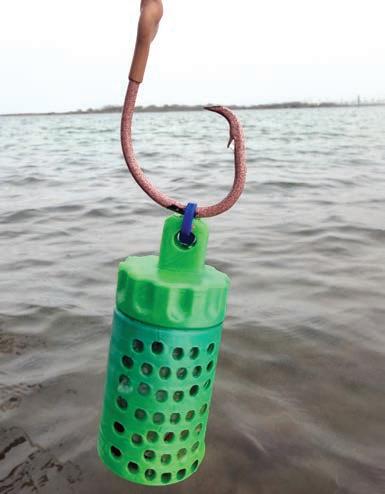
I’ve recently come up with some new innovations. A couple of years ago, I designed the Ozmosis rod blanks for crafting shark rods that I now run exclusively in my lineup. Coming off that success, there are two newly released items I’ve spent a great deal of time perfecting. The first is a custom 3D-printed bait capsule, which I primarily use for targeting the big, ugly variety of oversized black drum in late winter and early spring.
Traditionally, we used half or whole blue crabs for bait when trying to catch these brutes. In years when we had warmer-than-normal air and water temperatures, we found ourselves overwhelmed by small fish when we used these proven baits. Sometimes pinfish and other small fish would clean all the meat out of a half crab in mere minutes. The bait capsules, which I dubbed Big Ugly Bombs, provide a
Big Ugly Bomb loaded with bait and ready for deployment.
protective measure against this form of fishing theft. These precisely engineered, permeable capsules can be crammed full of crab meat or shrimp with no fear of being stripped by hungry little fish.
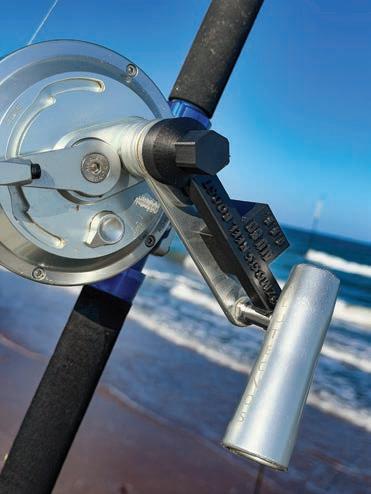
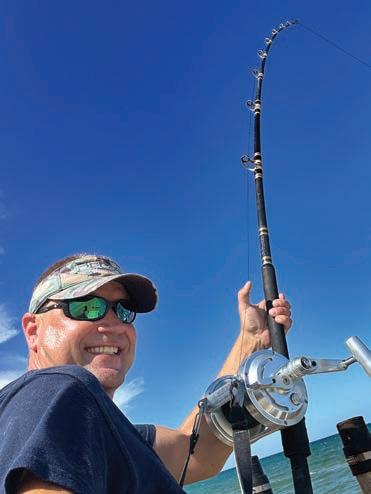
The other unique item I’m currently releasing is a highly desired tool for heavy-duty shark fishing reels. I call this custom-engineered adaptive reel accessory used for bringing in and swapping out baits the Ozmosis Reel Boost (O.R.B.). Shark anglers deploy baits 400, 600, sometimes over 800 yards from the beach these days. When it’s time to bring in a bait, an angler simply uses normal tension to break the spider weight’s grip free from the sand, then attaches the O.R.B. and drills the line in.
Utilizing the O.R.B. provides both a chronological and a physical advantage, eliminating lost time and energy in what has always been a painstaking process. It’s important to note the reel must be in low gear and the drill must be at a low speed to do this correctly. In addition to changing out baits, this great tool works well for filling reels with line. At this point, I’ve made the O.R.B. compatible with Avet EXW shark reels and some 80-model Alutecnos reels, with other models being added to the line constantly.
Those of us who spend a great deal of time on the water often ponder ways to make the things we do easier, more efficient and more productive. I’ve been inspired to explore my creativity by the eccentric Nick Meyer, who continues to come up with interesting and useful innovations in the fishing world. With technology upgrading on a daily basis, gear and methods will forever evolve. I’ll continue to adapt and contribute to developing trends in the sport. Our creativity is a valuable expression of our blessed freedom. As long as I’m able, I’ll celebrate it by making new things and exploring new possibilities.
For the past decade Eric ‘Oz’ Ozolins has been promoting shark catch and release and assisting various shark research programs. Eric offers guided shark fishing on Padre Island National Seashore. Also renowned for extreme kayak big game fishing, Eric is the owner of Catch Sharks Tackle Company.
Here’s the ORB Tool attached to a reel – sure beats all that hand cranking when changing shark baits!
Here’s author Oz hooked up on a nice tiger shark, using an Ozmosis rod of his own manufacture.
ACQUIRING LOCAL KNOWLEDGE WITHOUT HARD KNOCKS
Probably the number one question I get asked for the month of April is, “Do you think we will need waders?”
“Bring them just in case,” is how I usually reply, because you just never know this time of year. It’s not that we have hardblowing northers to deal with, but with cool nights the water temperatures can still be chilly in the morning. If the sun doesn’t pop out early and you have 15–20 mph winds working, you will definitely feel better with them on.
Now, on the days with partly cloudy skies and climbing water and air temperatures, we have found so many fish up shallow you could actually wear shorts. I tell people fish are like us sometimes—most days in April we would rather sit in the sun than hide under the shade of a tree.
Fish will hover tight to shorelines and can be found on top of sandbars in as little as 6–8 inches of water. Sand heats up faster than anything around it on these days, so paying close attention to areas like this can be the key to success,
especially for trophy trout.
There may not be stringers full of fish in these small or tight-to-work areas, but the quality of fish you find there can be surprising. Stealth is key—turtle-speed walking and long casts. Most of the time these areas will be holding gin-clear water. Throwing small baits like 4-inch Down South Lures or Big Smooths is the ticket, in my opinion.
Getting close to some of these bigger fish lying on top of the sand can test one’s patience and skill, but the payoff can lead to some personal-best specimens being landed.
Working areas like this can take quite a bit of time, and don’t be surprised if you end up several hundred yards from the boat. Do not worry about trying to keep the boat close behind you by controlling it remotely with the Power-Pole and/or trolling motor. After many years of careful observation, I tend to believe that practice simply creates too much noise and pushes fish farther out in front of you—or even out of the area entirely.
I believe another factor contributing to this type of trout activity is the spawn. Typically in late March and April we begin to see more big fish up in shallow water. Part of this, I believe, is preparation for the first spawning events of the year.
Now, in saying that, we probably will not see them—at least not in large numbers—in areas like this every day. But if a person pays attention and takes note of the days when they do see more fish up shallow, they can begin putting some of the pieces of that puzzle together.
This does not mean you need to start burning shorelines and pushing these big fish off their beds. The most successful fishermen are those who can read what the water is telling them and walk into an area with confidence, knowing that timing and location have already given them the information they need to stalk some of the bay’s biggest trout.
From Port O’Connor to Rockport, we offer navigational trips designed to help anglers of all levels. Whether you are new to an area or an experienced angler exploring a certain body of water, we provide tips and techniques for each situation.
We also emphasize safety and boat etiquette on these trips, along with teaching anglers how to run new waters safely and mark hazards on their GPS units along the way.
Our goal is to help you learn how to read the water from both a navigation and fishing standpoint, while having detailed fishing discussions in each area we visit during your trip. These discussions include weather, tides, seasonal patterns, what to look for, and how to approach each specific area.
Whether you are new to fishing or a seasoned angler, we try to
customize each trip to fit your needs. With most anglers spending the bulk of their time on the water between May and September, a summer navigational trip might help you be just a little more successful.
Captain Nathan Beabout USCG/TPWD Licensed
Full time guide since 2007
Seadrift, Port O’Connor, & Port Mansfield, TX Facebook, Instagram, LinkedIn
Phone 210.452.9680
Email www.nmsportsmansadventures.com
THE FINE LINE BETWEEN GOOD AND GREAT
Every year the Texas Saltwater Legends Tournament brings together some of the best anglers on the coast in Port Mansfield. It’s a high-caliber trout tournament built around a live weigh, live-release format. The entry fee is steep, but so is the payout. This year’s first-place purse was right around $90,000, which definitely raises the stakes and brings out some serious competitors.
This year my tournament partners were Wayne, David and Sonny Hinojosa. With a field full of talented anglers, we knew preparation was going to be everything. We spent a lot of time pre-fishing leading up to the tournament, trying not only to find fish but to stay on them consistently. Anyone who fishes the Texas coast knows that locating good trout is one thing, but keeping up with them as conditions change is a whole different challenge.
About a week before the tournament, each of us was finding quality fish in different zones. It felt like things were lining up well and we were confident heading into tournament week. Then, just a few days before the event, everything changed. The wind shifted and the tides started doing something completely different.
Just like that, the entire game plan we had built flipped 180 degrees.
When conditions change that quickly, staying on top of fish becomes tough. The areas that were holding fish days earlier suddenly looked empty. We spent time bouncing between spots trying to relocate them, but things were definitely not as predictable as they had been earlier in the week. Luckily, there was one small
zone near my home waters that kept producing. It wasn’t a massive area, just a general stretch that seemed to hold both good trout and redfish no matter what the conditions were doing. The problem was that while I was pre-fishing it, there was one other boat in there with me—just the two of us poking around the same water.
The evening before the tournament we all got together as a team and really broke down our options. In tournaments like this, strategy matters just as much as fishing ability. Boat draws and speed can play a big role, too. When most of the field is capable of running 70-plus mph, getting to a spot first can make all the difference. Our plan was simple: commit to that zone and fish it thoroughly. We decided we would stick it out and work the area hard until we truly felt like there was nothing left to catch.
When tournament morning arrived, we drew boat number two, which meant we were leading the pack out of the gate. We were running south around 70 mph with no one else in sight, feeling good about getting there early. About fifteen minutes into the run, a boat came absolutely flying down the ICW behind us doing close to 90 mph. Sure enough, it turned out to be the same boat that had been pre-fishing the area with me earlier in the week. They passed us and reached the zone ahead of us.
When we arrived, we set up roughly 300 yards east of them to give everyone a respectful amount of space. Even in a highly competitive environment, courtesy on the water still matters.
Day One actually started off strong for us. Wayne and
Sonny both stuck solid five-pound trout and we had a few other opportunities at bigger fish. Unfortunately for me, I missed three good bites on a topwater and a Corky. One of those fish was easily a seven-pound-class trout, and the other two were likely in the five- to six-pound range.
Those are the kinds of bites that can completely change the leaderboard in a tournament like this. Even though we knew we had left some weight on the table, we still felt good heading into Day Two.
The second day is where things really got interesting. The other team beat us there again, but they set up slightly differently because of the wind direction. We adjusted as well and slid in where we could, still giving everyone room to work their water. Not even ten minutes into fishing, the guys next to us had already weighed two fish—and it wasn’t even 8:00 a.m. yet.
Our line on Day Two was about 300 yards to the west of them. I missed another solid trout early, and Wayne
had a shot at a good one as well. We still had plenty of time left in the day, so we remained patient and kept grinding.
Throughout the day we continued watching those guys weigh fish. They were fishing the exact same stretch of water… just 300 yards east of us. By the end of the tournament, it turned out that was the team that won the entire event.
Experiences like that are a reminder of how small adjustments can make a massive difference in fishing. Sometimes it’s not about finding a completely new area. Sometimes it’s about sliding a few hundred yards one direction or the other and giving something slightly different a chance. That small change might be the difference between a decent day on the water and the kind of day that wins a tournament.
Congratulations to all the winners, and hats off to the guys who came out on top with an impressive stringer.
PRODUCT
Suzuki Launches New Stealth 225 V6
Anglers looking for awesome power, reliability, and a bold look that’s sure to turn heads should look no further than Suzuki Marine’s new 225 V6 Stealth Line™ outboard. Beneath this outboard’s stylish cowling with distinctive Matte Black Finish and Black Chrome accents lies a high-performance 3.6L V6 DOHC 24-valve powerhead with advanced Electronic Fuel Injection, Multi-Stage Induction for optimum performance, a powerful 2.29:1 gear reduction ratio for great hole shot, fully transistorized Electronic Ignition, and a self-adjusting timing chain for long-term durability. Additional features like mechanical controls, Suzuki’s Keyless Start System, and Auto Trim feature make Suzuki’s Stealth Line™ 225 V6 a great choice for bay boats, flats boats and others needing a 20-inch shaft.
New Leader in Leaders
XBRAID’s new V12 Fluorocarbon Leader enters as the most technologically advanced leader line ever
The popularity of leader material grew exponentially after the dawn of braided fishing lines. Despite being incredibly strong-for-their-diameter, braids presented two significant drawbacks. First, they did the opposite of vanishing in a watery environment. Second, along with their strength came the tautness of rebar – no give whatsoever.
Fluorocarbon leader material to the rescue! And the most advanced of the advanced leader lines is XBRAID’s new V12 Fluorocarbon Leader.
Berkley – Ripple Mullet
The Berkley Gulp! Saltwater Ripple Mullet is back with a softer formula, new colors, and proven fish-catching power. Featuring an aggressive ribbed body that creates vibration and disperses Gulp!’s unmatched scent, this bait mimics the frantic action of injured baitfish to trigger more strikes. On the fall, its subtle tail flutter imitates a dying fish, making it irresistible to hungry predators. Available in two versatile sizes and a wide range of natural and vibrant colors, the Ripple Mullet is a musthave for saltwater anglers looking to up their game.
Fluorocarbon Leader FEATURES:
• 100% fluorocarbon
• Made from the clearest fluorocarbon resins
• Proprietary extrusion process
• Slim profile
• Exceptional hardness resists coiling
• Highly abrasion resistant
• Low-stretch
• Incredible knot strength
• 2- to 25lb test strengths
• 33-foot spools
MSRP $19.99
XBRAD V12
HIGHLIGHTS
Coastal Brew 5.5-inch Deceiver
The all-new Coastal Brew 5.5in Deceiver is engineered for ultra-realistic swimming action that inshore game fish simply can’t ignore. Featuring an extra-long tail and wide, flat paddle, it delivers a natural yet powerful motion at any retrieve speed. Fish it slow for pressured fish or cold-water conditions, or speed it up for aggressive thumps and a wide, attention-grabbing swing—this bait performs flawlessly either way. Built for versatility, it excels in everything from sight-fishing to fast-paced inshore scenarios. Crafted from durable, saltwater-grade plastic, the Deceiver stands up to repeated strikes from hardhitting species. Shallow hook slots provide reliable weedless rigging without sacrificing strength, preventing tearing while maintaining a clean, snagless profile. A true do-it-all paddle bait designed to perform when it matters most!
King Sailfish Mounts
King Sailfish Mounts is the world’s leading producer of museum-quality fiberglass fish replicas, trusted by anglers, brands, and institutions for more than 30 years. Every mount is created from a real fish, sculpted from original molds, and hand-finished by professional marine artists. From a lightning-fast king mackerel to a powerful blue marlin, or a perfectly detailed redfish, each piece captures the true shape, color, and attitude of your fish. With our original headquarters in Fort Lauderdale, Florida, and a new 30,000-square-foot manufacturing facility in New Orleans, King Sailfish Mounts now offers faster production and reduced shipping costs for Gulf Coast anglers, while continuing to lead the industry in conservation-minded craftsmanship.
Mud Hole All-In-One Rod Building Kit
With Mud Hole All-In-One Rod Building Kits, we’ve put everything you need to build a custom fishing rod in one convenient package!
Whether Spinning, Casting, Fly, or Ice, each All-In-One Kit contains all the components, tools, supplies, and instructions to build your own custom fishing rod! And with Mud Hole’s FREE online rod building content, it’s never been easier to get started in rod building. Mud Hole Rod Kits are the perfect way to get started in custom rod building and make a great gift for anglers who want to feel what it’s like to catch a fish on a rod they built!
Matagorda
Bink Grimes is a full-time fishing and hunting guide, freelance writer and photographer, and owner of Sunrise Lodge on Matagorda Bay.
Telephone 979-241-1705
Email binkgrimes@yahoo.com
Website matagordasunriselodge.com
THE VIEW FROM Matagorda
I don’t know about you, but to me it feels like this spring season has a bit of a different feel to it. The wind is blowing, it’s actually raining a bit, and tides are swelling.
Weather patterns are cycling and changing back to what we hope will be a wetter 2026.
Sure, the wind is typically calmer during drought years, which many fishermen tend to see as a blessing, but wildlife and humans as a whole benefit far more when we receive normal rainfall.
Green symbolizes all that is spring—new life, rebirth, and a rejuvenation of the soul.
Trees are blossoming, water temperatures are rising, and bait is becoming active. At the time of this writing, water temperatures were nearing 75°F in the Matagorda bays. Spring Equinox tides invigorate the shallows and back lakes, so every spot in the bay becomes a potential player for finding fish. Oyster Lake, Crab Lake, Boggy and Lake Austin are great places to find redfish and black drum on live shrimp under a popping cork. Scattered speckled trout can also be found in the lakes as spring tides rise.
As finger mullet begin showing up along shorelines en masse, expect the topwater bite to get even better. March was a great topwater month, with water temperatures in the upper 60s to lower 70s on most
days. Longer days and swelling incoming tides will soon prompt glass minnows (bay anchovies) to move along grassy shorelines. Look for diving brown pelicans to point the way.
The minnows usually show during afternoons in West Matagorda Bay, and incoming tides over sand and grass are a recipe for success. The problem is that many of those traditional grass shorelines in West Bay are currently devoid of grass. We are steadily losing seagrass habitat, which has adversely affected many of our traditional wading haunts.
As tides swell, knee- to thigh-deep shorelines in East Matagorda Bay will begin attracting and holding large speckled trout. Brown Cedar Flats, Half-Moon Reef and Catch-All Basin are all big trout havens. Corkys, MirrOlures, Super Spooks and She Dogs are all effective choices.
Never discount deep shell in East Bay, no matter the season. Trout use it year-round, and miles of scattered towheads of shell can be slowly drifted with soft plastics, topwaters, or live shrimp under a popping cork. In fact, some of the largest speckled trout in East Bay come from the middle of the bay while drifting.
April is never too early to fish the Gulf of Mexico. The warming trend of spring wakes up the jetties. There are some big ol’ trout out there, and a warm incoming ocean tide is all that’s needed. The magic temperature of 72–75° is already trying to happen out there.
On those days when the wind is blowing your hat off, slide back into the back lakes and work the shell for black drum and redfish. As long as you have big tides, you always have a chance.
April begins 26 episodes of the Texas Insider Fishing Report on the Space City Network and FanDuel Sports Southwest Network (formerly Fox Sports Southwest). I’ll be giving the weekly Texas Middle Coast report for what will now be my ninth season on the show. It airs around Astros broadcasts on Space City every Thursday through Saturday from April through September.
We hope to see you in Matagorda in 2026. Our bays, beaches and businesses are waiting to put a smile on your face.
Port O'Connor Seadrift
Captain Gary Gray is a full time guide, born and raised in Seadrift. He has been guiding the Seadrift/Port O’Connor region since 1986. Gary specializes in year ‘round wade fishing for speckled trout and redfish with artificial lures.
It seems like every year I wait impatiently for what I consider the first true signs of spring—trees sprouting new buds and flowers blooming along Lane Road, the route I travel every morning on my way to Charlie’s Bait Camp. For me, that’s when the spring season truly begins. I consider it a kind of mind and body reset for fishing. Deep down I’m hoping to find that all the grass beds made it through the winter without too much damage from the small freezes we had, and that all the immature baitfish also survived. I fished consistently over the winter and am very glad to report that with the rather mild conditions we experienced, the entire ecosystem appears to have come through pretty much unscathed, as of this writing.
Every spring when the water temperature is steadily hanging around the 70-degree mark, I make reconnaissance trips into West Matagorda, Espiritu Santo, San Antonio and Mesquite Bays. These are all major bays that I can fish readily without trailering my boat. By making these trips I can sample the size of fish and the locations they are using, and also determine what phase of the transition out of winter patterns they are in. Meaning, are they primarily in backwater areas, or are they holding around major shoreline structures such as deeper guts, points, grass beds or reefs? I also use these sampling trips to discover where the major concentrations of baitfish are staged and the sizes they have developed to.
All the bay systems mentioned presently appear to have good
quality fish holding in both the backwaters and along the main bay shorelines. I judge the areas I pre-fish based on both the quality and quantity of fish I can either see or catch. I like to concentrate my spring trips where my clients will have the best shot at numbers of quality fish and possibly even a fish of a lifetime.
I will mention that the areas where I concentrated my pre-fishing forays, no matter the bay system, were predominately along the south shorelines. I do this in preparation for the gusty springtime winds of April and May that blow mostly from southerly directions and have to be dealt with on a daily basis. You can depend on April wind; it usually blows all day and settles only slightly overnight. Then, as soon as the sun peeks out, here it comes again.
Now don’t let me discourage you with all this windy talk. I would much rather have high winds than no wind at all, especially during periods when our tides are weak. Wind-driven water movement is basically our bread and butter once we get farther from the Gulf passes, especially in the upper San Antonio Bay areas. The wind pushes water over shell reefs and through guts and around points on main bay shorelines, pretty much emulating a normal tidal movement when there isn’t one.
After many hours logged in the different bays, it’s safe to say I will be fishing the San Antonio and Mesquite Bay areas predominately in April. There are already large concentrations of fish amassed on the main bay shorelines. Typically speaking there will be some areas where you will encounter mostly small trout in strong numbers. When my clients and I run into these little guys regularly, I will load them up and move to another area—not because we won’t eventually catch some keeper fish, but because I don’t want to injure or kill these little ones. Undersized trout are far more aggressive in their feeding and will swallow soft plastics, making it difficult to revive them sufficiently to keep them from becoming dolphin food.
In closing, I would like to mention something about the number of stingrays I noticed on all the major bay shorelines. The majority of the rays were between the size of a man’s hand and a dinner plate—the kind that can really nail you good. Now is a good time to go to www. foreverlast.com and order a set of Ray Guardz for all your family members who wade. When ordering online you can use my code GARY15 and get an additional 15% off everything you purchase.
Foreverlast has many new wade fishing products available, so be sure to browse around. I think you will be impressed. Fish hard, fish smart!
Lola Newman was excited to get into some hard-pulling black drum.
Author with a great San Antonio Bay redfish.
Science Sea and the
When a Survival Strategy Backfires
It’s easy to take bacteria for granted when these single-celled creatures are too small to see with the naked eye. Yet bacteria are the most plentiful living organisms on earth and play a huge role in maintaining ecosystems. The population of one group, called SAR11, in the world’s oceans is estimated to be around 24,000,000,000,000,000,000,000, 000,000! (That’s 27 zeros.) SAR11 bacteria make up about 20% to 40% of plankton cells in upper layers of the ocean.
Scientists have learned that the very characteristic that’s helped these bacteria survive so well also makes them extra sensitive to unexpected changes in the world’s oceans. So far, the secret to SAR11’s evolutionary success has been their ability to adapt to environments with very few nutrients. They do this by getting rid of genes they don’t need. This helps them conserve energy when food is scarce. When scientists recently looked at the genes of hundreds of these bacteria, they learned which genes tended to be lost. The missing genes were the ones that regulate the cell cycle and ensure that cell division and replication of DNA occurs normally. The strategy of losing those genes is effective if the surrounding environment remains fairly stable. But oceans have been in a state of ongoing flux in recent years due to effects of shifts in the global climate on ocean temperature and pH levels.
Under that stress, these bacteria are replicating DNA without dividing properly. They end up with extra chromosomes and then grow too big and die—even when nutrients become more abundant. That’s bad news for more than just SAR11. These bacteria are important in regulating marine food webs, so environmental instability affecting them could have far-reaching consequences for many other creatures. Learning more about this vulnerability can help scientists understand what to expect as conditions in the oceans change.
SAR11 bacteria, like this model of one, are among the most abundant organisms in the oceans. Image courtesy of Xiaowei Zhao and Nicastro Lab, UT Southwestern
Upper Laguna/ Baffin
David Rowsey has 30 years in Baffin and Upper Laguna Madre; trophy trout with artificial lures is his specialty. David has a great passion for conservation and encourages catch and release of trophy fish.
Last month I tried to get the point across regarding the importance of having wind blowing in order to catch fish consistently in Baffin and the Upper Laguna. Pretty sure the man upstairs heard me and must’ve said something like, “Well…hold my beer!” We’ve had some days splitting our hair and even a few that made us throw in the towel before the Haynie was even launched. ’Tis the season!
April is sure to bring more wind, or at least more of what we are seeing now. The upside is that all of this wind will be pushing much-needed water up from the south—Port Mansfield direction. That water will not only be welcomed; it is also badly needed. As is most of Texas, we are really suffering from the drought down here. Baffin has very little freshwater inflow at the best of times and basically none at present. In fact, our salinity is currently averaging close to 55 ppm, with low 60s in a few isolated areas.
To put that into perspective, salinity at Port Aransas usually runs in the neighborhood of 35 ppm. Being a hypersaline lagoon by definition— where evaporation exceeds freshwater inflow— we expect the salinity in Baffin to be higher than bays with greater inflow and/or connection to the ocean. Hence the importance of southerly springtime winds that deliver water (along with game fish and forage species) northward through the Land Cut from the Lower Laguna Madre. This process dilutes Baffin’s natural tendency toward hypersalinity and replenishes the fishery. Without it, our salinity would soar beyond the level at which our game fish can survive.
As we are now fully five years removed from the freeze of ’21, we have continually made great gains in growing some big trout again. We are rewarded weekly with trout over seven pounds, and eight-pounders are not uncommon. That said, the number of bites from fish of all sizes seems to be down.
How could that be after five years of recovery? There are a number of theories floating around, but I believe the number one culprit is the high and rising salinity levels. It’s not as if we haven’t
seen this before. I remember a stretch in the early 2000s that was eerily similar, and it only passed when we had a tropical movement that caused tides to rise high enough to push fresh Gulf water into the furthest reaches of our bays.
I’m optimistic that spring tides from the south will not only bring in enough new water to remedy our higher-than-normal salinity, but will also bring southern trout back into the fold in great numbers.
Port Mansfield has been red-hot this winter and spring, which makes one—at least me—ponder the possibility that many of our trout have temporarily migrated south to escape the high salt content. For the record, the same has been true regarding baitfish presence. Of course, that could also explain why the bite has been slower, as the higher salinity may affect mullet more than trout. And as the mullet retreat, so go the trout. Again, just my salty two cents, with no real scientific basis or value. Living and fishing in such a unique area certainly has its pros (giant trout), but the cons go hand in hand with it as well.
We are catching fish most days, but some days really require extra effort and fortitude. I’m blessed to have regular clients who are next level in both skill and attitude—willing to grind out those tough days. More often than not, the rewards are still plentiful. A great day in a client’s mind may be mediocre in my eyes or compared to the expectations I hold for myself as a guide or for the fishery as a whole. Before I ever quit this gig (not in the forecast), I desperately hope to see Baffin at its peak again, like it was from the mid-90s through the 2010s. Honestly, it’s hard not to compare and critique our daily efforts when you have witnessed and experienced those days—so many trout over five pounds, redfish seemingly everywhere along the banks, no burn boats wrecking our skinny-water fishing, courtesy as the norm, and social media being nothing more than a group discussion at the dock after a long day on the water.
Jim Mickey with one of many stud trout he has caught and released this year on the tried-andtrue Bass Assassin.
Dang! Am I getting old and grumpy, or just remembering the best of times? I’m going with the latter and holding faith that we will get back there soon.
Pray for rain—and lots of it. Remember the Buffalo!
—Capt. David Rowsey
“We contracted the construction of the TSFMag office building with Farrell Jackson. Jackson also built my son’s bay house here in Seadrift. We were completely satisfied with both projects…a professional and trustworthy contractor.” ~ Everett Johnson | Editor/Publisher, TSF Mag
Port Mansfield
Captain Wayne Davis has been fishing the Lower Laguna-Port Mansfield for over 20 years. He specializes in wade fishing with lures.
Telephone 210-287-3877
Email captwayne@kwigglers.com
WAYNE’S Mansfield Report
Greetings from Port Mansfield. We made it through another winter and, let me tell you, summer is fast approaching. That being said, we still have time to capitalize on some heavyweight trout action this month. If you recall, we had a double-digit sow landed during April a few years ago. Simply for reference, that impressive catch happened on a topwater lure in shallow water.
In late February we saw the tides begin to rise from what appeared to be historical lows, and that first push of rising water put the fish on lockdown for a couple of days. Once things stabilized, the fish got back to their routine, which allowed us to actually catch them again. I had a three-day span where we worked harder than ever before just to get a bite or two. I cannot recall in recent memory it being so tough for a full three-day stretch. Heck, one day I caught only one rat red all day and that was it.
With water levels getting back to their normal springtime range, I have been venturing into the back bay shallows chasing redfish and those free-roaming lunker trout. With winds blowing, the reds have been grouping together and gorging on shrimp and small pinfish. They are easy to spot from a distance; the giveaway will usually be a small group of seagulls hovering overhead and occasionally diving to pick off a shrimp that lingers too near the surface.
Keep in mind, when working these pods of reds, you want to focus on the outside edges instead of plopping your lure right in the middle of them. By taking this approach, you will often pick off a trout or two along the edges as well.
With summer almost on the horizon, you can bet more people will be hitting the water, along with a near-endless string of fishing tournaments filling every weekend. On that note, I have never witnessed more boats on the water than I have seen this winter, especially tower boats. Just before the Saltwater Legends Fishing Tournament, I recall wondering about the sheer number of tower boats that have been built, because it seemed like every one of them was out on the Lower Laguna Madre gliding across the pristine flats in search of fish.
up and down the coast. Reds and trout will venture into these areas and concentrate along windblown shorelines and near drains. Any water movement through back bay drains will be key, as this is when gamefish are most active. I personally like water flowing out of the drains, but either direction works—just be there when it’s happening.
On a side note, drains are also excellent spots to fish for flounder, as they too will be shuffling through our back bays this time of year.
As far as bait is concerned, I will soon be reaching for single hooks rather than treble hooks on my topwaters. With high winds also comes more floating grass, which can be a challenge when fishing surface lures. Now, if you are working far back in the bays, floating grass may not be so bad, but in the open waters of the Lower Laguna Madre you can bet that floating grass will be an issue.
The 4-inch KWigglers paddletail will also be tied to my other FTU G2 Green Rod, more than likely mounted on a 1/8-ounce 2/0 short-shank jighead. When wind churns the water into a murky color, the strong vibrations created by the tail of this bait make it easier for fish to sense its presence and react to it.
Our Lower Laguna is in great shape and primed for springtime fishing, which everyone loves to hear. It is important to respect the resource and only keep what you need for a healthy meal or two. So many anglers have already forgotten about the devastating effects of the 2021 freeze—hence my occasional reminders here in this column. Trust me, freshly harvested fillets expertly prepared for a fish dinner after an enjoyable day on the water will always taste better than a package you forgot about in the freezer a year ago.
So, until next time—fresh is always better than frozen.
It looks like we are setting up for a great summer and I am looking forward to working the shallows. As mentioned earlier, the back bays will come alive—not only in Port Mansfield but everywhere
Rob Harrison shows off a beauty…Who is that masked man?
Marie Tobias with a bonus 12-pound redfish while plugging for trophy trout.
Arroyo Colorado to Port Isabel
A Brownsville-area native, Capt. Ernest Cisneros fishes the Lower Laguna Madre from Port Mansfield to Port Isabel.
Ernest specializes in wading and poled skiff adventures for snook, trout, and redfish.
Cell 956-266-6454
Website www.tightlinescharters.com
SOUTH PADRE Fishing Scene
Seems that spring is suddenly upon us, and if it’s anything like last year we are in for lots of catching. April is one of our windiest months, and I can say windy conditions while out on the water irritate me. You can barely hold a conversation because of it and some of our best fishing areas get churned into muddy soup. Wind can cause things to fly off the boat, especially your trash, and nobody likes getting beaten by chop while navigating the bays. But, and a very big but, the harder the wind blew last April the better the fishing got. So we learn to tolerate the wind.
For this month’s article, I want to start by preparing you for everything I know and see out on the water on a windy spring day or evening during the spring shrimp hatch on the Lower Laguna Madre, and then follow up with this month’s video displaying what I am talking about.
As spring is known for everything coming alive, the year’s brown shrimp crop begins to emerge this month and, like clockwork, our redfish and trout take full advantage. You should take note that these shrimp appear mostly in shallow water during periods of strong wind in areas with muddy bottom. The birds will point the way.
The strong winds aid the seagulls in remaining aloft, sometimes just a few and other times a dozen or more. Either way they are easy to spot, and this is when catching becomes easy. The commotion under the birds will be fish rooting shrimp out of the mud and grass and gorging on them. Between the birds and the fish, the shrimp don’t stand much of a chance.
In my opinion, the best way to approach these miniature feeding frenzies is drifting in quietly from upwind and setting the Power Pole as soon as the action can be confirmed—about 30 to 40 yards away. Look for tails wagging above the surface in areas that appear freshly muddied and with shrimp skipping across the surface. You can fish from the boat or wade to the action. Keep an eye on the direction the fish seem to be moving and try to stay ahead of them. A twenty-yard cast is where I want to be. The closer you are, the more accurate your cast will be and, when you hook a fish, you will have more leverage to pull it away from the school.
direction the fish are heading. A fairly slow retrieve works best, but not so slow as to get hung up on the grass. This is where the Z-Man 1/8 ounce Eye Strike Texas Eye weedless jig head comes in handy. You can almost drag your lure on the bottom without catching grass.
What you don’t want to do is plop the lure down right in the middle of the fish, as this will usually spook the school and cause them to scatter. Yes, you will probably get a bite, but it will likely be the only one. As you cast toward the edge and hook up, keep your rod low and try to wrestle the fish away from the center of activity. Another good lure placement strategy is casting beyond the pod and bringing your lure across their path. This technique almost always garners a strike.
As I mentioned earlier, the method of catching fish under the birds described here is greatly enhanced by strong wind. The best time to experience “working birds” is in late afternoon toward evening during daily solunar feeding periods. The harder it blows the better…so let ’er blow.
Trout action has been very steady with strong numbers and some big ones in the mix. Full and new moon periods will mark the beginning of spawning in April, so if larger trout are your targets you should concentrate on these periods—focusing efforts on shallow grass flats and potholes.
Can’t fail to mention our snook population also appears to be in a very healthy state. Anglers will do well to focus efforts on periods of strongest tide flows when targeting them. Warming waters will encourage snook to leave deeper haunts where they spent the winter and take up residence on the flats again.
Tighten your cap and best of luck!
Now, for lure placement; there are almost always a few trout mixed with the reds and they tend to hang on the outer edges of the action. An ideal cast is toward the outside edge of the muddy area in the
Nick Villarreal stalked this one on the shallow sand flats.
Richard Garza fooled this trout on Z Man’s DieZel Kickerz in Opening Night.
FISHING REPORTS AND FORECASTS from Big Lake to Boca Chica
Trinity Bay - East Bay - Galveston Bay | James Plaag Silver King Adventures - silverkingadventures.com - 409.935.7242
We caught up with James just as he was returning from a few days down at Port Mansfield, fishing the Saltwater Legends Tournament. His first comment was, “Man, that’s a different kind of place down there…lots of big fish, but I’m glad to be home!” Here in the Galveston Bay System, James says all bays are in play. “We’ve been wading shorelines almost exclusively ever since the tides got really low about a month ago. Trout fishing has been decent to good, with a few five- to five-and-a-half-pounders showing up, but mostly just chunky twos and threes. The redfish action over in West Bay and Chocolate has been absolutely insane; my guys absolutely love it. Afternoons are best, especially when the tides are really low. There’s been a fair topwater bite of late, nothing to really write home about yet but improving almost daily as temperatures are rising and tides have begun returning to normal levels. Right now, I’d say that just about any place that looks right—water quality and bait-wise—should produce fish. Shorelines and shallower reefs will remain my focus over the coming weeks. We should also begin to see birds working by mid-month.”
Jimmy West | Bolivar Guide Service - 409.996.3054
Jimmy says the fishing is really good right now, in both East and Trinity bays, for wading anglers and also those riding the trolling motor and fishing out of the boat on calm days. “It’s not really like the good old days, though. We’re not catching any of those six- and seven-pounders like we used to during springtime. Mother Nature has been too hard on the fishery with floods and freezes the past six or eight years to be able to enjoy that kind of action. But we’re having no trouble finding fifty to sixty or more two- to three-pounders during a half day on the water. It’s no surprise, actually; water temps are already as high as 70° in most areas. The slicking pattern is taking off full-bore the last few days, which really makes getting on a steady trout bite something of a no-brainer, especially around reefs where they’re congregated. The topwater bite hasn’t really kicked in yet; that’ll be another week or two developing. So right now our fish are pretty much all coming on soft plastics. About half or more are keepers, averaging 17 to 18 inches or so, with the remainder just a bit undersized.”
West Galveston - Bastrop - Christmas - Chocolate Bays
Randall Groves | Groves Guide Service
979.849.7019 - 979.864.9323
Coming out of winter, I always look forward to the warmer months. Sure signs of spring will be the arrival of the glass minnows and other species, such as the recently hatched shad crop that our trout will be quick to feed upon at every opportunity. Our topwater bite improves significantly as the water temperatures rise to 70° and above. Favorite surface lures are the Spook Junior and Skitter Walk, especially in colors such as bone and pearl bodies with pink heads. When the topwater bite isn’t happening fast enough, we will be quick to chunk the Norton Sand Eel Junior in the red magic color, rigged on Norton screw-lock jigheads—1/4 ounce when the current isn’t too strong and 3/8 ounce when necessary to get the lure down lower when the fish are hanging near bottom. We often work these lures very aggressively in order to trigger reaction strikes when they’re not actively feeding. When they get really picky, I switch to a Berkley 3-inch Swim Shad in either chartreuse or a natural shad color. I just took delivery of a new JH Performance BX 253 and highly recommend the JH brand to anybody shopping for a new boat.
Matagorda Bays | Capt. Glenn Ging - Glenn’s Guide Service 979.479.1460 - www.glennsguideservice.com
Spring fishing in Matagorda has started off great this year with the early warm-up, and April should be a really productive month on the water. I’ll be drifting deep shell in East Matagorda Bay and shallower shell in West Matagorda Bay a bunch this month. I like to throw slightly smaller baits in April because of the amount of smaller baitfish like shad and glass minnows in the bays. I tend to throw three- and four-inch paddletails in natural baitfish colors. I really like the Bass Assassin four-inch Sea Shad or the Down South Burner Shad rigged on an eighth-ounce jighead. I’ll also be throwing Coastal Corks with live shrimp or assorted lures under them. A popping cork with a Vudu Shrimp, Gulp! Shrimp or a MirrOlure Lil’ John is a great option as well. Redfish action has been pretty steady, and now that the tides are back up, the back lakes and shallower grass and mud flats are where most of the action is. Lots of good redfish are being caught on live shrimp under corks and on cut mullet on bottom. Gulp! shrimp under corks are also producing. We should also see good black drum action around shallow shell reefs.
We have had great early-spring fishing in the Tres Palacios Bay area. We’ve had lots of success wading around reefs in waist-deep water, catching plenty of reds and trout. MirrOlure She Dogs in green/chrome and Skitter Walks in pearl have by far been the best baits for redfish. When wading the same areas for trout, we’ve been throwing Paul Brown Fat Boys in Gringo and Pistachio for best results. With water temperatures working their way back to the 70s, wading action should get nothing but better. Drifting has been pretty good as well. We’ve been drifting over shell in five to seven feet of water, throwing Down South Lures in Chicken of the C and Pappa Pearl rigged on quarter-ounce heads. The fish on the deeper shell have seemed to hit best when the lure is coming up off the bottom. River fishing has stayed pretty steady, with most fish coming on natural-colored three-inch Vudu Shrimp dangled under Coastal Corks. Black drum should start showing up in better numbers, and any shell pads in two to three feet of water fished with fresh dead shrimp under corks should produce plenty. Soon, flats with sand and grass on the bottom will produce the best results.
Port O’Connor | Lynn Smith
Back Bay Guide Service - 361.935.6833
On recent trips, Lynn has been finding lots of active bait like mullet and shad along area shorelines with a mix of mud or sand and grass on the bottom. The fishing for slot reds and bigger-than-average trout has been steady as the weather and water warm up. “We’re having good luck lately throwing topwaters when conditions are somewhat calm, especially when we have some cloud cover. Slow-sinking twitchbaits are also producing well at times. By far, the best way to stalk the fish and work these kinds of lures is by wading. Because many of the places we’re fishing have so much grass on the bottom, surface and suspending plugs work best, since they don’t get down into the strands of grass. This month we’ll continue to leave the dock well after sunrise because we’re still having our best bite in the afternoons, when the water reaches its peak temperature for the day. In the middle of spring, once the clouds of glass minnows show up, fishing the coves and back lakes during the heat of the day can produce some
epic action. Keeping lures moving in close proximity to the bait is critical.”
Rockport | Blake Muirhead
Gator Trout Guide Service - 361.790.5203 or 361.441.3894
April is a great month to target redfish and trout in the bays of the Coastal Bend, Blake says. “This time of year, the weather is usually pretty windy in South Texas. On average, fishing wind-blown structures and shorelines makes good sense, but if the spring wind really starts cranking in earnest, fishing protected pockets in the lee of a land mass makes better sense. A classic place to do that is on the south shoreline of Aransas Bay, where plenty of grass grows in a generally sandy bottom. Even with southeast winds humming at twenty knots, the water close to shore over there stays clear. In such situations, fishing for reds and some of the bigger trout is best in low-light conditions. Throwing lures with natural-looking color patterns and working them tight to the emergent cord grass on the bank are important choices to make. As a rule, the best fishing occurs when the tide is moving in during the early part of the day. If conditions are calm, which they sometimes are, we’ll cast an eye toward the surf. If we’re able to get out there this early in the spring, we usually find some outstanding action.”
Upper Laguna Madre - Baffin Bay
Captain James Sanchez Guide Service - 210.260.7454
When targeting trout this month, factors to consider when choosing an area include tide levels, water temperatures and the presence of mullet. If tides are low, trout tend to concentrate on drop-offs near the edges of flats, also on shorelines and around the fringes of spoil islands. When the water is higher and warmer, they will follow their prey into shallower areas. With spawning underway, we pay attention to the full and new moon phases, which are when they’re most active. This can increase the chances of catching a trophy. Our go-to lure is the KWigglers Ball-tail Shad, but subsurface hard baits like the Mansfield Knocker Darter, Paul Brown Original Fat Boy or Soft-Dine XL all also produce good fish. Unless we experience a late-season cold front, warming water temperatures will cause redfish to congregate around shallow structures that hold juvenile fish, shrimp and crabs. Typically, we catch them while wading in knee- to thigh-deep water with grass and potholes on the bottom. On windy days, we have great success along wind-blown shorelines where distinct color changes form. If they’re feeding aggressively, we throw topwaters like the Mansfield Knocker or Spook Junior. A steadily retrieved Wig-A-Lo or a four-inch paddletail can also be effective on windy days.
Corpus Christi & Baffin Bay | Capt. Chris Elliott’s Guide Service captchriselliott@yahoo.com - 361.834.7262
Spring is finally here, and the fishing is great. For the next couple months, we’re often forced to plan our days around what the weather gives us. Typically speaking, spring comes with a lot of windy conditions, but that doesn’t usually keep us from enjoying our days on the water. This month we look for places that lie leeward of spoil islands or other structure to reduce the fury of the wind, and we always remember that lots of bottom grass helps with maintaining decent water clarity. I’ll be downsizing my lures and throwing a lot more of the smaller paddletails to match the size of the primary forage available to the predators in April, like glass minnows and small shad. A Double D is also one of my favorite springtime baits. We’ll start to see all the young-of-the-year bait move into the bays and onto the flats, so we’re always looking for areas with high amounts of bait activity. Then we work to match the hatch with our lures and presentations. Generally, this means keeping smaller baits handy and moving them through the water with plenty of speed and starts and stops this time of year.
P.I.N.S. Fishing Forecast | Eric Ozolins
361.877.3583 - Oceanepics.com
Lately, jackfish are storming the surf in great numbers, aggressively chasing mullet and other small fish. On calm mornings, sightcasting them with topwaters and big spoons as they ambush bait is effective. The jacks also like cut mullet. The pompano are still around, but numbers will thin out as the water warms. Some will still be caught on shrimp and/or Fish-bites, especially early in April. This setup will also provide a good chance at large whiting, black drum and even sheepshead. Different species will react differently to the water conditions. If the water clarity is good, any of these mentioned species will be possible, and fishing with lures works well. When the water is dirty, live and fresh dead baits will produce much better, and targeting specific kinds of fish becomes harder. Sharks are also invading the shallows as I type. The scalloped hammerheads should be in the shallows close to shore, along with numerous blacktips. As we get closer to May, the large bull sharks will start showing up in bigger numbers. The arriving hammers will be taking smaller baits such as whiting, and any residual sandbar sharks or arriving bull sharks will prefer larger baits.
Port Mansfield, Texas | Ruben Garza
Snookdudecharters.com - 832.385.1431
GetAway Lodge - 956.944.4000
April in Port Mansfield brings consistently warm conditions, with daytime highs near 85°F and lows around 70°F. Water temperatures tend to hover in the mid-70s range, ticking up slightly through the month. Winds are typically southerly to southeasterly, averaging around 12 mph or more, with the mornings calmer and afternoons breezier. Wise boaters plan accordingly to navigate the choppy waters when returning to port. Tidal swings are modest, but rising tides push bait up onto shallow parts of the flats. Rising water and the influx of bait keep trout, redfish and flounder active near drop-offs. Early mornings are ideal for topwaters and twitchbaits. Mansfield Knockers are a great choice for both redfish and trout, especially near grass edges. As winds build, we switch to soft plastics, either paddletails or ball-tails, and retrieve them over sandy potholes and grass seams for steady bites from all three species. Specific areas in the Lower Laguna Madre to find fish include the flats north of the Mansfield Cut, the Saucer, Gladys Hole, Cullen Bay, Long Bar and South Bay Flats — all known to hold plenty of speckled trout and redfish, especially the parts with a good blend of sandy potholes and grassy edges.
Steady wind has been the norm lately, as we’re in the transition to spring fishing. In the Lower Laguna Madre, the trout bite has been great. Water and air temperatures warming up have led to us finding plenty of trout in two to three feet of water. Most of our trout are staying on grassy flats adjacent to deeper water. The sand bars have held good numbers as well, especially early in the mornings before wind kicks up. Z-Man Big BallerZ in the redbone color rigged on eighth-ounce heads have been producing as well or better for us than anything else. We’re fishing our plastics mid-way up in the water column, using fast retrieves for best results. Redfish numbers are healthy. They’re biting best in shallow water (two feet deep or less) covering a sandy bottom. Grass lines and shorelines are coming alive as water temperature and tides rise too. Topwaters have worked great when cast close to shore early in the mornings. Bone Spook Juniors rigged with weedless hooks are a great first choice for this drill. As winds pick up, the redfish will move over to big grass flats in depths of one or two feet.
Mark Salgado Baffin Bay - 32” black drum
Bryton Kyrisch 21” redfish
Juan Perez South Texas - 30.25” 8.75 lb trout CPR
Kade Karlen Baffin Bay - 43” 25 lb bull red
Cody Jordan Baffin Bay - 28” 6.25 lb trout
Pop Pop, Cory, & Campbell Hamman Three generations wade fishing
Austin Tarango Nueces Bay - 28” trout
Dj Reyna Baffin Bay - 30” 9 lb trout
First come – first published! Photos are judged on artistic merit and sporting ethic displayed. No stringer, cleaning table, or hanging board images allowed. Digital images only. Adjust camera to high or best quality. All images become property of TSFMag. Email to: Photos@TSFMag.com Include short description of your catch with name, date, bay system, etc.
Photo
Laura & Will Andrews San Luis Pass - 36” drum
Heather Rowe St Charles Bay - black drum
Shay Long Port Mansfield - first fish!
Kaylyn Karlen Baffin Bay - 19.5” trout
Douglas Woods Port Mansfield - 8 lb trout
Donneville Prescott Sabine Pass - 27” redfish
Anton Mucky Laguna Madre - 28” trout
Miki Michele Smith Seadrift - 27.25” trout
Got ideas, hints or recipes you’d like to share? Email them to pam@tsfmag.com or send by fax: 361 792-4530
Cucumber & Jicama Shrimp Cocktail
INGREDIENTS
1 pound shrimp, peeled and deveined
1 Tbsp Zatarain’s Liquid Shrimp and Crab Boil
1/3 cup fresh lime juice
2/3 cup ketchup
½ tsp Worcestershire sauce
½ cup each diced (1/4” cubes) cucumber and peeled jicama
½ cup chopped cilantro
1 avocado cut into cubes
PREPARATION
Fill a large pot with water and add liquid Zatarain. Bring to a boil. While the water is coming to a boil, prepare a cold-water bath in a separate bowl with ice cubes and cold water. When water comes to a boil, turn the heat off and add the shrimp. Let the shrimp soak for two minutes. Drain, then place the shrimp in the cold-water bath.
In a separate bowl, add drained shrimp, lime juice, ketchup, Worcestershire sauce, cucumber, jicama, and cilantro. Mix well. Fold in avocado.
Garnish with avocado slices and a sprig of cilantro and serve with tortilla chips.
•
Brought to you by
This product is great for inshore saltwater fishing for species such as redfish, snook, speckled trout, tarpon, flounder, cobia, and much more. The Coastal Brew Dart may very well be the epitome of a trout bait. Equipped with a long, thin, and whippy tail, this bait triggers bites like nothing else. Worked with an erratic “pop, pop and fall” retrieve, saltwater gamefish simply can’t resist the urge to engulf one of these baits. Mimicking a wounded baitfish or fleeing shrimp, you’ll feel like you’re cheating each time you rig one of these baits up. These baits are made of a durable saltwater grade plastic and come scented with coffee scent to help mask unwanted odors.