V
VERITAS
IN THIS ISSUE: Securing the future p. 6-7 Inside PsiQuantum p. 8-10 A viral line of defense p. 14-15 1
VERITAS October 2026 Volume 7 Issue 1
Mission Statement In Silicon Valley, and specifically in Palo Alto, we are lucky enough to have the opportunity to grow from some of the most progressive minds in assorted STEM fields. Palo Alto High School has a thriving community of students who are ready to share their discoveries. However, at the same time, many students might also feel intimidated by, or disinterested in these fields despite its proximity to and importance in our daily lives. Veritas hopes to bridge the gap between these students and STEM by repackaging scientific content to be interesting for all, promoting a flexible approach to scientific education, and embracing new approaches to science and technology without hindrance by tradition.
Advertising The staff publishes advertisements with signed contracts providing they are not deemed by the staff inappropiate for the magazine’s audience. For more advertising with Veritas, please contact palyjournalismincubator@gmail.com
Publication Policy Veritas, a science and technology magazine published by the students in Palo Alto High School’s Incubator Journalism class, is a designated open forum for student expression and discussion of issues concerning its readers. Veritas is distributed to its readers and the student body at no cost.
Printing and Distribution Veritas is printed twice per semester by aPrintis in Pleasonton, California. All Veritas Work is available at issuu.com/palyveritas.
Artificial Intelligence Policy Artificial intelligence and the rise of ChatGPT has brought on discussions of the originality of student writing and art. Veritas prides itself in only publishing work created directly by students. As such, all art, writing, and photos in Veritas are solely produced by students — although we do allow tools such as ChatGPT and Murrow to be used for basic ideation. 2 October 2026
Staff Editors-in-Chief
Alexander Lawson Araina Gupta
Managing Editor
Richard Klinkner
Staff Writers Araina Gupta Richard Klinkner Caitlin Ko Alexander Lawson Odin Strohecker Priya Tamura Jasper Veer Tuteja Oscar Varodayan Julianne Yoon
Adviser
Paul Kandell
Letters to the Editors The staff welcomes letters to the editors. We reserve the right to edit all submissions for length, grammar, potential libel, invasion of privacy, and obscenity. Send all letters for veritaspaly@gmail.com or to 50 Embarcadero Road, Palo Alto, CA 94301.
Connect
veritaspaly@gmail.com palyveritas.com veritas.magazine issuu.com/palyveritas
IN THIS ISSUE Letter from the editors Dear readers, Welcome to our first Veritas edition of 2026! We are so excited to return with our volume 7 October issue. Palo Alto has been a hub for advances in science and technology for a long time. This October, we focus on the people and companies that shape its culture of innovation. “Sparking success” (p. 12-13) written by Oscar Varodayan and Jasper Tuteja examines entrepreneurship and the value of taking risks through the experiences of Palo Alto-based startup founder Al Yuen. Innovation extends beyond entrepreneurship, however. In this issue, we also look into emerging technologies and cutting-edge research. In “Inside PsiQuantum” (p. 8-10), we take readers inside a Palo Alto-based quantum computing startup and explore its goal of building a large-scale quantum computer. In addition to this, staff writers Priya Tamura and Caitlin Ko explore the frontier of AI-driven biology and the development of viruses designed by AI in “A viral line of defense” (p. 14-15). This issue also includes articles on STEM at Paly. From covering a Chemistry Honors lab to AP Cybersecurity’s new implementation, we aim to capture the spirit of science on our own campus. Enjoy! — Alexander Lawson and Araina Gupta, Editors-in-Chief
4
Summer in Science
4
Intelligence 2026: The Salon
5
Atomic signatures
6-7
Securing the future
8-10 Inside PsiQuantum 12-13 Sparking success 14-15 A viral line of defense
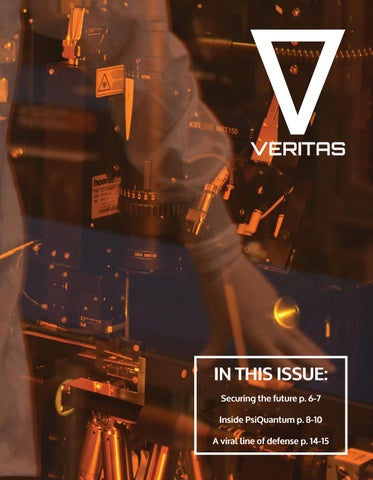
On the cover Staff writer Oscar Varodayan pictures a photolithography machine inside PsiQuantum’s manufacturing, testing, and research faciity in Milpitas. The facility is known as “PsiFactory.” 3
Text and photos by JULIANNE YOON
Intelligence Verbatim: Summer in science 2026: The Salon
For many students, summer is the best time to explore interests beyond what is taught in the classroom. Veritas asked several Palo Alto High School students what science-related activities they were able to pursue this summer.
“I was a counselor for the Science Olympiad summer camp and the Robotics summer camp at Paly. Other than that, I attended some lectures at Berkeley about material science directed by a research professor and a former alumnus from Paly.” — Andrew Jung, sophomore
“I did a week-long course at Stanford, and we basically studied human anatomy and the muscles in the body and the bone structure and everything to get better at both drawing and our knowledge of science.” — Siena Siljak, senior “I ended up applying to a NASA internship … Over the summer, we were able to explore math modeling in optimization but in a lunar environment, and that goes into material science, which is also something I’m really passionate about. So it was really cool to see how these two components work together to solve something bigger.”
P
alo Alto High School alum and actor-writer Joelle Dong hosted an interactive salon to explore artificial intelligence through film, music, and discussion at Qualia Contemporary Art in Palo Alto as the first of a series of events. The event, titled “Intelligence 2026: The Salon,” centered on the discussions of the possibilities and uncertainties surrounding AI as it becomes increasingly integrated into society. Throughout the evening, attendees shared their experiences with AI and participated in activities that made the conversation more interactive and immersive. “We wanted to bring people together to discuss AI in a way that felt fun, dynamic, and human,” Dong said. Participants read scenes from films including “2001: A Space Odyssey” and “Contact”, using them as jumping points to explore AI safety and the relationship between humans and technology. Attendees also discussed the artwork in the gallery, collaborated on a story with ChatGPT, and watched an improvised piano performance. Dong said that she wanted to create a space where AI seems less abstract and more grounded. “When you ask people what they think about AI, the conversation gets theoretical very fast,” Dong said. “We wanted to give people immediate, visceral experiences that could open up discussion of feelings as well as ideas.”
— Audrey Mi, senior
“One thing I did over the summer that is science-related is I went to UCSD Cosmos Cluster 4, which is about heating and cooling. We essentially learned basic thermodynamics, mainly for application along the lines of cooling computer chips, or possibly data centers, but also about the ethical concerns.” — Will Jackson, senior
4 October 2026
SEESAW SYMPHONY — Participants
Victor Xie and Brian Brown prepare to improvise a piano piece together in a demonstration of how interaction, including between humans and AI, transforms and echoes ideas. (Photo: Oscar Varodayan) Text by ARAINA GUPTA and OSCAR VARODAYAN
Atomic signatures Text and photos by ODIN STROHECKER
Chemistry Honors students study electron emission using bunsen burners, spectrum tubes, and spectroscopes.
I
n two labs, Chemistry Honors students at Palo Alto High School explored how excited electrons release energy in the form of light. In the first lab, students working in groups of three used Bunsen burners to create a steady flame. Next, they dipped Q-tips into metal salt solutions containing copper(II), lithium, sodium, calcium and strontium. Then, the students introduced each Q-tip to the flame and observed each solution change the color of the flame. In the second lab, students worked in pairs to study the emission spectra of different gases with spectrum tubes and spectroscopes. In the spectrum tubes, electricity constantly excited the gases’ electrons, causing them to emit light. Students used spectroscopes, tools that separate light into individual wavelengths, to compare the emission spectra of each gas. The following photos show the two labs as they happened in real time.
Sophomore Genevieve Dixon looks at the light spectrum emitted by the spectrum tube through a spectroscope.
Sophomore Vidyut Jagadish and Sophomore Aliaskar Abdualiyev change the color of the flame by introducing a Q-tip soaked in a metal solution.
Junior Kevin Pei and sophomore Andrew Jung lower the amount of air reaching the flame to make it smaller.
Sophomore Andrew Jung studies the color of a metal salt solution.
5
Text by ARAINA GUPTA and JULIANNE YOON
Securing the future A
Alto High School and nationAP Cybersecurity wide for the first time this year, prepares Palo Alto is a course in which students can explore how to detect cyber attacks, High School students data breaches and other digital threats. Christopher Bell, who teaches all three to combat modern AP Cybersecurity classes at Paly, said that digital threats the course teaches many increasingly imP Cybersecurity, offered at Palo
portant skills, such as understanding how
6 October 2026
networks and devices are used and how they interact with the world. According to Bell, emerging technologies are incorporated into the course curriculum, including artificial intelligence. “You can think a lot about AI because this is the first college board class that I know of that actually has AI integrated in it,” Bell said. “You need to know how to use AI, you need to know how to use AI to defend against attacks, [and] how people use AI [for] attacks.” Bell said that the course gives students a chance to develop skills that are increasingly sought after and important in tech related careers. “Students can learn new skills that are really applicable and in demand in our industries and [they can] start that now in high school and do a college level version
Photo by ARAINA GUPTA
of that [which] is really cool,” Bell said. AP Cybersecurity joins a host of computer science courses offered at Paly, including AP Computer Science Principles and AP Computer Science A. According to Bell, these two courses focus on programming and computing skills, while AP Cybersecurity focuses on threats to digital systems. “If you’re programming something in CSA, you’re learning how to save things and what structures to put them in, but you don’t necessarily know how to do it securely,” Bell said. “So then this one [AP Cybersecurity] is that other class that is going to tell you how to make sure that you can do security and maybe stop some of the data breaches that are in our news every day.” Bell recommends AP Cybersecurity to
students interested in learning how things work and keeping digital systems secure. “As we get further and further with technology, being able to understand how things work together, but then also how to keep ourselves, our friends, our family, but then the larger community safe is also really useful,” Bell said. Junior Noah Siva said he took AP Cybersecurity to learn vital skills that are applicable in the real world. “Pretty much everyone, they are at risk of being attacked in a cyber security attack,” Siva said. “So [cybersecurity] applies to everyone, and it’s just an important life skill to have, to just know what to do.” AP Cybersecurity is one of three courses part of College Board’s AP Career Kickstart program, a set of courses designed to prepare students for careers in rising fields
like business, cybersecurity, and networking. According to the College Board, the program’s goal is to expose high school students to skills that are in high demand. According to junior Yoyo Cai, one of the reasons she decided to take the course was its focus on security regarding the use and development of AI. “Collegeboard usually doesn’t have AI stuff, but [AP Cybersecurity is] new and up to date,” Cai said. Bell said that the course’s strong focus on current technology may make it more appealing to students. “We’ve got attacks going on, and we’ve got lots of holes in the field where we need people to help keep us all safe,” Bell said. “[AP] CSA, you’re doing cool stuff, but it might not necessarily be topical. And maybe that’s what draws some people in.”
7
Text by OSCAR VARODAYAN and ARAINA GUPTA
INSIDE
PSIQUANTUM A look into a Palo Alto-based photonic quantum startup
S
teel tubes, copper wires, and intricate machinery fill the clean room inside PsiQuantum’s research and development facility, known as PsiFactory. Outside, thick helium-3 tubes snake around the exterior of the 127,574
8 October 2026
square foot warehouse. All around, scientists move between rows of experimental hardware. The end goal? A quantum chip the size of a postage stamp. PsiQuantum, a startup based in Palo Alto, located at 700 Hansen Way, works to build a large-scale quantum computer with practical applications. In an email, Stanford Electric Engineering Professor Joonhee Choi said that quantum computing harnesses the principles of quantum mechanics to build a
system that could potentially solve very complex problems. “Quantum computers could make certain very difficult problems much easier, including simulating molecules and materials, search and optimization, and breaking some forms of encryption,” Choi stated. “In cybersecurity, for example, a sufficiently powerful quantum computer could break widely used public-key encryption, which is why quantum-resistant encryption is already being developed.”
PHOTON PATHWAYS — This
machine is responsible for etching the waveguides, or the paths that the photons follow, onto the quantum chips. To prevent interference from dust or harmful wavelengths of light, the machine is kept in PsiQuantum’s clean room and under a hood with amber lighting.
According to Choi, instead of bits, qubits — or quantum bits — are used instead. “A qubit is the quantum version of a computer bit,” Choi said. “A normal bit is either 0 or 1, while a qubit can exist in a combination of 0 and 1. By controlling many qubits together, quantum computers can process information in fundamentally different ways.” Unlike other quantum computing companies, which store information in
Photos by OSCAR VARODAYAN forms ranging from trapped ions to super- employing them. conducting circuits, PsiQuantum’s strategy “It’s easy to forget that 10 years ago, if lies in photonics, the science of manipulat- you got a qubit working, that was a chaming photons. Photons, quantum particles pagne moment,” Shadbolt said. “Now if of light, can take difyou’ve got good quferent optical paths, bits, nobody cares.” “A normal bit is either and information can According to be stored in this way. 0 or 1, while a qubit Shadbolt, though According photonic qubits have can exist in a combito Pete Shadbolt, lots of large-scale benco-founder and chief nation of 0 and 1. By efits, it is difficult to scientific officer of controlling many qumake photons engage PsiQuantum, phoat the bits together, quantum meaningfully tonic qubits are idesmall scale. al because they do computers can process “We really liked not require as much information in funphotonics to get to careful tuning of enthat kind of scale, but damentally different vironmental condiit’s actually a pretty ways.” tions. annoying qubit to get “They [photon— JOONHEE CHOI, started with,” Shadic qubits] don’t feel Stanford Electrical bolt said. “Photons heat,” Shadbolt said. Engineering Professor don’t interact, so if “They don’t feel elecyou think about taktromagnetic interfering two laser beams, ence.” you just cross the beams, nothing happens Beyond this resistance to environmen- … so getting two qubit gates to work with tal interference, Shadbolt said that one of photons is harder than with other apthe biggest advantages of using photonic proaches.” qubits is the potential for scalability. Instead, PsiQuantum uses a strategy “The biggest thing for us was this known as fusion-based computing to solve idea that we could this problem, where leverage existing photons are connecthigh-volume manu- “There’s this obnoxed through measurefacturing to build a ment, which is finding ious facade of inacuseful machine that out the state of the quwe could sort of ride cessibility around bit, instead of requiron the coattails of quantum computing. ing them to directly the existing momenIt’s metal pieces, steel interact. tum of the semicon“I fused them and copper and glass ductor industry,” [photonic qubits] toShadbolt said. gether,” Shadbolt said. and silicon, and you Shadbolt’s senti“But this primitive can touch it, and you ment reflects one of [basic operation] turns the largest challenges can break it and mess out to be enough to in quantum com- about with it.” do anything.” puting: being able Shadbolt said to build a scalable that a quantum com— PETE SHADBOLT, puter could accelerate architecture that can PsiQuantum Co-Founder the ability to innovate manipulate a large and Chief Scientific Officer and solve problems number of qubits for practical appliacross a multitude of cations to actually industries by elevating be possible. According to him, the focus the current understanding of foundational in quantum engineering has shifted away sciences. from purely building qubits to effectively “If you look at our advanced econo
9
LEFT — This is a
circular circuit board assembly on display in PsiQuantum’s lobby, featuring a mounted component and multiple electrical connections. PsiQuantum uses photonic qubits largely because they have high scalability potential, which is necessary to build a functional quantum computer.
my: drug companies, materials companies, energy, pharmaceutical and semiconductor companies sit on a microscopic foundation of chemistry, physics and math,” Shadbolt said. Shadbolt said that he thinks that quantum computing is not as daunting as the public often believes. “There’s this obnoxious facade of inaccessibility around quantum computing,” Shadbolt said. “It’s metal pieces, steel and copper and glass and silicon, and you can touch it, and you can break it and mess about with it, and then it’s really understandable.” More specifically, Shadbolt said quan-
RIGHT — A
microscope display shows the intricate spiral-shaped circuitry of one of PsiQuantum’s photonic chips. Photons take a certain amount of time to travel through the spiral patterns which allows the chip to harness their strength to create computation power.
10 October 2026
tum computing should be treated like how a mechanic treats a car. “The first time you look under the hood, you think, ‘Holy crap! How did someone design this?’” Shadbolt said. “And then a few years later, you realize, ‘Oh, it’s gears and pulleys and valves and vacuum systems and electronics. It’s all doable to actually understand what’s in there.” According to Shadbolt, he hopes that more people realize that quantum computing requires a wide array of disciplines, not just ones specifically geared towards quantum. “[We are already] cutting steel, building high-power cryogenics, doing pack-
aging, assembly, software, and firmware,” Shadbolt said. “Most of the people at PsiQuantum now don’t have some elite quantum information background.” According to Shadbolt, even though quantum computing is often portrayed as a difficult field, it actually gives him a large sense of purpose. “It’s a gift to have something that’s so worthwhile and an Everest-like challenge,” Shadbolt said. “You meet people in your life where they’re desperate for that; they’re crying out to have a mission and a purpose and a thing that they can just go after. … So having that North Star, that aligning mechanism, is gold.”
Volume 7, Issue 1 Veritas
Publish your work! Do you want to be featured in the next issue of Veritas? Send us an email at VeritasPaly@ gmail.com or scan the QR code on the left!
Your ad could be here! Come advertise at the Incubator! Magazines include Veritas, Via Verde, Athro, Via, Verde, Ink, Chomp
11
Text by JASPER TUTEJA and OSCAR VARODAYAN
Sparking success
Local startup founder explains why young find an actual idea, something you want to change, to improve, and you don’t know people in STEM should try entrepreneurship how to find one.
Y
“Look for real-world problems to ou’re a high schooler with an they’re gonna want to hire the ones that solve,” Yuen said. “The best entrepreneurs are kind of lazy people. They go, ‘Why do interest in computer science, have solved problems.” planning out your life. The plan Yuen’s latest endeavor is PicoJool, I have to stand in line?’ ‘Why is this process so difficult and is simple: Attend a prestigious a Palo Alto-based tedious?’” university, take the hardest classes. Study company that aims This technique hard for four years, get good grades. Posi- to create high-speed, “You don’t have to be has worked before, tion yourself for a high-paying software job energy-efficient data this genius that inventand will work again. right after graduation. transmission in AI ed a bunch of stuff, you When two friends Then you take a look at the job mar- data centers. Yuen know, at 20 or 21. You struggled to find a ket. According to an April paper by econ- has been working taxi one snowy eveomist Lee Tucker at the United States in the tech world just have to have your ning, Uber was conCensus Bureau, entry-level job hirings in for four decades, hands dirty and build ceived. When engicareers exposed to AI have plummeted. has founded four neers struggled to “Twenty-two to 24-year-old hires fol- startups, and thinks things and try things” - AL YUEN, communicate with lowing introduction of ChatGPT … in the people should be PicoJool founder and CEO each other, they most AI-exposed quintile of industry-state unafraid of failure. made Twitter. Look cells declined by 12% over the 10 quarters “[I’ve had] tons around, find a probfollowing the introduction of ChatGPT,” of failures,” Yuen Lee wrote. said. “I’ve failed more often than anybody, lem, then solve it. See? This is doable. Now you’ve got an idea, you think you So you’re at a loss. The “stable” path of but I’ve missed every shot that I didn’t take. studying doesn’t seem safe. You don’t know I failed at every startup that I didn’t start.” have the technical skills to operate on it, where to go next. You consider founding a So you’ve decided to lighten the but you don’t know who to hire. Should business, but as a stereotypically risky ven- course load and actually make something. you look for technical skills, social skills, or ture, the idea seems outrageous. But what? According to Yuen, the type, just your friends? Yuen explains that you Startup founder and CEO Al Yuen scale and focus of the business is irrelevant: want to find other outstanding individuals disagrees with that sentiment. His take is starting something, anything, will be im- and construct a team that works together. “[In school] we’re always emphasizthat the experience of entrepreneurship mensely valuable. — defined by Stanford as someone who “Young people would learn so much ing to be the smartest person in the room, will “strike out on an by starting a busi- the number one in your class,” Yuen said. original path to create “The best entrepreness: a boba shop, “That’s not the way you know the world a new business” — acdelivering Christmas works. If you want to be successful as a neurs are kind of lazy tually enables future buttons, whatev- leader, then you have to make everybody success, even if you people. They go, ‘Why er it is,” Yuen said. else better. … You can have a superstar don’t continue in the do I have to stand in “Those business engineer, but if they don’t get along with startup world. startups kind of help people, nobody wants to work with them.” line?’ ‘Why is this proBut in the end, you find yourself back “When I look at you understand how cess so difficult and at your original question. “Is this really a LinkedIn or a resume, businesses work, the and it gives me a list tedious?’“ accounting, the taxes better option than getting a CS degree?” of classes they took - AL YUEN … You don’t have to Yuen replies: “You don’t get the chance to say ‘I’m or software that they be this genius that know how to code, it invented a bunch of going to play it safe’ because there is no really tells me nothing,” said Yuen, who stuff, you know, at 20 or 21. You just have safe path to stay in school, get good grades, is also a former Palo Alto High School to have your hands dirty and build things and get that dream job,” Yuen said. “You have to make that path yourself, and entreparent. “You’re taking classes, and you’re and try things.” learning, but when you get out [of school], Still, the question persists. You have to preneurship gives you that.”
12 October 2026
Photo by OSCAR VARODAYAN ENERGETIC EXPLANATION — PicoJool founder and CEO Al Yuen explains the mechanics behind the company’s hyperefficient fiber optic cables. According to Yuen, successful entrepreneurs first find problems to solve and then search for solutions, not the other way around. “Don’t be the person that has the technology looking for a problem to solve,” Yuen said. “A lot of entrepreneurs, especially from college or universities, have a really cool technology looking for a problem to solve. That’s backwards.”
13
Text by PRIYA TAMURA & CAITLIN KO
A
Stanford researchers artificially design new viruses to defend against deadly bacteria
swarm of viruses pounces towards their target, locking on to the invading enemy bacterium. But unlike you and me, these viruses were not born from the natural world. Instead, their creation was authored by artificial intelligence. Geneticists have long been infatuated with reading the code of life and deciphering the biological alphabet written into the life around us. Now, researchers at Stanford University and the Arc Institute have taken this metaphor literally by using artificial intelligence to write the genomes for entirely new viruses. The Laboratory of Evolutionary Design, or Hie Lab, developed AI models capable of generating fully functioning, new-to-nature viruses, according to the August study published in Science. Samuel King, a Stanford PhD student who co-authored the project, said that the team trained the models on DNA to process genetic information much like modern AI processes human speech. “Our lab has developed large language models pretty similar to ChatGPT, but trained on DNA,” King said. “These models, instead of speaking English, they speak the language of biology, so they read and write DNA.”
Interpreting the language of DNA While researchers have managed to generate fragments of DNA and individual proteins, King said generating and synthesizing an organism’s entire genetic blueprint in a lab is much more computationally difficult.
14 October 2026
Art by HUDSON PRESS Since DNA relies on only four building blocks, or nucleotides, King said its sequences are highly repetitive and are harder to parse for meaning. “The field of designing proteins has been around for a while, but people haven’t been able to develop really good AI models for DNA because DNA is less information rich than proteins,” King said. “Proteins are a 20 letter alphabet, whereas DNA is a four letter alphabet.” To understand these vast stretches of DNA, the Hie Lab developed two AI models. While Evo 1 was trained exclusively on simple genomes lick bacteria and archaea, Evo 2 expanded to more complex genomes from plants and animals. King said Evo 2 features an expanded context window capable of analyzing up to one million nucleotides at a time, allowing it to generate entire viral genomes. “We needed advances in AI methods to be able to train good AI models on DNA, and once we did that, we were able to unlock doing genome design,” King said. To test the generative capabilities of the models, the researchers focused on bacteriophages, which are naturally occurring viruses that infect bacteria by injecting their own genetic material to turn the host cell into a factory for producing new viruses. Just as a standard AI chatbot predicts the next word in a sentence, Evo generates thousands of candidate bacteriophages through a similar method by predicting the next nucleotide letter in a genetic sequence based on patterns from natural DNA.
From digital to living Once the team had these prospective sequences, King said they computationally filtered out non-viable designs before testing them in a lab. “We then created a framework for evaluating those generated genomes, … and we were able to choose a few hundred that we actually wanted to test in the lab,” King said. “Then, we chemically printed a few hundred of these AI-generated genomes.” After synthesizing the digital sequences, the researchers inserted the bacteriophages into E. coli cells to see if they could successfully replicate. King said the lab found several fully viable, artificial viruses that were able to infect and destroy the E. coli bacterial cells. “We put them in real bacterial cells, and we wanted to see if they would produce a functional virus,” King said. “When we did this, we got 16 functional viruses from these AI-generated genomes.”
An army against superbugs The primary medical application for synthetic viruses lies in combating antibacterial immunity. King said that as standard antibiotics are consistently overprescribed, surviving bacteria pass on mutations and give rise to treatment-resistant superbugs. To address this problem, King said researchers and clinicians use a process known as phage therapy, which has entered the mainstream consumer market in Russia. “People predict that antibiotic resistance will be one of the leading causes of death in the next cou-
ple of decades,” King said. “A promising strategy to fight these drug resistant bacteria is using bacteriophages because they can naturally target and kill bacteria.” King said using multiple bacteriophages in phage therapy is important because without it, bacteria may evolve to form resistance against the phages. To prevent bacterial immunity, King said his team used a combination of viruses to attack the bacteria from multiple genetic angles simultaneously, making it nearly impossible for the bacteria to survive. “We created a cocktail of the AI-generated phages, and infected phage resistant bacteria with it, and it [the cocktail] was able to work really well and overcome the resistance,” King said.
Biosecurity risks and the future Senior Rasia Yu, co-captain of Paly’s Science Olympiad team and co-president of the Biology Club, said that while using genetic design to target bacteria can be a life-saving therapeutic, she worries the same technology could be used to target humans. “If we can design special bacteriophages, then we can treat superbugs and save many lives,” Yu said. “But also, if this technology could work to design bacteriophages, who’s to say that it can’t be reworked to design human-infecting viruses?” Given new possibilities for lethal, customized viral genomes, Yu said the most concerning designs involve persistent viruses capable of integrating foreign genes directly into a host’s genome known as proviruses. “Imagine a disease that’s as contagious as smallpox, as lethal as ebola and
as adaptable as the flu,” Yu said. “Some pre-existing viruses like HIV are capable of leaving fragments of its own DNA embedded in your DNA, making an HIV infection permanent. If someone with bad intent creates a virus that can alter the DNA of the host permanently, [then] we’re basically making the next horror disease real.” Yu said that preventative legal safety measures similar to restrictions implemented on preimplantation genetic editing should take precedence over rapid innovation. “Safety concerning science should come first in my opinion,” Yu said. “We should add some ethical safeguards just like how we made genetically editing human embryos illegal to ensure that nothing atrocious happens.” While predictive AI tools like AlphaFold and Boltz-2 already assist researchers by modeling 3D protein structures, Yu said that the critical thinking and implementation in research should be human-led. “Currently I think the best balance is still to just use AI as a tool for modeling trends and patterns in chemicals that are too large of a scale for humans to comprehend, [like] solving Levinthal’s paradox, leave everything else to researchers for now,” Yu said. “The thinking and weighing of morals and ethics should still come from humans.” King said the Hie lab implemented safeguards when they developed Evo models to restrict the possibility for misuse. “Both [Evo] models were not trained on viruses that infect eukaryotes,” King said. “We didn’t train it on any human viruses or anything to make sure that people wouldn’t use it to do dangerous things with them.” There is no doubt that navigating these safety risks will be an ongoing challenge. Still, King said that he believes advancements in generative AI will continue to transform the possibilities for biological research that were unthinkable before. “It’s hard to predict, but I think we’re suddenly beginning to see a lot about biology that we didn’t see before,” King said. “These models, because they can train on so much biological data, can learn a lot of things that otherwise might have taken humans a really long time. We’re really hopeful that as we continue to make more and more advanced versions of these models, we’ll be able to continue getting better at both discovery and design in biology.”
15
26’-27’ Meeting Schedule Wed, Nov 4, 2026 Wed, Jan 20, 2027 Wed, Mar 3, 2027 Thurs, May 6, 2027