
Spotlight

Ver i tas

INCUBATOR SPOTLIGHT
Second Edition – Summer 2026 STAFF
Editors-in-Chief
Julia Curtis – Via Verde
Henry Germain – Chomp
Araina Gupta – Veritas
Alexander Lawson – Veritas
Richard Zhang – Chomp
Managing Editors
Richard Klinkner – Veritas
Caitlin Ko – Via Verde
Staff Writers
Lucas Arai, Julia Curtis, Hadrien de Martel, Roshan Gautham, Henry Germain, Araina Gupta, Danielle Hanigal, Motoko Iwata, Arjun Jindal, Richard Klinkner, Caitlin Ko, Alexander Lawson, Jack Lindauer, Joyce Ma, Chiara Martin, Cailey Quita, Liani Regade, Benji Sandel, Mihika Shridhar, Sebastian Tung, William Xue, Xander Yap, Amily Zhang, Richard Zhang
Want to advertise with us?
Scan below for information:

Mission Statement
The purpose of this magazine is to highlight the different Incubator publications and showcase the diverse topics and stories our class covers. Incubator is a unique class in that students are able to start publications themselves, and this magazine is a culmination of the creations of Paly journalism students. Incubator represents and values creativity and innovation, which is what this magazine embodies. We hope to highlight all of these diverse topics in-depth, and show how they impact the Paly community.
Publication Policy
The Incubator is committed to providing an open platform for diverse voices and perspectives.
AI Policy
Artificial intelligence and the rise of ChatGPT has brought on discussions of the originality of student writing and art. The Incubator as a whole prides our community of unique student writers and has established policies regarding AI-generated works. The originality of the writing and art in this edition has been confirmed by both writers and artists.
Legal Ethics Policy
Student journalist on any publication in The Incubator will only publish legally protected speech, following the legal definitions of libel, obscenity, and invasion of privacy. Consistent with California Education Code section 48907, the staff will refrain from publishing material (including submissions from the community) which so incite students as to create a clear and present danger of the commission of unlawful acts on school premises of the violation of lawful school regulations, or the substantial disruption of the orderly operation of the school. When faced with potential legal questions, staff will contact the Student Press Center for advice concerning media law.
Printing and Distribution
All printing publications of The Incubator are printed by aPrintis in Pleasanton, CA. Funding for printing comes primarily from advertisements and grants. Copies are distributed free of cost around the Palo Alto High School campus.
On the cover:
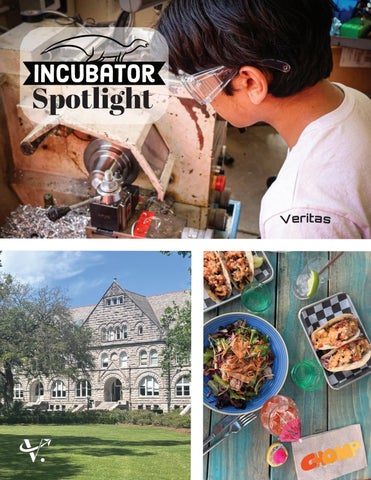
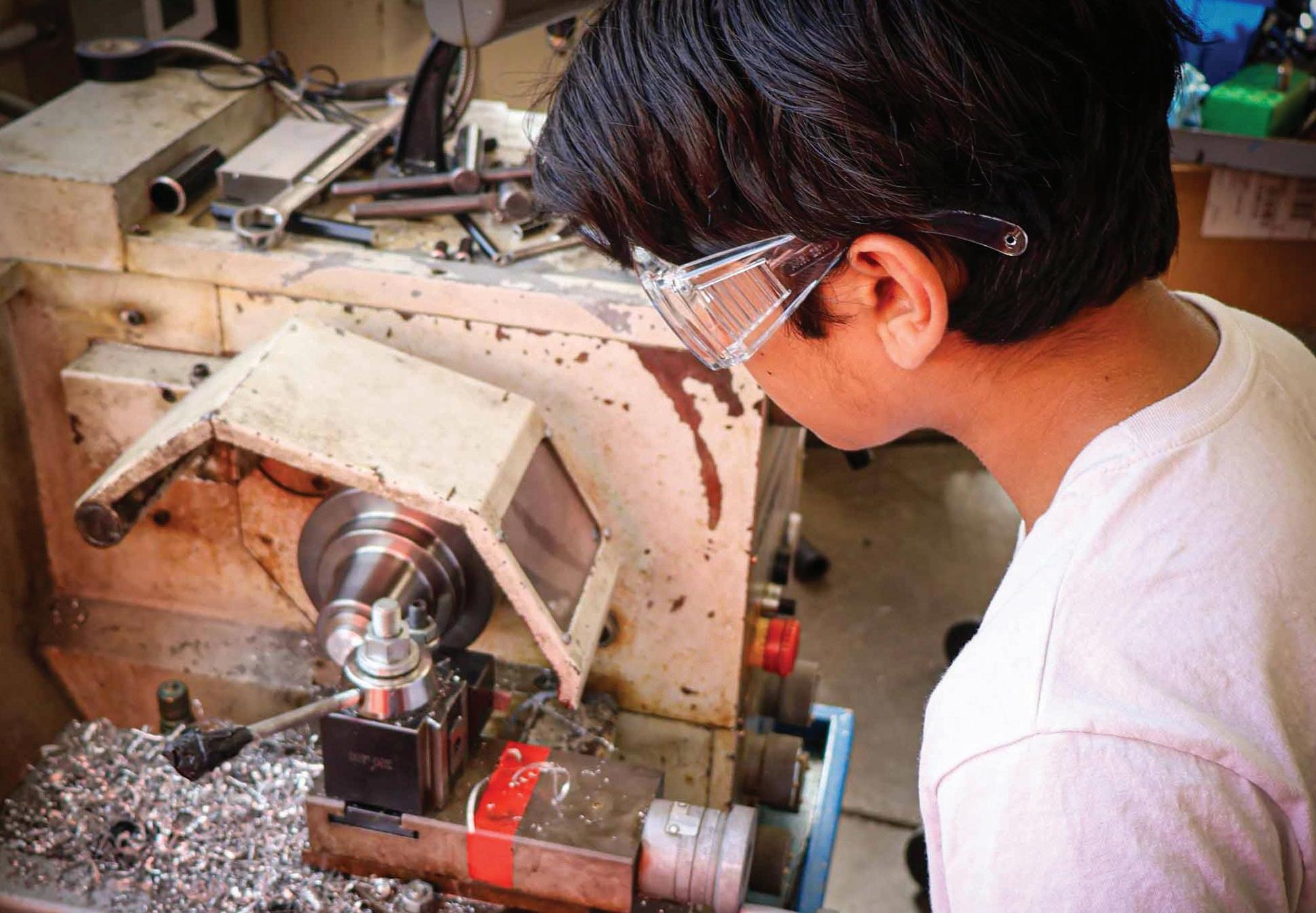
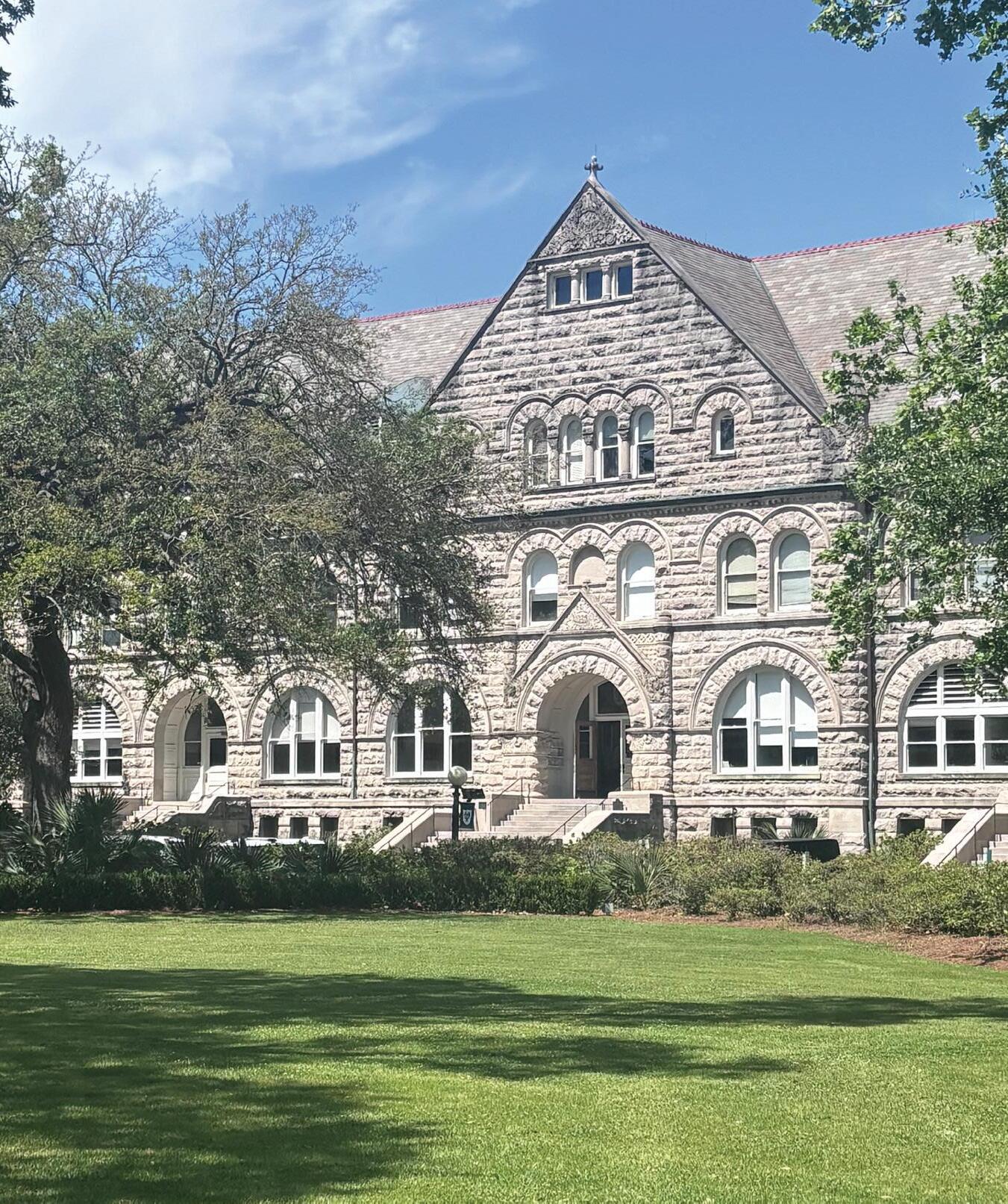
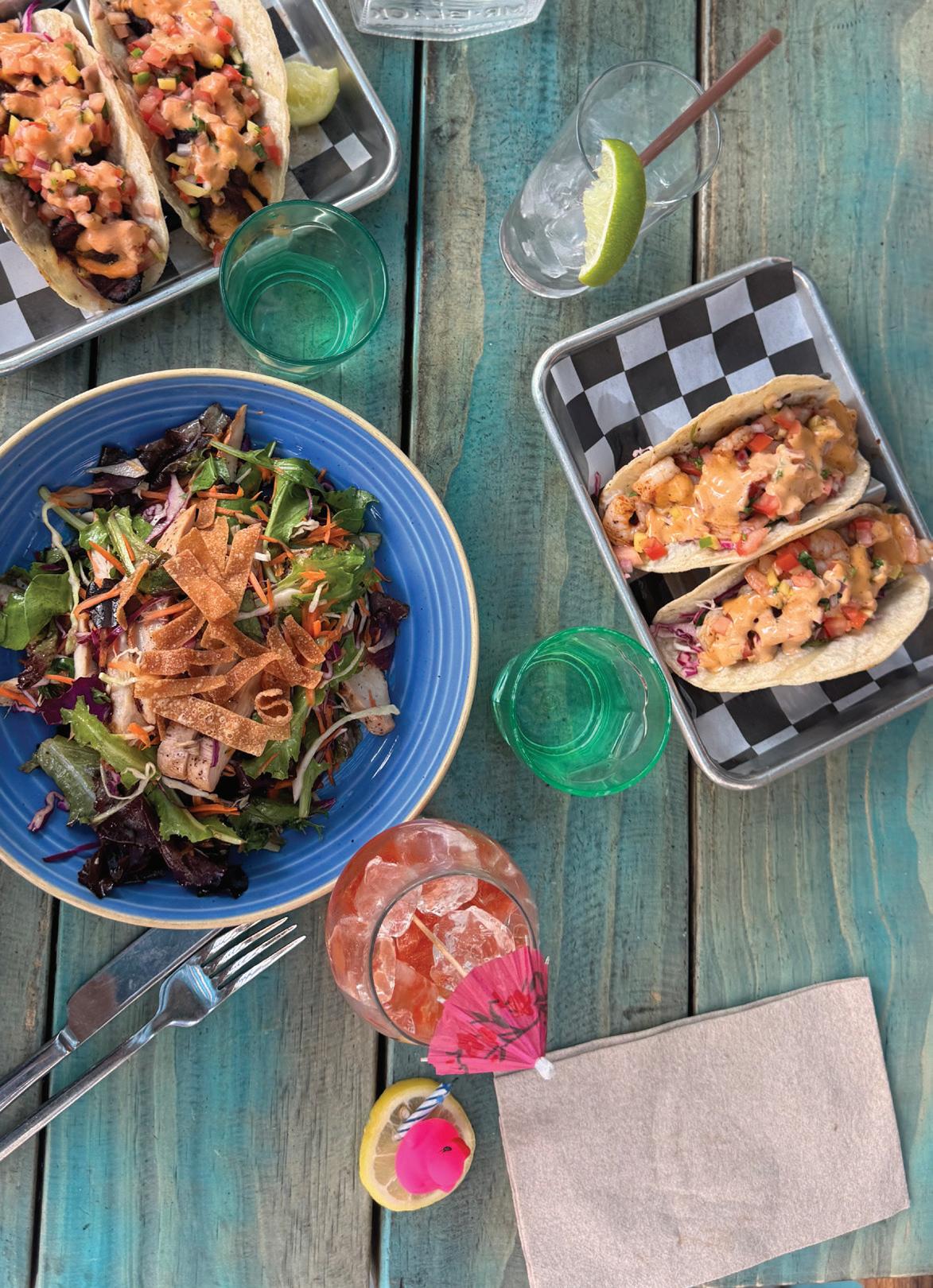
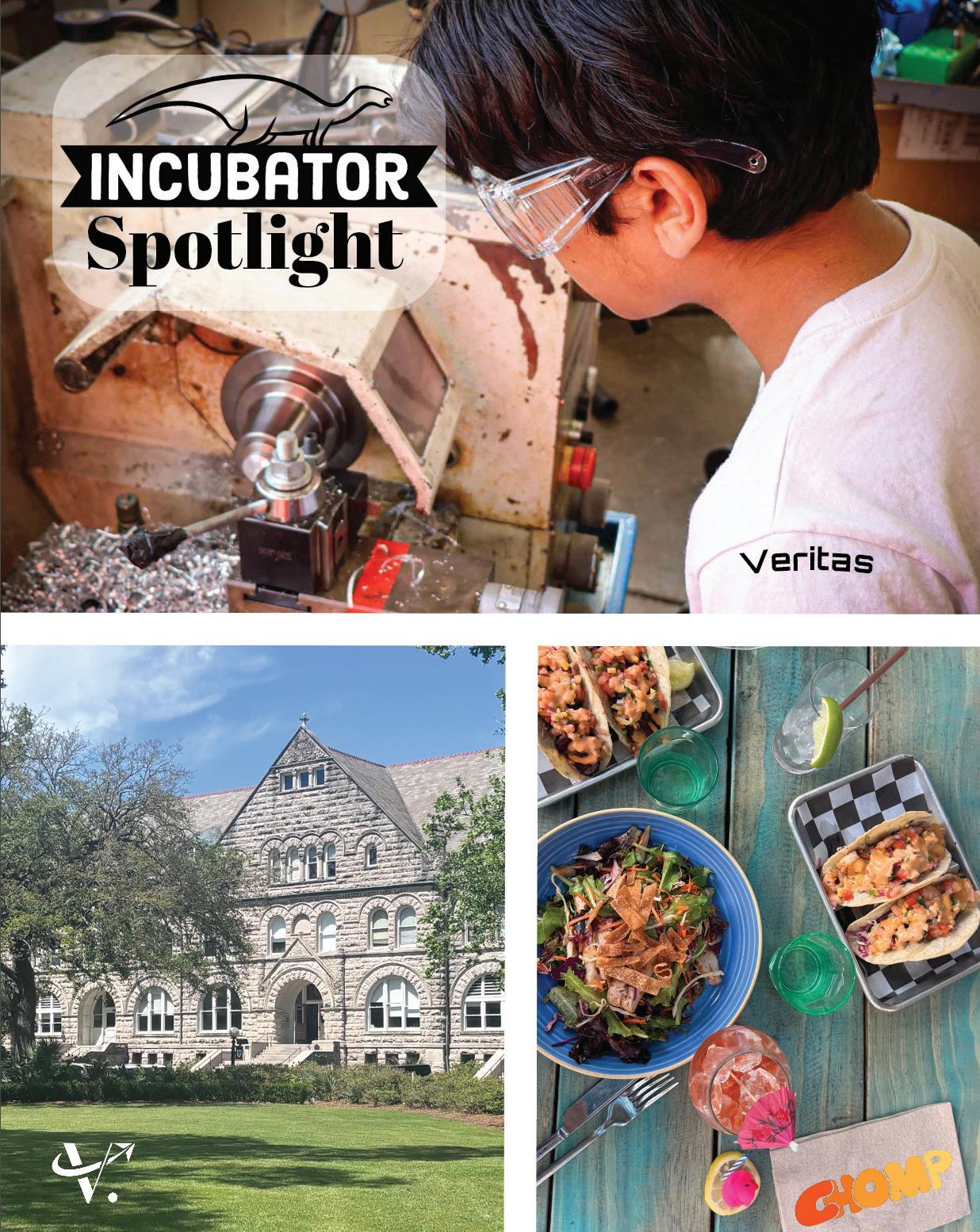
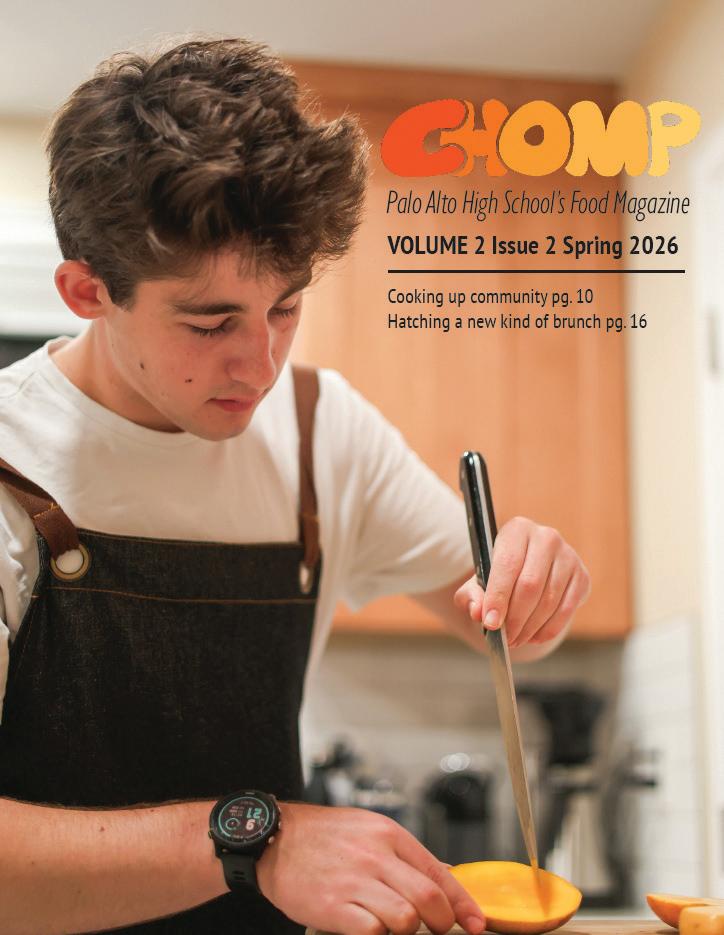
This cover, designed by Arjun Jindal, showcases the three glossy magazines of the Incubator. Each section is the cover of an individual publication, which all combine to create one merged magazine.
The photographers who contributed to this cover are Arjun Jindal, Charlotte Barclay, and Julia Curtis.
Editors Note:
We are excited to present our second “Incubator Spotlight” magazine, which combines three regularly published magazines at Palo Alto High School. Incubator Spotlight allows our class to highlight our array of separate Paly journalism startups within a single magazine. This combined magazine accessibly showcases all of the diverse publications the Incubator hosts, as well as presenting our staff’s diverse talents. We start by taking out a bite of Chomp, where we dive into a review of the downtown ice cream store “Salt & Straw” and find out whether their extreme flavors are up to snuff. Up next is Veritas, where Richard Klinker discusses the latest trend in bodybuilding: peptides. Finally, we take a trip to Via Verde, where Joyce Ma and Caitlin Ko give readers their top five hacks for avoiding tourist traps. This issue would not be possible without our advertisers and the MAC Boosters, or the guidance and support of our adviser, Paul Kandell. We’re so excited for you to read this Incubator Spotlight!
— Alexander Lawson, Araina Gupta, Henry Germain, Julia Curtis, Richard Zhang, editors-in-chief
CHOMP
Editor’s Note:
We are so excited to present the fifth edition of Chomp! After two years of publishing magazines, we have found a rhythm in representing the food in the Bay Area as we continue to dive deep into new local spots and tell the stories of upcoming businesses.In this issue, Mihika Sridhar shines the spotlight on chef and food critic Charlotte Barclay, who has accumulated many followers on Instagram for her fun and engaging videos about food. Brand new food options in Palo Alto are visited, as Cailey Quita and Amily Zhang explore the authenticity of Yutori Cafe, along with Lucas Arai and Sebastian Tung, who review Ralph’s coffee, a coffee shop inside of a designer clothing store. To cap it off, Richard Zhang and Henry Germain travel around Palo Alto to sample a variety of restaurant price ranges and discuss what Paly students value the most when looking for food. Chomp loves showcasing students’ stories related to food, so if you’d like to be featured, please reach out. This issue would also not be possible without support from the MAC boosters and our adviser, Paul Kandell. I’m excited for you to read our work!
— Henry Germain and Richard Zhang, editors-in-chief
Small Batch BIG Buzz
Salt and Straw’s limited-edition ice cream flavors have captured the attention of ice cream lovers in Palo Alto. Does it live up to the expectations?
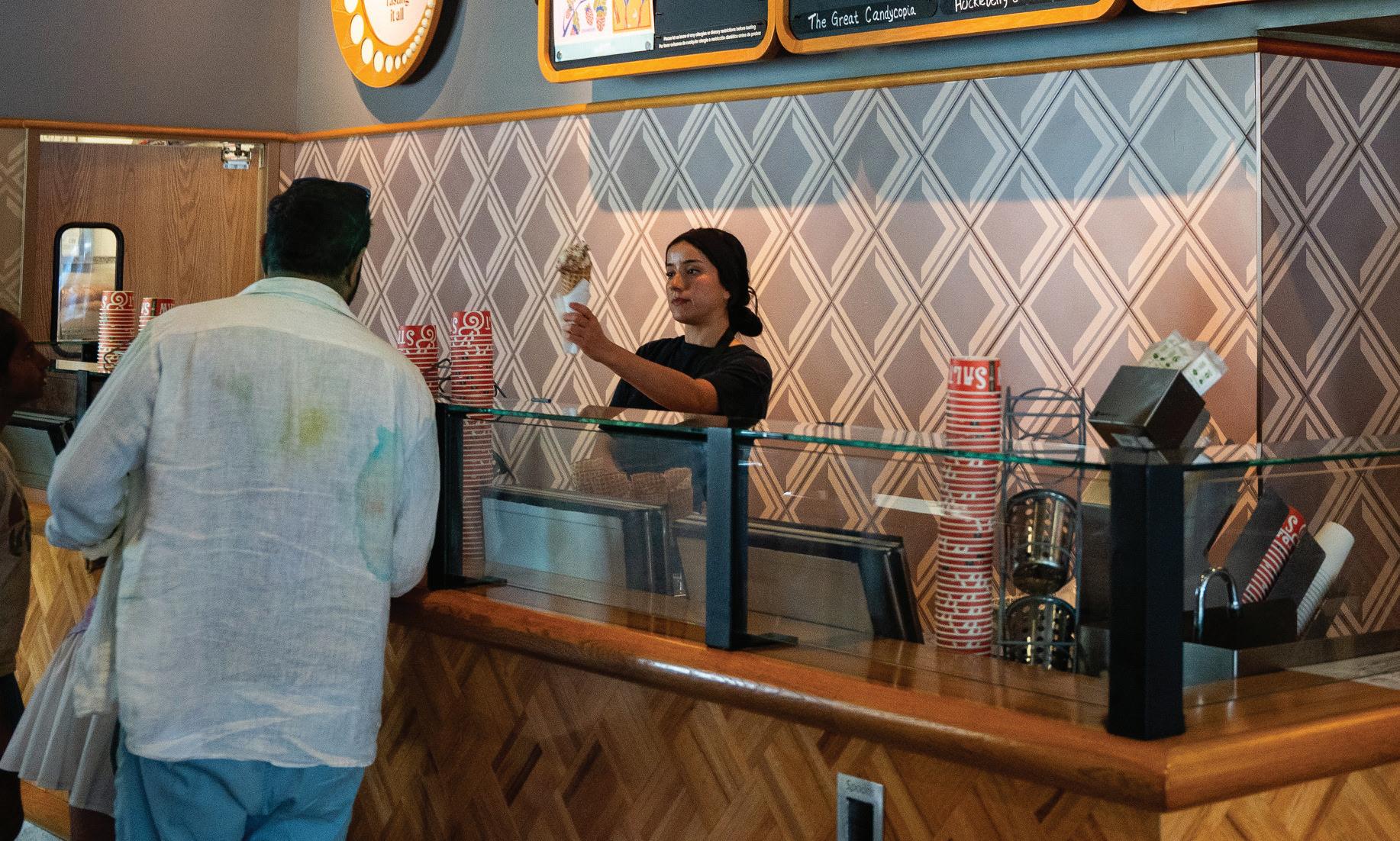
SERVING ICE CREAM A perfect ice cream after waiting in Salt and Straw’s long line. The newly released flavors draw in large crowds each month. Store manager Pedro Vargas witnesses them first hand.
“Normally there’s a big crowd around here ... Fridays [and] Saturdays are our busiest days,” Vargas said.
The renowned Salt and Straw ice cream parlor that sits on University Avenue in downtown Palo Alto releases limited-edition flavors each month, which are famously known for containing exotic combinations such as pear and blue cheese, strawberry and black pepper, or chocolate and potato chips. From the outside, the sweet smell of ice cream is easy to identify and becomes even stronger once you enter. There is usually a line, but it moves quickly, providing you with adequate time to pick your flavor.
Pedro Vargas, the store’s manager, explained that Tyler Malek, Salt and Straw’s head ice cream maker, has created the flavors in Portland, Oregon, since the company’s inception in 2011. A team is then given the task of deciding which of Malek’s new flavors make the final cut, Vargas said.
These flavors of the month brought a lot of variety, with fruity, acidic, and rich tastes. Each had its own uniqueness, differing drastically from typical ice cream flavors. If you visit Salt and Straw, you will likely be able to find an ice cream that matches your perfect flavor profile.
Chocolate Malted Potato Chip Cupcake ($6.95) 10/10 — We thought this ice cream was by far the best of the bunch. Initially, the rich and decadent chocolate is most prominent. The experience is then followed
by crunchiness from the potato chip and chewy, soft cupcake chunks. Accompanying the ice cream is an underlying saltiness that not only balances the sweetness but also elevates the flavor of each element.
Peanut Butter & Jelly Pound Cake ($6.95) 8/10 — This was also one of our favorites. While we felt like the taste was disproportionate, with more jelly than peanut butter, the raspberry-tasting jelly was light and smooth. The raspberry made for an initial sourness, while the peanut butter followed up with sweetness. It made for a great hybrid between a sorbet and an ice cream.
Rum Raisin Bundt Cake ($6.95) 7/10 — The ice cream incorporated a classic vibe, although with a more prominent flavor of rum than raisin, creating some bitterness. Additionally, there was an overwhelming presence of coconut.
Salted Grapefruit Coconut Julep ($6.95) 3/10 — Tart and bitter, the Salted Grapefruit Coconut Julep perfectly exhibits the flavor of a sour grapefruit. The overpowering grapefruit made it difficult to taste the other aspects of this ice cream, like the coconut, despite it being in the name. According to Salt and Straw’s website, the flavor is meant to taste like a “Derby Classic,” evoking flavors associated with the theme of the Kentucky Derby.
Text by ROSHAN GAUTHAM and JACK LINDAUER
Photo by LUCAS ARAI
Blossoming street food
The Cherry Blossom Festival serves up a variety of Japanese
dishes.
Every spring, San Francisco’s Japantown undergoes a beautiful transformation. The streets are blanketed in pink as the cherry blossoms fall, while thousands of people flock to this small, vibrant district to enjoy a taste of Japan.
Now in its 59th year, the Northern California Cherry Blossom Festival – known in Japanese as Sakura Matsuri — is run by nonprofits dedicated to preserving and promoting the traditions and culture of Japan and the Japanese-American community.

son to show up. Along Webster Street, food stalls stretch out in tempting rows showcasing numerous Japanese cuisines.
Going from April 11 to April 19, the festival not only brings exquisite foods, cultures, and views, but most importantly, memories. If you ever find yourself near San Francisco during this time period, we highly recommend attending.
But besides taiko drumming, lively parades, and the sea of pink cherry blossoms, there is another crucial rea-
Takoyaki: $9 (8.3/10)
In this review, we dig into the vendor food scene at the festival – what’s worth the wait, what stands out, and what you absolutely need to try before leaving Japantown.
Sold at the Soto Mission of San Francisco vendor, the takoyaki arrived fresh off the cast-iron molded griddle, the octopus inside was perfectly cooked, and the temperature was just right. What really elevated the dish was the spicy mayo drizzled on top, a creamy, flavourful kick that didn’t overpower the octopus. For just a dollar extra, the sauce was a worthwhile addition. The red pickled ginger pieces served alongside also added a sharp, tangy snap that cut through the richness of the sauce. Together, those details created a balance that felt refined and captured what makes Japanese street food so appealing. 8.3 out of 10

Gyoza: $7.50 (6.9/10)
Kake Udon: $16 (8/10)

Offered by Soko Taru Mikoshi Rend, the kake udon noodles arrived steaming in a broth with a strong scent of herbs and vegetables. When digging in, the broth was sweet while the udon noodles were chewy. Overall, this created a filling and comfortable sensation. The green onions scattered across the dish created a savory flavor that contrasted the broth’s sweetness, creating a balanced taste. Kimchi on top added a bright tang and layer of spice that carried more depth without taking over. With all of its unique traits combined, this kake udon felt slightly beyond the standard udon; familiar enough to feel comforting while being distinct enough to last in your mind after the festival.
Found at the Hokka Nichibei Kai vendor, the gyoza, served in a set of six, arrived coated in soy sauce, with each piece having a crisp bottom and a thin wrapper encasing the pork filling. While the gyoza came out warm, it came just short of the ideal burning temperature that makes the first bite both memorable and satisfying. The pork was a little bland, and though the soy sauce helped bring out more flavor, it couldn’t fully make up for what the filling lacked on its own. A solid festival bite, but not enough to make us order it again.

Text by LUCAS ARAI and SEBASTIAN TUNG
Art and photos by LUCAS ARAI

The journey behind Charlotte Barclay’s transition to culinary reviews
Most people only dream of being on a TV show as a kid. To be famous and have all your classmates see you on their own television. For most kids, this ends as just a wish. Not for Charlotte Barclay, though. At just 11 years old and a 5th grader at Duveneck Elementary School, she went on “Chopped Junior” and won. Chopped Junior is a cooking game show on Food Network where contestants compete for $10,000 over three rounds.
Just as some kids are drawn to art or different sports, Barclay was interested in cooking from a very young age.
“It just grabbed my attention. Instead of being interested in Disney Channel shows or movies, I would always
More than a meal
just wanna keep the channel on like Food Network instead and watch all of that,” Barclay said. “Growing up, my mom was a really good cook, so I always got to watch her cook, and I always found that fascinating. She would let me help her, so I found that to be a good way to pass the time.”
What started as only helping her mom became one of her favorite pastimes when she realized what she could accomplish.
“From a young age, I think I realized that I was naturally gifted and good at it, and I liked the idea of being good at something,” Barclay said.
ment with what she liked.
“My favorite part is just that I don’t have to measure anything, and if you make mistakes, it’s very forgiving,” Barclay said. “In baking, if you mismeasure something, that’s kind of it, and you can’t fix it. Whereas in cooking, if you add too much pepper or add too much spice, you can counteract that with other flavors or by adding different ingredients. So it’s like you’re making a potion.”
“Growing up, my mom was a really good cook, so I always got to watch her cook, and I always found that fascinating,”
— Charlotte Barclay, senior
Cooking created a space where she was able to relax and enjoy herself. Instead of having to worry about following instructions exactly, she could experi-
Despite a busy senior year, Charlotte was able to keep up her love of food with an Instagram account where she reviewed food. While many people can only discern whether they like a dish or not, Barclay deciphers what individual elements she enjoys and what changes she believes to be necessary. Her account is her way of
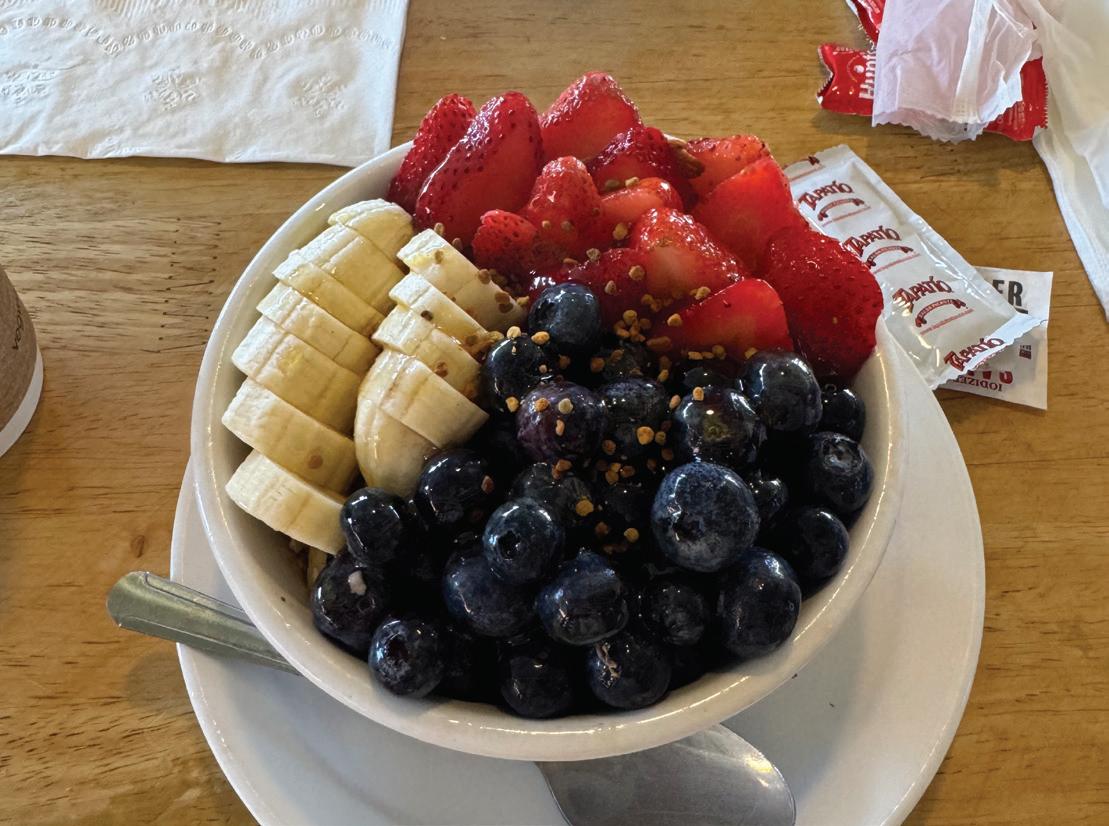
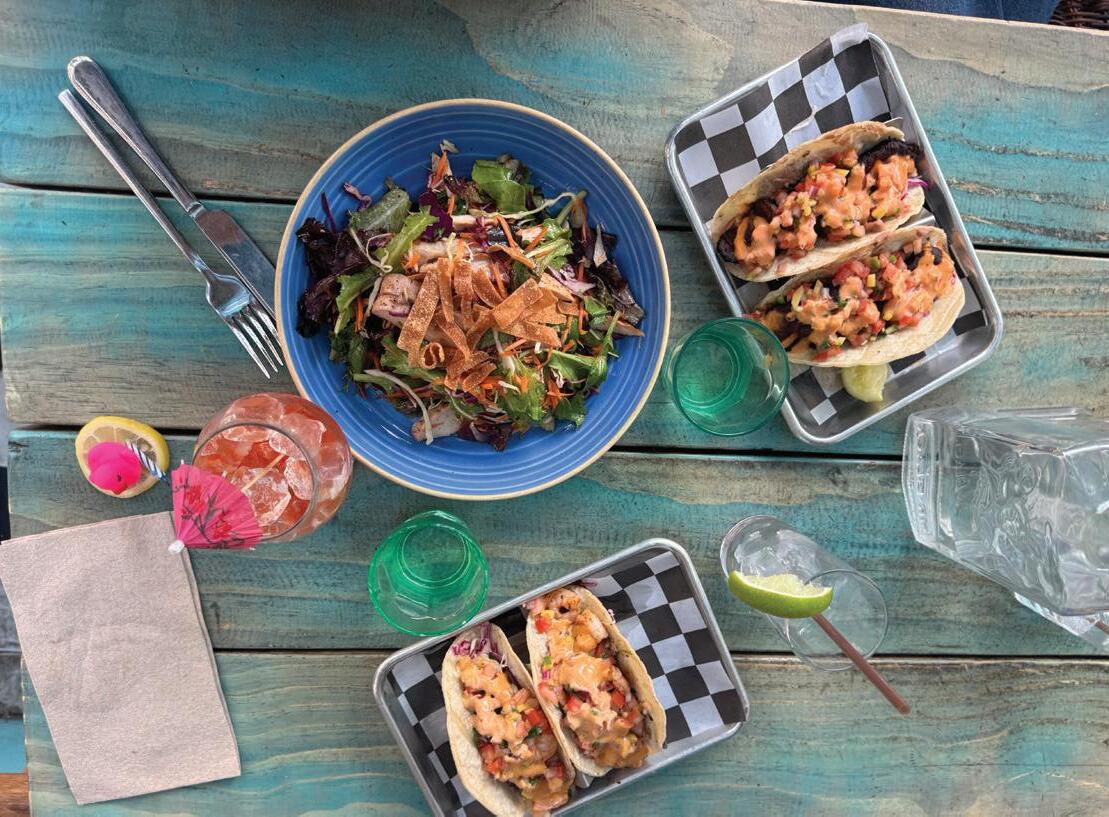
expressing her love for food.
“I started my Instagram channel because I had a bunch of friends who would always laugh at the way I critique the food when I’d go to places,” Barclay said. “I had multiple people suggest, like ‘oh, you should make an Instagram review account out of this’. So I just thought it would be fun and a fun way to keep people posted on my thoughts on food, give them recommendations, and kind of make use of my ability to criticize food and applaud it.”
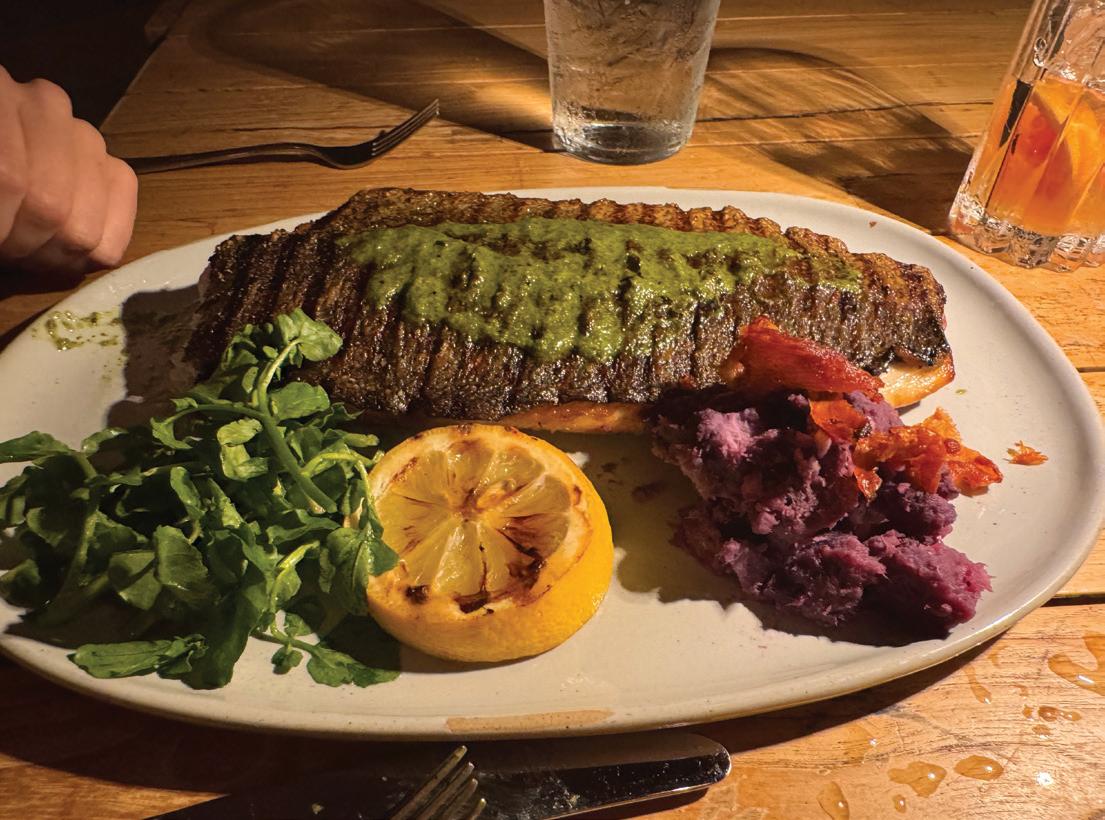
it tells me what I should be ordering, or what I’m able to order, what’s good and what’s bad,” Grodnitzky said. “It’s like watching someone who’s a mini professional but who is also my friend do these videos.”
“The main reason why I make the videos and post is because I know my friends find it fun and interesting,”
— Charlotte Barclay, senior
Barclays’ friends who inspired her to make the account are always ready to support her videos. Paly senior Isabella Grodnitzky explains why she enjoys the food review videos.
“I like watching her videos because
While Charlotte may take her reviews seriously, she does not put the same stress on her account. Her videos are purely for fun.
“At the end of the day, it makes me happy to make them,” Barclay said.
“It’s kind of a fun creative outlet to just document for my own sake the different restaurants that I like, flavors that I enjoy, and things I would change.”
The purpose of the videos has always been to have fun with her friends. So, Barclay explains that whether her account will continue into college depends
on the community there.
“The main reason why I make the videos and post is because I know my friends find it fun and interesting,” Barclay said. “I think it’ll [posting videos] depend on what type of friends I make in college.”
All things considered, Barclay doesn’t feel pressure to continue making videos or post consistently. The reason for their creation ties back to her happiness and what she hopes to impart on others.
“It’s just the joy it brings me, and I mean hopefully other people too,” Barclay said.
SNAPPING A PHOTO (UPPER LEFT) Charlotte Barclay records herself reviewing a drink she bought from Boba Guys for her instagram review page. Photo by Mihika Sridhar
Food photos by CHARLOTTE BARCLAY
Text by MIHIKA SRIDHAR
Yutori Brings Japan to Palo Alto
Reviewing Palo Alto’s newest Japanese cafe and grocery store
Tucked away in Ventura, Palo Alto, Yutori isn’t your typical cafe. At first glance, it’s a minimalist Japanese coffee shop. But when you step inside, you’ll find a perfectly curated grocery store stocked with imported snacks, pantry staples, and home goods.
The concept raises the question: Is Yutori just another aesthetic cafe, or does it offer something genuinely different from other spots in the area? The answer is a mix of both.
Yutori opened April 13, 2026, on 3375 El Camino Real, replacing the longgone Corner Bakery Cafe. The initial hype was hard to ignore, with lines that stretched out the door and wait times reaching an hour. We visited around 9:40 a.m. on a Saturday, and the line had reached the parking lot.
Yutori co-owner Lily Peng said Yutori holds a special meaning in Japanese.
“Yutori is a Japanese meaning for giving space and enjoying the moment, like a space to breathe,” Peng said. “We wanted to create a space that brings that element of taking a pause in your busy daily lives and having the ability to sit back and enjoy the present time.”
Yutori stands out primarily due to its hybrid setup, featuring a line for the cafe and a line for the deli. While most cafes focus solely on drinks and pastries, Yutori blends a cafe experience with a Japanese marketplace and a soon-opening restaurant in the next two months.
“We want customers to come multiple times in a day to have different ex-
Hojicha Goma Latte ($8)
The Hojicha Goma Latte has a thick cream top with a strong roasted sesame flavor. The hojicha, a type of Japanese roasted green tea, is light and tastes dilut ed at times. We felt that the sesame adds the depth that the tea lacks. The drink feels cohesive overall. As hojicha lovers, we thought the tea was average, but when added with the cream, it was fla vorful and delightful.
periences,” Peng said. “They come in the morning grab their coffee, they come at lunch and grab something quick to eat, and in the evening they can come and do a celebratory dinner with friends and family for birthdays and anniversaries.”
Shelves are lined with unique items including traditional fruit sandos and kitchen tools from Japan.
“We have retail products from Japan that we want to showcase from different artists that only work in Japan and only ship their products in Japan,” Peng said.
These small details provide Yutori with a distinct identity, somewhere between a cafe and a convenience store you might find in Japan.
“We wanted to offer a bunch of different options for brunch and dinner menus,” Peng said. “[We also wanted to incorporate] the idea of a konbini, which is a Japanese grocery store, because they’re around every corner in Japan and they’re very convenient to stop in and grab a quick bite to eat.”
Throughout the first few opening weeks, Peng said Yutori struggled to keep up with the demand for products.
“When we opened, we didn’t expect the volume, and we ran out of eggs and milk within the first day,” Peng said. “We had to make multiple last minute runs to stores to replenish all the products that we needed for the rest of the weekend.”

bento boxes and different sushi items, and we’re very open to customer feedback,” Peng said. “On the cafe side, we’ll constantly evaluate our menu and introduce new flavors of pastries and drinks.”
The cafe’s hours, which are 8 a.m. to 5 p.m., make it inaccessible before and after school. With other cafes like Yummy Future, Maruwu Seicha, and Starbucks being open late, Yutori doesn’t seem like a competing study spot.
“As we ramp up and get comfortable with the current operations, we’ll consider changing our hours a little bit,” Peng said. “We’ll see about the cafe and what the demand is for coffee and matcha in the later hours of the day.”
Still, the space itself, especially the marketplace, adds value beyond the food. Browsing Japanese snacks and ingredients while grabbing a drink makes the experience feel more immersive.
Yutori brings a fresh new concept to Palo Alto, but the execution varies dramatically depending on what you order. The drinks stand out and are worth trying, while the pastries are solid. The food, however, doesn’t justify the price.
Overall, Yutori works best as an occasional stop for drinks and aesthetic marketplace, rather than a go-to spot for a full meal.
According to Peng, Yutori still has many dishes they’re excited to release in the future.
“We’re constantly testing out new items on the deli side like sandwiches,

“We’re trying to bring a lot of elements and favorites of Japan to Yutori, whether it’s our food, our drinks, the products that we sell,” Peng said. “Hopefully, when they come, it’s an experience that they can’t really get anywhere else that easily.”
Sweet Miso Latte
($7)
The Sweet Miso Latte is a standout. It strikes a balance between sweetness and creaminess, with a subtle savory edge from the miso. At first glance, the idea of miso in a latte might seem strange — like it could veer into “miso soup” territory — but it didn’t. Instead, the flavor is mellow and unique, though the miso flavor fades as you continue drinking and get used to it. It’s the kind of drink that feels creative without being gimmicky, and one that’s easy to recommend for people visiting Yutori.
The Ham Katsu Sando ($17.50)
The Ham Katsu Sando seemed to be one of the more substantial menu items. Made fresh to order, it features crispy panko-crusted ham layered inside soft milk bread, paired with red cabbage and a Kewpie hot honey mustard sauce. In theory, it’s a classic Japanese convenience store-style sandwich. How ever, while the ham is crispy and well-cooked, the milk bread tastes closer to standard white bread, and the cabbage is less prominent than expected. Considering the wait times during opening week, the result feels un derwhelming. After waiting nearly an hour for our drinks, the sando may not match the expectations created by the buzz. At $17.50, it ends up feel ing like a simpler menu item compared to its price point. The sauce is unex pected at first — reminiscent of wasabi before settling into a sweeter profile.
Black Sesame Scone ($6)

The Black Sesame Scone has golden, crisp edges and a soft, crumbly inside. We were lucky that a new batch had just been baked and brought out to the front when we ordered the scone, so the freshness elevated the dish. The base leans slightly plainer and lacks a clear flavor on its own. Luckily, most of the taste comes from the icing, which brings a strong sesame flavor with a mild sweetness. The flavors are simple and work for those who prefer less-sweet pastries, but may feel too plain for others.
We felt that the bites with icing were delicious, but the bites without it were less flavorful. Overall, it would be a nice sweet treat to get while studying at Yutori or on the go. We especially recommend this pastry to people who prefer lightly sweetened pastries rather than sugary ones.
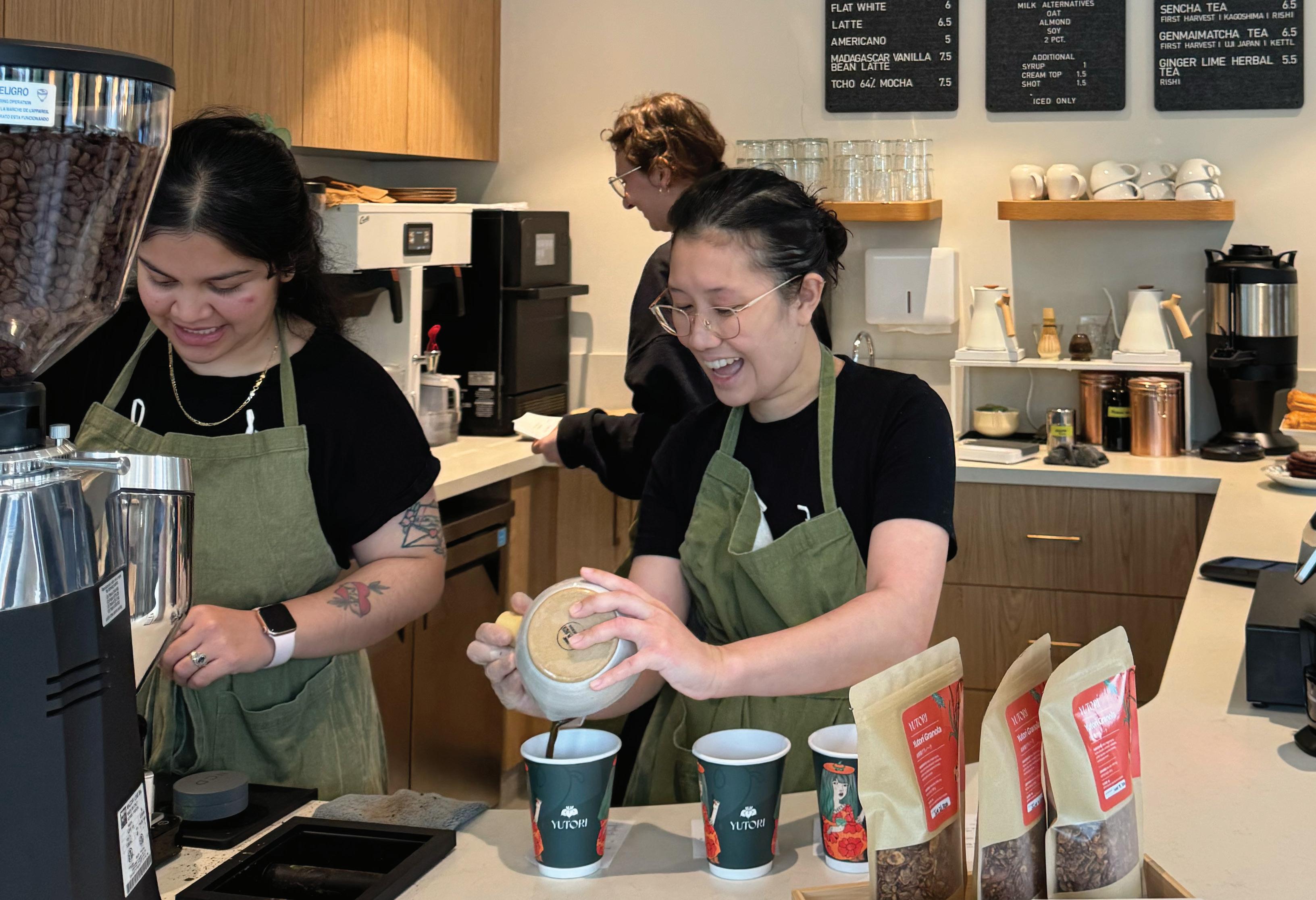
BREWING SMILES — Yutori baristas brewing their signature drinks at the front counter
BREWING SMILES — Yutori baristas brewing their signature drinks at the front counter
More Food or Better Food?
Should students prioritize quality, quantity, or cost when dining?
Whether they’re looking to enjoy a sit-down lunch or searching for a late-night snack, students are always trying to get the most out of their money. Some prefer quantity over quality, while others enjoy finer dining and the hospitality that comes with it. But which aspect of dining is more practical and important for students?
Luckily for Palo Alto High School students, their access to a wide range of cuisines and styles is not limited by their budget at all. From the outskirts of Palo Alto to the heart of downtown, restaurants populate streets and plazas to offer meals of different price ranges.
Shah said. “If it’s really good food, I’ll keep coming back to the same place and eating that good food. But when it comes to price and looking at quality, I try to find a middle ground between the two.”
“I can sacrifice some of the quantity for really good food. If it’s really good food, I’ll keep coming back to the same place and eating that good food. But when it comes to price and looking at quality, I try to find a middle ground between the two.”
This wide variety of restaurants unavoidably leads to contrasting preferences when it comes to choosing between them.
Paly junior Willem Madwed explains his perspective on dining, and what his focuses are when evaluating a restaurant.
“I look for a reasonable price range when looking for a restaurant,” Madwed said. “But personally, I’m a big eater, so I lean towards quantity instead of quality most of the time.”
— Vinay Shah, senior
“I look for a reasonable price range when looking for a restaurant. But personally, I’m a big eater, so I lean towards quantity instead of quality most of the time.”
Paly senior Vinay Shah explains how, when push comes to shove, he often chooses higher-quality food rather than a large portion of food.
“I can sacrifice some of the quantity for really good food,”
— Maura Hambly, junior
Paly junior Maura Hambly describes how she prioritizes the cheaper options when it comes to deciding.
“I’d say the first thing I look at is quality,” Hambly said. “But if the options aren’t too far off and one of them is a little cheaper, I would definitely choose the cheaper option.”
To compare these students’ different viewpoints, we visited three restaurants with drastically different price ranges and service.
After visiting each place and hearing from students with different preferences, it became clear that there is no one best approach when it comes to dining on a budget. Whether you are getting feasts from Taco Bell, grabbing a quick bite at InN-Out, or savoring a meal at Coupa Cafe, each restaurant has its own purpose that depends on what you are looking for in that moment. The advantage of Palo Alto isn’t just the amount of restaurants near us, but the variety of them that students get to choose between. Ultimately, the best restaurant isn’t the one with the lowest price or the highest quality, but the one that fits your needs.
Taco Bell
Total cost: $14.45
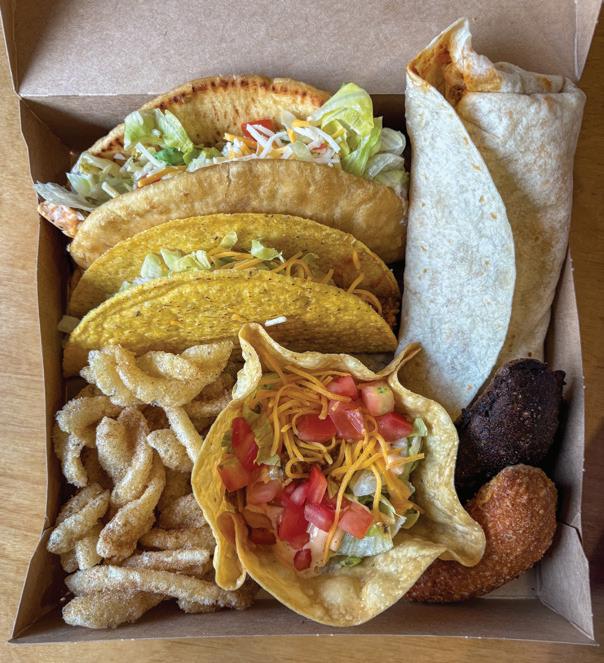
For $15, you won’t just get a meal, you can practically get a whole feast. There was easily enough food to feed two people with the 6 items and the drink that we were able to purchase. We utilized the “Luxe” value menu, such as the $7 supreme luxe box, which consisted of a Chicken Chalupa supreme, a 5-layer Burrito, a Regular Crunchy Taco, one medium drink, and Cinnamon Twists. Adding a Mini Taco Salad and two tasty dessert empanadas, which are labeled as fan-favorites, rounds off a tray of food that is more than enough for two. The quality was as expected, consistent, fast-food comfort, but the volume of food per dollar here at Taco Bell may be unbeatable.
In-N-Out
Total cost: $15.33
Quick, simple, and tasty. Those words often describe the food In-NOut serves, and our experience was no different. Few seats inside the restaurant were unoccupied, and the continuous chatter of conversation created an exciting, enjoyable environment. Staff were friendly and eager to help, though they didn’t provide the top-tier service you would see at fancier restaurants. For a grand total of $15.33, In-N-Out can get you a double-double burger, animal fries, and a medium drink. The food they serve is conventional, basic, yet delicious. The fresh lettuce and tomatoes compliment two juicy patties nicely, and the American cheese layered between them gives each bite a satisfying texture. The animal fries were more of a let-down. The fries came soft rather than crispy, and the cheese on top lacked the ideal liquid-like texture, with it being closer to a solid. However, the sauteed onions sprinkled in the cheese added a kick of flavor that made the dish slightly more enjoyable. There’s nothing innovative or extra about In-N-Out’s food, but the price and quality will not disappoint.
Coupa Cafe
Total cost: $16.27
Coupa Cafe represents the “quality over quantity” end of the spectrum. In the busy downtown Palo Alto cafe, a single breakfast arepa, which is stuffed with scrambled eggs, bacon, and Gouda cheese, sits just above our budget at $16. This means that $15 technically won’t cover the cost of the entire dish once you factor in tax and a tip. While you do get significantly less food compared to Taco Bell or In-N-Out, the true value comes from the traditional preparation. The white cornmeal shell, which is grilled to a crisp, is then filled with the warm scrambled eggs, the juicy yet crispy bacon, and lastly the creamy Gouda cheese. Lastly, the dish is served with a side of fresh fruit, adding a final touch to this near-gourmet meal. This is a sit-down experience, where one pays for the atmosphere along with the specialized Venezuelan craft rather than focusing on the sheer calorie count.
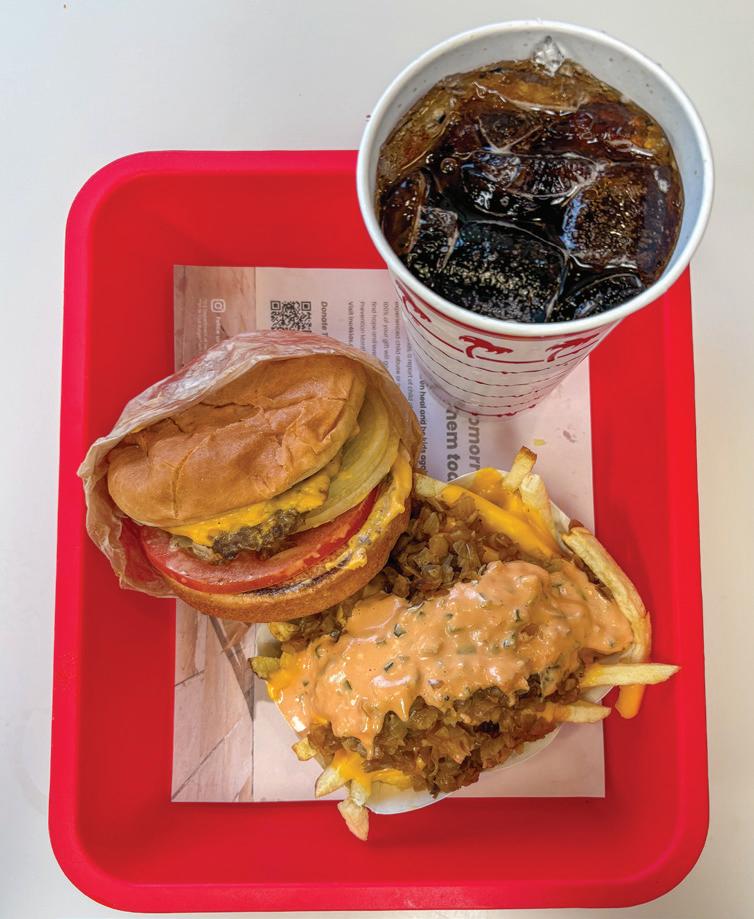
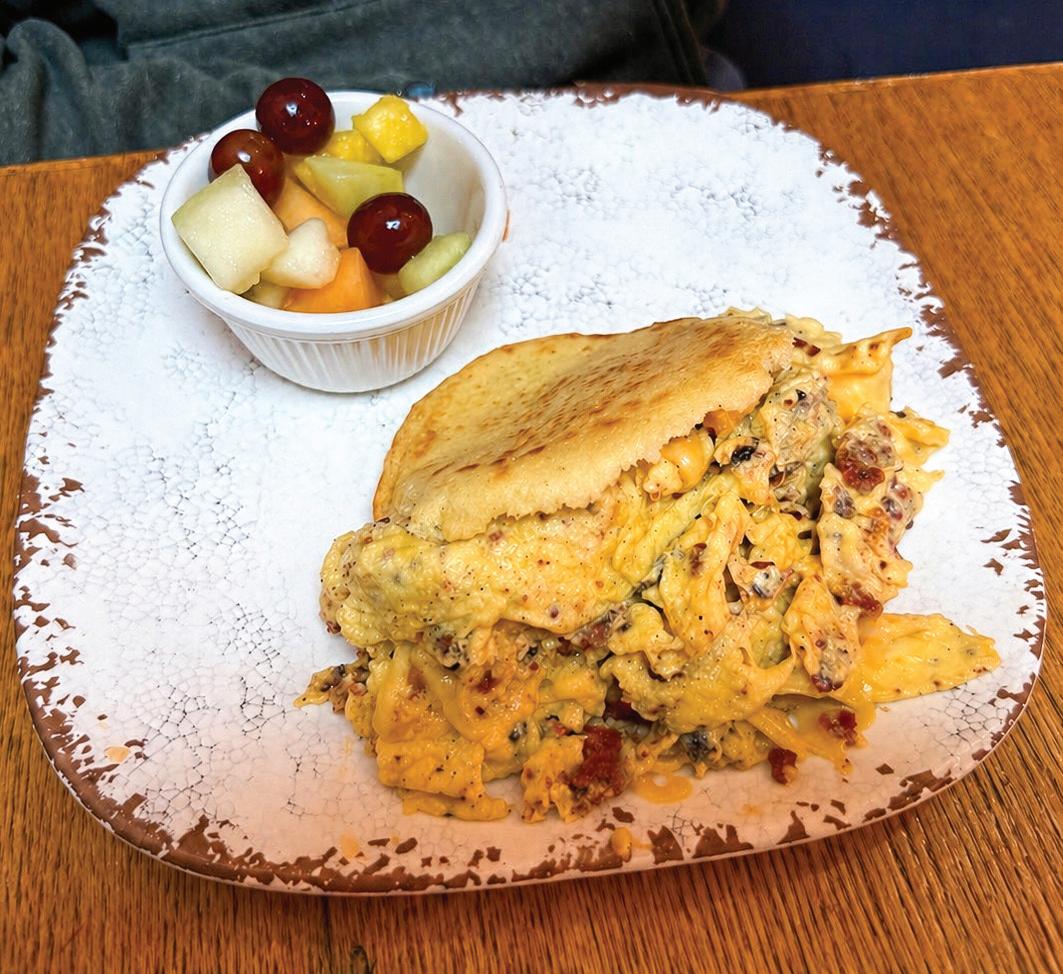
Delicious Delarosa
Fast food fuses with Italian cuisine at Stanford Shopping Center’s new addition
Locals are raving about Palo Alto’s new rendition of the well loved Italian chain, Delarosa, which is perfectly situated in a large bright orange square building in Stanford Shopping Center. Intrigued by all the positive reviews, a few friends and I ventured to the restaurant one Sunday to see if Delarosa is really worth the hype.
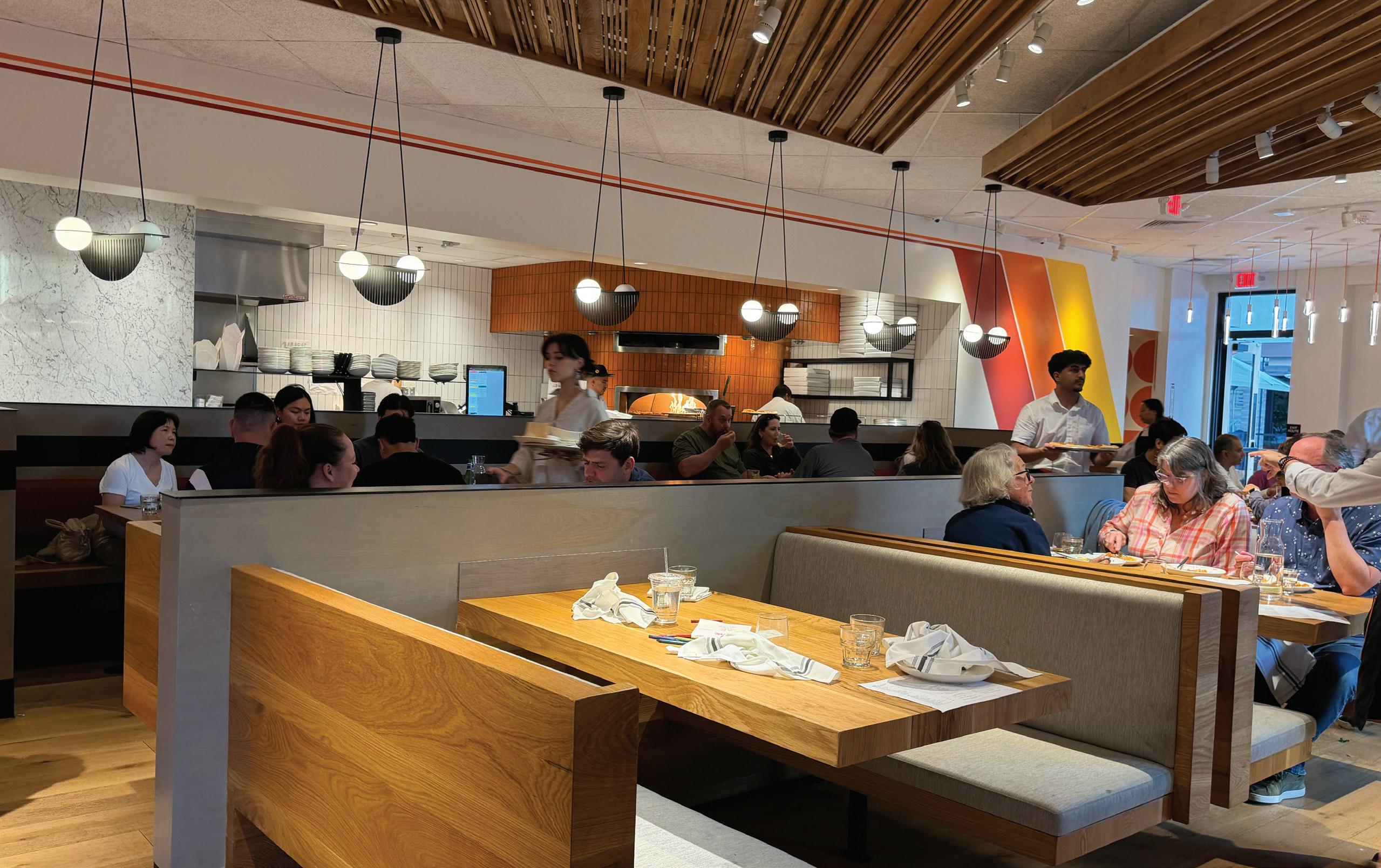
The restaurant had a bright, upbeat and colorful vibe. It was relatively full of mostly young families and couples, conversing happily over their food, with trendy pop music playing in the background.
We were greeted at the door by a friendly hostess standing behind the counter, and were shown to our seats almost immediately after telling her of our reservation. Moments after we sat down, our waiter arrived offering us water. His friendliness stood out to me, and he made me feel welcome and comfort-
able with his enthusiastic nature.
The menu was also a pleasant surprise. Each item’s price ranged from $6-$25, which was a very good deal considering the relatively large portions of food. The menu kept things very concise; each of the categories of food had very limited options but with a wide variety of foods.
We ended up ordering the cacio e pepe fries ($8), the cauliflower ($14), the vodka sauce rigatoncini ($20) and the margherita pizza ($18).
Our whole decision-making process only took about five minutes, but during those five minutes, two separate waiters came by twice each to ask us if we were ready to order. They always offered to give us more time to decide, but the urgency made me feel slightly rushed.
However, this fast paced service is a part of Delarosa’s legacy. Delarosa emerged from the fast casual Italian restaurant chain, Pasta Pomodoro, which aimed to bridge the gap between fast food and fine dining.
The owner, Adriano Paganini, sold the company in the early 2010s to form Delarosa. Palo Alto’s location is the fourth of four identically named restau-
rants across the Bay Area, the first one being on Chestnut Street in San Francisco. Samantha Amoroso, the manager of Palo Alto’s Delarosa, explained Delarosa’s unique mission.
“What really stands out for us as a restaurant is that we are a perfect mix between a fast casual place and somewhere that is fine dining,” Amoroso said. “We want to provide fine dining service, fine dining food in a more casual setting.”
And this they did.
Not even five minutes after we ordered, a waiter came by with a hot pile of golden-brown cauliflower smothered in oil and spicy peppers. The cauliflower was smooth, tender, crunchy, oily (but not greasy), and had a slight kick of spice.
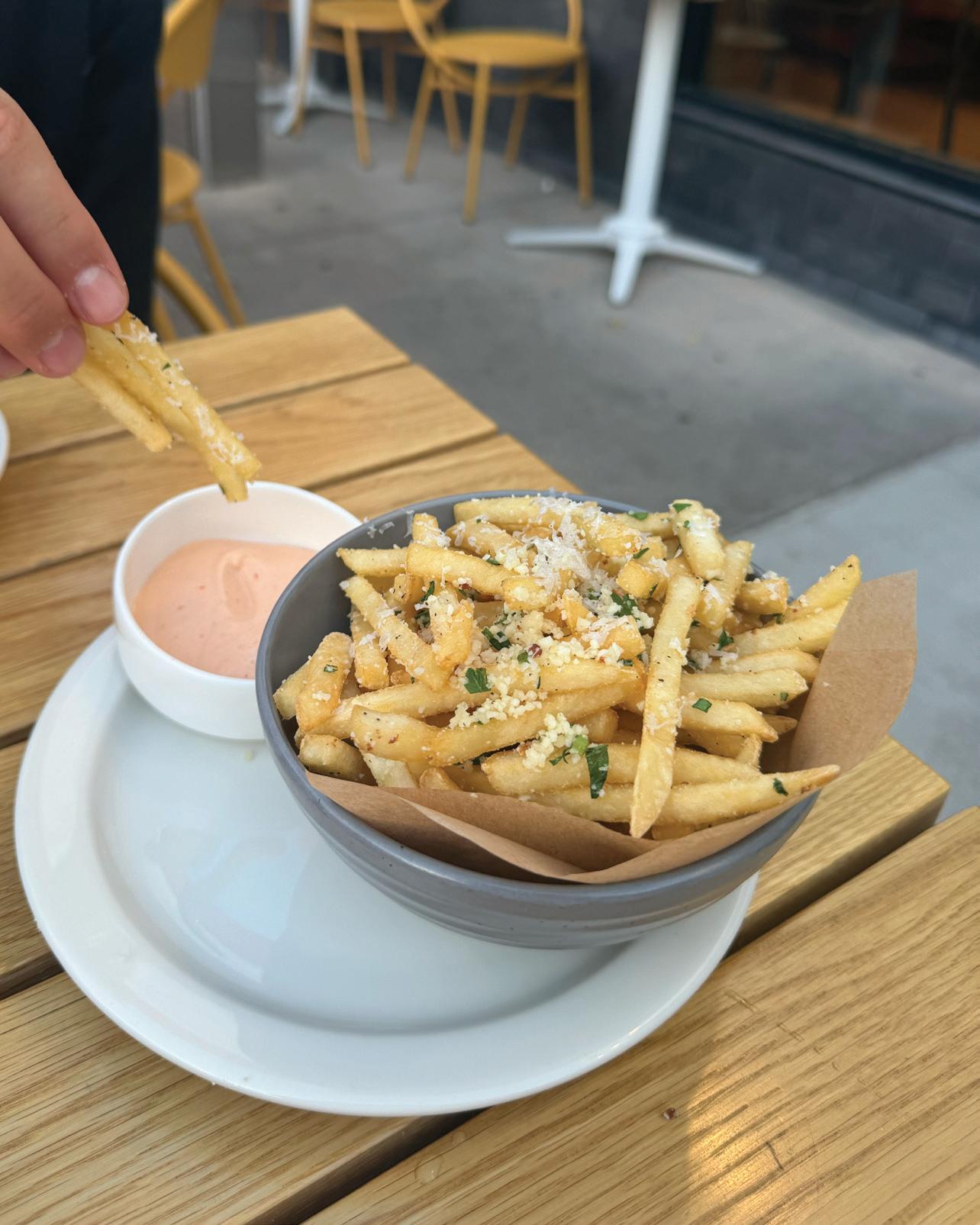
We were still working on the cauliflower when the cacio e pepe fries arrived. Served in a silver bowl with a side of calabrian aioli and a generous heap of pecorino cheese, the fries were thin, crispy and fresh. However, this dish was likely my least favorite out of everything we ordered. This was not because the fries were bad by any means, but simply because it wasn’t very special. It lacked the same flair and originality that some of the other dishes and I was a bit sur-
prised to see fries being offered at an Italian restaurant. To me it felt more like theme park concession food rather than a reputable Italian dish.
To no one’s surprise our next plate came by our table almost immediately after the fries. This was the rigantoncini with vodka sauce, the pasta that had our waiter thinking a trio of teenagers was trying to order alcohol. Fortunately, that misunderstanding was cleared up before the police were called, and I’m grateful it was because I would have much preferred to get a bowl of delicious, saucy, indulgent pasta than a bottle of liquor.
CASUAL VIBE (dominant) Delarosa fosters a vibrant and upbeat vibe with it’s interior
CACIO E PEPE FRIES (left) While untraditional, this dish adds to the fast-food aspect
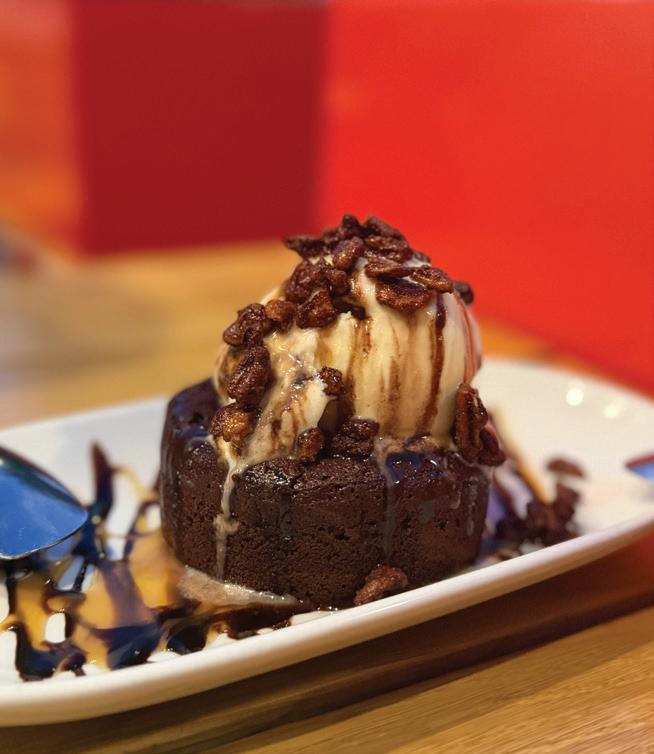
RIGATONCINI PASTA (bottom) An Italian classic vodka pasta FLOURLESS CHOCOLATE CAKE (top) One of many delectable dessert options
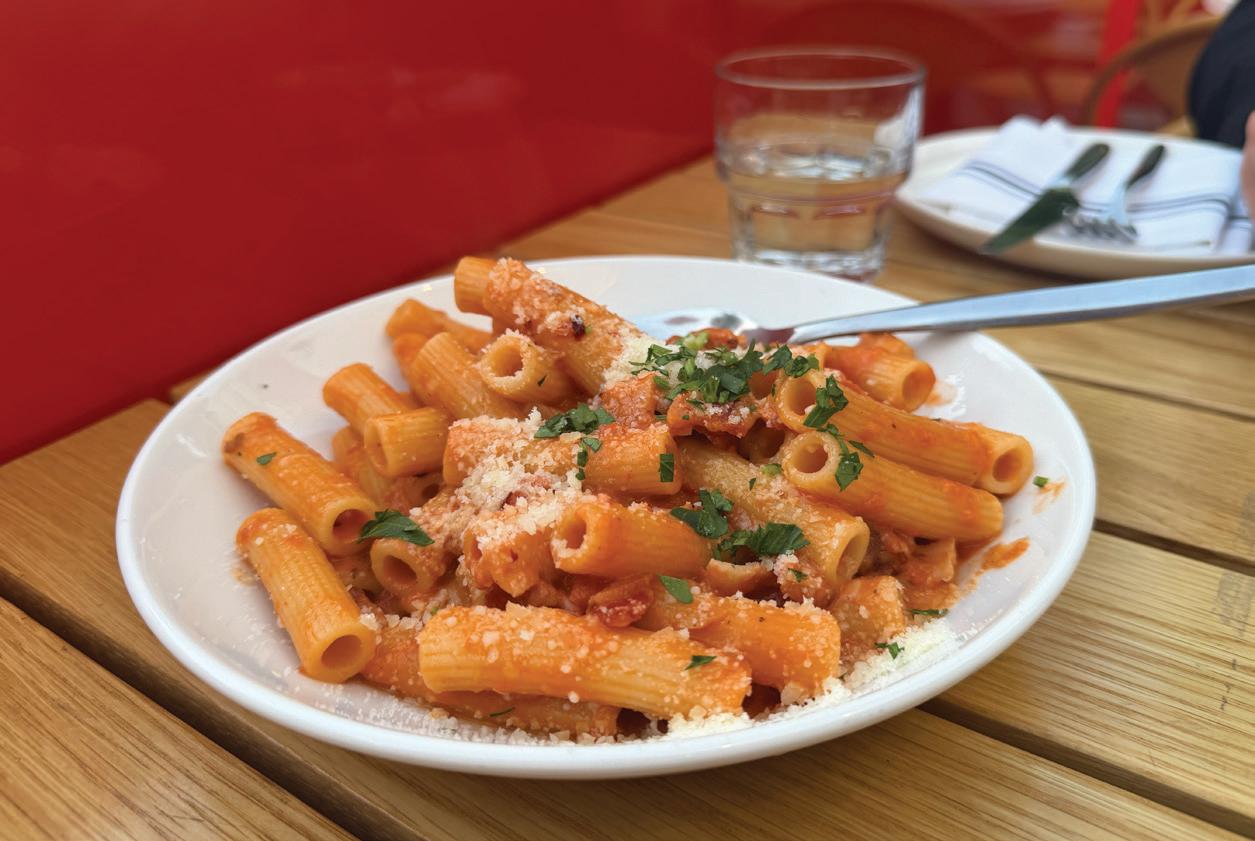
guanciale had its own distinct flavor and perfect chewiness. This was easily the best vodka pasta I’ve ever tasted.
“What really stands out for us as a restaurant is that we are a perfect mix between a fast casual place and somewhere that is fine dining. We want to provide fine dining service, fine dining food in a more casual setting.”
—Samantha Amoroso, Delarosa Manager
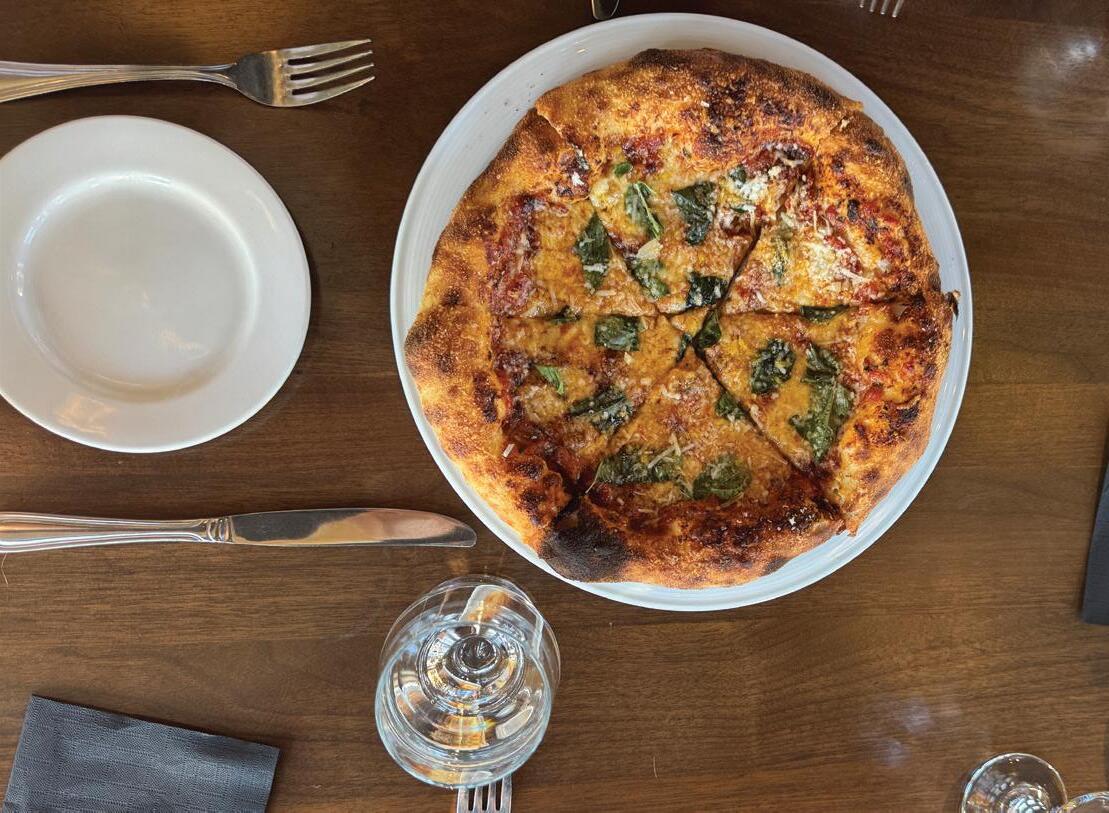
Continuing with the trend of food arriving quickly, the margherita pizza arrived when we had only finished the cauliflower. Out of all the dishes, this was the most visually appealing. It looked like a pizza straight out of a highly photoshopped advertisement, as everything down to the last piece of cheese looked carefully and intentionally placed.
for dessert.
The cake was the highlight of the night for me. It was pretty large with an even larger scoop of vanilla ice cream drenched in chocolate and caramel sauce and covered in pecans. When I took a bite, I was immediately blown away by all the rich, decadent and clashing flavors. This was exactly what I was looking for in a cake: moist, creamy, comforting and warm.
Our total for this meal came out to be $89.65 which is a pretty respectable price for the five generously portioned dishes we ordered. The only issue we had with the price was the $9 sparkling water, which we ensured was fully consumed down to the last drop.
The pasta was served piping hot in a large bowl for us to share. The sauce was creamy, tomatoey and addicting and the
When I took a bite, I was caught off guard by how thin and crispy the crust was, but I grew to love the contrast between the crunchy crust, thick sauce and chewy cheese.
After we finished our mains, we ordered the flourless chocolate cake ($10)
Overall my experience at Delarosa was a positive one. The staff were all welcoming and friendly, the vibes were bright and happy, and the food was incredibly delicious. So next time you’re in need of a quick and delicious meal on par with some of the finest Italian restaurants around, check out Delarosa; you’ll thank me later.
Photos by CHIARA MARTIN
Text by DANIELLE HANIGAL
Ralph’s Coffee brings style to Stanford
Ralph Lauren’s signature cafe brings New York charm to Palo Alto
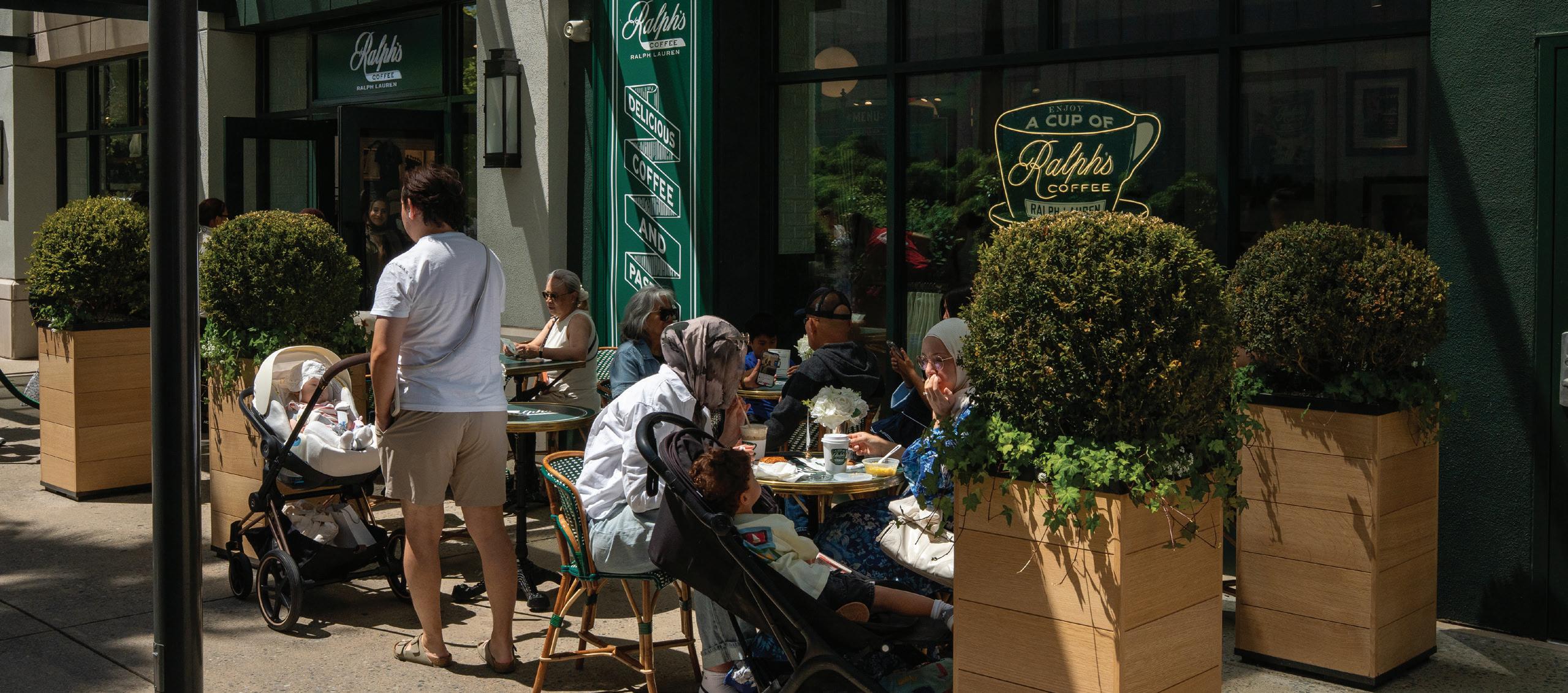
Stanford Shopping Center has seen its fair share of openings in the past year, but the latest one has been drawing lines out the door since its opening. Ralph’s Coffee, the signature cafe brand from the famous clothing line Ralph Lauren, just opened its doors this spring and has quickly become the area’s go-to spot.
Ralph’s coffee first opened in 2014 inside Ralph Lauren’s flagship store on Madison
Avenue in New York City, and since then expanded to cities like London and Tokyo. The Stanford Shopping Center location is its first Bay Area opening.
Brick walls, dark wooden beams, and framed black-and-white photos give it an authentic New York City neighborhood feel. Fresh flowers on marble tables and hunter green accents on the menu board, the cushions with the cups tie the whole place
Lemon Olive Cake - $7.00 (9/10)
The lemon olive cake had the perfect amount of sweetness while being enough to keep your stomach from growling for a while. The lemon frosting on top of the cake provided an intriguing amount of flavor, while the cake itself supplied a yet satisfying texture that makes you desperate for another bite. While the cake isn’t one of the main attractions on the menu, if you are looking for a small treat to go along with your drink, the lemon olive cake is a great option.
Pain au chocolat - $6.50 (8.8/10)
The pain au chocolat, which in simpler terms is a chocolate croissant, was one of the highlights of the visit. The outside was light and crispy, giving it a satisfying crunch before opening up to a soft, fluffy inside that greeted the tongue with a warm and buttery flavor. The chocolate was the right sweetness, adding richness without making it feel heavy or overly sugary. Overall, it was well-balanced and flavourful, and definitely worth ordering again.
Iced Chai Tea - $7.00 (6.8/10)
The iced chai tea was refreshing, but the spices kept a warm undertone to the drink. The first sip was the best, with the spice and sweetness coming through clearly. However, after a few sips, the flavor started to fade and became bland, making the drink less memorable than it first seemed. The iced chai tea was good at first, but not distinct enough to stand out.
together, and create a space that feels intentional without being overdone. The small space combined with the large crowds brings a cozy and comfortable atmosphere you are destined to go back to.
While it is not everyday you see clothes so closely associated with food, it makes it all the more interesting. The menu was quite large and based on what we chose, here was our take on the cafe’s food and drinks.
Blueberry Muffin - $6.50 (8.5/10)
The blueberry muffin was one of the best baked goods within the cafe. The combination of the blueberries, sweet muffin bread, and the sugar coating reminds you of the high quality this cafe presents in its food. All together, you are presented with a sweetness that isn’t overwhelming nor too mild. While the flavor of the muffin met expectations, the most notable thing about the treat was its size. The blueberry muffin was larger than most muffins and could easily satisfy one’s stomach. If you are looking for a fulfilling, quick treat from the cafe, I suggest you consider the blueberry muffin.
Matcha Lemonade - $7.00 (4/10)
The matcha lemonade was somewhat of a let-down compared to the other items on the menu. Coming in at the same price as many of the other drinks, you’d expect similar results, with an appealing flavor and quality. Unfortunately, this was not the case. You are greeted by a swampy green color that does not quite attract the eye. When going in, you are instantly welcomed by the weird combination of lemonade and matcha, a taste that may appeal to few, but definitely not to many. The sweetness paired poorly with the earthy taste of the matcha, leaving a bad tangy aftertaste in the mouth. Overall, while this drink may be somewhat refreshing on a hot day due to its cold temperature, it may be best to avoid this drink altogether.
Text by LUCAS ARAI and SEBASTIAN TUNG
Photo by LUCAS ARAI
VERITAS

Editor’s Note:
Welcome back to Veritas, Palo Alto High School’s science and technology magazine! Our issue focuses on highlighting the growing integration of science and technology in our community and how it impacts student life by shaping cultural and physical spaces around us. From MakeX’s inclusive spirit of innovation to the controversy surrounding Turnitin’s implementations in schools, we aim to examine how STEM influences our community in a variety of ways. We also profile an AP Research student studying the role of artificial intelligence in classrooms. Finally, this issue features the peptide trend, a digital art gallery, and other developments that make Silicon Valley what it is. We hope you enjoy Veritas’s 2026 summer issue!
— Araina Gupta and Alexander Lawson, editors-in-chief
Text by: XANDER YAP and RICHARD KLINKNER
Error: future unknown
In the rapidly advancing world of AI, lots of dialogue has arisen regarding the profound changes AI will bring to the job market. This imminent shift has sparked a range of reactions in Palo Alto High School, where students and teachers alike are weighing the effects AI will have on the future job market.
Optimistic




“Now, the real thing that AI can’t do is that it can’t be human. It can’t have this rationality that human beings have. It doesn’t have the same level of empathy and compassion. ... I know that the industries that I’m interested in, specifically in the humanities, that’s something that cannot be replicated by artificial intelligence, just because it’s so much based in the human brain.”
—
KYLE GREENBERG, 10th grade
“Honestly, I don’t really agree with the idea of, AI taking over jobs ... It’s not something that is ruining job opportunities for people. I think it’s just something that’s like, kind of changed. I think it could be kind of like a pinch for people who are maybe in like, CS or just people who are in that area who could be kind of faced by artificial intelligence.”
— EILEEN LEE, 10th grade
“I think that it’s wise for students to truly start piecing together their interests and their passions with how they’re going to find a way to survive, ... I’m advising many of my students ... to think about is picking up a skill that they think is difficult to replace”
— ROXANNE LANZOT, computer science teahcer
“The use of AI has sort of desensitized the hard effort and work, which has made a lot of people lazy, and I think attention span to hard labor has also gone down. Especially with the weakening job market, AI has taken over a lot of jobs, and I think that it’s overall been a very bad impact on society.”
— TIRIAN MELEAN, 12th grade
STEM NEWS BRIEFS
Local robotics teams compete in world championships
Local robotics teams Paly Robotics and Peninsula Robotics ended their seasons by competing at the FIRST Robotics Championship from April 29 to May 2 in Houston, Texas.
Six hundred teams from 66 countries, divided across eight divisions, participated in the tournament after qualifying through competitions throughout the season.
Paly Robotics competed in the Johnson Division and finished 23rd out of 75 teams, while Peninsula Robotics competed in the Newton Division and advanced to elimination matches, finishing seventh out of 75 teams.
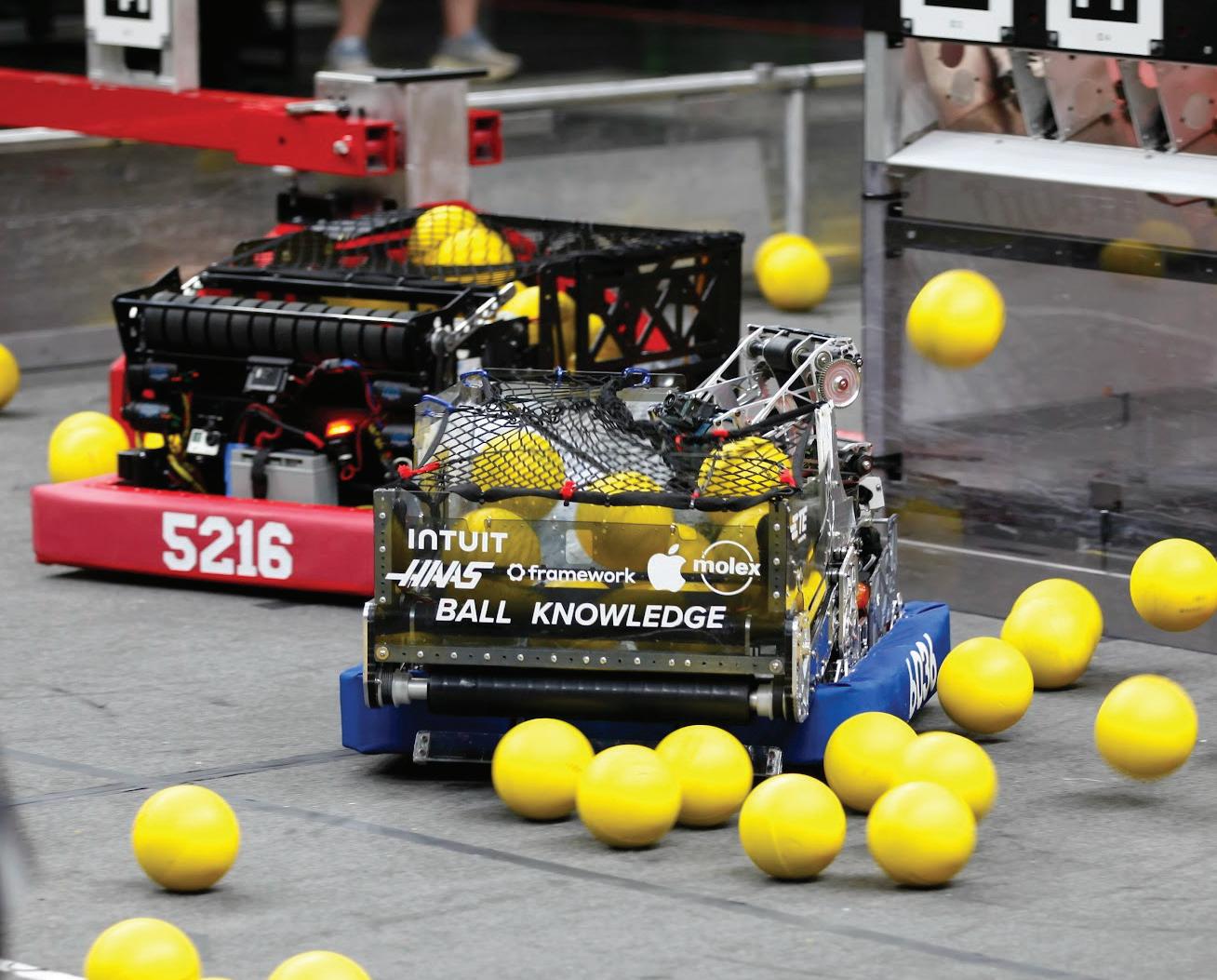
During this season’s games, alliances of three teams’ robots competed against other alliances to gain the most points by scoring foam balls into goals and climbing a tower structure.
According to Palo Alto High School sophomore and Peninsula Robotics build co-captain Gauri Oberai, the team poured a lot of time into improving robot reliability over the season.
“I was really happy with our experience at worlds because of the amount of people who locked in and contributed to making us a world class team again,” Oberai said.
Palo Alto police address concerns over surveillance cameras

The Palo Alto Police Department will begin releasing monthly license plate search logs following concerns over a nationwide feature operated by Flock Safety, according to an April 21 statement.
The statement said that Palo Alto’s Flock Safety camera data was previously used in the company’s “National LPR Network,” which is a feature introduced in 2023 that allows law enforcement agencies to search vehicle data collected nationwide.
This feature being implemented in Palo Alto drew public concern in early 2026 due to California laws limiting how automated license reader plate data can be shared with out-of-state agencies.
In the statement, the PAPD said it was unaware of this feature and learned about it in December 2025. It also said all city data had been removed from Flock Safety’s network by October 2024 and no Palo Alto data was actually accessed by out-of-state agencies.
Flock Safety’s automated license plate readers use cameras to capture images of passing vehicles and record information to help investigators. The system sends real time alerts to relevant law enforcement agencies if a wanted vehicle is detected.
In 2023, the Palo Alto City Council approved the installation of 30 Flock Safety cameras throughout the city.
MONITORING — A Flock Safety automatic license plate reader sits on a traffic pole at the intersection of Grant Avenue and El Camino Real in Palo Alto. (Photo: Araina Gupta)
COMPETING — Robots compete against one another to score foam balls into a container at the FIRST Robotics Championship. (Photo: Gauri Oberai)
From Idea to reality
How MakeX fuels student innovation through hands-on engineering
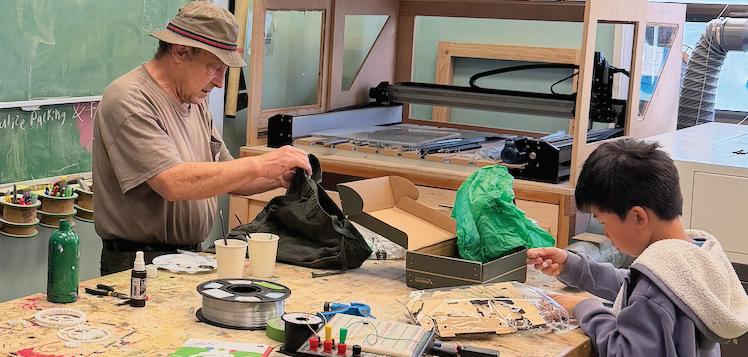
Walking into Room V1 at Cubberley Community Center, you might expect to hear the hum of 3D printers or the whirring of saws. Instead, it’s often the sound of collaboration that takes over the room. Whether it’s sharing ideas, testing out designs, or huddling around a computer to model different prototypes, the students in the room grow together.
For students across Palo Alto, MakeX is a student makerspace with a decade-long history full of student innovation. Founded in 2014, the space is a place where students can explore interests and build on their ideas.
For senior and student mentor Khai Gordon, his journey into the engineering world started in 7th grade, but it wasn’t until his sophomore year that he went to the makerspace on a regular basis.
“I wanted to find an extracurricular that would let me express this interest,” Gordon said. “That’s when I started showing up to MakeX more. You get to engage with the community and gain a lot of perspectives and hear a lot of ideas. There’s also a good variety of machines to use, such as 3D printers, laser cutters, woodworking tools, and more.”
While many students across the city are familiar with club robotics labs and teams, where students are often focused on one robot and a goal, Gordon said that MakeX differs because it provides students with a place to explore a wider range of projects and ideas.
“Robotics labs are more focused on robotics things ... their tools are all for the purpose of making a robot,” Gordon said. “While at MakeX, there’s a greater variety of what you can make, such as stickers, 3D prints, tables, embroidered things, and electrical-based things. So, there’s a lot more variety when it comes to MakeX.”
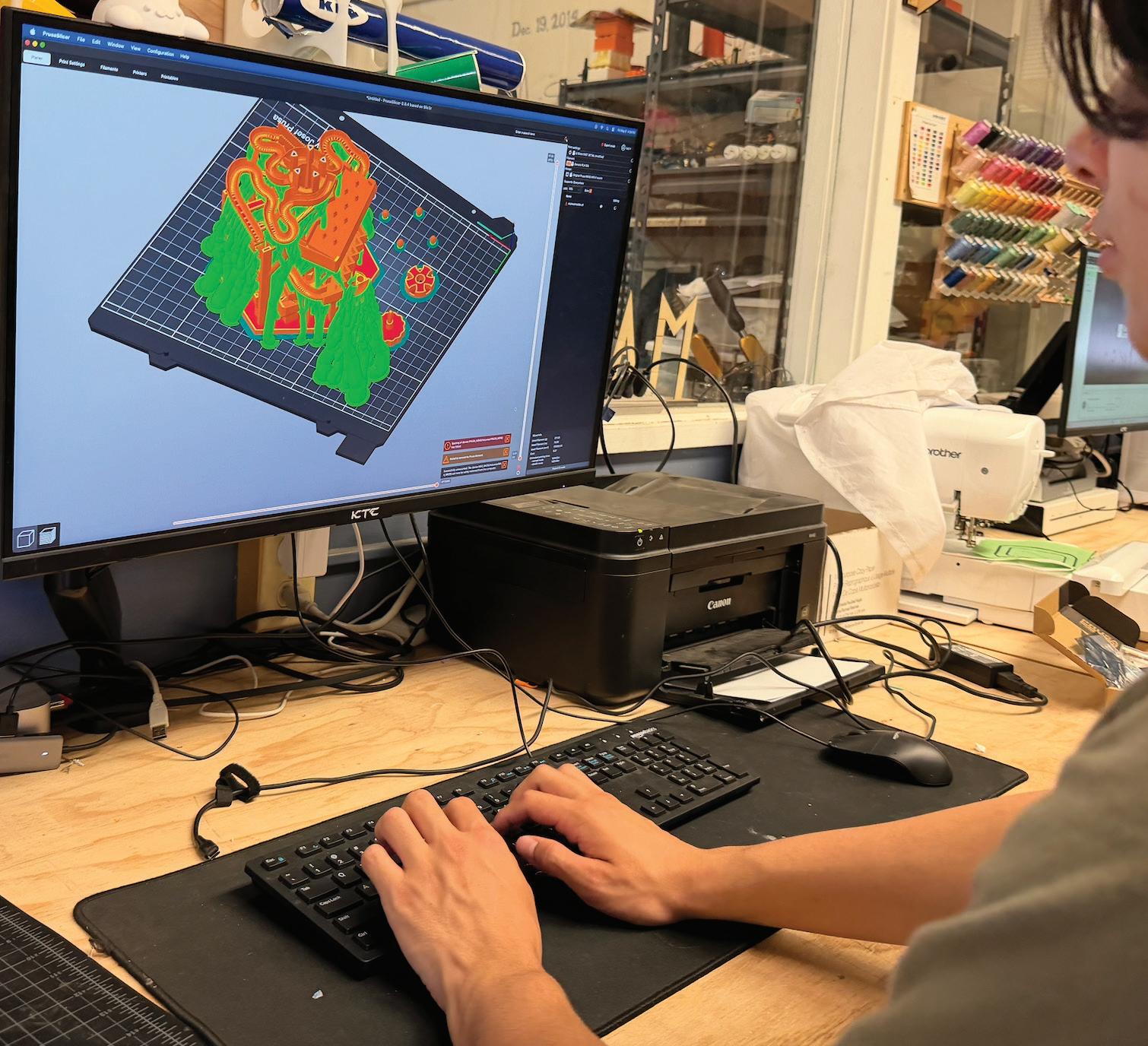
In this makerspace, the projects often connect a basic hobby or idea with higher levels of science and engineering. Gordon used the makerspace to develop his personal project by utilizing his passion and the resources at MakeX.
“One cool thing I made was my personal project of using pH to track meat spoilage,” Gordon said. “I used MakeX to help me create a 3D printed base in order to hold my device while I was testing it out.”
Additionally, Gordon has seen other students work on things that fit their passions with the resources that MakeX provides.
“I saw someone making a collection of bowls using logs from trees,” Gordon said. “I’ve seen people make keyboards from 3D printers, and also light up displays using tools from the electrical room.”
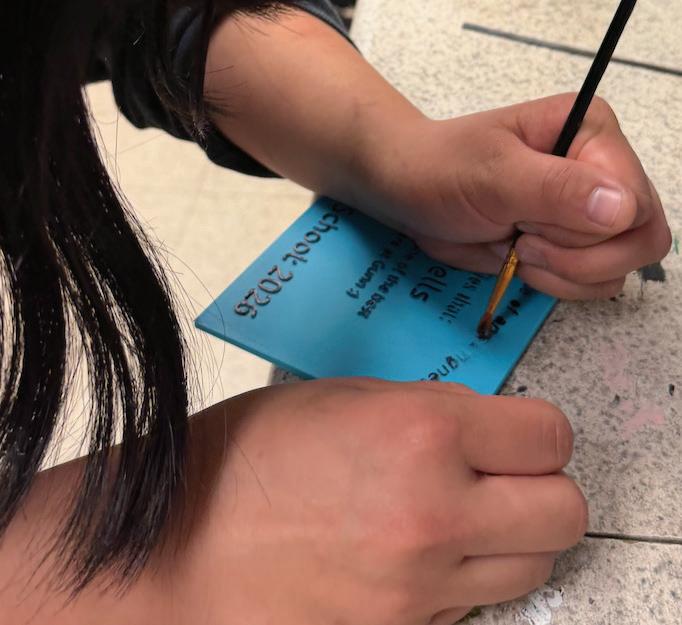
Students have not only been able to create things for their own personal use but also to help those in their community. Lucile Nguyen, a junior at Gunn High School, explains the current projects she is working on.
“I’m working on a 3D printed plaque for my teacher who recently got diagnosed with cancer,” Nguyen said. “I’m also making a video with my friends with a bunch of staff and students mentioning one word about her to basically just make her day, and we’re planning to show her next week.”
Not only are students able to work on their projects, but they also get the opportunity to be mentors to others. Not only do they
guide the new students with their projects, but they also teach them how to safely use the tools in the makerspace. As a student leader, Gordon tries to empower students who want to try something new while instructing them at the same time, which allows for their success.
“I guide the younger students to use this workspace to its full potential,” Gordon said. “I don’t do the work for them; instead, I guide them to the correct answer. That way, they can learn how to use these tools on their own and eventually start helping out other people.”
Despite its successes, the makerspace also faces challenges regarding time and square footage. While student mentors like Gordon have access to the space 24/7, the general public is limited to Friday evenings and Saturday afternoons.
“People who are visiting can only show up at certain times, so that only gives them a few hours to work on their projects,” Gordon said. “It isn’t really a lot. The building is also really on the smaller scale, so it’s hard to fit in all these tools in order to meet everyone’s needs.”
A 5th grader from Fairmeadow Elementary said the space gives younger students a place to work on hands-on projects and be creative. For example, the student was able to create a rock painting as a Mother’s Day gift.
“I’m working on some rock painting for Mother’s Day gifts,” the student said. “I like 3D printers, and every time I come, I can try different tools and make new things.”
Above all, the true value of MakeX comes from providing access to the technology. For some, the space is also a great way to earn volunteer hours while networking with other students. For others, MakeX is simply a space to build whatever comes to mind.
“I want people to know it [MakeX] exists,” Gordon said. “I really want students to know that there is a community of people who are willing to help them out and give them the resources that they need and may not have at home. All you have to do is just come in with an idea.”
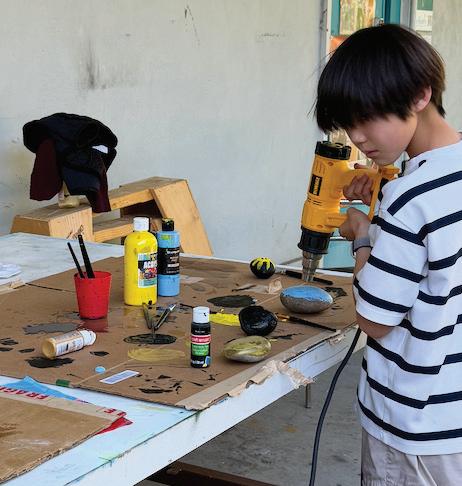
TOP LEFT – MakeX welcomes people from all ages around the Palo Alto community.
MIDDLE – Gunn High School junior and student mentor Lucile Nguyen works on a plaque for one of her teachers.
TOP RIGHT – Palo Alto High School senior and student mentor Khai Gordon works on designing a marble run using computer software.
BOTTOM – Fairmeadow Elementary School student works on painting a Mother’s Day rock gift.
Text by: XANDER YAP and MOTOKO IWATA
How students interact with AI
An AP Research student examines AI literacy education
Beyond a growing presence in medical technology and computer programs, artificial intelligence has become increasingly present in our schools. According to a study conducted by the Stanford University Human-Centered Intelligence Center in 2026, four out of five U.S. students use AI for schoolwork, but school policies have failed to keep pace.
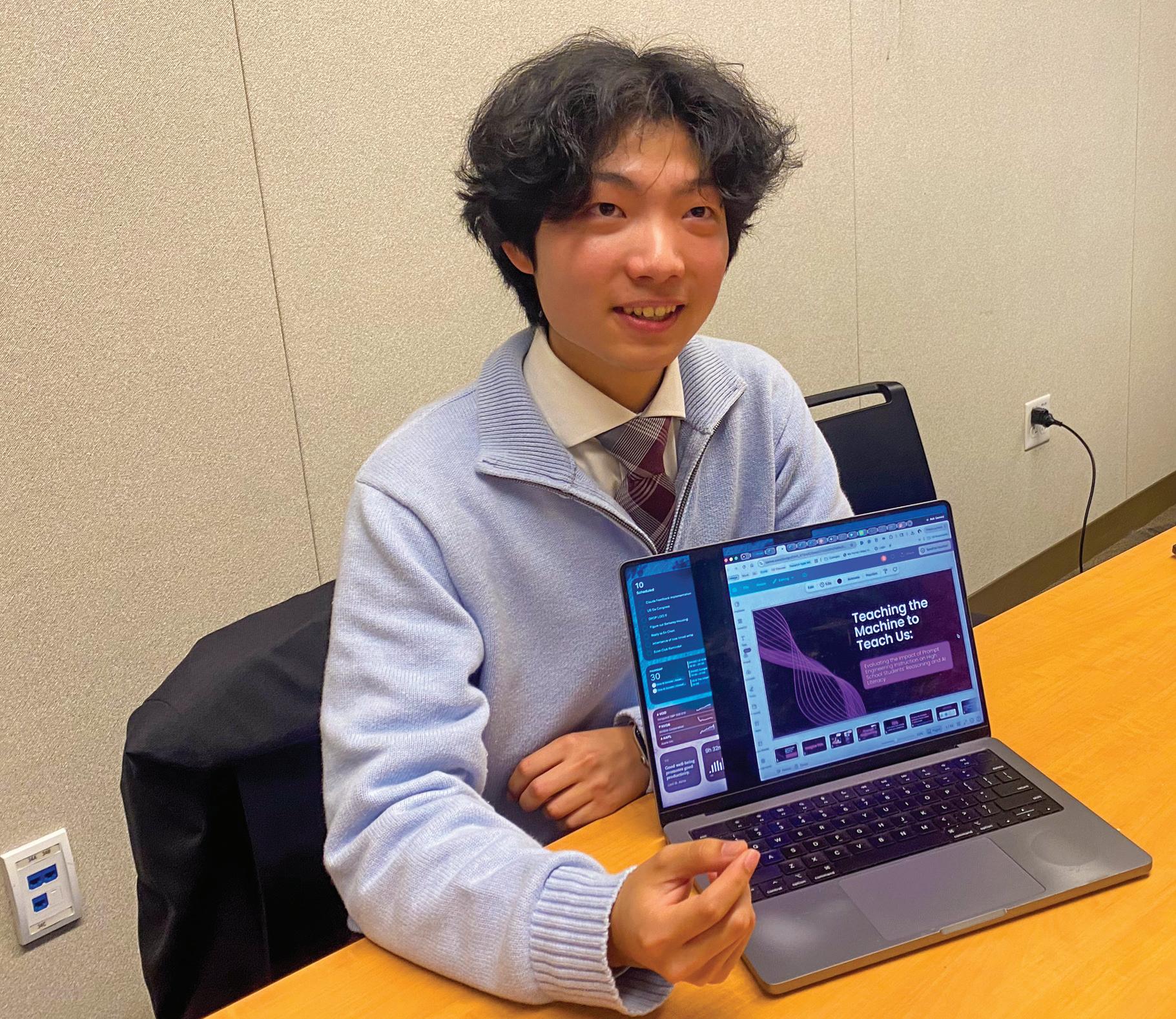
Jerry Yan, a senior in Palo Alto High School’s AP Research program, set out to learn how students are using AI in classrooms.
“I was wondering, with AI being a huge problem in the schools right now, it really raises the question of how do we interact with LLMs [Large Language Models] in the long term?” Yan said.
According to Yan, his initial research found that students’ first instinct is to use AI to replace their own thinking.
“One thing from a literature review that I found very interesting is that substitutive use is the norm,” Yan said. “If you don’t go through any prompt engineering education or AI literacy education, you default to substantive use.”
Yan’s study tested people’s AI use before and after taking an AI literacy course.
According to Yan’s AP Research teacher, Samuel Howles-Banerji, it is important for students to learn how to use AI responsibly.
“If they [students] knew how to use AI to help them learn, as opposed to just giving them answers, it would be a really powerful tool that would be accessible to everyone,” Howles-Banerji said. “I hope that the work that Jerry did can lead towards more development of those [educational] tools and push for those tools to be
in front of every student.”
Yan said that he also believes that there is miscommunication about how to effectively use AI that could stem from contradictory messaging.
“Teachers themselves don’t know how to interact with AI,” Yan said. “PAUSD gives us Gemini, but … most of the time, teachers will say, ‘You can’t use AI in this class’.”
However, Yan said his research reveals that AI literacy education can reframe the way students use AI.
“Curriculum in California or even PAUSD at least, should start shifting, whether that be in living skills or English classes, where some AI literacy is taught,” Yan said. “Something that the study has proven as being statistically significant is that if students are put through this 45 minute async curriculum, they tend to have less substantive use and also spot more AI hallucinations, which are always good for education.”
According to Yan, his research has some limitations due to study’s size.
“Because we’re in Palo Alto High School and I’m just doing AP research, only 20 people signed up,” Yan said. “Currently, in my entire paper, only 15 people finished their research. As a result, even though my study is a true experimental study, it is not conclusive because of the low statistical power it holds.”
Yan said that his initial findings suggest that AI literacy education could be adopted in the district to reframe the way students use AI.
“For the people who went through the prompt engineering curriculum, they were talking about the process of prompting AI,” Yan said. “The paradigm shifted from ‘the AI could give me results’ versus ‘the AI could help me with the process.’
Above: Jerry Yan, an AP Research student, presents his artificial intelligence research. Yan has been researching how PAUSD students engage with AI, and how AI literacy education can reshape its use.
Text by RICHARD KLINKNER and ALEX RYTOKOSKI
Synthetic shortcuts
Experimental chemicals rise in popularity despite varying success
Editor’s note: Peptides often pose significant health risks. Veritas does not condone the use of peptides or any other performance-enhancing substances.
Nine months. That’s how long it took senior Keshav Vasudeva’s ACL to heal after he tore it playing soccer. He doesn’t credit his recovery to physical therapy – he credits it to peptides.
According to a New York Times article, peptides are short-chain amino acids that aid in regulating hormones, promoting tissue repair, and reducing inflammation. Use of peptides has recently been trending on popular social media platforms like TikTok and Instagram, driving many people to try for themselves.
Vasudeva, like many, didn’t always know much at all about peptides until TikTok introduced them to him, claiming that they were the “best thing ever.” He didn’t want to try them at first – he just wanted to figure out what the hype was about – but his perspective shifted when his ACL wasn’t healing at the rate he wanted.
“Everyone was swearing up and down by BPC-157 and TB500 … my ACL wasn’t healing at the rate it was supposed to,” Vasudeva said. “I saw no reason not to try it [peptides] if all these people were getting amazing effects.”
According to Vasudeva, the supplement provided him better relief than physical therapy ever had.
“My mind was genuinely blown within maybe two weeks,” Vasudeva said. “My knee felt better than it had with nine months of physical therapy. “I was running again, and it was amazing.”
Afterwards, Vasudeva’s surface-level interest quickly transformed into a search for new peptides he could use.
“It kind of led me down a peptide rabbit hole where I started experimenting with a few different ones [outside of recovery],” Vasudeva said.
The experimental nature of these peptides can also lead to unintended consequences. During Vasudeva’s experimentation with peptides, he experienced an unintended side effect after taking GHK-Cu, a copper
“For quick reduction of injury, healing wounds, things like that, there is no evidence that [peptide use] actually works. It can be more harmful than anything else.”
–Stacey Kofman, Sports Medicine teacher
After intensive research, Vasudeva decided to give BPC-157 and TB-500 a try and ordered them to supplement his physical therapy. The results came sooner than he expected.
“BPC 157 and TB 500 are basically peptides that, instead of adding something new to your body when you inject them, tell your body [and] brain to send more tissue and repair to parts of your body in need,” Vasudeva said.
bad within like a week of taking it,” Va sudeva said.
So Vasudeva went back to the drawing board.
“I did some more research and [I learned] your zinc and copper levels should be in balance – there was an excess of cop per without an excess of zinc, Vasudeva said. “So I started taking the zinc supple ment, and almost instantly, my skin be came the best it’s ever been.”
However, the rapid results from pep
tides seen on social media often hide medical risks far greater than a skin reaction, and Palo Alto High School Sports Medicine teacher Stacey Kofman warn that the market for peptides is unregulated and lacks FDA approval and clinical research to support the safety of peptides.
“Once [a peptide] breaks down in your system, it can cause other issues,” Kofman said. “It can cause some kidney function issues and some other metabolic issues, and so that’s not a good thing to have happen, right? … Because you’re getting something off-market that is not tested well – that’s one of the reasons why it’s banned.”
Kofman also explains the lack of scientific backing behind peptide use for recovery.
“For quick reduction of injury, healing wounds, things like that, there is no evidence that [peptide use] actually works,” Kofman said. “It can be more harmful than anything else.”

Text by: DOREEN HOU and RICHARD KLINKNER
Guilty until proven human
Adoption of AI detectors erodes trust between teachers and students
When Palo Alto High School students submit an essay through Turnitin.com, their teacher can see two numbers attached to it – the first for plagiarism, and the second for AI use. While both numbers are important, the latter is becoming one of the most crucial numbers for the English department, and, accordding to Palo Alto Online, recently resulted in a 76% AI use flag that compromised a Paly sophomore’s semester of work.
According to the San Fran cisco Standard, a recently filed lawsuit against the Palo Alto Unified School District involves a Paly student ac cused of using AI on a school assignment. After being told to redo it by hand, he re ceived a D on the assignment, sig nificantly impact ing his semester grade. Despite negotiations be tween the student’s parents and the district, the district has stood firm on the teacher’s de cision to keep the student’s lowered grade.
This student’s experience is not an isolated incident –many Paly students face similar guilty-until-prov en-innocent situations, and teachers are struggling to distin guish between what is and isn’t student work.
In December, AP Language and Com position teacher Alanna Williamson said
student Turnitin AI use numbers were through the roof.
“It [AI detection] was over 40% in each one of my periods,” Williamson said. “So 10 to 13 students in each class period got flagged at like 50 to 80%.”
Williamson attributes the trend of using AI not to academic dishonesty, but to the intense academic pressure stu-
grammar here?’ … which was not really what any of us expected. We kind of expected them to take the shortcut, and we’re not seeing them do that.
Hanson also explained that AI detectors flag potential AI activity by comparing student writing to standard word patterns used by large language models such as ChatGPT.

“I remember, my heart dropped when I saw how much AI it thought that I used.”
–Nina Faust, Senior
“It’s basically looking at the word you write and what’s the next most likely word that is most common out there,” Hanson said. “When we look at an AI detector to say, ‘Oh, hey, do we think that this was written by ChatGPT or something similar,’ it’s looking to see how off that baseline is.” Hanson said AI detectors analyze past word pattern recognition, explaining that if students deviate too far from what is expected of them by the AI, they will be flagged for AI usage.
“[It’s] also just looking at ‘Is this normal for a student of high school age’ or college age or whatnot, and so it’s sort of geared toward the level of writing that one would expect for it for this type of assignment,” Hanson said.
Williamson said she takes additional steps to verify the legitimacy of Turnitin’s result once warned of potential AI use within the student paper.
“I would ask for the student’s document to be shared with me so that I can look through their revision history and see if there’s anything suspicious
in there,” Williamson said. “Like massive copy-pastes or writing that doesn’t sound like their own.”
Turnitin encourages secondary verification as Williamson does. According to Hanson, authentic human writing is messy with backtracking and deletions, with most students starting with an outline, jumping between sections, and revising, making revision history a crucial part of evaluating student work.
I used.”
While Turnitin strives for accurate detections, false positives still occur. According to Hanson, while Turnitin’s system aims for a false positive rate of under 1%, Hanson cautions against its use as absolute proof of academic dishonesty.
“That’s the only thing I’ve thought of so far, and it’s working, so everyone’s just gonna have to handwrite everything forever back to the 90s.”
–Alanna Williamson, Paly English teacher
“Most students are doing this non-linear writing, but then you have one student who pastes the whole two pages worth of text in, or writes from beginning to end, all the way down,” Hanson said. “That’s suspicious. That doesn’t tell me that the student is really writing.”
Hanson said that perfectly detecting AI-generated text is getting harder and harder, so she reframed the focus of the detection tool. Rather than using Turnitin as a tool to catch students using AI, she hopes it will help teachers to determine if AI is used as a tool or as a crutch. Furthermore, Hanson hopes teachers rely on AI detectors as dialogue tools for teachers to teach students about responsible use of AI rather than for “detection.”
Though Turnitin has helped Williamson detect students exploiting AI to complete assignments, she also said it flagged those who use tools like Grammarly that are accepted in her classroom.
“I think a lot of other kids are just using it [AI] in small ways that are like trying to get help,” Williamson said. “And unfortunately, that’s going to get flagged, and there’s no way for us to actually verify and see what they did.”
Paly senior Nina Faust said that she had her paper flagged for AI use even though it was completely her work.
“I felt pretty offended because I worked really hard on that paper,” Faust said. “ And my teacher talked a lot about how she was [going to] punish anyone who used AI. I remember, my heart dropped when I saw how much AI it thought that
“We know this isn’t a perfect system,” Hanson said. “Those are just indicators that something might be up, and you might want to take the next step to investigate further … Your AI detection score should never really be considered as the end-all be-all of understanding if AI is in the paper.”
Acccording to Hanson, Turrnitin constantly makes changes to its AI detection model to adapt to rapidly advancing AI models.
“This is a very fast-moving space, so we have monitoring in place that is consistently looking at our models … comparing them to future models that are coming out,” Hanson said, “We do have an open dialogue with some of the major LLM providers to understand when new models will be coming, so we can do some testing in certain cases and try to keep pace.”
tin’s adaptability, however, as sometimes the release of models outpaces the release of AI detectors.
“[It’s] not always possible,” Hanson said. “We can’t always line up our updates with the newest thing that comes out, because sometimes we just don’t know, but we’re constantly working with other folks in the industry, and are tweaking what we’ve put together.”
Based on an article Turnitin posted on April 9, 2024, it has reviewed over 200 million papers since its launch in April 2023. That number will only increase in coming years.
Paly senior Jerry Yan, a researcher in AI prompt engineering, said that despite the low false positives AI detectors advertise, the errors detectors make still affect a large number of people because of the number of papers in the system.
“Even if, let’s say they [AI detectors] claim to have a 95% accuracy, that means 5% are still being falsely flagged,” Yan said. “Which is like, let’s say 10 million people turn it in ... 500,000 people will get flagged.”
“[AI detector development] is going to become how AI becomes really a helpful and supportive part of education, rather than just a signal or indicator to police or be punitive.”
–Gretchen Hanson, director of product management
Hanson sees improvements in AI detectors as a means to transition AI detection from catching students being dishonest to helping students grow.
“And I think that [greater development of AI detection tools] is how AI becomes really a helpful and supportive part of education, rather than just a signal or indicator to police or be punitive, which is not the right environment for anyone to learn effectively,” Hanson said.
There are some limitations to Turni-
Williamson said that while Turnitin is not the most effective tool to prevent AI use, it is the only option they have. She anticipates that the technology will improve for more precision in detecting AI use for student work.
“Hopefully in the future things [AI detectors] will get more advanced, where we can actually see exactly what someone did and verify things,” Williamson said.
However, one way Williamson uses to combat the high prevalence of students flagged for AI use in their papers is to have everyone write the paper by hand. Since she implemented this method in her classroom, the majority of her students now display 0% AI use.
“That’s the only thing I’ve thought of so far, and it’s working,” Williamson said. “So everyone’s just gonna have to handwrite everything forever back to the 90s.”
ART, REIMAGINED
Palo Alto exhibition features interactive digital art installations
Displayed on a cubic structure built from video screens, a piece reveals an extremely detailed digital landscape composed of thousands of generated images that change and evolve in real time.
This structure is part of “Infinite Loop,” the current exhibit on display at NODE on the corner of University Avenue and Emerson Street in downtown Palo Alto.
NODE Foundation is a nonprofit art gallery designed to bring digital pieces into a physical setting. “Infinite Loop” features work by prominent digital artist Mike Winkelmann, more widely known as Beeple.
The exhibit will remain open until June 28, available for free public access Fri day through Sunday, and entrance to the gallery is free.
Phil Mohun, executive director of NODE, de scribes it as a network of people and physical places with the purpose to give digital creativity a physical presence.
“If you try to go to a traditional art place [gallery], you get told it’s [digital art] not art, or it’s too expensive to get the screens, or our IT depart ment doesn’t know how to do that,” Mohun said.
NODE opened in January to address these limitations with its open ing exhibit “10,000,” which featured Cryp toPunks, one of the most well-known non-fungible token collections.
Winkelmann, known for his extensive NFT-based digital art, emphasized the importance of spaces like NODE during a speech at the “Infinite Loop” preview.
“Seeing a place like this that really cares about elevating digital art, giving a voice to this crazy art form that still doesn’t have a huge amount of different outlets is super, super special,” Winkelmann said.
One attendee, Torve Indhal, said that the exhibition connects to his background in deep tech.
“Coming to a digital art gallery gave me a connection between physics, the hidden world of what’s going on with atoms and everything, and it connects me to art,” Indhal said. “So I find it very, very interesting.”
merse viewers in the environment.
“The sculpture is an AI model from 2023, and the ceiling and walls are an AI model from this week,” Mohun said. “You can see the difference in how good the tools have gotten.”
Beyond the visuals, a key development is the ability to directly engage with many of the pieces. Either by accessing a custom website or through a kiosk at the gallery itself, the viewer can alter the images being displayed.
“We wanted to create a space where digital artists can have a space.”
— Phil Mohun, director of NODE
The pieces included in “Infinite Loop” are built using software tools, including newer artificial intelligence models, allowing for the creation of dynamic
“Rather than static displays, the entire exhibition is engineered to be an immersive dialogue that transforms passive viewing into an active experience between the audience and technology,” Winkelmann
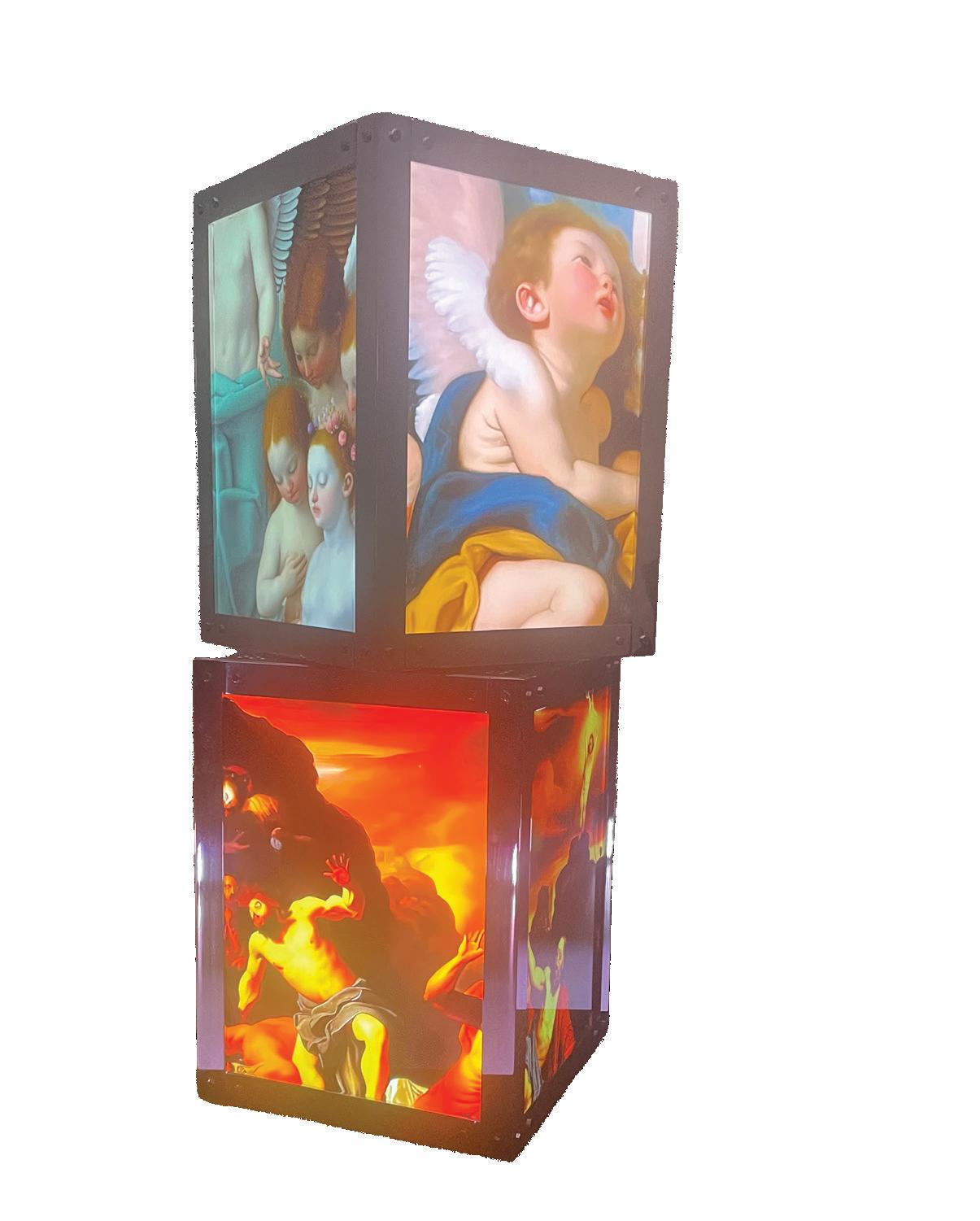
One piece, “Heaven and Hell,” showcases a kinetic sculpture powered by generative AI trained on depictions of “heaven” and “hell” to create a continuously evolving piece. The sculpture sits in a room where the ceiling and walls showcase AI-generated visuals to im-
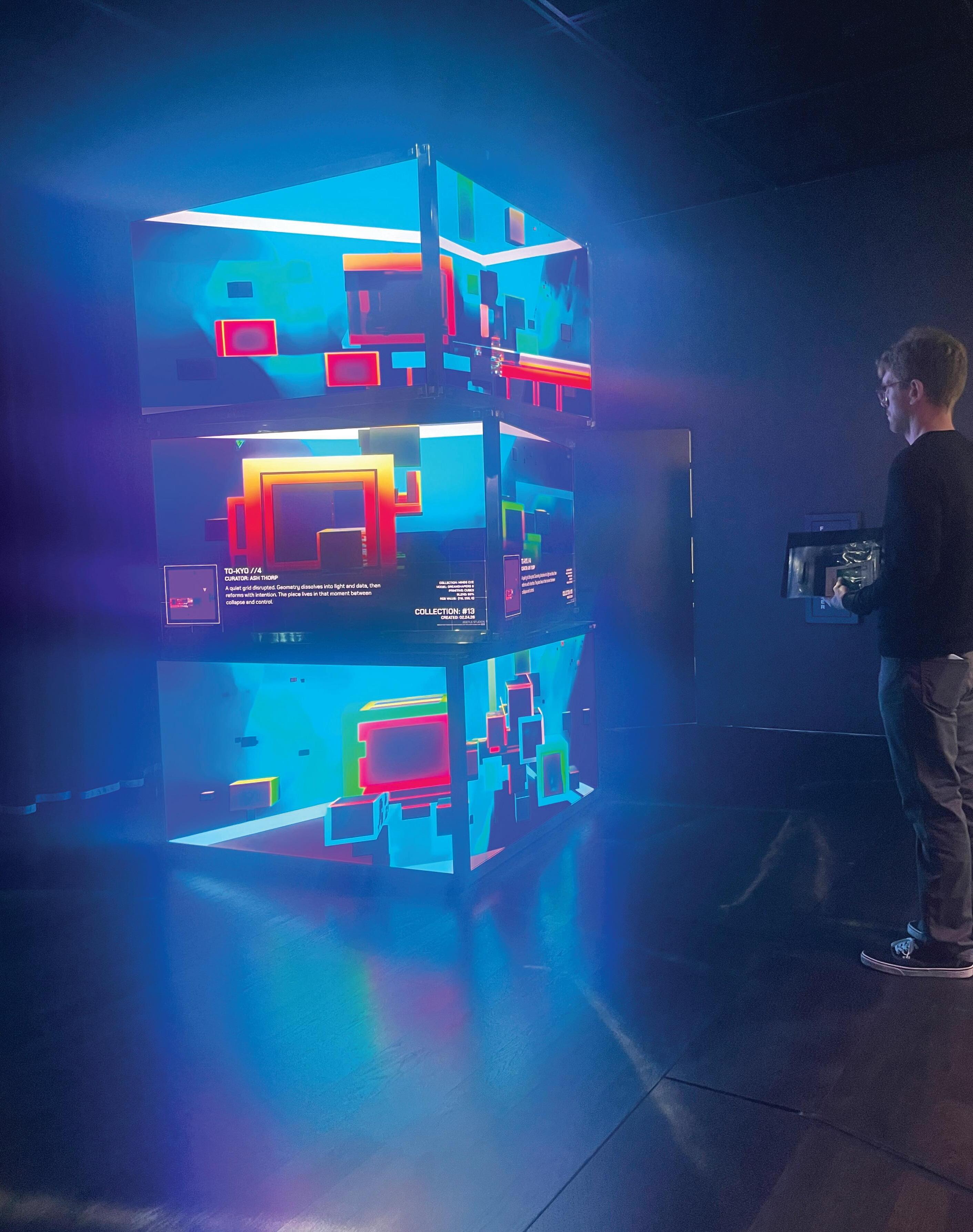
In another piece called “Diffuse Control,” curators select images to feed into the system, which uses a diffusion-based AI model to generate its own physical interpretation of the images across a three-layered rotating installation. Because the visuals continuously change, viewers can capture a specific moment of the display, creating a unique print.
“I think that these tools augment creativity,” Mohun said. “They don’t restrict it. They let you do more, basically.”
Looking ahead, Mohun believes that technological tools such as AI will increasingly be integrated into art, whether it’s digital or physical.
“You might use an AI model to help you imagine different versions of the painting before you create it,” Mohun said. “Or if you’re creating a sculpture, you might make a 3D render of the sculpture using tools. So it’s like this computer-aided design is going to become a part of, I think, many people’s practice.”
Winkelmann described the purpose of the exhibition as exploring what digital art is capable of.
“It is fundamentally about proving that digital art is a medium with inherent potential to democratize art,” Winkelmann stated.
RIGHT — “Diffuse Control” LEFT “Heaven and Hell”

Editor’s Note:
Welcome to Via Verde, where you can travel around the world through our unique Paly student lens.
As a part of Incubator Spotlight, Via Verde is thrilled to share our exciting adventures and travel tips with the fascinating stories from Veritas and Chomp. In this issue, you’ll travel through funky New Orleans neighborhoods, lushious Spainish countryside, and follow Paly Seniors on their college visits. I am excited to present Via’s third issue in Volume 6, my first issue as Editor in Chief. I would like to thank our previous editors for making this opportunity possible as I begin this journey.
Bon Voyage!
— Julia Curtis, editor-in-chief
Booked for the Summer
Paly students reveal their summer travel plans
“I’m going to Hawaii with my family and then I’m going to Croatia for a school tour. I’m excited because I’ve never been to Croatia and I like swimming in Hawaii. In Hawaii, we’re going to the beach, and then in Croatia, we’re doing a music tour with Paly Choir, so we’re gonna be singing folk songs for a bunch of people on the street.”
— MUSTAFA GULER 9th grade


“I’m travelling to Reno, Nevada for a volleyball camp. I am so excited because volleyball is my favorite sport and it’s so fun.”
“The first week of summer, I’m planning to go to Korea with my mom, my brother, and a couple of our friends. I have a club at Paly that’s a penpal program with North Korean defectors who go to a school in Korea. We’re planning on visiting the high school to meet them and further our relations with them.”
— MIRAI MATSUZAWA
11th grade
— MARIAH BALL
11th grade

Via Verde Student Travel Magazine
First Day of Forever
Seniors visit their prospective college campuses

By the time senior year winds down most Palo Alto High School students have made their post-paly decisions. For many of those who are going to college, the deposit is in, the caps have been thrown, the roommates have been found. But between commitment day and move-in day, there is a strange in-between ritual: the admitted student visit. You go to the campus where you will spend the next four years of your life, and you try to figure out if you made the right call.
When Paly senior Finn Schoebel arrived at the University of Chicago for its admitted students weekend, the campus felt different than his initial tour. This time, he walked through campus? as someone who belonged.
“It’s basically my first real experience on campus… being like, Wow! This is where I’m going to spend the next four years of my life,” Schobel said.
The best part, he said, was meeting other incoming freshmen: although the structure of the weekend made that harder than Schobel expected.
“The only way you could make friends is
if you already had a clique,” Finn said.
The food was a mixed bag. The university provided boxed lunches, which Schoebel described as “a little bland.” Schoebel took to the food trucks that were located on campus, but they were only “good grub, not great grub.” Luckily, he found his favorite meal at KAVA.
“The worst Kava food you’ll ever have is about twice as good as the best Chipotle,” he said. “I promise.”
Schoebel left Chicago confident in his decision. His advice: go visit the school you’ve committed to, even if you’ve already made up your mind.
“You only get to do that once,” Schoebel said. “I recommend it to everybody.”
Others had a rockier start. Max Merkel, heading to Baylor University in Waco, Texas, arrived at night to a quiet campus and a town that felt dead.
“I was like ‘I don’t know about this place,’” Merkel said.
What won Merkel over was the people. He described a recurring warmth of the community.
“There are stories of people moving there and not planning to stay indefinitely, and then they end up doing it because the people are so awesome,” Merkel said. “Southern hospitality, of course.”
Sometimes things don’t go to plan. Paly senior Boris Nezlobin, visited UC Berkeley, but when was on his way to a lecture when an elevator got stuck between floors. He ended up being stuck there for half an hour.
“911 hung up on us and didn’t call back,” Nezlobin said.
Although it was not the best way to see Berkeley, he wasn’t super worried. He then spent the time talking to the once strangers around him, and he still chats with one of the guys he met in that elevator.
No visit will be perfect: mediocre food, awkward icebreakers, or getting stuck in an elevator. But thats the point.
As Schobel puts it: “Go visit the college you’re going to. It’s pretty cool.” v.
Photo by Max Merkel
Text by Arjun Jindal
POINTING FOWARD — Senior Max Merkel poses with a Baylor Bears-branded Toyota Land Cruiser outside the admissions center during his admitted students visit to Baylor University in Waco, Texas.
Text by JULIA CURTIS
Big Easy Blues
Spring break in the Jazz capital of the country: New Orleans
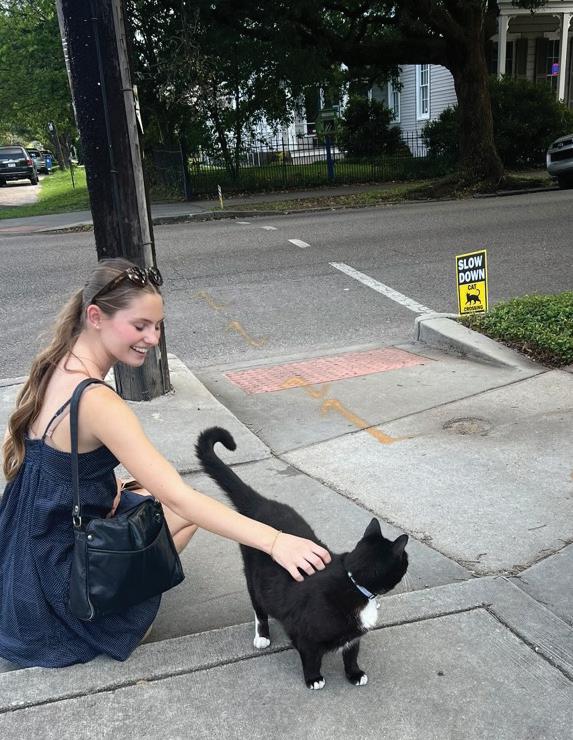
CAT CROSSING (main) — As I strolled down Magazine St. towards Peaches’ Records, a furry friend helped me cross the street. Photo: Mary Marsh

FAMOUS FOR ITS extravagent
Mardi Gras festivals, its unique bayou ecosystem, its steaming hot beignets, its crawfish delicacies, and maybe most of all, its prominent jazz culture, . I visited NOLA during spring break, primarily to visit Tulane University, but ultimately ended up uncovering the authentic music culture within the “Big Easy.”

After touring Tulane University’s lush campus in mid-preparation for their annual Crawfish Festival, I walked down streets lined with classic southern architecture and a surprising amount of wandering cats. In the daytime, the residential and fairly quaint neighborhoods sparkled with southern charm. When night rolled around, however, is when the party starts.
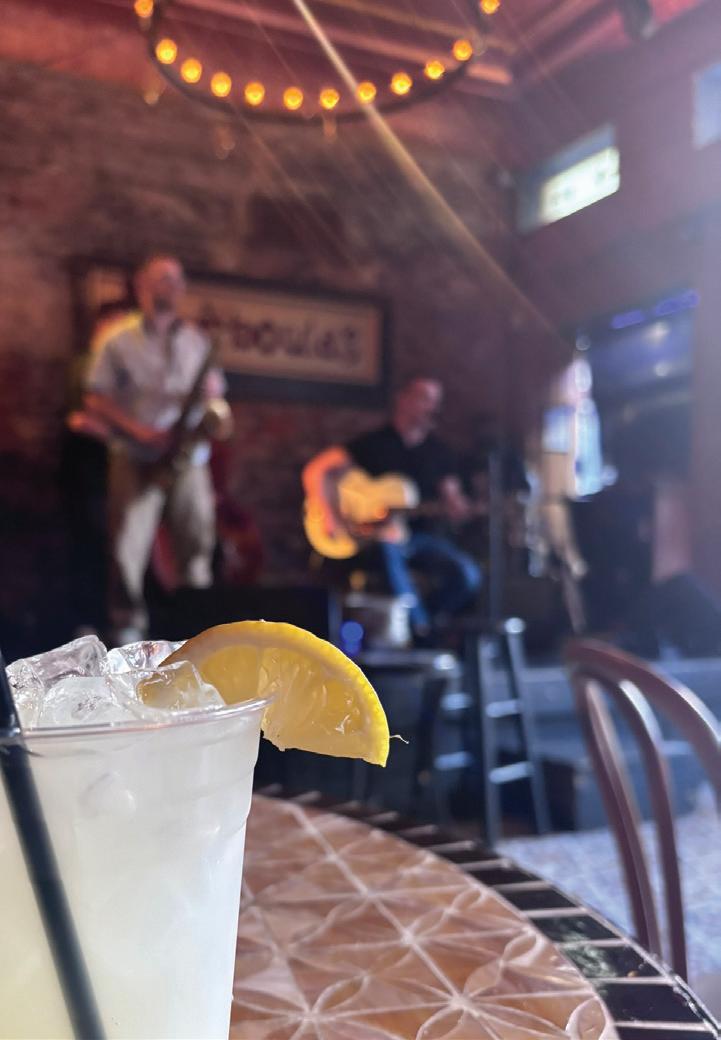
It’s hard to escape music on Bourbon Street, the most famous party neighborhood in the New Orleans French Quarter. Clubs line the street, most with live bands, as the hosts encourage passersby to come in for a drink. In the road, instead of cars, there
are groups of synchronized shirtless drummers, breakdancers taking audience volunteers, and talented teens tapping complicated rhythms with drumsticks on upside down paint buckets.
The quieter version of Bourbon Street is Frenchman Street, where almost every establishment is also dedicated to music. Live jazz spills out of the open windows and doors of every restaurant, as the hosts beckon pedestrians to come in. At Bamboula’s restaurant, I had a front row table facing a small stage hosting a bass, saxophone, drum, and guitar combo. Not only was the bread pudding life-changingly delicious — recommended above every other dessert on the menu by our waiter, and rightfully so — but the music was authentic. The foundation of New Orleans jazz is audience celebration — the musicians even explicitly encourage it —, such as hooting and hollering after a scat solo or saxophone riff, unlike a typical classical concert. While loud talking is discouraged, the live jazz environment encourages the audience to let the band know when they’re enjoying the music.
Next door to Bamboula’s is The Maison, where a classic brass jazz combo, complete with drums, bass, guitar, two trombones, two trumpets, and a saxophone, were in full swing when I arrived. After her smooth scat solo, the band leader sat in her chair, playing her trumpet one-handed while the entire restaurant applauded. When their set ended, a rhythm and blues jazz combo entered, led
by an eccentric, orange afro-haired woman. In contrast to the smooth, classic jazz of the last group, these musicians rocked the restaurant with 80s R&B jazz riffs.
Frenchman Street is also home to the Louisiana Music Factory record store, with walls covered in vinyl, band T-shirts and black-and-white posters. Boxes of donated records sat below rows of new vinyl and CDs, from New Orleans jazz to rock and roll to country classics. The further back into the store I walked, the more niche and inexpensive the music became, mostly used one-hitwonders and $3 donation records. The star of the show was Snooks, the residential tabby cat wandering between walls of Beatles CDs and Elvis records. After sufficiently petting his Majesty Snooks, I decided on an Amy Winehouse album, a Peter Paul and Mary album, and a Beatles CD.
On the quieter Magazine Street, beside thrift stores, fun boutiques and coffee shops, Peaches Record store hosts expansive walls of records and CDs of all genres and prices. Originally a historic Woolworth store, Peaches’ left wall is taken up by the original lunch counter, bar stools, and soda machine. From the wide array of diverse genres available, I picked out a Weezer record and a Joan Baez record to take home.
Undeniably, New Orleans culture is one of the most authen tic and definitely a must-see for all music — and cat — lovers. v

CANAL STREET PALMS (right) — Down the middle of New Orleans’ biggest boulevard, Canal Street, are two long rows of palm trees spanning almost four miles. In between them, the city’s classic, old-fashioned streetcars run to and from each end of the “Big Easy.” Photo: Julia Curtis
BAMBOULA’S BAND (left) — Sipping on a fizzy lemonade, I watched a classic jazz combo play in a Frenchman Street restaurant. Photo: Julia Curtis
Spain in the Summer
A JOURNEY THROUGH CANTABRIA
When people think of Spain, the golden beaches of Barcelona and the bustling city streets of Madrid are usually what first comes to mind. These stunning destinations are located in the center and the southern part of the country.
Northern Spain is a whole different world: the landscape of lush emerald hills and charming villages greet visitors during the summer months. From June 10 to June 24, I visited the Spanish province of Cantabria, known for its fresh seafood and beautiful beaches. This wasn’t my first time visiting Northern Spain, as I had gone the previous November with my brother’s soccer team. I traveled with my mom and my younger brother, who had signed up for a soccer camp in Northern Spain.
To kick off my summer trip, I took a hop-on-hop-off bus around Santander, Cantabria’s capital city. I didn’t get off at any specific stop, instead looking through the window and listening to the tour guide
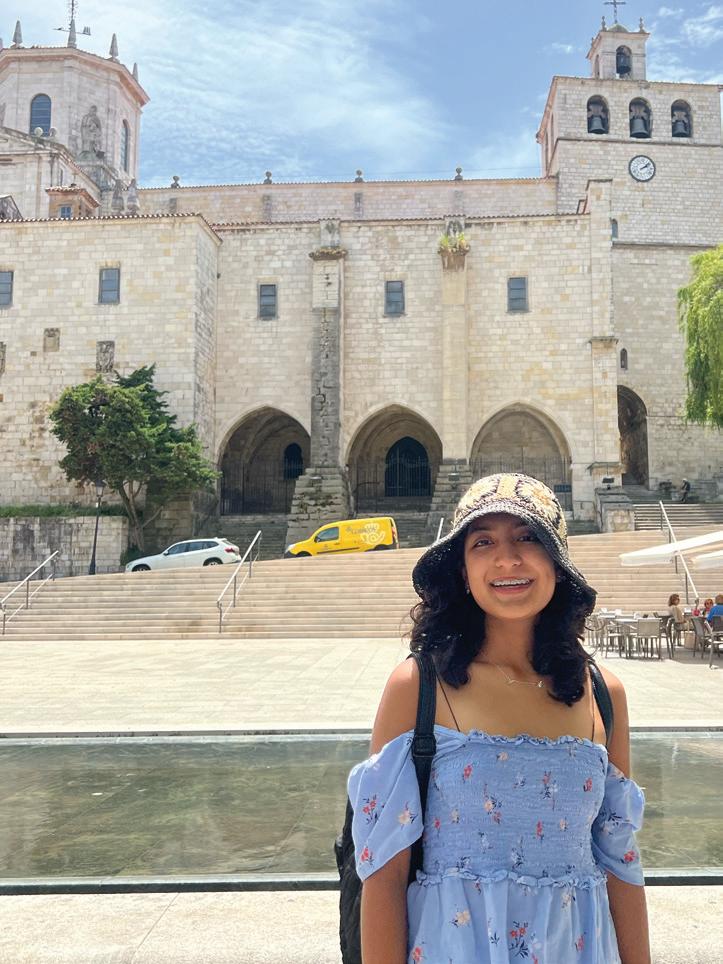
city. From the peaceful suburban neighborhoods to the crowded downtown area filled with commercial outlets, I got to see a glimpse of everyday life in Santander.
My brother participated in a soccer camp in the mornings with the local team, Racing Santander, so my mother and I did our own exploring.
A few days into my trip, I visited El Capricho, a famous little house designed by the renowned Spanish architect Antoni Gaudí. After a 30-minute drive through rolling green hills, I saw the colorful building with stained glass windows and fancy turrets in the distance. While exploring the interior, I was amazed by the intricate flowers etched into the wall and the indoor greenhouse, a feature practically unheard of in the 17th century. Nature was Gaudí’s main source of inspiration, and the picturesque landscapes of Cantabria certainly contributed to this architectural masterpiece.
My final adventure was a bit of a mistake, but it was worth it in the end. My family had meant to book a food tour in the bustling metropolis of San Sebastián de Donostia, a few hours drive from Santander. As we drove up to a small rural village nestled in the verdant green hills, we realized we might have booked the wrong tour. It turns out that we visited the wrong “San Sebastián”! San Sebastián de Garabandal, the village we ended up exploring, is known for being the site of a holy miracle: between 1961 and 1965, four young girls reported seeing apparitions of the Archangel St. Michael and the Virgin Mary. We visited their famous church where we watched a mass take place. Although this side adventure was an accident, the experience turned out to be a small corner of spirituality and peace in our exciting adventure.
A trip along Spain’s northern coast can never be complete without a visit to the beach! Santander’s beaches are warm and picturesque, with turquoise waters and golden sands. My personal favorite was Sardinero Beach, just across the street from my hotel. I enjoyed paddling through the rushing waves and soaking in the radiant sunlight.
culture — which, given their shared history, should not be a surprising fact. After all, Mexico was a Spanish colony for three centuries. I am half Mexican and I enjoy learning about cultural differences between Mexico and the “mother country,” Spain. The Spanish spoken in Spain sounds harsher and more aspirated than the smooth and rapid dialect I hear my mom and uncle speak. Spanish tortillas are made of egg, ham, and onions; they are quite different from the corn flour tortillas I make quesadillas with at home. Spain feels special to me because some parts of the culture seem familiar, but there is also a lot for me to learn and explore. In other words, it feels like cultural deja vu.
I am enchanted by Spain’s natural beauty and rich culture, and I plan to keep visiting as often as I can. Others may grow disillusioned visiting the same country time and time again, but for me, there is always something new to explore in Spain, whether it’s a secluded village in the midst of the Cantabrian hills or a steaming bowl of aromatic paella from a little restaurant in Santander. v

describe the unique architecture of the
Every time I visit Spain, what always stands out to me the most are the similarities between Spanish culture and Mexican
Text by Liani Ragade
Photos by Liani Ragade and Adriana Flores
Sardinero Beach —This was my favorite beach in Cantabria, and it was just across the street from my hotel.
Exploring —I visited the Cathedral of Santander while exploring this vibrant and historical city.
AN ARCHITECTURAL GEM — El Capricho, one of Gaudí’s most famous works, resides in the Cantabrian hills. The building is just a 30 minute drive from Santander, and I enjoyed wandering around the lush flower gardens.
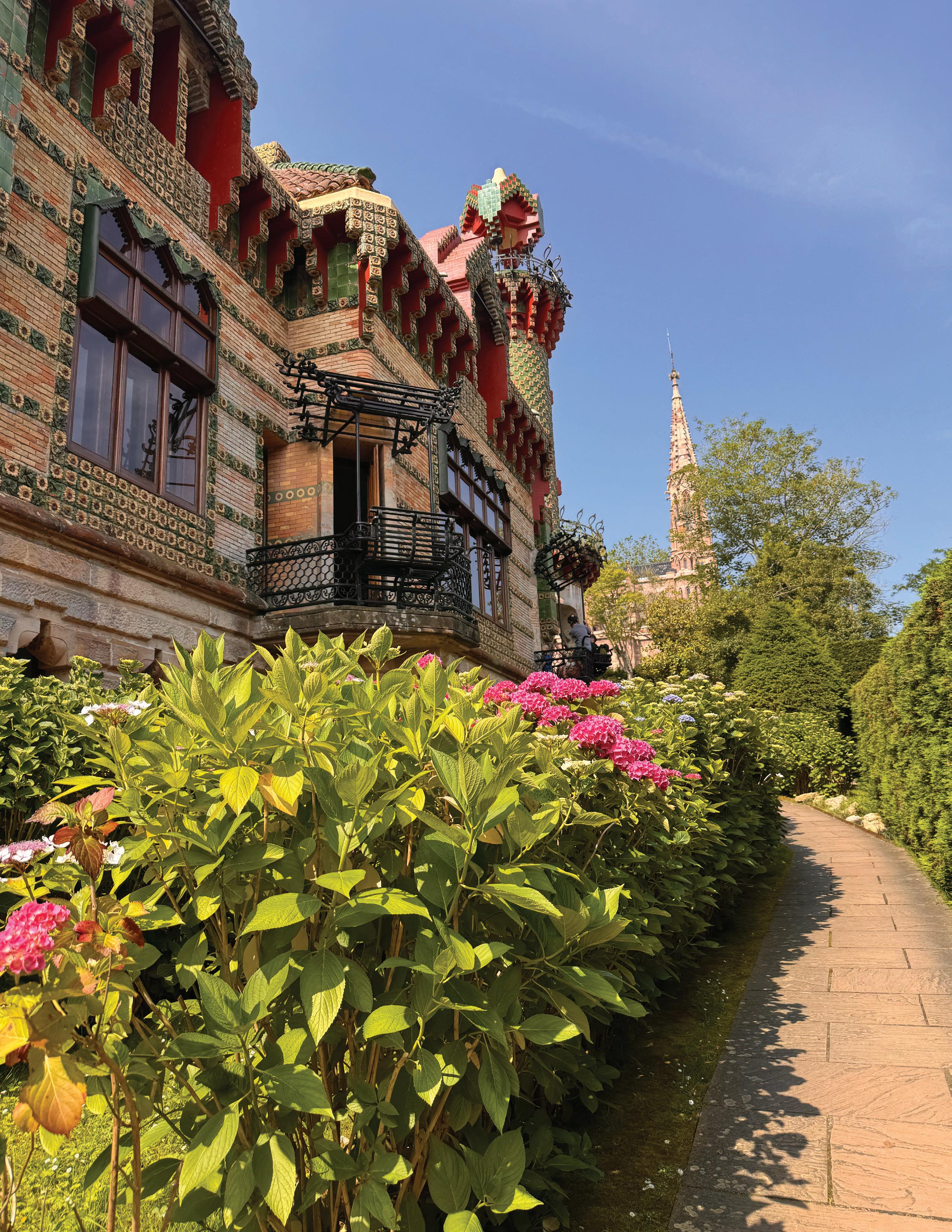
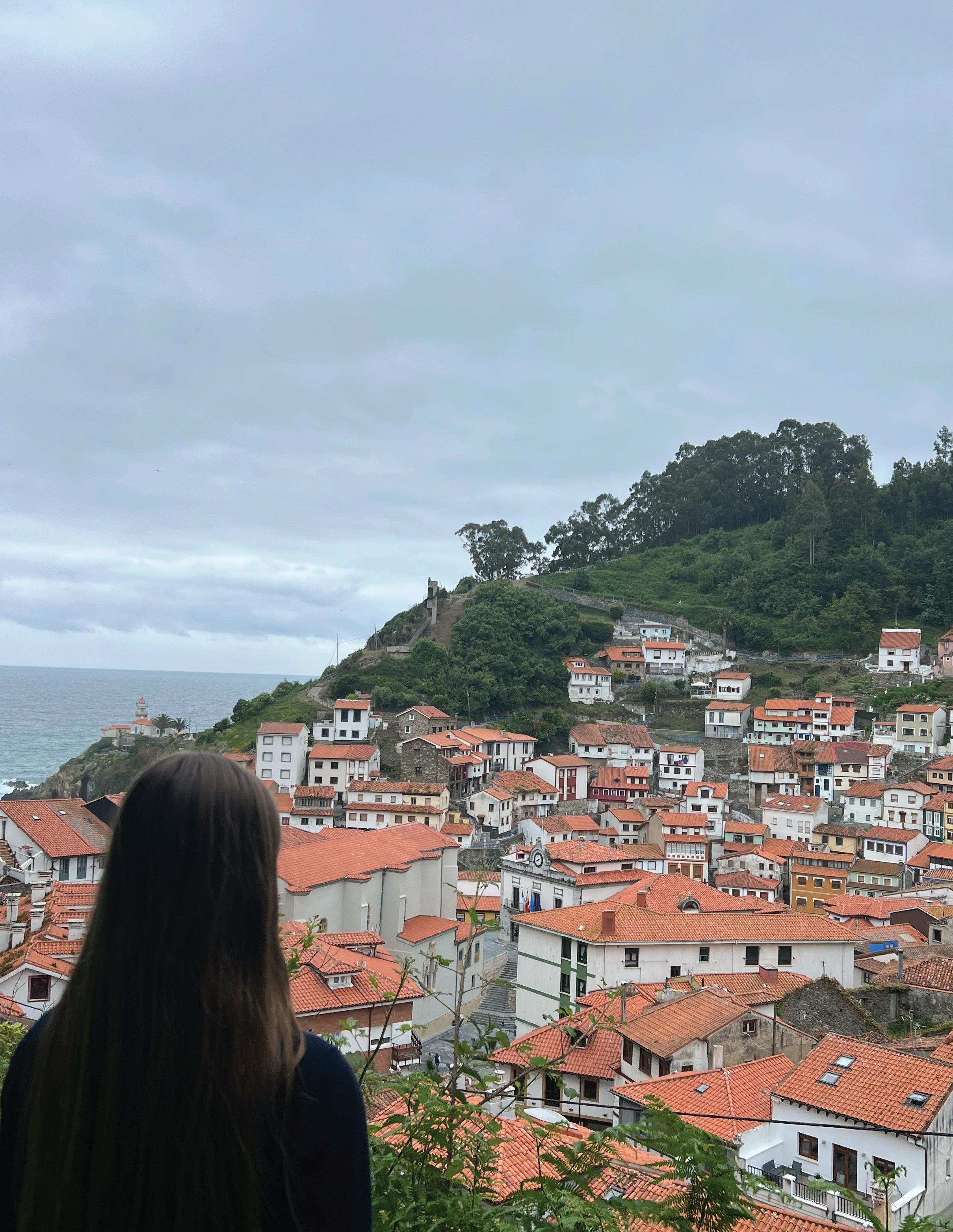
TRACKING TRAPS!
Via’s
best advice to avoid tourist traps
Vacationing in Spain. Photo by Julia Curtis
Excited at the chance to take some time off and visit someplace new, you eagerly pack your bag in preparation for your long-awaited vacation. Finally! Sweet freedom. With the world as your oyster, it's time to relax, explore, and have a good time.
But as you’re enjoying your well-deserved vacation, you run into yet another expensive scam. Instead of enjoying time off, it’s yet another problem to worry about. Ugh.
To help you avoid any pitfalls on your adventures, we asked the Palo Alto High School community for their travel experiences.
DON’T
TRUST STRANGERS
We all know the phrase “stranger danger.” It’s even more true if you’re in a new country — you should be more wary of people you don’t know.
Junior Invanka Kumar and her friends had a worrying experience with some strangers on a school trip to Spain where she wanted to get the most impressive photo within her group.
“I'm like, ‘We have to go climb somewhere. We need to get a good story’,” Kumar said. “And this guy shows up out of nowhere, and he's like, ‘Do you want me to take you guys to a good picture location?’”
Determined to win this photography contest, Kumar and her friends followed the man. After all, two members of the group could speak Spanish. In a group of 4 against one man, what’s the worst that could happen?
“We ended up walking the staircase ... and we're basically on his terrace,” Kumar said. “Then we keep going ... and then he disappears out of nowhere.”
At this point, Kumar is not too worried yet, and the whole situation happens to be fairly entertaining.
“We see those two super, super cute girls,” Kumar said. “They're like, eight years old or something. [...] And they start doing gymnastics. They do flips, they do splits, they're talking to us. I'm practicing my Spanish with them. Why not? It's a fun occurrence.”
However, these people did not turn out to be as innocent as they seemed.
“Out of nowhere, we hear a super loud scream: ‘Guys, they're pickpockets, run away, go,’” Kumar said. “And then we see that these girls have come dangerously close to us and we're scared we're gonna lose our stuff. So we all clutch our bags, and then we go, we descend and we basically run away from them.”
Even the nicest-looking people can have ulterior motives, and no matter how genuine a person seems, you should never let your guard down around

AV2. YOUR GROUND 3.
DO YOUR RESEARCH
acations are exciting, and it’s easy to get carried away — every cute shop, cafe, and souvenir seems to be calling your name.
But don’t be fooled by the Eiffel Tower keychains and the aesthetic dining setups. Restaurants and shops geared towards tourists are often egregiously expensive when compared to common prices.
History teacher Katya Villalobos fell for such a tourist trap on one of her first trips to Austria.

“We decided to do [...] the ‘Sound of Music’ tour in Salzburg,” Villalobos said. “We spent a lot of money on it, and it was okay, but we realized that we shouldn't have done it [the
tour], that we probably could have done it on our own.”
As it turned out, the true goal of the tour was to get participants to buy from one specific shop. In hindsight, Villalobos believes the tour was a scam, just like many other spots in major tourist centers.
“If you go into those restaurants and cafes, they're always more expensive than the ones you find if you go literally three blocks in,” Villalobos said, adding that a little research would help avoid these problems.
“Just research,” Villalobos said. “There's so much stuff available now. I didn't have access to the Internet. [...] The Internet wasn't as robust as it is now. There's much more information that people can use.”
STAND
s a tourist, it’s normal to want to lay low and blend in. Visiting a foreign country without much knowledge of the language, culture, and local practices can feel intimidating.
However, being a passive doormat is a recipe for getting duped, so it is important that you stand up for yourself when necessary.
Palo Alto High School sophomore Genevieve Leighton experienced such a trap on a trip to Costa Rica, where a scrape with a motorcyclist resulted in the loss of several hundred dollars.
“We were going down a highway when this motorcyclist comes out of nowhere going really fast,” Leighton said. “Then the guy hits us in our car. Hits us. Not the other way
around.”
As the two parties tried to settle the situation, the motorcyclist provided them with an offer: Hand over $400 and he will walk away.
Not wanting to cause trouble, Leighton’s family handed over the cash and left it at that.
“My mom was like, we’re on vacation,” Leighton said. “Just give him the money and then we can go.”
In the moment, keeping the peace might seem like the best thing to do, but often stand ing your ground will get you much better re sults.
“My dad actually wanted to call the police,” Leighton said. “I think we could have saved those $400 if we had.”


GIT’S NEVER FREE
Everyone appreciates a free gift, but unfortunately, those “free” items often have a hidden price. Whether it’s a trinket, a picture, or a snack, accepting something free from a random stranger is rarely a good idea.
After you receive the offering, the seemingly generous stranger could turn into a badgering solicitor and demand payment.
Senior Harrison Lan once fell into this sticky situation after taking a “free” photo with a bootleg Spiderman in New York while on a tour group with his mom.
“I was really young,” Lan said. “[I thought] it was free, and when we got a photo and [started] walking away, this guy started chasing after us [repeatedly asking for] $10, $15 or whatever.”
Soon after, the man started repeatedly
yelling for cash.
“Like, ‘Give me your money. Give me your money,’” Lan said. “I'm like, no, because it's so stupid. Why would you pay for a photo? … Not to break your hustle, but I think it's kind of stupid that they're trying to lure you into getting a photo.”
According to a report by Newsweek, the Times Square Alliance found “one in five New Yorkers has been touched without consent by a costumed entertainer in Times Square.”
Although Lan managed to escape without paying, many others do not. While a free gift may seem tempting, it is better to refuse than to end up paying a high price for something you never asked for.
MIND THE GUIDE
oing to a new country can be daunting — and no matter how much you research, there’s always a chance you might miss a hidden gem. That’s why many opt for tour groups.
In a tour group, your only job is to have fun, keep up, and enjoy your vacation. Some might find it stifling, but for Paly librarian Sima Thomas, the tour guide is a feature, not a bug.
“Having a tour is really what you need to get the inside information or the history,” Thomas said.
Still, this convenience means that you’re at the mercy of your tour guide’s schedule. During her honeymoon in Bali, Thomas found activities like this can be a mixed bag when her tour guide brought them to a restaurant that was clearly not
up to snuff.

“The food wasn't good,” Thomas said. “The restaurant just filled up with bus loads of tourists,” Thomas said. “It was like fast food and it was pretty expensive for what it was.”
Thomas said that while she has had good experiences with guided tours, it’s important to read reviews and always vet your tours.
“It's always a balance of finding a good guy who is gonna — you have to pay them, and that's their job — but also somebody who's not just doing it for the money,” Thomas said. “[someone] who actually loves the thing that they're showing off the place that they're showing off.”
So before you book that next flight to your dream vacation, make sure to check back on all our advice — don’t trust strangers, stand up for yourself, and do your research.
Vacations are about enjoying yourself as much as possible, and we’re here to help you do just that.
Bridging the gap
STUDENT REASONS BEHIND TAKING A GAP YEAR

At the end of high school, there’s the conventional path: going directly to college. Palo Alto High School students often choose this route; according to the 24-25 Paly School Profile, 83% of students go straight to a four-year institution after graduation.
While Paly culture can make it seem like this path is the only one to success, direct enrollment into college is just one of many post-graduation options. Some choose community college, some choose trade school and just 2.5% of Paly students choose to take a gap year.
A gap year has a special appeal: the once-in-a-lifetime opportunity to explore the world and have new experiences without the obligations of the “real world.” Many students take different approaches to their gap years, whether it’s volunteering, exploring new places, or pursuing a personal project.
Paly Class of 2025 alum Izzy Bienaime recently completed her gap year, where she spent the first half backpacking in Patagonia and the second in Rome taking architecture courses.
“Going on a three-month expedition with no phone was the most refreshing thing for my mind,” Bienaime said. “And studying architecture amongst people with experience opened my eyes to the academic rigor
I would be facing, and I got an introduction into what I’ll be studying next year.”
Bienaime originally decided to take a gap year due to being young for her grade and her desire to take a break from academic pressure. Ultimately, she didn’t find value in relaxation, but in life-changing experiences.
“I would not want to take back any of the experiences I had, any of the friends I made, or any of the life lessons I learned,” Bienaime said.
Students can have many different reasons for taking a gap year, whether it’s needing a break from academics or wanting to find their calling and learn about themselves. However, making the decision to take a gap year is often difficult due to social stigma and the fear of losing academic momentum.
Sandra Cernobori, a college adviser and part of the College and Career Center at Paly, says anyone can take a gap year as long as they have a set goal in mind.
“I don’t think it’s about the student,” Cernobori said. “I just think it’s the reason.”
Cernobori points out that students shouldn’t take gap years as a plan to get into better colleges, but instead use it as a way to achieve self-fulfilment.
“If you’re applying to colleges that you weren’t admitted to the first time, you’re probably not getting admitted again,” Cer-
nobori said. “Usually a gap year alone is not enough, no matter what cool neat thing you do to make a difference.”
It’s also important to be informed about different college policies, as not all colleges grant deferrals or will reclassify gap year students as transfer applicants. Another challenge lies in the social obstacle of separating from classmates and friends, most of whom will be heading straight to college.
“It was difficult senior year to watch all my friends talk to roommates, plan dorm decor, and eventually say goodbye to them as they were leaving for college,” Bienaime said.
Despite these difficulties, gap years can be a special opportunity to discover new parts of yourself and the world and, with proper planning, it can be an enlightening experience. For Paly senior Tali Lehrer, her plan is to participate in a program called Young Judea, where she will spend a year living in Israel. She sees taking a gap year as a time to connect to her roots while also furthering her future aspirations.
“I am just super-excited to meet new people, explore Israel, and take time to really just live life and learn more about myself away from school,” Lehrer said. “I am going to be working on an ambulance team, which is going to be good work experience and help me explore my interests in medicine.”


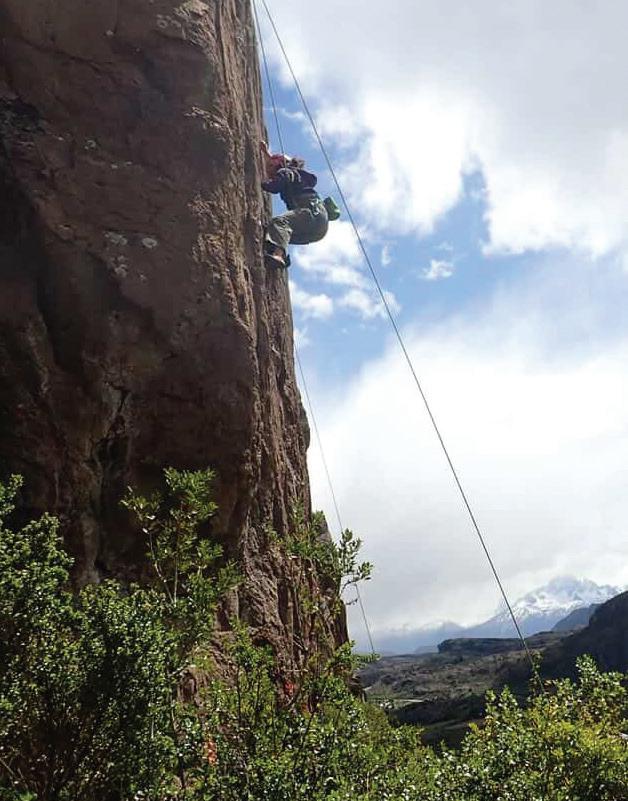
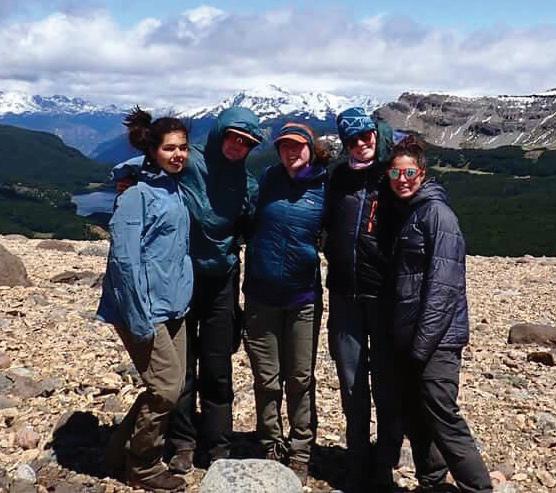
ADVENTURING IN THE ARCTIC (DOMINANT) — Izzy Bienaime backpacks through frozen fields in Patagonia.
LA DOLCE VITA (TOP) — Bienaime poses with some friends from Rome in the classic “I Heart Roma” t-shirts.
SAY CHEESE (ABOVE) — Taking a picture with her friends in front of a picturesque mountain, Bienaime uses a digital camera to capture the moment.
MOUNTAINOUS MISSION (LEFT) — Bienaime rock climbs up a rocky mountain in Patagonia, taking advantage of one of the many outdoorsy activities Nols has to offer.
my
24
H O U R
When everything that could go wrong, goes wrong
How did my trip to New York, which should have been six hours, take 24?
When I left my house Wednesday afternoon in the middle of March to catch my 4:30 p.m. flight, things were going great.
I was traveling with my dad and two brothers, Jonah and Joshi. My dad is genetically organized and my younger brother Joshi got this trait. Jonah is a superhuman who can stay calm through anything.
The trip from my house to SFO barely took any time. The 101 was empty and security was a breeze. My family and I got to the gate and boarded the plane with time to spare.
The flight to Newark International Airport flew by, until — with only an hour and 50 minutes remaining — I noticed that the estimated time remaining for the flight was fluctuating, one and a half hours left, one hour and fifty minutes left, 40 minutes.
The captain told us that bad weather had diverted our flight to Chicago and that we could take the earliest flight out after arriving.
We landed at midnight in Chicago with me feeling confused and a little angry. Why was this happening to me? Didn’t the universe know that I had to be in New York at noon for a competition.
started gathering information. Our “connec tion” to New York was scheduled for 2 a.m.,
D E T O U R
the bad weather was expected to last until 4 a.m.
My brother and dad booked a flight for 6:45 a.m. while I tried desperately to find a hotel near the airport. Thankfully, the airline had given us room vouchers.
We were lucky that there was a hotel adjacent to our gate. We were not so lucky to find out the hotel was completely booked after waiting in line for half an hour.
My dad called an Uber to the closest hotel eight miles away, but when the driver’s icon pulled into a McDonalds, we canceled it. Things were not going our way and my



for the new Uber to arrive. After a 30 minute drive, at 1:15 a.m. we arrived at a new hotel, enough for a whopping 3.5 hours of sleep. Once I got to my bed, I crashed.
After my alarm went off at 5:30 a.m. — I had set it for when I was supposed to be downstairs so I could get extra sleep — I rushed to meet my family in the Uber. On the way, I passed a restaurant buffet opening in an hour and realized I hadn’t eaten since the bean and cheese burrito on the plane.
There were very few TSA officers working at the airport thanks to the Department of Homeland Security shutdown, and the lines were long. We went to the closest and shortest line but — judging at the speed it was going — we would have missed our flight.
left-engine was broken, and our flight was cancelled.
I was about to cry. I was so close to making it to New York, but instead, I would be stuck in an airport for five hours. It was in sane. If I had known the engine was going to break, I would have stayed longer in the hotel, gotten more sleep, and eaten breakfast.
“I was about to cry. I was so close to making it to New York, but instead, I would be stuck in an airport for five hours.”
I ran down the hall, frantically searching for a TSA Pre-Check line and, once I found it, I quickly called over my family.
We made it through security and raced to our gate. The flight had called for boarding 20 minutes earlier, but miraculously we made it.
As flight attendants cheered us on, we put up our bags and took our seats. I breathed a sigh of relief, we had made it. I would make it to New York on time. Everything was fine.
Twenty minutes later, the flight attendants informed us that the captains wanted to perform checks on the engine. They said to take our bags with us as we disembarked the plane, in case we couldn’t get back on. They knew what they were doing.
The second we got off, my dad rushed to book a backup flight. The earliest he could find was a flight at noon to JFK, even further from our destination than Newark, where we were originally headed. Thirty minutes later, the flight attendants informed us that the
At last, at 11:15 a.m., we boarded a new plane, hoping that it would take us to New York.
It did. But fate was not done with us yet. Bad weather had caused terri ble traffic, and the Uber drive took two hours, more than twice as long as it should have.
I arrived at the hotel in New York at 5:30 p.m., 24 hours af ter leaving Palo Alto. A trip that should have taken no more than six hours took an entire day.
Through it all — the weath er, the lines, and the engine breakdowns — I realized I had one golden advantage that helped me make it through the night mare: my family.
In the midst of all the mad ness, we were each others’ rock.
When we first were stranded in Chicago, I worked on finding a hotel while my brother and dad searched for flights. After hours of travel, I was wiped out with exhaus tion, but my dad, ever reliable, re membered to order an Uber from the hotel to the

When we finally got on the plane, and disaster struck again — the engine broke, and we had to disembark. I was reeling, but our family put our heads together and looked for a flight out.
Next time you travel, try to find someone you trust — they might just come in clutch.

Text
by BENJAMIN CZARKA SANDEL
Art by CAITLIN KO

I believe in meeting the student as an individual with humor and deep intelligence, and that empathy is foundational to effective teaching.
Graduating from Stanford University, I taught creative writing at Boston University and afterwards spent several years living and teaching in Rome.
Lessons with Tobi & Friends is a team of educators who understand that modeling kindness, drive, and curiosity is just as important as teaching the fundamentals of grammar and geometry.
This is a team of skilled, passionate, wise educators I’m grateful to call my friends.
Summer Admissions Essay Coaching and SAT Prep